On several previous occasions “Snow White” and I have documented Ron Clutz’s misuse of MASIE Arctic sea ice extent data on his “Science Matters” blog. We agree with Ron that science matters, so on several occasions we have attempted to direct his attention to my interview with NASA/NSIDC scientist Walt Meier. Walt’s words of wisdom included:
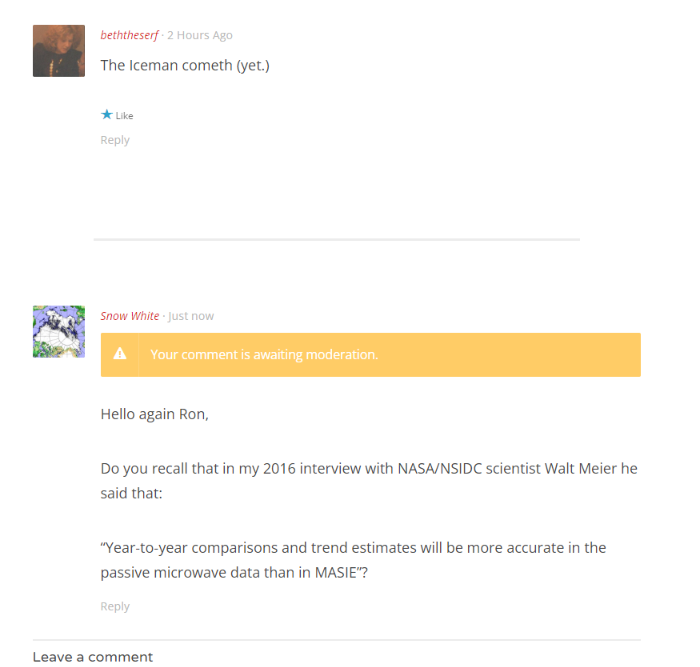
Year-to-year comparisons and trend estimates will be more accurate in the passive microwave data than in MASIE.
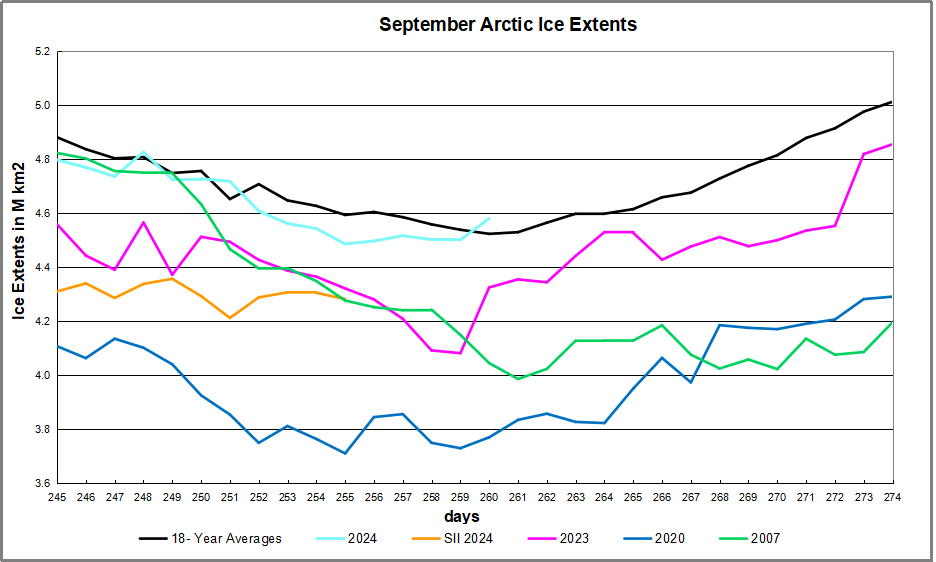
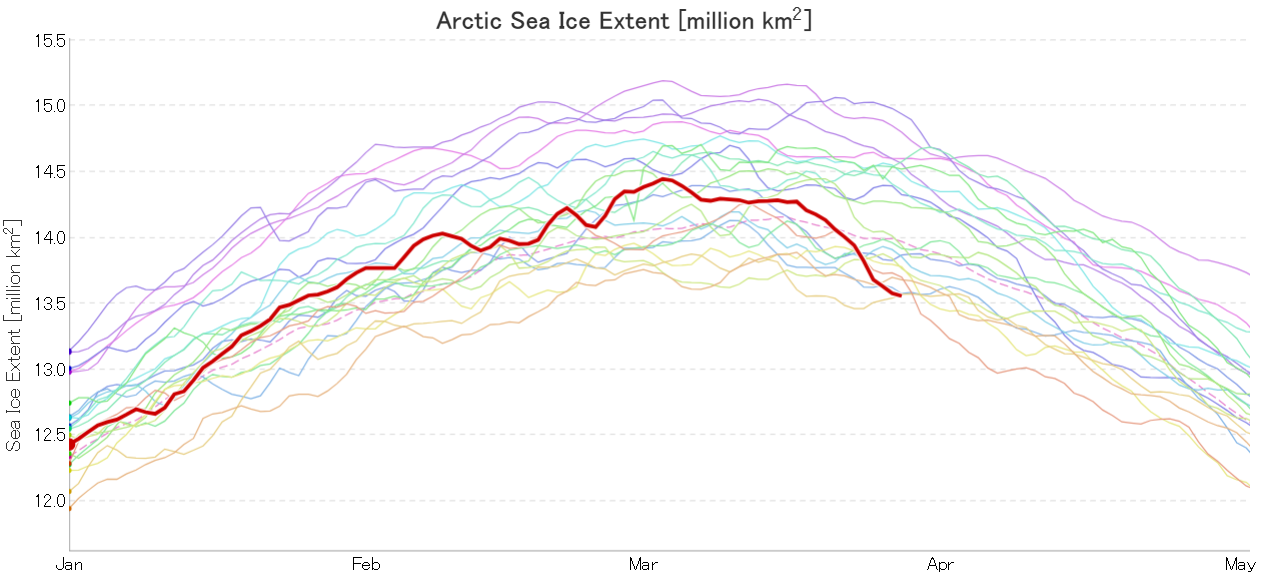
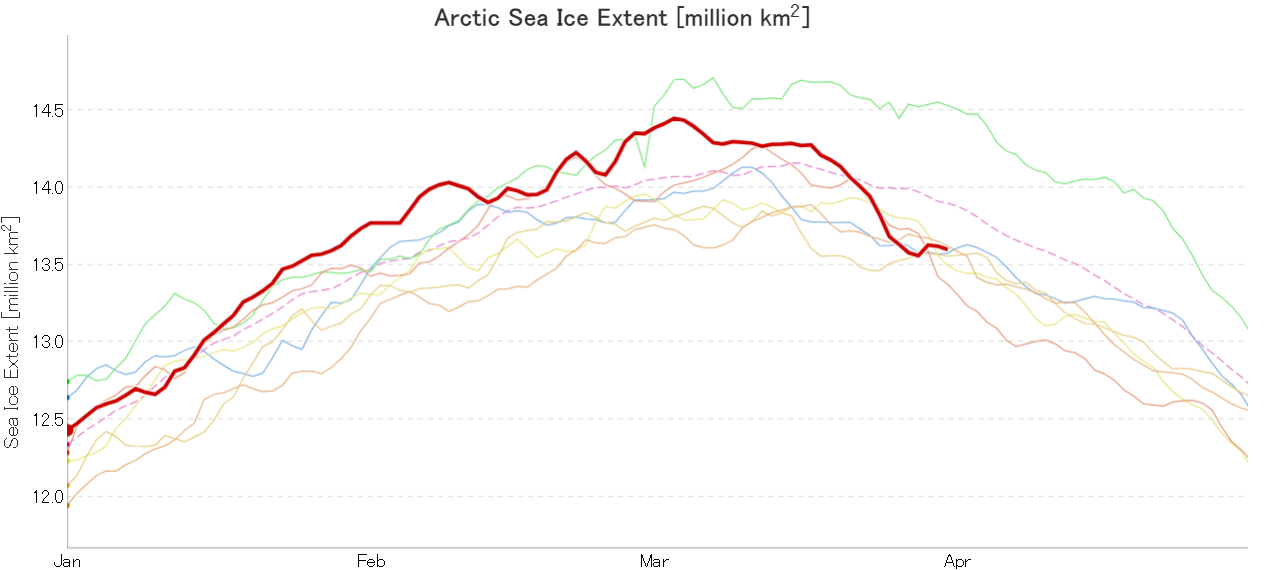
It will probably not surprise you to learn that Ron has not learned anything from our repeated efforts. In his article entitled “2024 Arctic Ice Beats 2007 by Half a Wadham” earlier today Ron proudly displays this graph:
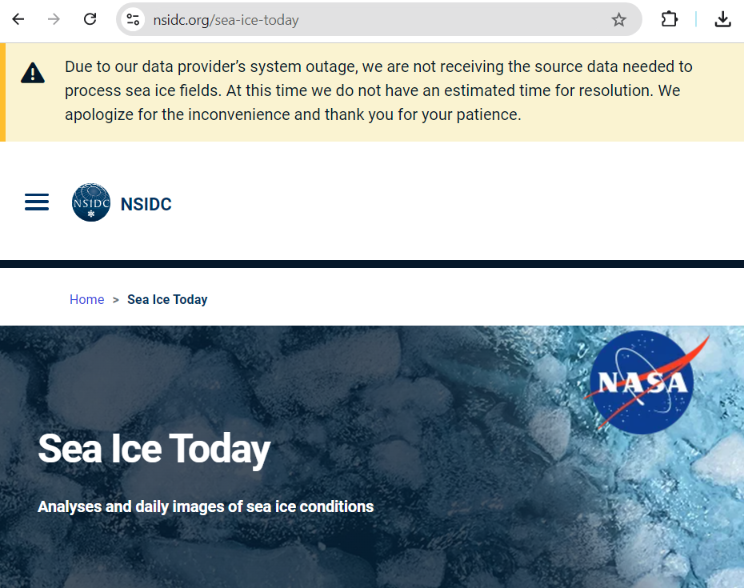
You will note that Ron does not provide details of his data source. However I have recently noted a sudden lack of SSMIS passive microwave data emanating from NOAA. The OSI SAF reported it this way on September 12th:
Dear OSI SAF Sea Ice Concentration User,
Due to missing input data, we have not been able to generate L2 products, corresponding to F-16 / F-17 / F-18 since Sep 11 19:36 UTC.
We apologize for any inconvenience.
The NSIDC’s sea ice home page puts it this way today:
Now day 260 of 2024 is September 16th, so it seems safe to assume that Ron is erroneously using his favourite MASIE metric for year to year comparisons yet again. In his article Ron states that:
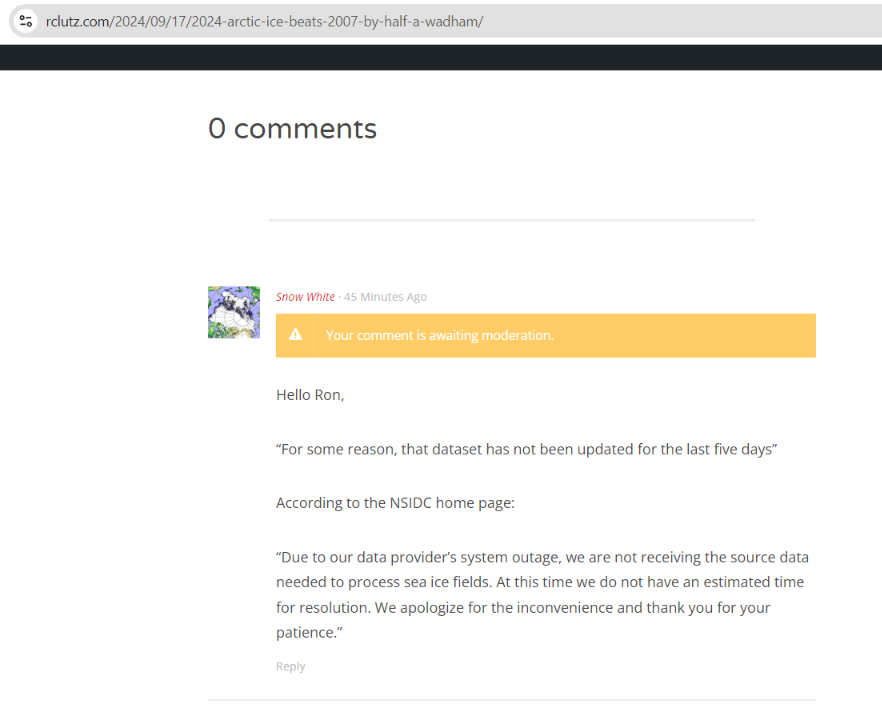
SII was reporting deficits as high as 0.5M km2 (half a Wadham) compared to MASIE early in September. For some reason, that dataset has not been updated for the last five days.
It appears as though Ron has also not yet learned how to find NSIDC’s sea ice home page on the world wide interweb!
I added this hopefully helpful comment below Ron’s article. For some strange reason it is yet to emerge from his moderation queue:
[Update – September 18th]
Our regular reader(s) will not be surprised to learn that my helpful comment yesterday is no longer in Ron’s moderation queue, but is now languishing underfoot on his cutting room floor.
Ron has written another Arctic article using the graph reproduced above. This one is entitled: “2024 Arctic Ice Abounds at Average Daily Minimum“. In it Ron assures his flock of faithful followers that:
We are close to the annual Arctic ice extent minimum, which typically occurs on or about day 260 (mid September). Some take any year’s slightly lower minimum as proof that Arctic ice is dying, but the image above shows the Arctic heart is beating clear and strong.
Over this decade, the Arctic ice minimum has not declined, but since 2007 looks like fluctuations around a plateau.
Ron has also changed his phraseology regarding the recent SSMIS data outage. This time it reads:
For some reason, apparently data access issues, that dataset has not been updated for the last five days.
“Snow White” felt compelled to leave Ron another helpful comment concerning his new words of Arctic wisdom:
It’s that time of year again! Tony Heller has been asserting that “summer is over at the North Pole” for several weeks now, and the 2023 Arctic sea ice minimum extent will occur at some point over the next four or five weeks. The exact date and level will almost certainly vary from one extent metric to the next.
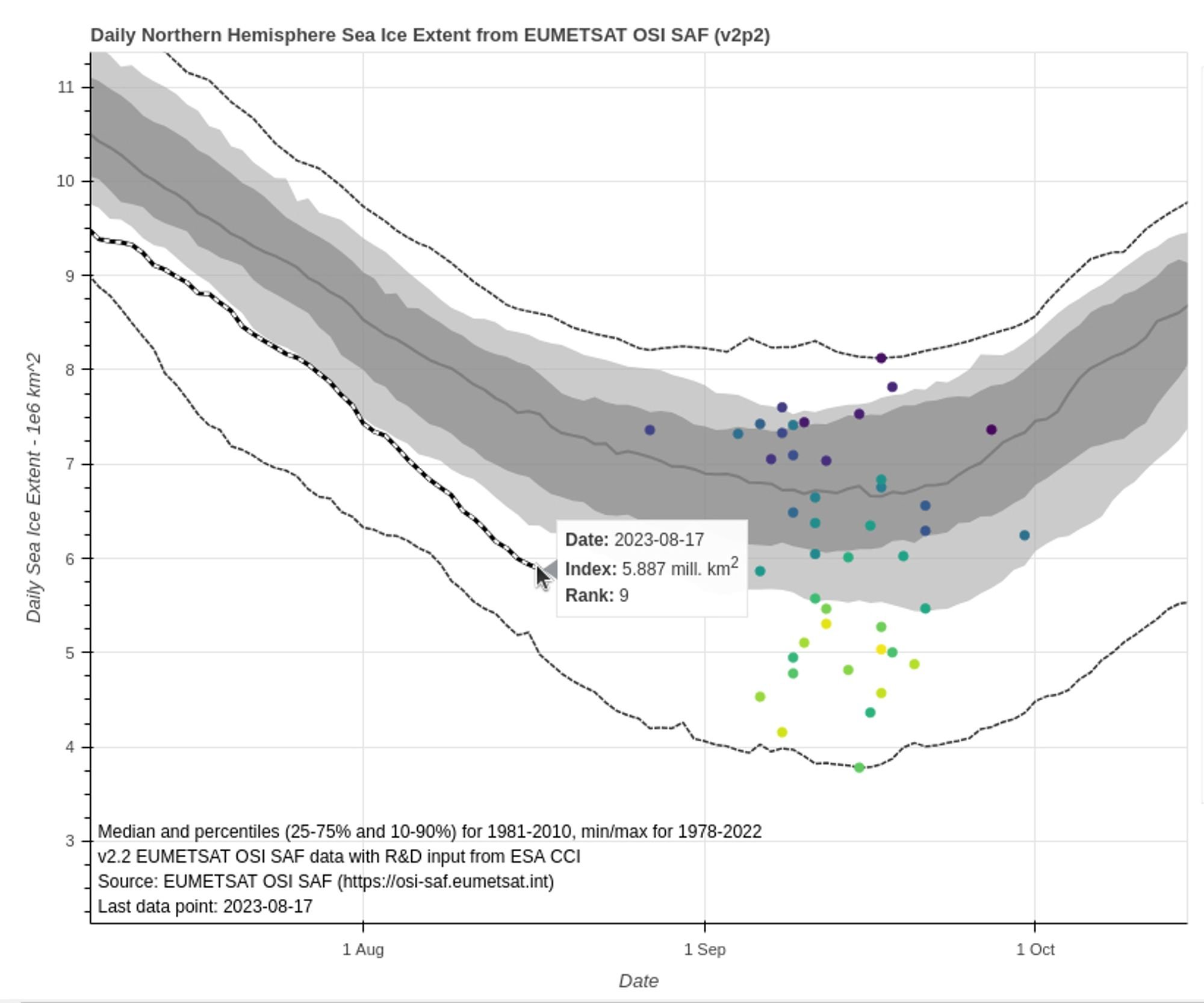
To get the minimum extent ball rolling, here’s Signe Aaboe’s graph of previous summer minima based on OSI SAF data:
Here too is Zack Labe’s equivalent, based on JAXA data:
Christmas is coming. Santa’s secret summer swimming pool has frozen over. The time has come for a new monthly Arctic update.
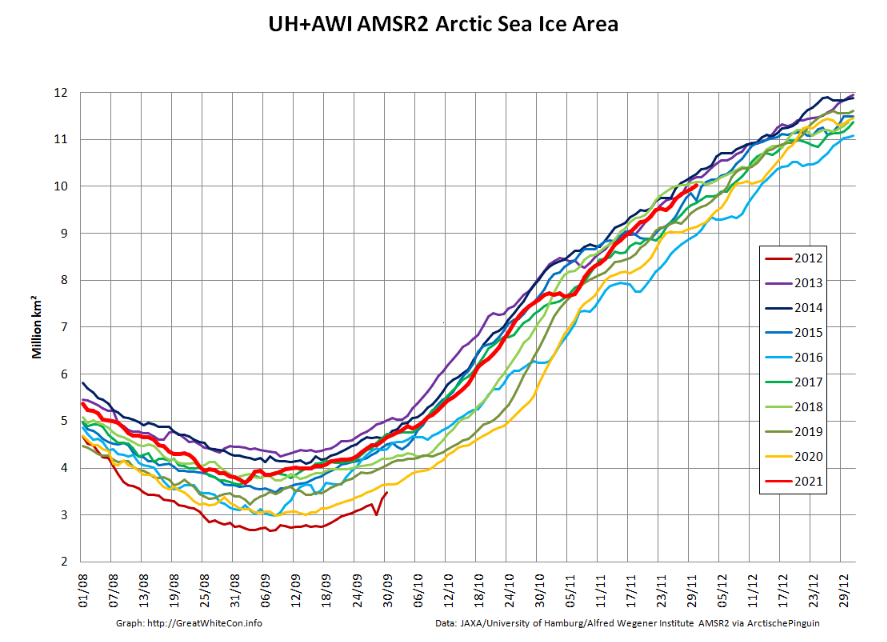
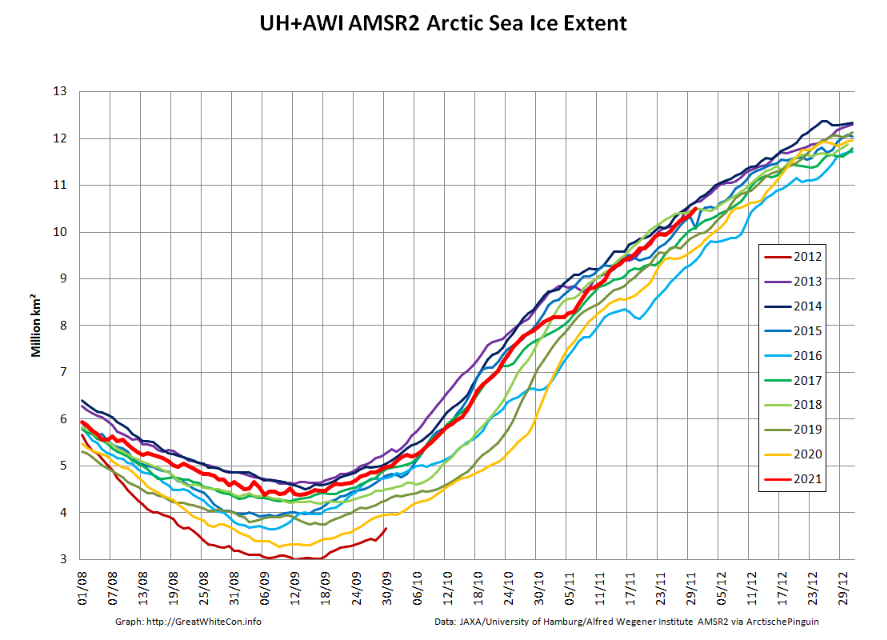
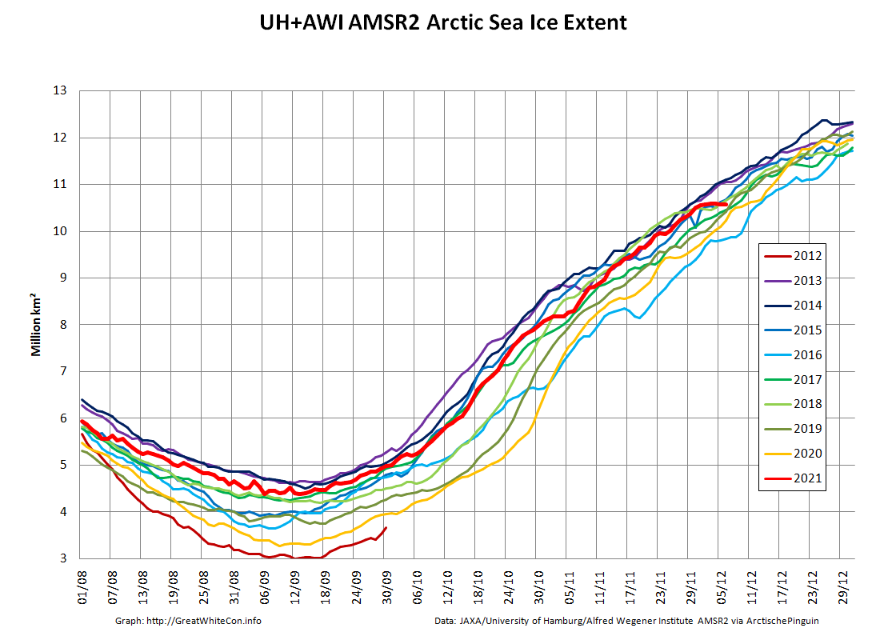
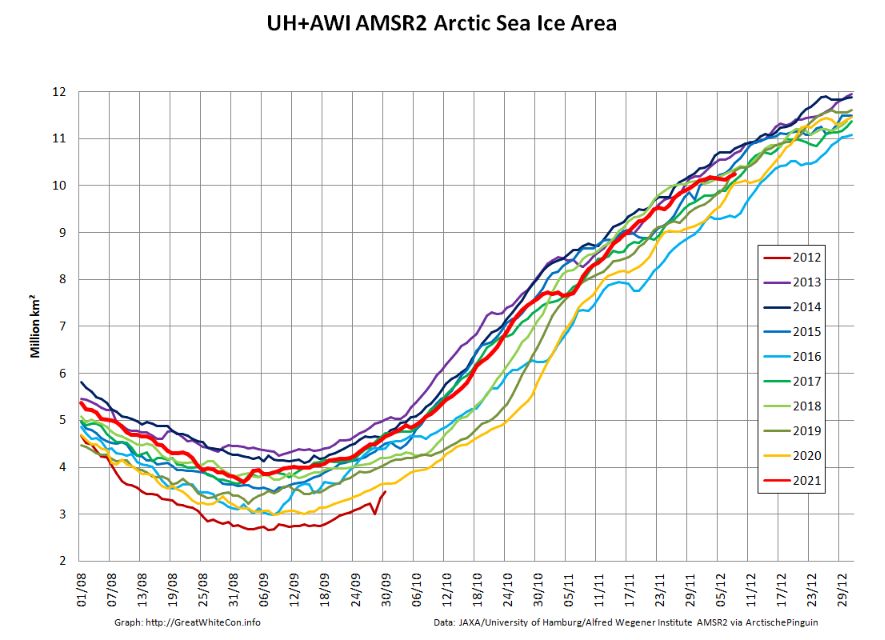
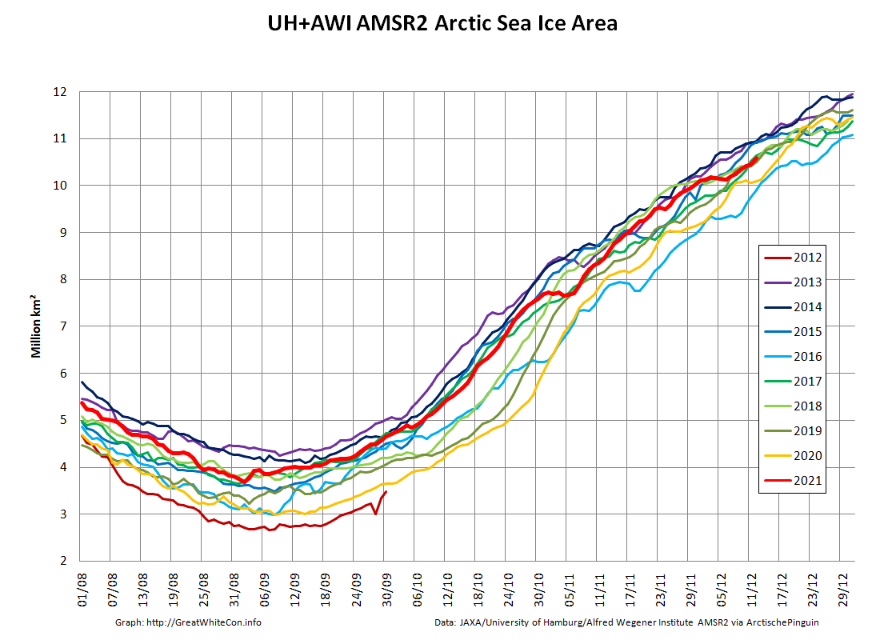
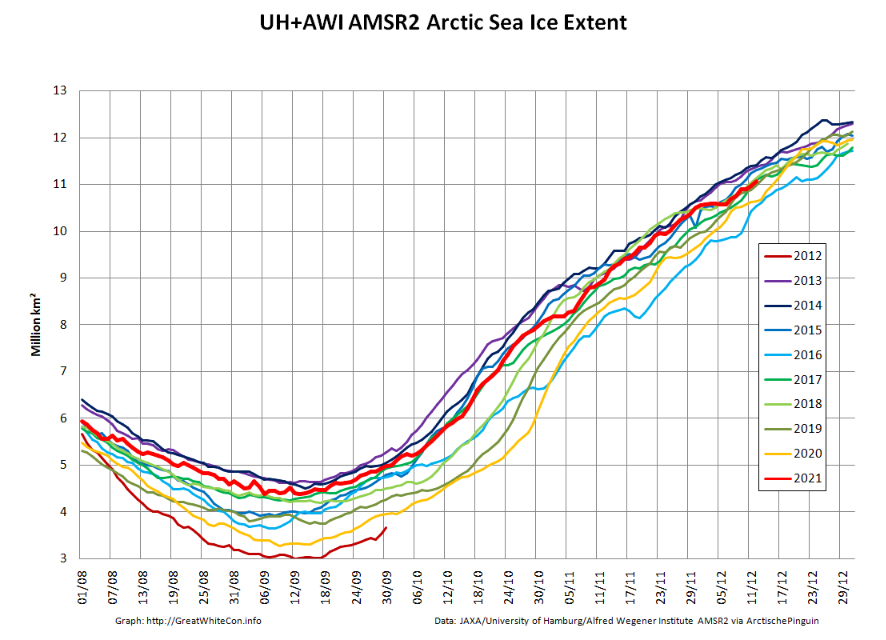
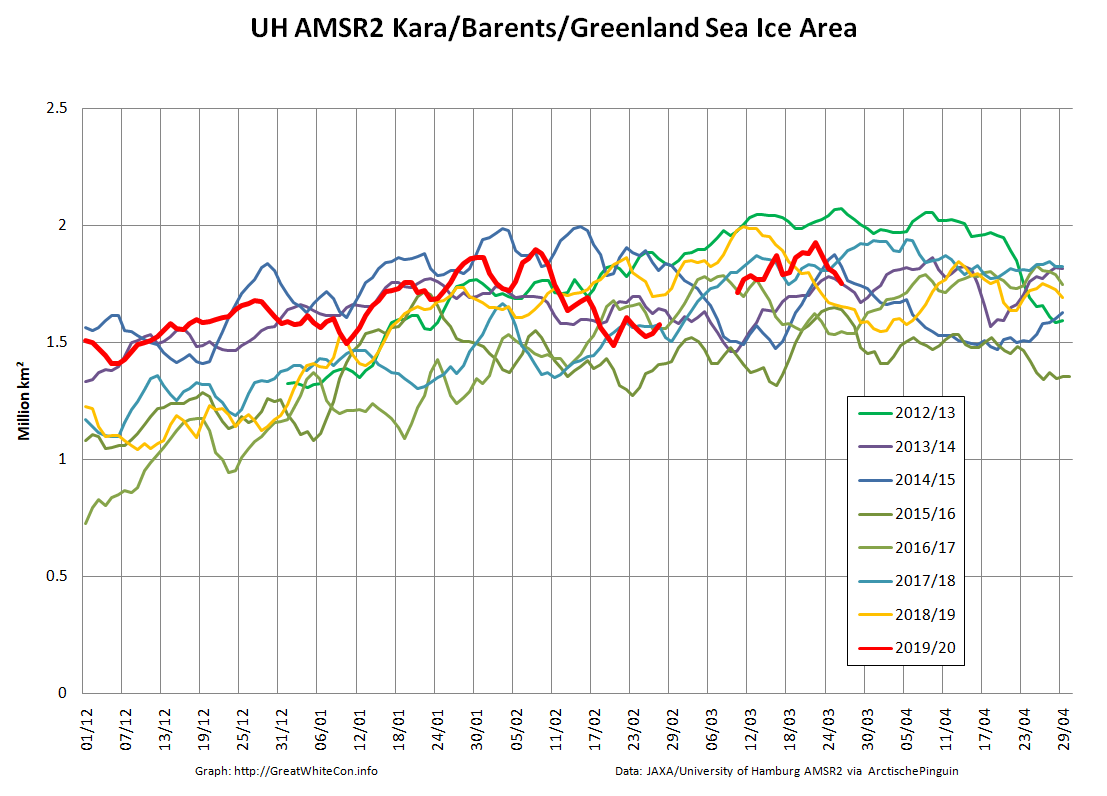
The JAXA/ADS/ViSHOP web site is undergoing maintenance for a week, so let’s start the festive season with a look at high resolution AMSR2 area and extent:
After a brief hiatus in early November both metrics are once again tracking within, but near the upper bound of the last 10 years.
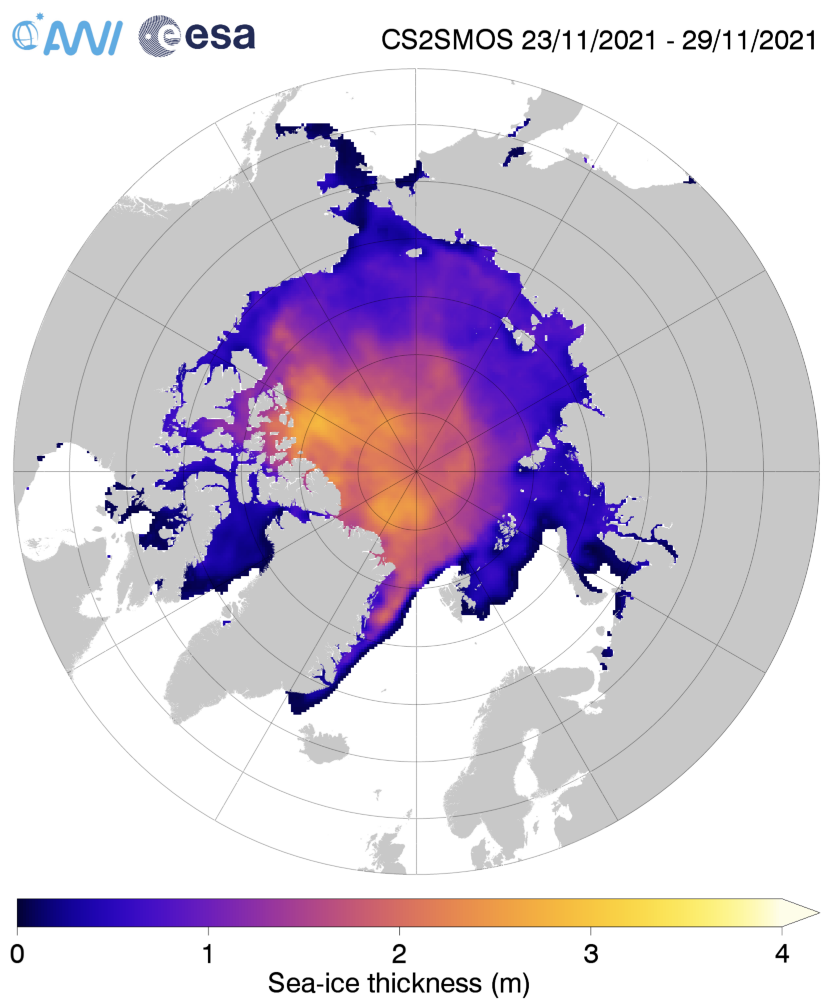
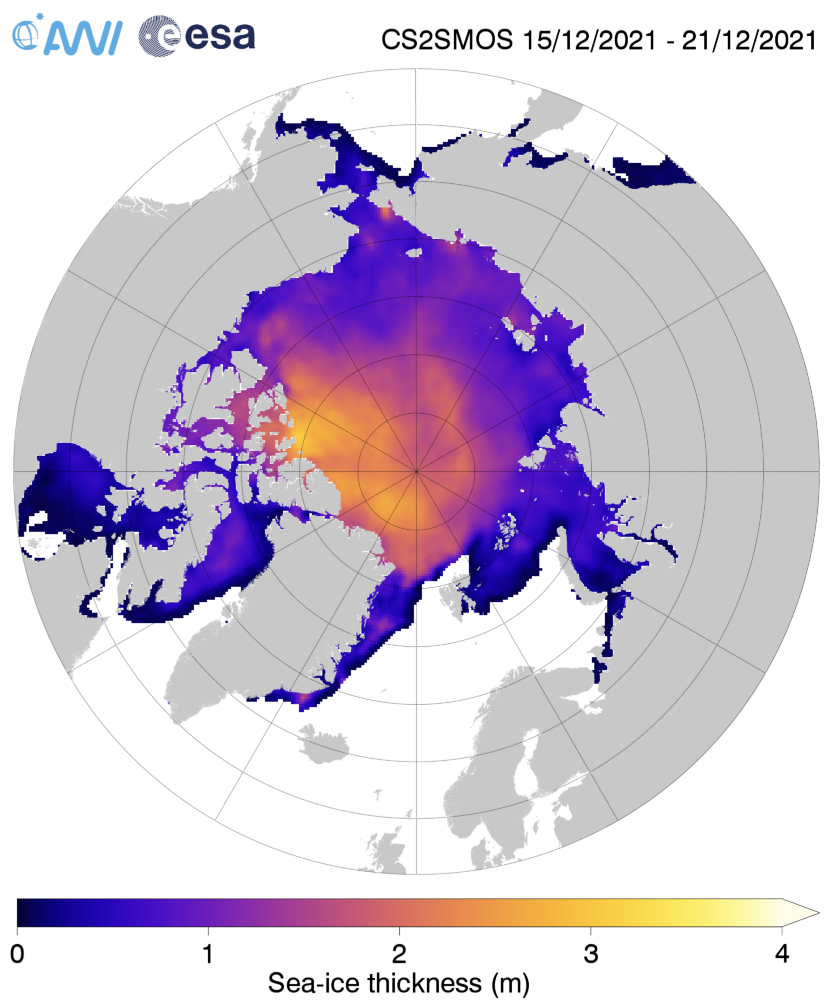
Next let’s take a look at the latest AWI CryoSat-2/SMOS thickness map:
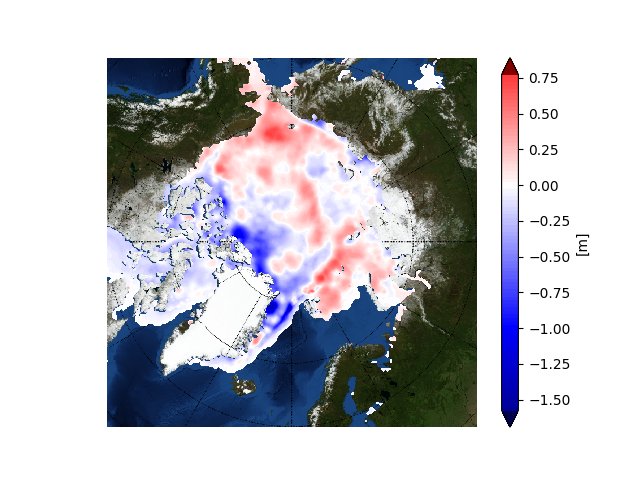
together with the anomaly map from the Finnish Meteorological Institute:
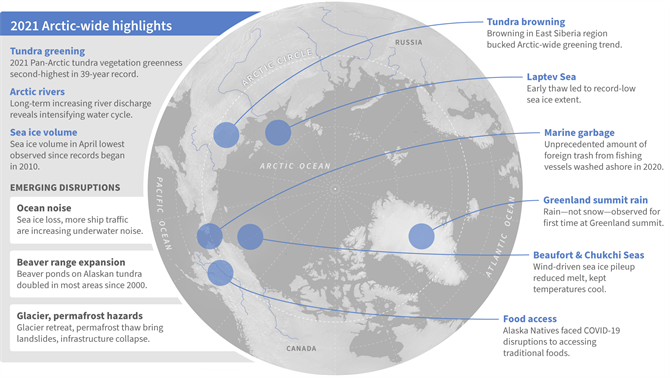
Still thinner than usual in the so called “last ice area” north of Greenland and Ellesmere Island, and thicker than usual on the Siberian side of the Arctic, particularly in the Chukchi Sea.
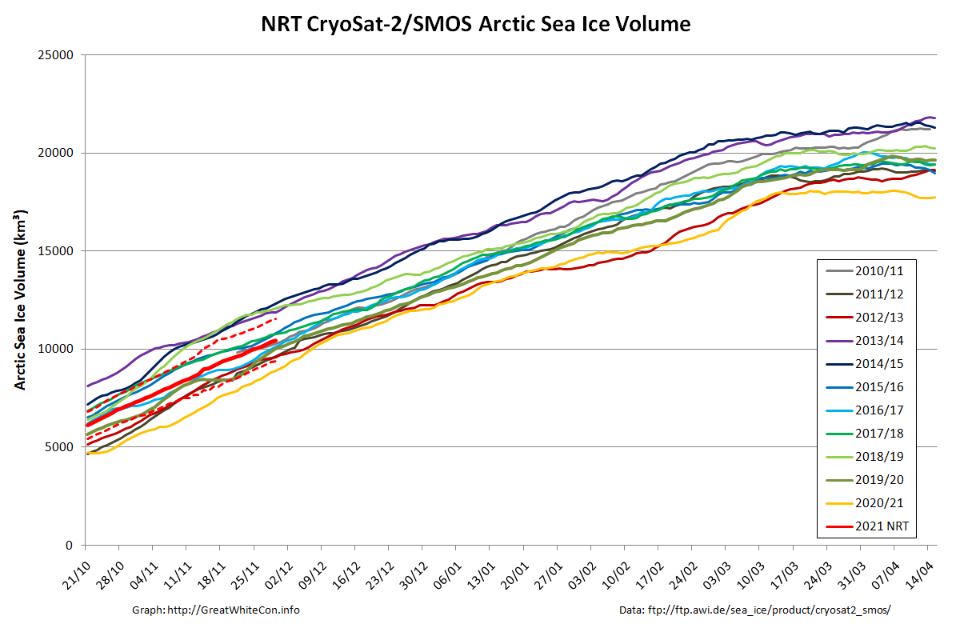
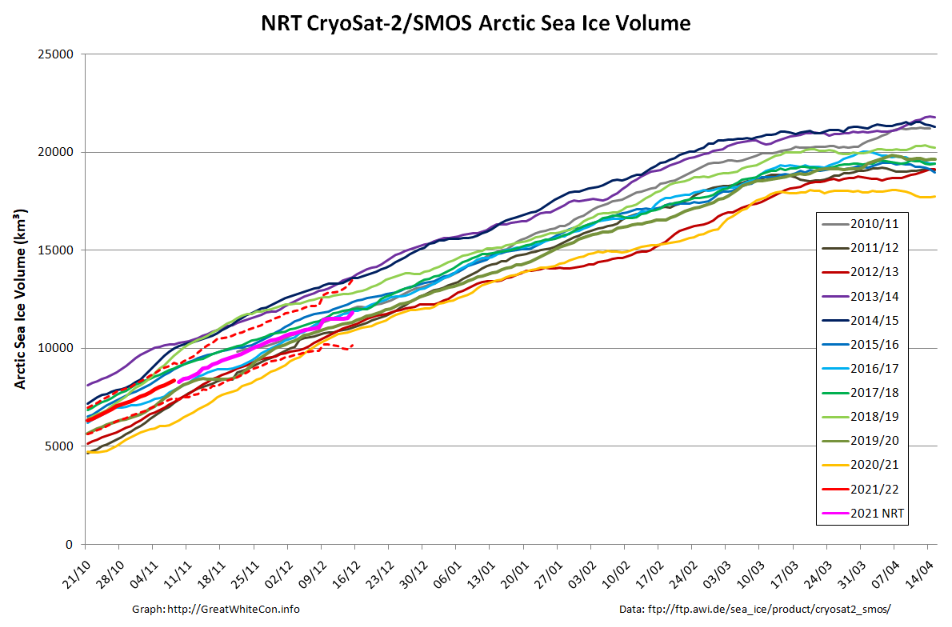
Finally, for the moment at least, here’s the latest CryoSat-2/SMOS volume graph:
Unlike the previous metrics, this particular one is close to the middle of the pack.
Sea ice extent increased at a faster than average pace through November and by the end of the month, extent was just within the interdecile range. Extent was above average in the Bering Sea, but Hudson Bay remained unusually ice free through the month.
The November 2021 monthly average extent was 9.77 million square kilometers (3.77 million square miles), which ranked tenth lowest in the satellite record. The 2021 extent was 930,000 million square kilometers (359,000 million square miles) below the 1981 to 2010 long-term average. Extent was higher than average in the Bering Sea, but is extremely low in Hudson Bay.
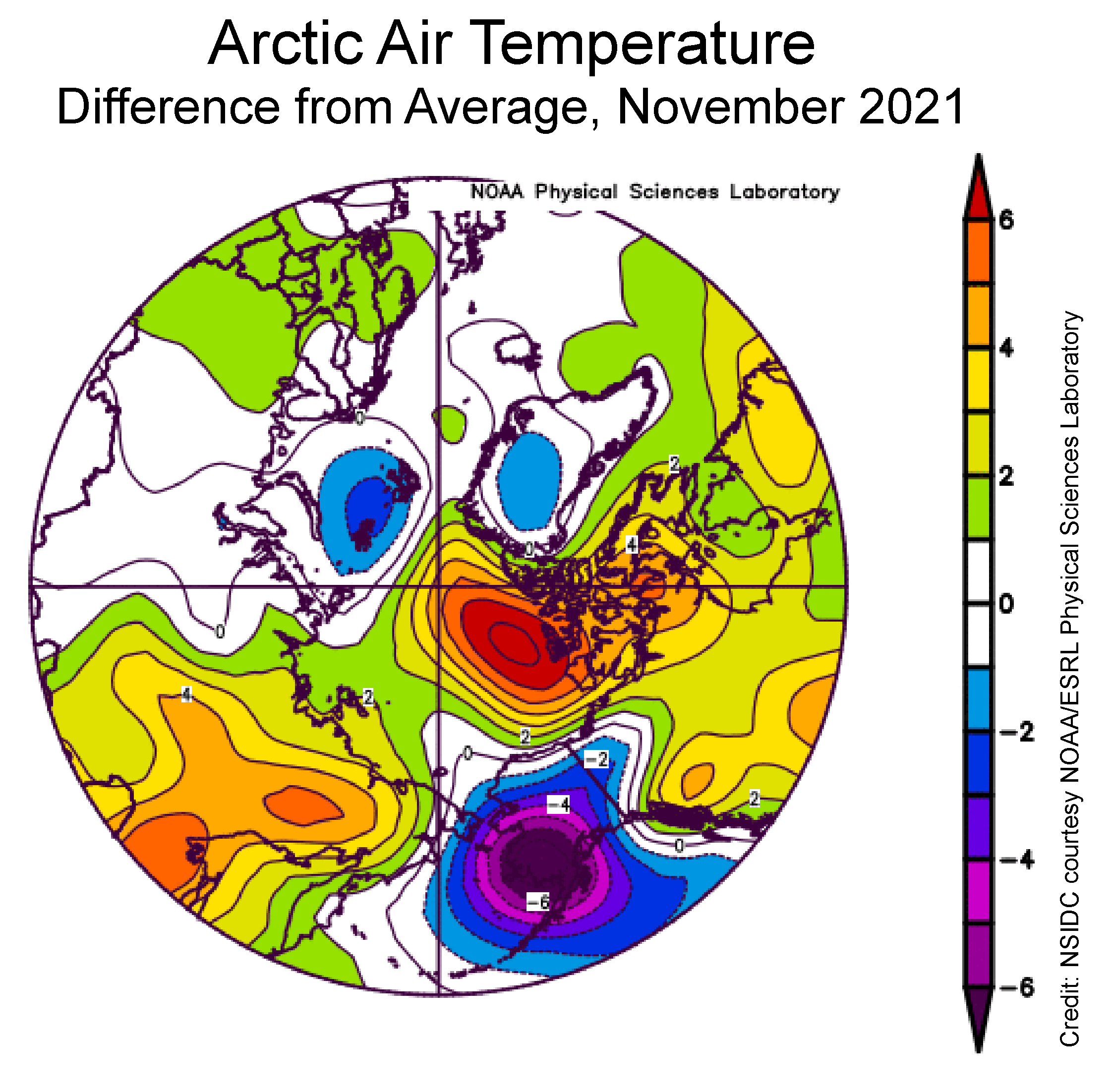
Air temperatures at the 925 millibar level (about 2,500 feet above the surface) were well above average north of the Canadian Archipelago, by as much as 6 degrees Celsius. Conversely, temperatures over southwest Alaska and the eastern sector of the Bering Sea were as much as 6 degrees Celsius below average:
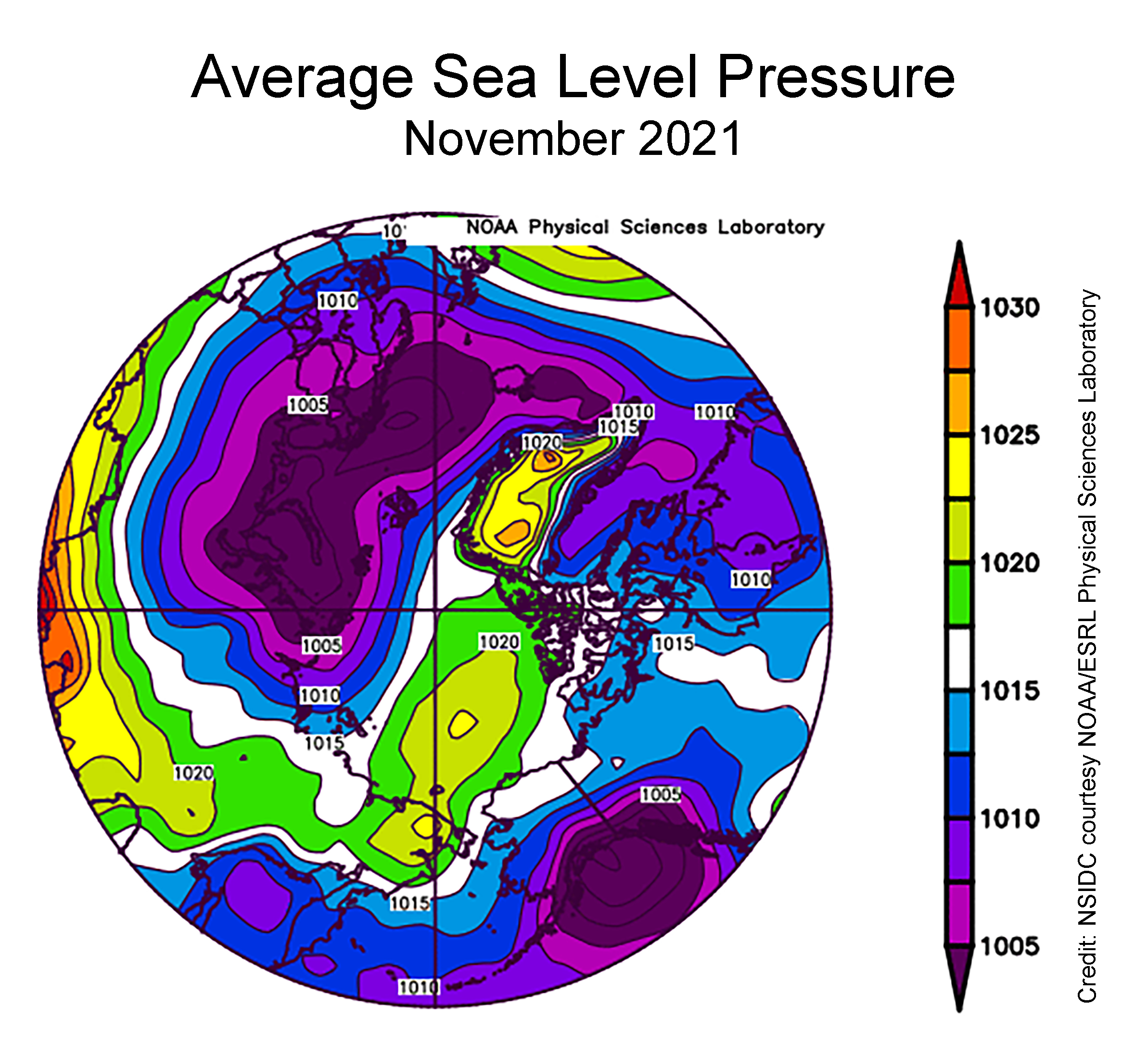
The sea level pressure pattern for November featured widespread low pressure over the Atlantic side of the Arctic and extending into the Barents and Kara Seas, paired with a moderately strong Beaufort Sea High. Strong low pressure over the Gulf of Alaska resulted in a circulation pattern in the eastern Bering Sea that brought cold air from the north. This pattern was favorable for sea ice growth, and can explain the above average ice extent in the region:
[Edit – December 7th]
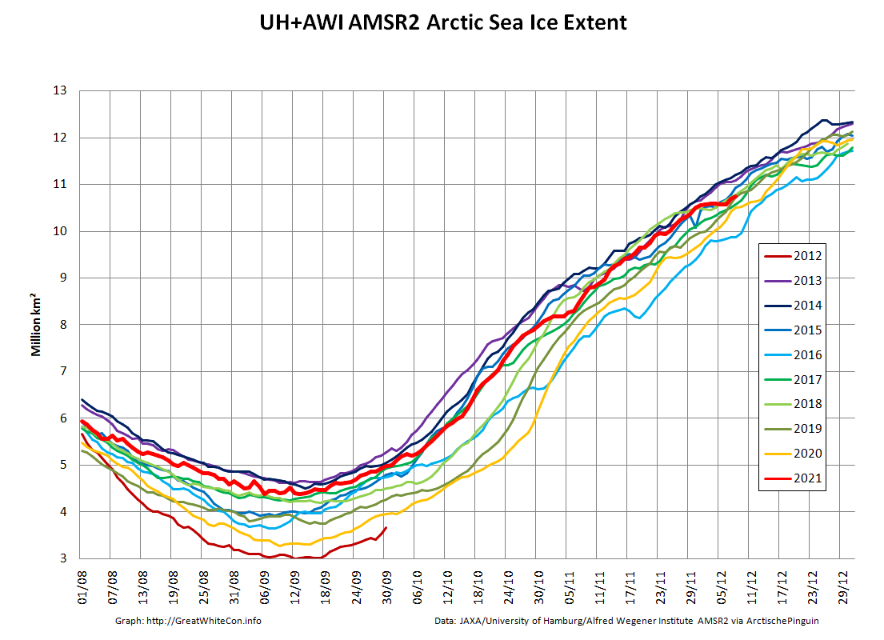
Since the start of December high resolution AMSR2 extent has been flatlining:
Sea ice area has even declined slightly over the past few days:
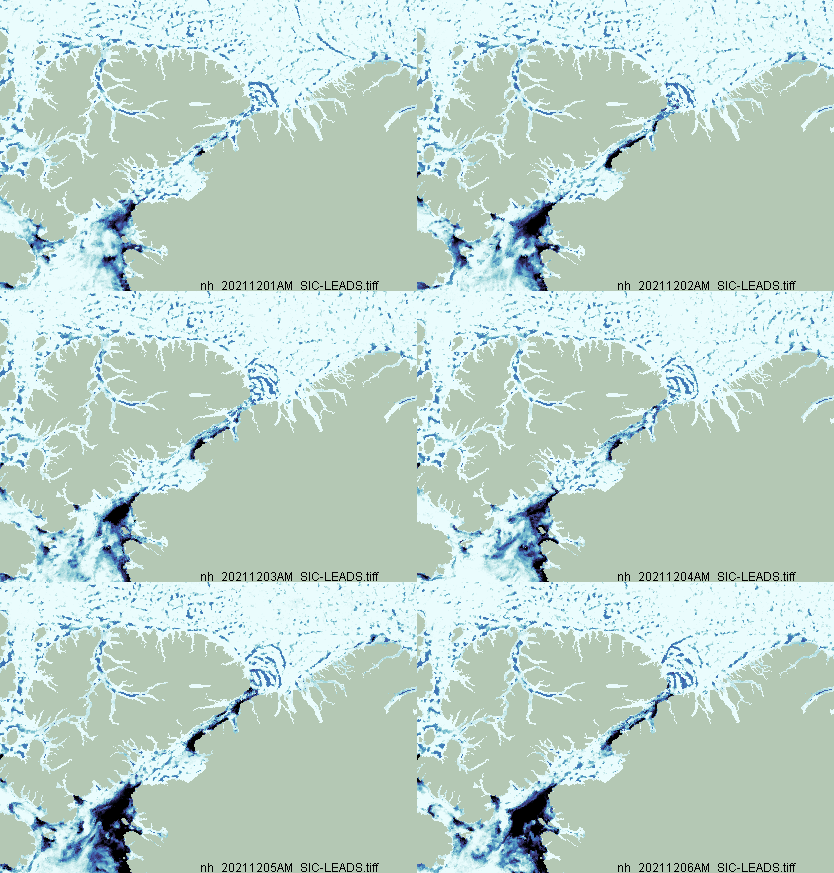
Here too is an animation created by Uniquorn on the Arctic Sea Ice Forum using AWI ASMR2 data to reveal ice movement through the Nares Strait during December:
[Edit – December 9th]
The JAXA/ADS/ViSHOP web site is down again, so let’s take another look at high resolution AMSR2 area and extent:
It seems that the “brief hiatus” is over, and extent is now in a “statistical tie” with 2018/19 at 4th lowest for the date amongst recent year.
[Edit – December 13th]
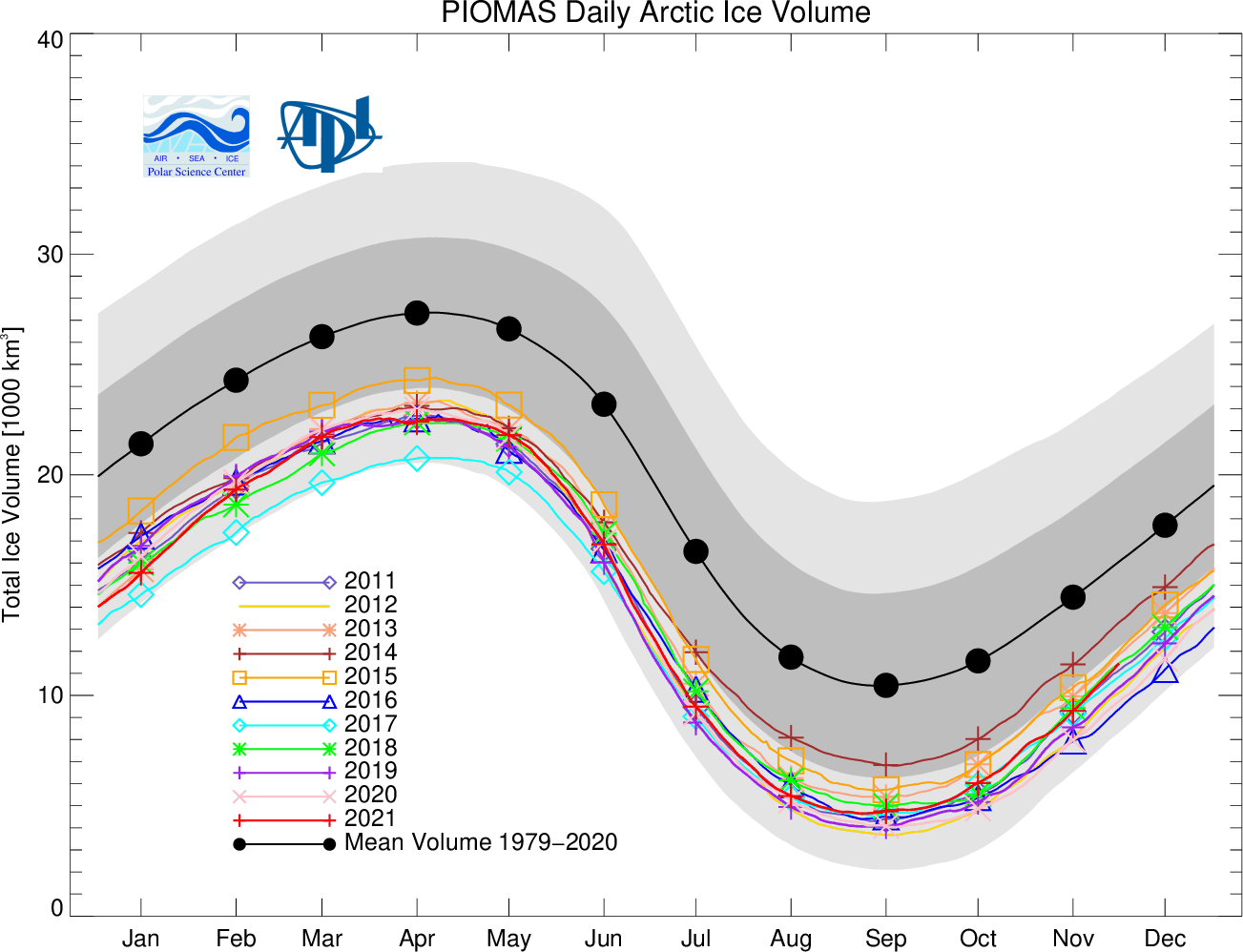
The PIOMAS Arctic sea ice volume data for November 2021 has been released:
Average Arctic sea ice volume in November 2021 was 7,830 km3. This value is the 7th lowest on record for November, about 1600 km3 above the record set in 2016. Monthly ice volume was 61% below the maximum in 1979 and 45% below the mean value for 1979-2020. Average November 2021 ice volume was about one sigma above the 1979-2020 trend line. October saw relative rapid ice growth for recent years bringing the mean ice thickness (above 15 cm thickness) above the recent low values:
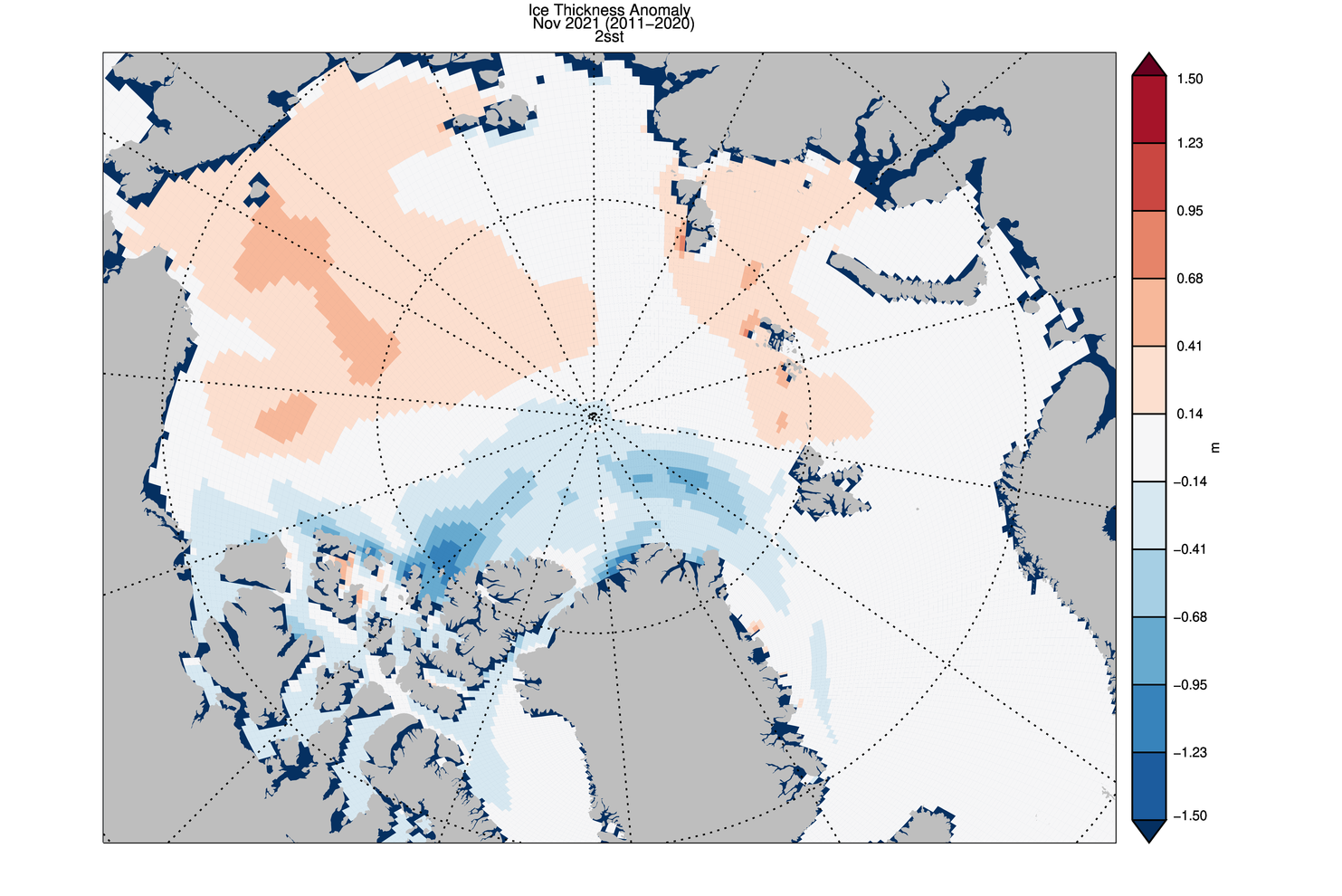
The ice thickness anomaly map for November 2021 relative to 2011-2020 continues to show anomalies divided into positive and a negative halves with areas of positive anomalies increasing since the two prior months. Negative anomalies stretching from North of Greenland and along the Canadian Archipelago across the Eastern Arctic into the Barents Sea. Areas North of Greenland again feature very low ice thickness as in prior years (see our recent paper). Positive anomalies are notable in the Beaufort and Chukchi seas due to advection of thicker older ice into the areas during the previous winter (See recent paper on this). The Alaskan summer has also been relatively cold contributing to unusually thick ice in this area:
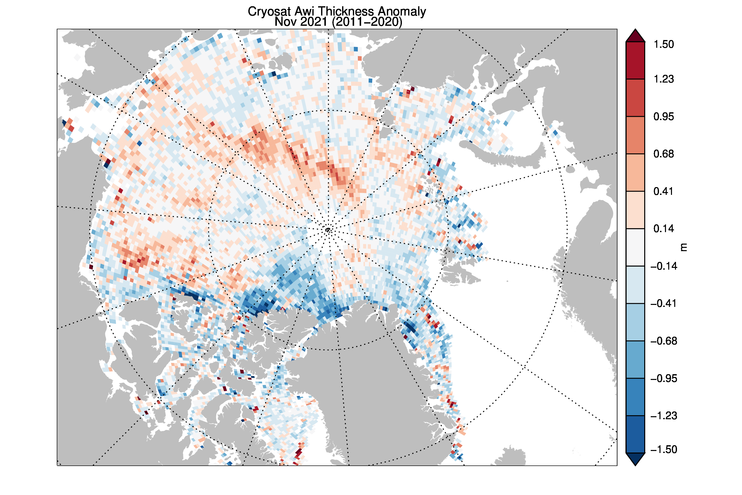
CryoSat-2 ice thickness shows a similar picture sea ice thickness anomalies but with the maxima slightly displaced which maybe due to temporal sampling of the composite:
The JAXA web site is still down, so here’s another set of high resolution AMSR2 graphs:
[Edit – December 14th]
NOAA have just released their 2021 Arctic Report Card. Here’s the introductory video:
“Everybody knows [the Arctic] is a canary when it comes to climate change,” says Peter Jacobs, a climate scientist at NASA’s Goddard Space Flight Center, who presented the work on 13 December at a meeting of the American Geophysical Union. “Yet we’re misreporting it by a factor of two. Which is just bananas.”
Jacob’s co-authors include researchers who oversee several influential global temperature records, and they noted the faster Arctic warming as they prepared to release the global temperature average for 2020. NASA’s internal peer reviewer challenged the higher figure, suggesting the scientific literature didn’t support it. But the researchers have found the four times ratio holds in record sets from both NASA (3.9) and the United Kingdom’s Met Office (4.1), and they hope to soon include the Berkeley Earth record. (Their work also has company: In July, a team at the Finnish Meteorological Institute posted a preprint also arguing for the four times figure.)
The researchers found Arctic warming has been underestimated for a couple of reasons. One is climate scientists’ tendency to chop each hemisphere into thirds and label the area above 60°N as the “Arctic”—an area that would include, for example, most of Scandinavia. But the true definition of the Arctic is defined by Earth’s tilt. And, as has been known for centuries, the Arctic Circle is a line starting at 66.6°N. When researchers lump in the lower latitudes, “you’re diluting the amount of Arctic warming you’re getting,” Jacobs says. “That is not a trivial thing.”
The other difference is the choice of time periods over which the warming rate is calculated. Jacobs and his colleagues focused on the past 30 years, when a linear warming trend emerged for the Arctic. Analyses that look at longer term trends see less divergence between the Arctic and the world.
[Edit – December 23rd]
Here is the latest CryoSat-2/SMOS volume graph, now including some reanalysed data which seems to have come in slightly higher than the earlier “near real time” numbers:
Plus the AWI thickness map:
Further discussion of the divergence between volume and extent continues in the new New Year 2022 thread:
Earth’s energy imbalance is of course a critical factor driving “global warming”. According to NASA back in June:
Researchers have found that Earth’s energy imbalance approximately doubled during the 14-year period from 2005 to 2019.
Earth’s climate is determined by a delicate balance between how much of the Sun’s radiative energy is absorbed in the atmosphere and at the surface and how much thermal infrared radiation Earth emits to space. A positive energy imbalance means the Earth system is gaining energy, causing the planet to heat up.
Scientists at NASA and NOAA compared data from two independent measurements. NASA’s Clouds and the Earth’s Radiant Energy System (CERES) suite of satellite sensors measure how much energy enters and leaves Earth’s system. In addition, data from a global array of ocean floats, called Argo, enable an accurate estimate of the rate at which the world’s oceans are heating up. Since approximately 90 percent of the excess energy from an energy imbalance ends up in the ocean, the overall trends of incoming and outgoing radiation should broadly agree with changes in ocean heat content.
“The two very independent ways of looking at changes in Earth’s energy imbalance are in really, really good agreement, and they’re both showing this very large trend, which gives us a lot of confidence that what we’re seeing is a real phenomenon and not just an instrumental artifact, ” said Norman Loeb, lead author for the study and principal investigator for CERES at NASA’s Langley Research Center in Hampton, Virginia. “The trends we found were quite alarming in a sense.”
As our regular reader(s) will no doubt already be aware, Willis Eschenbach has been singularly unhelpful when it comes to assisting 3rd parties to reproduce the results contained in his 2014 letter to the editor of PNAS on the topic of “Arctic albedo”:
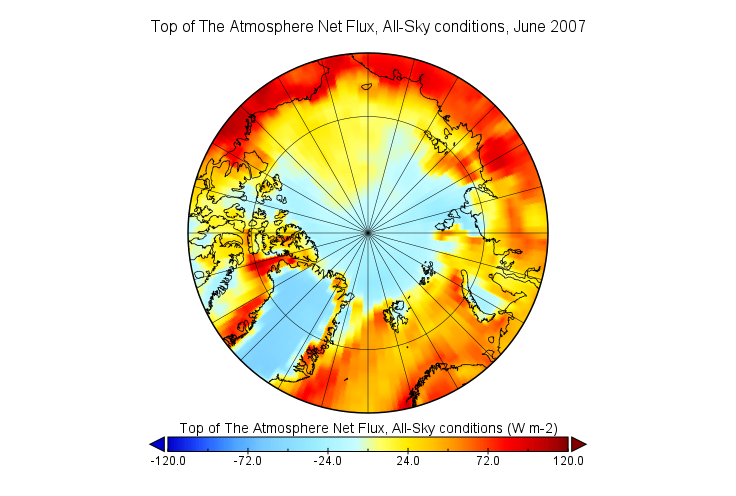
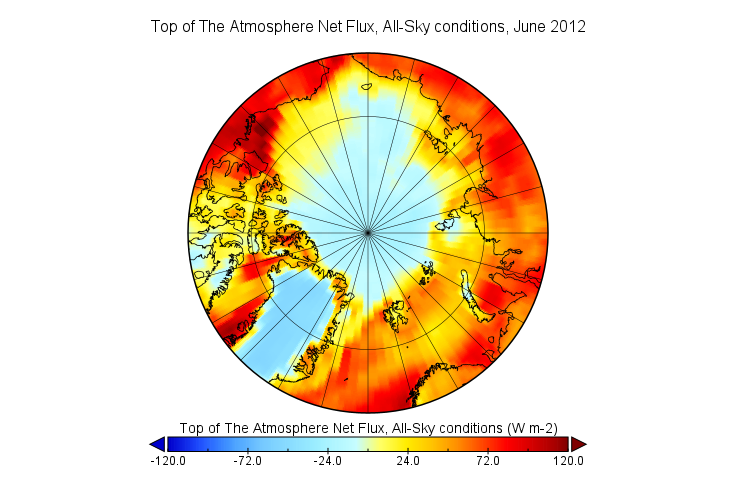
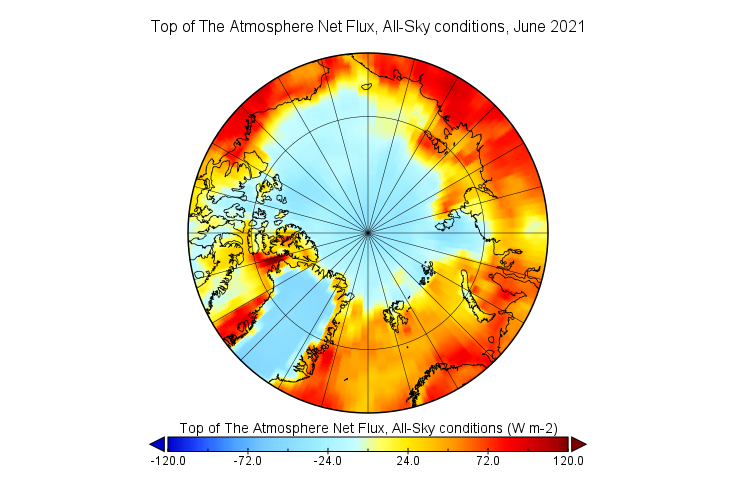
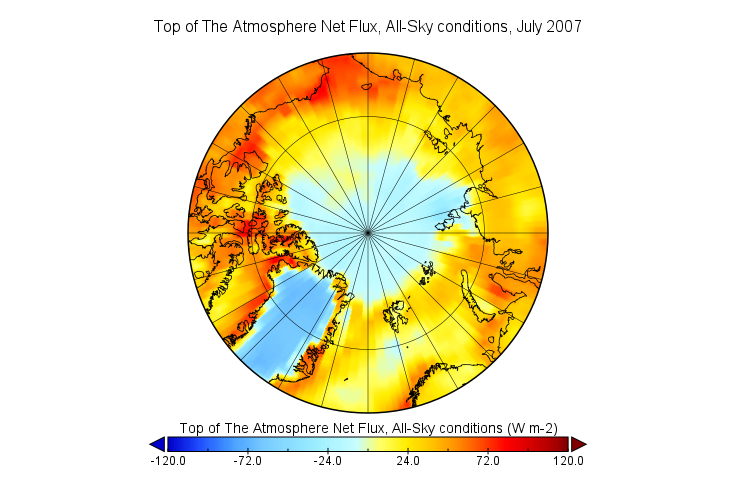
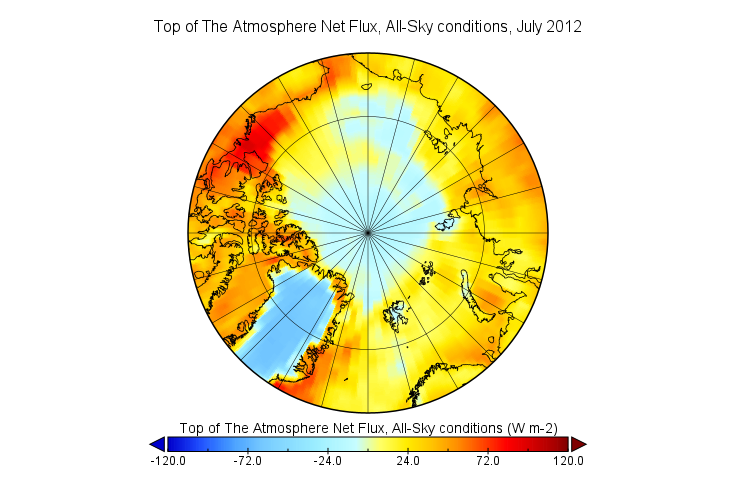
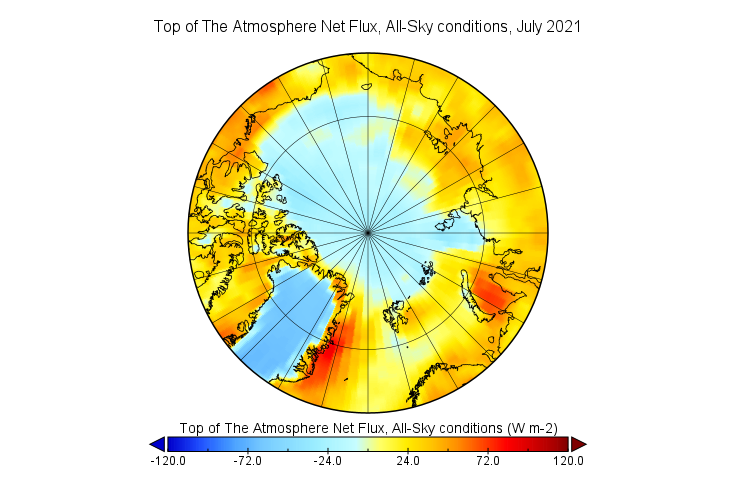
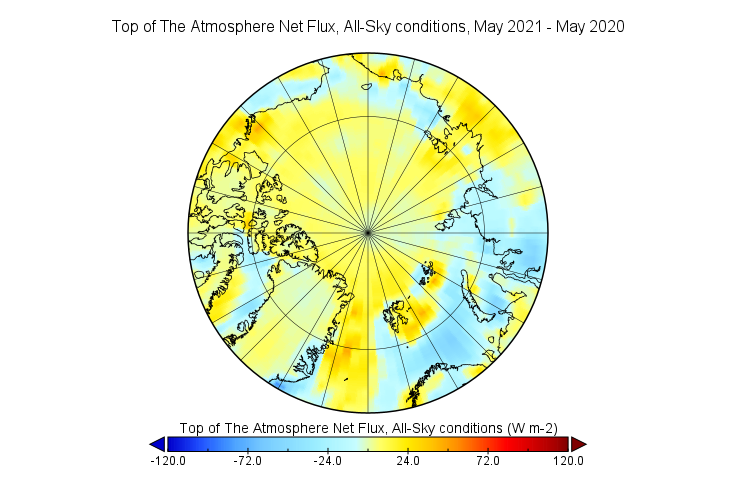
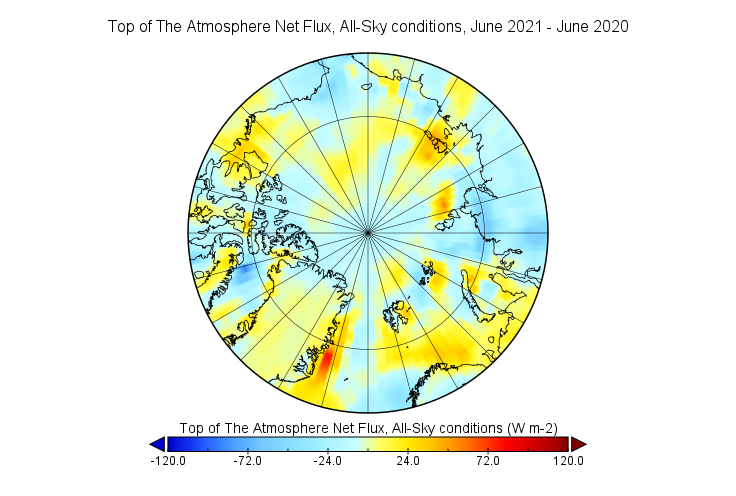
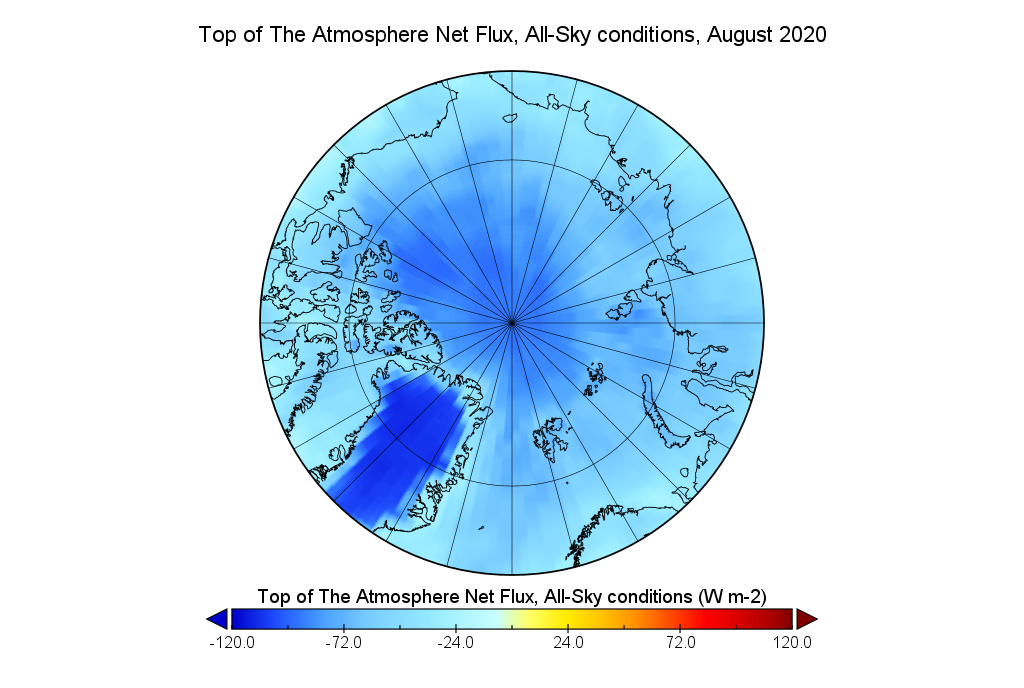
Whilst we wait (in vain?) for Willis to explain himself, here is a preliminary look at some example CERES net top of the atmosphere energy flux maps for the Arctic:
June 2021 is the latest month currently available in NASA’s CERES data, and please feel to play the game of “spot the difference” in the space provided for that purpose below. Meanwhile we await the data for July and August 2021 with barely bated breath.
[Edit – November 3rd]
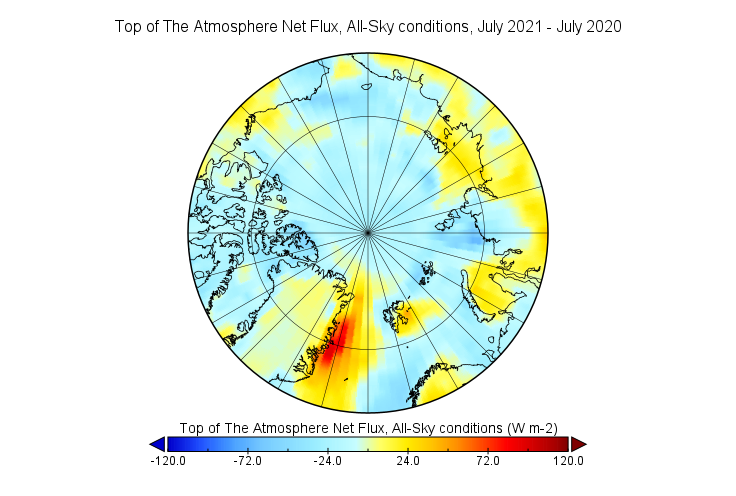
The CERES data for July 2021 has now been released, so first of all let’s take a look at the July net TOA flux for some selected years:
Next let’s compare this year’s peak insolation months with last year’s:
Does anything stand out yet?
[Edit – January 1st]
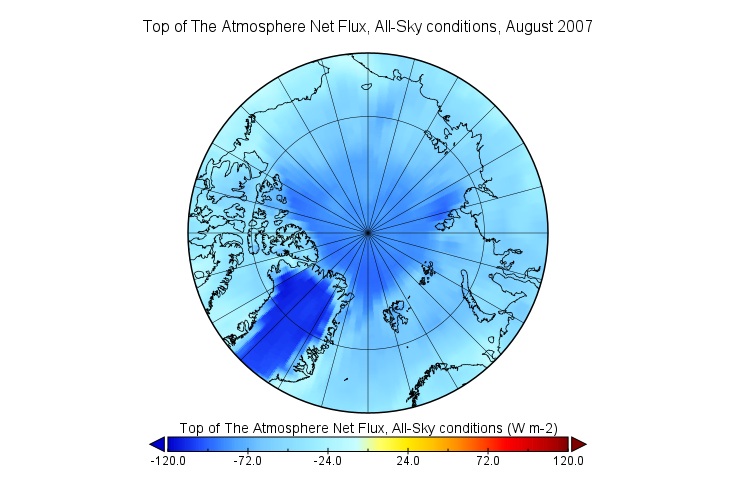
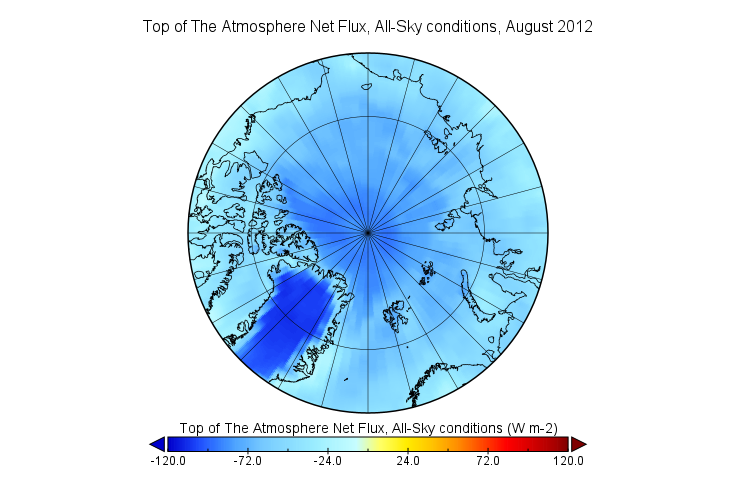
Here are maps of the CERES net TOA flux for August 2021 and our usual selection of other years:
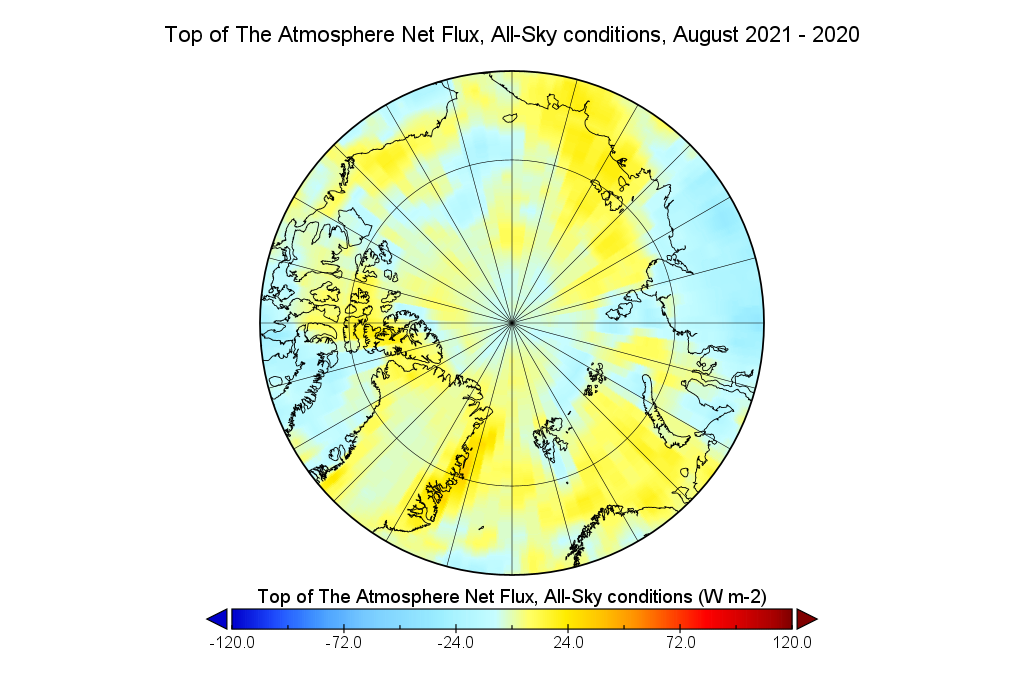
It is obvious that by August the entire Arctic is radiating energy back into space. Now let’s compare August 2021 with 2020:
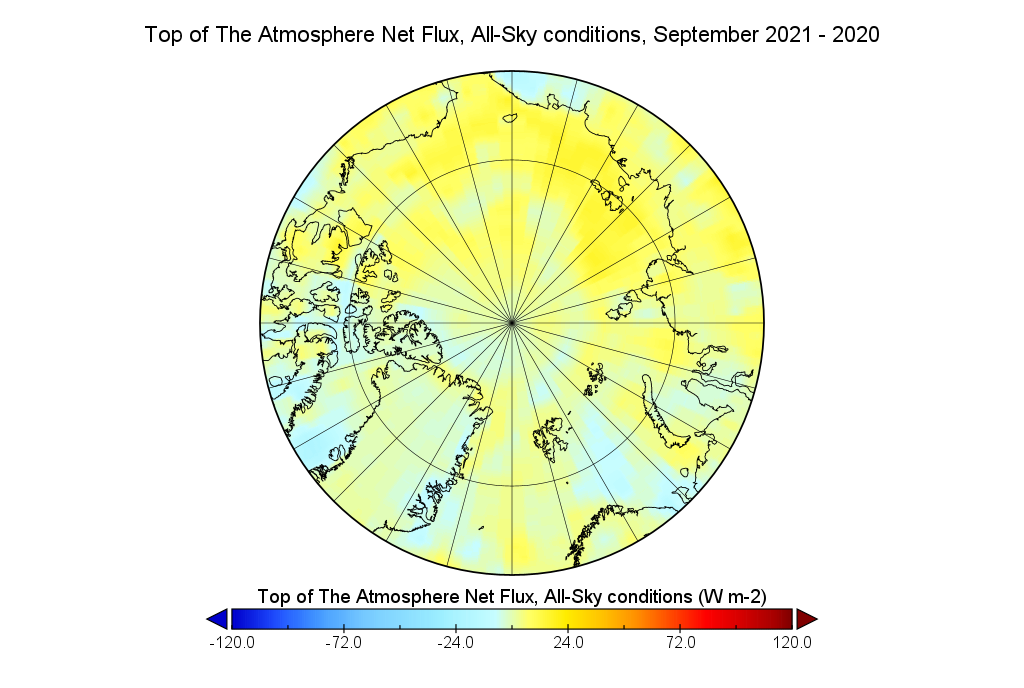
Whilst we’re at it let’s also take a look at how September compares to last year:
It is also obvious that the central Arctic has been radiating less energy back into space during September this year than it was in 2020.
The results of the ARCUS Sea Ice Prediction Network August call have been released, and here is the outlook for the 2021 minimum September mean Arctic sea ice extent:
The median prediction for the mean sea ice extent during the month of September 2021 is 4.39 million km2. According to ARCUS:
As of 22 August 2021, the Arctic sea-ice extent was 5.58 (compared with 25 August 2020 value of 4.43) million square kilometers. Arctic sea-ice extent in 2021 remains well below the climatological median and has closely followed the 2012 values for much of the summer but has diverged to higher sea-ice extent starting in early August. The forecasts continue to support September 2021 mean sea-ice extent being well above the September 2020 value. July sea-ice retreat has been greatest in the Eurasian seas, particularly in the East Siberian Sea, making the 2021 ice edge well north of the long-term median edge in Eurasia. Sea ice retreated since the end of July along the northern coast of Alaska, although the ice edge is near its climatological position, which makes the Beaufort and Chukchi sea ice extent the largest at this time of year since 2006. A tongue of sea ice that has been present all summer continues to extend close to land in the Kara Sea, making the northeast passage likely to remain blocked for the first time in several years. Half the models which provide spatial data to the SIO predict that the tongue is likely to survive.
Now let’s take a look at a range of assorted extent measurements. Here’s the NSIDC’s 5 day average extent:
It’s been a long wait since NASA launched the ICESat-2 satellite in September 2018:
However some good news has arrived at long last! ICESat-2 level 4 monthly gridded Arctic sea ice thickness data is now available for download via the NSIDC:
Now for the bad news. Currently it’s only available from 1 November 2018 to 30 April 2020 . There also seems to be an absence of data in summer, just like CryoSat-2.
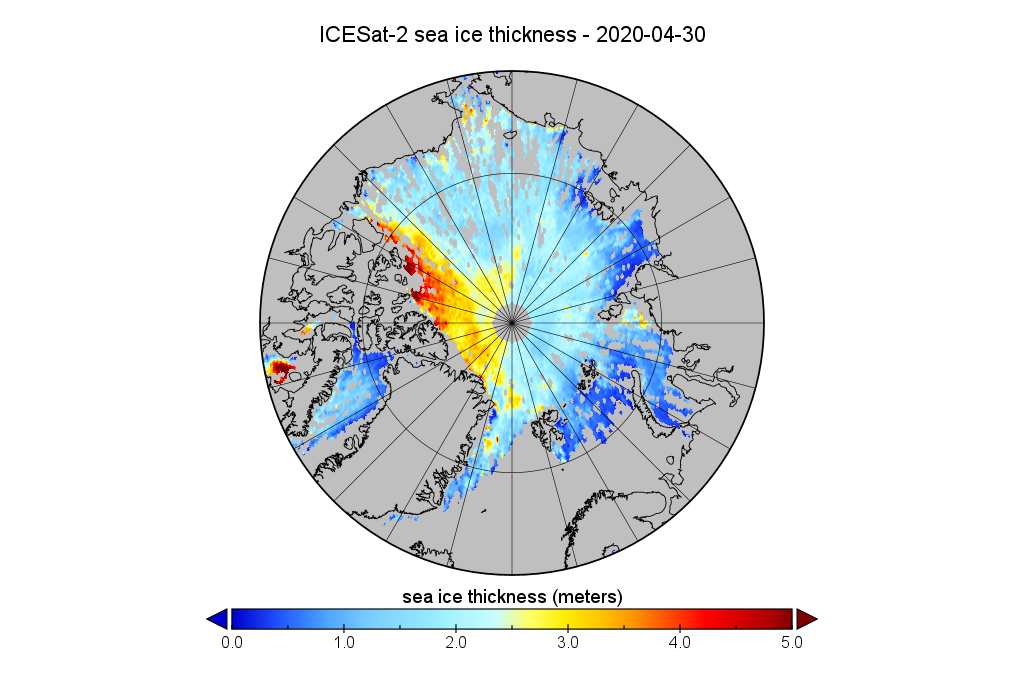
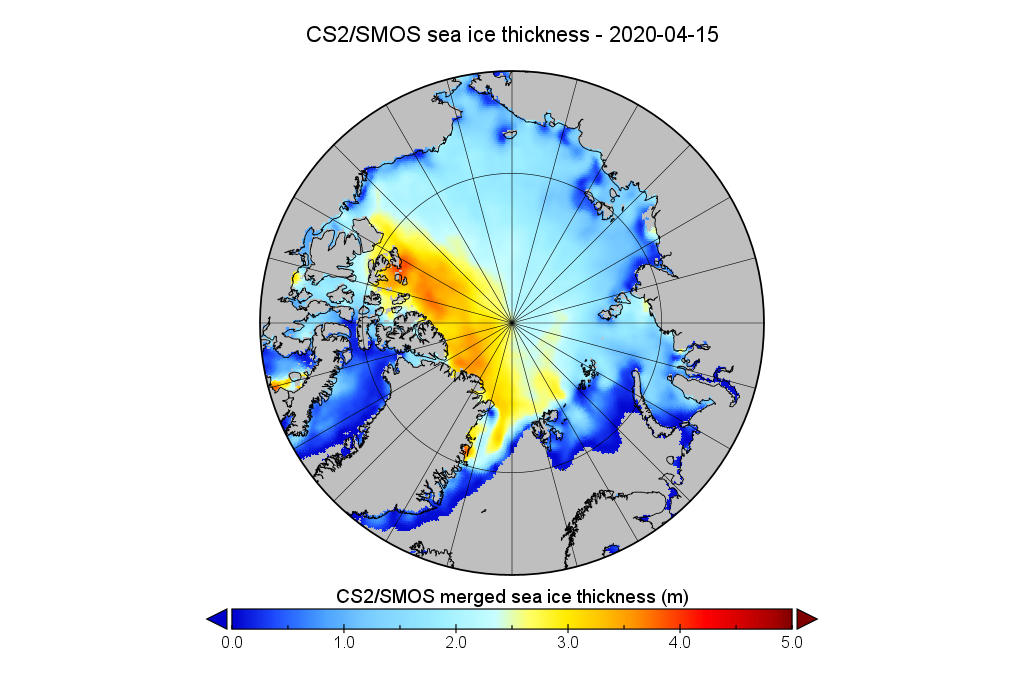
Here is my first visualisation of the most recent data, for April 2020:
Here is the equivalent from AWI’s CryoSat-2/SMOS gridded thickness product for comparison purposes:
Regular readers of this blog will no doubt have realised that way up here in the Great White Con Ivory Towers we concluded many moons ago that Arctic sea ice is the “canary in the climate coal mine”.
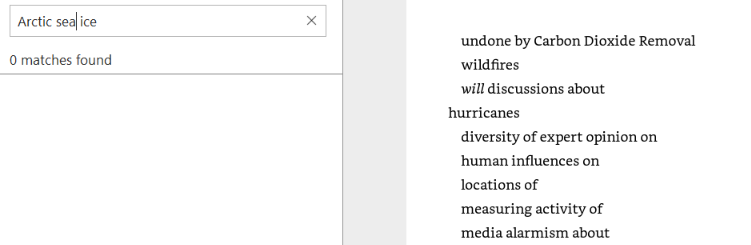
Unlike some others we have already mentioned we were not the beneficiaries of a review copy of Steven E. Koonin’s new book, catchily entitled “Unsettled: What Climate Science Tells Us, What It Doesn’t, and Why It Matters”. Hence I was compelled to acquire my own review copy, and have just purchased the electronic version. I eagerly searched the virtual weighty tome for the term “Arctic sea ice”, and you may well be wondering what I discovered?
Nothing. Nada. Zilch. ничего такого. Nic.
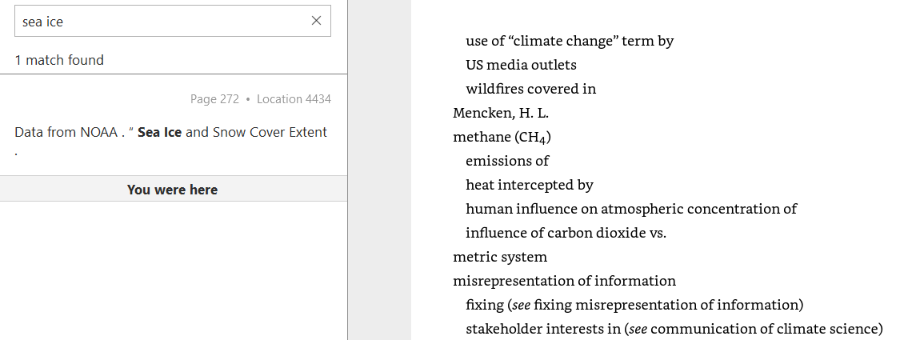
I broadened my thus far vain search by removing the “Arctic” specifier, which revealed:
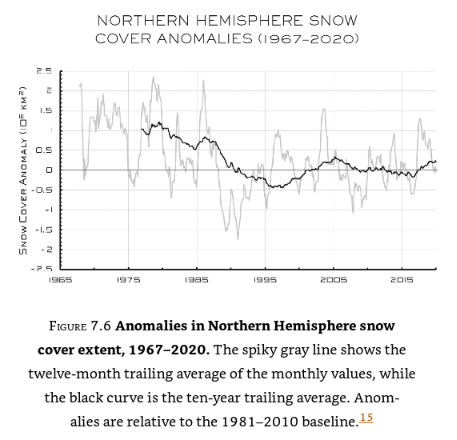
No mention of “sea ice” in the body of the book, merely a reference to the data underlying this graph of northern hemisphere snow cover:
I am forced to an unsettling conclusion. Evidently there are some areas of climate science that Dr. Koonin tells his eager readers nothing whatsoever about. It seems likely that he is also well aware that Arctic sea ice is the canary in the climate coal mine, which is why he has chosen to make no mention of it in his magnum opus.
Here is an informative video which will no doubt not appear in “Unsettled – The Movie”:
[Edit – May 8th]
Having now had time to read some of Steve Koonin’s “Unsettled Climate Science” at greater length I have discovered that it does contain one reference to Arctic sea ice, albeit using non-standard terminology. On page 40 of the Kindle version of the book I read:
Rising temperatures at the surface and in the ocean are not the only indicators of recent warming. The ice on the Arctic Ocean and in mountain glaciers has been in decline, and growing seasons have been lengthening slightly. Satellite observations show that the lower atmosphere is warming as well.
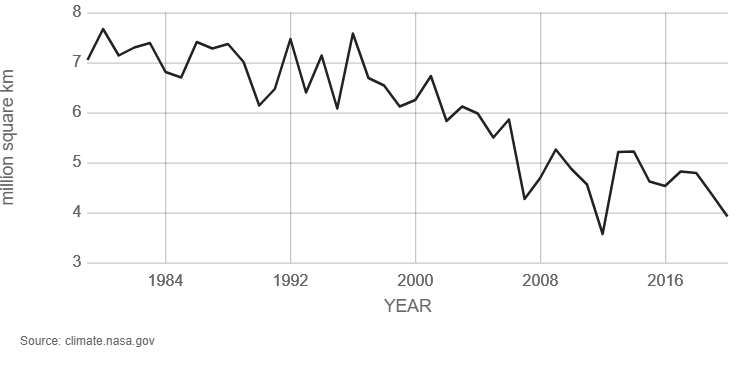
A paragraph I can broadly agree with, but I am compelled to ask why Dr. Koonin does not quantify the “decline of the ice on the Arctic Ocean” anywhere in the book? There are a wide variety of metrics used to quantify the “amount” of sea ice in the Arctic, but here is one readily available for download from the NASA web site. It is hard to believe that a scientist of Dr. Koonin’s experience, particularly one writing about climate change, has never previously come across a similar graph of Arctic sea ice extent:
Arctic sea ice reaches its minimum each September. September Arctic sea ice is now declining at a rate of 13.1 percent per decade, relative to the 1981 to 2010 average. This graph shows the average monthly Arctic sea ice extent each September since 1979, derived from satellite observations.
It seems safe to assume that Dr. Koonin has heard of NASA, since the organisation is mentioned several times in his list of references and once in the body of the book. However it seems that the United States’ National Snow and Ice Data Center (NSIDC for short) is not very visible on his personal radar screen, meriting only a single reference which is to snow rather than ice data.
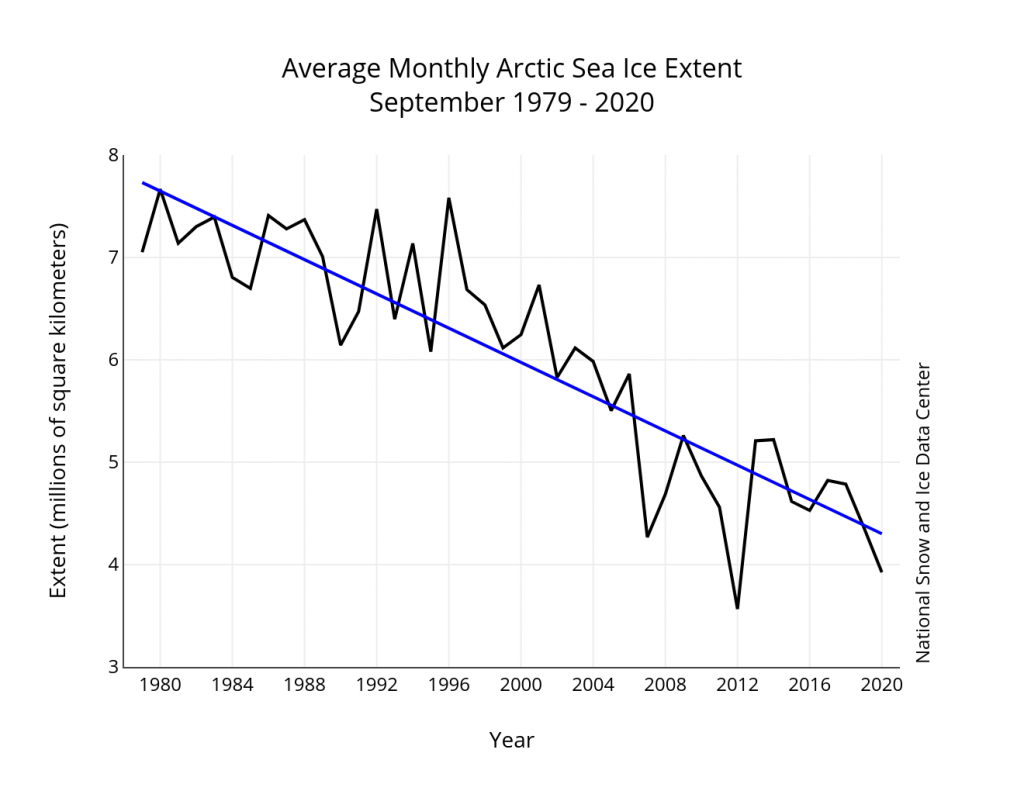
Here is the NSIDC’s version of the NASA graph above, which includes a handy trend line:
Monthly September ice extent for 1979 to 2020 shows a decline of 13.1 percent per decade.
Nearby Steve has penned another paragraph I can broadly agree with. On page 36 he states:
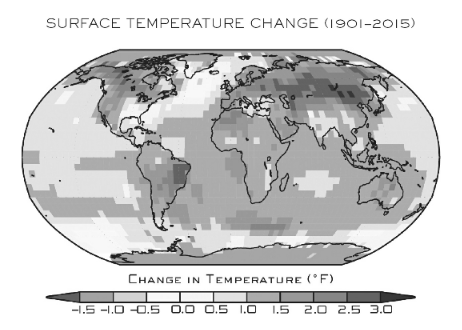
The warming of the past forty years on large scales hasn’t been uniform over the globe. That’s evident in Figure 1.5, reproduced from the US government’s 2017 CSSR (Climate Science Special Report, described earlier). As you can see, the land is warming more rapidly than the ocean surface, and the high latitudes near the poles are warming faster than the lower latitudes near the equator.
Here is the figure 1.5 referred to above:
Surface temperature change (in °F) for the period 1986–2015 relative to 1901–1960. Changes are generally significant over most land and ocean areas. Changes are not significant in parts of the North Atlantic Ocean, the South Pacific Ocean, and the southeastern United States. There is insufficient data in the Arctic Ocean and Antarctica to compute long-term changes there.
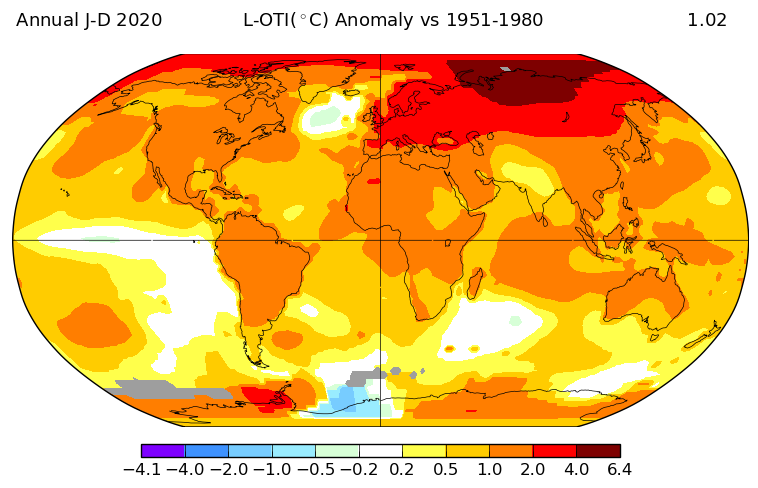
Once again I am compelled to ask some questions. Why not include a map that uses more recent data than 2015? And why not quantify how much faster the “high latitudes near the poles are warming than the lower latitudes near the equator”?
NASA helpfully provide an interface to their data which allows anybody who can click a mouse to produce their own global surface temperature maps. Here is the up to date answer to the first question:
NASA have also produced another informative video, which I suspect will also never make it into “Unsettled – The Movie”:
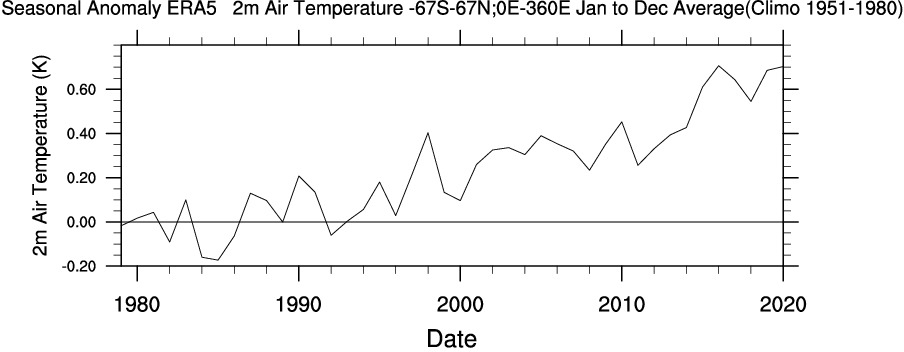
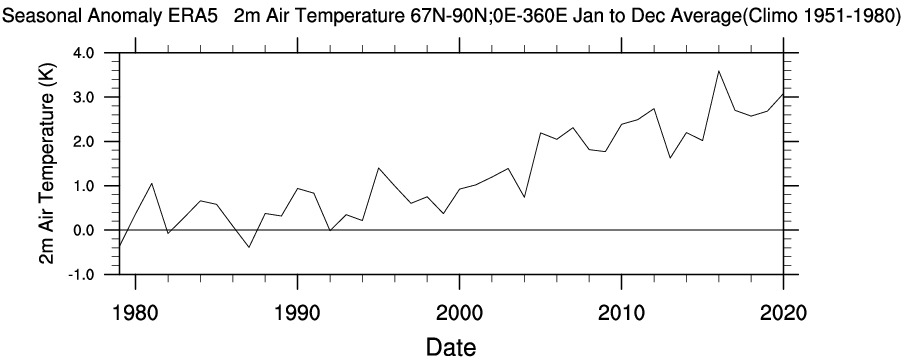
Another US scientific agency that provides publicly accessible climate data is the National Oceanic and Atmospheric Administration (NOAA for short). The abbreviation is referred to several times in Steve Koonin’s book, but for some reason he never expands the acronym in full. Like NASA they also provide a means to produce your own maps and time series. Albeit with a somewhat more complex user interface, the Web-based Reanalysis Intercomparison Tool (WRIT for short) allows the user to differentiate between different regions of Planet Earth, and hence answer the second question above.
Please compare and contrast the “non polar” temperature time series with the “Arctic” one. Note the change of scale of the X axis, and also the units. Degrees Kelvin rather than degrees Fahrenheit which are seemingly preferred by Dr. Koonin:
To summarise, you don’t need to wait for Steve Koonin to write another book or for the US government to produce another CSSR. Vast amounts of data and a plethora of visualisation tools are freely available to allow you to do your own research regarding a wide variety of climate metrics. Steve neglects to impart that information to his readers as well.
[Edit – May 9th]
As has been alluded to above, in the soon to be shipped hardcover edition of his new book Steve Koonin makes much mention of “snow cover” whilst ignoring “sea ice” entirely. There are also a grand total of 48 reference to the perhaps overly esoteric term “albedo“. On page 84 of the Kindle edition of “Unsettled” we are reliably informed that:
Among the most important things that a model has to get right are “feedbacks.”
Despite that the entire electronic volume makes no mention whatsoever of the phrase “ice-albedo feedback” or any synonym thereof. A brief course teaching the topic has recently been developed as part of the outreach activities of the MOSAiC Arctic drift expedition. Perhaps Dr. Koonin would be well advised to read it at his earliest convenience?
The ice-albedo feedback is an example of a positive feedback loop. A feedback loop is a cycle within a system that increases (positive) or decreases (negative) the effects on that system. In the Arctic, melting sea ice exposes more dark ocean (lower albedo), which in turn absorbs more heat and causes more ice to melt…the cycle continues.
Here’s another explanatory video which will also no doubt never make it into “Unsettled – The Movie”:
Watch this space for further revelations about the gigantic Arctic canary in the room!
This comes to you a couple of days early, but the clocks have just changed to British Summer Time in the once United Kingdom and there is news to impart.
JAXA Arctic sea ice extent has fallen to the lowest level for the date in their satellite era records going back to 1979. This graph shows every year since 2000:
The high resolution AMSR2 regional graphs make clear that the precipitous drop on the Pacific periphery has continued:
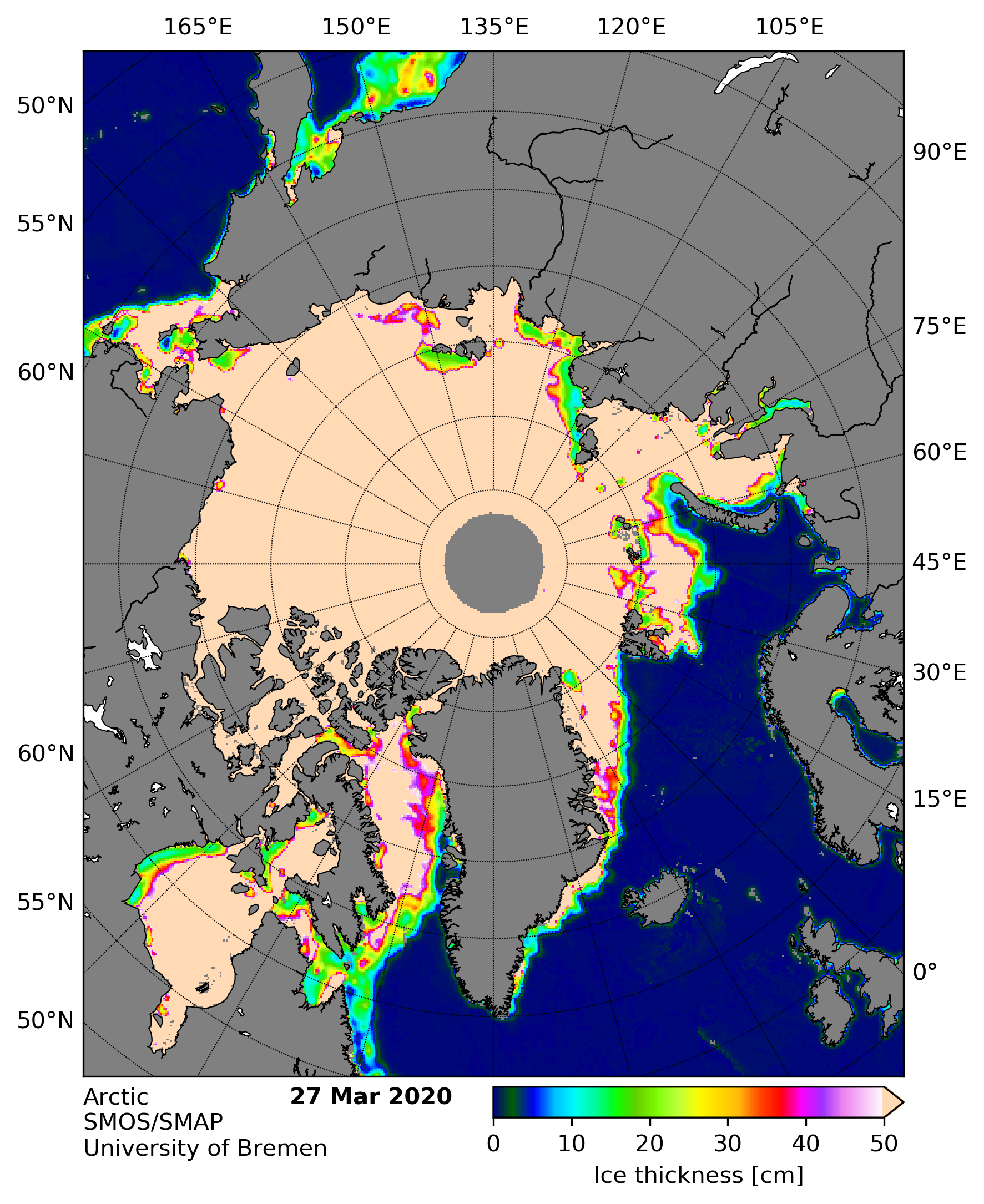
The current combined SMOS/SMAP Arctic sea ice “thinness” map makes clear that there is plenty more thin ice ready for melting in the Sea of Okhotsk and Baffin Bay:
There is also a large area of thin ice in the Laptev Sea, which will be interesting to watch once the 2020 melting season gets underway in earnest.
[Edit – April 1st]
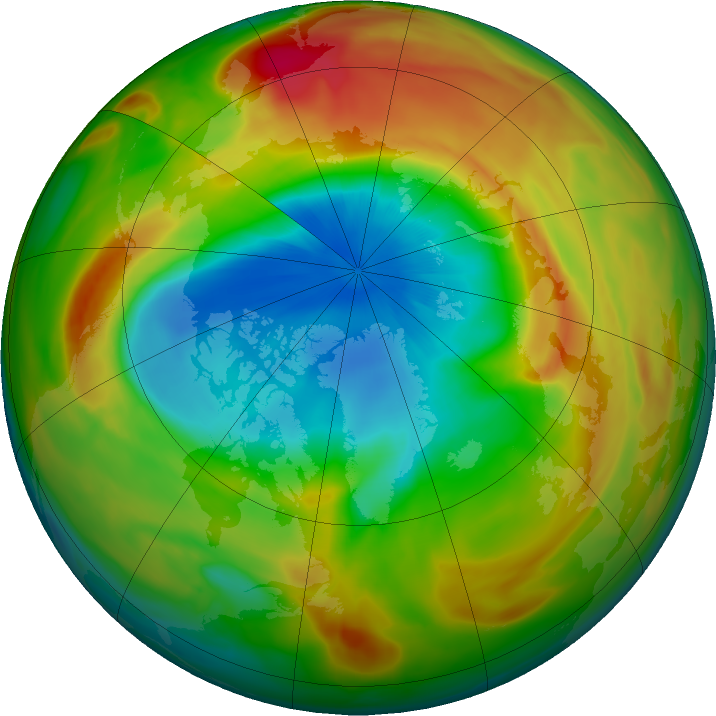
Today is All Fools’ Day, but this is no joke. Thanks to the consistent polar vortex over the Northern Hemisphere winter there is currently an anomalous “ozone hole” over the North Pole. As recently described in Nature:
A vast ozone hole — probably the biggest on record in the north — has opened in the skies above the Arctic. It rivals the better-known Antarctic ozone hole that forms in the southern hemisphere each year.
Record-low ozone levels currently stretch across much of the central Arctic, covering an area about three times the size of Greenland. The hole doesn’t threaten people’s health, and will probably break apart in the coming weeks. But it is an extraordinary atmospheric phenomenon that will go down in the record books.
“From my point of view, this is the first time you can speak about a real ozone hole in the Arctic,” says Martin Dameris, an atmospheric scientist at the German Aerospace Center in Oberpfaffenhofen.
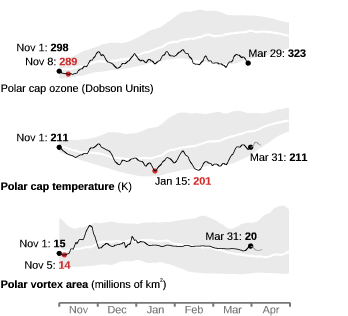
Here are the latest graphics from the “Arctic Ozone Watch” section of the NASA web site:
Observations made during the still ongoing MOSAiC expedition, have confirmed the satellite derived measurements:
This year, powerful westerly winds flowed around the North Pole and trapped cold air within a ‘polar vortex’. There was more cold air above the Arctic than in any winter recorded since 1979, says Markus Rex, an atmospheric scientist at the Alfred Wegener Institute in Potsdam, Germany. In the chilly temperatures, the high-altitude clouds formed, and the ozone-destroying reactions began.
Researchers measure ozone levels by releasing weather balloons from observing stations around the Arctic (including the Polarstern icebreaker, which is frozen in sea ice for a year-long expedition). By late March, these balloons measured a 90% drop in ozone at an altitude of 18 kilometres, which is right in the heart of the ozone layer. Where the balloons would normally measure around 3.5 parts per million of ozone, they recorded only around 0.3 parts per million, says Rex. “That beats any ozone loss we have seen in the past,” he notes.
I’ve previously conjectured about the potential effect of the strong polar vortex on Northern Hemisphere snow cover this Spring, and here’s NOAA’s current snow extent graph:
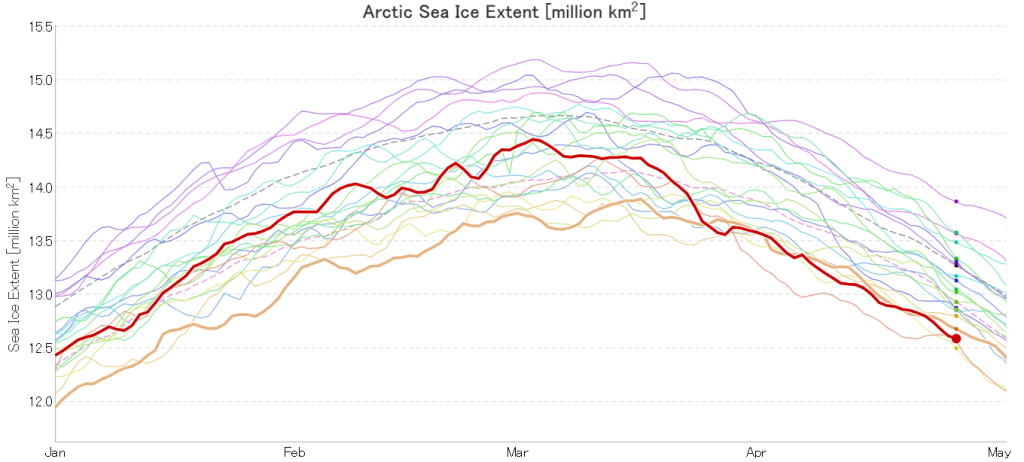
JAXA extent’s precipitous recent decline has abated, and it’s now 5th lowest for the date in the satellite era:
[Edit – April 4th]
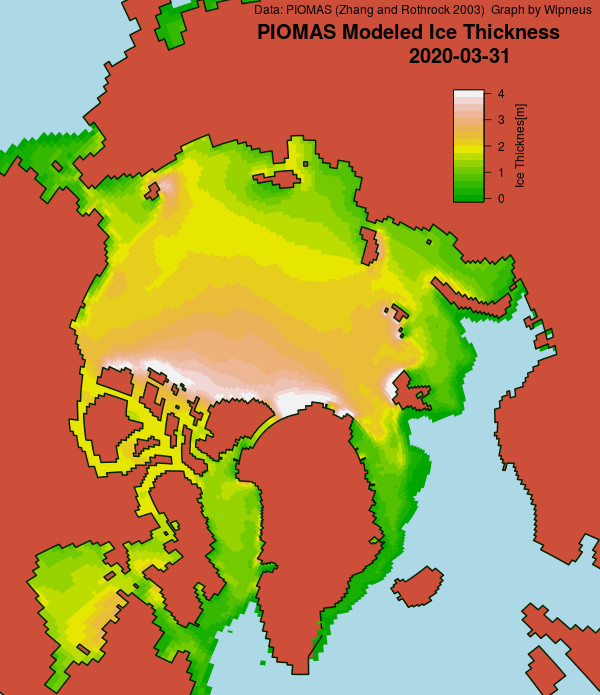
Here’s the March 31st PIOMAS Arctic sea ice gridded thickness map:
Ice is thickening impressively against the Canadian Archipelago and North Greenland.
That is indeed the case with the PIOMAS “modelled” numbers, but is much less obvious in the latest CryoSat-2/SMOS “measured” thickness map where ice over 4 metres thick is still conspicuous by its absence North of Greenland:
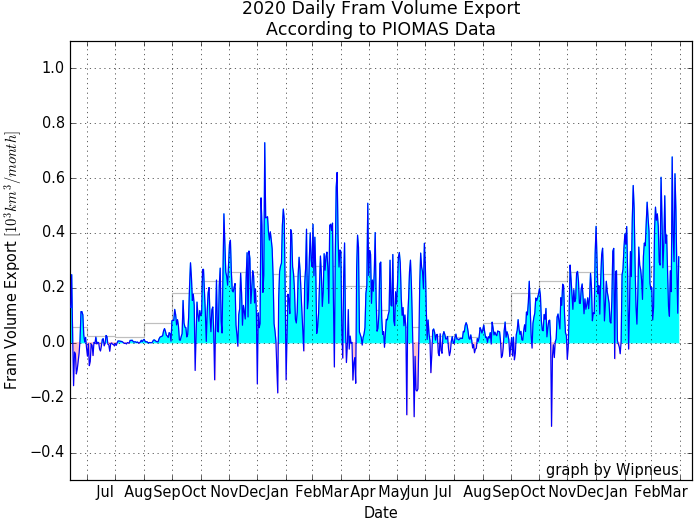
[There’s] not much thick ice on the East Coast of Greenland, indicating the increase was from reduced loss through the Fram Strait?
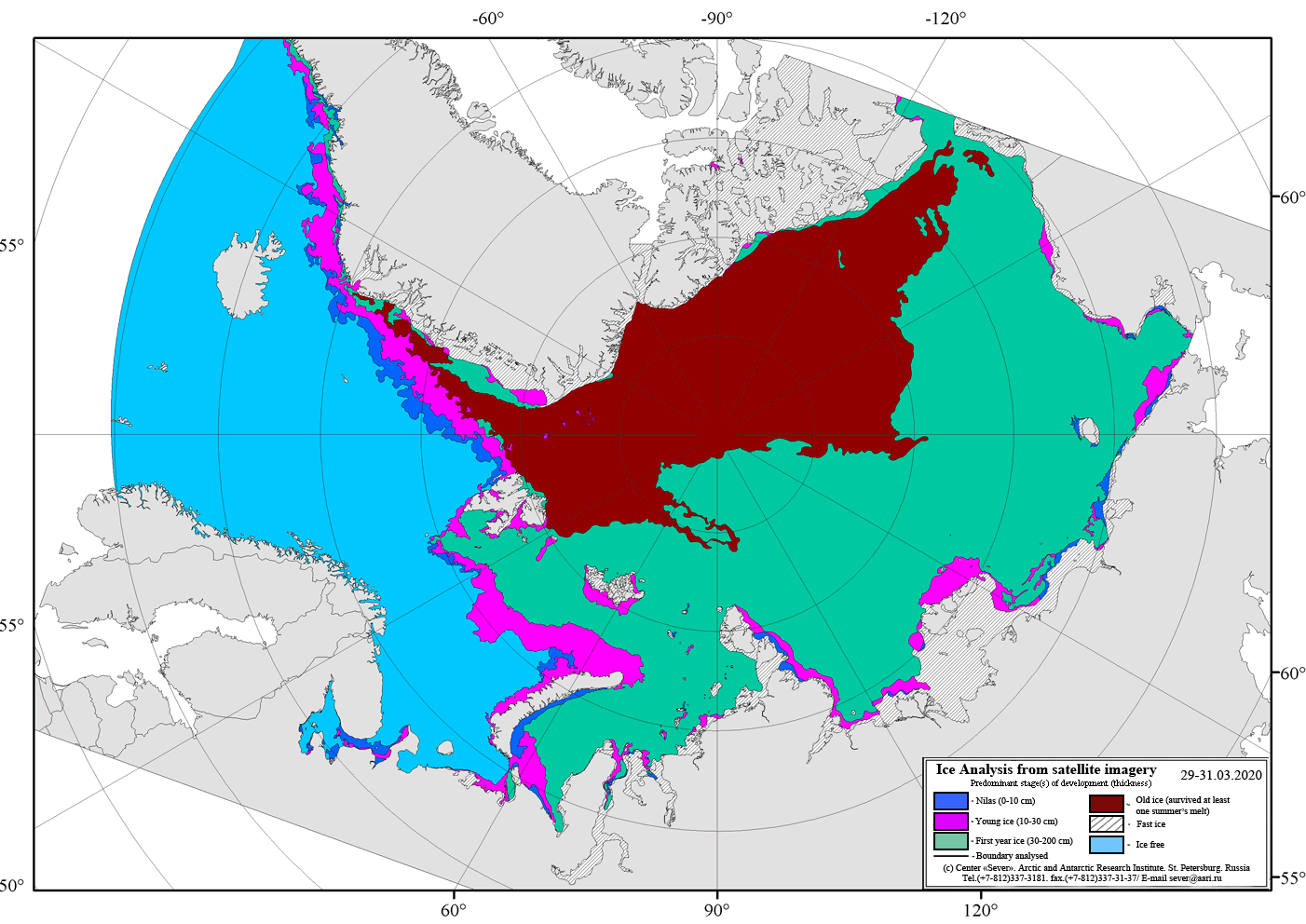
together with the latest AARI ice age map:
[Edit – April 6th]
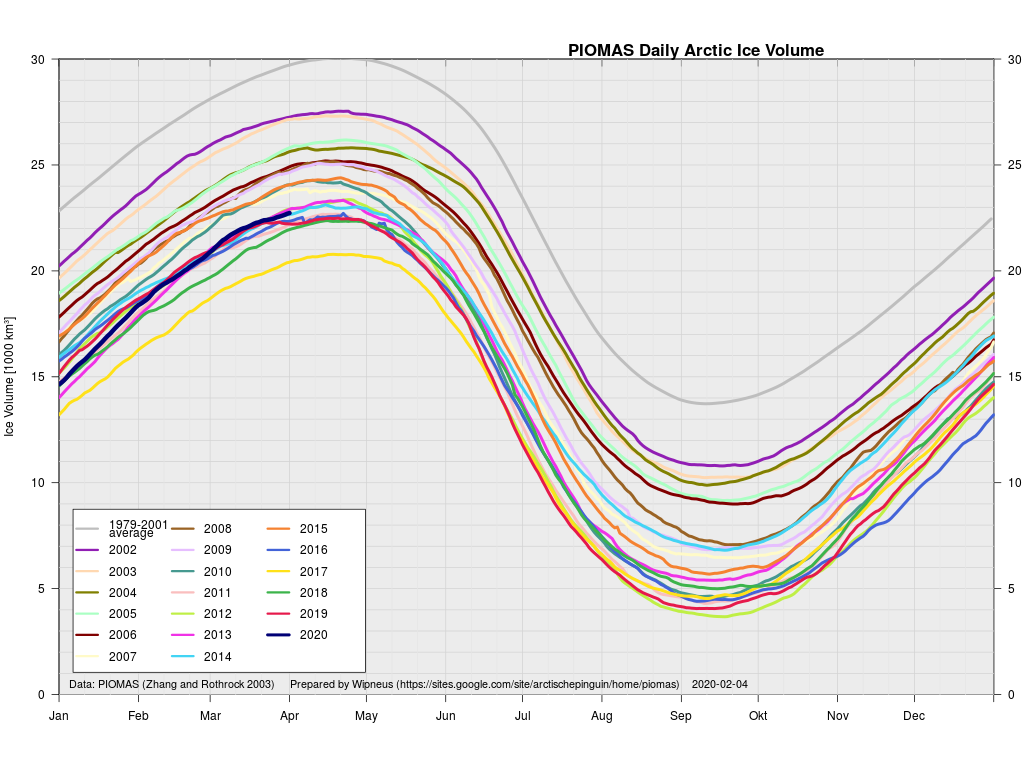
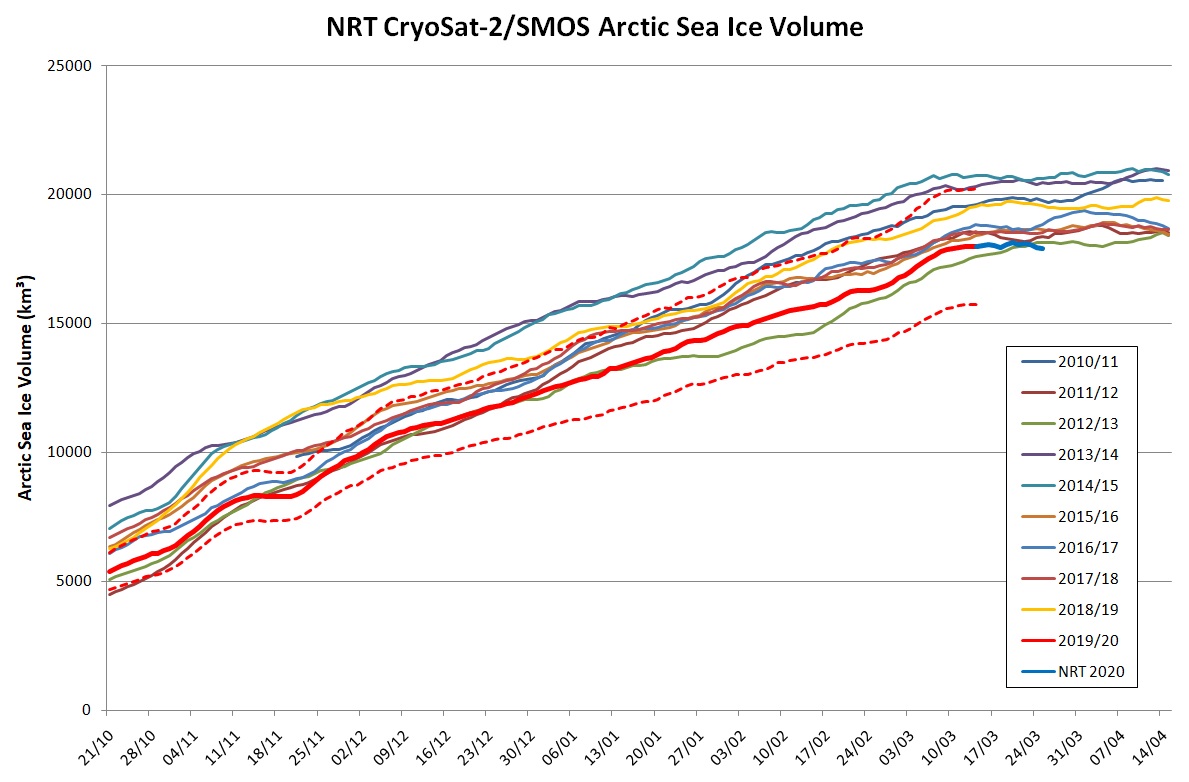
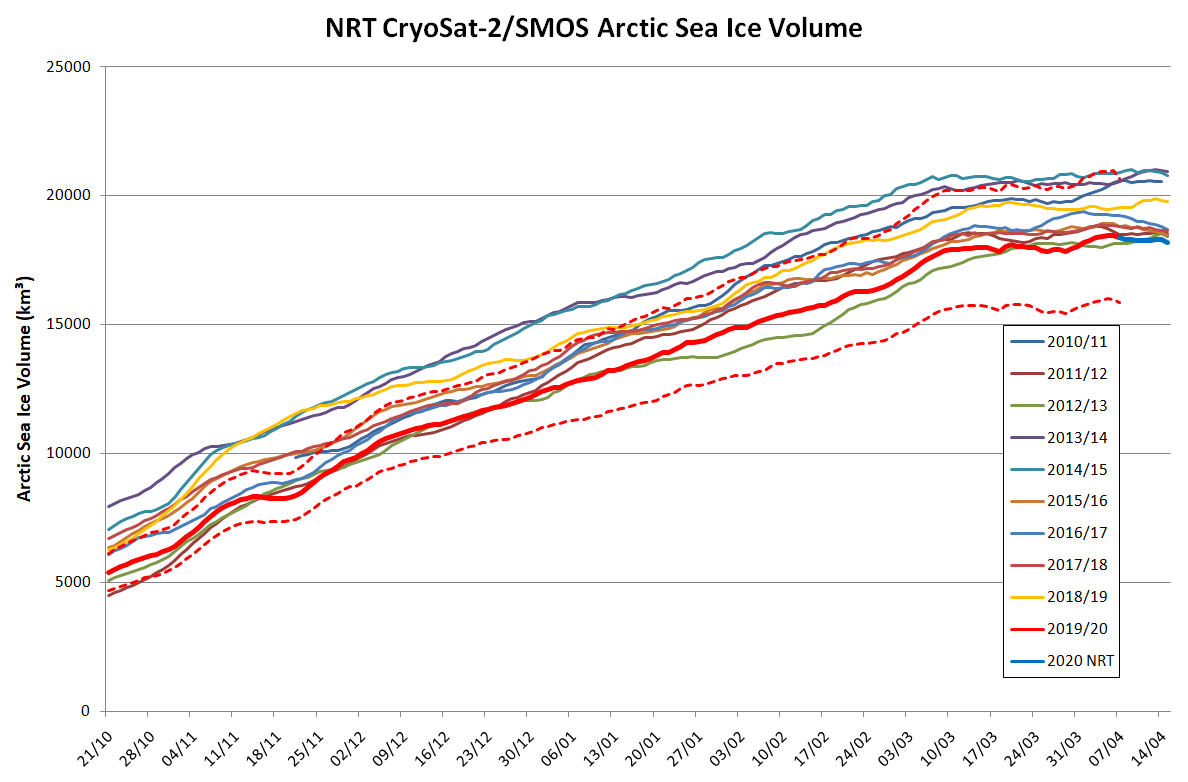
Here’s the latest update of our novel NRT volume metric:
I’ve applied a crude correction to the still problematic NRT data so that it at least coincides with the reanalysed data on March 14th. Whilst we await the reanalysed numbers for the rest of March and early April it looks as though Arctic sea ice volume reached at least a temporary peak on March 20th 2020.
[Edit – April 19th]
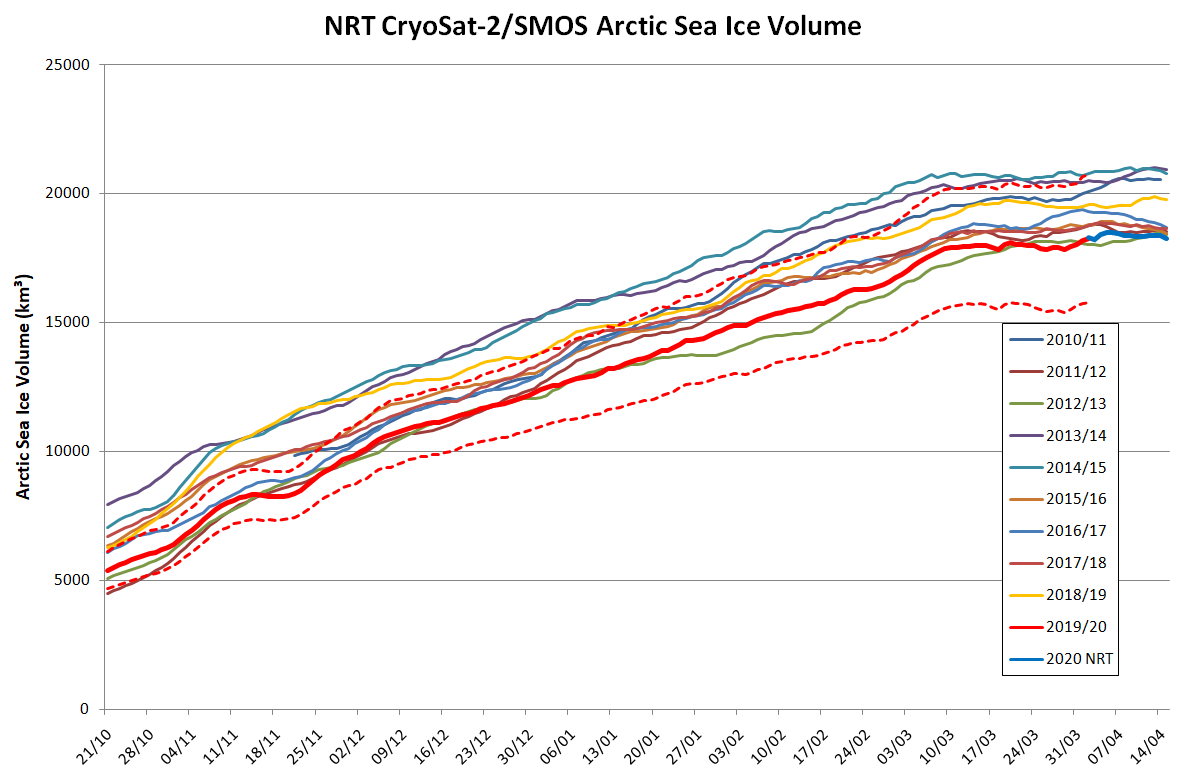
Here’s another update of our novel NRT volume metric, still incorporating my “fudge factor”:
Note also this handy hint from Stefan Hendricks on Twitter:
The reprocessed #Cryosat2 data is fine though and for the recent winter there is a corrected CS2SMOS version: ftp://ftp.awi.de/sea_ice/product/cryosat2_smos/v202_2/
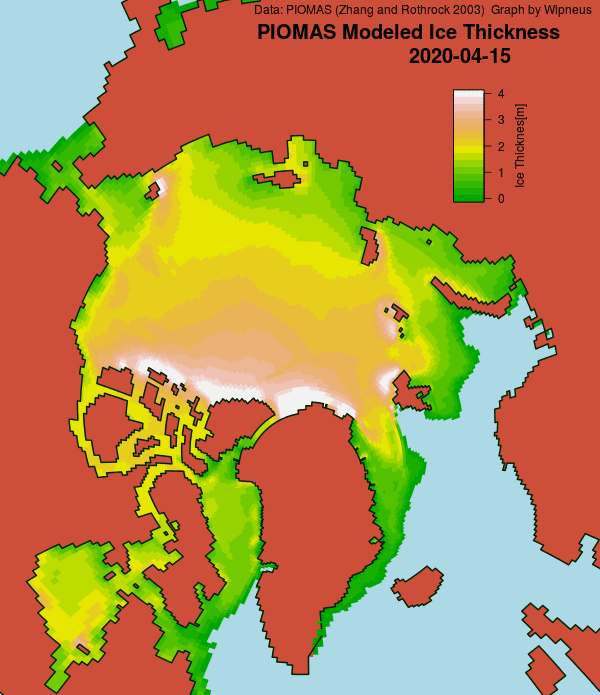
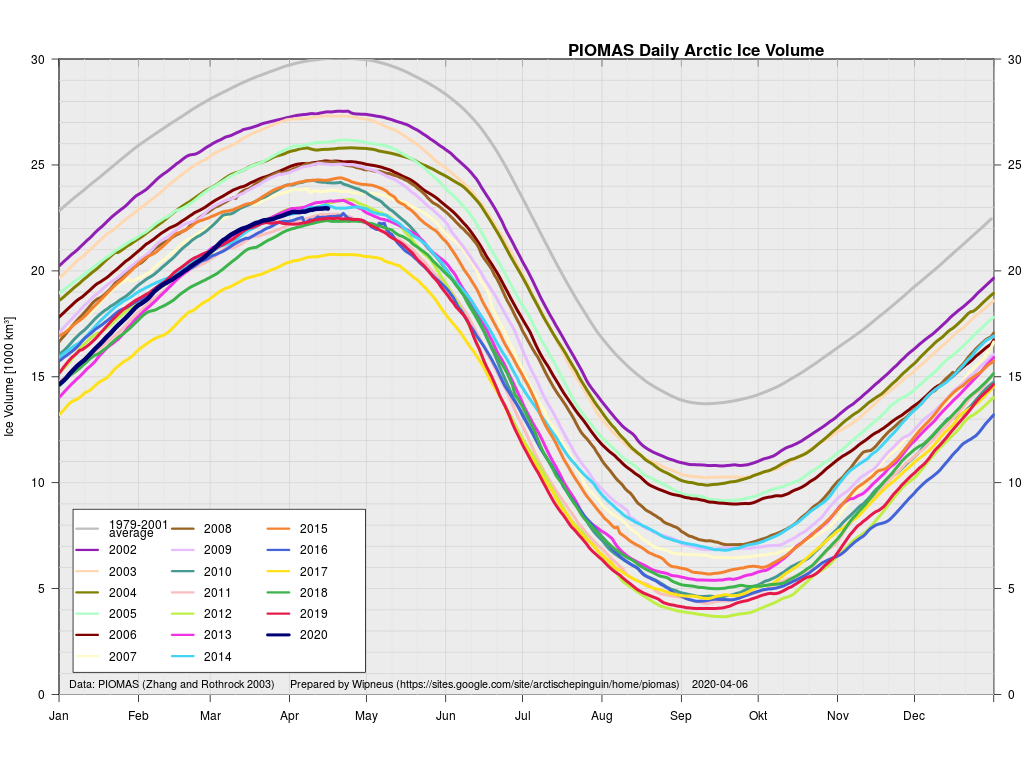
Wipneus has crunched the mid month PIOMAS gridded thickness numbers. Here’s the result:
The discrepancy between the PIOMAS model and the CryoSat-2 “reality” is still very evident.
[Edit – April 25th]
With another week’s worth of reanalysed data now processed, it now seems certain that the CS2/SMOS Arctic sea ice volume maximum was 18469 km³ on April 6th:
[Edit – April 28th]
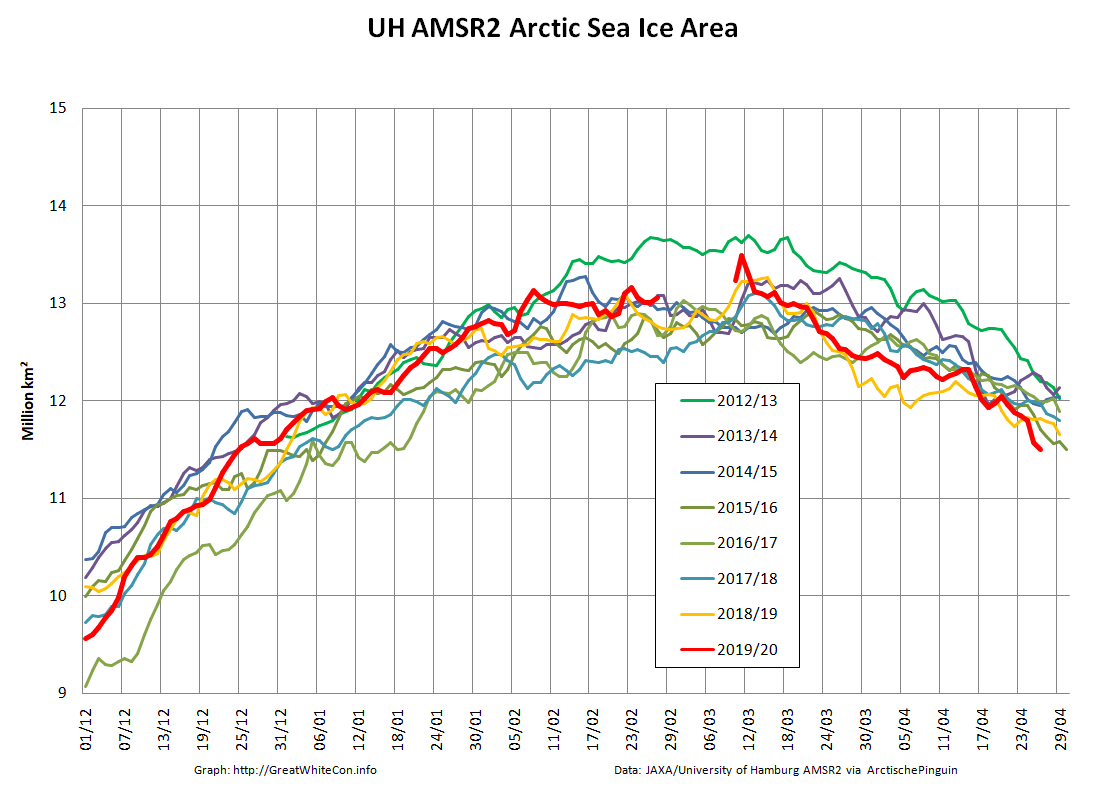
The high resolution AMSR2 area and extent metrics are now both “lowest for the date” in the AMSR2 record:
An experienced team of polar explorers set off on April 4th intending to ski from a latitude of 88° North to 90° North, better known as the North Pole!
According to the expedition’s web site those 2 degrees of latitude are symbolic of the United Nations Framework Convention on Climate Change agreement in Paris to “hold the increase in the global average temperature to well below 2 °C above pre-industrial levels”, and are thus part of the expedition’s name.
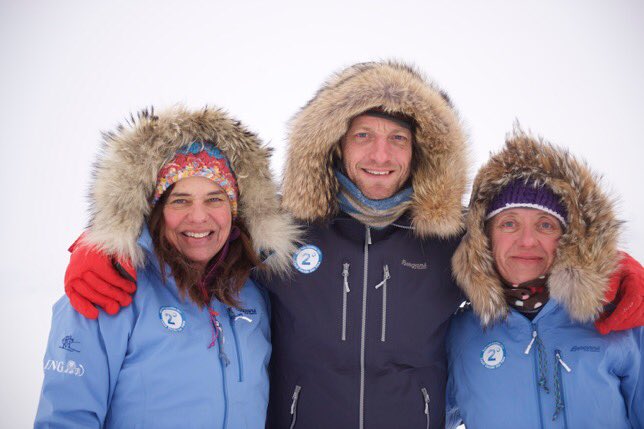
Here’s the team of Bernice Notenboom, Martin Hartley and Ann Daniels pictured shortly before departing on their arduous journey via the Russian Barneo ice camp near the North Pole:
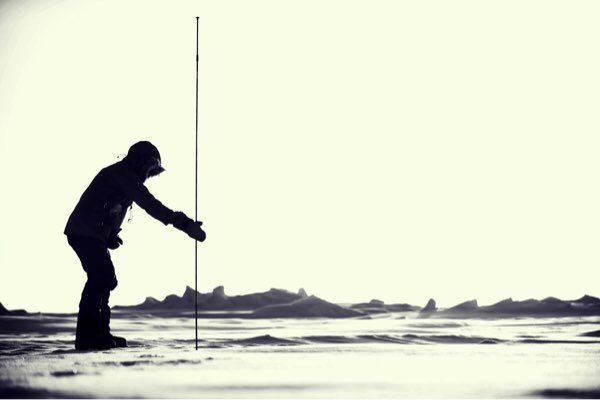
Apart from hauling their sleds across some very challenging terrain they will also be doing lots of “citizen science” en route, including stopping regularly to measure the depth of snow covering the sea ice:
Photo: Martin Hartley
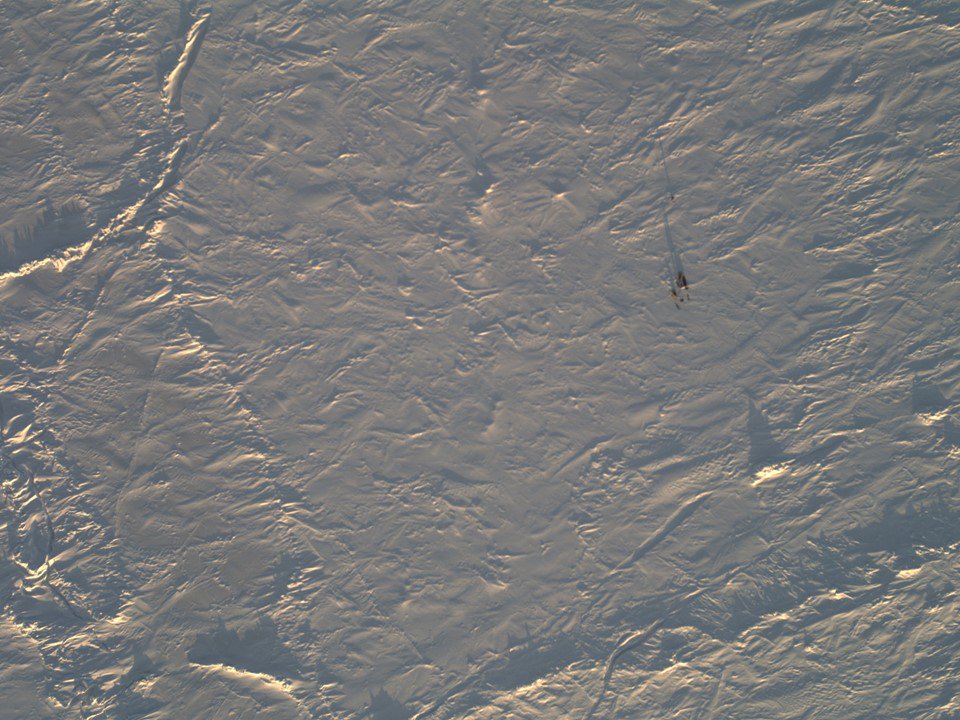
As part of that scientific mission the NASA Operation IceBridge Orion P3 aircraft overflew the team, and amongst other things took this picture:
Photo: NASA
Bernice announced on the 2 Degrees expedition’s blog this morning that:
A milestone today – skied 1/2 degree of latitude.
Victor Serov who I call into every night with our position is really happy with our progress: ” You are doing very well Bernice and you are doing science” is his encouraging response every time I call in.
I imagine he is sitting in a tent in Barneo with a giant map, North Pole in the middle, and plotting all routes towards the pole. Each team on the ice has to call in coordinates at night so if something happens, they are standby with 2 MI8 helicopters to assist. Like yesterday somebody had to get evacuated because of frostbite.
To get a compliment from a Russian scientist who has spend a year in Vostok in Antarctica [coldest place on earth] as well as being an accomplished polar explorer, we should be proud of ourselves to have skied 1/4 of the way on day 5. But it hasn’t come easy. The half degree has been really hard work temperatures dipped to -41C too cold to film, do science, all we can do is keep moving until we need to eat and drink.
The sleds weigh over 80 kilo’s and new pains and aches show unexpectedly in places you don’t want them, like my back. On the odd break, I would get the notebook out, jot down the GPS position while Ann pokes into the snow and yells the various snow depths to me. The rest of the day we are doing cold management: toes we don’t feel anymore and need nurturing or placing your thumb between the fingers to warm them up inside your mitt, and worse letting your arm hang so the blood can race back to the extremities.
If you are cold all blood flows to your heart and core to protect it, so to call it back is playing a trick with your mind. Despite this careful nursing, I still end up with frost nip on all fingers. I now need to be extra careful with exposure to cold.
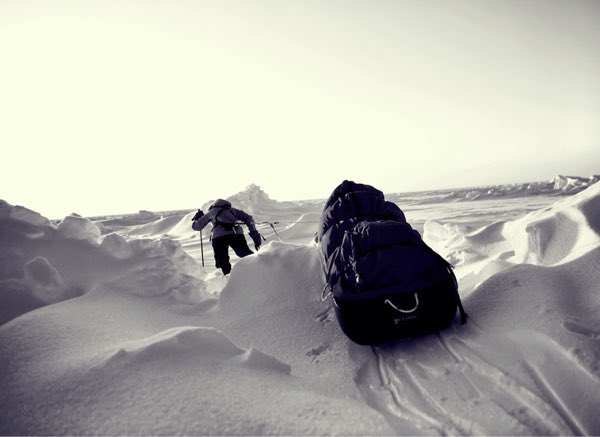
Meanwhile Ann Daniels published this image of the sort of terrain they’ve been crossing on her Twitter feed:
Photo: Martin Hartley
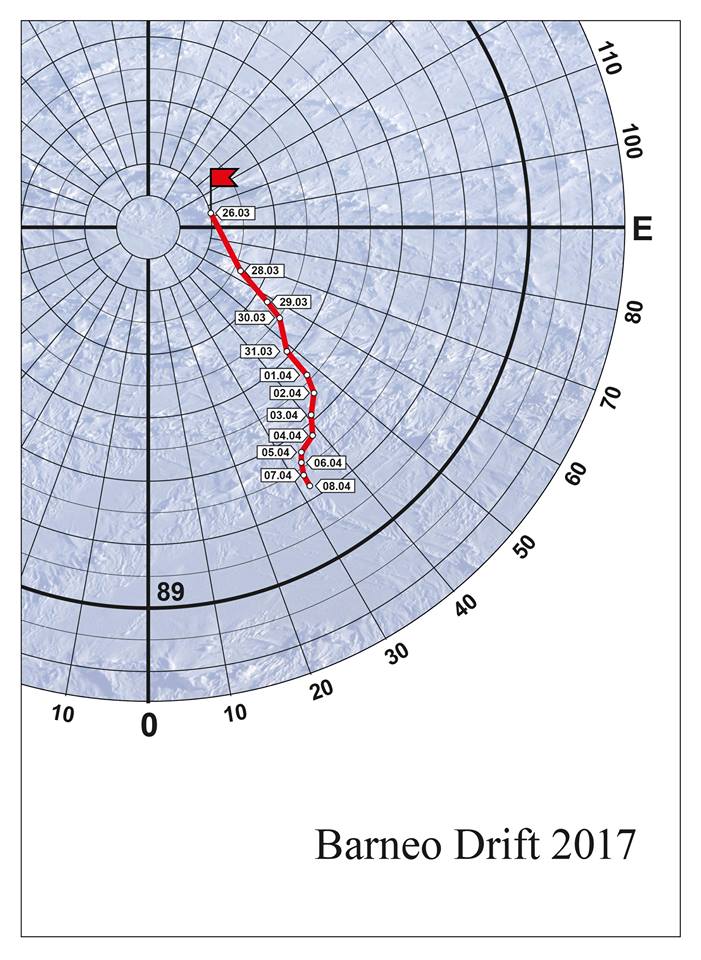
The expedition’s current position is reported as as 88.52 N, 147.75 E. Only another 1 1/2 degrees to go! As this map of the drift of the Barneo ice camp shows, the winds are currently somewhat in the team’s favour:
The show is over, and it went pretty much as Alice F. predicted it would. Lamar Smith has passed his verdict on the morning’s proceedings in strangely untheatrical style:
My own mileage certainly varied from Lamar’s! Here’s a hasty summary of events via the distorting lens of Twitter:
A more detailed analysis of United States’ House Committee on Science, Space and Technology’s “show trial” of climate models will follow in due course, but for now if you so desire you can watch the entire event on YouTube:
I’ll have to at least watch the bit where my live feed cut out as Dana Rohrabacher slowly went ballistic with Mike Mann:
Nevertheless, given our long running campaign against the climate science misinformation frequently printed in the Mail on Sunday it gives us great pleasure to reprint in full the following extract from his written testimony today:
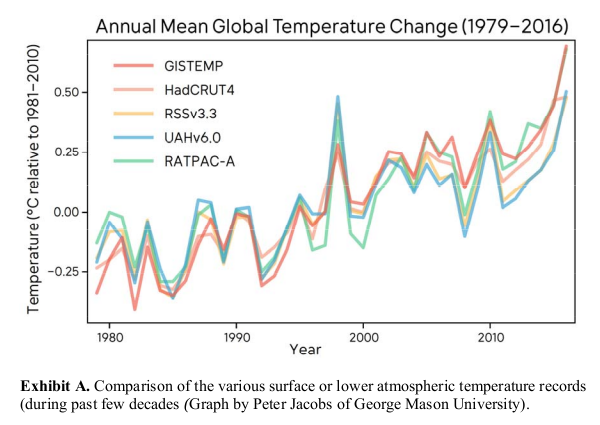
For proper context, we must consider the climate denial myth du jour that global warming has “stopped”. Like most climate denial talking points, the reality is pretty much the opposite of what is being claimed by the contrarians. All surface temperature products, including the controversial UAH satellite temperature record, show a clear long-term warming trend over the past several decades:
We have now broken the all-time global temperature record for three consecutive years and a number of published articles have convincingly demonstrated that global warming has continued unabated despite when one properly accounts for the vagaries of natural short-term climate fluctuations. A prominent such study was published by Tom Karl and colleagues in 2015 in the leading journal Science. The article was widely viewed as the final nail in the “globe has stopped warming” talking point’s coffin.
Last month, opinion writer David Rose of the British tabloid the Daily Mail — known for his serial misrepresentations of climate change and his serial attacks on climate scientists, published a commentary online attacking Tom Karl, accusing him of having “manipulated global warming data” in the 2015 Karl et al article. This fake news story was built entirely on an interview with a single disgruntled former NOAA employee, John Bates, who had been demoted from a supervisory position at NOAA for his inability to work well with others.
Bates’ allegations were also published on the blog of climate science denier Judith Curry (I use the term carefully—reserving it for those who deny the most basic findings of the scientific community, which includes the fact that human activity is substantially or entirely responsible for the large-scale warming we have seen over the past century — something Judith Curry disputes). That blog post and the Daily Mail story have now been thoroughly debunked by the actual scientific community. The Daily Mail claim that data in the Karl et al. Science article had been manipulated was not supported by Bates. When the scientific community pushed back on the untenable “data manipulation” claim, noting that other groups of scientists had independently confirmed Karl et al’s findings, Bates clarified that the real problem was that data had not been properly archived and that the paper was rushed to publication. These claims too quickly fell apart.
Though Bates claimed that the data from the Karl et al study was “not in machine-readable form”, independent scientist Zeke Hausfather, lead author of a study that accessed the data and confirmed its validity, wrote in a commentary “…for the life of me I can’t figure out what that means. My computer can read it fine, and it’s the same format that other groups use to present their data.” As for the claim that the paper was rushed to publication, Editor-in-chief of Science Jeremy Berg says, “With regard to the ‘rush’ to publish, as of 2013, the median time from submission to online publication by Science was 109 days, or less than four months. The article by Karl et al. underwent handling and review for almost six months. Any suggestion that the review of this paper was ‘rushed’ is baseless and without merit. Science stands behind its handling of this paper, which underwent particularly rigorous peer review.”
Shortly after the Daily Mail article went live, a video attacking Karl (and NOAA and even NASA for good measure) was posted by the Wall Street Journal. Within hours, the Daily Mail story spread like a virus through the right-wing blogosphere, appearing on numerous right-wing websites and conservative news sites. It didn’t take long for the entire Murdoch media empire in the U.S, U.K. and elsewhere to join in, with the execrable Fox News for example alleging Tom Karl had “cooked” climate data and, with no sense of irony, for political reasons.
Rep. Lamar Smith (R-TX), chair of this committee has a history25 of launching attacks on climate science and climate scientists. He quickly posted a press release praising the Daily Mail article, placing it on the science committee website, and falsely alleging that government scientists had “falsified data”. Smith, it turns out, had been planning a congressional hearing timed to happen just days after this latest dustup, intended to call into question the basis for the EPA regulating carbon emissions. His accusations against Karl and NOAA of tampering with climate data was used in that hearing to claim that the entire case for concern over climate change was now undermined.
That’s pretty much the way we see things too Mike!
[Edit – March 31st]
In the aftermath of Wednesday’s hearing, the accusations are flying in all directions. By way of example:
No clarification has yet been forthcoming from Dr. Pielke.
The denialosphere is of course now spinning like crazy attempting to pin something, anything, on Michael Mann. Over at Climate Depot Marc Morano assures his loyal readers that:
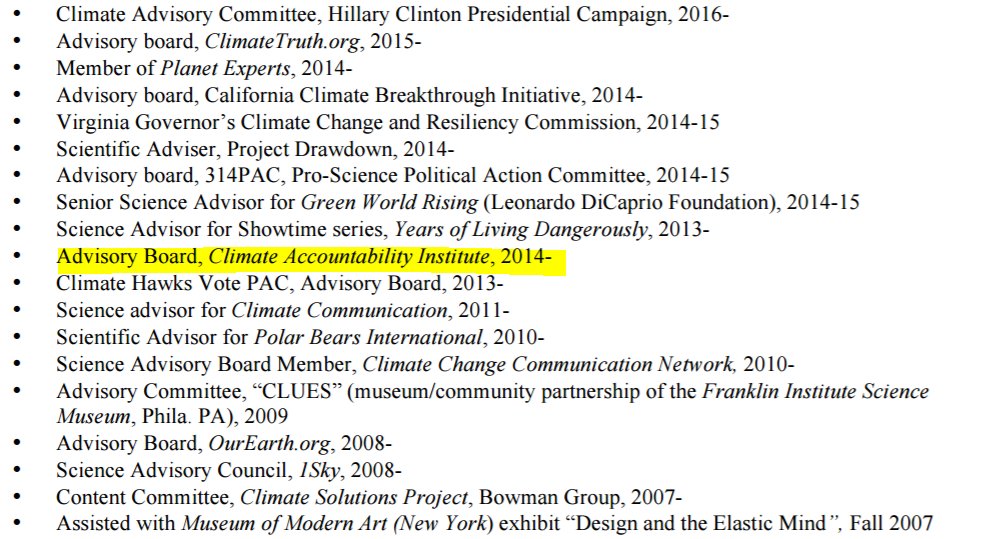
Testifying before Congress, climate scientist Michael Mann denies any affiliation or association to the Climate Accountability Institute despite his apparent membership on the Institute’s Council of Advisors.
Whilst correctly quoting Dr. Mann as saying:
I can provide – I’ve submitted my CV you can see who I’m associated with and who I am not.
Here’s the video Marc uses to support his case:
Meanwhile over on Twitter:
As I said before, Mann said "No." He then added "I've submitted my CV. You can see who I'm associated with". The CV contradicts his lie.
Today is All Fools’ Day, but this is no joke. Last night Judith Curry posted an article on her “Climate Etc.” blog entitled “‘Deniers,’ lies and politics“. Here is an extract from it:
“Turns out Mann appears to be a bit of a denier himself. Under questioning, Mann denied being involved with the Climate Accountability Institute even though he is featured on its website as a board member. CAI is one of the groups pushing a scorched-earth approach to climate deniers, urging lawmakers to employ the RICO statute against fossil-fuel corporations. When asked directly if he was either affiliated or associated with CAI, Mann answered “no.” [JC note: Mann also lists this affiliation on his CV]
Some additional ‘porkies’ are highlighted in an article by James Delingpole.
Now the first thing to note is that I’d already explained the context of Mr. Mann’s “interrogation” by Rep. Clay Higgins on Judith’s blog several times:
At the risk of repeating myself Mann said, and I quote:
“I’ve submitted my CV. You can see who I’m ‘associated’ with”
His CV states, quoted by McIntyre:
Why on Earth Judith chose to repeat the “CAI” allegation is beyond me.
Secondly, Prof. Mann is NOT featured on the CAI website as a board member. He is instead listed as a member of their “Council of Advisors”.
Thirdly, quoting James Delingpole as a source of reliable information about anything “climate change” related is also beyond me. Needless to say Mr. Delingpole also repeats the CAI nonsense, whilst simultaneously plagiarising our long standing usage of the term “Porky pie“!
All of which brings me on to my next point. In the video clip above Rep. Higgins can be heard to say:
These two organisations [i.e the Union of Concerned Scientists & the Climate Accountability Institute], are they connected directly with organised efforts to prosecute man influenced climate sceptics via RICO statutes?
to which Dr. Mann replied:
The way you’ve phrased it, I would find it extremely surprising if what you said was true.
Now please skip to the 1 hour 31:33 mark in the video of the full hearing to discover what Marc Morano left out. Rep. Higgins asks Dr. Mann:
Would you be able to at some future date provide to this committee evidence of your lack of association with the organisation Union of Concerned Scientists and lack of your association with the organisation called Climate Accountability Institute? Can you provide that documentation to this committee Sir?
This is, of course, a “when did you stop beating your wife” sort of a question. How on Earth do you prove a “lack of association with an organisation”. Supply a video of your entire life? Dr. Mann responded less pedantically:
You haven’t defined what “association” even means here, but it’s all in my CV which has already been provided to Committee.
So what on Earth are Rep. Higgins and ex. Prof. Curry on about with all this “RICO” business? With thanks to Nick Stokes on Judith’s blog, the document he refers to seems to be the only evidence for the insinuations:
It turns out that what the congressman was probably referring to was a workshop they mounted in 2012 (not attended by Mann), which explored the RICO civil lawsuit mounted against tobacco companies.
It does mention for example “the RICO case against the tobacco companies” but it never mentions anything that might conceivably be (mis)interpreted as “pushing a scorched-earth approach to climate deniers”.
That being the case, why on Earth do you suppose Judith Curry chose to mention that phrase on her blog last night and why did Clay Higgins choose to broach the subject on Wednesday?
[Edit – April 2nd]
Perhaps this really is an April Fools’ joke? Over on Twitter Stephen McIntyre continues to make my case for me. Take a look:
And he’s not the only one! Alice F.’s sixth sense tells her that another Storify slideshow will be required to do this saga justice!
This website uses cookies to improve your experience. We'll assume you're ok with this, but you can opt-out if you wish. Cookie settingsACCEPT
Privacy & Cookies Policy
Privacy Overview
This website uses cookies to improve your experience while you navigate through the website. Out of these, the cookies that are categorized as necessary are stored on your browser as they are essential for the working of basic functionalities of the website. We also use third-party cookies that help us analyze and understand how you use this website. These cookies will be stored in your browser only with your consent. You also have the option to opt-out of these cookies. But opting out of some of these cookies may affect your browsing experience.
Necessary cookies are absolutely essential for the website to function properly. This category only includes cookies that ensures basic functionalities and security features of the website. These cookies do not store any personal information.
Any cookies that may not be particularly necessary for the website to function and is used specifically to collect user personal data via analytics, ads, other embedded contents are termed as non-necessary cookies. It is mandatory to procure user consent prior to running these cookies on your website.