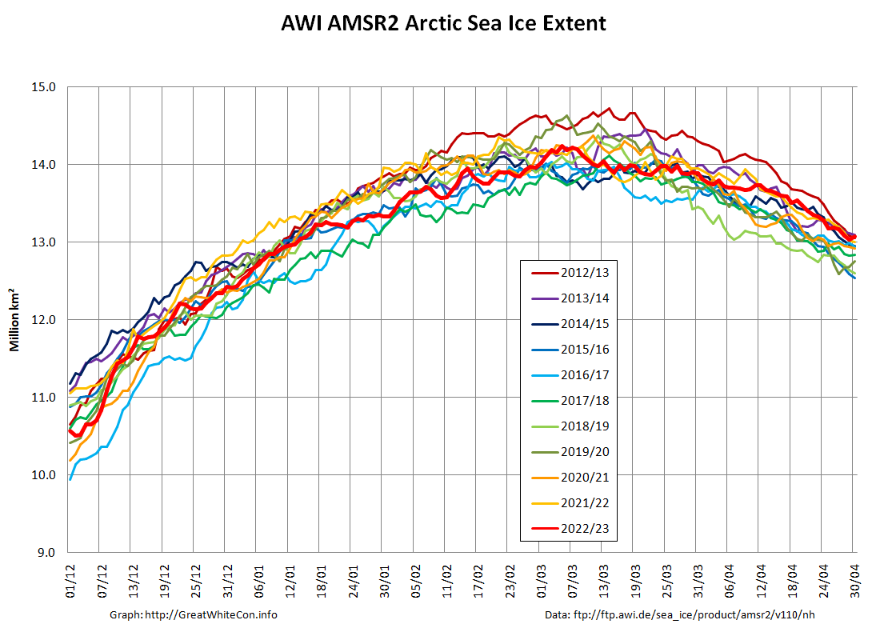
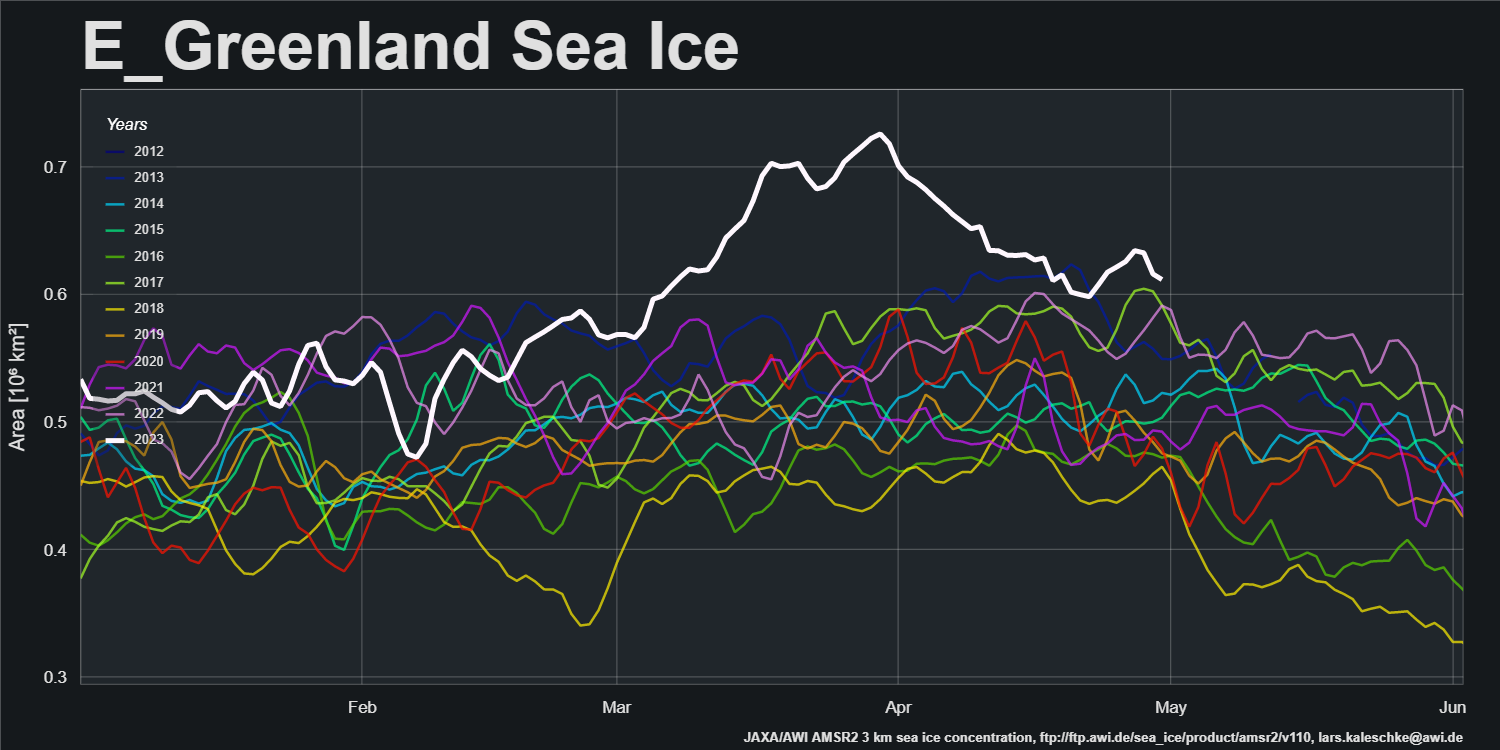
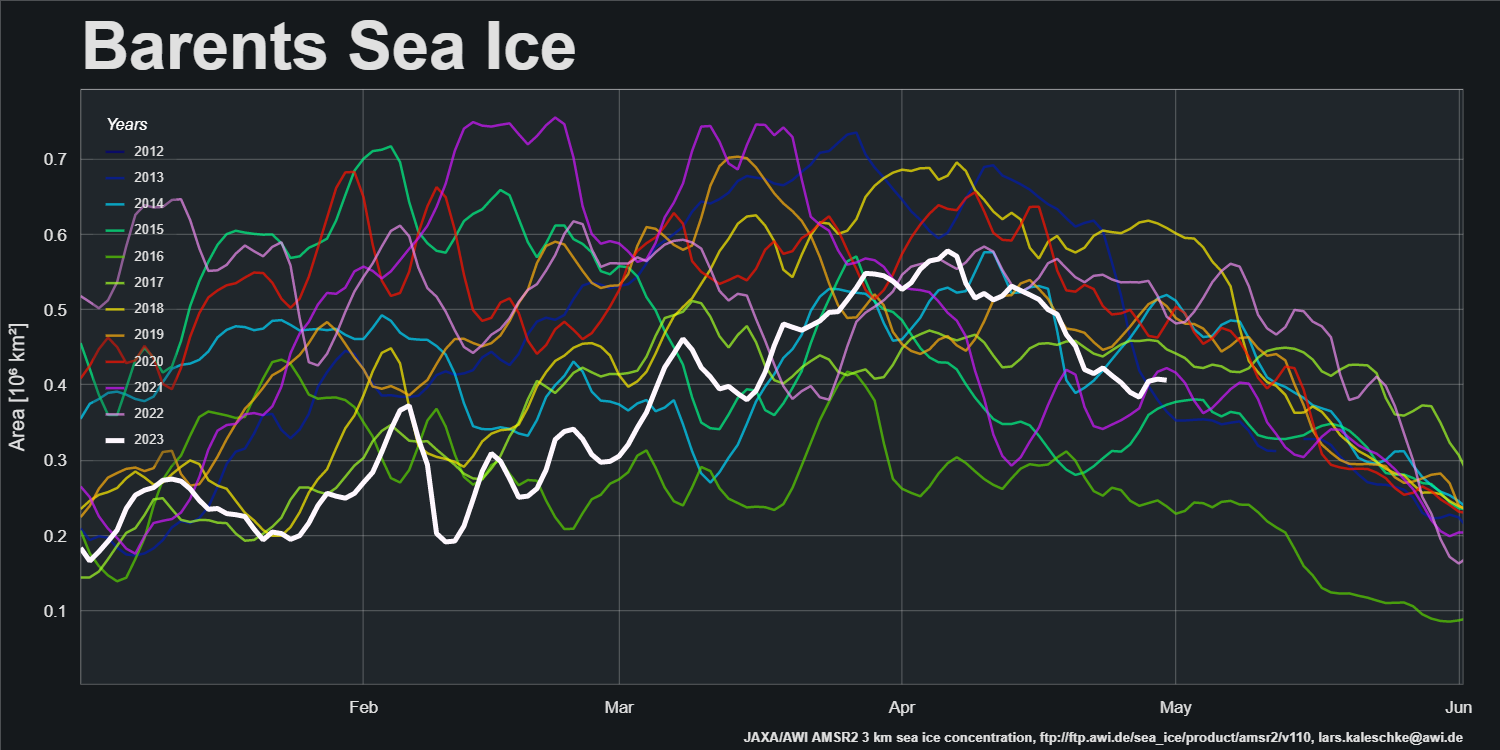
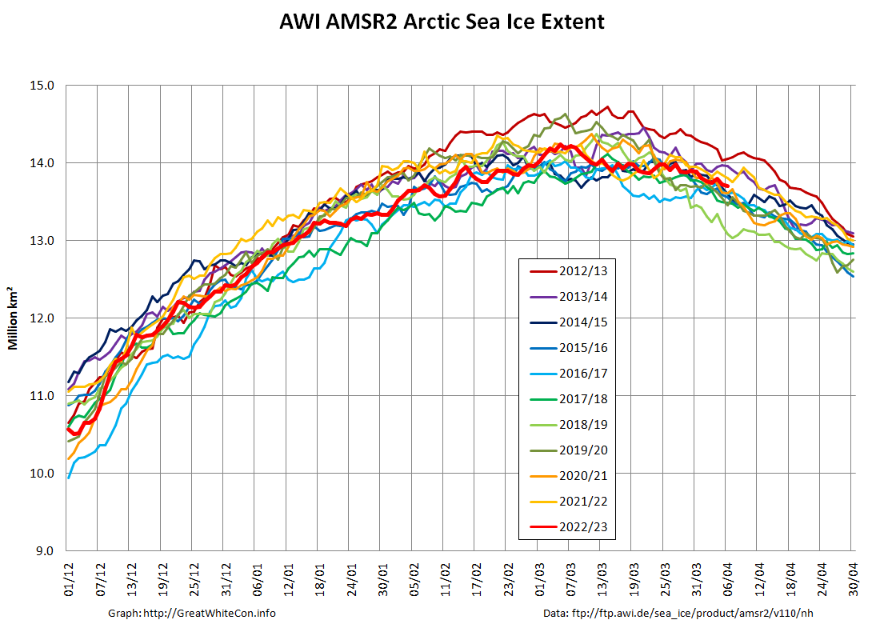
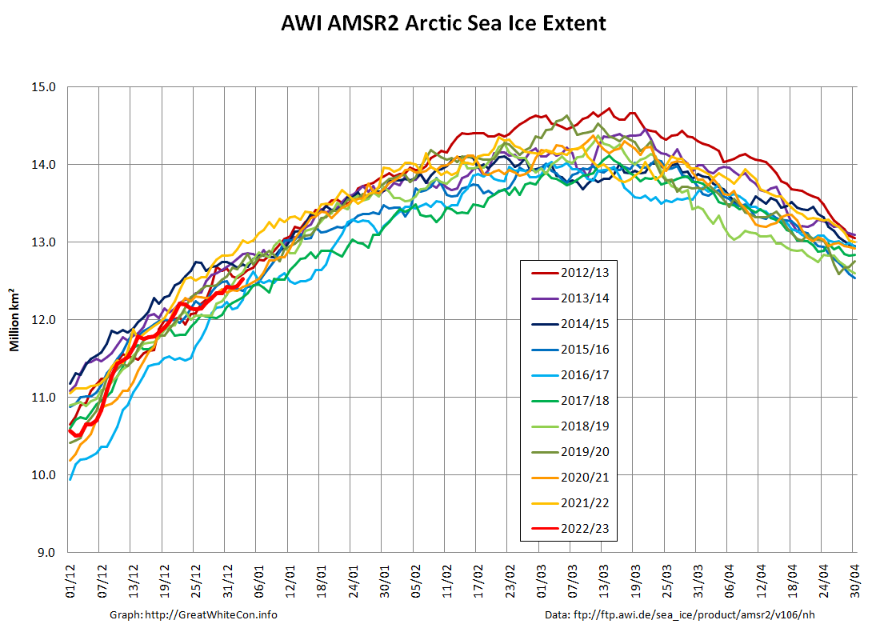
Arctic sea ice extent in early April is singularly unexceptional. Here’s the AWI AMSR2 version:
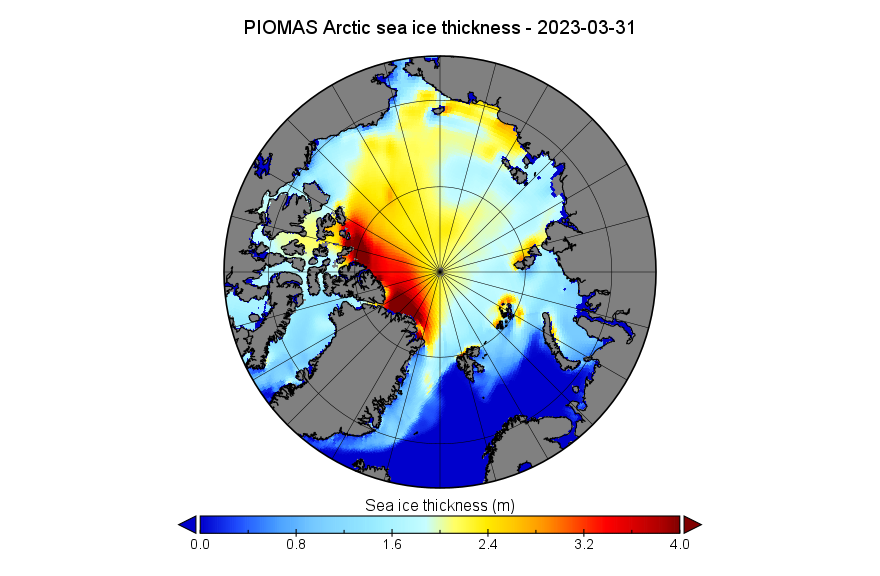
Things start to become more interesting when looking at the third dimension. Here’s the PIOMAS gridded thickness map for March 31st:
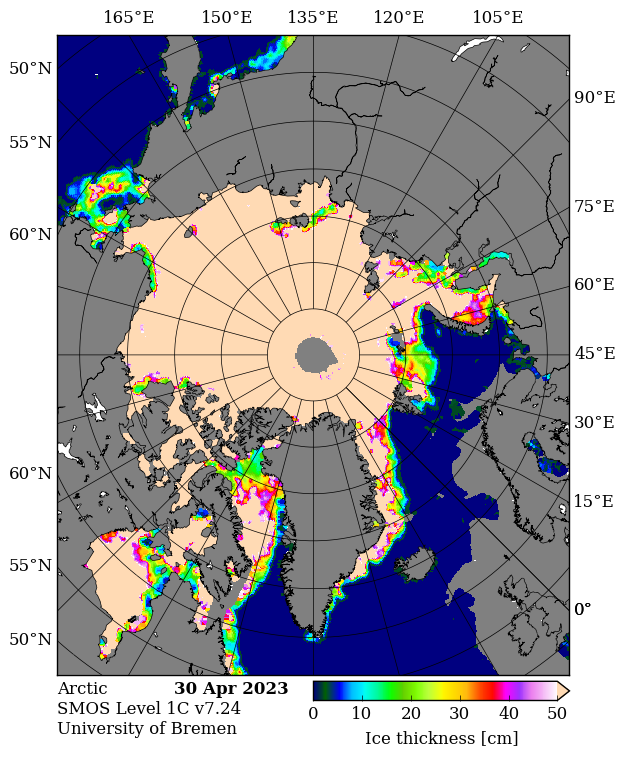
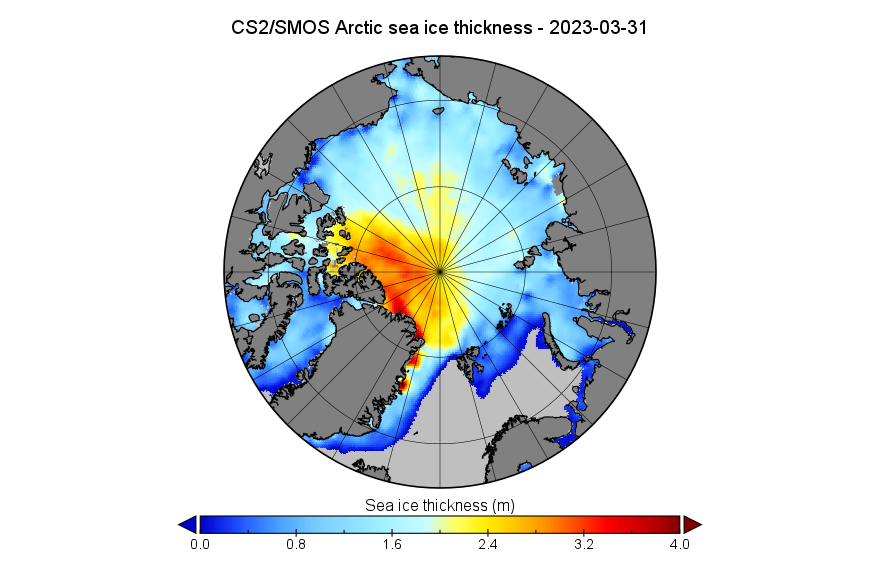
and the CryoSat-2/SMOS map for the same date:
Note the differing distribution of thick ice north of Greenland and the Canadian Arctic Archipelago between the two maps. Note also the area of thinner ice along the coast of the Beaufort Sea visible on the CS2/SMOS map.
By way of explanation for that phenomenon see the March sea level pressure map from the latest edition of the NSIDC’s Arctic Sea Ice News:
We’ll come on to the Arctic in a moment, but at more temperate latitudes I am proud to announce that my Cornish alter ego has been officially outed as an “environmental campaigner” by the BBC. Moving pictures of yours truly, discussing drought rather than sea ice, are available via BBC iPlayer until around 18:30 this evening, possibly to UK residents only.
[Stop Press! A shorter version of Kirk England’s report on two potential desalination plants in Cornwall (also including my 15 seconds of fame!) is available here until around 22:30 this evening ]
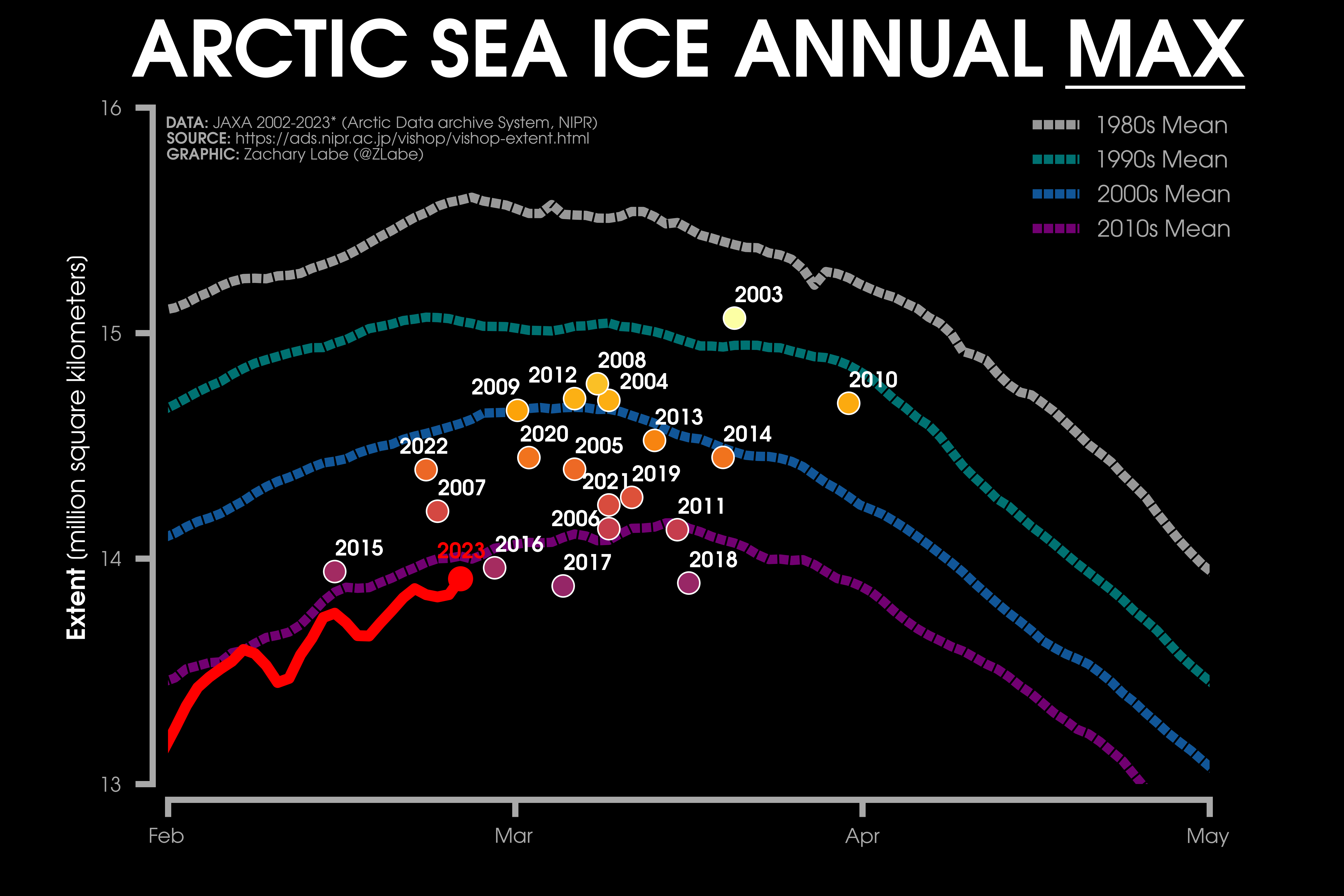
Alternatively we have recorded our own moving pictures of this momentous event:
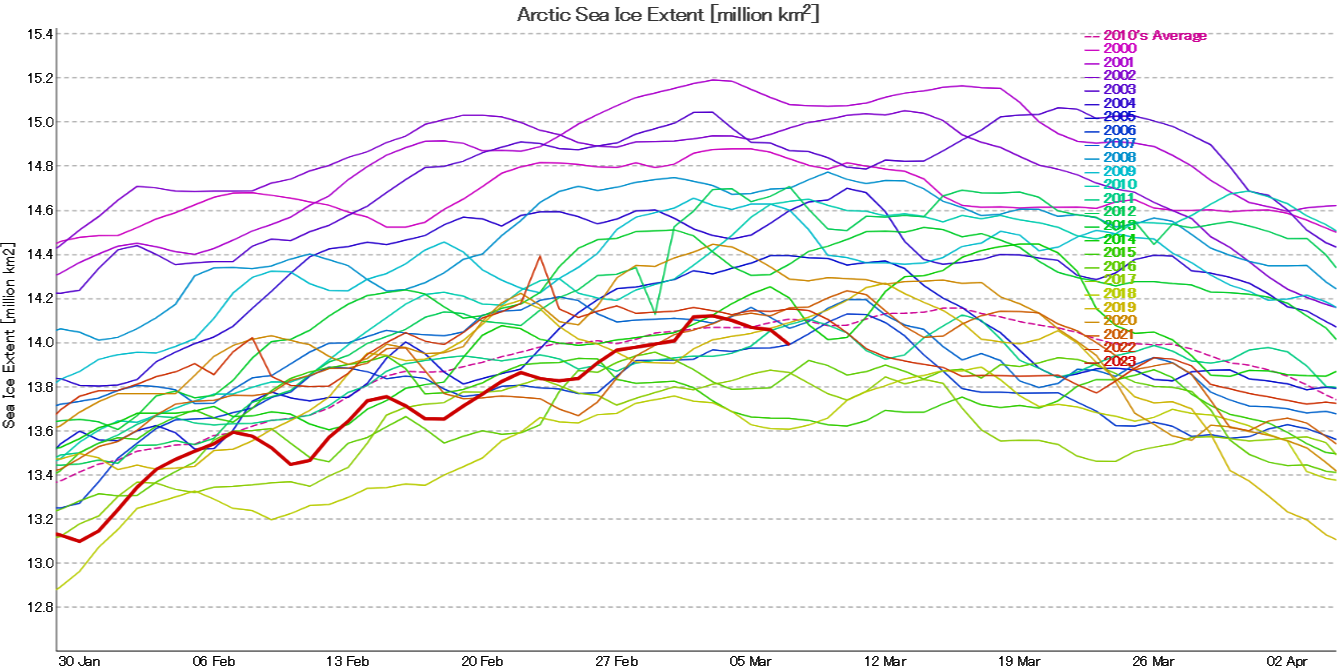
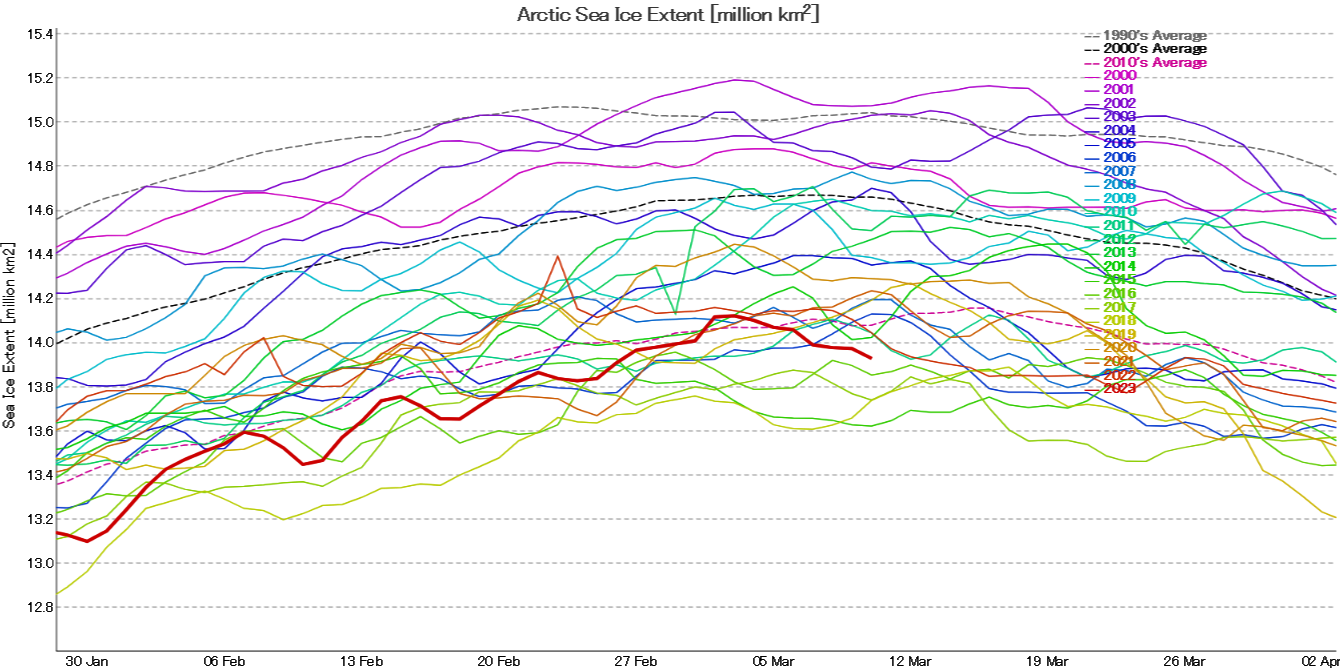
Zack’s graph displays the JAXA/ViSHOP version of Arctic extent, so here too is JAXA’s own graph of the current sea ice extent:
It doesn’t look as though the 2023 maximum has been achieved yet, but extent on March 1st was 14.01 million km². That is evidently not going to be the lowest in the satellite era!
[Edit – March 8th]
As Tom has already mentioned below, JAXA extent has declined significantly since the (so far!) peak extent of 14.12 million km² on both the 2nd and 3rd of March:
It’s too soon to be certain of course, but we certainly now have a good candidate for the 2023 maximum JAXA extent.
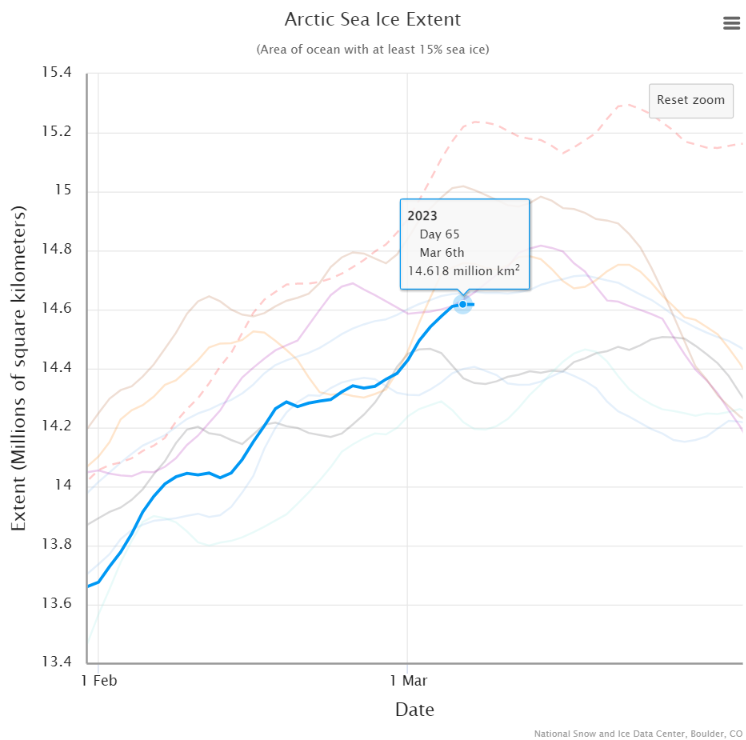
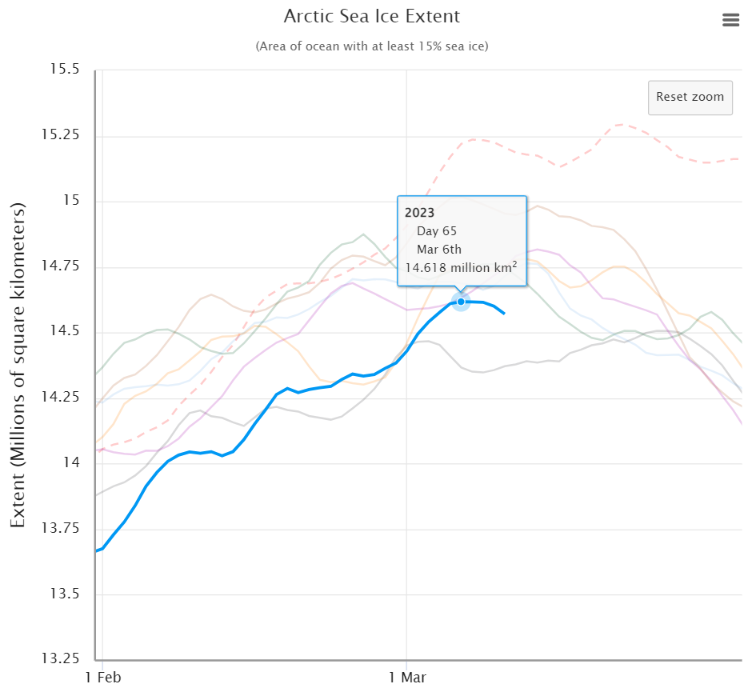
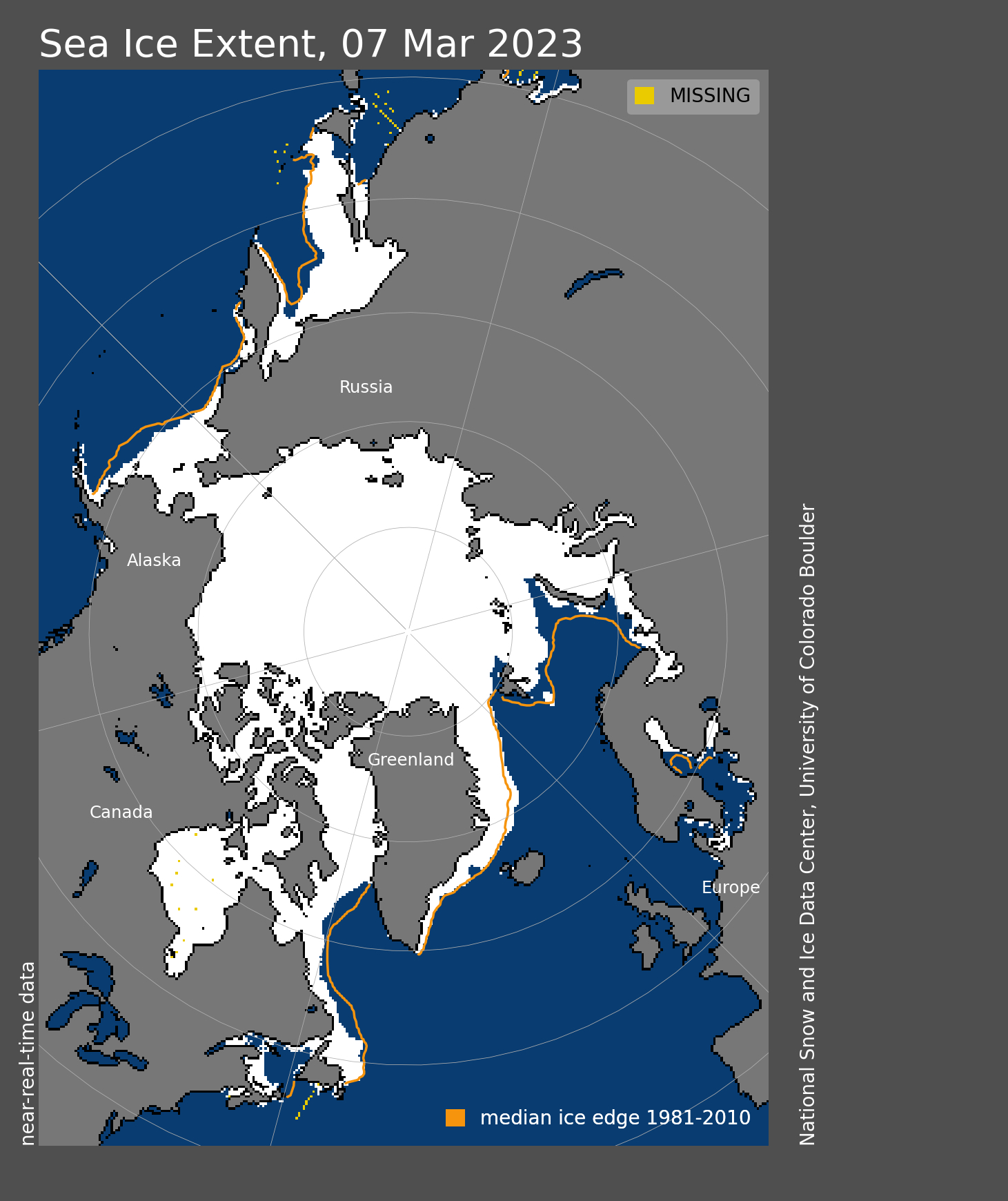
NSIDC 5 day averaged extent is still increasing, but let’s see what this afternoon’s update (UTC) reveals…
Which is a decrease of 0.001 million km² from March 6th, leaving a current NSIDC maximum extent of 14.62 million km²!
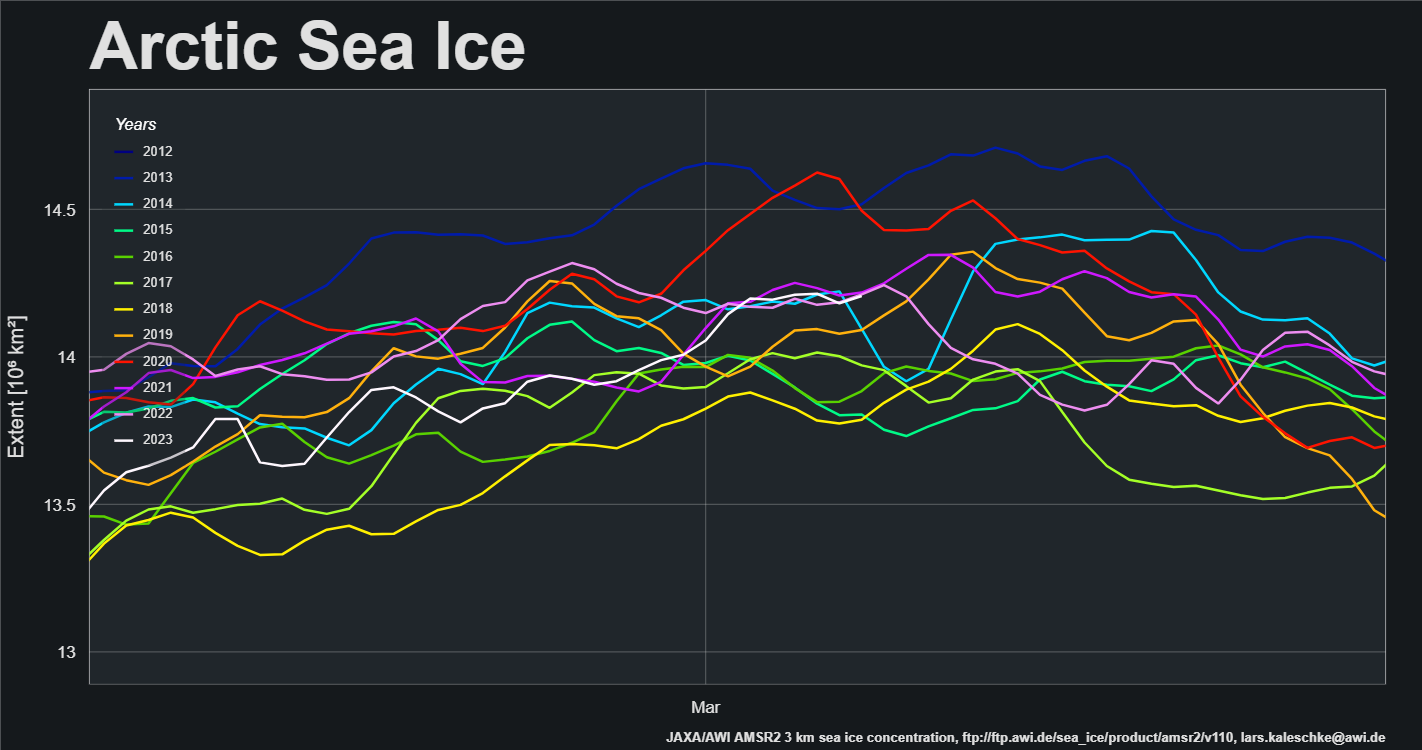
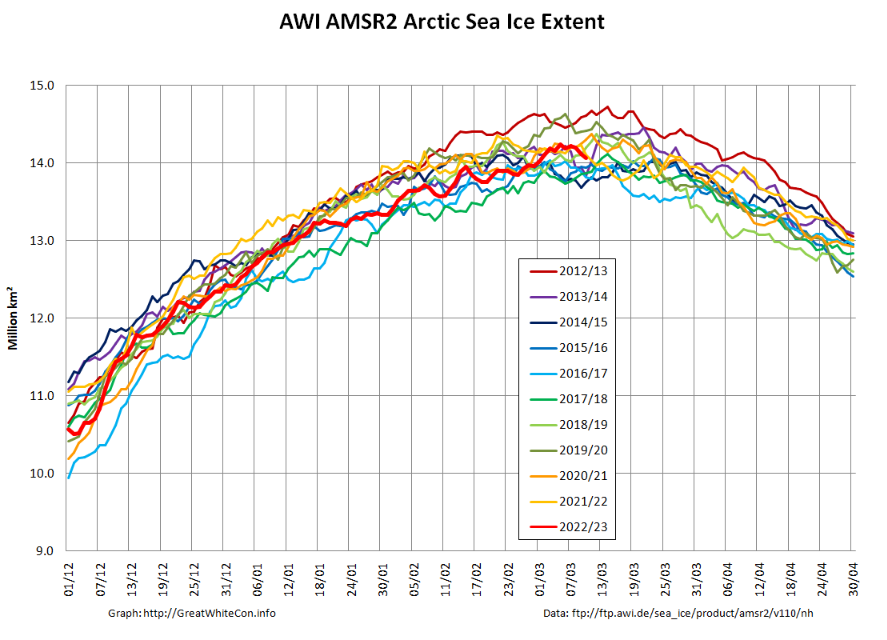
Finally, for the moment at least, AWI’s “high resolution” AMSR2 extent looks a lot less convincing than JAXA’s:
[Edit – March 11th]
NSIDC Arctic sea ice extent took a tumble yesterday, so with only mild trepidation I’m calling the 2023 maximum extent. In the case of the NSIDC’s 5 day average metric that’s still a rounded up 14.62 million km² on March 6th:
The JAXA/ViSHOP maximum extent remains at 14.12 million km² on March 2nd:
The “high resolution” AMSR2 based metric from AWI peaked at 14.24 million km² on March 5th:
[Edit – March 16th]
They are of course a bit late with the news, but the NSIDC have now called the 2023 maximum Arctic sea ice extent:
Arctic sea ice has likely reached its maximum extent for the year, at 14.62 million square kilometers (5.64 million square miles) on March 6. The 2023 maximum is the fifth lowest in the 45-year satellite record. NSIDC scientists will present a detailed analysis of the 2022 to 2023 winter sea ice conditions in the regular monthly post in early April:
The date of the maximum this year, March 6, was six days earlier than the 1981 to 2010 average date of March 12…
The ice growth season ended with below average sea ice extent in the Bering Sea, Sea of Okhotsk, Barents Sea, and Labrador Sea. Above average extent was in the Greenland Sea. Extent was well below average in the Gulf of St. Lawrence for a second year in row.
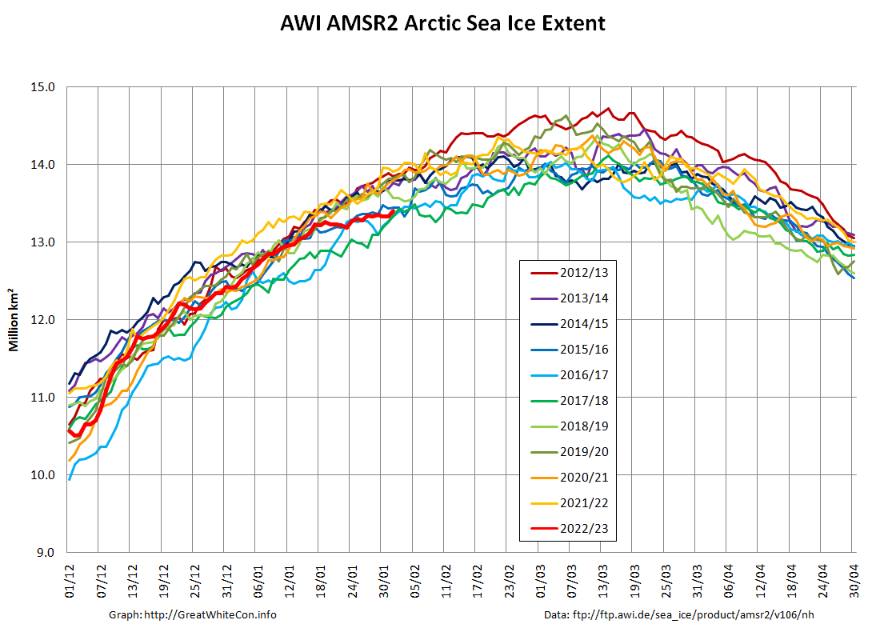
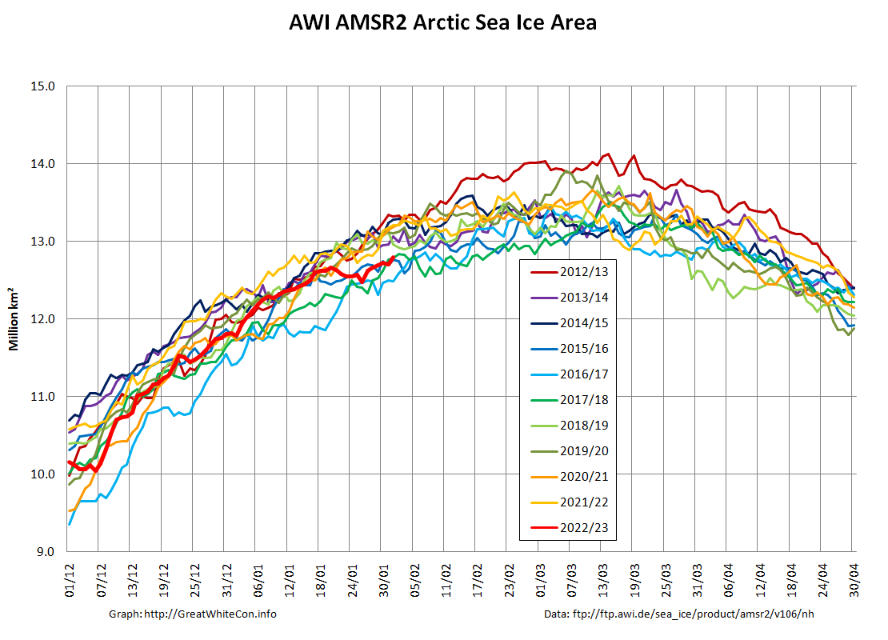
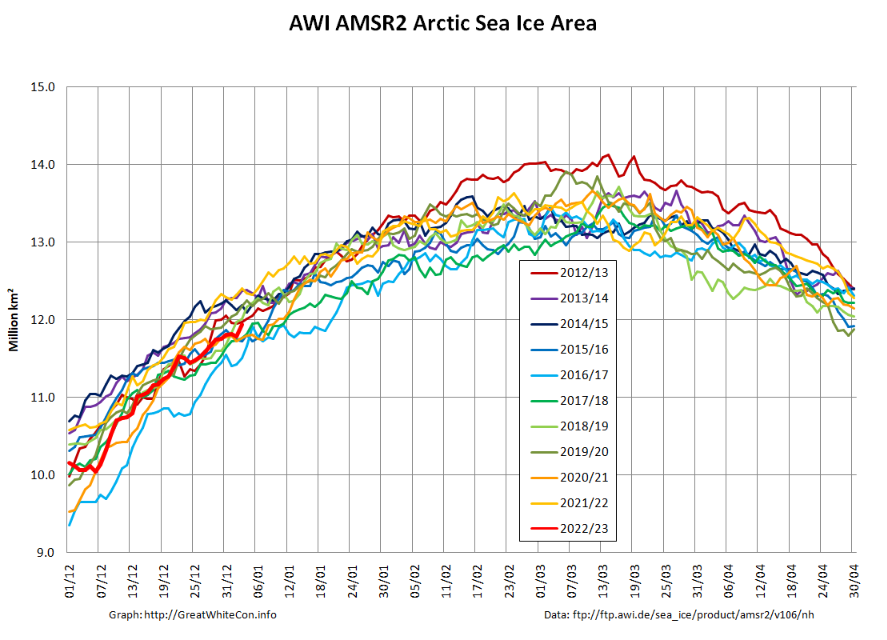
A new month has arrived, and during January several Arctic sea ice metrics have been drifting towards the bottom of their respective decadal ranges. To begin with here is AWI’s high resolution AMSR2 extent graph, which is currently very close to being lowest for the date in the AMSR2 record:
However that is less the case for area:
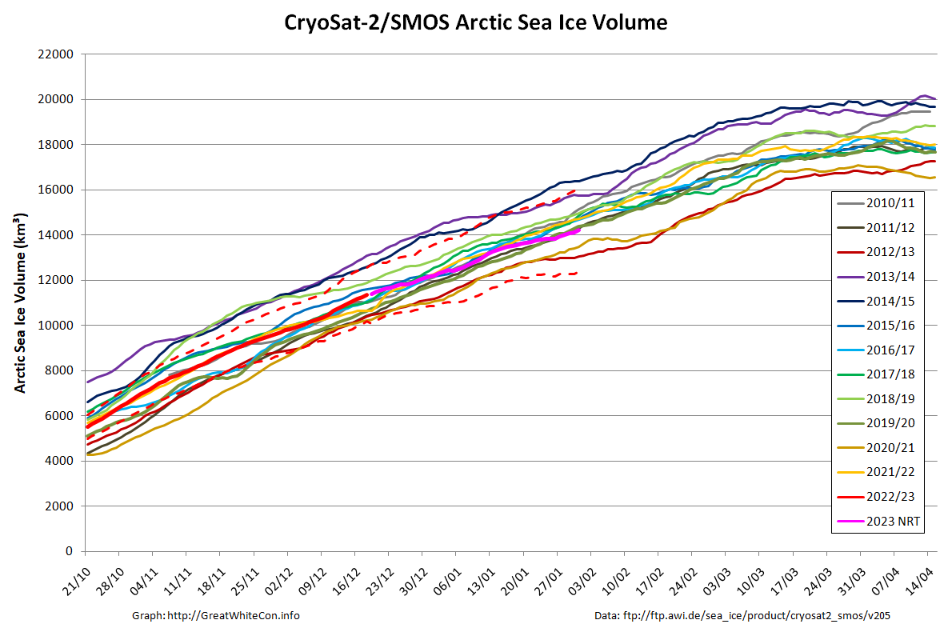
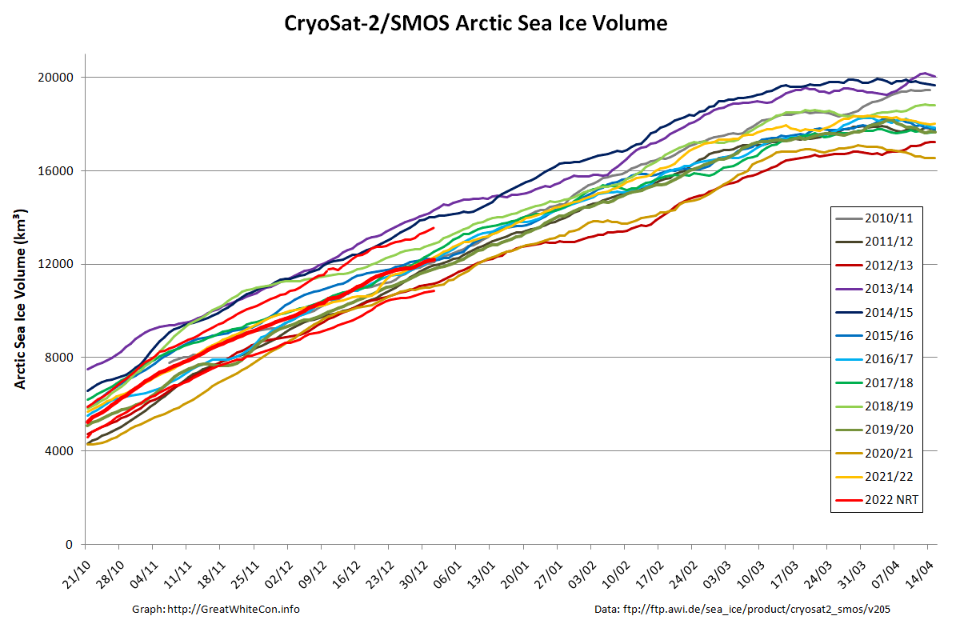
Taylor is keen to see the PIOMAS volume data for January, but whilst we wait for the latest Polar Science Center update here is the CryoSat-2/SMOS volume graph, which now includes a couple of month’s worth of reanalysed results as well as more recent near real time numbers:
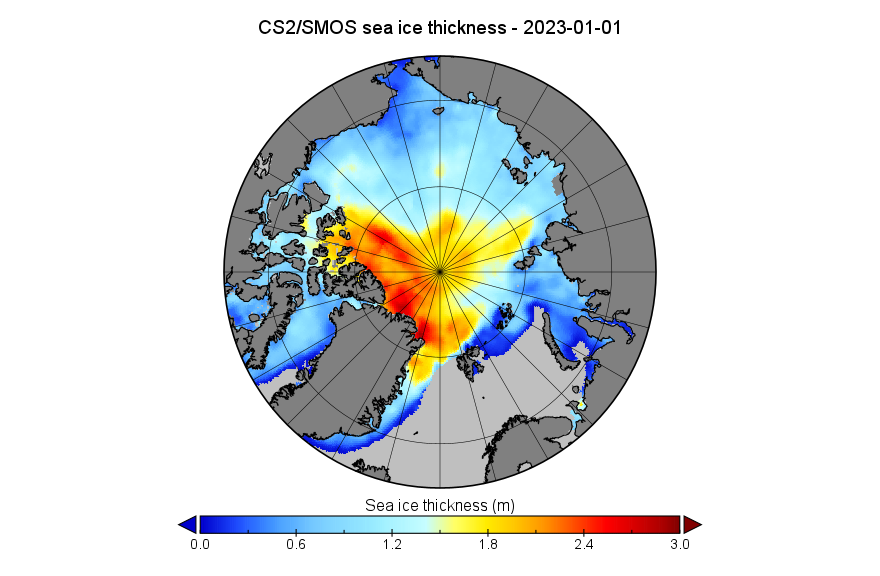
Here too is the start of month CS2/SMOS thickness map:
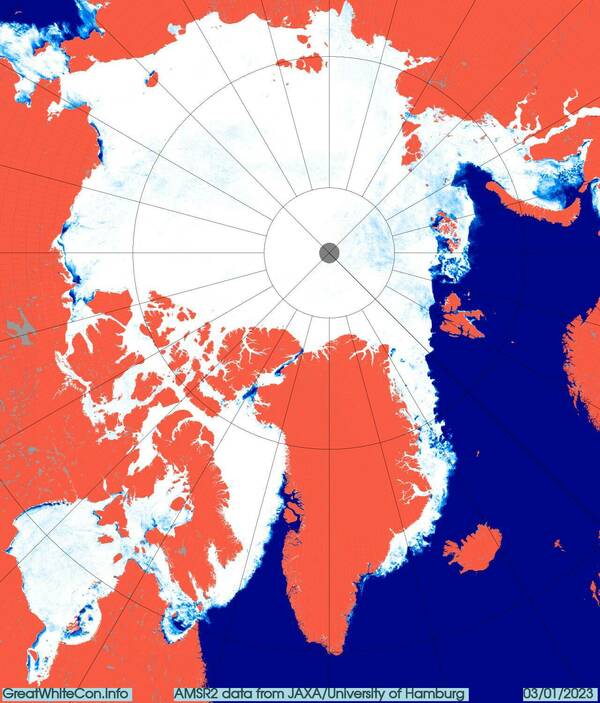
At the beginning of the New Year all the central regions of the Arctic are now refrozen apart from a small area of the Kara Sea:
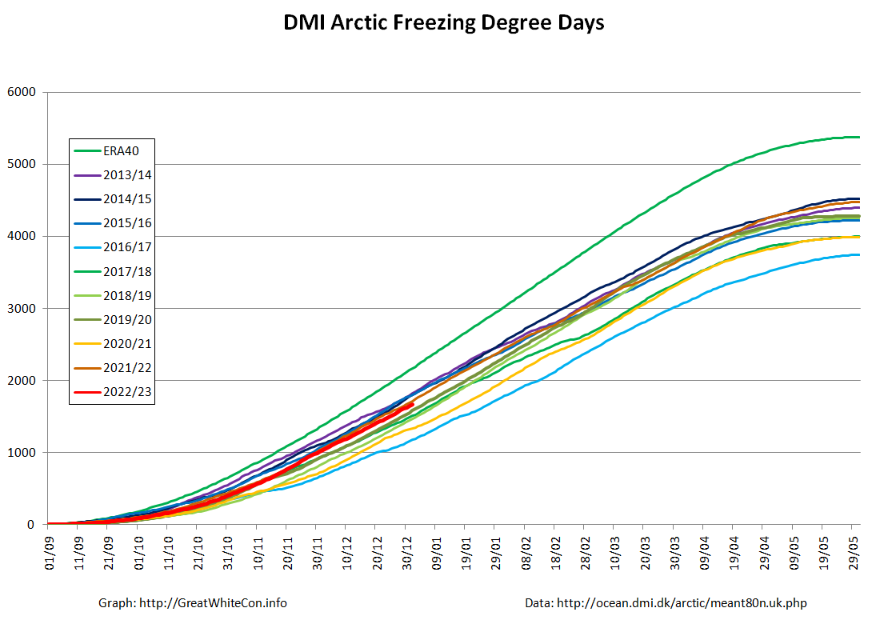
Most Arctic sea ice metrics are near the middle of their respective ranges over the last decade. By way of example, here is a graph of Arctic Freezing Degree Days based on the Danish Meteorological Institute’s temperature data for the area north of 80 degrees latitude:
Here too are the high resolution AWI AMSR2 area and extent graphs:
The latest AWI CryoSat-2/SMOS volume graph tells a similar story:
Although overall volume is in the middle of the pack, the associated thickness map:
and the thickness anomaly map from the Finnish Meteorological Institute reveal an unusual distribution of thicker ice:
A considerable volume of ice currently situated between Svalbard and North East Greenland seems destined to exit the Central Arctic Basin via the Fram Strait over the coming months.
[Edit – January 24th]
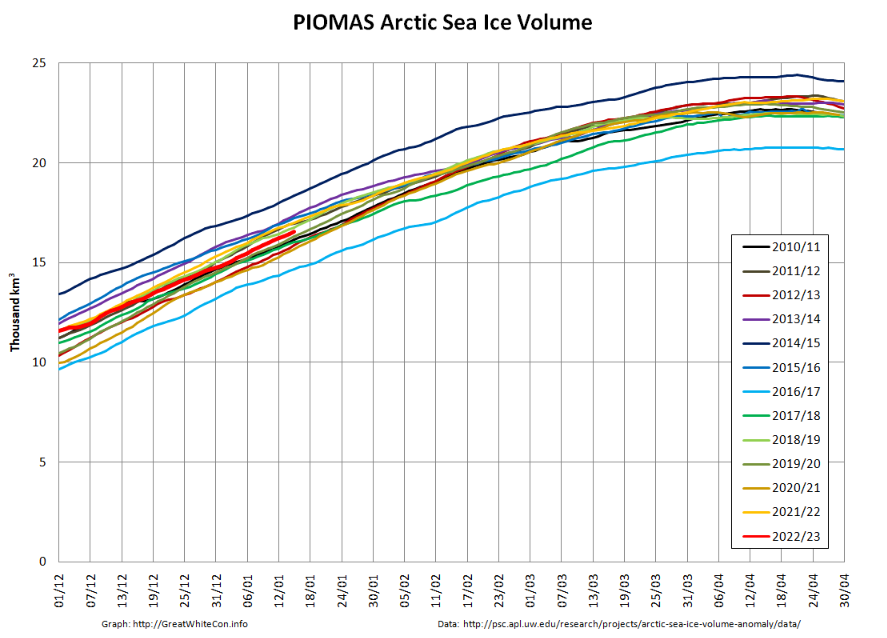
In a somewhat belated mid month update, here’s the PIOMAS daily Arctic sea ice volume graph:
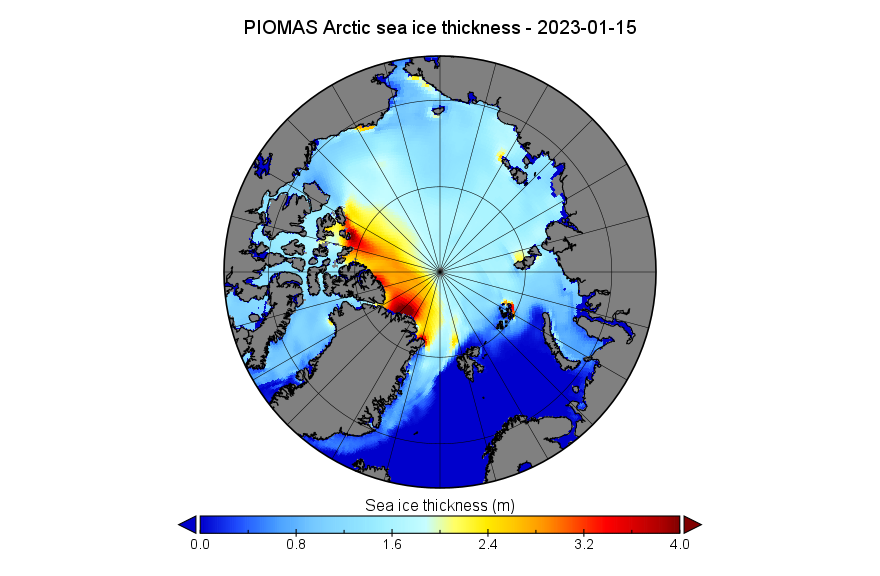
together with the PIOMAS thickness map on January 15th:
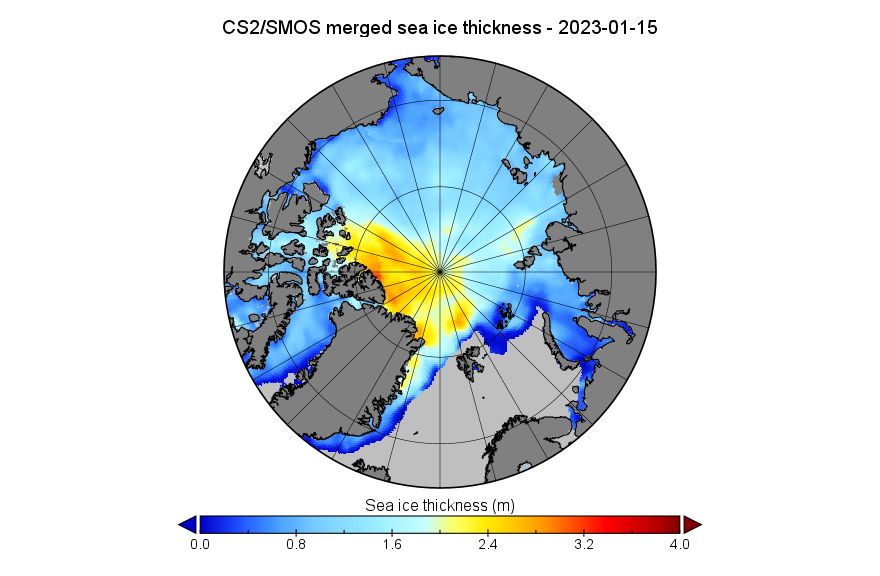
For comparison purposes here’s the AWI CryoSat-2/SMOS thickness map using the same scale:
Note the change of scale from the beginning of the month CS2/SMOS map at the top.
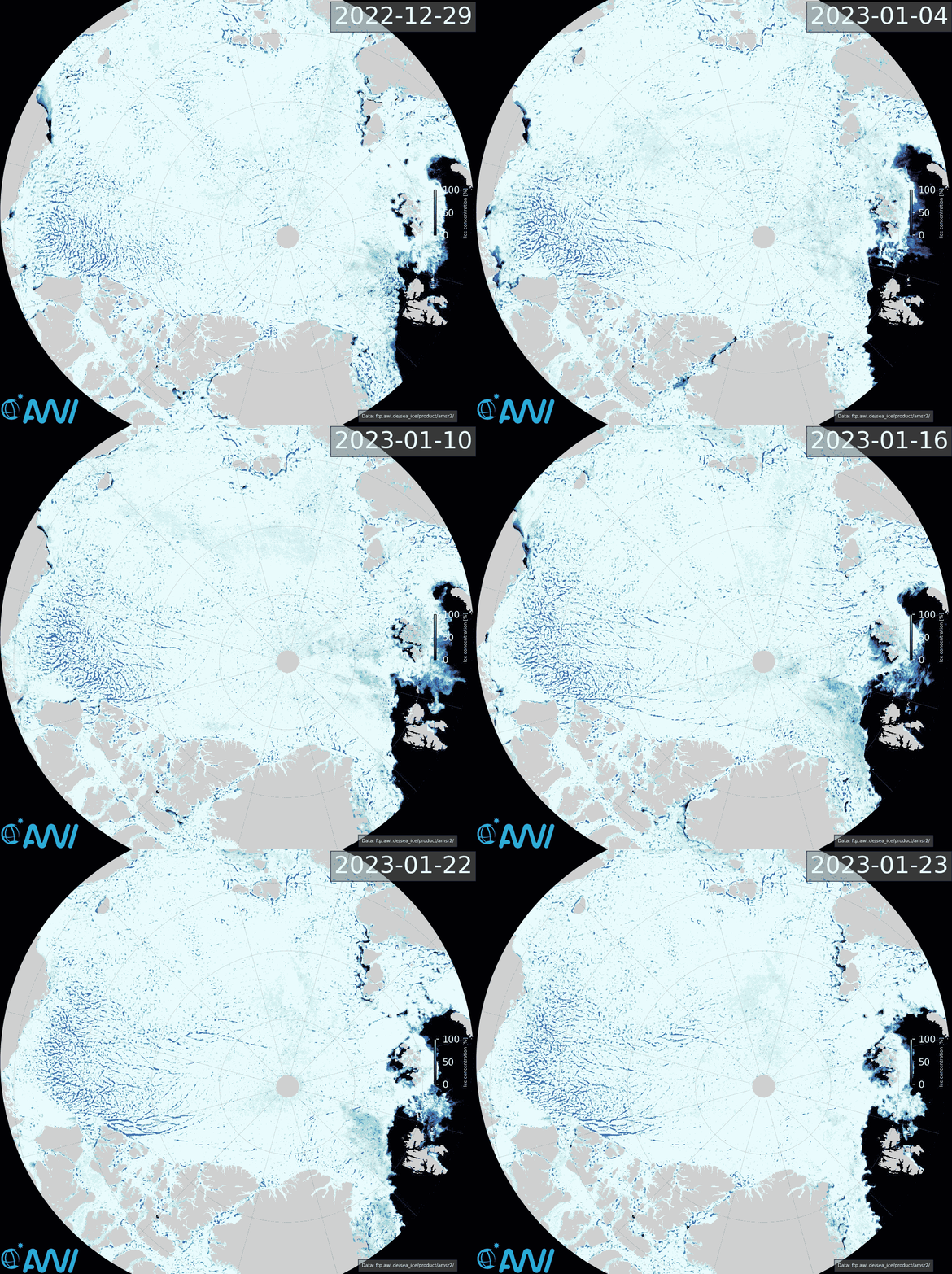
Here too is Lars Kaleschke’s animation of recent Arctic sea ice concentration, with the width of leads exaggerated to reveal ice motion:
Click to animate (10 Mb!)
Evidently sea ice export from the so called “last ice area” is continuing via the Nares Strait and in particular via the Fram Strait between Greenland and Svalbard.
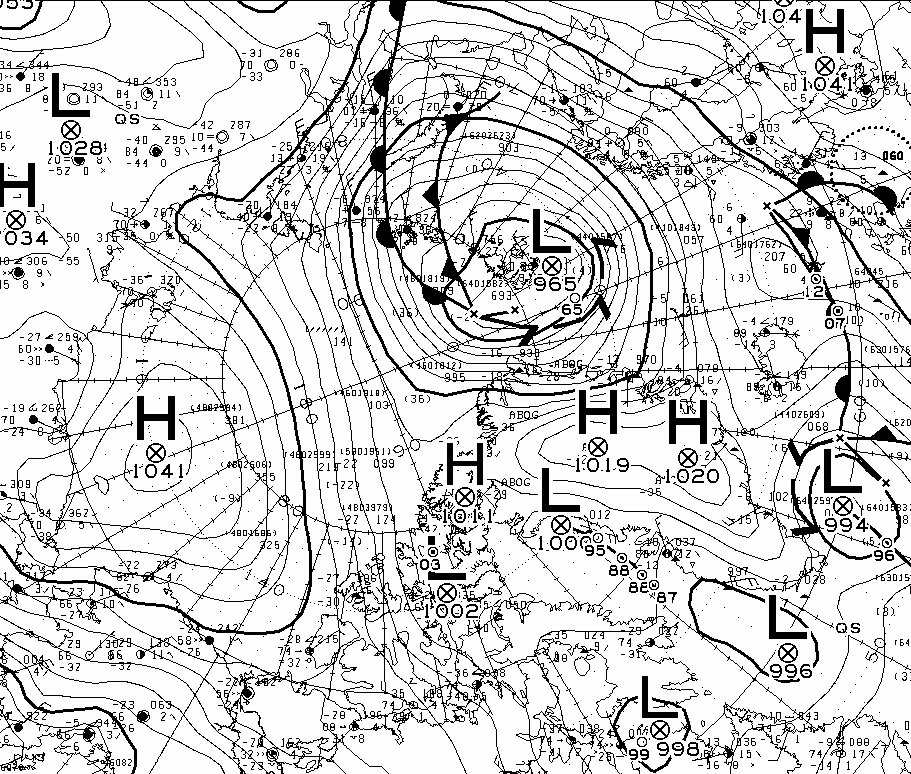
Although not on the same scale as the cyclone at around the same time last year, surface pressure of a storm near Svalbard bottomed out at 965 hPa yesterday:
It will be interesting to see what effect the storm has on the ice on the Atlantic periphery over the next few days.
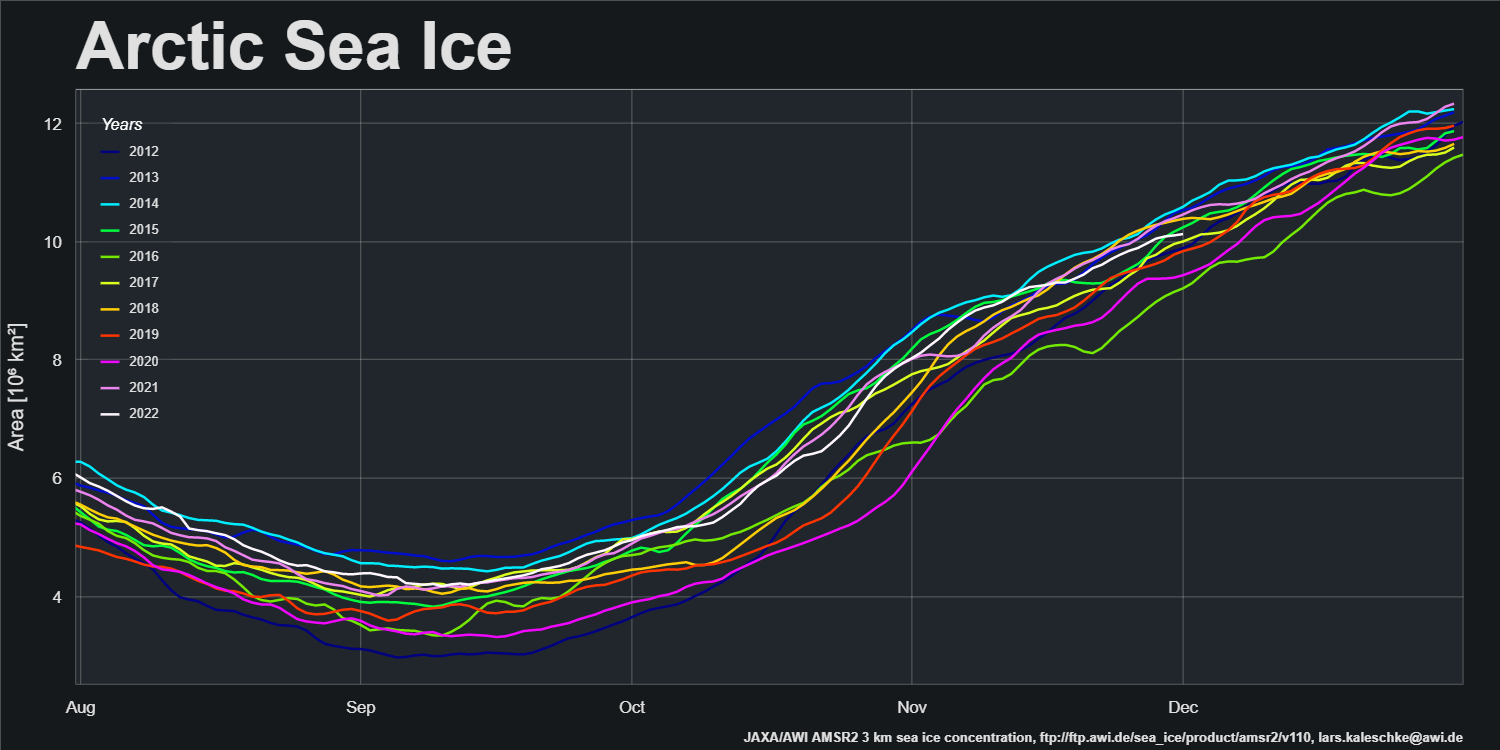
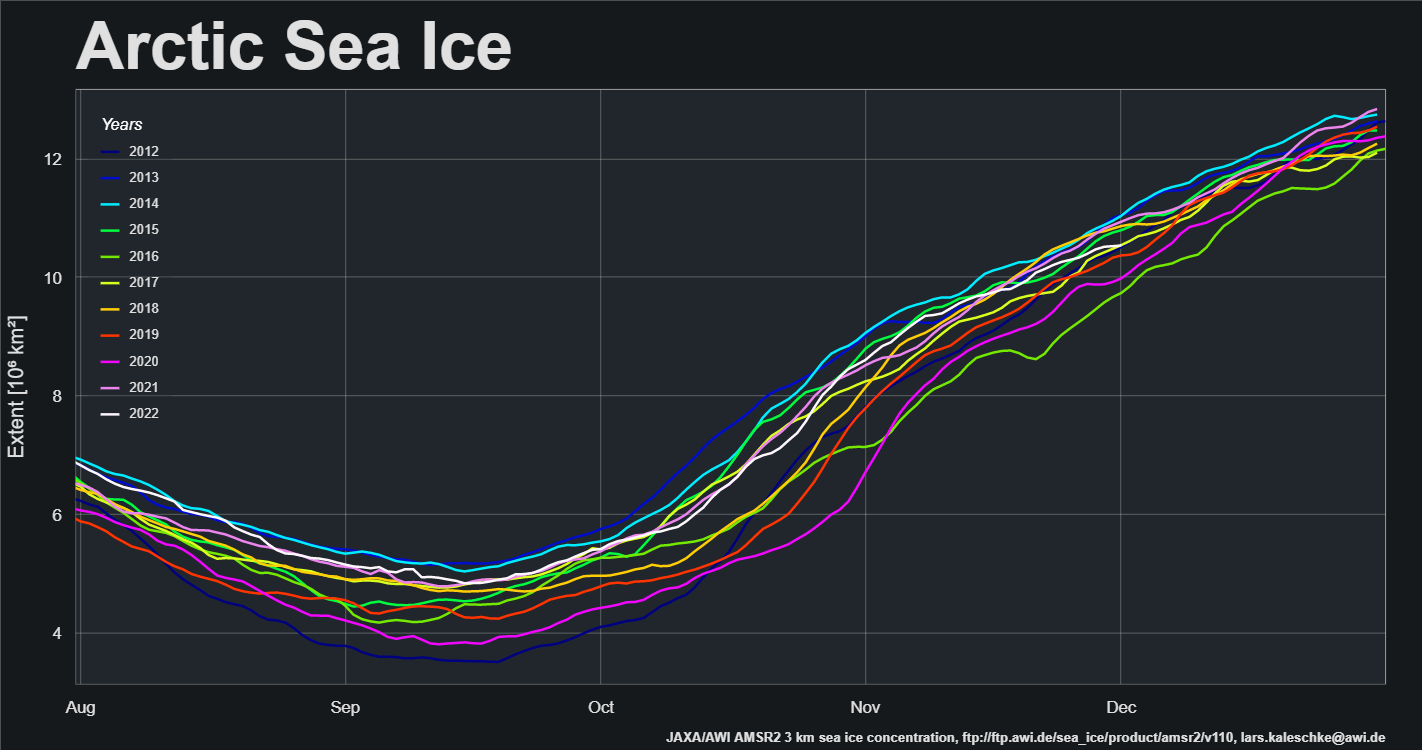
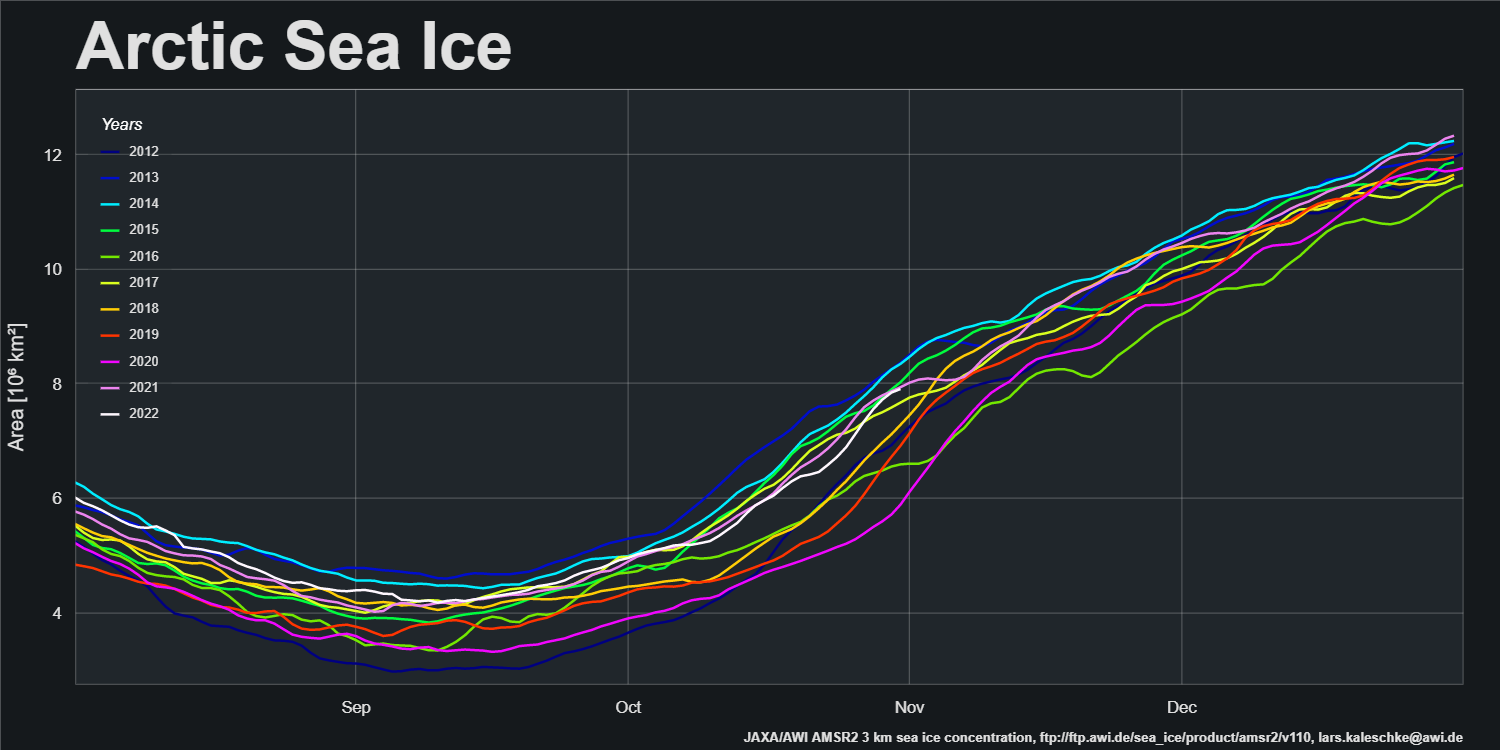
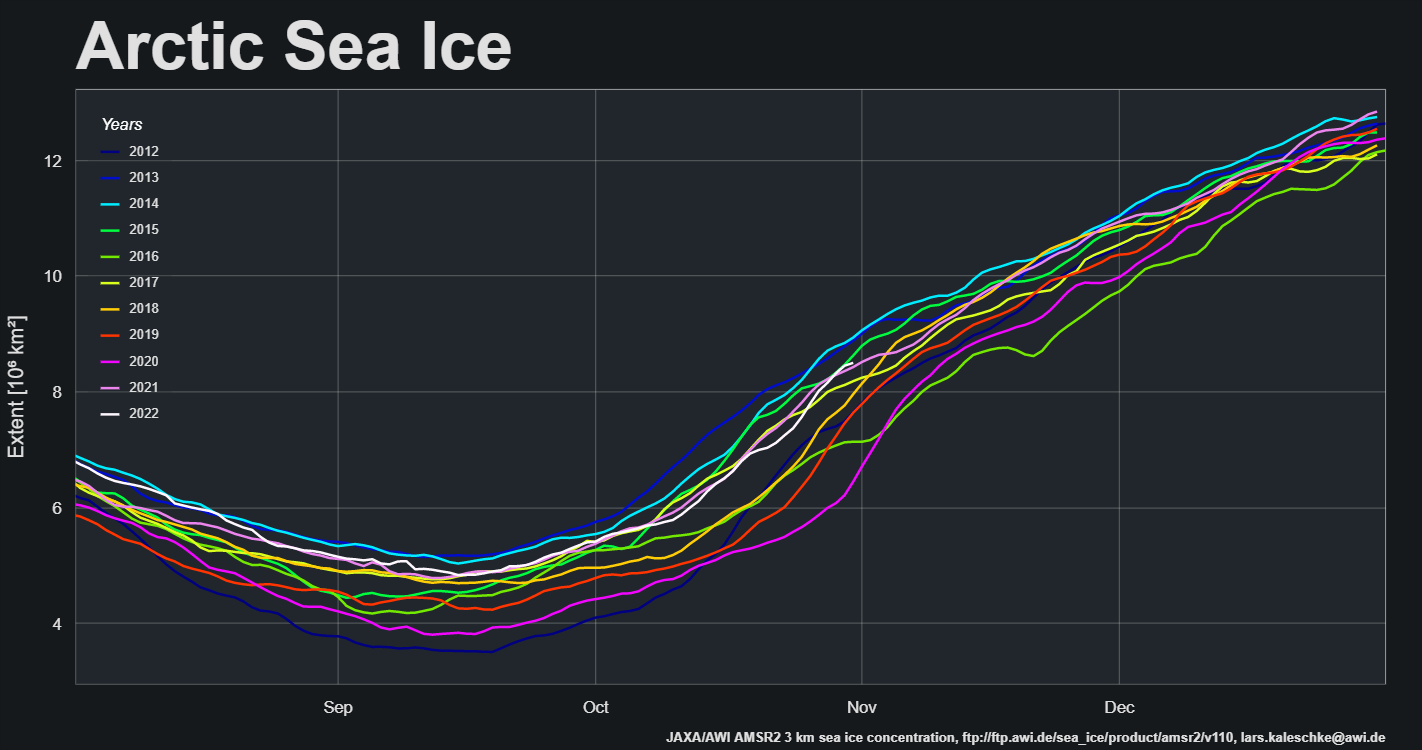
A new month is upon us and Christmas is coming! Here’s another look at Lars Kaleschke’s high resolution AMSR2 area and extent graphs for the Arctic as a whole:
Extent increase stalled for the last few days of November, and as a result extent is now in a “statistical tie” with 2017 for 4th lowest extent for the date in the AMSR2 record.
A change is allegedly as good as a rest, so here’s an alternative view of high resolution AMSR2 area and extent created using the experimental tools provided by the AWI’s Lars Kaleschke at: https://sites.google.com/view/sea-ice/
After a brief pause mid-month the refreeze has accelerated again. Both metrics are in the upper half of the decadal range, with extent this year just above 2021 and area just below last year.
Next let’s take a look at sea ice concentration at the end of October:
Recently Judith Curry published a series of articles on the topic of blackouts. Since attempting to prevent such things is my “professional” speciality I’ve spent a bit of time over at “Climate Etc.” recently. Hence I couldn’t help but notice Judith’s article on Tim Palmer‘s new book, entitled “The Primacy of Doubt”. According to Judith:
This book is a physics-intellectual feast. Must read.
Hence I immediately rushed online and bought a copy from amazon.co.uk, which arrived today. A more detailed overview will follow once I’ve had a chance to read the whole book, but leafing through it this evening I couldn’t help but notice this quotation from Richard Feynman at the very start:
Our freedom to doubt was born of a struggle against authority in the early days of science. It was a very deep and strong struggle. Permit us to question — to doubt, that’s all — not to be sure.
My gaze also alighted on the final paragraph of chapter 10 – “Decisions! Decisions!”:
Just as with weather prediction, a cost-loss analysis can help you make a decision about whether to take anticipatory action regarding climate change…
Based on the way we value our own existence in other areas of life, there does indeed seem to be a strong argument that we should act now, uncertainties about future climate change notwithstanding.
But this is ultimately a decision which each of us must make, e.g. in deciding which politicians to vote for.
Of course being a citizen of the once Great British banana republic I don’t get to vote on our next Prime Minister!
I think I’ll go and pass this news on to Judith and her denizens forthwith. Meanwhile here’s a quotation from the back cover. According to Suki Manabe, winner of the 2021 Nobel Prize in Physics:
The Primacy of Doubt is an important book by one of the pioneers of dynamical weather prediction, indispensable for daily life, describing how the approach can be used for prediction in other areas, such as climate, health, economy, and conflict.
[Edit – October 22nd]
I’m still rather busy trying to help keep the UK’s lights on, so I have yet to even begin reading “The Primacy of Doubt” from cover to cover. However here is another brief extract, from the chapter on “Climate Change”:
We understand these [water vapour, albedo] feedback processes reasonably well. However, there is another feedback process associated with water that we understand rather poorly. This is the cloud feedback process.
[Edit – October 25th]
Here’s another extract from chapter 6 (page 115):
The question of whether clouds act as a positive or negative feedback on climate change can’t at present be answered unambiguously: indeed, I would say it is the biggest unsolved problem in physical climate-change science.
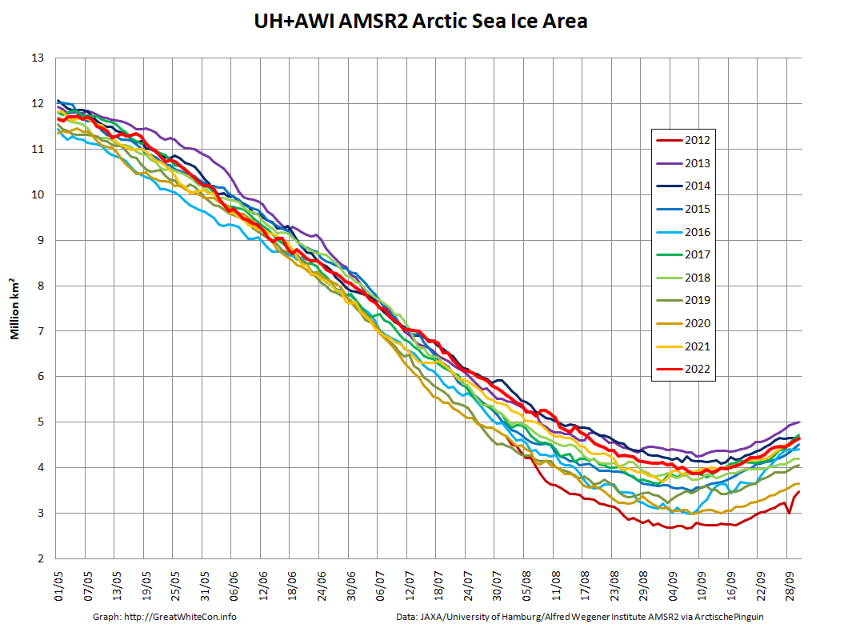
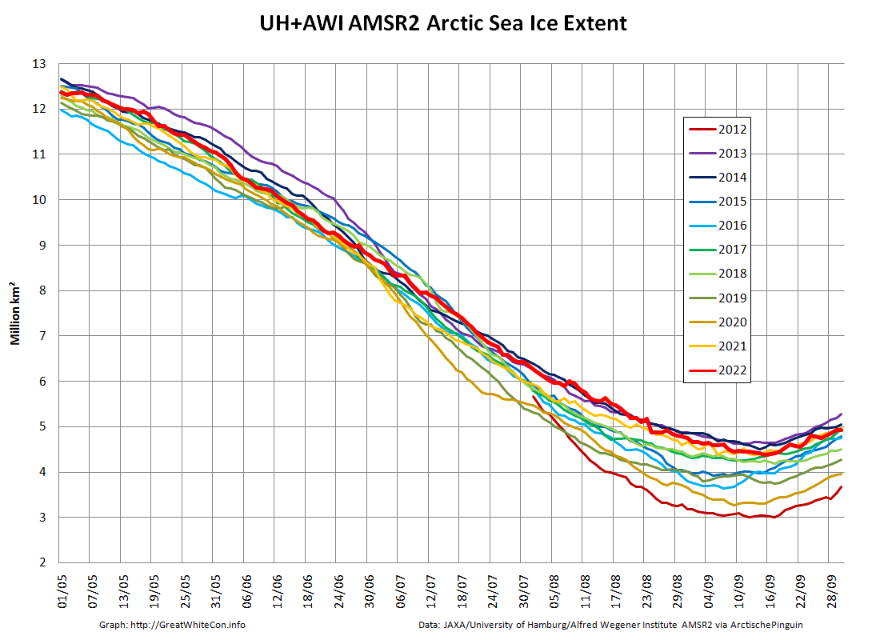
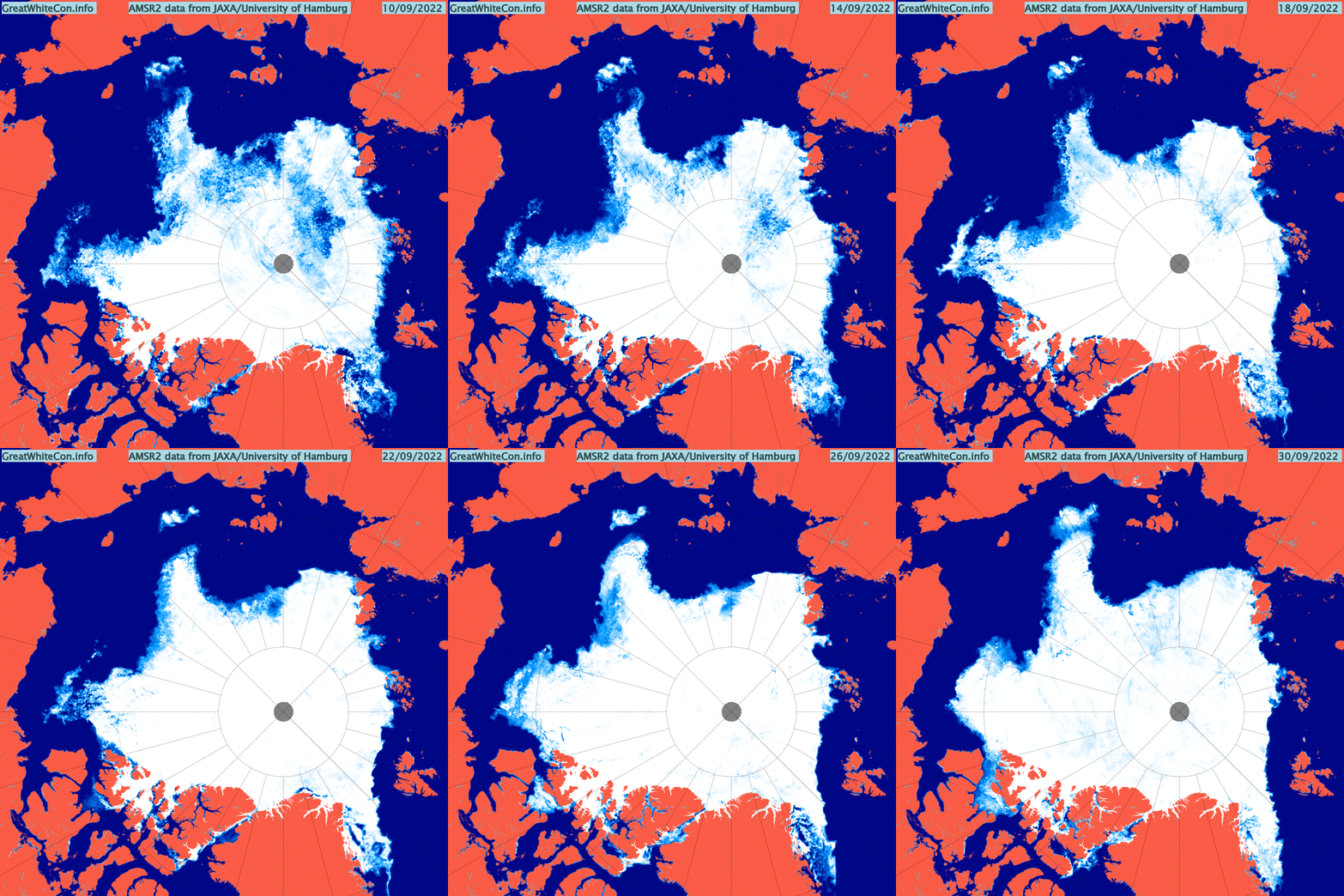
The 2022/23 freezing season has begun, so to begin with here are Arctic sea ice area and extent during its early stages:
Both metrics are currently tracking 2021 quite closely.
Here too is an AMSR2 animation of the transition from melting to freezing in the Central Arctic. Click to animate, and be warned that the file size is almost 10 Mb:
[Edit – October 4th]
Another big storm is heading for the Chukchi Sea. The GFS forecast currently shows a sub 960 hPa low developing on Thursday:
This website uses cookies to improve your experience. We'll assume you're ok with this, but you can opt-out if you wish. Cookie settingsACCEPT
Privacy & Cookies Policy
Privacy Overview
This website uses cookies to improve your experience while you navigate through the website. Out of these, the cookies that are categorized as necessary are stored on your browser as they are essential for the working of basic functionalities of the website. We also use third-party cookies that help us analyze and understand how you use this website. These cookies will be stored in your browser only with your consent. You also have the option to opt-out of these cookies. But opting out of some of these cookies may affect your browsing experience.
Necessary cookies are absolutely essential for the website to function properly. This category only includes cookies that ensures basic functionalities and security features of the website. These cookies do not store any personal information.
Any cookies that may not be particularly necessary for the website to function and is used specifically to collect user personal data via analytics, ads, other embedded contents are termed as non-necessary cookies. It is mandatory to procure user consent prior to running these cookies on your website.