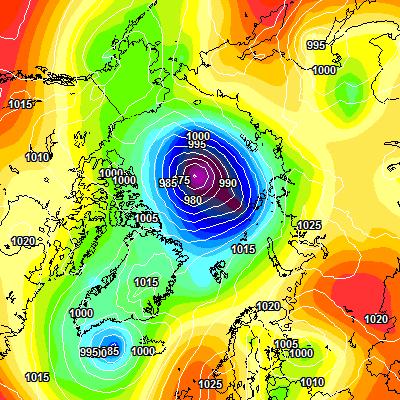
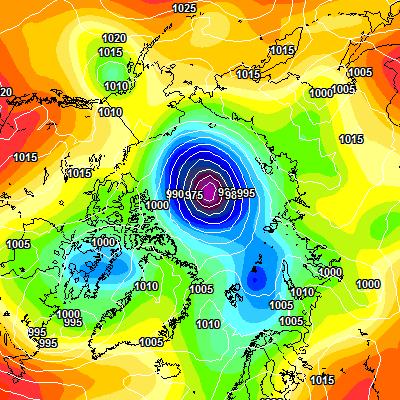
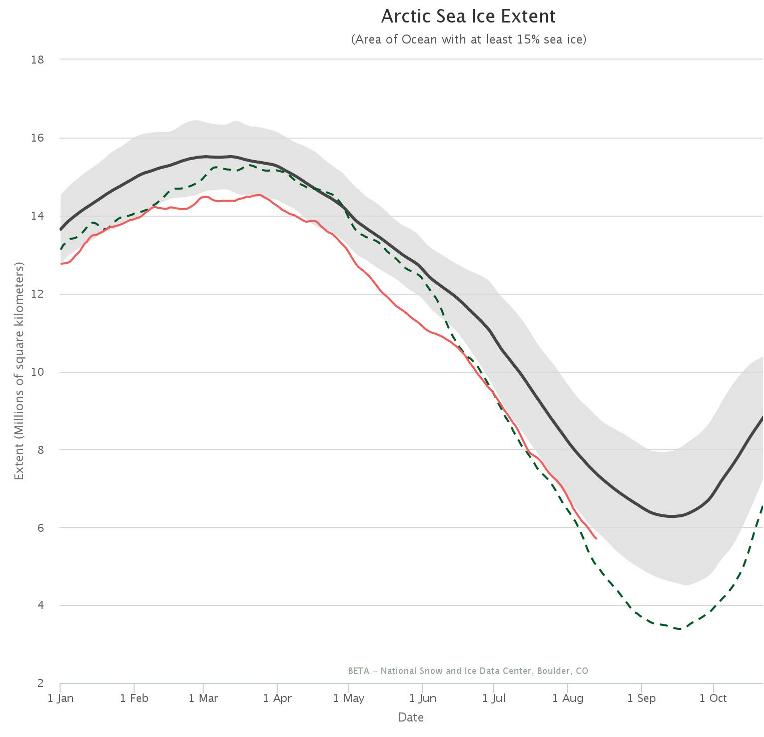
Tag Archives: Cyclone

Facts About the Arctic in July 2020

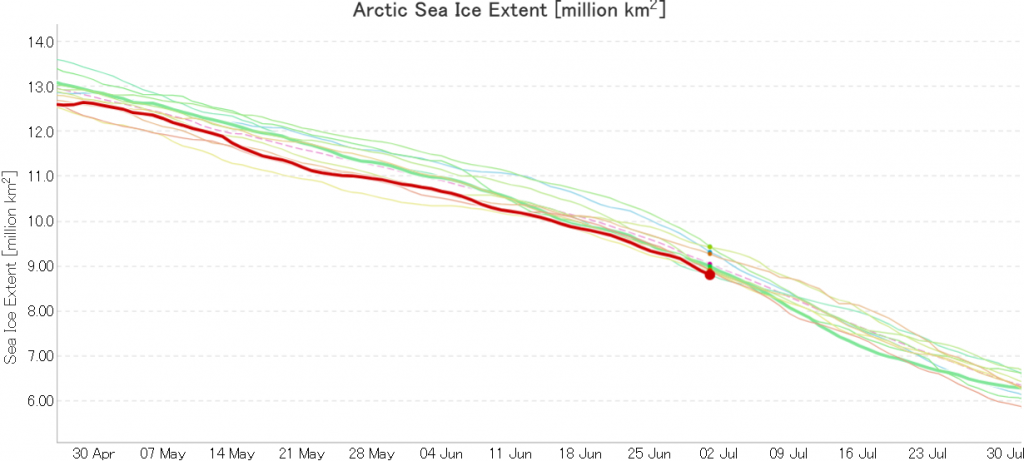
The new month starts with JAXA extent “lowest for the date in the satellite record” by a whisker:
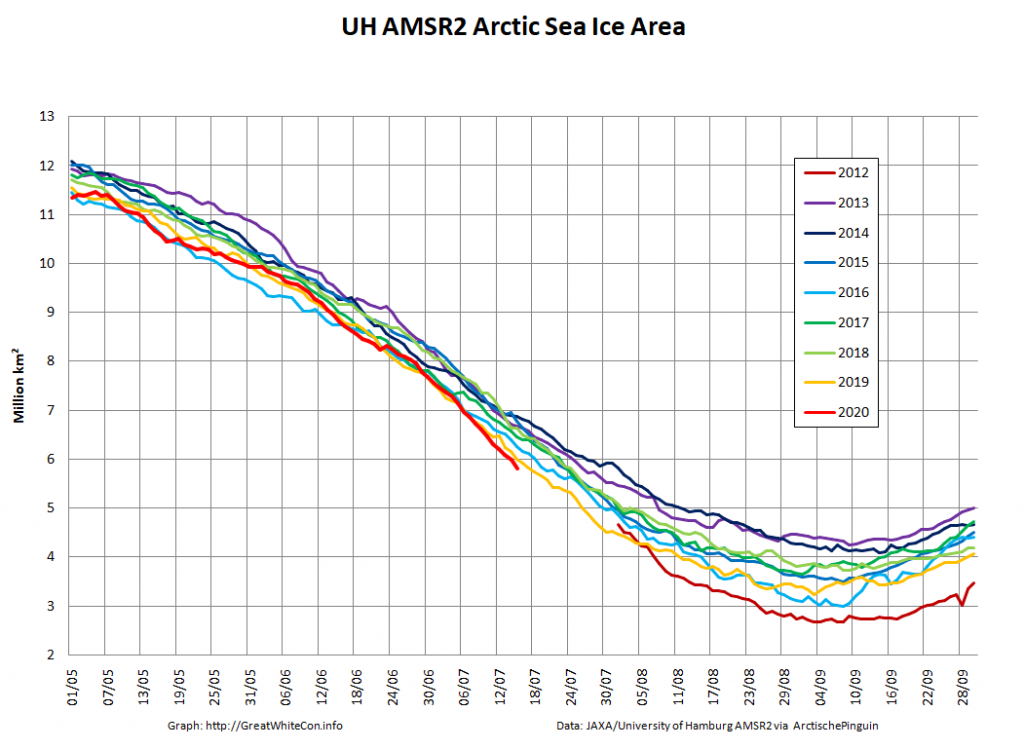
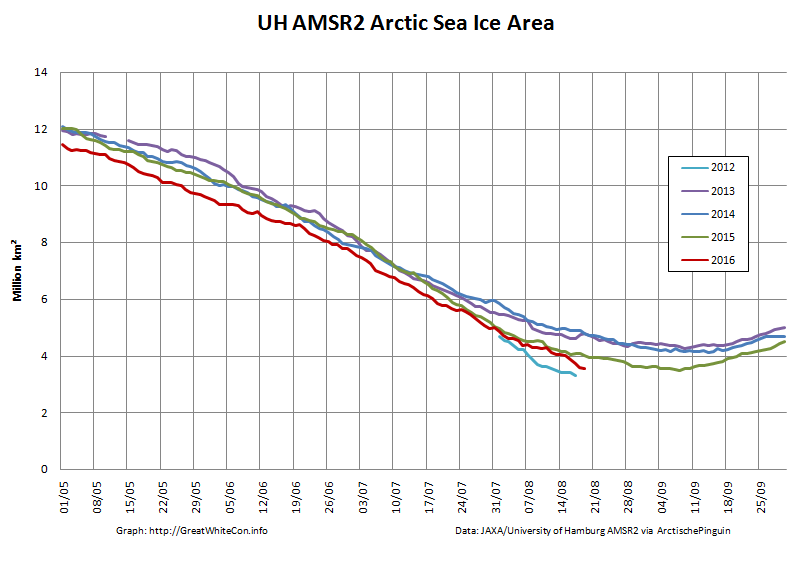
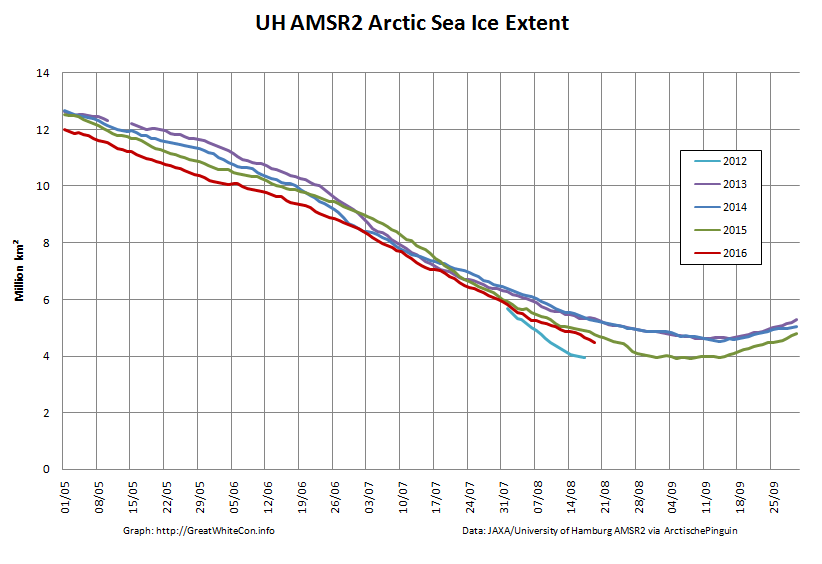
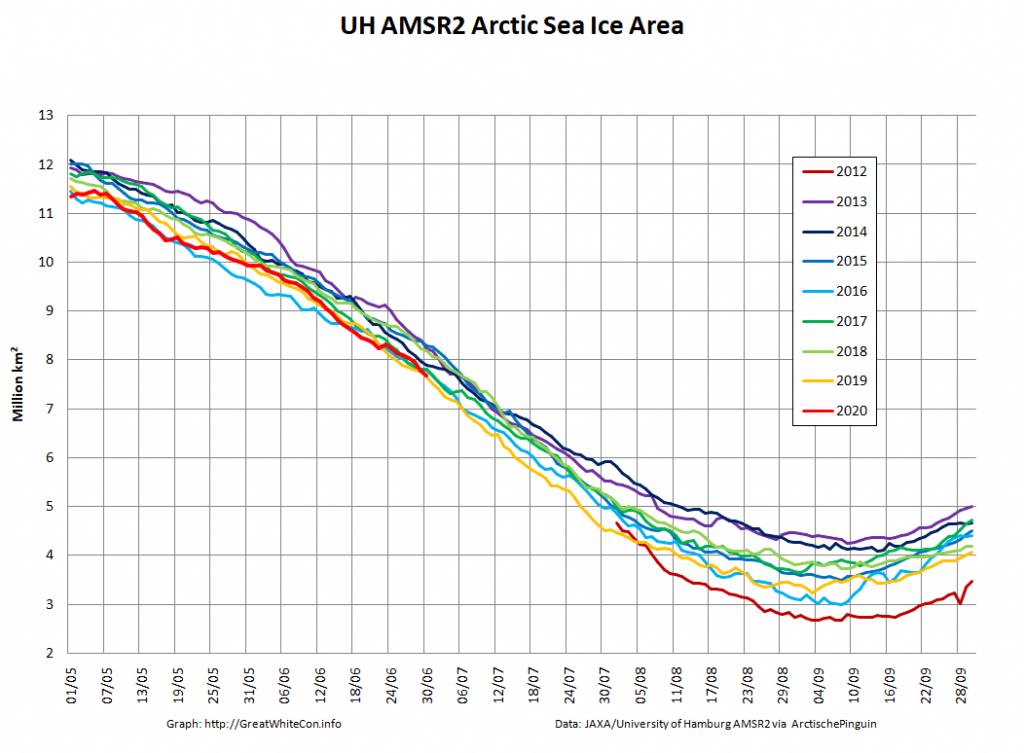
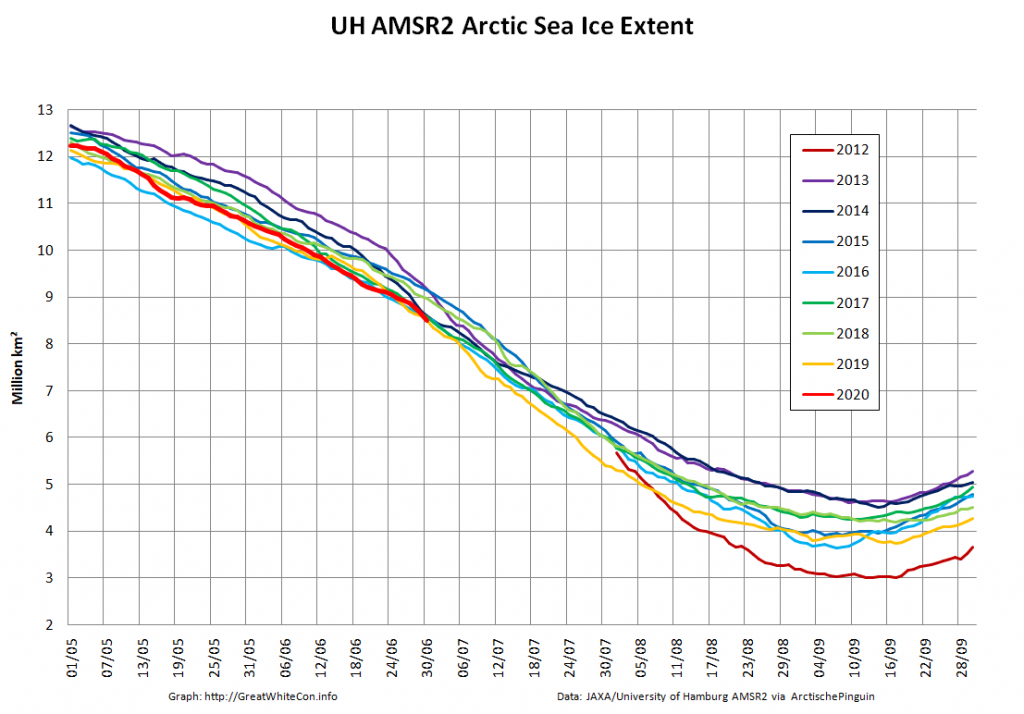
The high resolution Arctic sea ice area and extent graphs based on the University of Hamburg’s AMSR2 concentration data are also in “statistical ties” for that honour, in records going back to 2013:
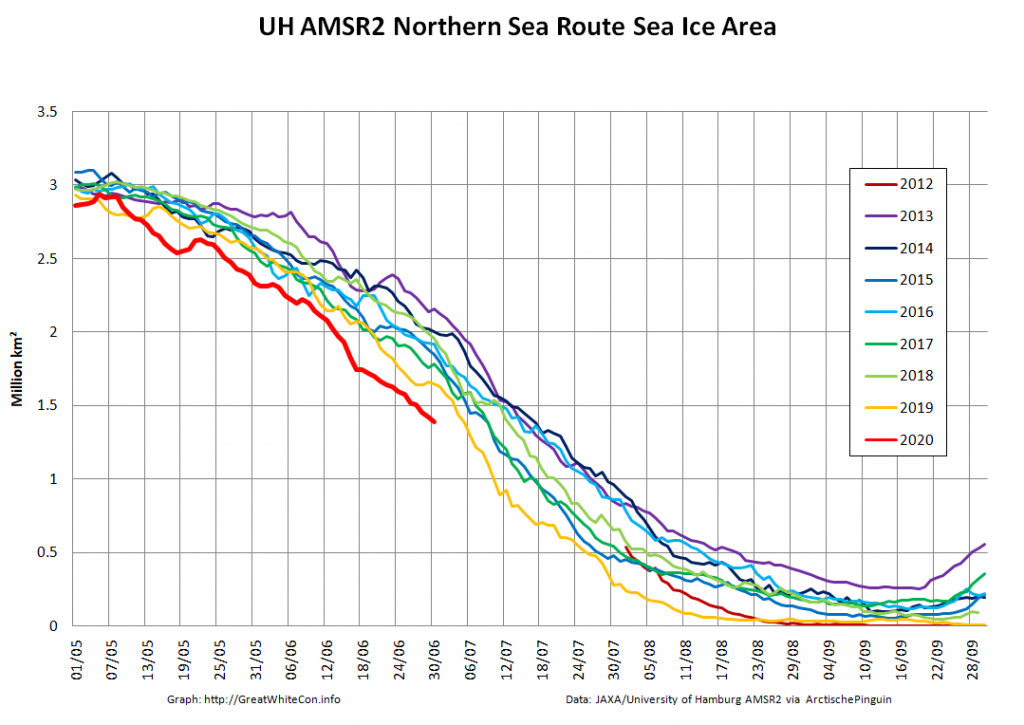
The 2020 melting season currently seems to be a game of two (geographical) halves. The sea ice on the Siberian side of the Arctic is currently at record lows:
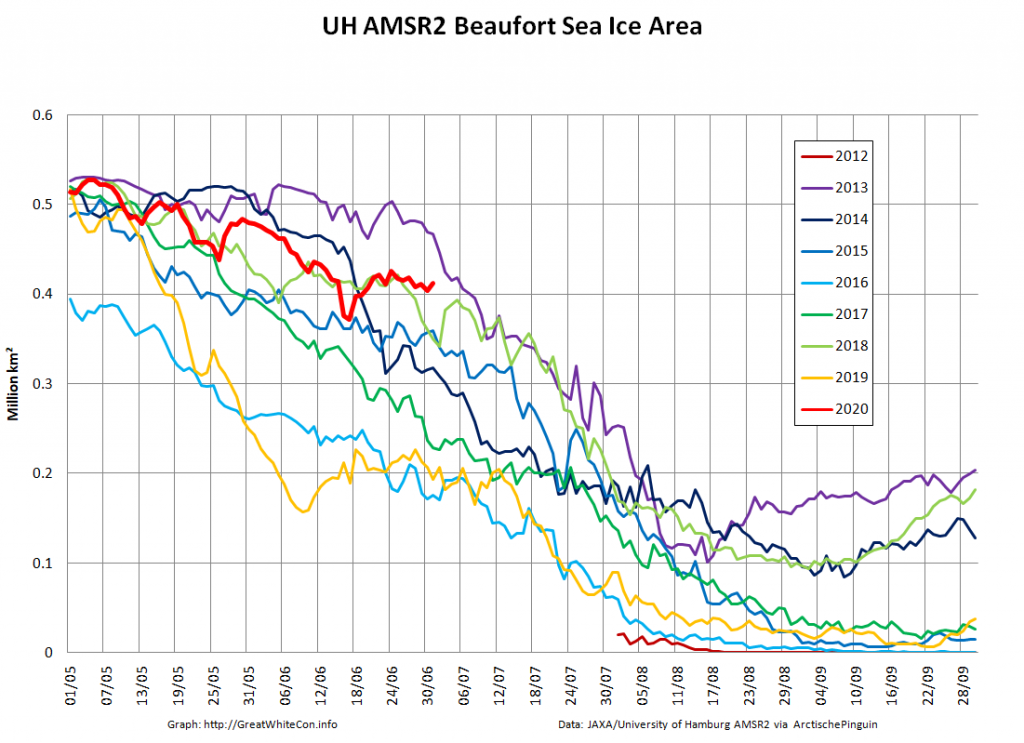
Whereas the Beaufort Sea is near a record high:
Currently the tell tale signs of surface melt are visible across most of the central Arctic, as are the large number of wildfires across Arctic Siberia:
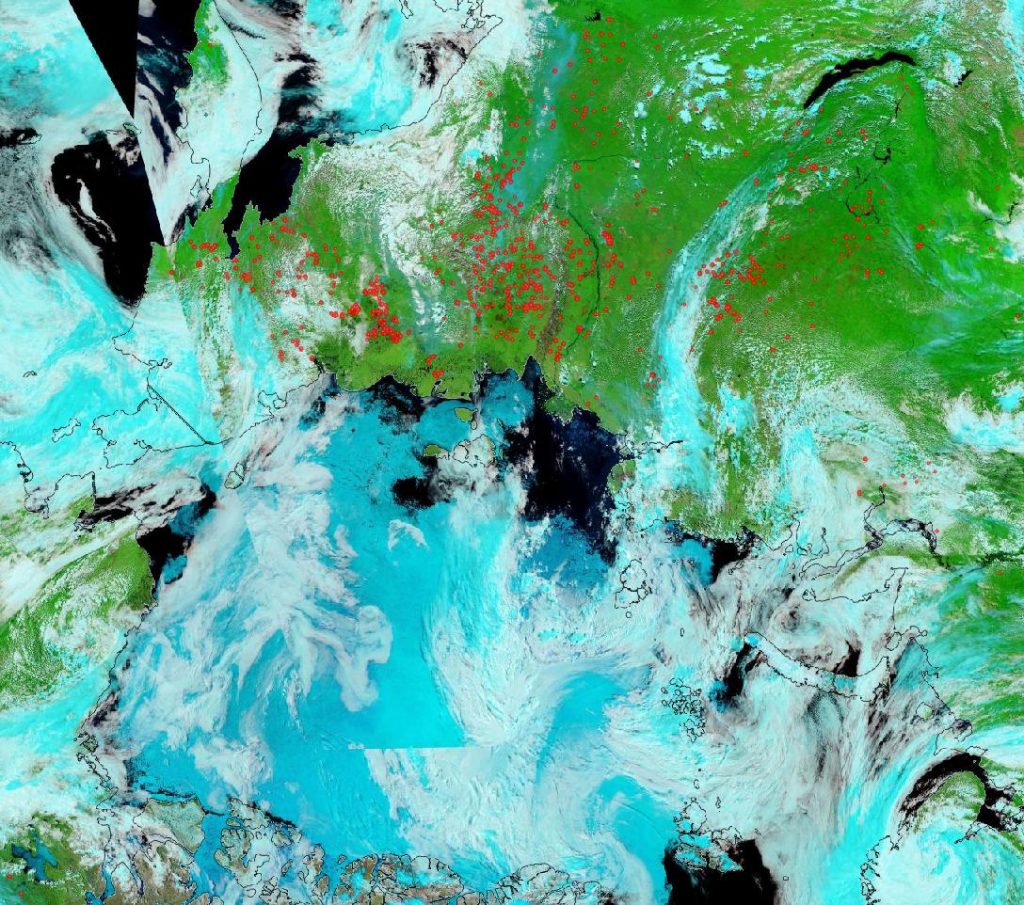
NASA Worldview “false-color” image of the Arctic on July 1st 2020, derived from the MODIS sensor on the Terra satellite

[Edit – July 4th]

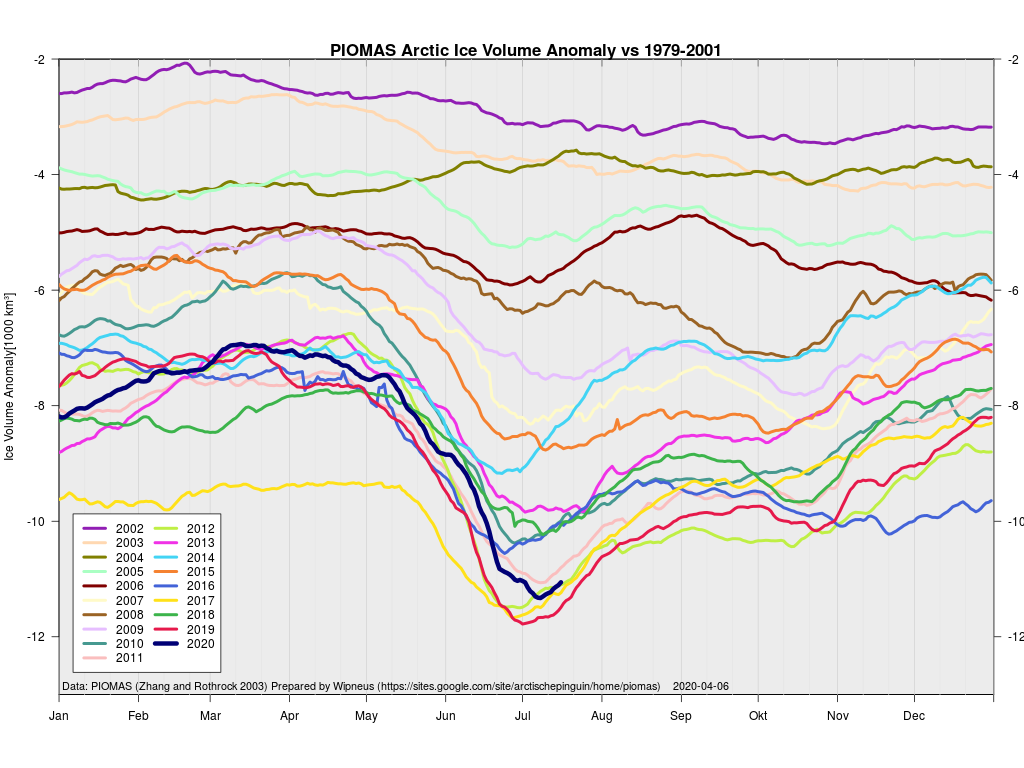
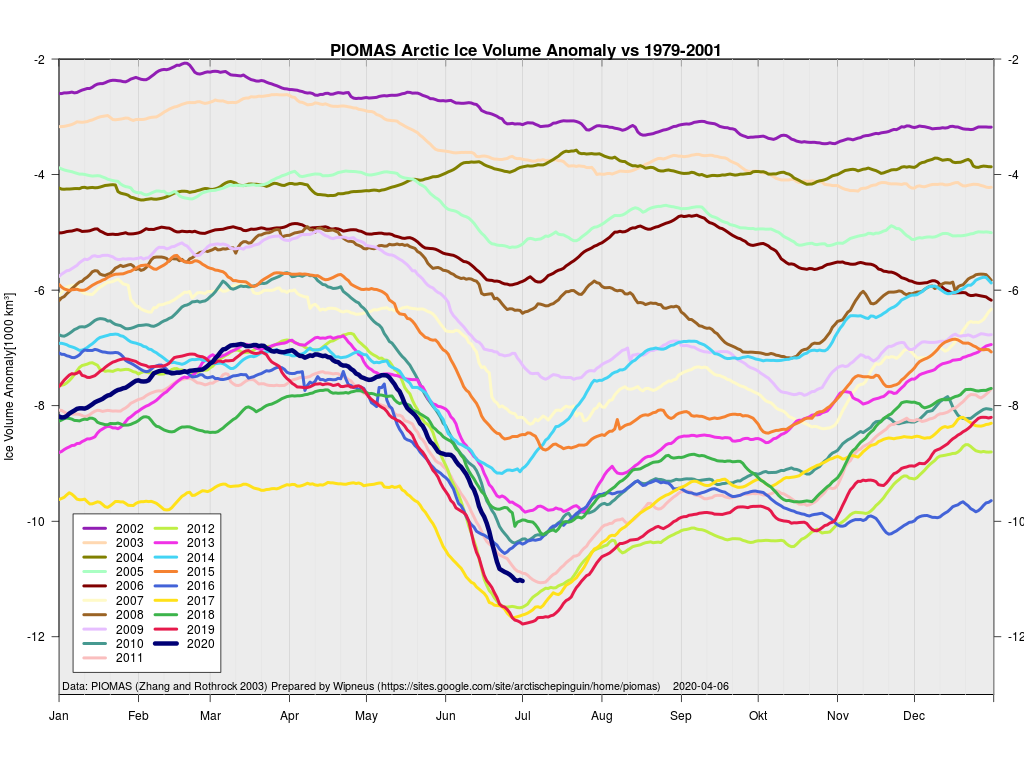
The June 30th PIOMAS gridded thickness numbers have been released, and here are the results of Wipneus’s number crunching:
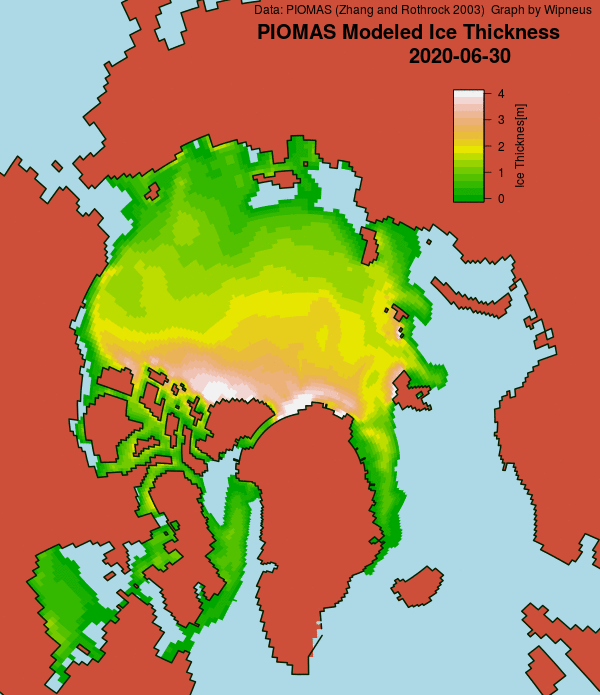
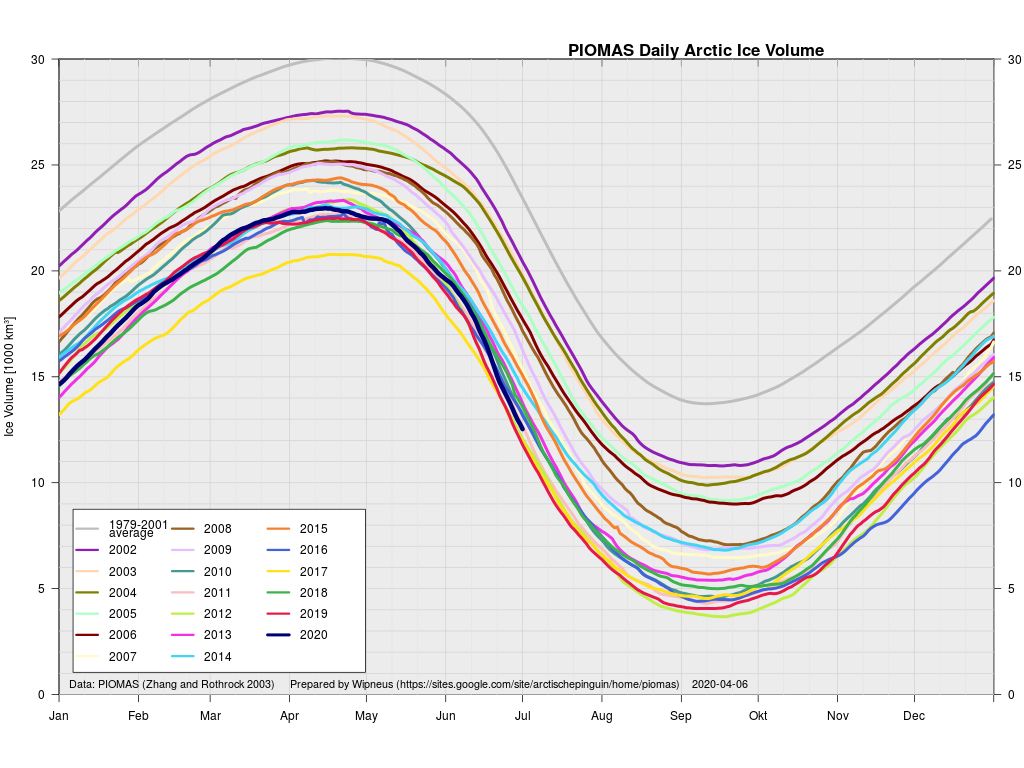
This month including a visualisation of the increasing negative anomaly:
[Edit – July 6th]

A break in the clouds over the North Pole reveals the onset of surface melt:
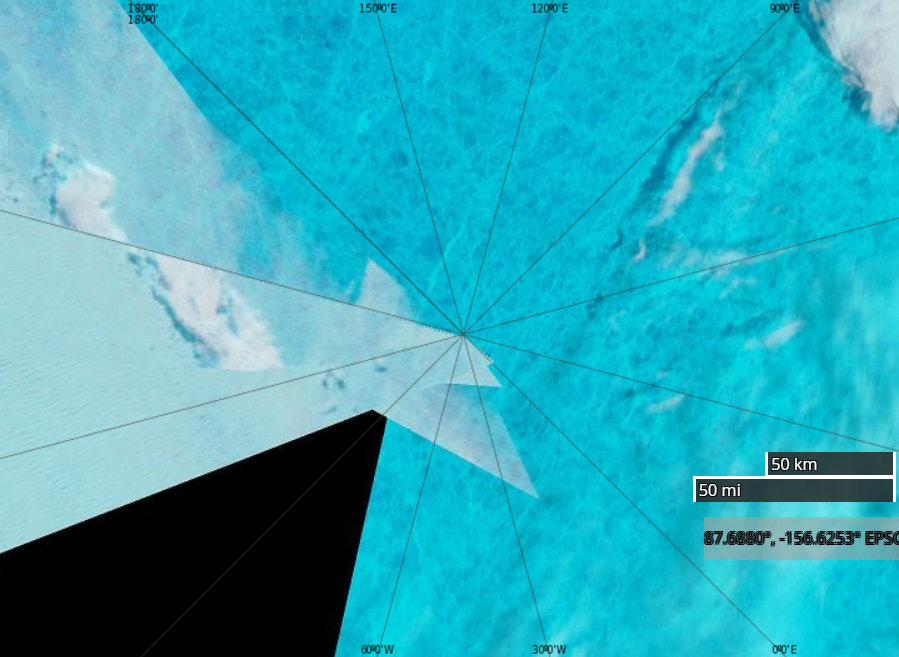
NASA Worldview “false-color” image of the North Pole on July 6th 2020, derived from the MODIS sensor on the Terra satellite

[Edit – July 8th]

After a brief hiatus there are once again some ice mass balance buoys installed at assorted locations across the Arctic. Some have ceased to function, but one of the buoys installed as part of the MOSAiC expedition is still sending back data as it heads towards the Fram Strait. Buoy 387850 is currently located at 81.66 N, 4.19 E. Here’s its ice mass balance plot:
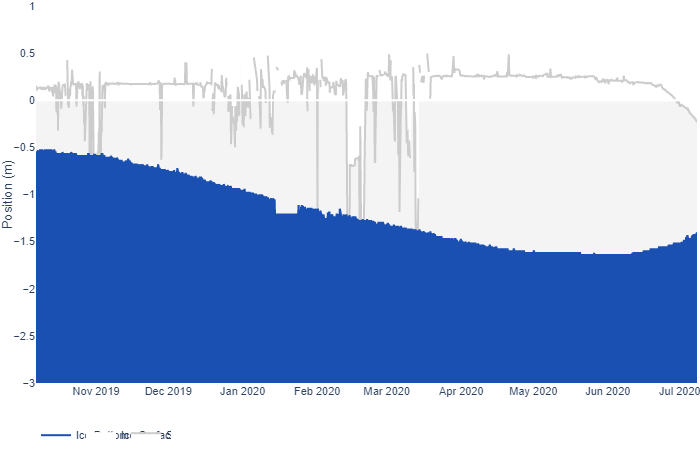
As you can see, both surface and bottom melt are well under way, with just over a meter of ice still remaining.

Now let’s take a look at buoy 386840, currently located at 74.30 N, 132.60 W in the Beaufort Sea:
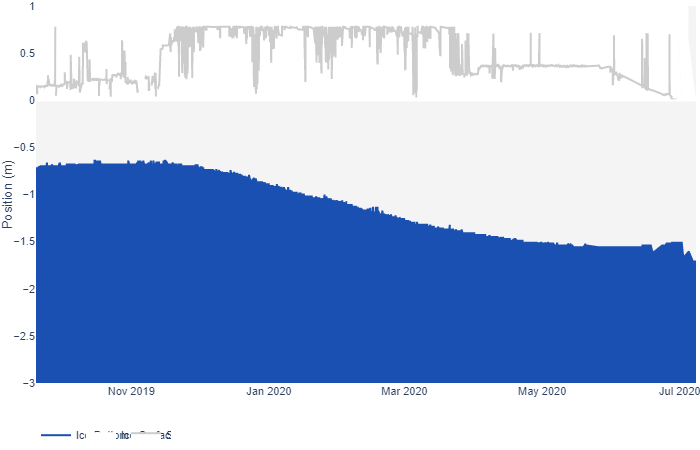
It looks as though the ice thickness has increased, but surely that can’t be right at this time of year? To try and find out I downloaded the raw data and plotted the temperature readings from the buoy’s thermistor string:
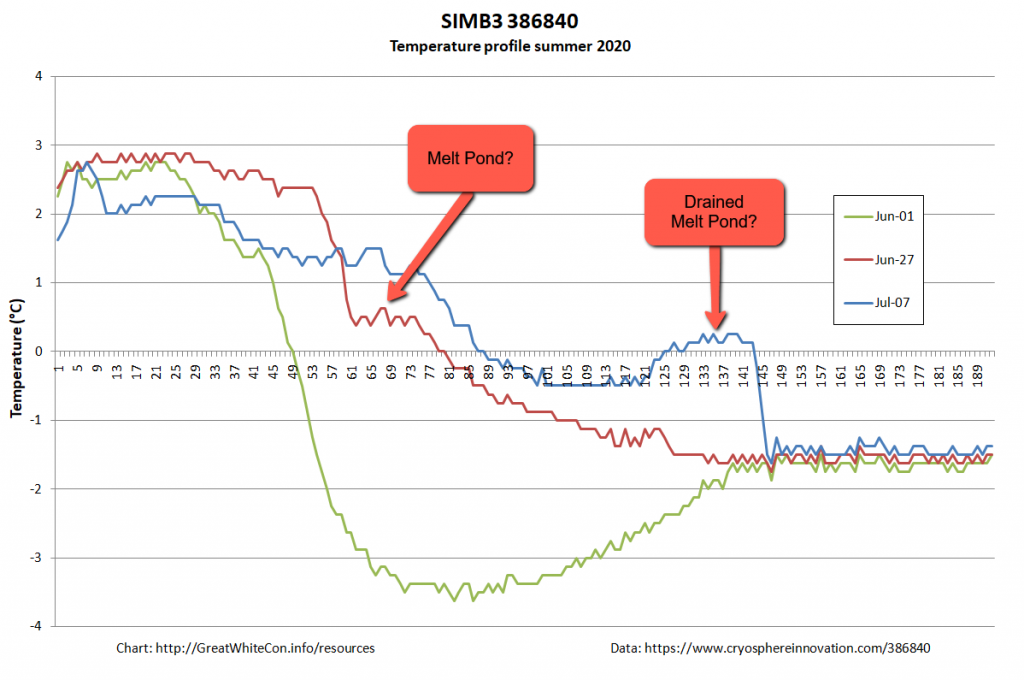
It looks to me as though the ice floe carrying the buoy is currently floating on some warm fresh water from a recently drained melt pond, which is confusing the sensor designed to measure the position of the bottom of the ice. There certainly seems to be far less than the claimed “1.653 m snow and ice thickness” still remaining to be melted!

[Edit – July 15th]

A very unusual image. Hardly a cloud in the sky over the North Pole yesterday:
NASA Worldview “false-color” image of the North Pole on July 14th 2020, derived from the MODIS sensor on the Terra satellite

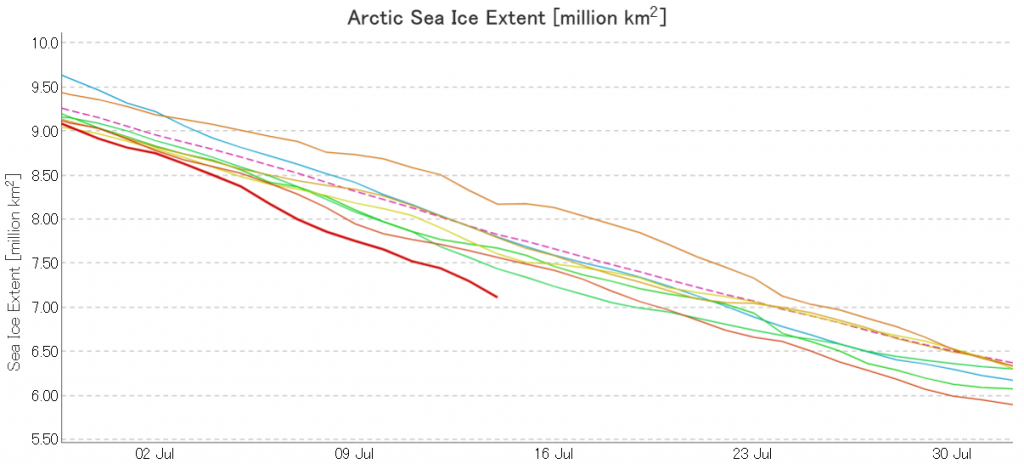
The July 2020 extent “plummet” shows no signs of ending just yet. Here’s the JAXA/ViSHOP version:
[Edit – July 17th]

JAXA AMSR2 extent is now below 7 million km², and the high resolution version is lower still:
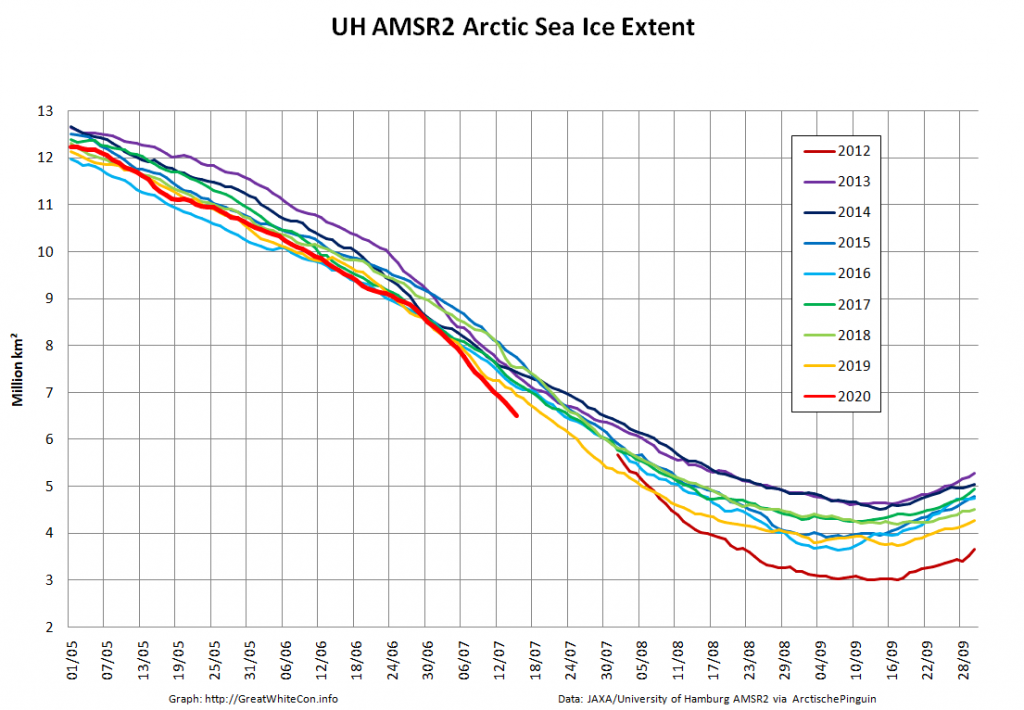
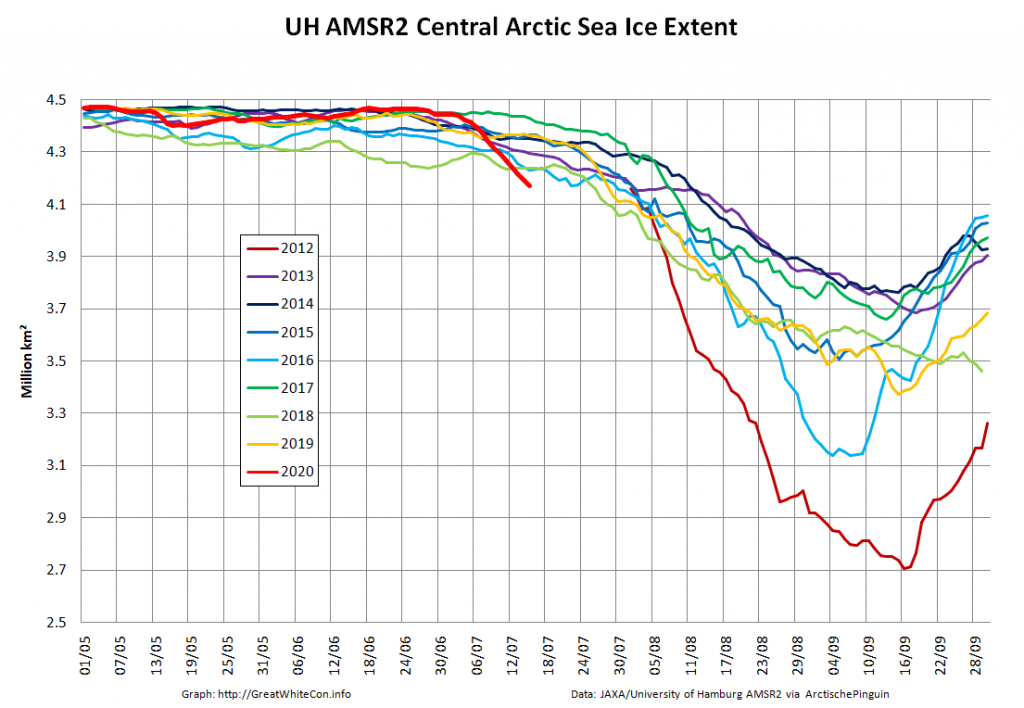
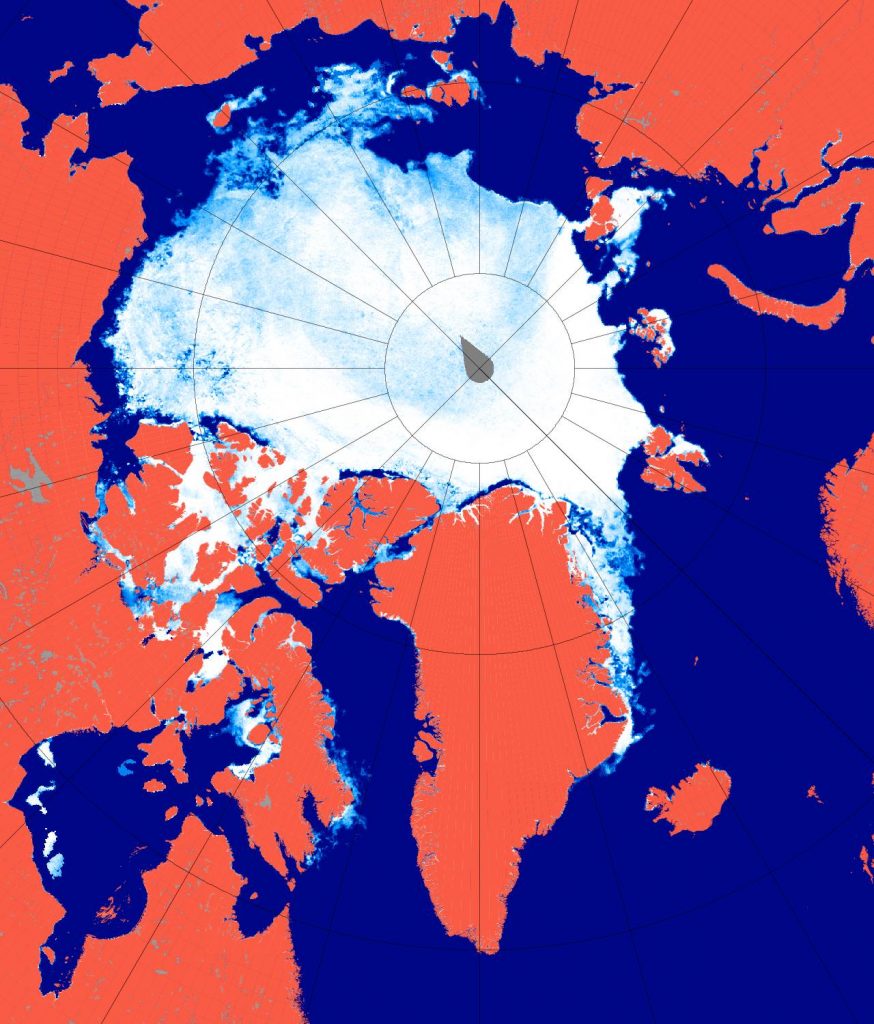
As the “Laptev Bite” and the Atlantic periphery of open water extends further towards the North Pole, Central Arctic Basin extent is now also at record lows for the date in the AMSR2 record:
[Edit – July 19th]

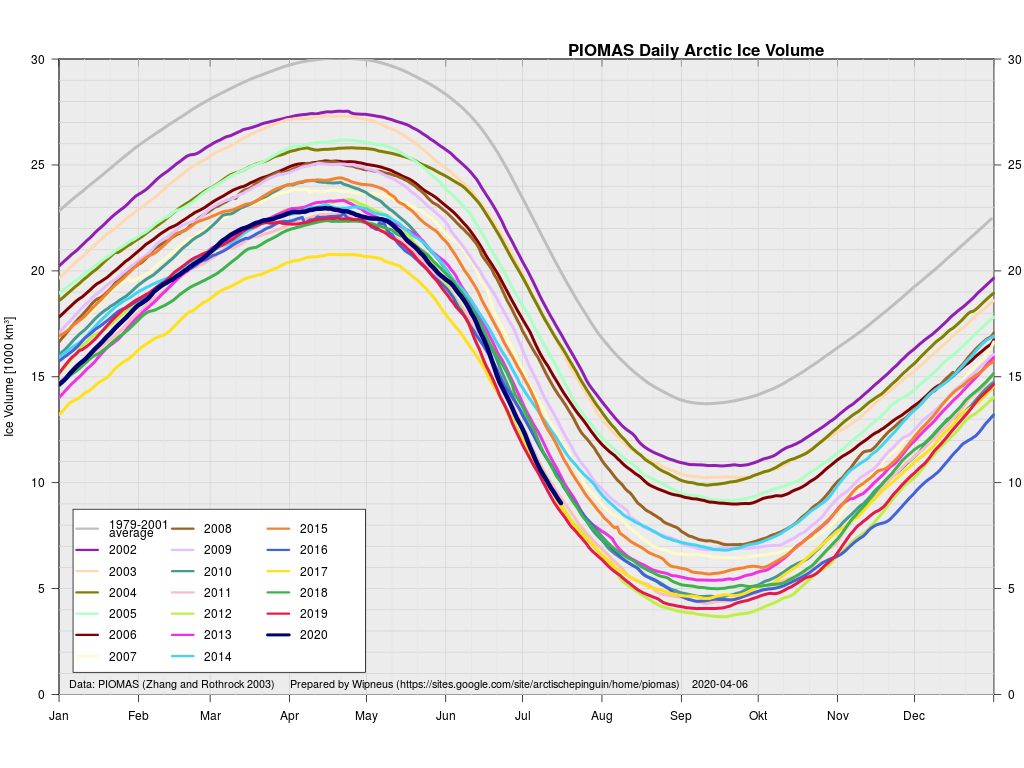
Wipneus has crunched the mid month PIOMAS gridded thickness numbers, and here are the results:
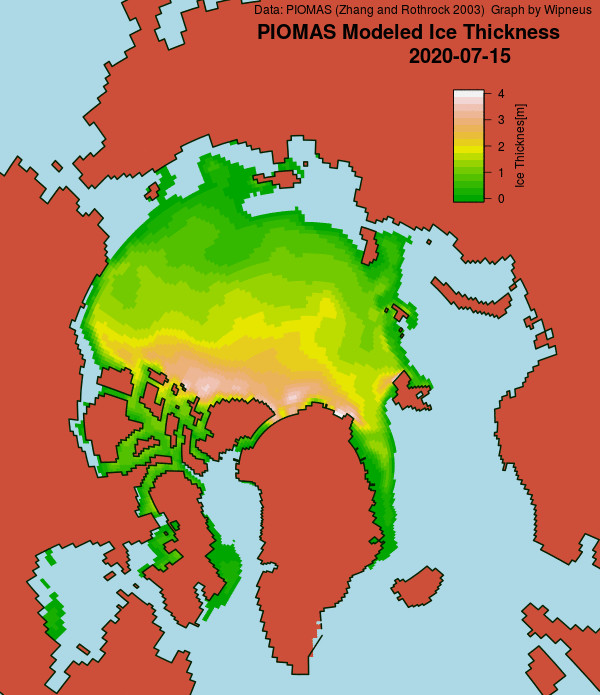
Extent is currently lowest in the satellite era by a long way, but modelled volume is only fourth lowest!

Watch this space!

[Edit – July 21th]

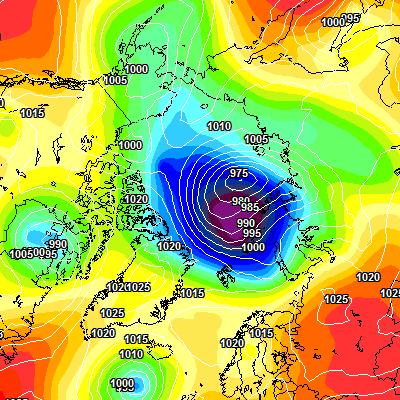
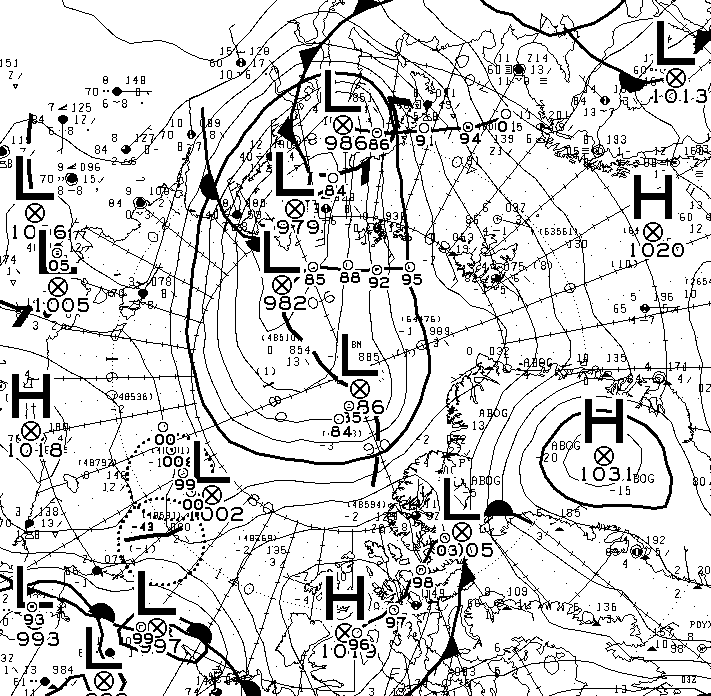
At long last there’s a sub 1000 hPa MSLP low pressure area slowly wending its way across the central Arctic:
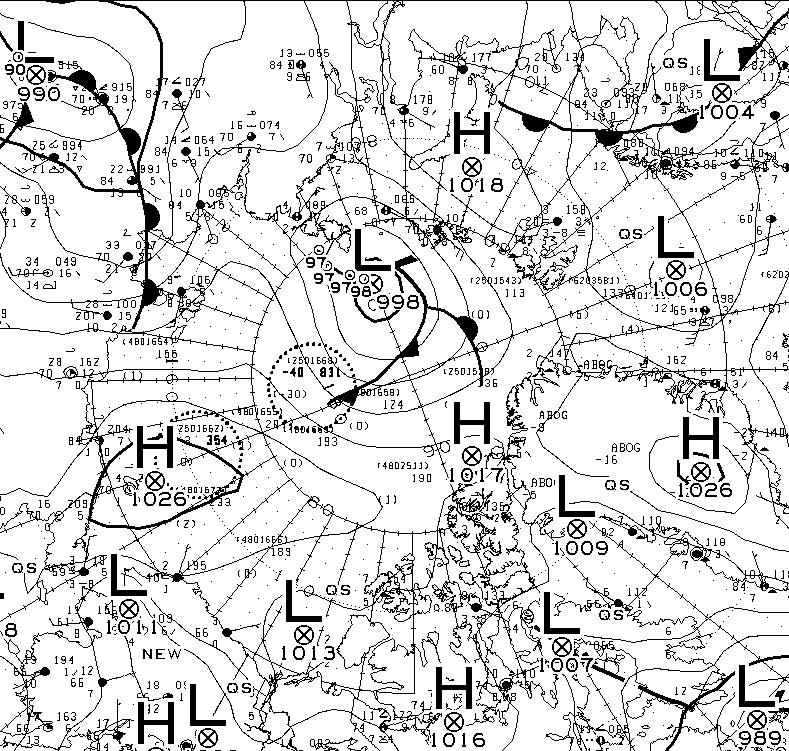
It seems to have bottomed out at 997 hPa. Perhaps this will inhibit the ongoing “plummet” in extent? JAXA extent fell by 114,342 km2 yesterday.

[Edit – July 23rd]

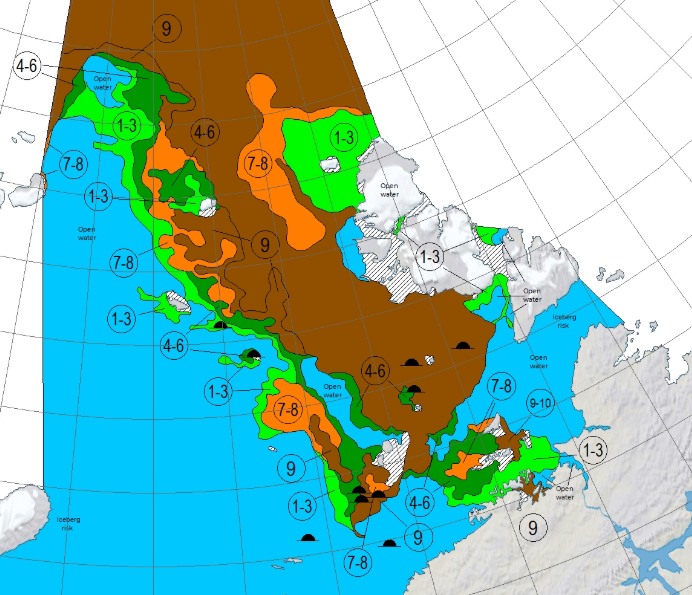
The Northern Sea Route has opened unusually early this year:

Based on the AMSR2 concentration maps from the University of Hamburg that happened on July 13th. The final choke point, as is so often the case, was the Vilkitsky Strait. According to the charts from the Russian Arctic and Antarctic Research Institute, by the 14th there was a narrow way through occupied by no more than 3/10 concentration ice:
[Edit – July 25th]

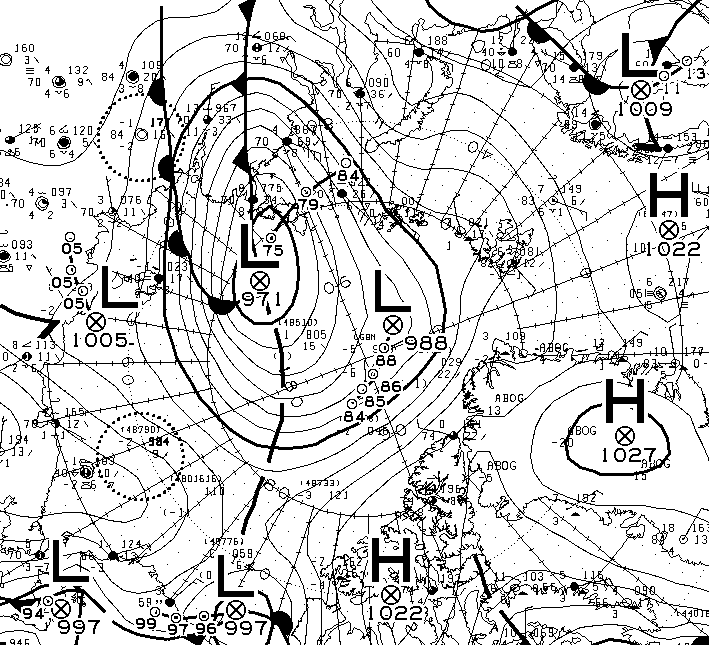
A mere three days away, and the GFS and ECMWF forecasts are in agreement, so there is a decent chance this setup will materialise in the real world:
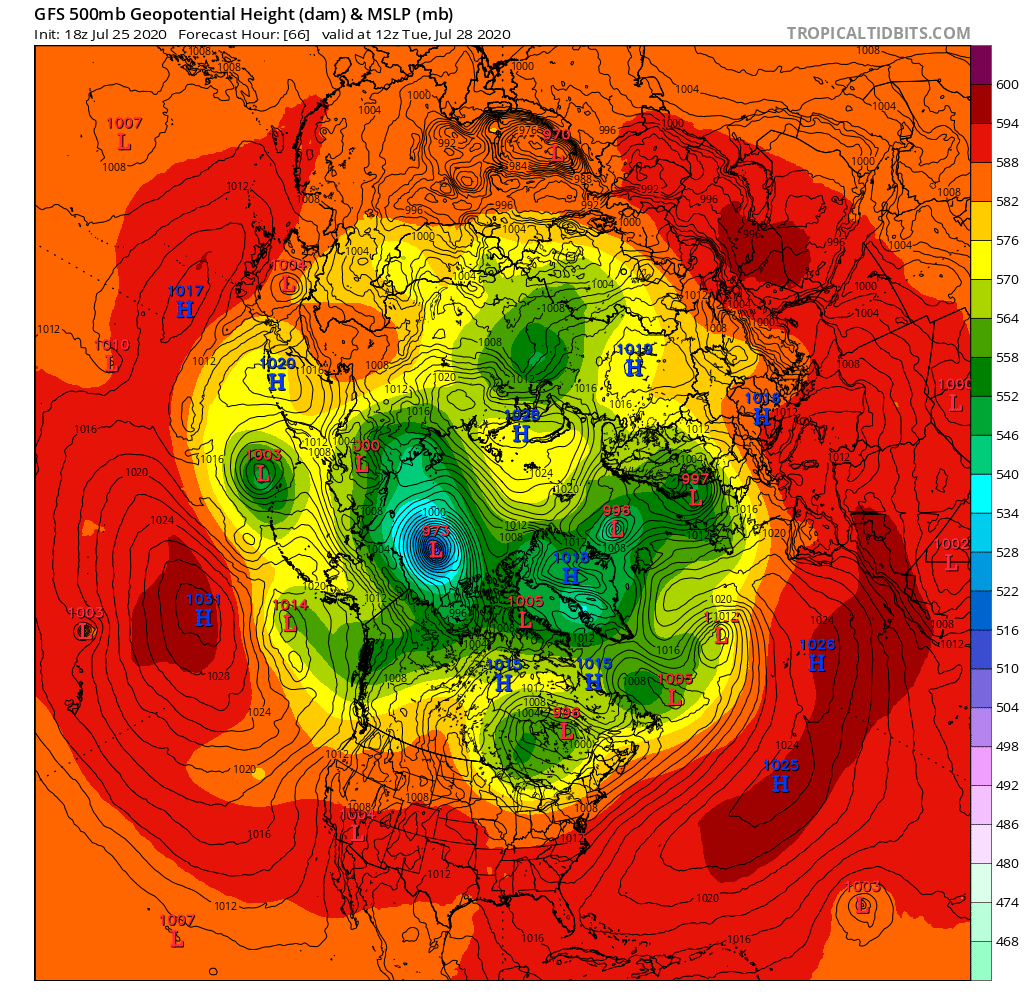
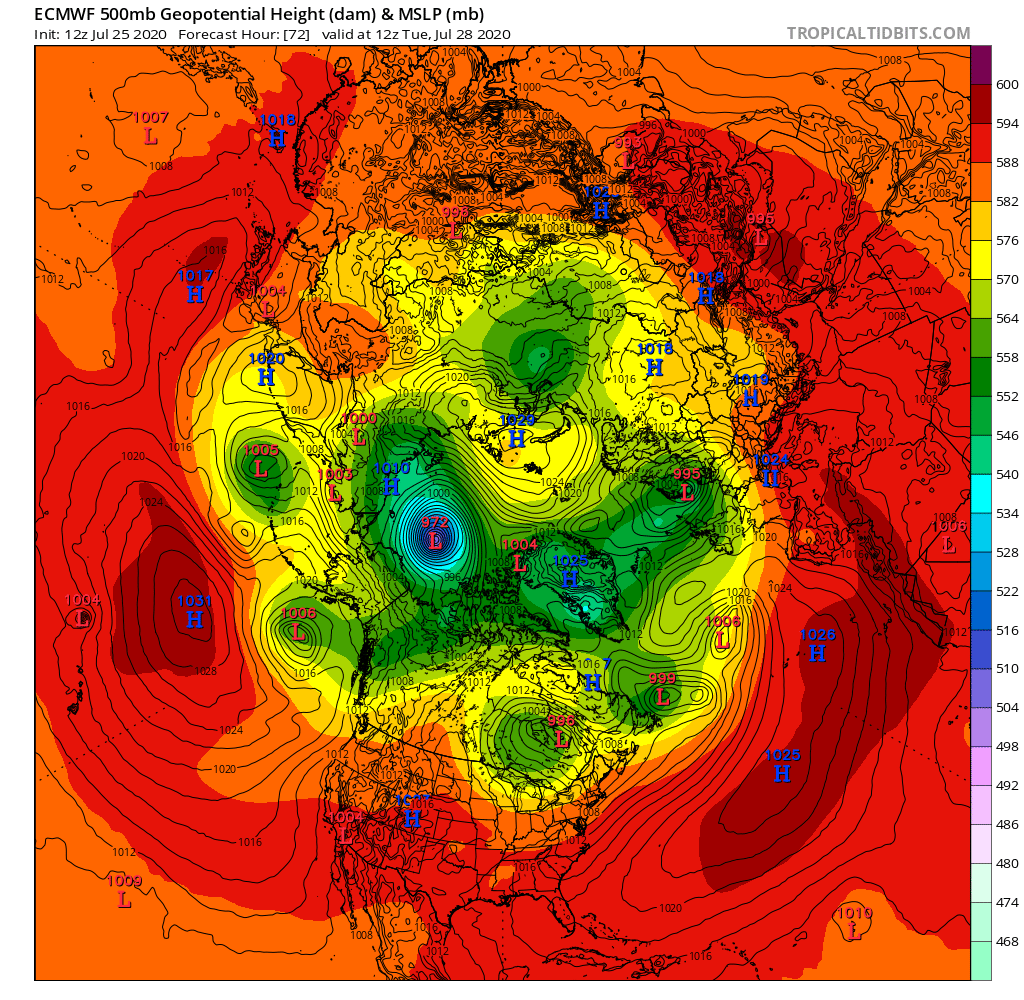
Graphics via Tropical Tidbits

A 972(ish) hPa MSLP cyclone sitting over the ice Beaufort Sea by 12Z on Tuesday.

[Edit – July 27th]

The Sea Ice Prediction Network July forecast for this year’s September minimum extent have been released. Here’s the graphical overview:
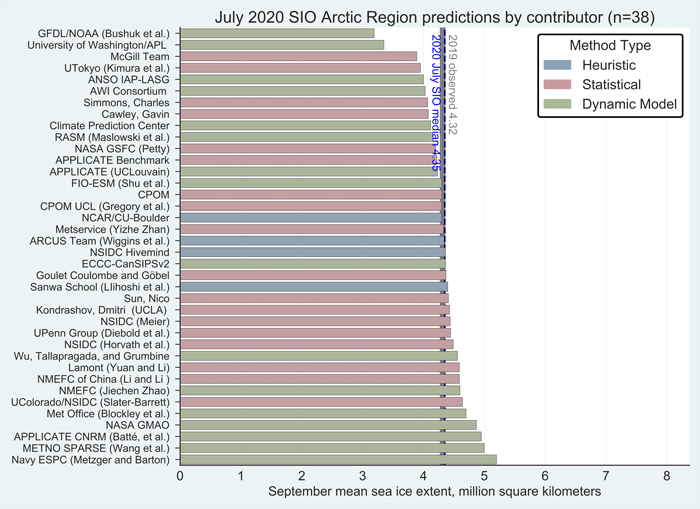
This year’s median projected value from the July forecasts of 4.3 million square kilometers is essentially identical to the median from the June forecasts. Quartiles are 4.1 and 4.6 million square kilometers. As was also the case for June, only two projections, both by dynamic models, are for a new record low, below the mark of 3.57 million square kilometers set in 2012. One dynamical model predicts the September sea-ice extent above 5.0 million square kilometers, compared to two in the June report.

Note that the numbers quoted are for the average NSIDC extent across the month of September, not the lowest daily JAXA extent, which I suggested earlier would be “below 4 million km²” this year.

Meanwhile over on Twitter this evening (UTC):

[Edit – July 28th]

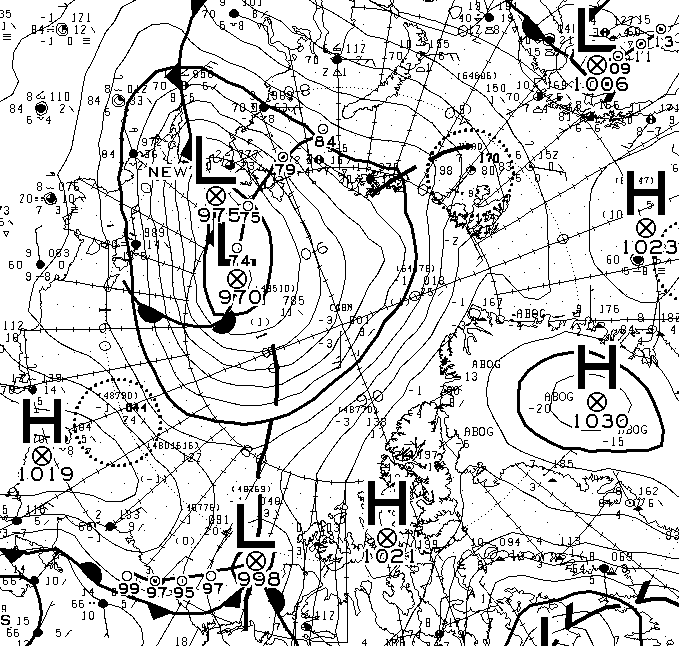
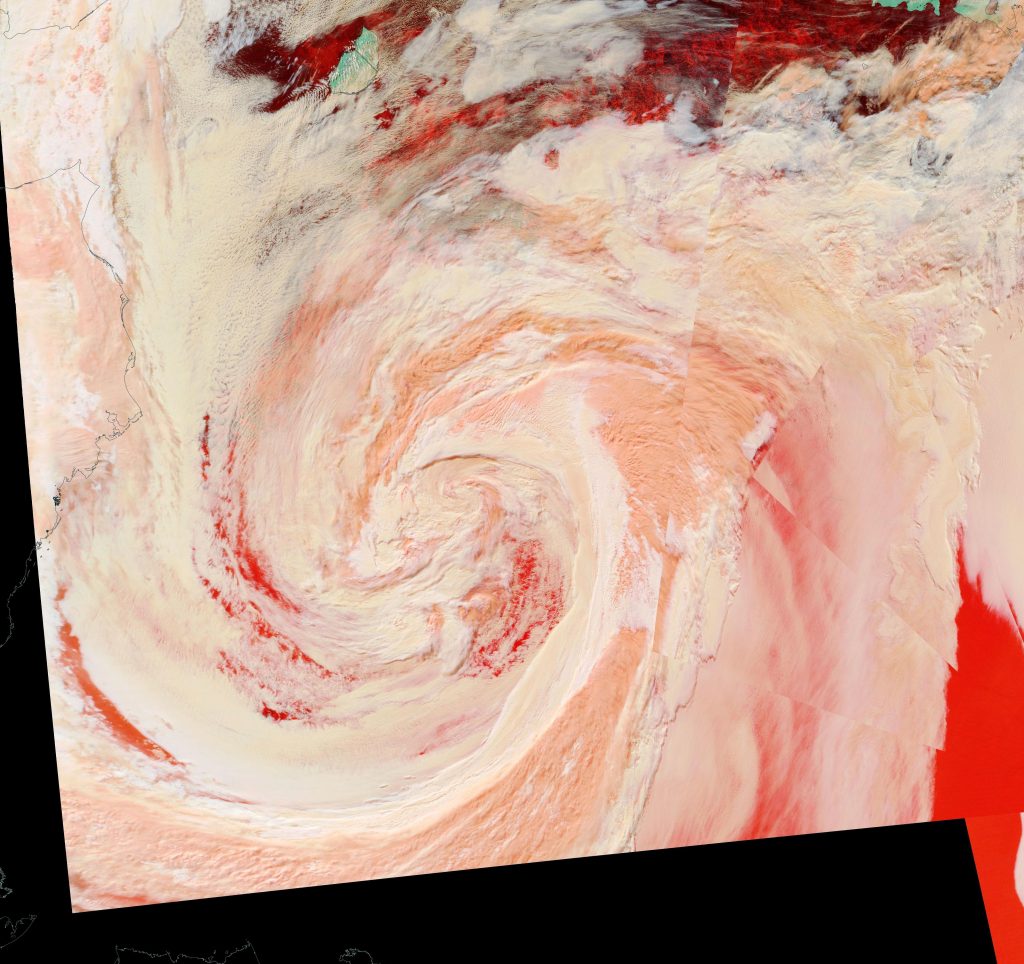
The MSLP of the (Great?) Arctic cyclone sank below 970 hPa overnight:

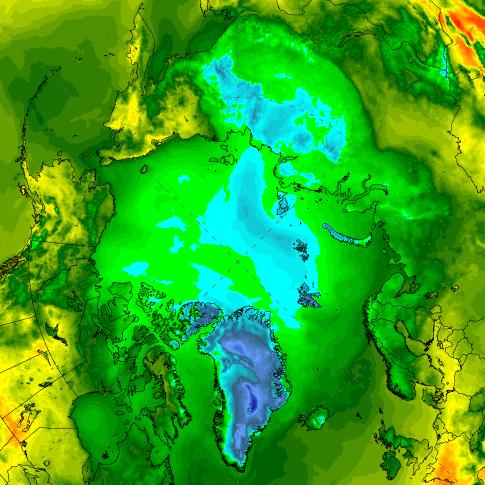
Here’s an early false colour snapshot of how (s)he looks from on high this afternoon (UTC), courtesy of the MODIS instrument on the Terra satellite:
[Edit – July 29th]

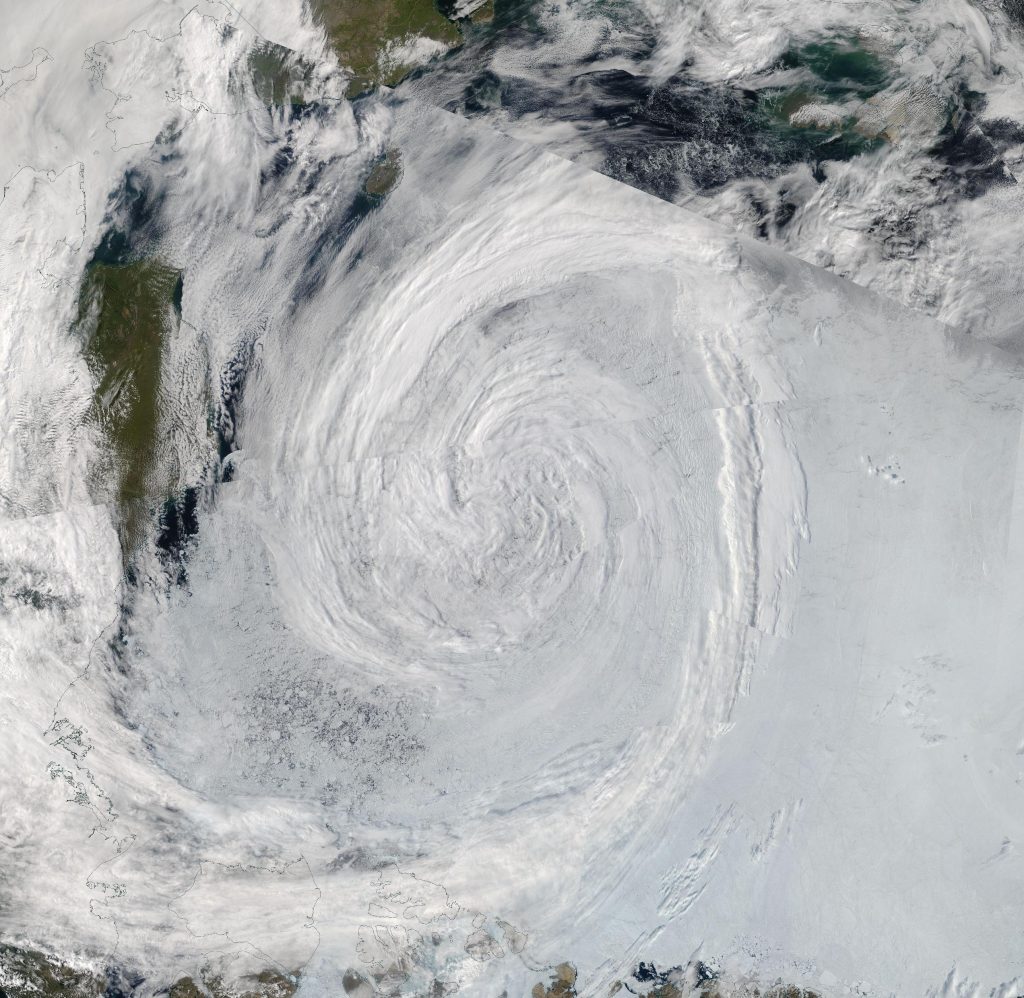
First up today we have a more complete “true colour” image of the cyclone doing its worst yesterday, including a fairly clear view in the bottom left corner of the initial damage to the sea ice covering the eastern Beaufort Sea. This one is from the Aqua satellite:
Watch this space!

Facts About the Arctic in June 2019

In my humble opinion summer in the Arctic summer starts on June 1st, so let’s check the current sea ice situation in the once frozen North. For details of the preconditioning of the ice during the Arctic spring see “Melt Pond May“, where I concluded that:

Compared with 2016 at the same time of year I am compelled to say that with June 1st just around the corner the 2019 summer melting season is primed to progress more quickly.

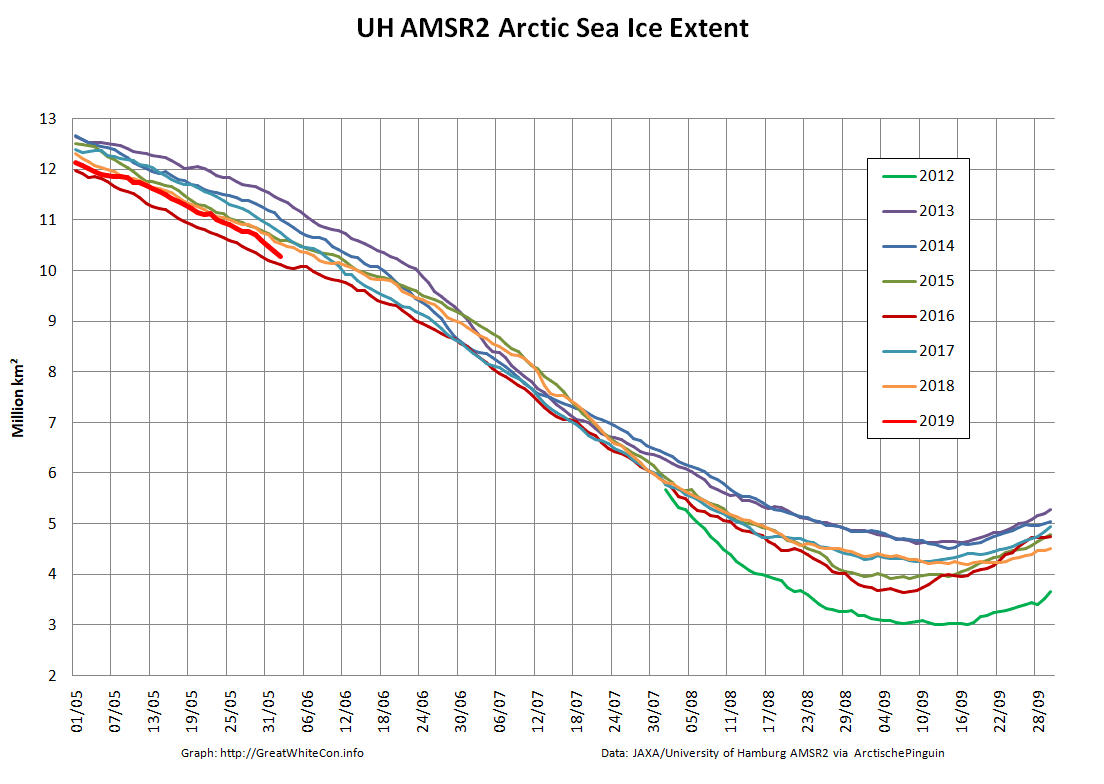
Currently extent is significantly below 2012, albeit somewhat above 2016 at the same time of year. And what of melt ponds? In 2012 there was evidence of less snow cover over land and more surface water on the ice on the Siberian side of the Arctic. Other than that Arctic sea ice in 2019 looks to be in worse shape than in 2012.

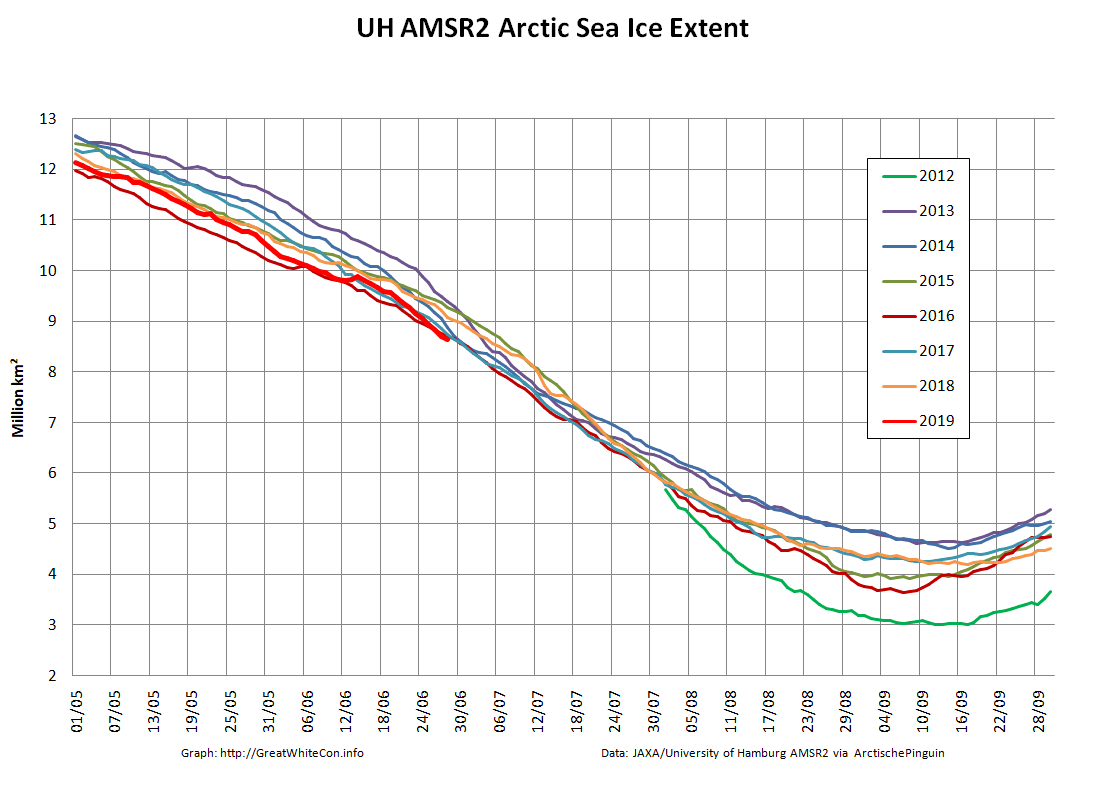
And how have things progressed over the last few days? Take a look at this:

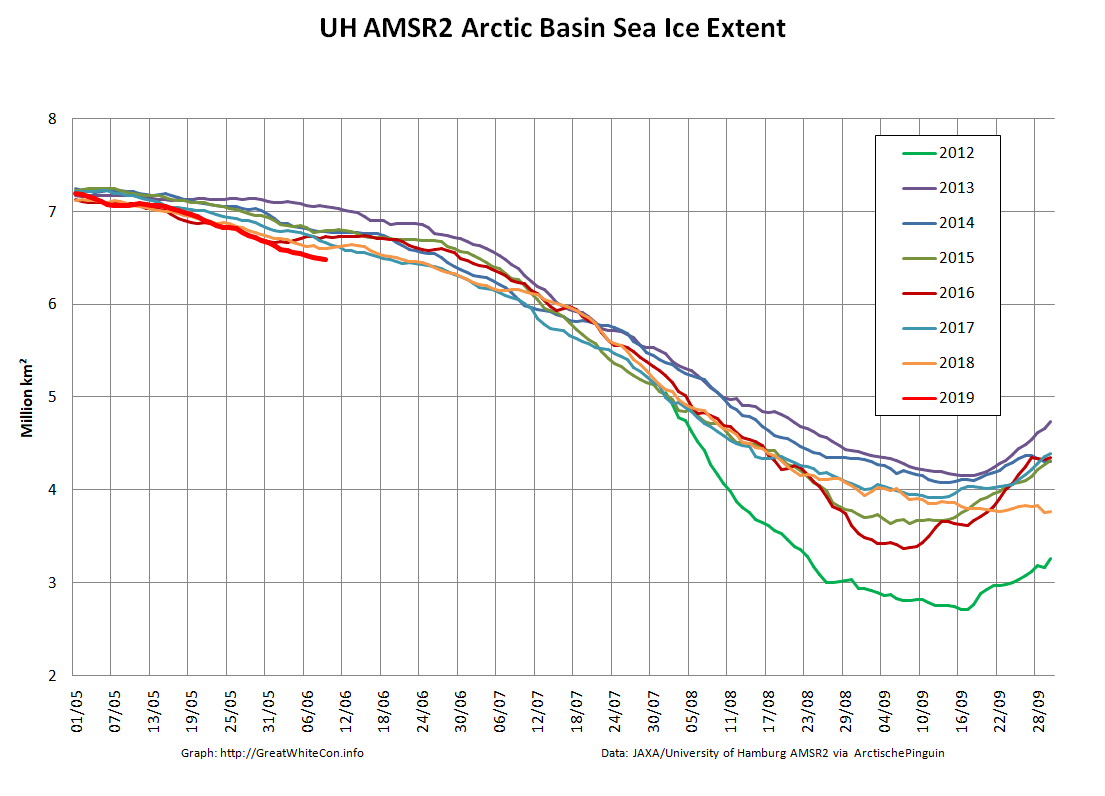
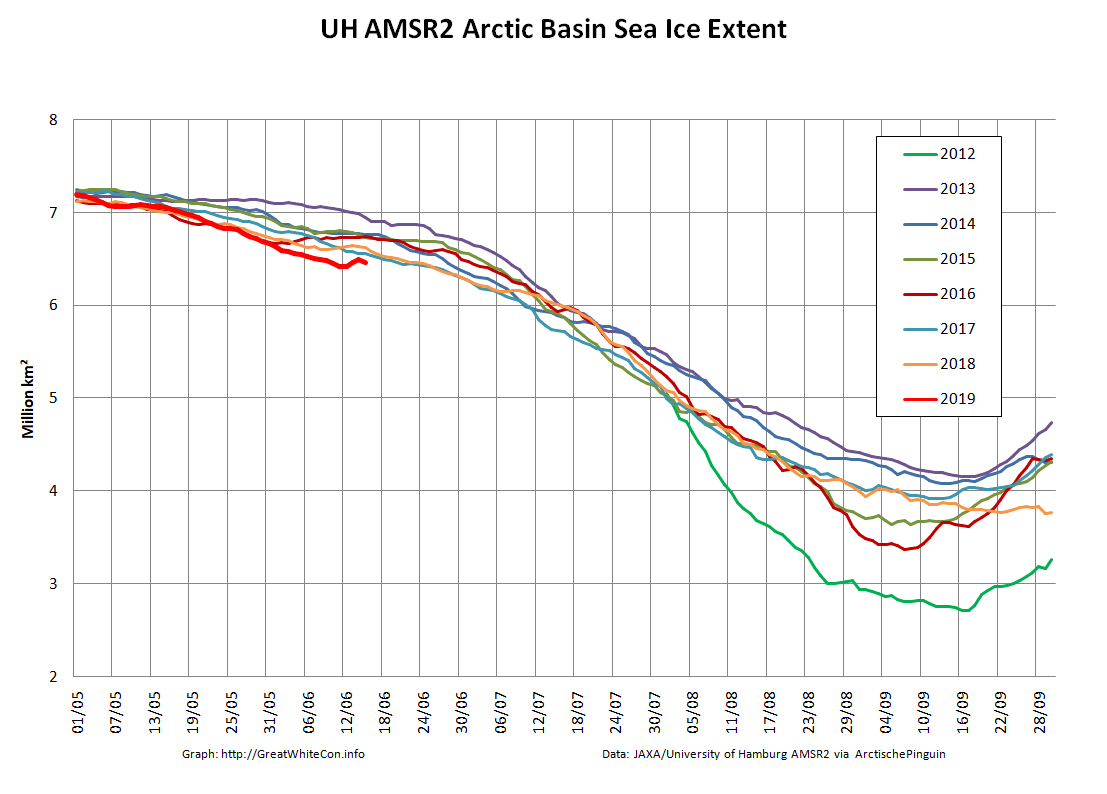
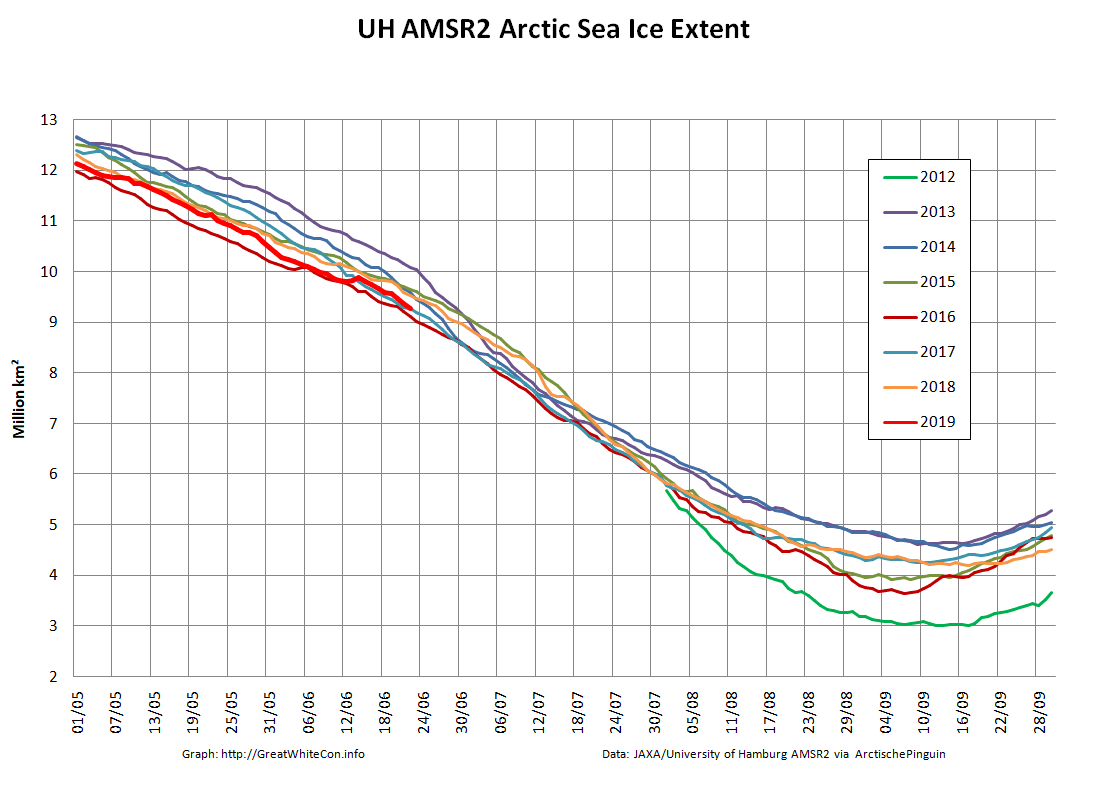
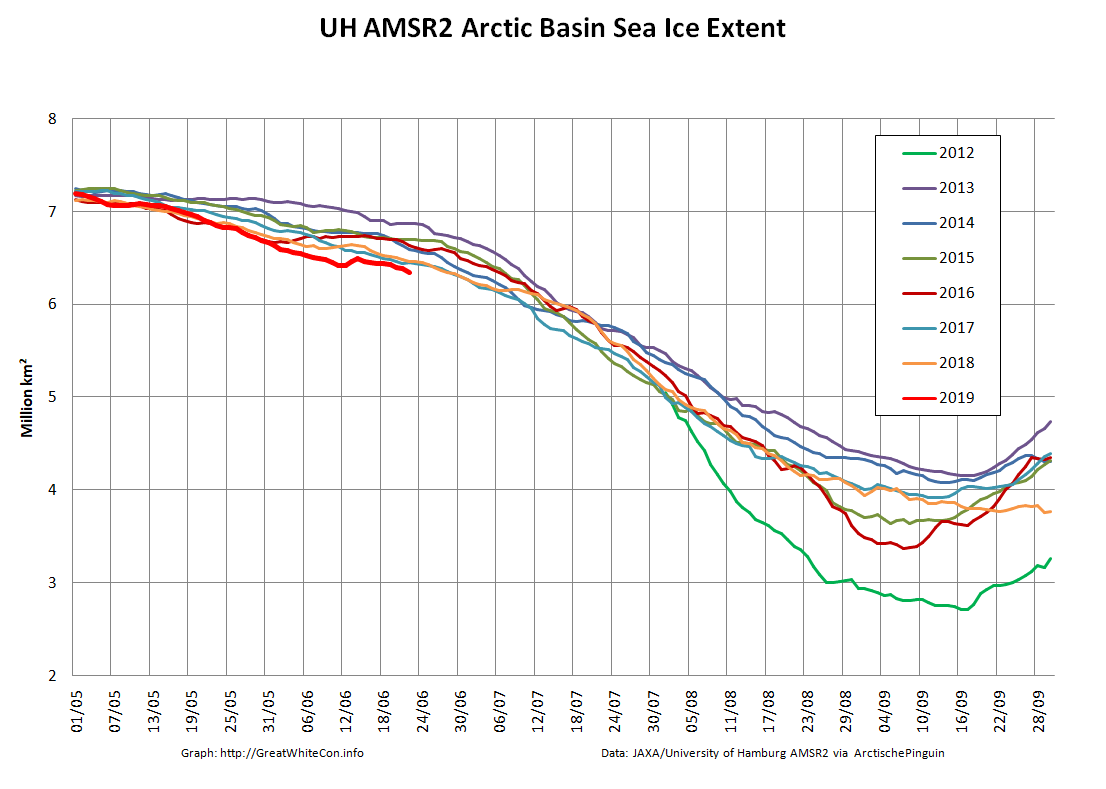
Our “Arctic Basin” metric encompasses the Central Arctic plus the Beaufort, Chukchi, East Siberian and Laptev Seas. It is currently headed into uncharted waters. The effect on overall Arctic sea ice extent is also readily visible:

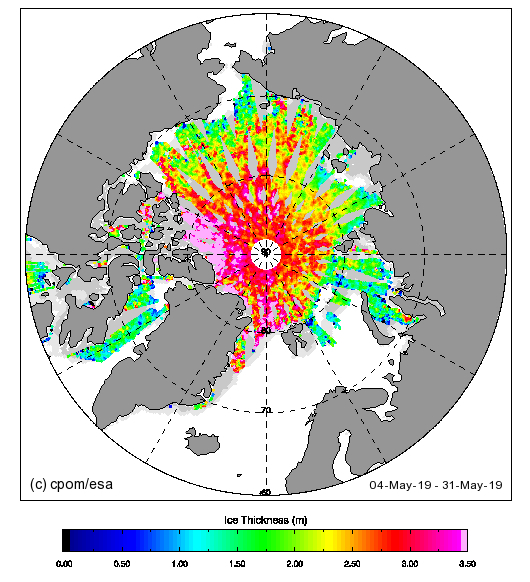
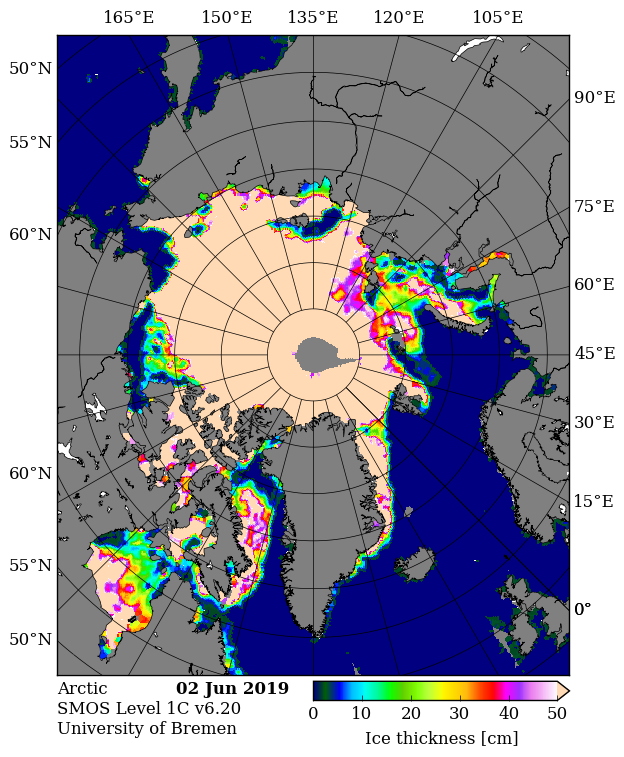
This year both the CPOM version of CryoSat-2 thickness and the University of Bremen’s SMOS thickness maps are continuing to be published during the melting season:

Take them with a large pinch of salt at this time of year!

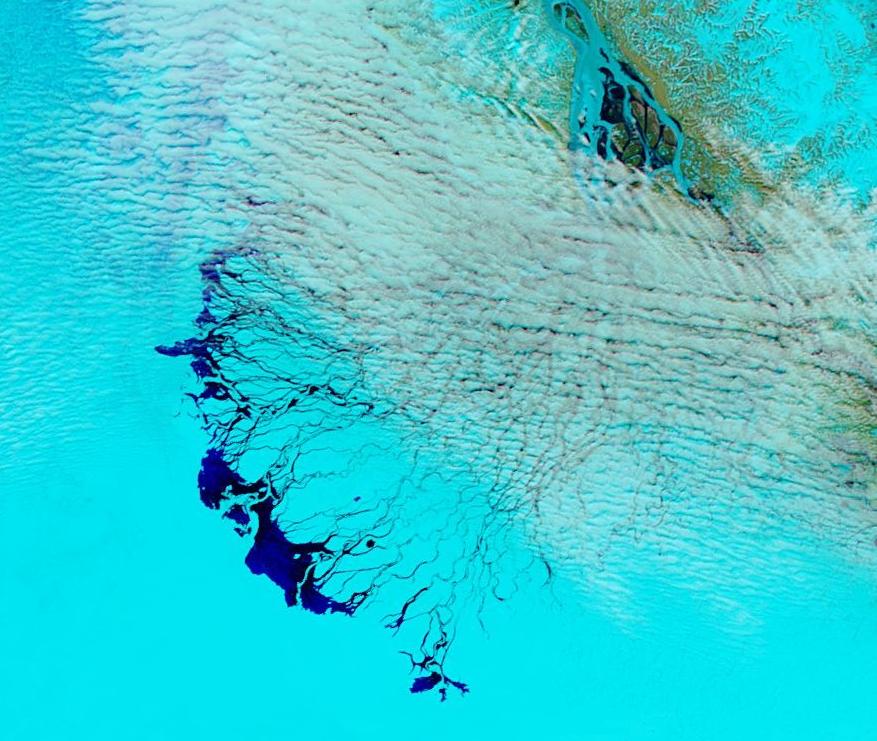
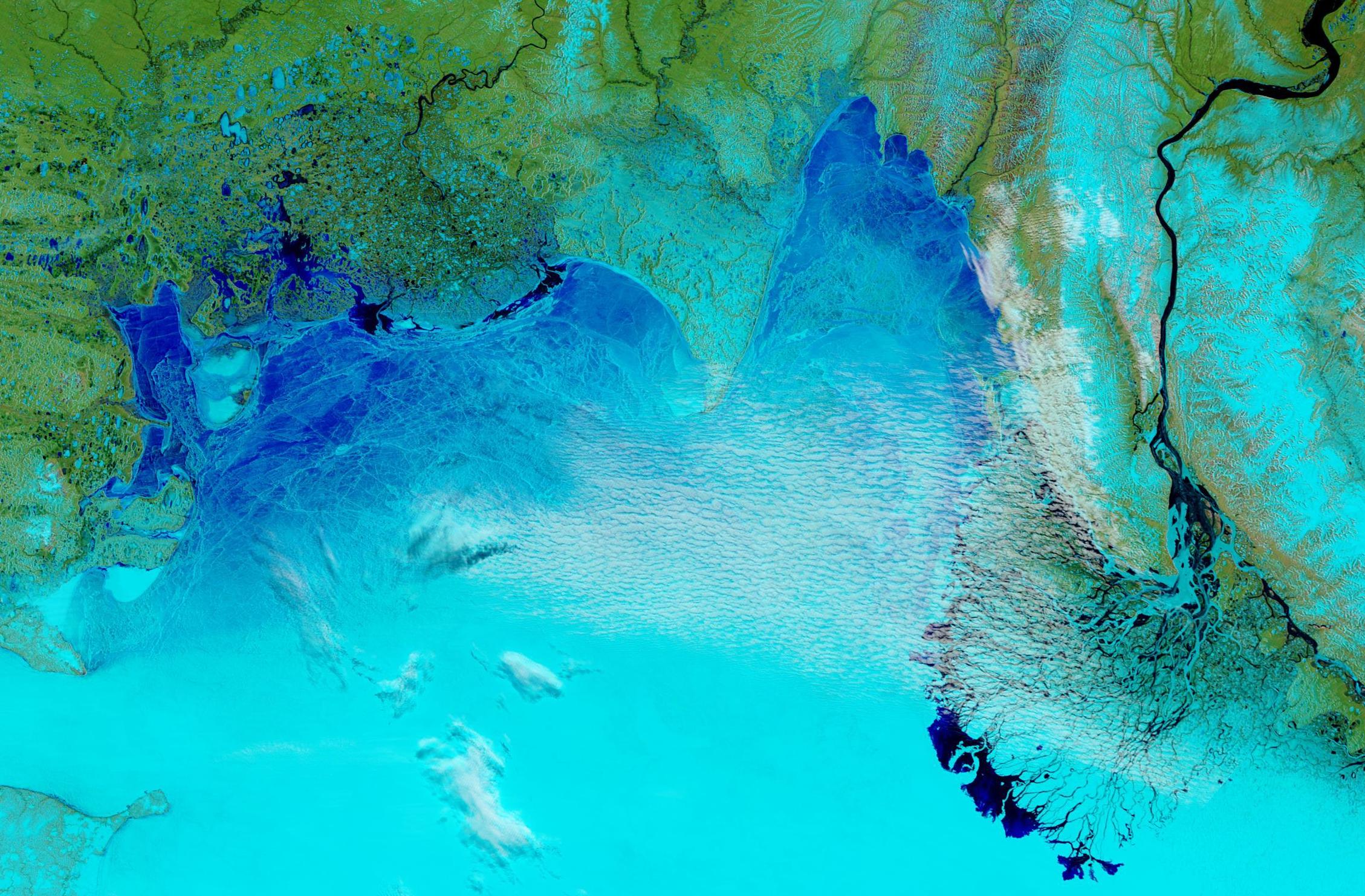
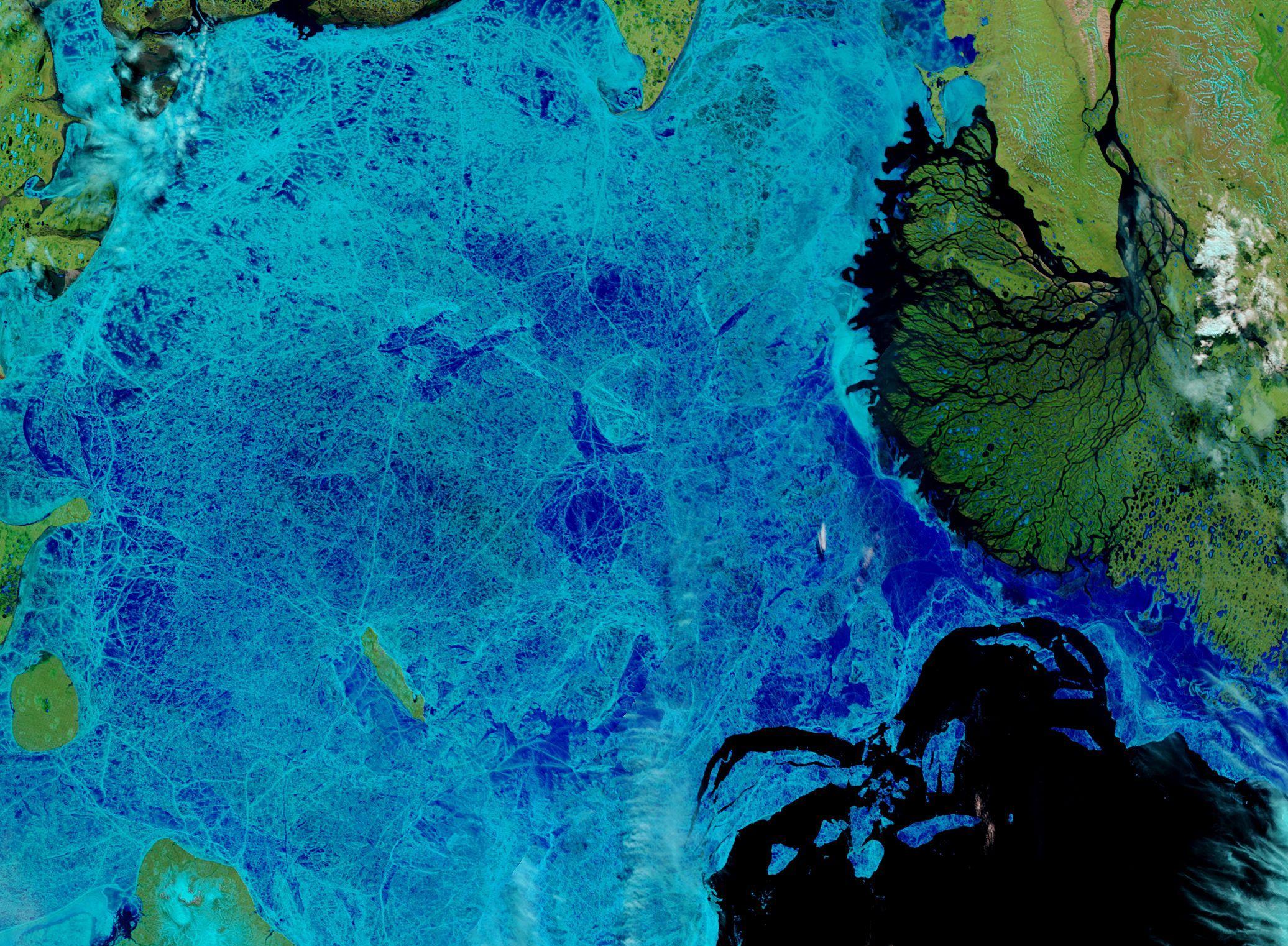
Finally, for the moment at least, liquid water is starting to seep out of the Lena Delta:

NASA Worldview “false-color” image of the Lena Delta on June 3rd 2019, derived from the MODIS sensor on the Aqua satellite

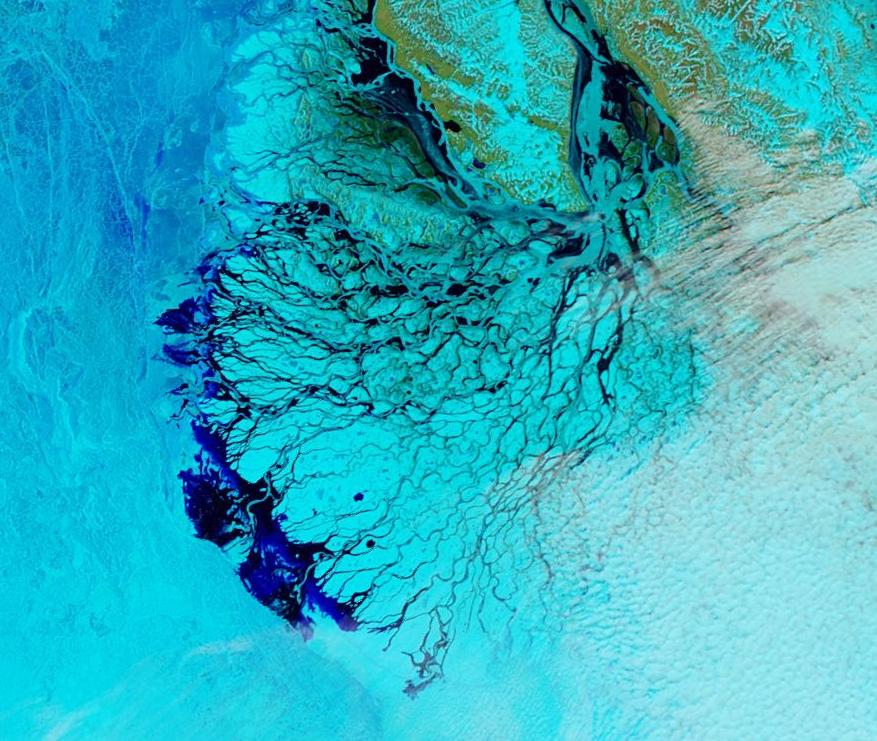
For comparison purposes please also take a look at the same date in 2016:

NASA Worldview “false-color” image of the Lena Delta on June 3rd 2016, derived from the MODIS sensor on the Aqua satellite

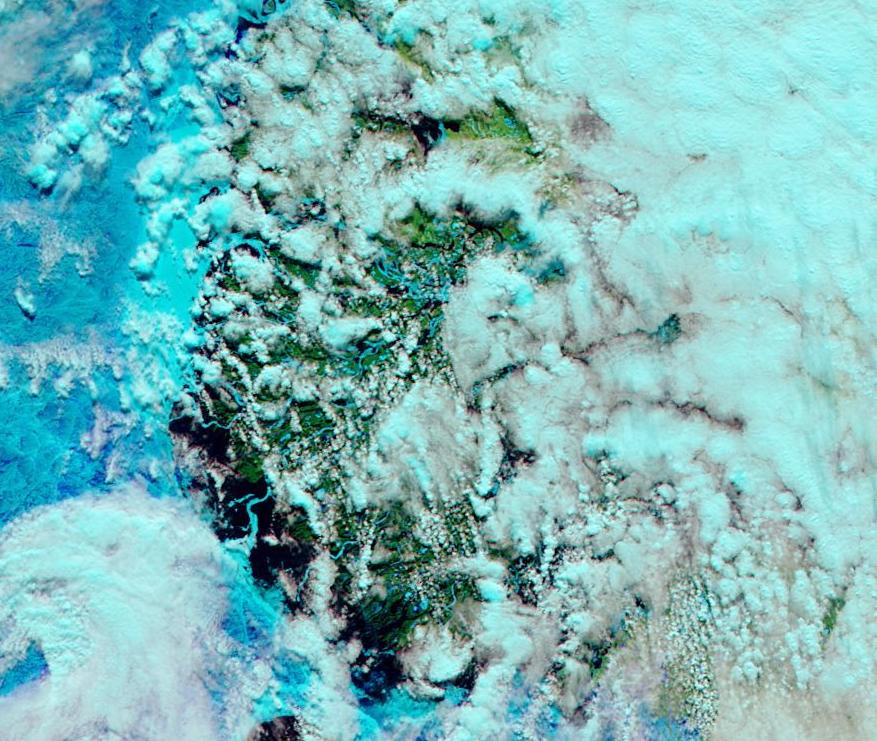
and the previous date in 2012:

NASA Worldview “false-color” image of the Lena Delta on June 2nd 2012, derived from the MODIS sensor on the Aqua satellite

[Edit – June 4th]

A significant area of the Laptev Sea ice is now turning a much darker shade of blue using the band 7-2-1 false colour combination:

NASA Worldview “false-color” image of the Laptev Sea on June 4th 2019, derived from the MODIS sensor on the Terra satellite

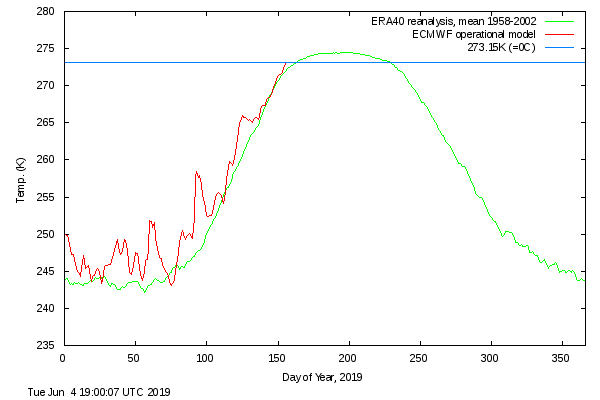
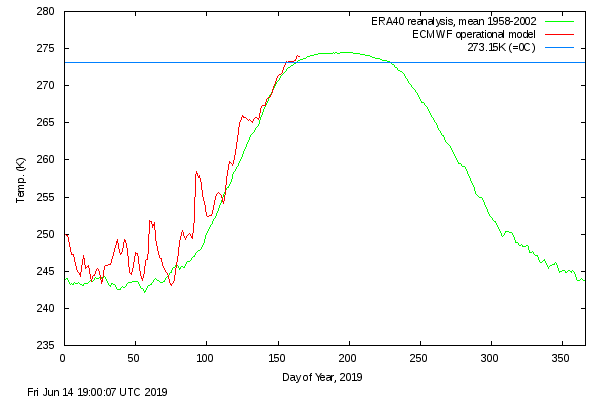
In addition the DMI >80N temperature metric has reached the zero Celsius line well ahead of schedule:

[Edit – June 5th]

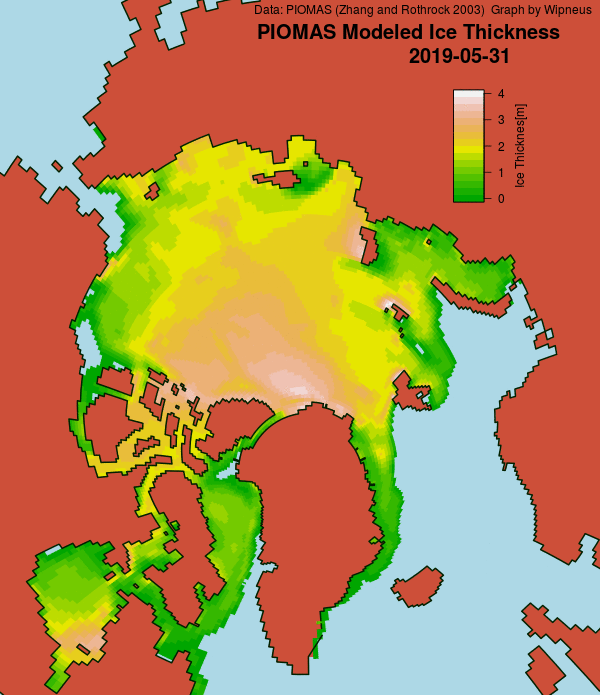
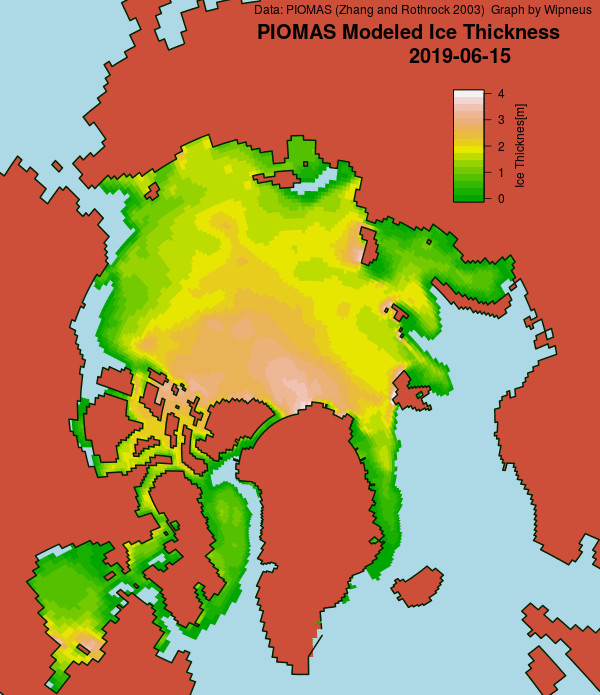
The May PIOMAS numbers have been released! Here is the Wipneus generated state of play on May 31st:

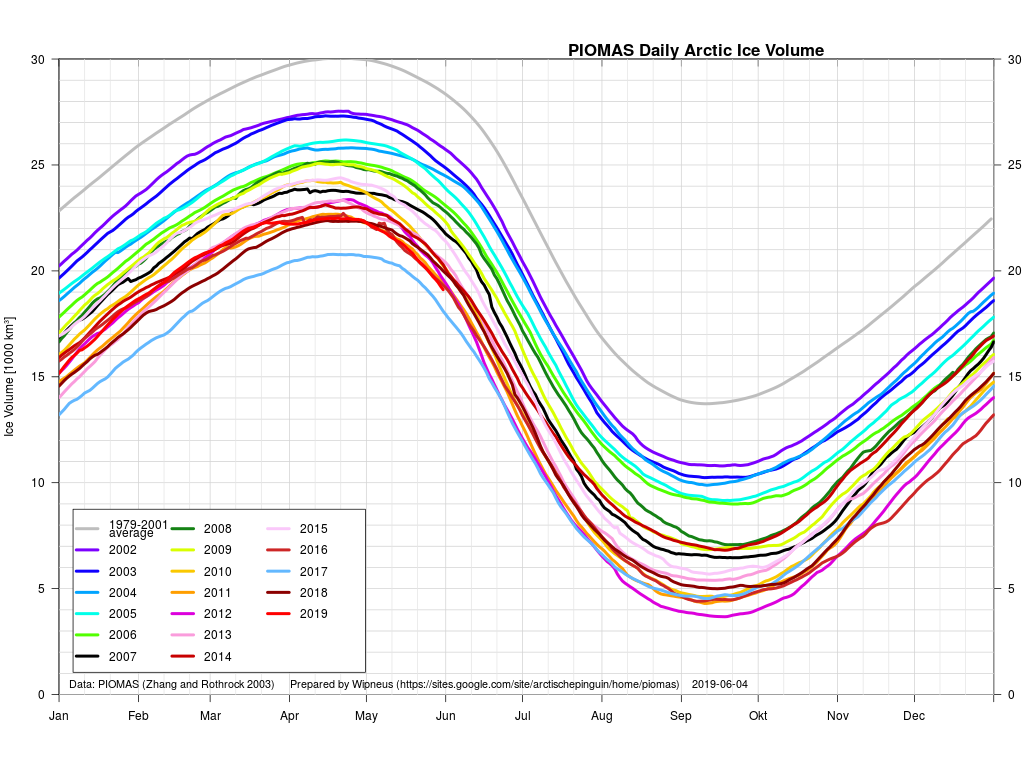
and here is the all too familar multi-year graph:

[Edit – June 10th]

As reported in this year’s Northwest Passage article:

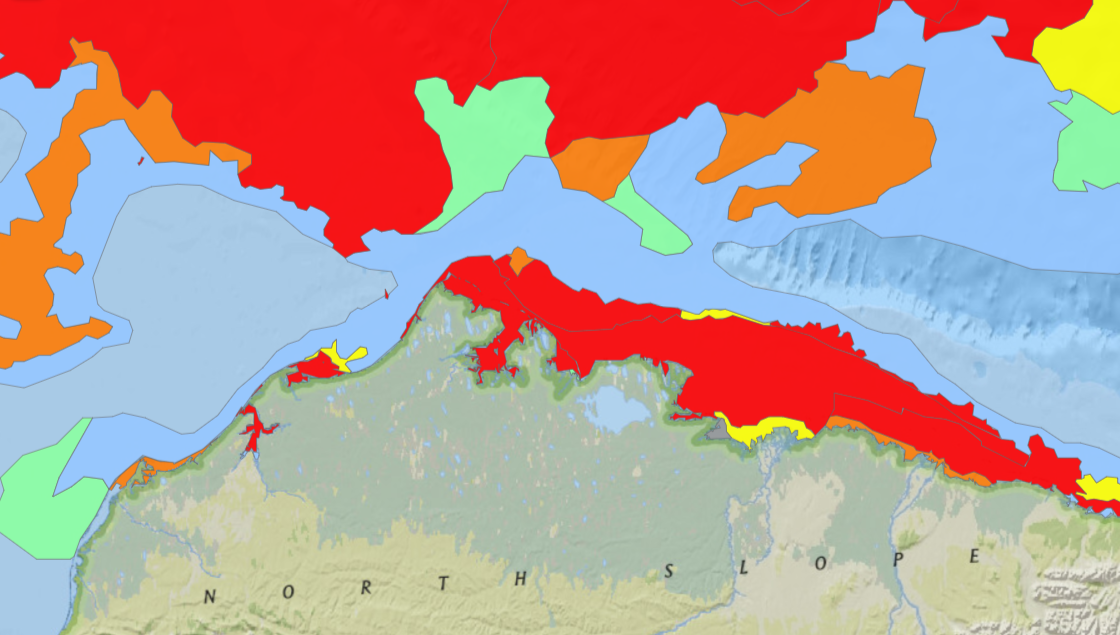
Any early bird traversing the Northwest Passage from west to east could now sail through open water around Point Barrow, along the Alaskan and Canadian coast and into the Amundsen Gulf:

Arctic Basin sea ice extent is still descending through uncharted territory:

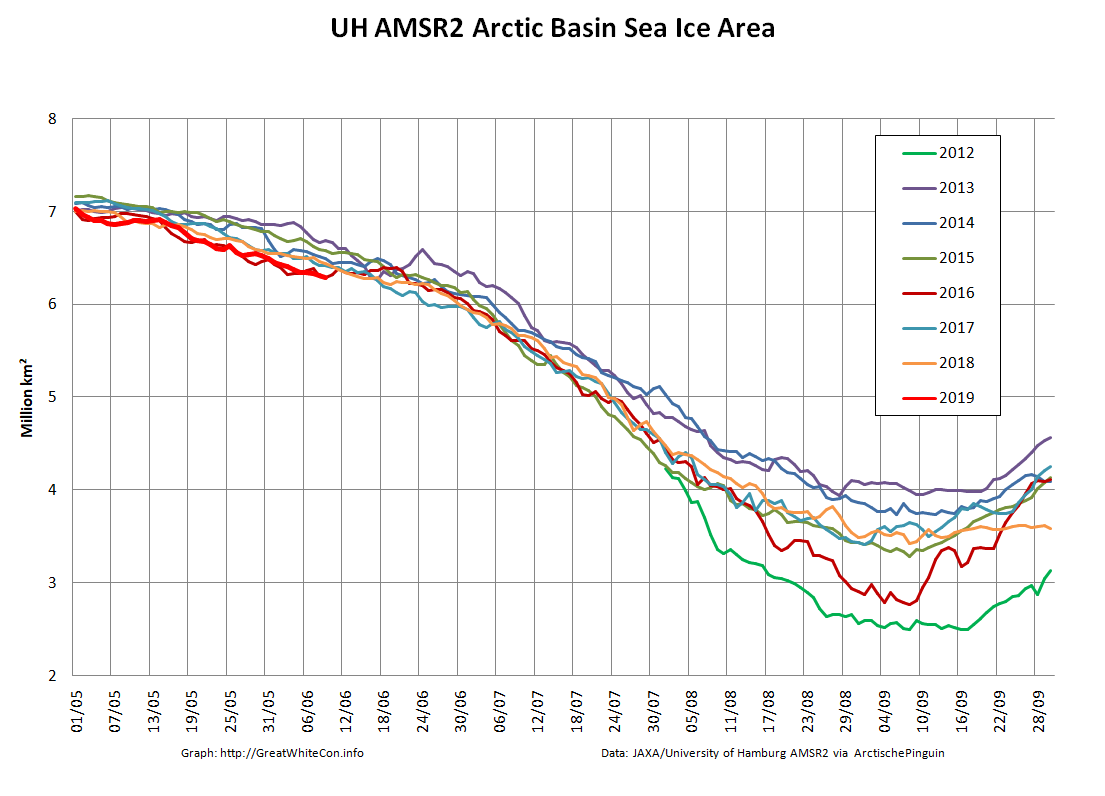
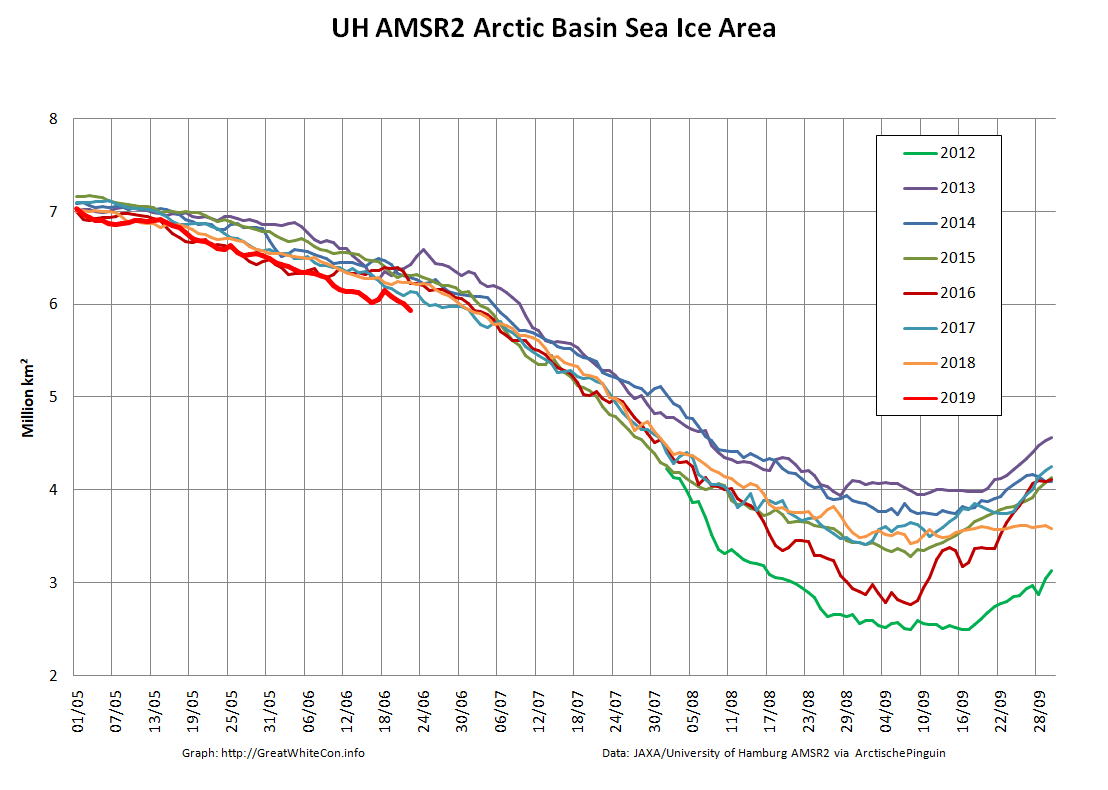
and Basin area currently looks poised to follow suit:

[Edit – June 11th]

There’s a beautifully clear view of the Siberian coast today, with vast areas of melt ponds visible on VIIRS false colour:

NASA Worldview “false-color” image of the Laptev & East Siberian Seas on June 11th 2019, derived from the VIIRS sensor on the Suomi satellite

The Arctic Basin area has indeed taken a nosedive into uncharted territory:

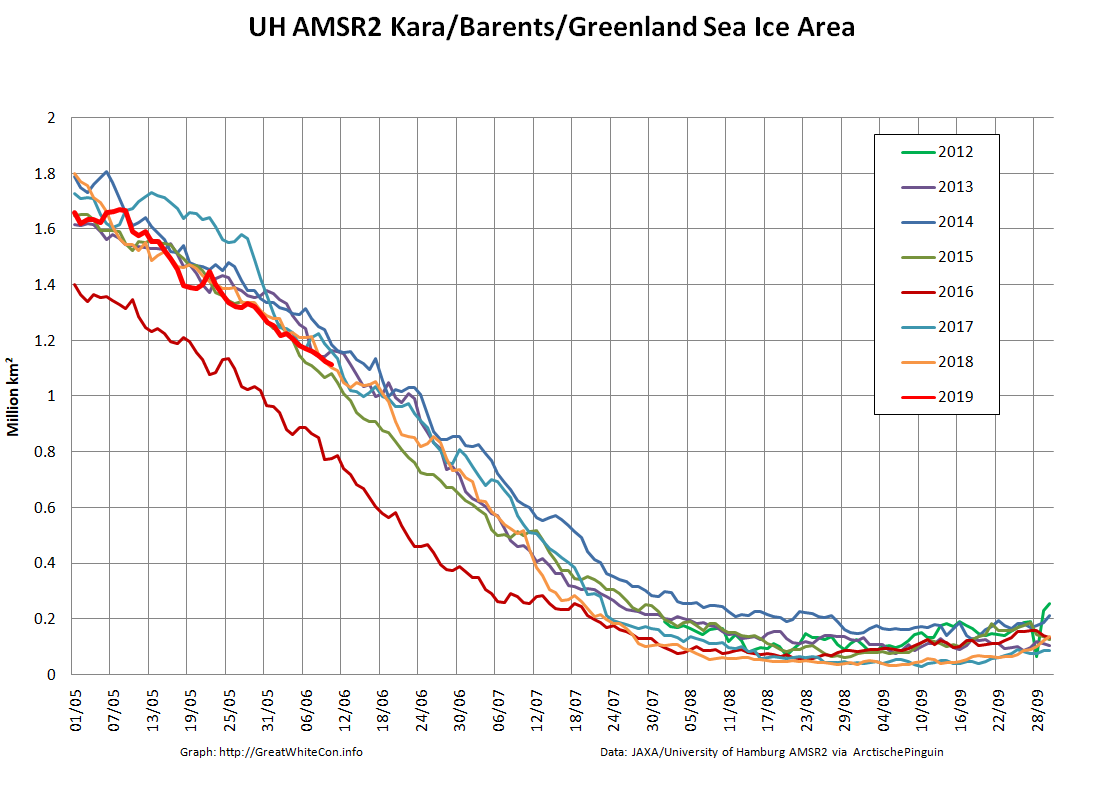
By way of comparison sea ice area on the Atlantic periphery is in amongst the recent pack, thanks to the almost continual drift in that direction over last winter:

[Edit – June 13th]

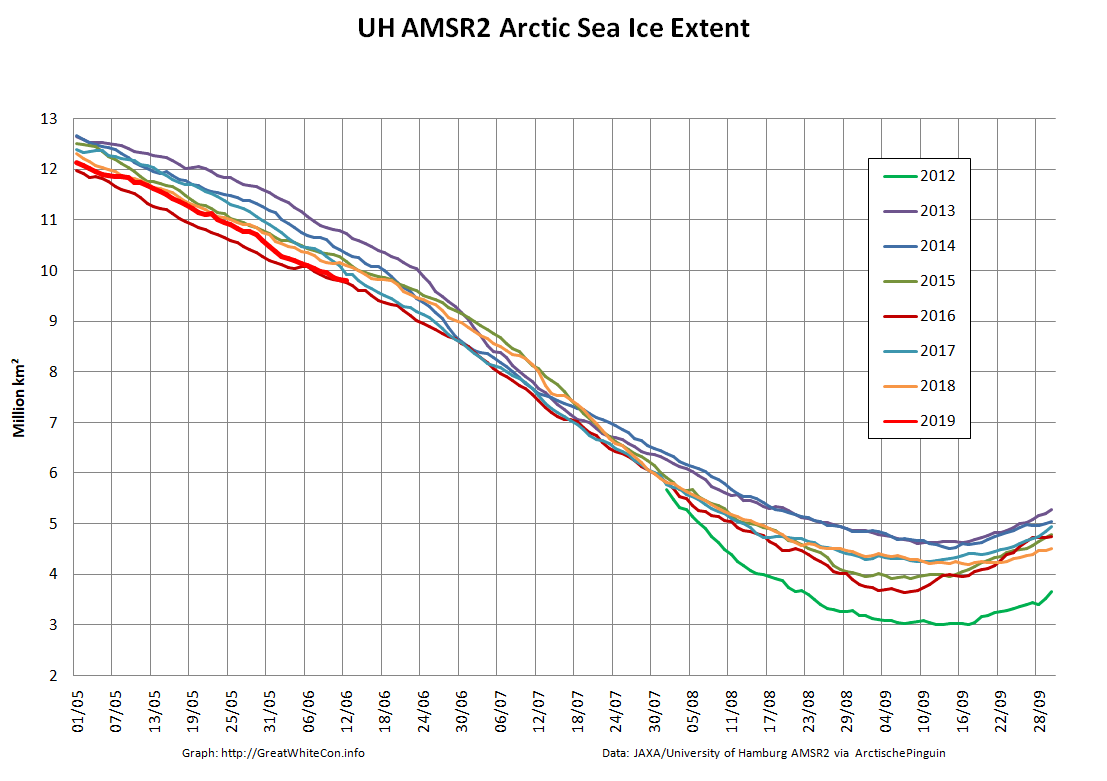
High resolution AMSR2 extent has been in a “statistical tie” with 2016 for a few days:

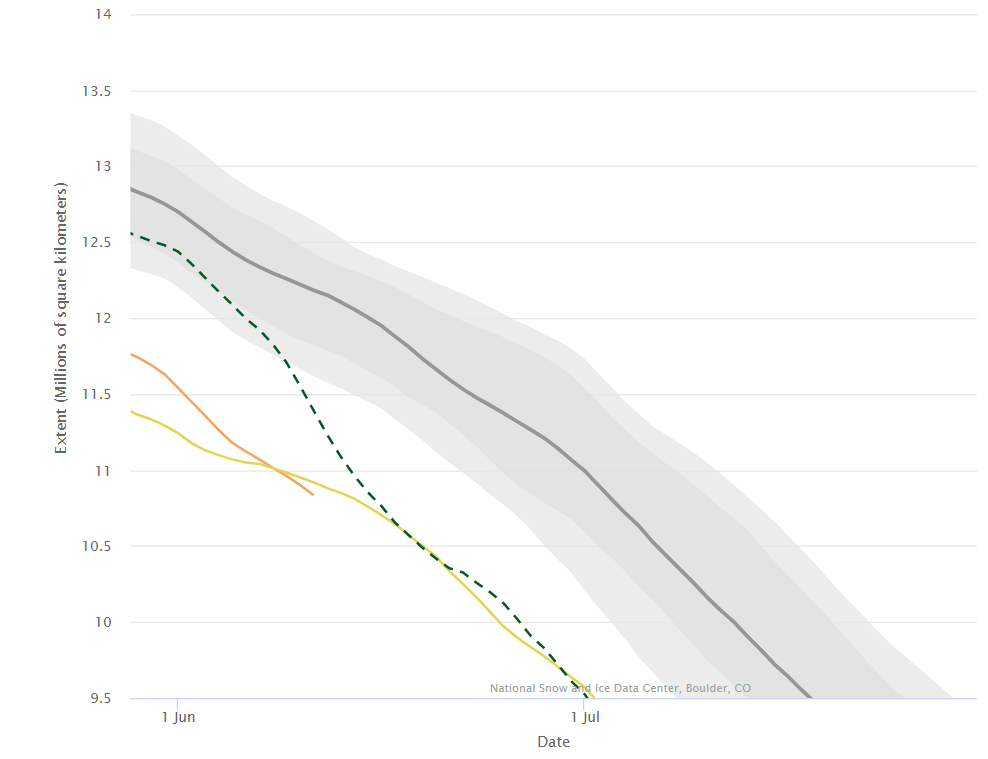
However the NSIDC’s 5 day average extent has reached a clear new low for the date, in the satellite record at least:

[Edit – June 14th]

Especially for AJBT, here’s the Slater Probabilistic Ice Extent prediction for August 3rd:

and here’s the current DMI >80N temperature graph:

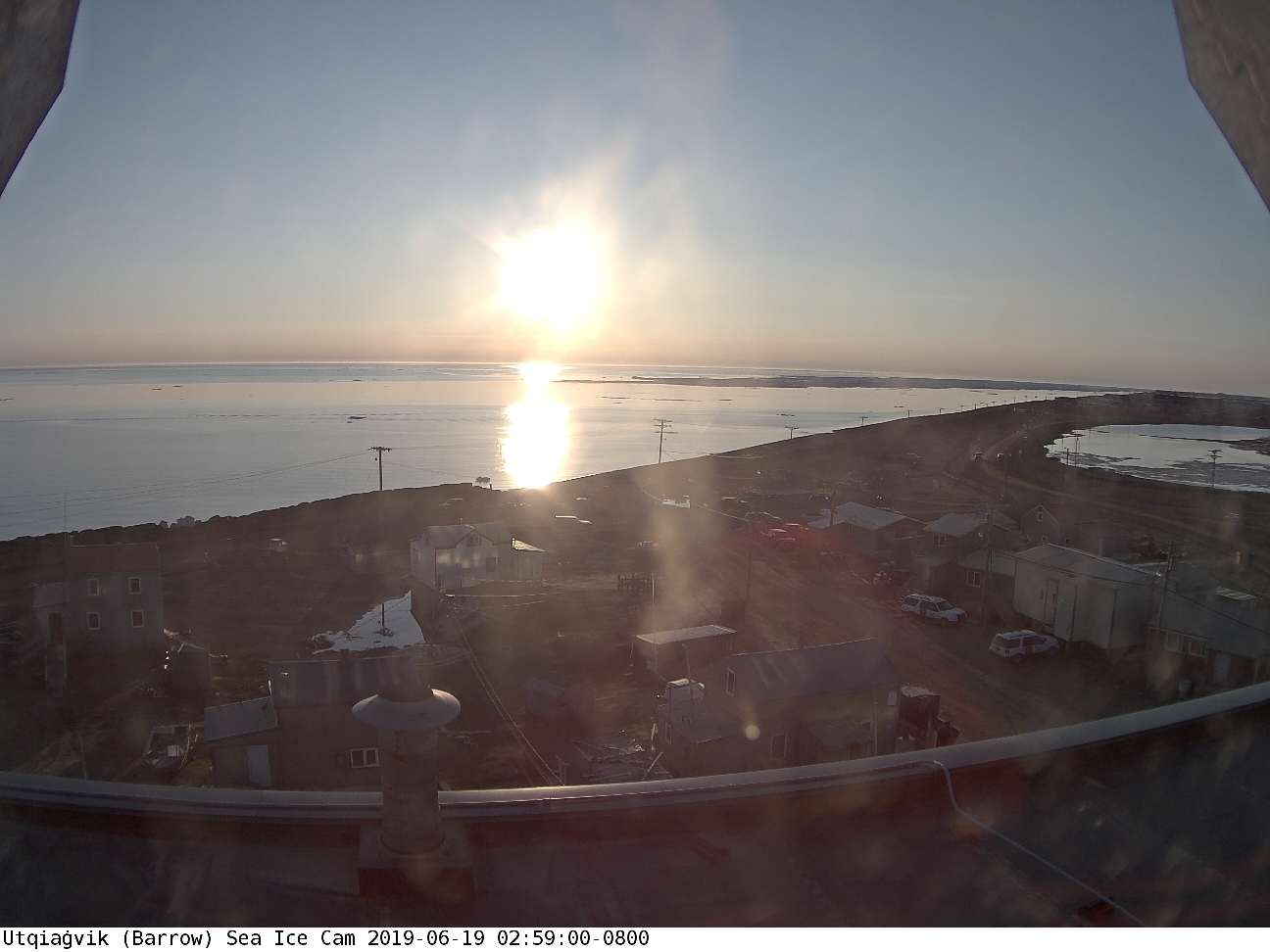
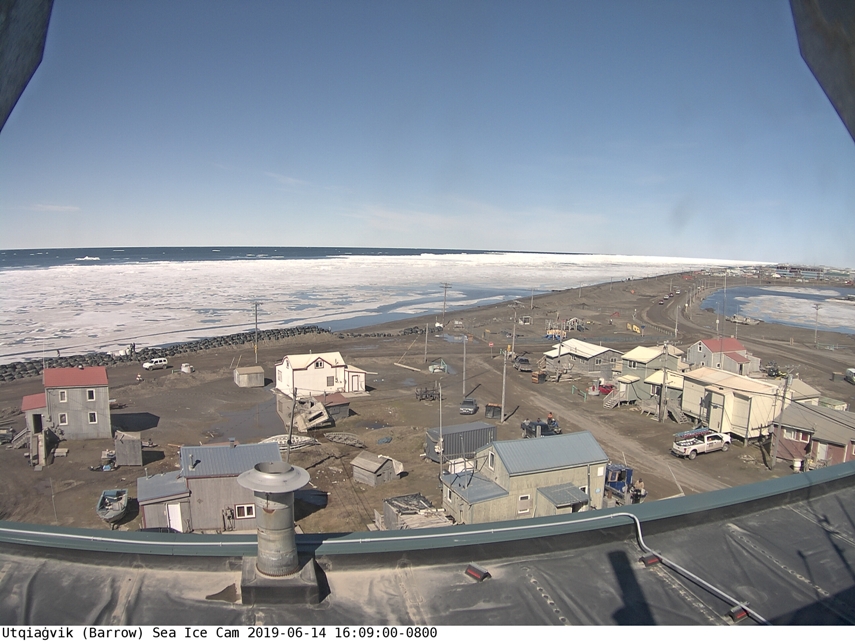
Finally, for the moment at least, there is not very much fast ice left at Utqiaġvik:

[Edit – June 15th]

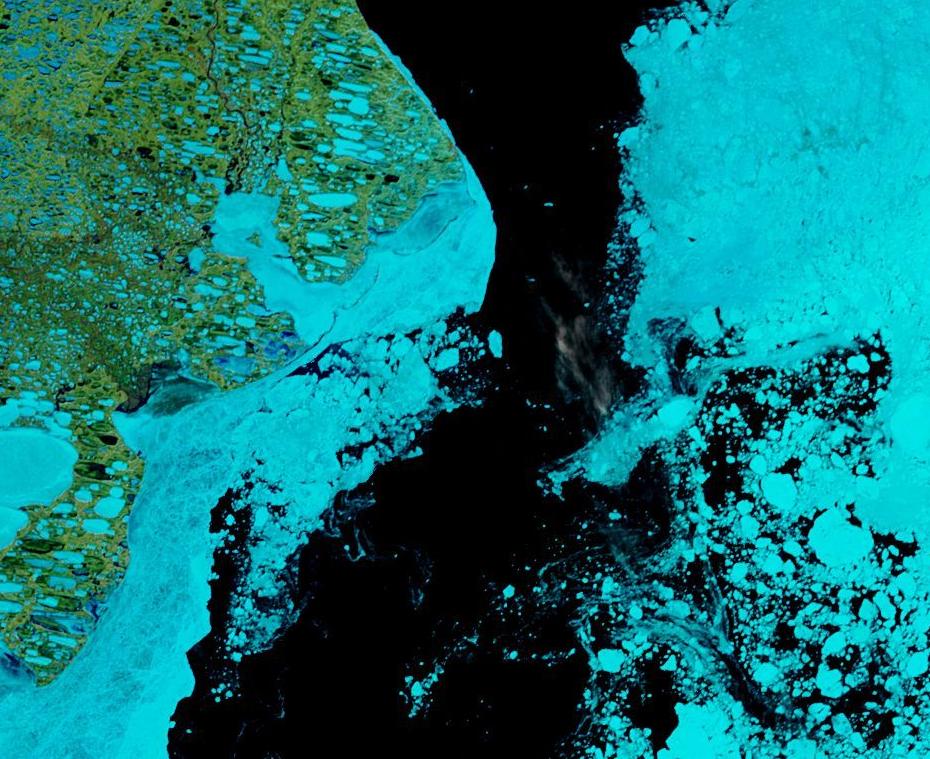
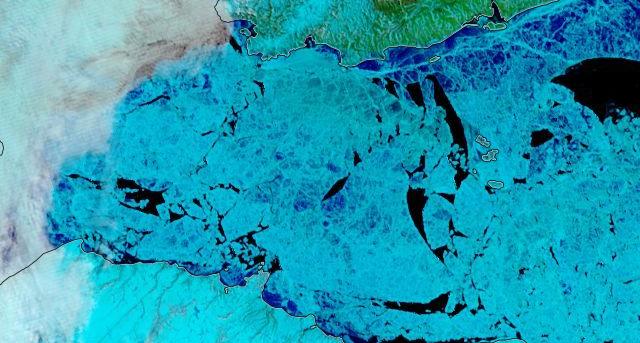
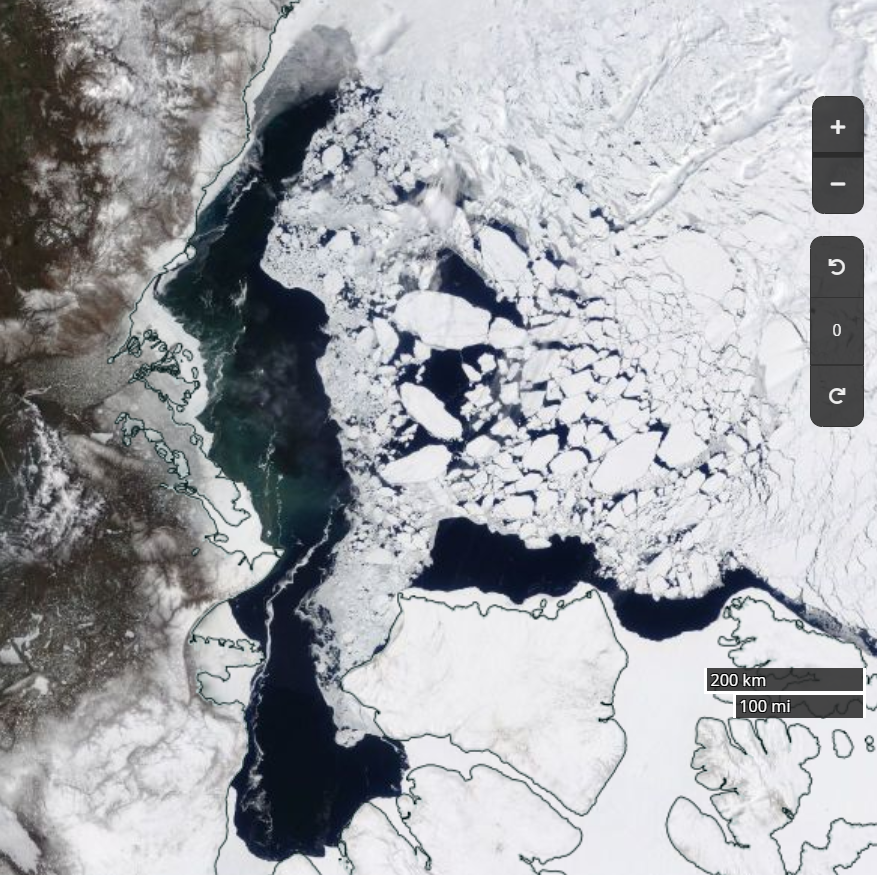
The sea ice in the Laptev Sea is starting to break up:

NASA Worldview “false-color” image of the Laptev Sea on June 15th 2019, derived from the MODIS sensor on the Terra satellite

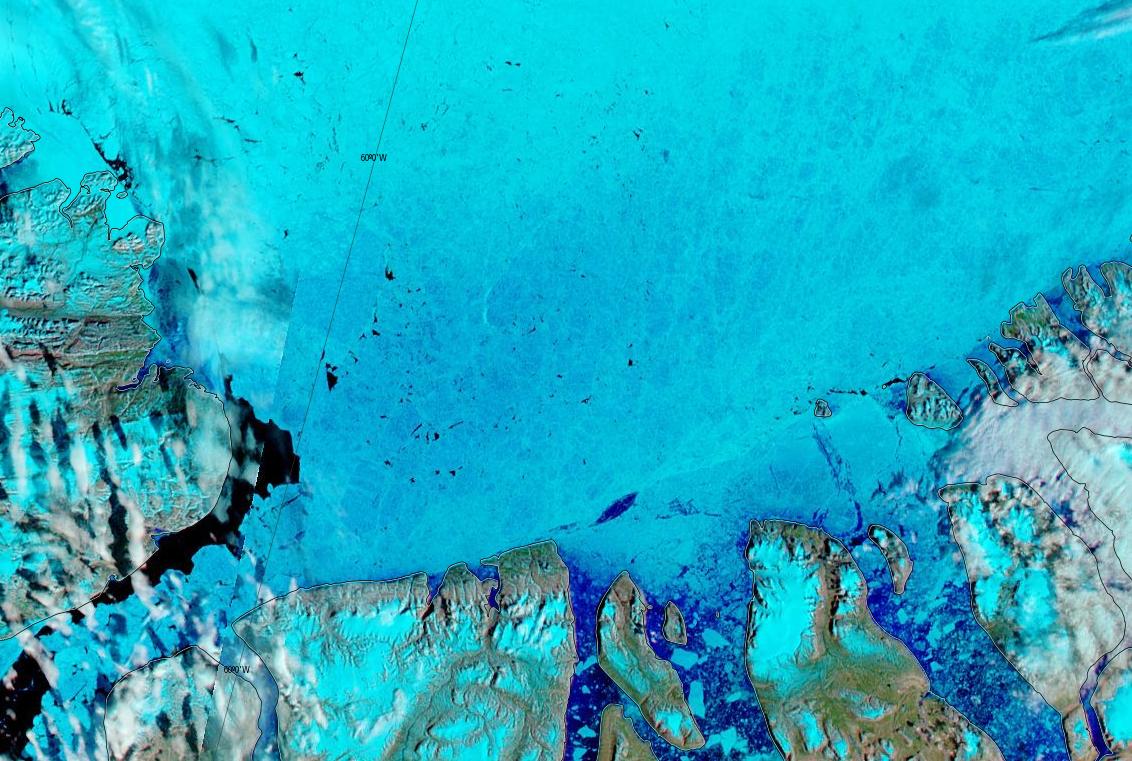
As is the fast ice in the Beaufort Sea:

NASA Worldview “false-color” image of the Beaufort Sea on June 14th 2019, derived from the MODIS sensor on the Terra satellite

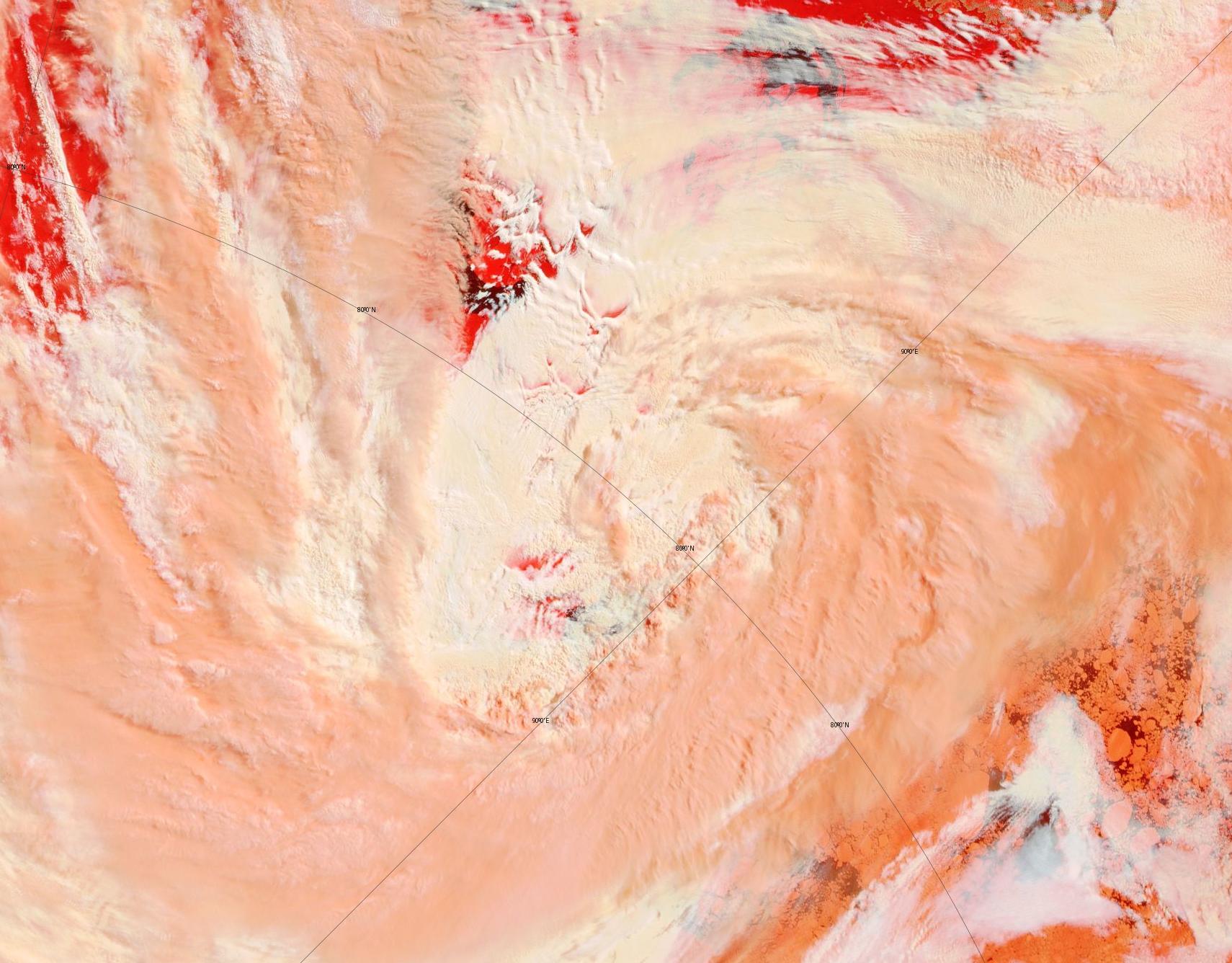
Meanwhile the MSLP of the cyclone currently spinning over Severnaya Zemlya was down to 976 hPa at 06:00 UTC this morning:

NASA Worldview “false-color” image of the Kara Sea on June 15th 2019, derived from the MODIS sensor on the Terra satellite

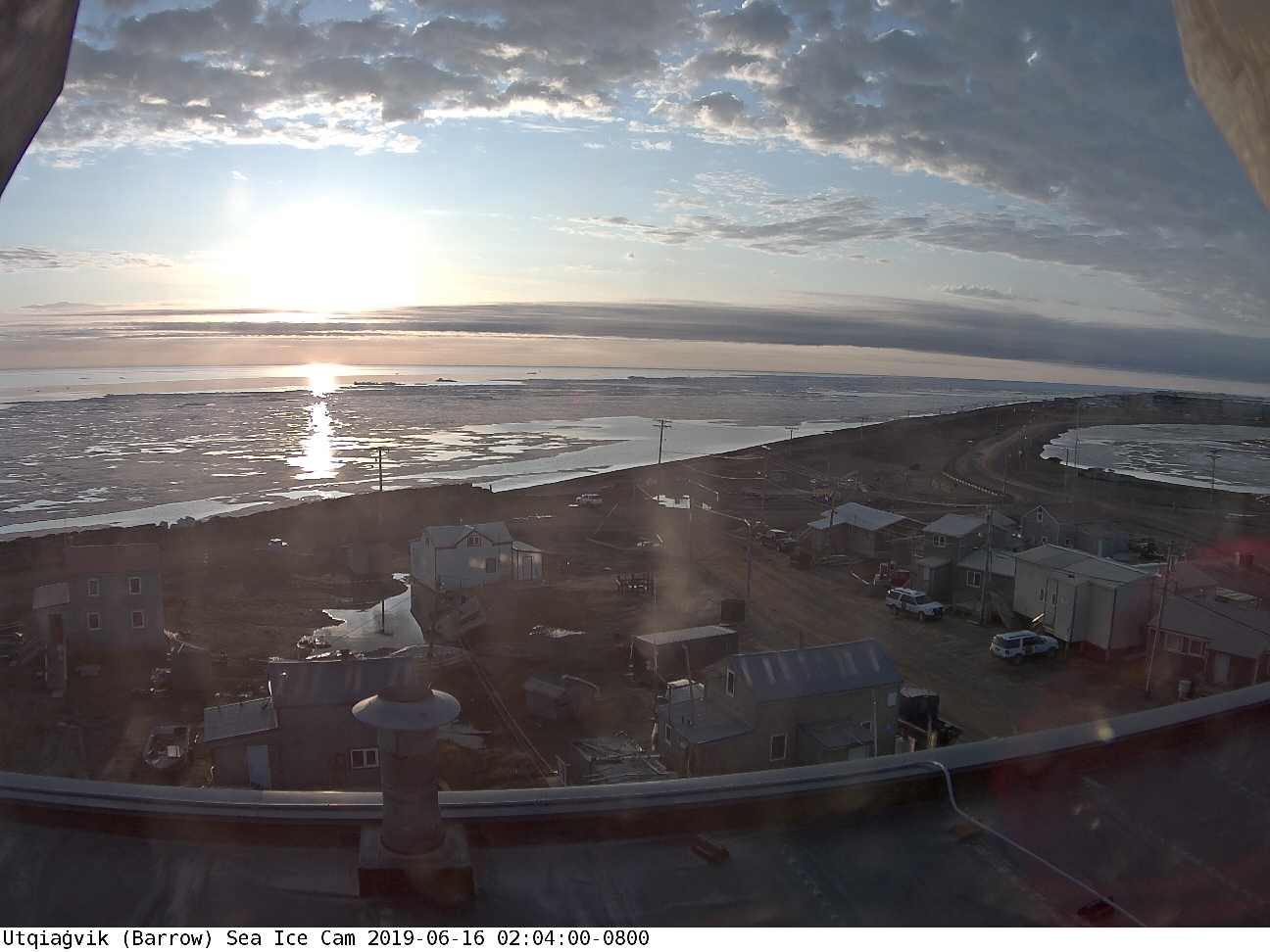
An early morning image from the Utqiaġvik webcam:

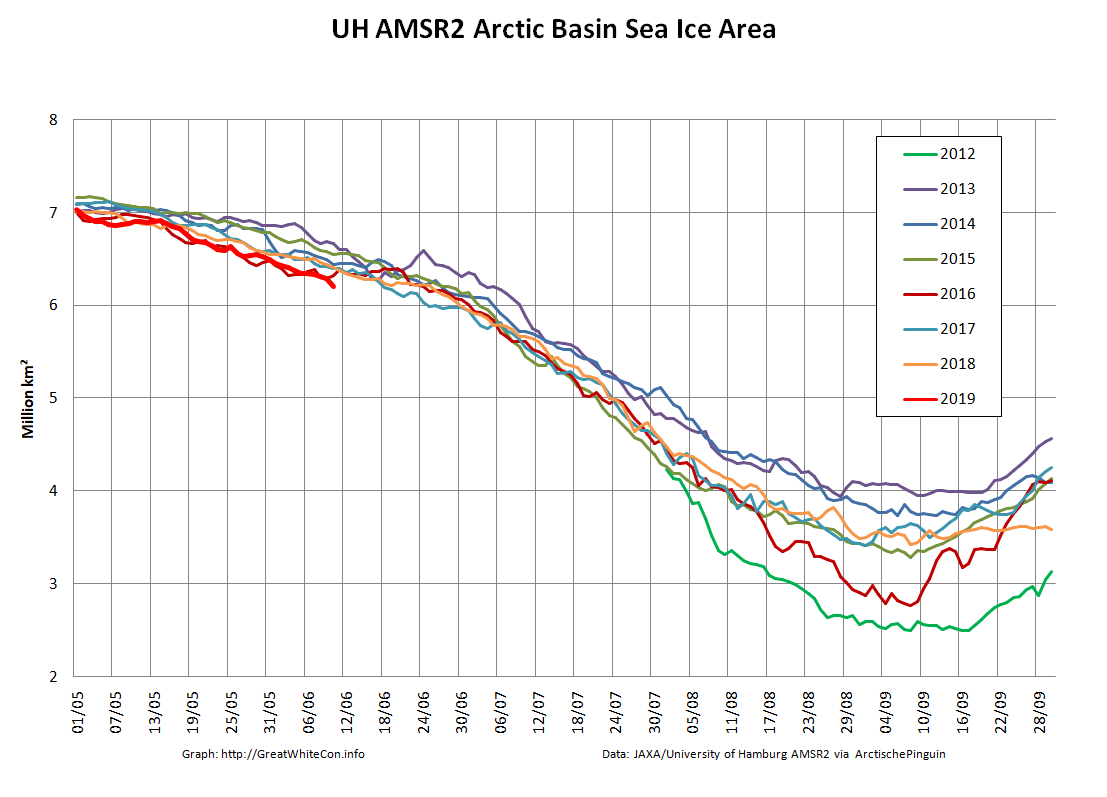
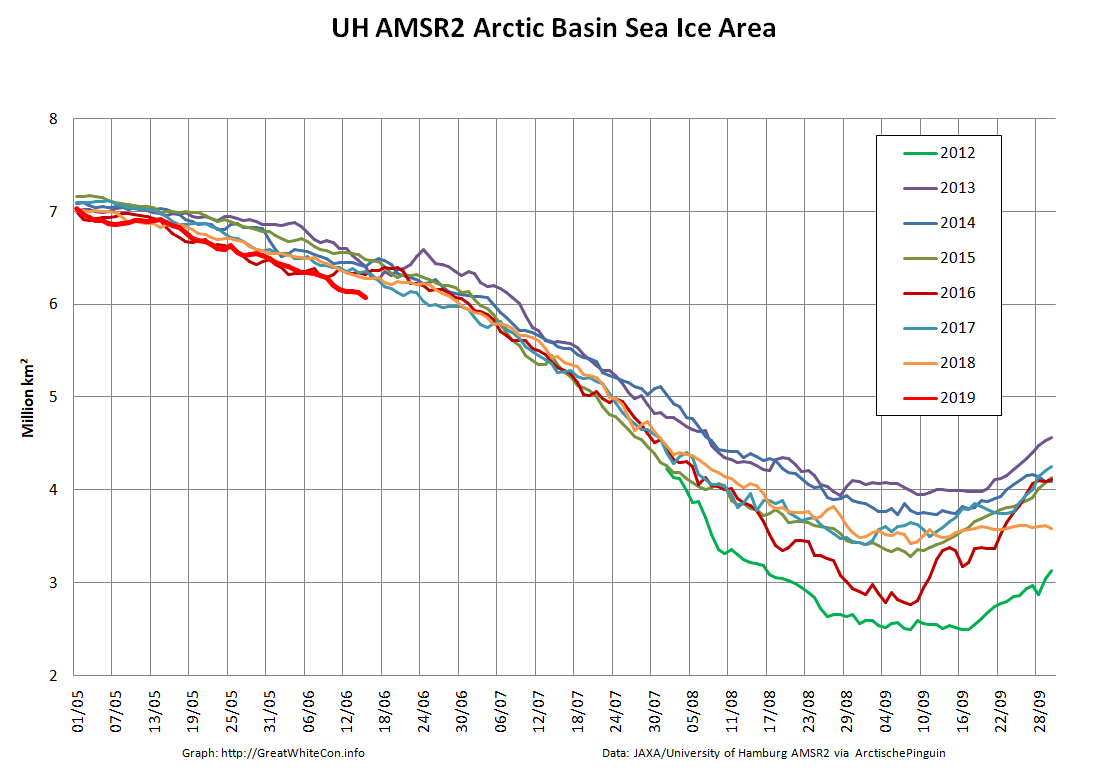
Especially for Mateo (see below) here’s the current high resolution Arctic Basin sea ice area:

and extent:

Note that the recent cyclones have caused a temporary jump in sea ice extent, but not in area.

[Edit – June 17th]

The Lincoln Sea has turned noticeably bluer on MODIS bands 7-2-1 false colour:

NASA Worldview “false-color” image of the Lincoln Sea on June 17th 2019, derived from the MODIS sensor on the Aqua satellite

[Edit – June 19th]

The sea ice off the Lena Delta has started to collapse:

NASA Worldview “false-color” image of the Laptev Sea on June 19th 2019, derived from the MODIS sensor on the Aqua satellite

Meanwhile the clear water off Point Barrow is opening up further:

Finally, for the moment at least, here is the current view from the Utqiaġvik (Barrow as was) sea ice webcam:

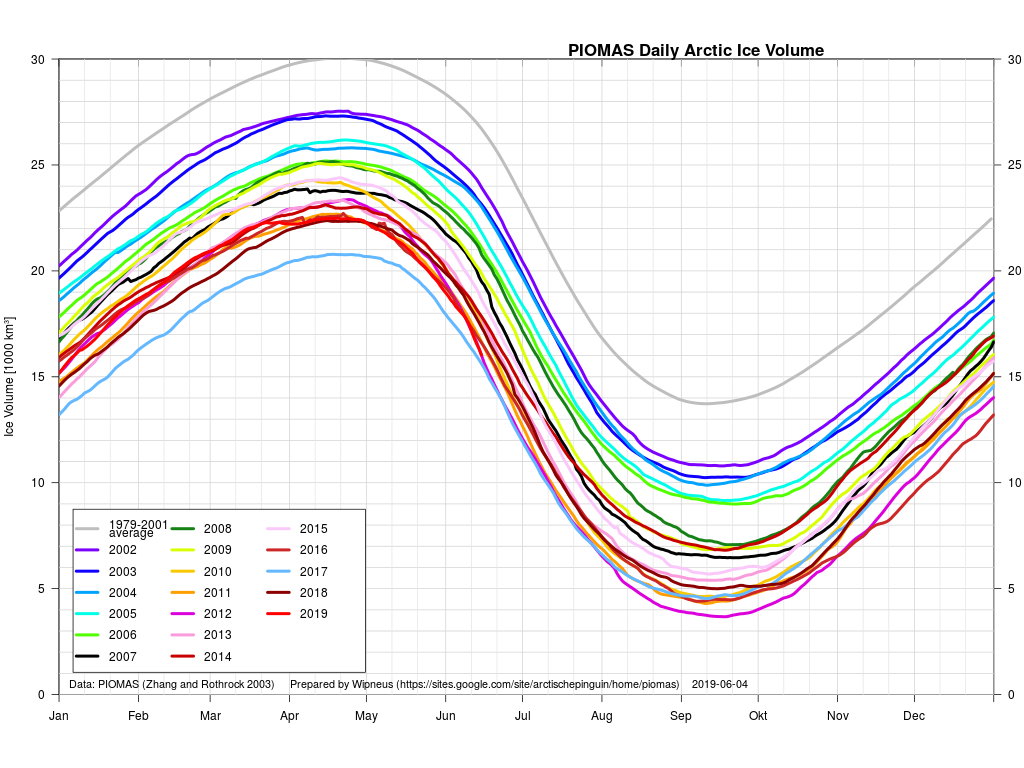
P.S. The mid month PIOMAS numbers have been released, and Wipneus has worked his usual magic:

2019 sea ice volume is currently in a “statistical tie” with 2012, in 2nd place behind 2017:

[Edit – June 22nd]

The fast ice in the Vilkitsky Strait has started to break up:

NASA Worldview “false-color” image of the Vilkitsky Strait on June 22nd 2019, derived from the MODIS sensor on the Terra satellite

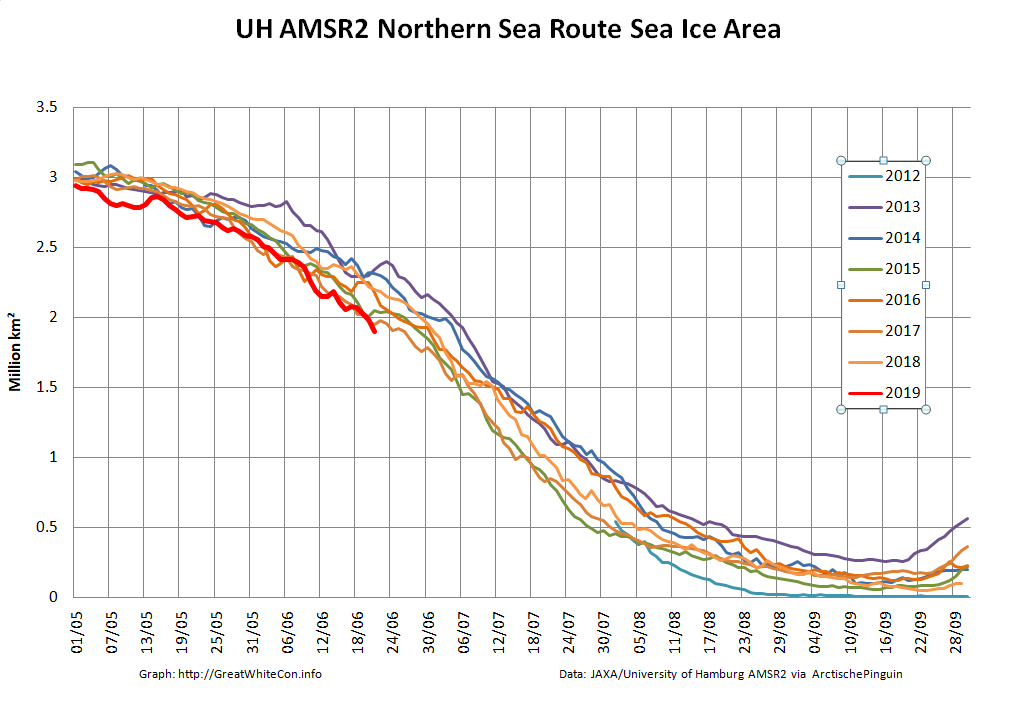
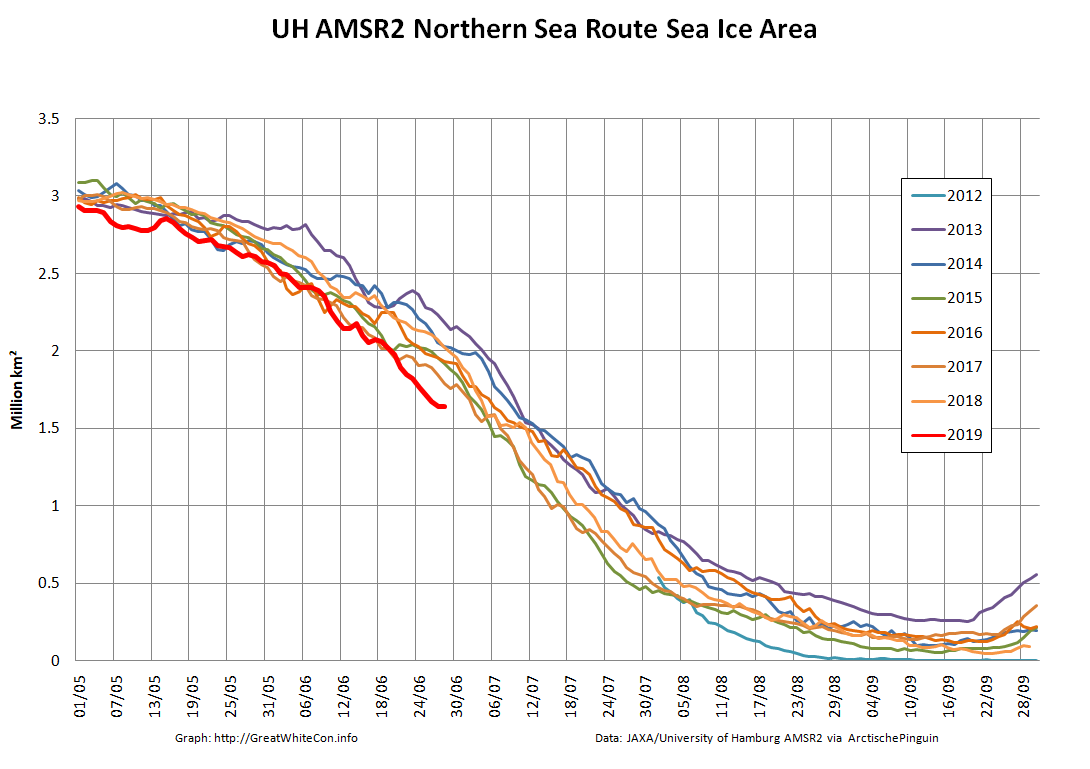
Sea Ice area along the Northern Sea Route is currently the lowest for the date in the AMSR2 ere:

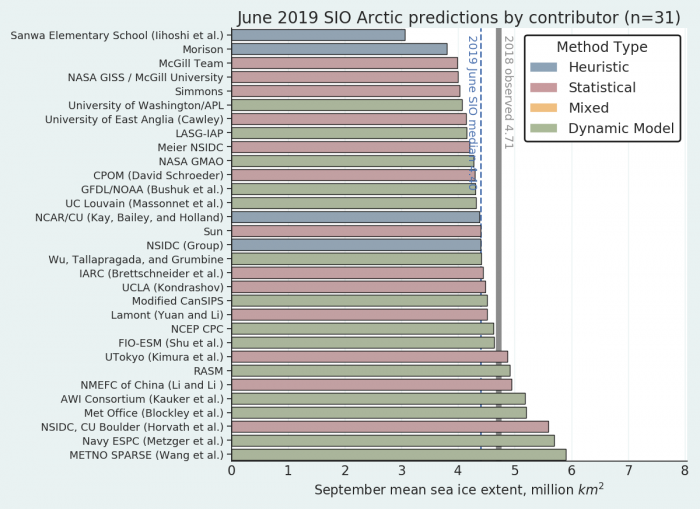
In addition the June 2019 Sea Ice Prediction Network report has been released. Here’s the summary:

Again, as in previous years, the spread in the dynamical models are larger compared with statistical models. Overall, the heuristic method has the lowest projected September sea-ice extent value with a median at 4.09 million square kilometers, and the dynamical models have the highest number with the median at 4.56 million square kilometers.

[Edit – June 23rd]

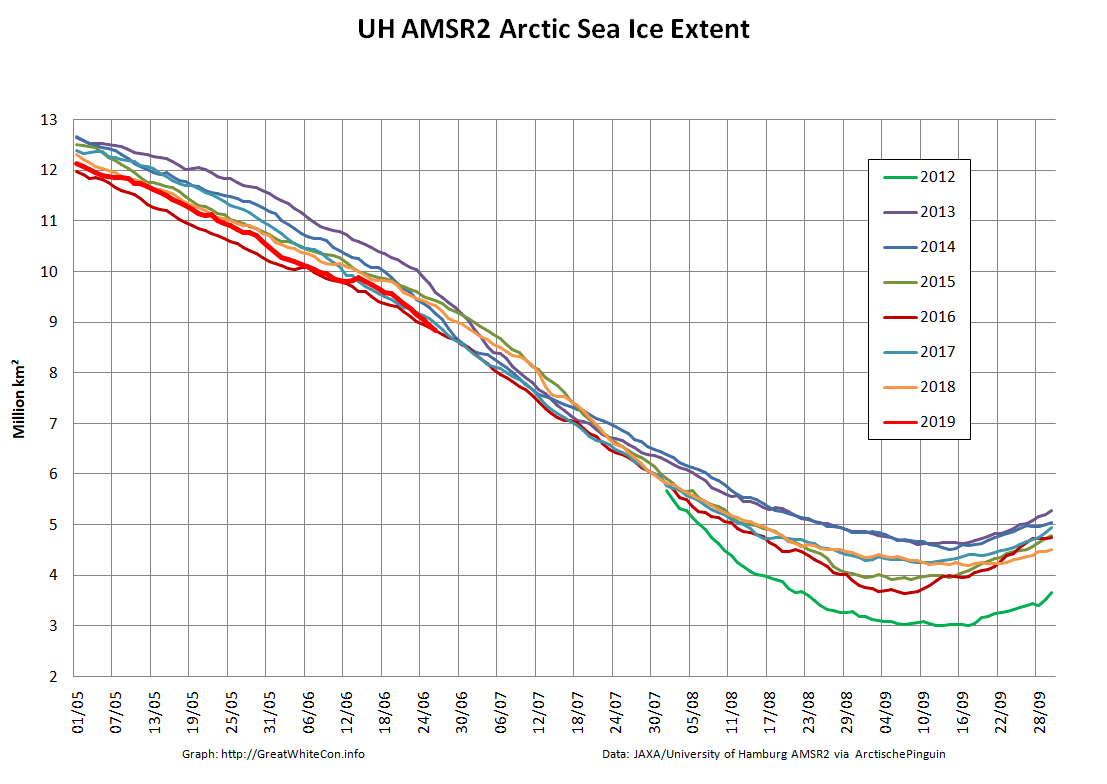
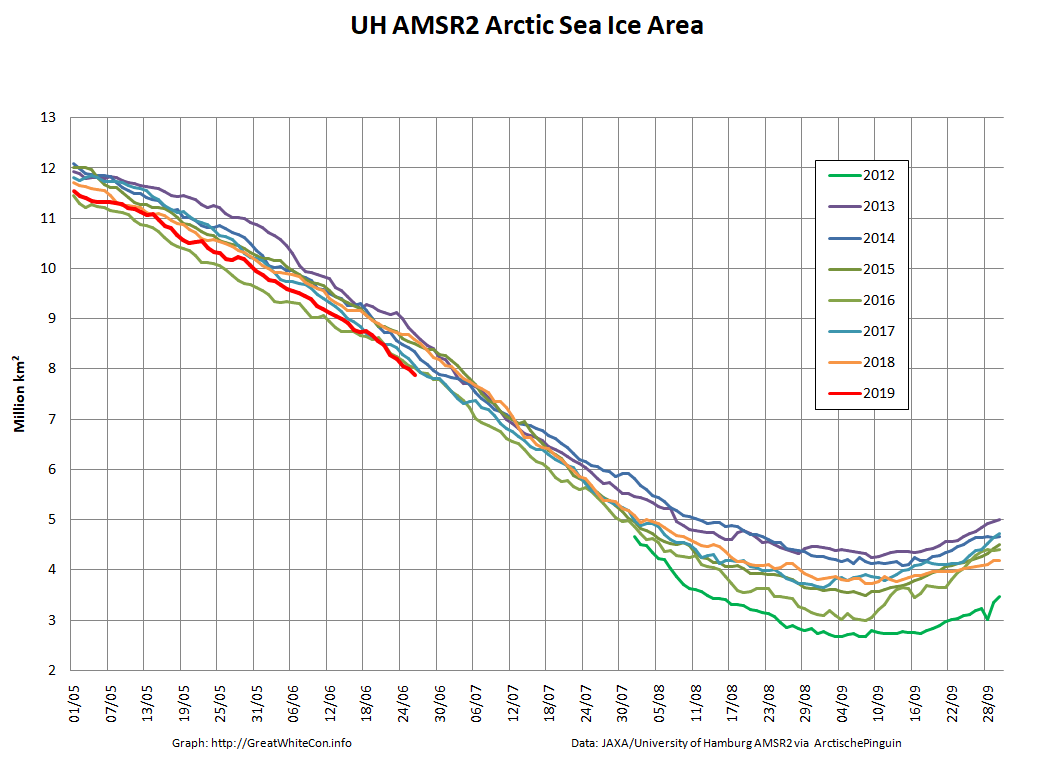
Arctic wide sea ice area is now lowest for the date in the high resolution AMSR2 record, although extent has yet to follow suit:

If you exclude the peripheral seas, which are all largely ice free by mid September in this day and age, the picture is extremely stark:

A brief glimpse through the clouds reveals that the North Pole is now starting to feel the recent heat:

NASA Worldview “false-color” image of the North Pole on June 22nd 2019, derived from the MODIS sensor on the Terra satellite

[Edit – June 27th]

Arctic wide sea ice extent is now lowest for the date in the high resolution AMSR2 record:

Here’s Arctic wide sea ice area, which is still well below the rest of the pack:

[Edit – June 29th]

As the end of the month draws near let’s take a look at sea ice area along a couple of the famous sea routes above the Arctic Circle. First of all here’s the Northern Sea Route, comprising the Kara, Laptev, East Siberian and Chukchi Seas:

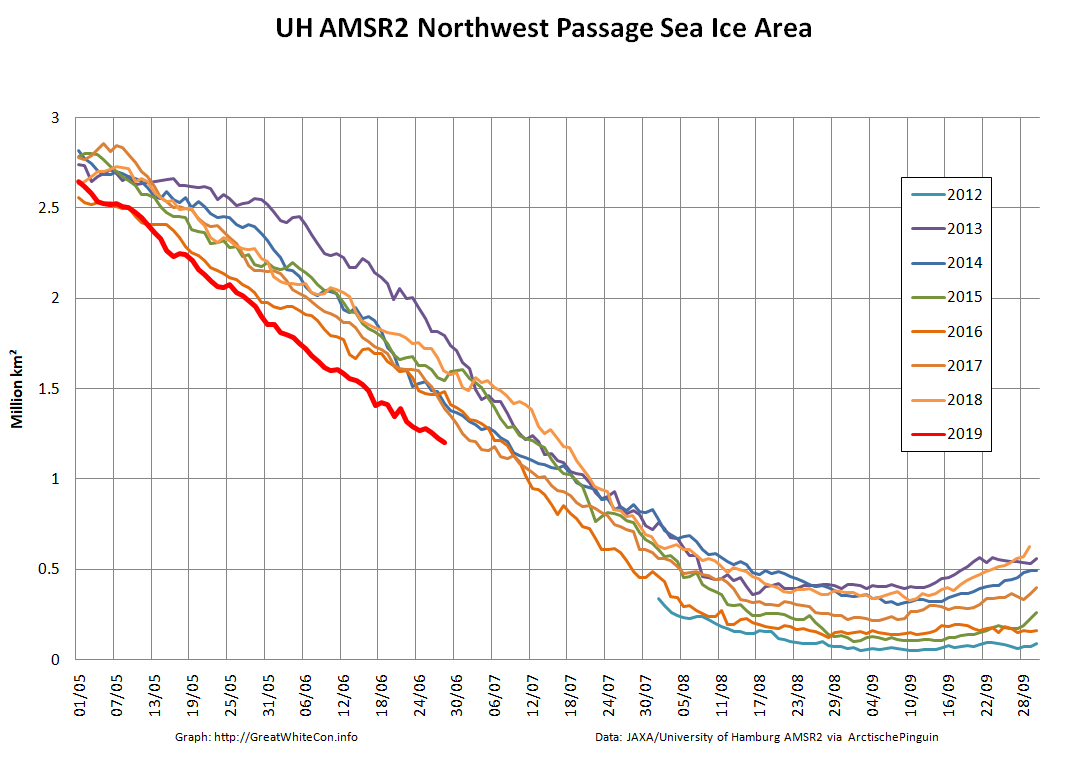
Next here’s the Northwest Passage, comprising the Chukchi and Beaufort Seas plus the channels of the Canadian Arctic Archipelago and Baffin Bay:

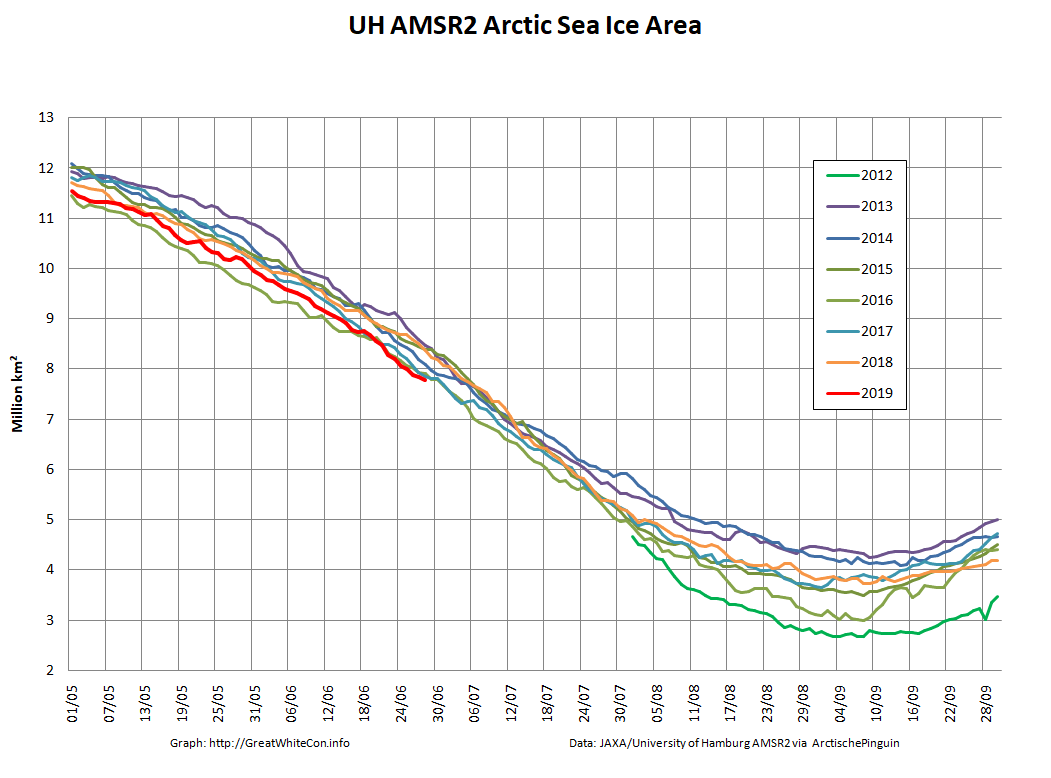
For completeness here too are the current Arctic wide area and extent numbers:

Watch this space!
Melt Pond May 2019

A couple of years ago I was asked to provide “a handful of things [you] will be keeping an eye on over the next few months to judge how ‘good’ or ‘bad’ the melt is going?”

My answer was, and remains:

5 fingers worth to start with? Not necessarily in order of time or importance!

1. How soon melt ponds and/or open water hang around in the Beaufort Sea this year. Things started very early [in 2016]:

https://GreatWhiteCon.info/2016/04/the-beaufort-gyre-goes-into-overdrive/

2. Ditto the Bering Strait and Chukchi Sea

3. Ditto the Laptev and East Siberian Seas

4. How many (and how deep, warm, wet) spring cyclones spin around the Arctic Ocean

5. How the snow melt progresses across Canada, Alaska and Siberia

Applying the same criteria this year, open water is already hanging around in the Beaufort Sea, as well as the Amundsen Gulf:

NASA Worldview “true-color” image of the Beaufort Sea on May 21st 2019, derived from the MODIS sensor on the Terra satellite

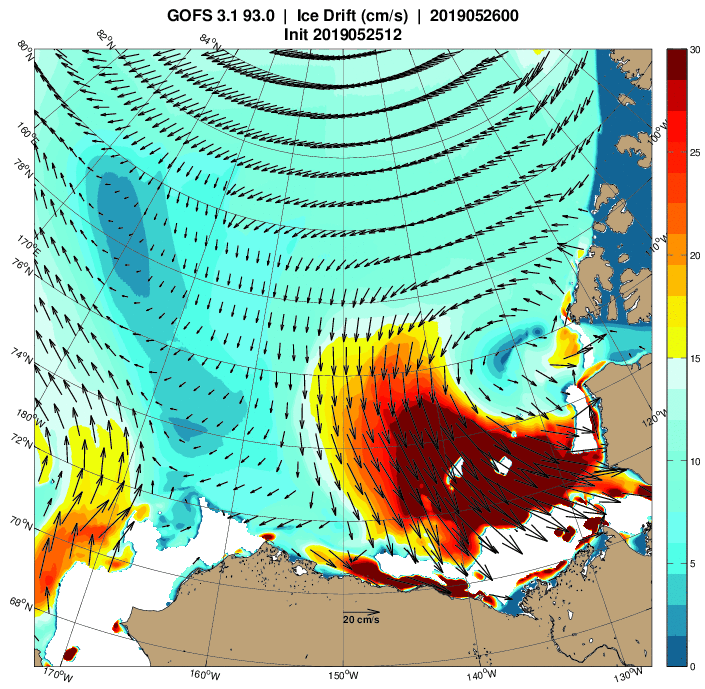
What’s more a cyclone is currently spinning in the area too:

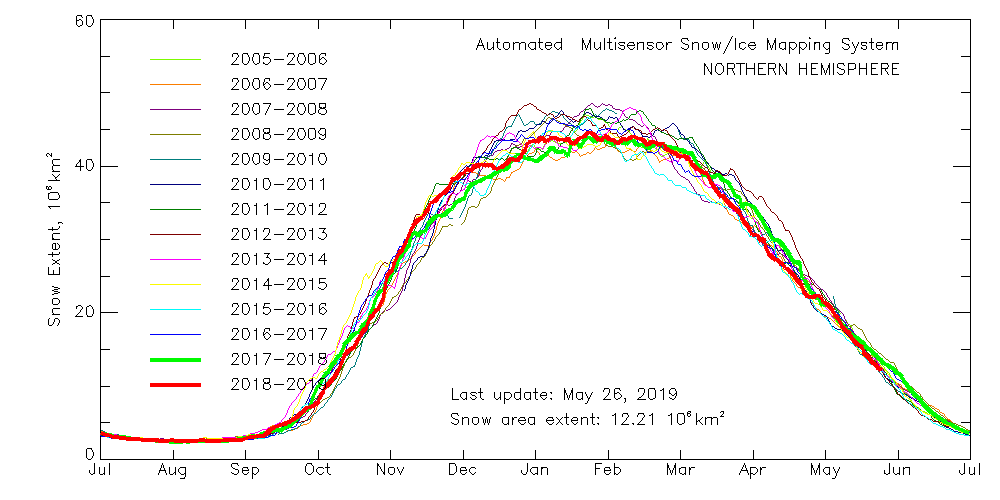
With those prerequisites in place, how about my other criteria? Here’s the current northern hemisphere snow cover graph:

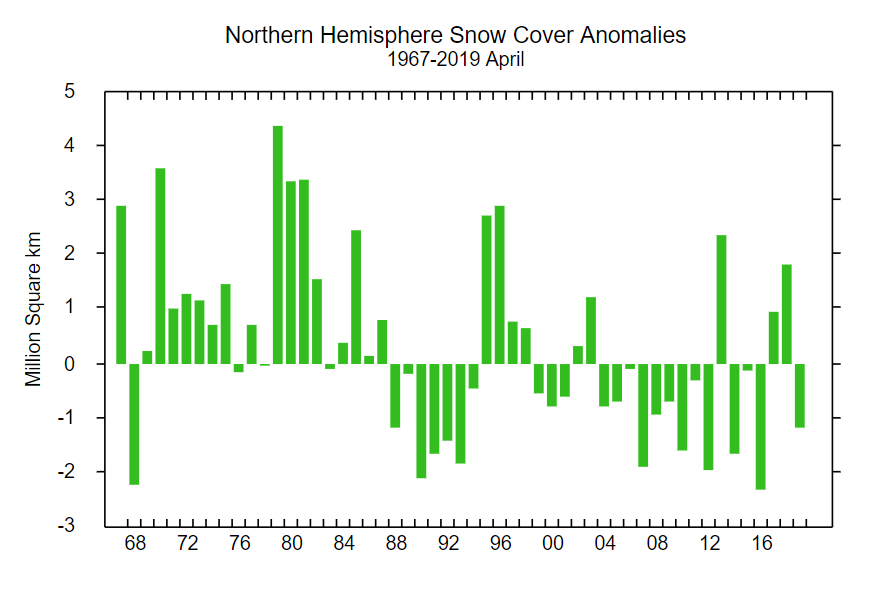
That suggests snow cover over land is close to recent lows, which is confirmed by the Rutgers University snow cover anomaly graph for April:

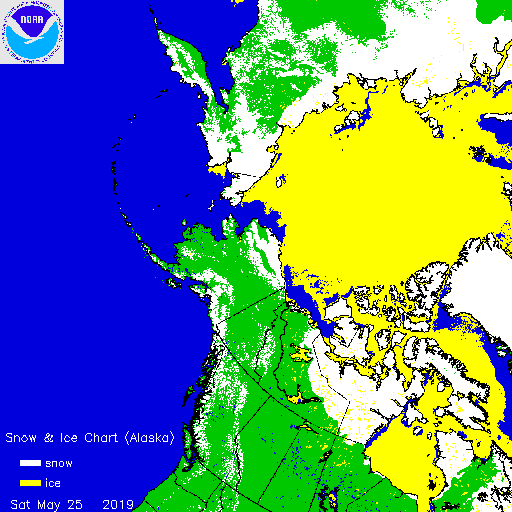
This year is anomalously low, but not by as much as 2012 and 2016. For completeness, here also is the current US National Ice Center snow cover map:

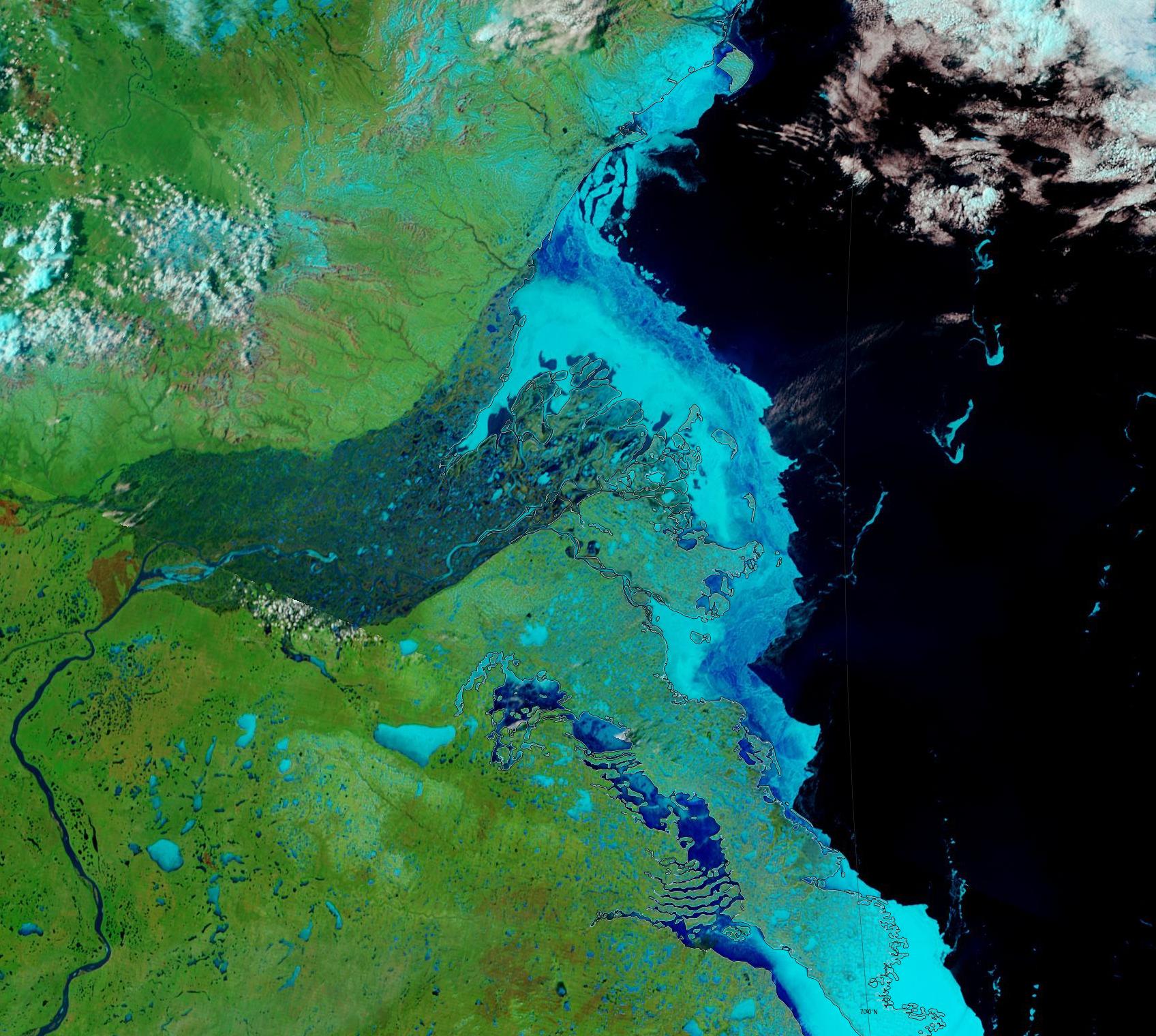
Moving on to melt ponds, there are plenty to be seen on the fast ice around the Mackenzie river delta:

NASA Worldview “false-color” image of the Mackenzie Delta on May 24th 2019, derived from the MODIS sensor on the Terra satellite

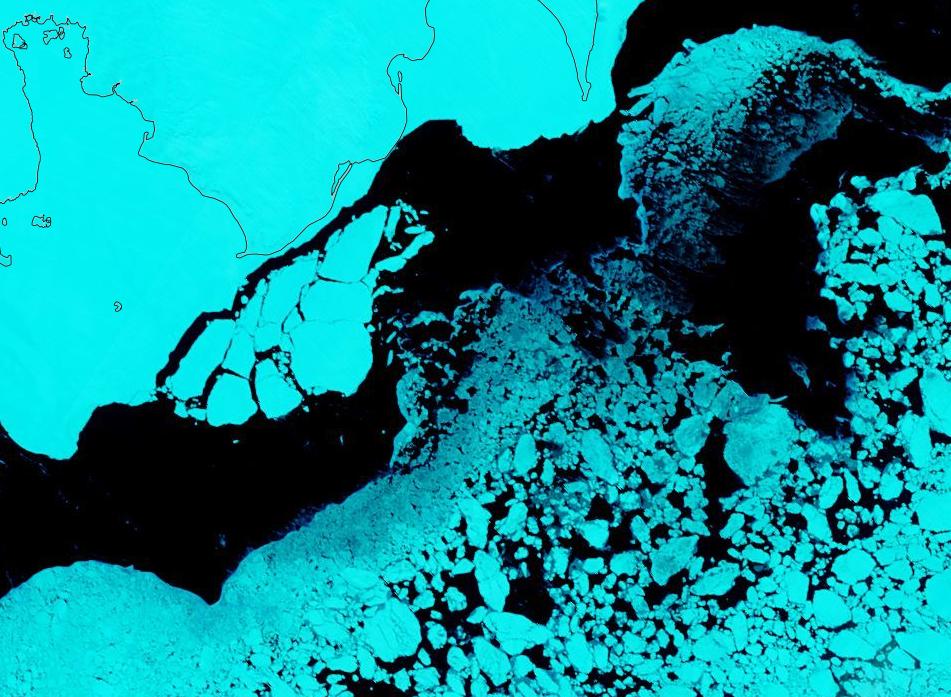
There also seem to be signs of some at a higher latitude off Ostrov Kotelny in the New Siberian Islands:

NASA Worldview “false-color” image of the Laptev Sea on May 23rd 2019, derived from the MODIS sensor on the Terra satellite

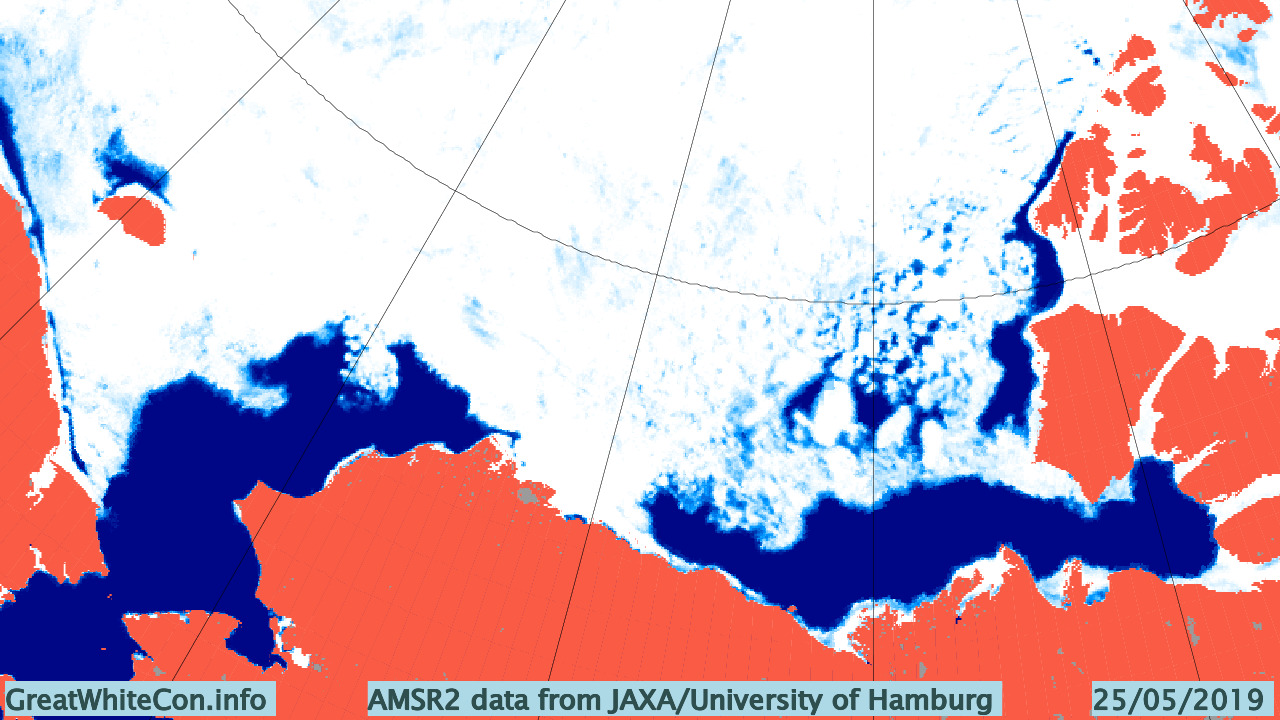
This year there is also a lot of open water in the Chukchi Sea, and almost no sea ice left in the Bering Sea:

Compared with 2016 at the same time of year I am compelled to say that with June 1st just around the corner the 2019 summer melting season is primed to progress more quickly.

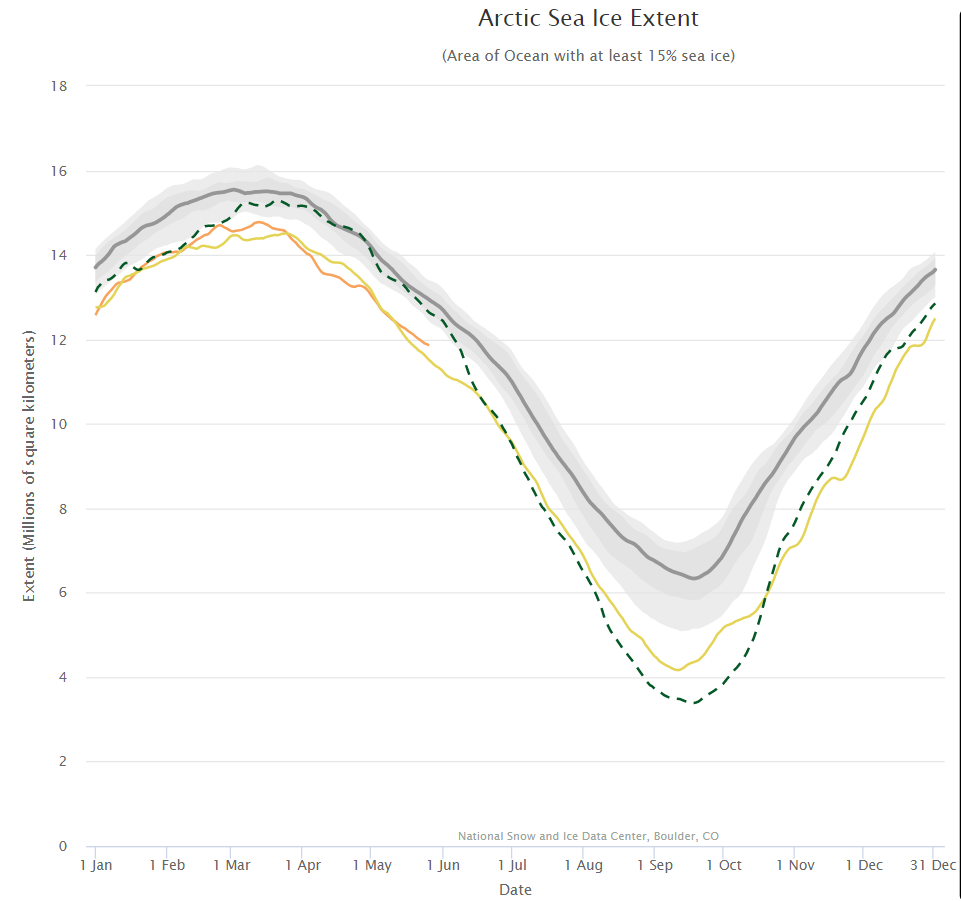
The next obvious comparison to make is with the (in)famous year of 2012, which resulted in the lowest ever minimum extent in the satellite record. Firstly let’s look at the National Snow and Ice Data Center’s graph of Arctic sea ice extent:

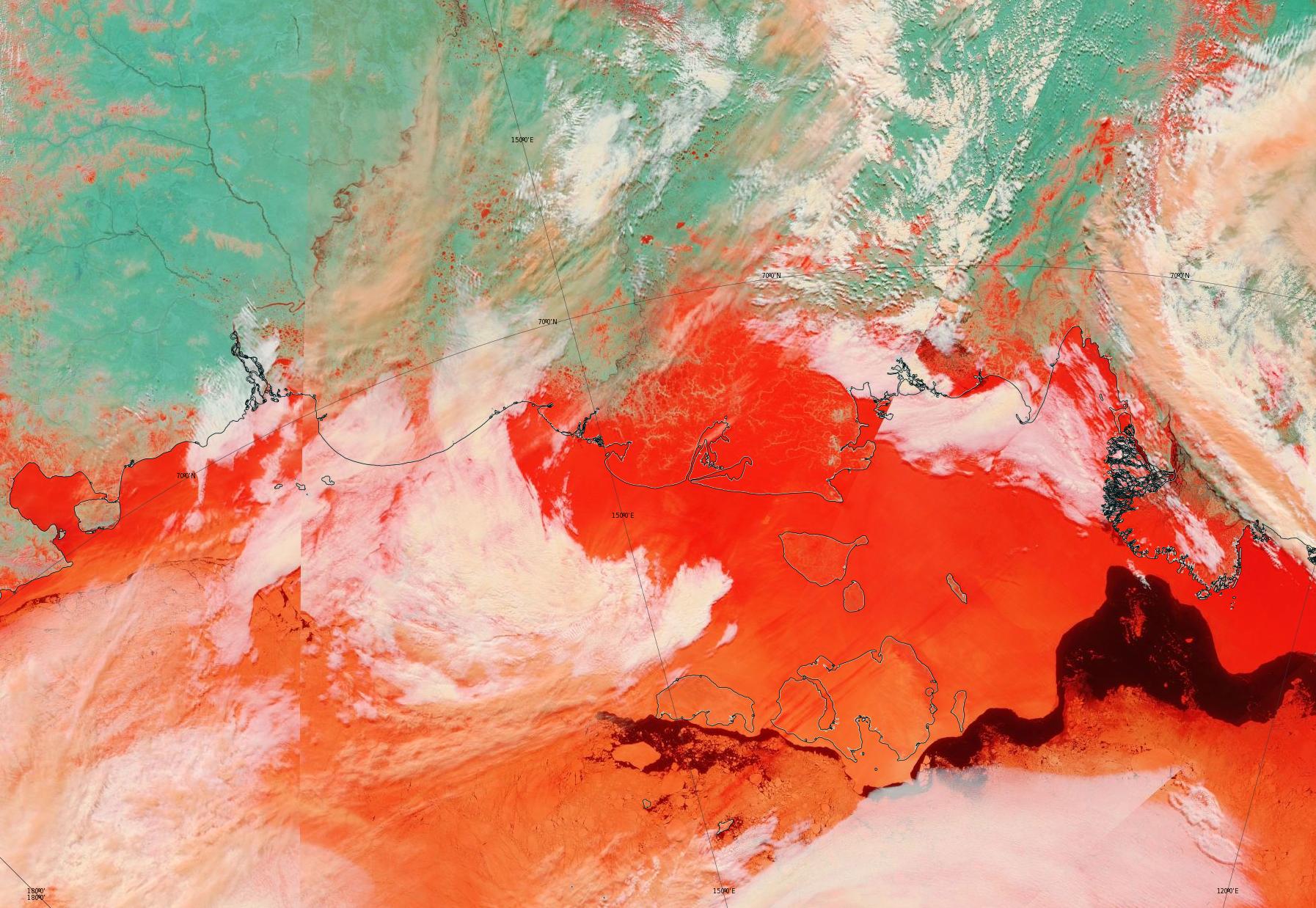
Currently extent is significantly below 2012, albeit somewhat above 2016 at the same time of year. And what of melt ponds? In 2012 there was evidence of less snow cover over land and more surface water on the ice on the Siberian side of the Arctic:

NASA Worldview “false-color” image of the Eastern Arctic on May 25th 2012, derived from the MODIS sensor on the Terra satellite

Other than that Arctic sea ice in 2019 looks to be in worse shape than in 2012.

[Edit – May 27th]

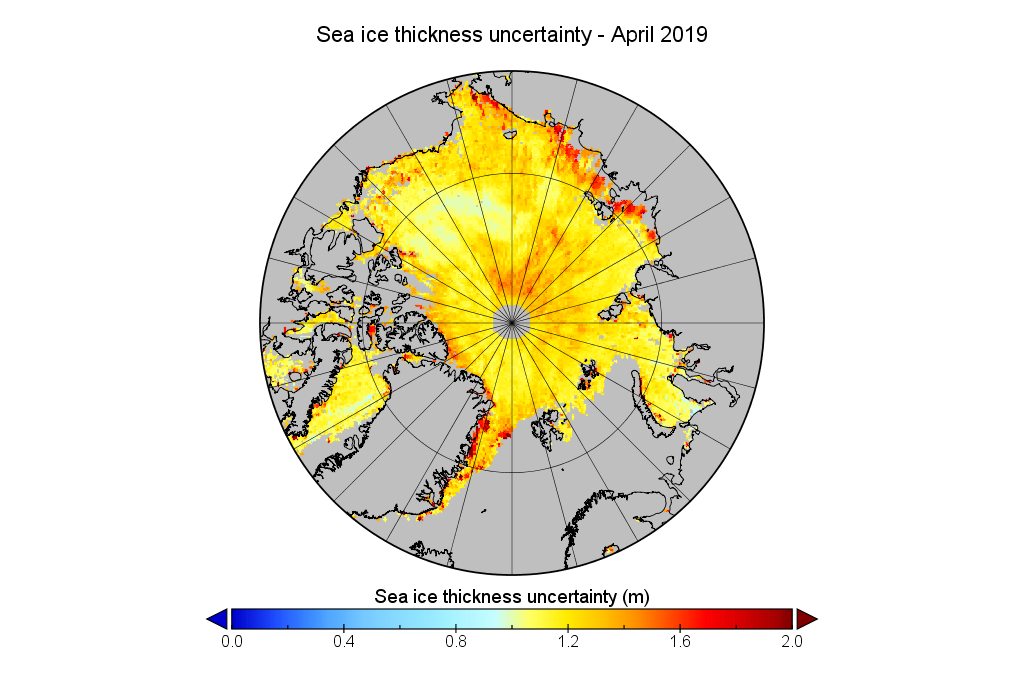
We’ve established that the extent of Arctic sea ice at the end of May 2019 is less than in 2012, but something else to consider is whether that ice is currently thicker than in 2012, or not. Satellites can have a reasonable stab at measuring the area of sea ice, but the third dimension is much trickier. The European Space Agency’s CryoSat-2 satellite has been attempting to measure sea ice thickness since 2010, so let’s take at the conclusions it has reached:

Don’t forget to take a good long look at the associated uncertainties too:

Watch this space!
Facts About the Arctic in January 2019

We generally write our periodic reports on the state of Arctic sea ice around the time the PIOMAS volume numbers are published. It seems as though we’ll have a long wait for that to happen at the moment though. According to The Economist today:

America’s government shutdown has become the longest in history. Hundreds of thousands of federal workers remain either stuck at home or forced to work without pay. To reopen the government President Donald Trump is demanding $5.7bn for his border wall. Nancy Pelosi, who presides over the most polarised House of Representatives in recent memory, does not want to give it to him.

and according to the Polar Science Center at the University of Washington:

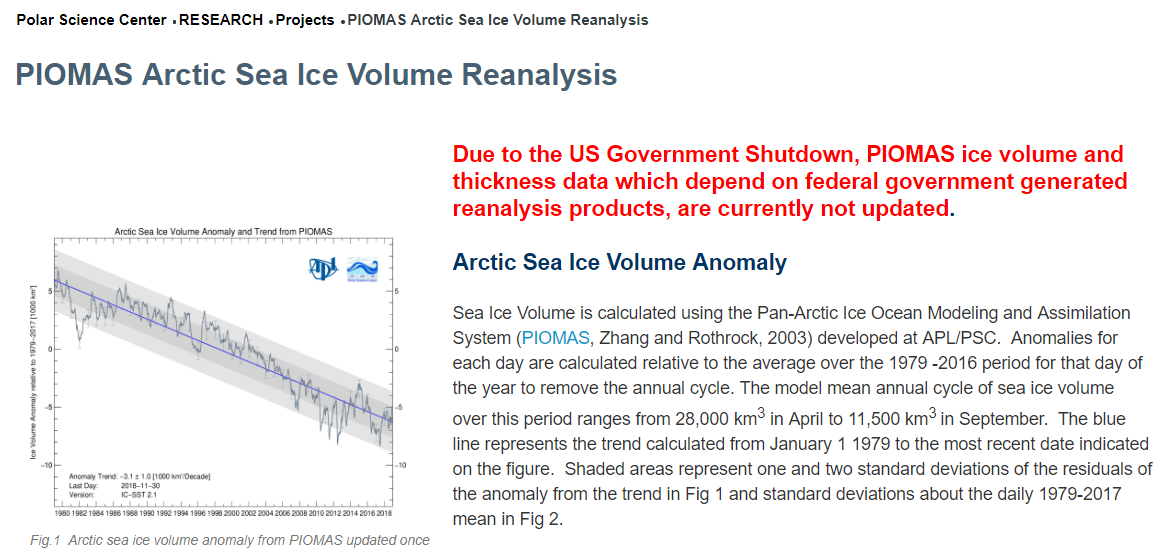
Due to the US Government Shutdown, PIOMAS ice volume and thickness data which depend on federal government generated reanalysis products, are currently not updated.

Instead of PIOMAS, let’s start instead with the January 2019 edition of the National Snow and Ice Data Center’s Arctic Sea Ice News:

As 2018 came to a close, Arctic sea ice extent was tracking at its third lowest level in the satellite record, while sea ice in the Antarctic remained at historic lows. Slightly faster growth in the first few days of the new year, mostly in the Pacific sea ice areas, has the daily sea ice extent at fifth lowest as of this post.

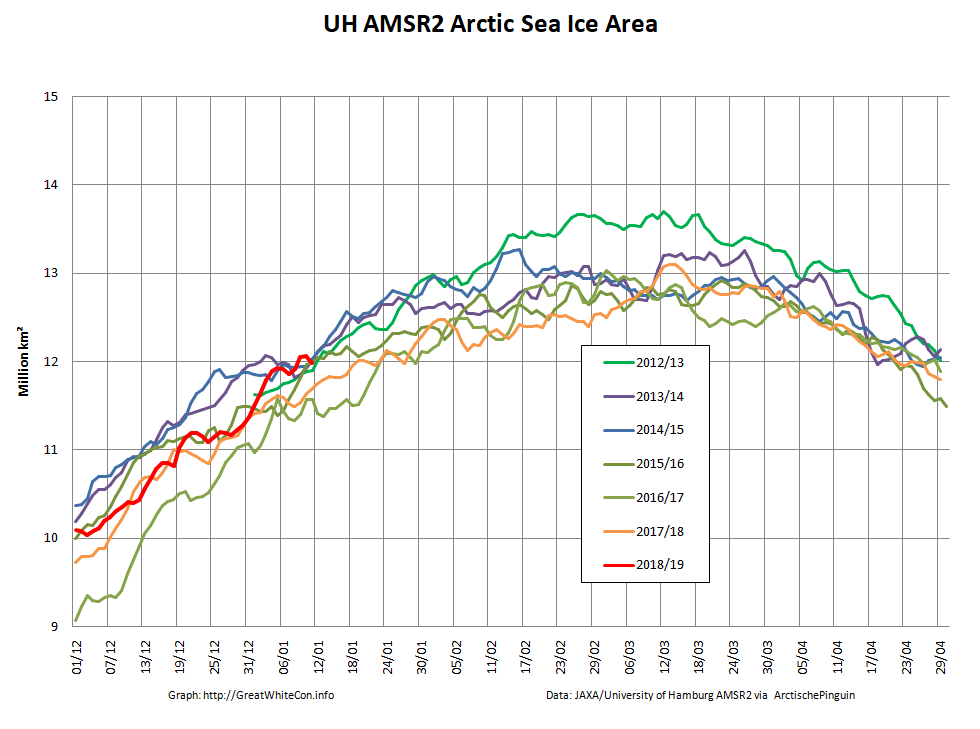
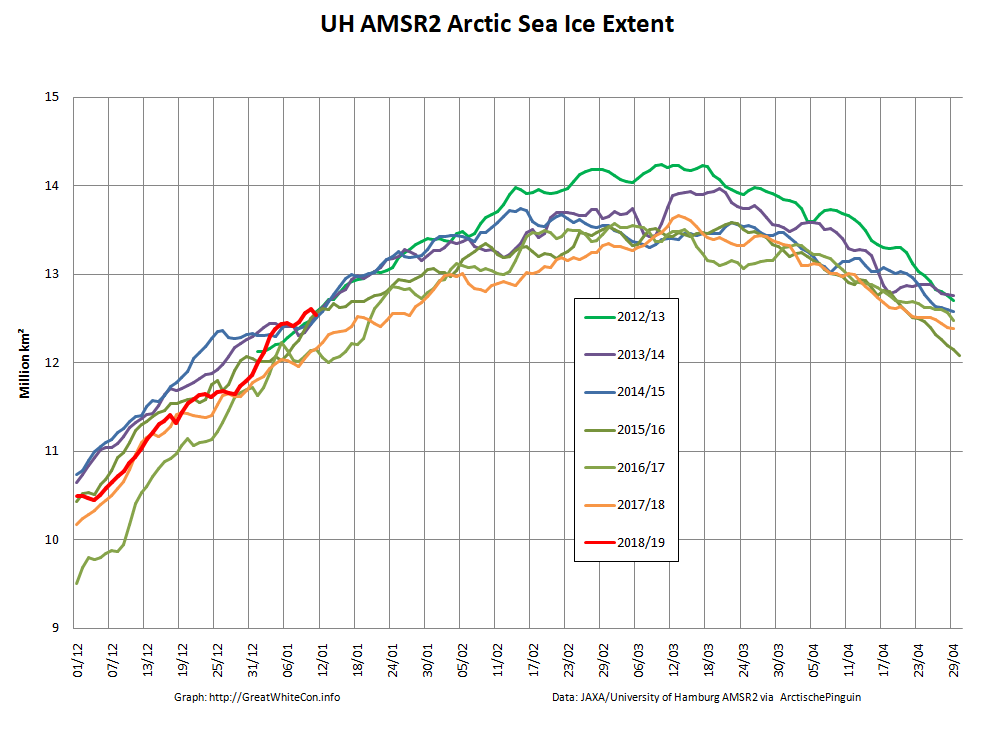
Now let’s take a look at our favourite high resolution AMSR2 area and extent metrics:

You can see that towards the end of December Arctic sea ice extent was verging on lowest for the date, since when it has risen quickly to reach highest for the date in the brief AMSR2 records a few days ago.

The NSIDC also mention the US Government shutdown:

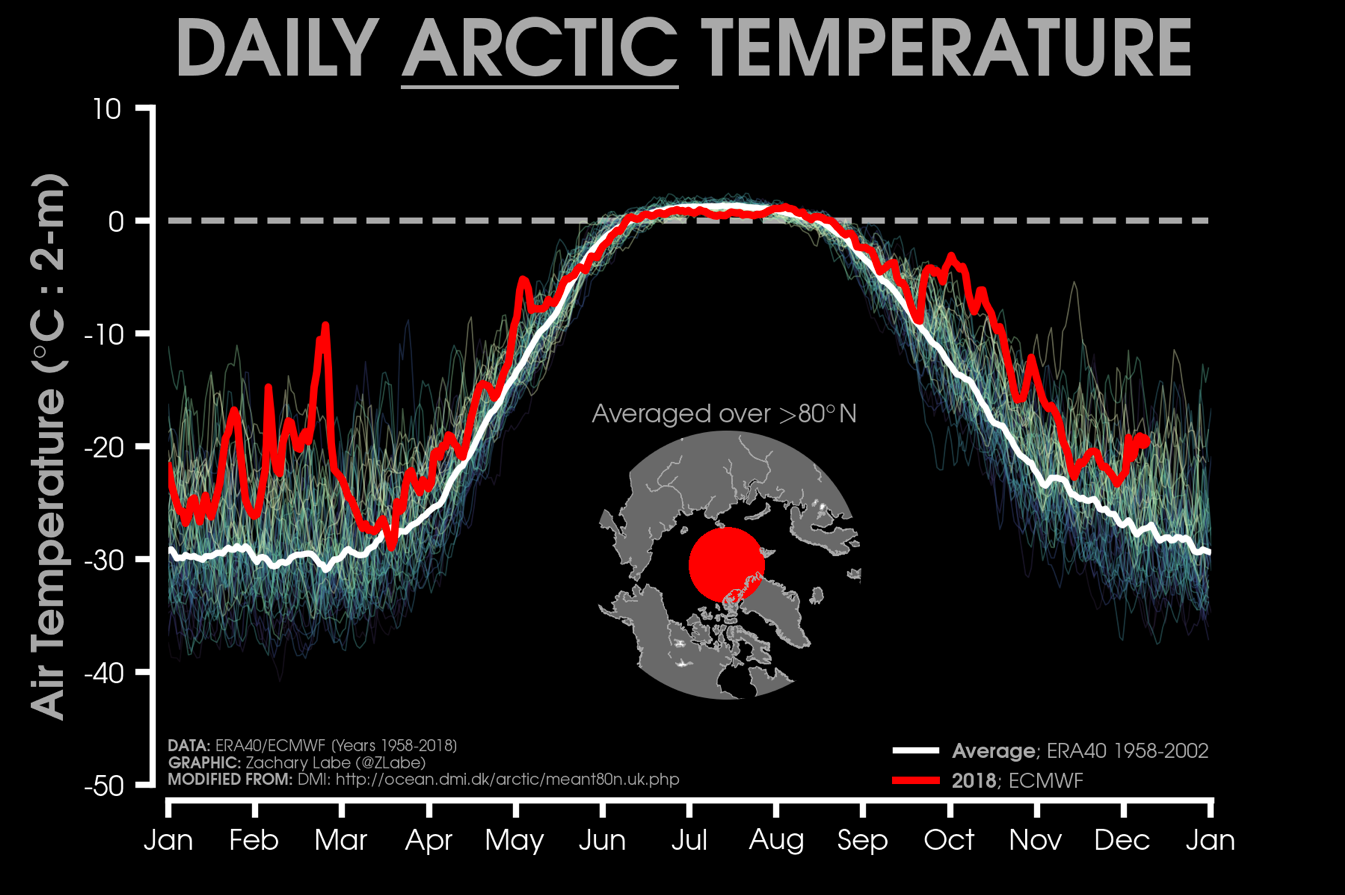
Unfortunately, as a result of the partial government shutdown, we are unable to access the National Oceanic and Atmospheric Administration (NOAA) pages to retrieve information on atmospheric air temperatures and sea level pressure patterns. Instead, we turn to daily (2 meters above the surface) mean air temperatures north of 80 degrees North from the European Centre for Medium-Range Weather Forecasts (ECMWF) operational model. This analysis shows that air temperatures remained above the 1958 to 2002 average for all of December.

Graph by Zack Labe
Graph by Zack Labe

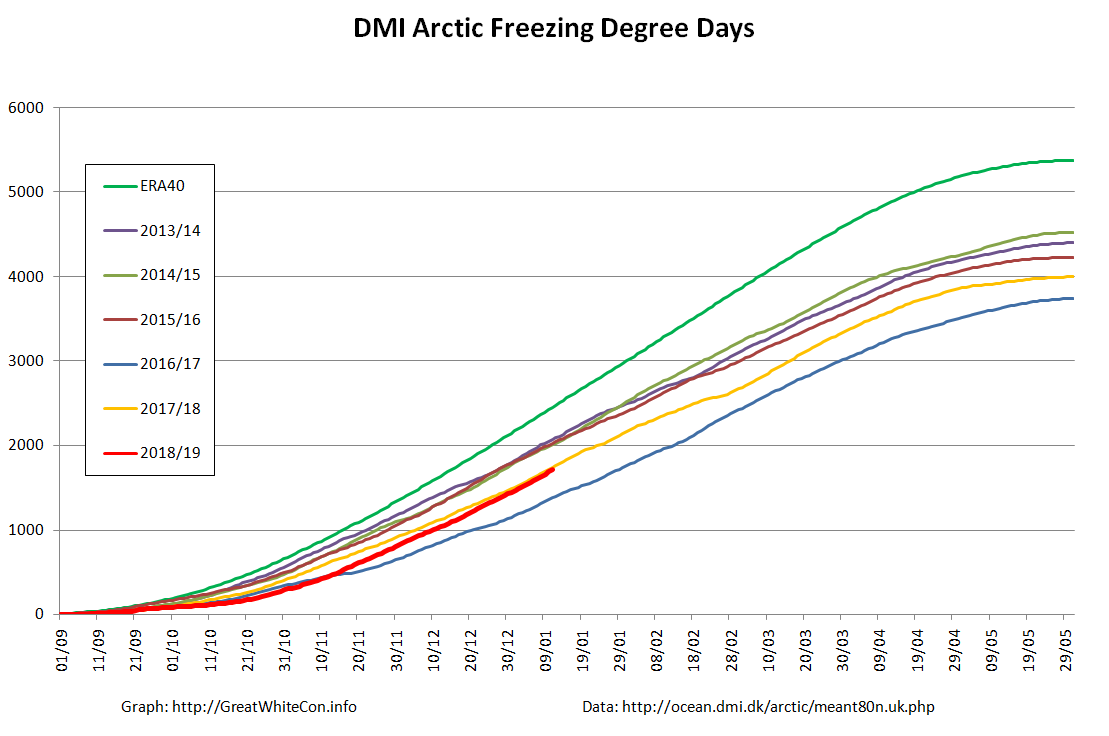
That brings us on to our Arctic freezing degree days graph, based on DMI data:

After a very slow start to the freezing season the FDD numbers are now vying for second place with last year, behind the astonishingly warm winter of 2016/17. In the absence of the PIOMAS volume numbers we can at least take a look at sea ice thickness. Here’s CryoSat-2:

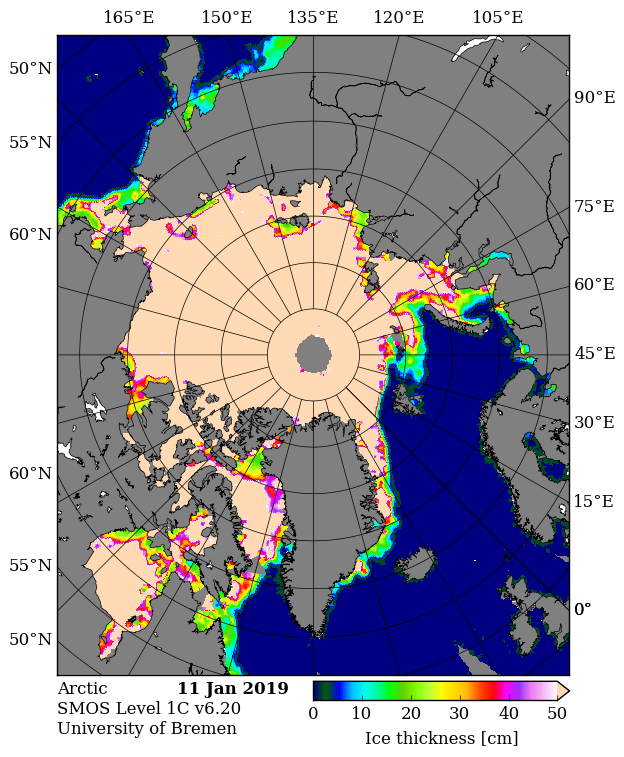
followed by SMOS:

and since a change is as good as a rest here’s the latest map from the Russian Arctic and Antarctic Research Institute for good measure:

All those sources seem to be agreed that large areas of both the Barents and Kara Seas are currently covered by young thin ice. Finally, for the moment at least, let’s take a look at some extracts from the NSIDC’s review of 2018:

January 2018 began the year with record low sea ice extents for the Arctic as a whole.

The seasonal maximum, reached on March 17, 2018, was the second lowest in the satellite record. While low extent persisted through April and May, sea ice loss during early summer was unremarkable despite above average 925 hPa air temperatures over the Arctic Ocean and Eurasia.

Air temperatures over the Arctic Ocean in July were below average, followed by above average temperatures in August. In fact, on average, August temperatures were higher than July temperatures in 2018. This is highly unusual in the Arctic and something not seen in at least 40 years.

The September 2018 seasonal minimum extent ended up slightly above the long-term linear trend line, tying with 2008 for the sixth lowest in the satellite record. After the minimum, the ocean was slow to freeze up, and October sea ice extent ended up as the third lowest. However, ice growth was very rapid in November, such that November 2018 extent approached the interquartile range of the 1981 to 2010 median. Nevertheless, large amounts of open water remained in the Barents and Chukchi Seas. By the end of December, ice conditions in the Chukchi Sea were back to average, while extent remained unusually low in the Barents Sea.

Coverage of old ice (greater than 4 years old) over the Arctic continued to decline. Such old ice covers only 5 percent of the area it used to in 1980s.


[Edit – January 13th]

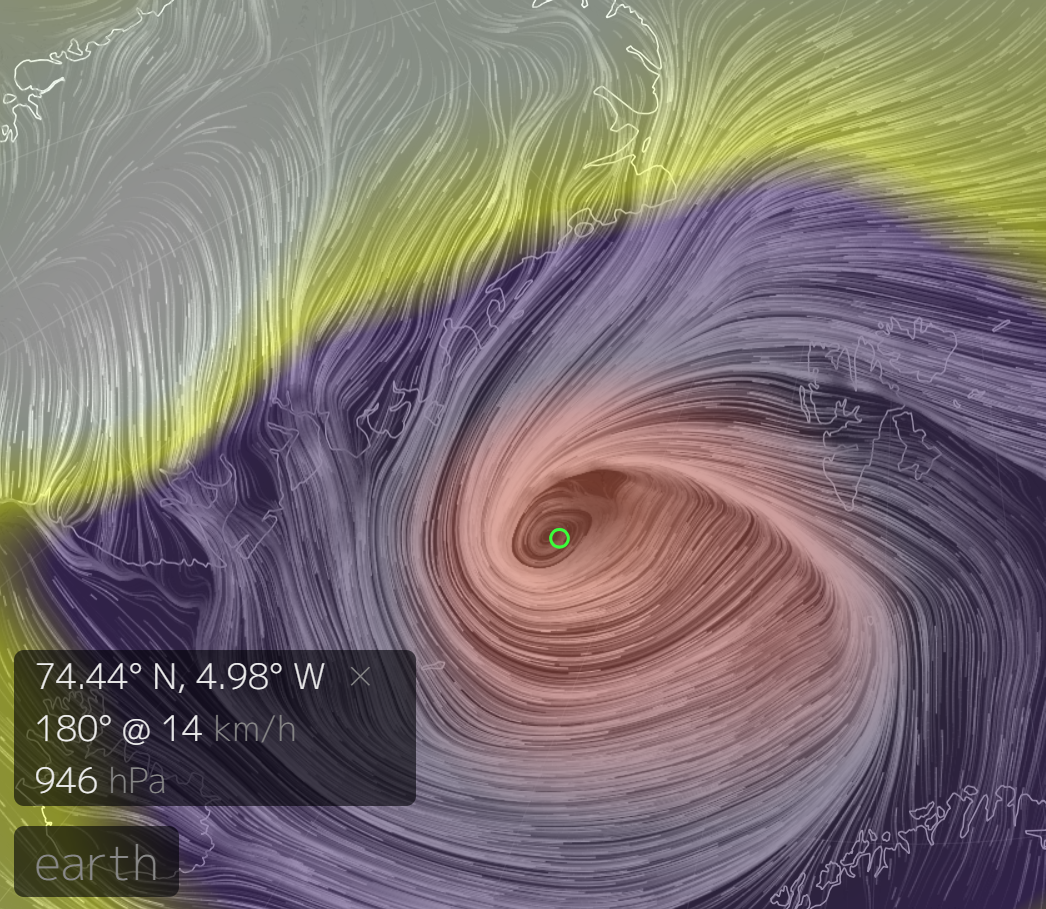
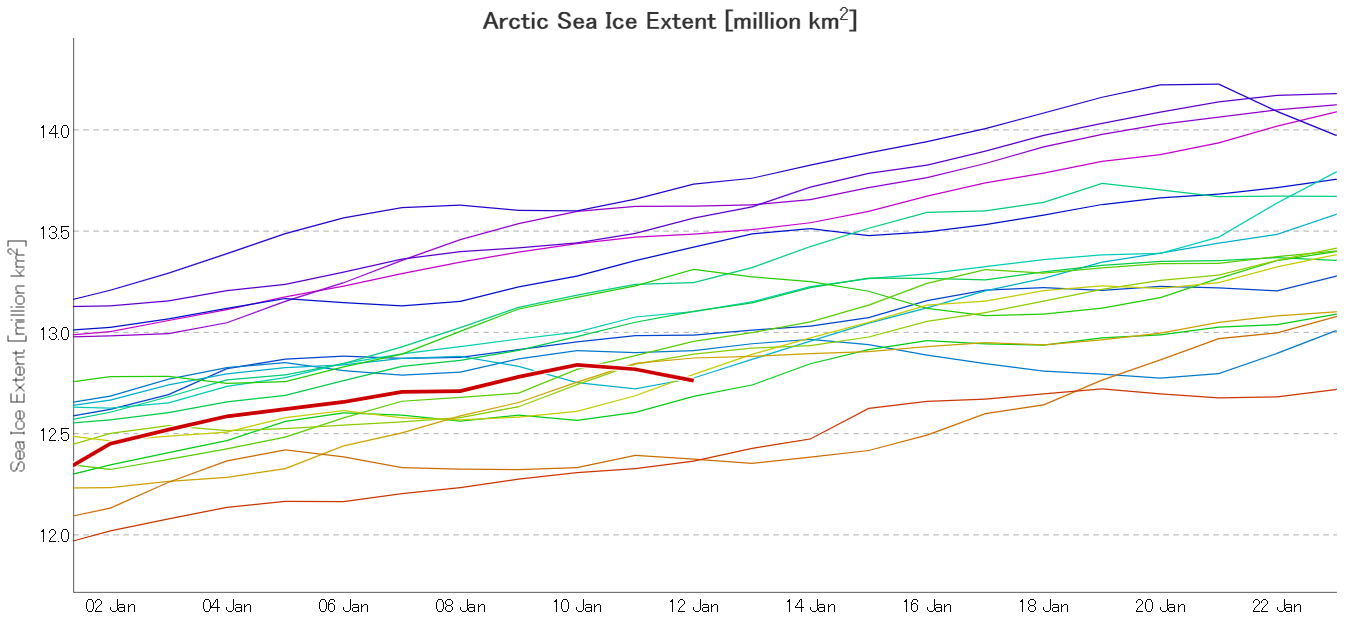
Arctic sea ice area and extent have both been falling over the last few days, possibly as a result of the recent cyclone which created strong northerly winds in the Fram Strait. This is from Earth at 09:00 UTC on January 10th, showing a MSLP of 946 hPa:

Here’s what used to be referred to as JAXA extent:

Meanwhile up in the stratosphere at 10 hPa the polar vortex has gone into reverse:

Or to be more precise:

The Great Arctic Cyclone of 2018?

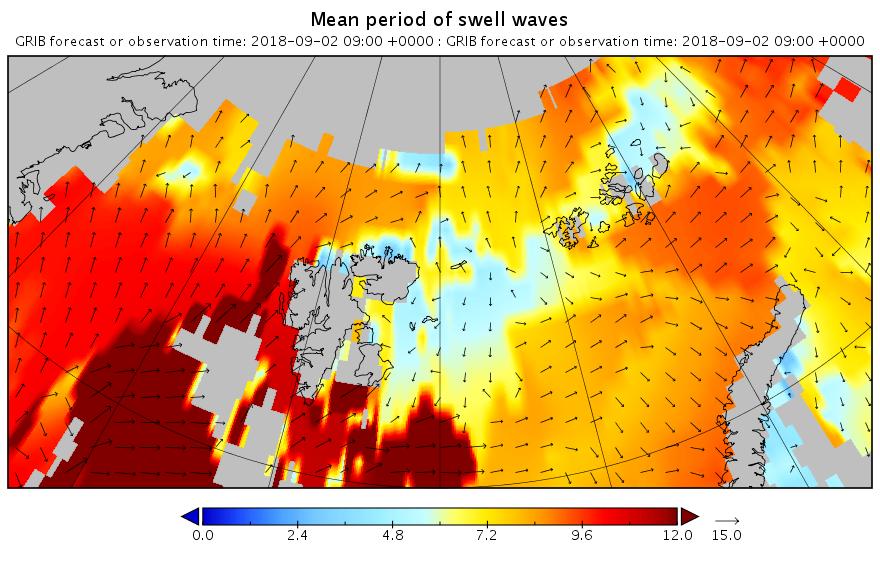
Our title for today refers back to the Great Arctic Cyclone of August 2012. There has been some speculation over on the Arctic Sea Ice Blog about whether a similar event is about to occur this year.

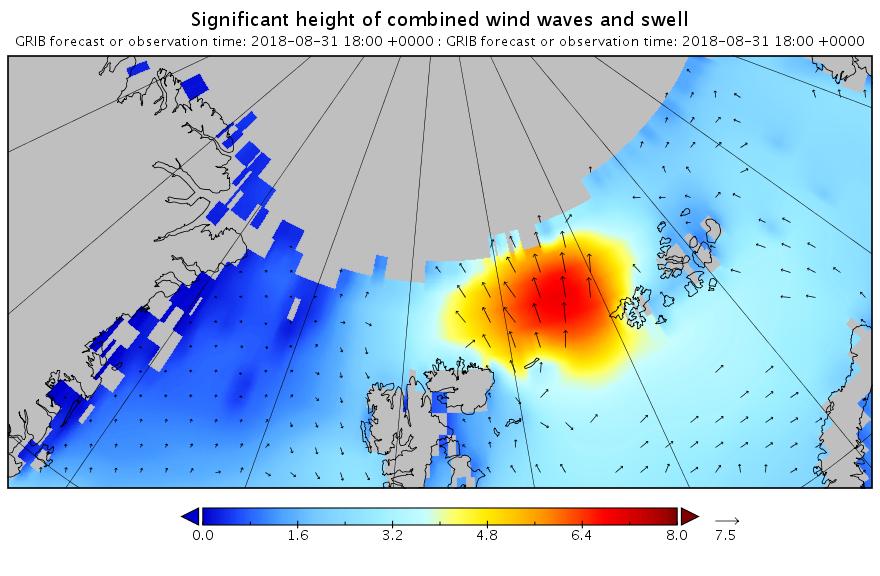
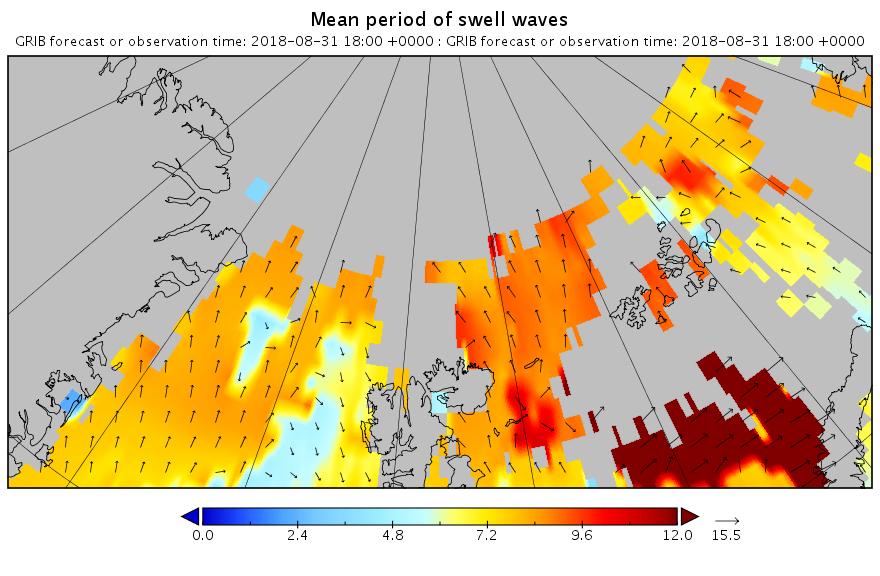
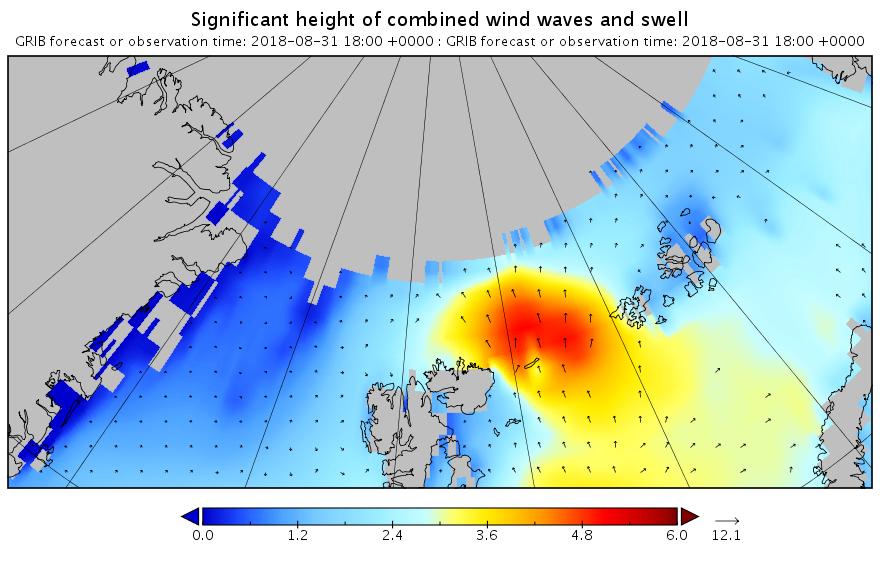
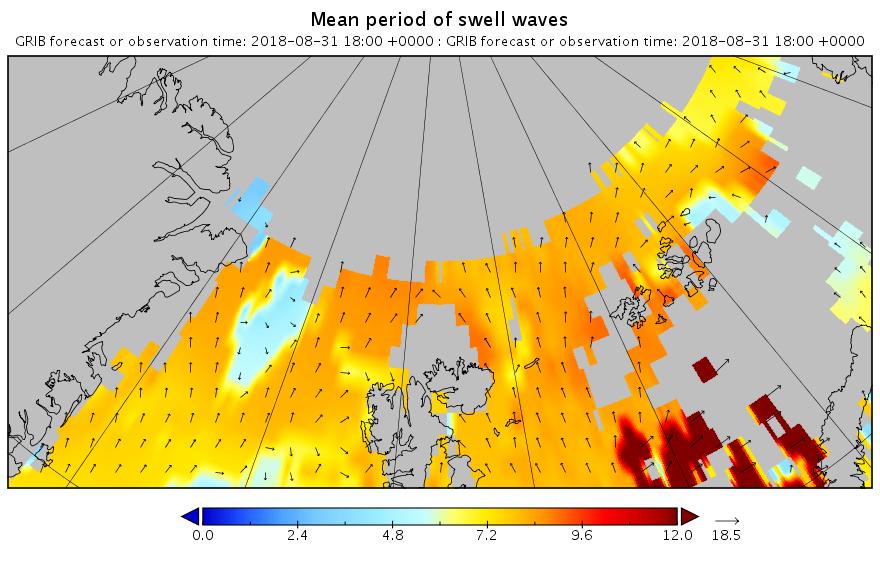
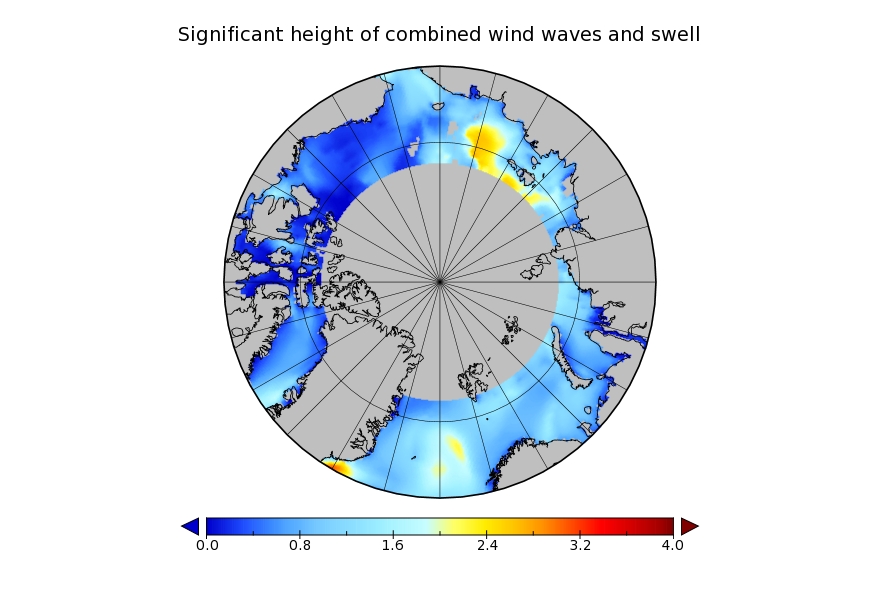
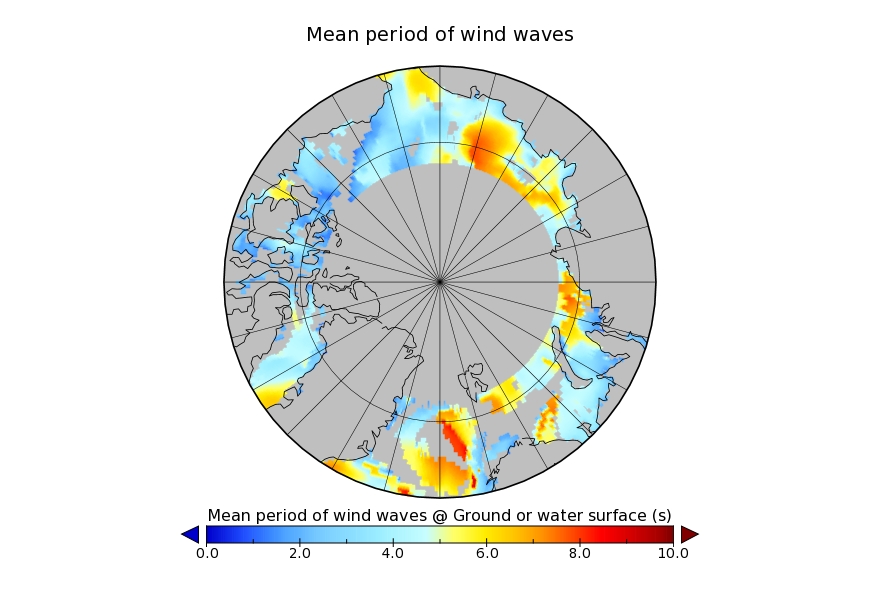
It’s later in the season of course, but as is our wont we always look at the waves first. Here is the current WaveWatch III forecast for the evening of August 31st UTC:

Significant_height_of_combined_w in multi_1.glo_30mext.20180827_00039

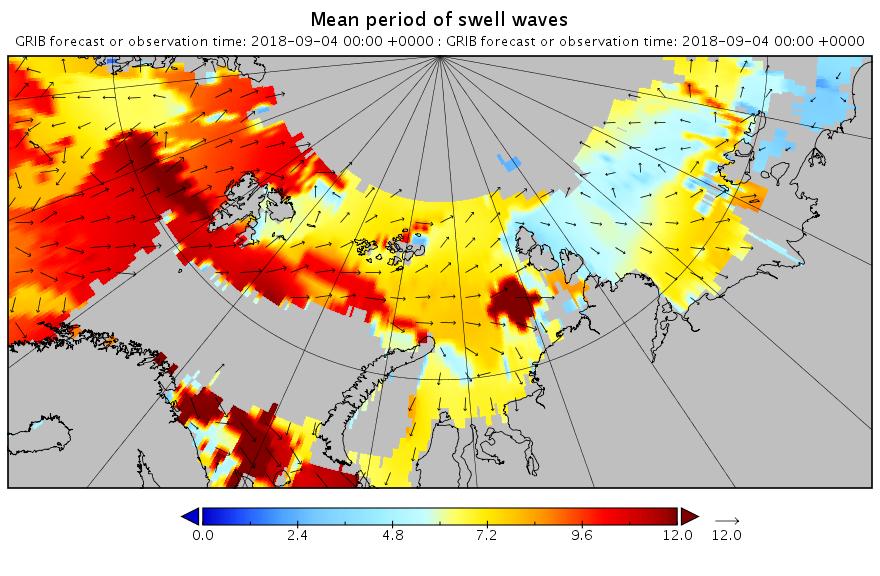
Mean_period_of_swell_waves_order in multi_1.glo_30mext.20180827_00039

In summary the forecast shows some very large waves with a substantial period for inside the Arctic Circle directed straight at the ice edge. Let’s follow the forecast over the next few days carefully shall we?


[Edit – August 30th]

The latest wave forecast for tomorrow evening isn’t as extreme as 3 days ago. Note the change in the significant height scale:

Significant_height_of_combined_w in multi_1.glo_30mext.20180830-06Z_00013

Mean_period_of_swell_waves_order in multi_1.glo_30mext.20180830-06Z_00013

Nonetheless the height and period are still very significant!


[Edit – August 31st]

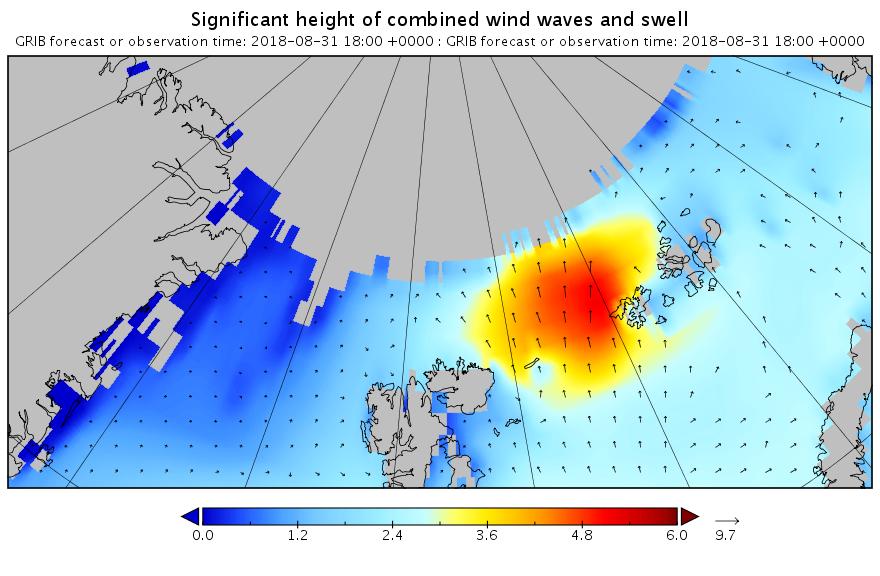
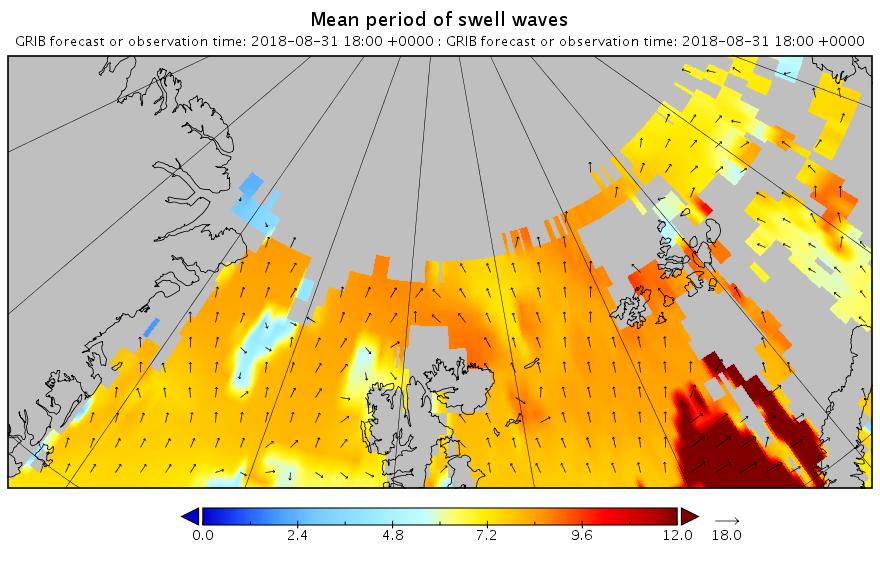
Here’s the latest forecast for 6 PM this evening (UTC):

Significant_height_of_combined_w in multi_1.glo_30mext.20180831_00007

Mean_period_of_swell_waves_order in multi_1.glo_30mext.20180831_00007

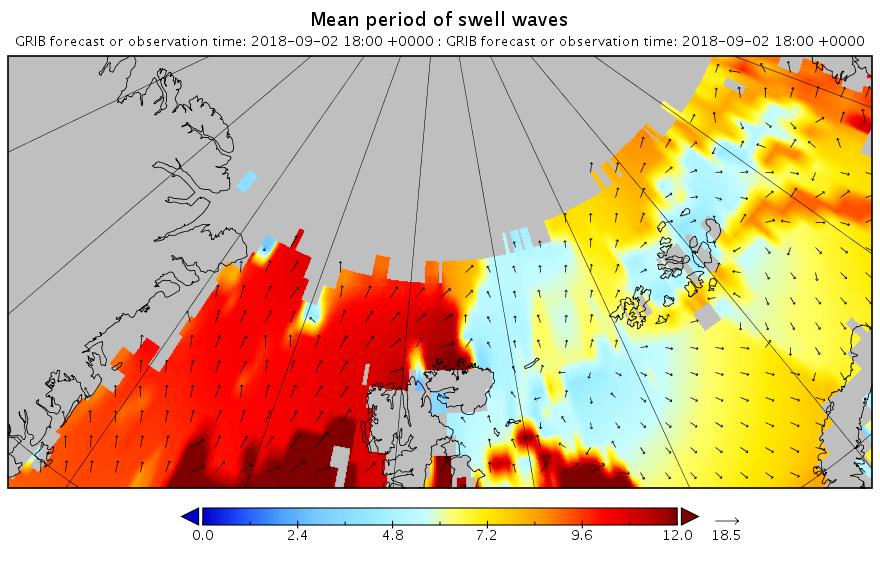
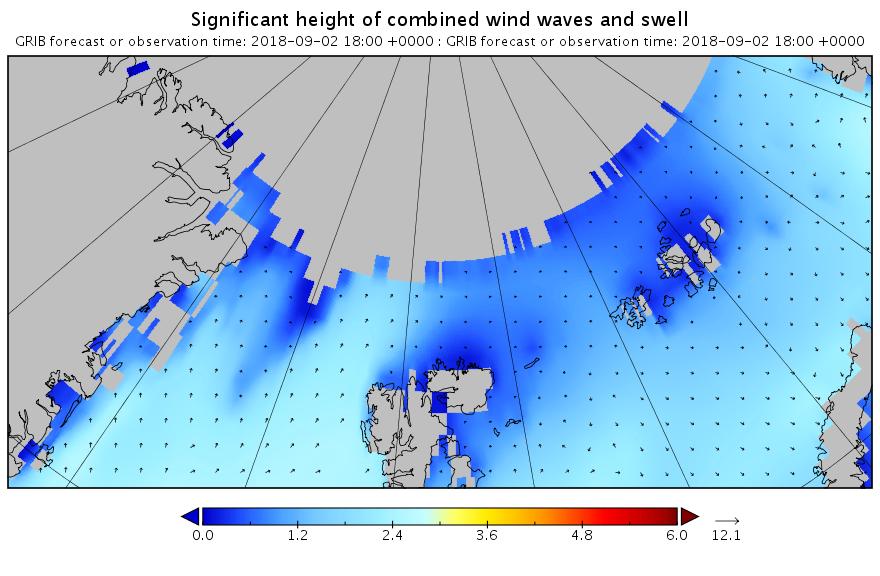
Note how the open water across almost the entire map is full of what in the Arctic counts as a long period swell. That means that the forecast for 2 days later looks like this:

Mean_period_of_swell_waves_order in multi_1.glo_30mext.20180831_00023

Significant_height_of_combined_w in multi_1.glo_30mext.20180831_00023

Less height but with a longer period. All of which means that the sea ice north of the Atlantic Ocean isn’t about to receive a short sharp shock. It has a sustained battering lasting several days to look forward to.


[Edit – September 1st]

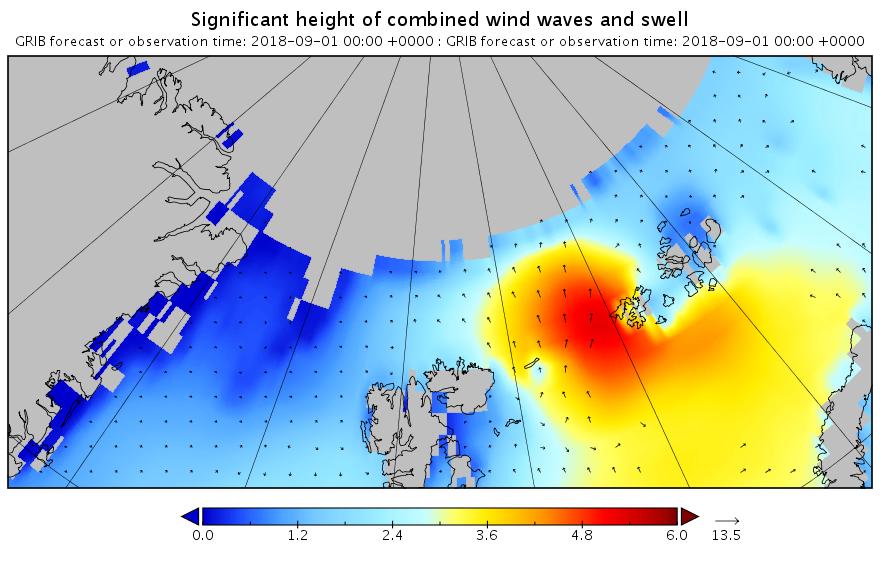
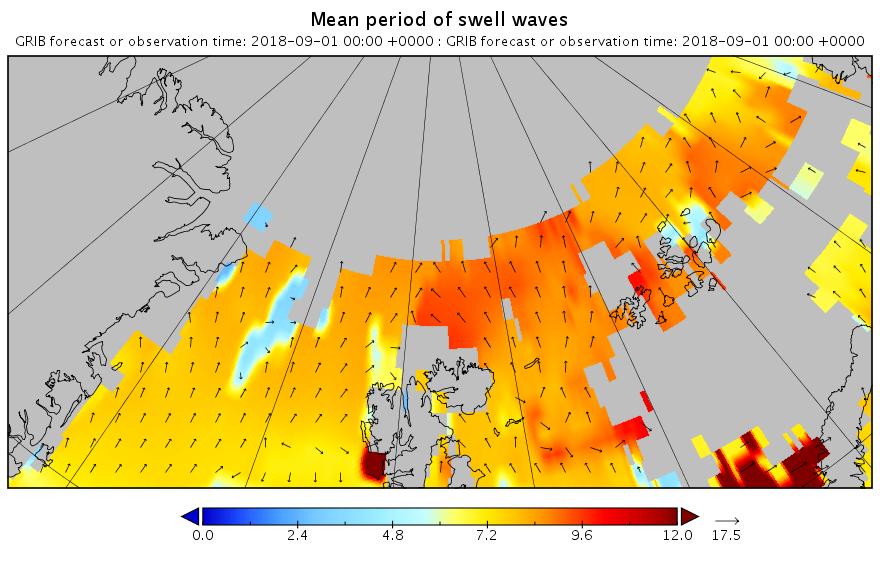
The barrage of assorted swells has begun. Here’s the “hindcast” from midnight last night UTC:

Significant_height_of_combined_w in multi_1.glo_30mext.20180901_00001

Mean_period_of_swell_waves_order in multi_1.glo_30mext.20180901_00001

Now lets take a look at tomorrow’s forecast for the Laptev Sea. This is for 09:00 UTC:

Significant_height_of_combined_Laptev.20180901_00012

Mean_period_of_swell_waves_Laptev.20180901_00012

Note once again the change of scale on the wave/swell height map. Nevertheless a 3+ meter swell heading over into the East Siberian Sea isn’t something you see every day.

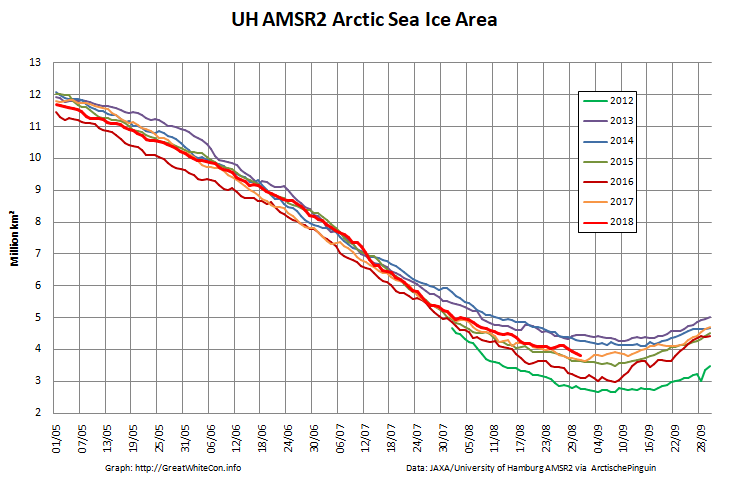
Now were into September the 2018 annual minimum extent can’t be too far away. Extent decline appears to have stalled. However “high res” AMSR2 area is currently falling fast, for the time of year at least:

Arctic-Area-2018-08-31


[Edit – September 2nd]

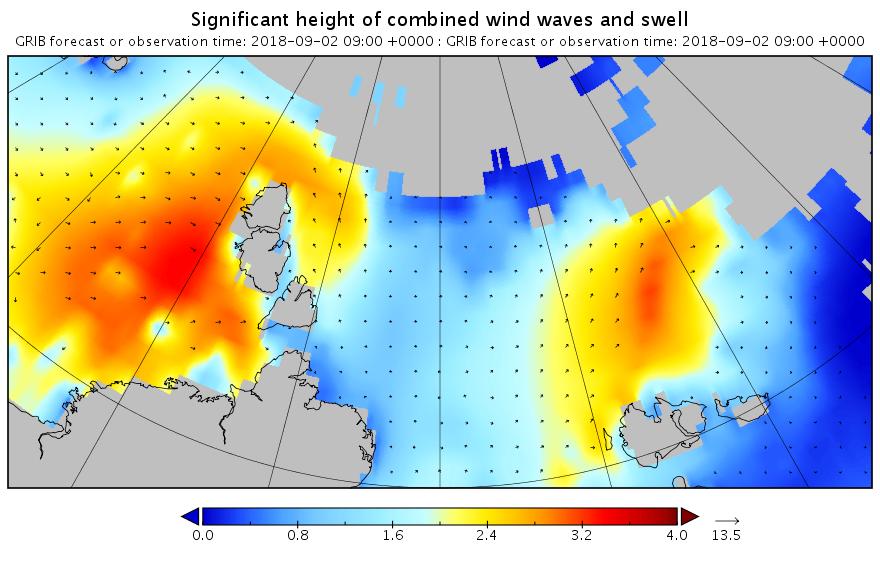
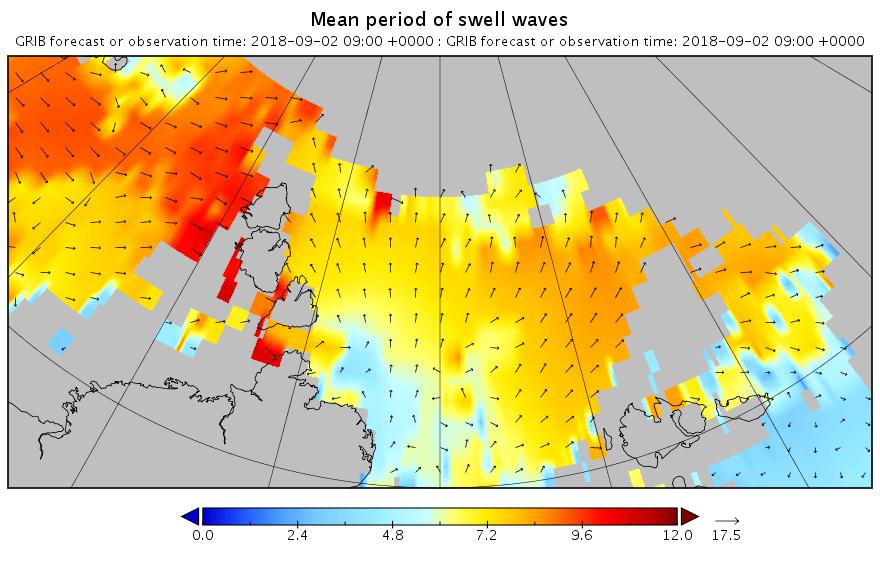
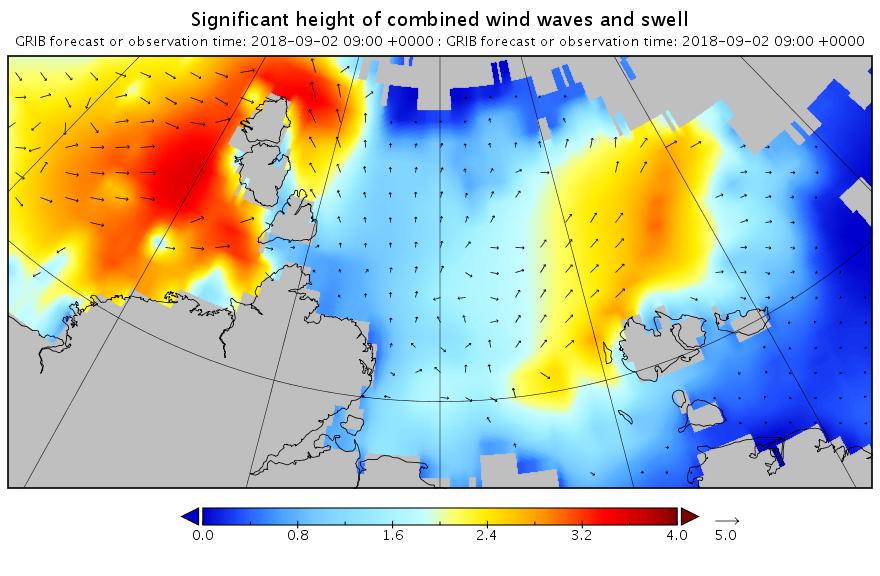
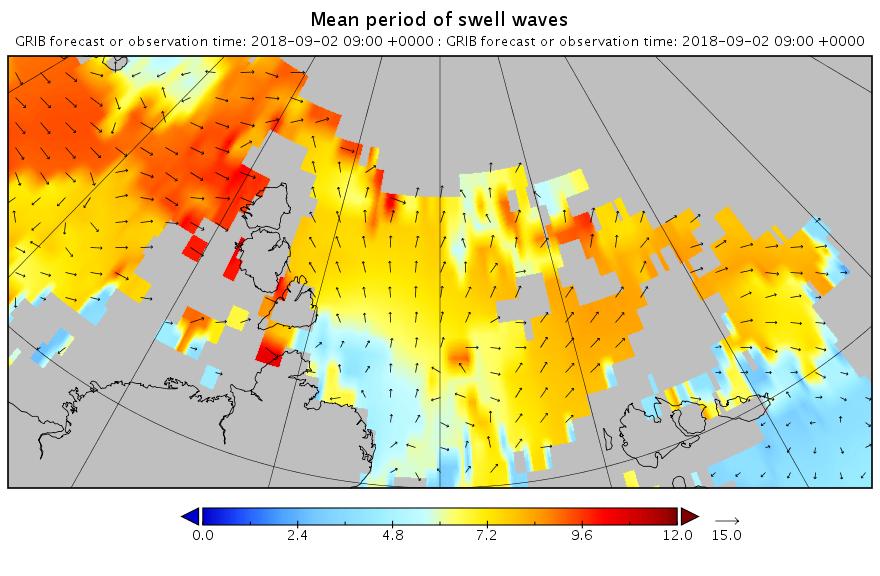
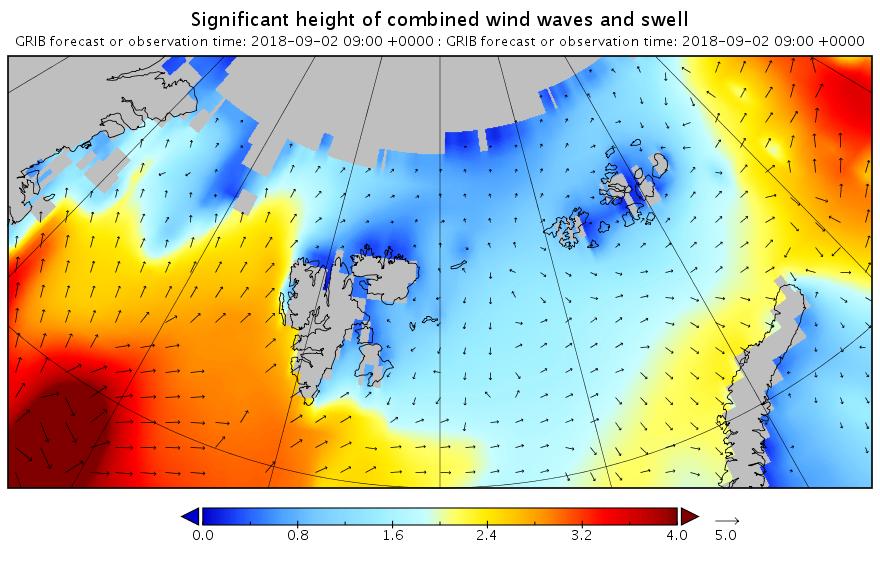
Here are the swell and period forecasts at midnight for round about now, 09:00 UTC:

Significant_height_of_combined_Laptev.20180902_00004

Mean_period_of_swell_waves_Laptev.20180902_00004

Significant_height_of_combined_Barents.20180902_00004

Mean_period_of_swell_waves_Barents.20180902_00004

All the seas between Greenland and the New Siberian Islands are awash with swells with a period of 8 second or greater. This is most unusual, to put it mildly!


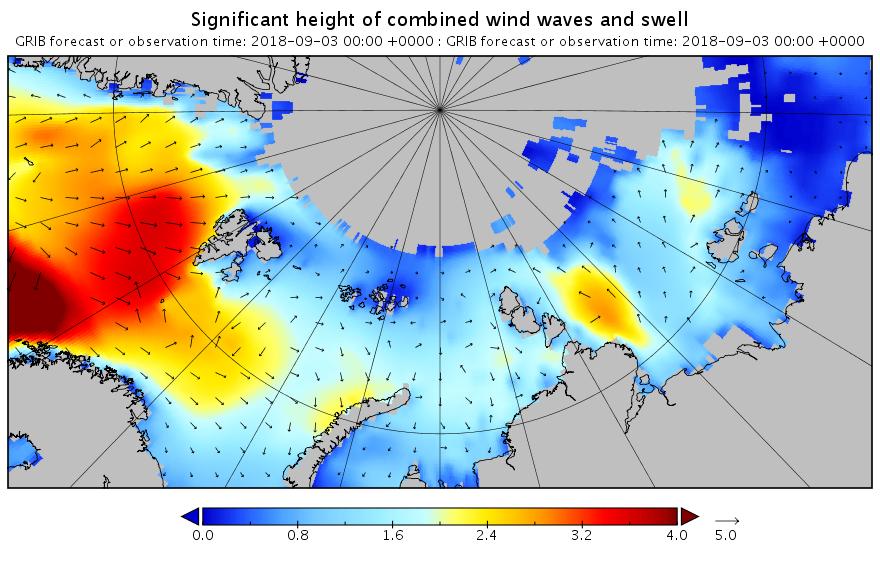
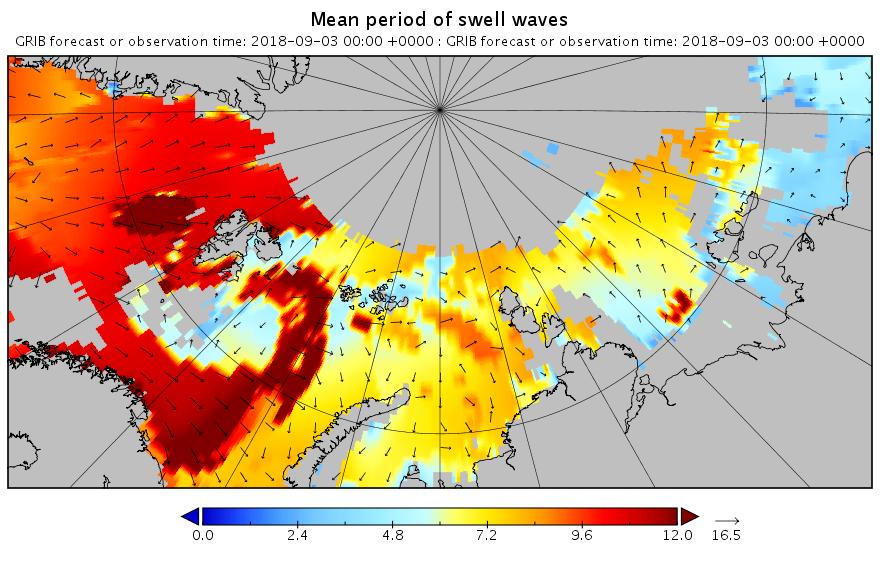
[Edit – September 3rd]

Here’s the WaveWatch III “hindcast” from midnight last night UTC for the Russian side of the Arctic Ocean:

Significant_height_of_combined_NSR.20180903_00001

Mean_period_of_swell_waves_NSR.20180903_00001

There are still significant swells almost everywhere you look.


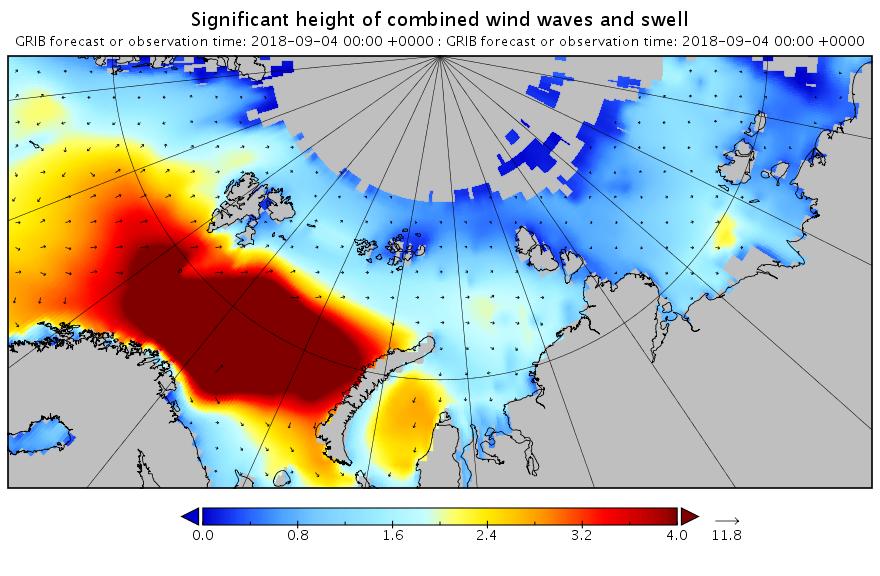
[Edit – September 4th]

Using the same scales as yesterday, here’s today’s hindcast from midnight:

Significant_height_of_combined_w in multi_1.glo_30mext.20180904_00001

Mean_period_of_swell_waves_order in multi_1.glo_30mext.20180904_00001

There’s still plenty of action in the Arctic Ocean!


[Edit – September 5th]

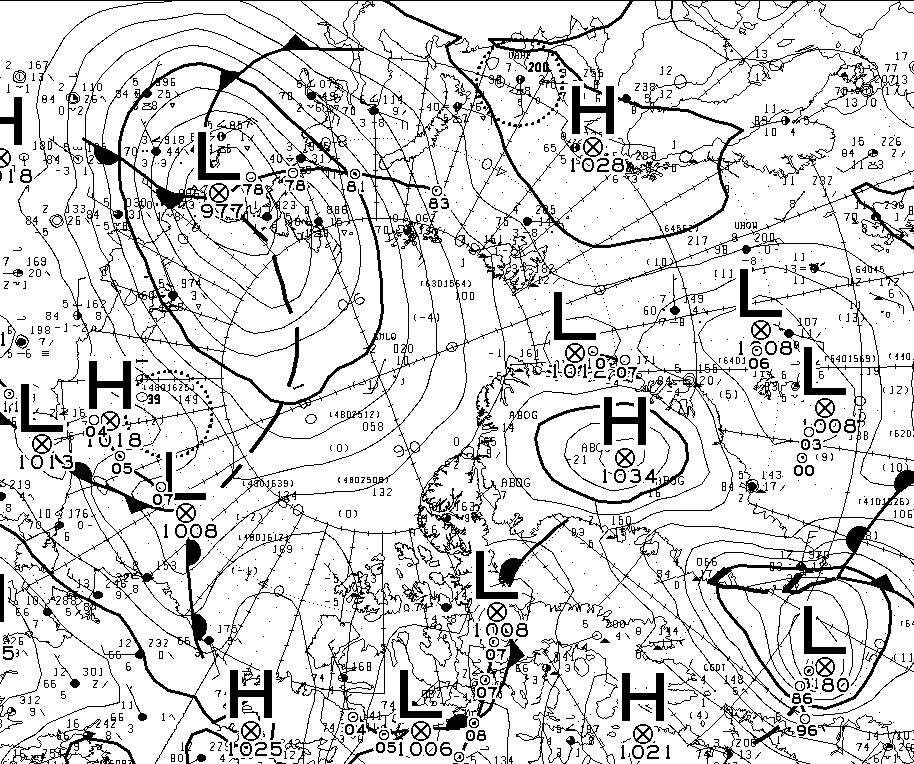
Feel free to debate whether it merits the “Great” prefix, but this is how the early September 2018 Arctic cyclone has panned out. According to this morning’s Environment Canada synopsis the cyclone is centred near the coast of the Laptev Sea and is down to a MSLP of 977 hPa:

CMC_SLP-20180905-00Z

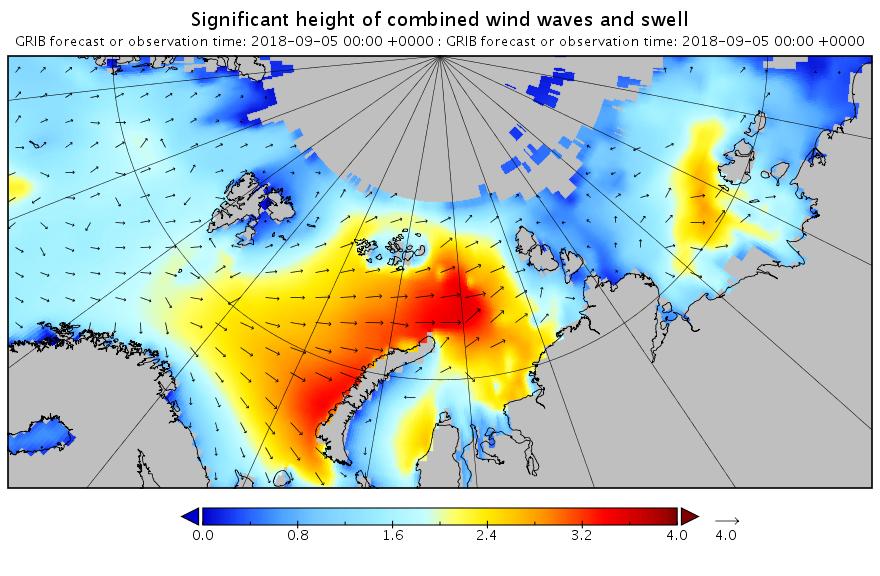
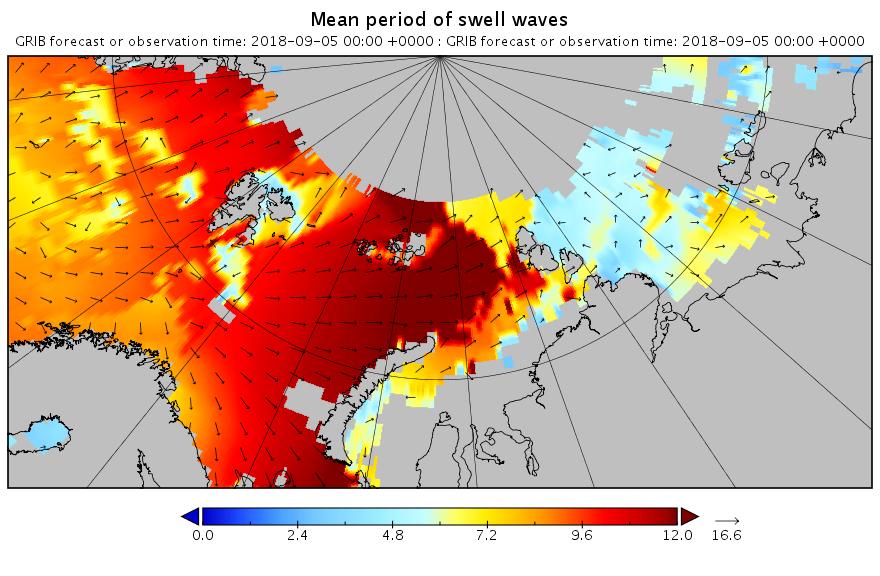
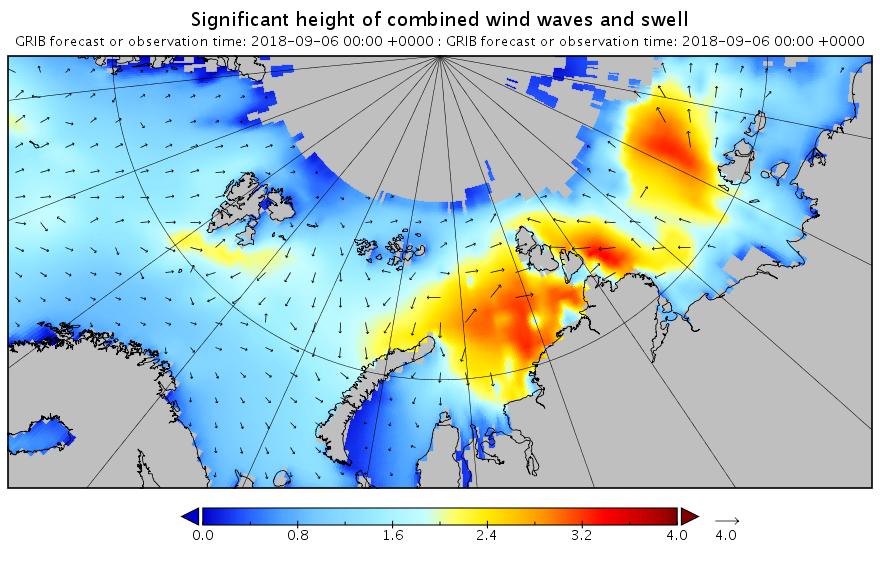
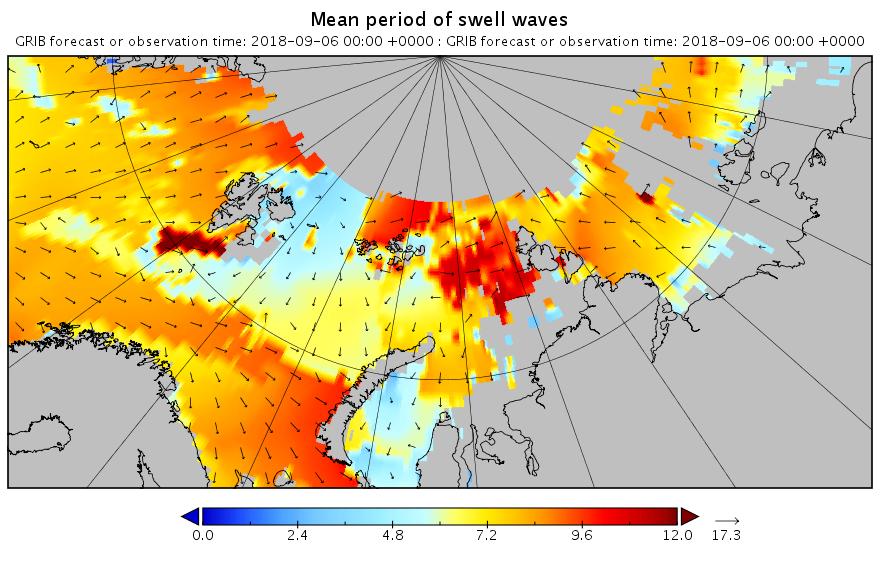
Here’s another WaveWatch III hindcast from midnight UTC:

Significant_height_of_combined_w in multi_1.glo_30mext.20180905_00001

Mean_period_of_swell_waves_order in multi_1.glo_30mext.20180905_00001


[Edit – September 6th]

Need I say more?

Significant_height_of_combined_NSR.20180906_00001

Mean_period_of_swell_waves_NSR.20180906_00001


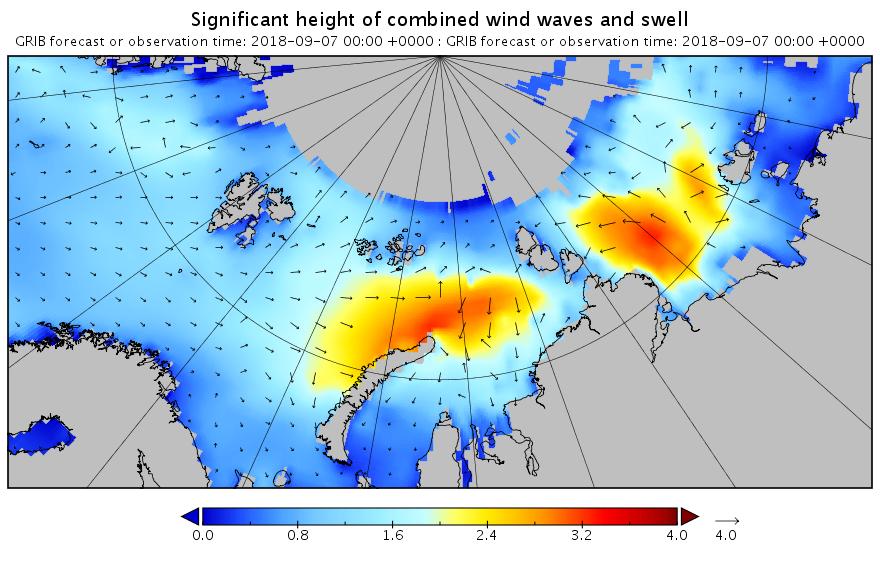
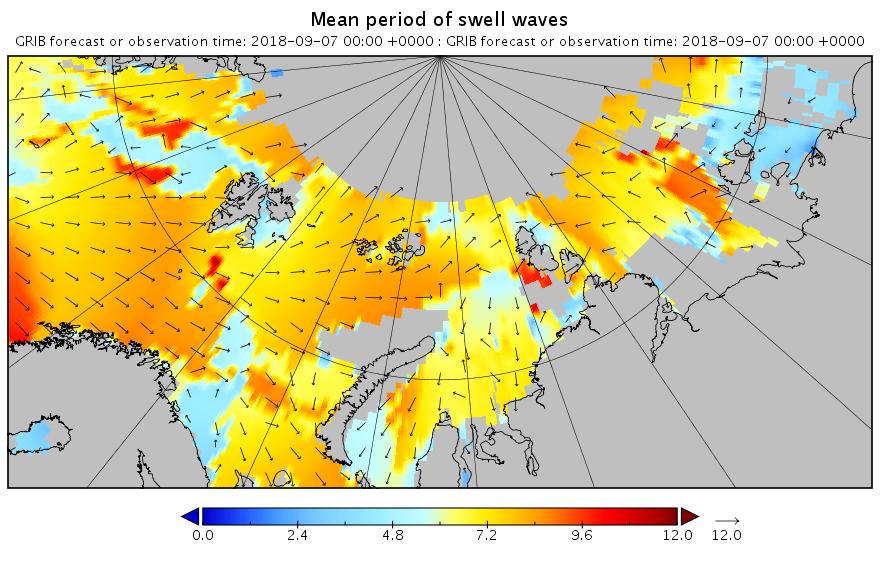
[Edit – September 7th]

The swell in the Fram Strait an Barents Sea is diminishing, but the period in the Laptev Sea is increasing now:

Significant_height_of_combined_NSR.20180907_00001

Mean_period_of_swell_waves_NSR.20180907_00001


[Edit – September 8th]

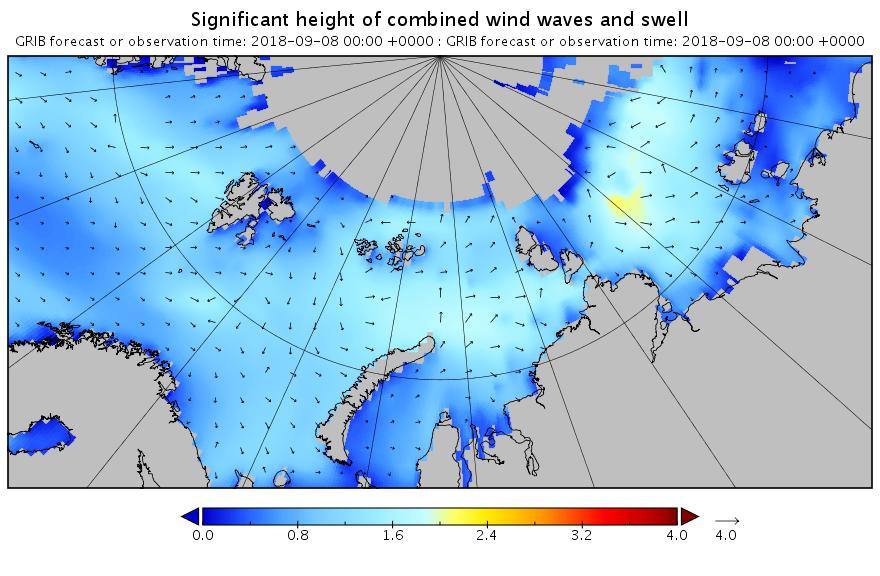
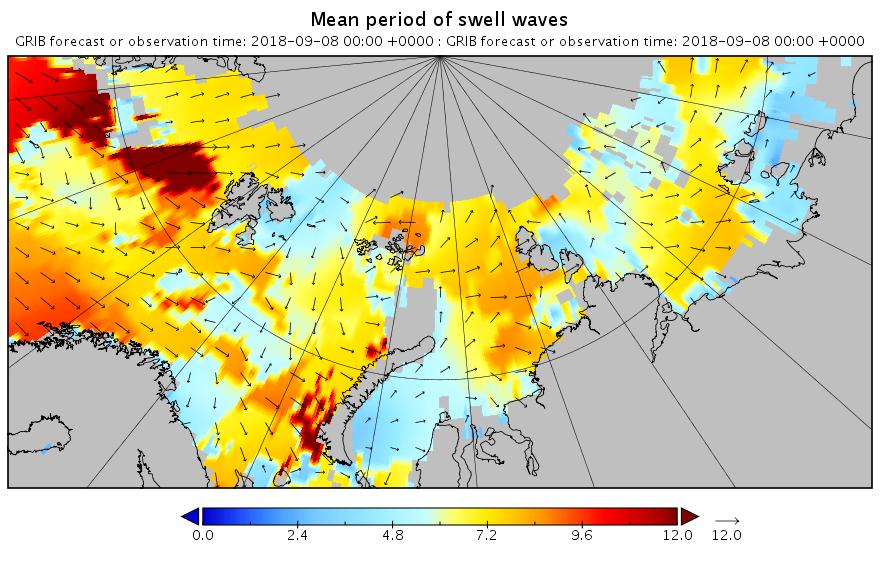
All the wave activity in the Laptev Sea is diminishing. Here’s the hindcast from midnight:

Significant_height_of_combined_NSR.20180908_00001

Mean_period_of_swell_waves_NSR.20180908_00001

Meanwhile things are warming up in the Chukchi and Beaufort Seas. Here’s the forecast for midnight tonight:

Significant_height_of_combined_Pacific.20180908_00009

Mean_period_of_swell_waves_Pacific.20180908_00009


[Edit – September 9th]

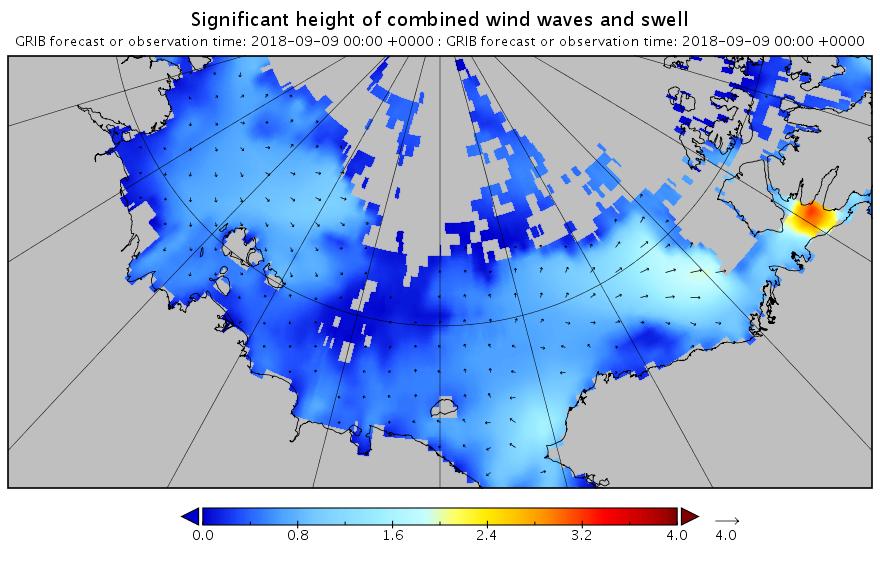
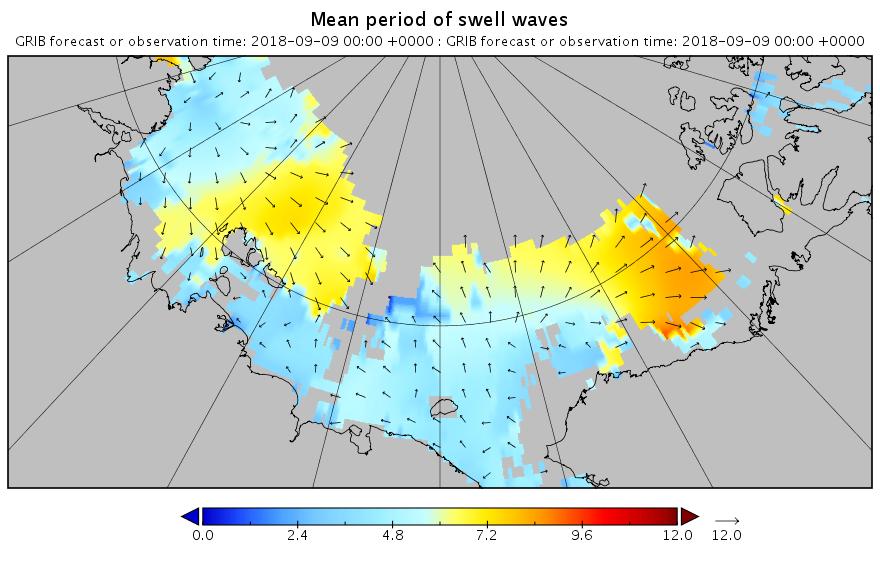
Here’s the hindcast for this morning’s swell in the Beaufort Sea:

Significant_height_of_combined_Atlantic.20180909_00001

Mean_period_of_swell_waves_Pacific.20180909_00001

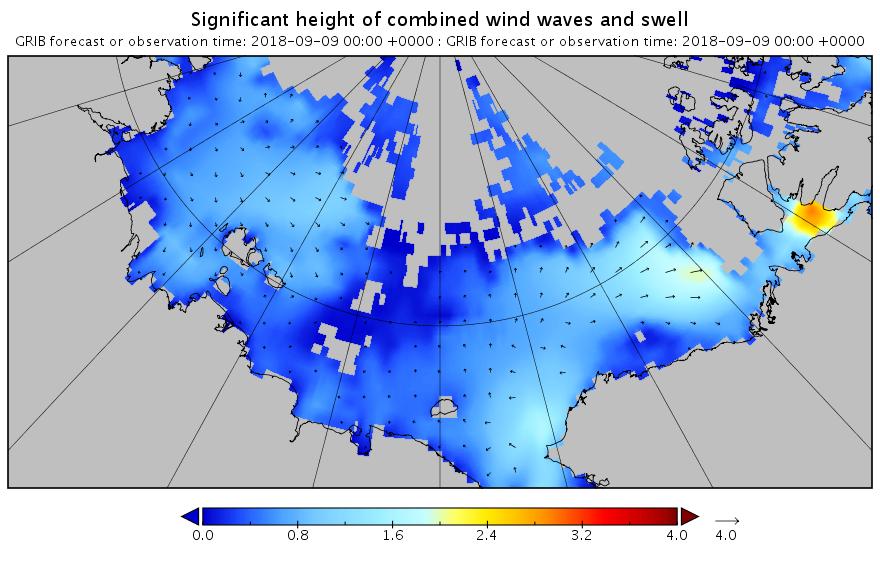
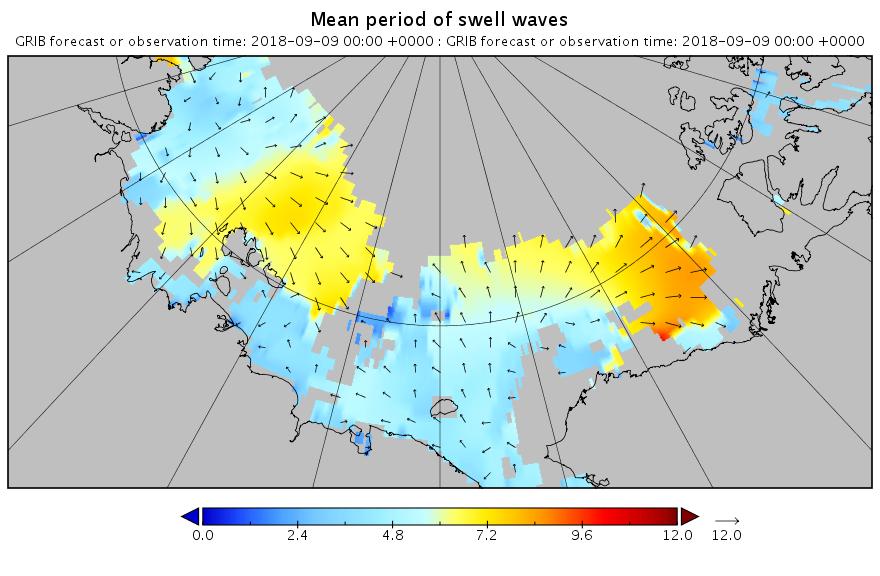
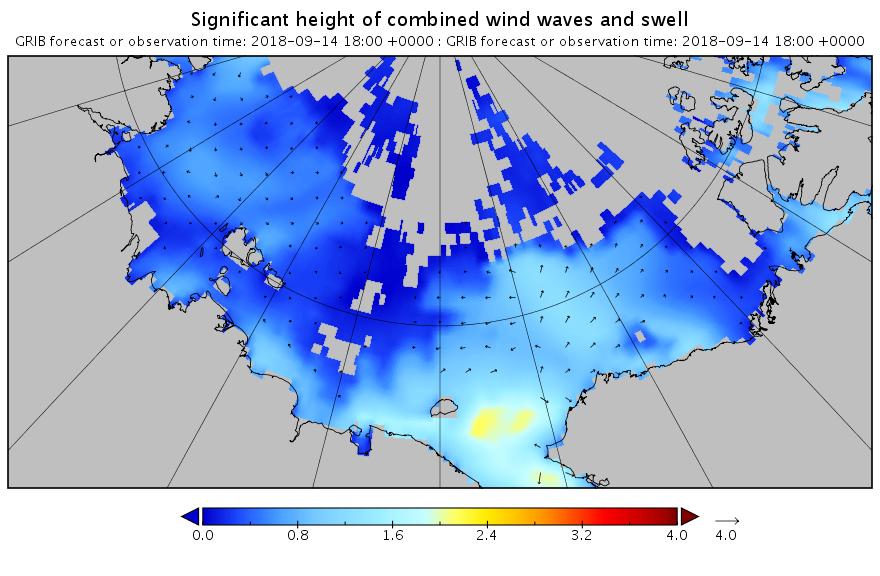
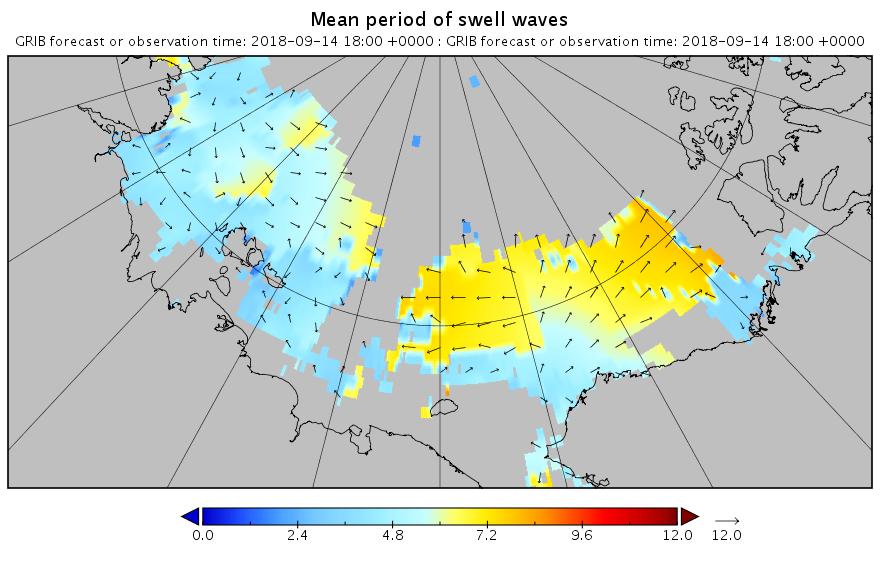
This is currently a long way into the future and hence may not verify in practice. However any pulse of swell is currently forecast for September 13th:

Significant_height_of_combined_Atlantic.20180909_00047

Mean_period_of_swell_waves_Pacific.20180909_00047

The February 2018 Fram Strait Cyclones

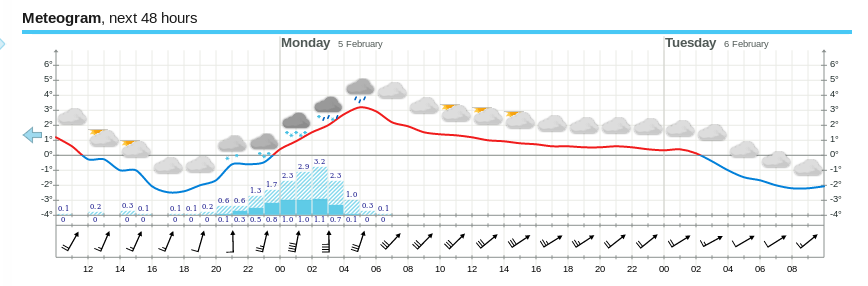
As already mentioned in our February Arctic overview, another storm is brewing. Here is this morning’s weather forecast for Longyearbyen, the capital of Svalbard:

svalbard_forecast_20180204

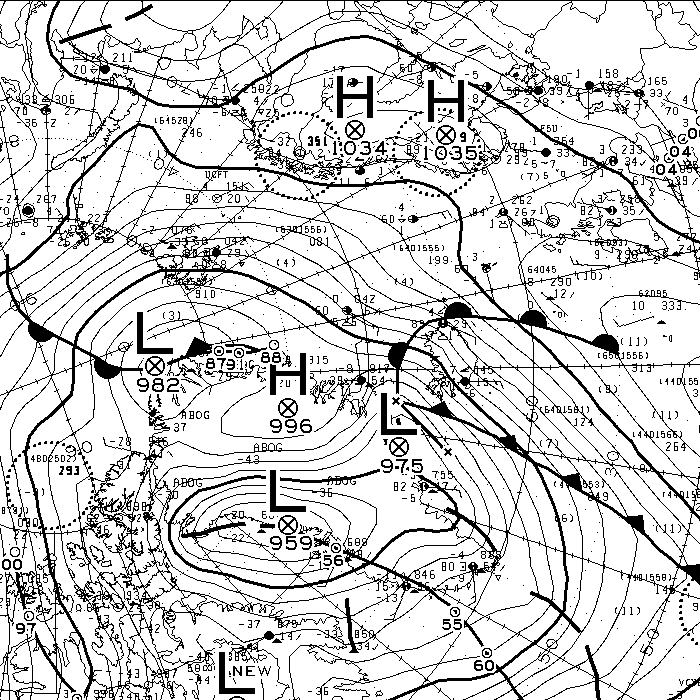
Much like last month, temperatures are above zero and rain is forecast. That’s because once again the current synoptic chart from Environment Canada shows a warm wet flow from way down south over Svalbard and on into the Central Arctic:

Synopsis-20180204-06Z-Crop

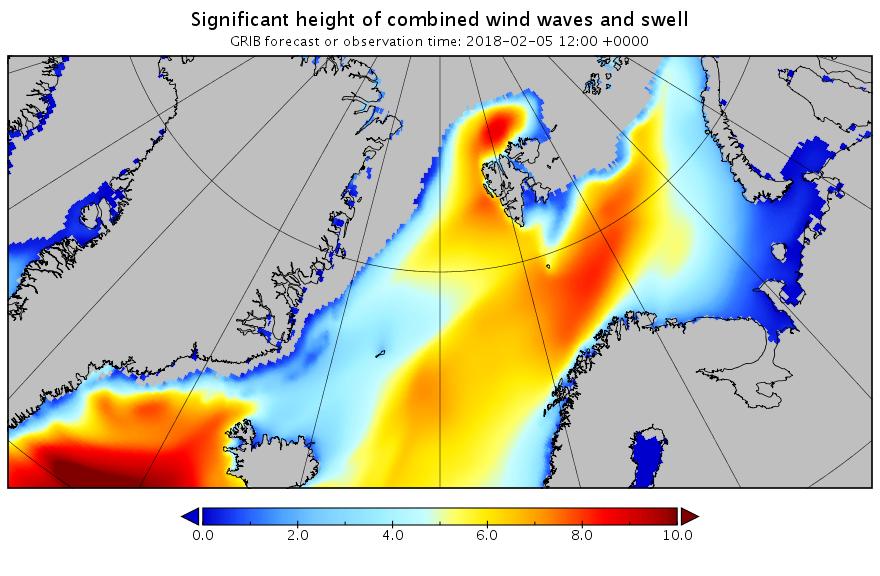
Next here’s the current combined wave and swell height forecast for the Svalbard area:

Significant_height_of_combined_w in multi_1.glo_15mext.20180204_00037

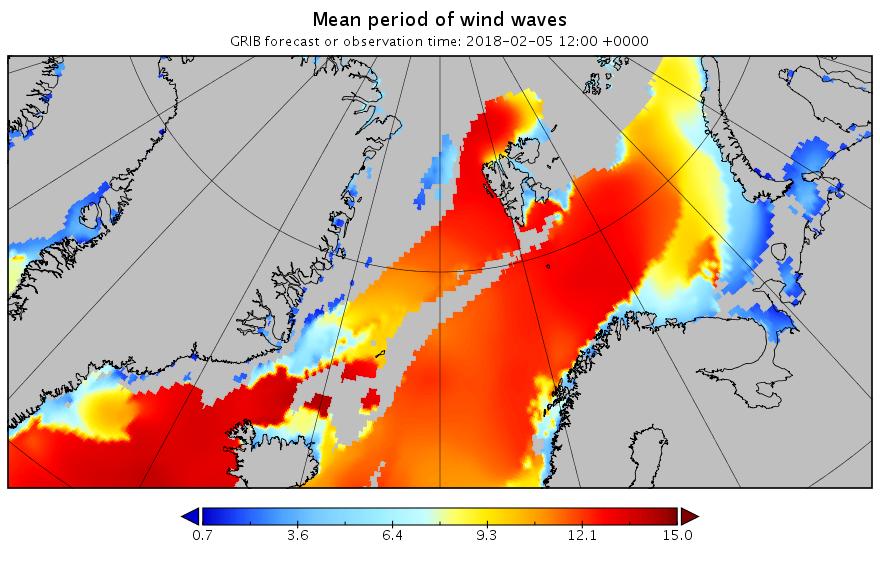
and here’s the associated wave period forecast:

Mean_period_of_wind_waves_surfac in multi_1.glo_15mext.20180204_00037

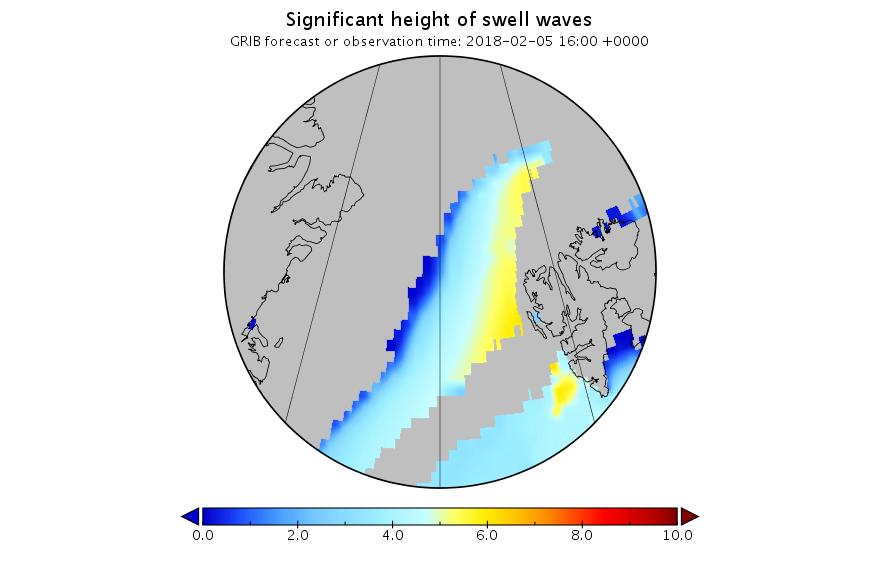
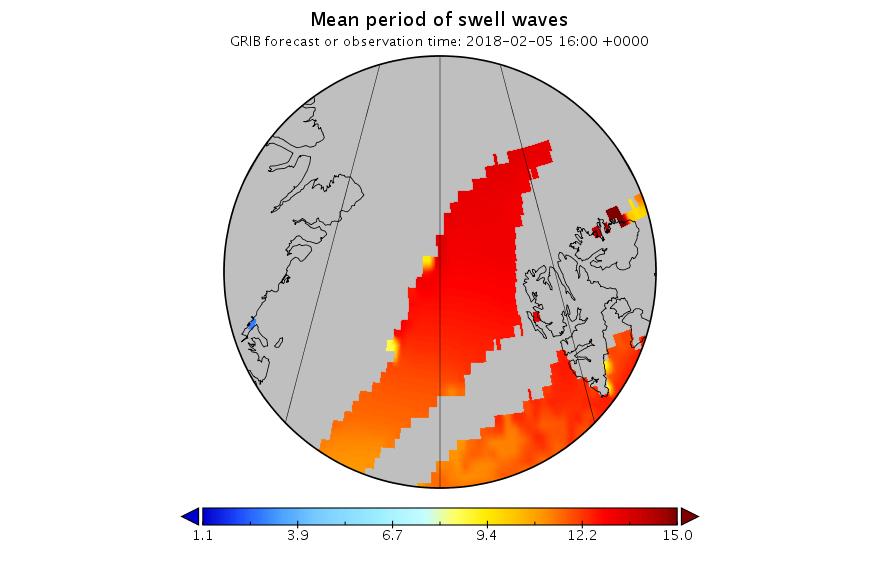
It’s still showing 10 meter waves with a 15 second period north of Svalbard tomorrow lunchtime. Somewhat unusually for the Arctic these aren’t merely giant wind waves. Zooming in on the Fram Strait and breaking out the underlying primary swell reveals:

Significant_height_of_swell_wave in multi_1.glo_15mext.20180204_00041

Mean_period_of_swell_waves_order in multi_1.glo_15mext.20180204_00041

A long distance swell of that magnitude is going to cause some damage.


[Edit – February 5th]

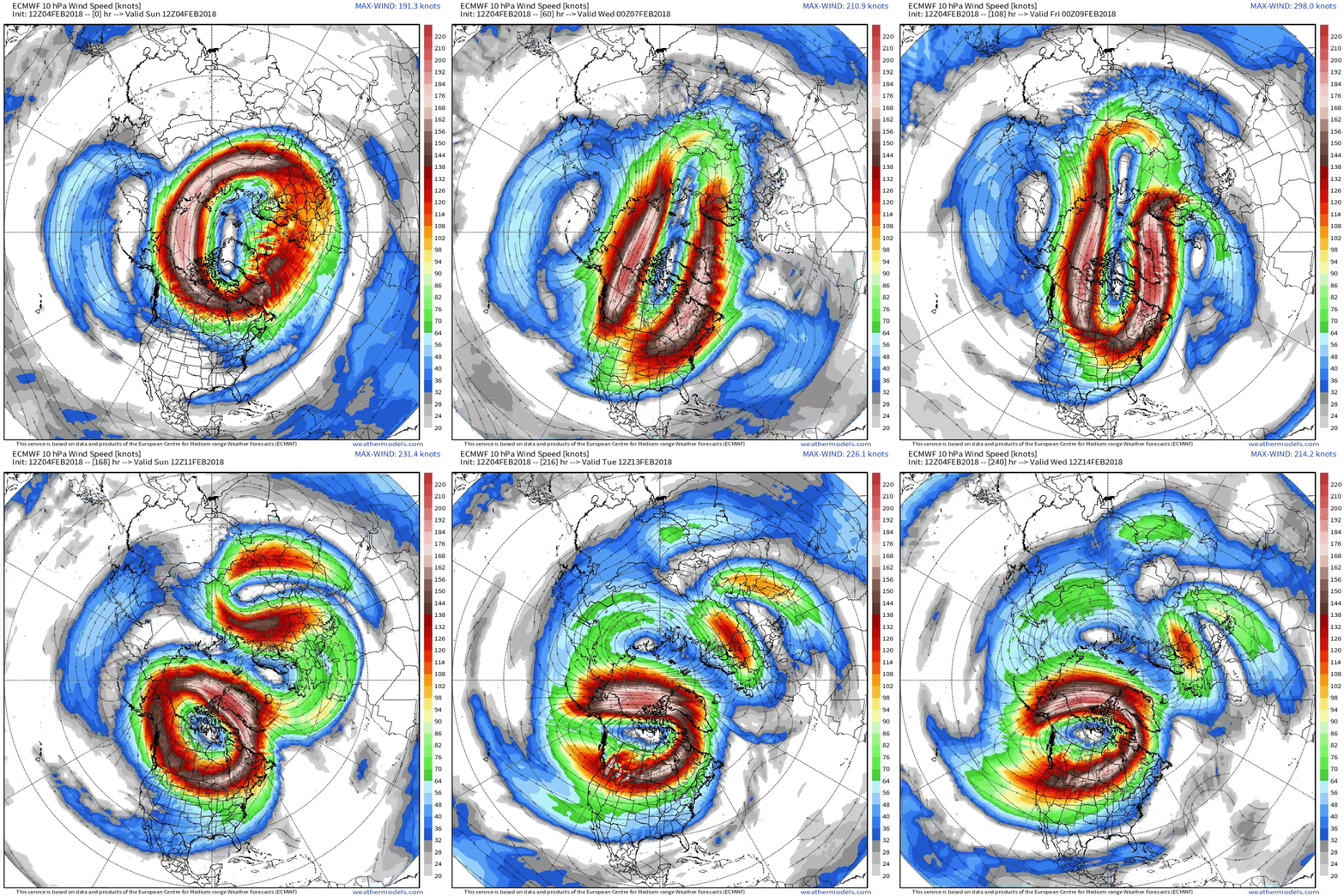
The current ECMWF forecast for a split polar vortex, courtesy of Ice Shieldz on the Arctic Sea Ice Forum:

Polar View Wind Speed 10 hPa 20180204

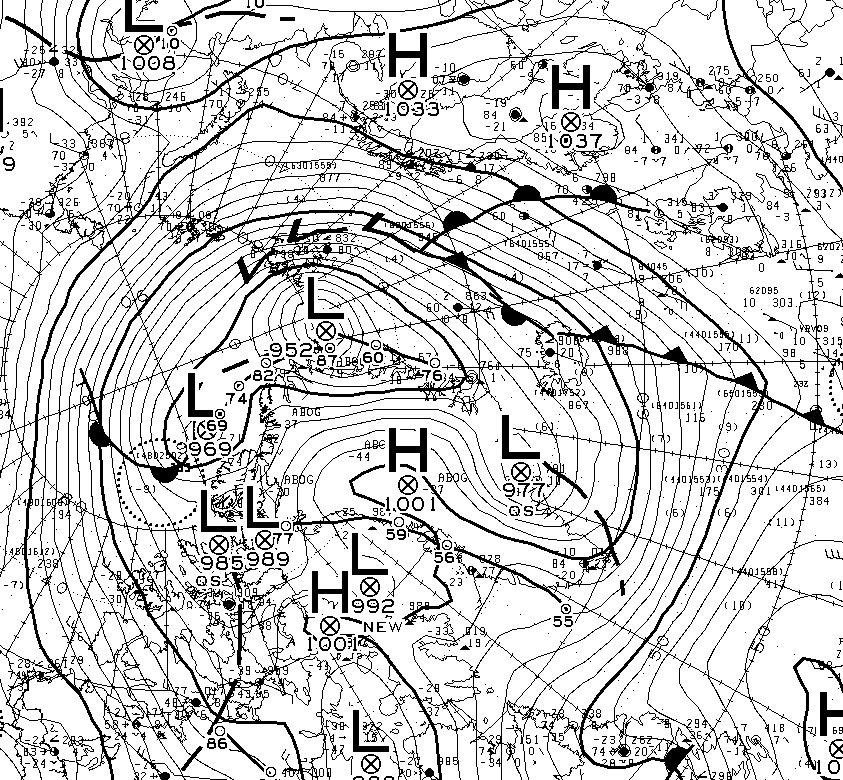
This is suggestive of more cyclones to come, but sticking with the current one for now, here is the MSLP chart at 00:00 UTC this morning showing the cyclone’s central pressure has dropped to 952 hPa:

Synopsis-20180205-00Z-Crop

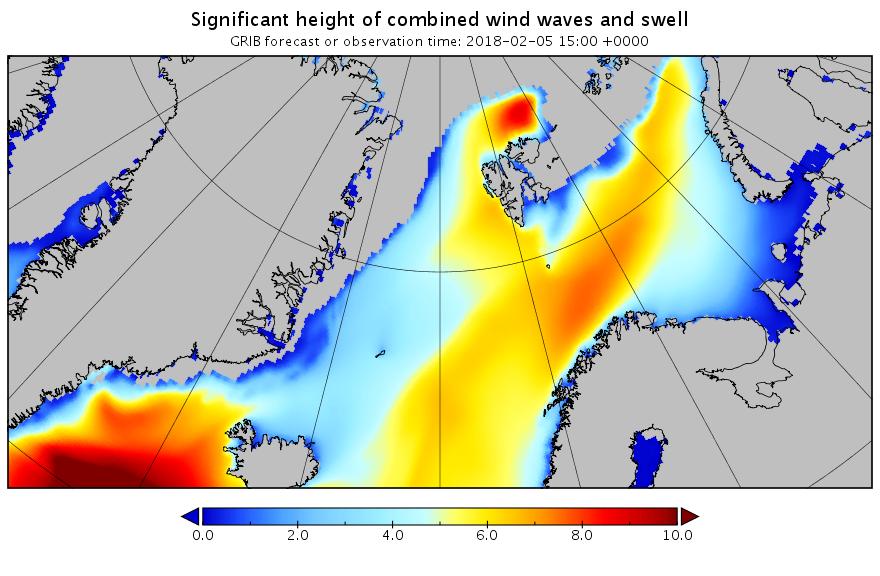
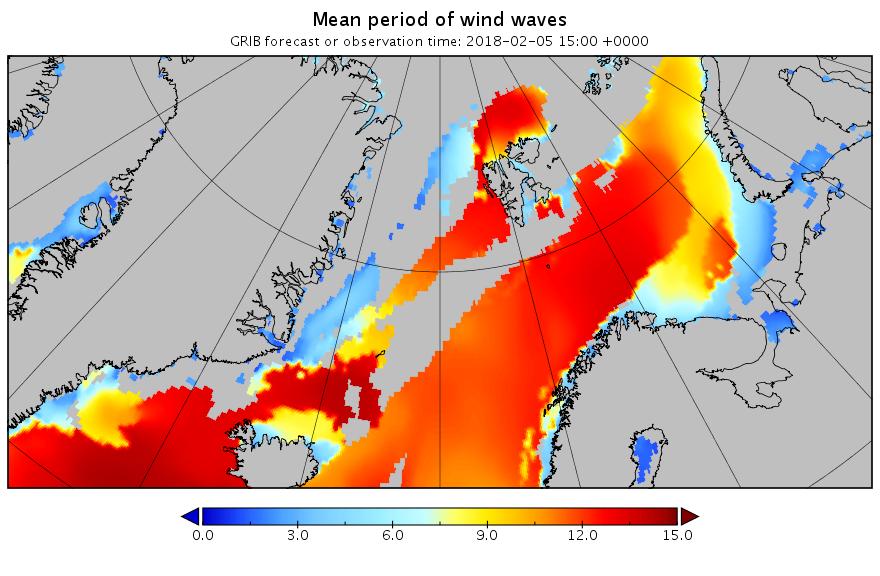
Here too is the current WaveWatch III forecast for 15:00 UTC today:

Significant_height_of_combined_w in multi_1.glo_15mext.20180205_00016

Mean_period_of_wind_waves_surfac in multi_1.glo_15mext.20180205_00016

The peak of the swell north of Svalbard is now slightly later than originally forecast, but it’s still enormous!

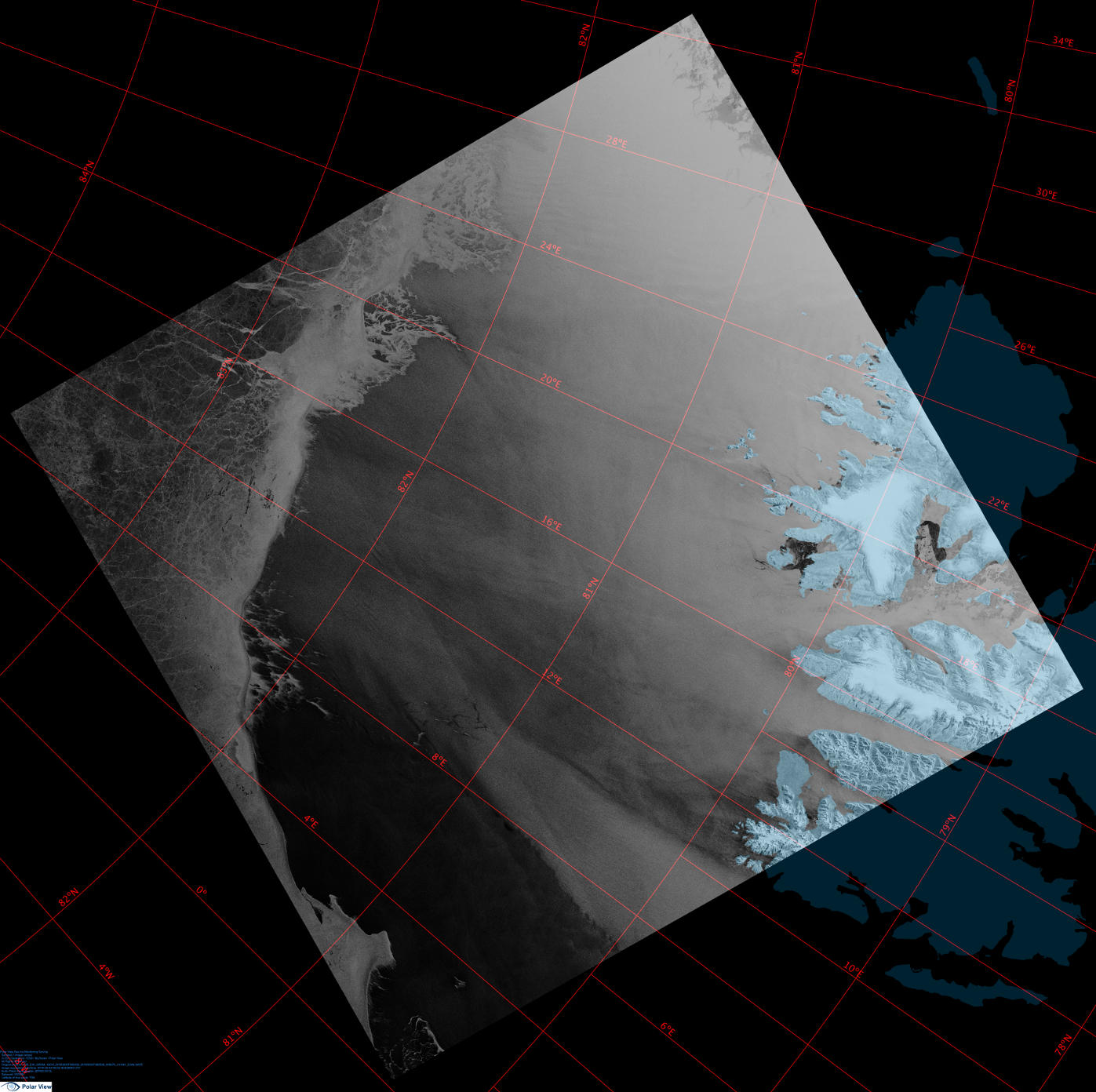
Here’s a single Sentinel 1B synthetic aperture radar image that captures the position of the ice edge north of Svalbard yesterday quite nicely:

S1B_Svalbard_20180204T0654


[Edit – February 7th]

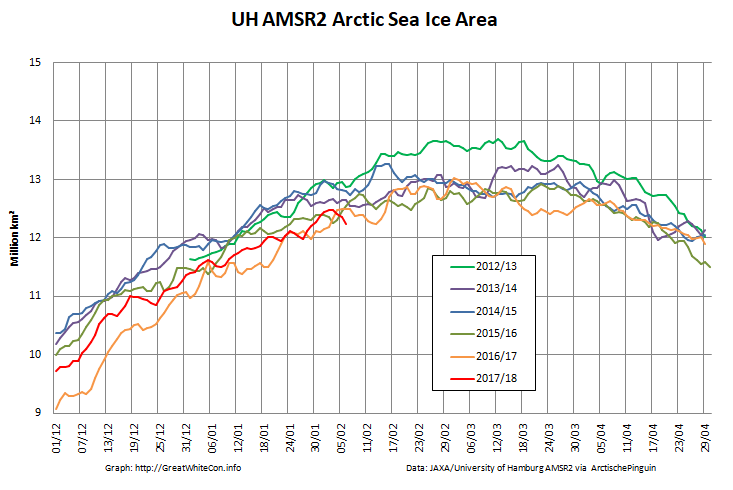
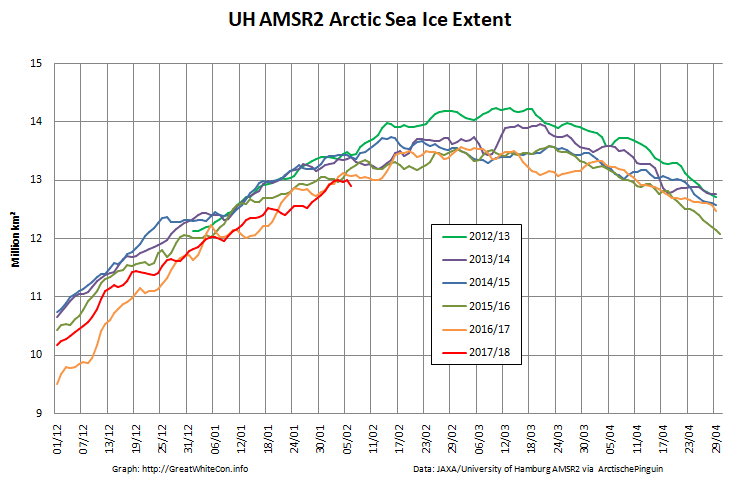
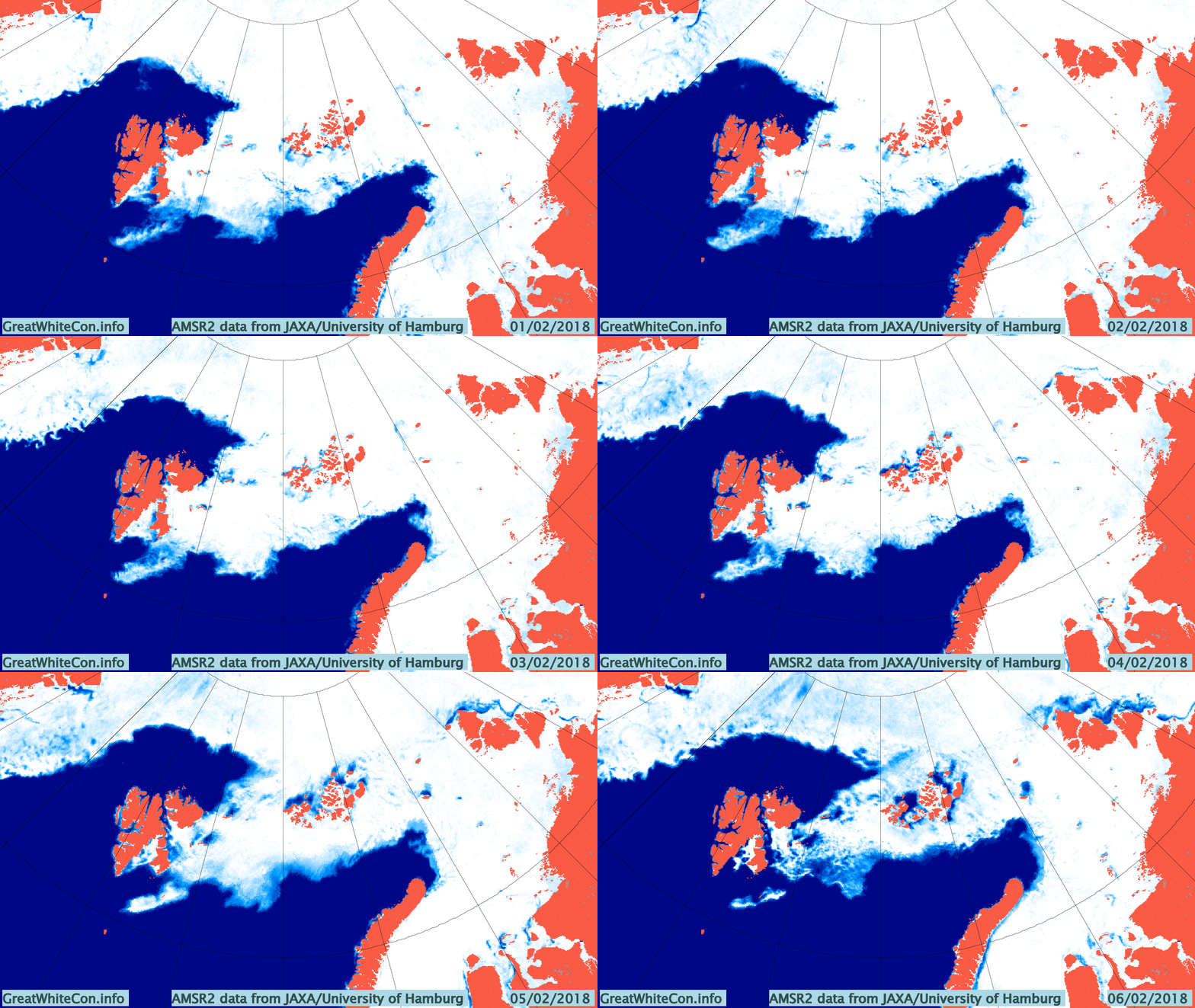
A brief overview of the effect of the recent cyclone on the sea ice in the Arctic via AMSR2:

UH-Arctic-Area-2018-02-06

UH-Arctic-Extent-2018-02-06

atlantic-201802-1280

Click the image to animate it.


[Edit – February 8th]

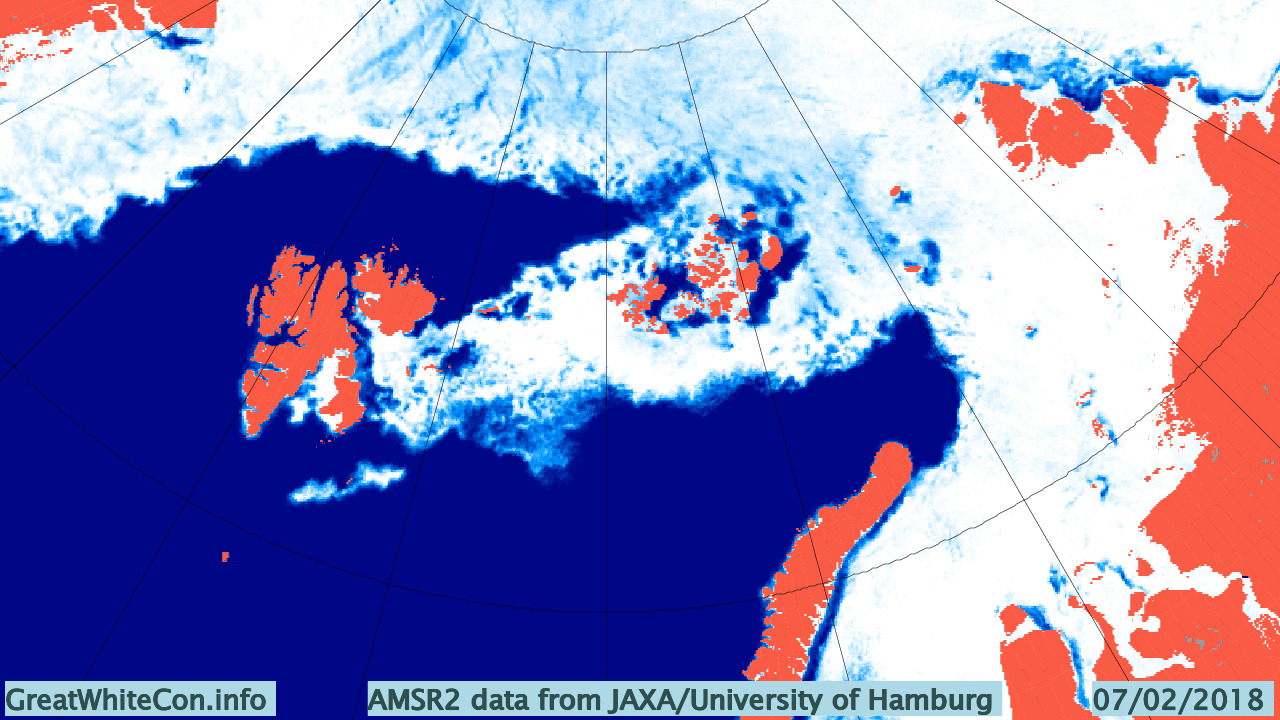
An Arctic wide take via Thomas Lavergne on Twitter:

plus the latest AMSR2 concentration map:

Arc_20180207_res3.125_LARGE


[Edit – February 9th]

An interesting insight into CryoSat-2 sea ice thickness measurements from Stefan Hendricks on Twitter:

Plus Judah Cohen on the split polar vortex:

The January 2018 Fram Strait Cyclones

We’ve covered similar events in the recent past, but this one looks like it will take the proverbial biscuit.

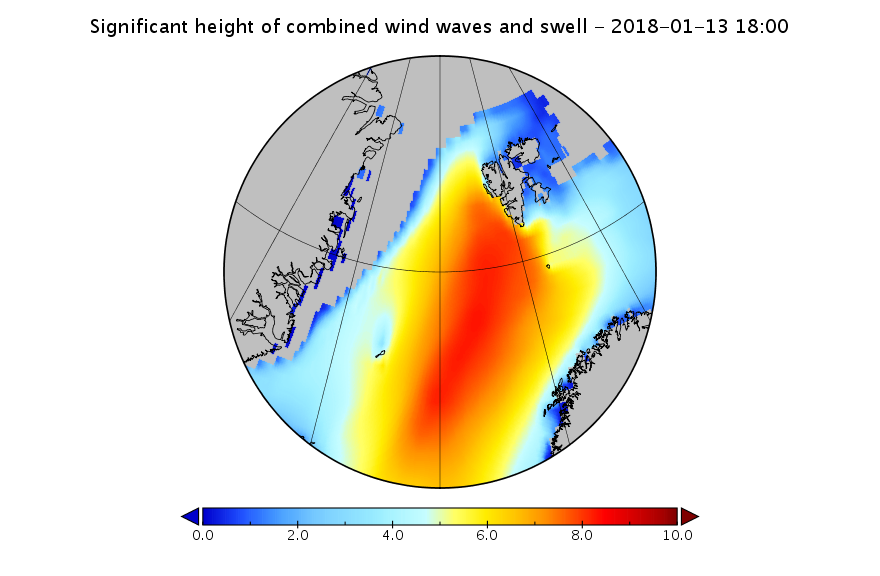
Here’s the 6 hour wave forecast for the Fram Strait from 12:00 UTC this afternoon:

Significant_height_of_combined_w in multi_1.glo_30mext-20180113-12z+6

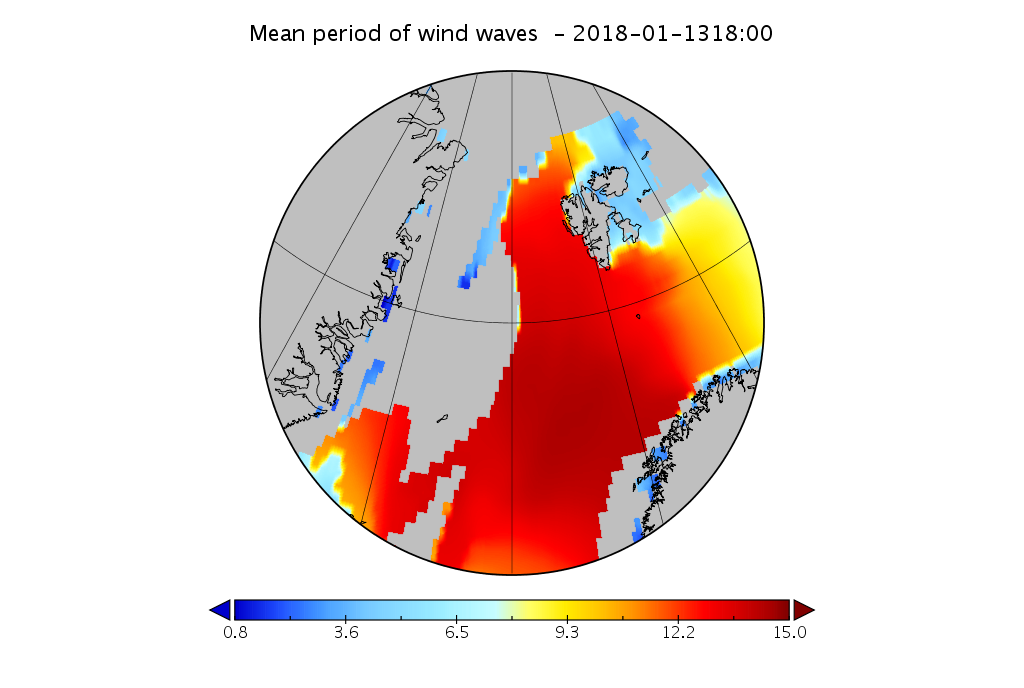
Mean_period_of_wind_waves_surfac in multi_1.glo_30mext-20180113-12z+6

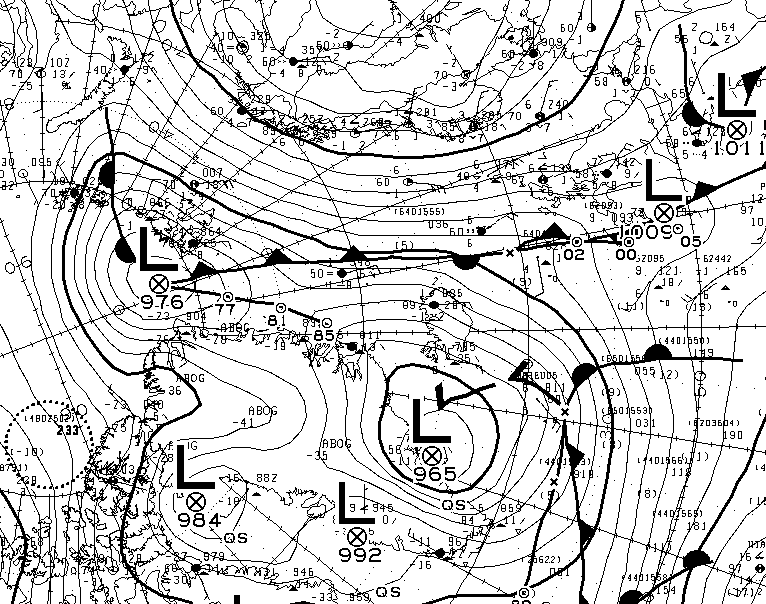
Look at the scales carefully then compare the wave height and period with previous similar events. Here’s the cause of those giant waves, two powerful cyclones off Greenland pumping heat and moisture northwards from a long way south:

Synopsis-20180113-18Z-Crop

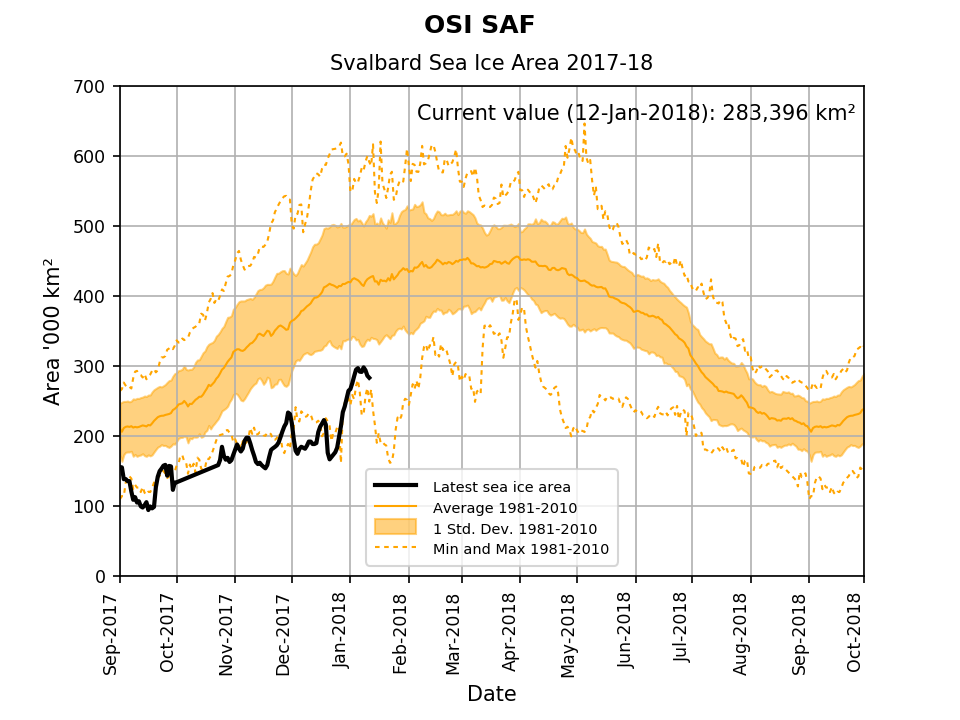
Also bear in mind the current sea ice area around Svalbard:

osisaf_svalbard_plot_20180112

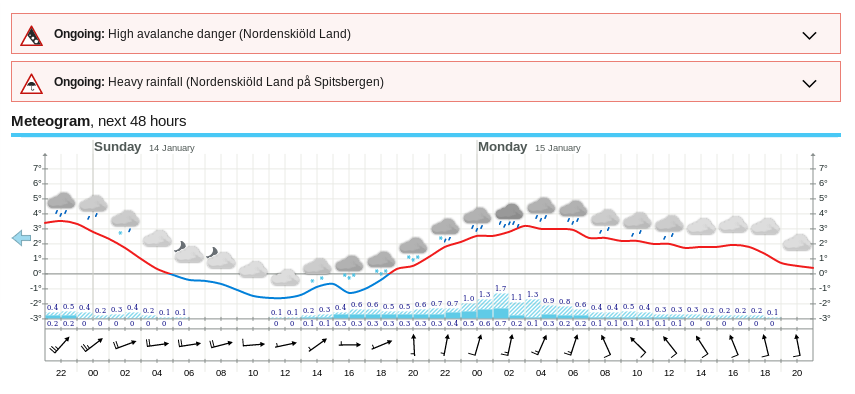
and the current weather forecast for the capital Longyearbyen:

svalbard_forecast_20180113

Note in particular the anomalously high temperatures and the severe weather warnings for both rain and avalanches. In the middle of January.

Finally, for the moment at least, here’s a Sentinel 1B image of the sea ice in the Fram Strait earlier this morning:

S1B_Fram_20180113T063817


[Edit – January 14th]

The temperature in Longyearbyen is forecast to drop below freezing point early on Tuesday and then remain there, which I guess counts as good news?

svalbard_forecast_20180114

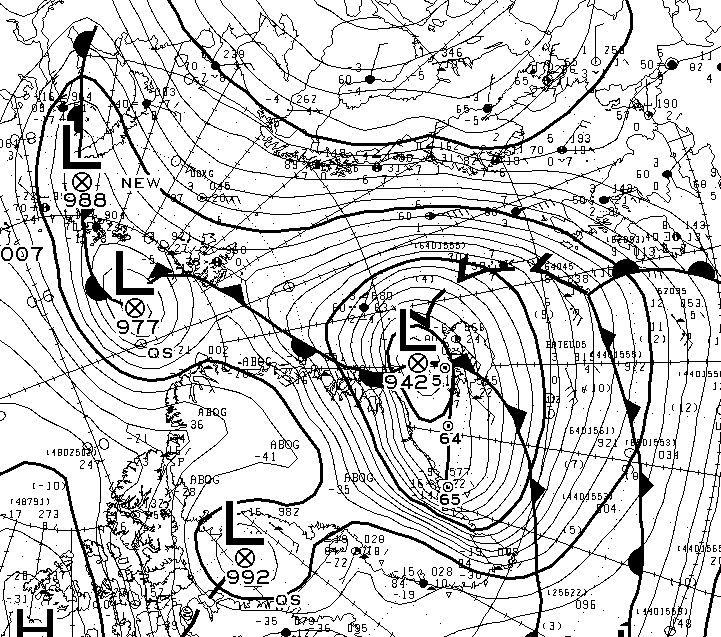
However the southernmost of the two cyclones off Greenland is now down to a central MSLP of 942 hPa:

Synopsis-20180114-12Z-Crop


[Edit – January 15th]

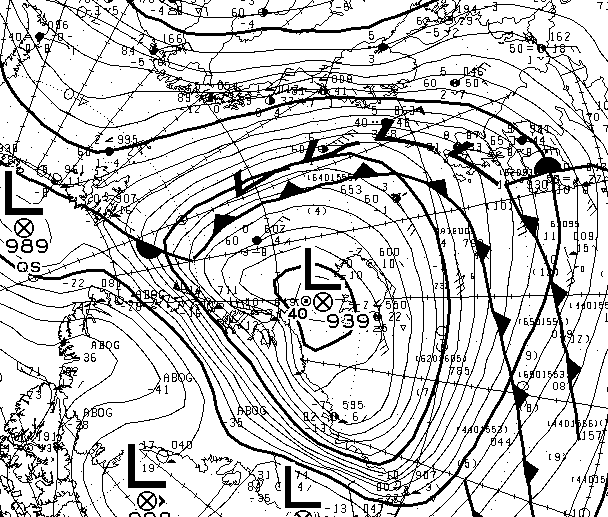
The cyclone now centred near Iceland looks as though it bottomed out at a MLSP of 939 hPa earlier today:

Synopsis-20180115-00Z-Crop

Watch this space!
Facts About the Arctic in March 2017

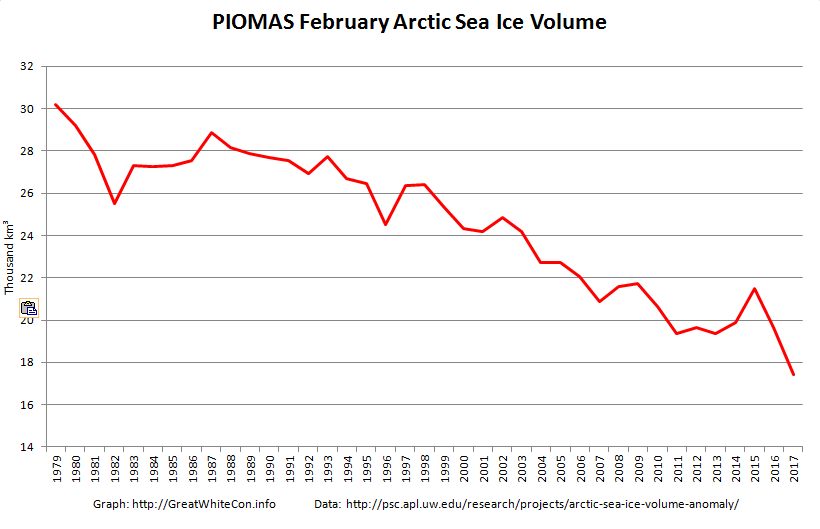
The February 2017 PIOMAS Arctic sea ice volume numbers are out. It’s no longer surprising to report that they are the lowest ever for the month of February in records going back to 1979:

PIOMAS-2017-02

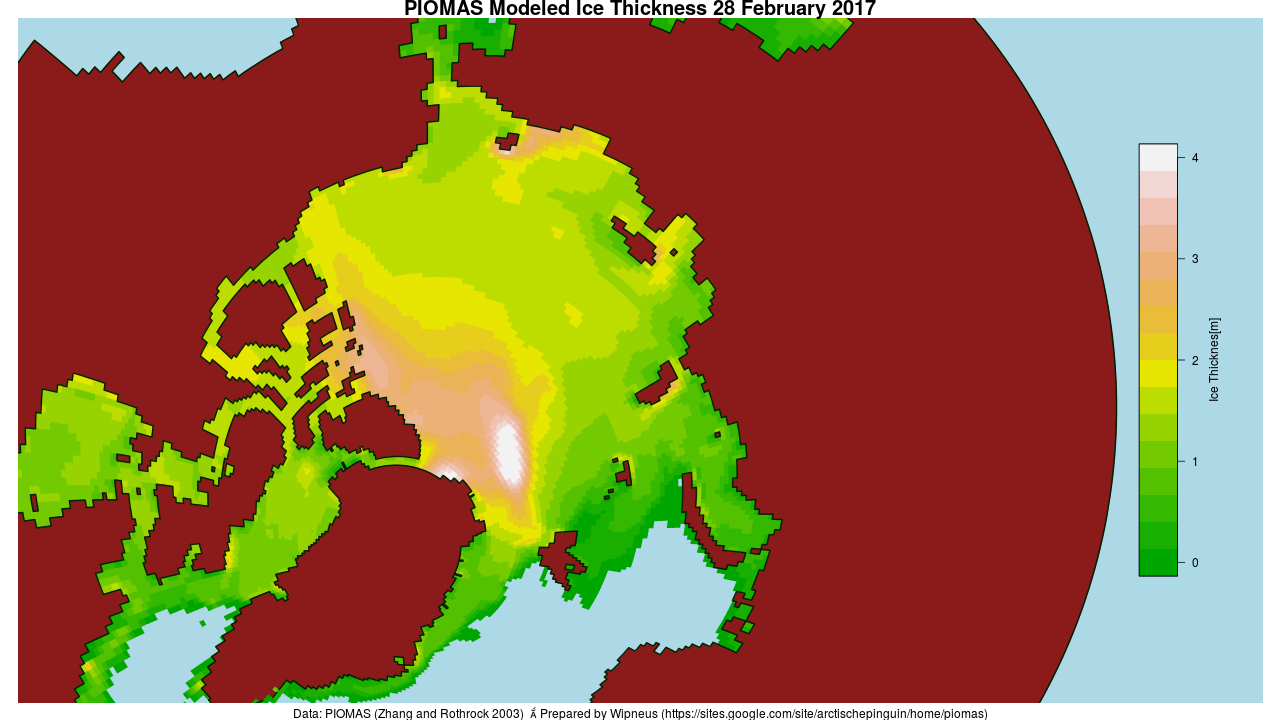
Here’s the PIOMAS gridded thickness map for February 28th:

PIOMAS-thkness-20170228

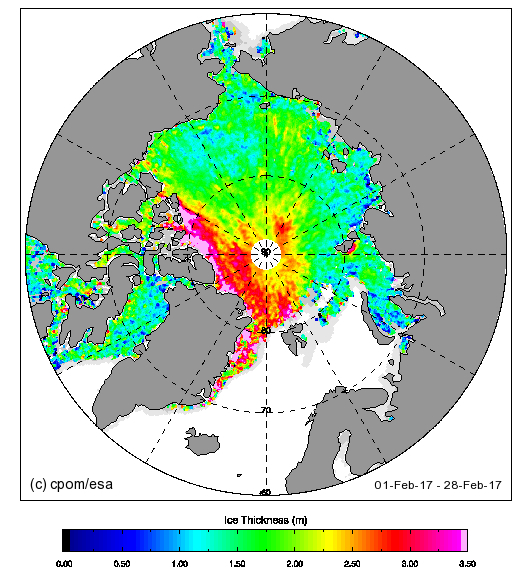
whilst here’s the latest CryoSat-2 thickness map:

Cryosat_28_20170228

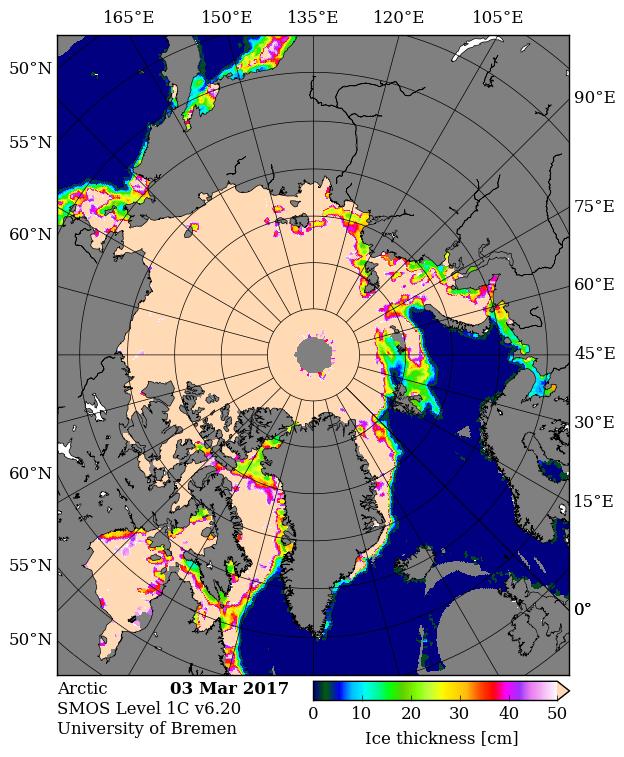
and here’s the latest SMOS thickness map from the University of Bremen:

SMOS-20170303

Lars Kaleschke suggests via Twitter this revealing SMOS thickness animation:

There does seem to be a small patch of slightly thicker ice in the East Siberian Sea off Chaunskaya Bay, but there’s still a much larger area of sub 0.5 meter thick ice in the Laptev and Kara Seas.

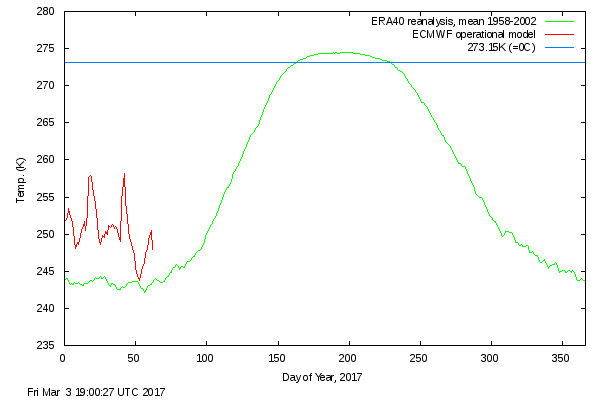
The Danish Meteorological Institute’s temperatures for the “Arctic area north of the 80th northern parallel” graph shows somewhat more “normal” readings in February 2017, but still without falling below the ERA40 climatology this year or in 2016:

DMI-meanT_20170303

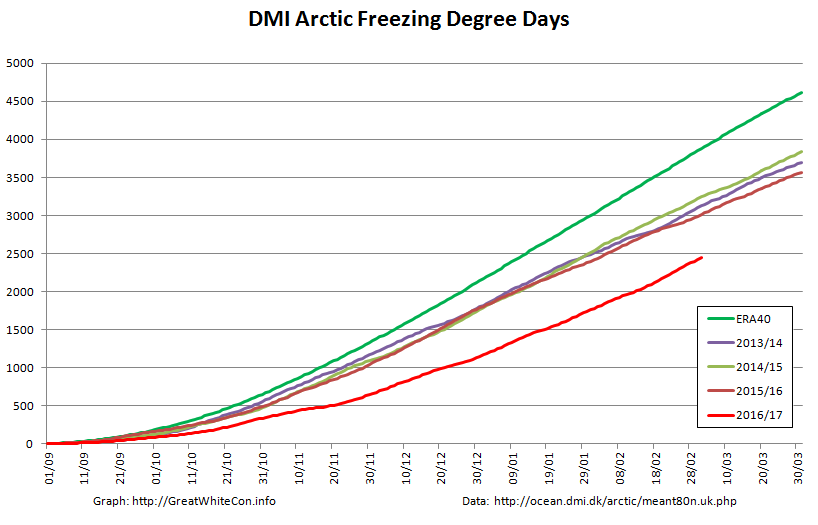
The graph of cumulative Freezing Degree Days (FDD for short) is still far below all previous years in DMI’s records going back to 1958:

DMI-FDD-20170303

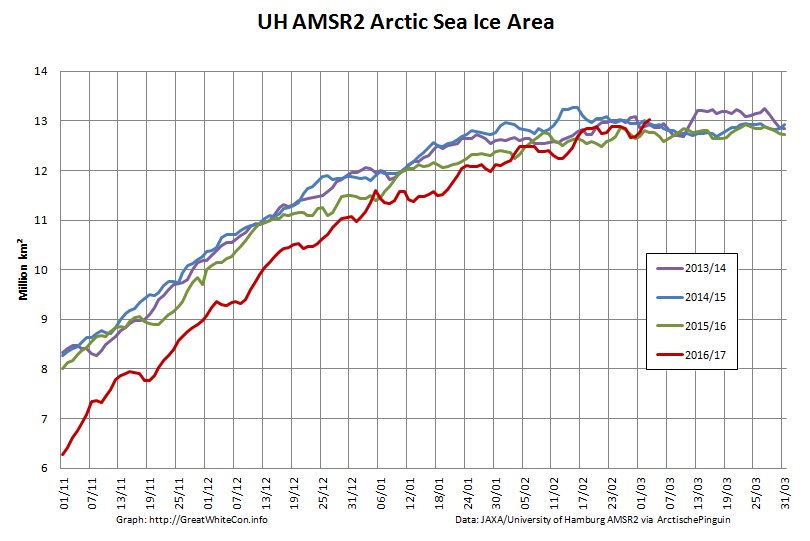
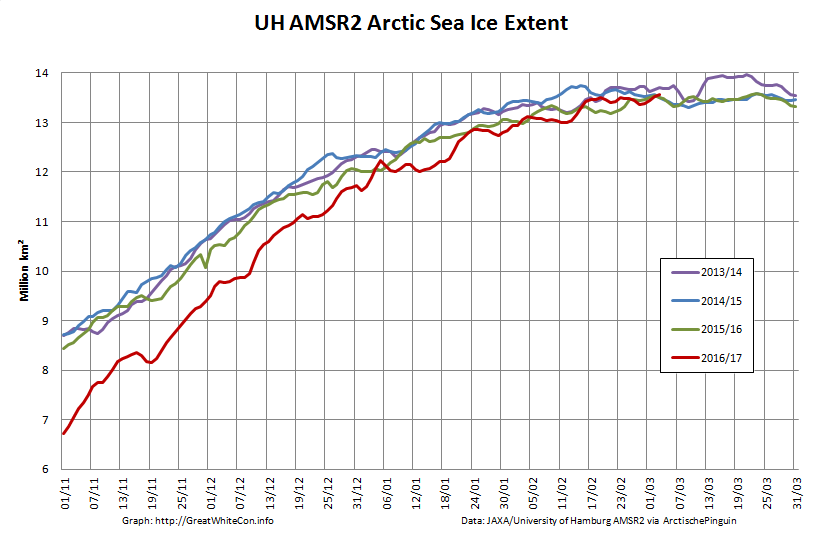
Finally, for the moment at least, here’s the high resolution AMSR2 Arctic sea ice area and extent:

UH-Arctic-Area-2017-03-03

UH-Arctic-Extent-2017-03-03

I’m going to have to eat some humble pie, or crow pie as I gather it’s usually referred to across the Atlantic, following my tentative “2017 maximum prediction” a couple of weeks ago. Both area and extent posted new highs for the year yesterday, with area creeping above 13 million square kilometers for the first time this year.


[Edit – March 7th]

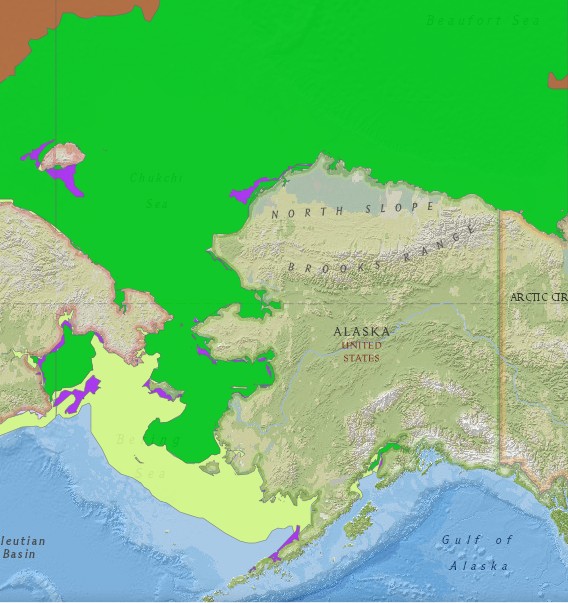
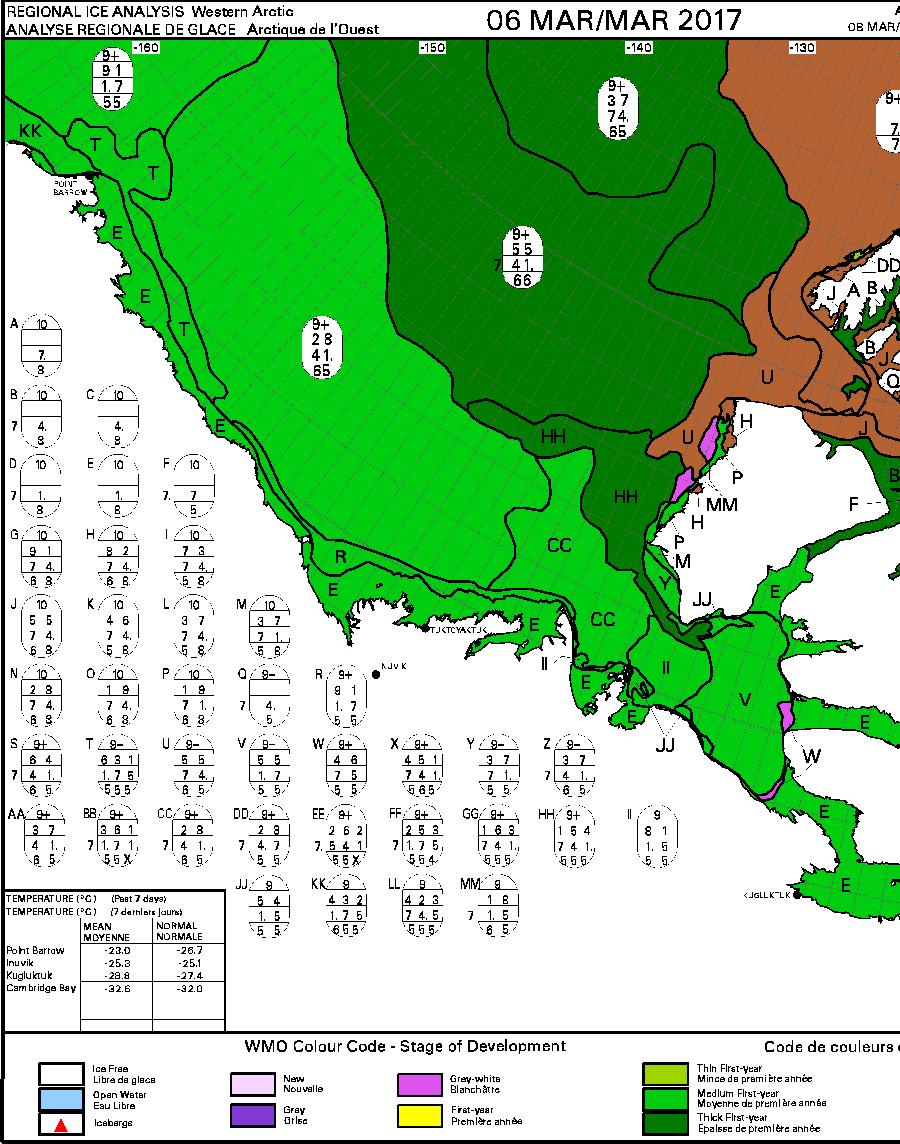
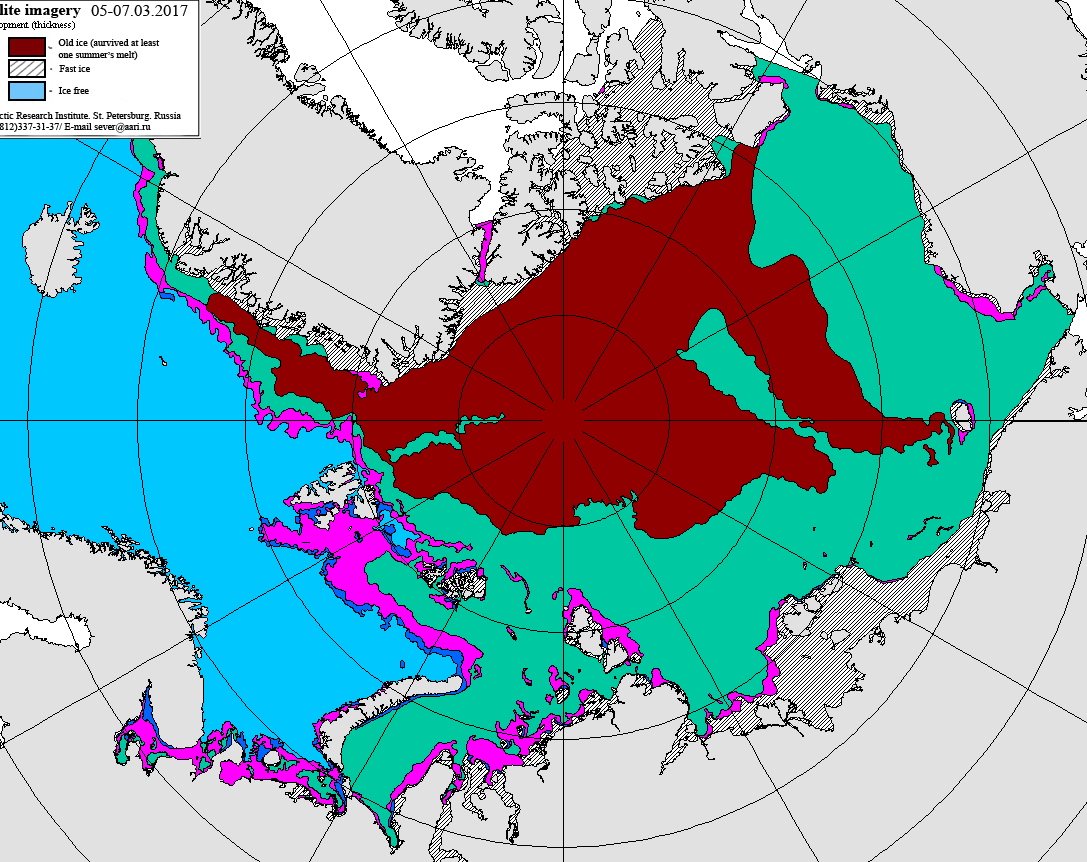
Commenter Michael Olsen suggests that “thicker ice being pushed into the Alaskan and Russian parts of the Arctic Ocean”. Here’s some evidence:

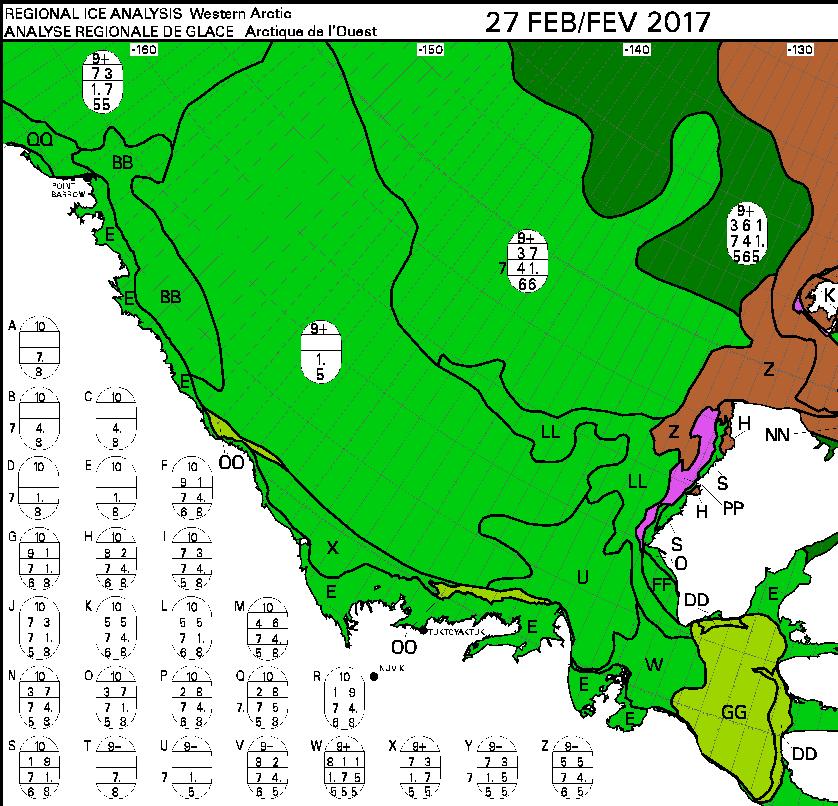
The United States’ National Weather Service current sea ice stage of development map for Alaskan waters:

NWS-Alaska-SoD-20170307

This week’s Canadian Ice Service sea ice stage of development map is expected later today, so for now here’s last week’s:

CIS-West-SoD-20170227

and here’s the latest version:

CIS-West-SoD-20170306

Similarly this week’s Russian Arctic and Antarctic Research Institute ice chart is expected soon has been published:

AARI-20170307-crop


[Edit – March 11th]

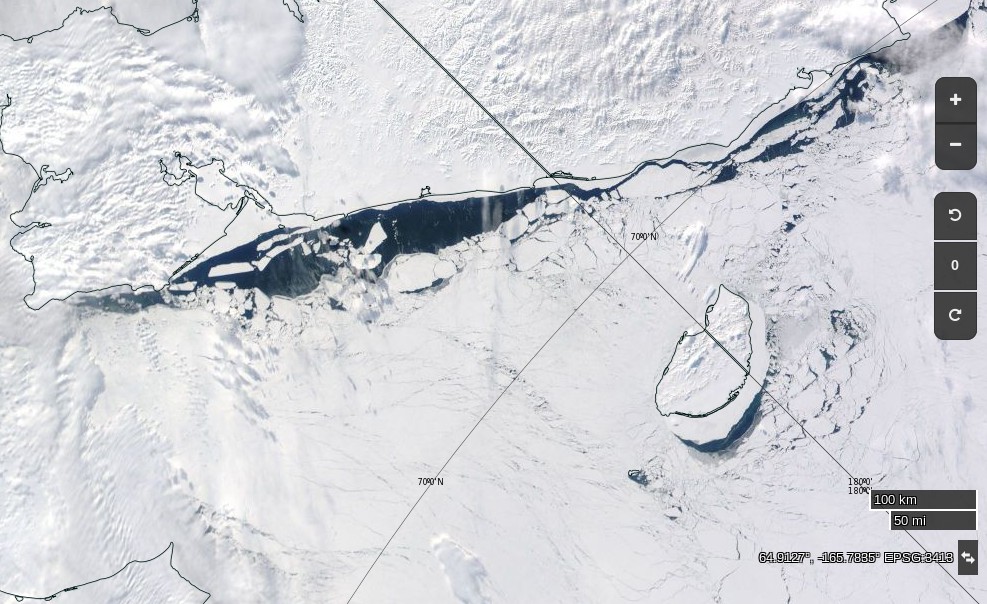
Especially for Michael, a visual image of all the “thicker ice [that’s been] pushed into the Russian parts of the Arctic Ocean” courtesy of the nice folks at NASA:

NASA Worldview “true-color” image of the Chukchi Sea on March 10th 2017, derived from the MODIS sensor on the Aqua satellite


[Edit – March 12th]

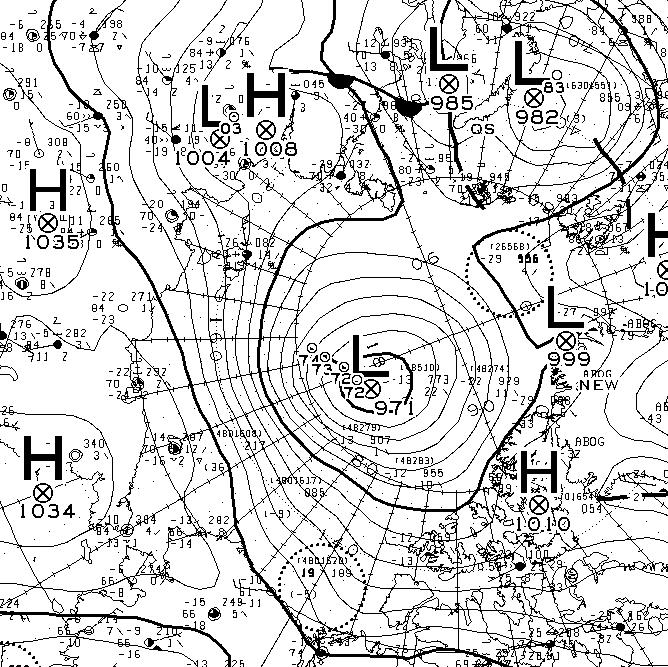
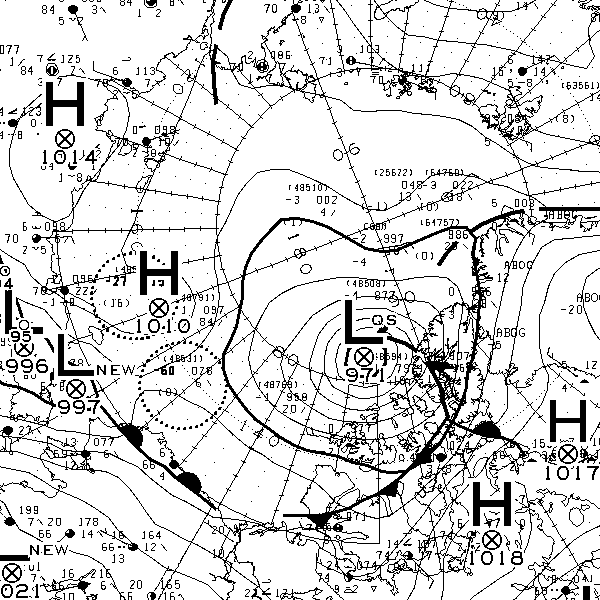
Yet another strong Arctic cyclone has been battering the sea ice in the Arctic Basin. According to Environment Canada this one bottomed out at 971 hPa at 06:00 UTC today.

Synopsis-20170312-06Z

Global Sea Ice Extent Reaches Lowest *Ever Level

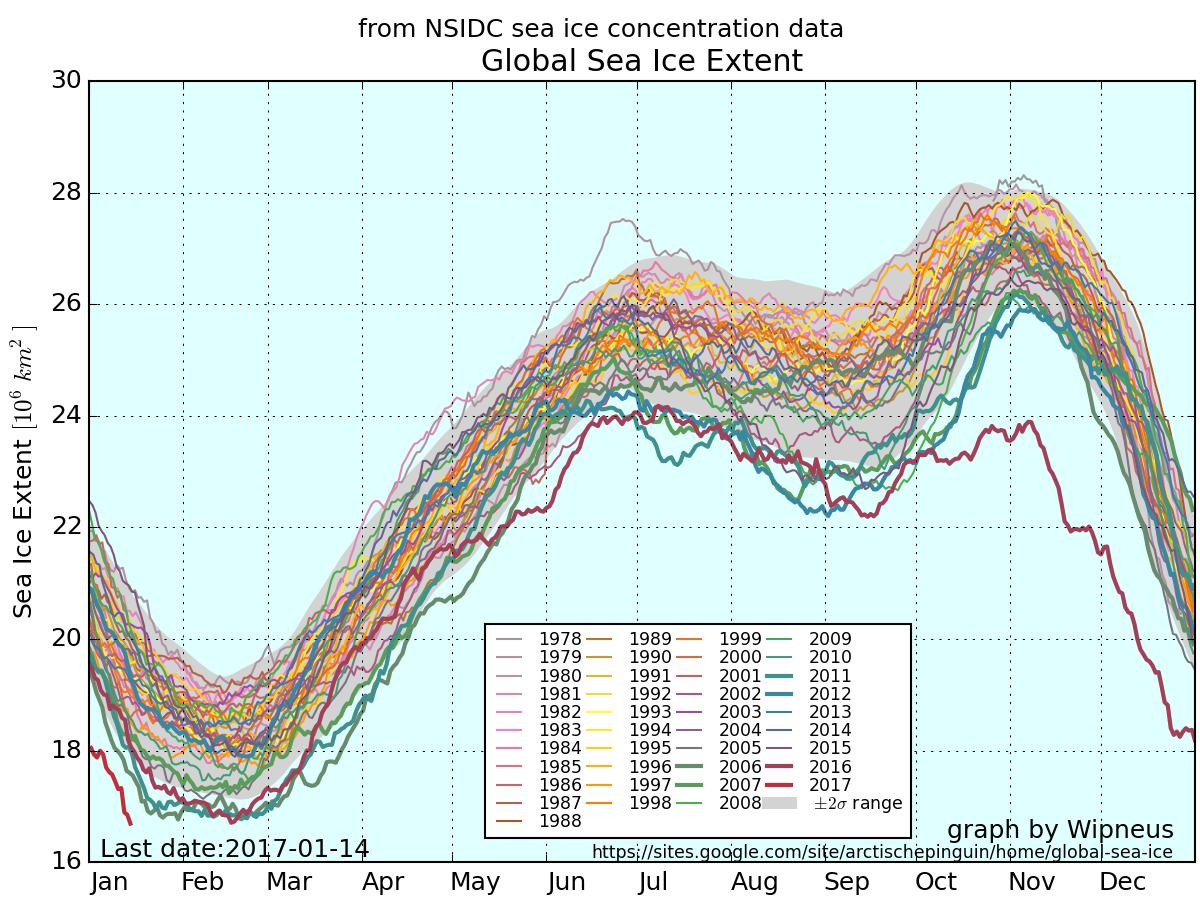
Here once again is the up to date version of Wipneus’ graphic graphic, this time of global sea ice extent:

nsidc_global_extent_20170114

As you can see, global sea ice extent has just reached the lowest ever level in the National Snow and Ice Data Center’s satellite records going back to 1979. It was over a month later when the previous record was broken in February 2016, so there is plenty of time for the metric to fall further.

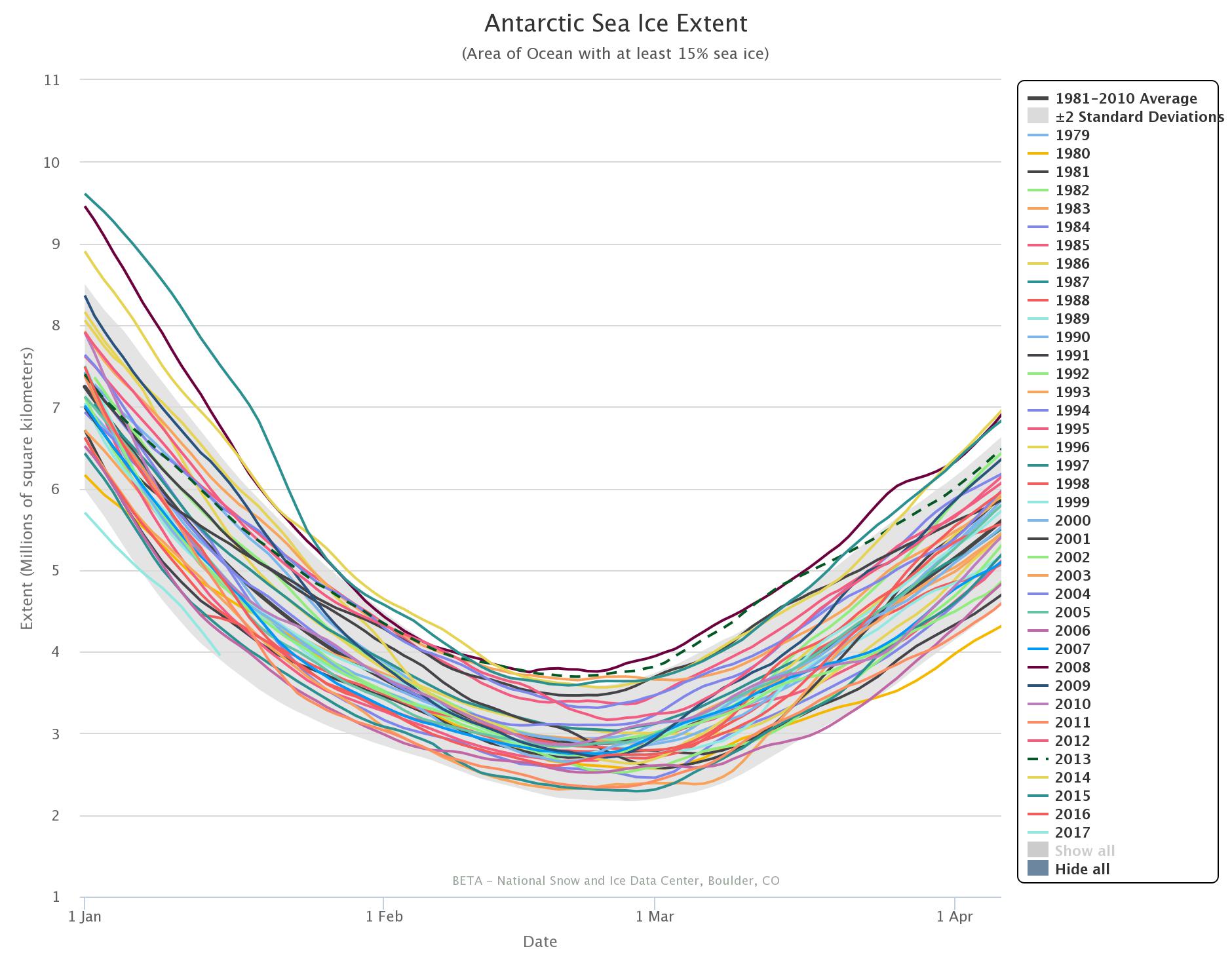
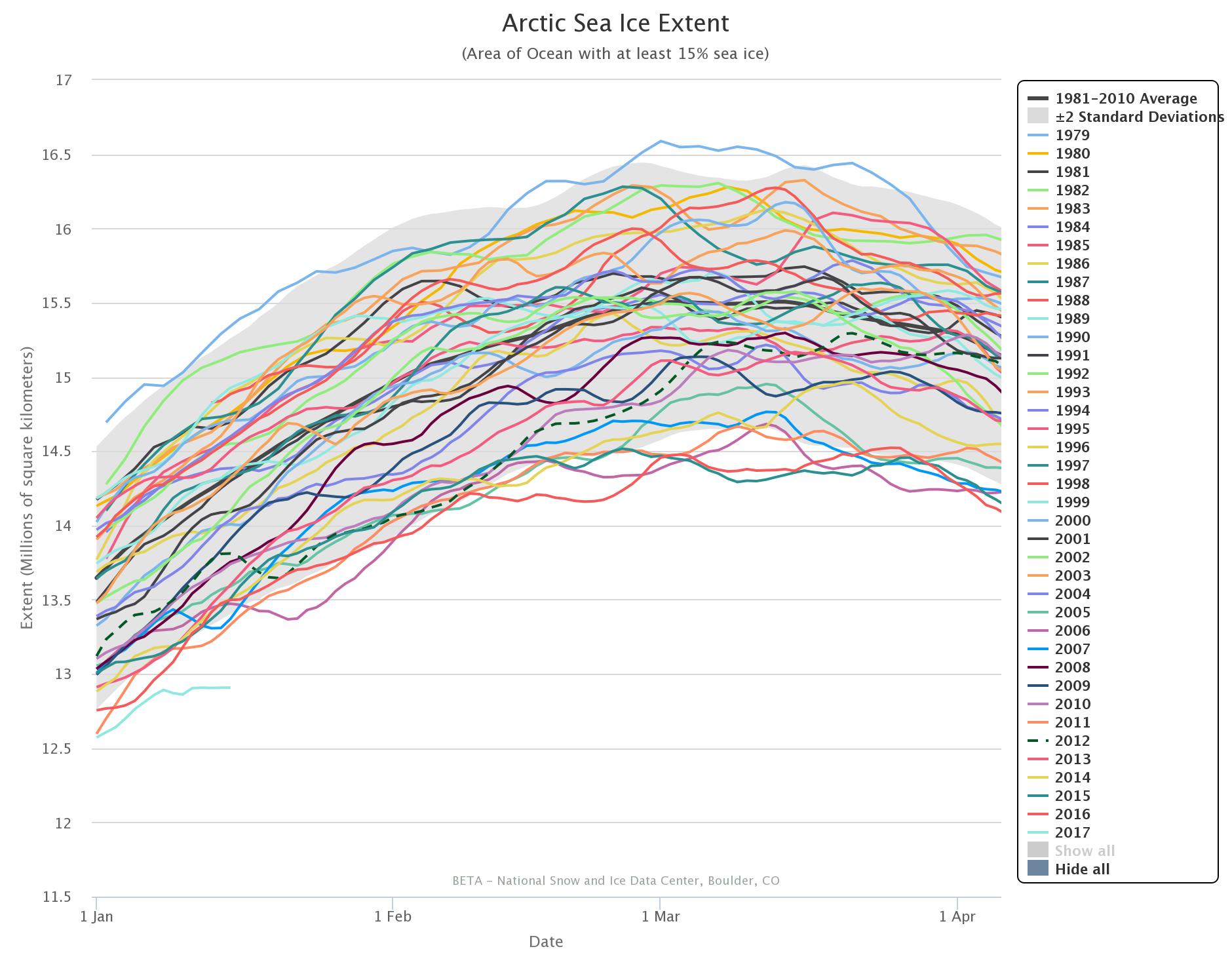
The 2017 curves in the NSIDC’s own extent graphs are coloured in a pale shade of blue. Even so they’re easy to pick out since both Antarctic and Arctic extent are at the lowest level for the date in NSIDC’s records by a considerable margin:

Chantarctic-20170115

Charctic-20170115

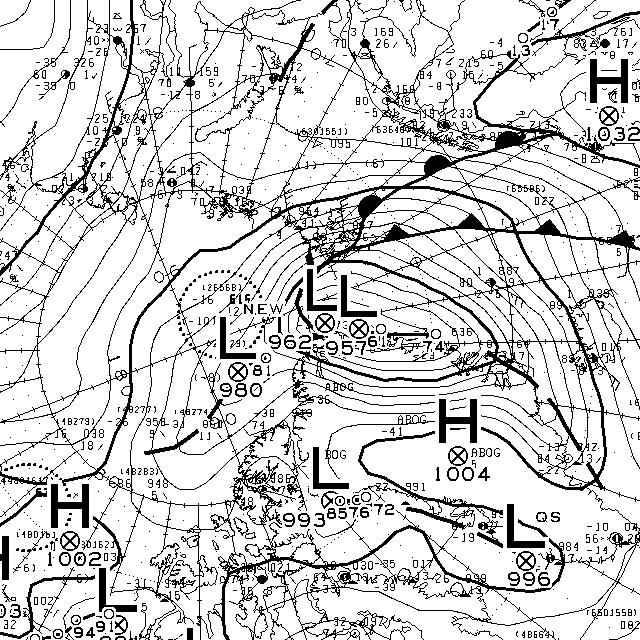
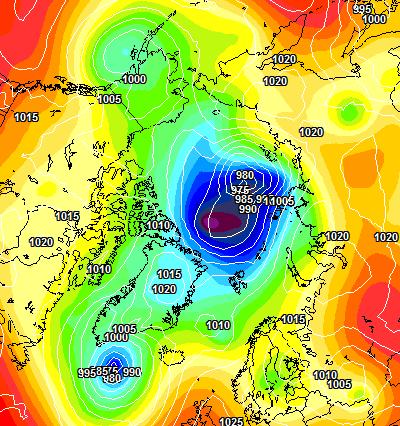
Antarctic sea ice extent is still falling, and the Arctic has been flatlining for several days now and more trouble is heading its way. Another Fram Strait cyclone is brewing, and this time around the storm’s minimum central pressure is already down to 957 hPa according to Environment Canada:

Synopsis-20170116-12Z

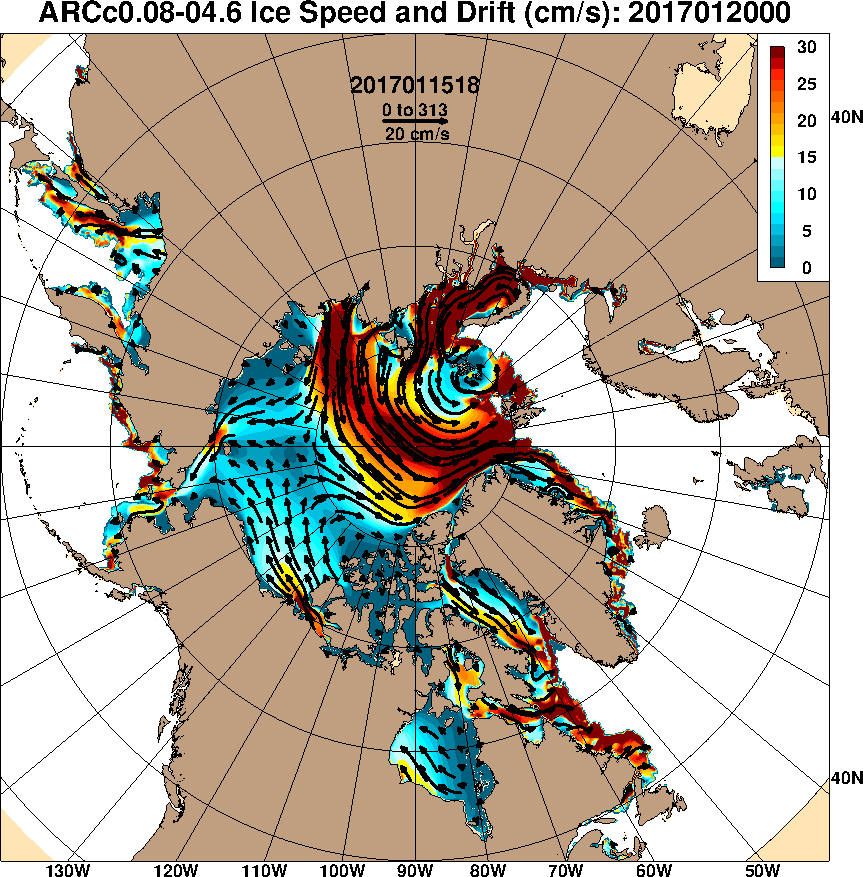
According to the current forecasts it will continue to spin over the central Arctic for several more days, driving export of sea ice via the Fram Strait:

ACNFS sea ice drift forecast for January 20th 2017

* In NSIDC satellite records going back to 1979

The Great Arctic Cyclone of 2016

A storm is brewing in the Arctic. A big one! The crew of the yacht Northabout are currently sailing along the western shore of the Laptev Sea and reported earlier today that:
The sea is calm. Tomorrow a gale 8. But this moment is perfect.

That perfect moment will not last long. Here is the current ECMWF forecast for midnight tomorrow:

ECMWF-20160813+48

and here is the current Arctic surf forecast for 06:00 UTC on Monday:

height_20160813+55h

period_20160813+55h

A 975 hPa low pressure system will be creating 3 meter waves with a period of around 8 seconds heading across the East Siberian Sea in the direction of the ice edge. By midnight on Monday the cyclone is forecast to have deepened to a central pressure below 970 hPa:

ECMWF-20160813+3d

All of this is rather reminiscent of the “Great Arctic Cyclone” in the summer of 2012, which looked like this on August 7th:

ECMWF-20120807

and which ultimately led to the lowest Arctic sea ice extent in the satellite record. Using the National Snow and Ice Data Center’s numbers that was 3.41 million square kilometers on September 16th 2012. Here’s the NSIDC’s current graph comparing 2012 with this year:

Charctic-20160813

I wonder what the minimum for 2016 will be, and on what date?


[Edit – August 14th]

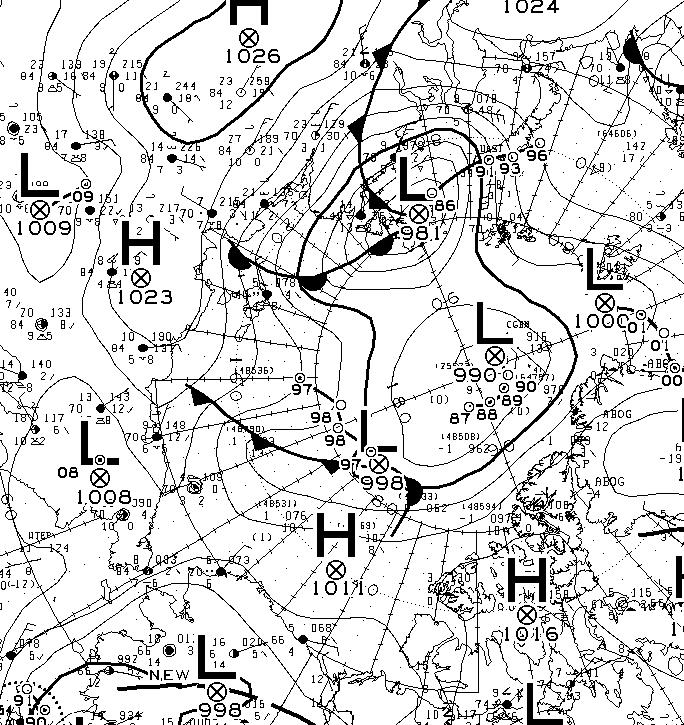
The cyclone is currently centred near Severnaya Zemlya, and the central pressure is down to 981 hPa according to Environment Canada:

Synopsis-20160814-06Z

Northabout is sheltering from the storm.


[Edit – August 15th]

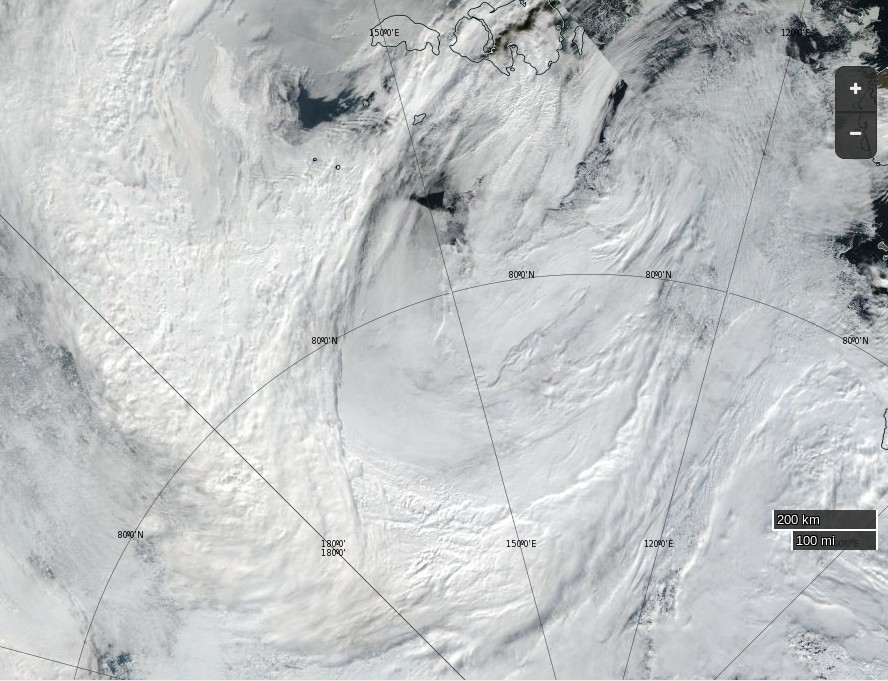
Here’s how the Great Arctic Cyclone of 2016 looks from on high this morning:

NASA Worldview “true-color” image of the 'Great Arctic Cyclone' on August 15th 2016, derived from the VIIRS sensor on the Suomi satellite
NASA Worldview “true-color” image of the ‘Great Arctic Cyclone’ on August 15th 2016, derived from the VIIRS sensor on the Suomi satellite

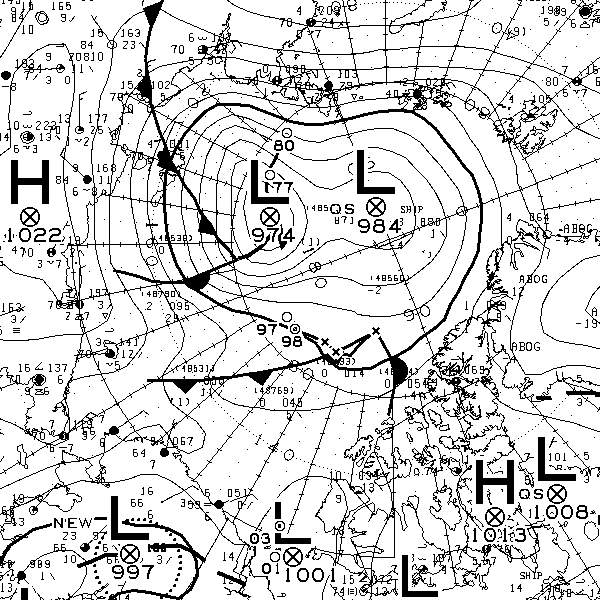
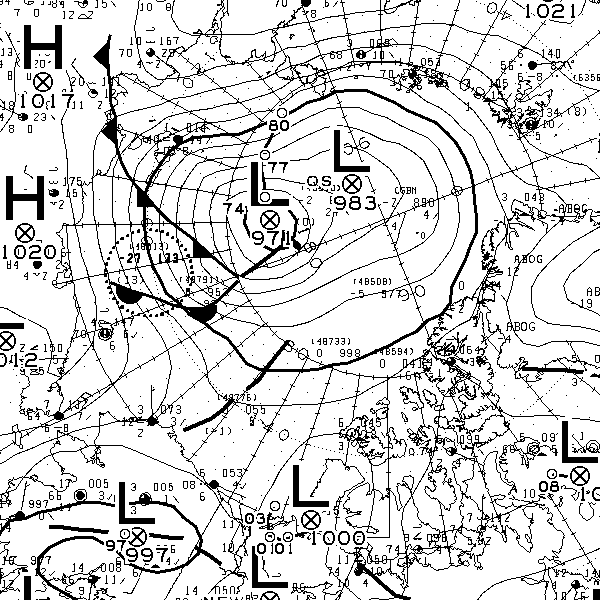
The latest synopsis from Environment Canada shows that the central pressure of the cyclone is now down to 974 hPa:

Synopsis-20160815-00Z

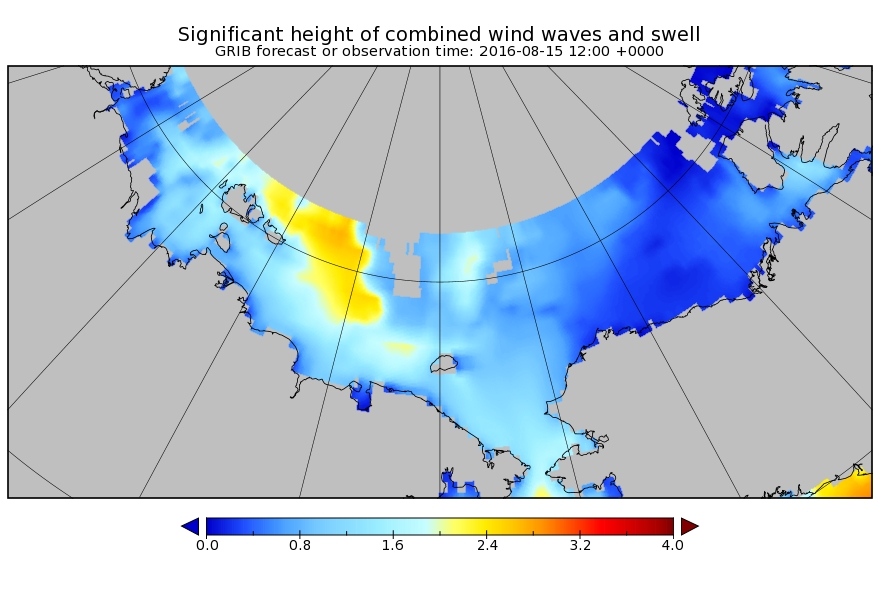
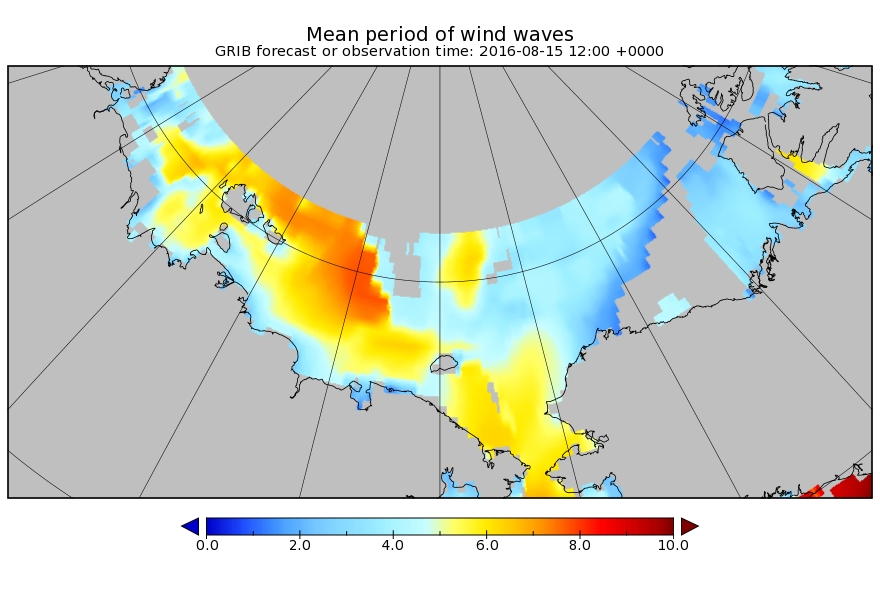
The WaveWatch III forecast for noon today UTC confirms the forecast of two days ago:

Significant_height_of_combined_w in multi_2.glo_30m.20160815_00013

Mean_period_of_wind_waves_surfac in multi_2.glo_30m.20160815_00013

u-component_of_wind_surface in multi_2.glo_30m.20160815_00013

P.S. The Canadian 0600Z synopsis has the cyclone’s SLP down to 971 hPa:

Synopsis-20160815-06Z


[Edit – August 16th]

This morning the cyclone’s SLP is down to 969 hPa:

Synopsis-20160816-00Z

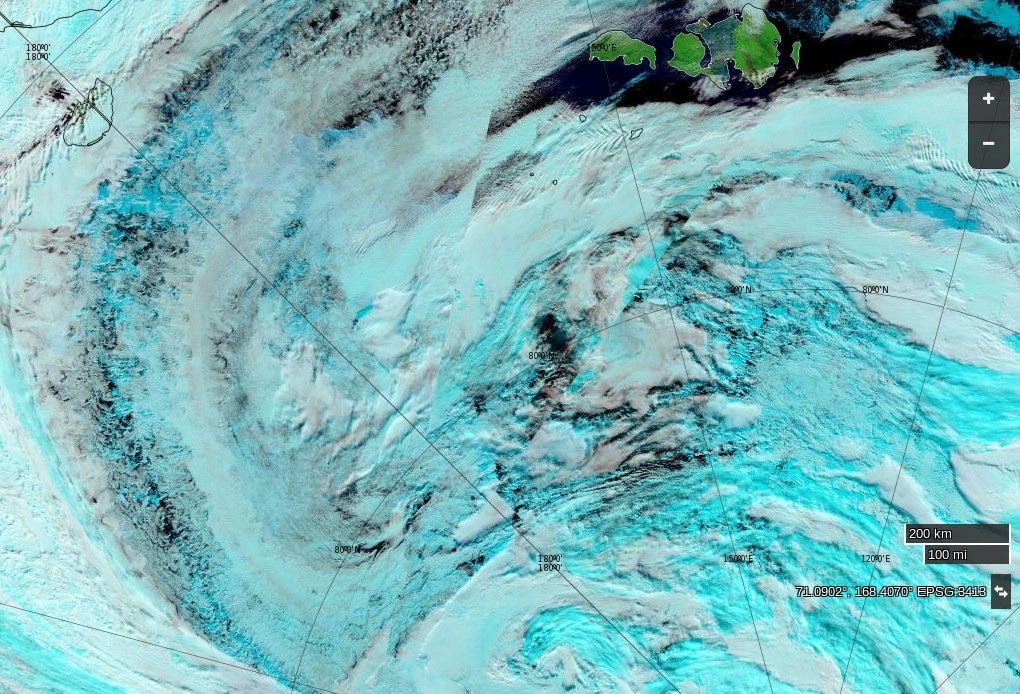
and the clouds over the Central Arctic are parting:

NASA Worldview “false-color” image of the Arctic Basin on August 16th 2016, derived from the MODIS sensor on the Terra satellite

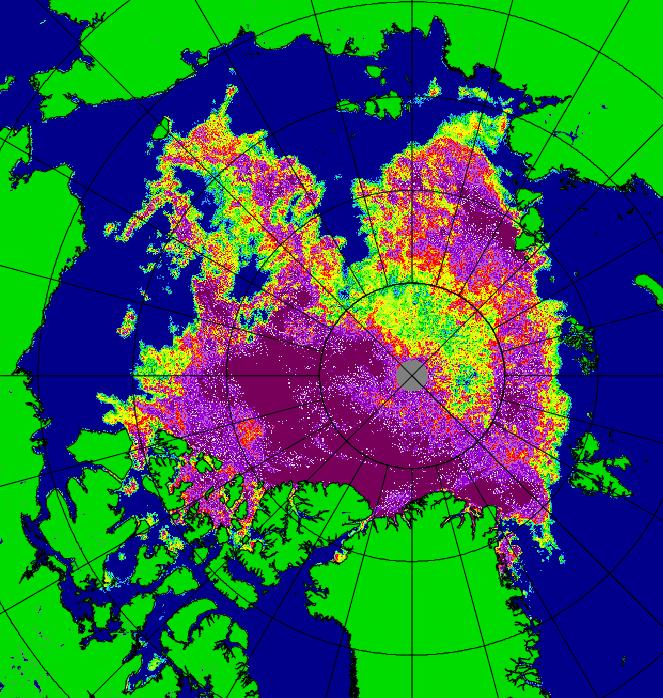
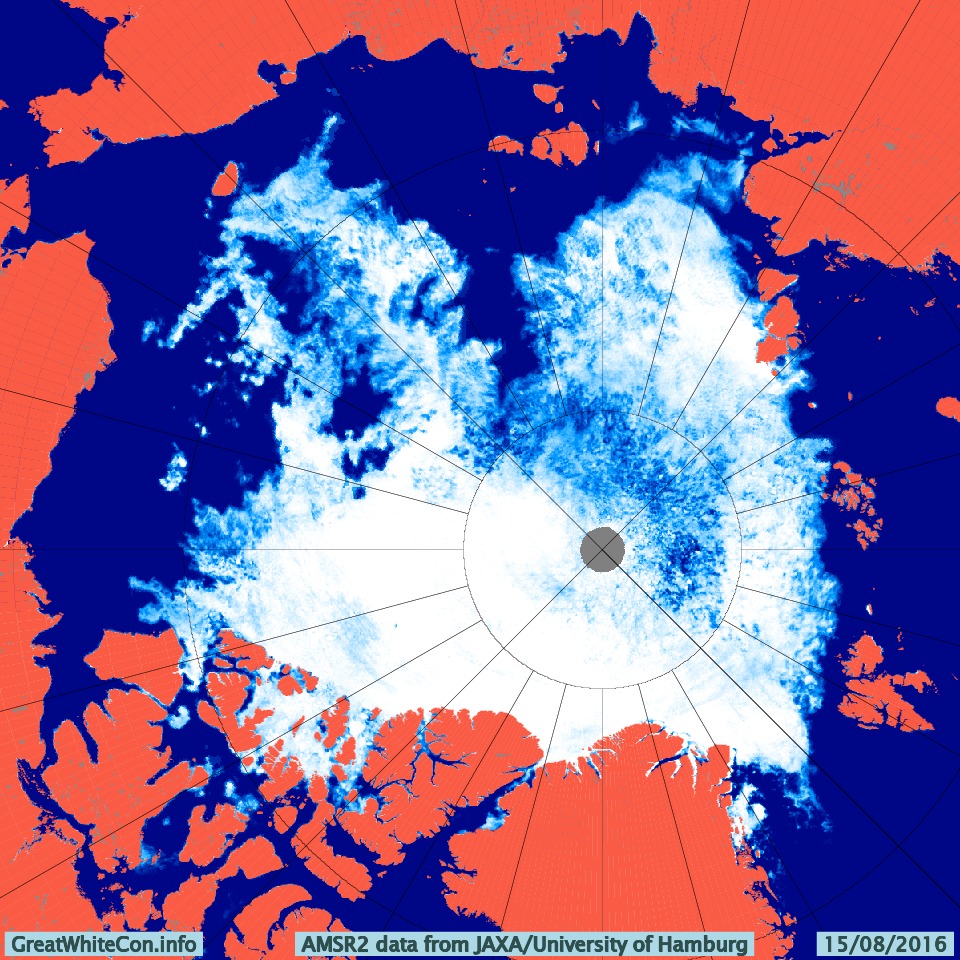
Our favourite method of seeing through the clouds using the AMSR2 maps from the University of Hamburg doesn’t seem to working at the moment, so here’s one from the University of Bremen instead:

asi-AMSR2-n6250-20160815-v5_nic

P.S. The University of Hamburg high resolution AMSR2 maps are up and running again:

Arc_20160815_res3.125


[Edit – August 17th]

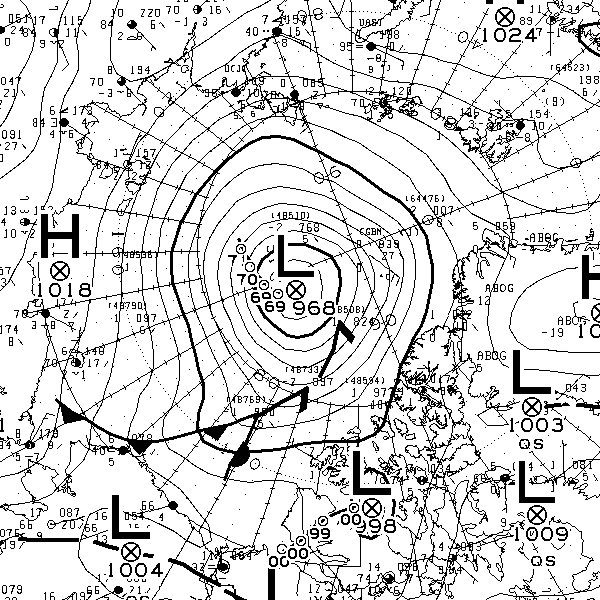
According to Environment Canada the cyclone central pressure bottomed out at 968 hPa yesterday:

Synopsis-20160816-06Z

However, over on Twitter there is this:


[Edit – August 18th]

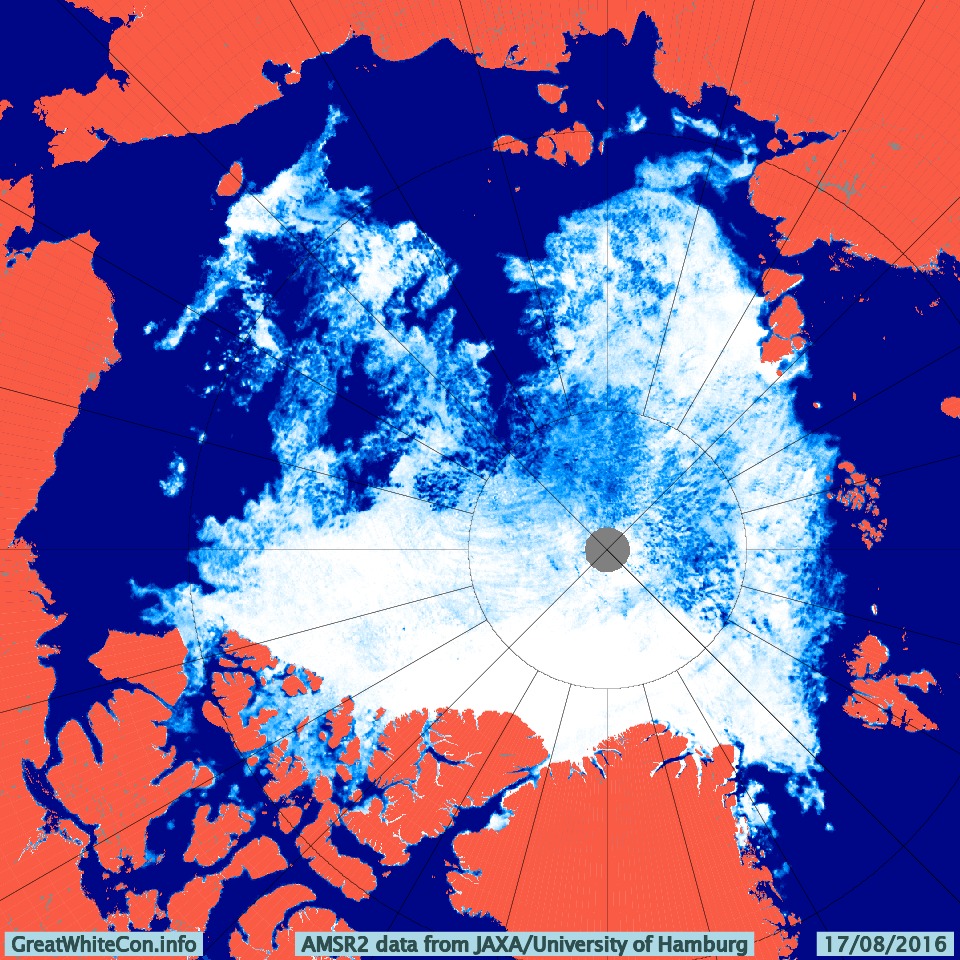
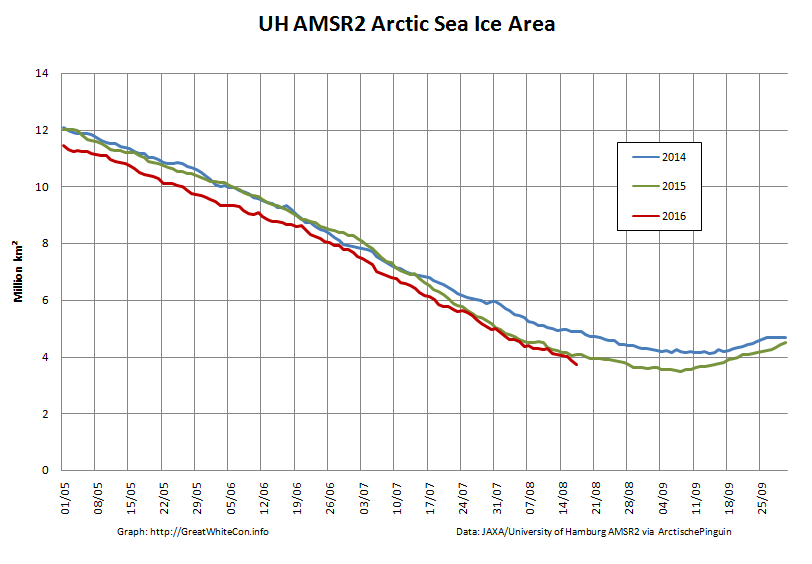
The cyclone central pressure is now up to 983 hPa, and some indications of the effect it has had on the sea ice in the Arctic are being revealed:

Arc_20160817_res3.125

UH-Arctic-Area-2016-08-17


[Edit – August 19th]

According to Environment Canada the cyclone’s central pressure rose to 985 hPa earlier today:

Synopsis-20160819-00Z

However the 987 hPa low near the Canadian Arctic Archipelago is currently forecast to deepen below 980 hPa over the next 24 hours. Here’s the ECMWF forecast for first thing tomorrow morning:

ECMWF-20160719+1d

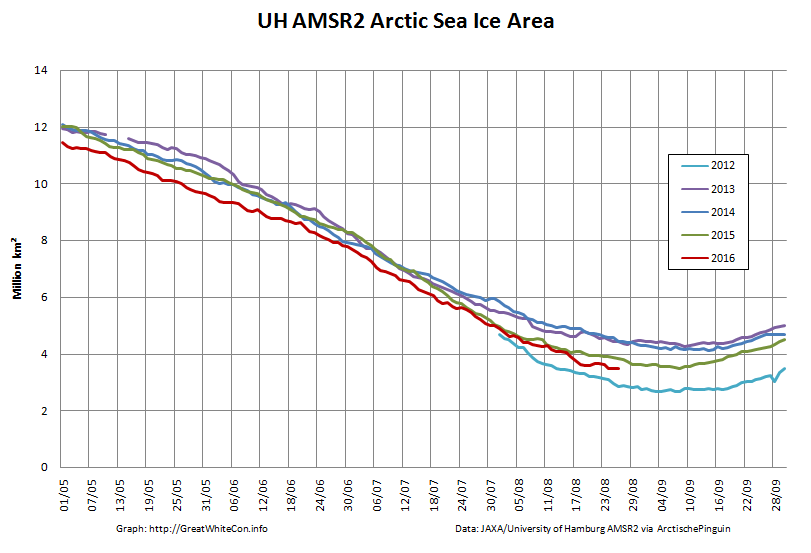
The high resolution AMSR2 Arctic sea ice area has reduced by another 133.5 thousand square kilometers since yesterday. A similar drop tomorrow will take us below the 2015 minimum.


[Edit – August 19th PM]

The MSLP of the rejuvenated cyclone had dropped to 976 hPa by 12:00 UTC today:

Synopsis-20160819-12Z

The ECMWF forecast for lunchtime tomorrow is for something similar:

ECMWF-20160719-12Z+1d


[Edit – August 20th]

The current incarnation of the cyclone bottomed out at 971 hPa near the Canadian Arctic Archipelago:

Synopsis-20160820-00Z

The 72 hour forecast from ECMWF for the next phase of GAC 2016 is beginning to enter the realms of plausibility. Here’s what it reveals:

ECMWF-20160720+3d

“Wipneus” reports on the Arctic Sea Ice Forum that:

BREAKING NEWS: Uni Hamburg is releasing AMSR2 sea ice concentration data from 2012. August 1-13 until now.

so here are the latest high resolution AMSR2 metrics, now with added 2012!
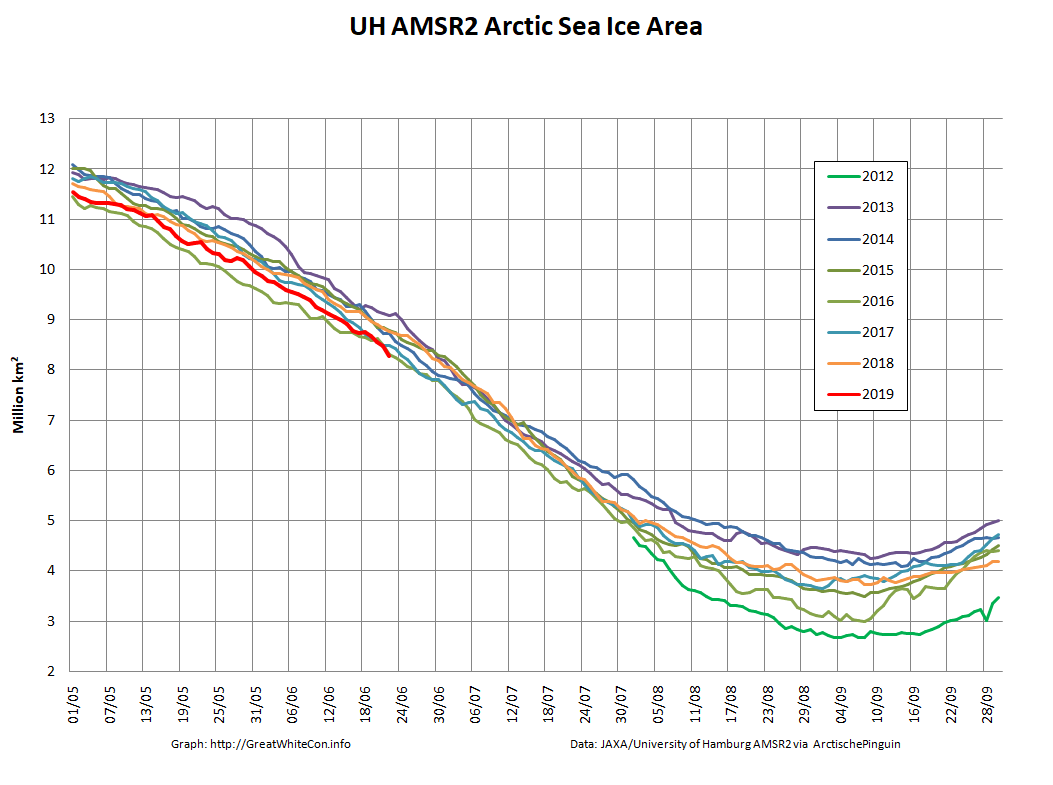
UH-Arctic-Area-2016-08-19

UH-Arctic-Extent-2016-08-19

The effect on area of the Great Arctic Cyclones of 2012 and 2016 is evident, but 2016 extent looks to have a lot of catching up to do.


[Edit – August 22nd]

Phase 3 of GAC 2016 started with 4 lows in a row this morning:

Synopsis-20160822-06Z

which have now resolved into a cyclone with 971 hPa MSLP:

Synopsis-20160822-18Z

Note also the high pressure area over Greenland, and Reggie’s developing dipole. I wonder what tomorrow will bring?


[Edit – August 23rd]

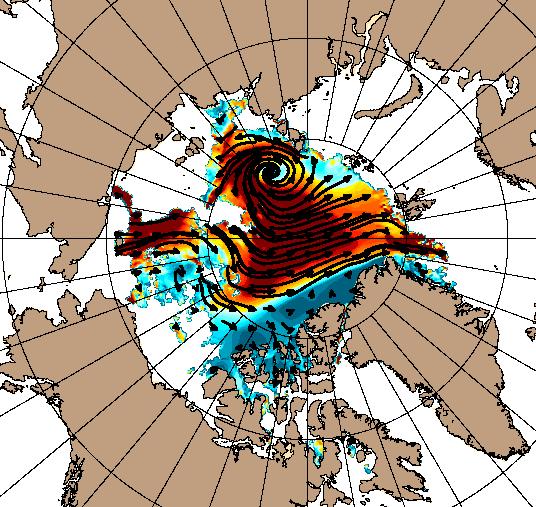
MSLP is down to 970 hPa this morning, and the CAB Low / Greenland High dipole is still evident:

Synopsis-20160823-00Z

Hence the GFS forecast of a “blowtorch” on the Pacific side of the Arctic by the weekend:

CCI-T2-20160823+4d

and the US Navy’s ACNFS ice drift forecast for today:

ACNFS-Drift-2016082118_2016082300

The University of Hamburg have been processing more AMSR2 data from 2012. You can argue until the cows come home about which is the best metric to peruse at this time of year, but try this one for size:

UH-Basin-Area-2016-08-22

That’s the high resolution AMSR2 sea ice area for the Arctic Basin, comprising the CAB plus Beaufort, Chukchi, East Siberian and Laptev Seas.


[Edit – August 25th]

There’s a bit of a gap in the clouds over the Central Arctic today:

NASA Worldview “true-color” image of the Central Arctic Basin on August 25th 2016, derived from the MODIS sensor on the Terra satellite

This is merely the calm before the next storm. Here is the current ECMWF forecast for Saturday lunchtime (UTC):

ECMWF-20160825-12Z+2d

Low pressure on the Siberian side of the Arctic and high pressure on the Canadian side producing an impressive dipole with lots of sea ice “drift” towards the Atlantic:

ACNFS-Drift-2016082518_2016082700


[Edit – August 27th]

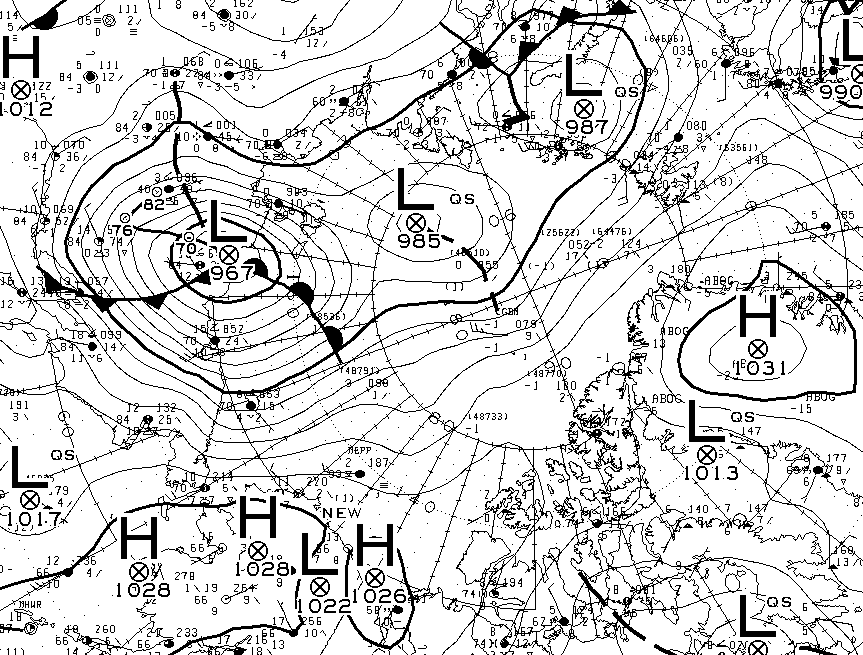
Saturday morning has arrived, and so has the predicted storm. As the centre of the cyclone crossed the coast of the East Siberian Sea its central pressure had fallen to 967 hPa, whilst the high pressure over Alaska had risen to 1028 hPa:

Synopsis-20160827-00Z

The effect of the earlier bursts of high wind is apparent in the high resolution AMSR2 sea ice area graph:

UH-Arctic-Area-2016-08-26

However they are not as apparent in the corresponding extent graph:

UH-Arctic-Extent-2016-08-26


[Edit – August 28th]

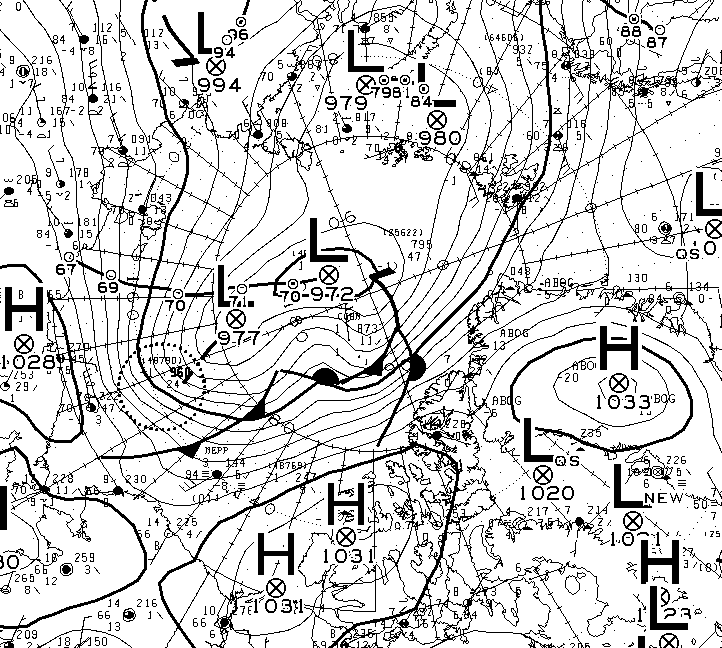
As the centre of the cyclone heads for the North Pole the isobars are tightening across the last refuge of multi-year sea ice north of the Canadian Arctic Archipelago and Greenland:

Synopsis-20160828-06Z

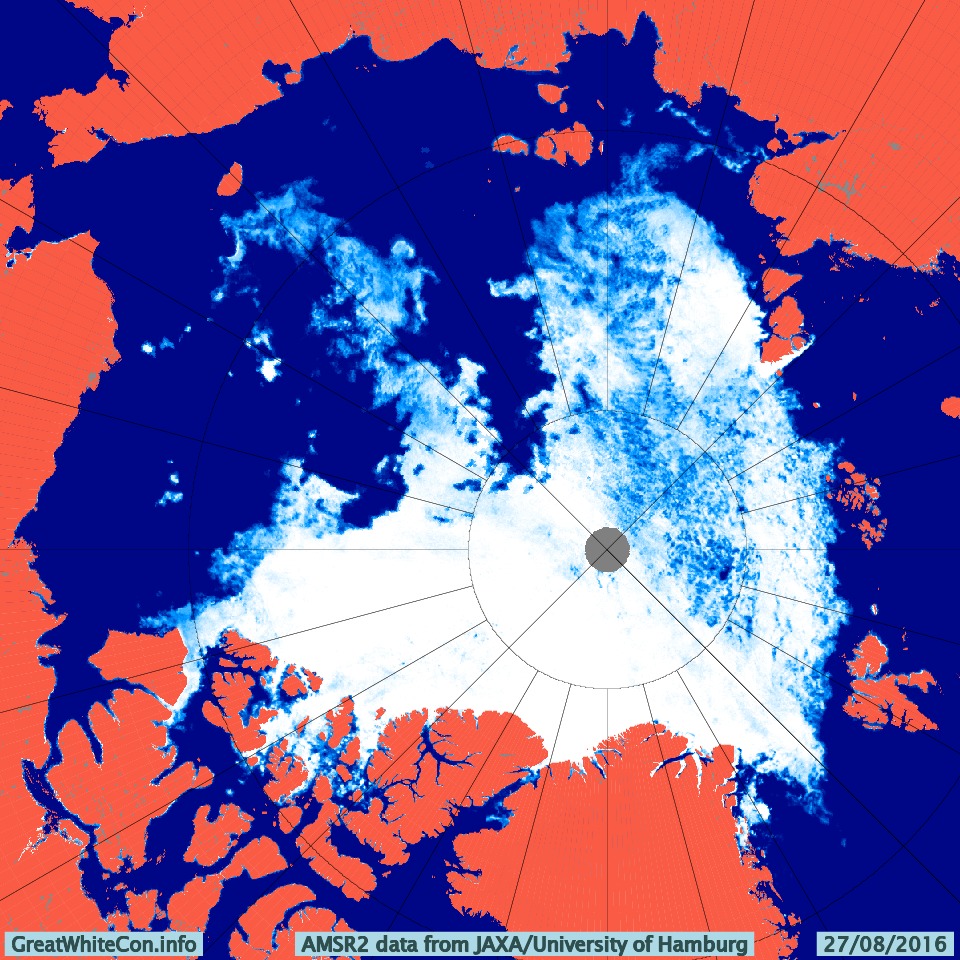
The area north of the East Siberian Sea that was predicted to bear the brunt of the wind and waves overnight is still covered in cloud. However the latest AMSR2 update from the University of Hamburg suggests that open water now stretches as far as 86 degrees north:

Arc_20160827_res3.125

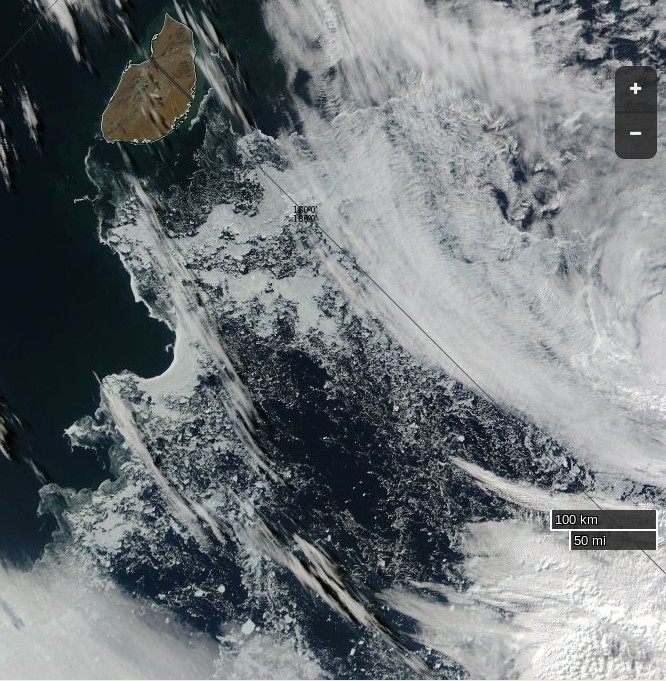
The skies over the northern Chukchi Sea have cleared to reveal this:

NASA Worldview “true-color” image of the northern Chukchi Sea on August 28th 2016, derived from the MODIS sensor on the Aqua satellite


[Edit – August 29th]

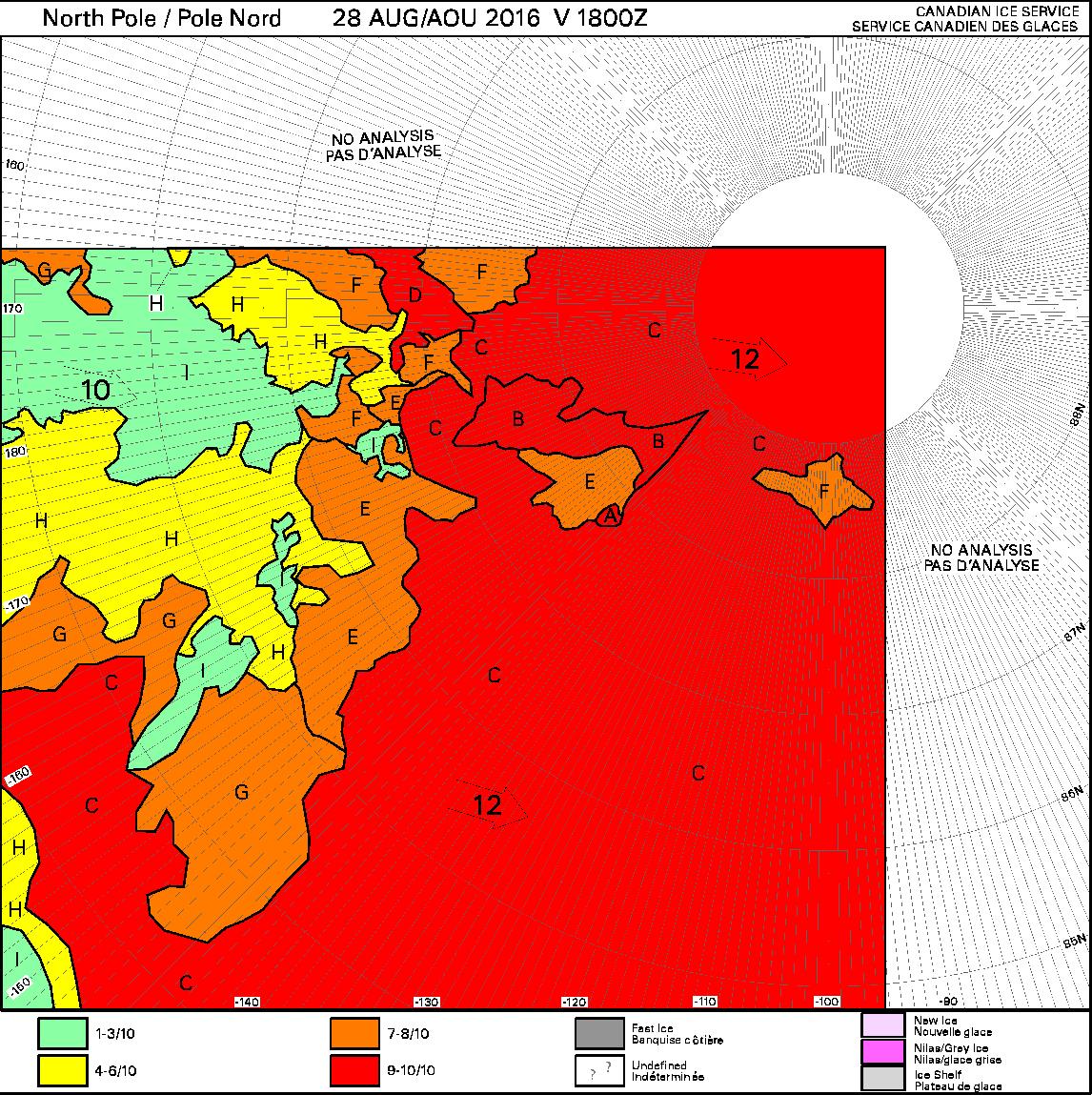
Some of the effects of the recent high winds can be judged by this Canadian Ice Service chart of ice concentration near the North Pole:

Pole_20160828180000


[Edit – September 1st]

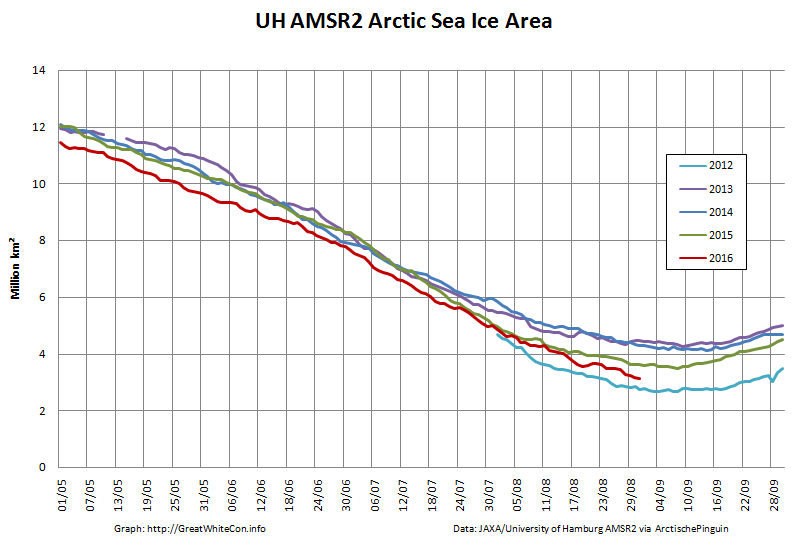
Arctic sea ice area continues to fall quickly for the time of year:

UH-Arctic-Area-2016-08-31

The recent dipole has finally caused some compaction of the scattered sea ice. Hence the high resolution AMSR2 extent is following suit and is now below last year’s minimum:

UH-Arctic-Extent-2016-08-31