Tag Archives: Greenland

Steven Koonin’s Unsettled Greenland Ice Sheet Science

For our latest review of Steven E. Koonin’s new book, “Unsettled”, we’re moving from the ice covering the Arctic seas on to land. Greenland to be specific. Unlike Arctic sea ice the Greenland Ice Sheet does merit a mention in the book. In fact it’s one of the bullet points Steve leads with on page 2:

Here are three more [climate facts] that might surprise you, drawn directly from recent published research or the latest assessments of climate science published by the US government and the UN:

  • Humans have had no detectable impact on hurricanes over the past century.
  • ​Greenland’s ice sheet isn’t shrinking any more rapidly today than it was eighty years ago.
  • The net economic impact of human-induced climate change will be minimal through at least the end of this century.

So what gives?

A very good question Steve, because if we stick with the Arctic land ice referred to in the middle bullet, Professor Koonin makes no reference at this juncture to any “recent published research or latest assessment of climate science” to justify his assertion.

Which is a bit of a shame since in the Climate Feedback critique of Professor Koonin’s statement which was mentioned in our introductory article, Twila Moon from the United States’ National Snow and Ice Data Center points out that:

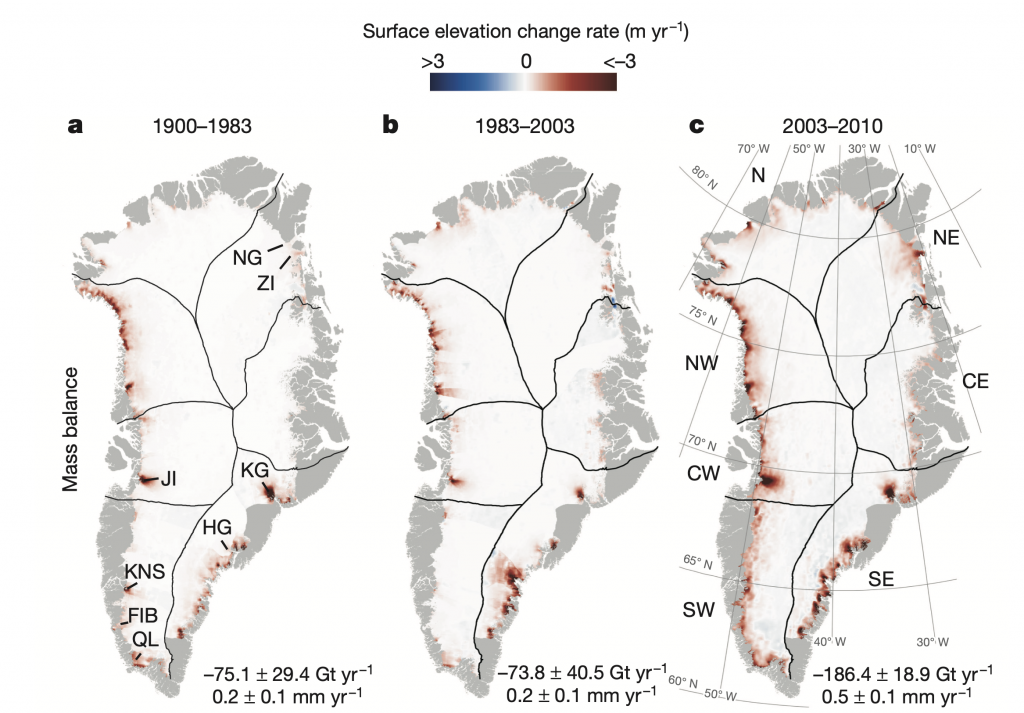
This statement is untrue. In fact, the Greenland Ice Sheet lost more mass during 2003-2010 than during all of 1900-2003 combined. This is evident in the following figure from Kjeldsen et al. (2015)

This image has an empty alt attribute; its file name is Greenland-Kjeldsen-2015-1024x713.png
Surface elevation change rates in Greenland during 1900-1983 (a), 1983-2003 (b), and 2003-2010 (c). The numbers listed below each panel are the integrated Greenland-wide mass balance estimates expressed as gigatonnes per year and as millimetre per year GMSL (global mean sea level) equivalents.

If we look in more detail at changes over 1972-2018, we can further see that the ice sheet was mostly in balance (gain about the same amount of snow/ice in winter as is lost in summer) during the 1970s and 1980s [Mouginot and Rignot et al. (2019)]. It was only in the mid-1990s that Greenland ice loss began to increase more substantially.

Over the last 20 years, ice loss has been rapid and large, creating measurable sea level rise, which we experience as increases in coastal erosion, flooding, problems with water and sewer systems at the coasts, and saltwater inundation of freshwater sources.

So how is it possible for Steve Koonin to have got his facts so wrong? For his attempt at justification we have to wait until chapter 8 of “Unsettled” on the subject of “Sea Level Scares”. On page 160 of my Kindle edition Steve writes:

So future global sea level rise is uncertain not only because of all of the model uncertainties in the global temperature rise discussed in Chapter 4, but also because the dynamics of the Greenland and Antarctic ice sheets are quite uncertain. The IPCC summarizes the situation (SMB is the Surface Mass Balance, measuring the net change in ice due to atmospheric processes): . . .

“For periods prior to 1970, significant discrepancies between climate models and observations arise from the inability of climate models to reproduce some observed regional changes in glacier and GIS [Greenland Ice Sheet] SMB around the southern tip of Greenland. It is not clear whether this bias in climate models is due to the internal variability of the climate system or deficiencies in climate models. For this reason, there is still medium confidence in the ability of climate models to simulate past and future changes in glaciers mass loss and Greenland SMB.”

The reference for this quotation is given as “IPCC SROCC Section 4.2.2.2.6“, which on inspection is entitled “Budget of global mean sea level change”. The immediate question that springs to my mind is “Why didn’t Steve refer to SROCC Section 1.4.2?”. That section is entitled “Observed and Projected Changes in the Cryosphere”, and skipping over the Arctic sea ice section for the moment it states:

AR5 assessed that the annual mean loss from the Greenland ice sheet very likely substantially increased from 34 (-6–74) Gt yr–1 (billion tonnes yr–1) over the period 1992–2001, to 215 (157–274) Gt yr–1 over the period 2002–2011.

Or Steve might have quoted from Section 4.2.2.2.4 “Greenland and Antarctic ice sheets”, but for some reason he didn’t:

Frequent observations of ice sheet mass changes have only been available since the advent of space observations (see Section 3.3.1). In the pre-satellite era, mass balance was geodetically reconstructed only for the GIS (Kjeldsen et al., 2015)

op. cit., or as suggested there he could even have quoted from Section 3.3.1 “Ice Sheet Changes”, but once again he didn’t:

The GIS was close to balance in the early years of the 1990s (Hanna et al., 2013; Khan et al., 2015), the interior above 2000 m altitude gained mass from 1961 to 1990 (Colgan et al., 2015) and both coastal and ice sheet sites experienced an increasing precipitation trend from 1890 to 2012 and 1890 to 2000 respectively (Mernild et al., 2015), but since the early 1990s multiple observations and modelling studies show strong warming and an increase in runoff (very high confidence).

Personally I have very high confidence that Professor Koonin had great difficulty cherry picking a Greenland Ice Sheet quote from the IPCC that could be “spun” into supporting his case. Frankly his “southern tip of Greenland” effort smacks of desperation.

Unsettling, is it not?

[Edit – June 12th]

Here’s a long thread on Twitter from Helen Fricker, explaining the genesis of the IPCC’s Special Report on the Ocean and Cryosphere in a Changing Climate. Essential reading for Steve Koonin, since he is apparently unaware of any of this!

Helen refers to her recent op-ed for The Hill which goes into slightly more detail:

The upcoming sixth IPCC report in 2022 will contain updated projections of future sea level rise based on tens of different simulations provided by research groups around the world. These groups all worked together in a community-led effort, involving ice sheet, ocean and atmosphere modeling and observational teams.

We have come a long way, but even after all this we are still playing “catch-up,” and there are still gaps in our understanding. We do know, however, that the ocean is warming and that both Antarctica and Greenland are vulnerable to this warming. The same goes for the atmosphere. We worry that the biggest portion of Antarctica, East Antarctica — which we still think of as a sleepy giant since it is so thick and vast, making it harder for warming ocean waters and increasing air temperatures to reach it — is starting to show signs of change. We also worry that there may be mechanisms, that we have not been able to witness in the modern record and hence that are not in the models, that may amplify the ice loss. Scientists are using paleo-reconstructions to figure out whether these may be important.

Still, we can say with confidence that sea level will continue to rise (faster) in the future and that our projections are conservative estimates. Indeed, satellite observations that measure the changing height (altimetry) and changing mass (gravimetry) of ice sheets are tracking the worst-case predictions from IPCC’s fifth report.

As we gather more data, both on and around the ice sheets using all available tools, including satellites, our observational record gets longer and our understanding improves. As our understanding improves, our models get better. Long-term measurements, sometimes acquired by launching new satellites (such as NASA’s ICESat-2 and other follow-on missions), coordinated modeling and international collaboration are key to delivering more accurate predictions, so that coastal communities can make informed decisions to protect infrastructure and citizens and manage resources.

Koonin’s Unsettled Science – The Movie(s)

We have previously mentioned the Wall Street Journal’s assorted activities promoting the new book by Steven E. Koonin which possesses the rather long winded title of “Unsettled: What Climate Science Tells Us, What It Doesn’t, and Why It Matters.”

We further speculated that assorted things that climate science tells us which Dr. Koonin neglected to mention in his book would also not appear in moving pictures expounding his “message”. That has indeed proved to be the case. You can see a copy of the book in question handily placed on a bookshelf behind Steve Koonin in this interview with Paul Gigot for the Wall Street Journal:

By way of introduction Paul enquires:

What isn’t settled in your mind?

Steve responds:

What isn’t settled is how the climate is going to respond to growing human influences, and how that response will affect society and ecosystems.

A little later Paul asserts that:

There’s no question that fossil fuel extraction and burning adds carbon dioxide and methane and other things into the atmosphere. Is the issue just how the interactions work and how much warming they will cause? I mean Al Gore keeps telling us for example that if you look at the graph of CO2 emissions it’s going up, therefore there’s a direct correlation between that and temperature. I think you’re saying “that’s not true”?

to which Steve responds:

That’s not true! For example, when you look at the record global temperature went down between 1940 and 1970 even as greenhouse gases increased. That’s got to tell you immediately that things are a little more complicated than just greenhouse gases are warming the Earth.

So there you have it. Al Gore is a mere straw man, easily knocked down with a cherry pick without even bothering to mention any of the underlying science.

Paul moves on to mention in passing our favourite topic here at the Great White Con:

Now what about the idea that if we continue to warm you’re seeing all these consequence in terms of much more severe weather events, you’re seeing rising oceans, you’re seeing the melting of the polar ice caps. All of that sort of blends together into a kind of disastrous scenario. Are you saying that those are also just simply exaggerated?

Steve responds eagerly:

Yes they are! And let me give you some factoids.

Unsettlingly none of the factoids he gives us mention Arctic sea ice, a topic which Professor Koonin appears to be strangely ignorant of. Perhaps that’s because whichever way you try to slice and dice it that’s still the ultimately unavoidable giant canary in the climate coal mine?

[Edit – May 11th]

Needless to say Steve Koonin has also been interviewed by Tucker Carlson for Fox News. Needless to say the clip once again opens with a speech by that well known climate scientist, Joe Biden. Needless to say there is no mention of the giant canary in the Arctic coal mine once again. Tucker makes no reference to Greenland either, which does at least merit a mention in Steve’s book. Take a look:

Tucker opens his questioning with:

A hurricane will arise out of the Caribbean. We’ll have a heat wave. We’ll have a cold snap. All of them are attributed reflexively to climate change. How certain can we be that climate change causes those events?

Steve responds:

When you read the official reports from the UN and the US Government you find some surprises. For example, even though the globe has warmed by about 2 degrees Fahrenheit over the last century the incidence of heat waves across the 48 states is no greater than it was in 1900, and the highest temperatures haven’t gone up in 60 years.

We have been able to find no detectable influence on hurricanes from humans, and the models that we use to predict future climates have become more uncertain even as they’ve become more sophisticated. All of these things suggest that people who say that “we’ve broken the climate” and face certain doom unless we take drastic action are just misinformed about what the official reports actually say.

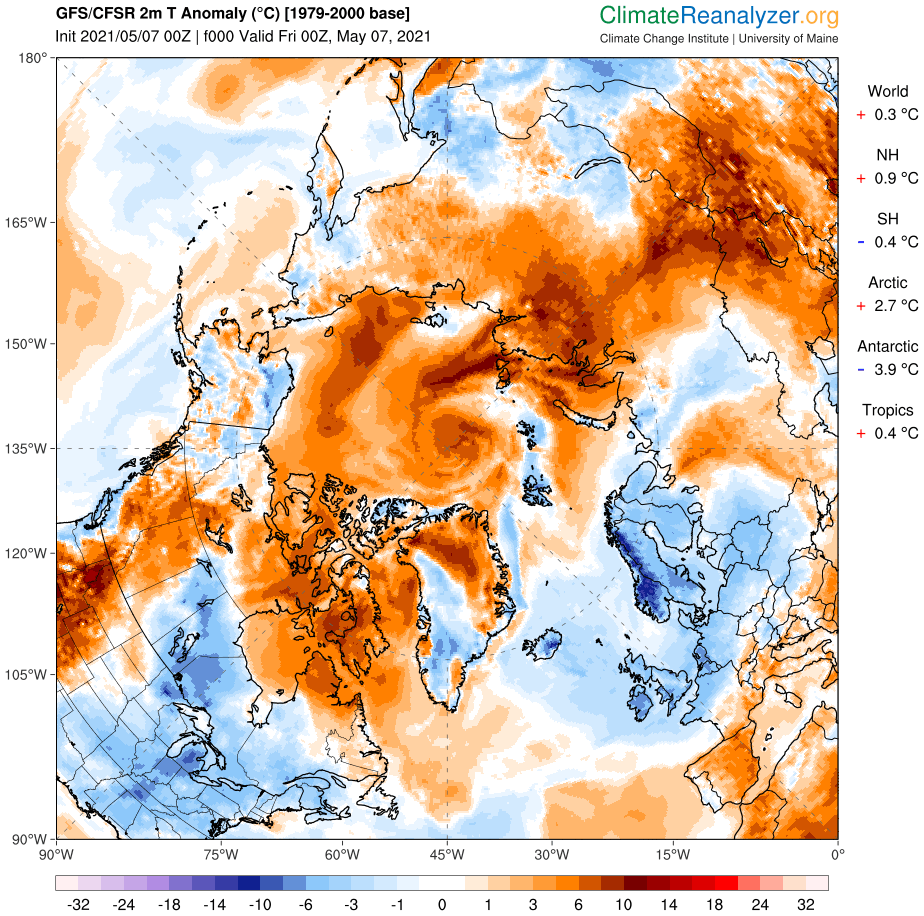
Despite the fact that Fox display some stock footage of sea ice during the interview, Tucker and Steve seem strangely unaware that those 48 states do not constitute the entire globe, or that there was a 2.7 degrees Celsius “heat wave” in the Arctic even as the interview was being conducted:

A little later in the interview Steve says:

We need to have an accurate portrayal of what we know and what we don’t know, and then we can have the debate about what to do about it, without using science as a weapon.

Sadly Steve seems strangely unaware that evidently you’re not going to get the accurate portrayal he recommends via Fox News!

[Edit – May 14th]

Steven Koonin has also been interviewed on CNBC’s Squawk Box, where Joe Kernen’s introduction gives you a strong flavour of what’s to come:

Corporations are spending billions to reduce their so called carbon footprint. President Biden’s infrastructure plan is loaded with subsidies for green industries. In fact if the new green deal ever was passed it wouldn’t be billions, it would be trillions.

Our next guest questions the conventional wisdom on climate science and it’s impact on business and the US economy. Steven Koonin served as the chief scientist in the Obama energy department, and is currently a professor at NYU and the author of “Unsettled: What Climate Science Tells Us, What It Doesn’t, and Why It Matters” :

Steve begins by assuring Joe’s audience that:

Everything I’ve written in this book comes almost directly from the official UN and US Government assessment reports, so this is not Steve talking really, but it is the consensus science.

For some strange reason Steve neglected to include the phrase “ignored and/or cherry picked” in front of “official UN and US Government assessment reports”. He then spouts his by now familiar schtick about “heatwaves in the US”, “hurricanes” and “global wildfires”. Joe then moves the conversation on to the economy:

Will there be an unnecessary negative effect on GDP, on corporations, if they pursue this when it’s not really necessary?

To which Dr. Koonin, as Joe calls him, responds:

I like to say you change the energy system by orthodonture rather than tooth extraction. And so if we do want to reduce carbon emissions we need to do it at a more thoughtful pace and in a more thoughtful way than is being proposed, and moreover we need to get the rest of the world to come along with us if it’s going to have any impact at all…

As [John] Kerry has said, unless the rest of the world comes along US efforts are futile.

So yet again no mention of the IPCC’s “consensus science” regarding Arctic sea ice or even the Greenland Ice Sheet. I cannot help but wonder where Steve’s talking head will appear next on United States’ viewers screens, but on past performance it seems unlikely that the cryosphere will merit a mention.

Watch this space!

The 2021 Maximum Arctic Sea Ice Volume

If the 2021 maximum Arctic sea ice extent is more your thing then please see the previous article:

The 2021 Maximum Arctic Sea Ice Extent

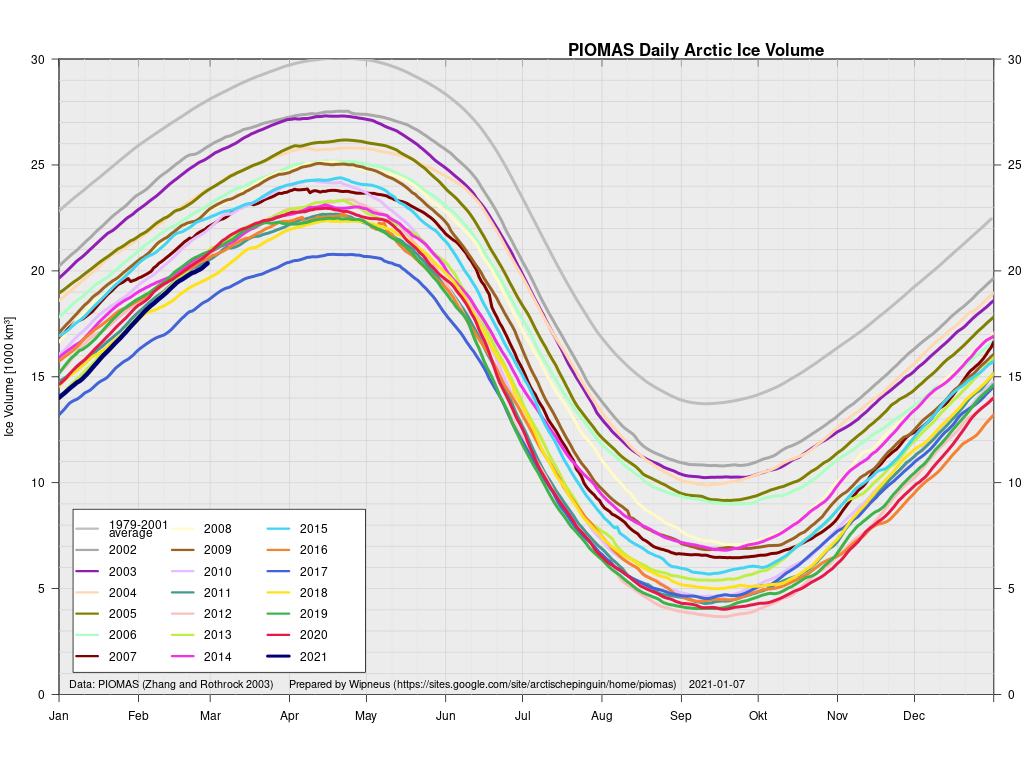
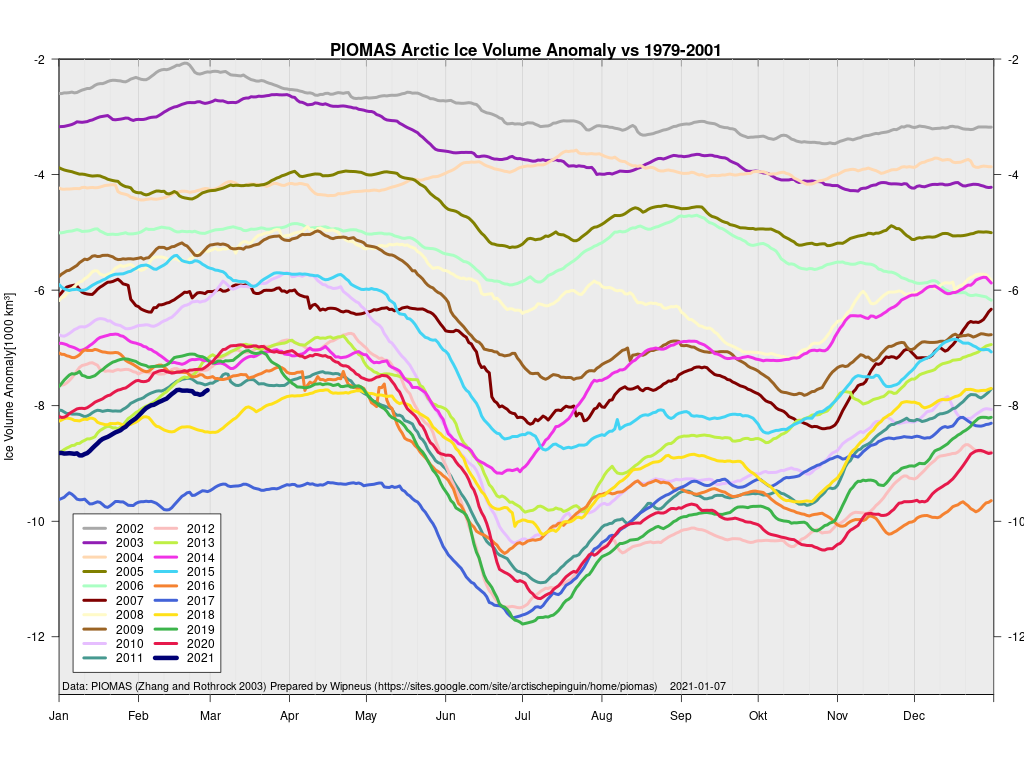
Maximum volume is still several weeks away, but let’s first of all take a look at the PIOMAS modelled volume numbers for February. They are not yet available via the University of Washington’s Polar Science Center web site, but Wipneus has once again crunched the gridded thickness numbers which are already available. Here is what they reveal:

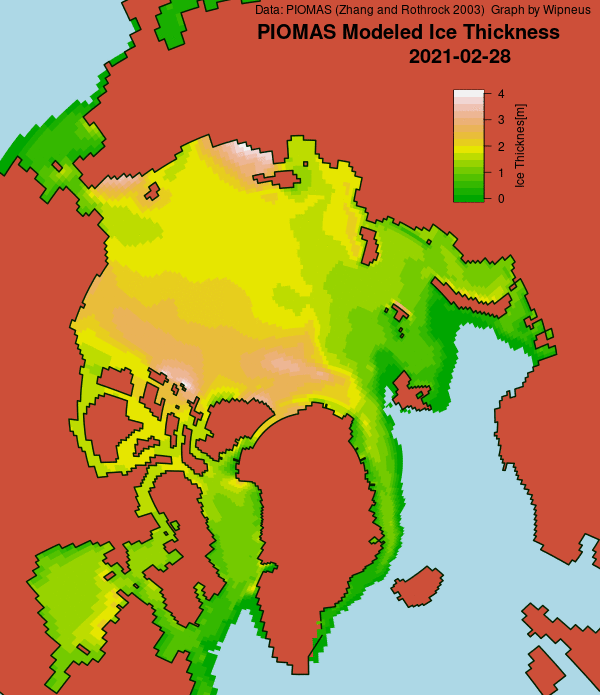
As you can see, it will be a big surprise if the 2021 volume maximum occurs in March rather than April, and 2021 is currently 3rd lowest for the date, behind 2017 and 2018. For completeness here too is the PIOMAS thickness map for the end of February:

This does contain some surprises, such as an area of thick ice along the shore of the East Siberian Sea, but no such thing along the north coast of Greenland, the traditional bastion of “the thickest ice in the Arctic Ocean”.

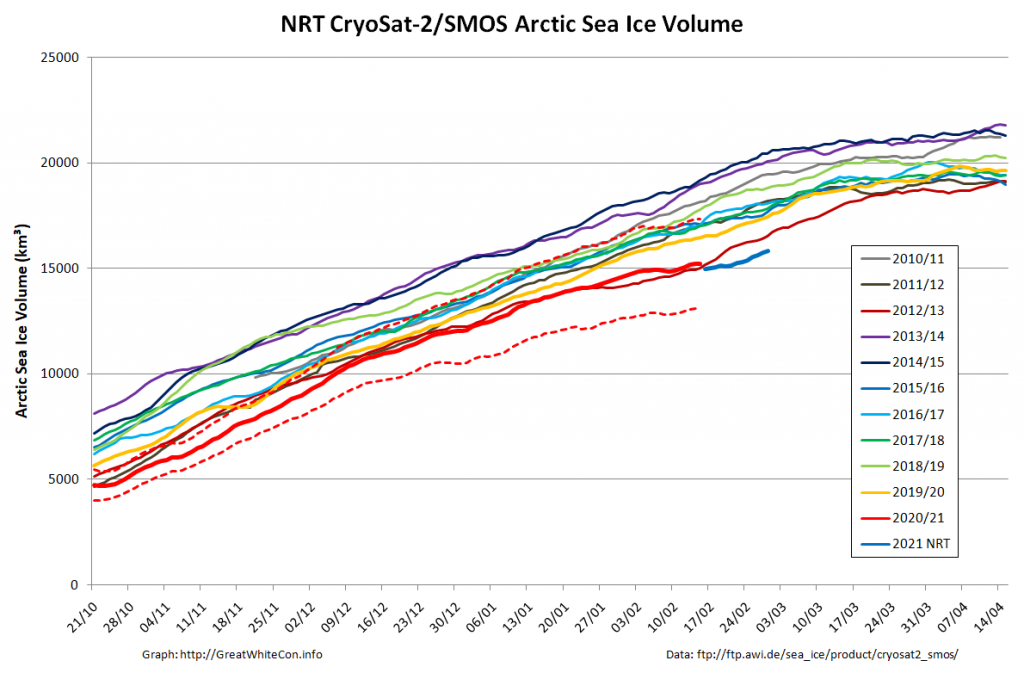
The “measured” Arctic sea ice volume calculated from CryoSat-2 and SMOS thickness data has also updated to February 28th:

Note that the “near real time” figures graphed in blue will almost certainly be revised upwards when the “reanalysed” data is released in a couple of weeks. Equally certainly they will be “lowest for the date” in the 11 year record.

Here also is the CS2/SMOS thickness map for February 28th for comparison purposes:

Continue reading The 2021 Maximum Arctic Sea Ice Volume

The 2019 Arctic Sea Ice Metric Minima

September is here once again, so the assorted minima of a variety of Arctic sea ice metrics will be reached soon, if they haven’t happened already!

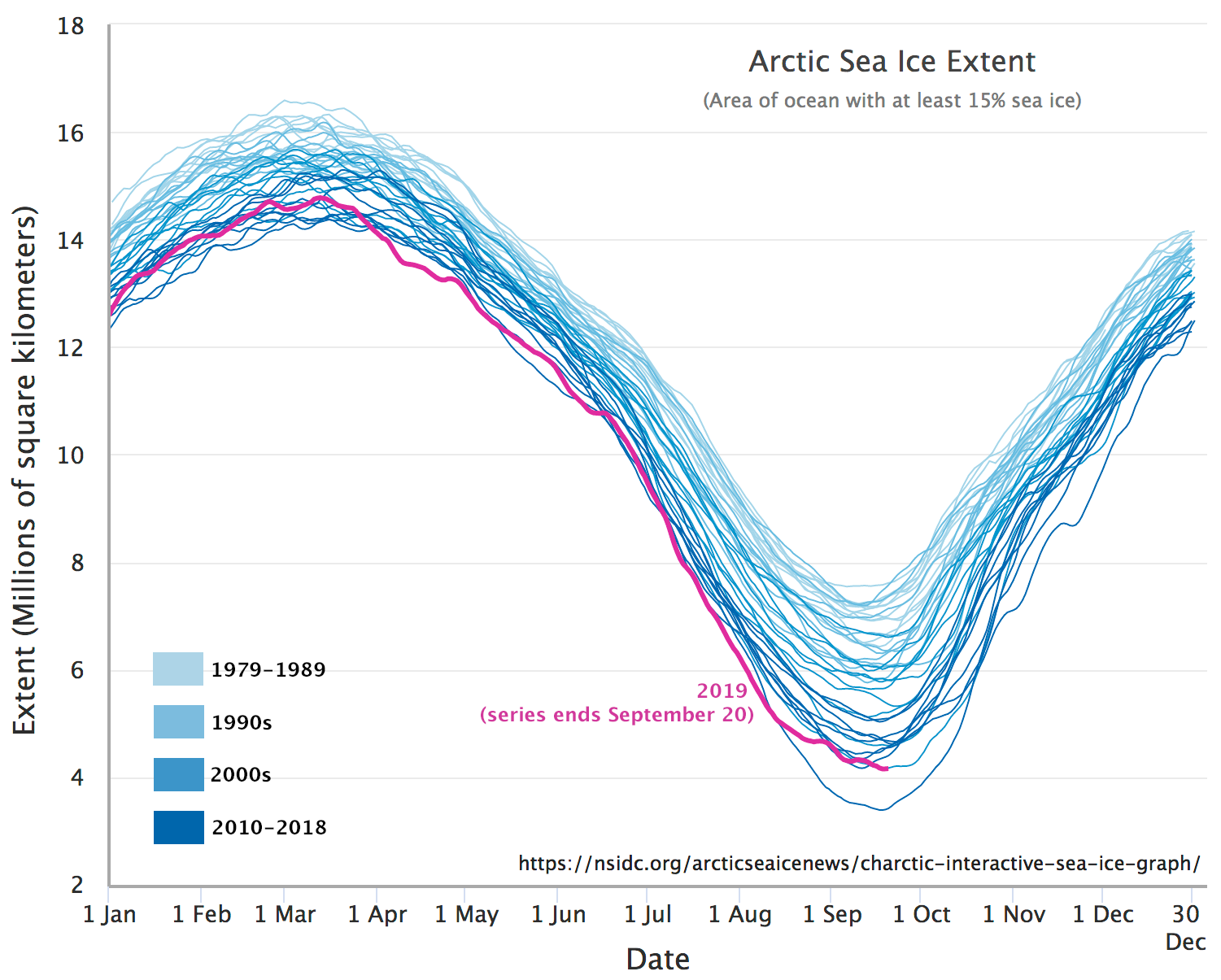
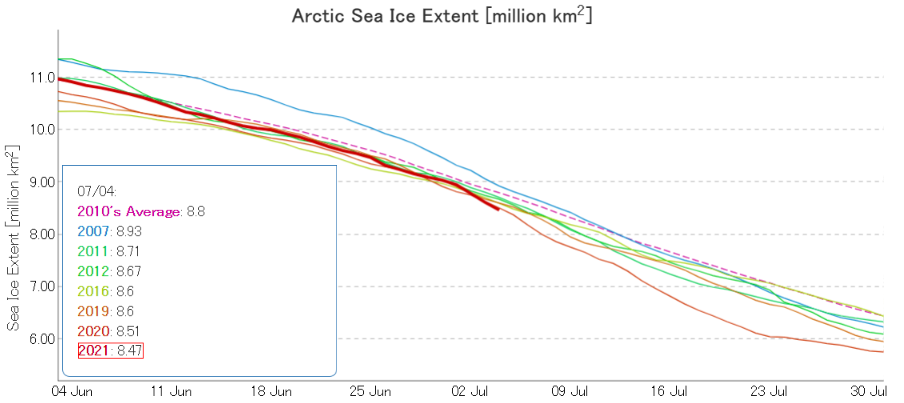
In the latter category let’s first take a look at the NSIDC’s 5 day averaged SSMIS based Arctic sea ice extent:
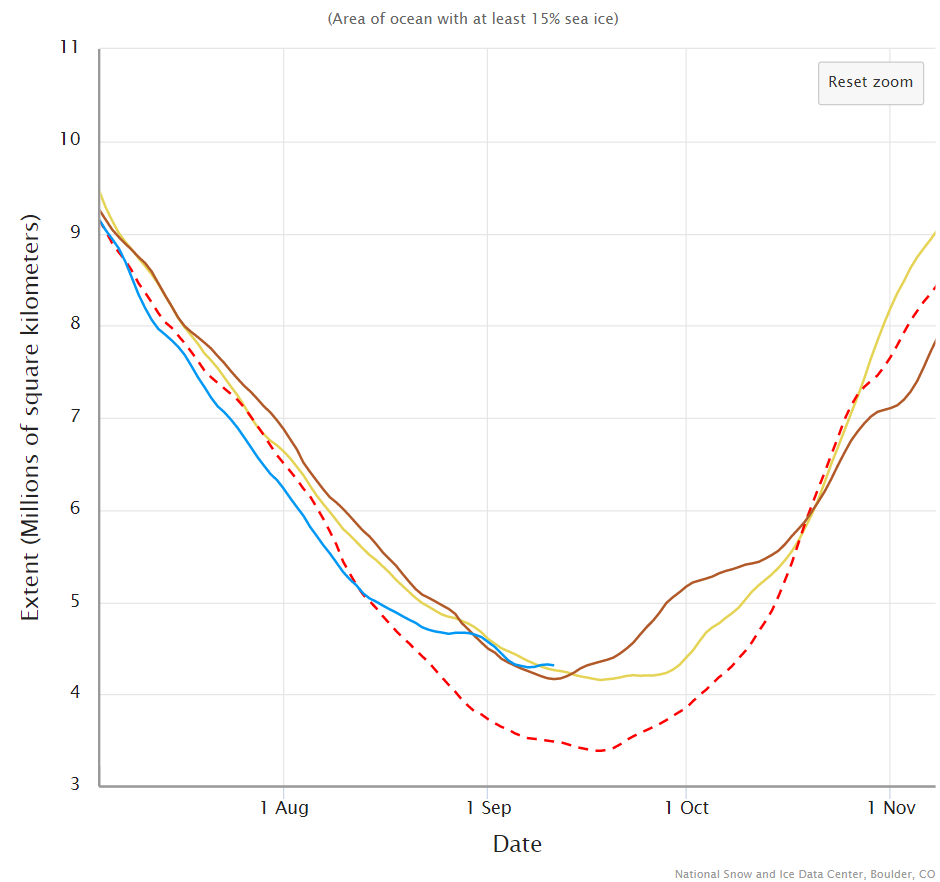
It looks entirely feasible that the current minimum of  4.29 million square kilometres on September 7th will hold for the rest of the calendar year. The daily NSIDC number is currently 4.24 million km² on September 4th.

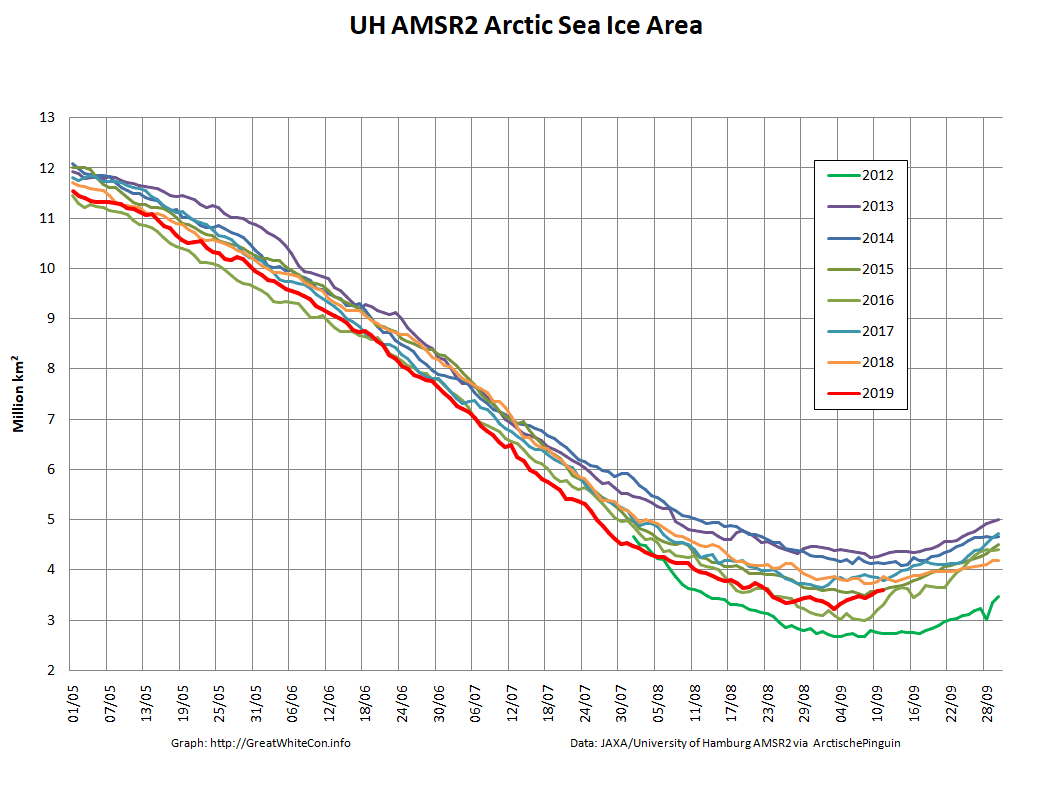
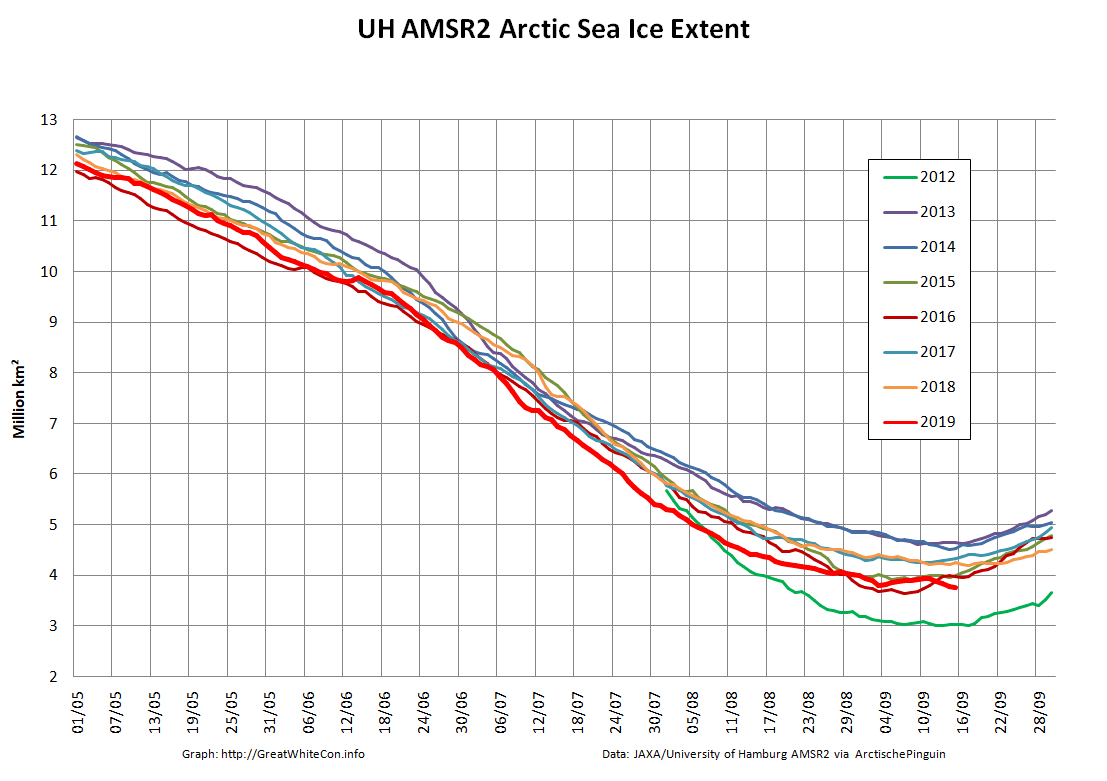
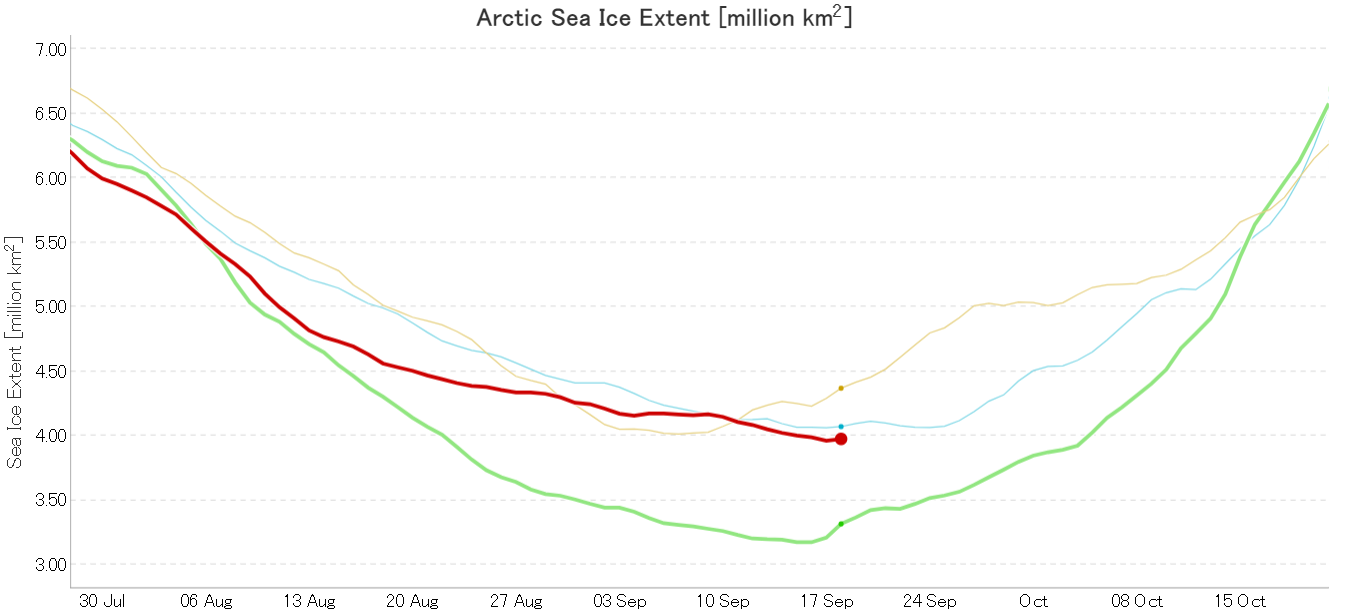
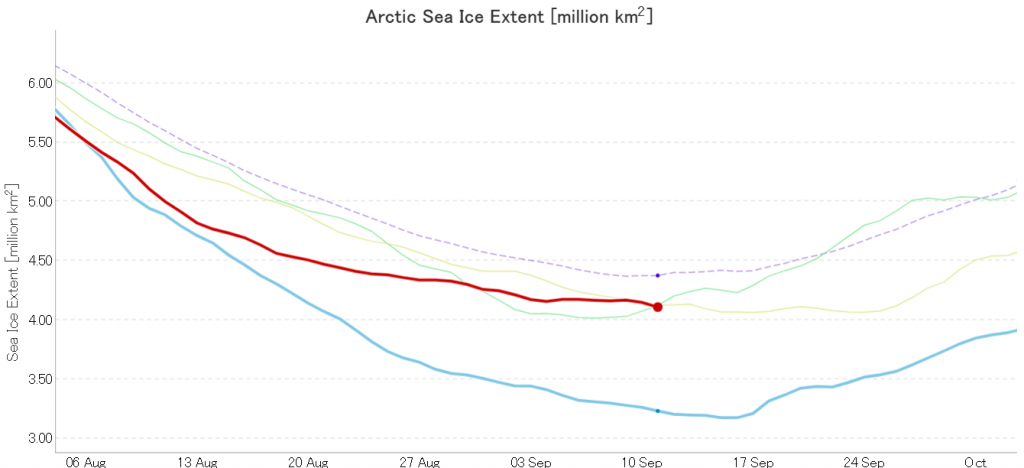
By way of contrast the JAXA/ViSHOP AMSR2 based extent hit a new low of  4.11 million  km² yesterday:
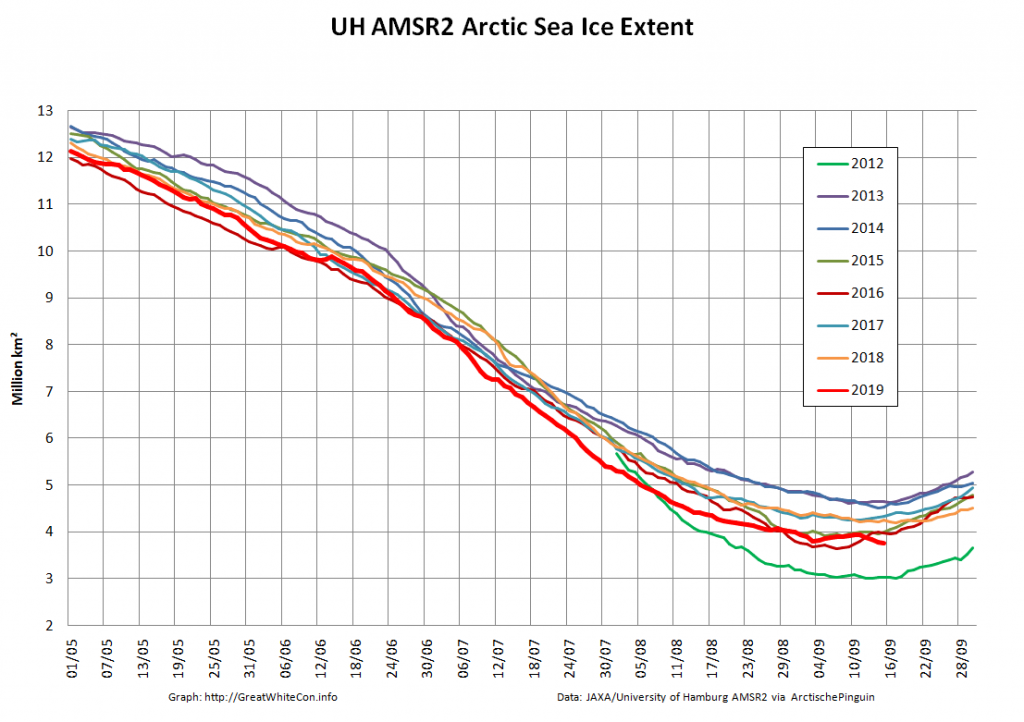
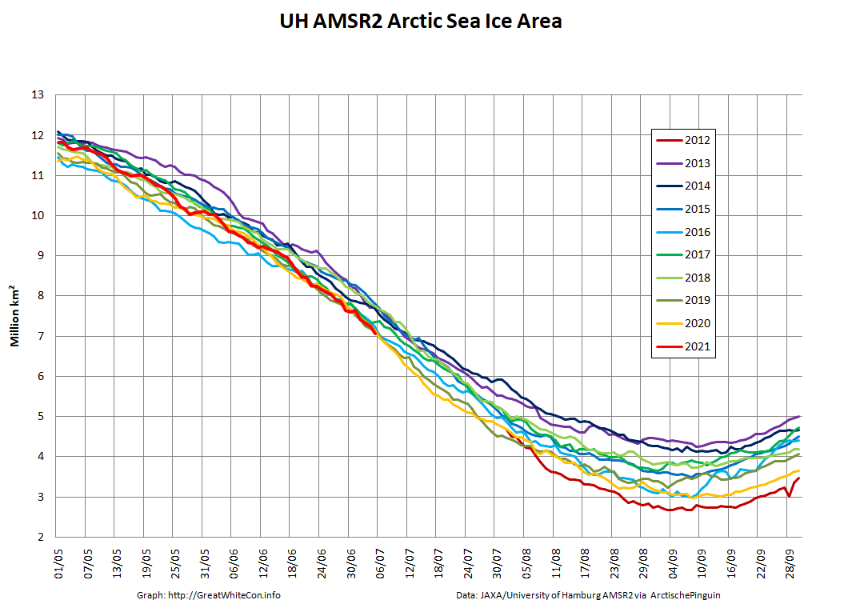
And what of our much beloved high resolution AMSR2 metrics derived by “Wipneus” from the University of Hamburg’s AMSR2 concentration data? Area certainly looks to be past the minimum for this year, whereas extent is still conceivably capable of another push lower:
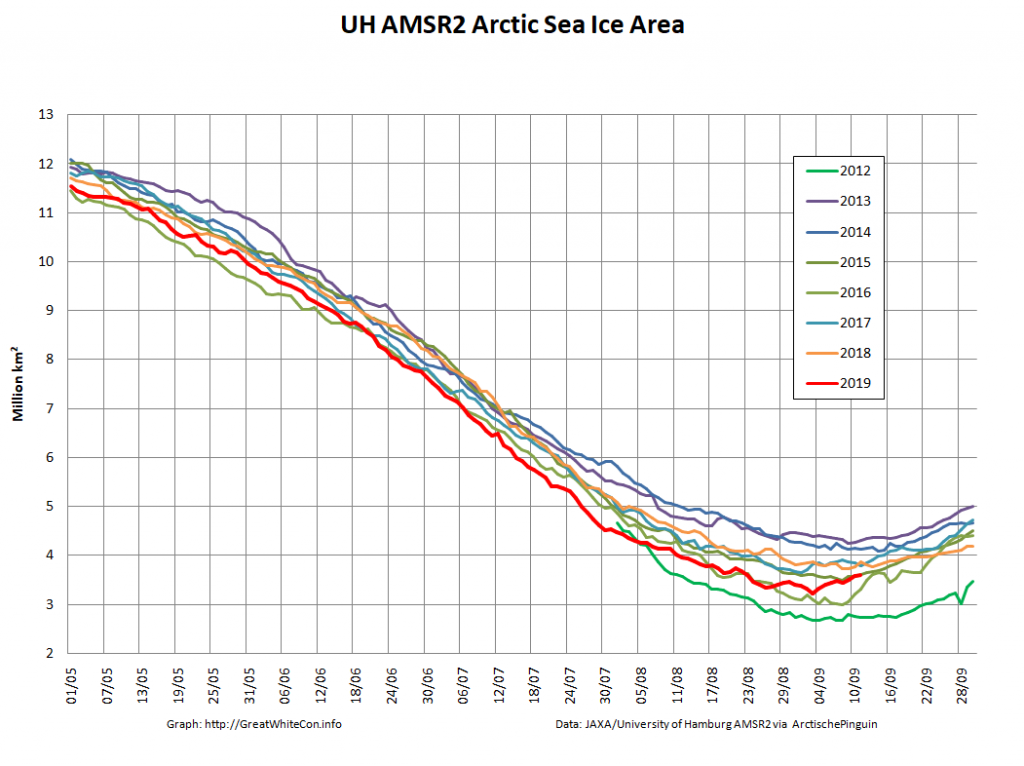
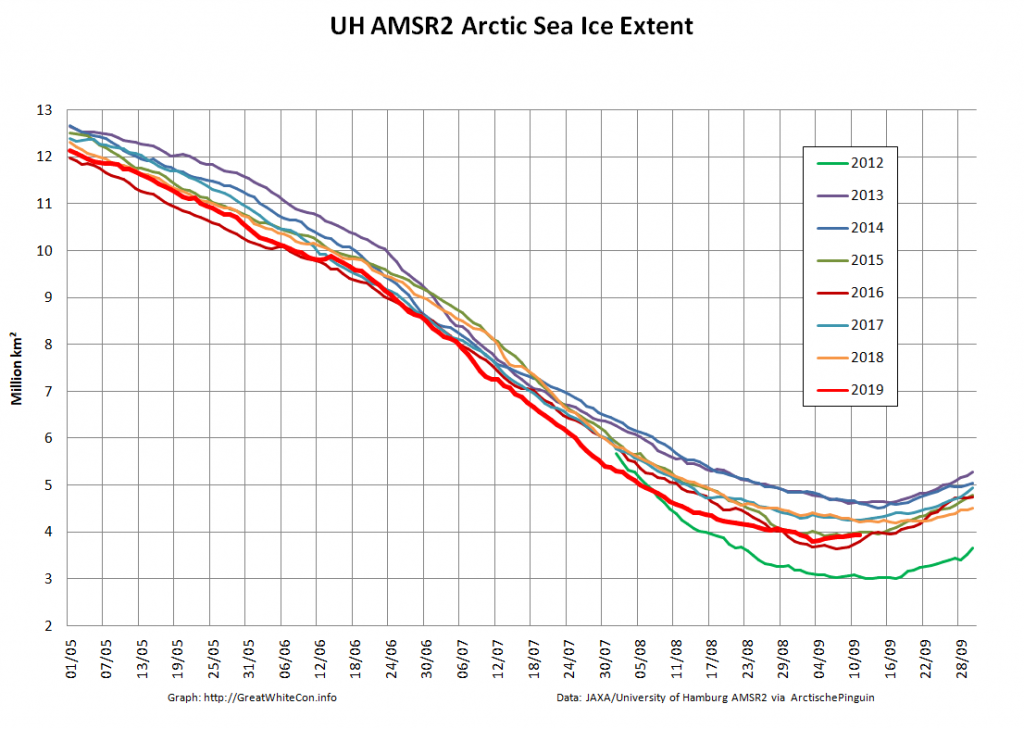
The provisional minimum extent for 2019 is 3.80 million km² on September 3rd.

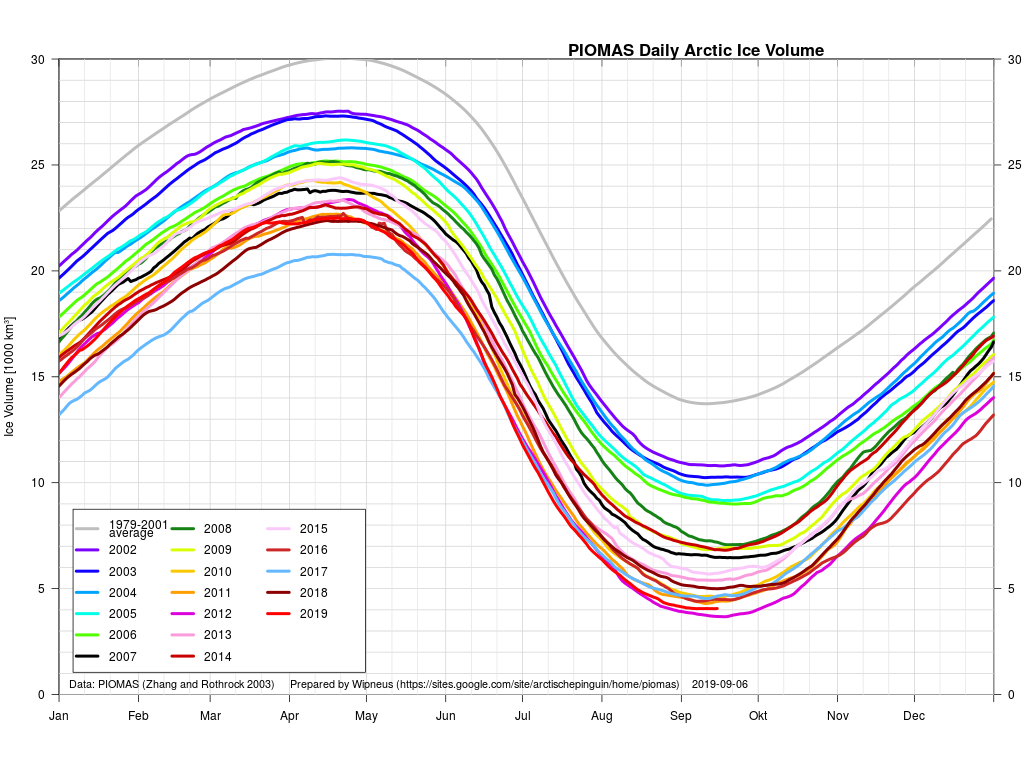
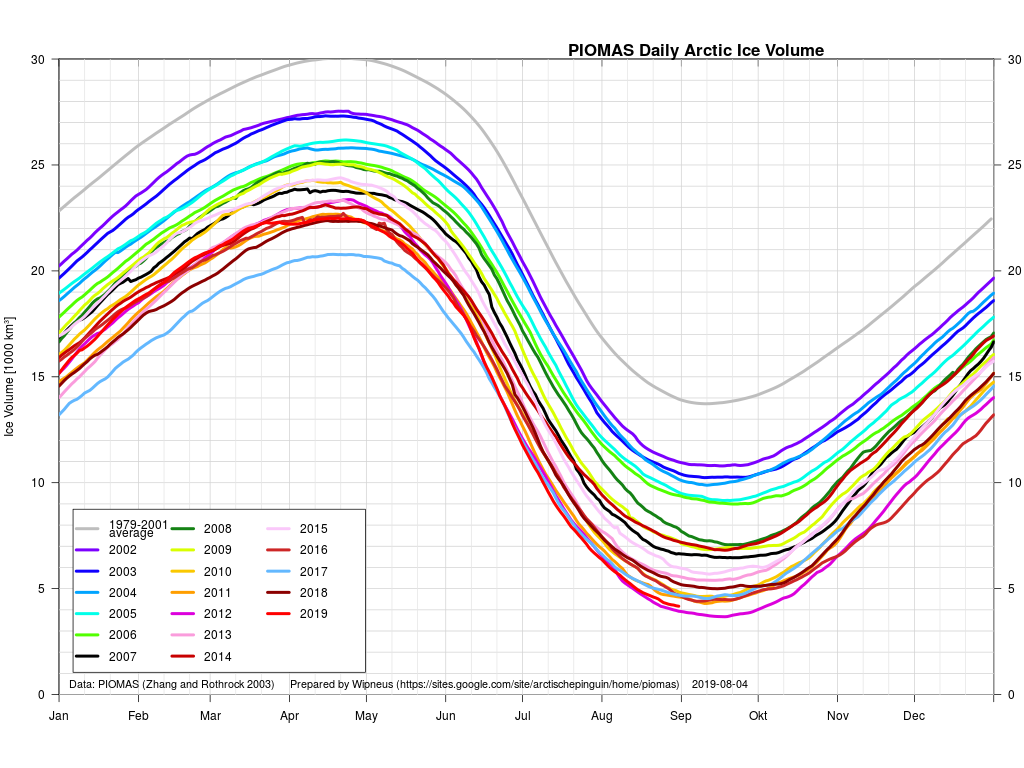
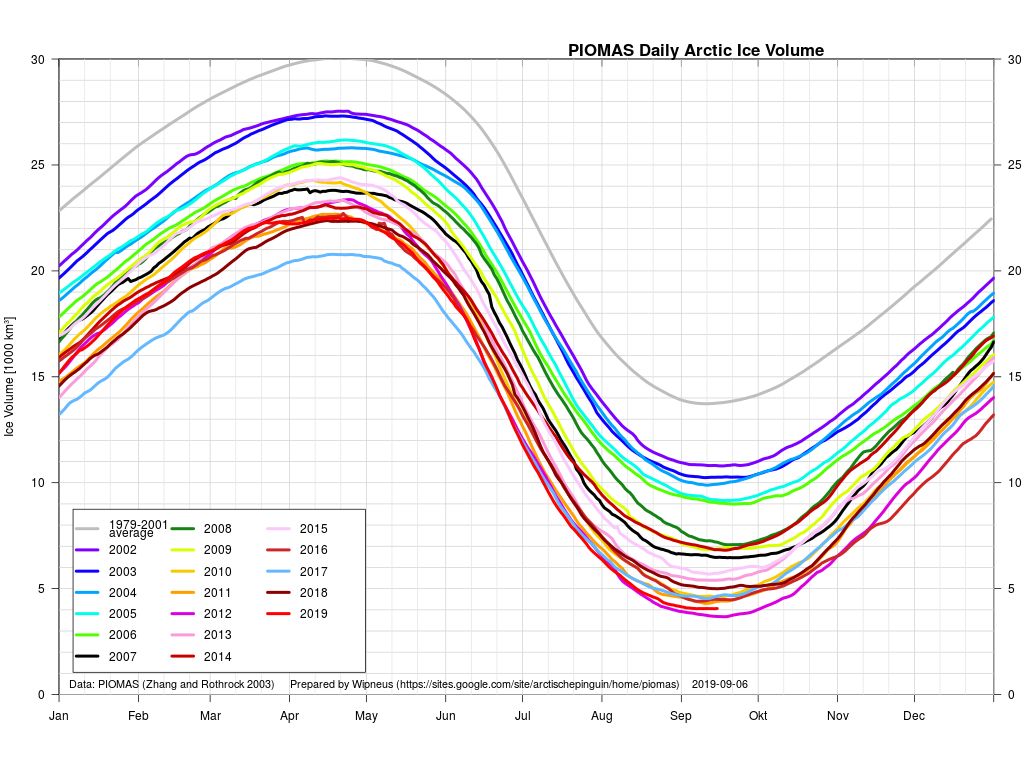
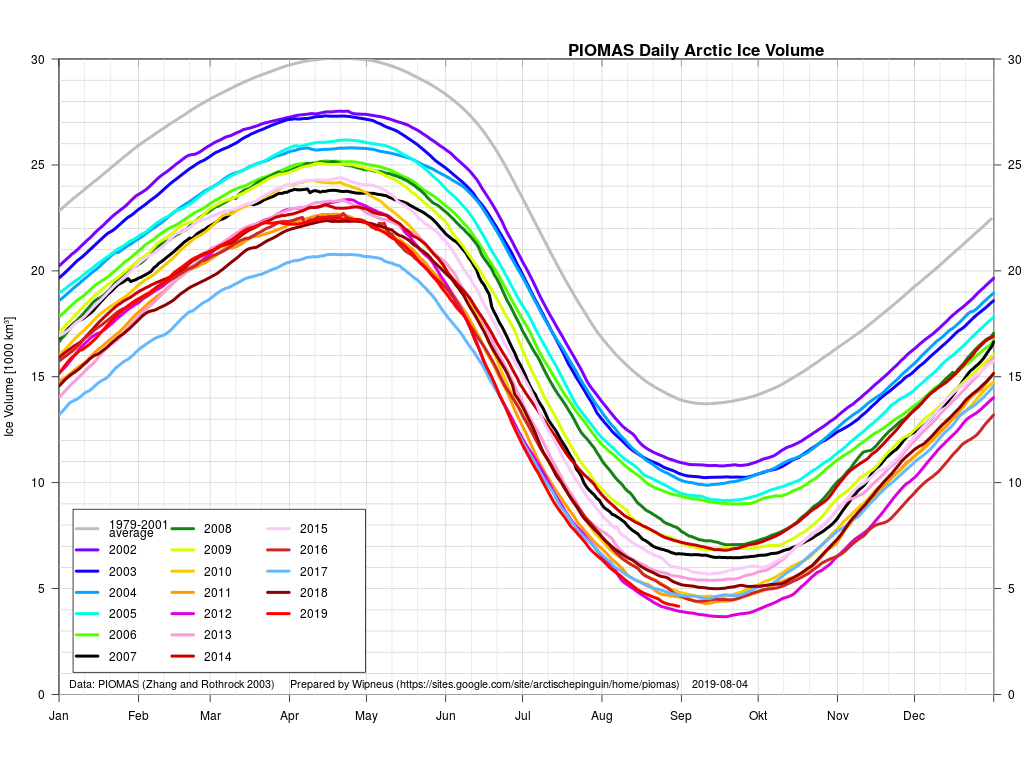
The minimum Arctic sea ice volume generally occurs slightly later than area or extent. The data certainly arrives later! Here’s the PIOMAS graph up to August 31st:
and here’s the associated thickness map:
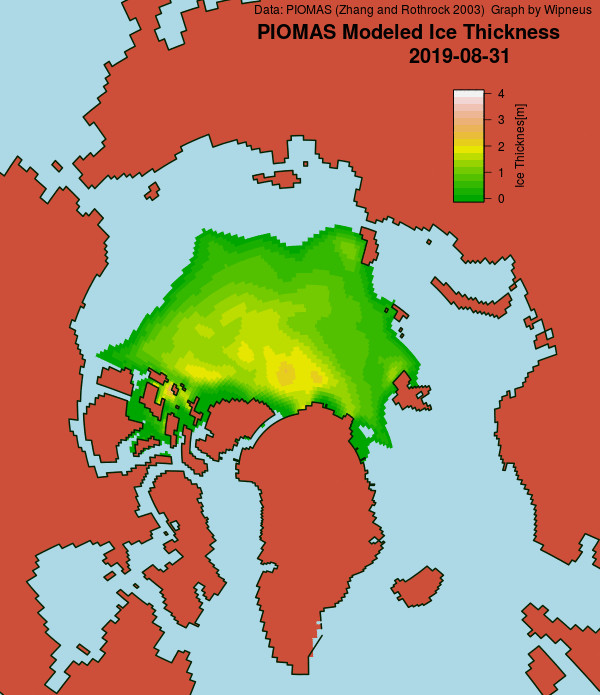
Note that Arctic wide modelled volume is only slightly higher than in 2012 at the same time of year, but there is a noticeably greater percentage gap in extent. That implies that average ice thickness across the Arctic is lower in 2019 than in 2012.

Note also that the thickest ice is no longer located along the north coasts of Greenland and the Canadian Arctic Archipelago. Here are the equivalent maps for previous years for comparison purposes:
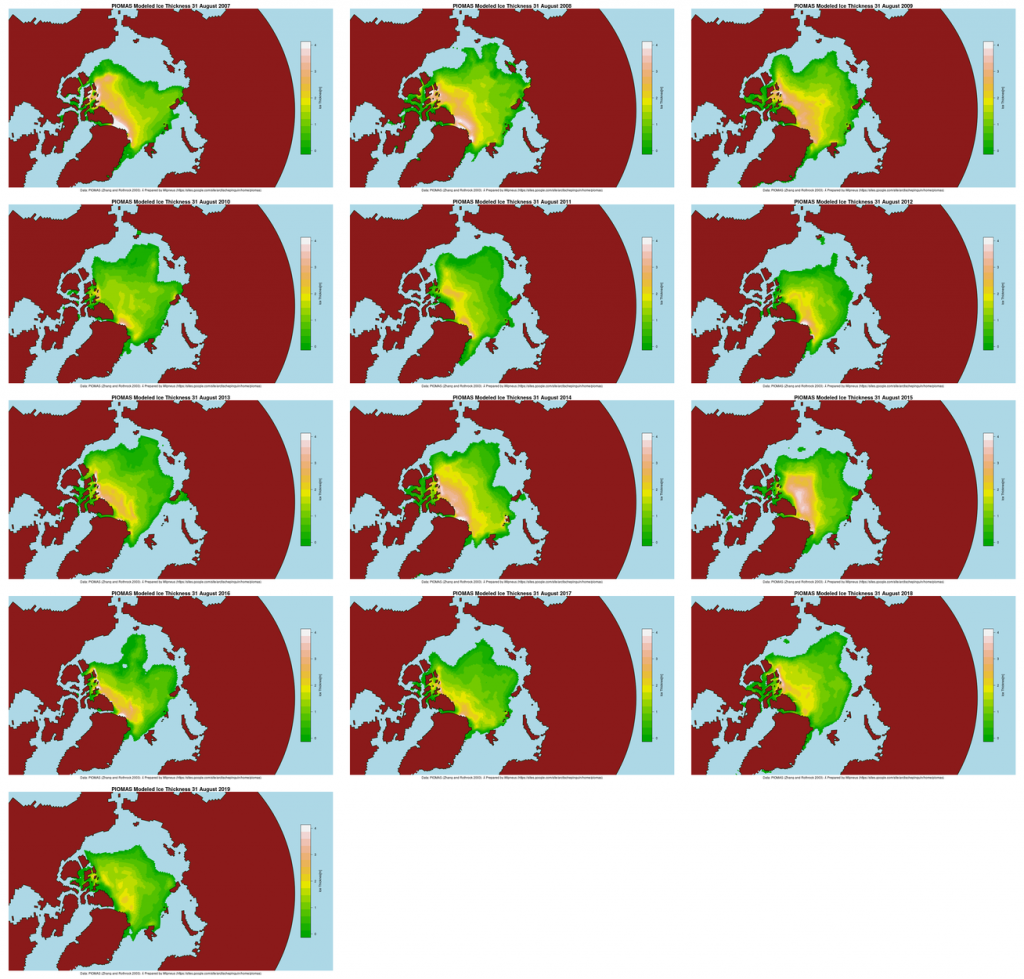
Perhaps JAXA extent will head still lower over the next few days? Perhaps PIOMAS volume will sneak below 2012 before the peripheral refreeze begins?

[Edit – September 13th]

JAXA Arctic sea ice extent has reached a new minimum of 4.09 million km².

NSIDC daily extent is currently 4.28 million km², still just above the September 4th minimum.

[Edit – September 14th]

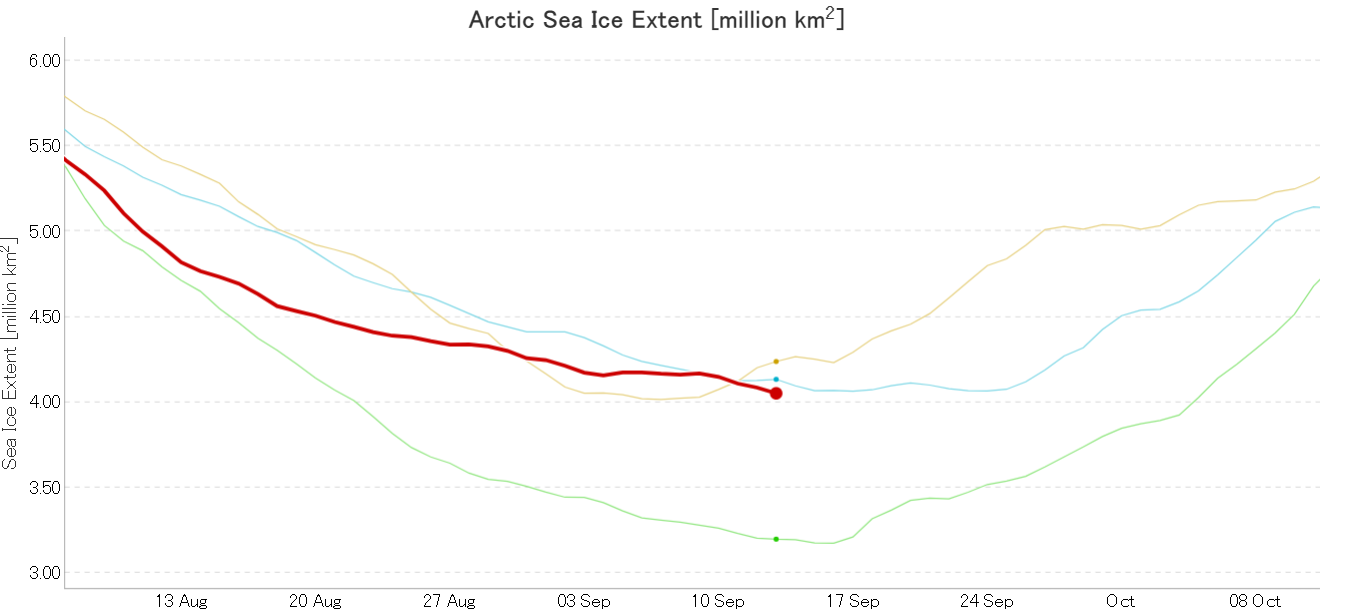
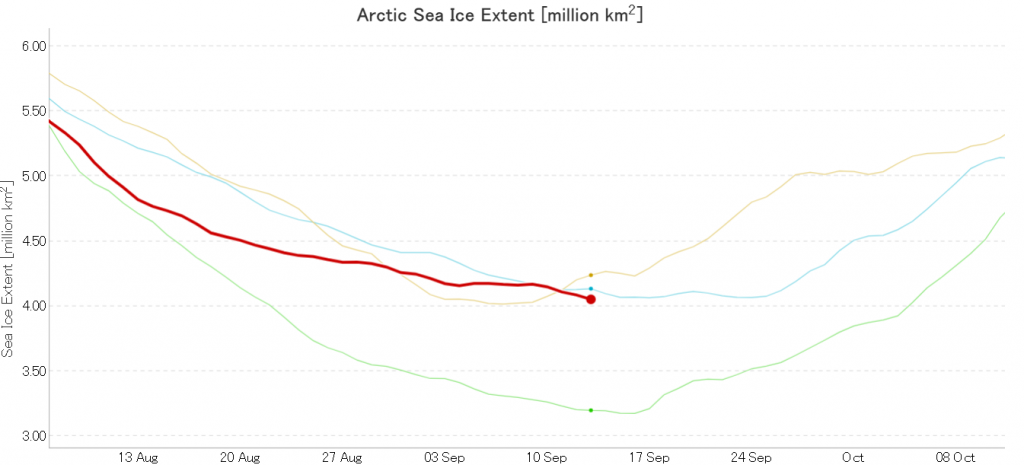
JAXA Arctic sea ice extent has reached a new minimum of 4.05 million km², which now puts it below the 2007 minimum that occurred somewhat later in September:
[Edit – September 14th PM]

NSIDC 5 day averaged extent has also (by a whisker!) reached a new minimum for the year of 4.285 million km²:
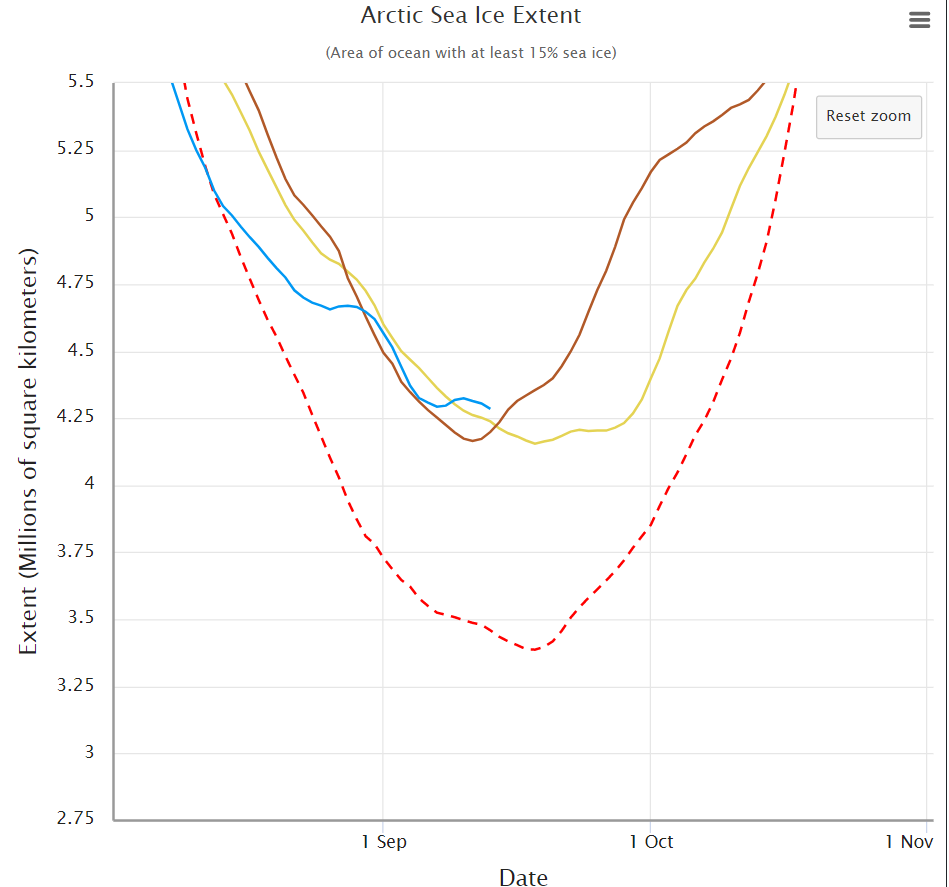
The daily number fell to 4.21 million km².

[Edit – September 15th]

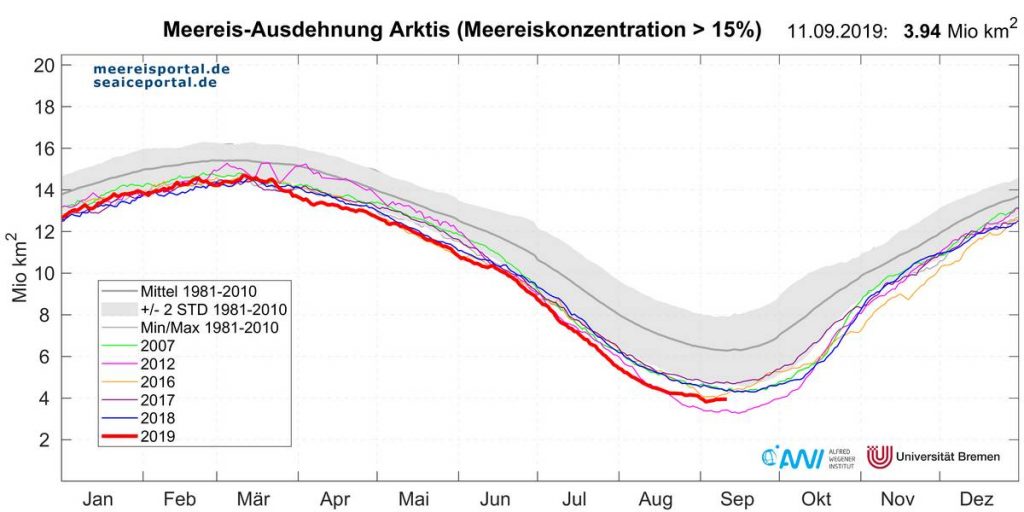
I have somewhat belatedly discovered that in the build up to the forthcoming MOSAiC Expedition the Alfred Wegener Institute recently announced  that:

The sea-ice extent in the Arctic is nearing its annual minimum at the end of the melt season in September. Only circa 3.9 million square kilometres of the Arctic Ocean are covered by sea ice any more, according to researchers from the Alfred Wegener Institute and the University of Bremen. This is only the second time that the annual minimum has dropped below four million square kilometres since satellite measurements began in 1979.
[Edit – September 16th]

JAXA/ViSHOP extent has dropped below the 2016 minimum, and now measures 4.01 million km²:
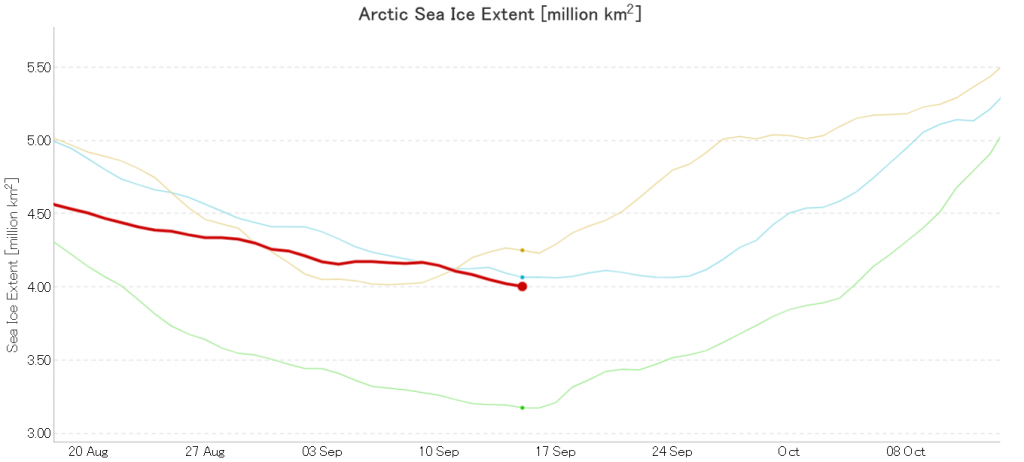
Only 2012 left to beat!

Wipneus’ high resolution AMSR2 extent has also posted a new low for the year, but still has a little way to go before passing 2016:
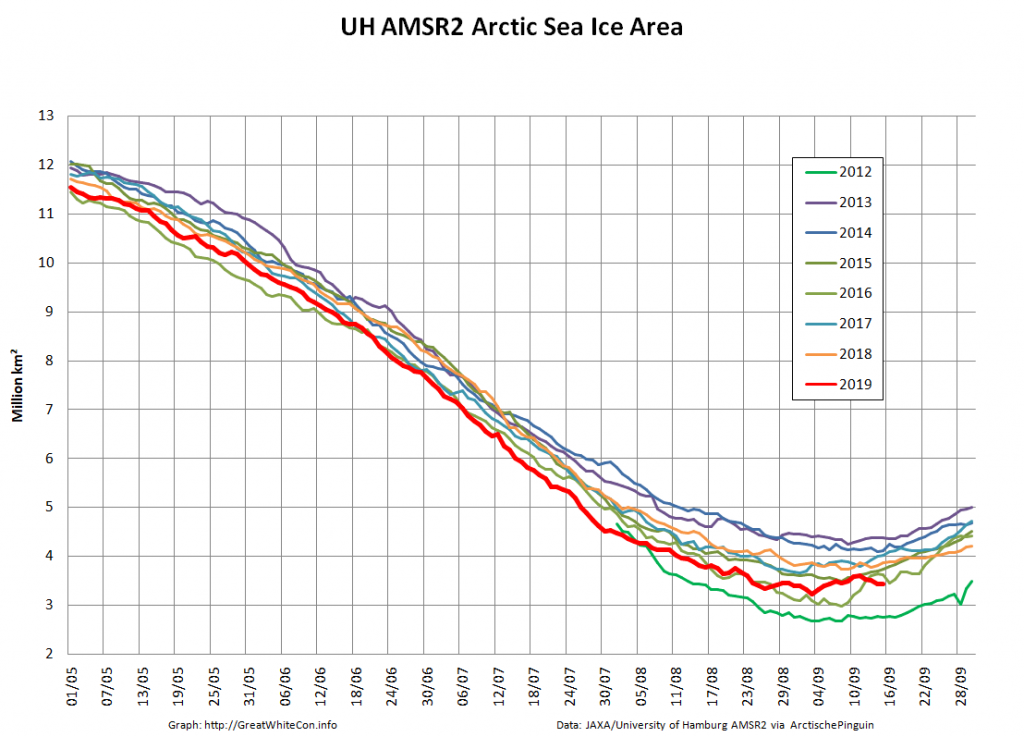
Area is also currently declining, but is still well away from a new minimum for 2019:
[Edit – September 19th]

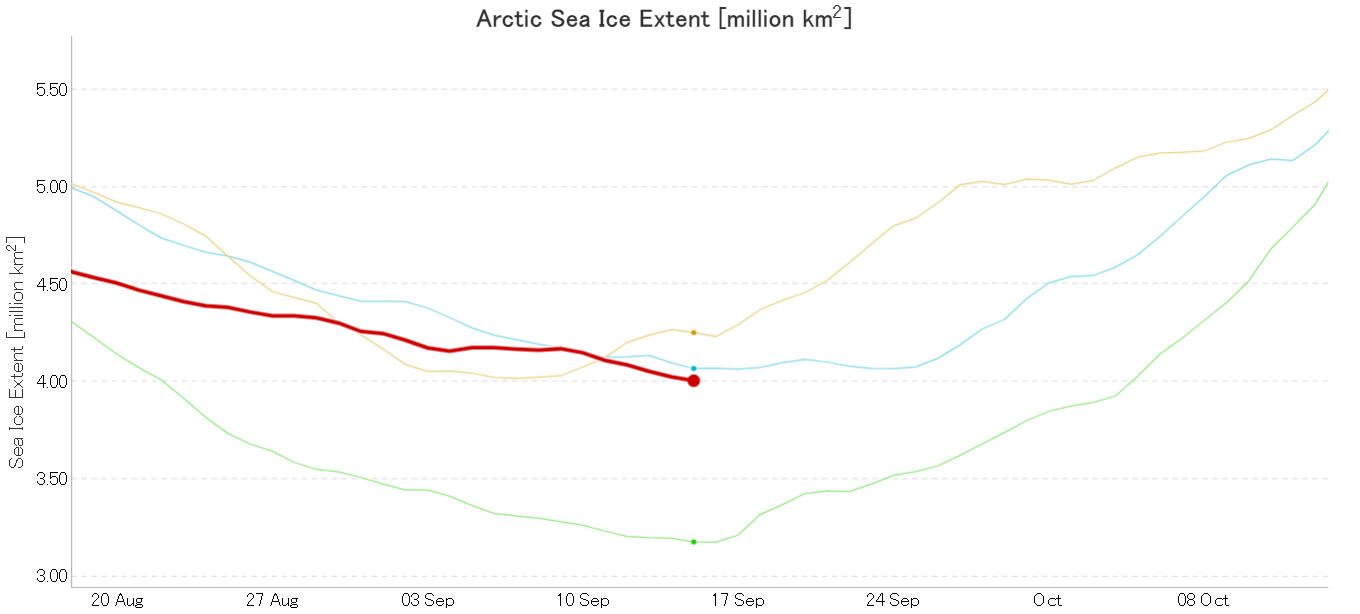
After some more modest declines JAXA/ViSHOP extent has just increased marginally from the previous day, and now measures 3.98 million km²:
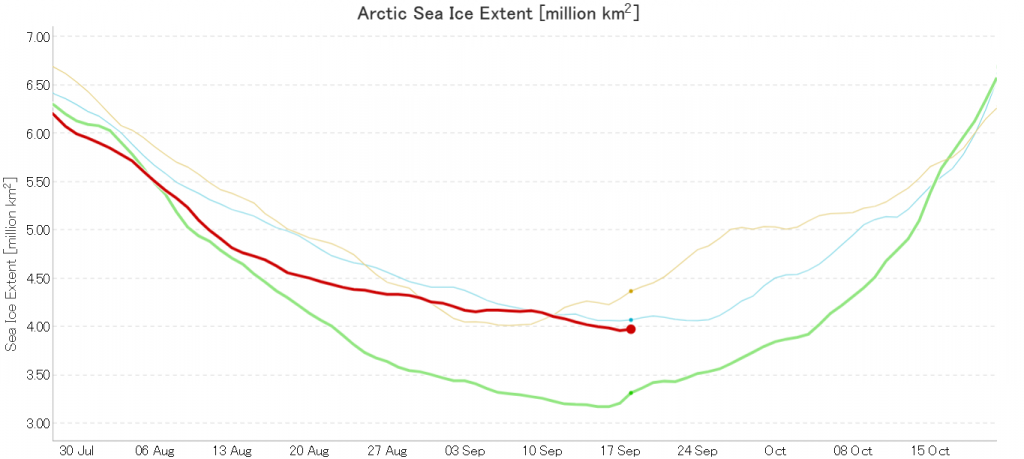
That puts the (very!) tentative minimum for 2019 at 3.96 million km² on September 17th.

[Edit – September 20th]

The mid month PIOMAS gridded thickness and volume numbers have been released:
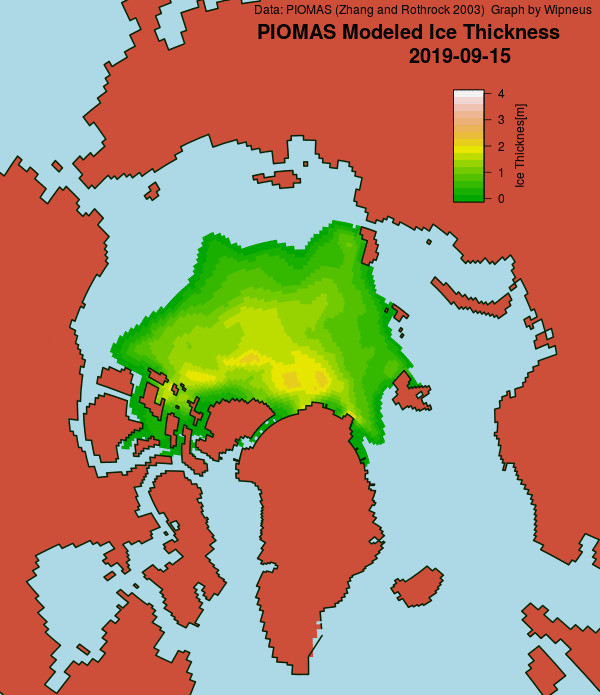
As anticipated given recent extent values, the volume difference from 2012 has increased somewhat over the last two weeks.

[Edit – September 23rd]

The National Snow and Ice Data Center have called the 2019 minimum in their latest edition of Arctic Sea Ice News:

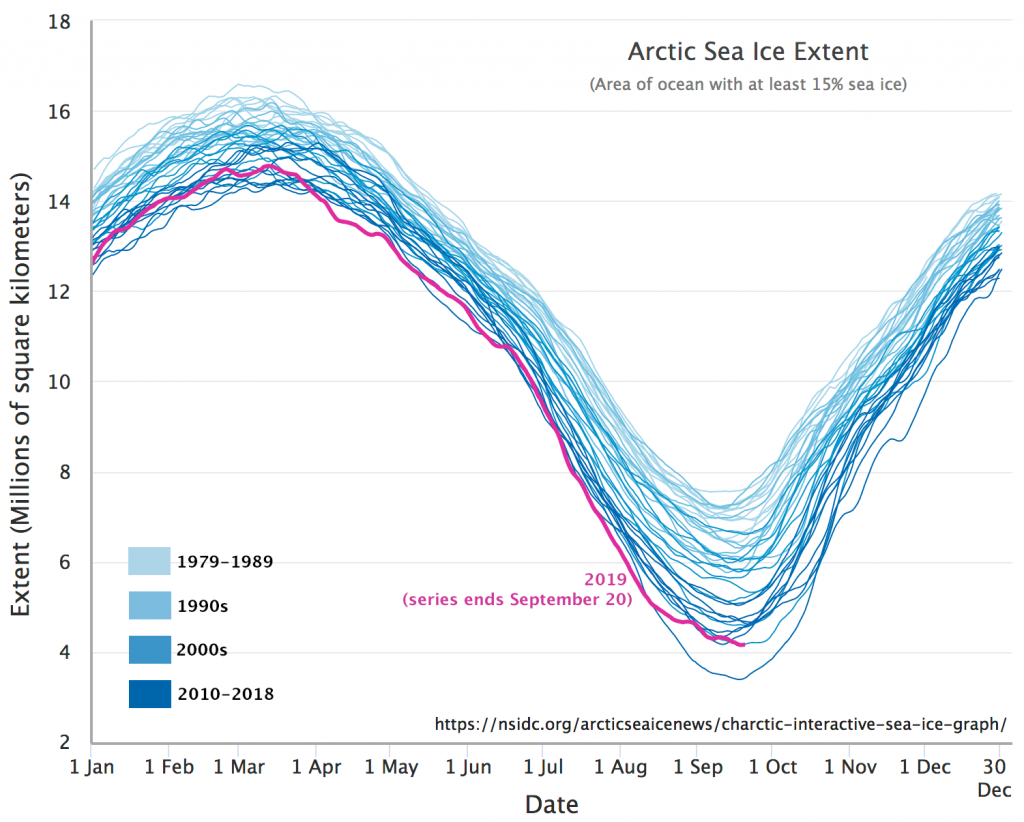
On September 18, 2019, sea ice extent dropped to 4.15 million square kilometers (1.60 million square miles), effectively tied for the second lowest minimum in the satellite record along with 2007 and 2016. This appears to be the lowest extent of the year. In response to the setting sun and falling temperatures, ice extent will begin increasing through autumn and winter. However, a shift in wind patterns or a period of late season melt could still push the ice extent lower.
[Edit – September 24th]

To summarise the assorted minimum extent metrics for 2019:

University of Bremen – 3.77 million km² on September 18th, 2nd lowest behind 2012.
JAXA/ViSHOP – 3.96 million km² on September 17th, “Statistical tie” with 2016 for 2nd lowest.
NSIDC 1 day – 4.10 million km² on September 17th, “Statistical tie” with 2016 for 2nd lowest.
NSIDC 5 day – 4.15 million km² on September 18th, 2nd lowest behind 2012.

[Edit – October 1st]

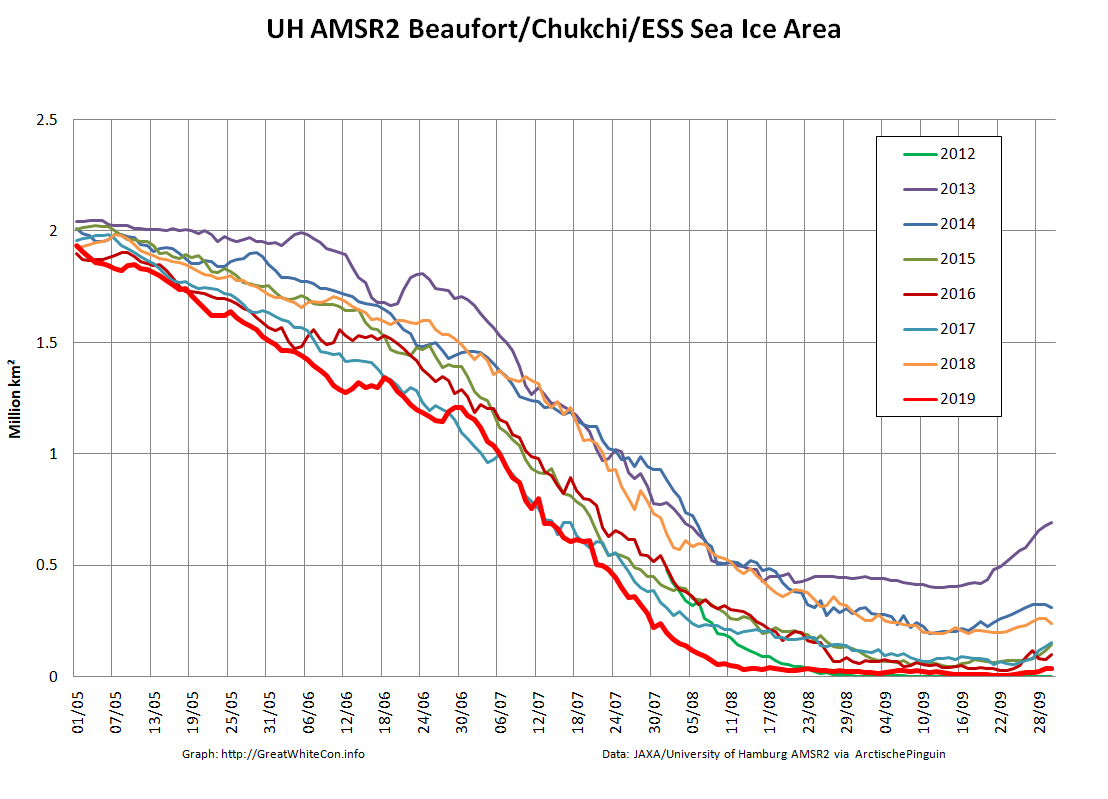
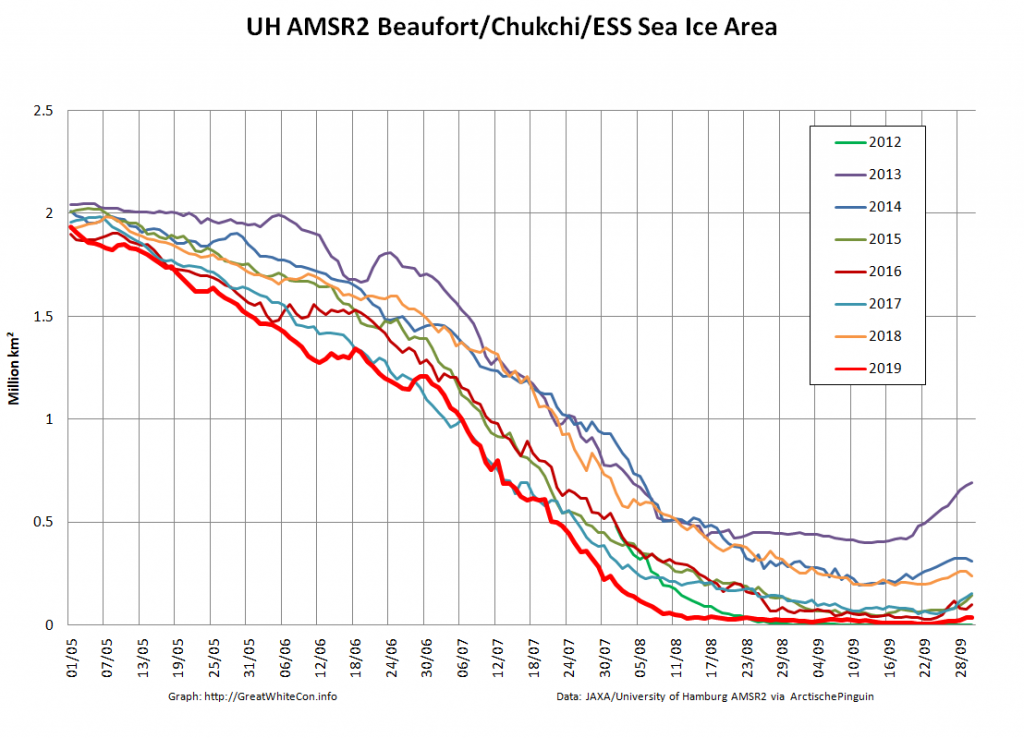
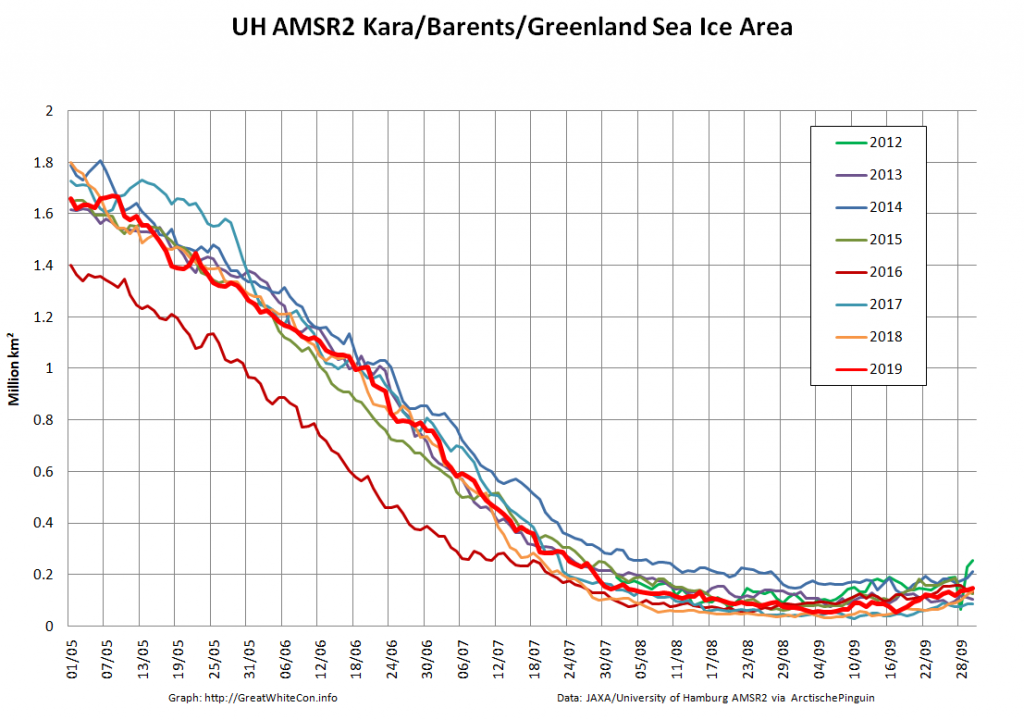
Two sides of the same coin? Sea ice area on the Pacific side of the Arctic has been at historic lows for most of the melting season:
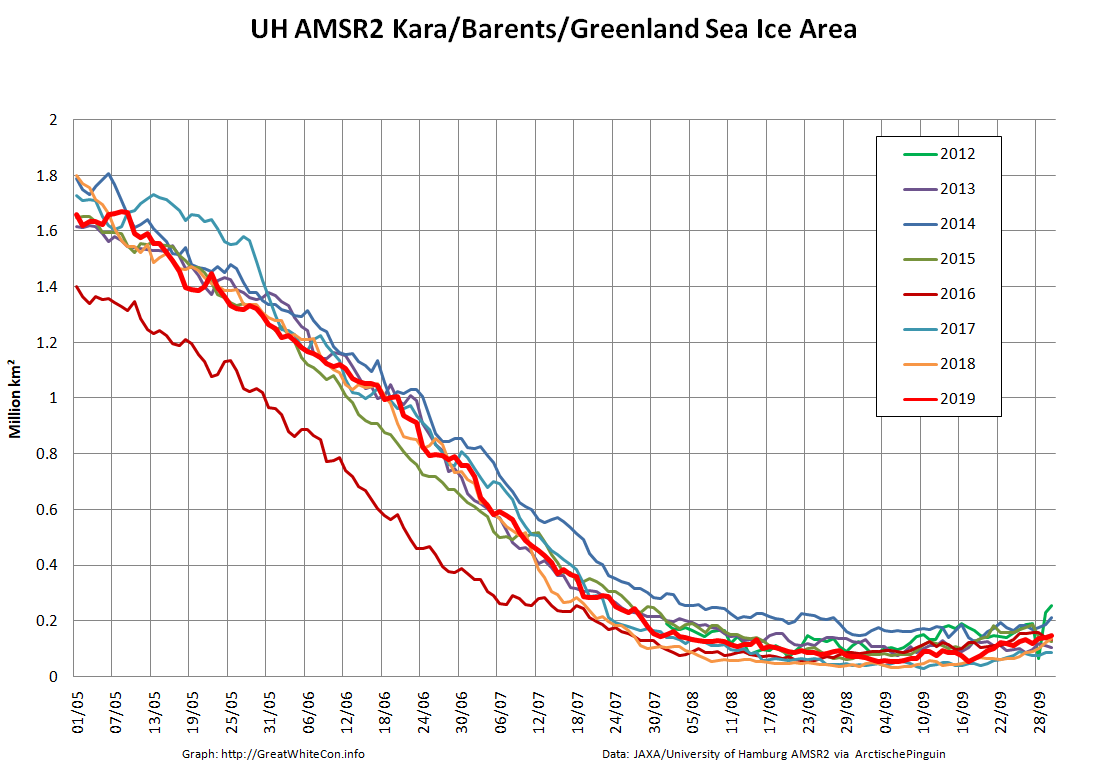
whereas on the Atlantic side:
[Edit – October 7th]
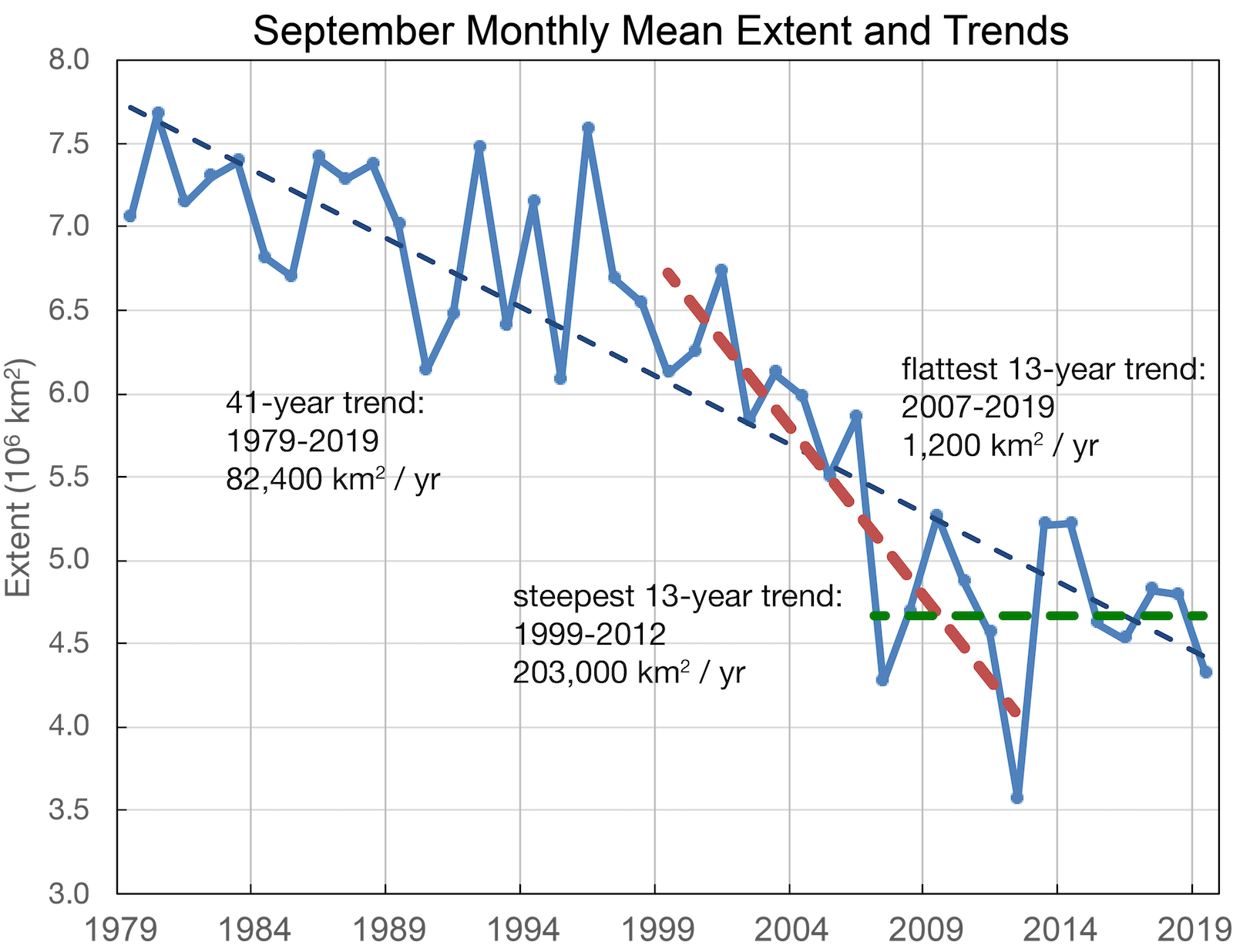
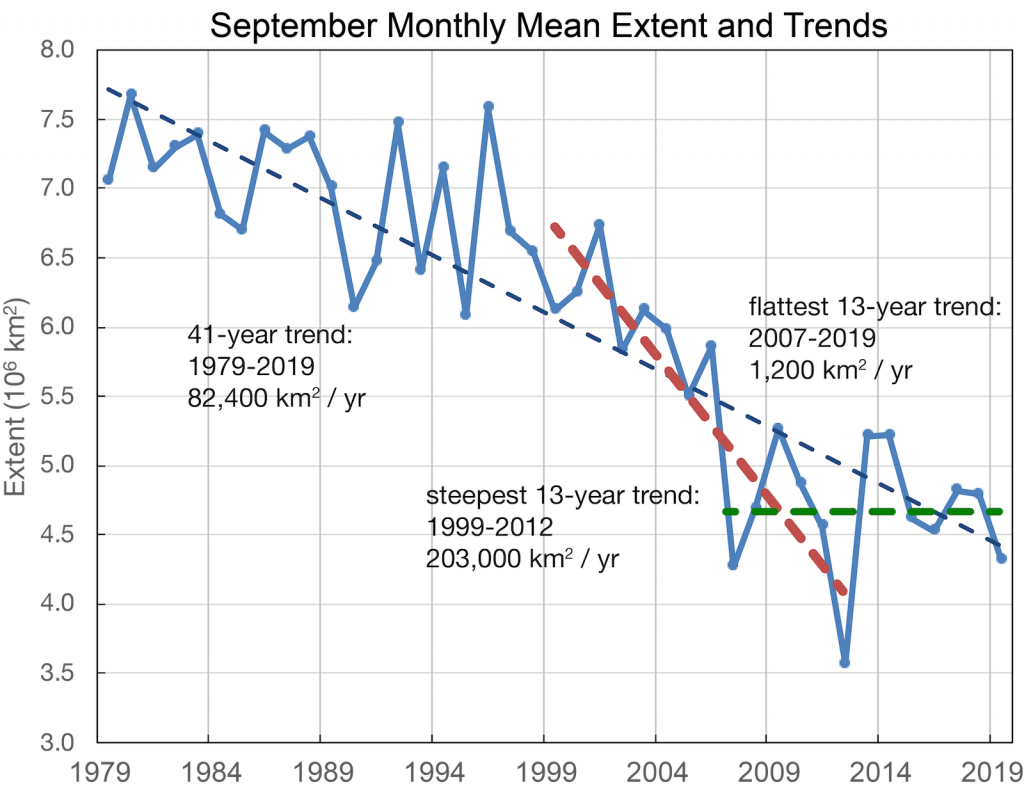
The September monthly numbers have arrived from the NSIDC, together with some intriguing annotations by Walt Meier:
Watch this space. Just in case!
An Unusual Sea Ice Situation North of Greenland

Further to our recent coverage of the voyage of the good ship Polarstern past Kap Morris Jesup comes this video courtesy of Suman Singha:

An animation created with 2745 high resolution Sentinel-1 SAR images.

Sentinel-1 data courtesy Copernicus

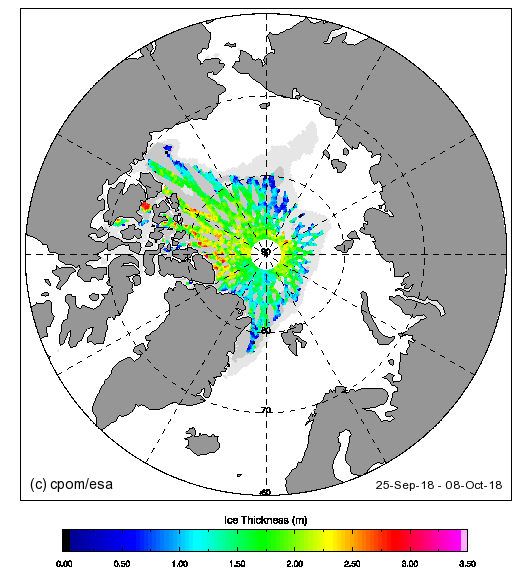
Plus the early autumn estimates of Arctic sea ice thickness from CryoSat-2 via the Centre for Polar Observation and Monitoring:

CS2_thk_14-20181010

Please note the abnormally thin sea ice to the north of Greenland.

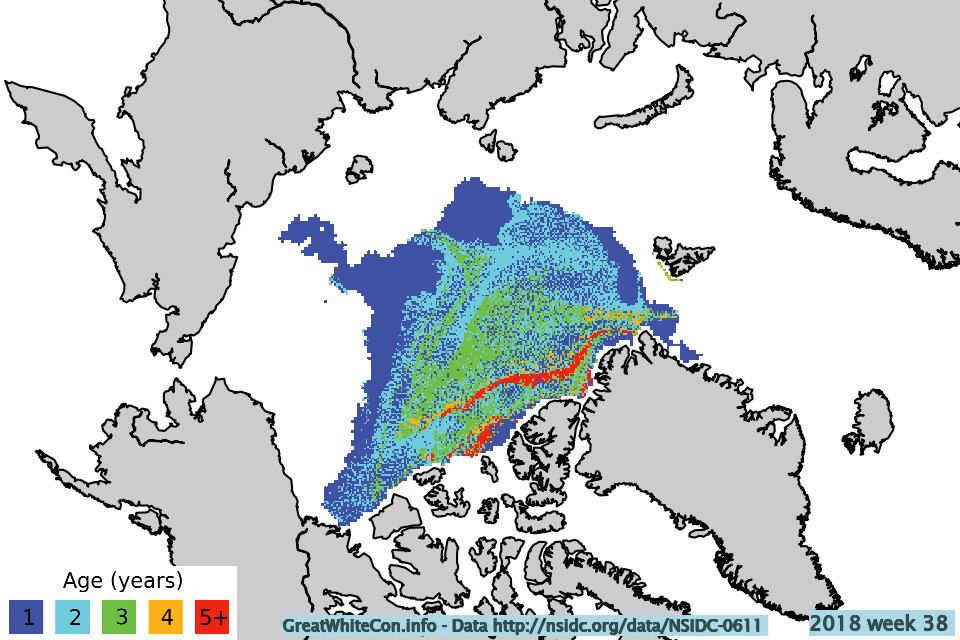
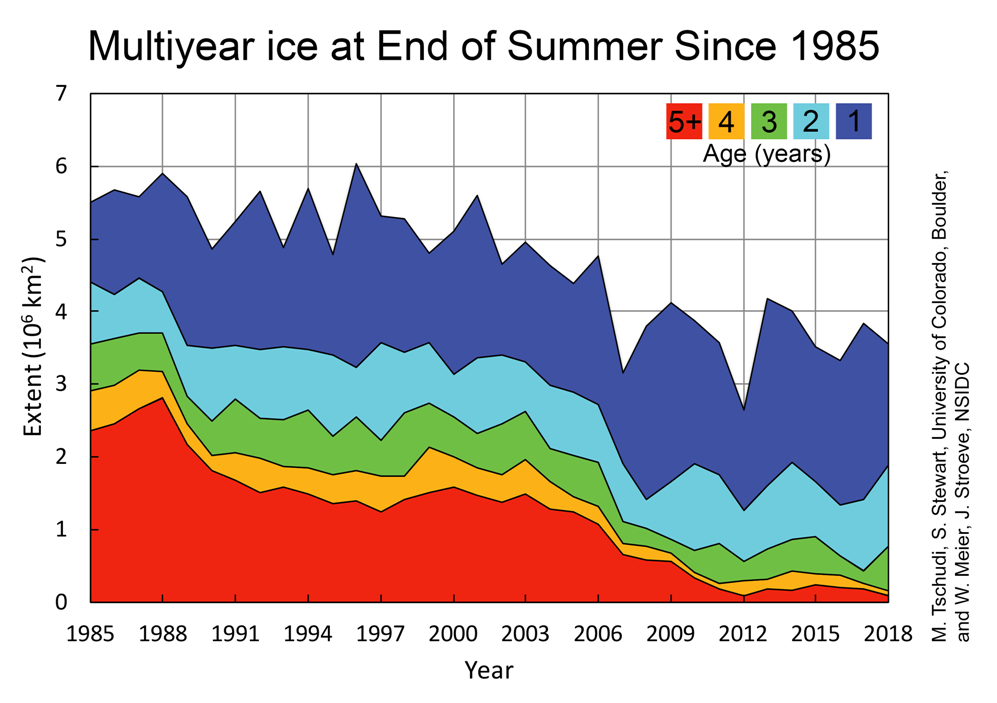
Finally, for the moment at least, here’s the latest Arctic sea ice age information extracted from the October 2018 edition of the NSIDC’s Arctic Sea Ice News:

iceage_browse_week_n_2018_38_QL

TschudiAge2018-1000

The “oldest, thickest sea ice in the Arctic” seems to be vanishing before our very eyes.

Could Northabout Circumnavigate Greenland in 2018?

Our regular reader(s) may recall our extended coverage on the plucky little yacht Northabout‘s ultimately successful attempt to circumnavigate the Arctic Ocean in the summer of 2016?

Many were the skeptics who said she stood no chance of finding a way through some “thick sea ice” apparently blocking her path across the Laptev Sea, but they were proved wrong:

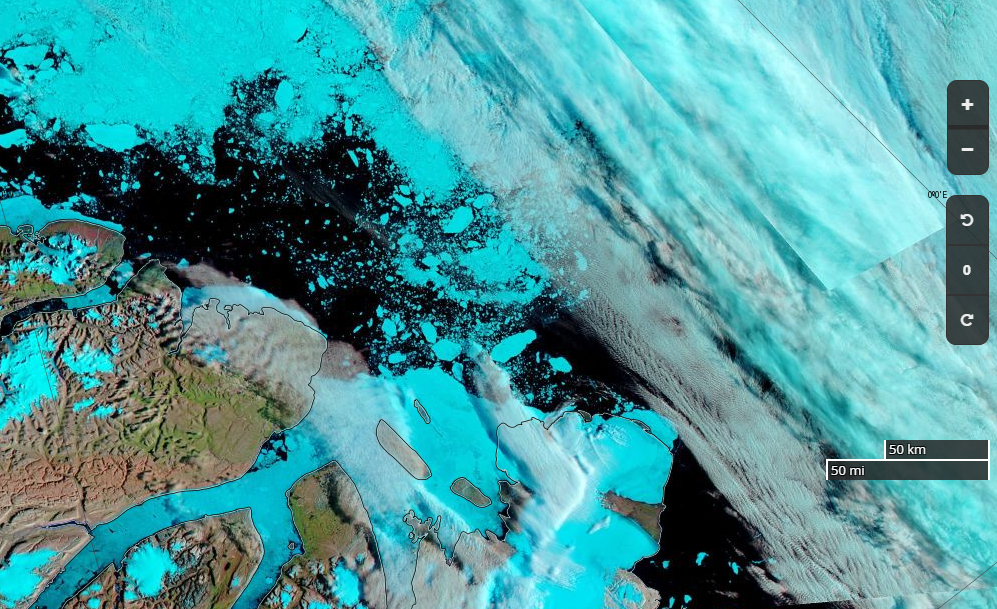
As a thought experiment in the summer of 2018 we’re now thinking the unthinkable. If she put her mind to it could Northabout circumnavigate Greenland in 2018? Let’s take a look at the evidence shall we? The allegedly “oldest, thickest Arctic sea ice” north of Greenland isn’t there any more this summer:

Nord-Aqua-721-2018-08-19

Kap-Morris-Jesup-Terra-2018-08-19

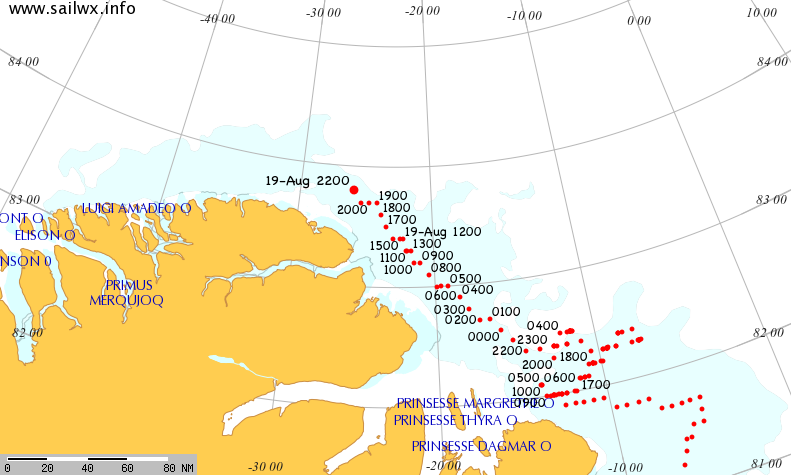
The research icebreaker Polarstern has already inspected the open waters off Kap Morris Jesup, the most northerly tip of Greenland:

Polarstern-2018-08-19-2200

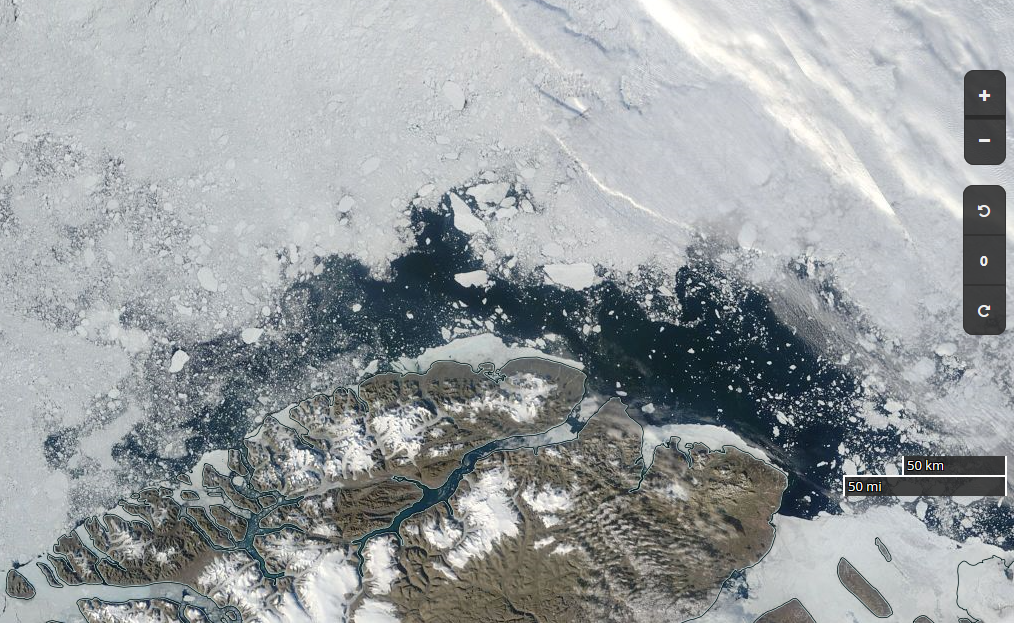
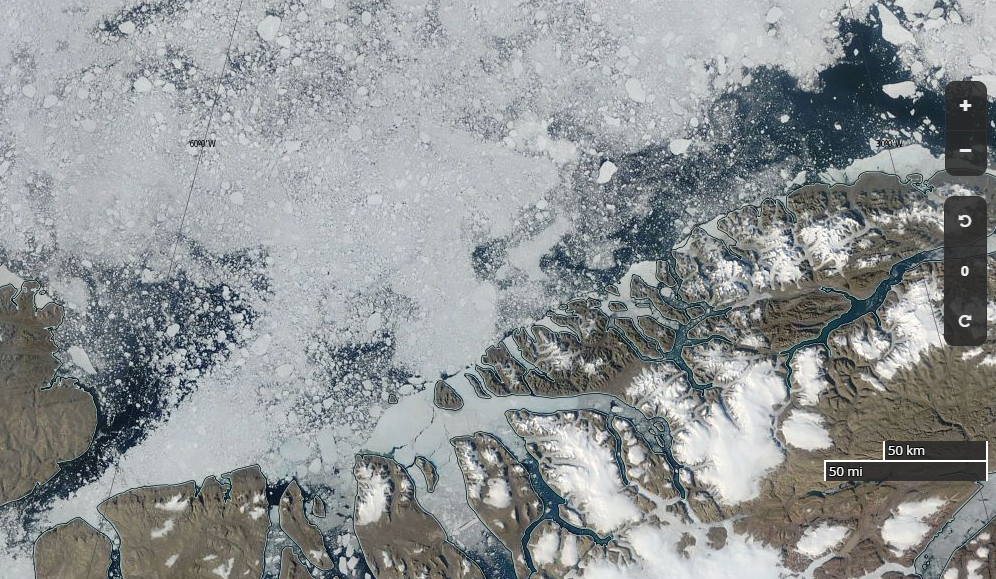
What’s more the waters of the Lincoln Sea currently look no more tricky to traverse than the Laptev Sea in August 2016:

Lincoln-Terra-2018-08-19

In conclusion, for the moment at least, what’s the theoretical solution to our 2018 thought experiment?

Here’s another thought to ponder as well. I don’t suppose it’s in the Alfred Wegener Institute’s PS115 mission plan, but do you suppose Polarstern could circumnavigate Greenland at the moment?


[Edit – August 23rd]

The University of Bremen used not to publish their Arctic sea ice “thinness” maps in summer. However now they do, so here’s a close up of Northern Greenland for August 22nd:

SMOS-Zoom-20180822


[Edit – August 26th]

First of all here’s one of our occasional sea ice motion videos:

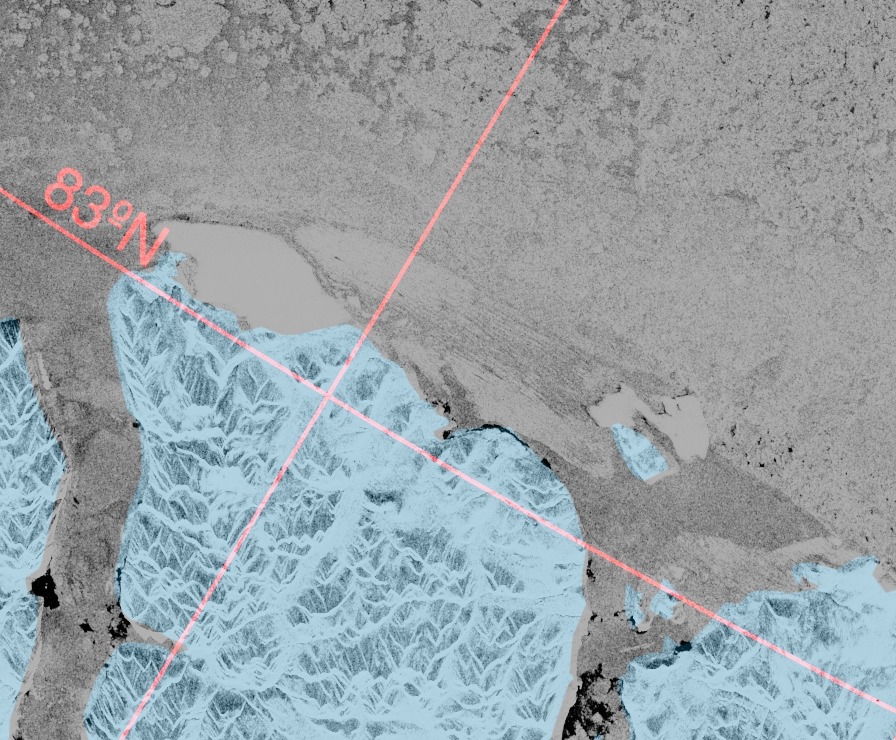
This one reveals the open water north of Greenland in February as well as the much longer event in August. Next here’s a Sentinel 1B synthetic aperture radar image of the Kap Morris Jesup area from yesterday:

S1B_MorrisJesup_20180825T1700

Meanwhile thanks to a heads up from Treform2 on the Arctic Sea Ice Forum comes evidence that on the other side of the Lincoln Sea the last remnants of the Ward Hunt Ice Shelf are “disintegrating”:

S1B_WardHunt_20180824T1442

The January 2018 Fram Strait Cyclones

We’ve covered similar events in the recent past, but this one looks like it will take the proverbial biscuit.

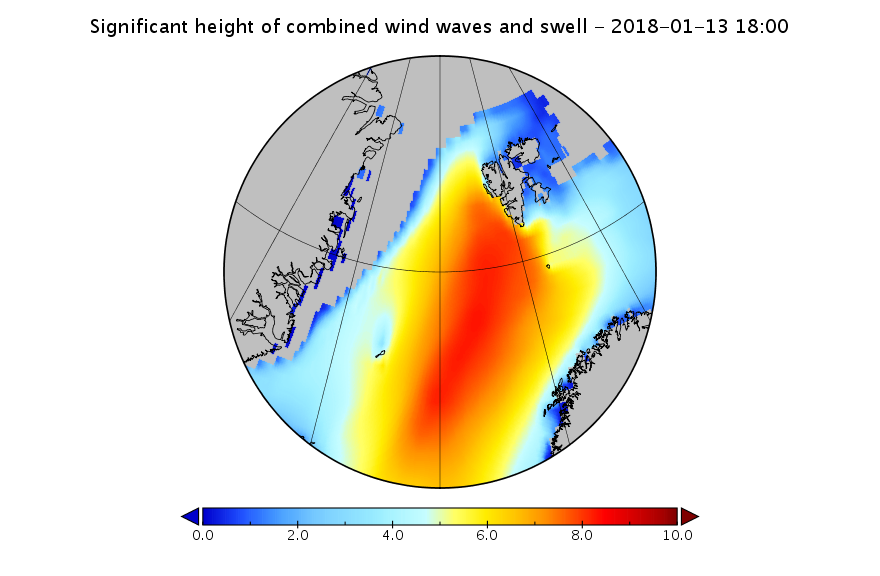
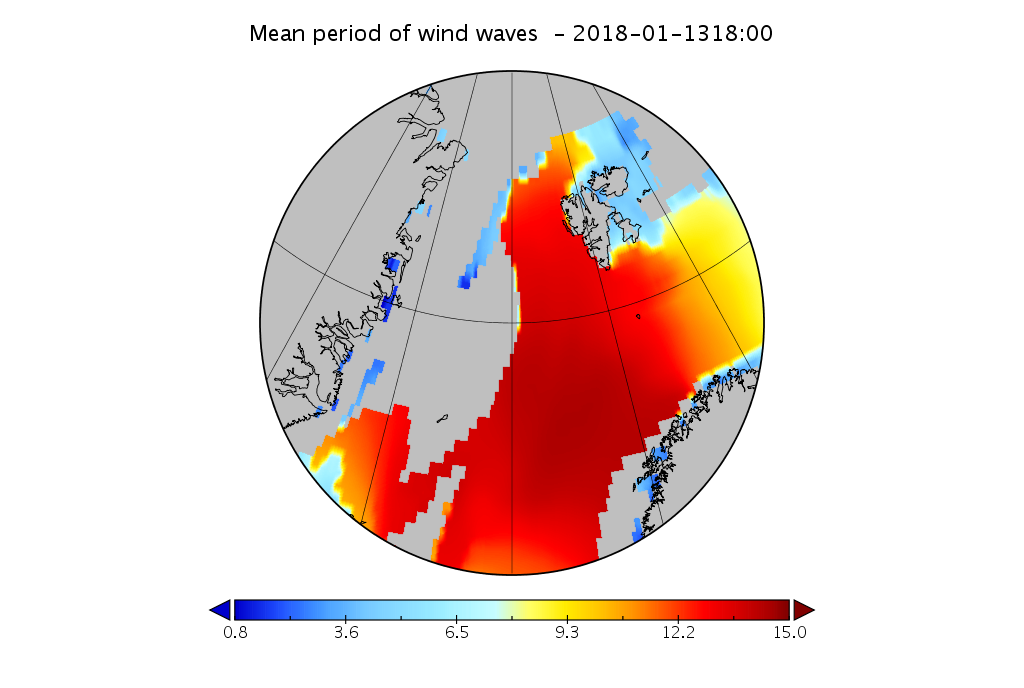
Here’s the 6 hour wave forecast for the Fram Strait from 12:00 UTC this afternoon:

Significant_height_of_combined_w in multi_1.glo_30mext-20180113-12z+6

Mean_period_of_wind_waves_surfac in multi_1.glo_30mext-20180113-12z+6

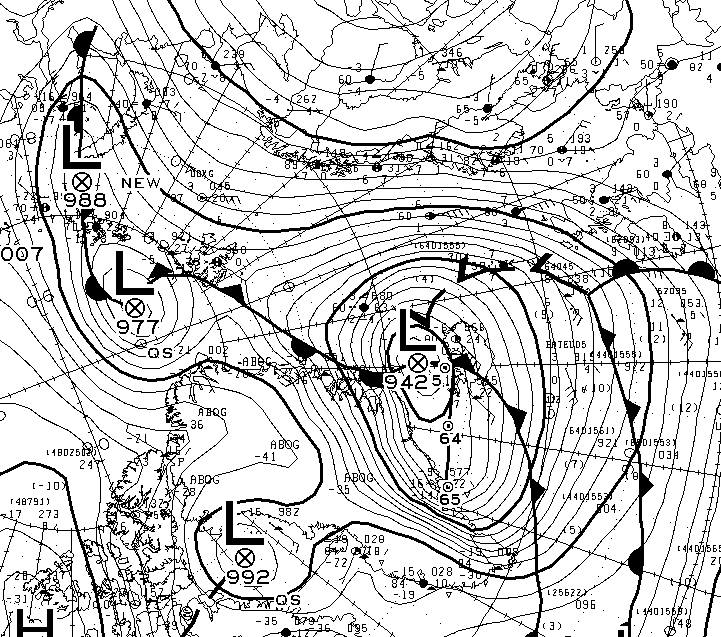
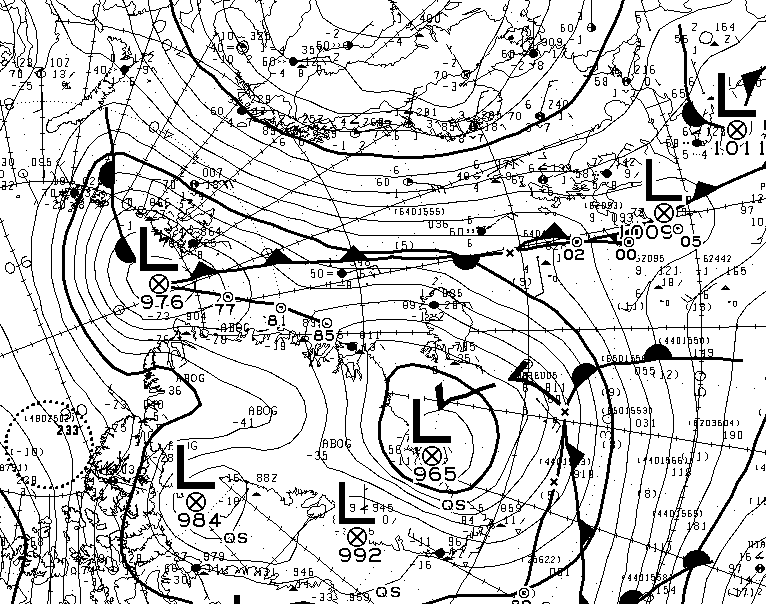
Look at the scales carefully then compare the wave height and period with previous similar events. Here’s the cause of those giant waves, two powerful cyclones off Greenland pumping heat and moisture northwards from a long way south:

Synopsis-20180113-18Z-Crop

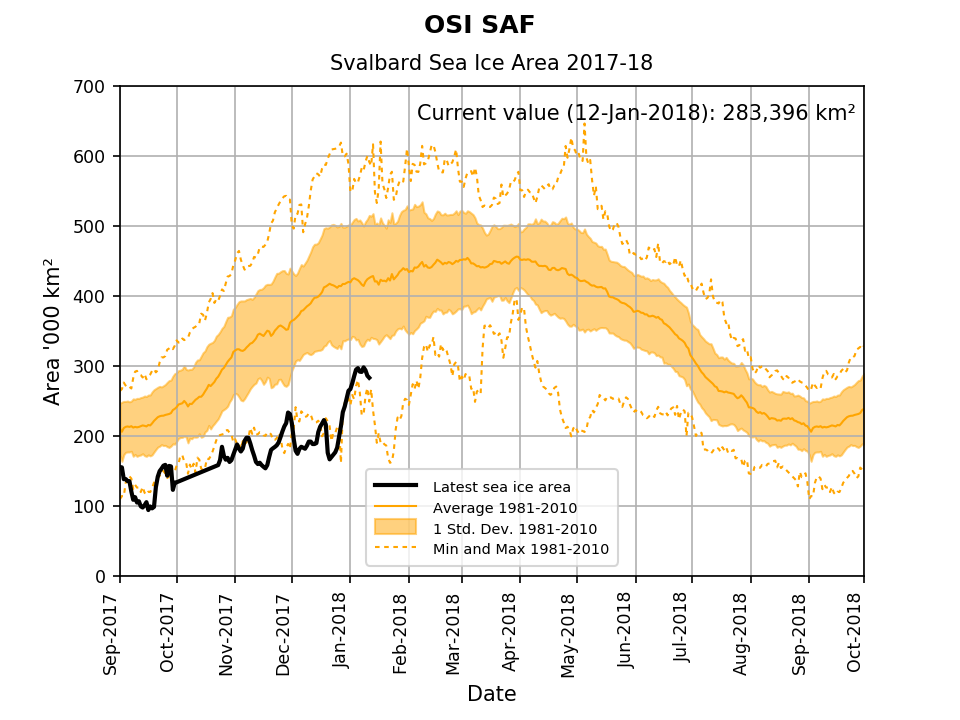
Also bear in mind the current sea ice area around Svalbard:

osisaf_svalbard_plot_20180112

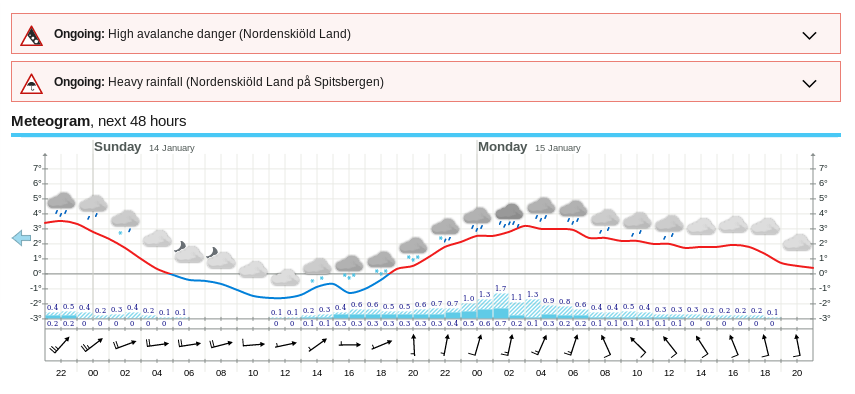
and the current weather forecast for the capital Longyearbyen:

svalbard_forecast_20180113

Note in particular the anomalously high temperatures and the severe weather warnings for both rain and avalanches. In the middle of January.

Finally, for the moment at least, here’s a Sentinel 1B image of the sea ice in the Fram Strait earlier this morning:

S1B_Fram_20180113T063817


[Edit – January 14th]

The temperature in Longyearbyen is forecast to drop below freezing point early on Tuesday and then remain there, which I guess counts as good news?

svalbard_forecast_20180114

However the southernmost of the two cyclones off Greenland is now down to a central MSLP of 942 hPa:

Synopsis-20180114-12Z-Crop


[Edit – January 15th]

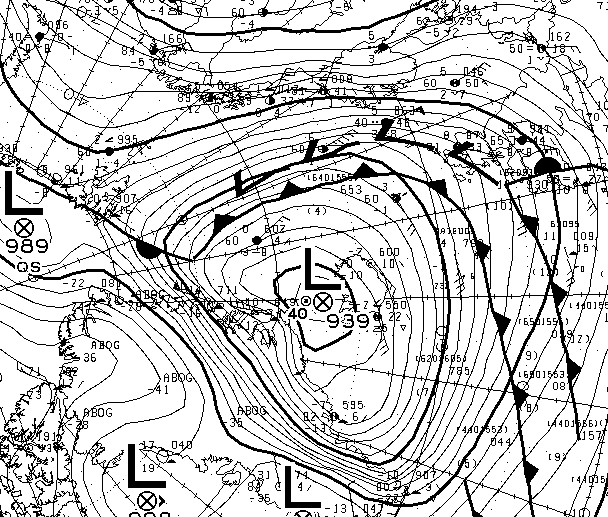
The cyclone now centred near Iceland looks as though it bottomed out at a MLSP of 939 hPa earlier today:

Synopsis-20180115-00Z-Crop

Watch this space!
Greenland 2016 Melt Starts A Month Early

According to the Danish Arctic research institutions’ Polar Portal this year there’s been an “Unusually Early Greenland Melt“. The article by Ruth Mottram points out that:

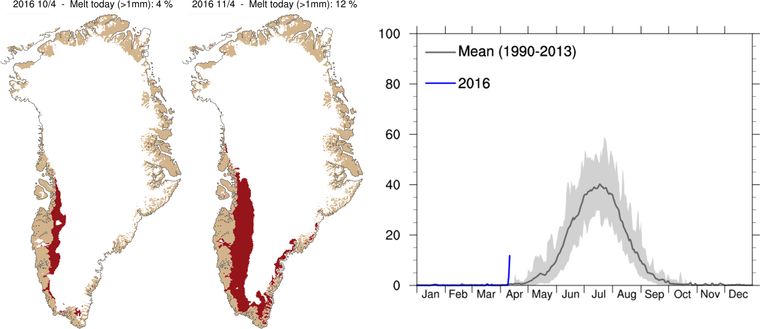
An early melt event over the Greenland ice sheet occurred this week, smashing by a month the previous records of more than 10% of the ice sheet melting.

Greenland-Melt-2016-04-11

Based on observation-initialized weather model runs by DMI, almost 12% of the Greenland ice sheet had more than 1mm of melt on Monday 11th April, following an early start to melting the previous day. Scientists at DMI were at first incredulous due to the early date. “We had to check that our models were still working properly” said Peter Langen, a climate scientist at DMI. “Fortunately we could see from the PROMICE.dk stations on the ice sheet that it had been well above melting, even above 10 °C. This helped to explain the results”. The former top 3 earliest dates for a melt area larger than 10% were previously all in May (5th May 2010, 8th May 1990, 8th May 2006).

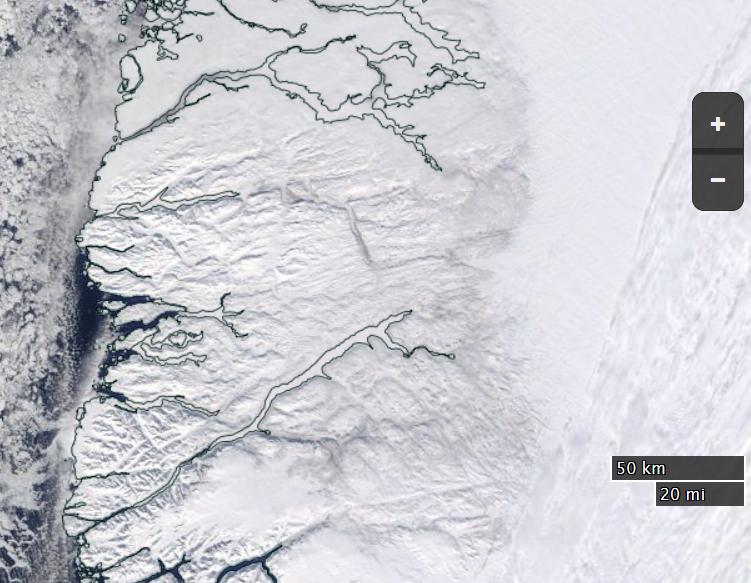
Just in case you think the DMI’s models really aren’t working properly, take a look at this satellite image of South West Greenland today:

NASA Worldview “true-color” image of South West Greenland on April 12th 2016, derived from the MODIS sensor on the Terra satellite

Then head over to NASA Worldview and flip back to last year using the controls at the bottom left:

SWGreenland-Terra-2015-04-12

Can you spot the difference? According to the Polar Portal once again:

Around the coast of Greenland where DMI has climate records dating back to 1873, Greenland came close to setting a record temperature for the whole of Greenland in April. Kangerlussuaq measured a daily maximum of 17.8°C, the previous record is 18.0°C and the DMI observation station at the Summit of Greenland set a new “warm” April record of -6.6°C. “Everything is melting” observed Nuuk resident Aqqaluk Petersen.

The melt was driven by warm air advected from the SW bringing rain along the coast, similar to an extreme melt event in 2012 when 95% of the surface of the ice sheet had melt, a situation that has been reported in detail by GEUS and DMI scientists (Fausto et al., 2016).

[Edit – April 15th 2016]

It has been brought to my attention that the cloud cover in the first image above makes it difficult to see the melting ice sheet. By way of explanation, at this time of year you can use images derived from the MODIS instrument on the Aqua and Terra satellites and the VIIRS instrument on the Suomi satellite to watch the snow cover retreat across Alaska, Canada, Siberia and indeed Greenland.

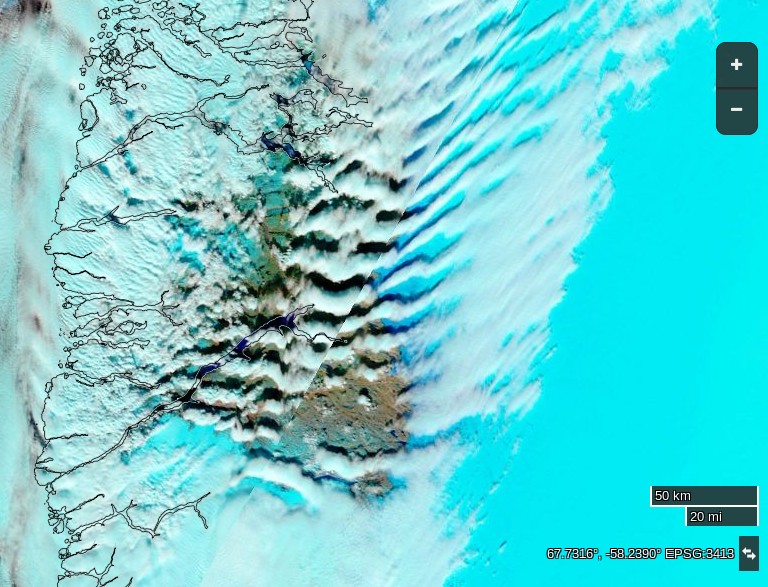
There is less snow on the ground in SW Greenland than “normal” this year, and hence lower albedo. This implies there will also be less snow on the ice sheet itself, which is hence more vulnerable to “early melt”. In order to get visual confirmation of melt ponds on the ice clear blue skies are needed. You can see hints of “blue ice” through the gaps in the cloud on my first image above. To bring out the “blue ice” try following the link above to NASA Worldview and then experiment with the controls on the left. If you select “Corrected Reflectance (Bands 7-2-1) you should be able to produce an image that looks like this:

NASA Worldview “false-color” image of South West Greenland on April 12th 2016, derived from the MODIS sensor on the Terra satellite

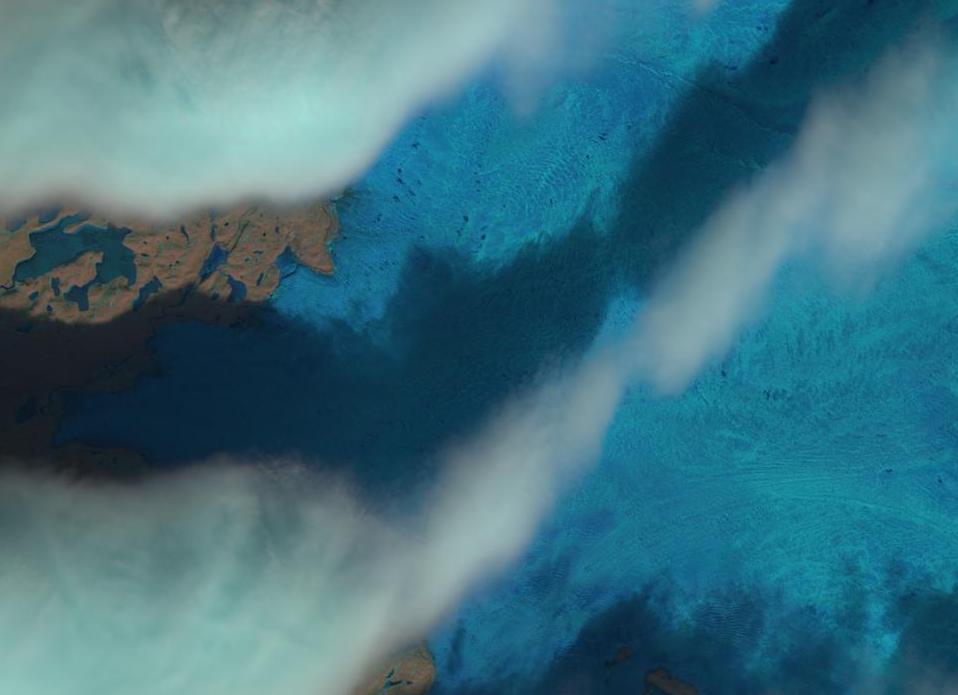
For a closer look between the clouds here’s a “natural colour” image from Landsat 8:

A “natural color” image of South West Greenland on April 12th 2016, from the Landsat 8  satellite
A “natural color” image of South West Greenland on April 12th 2016, from the Landsat 8 satellite

More Heat Heading for the North Pole

We speculated a few days ago about whether the “Son of Storm Frank” might have battered Britain by now, and be sending a 10 meter swell past Svalbard towards the Arctic sea ice edge. That’s not quite how things have worked out in practice however! We haven’t had another named storm affecting the United Kingdom directly, but we have received a series of long distance swells from a sequence of hurricane force storms further out in the North Atlantic. I even managed to test my Arctic surfing equipment by personally partaking in the swell generated by Hurricane Alex!
Moving from the water into the air, here’s the Danish Meteorological Institute’s forecast for Greenland tomorrow:

Greenland-20160123+24h

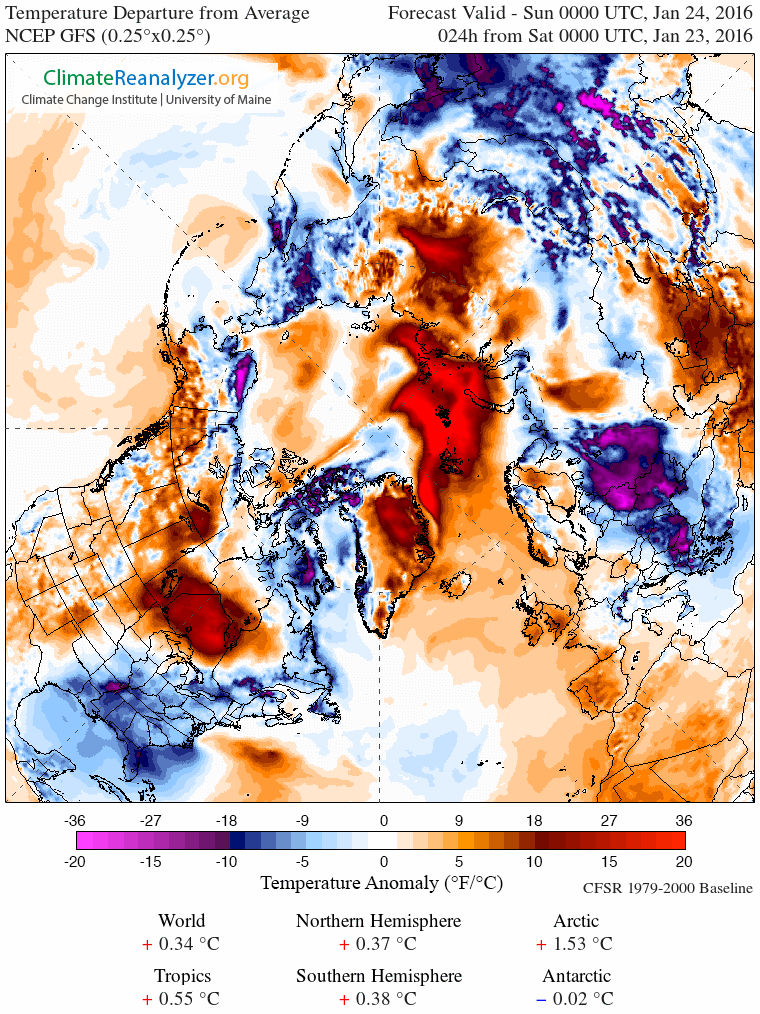
If you’re at all familiar with isobars you’ll note yet another storm off Southern Greenland and that comparatively warm, moist air will be heading up the east coast of Greenland towards the Fram Strait, albeit not at the speeds generated by Storm Frank! As a consequence here is Climate Reanalyzer’s surface temperature anomaly map for first thing tomorrow:

CCI-AnomT-20160123+24h

and here is how it looks by Wednesday lunchtime:

CCI-AnomT-20160123+108h

As you can see, the ultimate effect of the recent hurricane force storms in both the Atlantic and the Pacific is to attack the Arctic with warm, moist air from both sides. Whilst we wait to see exactly how this much shorter term forecast pans out, particularly at the North Pole itself, the DMI’s graph of temperatures in the central Arctic has burst back into life after a “brief hiatus” in the New Year. Here’s how it looks at the moment:

DMI-T80N-20160123

New Calving of the Zachariae Isstrom Glacier

The Zachariæ Isstrøm glacier in North East Greenland is in the news at the moment. Here’s a recent article from The Guardian for example, which states that:

A major glacier in Greenland that holds enough water to raise global sea levels by half a metre has begun to crumble into the North Atlantic Ocean, scientists say. The calving of the glacier into chunks of floating ice will set in train a rise in sea levels that will continue for decades to come, the US team warns.

“Even if we have some really cool years ahead, we think the glacier is now unstable,” said Jeremie Mouginot at the University of California, Irvine. “Now this has started, it will continue until it retreats to a ridge about 30km back which could stabilise it and perhaps slow that retreat down.”

Mouginot and his colleagues drew on 40 years of satellite data and aerial surveys to show that the enormous Zachariae Isstrom glacier began to recede three times faster from 2012, with its retreat speeding up by 125 metres per year every year until the most recent measurements in 2015.

The same records revealed that from 2002 to 2014 the area of the glacier’s floating shelf shrank by a massive 95%, according to a report in the journal Science. The glacier has now become detached from a stabilising sill and is losing ice at a rate of 4.5bn tonnes a year.

Eric Rignot, professor of Earth system science at the University of California, Irvine, said that the glacier was “being hit from above and below”, with rising air temperatures driving melting at the top of the glacier, and its underside being eroded away by ocean currents that are warmer now than in the past.

“The glacier is now breaking into bits and pieces and retreating into deeper ground,” he said. The rapid retreat is expected to continue for 20 to 30 more years, until the glacier reaches another natural ledge that slows it down.

The Guardian article includes a picture of Zachariæ Isstrøm, along with much of the rest of North East Greenland. Here it is again, together with a helpful annotation revealing the location of the calving face of Zachariæ Isstrøm in amongst all the snow and ice:

zach-guardian

That’s still not really much help when it comes to visualising the “retreat speeding up by 125 metres per year”, so here’s a closer look at Zachariae Isstrom using an image prepared by Espen Olsen for the Arctic Sea Ice Forum, which is based on a Landsat 8 satellite image from September 2014:

Retreat of the calving face of the Zachariae Isstrøm glacier between 2009 and 2015

North East Greenland is in the dark at the moment, but if you want to take a closer look at recent changes to Zachariæ Isstrøm for yourself you can do so with the aid of NASA’s EOSDIS Worldview web site, which allows you to scroll through images from both the Aqua and Terra satellites. Here’s one from August 26th 2015:

NASA Worldview “true-color” image of the Zachariae Isstrøm glacier on August 26th 2015, derived from the MODIS sensor on the Aqua satellite

Our headline for today announces that yet another large chunk of ice has just detached itself from Zachariæ Isstrøm. You may wonder how we can be so sure of that when it’s dark in North East Greenland? That’s because yet another satellite can “see” in the dark, using synthetic aperture radar. Here’s an animation prepared earlier today by “Wipneus” using data from the European Space Agency’s Sentinel 1A satellite, once again for the Arctic Sea Ice Forum:

Animated comparison of Sentinel 1A visualisations of the Zachariae Isstrøm calving face on 4th and 16th November 2015

Can you spot “The new iceberg [that] seems to lie on its side”?

The conclusion to all this frantic activity, according to Mouginot, Rignot et al. at least, is that:

The Zachariæ Isstrøm / Nioghalvfjerdsfjorden sector is one of three major marine-based basins in Greenland along with the Jakobshavn Isbræ and Petermann–Humboldt glaciers, each holding a 0.6-m sea-level equivalent. Jakobshavn Isbræ started a rapid retreat (18 km in 2001-2015) following the collapse of its ice shelf and has undergone massive calving events since 2010. The central channel of the Petermann ice shelf lost 250 m of ice in 2002-2010, and the ice front retreated 33 km in 2010-2012. The Nioghalvfjerdsfjorden ice shelf will become vulnerable to break up in the near future if thinning continues. These observations combined suggest that all three major marine-based basins are undergoing significant changes at present. Jakobshavn Isbræ and Zachariæ Isstrøm have already transitioned to tidewater glacier regime, with increased calf-ice production and ice melting by the ocean. The retreat of these marine-based sectors is likely to increase sea-level rise from Greenland for decades to come.