An article by Andy West on the topic of “Public ClimateBall” has now been posted on both Judith Curry’s Climate Etc. and WUWT. Here’s a brief extract from the introduction:
Climate blogger ‘Willard’ has put significant efforts into a large taxonomy of skeptical challenges (the ‘Bingo Matrix’ or ‘Contrarian Matrix’) and brief rejoinders to same. Along with the very useful characterization of especially the rhetoric aspects of the conflicted skeptic / mainstream climate-change blogosphere, as an engagement not based primarily upon rational argument leading where it will, but one with different rules, a kind of ritual or game: ClimateBall™. Everything herein is my own view of ClimateBall, and what it points to.
Which got me thinking about my own experience of playing “the great game”. Checking Twitter for my assorted “plays” over the years, most of them seem to be missing! Hence my Agatha Christie inspired title for today.
They’re not actually “missing” of course, if you know the URLs in advance. However for some strange reason many of them do seem to be missing from Twitter search results. Since Christmas is already less than a month away let’s have a little festive fun shall we? How many “tweets” of mine tagged with the #ClimateBall hashtag can you find that were posted between January 1st 2021 and November 28th 2021? To give you the vaguest of red herring style clues, here’s the most recent one at the time of writing:
Answers on a virtual postcard please, in the space provided for that purpose below. Please also include a brief description of your search methodology.
You may or may not be a fan of the likes of Brian Eno, Neil Gaiman and Kim Stanley Robinson but I thought I should point out to the assembled throng that attending this event live, albeit remotely, was the highlight of my recent COP26 experience:
https://youtu.be/PAtq2_nsjKo?t=341
Just as we need climate scientists to present the facts, we need the arts and culture to help us think and feel and talk about the climate crisis at all levels. The conversation needs scientists – but it urgently needs artists too. Science discovers, Art digests. Art and culture tell us stories about other possible worlds, lives, and ways of being. A novel or a film invites us to experience an imaginary world and see how we feel about it. Culture is where our minds go to experiment, to try out new feelings.
As Brian Eno put it whilst I was live Tweeting the 5×15 event:
It seems that Neil Gaiman was in Scotland for the recording of the second series of Good Omens. What is more not only did he retweet my Eno quote above but also my introduction to the event as well. What a nice man!
As indeed is Kim Stanley Robinson, although very sensibly he has better things to do than spend time on Twitter. Amongst a variety of other things “Stan” read an extract from his latest book, The Ministry for the Future:
We are a herd, made of individuals. We move in lines, one after another.
The land we walk over is mostly water. When we walk on water we grow frightened and hurry to return to land. Some of us lead astray the stupid, others urge fools to rash adventures.
If we follow the wrong leader we die. If we panic we die. If we stay calm we are killed. You could eat us but we are of more use to you in other ways, so you rarely do.
By our passing we render the land in ways you need more than ever before. We are caribou, we are reindeer, we are antelope, we are elephants, we are all the great herd animals of Earth, among whom you should count yourselves.
It’s not November until tomorrow, but Andy Lee Robinson has just published the 2021 edition of his long running “Arctic ice cube” video series, based on the PIOMAS volume data. Here it is for your edification:
Earth’s energy imbalance is of course a critical factor driving “global warming”. According to NASA back in June:
Researchers have found that Earth’s energy imbalance approximately doubled during the 14-year period from 2005 to 2019.
Earth’s climate is determined by a delicate balance between how much of the Sun’s radiative energy is absorbed in the atmosphere and at the surface and how much thermal infrared radiation Earth emits to space. A positive energy imbalance means the Earth system is gaining energy, causing the planet to heat up.
Scientists at NASA and NOAA compared data from two independent measurements. NASA’s Clouds and the Earth’s Radiant Energy System (CERES) suite of satellite sensors measure how much energy enters and leaves Earth’s system. In addition, data from a global array of ocean floats, called Argo, enable an accurate estimate of the rate at which the world’s oceans are heating up. Since approximately 90 percent of the excess energy from an energy imbalance ends up in the ocean, the overall trends of incoming and outgoing radiation should broadly agree with changes in ocean heat content.
“The two very independent ways of looking at changes in Earth’s energy imbalance are in really, really good agreement, and they’re both showing this very large trend, which gives us a lot of confidence that what we’re seeing is a real phenomenon and not just an instrumental artifact, ” said Norman Loeb, lead author for the study and principal investigator for CERES at NASA’s Langley Research Center in Hampton, Virginia. “The trends we found were quite alarming in a sense.”
As our regular reader(s) will no doubt already be aware, Willis Eschenbach has been singularly unhelpful when it comes to assisting 3rd parties to reproduce the results contained in his 2014 letter to the editor of PNAS on the topic of “Arctic albedo”:
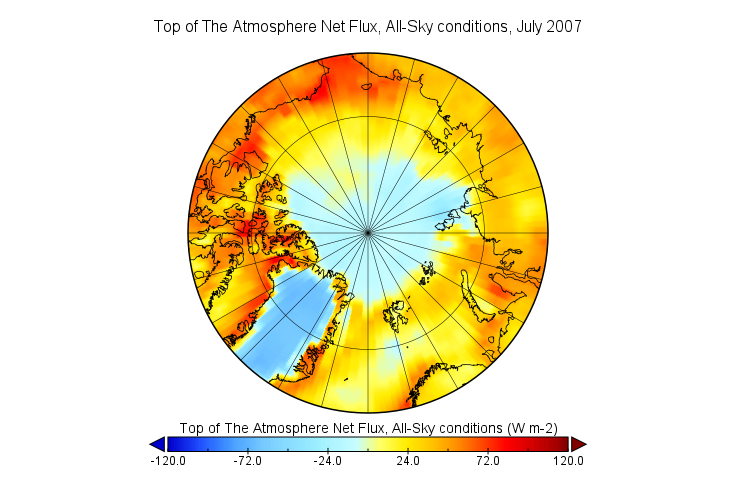
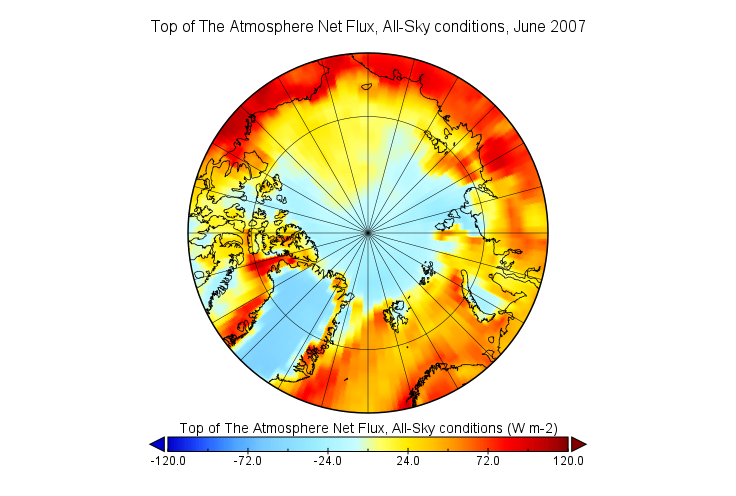
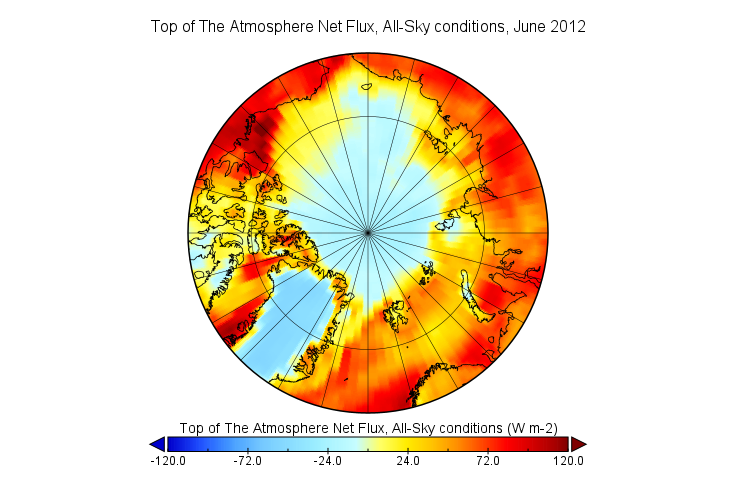
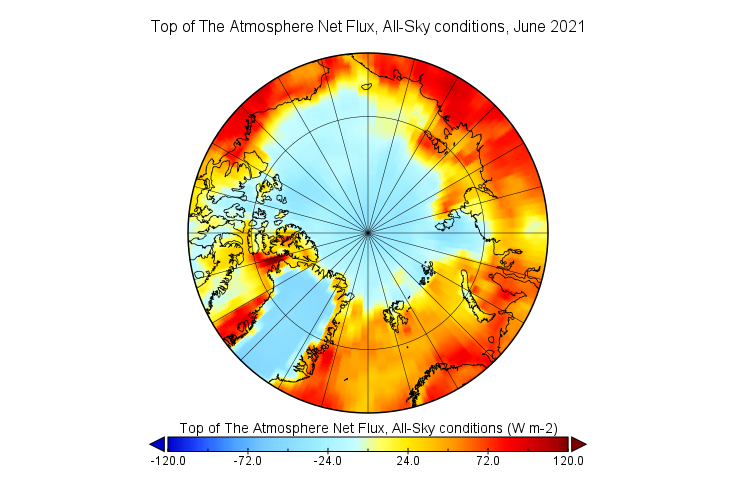
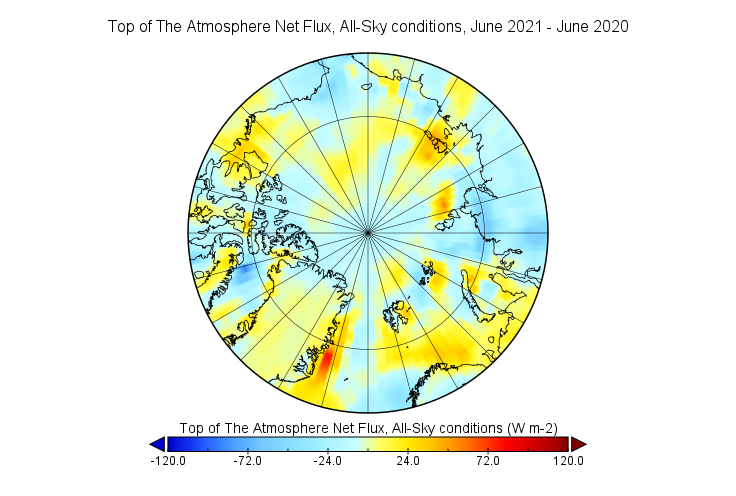
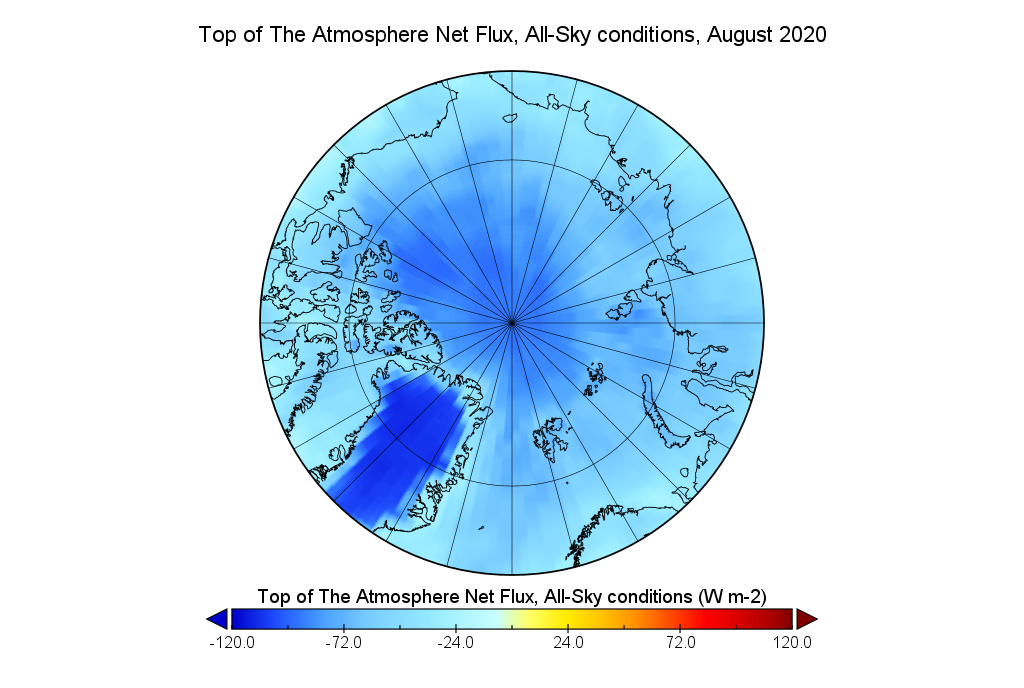
Whilst we wait (in vain?) for Willis to explain himself, here is a preliminary look at some example CERES net top of the atmosphere energy flux maps for the Arctic:
June 2021 is the latest month currently available in NASA’s CERES data, and please feel to play the game of “spot the difference” in the space provided for that purpose below. Meanwhile we await the data for July and August 2021 with barely bated breath.
[Edit – November 3rd]
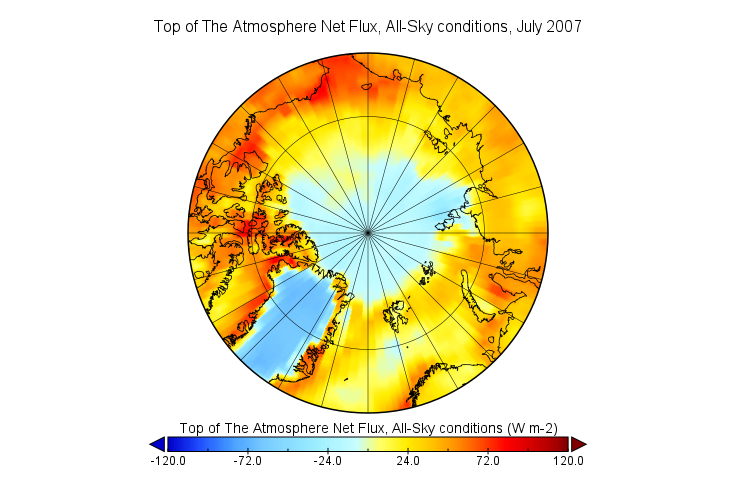
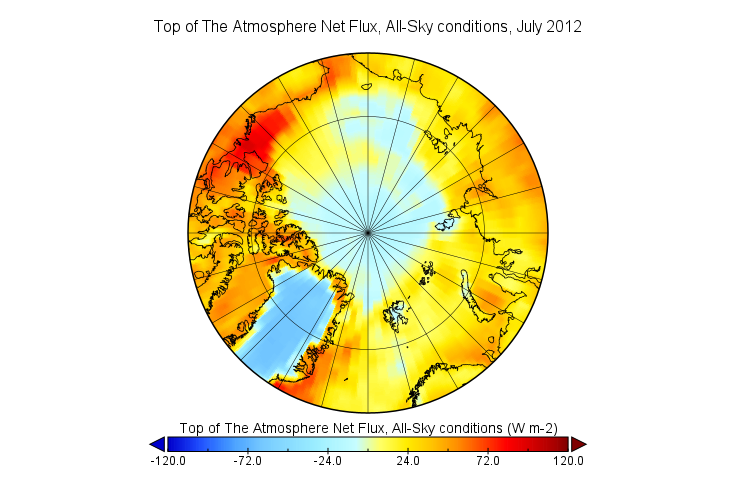
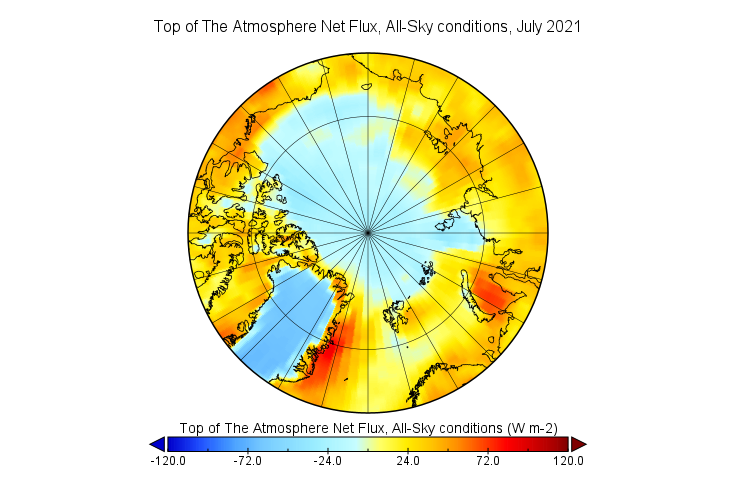
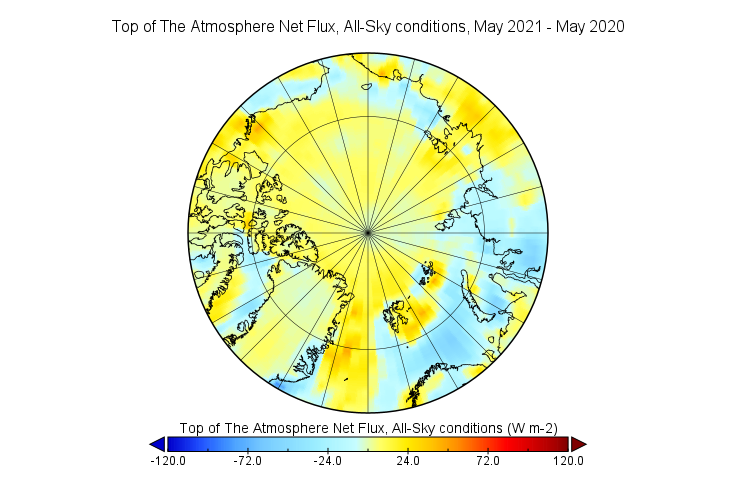
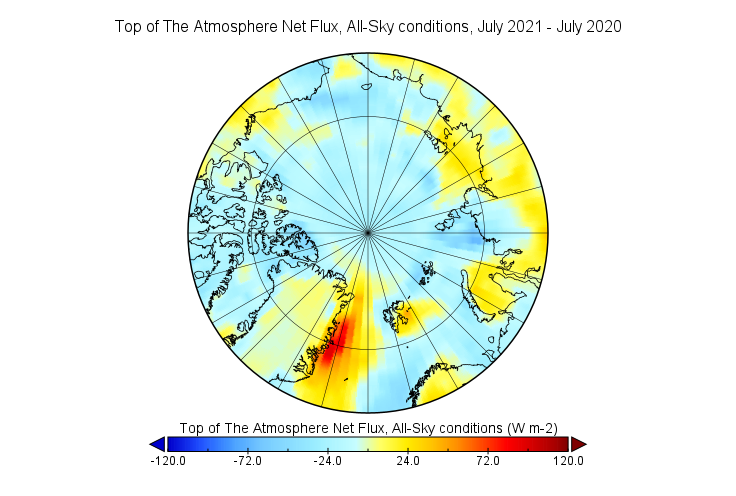
The CERES data for July 2021 has now been released, so first of all let’s take a look at the July net TOA flux for some selected years:
Next let’s compare this year’s peak insolation months with last year’s:
Does anything stand out yet?
[Edit – January 1st]
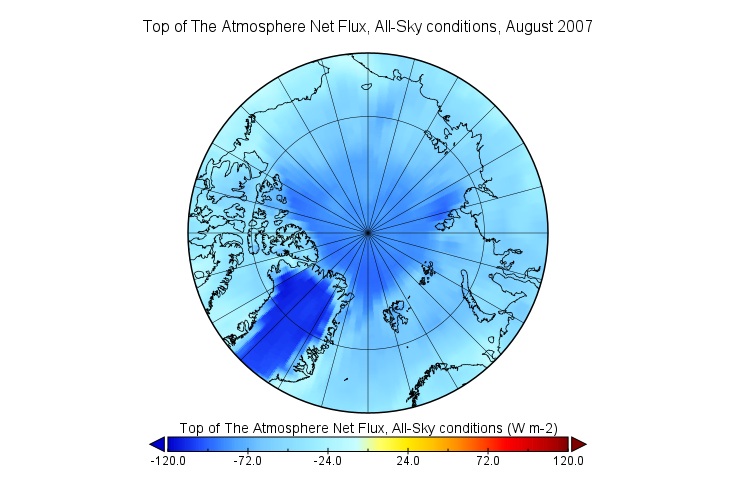
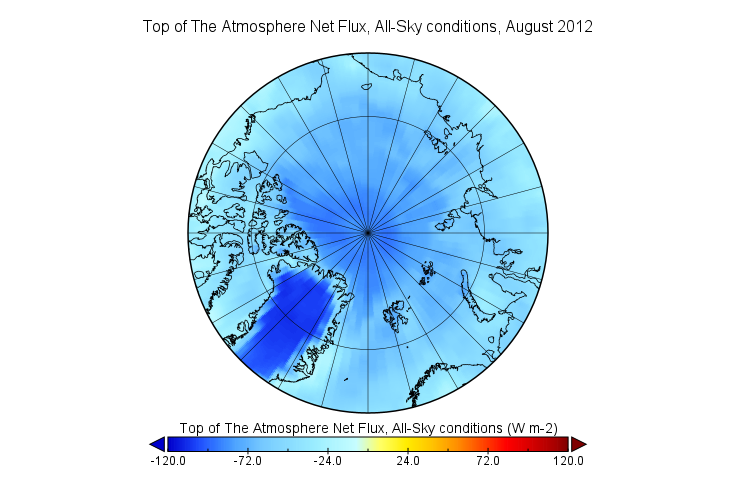
Here are maps of the CERES net TOA flux for August 2021 and our usual selection of other years:
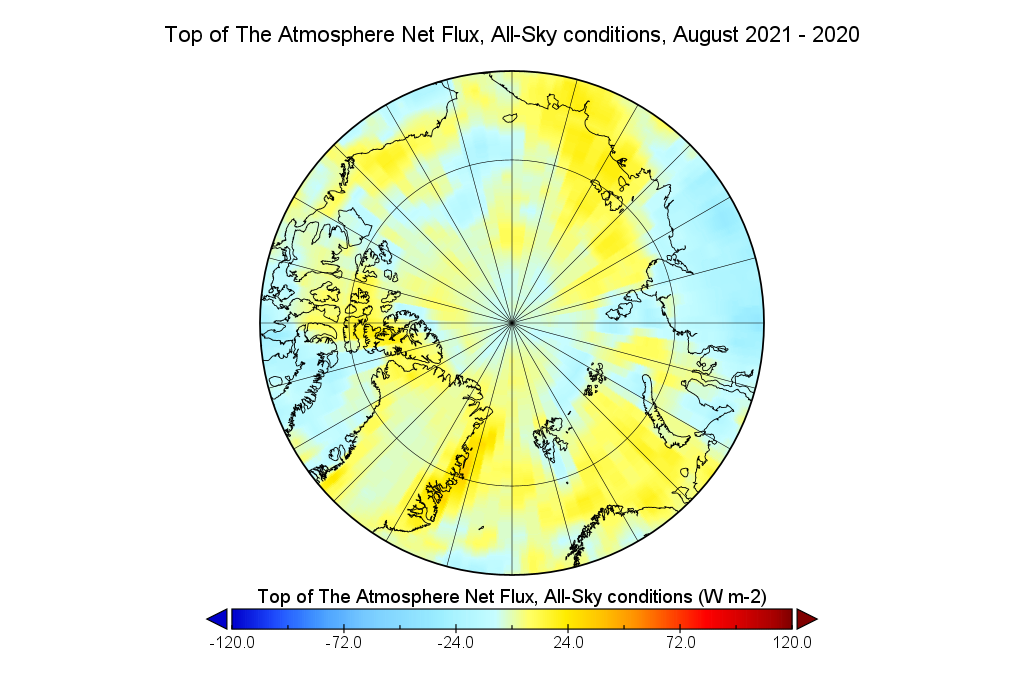
It is obvious that by August the entire Arctic is radiating energy back into space. Now let’s compare August 2021 with 2020:
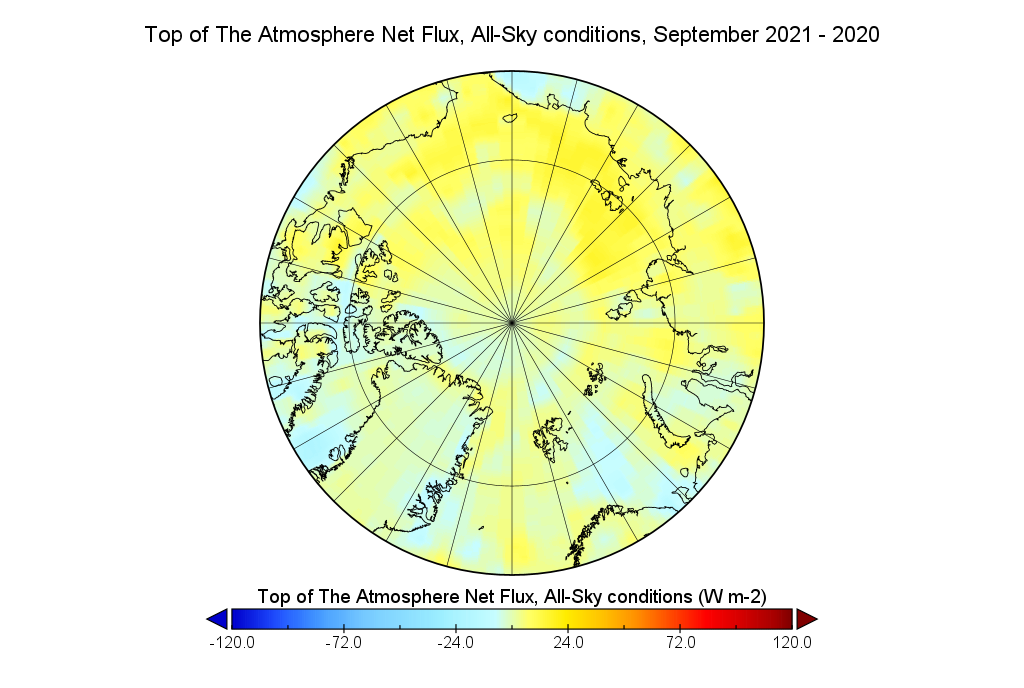
Whilst we’re at it let’s also take a look at how September compares to last year:
It is also obvious that the central Arctic has been radiating less energy back into space during September this year than it was in 2020.
A recent paper by Kent Moore et al. has caused something of a stir in the mainstream media recently, as well as in cryospheric circles and amongst the cryodenialista:
The area to the north of Ellesmere Island and Greenland contains the Arctic’s thickest ice and it is predicted to be the last to lose its perennial ice, thus providing an important refuge for ice-dependent species. There is however evidence that this Last Ice Area is, like the entire Arctic, undergoing rapid changes that may reduce its suitability as a refuge. During May 2020, a polynya developed to the north of Ellesmere Island in a region where there are no reports of a previous development. We use a variety of remotely sensed data as well as an atmospheric reanalysis to document the evolution and the dynamics responsible for the polynya. In particular, we argue that anomalously strong divergent winds associated with an intense and long-lived Arctic anti-cyclone contributed to the development of the polynya as well as similar previously unreported events in May 1988 and 2004.
Curiously the paper neglects to mention a polynya in the same region that we reported on, albeit in passing, in August 2018. Here’s an updated video of that event, with the addition at the start of a yellow arrow to highlight the part of the Arctic’s “Last Ice Area” investigated by Moore et al. and a pale blue arrow to highlight Kap Morris Jesup, the most northerly point in Greenland:
Next here’s another animation, covering the time period discussed in the paper and continuing throughout the summer of 2020:
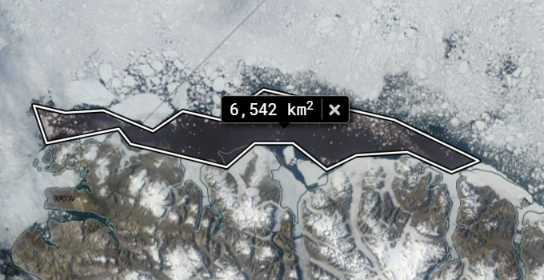
Comparing the two animations it is obvious that the August 2018 polynya is much larger than the one in May 2020, confirmed by a quick area computation using NASA WorldView:
The introduction to the paper states that:
Flaw leads, elongated regions of open water that develop along the interface between land fast and pack ice (Barber & Massom, 2007) are common in the region. Indeed Peary’s 1909 sledding expedition to the North Pole was delayed as a result of a large flaw lead that developed north of Ellesmere Island (Peary, 1910). However, the development of a polynya in this region has not been reported previously.
To my eye the image above reveals something far too wide to be described as a “flaw lead”, but let’s delve deeper into the paper:
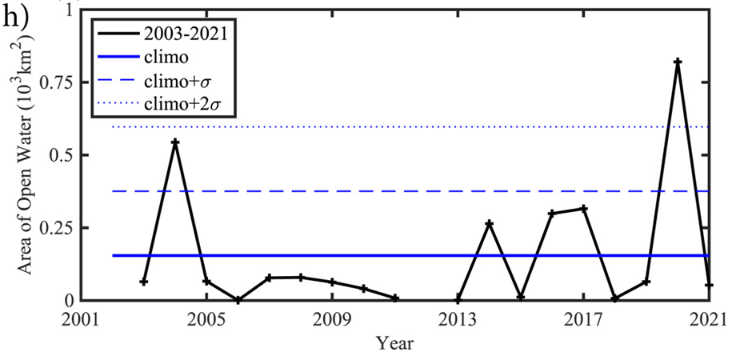
A perspective on the unique nature of the May 2020 event is provided by the monthly mean area of open water in the area of interest during May for the entire period of the ASI data set, 2003–2021 (Figure 2h). Typically the area of open water during May in the region is less than 160 km2. May 2020 is the only year in which the area of open water exceeds 2 standard deviations above the mean.
Perhaps the polynya in question is indeed “unique in the month of May”, in which case it would no doubt have been helpful if the abstract and/or the introduction to the paper had mentioned this subtlety. Then the plethora of erroneous statements in the media like the one recently referenced by Mark Lynas on Twitter might have been avoided?
The polynya is the first one that has been identified in this part of the Last Ice Area, according to a new study detailing the findings in the AGU journal Geophysical Research Letters.
Since Mark, amongst others, seem to be suffering from the misapprehension that “The Arctic’s ‘Last Ice Area’ is cracking, just in time for COP26” here is what’s been happening in the “Last Ice Area” this year, in the run up to next month’s conference in Glasgow:
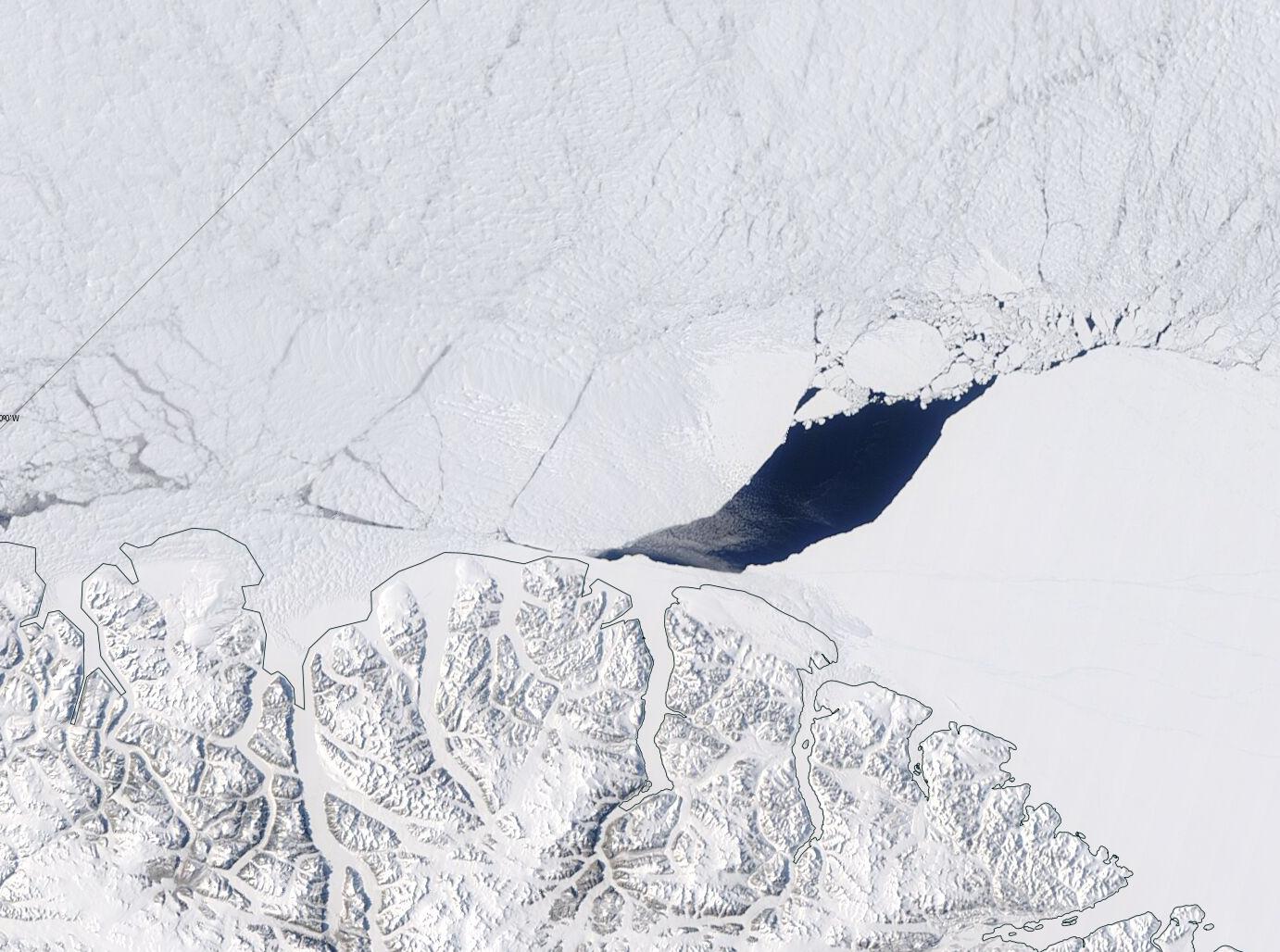
Finally, for the moment at least, are MODIS images of the May 20th 2020 polynya:
and the one on May 12th 2004:
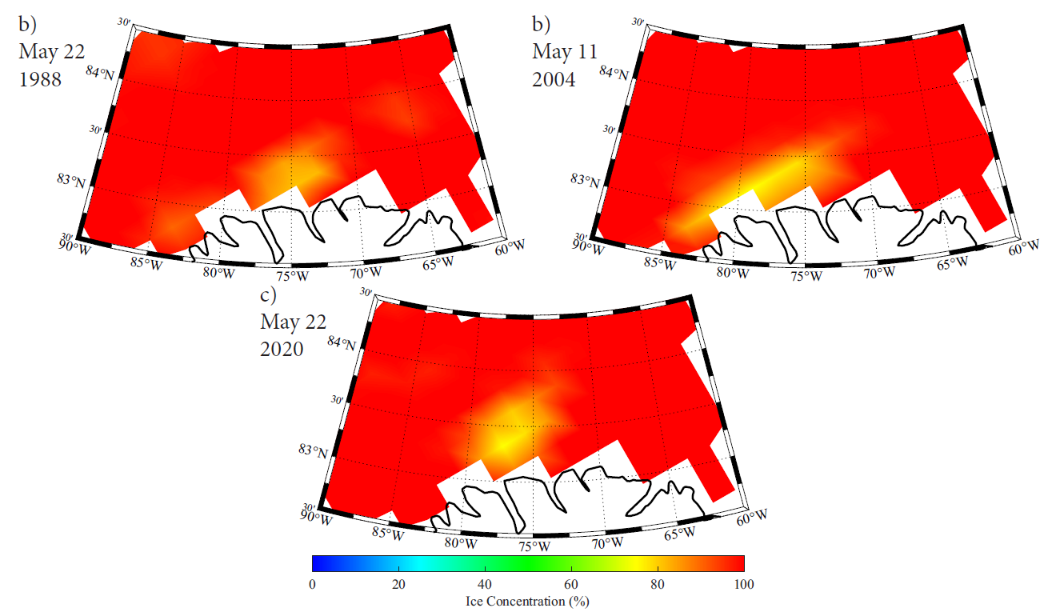
Neither Aqua or Terra had been launched in 1988 of course, and Landsat 5 didn’t cover the north of Ellesmere Island. This is the SSM/I & SSMIS visualisation of all three May polynyas from the supplement to Moore’s paper:
O frabjous day! Callooh! Callay!” He chortled in his joy.
It has been brought to my attention (slightly belatedly) that in the run up to COP26 David Rose is once again pontificating about Arctic sea ice on Twitter. I have been in discussion about the “recently discovered” polynya in the so called “Last Ice Area” north of Ellesmere Island for a few days. Then this morning I discovered via a heads up from “ClimateVariability” that Mark Lynas has been tweeting about it too:
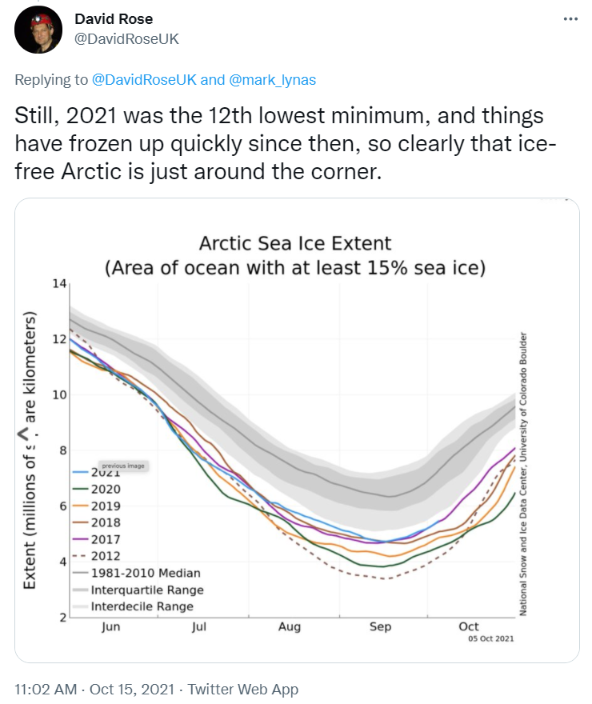
My Arctic alter ego and I were of course “blocked” by David Rose on Twitter many moons ago, and he has been quite quiet about the Arctic of late. However what with one thing and another he has now resumed his controversial commentary on the High North by commenting on Mark’s missive as follows:
We’ve been following the voyage of the Canadian icebreaker CCGS Amundsen as he circumnavigated Banks Island. Now Amundsen is about to set off on the final leg of his 2021 Arctic campaign to conduct the “DarkEdge” study in northern Baffin Bay. According to the Amundsen Science web site:
7 October to 3 November – Cambridge Bay to Quebec City
During the final Leg of the 2021 Expedition, an integrated study (DarkEdge) will take place at the ice edge to study the key processes taking place during the fall-winter transition in northern Baffin Bay. The Sentinel North program will deploy an Autonomous Underwater Vehicle (AUV) and contribute to the Dark Edge campaign. The CCGS Amundsen will sail to Quebec City for the end of the annual expedition on November 3rd.
and according to Christian Katlein from the Alfred Wegener Institute:
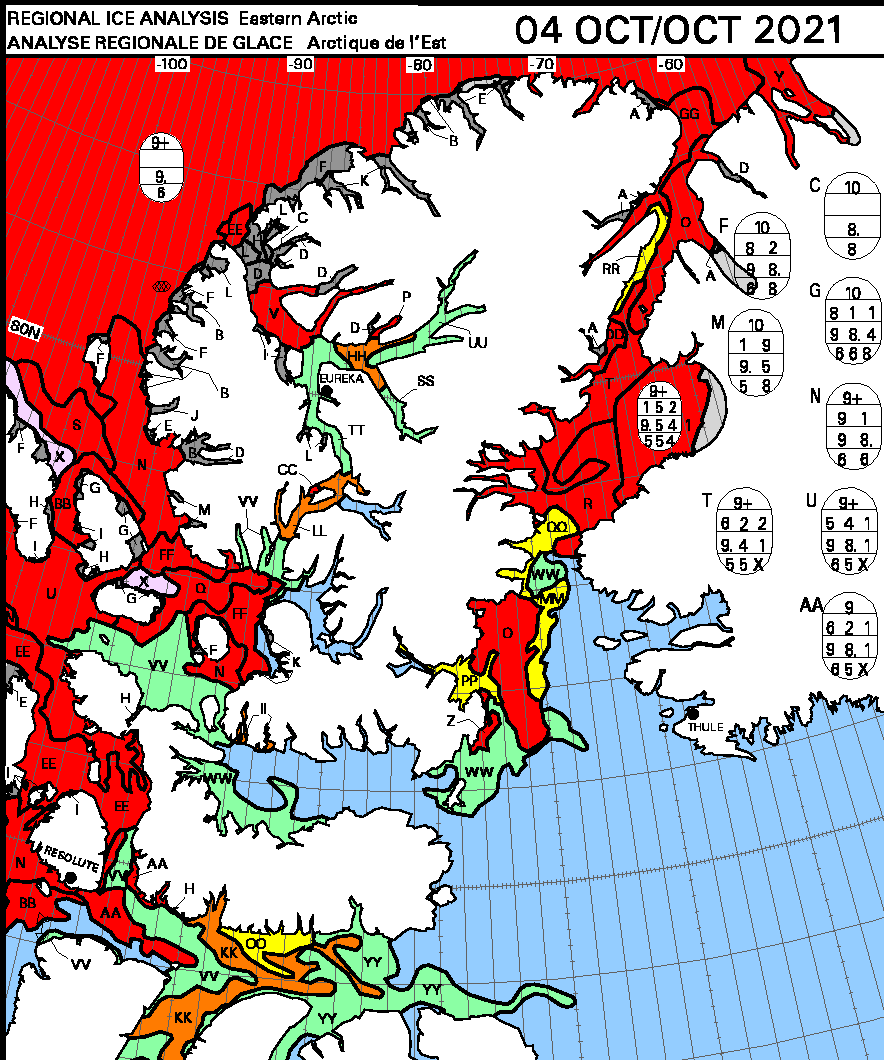
The Canadian Ice Service daily charts don’t currently cover the north of Baffin Bay, so here’s the most recent weekly which provides some idea of what Amundsen will be facing over the next few weeks:
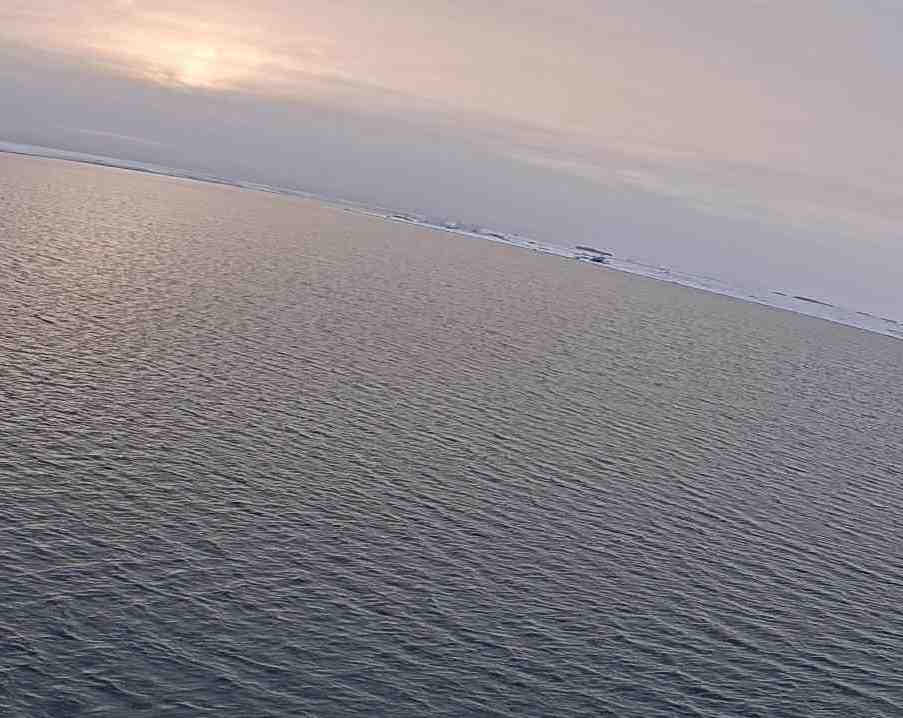
As Amundsen prepares to begin his voyage to the DarkEdge, here’s a watery sun setting over Cambridge Bay last night:
[Edit – October 11th]
Here’s the eighth video in Christian’s Sea Ice Stories series and the first from Amundsen itself, whilst moored in Cambridge Bay:
[Edit – October 12th]
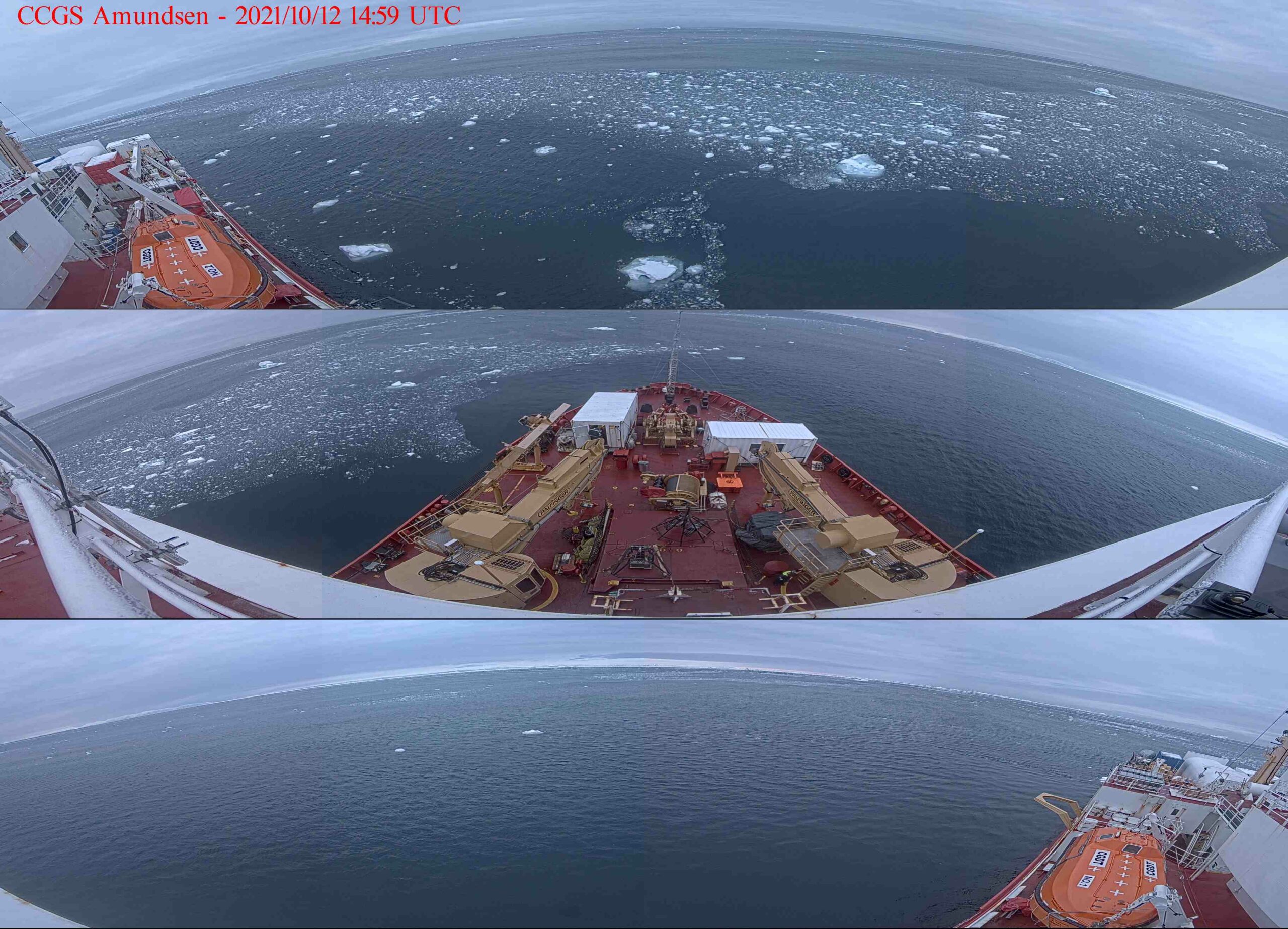
Amundsen has finally located a smidgen of sea ice in Baffin Bay, at approximately 76.10 N, 77.10 W. Click to enlarge:
[Edit – October 13th]
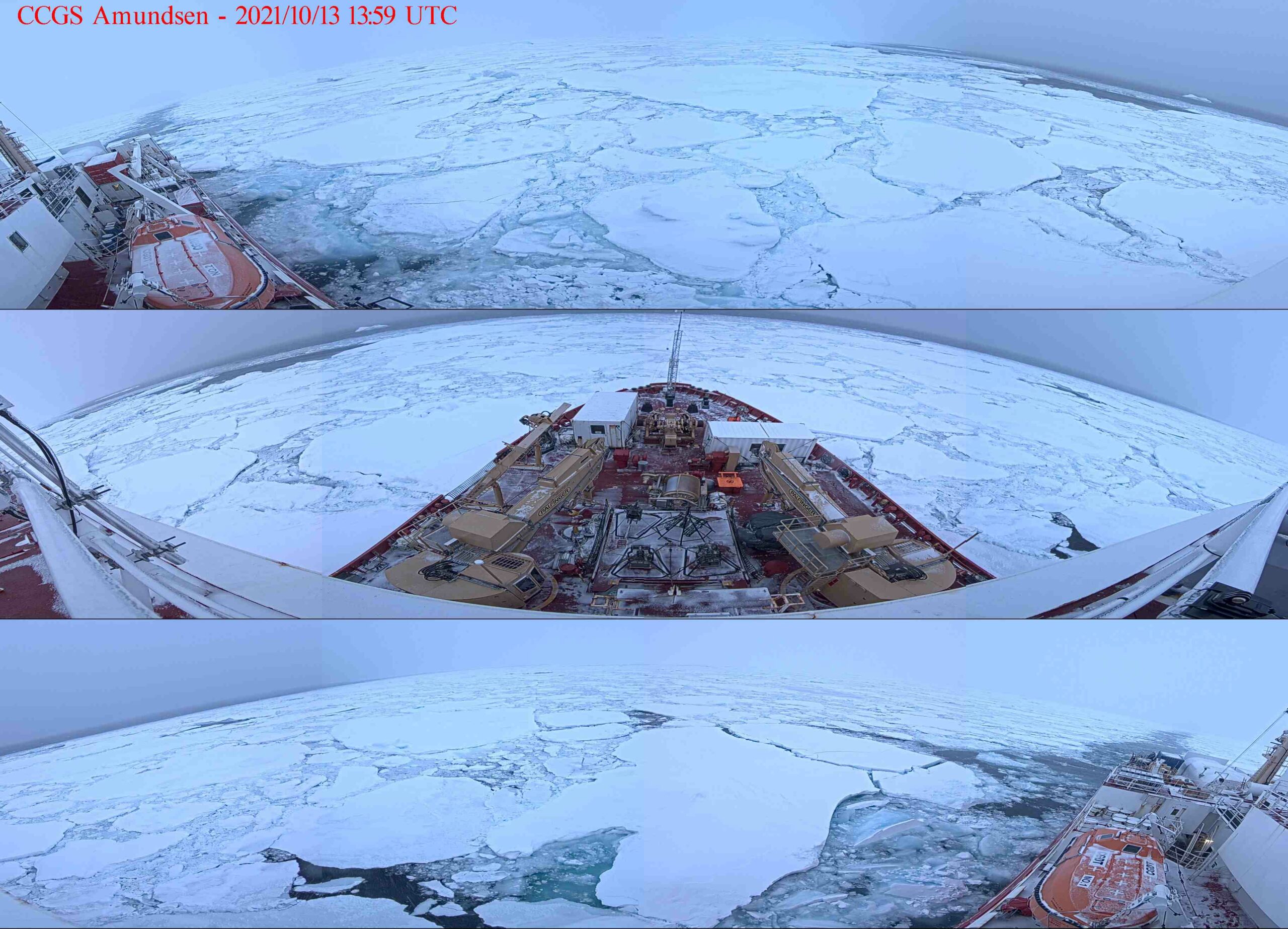
Amundsen has managed to find some more significant sea ice, this time located at around 76.30 N, 78.70 W:
It seems Tony didn't bother to read the references in the @IPCC_CH's #FAR that he quoted earlier.
Had he done so he would have discovered that when USS Nautilus sailed under the #NorthPole in 1958 it found the mean ice draft to be 5.32 meters.#TruthDecay#ClimateBall™
"I'm pretty sure that ice doesn't grow during record heat"
Tony seems unaware that the #Arctic isn't the entire planet, that #SeaIce melts in summer, and that summer surface temperatures in the high Arctic are held close to the melting point.#TruthDecay#ClimateBall™
Needless to say Tony has yet to answer my final question.
[Edit – October 16th]
Needless to say Tony Heller has yet to answer any of my recent questions. What’s more despite the exhortations of one of his band of merry (mostly) men he has declined to engage in a public debate with me:
With my alter ego blocked I’ve been debating with some of Tony’s band of merry (mostly) men whilst wearing my normal attire. One of them requested the opinion of Judah Cohen and Big Joe on Tony’s cherry pick du jour:
A few days ago we posted an article about the recent surge in the amount of disinformation being published about Arctic sea ice. Eventually one of our long list of usual suspects, Anthony Watts, published a copy of an erroneous Arctic article by Paul Homewood.
Now the Watts Up With That Arctic porky pie production line is going into overdrive, so here’s an already long list of its output in the run up to the COP26 conference in Glasgow in a month or so. First up is the aforementioned clone from NALOPKT. Allegedly:
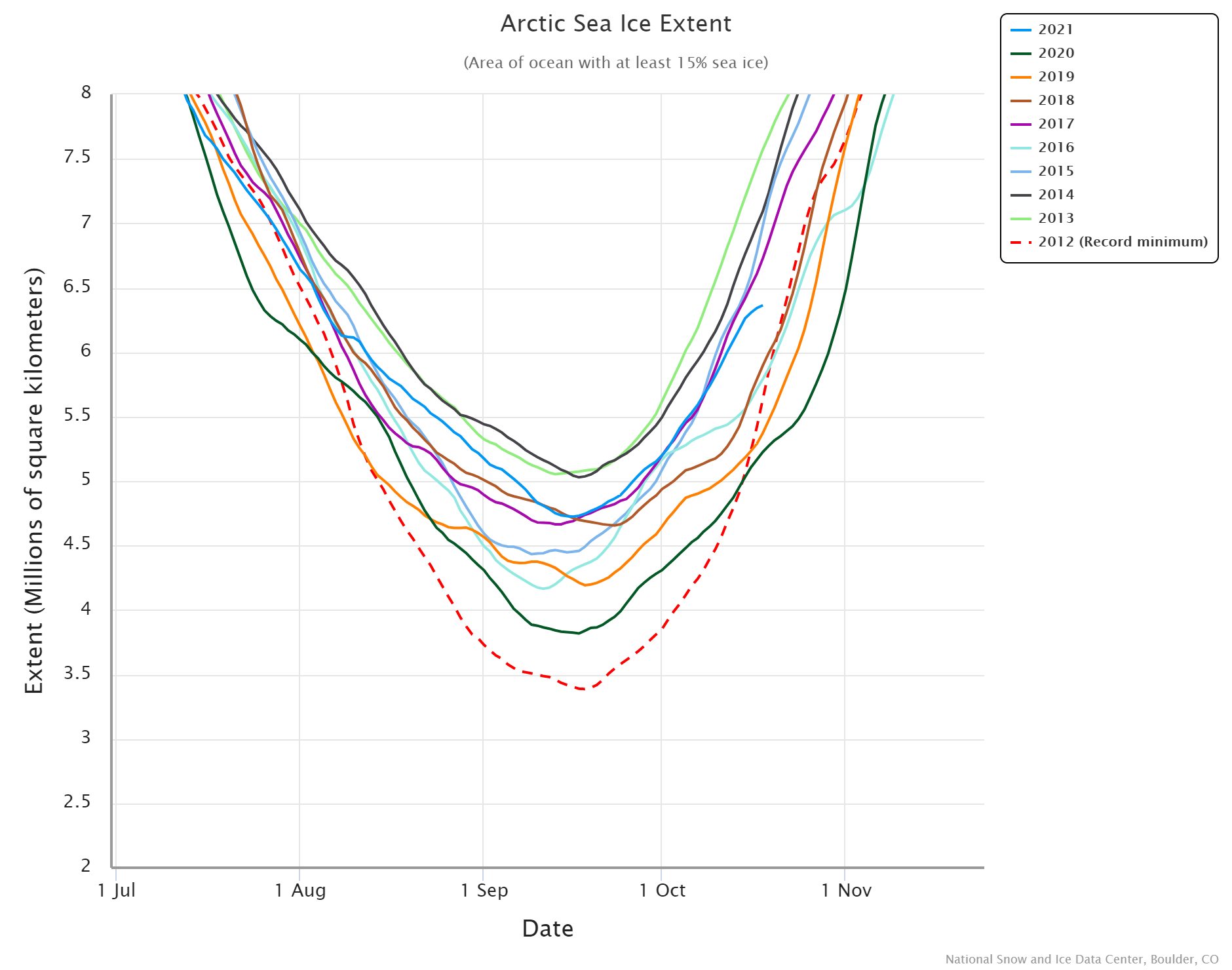
It is very easy to show that Arctic sea ice has stabilised. As their graph itself shows, there have only been three years since 2007 with lower ice extent than that year, and eleven have had higher extents. Also the average of the last ten years is higher than 2007’s extent.
In itself, this is too short a period to make any meaningful judgements. But that is no excuse for the Met Office to publish such a manifest falsehood.
This comment of mine on that article remains invisible at WUWT:
Who would have thunk it?
Not a lot of people know that @wattsupwiththat has just repeated Paul Homewood's allegations that @MetOffice has been economical with the truth about #Arctic#SeaIce.
Neither Paul nor Anthony have seen fit to publish my response yet:
This website uses cookies to improve your experience. We'll assume you're ok with this, but you can opt-out if you wish. Cookie settingsACCEPT
Privacy & Cookies Policy
Privacy Overview
This website uses cookies to improve your experience while you navigate through the website. Out of these, the cookies that are categorized as necessary are stored on your browser as they are essential for the working of basic functionalities of the website. We also use third-party cookies that help us analyze and understand how you use this website. These cookies will be stored in your browser only with your consent. You also have the option to opt-out of these cookies. But opting out of some of these cookies may affect your browsing experience.
Necessary cookies are absolutely essential for the website to function properly. This category only includes cookies that ensures basic functionalities and security features of the website. These cookies do not store any personal information.
Any cookies that may not be particularly necessary for the website to function and is used specifically to collect user personal data via analytics, ads, other embedded contents are termed as non-necessary cookies. It is mandatory to procure user consent prior to running these cookies on your website.