Tag Archives: NSIDC

The United States’ National Snow and Ice Data Center

Facts About the Arctic in January 2024

Happy New Year to one and all.

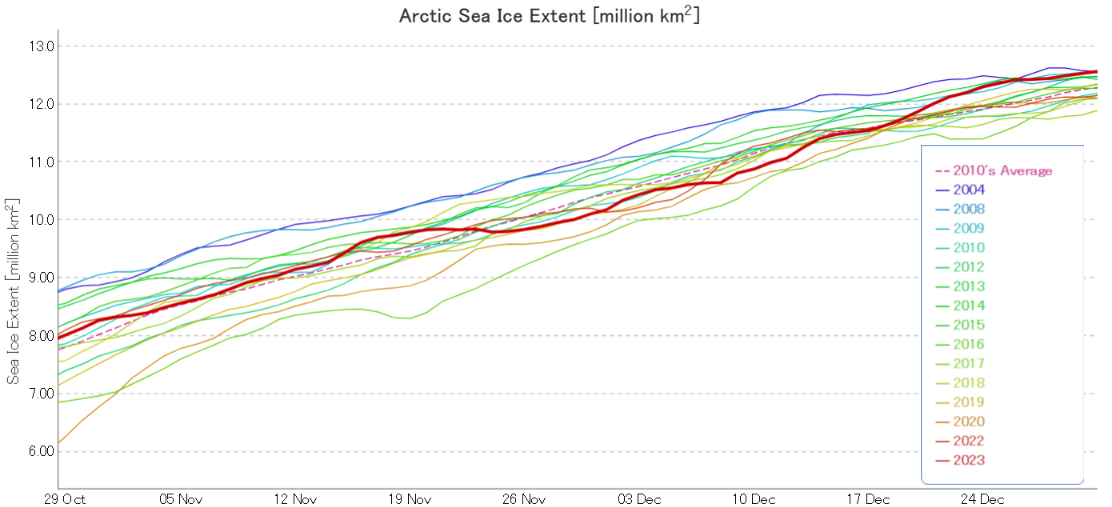
Whilst waiting for the all important thickness and volume data to arrive, we’ll start the new year in traditional fashion with a graph of JAXA extent:

The 2023 calendar year finished with this particular extent metric sitting at 15th lowest in the satellite era.

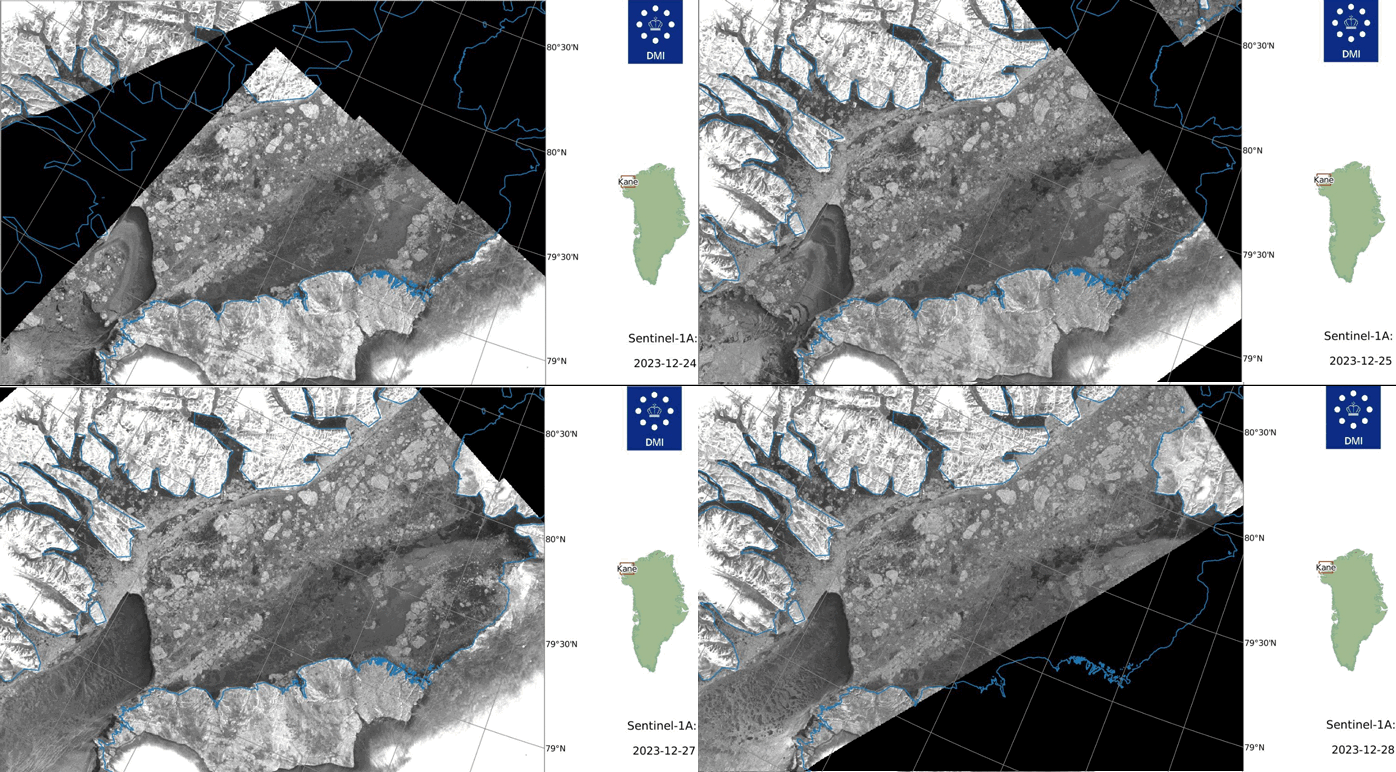
From Niall Dollard on the Arctic Sea Ice Forum comes evidence via the Sentinel 1A satellite that an arch formed in the Nares Strait between Greenland and Ellesmere Island in late December:

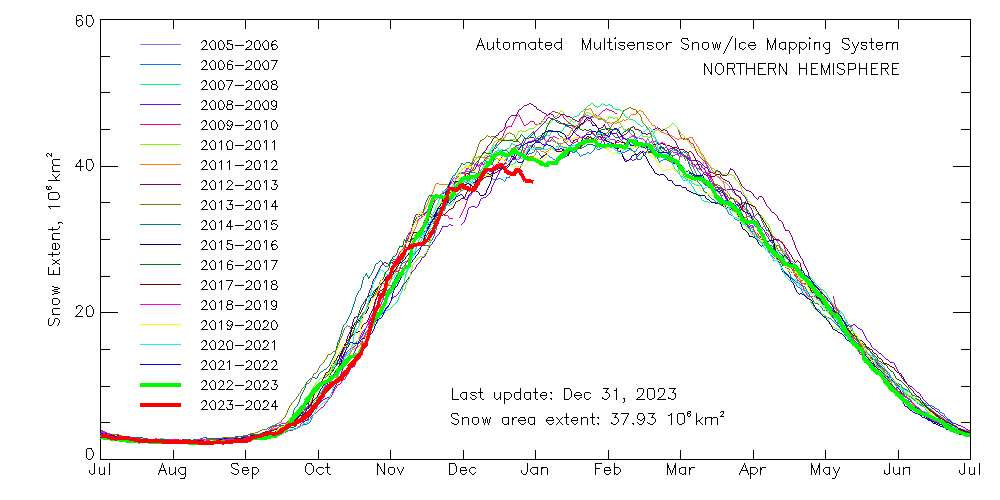
Since it’s a hot topic on (a)social media at the moment, here too is the Northern Hemisphere Multisensor Snow Extent at the end of 2023:

Please note the current record low NH snow extent. Matt predicts all that is about to change:

[Update – January 2nd]

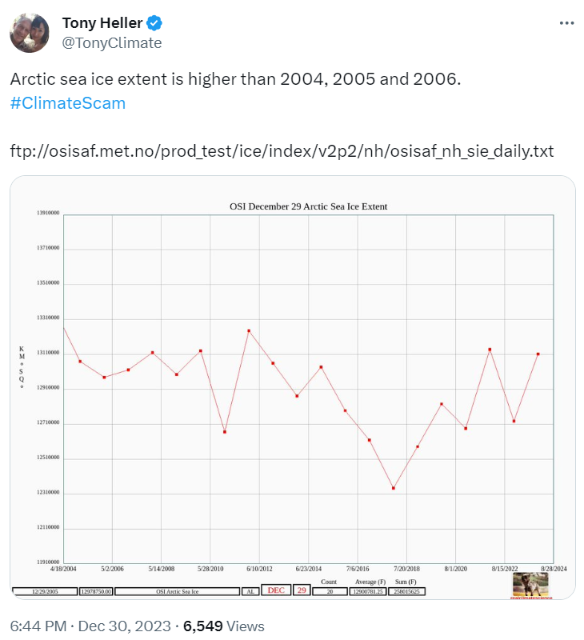
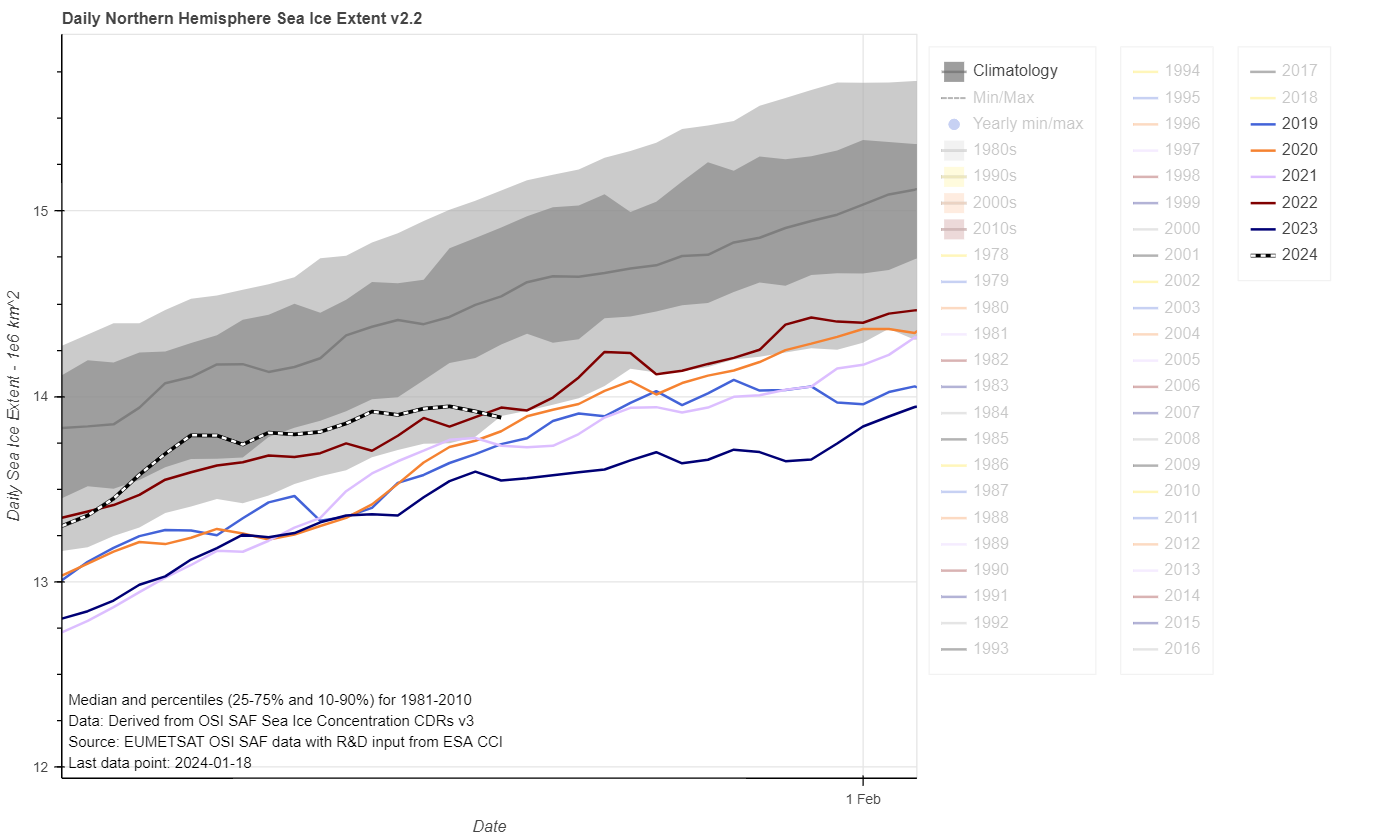
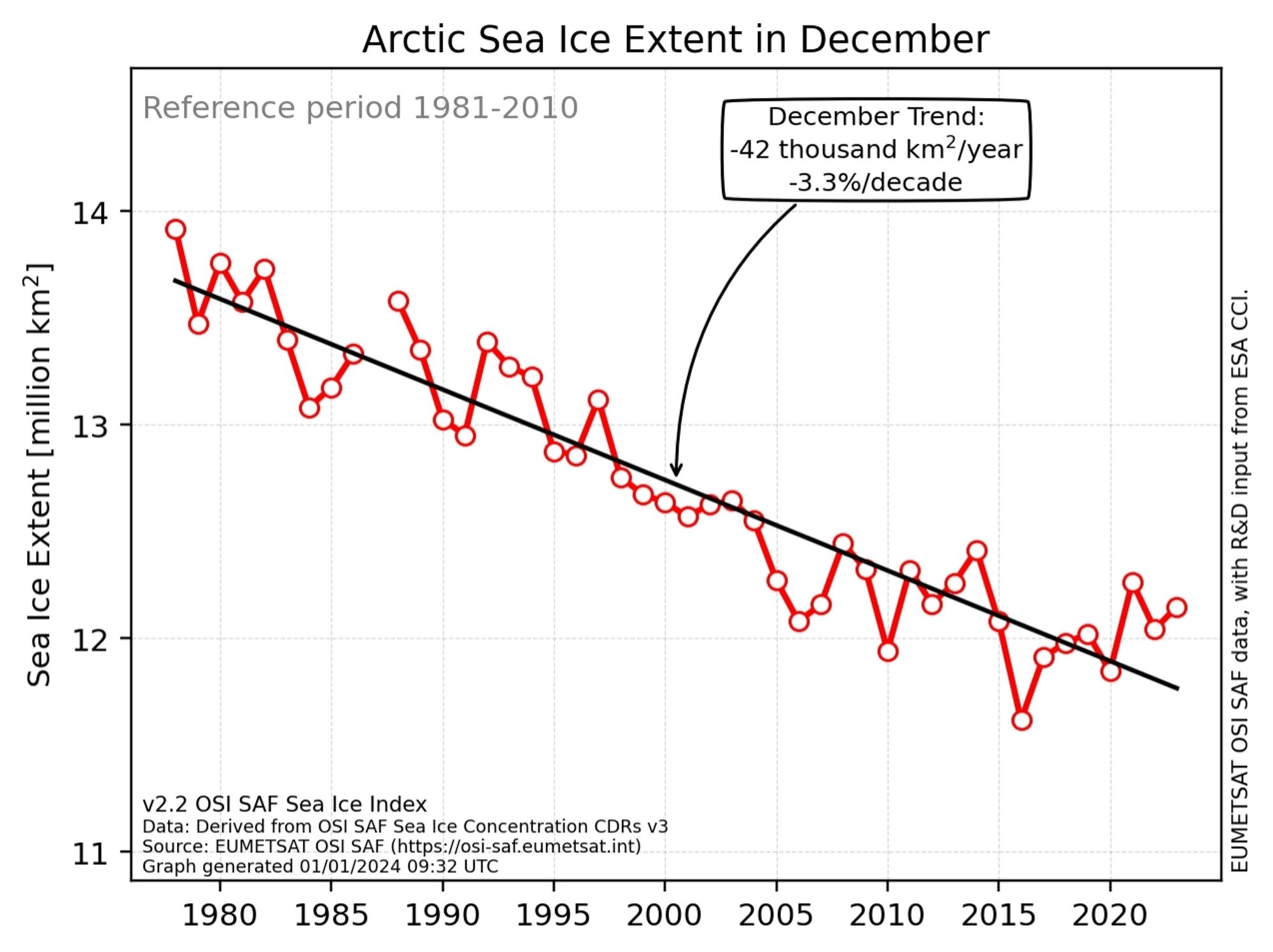
Hot off the Scandinavian virtual printing presses, here is the official December Arctic sea ice extent trend graph from the OSI SAF:

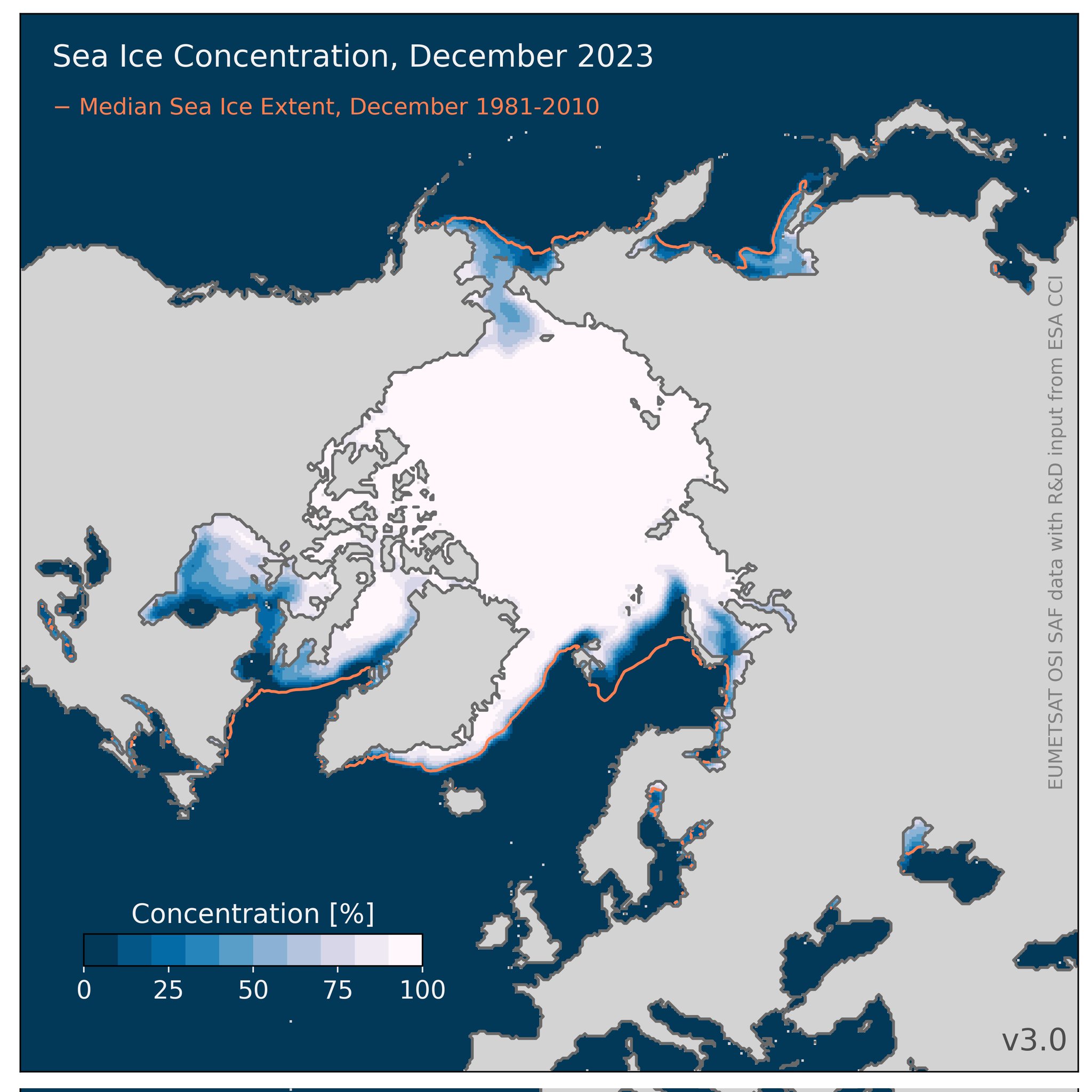
That’s “Steve”/Tony’s current metric du jour. When do you suppose he will bring it to the attention of his horde of regular readers? It’s accompanied by this matching concentration map:

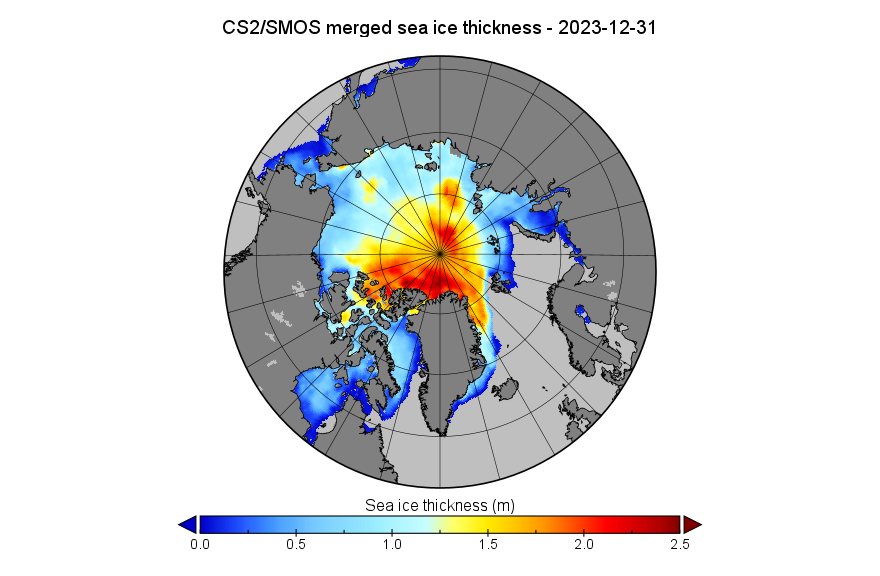
Here too is the CryoSat-2/SMOS thickness map for December 31st, in a different format to the one usually used here:

[Update – January 3rd]

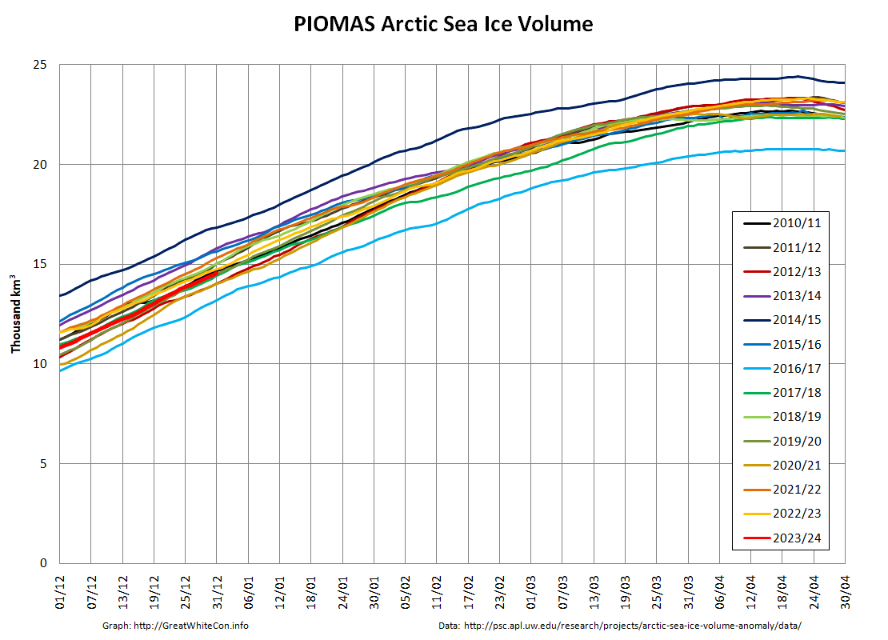
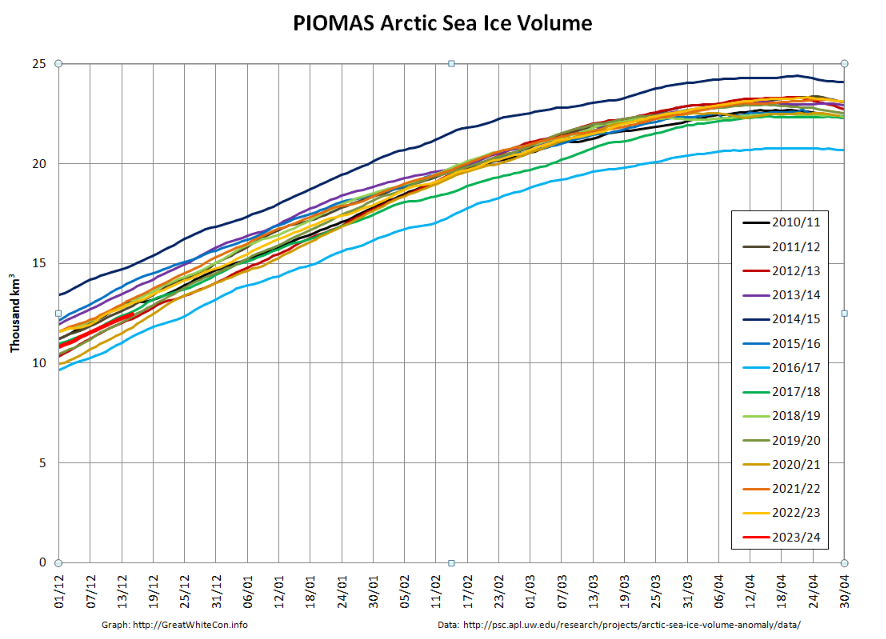
The December PIOMAS modelled gridded thickness data has been released. The calculated volume is 6th lowest in the satellite era:

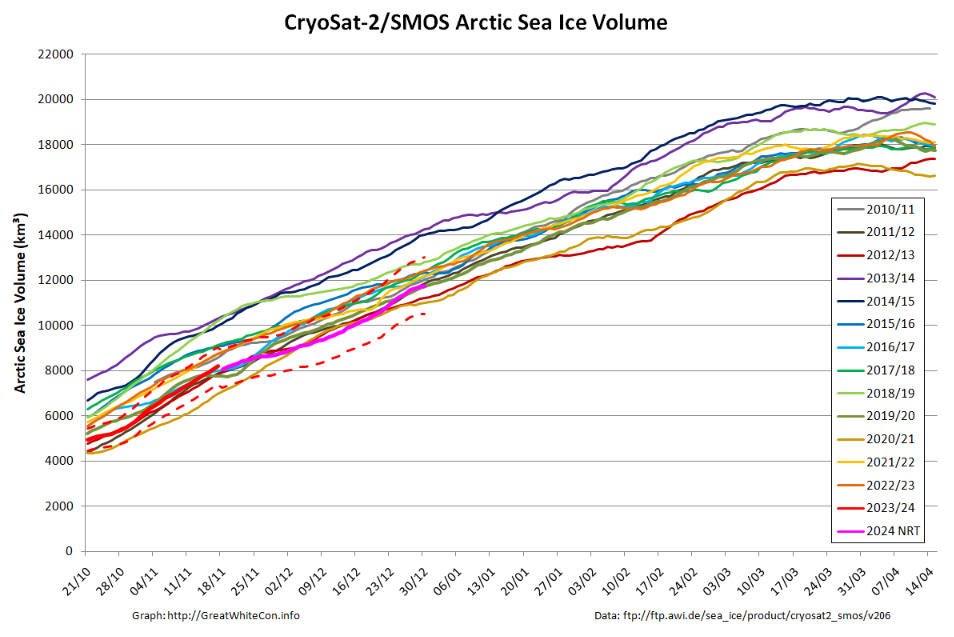
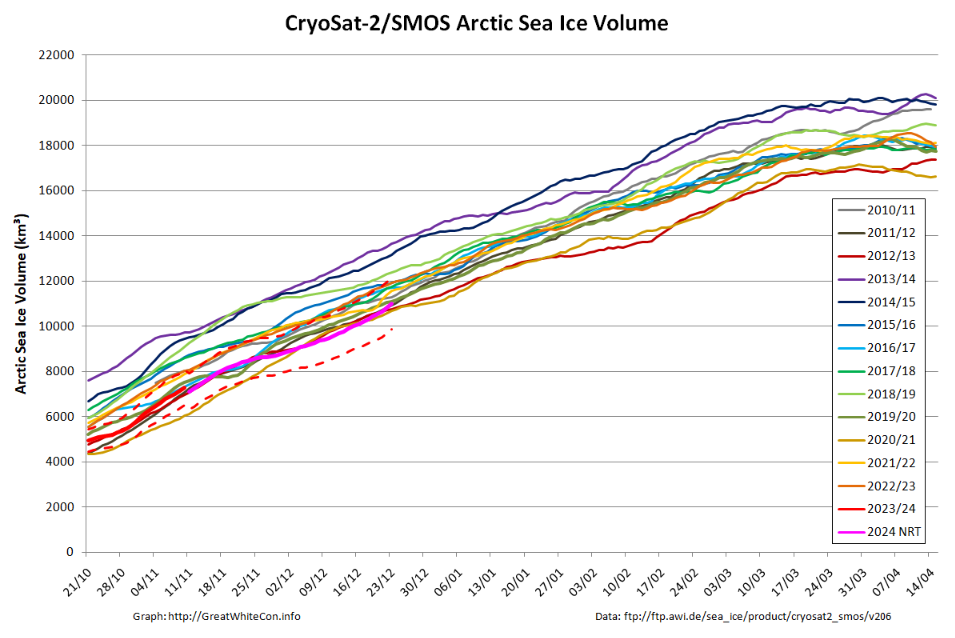
Here is the equivalent CS2/SMOS volume graph

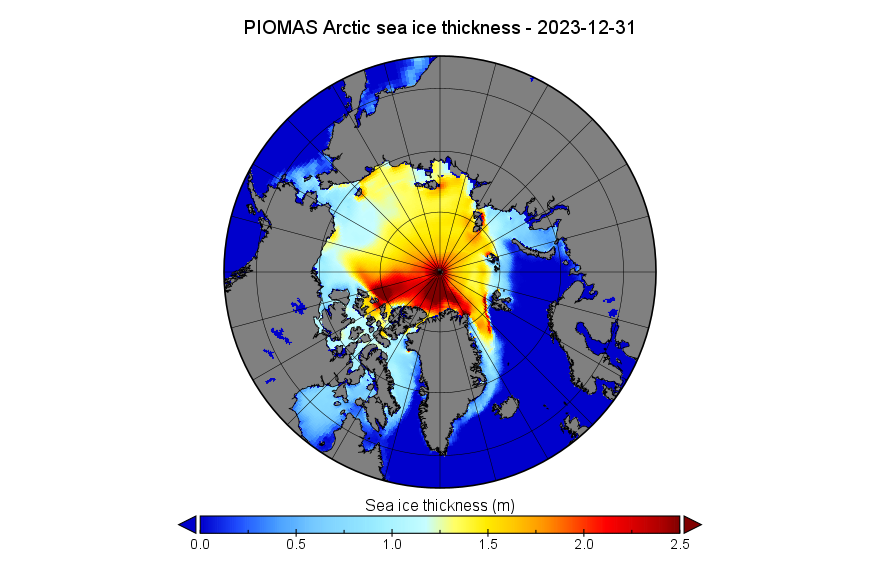
Here too is the PIOMAS thickness map for December 31st:

This uses the same Greenland down orientation and 2.5 meter maximum scale value as the CS2/SMOS map above.

[Update – January 6th]

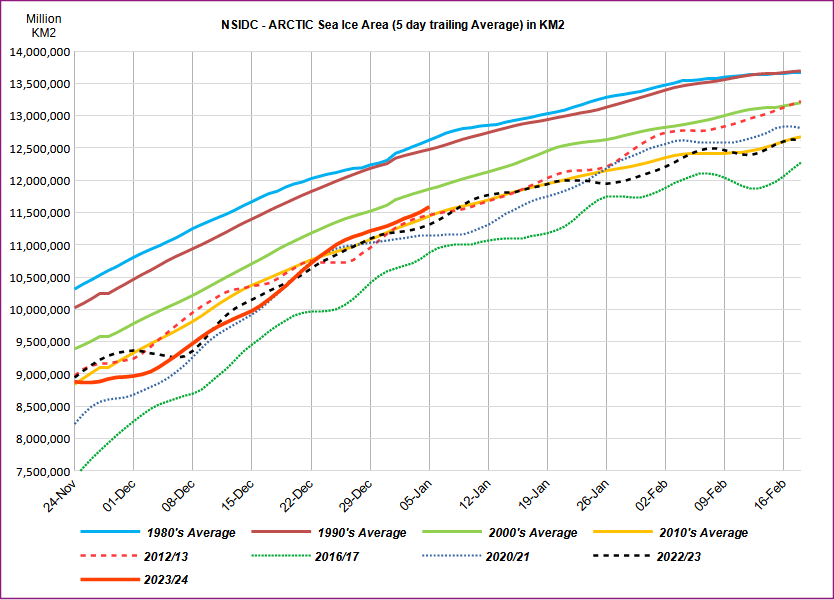
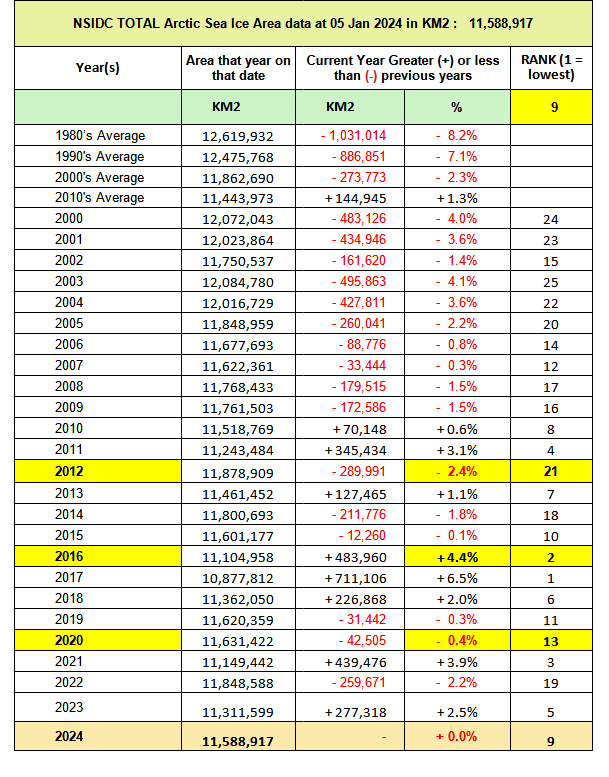
Here are the NSIDC area numbers from Gerontocrat on the Arctic Sea Ice Forum that Tom mentions below:

Currently 9th lowest for the date. In the satellite era!

[Update – January 8th]

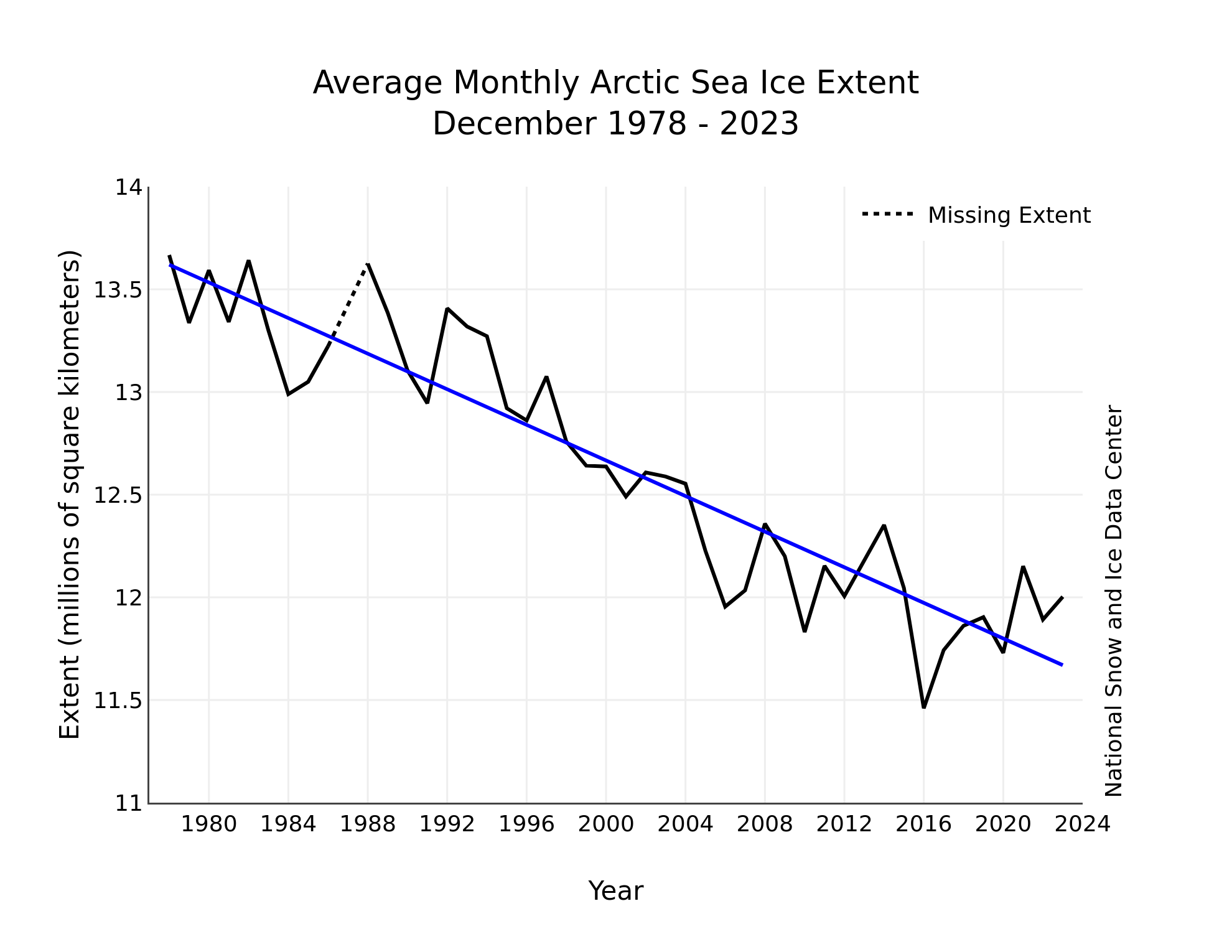
The National Snow and Ice Data Center has published the December edition of Arctic Sea Ice News:

The end of 2023 had above average sea ice growth, bringing the daily extent within the interdecile range, the range spanning 90 percent of past sea ice extents for the date. Rapid expansion of ice in the Chukchi and Bering Seas and across Hudson Bay was responsible.

Average Arctic sea ice extent for December 2023 was 12.00 million square kilometers, ninth lowest in the 45-year satellite record . Sea ice extent increased by an average of 87,400 square kilometers per day, markedly faster than the 1981 to 2010 average of 64,100 square kilometers per day.

After a delayed start to the freeze-up in Hudson Bay, sea ice formed quickly from west to east across the bay, leaving only a small area of open ocean near the Belcher Islands at month’s end. In the northern Atlantic, sea ice extent remained below average extent, as has been typical for the past decade.

For December overall, 2023 had the third highest monthly gain in the 45-year record at 2.71 million square kilometers, behind 2006 at 2.85 million square kilometers and 2016 at 2.78 million square kilometers.

Moving on to the “Conditions in context” section:

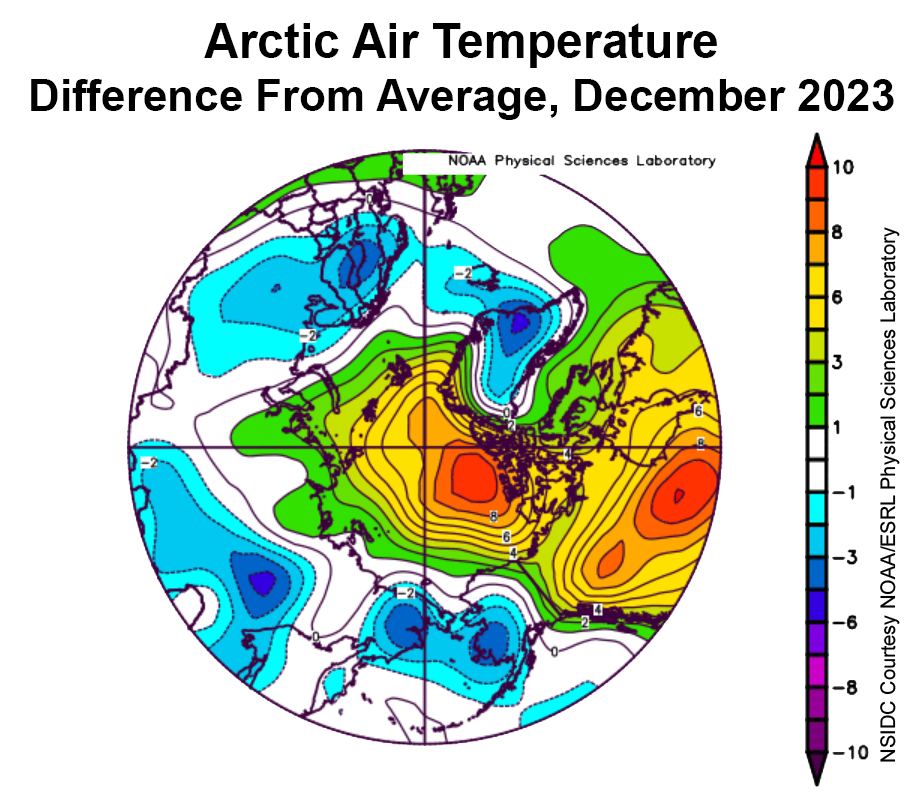
Warm conditions prevailed over the central Arctic Ocean and Beaufort Sea regions, as well as over Hudson Bay and much of northern Canada, with air temperatures at the 925 millibar level (around 2,500 feet above sea level) 8 to 9 degrees Celsius above the 1991 to 2020 average. Elsewhere, relatively cool conditions prevailed, with air temperatures 2 to 4 degrees Celsius below average in southwestern Alaska, easternmost Russia, Scandinavia, and southeast Greenland. Cool conditions in the Bering and southern Chukchi Seas explain the rapid ice growth there. By contrast, the warm conditions over Hudson Bay, continuing since November, explain its delayed start of ice formation there.

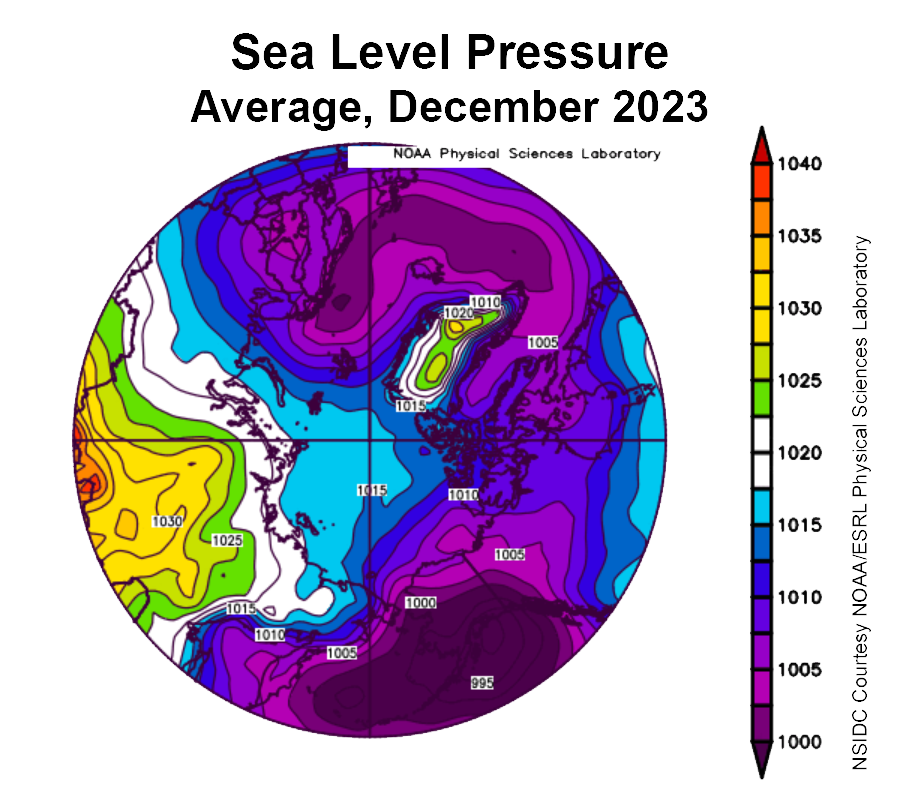
The atmospheric circulation pattern for December was marked by low sea level pressure over the Gulf of Alaska and northern Europe and high sea level pressure over central Russia. This pattern led to cold Arctic air flowing across the Chukchi Sea and into the Bering Sea as well as advection of relatively warm air across Canada into the Beaufort Sea:

[Update – January 10th]

NOAA have published the 2023 Arctic Report Card.

Here’s a taste, but there’s much more at the dedicated article linked to above:

[Update – January 12th]

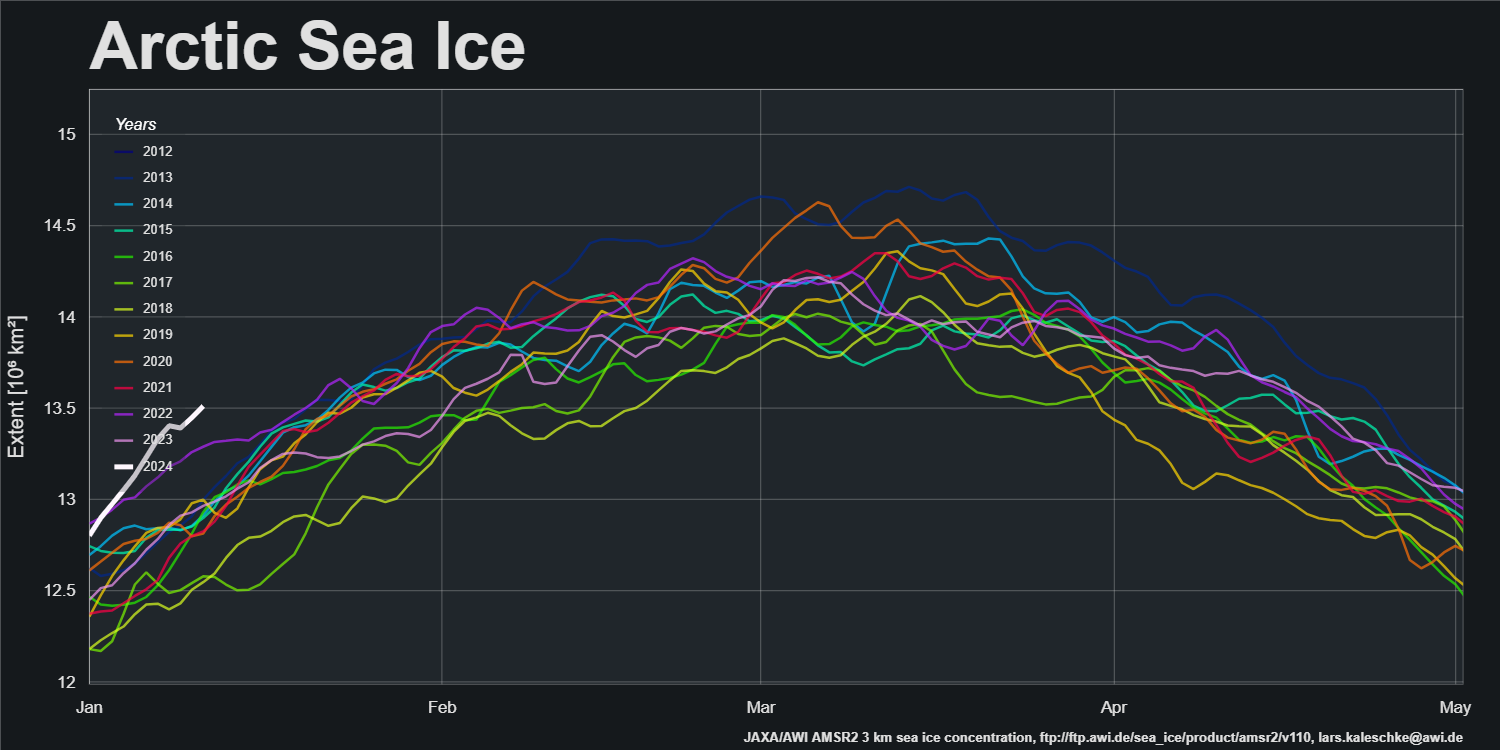
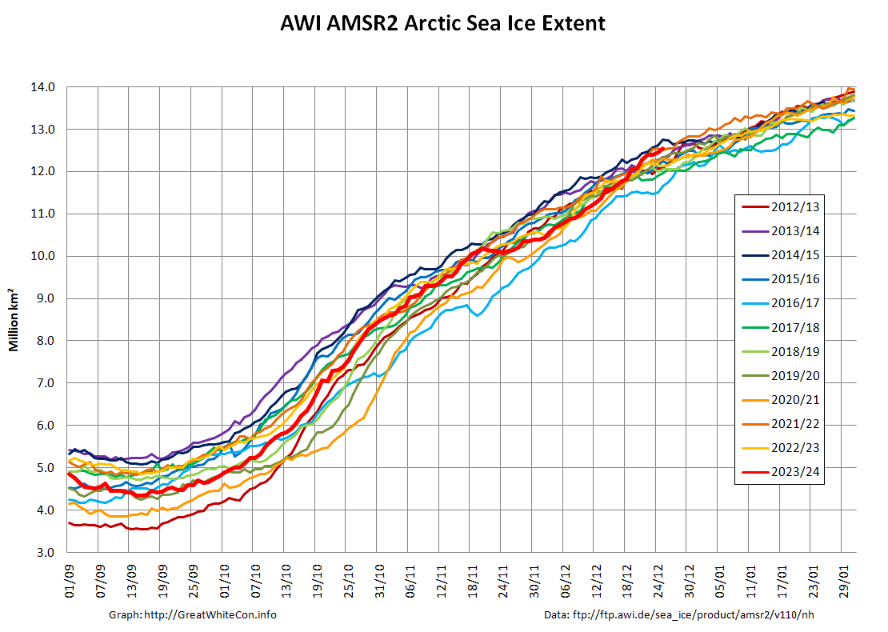
A change is as good as a rest, so here’s the AWI “high resolution” AMSR2 Arctic wide sea ice extent graph

It’s currently highest for the date in the AMSR2 era by a significant margin.

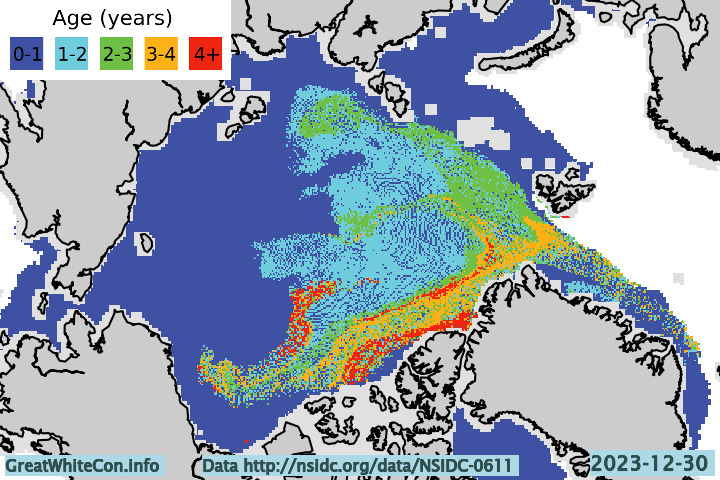
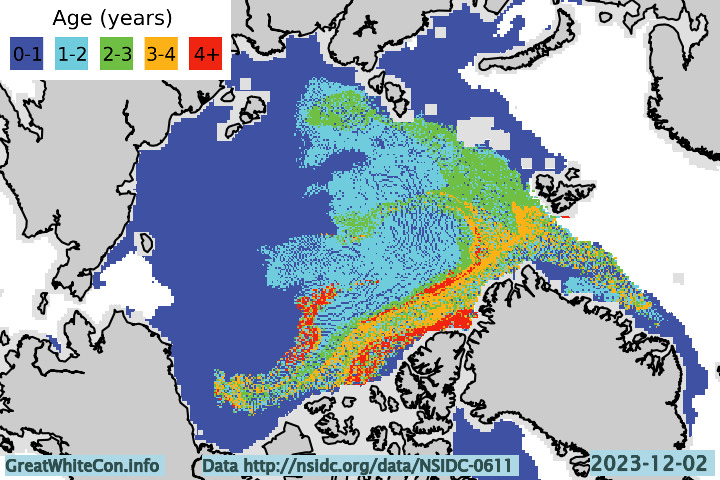
Here too is the ice age map for the end of 2023:

[Update – January 19th]

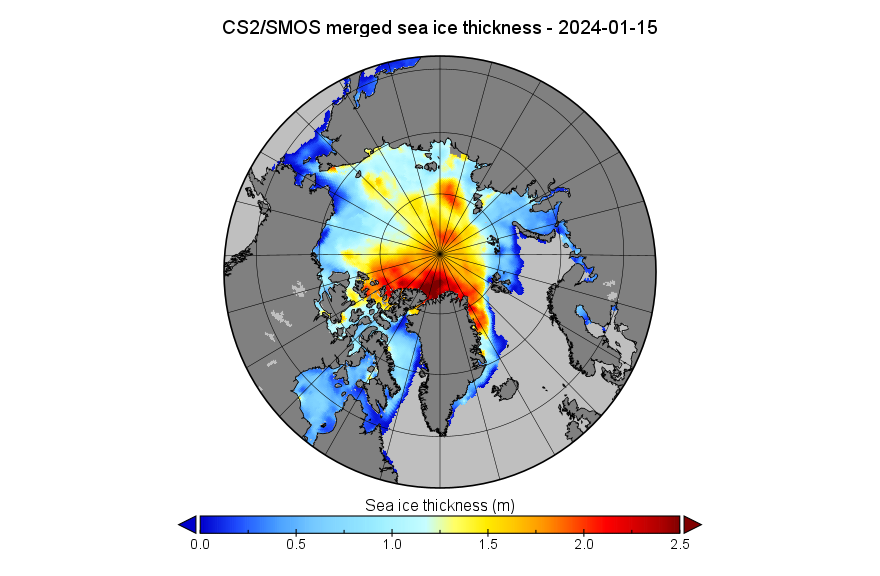
Something seems to have gone wrong with the processing of the mid-month PIOMAS gridded thickness data. For the moment we’ll have to make do with just the CryoSat-2/SMOS thickness map:

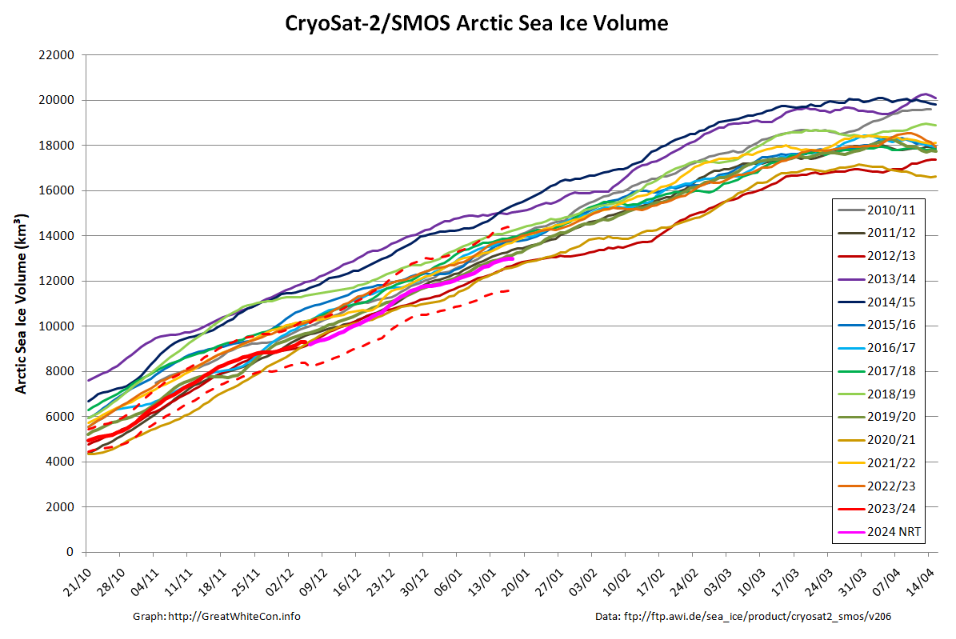
and volume graph:

With the perennial caveat of a probable upward revision when the reanalysed data is released, Arctic sea ice volume is still close to the bottom of the range during the CryoSat-2 era.

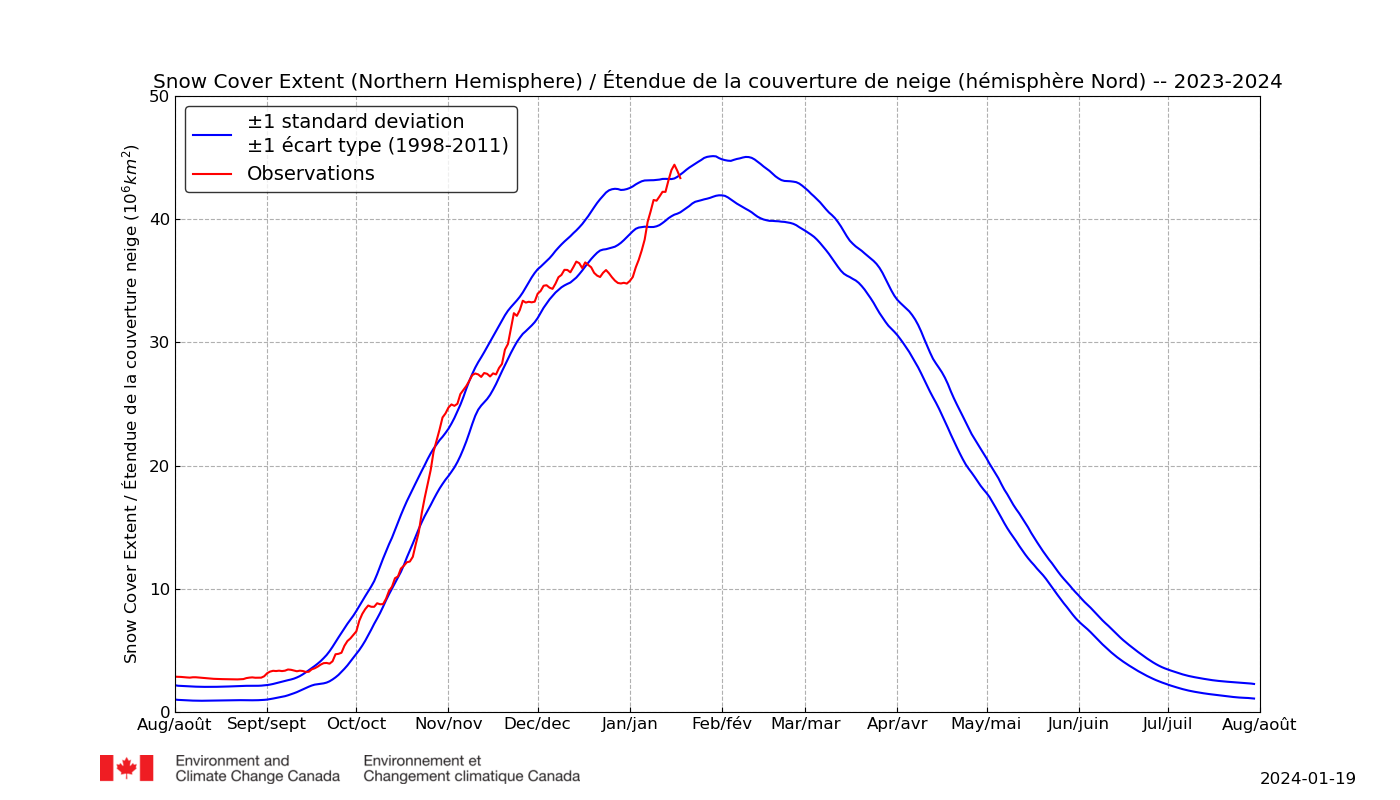
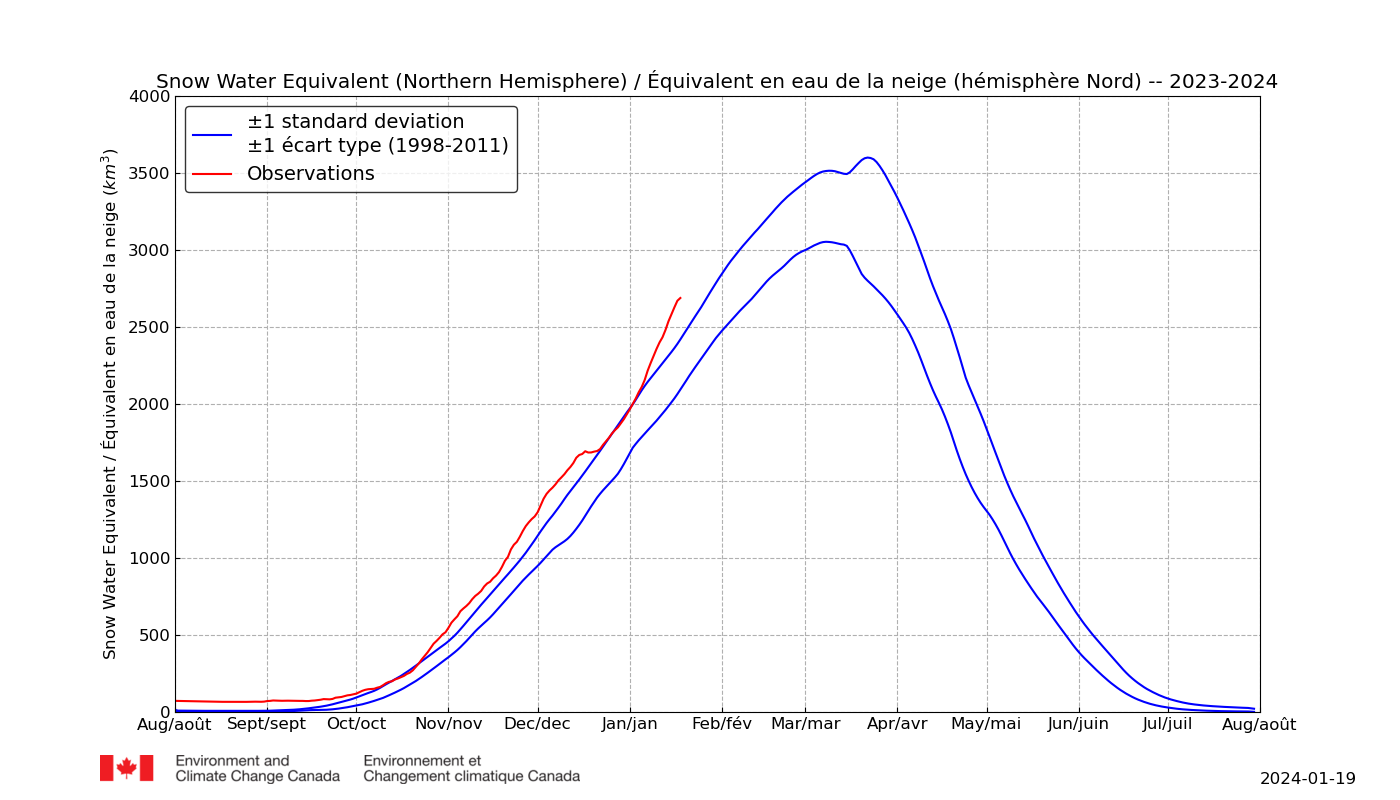
In addition especially for Matt, “Steve”/Tony and numerous others of a “skeptical” persuasion, here are the latest Environment & Climate Change Canada snow extent and snow water equivalent graphs for the northern hemisphere:

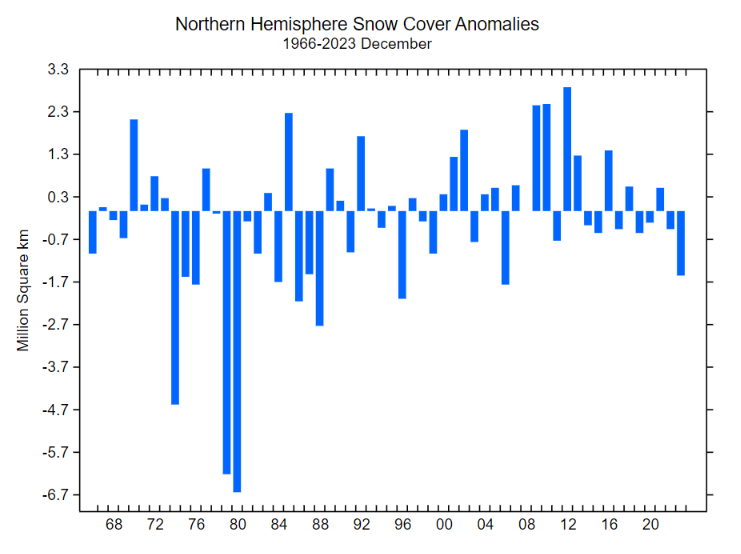
Last but certainly not least is the Rutgers Global Snow Lab northern hemisphere snow cover anomaly chart for December:

[Update – January 29th]

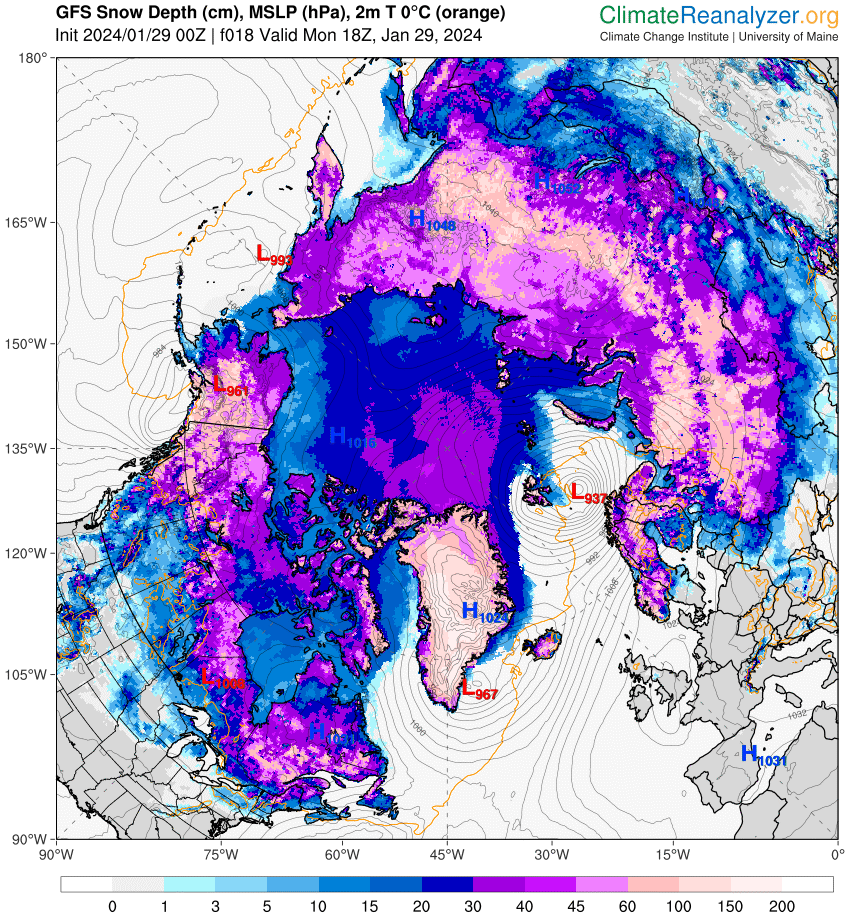
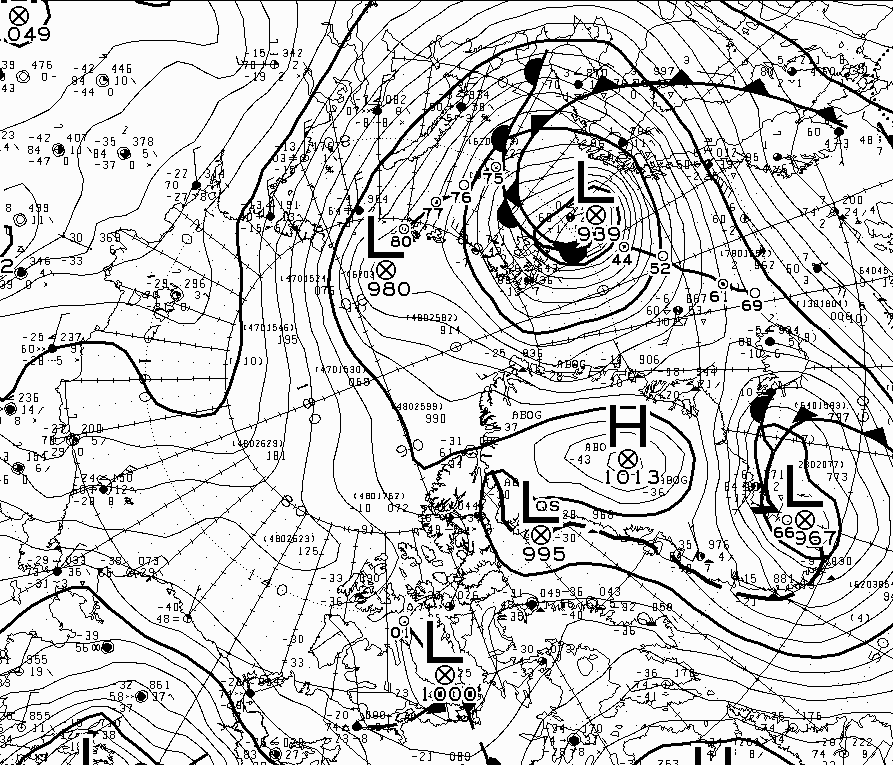
A winter cyclone is stirring up the far North Atlantic. It’s currently forecast to bottom out later today with a minimum MSLP of 937 hPa:

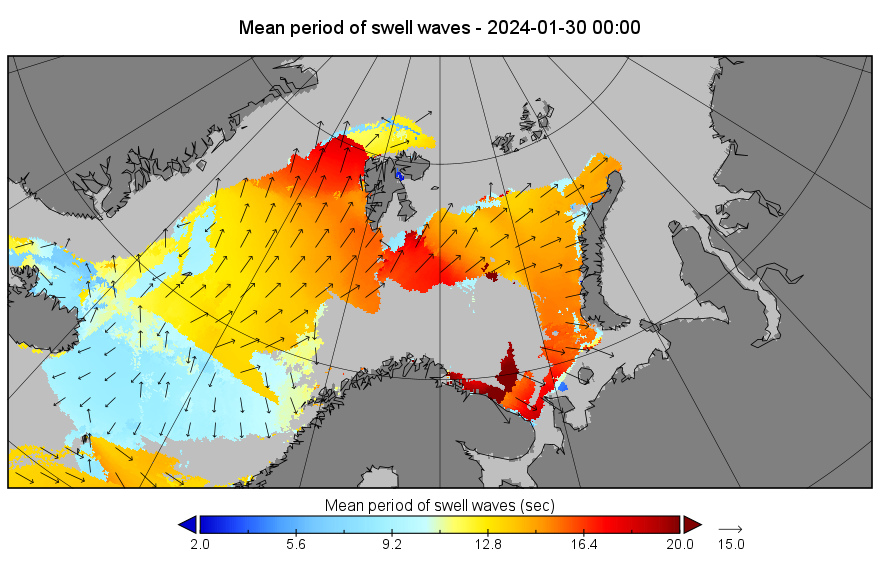
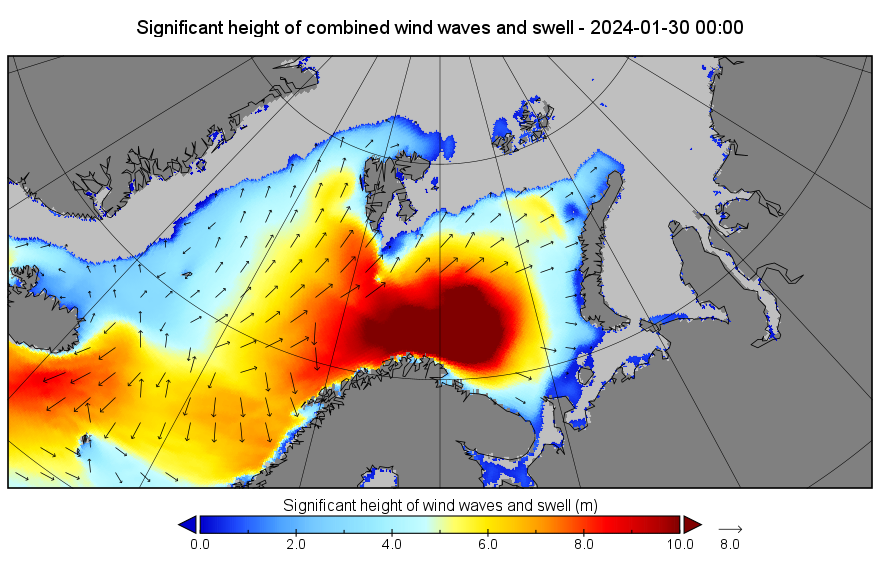
The storm has been creating a long period swell directed at the ice edge in the Barents Sea. By midnight that swell will be battering the ice in the Fram Strait too:

[Update – January 30th]

According to Environment Canada the cyclone bottomed out with an MSLP of 939 hPa at 12 PM UTC yesterday:

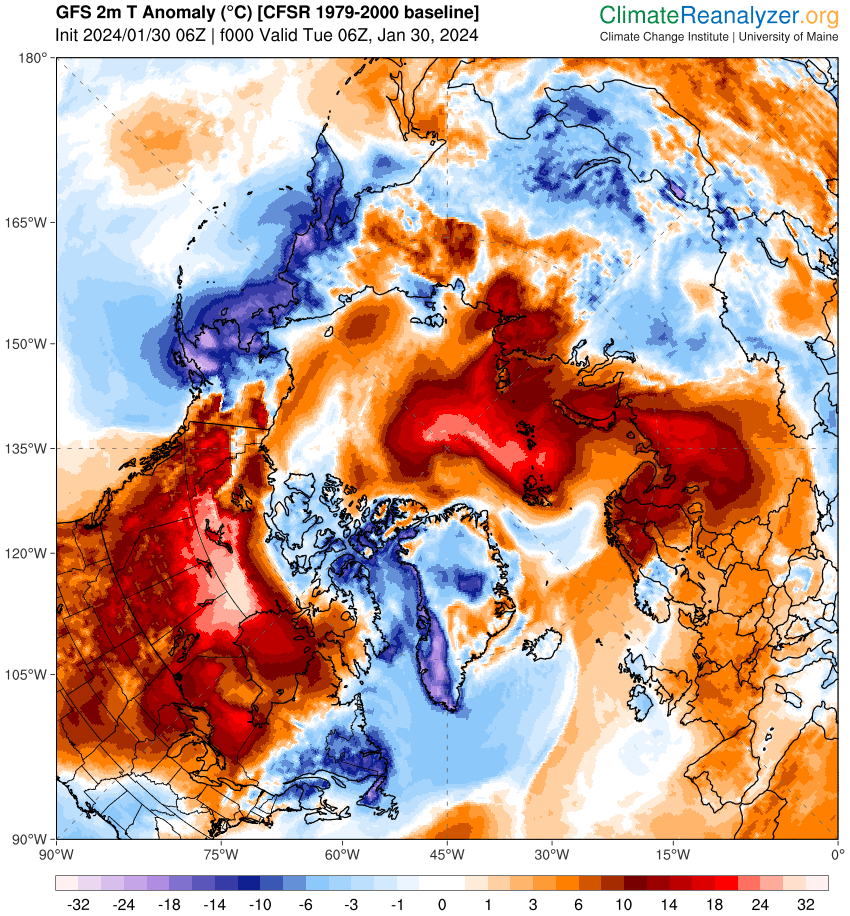
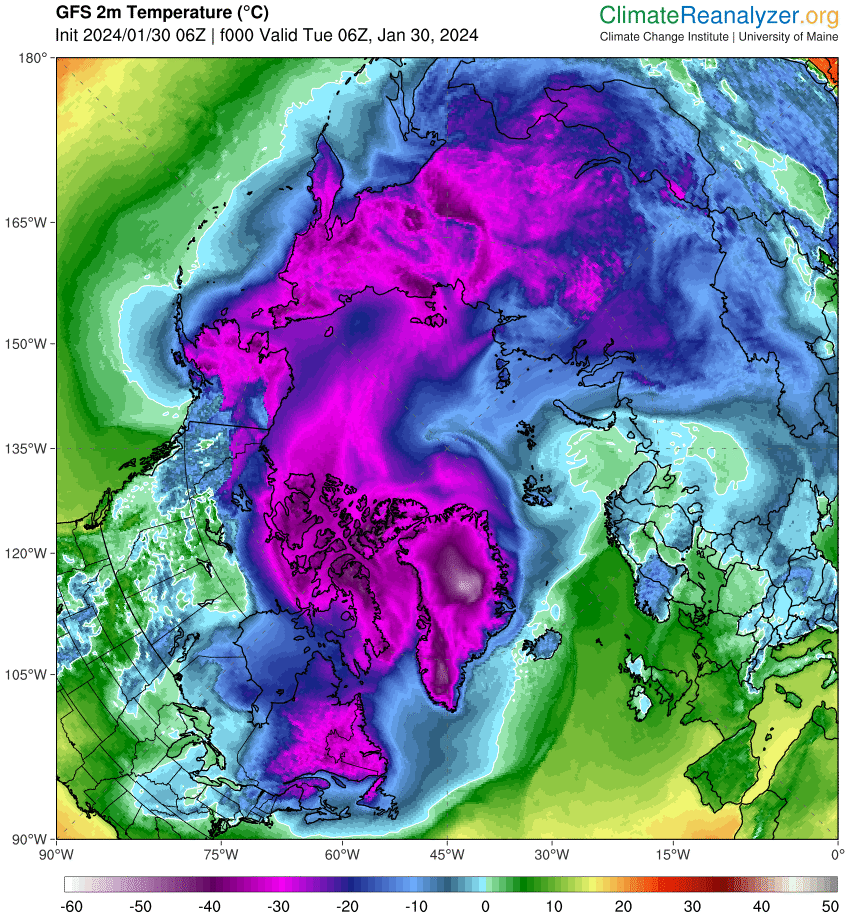
Associated with the storm is a pulse of abnormally warm air reaching to the North Pole and beyond:

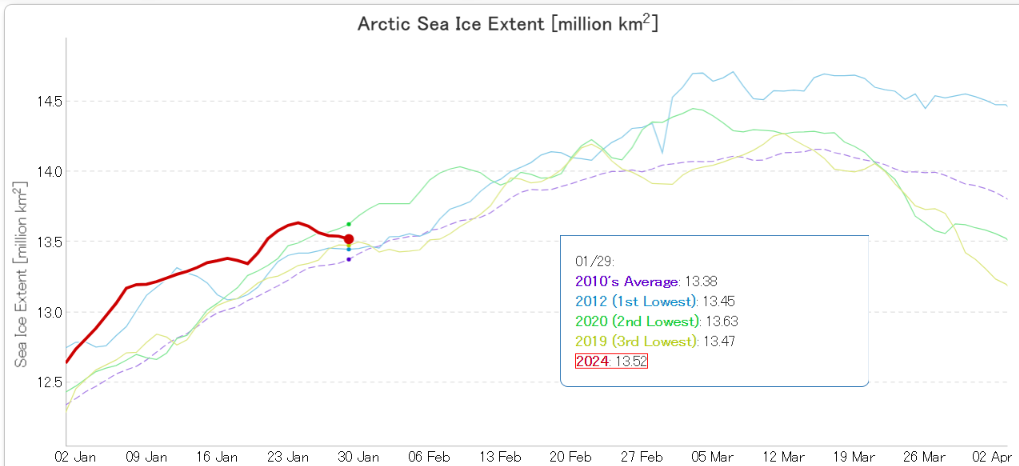
Here’s how JAXA extent looks as the big swell arrives:

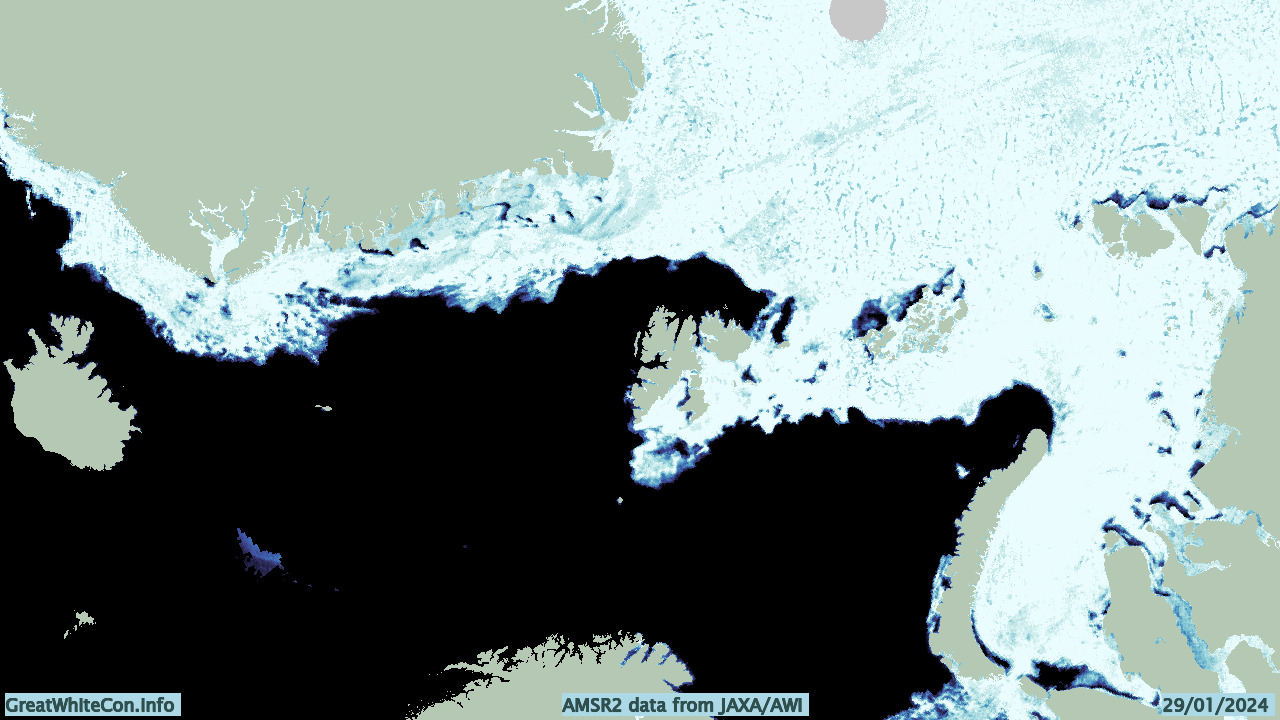
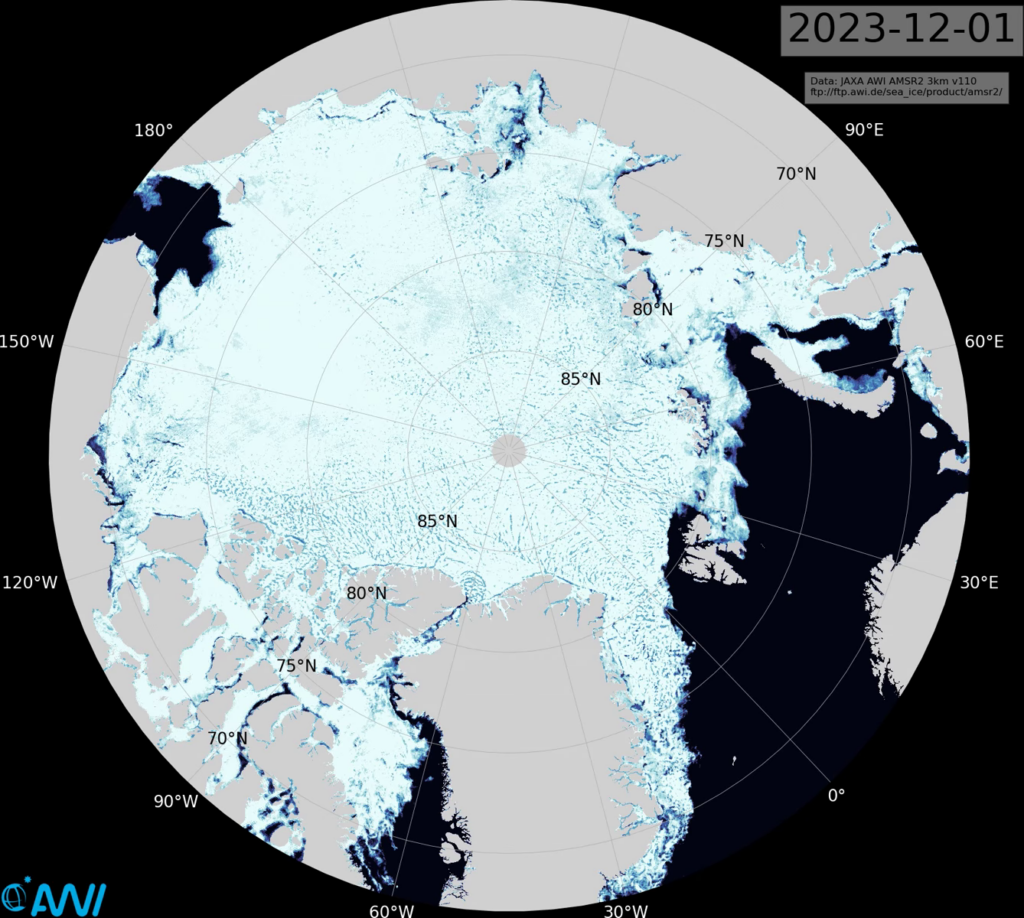
And here’s the lead enhanced AWI AMSR2 concentration map of the Atlantic periphery:

Let’s see how things change over the next few days.

[Update – January 31st]

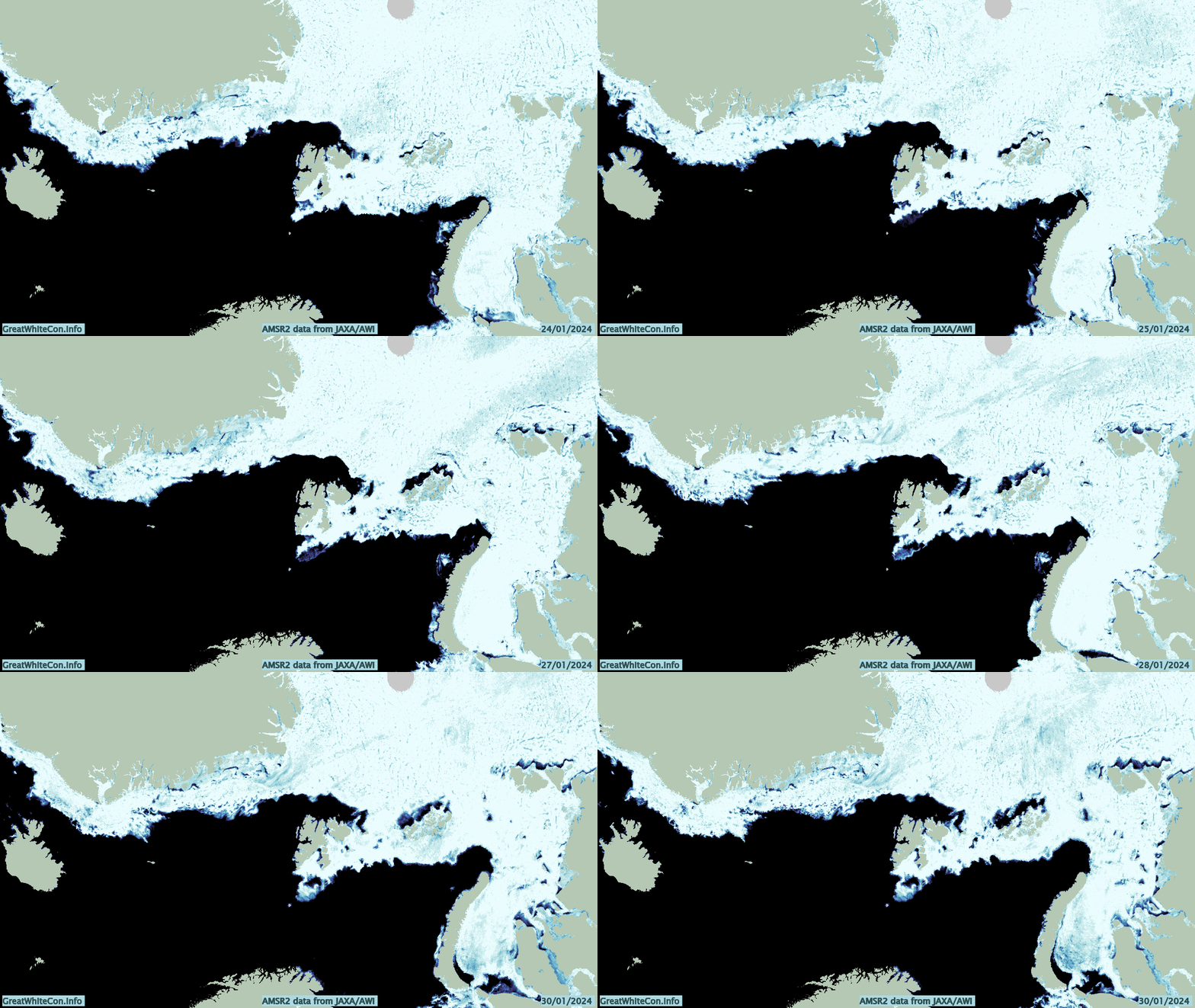
Here’s a preliminary look at the effect of the recent Arctic cyclone and other “weather” on the sea ice in the Fram Strait and Barents & Kara Seas:

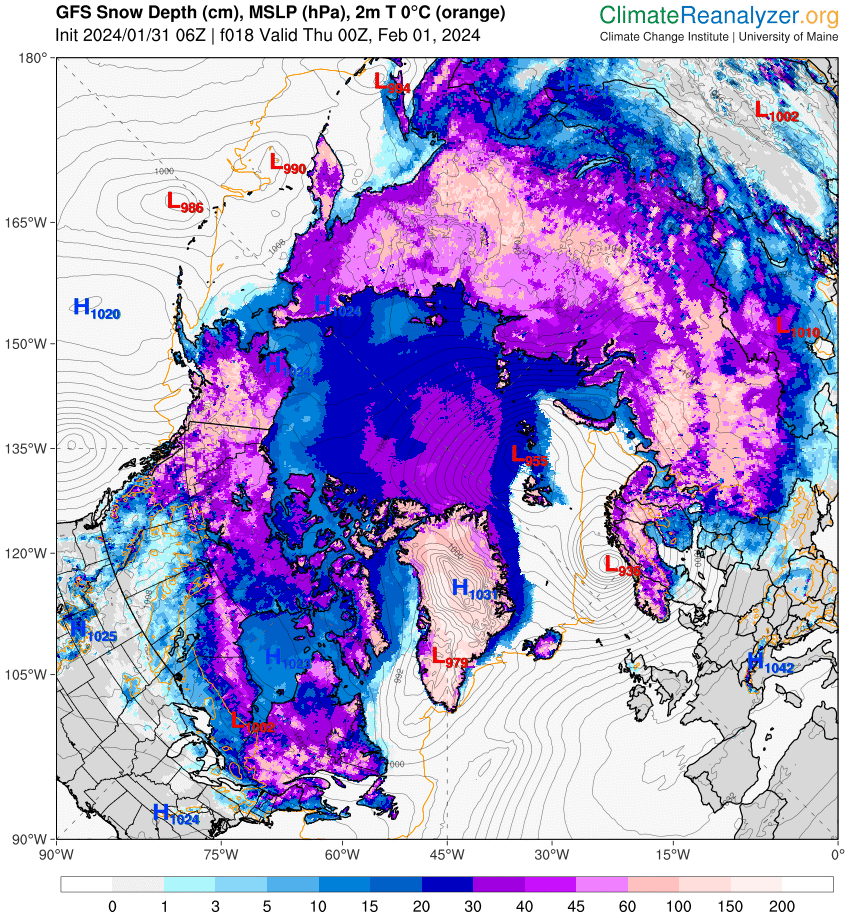
There is also another cyclone heading for the Barents Sea. This one is forecast to bottom out at 936 hPa at around midnight tonight near the Norwegian coast:

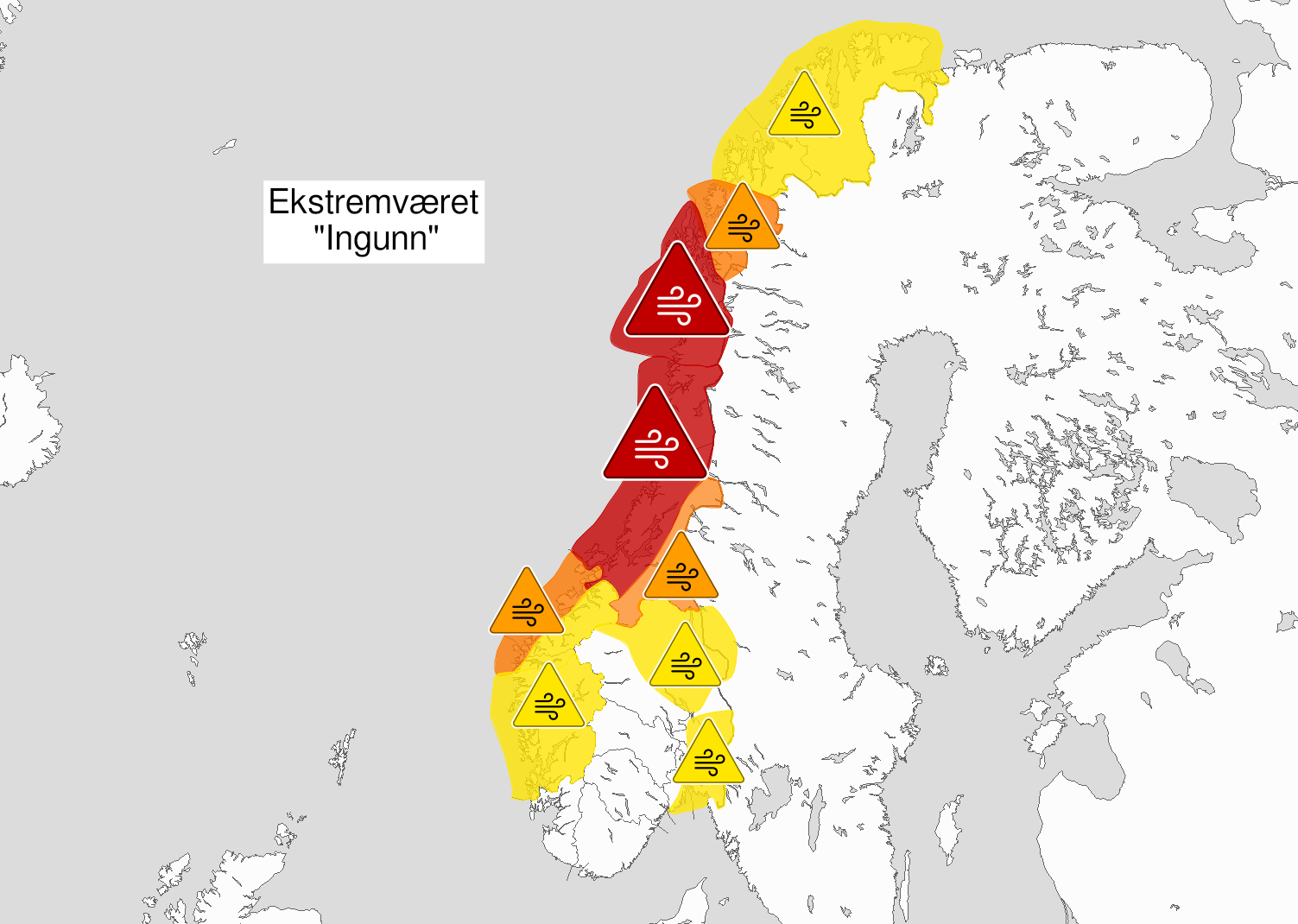
P.S. The cyclone mentioned just above has been named Storm Ingunn by the Norwegian Meteorological Institute:

A yellow warning for wind has been issued for Scotland, and a red warning for Norway:

The conversation continues over on the February open thread.

Facts About the Arctic in December 2023

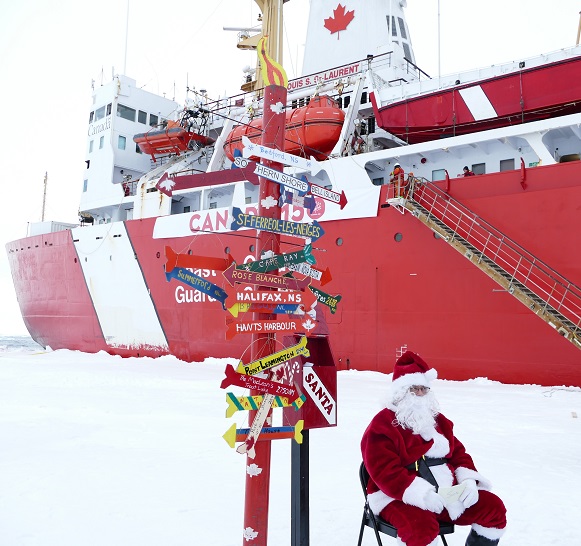
Christmas is rapidly approaching, and Santa and Snow White send festive greetings to one and all from the North Pole:

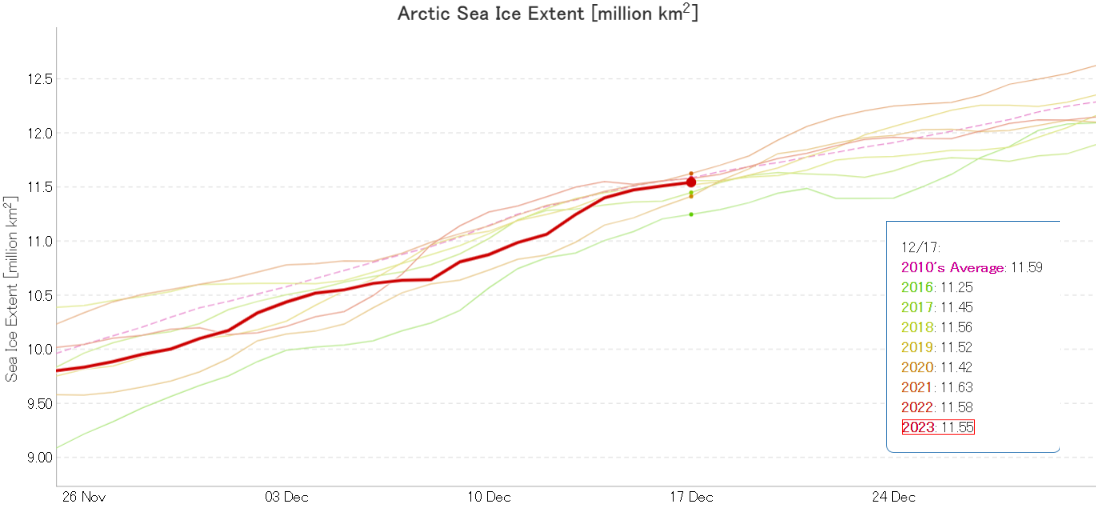
JAXA extent currently seems to be stuck on December 17th, but here’s how it looked a couple of days ago:

Having been comfortably in 3rd lowest position in the satellite era a few days ago, AMSR2 extent is now 5th lowest and very close to the 2010s average for the date.

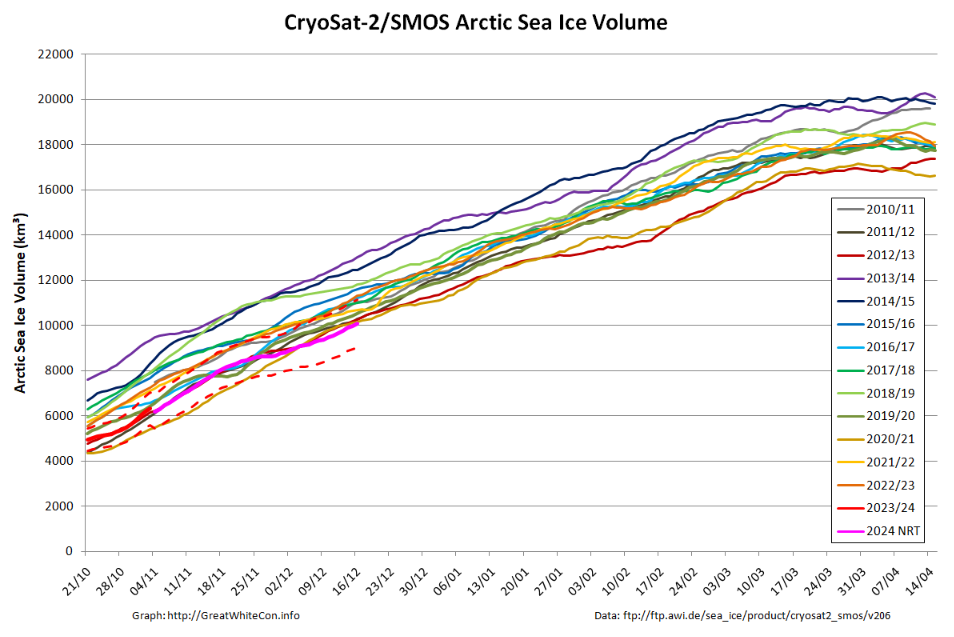
The Alfred Wegener Institute have been releasing reanalysed CryoSat-2/SMOS merged thickness data for a few days, and here is the resulting Arctic sea ice volume chart:

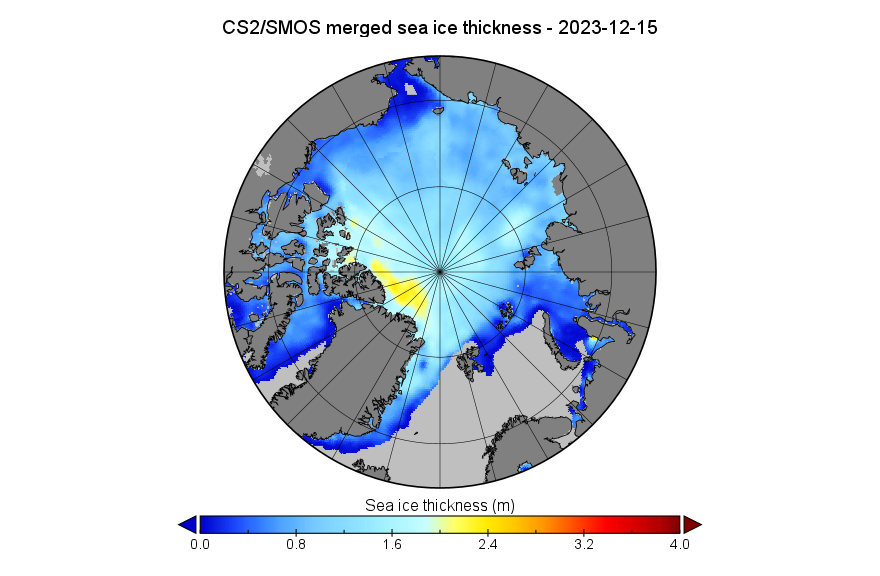
Near real time volume is currently lowest for the date in the CS2 record, but is likely to be revised upwards when the reanalysed data is eventually released. The associated NRT thickness map looks like this for December 15th:

The mid-month PIOMAS modelled gridded thickness data has also been released. The calculated volume is 5th lowest in the satellite era:

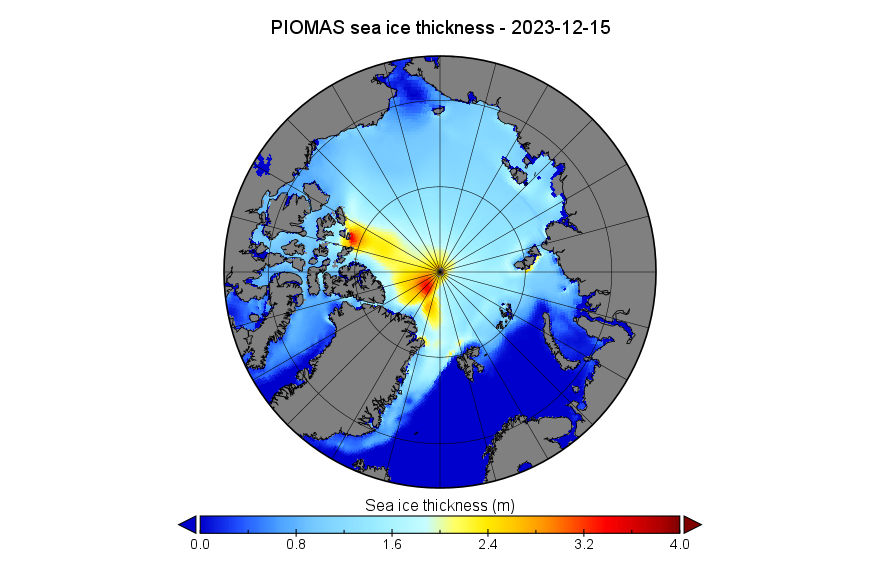
Here too is the PIOMAS thickness map for December 15th:

[Update – December 24th]

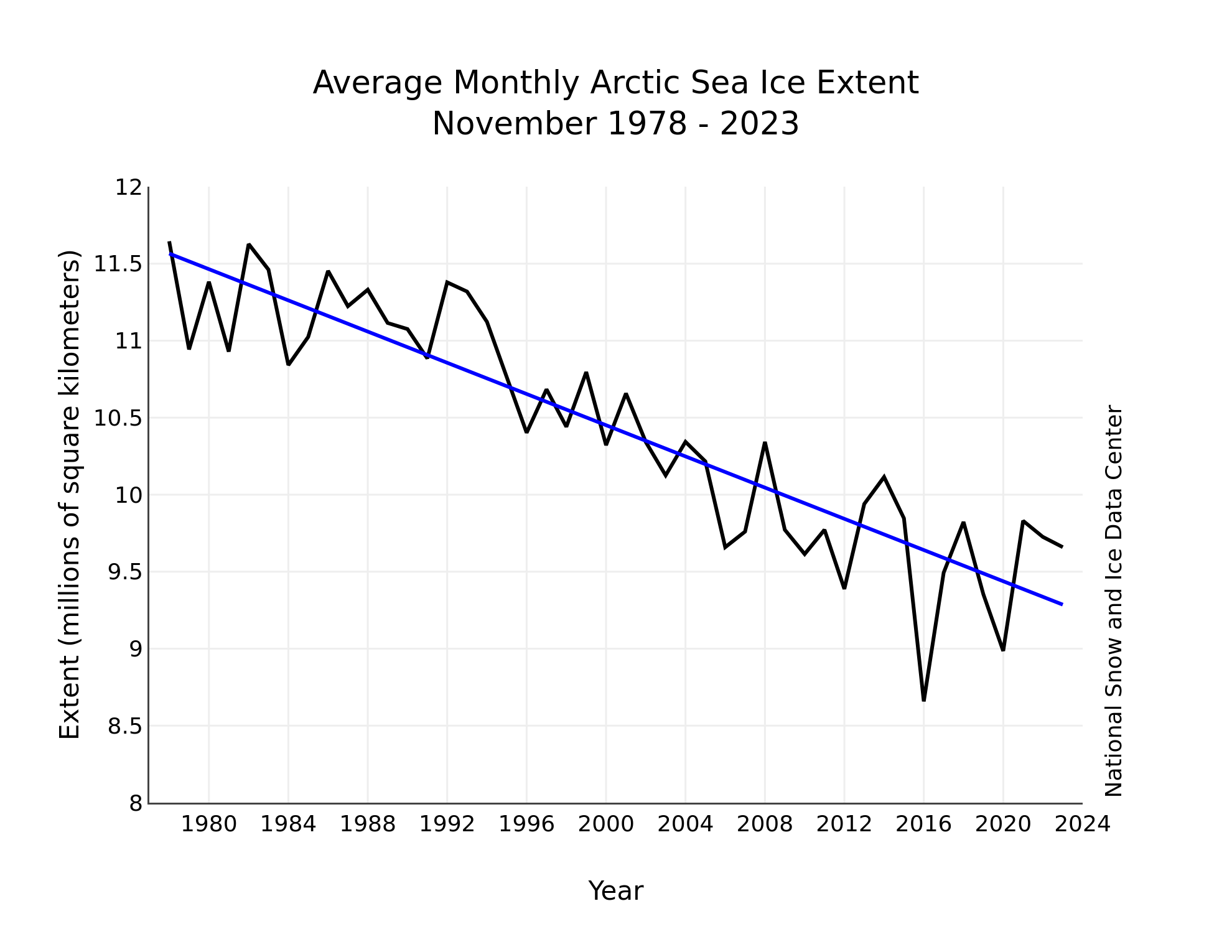
Merry Xmas everyone, especially Matt! Here’s a couple of images from the National Snow and Ice Data Center’s latest edition of Arctic Sea Ice News. In the short term sea ice is always melting somewhere:

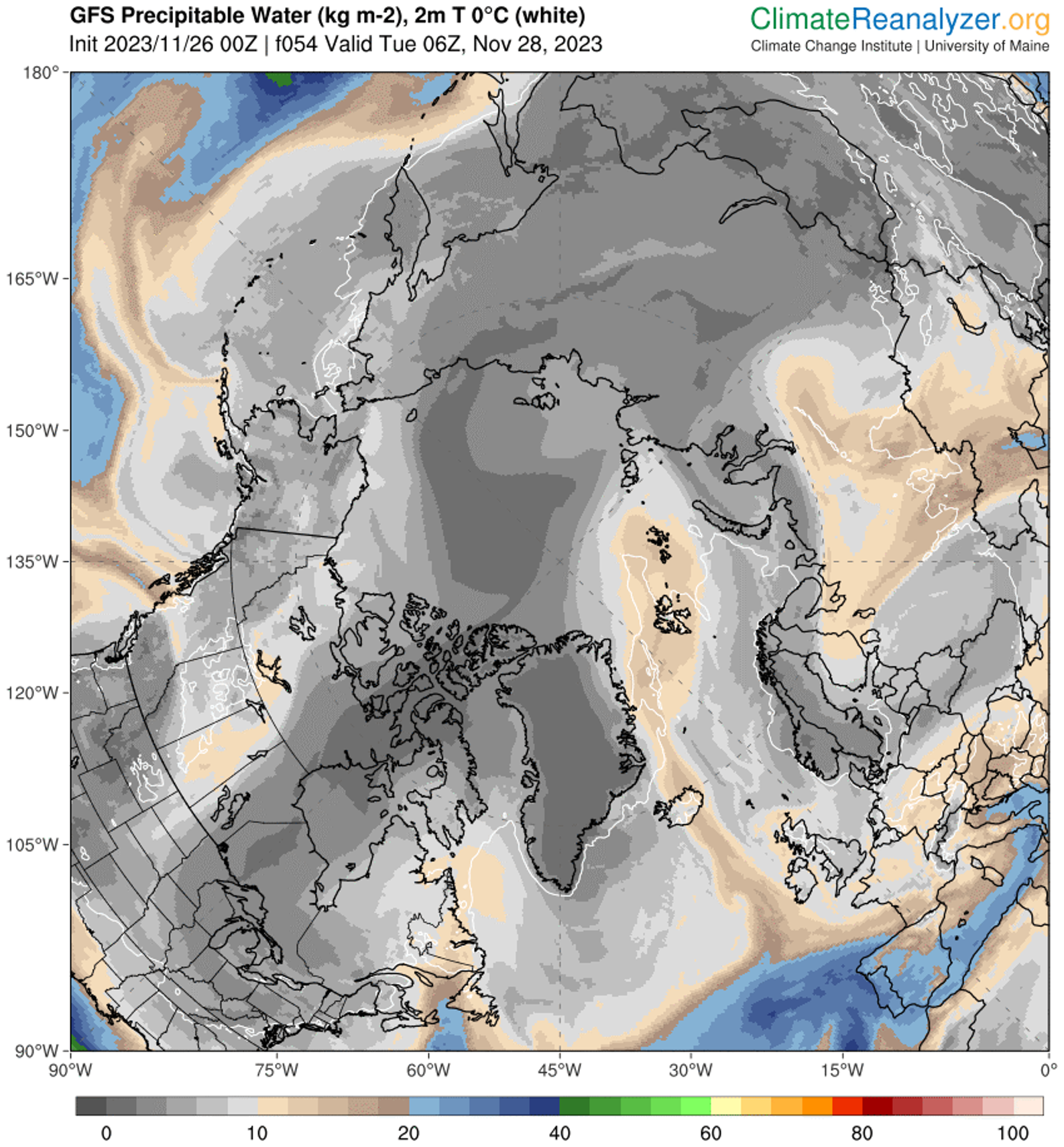
From November 21 to 28, a series of three extratropical cyclones followed a common track from the northeast coast of Greenland eastward along the northern edge of the Barents, Kara, and Laptev Seas. As each storm moved into the Arctic Ocean, it merged with its predecessors, creating a persistent cyclonic (counter clockwise) wind regime. The first and third of these storms originated in the Icelandic Low region before migrating up the east side of Greenland. The second storm originated just north of Greenland. Simultaneously, a center of high pressure developed over the ice-free part of the Barents Sea, becoming especially strong on November 26 to 28.

This combination of persistent low pressure to the north and west of Svalbard and a high-pressure center to the southeast created a strong, persistent flow from the south of relatively warm and moist air from the North Atlantic Ocean toward Svalbard, which then turned eastward along the marginal ice zone. This is seen as an extension of an atmospheric river into the Arctic. Atmospheric rivers are long narrow corridors that carry a large amount of water vapor. A recent study suggests that atmospheric rivers lead to ice loss by transporting warm, moist air into the Arctic that can limit sea ice growth. This is consistent with the observed pause in seasonal ice growth in late November.

And over the longer term:

[Update – December 26th]

From being near the bottom of the recent pack at the end of November, Arctic sea ice extent is now edging towards the top of the 2010s range. Here’s the AWI high resolution AMSR2 metric:

However sea ice volume has not followed suit, and remains near the bottom of the range:

Here’s an animation of sea ice motion over the last month, revealing amongst other things the recent rapid refreeze of the Chukchi Sea (click to animate):

[Update – December 29th]

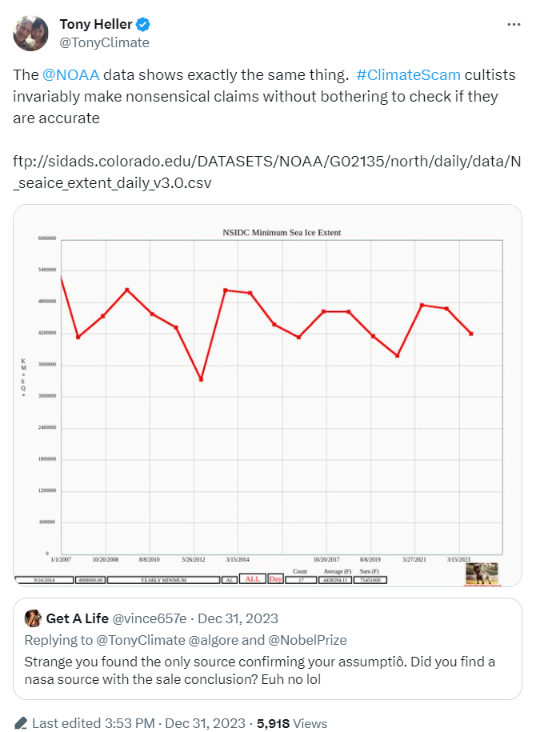
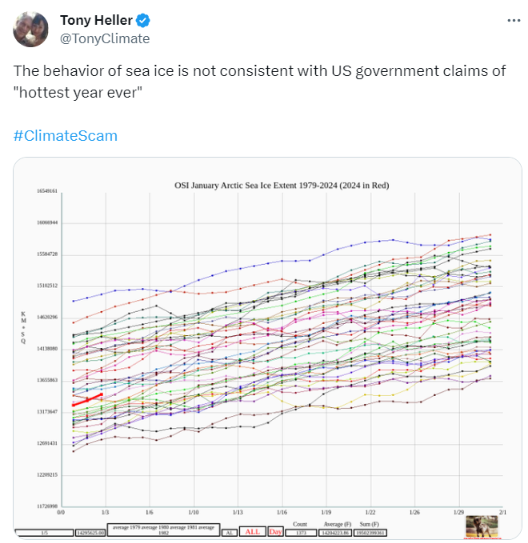
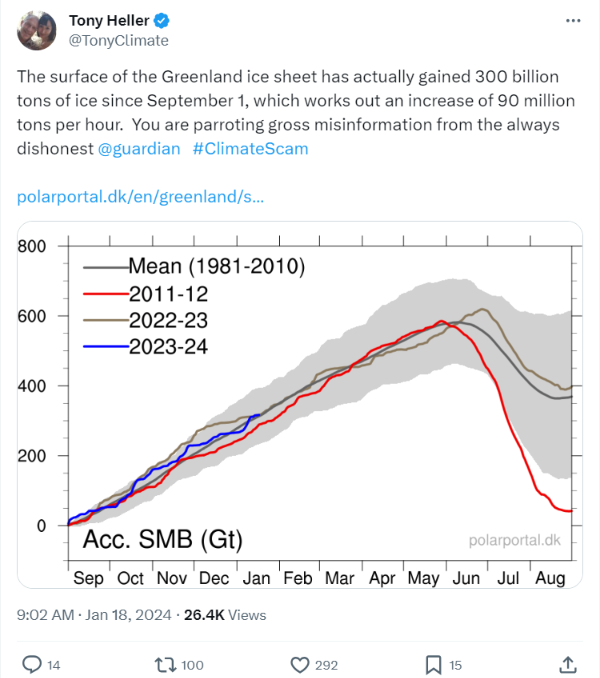
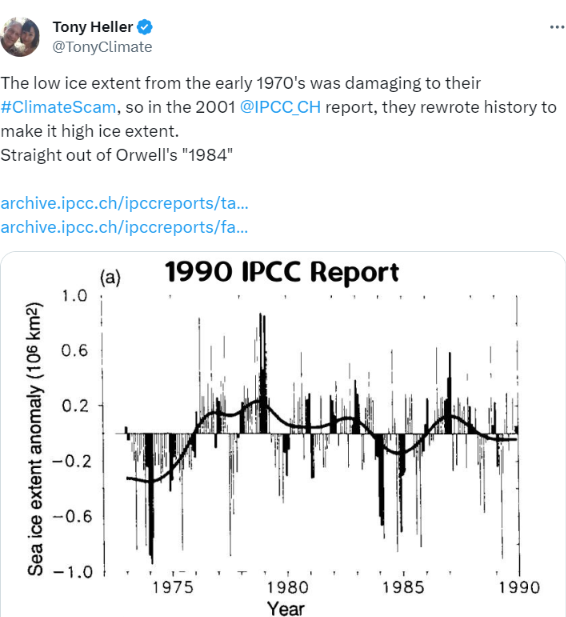
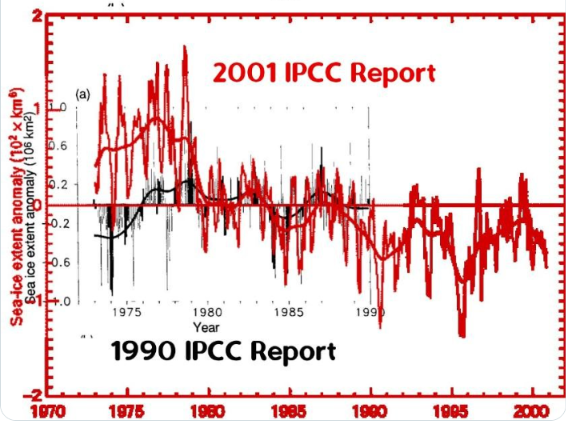
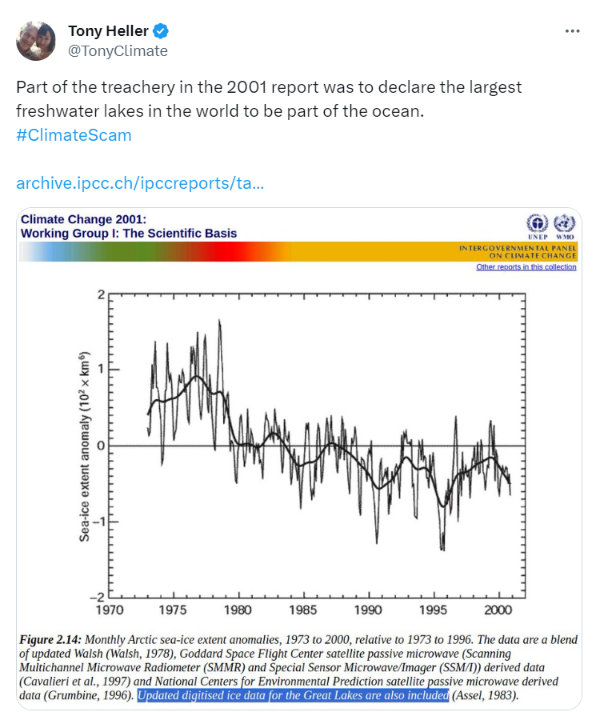
Matt is getting very excited about the allegedly “high Arctic sea ice extent” over on XTwitter. So is Tony Heller, although he has also helpfully provided convincing empirical evidence that the IPCC’s global warming “predictions” are correct!

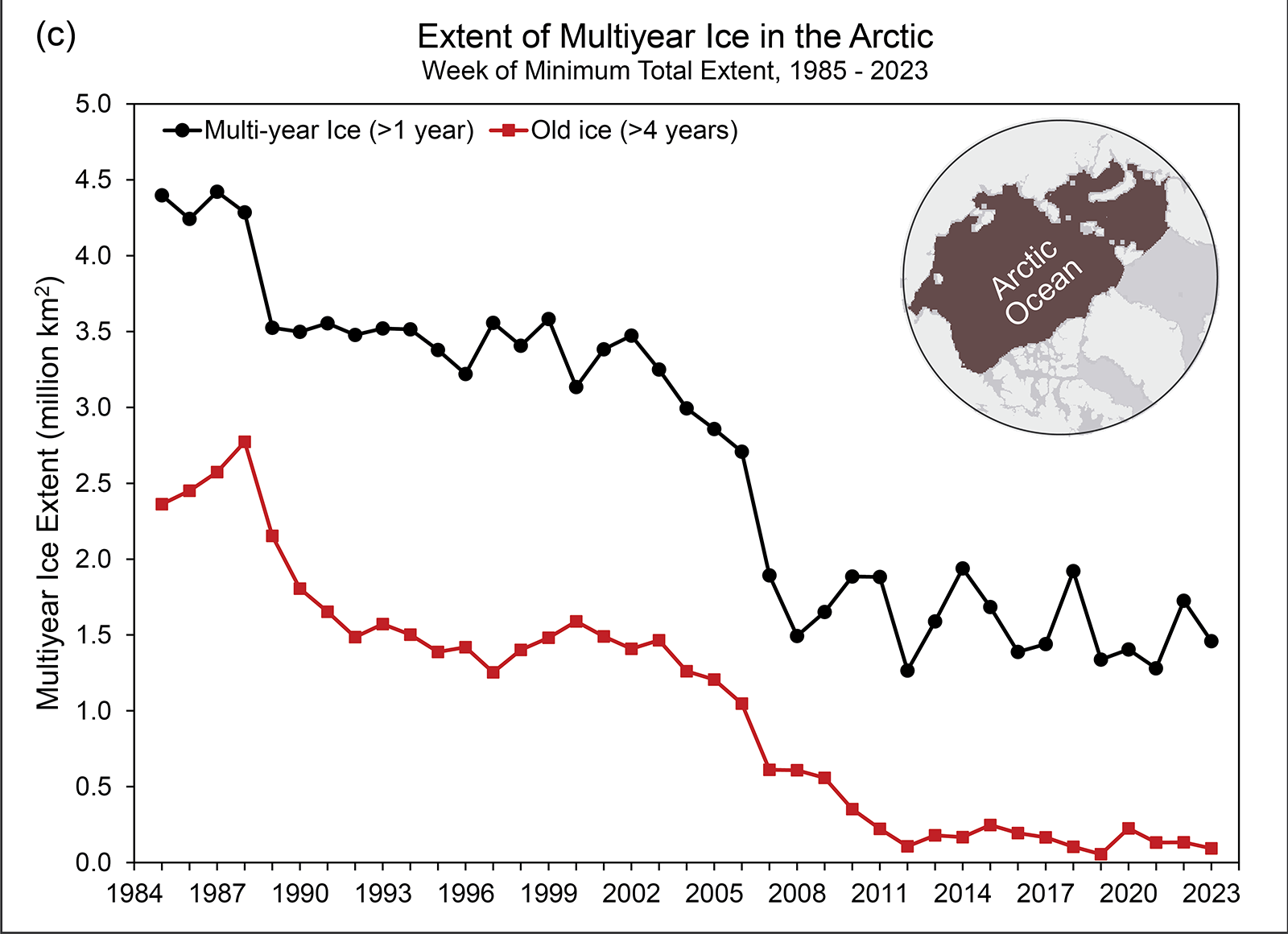
However neither of them seem to be at all interested in the age of Arctic sea ice. Here’s the early December update:

Drifting off topic only slightly, whilst perusing social media I also found this animation from Kev Pluck highly amusing:

https://twitter.com/kevpluck/status/1740174122850930979

The conversation continues on the New Year 2024 open thread.


Facts About the Arctic in September 2023

There’s lots of coverage specifically about assorted Arctic sea ice extent metrics over on the “2023 Minimum Extent” thread. However we’ll start the September open thread ball rolling with a couple of cross posted images.

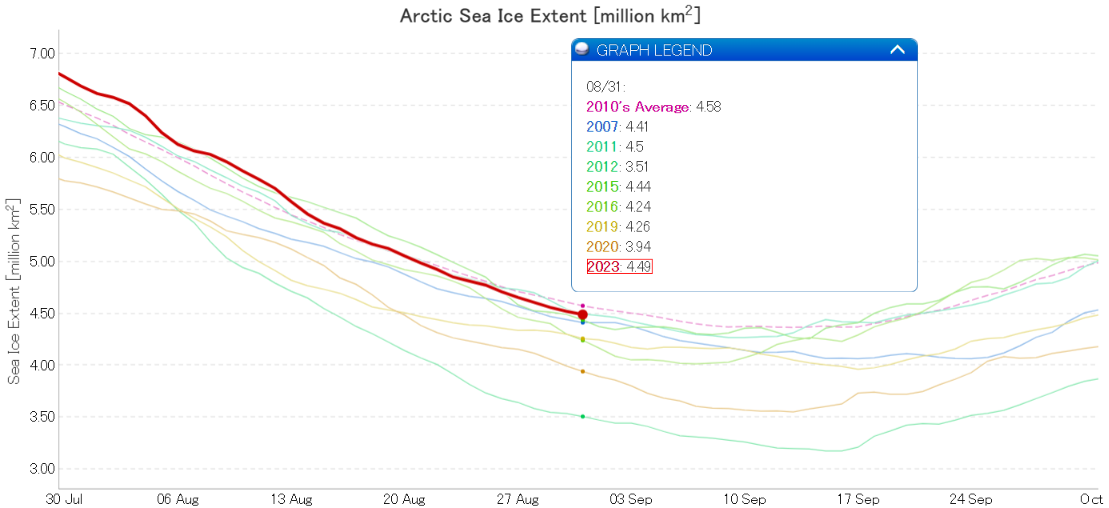
At the end of August JAXA daily extent was 7th lowest for the date, at 4.49 million km² :

The median prediction of the contributors to the August call by the Sea Ice Prediction Network for the September monthly average extent is 4.6 million km² :

Continue reading Facts About the Arctic in September 2023

The 2023 Arctic Sea Ice Minimum Extent

It’s that time of year again! Tony Heller has been asserting that “summer is over at the North Pole” for several weeks now, and the 2023 Arctic sea ice minimum extent will occur at some point over the next four or five weeks. The exact date and level will almost certainly vary from one extent metric to the next.

To get the minimum extent ball rolling, here’s Signe Aaboe’s graph of previous summer minima based on OSI SAF data:

Here too is Zack Labe’s equivalent, based on JAXA data:

Continue reading The 2023 Arctic Sea Ice Minimum Extent

Facts About the Arctic in April 2023

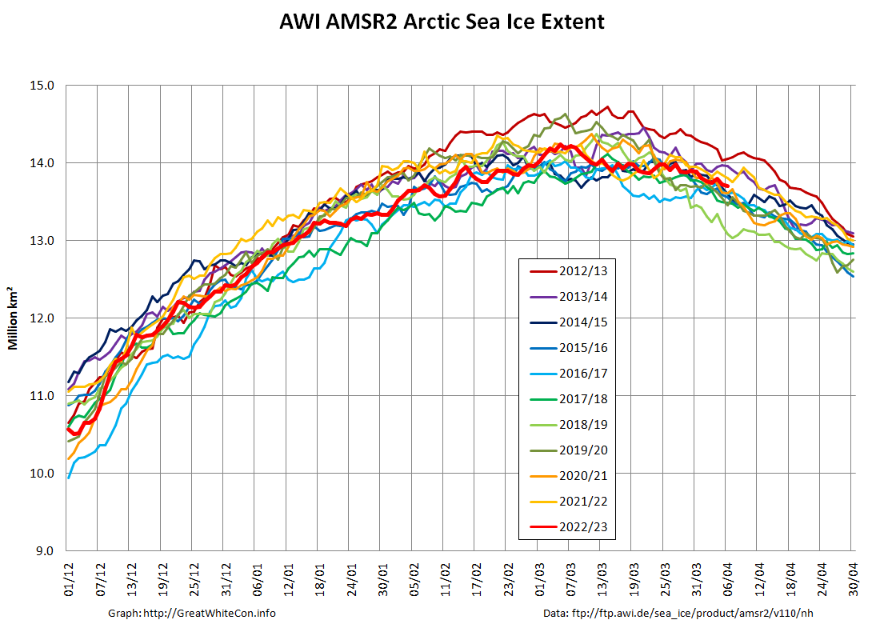
Arctic sea ice extent in early April is singularly unexceptional. Here’s the AWI AMSR2 version:

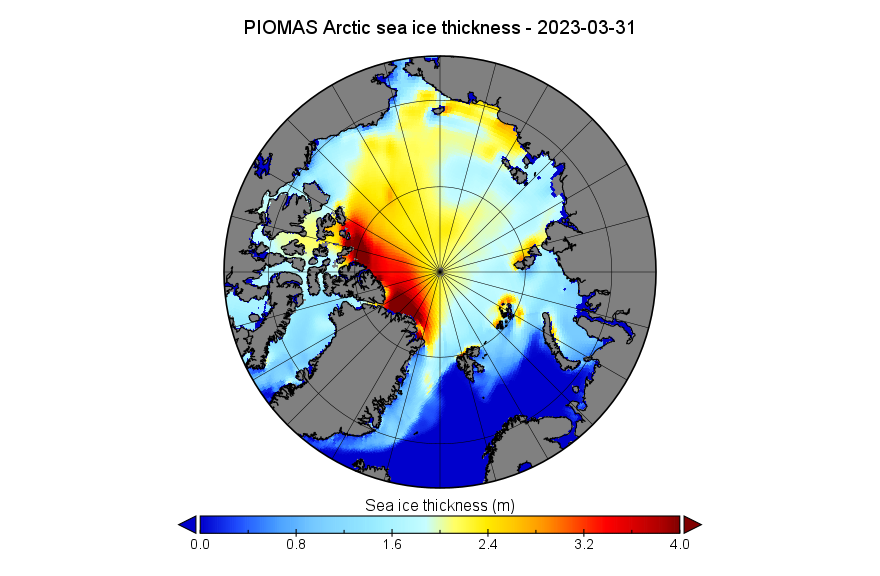
Things start to become more interesting when looking at the third dimension. Here’s the PIOMAS gridded thickness map for March 31st:

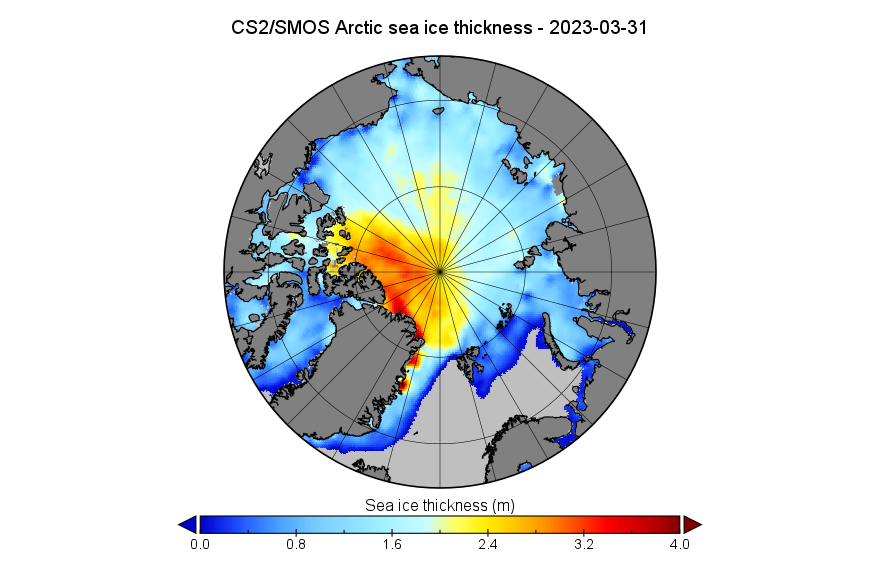
and the CryoSat-2/SMOS map for the same date:

Note the differing distribution of thick ice north of Greenland and the Canadian Arctic Archipelago between the two maps. Note also the area of thinner ice along the coast of the Beaufort Sea visible on the CS2/SMOS map.

By way of explanation for that phenomenon see the March sea level pressure map from the latest edition of the NSIDC’s Arctic Sea Ice News:

Continue reading Facts About the Arctic in April 2023

The 2023 Maximum Arctic Sea Ice Extent

March has arrived, so it’s time to start taking a serious look at where and when the 2023 maximum Arctic sea ice extent will occur.

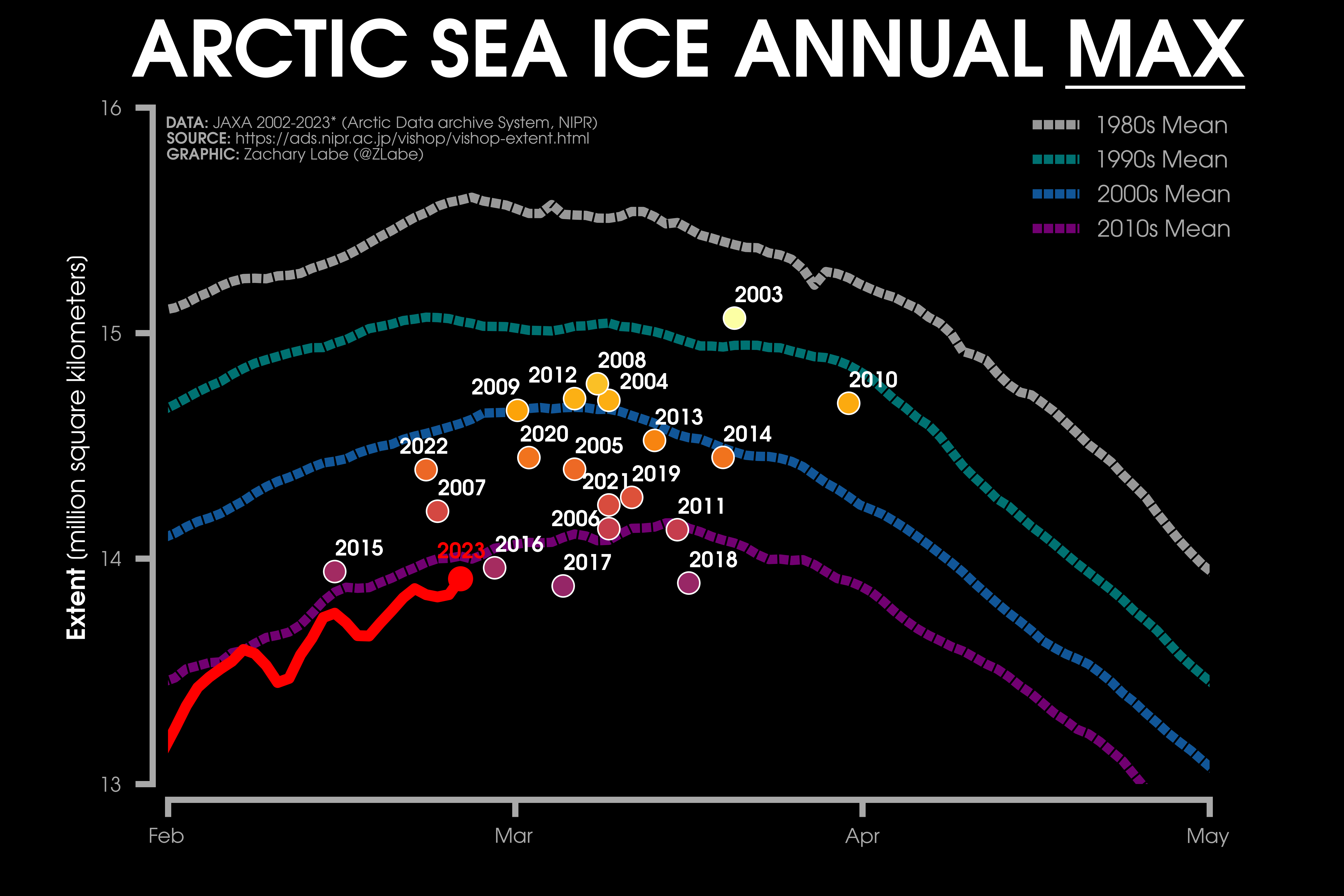
To start with here’s Zack Labe’s overview of previous years’ maxima:

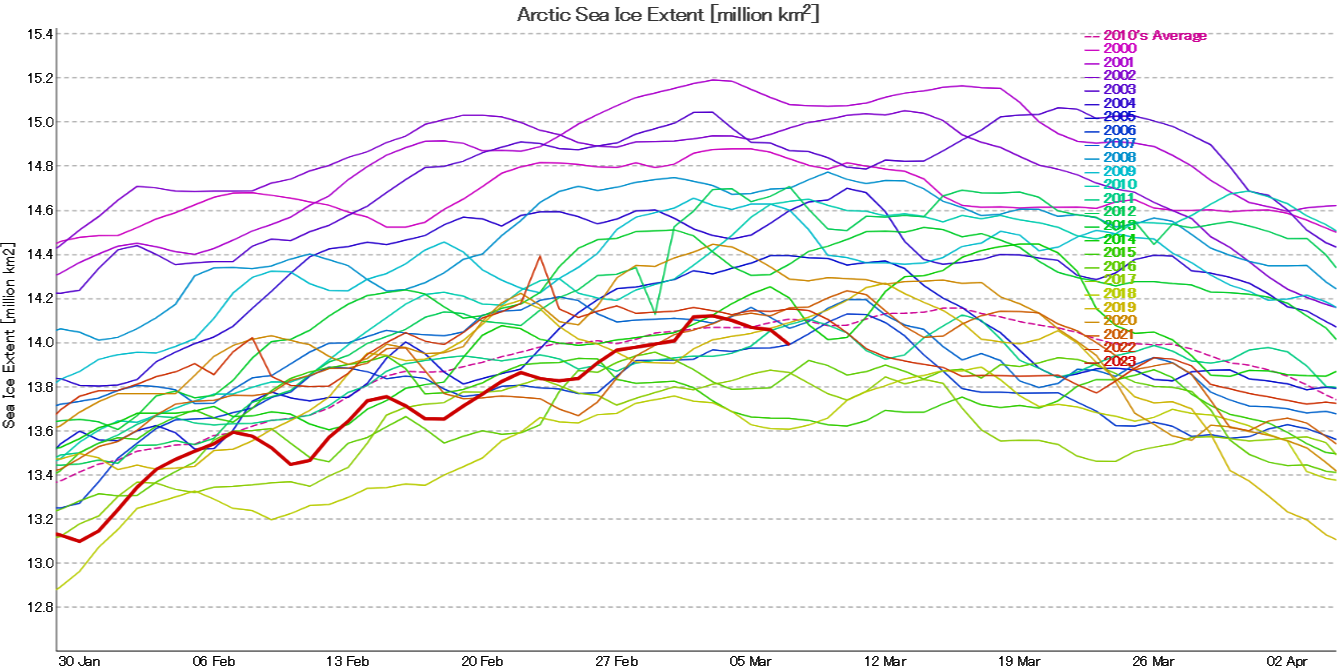
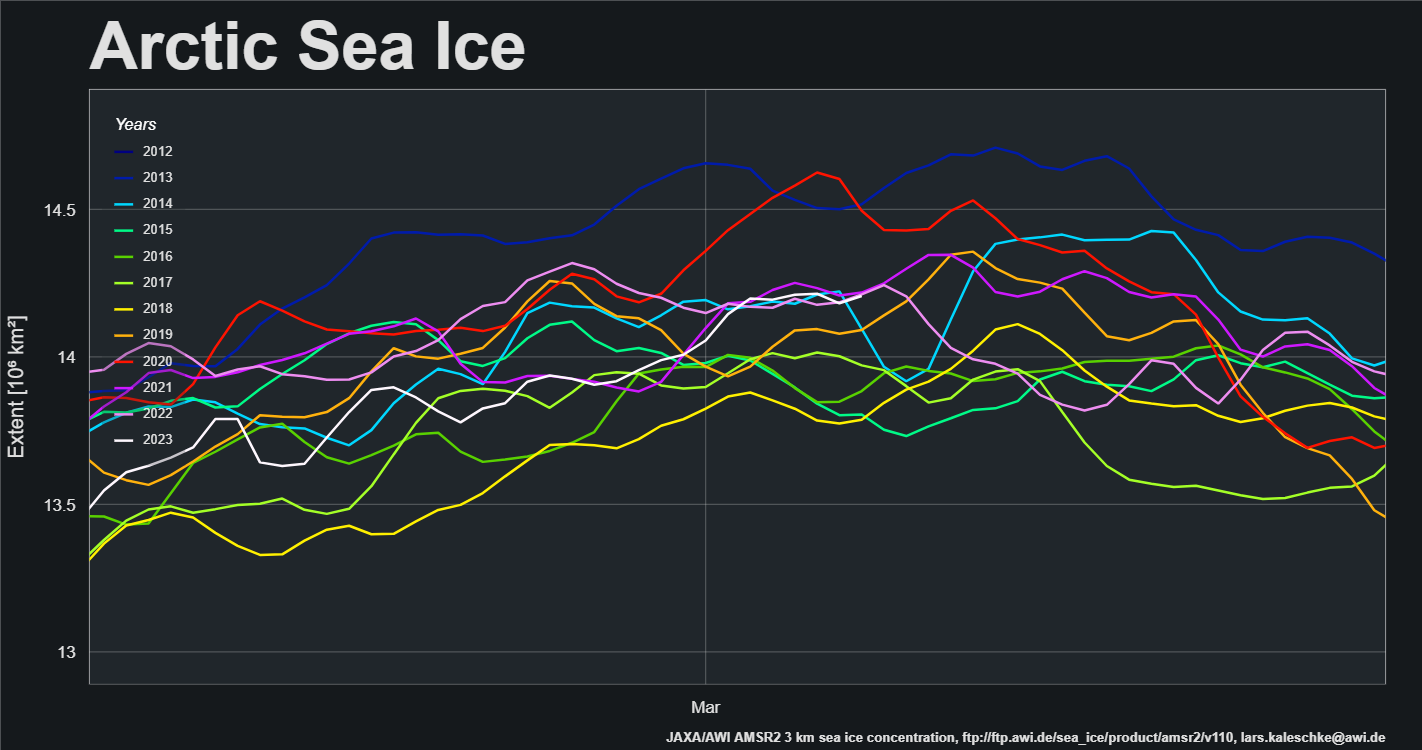
Zack’s graph displays the JAXA/ViSHOP version of Arctic extent, so here too is JAXA’s own graph of the current sea ice extent:

It doesn’t look as though the 2023 maximum has been achieved yet, but extent on March 1st was 14.01 million km². That is evidently not going to be the lowest in the satellite era!

[Edit – March 8th]

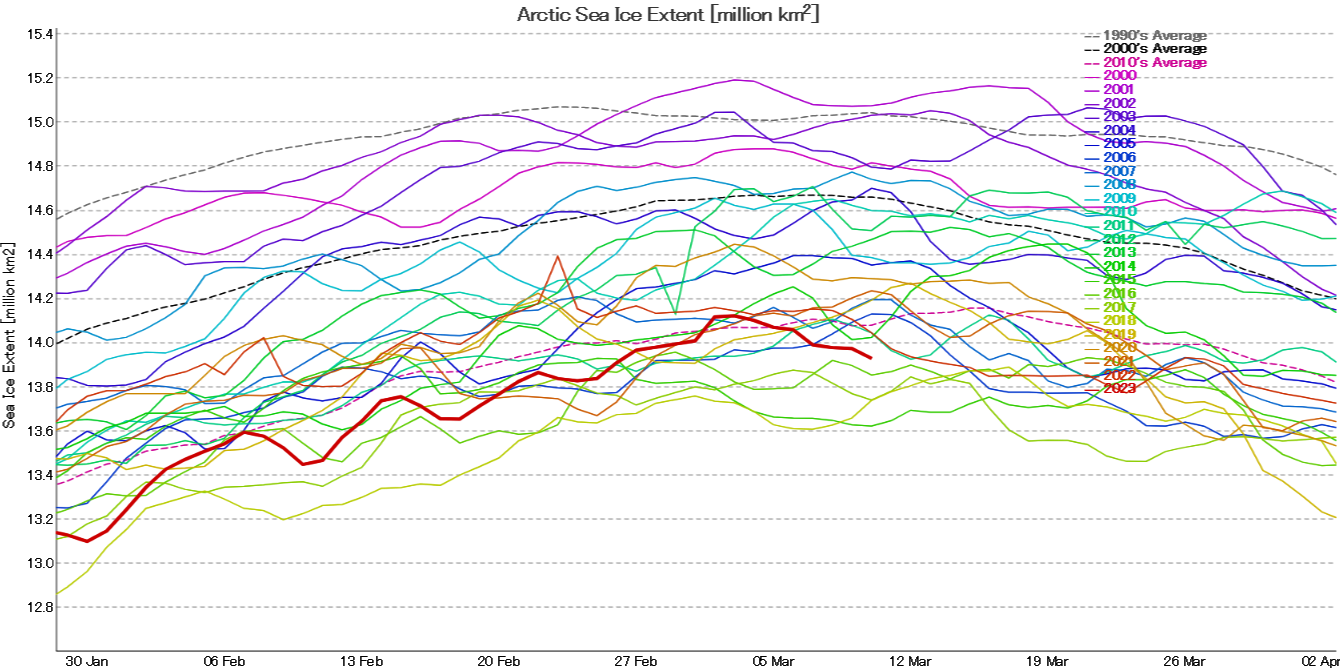
As Tom has already mentioned below, JAXA extent has declined significantly since the (so far!) peak extent of 14.12 million km² on both the 2nd and 3rd of March:

It’s too soon to be certain of course, but we certainly now have a good candidate for the 2023 maximum JAXA extent.

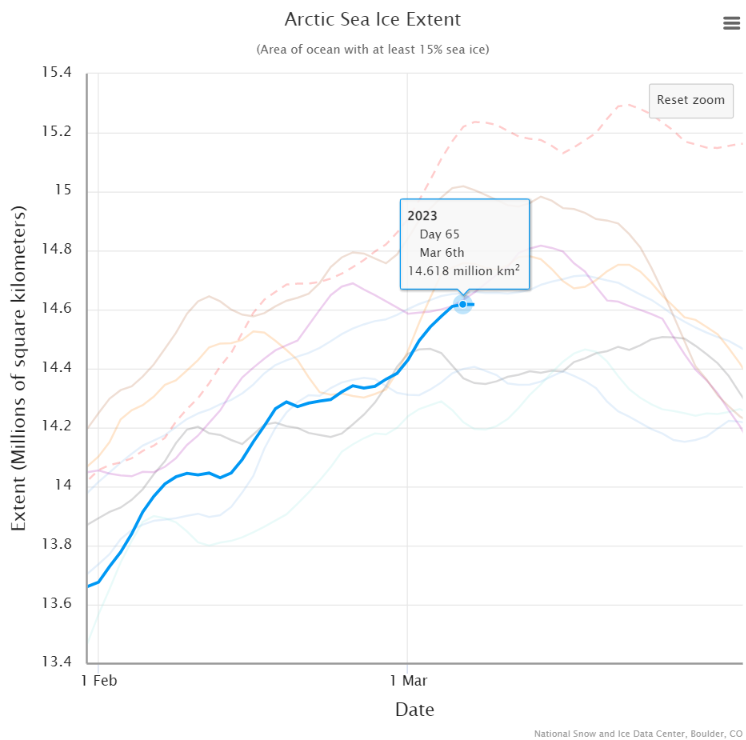
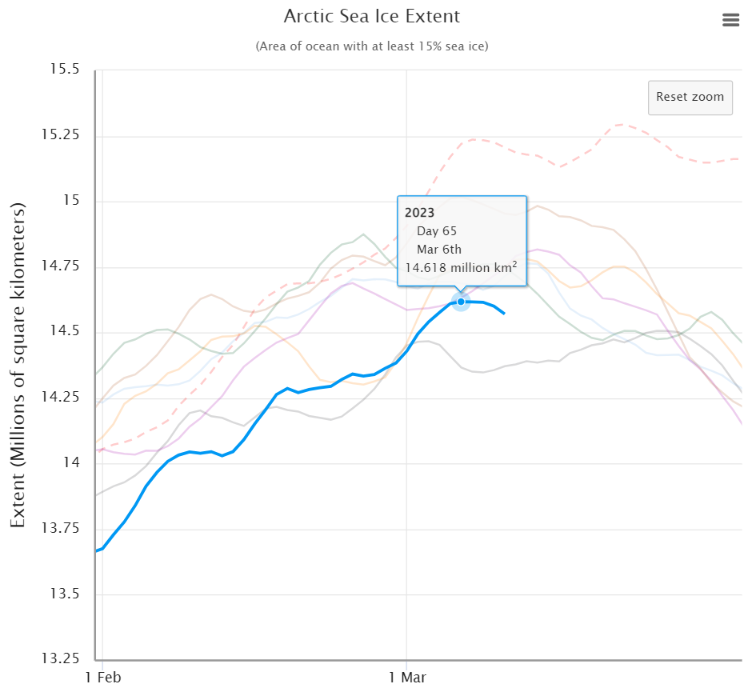
NSIDC 5 day averaged extent is still increasing, but let’s see what this afternoon’s update (UTC) reveals…

Which is a decrease of 0.001 million km² from March 6th, leaving a current NSIDC maximum extent of 14.62 million km²!

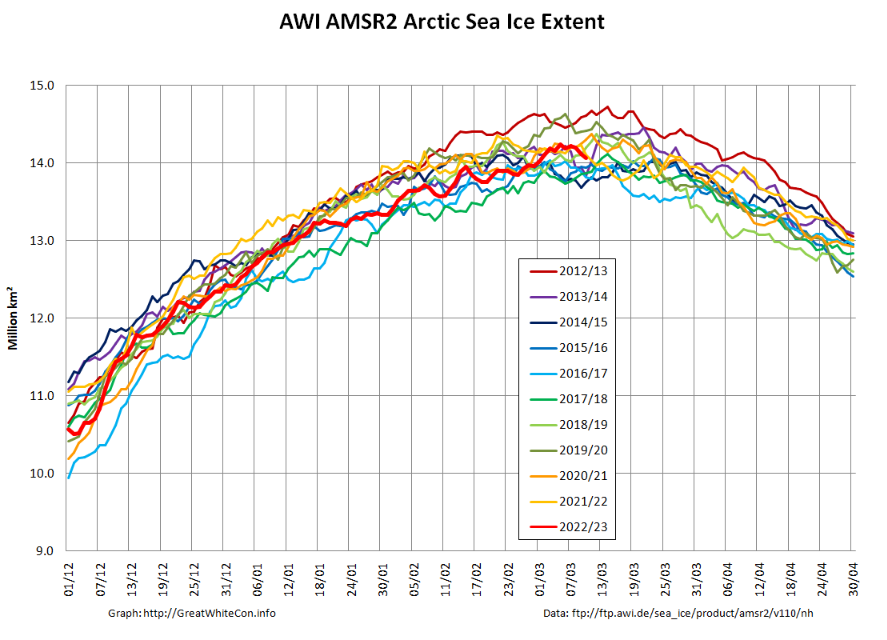
Finally, for the moment at least, AWI’s “high resolution” AMSR2 extent looks a lot less convincing than JAXA’s:

[Edit – March 11th]

NSIDC Arctic sea ice extent took a tumble yesterday, so with only mild trepidation I’m calling the 2023 maximum extent. In the case of the NSIDC’s 5 day average metric that’s still a rounded up 14.62 million km² on March 6th:

The JAXA/ViSHOP maximum extent remains at 14.12 million km² on March 2nd:

The “high resolution” AMSR2 based metric from AWI peaked at 14.24 million km² on March 5th:

[Edit – March 16th]

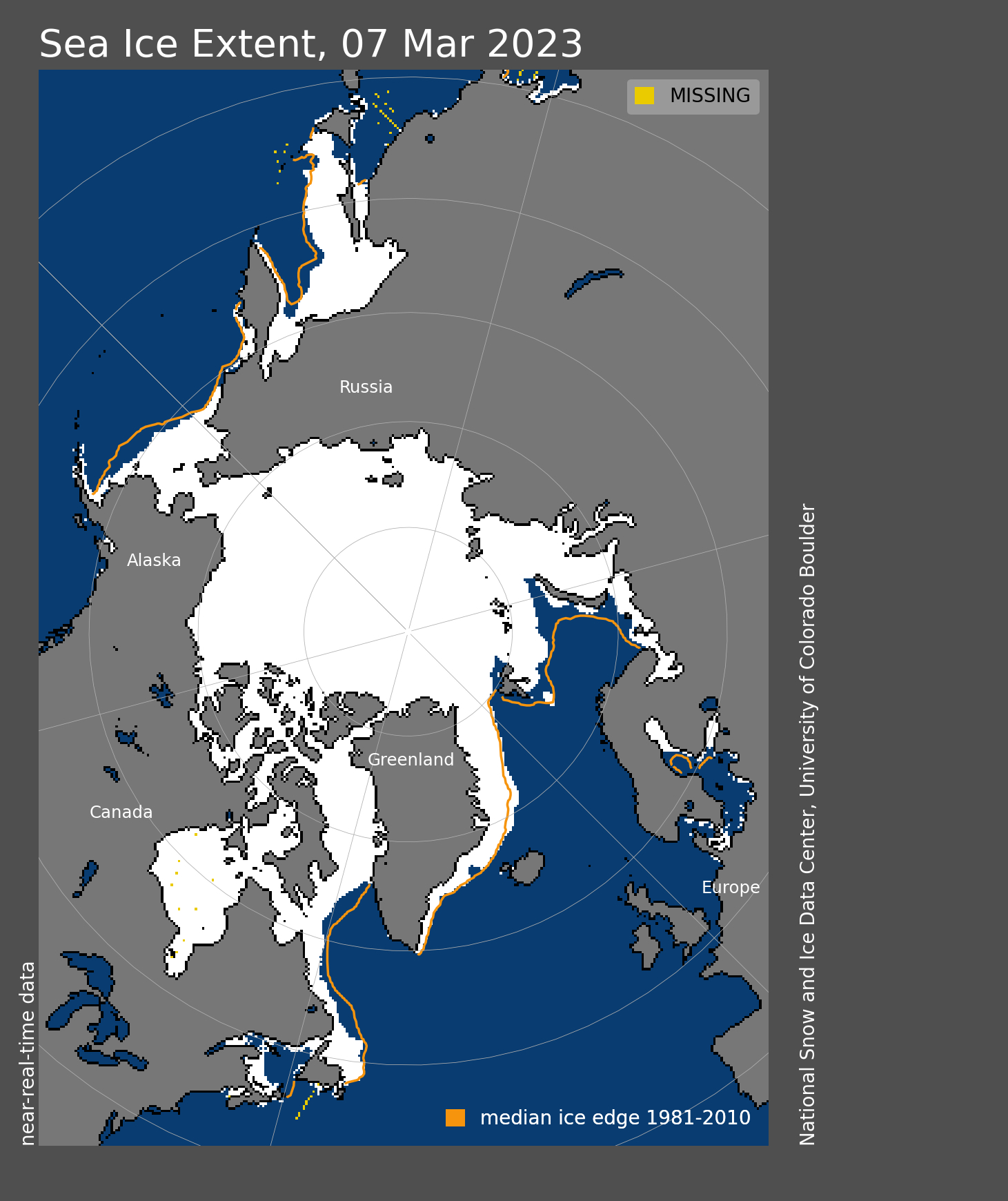
They are of course a bit late with the news, but the NSIDC have now called the 2023 maximum Arctic sea ice extent:

Arctic sea ice has likely reached its maximum extent for the year, at 14.62 million square kilometers (5.64 million square miles) on March 6. The 2023 maximum is the fifth lowest in the 45-year satellite record. NSIDC scientists will present a detailed analysis of the 2022 to 2023 winter sea ice conditions in the regular monthly post in early April:

The date of the maximum this year, March 6, was six days earlier than the 1981 to 2010 average date of March 12…

The ice growth season ended with below average sea ice extent in the Bering Sea, Sea of Okhotsk, Barents Sea, and Labrador Sea. Above average extent was in the Greenland Sea. Extent was well below average in the Gulf of St. Lawrence for a second year in row.

Watch this space!
New Record Antarctic Sea Ice Minimum Extent

I should of course add “in the satellite era”, but the title is pretty unwieldy as it is!

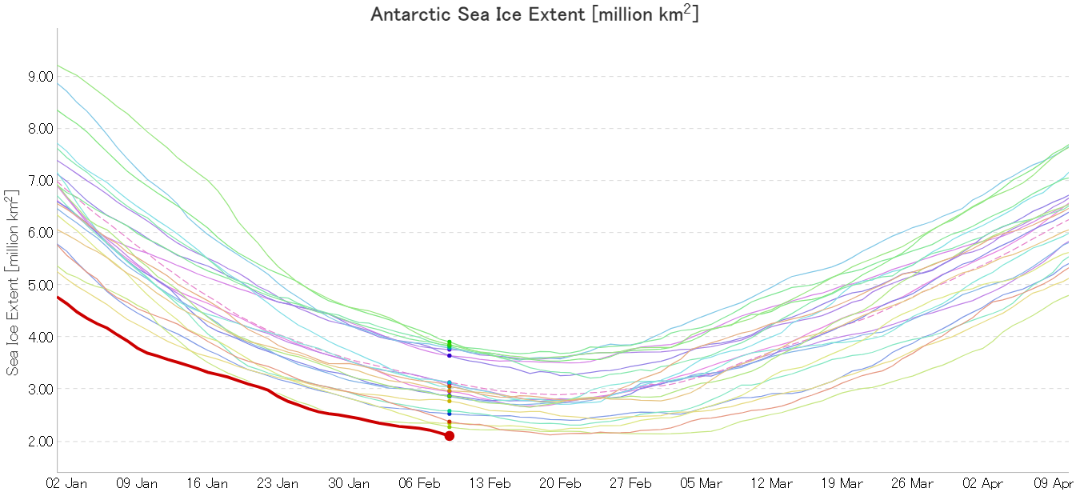
I was up early (UTC) to check the latest JAXA data, and sure enough that confirmed a new record minimum Antarctic sea ice extent of 2.11 million km² was reached yesterday:

Having added a note to that effect the Arctic open thread, Lars Kaleschke from the Alfred Wegener Institute pointed out over on Mastodon that the AWI had published a press release about the event this morning:

Let’s take a closer look at what the AWI had to say:

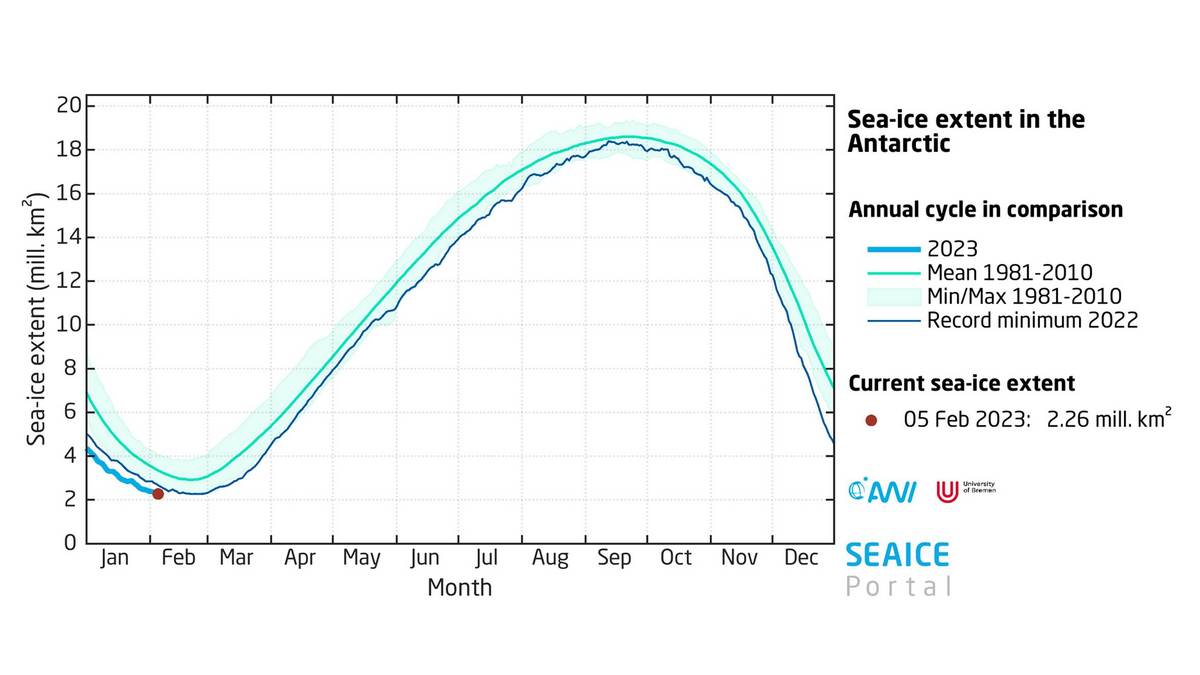
On 8 February 2023, at 2.20 million square kilometres, the Antarctic sea ice extent had already dropped below the previous record minimum from 2022 (2.27 million square kilometres on 24 February 2022). Since the sea ice melting in the Antarctic will most likely continue in the second half of the month, we can’t say yet when the record low will be reached or how much more sea ice will melt between now and then,” says Prof Christian Haas, Head of the Sea Ice Physics Section at the Alfred Wegener Institute, Helmholtz Centre for Polar and Marine Research (AWI), with regard to the current developments in the Antarctic. “The rapid decline in sea ice over the past six years is quite remarkable, since the ice cover hardly changed at all in the thirty-five years before. It is still unclear whether what we are seeing is the beginning of a rapid end to summer sea ice in the Antarctic, or if it is merely the beginning of a new phase characterised by low but still stable sea ice cover in the summer.”

Here’s how that news looks in the AWI’s official press release:

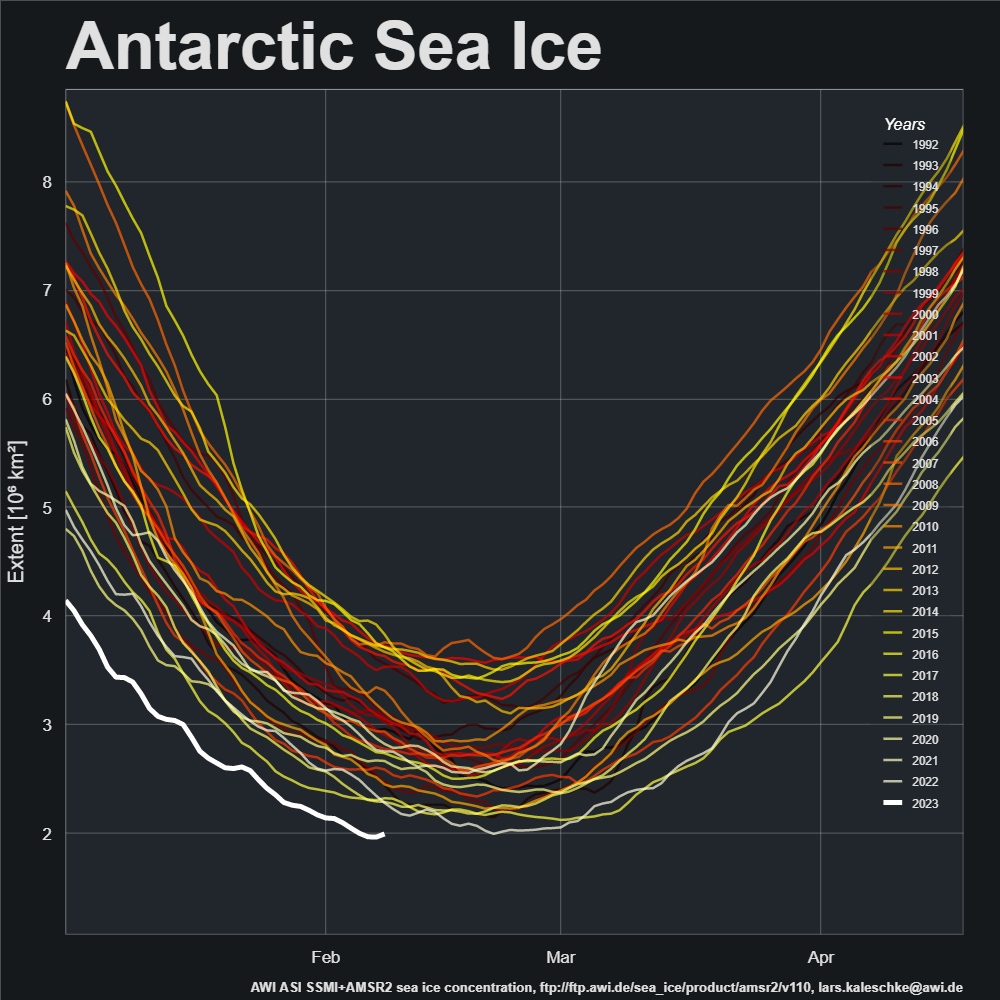
and here’s how it looks in Lars’ experimental AMSR2 graphic, with current minimum at 1.97 million km²:

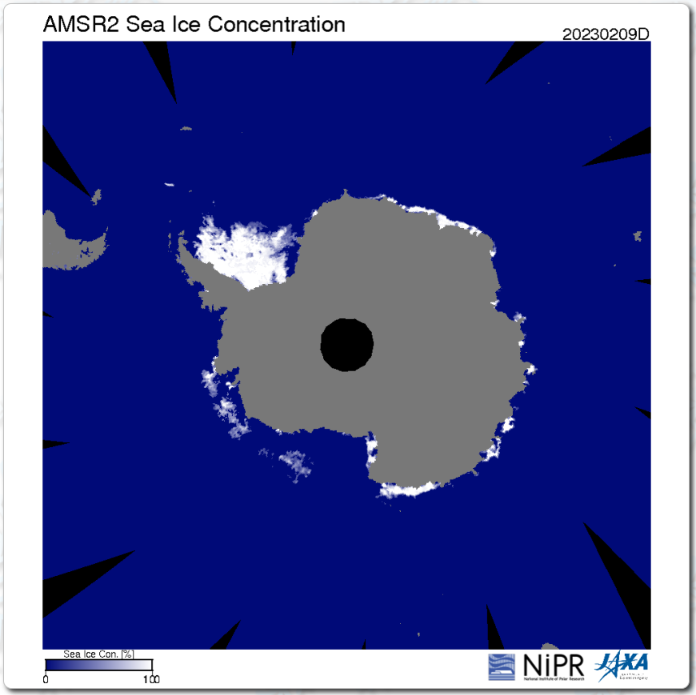
By way of prognostication here too is the current JAXA AMSR2 concentration map:

There are some low concentration areas which suggest further extent reductions still to come, despite the recent uptick in the high resolution graph.

Getting back to the AWI’s text:

The melting has progressed since December 2022, especially in the Bellingshausen and Amundsen Seas in the West Antarctic; the former is virtually ice-free. That is also where the research vessel Polarstern currently is, exploring the evidence left behind of past glacials and interglacials. According to expedition leader and AWI geophysicist Prof Karsten Gohl, who is now in the region for the seventh time, having first come in 1994: “I have never seen such an extreme, ice-free situation here before. The continental shelf, an area the size of Germany, is now completely ice-free. Though these conditions are advantageous for our vessel-based fieldwork, it is still troubling to consider how quickly this change has taken place.”

Polarstern in ice free Bellingshausen Sea, West Antarctica, in January 2023. (Photo: Daniela Röhnert)

Analyses of the current sea ice extent, conducted by the Sea Ice Portal team, show that, for the entire month of January 2023, the ice was at its lowest-ever extent recorded for the time of year since the beginning of record-keeping in 1979. The monthly mean value was 3.22 million square kilometres, ca. 478,000 square kilometres (an area roughly the size of Sweden) below the previous minimum from 2017. With regard to its long-term development, the Antarctic sea ice shows a declining trend of 2.6 percent per decade. This is the eighth consecutive year in which the mean sea-ice extent in January has been below the long-term trend.

But what has caused the current lack of Antipodean sea ice? The press release continues:

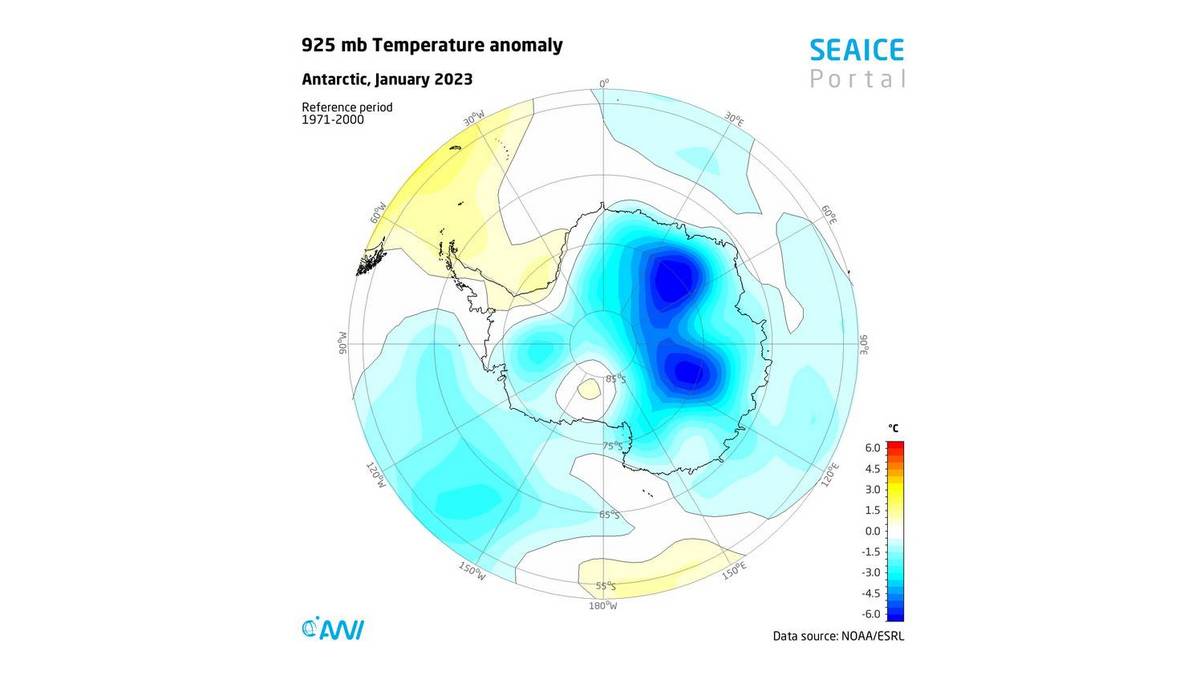
This intense melting could be due to unusually high air temperatures to the west and east of the Antarctic Peninsula, which were ca. 1.5 °C above the long-term average. In addition, the Southern Annular Mode (SAM) is in a strongly positive phase, which influences the prevailing wind circulation in the Antarctic. In a positive SAM phase (like today), a low-pressure anomaly forms over the Antarctic, while a high-pressure anomaly develops over the middle latitudes. This intensifies the westerly winds and causes them to contract toward the Antarctic. As a result, upwelling of circumpolar deep water on the continental shelf intensifies in the Antarctic, promoting sea-ice retreat. More importantly, it also intensifies the melting of ice shelves, an essential aspect for future global sea-level rise.

Air temperature anomalies in °C at 925 hPa pressure level in Antarctica in January 2023 compared to the long-term mean 1971-2000. (Graphic: meereisportal.de)

The press release concludes:

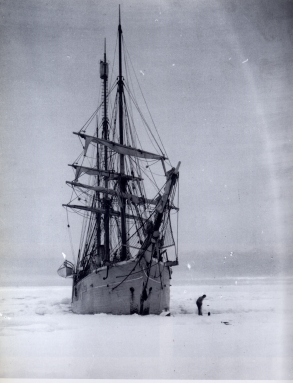
Historical records also reflect the tremendous changes. For example, in the Antarctic summer 125 years ago, the Belgian research vessel Belgica was trapped in the massive pack ice for more than a year – in exactly the same region where the Polarstern can now operate in completely ice-free waters. The photographs and diaries of the Belgica’s crew offer a unique chronicle of the ice conditions in the Bellingshausen Sea at the dawn of the industrial age, which climate researchers often use as a benchmark for comparison with today’s climate change.

Belgica became ice bound near Peter I island on February 28th 1898. On board was second officer Roald Amundsen. The leader of the expedition, Adrien de Gerlache, published a French language book about the voyage in 1902: “Quinze mois en Antarctique“.

Belgica ice bound in the Bellingshausen Sea

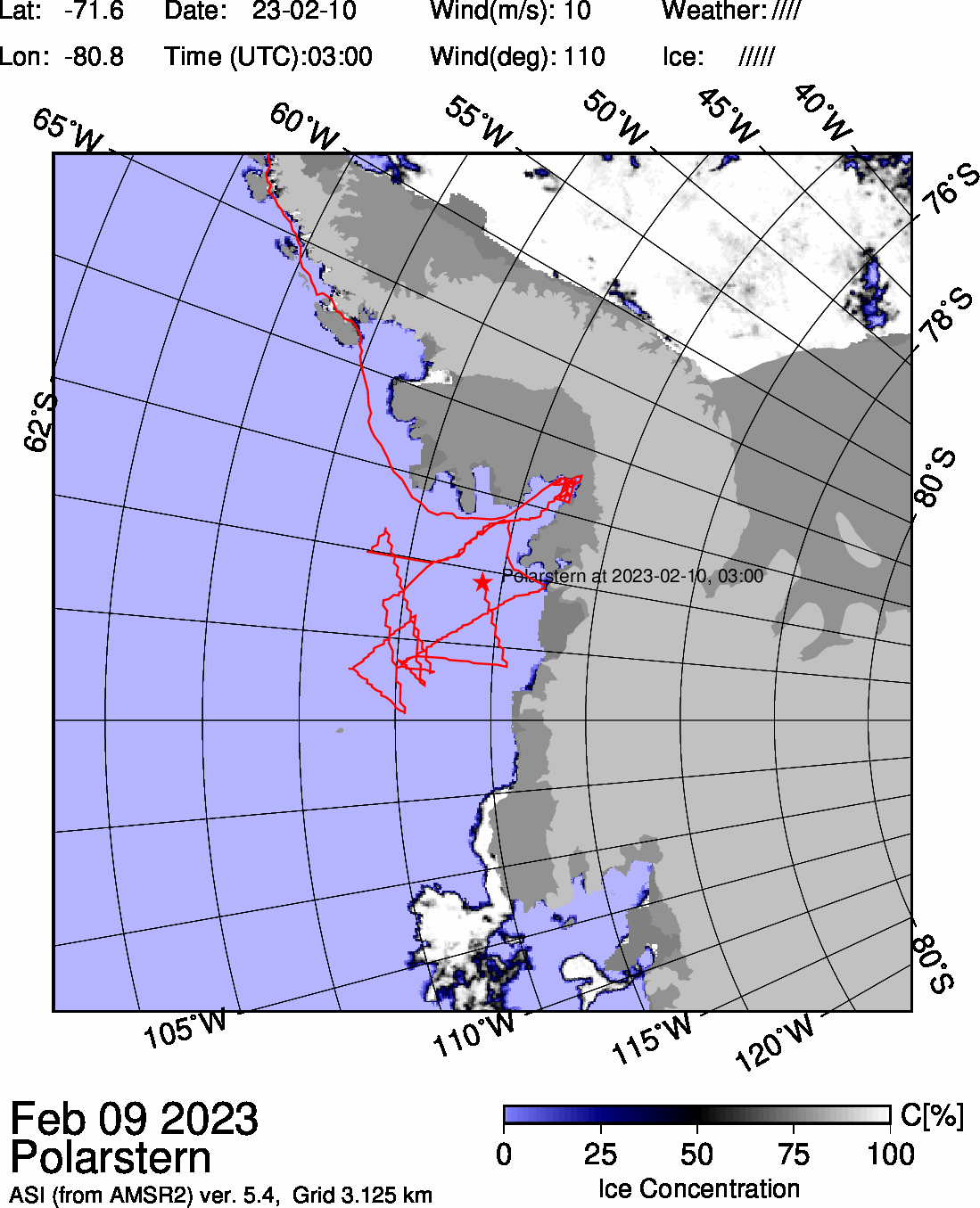
Finally, for the moment at least, here is the University of Bremen’s map of Polarstern’s current location and the sea ice concentration in the vicinity thereof:

[Edit – February 11th]

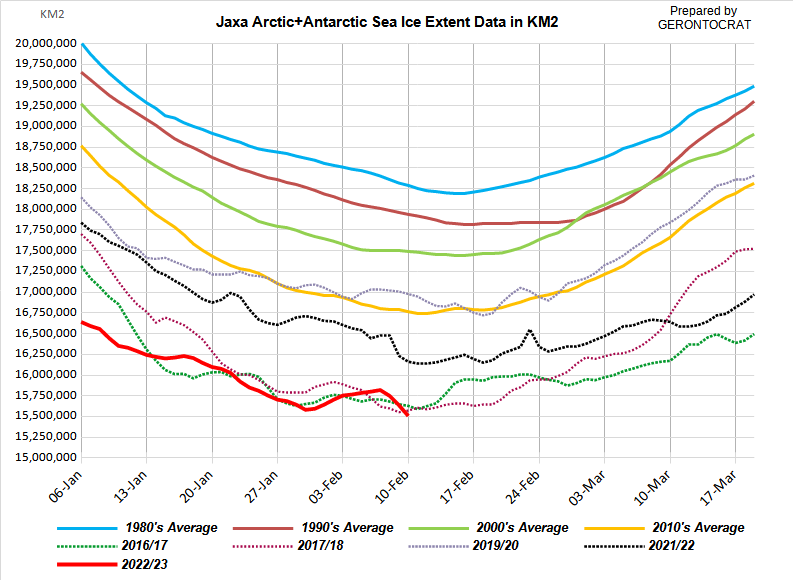
JAXA Antarctic sea ice extent is now down to 2.06 million km². Accompanied by a significant fall in Arctic extent, JAXA’s flavour of global sea ice extent has now also reached the lowest level ever recorded in the satellite era, at 15.51 million km² :

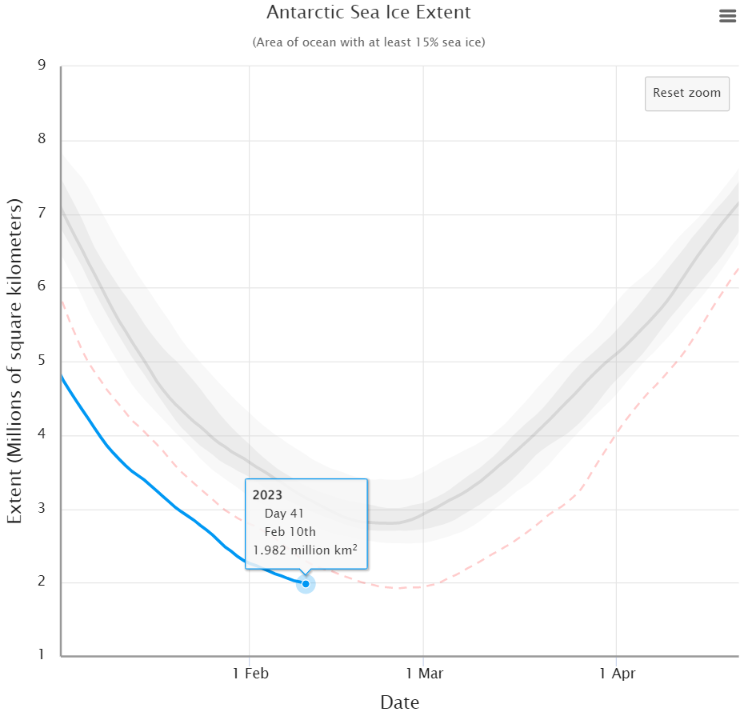
P.S. The NSIDC’s 5 day averaged extent hasn’t quite reached a record minimum yet:

However their daily extent has reached a new satellite era record minimum:

[Edit – February 14th]

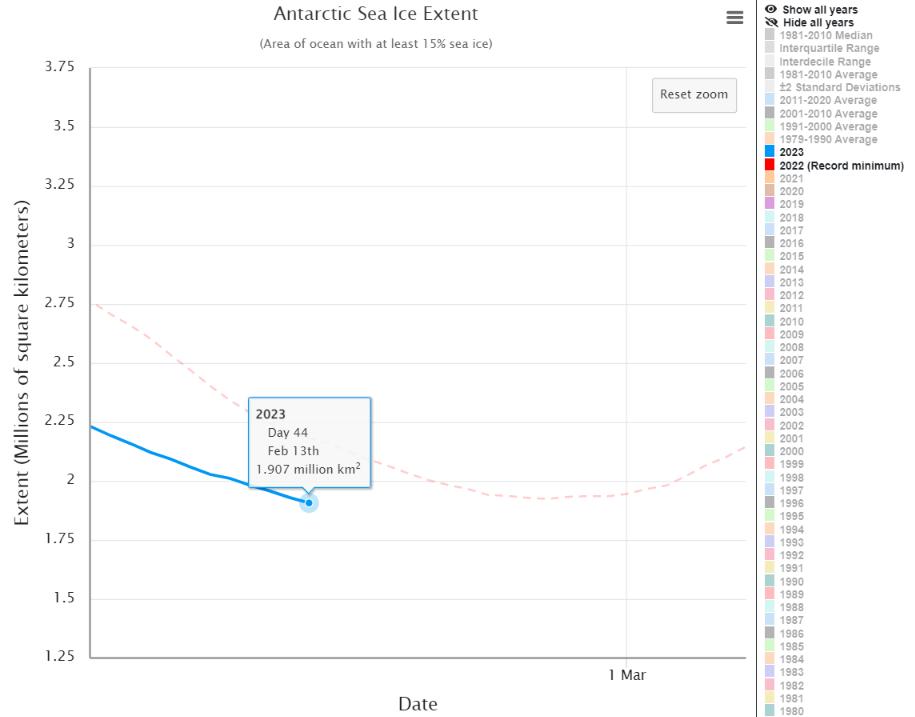
The NSIDC’s 5 day average Antarctic sea ice extent metric has duly reached a new record low level of 1.91 million km² :

P.S. The NSIDC has now published its own article about the record minimum:

With a couple more weeks likely left in the melt season, the extent is expected to drop further before reaching its annual minimum. Much of the Antarctic coast is ice free, exposing the ice shelves that fringe the ice sheet to wave action and warmer conditions…

Extent has tracked well below last year’s melt season levels since mid-December. As noted in our previous post, a positive Southern Annular Mode has led to stronger-than-average westerly winds. Along with a strong Amundsen Sea Low, the weather conditions have brought warm air to the region on both sides of the Antarctic Peninsula. This has largely cleared out the ice cover in the Amundsen and Bellingshausen Seas, and reduced the sea ice extent in the northwestern Weddell Sea. Sea ice is patchy and nearly absent over a long stretch of the Pacific-facing coastline of Antarctica.  Earlier studies have linked low sea ice cover with wave-induced stresses on the floating ice shelves that hem the continent, leading to break up of weaker areas.

Antarctic sea ice extent has been highly variable over the last several years. While 2022 and 2023 have had record low minimum extent, four out of the five highest minimums have occurred since 2008. Overall, the trend in Antarctic minimum extent over 1979 to 2023 is near zero. The current downward linear trend in the Antarctic minimum extent from 1979 to 2023 is 2,400 square kilometers per year, or 0.9 percent per decade, which is currently not statistically significant. Nevertheless, the sharp decline in sea ice extent since 2016 has fueled research on potential causes and whether sea ice loss in the Southern Hemisphere is developing a significant downward trend.

Watch this space!
Facts About the Arctic in February 2023

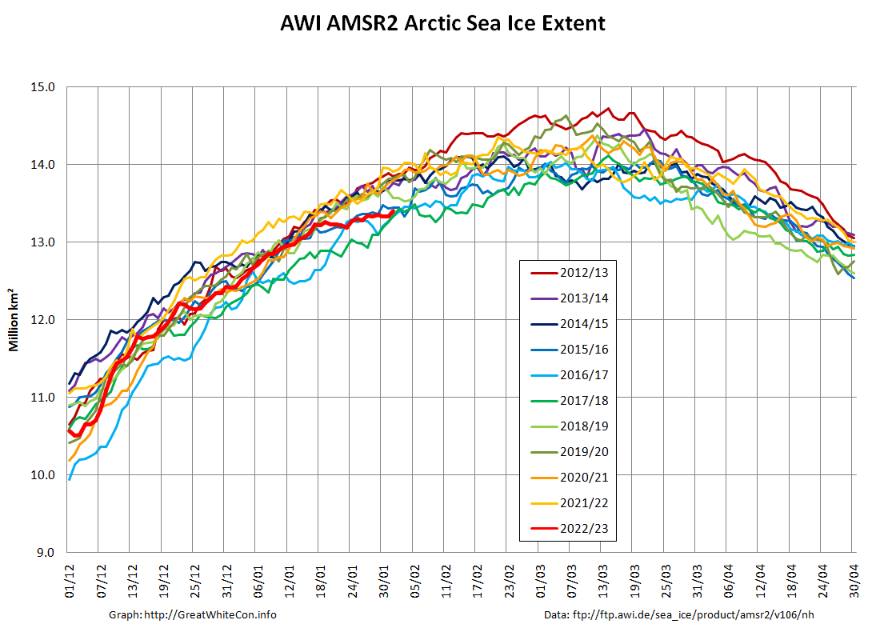
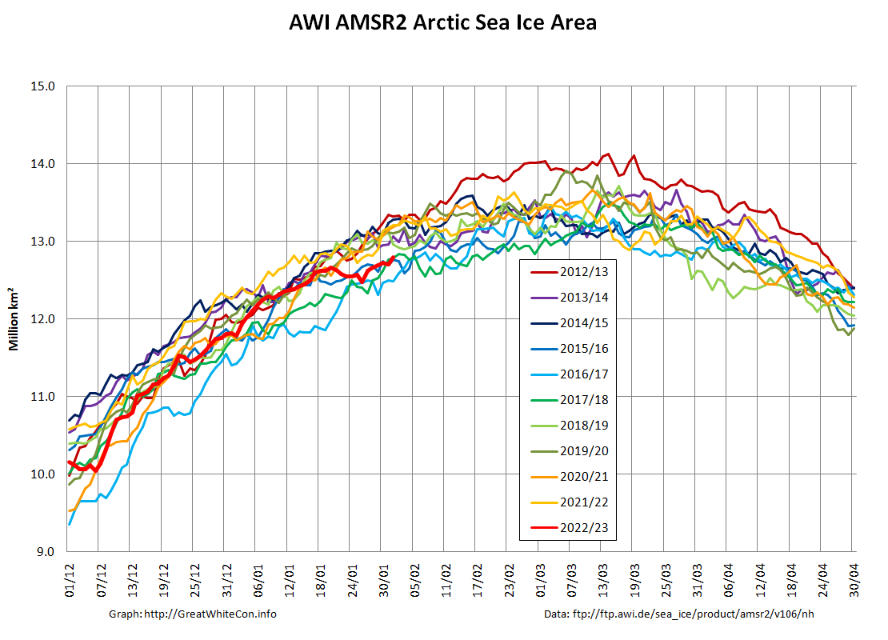
A new month has arrived, and during January several Arctic sea ice metrics have been drifting towards the bottom of their respective decadal ranges. To begin with here is AWI’s high resolution AMSR2 extent graph, which is currently very close to being lowest for the date in the AMSR2 record:

However that is less the case for area:

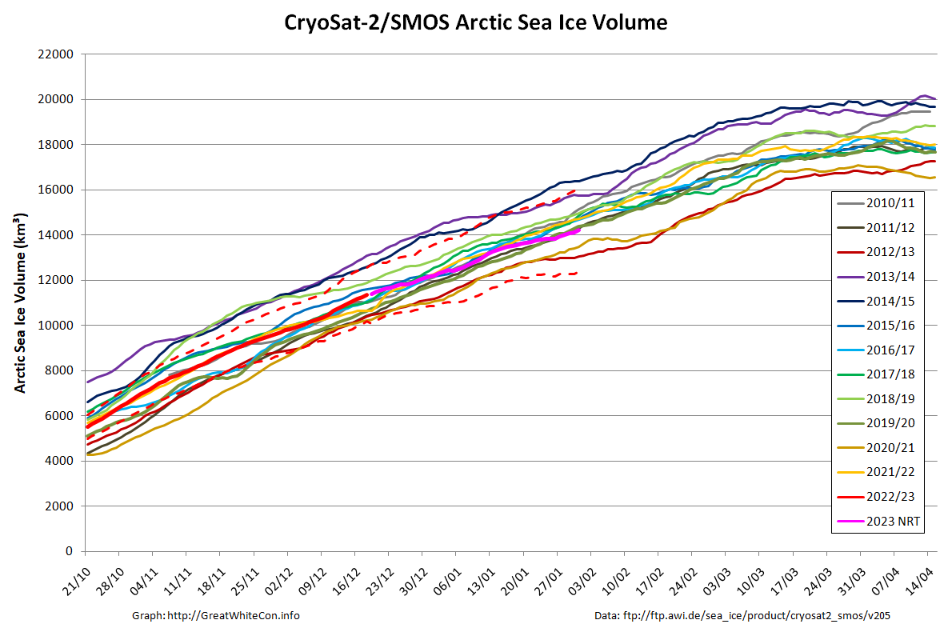
Taylor is keen to see the PIOMAS volume data for January, but whilst we wait for the latest Polar Science Center update here is the CryoSat-2/SMOS volume graph, which now includes a couple of month’s worth of reanalysed results as well as more recent near real time numbers:

Here too is the start of month CS2/SMOS thickness map:

Continue reading Facts About the Arctic in February 2023

Facts About the Arctic in November 2022

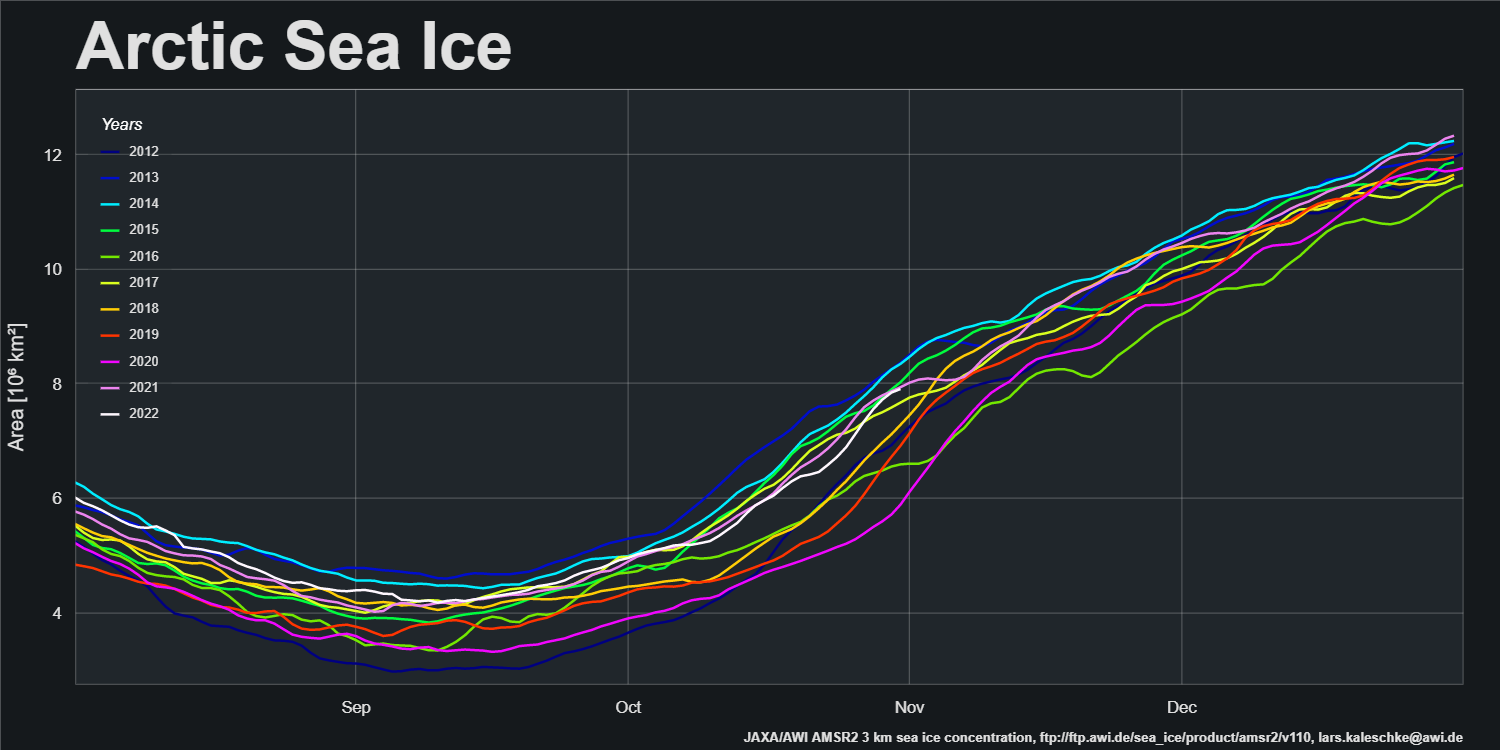
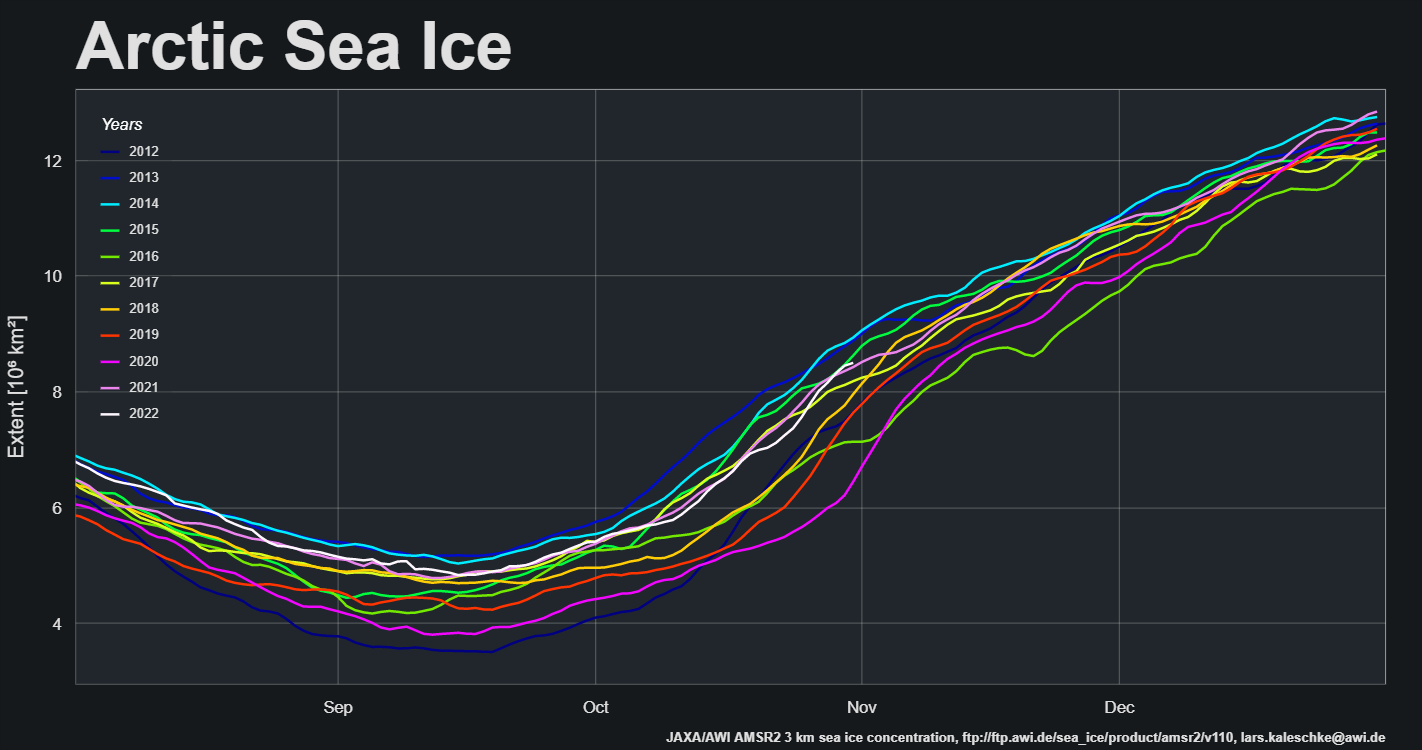
A change is allegedly as good as a rest, so here’s an alternative view of high resolution AMSR2 area and extent created using the experimental tools provided by the AWI’s Lars Kaleschke at: https://sites.google.com/view/sea-ice/

After a brief pause mid-month the refreeze has accelerated again. Both metrics are in the upper half of the decadal range, with extent this year just above 2021 and area just below last year.

Next let’s take a look at sea ice concentration at the end of October:

Continue reading Facts About the Arctic in November 2022

The 2022 Arctic Sea Ice Minimum Extent

September has arrived and it’s time to start speculating about when and at what level this summer’s minimum Arctic sea ice extent will occur. Here’s a helpful summary of previous years’ JAXA AMSR2/AMSR-E extent minima courtesy of Zack Labe:

Here too is JAXA’s current graph of extent, including a selection of previous years:

JAXA extent on August 31st was 4.96 million km2, marginally below last year’s value of 4.99 million km2 on the same date.

Continue reading The 2022 Arctic Sea Ice Minimum Extent