Tag Archives: Concentration

Facts About the Arctic in March 2022

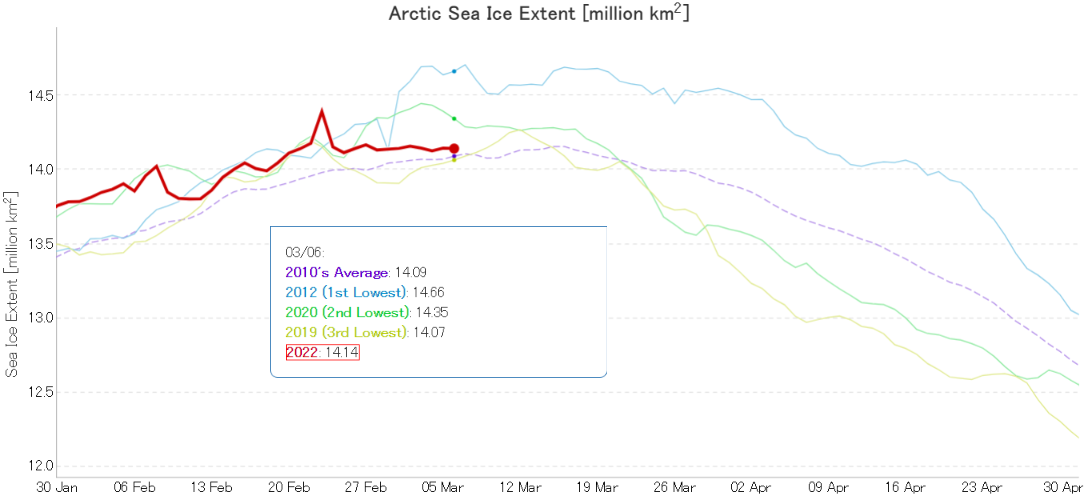
For detailed analysis of Arctic sea ice extent over the next few weeks please see the 2022 maximum extent thread. However to get the new open thread going here is the current JAXA/ViSHOP extent graph:

It’s looking more and more as though the real maximum for 2022 occurred close the false peak on February 23rd.

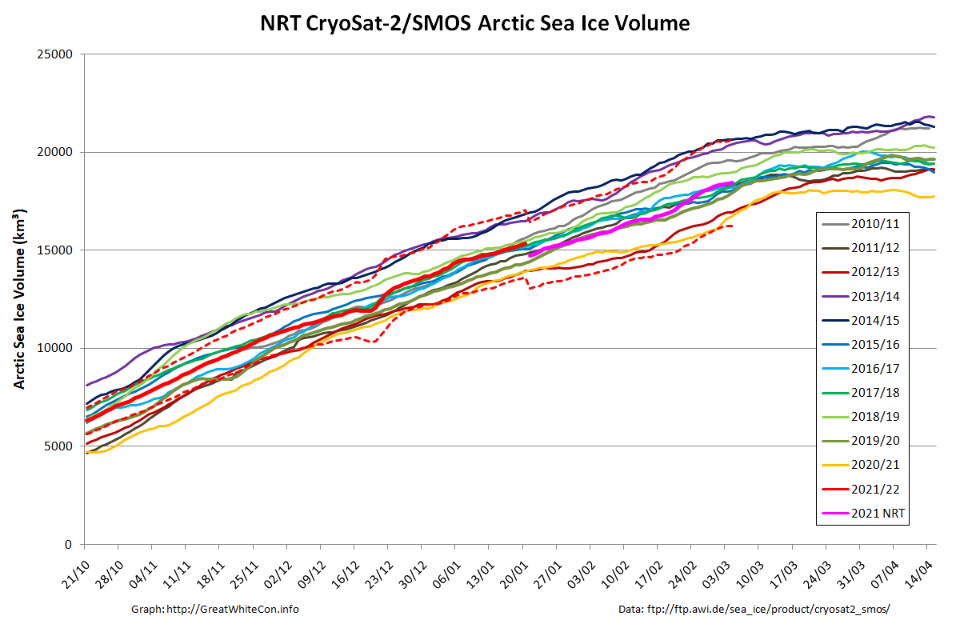
Arctic sea ice volume will keep increasing for a while longer. Here is the current AWI CryoSat-2/SMOS volume graph:

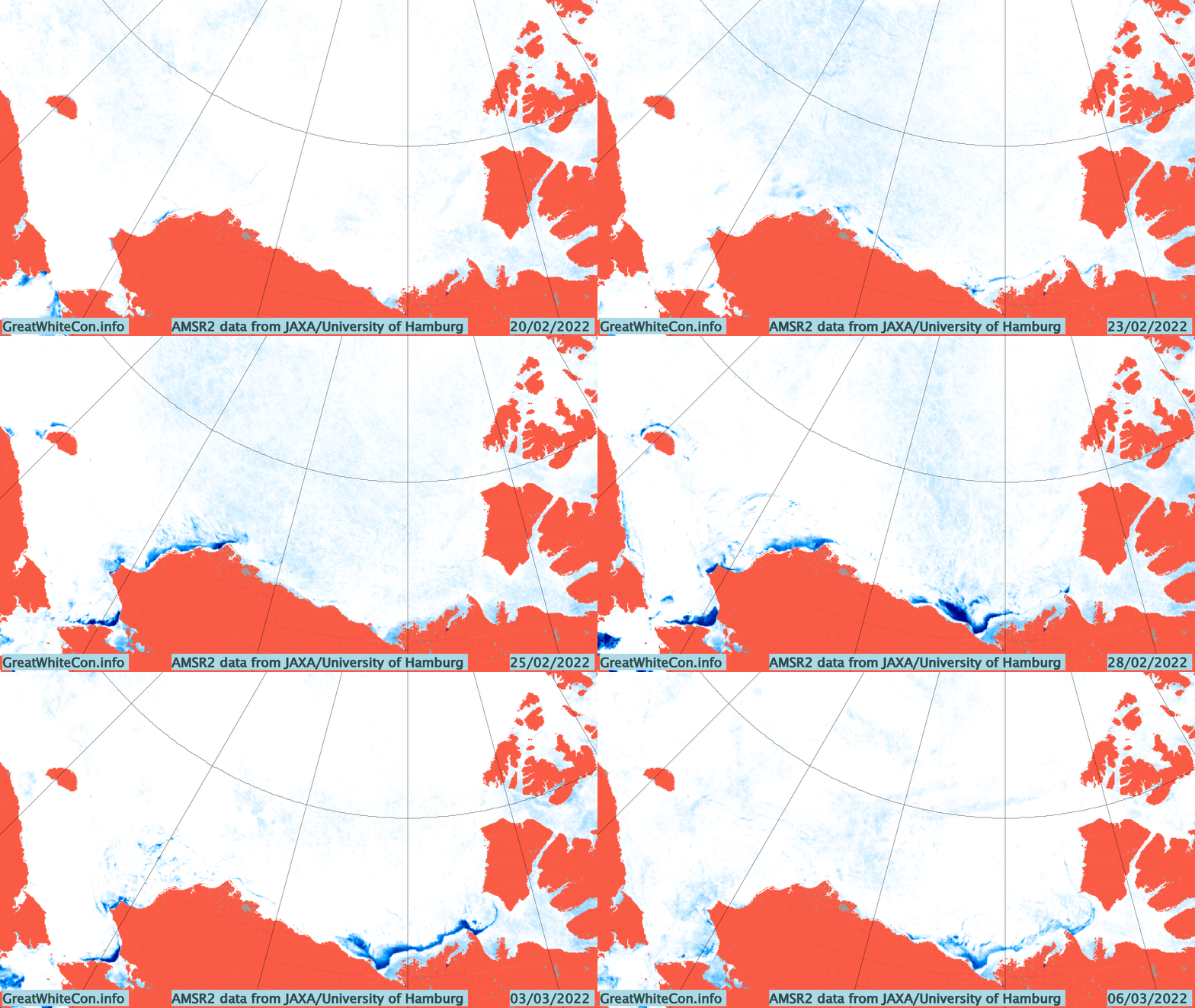
The recent “flat line” in extent is in part due to recent events on the Pacific periphery of the Arctic. Take a look at this animation of AMSR2 sea ice concentration:

The gap varies depending on how the wind blows, but there is still evidence of open water (or very thin ice) along the shore of the Beaufort and Chukchi Seas. Here’s the Mackenzie Delta and the adjacent Beaufort Sea on March 5th:

Continue reading Facts About the Arctic in March 2022

Facts About the Arctic in September 2021

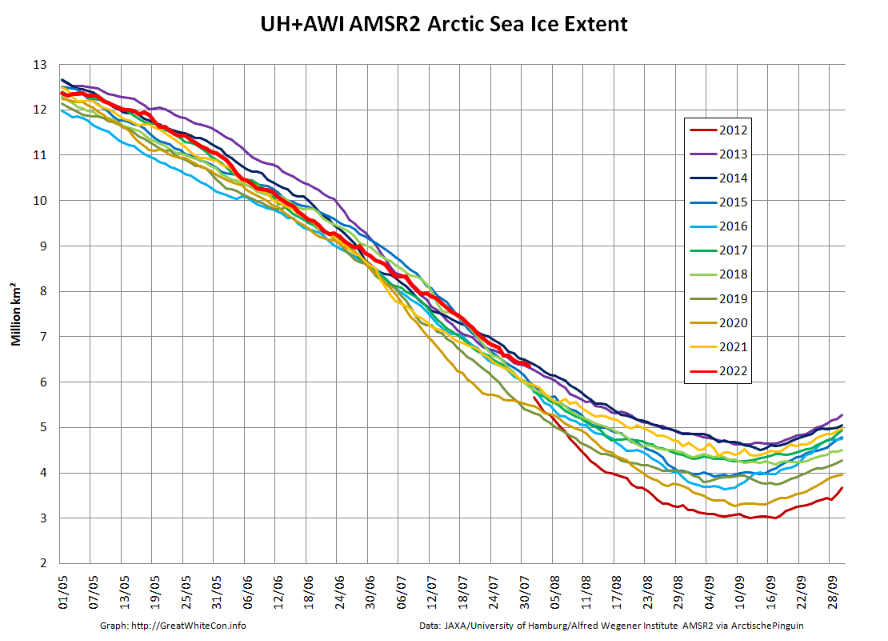
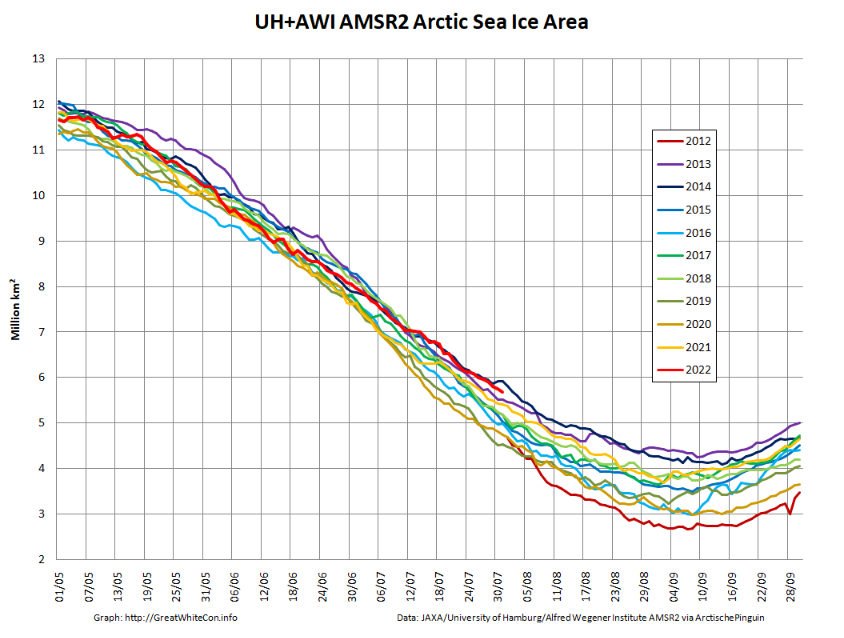
A detailed dissection of the 2021 minimum of various Arctic sea ice extent metrics can be found on a dedicated thread. All other Arctic news in September will be found below.

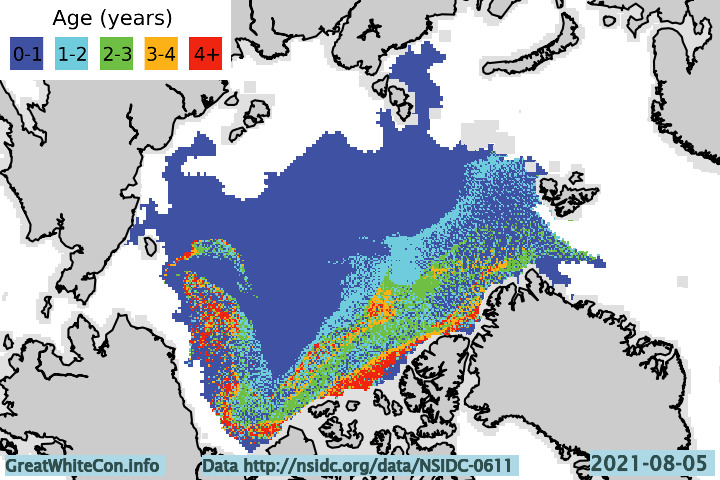
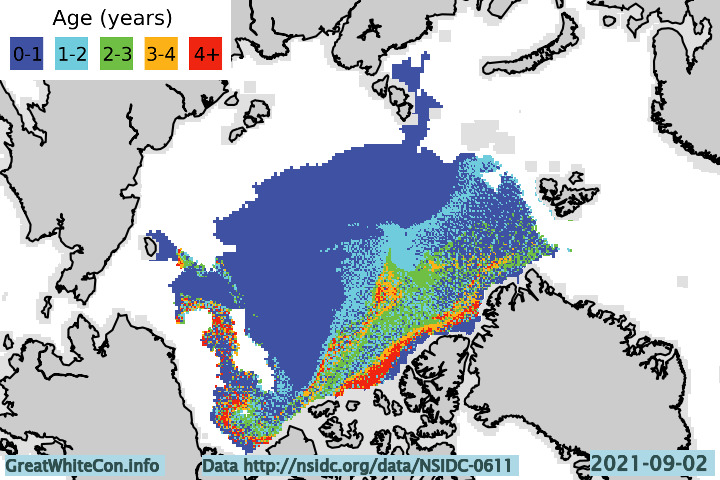
Let’s start with a map of sea ice age at the beginning of August:

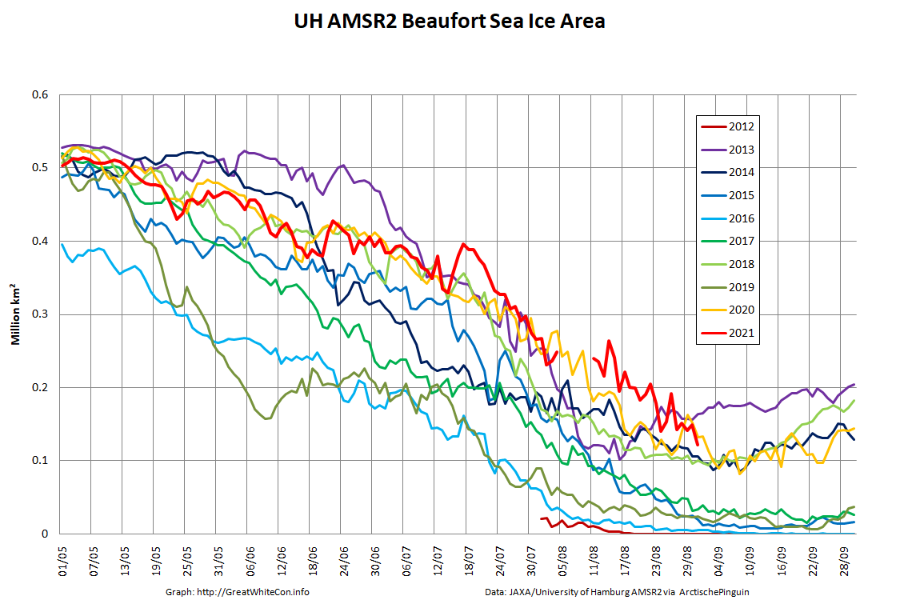
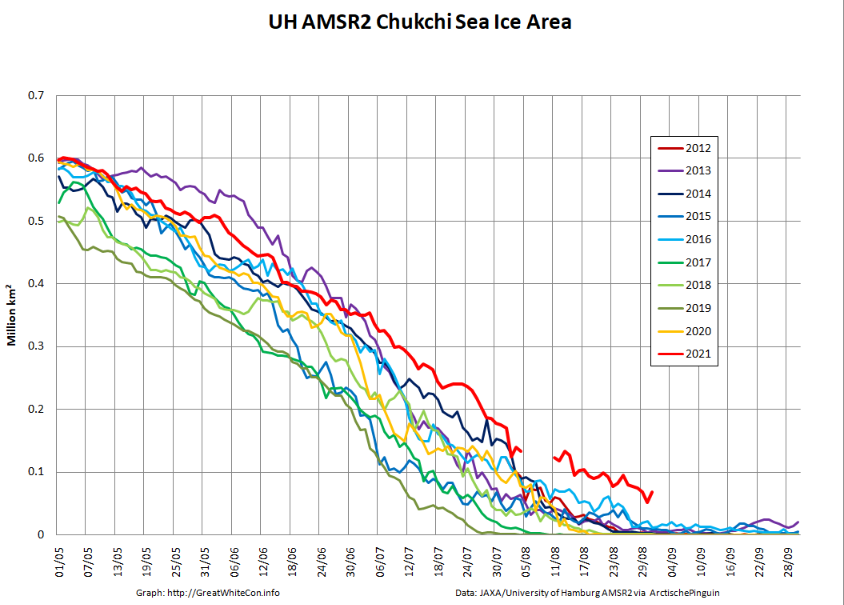
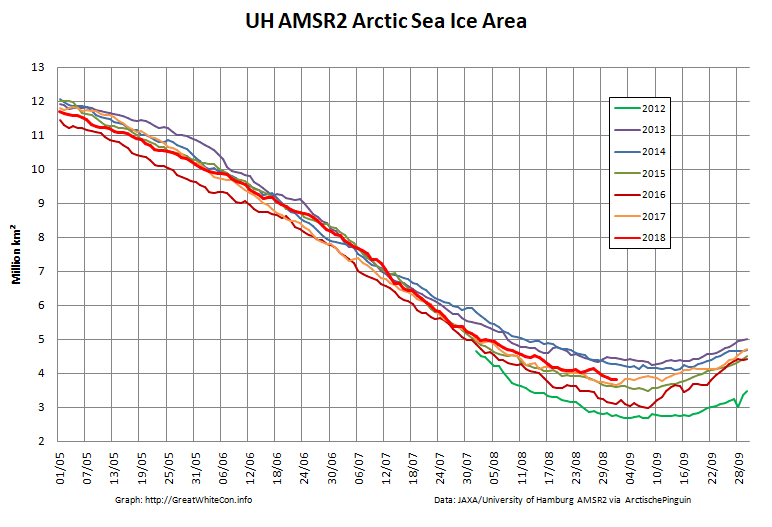
Firstly notice the absence of 3+ year old ice off the coast of north east Greenland. Also visible is a band of 4+ year old ice across the Pacific side of the Arctic Basin, which has slowed melting in the region and explains the following regional sea ice area graphs:


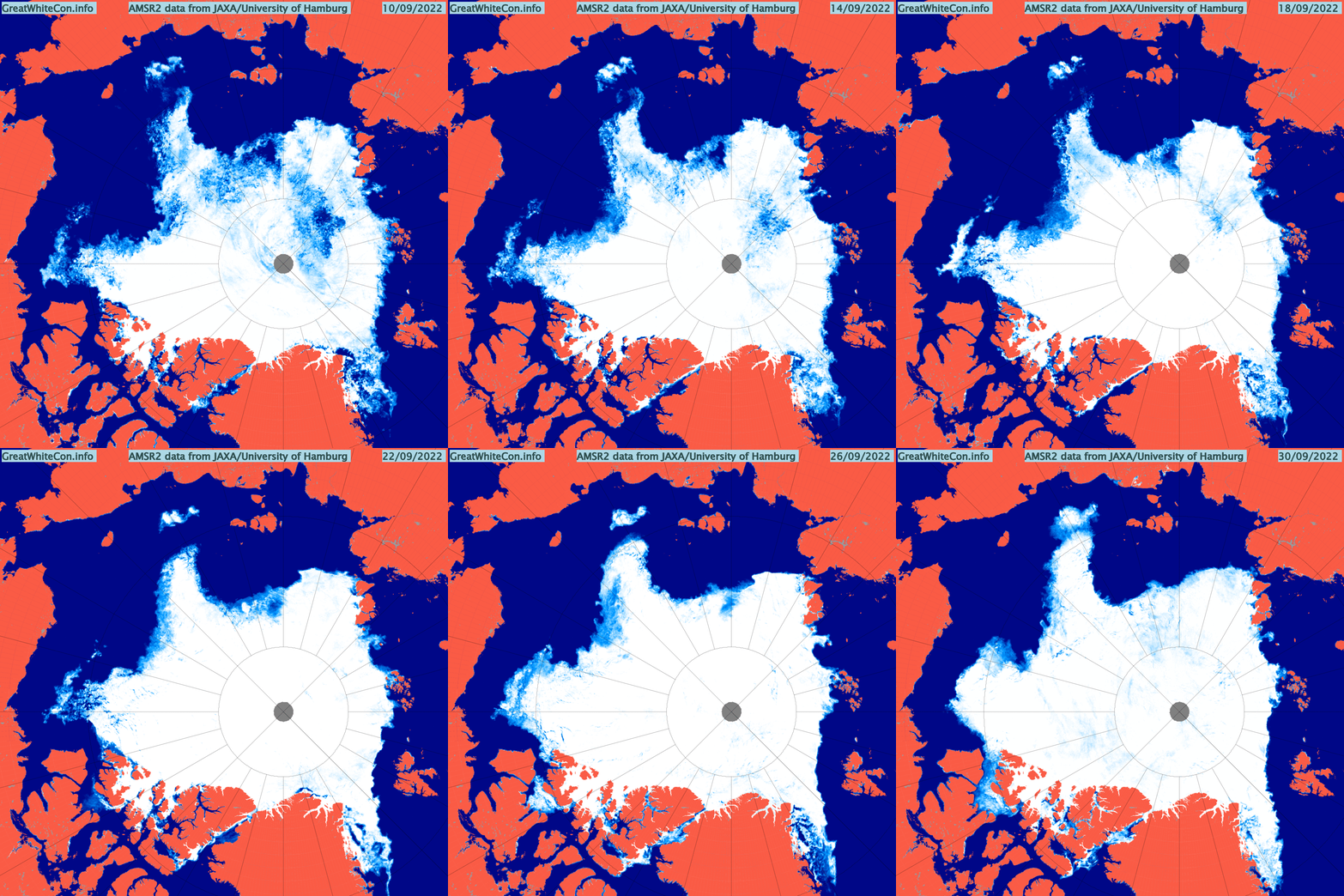
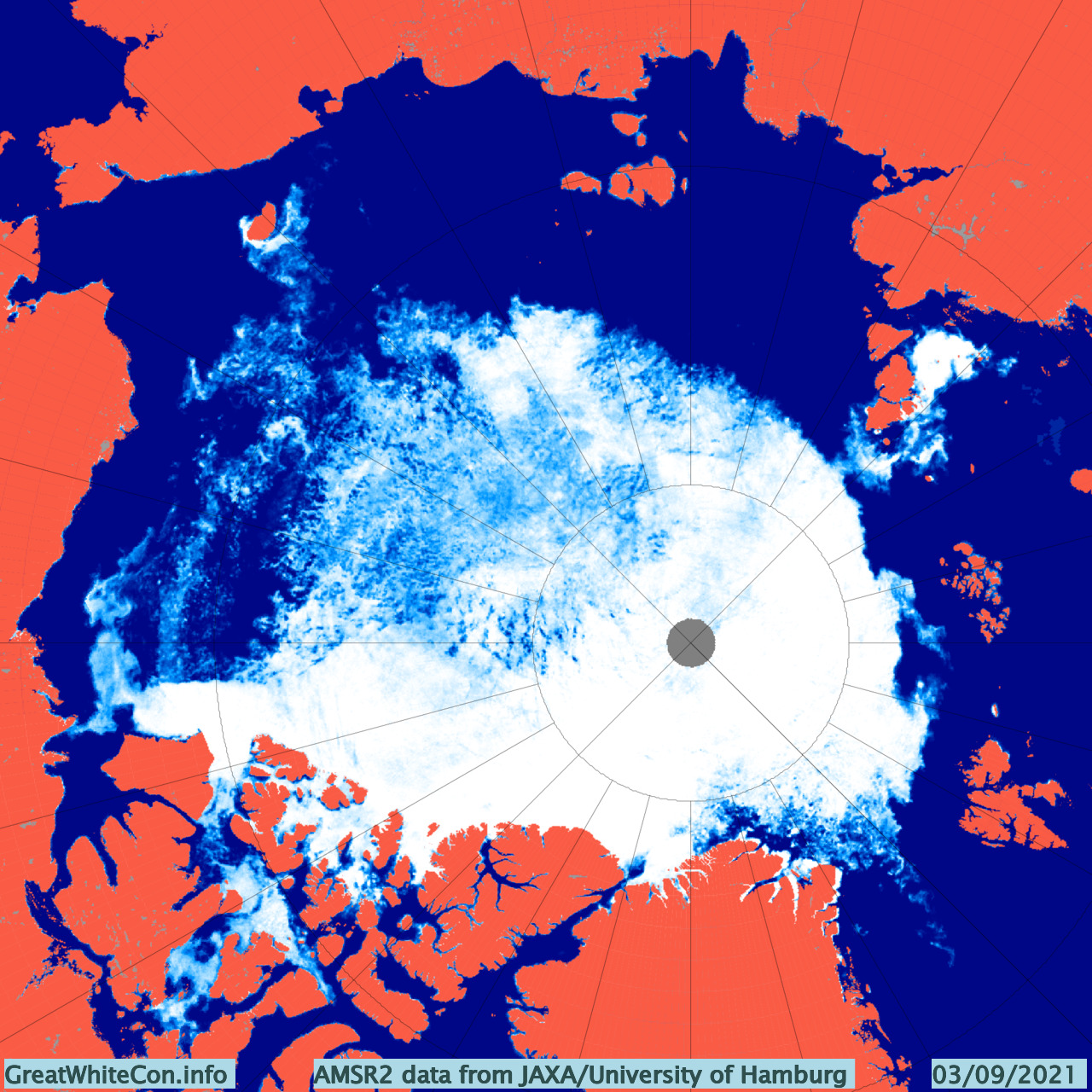
Next here’s the current AMSR2 concentration map:

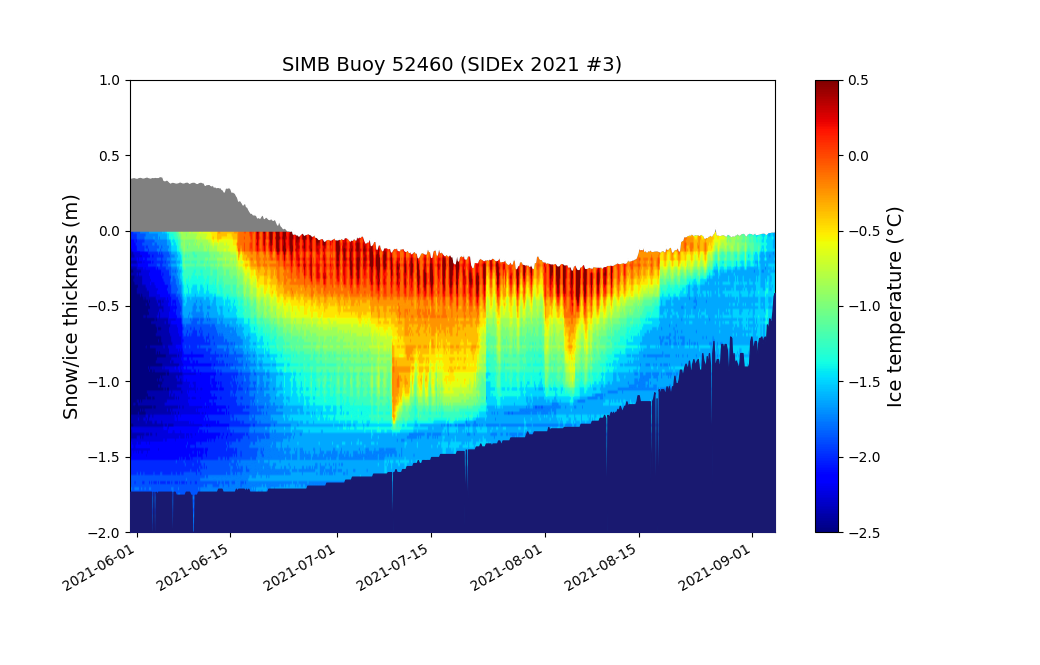
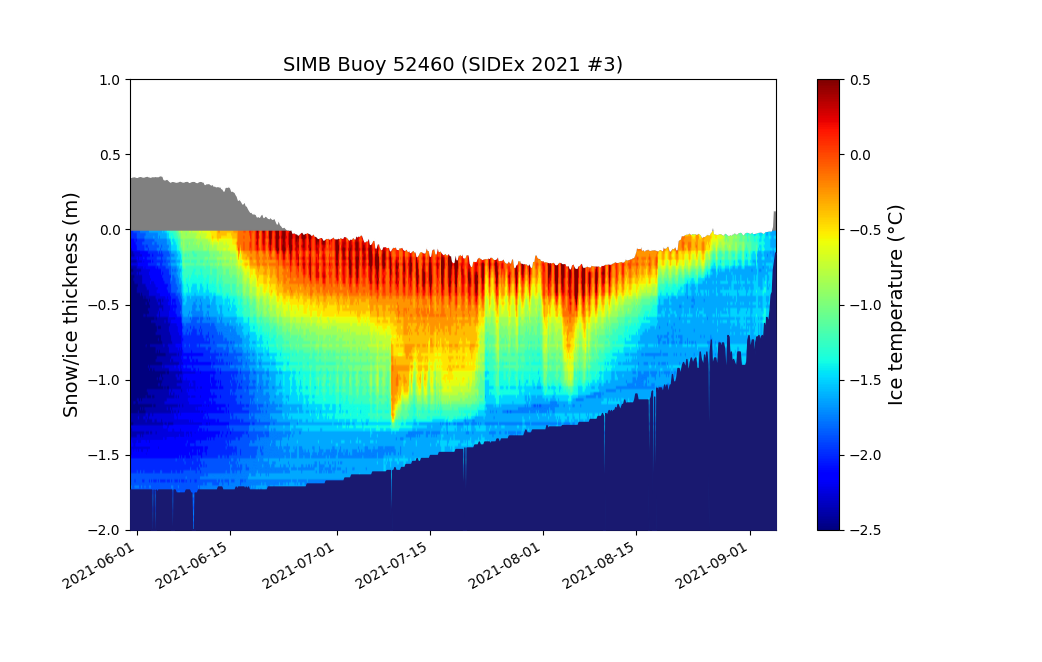
There is currently a large area of open water in the Wandel Sea to the north of Greenland. There is also an arm of old ice across the Beaufort and Chukchi Seas which is still clearly visible, but also visible is the recent reduction in sea ice concentration in the region. By way of explanation, here’s another look at the thickness of an ice floe currently situated to the north of the Chukchi at 74.84 N, 164.29 W, as measured by an ice mass balance buoy:

As the 2021 melting season draws towards its conclusion the floe is experiencing rapid bottom melt. How much longer will this floe and others like it last? Will it survive to become an “old ice” dot on next year’s ice age maps?

[Edit – September 6th]

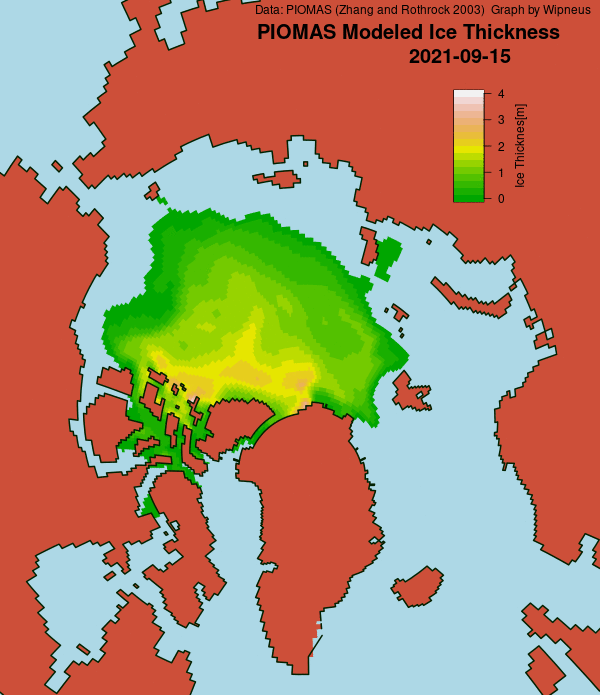
As Wipneus puts it on the Arctic Sea Ice Forum, “PIOMAS has updated the gridded thickness data up to the 31st of August”. Here’s the latest modelled thickness map, which shows the thickest remaining ice located north of the Canadian Arctic Archipelago rather than north of Greenland:

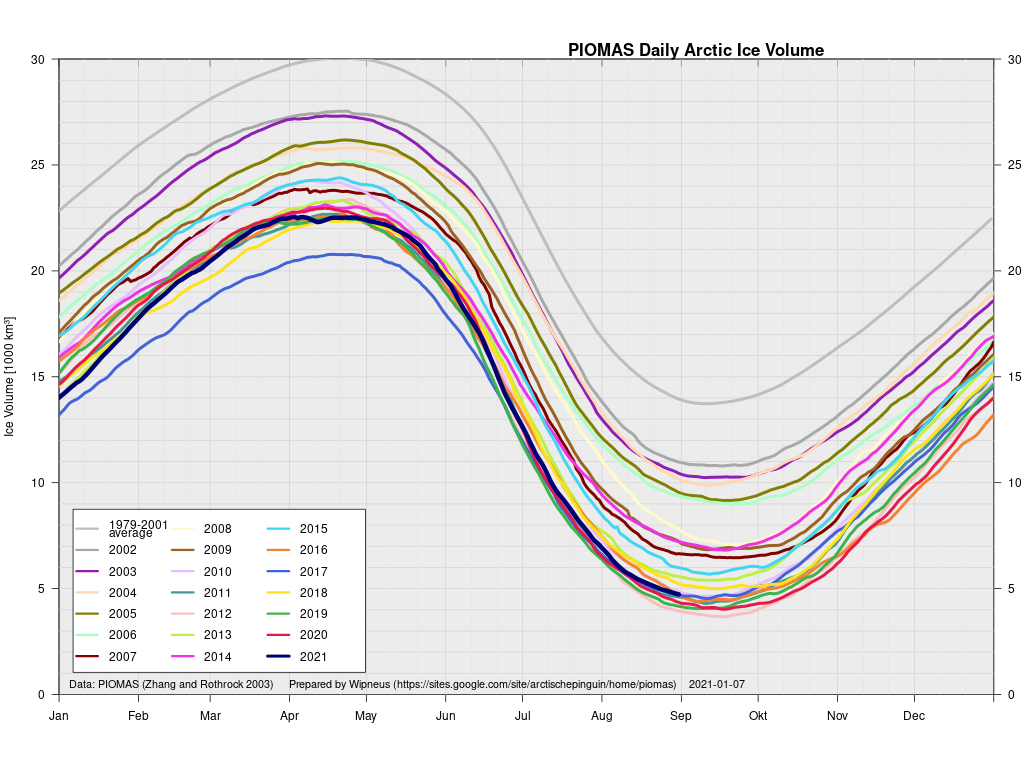
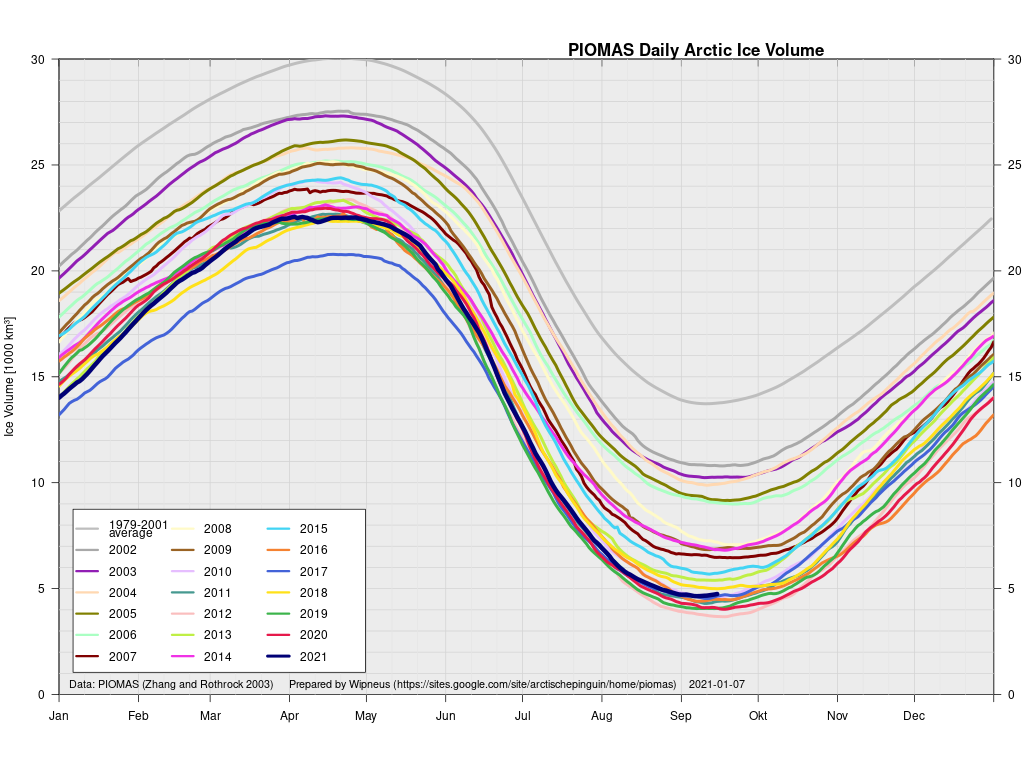
The accompanying volume graph shows 2021 in 7th lowest position, at 4.7 thousand km3:

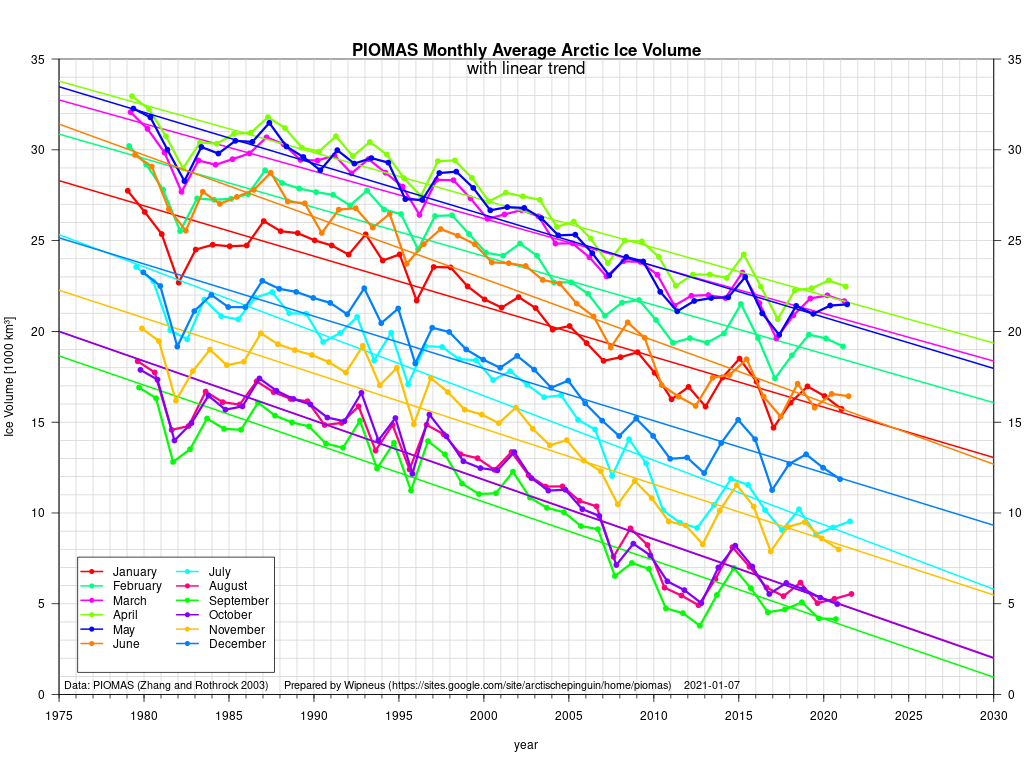
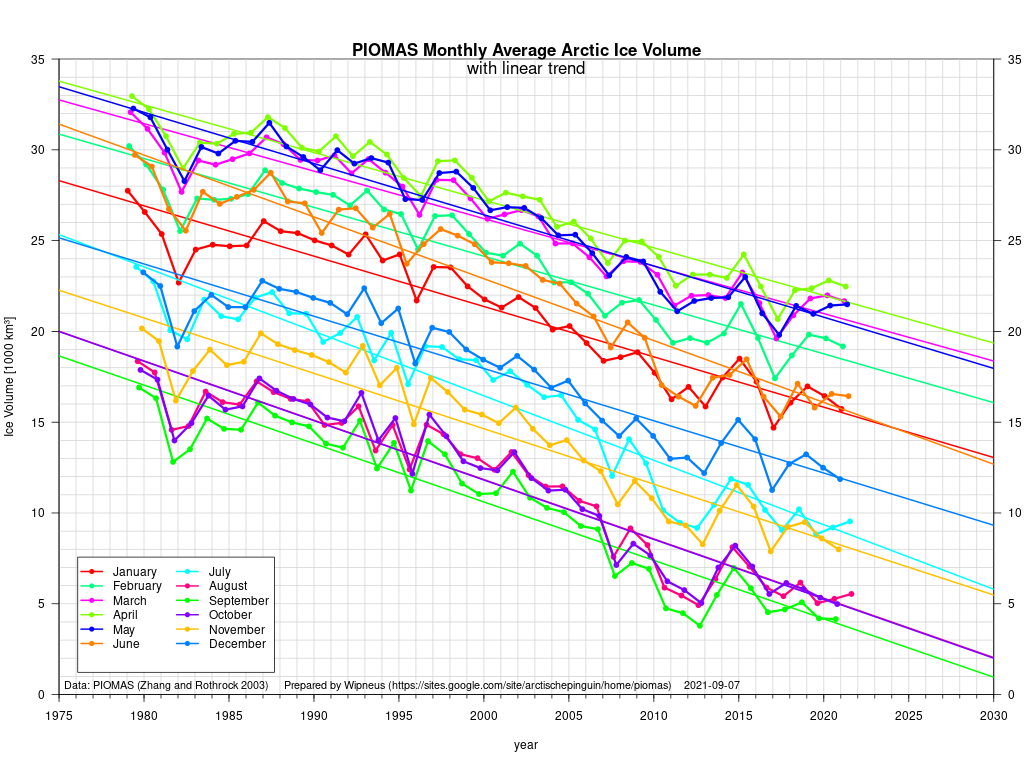
Here too are the current PIOMAS volume trends for each month of the year:

The Swedish icebreaker Oden has recently been exploring the area between northern Greenland and the North Pole as part of the Synoptic Arctic Survey expedition:

Here are the measurements of water temperature it has recorded over the past few days:

Ranging between -0.4 °C and -1.0 °C it doesn’t look as though the 2021 refreeze will be starting in the Wandel Sea just yet.

[Edit – September 10th]

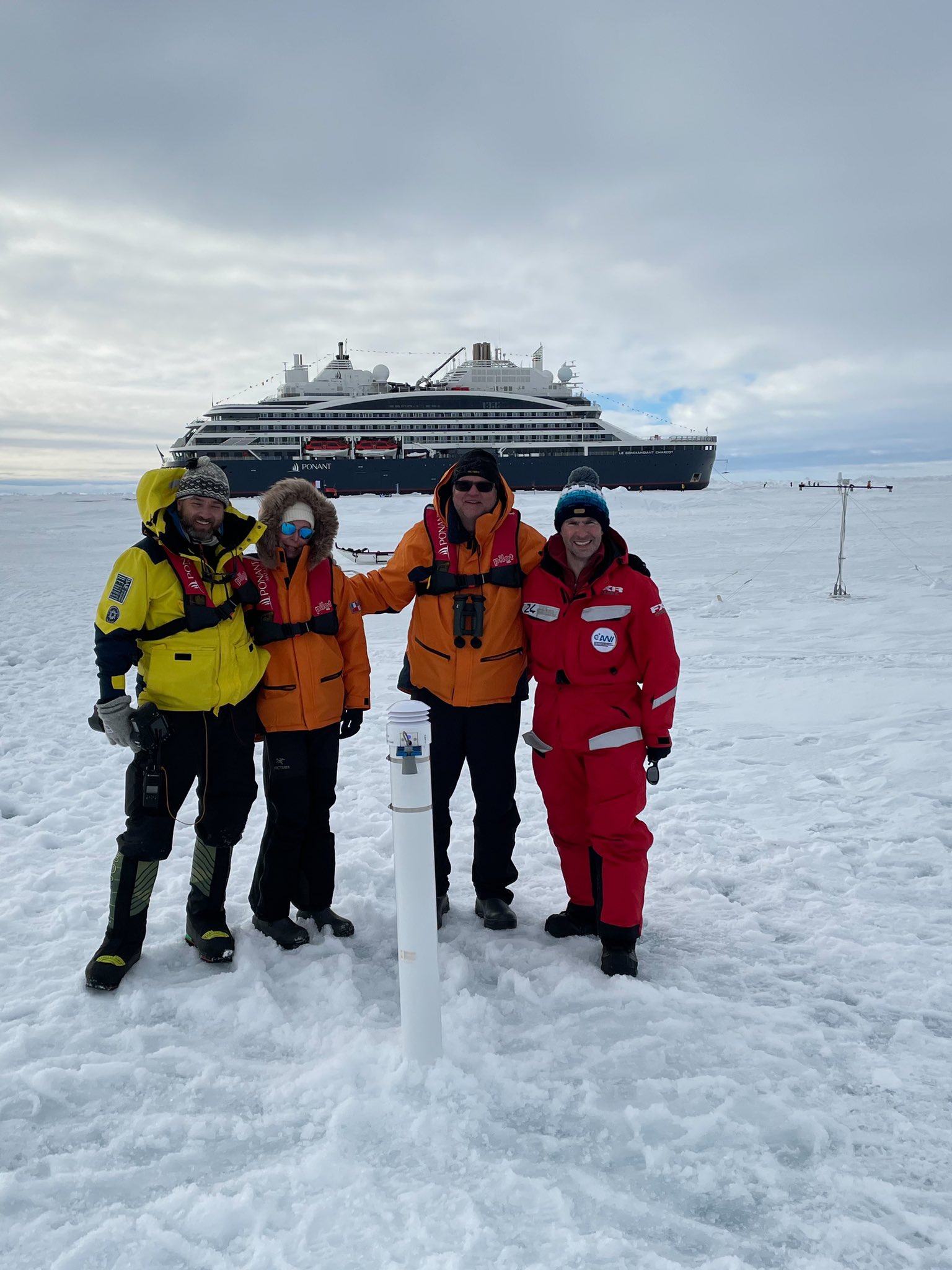
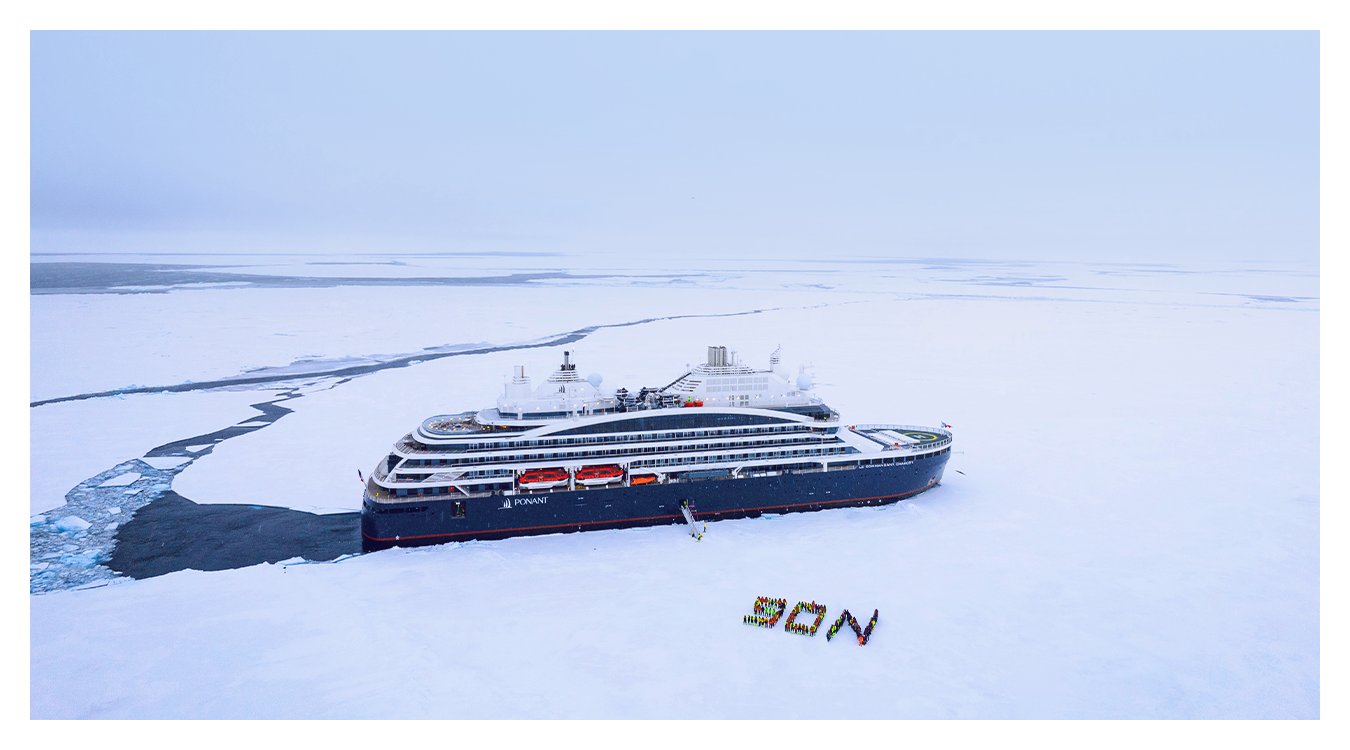
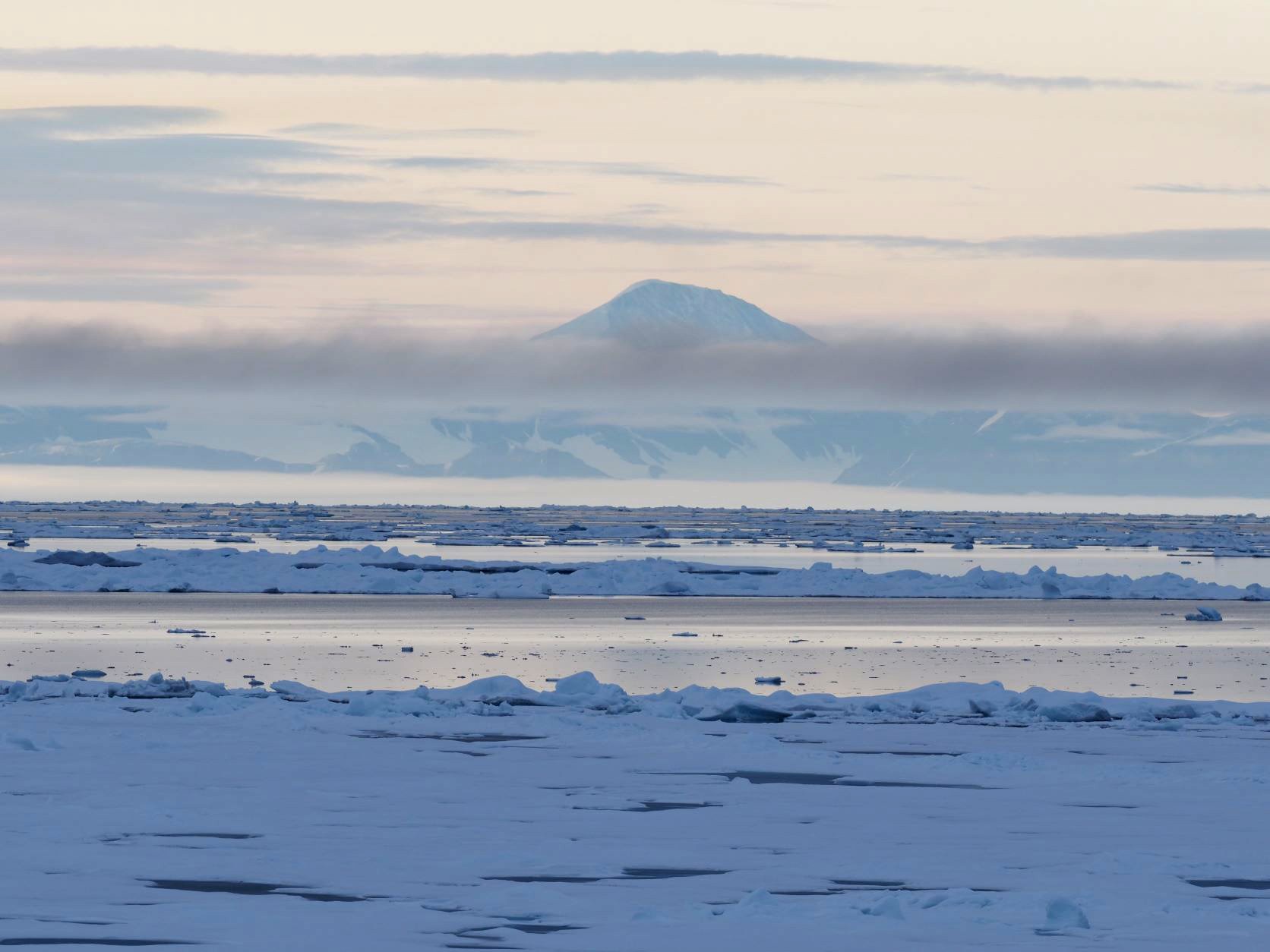
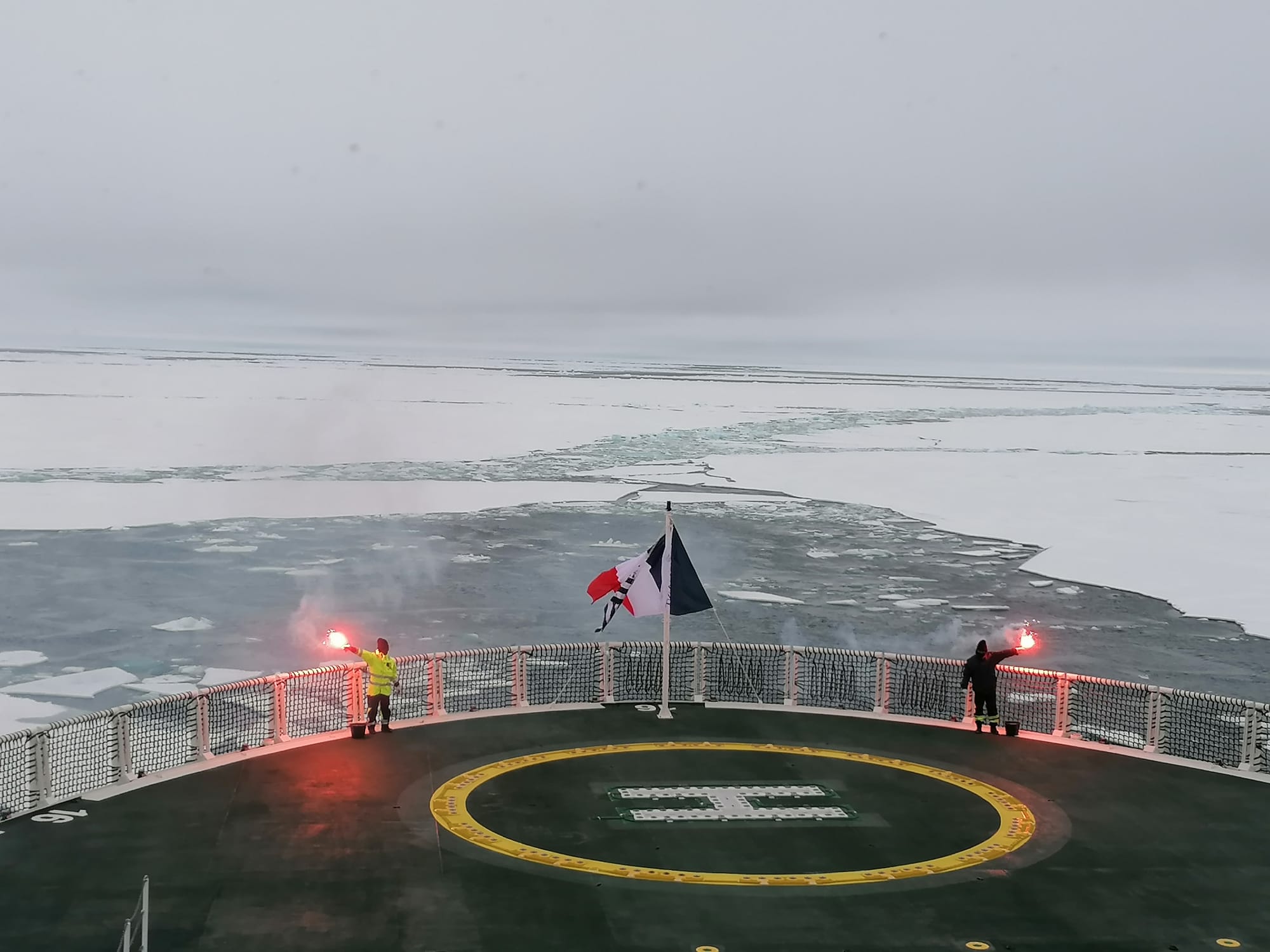
A picture of the sea ice at the North Pole from Ponant’s Le Commandant Charcot on September 6th:

[Edit – September 13th]

Here’s the latest NSIDC sea ice age map:

That shows plenty of old ice still left in the Beaufort Sea. However ice mass balance buoy 52460 now appears to floating free of its ice floe at 75.56 N, 165.99 W:

[Edit – September 14th]

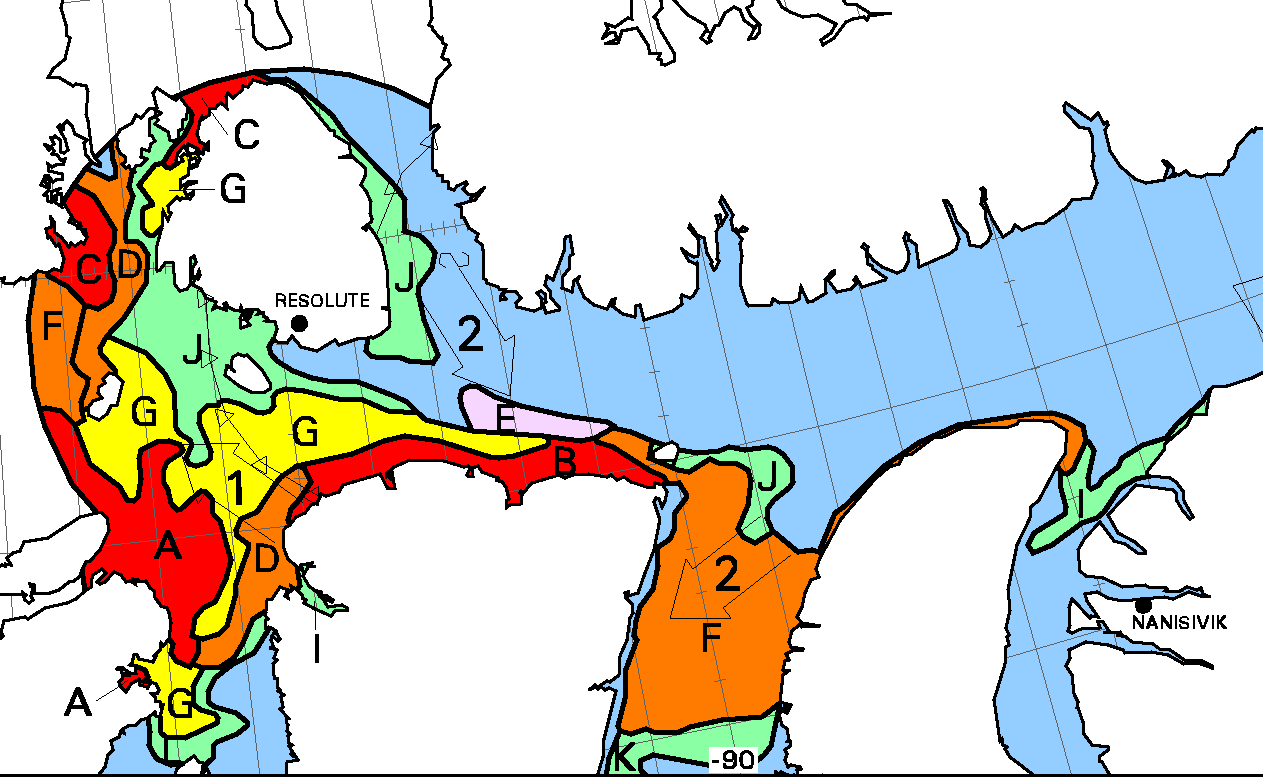
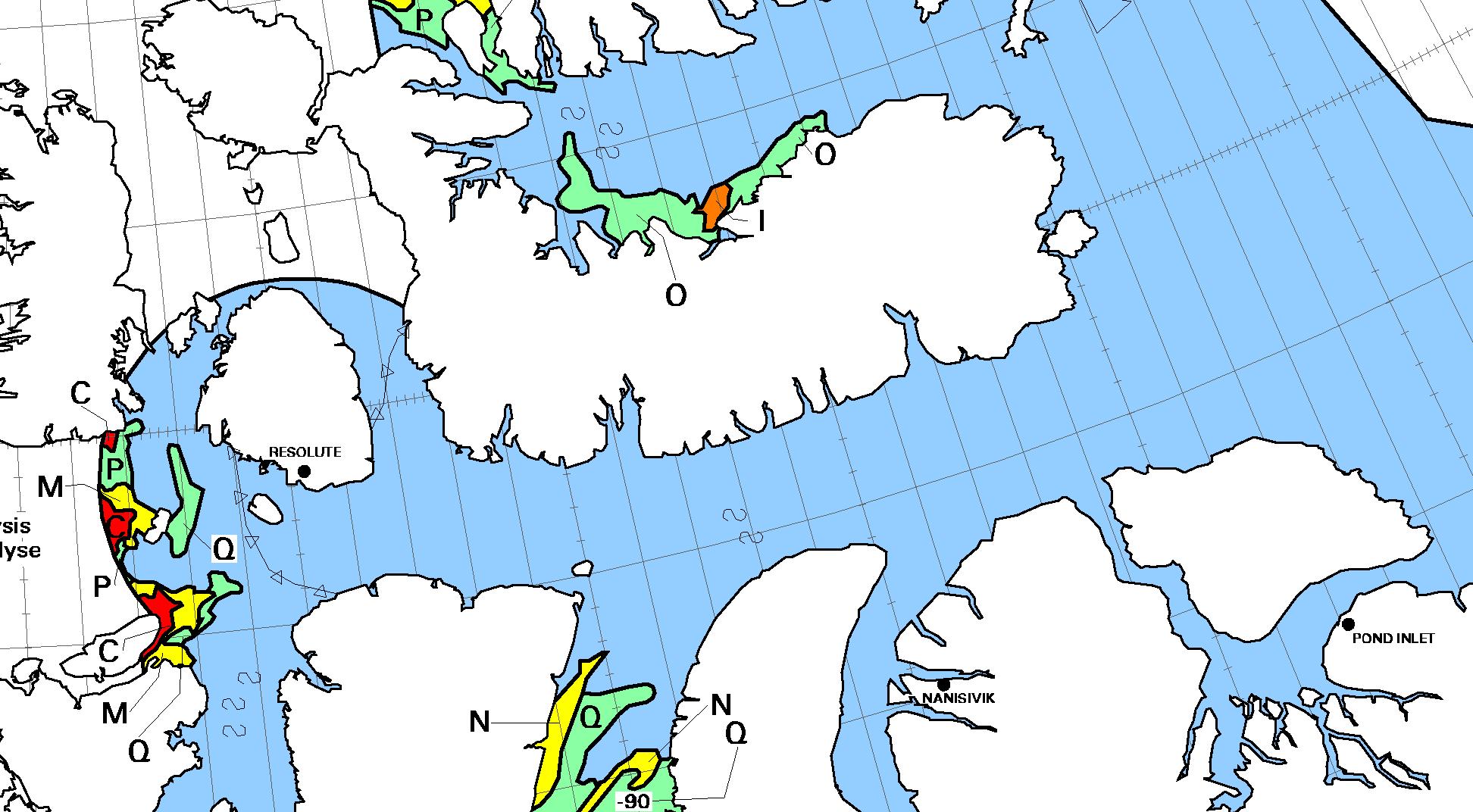
“New ice” has started to appear in previously open water on the Canadian Ice Service charts. See area E south east of Resolute:

[Edit – September 21st]

In answer to Frozen Earth’s metaphorical prayer, Wipneus has just released the mid September PIOMAS gridded thickness numbers on the Arctic Sea Ice Forum. First of all the thickness map:

followed by the volume graph:

and the monthly volume trends:

Volume calculated from the thickness data currently show that 2021’s minimum was reached on September 7th at 4.64 thousand km3, which is the 8th lowest value in the Polar Science Center’s record.

[Edit – September 23rd]

NASA have just announced a new paper about clouds in the Arctic. Highly relevant given their recent overview of the 2021 melting season!

Clouds are one of the biggest wildcards in predictions of how much and how fast the Arctic will continue to warm in the future. Depending on the time of the year and the changing environment in which they form and exist, clouds can both act to warm and cool the surface below them.

For decades, scientists have assumed that losses in Arctic sea ice cover allow for the formation of more clouds near the ocean’s surface. Now, new NASA research shows that by releasing heat and moisture through a large hole in sea ice known as a polynya, the exposed ocean fuels the formation of more clouds that trap heat in the atmosphere and hinder the refreezing of new sea ice.

The findings come from a study over a section of northern Baffin Bay between Greenland and Canada known as the North Water Polynya. The research is among the first to probe the interactions between the polynya and clouds with active sensors on satellites, which allowed scientists to analyze clouds vertically at lower and higher levels in the atmosphere.

The approach allowed scientists to more accurately spot how cloud formation changed near the ocean’s surface over the polynya and the surrounding sea ice.

Watch this space!

The 2018 Arctic Sea Ice Metric Minima

September is upon us once again, the month in which the assorted Arctic sea ice area and extent metrics (almost) always reach their respective annual minima. Now we are free to start speculating about what the assorted minima will be, and on what date.
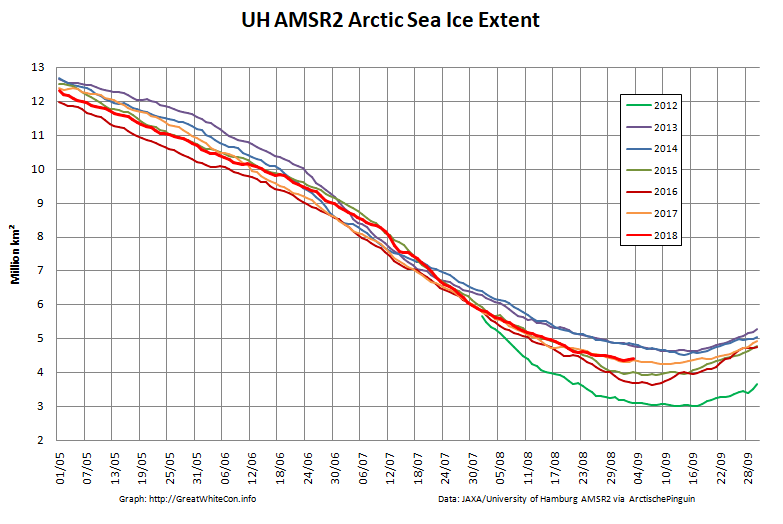
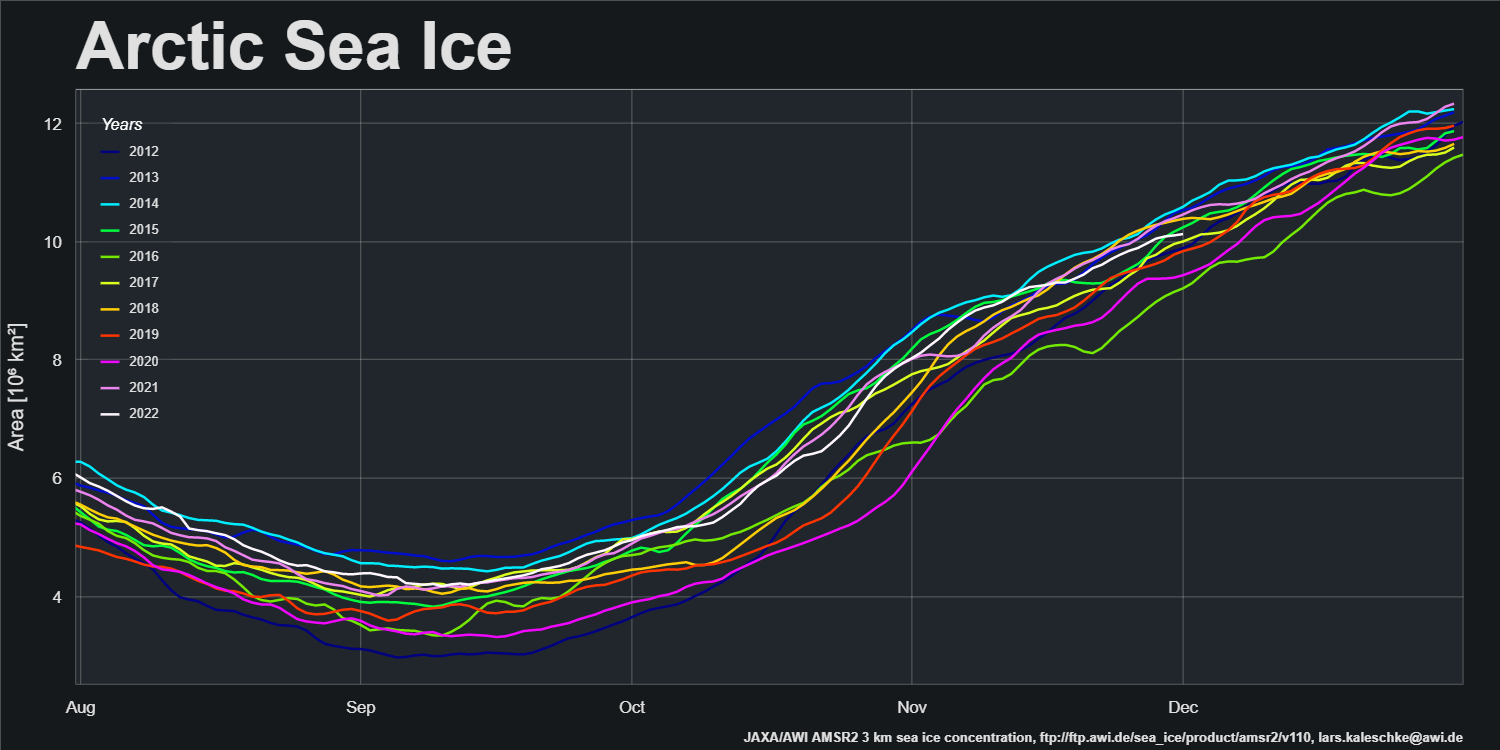
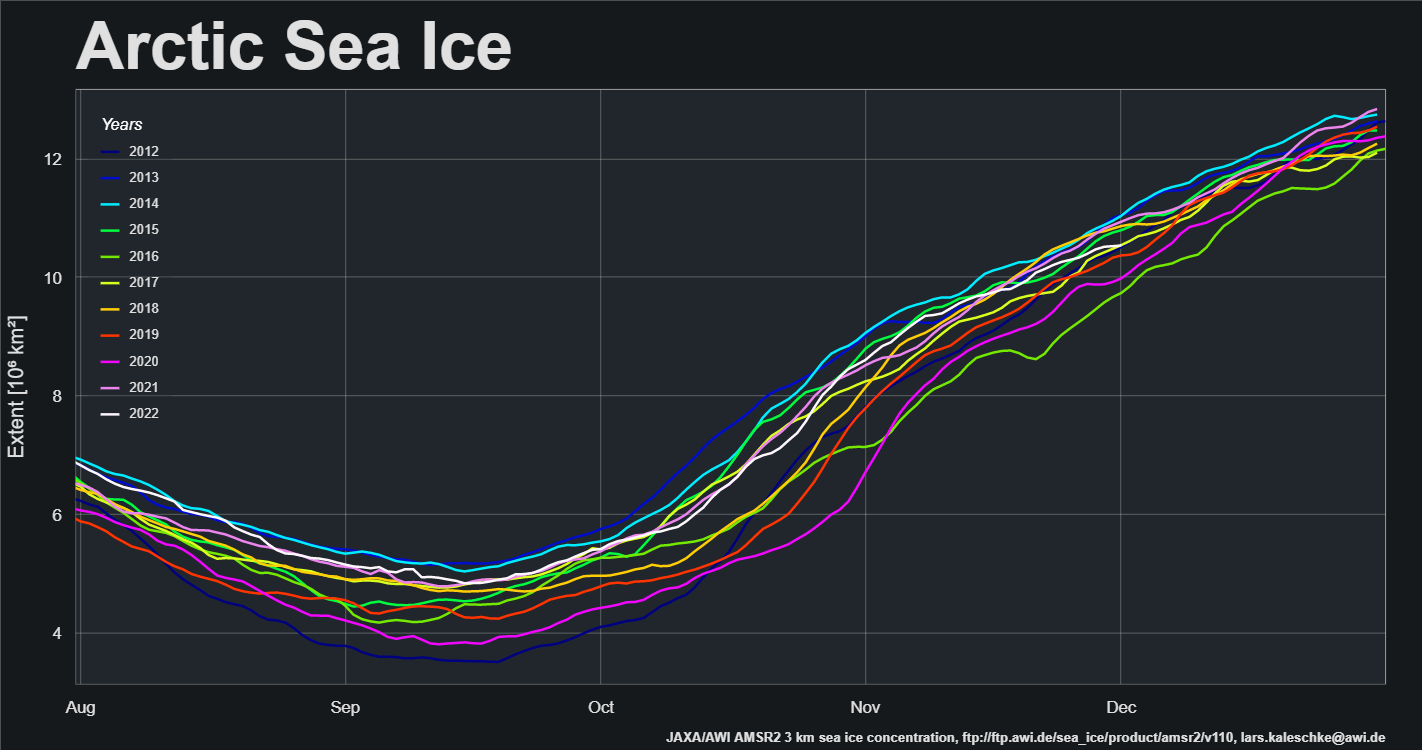
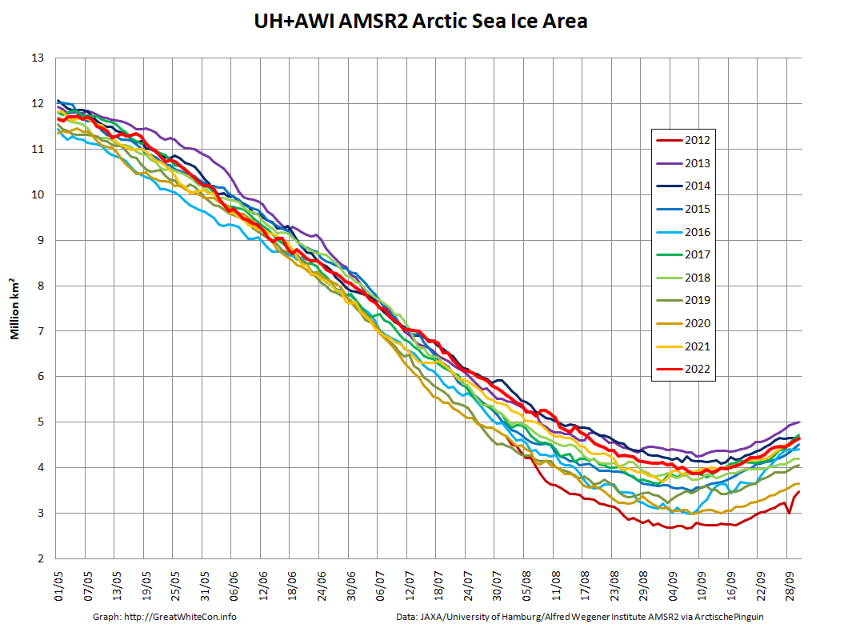
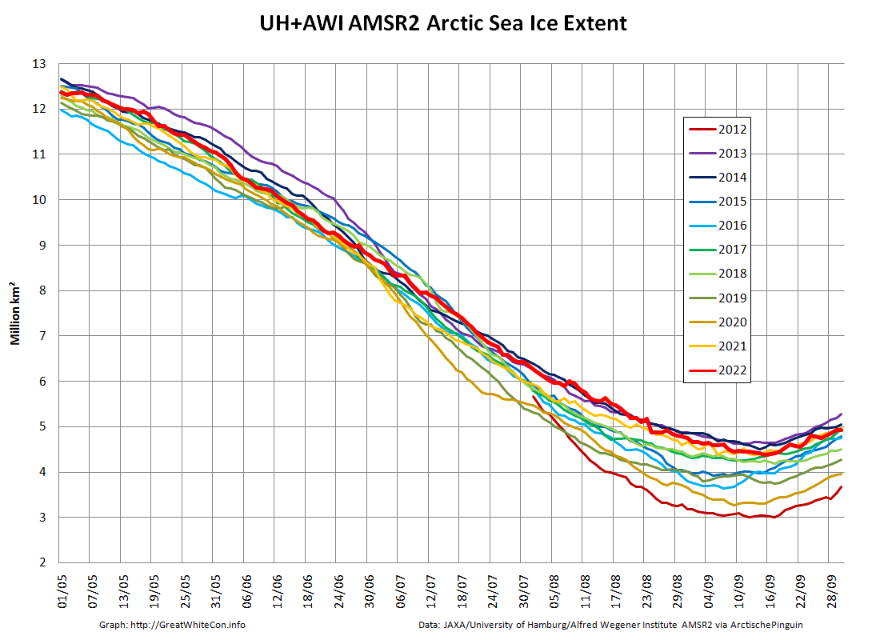
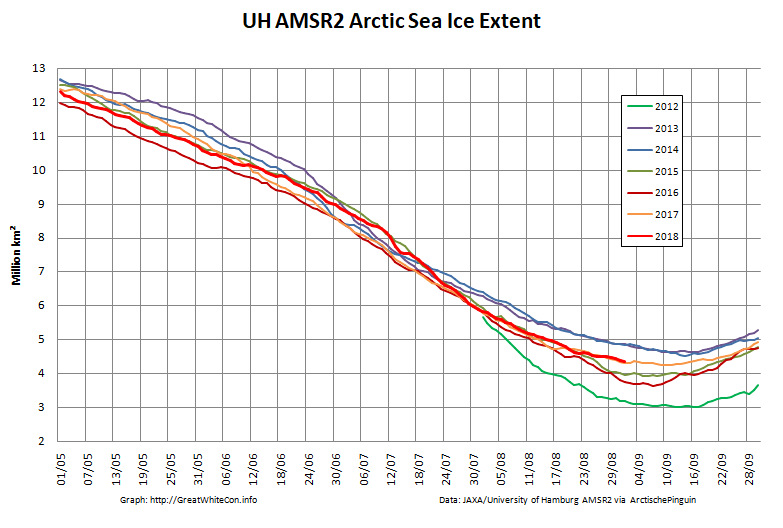
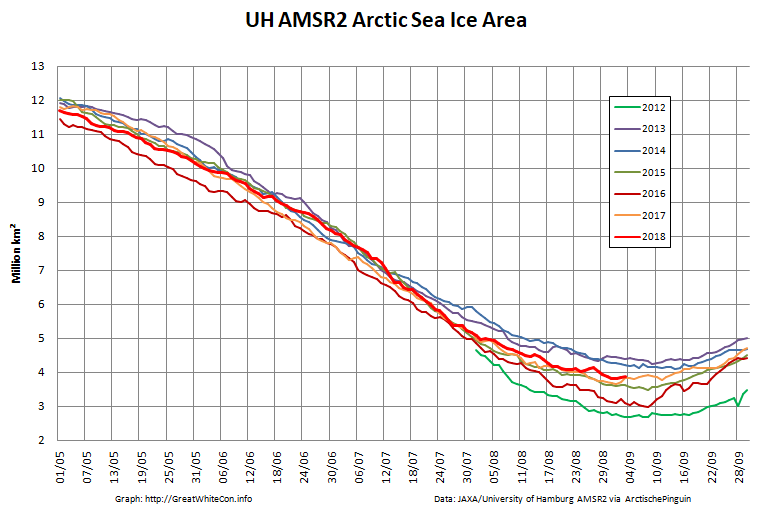
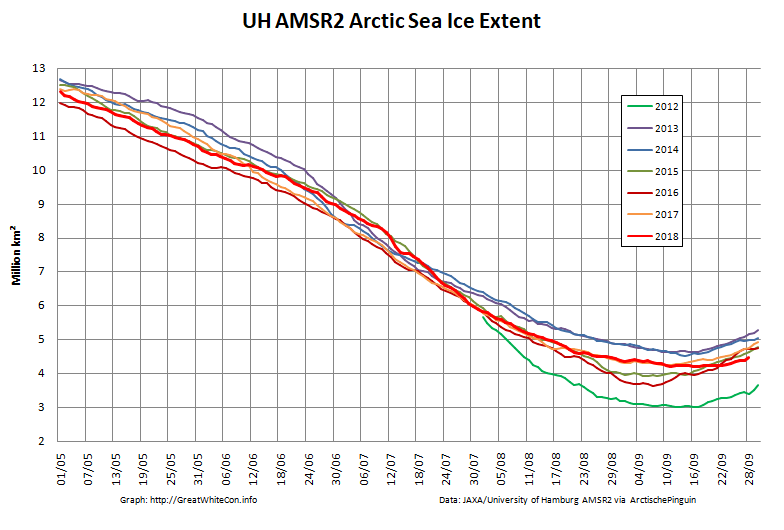
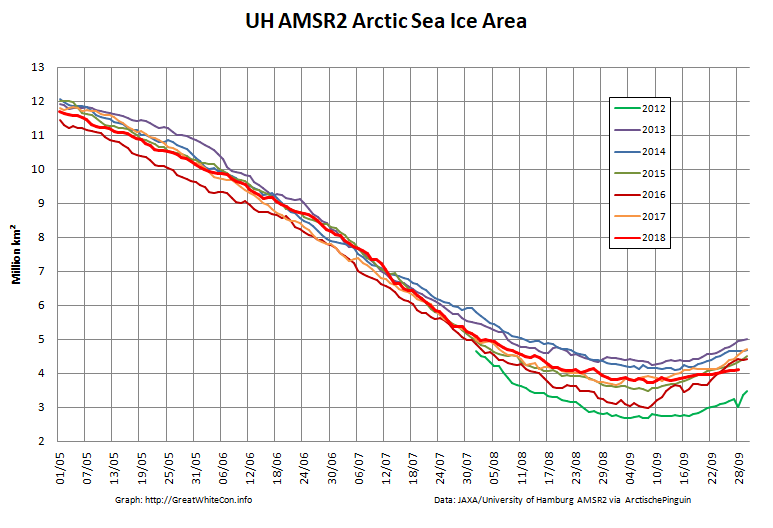
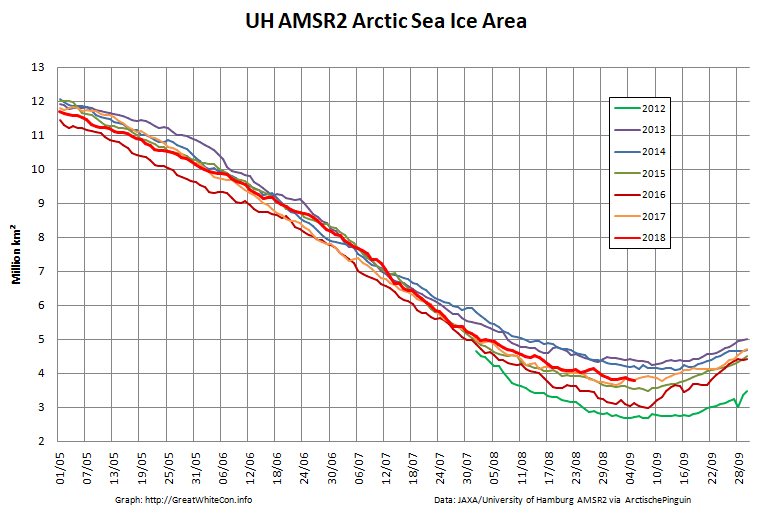
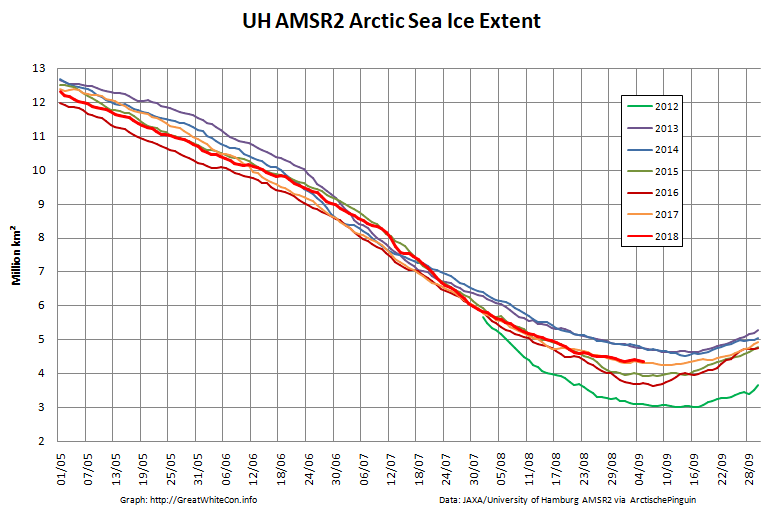
To begin with let’s take a look at our much beloved high resolution AMSR2 metrics derived by “Wipneus” from the University of Hamburg’s AMSR2 concentration data:

Arctic-Area-2018-09-01

Arctic-Extent-2018-09-01

There’s currently some divergence between the area and extent graphs. Area is declining rapidly for the time of year, whilst extent seems to almost have come to a standstill!

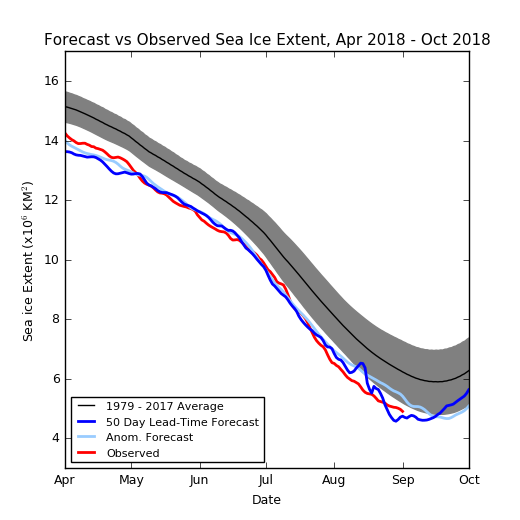
Next here’s the prediction of the late, great Andrew Slater’s Probabilistic Ice Extent algorithm:

SPIE-extent-20180901

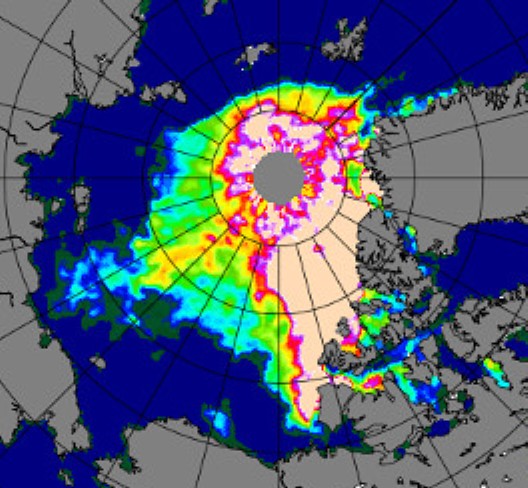
Before looking at some of the other metrics we’ll wait for the effect of the assorted storms currently circling the Arctic to play out. Here’s how the AMSR2 concentration map looks at the moment:

Arc_20180901_res3.125

whilst here’s the University of Bremen’s summer SMOS sea ice “thinness” map:

SMOS-20180901


[Edit – September 3rd]

UH AMSR2 area and extent both increased yesterday, so we have a (very!) provisional minimum extent of 4.35 million square kilometres on September 1st.


[Edit – September 4th]

Area and extent have both increased again:

Arctic-Area-2018-09-03

Arctic-Extent-2018-09-03

Is the minimum already in, or will the storms still circulating around the Arctic Ocean reverse that trend over the next few days?


[Edit – September 6th]

High resolution area and extent both posted marginal new lows for the year yesterday:

Arctic-Area-2018-09-05

Arctic-Extent-2018-09-05


[Edit – September 29th]

According to the latest edition of the NSIDC’s Arctic Sea Ice News:

On September 19 and 23, Arctic sea ice appeared to have reached its seasonal minimum extent for the year, at 4.59 million square kilometers (1.77 million square miles). This ties 2018 with 2008 and 2010 for the sixth lowest minimum extent in the nearly 40-year satellite record.

Please note that this is a preliminary announcement. Changing winds or late-season melt could still reduce the Arctic ice extent, as happened in 2005 and 2010. NSIDC scientists will release a full analysis of the Arctic melt season, and discuss the Antarctic winter sea ice growth, in early October.

Figure2_09232018

The NSIDC numbers are based on a 5 day average, whereas the one day high resolution AMSR2 extent reached a minimum of 4.195 million square kilometers on September 17th:

Arctic-Extent-2018-09-28

The AMSR2 area minimum occurred significantly earlier. 3.737 million square kilometers on September 9th:

Arctic-Area-2018-09-28

Facts About the Arctic in August 2017

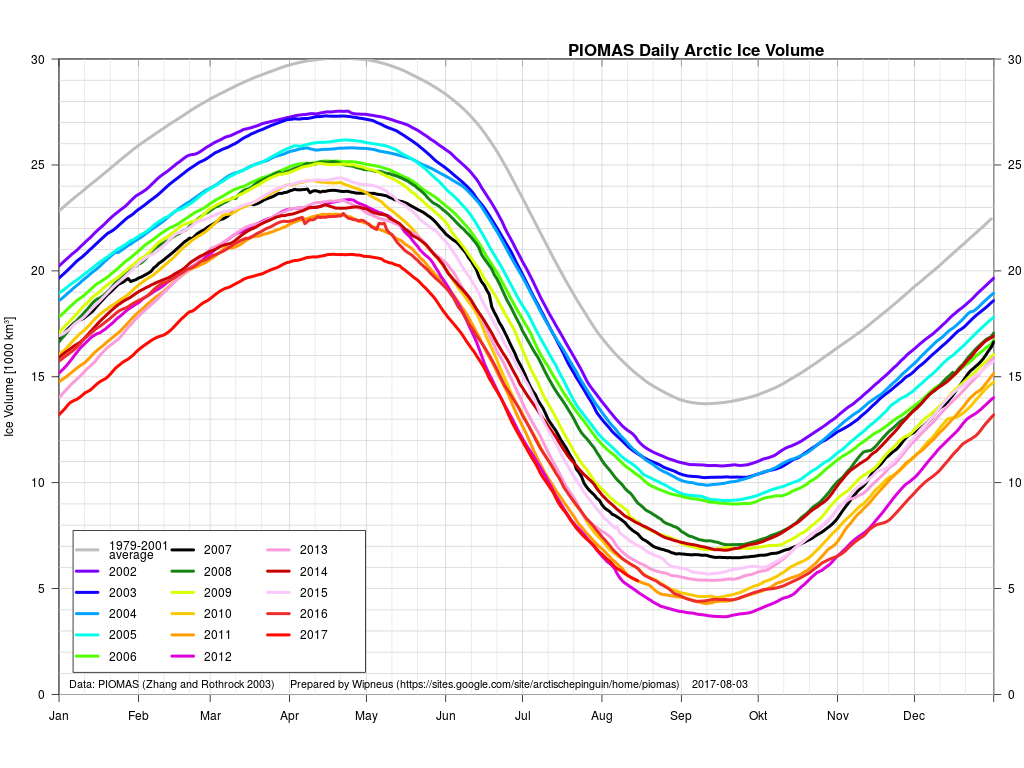
What seems likely to be the most interesting period of the 2017 Arctic sea ice melting season is upon us! The PIOMAS gridded data hasn’t been released yet, but the overall volume numbers reveal that 2017 has now relinquished its “lowest ever” position to 2012. Here’s Wipneus’ graph of the volume data:

piomas-trnd4-20170731

plus his anomaly plot:

piomas-anomaly-20170731

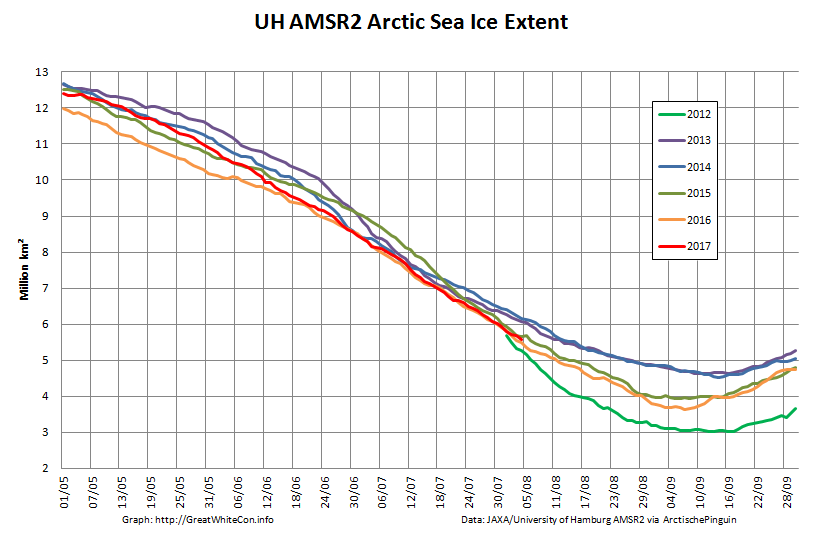
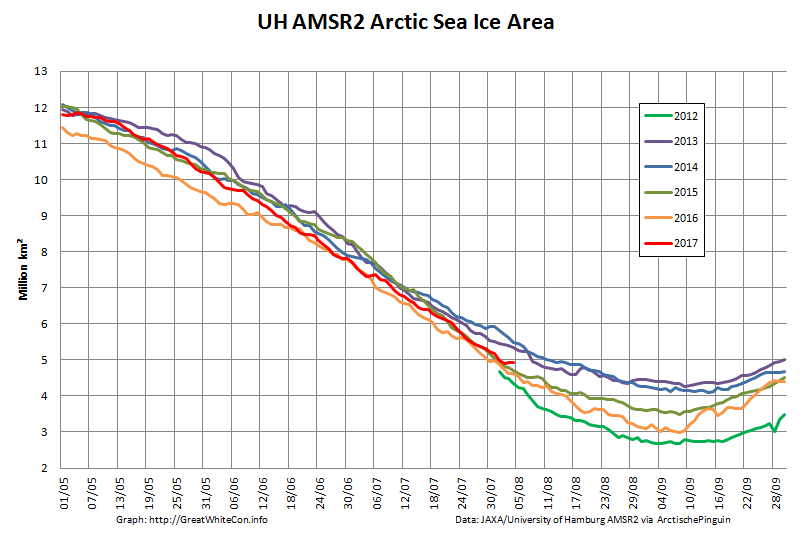
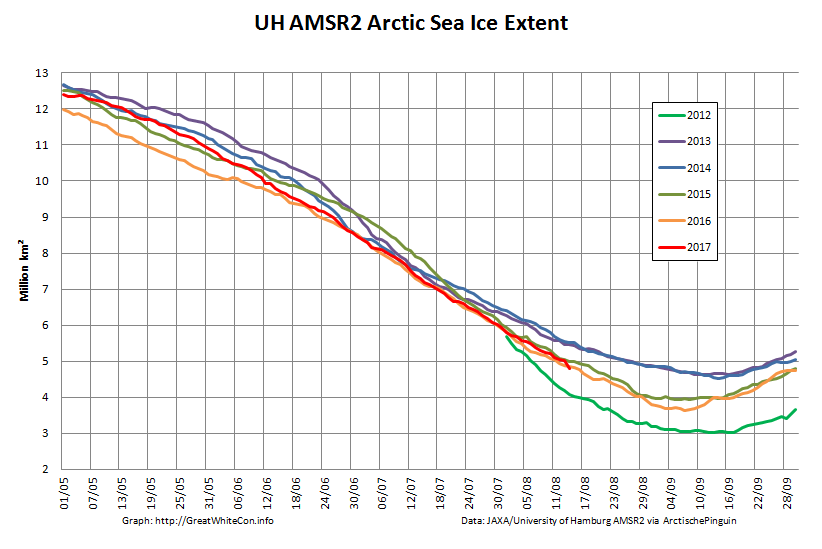
Our favourite high resolution AMSR2 area and extent graphs now also allow comparison with 2012. Here’s how they look at the moment:

UH-Arctic-Extent-2017-08-04

UH-Arctic-Area-2017-08-04

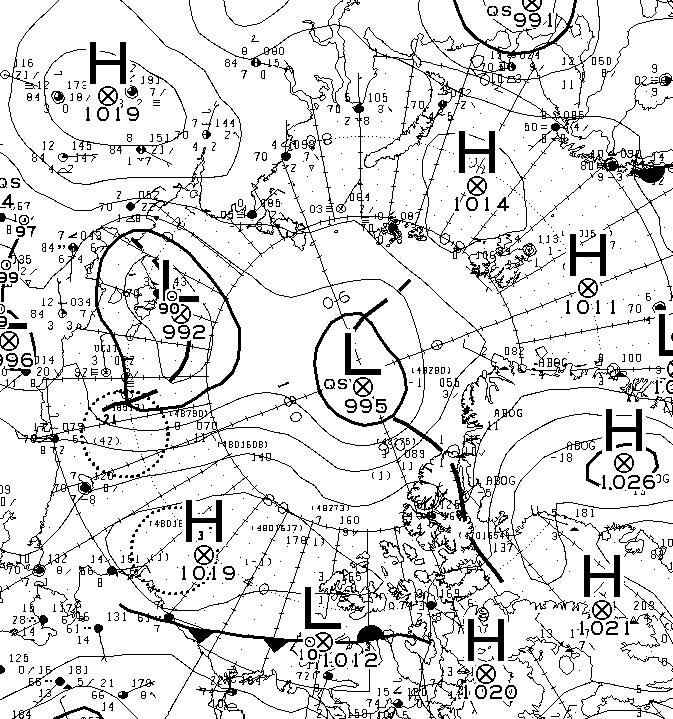
As you can see, round about now is when 2012 Arctic sea ice extent started to noticeably race ahead of the rest of the pack. Will 2017 follow suit? Are there any Arctic cyclones on the horizon for example? Well, the one forecast for August 4th hasn’t materialised. Here’s this morning’s Environment Canada synopsis:

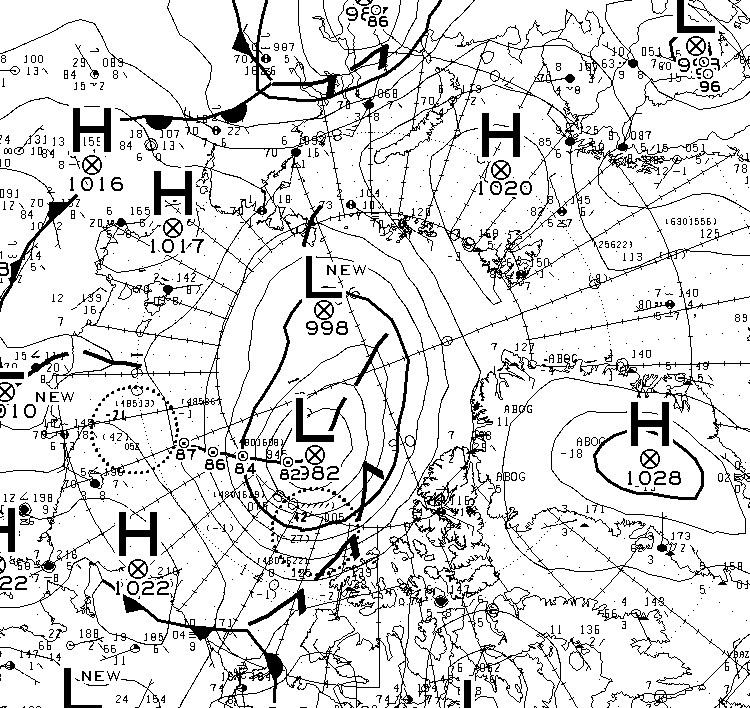
Synopsis-20170804-00Z-Crop

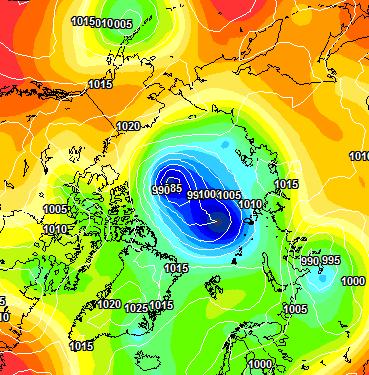
However both ECMWF and GFS agree that a sub 985 hPa storm should have arrived by Sunday morning. Here’s the ECMWF version from MeteoCiel:

ECH1-20170804+48h

There’s stronger storms in the forecast further out, but once again we’ll believe them if and when we see them!

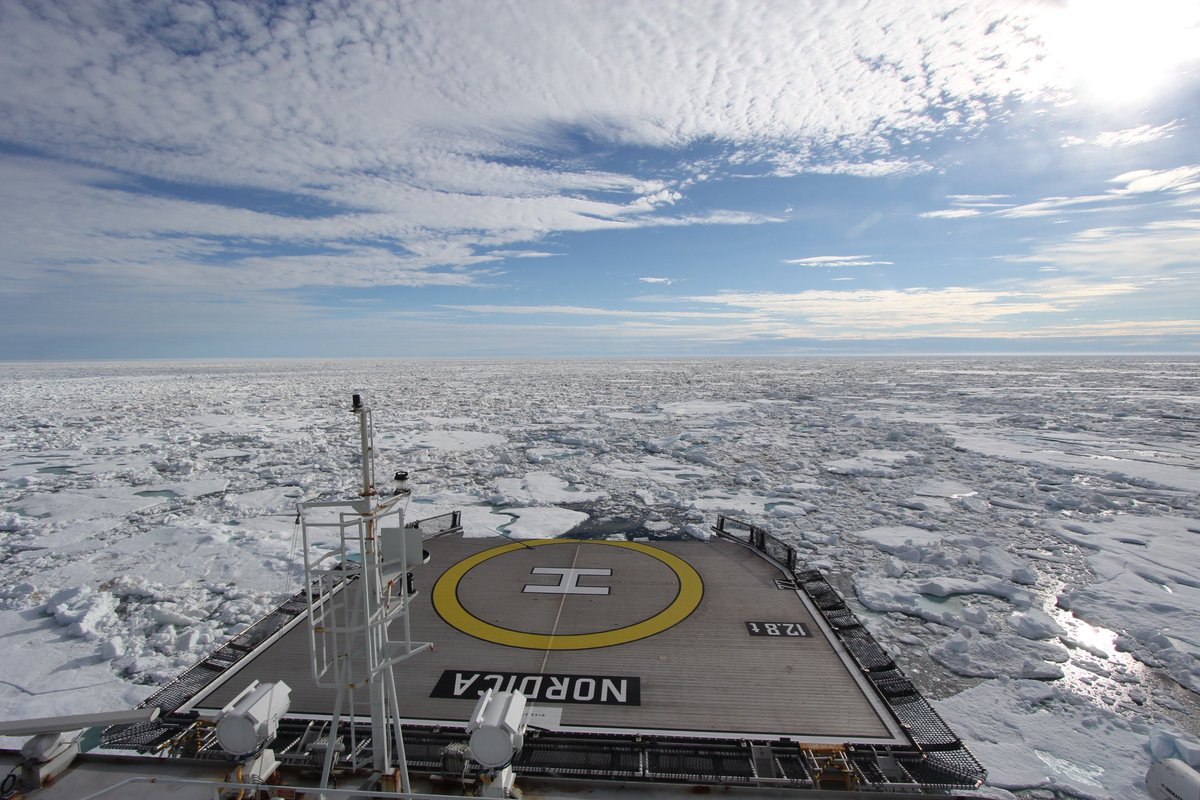
We’re keeping a close eye on the Northwest Passage once again this year. Most of the southern route is open already, but as we predicted the old ice in Larsen Sound has a lot of melting still to do. Here’s how it looked from the icebreaker Nordica a few days ago:

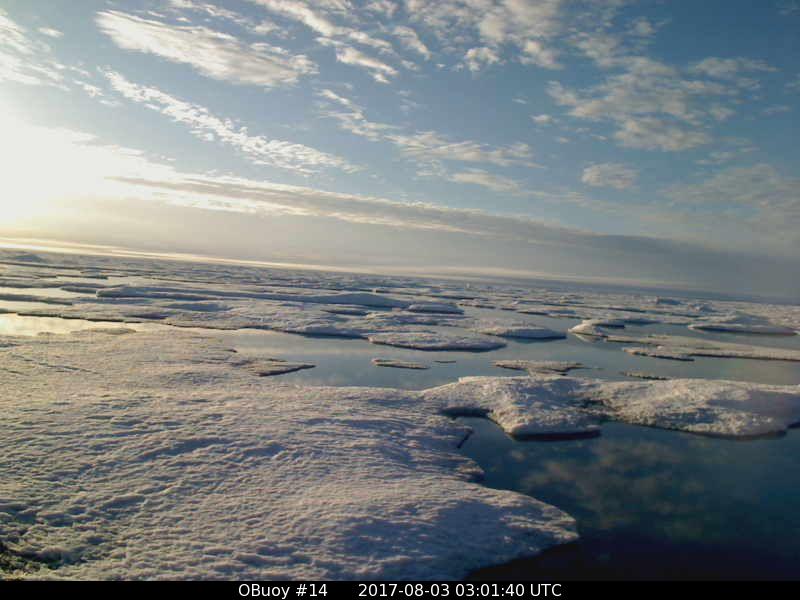
On top of that the old ice around O-Buoy 14 is currently rushing south down the McClintock Channel to replenish it. Here’s how that looks at the moment:

OBuoy14-20170803-0301

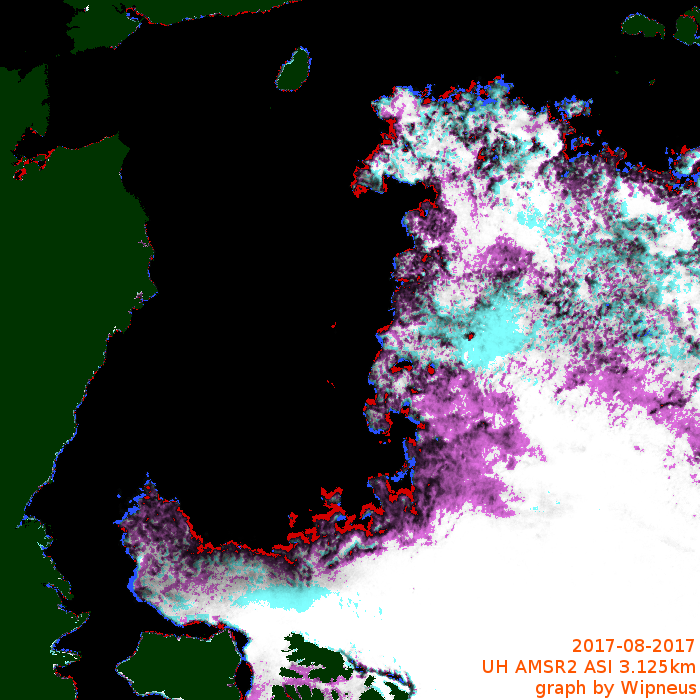
Meanwhile the melt along the Northern Sea Route is well ahead of last year. Here’s the University of Hamburg AMSR2 concentration map of the area:

Arc_20170803_res3.125_LARGE

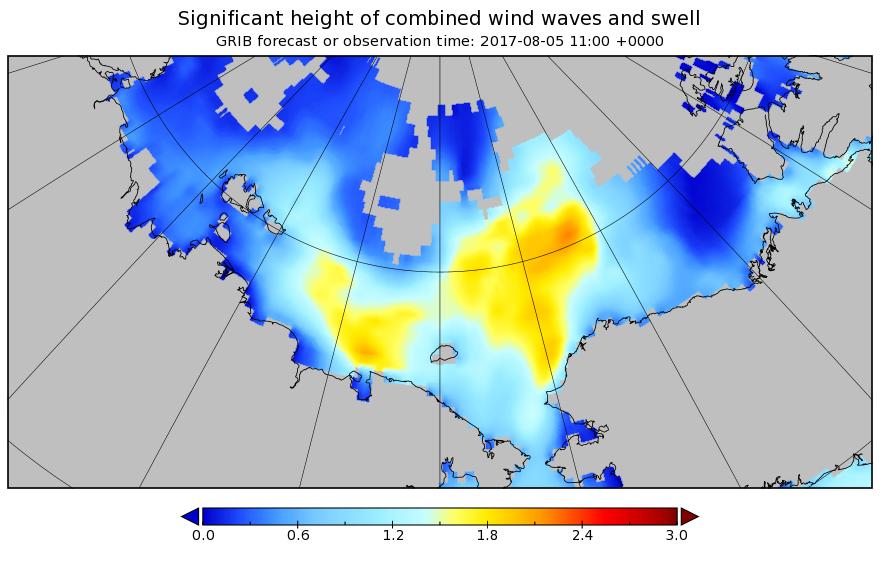
There’s also now a lot of open water on the Pacific side of the Arctic, and Sunday’s cyclone is forecast to create a large area of 2 meter plus waves heading in the direction of the ice edge:

Significant_height_of_combined_w in multi_1.glo_30mext.20170804_00024

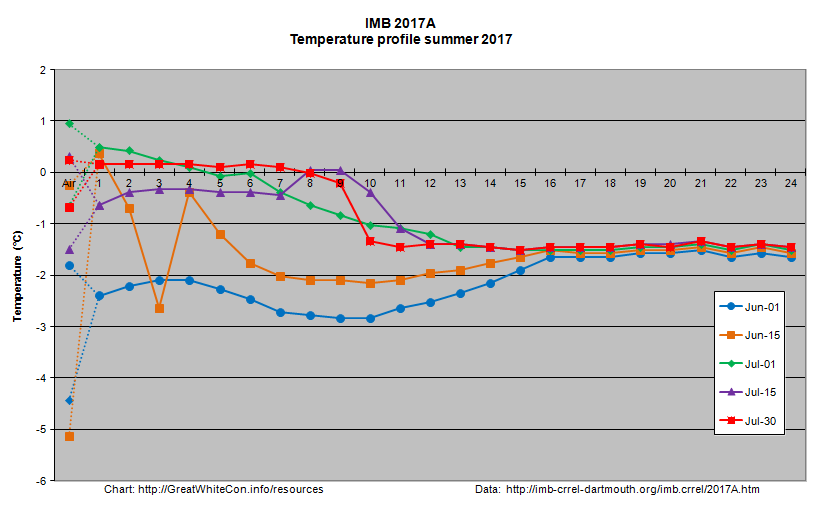
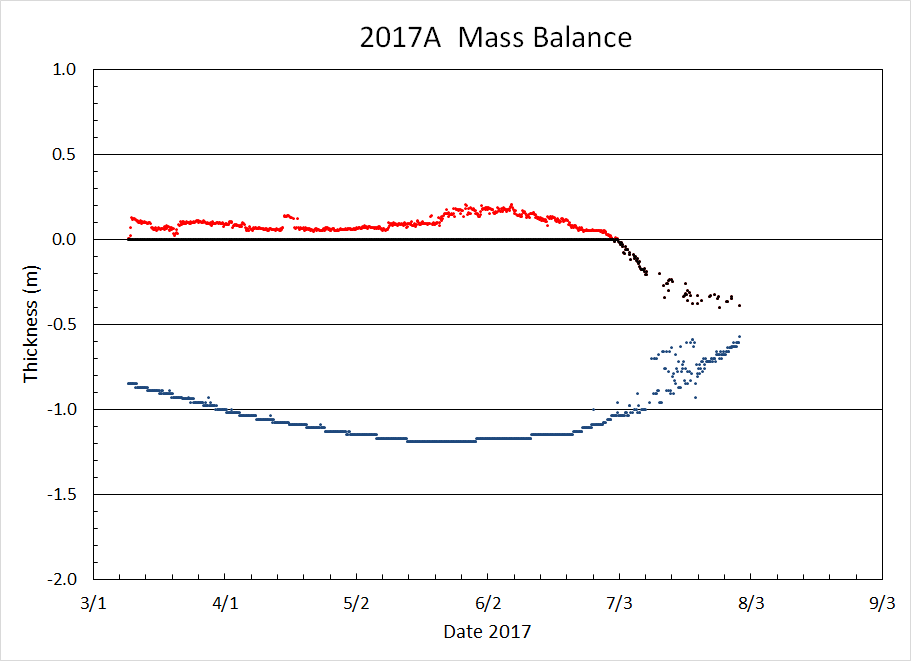
I expect that to have a noticeable effect on the already fragile sea ice by early next week, assuming the storm arrives as forecast! There is an ice mass balance buoy handily placed out on the ice in the path of the storm. Buoy 2017A is currently located near 77 N, 147 W, and its assorted sensors suggest the ice underneath it is now less than 20 cm thick:

2017A-2017-07-30

2017A_thick_20170731

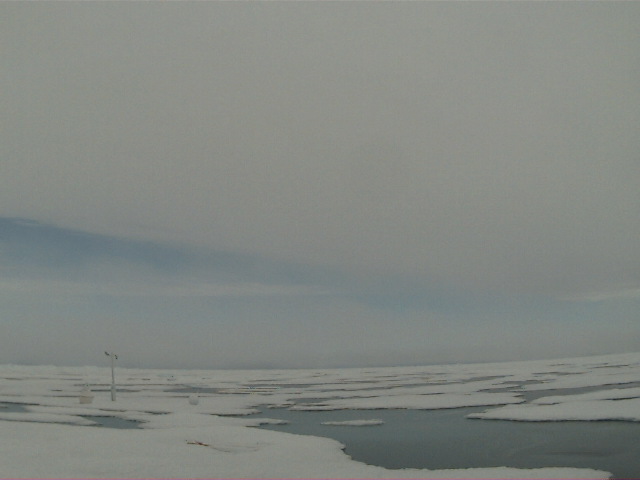
Here’s how the area around the buoy looked a couple of weeks ago:


Image of 2017A from WARM 6 on July 18th 2017. NSF project: NSF OPP #1603548

The $64,000 question now is will the 2017 Arctic sea ice metrics stay in amongst the recent pack, or race after 2012 instead?


[Edit – August 6th]

This morning’s synopsis from Environment Canada suggests the cyclone has bottomed out at a MSLP of 982 hPa:

Synopsis-20170806-06Z-Crop

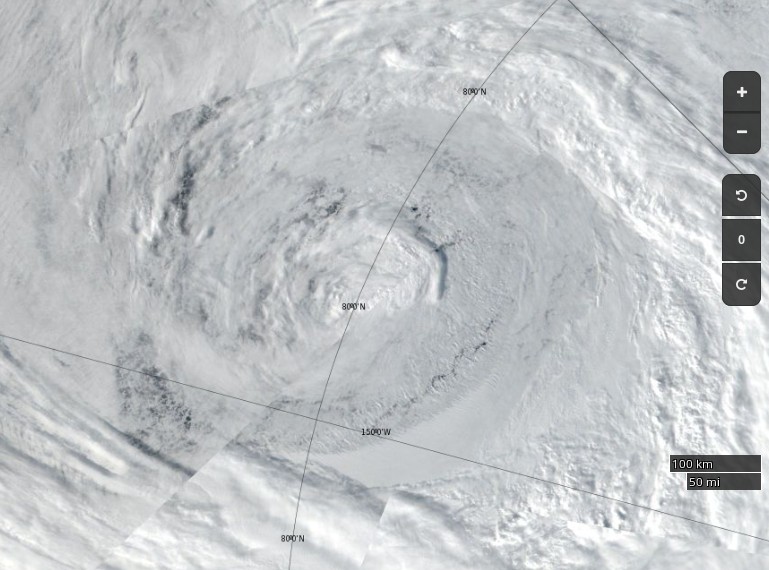
Here’s how the cyclone looked from space yesterday:

NASA Worldview “true-color” image of the sea ice north of the Beaufort Sea on August 5th 2017, derived from the VIIRS sensor on the Suomi satellite

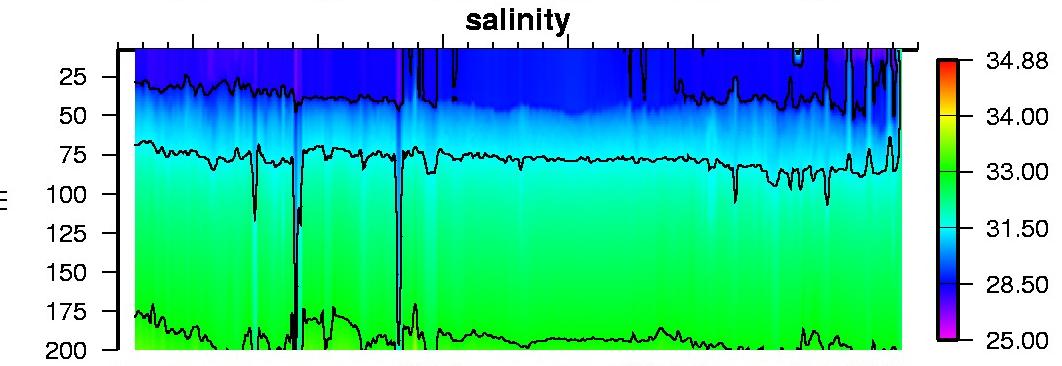
I think that I can convince myself that the salinity profile from ice tethered profiler 97, currently located at 73° N, 134° W, reveals mixing from depth in the wake of the storm:

itp97-Salinity-20170806

The synthetic aperture radar on the Sentinel 1B satellite can certainly see through the clouds, and reveals open water in the Central Arctic north of the Beaufort Sea yesterday evening (UTC):

Sentinel 1B image of Arctic sea ice at 79N, 160W on August 5th 2017
Sentinel 1B image of Arctic sea ice at 79° N, 160° W on August 5th 2017


[Edit – August 7th]

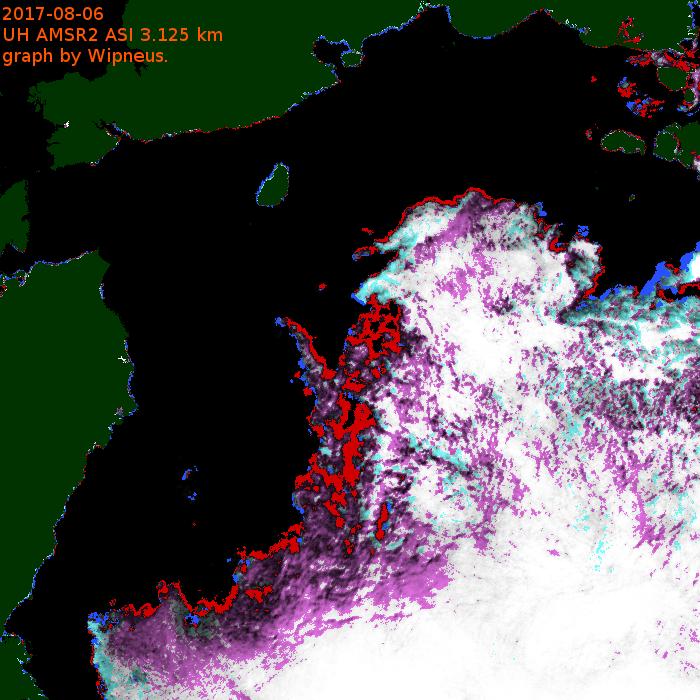
Here is Wipneus’ latest AMSR2 concentration delta map:

AMSR2-Delta-20170806

The effects of this weekend’s storm are readily apparent! Just in case you’re wondering Wipneus reports:

Area: -172.0 (+324k vs 2016, +138k vs 2015, -669k vs 2014, -523k vs 2013, +493k vs 2012)

UH-Arctic-Area-2017-08-06


[Edit – August 8th]

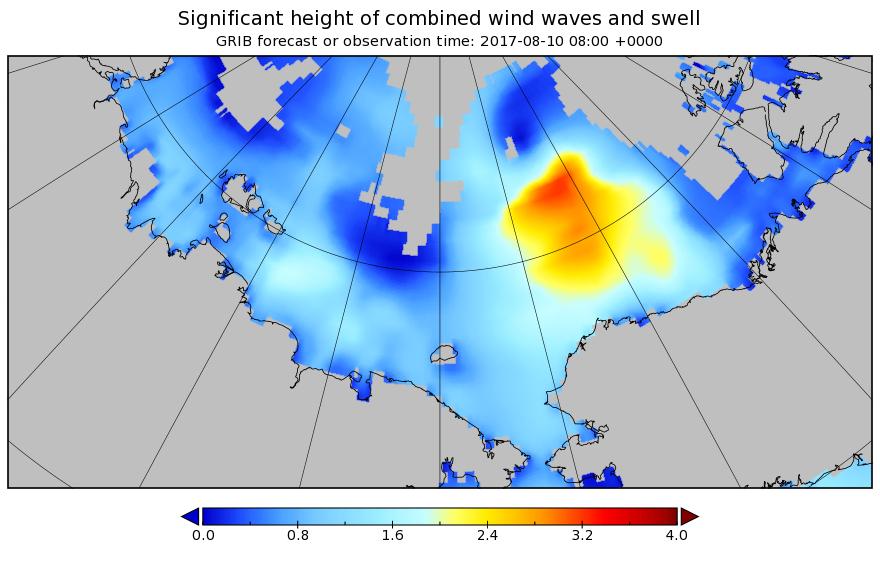
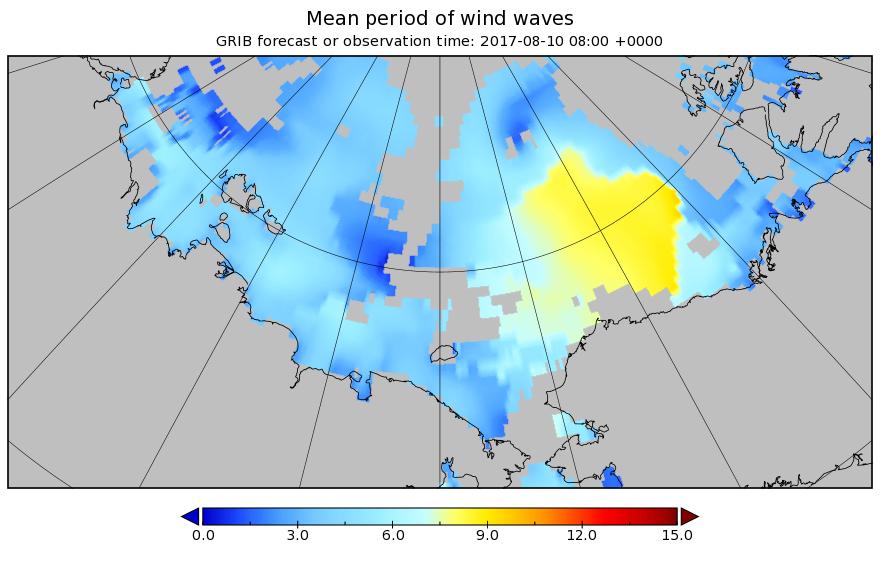
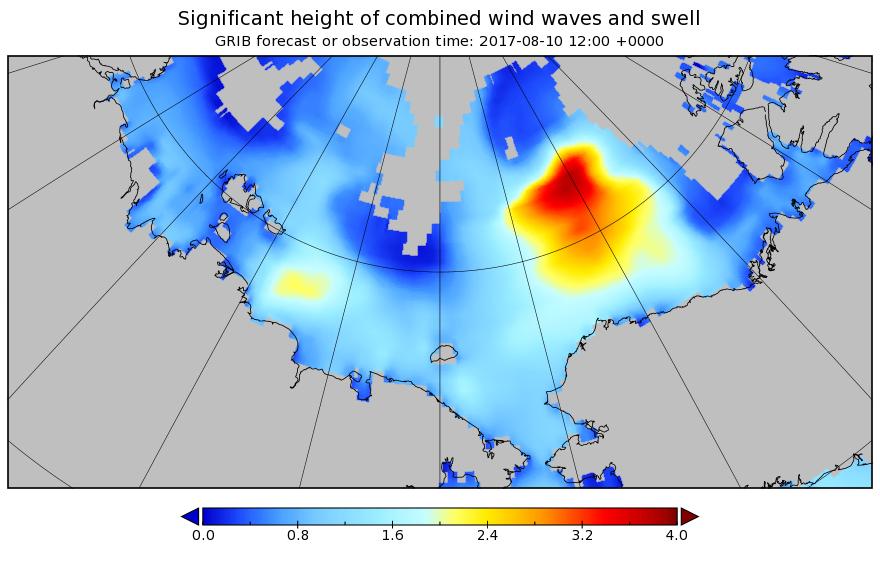
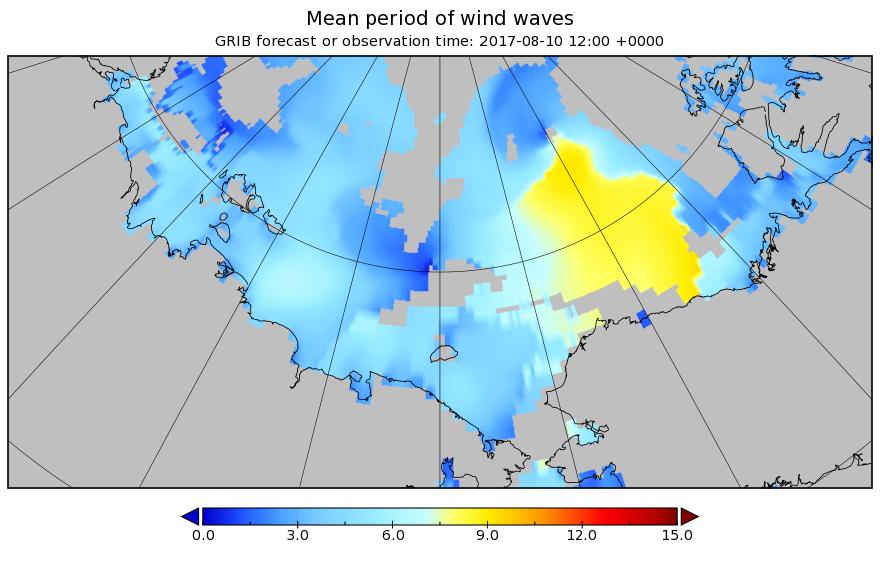
The next pulse of swell is currently forecast to be somewhat higher and longer period than the last one. This one is also taking aim at the Beaufort Sea MIZ:
Significant_height_of_combined_w in multi_1.glo_30mext.20170808-12Z_00045

Mean_period_of_wind_waves_surfac in multi_1.glo_30mext.20170808-12Z_00045


[Edit – August 9th]

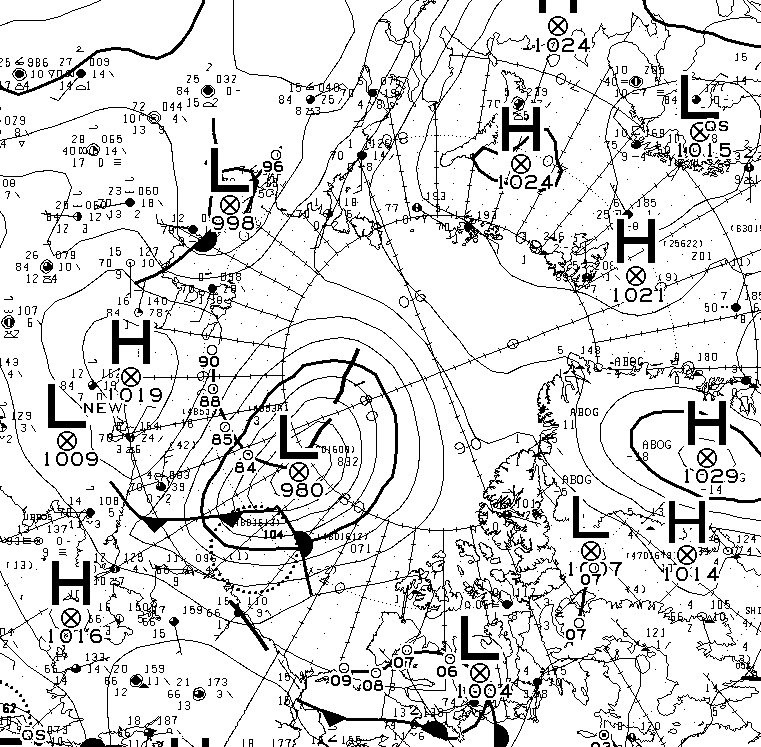
According to Environment Canada the latest cyclone is already down to 980 hPa MSLP:

Synopsis-20170808-06Z-Crop


[Edit – August 9th PM]

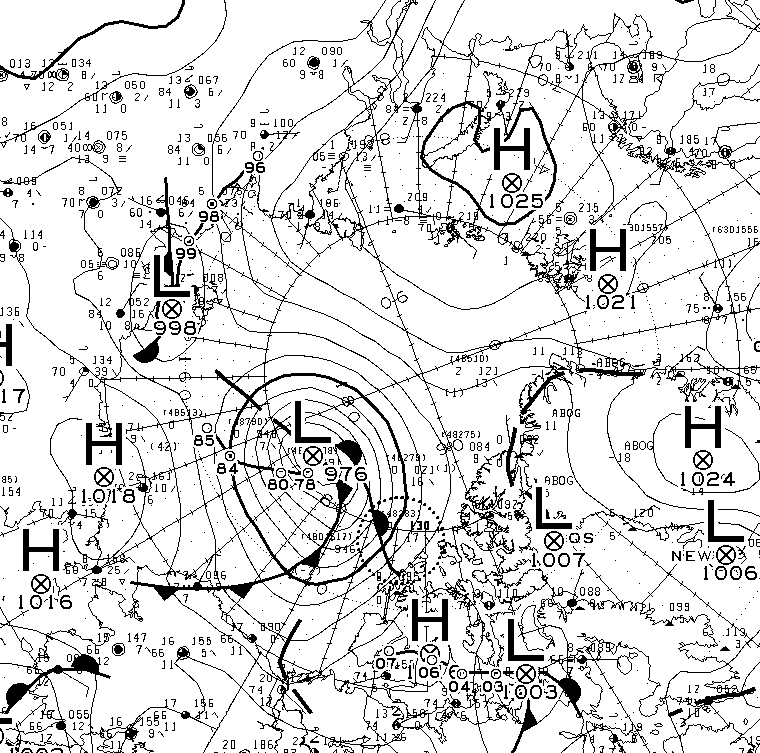
The MSLP of the current cyclone is now down to 976 hPA:

Synopsis-20170808-18Z-Crop

The latest WaveWatch III forecast has increased the predicted peak height and period of the resulting waves once again:

Significant_height_of_combined_w in multi_1.glo_30mext.20170809_00037

Mean_period_of_wind_waves_surfac in multi_1.glo_15mext.2070809_00037B


[Edit – August 10th]

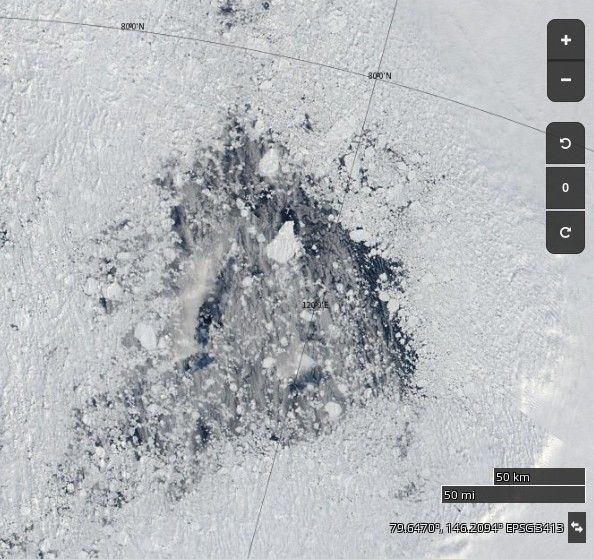
Large holes are appearing in the sea ice on the other side of the Arctic too. Take a look north of the Laptev Sea for example:
NASA Worldview “true-color” image of the "Laptev Bite" polynya on August 10th 2017
NASA Worldview “true-color” image of the “Laptev Bite” polynya on August 10th 2017

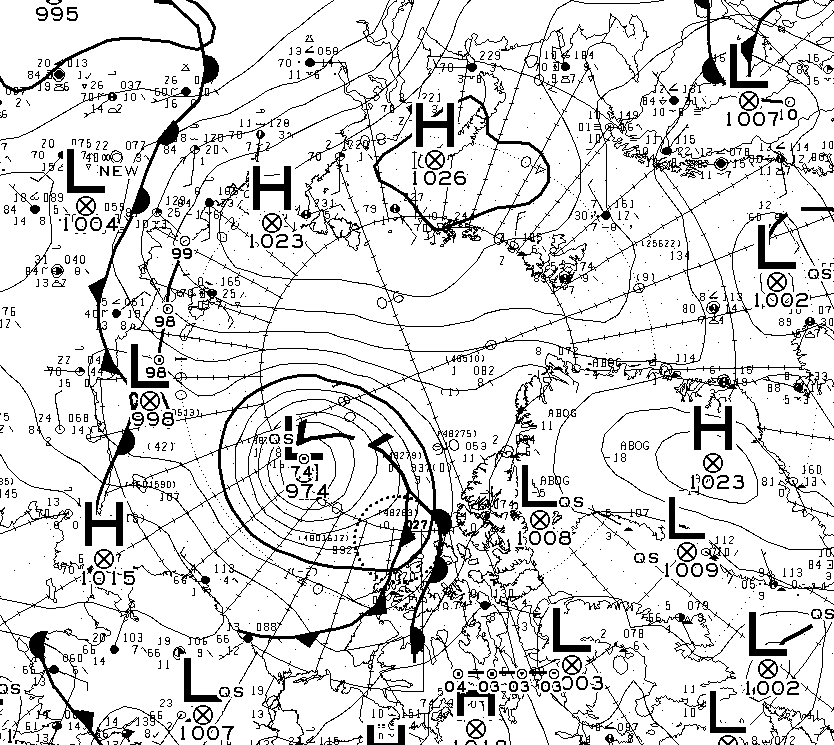
Meanwhile the current cyclone on the Pacific side of the North Pole appears to have bottomed out at 974 hPa:

Synopsis-20170810-06Z-Crop


[Edit – August 11th]

Here’s the latest sea ice concentration one day delta map from Wipneus:

AMSR2-Delta-20170810
Despite the expected divergence caused by a low pressure area crossing the ice, both are and extent of sea ice on the Pacific side of the Arctic are still falling.


[Edit – August 12th]

The waves are considerably smaller in the Beaufort Sea today, but not in the Bering Strait!

Significant_height_of_combined_w in multi_1.glo_30mext.20170812-00Z_00007

Here’s the latest one day delta map:

AMSR2-Delta-20170811

and here’s video showing the motion of sea ice in the Beaufort & Chukchi Seas so far this summer:


[Edit – August 13th]

Here’s an animation from Wipneus revealing the effect of the two recent cyclones on the Pacific side, plus everything else that’s been going on in the Arctic:

AMSR2-Basin-Anim-20170812-600

Click the image to see a much larger (3.3 Mb) version.


[Edit – August 16th]

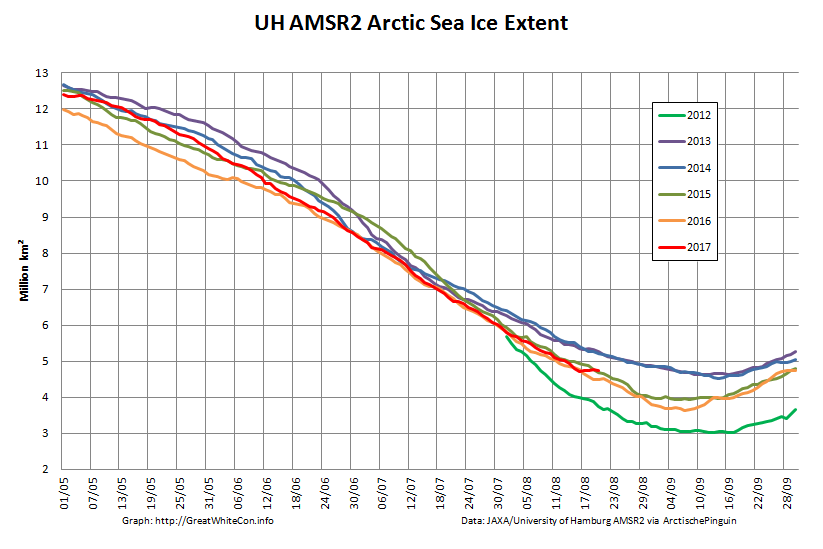
AMSR2 Arctic sea ice extent has taken another tumble, and has dropped below 2016:

UH-Arctic-Extent-2017-08-15

Only 2012 left to beat!


[Edit – August 18th]

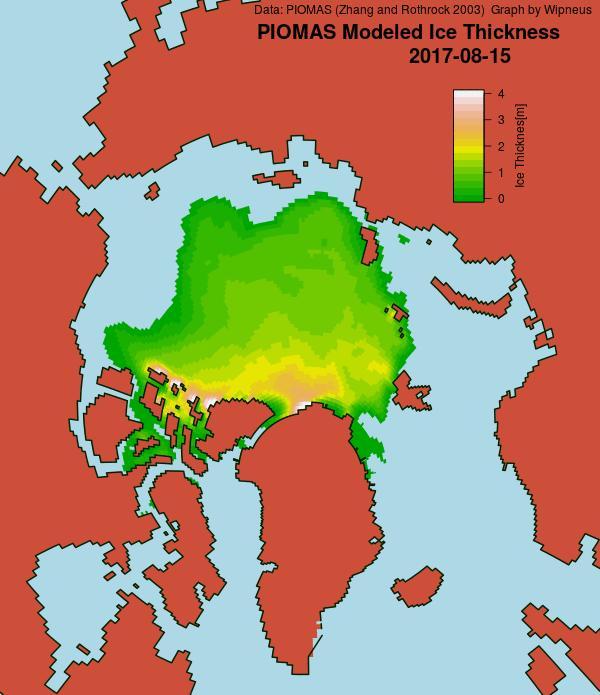
A PIOMAS mid month update has been released, including gridded thickness data. 2017 modelled volume has failed to follow 2012’s trajectory towards the September minimum, and is now on a par with 2011:

piomas-20170815

piomas_thickness_20170815


[Edit – August 21st]

After a “brief hiatus” in the wake of the recent cyclones Arctic sea ice area has posted a new low for the year:

UH-Arctic-Area-2017-08-20

Extent has yet to follow suit:

UH-Arctic-Extent-2017-08-20

The main loss of area has been in the “Beaufort Bite” once again:

AMSR2-Delta-20170820


[Edit – August 24th]

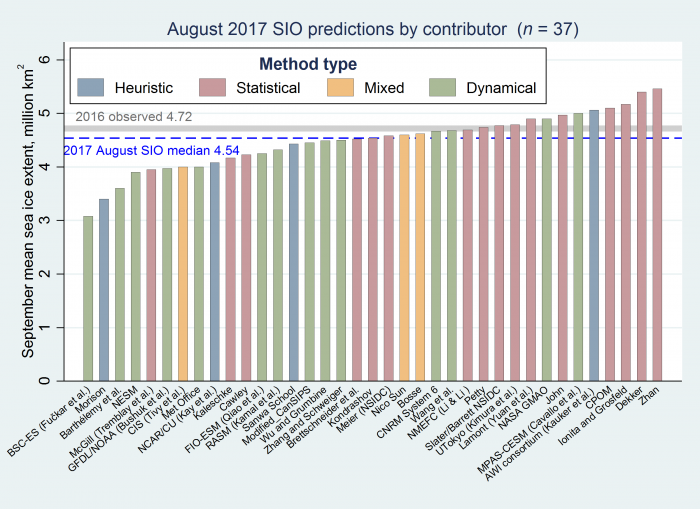
The SIPN August sea ice outlook has been released. Here are the predictions:

Watch this space!

The 2017 Antarctic Sea Ice Minimum Extent

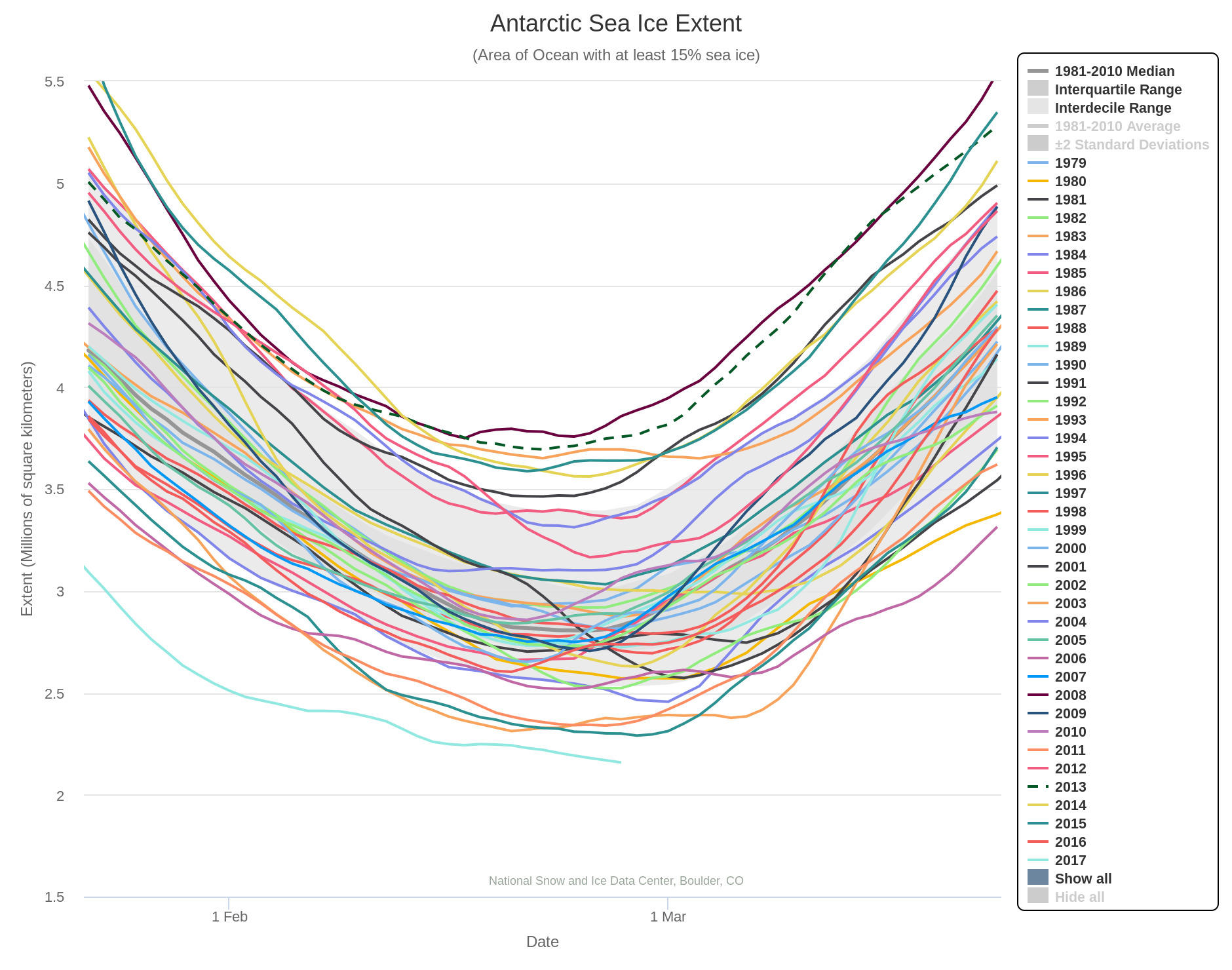
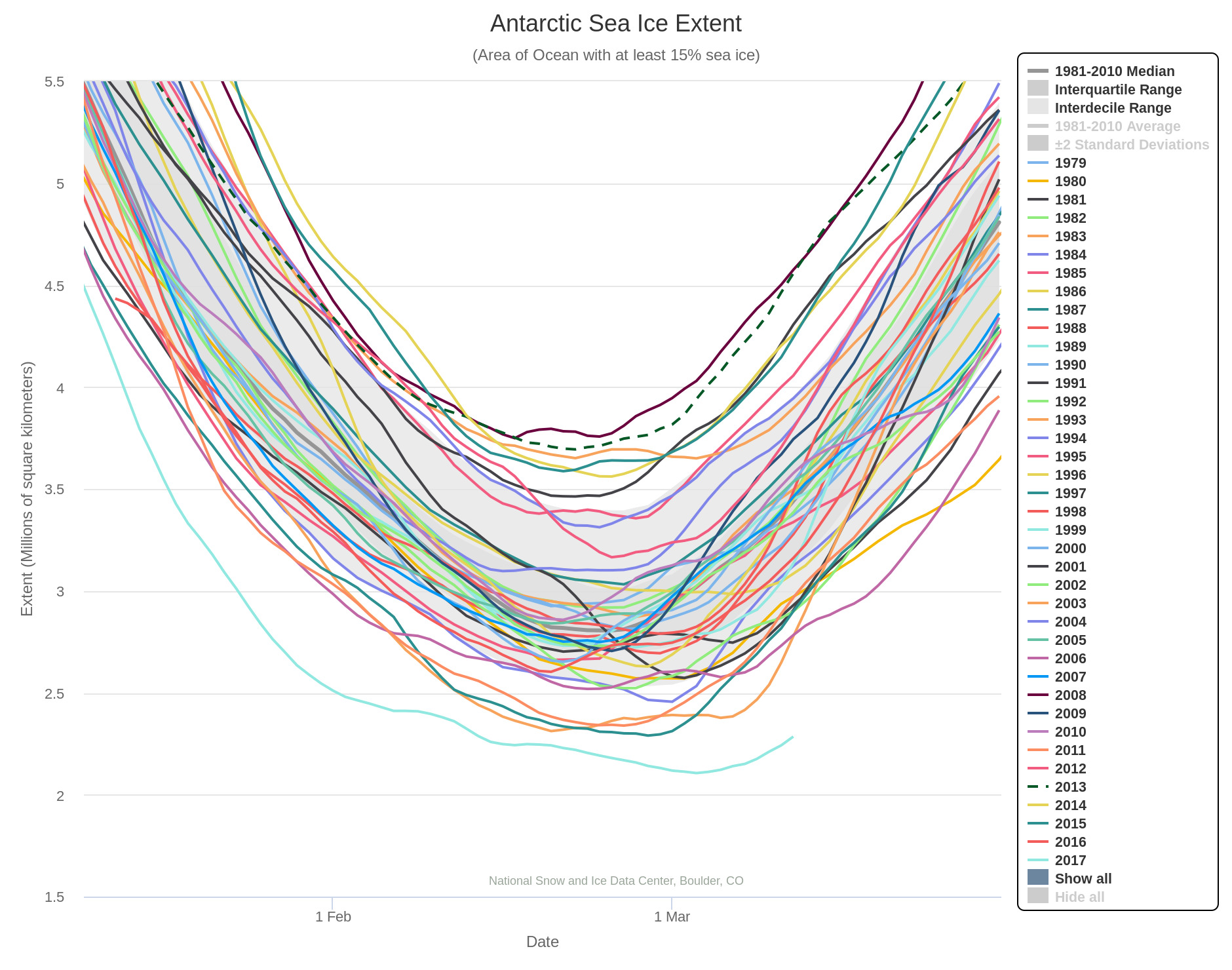
In 2017 Antarctic sea ice extent is beating all the records. All flavours of the metric are already below the minimum of all previous years in the satellite record, and it looks like there’s still some more melting left to go. Here’s the NSIDC’s 5 day averaged extent:

Chantarctic-20170226

and here’s JAXA’s 2 day averaged version:

JAXA-antarctic-feb27-2017

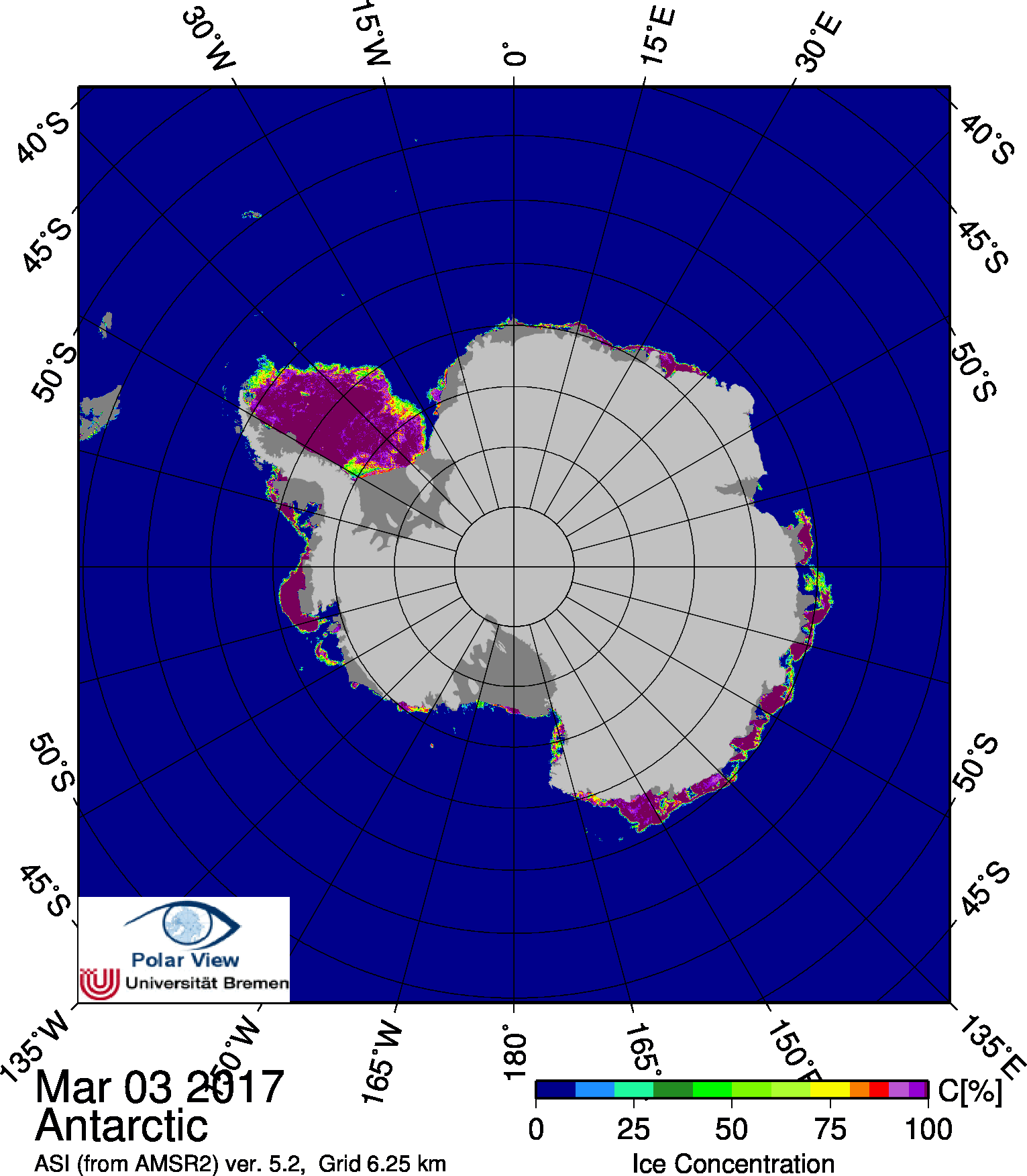
Finally, for the moment at least, here’s the current map of Antarctic sea ice concentration from the University of Bremen:

Bremen_Antarctic_AMSR2_20170227


[Edit – March 12th]

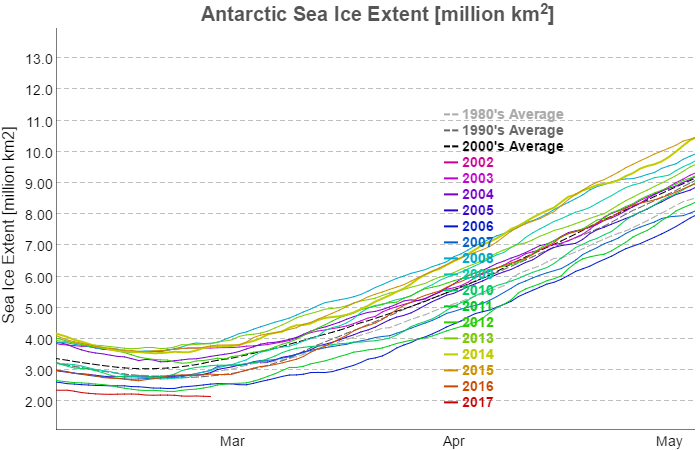
It seems highly likely that the 2017 Antarctic sea ice minimum extent has now been reached. Here’s the NSIDC 5 day averaged extent graph:

Chantarctic-20170311

The minimum extent of 2.106 million square kilometers was reached on March 3rd. Here’s the University of Bremen’s Antarctic sea ice concentration map for March 3rd:

asi-AMSR2-s6250-20170303

Is the Northwest Passage Open Yet?

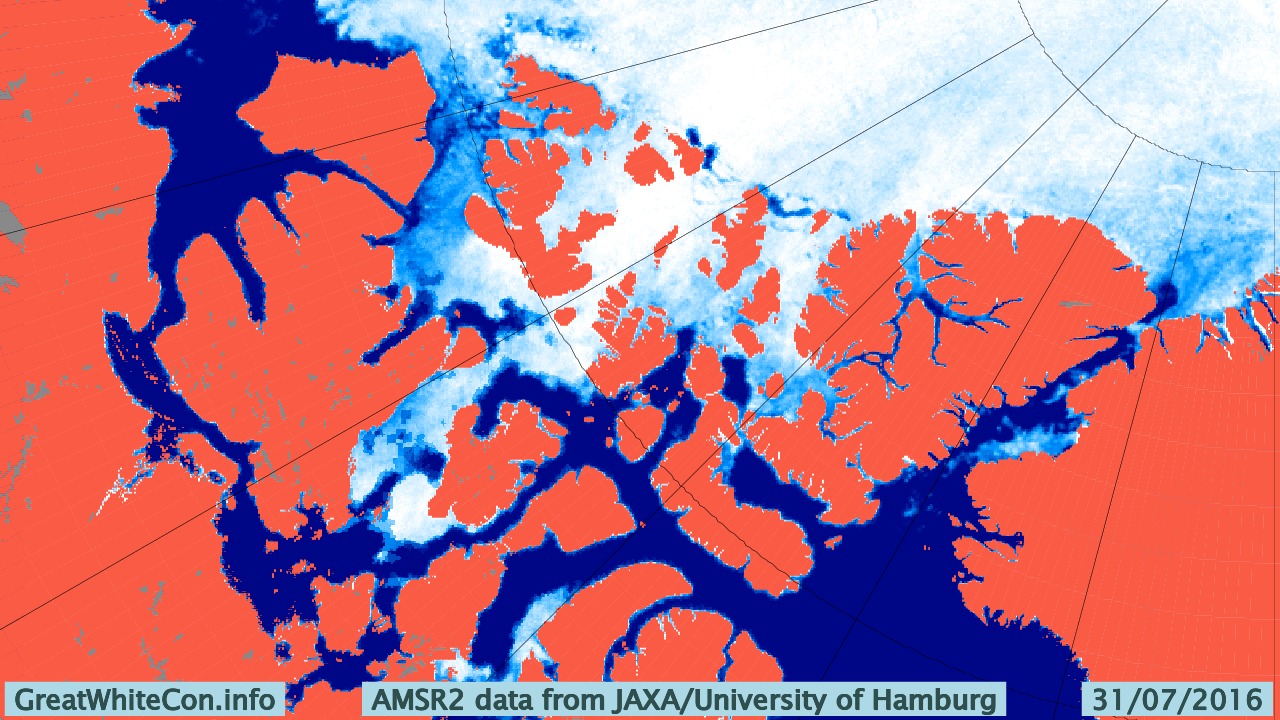
We asked this question last year, albeit a couple of weeks later. It looks like it is if you only peruse passive microwave visualisations such as this one:

Arc_20160731_res3.125_LARGE

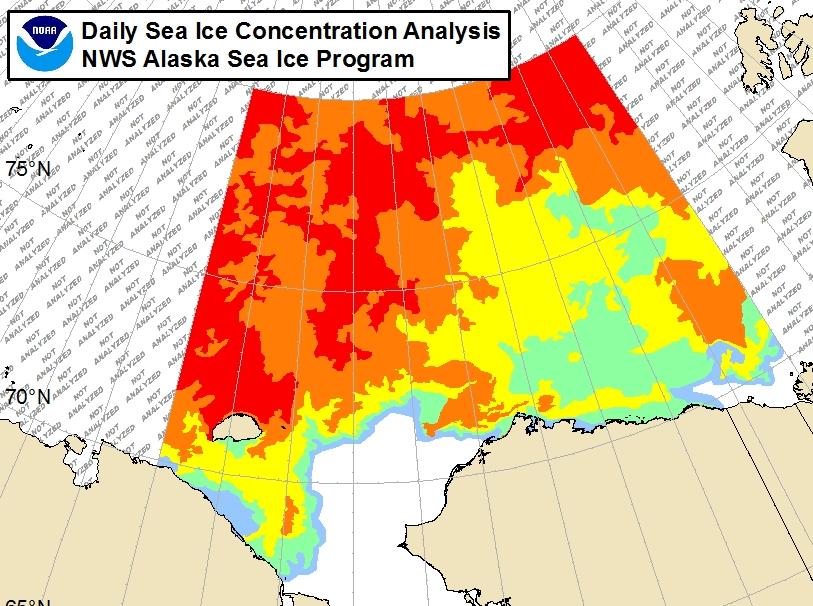
However if you were the captain of a yacht attempting to sail through the Northwest Passage this year you might well have some reservations. For example, the Barrow webcam (currently stuck on July 31st) reveals this:

Here’s the associated National Weather Service ice chart:

NWS-Alaska-20160801-Crop

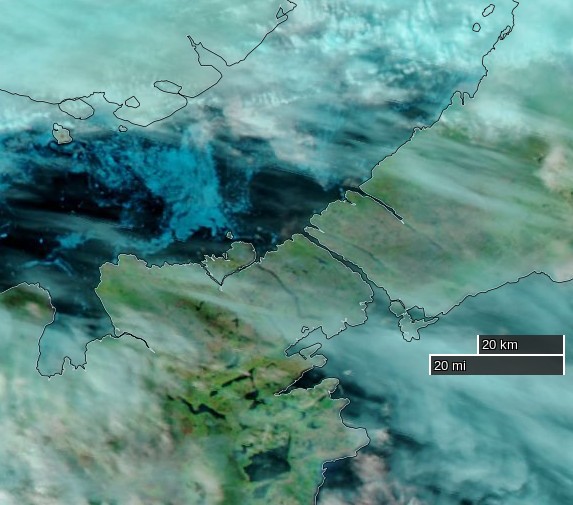
Meanwhile further east the approach to the often troublesome “choke point” of Bellot Strait looks like this from the Suomi satellite:

NASA Worldview “false-color” image of the Bellot Strait on August 1st 2016, derived from the VIIRS sensor on the Suomi satellite

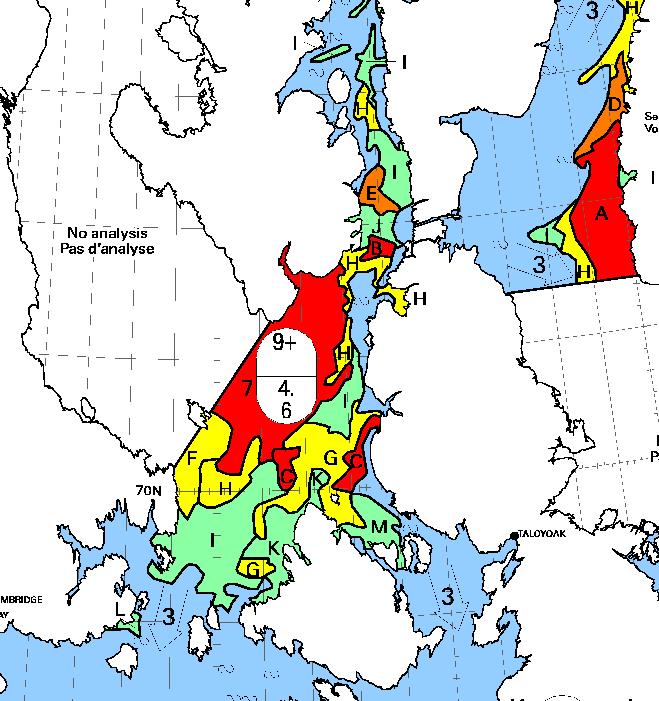
whilst the associated Canadian Ice Service ice chart looks like this:

QueenMaud-201608011800

Discretion being the better part of valour, in all the circumstances waiting a day or two longer before casting off might prove prudent:

Arc_20160801_res3.125_LARGE


[Edit – August 3rd]

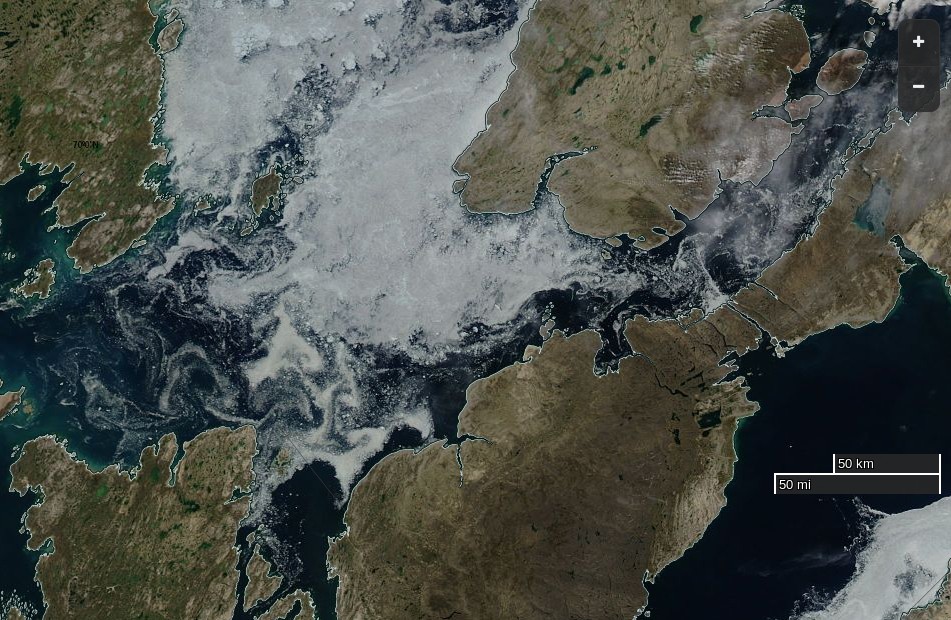
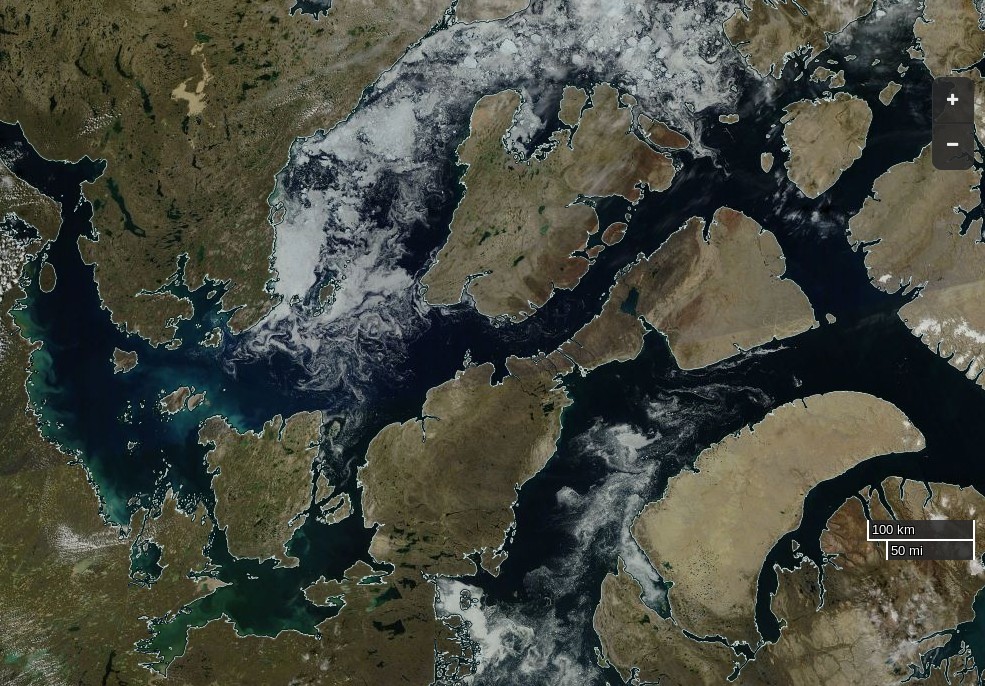
Clearer skies over the Northwest Passage yesterday reveal the remaining ice:

NASA Worldview “true-color” image of Larsen Sound on August 2nd 2016, derived from the MODIS sensor on the Aqua satellite

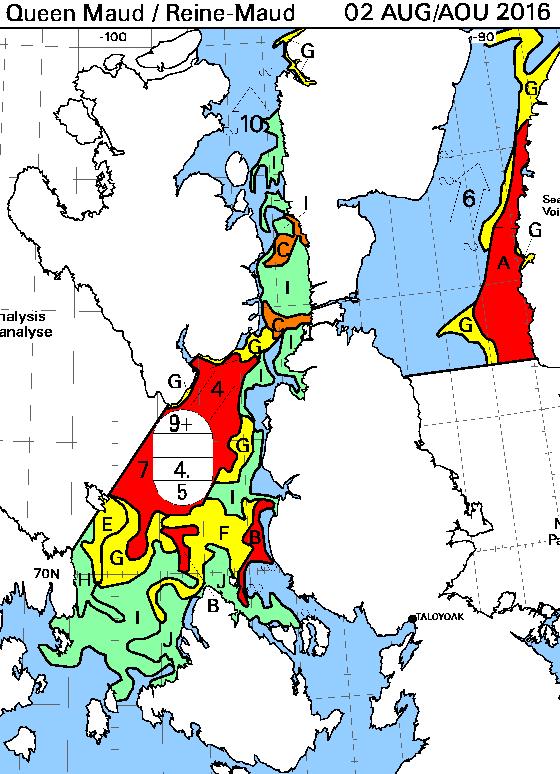
Here’s the CIS chart of the area from yesterday evening:

QueenMaud-201608021800


[Edit – August 7th]

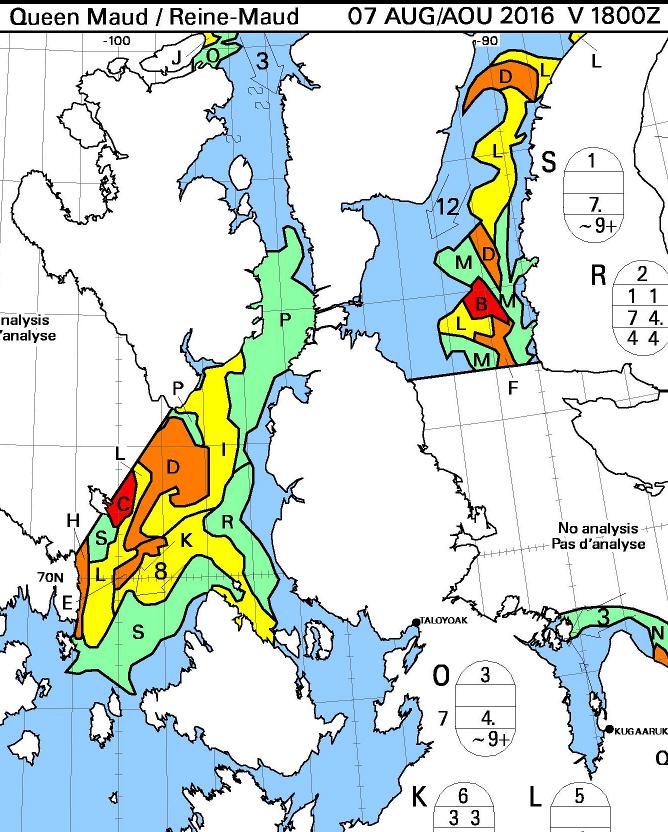
Here’s the August 7th CIS chart for the Queen Maud Gulf and points north:

QueenMaud-201608071800

Today there looks to be a route past Gjoa Havn and through Bellot Strait that doesn’t involve negotiating more than 3/10 concentration sea ice. The ice has been pushed back from Point Barrow too, so by my reckoning we can now declare one route through the Northwest Passage “open”, for the moment at least.


[Edit – August 10th]

A nice clear MODIS image of the Northwest Passage yesterday:

NASA Worldview “true-color” image of the Northwest Passage on August 9th 2016, derived from the MODIS sensor on the Terra satellite

backed up by the CIS ice charts:

Resolute-201608091800

QueenMaud-201608091800

Has The Ice Clearly Broken Completely In Two Now?

In the spirit of providing some spurious “balance” to the contentious Arctic sea ice “debate” our quote for today comes fairly fresh from the Arctic Sea Ice Forum:

idk how people are confusing the gaping fissures that span from Siberia to Canada with melt ponds but it seems like half the people here have blinders on to what is ongoing.

I know HYCOM gets a lot of flak but instead of projecting out, let’s look at the last five days.

[Superfluous image redacted]

The ice has clearly broken completely in two now, and the recent ~970mb low did a major whomping to the ice in the “cleavage” between what’s stuck against Siberia and the main CAB.

Intriguingly this was in response to an informed comment on June 23rd to the effect that:

As we have seen recently, these large area drops in the middle of the pack do not mean the ice is gone, just that its top is wet/ponded. In a couple of days some of these drops might be reversed. Of course the ice has suffered in the meantime, but still it’s risky to simply extrapolate these numbers.

Even more intriguingly our headline for today is remarkably like the inverse of a phrase in a Mail on Sunday article that led us to create this site in the first place!

Nearly three weeks have passed since those “gaping fissures that span from Siberia to Canada” were announced, and you may well (like me) be wondering how they have been coming along? In partial answer to that question here is our very latest video based on the University of Hamburg’s AMSR2 concentration visualisations:

In my own humble opinion this doesn’t really count as a “gaping fissure” but MODIS imagery does now show a fair bit of open water between Siberia and the North Pole:

CAB-Terra-20160711-400

A “gaping fissure” between the Pole and Canada (and/or Greenland) is however conspicuous only by its absence:

NASA Worldview “false-color” image of the Central Arctic Basin on July 11th 2016, derived from the MODIS sensor on the Aqua satellite

I do think that I can spot some melt ponds in the area at the moment though. How about you?

The one CRREL/ERDC ice mass balance buoy still reporting reveals that both surface and bottom melting have started at around 83 degrees north:

2016-07-11_2015F

The 2016 multi-year ice melting season has evidently now begun, and the floe upon which buoy 2015F is sitting still has ~1.9 metres of melting to go. It’s not beyond the bounds of possibilty that a “gaping fissure” from the Atlantic to the Pacific will ultimately emerge this year. However based on the evidence thus far I’ll be extremely surprised if there is one “from Siberia to Canada”, unless of course you count the Chukchi & Beaufort Seas. That route is already open to intrepid Arctic seafarers, as can be seen at the bottom of the animation above and on the current JAXA/ADS Arctic sea ice surface melt map:

AM2SI20160711A_SIT_NP


[Edit July 14th 2016]

It seems I was mistaken. According to my flack jacketed informant over at the ASIF:

I have taken lots of flack I will stand by my prediction that we are heading for sub-1M KM2 come September (or early October).

Structurally [the ice] has actually now broken into three pieces, one is attached to the islands N of Siberia/NE of Svalbard, one is near Wrangel/ESS, and the “bulk” is pushed against the CAA/Greenland.

The lower concentrations in CAB are clearly open water and not melt ponds.

specialforjim-scaled

I felt compelled to explain to (presumably) him that:

Here’s the NSIDC’s view of those “gaping fissures” of yours:

N_daily_extent-20160710


[Edit July 15th 2016]

“Flak jacket” assures me that:

Despite some faults I think both ARC and GLB are onto the truth. Satellite grabs over the past few days show failure on all three fronts (ATL, PAC, and the Russian side especially), but the Russian side doesn’t present as a solid front (nor does the Beaufort melt), and the leads keep getting absorbed into the slush of the main pack (which is why the ‘slush’ keeps expanding, and why most of the CAB has now evolved into this state). The only solid regions of ice are those bordering the steaming ATL waters as well as some remnants north of the CAA (no coincidence the latter was chosen as ‘evidence’).

“ARC” refers to the US Navy’s Arctic Cap Nowcast/Forecast System. Here’s the ACNFS sea ice thickness “nowcast” from July 13th:

Here’s the July 13th model run sea ice thickness forecast for July 14th:

and here’s an annotated version of the Navy’s sea ice concentration forecast:

ACNFS-Concentration-20160713+24h

Yesterday the Kara Sea didn’t suddenly become covered in sea ice, and today the area of the Central Arctic Basin around 82 N, 135 W looks like this to the MODIS instrument on board the Terra Satellite:

NASA Worldview “false-color” image of the Central Arctic Basin on July 15th 2016, derived from the MODIS sensor on the Terra satellite

and like this to the University of Hamburg’s ARTIST sea ice concentration algorithm:

Arc_20160714_res3.125_LARGE

whilst here’s the latest Canadian Ice Service RadarSat mosaic for the Western Arctic:

http://ice-glaces.ec.gc.ca/cgi-bin/getprod.pl?prodid=IPYMMR1WA&wrap=0&lang=en
Canadian Ice Service Western Arctic RadarSat mosaic for 8-11 July 2016

Ice mass balance buoy 2015F reports this morning:

Current Buoy Data (07/15/2016):
Pos: 82.89 N, 137.34 W
Air Temp: -0.76 C
Air Pres: 1011.16 mb
Ice thickness : 185 cm


[Edit July 16th 2016]

The Arctic Sea Ice Forum management have banished “Flack Jacket” to the sin bin for a month.

I’m fed up with the personal insults because a model that has a history of errors is showing something spectacular that no other data source does. Come back in a month if you still feel like it.

Meanwhile in answer to my enquiry on the HYCOM support forum Alan Wallcraft tells me:

We now use the National Ice Center’s IMS sea ice extent product in our assimiltion, see http://www.natice.noaa.gov/ims/. This is manually produced every day, and generally avoids the artifacts and deficiencies of satellite sea ice concentrations. However yesterdays IMS fields were not good, and that is where the spurious sea ice came from. Today’s IMS field is good, and we may rerun the 2016/07/13-18Z nowcast/forecast to clear this up.

After a brief “pause” ACNFS is back in action, and here is its latest Arctic sea ice concentration “nowcast”:

Yesterday the skies were clear once again over the corner of the Arctic where buoy 2015F is located:

NASA Worldview “false-color” image of the Central Arctic Basin on July 15th 2016, derived from the MODIS sensor on the Aqua satellite

Here’s how the sea ice area in the Central Arctic Basin has been faring recently:

CAB-Area-2016-07-16


[Edit July 19th 2016]

Here’s an early image of the North Pole from the Aqua satellite this morning, recorded for posterity in case it changes later:

NASA Worldview “true-color” image of the North Pole on July 19th 2016, derived from the MODIS sensor on the Aqua satellite
NASA Worldview “true-color” image of the North Pole at 09:00 UTC on July 19th 2016, derived from the MODIS sensor on the Aqua satellite

and as the recent Arctic storm heads towards the Canadian Arctic Archipelago here’s the latest Hamburg AMSR2 concentration map:

Arc_20160718_res3.125_LARGE

I now also have an answer to my “supplementary question” on the HYCOM support forum:

I attach the ACNFS plot you referenced and the corresponding plot from our next global real-time system (GOFS 3.1), which will likely replace our current global analysis (and ACNFS) once NAVGEM 1.4 is operational (it is running here with NAVGEM 1.3, like ACNFS). They assimilate the same observations, but ACNFS only does so near the ice edge while GOFS 3.1 assimilates sea ice concentration everywhere (but with higher error bounds in the ice interior). The reason for ACNFS only assimilating near the edge is in part due to that being the most important area for navigation but also because SSMI satelite ice concentrations tend to “over saturate” in the summer. We switched GOFS 3.1 to “believe” the observations because they are generally better in recent years.

The two are quite different in the interior of the sea ice and GOFS 3.1 is certainly better there. We did not see the low concentrations near the North Pole in ACNFS this time last year, so something has happened to make the free running model produce low concentrations this summer. We are looking into it.

071800_927_arcticicen.001″ width=”754″ height=”666″ class=”aligncenter size-full wp-image-4361″ />

icen2016071718_2016071800_042_arcticicen.001

icen2016071712_2016
</p>
	</div><!-- .entry-content -->
	
	<footer class=

The Beaufort Gyre Goes Into Overdrive

According to the US National Snow and Ice Data Center, the Beaufort Gyre is:

A clockwise circulation (looking from above the North Pole) in the Beaufort Sea, north of Alaska. This circulation results from an average high-pressure system that spawns winds over the region.

beaufort_gyre

Such a high pressure system has been in place over the Arctic Ocean for a few days now, and the effect of the clockwise circulation on the sea ice in the Beaufort Sea is already evident in these recent satellite images:

NASA Worldview “true-color” image of the Beaufort Sea on April 9th 2016, derived from the MODIS sensor on the Terra satellite

NASA Worldview “false-color” image of the Beaufort Sea on April 12th 2016, derived from the MODIS sensor on the Terra satellite

as well as in this animation of sea ice movement since February:

The high pressure is forecast to continue for several more days. Here’s the GFS forecast for April 20th, courtesy of MeteoCiel:

Northern Hemisphere surface pressure forecast for April 20th 2016

which shows a large system with a central pressure of 1040 hPa still sitting over the Northern Beaufort Sea. Next here’s an animation from the US Navy which forecasts ice thickness until April 19th:

April 13th 2016 ACNFS Beaufort Sea thickness forecast until April 19th

Note in particular the large area of open water forecast to be produced in the Chukchi sea off Barrow, Alaska by the end of the period. The continuing clockwise winds have already started reducing the area of sea ice in the Beaufort Sea at an unusually early date:

2016-04-13-Beaufort-AMSR2-Area_001

Amongst other things we’ll be keeping a close eye on the ice area in the Chukchi Sea over the next few days. The sun is already starting to bathe that area of our planet with its rays, and open ocean soaks up that heat much more readily than bright white ice.

[Edit – 16/04/2016]

Here’s an animation of the effect on sea ice of the Beaufort Gyre in overdrive from Neven at the Arctic Sea Ice Blog:

Neven-Gyre-20160414

Notice how towards the end of the animation another huge part of the ice pack, north of the Canadian Arctic Archipelago is pulled into the Gyre. This is mostly multi-year ice.

Here also is a MODIS image of the Beaufort Sea processed by A-Team at the Arctic Sea Ice Forum to highlight the areas of new ice:

ATeam-BeaufortDay106-2016

The Northwest Passage in 2016

Our coverage of the Northwest Passage is starting somewhat earlier then usual in 2016. That’s because an educational comment of mine seems to have gone permanently missing over at Andrew Montford’s blog. Over there commenter “Golf Charlie” suggested that:

Perhaps based on rumours, or folk stories, the possibility of a North West Passage, was the answer to many peoples dreams of wealth, fame and fortune. The Franklin Expedition set off, with all confidence, knowing that there had been an unprecedented retreat in Arctic sea ice extent. They never came home. The ships then sent to rescue them, never came home either, but some survivors did.

In July 2010, due to unprecedented ice loss, a team set out to find HMS Investigator, (one of the rescue ships) and found her within 15 minutes, exactly where she was trapped and abandoned. How had she got there?

This may be just a load of boring and irrelevant history to you, but as an ice expert keen to lecture others, it just seems strange that you don’t acknowledge the fact that before man made CO2 emissions could possibly had any remote chance of shrinking sea ice, it had all happened before.

It is likely that whatever caused the ice to retreat in the 1830s/40s, may have caused the current retreat. As no attempt has been made to explain this historical retreat, it seems premature to jump to conclusions about the present. What stories and folklore convinced Franklin there was a NWP? Had it opened before? Did the Vikings circumnavigate the North Pole? No one knows for sure.

Here’s the beginnings of my by now expanded reply:

I am already very familiar with the sorry tale of Franklin’s ill fated expedition. By way of some more recent Northwest Passage history, were you previously aware that Charles Hedrich completed his own multi-year voyage through the NWP last summer? His vessel was much smaller than Franklin’s:

“He is now, the first man to have rowed solo the North-West Passage.”

charles_hedrich_pond_inlet

It’s not terribly clear, but apparently Charlie thinks his “unprecedented ice loss” in the Summer of 2010 had a precedent in the 1840s and/or 50s. Perhaps he will pop in and elucidate? Whilst we wait to see what transpires in that regard, here’s an animation of sea ice concentration across the Northwest Passage last summer:

You will note that the “southern route” taken by Roald Amundsen in Gjøa opens first, ultimately followed by the “main route” via the McClure Strait.

My missing comment also referenced (by way of example!) a 2015 academic journal paper entitled “Ice thickness in the Northwest Passage“. Amongst its other conclusions can be found this:

Global climate models with their coarse resolution likely have difficulty capturing intricate sea ice dynamic processes within the narrow channels of the CAA. Specifically, the import, survival, and thickness of MYI are difficult to predict and may in fact increase during the transition to a sea ice-free Arctic with more mobile ice conditions in the Queen Elizabeth Islands which are located between the Arctic Ocean and NWP. Presumably, MYI from the Arctic Ocean will be more heavily ridged and thicker than locally formed MYI, posing greater danger to transiting ships than locally grown MYI.

Whilst we look forward to the prospects of the “transition to a sea ice-free Arctic”, what about the prospects for the Northwest Passage in the summer of 2016. As you can see from the video there wasn’t much in the way of multi-year sea ice left there by the Autumn of 2015, and there doesn’t seem to have been much transport of ice into the Canadian Arctic Archipelago over the winter either.

NWP-Development-20160328

On top of the ice there will of course be some snow by now. Here’s how the Topaz 4 snow cover map of the area looks at the moment:

Topaz4-CAA-20160404

All in all it looks to me at this early stage of the 2016 Arctic sea ice melting season as though one or more of the assorted routes through the Northwest Passage will be open again this coming summer. Do you suppose that will look like yet another “unprecedented retreat” to “Golf Charlie’s” eyes?

It seems as though a large commercial organisation sees things that way too. Crystal Cruises have concluded that in 2016 the Northwest Passage offers:

The ultimate expedition for the true explorer!

Anchorage to New York on Crystal Serenity
DATES : August 16 – September 17, 2016 (32 Days) CRUISE-ONLY FARES FROM : $21,855 Per Person

More than 18 months of careful planning and analysis has already gone into this project from January 2013 to July 2014, and will continue up to, and through, departure.

Crystal_Serenity

There will not be shore-based cell phone signals along the transit, except in the communities and towns we will be visiting. However, guests are requested to not use this signal when in port, as it will overwhelm the local system and disrupt the communication within the community.

While communication channels may be temporarily limited or unavailable to guests, the ship’s Captain and crew will always have operational and emergency communication throughout the entire voyage.

The 2016 Arctic Winter Sea Ice Puzzle

Professor Judith Curry recently posed the following rhetorical question on her “Climate Etc.” blog:

Arctic sea ice extent has been anomalously low this winter. The greatest anomalies are in the European sector, specifically in the Barents Sea. To what extent are the anomalies associated with warm temperatures?

Which she answered as follows:

So, what might be causing this particular anomaly? Some possibilities are:

  • Gobal warming (January 2016 was warmest Jan on record, according to the surface temperature analyses

  • Multidecadal oscillations (e.g. stadium wave) predicts ice recovery to be occurring in the same region (European Arctic) where we see the sea ice decline).

  • Seasonal weather circulation patterns – this has been a year with with unusual weather patterns, with both low temperature and high temperature records being set.

As regular readers will already be aware we have been blogging about anomalously warm temperatures in the Arctic all year and so felt well qualified to contribute to the “debate”. What a job that turned out to be! Early on in the proceedings the anticipated pronouncement was made by one of Judith’s “denizens”. A link to a ludicrously inaccurate article on Watts Up With That accompanied by the following words of wisdom:

Other measures are high.

Which of course they aren’t! Instead of stating the bleedin’ obvious Professor Curry replied:

I spotted this, no idea what to make of it.

You would think she and her denizens would therefore have been pleased when I attempted to explain to her what to make of it, but you would have been mistaken. The icing on the ad hominem cake was the aforementioned Anthony Watts driving by to accuse me of all sorts of nefarious activities without providing a single shred of evidence and then running for the hills when invited to actually prove his ludicrous allegations.

Since the denizens of “Climate Etc.” aren’t particularly interested let’s take stock here instead shall we? After every Arctic area and extent metric under the sun sitting at “lowest *ever” levels for weeks a recent increase in coverage on the Pacific side of the Arctic has changed that. The most up to date example of that is the JAXA/ADS extent, which currently looks like this:

vishop_extent-20160228

The latest reading is the merest whisker above 2015’s record low maximum. However in other respects things are most certainly not comparable with 2015. See for example this concentration comparison from Andrew Slater of the NSIDC:

ice_con_delt_20160227

Much more ice on the Pacific periphery where it will all have disappeared by September, as opposed to much less ice on the Atlantic side, even well to the north of 80 degrees latitude where the sun still does not shine. Here’s a video revealing how the sea ice North of the Pacific Ocean has been reacting to the sequence of hurricane force storms that have been passing through the area over the past couple of months:

Now let’s take a look at “near real time” Arctic sea ice thickness as measured by the CryoSat 2 satellite:

CryoSat2_20160225

Notice the absence of any thick ice in the Beaufort and Chukchi Seas, an obvious difference from last year? Notice too the large area of thick ice that looks as though it’s heading towards the Fram strait exit from the Central Arctic. Here’s another video, this time of sea ice movement over on the Atlantic side of the Arctic Ocean:

Those dark areas between Svalbard and the North Pole are suddenly starting to look as though they represent reality rather than a mere “artifact”, although perhaps they are merely transient evidence of yet another Arctic “heat wave”?