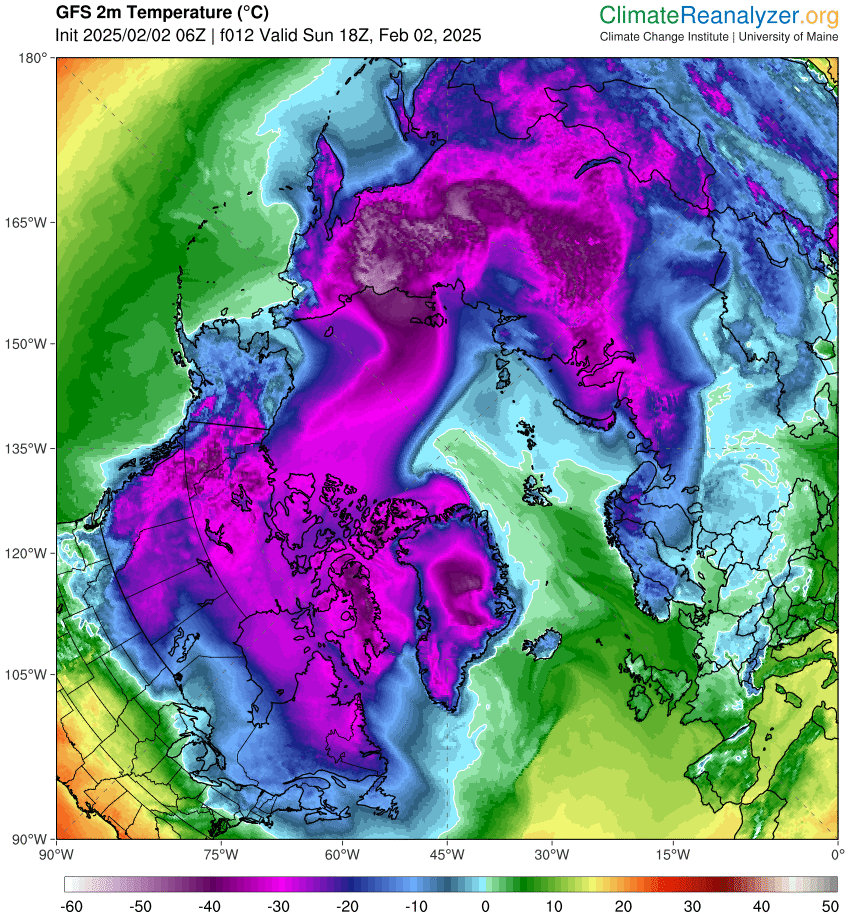
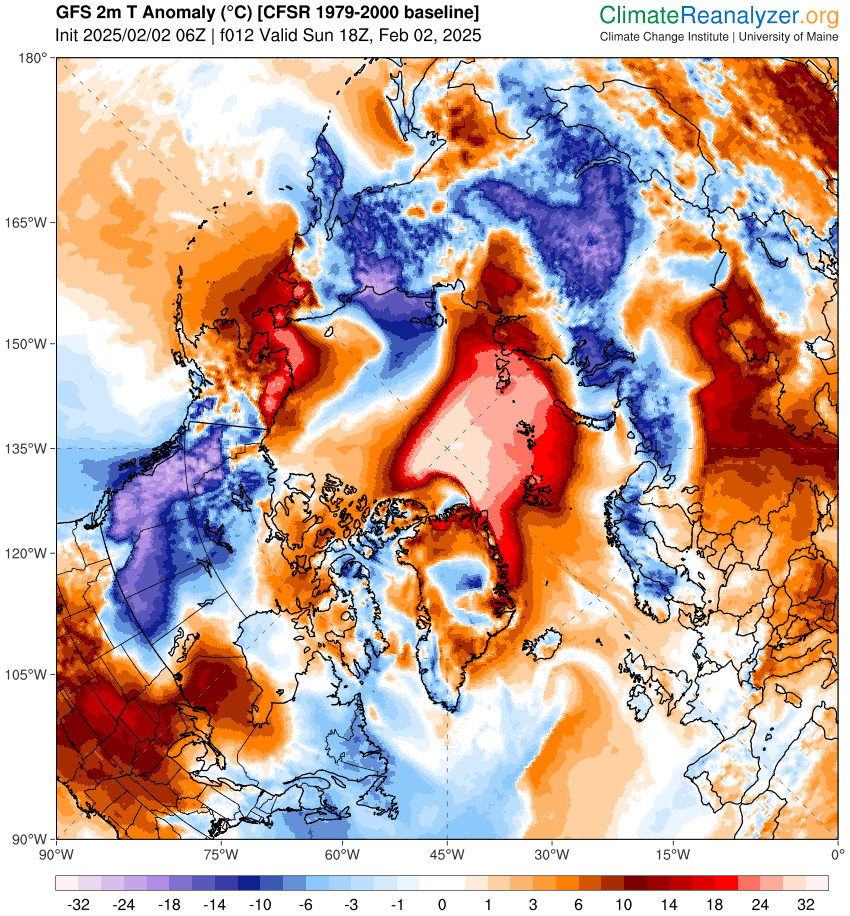
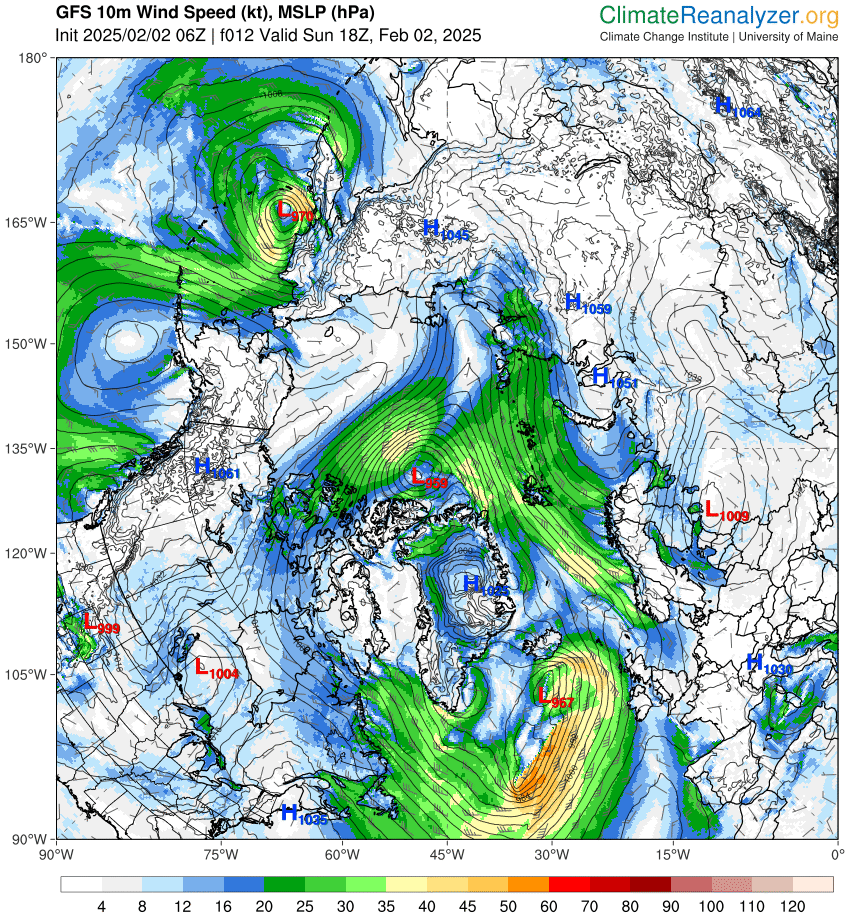
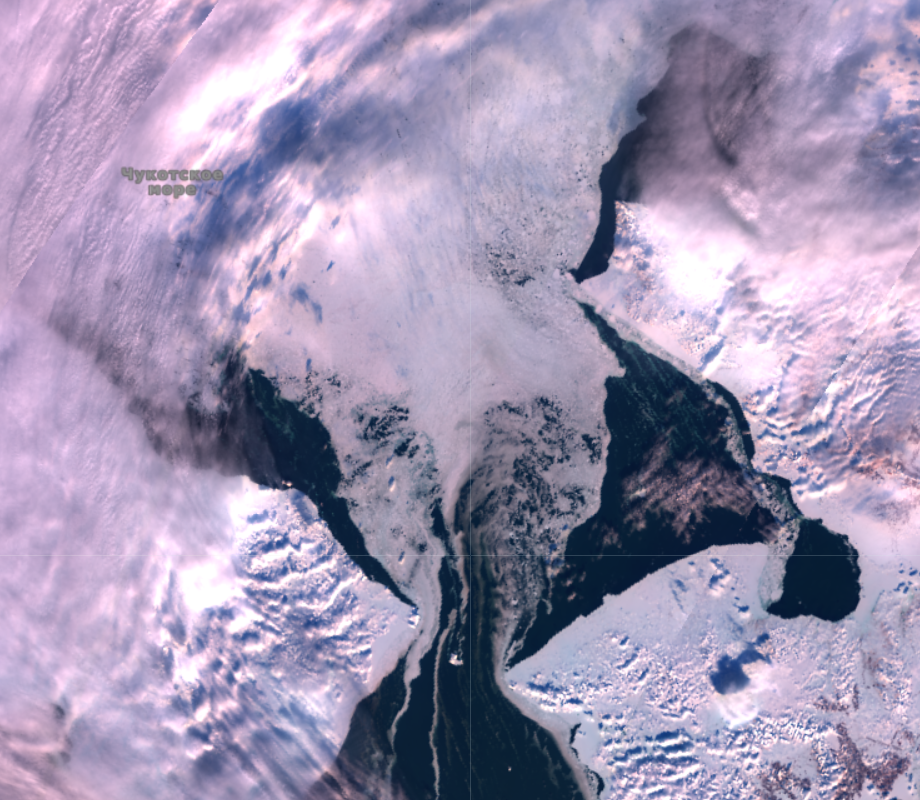
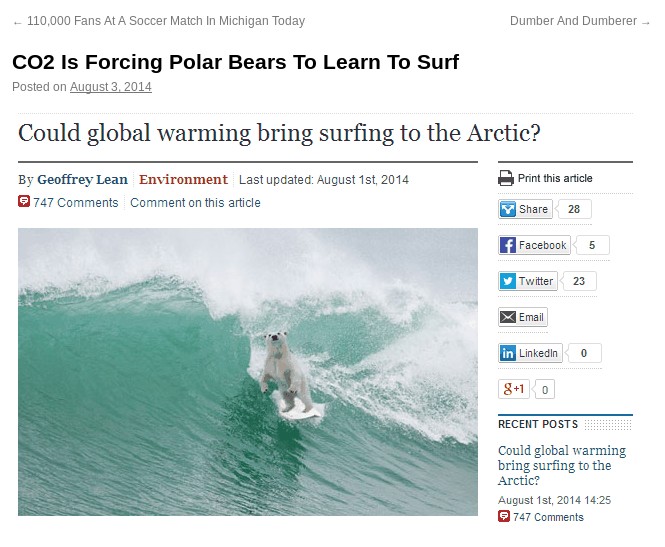
It’s been a long wait for the first ever Great White Con Arctic Basin Big Wave (Fantasy?) Surfing Contest to remove the ‘F’ from the overlong acronym. However currently the omens are bad for the sea ice in the Arctic Basin, which is sadly good for the GWCABBWSC. As we announced yesterday, there is already plenty of open water in the Chukchi Sea north of the Bering Strait between Russia and Alaska:
All of which means that today we are extremely unhappy to be able to announce that the waiting period for the Great White Con Arctic Basin Big Wave Surfing Contest 2019 began on March 1st.
Earlier this week I posed a little conundrum over on Twitter. Here it is:
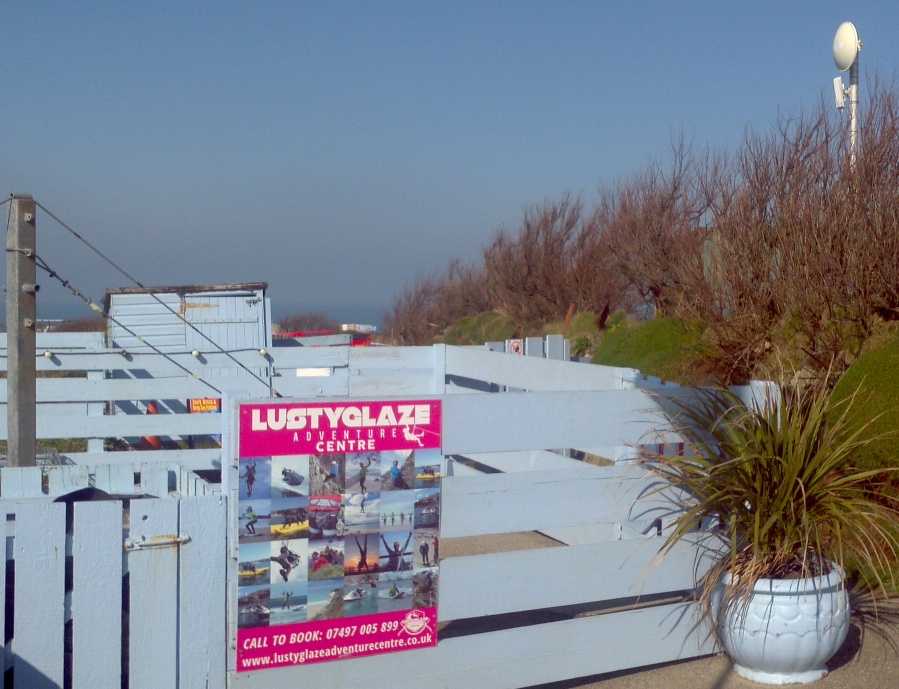
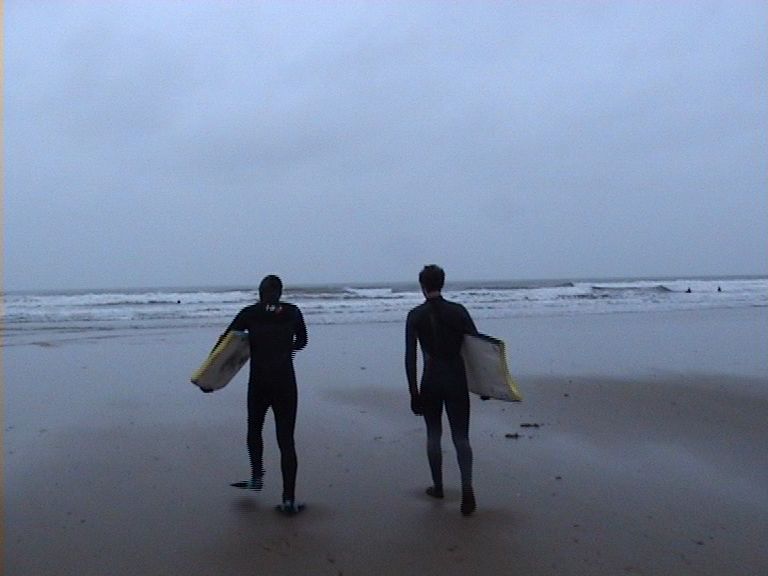
Nobody has called the Great White Con Ivory Towers hotline with the correct answer as yet, so today we can also reveal that the third in our series of Arctic Basin equipment evaluations took place last Wednesday on the outskirts of Newquay in North Cornwall. Here’s a slightly less obscure clue for the pub quiz fanatics amongst you:
As you can see from my neoprene encased image on Twitter, I was perhaps slightly over dressed for the weather conditions last week. I was wearing a C-Skins thermal rash vest with integrated hood inside my ancient Gul 5/4/3 winter wetsuit plus Tiki 6 mm socks and 2 mm webbed gloves. Even my fingers were more than warm enough on the day, although it’s fair to say that conditions weren’t typical for late summer in the Arctic Basin! What’s more they weren’t even typical for Newquay, since the weather on Wednesday was the tail end of a “heat wave” involving the highest February temperatures in England since the Met Office’s records began:
We’ll be doing an attribution study on how this week’s record-breaking temperatures were affected by #climatechange A Met Office analysis in 2014 showed that since 2000 there were 10 times as many high temperature records broken as cold temperature ones https://t.co/6cgNBdj7CYpic.twitter.com/1CEaORGsQx
What with one thing and another warming wise we’re confidently(ish) anticipating that the Great White Con big wave surf team will be searching the shores of the Arctic Basin on their electric powered jetskis for potential big wave spots by early September 2019. Unfortunately the opposing “Great Green Con” team haven’t worked out how to drive a jetski yet, but hopefully we can resolve that minor problem before the Arctic refreeze begins once again?
Regular readers who also follow the surfing news may recall that Great White Con team leader Andrew Cotton broke his back during his award winning wipeout at Nazaré in Portugal back in November 2017?
I spoke to Cotty yesterday and he assured me that his back was already healed sufficiently to take on the biggest waves the Arctic might care to offer over the coming months. However the same doesn’t yet apply to his more recent knee injury:
He expects to be fully fit by the end of the Northern Hemisphere summer, but failing that Cotty’s team partner Garrett McNamara has also successfully returned from injury recently, and hasn’t yet hurt anything else!
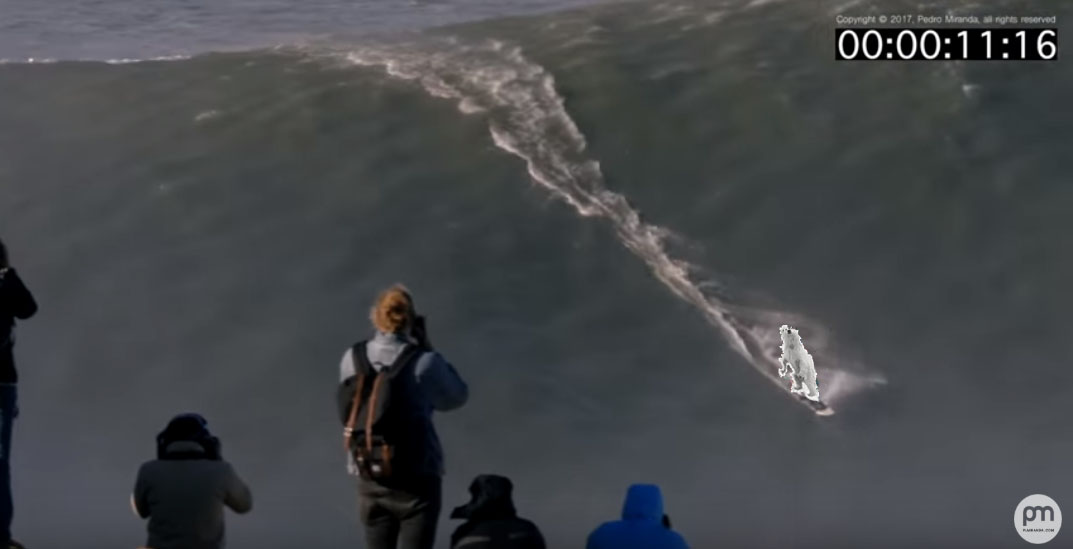
By the end of the long contest waiting period we will also have selected the lucky winner of our 2019 “New Einstein” competition who will be able to enjoy being fitted with one of our custom polar bear suits before partnering with “Great Green Con” team leader David Rose. Here’s our artist’s impression of a forthcoming GGC team equipment evaluation session on the next big swell to hit Nazaré:
With apologies to Pedro Miranda, Andrew Cotton and polar bears worldwide.
Looking at the latest Eastern Arctic ice charts from the Canadian Ice Service, I don’t think the crew [of Northabout] will exactly be shitting themselves.
I’m more interested in what a certain Tony Heller will be coming out with next.
It seems as though a certain Tony Heller and his many merry minions are already shitting themselves at the prospect of the plucky little yacht Northabout NOT getting “trapped in ice”. Hence we can provide this preliminary report on the astonishing ignorance of Tony and his faithful flock concerning all things Arctic. For the present we will confine ourselves to Mr. Heller’s latest missive on the Polar Ocean Challenge expedition, wittily entitled but strangely capitalised:
“we are in a race against time before the freeze”
I blogged the same thing yesterday, and the usual hysterical alarmists showed up complaining.
As luck would have it I blogged the same thing recently, and in actual fact it’s the usual hysterical denialists who have showed up both here and there to pen over a hundred comments and counting. Let’s take a look at a select few of them shall we?
For a reason known only to herself our old friend (and “New Einstein” award winner!) Gail Combsposted the weather forecast for Resolute yesterday, but without any link to her source(s):
TONIGHT: Saturday Night 09/10 80% / 1-3 in of snow
Snow showers early will become steadier snow overnight. Low 28 °F. Winds S at 15 to 25 mph. Chance of snow 80%. Snow accumulating 1 to 3 inches.
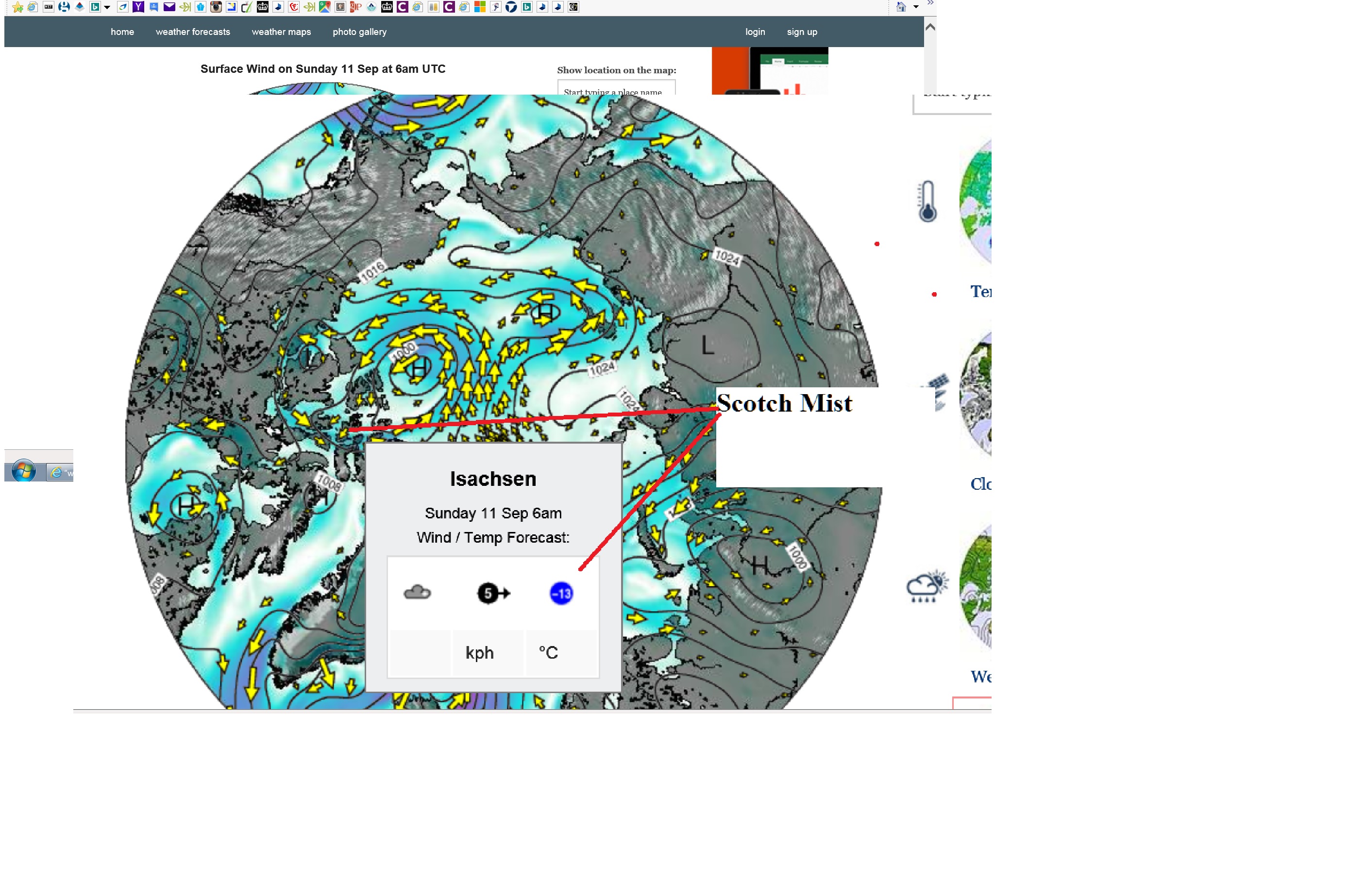
Then today Lawrence13 posts what purports to be the weather forecast for Isachsen whilst simultaneously suggesting that Isachsen is just around the corner from Resolute, which of course it is not:
Thing to note though, is that the northern part of the Northwest Passage was blocked by multi-year ice – foremost the western exit – FOR THE ENTIRE SUMMER, and was even not passable by ice breakers.
Needless to say Andy didn’t trouble to provide a link to his source. I therefore took the liberty of revealing to him the latest and greatest Great White Con Northwest Passage video:
He appears to be convinced that Isachsen is somewhere on the “main” route through the Northwest Passage. I took the trouble to inform him that:
According to the Environment Canada Climate Severity Index, Isachsen and the surrounding area has the worst weather in Canada with a CSI severity value of 99 out of a possible 100.
For some strange reason the Polar Ocean Challenge team are not planning on sailing past Isachsen any time soon!
His reply?
Nothing strange about it at all, Jimbo.
The Satellite Sea Ice charts told them they had NO CHANCE through the main North West Passage, so they snuck around through Cambridge Bay.
Andy then doubled down by throwing down all his gauntlets and issuing this challenge to Snow White’s manhood:
FFs, Jimbo, you have GOT to be joking !!!
Come on, coward, take my challenge.
Next year, WITHOUT sea ice charts, FOSSIL FUELS, or satellite navigation..
Do you fancy your chances surfing calving glaciers against GMac?
It’s hard to be sure, but I don’t think he does:
So, refusing to take up the challenge.
Coward.
There’s no answer to that! Or is there?
Please feel free to let me know when you want to be fitted for your polar bear suit Andy.
As you may be able to imagine, there’s plenty more dumbness to be discovered where that lot came from. As the day wears on and as time allows expect more amusing anecdotes from the depths of the cryodenialosphere.
[Edit – September 13th]
Not content with the dumbness quotient displayed by his faithful follows at the Blog of Fools, “Steven Goddard” has taken to Twitter to harangue poor defenceless Snow White. Here is a brief extract from his Gish gallop around the North Pole:
[Edit – September 14th]
Not content with haranguing Snow White about the Arctic “Steve”/Tony and merry Mendy fulminate about flash flooding in Cornwall & Manchester. Allegedly it’s all the media’s fault.
[Edit – September 19th]
Tony Heller has blocked poor defenceless Snow White on Twitter, so she cannot include his Tweets in her Storifys. Please feel free to try and work out where this one fits in the grand scheme of things:
Only a complete moron would conflate a wave with "rising sea levels" https://t.co/QeeYOJHLZr
It seems self evident that Americans have no sense of humour. They can’t even spell the word correctly. What’s more they also seem not to have the slightest clue about flash floods on this side of the Atlantic, preferring instead to rant about (the lack of) sea level rise on the shores of the “Land of the Free”:
Believe it or not, there’s plenty more where that lot came from.
Our regular reader(s) will be already be all too familiar with the 2015 edition of our annual Great White Con 2016 “New Einstein” Award. The jury has now finished its deliberations in a smoke filled igloo just outside the Great White Con Ivory Towers. I am pleased to be able to announce that the first prize of the loan of a polar bear suit kindly donated by the Daily Telegraph plus a battered big board from Cotty’s quiver has been awarded to none other than Gail Combs with her:
Jim, How does it feel to be morally responsible for the deaths of thousands of people a year?
I’m not quite sure how we’ll get the good news to Gail in time for her to take part in the 2016 Great White Con Arctic Basin Big Wave (Fantasy?) Surfing Competition, since she abused us in her capacity as a regular commenter on “Steve Goddard’s” (un)RealScience blog, where imparting such messages is most certainly a non trivial task. Watch this space!
You will no doubt be overjoyed to learn that we already have a couple of several candidates in the running for our 2016 award, the first of which is in similar vein to Gail’s winning 2015 entry. Here they are:
1) Gary P Jackson, who claims in his Twitter profile to be a “Texan, Palinista, Conservative Activist, DragRacer Editor & Publisher”, with:
2) Anthony Watts, who is the proprietor of what he claims is “The world’s most viewed site on global warming and climate change”, has of course already “blocked” the message he doesn’t care to hear:
Without offering a single shred of evidence for his baseless assertions Anthony had this to say on the “Climate Etc.” blog of Professor Judith Curry:
You two guys are quite the pieces of work. You both operate under multiple identities. Jim Hunt has three I have been able to identify, Lawrence Martin/Martinez has two.
Both of you post off topic or disrupt threads with the sort of unsubstantiated nonsense you post above, and both demand to have these off topic comments heard and then play the “look Watts is censoring me!” game when your comments don’t meet our site comment policy and/or are abusive in nature.
Case in point- here you are making abusive off-topic comments on Dr. Curry’s site.
Plain and simple, if you comment under different identities, post off topic and/or thread disruptive comments you don’t get to participate. Mr. Hunt was warned months ago, yet he still persists in trying to get comments through under other identities such as V2G.
3) Chris Comber, who claims to be a “Mac User, ebay addict, Re-enactor & Designer” and who has of course already “blocked” the message (s)he doesn’t care to hear:
Chris is apparently keen on the #Brexit concept, and (s)he blasted out an extended sequence of (comparatively!) mild ad homs culminating in:
4) CatWeazle666, who is an expert emitter of ad hominem attacks on the blog of “Steve Goddard” and it now becomes apparent also on the blog of Roger Helmer MEP, the United Kingdom Independence Party’s spokesman on Energy & Industry. CatWeazle’s entry is a stream of invective which eventually culminated (for the moment at least) in:
As you can see, there was no way I was going to take that lying down, and I in all the circumstances I felt compelled to bring the attention of Mr. Helmer and his merry minions to this link:
where many moons ago there appeared a well documented account of how “Steve Goddard” really is “the dumbest man on the internet” when it comes to analysing Arctic sea ice. Either that or he does have some idea of what he’s talking about but is nonetheless more than content to pull the wool over the eyes of his very own band of merry minions.
P.S. In response to my request for considered comment concerning 3 million deaths per annum due to outdoor air pollution CatWeazle666’s reply was:
What a sad little troll you are, Jim.
5) Ben Pile, whose Twitter profile tells us that he is a “Researcher, writer, blogger. Sceptical of environmentalism, environmental policy and the fashion for ‘evidence-based policy’. For science, against scientism”. Inevitably Ben is yet another “blocker” of scientific messages he doesn’t care to hear:
Ben evidently has a high opinion of himself, and thinks he knows more about climate science than IPCC lead author Professor Richard Betts:
6) Gator69, who is yet another expert emitter of ad homs on the blog of Tony Heller (AKA “Steve Goddard”).
Over at (un)Real Climate Science I humbly suggested under an article alleging “More Arctic Fraud From Mark Serreze And NSIDC” that it is difficult to prove that Amundsen “could have gone through [the Northwest Passage] in a few weeks”. Gator’s response?
Jim “could have” helped save 21,000 innocent humans yesterday, but he didn’t did he?
Jim thinks that snuffing out 21,000 innocent humans every day for his agenda is ethical and laudable.
“Could have” is an interesting phrase. How do you intend to justify this genocide Jim?
Please feel free to provide feedback to our 2016 jury in the space provided below.
We speculated a few days ago about whether the “Son of Storm Frank” might have battered Britain by now, and be sending a 10 meter swell past Svalbard towards the Arctic sea ice edge. That’s not quite how things have worked out in practice however! We haven’t had another named storm affecting the United Kingdom directly, but we have received a series of long distance swells from a sequence of hurricane force storms further out in the North Atlantic. I even managed to test my Arctic surfing equipment by personally partaking in the swell generated by Hurricane Alex!
Moving from the water into the air, here’s the Danish Meteorological Institute’s forecast for Greenland tomorrow:
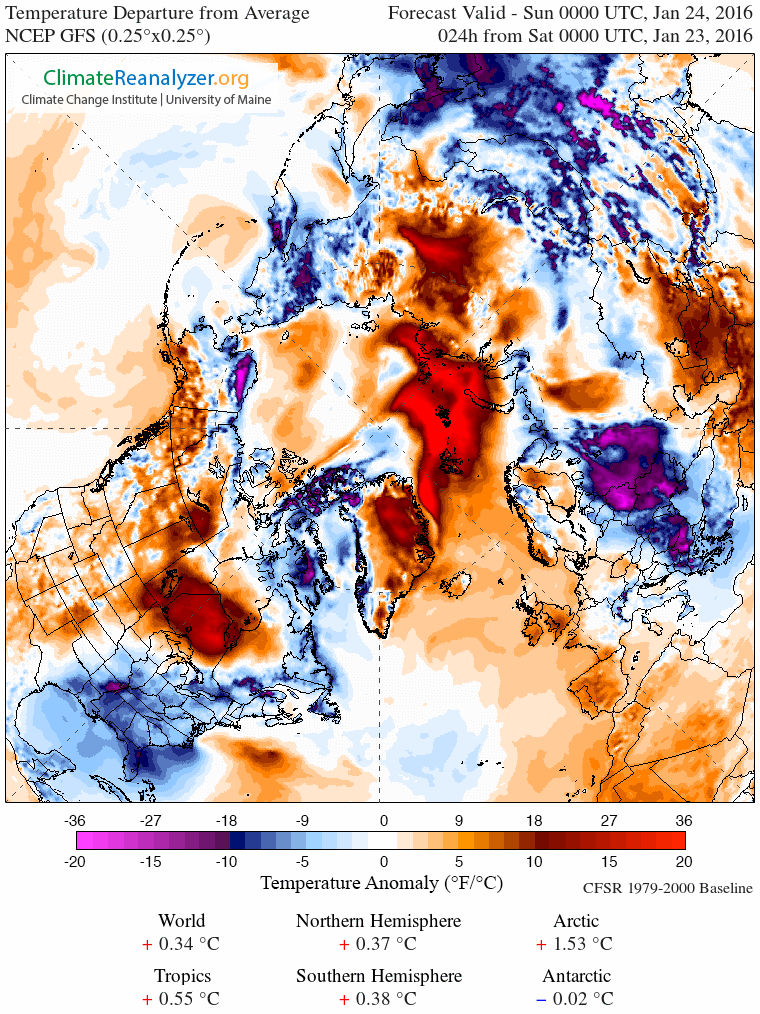
If you’re at all familiar with isobars you’ll note yet another storm off Southern Greenland and that comparatively warm, moist air will be heading up the east coast of Greenland towards the Fram Strait, albeit not at the speeds generated by Storm Frank! As a consequence here is Climate Reanalyzer’s surface temperature anomaly map for first thing tomorrow:
and here is how it looks by Wednesday lunchtime:
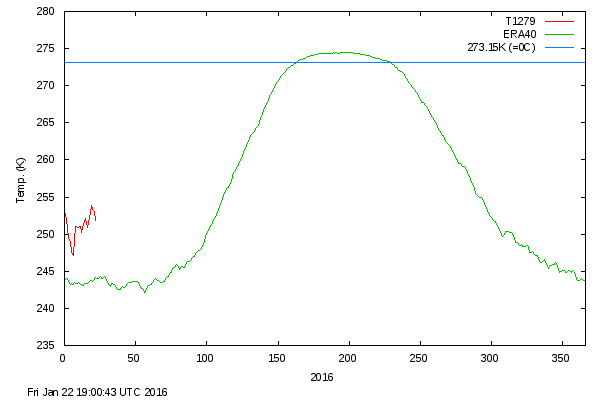
As you can see, the ultimate effect of the recent hurricane force storms in both the Atlantic and the Pacific is to attack the Arctic with warm, moist air from both sides. Whilst we wait to see exactly how this much shorter term forecast pans out, particularly at the North Pole itself, the DMI’s graph of temperatures in the central Arctic has burst back into life after a “brief hiatus” in the New Year. Here’s how it looks at the moment:
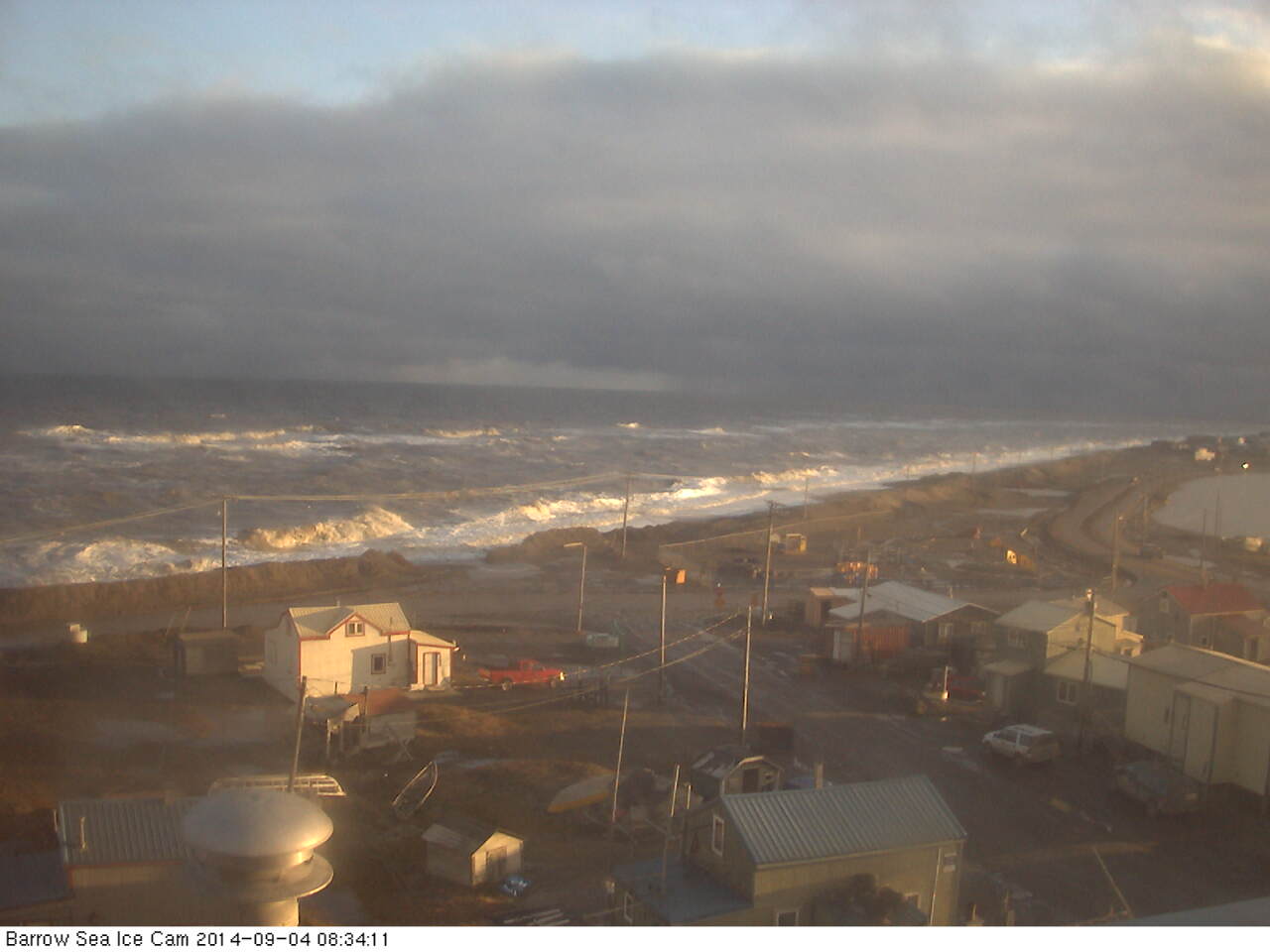
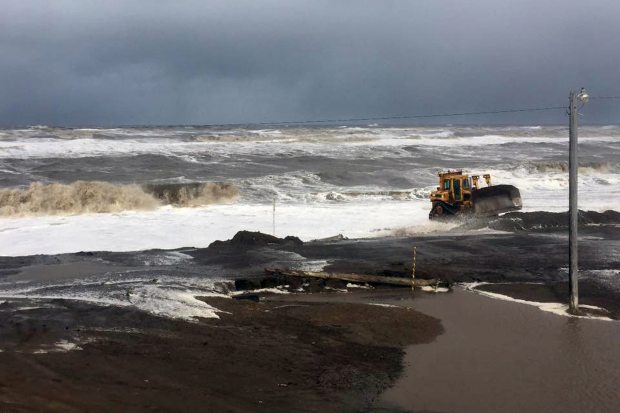
The first big waves of 2015 have been battering the town of Barrow, Alaska today and they’ve already broken through the coastal defences. Firstly take a look at the view from the Barrow webcam during a less damaging storm on September 4th last year:
Now take a look at the view from the same camera earlier today, and play “spot the difference” with me:
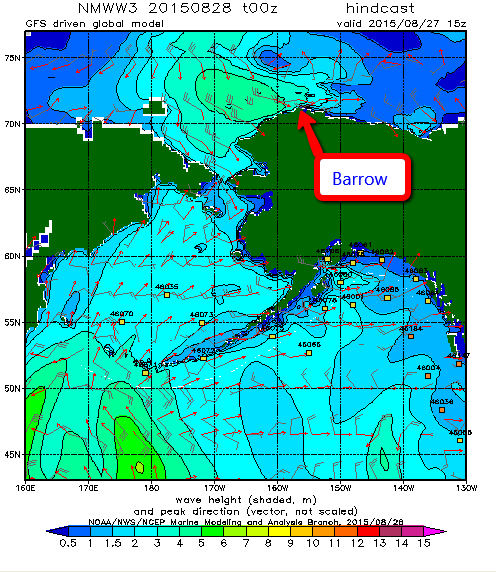
The cause of the flooding that is all too visible is a cyclone that’s been whirling around in the Chukchi Sea for a while, and here is a WaveWatch III “hindcast” of what the resultant winds have created in the way of waves. Firstly the “significant wave height”:
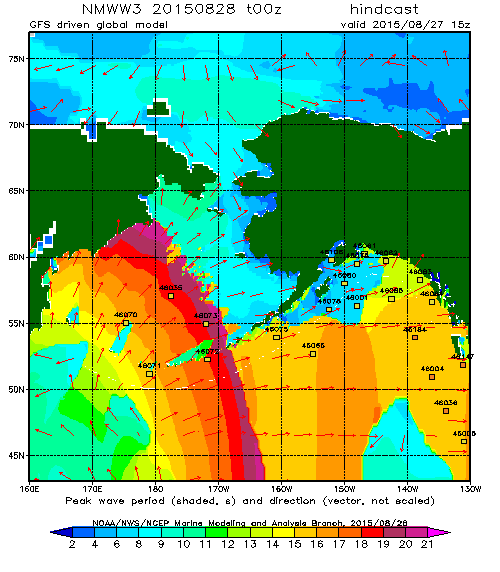
and now the “peak period”:
which reveal a swell 4 to 5 metres high with a period of 10 seconds heading directly towards Barrow Beach. According to the Alaska Dispatch News:
Huge, wind-whipped waves crashed onto the shore at Barrow on Thursday, forcing the closure of a nearby road. Westerly winds were gusting up to 50 miles an hour, pushing waves up to the top of the beach and causing some erosion, the National Weather Service said.
The service has issued a coastal flood warning for Barrow until Friday morning, along with a high surf advisory for the western part of the North Slope and a gale warning for much of the Beaufort and Chukchi Seas.
The big surf and flooding, which has covered a road that runs between the ocean and Barrow’s lagoon, is “not terribly unusual” at this time of the year, said Ryan Metzger, a National Weather Service meteorologist in Fairbanks. Fall is a stormy season, and the timing — right around the annual minimum sea ice extent — allows the surf to build and reach shore.
Photograph by Brittni Driver via Alaska Dispatch News
Just in case it’s not obvious from all the pictures, the respective advisory messages point out that:
A COASTAL FLOOD WARNING MEANS THAT RISING SEA WATER THAT CAUSES FLOODING IS EXPECTED. COASTAL RESIDENTS IN THE WARNED AREA SHOULD BE ALERT FOR RISING WATER…AND TAKE ACTIONS TO PROTECT LIFE AND PROPERTY.
A HIGH SURF ADVISORY MEANS THAT LOCALIZED BEACH EROSION IS EXPECTED. PRECAUTIONS SHOULD BE TAKEN TO PROTECT PROPERTY.
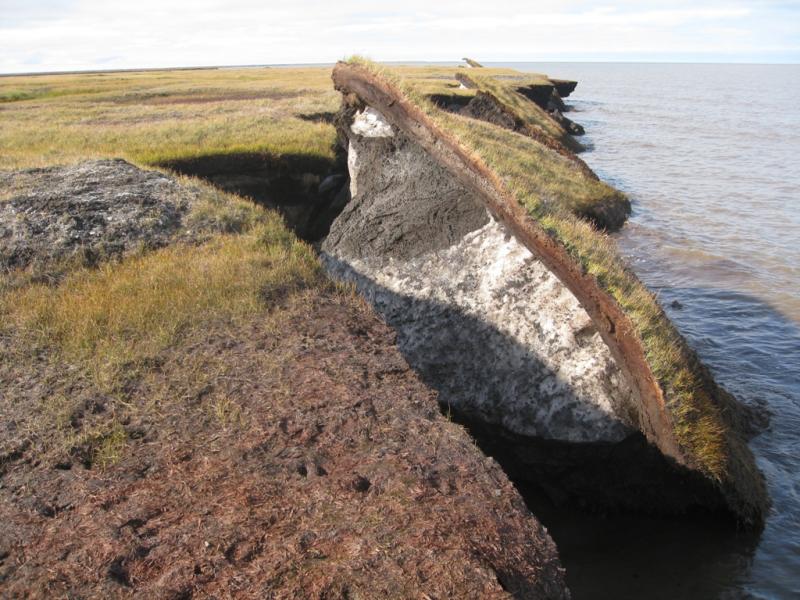
If you’re now wondering what might happen to other areas of the north coast of Alaska in similar circumstances, but with no bulldozer in attendance, here’s an example from Cape Halkett:
Thawing permafrost causes coastline collapse on Alaska’s North Slope, which is no longer kept frozen and protected from fall storms by sea ice—the ice now forms later in the season.
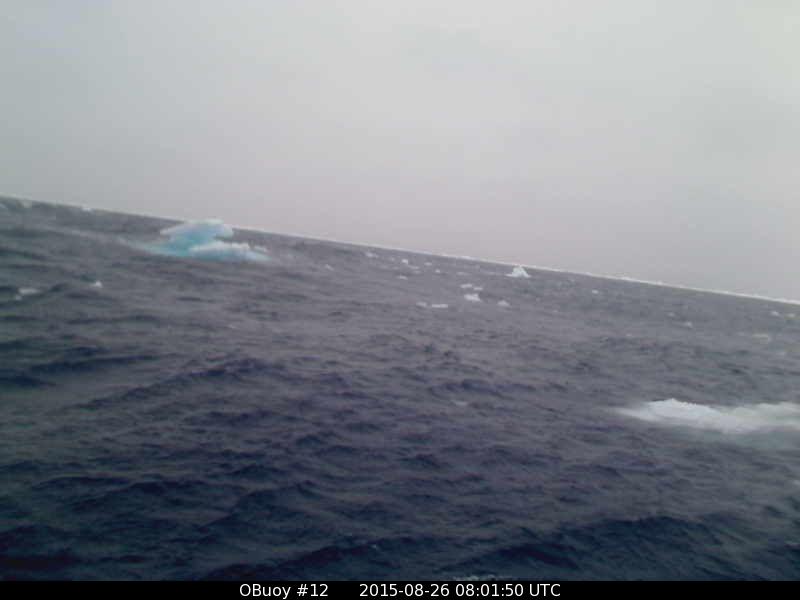
Away from the coast swell from the same cyclone has also been affecting the sea ice north of Barrow, and here’s what a webcam bobbing about on a buoy north of the Chukchi Sea showed as the winds started to build yesterday:
O-Buoy 12 image from August 26th 2015
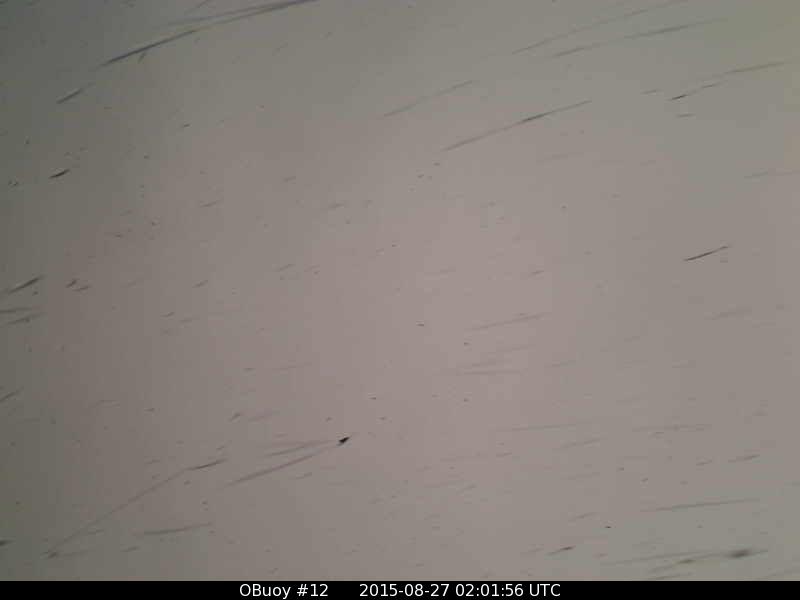
O-Buoy 12 has now tipped over and then ceased transmitting. This is the last picture received, in the early hours of August 27th when the wind speed had reached 13 m/s and the buoy had been moving at over 5 m/s:
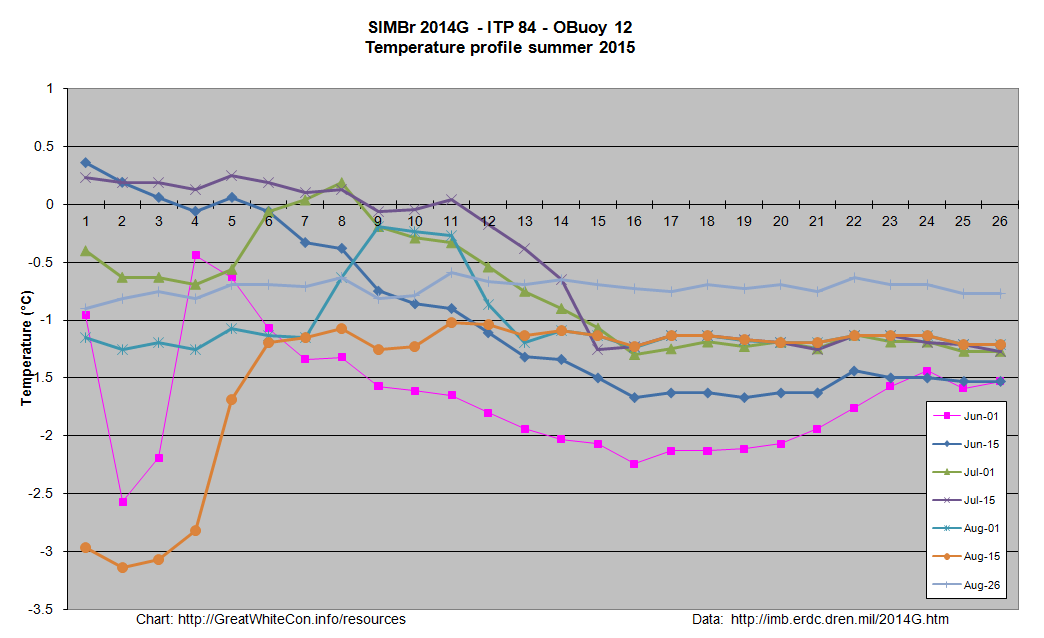
Once upon a time O-Buoy 12 was sat on the same ice floe as ice mass balance buoy 2014G, which has also been free floating for a while. Here’s what it reveals about the temperature of the sea water on August 26th 2015 at 77.56 N, 163.86 W:
Somewhere in the vicinity of -0.7 °C.
[Edit on 30/08/2015]
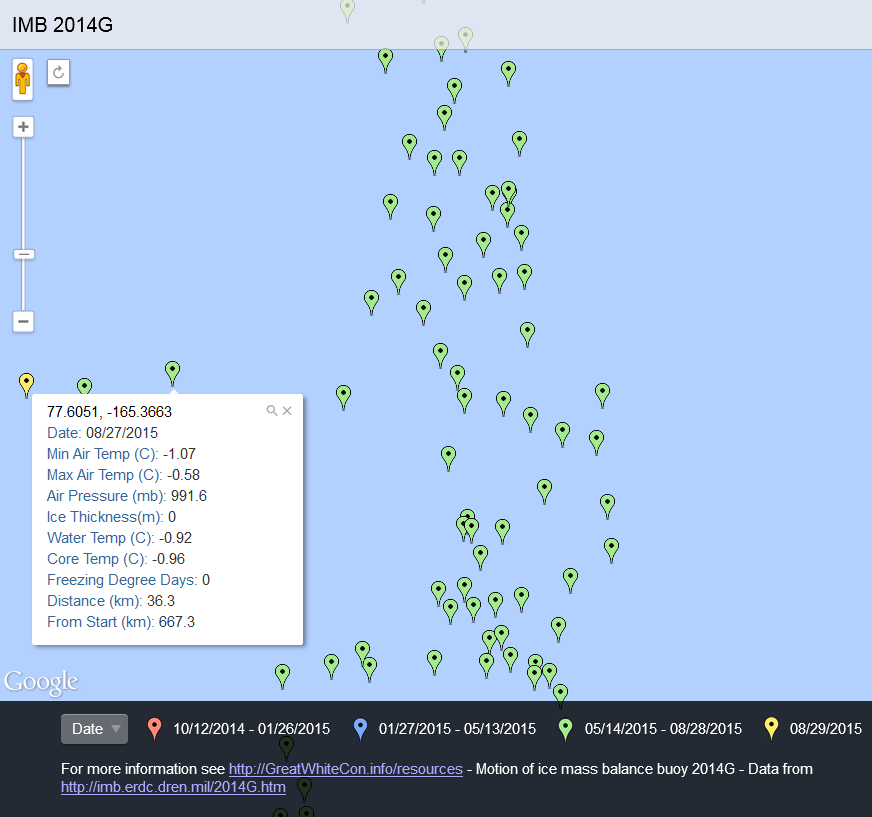
O-Buoy 12 has made no further transmissions, and therefore seems to have succumbed to the storm. In addition IMB buoys 2014F and 2013F stopped transmitting on the 26th and 27th of August respectively. Ice mass balance buoy 2014G has survived however, and reports two successive record daily distances travelled:
25.6 km on August 26th, followed by 36.3 km on the 27th. After a brief dip during the cyclone water temperature is still around -0.7 °C.
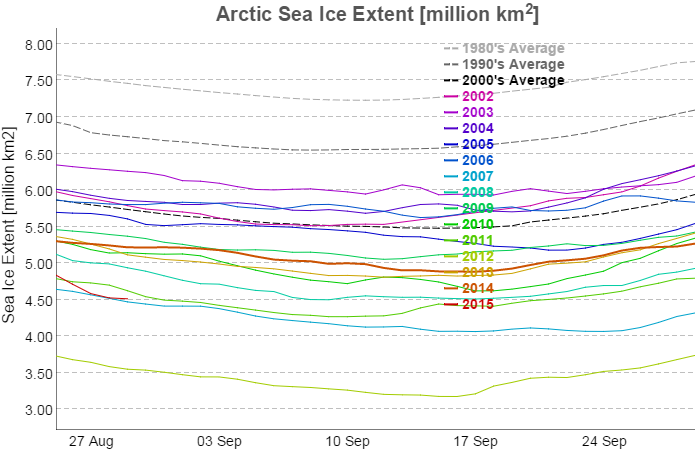
Presumably as a result of the cyclone JAXA Arctic sea ice extent has taken a tumble over the last few days. It has stabilised this morning slightly above 2007 levels:
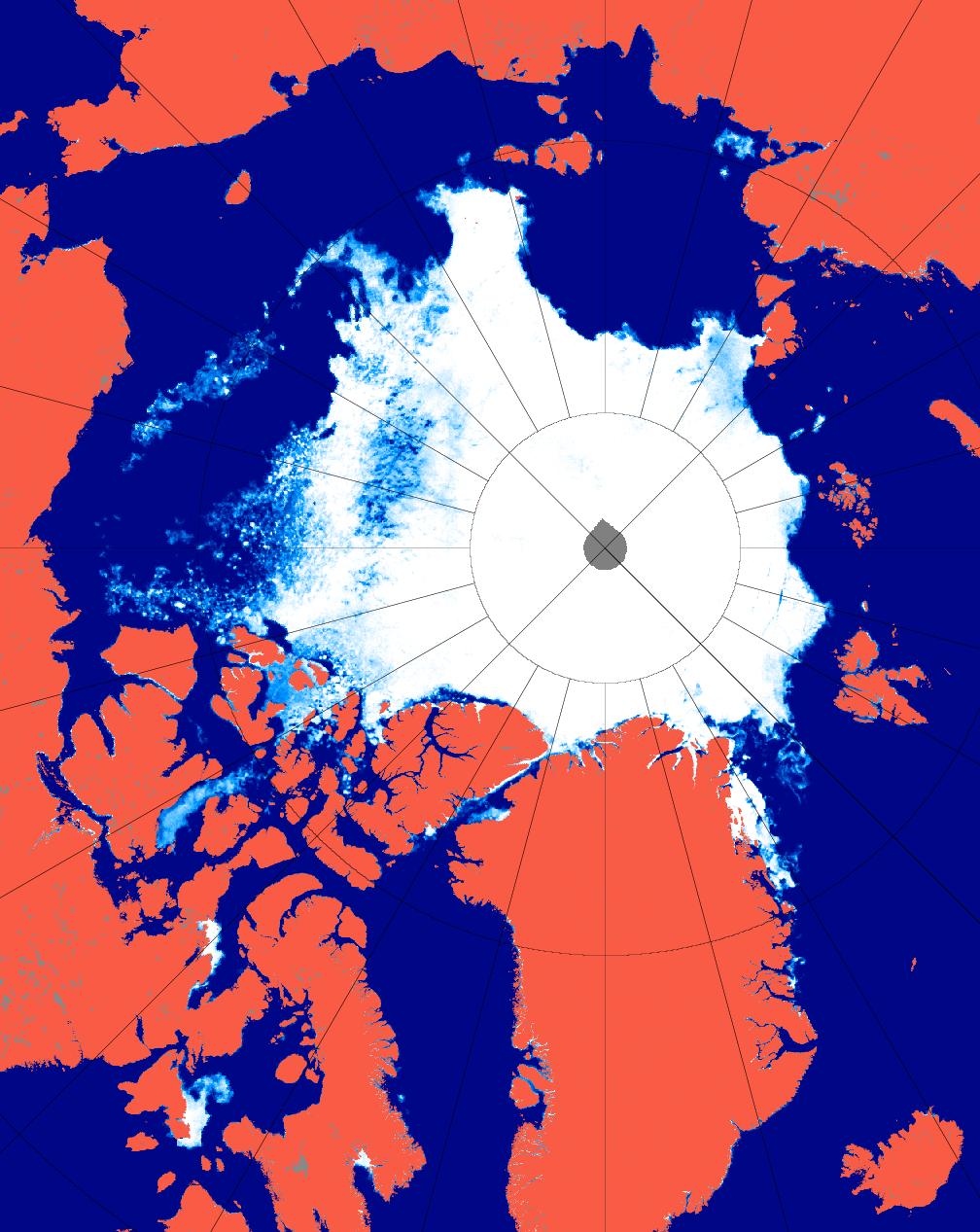
Here is the current AMSR2 Arctic sea ice concentration map from the University of Hamburg, revealing a large potential fetch across the East Siberian, Chukchi and Beaufort Seas should any further cyclones occur in the area over the next few weeks:
AMSR2 Arctic sea ice concentration on August 29th from the University of Hamburg
Hence the conditions now exist for an even more damaging swell to be generated before the 2015 minimum Arctic sea ice extent is reached.
Today we’re going to delve into the application of surf science in the Arctic. If you’re not already familiar with the basics of how the best surf is created then perhaps you might first wish to take a detour to the StormSurf “Wave Basics” article:
Wind waves, though rideable, are not the optimal type of wave one likes to ride. Swells are much better. Wind waves are only the raw material that swells are made from. But, the more energy wind waves accumulate while being driven by wind, the greater the likelihood they will transform into a swell. Enough energy and the swell can travel the entire circumference of the globe with only a slow decay in size!
During a typical open ocean winter storm, one could expect to see winds of 45-55 kts blowing over 600-1000 nautical miles for 36 hours. In such a storm, the average highest wind waves (or ‘seas’) commonly reach 30-35 ft towards the center of the fetch area and produce a swell with a period of 17-20 secs.
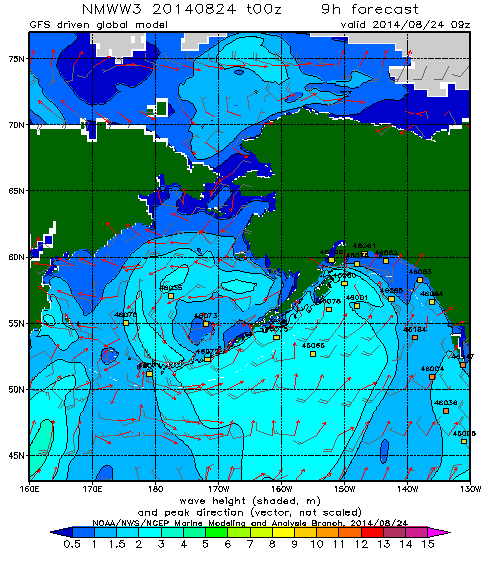
Regular readers may recall that on August 24th 2014 we revealed this WaveWatch III “surf forecast” for the Beaufort Sea, which lies off the north coast of Alaska and the Canadian Northwest Territories (i.e. top center of the map): and noted that the 2 meter waves depicted:
Have blasted past Point Barrow and are currently heading straight for the Beaufort Sea Marginal Ice Zone.
Here’s a video from the University of Washington’s Applied Physics Laboratory which explains that the Marginal Ice Zone is:
The area between declining unbroken sea ice and the expanding area of open water.
The theoretical significance of such swells has been discussed in a number of academic papers recently. Take for example these extracts from “Swell and sea in the emerging Arctic Ocean” by Jim Thomson from the University of Washington and W. Erick Rogers from the US Naval Research Laboratory. Note first of all that the authors distinguish between “wind seas” and “swells” as follows:
Pure wind seas have a wave age less than one, indicating that the wind is driving the waves, and these points cluster largely below the Pierson–Moskowitz limit. Swells have a wave age greater than one, indicating that the waves are outrunning the wind.
They then go on to use some more terms very familiar to the average surfer:
Ocean surface waves (sea and swell) are generated by winds blowing over a distance (fetch) for a duration of time. In the Arctic Ocean, fetch varies seasonally from essentially zero in winter to hundreds of kilometers in recent summers. Using in situ observations of waves in the central Beaufort Sea, combined with a numerical wave model and satellite sea ice observations, we show that wave energy scales with fetch throughout the seasonal ice cycle. Furthermore, we show that the increased open water of 2012 allowed waves to develop beyond pure wind seas and evolve into swells. The swells remain tied to the available fetch, however, because fetch is a proxy for the basin size in which the wave evolution occurs. Thus, both sea and swell depend on the open water fetch in the Arctic, because the swell is regionally driven. This suggests that further reductions in seasonal ice cover in the future will result in larger waves, which in turn provide a mechanism to break up sea ice and accelerate ice retreat.
It is possible that the increased wave activity will be the feedback mechanism which drives the Arctic system toward an ice-free summer. This would be a remarkable departure from historical conditions in the Arctic, with potentially wide-ranging implications for the air-water-ice system and the humans attempting to operate there.
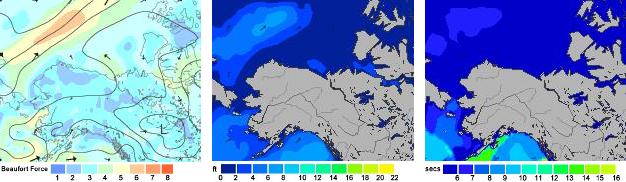
In practice there were several more swells that impacted the Beaufort Sea marginal ice zone over the course of the next couple of weeks. Here’s what the charts looked like, as visualised by MagicSeaweed.com rather than NOAA:
Beaufort Sea on August 27th 2014 – Winds / Wave Height / Wave Period
Beaufort Sea on September 1st 2014 – Winds / Wave Height / Wave Period
Beaufort Sea on September 7th 2014 – Winds / Wave Height / Wave Period
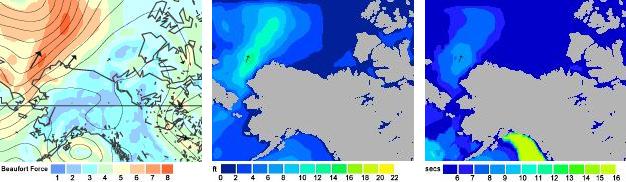
Note that on the right of each set of three is a depiction of the period of the waves in question. As StormSurf points out:
Chop tends to have a period ranging from 3-8 seconds. That is, there is anywhere from 3-8 seconds between each wave crest. Wind waves range from 9-12 seconds. Ground swells range from 13-15 seconds, and strong ground swells have a period anywhere from 16-25 or more seconds.
Thus the final swell on September 7th was actually the best of the bunch, with a small area of waves over 10 feet in height and with a period of over 9 seconds. According to StormSurf those are merely “wind waves” and not yet a full blown “swell”. To give you a feel for such waves here’s what some “wind waves” hitting the beach at Barrow looked like on September 4th 2014:
Next here’s another video that reveals what effect those series of waves had on the sea ice in the Beaufort Sea:
For future reference here also is the same swell described by Thomson and Rogers, but illustrated in an identical “surfer friendly” format to the 2014 swells we’ve been looking at:
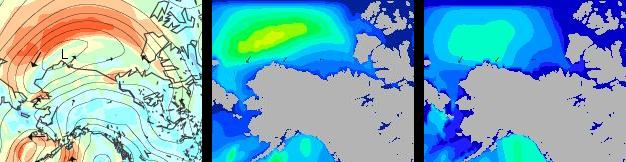
Beaufort Sea on September 18th 2012 – Winds / Wave Height / Wave Period
whilst here is the swell produced by the “Great Arctic Cyclone” of early August 2012, also mentioned in passing by Thomson and Rogers:
Beaufort Sea on August 5th 2012 – Winds / Wave Height / Wave Period
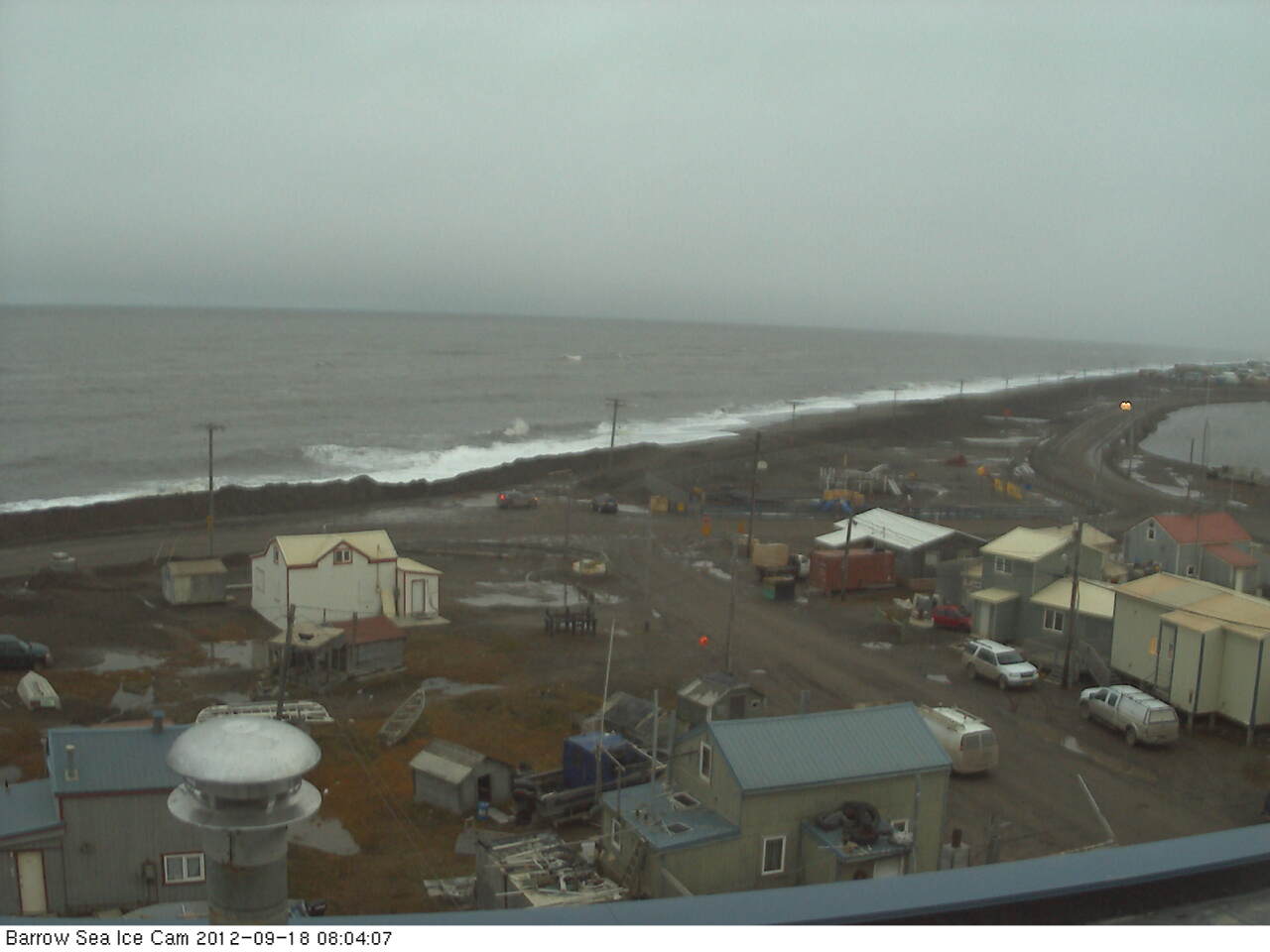
As you can see, if you’re a surfer used to tracking swells across the world’s oceans at least, whilst the September 2012 swell was indeed rather more substantial than those we have looked at in 2014, with a height in excess of 20 feet, the period was too short to qualify as a full blown swell and it was in fact directed away from the ice edge rather than towards it. Here’s what that 2012 swell looked like once it reached Barrow:
All of which does rather make one wonder what might happen if a slightly longer period swell directed at the ice edge in the Beaufort Sea were to occur at some point in the not too distant future? Whilst we all wait with bated breath to discover what that future holds for the sea ice in the Arctic, not to mention the beach at Barrow, here’s another video about the 2014 Marginal Ice Zone Program, which summarises the year’s campaign as a whole:
Note that Craig Lee says that:
We had very little wave activity. It was surprisingly calm when we were out there in the Araon, both when we were in the ice and in the open water. There just wasn’t much wind, and so there weren’t very many surface waves.
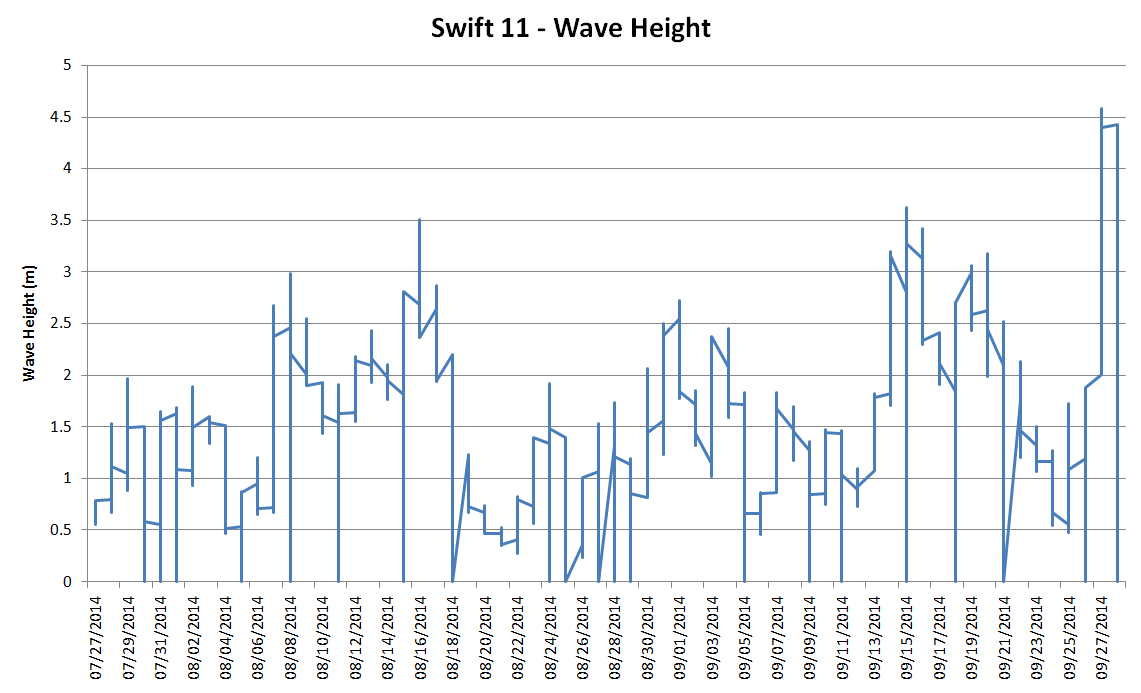
However at least one of the “robots” he refers to did discover some significant wave activity. Here’s a visualisation of SWIFT 11‘s record of significant wave height as it floated across the Beaufort Sea in the summer of 2014:
I don’t know about you, but I don’t think I would describe 4.5 meter waves as “surprisingly calm”, especially in the Arctic!
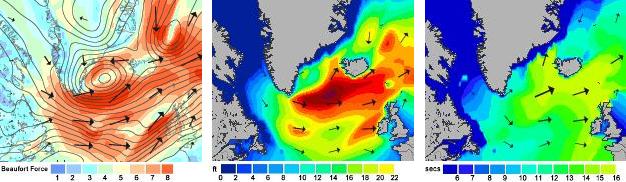
A week after our first equipment evaluation expedition for our 2015 Arctic Basin Big Wave Surfing Contest the signs were looking good once again, albeit with a southwesterly wind once again. Here’s how our compact format surf forecast looked for noon on March 7th, courtesy of some copying and pasting from Magic Seaweed’s global surf outlook:
The North Atlantic surf forecast for March 7th 2015. Winds / Wave Height / Wave Period
You’ll no doubt note that the swell height out in mid Atlantic was off the top of the truncated scale. That’s because it’s designed for use in the Arctic Basin, where 40 foot waves are very hard to come by! Take a look at the last link below to see what I mean.
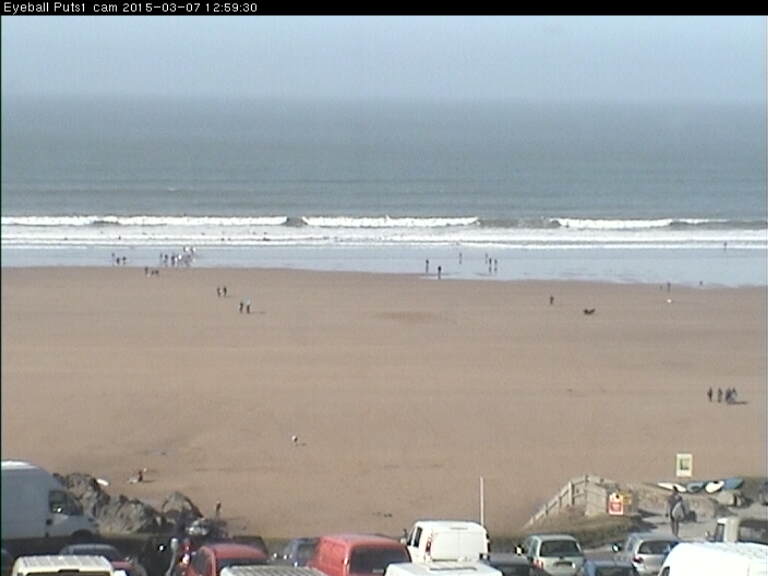
Given the wind the shelter of Putsborough was the order of the day when it came to spot selection. Water temperatures hadn’t changed significantly in a week, but the sun was shining on this occasion, which is undoubtedly preferable to the rain we experienced last time:
Donning the same gear as last time even my fingers didn’t feel cold this time around, although my partner for the day (encased in a standard winter wet suit plus separate hood) described conditions as “f…. cold!” even after warming up thoroughly, as you can see here:
Eat your heart out Anastasia Ashley! After the session considerably more energy was expended by the two of us extracting yours truly from his Tiki Prodigy 6/5/4 suit. After that I started chatting to Simon, who happened to be parked next to us in the car park at Putsborough Sands, as dusk started to descend. Here’s what happened next:
Towards the end of our conversation I explained the rationale behind our Arctic Basin big wave surfing contest, and briefly touched on some of the associated Arctic surf science. For the scientifically inclined amongst you, there’s a much longer explanation available in this companion article!
Great White Con fantasy big wave team rider Andrew Cotton was interviewed on BBC Radio Devon last week by none other than Simon Bates! Cotty was on a trip to Hawaii at the time and pointed out to Simon that:
The thing with surf… is it’s the tides, the waves, the wind. The surf tells you when to surf. It’s not around chores or work, you have to have surf that looks good.
As luck would have it all that came together for North Devon surfers at Putsborough Sands on Saturday. Things looked promising to us a couple of days beforehand, and plans were hatched on Twitter for our first equipment evaluation expedition of 2015:
We took the heaven sent opportunity to test out our thickest winter wetsuit in the following conditions:
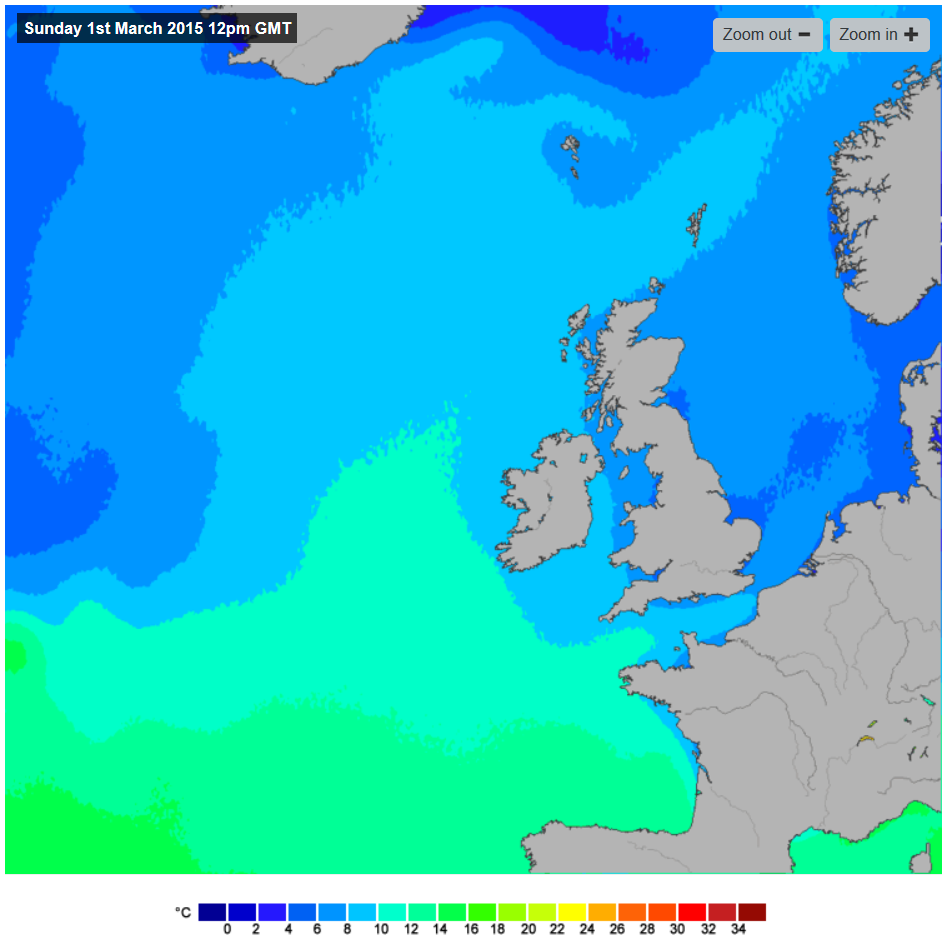
According to Magic Seaweed sea surface temperatures are currently around 8 °C off the coast of North Devon, and it doesn’t get much colder than that in this neck of the woods, which may have had something to do with at least one “no show” on Saturday. Simon had “volunteered” Richard Green for a “cold and dangerous” surf trip:
but Richard had a good excuse for being unable to make it since he was broadcasting on Radio Devon, and chatting to Pete Waterman amongst other things, that afternoon. We did invite Simon Bates along too, but it seems he had a previous engagement in London:
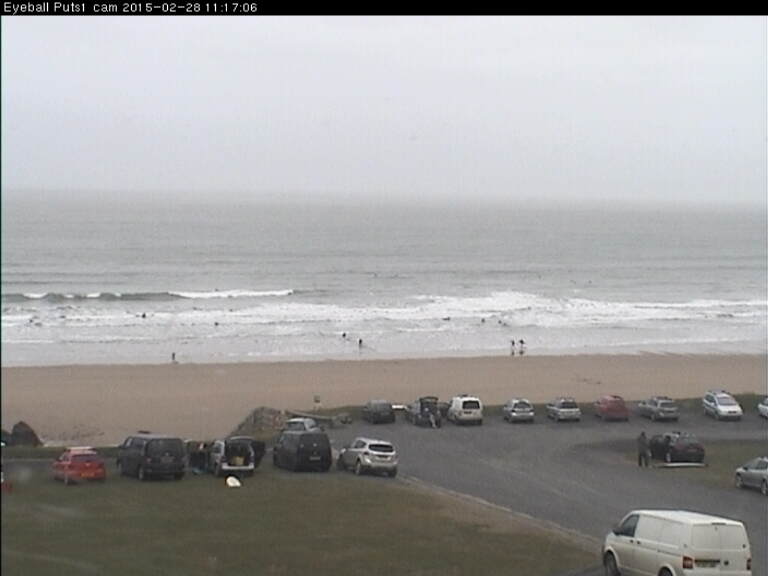
Prior to setting off for the north coast I got in touch with Trev Lumley, who is the proprietor of the Eyeball Surfcheck web site where we had discovered this enticing looking image on the Putsborough surfcam earlier that morning:
Trev told me he would be elsewhere by the time we arrived at “Spot P”, so I quickly tested out my little quiz for the day on him. He claimed never to have heard of Richard Green, whilst Simon Bates did ring a bell and the name Andrew Cotton was very familiar. When I explained the reason for my call Trev told me that he had actually heard Andrew being interviewed by Simon on BBC Radio Devon a few days previously. When pressed to decide who amongst the three names I had mentioned was most famous Trev told me that as far as he was concerned Cotty was the man, since he had known him since he was a boy. However Trev thought that Simon’s name would probably be more familiar to the average Devonian.
When we eventually arrived at the car park above the beach some heavy showers had already set in. However before plunging into the chilly North Atlantic, I took advantage of a break between the downpours and wandered around the car park at Putsborough with a cameraman in tow to discover the reaction of some of the locals to my TikiProdigy 6/5/4 suit, whilst also killing two birds with one stone by doing some research into the nature of fame and celebrity in the 21st century. Here’s my first interview, with a local lifeguard:
As you can see, our first interviewee thought the Tiki Prodigy “Looks warm”, which was comforting in all the circumstances. In addition out of our list of six celebrities Andrew Cotton was overwhelmingly the most famous. DJs Simon Bates and Richard Green, and journalists Andrew Neil, Christopher Booker and David Rose failed to achieve even the merest flicker of recognition.
More videos are on the way, but are currently still stuck in the editing suite here in the basement of the Great White Con Ivory Towers. In the meantime here are my own findings after a couple of hours at sea on my yellow sponge performing our first Arctic equipment evaluation test:
Apart from my Prodigy I was also wearing Tiki 5mm socks and 2mm bodyboarding gloves. I suffered none of the “brain freeze” reported by my even more intrepid companion, who entered the water hoodless beside me:
Because I didn’t want to lose my contact lenses I did very little duck diving. On only one occasion did I experience the thrill of cold water flushing down my back. My fingers started to feel a bit chilly as I was bobbing about out the back after my initial paddle out, but once I got into the swing of things even they were toasty for the duration. Whilst I do wonder if Tiki could be persuaded to produce some thicker gloves with webs between the fingers, my biggest problem proved to be extracting myself from my soggy suit in the pouring rain that had set in by the time I arrived back in the car park as the light was fading. To give you an idea of the problem I faced here is Andrew Cotton explaining the virtues of the chest zip version of the Zepha, which has replaced the Prodigy in Tiki’s range of cold water winter wetsuits:
As part of the build up to the 2015 Great White Con Arctic Basin Big Wave (Fantasy?) Surfing Contest (GWCABBWFSC for short) we’ve been researching previous Arctic Basin water sports events. You can only imagine our shock and delight when we discovered deep in the depths of the NSIDC’s “Top Secret” archives some never before seen video footage of the USS Skate surfacing “near the North Pole” in the summer of 1958. Even more astonishing than that was the moving pictures of Norbert Untersteiner being towed at high speed behind a powered water craft in the very same lead that SSN-578 had used to reach fresh air and sunshine. Firstly feast your eyes on this:
Now take a look at how 21st century big wave surfers tow into the waves created by calving glaciers:
This website uses cookies to improve your experience. We'll assume you're ok with this, but you can opt-out if you wish. Cookie settingsACCEPT
Privacy & Cookies Policy
Privacy Overview
This website uses cookies to improve your experience while you navigate through the website. Out of these, the cookies that are categorized as necessary are stored on your browser as they are essential for the working of basic functionalities of the website. We also use third-party cookies that help us analyze and understand how you use this website. These cookies will be stored in your browser only with your consent. You also have the option to opt-out of these cookies. But opting out of some of these cookies may affect your browsing experience.
Necessary cookies are absolutely essential for the website to function properly. This category only includes cookies that ensures basic functionalities and security features of the website. These cookies do not store any personal information.
Any cookies that may not be particularly necessary for the website to function and is used specifically to collect user personal data via analytics, ads, other embedded contents are termed as non-necessary cookies. It is mandatory to procure user consent prior to running these cookies on your website.