Tag Archives: AMSR2

More Arctic BS From Tony Heller

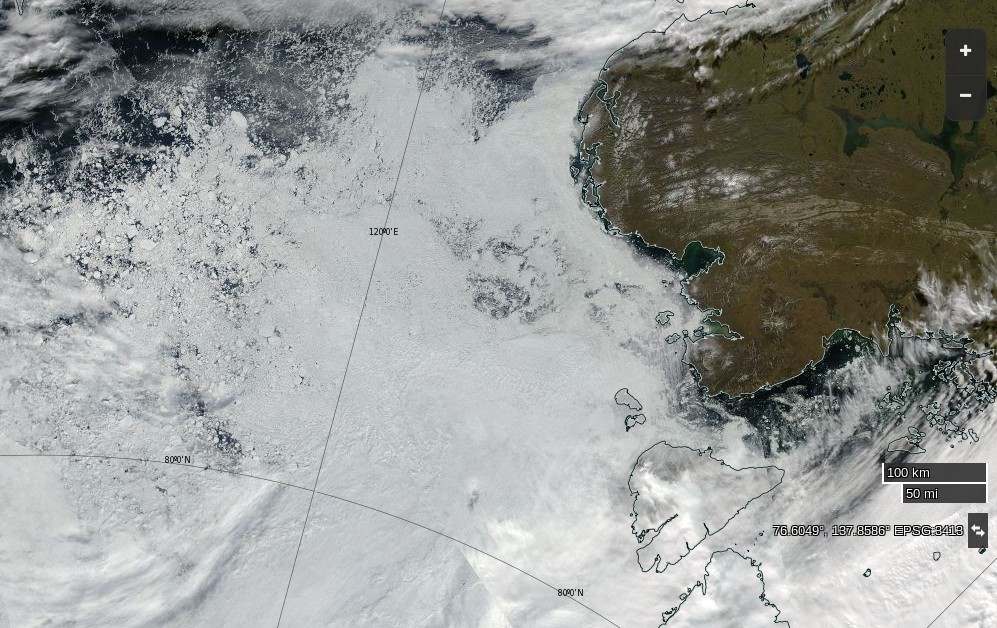
Please forgive my mixing of metaphors this morning, but the interminable stream of piss poor propaganda from Tony Heller grows ever more voluminous. Not only has he reprised his “DMIGate” nonsense but he is also posting pictures of the wrong bit of the Arctic yet again. Exhibit A:

DMI shows Arctic sea ice extent well below last year, and near a record low.

unReal-DMI-20170728

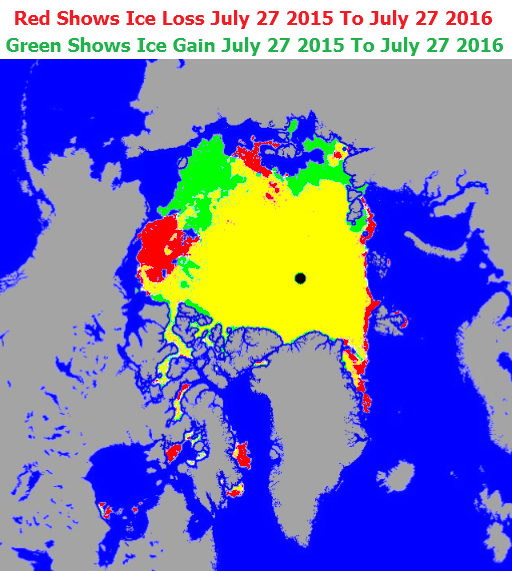
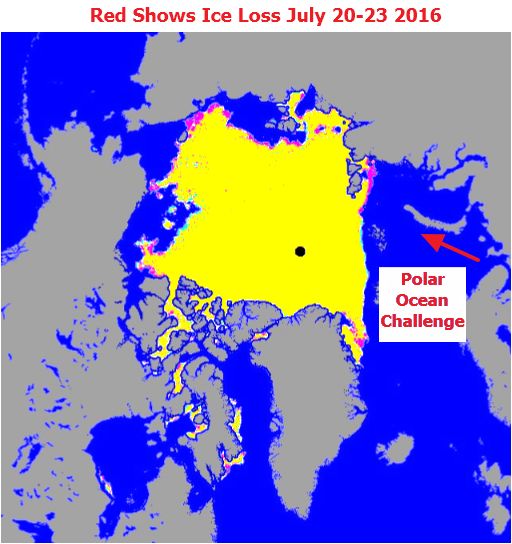
In fact, there is more ice than last year, and it likely that 2016 will end considerably higher than last year. This is because the big red spot (below) in the Beaufort Sea disappeared in a storm during the second week of August last year.

unReal-DMI-Delta-20170728

The forecast is for very cold air over the Beaufort Sea the next two weeks, so it is unlikely that a lot of melting is going to occur there. This is shaping up to be a disastrous year for Arctic alarmists, and it will be interesting to see how the graphs progress, and if and when they catch up with reality.

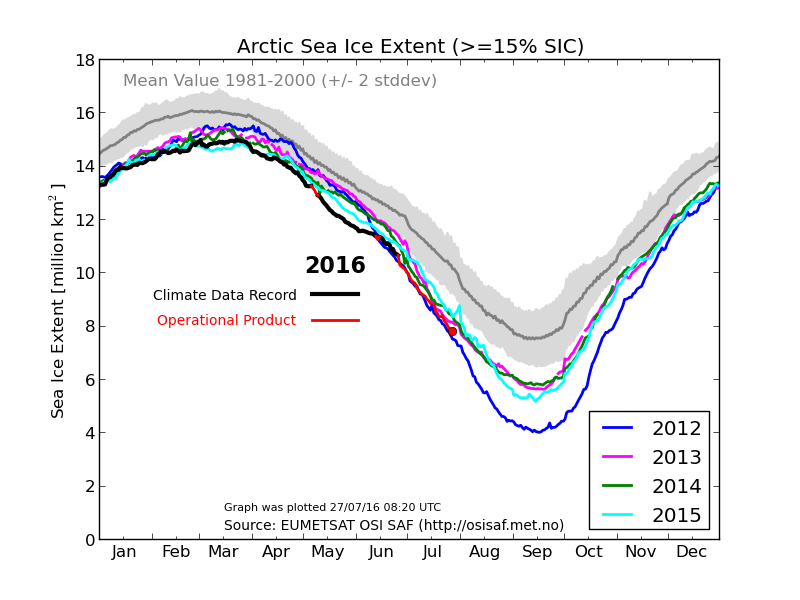
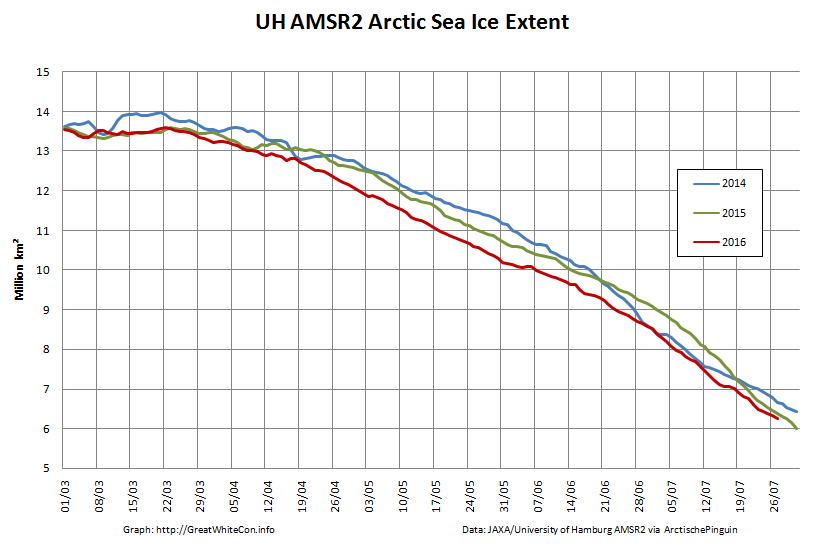
DMI aren’t the only ones that “show Arctic sea ice extent well below last year”:

UH-Arctic-Extent-2016-07-27

and Tony still wouldn’t recognise a higher resolution coastal mask if it bit him in the backside.

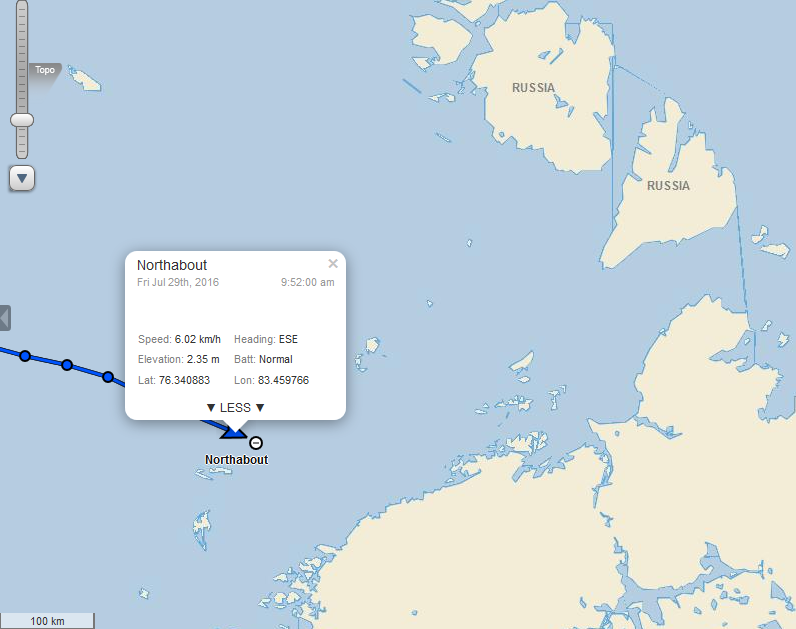
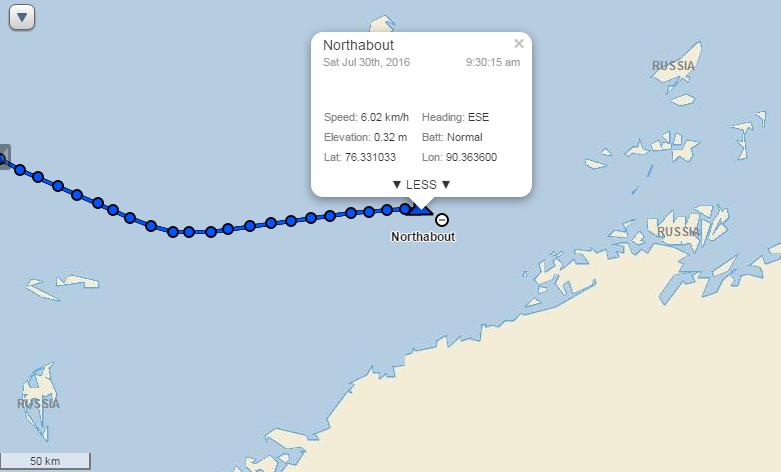
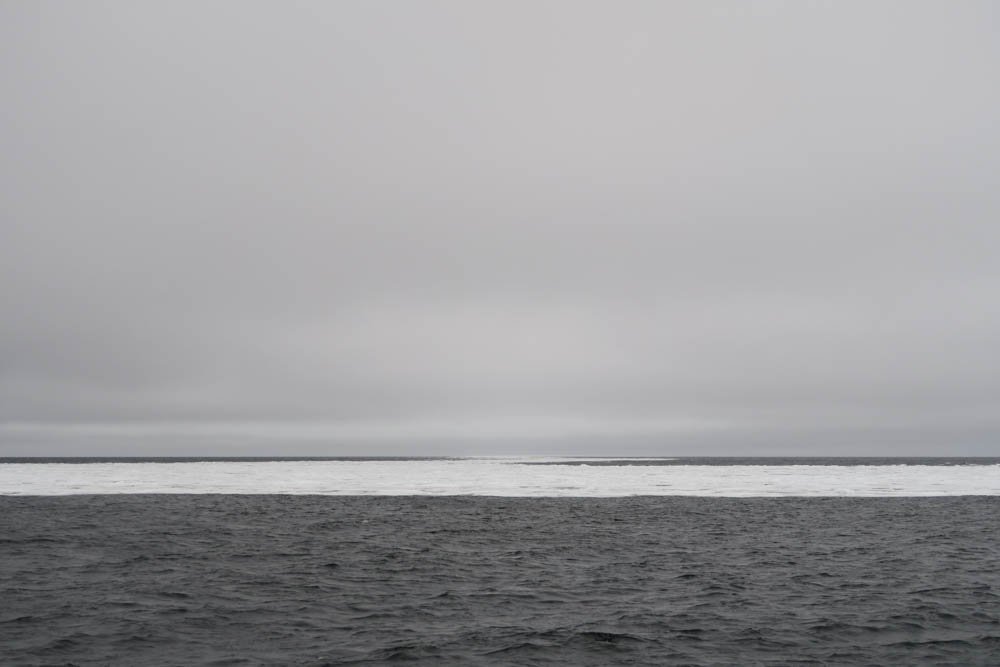
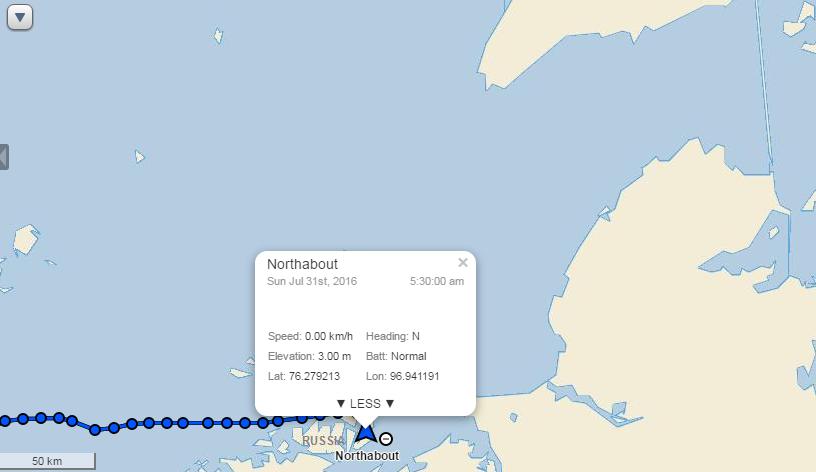
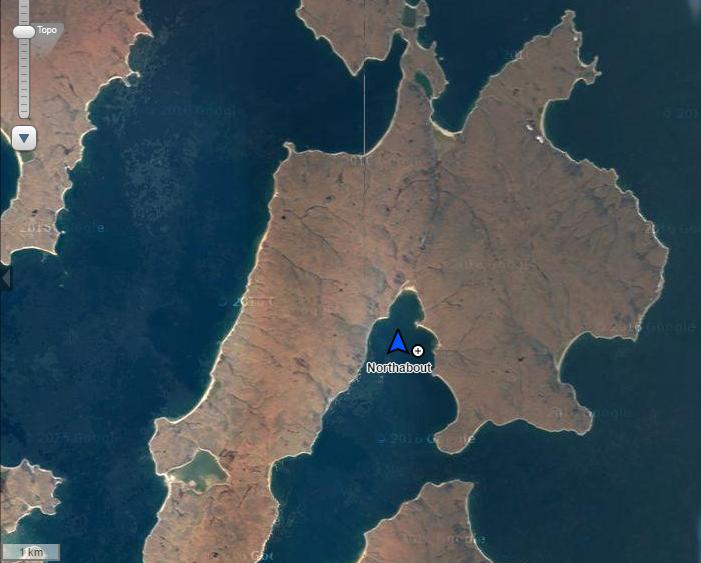
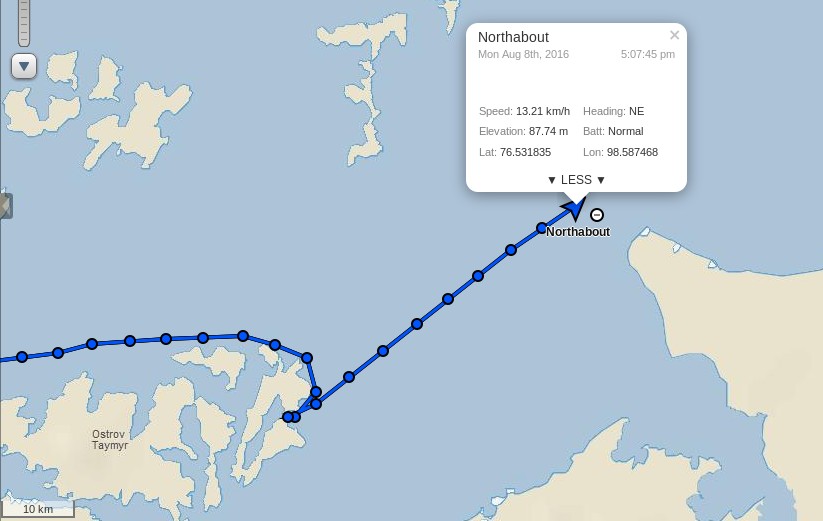
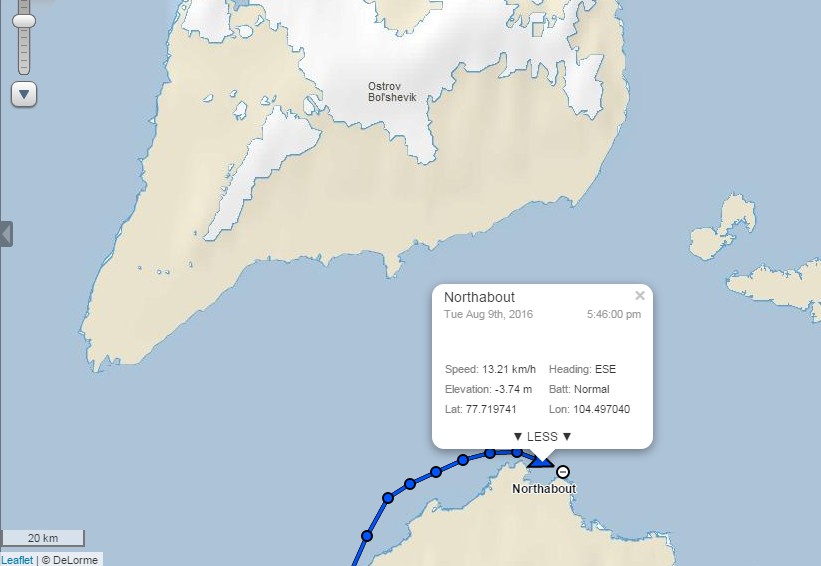
Moving on to Exhibit B, Tony still has it in for the valiant Polar Ocean Challenge team in brave little Northabout, who he claims are “Not Going Anywhere“:

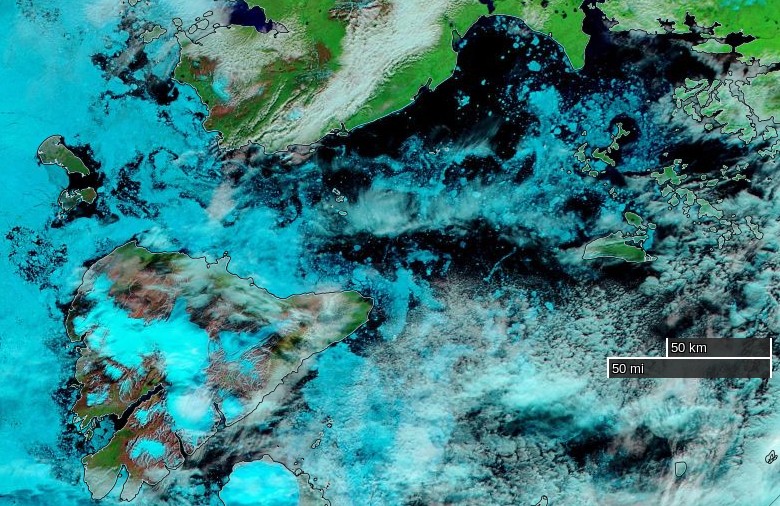
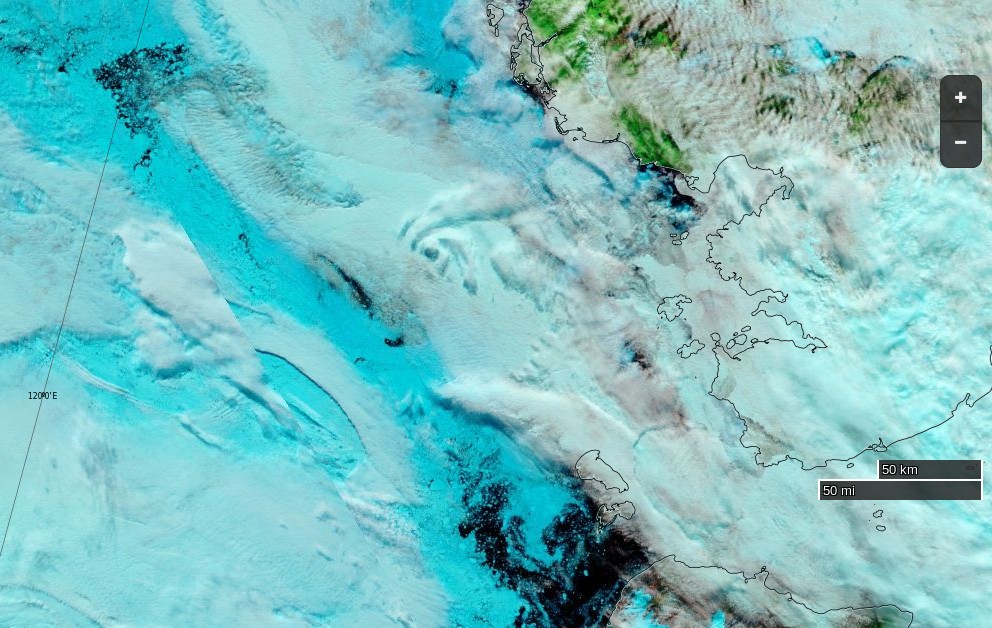
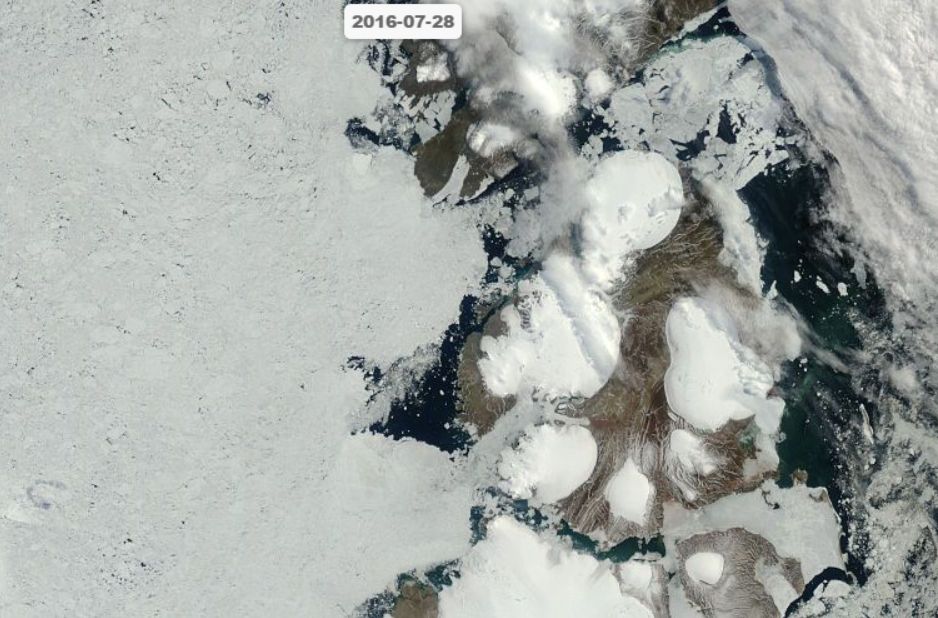
The clouds over the Northeast Passage have finally cleared, and you can now see what our intrepid explorers are up against. Hundreds of miles of solid pack ice.

unReal-Vilkitsky-20170728

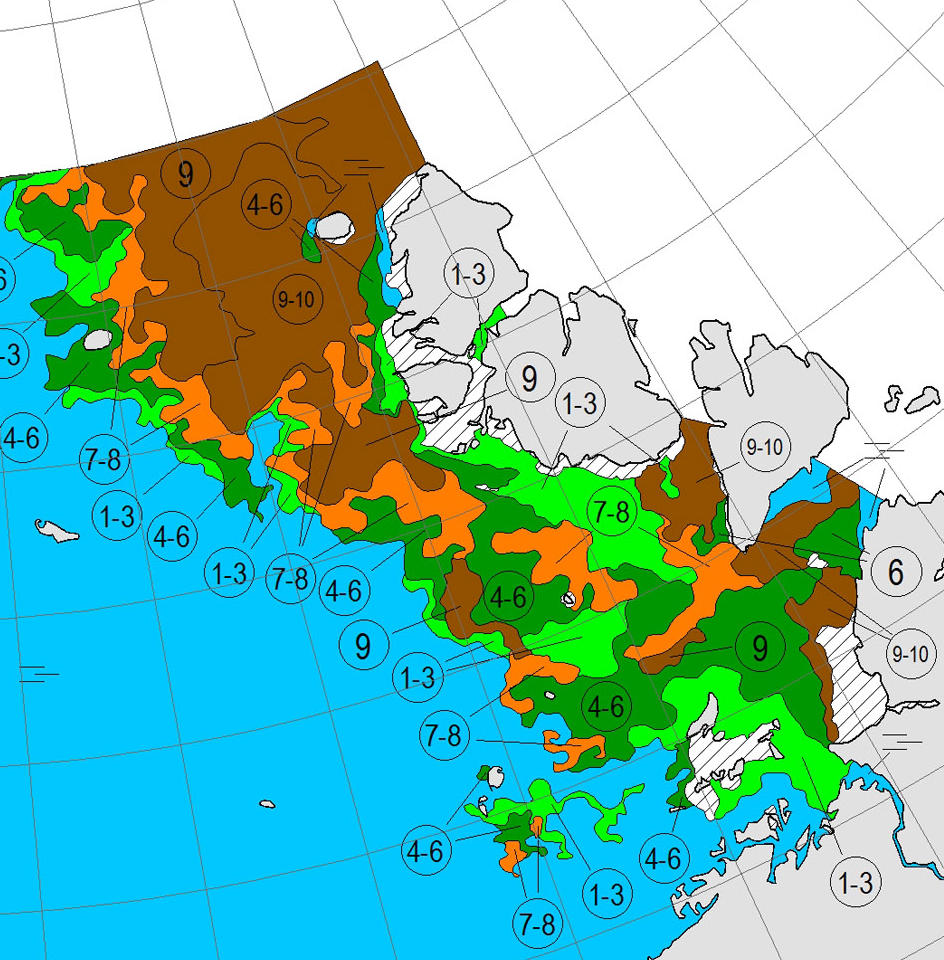
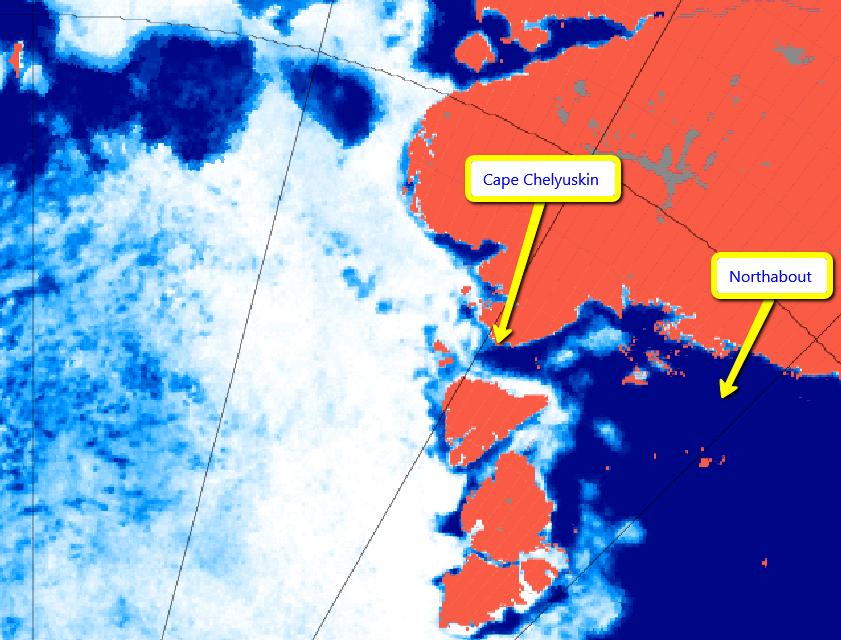
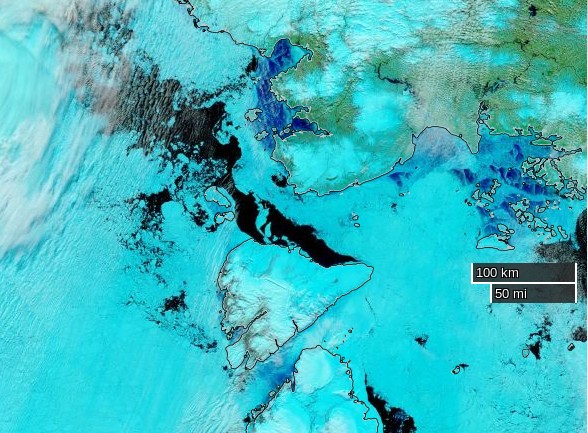
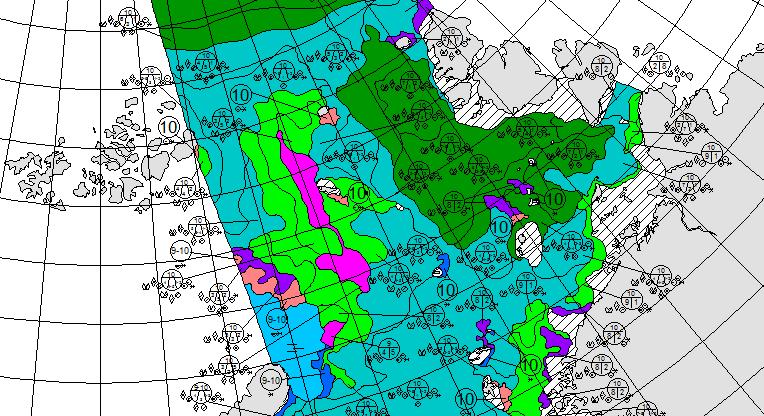
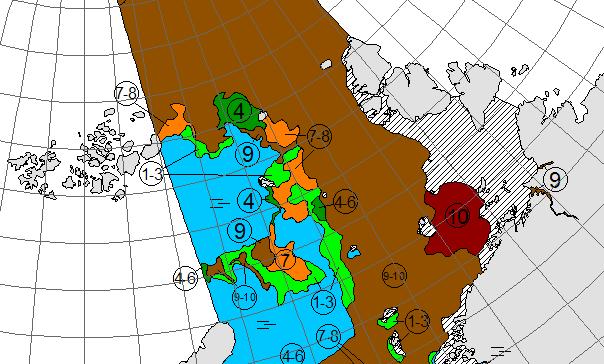
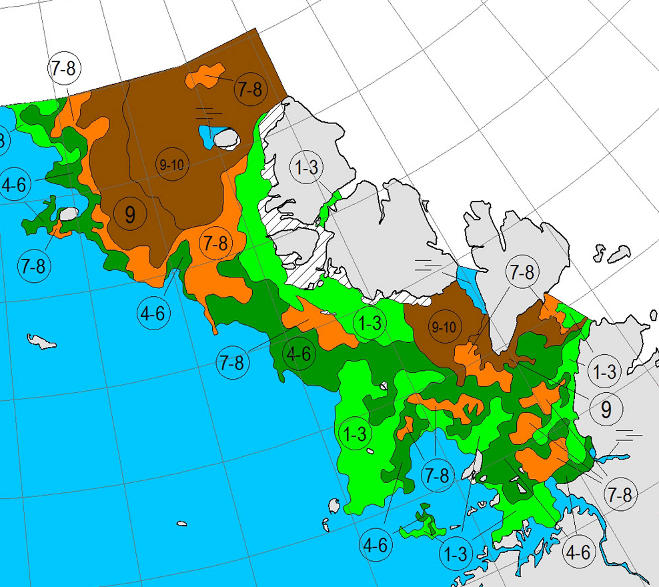
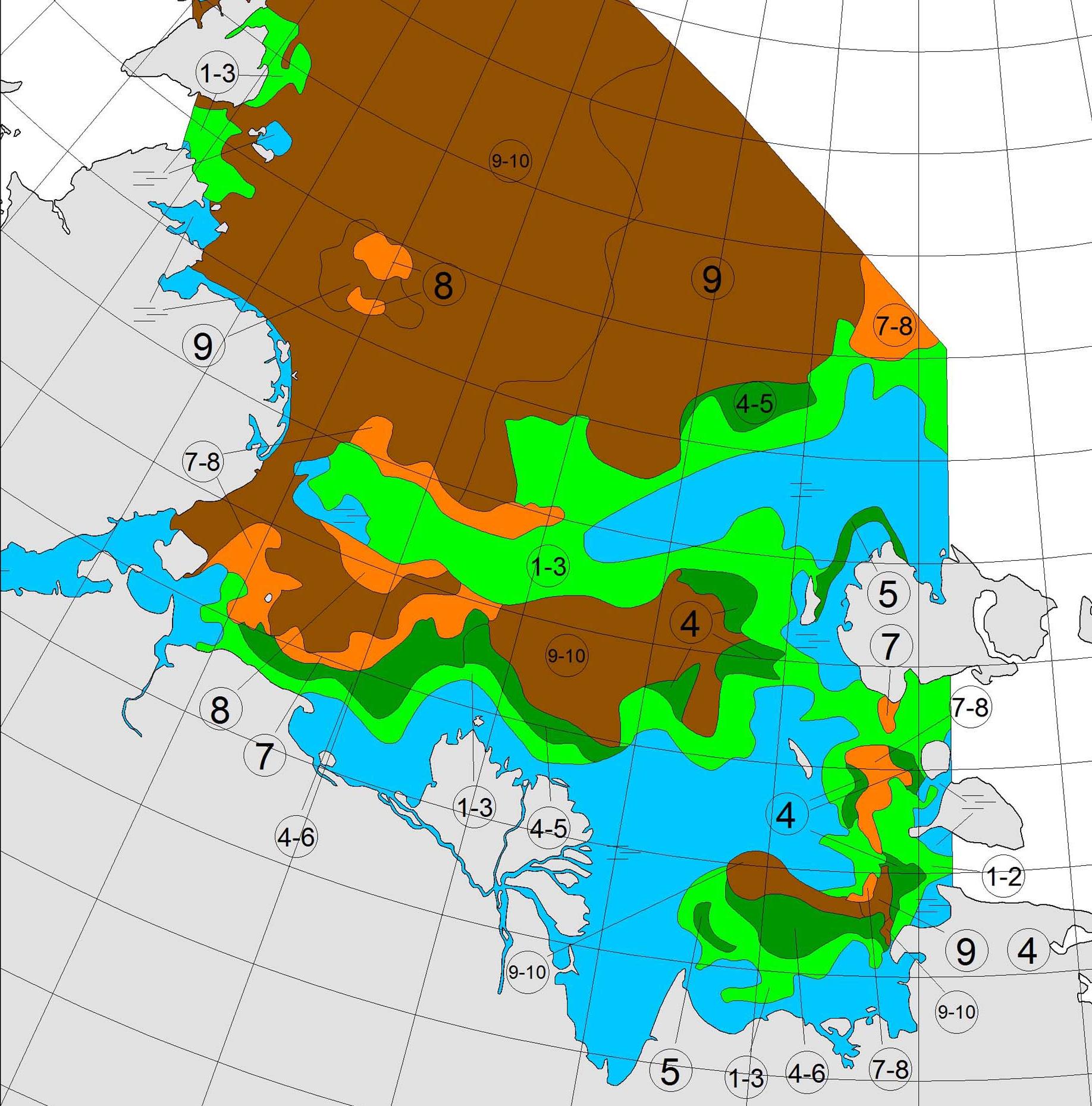
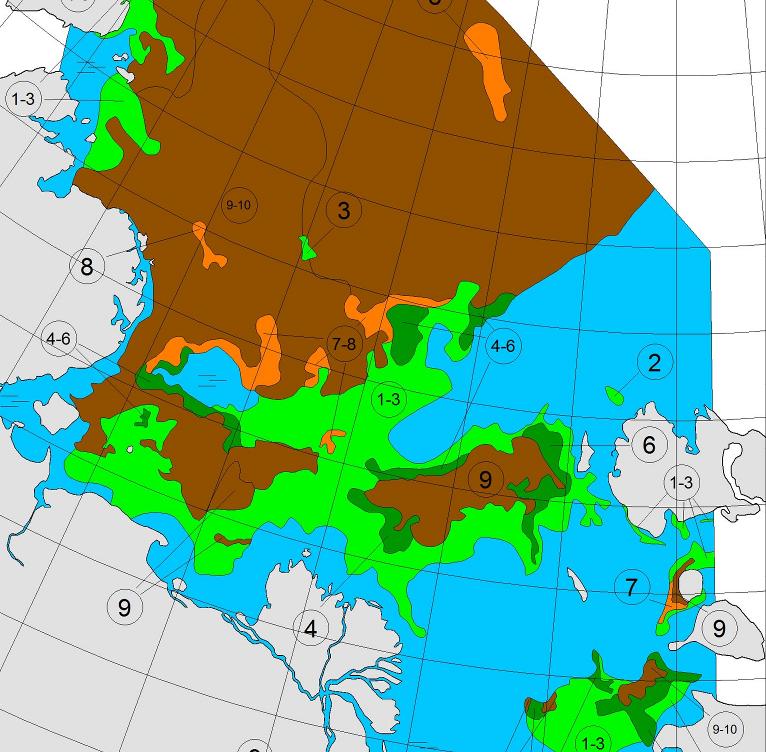
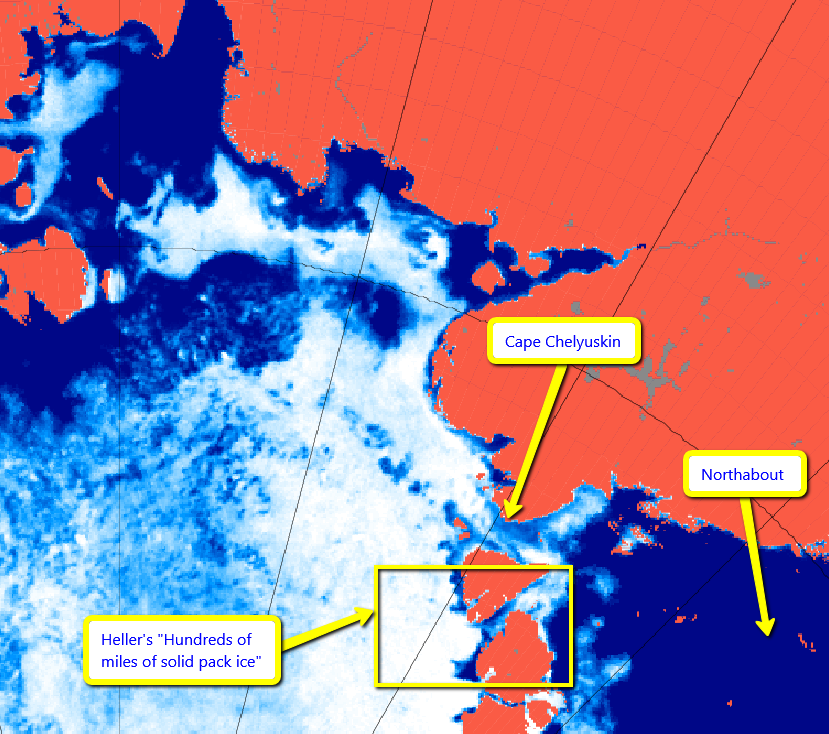
I pointed out the error of his ways to him yesterday, but for some strange reason Tony is still posting pictures of the wrong place. Here is an overview of the actual facts, as assessed by AMSR2:

Laptev-Kara-AMSR2-2016-07-29

Is the Polar Ocean Challenge About to End in Disaster?

It is if you believe Tony Heller, which I humbly suggest is not a particularly wise course of action at the best of times. In his umpteenth article on Northabout’s Great Adventure over the last four days he dares to take your humble scribe’s name in vain as he loudly proclaims:

Jim Hunt Egging The Ship Of Fools On To Disaster

I cannot help but think that sorting the wheat from the unReal Scientific chaff will be required as the “debate” proceeds, and so:

Them

Jim Hunt (and Blowtorch Reggie) are egging the ship of fools on to disaster, telling them that the ice is receding. And the intrepid fools are listening to them.

It has been persistently cloudy in the Northeast Passage, and the ice is not melting.

[Cloudy image redacted]

The ice edge has pushed back slightly due to winds.

unReal-Delta-20160723

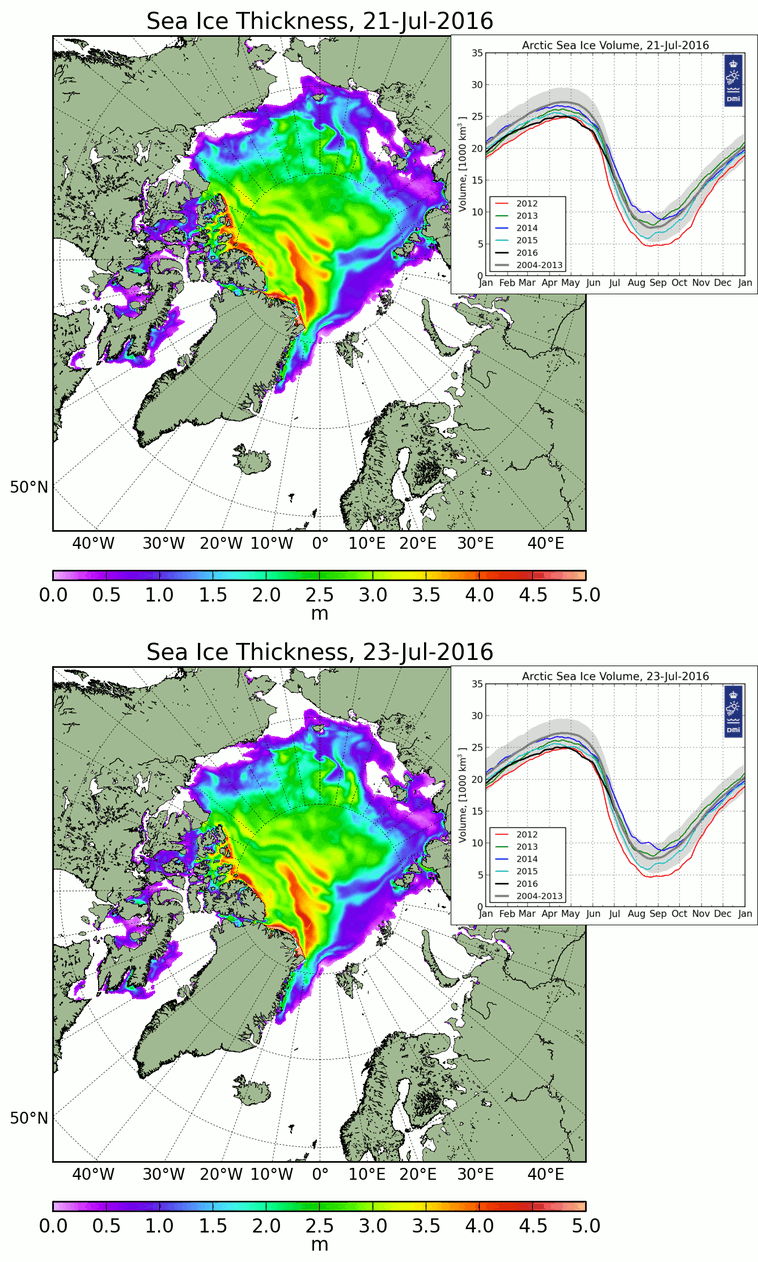
The animation below shows how the wind has shifted the ice over the last couple of days, and how the route is blocked with hundreds of miles of 1-2 meter thick ice.

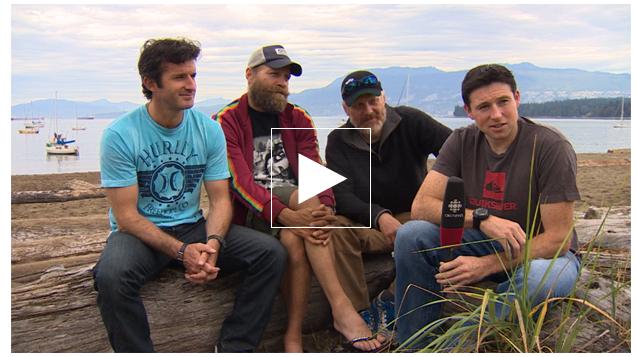
Reggie also egged the 2013 Arctic rowers on to near disaster, before they had to abandon their boat.

Sea ice, winds end rowers’ Northwest Passage bid early – British Columbia – CBC News

2016-07-24_CBC_ArcticJoule

Not too surprising that Jim Hunt’s web site is titled “GreatWhiteCon”

Us

Thanks for the heads up on Twitter Tony. However for some strange reason I seem to be unable to post a witty riposte 🙁

2016-07-24_1409_Toto

I explained about the winds to all and sundry two days ago. In case you missed it see:

https://greatWhiteCon.info/2016/07/northabouts-great-adventure/#Jul-22

Now please explain to me precisely how “Snow White” is “egging on” anybody by posting the satellite visualisation that you have kindly reproduced above?

It does after all reveal that the ice edge at the Kara Sea end of the Vilkitsky Strait has recently receded, as predicted.

Them

They aren’t going anywhere without an icebreaker. Why are you giving them false hope?

Us

I’m not “giving them false hope”. I’m reporting on some interesting (IMHO) Arctic facts, as per usual. In this instance it seems a few other people find them interesting also.

It seems we’re all agreed that “The ice edge has pushed back slightly due to winds” since your map above shows that too, albeit with reduced resolution?

FYI “Snow White” is sobbing uncontrollably into her snow white hanky as we speak. She’s still blocked by “Steve Goddard”

Them

I don’t think you are blocked any more.

Us

Us Again

My “cowardly cross dressing” alter ego is definitely still blocked Tony.

Whilst we’re on the subject, I thought you were of the view that those who block polite enquirers on Twitter are “probably attempting to pull off a Michael Mann sized fraud on the public.”?

http://realclimatescience.com/2016/07/arctic-fraud-in-the-works/

Have I inadvertently misunderstood your point?

Us Again

Another day has dawned and still no answer, so at the risk of repeating myself:

Please explain to me precisely how “Snow White” is “egging on” anybody by posting the satellite visualisation that you have kindly reproduced above?

Perhaps you prefer the wording of today’s update?

Apart from another AMSR2 image there’s a nice little video of dolphins playing around in the sea ice free Barents Sea!

Us Again

Another day has dawned, and still no answer.

At least the crew of “The Ship of Fools” appreciate “Snow White’s” cool humour:

Us Again

The sun is going down (UTC), and still no answer. At the risk of repeating myself, repeating myself:

“Please explain to me precisely how “Snow White” is “egging on” anybody by posting the satellite visualisation that you have kindly reproduced above?”

Or in today’s update for that matter.

Us Again

Another day has dawned, and still no answer.

To summarise the “Real Science” Arctic article template:

1) Write a snappy (if inaccurate) headline

2) Under that put one or more images which have little or no bearing on the headline

3) Under the image(s) put some text that also has little or no bearing on the headline

4) When called upon to justify 1-3 say nothing whatsoever of substance

5) Not too surprising that Jim Hunt’s web site is titled “GreatWhiteCon”?

Them

“Steve” remains strangely silent, but my old mate AndyG cannot resist the temptation to chip in with:

YAWN

What a pointless , worthless post.

Sort of like his CON of a web-site

DECEIT from the very first page.

Us

Nothing whatsoever of substance Andy. Par for the course.

Them

We’ll keep you posted!

The Mid July Surf Forecast for the Beaufort Sea

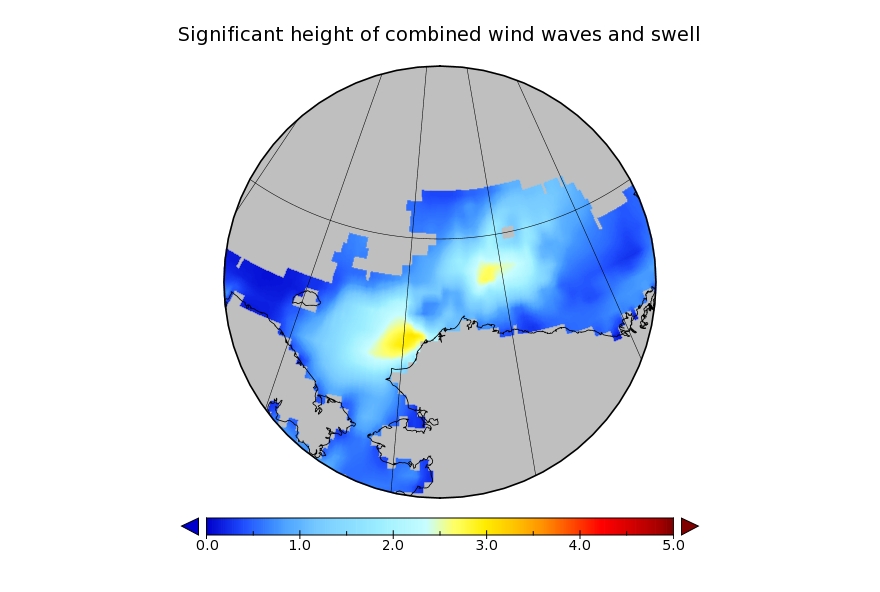
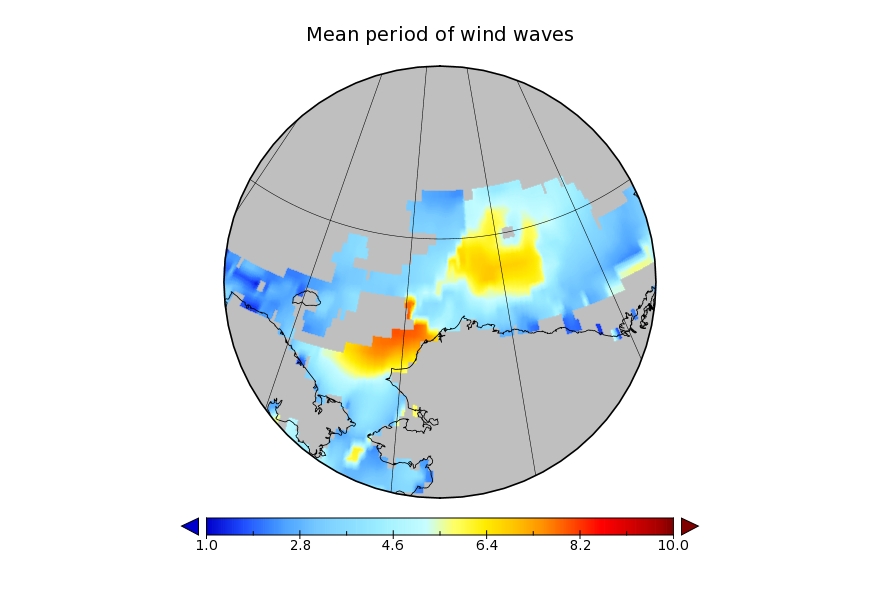
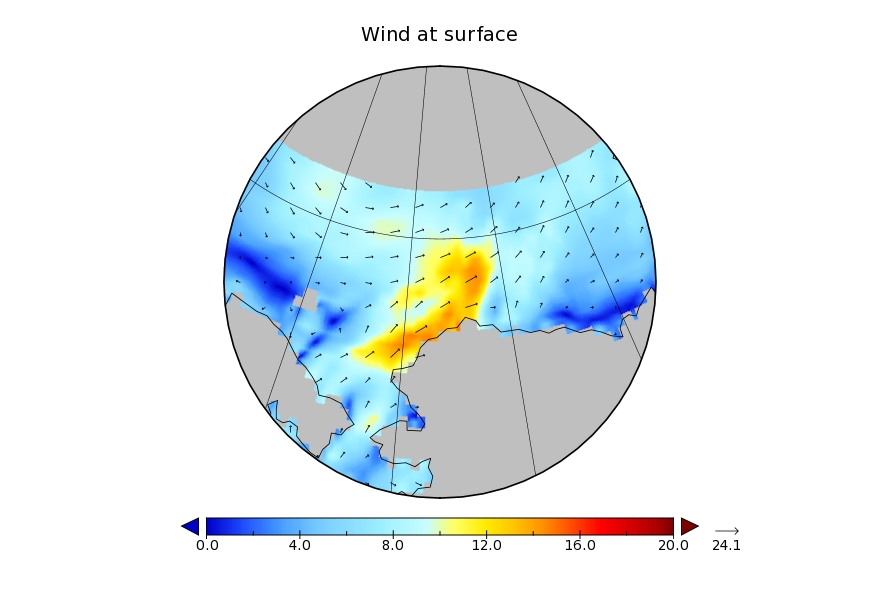
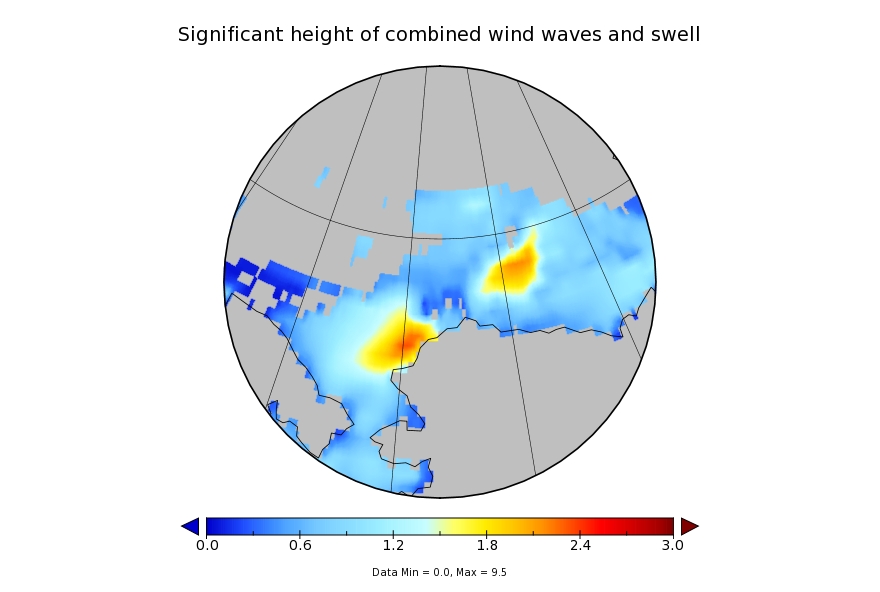
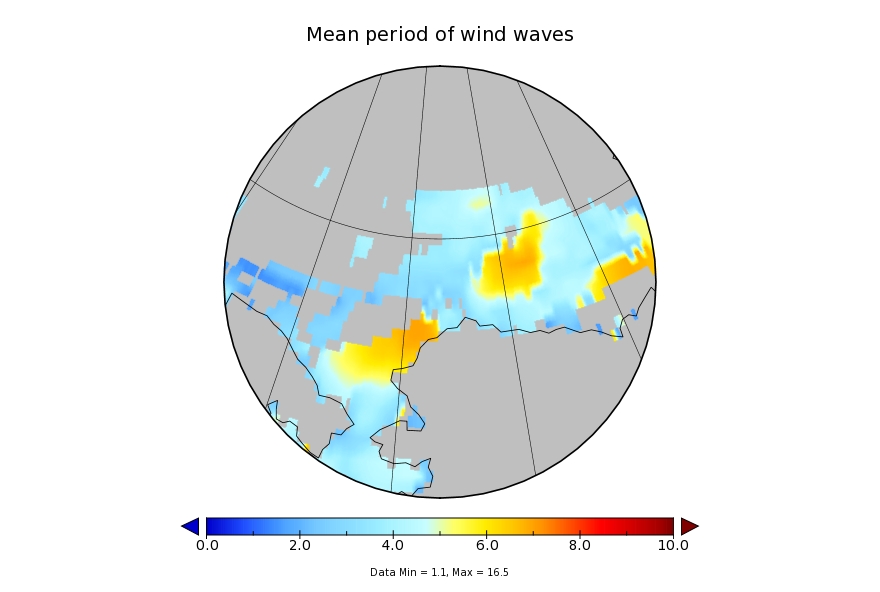
It looks like a storm is brewing in the Arctic. The long range weather forecasts for the Arctic have been remarkably unreliable recently, but this one is for a mere three days from now. WaveWatch III suggests there will be some significant waves in the Chukchi and Beaufort Seas this coming weekend, travelling in the direction of the ice edge:

WaveWatch III wave height forecast for July 17th
WaveWatch III wave period forecast for July 17th
WaveWatch III wind forecast for July 17th


[Edit July 15th 2016]

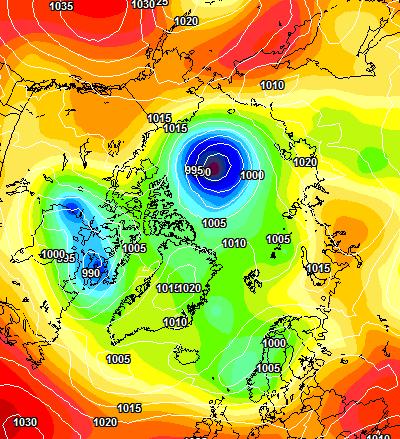
Sunday is only two days away now, and here is the current ECMWF prognosis:

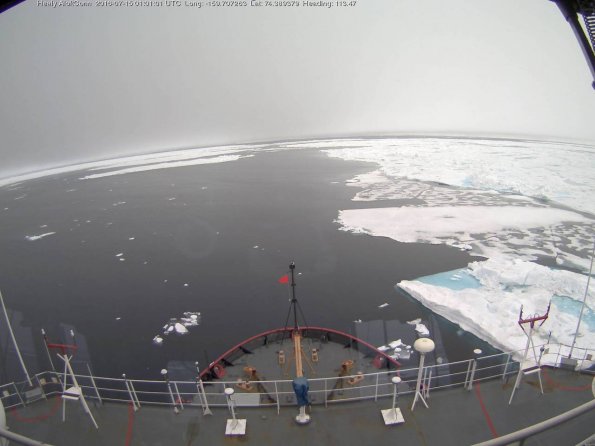
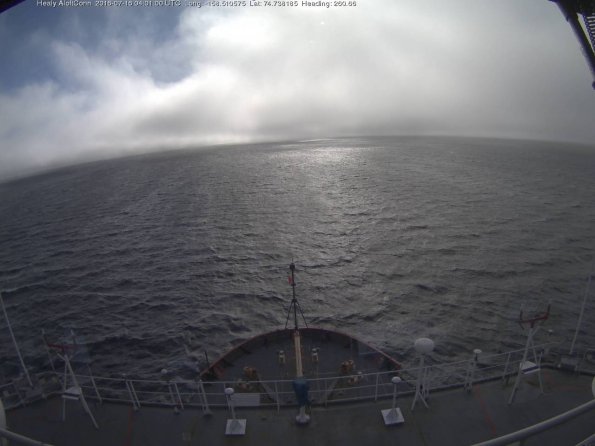
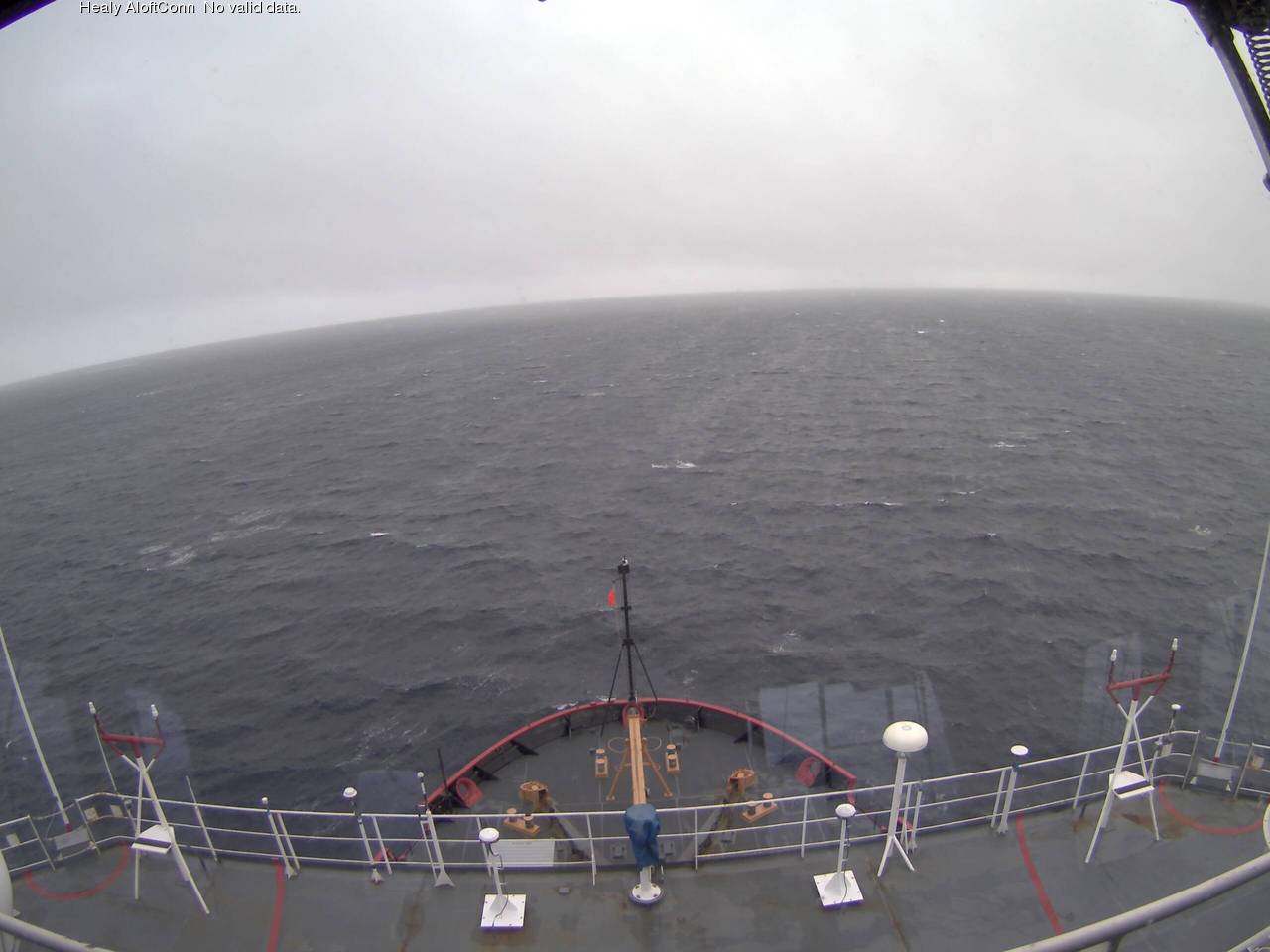
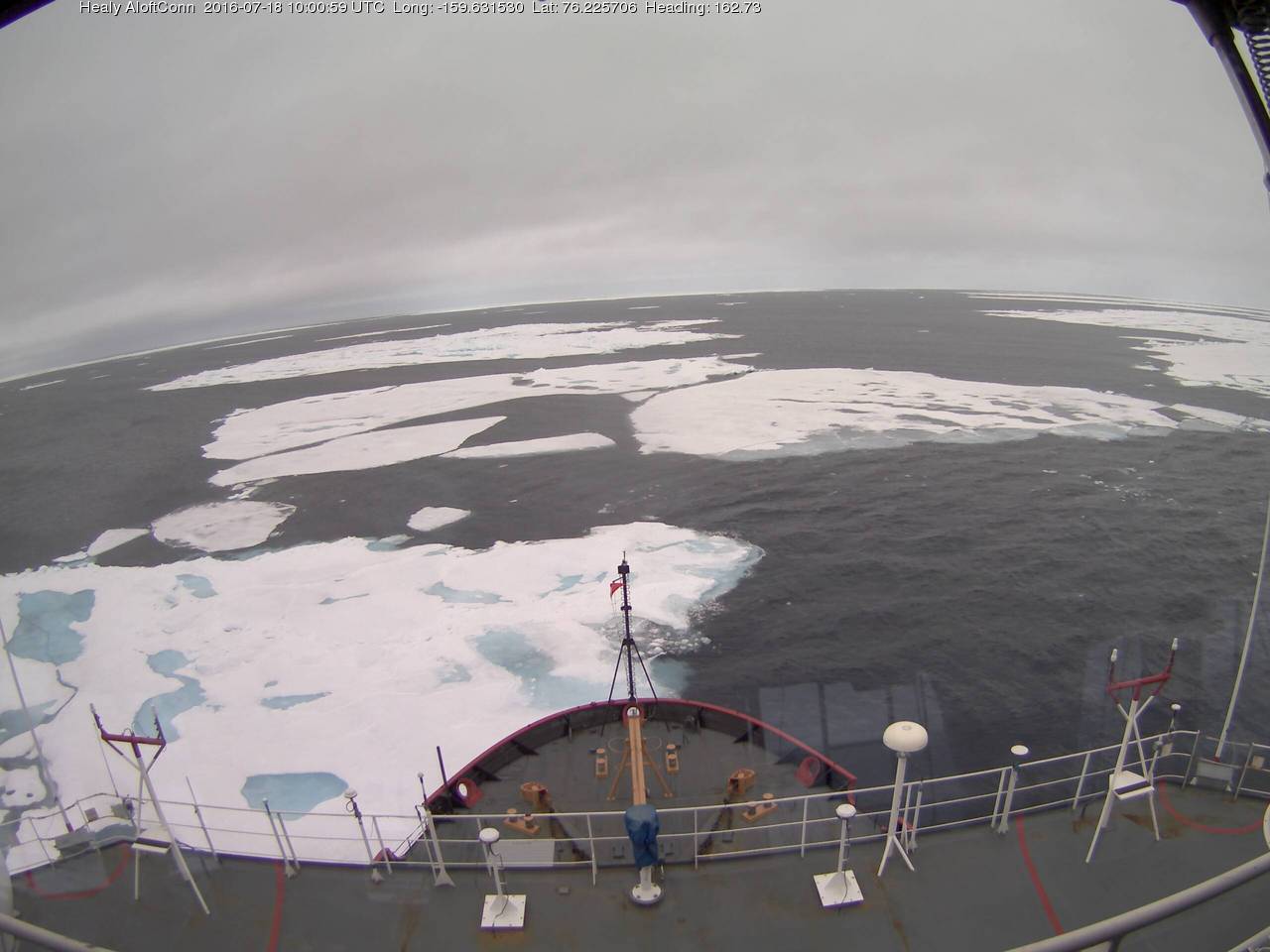
Here’s how “the surf” looks today, courtesy of United States Coast Guard Cutter Healy:


[Edit July 16th 2016]

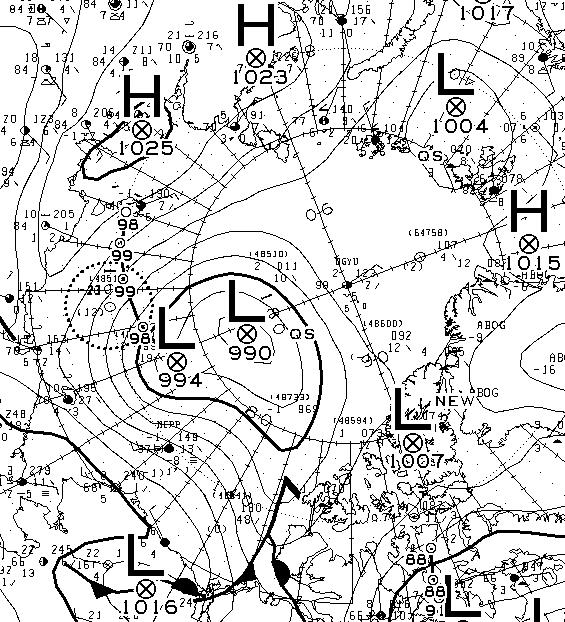
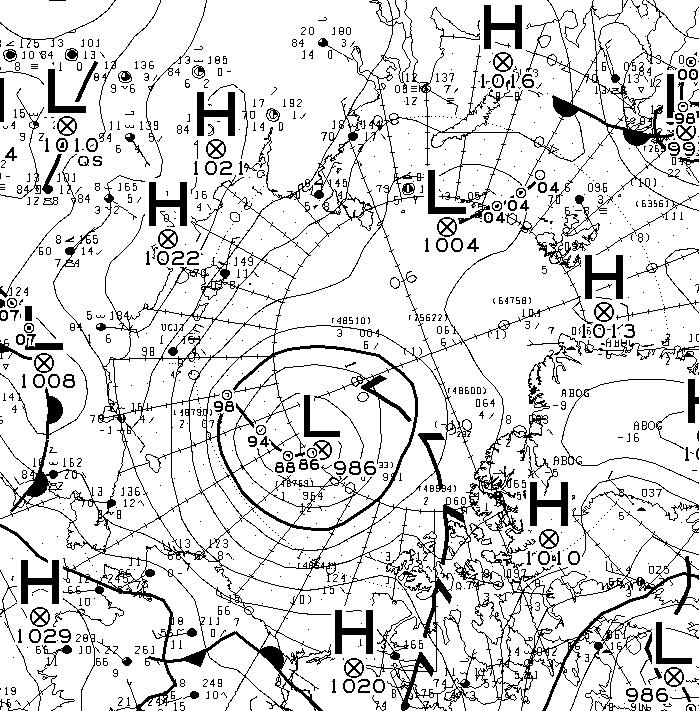
Another day has dawned, and the Environment Canada synoptic chart shows that the low pressure system currently over the Arctic has reached a central pressure of 990 hPa:

Synopsis-20160716-06Z

The latest ECMWF SLP forecast for tomorrow is firming up:

ECMWF-20160716+1d

A modest swell is now visible from USCGC Healy’s “AloftCon” webcam:

whilst the WaveWatch III forecast for tomorrow has dropped off to a significant wave height of around 2 metres with an average period of 7 seconds:

Height-20160716+1d

Period-20160716+1d

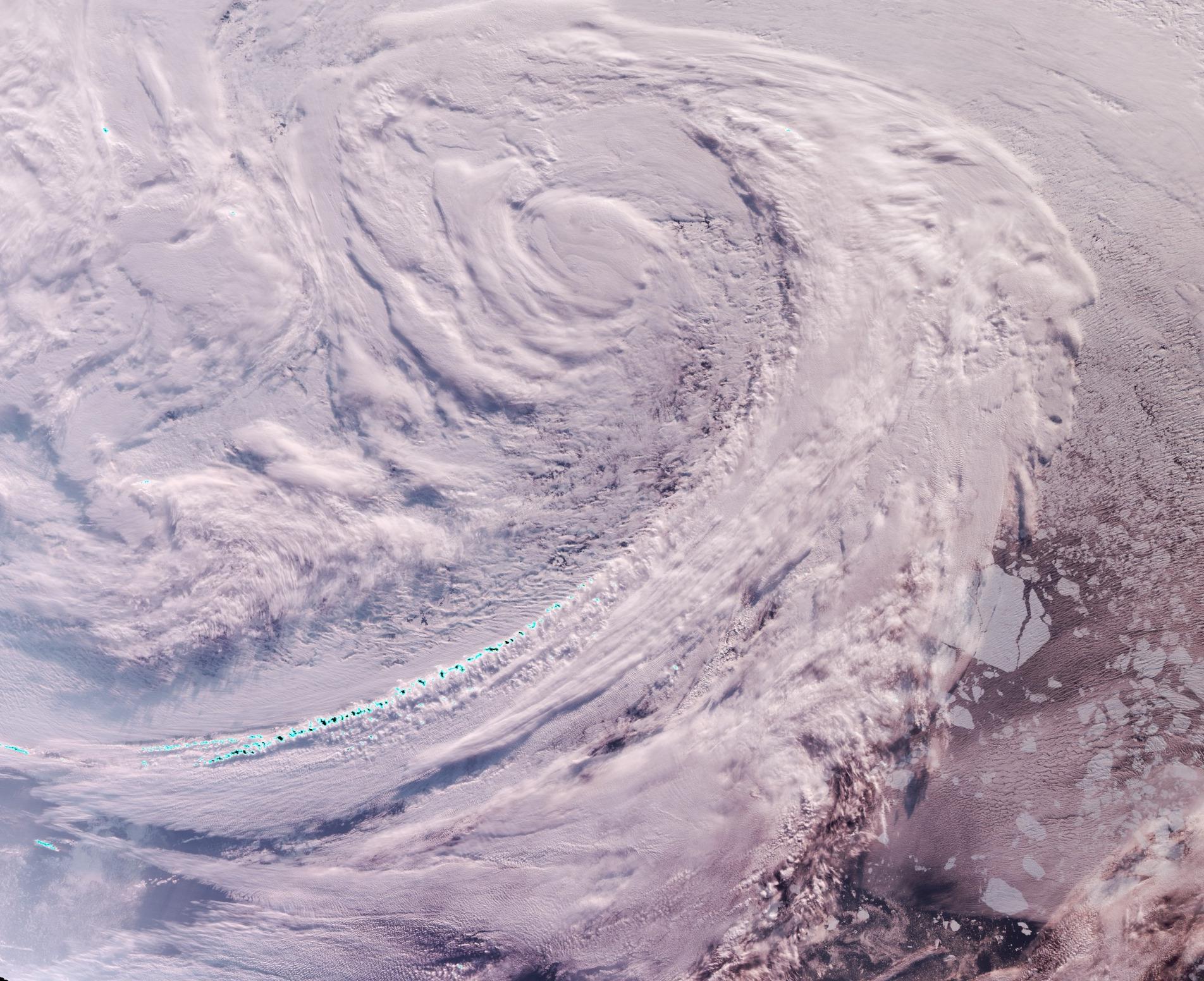
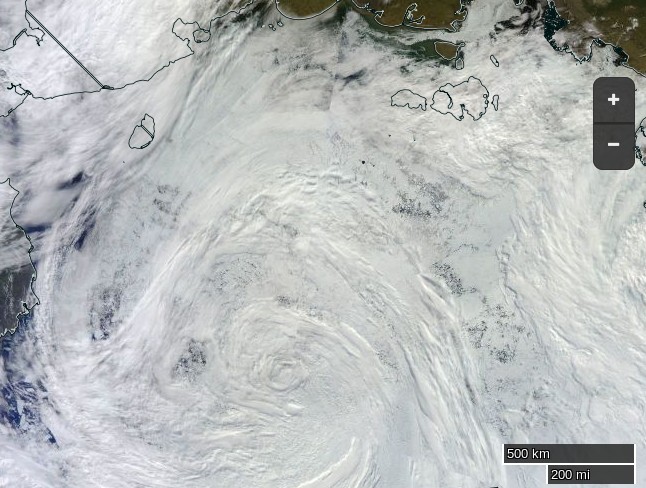
Meanwhile an image from the VIIRS instrument on the Suomi NPP satellite reveals the current storm in all its glory, together with confirmation that the “Big Block” multi-year ice floe north of Barrow has split asunder overnight:

Storm-VIIRS-20160716


[Edit July 17th 2016]

Sunday morning has now arrived. The storm in the Arctic looks to have bottomed out at 986 hPa central pressure. Here’s the Environment Canada synoptic chart for 00:00 this morning:

Synopsis-20160717-00Z

and here’s how the storm looks from the Terra satellite today:

Storm-Terra-20160717-1

This is how the resultant swell looked from USCGC Healy at 06:00:


[Edit July 18th 2016]

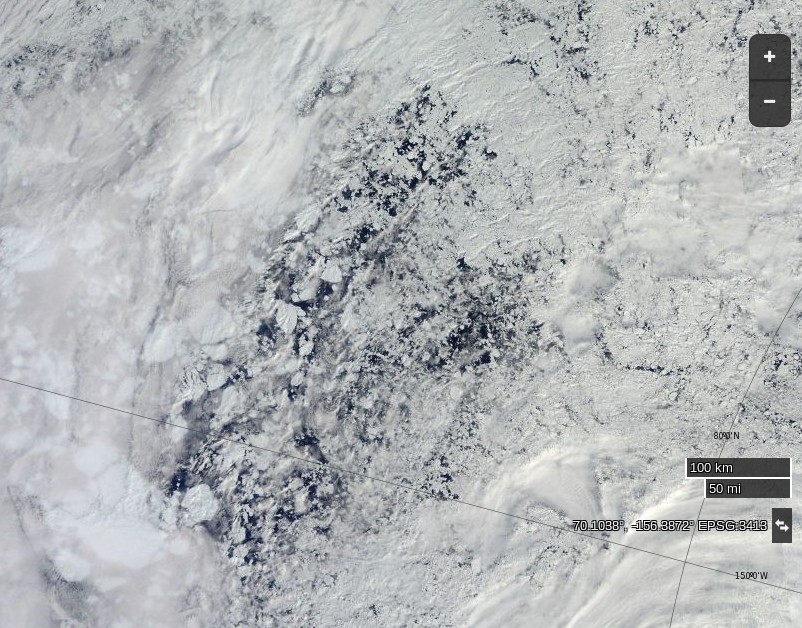
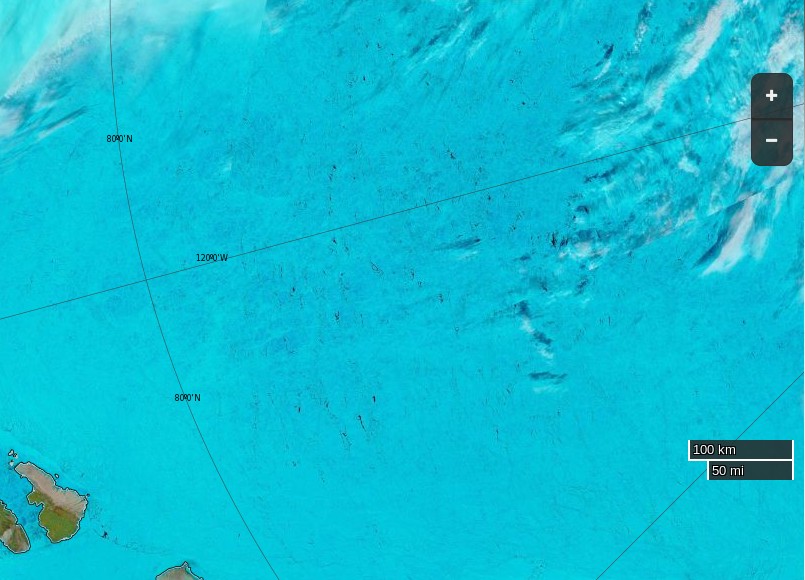
Here’s what the Beaufort and Chukchi Sea north of Barrow look like this morning through the clouds:

NASA Worldview “true-color” image of the Beaufort Sea on July 18th 2016, derived from the MODIS sensor on the Terra satellite

The remains of the now not so “Big Block” can just be made out in the bottom left. For a cloud free image here’s the latest AMSR2 passive microwave imagery of the area from the University of Hamburg:

Arc_20160717_res3.125_LARGE

The USCGC Healy and the remnants of the swell are in amongst the ice:


[Edit July 20th 2016]

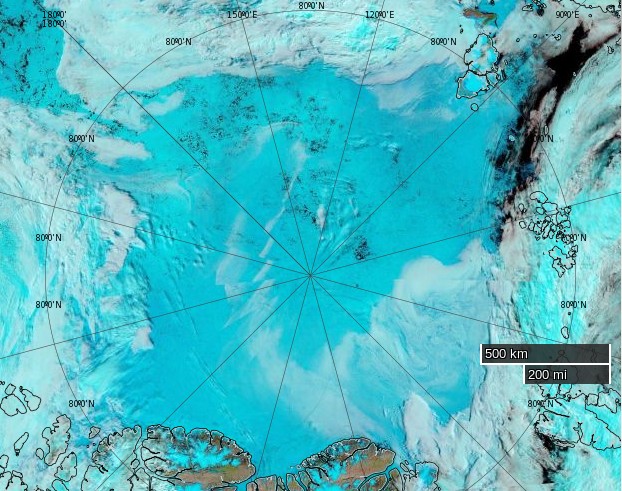
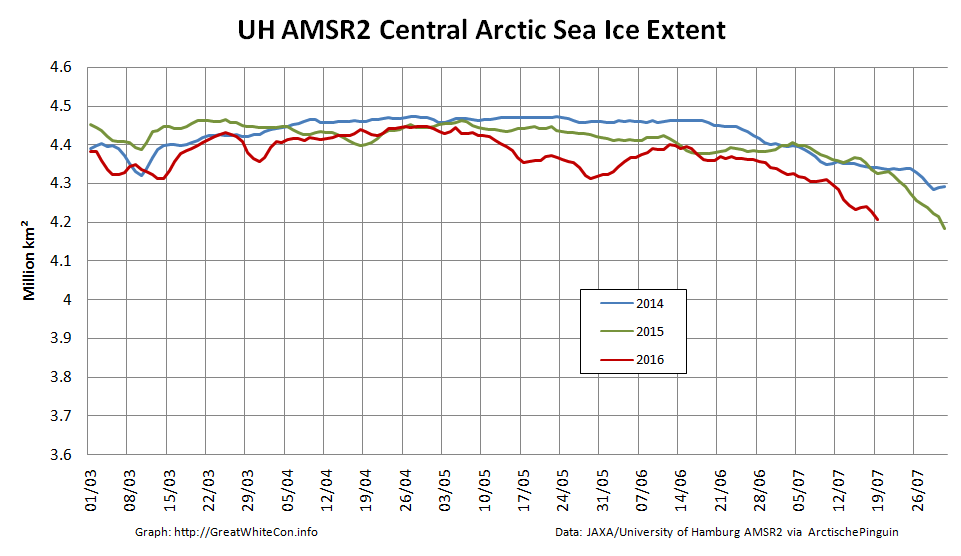
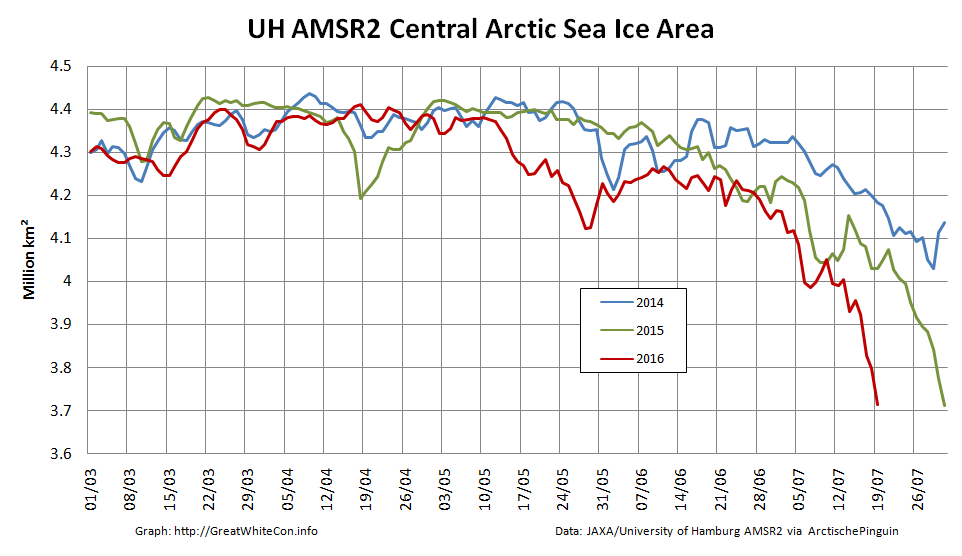
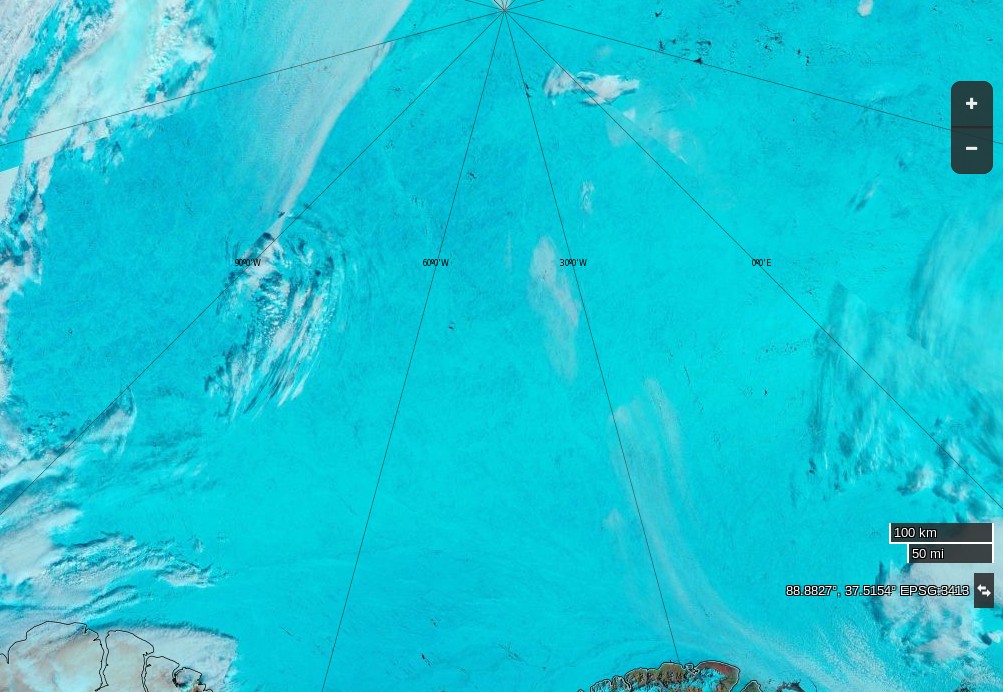
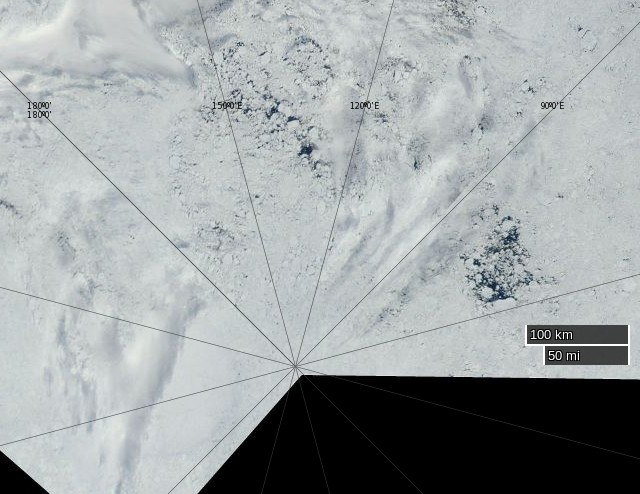
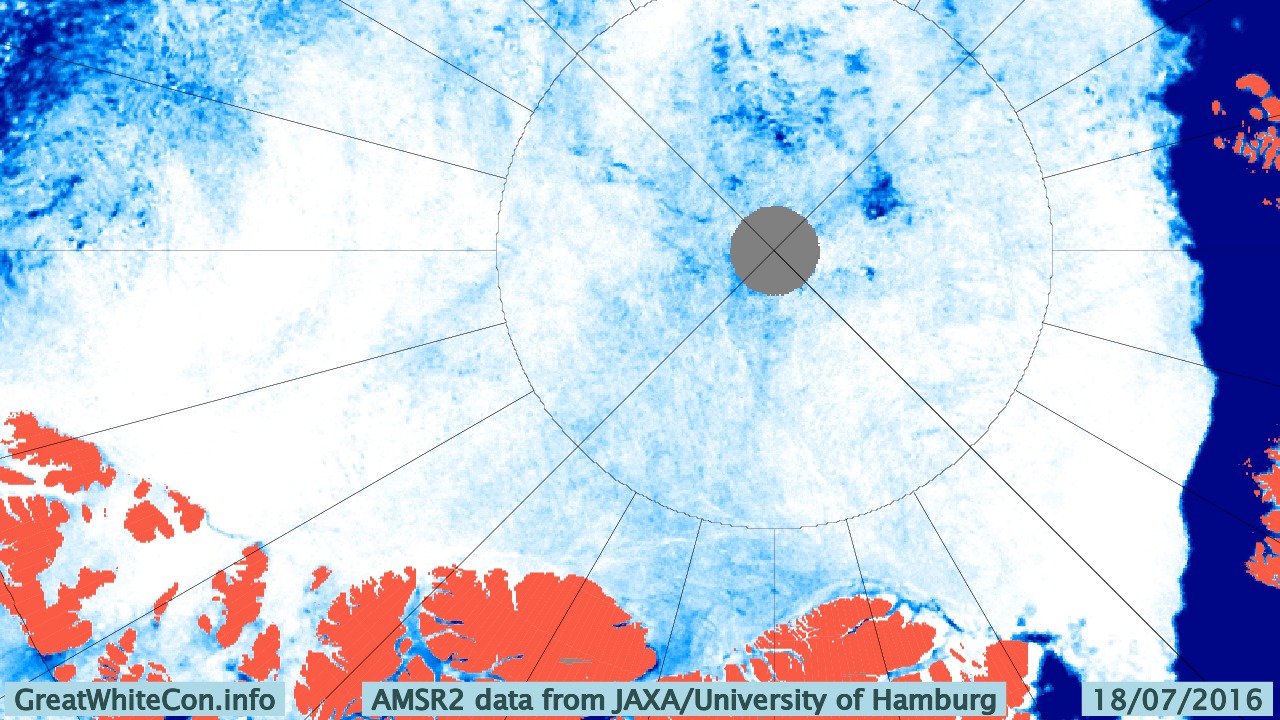
As the remnants of the storm head off across the Canadian Arctic Archipelago here is what it has left in its wake in the Central Arctic Basin:

NASA Worldview “false-color” image of the Central Arctic Basin on July 19th 2016, derived from the MODIS sensor on the Aqua satellite
University of Hamburg AMSR2 concentration visualisation of the Central Arctic on July 19th 2016

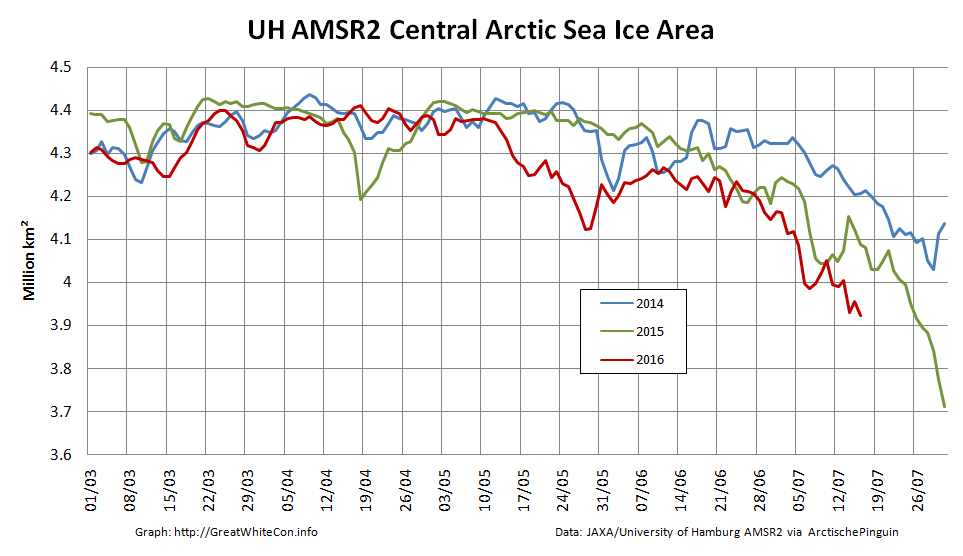
UH-CAB-Extent-2016-07-19

UH-CAB-Area-2016-07-19


[Edit July 21st 2016]

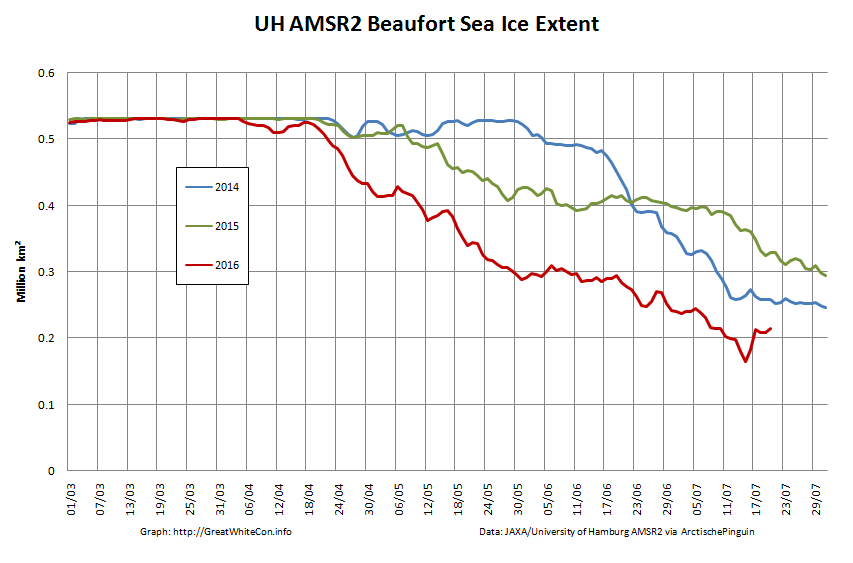
The storm has dispersed the remaining ice in the Beaufort Sea over the last few days:

UH-Beaufort-Extent-2016-07-20

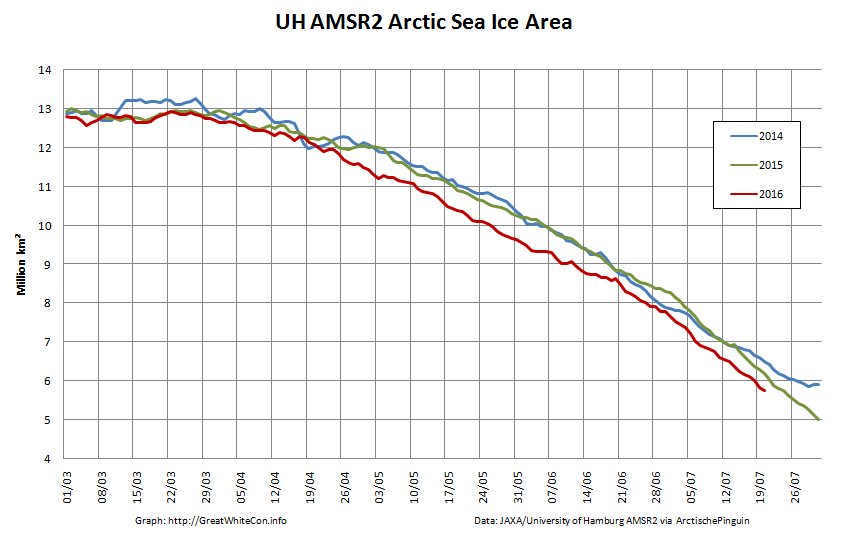
However across the Arctic as a whole sea ice area continues its downward trend:

UH-Arctic-Area-2016-07-20

Has The Ice Clearly Broken Completely In Two Now?

In the spirit of providing some spurious “balance” to the contentious Arctic sea ice “debate” our quote for today comes fairly fresh from the Arctic Sea Ice Forum:

idk how people are confusing the gaping fissures that span from Siberia to Canada with melt ponds but it seems like half the people here have blinders on to what is ongoing.

I know HYCOM gets a lot of flak but instead of projecting out, let’s look at the last five days.

[Superfluous image redacted]

The ice has clearly broken completely in two now, and the recent ~970mb low did a major whomping to the ice in the “cleavage” between what’s stuck against Siberia and the main CAB.

Intriguingly this was in response to an informed comment on June 23rd to the effect that:

As we have seen recently, these large area drops in the middle of the pack do not mean the ice is gone, just that its top is wet/ponded. In a couple of days some of these drops might be reversed. Of course the ice has suffered in the meantime, but still it’s risky to simply extrapolate these numbers.

Even more intriguingly our headline for today is remarkably like the inverse of a phrase in a Mail on Sunday article that led us to create this site in the first place!

Nearly three weeks have passed since those “gaping fissures that span from Siberia to Canada” were announced, and you may well (like me) be wondering how they have been coming along? In partial answer to that question here is our very latest video based on the University of Hamburg’s AMSR2 concentration visualisations:

In my own humble opinion this doesn’t really count as a “gaping fissure” but MODIS imagery does now show a fair bit of open water between Siberia and the North Pole:

CAB-Terra-20160711-400

A “gaping fissure” between the Pole and Canada (and/or Greenland) is however conspicuous only by its absence:

NASA Worldview “false-color” image of the Central Arctic Basin on July 11th 2016, derived from the MODIS sensor on the Aqua satellite

I do think that I can spot some melt ponds in the area at the moment though. How about you?

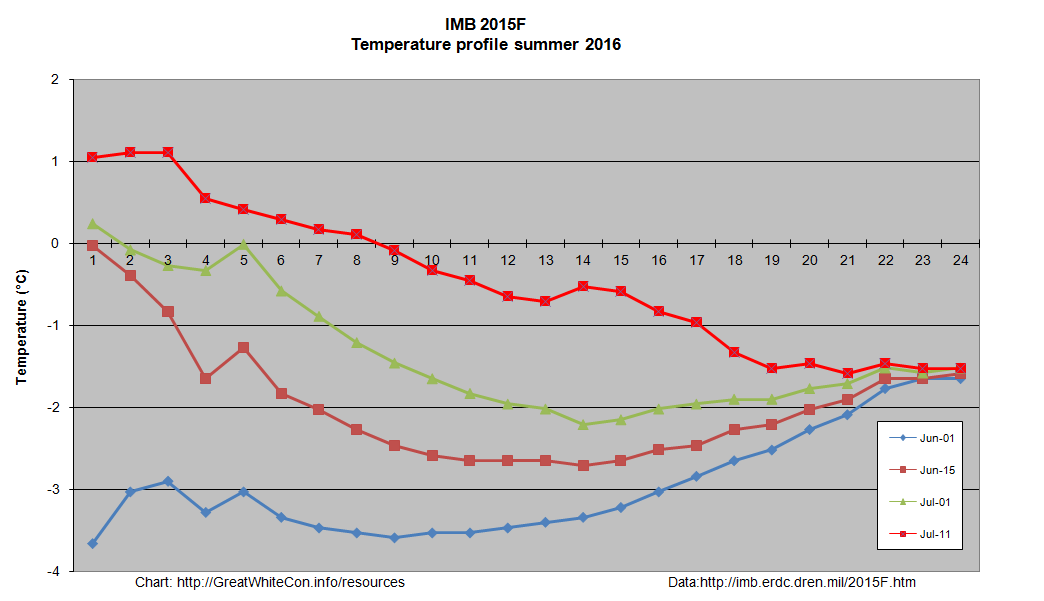
The one CRREL/ERDC ice mass balance buoy still reporting reveals that both surface and bottom melting have started at around 83 degrees north:

2016-07-11_2015F

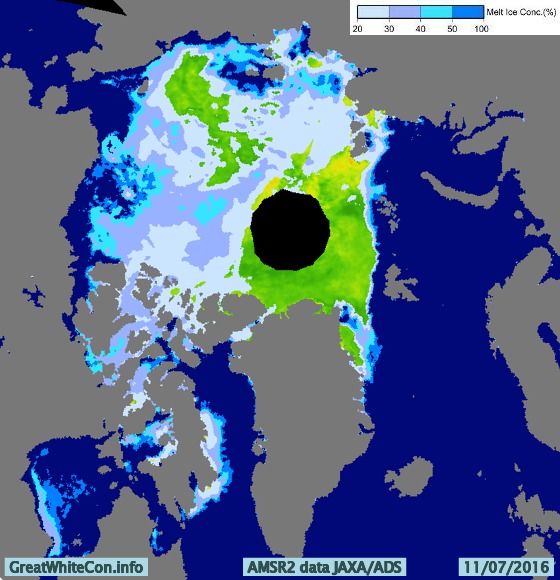
The 2016 multi-year ice melting season has evidently now begun, and the floe upon which buoy 2015F is sitting still has ~1.9 metres of melting to go. It’s not beyond the bounds of possibilty that a “gaping fissure” from the Atlantic to the Pacific will ultimately emerge this year. However based on the evidence thus far I’ll be extremely surprised if there is one “from Siberia to Canada”, unless of course you count the Chukchi & Beaufort Seas. That route is already open to intrepid Arctic seafarers, as can be seen at the bottom of the animation above and on the current JAXA/ADS Arctic sea ice surface melt map:

AM2SI20160711A_SIT_NP


[Edit July 14th 2016]

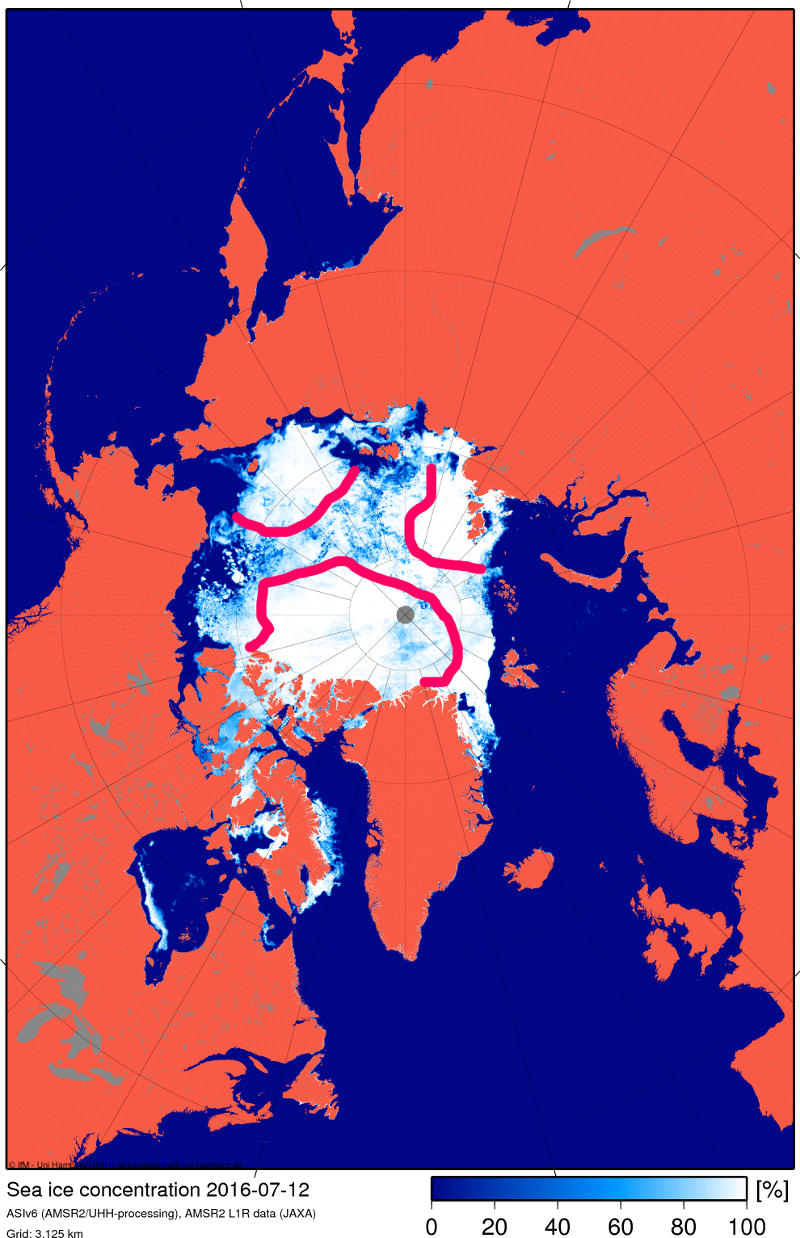
It seems I was mistaken. According to my flack jacketed informant over at the ASIF:

I have taken lots of flack I will stand by my prediction that we are heading for sub-1M KM2 come September (or early October).

Structurally [the ice] has actually now broken into three pieces, one is attached to the islands N of Siberia/NE of Svalbard, one is near Wrangel/ESS, and the “bulk” is pushed against the CAA/Greenland.

The lower concentrations in CAB are clearly open water and not melt ponds.

specialforjim-scaled

I felt compelled to explain to (presumably) him that:

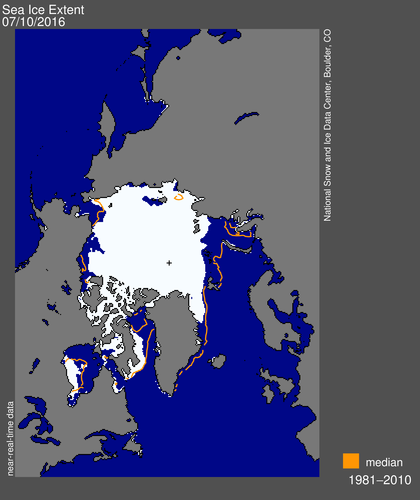
Here’s the NSIDC’s view of those “gaping fissures” of yours:

N_daily_extent-20160710


[Edit July 15th 2016]

“Flak jacket” assures me that:

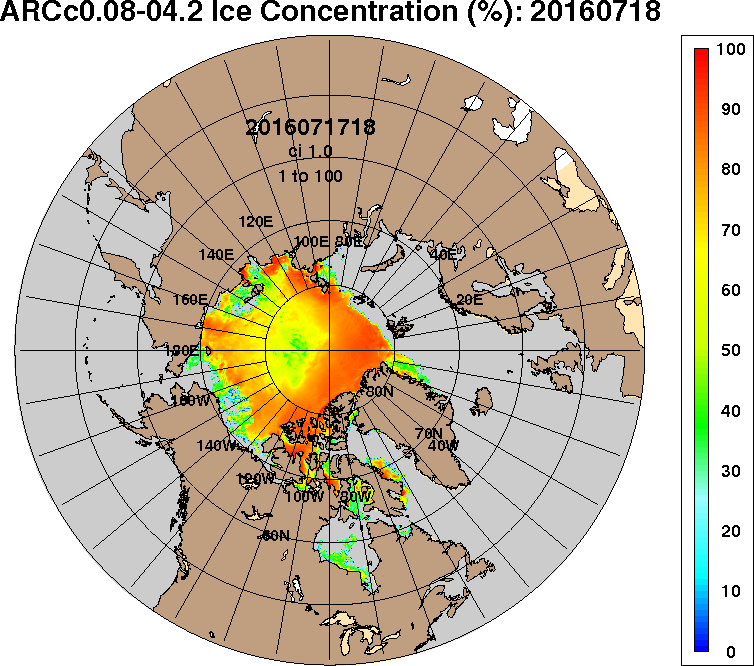
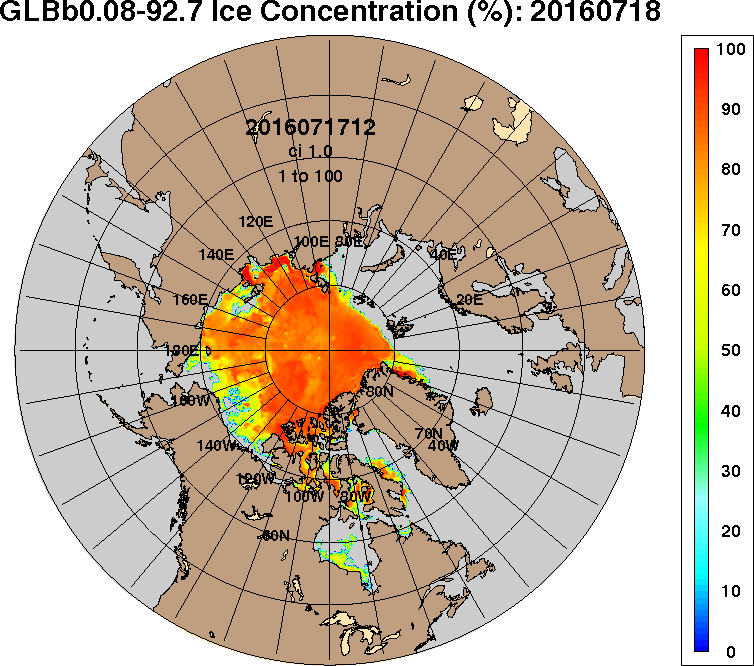
Despite some faults I think both ARC and GLB are onto the truth. Satellite grabs over the past few days show failure on all three fronts (ATL, PAC, and the Russian side especially), but the Russian side doesn’t present as a solid front (nor does the Beaufort melt), and the leads keep getting absorbed into the slush of the main pack (which is why the ‘slush’ keeps expanding, and why most of the CAB has now evolved into this state). The only solid regions of ice are those bordering the steaming ATL waters as well as some remnants north of the CAA (no coincidence the latter was chosen as ‘evidence’).

“ARC” refers to the US Navy’s Arctic Cap Nowcast/Forecast System. Here’s the ACNFS sea ice thickness “nowcast” from July 13th:

Here’s the July 13th model run sea ice thickness forecast for July 14th:

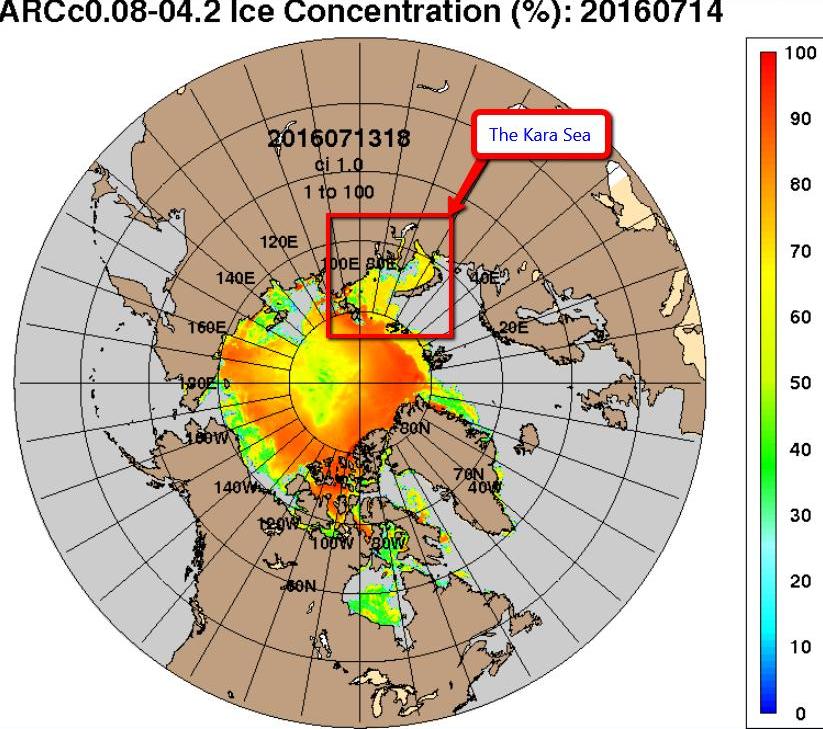
and here’s an annotated version of the Navy’s sea ice concentration forecast:

ACNFS-Concentration-20160713+24h

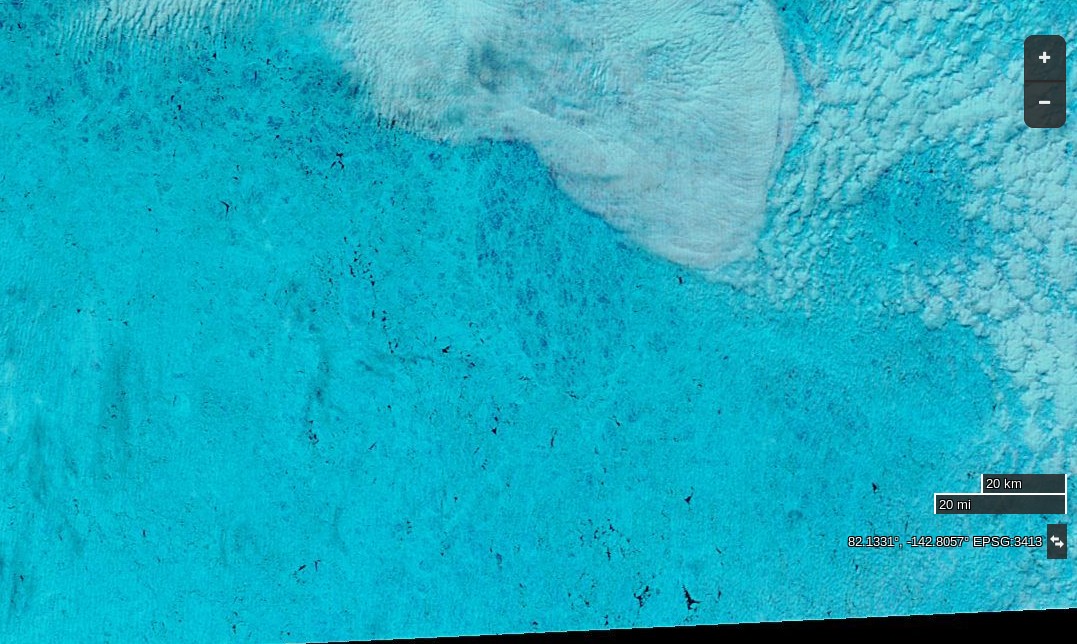
Yesterday the Kara Sea didn’t suddenly become covered in sea ice, and today the area of the Central Arctic Basin around 82 N, 135 W looks like this to the MODIS instrument on board the Terra Satellite:

NASA Worldview “false-color” image of the Central Arctic Basin on July 15th 2016, derived from the MODIS sensor on the Terra satellite

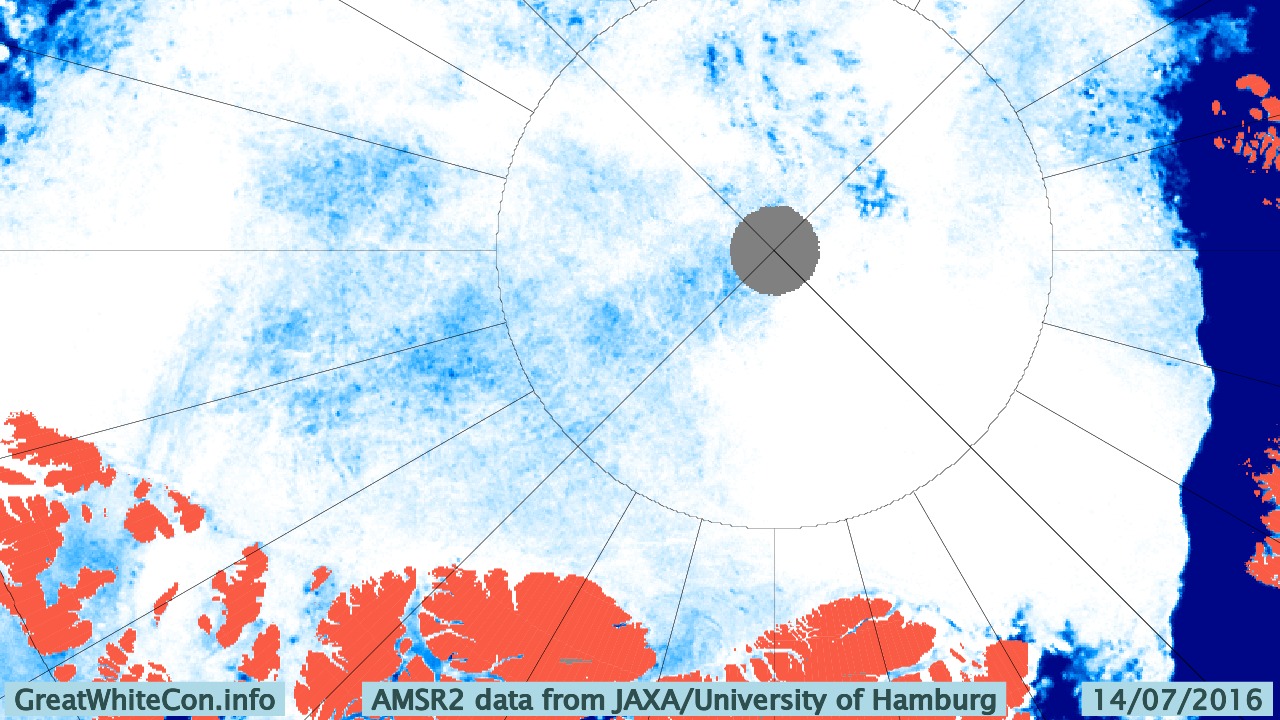
and like this to the University of Hamburg’s ARTIST sea ice concentration algorithm:

Arc_20160714_res3.125_LARGE

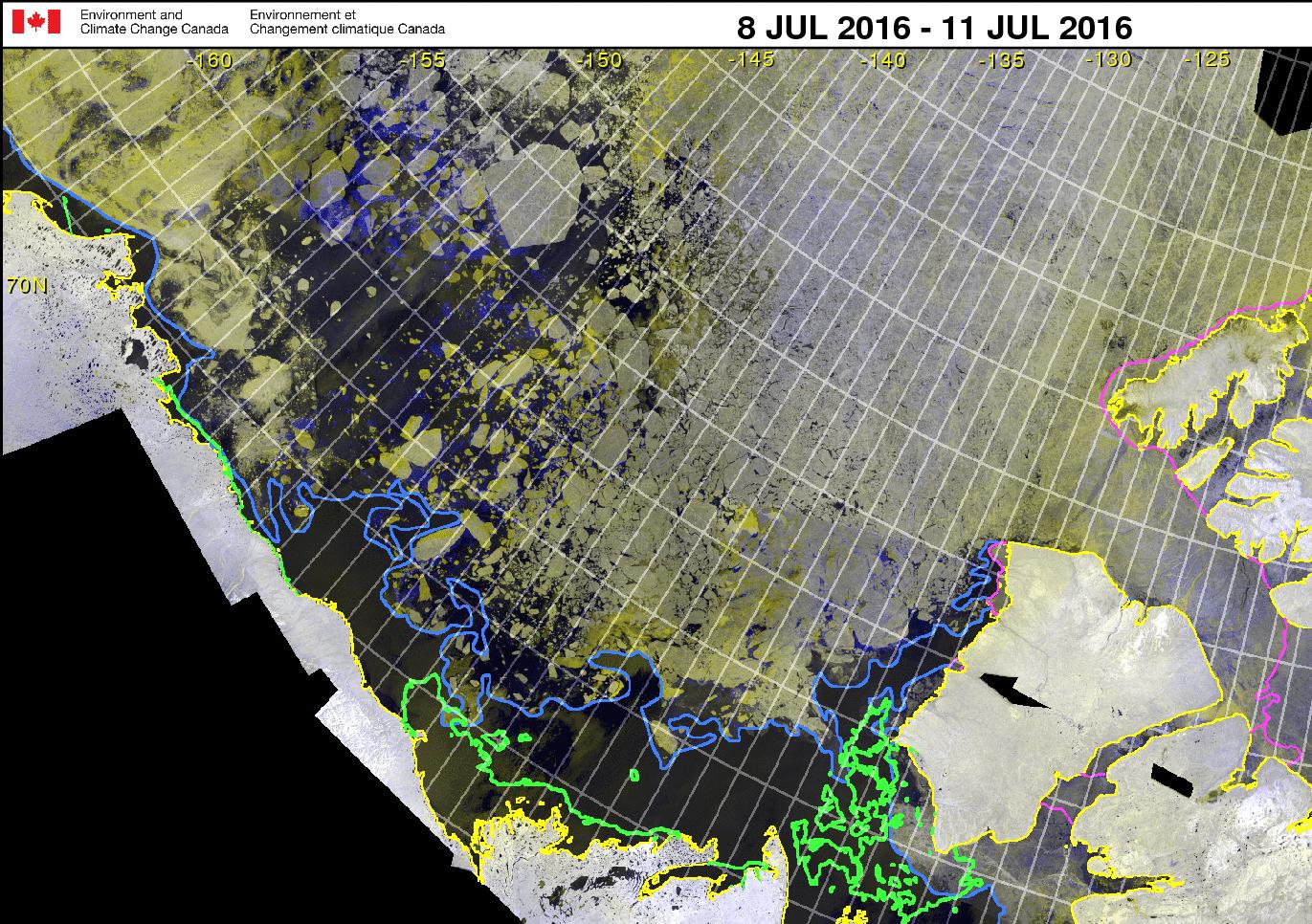
whilst here’s the latest Canadian Ice Service RadarSat mosaic for the Western Arctic:

http://ice-glaces.ec.gc.ca/cgi-bin/getprod.pl?prodid=IPYMMR1WA&wrap=0&lang=en
Canadian Ice Service Western Arctic RadarSat mosaic for 8-11 July 2016

Ice mass balance buoy 2015F reports this morning:

Current Buoy Data (07/15/2016):
Pos: 82.89 N, 137.34 W
Air Temp: -0.76 C
Air Pres: 1011.16 mb
Ice thickness : 185 cm


[Edit July 16th 2016]

The Arctic Sea Ice Forum management have banished “Flack Jacket” to the sin bin for a month.

I’m fed up with the personal insults because a model that has a history of errors is showing something spectacular that no other data source does. Come back in a month if you still feel like it.

Meanwhile in answer to my enquiry on the HYCOM support forum Alan Wallcraft tells me:

We now use the National Ice Center’s IMS sea ice extent product in our assimiltion, see http://www.natice.noaa.gov/ims/. This is manually produced every day, and generally avoids the artifacts and deficiencies of satellite sea ice concentrations. However yesterdays IMS fields were not good, and that is where the spurious sea ice came from. Today’s IMS field is good, and we may rerun the 2016/07/13-18Z nowcast/forecast to clear this up.

After a brief “pause” ACNFS is back in action, and here is its latest Arctic sea ice concentration “nowcast”:

Yesterday the skies were clear once again over the corner of the Arctic where buoy 2015F is located:

NASA Worldview “false-color” image of the Central Arctic Basin on July 15th 2016, derived from the MODIS sensor on the Aqua satellite

Here’s how the sea ice area in the Central Arctic Basin has been faring recently:

CAB-Area-2016-07-16


[Edit July 19th 2016]

Here’s an early image of the North Pole from the Aqua satellite this morning, recorded for posterity in case it changes later:

NASA Worldview “true-color” image of the North Pole on July 19th 2016, derived from the MODIS sensor on the Aqua satellite
NASA Worldview “true-color” image of the North Pole at 09:00 UTC on July 19th 2016, derived from the MODIS sensor on the Aqua satellite

and as the recent Arctic storm heads towards the Canadian Arctic Archipelago here’s the latest Hamburg AMSR2 concentration map:

Arc_20160718_res3.125_LARGE

I now also have an answer to my “supplementary question” on the HYCOM support forum:

I attach the ACNFS plot you referenced and the corresponding plot from our next global real-time system (GOFS 3.1), which will likely replace our current global analysis (and ACNFS) once NAVGEM 1.4 is operational (it is running here with NAVGEM 1.3, like ACNFS). They assimilate the same observations, but ACNFS only does so near the ice edge while GOFS 3.1 assimilates sea ice concentration everywhere (but with higher error bounds in the ice interior). The reason for ACNFS only assimilating near the edge is in part due to that being the most important area for navigation but also because SSMI satelite ice concentrations tend to “over saturate” in the summer. We switched GOFS 3.1 to “believe” the observations because they are generally better in recent years.

The two are quite different in the interior of the sea ice and GOFS 3.1 is certainly better there. We did not see the low concentrations near the North Pole in ACNFS this time last year, so something has happened to make the free running model produce low concentrations this summer. We are looking into it.

071800_927_arcticicen.001″ width=”754″ height=”666″ class=”aligncenter size-full wp-image-4361″ />

icen2016071718_2016071800_042_arcticicen.001

icen2016071712_2016
</p>
	</div><!-- .entry-content -->
	
	<footer class=

The Beaufort Gyre Goes Into Overdrive

According to the US National Snow and Ice Data Center, the Beaufort Gyre is:

A clockwise circulation (looking from above the North Pole) in the Beaufort Sea, north of Alaska. This circulation results from an average high-pressure system that spawns winds over the region.

beaufort_gyre

Such a high pressure system has been in place over the Arctic Ocean for a few days now, and the effect of the clockwise circulation on the sea ice in the Beaufort Sea is already evident in these recent satellite images:

NASA Worldview “true-color” image of the Beaufort Sea on April 9th 2016, derived from the MODIS sensor on the Terra satellite
NASA Worldview “false-color” image of the Beaufort Sea on April 12th 2016, derived from the MODIS sensor on the Terra satellite

as well as in this animation of sea ice movement since February:

The high pressure is forecast to continue for several more days. Here’s the GFS forecast for April 20th, courtesy of MeteoCiel:

Northern Hemisphere surface pressure forecast for April 20th 2016

which shows a large system with a central pressure of 1040 hPa still sitting over the Northern Beaufort Sea. Next here’s an animation from the US Navy which forecasts ice thickness until April 19th:

April 13th 2016 ACNFS Beaufort Sea thickness forecast until April 19th

Note in particular the large area of open water forecast to be produced in the Chukchi sea off Barrow, Alaska by the end of the period. The continuing clockwise winds have already started reducing the area of sea ice in the Beaufort Sea at an unusually early date:

2016-04-13-Beaufort-AMSR2-Area_001

Amongst other things we’ll be keeping a close eye on the ice area in the Chukchi Sea over the next few days. The sun is already starting to bathe that area of our planet with its rays, and open ocean soaks up that heat much more readily than bright white ice.

[Edit – 16/04/2016]

Here’s an animation of the effect on sea ice of the Beaufort Gyre in overdrive from Neven at the Arctic Sea Ice Blog:

Neven-Gyre-20160414

Notice how towards the end of the animation another huge part of the ice pack, north of the Canadian Arctic Archipelago is pulled into the Gyre. This is mostly multi-year ice.

Here also is a MODIS image of the Beaufort Sea processed by A-Team at the Arctic Sea Ice Forum to highlight the areas of new ice:

ATeam-BeaufortDay106-2016

Satellite Problems With Arctic Sea Ice Measurement

Skeptical sorts across the cryoblogosphere are in meltdown mode at the moment. They seem to be unaware that satellites don’t last forever in the harsh environment of space, and the individual scientific instruments carried by a satellite don’t either. Some failures are more spectacular than others however. By way of illustration here’s one recent report from Space.com:

The February [2015] explosion of an American military satellite may cause some problems for orbiting spacecraft after all, a new study reports.

The U.S. Air Force’s 20-year-old Defense Meteorological Satellite Program Flight 13 (DMSP-F13) craft blew apart on Feb. 3 after experiencing a power-system faillure. Analyses by the European Space Agency and other organizations found that the cloud of space junk generated by the explosion shouldn’t pose much of a threat to their missions, but the new research suggests that not all spacecraft are in the clear.

Another DMSP satellite started pushing up the metaphorical daisies earlier this year. Last month Space Flight Now reported that:

The U.S. Air Force has been unable to send commands to the service’s newest weather satellite for nearly a month, and engineers are trying to determine if the spacecraft can be salvaged, officials said last week.

The polar-orbiting Defense Meteorological Satellite Program Flight 19, or DMSP F19, spacecraft stopped responding to orders from the ground Feb. 11, the Air Force said in a March 3 press release.

“At this time, it is not known what caused the anomaly or if the satellite will be recovered, and the anomaly is under investigation,” the Air Force said. “There are no other known issues with the satellite.”

Designed for a five-year service life, DMSP F19 launched April 3, 2014, from California atop a United Launch Alliance Atlas 5 rocket. It is the newest in the Air Force’s series of DMSP weather observatories designed to help forecasters predict storms, clouds, fog and dust storms that could inhibit global military operations.

The data provided by the Special Sensor Microwave Imager/Sounder (SSMIS) instrument carried aboard several of the DMSP series of satellites is used by the National Snow and Ice Data Center to calculate their Sea Ice Index metric of Arctic sea ice extent. However suddenly Boulder has a problem. As we reported earlier this week the SSMIS sensor carried by DMSP F17 appears to be malfunctioning. This can be seen in this visualisation of the data from the European Ocean and Sea Ice Satellite Application Facility(OSI-SAF):

nt_20160409_f17_nrt_n

Look closely at the top centre of the image to see a large patch of spurious “sea ice”. Here’s the resulting SII extent graph from the NSIDC:

NSIDC_NH_20160410

Anthony Watts reported this news in typically fanciful fashion:
There is this small notice on the NSIDC page:

“The daily sea ice extent images are currently displaying erroneous data. NSIDC is investigating.”

It looks to be a problem with the DMSP F17 satellite.

Makes you wonder how long this has been going on and if the anomalously low readings we’ve seen for awhile are due to a slow sensor degradation.

Time will tell.

For a more realistic interpretation of the facts we suggest that instead of reading the propaganda perpetrated at WUWT you instead examine this graph derived using data from the AMSR2 sensor on board the Japanese SHIZUKU satellite:

JAXA-20160410

Mr. Watts evidently takes a very US centric view of these matters, since he neglected to report this timely news bulletin from the OSI-SAF:

Due to the previously reported problems with one of the channels on SSMIS onboard DMSP F17, OSI SAF is now working on replacing DMSP F17 with DMSP F18 in our sea ice products.

Currently, the switch to F18 has been implemented for the ice concentration product (OSI-401). The product dated 20160410 has been reprocessed and is available on our FTP server, ftp://osisaf.met.no/prod/ice/conc/ and ftp://osisaf.met.no/archive/ice/conc/2016/04

The ice edge and type products (OSI-402 and OSI-403) will be updated to use F18 tomorrow, 2016-04-12.

It seems Willis Eschenbach, the current Watts Up With That resident sea ice expert, is already beavering away endeavouring to prove Anthony’s case for him:

We have no way to know if this has been a gradual decrease followed by a failure, so yes, it’s certainly possible that the previous data is bad. Doesn’t mean it is, but we’d be fools not to check.

We suggested a simple check:

Why not compare the NSIDC’s SSMIS data from F-17 with JAXA’s AMSR2 data from Shizuku? Wouldn’t that do the trick?

Willis replied:

I meant that just from the bad reading alone, we don’t know if the previous data is bad. Yes, we can check it in the way you suggest and other ways … which is why I said we’d be fools not to check.

We think that if he does his due diligence he will find that he is in actual fact engaged on a fool’s errand, but time will indeed tell. Let’s wait and see what Willis n Willard can come up with, shall we? Meanwhile we also cannot help but wonder what the dynamic duo might make of our own due diligence replicating the results of another collaboration of theirs:

“The Awful Terrible Horrible Arctic Sea Ice Crisis”

The 2015 Arctic Sea Ice Minimum Extent

We’ve now entered the month of September, the month in which Arctic sea ice extent and area reach their annual minimum levels, historically at least. To set the scene, here’s the extent graph from the Japan Aerospace Exploration Agency (JAXA) for September 1st, based on data from the AMSR2 sensor on board their SHIZUKU satellite.:

IJIS-sep01

As you can see, the 2015 curve has just dropped below 2007 and is now at the second lowest level for the date in JAXA’s records. As the month progresses we’ll be taking a look at a variety of other metrics as they start to report their numbers for September.

To set the scene, here’s the University of Hamburg’s map of Arctic sea ice concentration for September 1st, again based on AMSR2 data:

Arc_20150901_res3.125

Here’s a video showing how that map has changed over the last two months:


Notice in particular the effect of the recent Arctic cyclone on the sea ice in the lower left quadrant. Note also our comment that:

[There is] a large potential fetch across the East Siberian, Chukchi and Beaufort Seas should any further cyclones occur in the area over the next few weeks. The conditions now exist for an even more damaging swell to be generated before the 2015 minimum Arctic sea ice extent is reached.

By now you may be wondering if we have a prediction to make? Well, we predict it still all depends on the weather! However here’s how the “probabilistic” 50 day ahead prediction from Andrew Slater of the NSIDC looks at the moment: SlaterExtent-20150831

If I were a betting man I’d say that the red line will ultimately put in a lower low than the dark blue one.

Finally, for the moment at least, take a look at the GFS surface level pressure forecast for later today, courtesy of MeteoCiel:

Can you see the 1000 hPa central pressure low spinning over the Laptev Sea? It’s currently not very deep, and it’s not over the East Siberian Sea either, but watch that space along with us as we wait to discover where and when the assorted Arctic sea ice metrics reach their minima for 2015.

[Edit – September 3rd 2015]

The latest edition of the US National Snow and Ice Data Center’s Arctic Sea Ice News has just been published. In the section on the imminent minimum they show this graph:

and say that:

Starting with the ice extent observed on August 31 and then applying 2006 loss rates, the slowest rate in recent years, results in the highest extrapolated minimum for 2015 of 4.50 million square kilometers (1.74 million square miles), and a September monthly average extent of 4.59 million square kilometers (1.77 million square miles). The lowest daily minimum comes from using the 2010 pace, yielding an estimated 4.12 million square kilometers (1.67 million square miles) for the daily minimum, and a September monthly average extent of 4.33 million square kilometers (1.67 million square miles).

Using an average rate of ice loss from the most recent ten years gives a one-day minimum extent of 4.38 ± 0.11 million square kilometers (1.79 million square miles), and a September monthly average of 4.49 ± 0.09. As of August 31, the 5-day running daily average extent is 4.72 million square kilometers. If no further retreat occurred, 2015 would already be the sixth lowest daily ice extent in the satellite record.

The forecast places the upcoming daily sea ice minimum between third and fourth lowest, with fourth more likely. There is still a possibility that 2015 extent will be lower than 4.3 million square kilometers, the third lowest sea ice extent, surpassing the 2011 sea ice extent minimum, and a small chance of surpassing 2007, resulting in the second-lowest daily minimum. This assumes that we continue to have sea ice loss rates at least as fast as those of 2010. This was indeed the case for the final ten days of August 2015.

Somewhere between 2nd and 6th then! We felt compelled to enquire on Twitter:

Shock News – IJIS Arctic Sea Ice Extent Lowest Ever!

You can of course argue that this is mere cherry picking on our part,  not to mention the slight economy with the truth in our necessarily punchy headline today. Nonetheless it is an actual fact that the IARC-JAXA Information System AMSR2 Arctic sea ice extent metric for February 17th 2015 reads 13,770,330 km² which is the lowest ever for the day of the year in a record going back to 2003. This follows a remarkably large fall (for the time of year) of  113,505 km² from yesterday’s reading of 13,883,835 km². Here’s our evidence:

IJIS_Sea_Ice_Extent_N_20150217

If you prefer to look at numbers instead of pictures then by all means try here instead for proof of the latest shock news from the Arctic.

If instead you prefer moving pictures, here’s an animation based on high resolution AMSR2 data from the University of Hamburg that may provide a few clues about how all this came about:

Can you see how the recent storms in the North Atlantic have “pulled” and then “pushed” the sea ice to thisese new record lows?

Please also note this warning message on the IJIS “Arctic Sea Ice Monitor” web page:

Thank you for visiting our website.

This site will be closed on February 22, and might be unstable from February 15, 2015.

New sea ice monitor website will be coming soon. Stay tuned.

Meanwhile, almost equivalent information can be available at:

JAXA:

http://kuroshio.eorc.jaxa.jp/JASMES/daily/polar/index.html
http://kuroshio.eorc.jaxa.jp/JASMES/climate/index.html

NIPR: National Institute of Polar Research , Japan

https://ads.nipr.ac.jp/vishop/vishop-monitor.html?N
https://ads.nipr.ac.jp/vishop/vishop-extent.html?N
https://ads.nipr.ac.jp/vishop/data/graph/Sea_Ice_Extent_N_v2.png
https://ads.nipr.ac.jp/vishop/data/graph/Sea_Ice_Extent_N_v2_L.png

New Antarctic Sea Ice Resources

In the Arctic the refreeze is slowing down as the March maximum extent approaches. Meanwhile in the southern hemisphere Antarctic sea ice extent has taken a tumble as the annual minimum extent approaches.

Over the long cold Arctic winter “Wipneus” of ArctischePinguin fame has been porting his northern hemisphere regional sea ice area/extent methodology to cover the South Pole as well. We are pleased to be able to reveal the fruits of his labours on our new regional Antarctic Sea Ice Graphs page. The ultimate source of the information is the University of Hamburg’s sea ice concentration data based on a 3.125 km grid that uses data from the from the AMSR2  instrument on board the Japan Aerospace Exploration Agency’s SHIZUKU satellite. Here’s an overview of Antarctic sea ice area:

2015-02-07-Ant-Area and here’s a close up on the sea ice extent in the Bellingshausen and Amundsen Seas region, where what sea ice there is helps buttress the West Antarctic Ice Sheet:

2015-02-07-West-Extent

In future we will also be bringing you satellite images from Antarctica. By way of example, here’s the latest “Shock News!!!” from the Antarctic, courtesy of LandSat 8:

I
NASA report that:

While large icebergs calve regularly from fast-flowing ice shelves in West Antarctica, the coast of cooler, drier East Antarctica tends to be less active. That made it a mild surprise when a 70-square-kilometer chunk of ice broke off from the King Baudouin Ice Shelf in January 2015. The last time that part of King Baudouin calved such a large iceberg was in the 1960s.

and you can track the current position of the latest large chunk of ex ice shelf on their WorldView web site:

The recently calved King Baudouin Ice Shelf on February 3rd 2015

Thanks also to “Arcticio” from the Arctic Sea Ice Blog who pointed me in the direction of PolarView, where it was remarkably easy to locate this Sentinel-1A synthetic aperture radar image of the large iceberg in question on January 30th 2015:

RoiBaudouin-600

How Many Subs In Santa’s Swimming Pool?

An extract from a  discussion about submarines surfacing at the North Pole, courtesy of Steven Goddard’s “Real Science” blog. One of us must be blind!

Them:

Hey spambot, what is this picture of?

USS Skate (SSN-578) made submarine history on 11 August 1958 when it became the first submarine to surface at the North Pole

Us:

It would seem to be the USS Skate on 11 August 1958 when it became the first submarine to surface at the North Pole. What is this picture of?

NASA Worldview “true-color” image of the North Pole area on September 2nd 2013

NASA Worldview “true-color” image of the North Pole area on September 2nd 2013, derived from bands 1, 4 and 3 of the MODIS sensor on the Terra satellite

Them:

Frozen ice. What is my prize?

And basically yours is just a snipe hunt. Mine disproves your hysteria.

Us:

No prize I’m afraid. The correct answer is vast areas of open ocean. Plenty of room for every submarine on the planet.

Them:

Sorry, there is no open water. Check your picture again. So you are reneging? Typical.

Us:

I have checked again, and I still see lots of open water underneath a thin veil of cloud. Perhaps you should arrange a hasty visit to an optician? Luckily microwaves can see through clouds, even if you cannot. Here’s another satellite image of the North Pole area from September 2nd 2013, this time a University of Hamburg visualisation of data from the AMSR2 sensor on board the Japanese SHIZUKU satellite.

AMSR2 image of the North Pole area on September 2nd 2013

AMSR2 image of the North Pole area on September 2nd 2013

The circle is 85 degrees North. How many subs do you suppose will fit into Santa’s secret summer swimming pool?

Them:

You have X-ray vision? I am sorry! I did not realize you were stuper girl! Want to try again? This time with normal vision.

BTW. for the SLOOOOOW learners. 85 North +/= North pole. The North Pole is WITHIN 85 North. But it is NOT 85 North.

The Skate is at 90 North. The NORTH POLE.

You may have x-ray vision, but you still cannot read a map. neither picture shows open water AT the north pole.

How many submarines are on the planet Snowy? better recheck your figures. They are not tinker toys.

Us:

You’re a hard man to please Phil! Feast your eyes on this picture instead then:
NASA Worldview “true-color” image of the North Pole area on August 28th 2013, derived from bands 1, 4 and 3 of the MODIS sensor on the Aqua satellite

NASA Worldview “true-color” image of the North Pole area on August 28th 2013, derived from bands 1, 4 and 3 of the MODIS sensor on the Aqua satellite

Them:
We’ll keep you posted!