I should of course add “in the satellite era”, but the title is pretty unwieldy as it is!
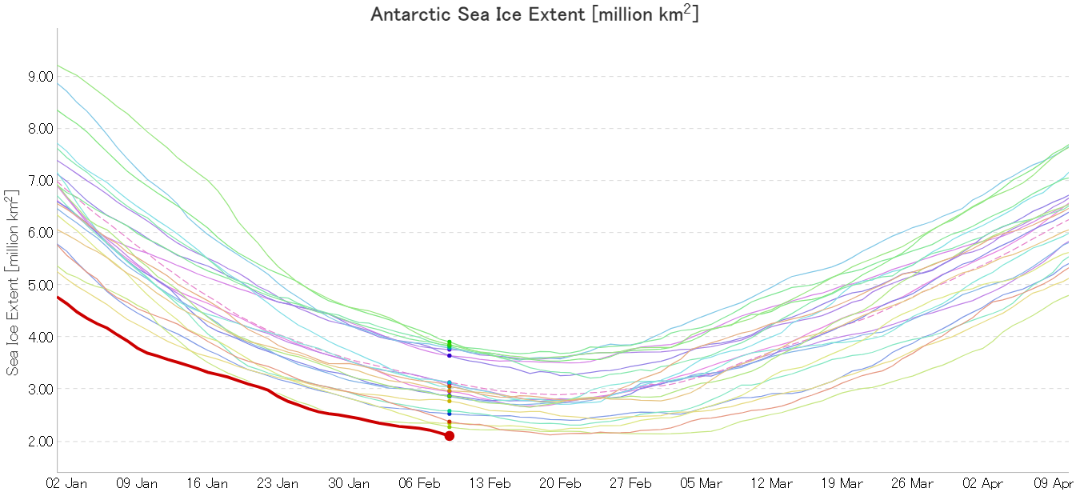
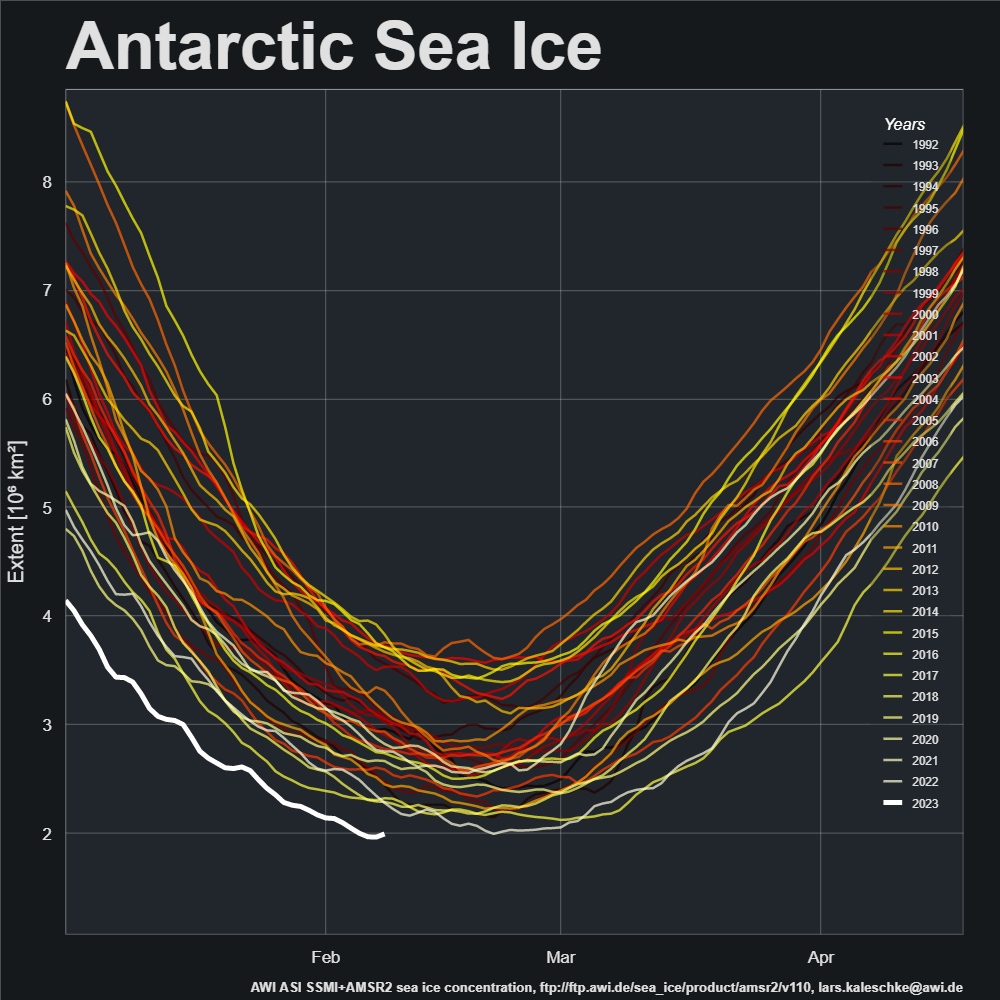
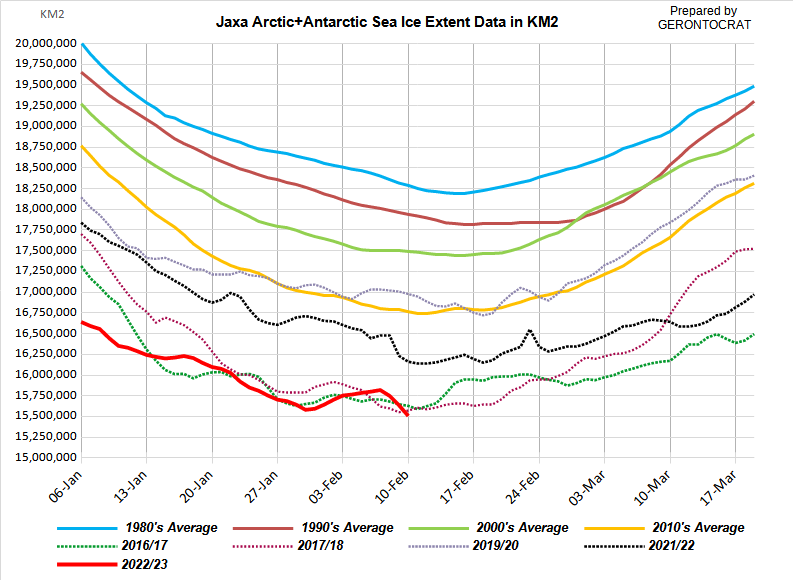
I was up early (UTC) to check the latest JAXA data, and sure enough that confirmed a new record minimum Antarctic sea ice extent of 2.11 million km² was reached yesterday:
Having added a note to that effect the Arctic open thread, Lars Kaleschke from the Alfred Wegener Institute pointed out over on Mastodon that the AWI had published a press release about the event this morning:
Let’s take a closer look at what the AWI had to say:
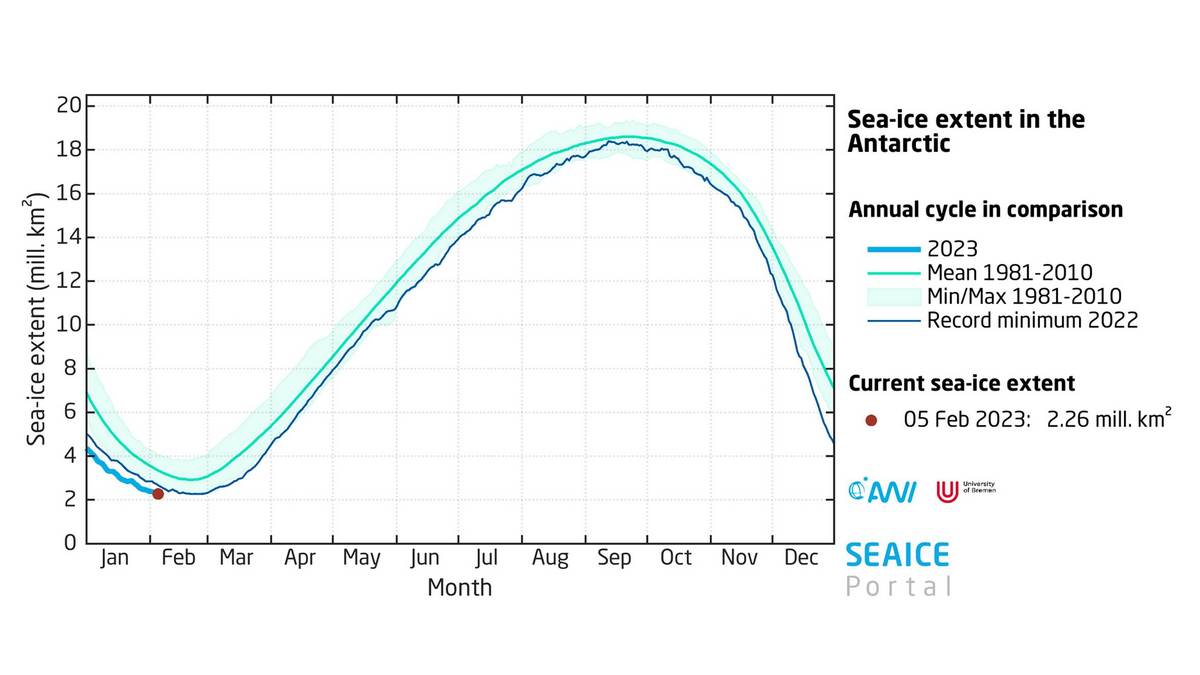
On 8 February 2023, at 2.20 million square kilometres, the Antarctic sea ice extent had already dropped below the previous record minimum from 2022 (2.27 million square kilometres on 24 February 2022). Since the sea ice melting in the Antarctic will most likely continue in the second half of the month, we can’t say yet when the record low will be reached or how much more sea ice will melt between now and then,” says Prof Christian Haas, Head of the Sea Ice Physics Section at the Alfred Wegener Institute, Helmholtz Centre for Polar and Marine Research (AWI), with regard to the current developments in the Antarctic. “The rapid decline in sea ice over the past six years is quite remarkable, since the ice cover hardly changed at all in the thirty-five years before. It is still unclear whether what we are seeing is the beginning of a rapid end to summer sea ice in the Antarctic, or if it is merely the beginning of a new phase characterised by low but still stable sea ice cover in the summer.”
Here’s how that news looks in the AWI’s official press release:
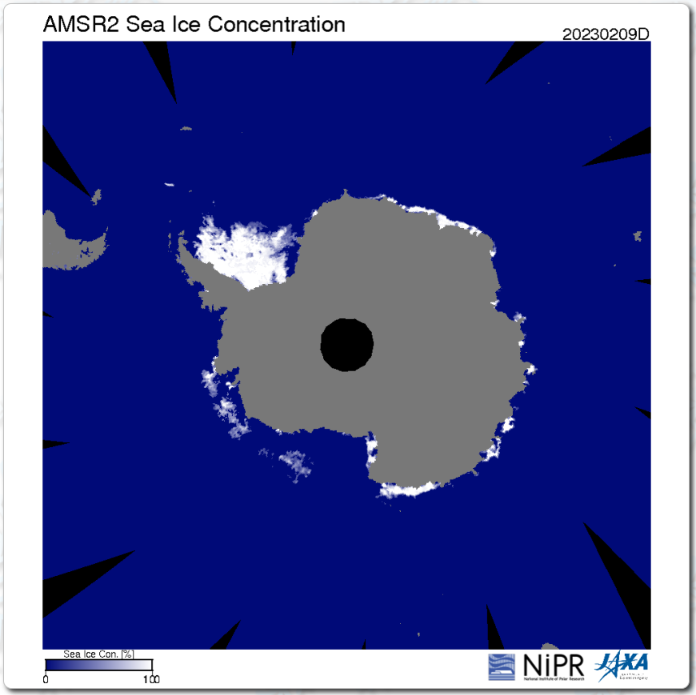
By way of prognostication here too is the current JAXA AMSR2 concentration map:
There are some low concentration areas which suggest further extent reductions still to come, despite the recent uptick in the high resolution graph.
Getting back to the AWI’s text:
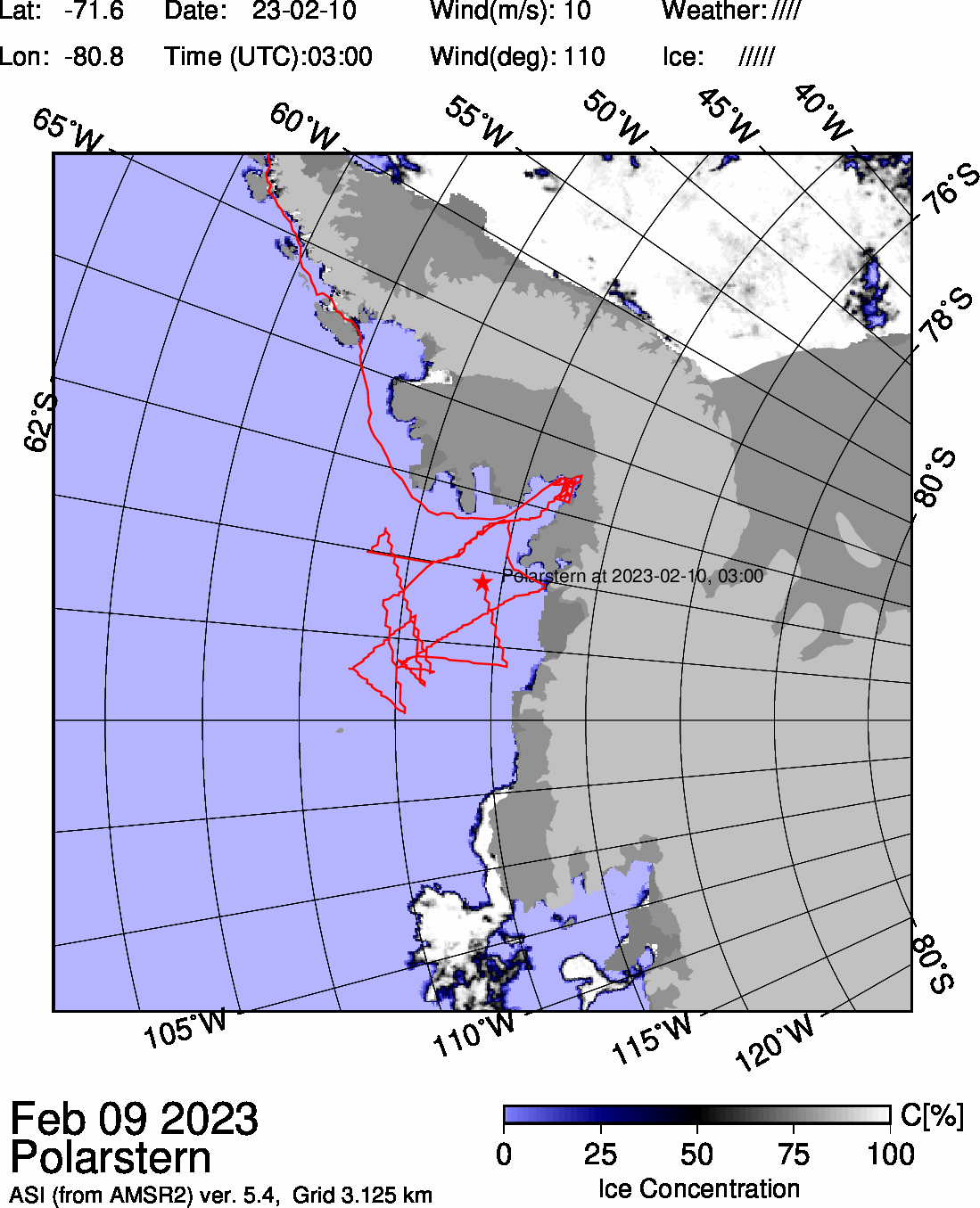
The melting has progressed since December 2022, especially in the Bellingshausen and Amundsen Seas in the West Antarctic; the former is virtually ice-free. That is also where the research vessel Polarstern currently is, exploring the evidence left behind of past glacials and interglacials. According to expedition leader and AWI geophysicist Prof Karsten Gohl, who is now in the region for the seventh time, having first come in 1994: “I have never seen such an extreme, ice-free situation here before. The continental shelf, an area the size of Germany, is now completely ice-free. Though these conditions are advantageous for our vessel-based fieldwork, it is still troubling to consider how quickly this change has taken place.”
Polarstern in ice free Bellingshausen Sea, West Antarctica, in January 2023. (Photo: Daniela Röhnert)
Analyses of the current sea ice extent, conducted by the Sea Ice Portal team, show that, for the entire month of January 2023, the ice was at its lowest-ever extent recorded for the time of year since the beginning of record-keeping in 1979. The monthly mean value was 3.22 million square kilometres, ca. 478,000 square kilometres (an area roughly the size of Sweden) below the previous minimum from 2017. With regard to its long-term development, the Antarctic sea ice shows a declining trend of 2.6 percent per decade. This is the eighth consecutive year in which the mean sea-ice extent in January has been below the long-term trend.
But what has caused the current lack of Antipodean sea ice? The press release continues:
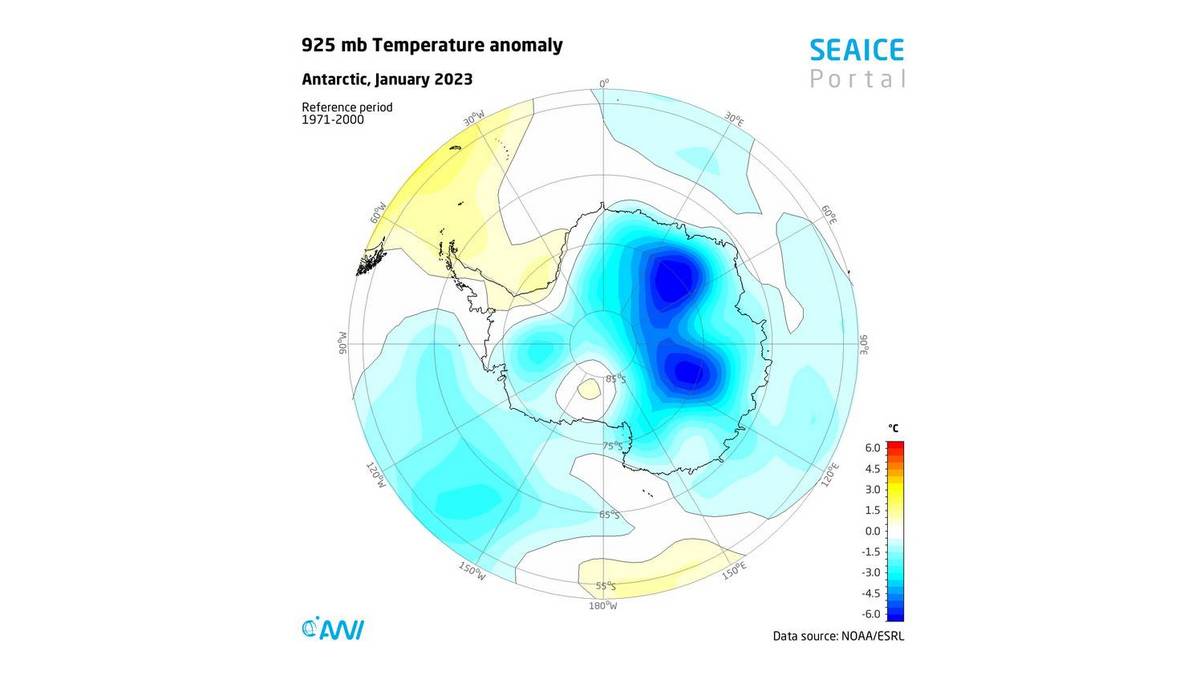
This intense melting could be due to unusually high air temperatures to the west and east of the Antarctic Peninsula, which were ca. 1.5 °C above the long-term average. In addition, the Southern Annular Mode (SAM) is in a strongly positive phase, which influences the prevailing wind circulation in the Antarctic. In a positive SAM phase (like today), a low-pressure anomaly forms over the Antarctic, while a high-pressure anomaly develops over the middle latitudes. This intensifies the westerly winds and causes them to contract toward the Antarctic. As a result, upwelling of circumpolar deep water on the continental shelf intensifies in the Antarctic, promoting sea-ice retreat. More importantly, it also intensifies the melting of ice shelves, an essential aspect for future global sea-level rise.
Air temperature anomalies in °C at 925 hPa pressure level in Antarctica in January 2023 compared to the long-term mean 1971-2000. (Graphic: meereisportal.de)
The press release concludes:
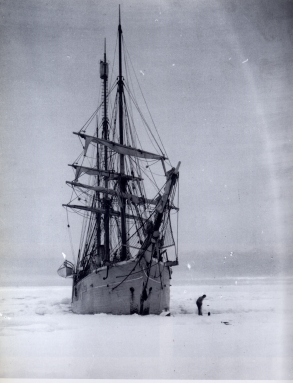
Historical records also reflect the tremendous changes. For example, in the Antarctic summer 125 years ago, the Belgian research vessel Belgica was trapped in the massive pack ice for more than a year – in exactly the same region where the Polarstern can now operate in completely ice-free waters. The photographs and diaries of the Belgica’s crew offer a unique chronicle of the ice conditions in the Bellingshausen Sea at the dawn of the industrial age, which climate researchers often use as a benchmark for comparison with today’s climate change.
Belgica became ice bound near Peter I island on February 28th 1898. On board was second officer Roald Amundsen. The leader of the expedition, Adrien de Gerlache, published a French language book about the voyage in 1902: “Quinze mois en Antarctique“.
Belgica ice bound in the Bellingshausen Sea
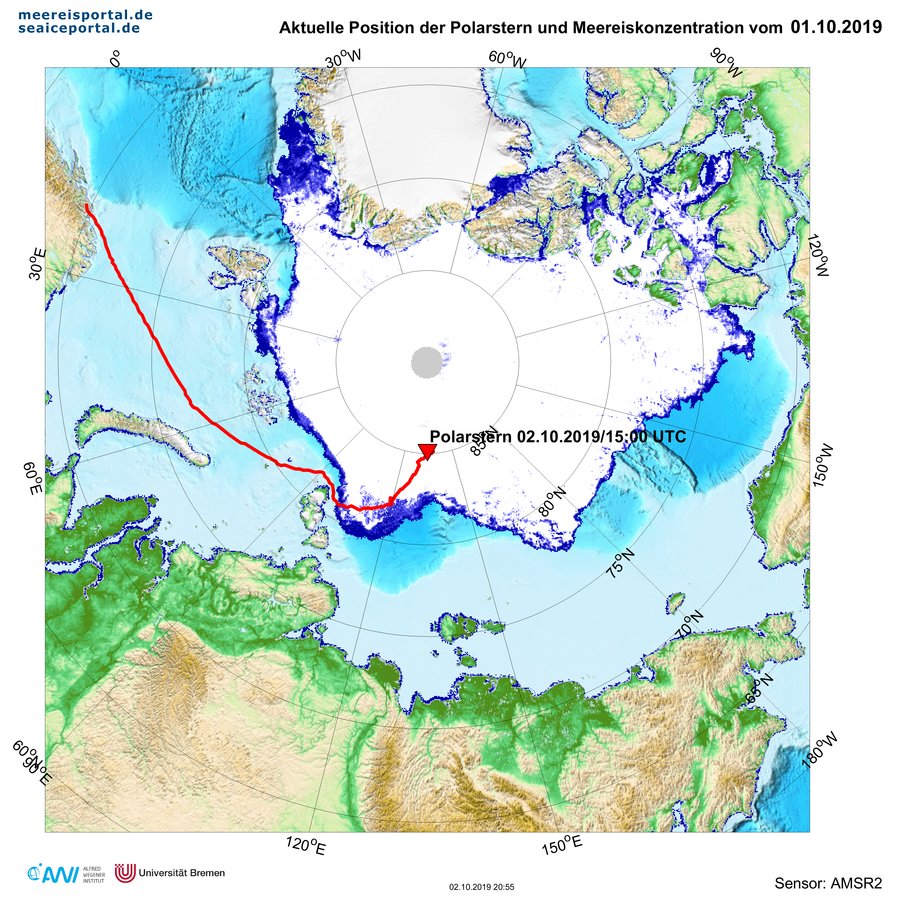
Finally, for the moment at least, here is the University of Bremen’s map of Polarstern’s current location and the sea ice concentration in the vicinity thereof:
[Edit – February 11th]
JAXA Antarctic sea ice extent is now down to 2.06 million km². Accompanied by a significant fall in Arctic extent, JAXA’s flavour of global sea ice extent has now also reached the lowest level ever recorded in the satellite era, at 15.51 million km² :
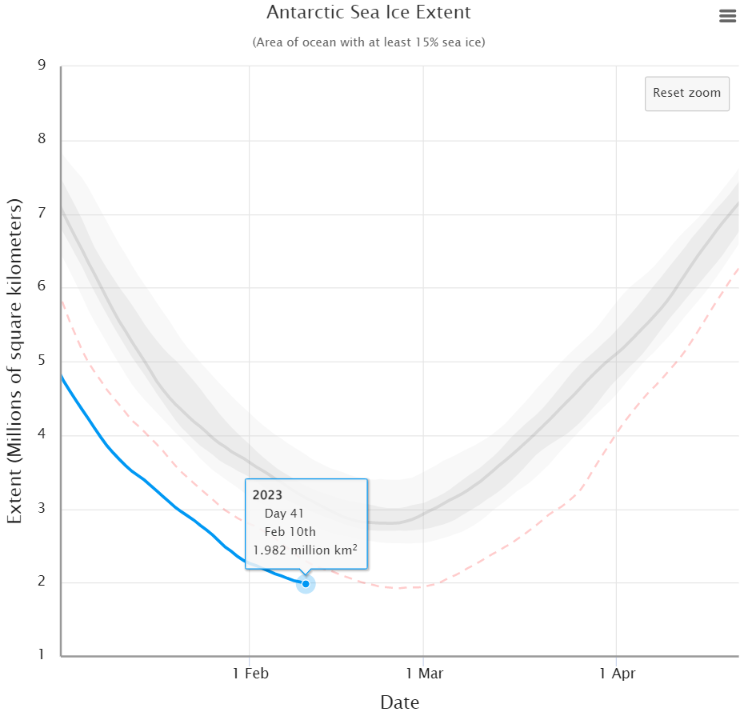
P.S. The NSIDC’s 5 day averaged extent hasn’t quite reached a record minimum yet:
However their daily extent has reached a new satellite era record minimum:
The reality is that @NSIDC daily #Antarctic#SeaIce extent for February 10th is 1.90 million km².
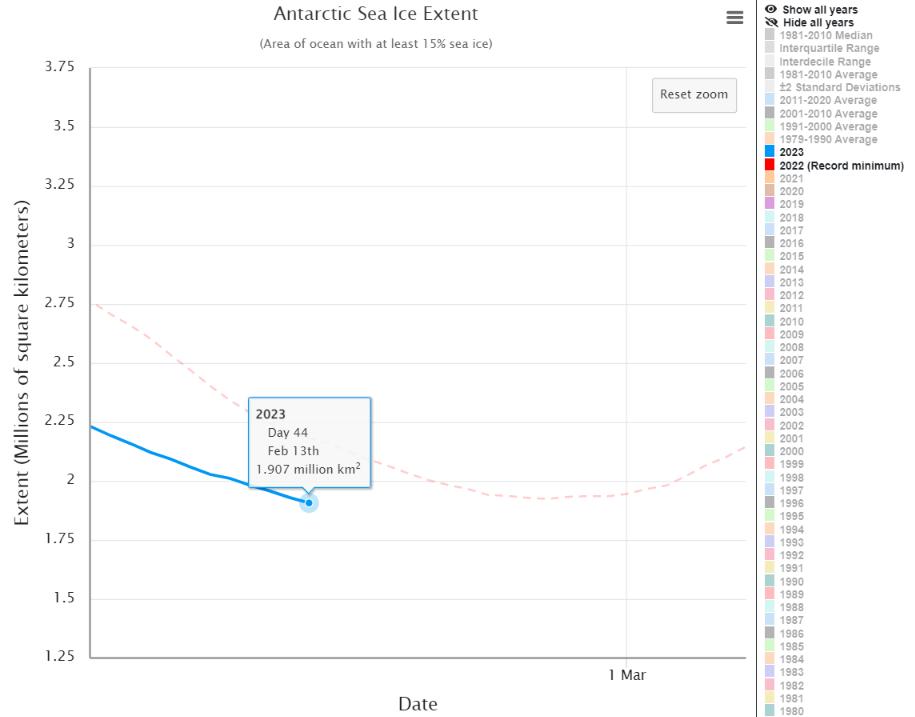
The NSIDC’s 5 day average Antarctic sea ice extent metric has duly reached a new record low level of 1.91 million km² :
P.S. The NSIDC has now published itsown article about the record minimum:
With a couple more weeks likely left in the melt season, the extent is expected to drop further before reaching its annual minimum. Much of the Antarctic coast is ice free, exposing the ice shelves that fringe the ice sheet to wave action and warmer conditions…
Extent has tracked well below last year’s melt season levels since mid-December. As noted in our previous post, a positive Southern Annular Mode has led to stronger-than-average westerly winds. Along with a strong Amundsen Sea Low, the weather conditions have brought warm air to the region on both sides of the Antarctic Peninsula. This has largely cleared out the ice cover in the Amundsen and Bellingshausen Seas, and reduced the sea ice extent in the northwestern Weddell Sea. Sea ice is patchy and nearly absent over a long stretch of the Pacific-facing coastline of Antarctica. Earlier studies have linked low sea ice cover with wave-induced stresses on the floating ice shelves that hem the continent, leading to break up of weaker areas.
Antarctic sea ice extent has been highly variable over the last several years. While 2022 and 2023 have had record low minimum extent, four out of the five highest minimums have occurred since 2008. Overall, the trend in Antarctic minimum extent over 1979 to 2023 is near zero. The current downward linear trend in the Antarctic minimum extent from 1979 to 2023 is 2,400 square kilometers per year, or 0.9 percent per decade, which is currently not statistically significant. Nevertheless, the sharp decline in sea ice extent since 2016 has fueled research on potential causes and whether sea ice loss in the Southern Hemisphere is developing a significant downward trend.
In a press release last week the Alfred Wegener Institute announced that:
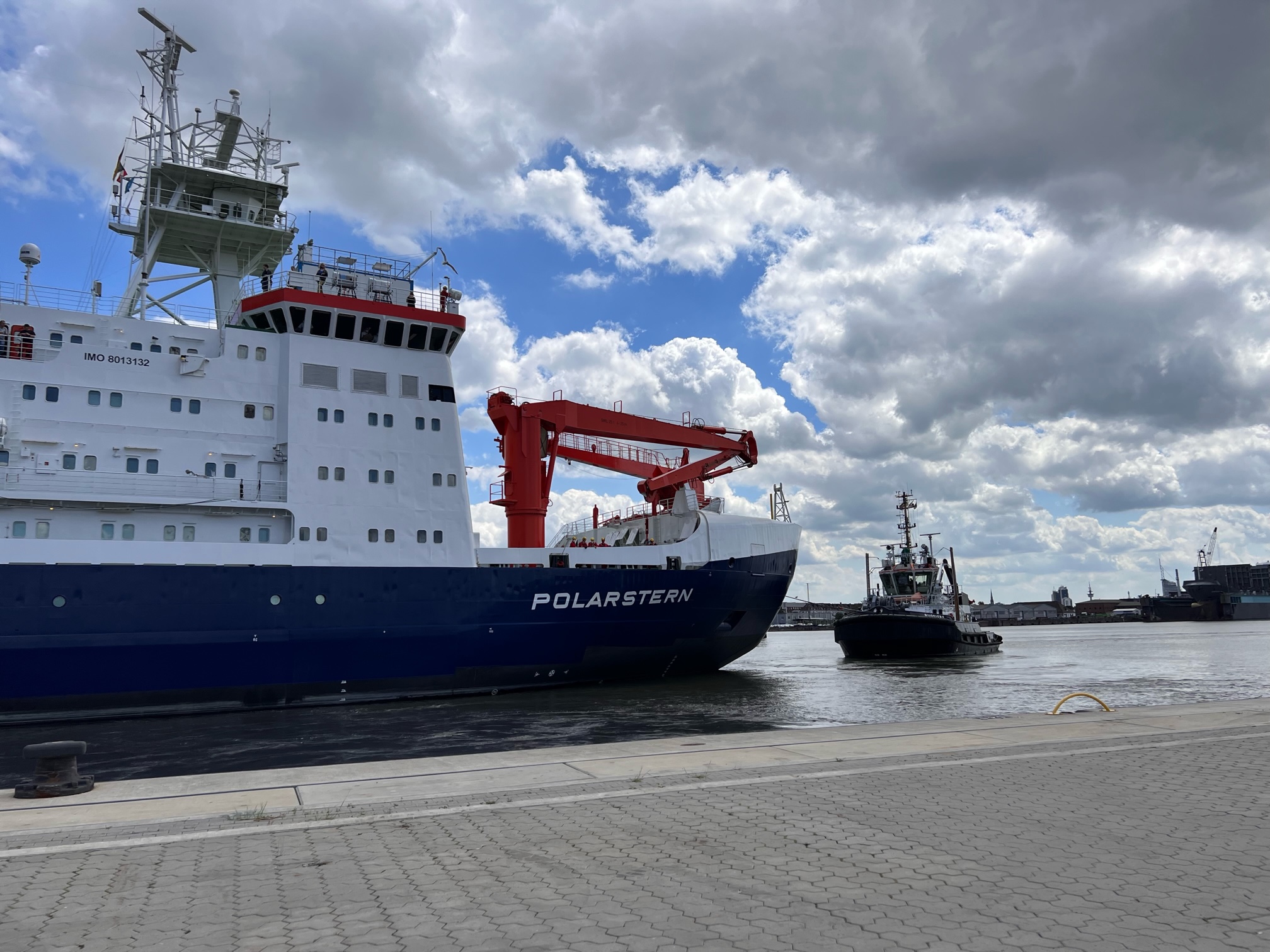
From her home port in Bremerhaven, the Polarstern will set course for Fram Strait and the marginal ice zone north of Svalbard, where warm, nutrient-rich Atlantic Water flows into the Arctic Ocean.
The Polarstern starts its voyage to the Arctic from its home port of Bremerhaven. Photo: Nina Machner
Closely monitoring energy and material flows in the marginal ice zone from the ship and from on ice floes is the goal of the team led by Prof Torsten Kanzow, expedition leader and a physical oceanographer at the Alfred Wegener Institute, Helmholtz Centre for Polar and Marine Research (AWI). “We will make transects from the open water into the dense sea ice and back. Along the way, we will gather a variety of physical, chemical and biological measurements in the marginal ice zone, which is especially productive and therefore especially interesting,” explains Kanzow.
“The team will also venture onto the ice to take a closer look at the thickness and characteristics of the sea ice and measure ocean currents and eddies away from the ship. We’ll also deploy so-called gliders in the ocean, buoys on the ice and moorings on the seafloor, all of which will record valuable data for the next several years. Lastly, we’ll extend our research radius with helicopter flights, during which we’ll observe, for instance, the melt ponds on the ice.”
Following the work in the MIZ north of Svalbard Polarstern will be heading for Northeast Greenland:
The two glaciers there (79 N Glacier and Zachariae Isstrom) are both characterised by ocean-driven ice loss and accelerated ice flows, making them contributors to sea-level rise. “We plan to install moorings in order to gauge the sensitivity of ocean-driven glacier melting to changing environmental conditions,” says Kanzow, who’s been pursuing research in the region since 2016. Accompanying geodetic-glaciological studies will be conducted on Greenland. On the one hand, they will assess how the solid ground is rising on extremely small scales, because it is still rebounding from the past weight of ice masses that melted after the last glacial maximum. On the other, they will explore temporal variations in supraglacial lakes; their drainage out to sea can have considerable effects on glacier flow speeds and glacier melting.
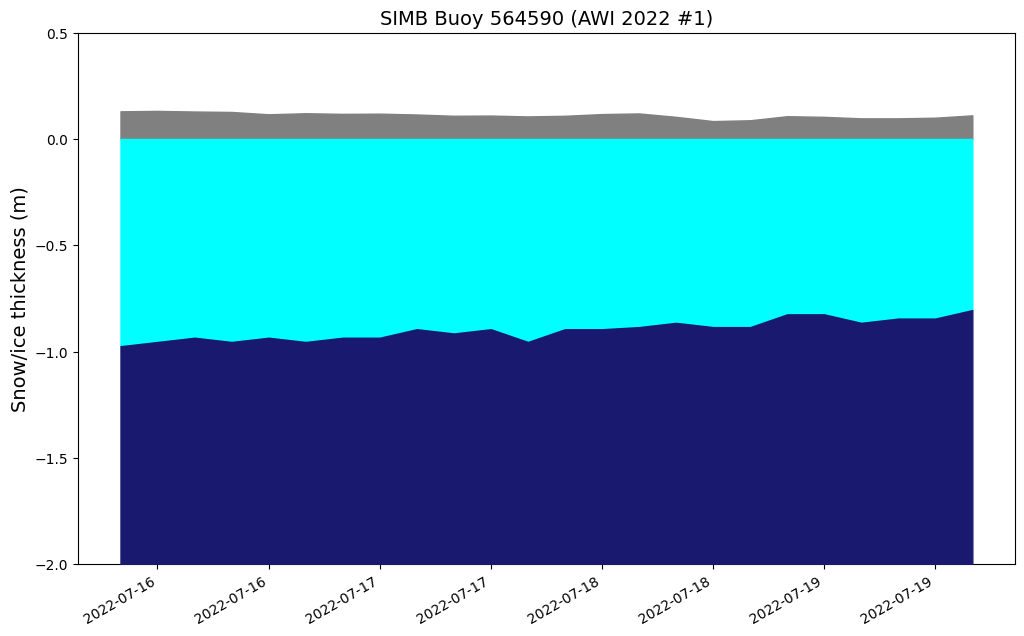
The AWI team have installed three seasonal ice mass balance buoys in the MIZ, without the usual thermistor string but with a new conductivity, temperature, depth (CTD) sensor fitted to measure salinity instead. Less colourful than usual sea ice thickness graphs can be viewed on the 2022 ice mass balance buoy page. Here’s one example:
[Edit – July 25th]
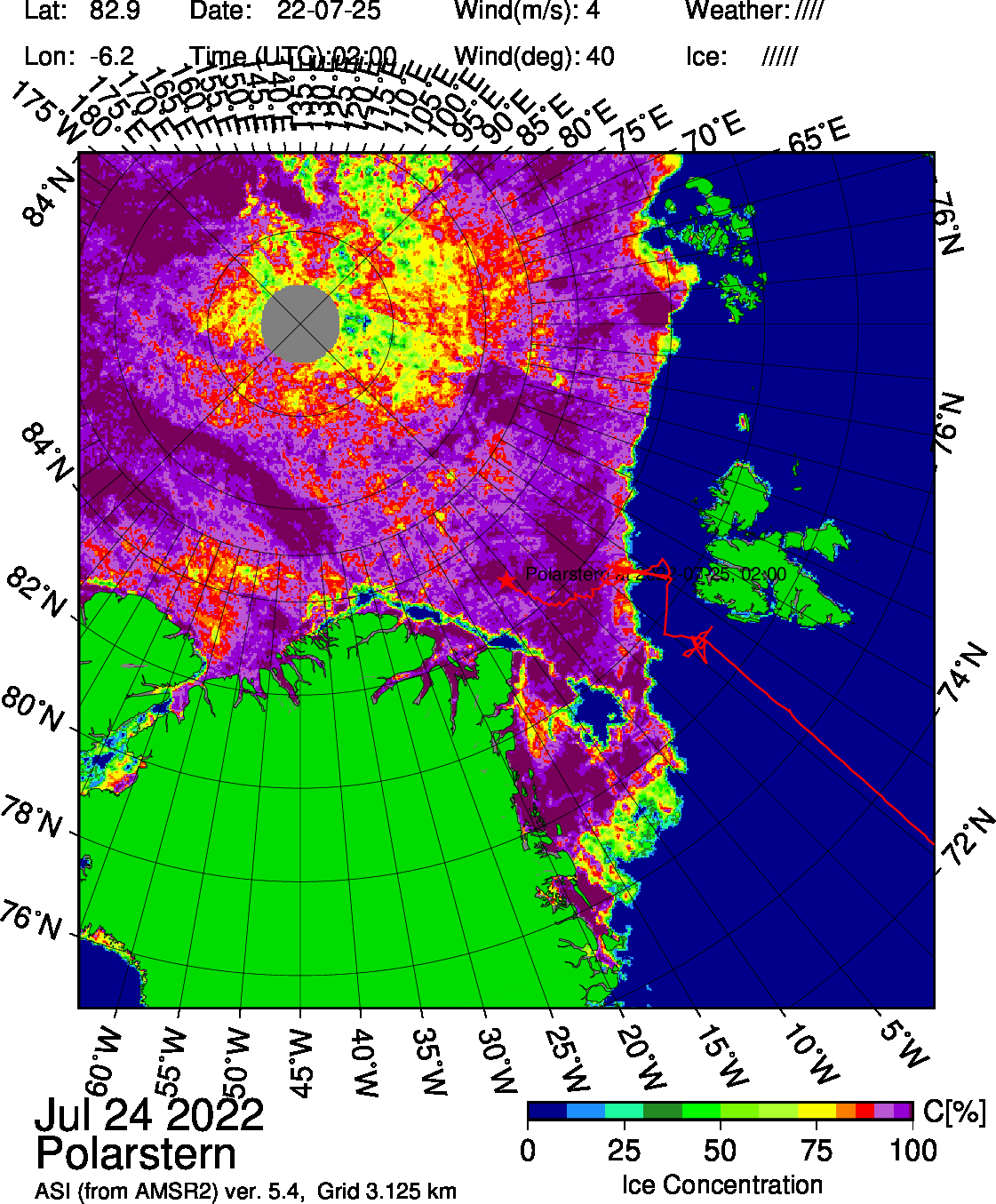
The image above updates on a daily basis, but today’s version is worth preserving for posterity:
There is currently a large area of low concentration sea ice around the North Pole, and Polarstern has left its station in the marginal ice zone and is currently heading north of Greenland rather than in the direction of the 79N/ZI glaciers.
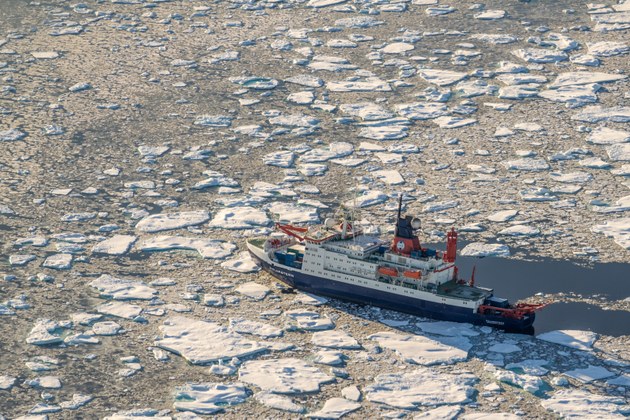
Polarstern has been heading even further north to the Aurora Vent field (about 130 nautical miles northwest). As part of an extensive lithospheric study, ocean bottom seismometers will be deployed at depths of more than 4000 meters to record seismological activity as well as the physical properties of the hydrothermal plume.
Polarstern north east of Greenland – Photo: Christian R. Rohleder
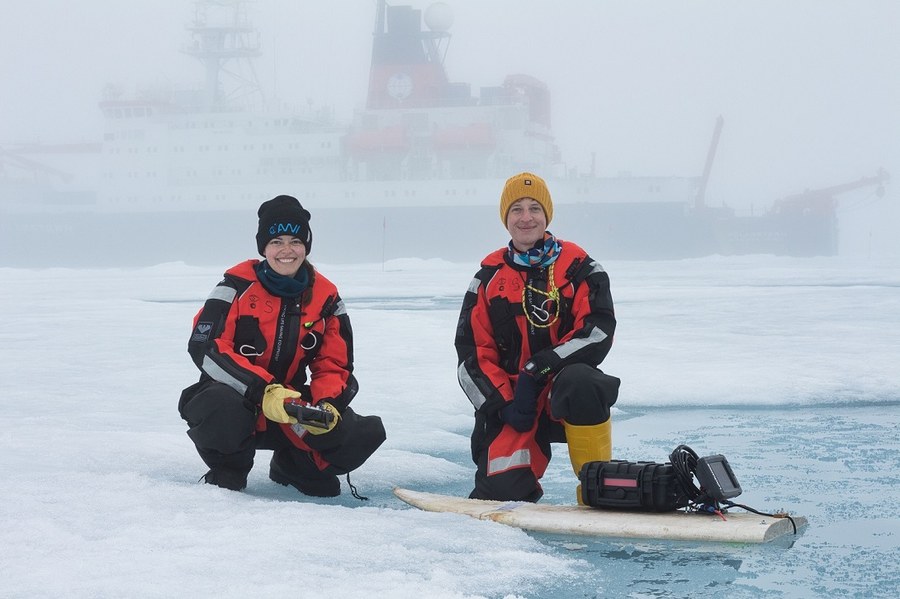
Polarstern is now heading south again, where a team from the Technical University of Dresden will be deploying a modified surfboard on supra-glacial lakes! Here’s a test run in a melt pond:
Photo: Erik Loebel[Edit – July 29th]
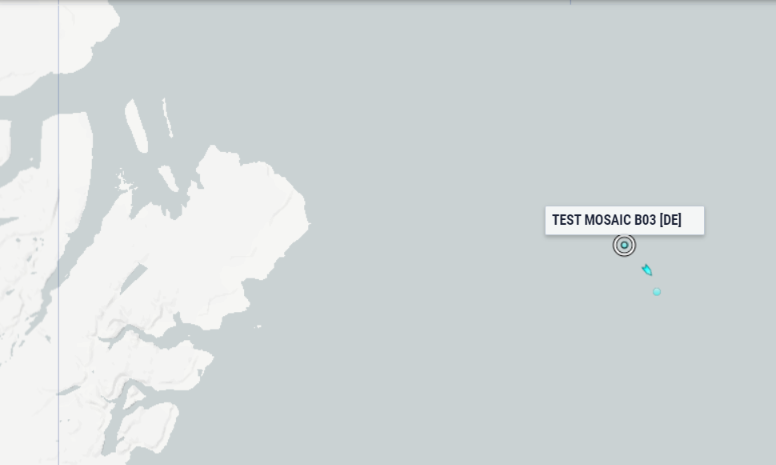
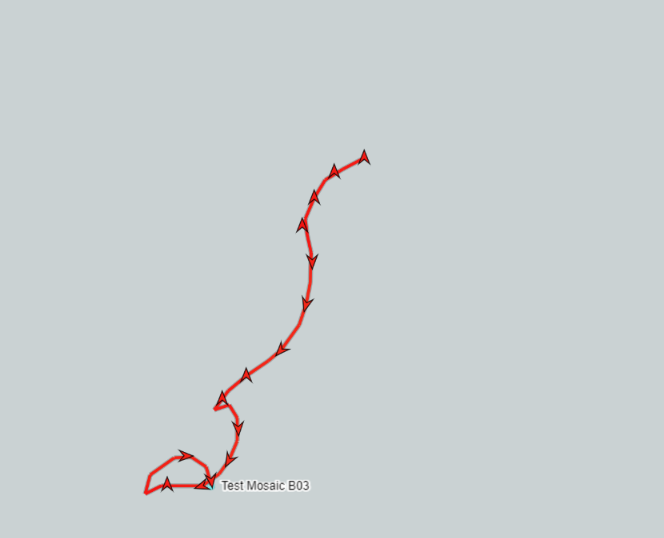
I discovered something rather interesting whilst browsing the Marine Traffic ship tracking web site this morning:
It appears as if the AWI have recently installed two buoys that support AIS position reporting, as indeed does Polarstern itself:
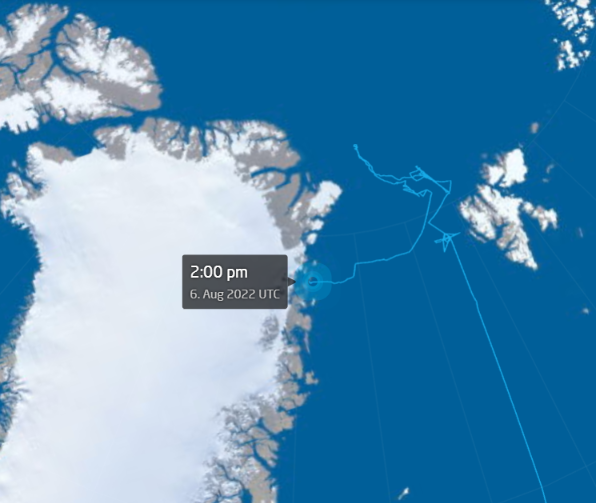
[Edit – August 6th]
Polarstern is now approaching the 79 N and Zachariae Isstrom glaciers:
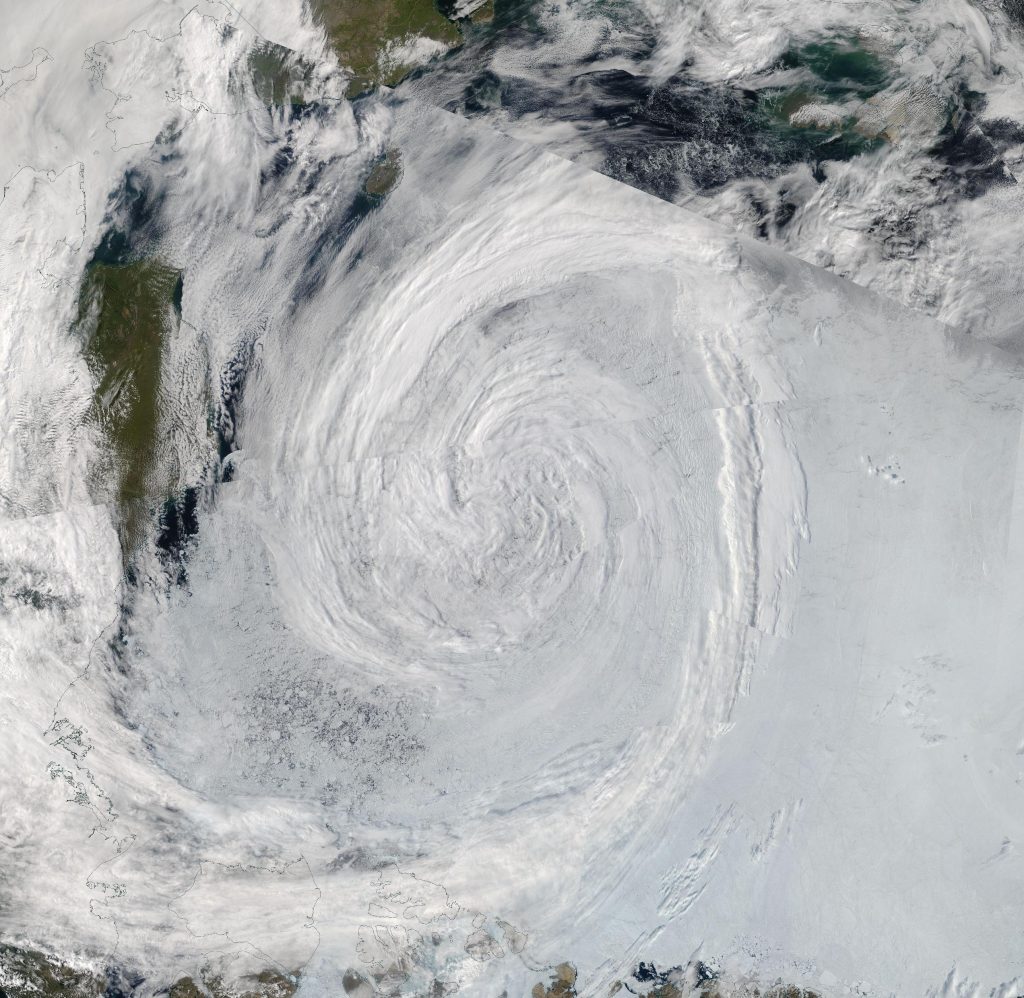
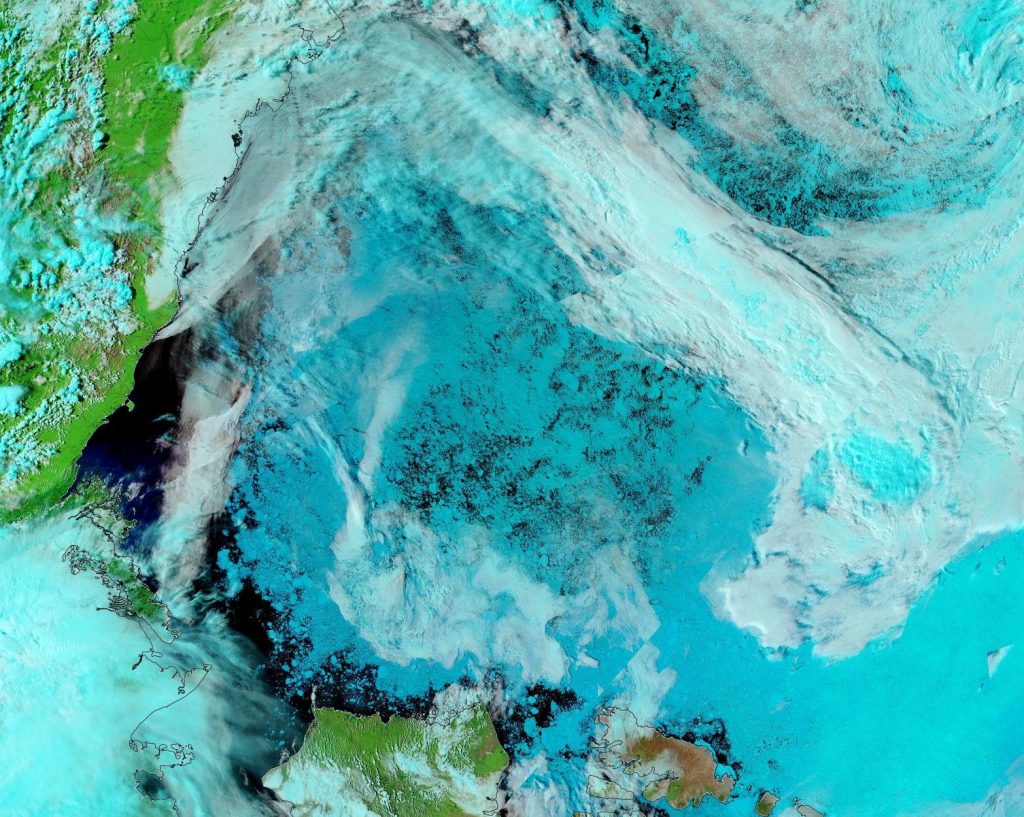
A new month begins today, and at the moment it looks as though it’s going to be the most interesting one since August 2012. Here once again is the satellite image of the enormous cyclone that was spinning over the Beaufort/Chukchi Seas just a few days ago:
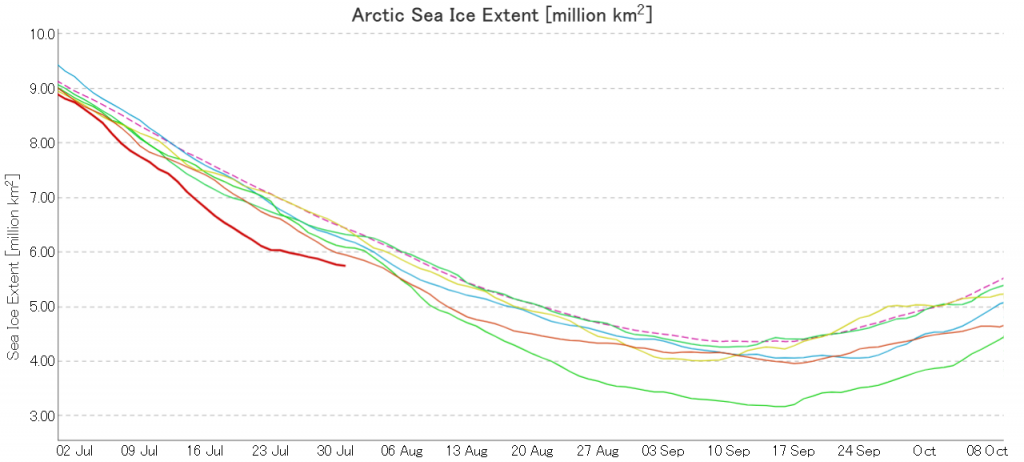
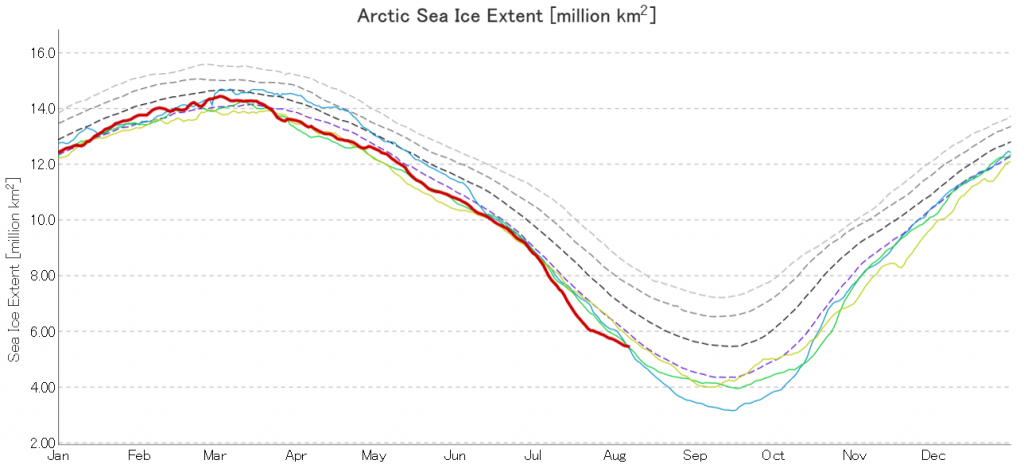
Here too is the effect of the cyclone on the trajectory of the JAXA Arctic sea ice extent graph:
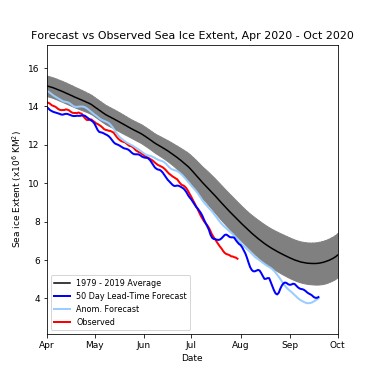
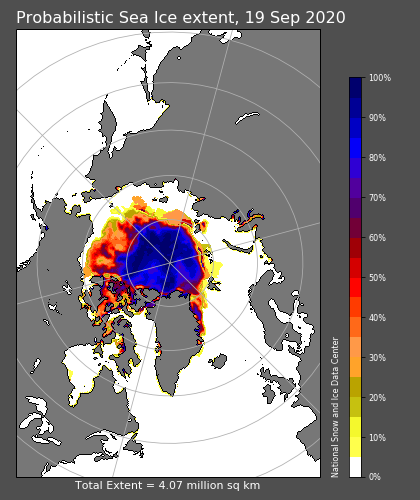
Here too is the current prognosis of the late Andrew Slater’s “Slater Probabilistic Ice Extent” 50 day forecast:
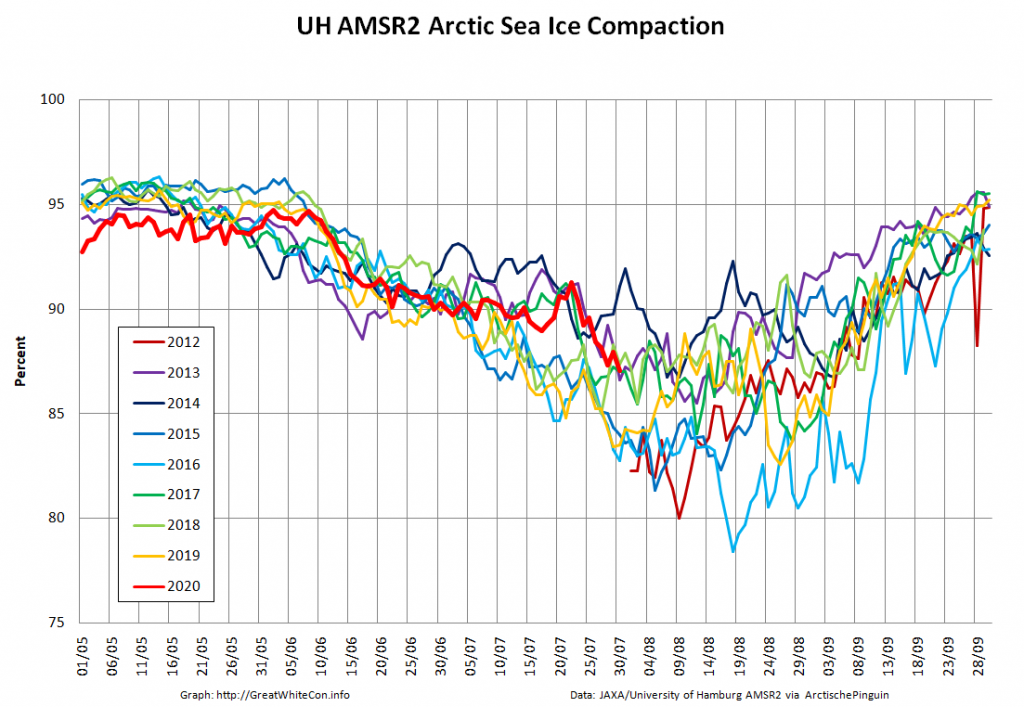
The cyclone has obviously resulted in a reduction in the rate of extent decline, but take a look at the high resolution AMSR2 “compaction” graph:
The gaps between the remaining sea ice floes have evidently increased, and hence the ice area is declining more rapidly than its extent.
[Edit – August 2nd]
Here’s an animation, based on the University of Hamburg’s AMSR2 concentration maps, which reveals the motion of the sea ice across the Beaufort and Chukchi Seas for the last two months:
Note in particular the side effects of the recent cyclone, visible at the end of the video.
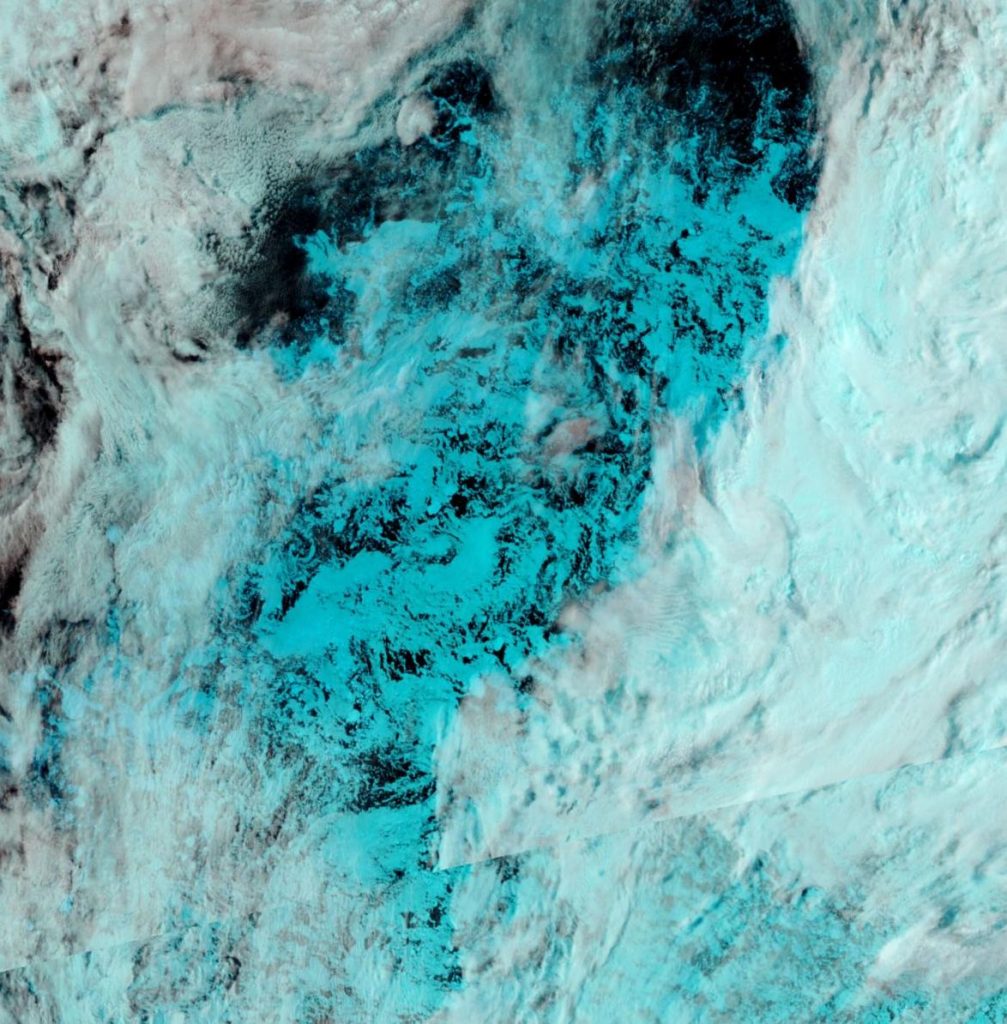
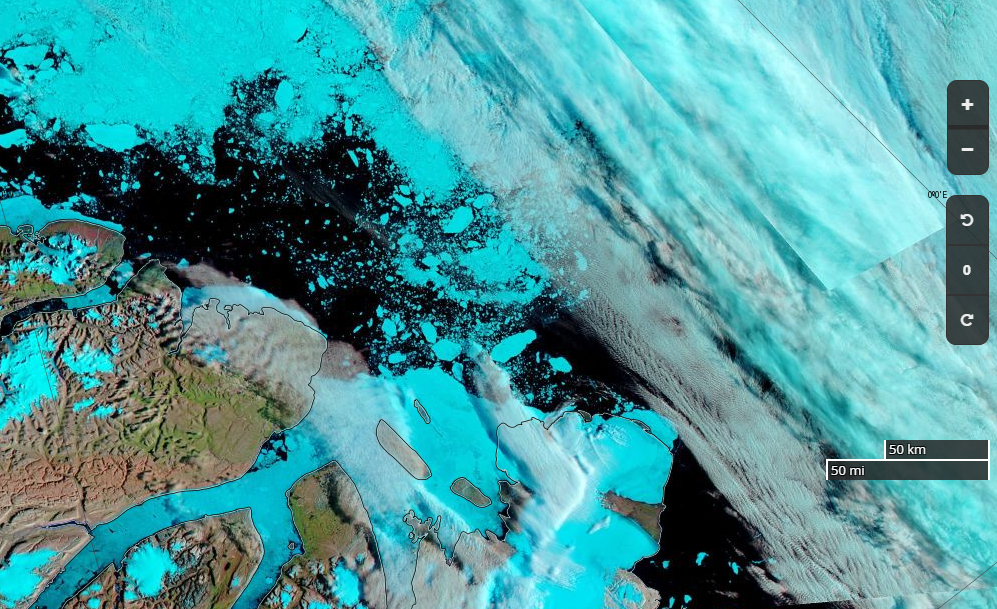
Here too is a close up of the current state of the remaining ice in the Chukchi Sea, snapped by the Suomi NPP satellite through a gap in the clouds:
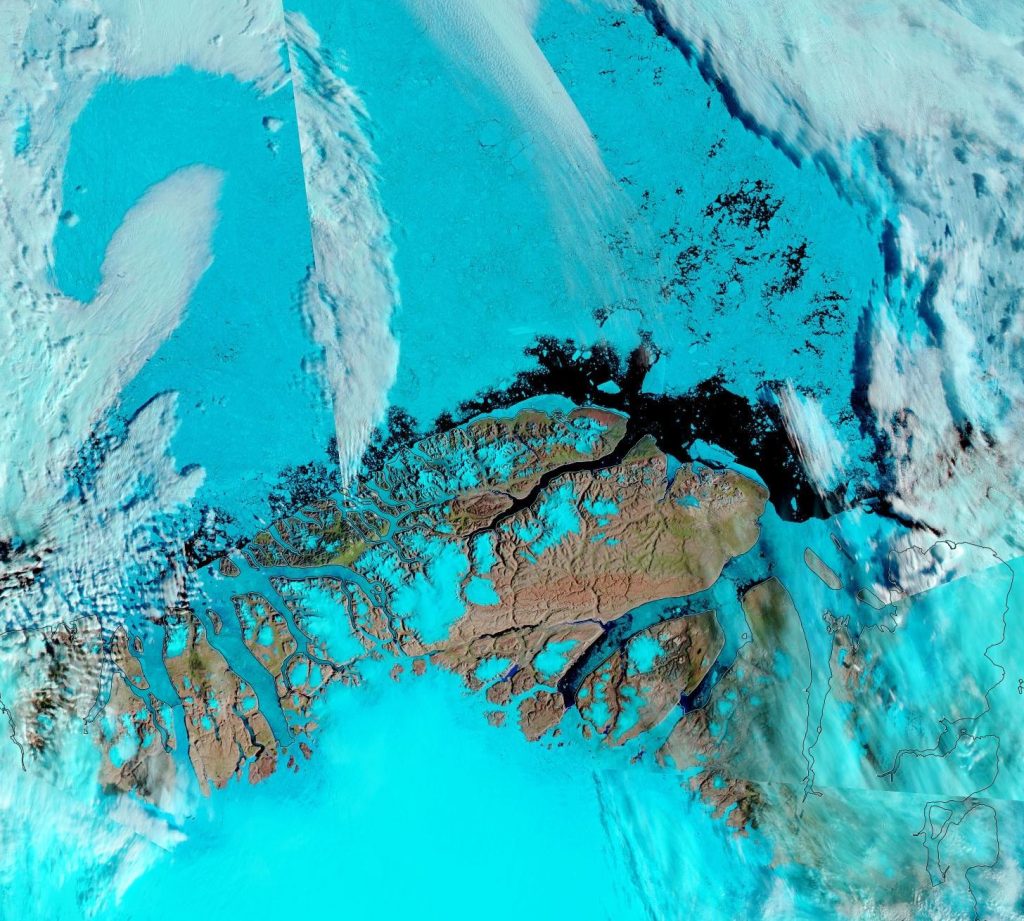
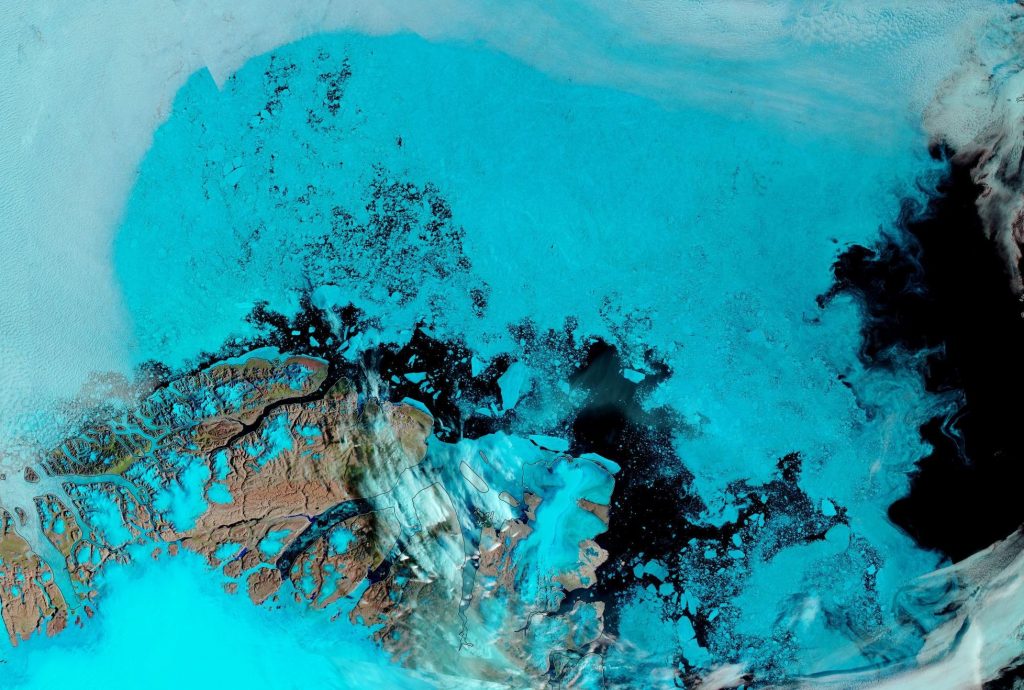
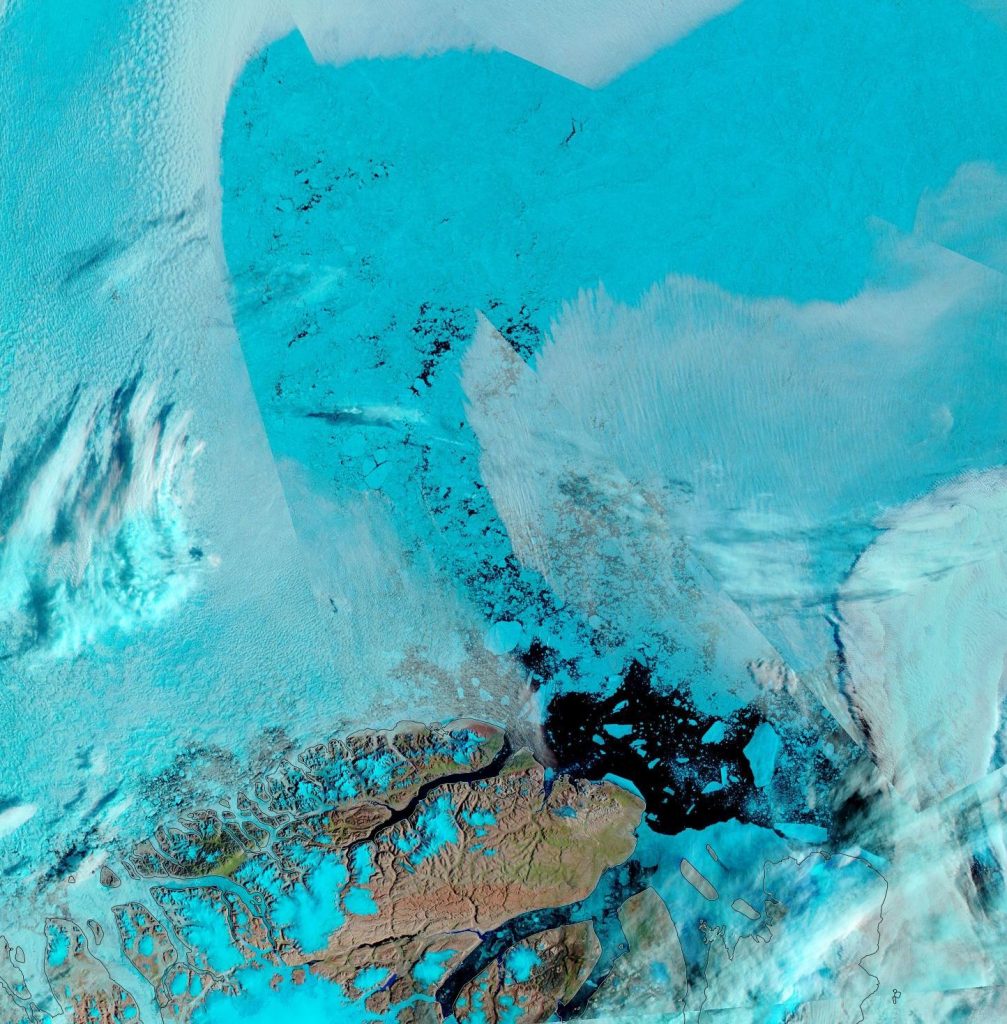
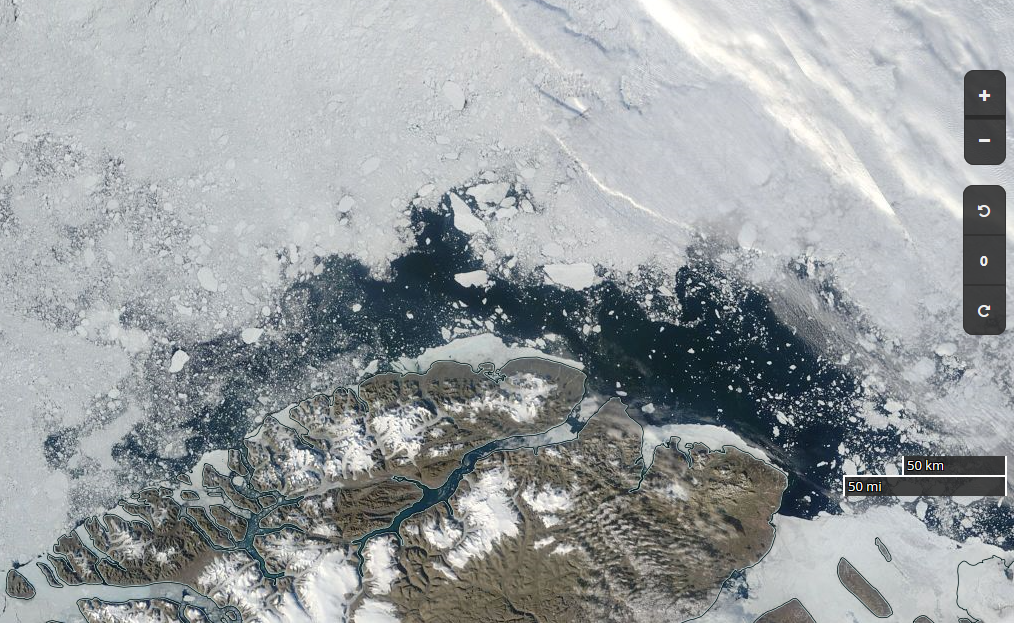
Plus the current open water north of Greenland. Perhaps once Polarstern has been flushed out into the open water of the Fram Strait at the end of the MOSAiC expedition she could take another look at this almost completely unexplored area of the Arctic Ocean?
[Edit – August 6th]
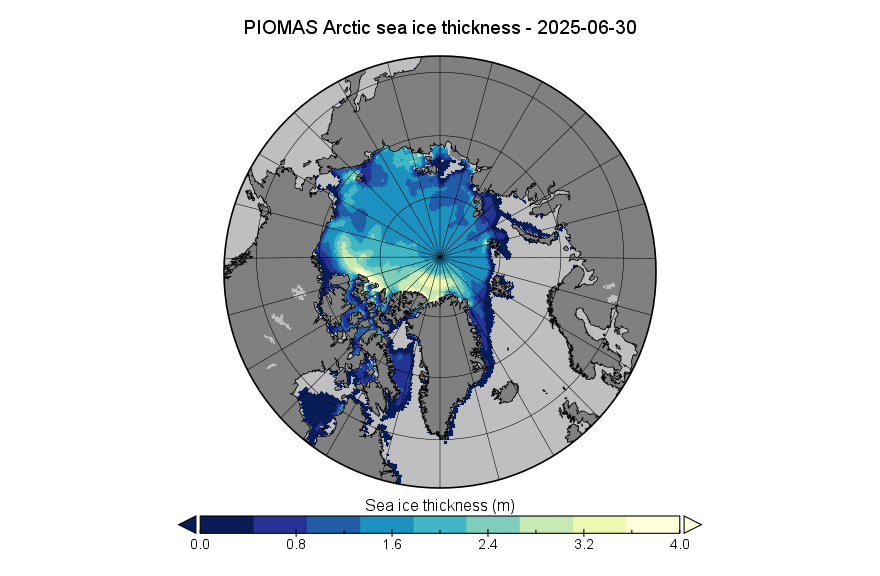
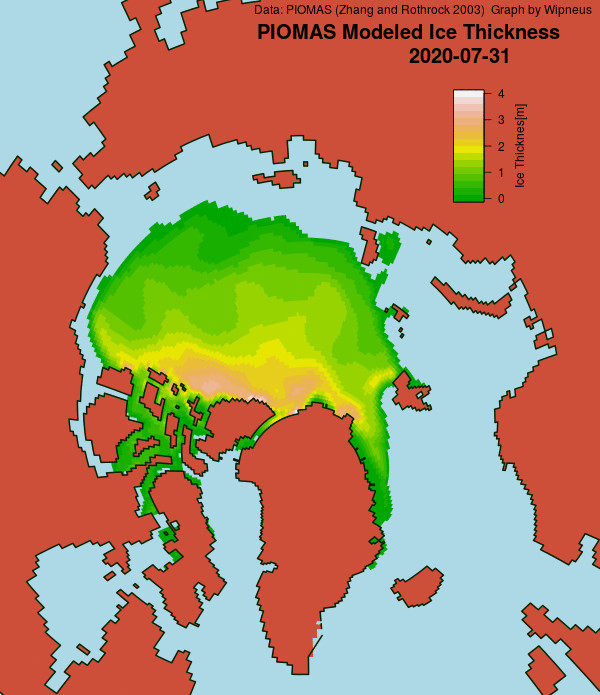
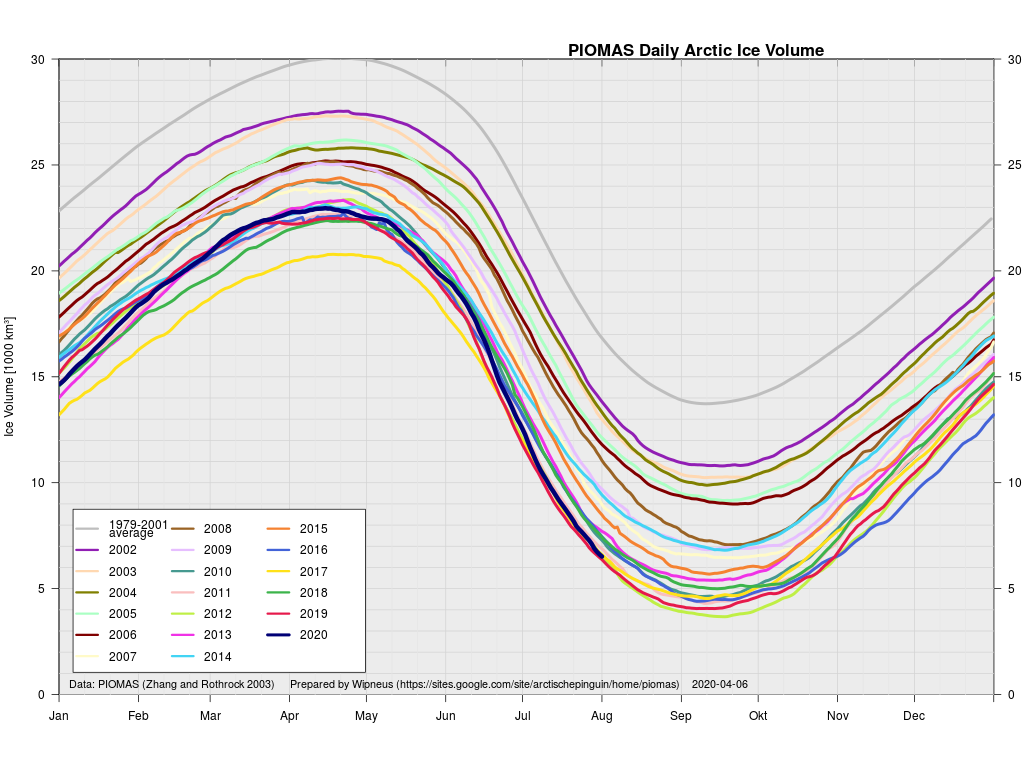
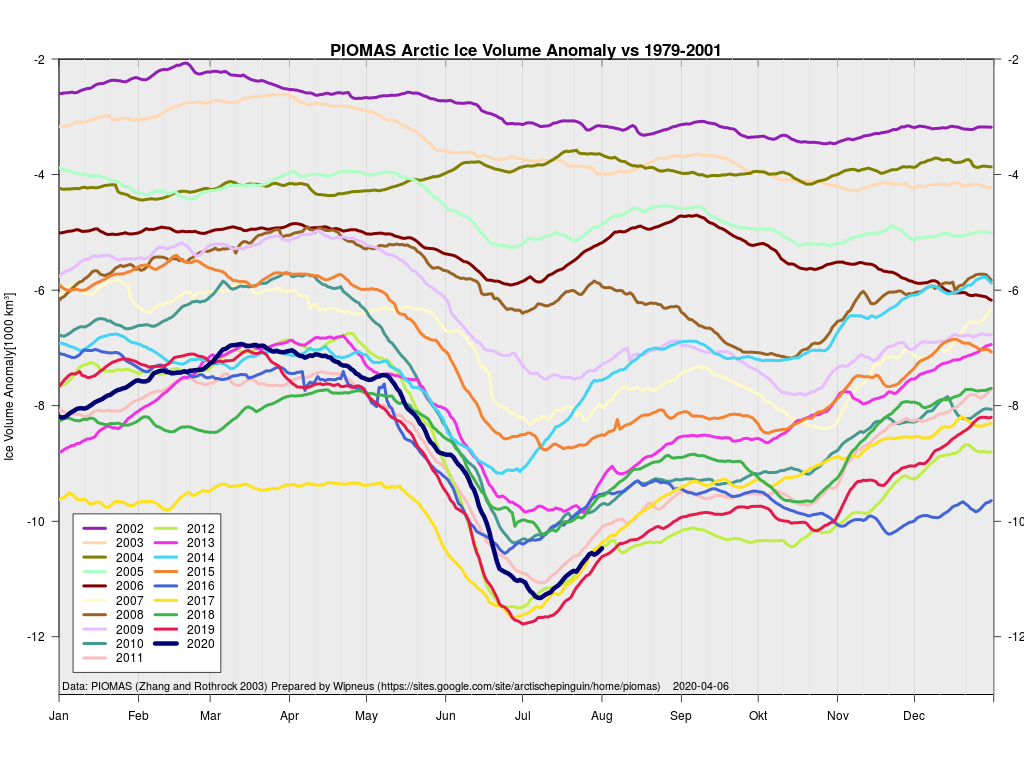
The latest gridded thickness data has been released by the PIOMAS team, and here are Wipneus’s visualisations:
Average Arctic sea ice volume in July 2020 was 9,300 km3. This value is only 400 km3 above the record minimum value of 8,900 km3 set in 2019. This makes 2020 the fourth lowest on record for July with 2012, 2017,2019 falling just below 2020.
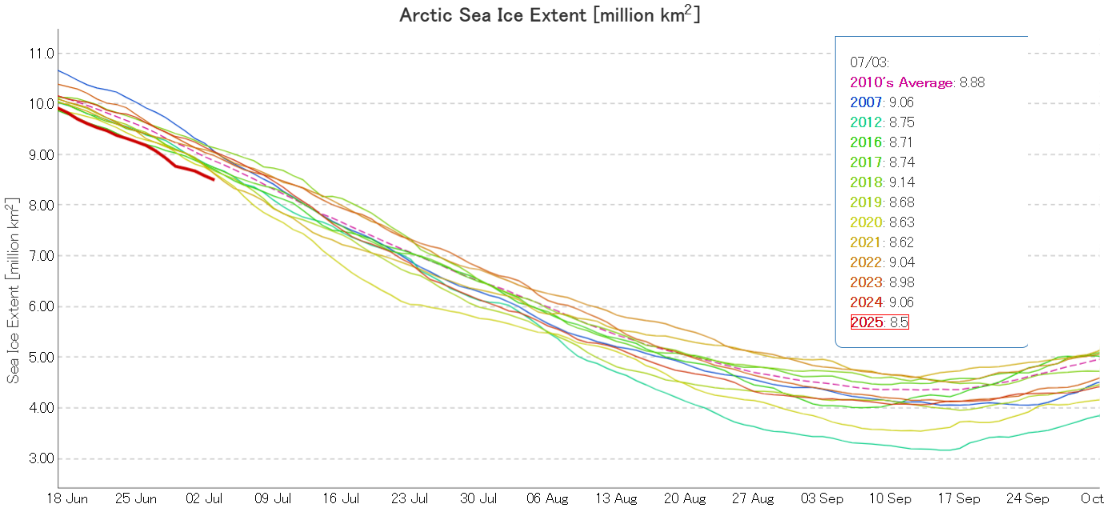
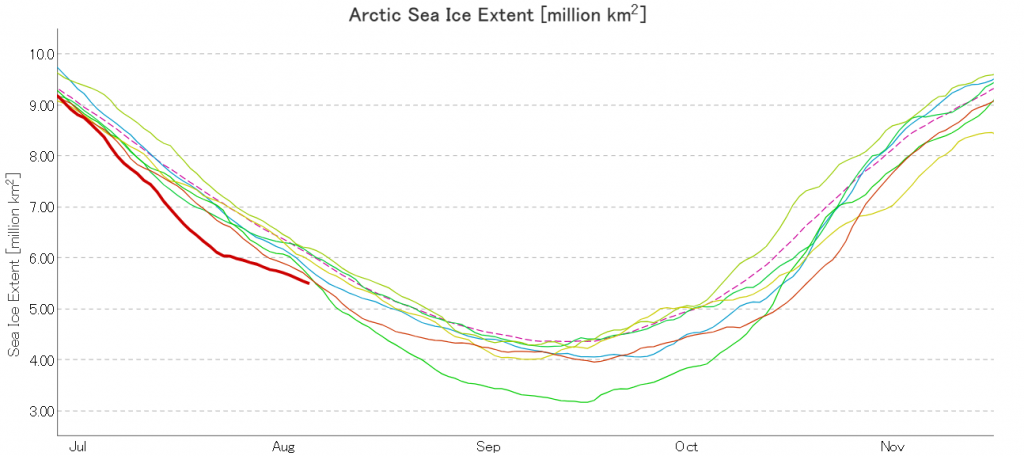
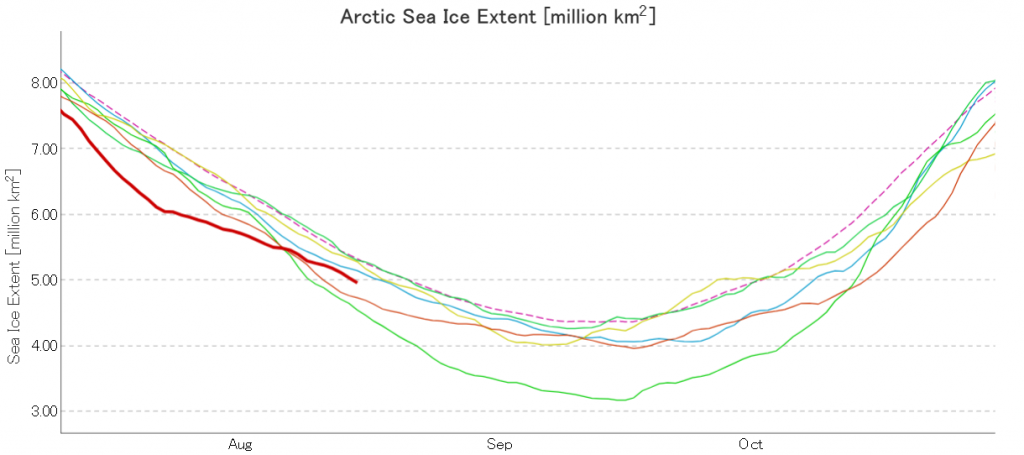
JAXA extent is still lowest for the date, but following the recent cyclone it looks as though it will not maintain that position for much longer:
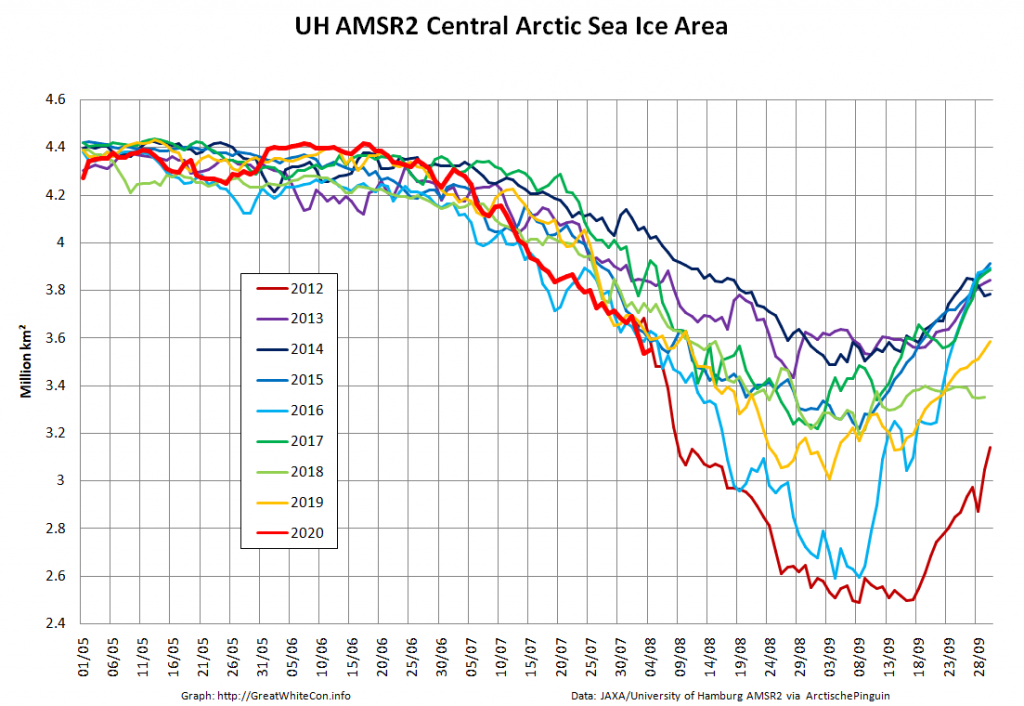
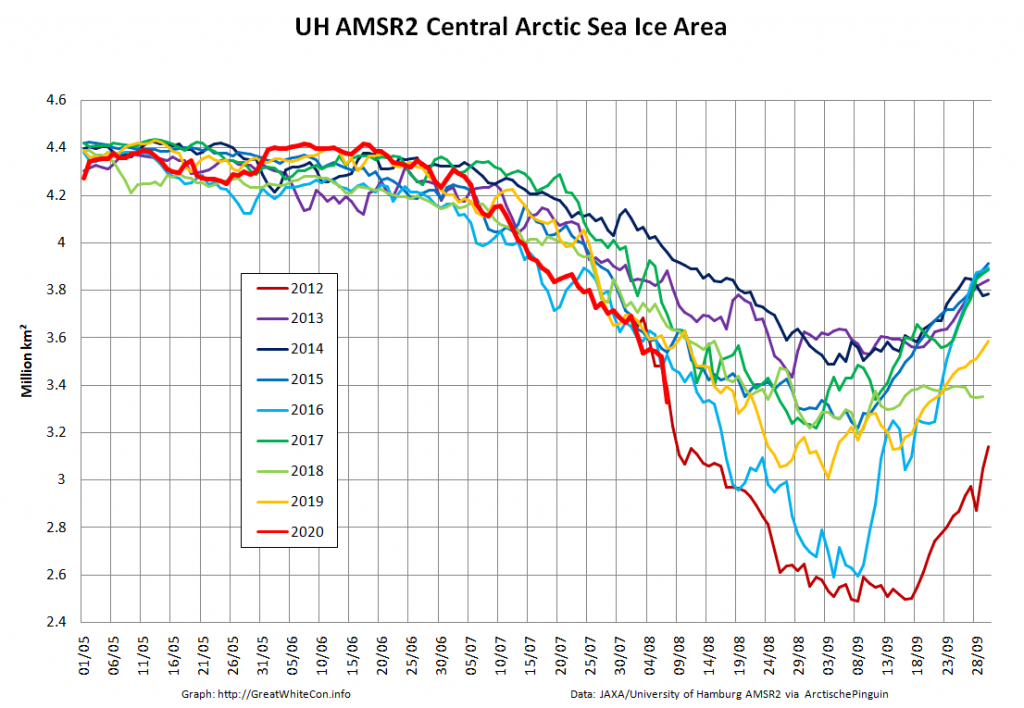
Now we’re in the month of August it’s possible to do a direct comparison with AMSR2 data for 2012. Here’s sea ice area for the Central Arctic Basin:
[Edit – August 8th]
All of a sudden JAXA extent is in 3rd place in the race to the minimum:
However let’s also take a close look at the state of the sea ice in the Beaufort and Wandel Seas shall we?
At this juncture I reckon that come mid September second place is now more likely than first. However as always, it still all depends on the weather.
[Edit – August 9th]
Surprising as it may seem, high resolution AMSR2 Central Arctic Basin sea ice area has so far managed to keep up with the precipitous drop in 2012:
North of Greenland the clouds have cleared closer to the North Pole, to reveal this:
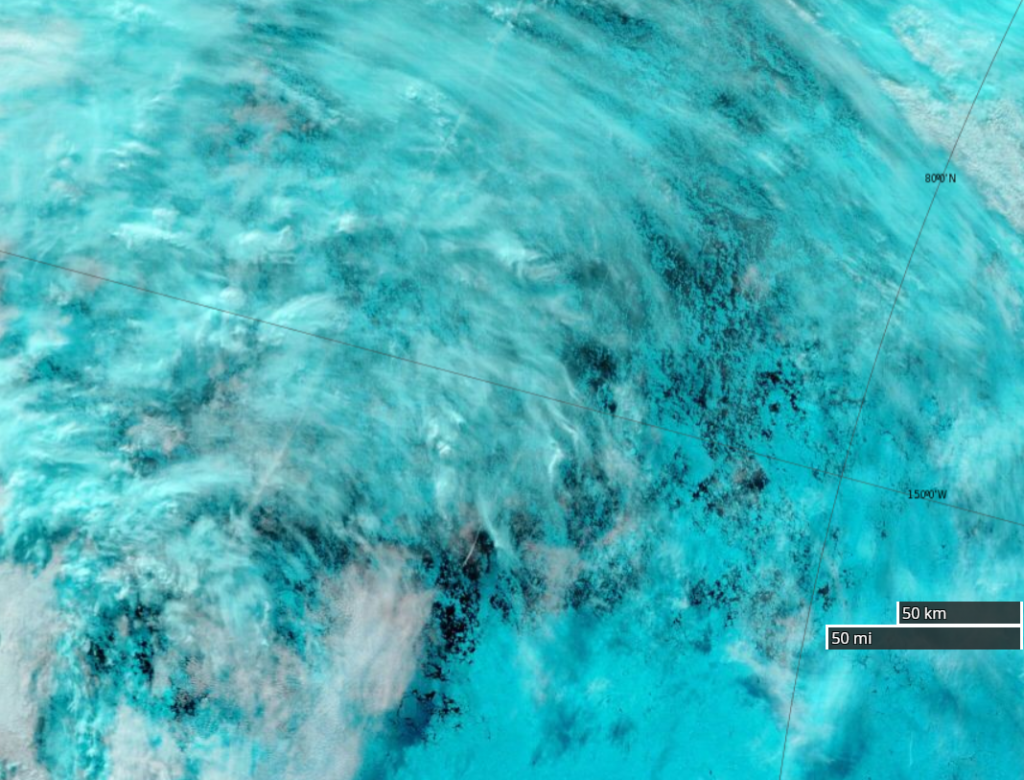
Fresh this morning from Terra, a rather cloudy view of the devastation near 80N, 150W:
[Edit – August 10th]
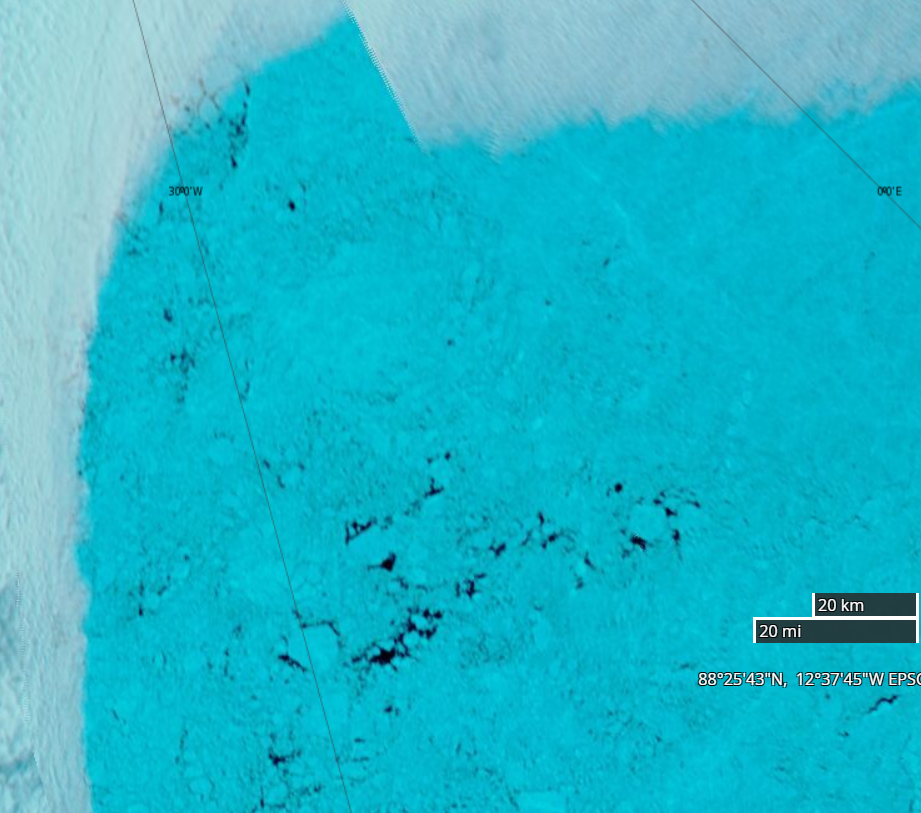
In a not entirely unexpected development one of ex Prof. Judy’s denizens is quibbling about the current condition of sea ice in the Arctic. Hence here is a close up of some “gaping holes in the sea ice cover” at 88N between Greenland and the North Pole:
[Edit – August 13th]
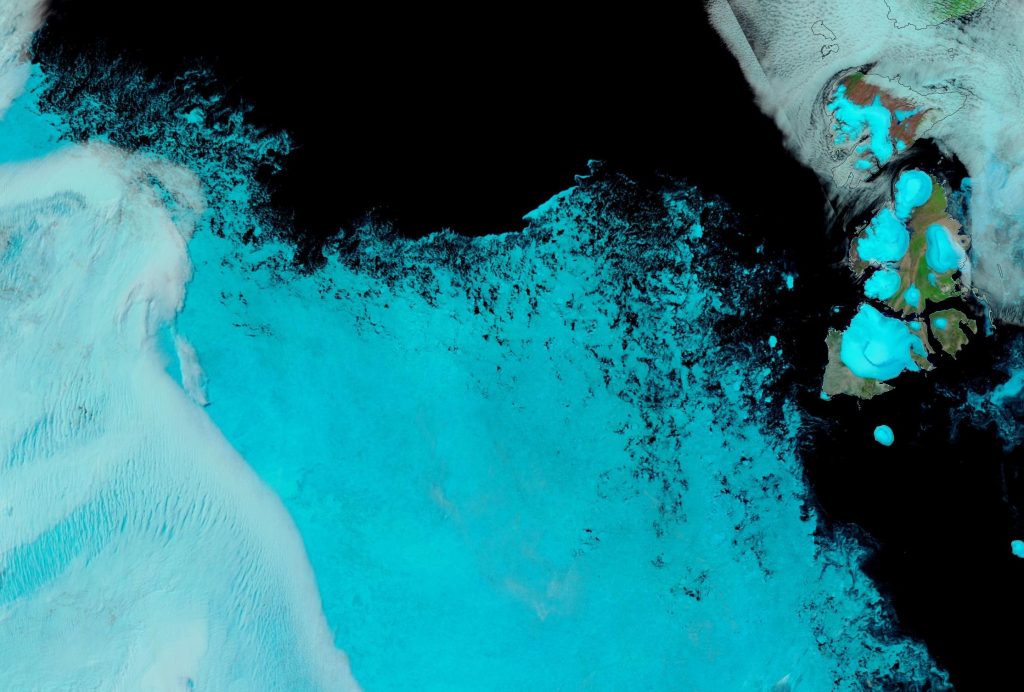
A nice clear view this morning of the marginal ice zone of the “Laptev Bite” and thereabouts from the Suomi satellite :
[Edit – August 16th]
JAXA AMSR2 extent has fallen below 5 million km²:
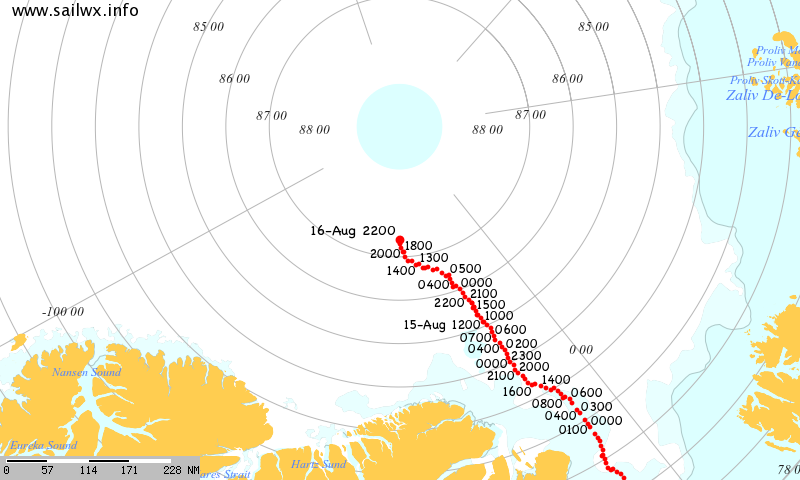
Having been flushed out of the Central Arctic through the Fram Strait the polar research vessel Polarstern is back, seemingly intent on taking a close look at the North Pole:
[Edit – August 19th]
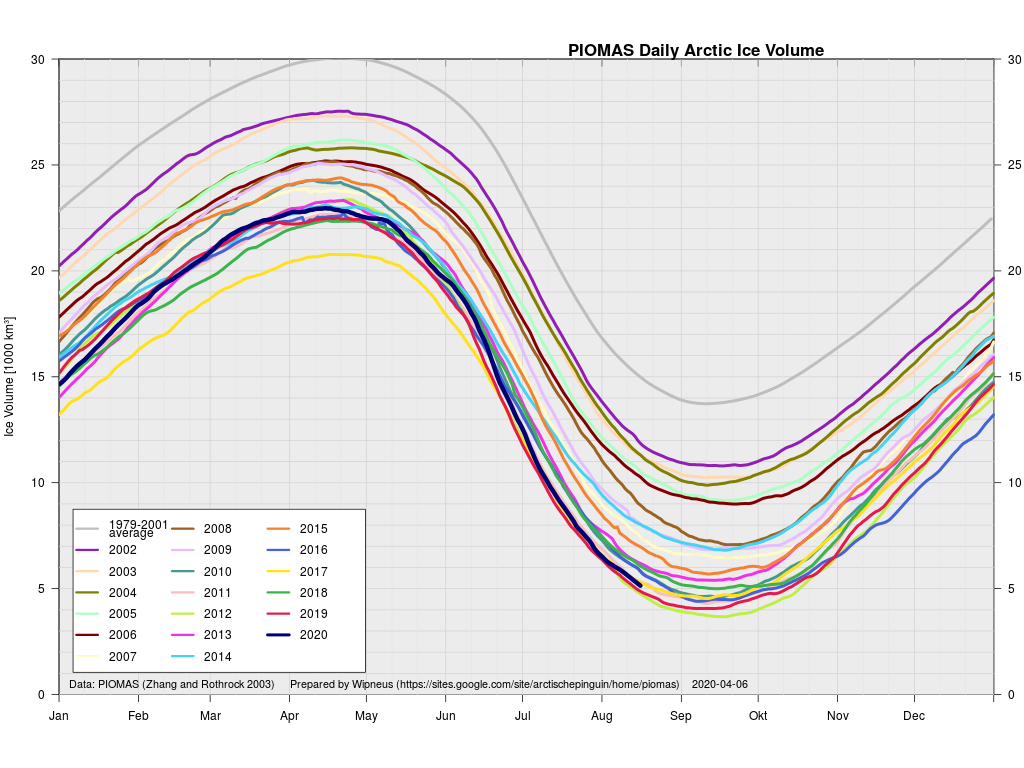
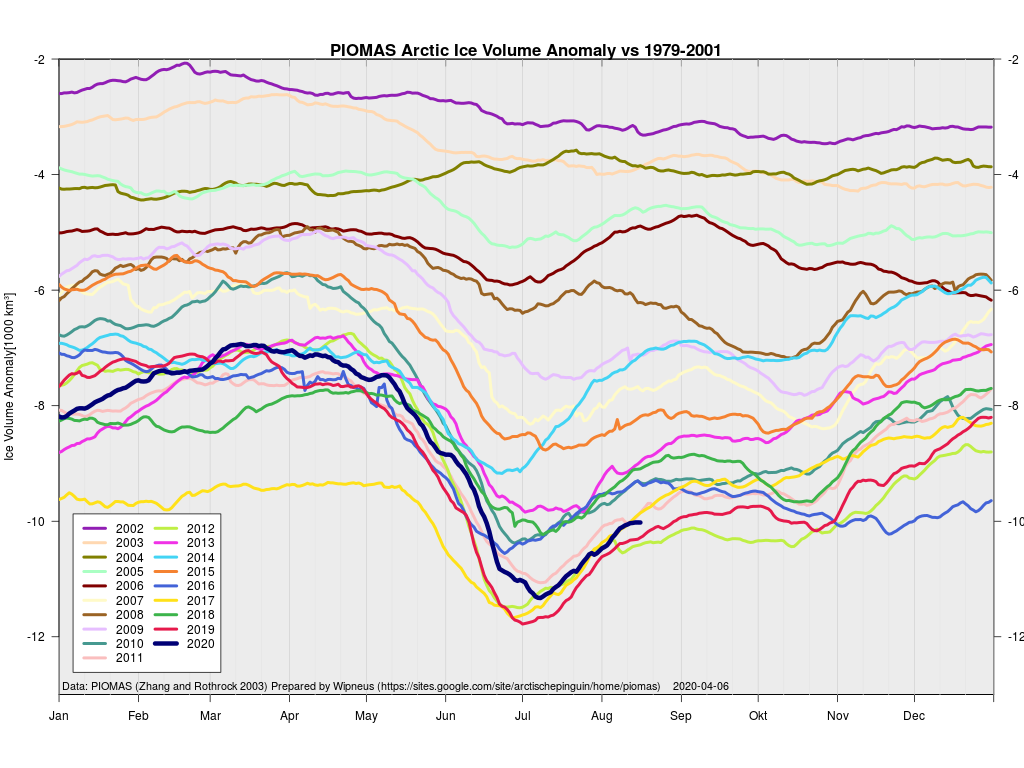
The mid month PIOMAS gridded thickness numbers have been published:
According to the Polar Science Center model Arctic sea ice volume is currently third lowest after 2012 and 2019.
[Edit – August 24th]
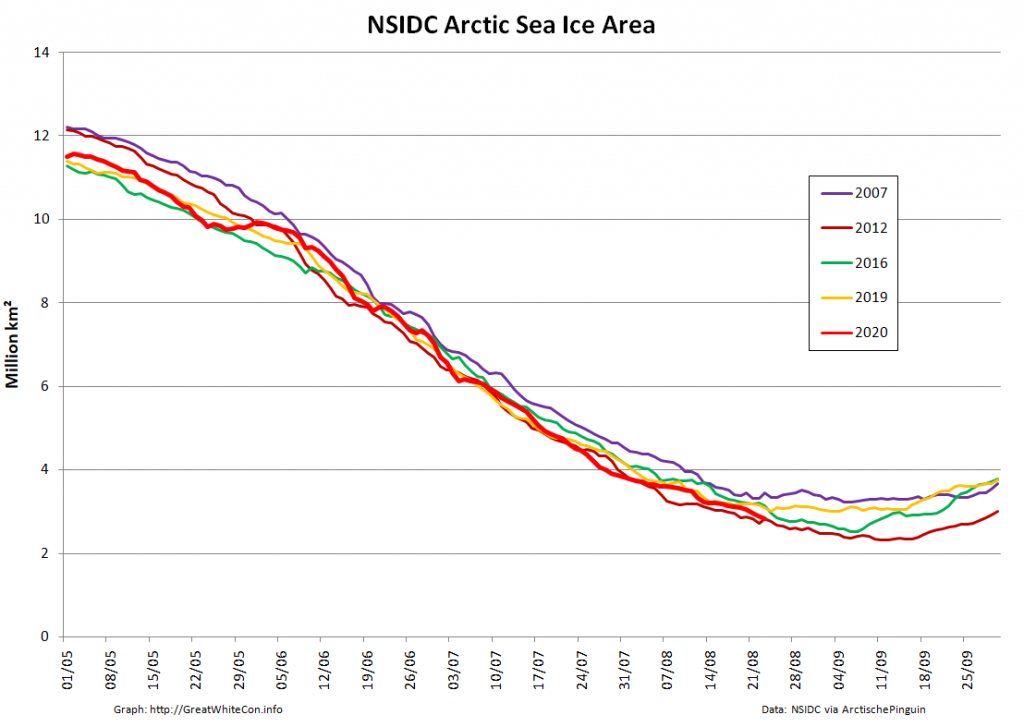
Arctic sea ice area based on NSIDC concentration data is now in a “statistical tie” with 2012 for the honour of “lowest for the date” in the satellite record:
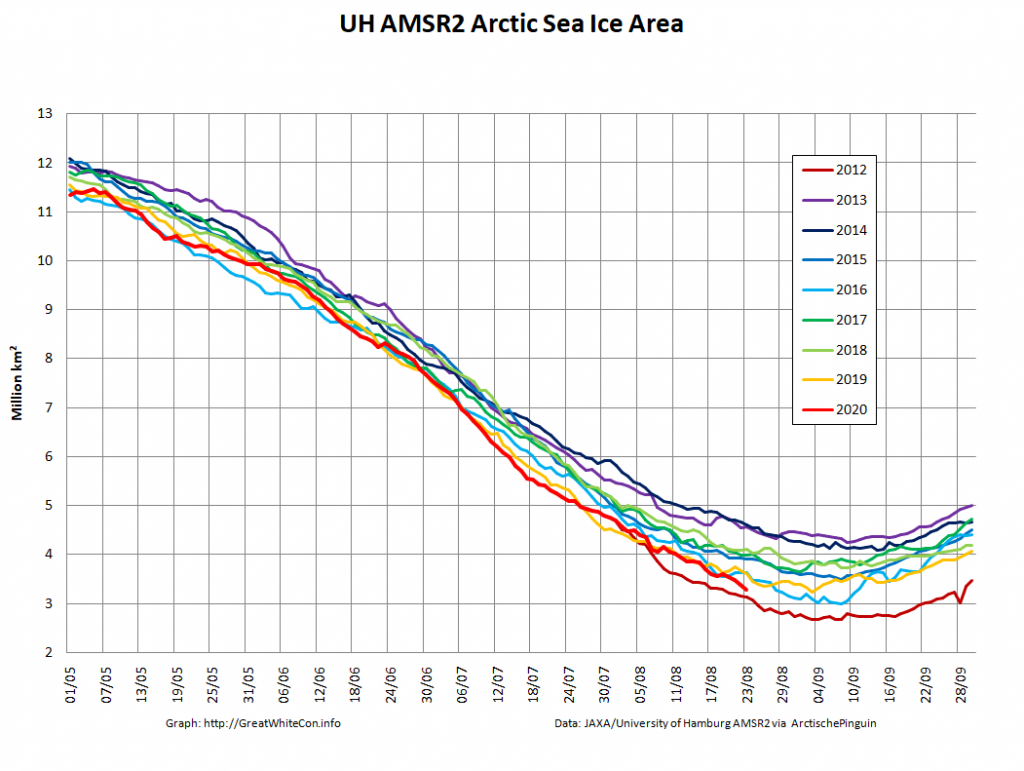
High resolution AMSR2 area isn’t far behind:
[Edit – August 24th]
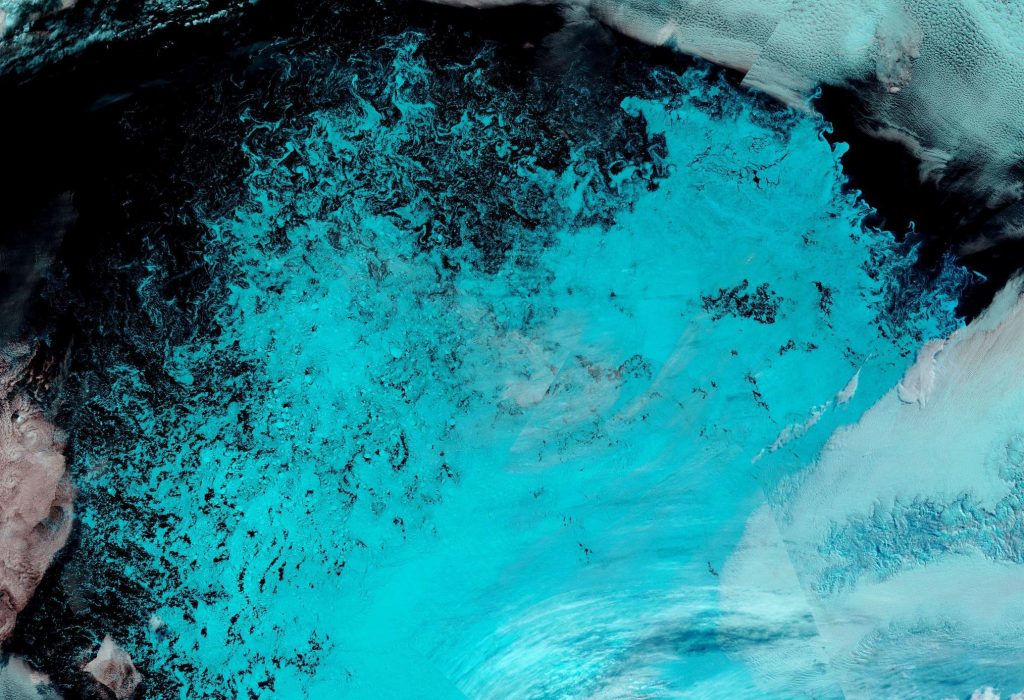
A nice clear view of the disintegrating sea ice north of the East Siberian and Chukchi Seas yesterday:
Watch this space very closely for the next few weeks!
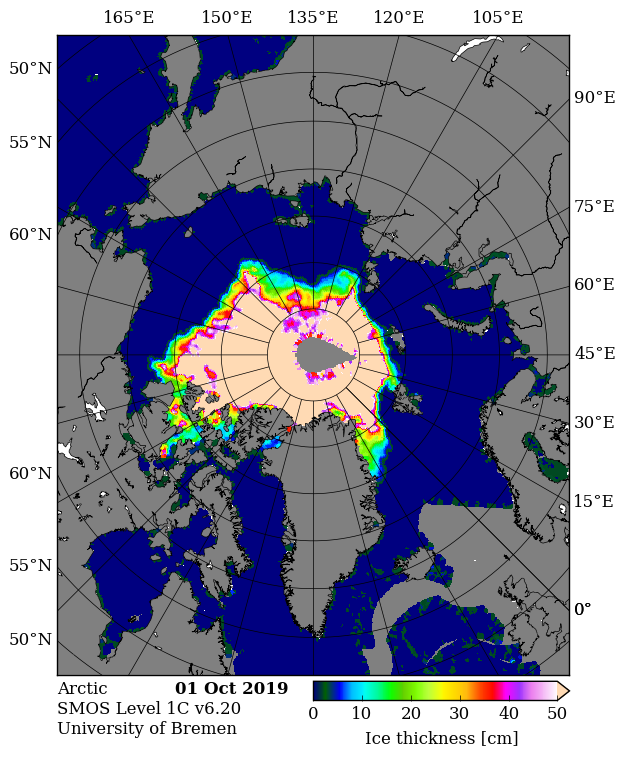
Whilst we await the PIOMAS volume numbers which generally arrive around the 5th of each month, and before we look at graphs of extent, with the refreeze well under way some “measured” thickness maps are coming back! Here’s the first SMOS map this autumn:
Then of course there’s our usual Arctic wide high resolution AMSR2 area and extent graphs:
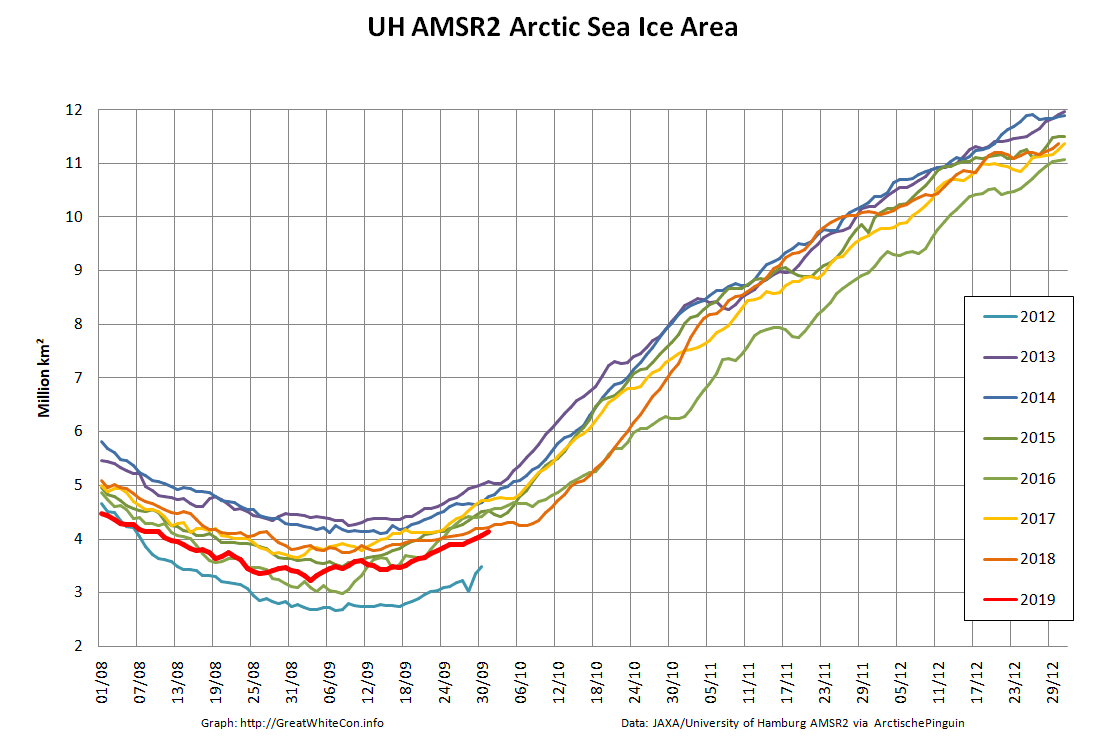
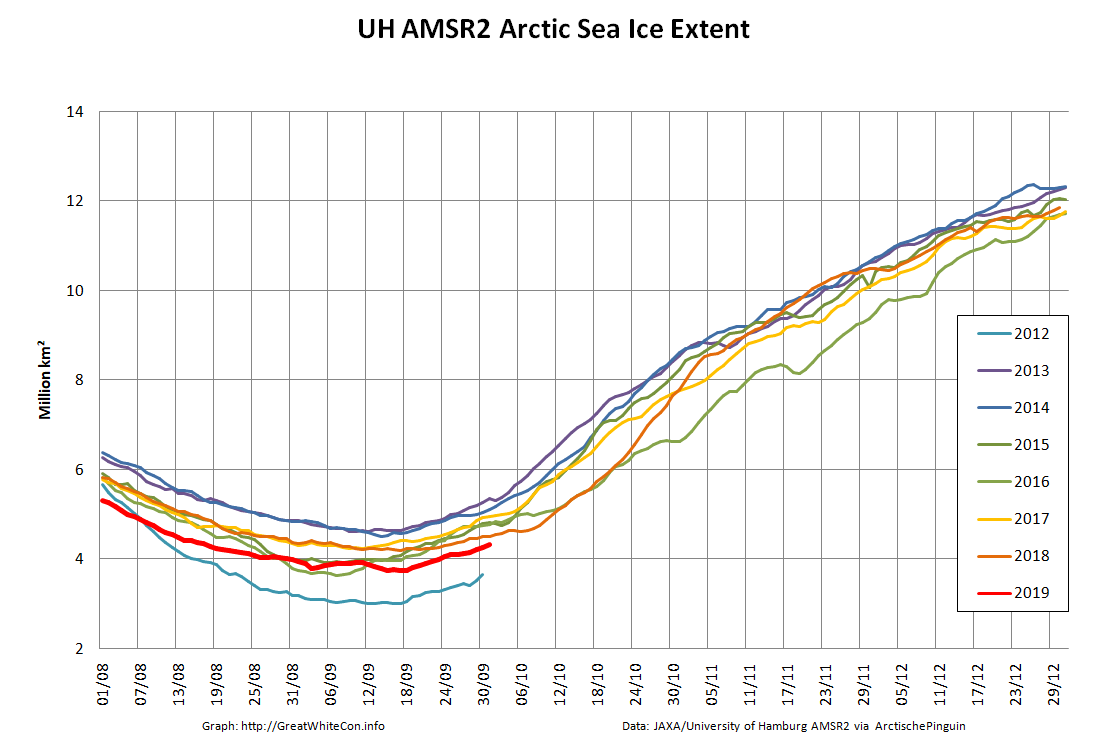
They reveal both metrics currently still second lowest (in the brief AMSR2 record) after 2012. It looks as though that may well change soon, particularly area.
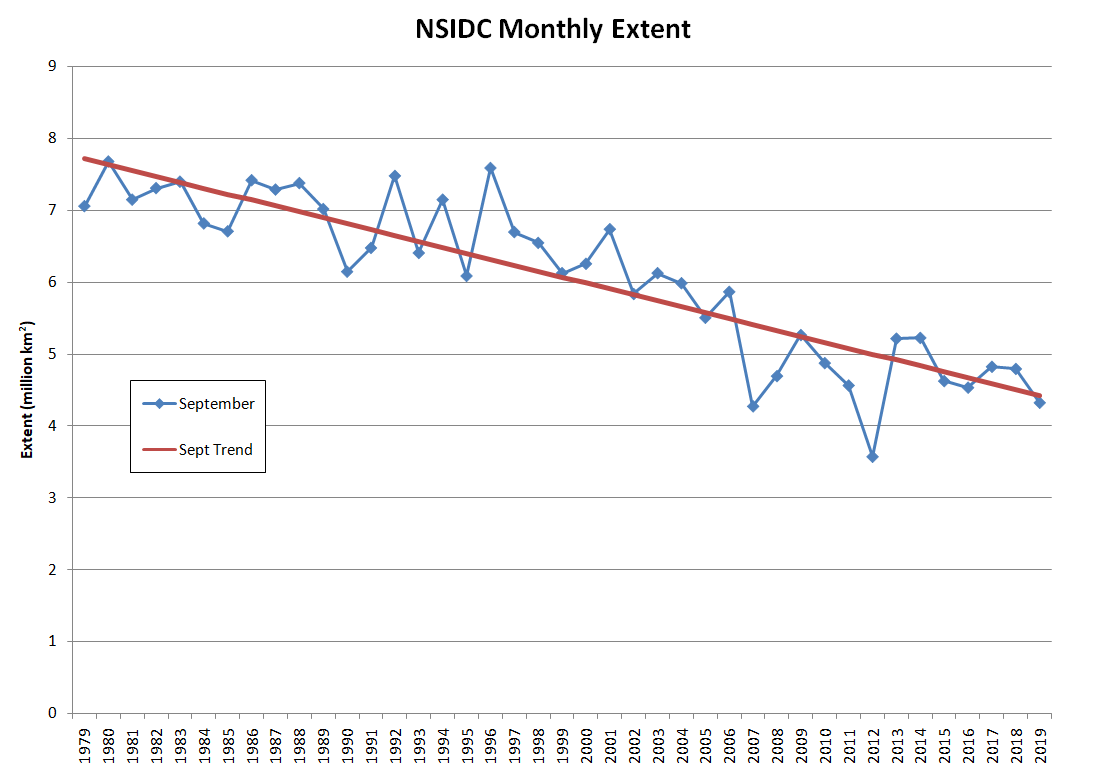
The near real time NSIDC monthly extent for September is 4.32 million km². Here’s the graph:
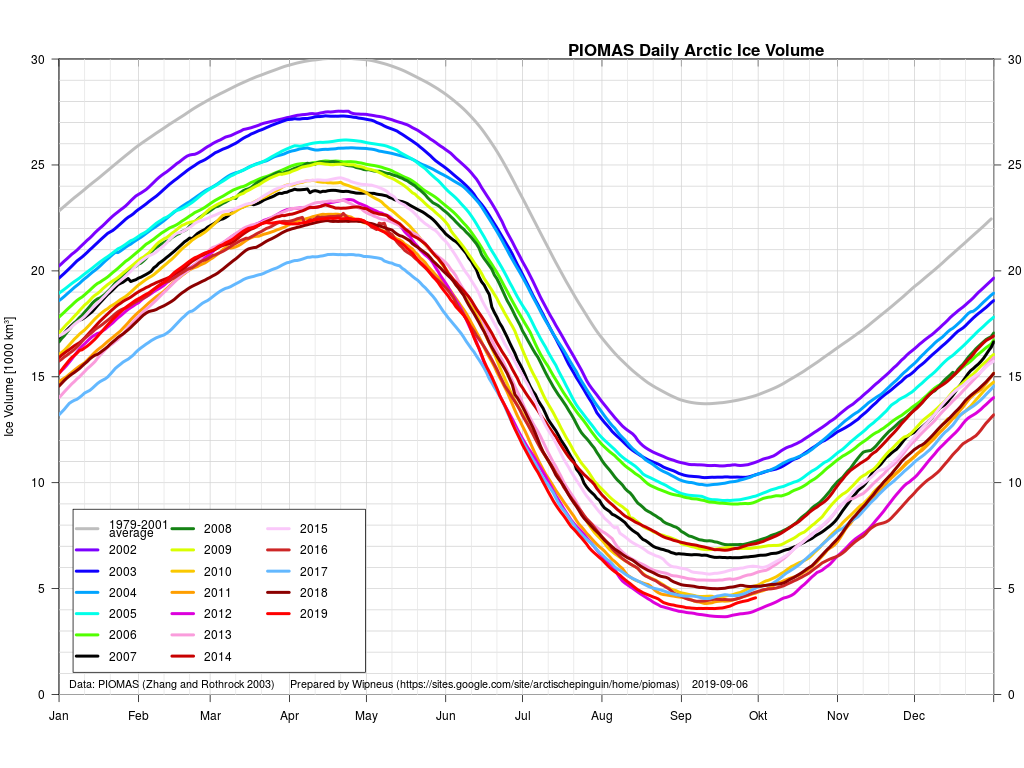
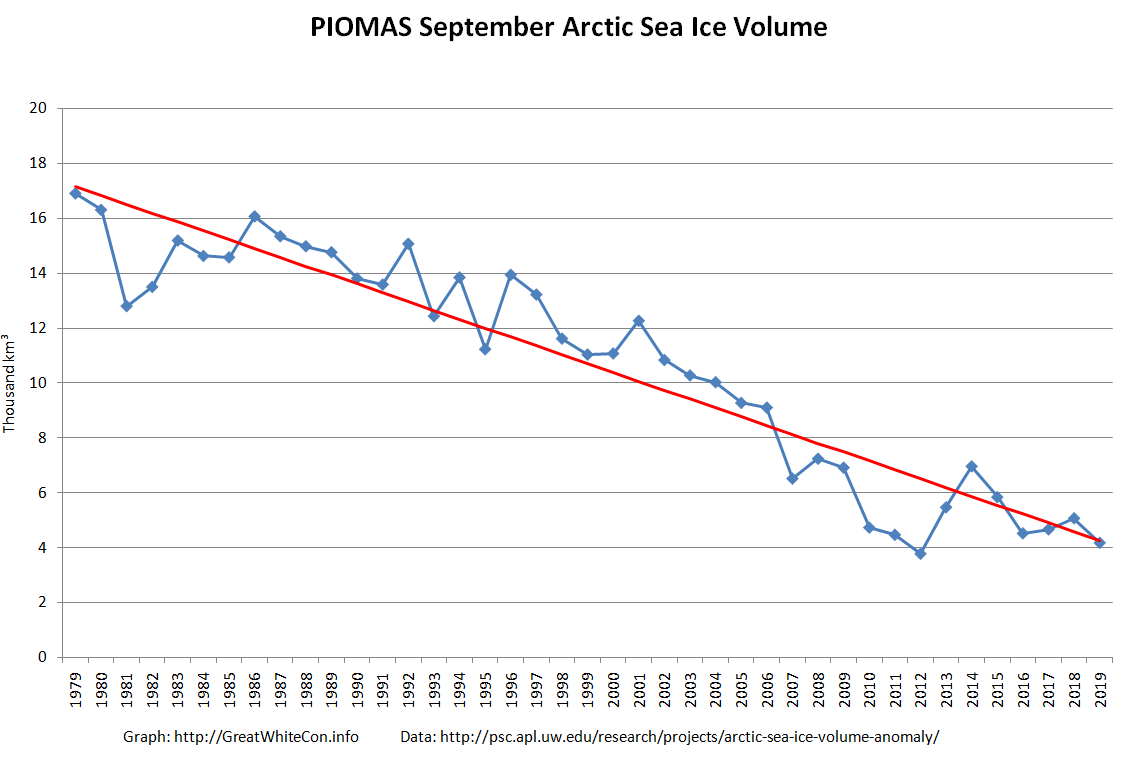
We’re eagerly awaiting the first ice mass balance buoy “near real time” data, but for now the 2019 PIOMAS minimum volume is expected to be revealed real soon now, so:
[Edit – October 5th]
As previously perfectly predicted, the PIOMAS numbers have arrived over at the ASIF. Here’s the thickness map for the end of September:
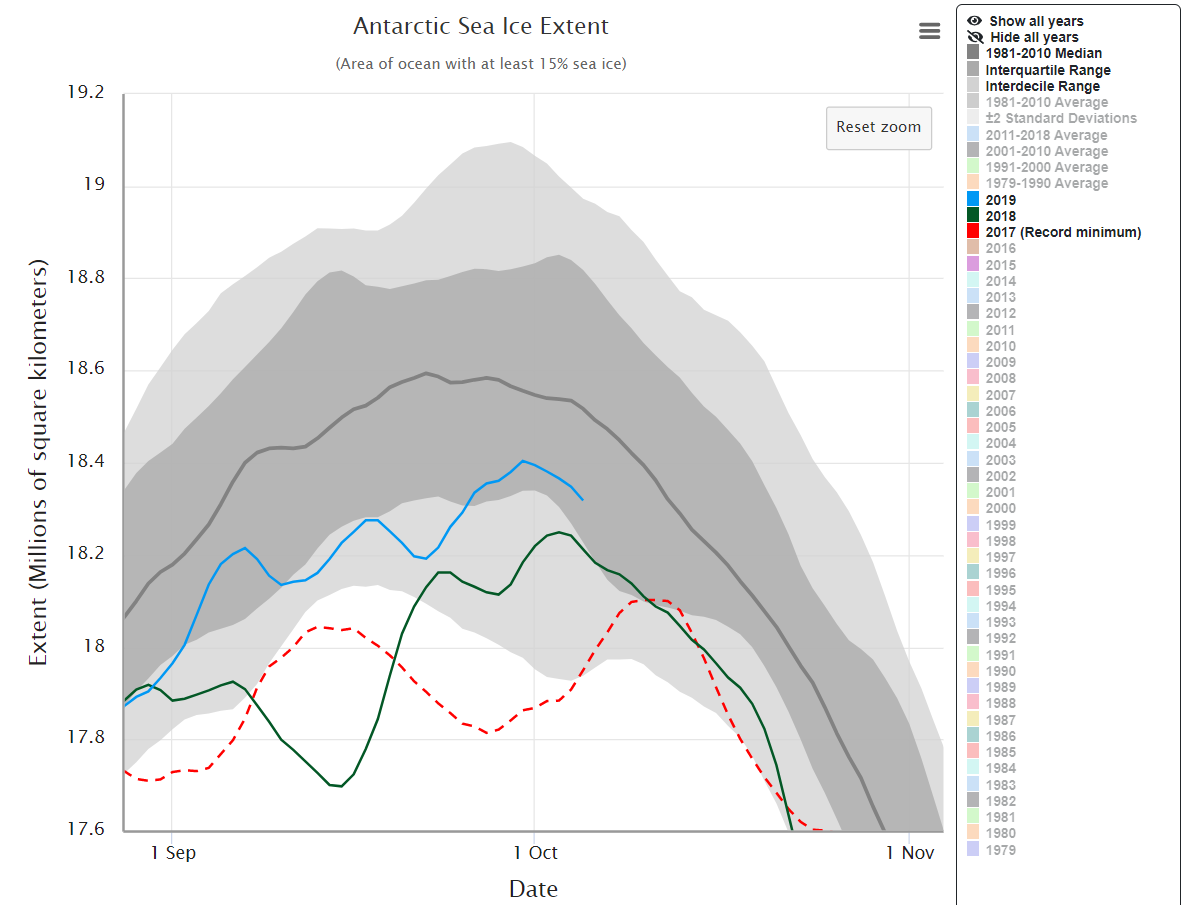
A marginally off topic excursion down under. The NSIDC 5 day average Antarctic sea extent looks to have peaked at 18.40 million km² on September 30th:
[Edit – October 7th]
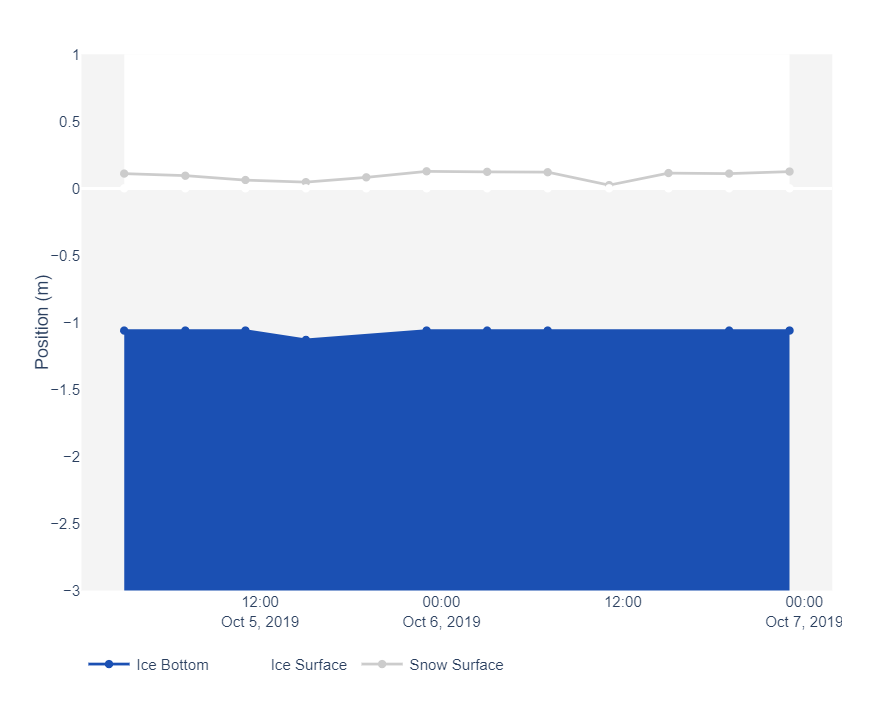
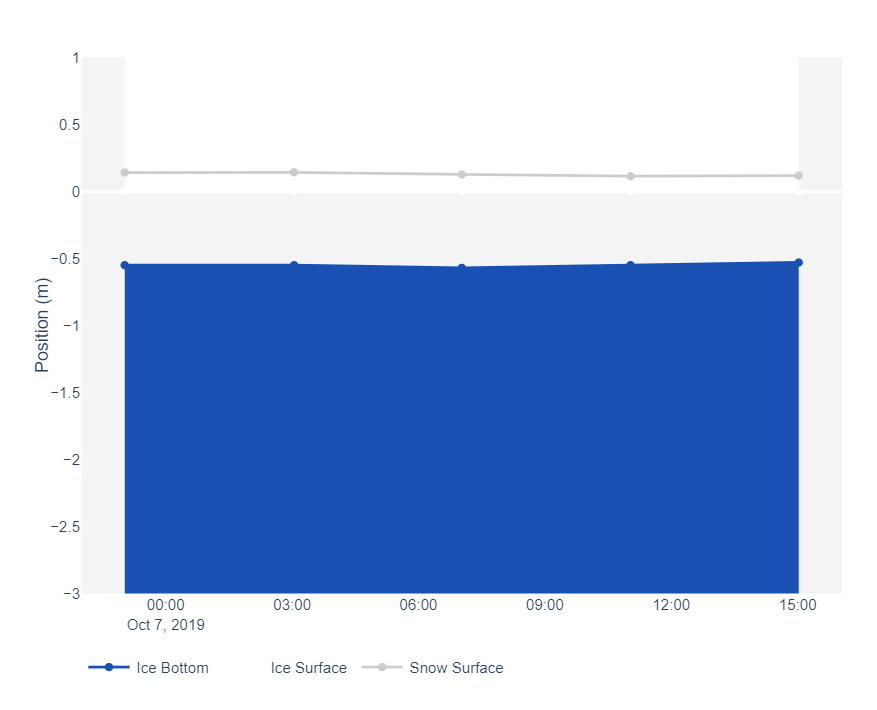
The first of the MOSAiC Expedition’s Ice Mass Balance buoys has been installed, presumably on the ice floe Polarstern is moored to. It reveals sea ice that is currently just over 1 meter thick with a sprinkling of snow on top:
P.S MOSAiC IMB buoy #3 has gone live today too:
There’s currently only 0.5 meters of ice under this one.
[Edit – October 9th]
Here’s the latest annual PIOMAS “ice cube” animation from Andy Lee Robinson:
[Edit – October 10th]
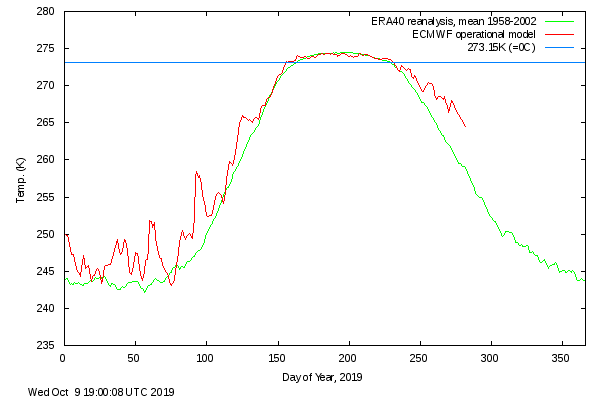
Here’s the latest DMI “high Arctic” temperature graph:
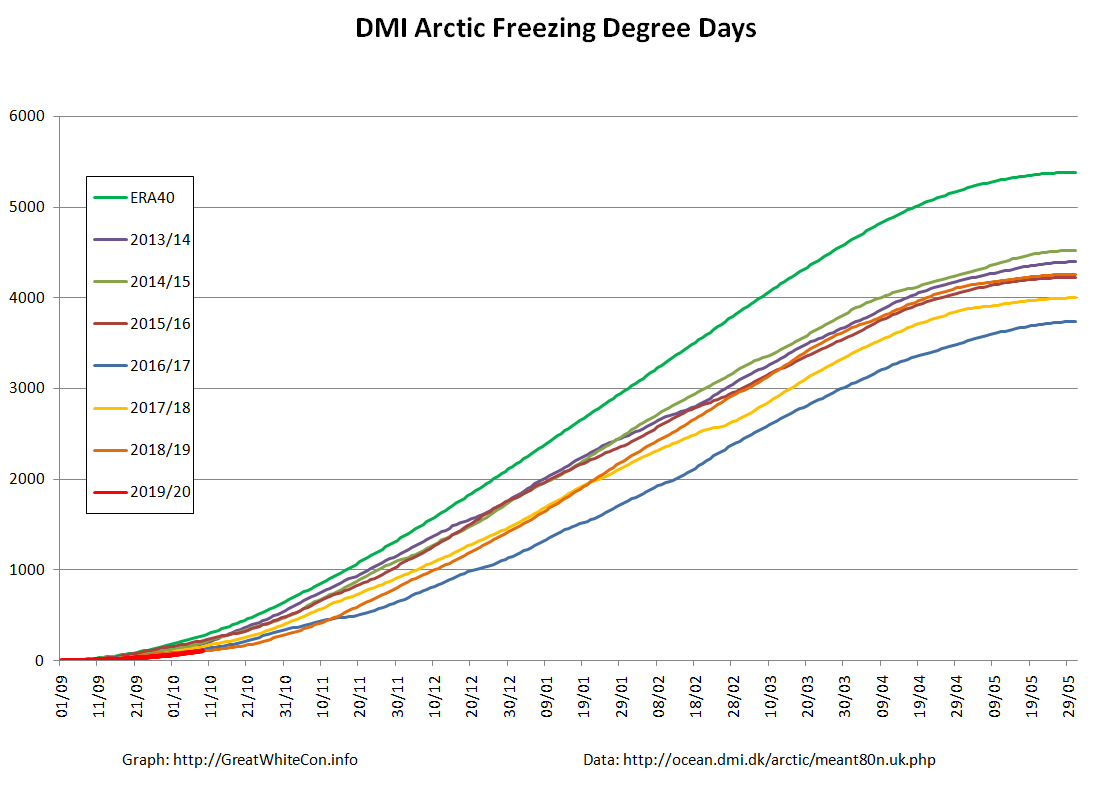
Needless to say that means the DMI Freezing Degrees Days graph is tracking the lowest readings in the DMI’s records:
[Edit – October 11th]
MOSAiC IMB buoy #2 has now been installed and is beaming back data:
The sea ice at this location is decidedly on the thin side at present. A mere 20 cm or thereabouts!
[Edit – October 12th]
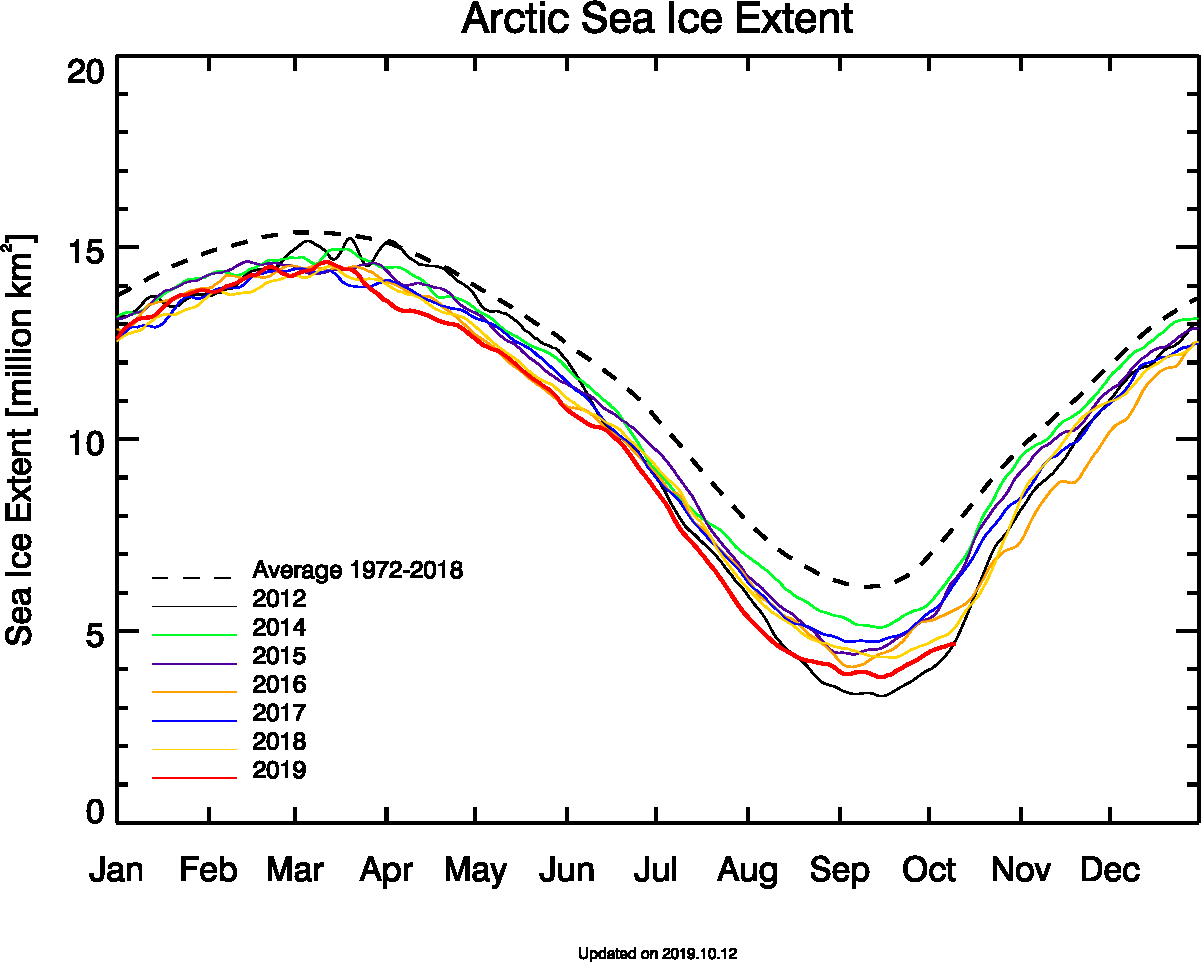
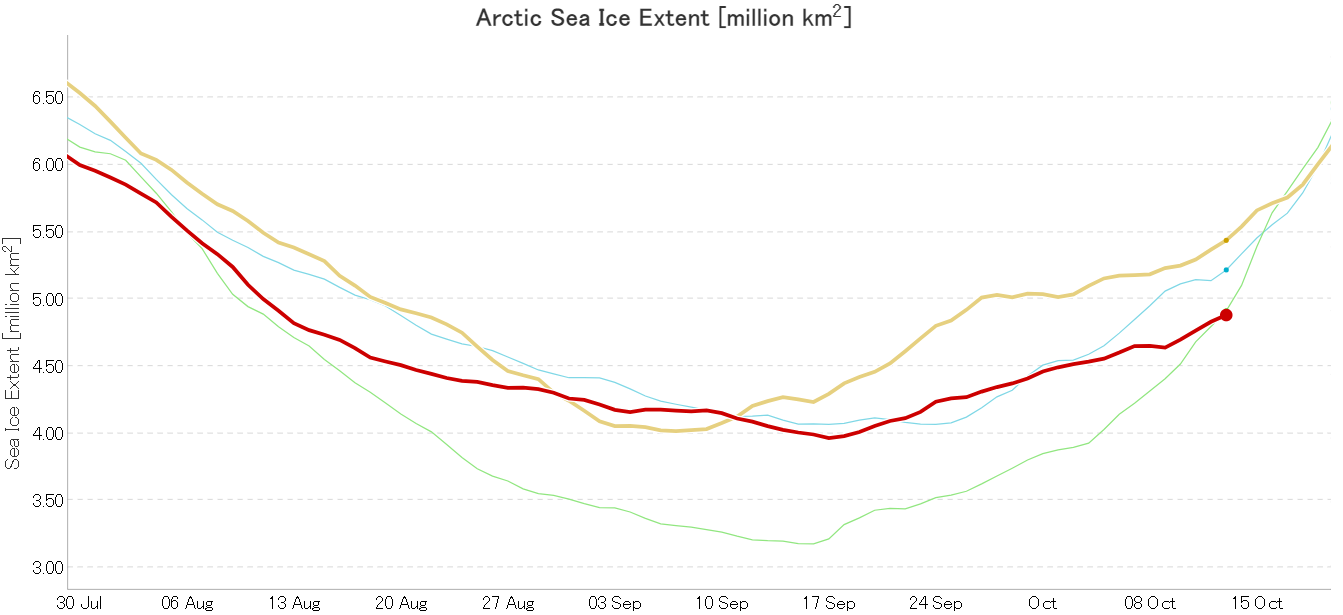
The JAXA ViSHOP web site is down at the moment, so by way of a change here is the University of Bremen’s AMSR2 based extent graph instead:
2019 Arctic sea ice is extent is now once again “lowest for the date” (since AMSRx satellite records began).
[Edit – October 14th]
The JAXA/ADS/ViSHOP web site is back online after being down over the weekend, presumably due to the effects of Typhoon Hagibis:
Sure enough the Japanese flavour of AMSR2 based extent is also now “lowest for the date”.
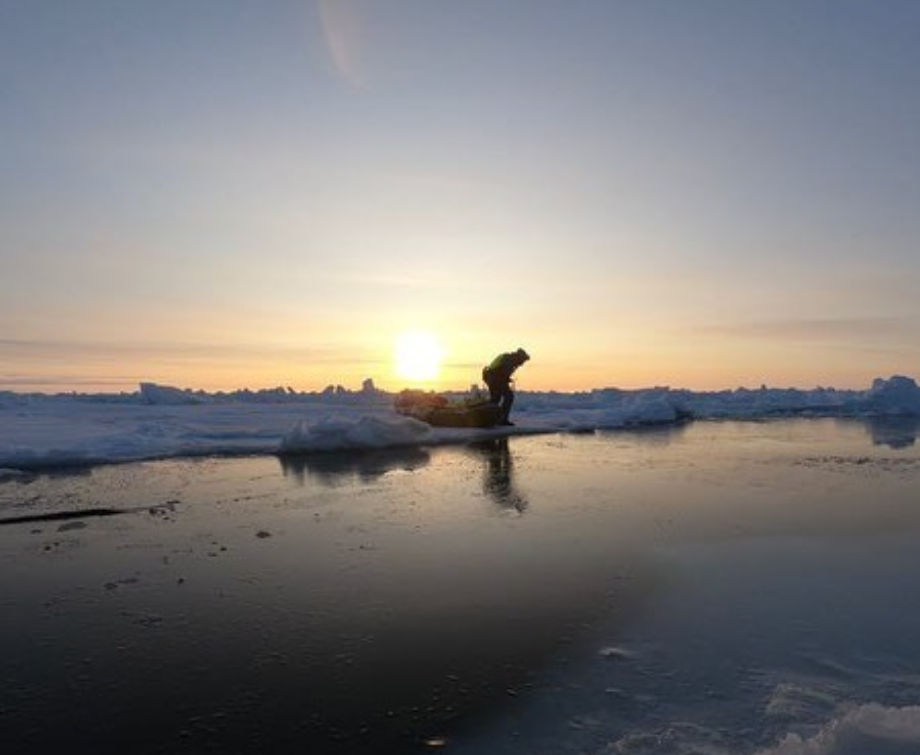
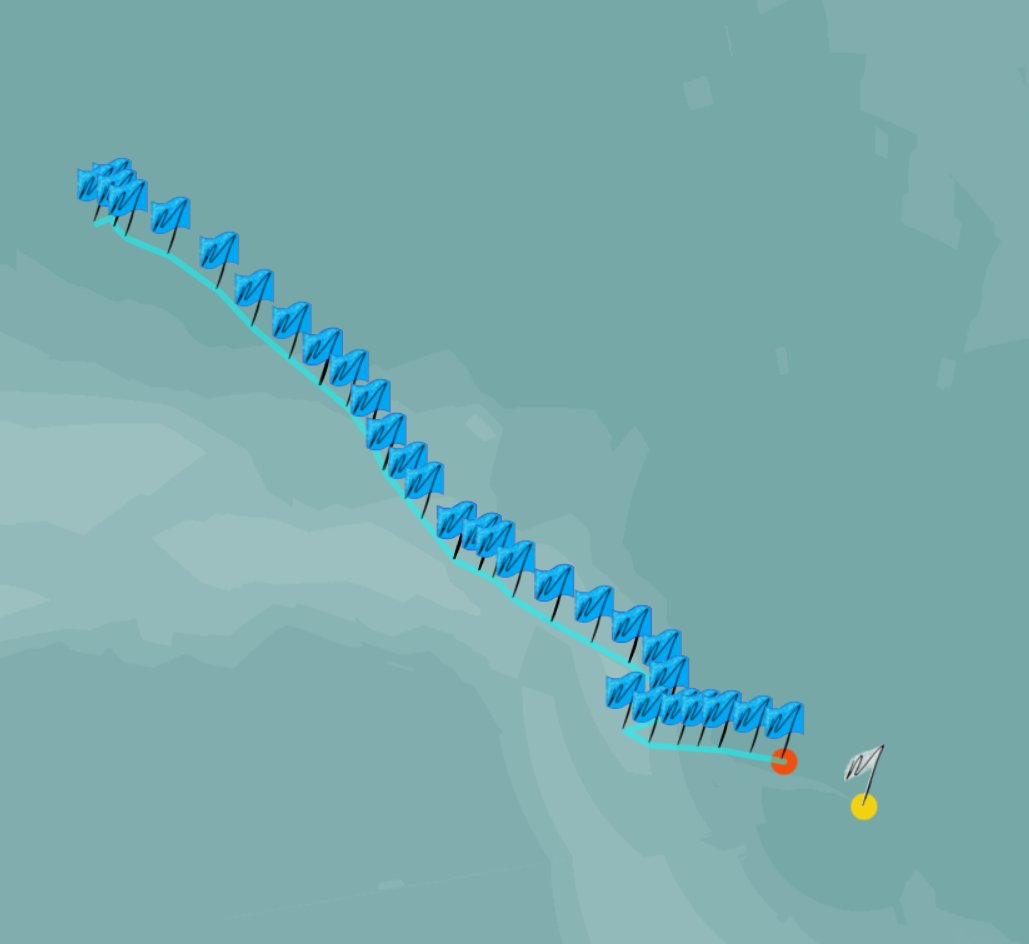
Mike and Borge’s current position was reported yesterday as: 89°35′51″N 140°30′32″E
[Edit – October 15th]
The latest SMOS Arctic sea ice “thinness” map shows sea ice starting to form on the shores of the Laptev Sea:
[Edit – October 16th]
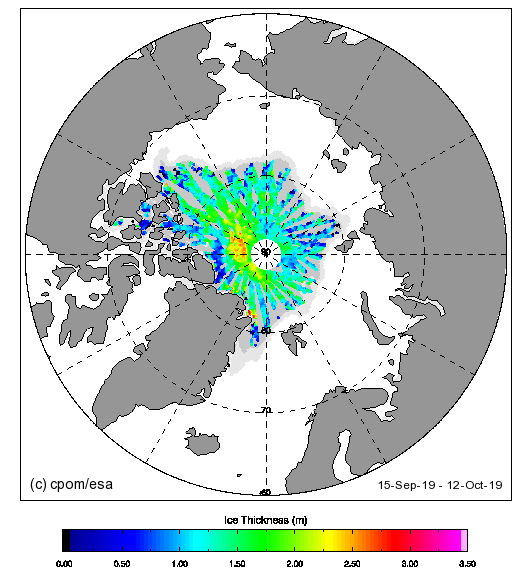
The Centre for Polar Observation and Monitoring (CPOM) have just published the first CryoSat-2 Arctic sea ice thickness map of the 2019/20 freezing season:
Note in particular the dark blue area north of the Canadian Arctic Archipelago.
[Edit – October 20th]
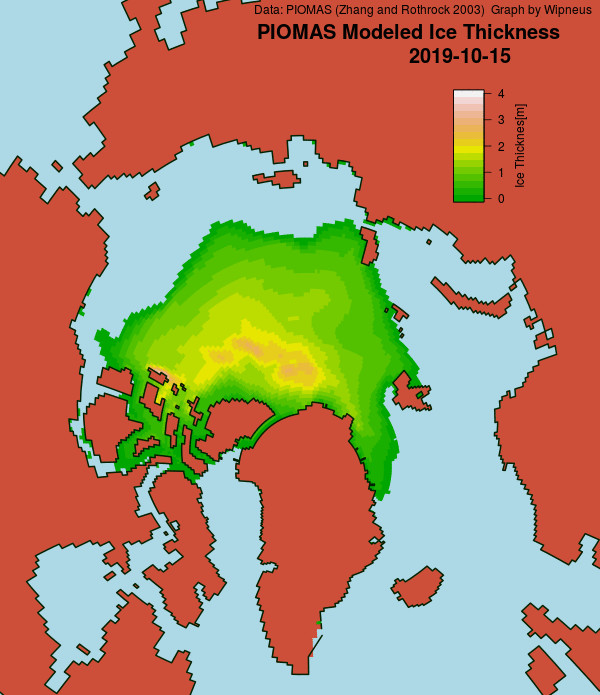
Wipneus has just crunched the October mid month PIOMAS numbers. Here are the results. Not only the modelled Arctic sea ice thickness map:
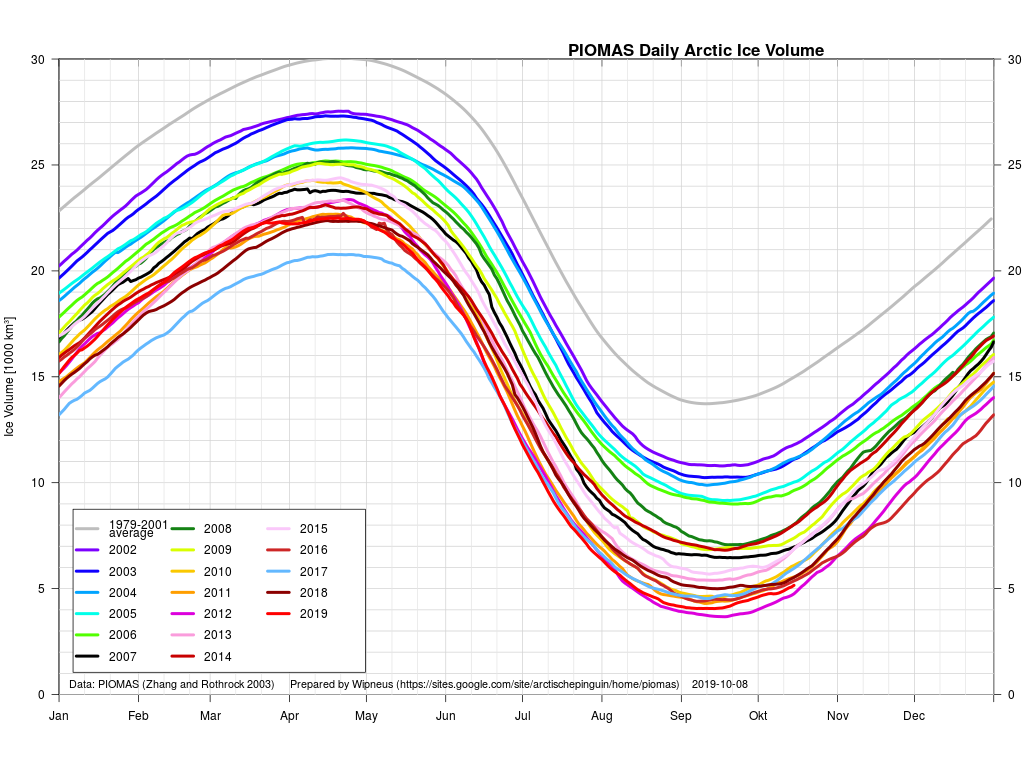
but also the Arctic sea ice volume graph:
[Edit – October 21st]
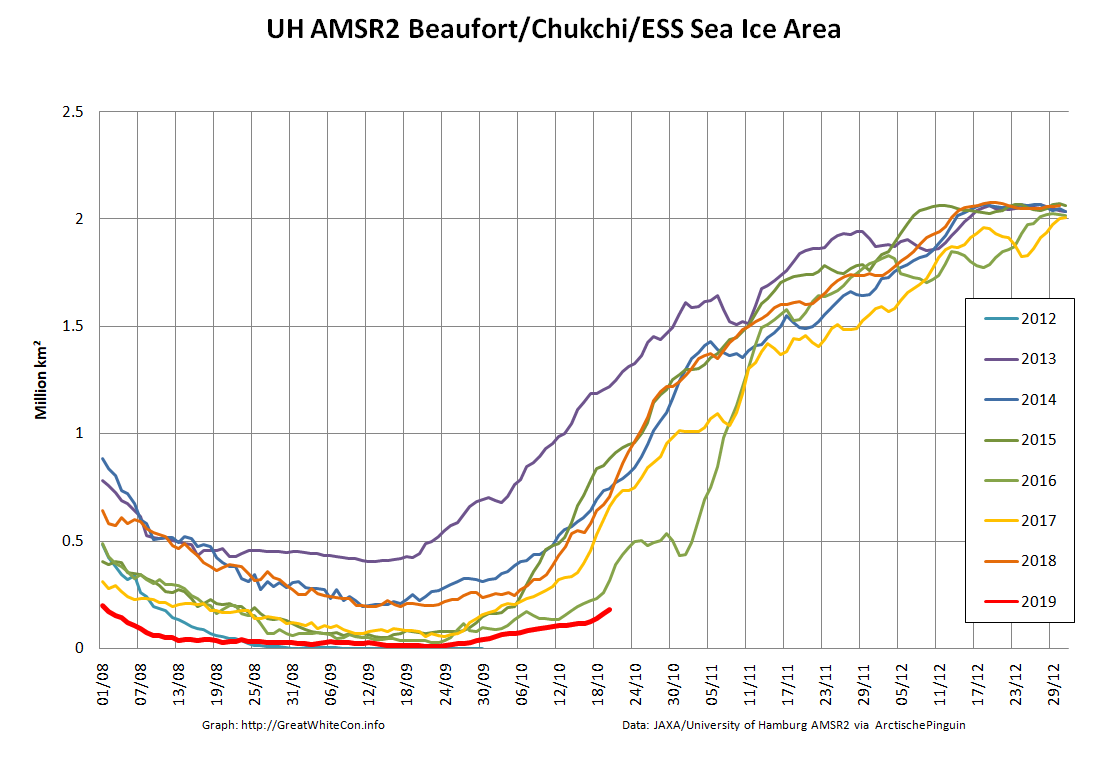
Over on Twitter Judah Cohen suggests that:
Maybe I will discuss more in the next blog but the #Arctic sea ice growth season on the North Pacific side of the Arctic is just nuts, like it is drunk! Looks unprecedented to me. This needs to be watched through the #winter. Already had 2 unprecedented winters in the Bering sea pic.twitter.com/sAVoZXgNAX
I have been trying to bring the implications of this to the attention of the denizens of Judith Curry’s “Climate Etc.” blog, thus far with remarkably little success! This is the gist of my argument:
“Summer solar heat absorption by the surface waters has increased fivefold over the same time period, chiefly because of reduced sea ice coverage.”
“The effects of an efficient local ice-albedo feedback are thus not confined to the surface ocean/sea ice heat budget but, in addition, lead to increased heat accumulation in the ocean interior that has consequences far beyond the summer season.”
“In the coming years, however, excess Beaufort Gyre halocline heat will give rise to enhanced upward heat fluxes year-round, creating compound effects on the system by slowing winter sea ice growth.”
In September 2019, the German research icebreaker Polarstern will set sail from Tromsø, Norway, to spend a year drifting through the Arctic Ocean – trapped in ice. The goal of the MOSAiC expedition is to take the closest look ever at the Arctic as the epicenter of global warming and to gain fundamental insights that are key to better understand global climate change.
In essence Polarstern will be following in the illustrious footsteps of Tara and Fridtjof Nansen‘s Fram before her, but with vastly more scientists in attendance than previous transpolar drift expeditions.
Hundreds of researchers from 19 countries take part in this exceptional endeavour. The MOSAiC expedition will bring a modern research icebreaker close to the north pole for a full year including for the first time in polar winter. The data gathered will be used by scientists around the globe to take climate research to a completely new level.
The expedition also bears a lot of resemblance to the more recent Norwegian Young Sea ICE Expedition, during which R/V Lance drifted embedded in winter sea ice, albeit nearer the North Atlantic.
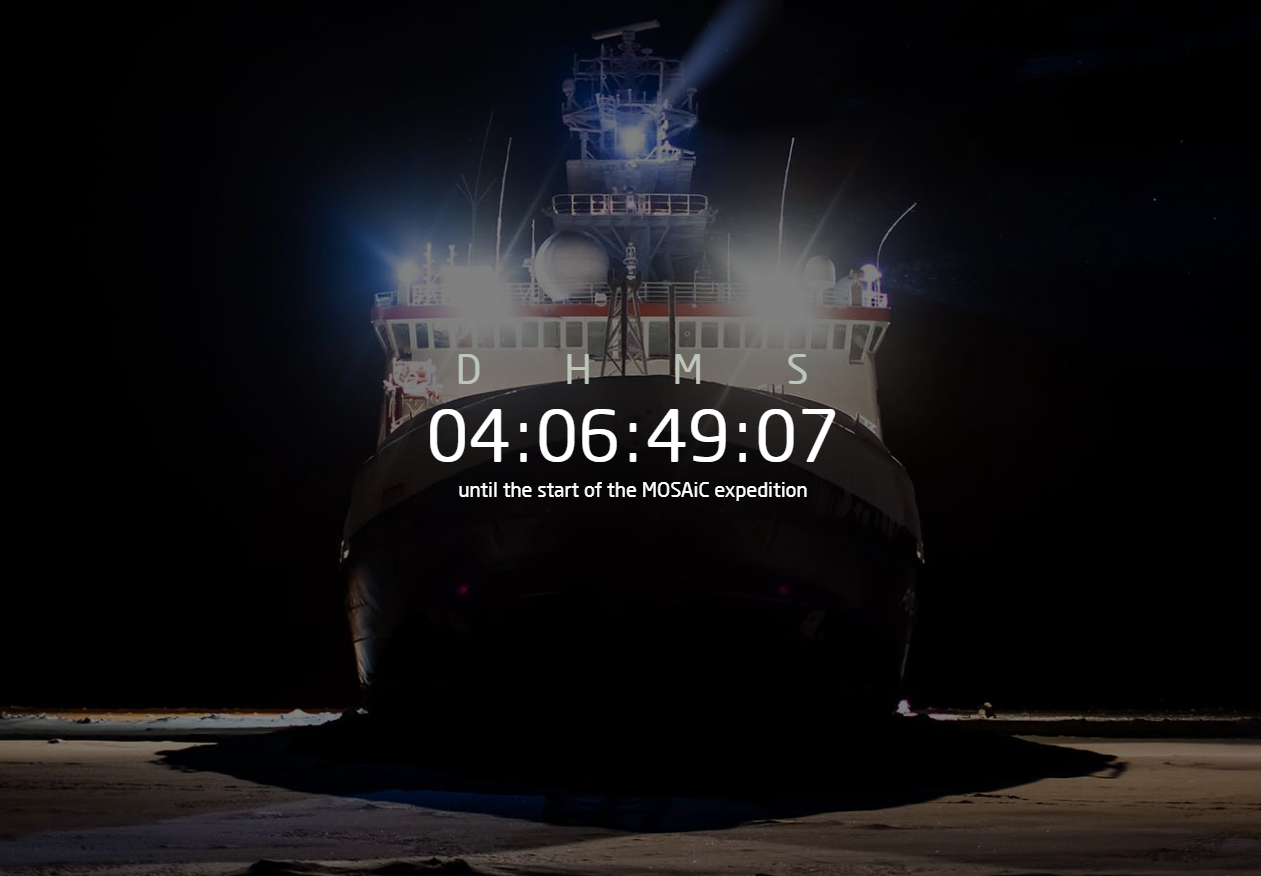
The countdown to “the largest polar expedition in history” has begun:
Here’s an infographic to help explain what happens next:
[Edit – September 20th]
The moment has arrived. The countdown is complete and the MOSAiC expedition begins today. According to the expedition web site:
After a decade of preparations, it’s finally time: this evening at 8:30 p.m. the German icebreaker Polarstern will depart from the Norwegian port of Tromsø. Escorted by the Russian icebreaker Akademik Fedorov, she will set sail for the Central Arctic. On board researchers will investigate a region that is virtually inaccessible in winter, and which is crucial for the global climate. They will gather urgently needed data on the interactions between the atmosphere, ocean and sea ice, as well as on the ecosystem. Thanks to the collaboration between international experts, the one-year-long ice drift past the North Pole will take climate research to a completely new level.
At the launch of MOSAiC Markus Rex, Head of the expedition from the Alfred Wegener Institute said that:
This mission is ground breaking. Never before has there been such a complex Arctic expedition. For the first time we will be able to measure the climate processes in the Central Arctic in winter. And so for the first time we will be able to understand this region and correctly represent it in climate models. The Arctic is the epicentre of global warming and has already undergone dramatic changes. And it is the weather kitchen for our weather in Europe. Extreme weather conditions like outbreaks of cold Arctic air here in winter, or heat waves in summer are linked to the changes in the Arctic. At the same time, the uncertainties in our climate models are nowhere bigger than in the Arctic. There aren’t any reliable prognoses of how the Arctic climate will develop further or what that will mean for our weather. Our mission is to change that.
Here’s the Alfred Wegener Institute’s 3 hour plus recording of the send off for Polarstern and Akademik Federov from Tromsø:
Here too are some alternative sources of information about the expedition:
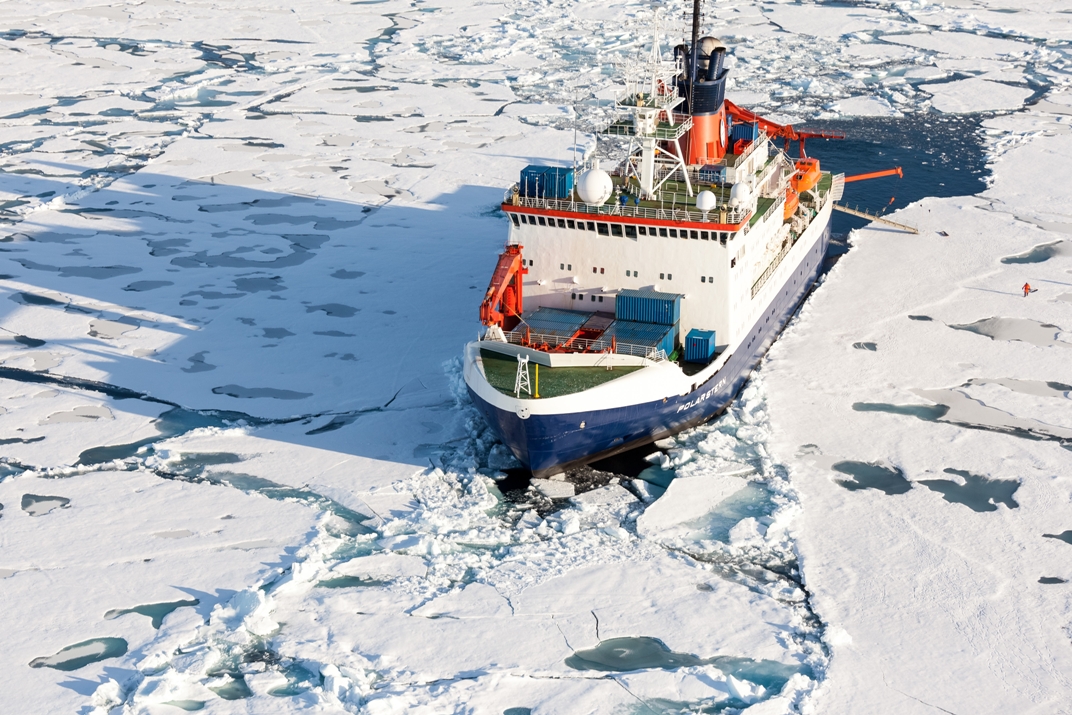
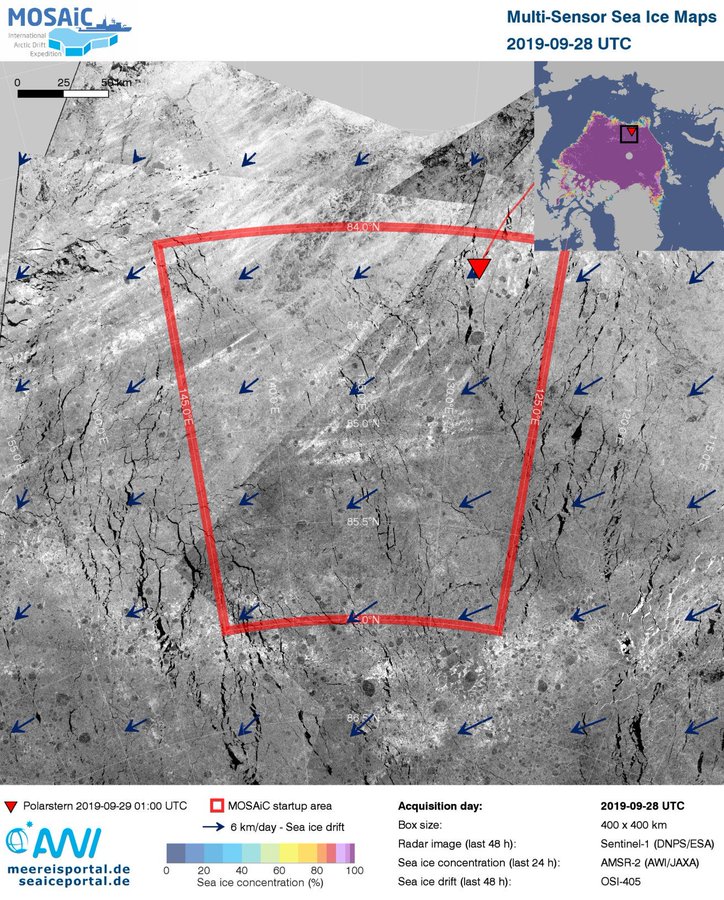
Polarstern is now within the initial target area, and is looking for a suitable ice floe to which she can attach herself:
Together with some other scientists, the head of MOSAiC, Markus Rex, flies over from #Polarstern to Akademik Fedorov, where they plan the next steps of searching for the right ice floe. #MOSAiCexpedition#Icedrift#Arctic
According to an article by Janek Uin from Brookhaven National Laboratory on the United States’ Department of Energy Atmospheric Radiation Measurement web site:
We finally found the piece of ice that will be the home for Polarstern for the next year. It’s a floe a few kilometers in diameter and with thickness ranging from half a meter to a few meters. Several ice floes were surveyed via helicopters from both icebreakers and by teams of scientists taking measurements on ice before a decision to pick this one was made. Now the two icebreakers are tied together as equipment, fuel, and people are transferred between the ships in preparation for deployment. While it’s exciting to see many new faces on Polarstern, we also had to say goodbye to some of the friends we had made on our way here.
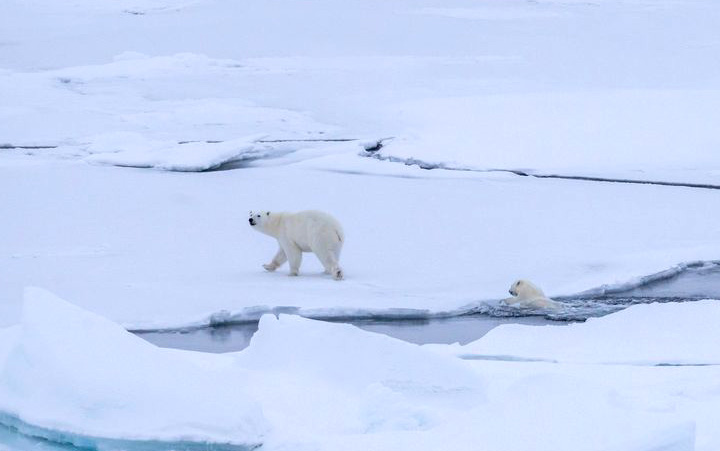
There was also a lot of excitement today as two polar bears—a mom with her cub—wandered very close to Polarstern. Everybody who could rushed to the deck to try to capture photos of them in the diminishing daylight.
[Edit – October 7th]
Via the MOSAiC Expedition Twitter feed:
On Friday evening at 9:30 p.m. boat time the team of #MOSAiCexpedition reached their destination: the floe which had been chosen some days before. #Icedrift#Arctic
Our regular reader(s) may recall our extended coverage on the plucky little yacht Northabout‘s ultimately successful attempt to circumnavigate the Arctic Ocean in the summer of 2016?
Many were the skeptics who said she stood no chance of finding a way through some “thick sea ice” apparently blocking her path across the Laptev Sea, but they were proved wrong:
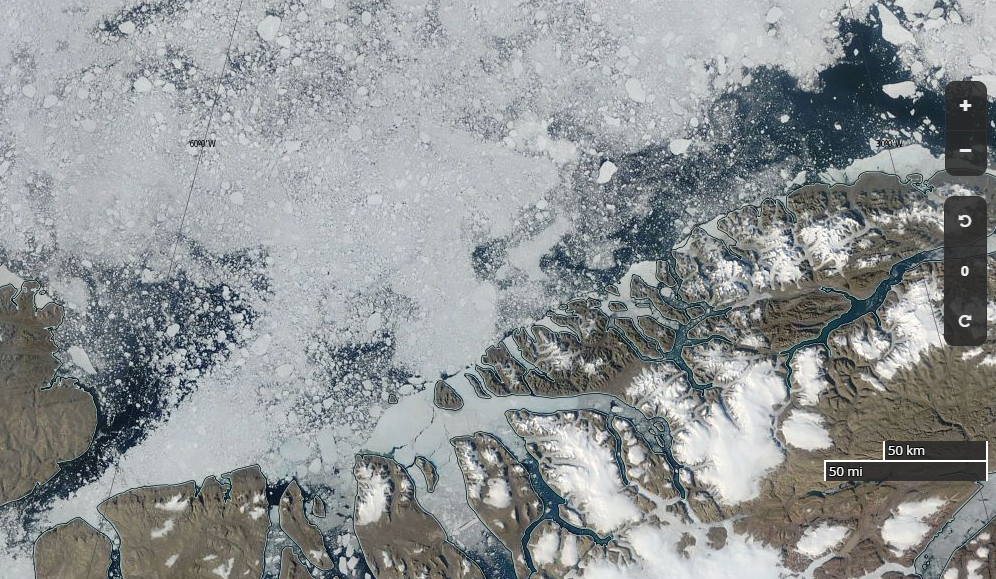
As a thought experiment in the summer of 2018 we’re now thinking the unthinkable. If she put her mind to it could Northabout circumnavigate Greenland in 2018? Let’s take a look at the evidence shall we? The allegedly “oldest, thickest Arctic sea ice” north of Greenland isn’t there any more this summer:
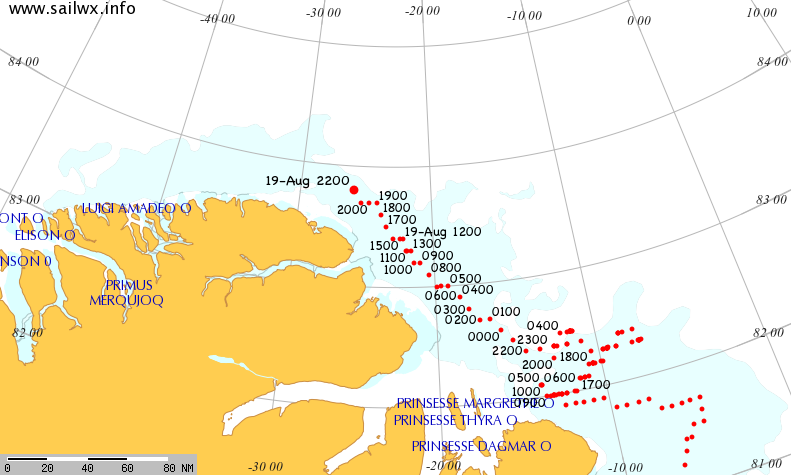
The research icebreaker Polarstern has already inspected the open waters off Kap Morris Jesup, the most northerly tip of Greenland:
What’s more the waters of the Lincoln Sea currently look no more tricky to traverse than the Laptev Sea in August 2016:
In conclusion, for the moment at least, what’s the theoretical solution to our 2018 thought experiment?
Here’s another thought to ponder as well. I don’t suppose it’s in the Alfred Wegener Institute’s PS115 mission plan, but do you suppose Polarstern could circumnavigate Greenland at the moment?
[Edit – August 23rd]
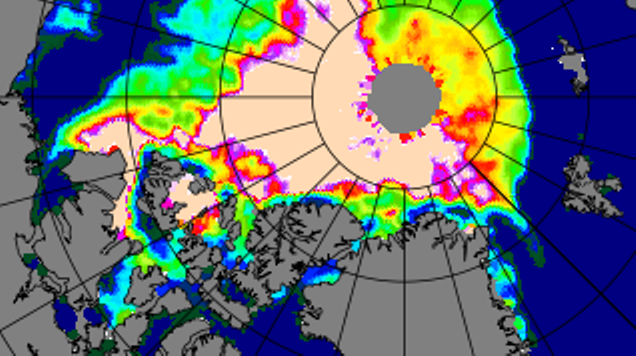
The University of Bremen used not to publish their Arctic sea ice “thinness” maps in summer. However now they do, so here’s a close up of Northern Greenland for August 22nd:
[Edit – August 26th]
First of all here’s one of our occasional sea ice motion videos:
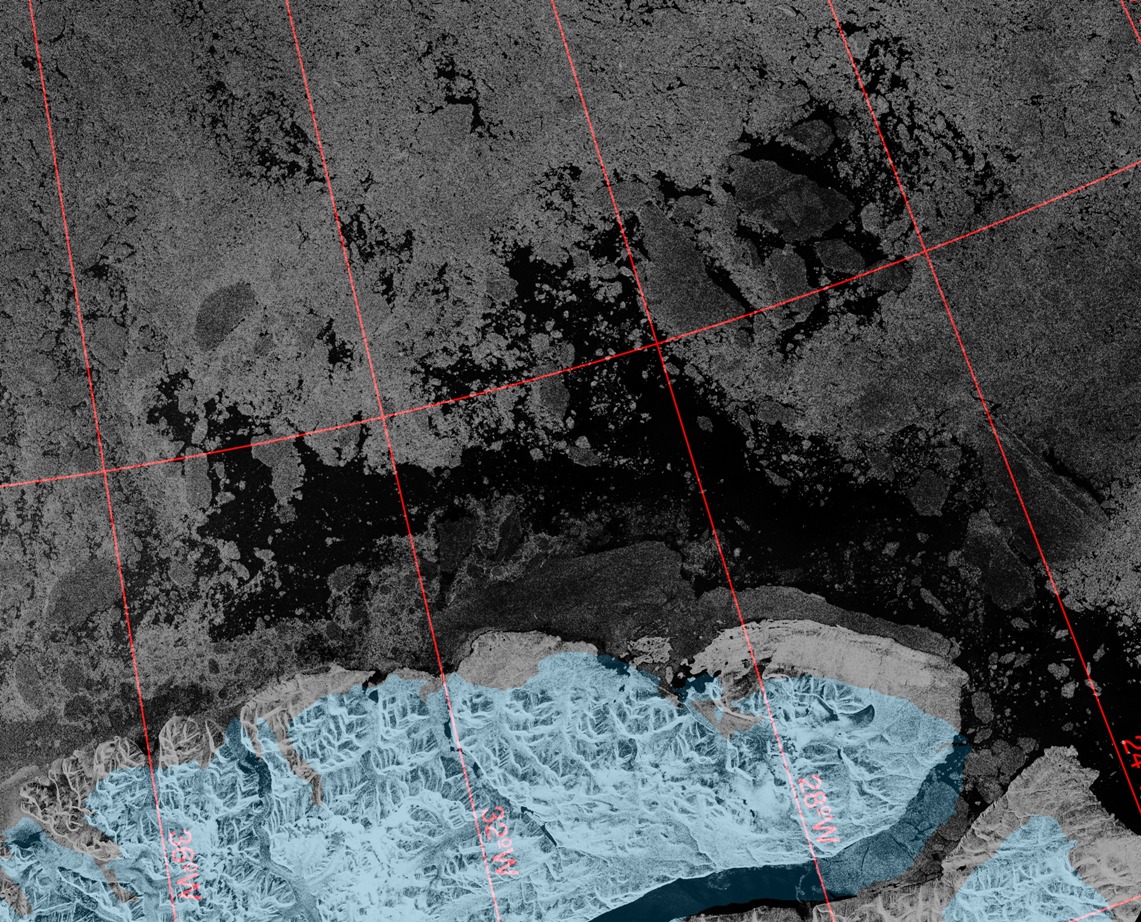
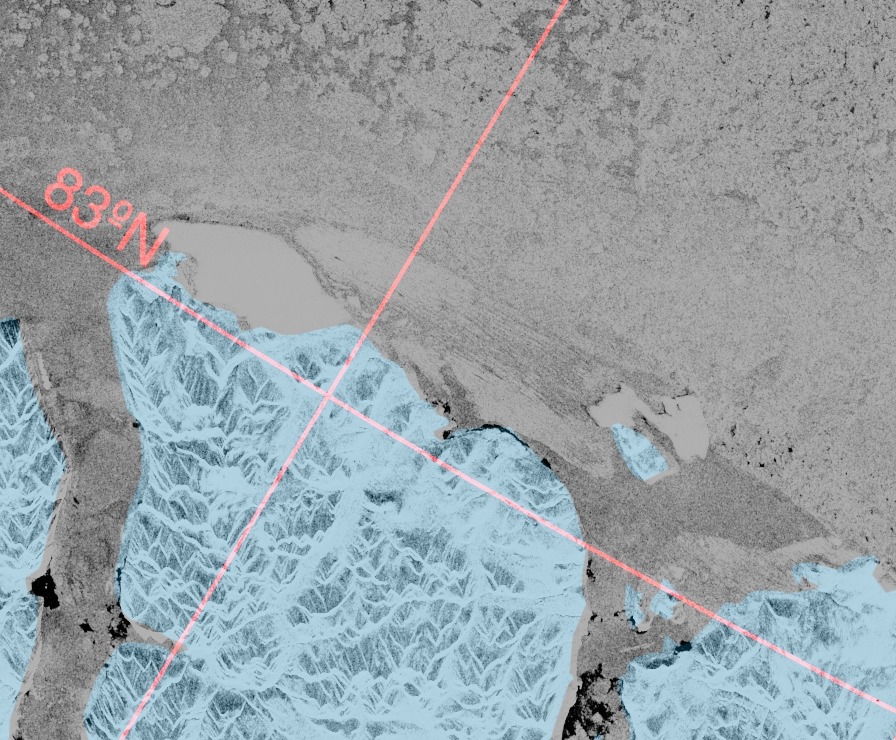
This one reveals the open water north of Greenland in February as well as the much longer event in August. Next here’s a Sentinel 1B synthetic aperture radar image of the Kap Morris Jesup area from yesterday:
This website uses cookies to improve your experience. We'll assume you're ok with this, but you can opt-out if you wish. Cookie settingsACCEPT
Privacy & Cookies Policy
Privacy Overview
This website uses cookies to improve your experience while you navigate through the website. Out of these, the cookies that are categorized as necessary are stored on your browser as they are essential for the working of basic functionalities of the website. We also use third-party cookies that help us analyze and understand how you use this website. These cookies will be stored in your browser only with your consent. You also have the option to opt-out of these cookies. But opting out of some of these cookies may affect your browsing experience.
Necessary cookies are absolutely essential for the website to function properly. This category only includes cookies that ensures basic functionalities and security features of the website. These cookies do not store any personal information.
Any cookies that may not be particularly necessary for the website to function and is used specifically to collect user personal data via analytics, ads, other embedded contents are termed as non-necessary cookies. It is mandatory to procure user consent prior to running these cookies on your website.