Christmas is coming, and even as we speak Snow White is heading for the geographical North Pole to assist Santa’s little helpers in their annual gift delivery mission:
Santa at the North Pole in August 2016
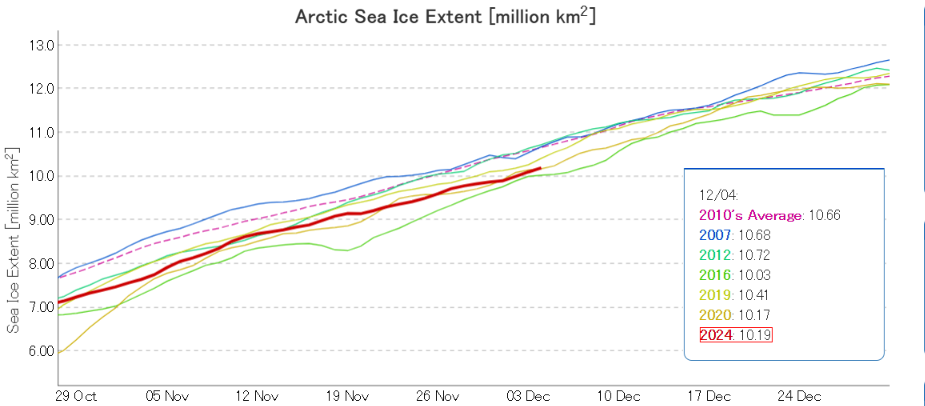
We’ll start the festive season with a graph of JAXA/ViSHOP extent, which is in a “statistical tie” with 2020 for 2nd lowest for the date in the satellite era:
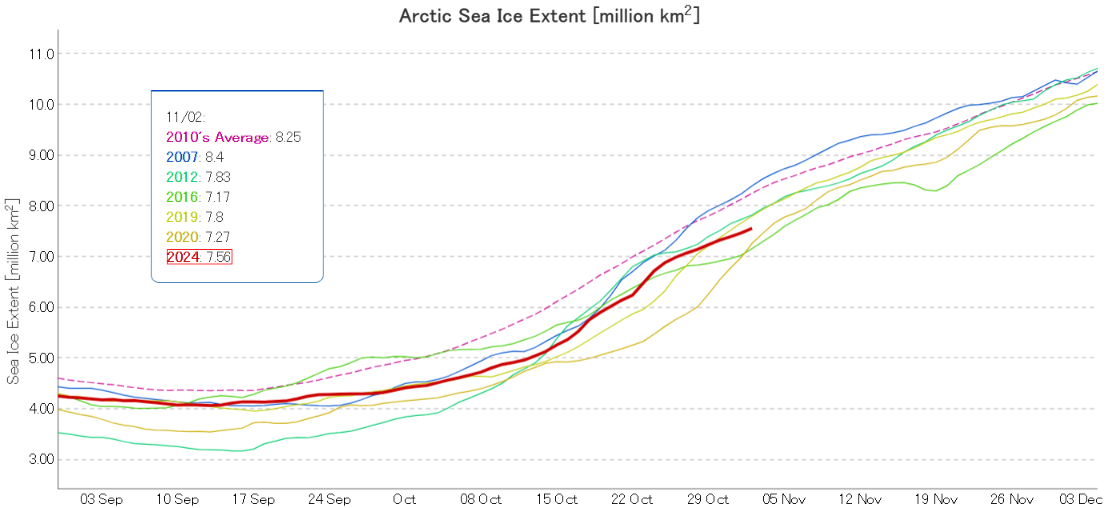
The Laptev and East Siberian Seas have now refrozen. Consequently Arctic sea ice extent is now increasing more slowly, and JAXA/ViSHOP extent is 3rd lowest for the date in the satellite era:
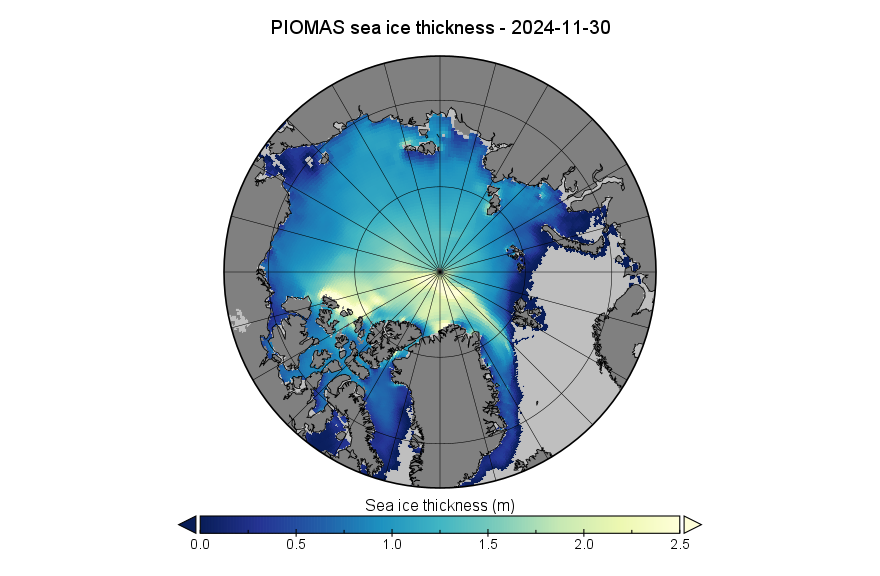
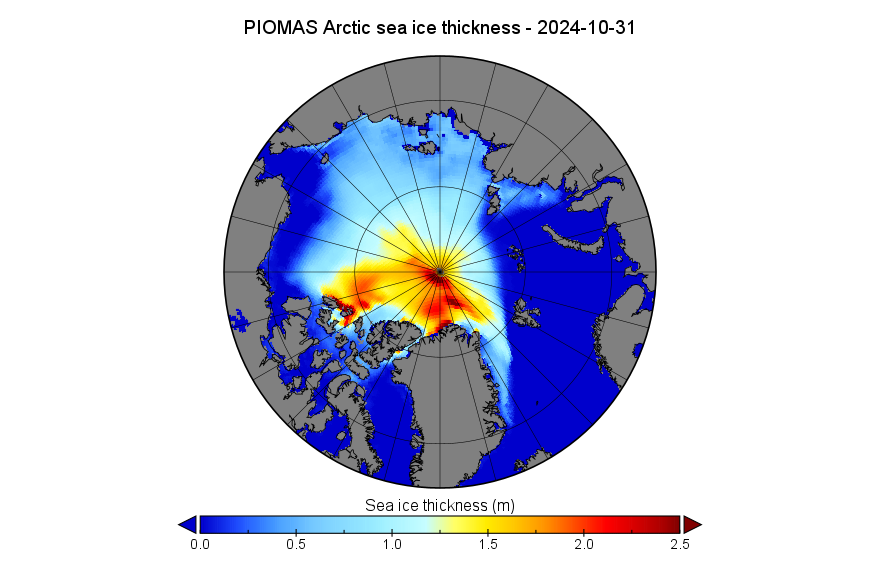
Note the change in scale from previous months, to allow for easier comparison with the “near real time” CryoSat-2/SMOS merged thickness data from the Alfred Wegener Institute:
On several previous occasions “Snow White” and I have documented Ron Clutz’s misuse of MASIE Arctic sea ice extent data on his “Science Matters” blog. We agree with Ron that science matters, so on several occasions we have attempted to direct his attention to my interview with NASA/NSIDC scientist Walt Meier. Walt’s words of wisdom included:
Year-to-year comparisons and trend estimates will be more accurate in the passive microwave data than in MASIE.
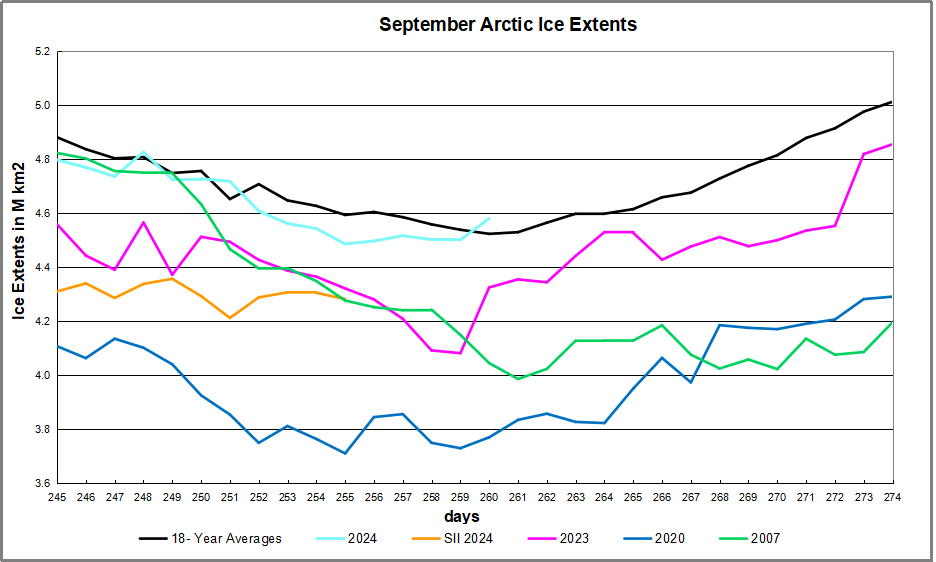
It will probably not surprise you to learn that Ron has not learned anything from our repeated efforts. In his article entitled “2024 Arctic Ice Beats 2007 by Half a Wadham” earlier today Ron proudly displays this graph:
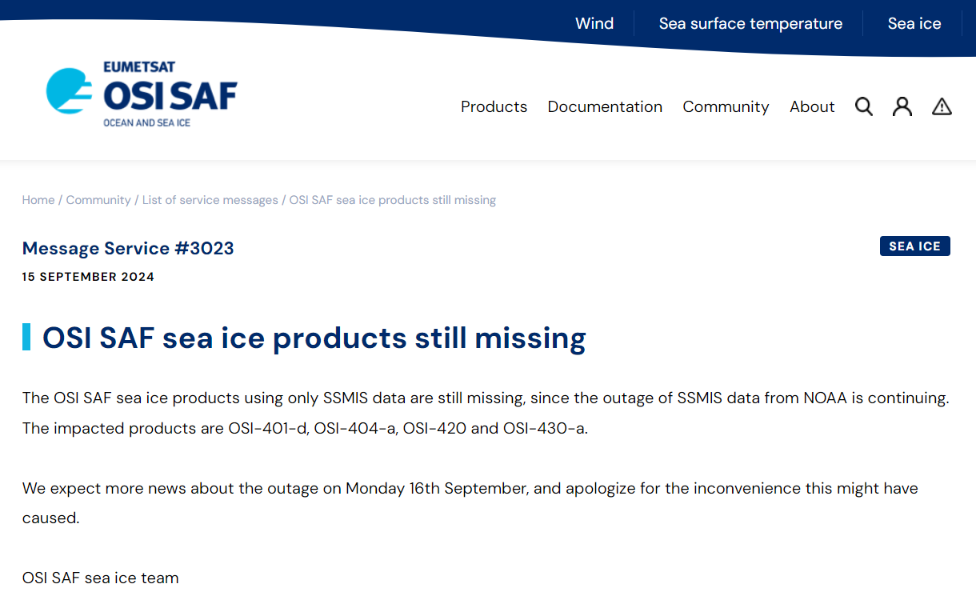
You will note that Ron does not provide details of his data source. However I have recently noted a sudden lack of SSMIS passive microwave data emanating from NOAA. The OSI SAF reported it this way on September 12th:
Dear OSI SAF Sea Ice Concentration User,
Due to missing input data, we have not been able to generate L2 products, corresponding to F-16 / F-17 / F-18 since Sep 11 19:36 UTC.
We apologize for any inconvenience.
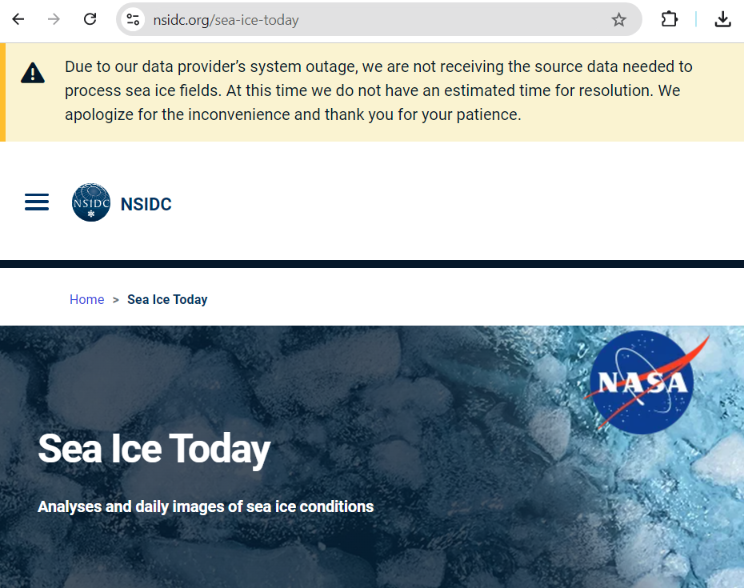
The NSIDC’s sea ice home page puts it this way today:
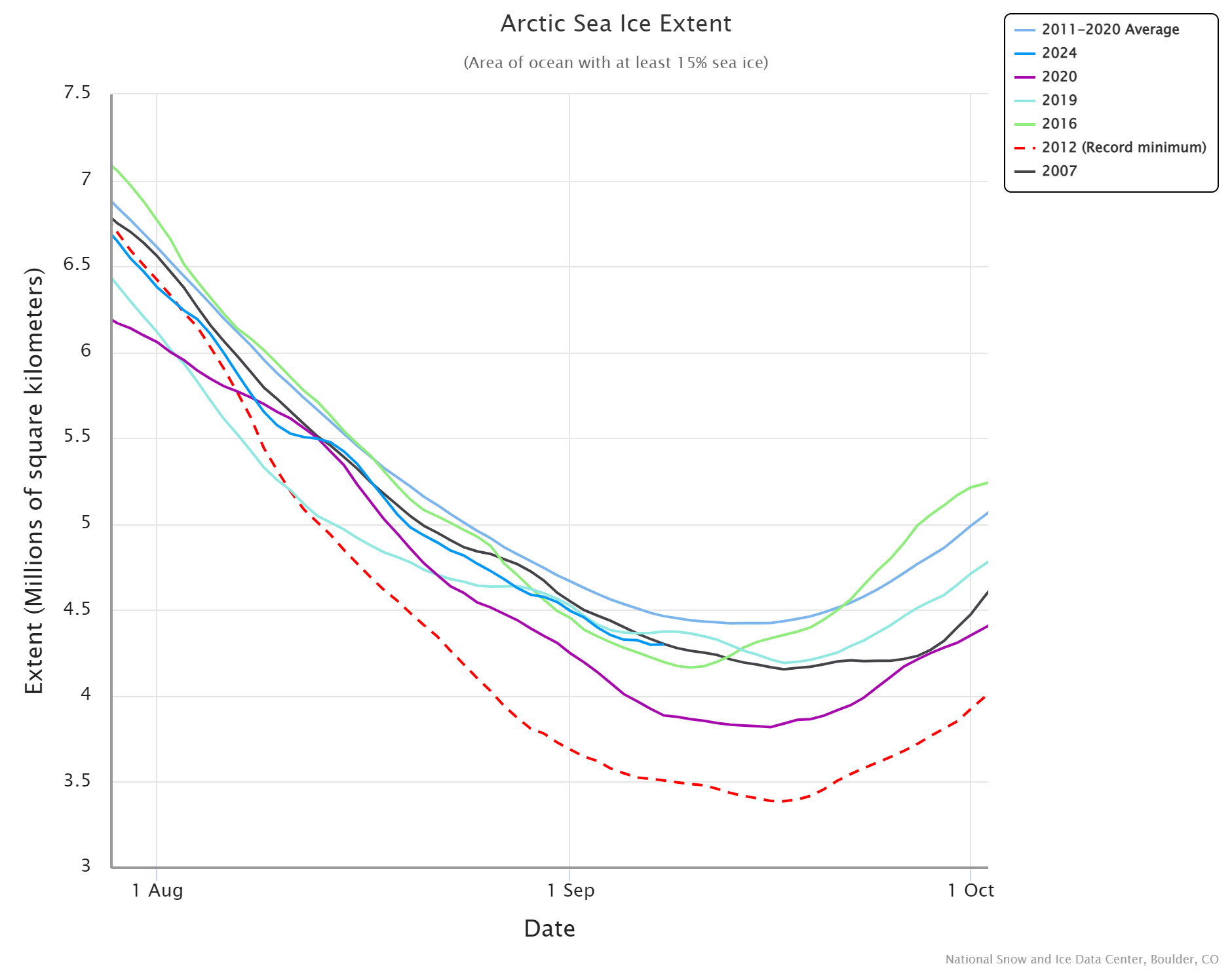
Now day 260 of 2024 is September 16th, so it seems safe to assume that Ron is erroneously using his favourite MASIE metric for year to year comparisons yet again. In his article Ron states that:
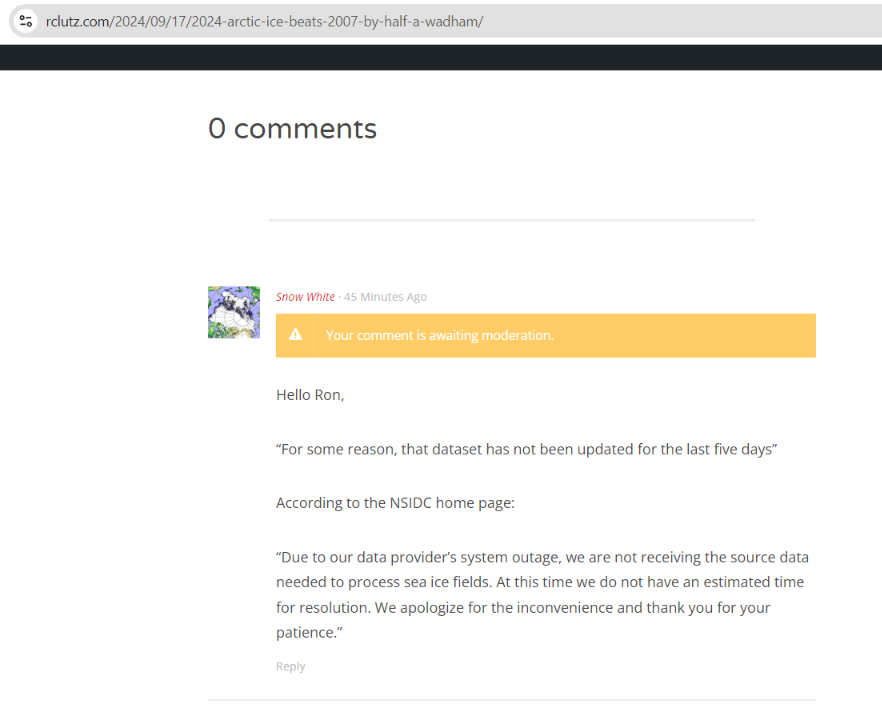
SII was reporting deficits as high as 0.5M km2 (half a Wadham) compared to MASIE early in September. For some reason, that dataset has not been updated for the last five days.
It appears as though Ron has also not yet learned how to find NSIDC’s sea ice home page on the world wide interweb!
I added this hopefully helpful comment below Ron’s article. For some strange reason it is yet to emerge from his moderation queue:
[Update – September 18th]
Our regular reader(s) will not be surprised to learn that my helpful comment yesterday is no longer in Ron’s moderation queue, but is now languishing underfoot on his cutting room floor.
Ron has written another Arctic article using the graph reproduced above. This one is entitled: “2024 Arctic Ice Abounds at Average Daily Minimum“. In it Ron assures his flock of faithful followers that:
We are close to the annual Arctic ice extent minimum, which typically occurs on or about day 260 (mid September). Some take any year’s slightly lower minimum as proof that Arctic ice is dying, but the image above shows the Arctic heart is beating clear and strong.
Over this decade, the Arctic ice minimum has not declined, but since 2007 looks like fluctuations around a plateau.
Ron has also changed his phraseology regarding the recent SSMIS data outage. This time it reads:
For some reason, apparently data access issues, that dataset has not been updated for the last five days.
“Snow White” felt compelled to leave Ron another helpful comment concerning his new words of Arctic wisdom:
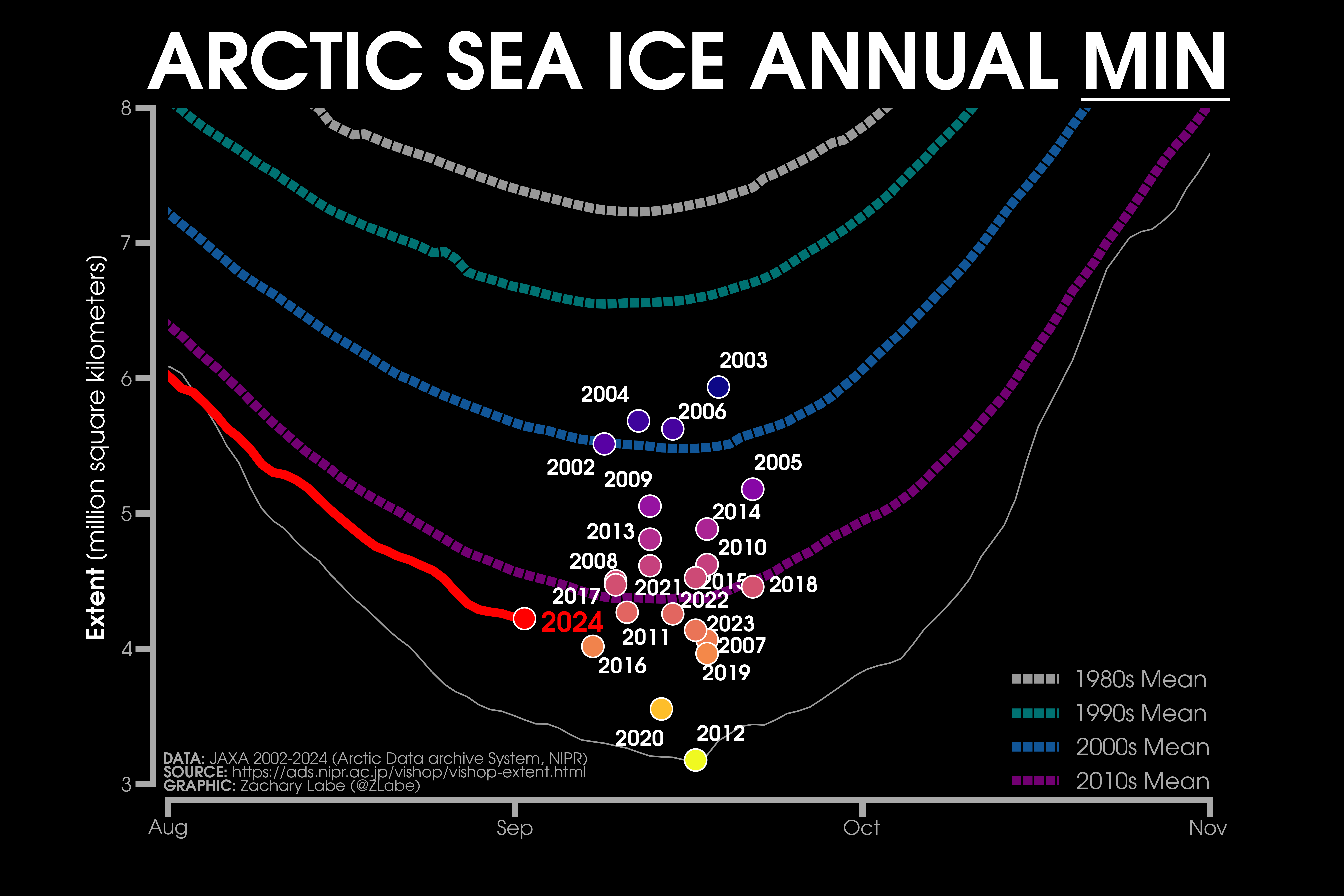
The 2024 Arctic sea ice minimum extent will almost certainly occur at some point over the next month. The exact date and level will vary from one extent metric to the next. Here’s a comparison of the current JAXA extent with previous minima, courtesy of Zack Labe:
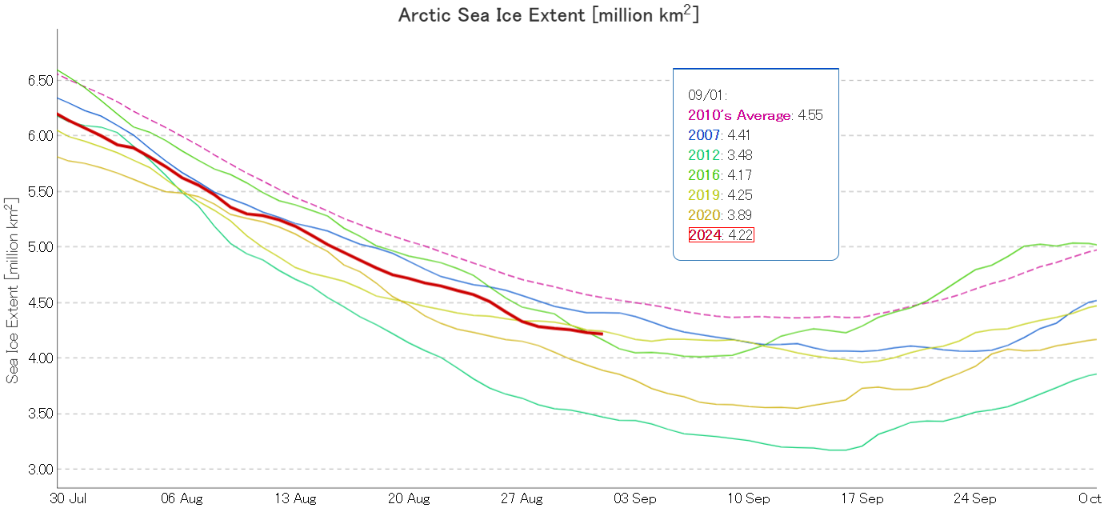
Here too is a more detailed look at 2024 extent compared with the 5 lowest annual minima in the JAXA record:
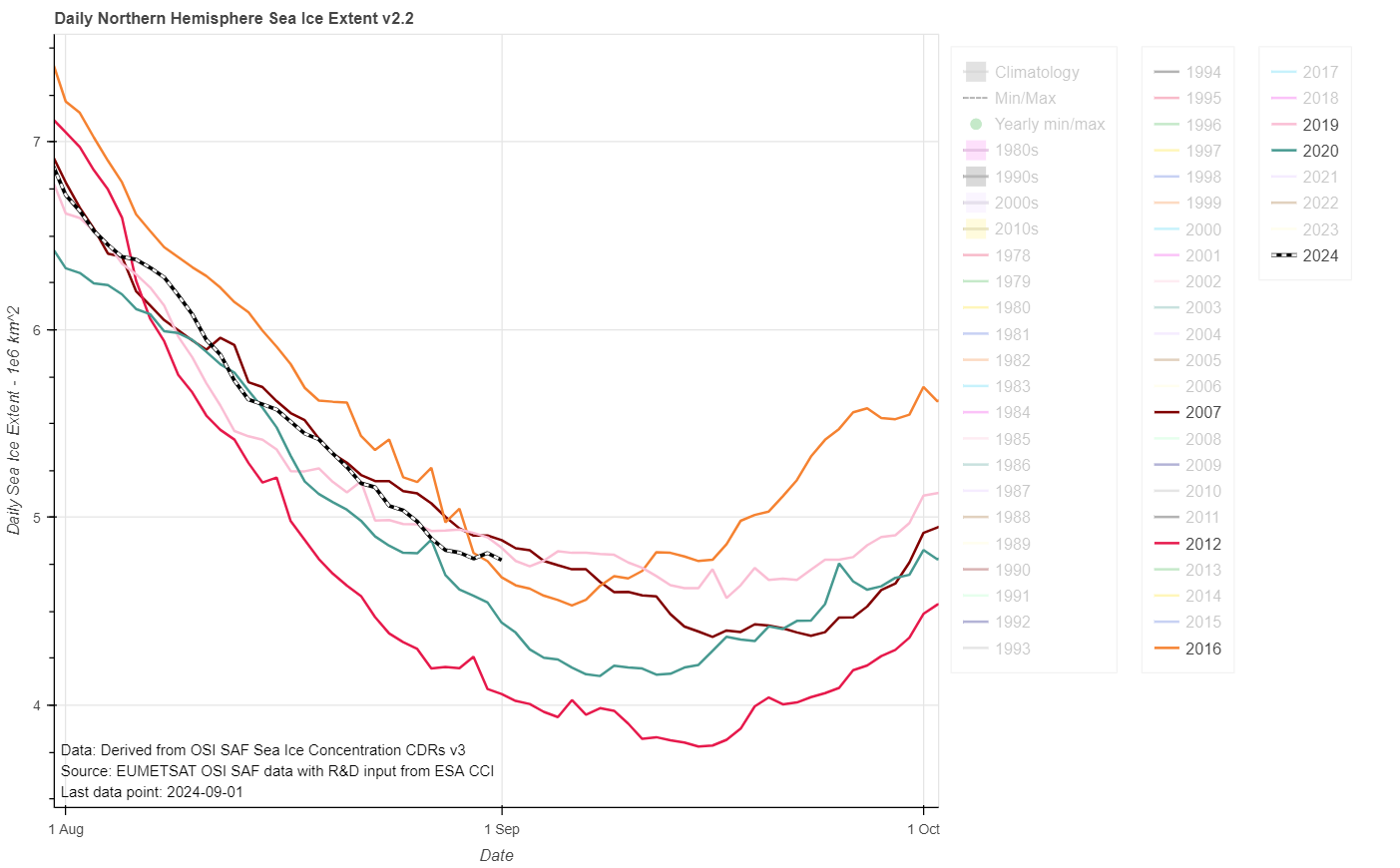
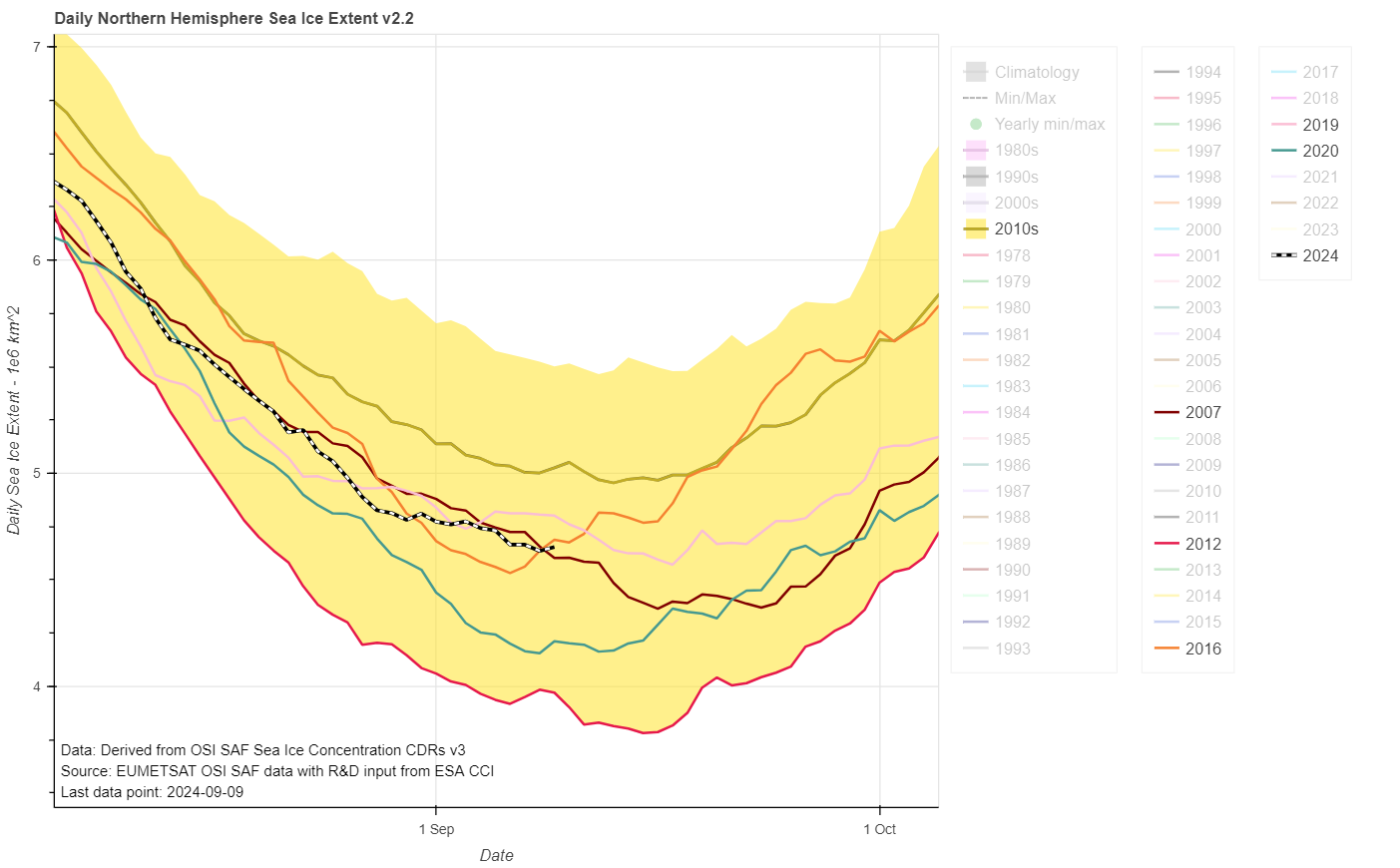
By way of comparison, here is the equivalent graph for the OSI SAF extent metric, which experienced an up tick yesterday but has now reached a new low for the year:
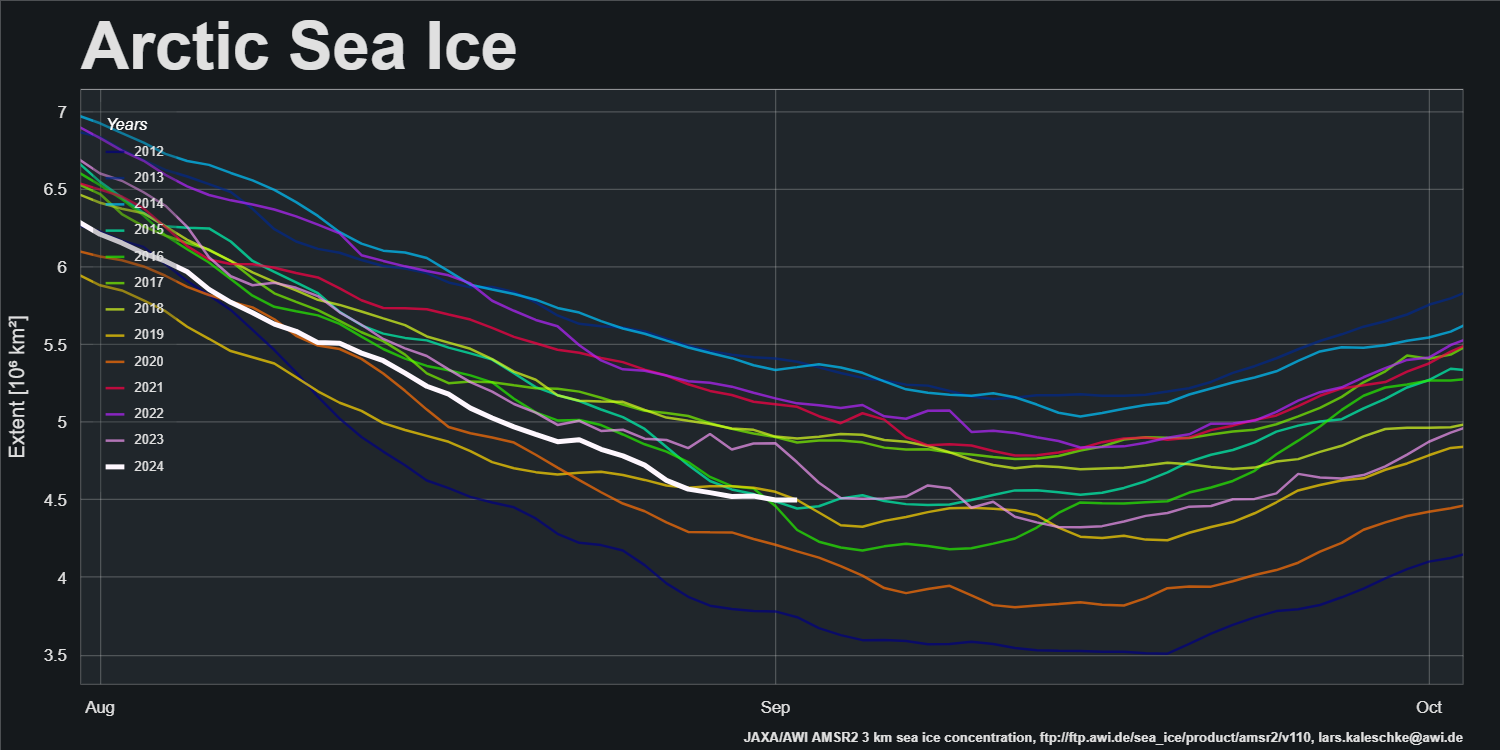
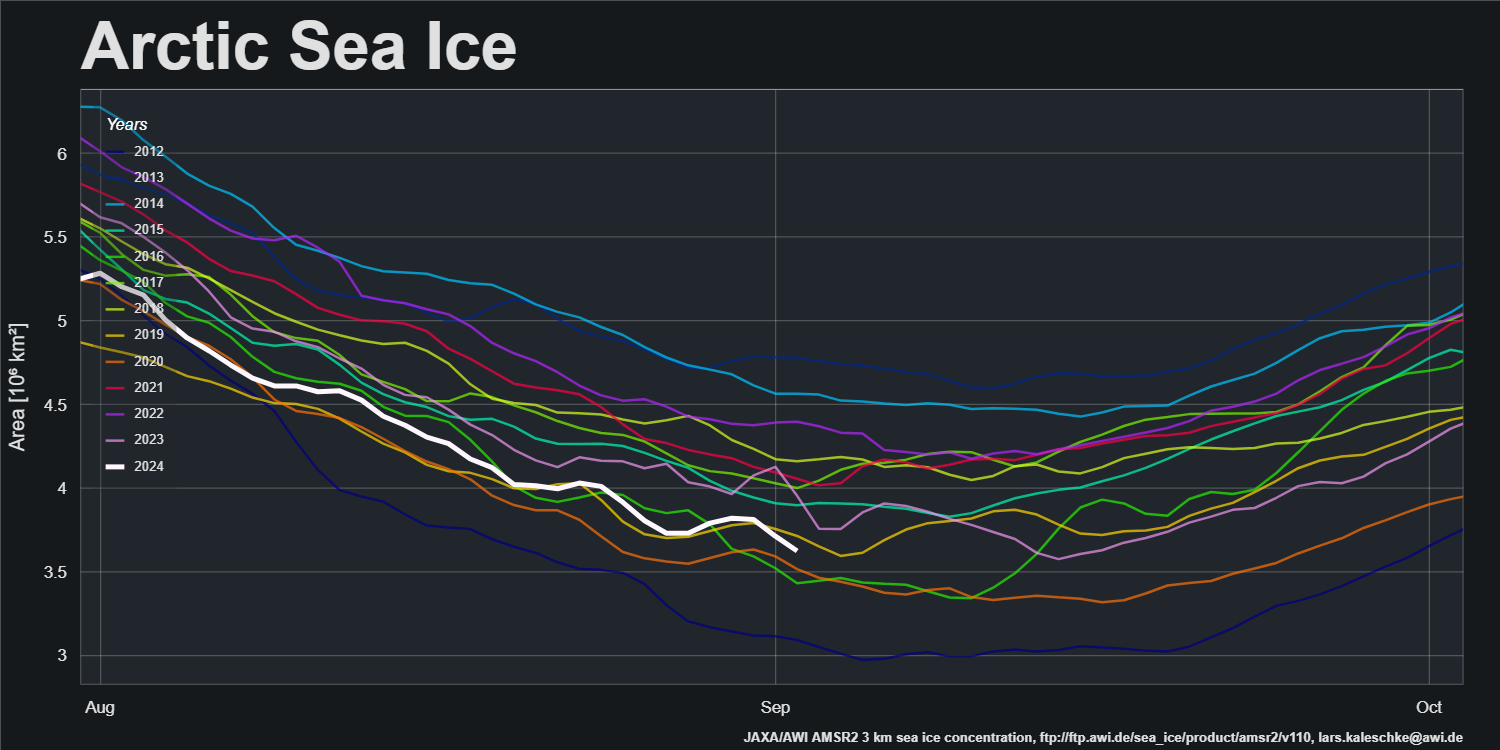
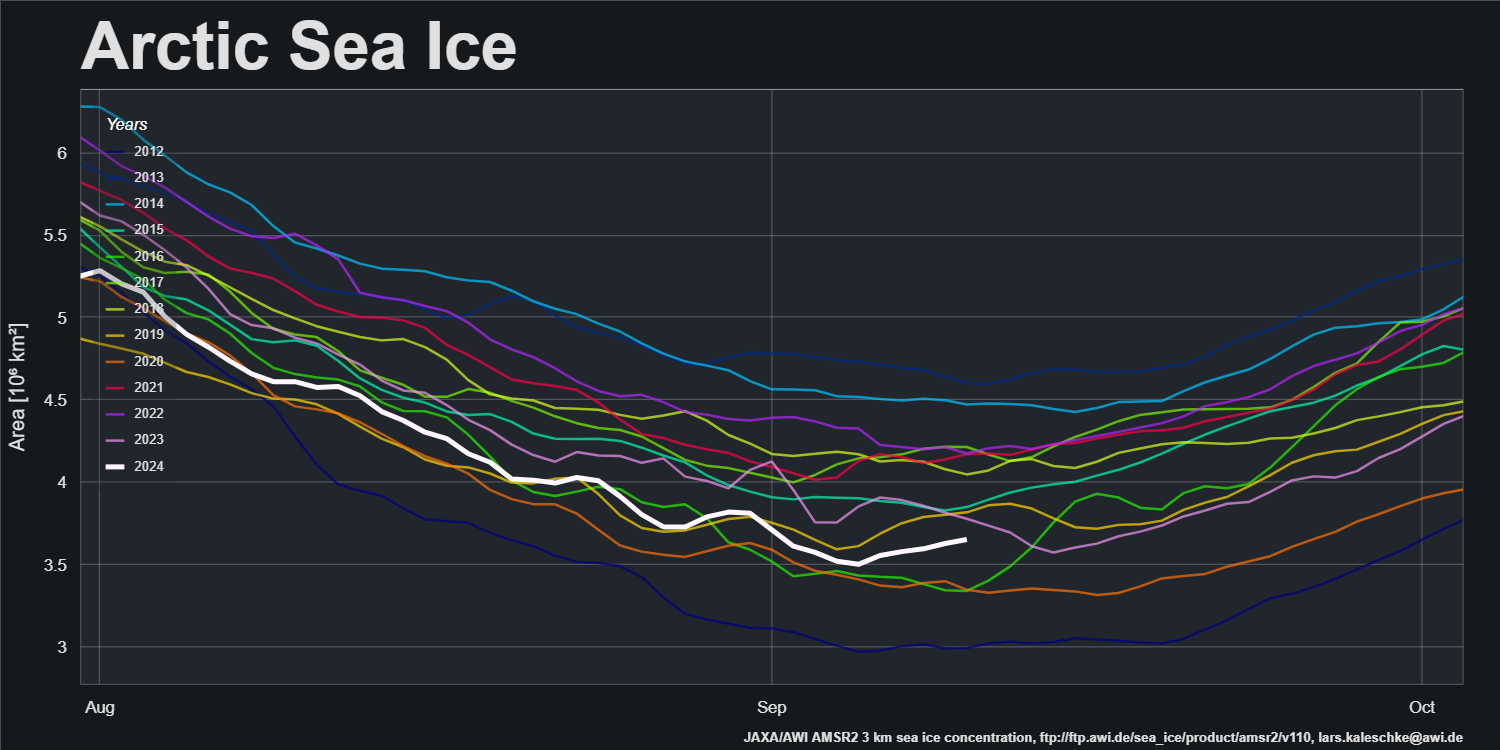
However AWI Arctic sea ice area is currently falling, which may well presage further significant falls in extent:
The NSIDC web site is currently “experiencing technical difficulties”, but hopefully we’ll be able to take a look at their extent graph in the very near future.
[Update – September 4th]
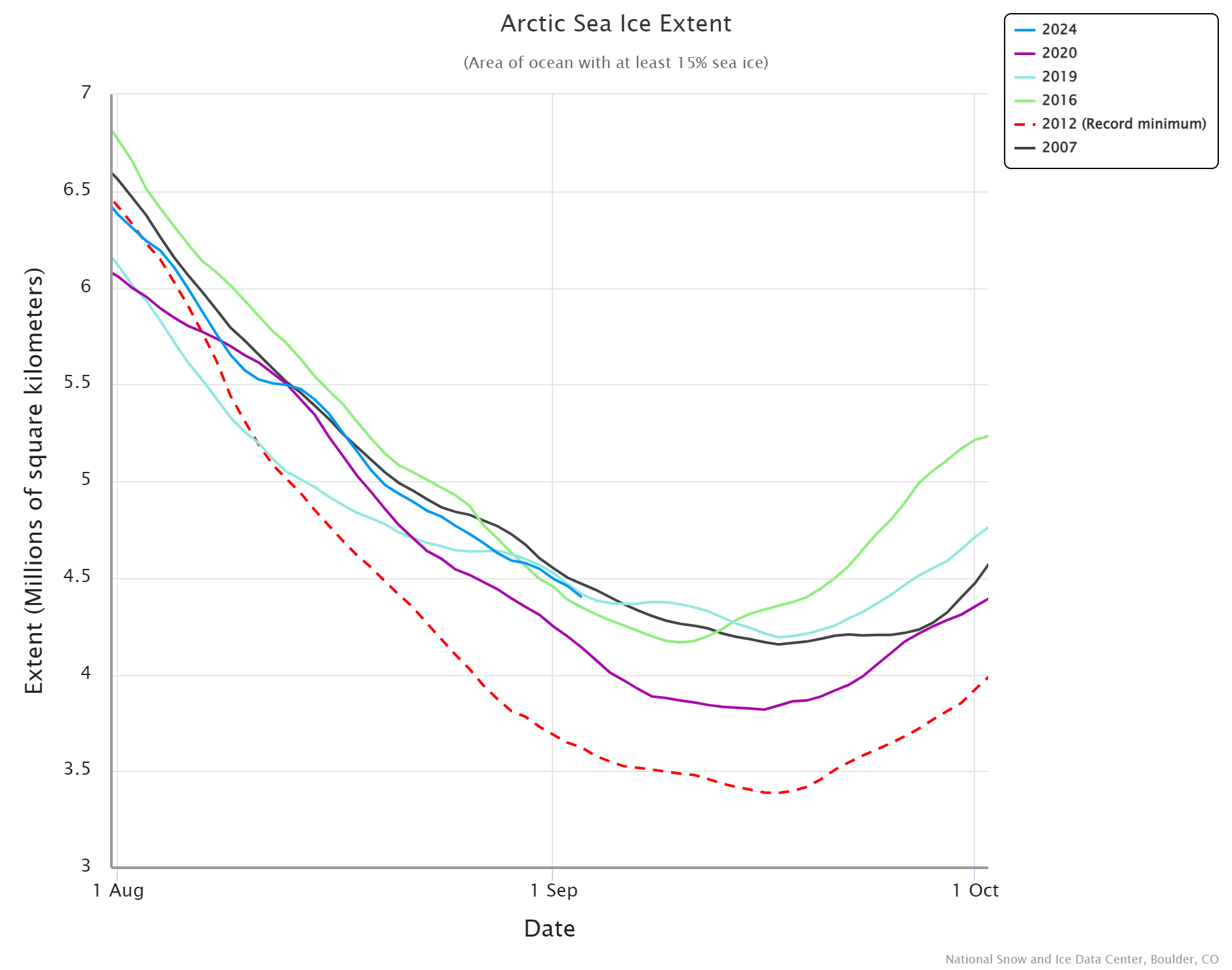
The NSIDC web site is back in action, and their 5 day averaged extent metric is currently still falling quickly:
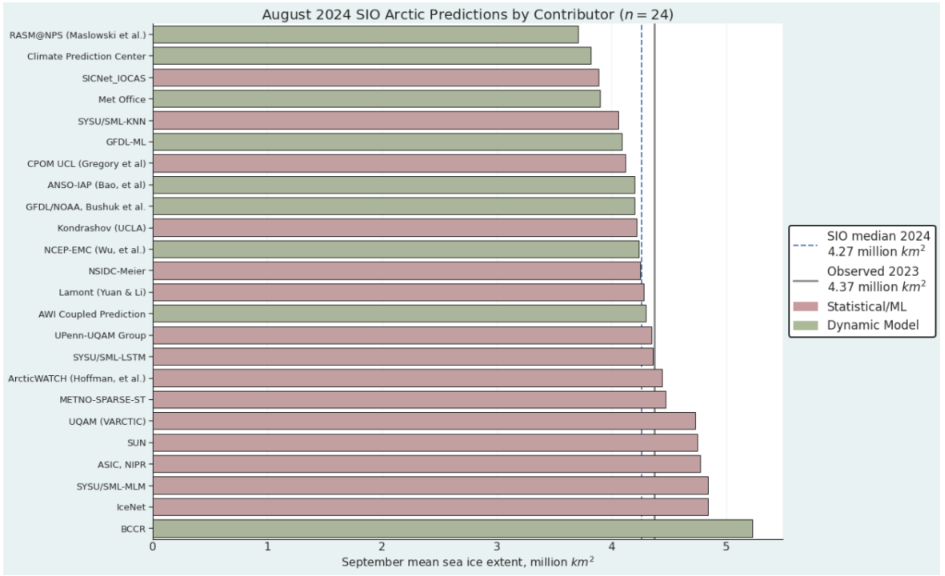
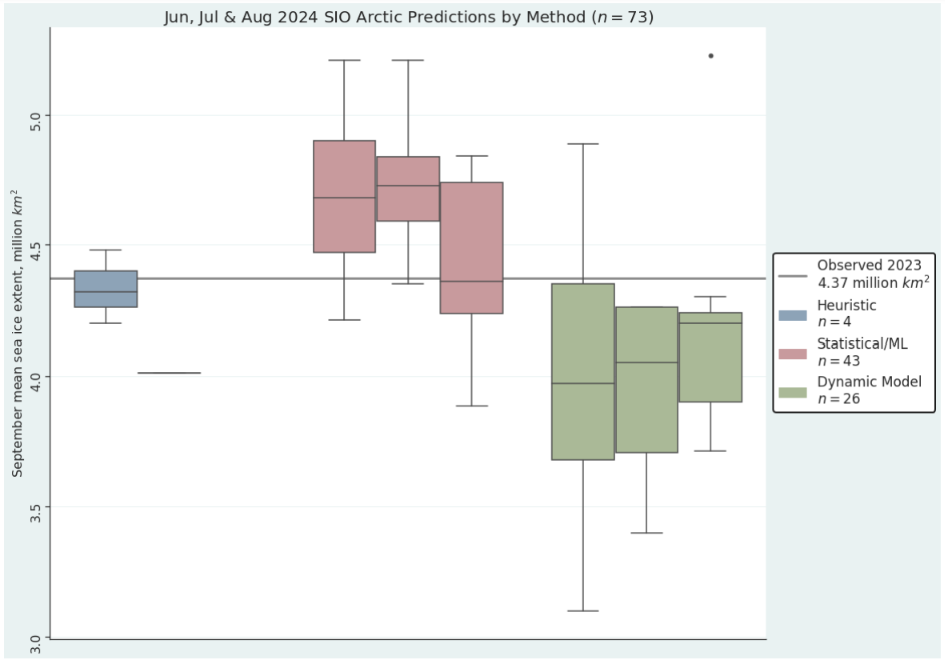
The ARCUS Sea Ice Prediction Network August report has been published. Note that the predicted numbers are for the September monthly average extent rather than the daily minimum:
For the August Outlook, we received 24 contributions of September pan-Arctic sea-ice extent forecasts…
The August 2024 median forecasted value for pan-Arctic September sea-ice extent is 4.27 million square kilometers with an interquartile range of 4.11 to 4.54 million square kilometers. This is about 200,000 square kilometers lower than the June median and about 250,000 square kilometers lower than the July median, which reflects the faster than average ice loss during July.
The lowest sea-ice extent forecast is 3.71 million square kilometers and the highest sea-ice extent forecast is 5.23 million square kilometers. These extremes are actually higher, particularly on the low end, than the estimates from July.
[Update – September 9th]
There’s been the tiniest of upticks in the NSIDC 5 day extent metric. 1 thousand km² to be precise. However, the others are still slowly declining:
[Update – September 10th]
NSIDC extent has posted a new low for the year, and JAXA extent is still declining. However there has been a slightly more substantial uptick in the OSI SAF metric:
The current minimum is 4.64 million km² on September 8th.
AWI sea ice area has posted a convincing looking minimum on September 4th, which suggests that the central refreeze is already well under way:
[Update – September 17th]
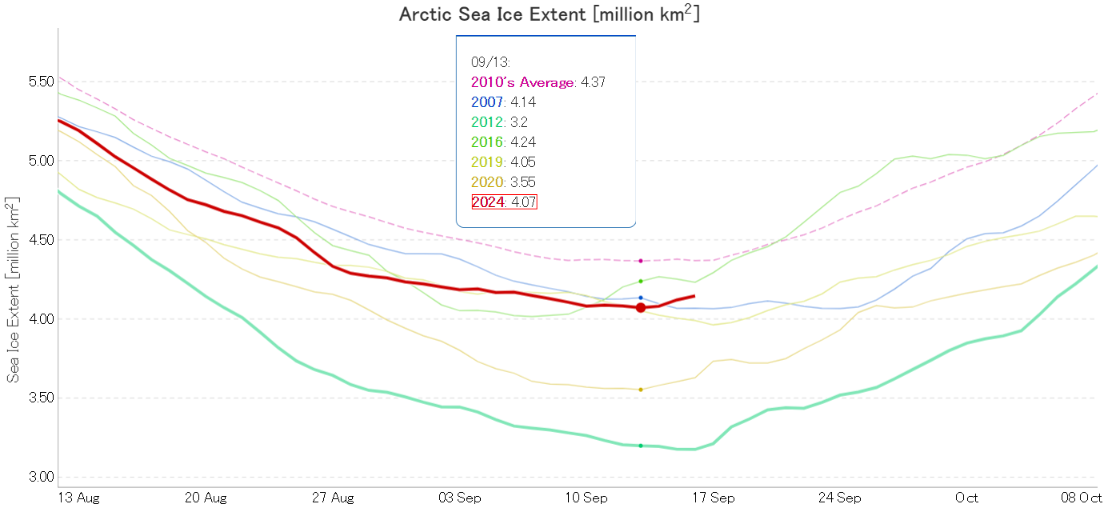
JAXA/ViSHOP/ADS extent has risen significantly over the last two days:
It now looks highly likely that the 2024 minimum will prove to be 4.07 million km² on September 13th. That is 4th lowest for the date, but equal 5th lowest minimum in the JAXA record.
A closer look at some of the other extent metrics will have to wait until this problem is solved:
Not good timing for a data outage!
[Update – September 22nd]
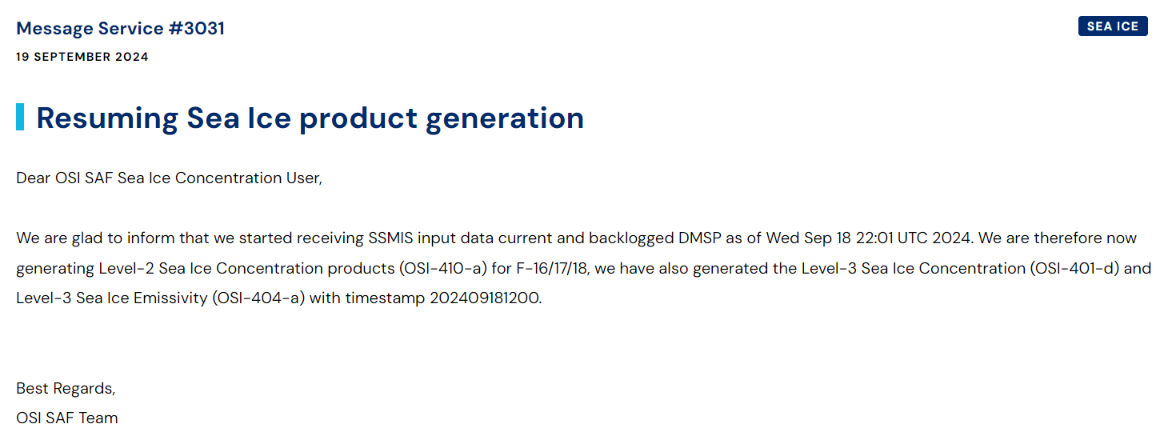
SSMIS data has been flowing again for a couple of days:
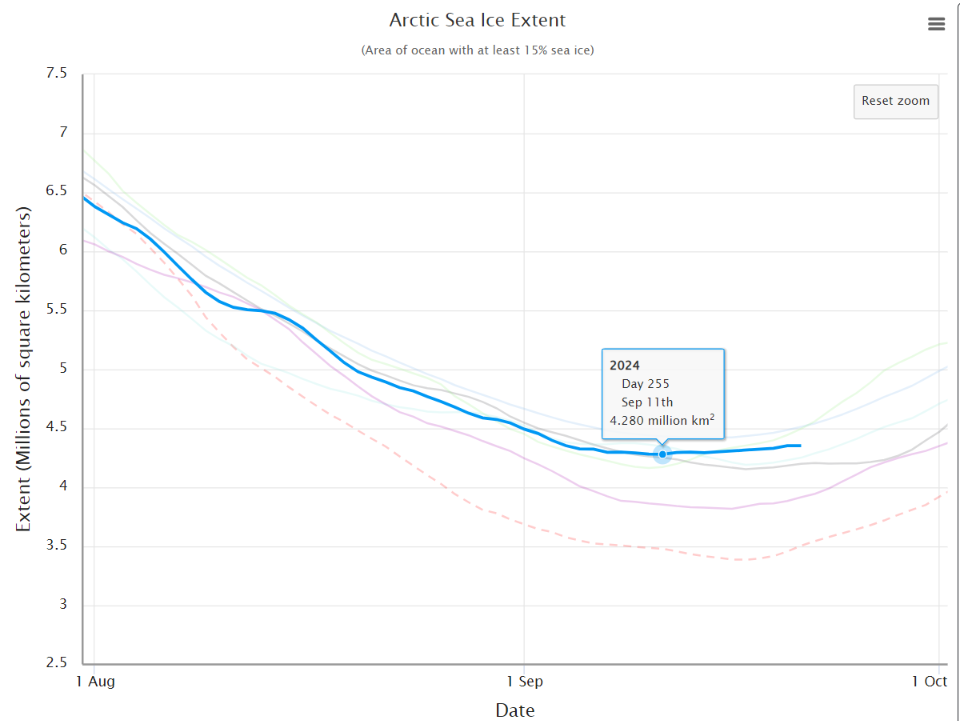
This graph may be subject to revision if and when the missing data is recovered, but currently it looks as though the 2024 minimum of the NSIDC 5 day averaged extent metric is 4.28 million km² on September 11th.
[Update – September 24th]
The National Snow and Ice Data Center formally announced today that:
On September 11, Arctic sea ice likely reached its annual minimum extent of 4.28 million square kilometers. The 2024 minimum is the seventh lowest in the nearly 46-year satellite record. The last 18 years, from 2007 to 2024, are the lowest 18 sea ice extents in the satellite record…
Note that this is a preliminary announcement. Changing winds or late-season melt could still reduce the Arctic ice extent, as happened in 2005 and 2010. NSIDC scientists will release a full analysis of the Arctic melt season, and discuss the Antarctic winter sea ice growth, in early October.
The NSIDC also addressed the recent missing SSMIS data issue mentioned above as follows:
Note that a gap exists in the input source data between September 12 and September 18. This gap somewhat lowers our confidence in the minimum extent estimate. However, it appears that September 11 is the mostly likely date of the minimum based on data trends in daily extent values leading up to the 5-day average on September 11 and the extent values after data restarted on September 18. If extent did drop further between September 11 and September 18, it would have been marginal. If the input source data becomes available to fill that gap, our team will update the minimum estimate if necessary.
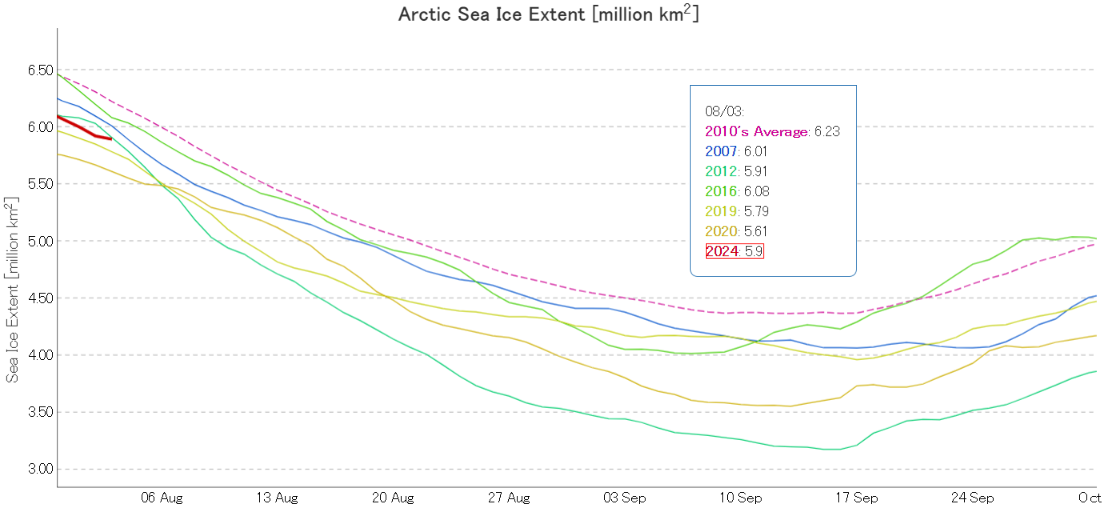
At the beginning of August JAXA/ViSHOP extent is 3rd lowest for the date in the satellite era:
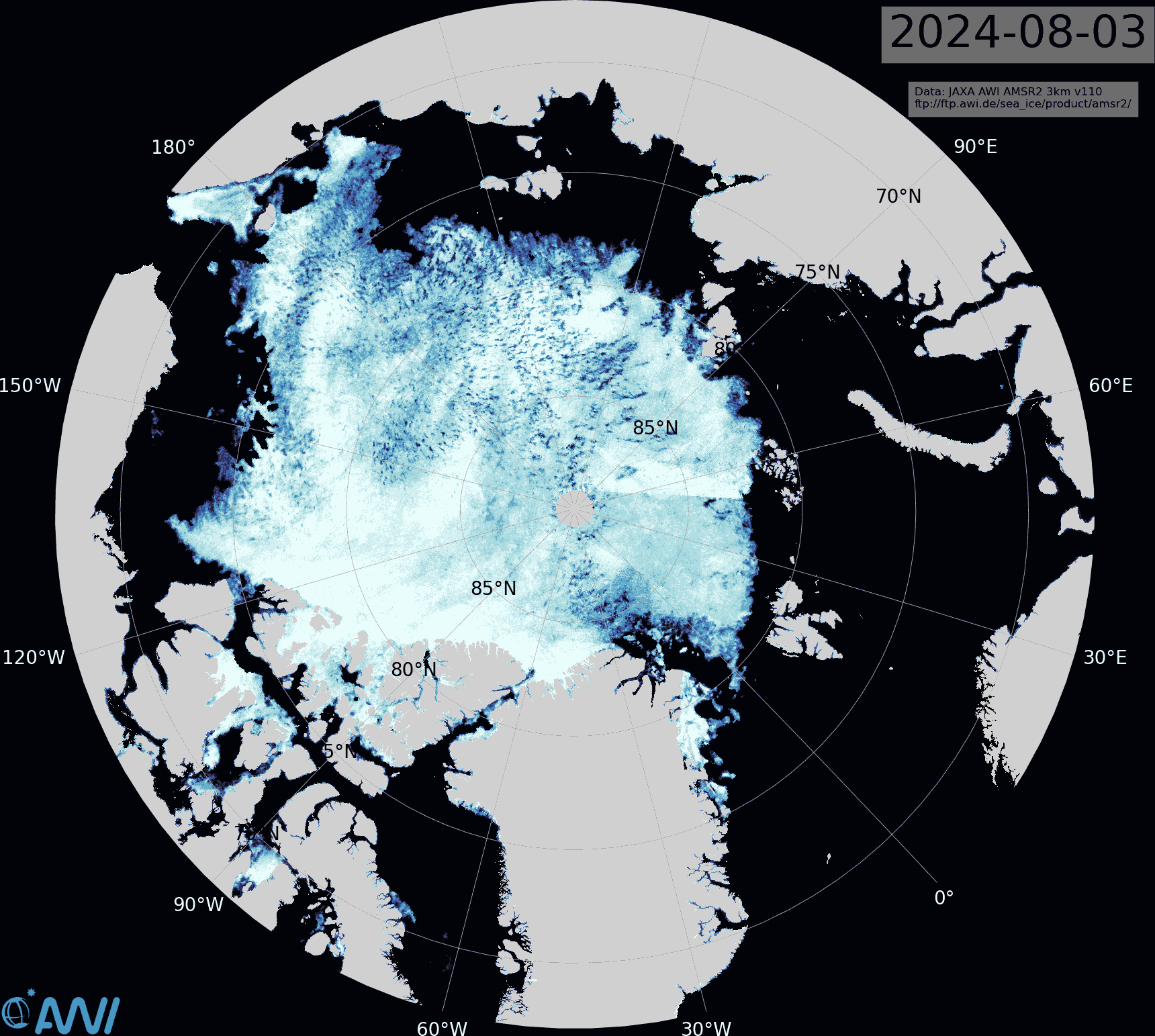
In 2012 extent had just started its unprecedented plunge towards the record September minimum, and 2024 seems certain to cross above the 2012 curve shortly. However, the latest AMSR2 sea ice concentration map from the Alfred Wegener Institute reveals areas of open water across the majority of the Central Arctic Basin:
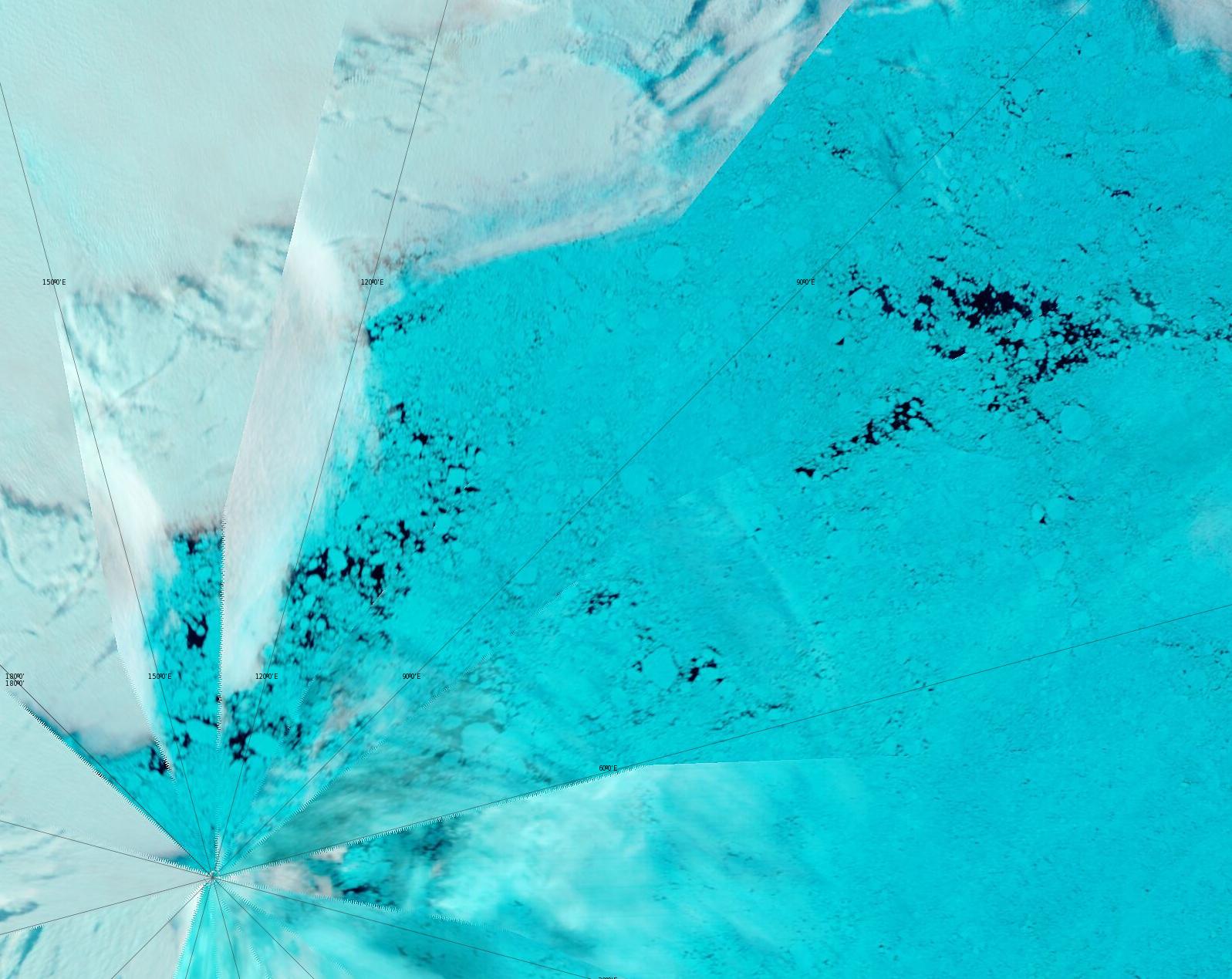
In particular the sea ice between the North Pole and northern Greenland is remarkably fragmented:
“False colour” image of the North Pole on August 3rd from the MODIS instrument on the Terra satellite
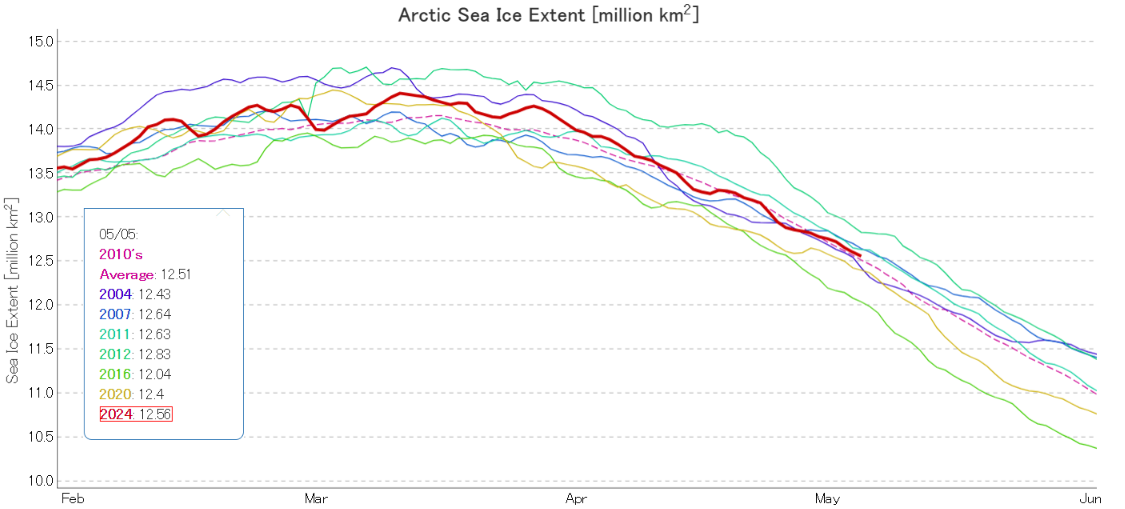
Since a certain “sceptic” has recently been comparing 2024 sea ice extent to “20 years ago”, here’s the current JAXA/ViSHOP extent graph of selected years, including 2004:
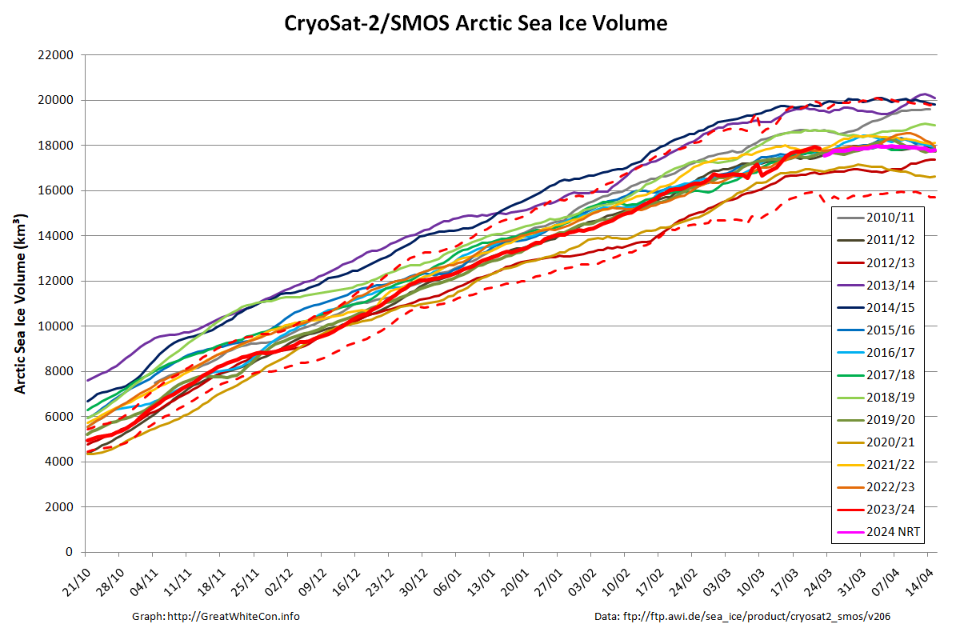
The CryoSat-2/SMOS merged Arctic sea ice volume graph finishes on April 15th, but older data is being reanalysed and here is the latest version:
The gap in the near real time data due to the problem with the SMOS satellite during the first half of March has been filled in, but the result doesn’t look very convincing to say the least!
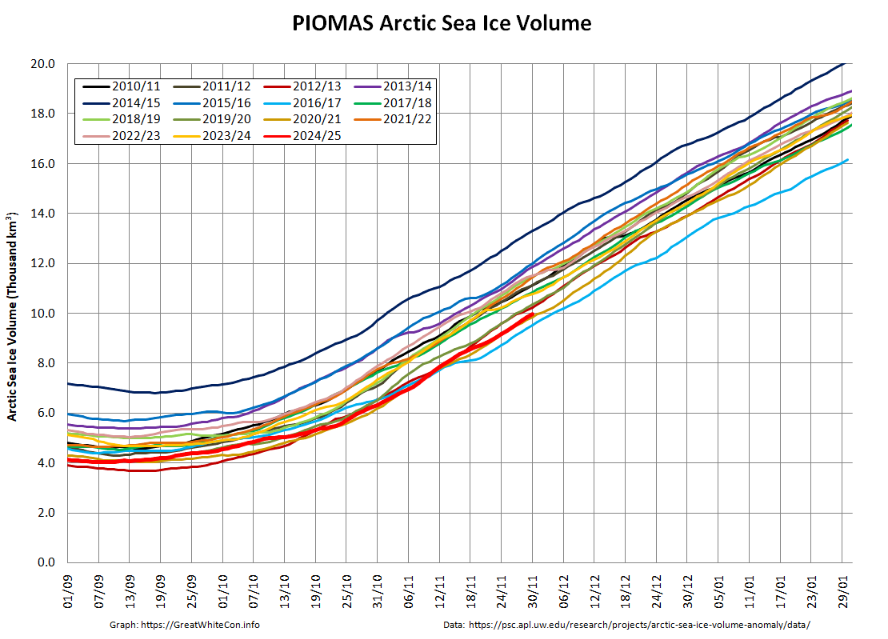
The PIOMAS gridded thickness data for April 2024 is now available. Here’s the end of month volume graph:
Our regular reader(s) may be wondering at this juncture, but that is not a typo in today’s title. For an in depth discussion of how alleged “renowned amateur naturalist and honorary doctor” Chris Packham sensationally rebranded Toby Young’s self identified “skeptical” web site live on air on the BBC’s “Sunday with Laura Kuenssberg” see here.
By way of additional background information see also our in depth investigation of the Daily Sceptic’s Arctic porky pie production line over here.
To the apparent astonishment of the Septic’s alleged “Environment Editor”, Chris Morrison, Reuters Fact Check has now followed in “Snow White’s” dainty footsteps through the as yet unmelted Arctic snow cover:
The so called “skeptics” are probably already salivating over that image!
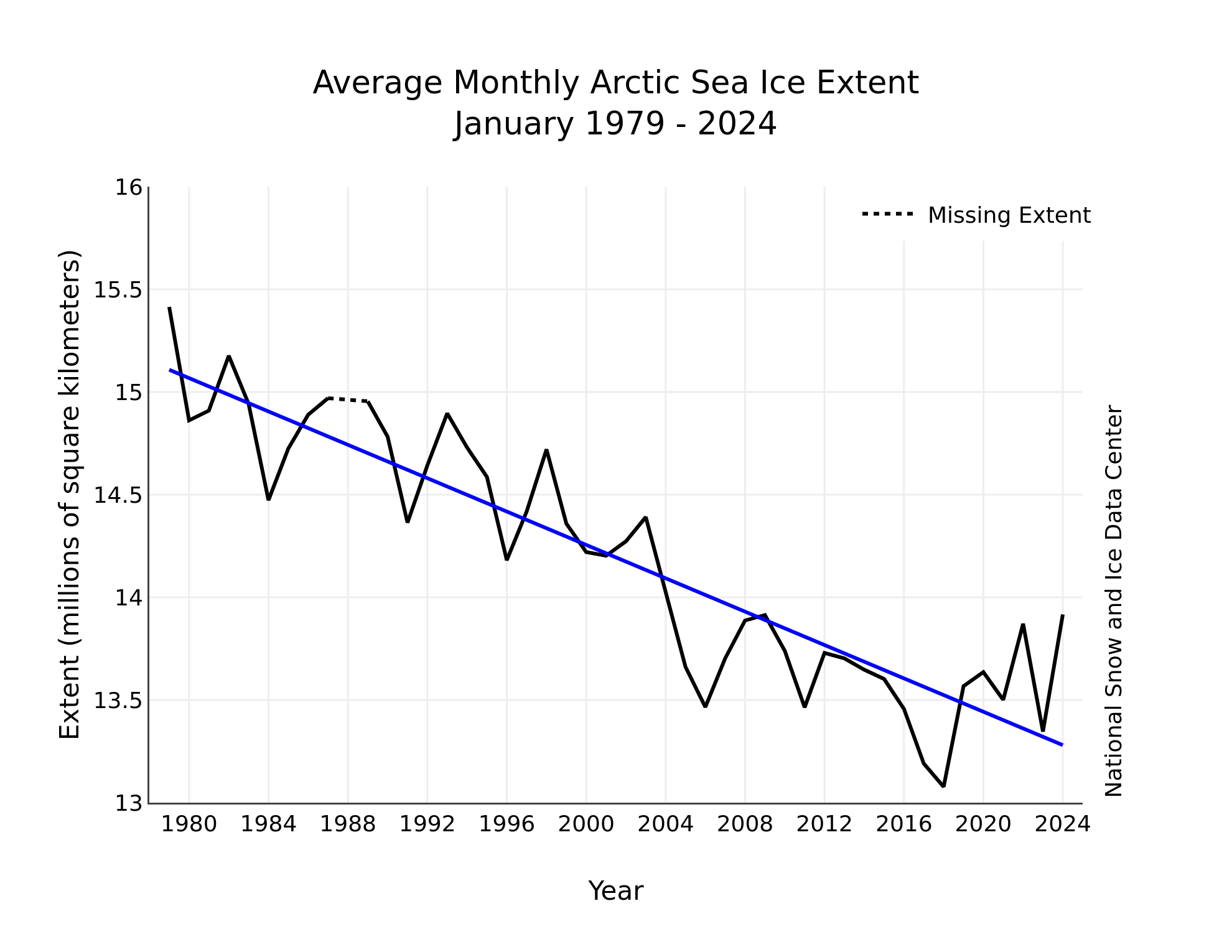
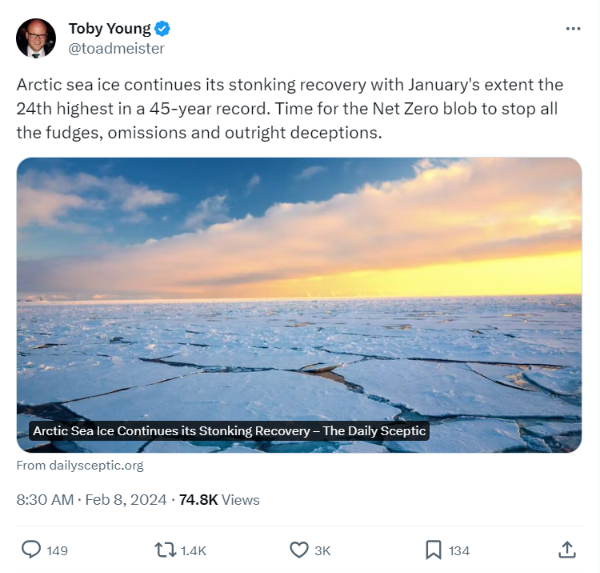
The name may not be familiar on the other side of the Atlantic, but here in the once United Kingdom Mr. Toby Young self identifies as “skeptical”, having named his web site the “Daily Sceptic”. This morning he Xweeted thus:
The linked article was written by the Daily Sceptic’s alleged “Environment Editor” Chris Morrison. Mr. Morrison Xweeted thus:
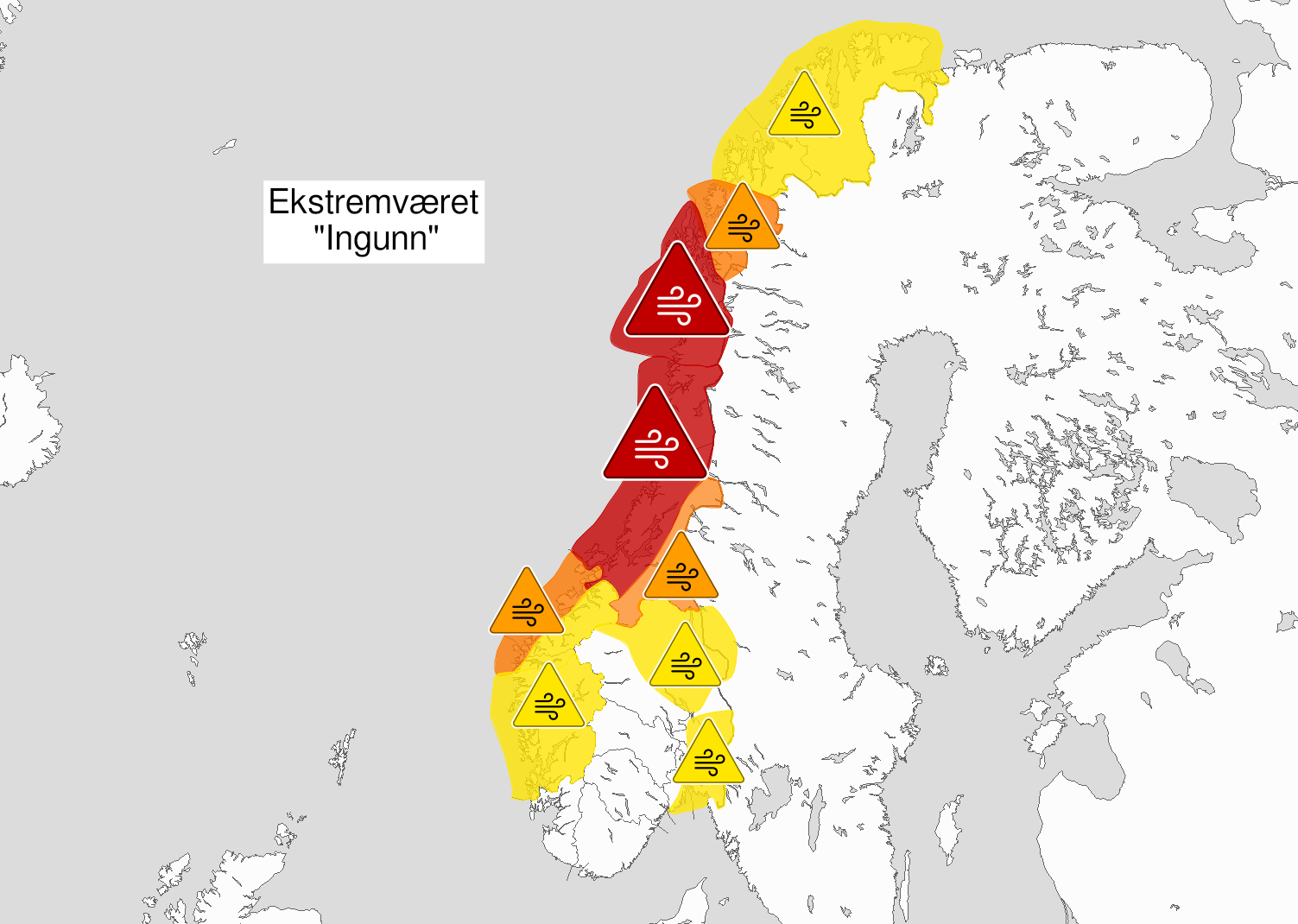
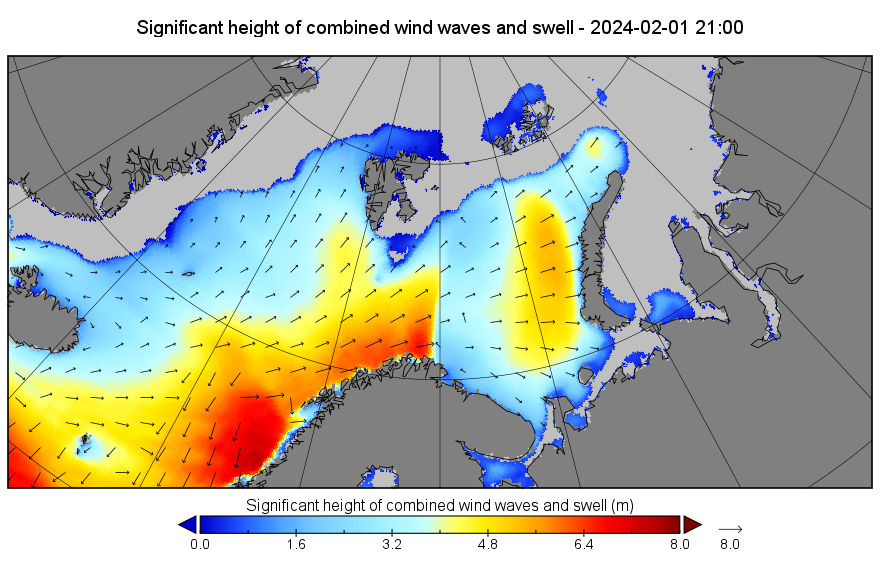
A change is perhaps even better than a rest? Let’s start February with a reminder that following close behind another recent Arctic cyclone, Storm Ingunn caused red weather warnings for high winds and avalanches in Norway two days ago:
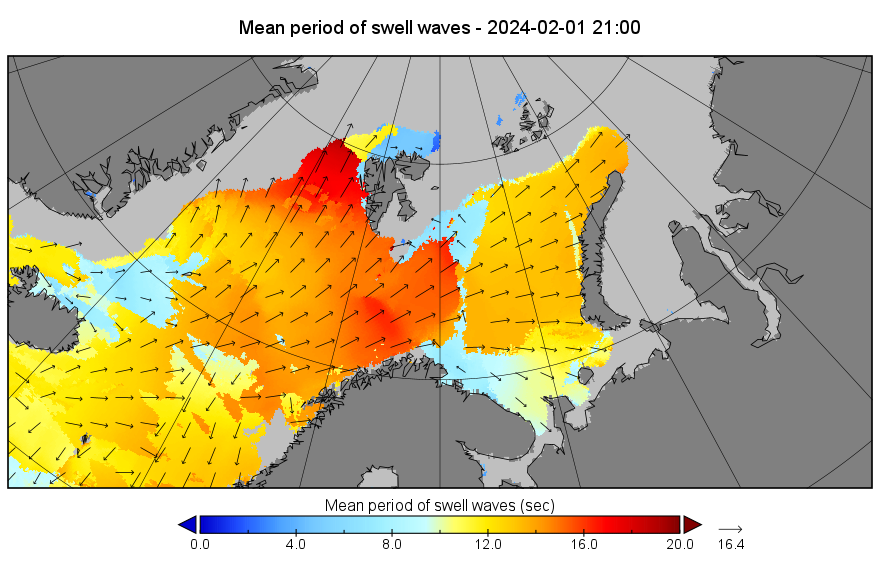
By yesterday evening another long period, storm driven swell was arriving at the sea ice edge in the Fram Strait, and to a lesser extent in the Barents Sea:
By this morning Ingunn had merged with the remnants of the prior cyclone, as revealed in Climate Reanalyzer’s visualisation of the latest GFS model run::
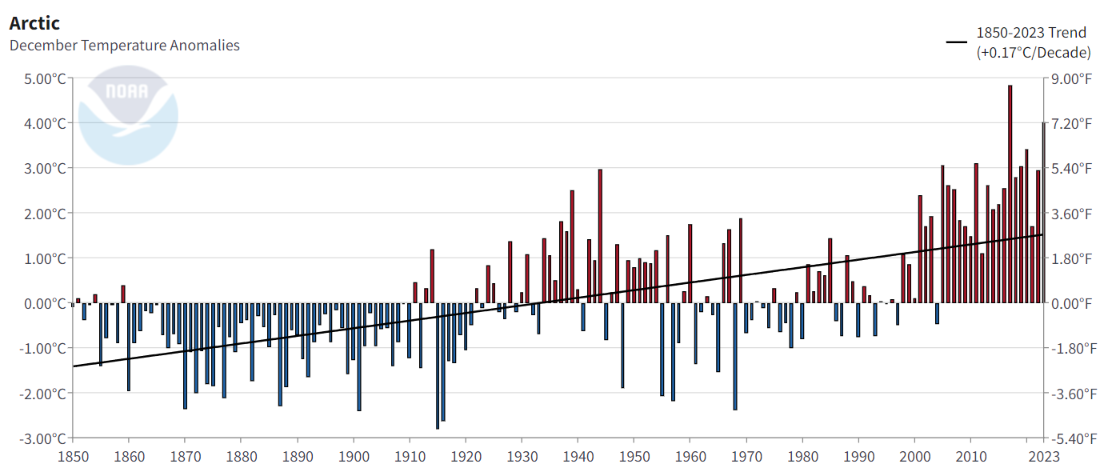
I was mildly surprised when a somewhat “skeptical” interlocutor of my Arctic alter ego linked to “Climate at a Glance” in the course of our alleged “debate”. I was even more surprised to discover that the far end of the suggested link was not NOAA’s familiar overview of the Arctic temperature trend:
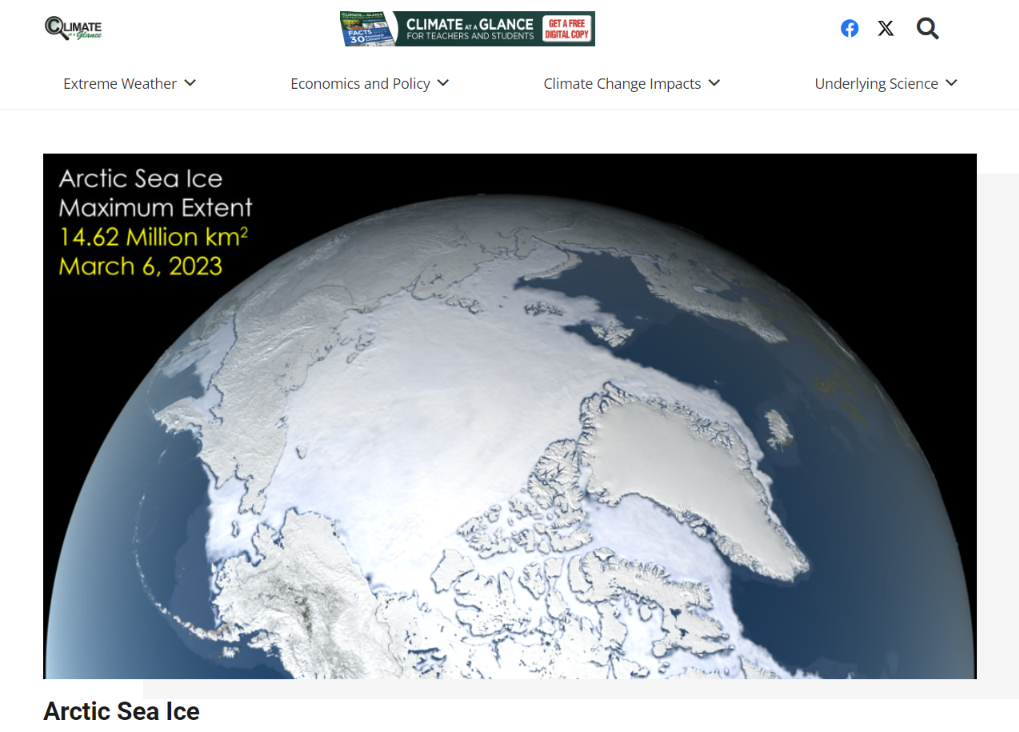
but instead a similarly named web site proudly sponsored by the Heartland Institute:
The “Climate at a Glance” home page currently features the Arctic at the top, and it probably won’t surprise you to learn that the linked article is full of half truths and untruths about “Snow White’s” favourite topic? Here are the Heartland Institute’s key Arctic takeaways:
This website uses cookies to improve your experience. We'll assume you're ok with this, but you can opt-out if you wish. Cookie settingsACCEPT
Privacy & Cookies Policy
Privacy Overview
This website uses cookies to improve your experience while you navigate through the website. Out of these, the cookies that are categorized as necessary are stored on your browser as they are essential for the working of basic functionalities of the website. We also use third-party cookies that help us analyze and understand how you use this website. These cookies will be stored in your browser only with your consent. You also have the option to opt-out of these cookies. But opting out of some of these cookies may affect your browsing experience.
Necessary cookies are absolutely essential for the website to function properly. This category only includes cookies that ensures basic functionalities and security features of the website. These cookies do not store any personal information.
Any cookies that may not be particularly necessary for the website to function and is used specifically to collect user personal data via analytics, ads, other embedded contents are termed as non-necessary cookies. It is mandatory to procure user consent prior to running these cookies on your website.