Tag Archives: Tony Heller

The real name of the apparently pseudonymous “Steven Goddard”. Pseudo-skeptical proprietor of the so called “Real Science” blog.

Sea Ice Data Tampering At DMI?

Not a lot of people know that our headline for today (apart from the terminating question mark) has been shamelessly plagiarised from Paul Homewood’s latest Arctic article. This will give you a flavour of Paul’s purple prose:

Electroverse have uncovered some blatant data tampering by DMI:

“It would appear that the Danish Meteorological Institute (DMI) may have taken a leaf out of NASA’s ‘data-fudging 101‘.

Sometime between late-Nov and early-Dec this year, the DMI’s Arctic Sea Ice Volume chart experienced a mysterious ‘vanishing’ of ice — this is revealed by a direct comparison of the Nov 18th and the Dec 8th charts below.”

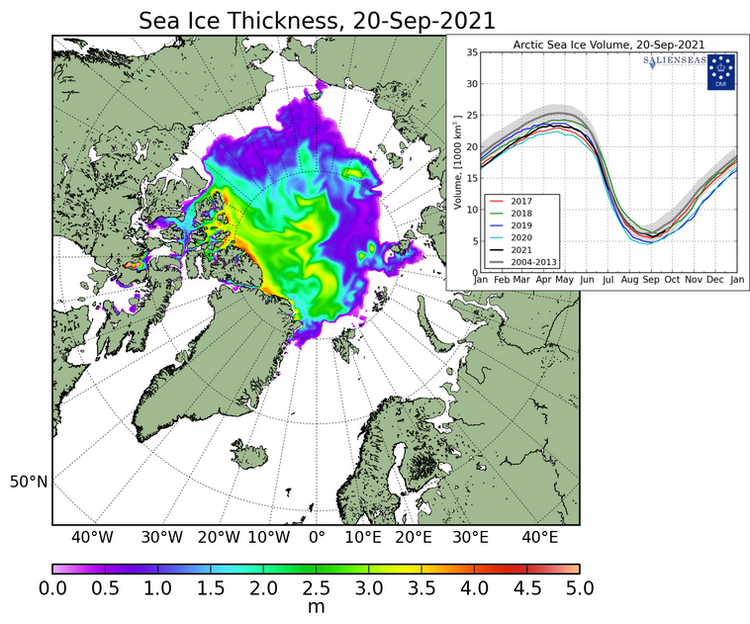
I am able to corroborate their findings. In September I took this screenshot of DMI sea ice thickness. Note that the black line for this year was close to the 2018 line, and above 2017 for Sep 20th:

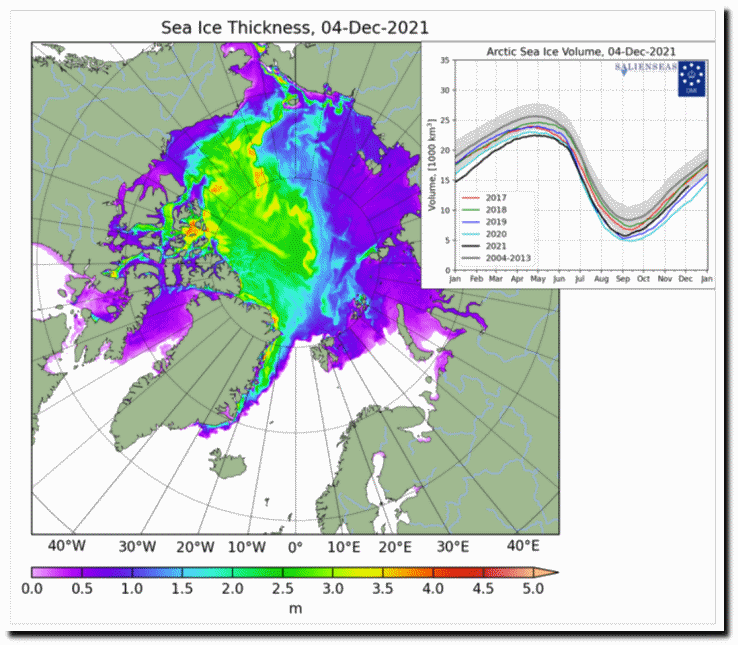
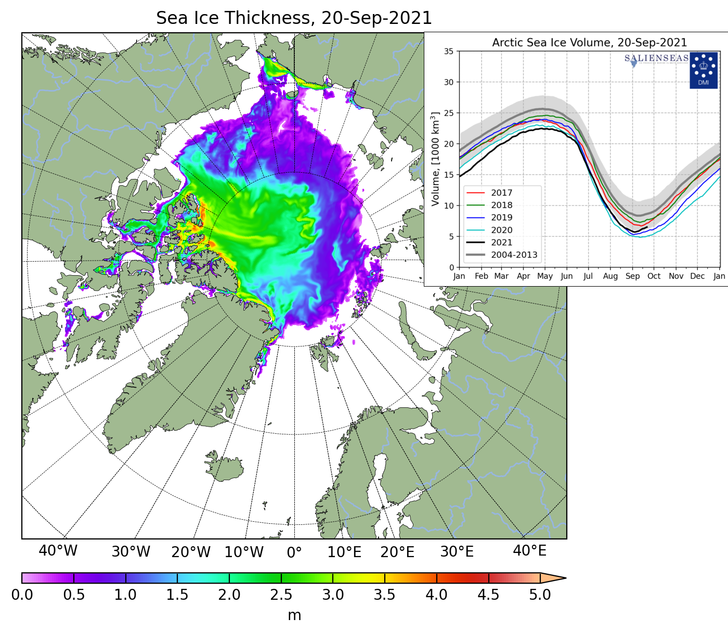
But the new version shows this year well below those two years:

There is no other way to describe this than blatant fraud. The changes do not appear to have been even documented, and the old data is not archived, being simply “replaced”. These should surely be very basic scientific requirements.

Neither does there appear to have been any public announcement by DMI about the fact or the justifications for what amounts to a significant change.

What this episode means is that DMI can no longer be trusted to produce honest, reliable data. It also raises the question of whether similar tampering has been carried out in previous years, without anybody being aware. After all, it is only by pure accident that it has been spotted this time.

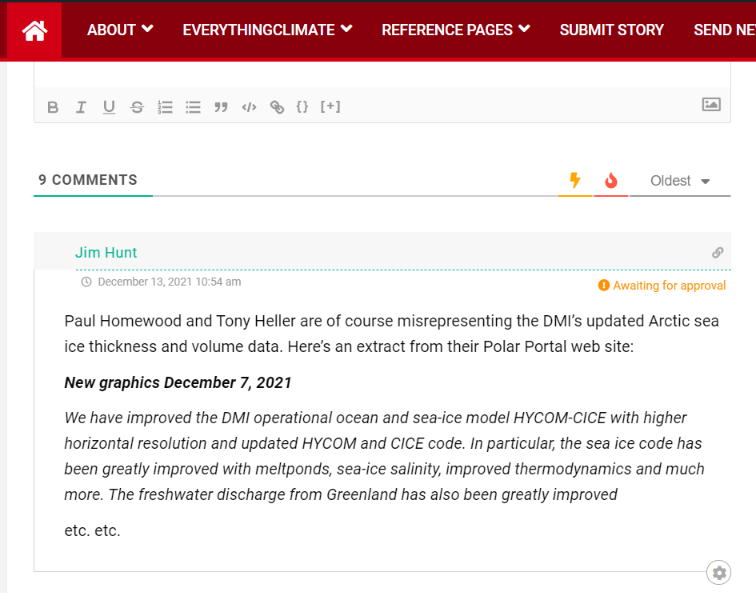
Even fewer people know that my helpful explanatory comment is currently invisible to Paul’s band of merry (mostly) men:

Should anyone contrive to click on the invisible link this what they would see just below the DMI’s recent Tweet:

Quite predictably Tony Heller has also jumped on the self same bandwagon, claiming in an article entitled “Rapidly Disappearing Arctic Ice” that:

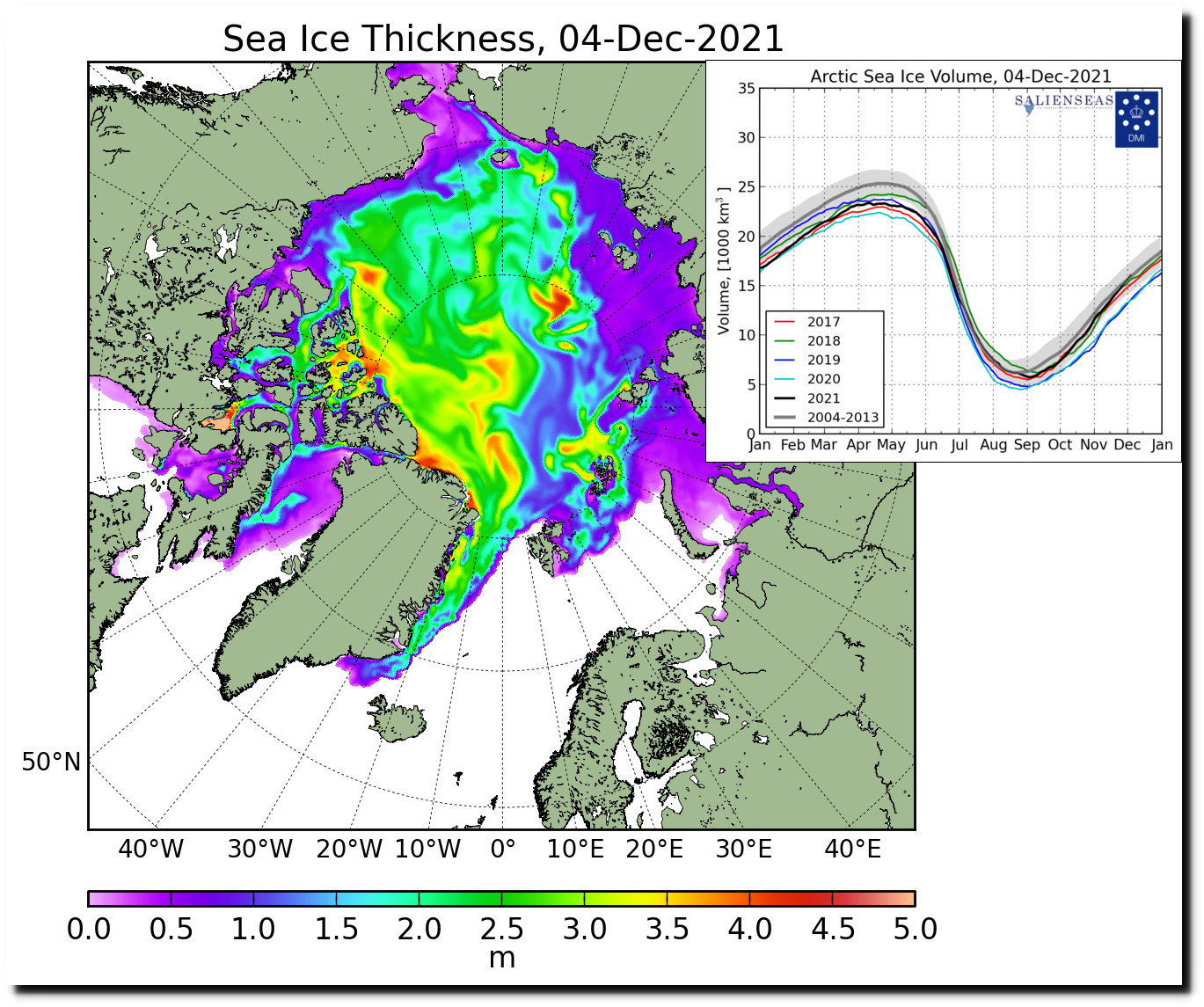
On December 4, DMI showed Arctic sea ice volume above the 2004-2013 average:

Quite predictably, the data disappeared for three days, and now that it has returned, DMI has massively reduced the amount of sea ice in the Arctic. Much of the thick ice off the coast of Siberia has disappeared:

Presumably their data tampering has freed the Russian ships trapped in the ice.

In normal circumstances I would of course point out the error of his ways to Tony via Twitter. However:

Here is the DMI’s explanation for the recent change in their Arctic sea ice thickness/volume visualisations, as shown on their “Polar Portal” web site:

New graphics December 7, 2021

We have improved the DMI operational ocean and sea-ice model HYCOM-CICE with higher horizontal resolution and updated HYCOM and CICE code. In particular, the sea ice code has been greatly improved with meltponds, sea-ice salinity, improved thermodynamics and much more. The freshwater discharge from Greenland has also been greatly improved using freshwater product from GEUS, which especially improves the coastal ocean currents and thus the ice transport nearshore Greenland. The model has been running continuously since September 1990. Therefore, we have by December 07, 2021 updated the graphics of sea-ice thickness and volume using the new and improved data on Polarportal and ocean.dmi.dk.

The improved model setup has led to higher variability as well as less abrupt melting during the melt season, which gives a shift of approximately half a month for the time of minimum ice volume. The trend between the years is almost unchanged. Thereby, a year with a large sea-ice volume in the old setup also has a large volume in the new setup, and similar for years with low sea-ice volume.

I always thought that “skeptical” folk didn’t much care for the output of “climate models” but I guess I must have been mistaken?

[Edit – December 13th]

Needless to say my comment at NALOPKT is still invisible this evening. However credit where credit is due. Tony Heller has at least not censored my comments on his blog. Earlier today Watts Up With That referred to both the Heller and Homewood DMIGate2 articles. Do you suppose the following helpful comment of mine will ever see the light of day at WUWT?

Watch this space for more #DMIGate2 news as and when we receive it!

Lies, Damned Lies And Tony Heller Videos

Yesterday Tony Heller proudly proclaimed on Twitter that:

I’m going to make a video today discussing the systemic lies, data hiding and deception about the Arctic from government agencies and the press.

Early today (UTC) that video was published on YouTube. At 0:19 Tony asserts that:

And of course the graph starts in 1979 because they say that’s the start of the satellite record!

On no “they” don’t! This morning (UTC):

Tony seems have gone very quiet on Twitter, so here’s another couple of episodes from the ongoing soap opera:

Here’s the reference in question, from page 236 in the IPCC’s First Assessment Report in 1990:

The Under-Ice Thickness Distribution of the Arctic Basin as Recorded in 1958 and 1970

Surely a sufficiently unambiguous title for someone of Tony Heller’s intellectual capacity to comprehend?

[Edit – October 11th]

Tony is still very quiet about Arctic matters on Twitter, so here’s a few more episodes of my ongoing critique:

[Edit – October 13th]

Shock News! Tony Heller has accidentally made a testable prediction on Twitter!!

Let’s bookmark it for posterity shall we?

Needless to say Tony has yet to answer my final question.

[Edit – October 16th]

Needless to say Tony Heller has yet to answer any of my recent questions. What’s more despite the exhortations of one of his band of merry (mostly) men he has declined to engage in a public debate with me:

[Edit – October 22nd]

With my alter ego blocked I’ve been debating with some of Tony’s band of merry (mostly) men whilst wearing my normal attire. One of them requested the opinion of Judah Cohen and Big Joe on Tony’s cherry pick du jour:

https://twitter.com/jim_hunt/status/1451325503584063496

Here’s what happened next:

https://twitter.com/jim_hunt/status/1451438951932309524

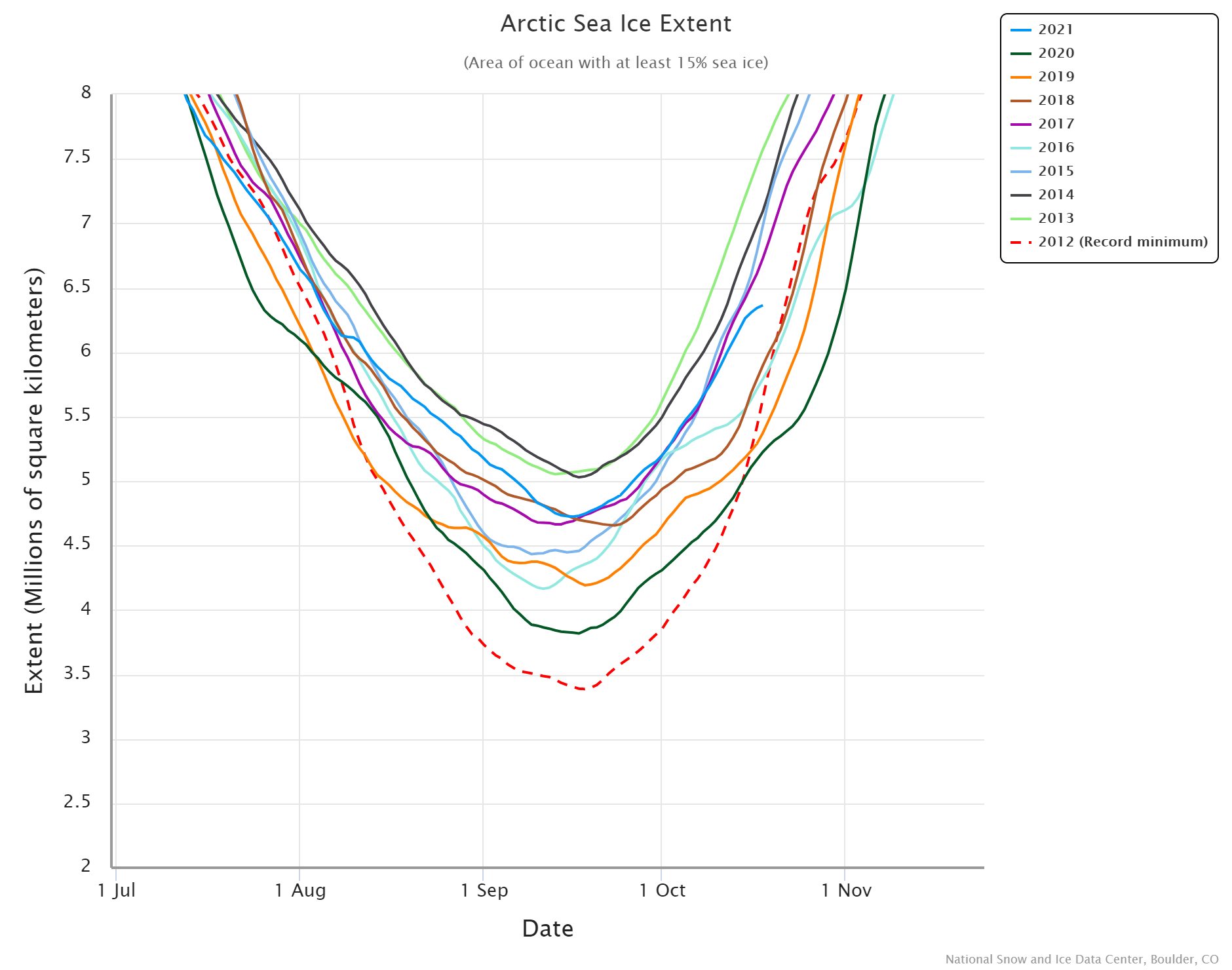
Here’s what Judah’s suggestion looks like, up until October 18th at least:

The NSIDC’s data feed seems to be suffering from a “brief hiatus”:

Watch this space!

Arctic Sea Ice Disinformation and COP26

There isn’t a million more square kilometers of ocean covered with ice than at the same time last year. Or is there?

For our younger readers perhaps I should point out that is a reference to the genesis of the Great White Con blog way back in the mists of time in September 2013, when a Daily Mail headline proudly, but erroneously, declared that:

And now it’s global COOLING! Record return of Arctic ice cap as it grows by 60% in a year.

Almost a million more square miles of ocean covered with ice than in 2012

With the COP26 conference due to start in Glasgow on October 31st UK Prime Minister Boris Johnson had this to say to the United Nations General Assembly yesterday, amongst other things:

In the words of the Oxford philosopher Toby Ord “we are just old enough to get ourselves into serious trouble”…

It is time for humanity to grow up.

It is time for us to listen to the warnings of the scientists – and look at Covid, if you want an example of gloomy scientists being proved right – and to understand who we are and what we are doing.

The world – this precious blue sphere with its eggshell crust and wisp of an atmosphere – is not some indestructible toy, some bouncy plastic romper room against which we can hurl ourselves to our heart’s content.

Daily, weekly, we are doing such irreversible damage that long before a million years are up, we will have made this beautiful planet effectively uninhabitable – not just for us but for many other species.

And that is why the Glasgow COP26 summit is the turning point for humanity.

If all that sounds unlikely, then take a look:

https://youtu.be/Z_YPE7vy_wQ?t=27


As we surmised at the time of the recent G7 Summit in Cornwall:

Continue reading Arctic Sea Ice Disinformation and COP26

The 2020 Maximum Arctic Sea Ice Extent

As Zack Labe has recently pointed out, in 2015 the Arctic sea ice maximum extent based on the JAXA numbers had already occurred on February 15th:
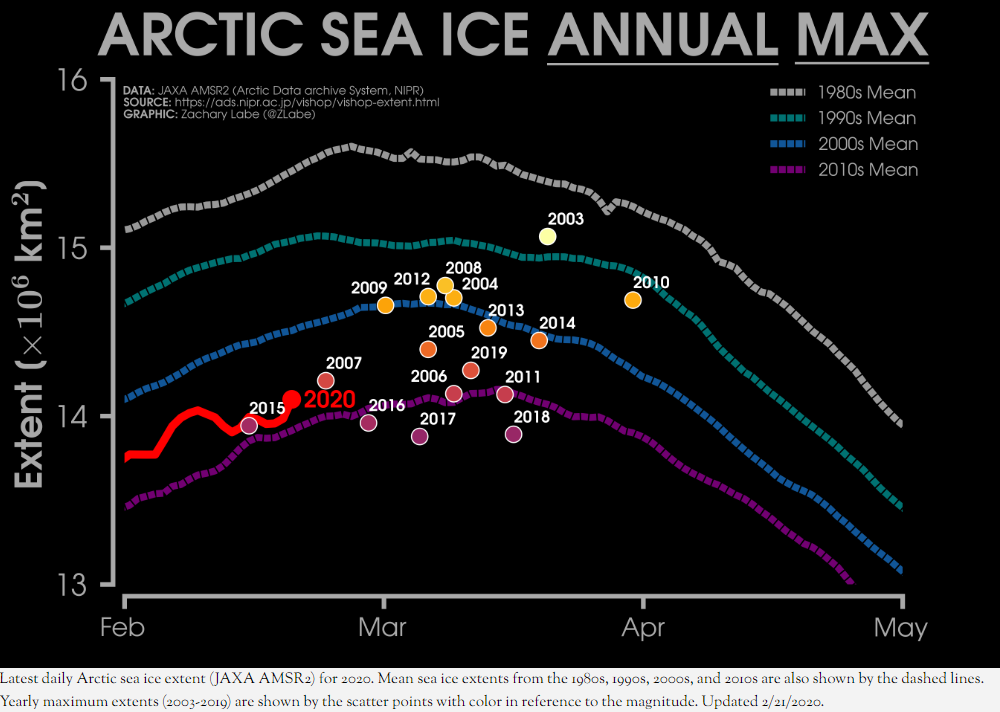
Perhaps it’s time we started paying attention this year! However the National Snow and Ice Data Center reported a significantly later date in 2015:

On February 25, 2015, Arctic sea ice extent appeared to have reached its annual maximum extent, marking the beginning of the sea ice melt season. This year’s maximum extent not only occurred early; it is also the lowest in the satellite record. However, a late season surge in ice growth is still possible.

Each year we keep track of the assorted Arctic sea ice metrics over the next month or so, and they rarely agree on the date of maximum extent, and never agree on the sea ice extent on that date! The reason for that is explained in a 2017 paper entitled “Variability and trends in the Arctic Sea ice cover: Results from different techniques“:

Reports on the sea ice cover have been provided by different institutions using basically the same set of satellite data but different techniques for estimating key parameters such as ice concentration, ice extent, and ice area. In this study, a comparison of results from four different techniques that are frequently used shows significant disagreements in the characterization of the distribution of the sea ice cover primarily in areas that have a large fraction of new ice cover or significant amount of surface melt.

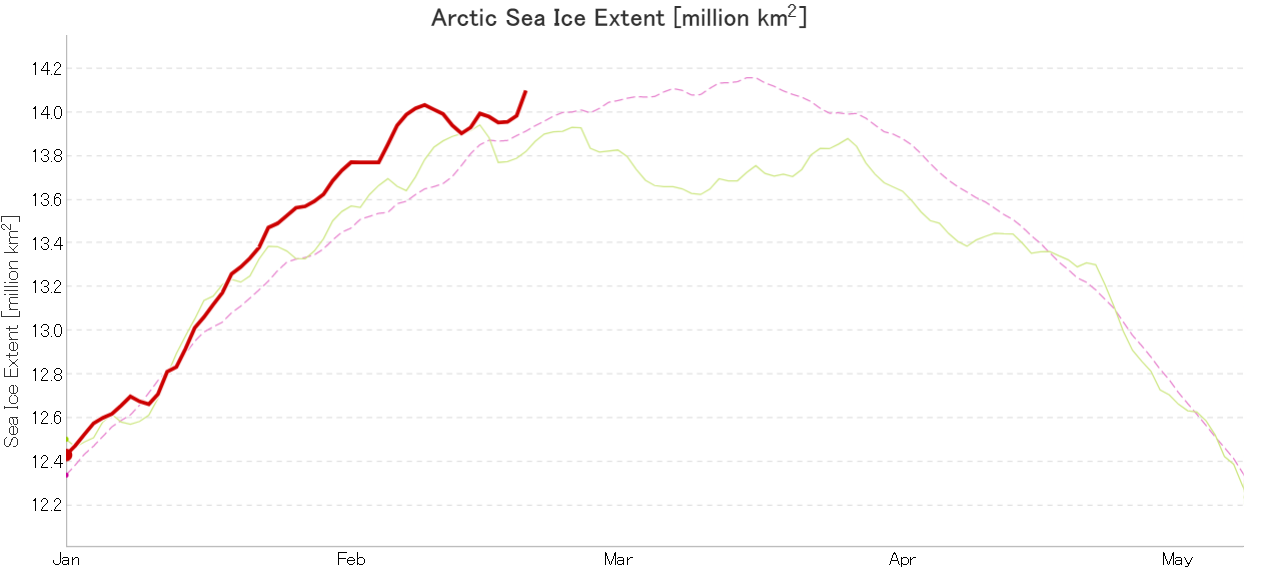
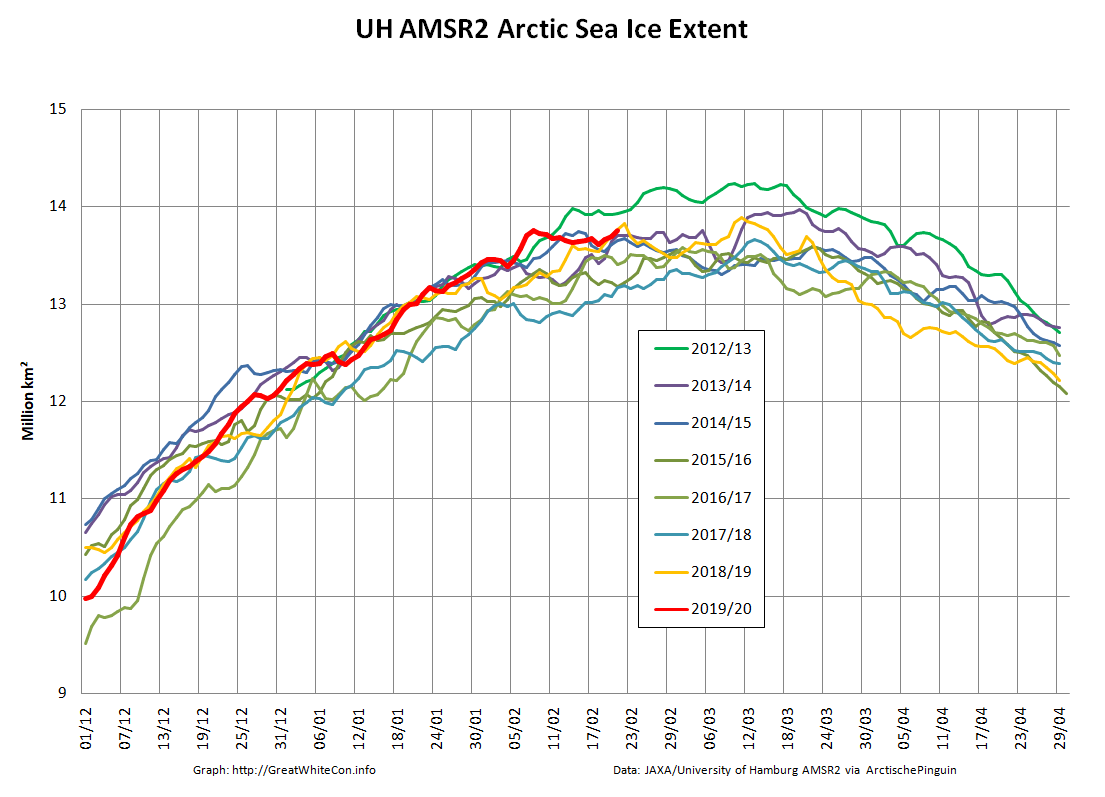
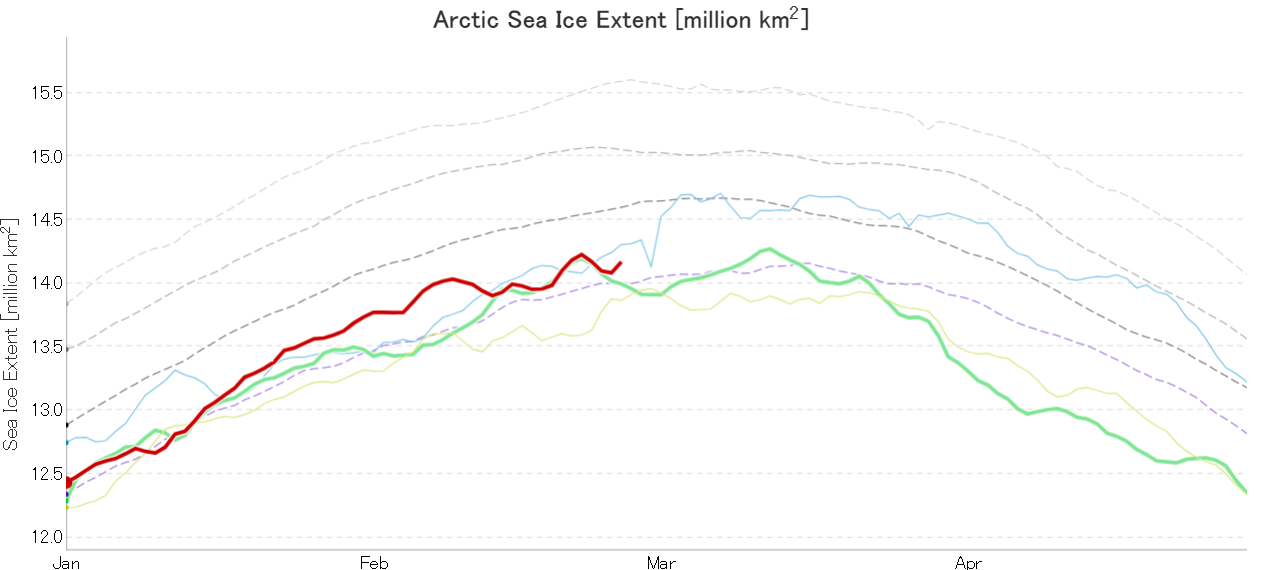
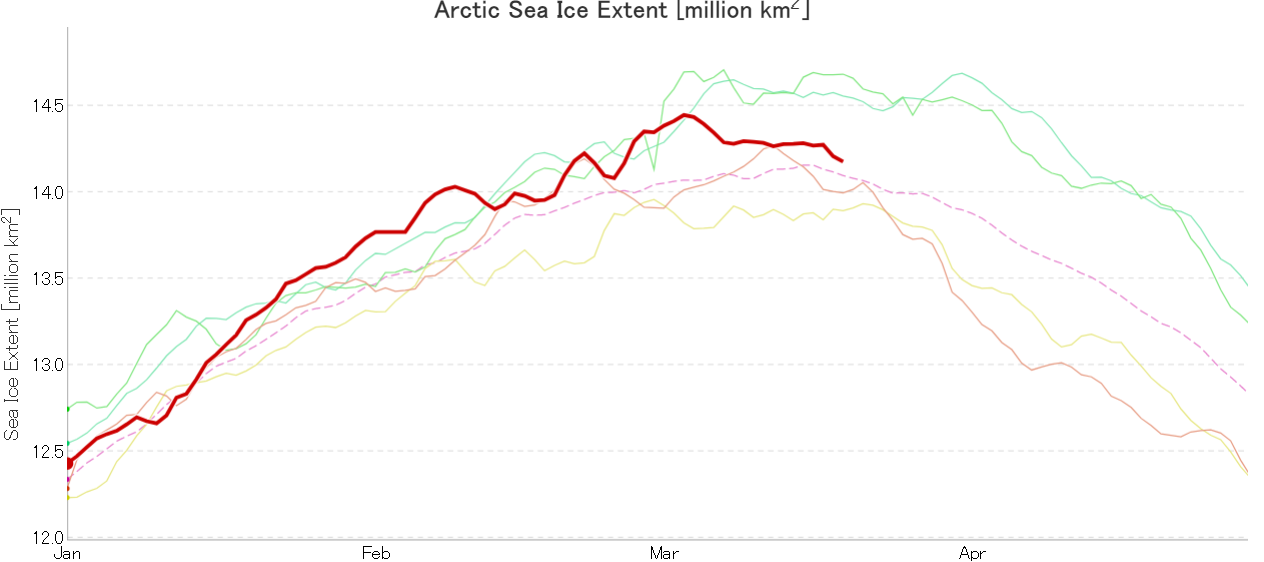
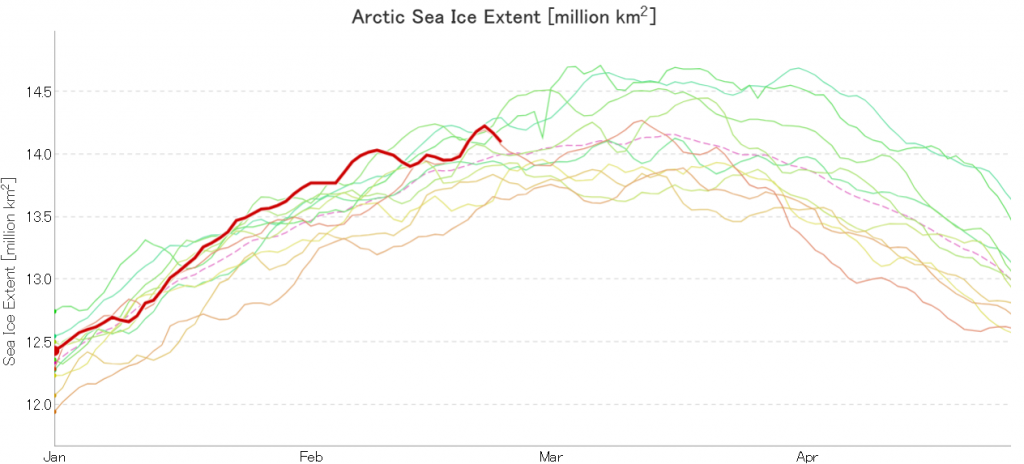
In due course we’ll look at the metrics from a variety of different institutions, but let’s start with JAXA, comparing 2020 with 2015 and the 2010s average:
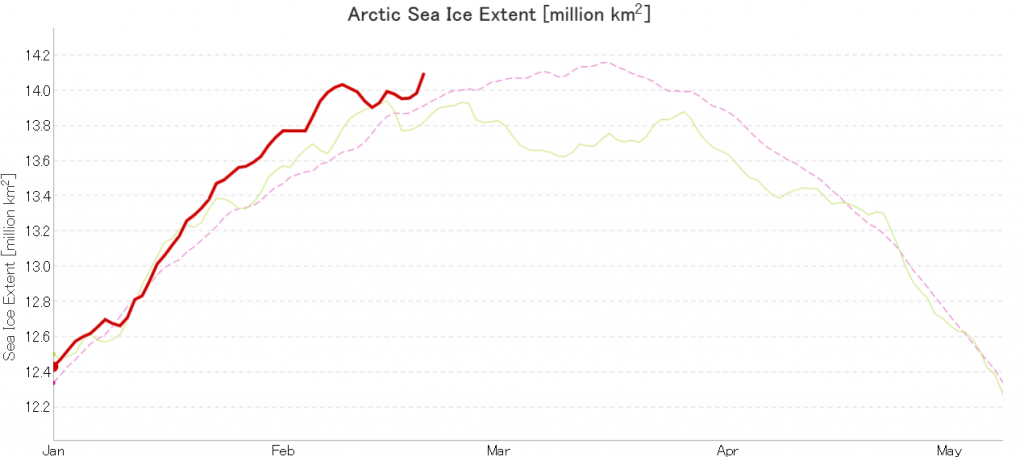
Extent is clearly increasing just at the moment! Will the next peak prove to be the maximum for the year or will we have to wait another month or more to find out that value, as suggested by the average?

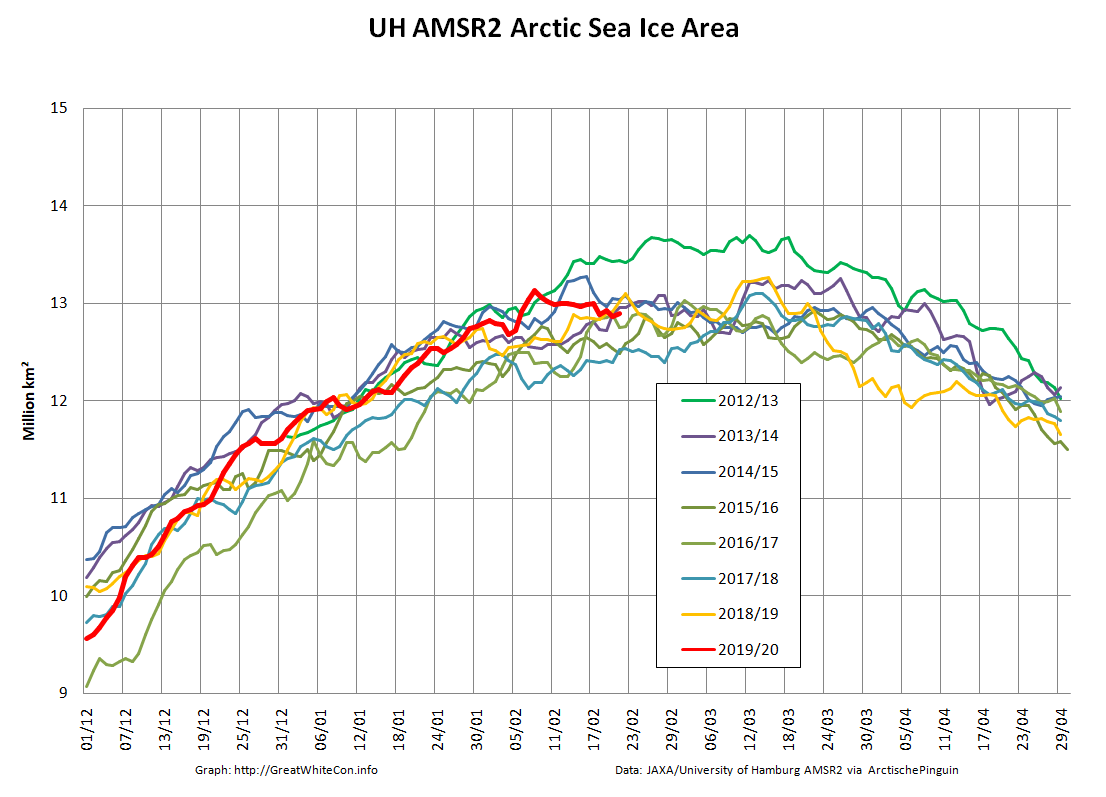
Compare and contrast JAXA extent with Wipneus’ high resolution AMSR2 extent and area:
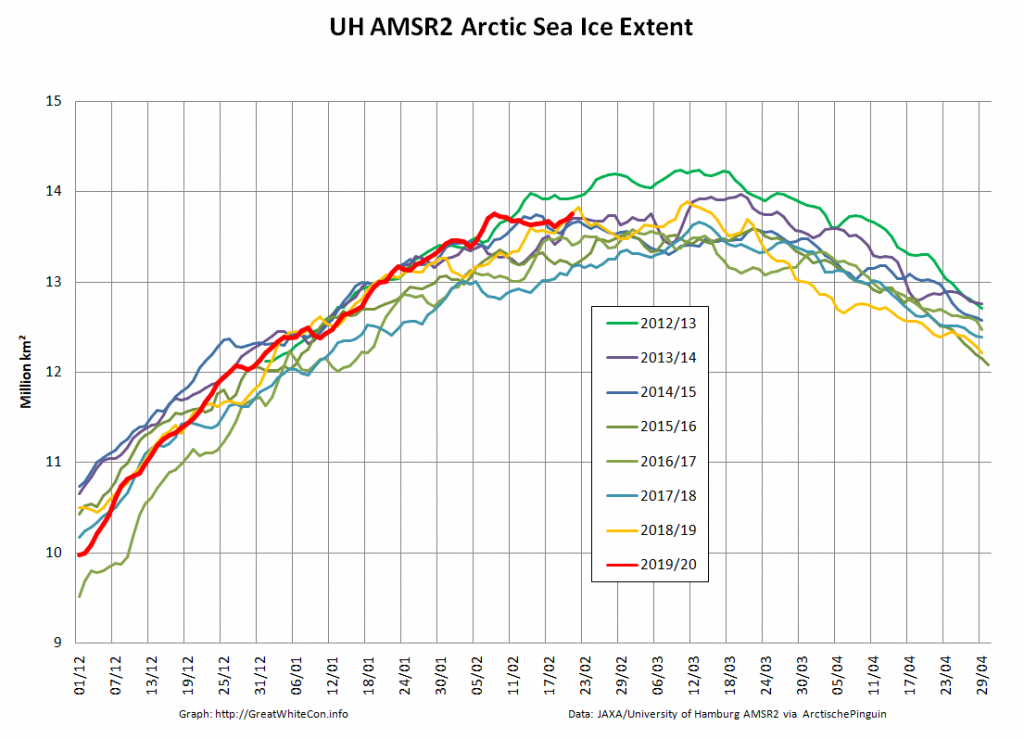
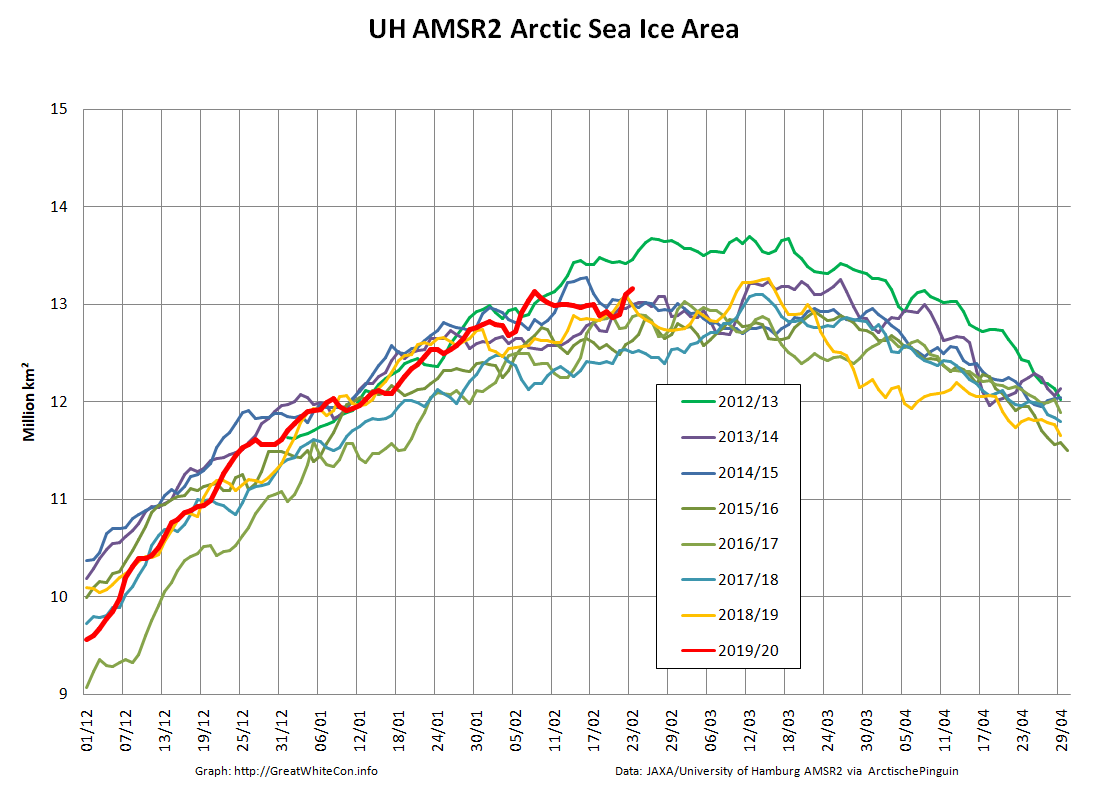
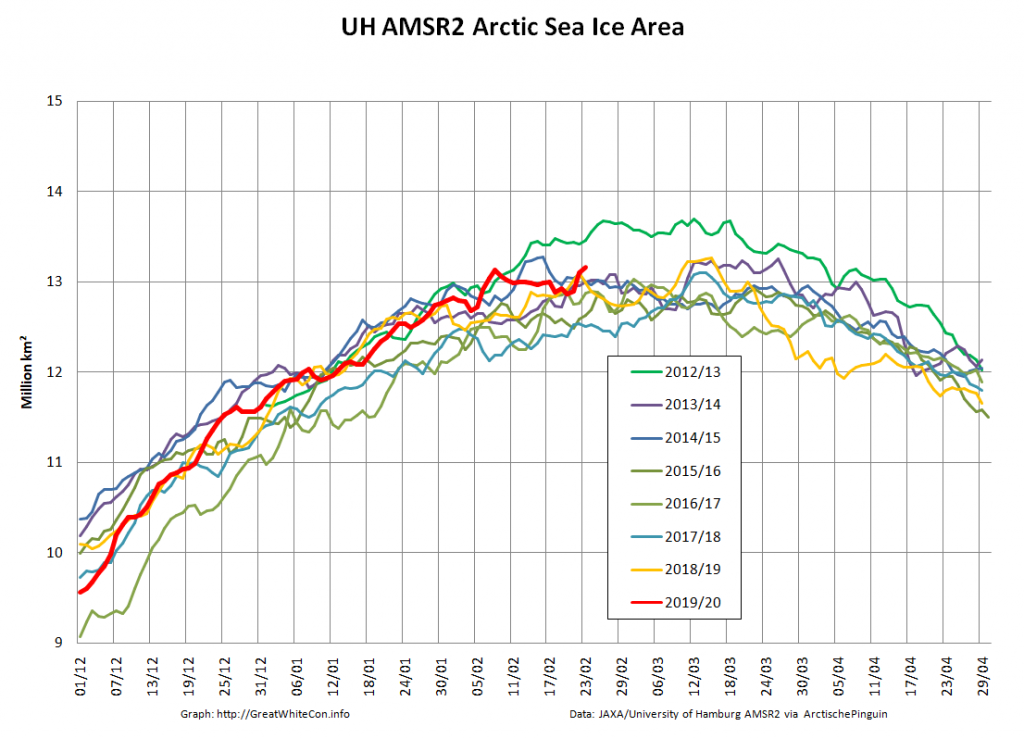
Perhaps the 2020 maximum area has already been reached?

[Edit – February 25th]

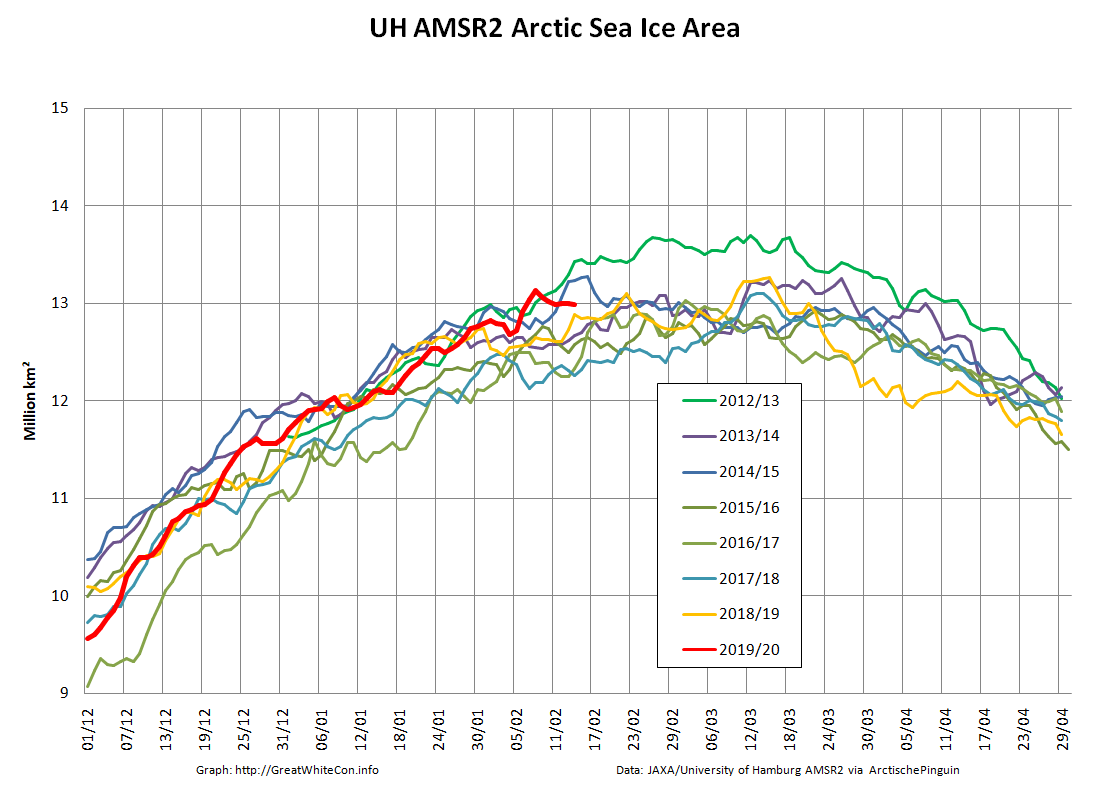
Or perhaps not! We’re playing mix and match this morning, since Wipneus’s new numbers haven’t been released yet. Here UH AMSR2 high resolution Arctic sea ice area from February 23rd:
Plus JAXA extent for the 24th:
[Edit – February 27th]

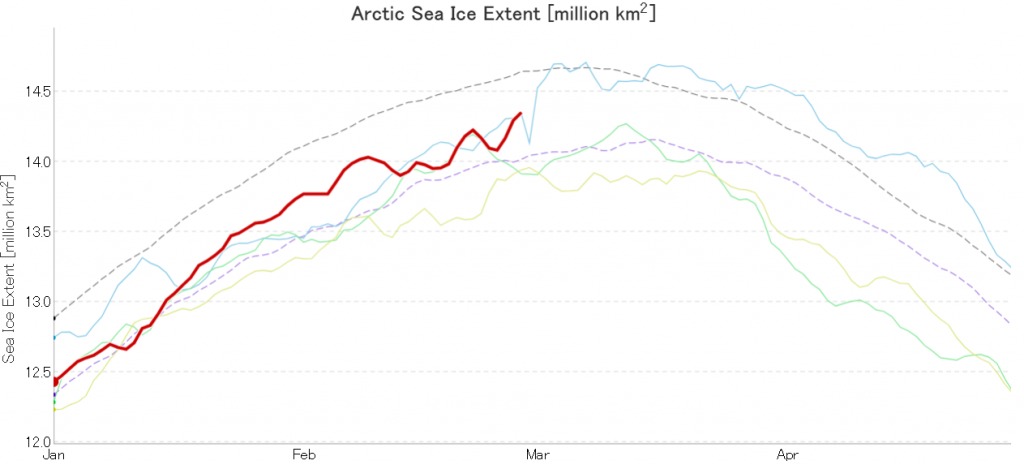
Tony Heller’s latest sea ice themed article claims “Normal Sea Ice Extent At Both Poles”. Hence today’s JAXA extent graph includes the averages for previous decades:
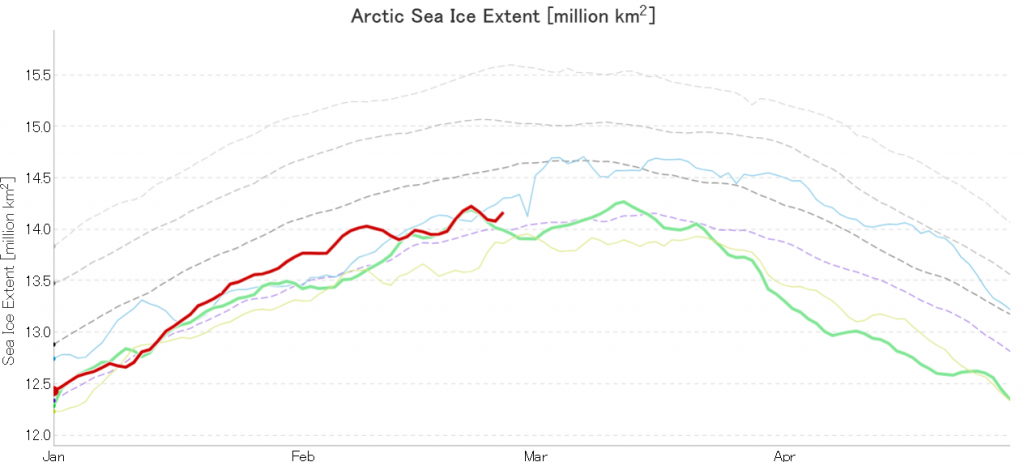
Extent is evidently increasing once again, and is even more evidently well below what passed for “normal” in the twentieth century!

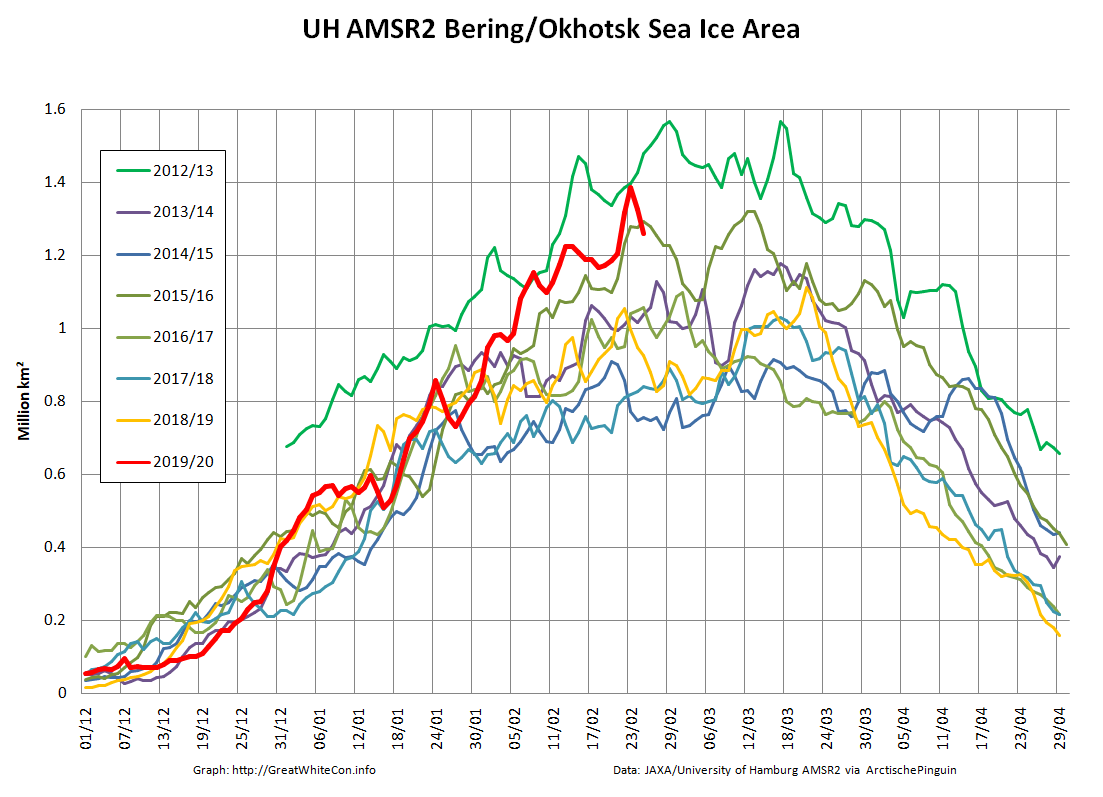
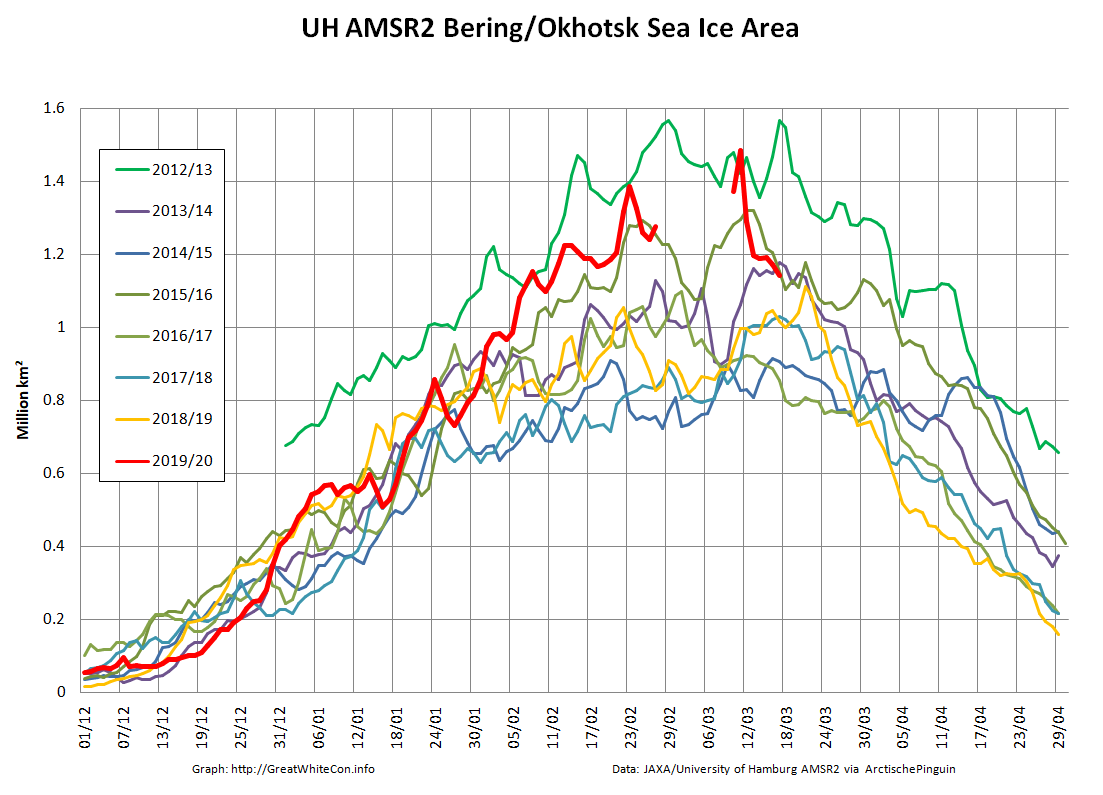
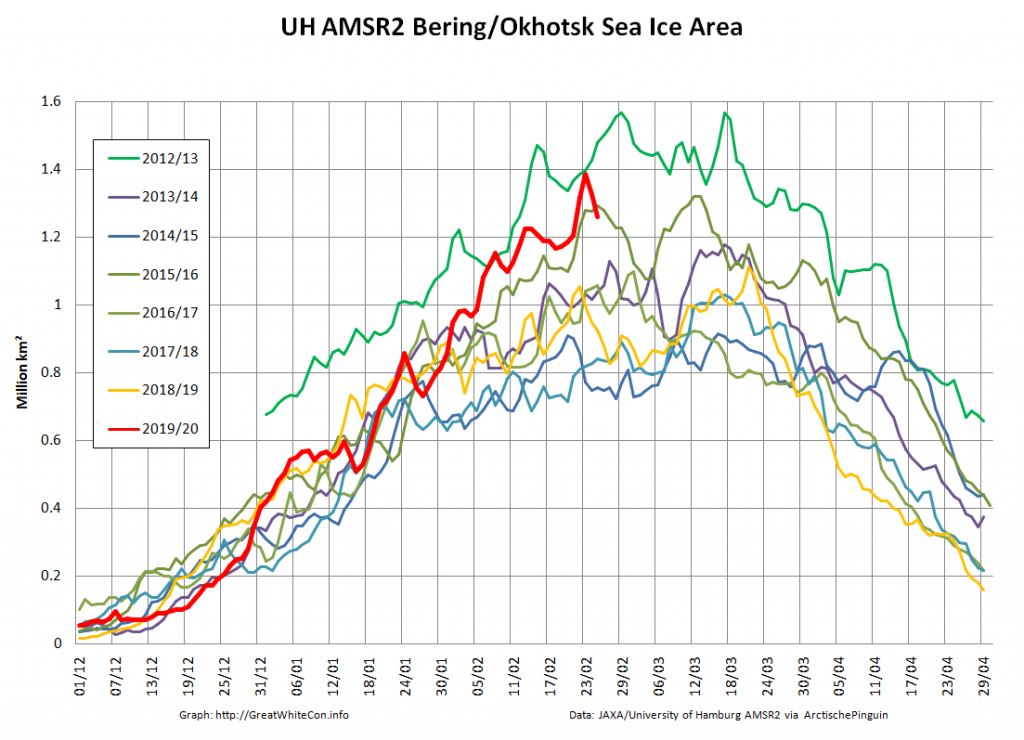
Let’s also compare the Pacific periphery:
with the Atlantic side of the Arctic Ocean:
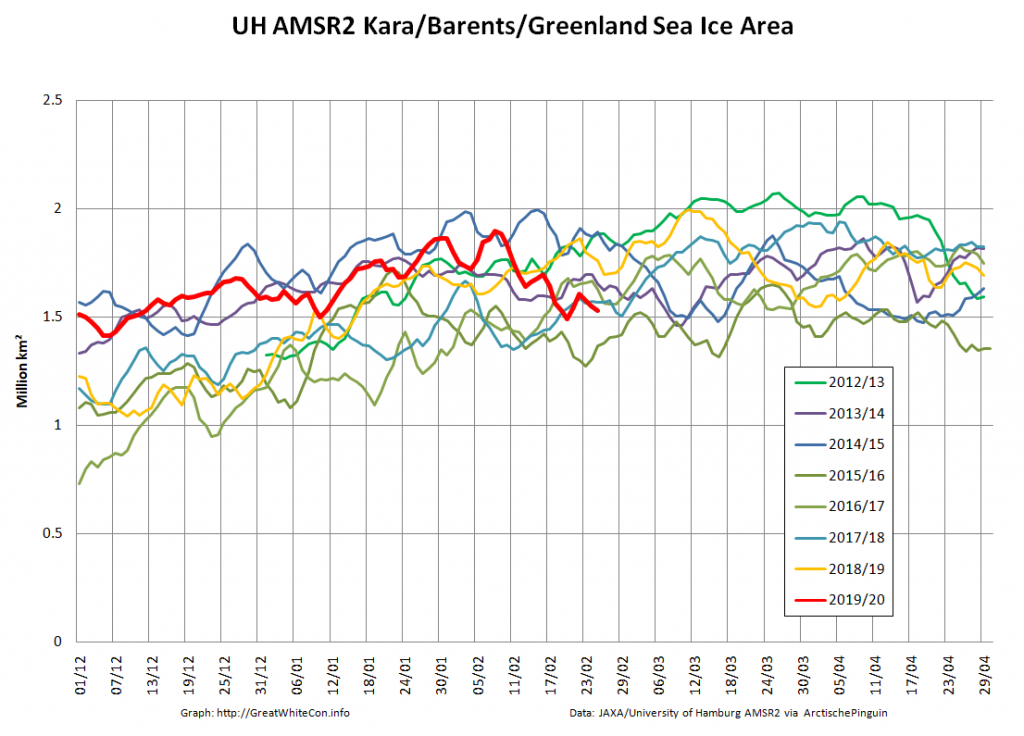
The Bering and Okhotsk Seas will be sea ice free by the time September 2020 arrives. How about the Kara, Barents and particularly Greenland Seas though?

[Edit – February 29th]

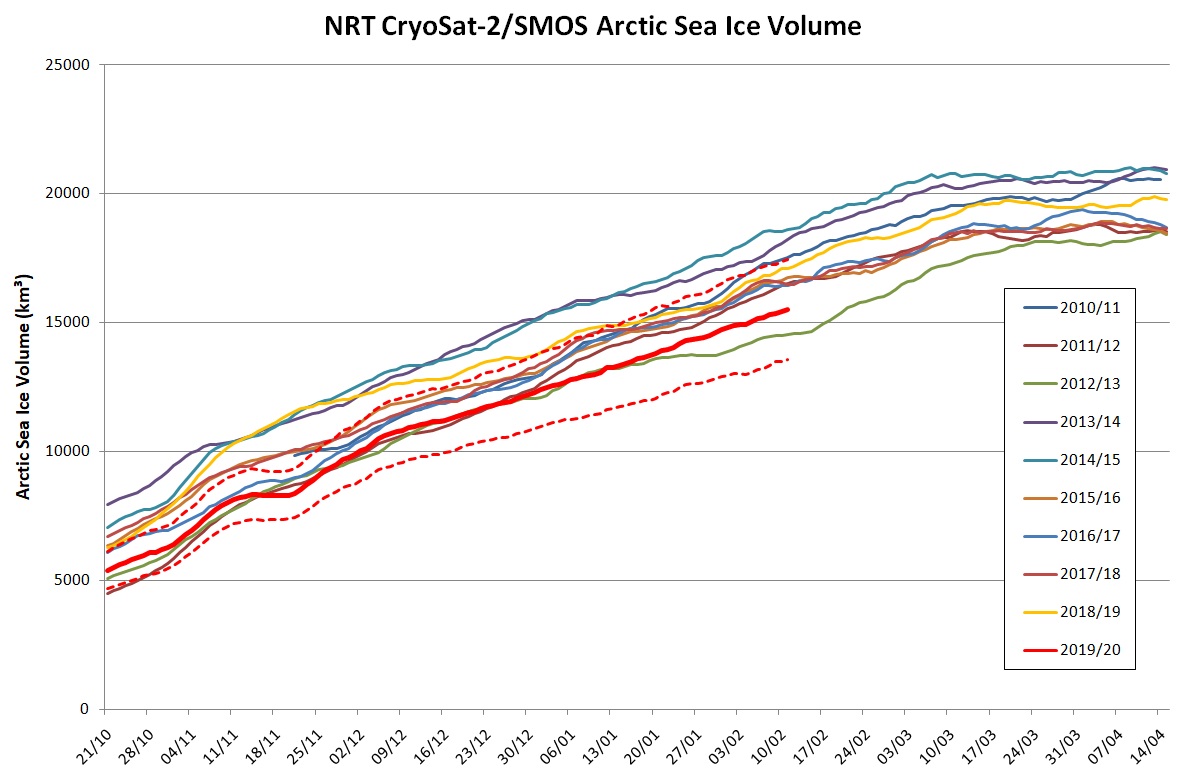
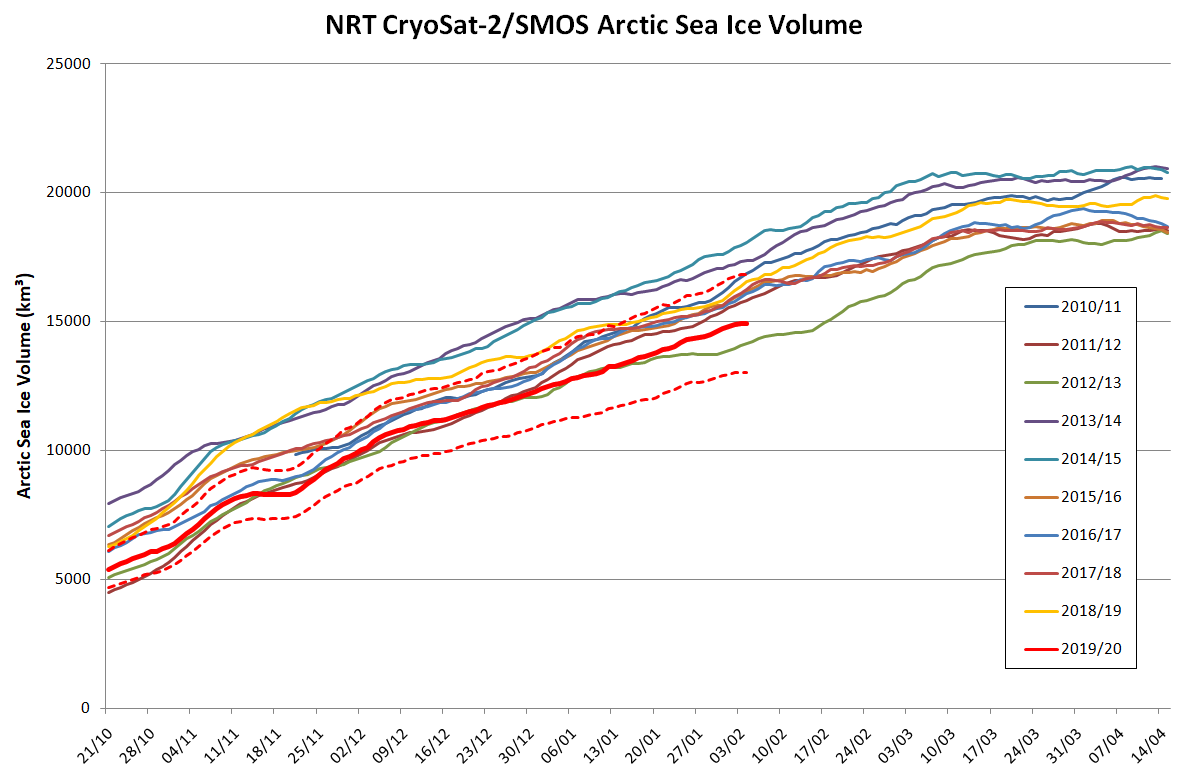
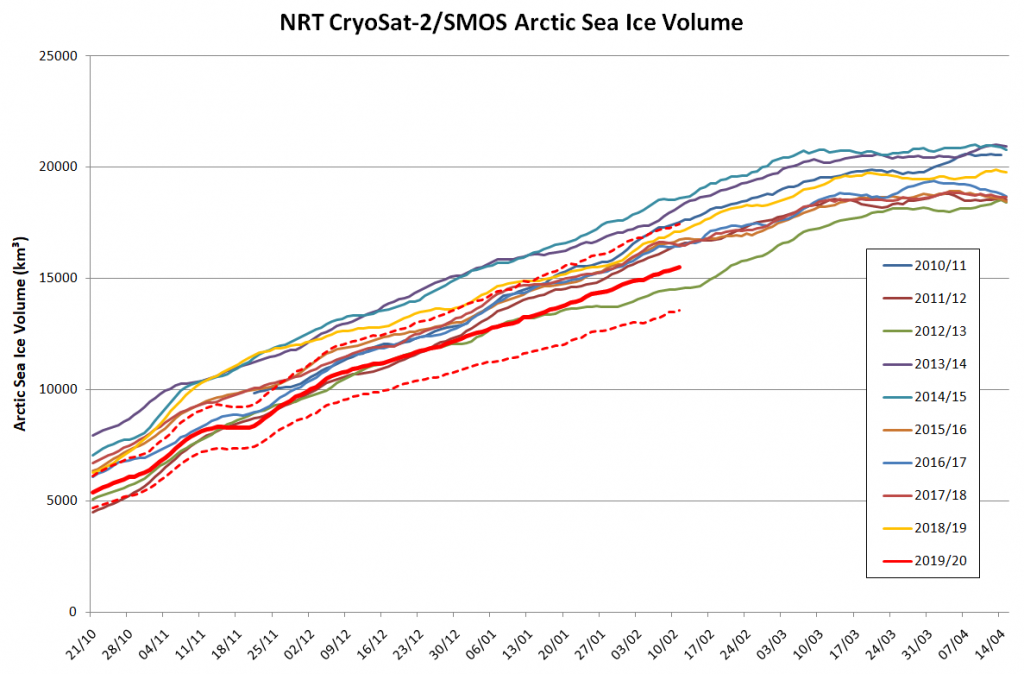
Arctic sea ice maximum volume usually occurs in April, but nonetheless let’s keep an eye on the metric that most nearly measure the “amount” of sea ice left in the Arctic in 2020. Here’s our “measured” CryoSat-2/SMOS volume metric, using reanalysed data up to February 12th:
PIOMAS “modelled” volume for February should be released soon, but getting back to extent the JAXA flavour has been setting new highs over recent days:
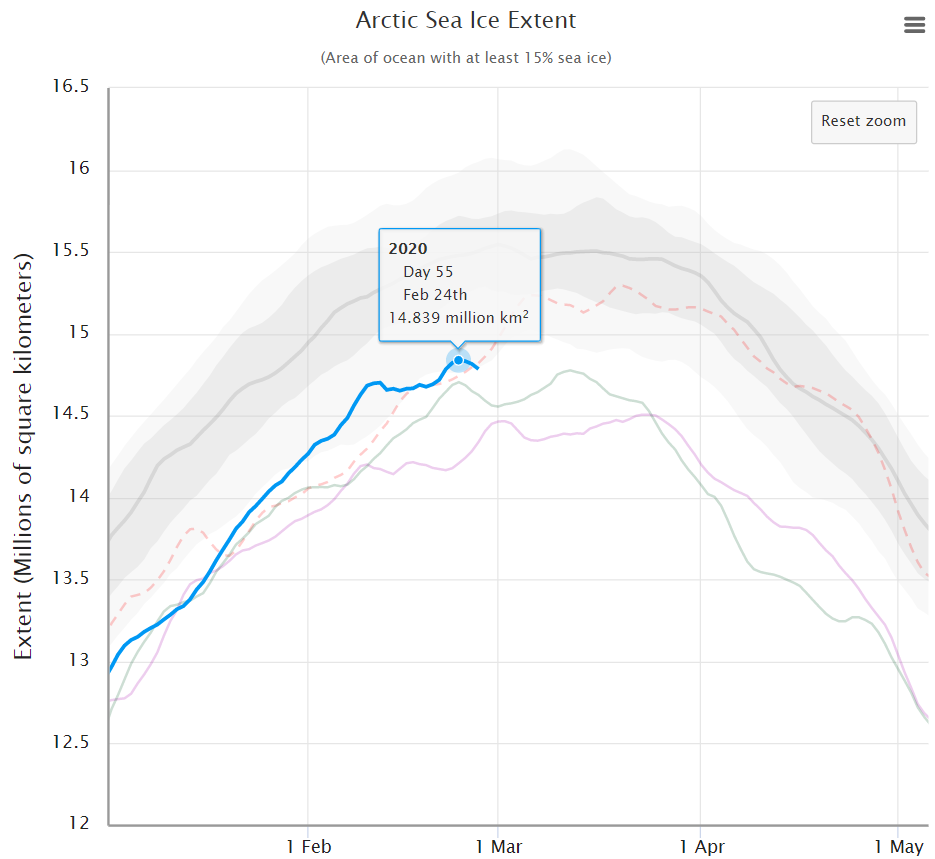
whereas the NSIDC’s Charctic 5 day averaged extent has not!
[Edit – March 6th]

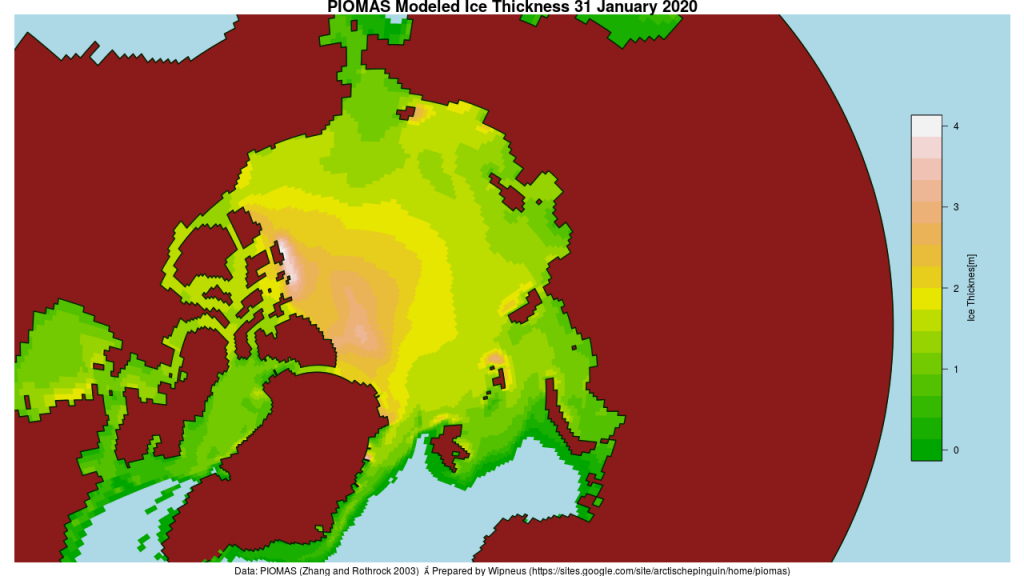
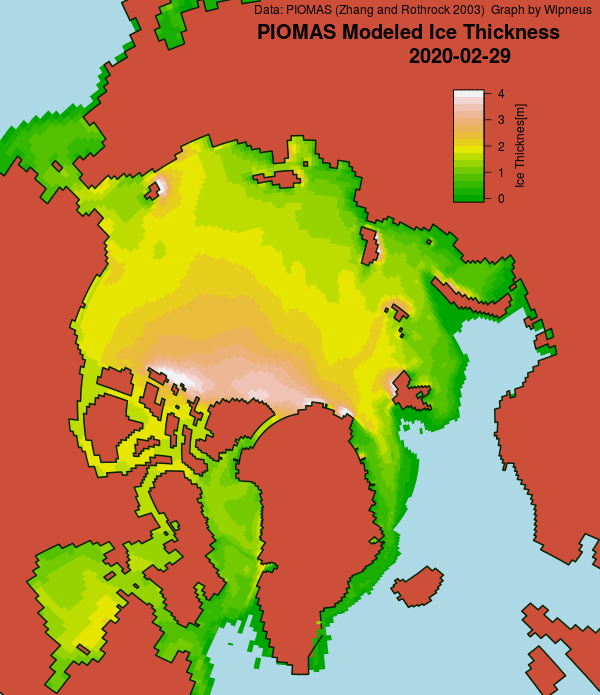
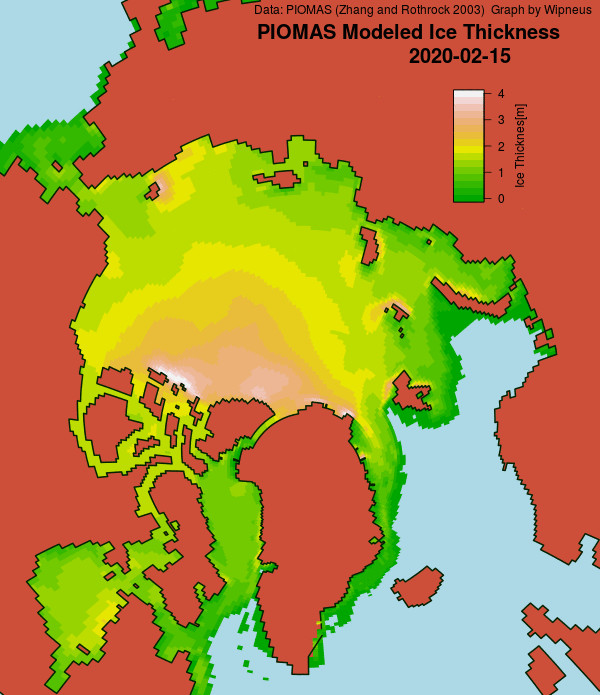
Here’s the February PIOMAS gridded Arctic sea ice thickness map, courtesy of Wipneus on the Arctic Sea Ice Forum:
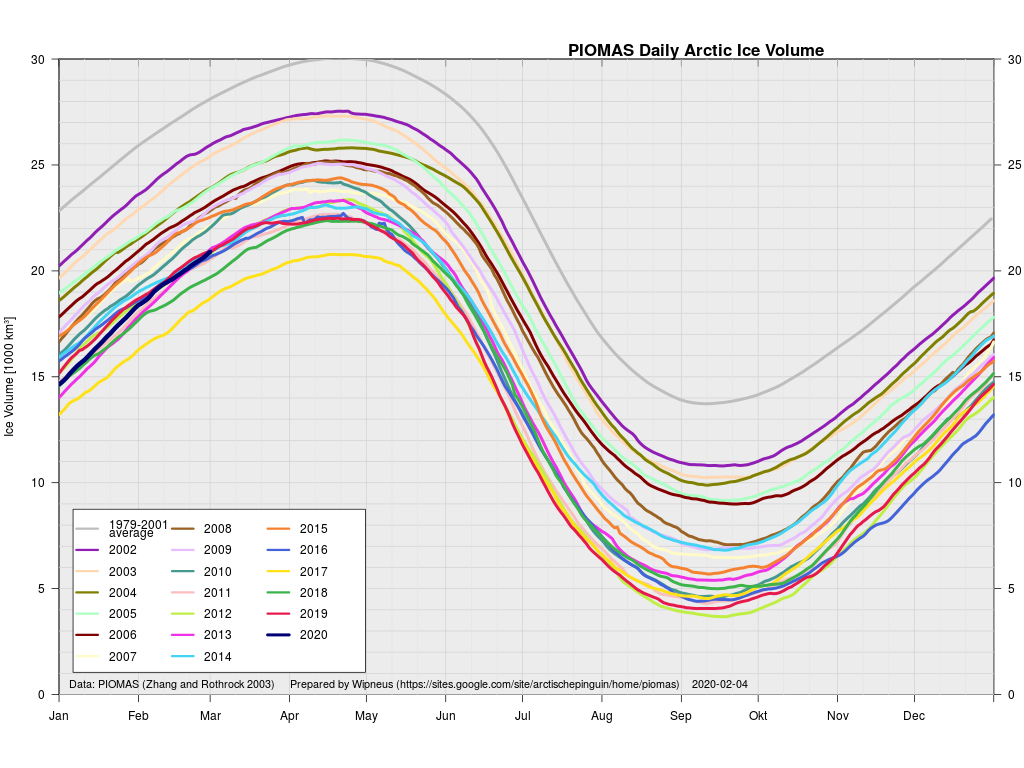
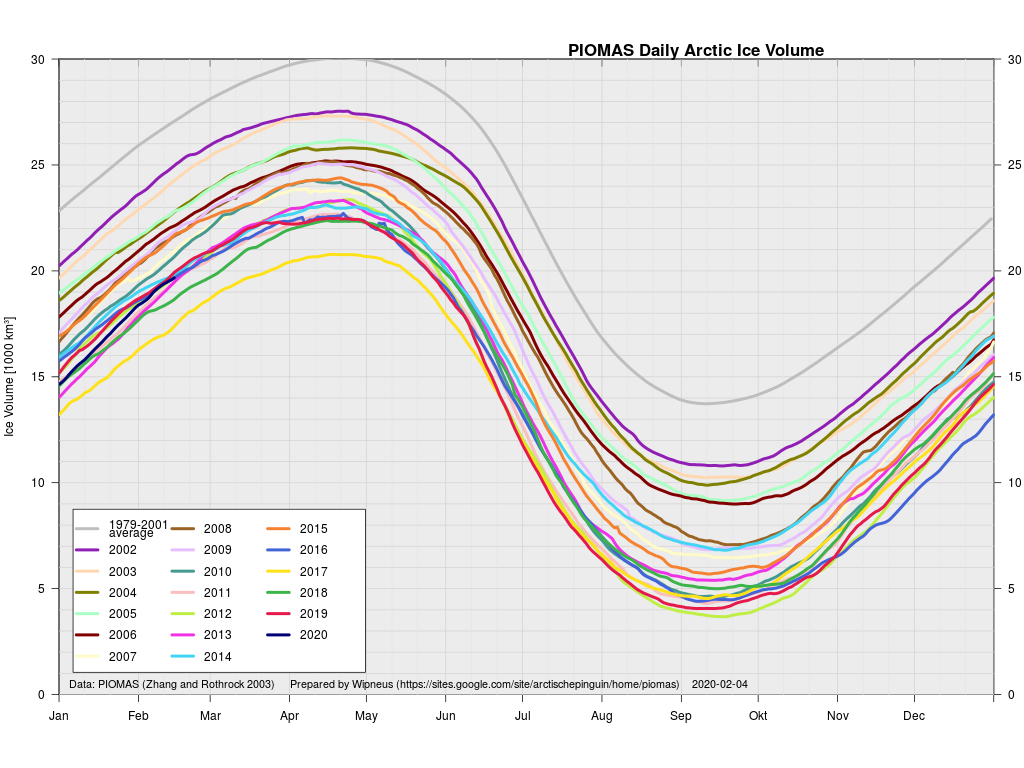
plus the traditional modelled volume graph:
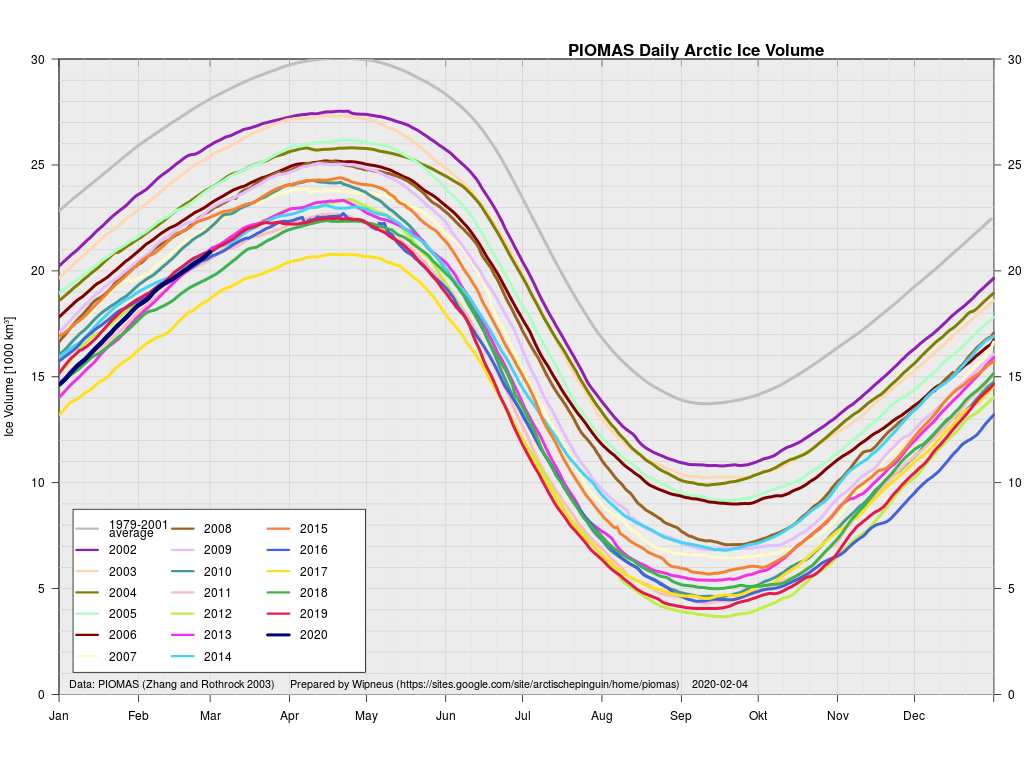
As angech has pointed out elsewhere, according to the PIOMAS team:

CryoSat-2 data show total volume for February 2020 substantially lower than PIOMAS with 2020 Febuary near record low levels over the 2011-2020 period

[Edit – March 19th]

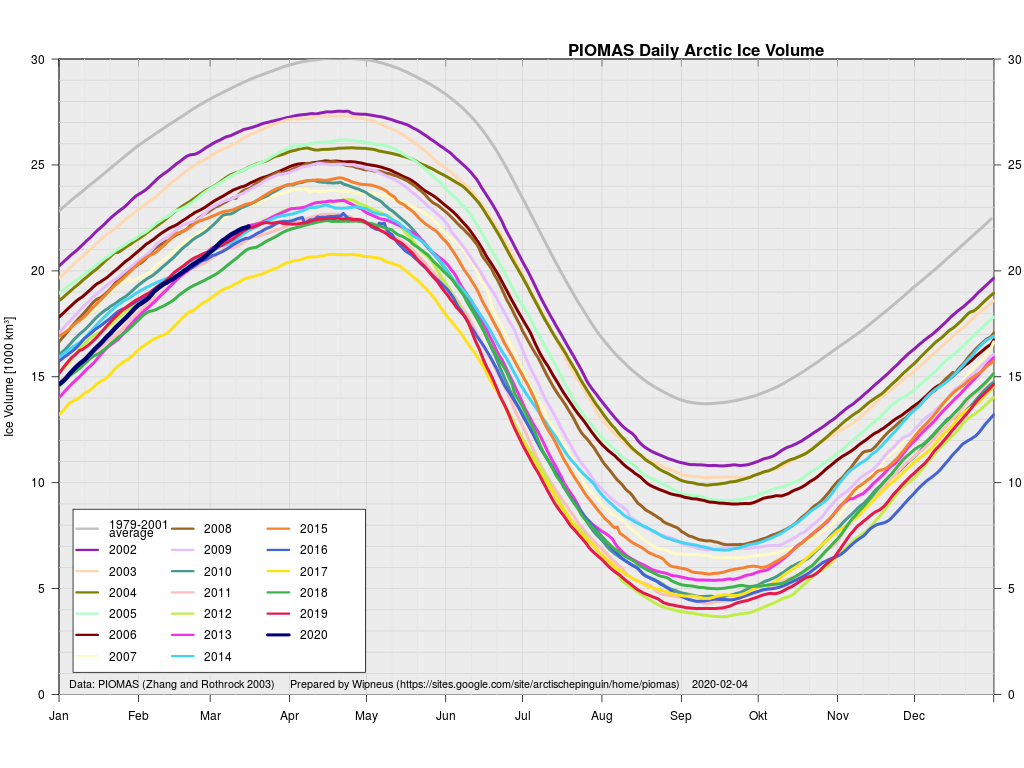
The March mid month PIOMAS numbers have been crunched by Wipneus. Here’s how things look at the moment:
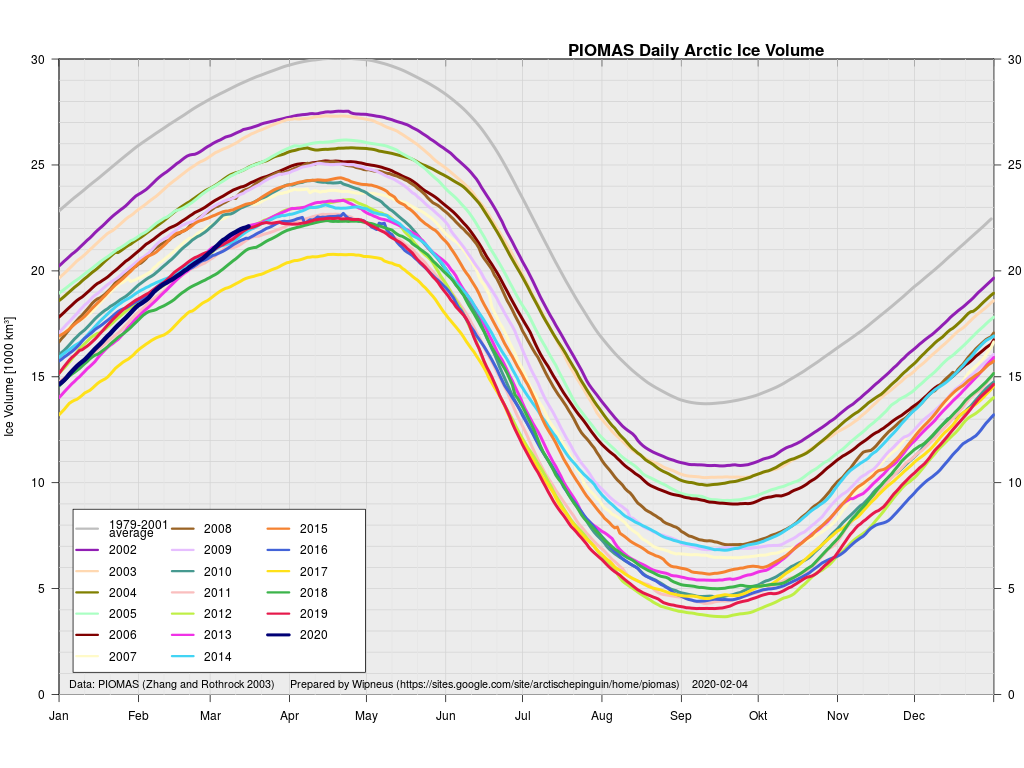
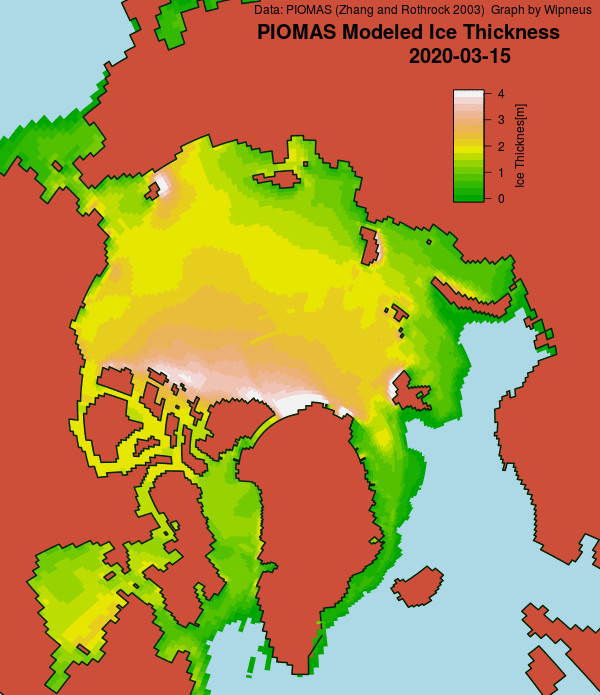
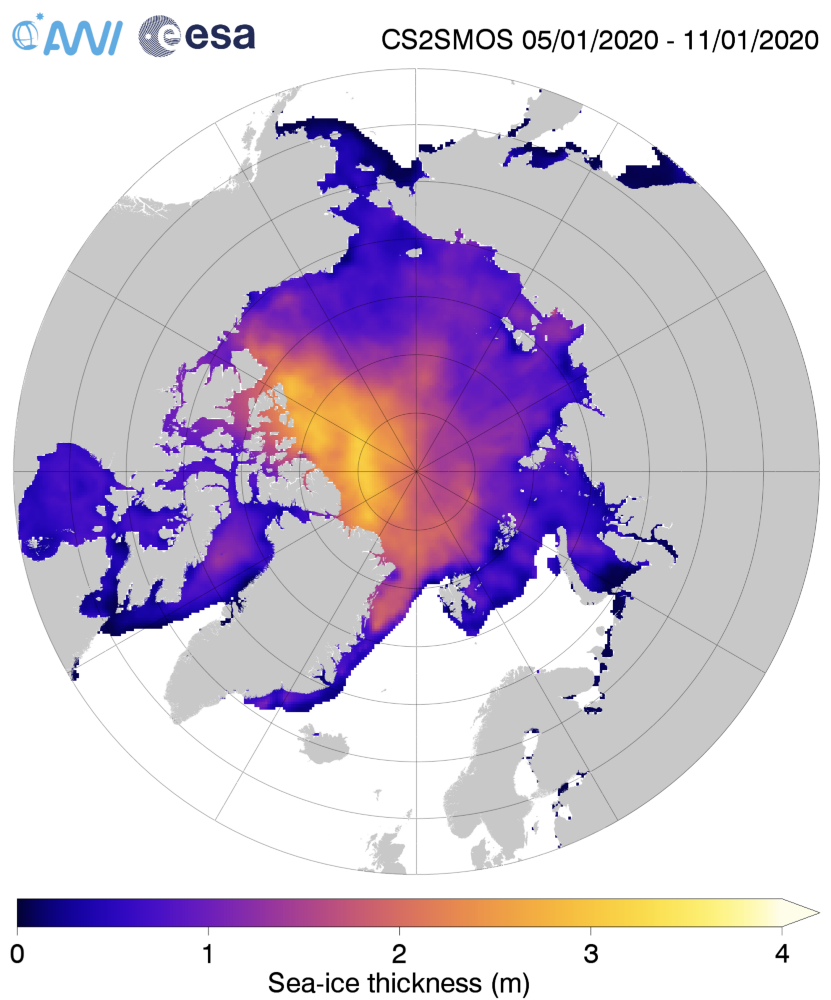
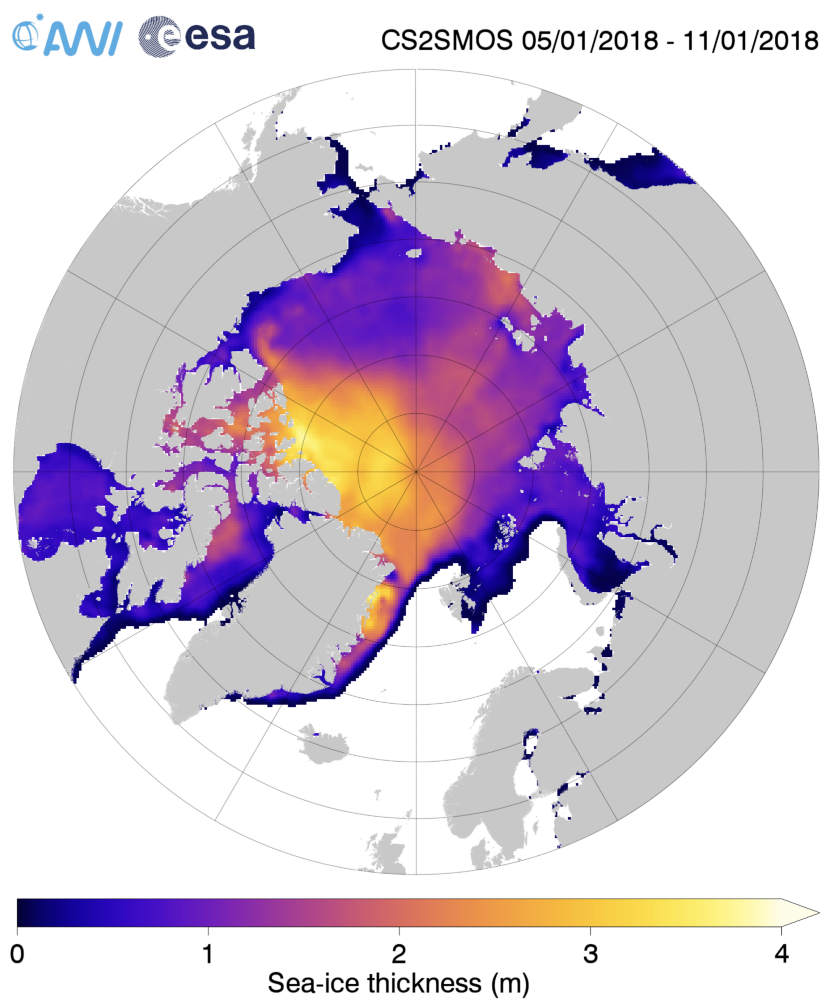
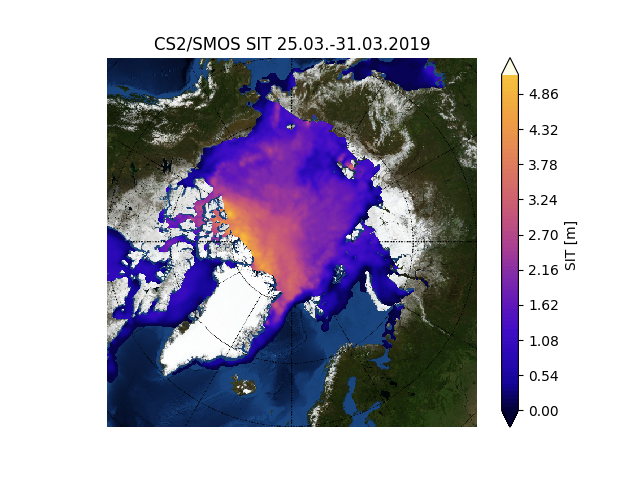
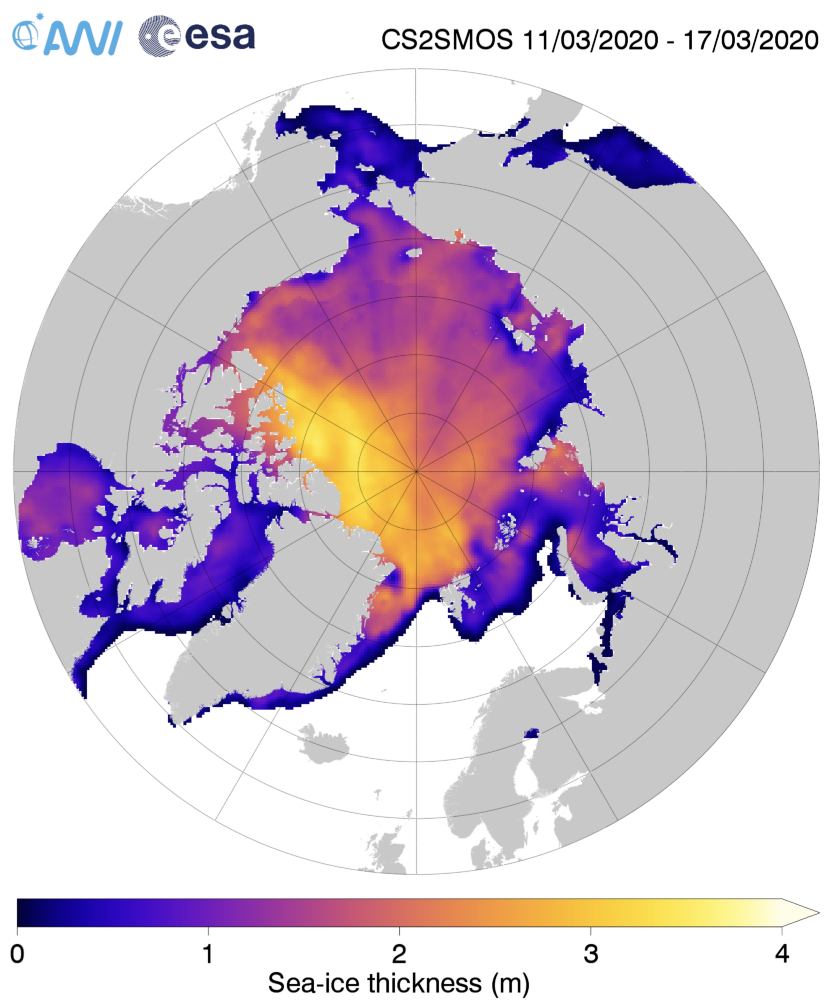
For comparison purposes here’s the current CryoSat-2/SMOS Arctic sea ice thickness map:
[Edit – March 20th]

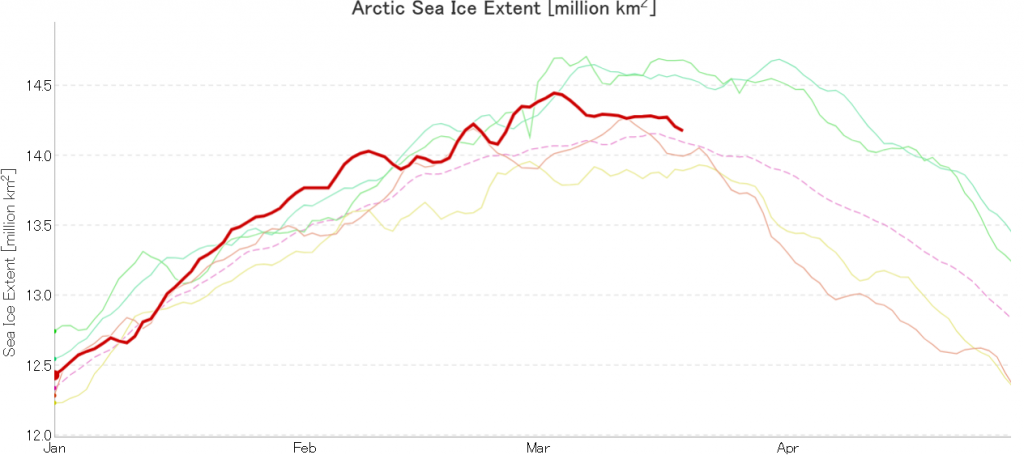
After flatlining for a long time JAXA extent has posted significant declines for two days running. There’s been no official announcement from the NSIDC as yet, but it now seems safe to conclude that there won’t be a late surge in extent similar to 2010. Here’s the current JAXA graph:
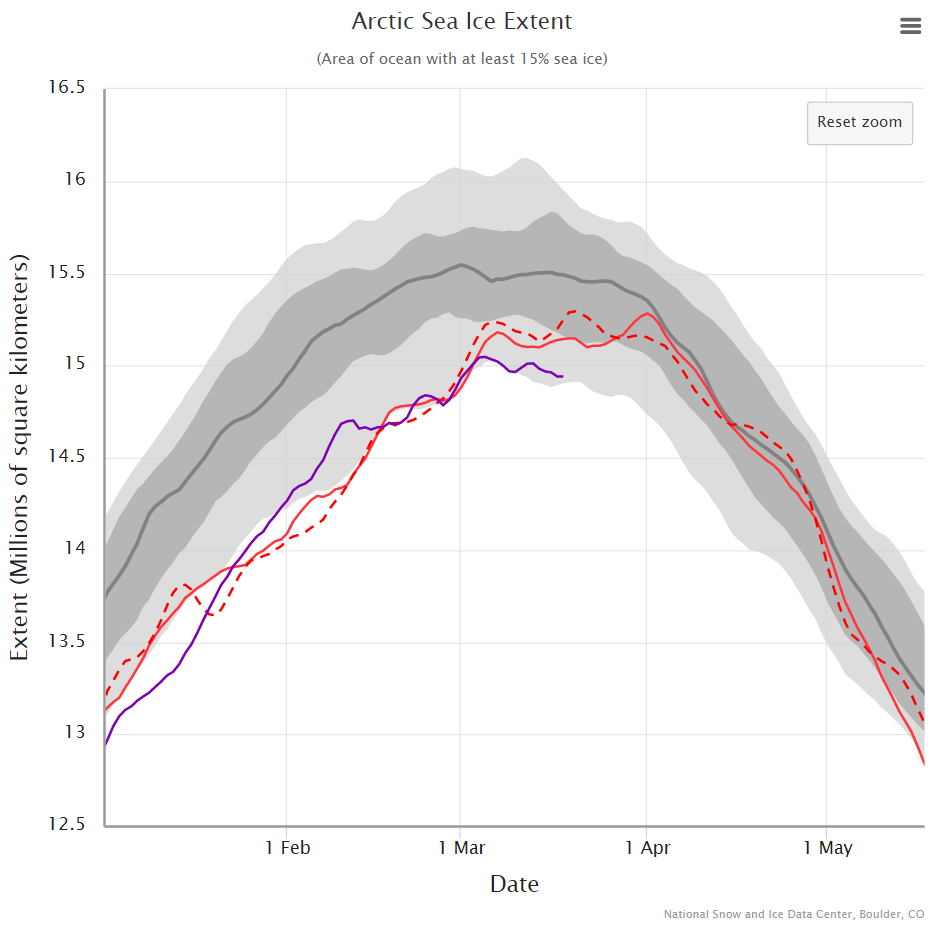
plus NSIDC’s 5 day averaged extent:
Hence the (still provisional!) maximum numbers for 2020 are:

JAXA/VISHOP AMSR2 – 14.45 million square kilometres on March 3rd
NSIDC 5 day SSMIS – 15.05 million square kilometres on March 5th

The University of Hamburg’s JAXA AMSR2 concentration data seems to have suffered an outage over the crucial period. Hopefully the gaps will be filled in due course. However more recent regional graphs  reveal the following:
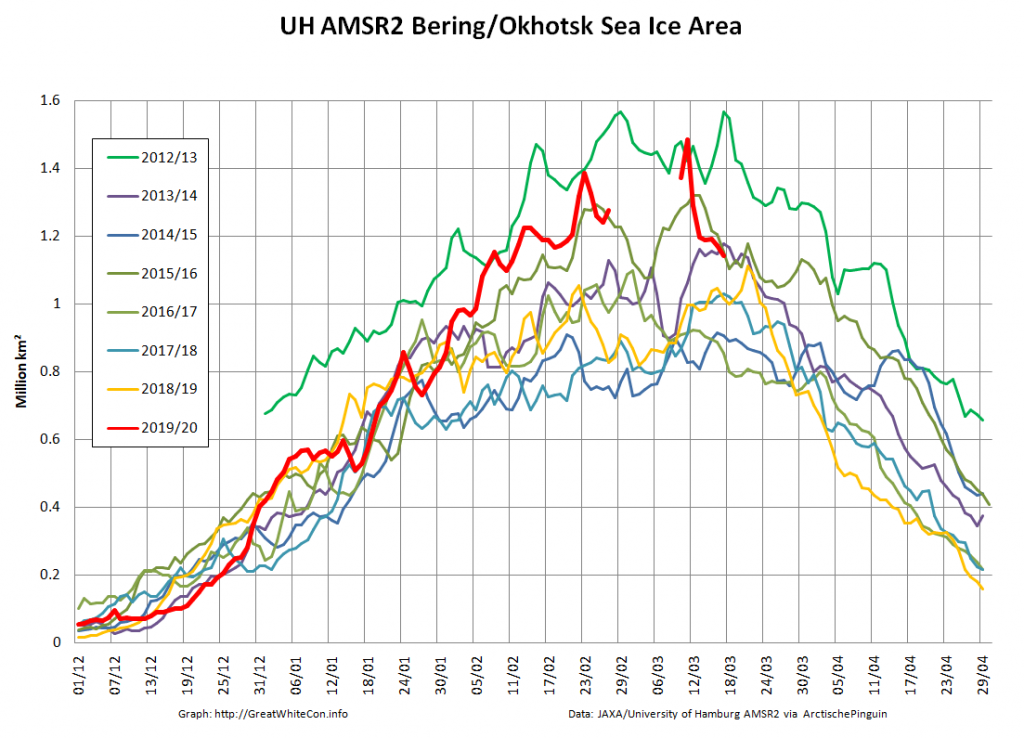
The recent declines in overall extent are evidently driven by declines on the Pacific periphery.
The Great White Con 2020 “New Einstein” Award

Our regular reader(s) have grown to love the amazing prizes awarded to the winner of our annual Great White Con “New Einstein” Award . The jury has now finished its deliberations on the 2019 award in the traditional smoke filled igloo just outside the Great White Con Ivory Towers, not far from Santa’s secret summer swimming pool. I am pleased to be able to announce that the first prize of the loan of a polar bear suit kindly donated by the Daily Telegraph plus a battered big board from Cotty’s quiver has been awarded to the ever spiteful Spike55 at Tony Heller’s unReal Climate Science blog, with:

You’re an idiot. A LIAR. A child-minded troll. And a slimebag con-man.

Here for your viewing pleasure is the very first “New Einstein” contestant of 2020, astonishingly early since we’re still in the midst of the 2019/20 Arctic sea ice freezing season!

1) Michael Liebreich on Twitter, with:

2) Thomas Barlow, in a “Personal Message” following the introduction of a new moderation regime on the Arctic Sea Ice Forum with:

Fuck off, clique hobbit, shit-for-brains.

Where’s the Thickest Arctic Sea Ice Gone?

In the absence of the usual mid month PIOMAS Arctic sea ice volume update I’m being moaned at by “angech” over on Judith Curry’s “Climate Etc.” blog:

Any ideas on why PIOMAS mid month update not out, other than not wanting to show a big recovery?

Unlike any of Judy’s denizens I checked out the comparatively new merged CryoSat-2 plus SMOS thickness maps from the Alfred Wegener Institute. “Measured” rather than “modelled” data must be a good thing surely?

Just in case there’s some significant difference between the “reanalysis” and “operational” versions of that product, here is the AWI’s most recent reanalysed Arctic sea ice thickness map, for the week ending January 11th:

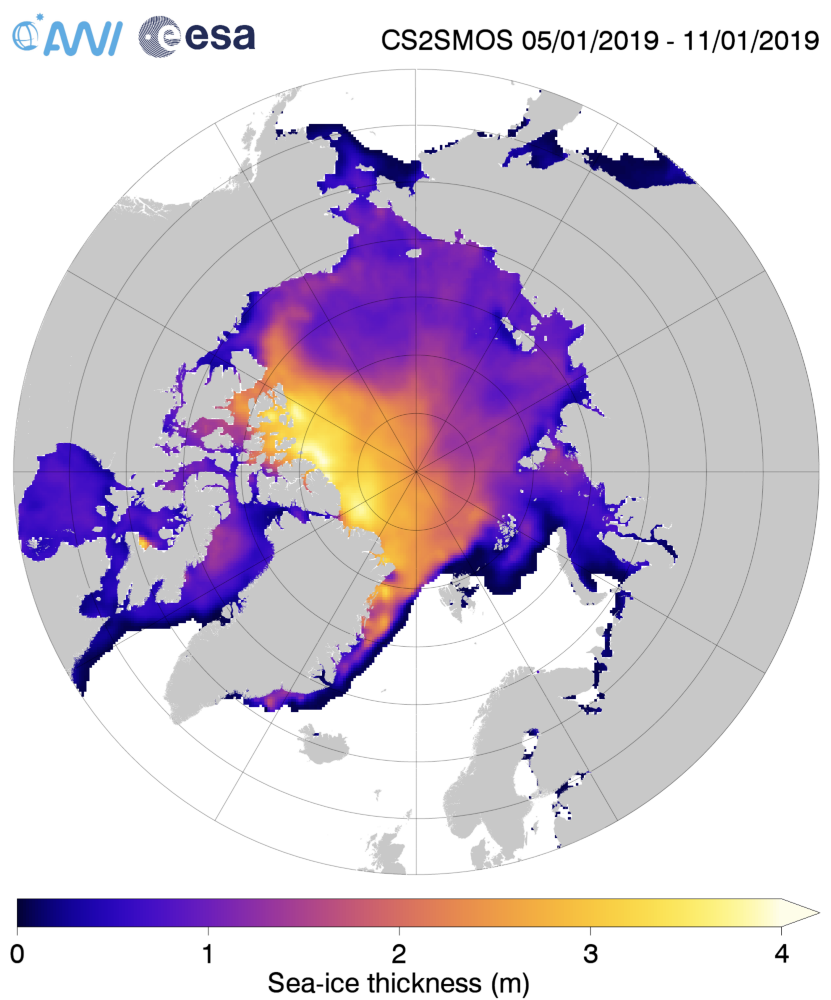
together with the same date from the previous two years:

Make sure to take a close look at the white areas north of Greenland and the Canadian Arctic Archipelago showing sea ice over 4 metres thick.

Over the winter of 2018/19 ASCAT revealed that there was a relentless movement of multi-year ice towards both the North Atlantic and the Beaufort Sea.

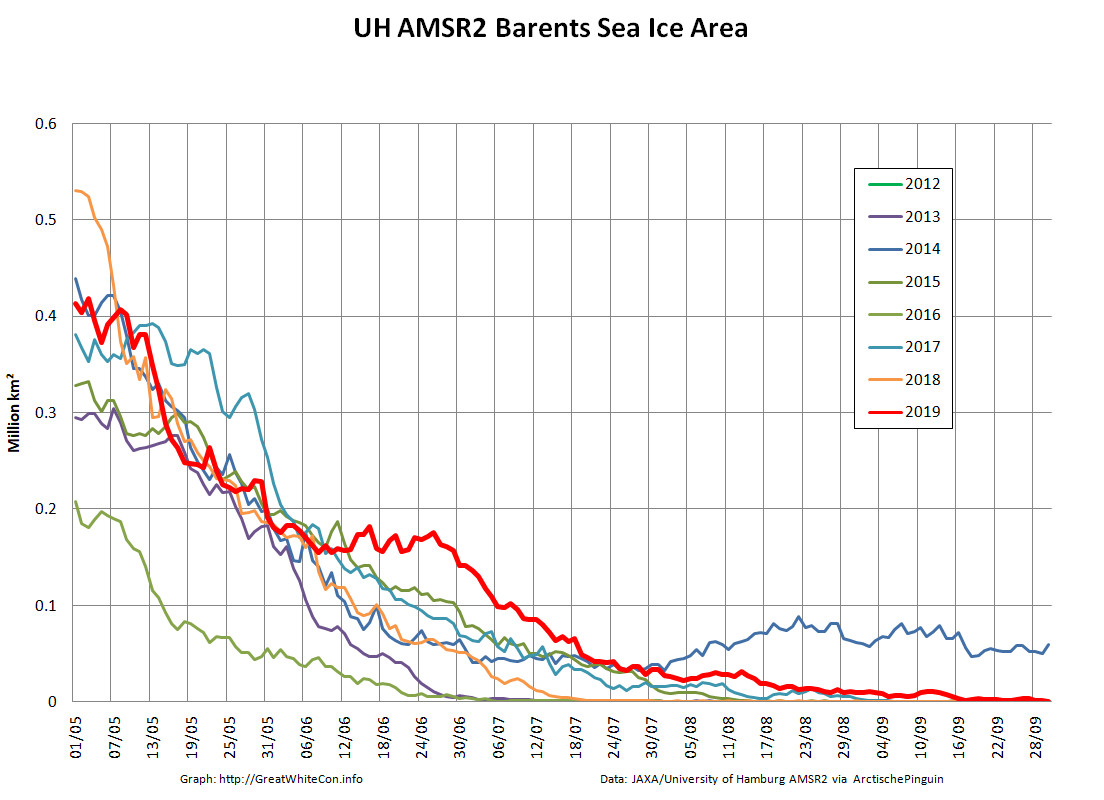
Not unexpectedly that meant that ice in the northern Barents Sea was slow to melt out in the summer of 2019:

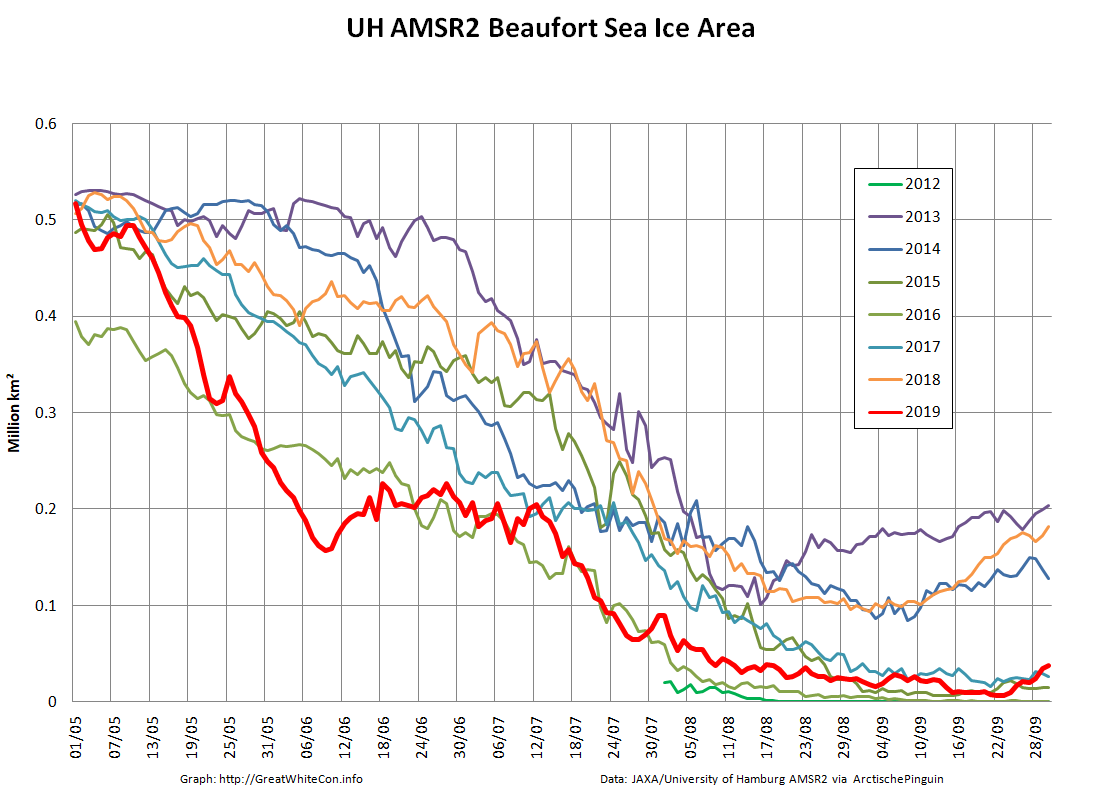
whilst after a fast start the melt in the Beaufort Sea also suffered a “brief hiatus” in June before ultimately melting out almost completely as well:

Perhaps a significant amount of the multi-year ice that survived the winter of 2018/19 has now simply melted away in warm water, to be replaced by much less robust first year ice in the area between the North Pole and the Siberian coast? It will be very interesting to see what the next PIOMAS update in early February reveals.

[Edit – February 4th]

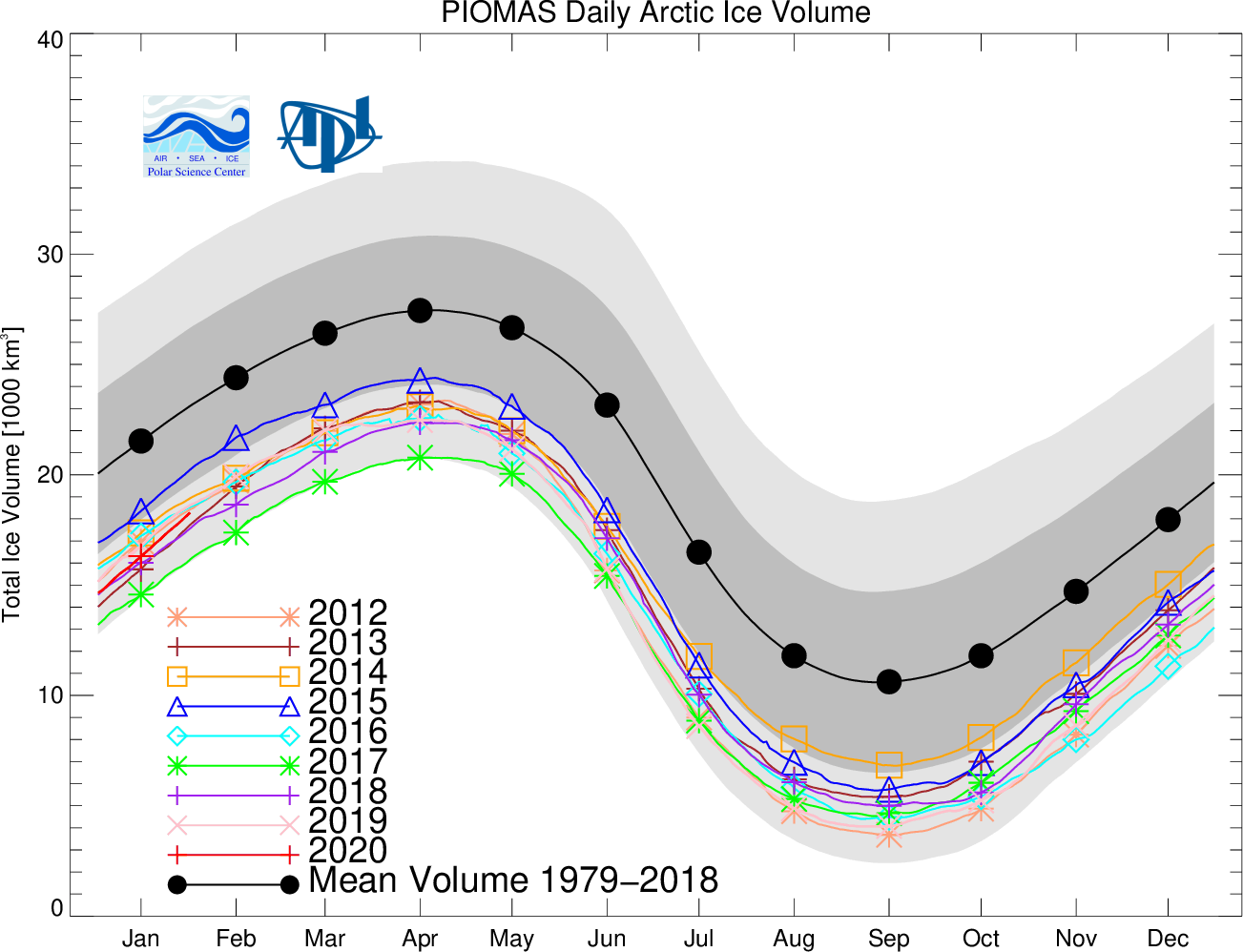
The next PIOMAS update referred to above has now arrived. Here’s the Polar Science Center’s graph:

Over on Climate Etc. angech is already exclaiming:

Strange it did go up a fair bit the old PIOMAS.
No publicity at the usual going down sites.

Actually it’s not at all strange, because thus far this winter the polar vortex has been remarkably well behaved. By and large cold air air has stayed in the Arctic. There hasn’t been much in the way of cold air intrusions into mid latitudes or warm air intrusions into the Arctic.

Hence it’s not at all surprising that the thickness of sea ice in the Arctic has been increasing slightly more quickly this winter than in other recent years. By way of some longer term context, here are the official Polar Science Center min/max trends:

[Edit – February 4th PM]

Wipneus has just released the January PIOMAS gridded thickness map. Here it is:

[Edit – February 5th]

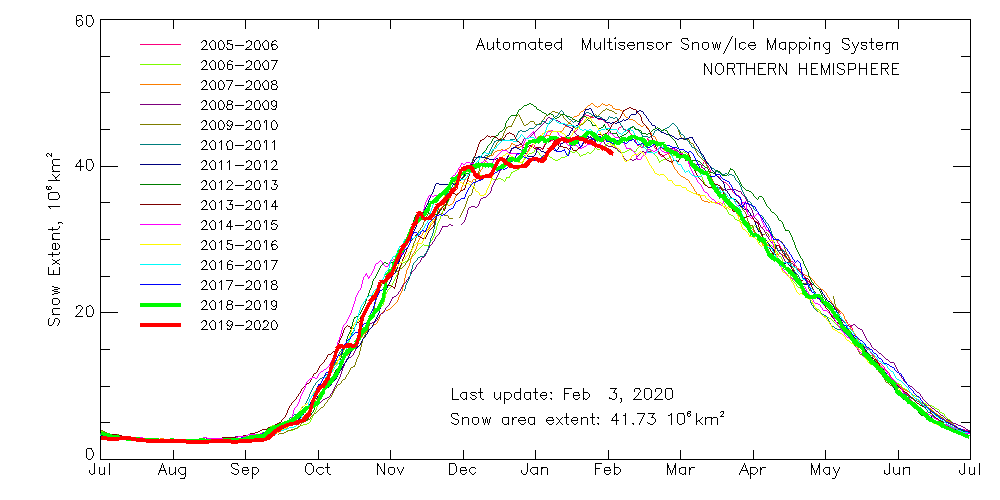
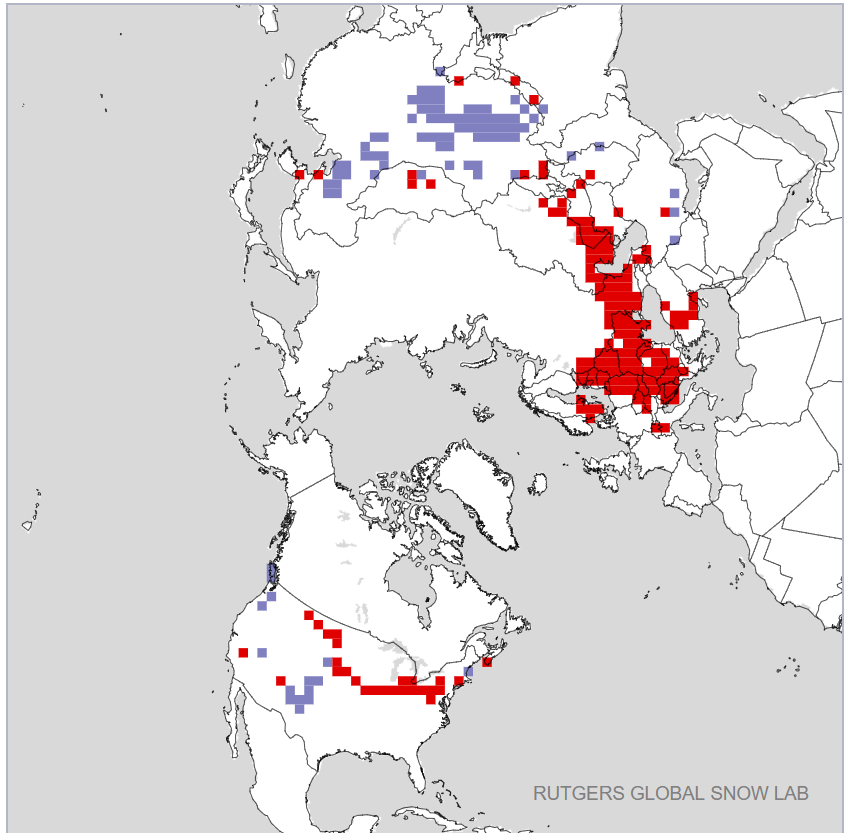
As is all too frequently the case, AdR and other commenters below get very excited about trivial increases in sea ice extent without considering snow extent. One side effect of the lack of cold air outbreaks into mid latitudes so far this winter currently looks like this:

[Edit – February 6th]

The AWI and PIOMAS sea ice thickness maps above look somewhat different at first glance. That being the case, I’ve written a program to crunch the AWI numbers. Here’s the result:

The source code plus raw and processed data can be accessed via the Arctic Sea Ice Forum:

CryoSat-2/SMOS Arctic Sea Ice Volume

[Edit – February 10th]

Further support for my “polar vortex” theory, from Judah Cohen no less!

[Edit – February 16th]

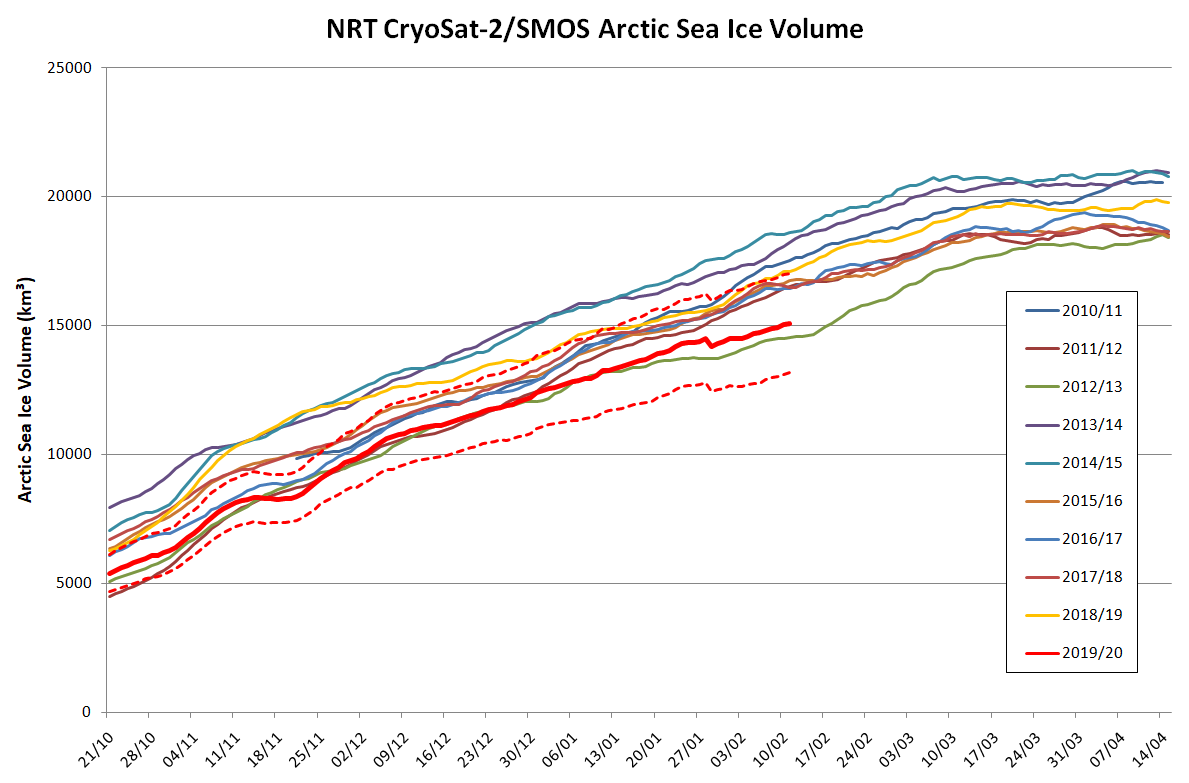
Here’s the latest update of our novel NRT volume metric:

Please note that there is a known problem with the NRT data from January 31st onwards.

Here too are Wipneus’ latest high resolution AMSR2 area and extent graphs:

[Edit – February 18th]

Wipneus has released his usual mid month PIOMAS update on the Arctic Sea Ice Forum:

I am forced to ponder once again why the CryoSat-2/SMOS thickness “measured” numbers just above seem to be more at variance with PIOMAS in 2020 than in previous years:

[Edit – February 22nd]

Here’s another weekly NRT volume update:

This time I’ve left off the NRT data from February 6th onwards, since the “issue” referred to above obviously hasn’t been solved yet. As an added bonus here’s a graph showing the trends (or lack thereof) on 3 dates during the October to April freezing season:

Facts About the Arctic in April 2019

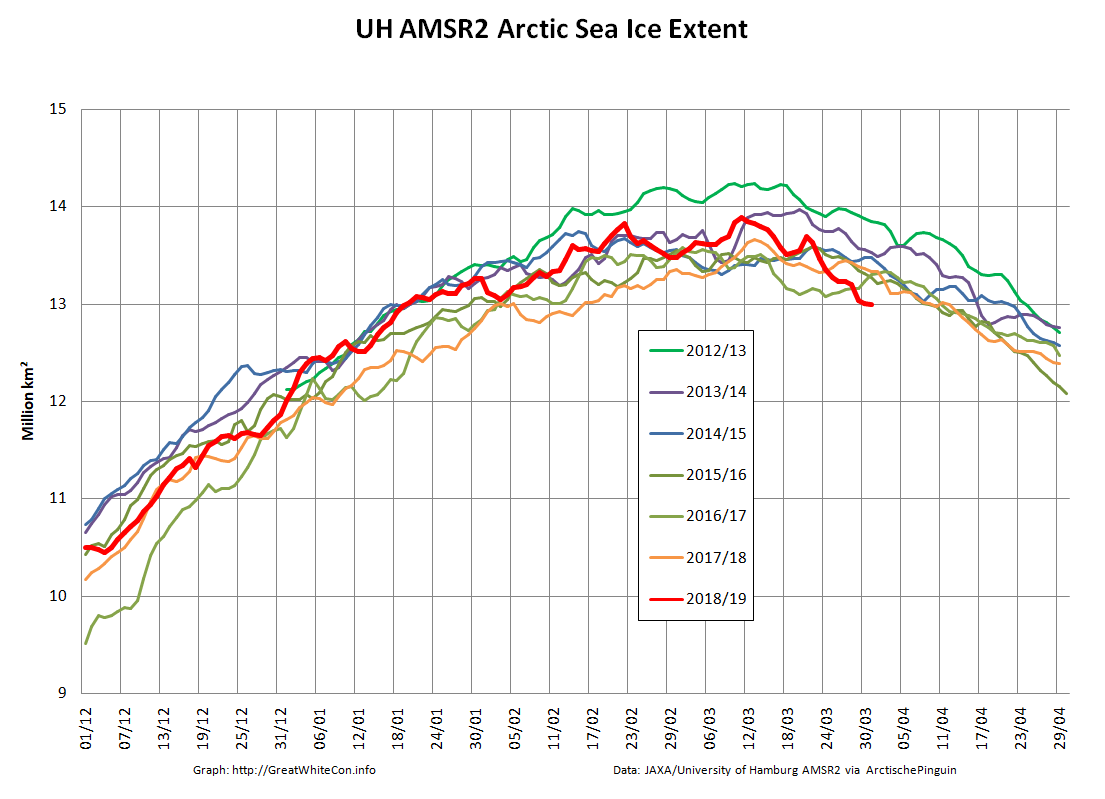
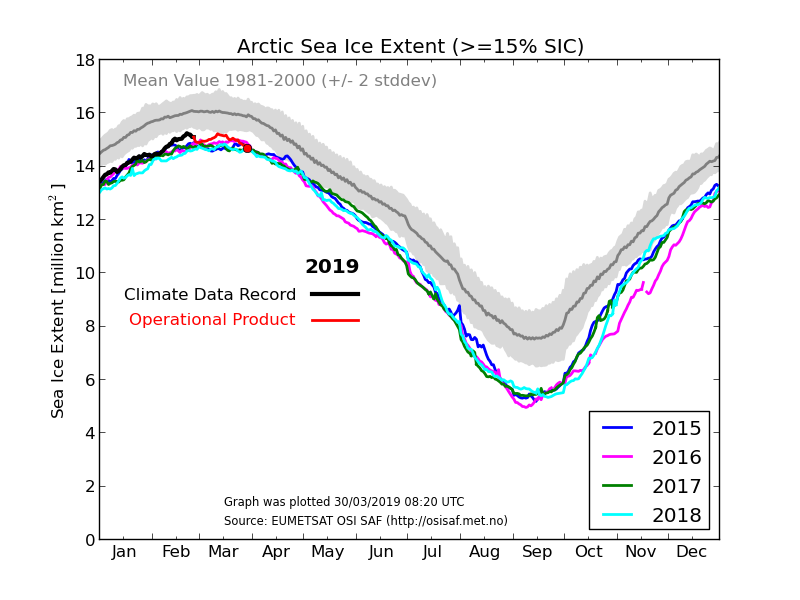
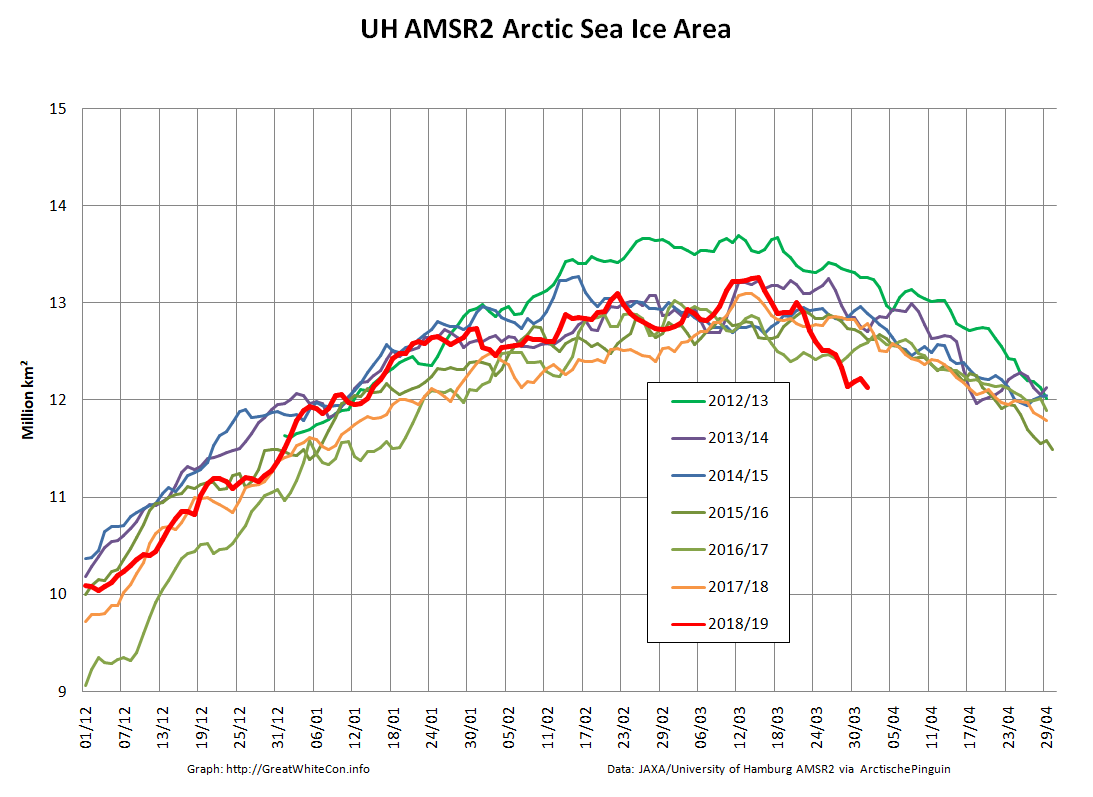
At the beginning of April 2019 all the assorted Arctic sea ice extent metrics are at their respective lowest levels for the date in the satellite record. Just for a change let’s start with the JAXA/ViSHOP graph for April 1st, based on AMSR2 data:

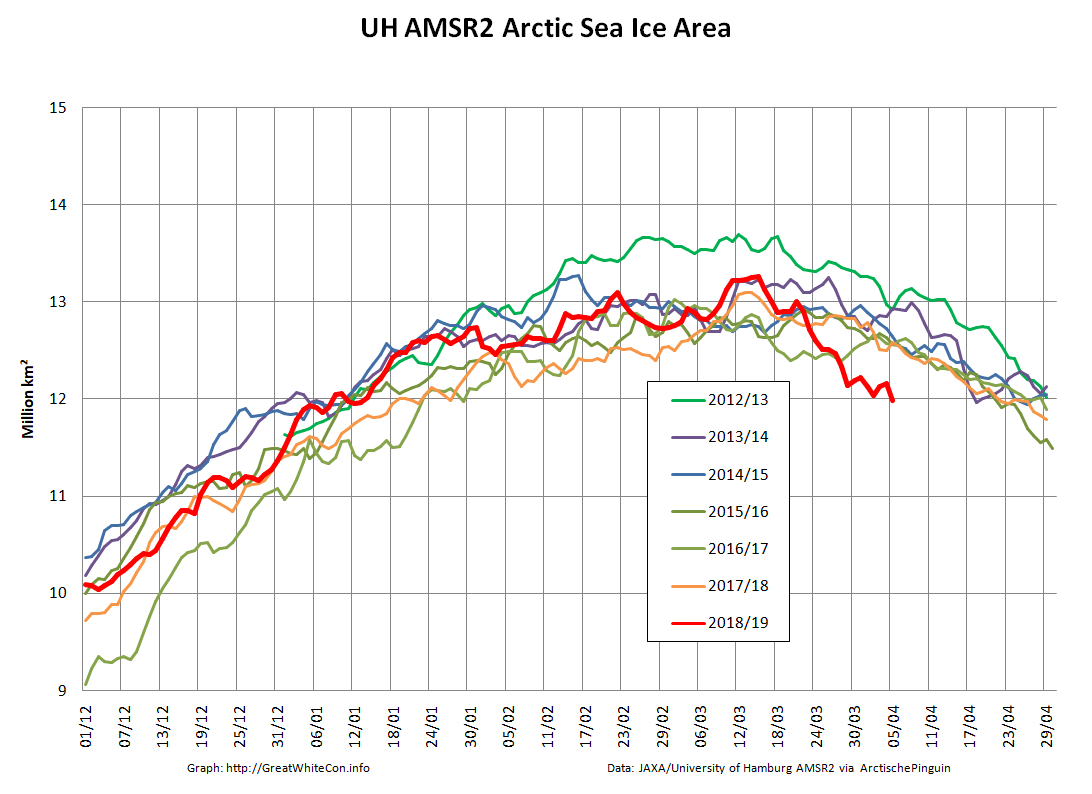
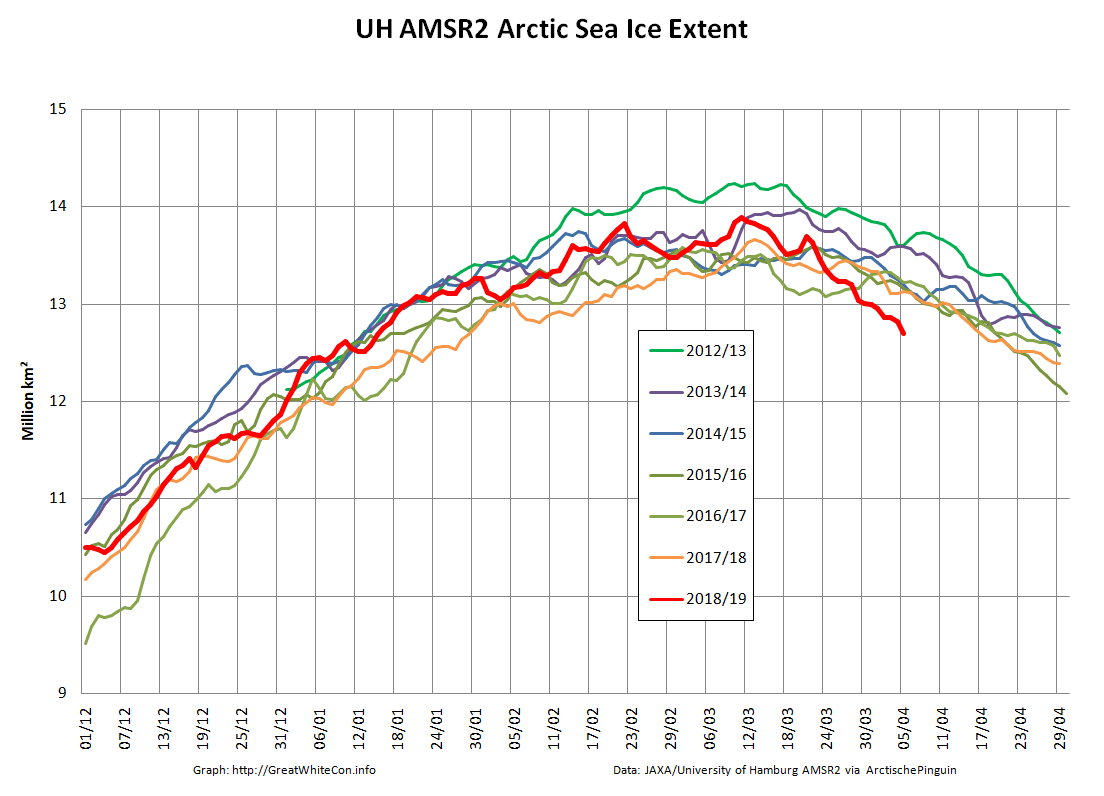
That shows extent apparently on an inexorable decline. However the higher resolution graphs derived by Wipneus from University of Hamburg AMSR2 concentration data reveal that Arctic sea ice extent has changed little over the last couple of days, and area has even increased somewhat:

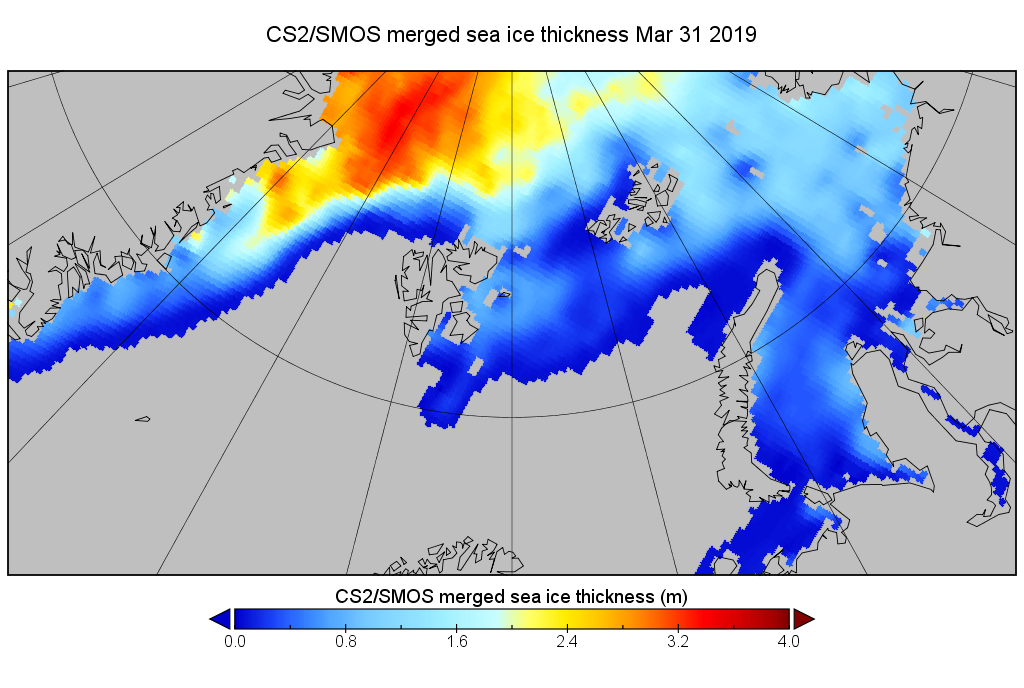
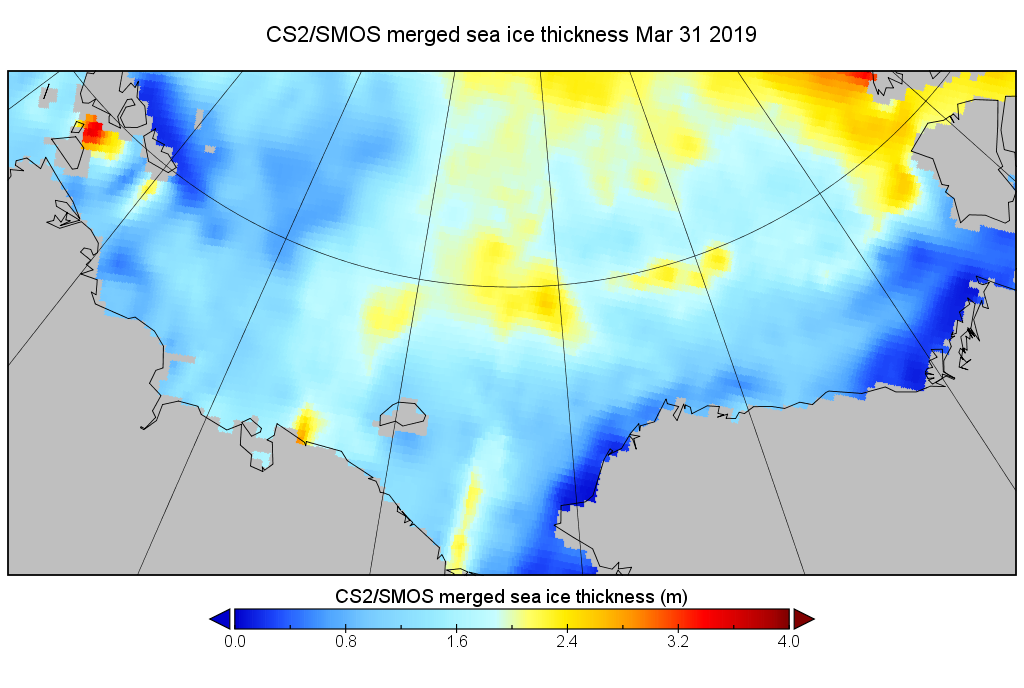
Whilst we wait for Wipneus’ latest PIOMAS thickness and volume update, here’s the gridded merged CryoSat-2/SMOS thickness data from the Finnish Meteorological Institute:

Watch this space for some other extent graphs once they’ve updated to April 1st. In particular the DMI’s version of events will be of great interest, since by way of a little All Fools Day fun I passed on the latest Arctic sea ice news to Tony Heller and the denizens of his “Deplorable Climate Science Blog” yesterday. They were not amused! By way of example, Rah solemnly informed me that:

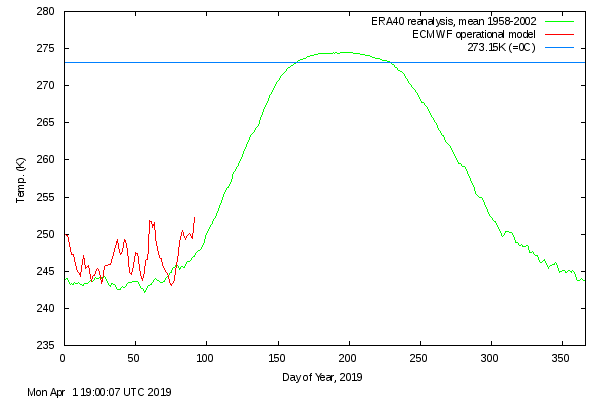
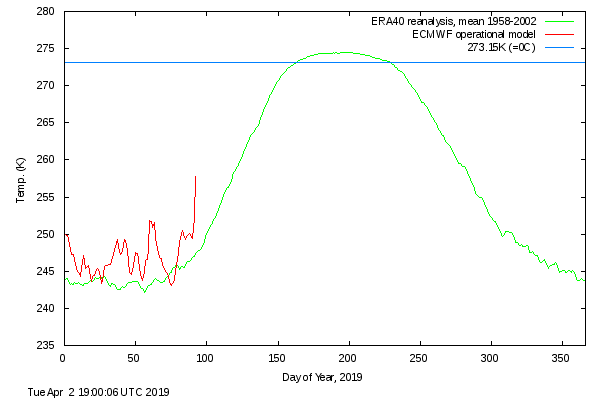
Tony consistently has used the DMI data as his primary source on the conditions in the Arctic, while you jump to whatever source you think justifies your bias. Get a life. Arctic air temps this year so far have been running below what they were at this time last year.

This is the graph that Steve/Tony used in an attempt to make his point:

Accompanied by his sage thoughts on the matter:

That has to be your lamest cherry-pick on record.

Here too is the latest graph of Rah and Tony’s beloved DMI “Arctic air temps”:

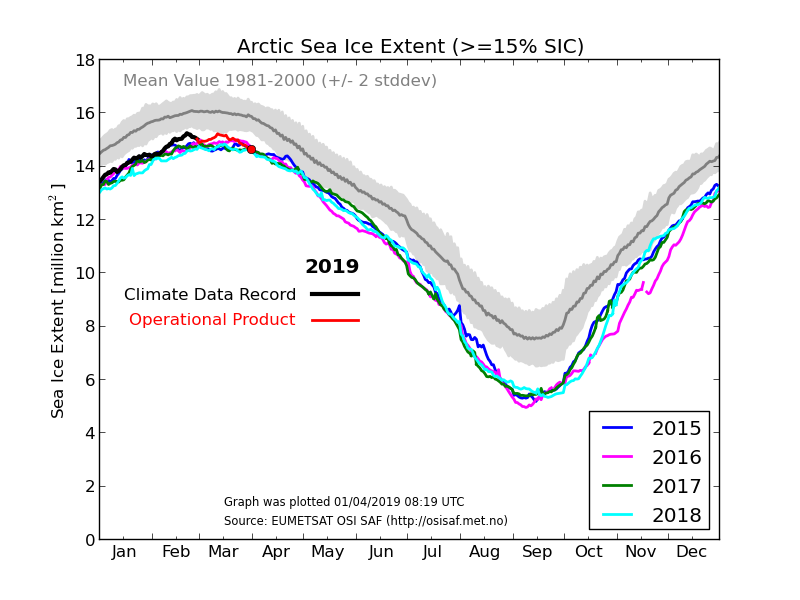
P.S. Here are the April 1st numbers from Steve/Tony’s current metric du jour:

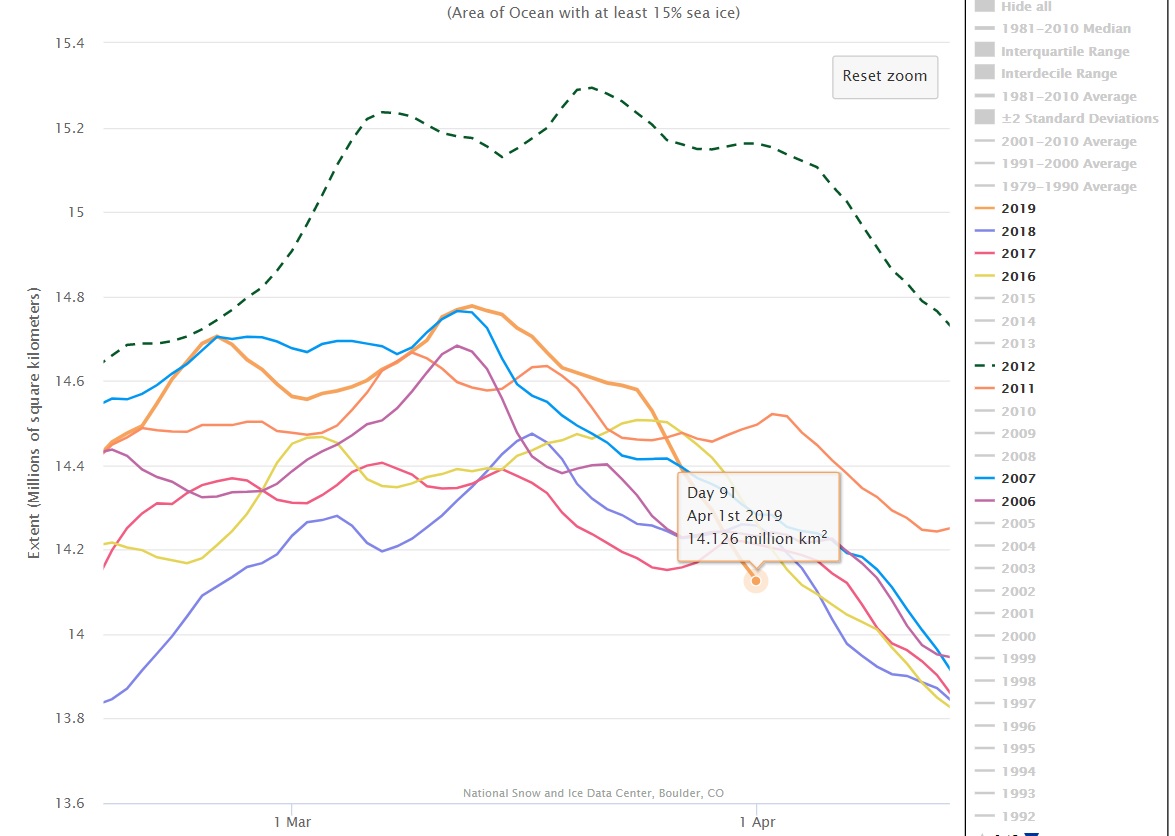
and from the National Snow and Ice Data Center:

Plus the April 2nd DMI “Arctic temperature” graph:


[Edit – April 3rd]

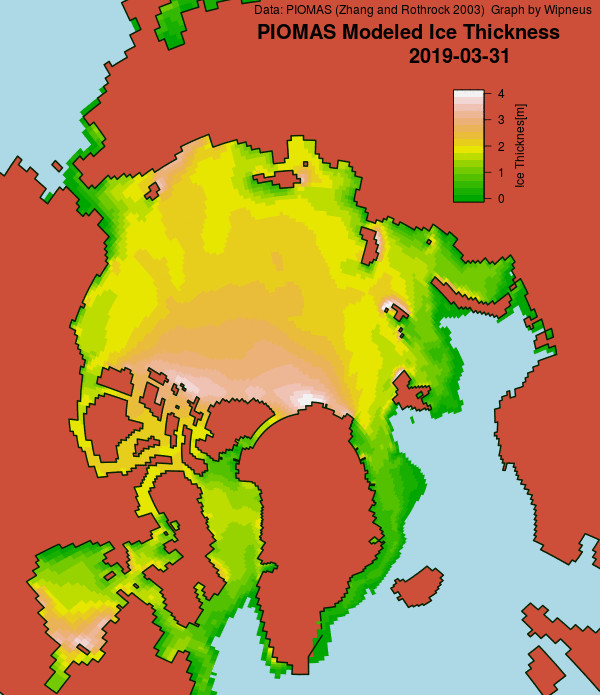
Snow White asked Axel Schweiger nicely on Twitter, and as if by magic the PIOMAS numbers for March have been released, including gridded thickness. Wipneus has crunched them to reveal the following end of March sea ice thickness map:

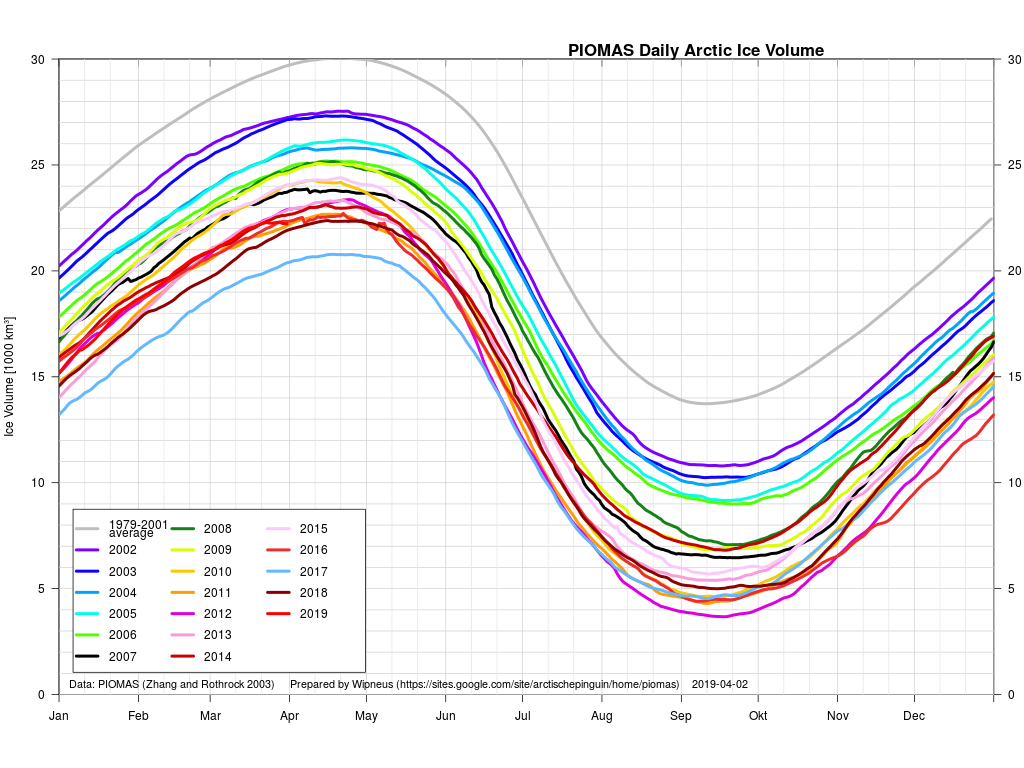
plus a rather unusual volume graph:

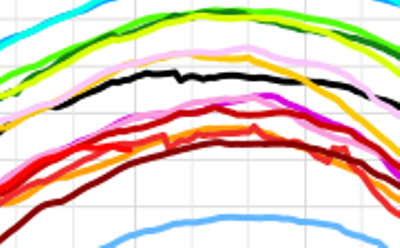
Here’s a closeup view:

According to the PIOMAS model Arctic sea ice volume has been flatlining for the last couple of weeks, and may even have peaked already!

Meanwhile returning to 2 dimensions the decline in area has resumed:


[Edit – April 7th]

Wipneus’ UH high resolution extent fell another 129k yesterday:

Plus a close up look at the FMI merged Cryosat-2/SMOS thickness for both the Atlantic and Pacific sides of the Arctic:

Apart from the usual thick ice queueing for the Fram Strait exit there’s not a lot to prevent the comparatively swift early melt from continuing apace.

The Great White Con 2019 “New Einstein” Award

The omens are good that 2019 is destined to be a year of firsts in the Arctic. Our regular reader(s) will no doubt fondly recall previous editions of our annual Great White Con “New Einstein” Award? 2019’s competition breaks all the moulds by opening the running with a quote from Snow White’s home from home at the Arctic Sea Ice Forum rather than one of the usual “skeptical” venues!

Here for your delectation is the very first “New Einstein” contestant of the 2019 melting season:

1) Lurk at the ASIF, with:

Your unnecessary over the top haughtiness and implicit threats is not helping your communication style one bit Jim. I am far from impressed atm with your version of the Ivory Tower you seem to inhabit. By all means ‘sharpen your sword’ if that is what you imagine you are dealing with because someone says they do not quite understand what you thread is all about.

You can either answer such reasonable questions with a modicum of sincerity and genuineness or continue in the direction you are heading.

2) Spike55 at unRealScience, with:

You’re an idiot.

A LIAR.

A child-minded troll

And a slimebag con-man.

That’s all.

3) Freegrass at the ASIF, with:

What I found out these last 3 months as a Newbie on this forum is that some people here don’t like it when new members take away the spotlight from the oldtimers. All they do is moan and bitch over file sizes, but they fail to reply to any other message I post. So what we have here my dear friend is a textbook example of bigotry. We are excluded from the group… They rather have we left, so they get all the attention again… But who cares? Leave those idiots be. Do what you know to be right, and work together for the benefit of all mankind!

in conjunction with:

Your only contributions to this thread have been complaints and promotions for your own website.

Please refrain from doing so! If you have some Nullschool animation to contribute or comments on the work that is posted here, feel free to do so! If you only come here to complain and tell people what to do, please go away!

and not forgetting:

May I remind everyone that this is the Nullschool Animations thread. I made this thread because you bastards complaint about my graphics on the melting season thread, and now you come here to bitch AGAIN? GO FUCK YOURSELVES!!!!!!!!

USS Skate at the North Pole – Truth and Fantasy Fiction

Tony Heller (AKA “Steve Goddard”) is regurgitating submarine balderdash for the umpteenth time.

Under the headline “No Change In Arctic Sea Ice Over The Past 60 Years” Tony asserts:

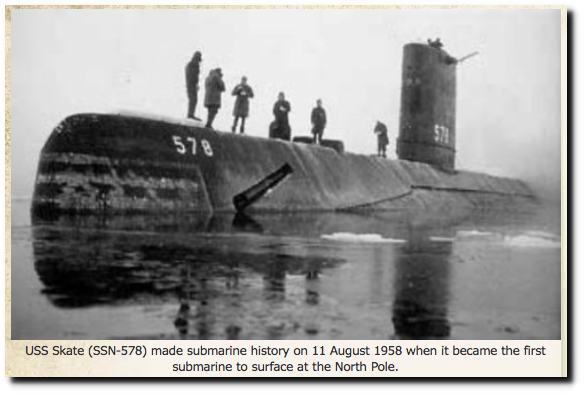
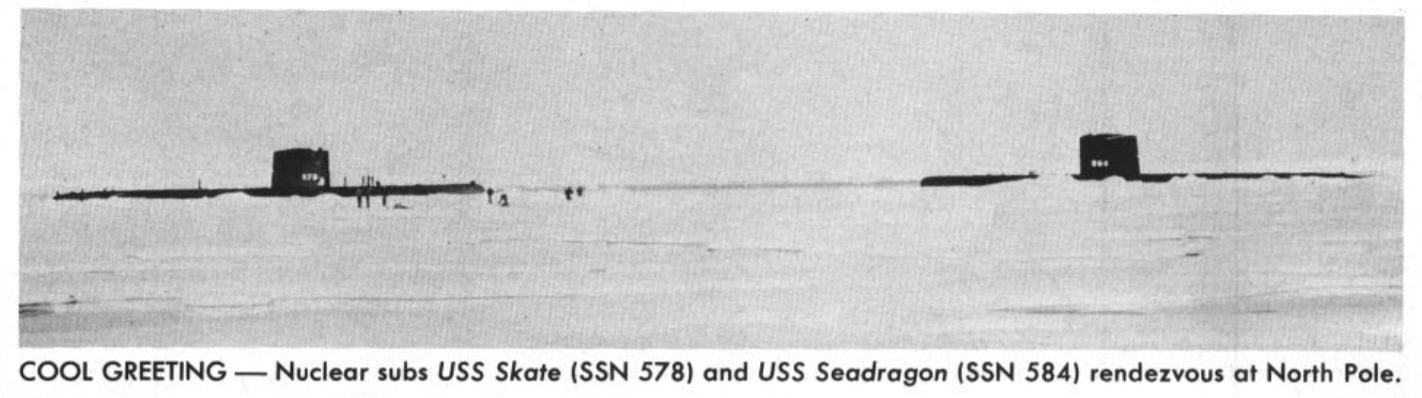
Sixty years ago this week, the USS Skate surfaced at the North Pole. Arctic sea ice was two meters thick.

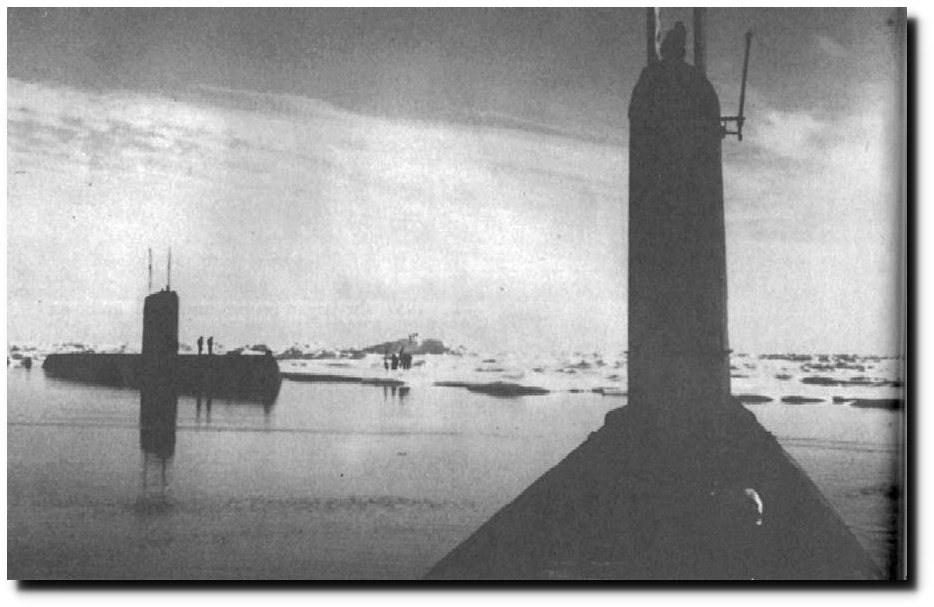
using these images as “evidence”:

SkateSeadragon

Skate-19580811

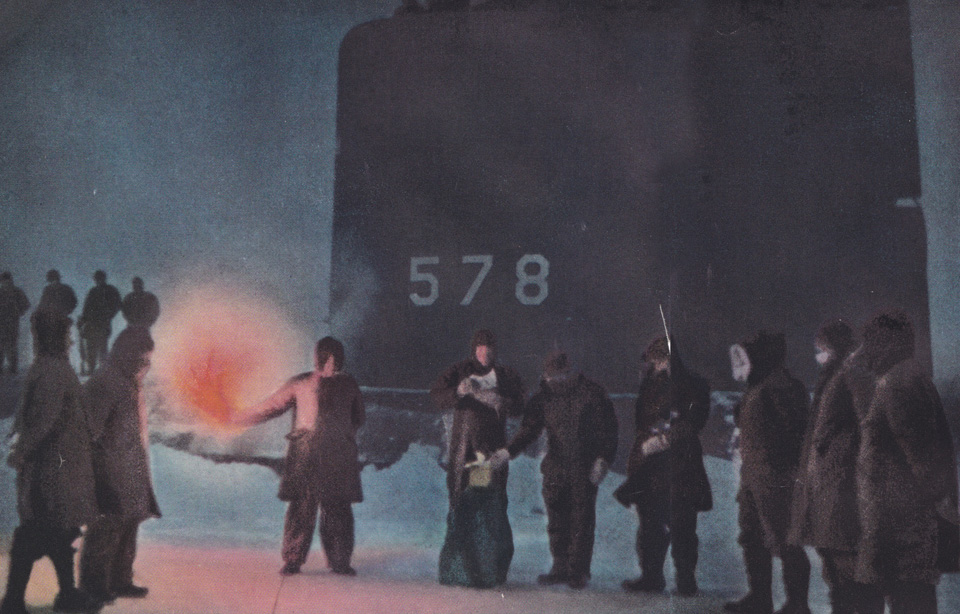
Please note that according to the July 1959 issue of National Geographic magazine:

The winter sun still hid below the horizon last March 17 when USS Skate crunched up through the ice at 90° N – first ship in history ever to surface at the Pole.

uss-skate-pole-19590327

Note also that when USS Skate surfaced at the North Pole on March 17th 1959 she was alone. There was no polynya to be seen, let alone a second submarine in one.

What do you suppose the odds are that Tony’s “No Change In Arctic Sea Ice Over The Past 60 Years” assertion is equally aberrant?

[Edit – August 18th]

A reader on Twitter, apparently a fan of Mr. Heller asks:

Of course there is! According to Commander James Calvert in the May 1959 edition of LIFE magazine:

On March 17 we arrived in the vicinity of the geographic North Pole. We had a job we very much wanted to do here, but as we cruised back and forth in the darkness below the Pole it seemed doubtful that we would be able to perform the last service requested by Sir Hubert Wilkins. No frozen leads or polynyas appeared. For a time I thought it would be necessary to conduct the service while submerged and discharge the ashes from one of the torpedo tubes as we passed under the pole.

Then suddenly we spotted the faint light of a small lead and we started up. This was our toughest surfacing so far. The quarters were cramped and we had to take special care not to hit Skate’s delicate rudder against the walls of ice. It took us two hours of careful maneuvering before Skate’s sail buckled the ice at the precise top of the world.

Climbing to the bridge I was greeted by an awesome sight. Skate was in a small lead completely surrounded by 10-foot-high hummocks of ice. This was the most inhospitable terrain we had seen so far.

[Edit – October 18th 2019]

The Skate and Seadragon surfacing at the North Pole meme has just been resurrected by David Middleton at “Watts Up With That”. He asserts that:

The North Pole may not have been totally ice free in 1962, but there clearly was a lot of open water…

quoting the United States Navy:

USS SKATE (SSN 578), CDR Joseph L. Skoog (Dr. W.K. Lyon and Richard Boyle), and USS SEADRAGON (SSN 584), CDR Charles D. Summitt, (Walter Wittman) conducted the first rendezvous of 2 ships at the North Pole.

Unfortunately for Mr. Middleton, Commander Summitt wrote a book about his experiences, the relevant section of which reads as follows:

When we were a couple of miles from the pole, we started watching for a large enough polynya to hold both of us. However, we reached the pole without either of us having any luck.

Image source: “All Hands” December 1962

Quod erat demonstrandum?

The 2017 Arctic Sea Ice Metric Minima

September has arrived once again, the month in which the assorted Arctic area and extent metrics (almost) always reach their respective annual minima. Now we can start to speculate about what the assorted minima will be, and on what date.

First of all let’s take a look at “Snow White’s” favourite high resolution AMSR2 metrics derived by “Wipneus” from University of Hamburg AMSR2 concentration data:

UH-Arctic-Area-2017-09-02

UH-Arctic-Extent-2017-09-02

As you can see, today’s values are both higher than yesterday’s. Hence we already have potential minima to consider! In this case:

UH AMSR2 Area – 3.65 million km² on September 1st
UH AMSR2 Extent – 4.30 million km² on September 1st

Personally I don’t think those numbers will last long, and here’s one reason why. The “surf forecast” for the far North Atlantic for midday on September 6th:
Significant_height_of_combined_w in multi_1.glo_30mext.20170903_00029

Mean_period_of_swell_waves_order in multi_1.glo_30mext.20170903_00029

Some significant swells are currently forecast to batter the ice edge on the Atlantic side of the Arctic over the next few days.
 

[Edit – September 3rd PM]

Shock news! Tony Heller has made a prediction about this year’s minimum!! Unlike last year, this year the NSIDC 5 day average extent seems to be his Arctic metric of choice:

Charctic-20170902

Tony tells his faithful flock:

The Arctic sea ice minimum this year is very likely going to be be larger than 2016, 2015, 2012, 2011 and 2007.

It is also likely that the minimum extent will be higher than 2010 and 2008.

Instead of reporting the huge gain in ice and massive failure of their forecasts, climate alarmists will report that extent was “8th lowest on record.”

All those years are on the graph above. We shall see.


[Edit – September 15th]

Our normal Arctic sea ice extent 2017 minimum service will be restored as soon as possible. Meanwhile here is the test card:

That comes to you via the Daily Express of all places!

On the way the cruise’s resident naturalist and Smithsonian lecturer, Michael Scott, risked the wrath of Trump supporters by pointing to some of the changes Greenland is undergoing.

A Nasa map based on data between 2004 and 2014 revealed that the ice is melting across most of Greenland – an area nine times the size of the UK.

Pulling together several papers, Michael said Greenland’s summer melt season now lasts 70 days longer than in the early 1970s.

This melting is unfreezing the fringes of the permafrost, which may explain why Nasa satellites are picking up fires raging where the ice has retreated.


[Edit – September 16th]

It is of course still to early to be 100% certain about this. However:

UH-Arctic-Extent-2017-09-15

It certainly looks as though the bottom is in for the University of Hamburg AMSR2 extent: 4.25 million km² on September 11th.

It’s much the same story for JAXA extent:

VISHOP_Extent-20170915

4.47 million km² on September 9th and 10th.


[Edit – September 19th]

The NSIDC have followed in Snow White’s glass slippered footsteps and tentatively called the minimum:

On September 13, Arctic sea ice appears to have reached its seasonal minimum extent of 4.64 million square kilometers (1.79 million square miles), the eighth lowest in the 38-year satellite record. The overall rate of ice loss this summer was slowed by a persistent pattern of low sea level pressure focused over the central Arctic Ocean.

Please note that this is a preliminary announcement. Changing winds or late-season melt could still reduce the Arctic ice extent, as happened in 2005 and 2010. NSIDC scientists will release a full analysis of the Arctic melt season, and discuss the Antarctic winter sea ice growth, in early October.

The ever industrious Wipneus has also called the PIOMAS minimum volume for 2017:

Minimum volume was reached at 11th September: 4.542 103km3, which is fourth lowest after 2012, 2011 and 2016 (resp 3.673, 4.302, 4.402) and just below 2010 (4.582).

piomas_gridded_thickness_20170911


[Edit – September 23rd]

Here’s the 2017 edition of our annual NSIDC daily max/min extent graph:

NSIDC-NH-MaxMin-2017

The maximum extent was the lowest in the satellite record, and the minimum was just fractionally above the trend line. For those that concern themselves with “statistical significance”, the PIOMAS minimum volume was a “statistical tie” for second place:

PIOMAS-20170915

Watch this space!