World renowned climate scientist Roger Pielke Jr. has just published an interesting paper in the highly respected academic journal the New York Post. It is entitled:
When it comes to climate change, to invoke one of Al Gore’s favorite sayings, the biggest challenge is not what we don’t know, but what we know for sure but just isn’t so.
Two new studies show that the Earth’s climate is far more complex than often acknowledged, reminding us of the importance of pragmatic energy and climate policies.
One of them, led by researchers at China’s Tongji University, finds that after years of ice sheet decline, Antarctica has seen a “surprising shift”: a record-breaking accumulation of ice…
Roger then heads for the far north, where he assures his learned readers that:
A second new paper, a preprint now going through peer review, finds a similar change at the opposite end of the planet.
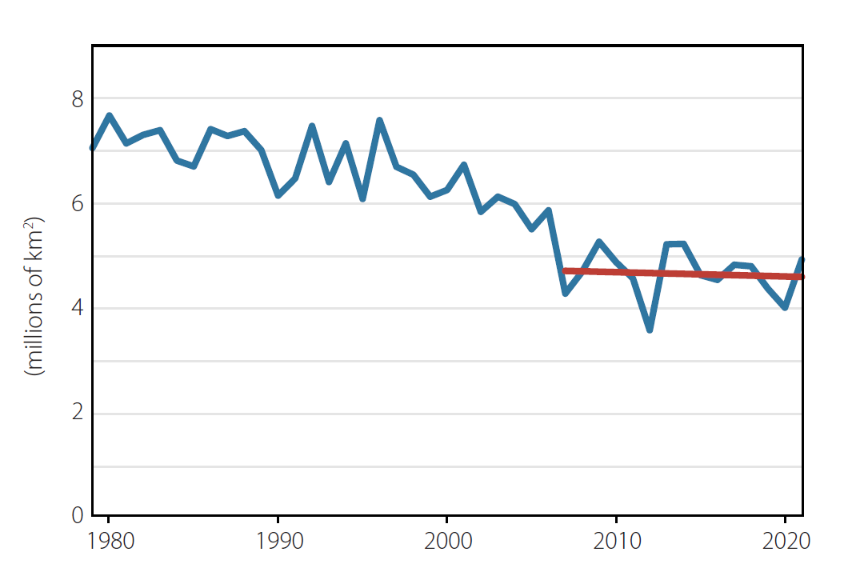
“The loss of Arctic sea ice cover has undergone a pronounced slowdown over the past two decades, across all months of the year,” the paper’s US and UK authors write.
They suggest that the “pause” in Arctic sea ice decline could persist for several more decades.
Together, the two studies remind us that the global climate system remains unpredictable, defying simplistic expectations that change moves only in one direction.
I feel compelled to point out to Roger that apart from the fact that they both include the word “ice”, Arctic sea ice and the Antarctic ice sheet are approximately as similar as chalk and cheese.
Roger neglects to provide NY Post readers with a reference or helpful link to the preprint he is referring to. However luckily for my own reader(s) I have already done so. Hence I am able to quote the authors’ own words, which read as follows:
According to these climate model simulations, this pause in the loss of Arctic sea ice could plausibly continue for the next 5-10 years.
I have already emailed the authors of the preprint asking them to justify their use of the term “pause”. I’ll let you know what they have to say on the matter in due course. In the meantime I suggest that Dr. Pielke consults an English dictionary. In pseudo code:
"pause" != "rebound"
I also suggest that he directs Post readers to more recent activity of yours truly’s virtual pen:
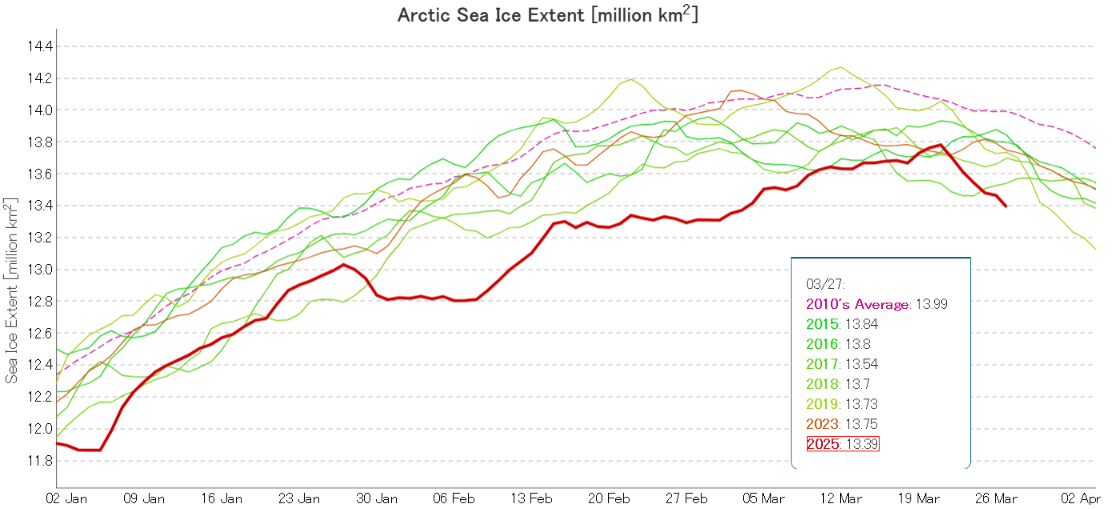
This year’s maximum extent is 1.31 million square kilometers below the 1981 to 2010 average maximum of 15.64 million square kilometers and 80,000 square kilometers below the previous lowest maximum that occurred on March 7, 2017:
Perhaps he also wouldn’t mind asking the Post’s online editor(s) to reveal this explanatory video to their viewers?
Earlier today the National Snow and Ice Data Center announced that:
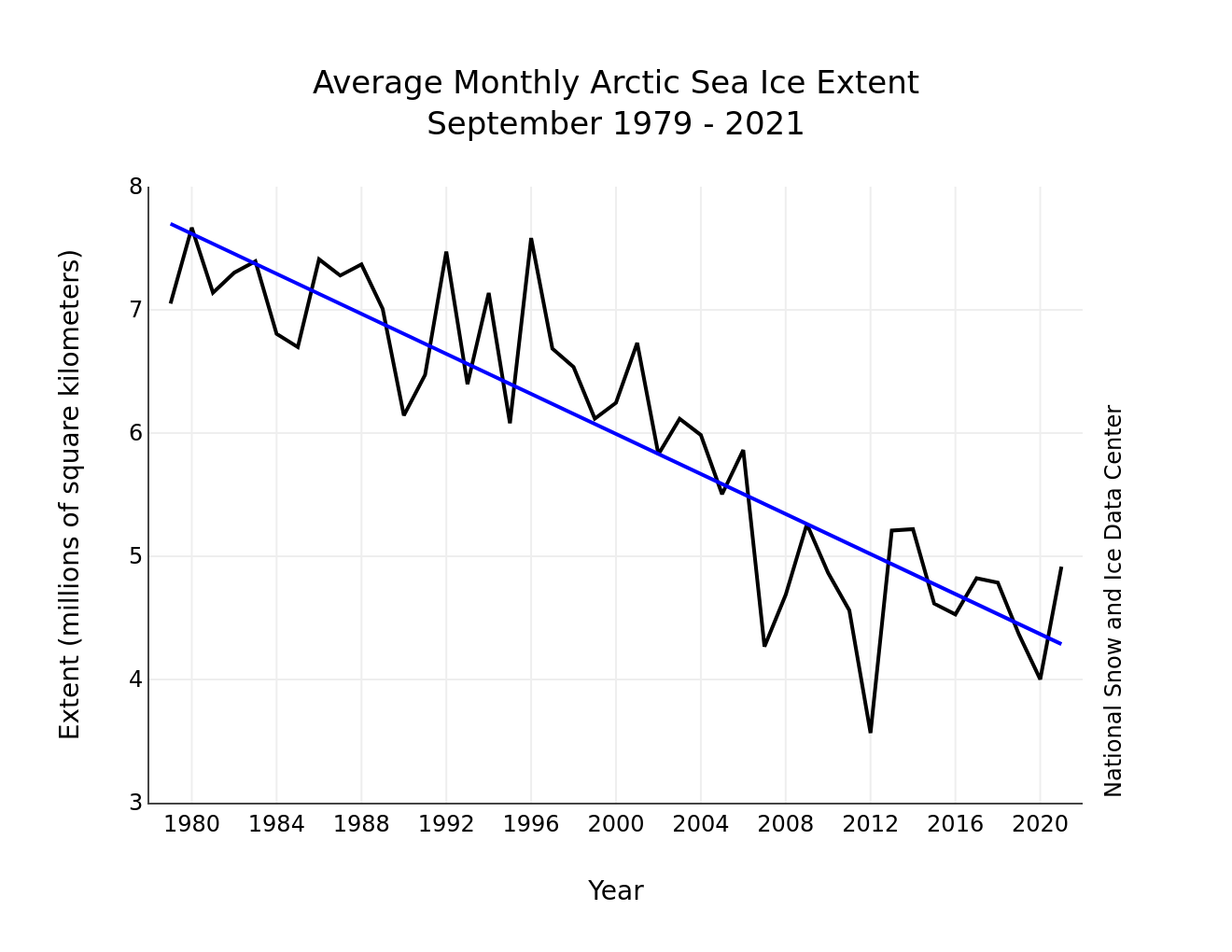
On September 11, Arctic sea ice likely reached its annual minimum extent of 4.28 million square kilometers (1.65 million square miles). The 2024 minimum is the seventh lowest in the nearly 46-year satellite record. The last 18 years, from 2007 to 2024, are the lowest 18 sea ice extents in the satellite record…
Note that this is a preliminary announcement. Changing winds or late-season melt could still reduce the Arctic ice extent, as happened in 2005 and 2010. NSIDC scientists will release a full analysis of the Arctic melt season, and discuss the Antarctic winter sea ice growth, in early October.
Consequently several of the usual cryodenialospheric suspects have been frantically spinning their webs of deceit around the announcement.
First up was Javier Vinós, who beat the NSIDC’s starting gun by firing a broadside on X (formerly Twitter) on Sunday. If you’re unfamiliar with the name, Javier frequently pontificates about Arctic sea ice, amongst other things, on Judith Curry’s “Climate Etc.” blog. He confidently announced that:
Arctic sea ice reaches its annual minimum with an extent greater than in 2007, 2012, 2016, 2019, 2020 and 2023.
The two warmest years in a row at > +1.5°C have ZERO IMPACT on the 17-year resilience of Arctic sea ice.
Needless to say, “Snow White” felt compelled to quibble:
Having yet to cross metaphorical swords with many of the more foul mouthed “skeptics” of my acquaintance this missive comes to you later than usual this year. However I have just come across one Alan Poirier for the first time.
1) Apparently Alan’s source of Arctic expertise is Watts Up With That!
This is how the entirety of our conversation on Twitter went earlier this evening (UTC):
Al Gore said nothing of the sort Alan. Evidently your memory is faulty.
2) The pseudonymous Vegieman’s apparent source of Arctic expertise is Tony Heller!
This is how he signed off from our recent conversation over at Tony’s unReal Climate Science blog:
The arrogant, condescending manner you project is consistent with those that defend the absurdities of every godless, human denigrating, population destroying effort currently being perpetrated on mankind everywhere. What possesses you and your kind to glory in heaping hopelessness, misery, and despair on your neighbor? To come here and strut your depraved condition is evidence of your insecurity. Tony and most here share an integrity and regard for truth that you are severely deficient in. It would be good if you could abandon your sinking ship, but I know it is a very hard descent from the crows nest in which you reside.
My apologies for the mixed metaphors in today’s title, but the news I bear is beyond bizarre.
In a press release earlier today The Global Warming Policy Foundation proudly announced that:
A new paper by an eminent meteorologist says that trends in polar sea-ice levels give little cause for alarm. The paper, by Professor J. Ray Bates has just been published by the Global Warming Policy Foundation.
According to Professor Bates, climate model simulations indicate significantly decreasing sea ice levels in both hemispheres, with the greatest decreases occurring in September each year. However, the observed September trend in the Antarctic is actually slightly upwards, and while observed levels in the Arctic have fallen over the last 40 years, they have been quite stable since around 2007.
Professor Bates said:
“In 2007, Al Gore told us that Arctic sea ice levels were ‘falling off a cliff’. It’s clear now that he was completely wrong. In fact, the trends in sea-ice are an antidote to climate alarm.”
Professor Bates also says that little reliance should be placed on model simulations of future sea-ice decline:
“Climate models failed to predict the growth in Antarctic sea ice, and they missed the recent marked slowdown of sea-ice decline in the Arctic. It would be unwarranted to think they are going to get things right over the next 30 years.”
Professor Bates’ paper is published today, and can be downloaded here (pdf).
By all means download Ray’s “paper” from the link above and take a look at his introduction, which begins as follows:
The recent publication of the book Unsettled by Steven Koonin has led to the likelihood of increased scrutiny of the perception of a climate emergency,1 an idea which has become so widely established in recent years. Koonin, a former scientific advisor to the Obama administration, has demonstrated that what the public are being told by the media is not necessarily what the scientists are saying. He has also shown that what is being relayed in the national and UN climate assessments has often been written for the purpose of persuading rather than informing.
Unsettled clearly shows that important aspects of climate science, which the public have been persuaded to regard as beyond dispute are, in fact, quite unsettled.
Regular readers may recall that as soon as Steve’s book was published in machine readable format we established that it made no mention whatsoever of sea ice, whether of the Arctic or Antarctic variety.
Furthermore, when I attempted to debate that fact with Prof. Koonin he disappeared without trace before justifying that strange omission, beyond asserting that:
The topic is somewhat distant from ordinary folks’ perception.
It seems that Prof. Bates and the GWPF disagree with Prof. Koonin on this topic, since presumably their “paper” is addressed to ordinary folks? Ray even explicitly states that:
Although Unsettled covers a broad spectrum of climate topics, it does not treat in depth the issue of recent polar sea-ice trends, which are key indicators of changes in the global climate.
His “paper” goes on to assert in section 2 that:
Since the introduction of passive-microwave satellite observations in the late 1970s, polar sea-ice extent has been among the most accurately observed climate indicators. Sea-ice volume, on the other hand, is much more difficult to measure.
So far so good I suppose, but then we are told:
In December 2007, former US vice-president Al Gore, in his Nobel Peace Prize acceptance speech in Oslo, referred to scientific studies warning that the Arctic sea ice was ‘falling off a cliff’. He highlighted forthcoming model results that projected largely ice-free Arctic summers in ‘as little as seven years’. He repeated this warning two years later at the 2009 COP15 climate meeting in Copenhagen.
Gore’s claim was based on a study by researchers from the US Naval Postgraduate School, who used a regional model of the sea ice–ocean system in the Arctic, constrained using observational data for the 12-year period 1996–2007, and concluded that the Arctic would be nearly ice-free in summer by 2016 (plus or minus three years).
Prof. Bates seems blithely unaware that we thoroughly debunked this nonsense many moons ago. What Prof. Wieslaw Maslowski, one of those pesky “researchers from the US Naval Postgraduate School”, actually said in December 2007 was:
If we project this trend ongoing for the last 10–15 years, we probably will reach zero in summer some time mid next decade.
Reiterate for the benefit of those who seem unable to understand either English or Mathematics that a “projection” is not the same thing as a “prediction”.
preferring instead a version of his own construction, which looks like this:
Ray then confidently asserts that:
The current slowdown in the rate of sea-ice loss was not expected, and the reasons for it are uncertain.
Sadly Ray’s exhaustive list of references fails to mention this learned journal article from 2011 by authors from the University of Washington and Los Alamos National Laboratory, which not only anticipated such a “slow transition” but also offered reasons for it:
Given the strong thickness–growth feedback of sea ice (Bitz and Roe 2004), where in a warming climate we can expect the thicker MY ice to thin at a greater rate than the thinner FY ice, and the fact that the ratio of MY to FY ice entering into the MY ice category each year is decreasing, it is likely that the difference between FY and MY ice survival ratios will decrease in a warming climate. If this occurs, the Arctic sea ice system would move toward a regime of decreased memory and decreased sensitivity to climate forcing…
There is of course plenty more GWPF sea ice nonsense where that lot came from, but it’s already past my tea time (UTC) and so further debunking will have to wait a while. In the meantime here’s a wake up call for Professor J. Ray Bates:
[Edit – December 17th]
Moving further down section 2 Ray assures us that:
Any objective discussion of the recent Arctic sea-ice decline also requires that some consideration be given to the evidence regarding past natural variability on a multi-decadal timescale. In the pre-satellite era, reliable data on sea-ice coverage was sparse.
By combining the temperature and partial sea-ice records, statistical reconstructions of the total sea-ice extent going back to the early 1900s can be created. Some of these reconstructions indicate that between the 1900s and 1940s, Arctic sea-ice extent comparable to the present reduced levels may have occurred.
Ray doesn’t sound very certain, which is perhaps because the paper in question blithely states that:
Because Arctic sea ice trends are closely correlated to Arctic temperature trends, they are often discussed in the context of global temperature trends.
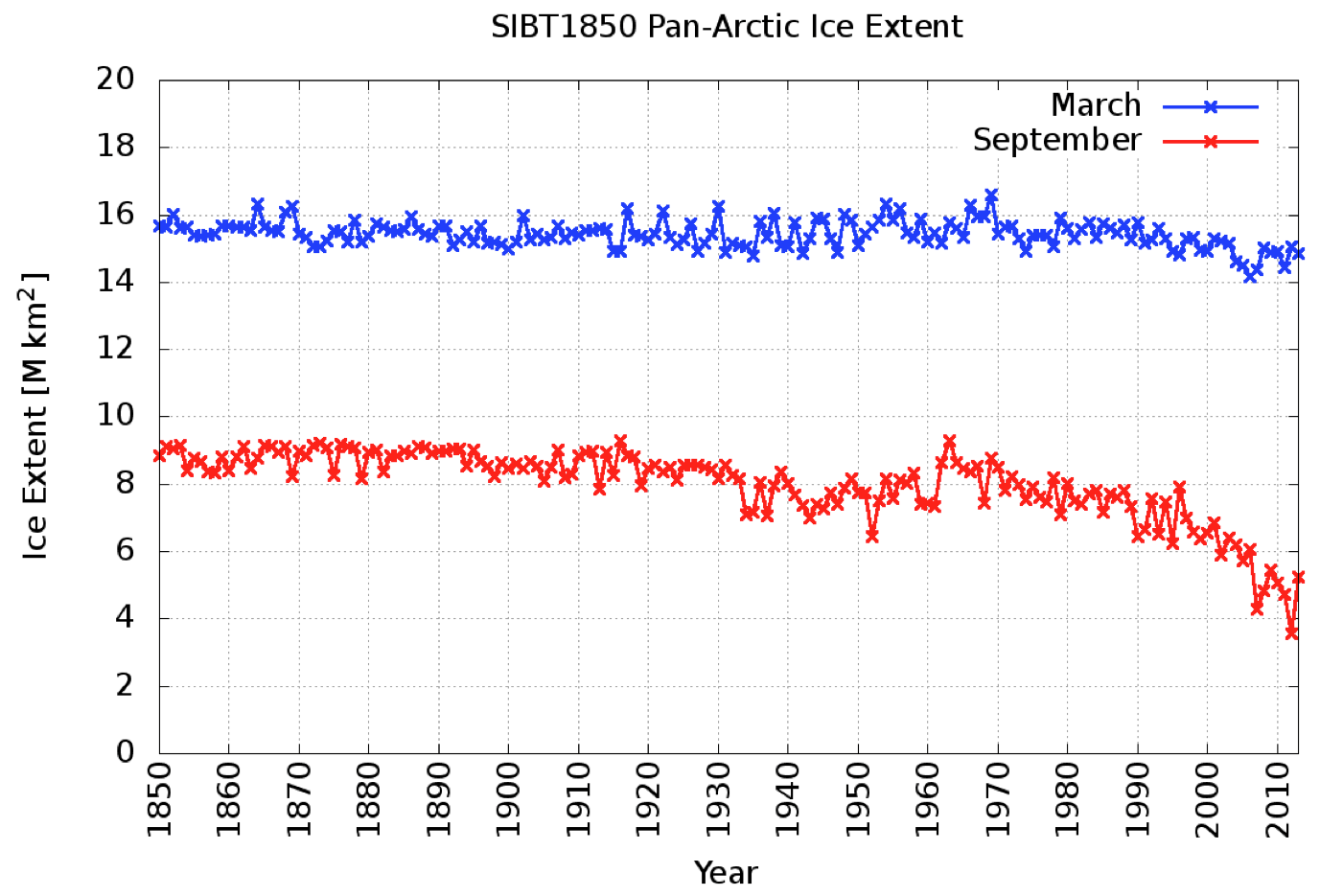
Maybe so, but to the best of my recollection Connolly et al. never attempt to “prove” the asserted correlation. Here’s an alternative assessment of “Arctic sea-ice extentbetween the 1900s and 1940s“:
There isn’t a million more square kilometers of ocean covered with ice than at the same time last year. Or is there?
For our younger readers perhaps I should point out that is a reference to the genesis of the Great White Con blog way back in the mists of time in September 2013, when a Daily Mail headline proudly, but erroneously, declared that:
And now it’s global COOLING! Record return of Arctic ice cap as it grows by 60% in a year.
With the COP26 conference due to start in Glasgow on October 31st UK Prime Minister Boris Johnson had this to say to the United Nations General Assembly yesterday, amongst other things:
In the words of the Oxford philosopher Toby Ord “we are just old enough to get ourselves into serious trouble”…
It is time for humanity to grow up.
It is time for us to listen to the warnings of the scientists – and look at Covid, if you want an example of gloomy scientists being proved right – and to understand who we are and what we are doing.
The world – this precious blue sphere with its eggshell crust and wisp of an atmosphere – is not some indestructible toy, some bouncy plastic romper room against which we can hurl ourselves to our heart’s content.
Daily, weekly, we are doing such irreversible damage that long before a million years are up, we will have made this beautiful planet effectively uninhabitable – not just for us but for many other species.
And that is why the Glasgow COP26 summit is the turning point for humanity.
If all that sounds unlikely, then take a look:
https://youtu.be/Z_YPE7vy_wQ?t=27
As we surmised at the time of the recent G7 Summit in Cornwall:
We have previously mentioned the Wall Street Journal’s assorted activities promoting the new book by Steven E. Koonin which possesses the rather long winded title of “Unsettled: What Climate Science Tells Us, What It Doesn’t, and Why It Matters.”
We further speculated that assorted things that climate science tells us which Dr. Koonin neglected to mention in his book would also not appear in moving pictures expounding his “message”. That has indeed proved to be the case. You can see a copy of the book in question handily placed on a bookshelf behind Steve Koonin in this interview with Paul Gigot for the Wall Street Journal:
By way of introduction Paul enquires:
What isn’t settled in your mind?
Steve responds:
What isn’t settled is how the climate is going to respond to growing human influences, and how that response will affect society and ecosystems.
A little later Paul asserts that:
There’s no question that fossil fuel extraction and burning adds carbon dioxide and methane and other things into the atmosphere. Is the issue just how the interactions work and how much warming they will cause? I mean Al Gore keeps telling us for example that if you look at the graph of CO2 emissions it’s going up, therefore there’s a direct correlation between that and temperature. I think you’re saying “that’s not true”?
to which Steve responds:
That’s not true! For example, when you look at the record global temperature went down between 1940 and 1970 even as greenhouse gases increased. That’s got to tell you immediately that things are a little more complicated than just greenhouse gases are warming the Earth.
So there you have it. Al Gore is a mere straw man, easily knocked down with a cherry pick without even bothering to mention any of the underlying science.
Paul moves on to mention in passing our favourite topic here at the Great White Con:
Now what about the idea that if we continue to warm you’re seeing all these consequence in terms of much more severe weather events, you’re seeing rising oceans, you’re seeing the melting of the polar ice caps. All of that sort of blends together into a kind of disastrous scenario. Are you saying that those are also just simply exaggerated?
Steve responds eagerly:
Yes they are! And let me give you some factoids.
Unsettlingly none of the factoids he gives us mention Arctic sea ice, a topic which Professor Koonin appears to be strangely ignorant of. Perhaps that’s because whichever way you try to slice and dice it that’s still the ultimately unavoidable giant canary in the climate coal mine?
[Edit – May 11th]
Needless to say Steve Koonin has also been interviewed by Tucker Carlson for Fox News. Needless to say the clip once again opens with a speech by that well known climate scientist, Joe Biden. Needless to say there is no mention of the giant canary in the Arctic coal mine once again. Tucker makes no reference to Greenland either, which does at least merit a mention in Steve’s book. Take a look:
Tucker opens his questioning with:
A hurricane will arise out of the Caribbean. We’ll have a heat wave. We’ll have a cold snap. All of them are attributed reflexively to climate change. How certain can we be that climate change causes those events?
Steve responds:
When you read the official reports from the UN and the US Government you find some surprises. For example, even though the globe has warmed by about 2 degrees Fahrenheit over the last century the incidence of heat waves across the 48 states is no greater than it was in 1900, and the highest temperatures haven’t gone up in 60 years.
We have been able to find no detectable influence on hurricanes from humans, and the models that we use to predict future climates have become more uncertain even as they’ve become more sophisticated. All of these things suggest that people who say that “we’ve broken the climate” and face certain doom unless we take drastic action are just misinformed about what the official reports actually say.
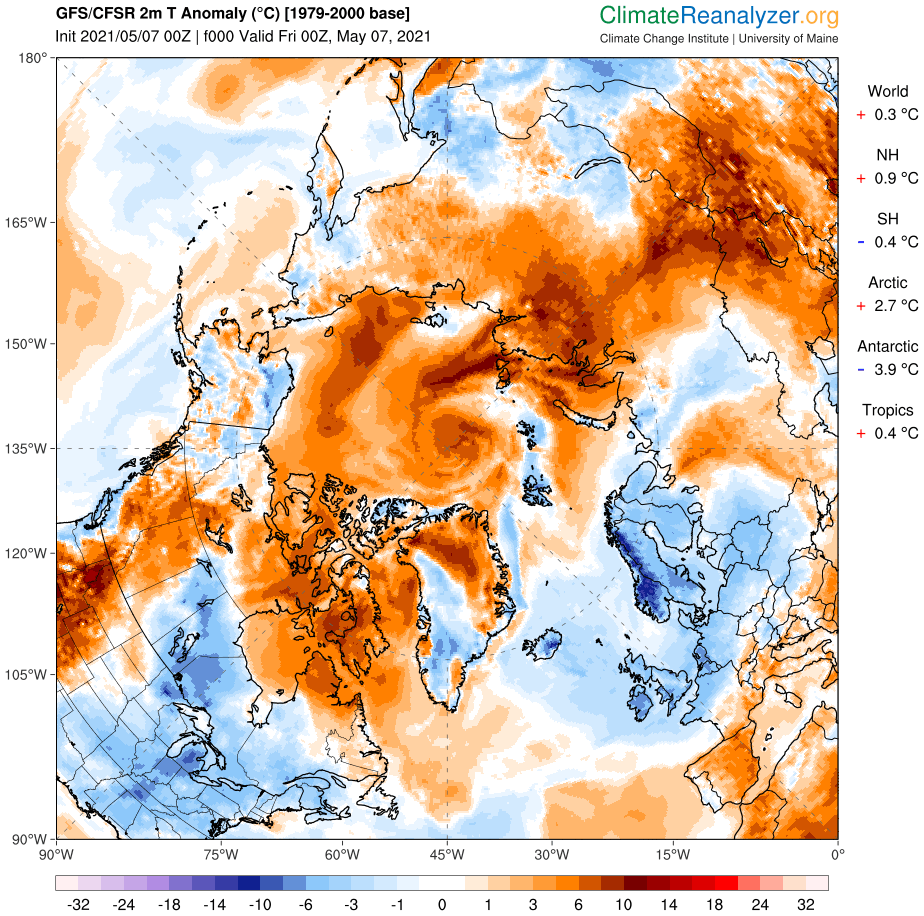
Despite the fact that Fox display some stock footage of sea ice during the interview, Tucker and Steve seem strangely unaware that those 48 states do not constitute the entire globe, or that there was a 2.7 degrees Celsius “heat wave” in the Arctic even as the interview was being conducted:
A little later in the interview Steve says:
We need to have an accurate portrayal of what we know and what we don’t know, and then we can have the debate about what to do about it, without using science as a weapon.
Sadly Steve seems strangely unaware that evidently you’re not going to get the accurate portrayal he recommends via Fox News!
[Edit – May 14th]
Steven Koonin has also been interviewed on CNBC’s Squawk Box, where Joe Kernen’s introduction gives you a strong flavour of what’s to come:
Corporations are spending billions to reduce their so called carbon footprint. President Biden’s infrastructure plan is loaded with subsidies for green industries. In fact if the new green deal ever was passed it wouldn’t be billions, it would be trillions.
Our next guest questions the conventional wisdom on climate science and it’s impact on business and the US economy. Steven Koonin served as the chief scientist in the Obama energy department, and is currently a professor at NYU and the author of “Unsettled: What Climate Science Tells Us, What It Doesn’t, and Why It Matters” :
Steve begins by assuring Joe’s audience that:
Everything I’ve written in this book comes almost directly from the official UN and US Government assessment reports, so this is not Steve talking really, but it is the consensus science.
For some strange reason Steve neglected to include the phrase “ignored and/or cherry picked” in front of “official UN and US Government assessment reports”. He then spouts his by now familiar schtick about “heatwaves in the US”, “hurricanes” and “global wildfires”. Joe then moves the conversation on to the economy:
Will there be an unnecessary negative effect on GDP, on corporations, if they pursue this when it’s not really necessary?
To which Dr. Koonin, as Joe calls him, responds:
I like to say you change the energy system by orthodonture rather than tooth extraction. And so if we do want to reduce carbon emissions we need to do it at a more thoughtful pace and in a more thoughtful way than is being proposed, and moreover we need to get the rest of the world to come along with us if it’s going to have any impact at all…
As [John] Kerry has said, unless the rest of the world comes along US efforts are futile.
So yet again no mention of the IPCC’s “consensus science” regarding Arctic sea ice or even the Greenland Ice Sheet. I cannot help but wonder where Steve’s talking head will appear next on United States’ viewers screens, but on past performance it seems unlikely that the cryosphere will merit a mention.
Our regular reader(s) will no doubt recall the good old days when several times each month an opportunity would present itself to debunk some “skeptical” nonsense from one or more of the usual suspects?
That all changed when Donald Trump was elected President of the United States. He was of course much more amenable to lobbying from fossil fuel interests than Barack Obama, and everything went (comparatively!) quiet.
Now that The Don has sailed off into the proverbial sunset and Joe Biden is top dog all that has changed. A return to the (not so) good old days comes as no surprise, and the porky pies have started coming off the denialospheric production line once again.
There have already been a few contrarian ripples on the surface of the climate science seas, which we may well come to in due course. However a set of substantial waves are now visible on the horizon. The proximate cause is the forthcoming summit of the G7 nations, which as luck would have it is taking place just down the road from the Great White Con winter holiday residence in North Cornwall. Then in November the COP26 conference is being held in Glasgow.
In June, Prime Minister Boris Johnson will welcome fellow G7 leaders to one of the most beautiful parts of the UK: Carbis Bay in Cornwall.
Other parts of the region will also play a key role in the Summit, including neighbouring St Ives, Falmouth and Newquay airport.
With over 400 miles of coastline, Cornwall’s stunning landscape provides a perfect setting for world leaders to come together and discuss how to respond to global challenges like coronavirus and climate change.
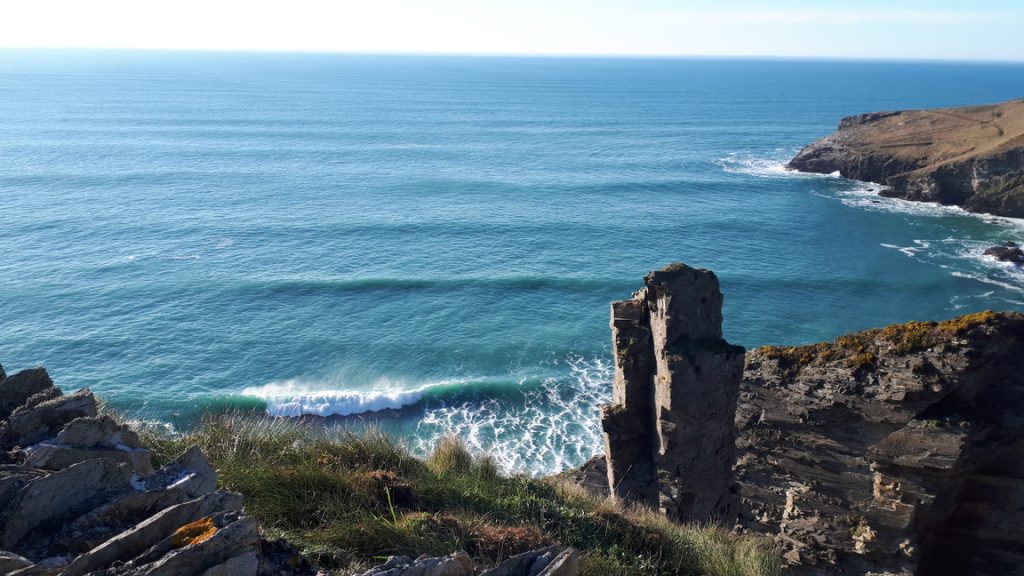
Here’s one of my recent pictures of some of that coastline, including part of Cornwall’s industrial heritage and some large waves!
Climate change is top of the G7 agenda along with Covid-19, and you can rest assured that vested interests will not miss any opportunity to promote those interests over the next two months and beyond. By way of example, one of our long standing “usual suspects”, Judith Curry, “tweeted” the following message to her followers on April 17th:
The celebrated web site of our old friend Anthony Watts published an article yesterday entitled “The polar ice melt myth“. As a self styled expert on that particular topic I popped over there expectantly, only to discover that it is an actual fact a cut ‘n’ paste of an April 30th article by Dr. Jay Lehr at CFACT. Part of that article reads as follows:
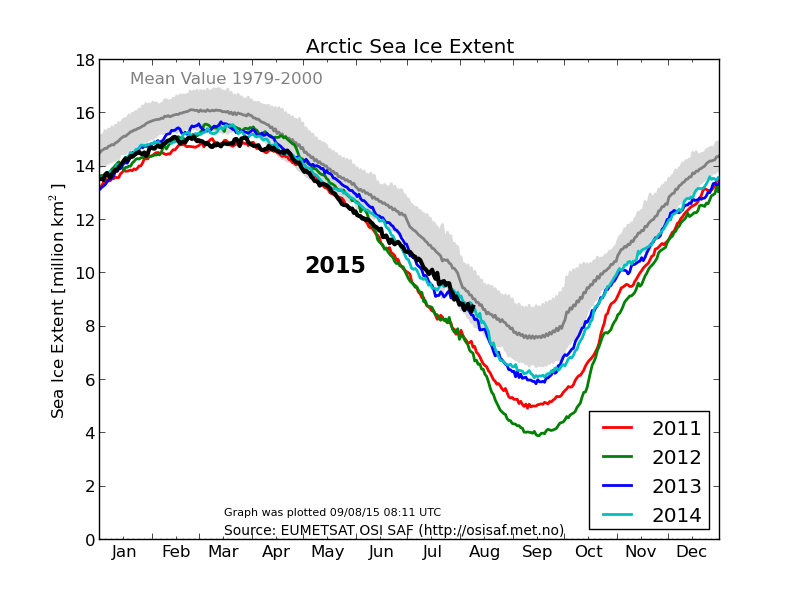
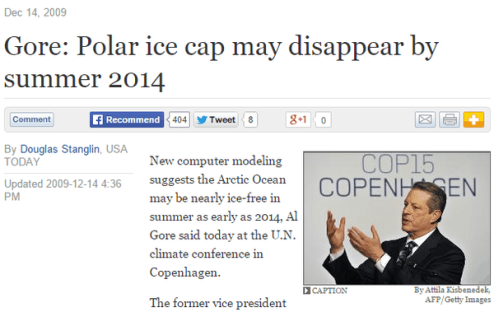
Al Gore predicted in 2007 that by 2013 the Arctic Ocean would be completely ice free. In the summer of 2012 ice levels did reach all time lows in the Arctic. Emboldened by this report Australian Professor Chris Turney launched an expedition in December of 2013 to prove that the Antarctic Sea Ice was also undergoing catastrophic melting only to have his ship trapped in sea ice such that it could not even be rescued by modern ice-breakers.
The Professor should have known that a more accurate estimate of sea ice can be had from satellite images taken every day at the Poles since 1981. These images show that between summer and winter, regardless of the degree of summer melting, the sea ice completely recovers to its original size the winter before for almost every year since the pictures were taken. The sea ice has been stubbornly resistant to Al Gore’s predictions. In fact the average annual coverage of sea ice has been essentially the same since satellite observations began in 1981. However that has not stopped global warming advocates and even government agencies from cherry picking the data to mislead the public.
I also like to think that I’m something of an expert on the way “skeptical” folks cherry pick the data to mislead the public. For example I once wrote a post about David Rose‘s Mail on Sunday article concerning Al Gore’s interpretation of Prof. Wieslaw Maslowski’s research into Arctic sea ice decline. Hence I felt compelled to comment on this most recent of misleadling WUWT articles about polar ice!
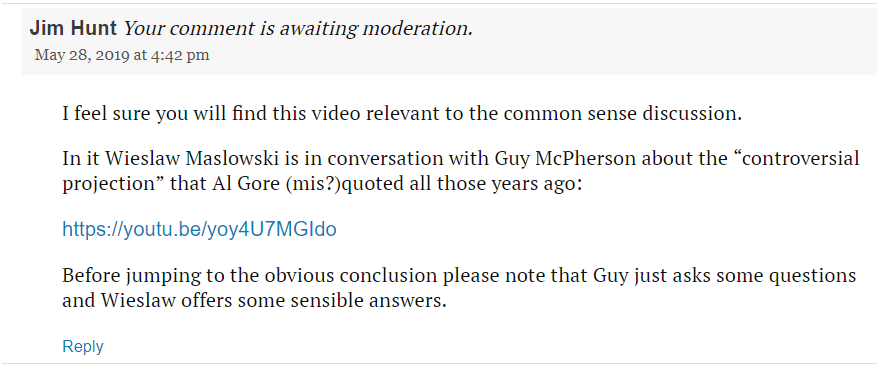
As luck would have it Guy McPherson recently interviewed Wieslaw about events back in 2007 and his more recent research on Arctic sea ice melt. Here is a video recording of their conversation:
I endeavoured to bring this most relevant piece of information to the attention of Anthony’s loyal readership last night (UTC) as follows:
This morning my pertinent comment is still “awaiting moderation”.
The melt season has essentially stopped, with very cold air across the Beaufort Sea
[Image redacted – It shows Canada and one corner of the Beaufort Sea]
The usual criminals in the press (Guardian, New York Times, etc.) and government agencies will of course not mention this, because reality and science wrecks their agenda.
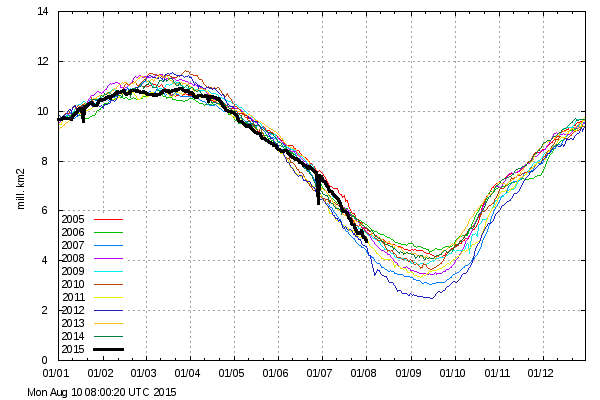
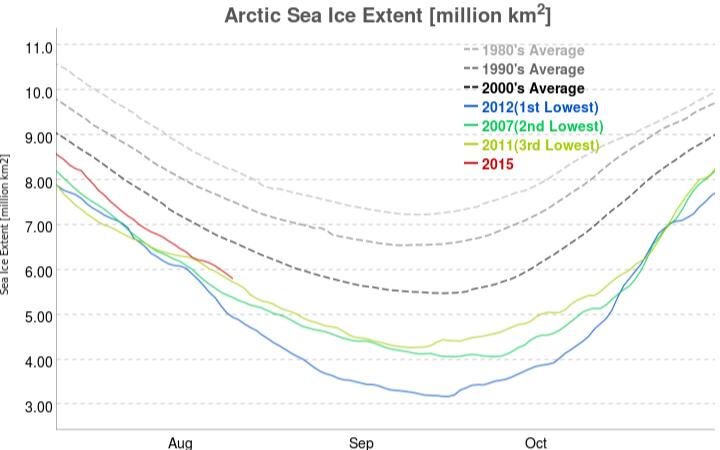
I have to admit Steve’s confusing language confused me briefly. The Arctic sea ice concentration and ice type maps from the OSISAF on which the Danish Meteorological Institute base their extent graphs have been updating normally, but I eventually discovered what “Steve”/Tony was on about. On close inspection although the date at the bottom has been updating the 2015 curve on DMI’s 30% threshold Arctic sea ice extent graph currently seems to be stuck on August 2nd:
I’ve informed DMI of the problem, but when it might be fixed remains to be seen, since as the DMI web site puts it:
The old plot can still be viewed here for a while.
and as I was just informed they don’t have any resources allocated to keep the “deprecated” 30% service running.
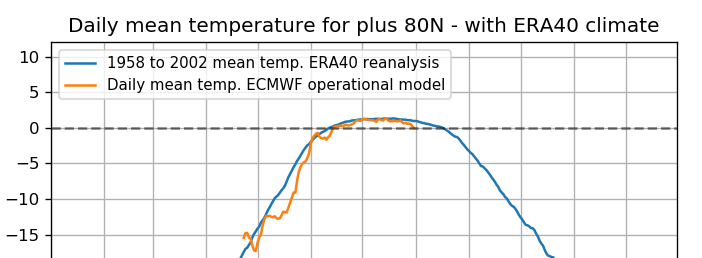
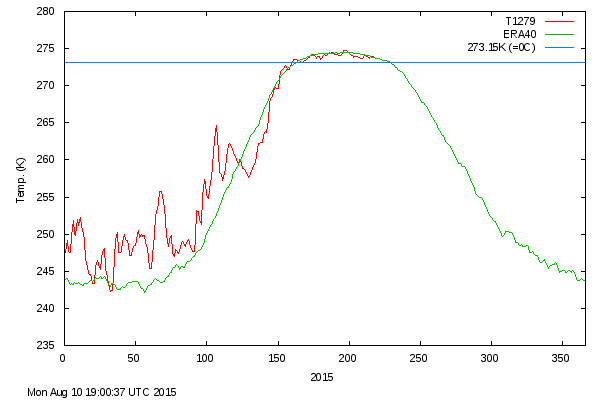
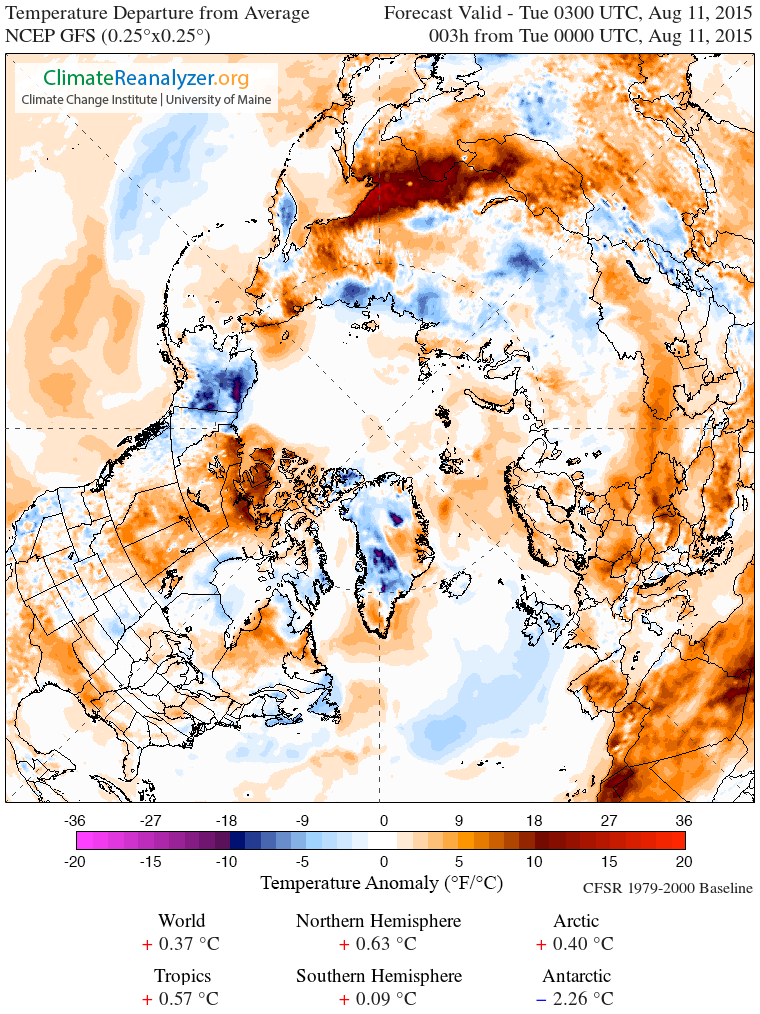
Meanwhile back in real world in the Arctic, DMI temperatures north of 80 degrees are above “normal”:
This website uses cookies to improve your experience. We'll assume you're ok with this, but you can opt-out if you wish. Cookie settingsACCEPT
Privacy & Cookies Policy
Privacy Overview
This website uses cookies to improve your experience while you navigate through the website. Out of these, the cookies that are categorized as necessary are stored on your browser as they are essential for the working of basic functionalities of the website. We also use third-party cookies that help us analyze and understand how you use this website. These cookies will be stored in your browser only with your consent. You also have the option to opt-out of these cookies. But opting out of some of these cookies may affect your browsing experience.
Necessary cookies are absolutely essential for the website to function properly. This category only includes cookies that ensures basic functionalities and security features of the website. These cookies do not store any personal information.
Any cookies that may not be particularly necessary for the website to function and is used specifically to collect user personal data via analytics, ads, other embedded contents are termed as non-necessary cookies. It is mandatory to procure user consent prior to running these cookies on your website.