Tag Archives: Snow Cover

Facts About the Arctic in April 2022

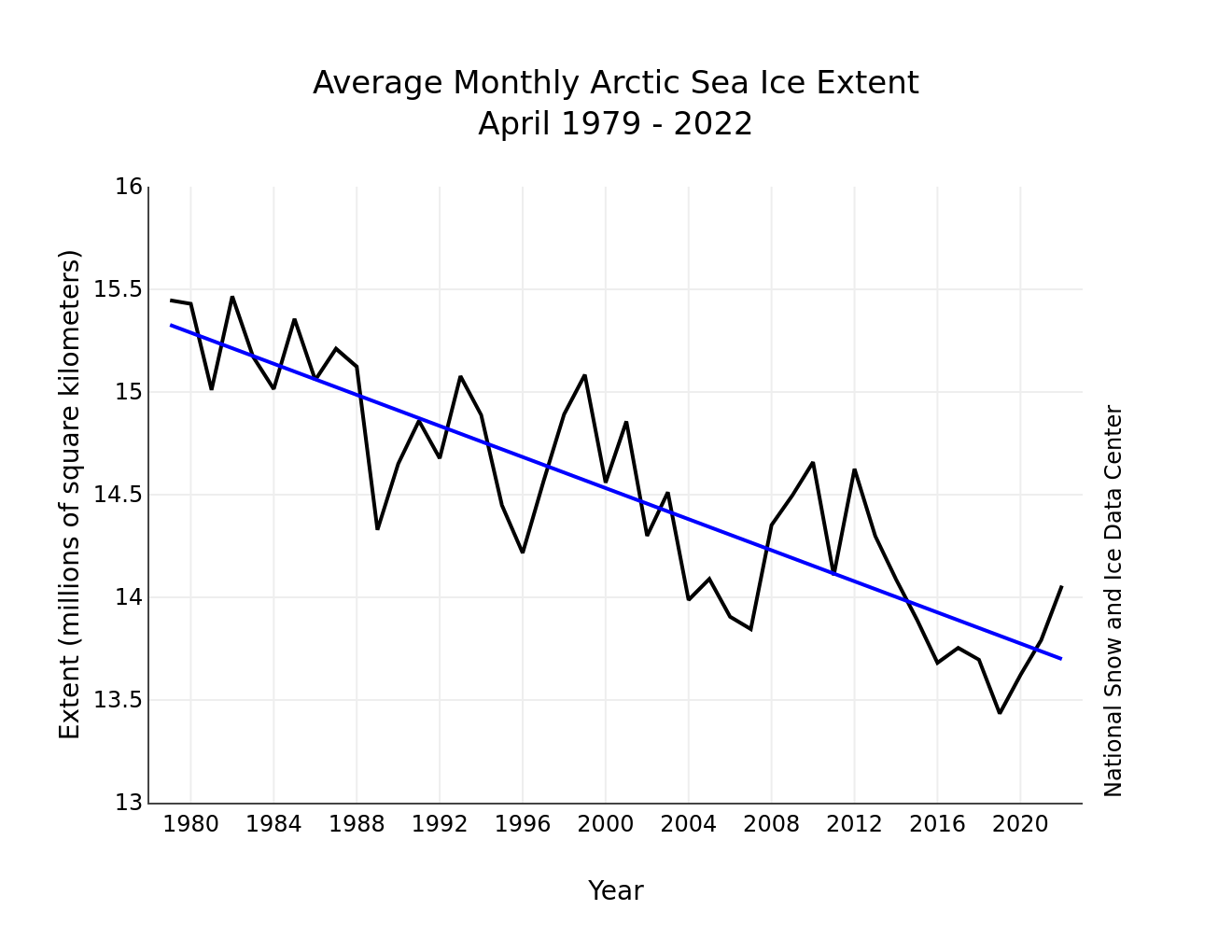
The April edition of the NSIDC’s Arctic Sea Ice News summarises March 2022 as follows:

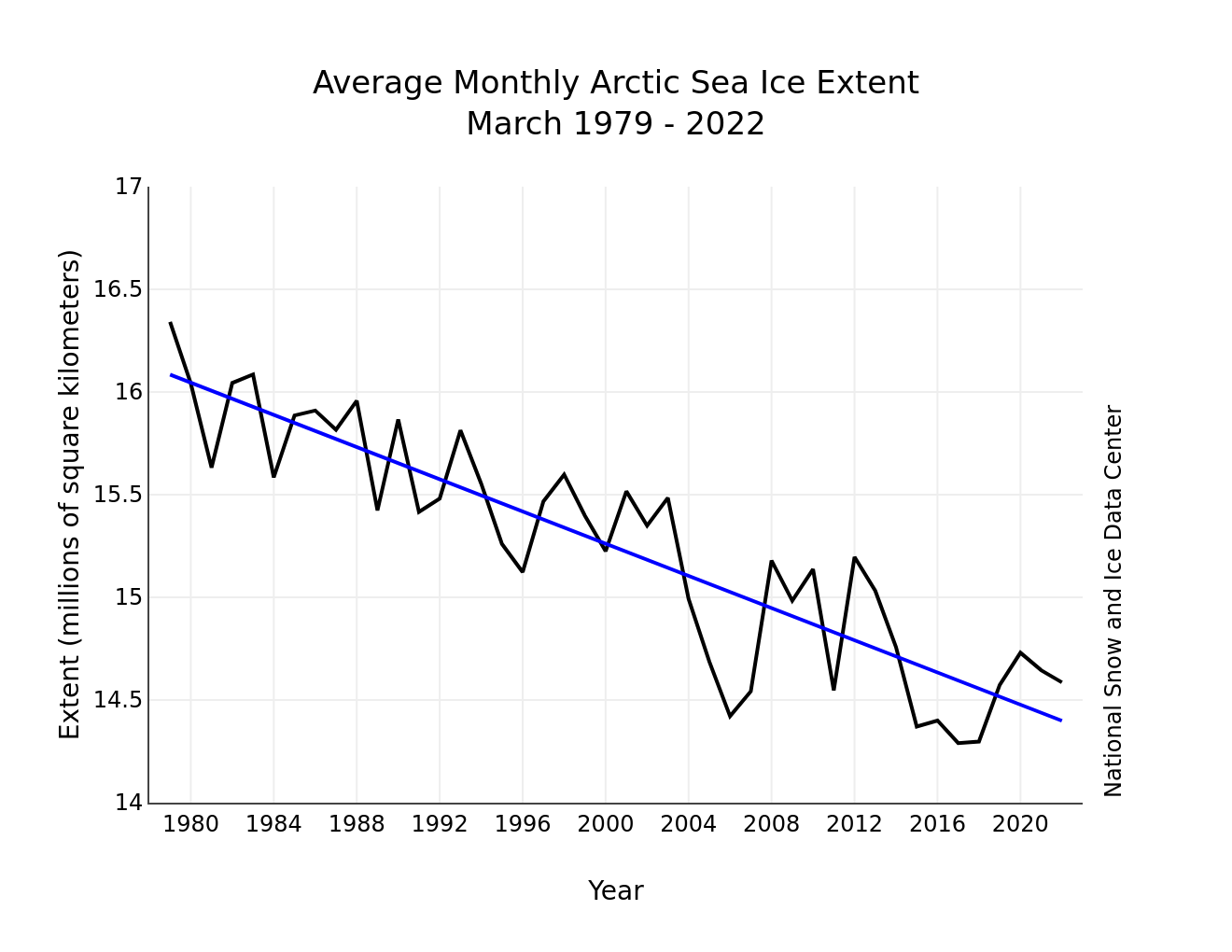
Average Arctic sea ice extent for March 2022 was 14.59 million square kilometers (5.63 million square miles), ranking ninth lowest in the satellite record…

The total decline, after a series of small ups and downs, was only 250,000 square kilometers (96,500 square miles):

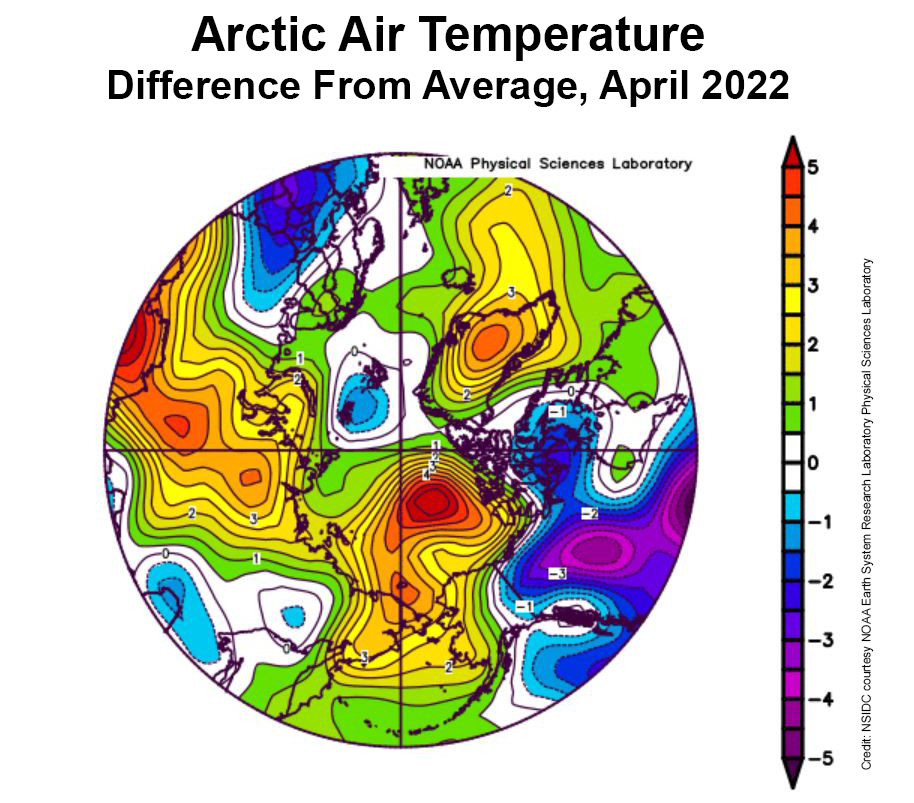
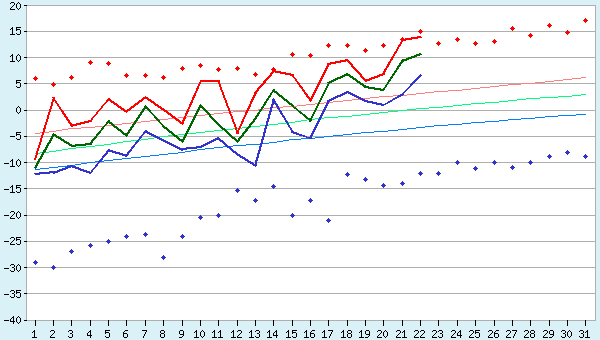
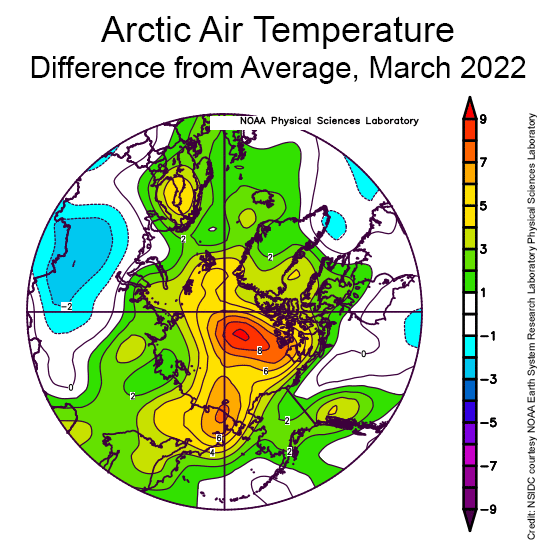
Counter to what might be expected given the very slow rate of sea ice loss over the month as a whole, air temperatures at the 925 millibar level (about 2,500 feet above the surface) were above average over all of the Arctic Ocean:

March temperatures were up to 9 degrees Celsius (16 degrees Fahrenheit) higher than average north of the Canadian Arctic Archipelago, up to 6 degrees Celsius (11 degrees Fahrenheit) above average in the East Siberian Sea, but up to 5 degrees Celsius (9 degrees Fahrenheit) above average over a wide area.

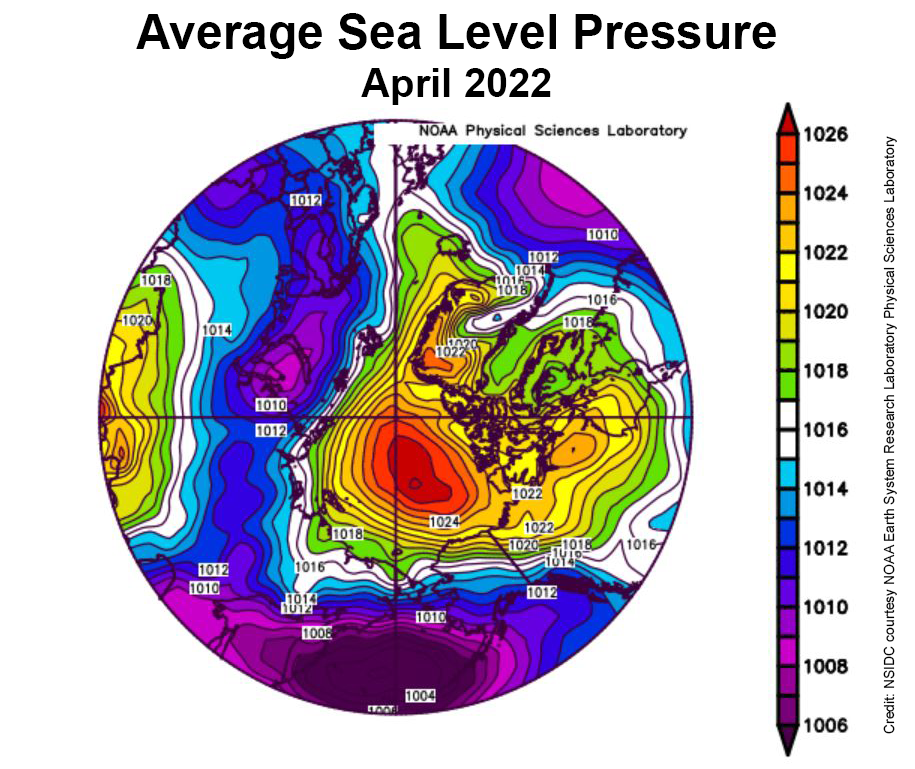
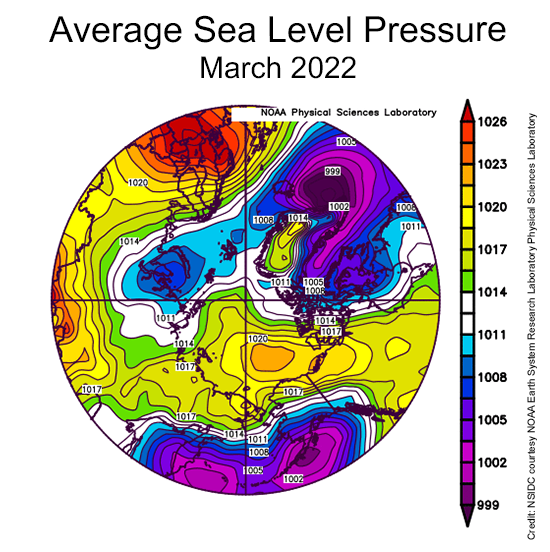
The key features of the sea level pressure pattern were high pressure (an anticyclone) over the central Arctic Ocean, a trough of low pressure extending into the Barents Sea, and an unusually high pressure over Northern Europe:

While having an anticyclone over the central Arctic Ocean is quite typical for this time of year, the combination of the high pressure over northern Europe and the pressure trough to the west led to a strong pressure gradient, leading to strong winds from south through the Norwegian and Barents Seas…

This can be tied to the extreme warm event over the Arctic Ocean seen in the middle of the month, associated with strong water vapor transport and the passage of several strong cyclones.

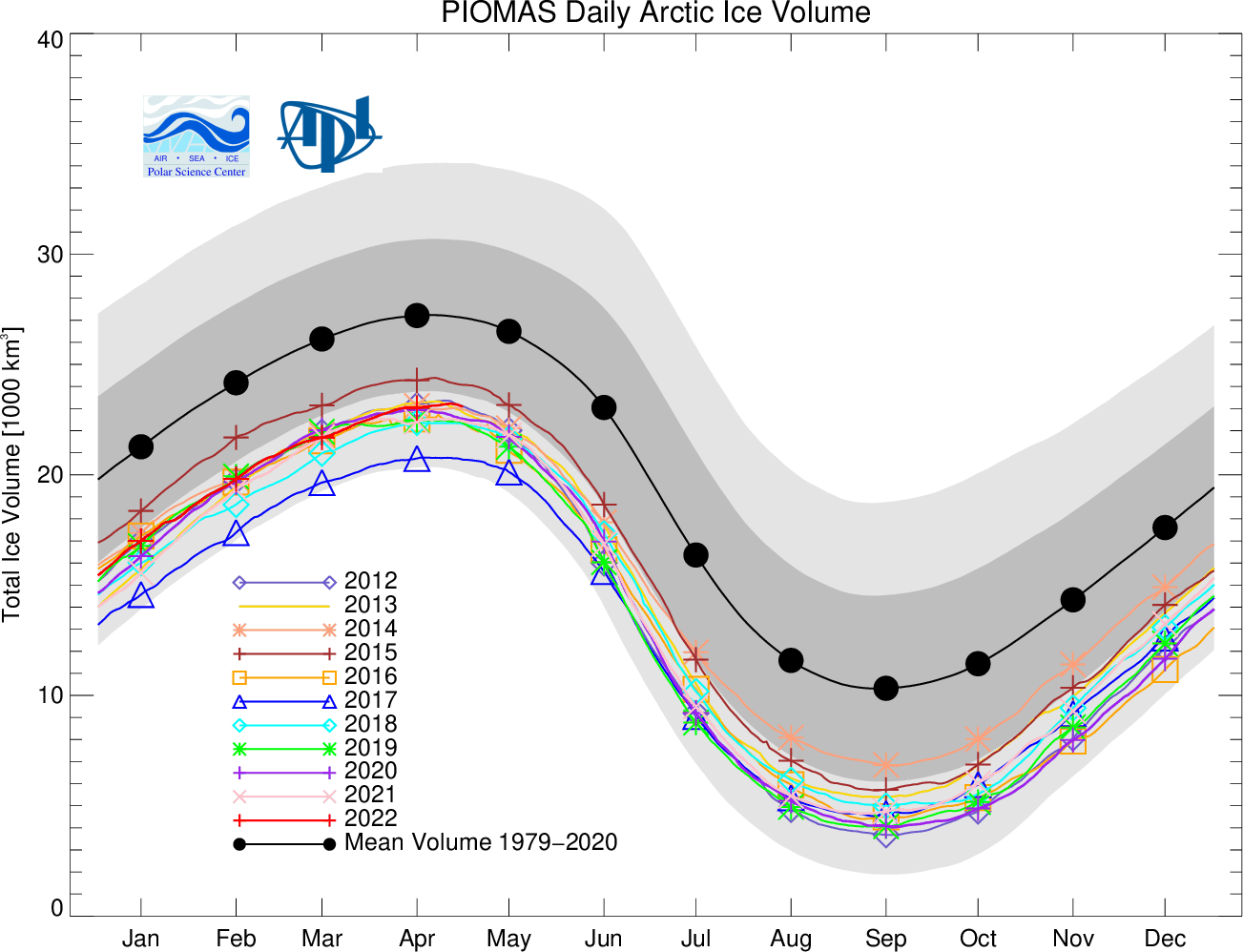
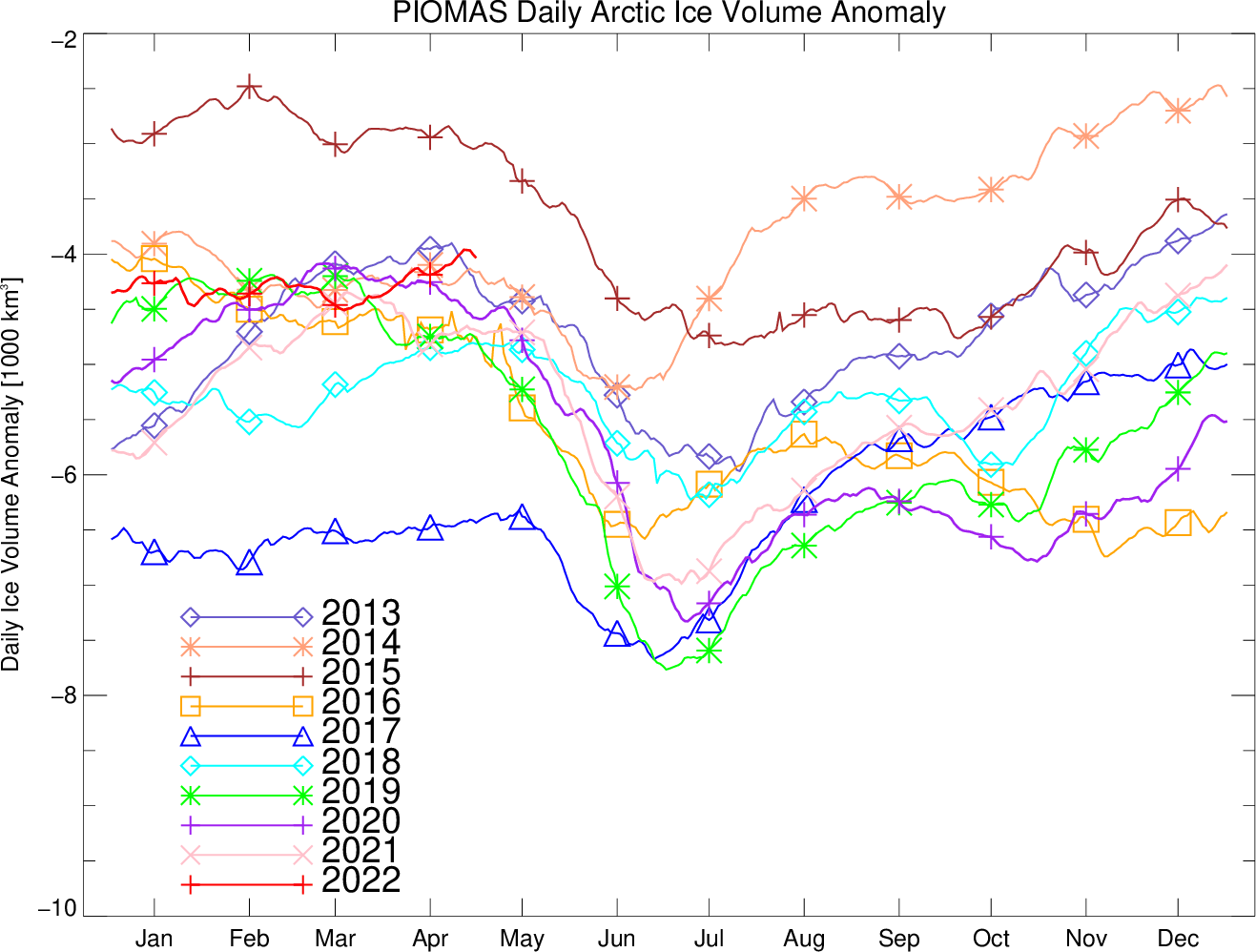
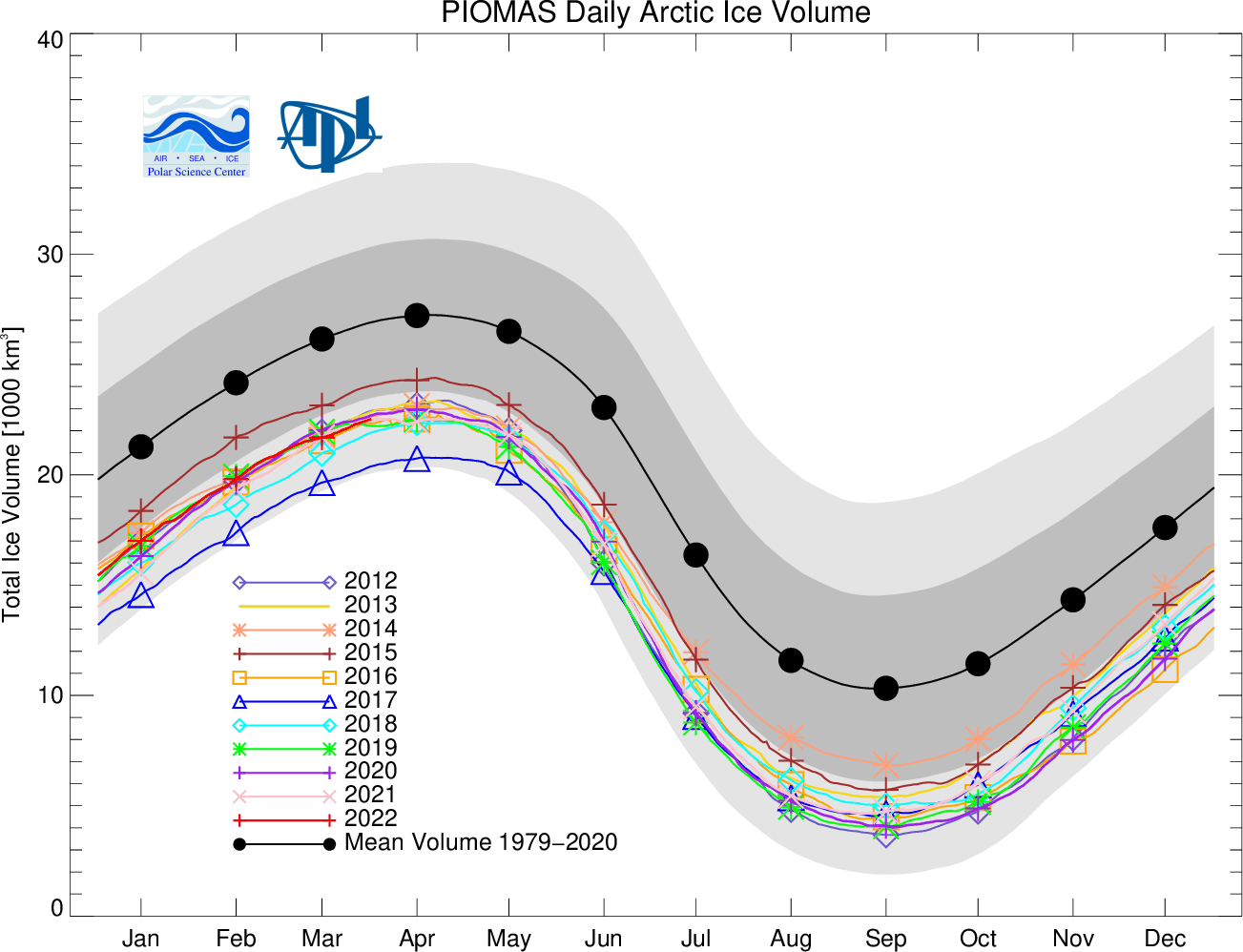
The Polar Science Center at the University of Washington has also released the PIOMAS volume data for March 2022:

Average Arctic sea ice volume in March 2022 was 21,700 km3. This value is the 6th lowest on record for March,  about  2,200 km3 above the  record set in 2017.   Monthly  ice volume was 38% below the maximum in 1979 and 25% below the mean value for 1979-2021:

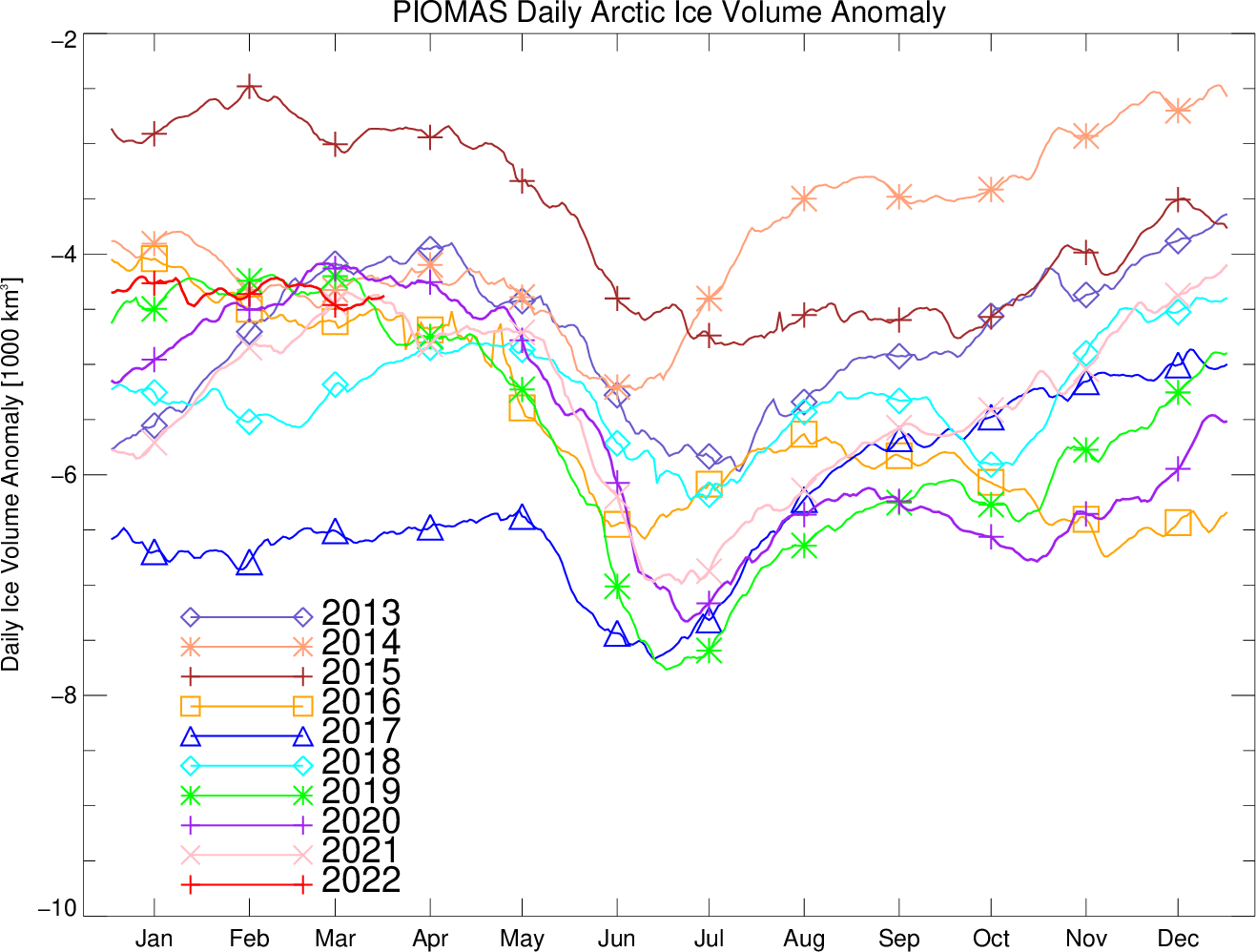
Ice growth anomalies for March 2022 continued to be at the upper end of the most recent decade with a mean ice thickness  (above 15 cm thickness) at the middle of  recent values:

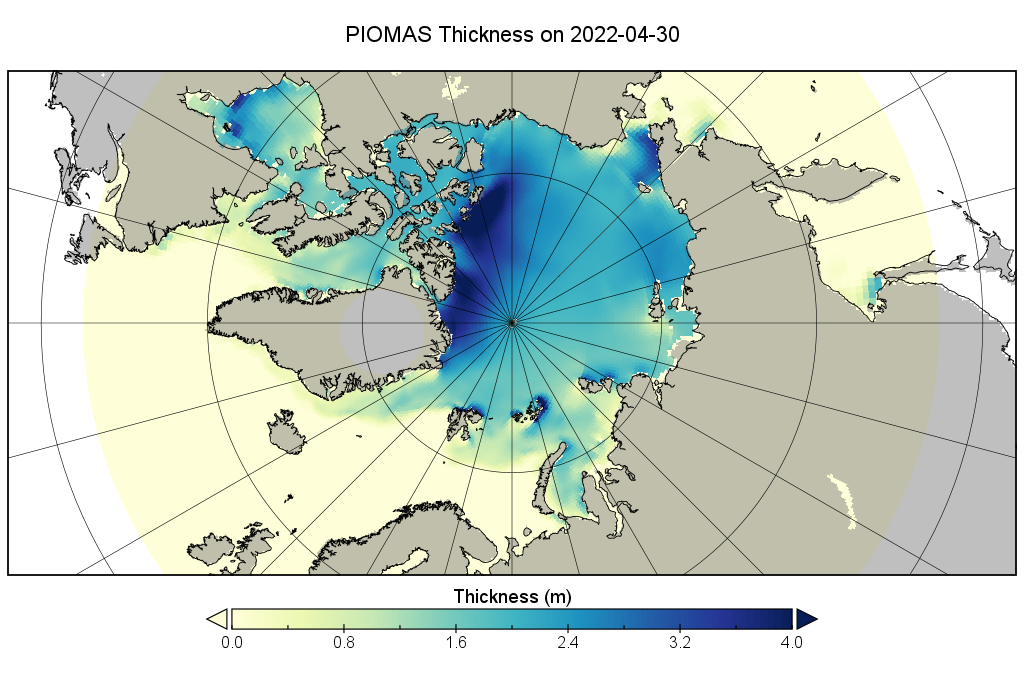
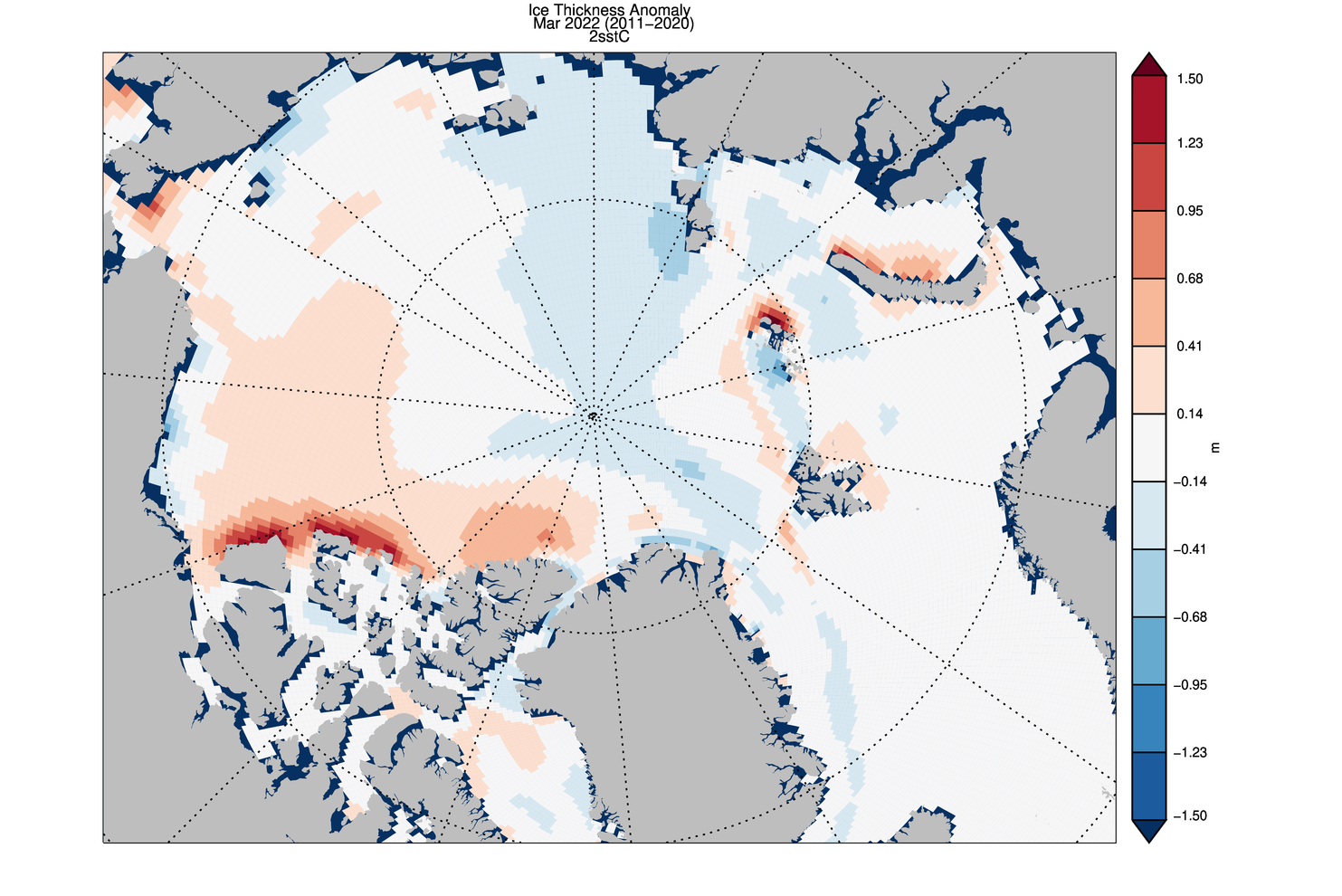
The ice thickness anomaly map for March 2022 relative to 2011-2020 divides the Arctic in two halves with positive anomalies in the “Western Arctic”  but negative anomalies in “Eastern Arctic”. A narrow band of negative anomalies remains along the coast of   North of Greenland but positive anomaly exists north of Baffin Island.

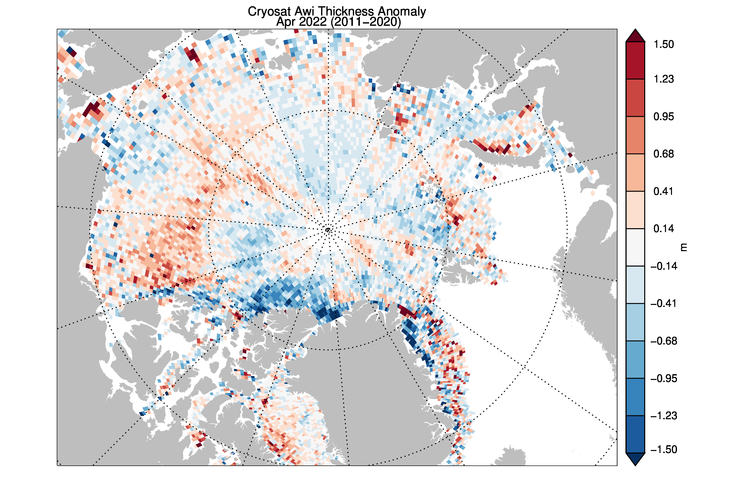
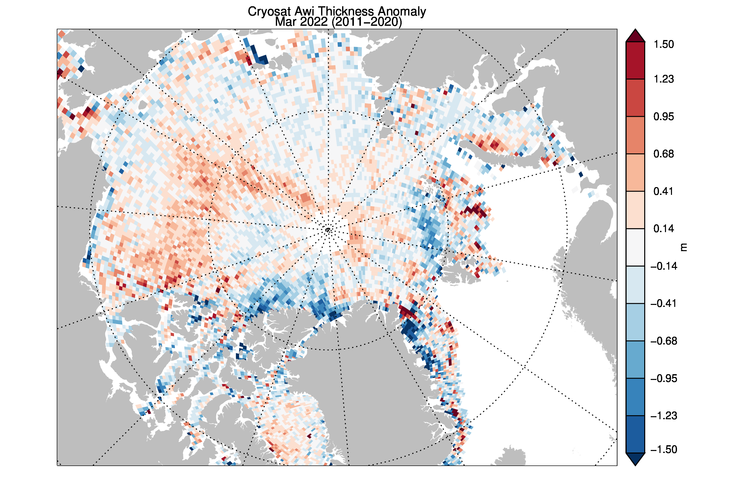
CryoSat 2 ice thickness shows an  similar pattern of sea ice thickness anomalies though the areas North of Greenland and Baffin Bay show substantial differences:

[Edit – April 10th]

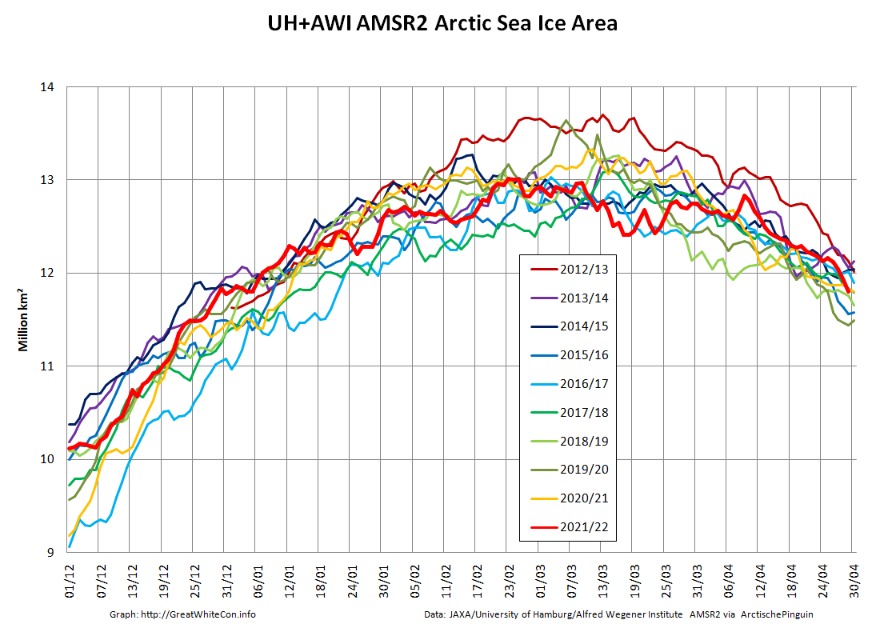
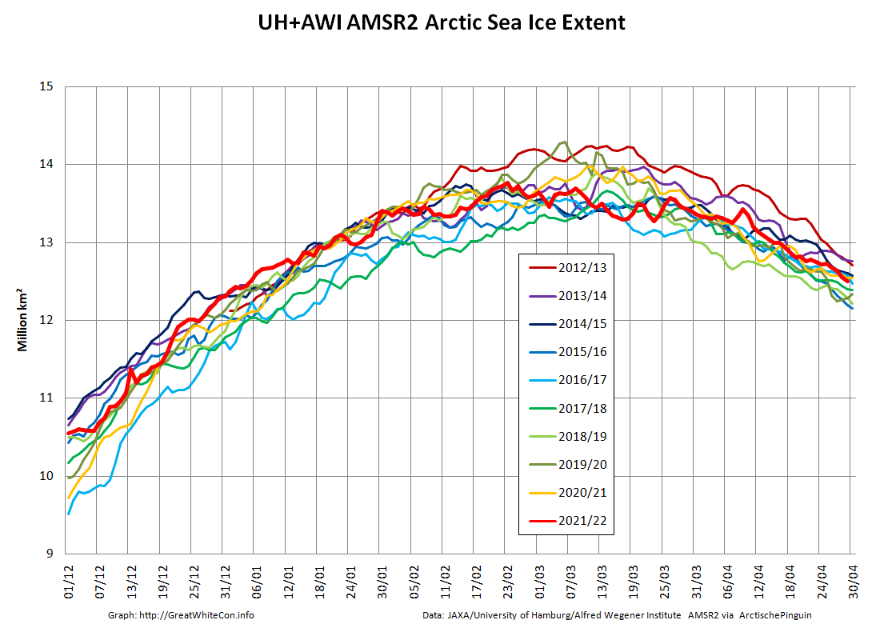
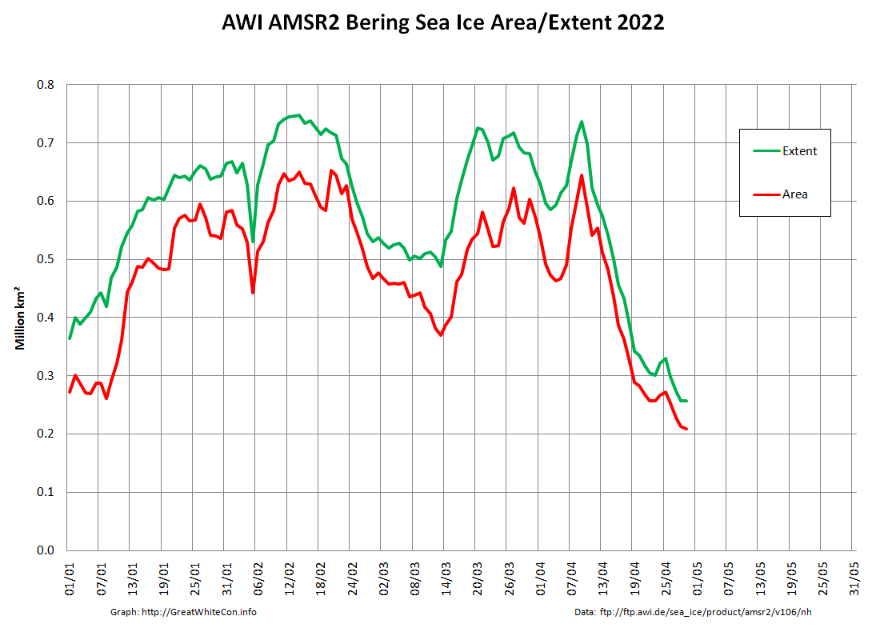
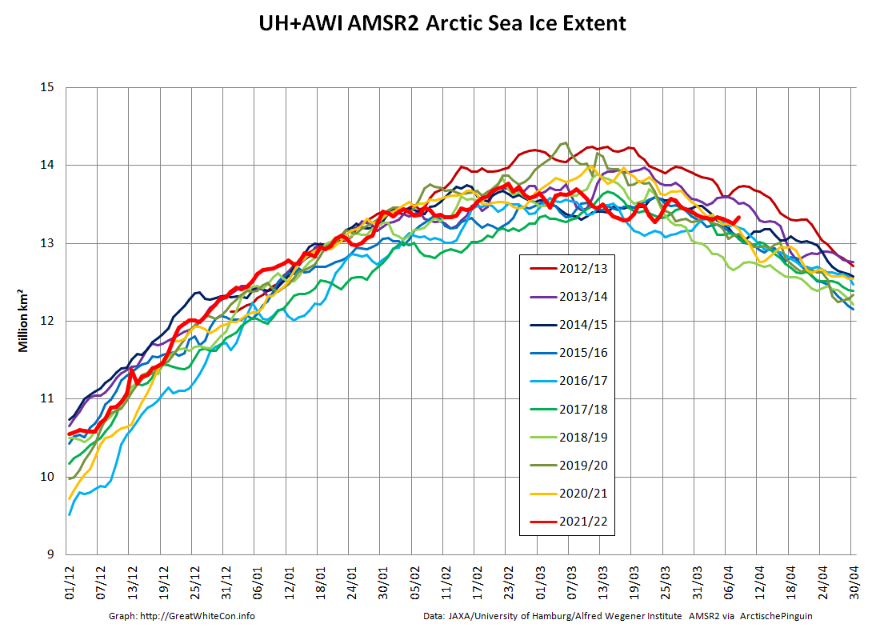
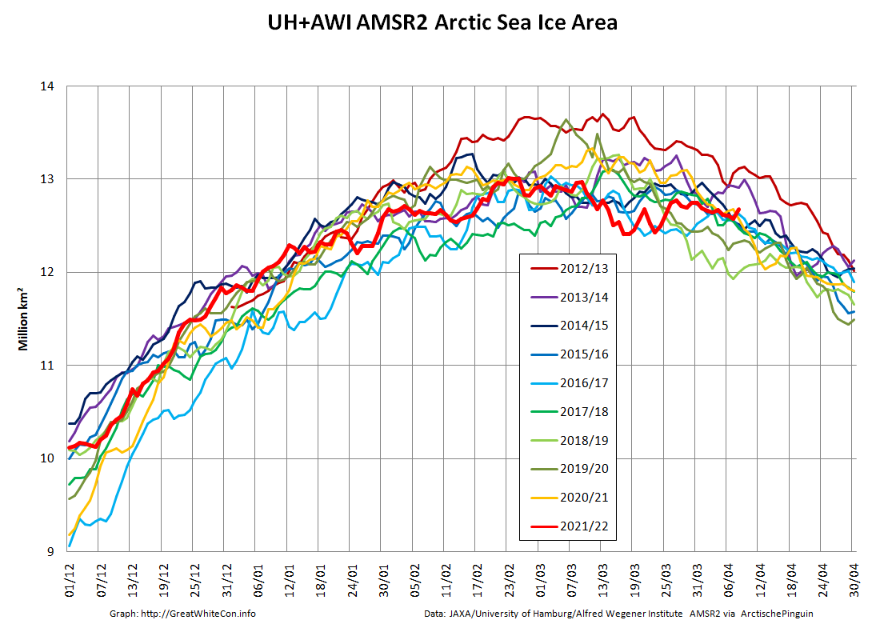
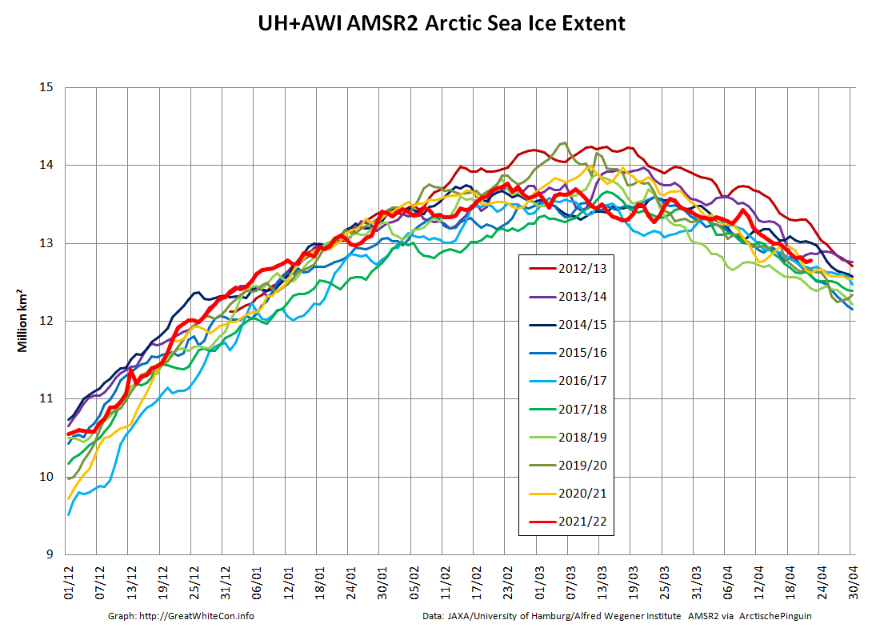
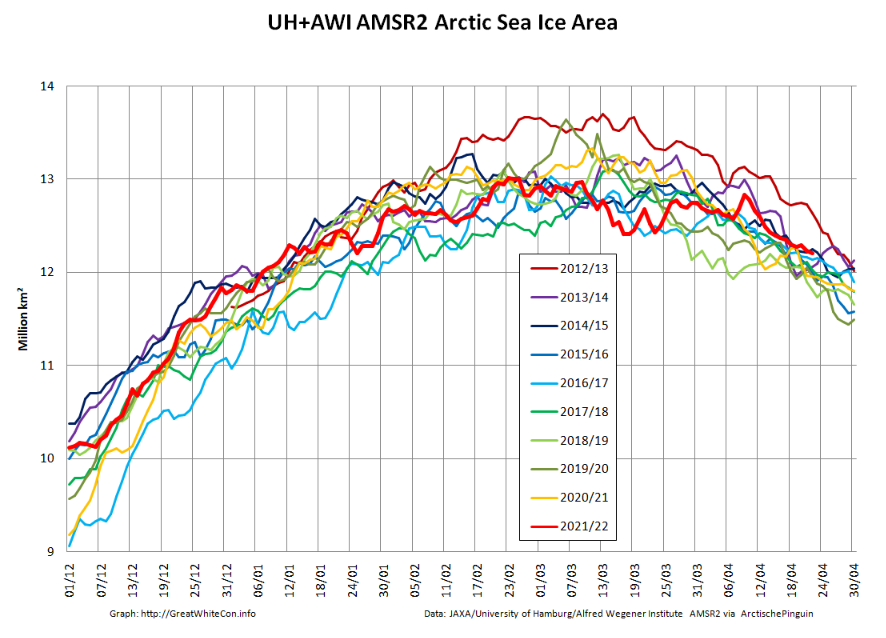
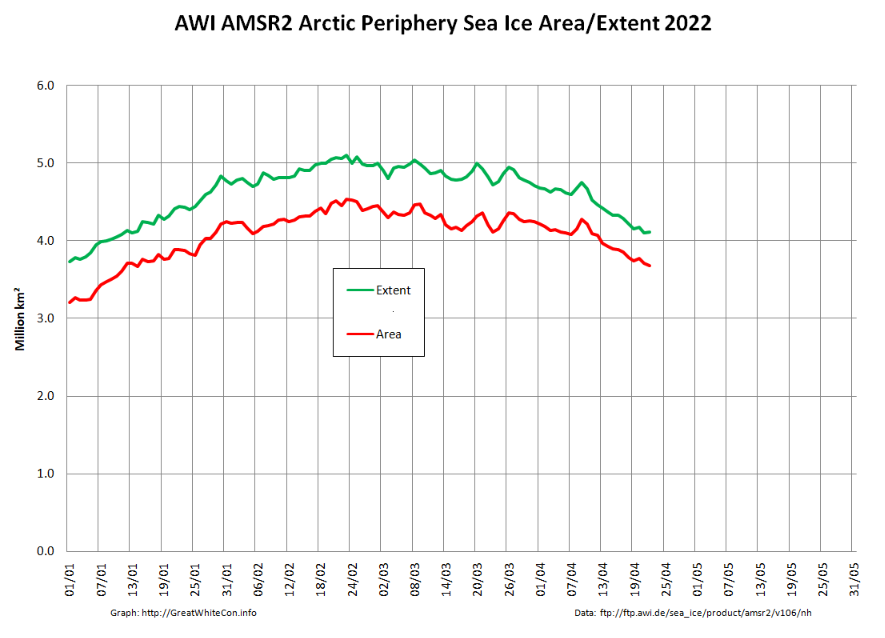
Here are the latest graphs of our favourite “high resolution” AMSR2 metrics, which combine recent data from the Alfred Wegener Institute with historical data from the University of Hamburg:


As you can see, there have indeed been a few ups and downs! Click the image below to see a 10 Mb animation of ice motion over the last few weeks:

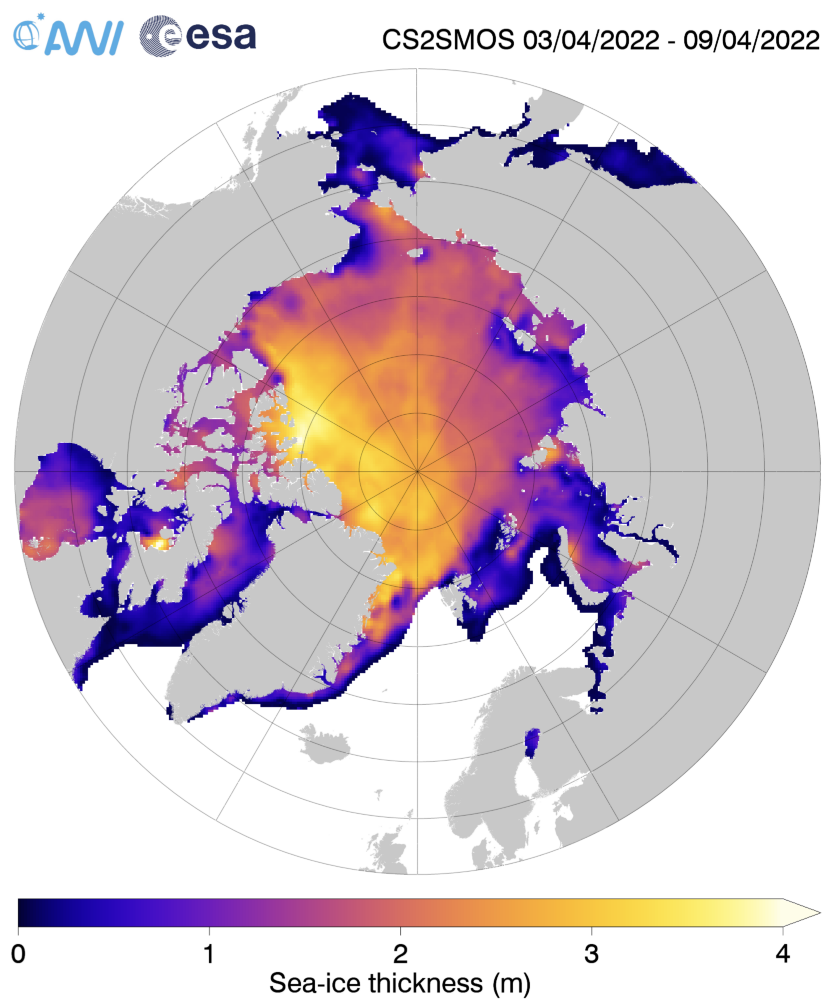
The obvious point to note at the moment is that there are currently long flaw leads on both the Siberian and Canadian sides of the Arctic Ocean. The animation also reveals episodes of open water in the Beaufort and Chukchi Seas, as well as north of Franz Josef Land and Svalbard.

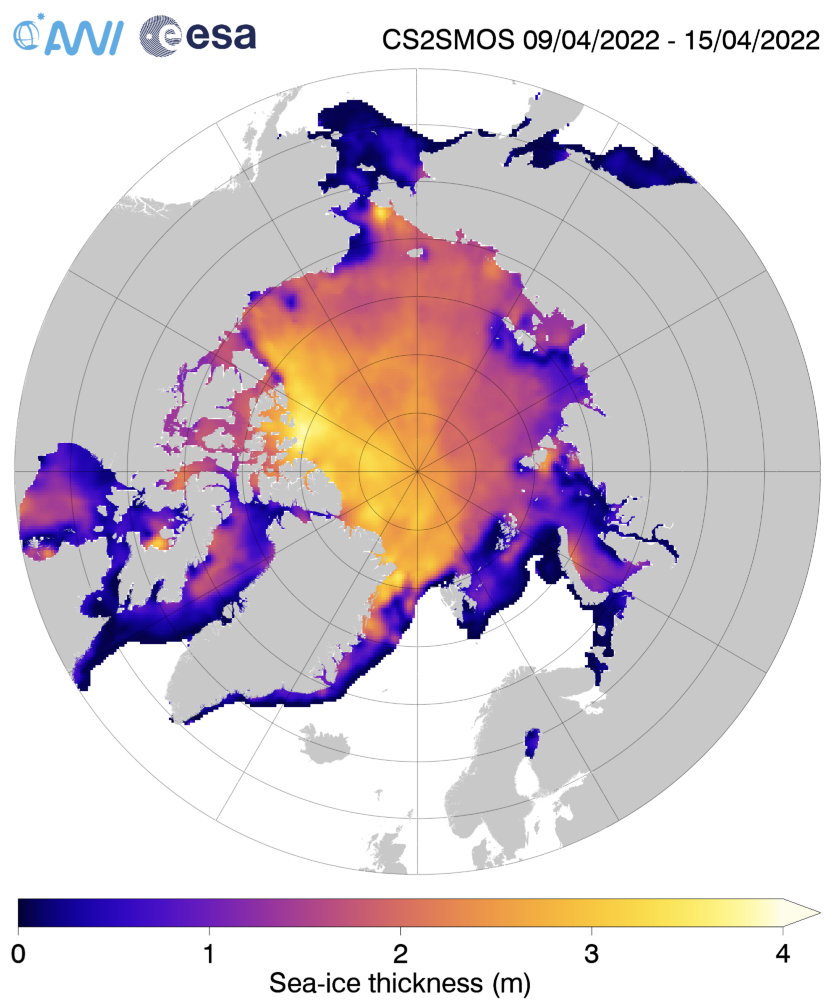
The ice in those areas is still very thin on the latest AWI CryoSat-2/SMOS sea ice thickness map:

[Edit – April 11th]

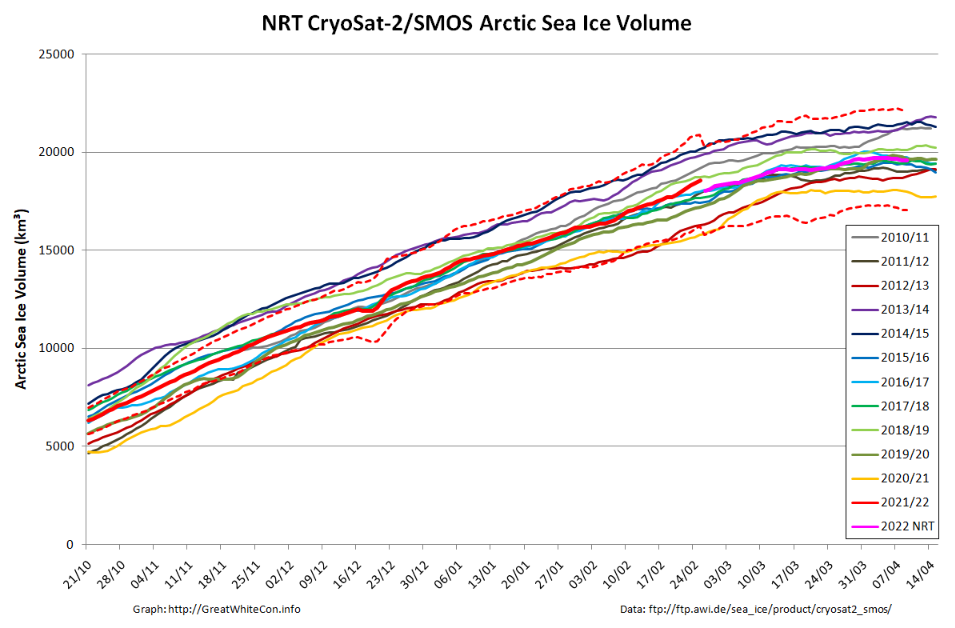
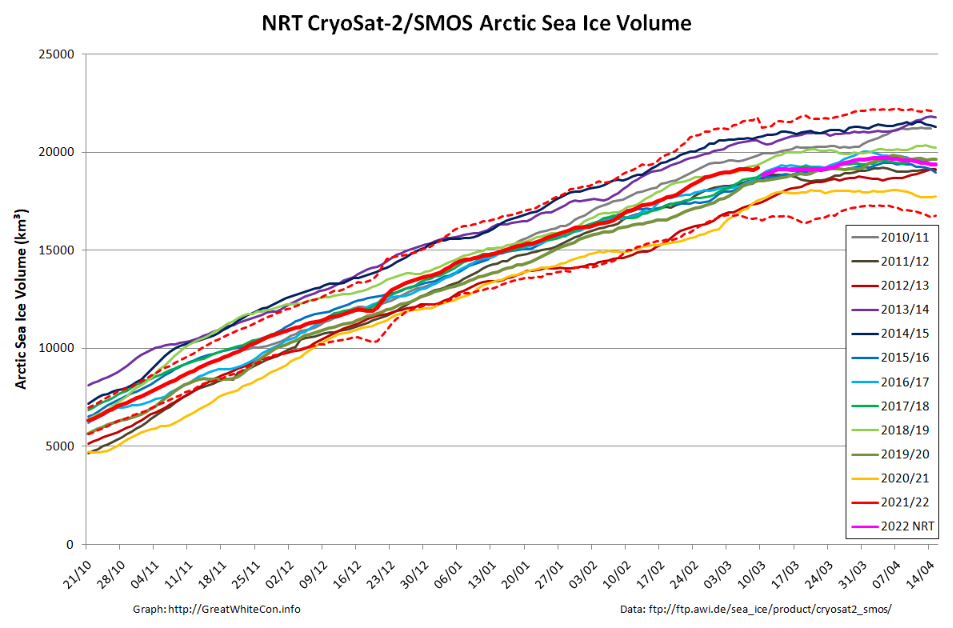
Here too is the latest AWI CryoSat-2/SMOS volume graph:

The reanalysed data is now showing something of a surge towards the end of February.

[Edit – April 23rd]

Here’s the last “near real time” AWI CryoSat-2/SMOS Arctic sea ice thickness map for Spring 2022:

The significantly thinner areas in the Beaufort and Chukchi Seas are even more pronounced than previously. Here also is the associated CS2/SMOS volume graph:

The 2022 maximum volume based on NRT data is 19719 km³ on April 5th. Expect that to be revised upwards when the reanalysed data is ultimately published.

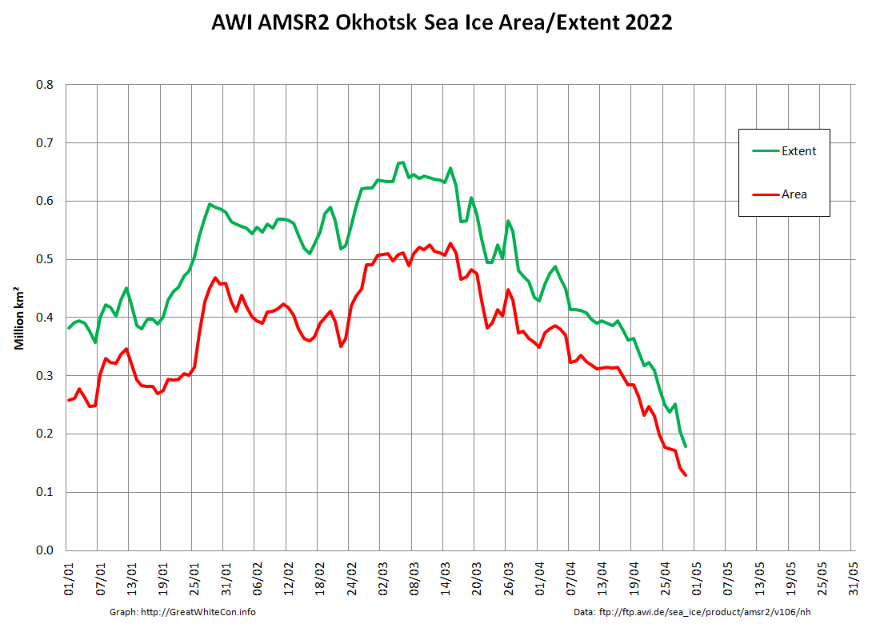
Going back to 2 dimensions, the assorted “ups and downs” now seem to have resolved into the melting season proper:

The peripheral sea have been responsible for most of the recent decline:

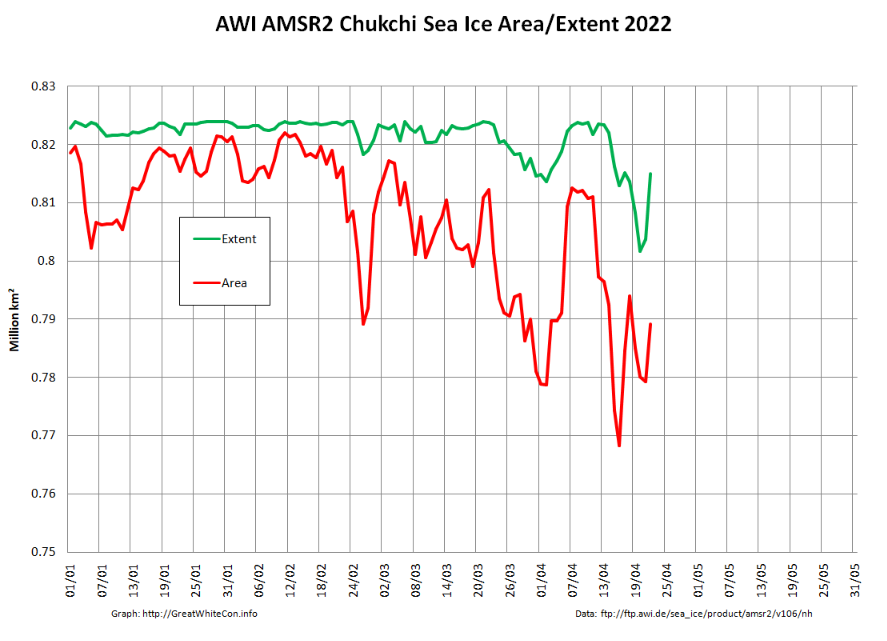
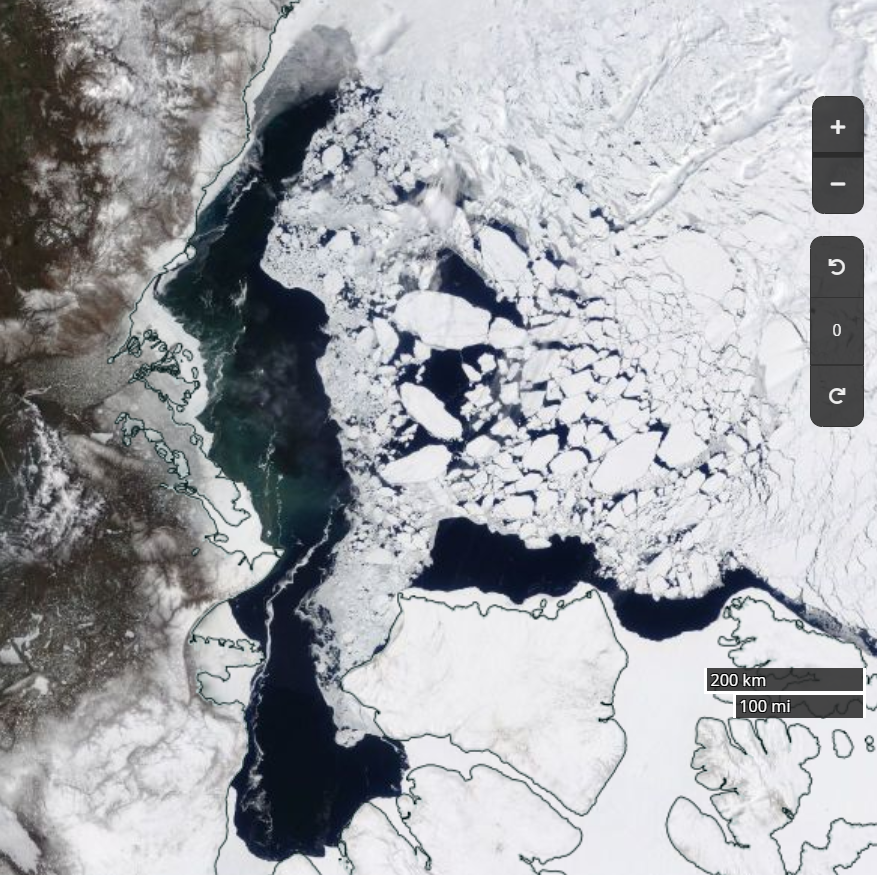
However as mentioned above, the Chukchi Sea has been experiencing some ups and downs of its own. Perhaps the sun is now high enough in the sky for the most recent “down” to stick around for the summer?

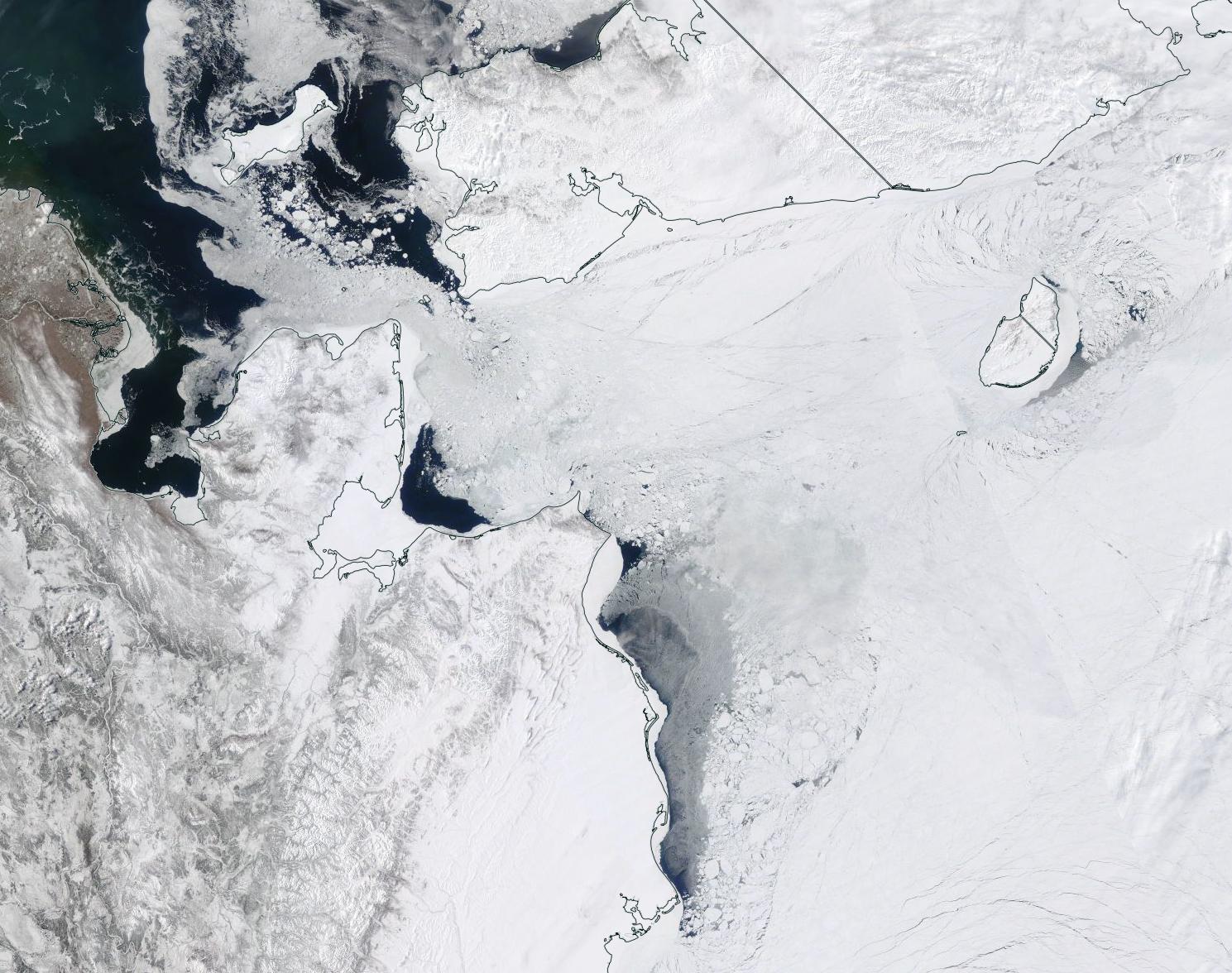
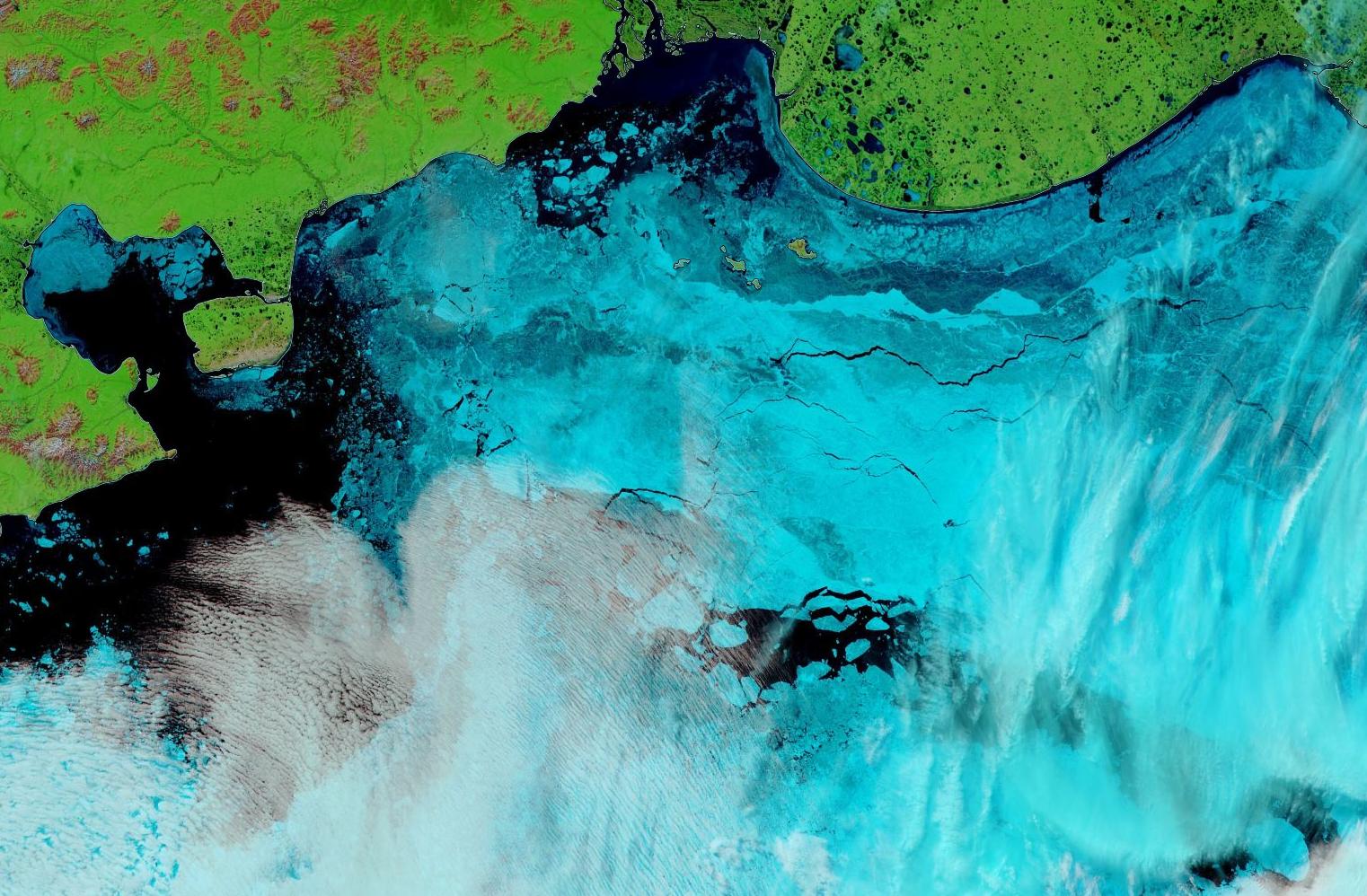
“True colour” image of the Chukchi Sea on April 21st from the MODIS instrument on the Terra satellite

[Edit – April 24th]

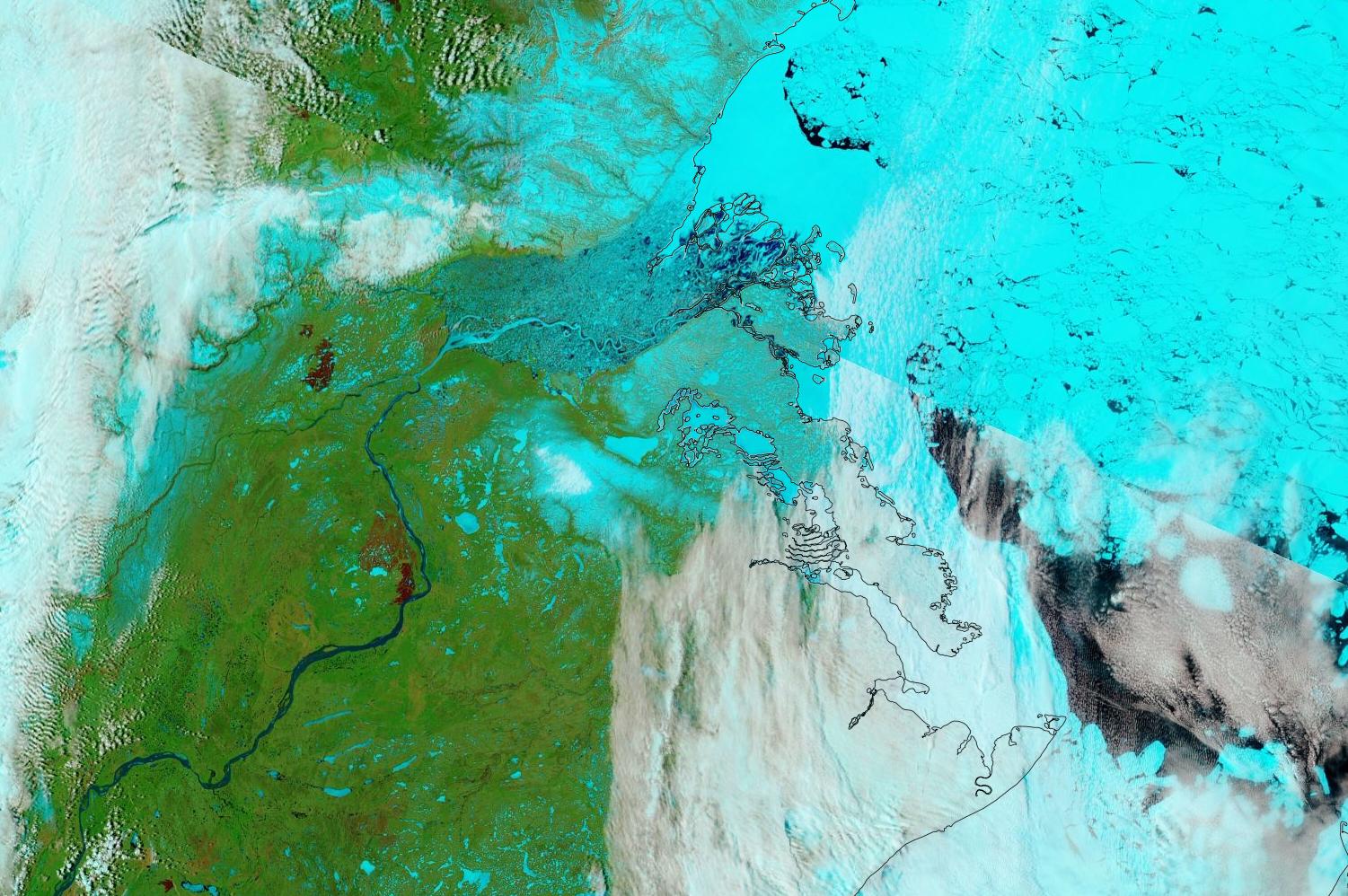
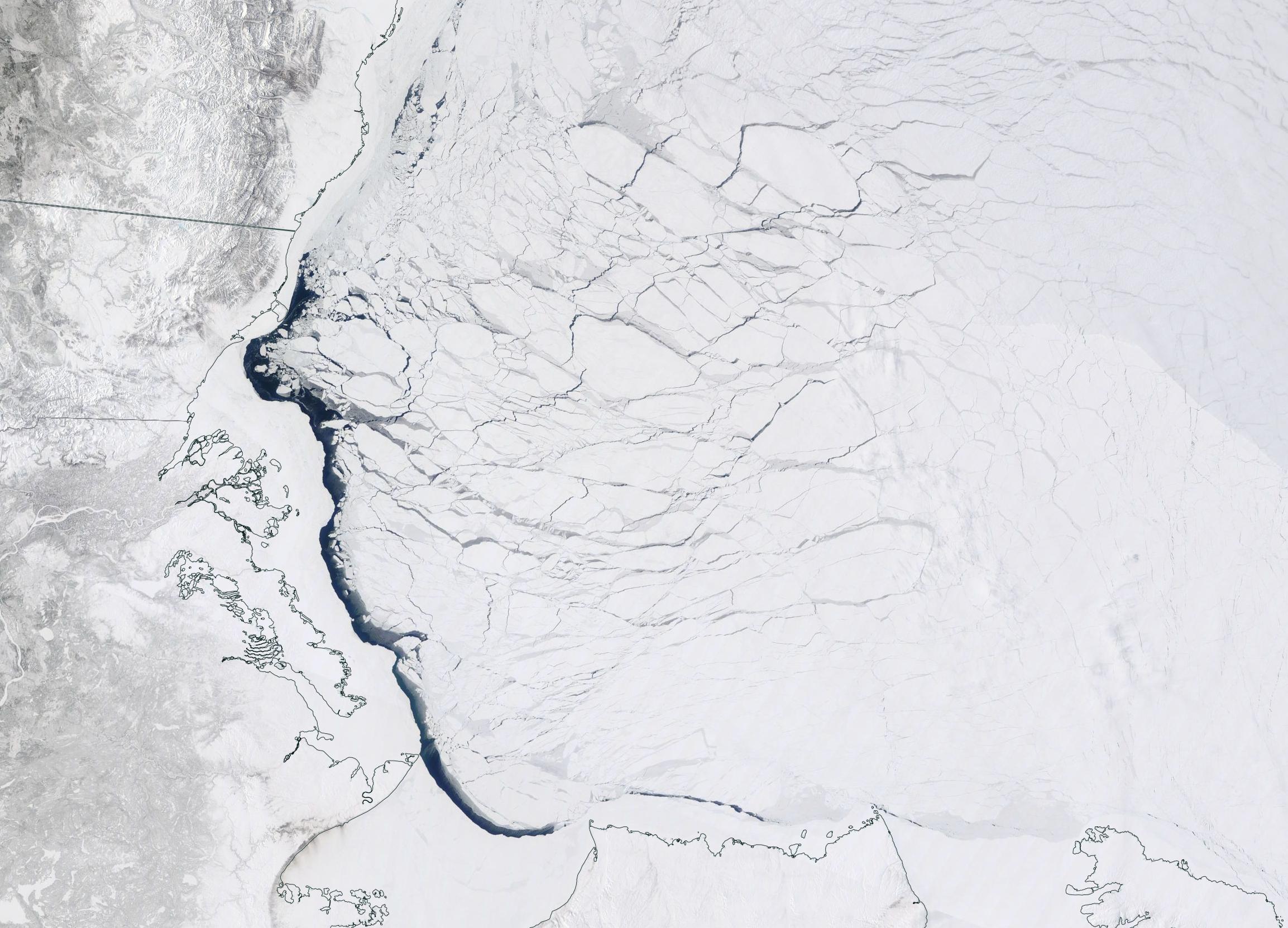
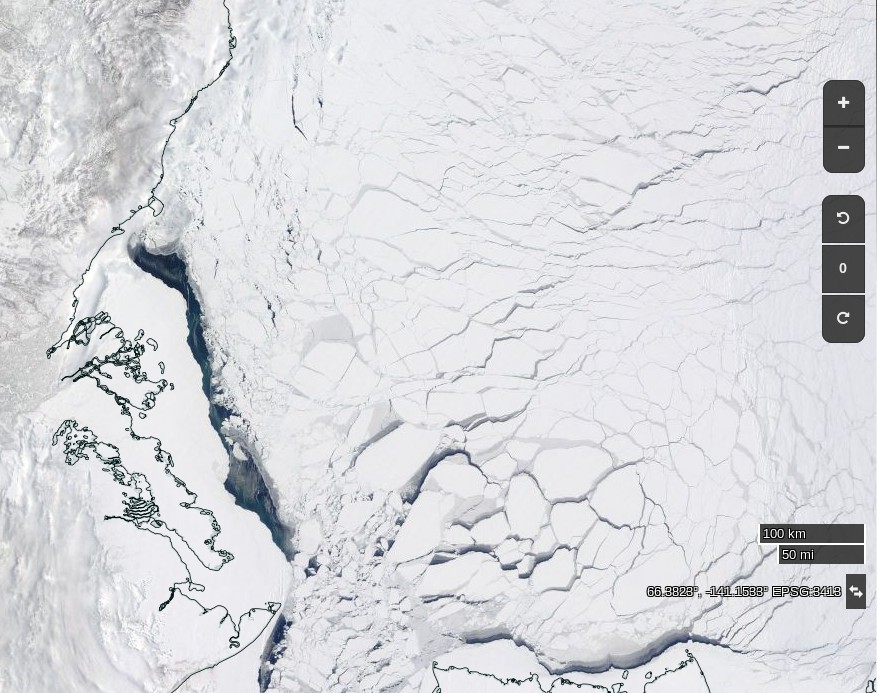
Over the last couple of days some open water has appeared in the Beaufort Sea off the Mackenzie Delta:

“True colour” image of the Beaufort Sea on April 23rd from the MODIS instrument on the Terra satellite

[Edit – April 25th]

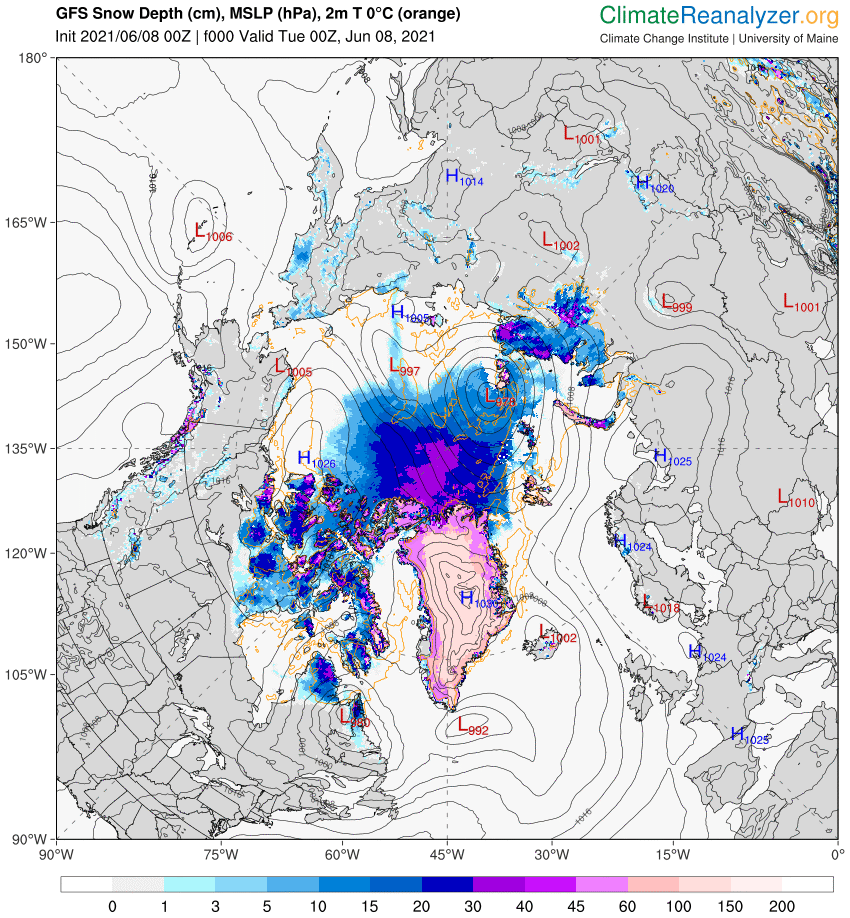
Especially for Taylor, here’s the GFS Arctic snow depth forecast for 10 days into the future:

See in particular the Beaufort and Chukchi areas.

Please also see the new open thread for May 2022

Facts About the Arctic in November 2021

It’s not November until tomorrow, but Andy Lee Robinson has just published the 2021 edition of his long running “Arctic ice cube” video series, based on the PIOMAS volume data. Here it is for your edification:

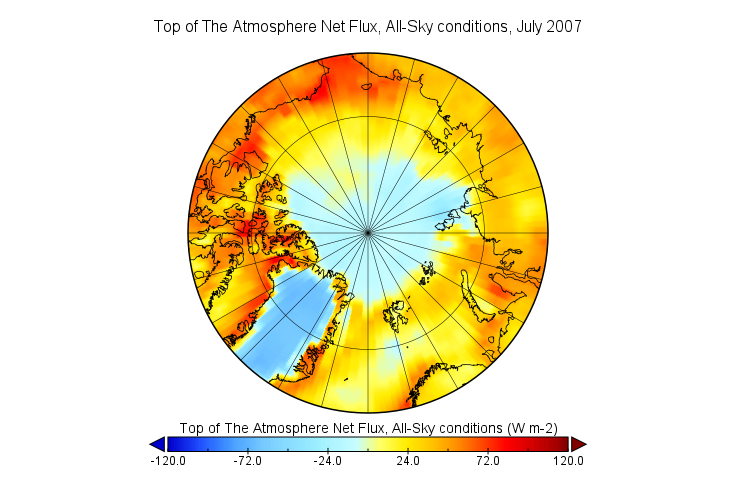
You may also wish to keep tabs on our deep dive into CERES top of the atmosphere energy flux data. Here’s a sneak preview:

[Edit – November 3rd]

In stark contrast to other recent years, northern hemisphere snow cover is very low at the moment:

Continue reading Facts About the Arctic in November 2021

Facts About the Arctic in June 2021

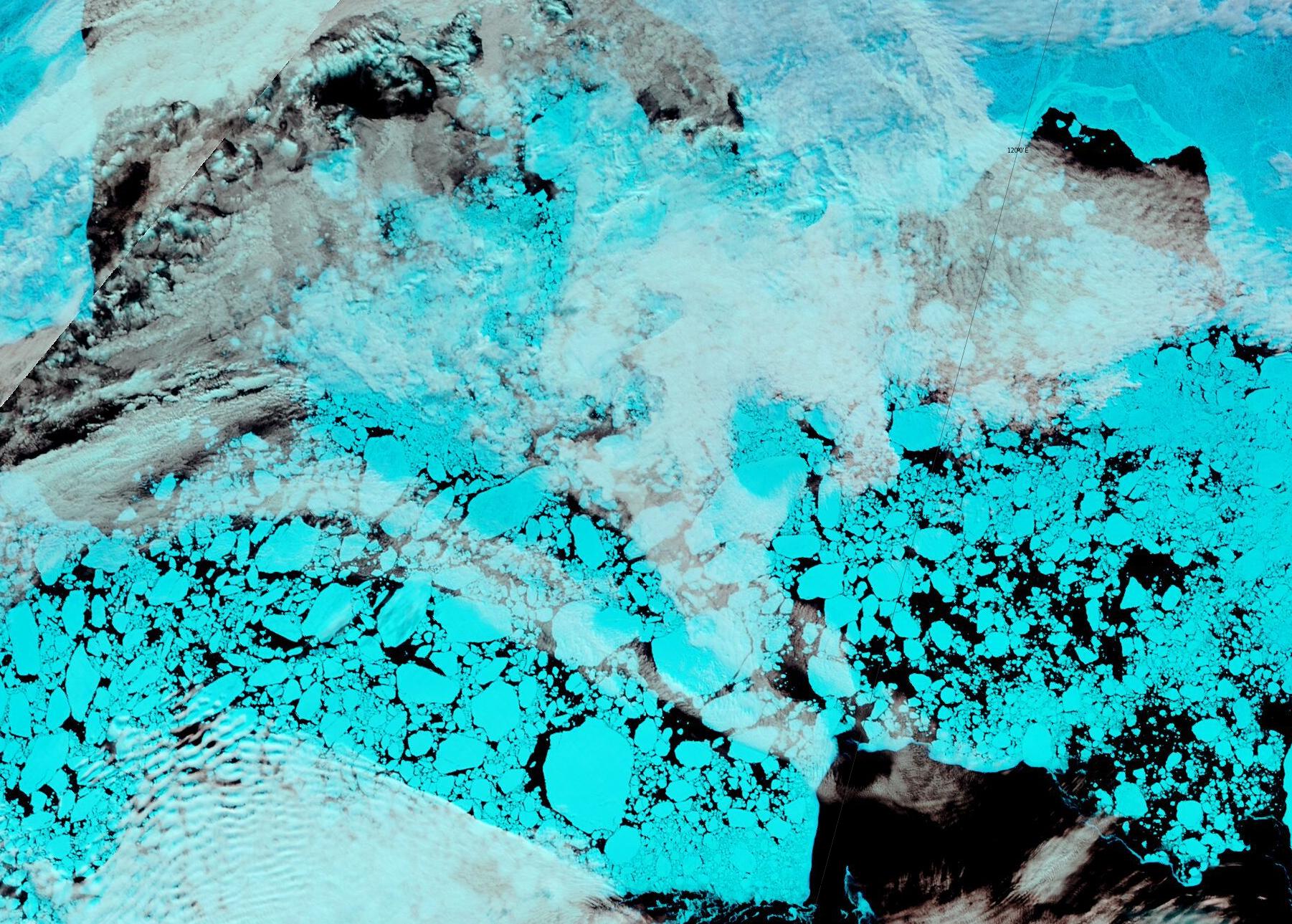
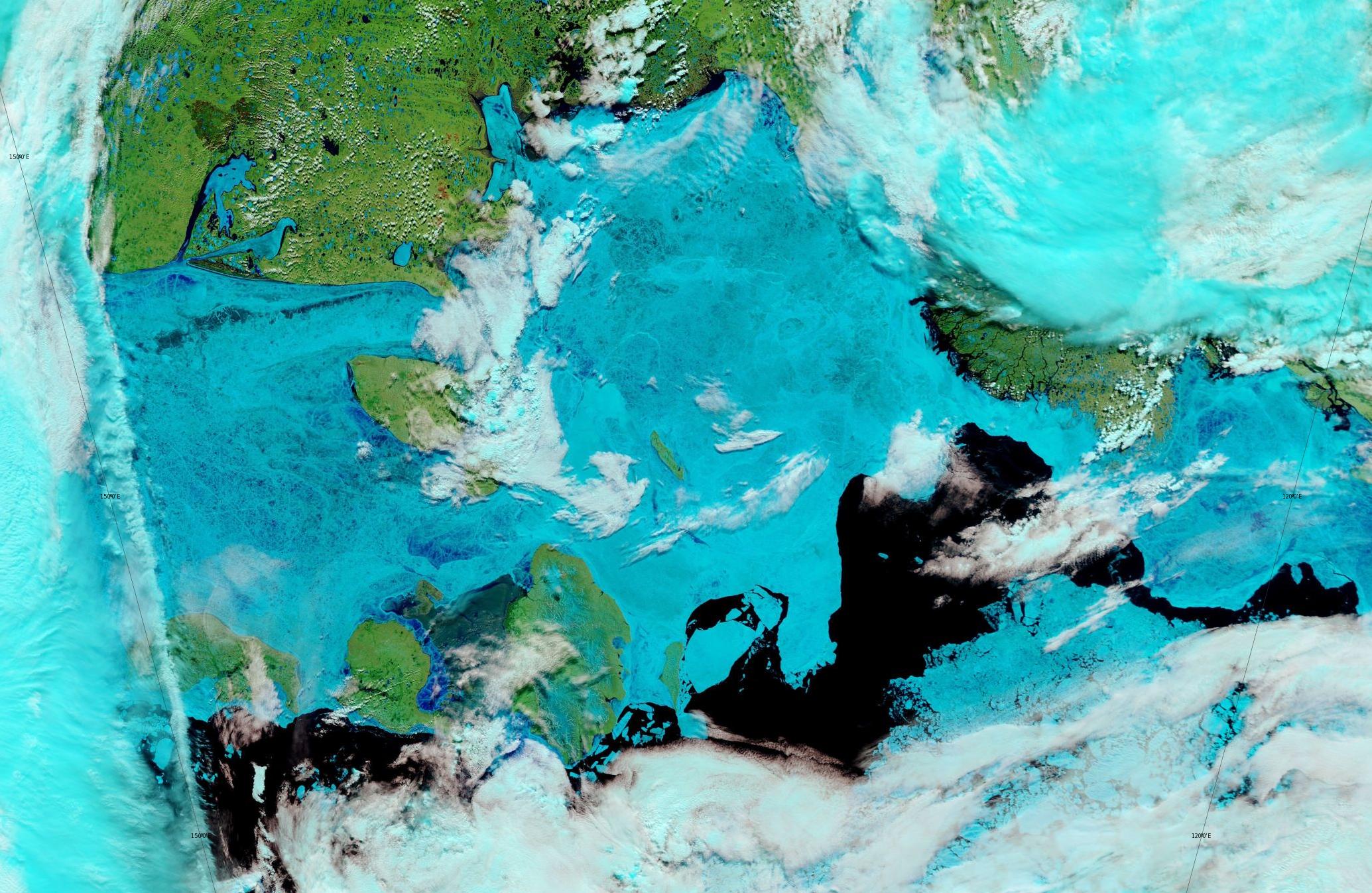
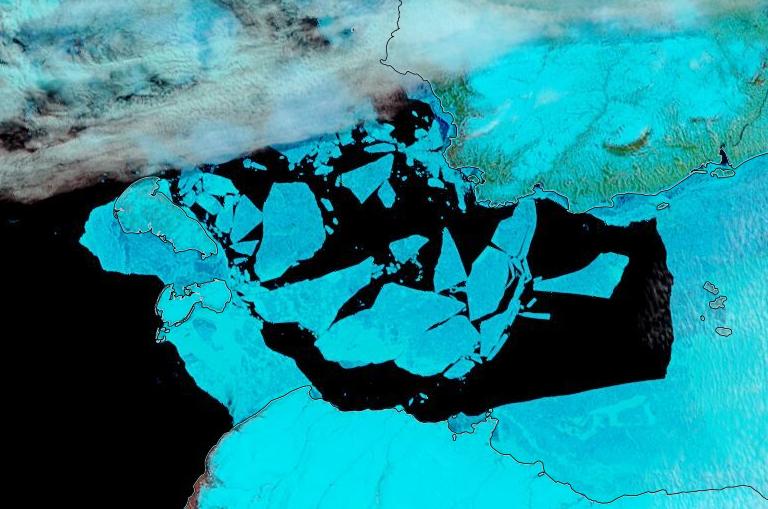
Let’s begin the month with a “true colour” image from the Terra satellite of the Laptev Sea and thereabouts:

The blueish tinge indicates the appearance of melt ponds almost everywhere over the land-fast ice currently covering the majority of the Laptev Sea.

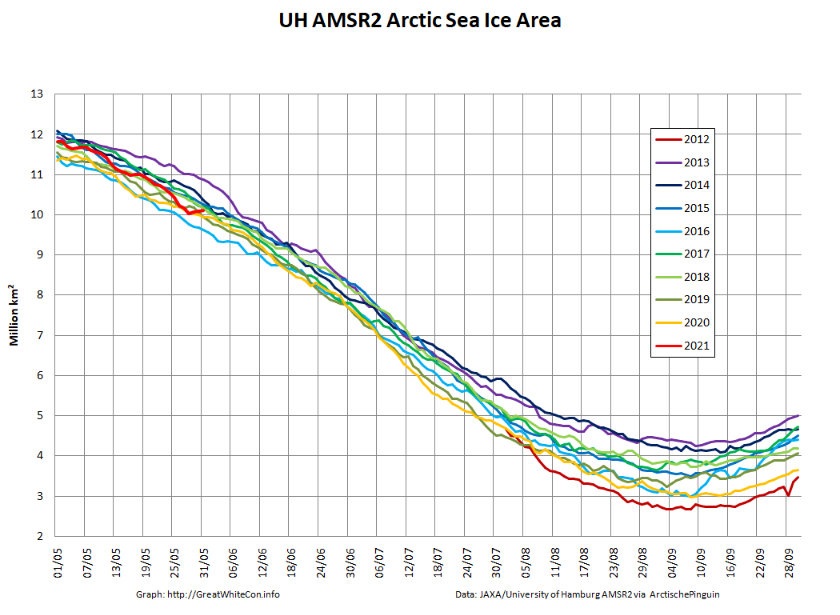
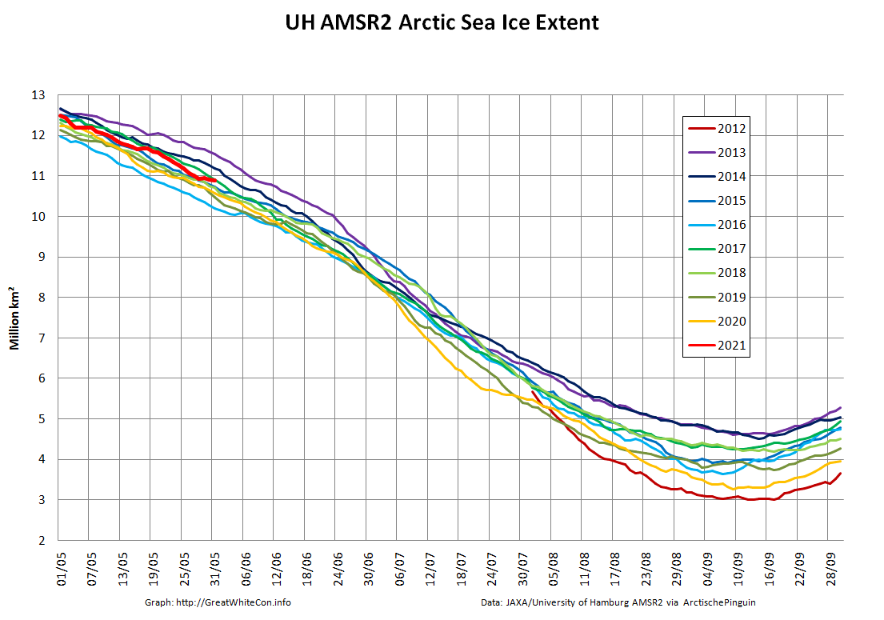
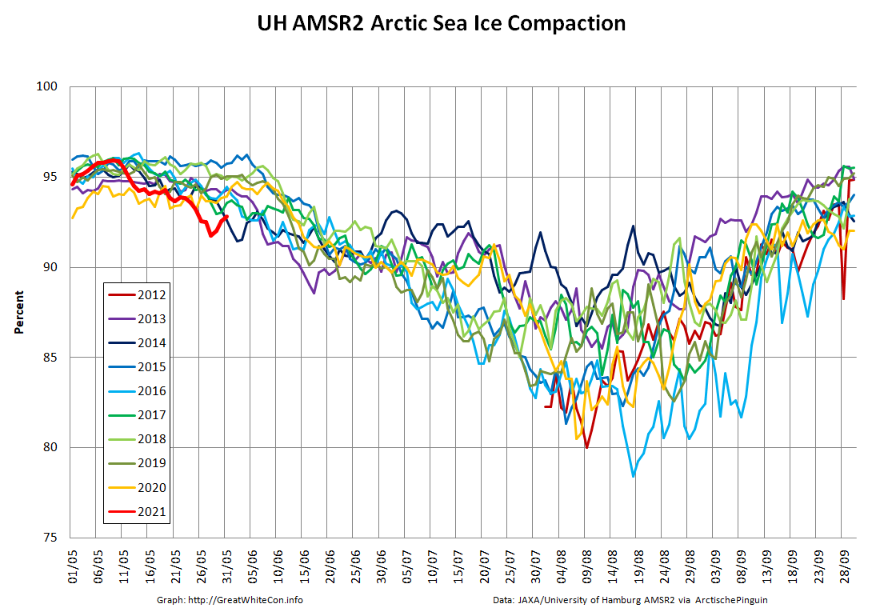
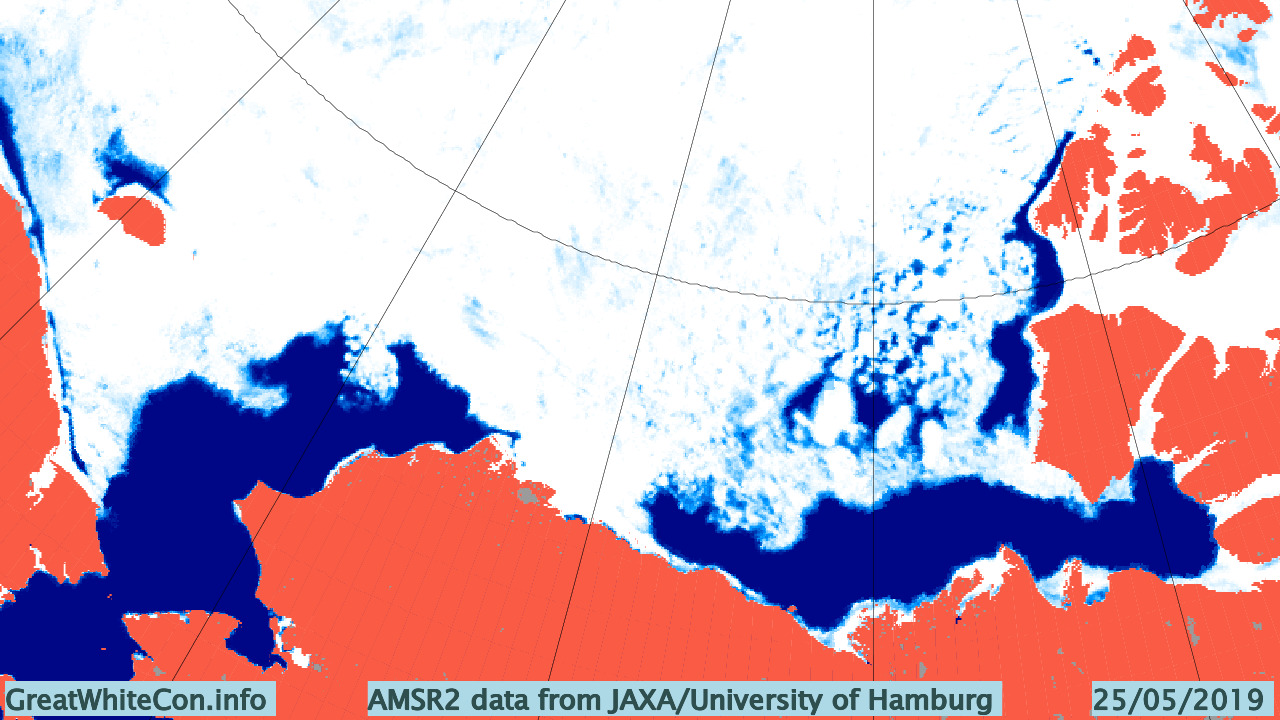
Let’s also take a look at the high resolution AMSR2 metrics for the end of May 2021:

Thanks to the recent “brief hiatus” in areal decline, Arctic wide compaction is no longer in record territory:

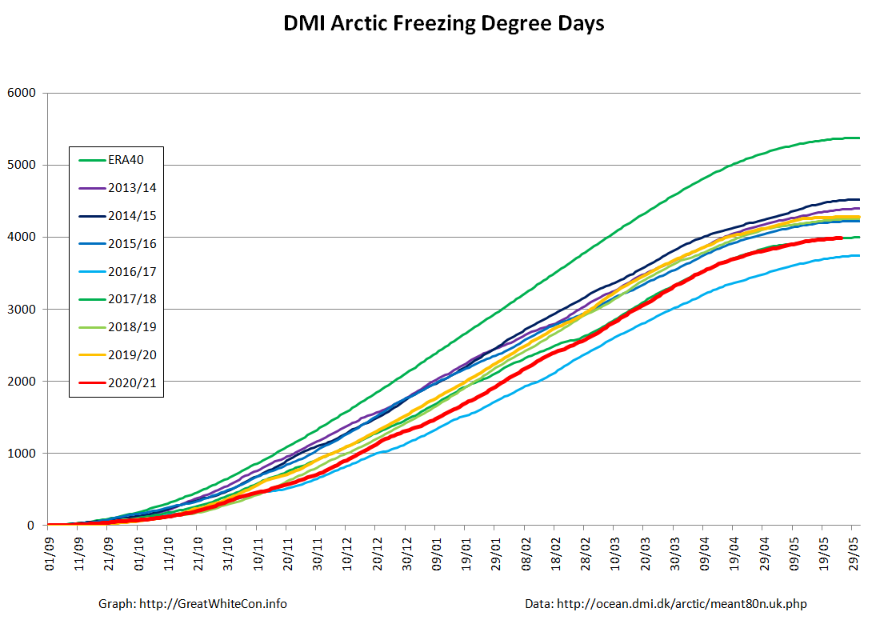
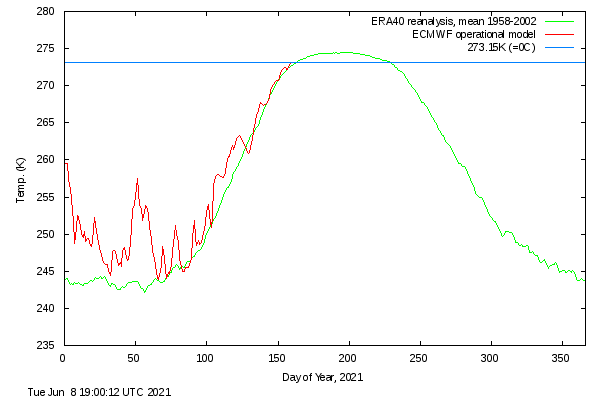
Finally, for the moment at least, here is the Danish Meteorological Institute’s high Arctic temperature data in the form of a graph of freezing degree days:

For some reason the data file still doesn’t include data to the end of May, but things won’t change much by then. Over the winter as a whole only 2016/17 was significantly warmer.

Let the 2021 Arctic sea ice summer melting season officially begin!

[Edit – June 4th]

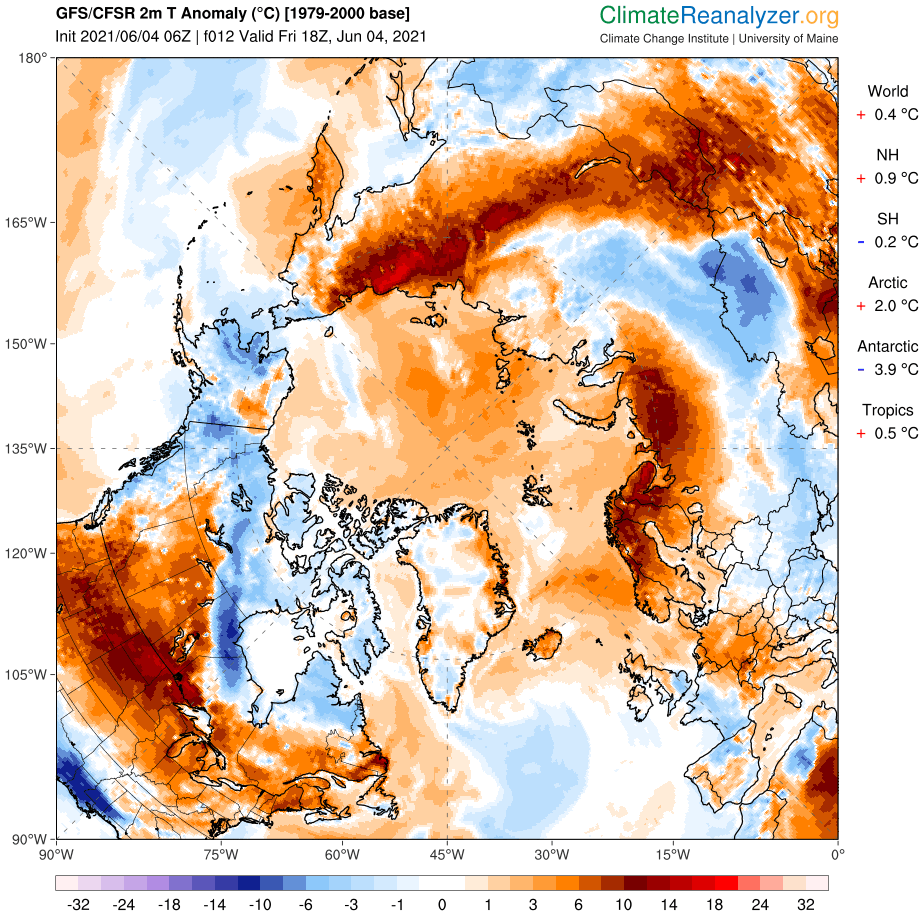
Perhaps unsurprisingly the GFS forecast from four days ago hasn’t quite worked out as predicted. The Arctic as a whole is certainly on the warm side, with a +2 C anomaly at this moment:

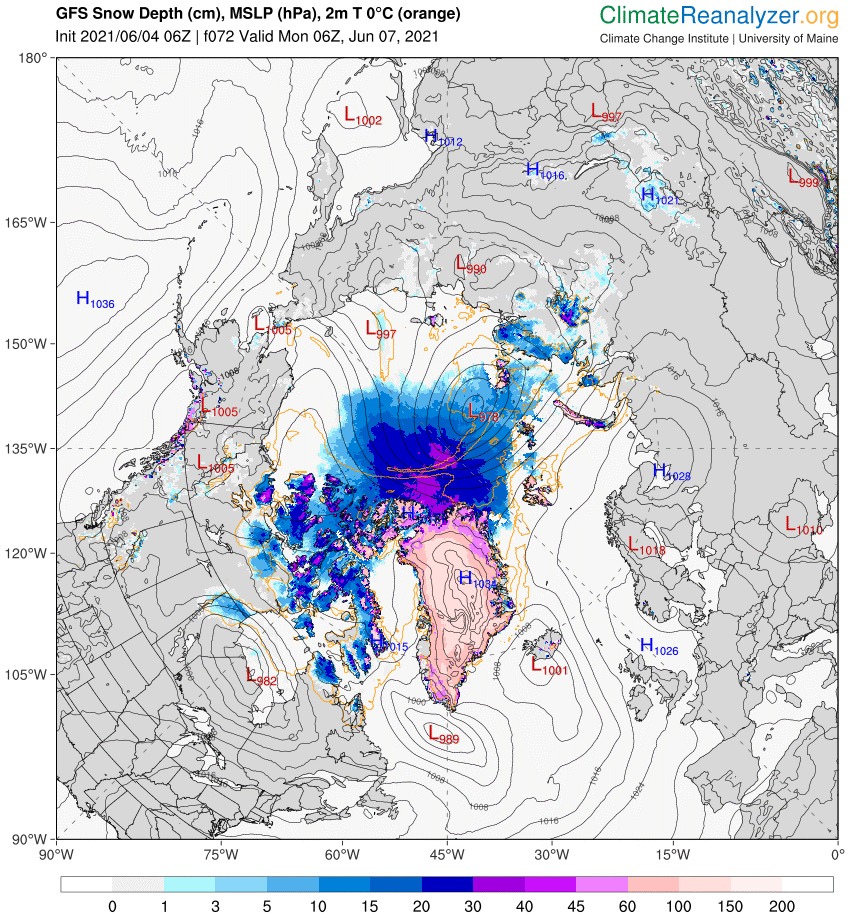
However the 966 hPa MSLP cyclone predicted for Monday is now forecast to be a mere 978 hPa:

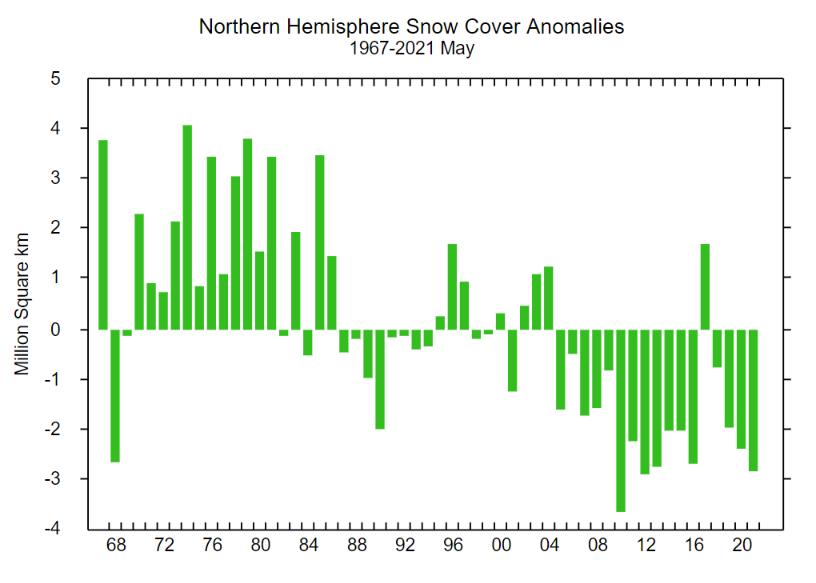
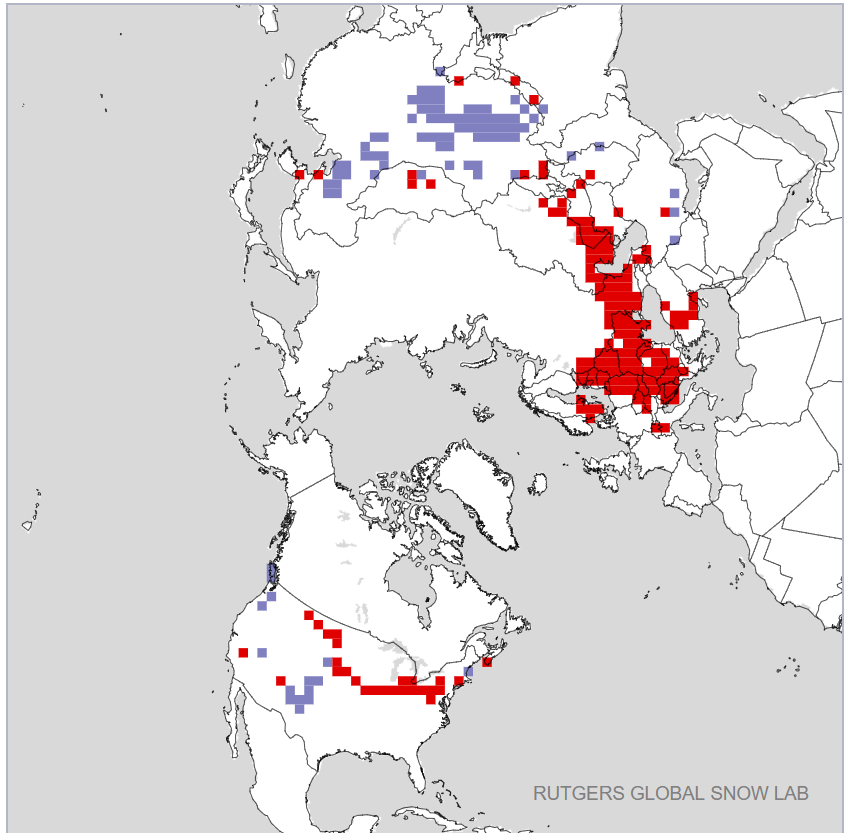
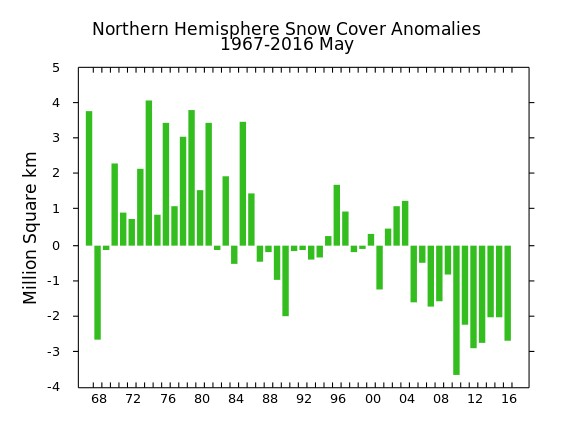
With 3 days to go there is a reasonable chance of it verifying in the “New Arctic” of 2021. As you can see from the map above a large area of the Central Arctic has now lost its snow cover. This is confirmed by the Rutgers Snow Lab northern hemisphere data for May:

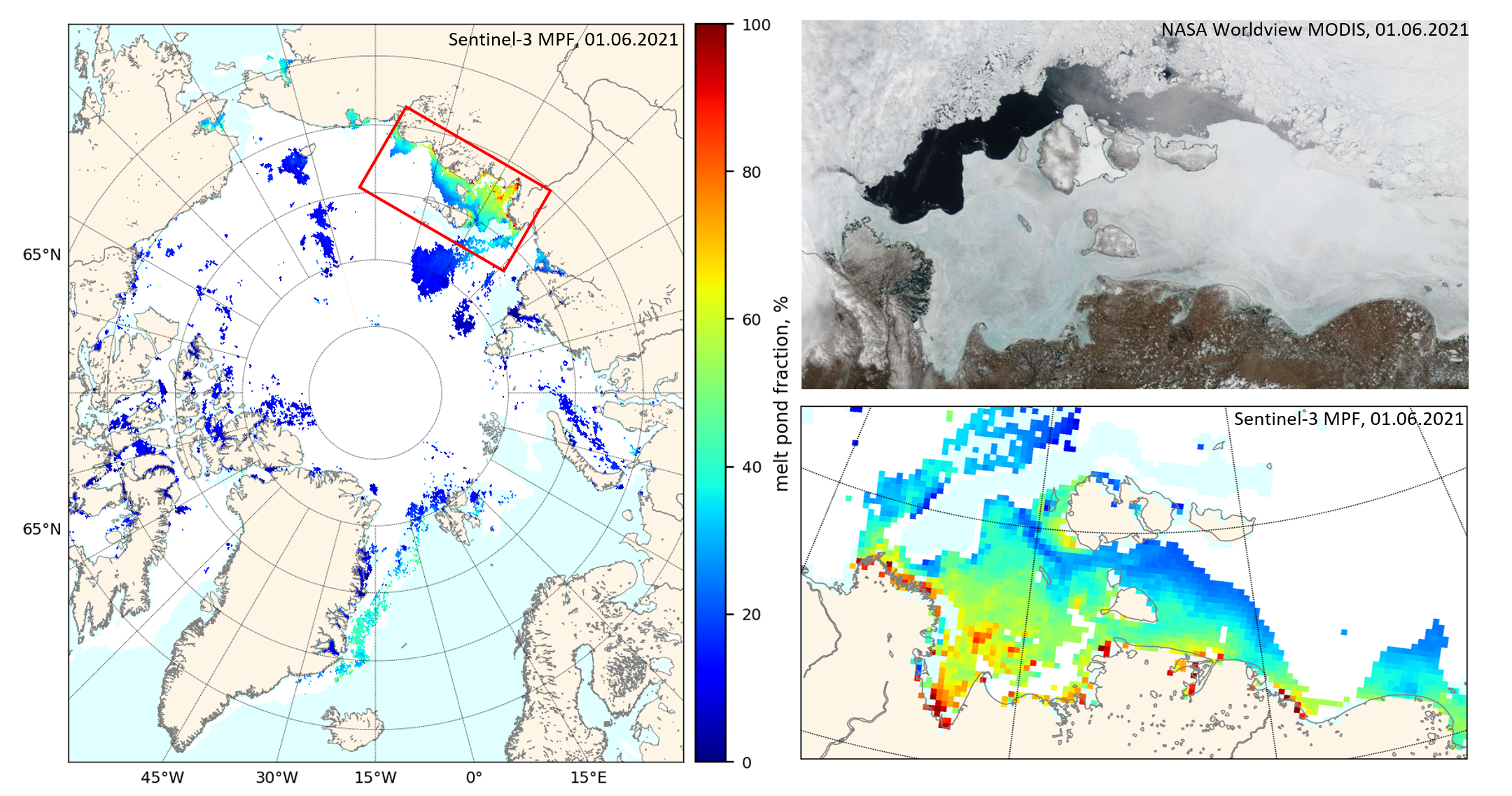
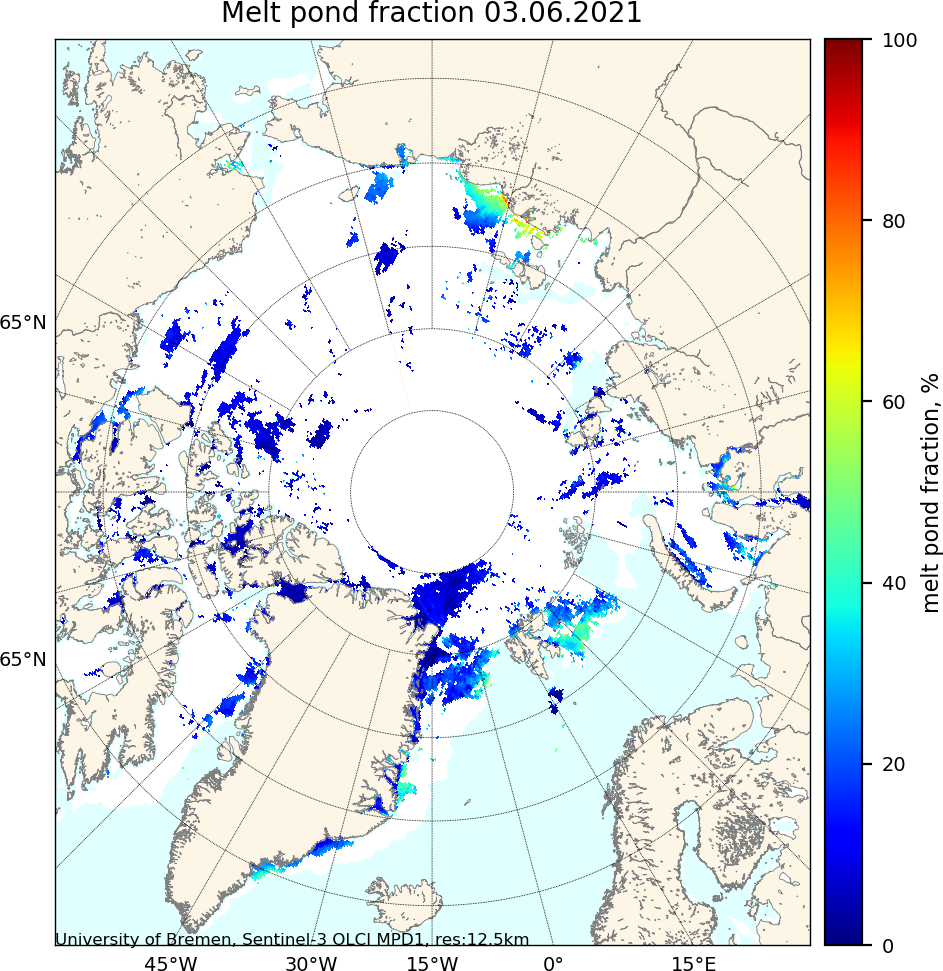
A new Sentinel 3 melt pond fraction product from the University of Bremen confirms that on the fast ice in the Laptev & East Siberian Seas snow cover has departed and melt ponds have arrived:

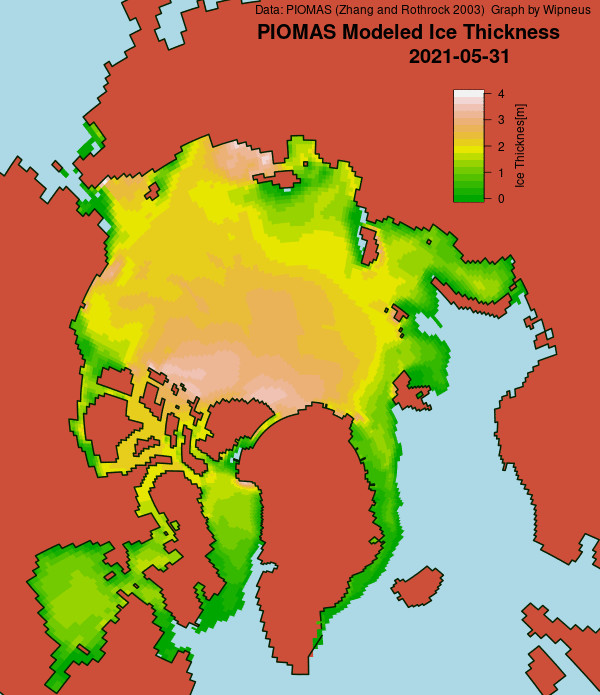
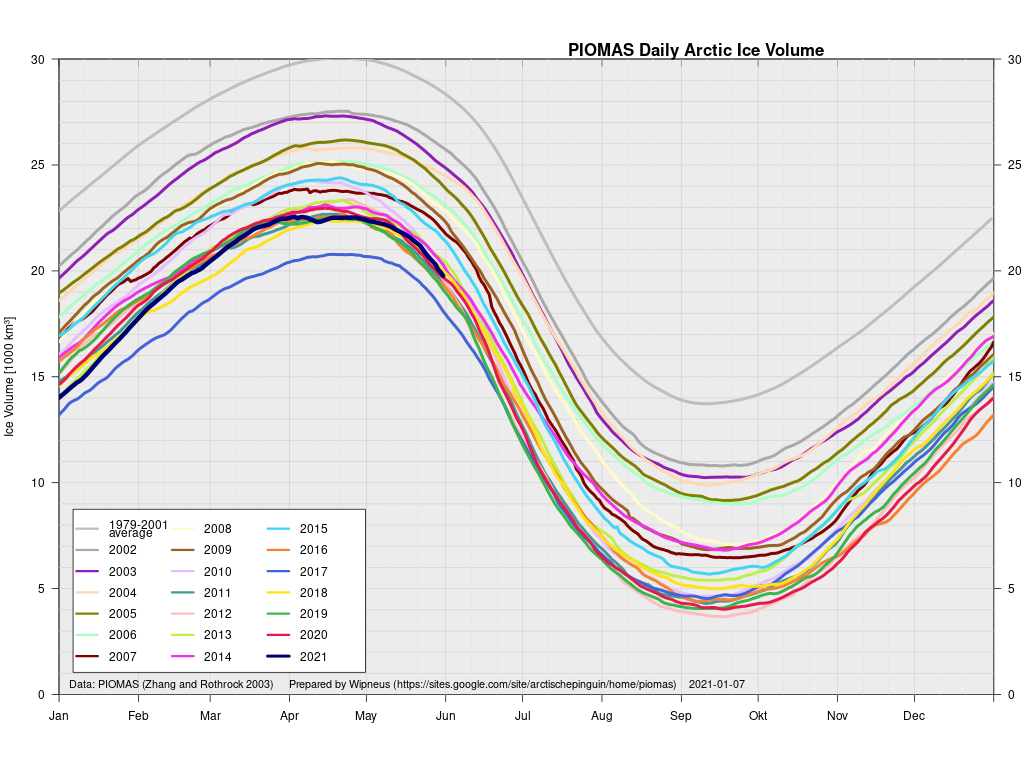
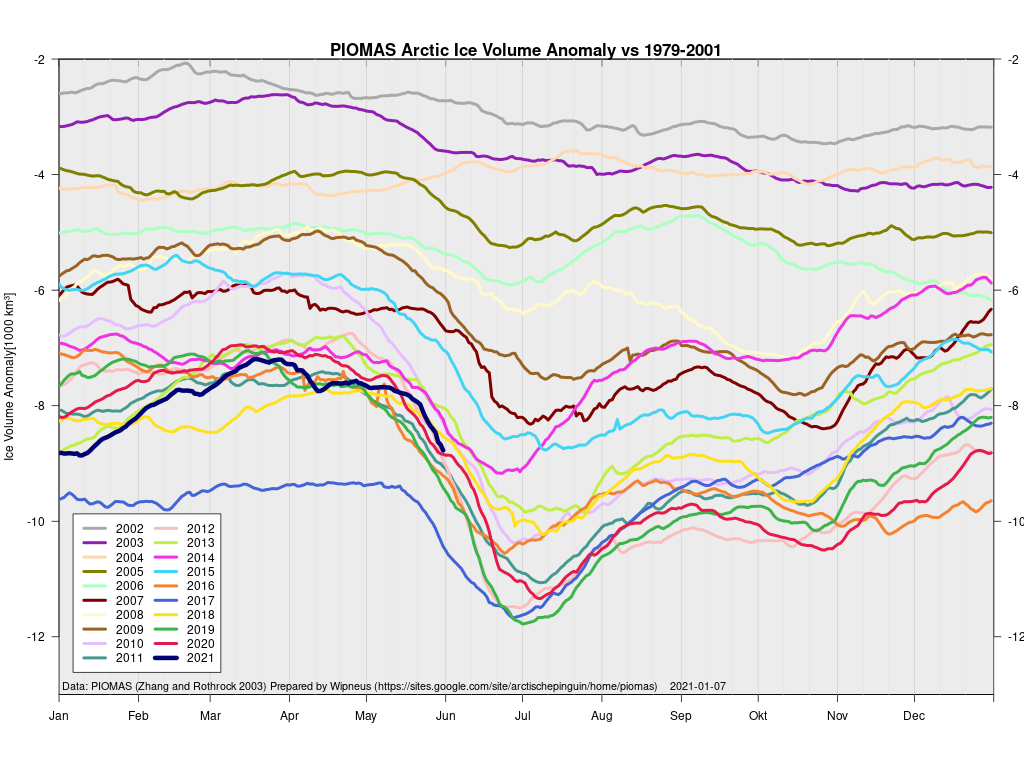
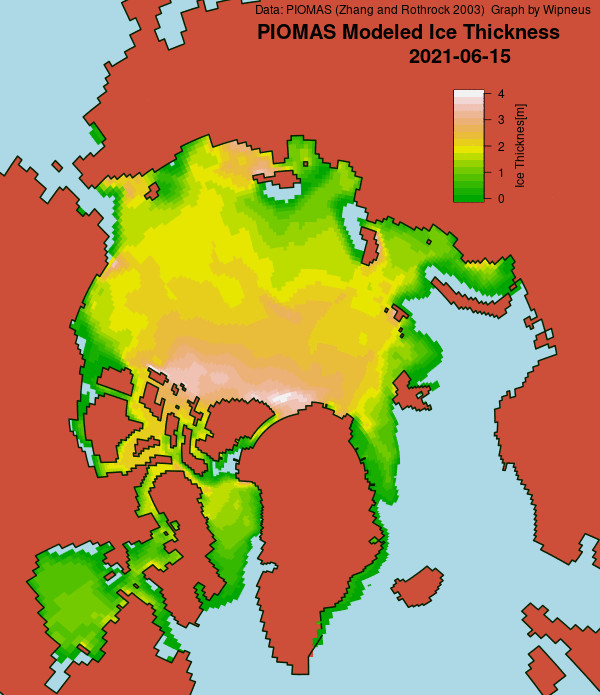
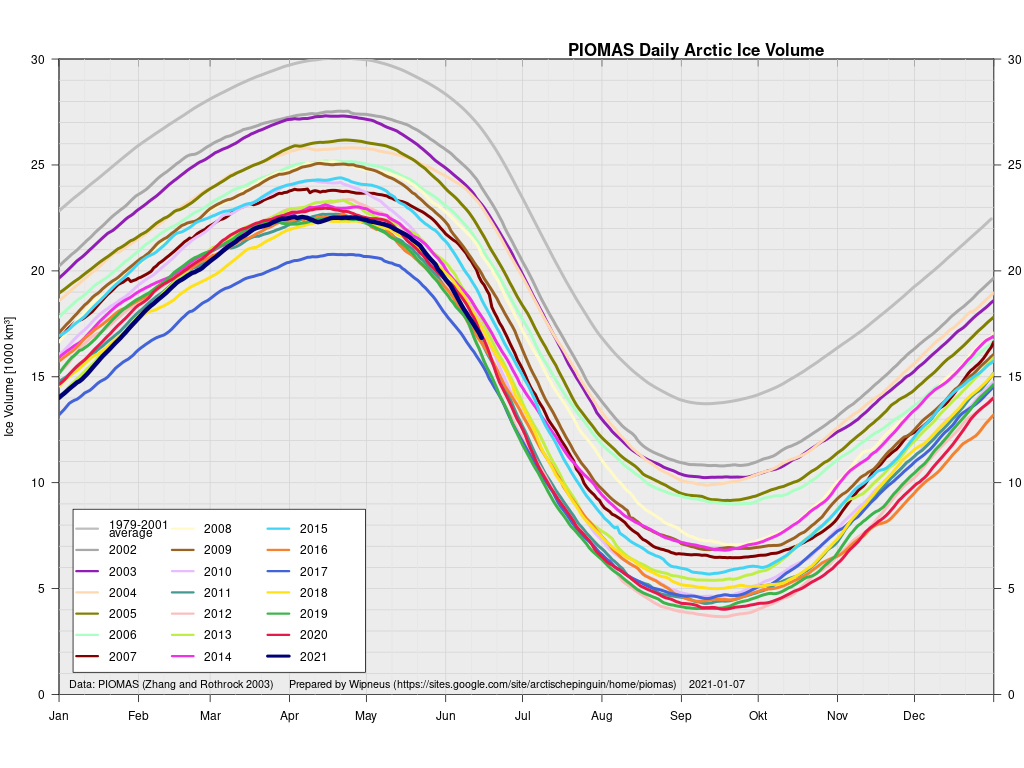
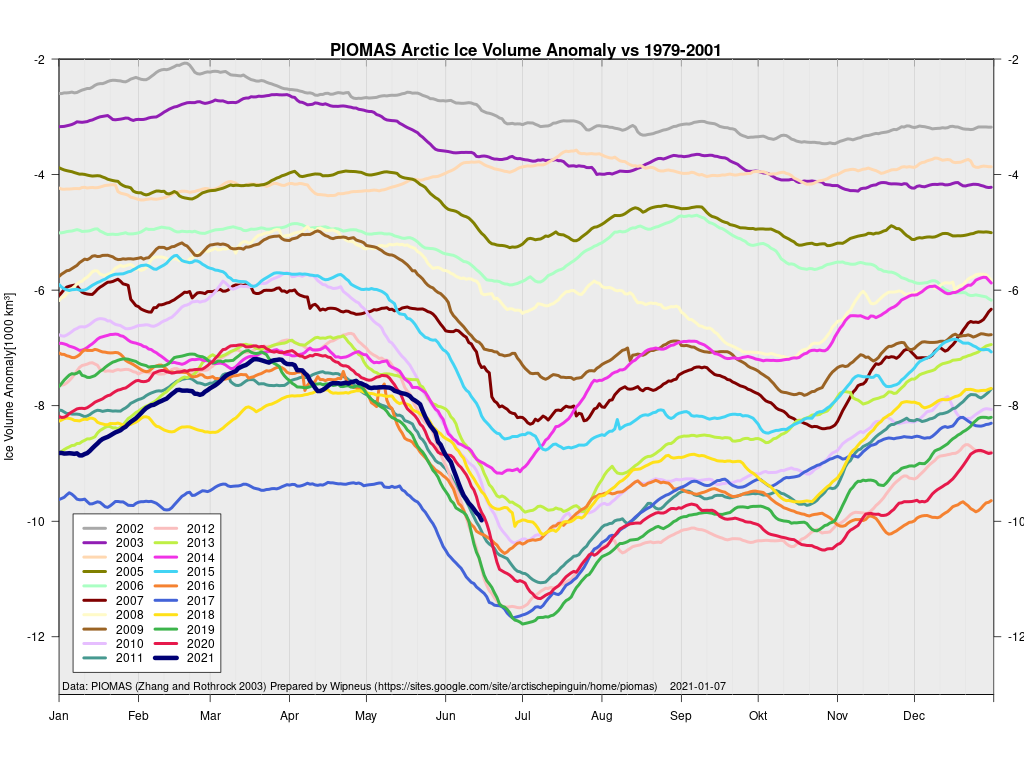
In other news Wipneus has released the latest PIOMAS gridded thickness and volume data on the Arctic Sea Ice Forum:

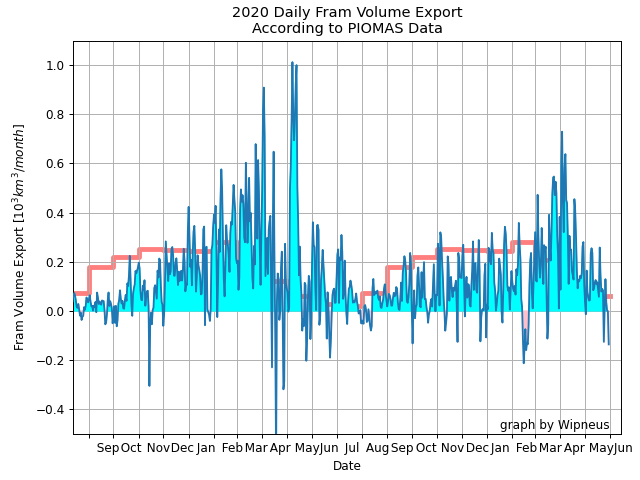
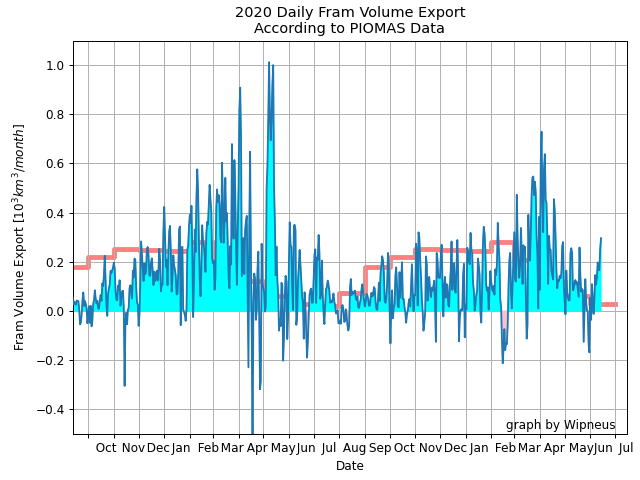
For some strange reason 2021 volume at the end of May is almost identical to 2012 and 2020! Plus of course there’s the modelled volume export from the Central Arctic via the Fram Strait:

[Edit – June 6th]

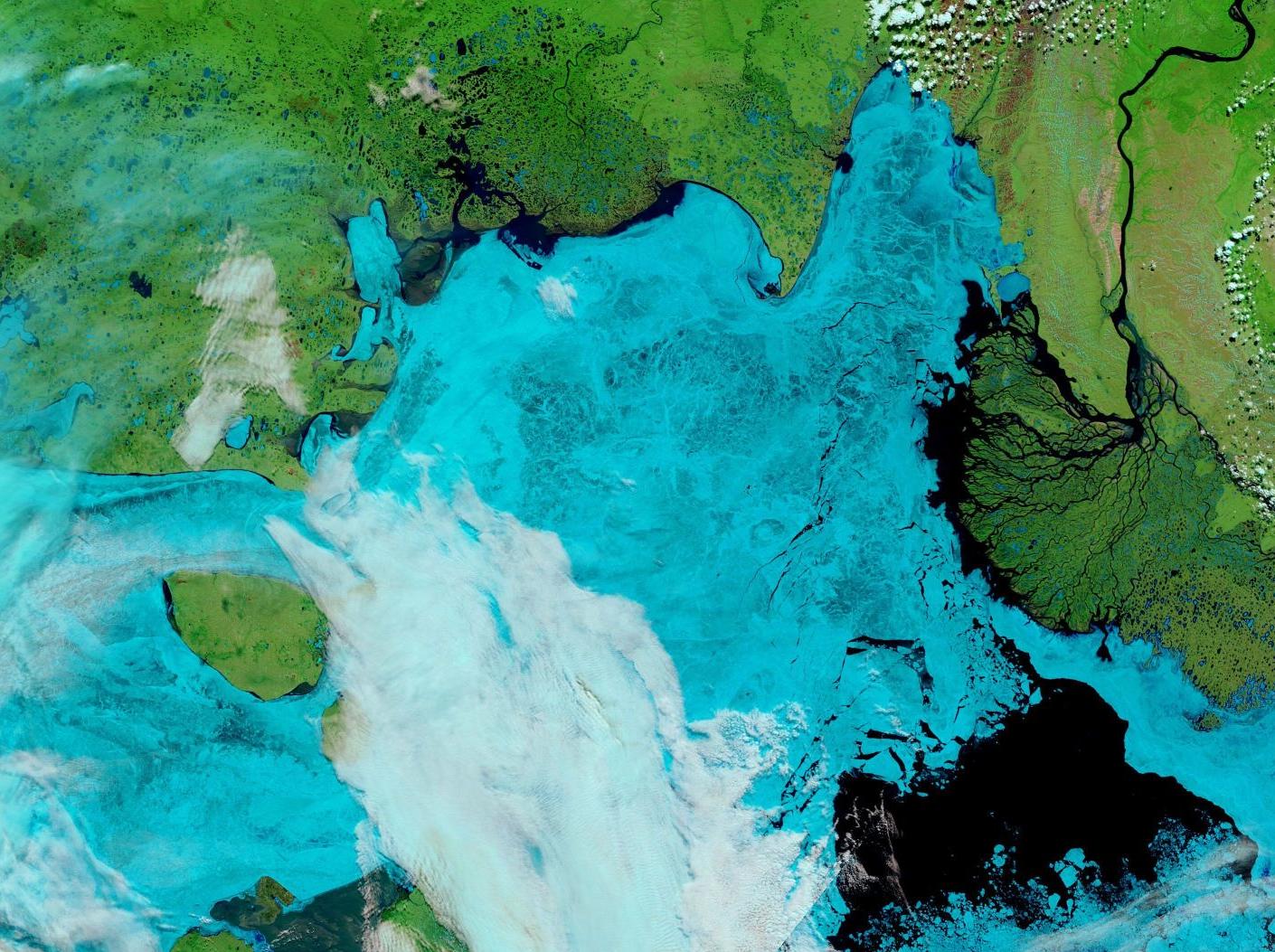
This “false colour” image reveals that there’s virtually no snow cover left on land, and this “false colour” image reveals that the land-fast ice in the East Siberian Sea is now awash with melt ponds:

[Edit – June 8th]

The forecast low pressure area appears to have bottomed out near the Severnaya Zemlya islands with a 978 hPa MSLP:

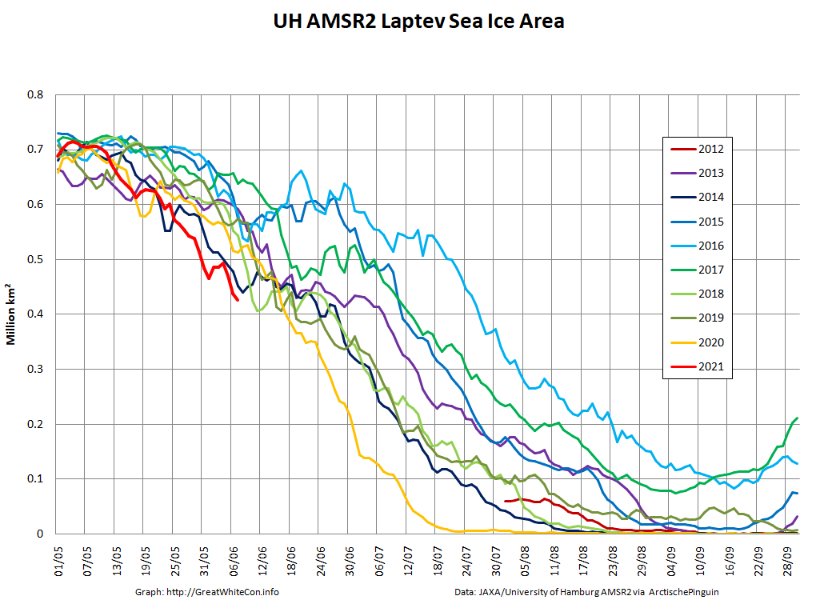
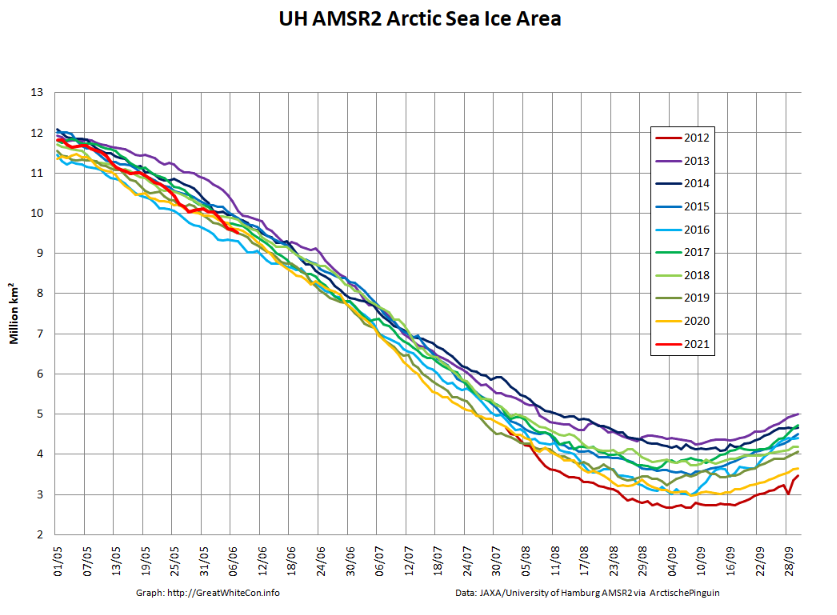
High resolution AMSR2 Arctic sea ice area is now 2nd lowest for the date after 2016:

Laptev sea ice area is still lowest for the data, and looks as though it will retain that position for a while:

[Edit – June 9th]

The effect of the recent heat and wind on the remaining sea ice in the Laptev Sea is now all too apparent:

It’s also evident in the DMI >80N temperature graph, which has now reached sea ice “melting point” ahead of the climatology:

Note that the blue line is actually above the “freezing point” of salty Arctic sea water.

[Edit – June 13th]

Fairly clear skies over the Laptev Sea and the western East Siberian Sea, revealing wall to wall melt ponds and the land-fast ice starting to break up near the coast as well as on the edge of the now open ocean:

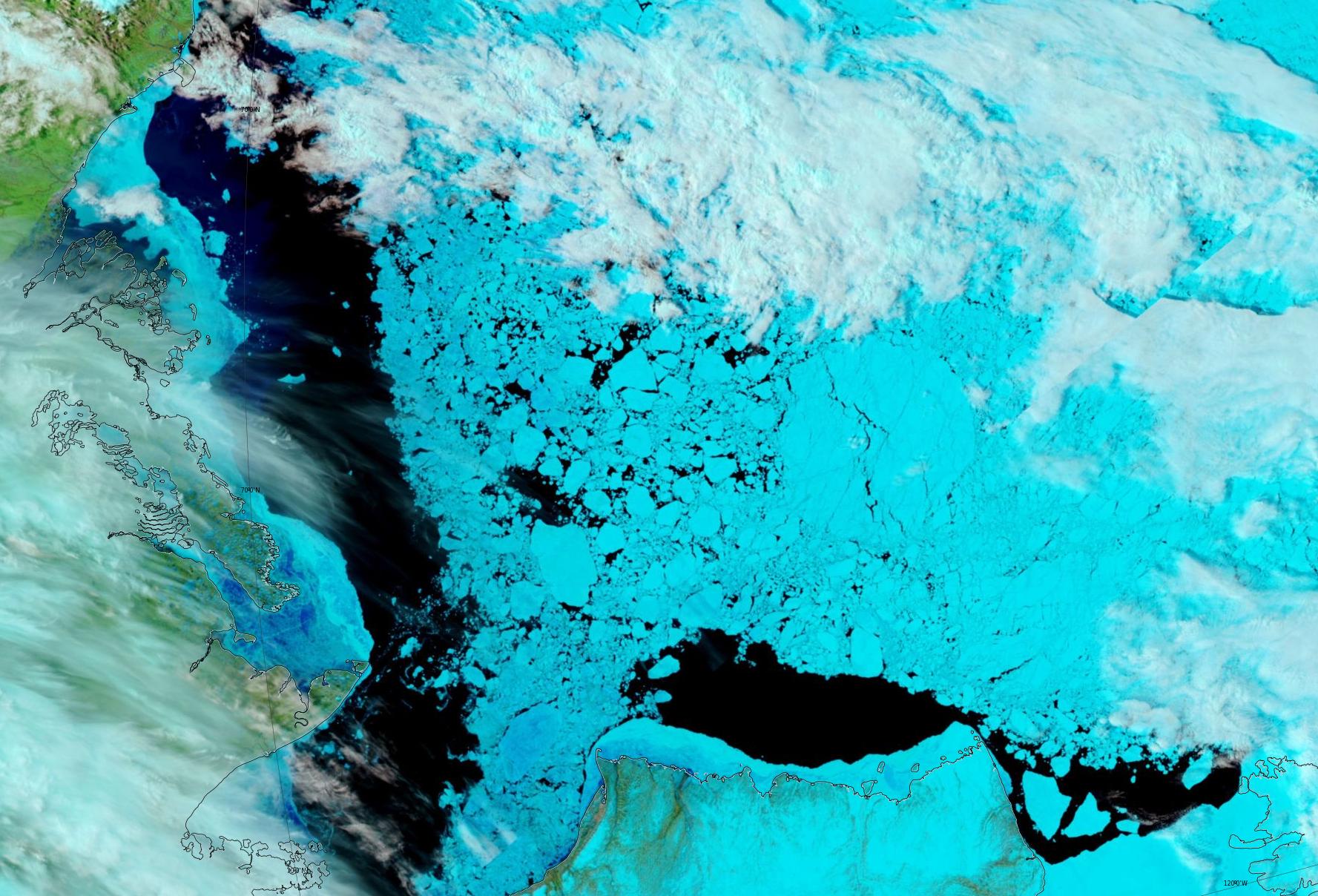
Plus yesterday’s view of the Beaufort Sea, revealing fast ice breaking up in the western entrance to the McClure Strait:

[Edit – June 18th]

A clearish view of the Laptev Sea today, revealing assorted cracks in a variety of locations:

[Edit – June 20th]

The latest mid-month PIOMAS thickness/volume numbers have been released:

[Edit – June 23rd]

The skies over the Vilkitsky Strait have been cloudy for a few days. However a fairly clear view yesterday reveals that breakup is well under way in what is usually one the last areas along the Northern Sea Route to become navigable:

[Edit – June 26th]

The land-fast ice in the East Siberian Sea has started to disintegrate en masse:

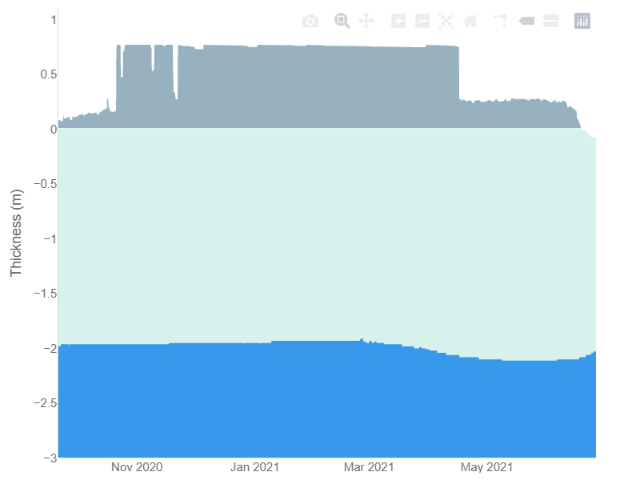
Data from ice mass balance buoy 441910, currently located at 76.1 N, 151.1 W in the Beaufort Sea, reveals the onset of both surface and bottom melt:

Watch this space!

Steve Koonin’s Unsettled Arctic Science

Regular readers of this blog will no doubt have realised that way up here in the Great White Con Ivory Towers we concluded many moons ago that Arctic sea ice is the “canary in the climate coal mine”.

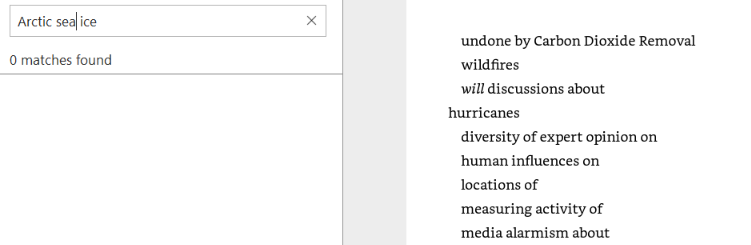
Unlike some others we have already mentioned we were not the beneficiaries of a review copy of Steven E. Koonin’s new book, catchily entitled “Unsettled: What Climate Science Tells Us, What It Doesn’t, and Why It Matters”. Hence I was compelled to acquire my own review copy, and have just purchased the electronic version. I eagerly searched the virtual weighty tome for the term “Arctic sea ice”, and you may well be wondering what I discovered?

Nothing. Nada. Zilch. ничего такого. Nic.

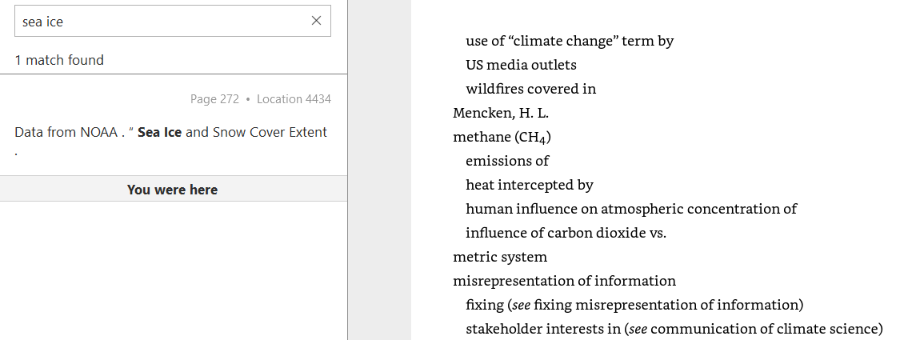
I broadened my thus far vain search by removing the “Arctic” specifier, which revealed:

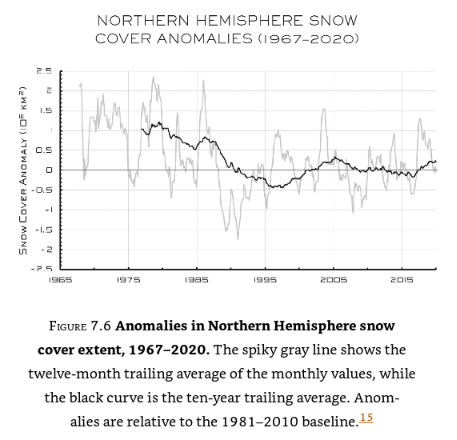
No mention of “sea ice” in the body of the book, merely a reference to the data underlying this graph of northern hemisphere snow cover:

I am forced to an unsettling conclusion. Evidently there are some areas of climate science that Dr. Koonin tells his eager readers nothing whatsoever about. It seems likely that he is also well aware that Arctic sea ice is the canary in the climate coal mine, which is why he has chosen to make no mention of it in his magnum opus.

Here is an informative video which will no doubt not appear in “Unsettled – The Movie”:

[Edit – May 8th]

Having now had time to read some of Steve Koonin’s “Unsettled Climate Science” at greater length I have discovered that it does contain one reference to Arctic sea ice, albeit using non-standard terminology. On page 40 of the Kindle version of the book I read:

Rising temperatures at the surface and in the ocean are not the only indicators of recent warming. The ice on the Arctic Ocean and in mountain glaciers has been in decline, and growing seasons have been lengthening slightly. Satellite observations show that the lower atmosphere is warming as well.

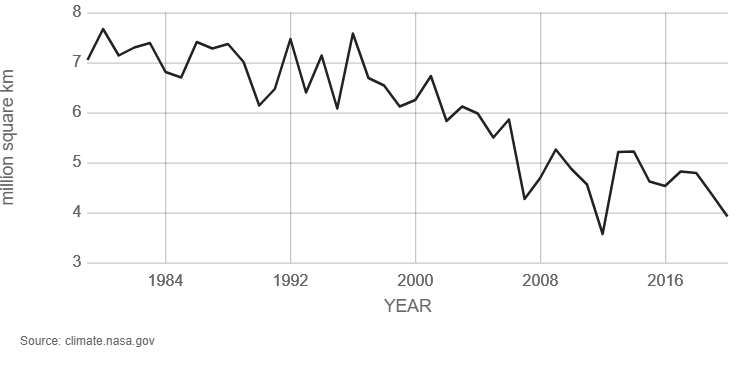
A paragraph I can broadly agree with, but I am compelled to ask why Dr. Koonin does not quantify the “decline of the ice on the Arctic Ocean” anywhere in the book? There are a wide variety of metrics used to quantify the “amount” of sea ice in the Arctic, but here is one readily available for download from the NASA web site. It is hard to believe that a scientist of Dr. Koonin’s experience, particularly one writing about climate change, has never previously come across a similar graph of Arctic sea ice extent:

Arctic sea ice reaches its minimum each September. September Arctic sea ice is now declining at a rate of 13.1 percent per decade, relative to the 1981 to 2010 average. This graph shows the average monthly Arctic sea ice extent each September since 1979, derived from satellite observations.

It seems safe to assume that Dr. Koonin has heard of NASA, since the organisation is mentioned several times in his list of references and once in the body of the book. However it seems that the United States’ National Snow and Ice Data Center (NSIDC for short) is not very visible on his personal radar screen, meriting only a single reference which is to snow rather than ice data.

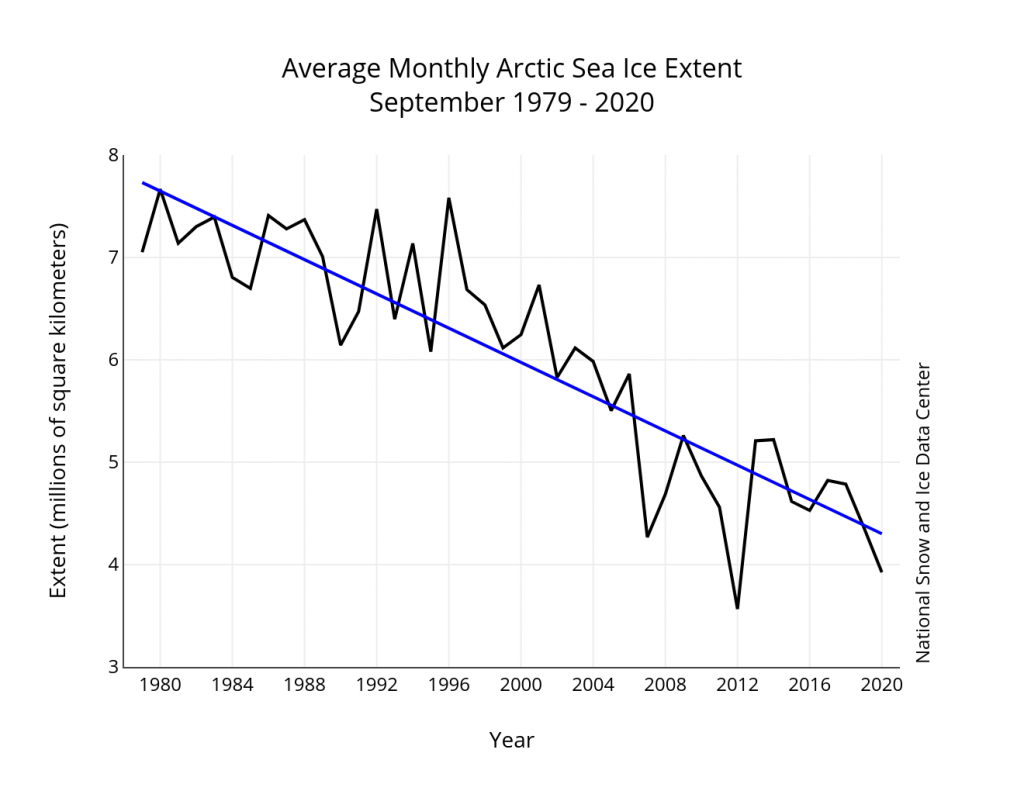
Here is the NSIDC’s version of the NASA graph above, which includes a handy trend line:

Monthly September ice extent for 1979 to 2020 shows a decline of 13.1 percent per decade.

Nearby Steve has penned another paragraph I can broadly agree with. On page 36 he states:

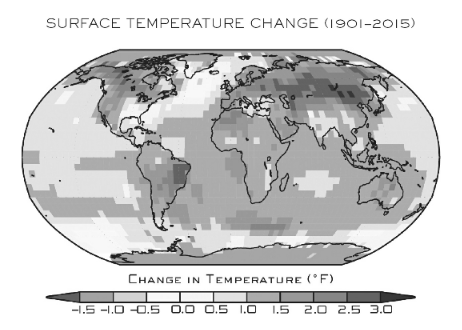
The warming of the past forty years on large scales hasn’t been uniform over the globe. That’s evident in Figure 1.5, reproduced from the US government’s 2017 CSSR (Climate Science Special Report, described earlier). As you can see, the land is warming more rapidly than the ocean surface, and the high latitudes near the poles are warming faster than the lower latitudes near the equator.

Here is the figure 1.5 referred to above:

Surface temperature change (in °F) for the period 1986–2015 relative to 1901–1960. Changes are generally significant over most land and ocean areas. Changes are not significant in parts of the North Atlantic Ocean, the South Pacific Ocean, and the southeastern United States. There is insufficient data in the Arctic Ocean and Antarctica to compute long-term changes there.

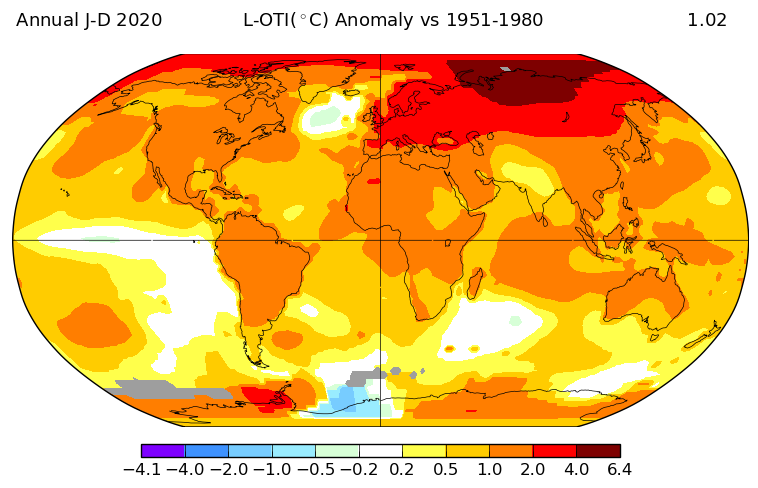
Once again I am compelled to ask some questions. Why not include a map that uses more recent data than 2015? And why not quantify how much faster the “high latitudes near the poles are warming than the lower latitudes near the equator”?

NASA helpfully provide an interface to their data which allows anybody who can click a mouse to produce their own global surface temperature maps. Here is the up to date answer to the first question:

NASA have also produced another informative video, which I suspect will also never make it into “Unsettled – The Movie”:

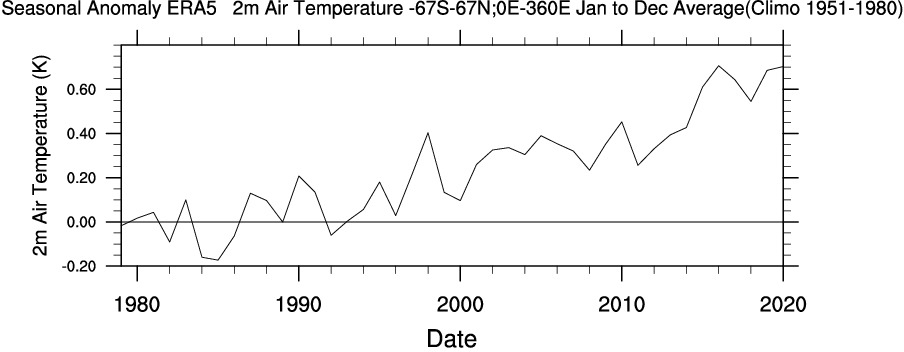
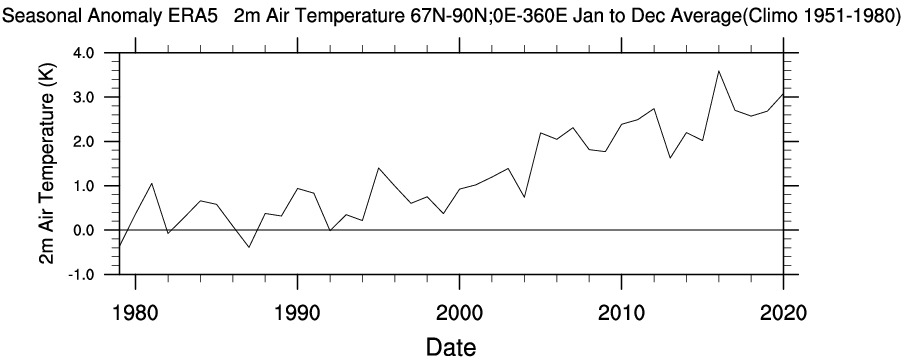
Another US scientific agency that provides publicly accessible climate data is the National Oceanic and Atmospheric Administration (NOAA for short). The abbreviation is referred to several times in Steve Koonin’s book, but for some reason he never expands the acronym in full. Like NASA they also provide a means to produce your own maps and time series. Albeit with a somewhat more complex user interface, the Web-based Reanalysis Intercomparison Tool (WRIT for short) allows the user to differentiate between different regions of Planet Earth, and hence answer the second question above.

Please compare and contrast the “non polar” temperature time series with the “Arctic” one. Note the change of scale of the X axis, and also the units. Degrees Kelvin rather than degrees Fahrenheit which are seemingly preferred by Dr. Koonin:

To summarise, you don’t need to wait for Steve Koonin to write another book or for the US government to produce another CSSR. Vast amounts of data and a plethora of visualisation tools are freely available to allow you to do your own research regarding a wide variety of climate metrics. Steve neglects to impart that information to his readers as well.

[Edit – May 9th]

As has been alluded to above, in the soon to be shipped hardcover edition of his new book Steve Koonin makes much mention of “snow cover” whilst ignoring “sea ice” entirely. There are also a grand total of 48 reference to the perhaps overly esoteric term “albedo“. On page 84 of the Kindle edition of “Unsettled” we are reliably informed that:

Among the most important things that a model has to get right are “feedbacks.”

Despite that the entire electronic volume makes no mention whatsoever of the phrase “ice-albedo feedback” or any synonym thereof. A brief course teaching the topic has recently been developed as part of the outreach activities of the MOSAiC Arctic drift expedition. Perhaps Dr. Koonin would be well advised to read it at his earliest convenience?

The ice-albedo feedback is an example of a positive feedback loop. A feedback loop is a cycle within a system that increases (positive) or decreases (negative) the effects on that system. In the Arctic, melting sea ice exposes more dark ocean (lower albedo), which in turn absorbs more heat and causes more ice to melt…the cycle continues.

Here’s another explanatory video which will also no doubt never make it into “Unsettled – The Movie”:

Watch this space for further revelations about the gigantic Arctic canary in the room!

Where’s the Thickest Arctic Sea Ice Gone?

In the absence of the usual mid month PIOMAS Arctic sea ice volume update I’m being moaned at by “angech” over on Judith Curry’s “Climate Etc.” blog:

Any ideas on why PIOMAS mid month update not out, other than not wanting to show a big recovery?

Unlike any of Judy’s denizens I checked out the comparatively new merged CryoSat-2 plus SMOS thickness maps from the Alfred Wegener Institute. “Measured” rather than “modelled” data must be a good thing surely?

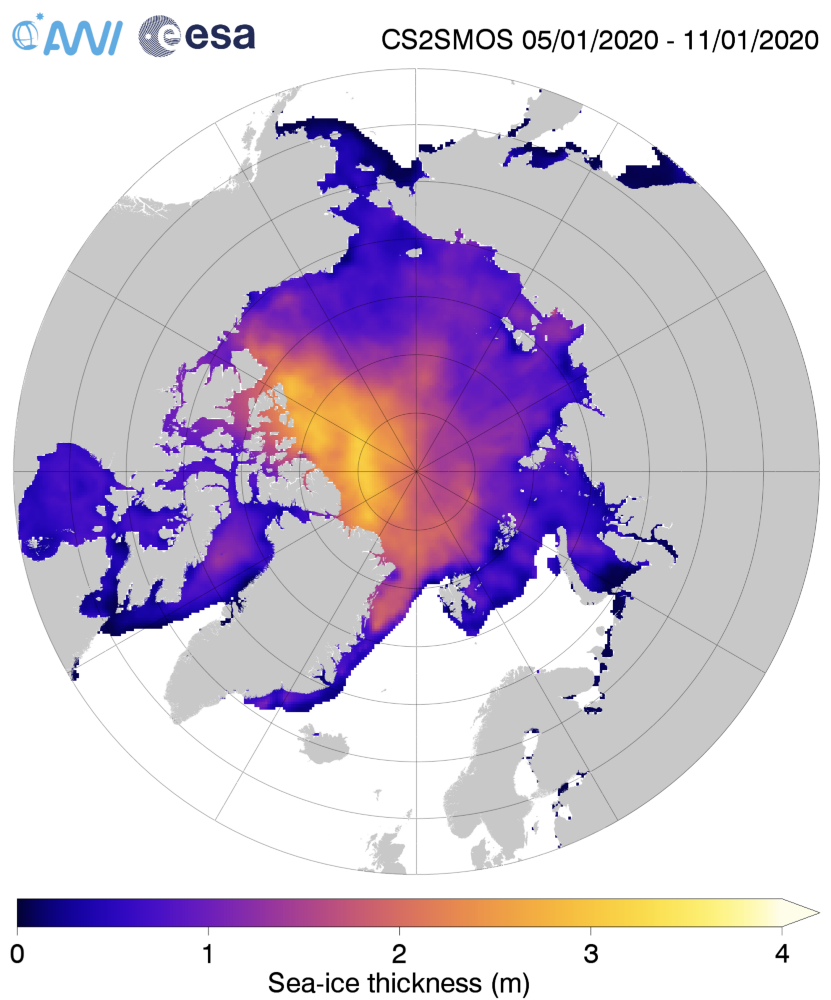
Just in case there’s some significant difference between the “reanalysis” and “operational” versions of that product, here is the AWI’s most recent reanalysed Arctic sea ice thickness map, for the week ending January 11th:

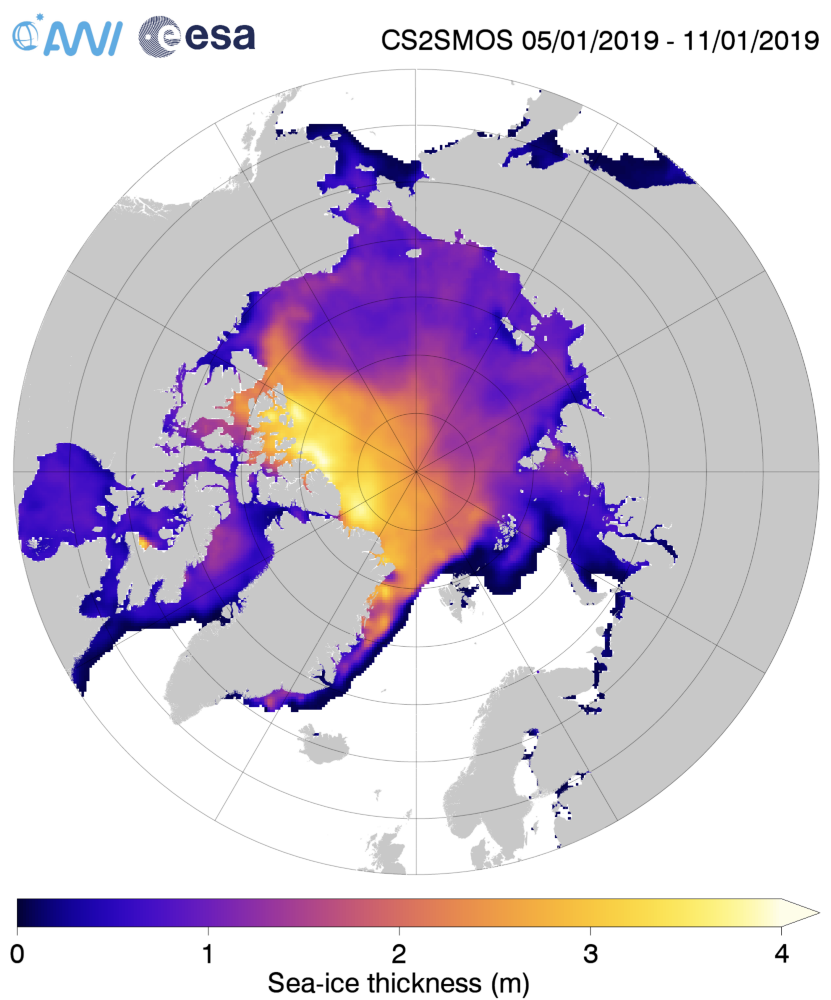
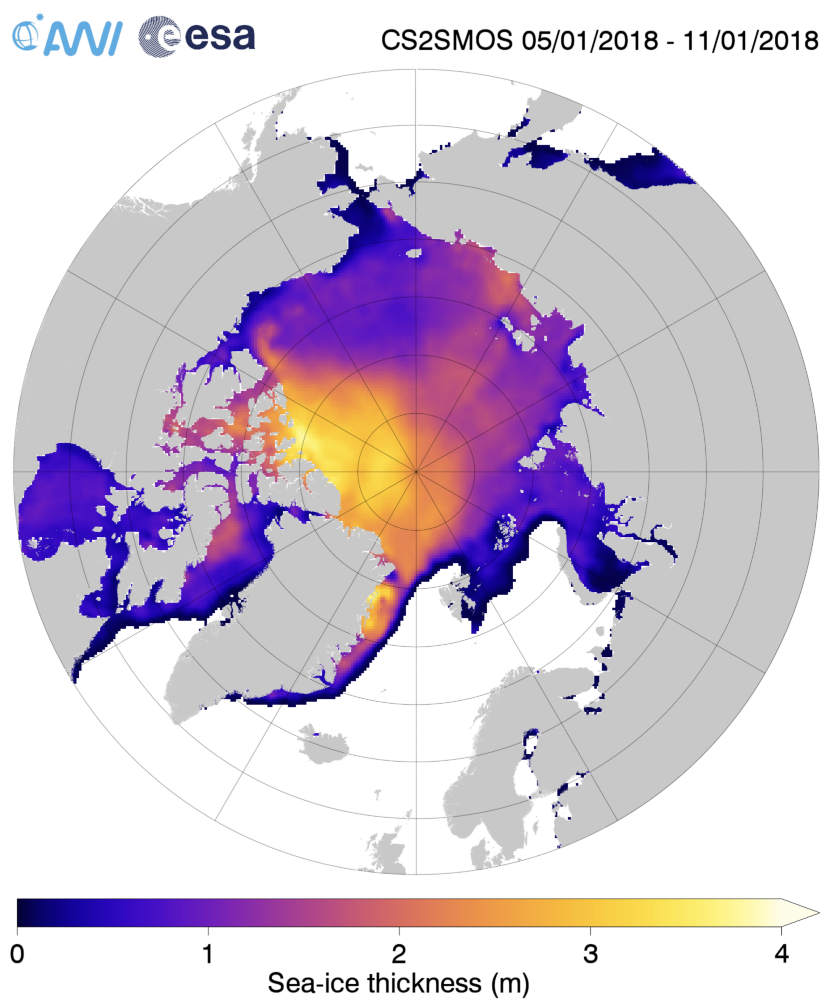
together with the same date from the previous two years:

Make sure to take a close look at the white areas north of Greenland and the Canadian Arctic Archipelago showing sea ice over 4 metres thick.

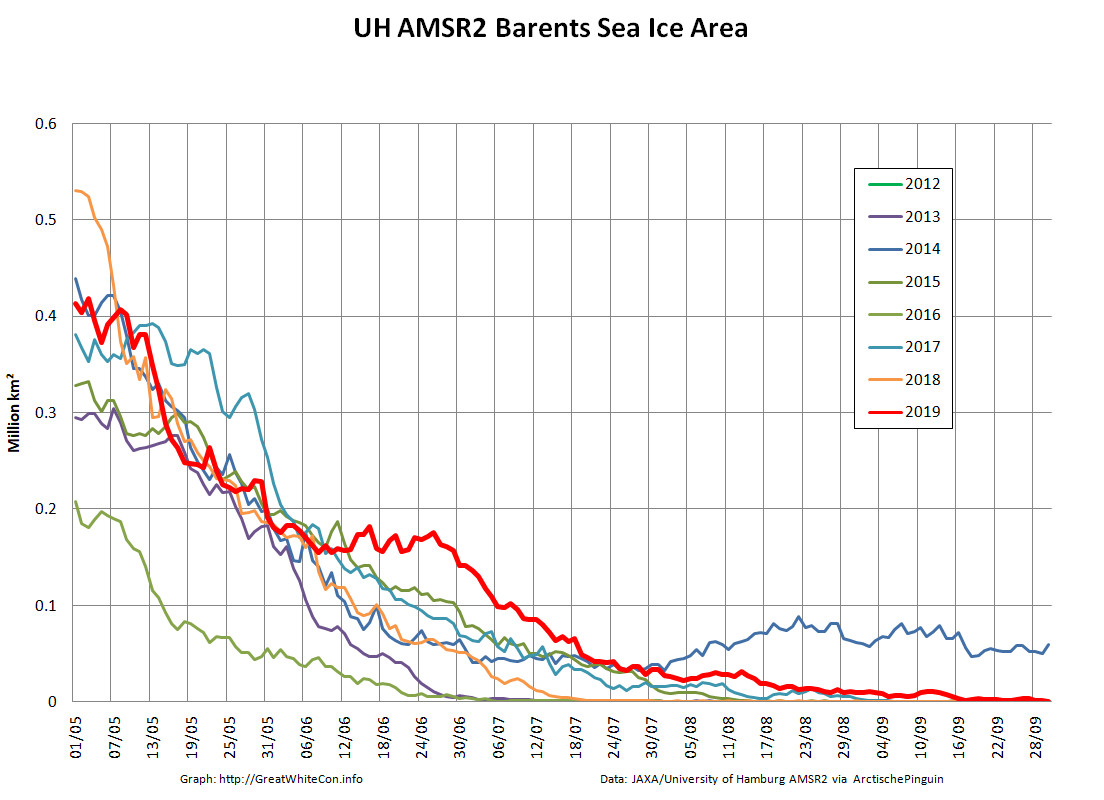
Over the winter of 2018/19 ASCAT revealed that there was a relentless movement of multi-year ice towards both the North Atlantic and the Beaufort Sea.

Not unexpectedly that meant that ice in the northern Barents Sea was slow to melt out in the summer of 2019:

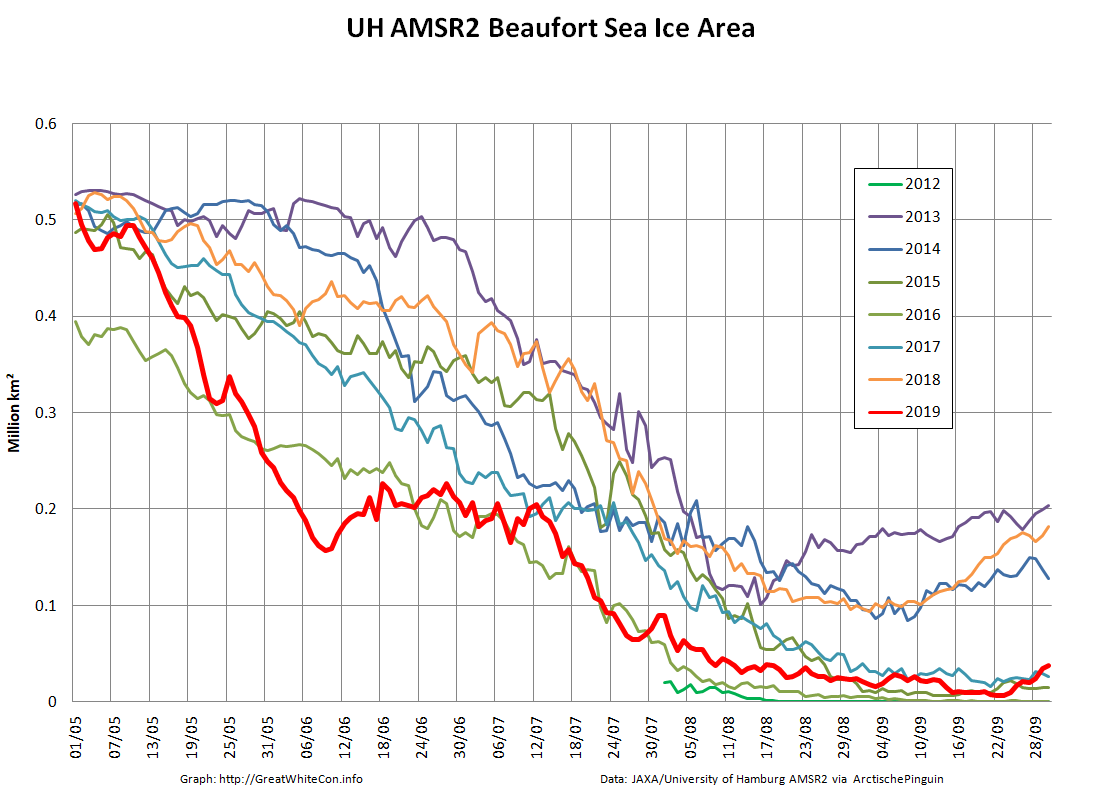
whilst after a fast start the melt in the Beaufort Sea also suffered a “brief hiatus” in June before ultimately melting out almost completely as well:

Perhaps a significant amount of the multi-year ice that survived the winter of 2018/19 has now simply melted away in warm water, to be replaced by much less robust first year ice in the area between the North Pole and the Siberian coast? It will be very interesting to see what the next PIOMAS update in early February reveals.

[Edit – February 4th]

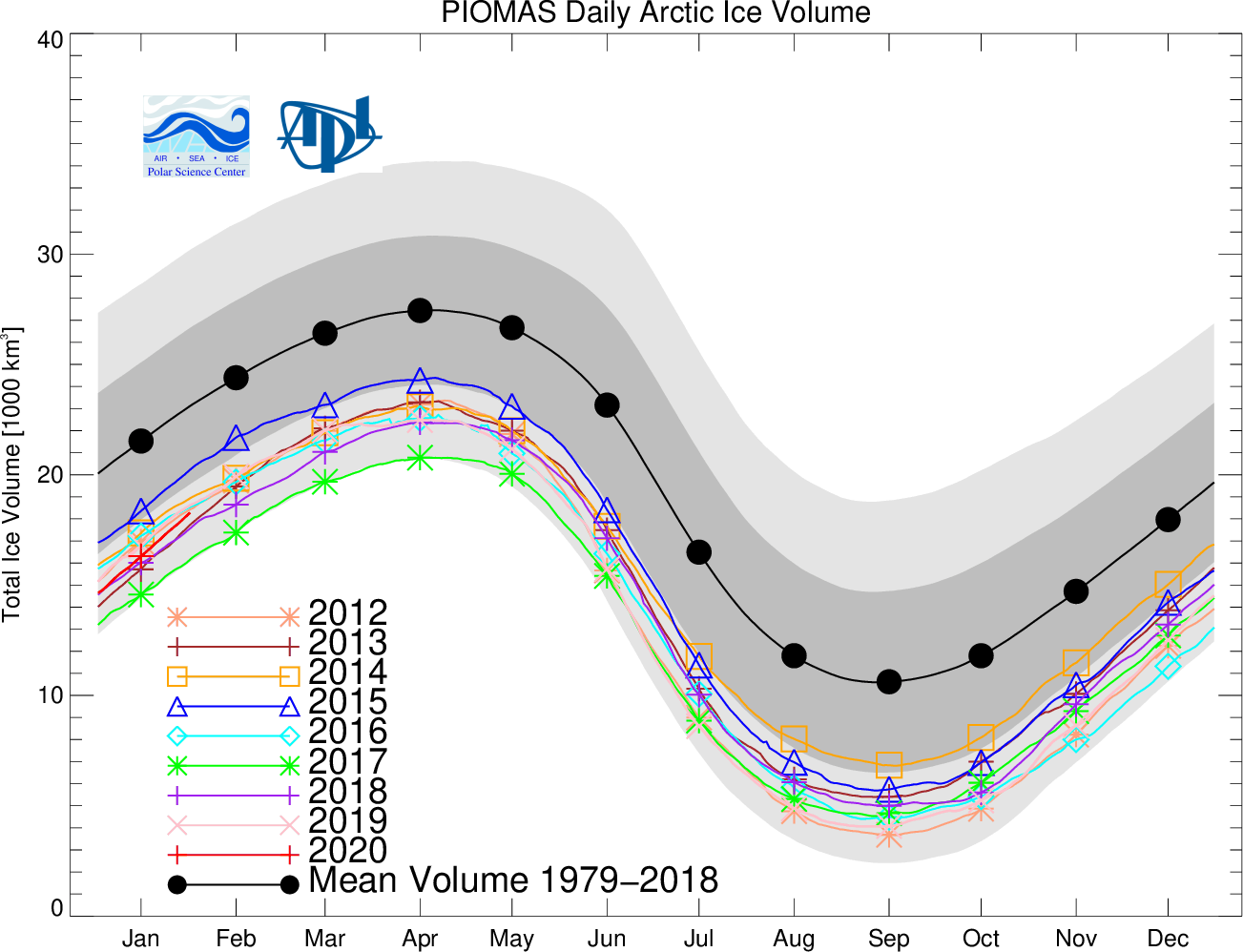
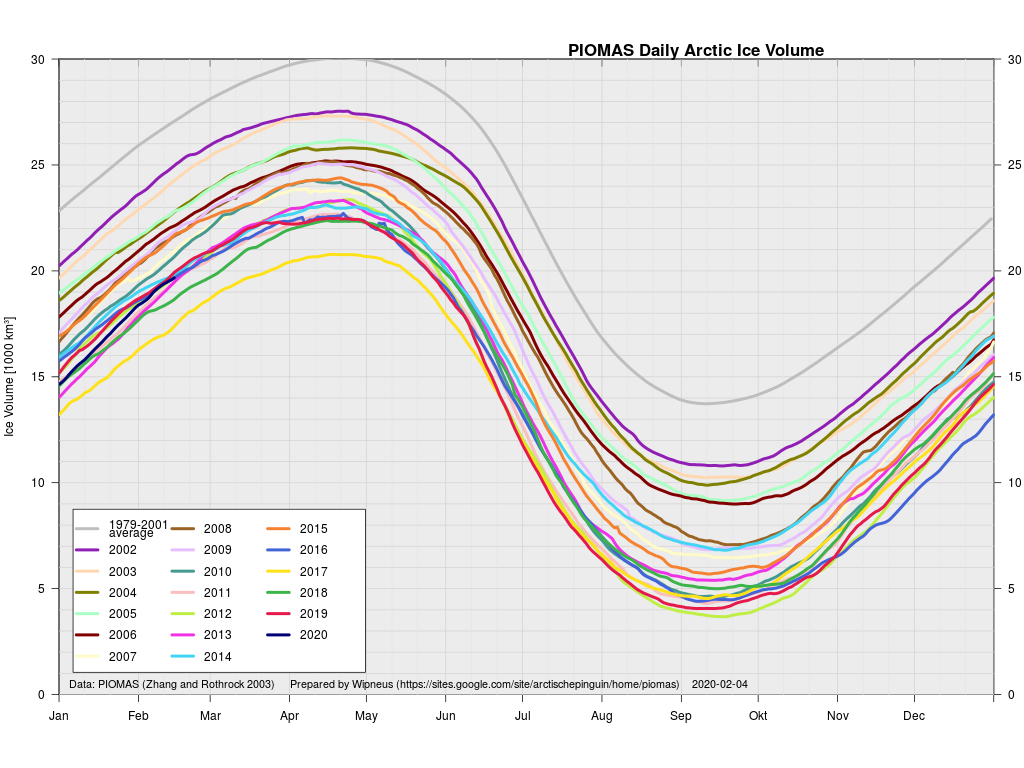
The next PIOMAS update referred to above has now arrived. Here’s the Polar Science Center’s graph:

Over on Climate Etc. angech is already exclaiming:

Strange it did go up a fair bit the old PIOMAS.
No publicity at the usual going down sites.

Actually it’s not at all strange, because thus far this winter the polar vortex has been remarkably well behaved. By and large cold air air has stayed in the Arctic. There hasn’t been much in the way of cold air intrusions into mid latitudes or warm air intrusions into the Arctic.

Hence it’s not at all surprising that the thickness of sea ice in the Arctic has been increasing slightly more quickly this winter than in other recent years. By way of some longer term context, here are the official Polar Science Center min/max trends:

[Edit – February 4th PM]

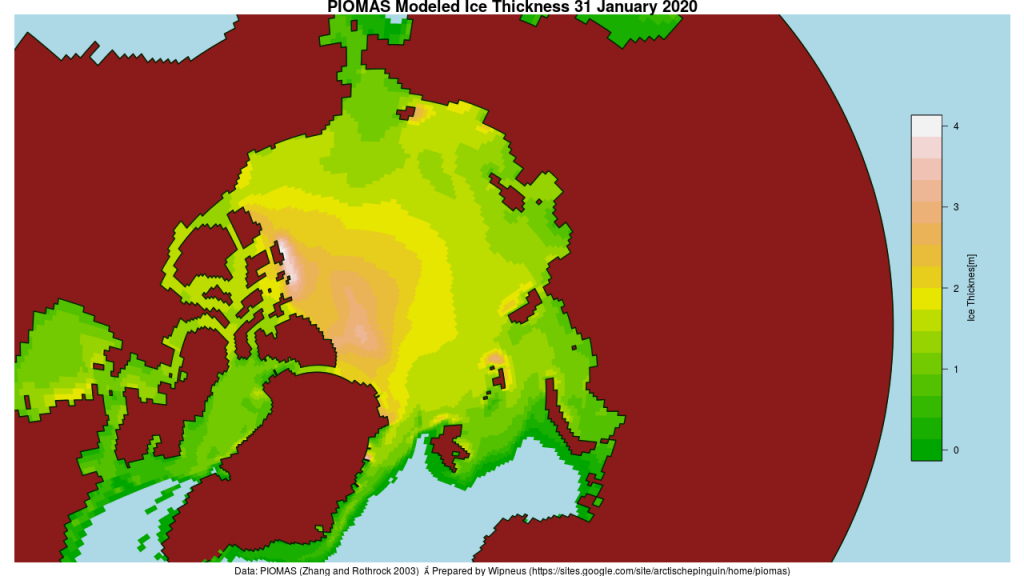
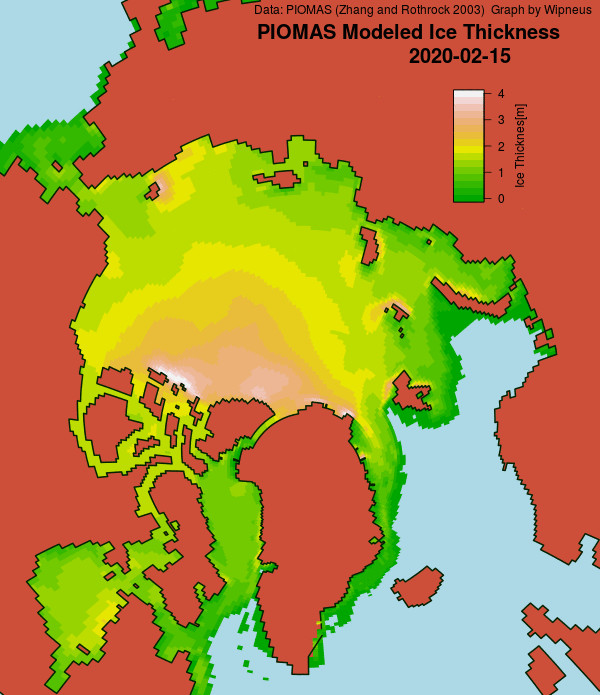
Wipneus has just released the January PIOMAS gridded thickness map. Here it is:

[Edit – February 5th]

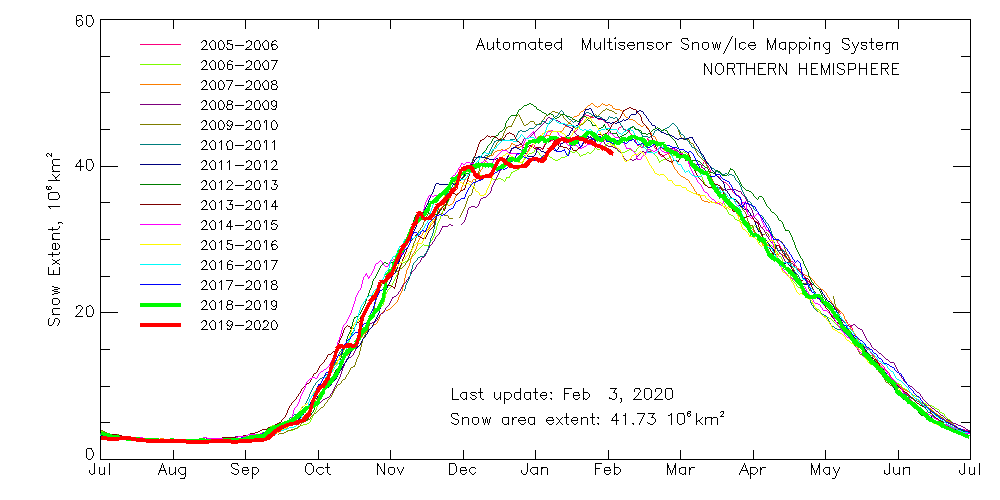
As is all too frequently the case, AdR and other commenters below get very excited about trivial increases in sea ice extent without considering snow extent. One side effect of the lack of cold air outbreaks into mid latitudes so far this winter currently looks like this:

[Edit – February 6th]

The AWI and PIOMAS sea ice thickness maps above look somewhat different at first glance. That being the case, I’ve written a program to crunch the AWI numbers. Here’s the result:

The source code plus raw and processed data can be accessed via the Arctic Sea Ice Forum:

CryoSat-2/SMOS Arctic Sea Ice Volume

[Edit – February 10th]

Further support for my “polar vortex” theory, from Judah Cohen no less!

[Edit – February 16th]

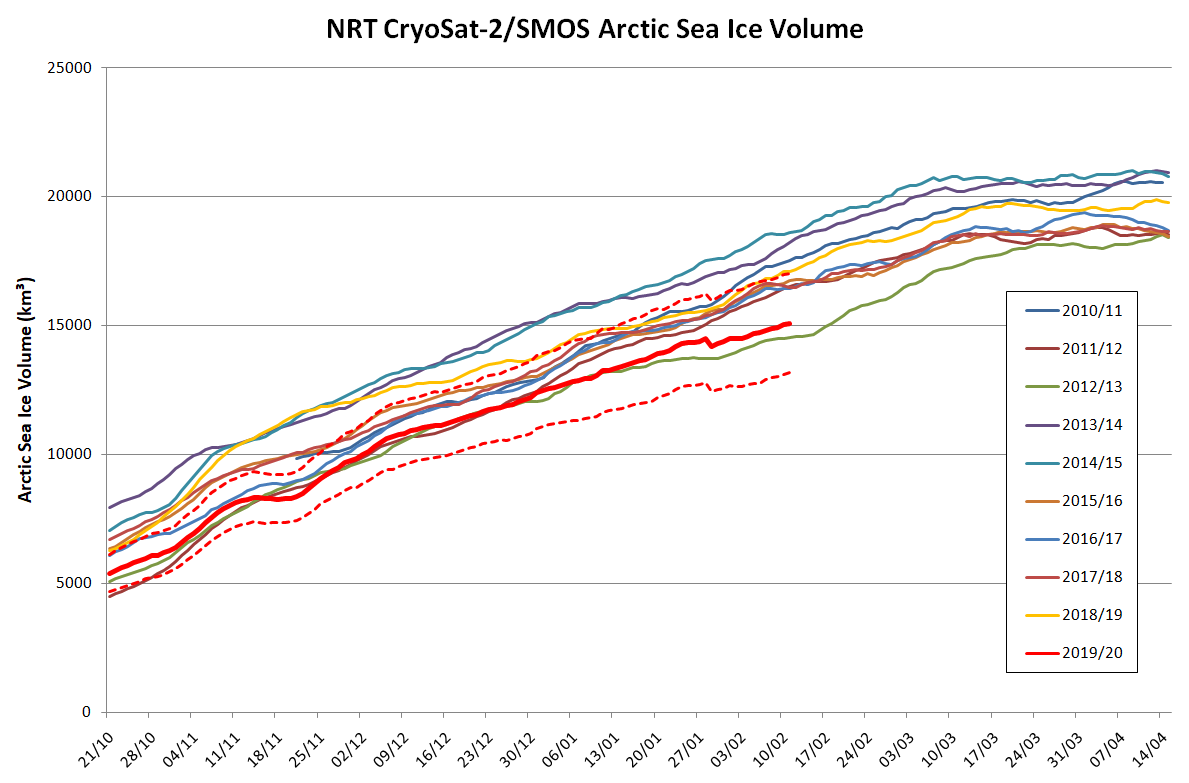
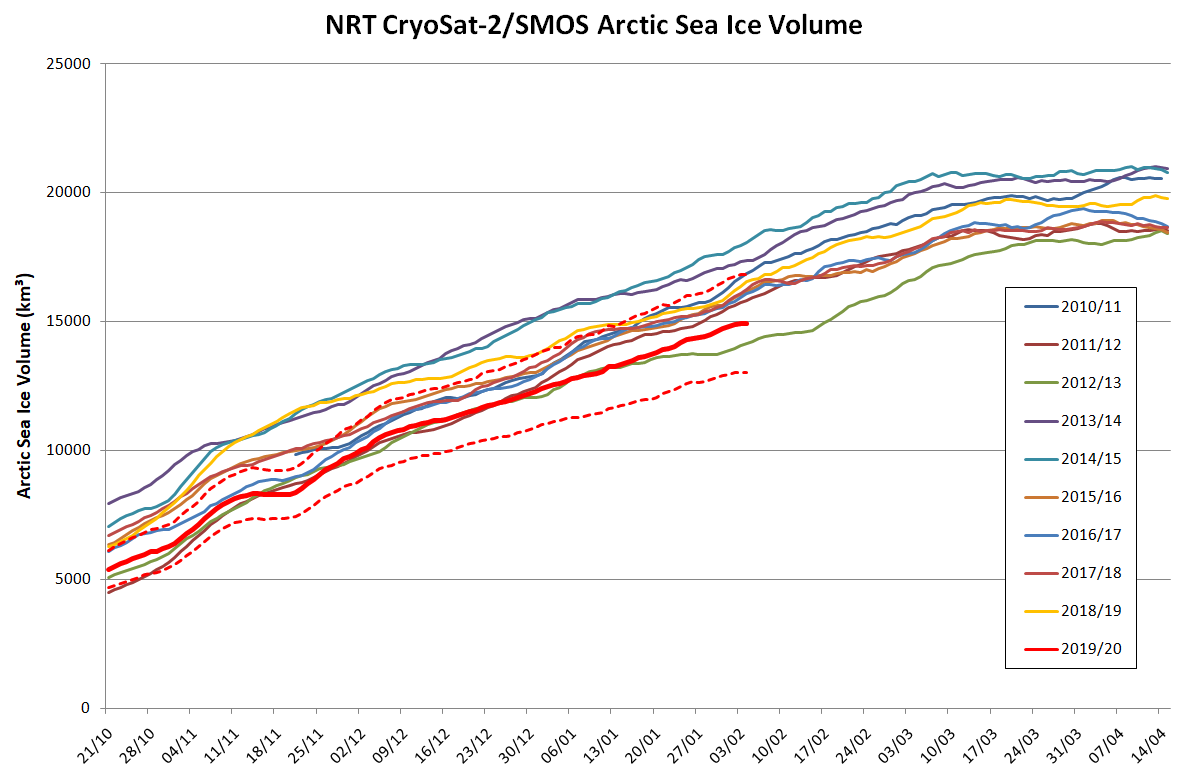
Here’s the latest update of our novel NRT volume metric:

Please note that there is a known problem with the NRT data from January 31st onwards.

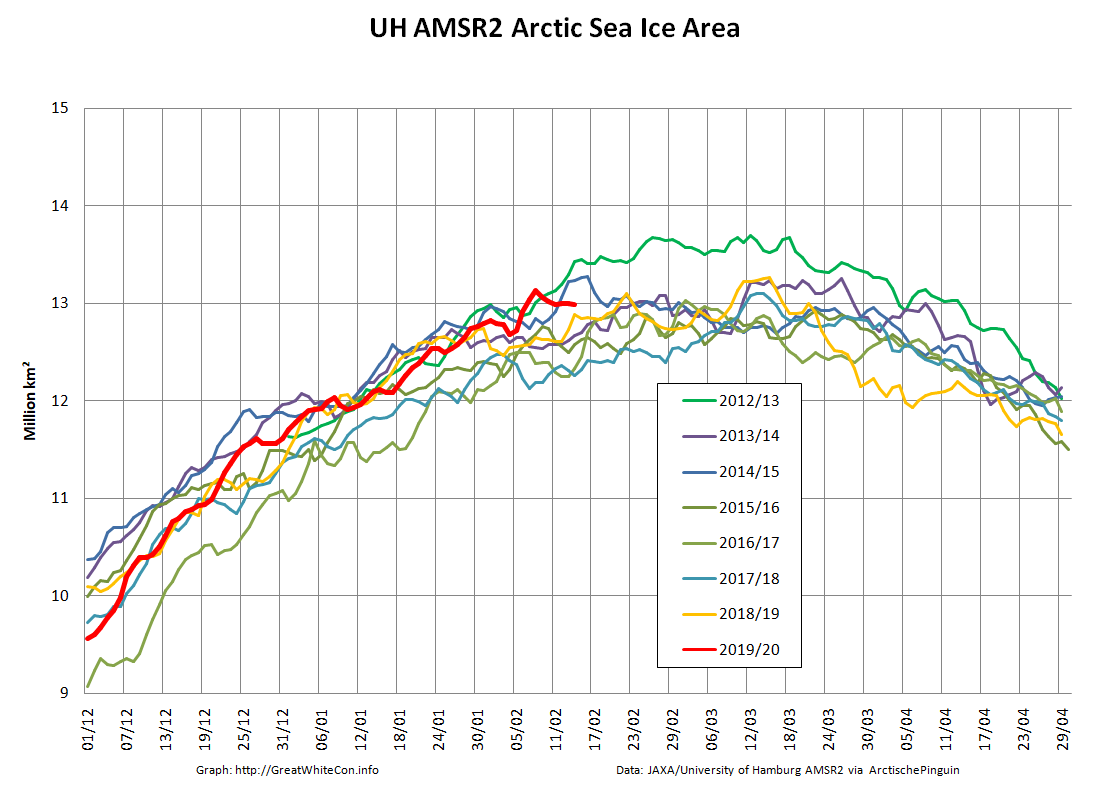
Here too are Wipneus’ latest high resolution AMSR2 area and extent graphs:

[Edit – February 18th]

Wipneus has released his usual mid month PIOMAS update on the Arctic Sea Ice Forum:

I am forced to ponder once again why the CryoSat-2/SMOS thickness “measured” numbers just above seem to be more at variance with PIOMAS in 2020 than in previous years:

[Edit – February 22nd]

Here’s another weekly NRT volume update:

This time I’ve left off the NRT data from February 6th onwards, since the “issue” referred to above obviously hasn’t been solved yet. As an added bonus here’s a graph showing the trends (or lack thereof) on 3 dates during the October to April freezing season:

Melt Pond May 2019

A couple of years ago I was asked to provide “a handful of things [you] will be keeping an eye on over the next few months to judge how ‘good’ or ‘bad’ the melt is going?”

My answer was, and remains:

5 fingers worth to start with? Not necessarily in order of time or importance!

1. How soon melt ponds and/or open water hang around in the Beaufort Sea this year. Things started very early [in 2016]:

https://GreatWhiteCon.info/2016/04/the-beaufort-gyre-goes-into-overdrive/

2. Ditto the Bering Strait and Chukchi Sea
3. Ditto the Laptev and East Siberian Seas
4. How many (and how deep, warm, wet) spring cyclones spin around the Arctic Ocean

5. How the snow melt progresses across Canada, Alaska and Siberia

Applying the same criteria this year, open water is already hanging around in the Beaufort Sea, as well as the Amundsen Gulf:

NASA Worldview “true-color” image of the Beaufort Sea on May 21st 2019, derived from the MODIS sensor on the Terra satellite

What’s more a cyclone is currently spinning in the area too:

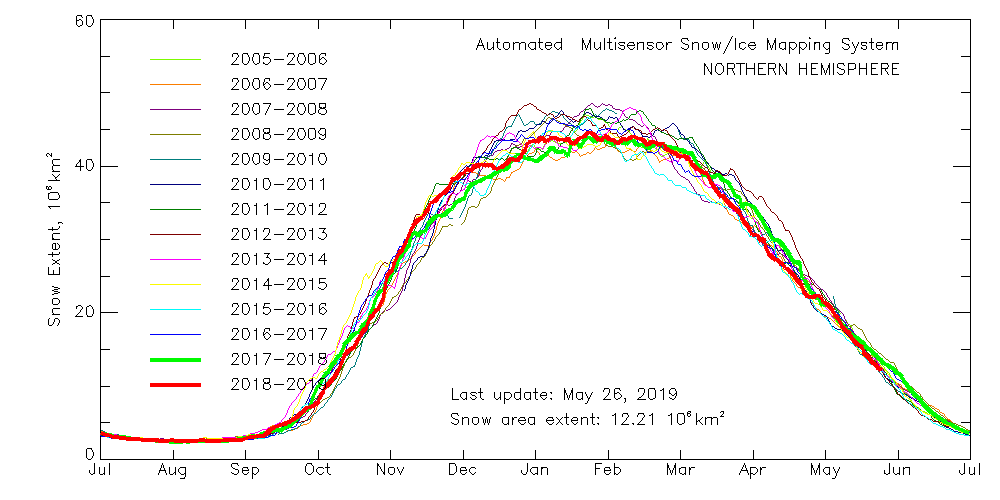
With those prerequisites in place, how about my other criteria? Here’s the current northern hemisphere snow cover graph:

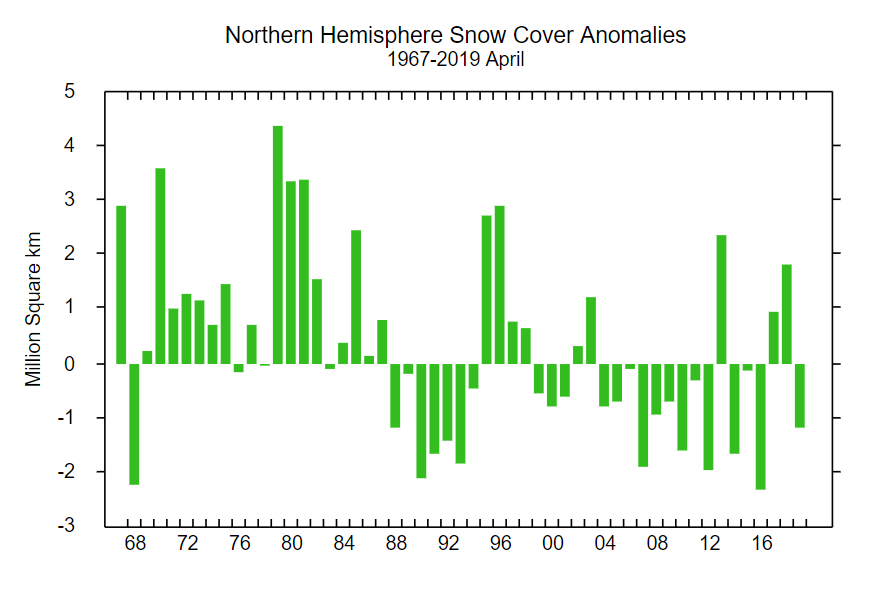
That suggests snow cover over land is close to recent lows, which is confirmed by the Rutgers University snow cover anomaly graph for April:

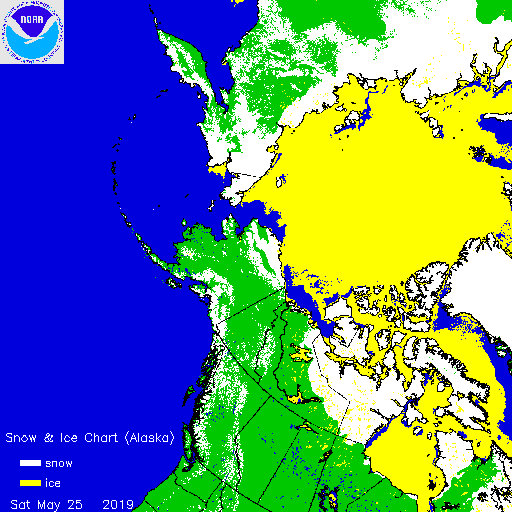
This year is anomalously low, but not by as much as 2012 and 2016. For completeness, here also is the current US National Ice Center snow cover map:

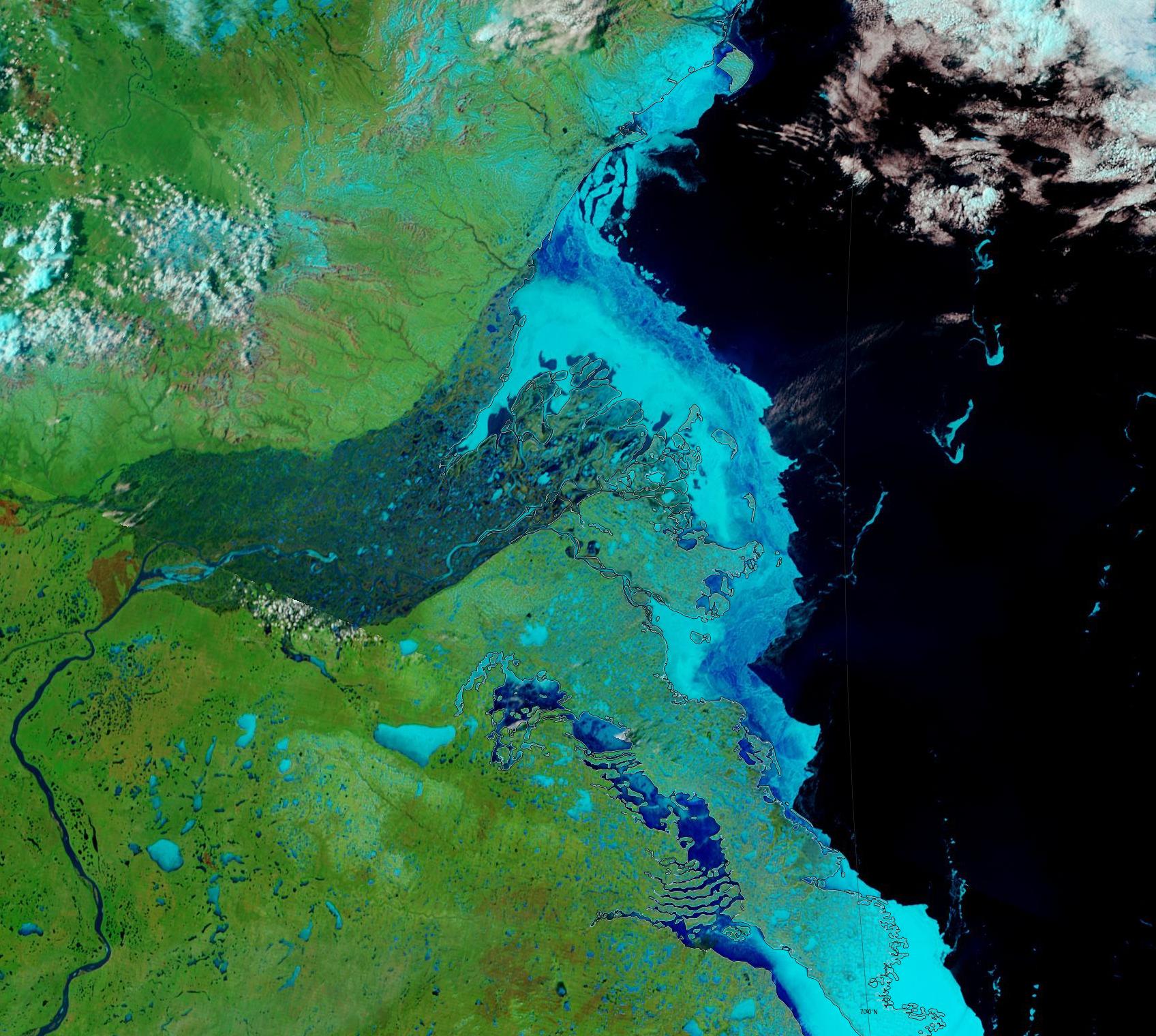
Moving on to melt ponds, there are plenty to be seen on the fast ice around the Mackenzie river delta:

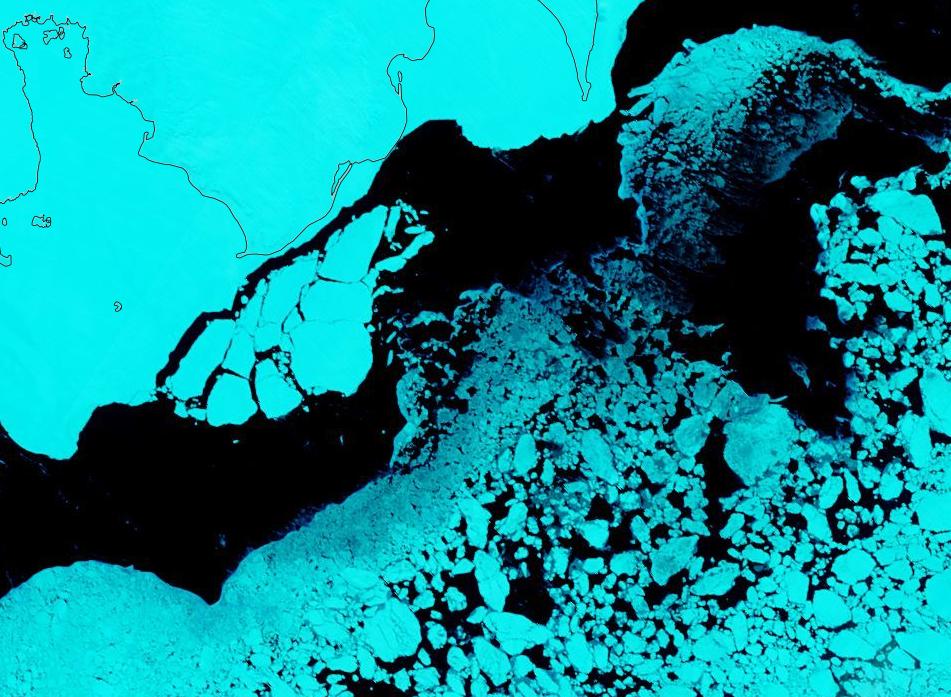
NASA Worldview “false-color” image of the Mackenzie Delta on May 24th 2019, derived from the MODIS sensor on the Terra satellite

There also seem to be signs of some at a higher latitude off Ostrov Kotelny in the New Siberian Islands:

NASA Worldview “false-color” image of the Laptev Sea on May 23rd 2019, derived from the MODIS sensor on the Terra satellite

This year there is also a lot of open water in the Chukchi Sea, and almost no sea ice left in the Bering Sea:

Compared with 2016 at the same time of year I am compelled to say that with June 1st just around the corner the 2019 summer melting season is primed to progress more quickly.

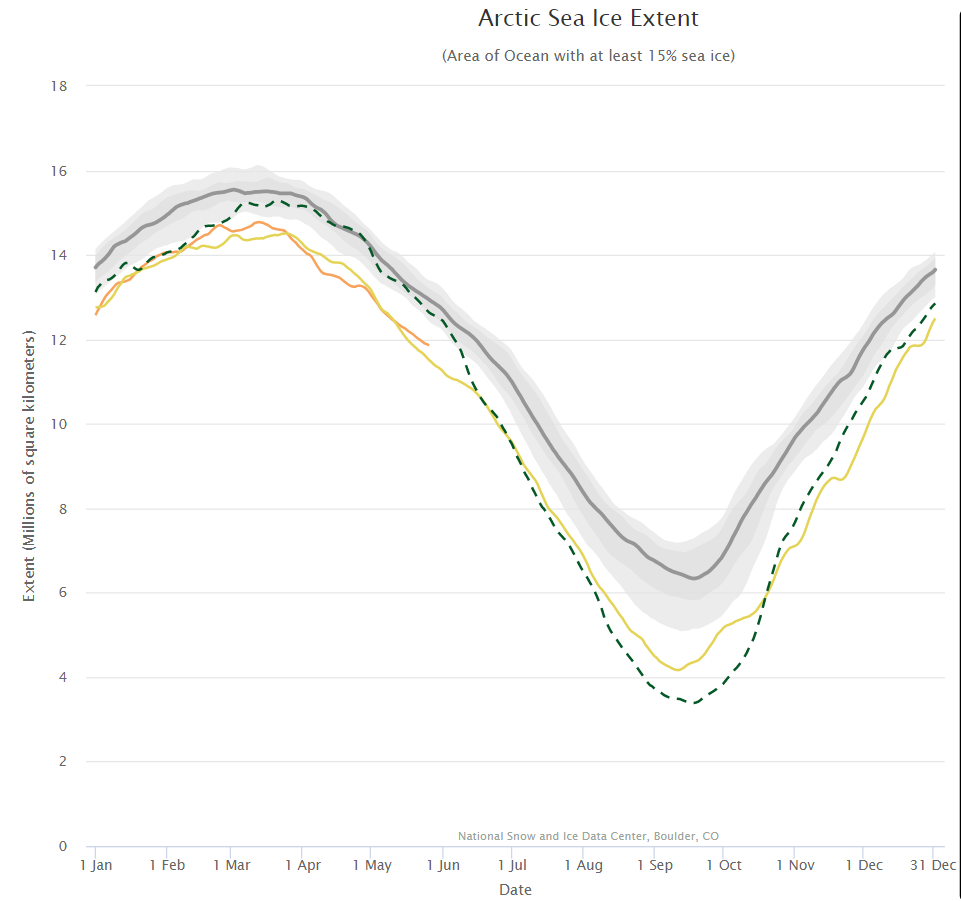
The next obvious comparison to make is with the (in)famous year of 2012, which resulted in the lowest ever minimum extent in the satellite record. Firstly let’s look at the National Snow and Ice Data Center’s graph of Arctic sea ice extent:

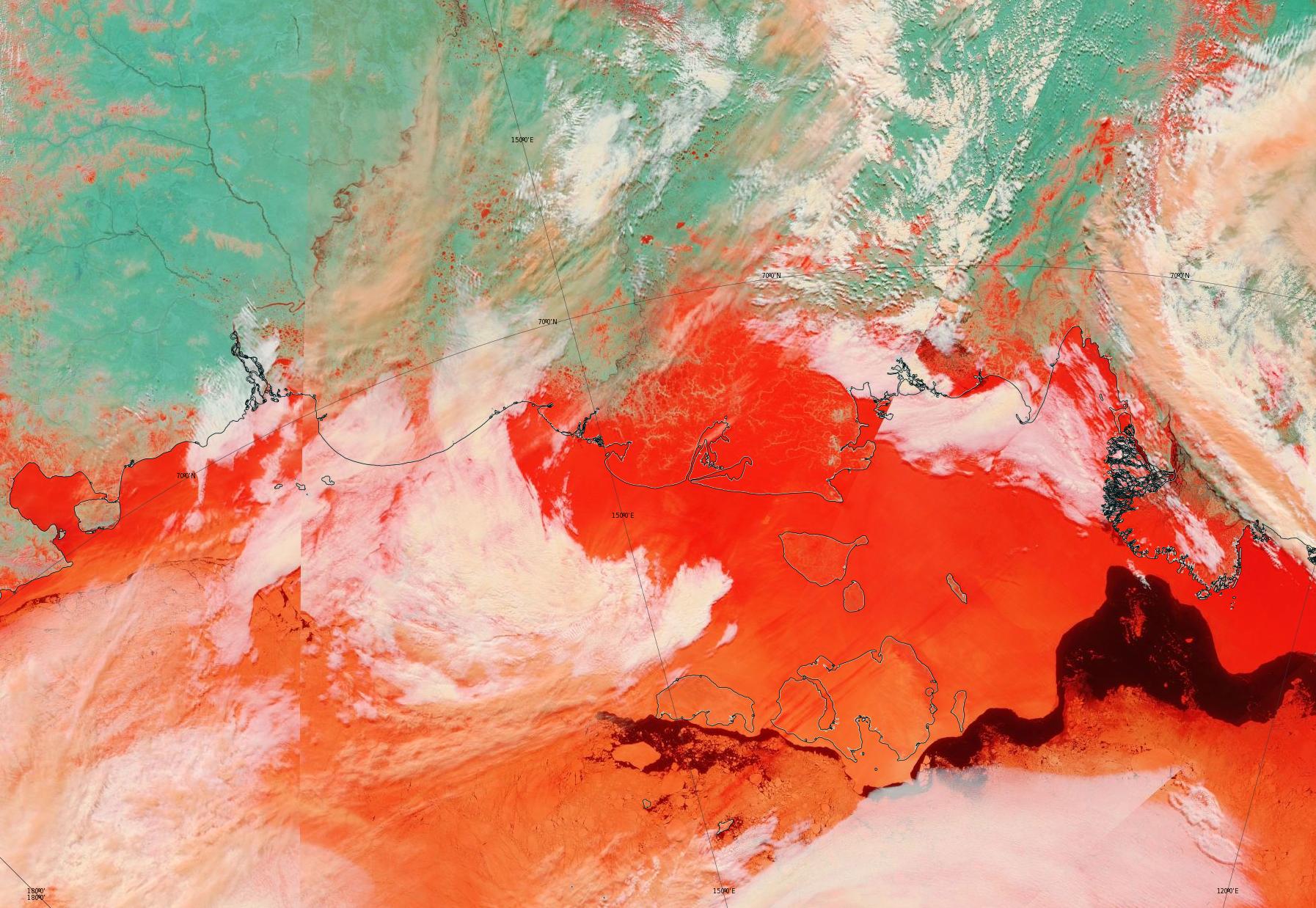
Currently extent is significantly below 2012, albeit somewhat above 2016 at the same time of year. And what of melt ponds? In 2012 there was evidence of less snow cover over land and more surface water on the ice on the Siberian side of the Arctic:

NASA Worldview “false-color” image of the Eastern Arctic on May 25th 2012, derived from the MODIS sensor on the Terra satellite

Other than that Arctic sea ice in 2019 looks to be in worse shape than in 2012.
[Edit – May 27th]

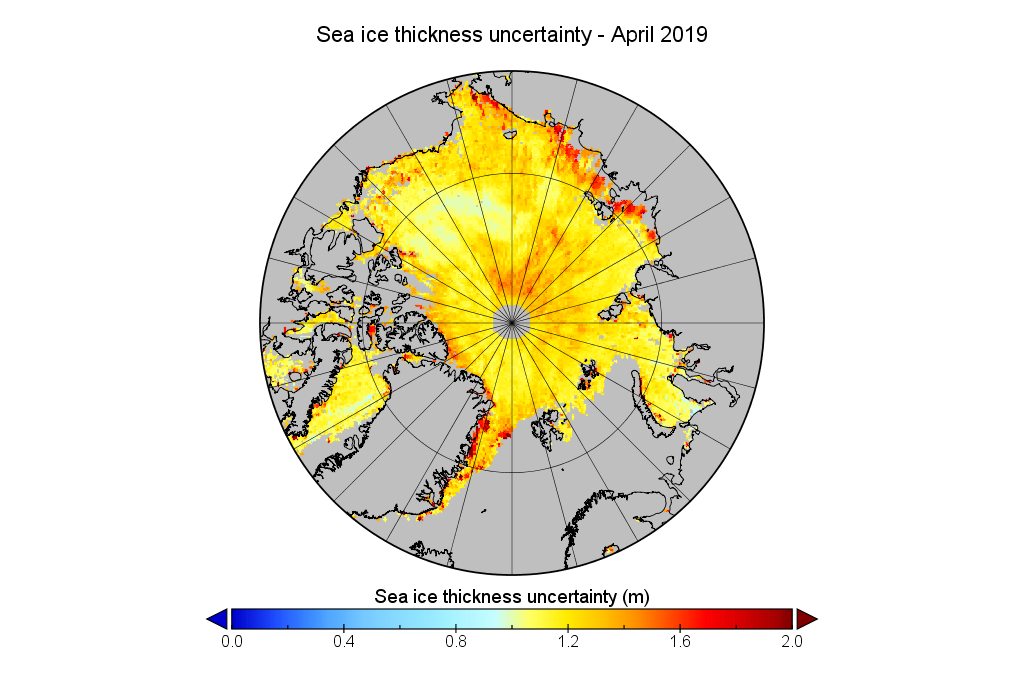
We’ve established that the extent of Arctic sea ice at the end of May 2019 is less than in 2012, but something else to consider is whether that ice is currently thicker than in 2012, or not. Satellites can have a reasonable stab at measuring the area of sea ice, but the third dimension is much trickier. The European Space Agency’s CryoSat-2 satellite has been attempting to measure sea ice thickness since 2010, so let’s take at the conclusions it has reached:
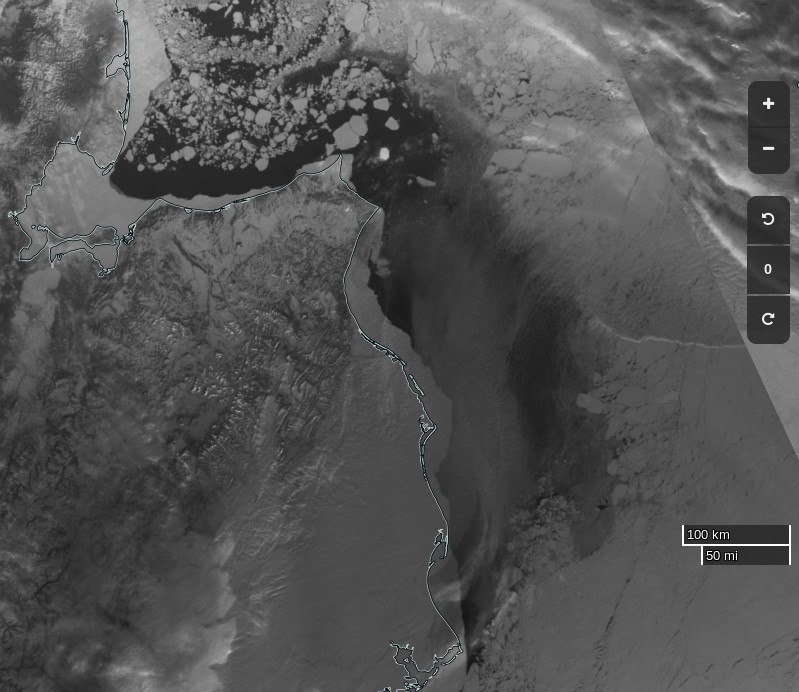
Don’t forget to take a good long look at the associated uncertainties too:

Watch this space!

Facts About the Arctic in May 2017

Before we got on to the more usual Arctic metrics let’s bear in mind that the beginning of May is the time when the ice on the mighty Mackenzie River begins to break up, ultimately sending a surge of (comparatively!) warm water rushing into the Beaufort Sea. The patches of open water visible in the Beaufort Sea off the Mackenzie Delta in early April refroze, but have recently opened up once again:

NASA Worldview “true-color” image of the Beaufort Sea on May 2nd 2017, derived from the MODIS sensor on the Terra satellite

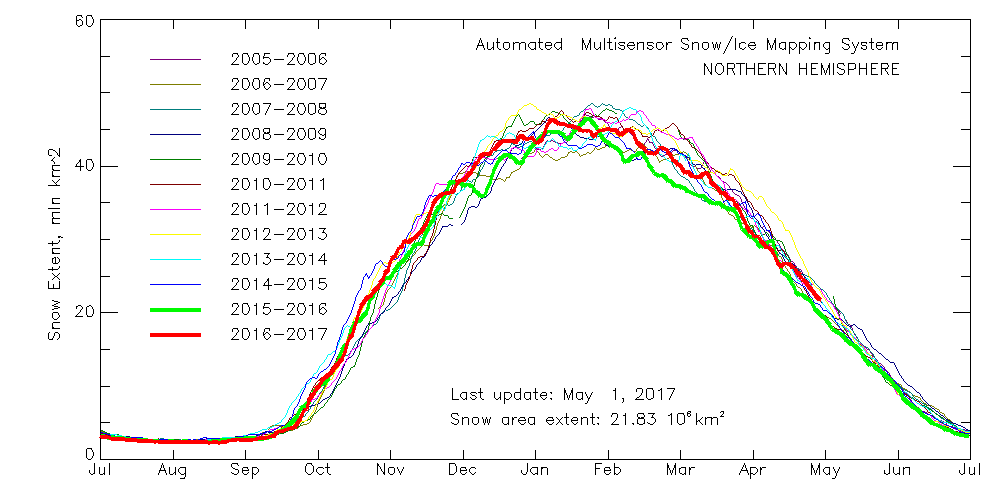
Meanwhile Northern Hemisphere snow cover is falling fast, albeit still above last year’s levels:

multisensor_4km_nh_snow_extent_20170502

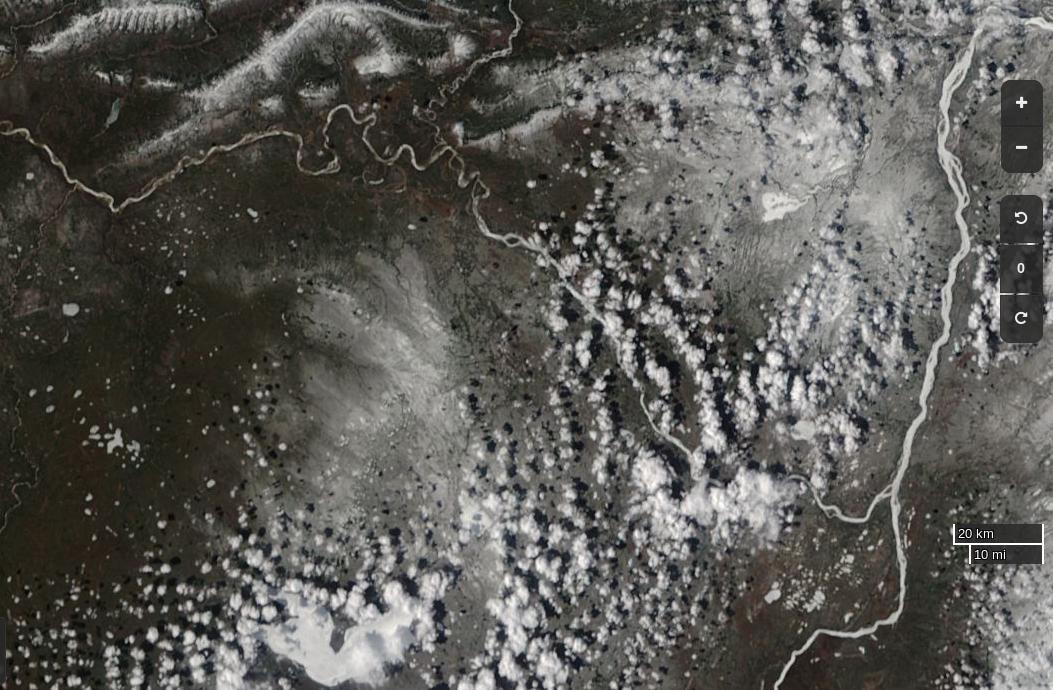
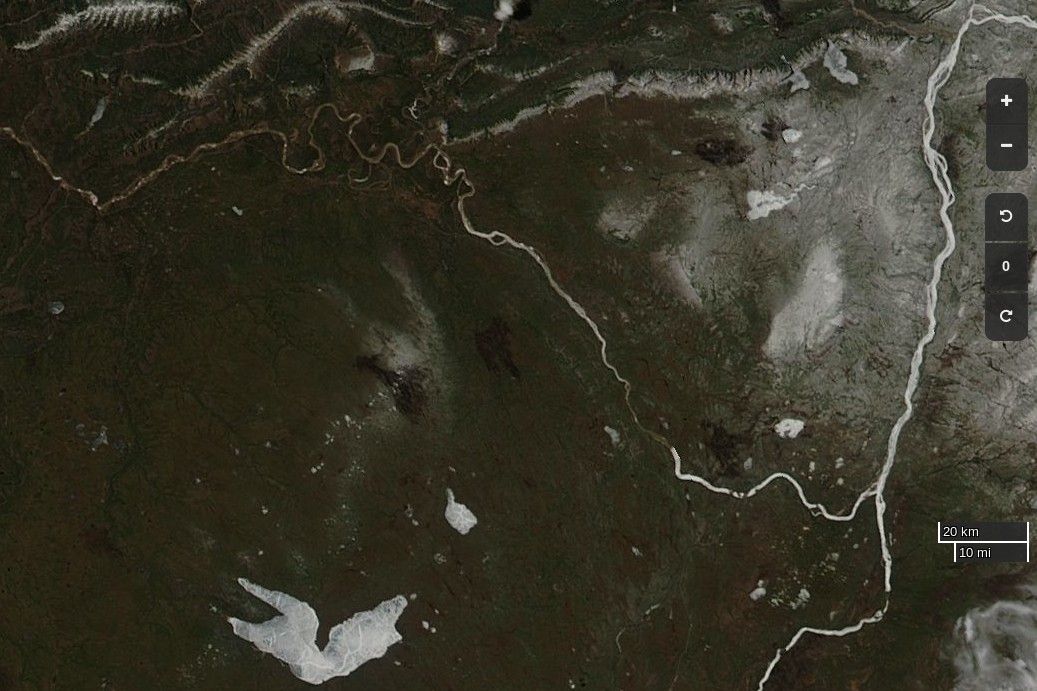
Here’s the current view of the Liard River in northern Canada, with the Mackenzie River running bottom to top on the right hand side:

NASA Worldview “true-color” image of the Liard and Mackenzie Rivers on May 2nd 2017, derived from the MODIS sensor on the Terra satellite

The break-up of the Liard leads the Mackenzie, and taking a look at last year’s view of the same area it’s apparent that this year there’s somewhat more snow on the ground, and that this years Mackenzie break-up will therefore be a few days later than last year:

NASA Worldview “true-color” image of the Liard and Mackenzie Rivers on May 2nd 2016, derived from the MODIS sensor on the Aqua satellite

Whilst early melt in the Beaufort Sea is currently behind last year, the reverse is most certainly the case next door in the Chukchi Sea. The skies are rather cloudy there at the moment, but using the Suomi NPP day/night band to peer through the gloom reveals this:

NASA Worldview “day/night band” image of the Chukchi Sea on May 2nd 2017, derived from the VIIRS sensor on the Suomi satellite

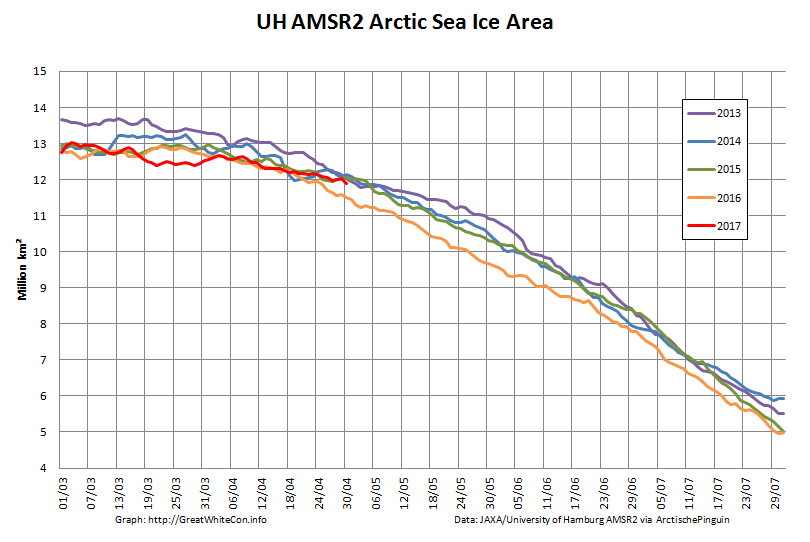
Whilst sea coverage on the Pacific periphery has continued to fall, extent on the Atlantic side has not been following suit. Hence overall Arctic sea ice area is no longer lowest in the satellite record:

UH-Arctic-Area-2017-04-30

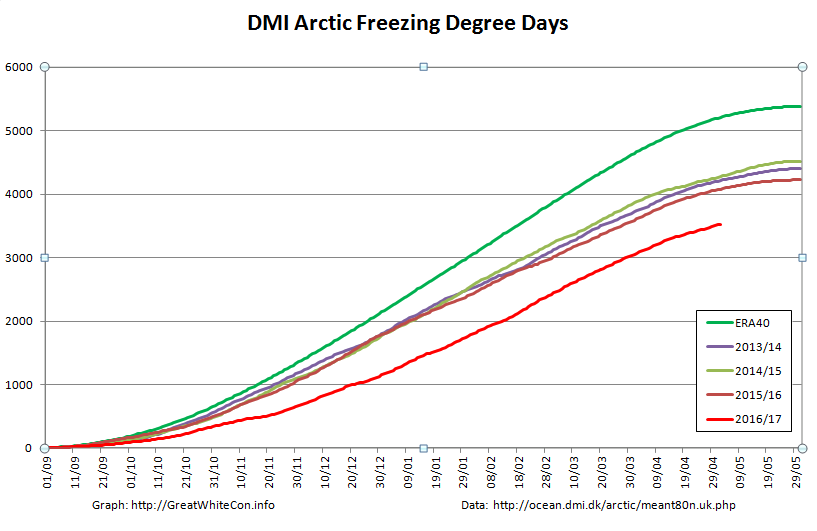
Finally, until the new PIOMAS numbers are released at least, here’s how DMI freezing degree days look at the moment:

DMI-FDD-20170502


[Edit – May 4th]

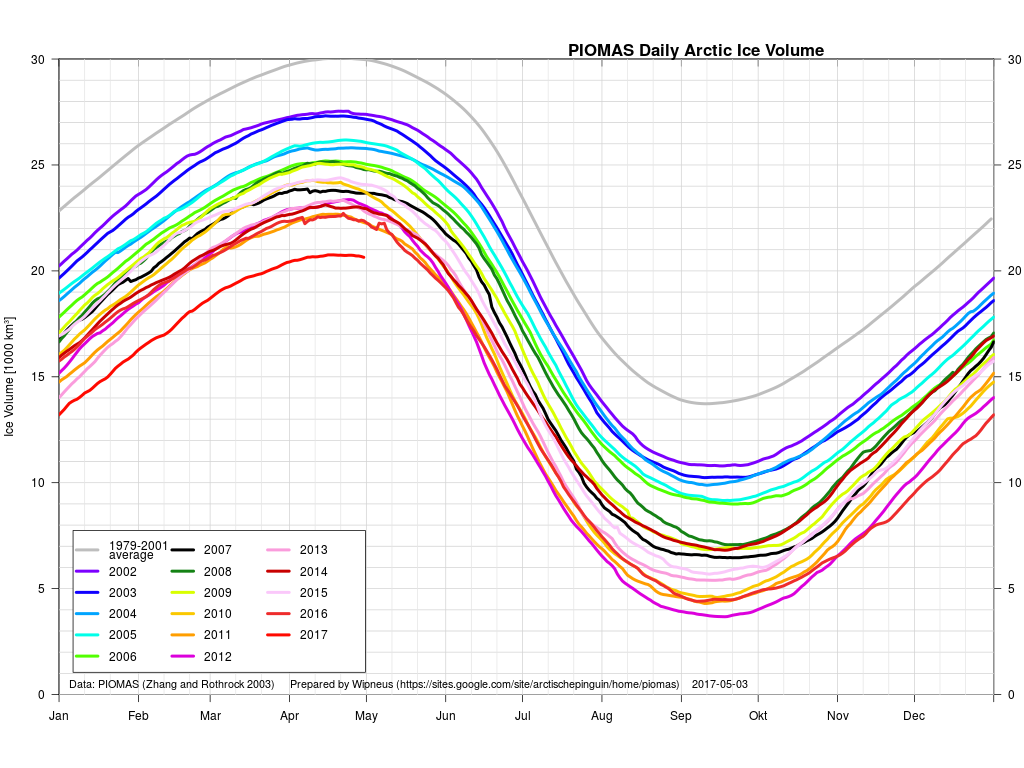
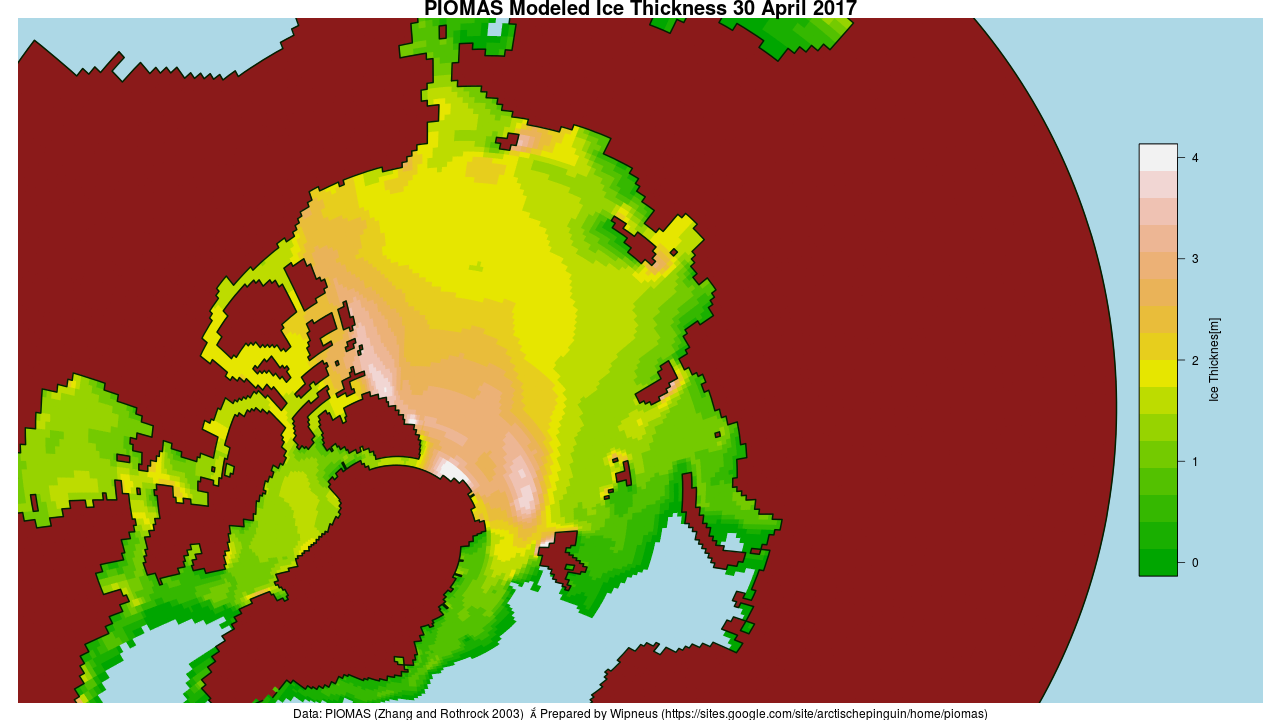
The April PIOMAS numbers have been published: Arctic sea ice volume is yet again by far the lowest on record:

PIOMAS-Volume-20170430

PIOMAS-thk-20170430


[Edit – May 5th]

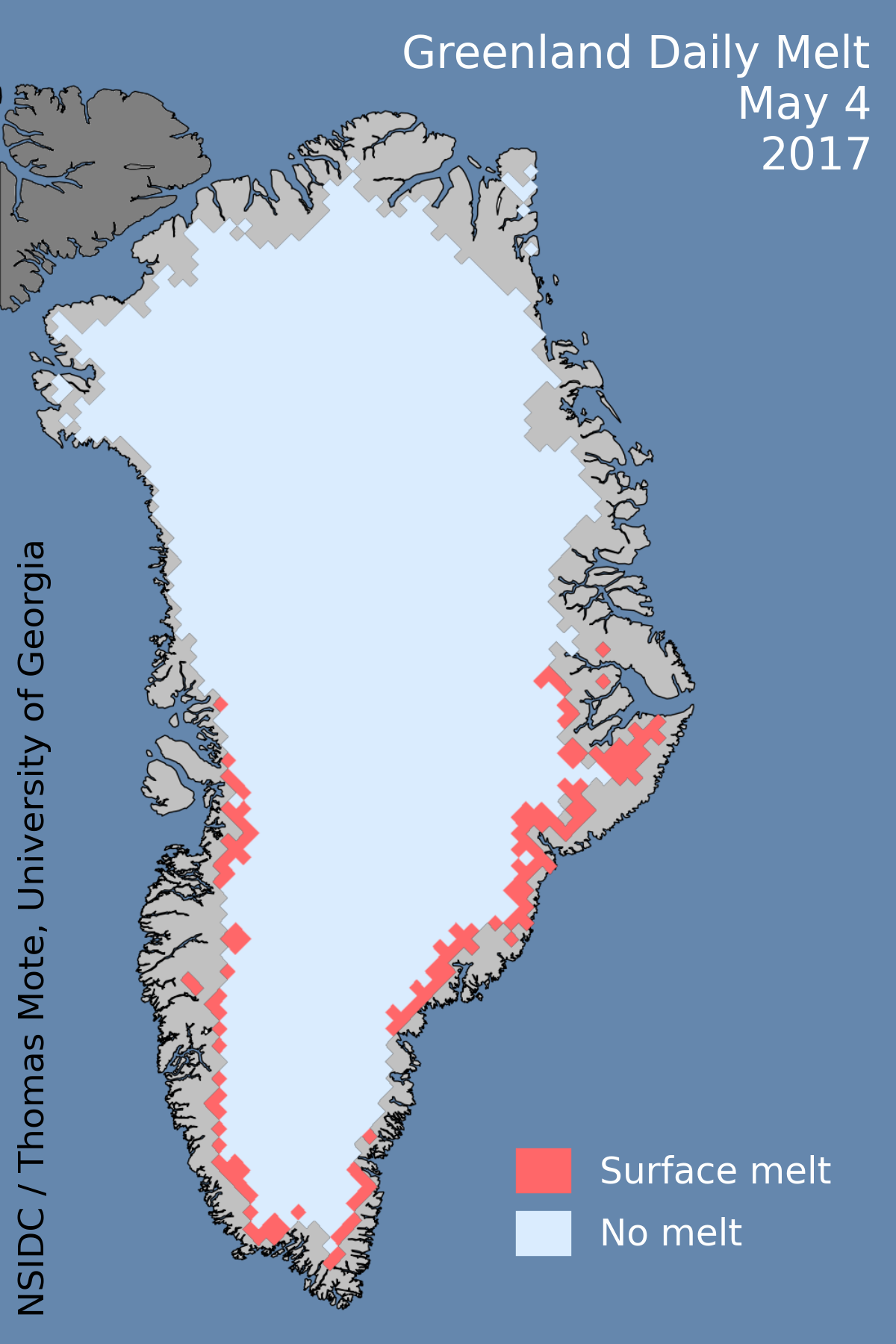
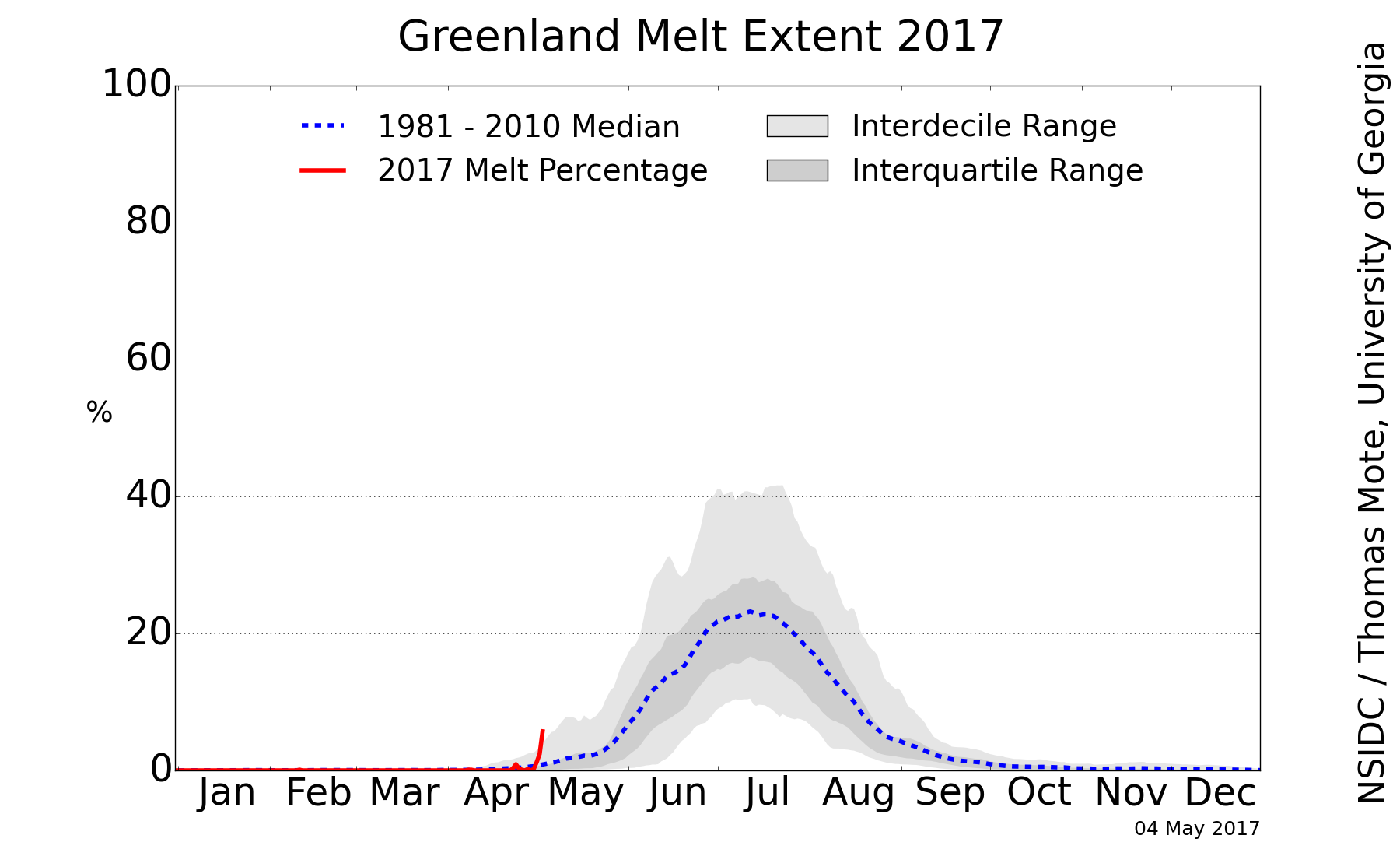
Greenland ice sheet surface melt has started early this year:

greenland_melt_map_20170504

greenland_melt_plot_20170504


[Edit – May 12th]

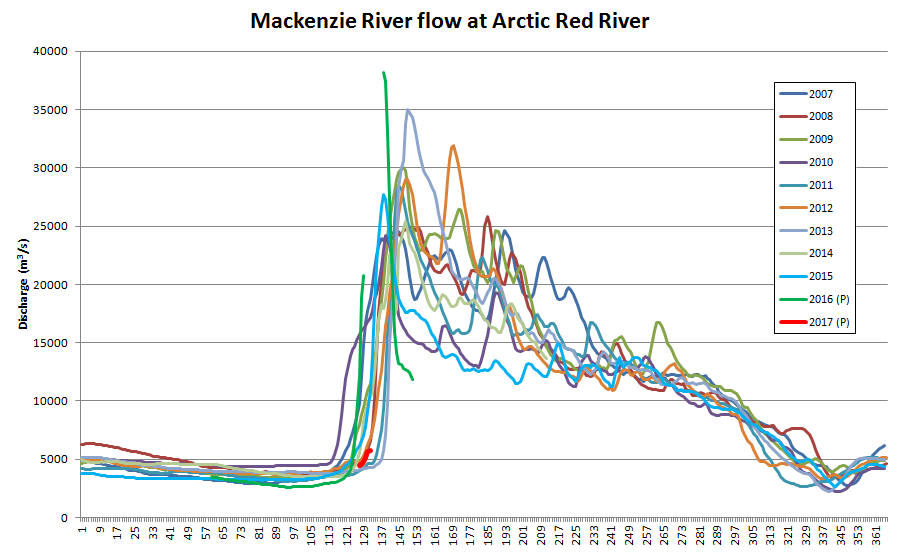
The ice break-up of the Mackenzie River is now visible as increased flow at the junction with Arctic Red River just south of the delta:

Mackenzie River flow at Arctic Red River up to May 12th 2017

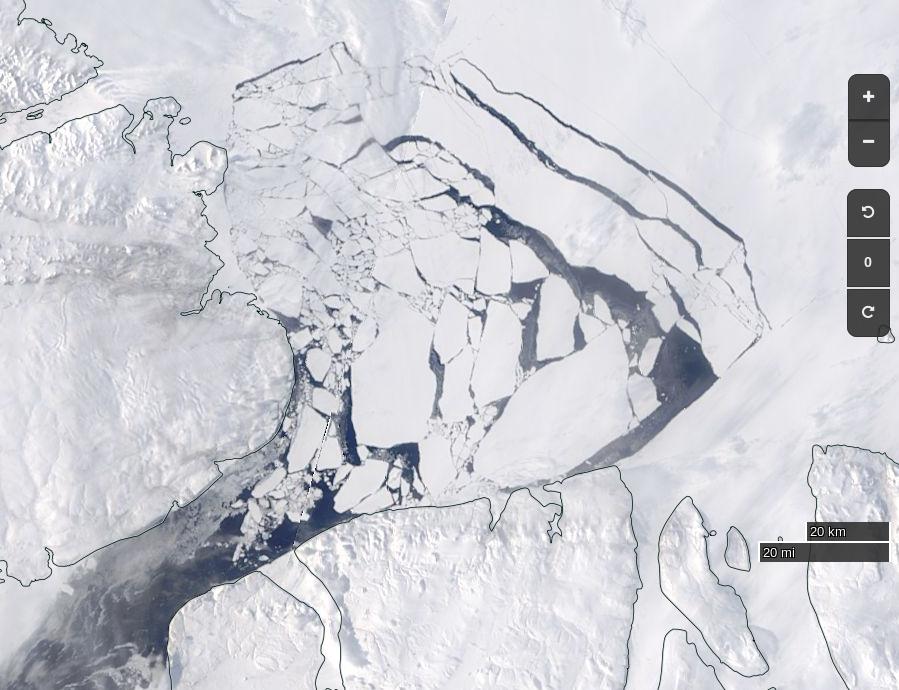
Meanwhile the sea ice in the Lincoln Sea north the Nares Strait is coming apart at the seams:

NASA Worldview “true-color” image of the Lincoln Sea on May 12th 2017, derived from the MODIS sensor on the Terra satellite


[Edit – May 17th]

May seems to be shaping up as month of two halves, both spatially and temporally. Here’s an overview of the current state of play:

Arc_20170516_res3.125

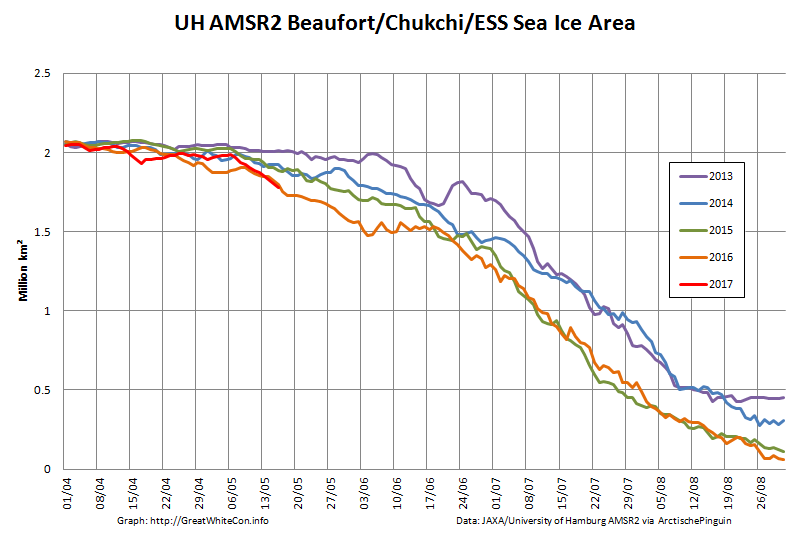
On the Pacific side of the Arctic sea ice area has been declining rapidly courtesy of the expanding areas of open water visible in the Beaufort, Chukchi and East Siberian Seas. It’s currently tracking below other recent years:

UH-Pacific-Extent-2017-05-16

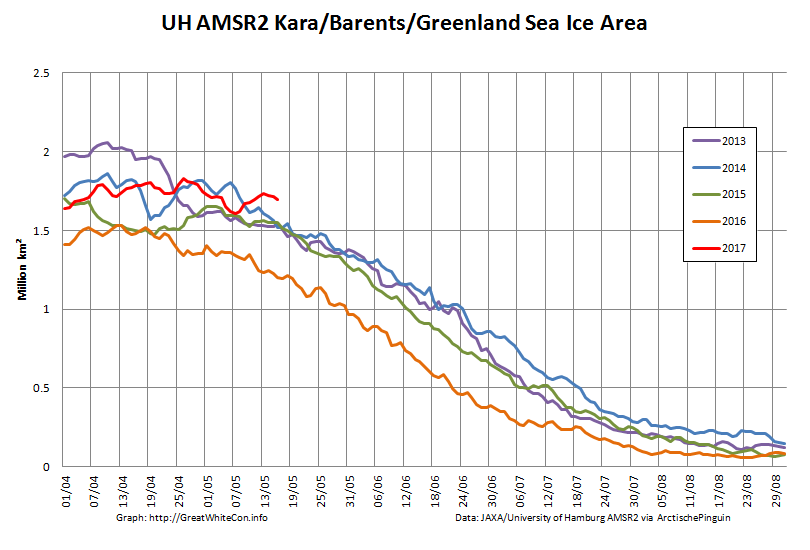
However over on the Atlantic side area has been flatlining, and is currently above other recent years:

UH-Atlantic-Extent-2017-05-16

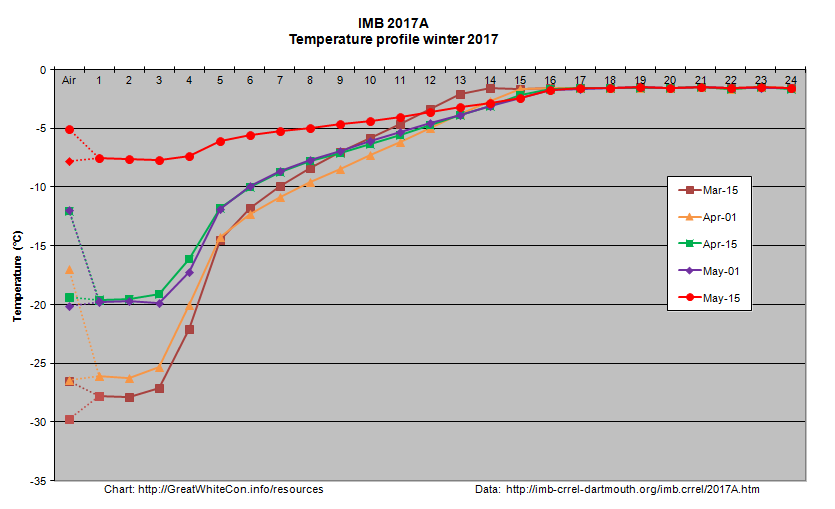
Ice mass balance buoy 2017A is now located near the boundary between the Beaufort and Chukchi Seas and as the melting season in that vicinity rapidly approaches it reveals that thermodynamic thickening has thus far achieved a mere 119 cm:2017A-2017-05-15

Arctic wide sea ice area has recently started to decline at an increasing rate:

UH-Arctic-Area-2017-05-16

During the second half of the month it will be interesting to see whether the forecast high temperatures produce significant melt ponding. If so it’s conceivable that 2017 area could drop below 2016 again by the beginning of June. There already signs of surface melt at places as far apart as Franklin Bay, Chaunskaya Bay and even the Great Bear Lake!

Watch this space!

References

Muhammad, P., Duguay, C., and Kang, K.-K.: Monitoring ice break-up on the Mackenzie River using MODIS data, The Cryosphere, 10, 569-584, doi:10.5194/tc-10-569-2016, 2016.

Rood S. B., Kaluthota S., Philipsen L. J., Rood N. J., and Zanewich K. P. (2017) Increasing discharge from the Mackenzie River system to the Arctic Ocean, Hydrol. Process., 31, 150–160. doi: 10.1002/hyp.10986.

Kwok, R., L. Toudal Pedersen, P. Gudmandsen, and S. S. Pang (2010), Large sea ice outflow into the Nares Strait in 2007, Geophys. Res. Lett., 37, L03502, doi:10.1029/2009GL041872.

Facts About the Arctic in April 2017

Particularly in view of all the balderdash concerning “climate science” being spouted in Washington DC on Wednesday lets first of all run through some Arctic sea ice facts from April 1st 2017 or thereabouts:

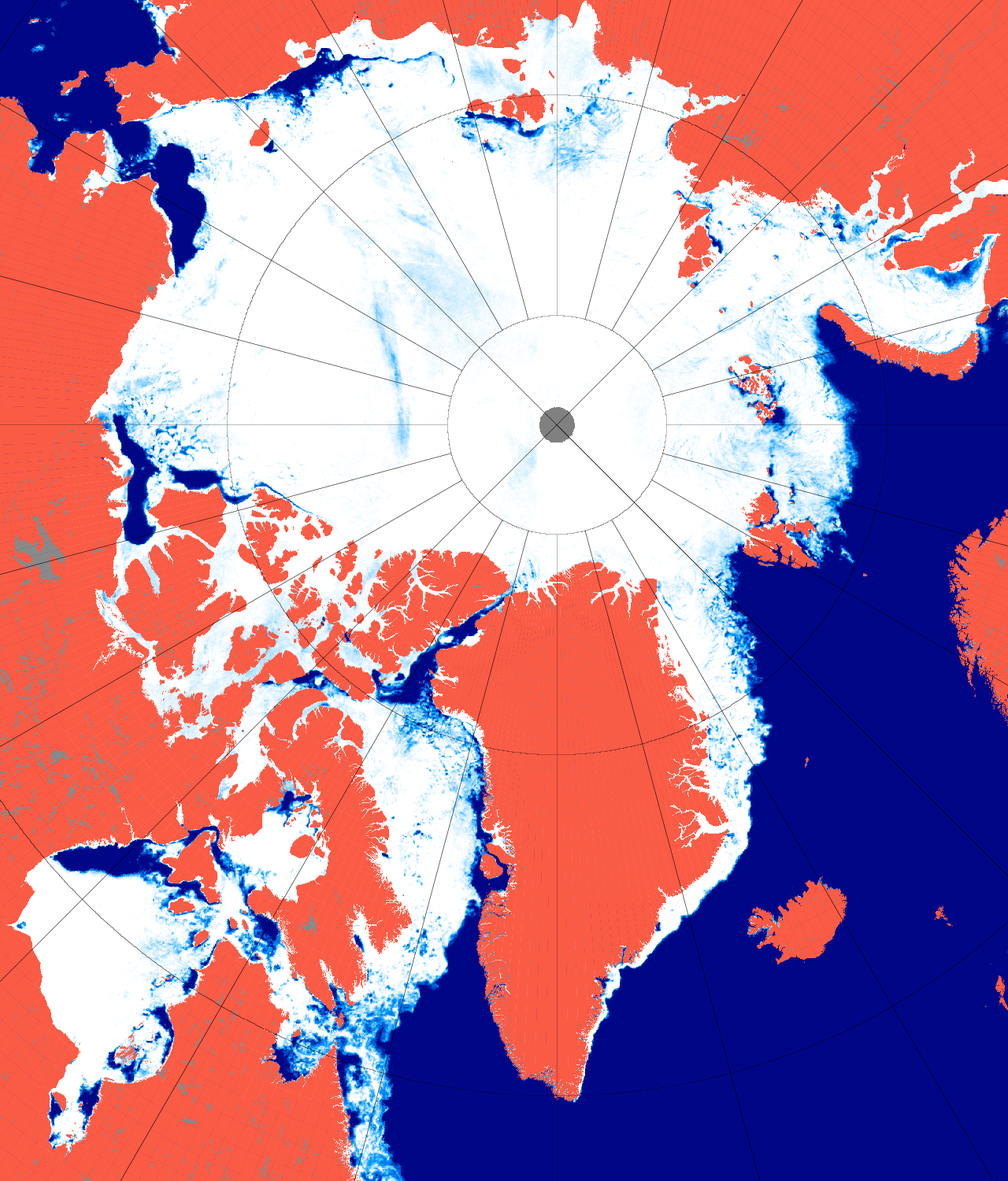
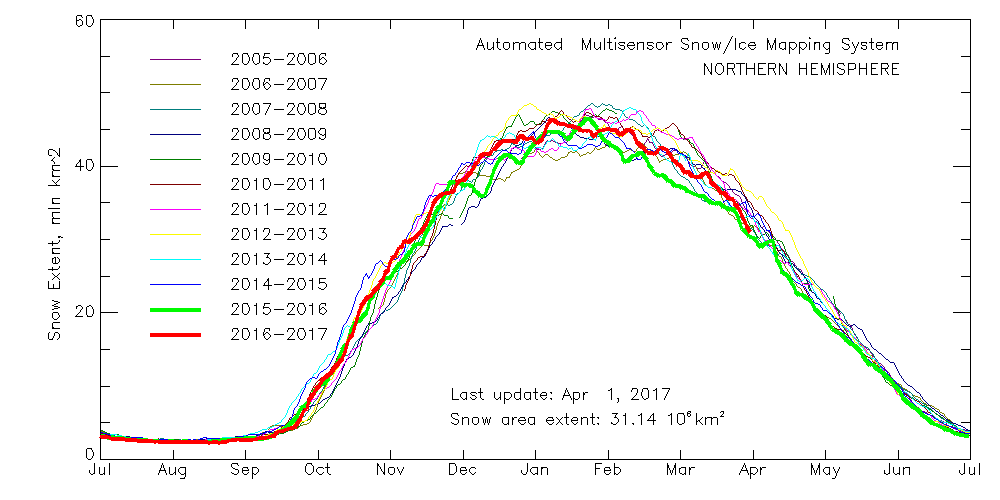
Northern Hemisphere Snow Extent:

multisensor_4km_nh_snow_extent_20170401

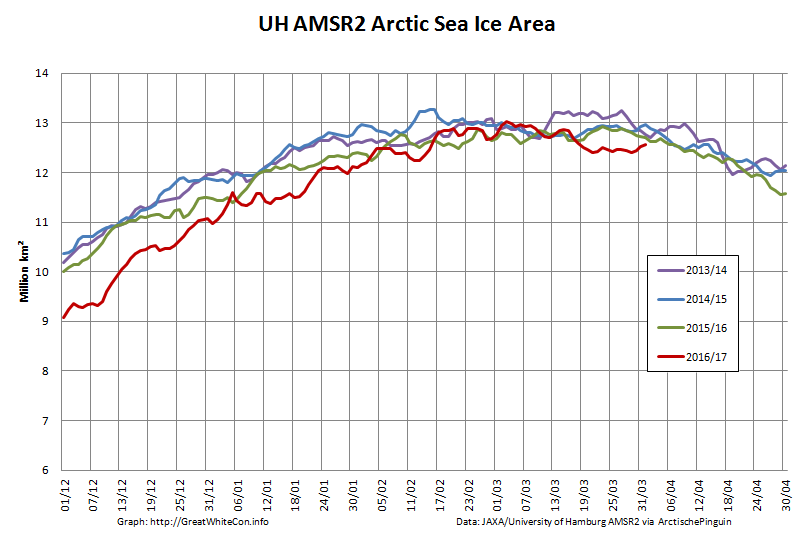
Arctic Sea Ice Area:

UH-Arctic-Area-2017-04-01

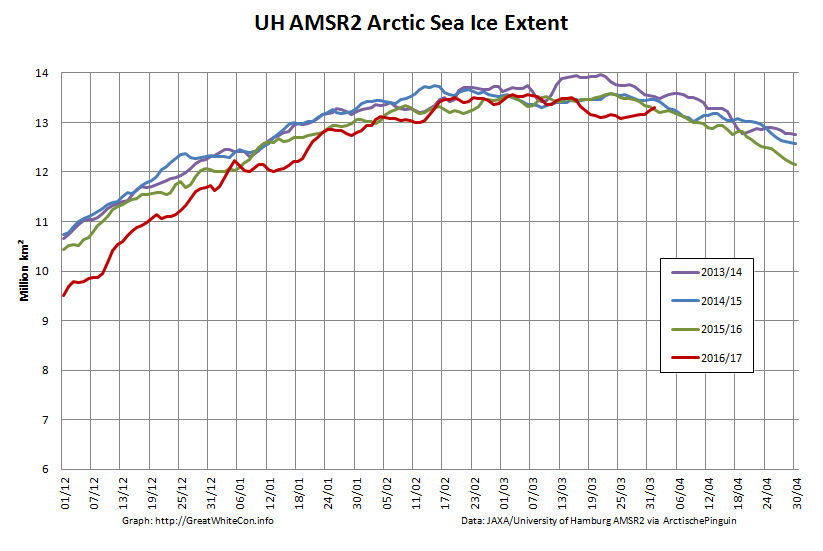
Arctic Sea Ice Extent:

UH-Arctic-Extent-2017-04-01

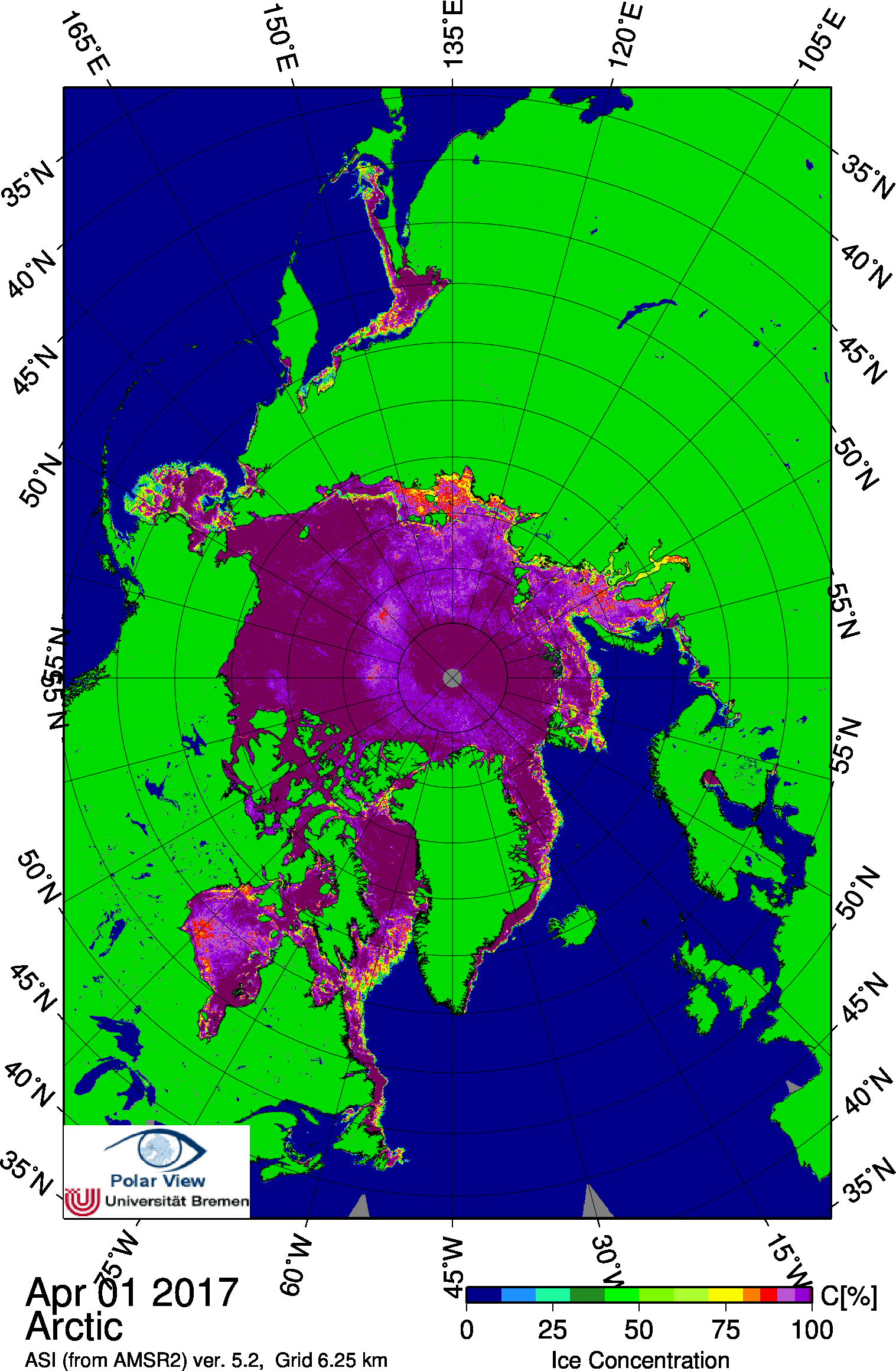
Arctic Sea Ice Concentration:

Bremen_AMSR2_20170401

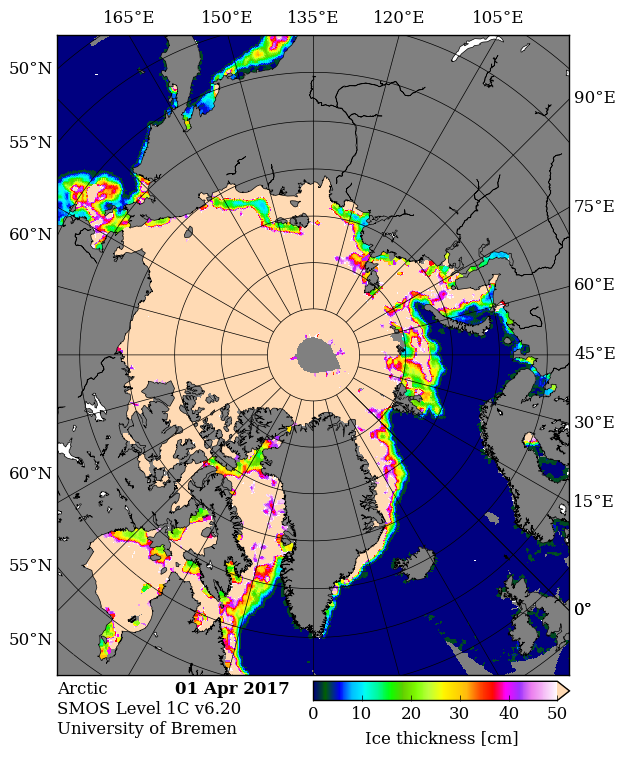
Thin ice map from the University of Bremen SMOS:

SMOS-20170401

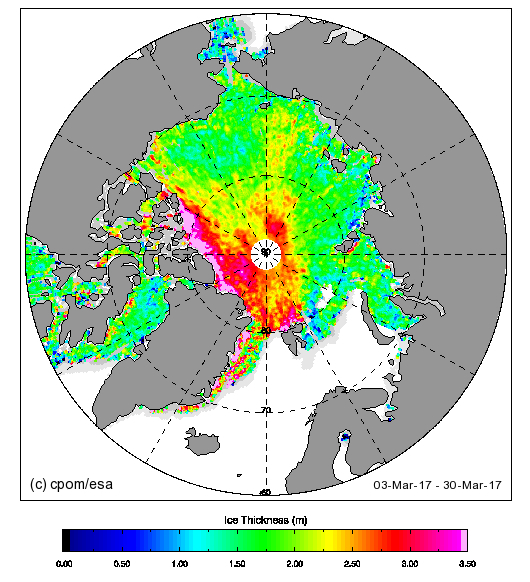
Thick ice map from CPOM CryoSat-2

Cryosat_28_20170330

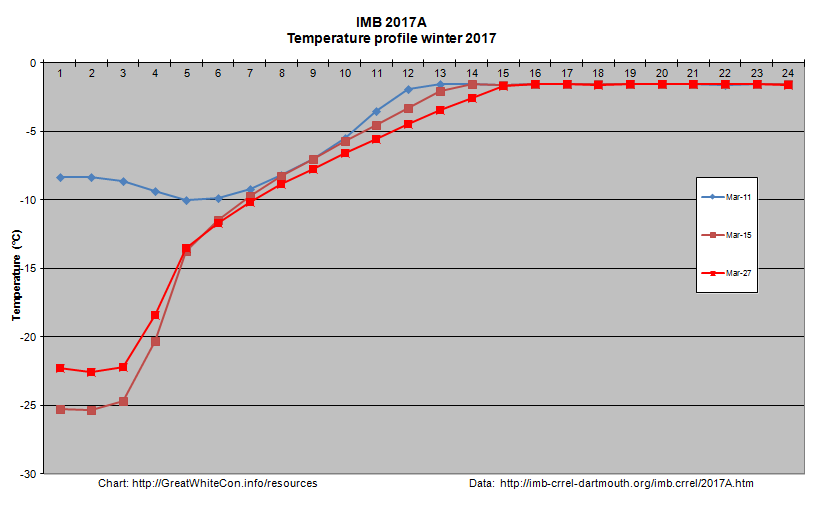
Beaufort Sea ice thickness growth graph:

2017A-2017-03-27

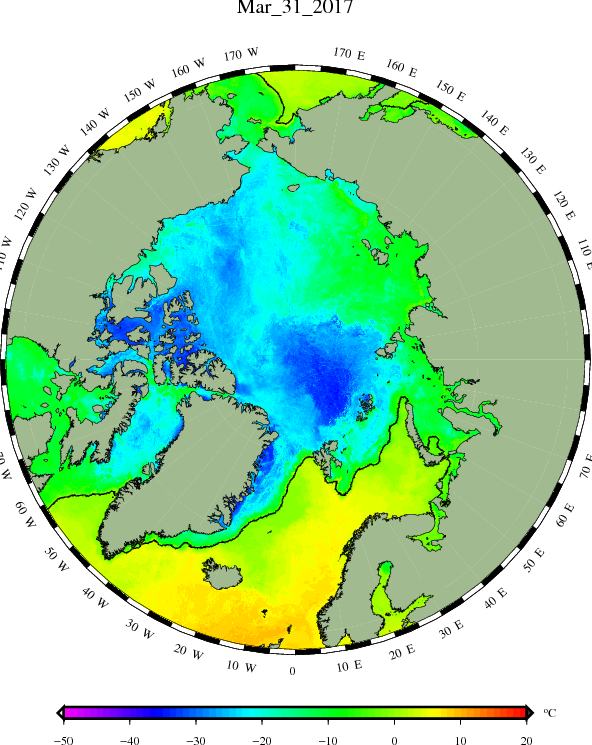
DMI sea ice temperature map:

DMI-icetemp-20170330

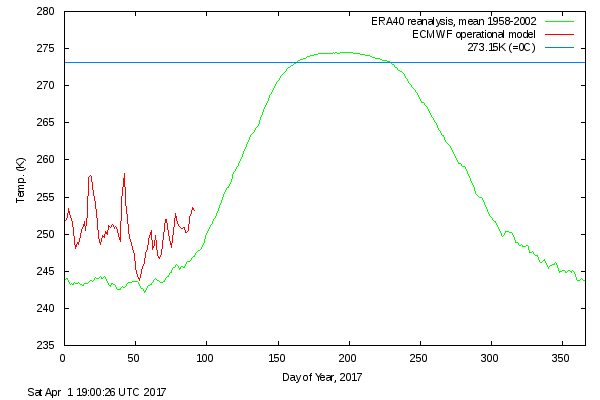
DMI atmospheric temperature graph:

DMI-meanT_20170401

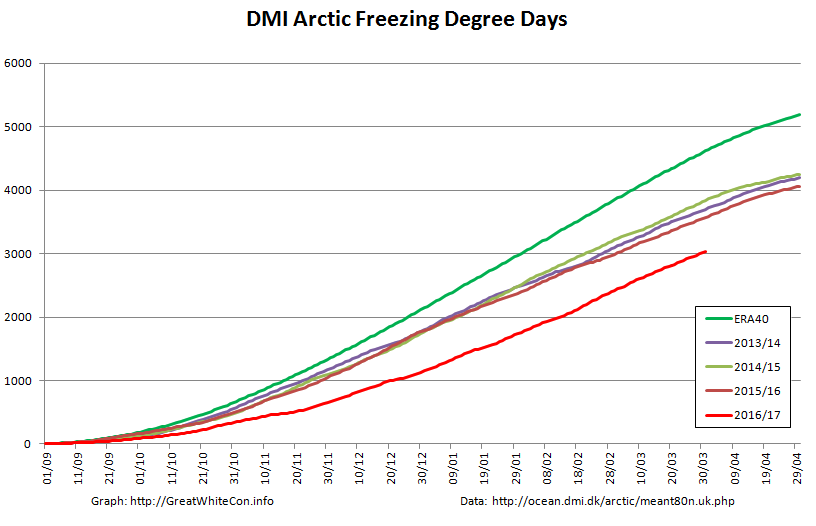
DMI Arctic Freezing Degree Days:

DMI-FDD-20170401

PIOMAS volume for March will follow in a few days, but it’s extremely unlikely to be anything other than “lowest for the date”.

What preliminary conclusions can we draw from this plethora of pretty pictures? First of all the Arctic hasn’t suddenly gone into “deep freeze” mode. Temperatures above 80 degrees north are rising again and are well above the climatology. Freezing degree days are still the lowest on record by a wide margin. Northern hemisphere snow cover is falling fast and is currently just above last year.

In contrast to last year, and thanks to lots of cyclones and very little in the way of anticyclones, there’s plenty of sub half meter sea ice in the Laptev and East Siberian Seas and hardly any in the Beaufort Sea. There’s also plenty of thin ice to be seen on both the Atlantic and Pacific peripheries.

The usual southerly arch hasn’t formed in the Nares Strait between Greenland and Ellesmere Island, and as SMOS shows the sea ice in the strait is consequently very thin. That leads one to wonder when the northern arch in the Lincoln Sea might give way.

It’s not immediately apparent from the still images above, but there’s been relatively large amounts of “old ice” exported from the Central Arctic on the Atlantic side, hence the recent increase in overall extent which is now second lowest for the date (since satellite records began). Area has been creeping up as well over recent days, but is still lowest for the date, as it has been for most of the last year. Sea ice “compactness” has decreased somewhat and given all the thin ice around the edges extent will soon start dropping once again.

All in all, the Arctic sea ice prognosis is not good. Are you watching Lamar Smith? (Pun intended!)


[Edit – April 4th]

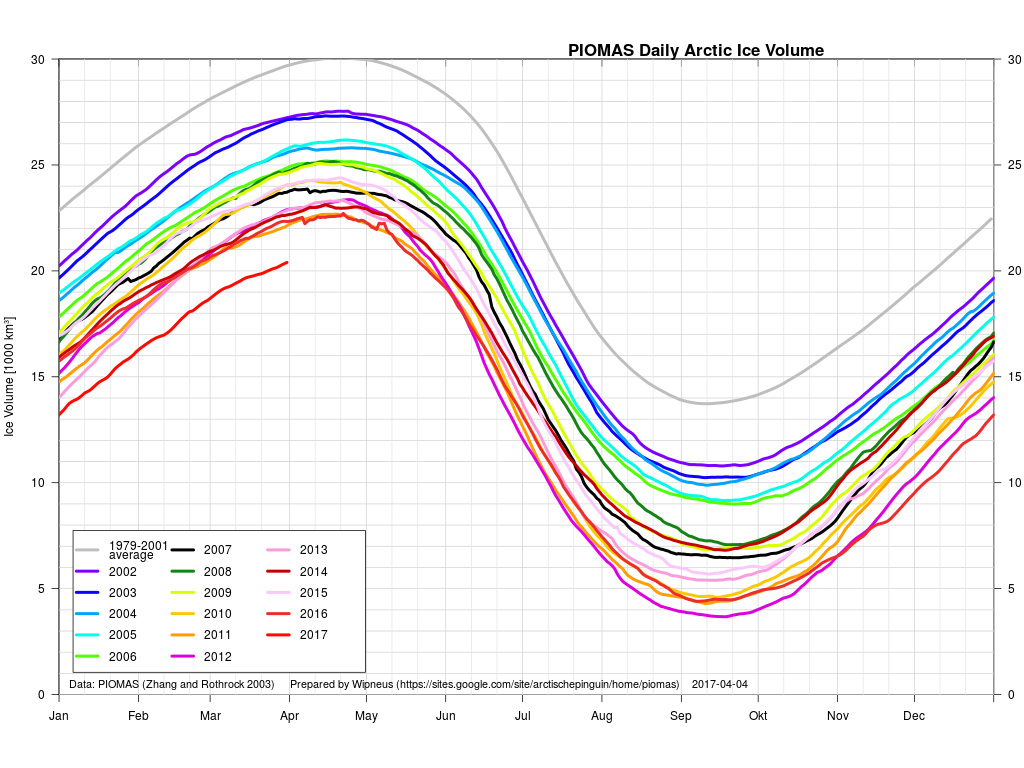
The March PIOMAS update is out! As suspected, Arctic sea ice volume is still by far the lowest on record:

PIOMAS-Volume-20170331

Volume on March 31st 2017 was 20.398 thousand cubic kilometers. The previous lowest volume for the date was 22.129 thousand km³ in 2011.

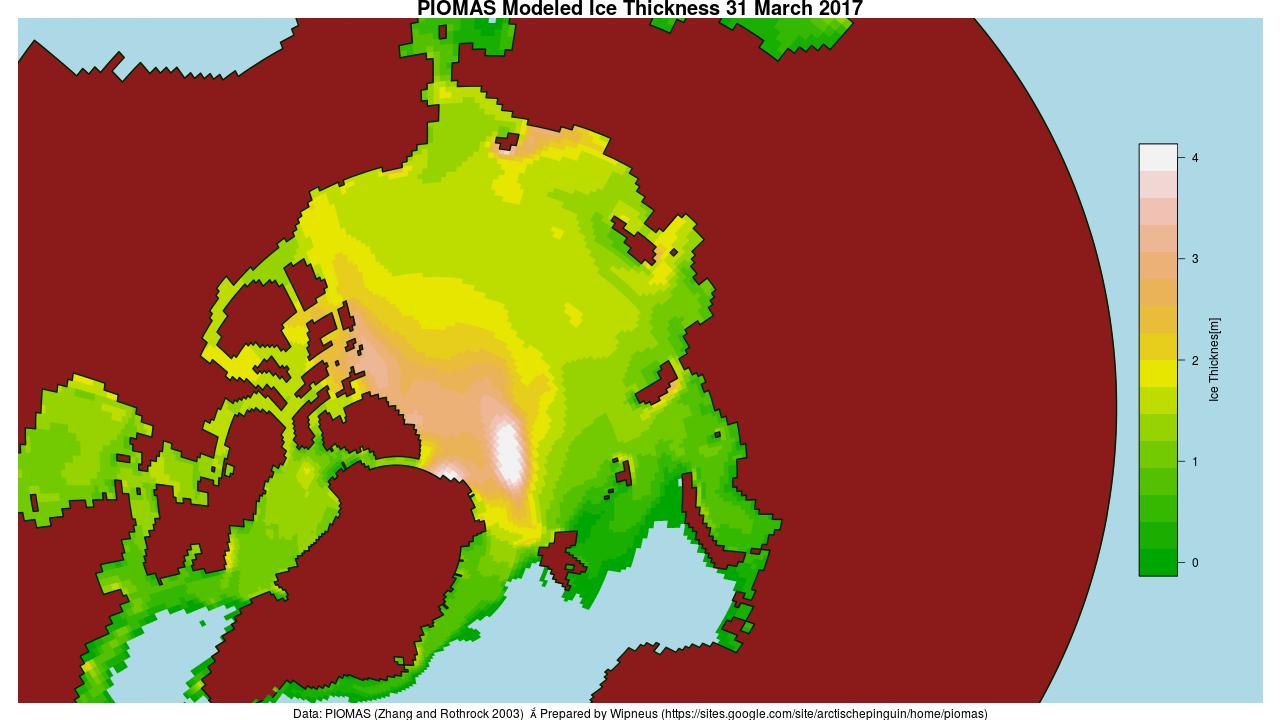
Here too is the PIOMAS modelled Arctic sea ice thickness map:

PIOMAS daily gridded thickness for March 31st 2017


[Edit – April 12th]

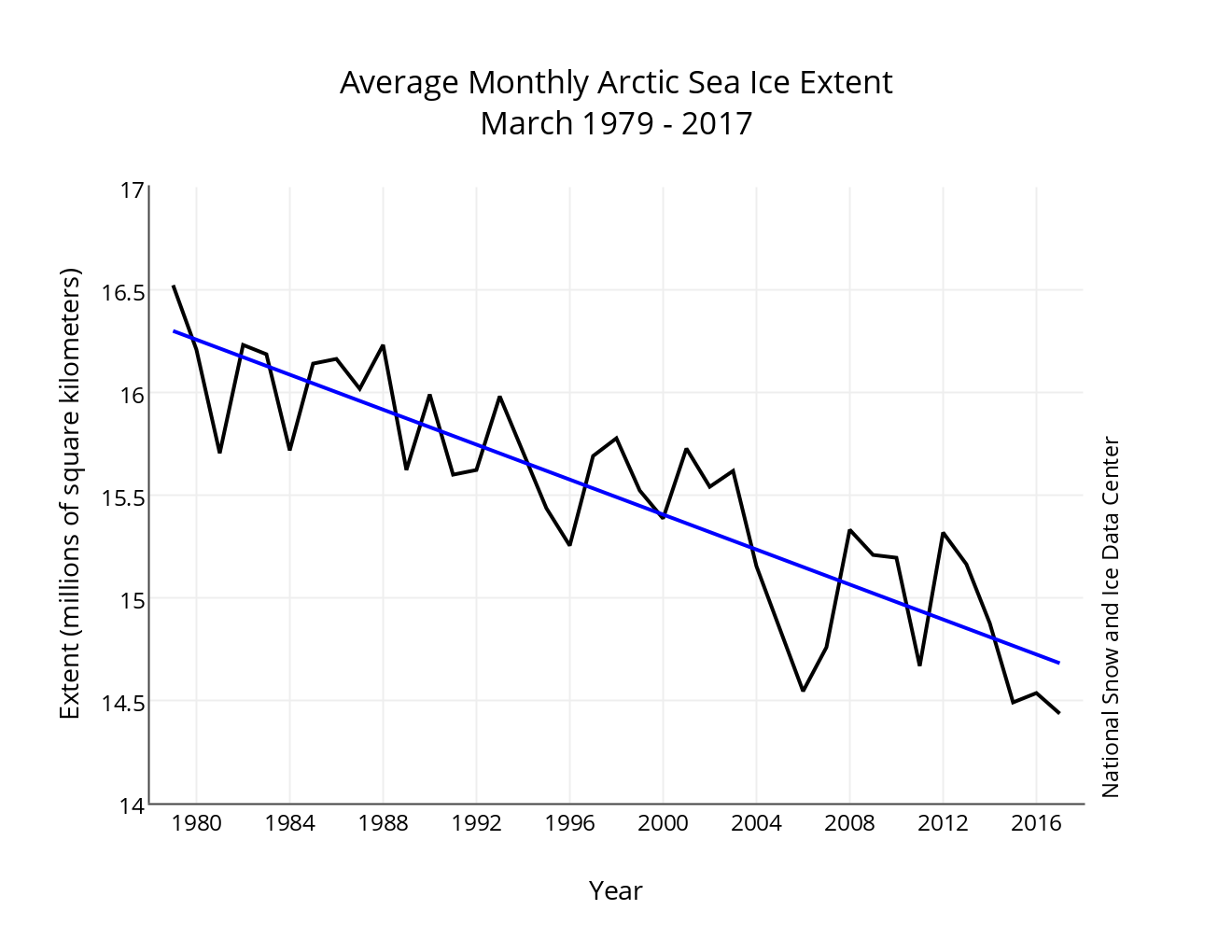
The latest edition of the NSIDC’s Arctic Sea Ice News confirms that their monthly extent metric for March 2017 was the lowest in the satellite record for the month:

monthly_ice_03_NH_v2.1

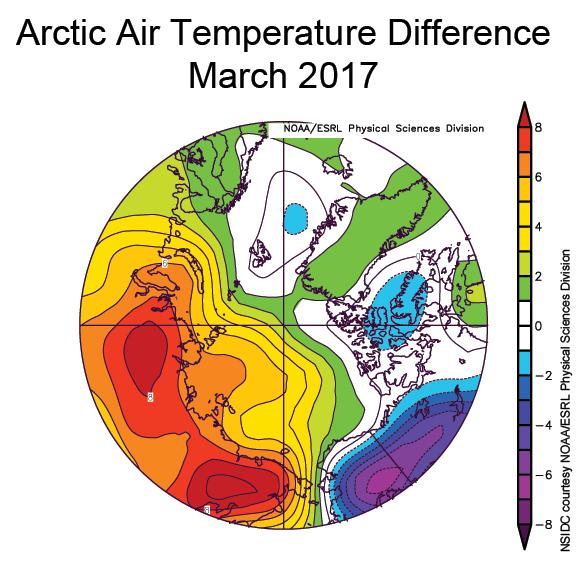
As well as highlighting the anomalously warm temperatures across much of the Arctic:

Mar_925t_anom

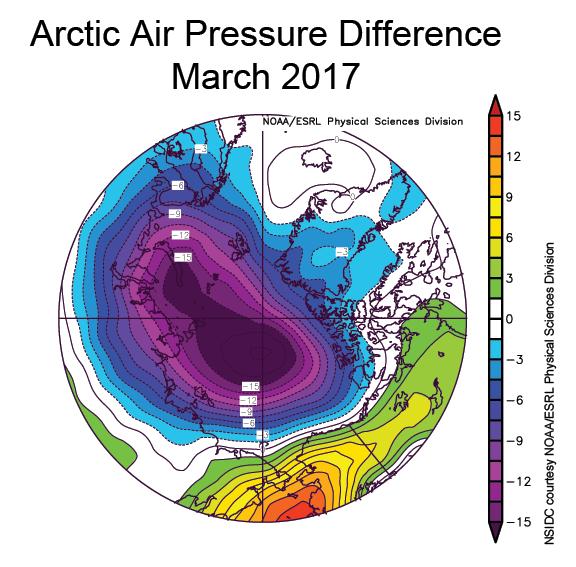
the NSIDC article includes this telling pressure anomaly map:

Mar_925_slp_anom

There’s also mention of a new paper:

New work by an international team led by Igor Polyakov of the University of Alaska Fairbanks provides strong evidence that Atlantic layer heat is now playing a prominent role in reducing winter ice formation in the Eurasian Basin, which is manifested as more summer ice loss. According to their analysis, the ice loss due to the influence of Atlantic layer heat is comparable in magnitude to the top down forcing by the atmosphere.

Shock News! The Telegraph is Propagating Fake News About the Arctic!!

David Rose is mercifully quiet this weekend, but there’s no rest for the wicked! Christopher Booker in the Sunday Telegraph leads a bunch of the usual Alt-facts suspects in a barrage of fake news about our dearly beloved Arctic sea ice. According to Mr. Booker in the “Arctic Myths” section of his column today:

As the fake science of global warming continues to crumble, one scare story the zealots are determined to hold on to at all costs is their claim that ice in the Arctic is dangerously vanishing. Yet again lately we have been treated to a barrage of such headlines as “Hottest Arctic on record triggers massive ice melt”.

The nearest we got to such a headline here at the Great White Con was “Arctic Sea Ice News from AGU” in which article we showed images which said things like:

arctictemp_map_graph_2015-16_620

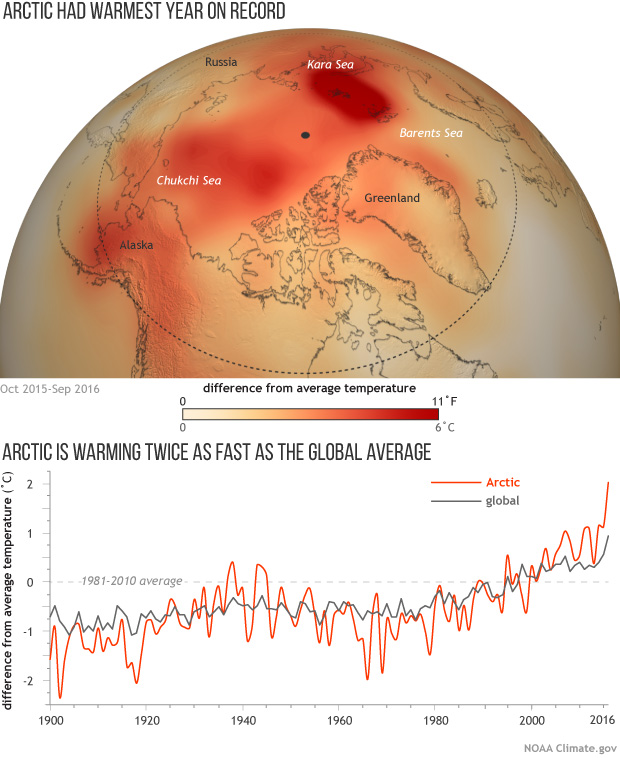
That’s because last year was the *hottest year on record in the Arctic! Undeterred by mere facts Mr. Booker continues:

Booker-NSIDC-20170226

But that ever-diligent blogger Paul Homewood has drawn on official sources such as the US National Snow and Ice Data Center to uncover what is actually happening. Under “Arctic Fake News”, on NotALotOfPeopleKnowThat, he posted a graph showing that last week the extent of sea ice was much the same as it has been at this date ever since 2001. Indeed, according to the Danish Meteorological Institute, there is even more of it today than in February 2006, and it is also significantly thicker. Back in 2008 much of the ice was only a metre thick. Today that has risen to two metres, and in some places four.

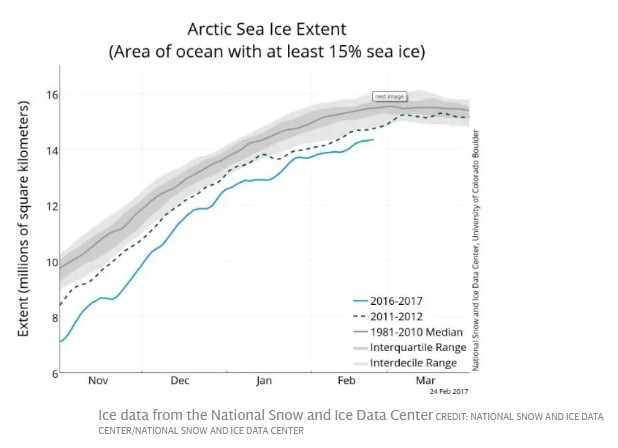
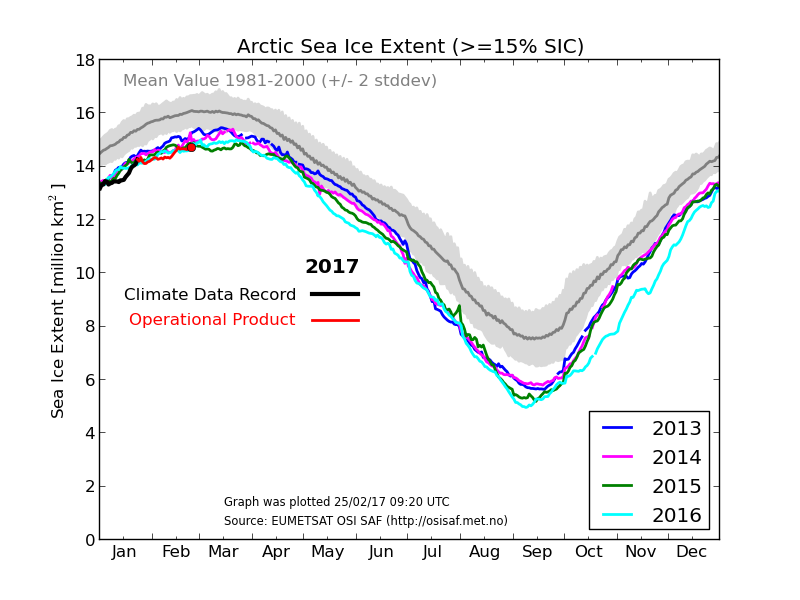
Mr. Booker appears to be more than somewhat confused, since this is what the DMI Arctic sea ice extent graph he links to reveals:

DMI_nh_iceextent_daily_5years_20170225

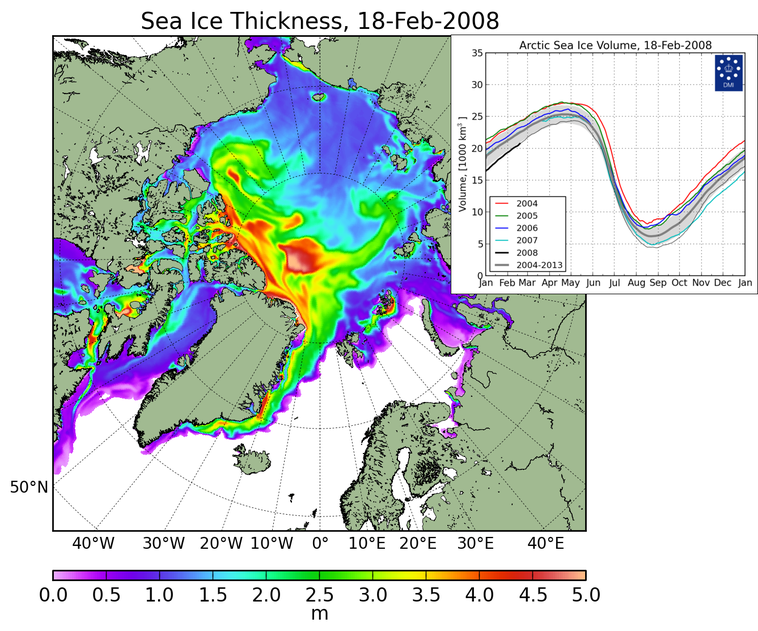
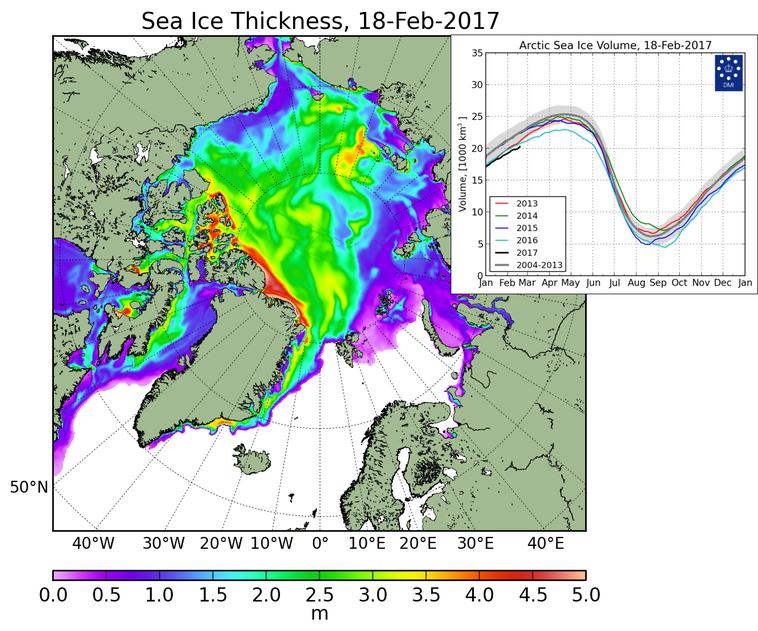
In addition the DMI thickness maps he refers to aren’t available at any of the places he mentions! Not a lot of people know that he was probably thinking of another recent article by Paul Homewood entitled “Arctic Ice Fake News“, which includes these two DMI thickness maps:

cice_combine_thick_sm_en_20080218

cice_combine_thick_sm_en_20170218

Even without considering other sources of Arctic thickness and/or volume data it is quite clear from the two volume graphs that according to the Danish Meteorological Institue Arctic sea ice volume is significantly lower this year than it was in 2008. If Arctic sea ice extent is greater this year and the volume is lower then the laws of physics (which not even the combined talents of Messrs Homewood and Booker can change) dictate that its average thickness must be LESS this year than in 2008!

Mr Booker blunders on:

The DMI data also show that the Greenland ice sheet, which we are told is melting at horrendous speed, is actually growing this year at a record rate, to a size way above its average for the past 26 years. And the most authoritative record of Northern Hemisphere snow cover shows this year’s ranking as one of the six highest since 1967.

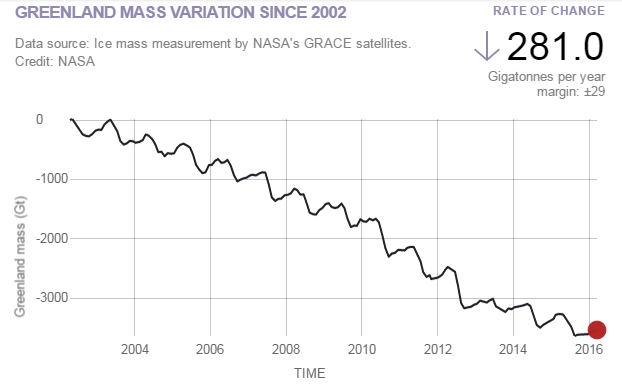
He seems blissfully unaware that the “DMI data” to which he refers is the output of a DMI climate model that attempts to determine the “surface mass balance” of the Greenland ice sheet. He seems to think it’s a measurement of the mass of the Greenland ice sheet, which it isn’t. However this is, courtesy of NASA:

GreenlandGrace-20170213

In his bubble of astounding Arctic ignorance Mr. Booker continues:

The Deplorable Climate Science blog, run by US expert Tony Heller, gleefully reproduces a 2007 headline: “Scientists: ‘Arctic is screaming’, global warming may have passed tipping point”. As Heller comments: “The Arctic is indeed screaming at climate scientists – to shut up.”

Now as luck would have it I have been (vainly!) attempting to persuade Mr. Heller “to shut up” on the very article Mr. Booker references! Let’s take a quick look at a couple of highlights shall we?

February 22, 2017 at 12:01 am

At the risk of repeating myself, need I say more?

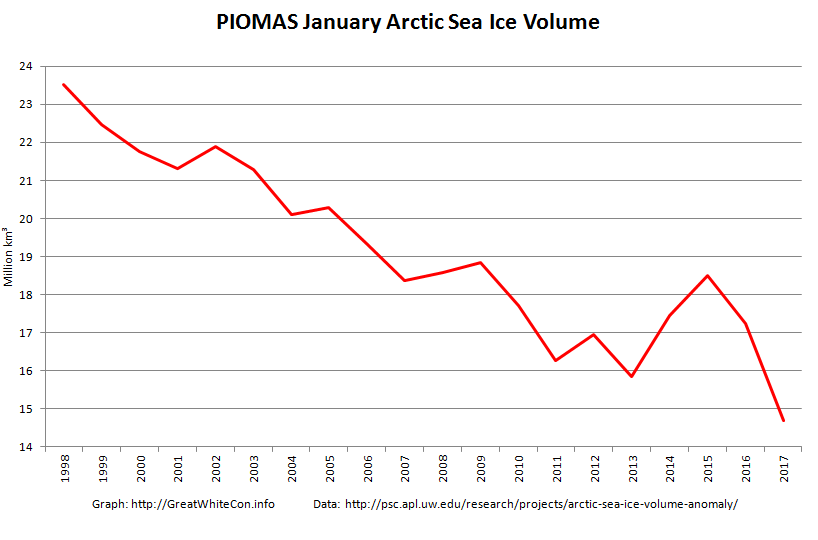
PIOMAS-Jan-19Years

It seems safe to assume that Mr. Booker wasn’t reading Mr Heller’s blog on or after February 22nd does it not? Otherwise he would surely have had second thoughts about writing such a ludicrous phrase as “there is even more of it today than in February 2006”?

Then of course there’s the burning question of the “Hottest Arctic on record”

February 22, 2017 at 5:59 pm

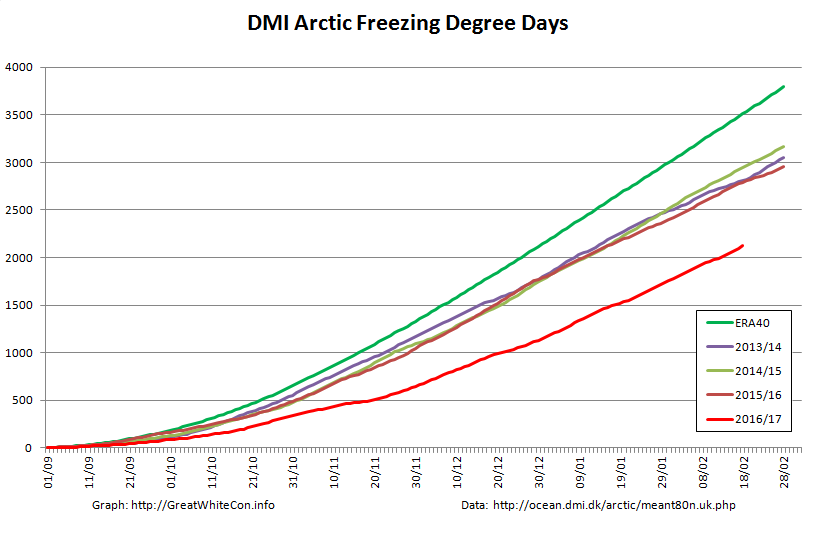
At the risk of (repeating myself)² AZ, here’s some “higher atmospheric air temperatures” for you:

DMI-FDD-20170218

If Mr. Booker had browsed Mr. Heller’s blog slightly more diligently he might even have seen this from the much maligned NOAA:

February 20, 2017 at 11:06 am

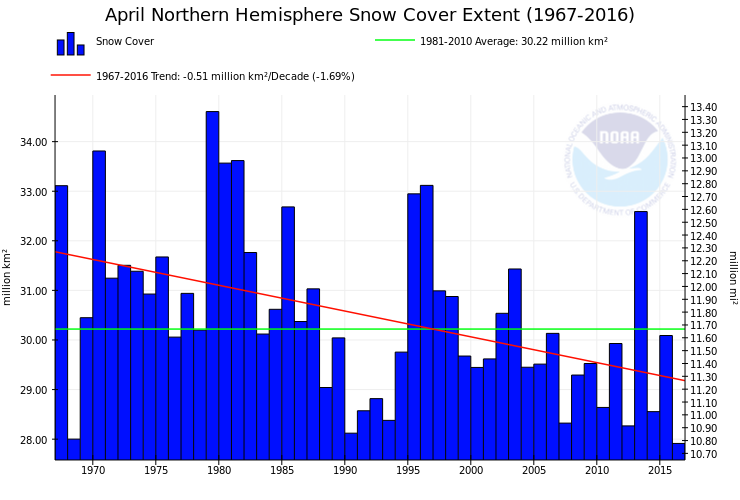
You seem to have forgotten about spring Gail? Here’s April:

NOAA-NH-Snow-April

Here’s the May graph from “the most authoritative record of Northern Hemisphere snow cover” for good measure:

Rutgers-NH-Snow-May

To summarise, Messrs Booker and Homewood could have confined their due diligence on their assorted Arctic articles to reading my comments on Mr. Heller’s blog. Having done so it would quickly have become apparent to them that every single point they made was in actual fact a “fake fact”.

The inevitable conclusion is that they have no interest whatsoever in establishing the actual facts about the Arctic. All they are interested in is propagating “fake news” about the Arctic as far and as wide as possible in pursuit of a common “agenda”. As is David Rose.

* Since satellite records began.

Facts About the Arctic in February 2017

The PIOMAS Arctic sea ice volume numbers for January 2017 have just been published. Yet another new record low for the date:

PIOMASIceVolumeAnomaly-201701

Here’s the PIOMAS gridded thickness for January 31st, courtesy of Wipneus at the Arctic Sea Ice Forum:

PIOMAS-20170131

Somewhat anomalously it shows the thickest ice some distance away from the coast of Greenland and/or Ellesmere Island. Here too is Andy Lee Robinson‘s updated PIOMAS “Arctic death spiral”:

arctic-death-spiral-1979-201701

Meanwhile yet more anomalously warm air is entering the Arctic Basin from both the Pacific and Atlantic sides:

CCI-T2Anom-20170204

That sort of thing has happened quite a few times over the 2016/17 freezing season, as you can see from this graph of cumulative Freezing Degree Days (FDD for short):

2017-02-03-DMI-FDD

The FDD graph is based on the same data as the probably much more familiar DMI “Daily mean temperatures for the Arctic area north of the 80th northern parallel” graph:

DMI-meanT-20170203

Things are warming up in the Arctic once again.


[Edit – February 5th]

Whilst we await the arrival of the forecast anomalous warmth, how are some other metrics coming along? Here’s the high resolution AMSR2 area and extent:

UH-Arctic-Area-2017-02-04

UH-Arctic-Extent-2017-02-04

It looks like they’re back in the “normal” range for now, does it not?


[Edit – February 6th]

Things currently still look fairly frosty over on the Pacific side of the Arctic, as you can see from the webcam at Utqiagvik (Barrow as was):

BarrowCam_20170206_225400

However over on the Atlantic side (and especially for “Richard”!) melting can now be observed on Svalbard:

isfjordradio-20170206

An extremely powerful cyclone off Greenland is pumping heat and moisture northwards:

Synopsis-20170206-18Z

Note that the cyclone’s MSLP fell to 940 hPa earlier today. This is the GFS precipitable water forecast for Wednesday lunchtime:

CCI-PWTR-20170206-12+48h

Finally, for the moment at least, here’s the current weather forecast for Longyearbyen in Svalbard:

2017-02-07-Longyearbyen-Fcst

All in all there’s plenty more heat and moisture on the way.


[Edit – February 13th]

The temperatures in Svalbard have now dropped back below freezing point:

Svalbard-Temps-20170213

As temperatures over parts of the Arctic Basin have reached zero degrees Celsius and above, Arctic sea ice extent has been declining:

UH-Arctic-Extent-2017-02-12

Now take a look at area:

UH-Arctic-Area-2017-02-12

Area has declined a lot! That’s because sea ice concentration is now noticeably <100% across much of the Arctic:

Bremen-AMSR2-20170212

There’s also been a discernable change in slope of the DMI freezing degree days graph:

DMI-FDD-20170213


[Edit – February 19th]

There’s been a late spurt of growth in both area and extent, which are now back in the pack of previous years:

UH-Arctic-Area-2017-02-18

UH-Arctic-Extent-2017-02-18

The newly frozen areas are currently still very thin:

SMOS-20170218

Meanwhile northern hemisphere snow cover has started to melt in earnest:

multisensor_4km_nh_snow_extent_20170218

Watch this space!