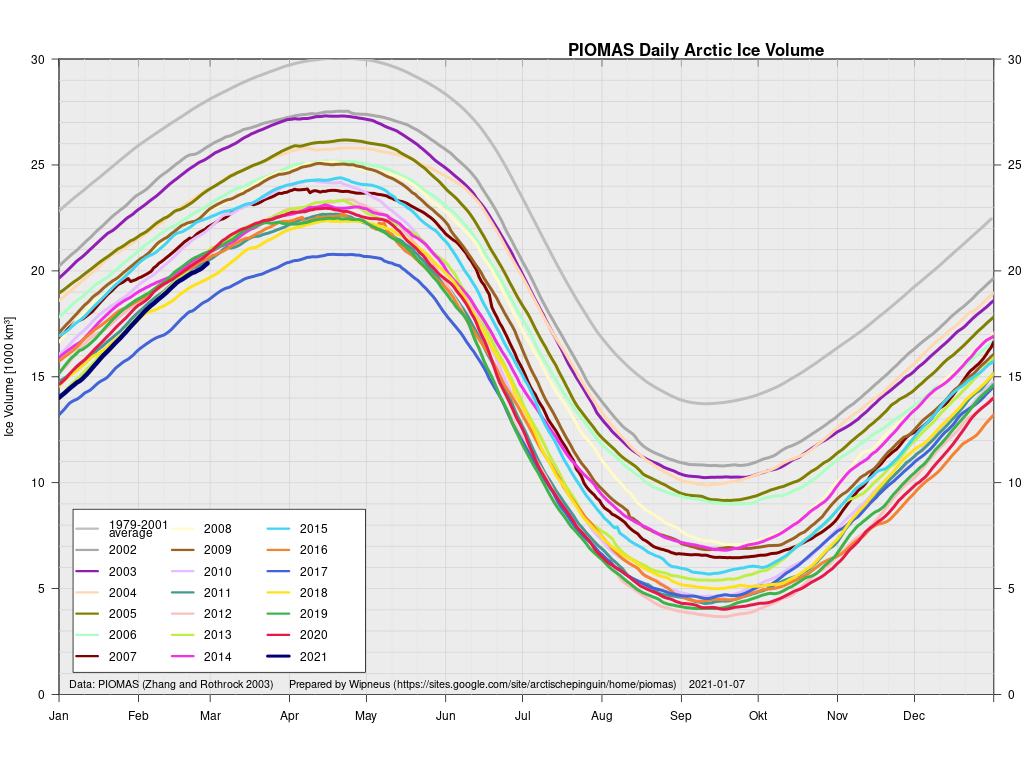
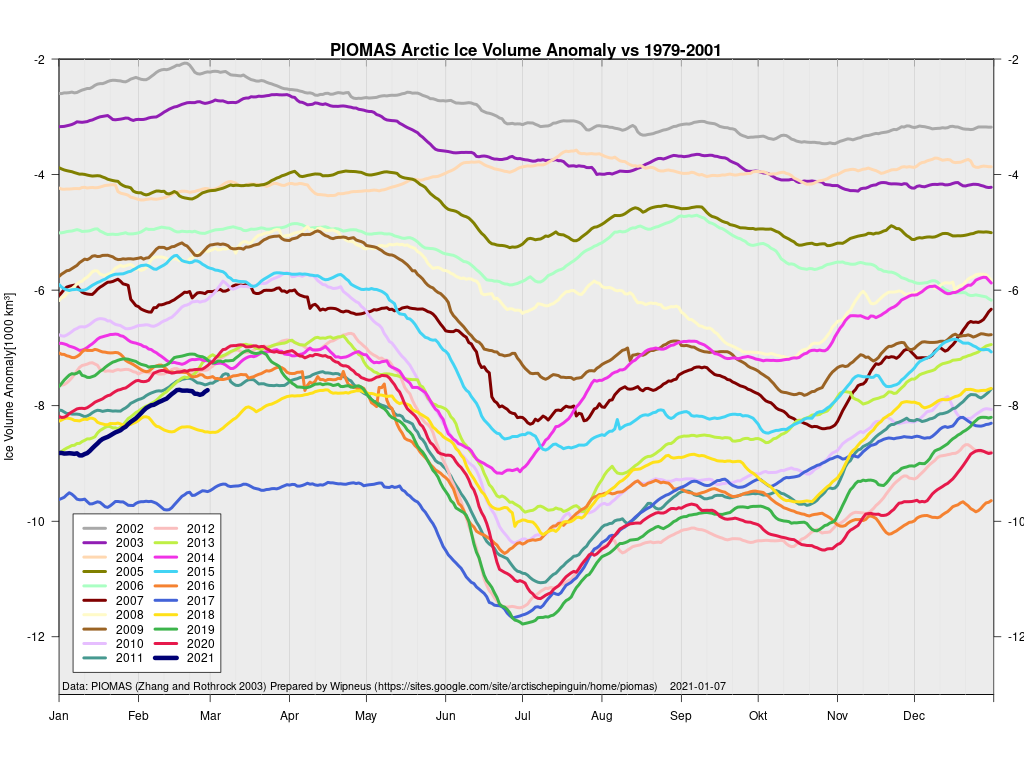
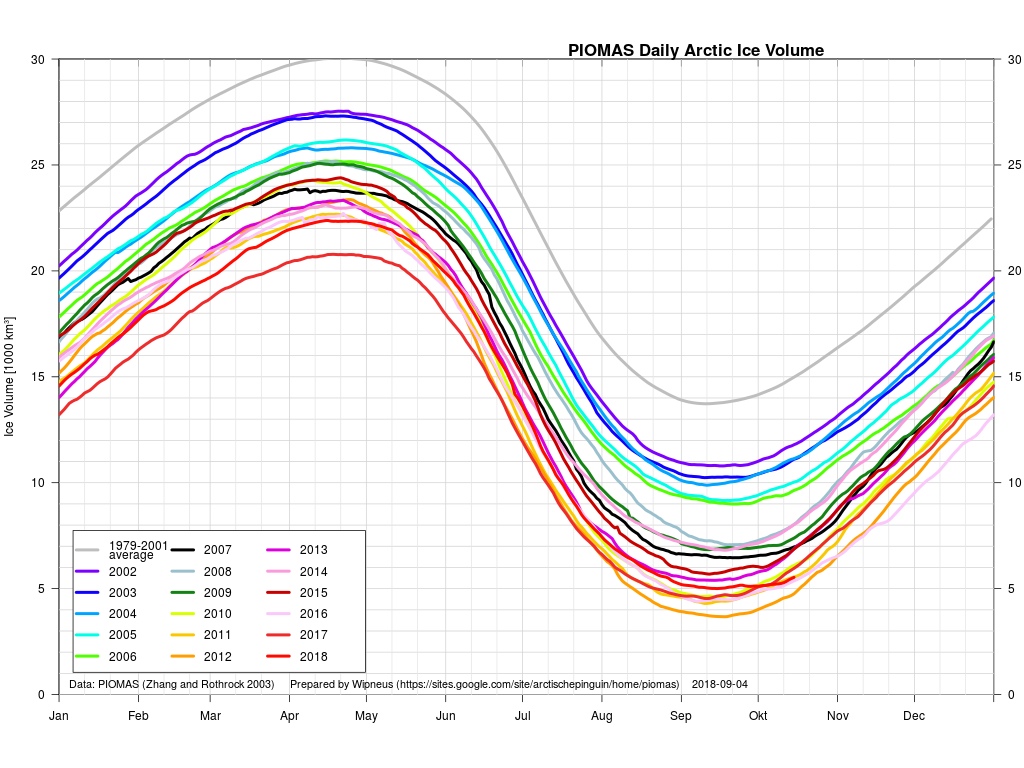
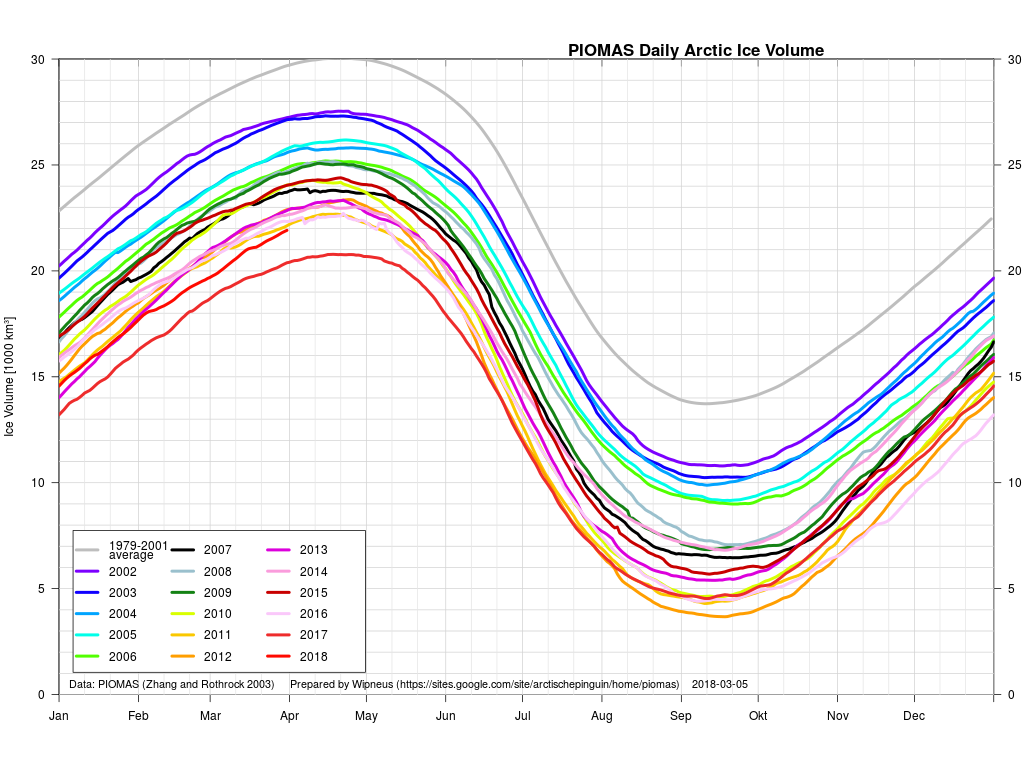
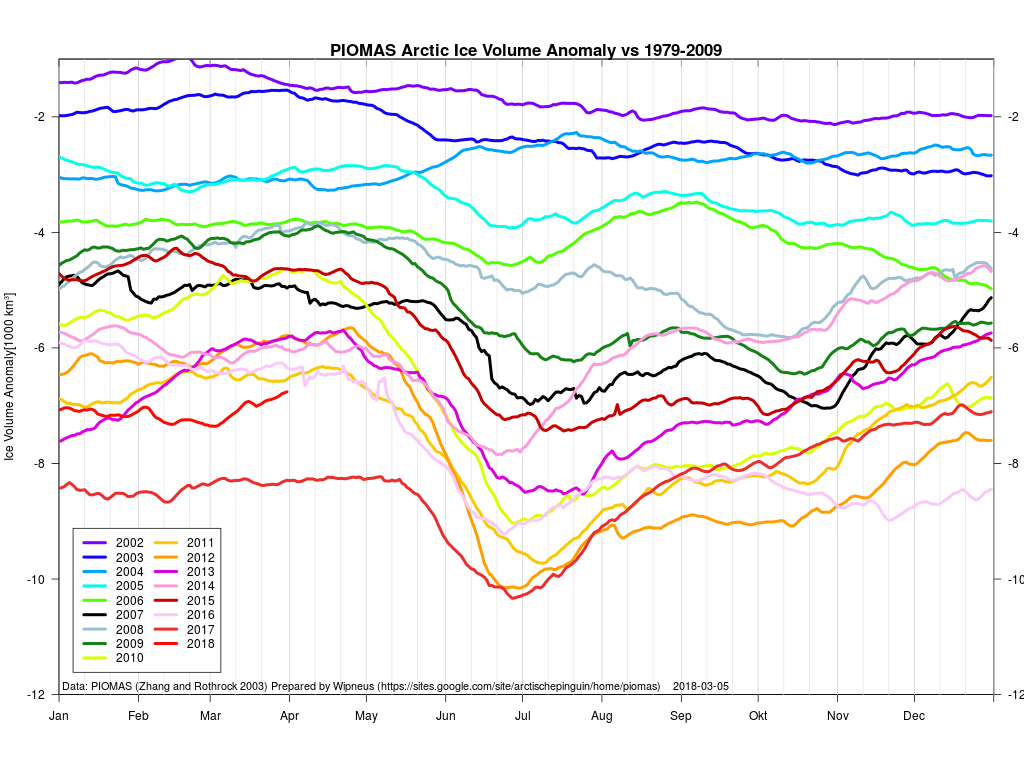
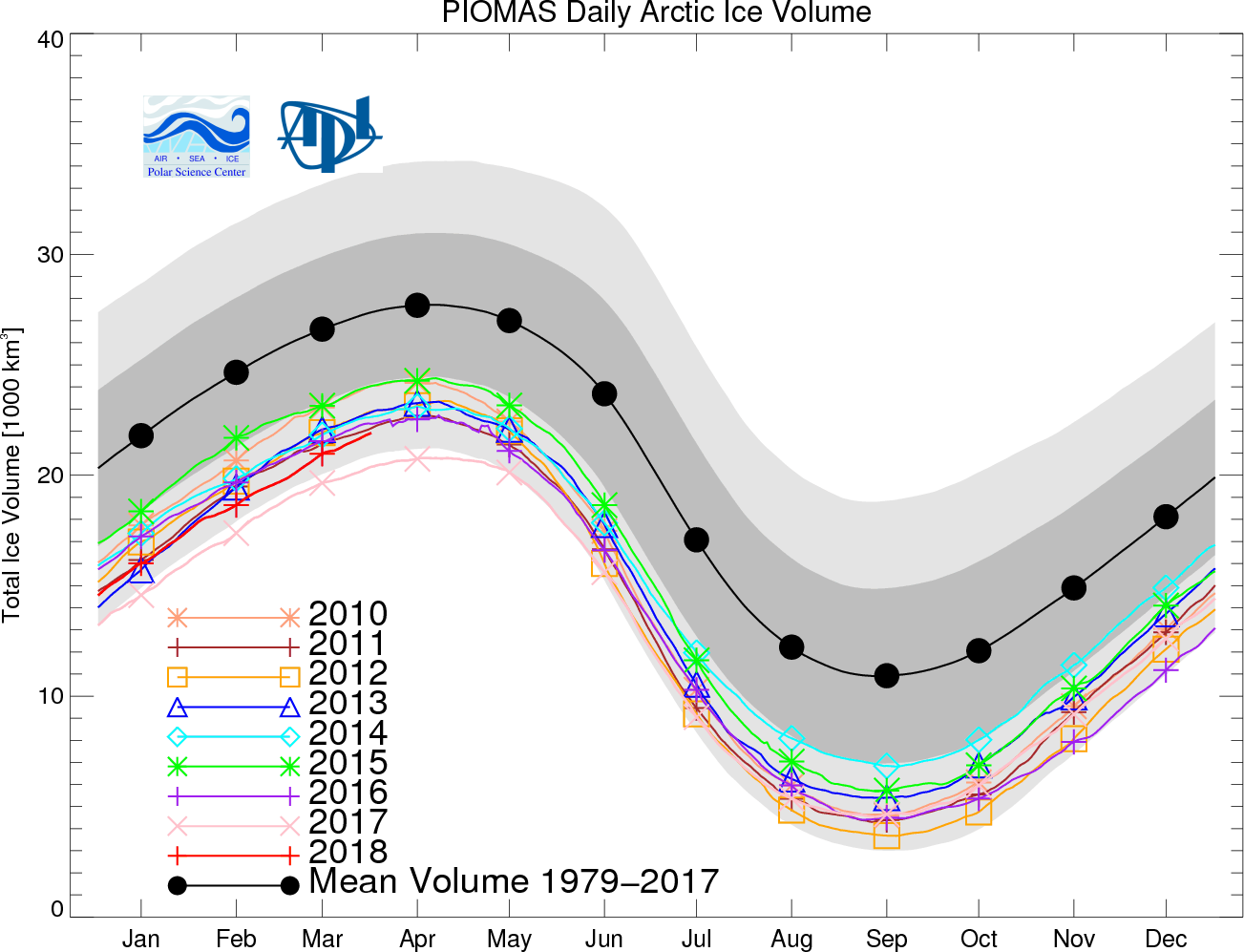
Maximum volume is still several weeks away, but let’s first of all take a look at the PIOMAS modelled volume numbers for February. They are not yet available via the University of Washington’s Polar Science Center web site, but Wipneus has once again crunched the gridded thickness numbers which are already available. Here is what they reveal:
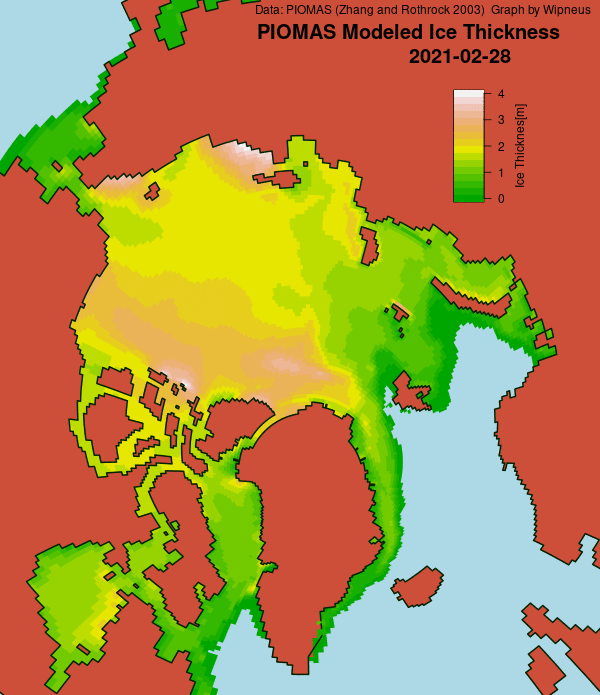
As you can see, it will be a big surprise if the 2021 volume maximum occurs in March rather than April, and 2021 is currently 3rd lowest for the date, behind 2017 and 2018. For completeness here too is the PIOMAS thickness map for the end of February:
This does contain some surprises, such as an area of thick ice along the shore of the East Siberian Sea, but no such thing along the north coast of Greenland, the traditional bastion of “the thickest ice in the Arctic Ocean”.
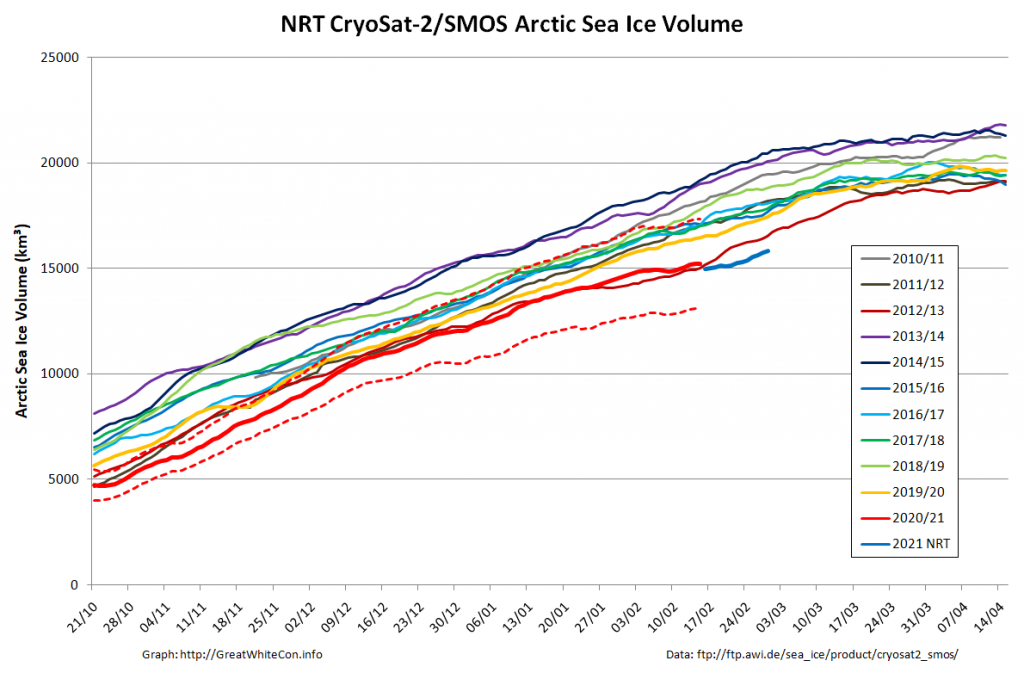
The “measured” Arctic sea ice volume calculated from CryoSat-2 and SMOS thickness data has also updated to February 28th:
Note that the “near real time” figures graphed in blue will almost certainly be revised upwards when the “reanalysed” data is released in a couple of weeks. Equally certainly they will be “lowest for the date” in the 11 year record.
Here also is the CS2/SMOS thickness map for February 28th for comparison purposes:
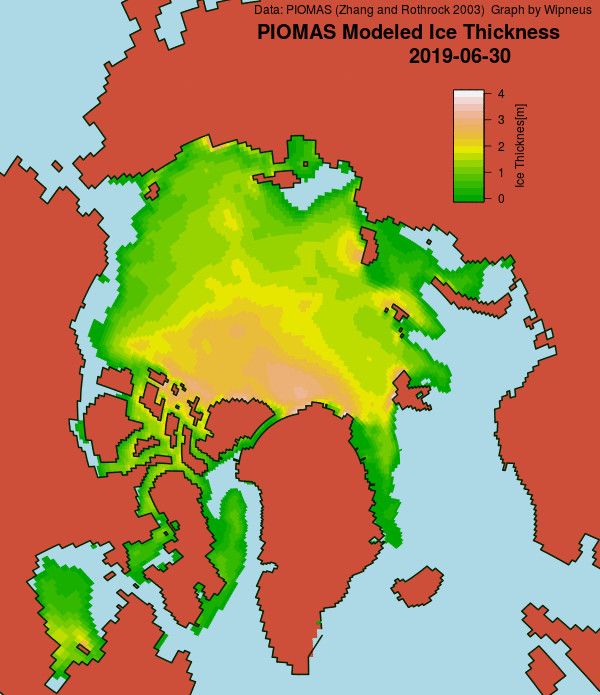
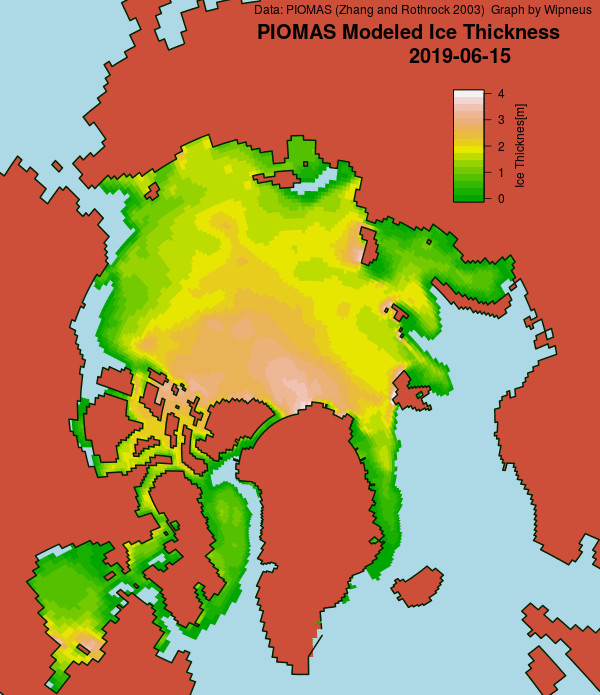
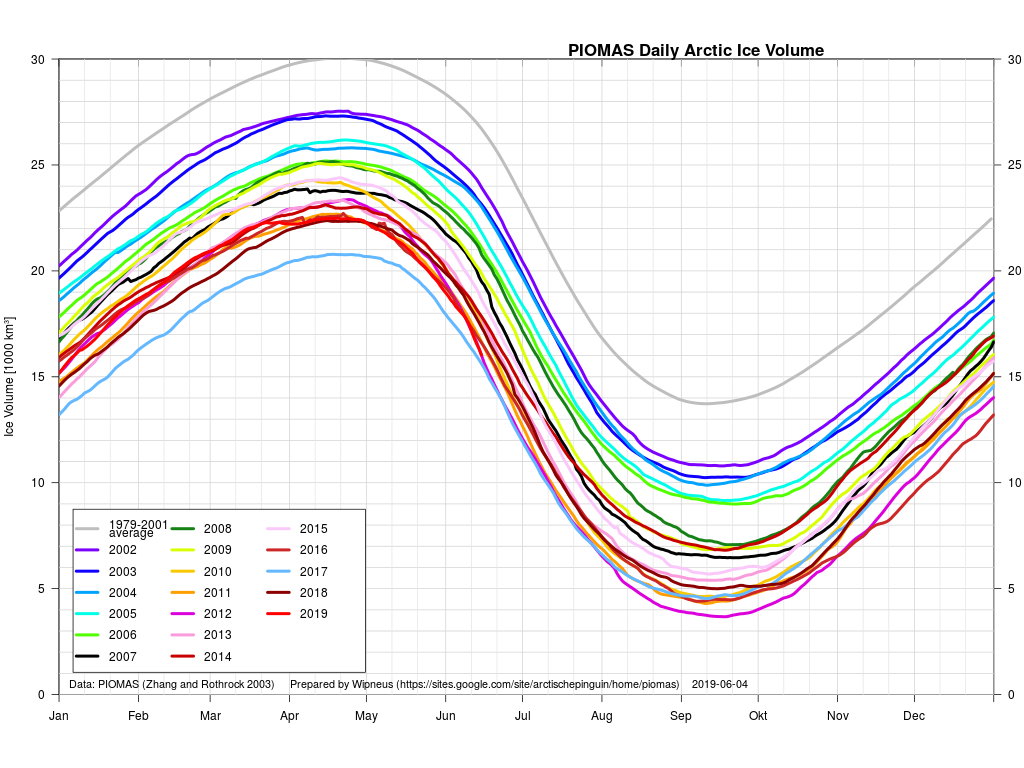
The June PIOMAS Arctic sea ice gridded thickness numbers have been released. Here once again is Wipneus’ visualisation thereof:
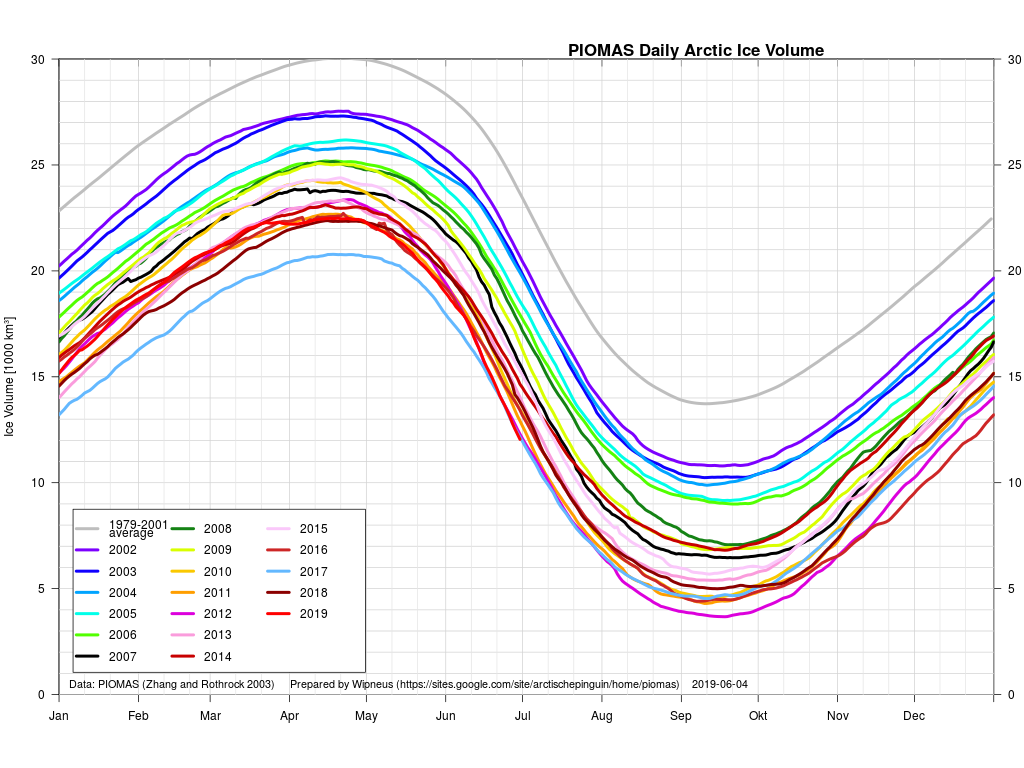
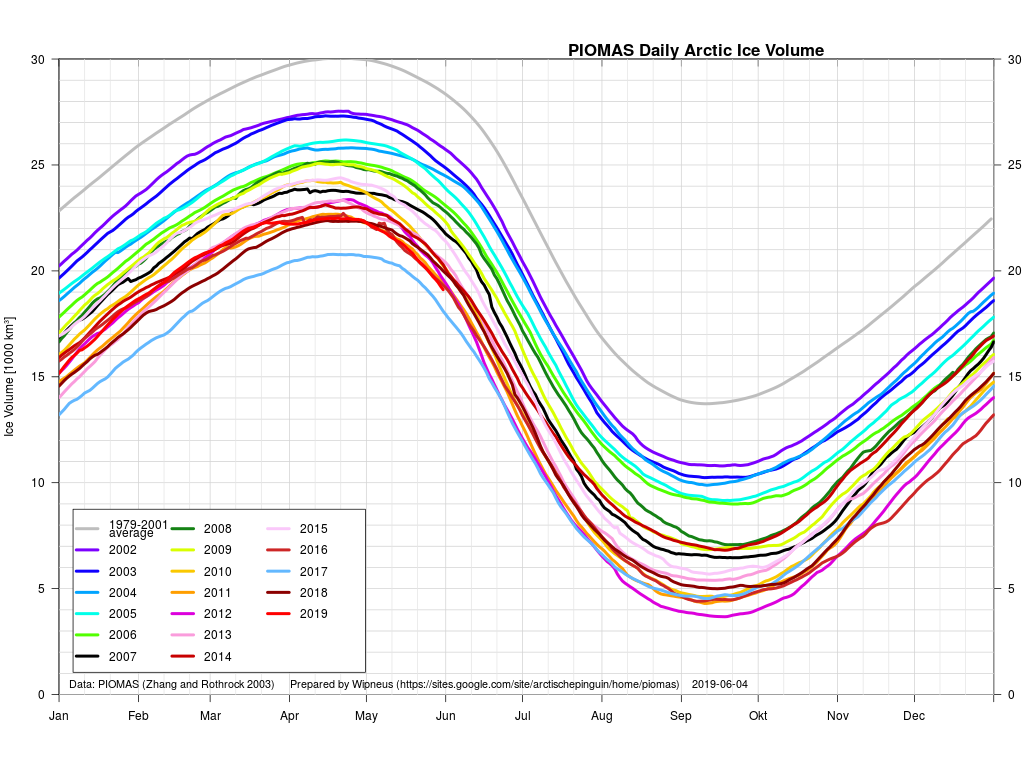
The Arctic wide volume graph does not make a pretty sight:
The recent rapid rate of decline has continued through the second half of June and PIOMAS modelled volume is now lowest for the date in the Polar Science Center’s records.
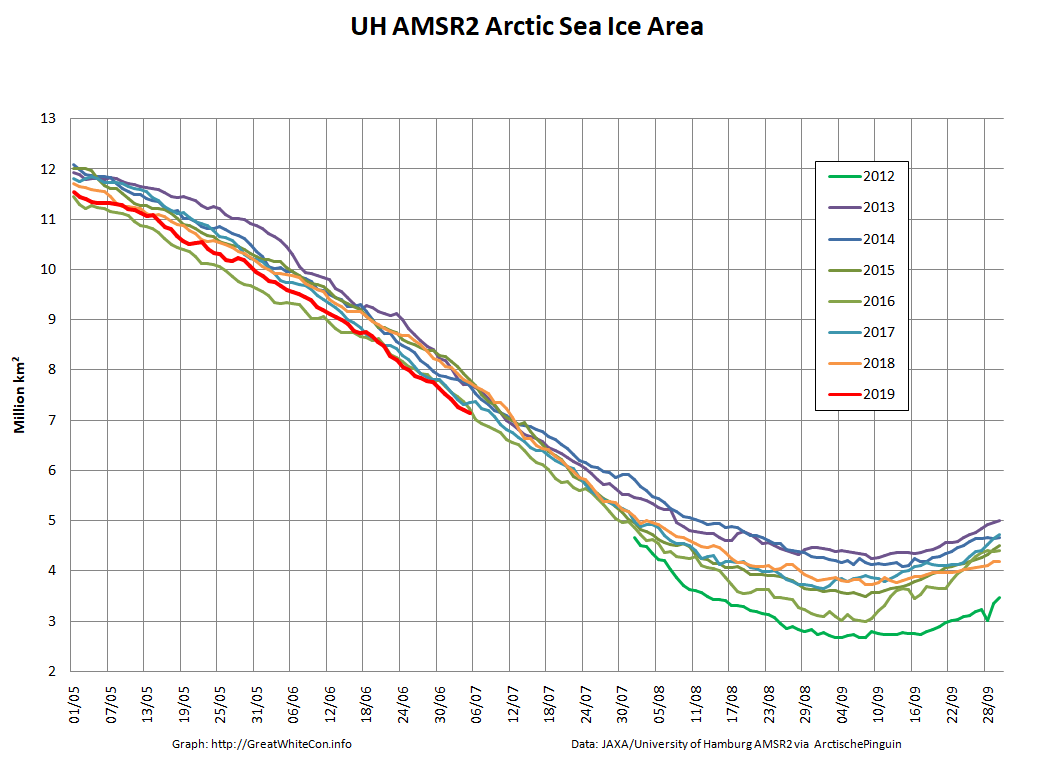
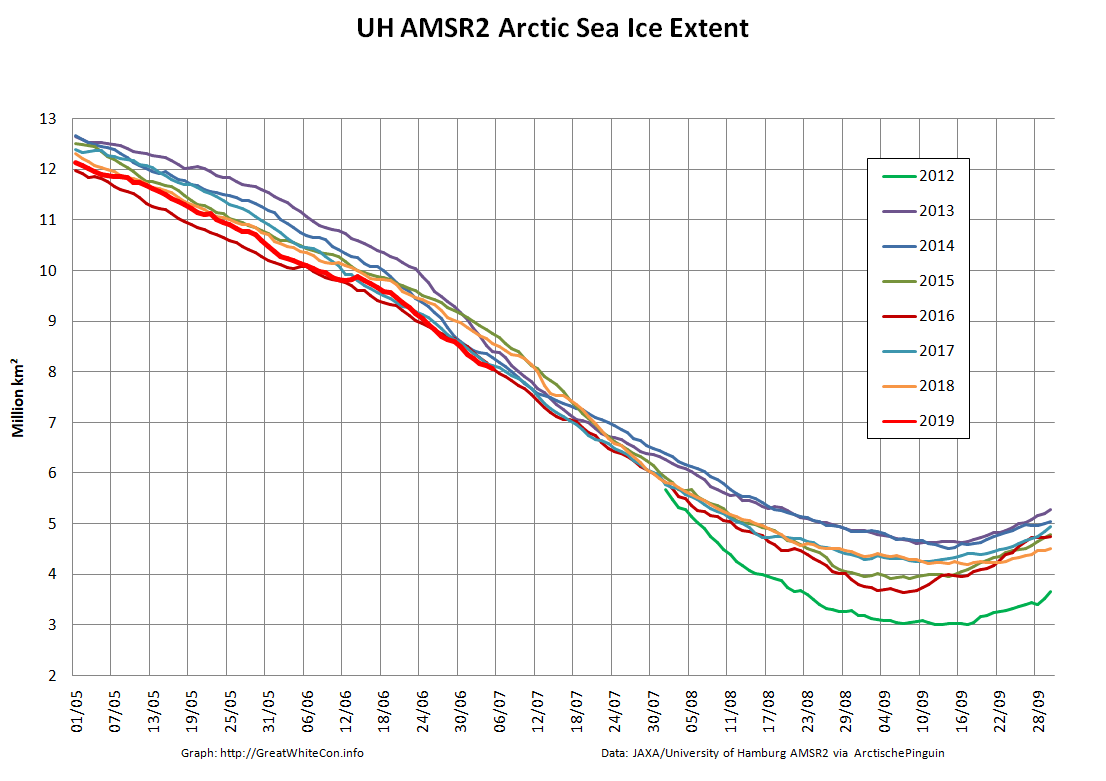
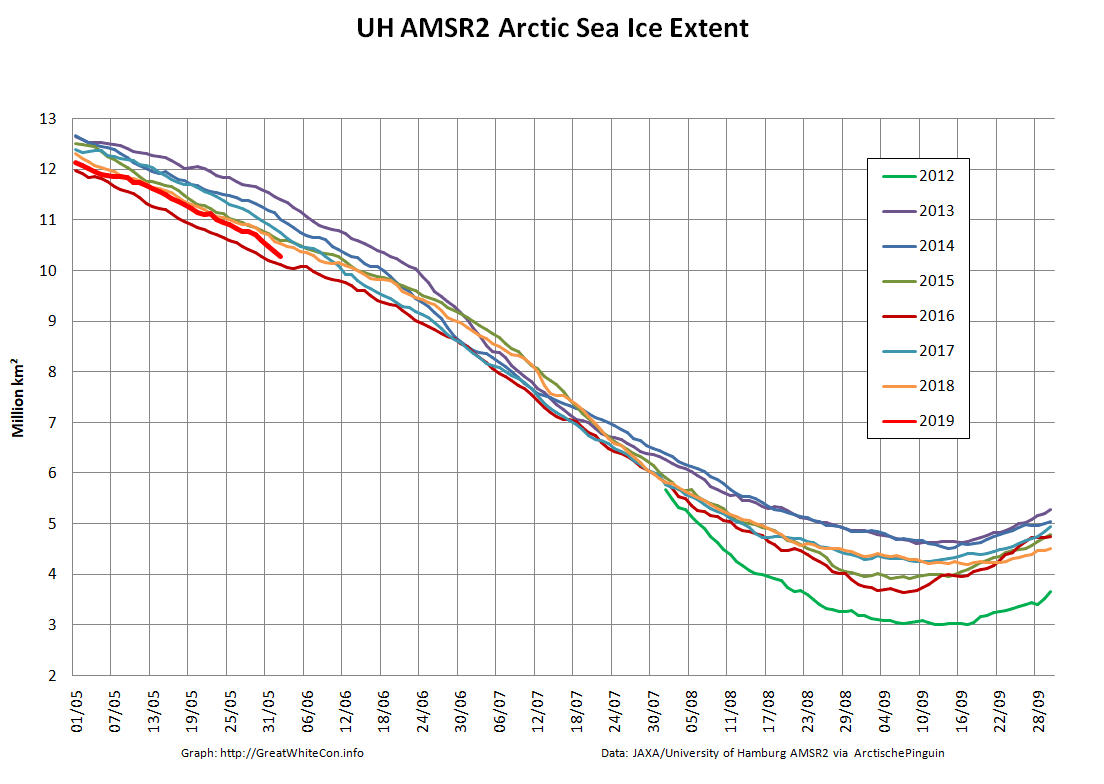
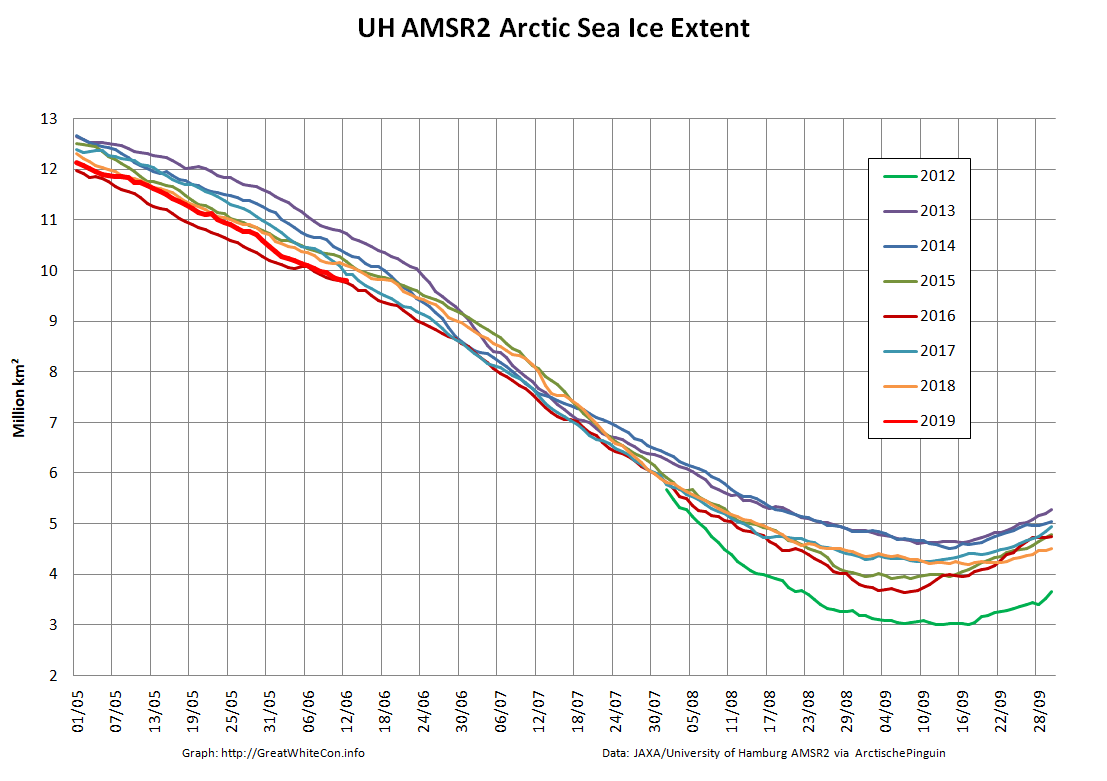
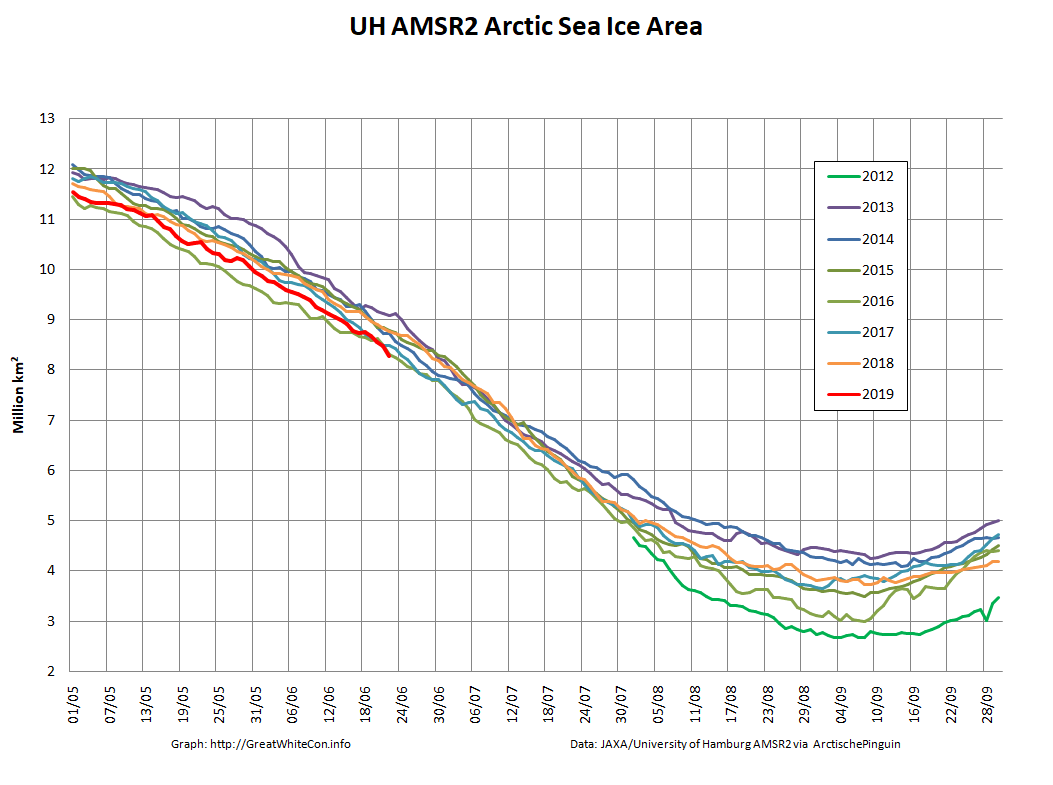
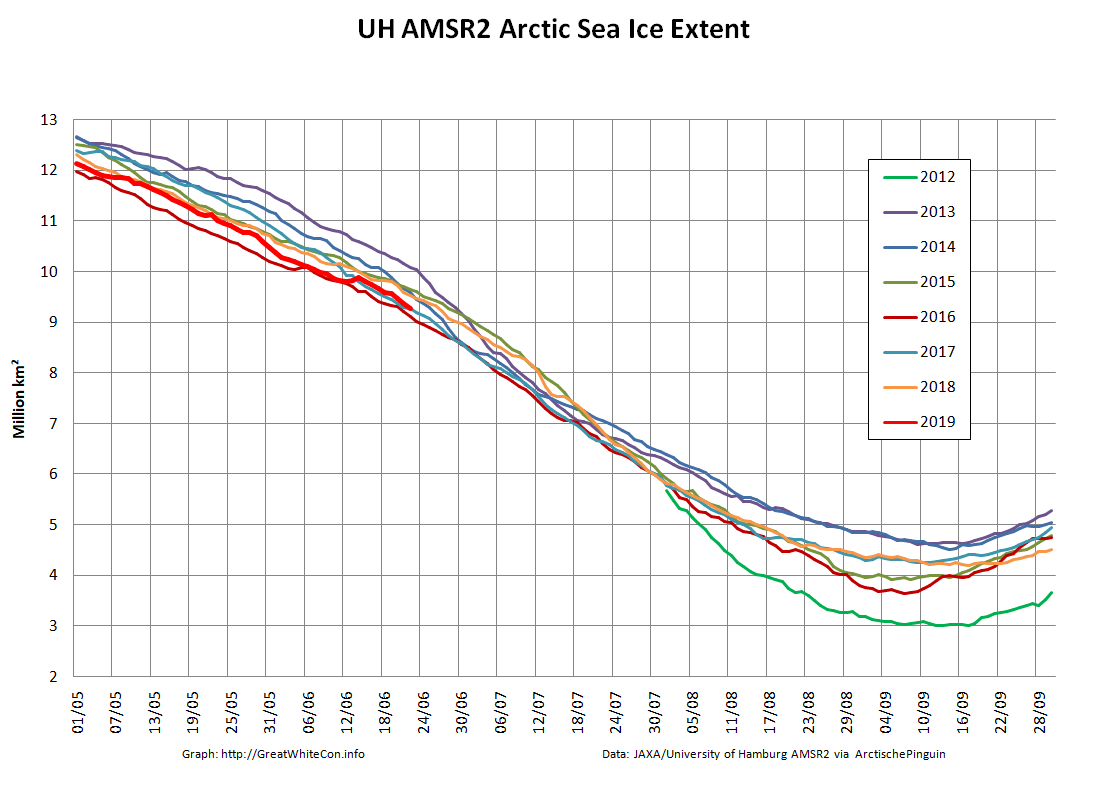
The various methods of measuring Arctic sea ice thickness don’t produce meaningful results during the summer, so let’s move on to area and extent. Arctic wide high resolution AMSR2 area and extent remain “lowest for the date”, although it currently looks as though 2016 may regain that dubious honour in the near future:
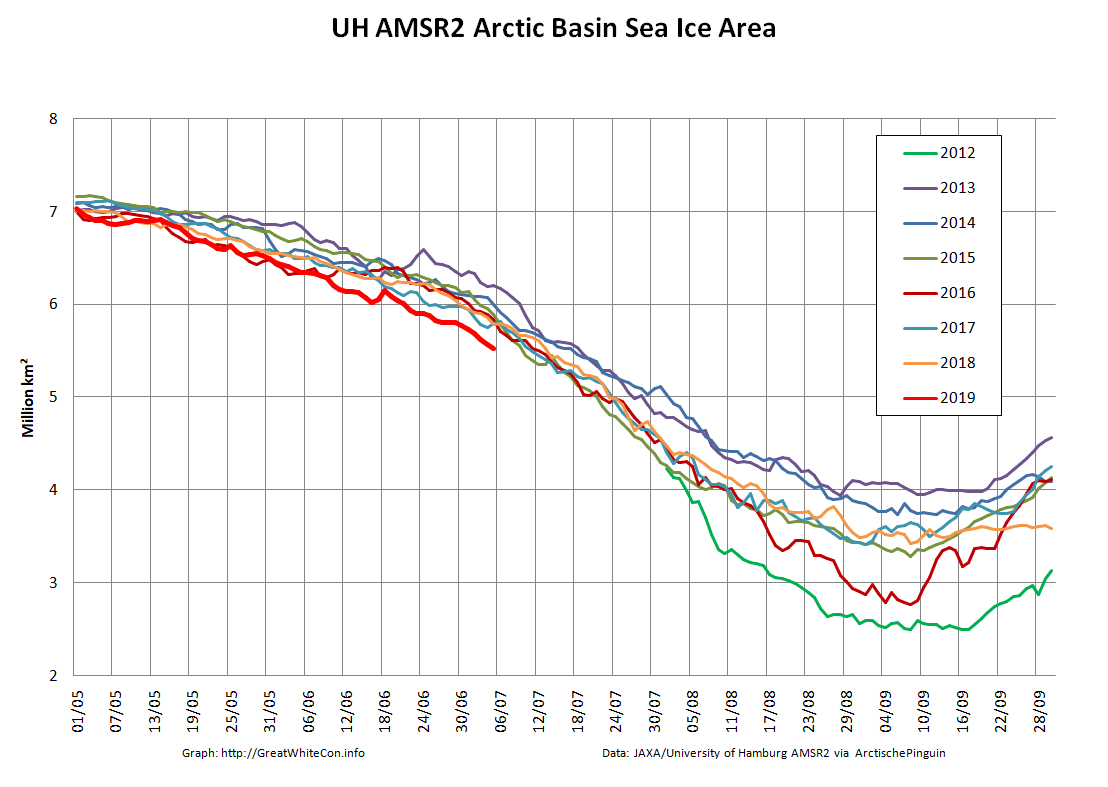
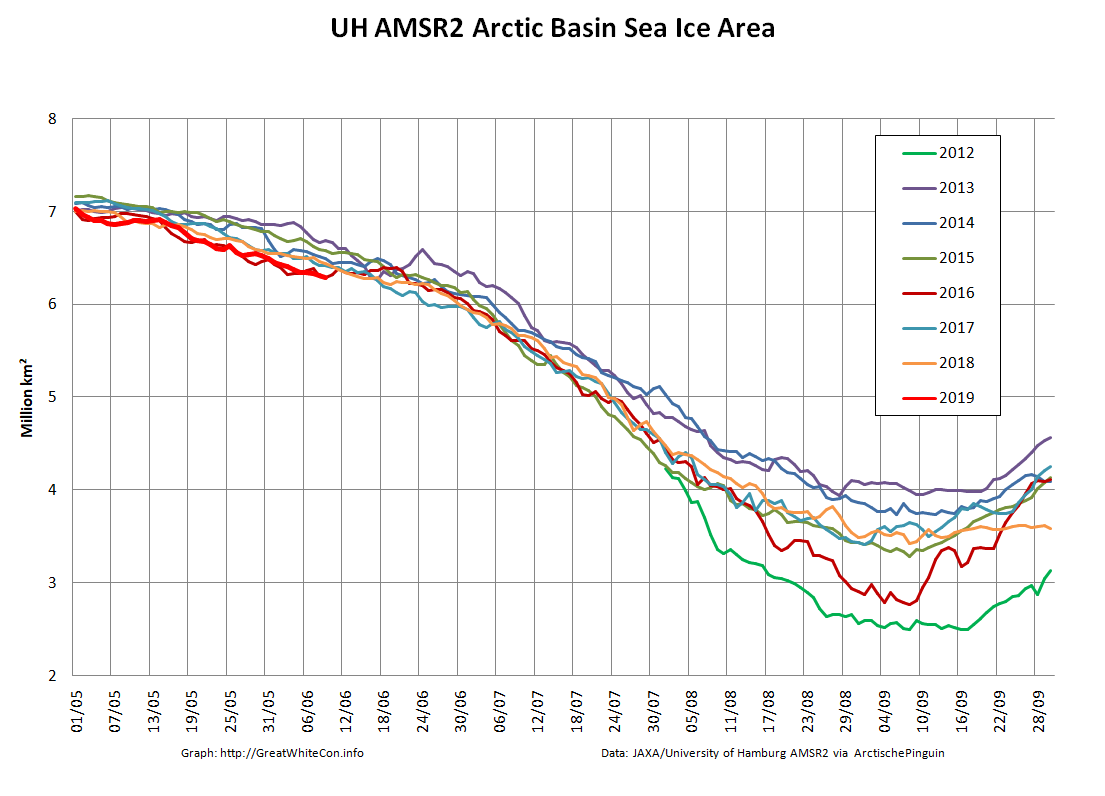
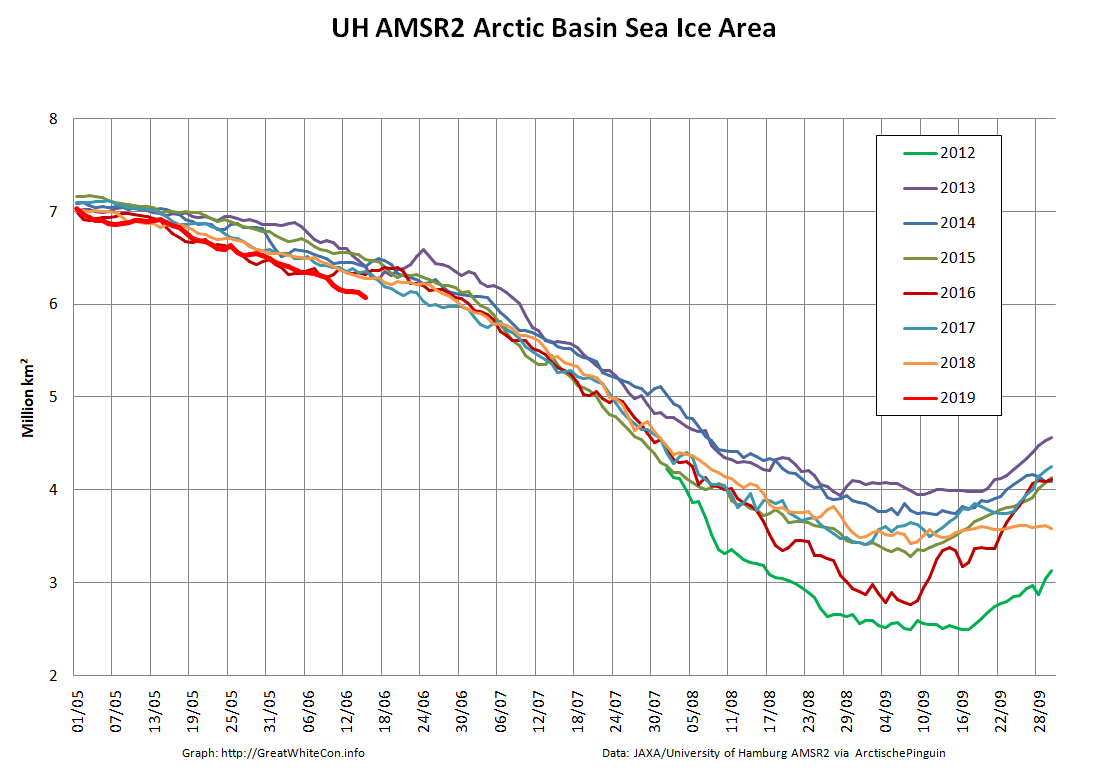
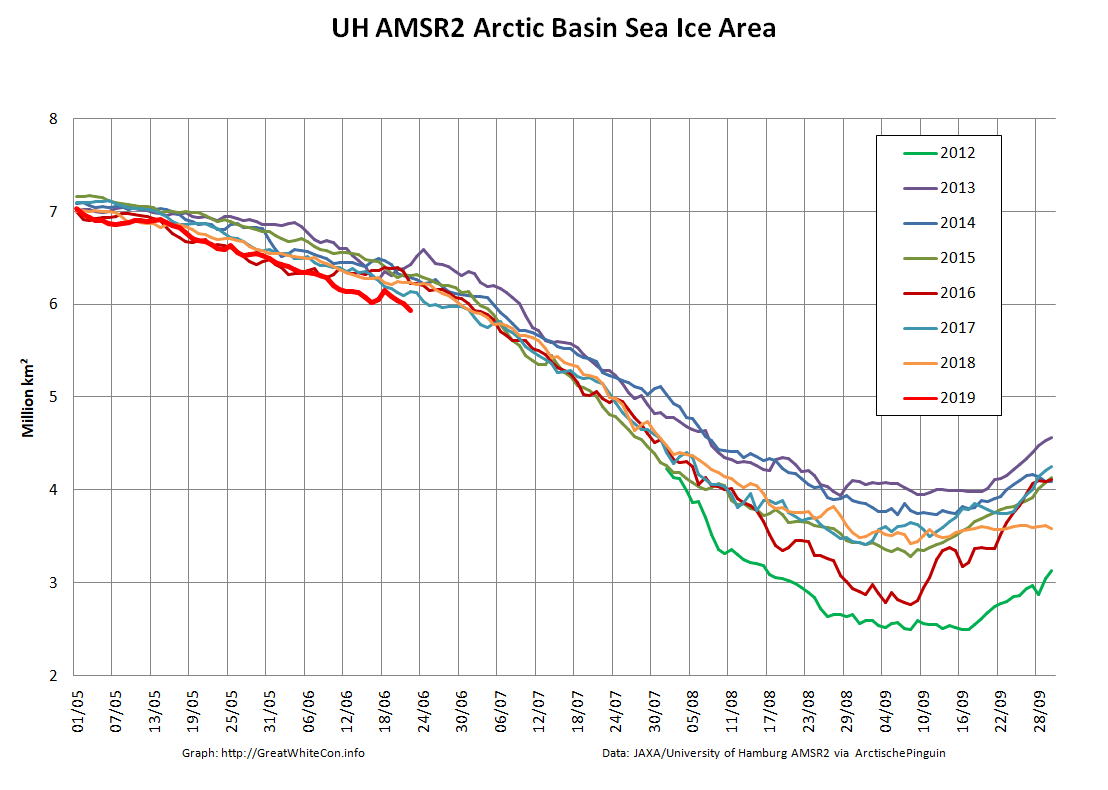
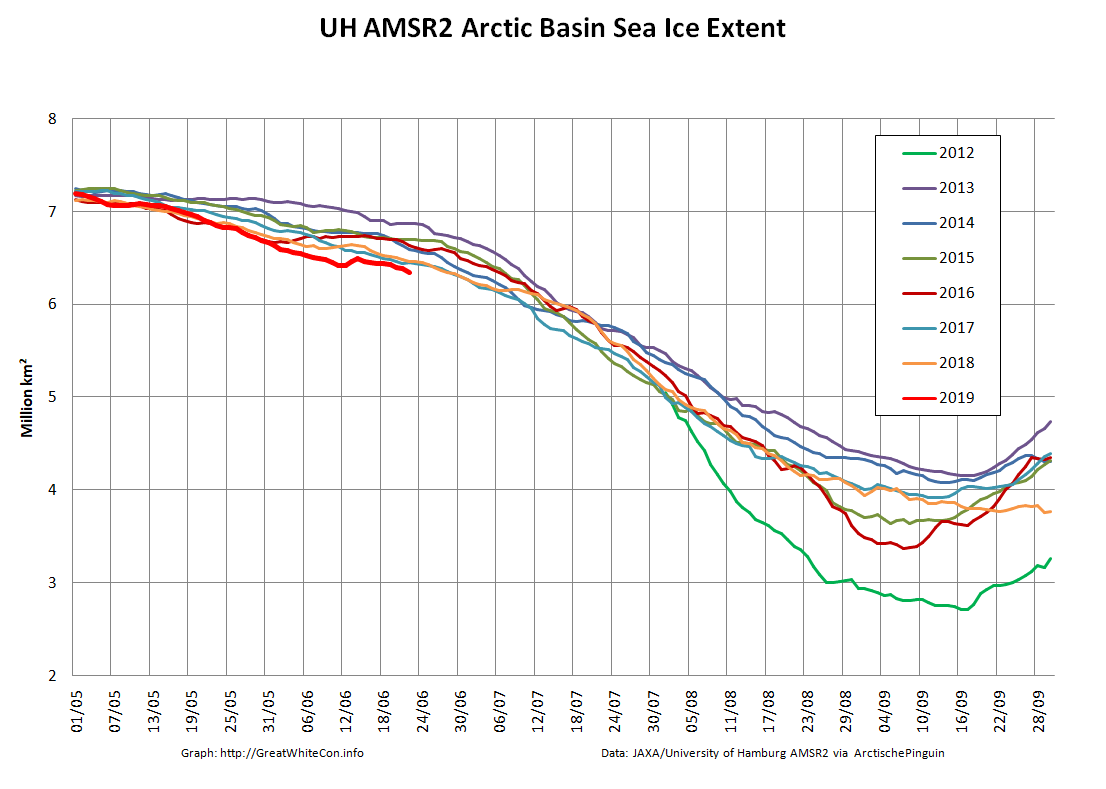
Confining the view to the Arctic Basin there is no doubt that 2019’s position will not be in doubt for quite some time:
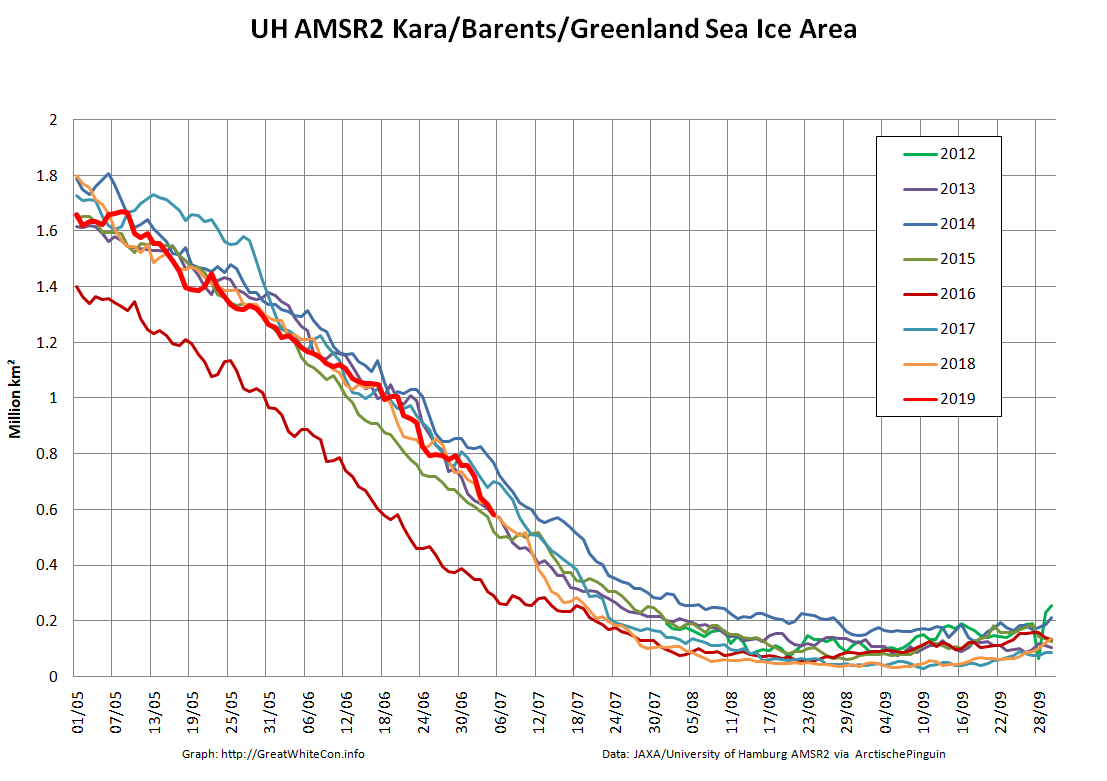
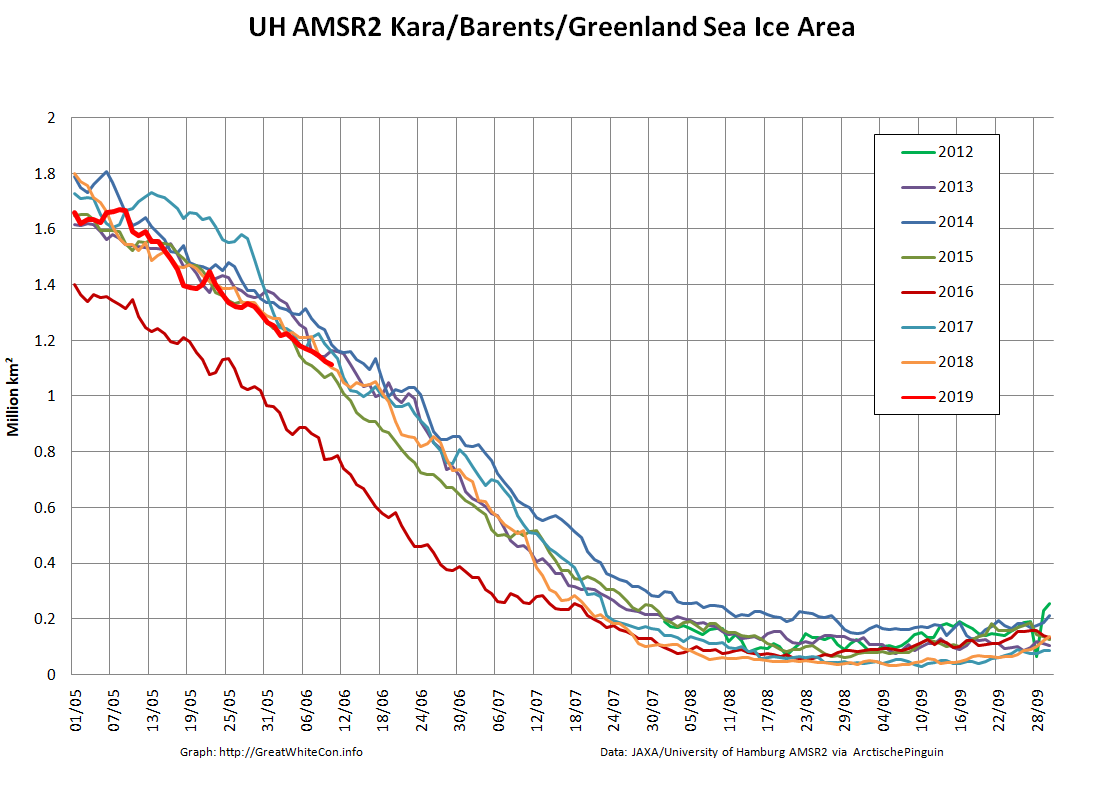
The apparent discrepancy is explained by taking a closer look at the Atlantic side of the Arctic:
Some of the thicker ice that has continued to be exported from the central Arctic in the direction of the North Atlantic is surviving there, for the moment at least.
In my humble opinion summer in the Arctic summer starts on June 1st, so let’s check the current sea ice situation in the once frozen North. For details of the preconditioning of the ice during the Arctic spring see “Melt Pond May“, where I concluded that:
Compared with 2016 at the same time of year I am compelled to say that with June 1st just around the corner the 2019 summer melting season is primed to progress more quickly.
Currently extent is significantly below 2012, albeit somewhat above 2016 at the same time of year. And what of melt ponds? In 2012 there was evidence of less snow cover over land and more surface water on the ice on the Siberian side of the Arctic. Other than that Arctic sea ice in 2019 looks to be in worse shape than in 2012.
And how have things progressed over the last few days? Take a look at this:
Our “Arctic Basin” metric encompasses the Central Arctic plus the Beaufort, Chukchi, East Siberian and Laptev Seas. It is currently headed into uncharted waters. The effect on overall Arctic sea ice extent is also readily visible:
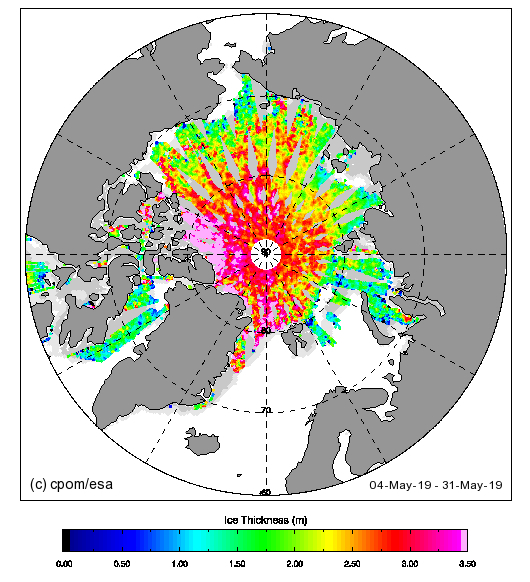
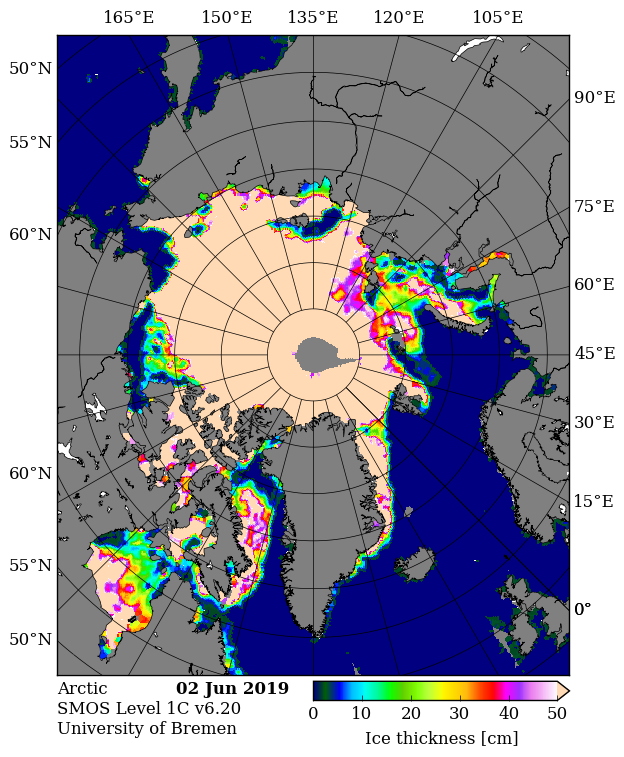
This year both the CPOM version of CryoSat-2 thickness and the University of Bremen’s SMOS thickness maps are continuing to be published during the melting season:
Take them with a large pinch of salt at this time of year!
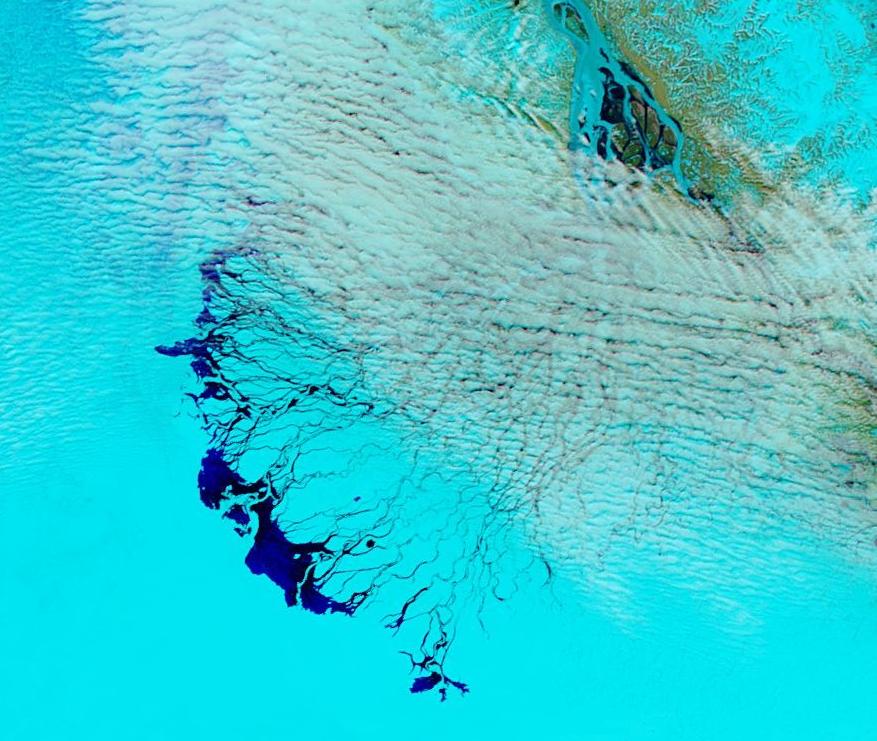
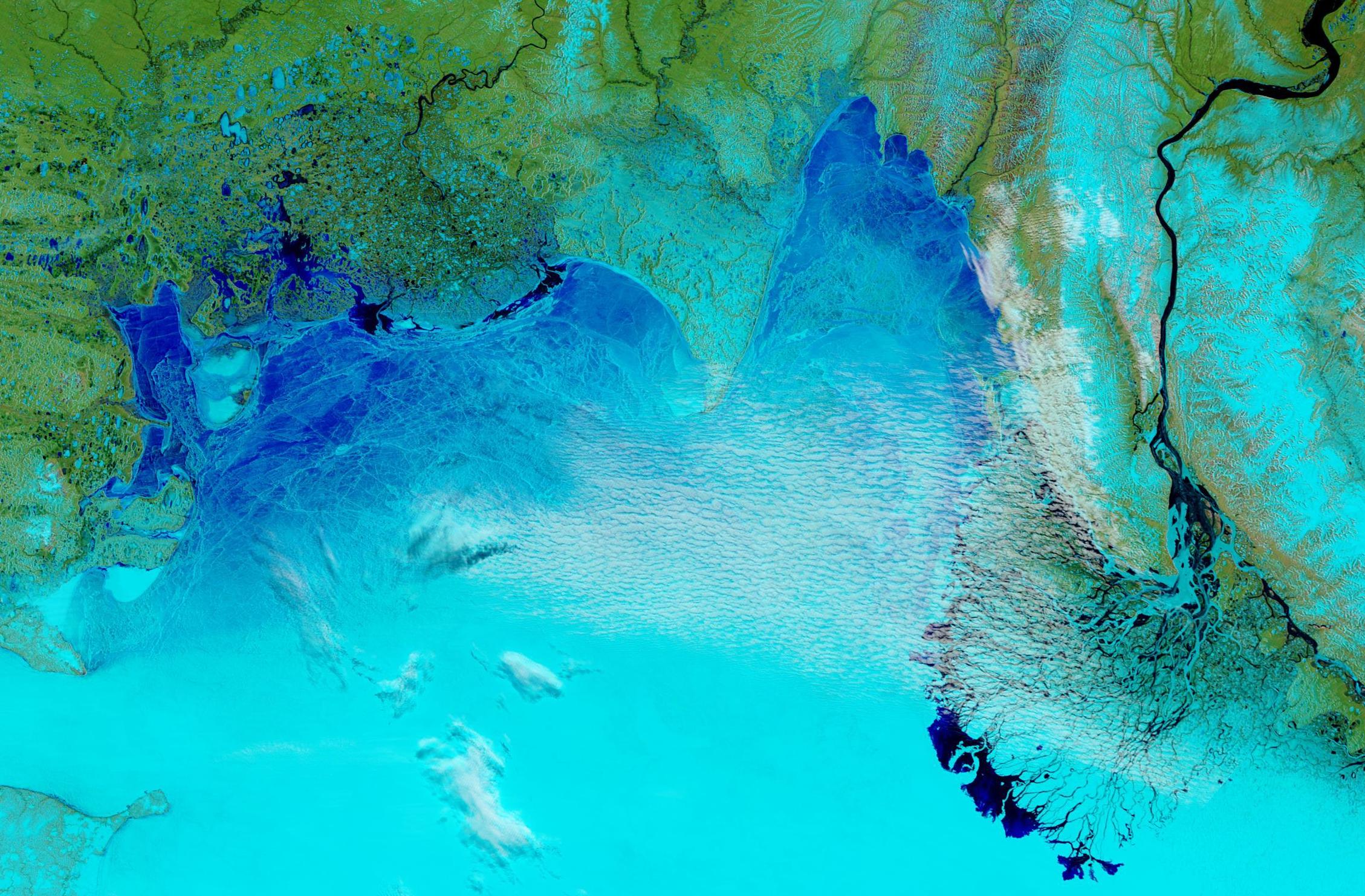
Finally, for the moment at least, liquid water is starting to seep out of the Lena Delta:
NASA Worldview “false-color” image of the Lena Delta on June 3rd 2019, derived from the MODIS sensor on the Aqua satellite
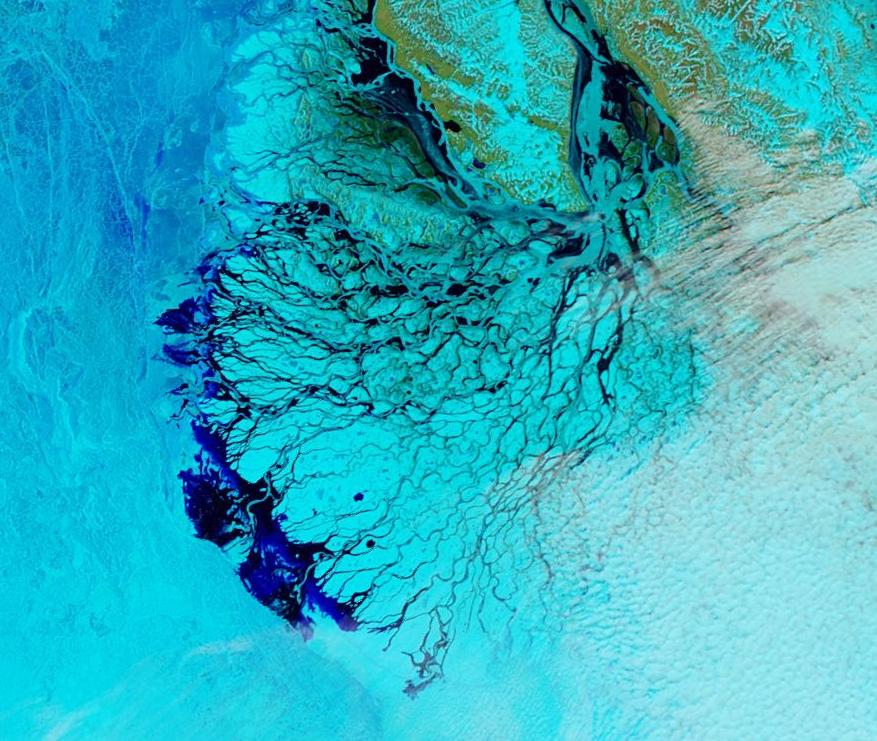
For comparison purposes please also take a look at the same date in 2016:
NASA Worldview “false-color” image of the Lena Delta on June 3rd 2016, derived from the MODIS sensor on the Aqua satellite
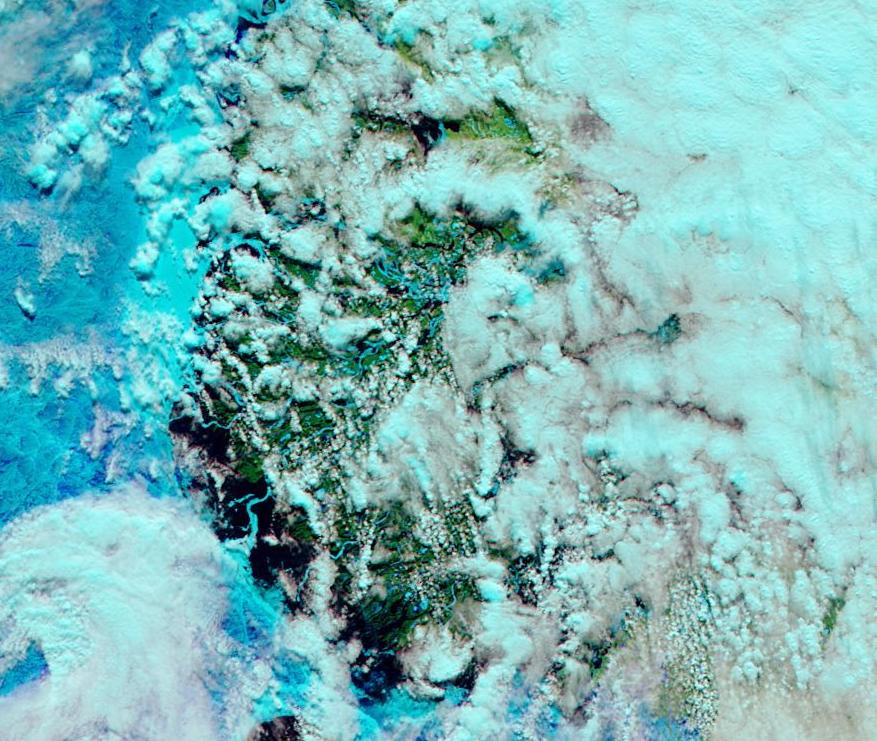
and the previous date in 2012:
NASA Worldview “false-color” image of the Lena Delta on June 2nd 2012, derived from the MODIS sensor on the Aqua satellite
[Edit – June 4th]
A significant area of the Laptev Sea ice is now turning a much darker shade of blue using the band 7-2-1 false colour combination:
NASA Worldview “false-color” image of the Laptev Sea on June 4th 2019, derived from the MODIS sensor on the Terra satellite
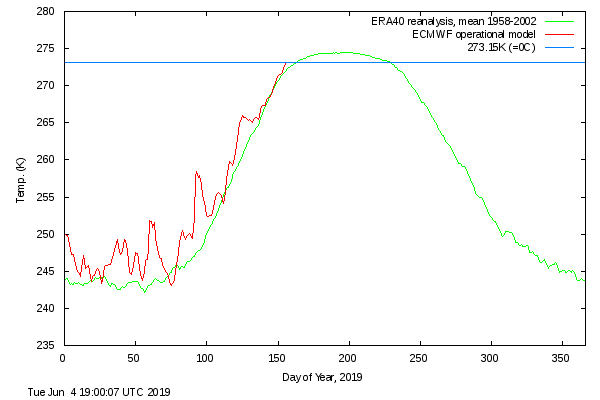
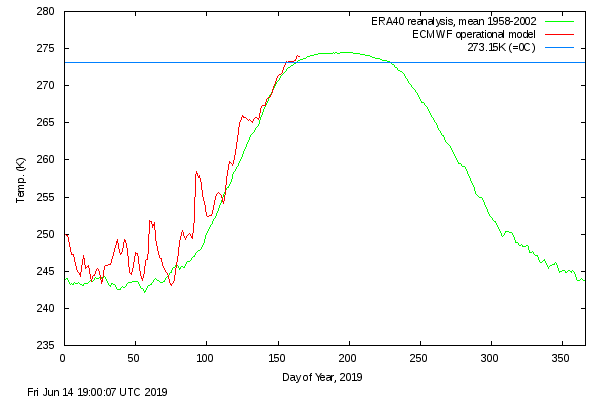
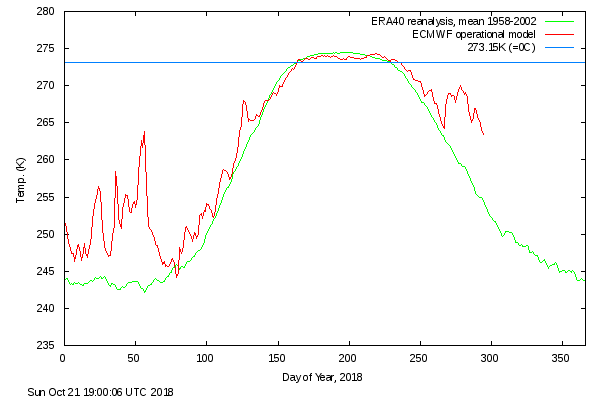
In addition the DMI >80N temperature metric has reached the zero Celsius line well ahead of schedule:
[Edit – June 5th]
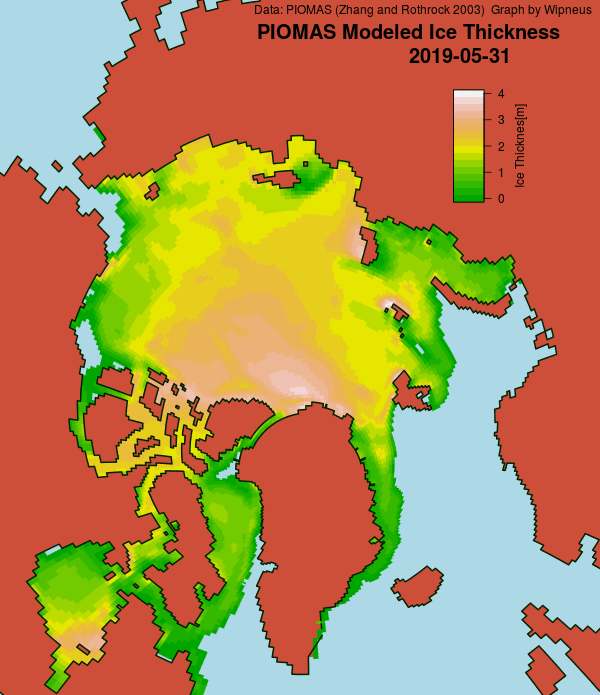
The May PIOMAS numbers have been released! Here is the Wipneus generated state of play on May 31st:
Any early bird traversing the Northwest Passage from west to east could now sail through open water around Point Barrow, along the Alaskan and Canadian coast and into the Amundsen Gulf:
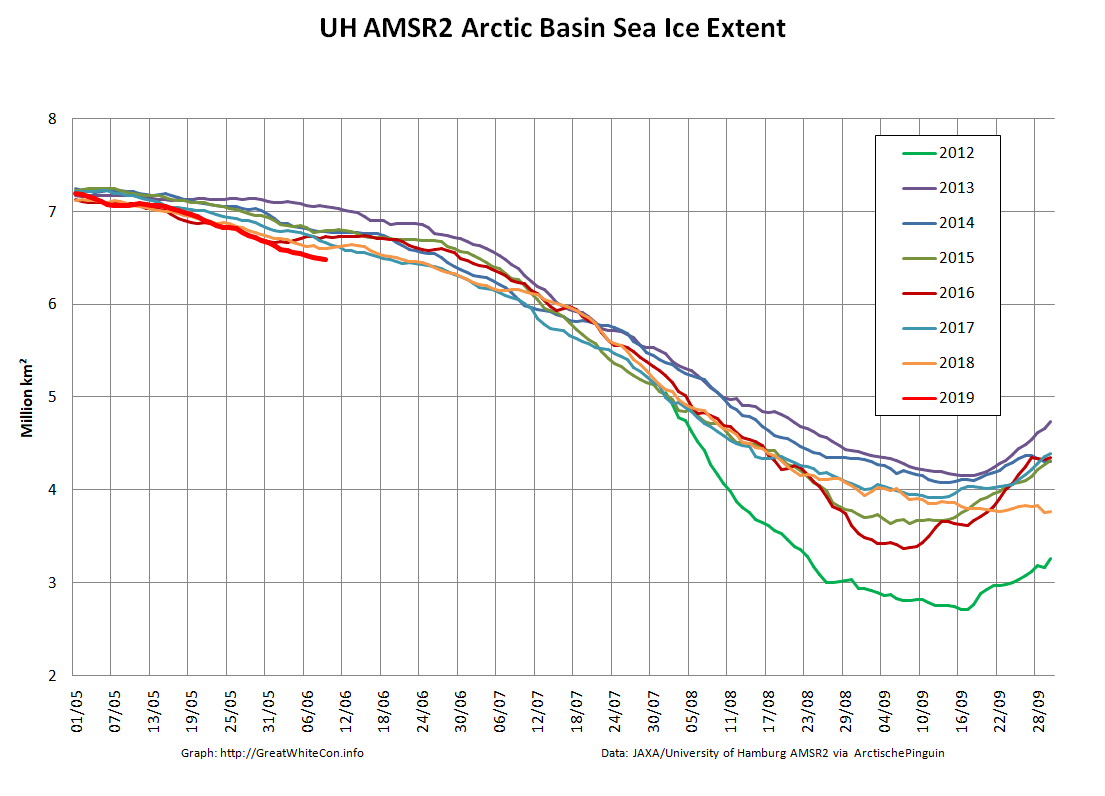
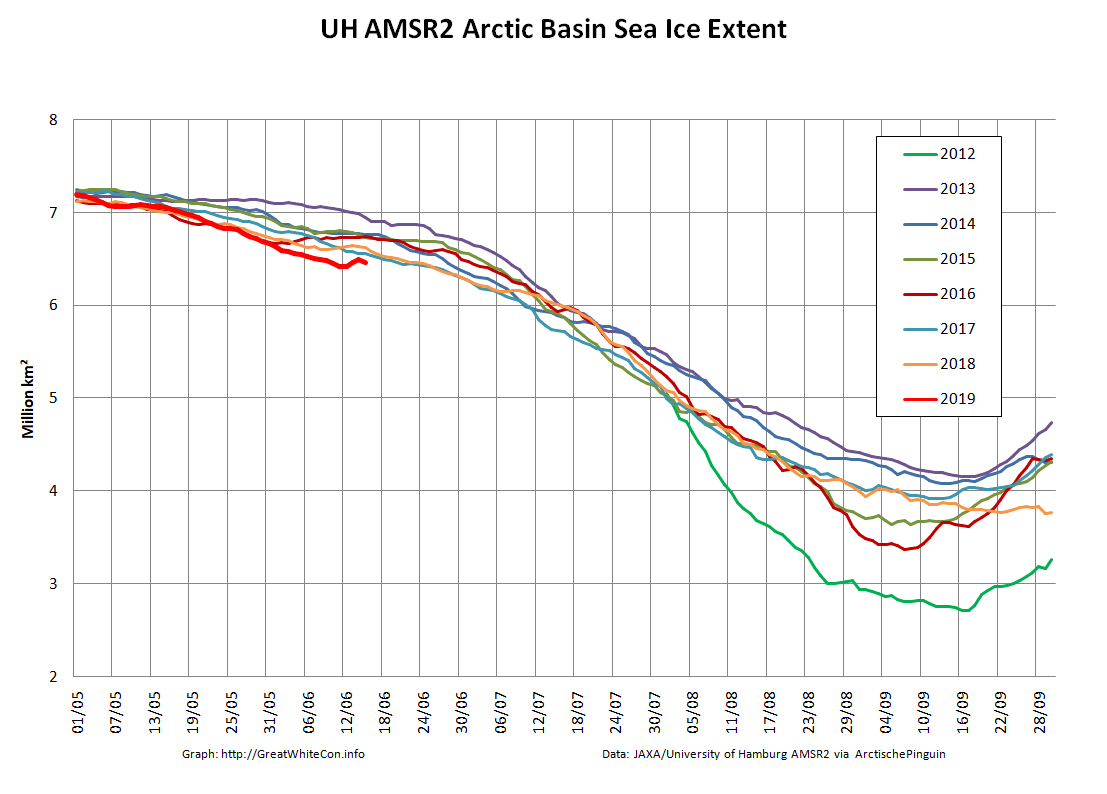
Arctic Basin sea ice extent is still descending through uncharted territory:
and Basin area currently looks poised to follow suit:
[Edit – June 11th]
There’s a beautifully clear view of the Siberian coast today, with vast areas of melt ponds visible on VIIRS false colour:
NASA Worldview “false-color” image of the Laptev & East Siberian Seas on June 11th 2019, derived from the VIIRS sensor on the Suomi satellite
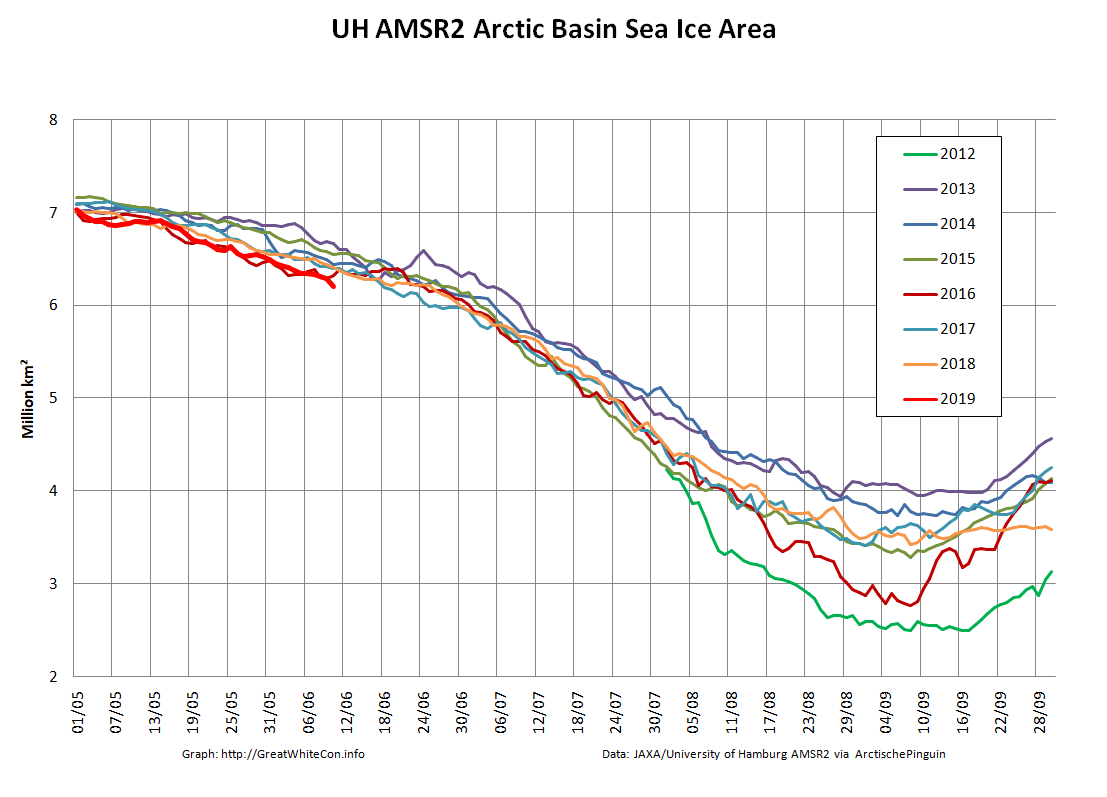
The Arctic Basin area has indeed taken a nosedive into uncharted territory:
By way of comparison sea ice area on the Atlantic periphery is in amongst the recent pack, thanks to the almost continual drift in that direction over last winter:
[Edit – June 13th]
High resolution AMSR2 extent has been in a “statistical tie” with 2016 for a few days:
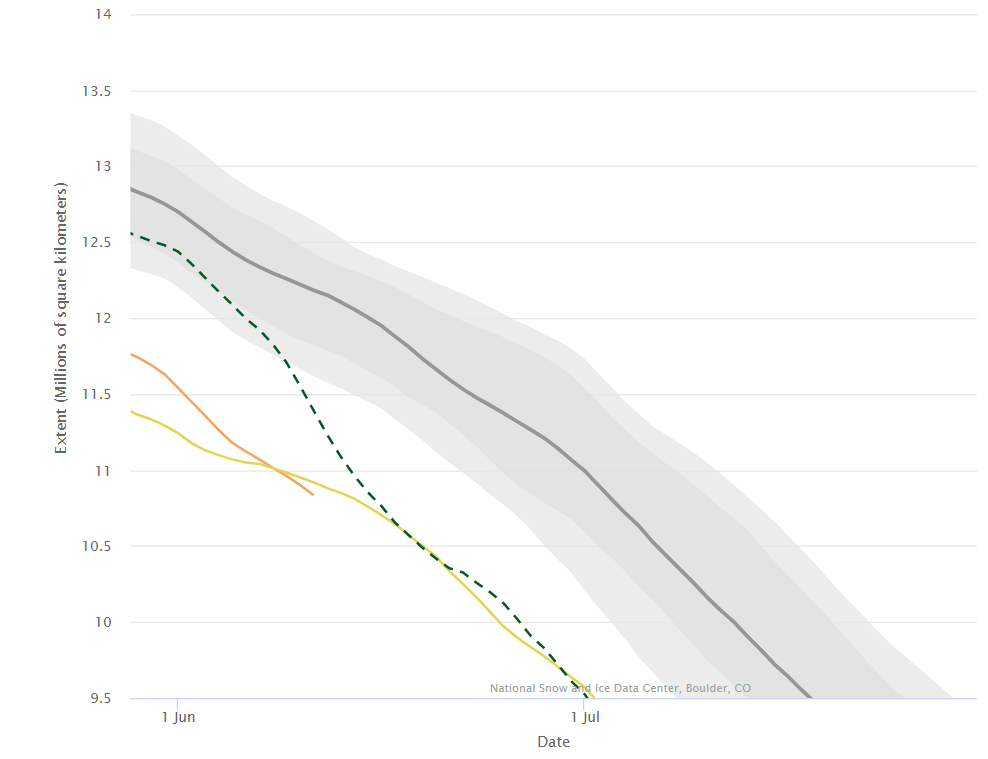
However the NSIDC’s 5 day average extent has reached a clear new low for the date, in the satellite record at least:
[Edit – June 14th]
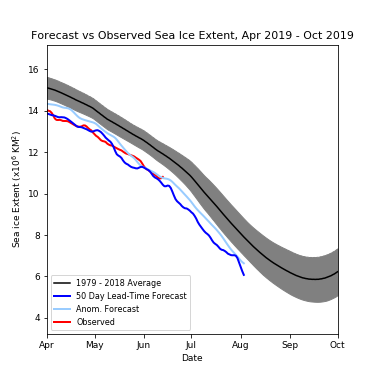
Especially for AJBT, here’s the Slater Probabilistic Ice Extent prediction for August 3rd:
and here’s the current DMI >80N temperature graph:
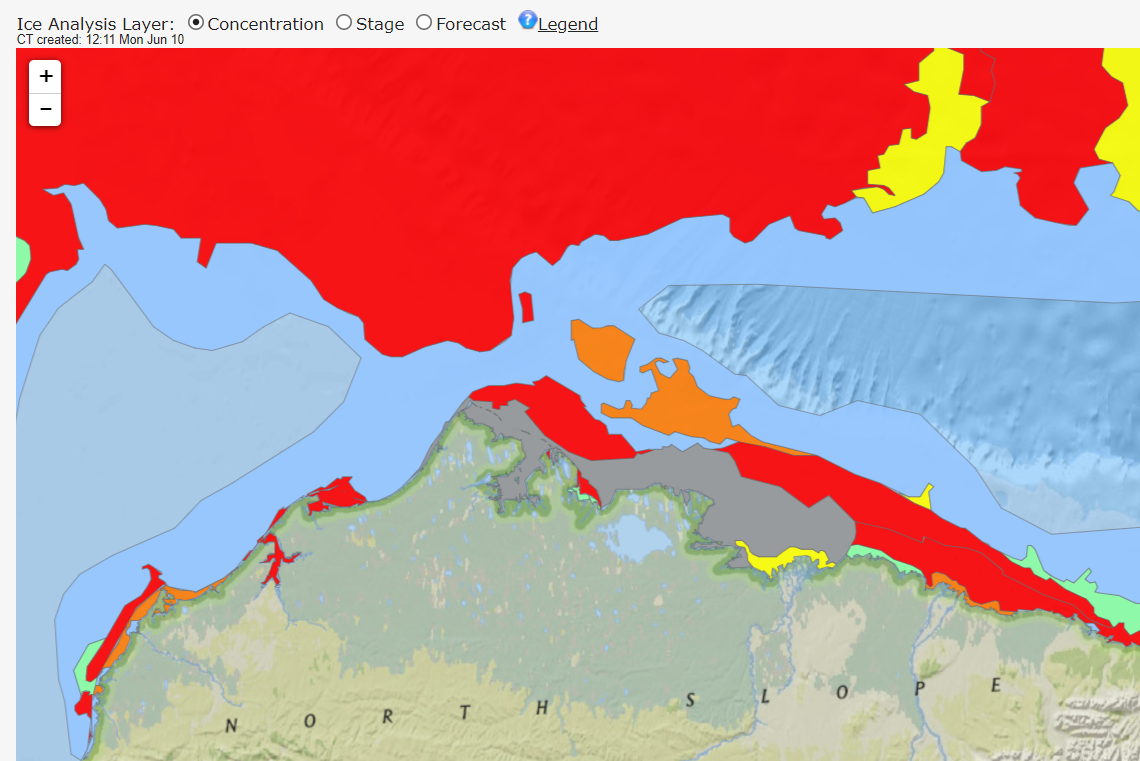
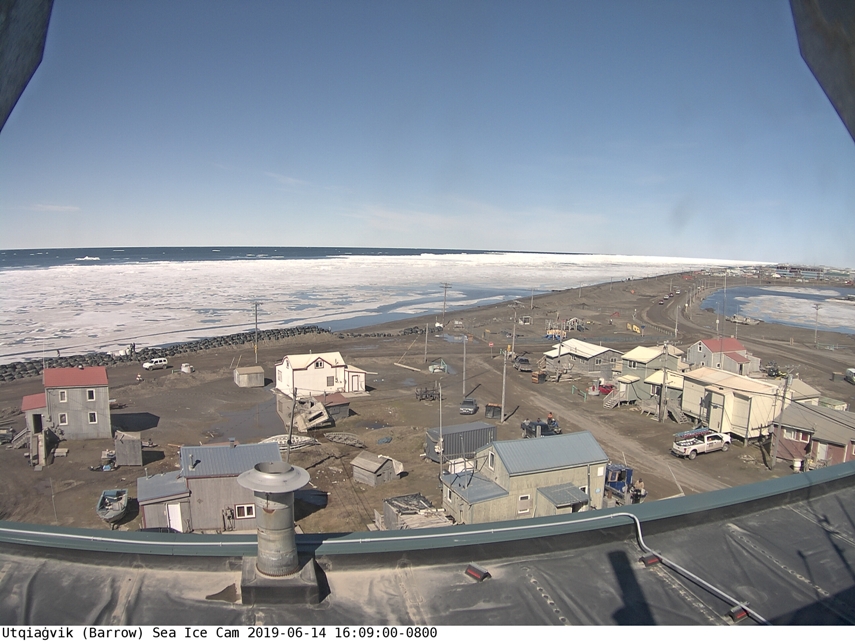
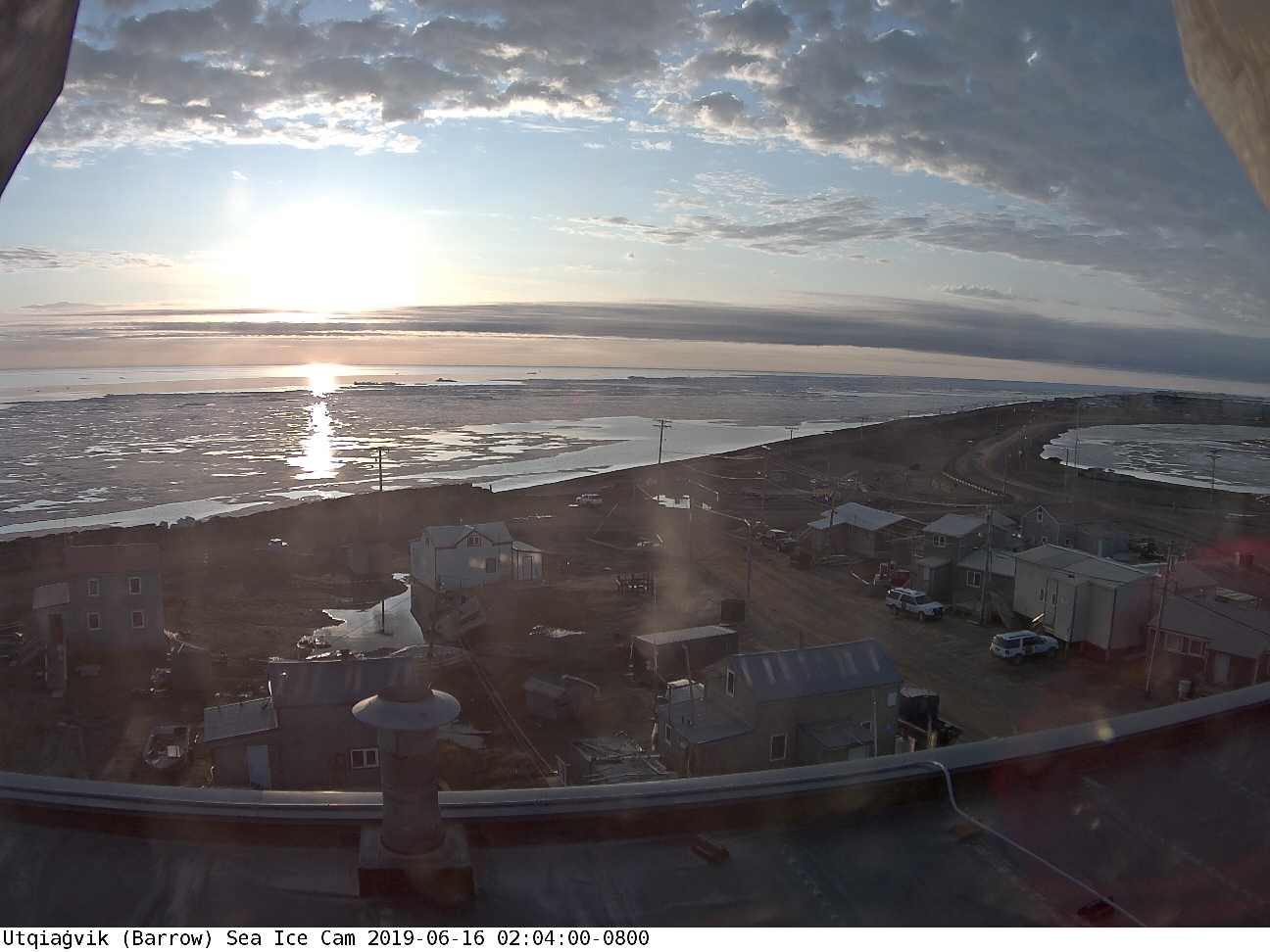
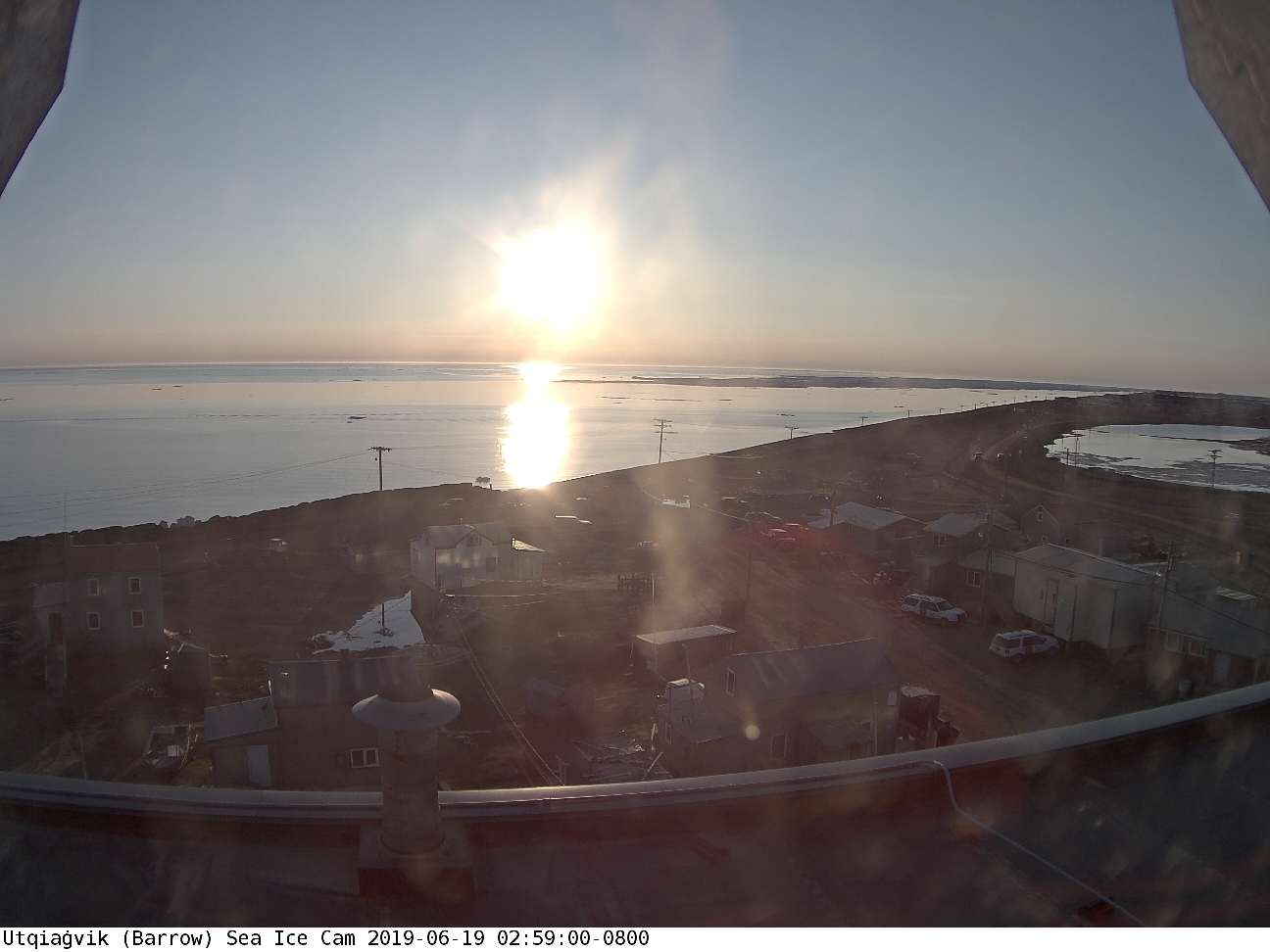
Finally, for the moment at least, there is not very much fast ice left at Utqiaġvik:
[Edit – June 15th]
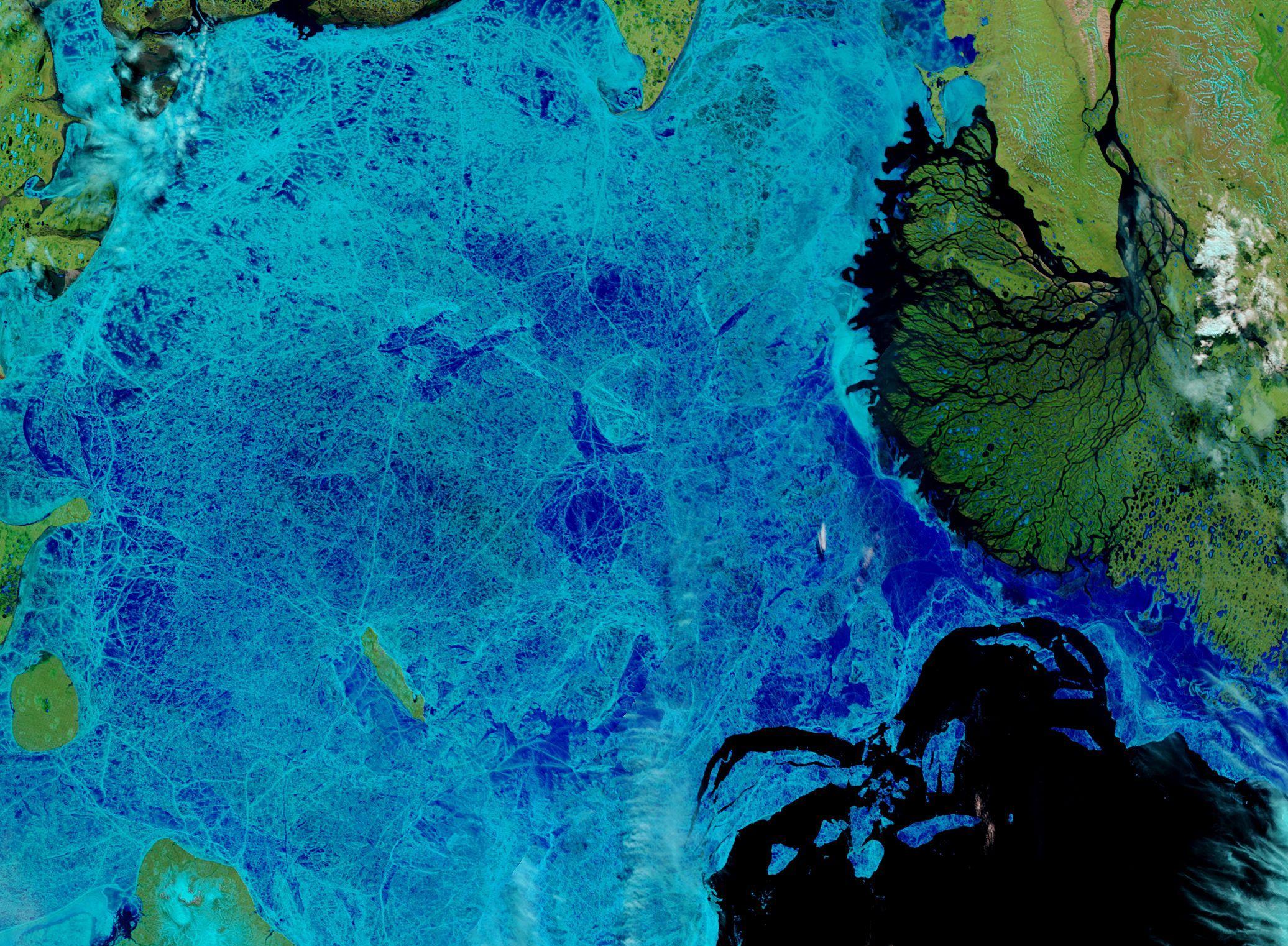
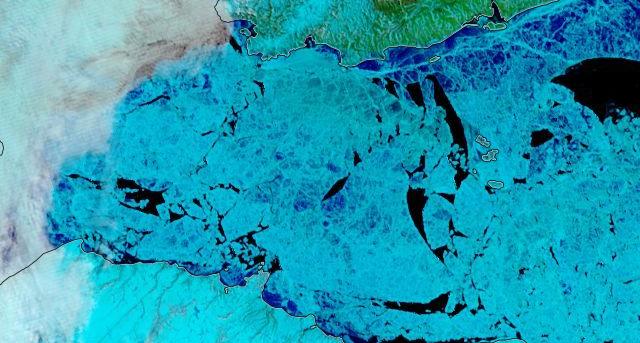
The sea ice in the Laptev Sea is starting to break up:
NASA Worldview “false-color” image of the Laptev Sea on June 15th 2019, derived from the MODIS sensor on the Terra satellite
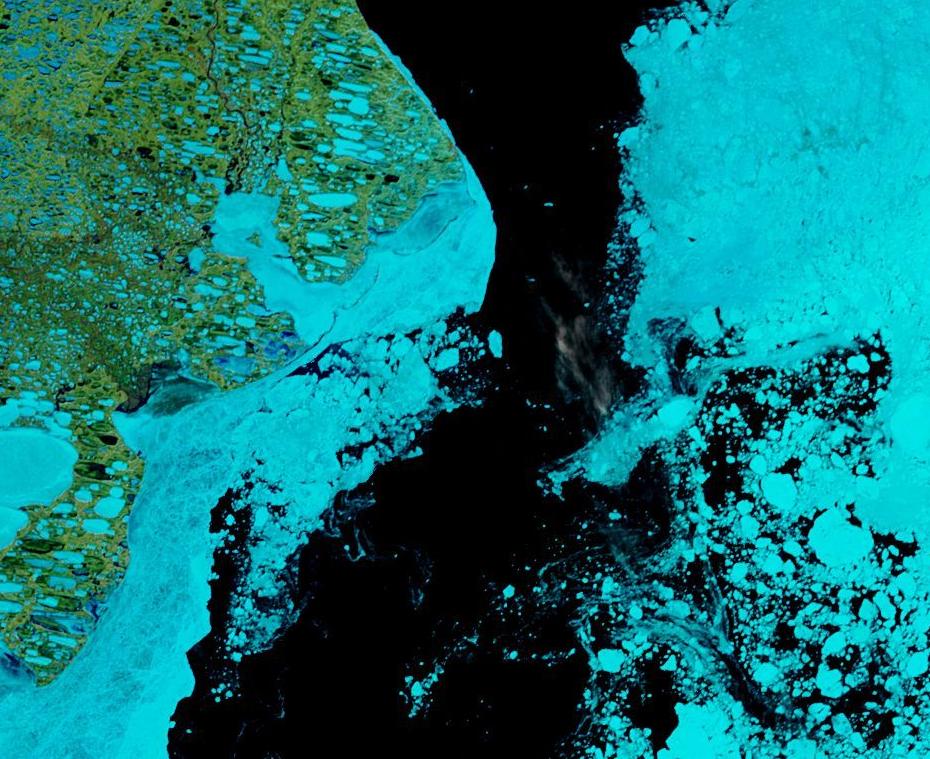
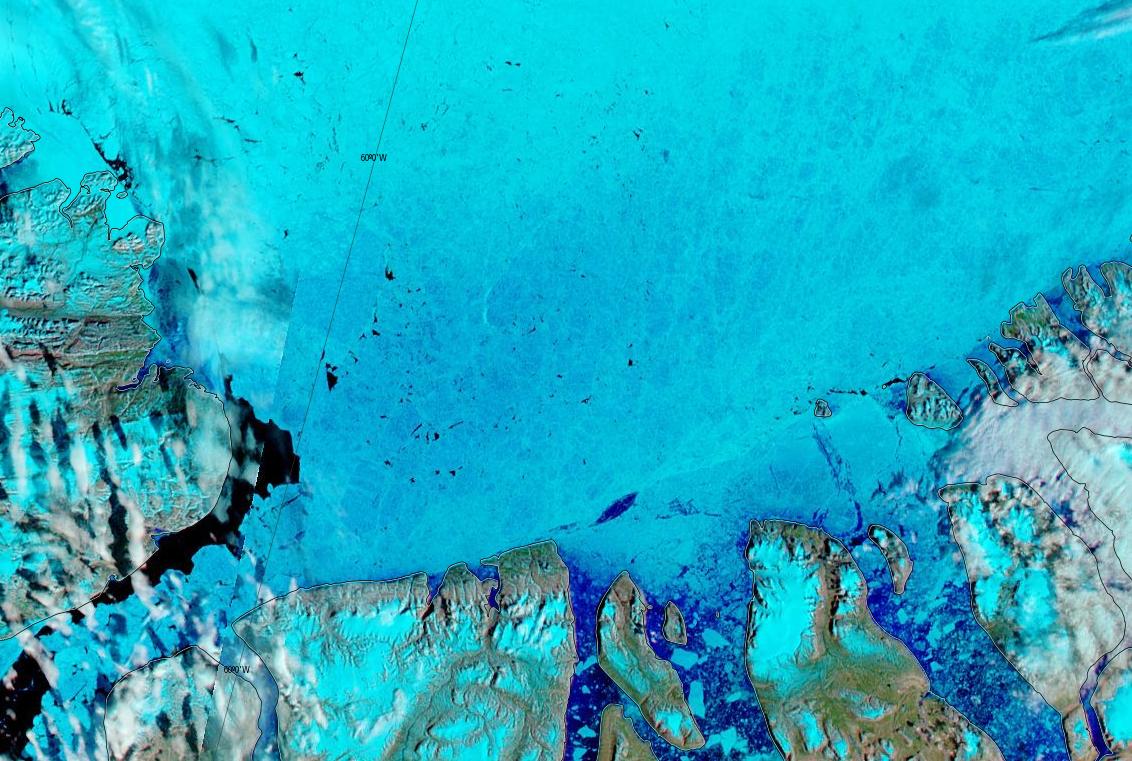
As is the fast ice in the Beaufort Sea:
NASA Worldview “false-color” image of the Beaufort Sea on June 14th 2019, derived from the MODIS sensor on the Terra satellite
Meanwhile the MSLP of the cyclone currently spinning over Severnaya Zemlya was down to 976 hPa at 06:00 UTC this morning:
NASA Worldview “false-color” image of the Kara Sea on June 15th 2019, derived from the MODIS sensor on the Terra satellite
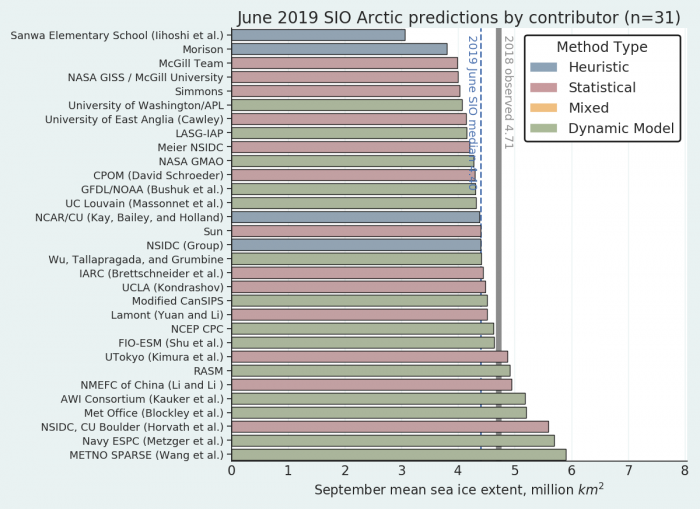
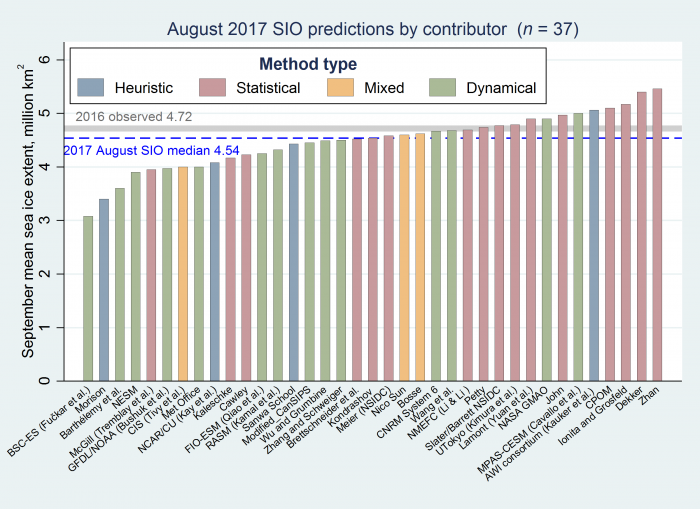
Again, as in previous years, the spread in the dynamical models are larger compared with statistical models. Overall, the heuristic method has the lowest projected September sea-ice extent value with a median at 4.09 million square kilometers, and the dynamical models have the highest number with the median at 4.56 million square kilometers.
[Edit – June 23rd]
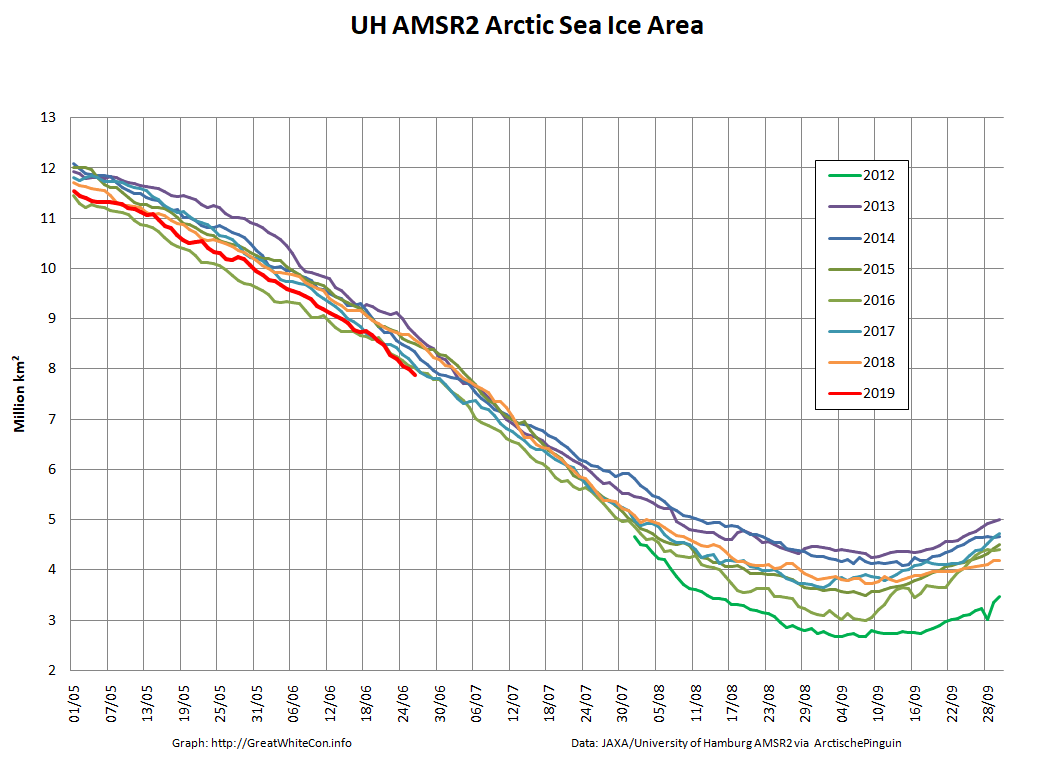
Arctic wide sea ice area is now lowest for the date in the high resolution AMSR2 record, although extent has yet to follow suit:
If you exclude the peripheral seas, which are all largely ice free by mid September in this day and age, the picture is extremely stark:
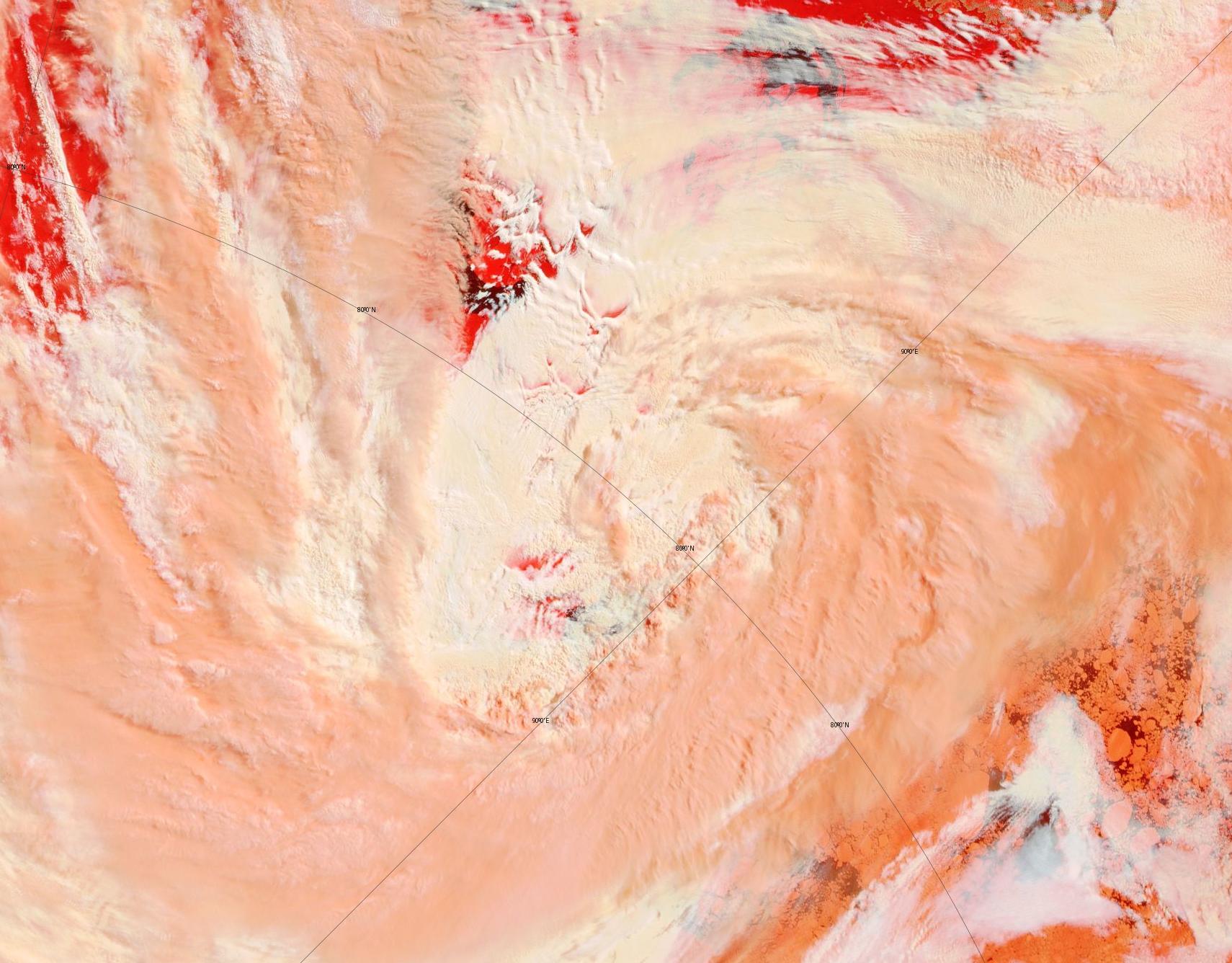
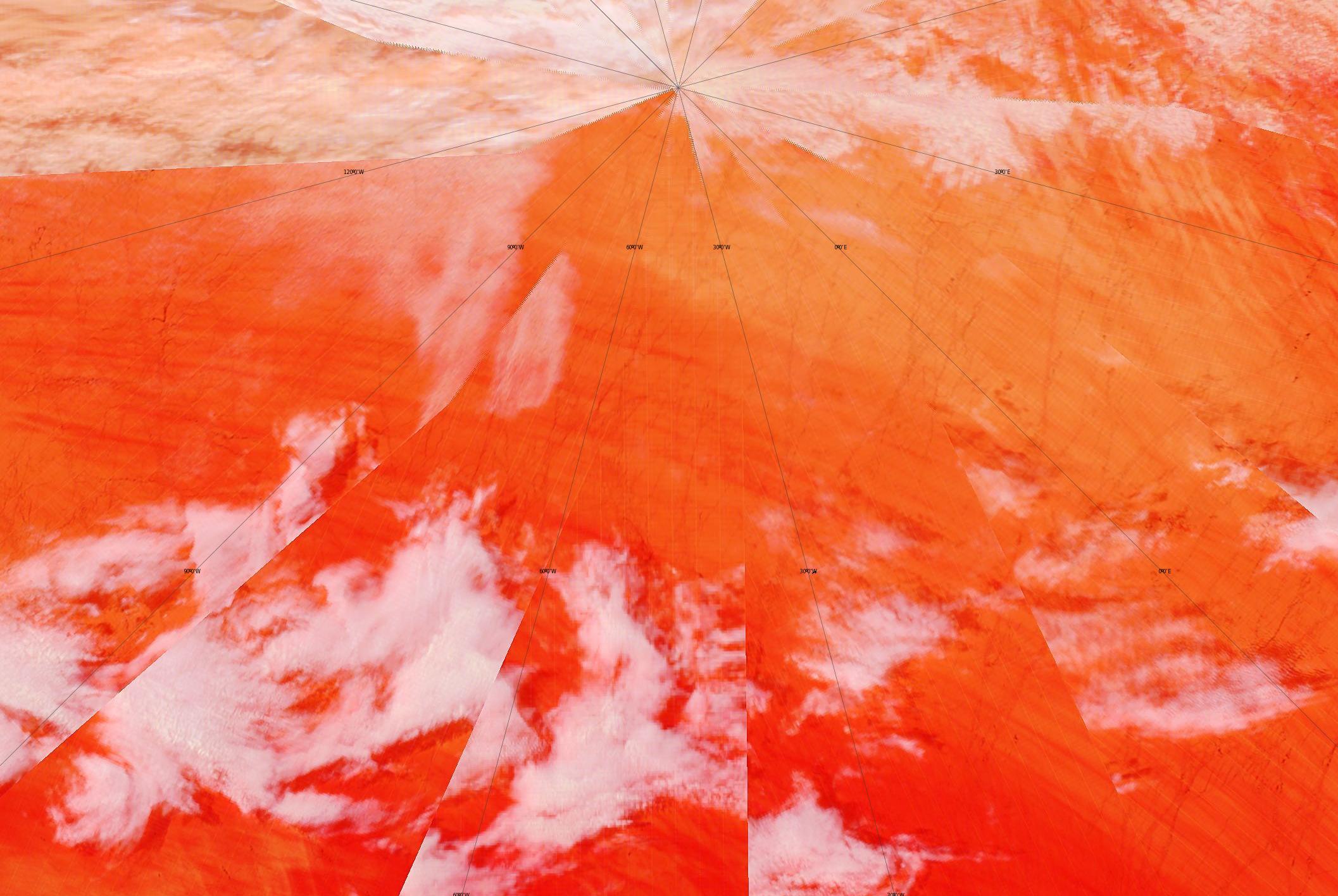
A brief glimpse through the clouds reveals that the North Pole is now starting to feel the recent heat:
NASA Worldview “false-color” image of the North Pole on June 22nd 2019, derived from the MODIS sensor on the Terra satellite
[Edit – June 27th]
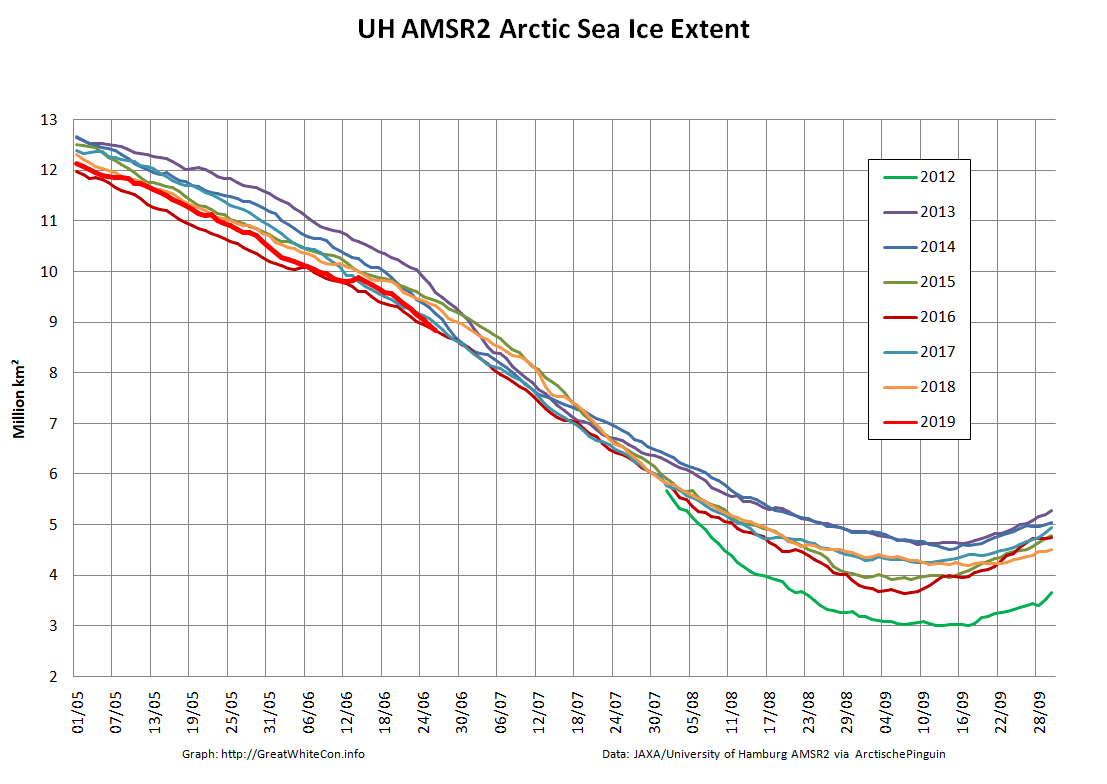
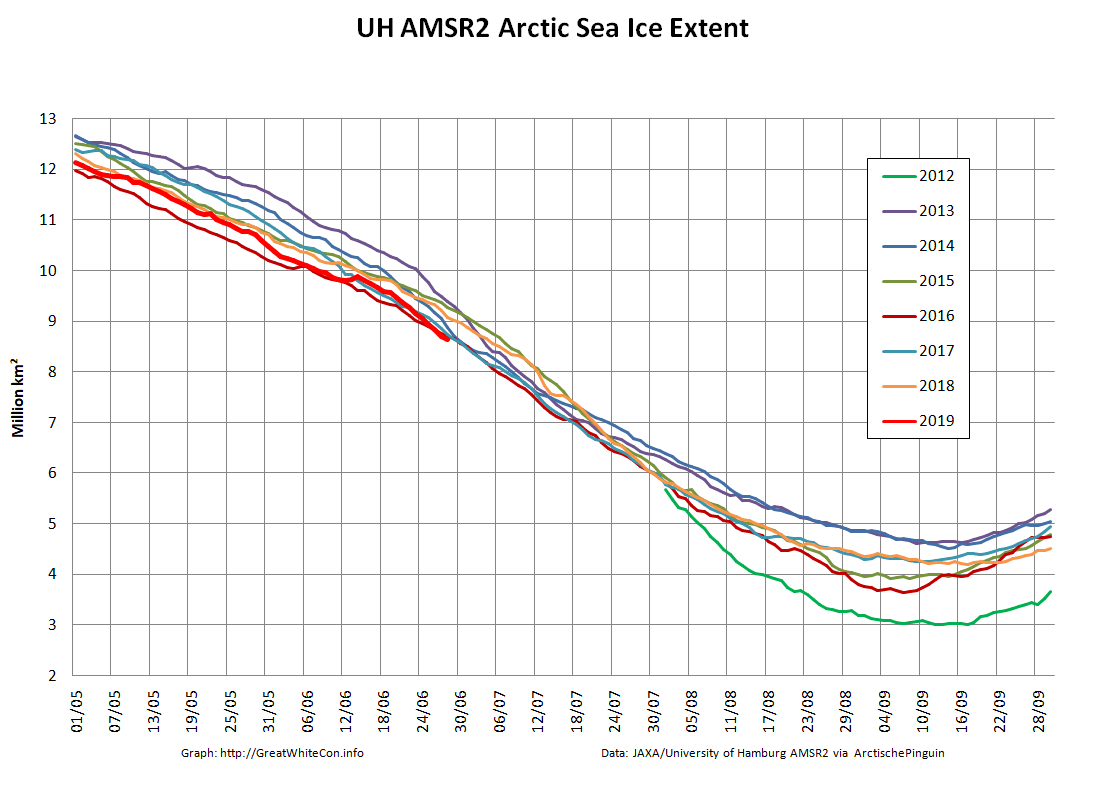
Arctic wide sea ice extent is now lowest for the date in the high resolution AMSR2 record:
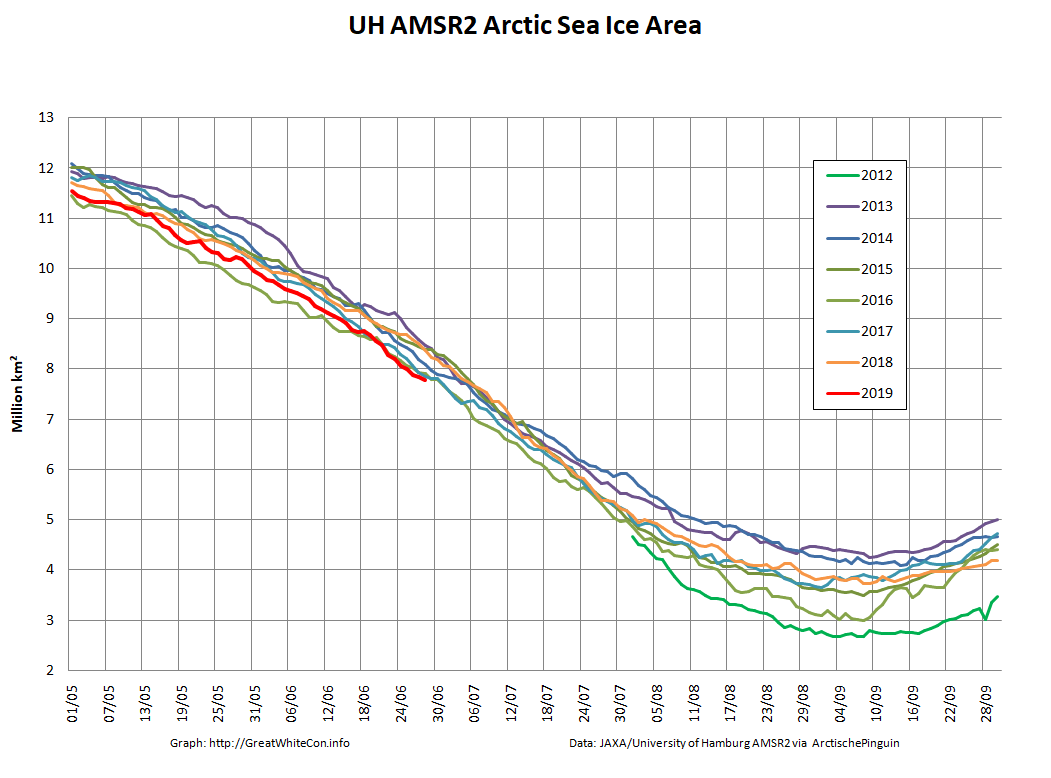
Here’s Arctic wide sea ice area, which is still well below the rest of the pack:
[Edit – June 29th]
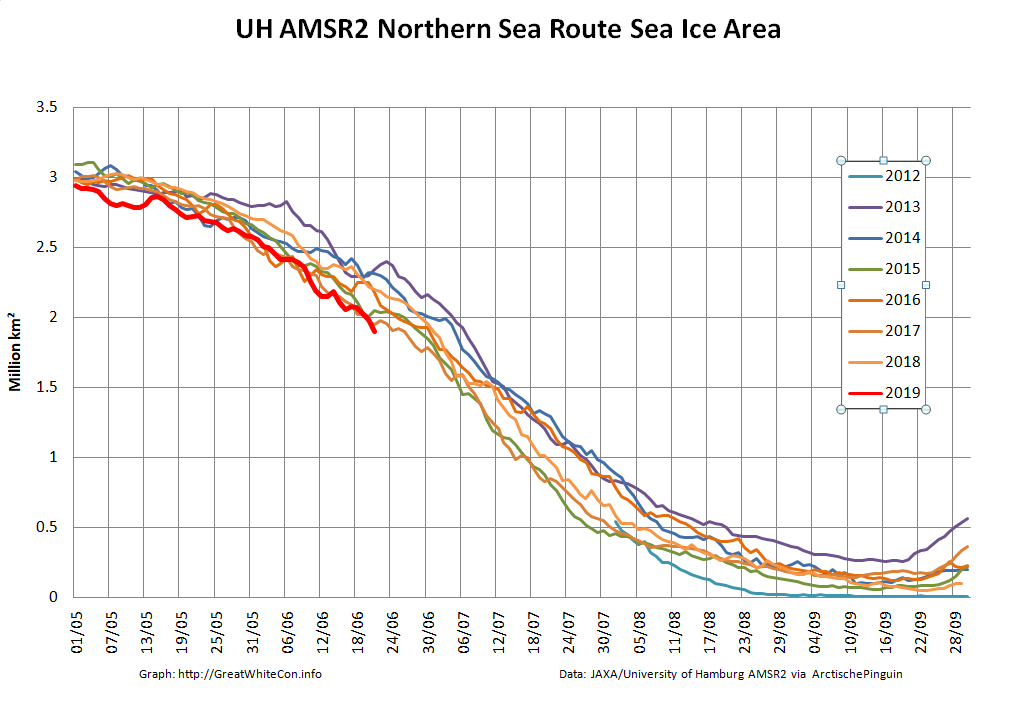
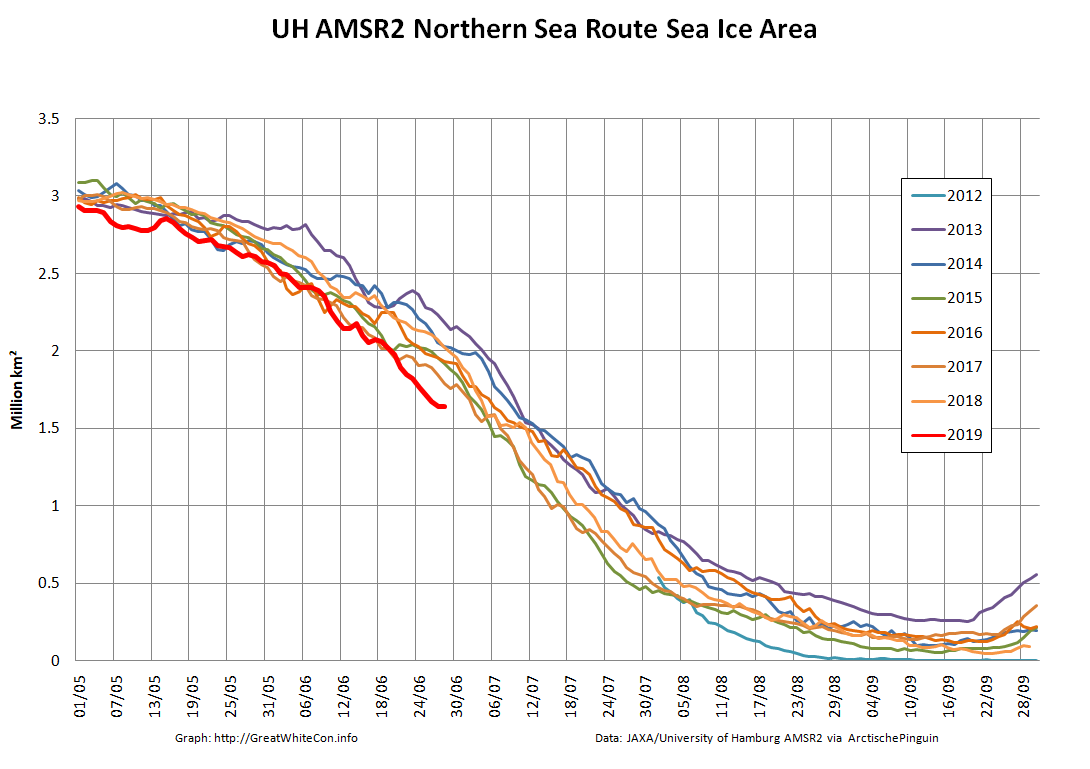
As the end of the month draws near let’s take a look at sea ice area along a couple of the famous sea routes above the Arctic Circle. First of all here’s the Northern Sea Route, comprising the Kara, Laptev, East Siberian and Chukchi Seas:
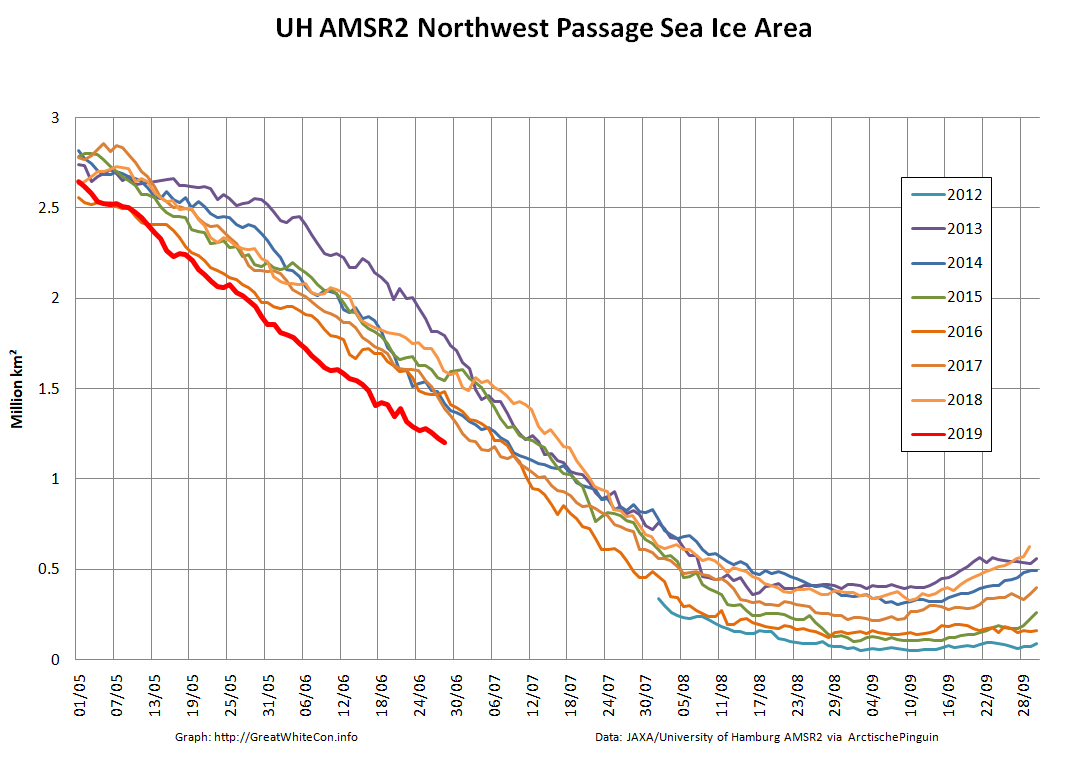
Next here’s the Northwest Passage, comprising the Chukchi and Beaufort Seas plus the channels of the Canadian Arctic Archipelago and Baffin Bay:
For completeness here too are the current Arctic wide area and extent numbers:
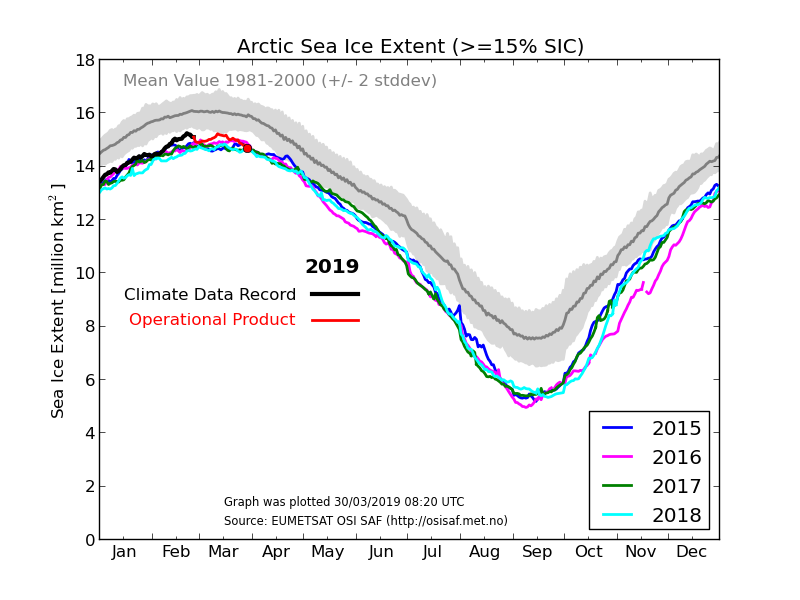
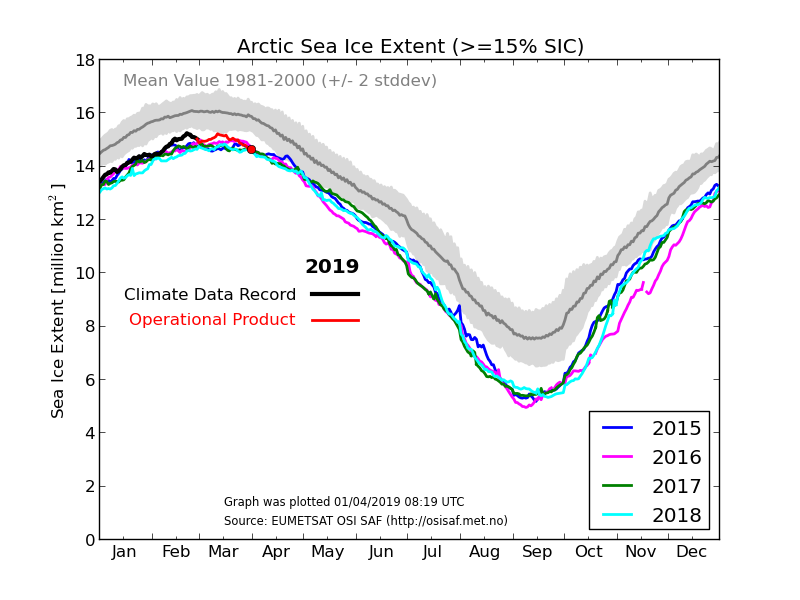
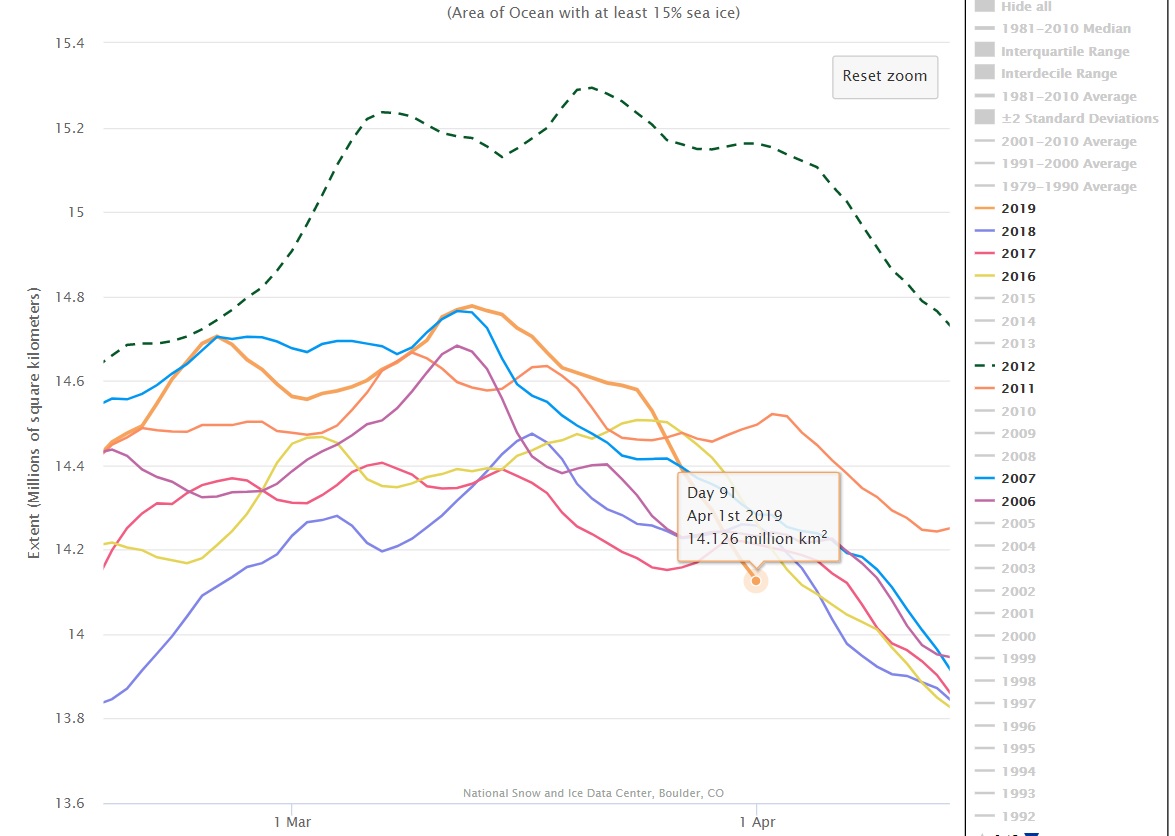
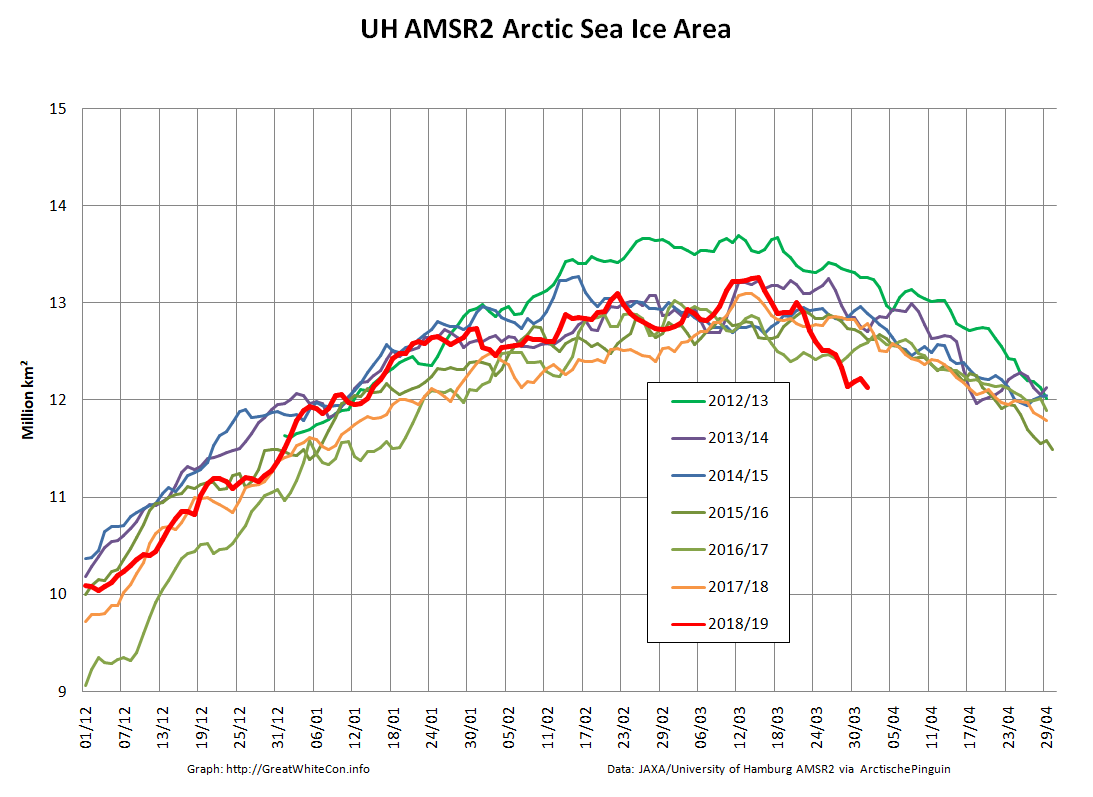
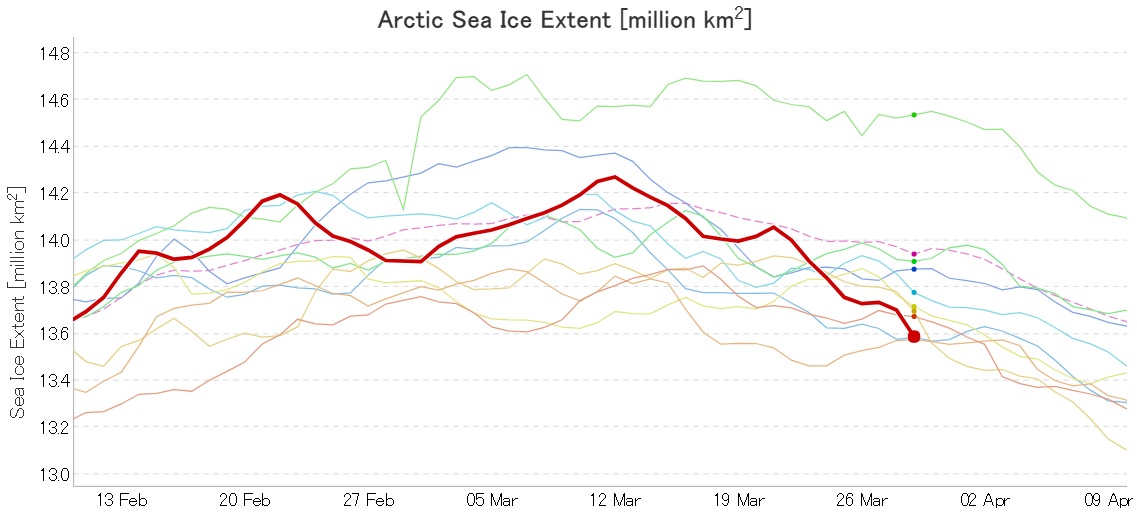
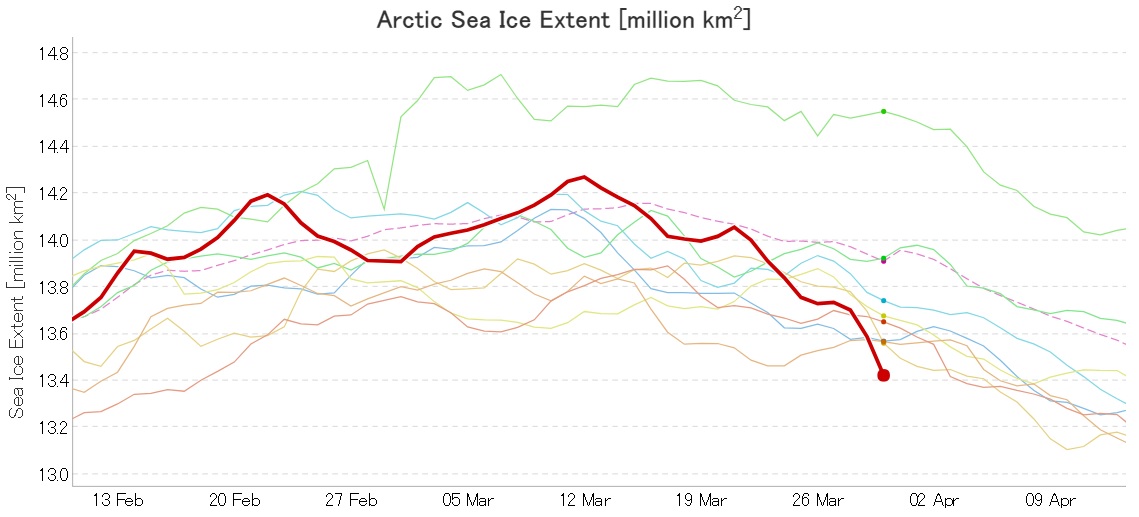
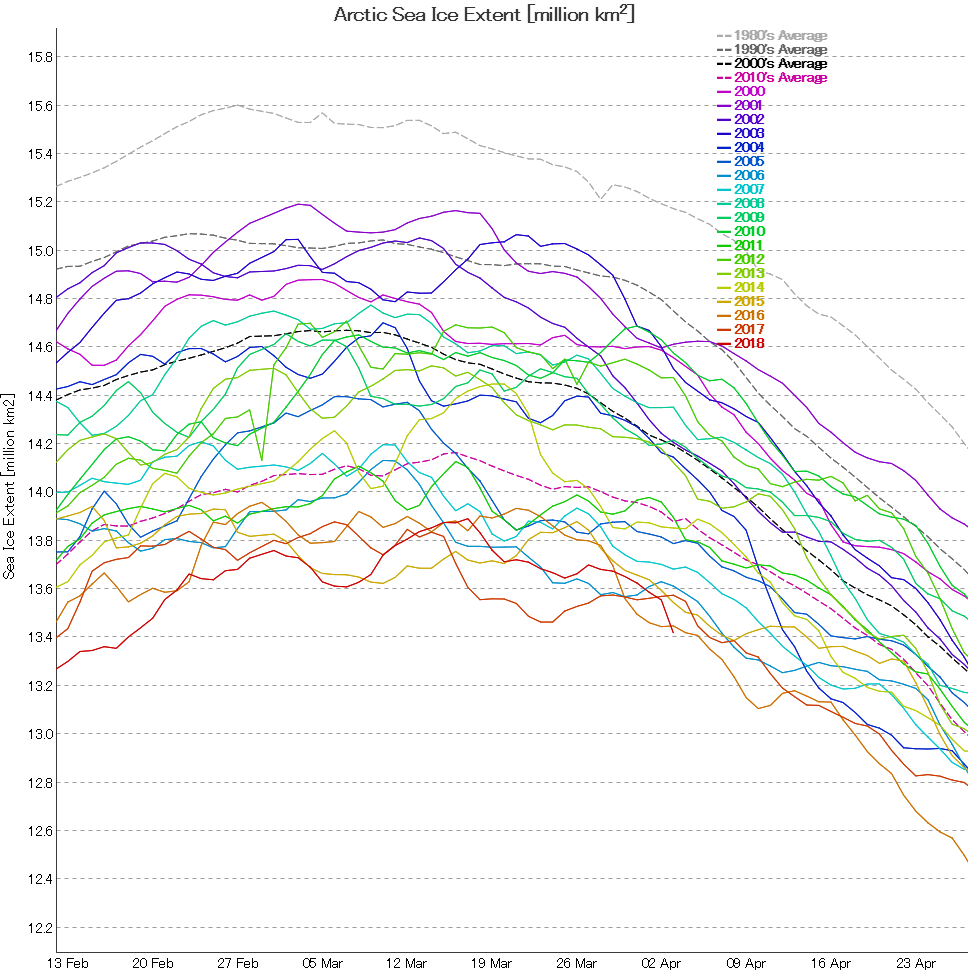
At the beginning of April 2019 all the assorted Arctic sea ice extent metrics are at their respective lowest levels for the date in the satellite record. Just for a change let’s start with the JAXA/ViSHOP graph for April 1st, based on AMSR2 data:
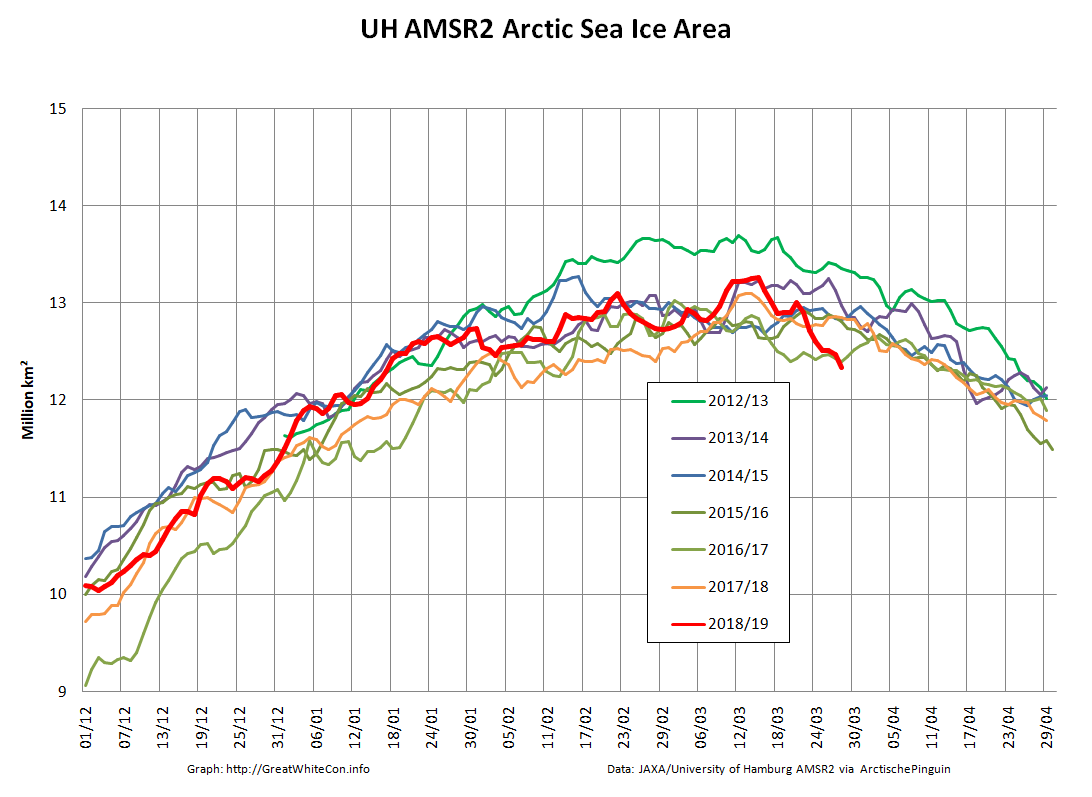
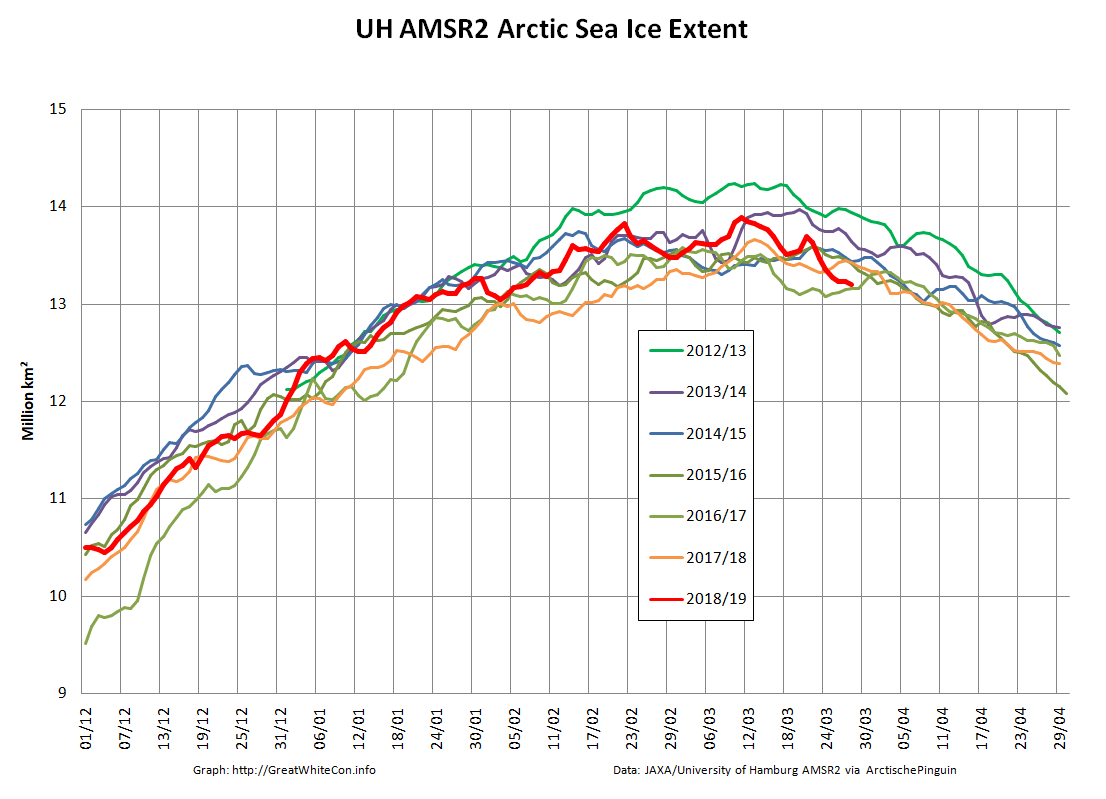
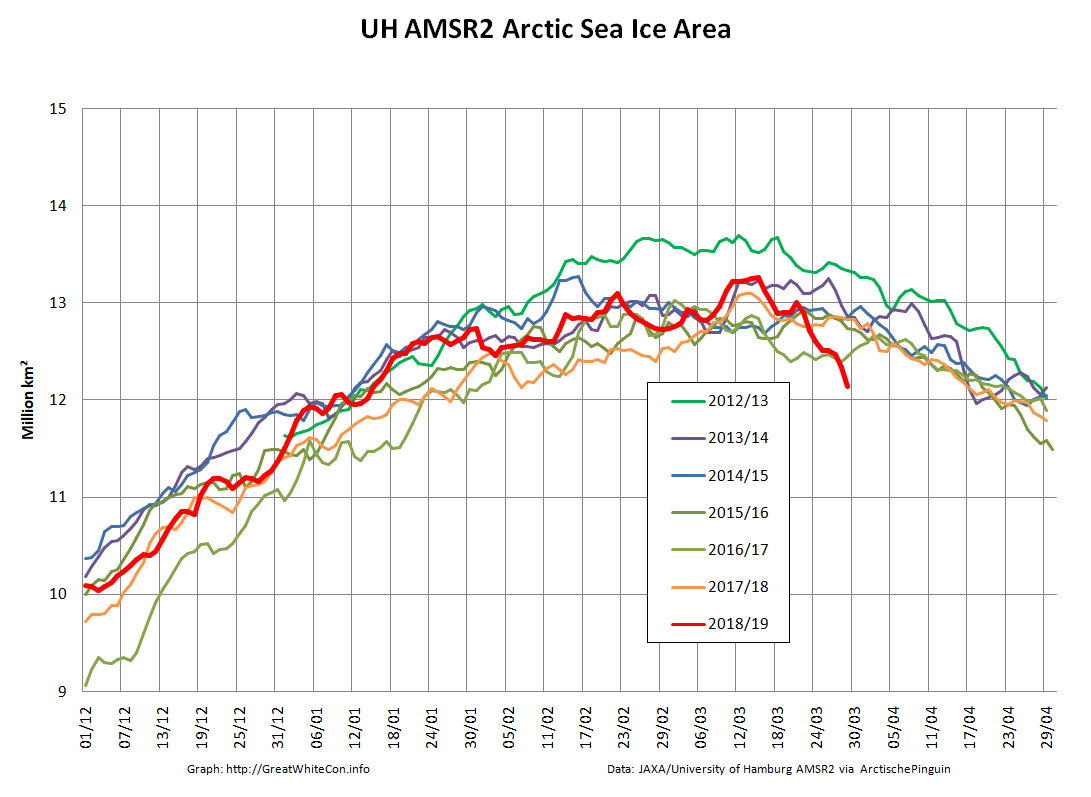
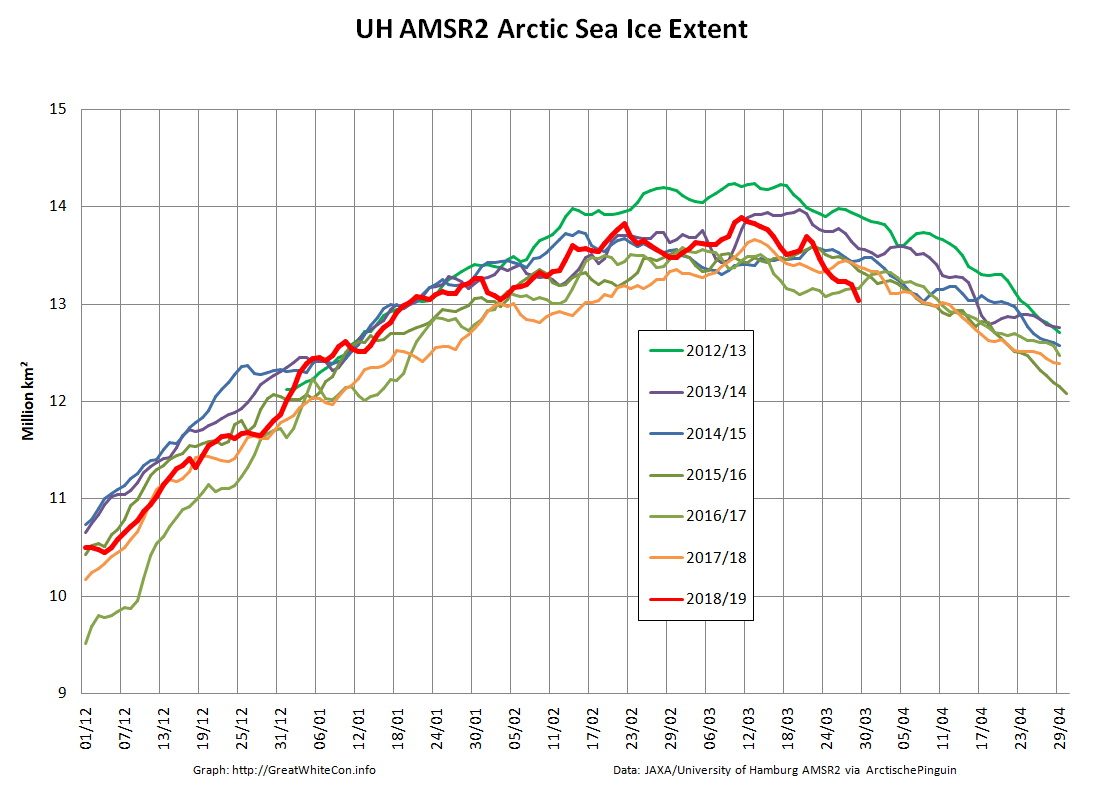
That shows extent apparently on an inexorable decline. However the higher resolution graphs derived by Wipneus from University of Hamburg AMSR2 concentration data reveal that Arctic sea ice extent has changed little over the last couple of days, and area has even increased somewhat:
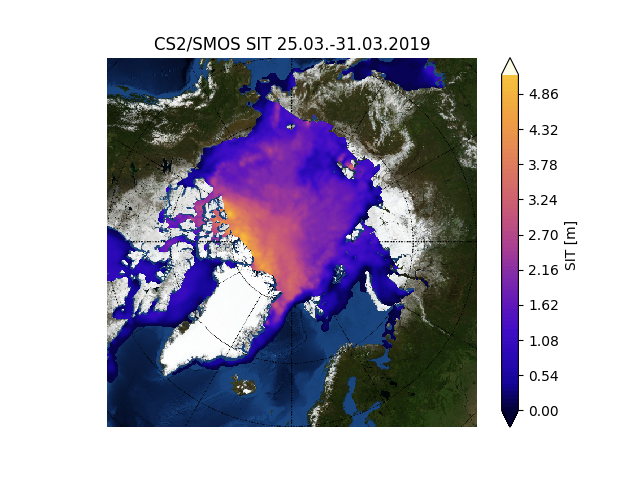
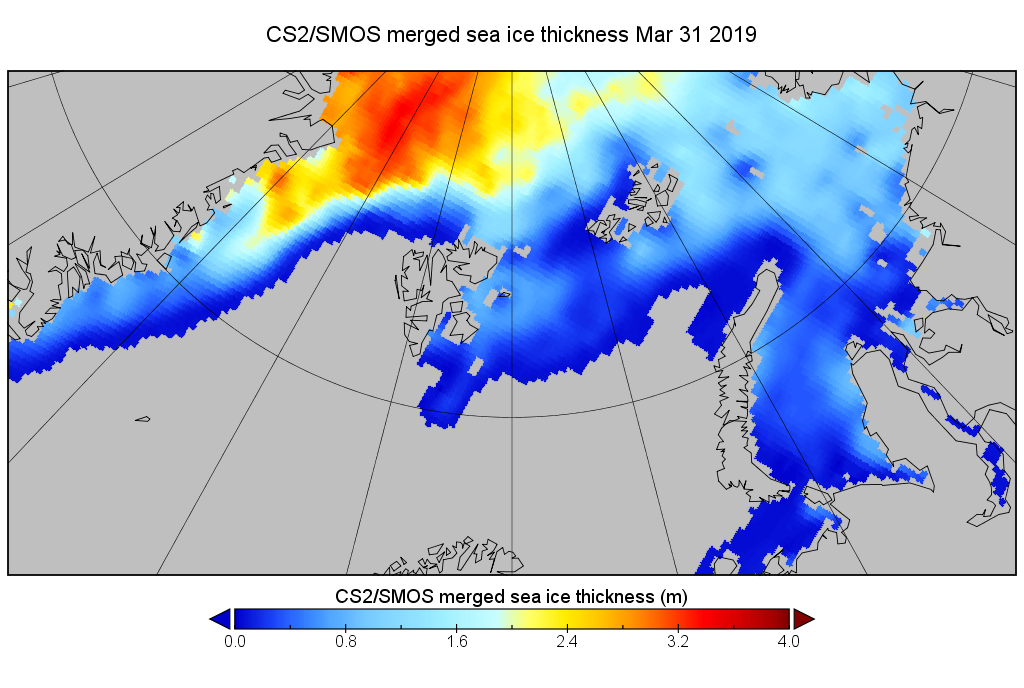
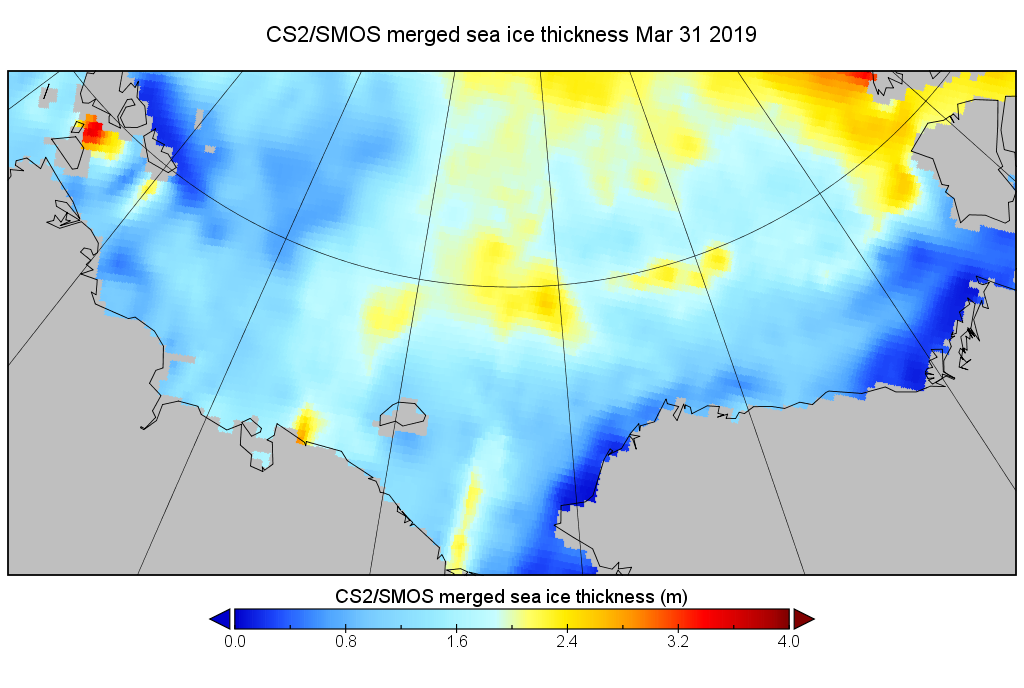
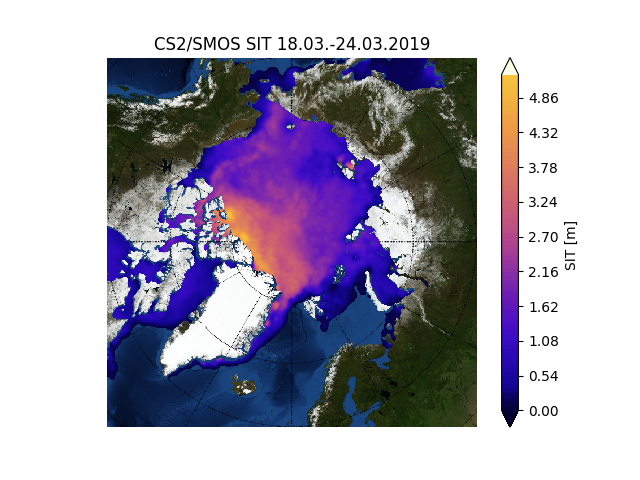
Whilst we wait for Wipneus’ latest PIOMAS thickness and volume update, here’s the gridded merged CryoSat-2/SMOS thickness data from the Finnish Meteorological Institute:
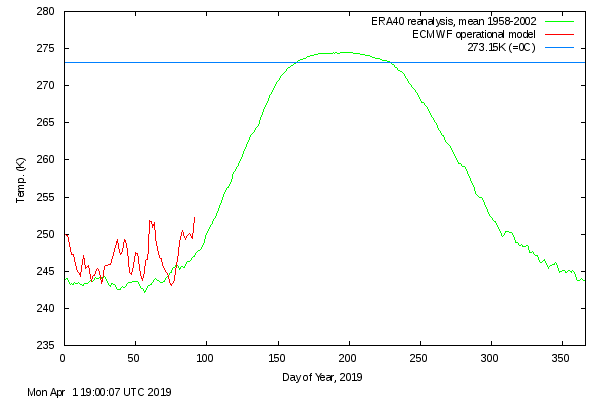
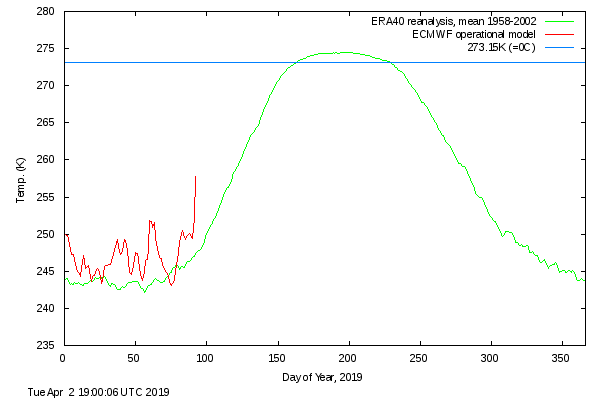
Watch this space for some other extent graphs once they’ve updated to April 1st. In particular the DMI’s version of events will be of great interest, since by way of a little All Fools Day fun I passed on the latest Arctic sea ice news to Tony Heller and the denizens of his “Deplorable Climate Science Blog” yesterday. They were not amused! By way of example, Rah solemnly informed me that:
Tony consistently has used the DMI data as his primary source on the conditions in the Arctic, while you jump to whatever source you think justifies your bias. Get a life. Arctic air temps this year so far have been running below what they were at this time last year.
This is the graph that Steve/Tony used in an attempt to make his point:
Plus the April 2nd DMI “Arctic temperature” graph:
[Edit – April 3rd]
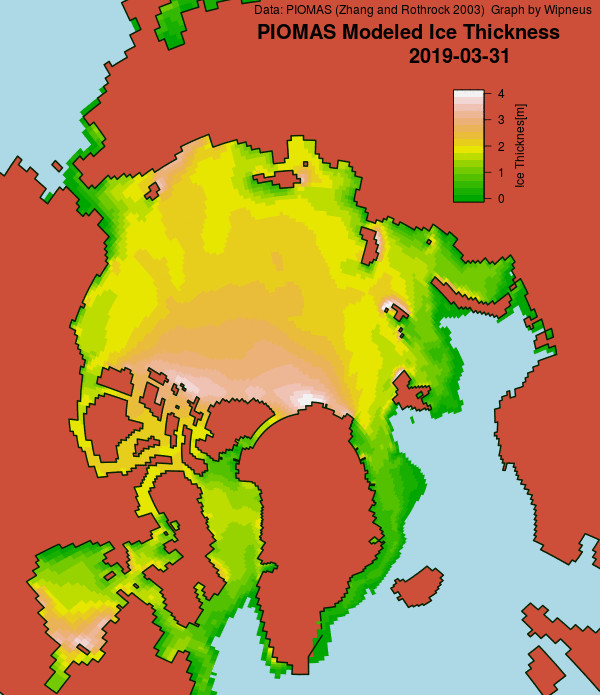
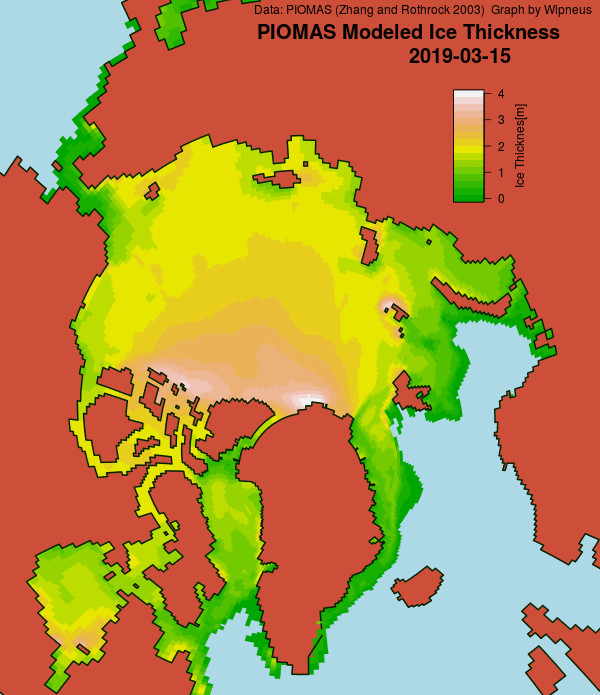
Snow White asked Axel Schweiger nicely on Twitter, and as if by magic the PIOMAS numbers for March have been released, including gridded thickness. Wipneus has crunched them to reveal the following end of March sea ice thickness map:
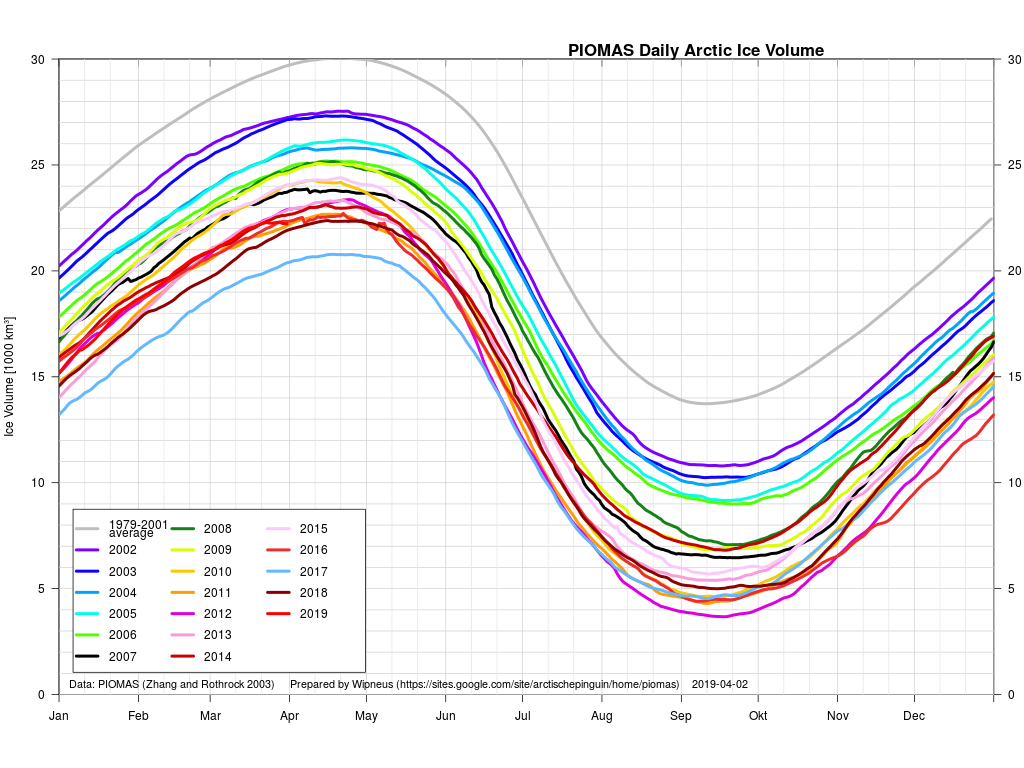
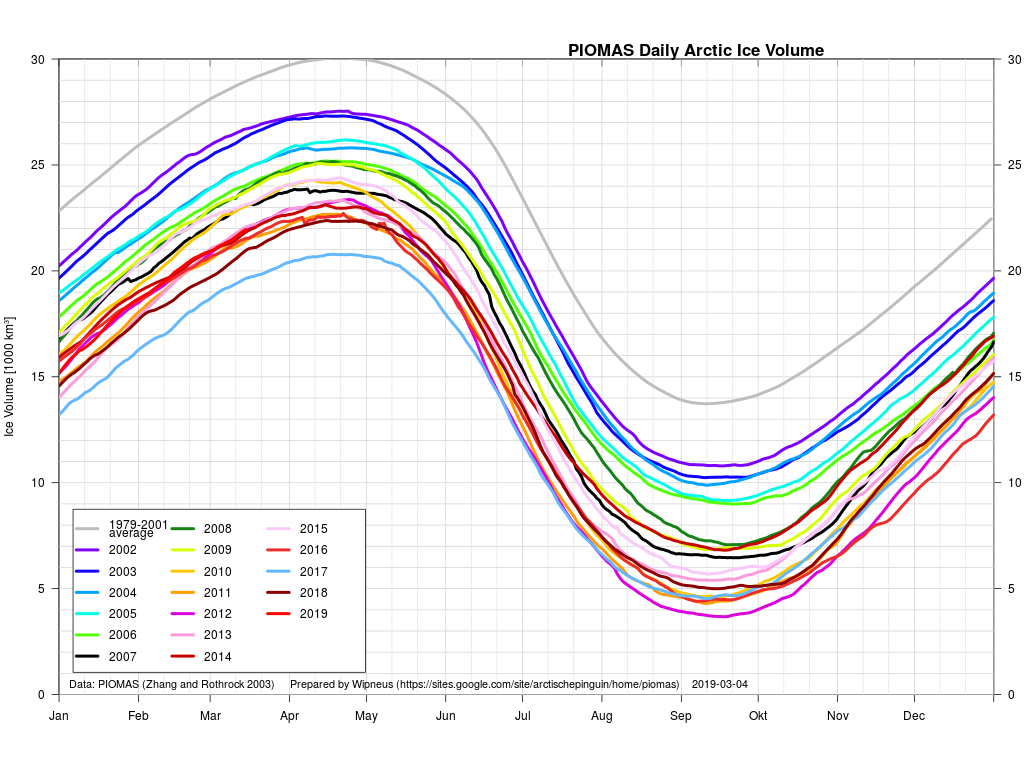
plus a rather unusual volume graph:
Here’s a closeup view:
According to the PIOMAS model Arctic sea ice volume has been flatlining for the last couple of weeks, and may even have peaked already!
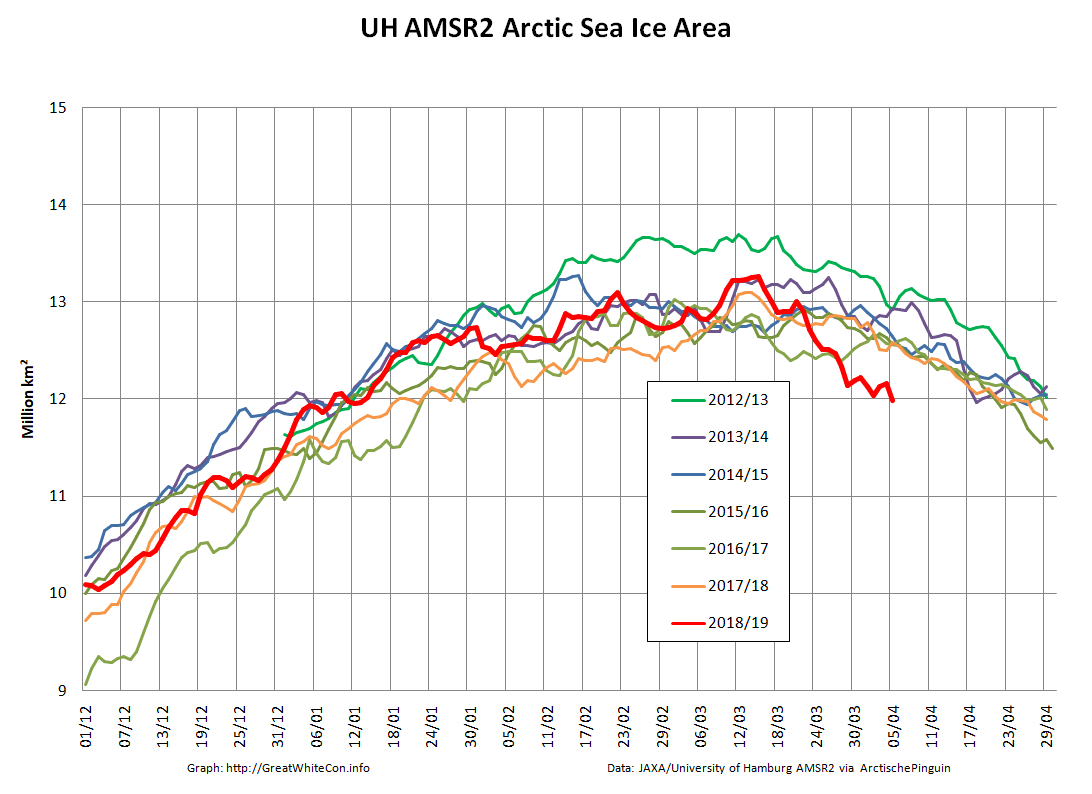
Meanwhile returning to 2 dimensions the decline in area has resumed:
[Edit – April 7th]
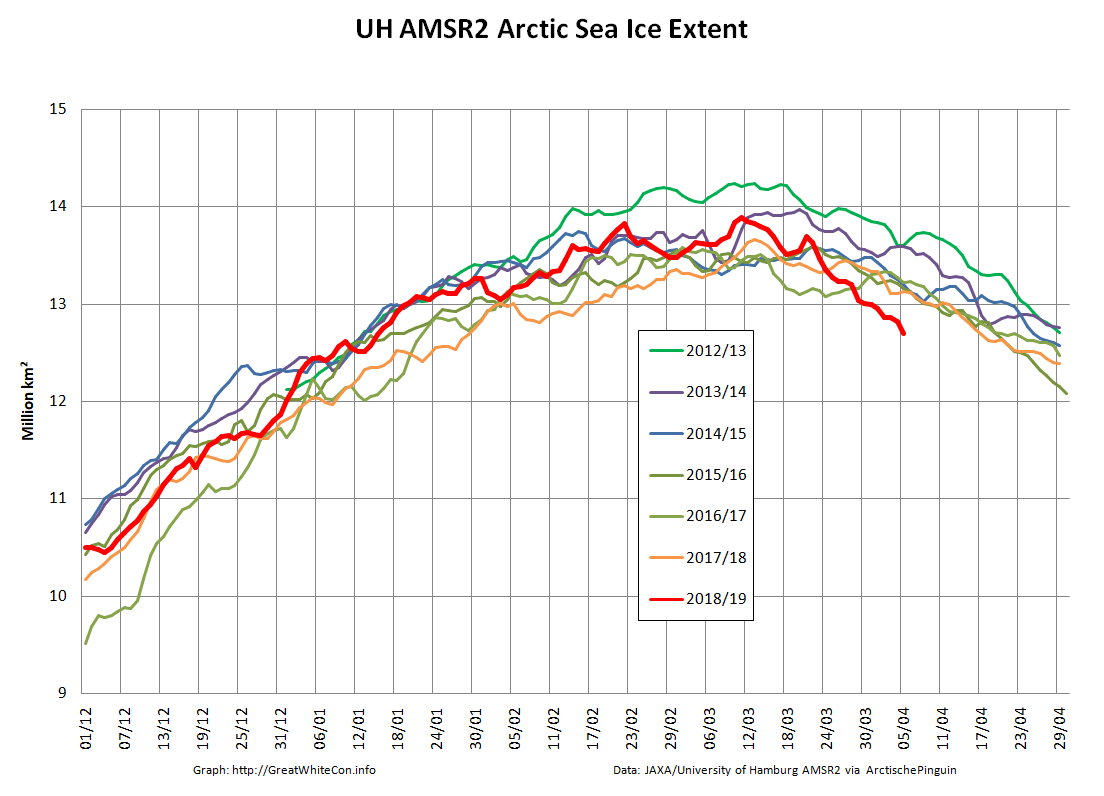
Wipneus’ UH high resolution extent fell another 129k yesterday:
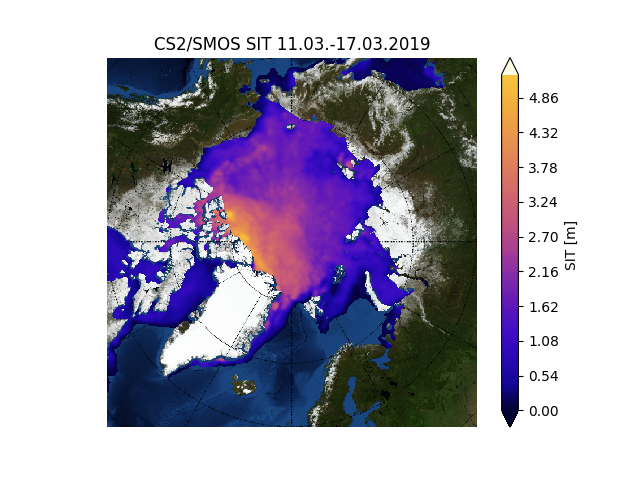
Plus a close up look at the FMI merged Cryosat-2/SMOS thickness for both the Atlantic and Pacific sides of the Arctic:
Apart from the usual thick ice queueing for the Fram Strait exit there’s not a lot to prevent the comparatively swift early melt from continuing apace.
Since the FMI make the gridded data available as well as that visualisation, here’s a closer look at the Bering/Chukchi area:
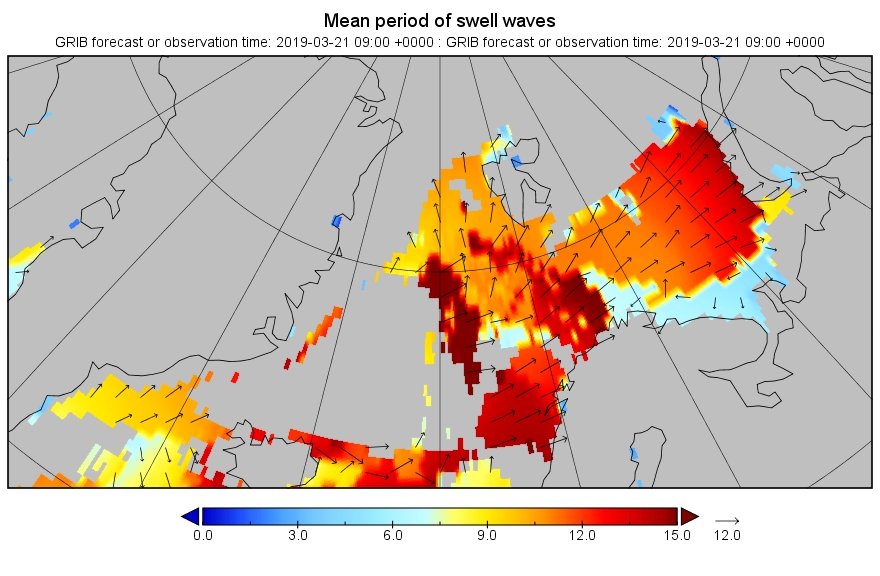
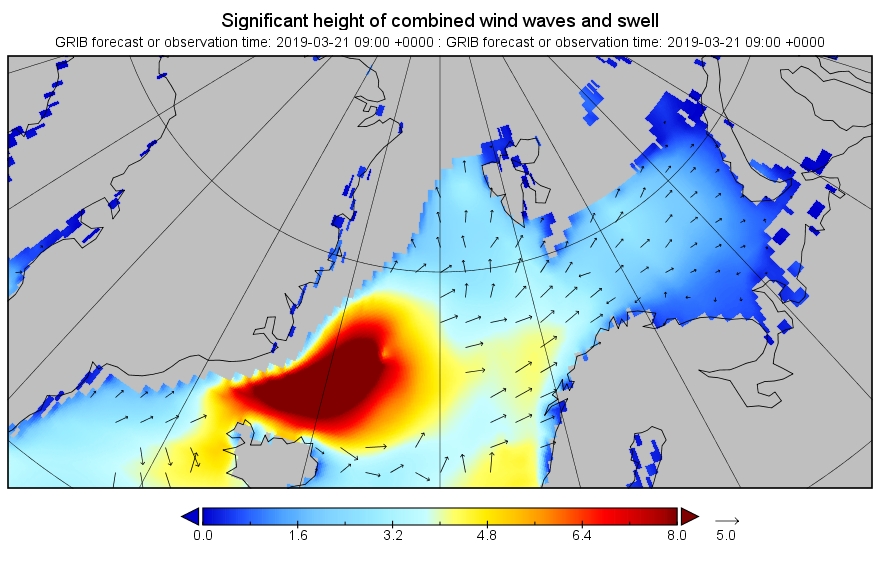
There’s an awful lot of thin ice in the region ripe for rapid melting now that the sun is shining down for a rapidly increasing number of hours per day. Over on the other side of the North Pole there’s also some significant swell forecast to hit the Atlantic edge of the Arctic ice pack. Here’s the current WaveWatch III forecast for 09:00 UTC tomorrow morning:
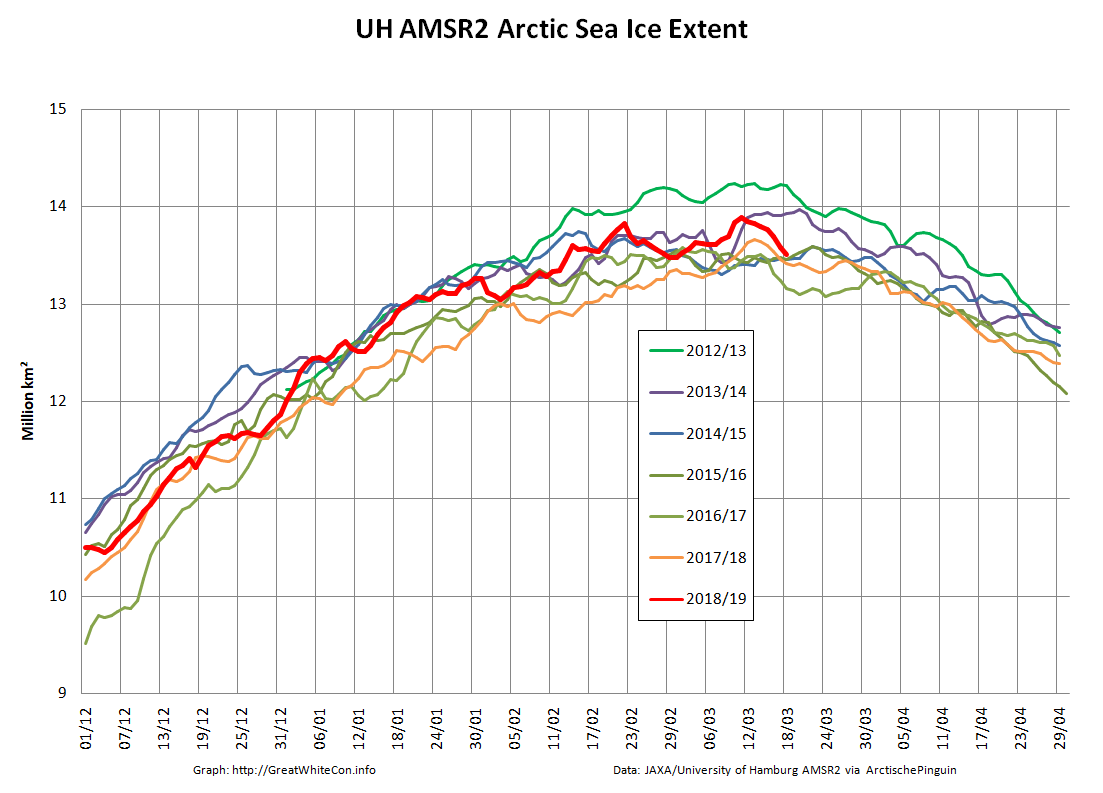
Finally, for the moment at least, here are the current Arctic wide high resolution AMSR2 sea ice area and extent graphs:
[Edit – March 22nd]
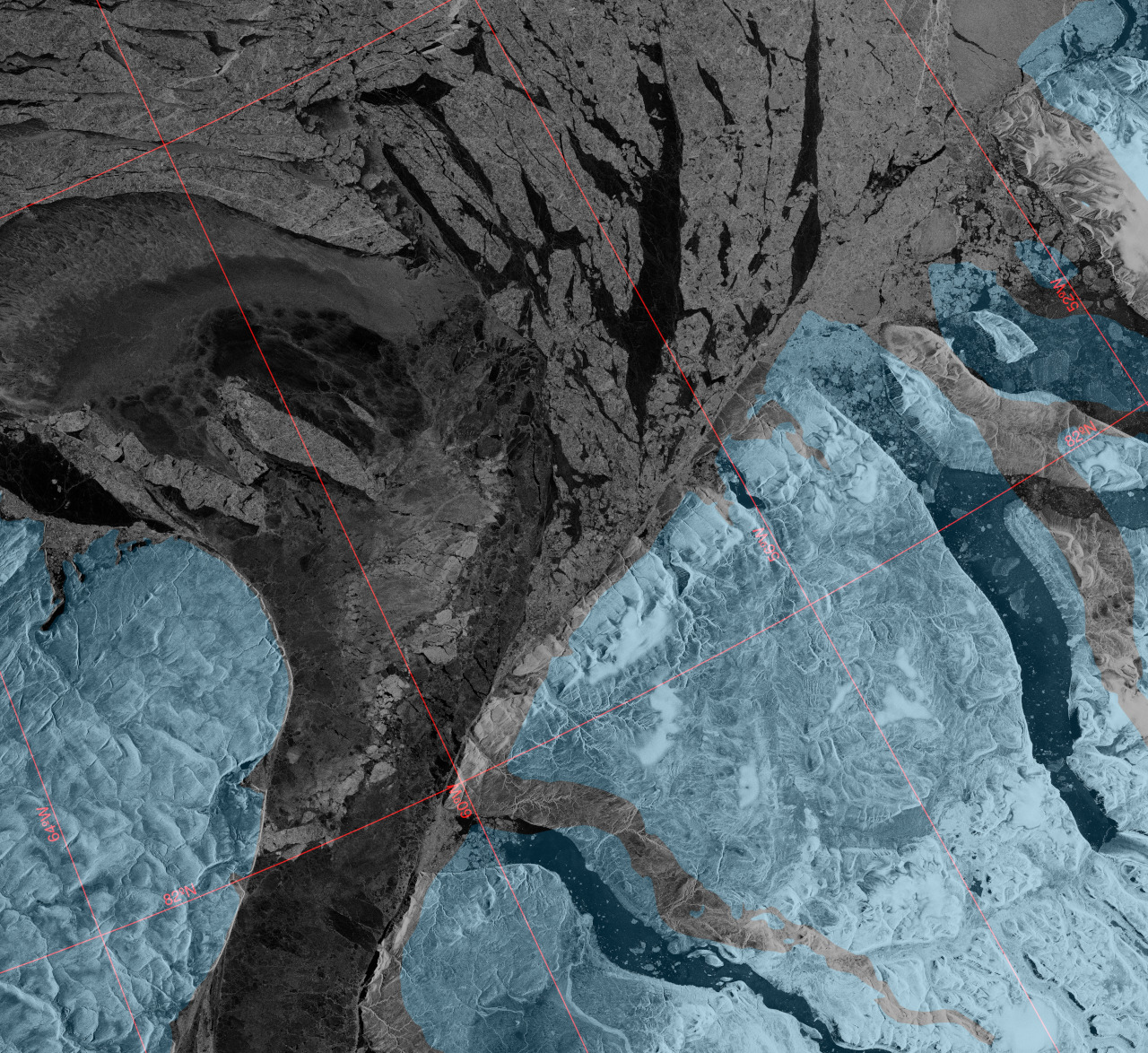
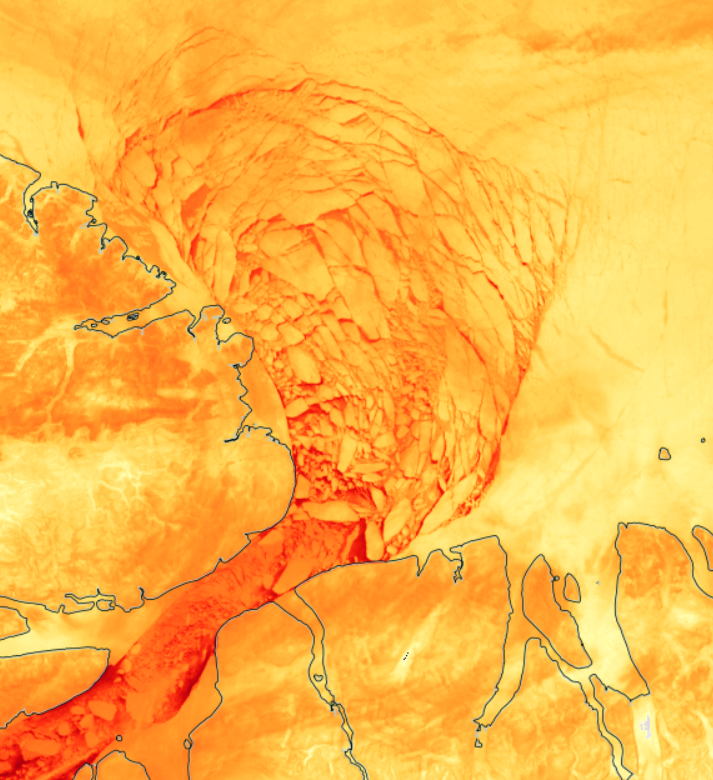
This Sentinel 1 SAR image of the Lincoln Sea from PolarView suggests that the northern arch of the Nares Strait is breaking up once again:
It is therefore conceivable that sea ice in the Lincoln Sea will continue to break up and flow south through the Nares Strait for the entire 2018/2019 winter.
[Edit – March 23rd]
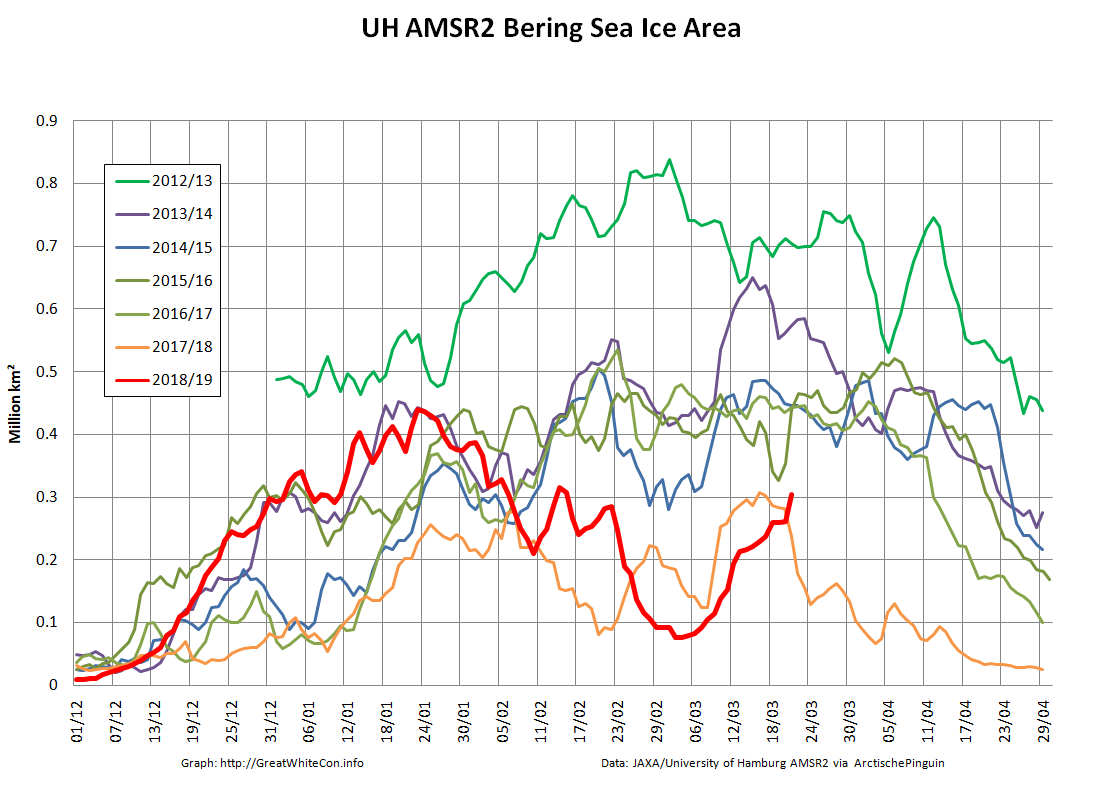
Bering Sea ice area has “rebounded” over the last few days:
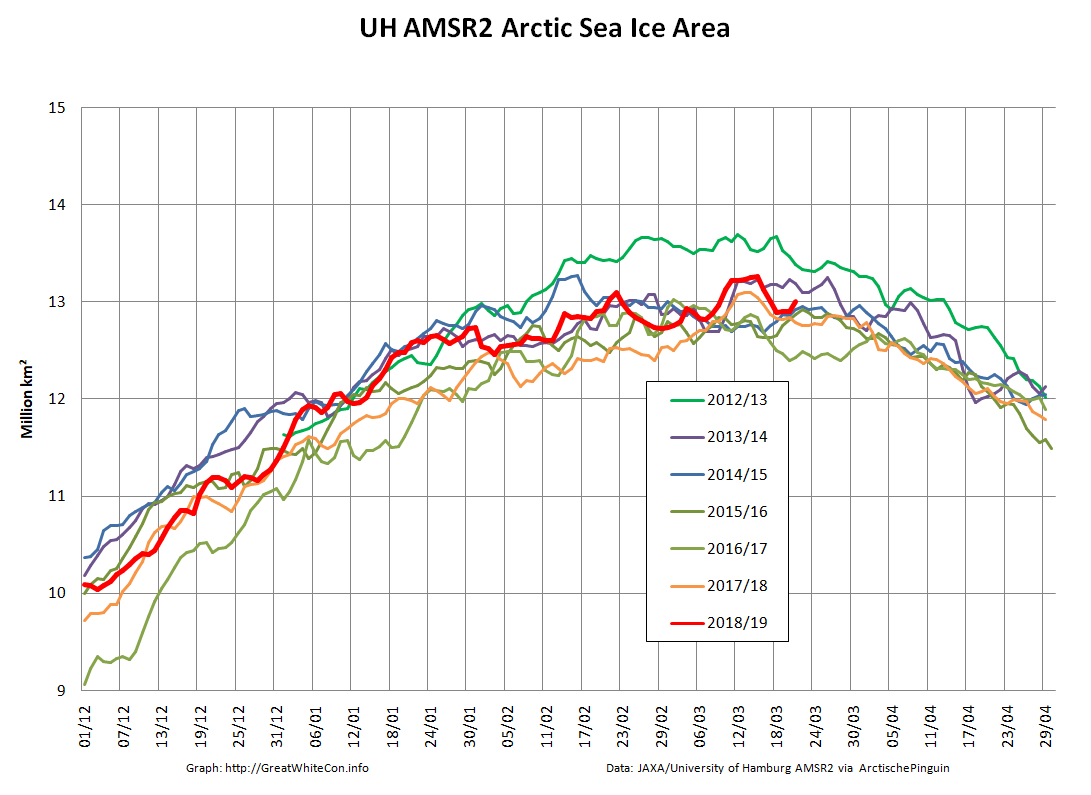
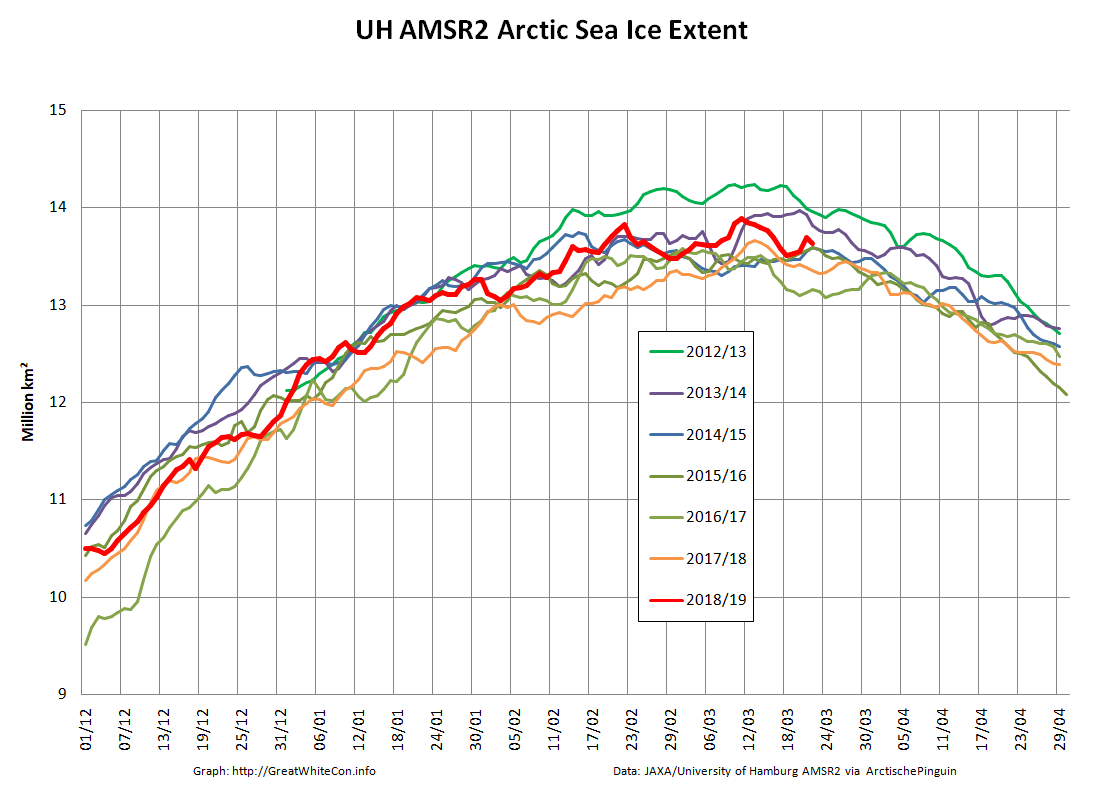
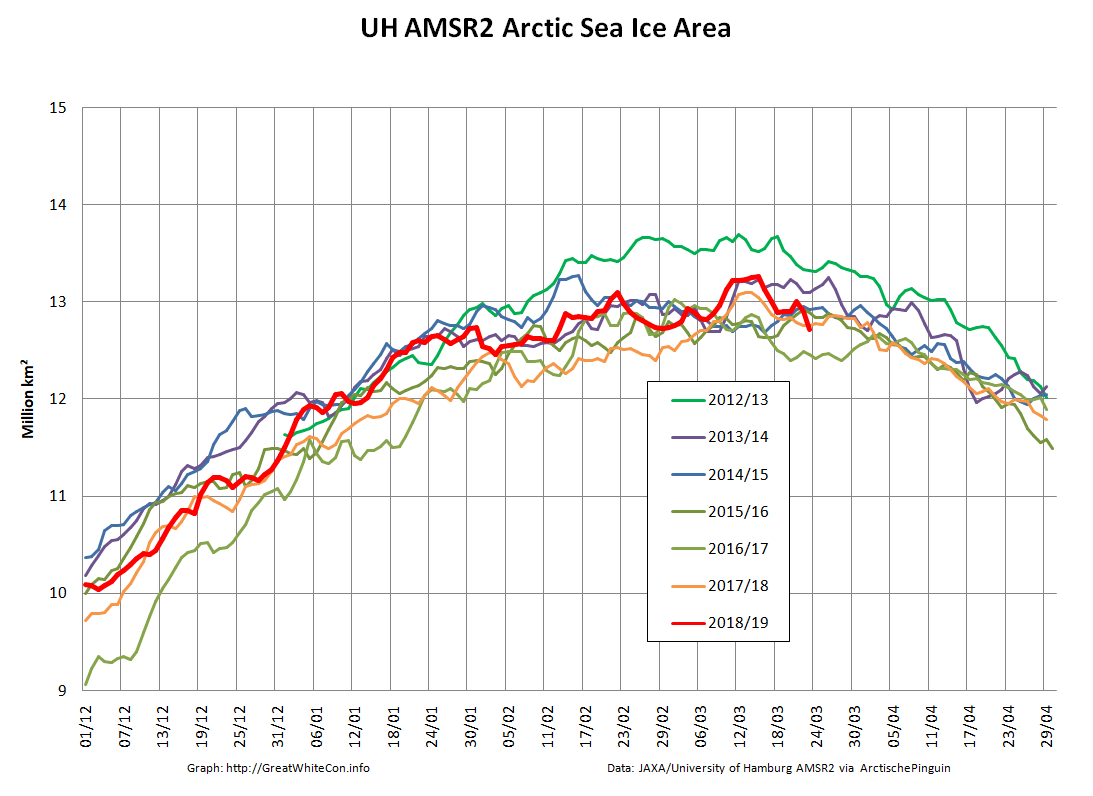
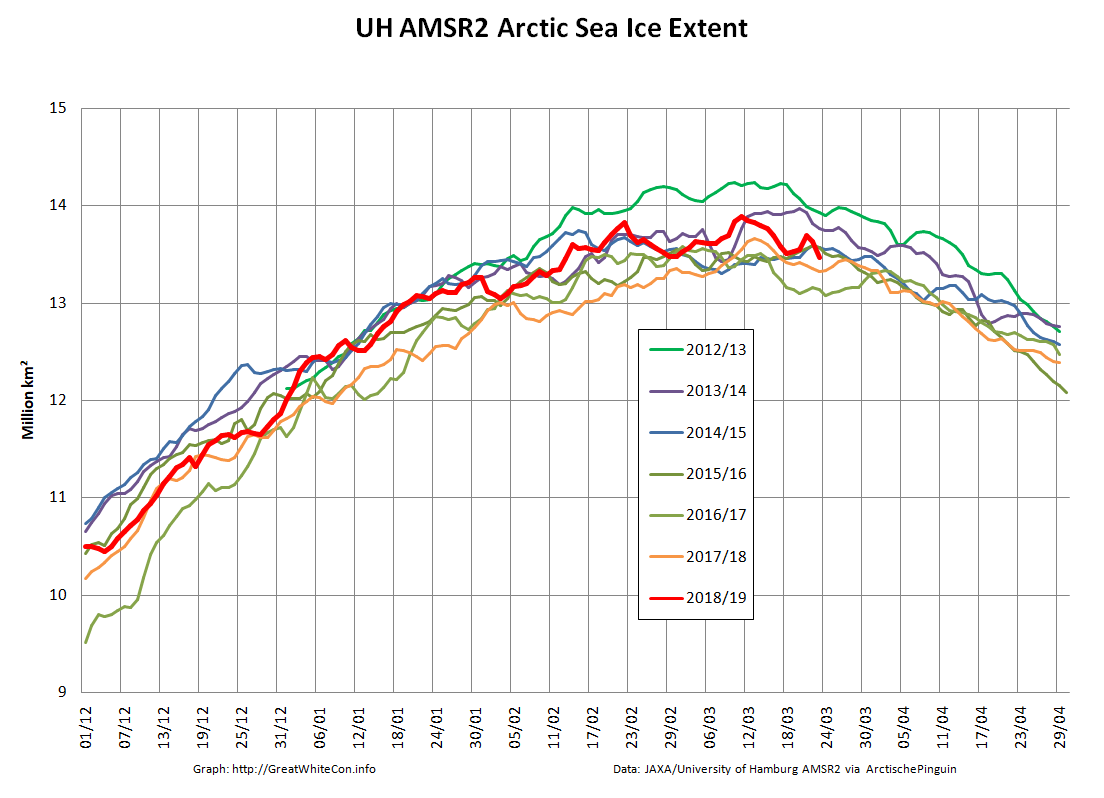
and taken the Arctic wide metrics with it:
Here’s the latest Sentinel 1 SAR image of the Lincoln Sea and northern Nares Strait:
[Edit – March 24th]
The “rebound” has reversed:
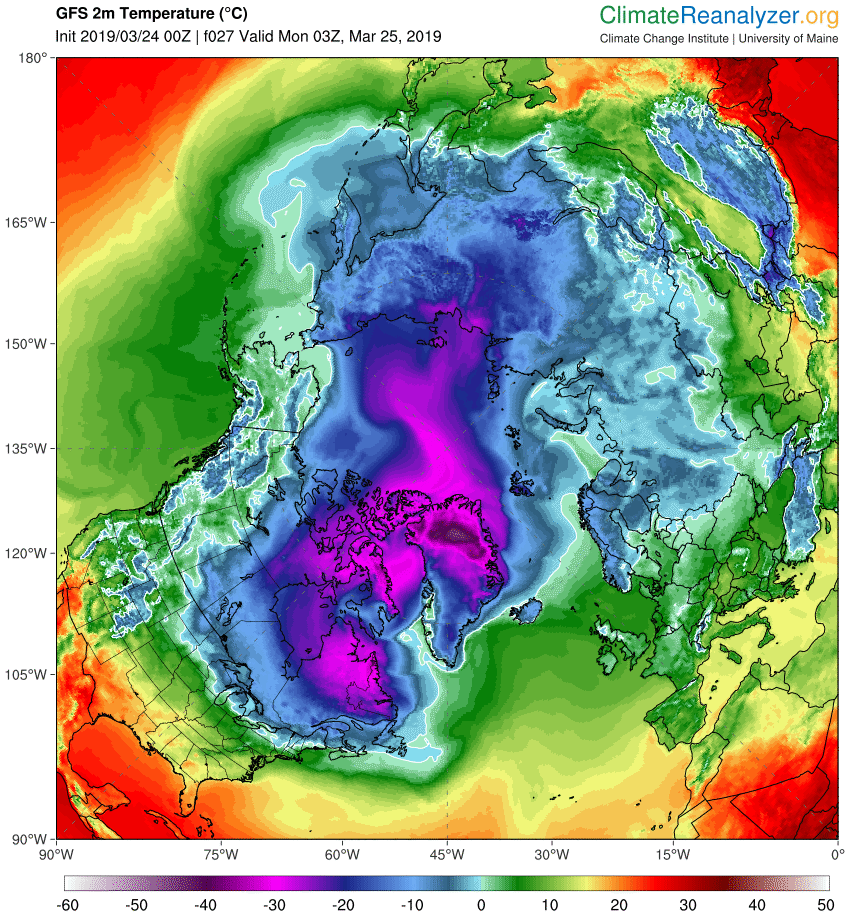
With temperatures above freezing point across the Bering and Chukchi Sea forecast for tomorrow morning expect the decline in Arctic sea ice extent to accelerate:
[Edit – March 25th]
There was a 162k decline in high resolution extent yesterday:
Here also is the current state of the thick sea ice exiting the Lincoln Sea via the Nares Strait:
[Edit – March 27th]
Here’s another week’s merged CryoSat-2/SMOS thickness data from the Finnish Meteorological Institute:
[Edit – March 30th]
We’re still waiting for Wipneus’ Raspberry Pi to crunch the high resolution AMSR2 numbers, but here’s the latest from JAXA:
2019 currently in 3rd place by a whisker.
P.S. The high resolution AMSR2 numbers are out:
Area is certainly lowest for the date in the AMSR2 era. Extent will almost certainly achieve that status tomorrow. Excluding the two most peripheral seas reveals perhaps an even more worrying picture?
[Edit – March 31th]
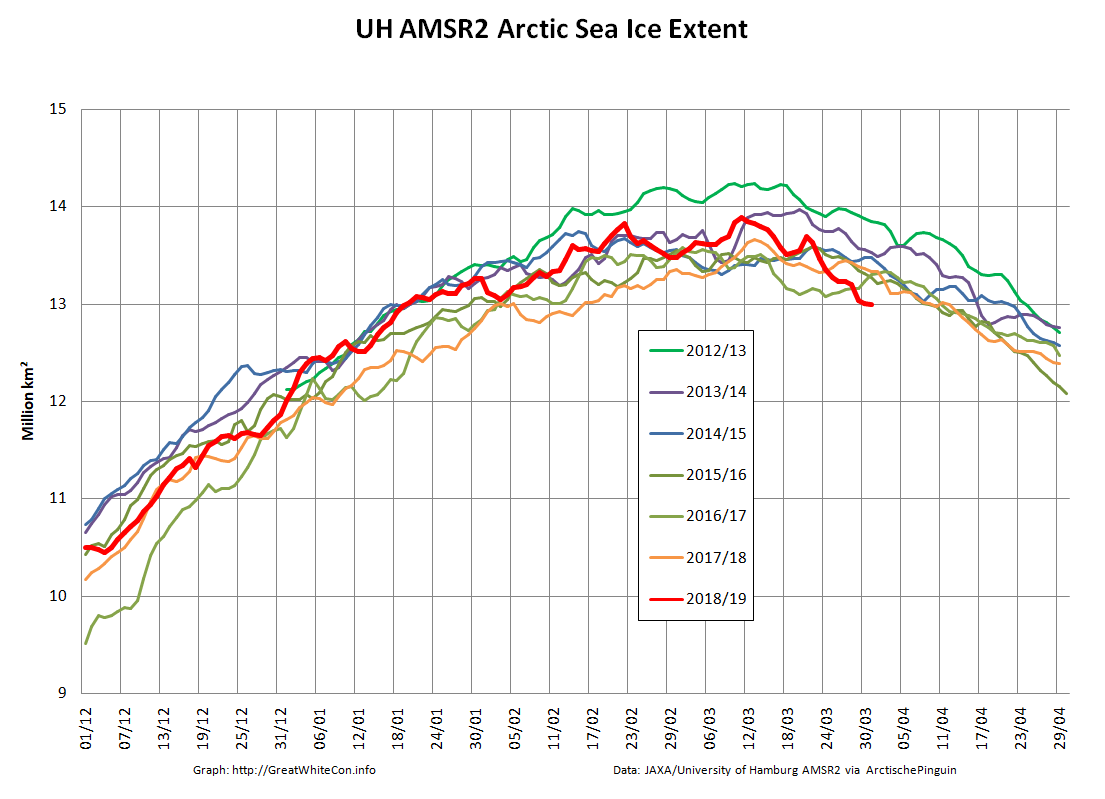
Arctic sea ice coverage is now firmly in the “lowest extent for the date in the satellite record” category, whichever metric you care to choose:
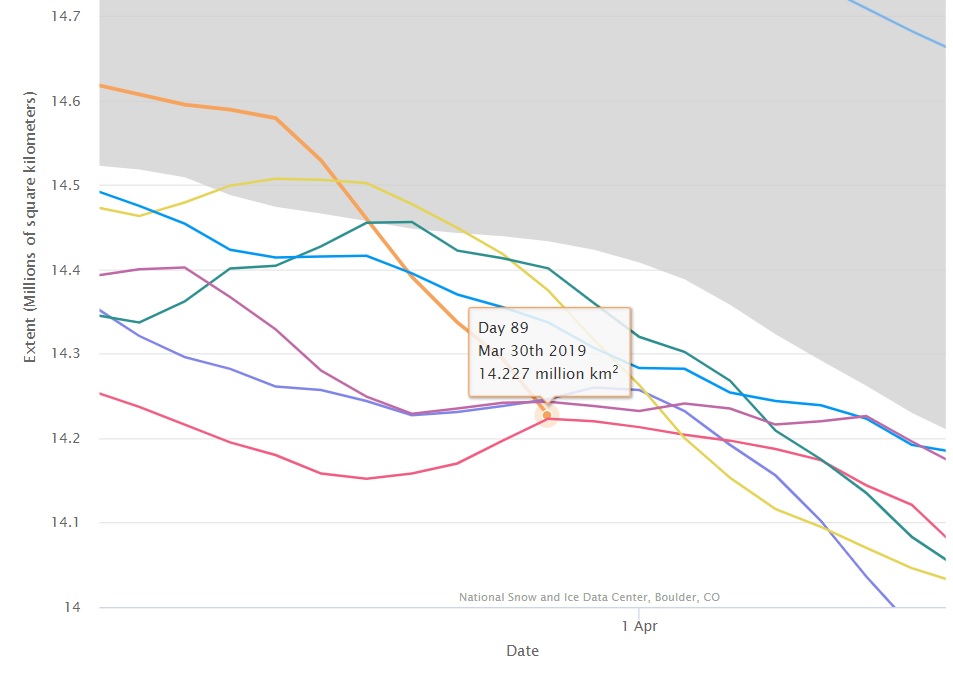
The NSIDC 5 day average is in a “statistical tie” for first place with 2017:
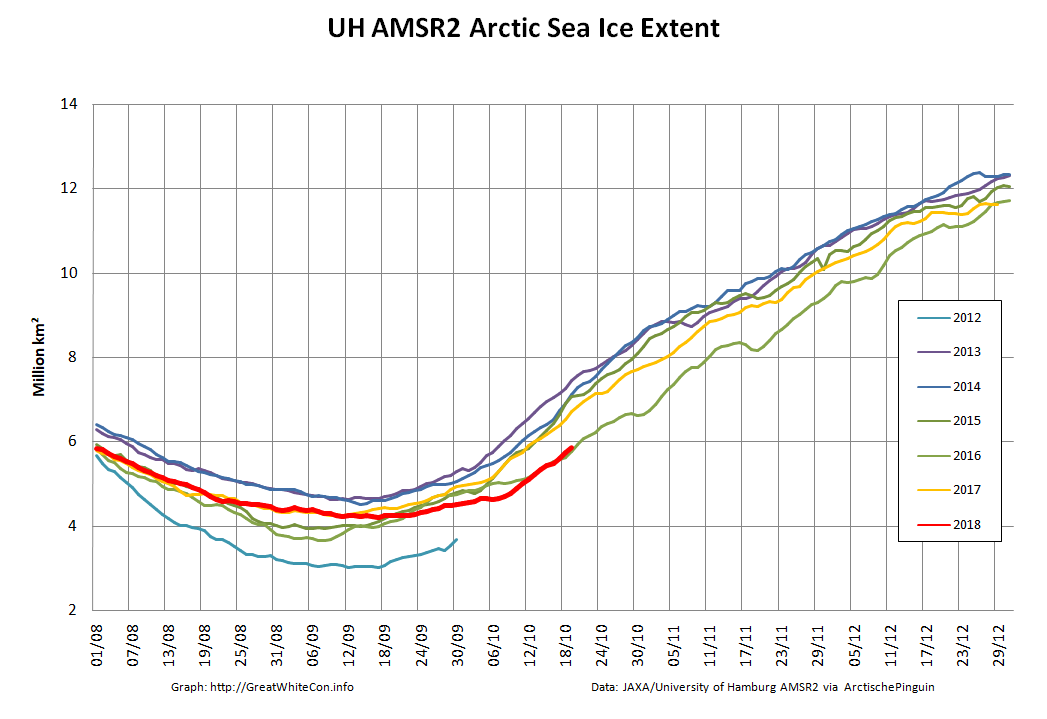
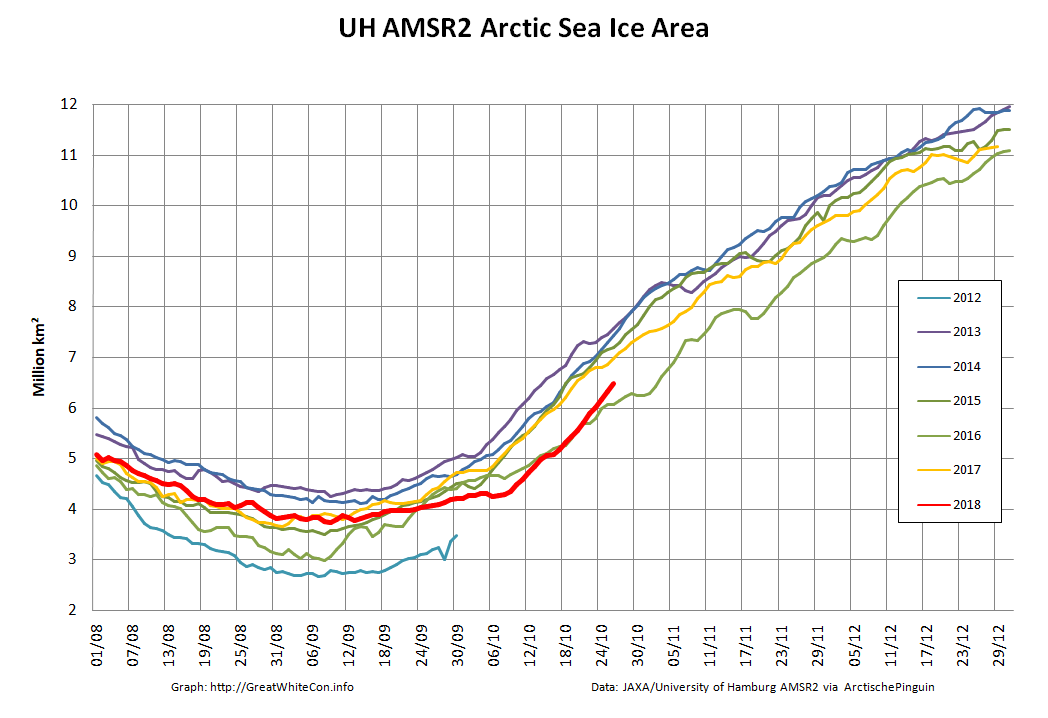
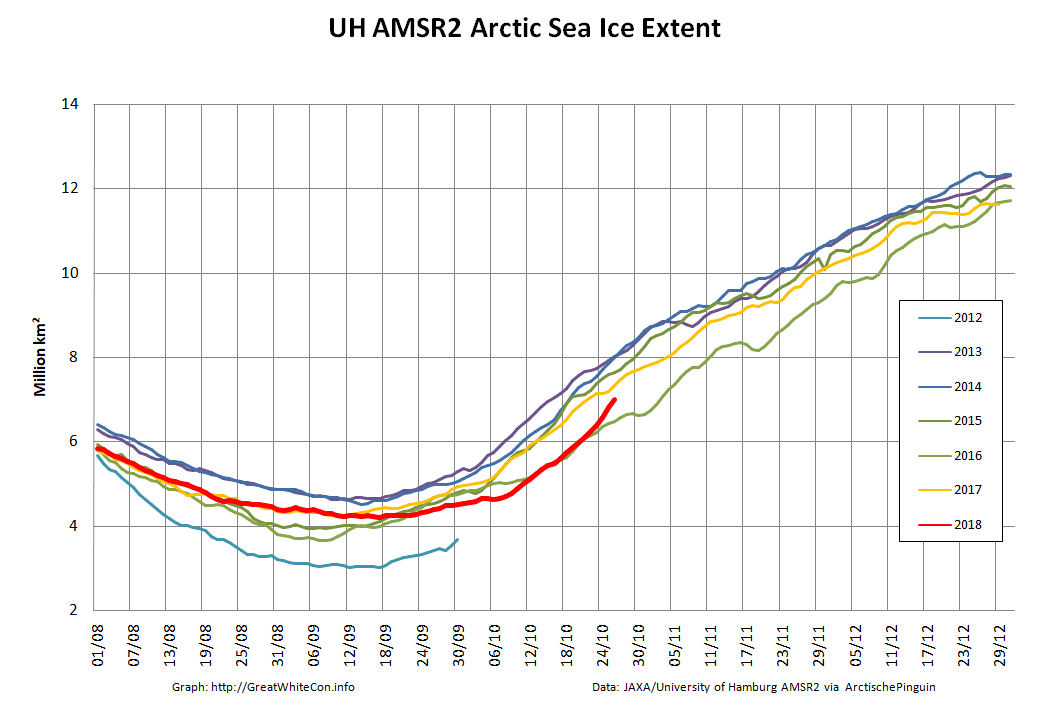
A somewhat belated start to our October 2018 coverage, but firstly please take a look at this graph:
Following a remarkably sluggish refreeze this year JAXA extent is currently the lowest for the date since their records began. Meanwhile Wipneus has just released his mid month PIOMAS volume update on the Arctic Sea Ice Forum:
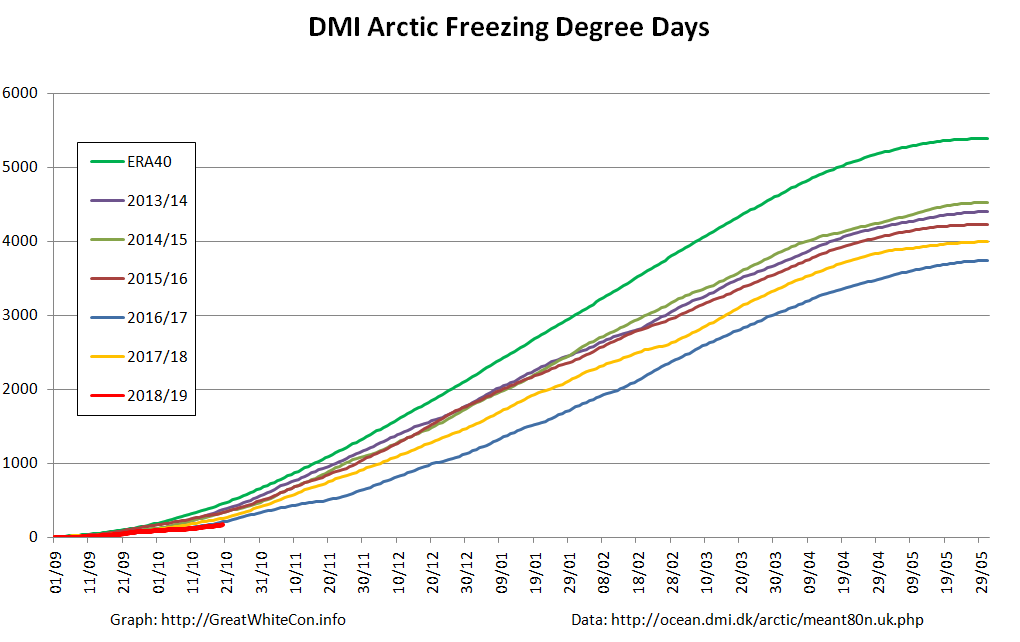
That graph reveals that Arctic sea ice volume has been increasing much more slowly than usual during October. The fact that the DMI freezing degree days graph is currently below all previous years in their records no doubt has something to do with that:
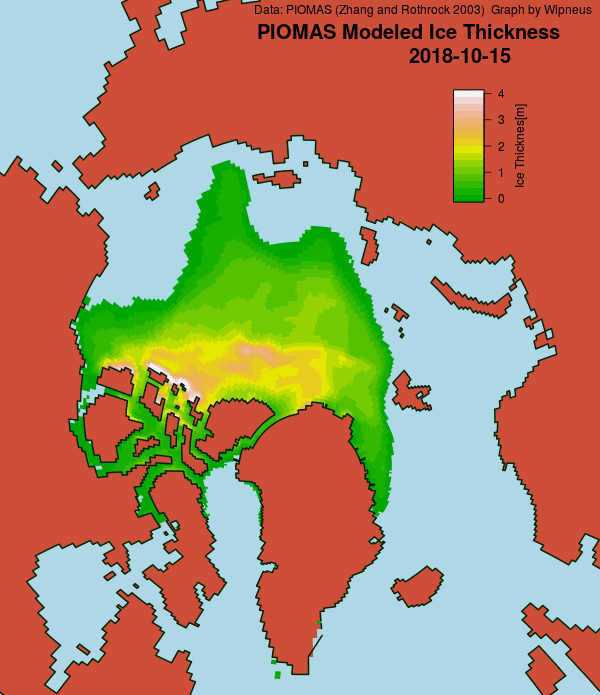
Wipneus has also updated the mid month PIOMAS gridded thickness map:
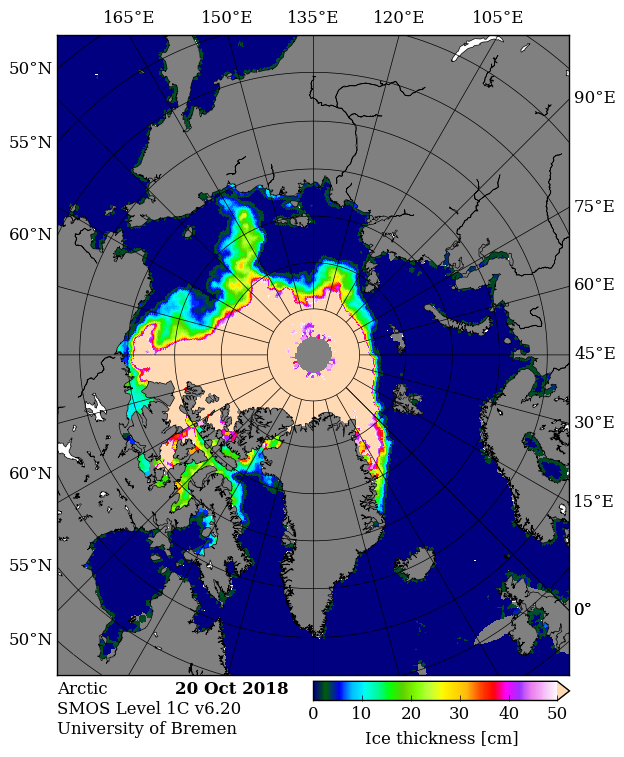
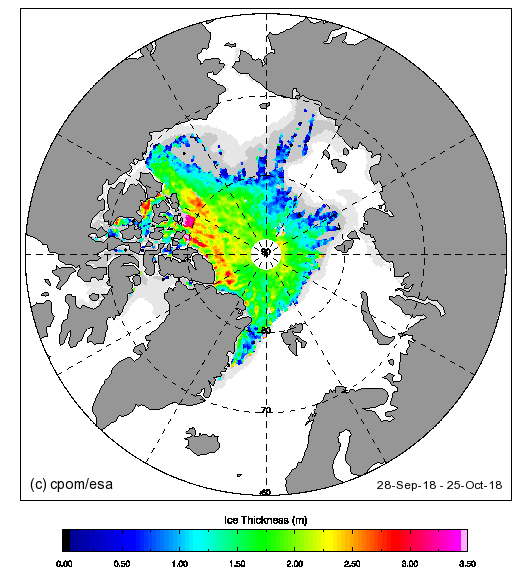
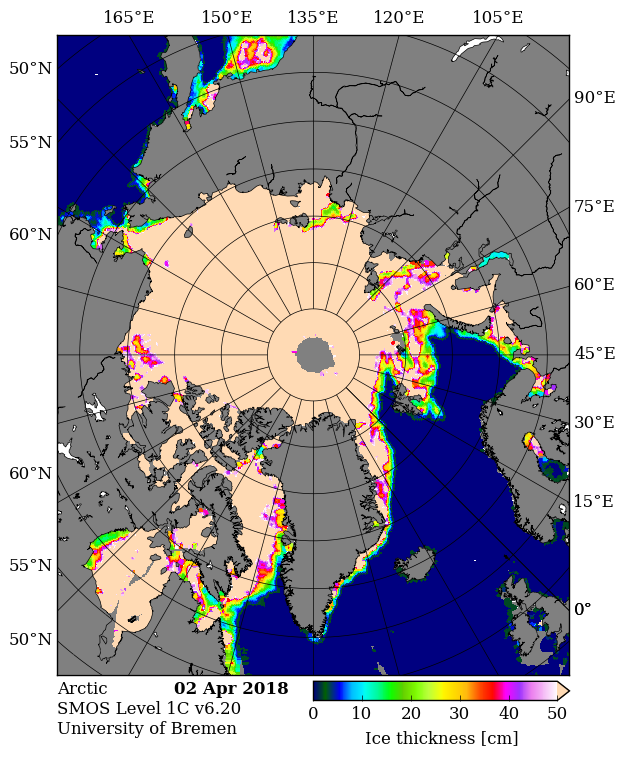
For a handle on the areas of thinner ice where refreezing is taking place around the periphery of the pack, here’s the latest SMOS map:
Finally, for the moment at least, here’s our favourite high resolution AMSR2 area and extent metrics based on JAXA data processed by the University of Hamburg to produced gridded concentration which is then used to derive area and extent by the inimitable Wipneus once again:
[Edit – October 28th]
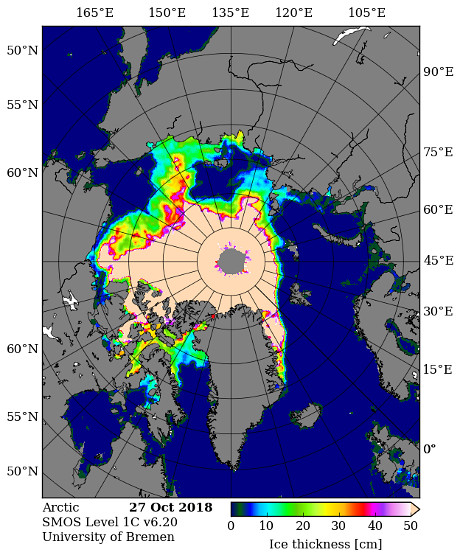
Here’s the latest thickness maps from SMOS:
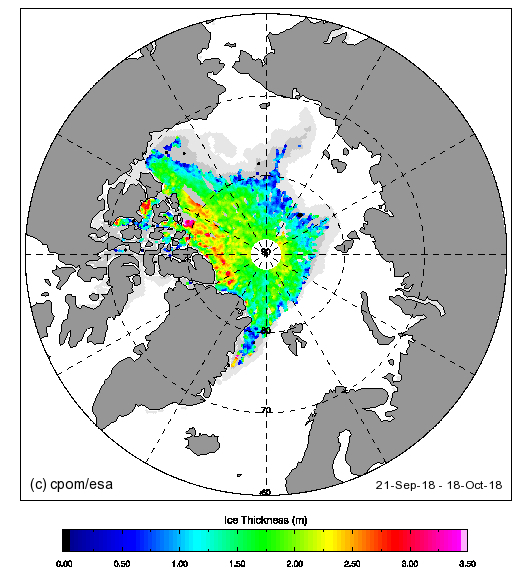
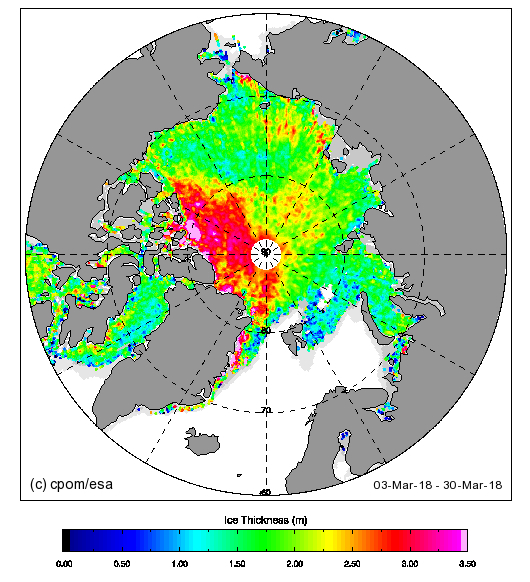
and CryoSat-2:
There’s been a recent rapid refreeze, leaving large areas of thin ice around the edges of the central pack:
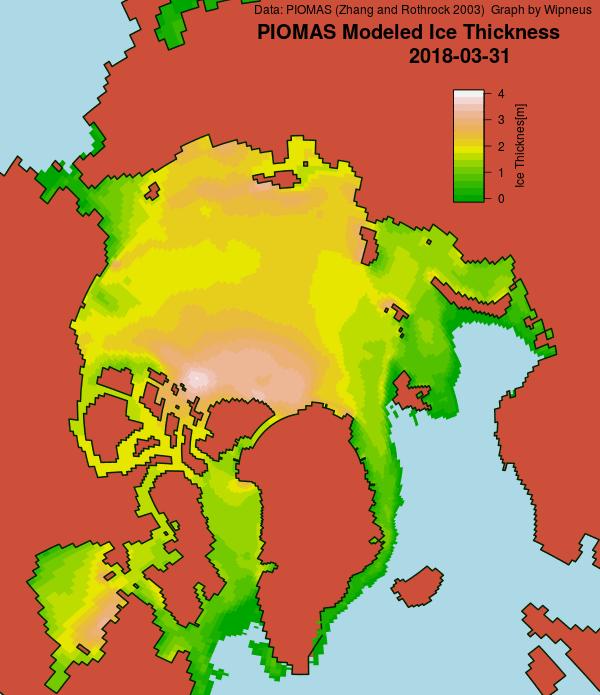
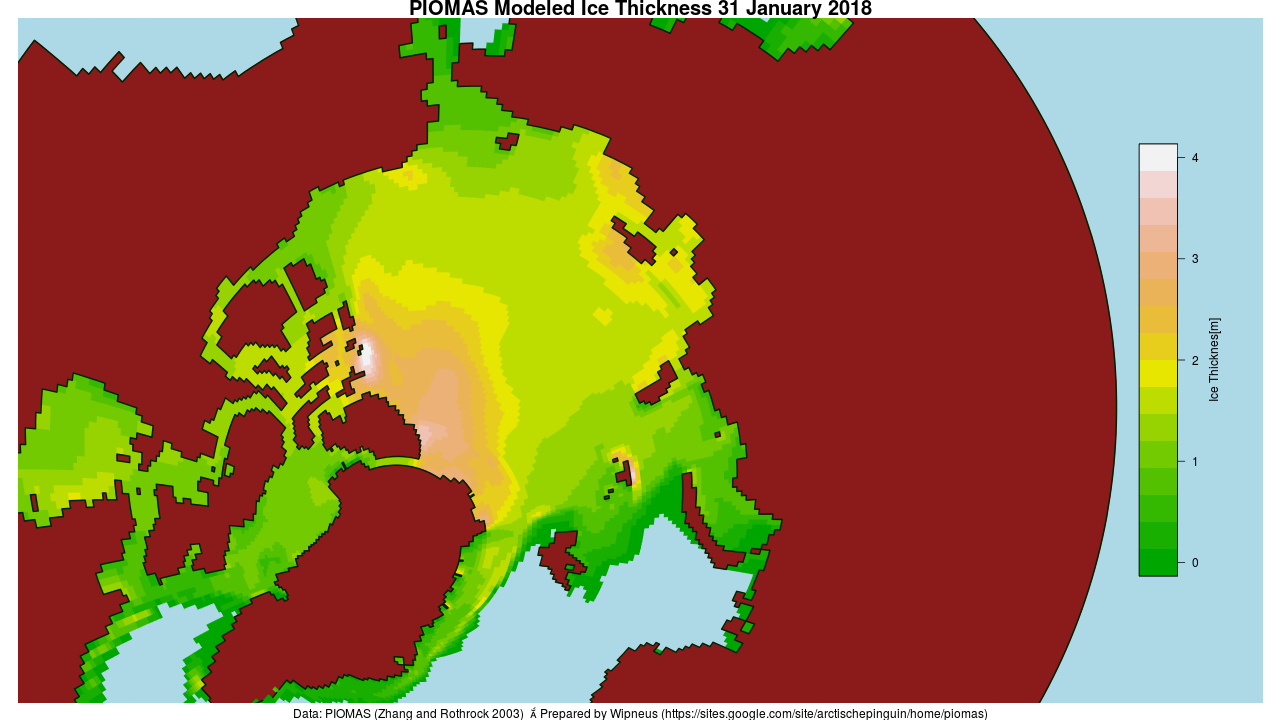
First of all Wipneus has been very quick off the mark this month with his PIOMAS gridded thickness map. Here is what it reveals for the last day of March:
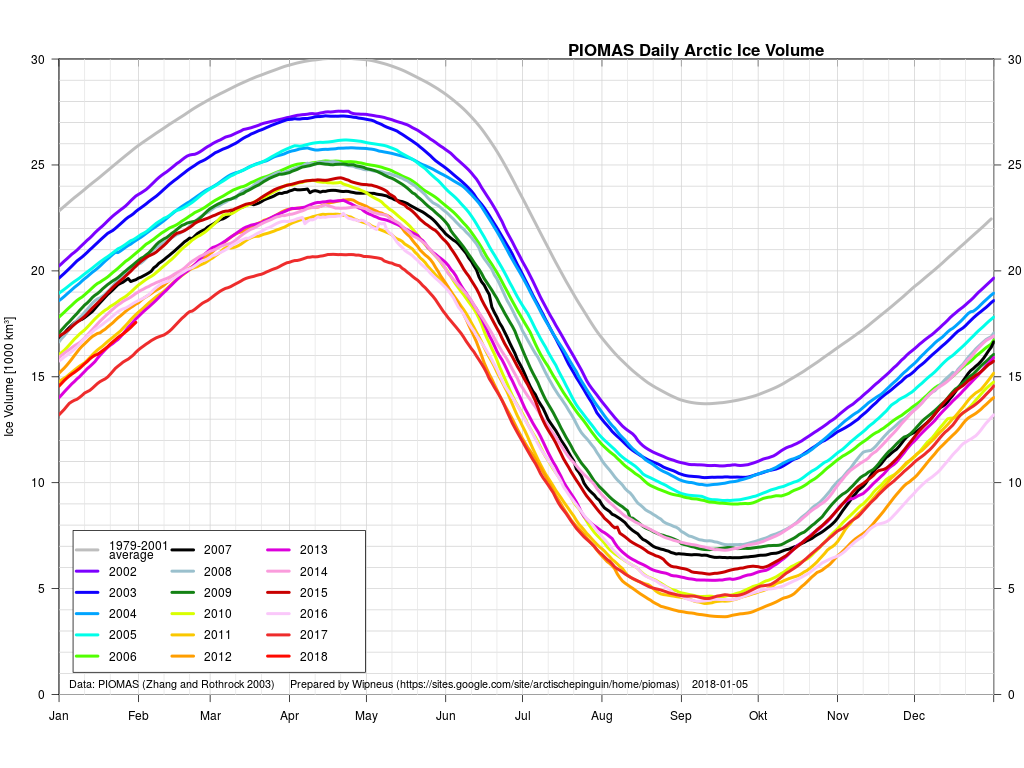
Here too is the latest PIOMAS volume graph:
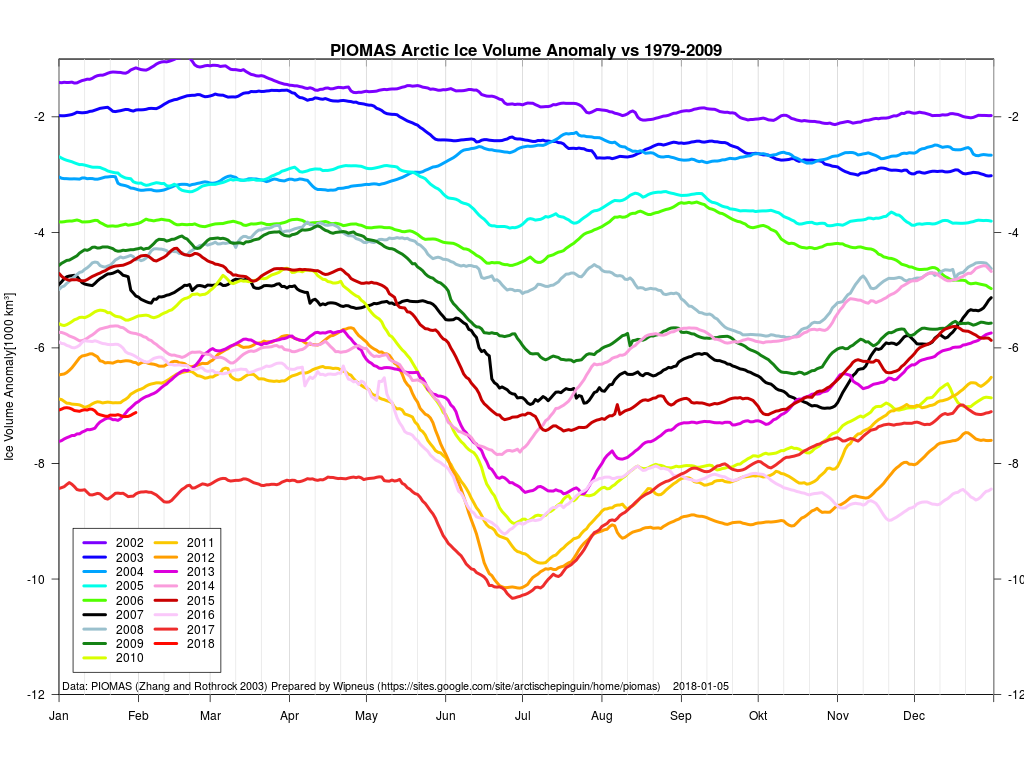
together with the associated anomaly graph:
They show 2018 still in second lowest position, albeit much closer to third place than last year’s line, which is currently leading the pack by a considerable margin.
By way of comparison here are the current Arctic sea ice thickness maps from SMOS:
and CryoSat-2:
All eyes are still on the Bering and Chukchi Seas, where significant extent declines look likely over the coming days.
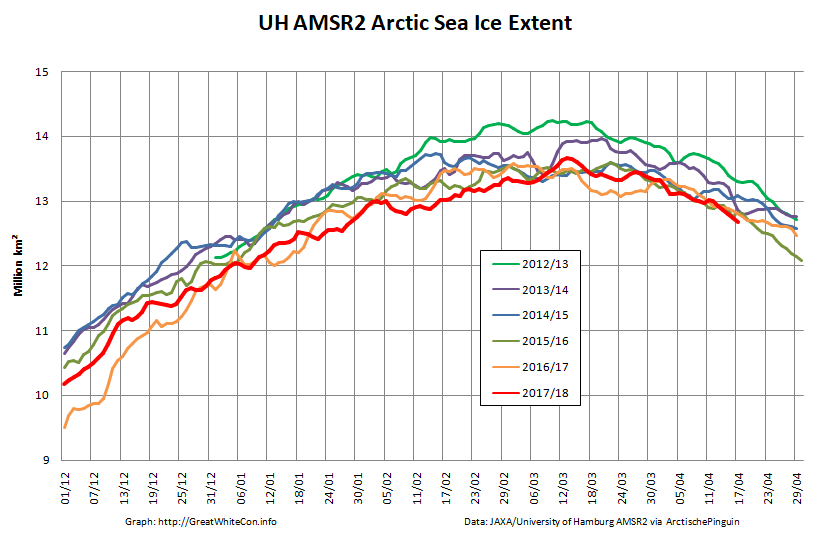
Meanwhile “JAXA” extent has just edged above 2016!
[Edit – April 11th]
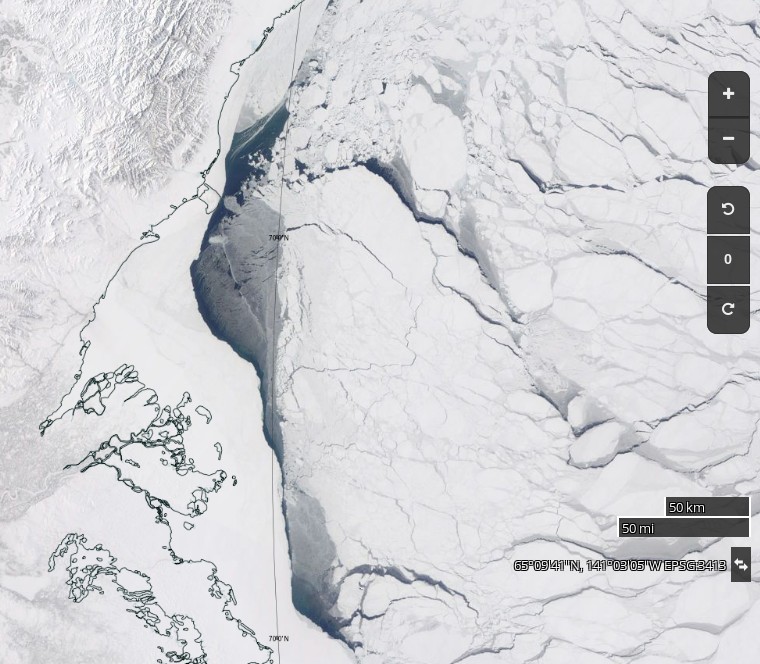
The focus has been on the Bering and Chukchi Seas until now. However there were clear skies over the Mackenzie Delta yesterday, revealing some open(ish) areas in the Beaufort Sea:
NASA Worldview “true-color” image of the Beaufort Sea on April 10th 2018, derived from the MODIS sensor on the Terra satellite
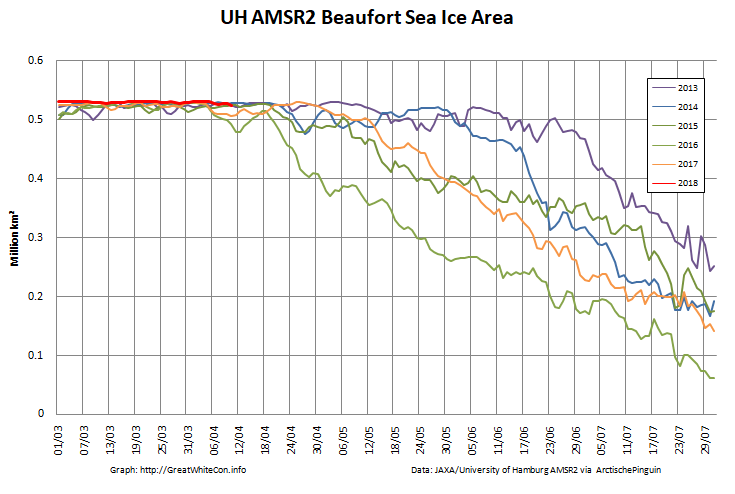
There’s only the merest hint of a blip on the area graph so far though:
It will be interesting to see if the decline in Beaufort Sea area continues from here, or whether this year’s “flatline” resumes and continues for a while longer.
[Edit – April 19th]
It’s not so apparent on the other extent metrics, but as the periphery melts the high resolution AMSR2 version looks to be heading into virgin territory on the downside:
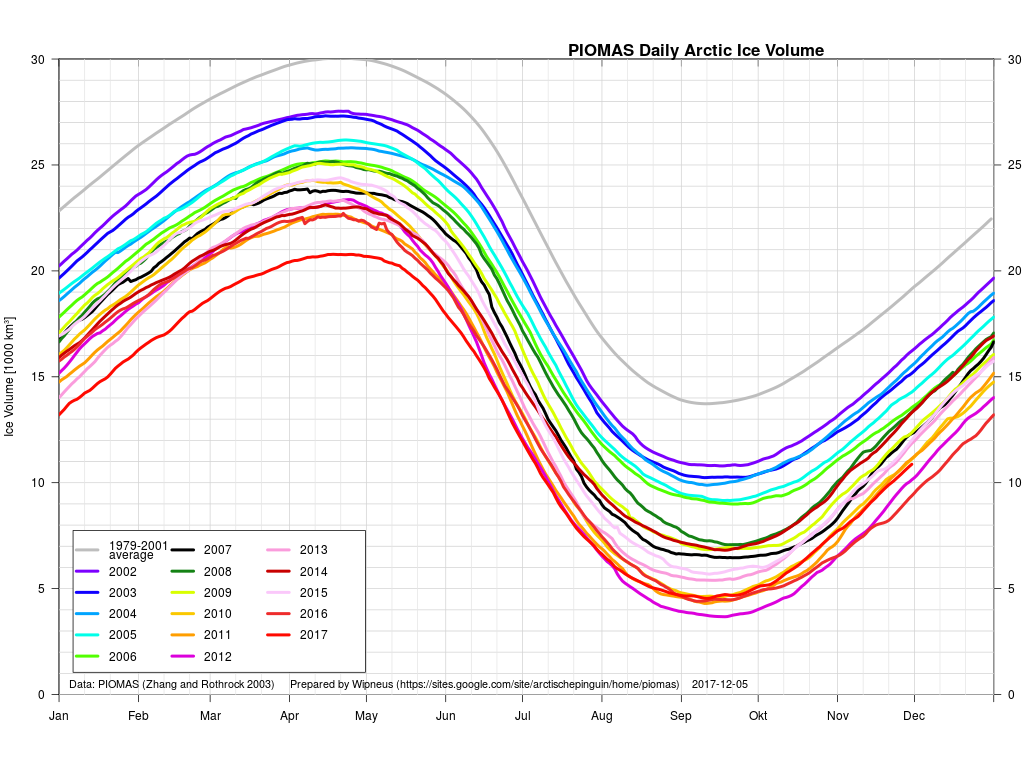
Whilst the official PIOMAS volume figures for January have yet to be released Wipneus has worked his usual magic on the gridded thickness numbers to reveal:
not to mention the calculated volume:
and the volume anomaly:
As Wipneus puts it:
Estimated from the thickness data, the latest value is from 31st of January: 17.57 [1000 km3], which is the second lowest value for that day, 2017 is lowest by a rather large margin at 16.16 [1000 km3].
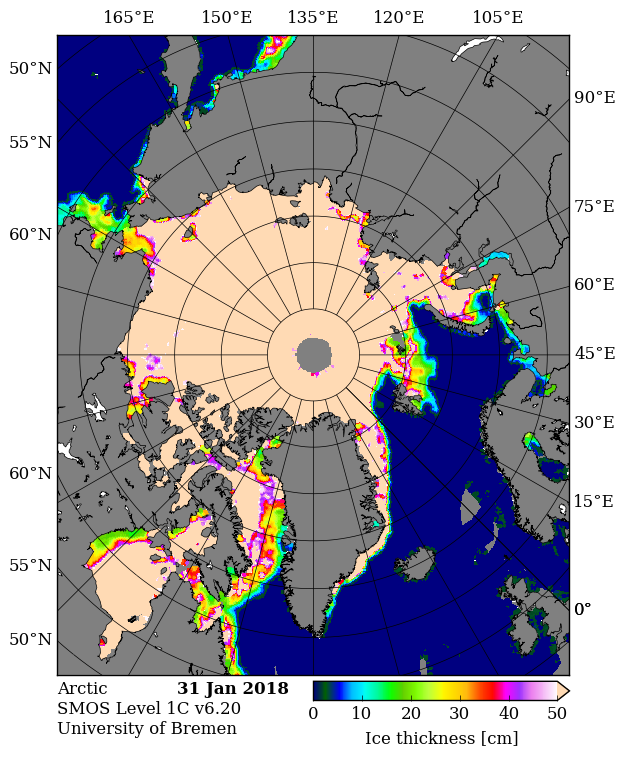
Here are the “measured” thickness maps from SMOS:
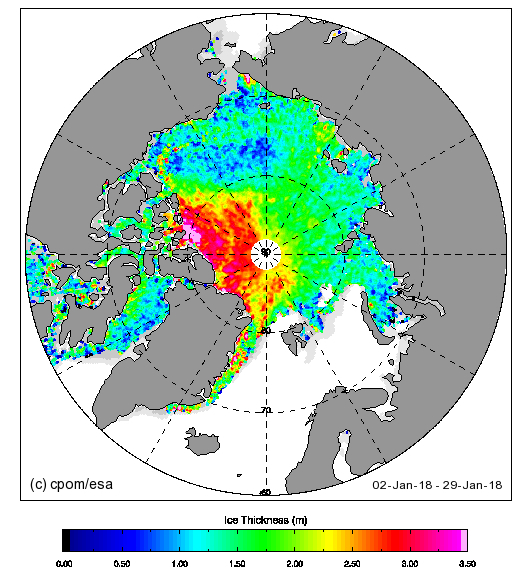
and CryoSat-2:
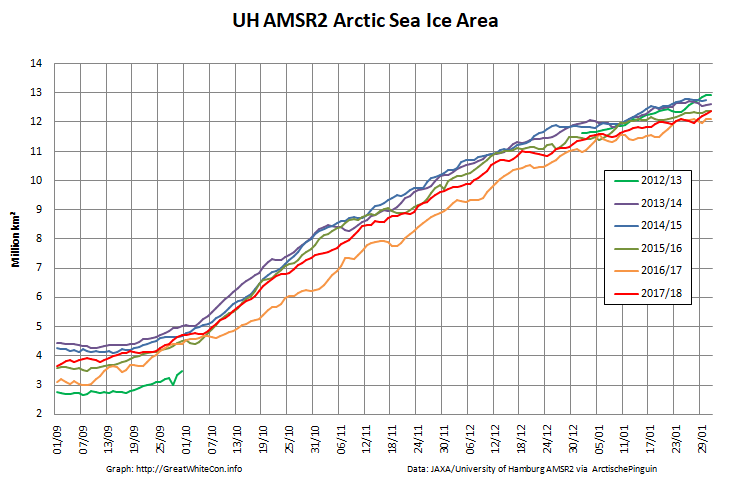
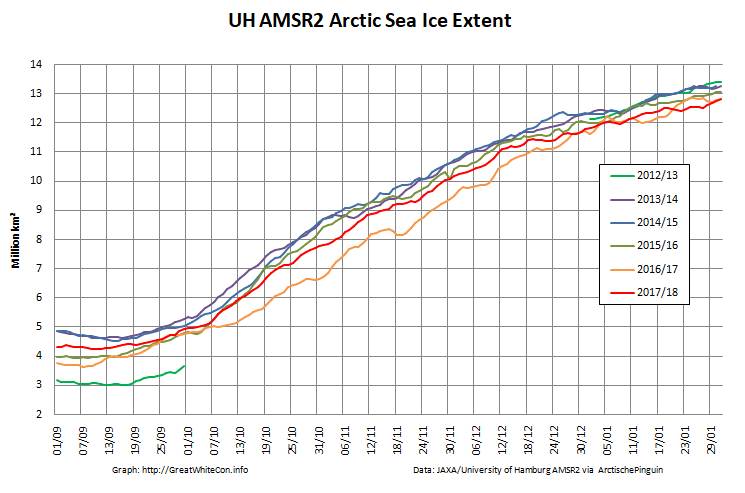
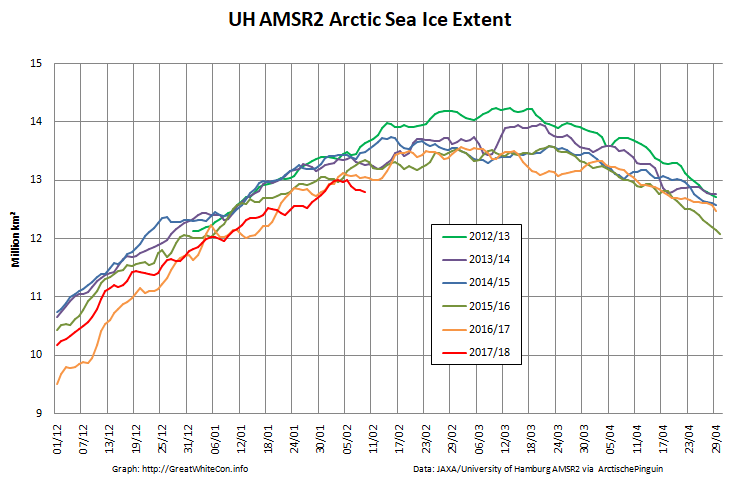
Here are the end of January Arctic wide high resolution AMSR2 graphs based on University of Hamburg data:
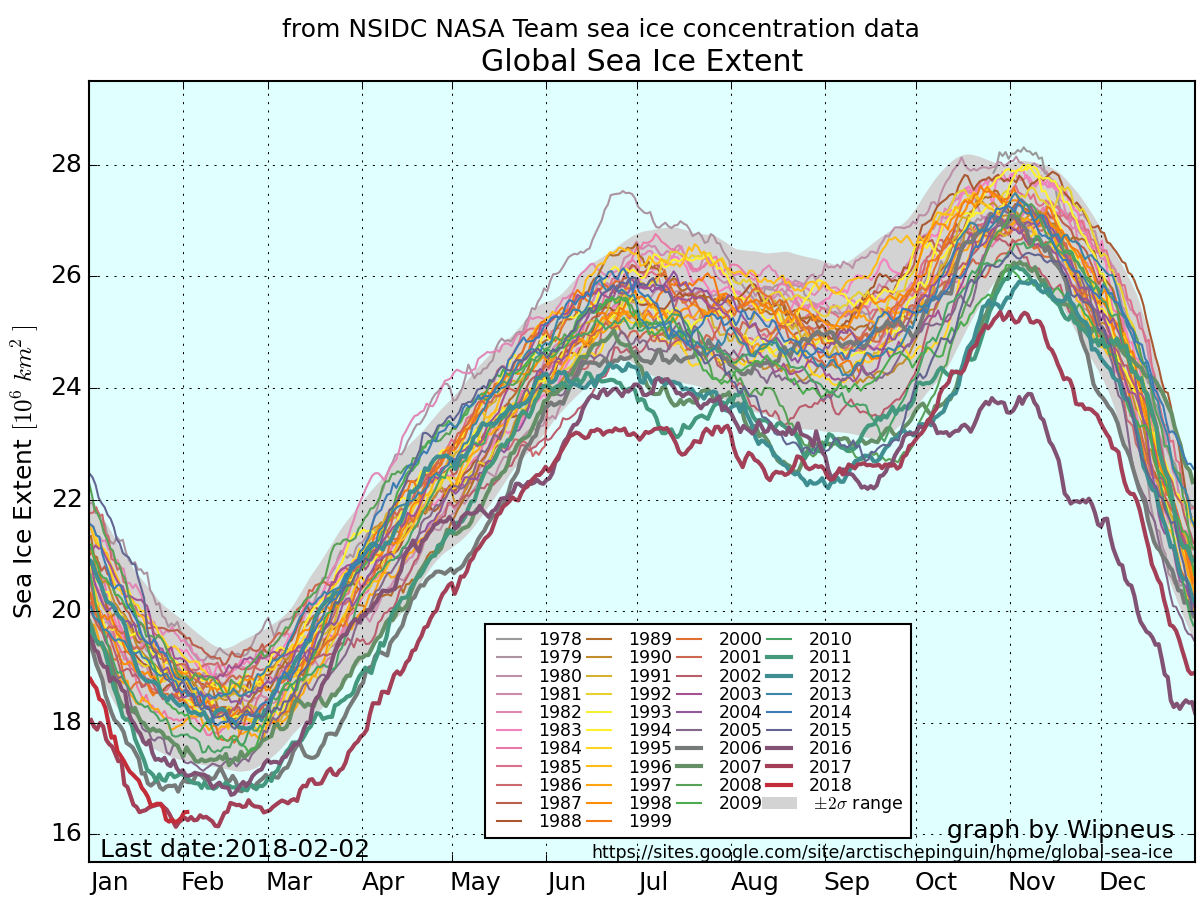
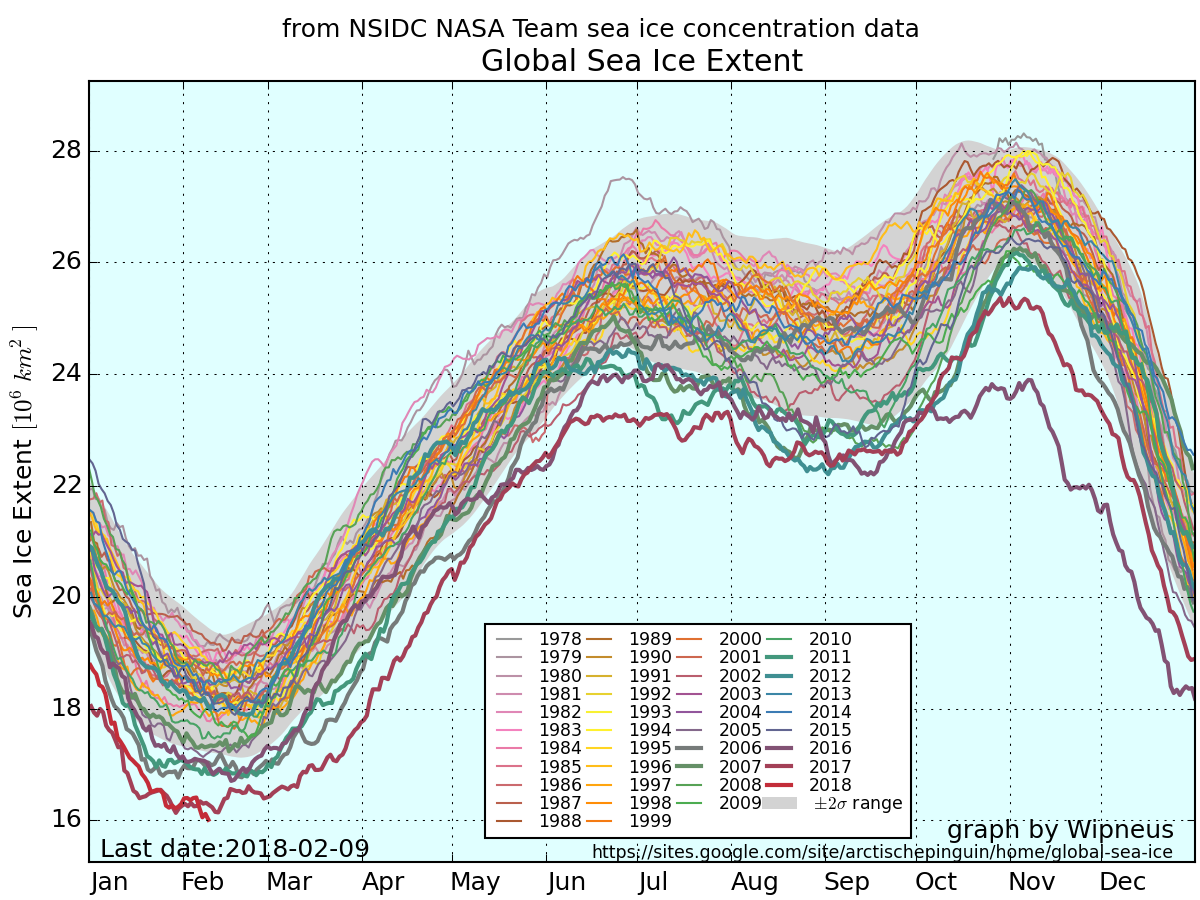
In addition, since it’s that time of year, here too is Wipneus’ NSIDC global sea ice extent:
The minimum thus far is very slightly above last year’s value, but perhaps like last year there will be a “double dip”?
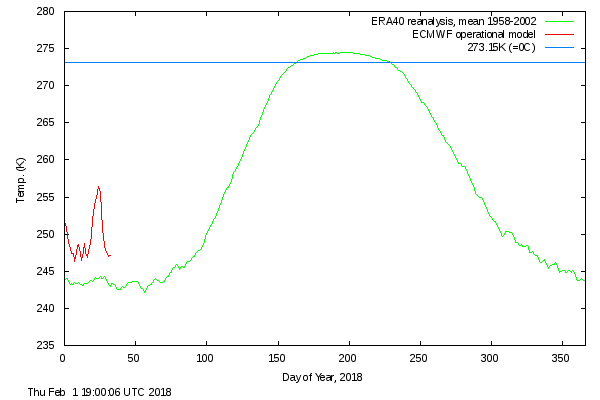
Getting back to the Arctic, here is the DMI >80N temperature plot for January:
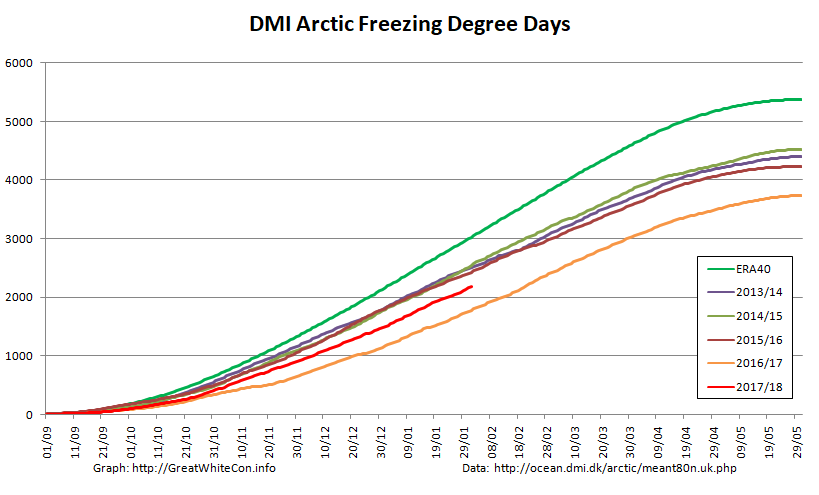
together with the associated freezing degree days graph:
Here’s a video showing the effect of the mid January cyclones on the sea ice in the Fram Strait and north of Svalbard:
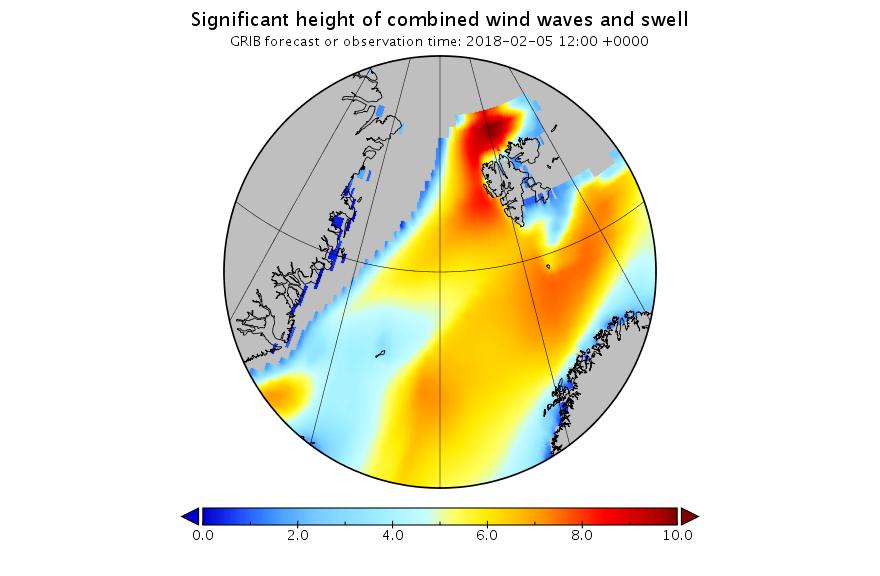
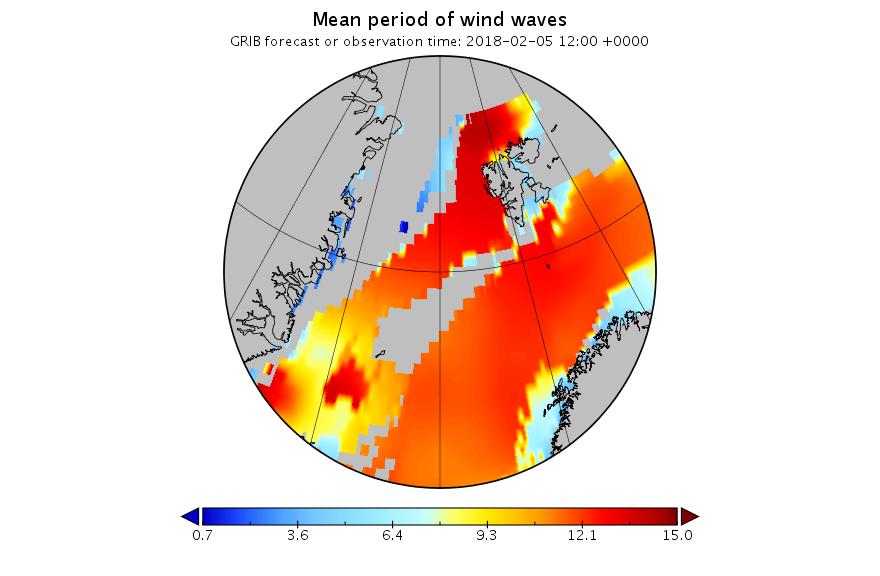
Finally, for the moment at least, here is the current Fram Strait surf forecast for 12:00 UTC on February 5th:
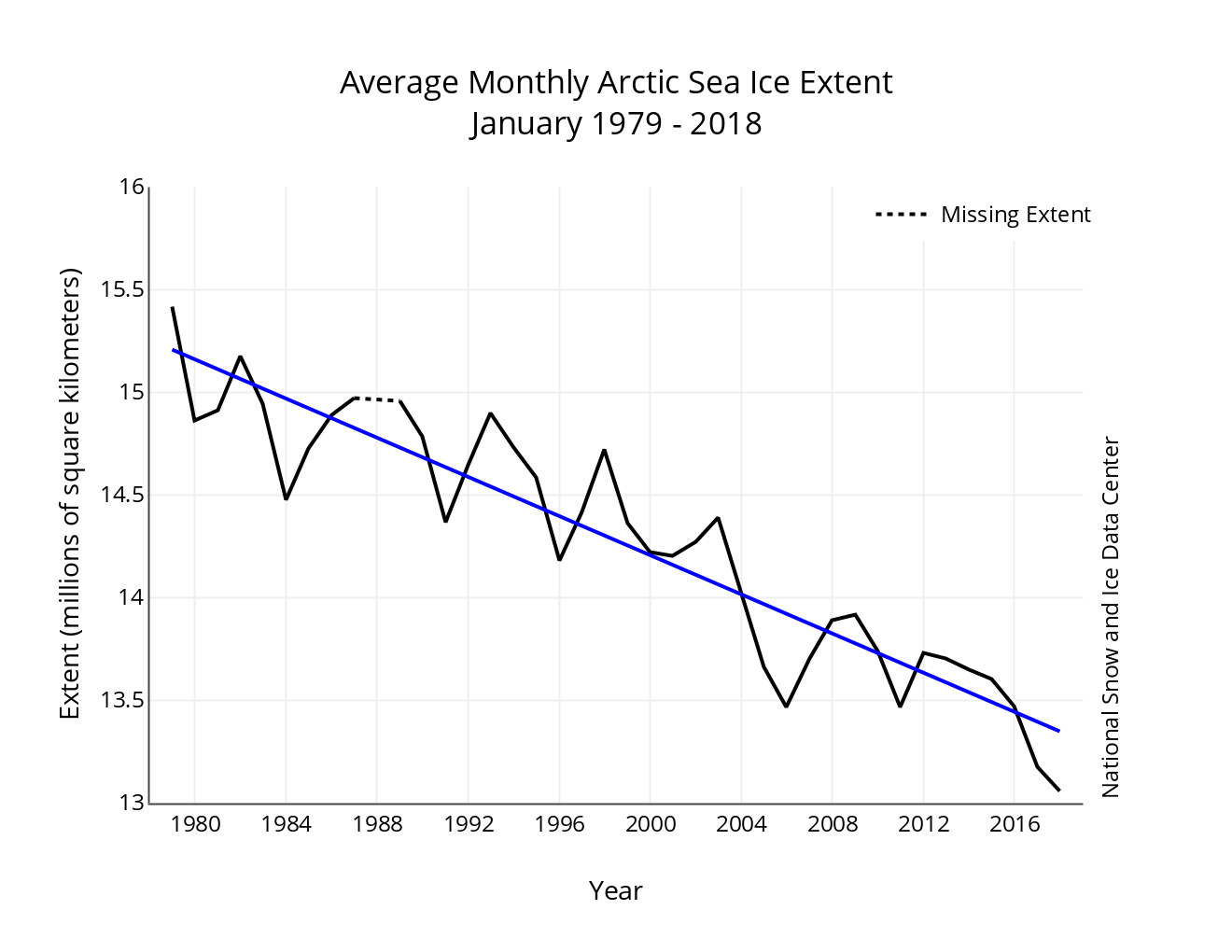
The latest edition of Arctic Sea Ice News has been published. As the NSIDC put it:
January of 2018 began and ended with satellite-era record lows in Arctic sea ice extent, resulting in a new record low for the month. Combined with low ice extent in the Antarctic, global sea ice extent is also at a record low.
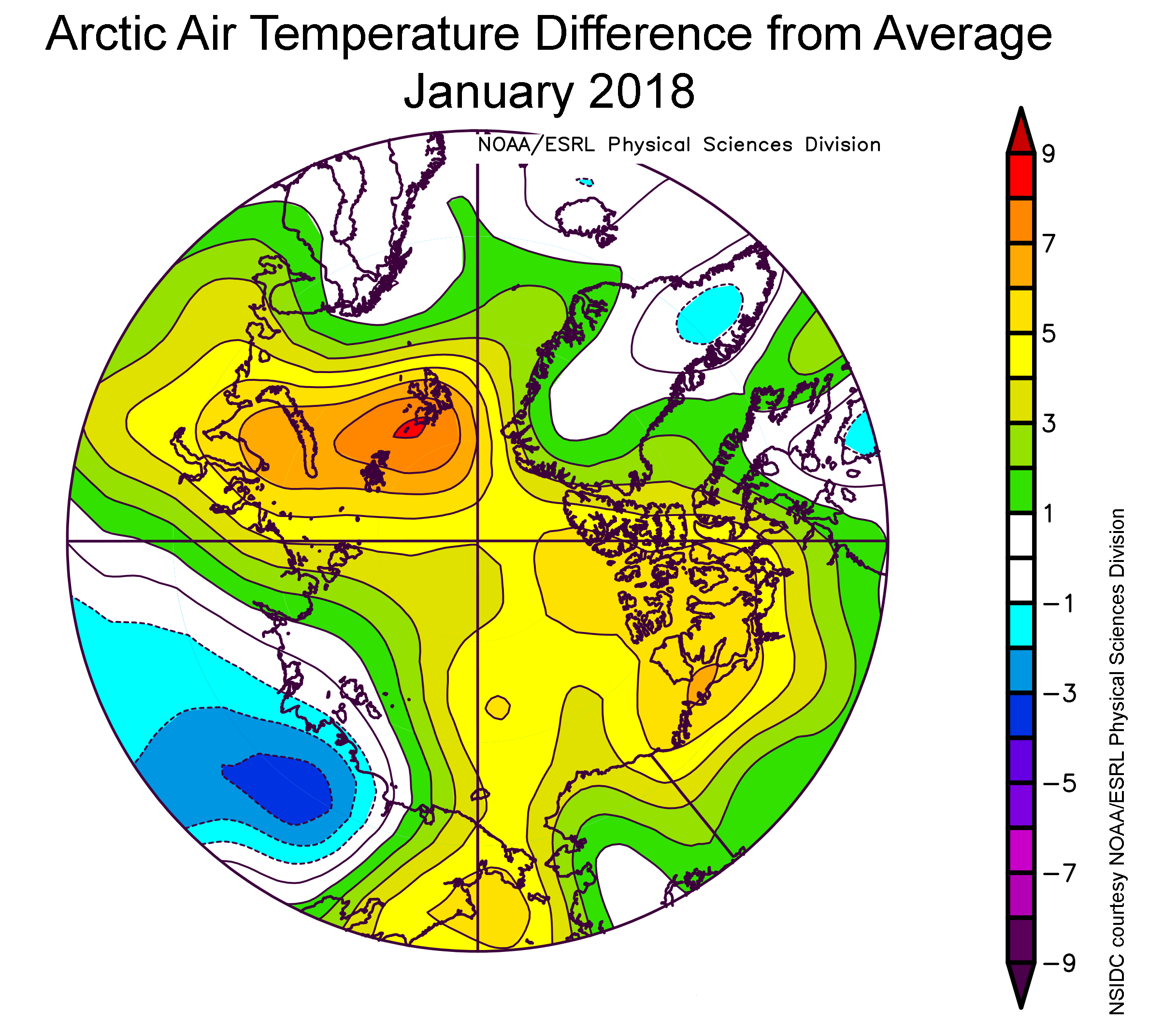
Air temperatures at the 925 hPa level (about 2,500 feet above sea level) remained unusually high over the Arctic Ocean. Nearly all of the region was at least 3 degrees Celsius (5 degrees Fahrenheit) or more above average. The largest departures from average of more than 9 degrees Celsius (16 degrees Fahrenheit) were over the Kara and Barents Seas, centered near Svalbard. On the Pacific side, air temperatures were about 5 degrees Celsius (9 degrees Fahrenheit) above average. By contrast, 925 hPa temperatures over Siberia were up to 4 degrees Celsius (7 degrees Fahrenheit) below average. The warmth over the Arctic Ocean appears to result partly from a pattern of atmospheric circulation bringing in southerly air, and partly from the release of heat into the atmosphere from open water areas.
[Edit – February 10th]
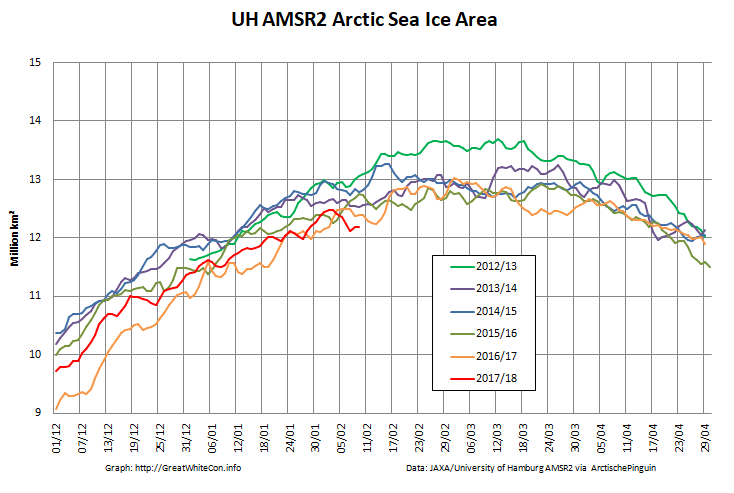
The University of Hamburg’s high resolution AMSR2 derived area is bouncing back after the recent cyclone, but extent is currently still declining:
The recent drop in Arctic sea ice extent has pushed the NSIDC global extent to a new all time (satellite era!) low:
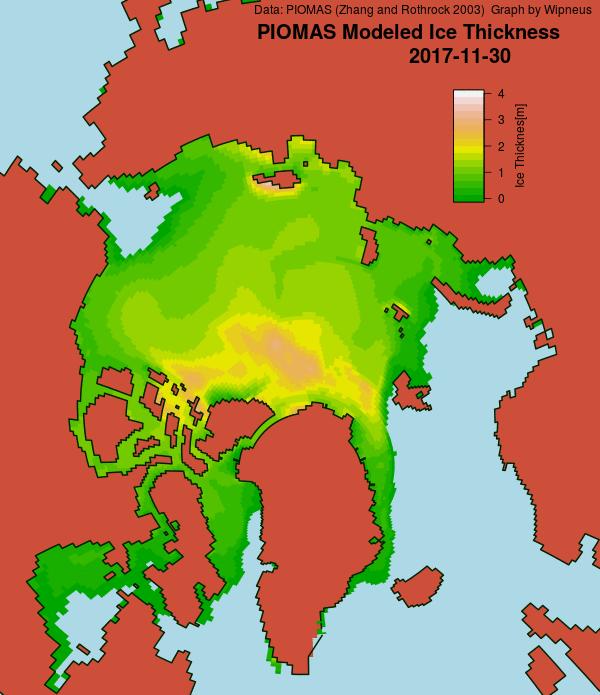
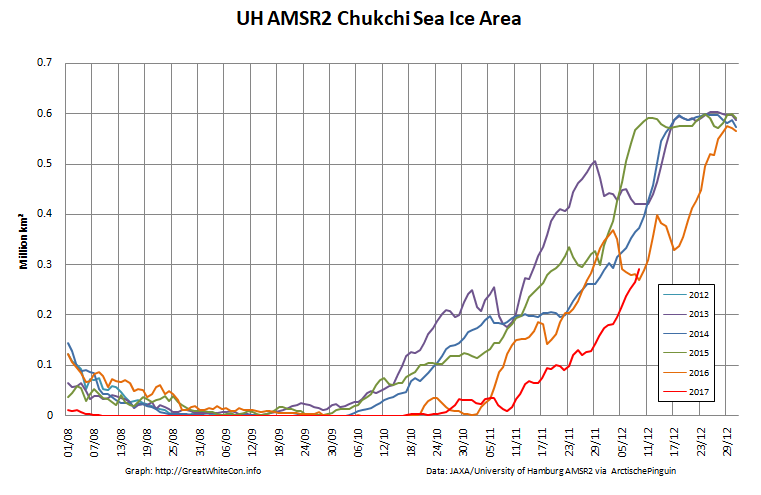
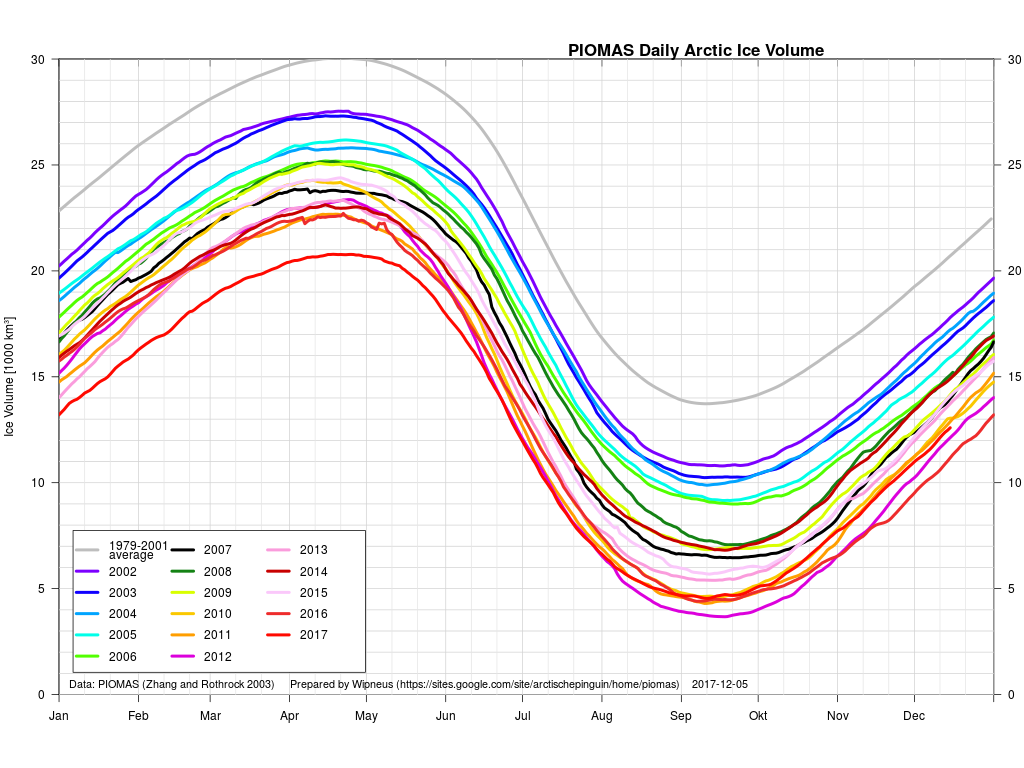
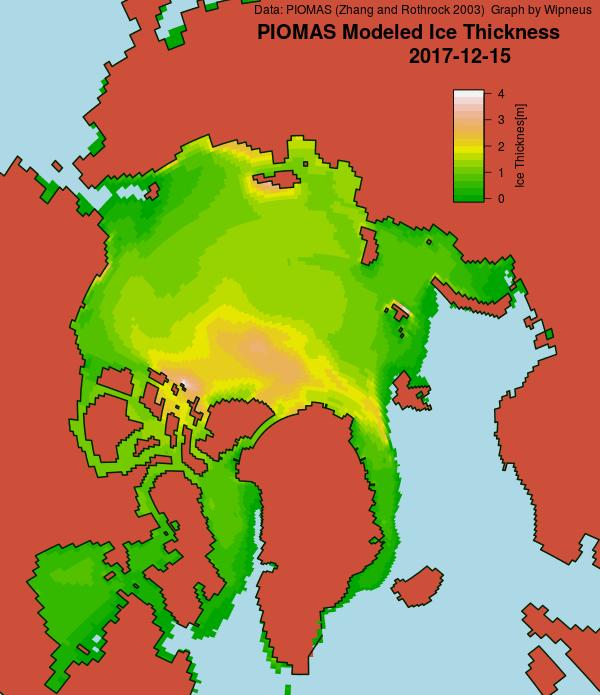
Christmas is coming, and Santa’s secret summer swimming pool has frozen over once again. However the same can’t be said for the Chukchi Sea! More on that in due course, but first let’s take a look at the PIOMAS volume graph at the end of November, courtesy of the wondrous Wipneus on the Arctic Sea Ice Forum:
2017 is currently third lowest, behind 2012 and 2016. Next let’s take a look at Wipneus’ PIOMAS Arctic sea ice thickness map:
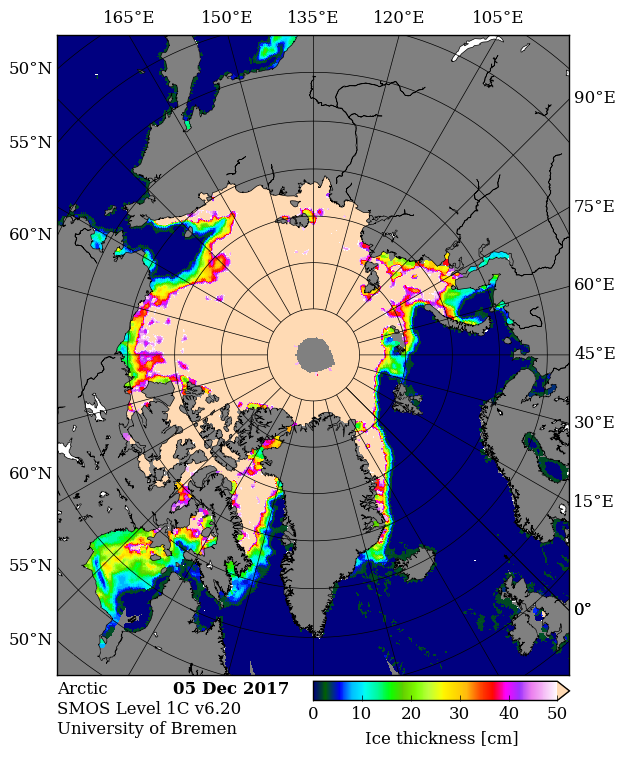
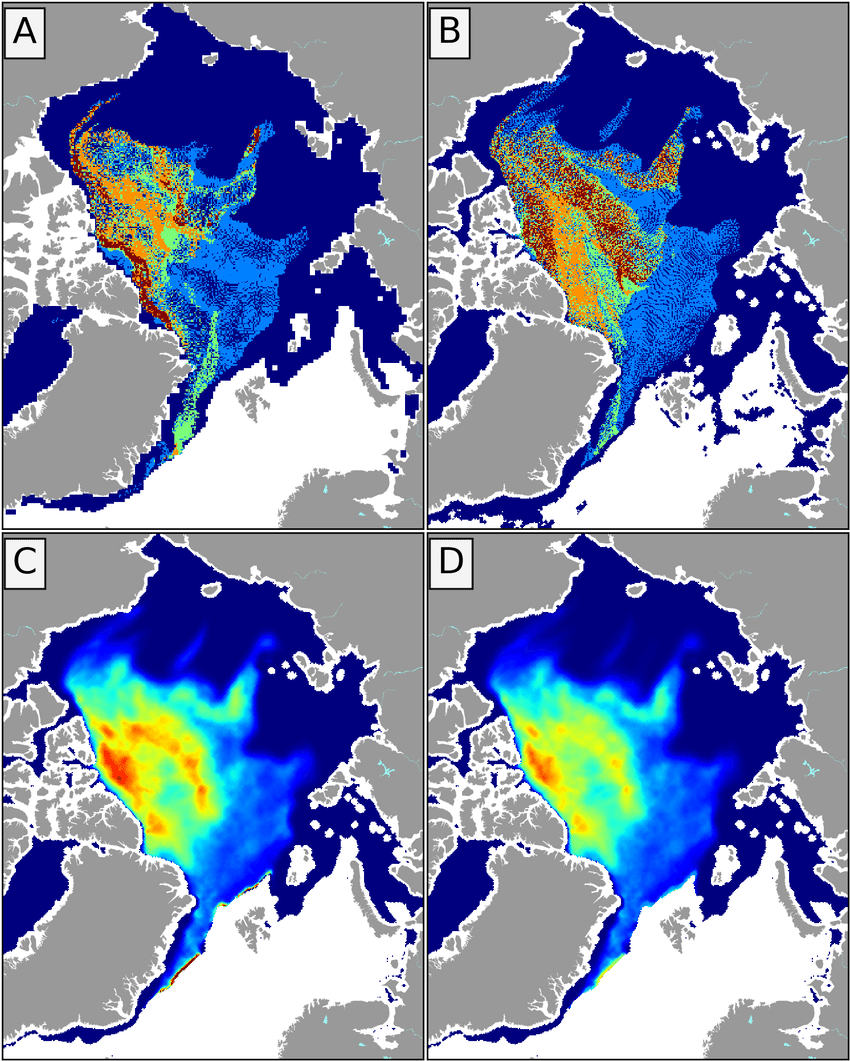
followed by the University of Bremen’s SMOS Arctic sea ice thickness map:
Note the large area of pale blue open ocean still visible in the Chukchi Sea towards the top left of both maps.
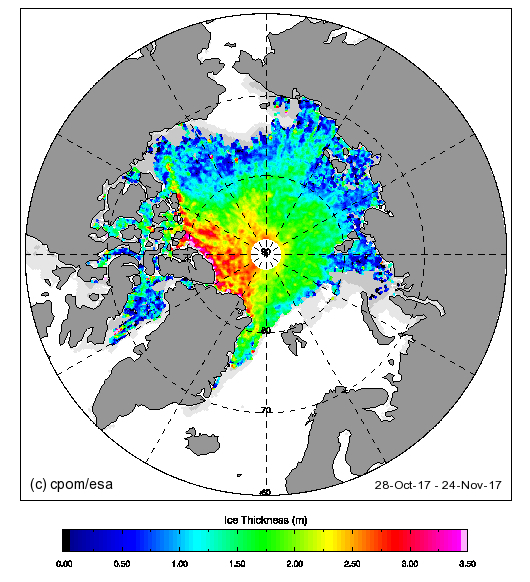
For another perspective on Arctic sea ice thickness here’s the latest Cryosat-2 map, which currently is based on the month up to November 24th:
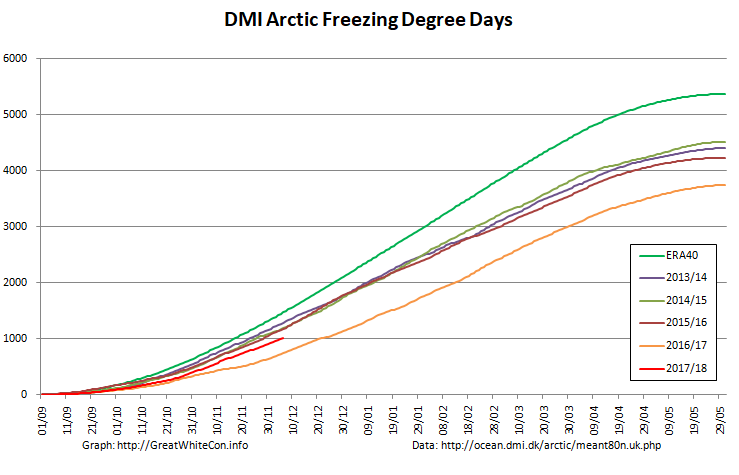
Finally, for the moment at least, here’s our very own Arctic Freezing Degree Days graph based on the DMI’s >80N data:
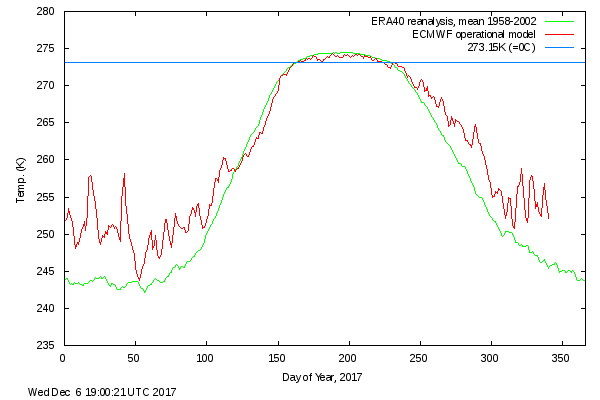
2017 is currently occupying the wide open space between the astonishingly low numbers last year and all previous years in DMI’s record. Here’s their graph for 2017 so far:
[Edit – December 10th]
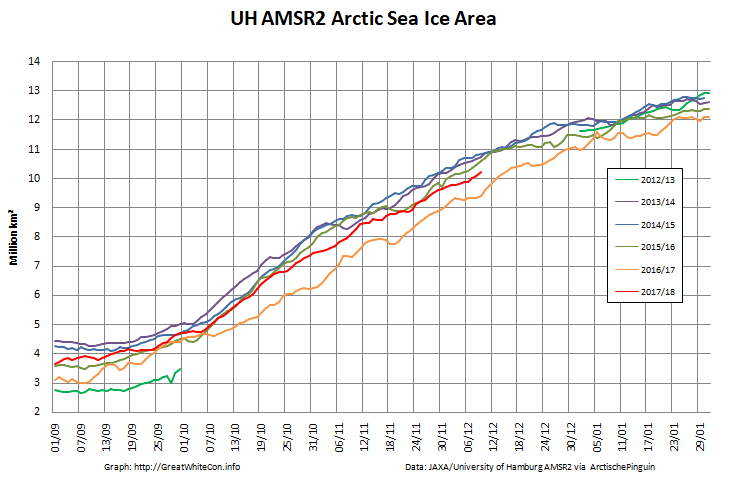
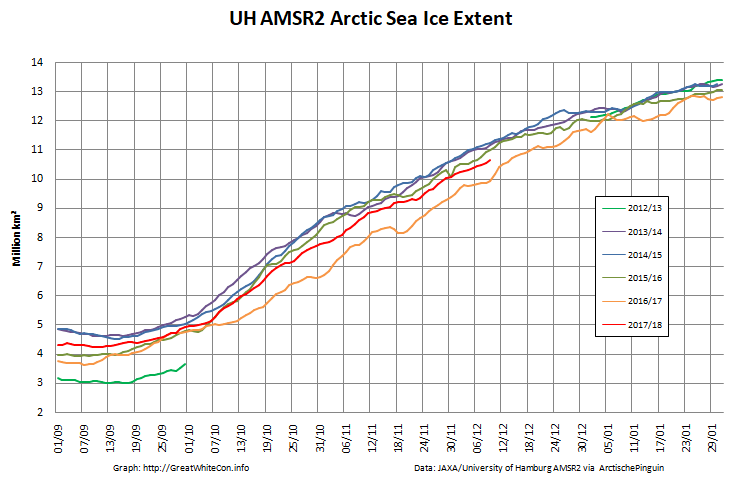
Current Arctic sea ice area and extent derived from the University of Hamburg’s high resolution AMSR2 data:
Plus the latest update on the Chukchi Sea situation:
What seems likely to be the most interesting period of the 2017 Arctic sea ice melting season is upon us! The PIOMAS gridded data hasn’t been released yet, but the overall volume numbers reveal that 2017 has now relinquished its “lowest ever” position to 2012. Here’s Wipneus’ graph of the volume data:
plus his anomaly plot:
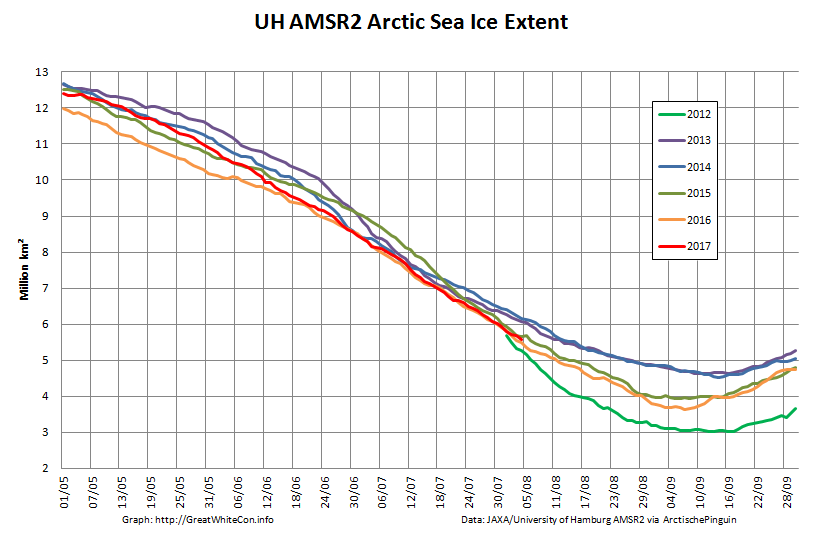
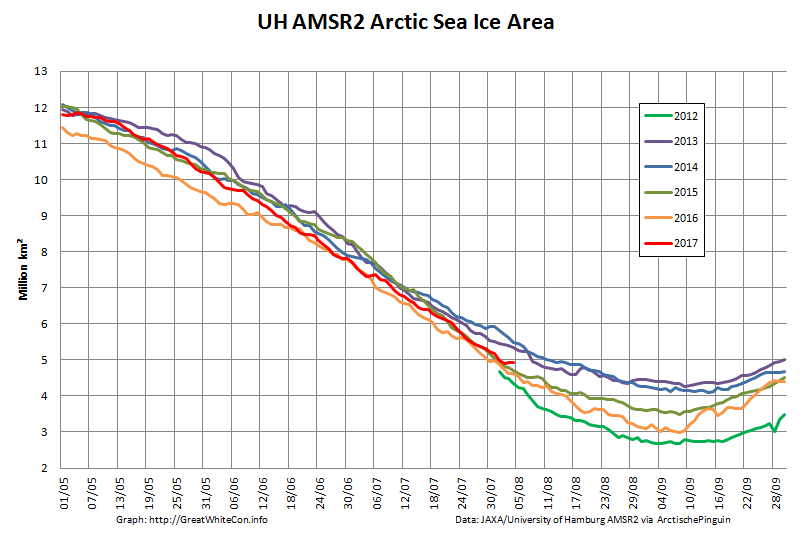
Our favourite high resolution AMSR2 area and extent graphs now also allow comparison with 2012. Here’s how they look at the moment:
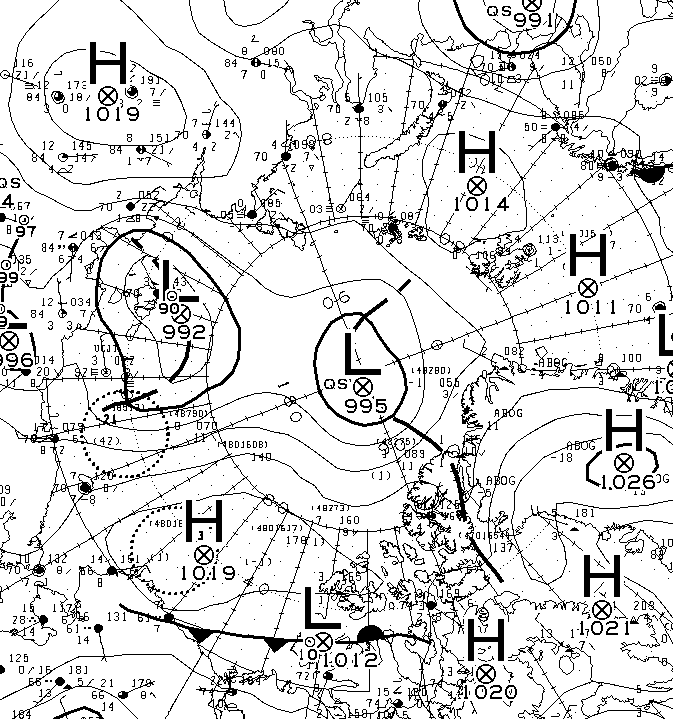
As you can see, round about now is when 2012 Arctic sea ice extent started to noticeably race ahead of the rest of the pack. Will 2017 follow suit? Are there any Arctic cyclones on the horizon for example? Well, the one forecast for August 4th hasn’t materialised. Here’s this morning’s Environment Canada synopsis:
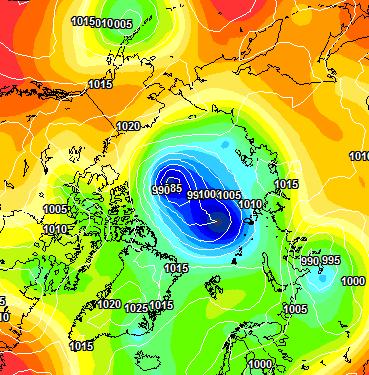
However both ECMWF and GFS agree that a sub 985 hPa storm should have arrived by Sunday morning. Here’s the ECMWF version from MeteoCiel:
There’s stronger storms in the forecast further out, but once again we’ll believe them if and when we see them!
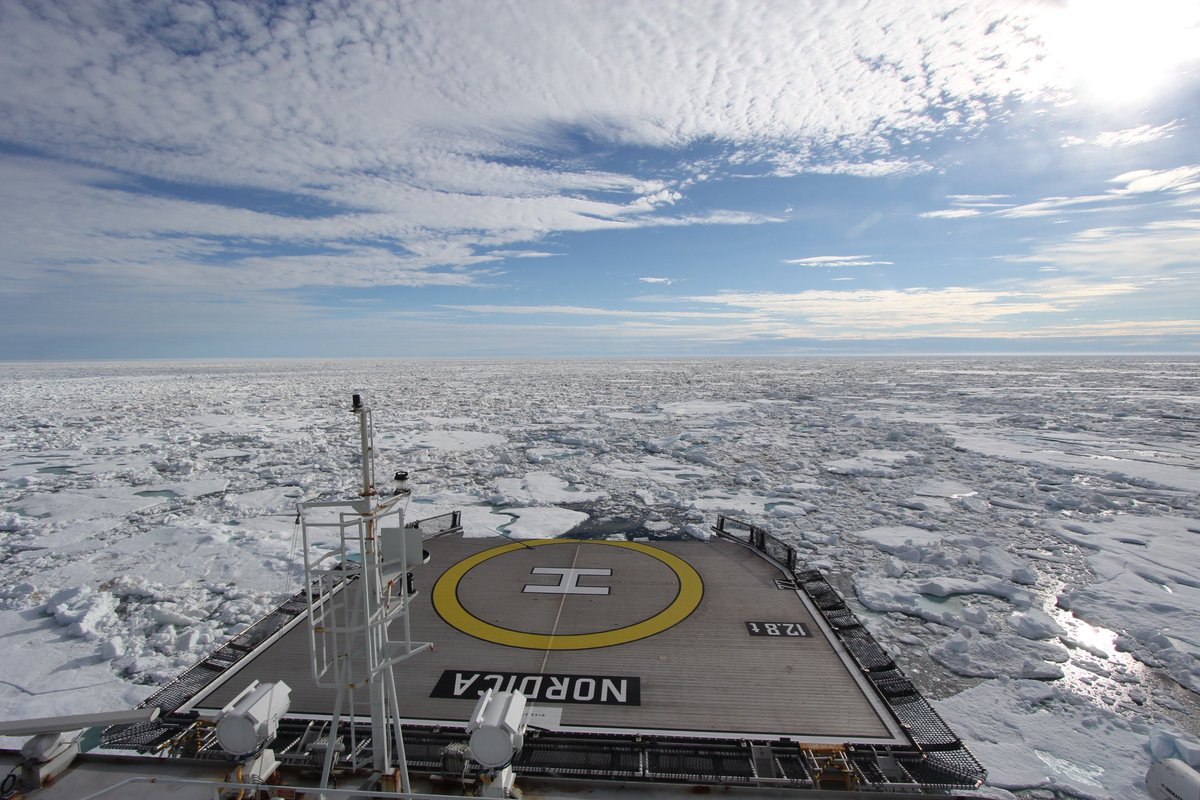
We’re keeping a close eye on the Northwest Passage once again this year. Most of the southern route is open already, but as we predicted the old ice in Larsen Sound has a lot of melting still to do. Here’s how it looked from the icebreaker Nordica a few days ago:
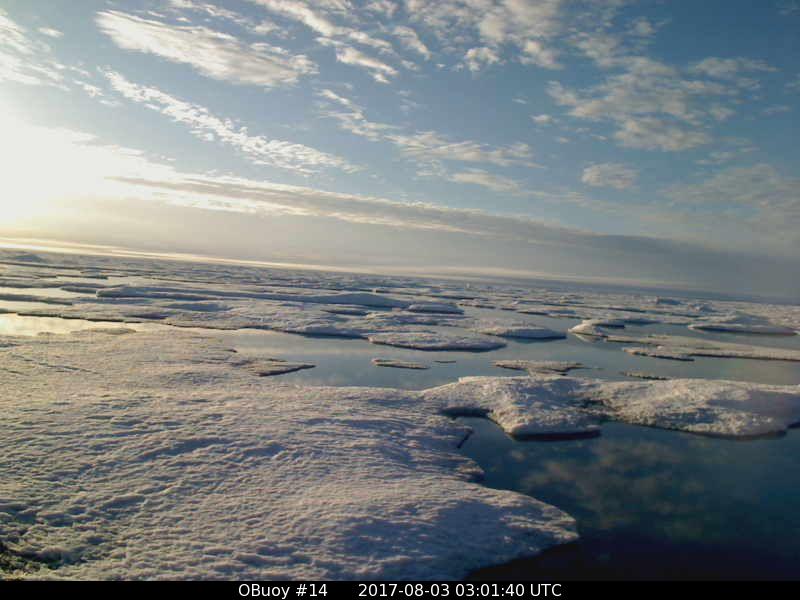
On top of that the old ice around O-Buoy 14 is currently rushing south down the McClintock Channel to replenish it. Here’s how that looks at the moment:
Meanwhile the melt along the Northern Sea Route is well ahead of last year. Here’s the University of Hamburg AMSR2 concentration map of the area:
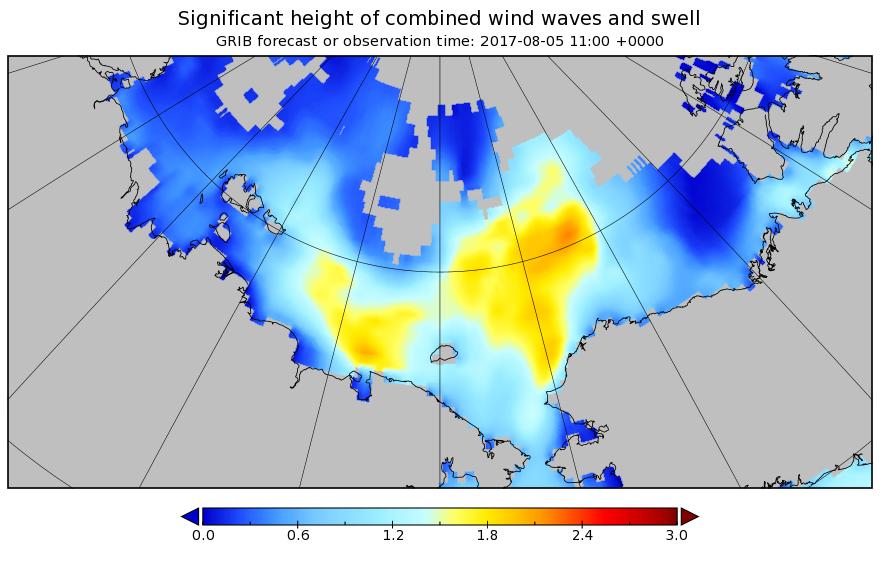
There’s also now a lot of open water on the Pacific side of the Arctic, and Sunday’s cyclone is forecast to create a large area of 2 meter plus waves heading in the direction of the ice edge:
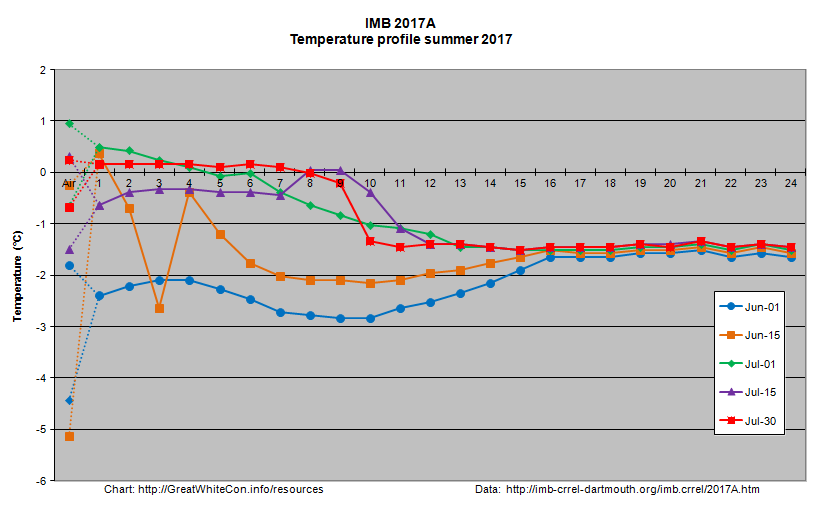
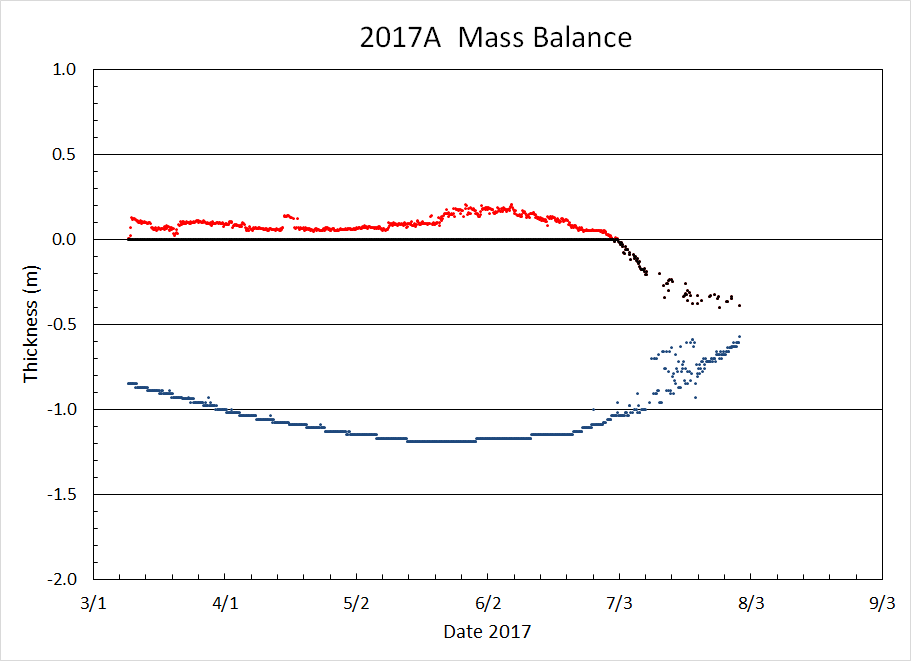
I expect that to have a noticeable effect on the already fragile sea ice by early next week, assuming the storm arrives as forecast! There is an ice mass balance buoy handily placed out on the ice in the path of the storm. Buoy 2017A is currently located near 77 N, 147 W, and its assorted sensors suggest the ice underneath it is now less than 20 cm thick:
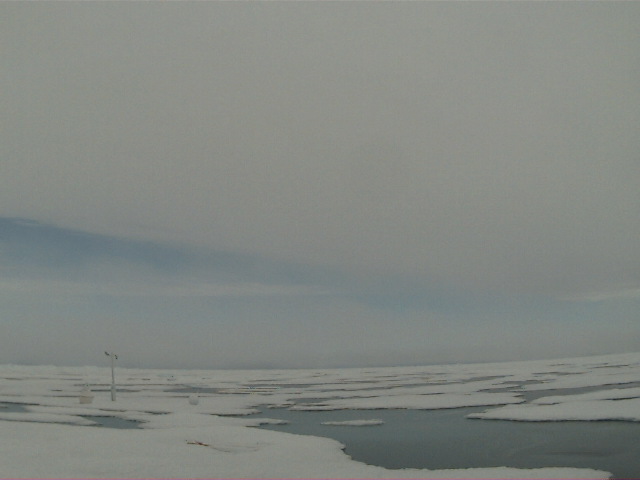
Here’s how the area around the buoy looked a couple of weeks ago:
Image of 2017A from WARM 6 on July 18th 2017. NSF project: NSF OPP #1603548
The $64,000 question now is will the 2017 Arctic sea ice metrics stay in amongst the recent pack, or race after 2012 instead?
[Edit – August 6th]
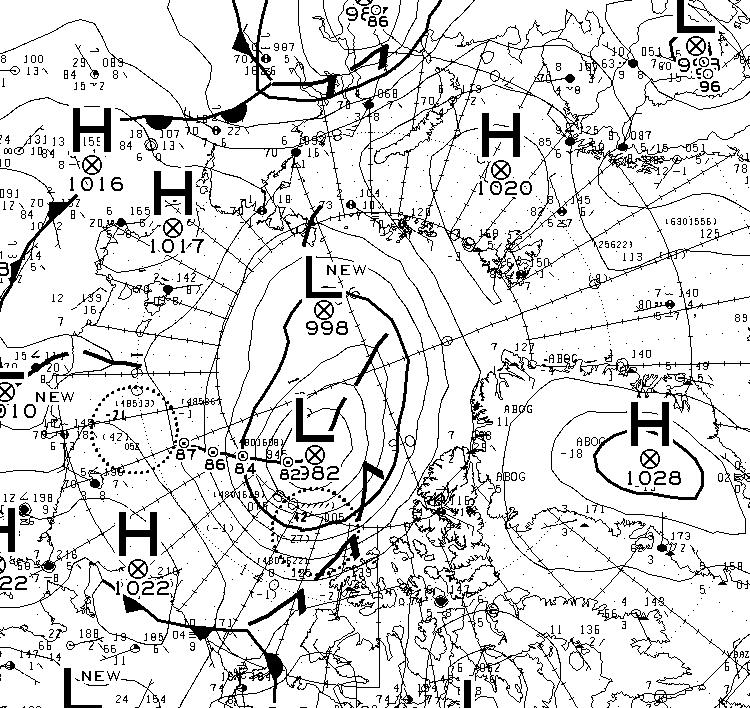
This morning’s synopsis from Environment Canada suggests the cyclone has bottomed out at a MSLP of 982 hPa:
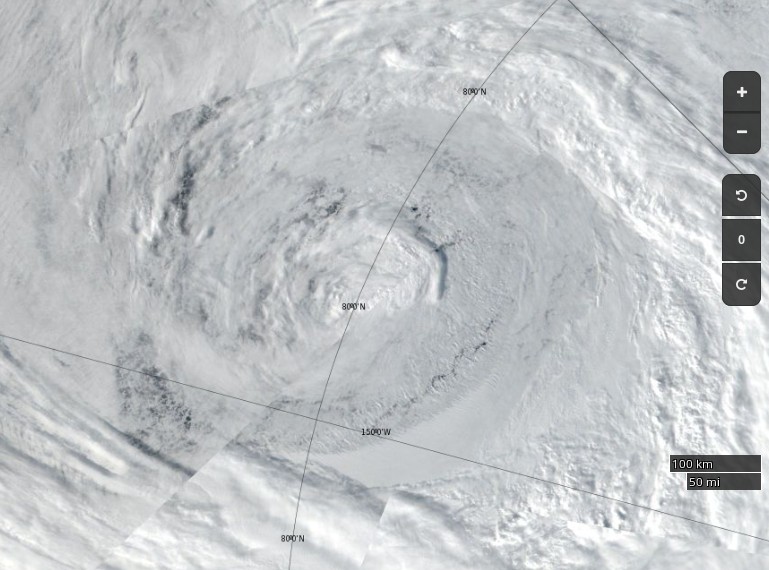
Here’s how the cyclone looked from space yesterday:
NASA Worldview “true-color” image of the sea ice north of the Beaufort Sea on August 5th 2017, derived from the VIIRS sensor on the Suomi satellite
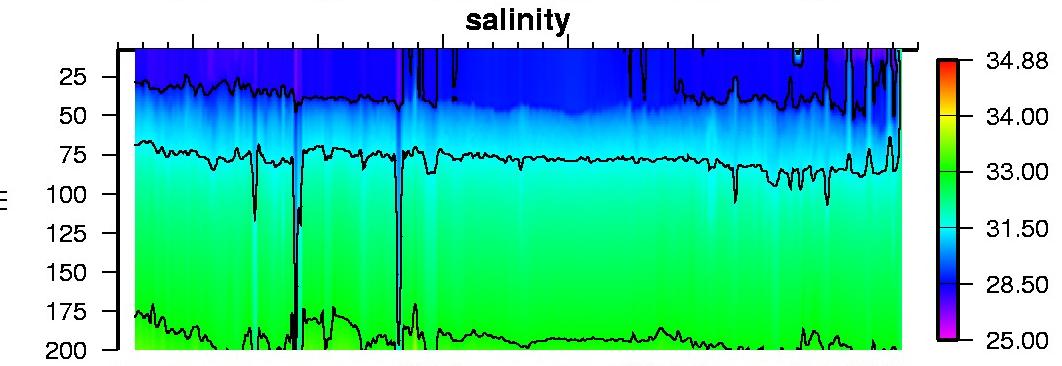
I think that I can convince myself that the salinity profile from ice tethered profiler 97, currently located at 73° N, 134° W, reveals mixing from depth in the wake of the storm:
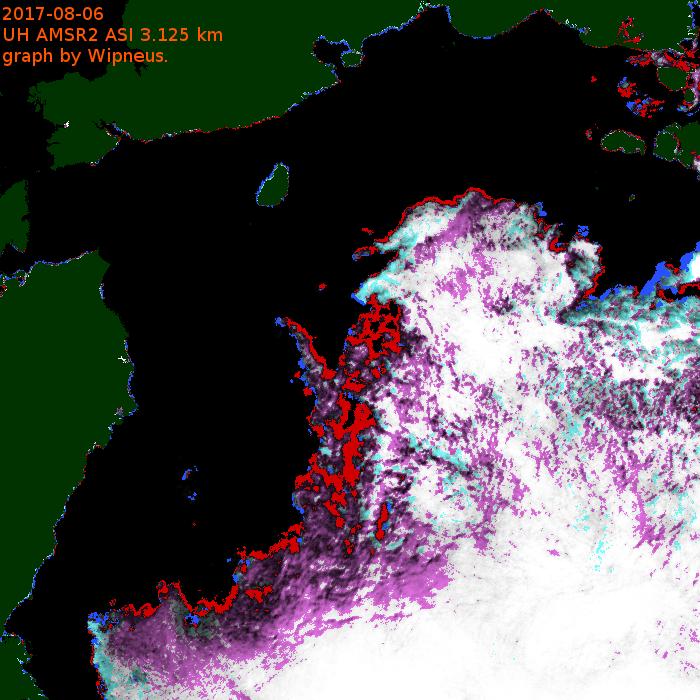
The synthetic aperture radar on the Sentinel 1B satellite can certainly see through the clouds, and reveals open water in the Central Arctic north of the Beaufort Sea yesterday evening (UTC):
Sentinel 1B image of Arctic sea ice at 79° N, 160° W on August 5th 2017
The effects of this weekend’s storm are readily apparent! Just in case you’re wondering Wipneus reports:
Area: -172.0 (+324k vs 2016, +138k vs 2015, -669k vs 2014, -523k vs 2013, +493k vs 2012)
[Edit – August 8th]
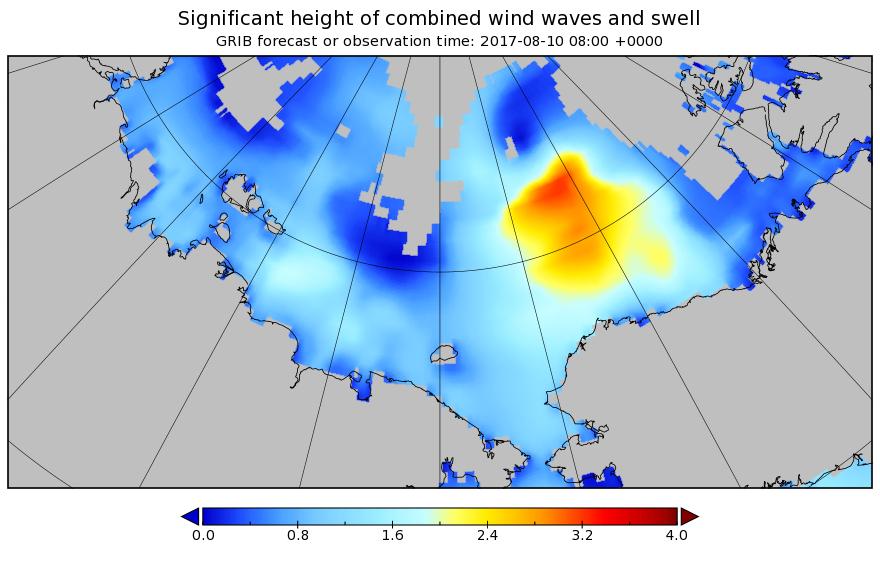
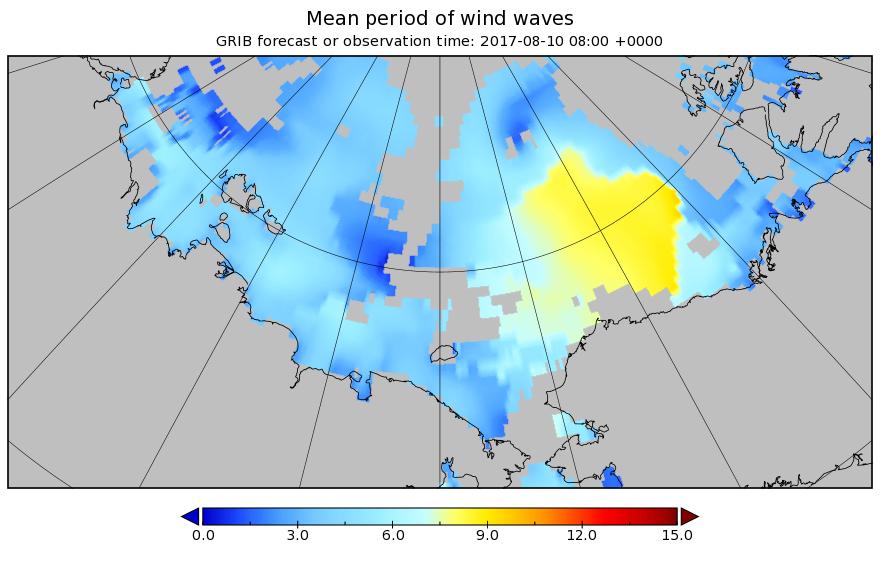
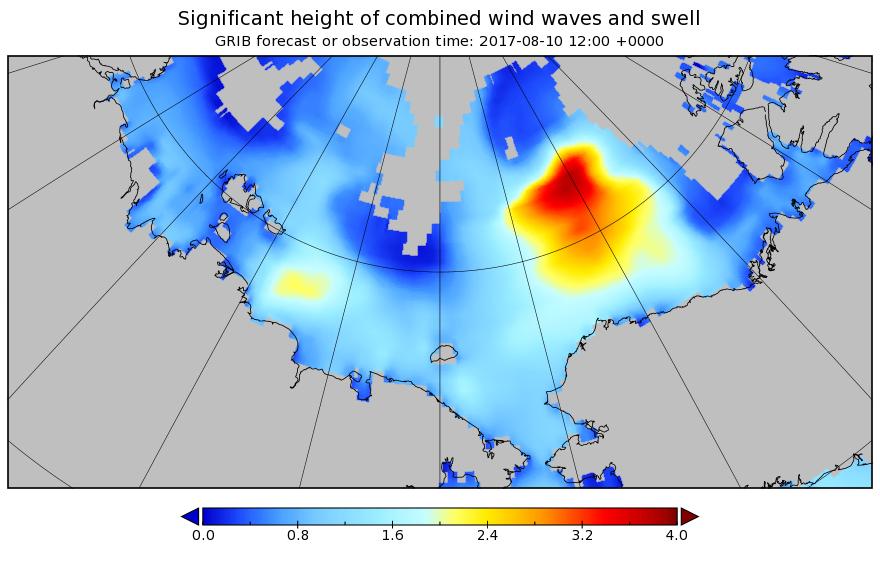
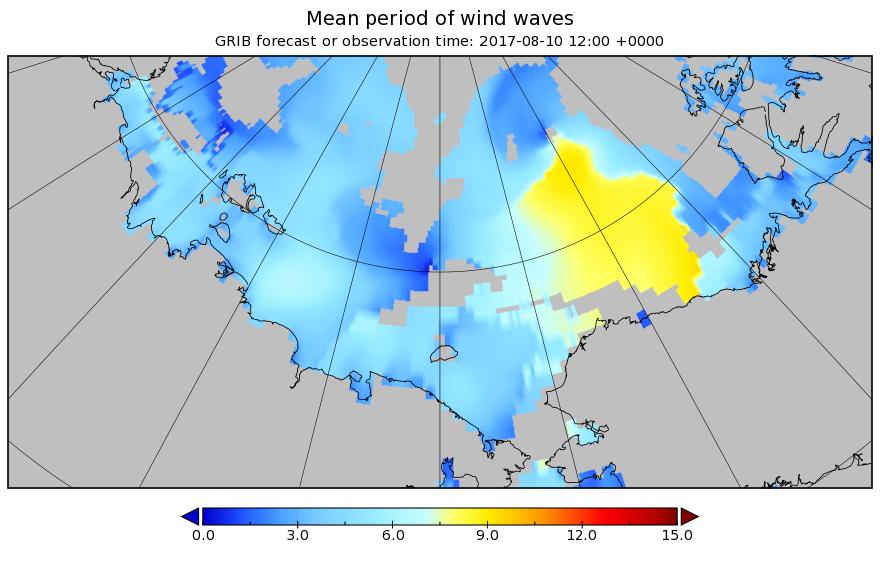
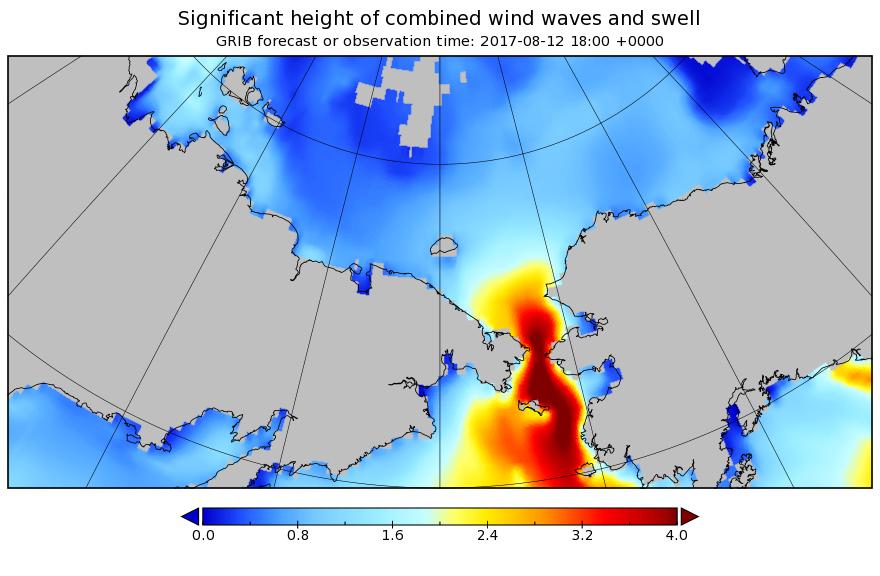
The next pulse of swell is currently forecast to be somewhat higher and longer period than the last one. This one is also taking aim at the Beaufort Sea MIZ:
[Edit – August 9th]
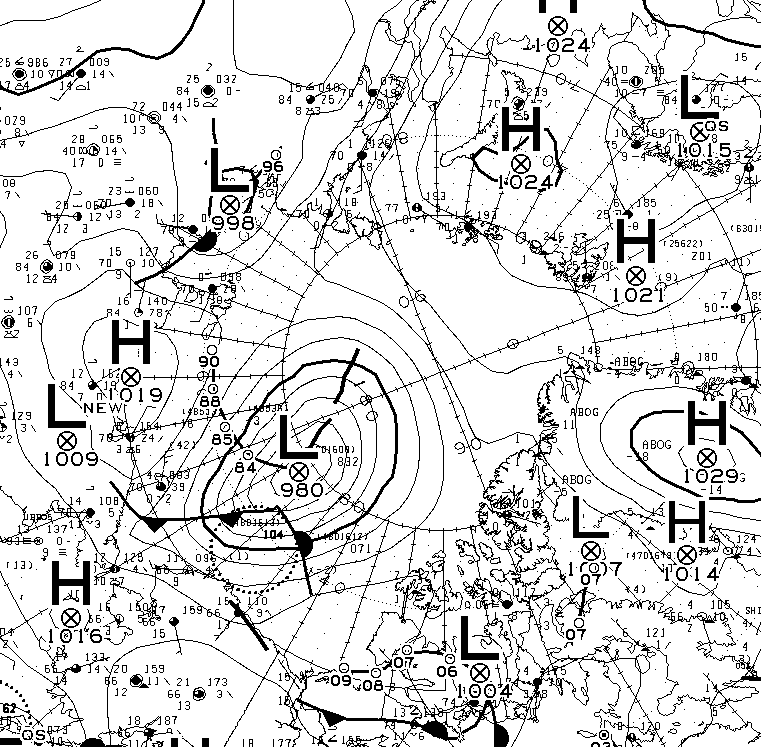
According to Environment Canada the latest cyclone is already down to 980 hPa MSLP:
[Edit – August 9th PM]
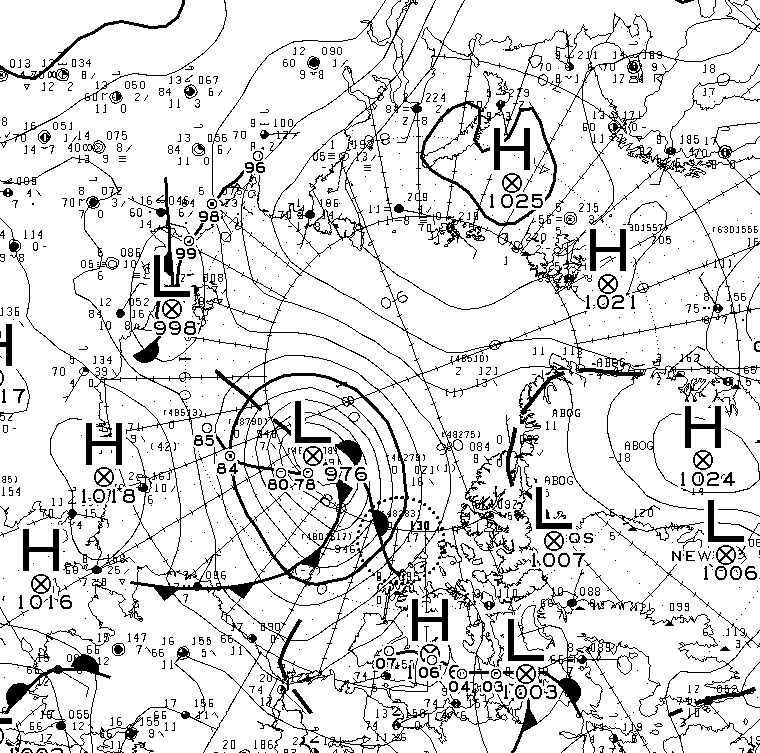
The MSLP of the current cyclone is now down to 976 hPA:
The latest WaveWatch III forecast has increased the predicted peak height and period of the resulting waves once again:
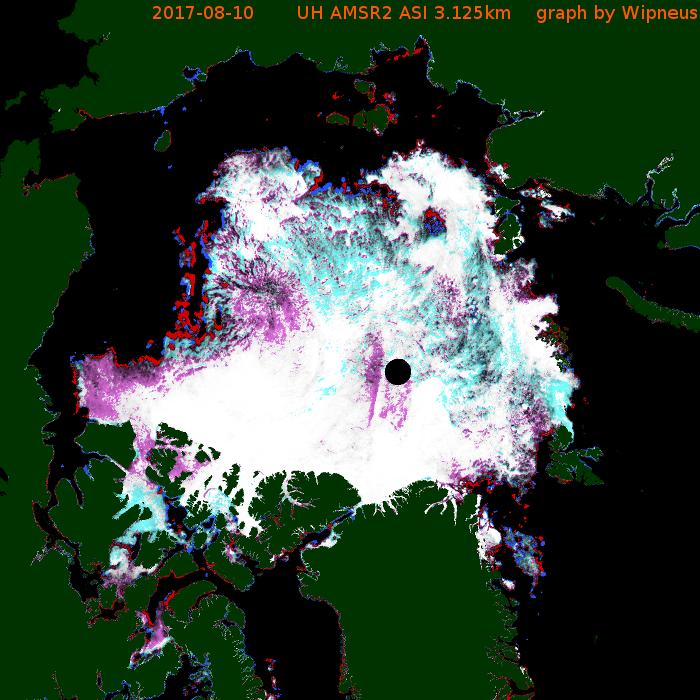
[Edit – August 10th]
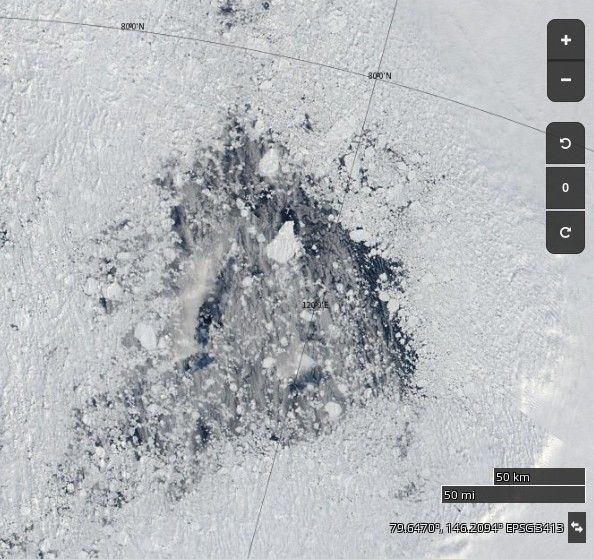
Large holes are appearing in the sea ice on the other side of the Arctic too. Take a look north of the Laptev Sea for example:
NASA Worldview “true-color” image of the “Laptev Bite” polynya on August 10th 2017
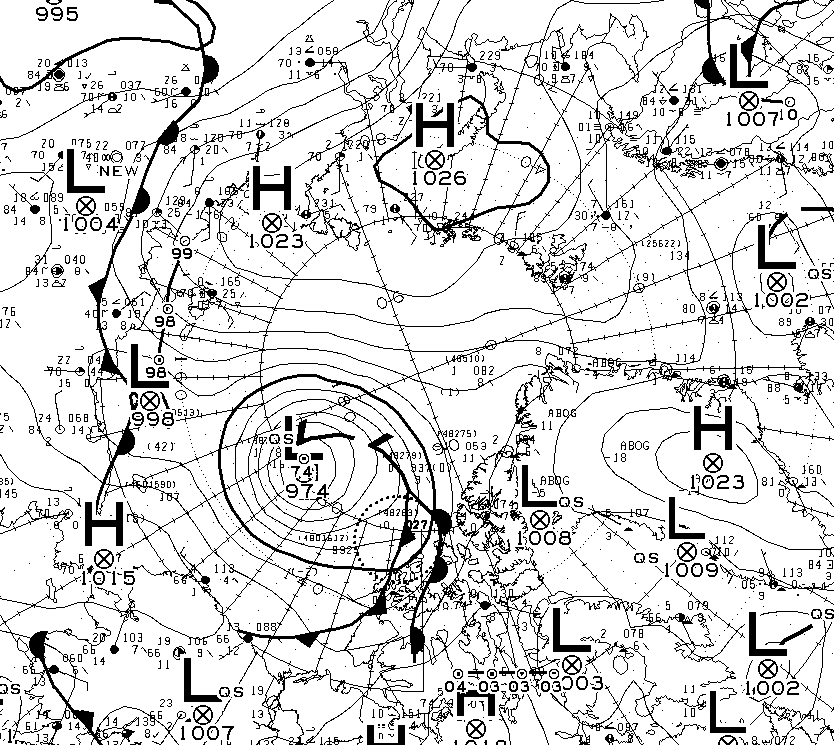
Meanwhile the current cyclone on the Pacific side of the North Pole appears to have bottomed out at 974 hPa:
[Edit – August 11th]
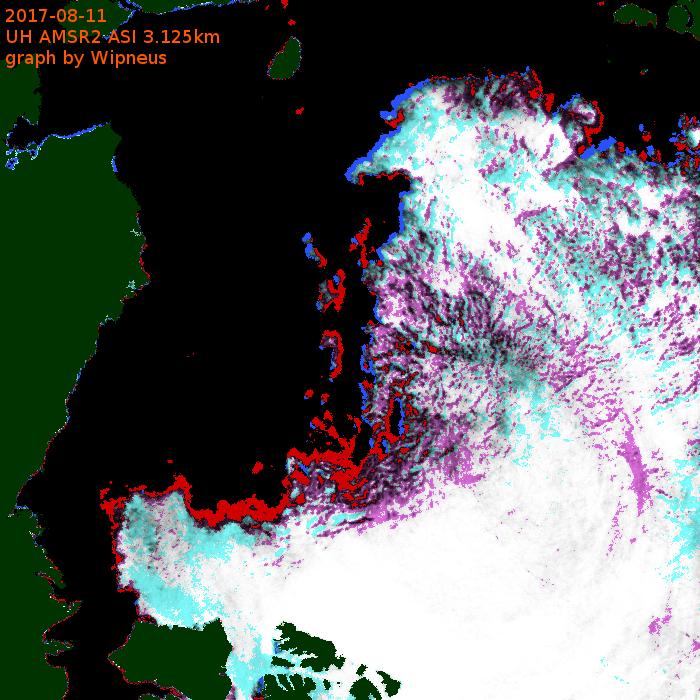
Here’s the latest sea ice concentration one day delta map from Wipneus:
Despite the expected divergence caused by a low pressure area crossing the ice, both are and extent of sea ice on the Pacific side of the Arctic are still falling.
[Edit – August 12th]
The waves are considerably smaller in the Beaufort Sea today, but not in the Bering Strait!
Here’s the latest one day delta map:
and here’s video showing the motion of sea ice in the Beaufort & Chukchi Seas so far this summer:
[Edit – August 13th]
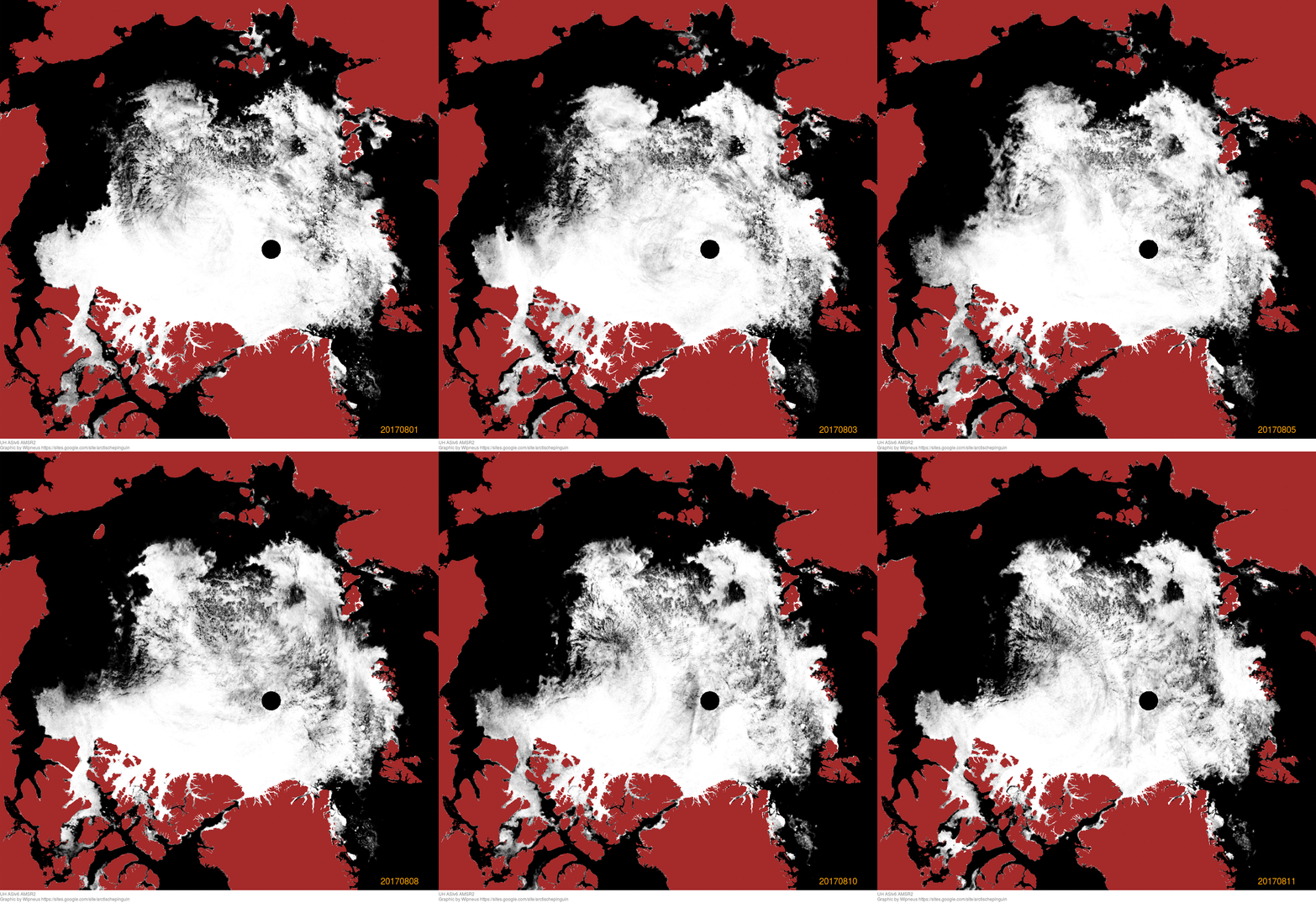
Here’s an animation from Wipneus revealing the effect of the two recent cyclones on the Pacific side, plus everything else that’s been going on in the Arctic:
Click the image to see a much larger (3.3 Mb) version.
[Edit – August 16th]
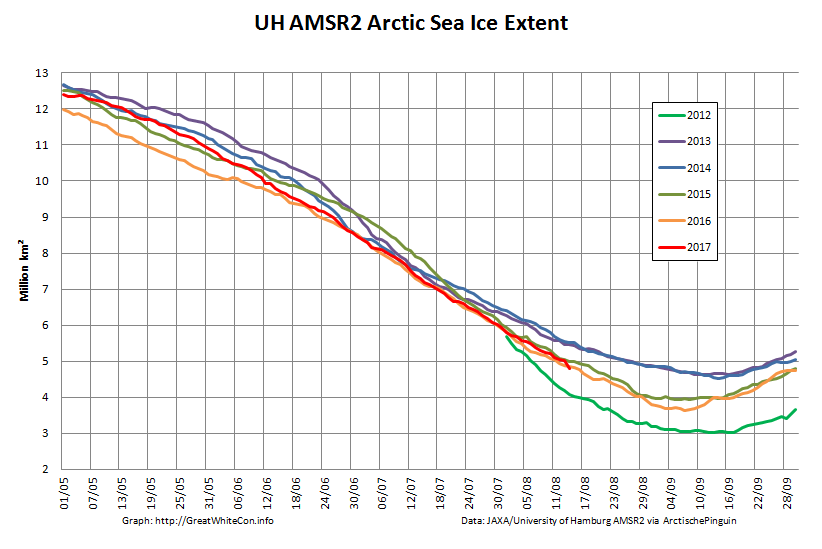
AMSR2 Arctic sea ice extent has taken another tumble, and has dropped below 2016:
Only 2012 left to beat!
[Edit – August 18th]
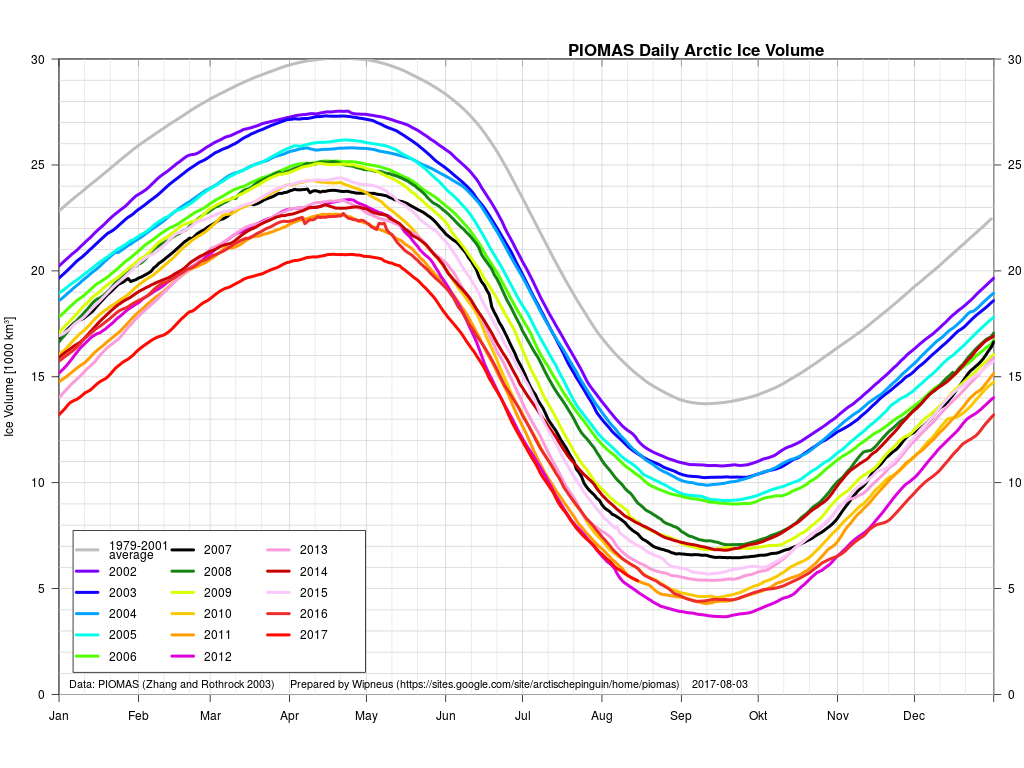
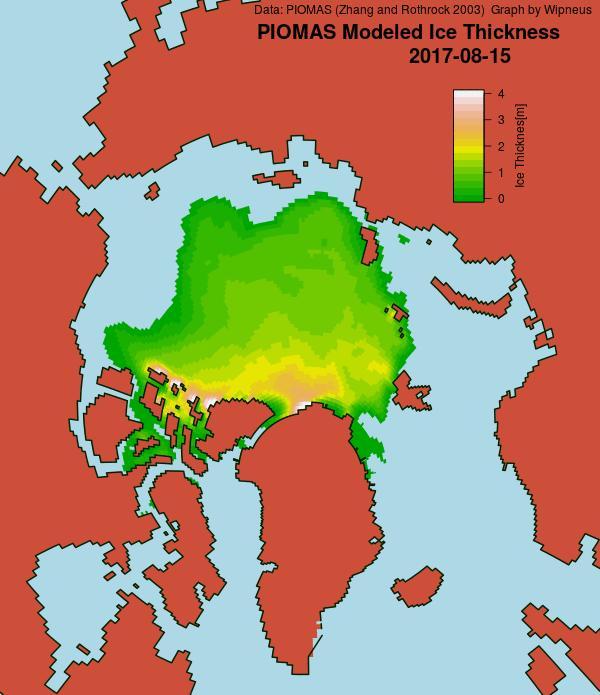
A PIOMAS mid month update has been released, including gridded thickness data. 2017 modelled volume has failed to follow 2012’s trajectory towards the September minimum, and is now on a par with 2011:
[Edit – August 21st]
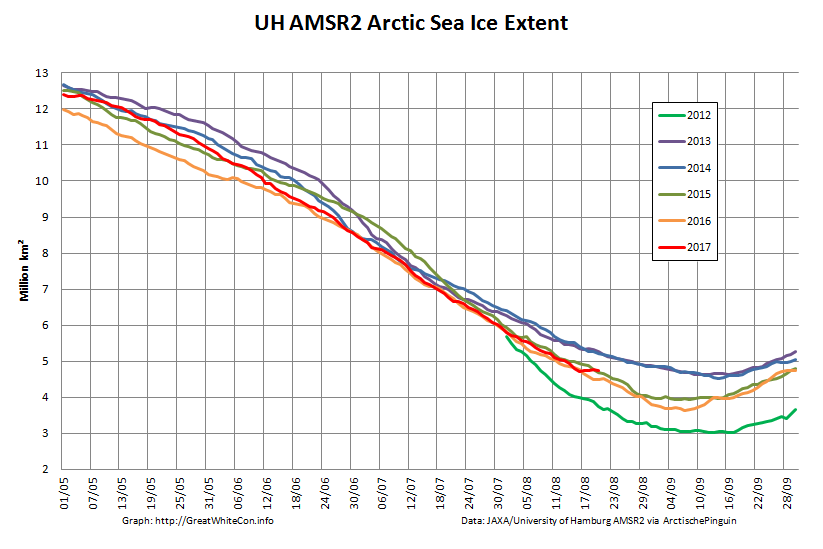
After a “brief hiatus” in the wake of the recent cyclones Arctic sea ice area has posted a new low for the year:
Extent has yet to follow suit:
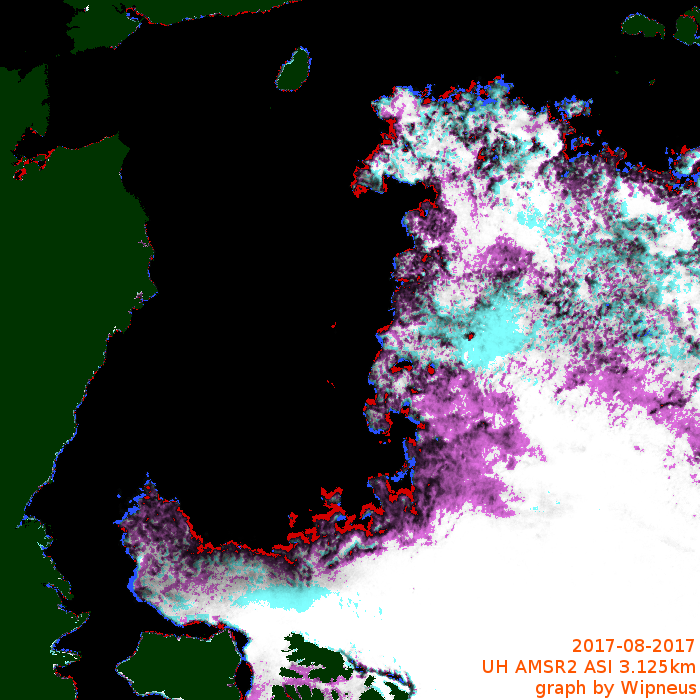
The main loss of area has been in the “Beaufort Bite” once again:
This website uses cookies to improve your experience. We'll assume you're ok with this, but you can opt-out if you wish. Cookie settingsACCEPT
Privacy & Cookies Policy
Privacy Overview
This website uses cookies to improve your experience while you navigate through the website. Out of these, the cookies that are categorized as necessary are stored on your browser as they are essential for the working of basic functionalities of the website. We also use third-party cookies that help us analyze and understand how you use this website. These cookies will be stored in your browser only with your consent. You also have the option to opt-out of these cookies. But opting out of some of these cookies may affect your browsing experience.
Necessary cookies are absolutely essential for the website to function properly. This category only includes cookies that ensures basic functionalities and security features of the website. These cookies do not store any personal information.
Any cookies that may not be particularly necessary for the website to function and is used specifically to collect user personal data via analytics, ads, other embedded contents are termed as non-necessary cookies. It is mandatory to procure user consent prior to running these cookies on your website.