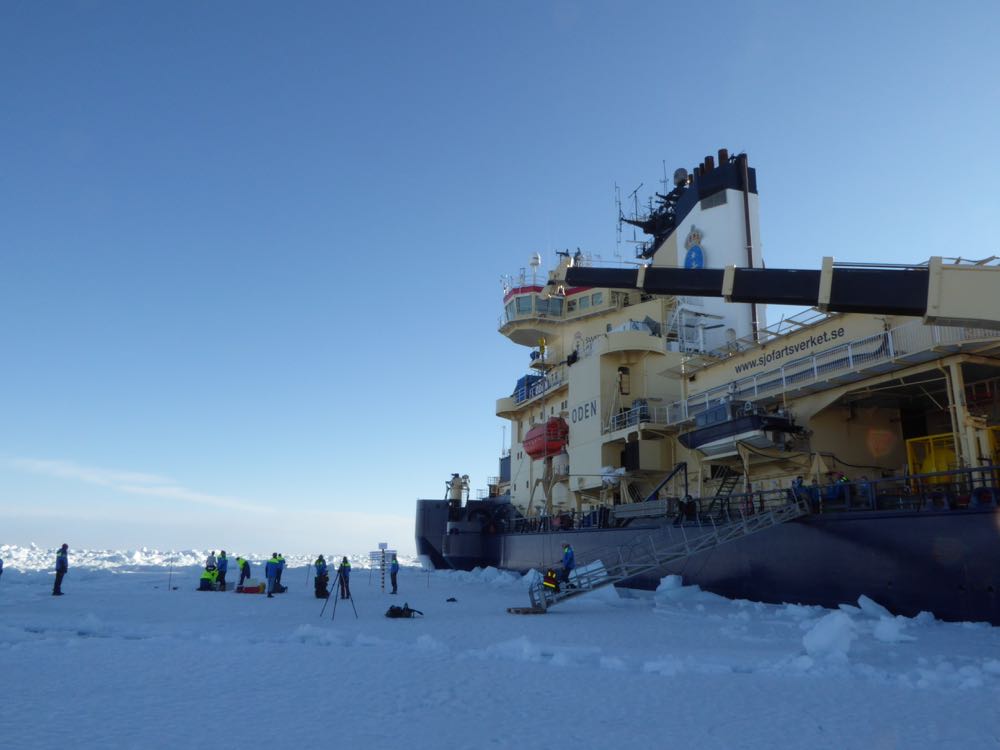
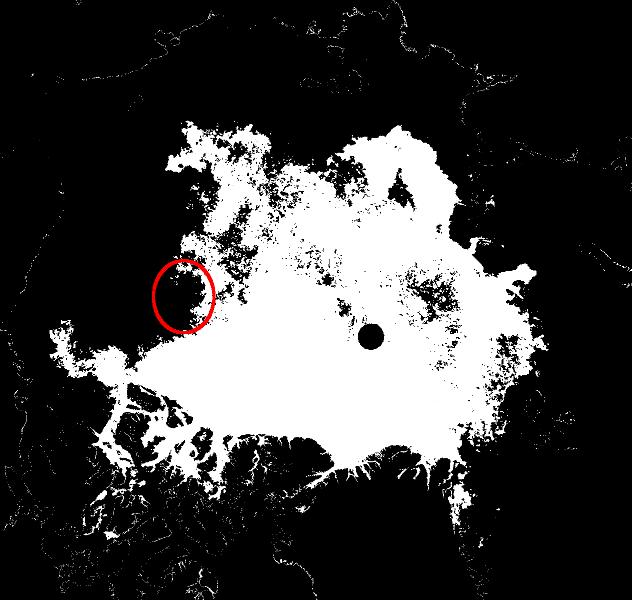
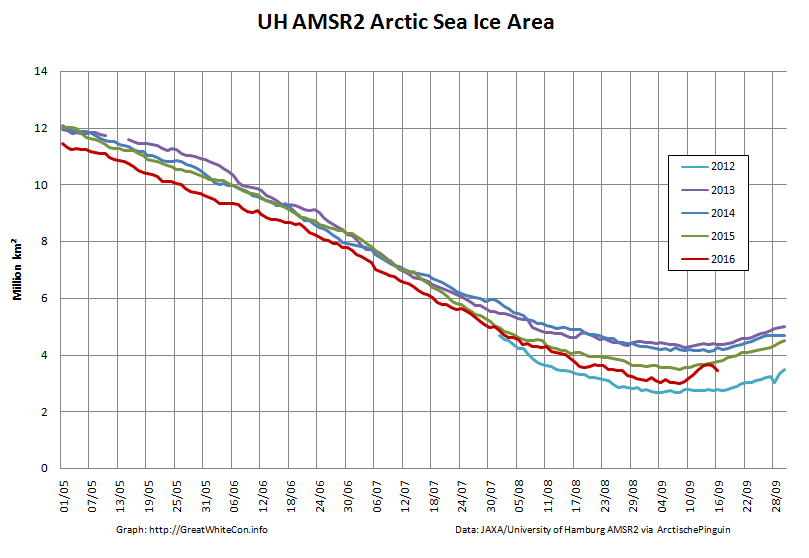
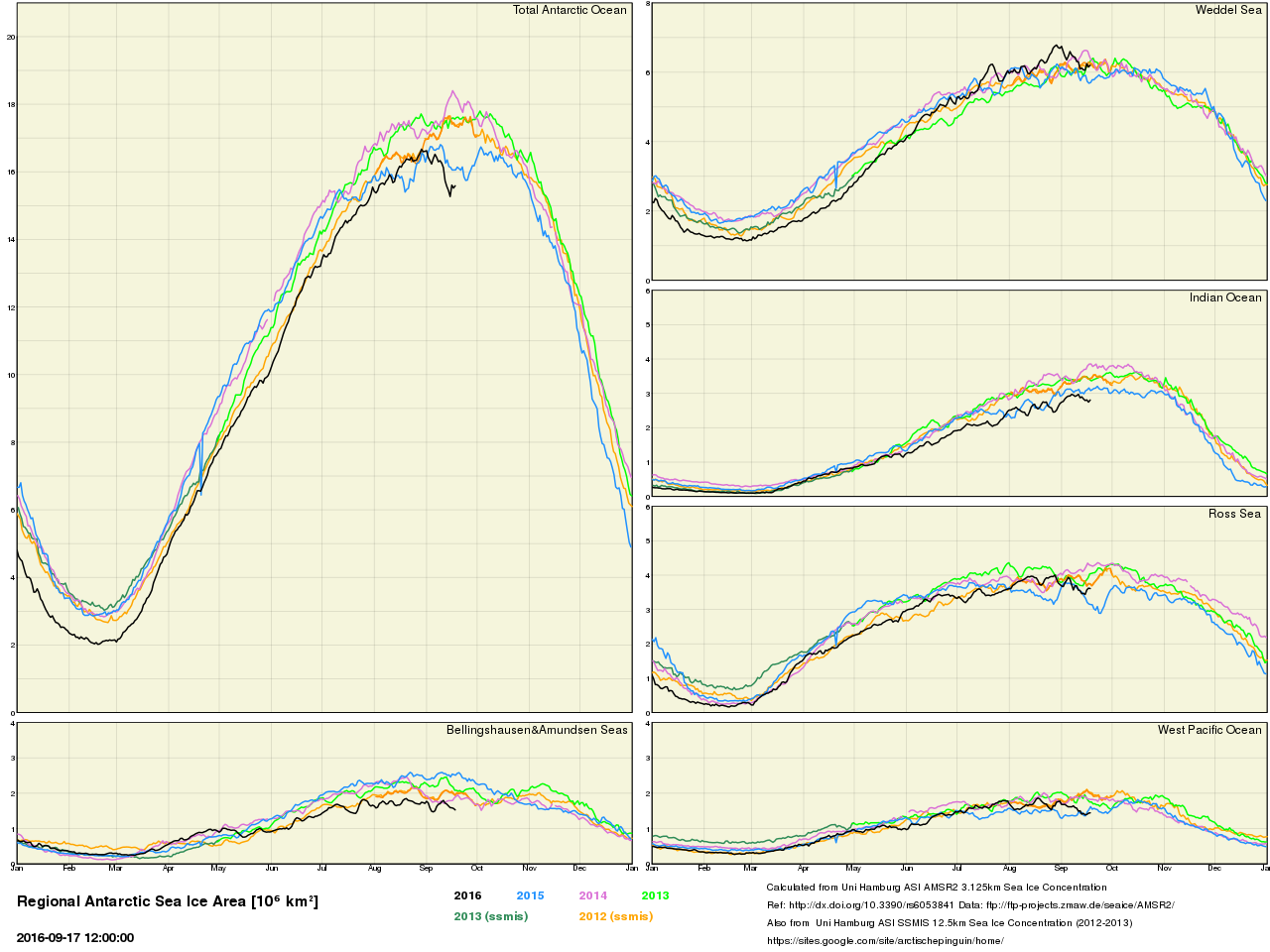
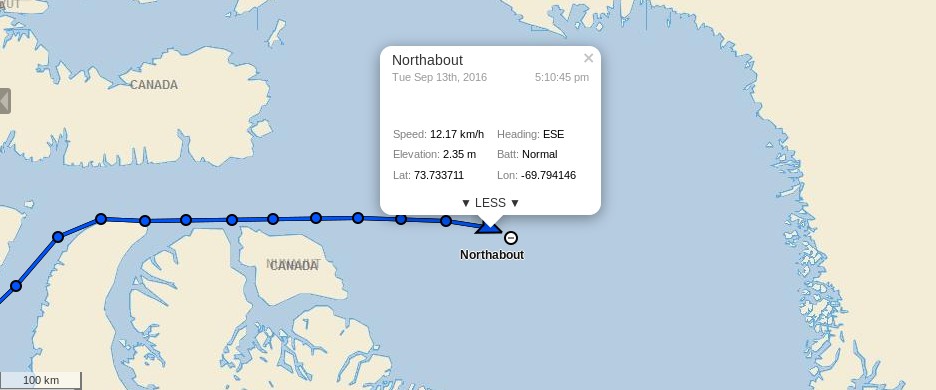
Our regular reader(s) may recall our extensive coverage of the Swedish icebreaker Oden’s visit to the North Pole (AKA Santa’s secret summer swimming pool) in 2016?
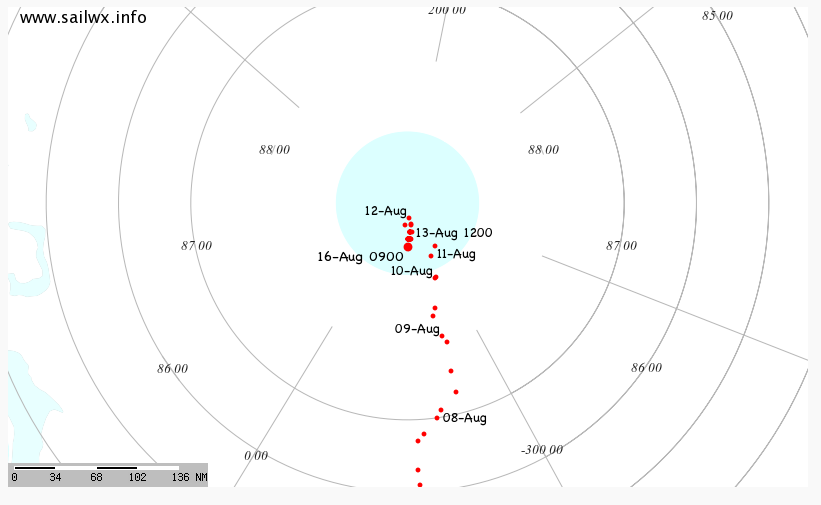
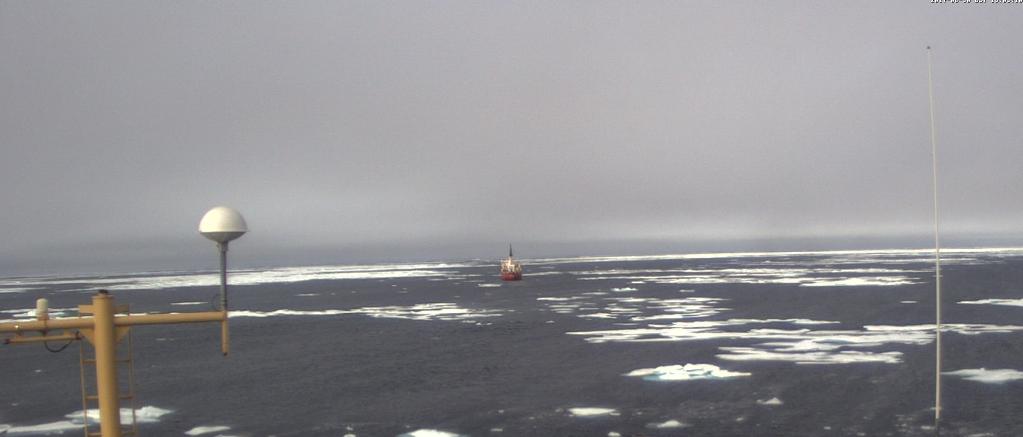
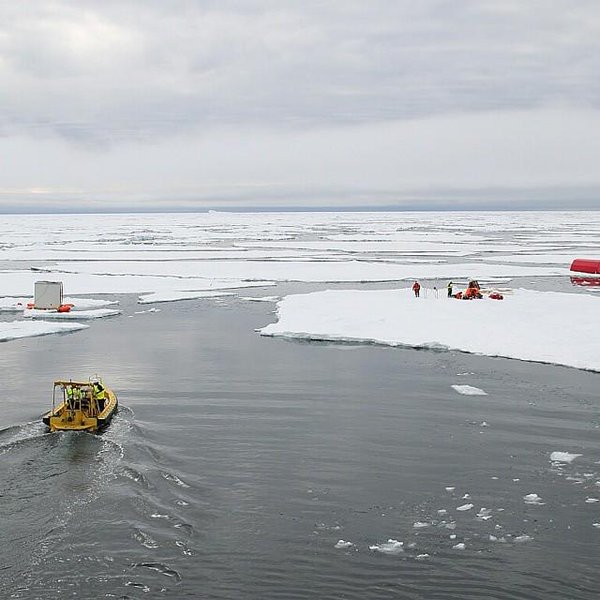
We are now able to report that Oden has been back at the North Pole once again, this time somewhat earlier in the season:
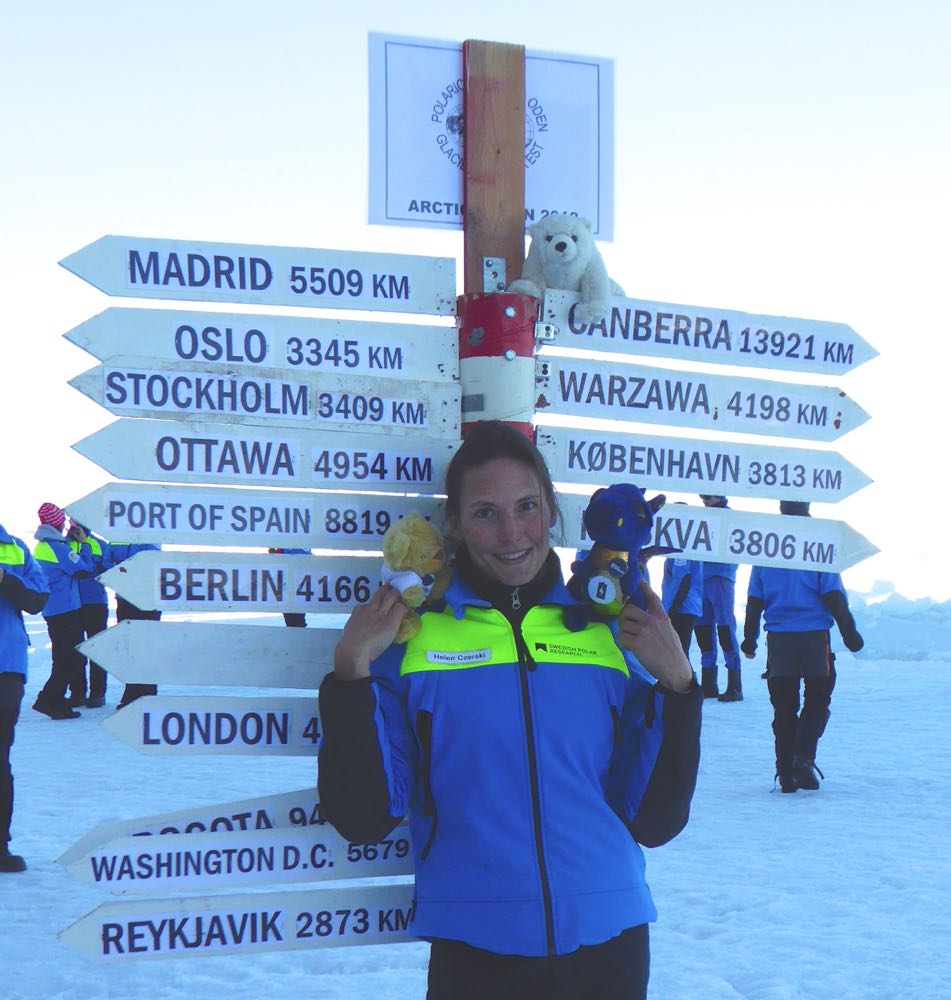
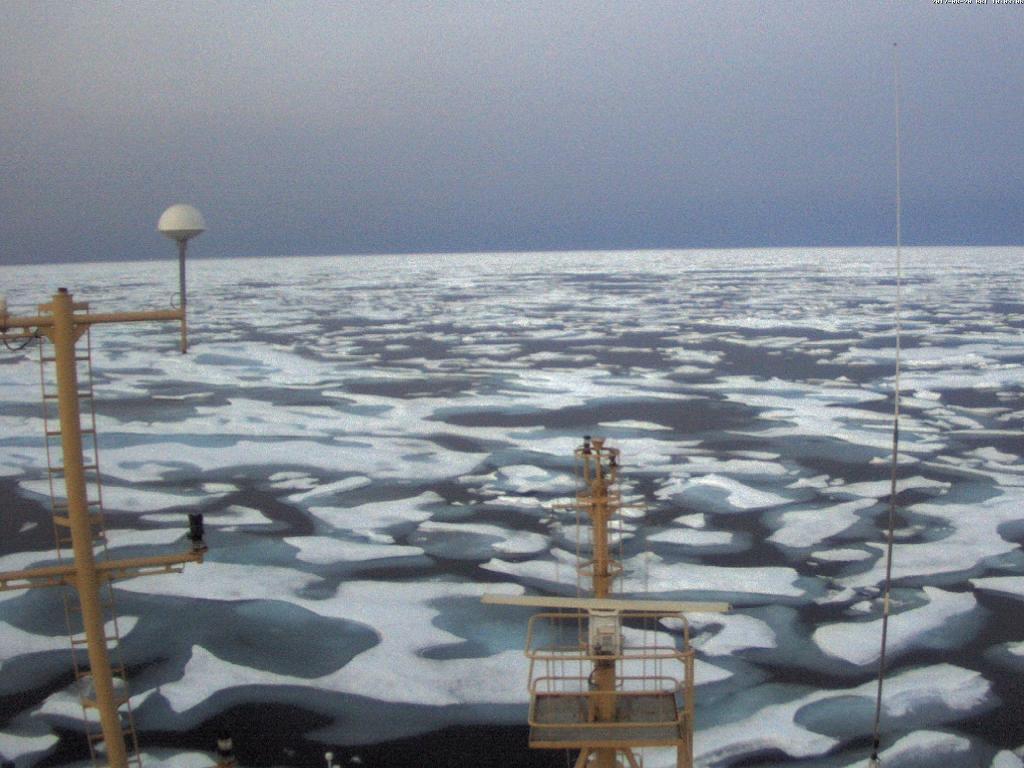
There’s not as much open water to be seen this year, although Oden’s visit is a week earlier than in 2016 so that may not be too surprising? What is perhaps surprising is that this year visiting the Pole wasn’t part of Oden’s plan! According to British physicist and oceanographer (and BBC TV star!) Helen Czerski:
We weren't really aiming for the pole, just to find a good ice floe as far north as possible. But we haven't found an ice floe yet and it looks as though I'll wake up tomorrow morning at the North Pole. Hello to the top of the world! #ArcticOcean2018pic.twitter.com/fDPnua4V6N
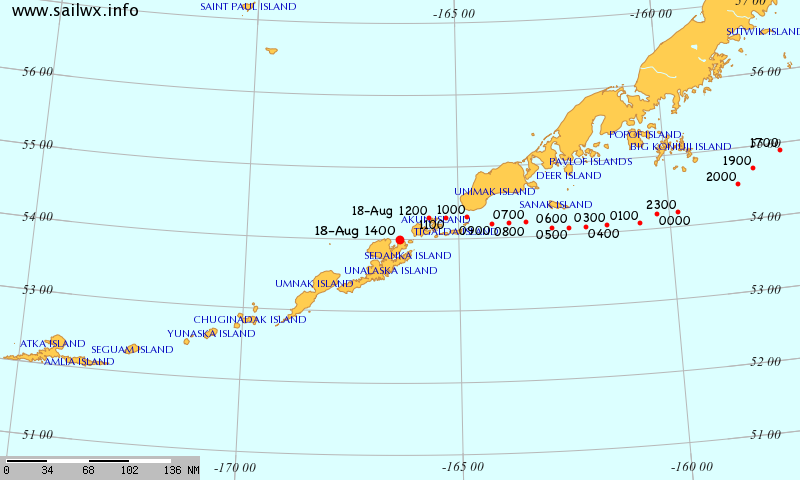
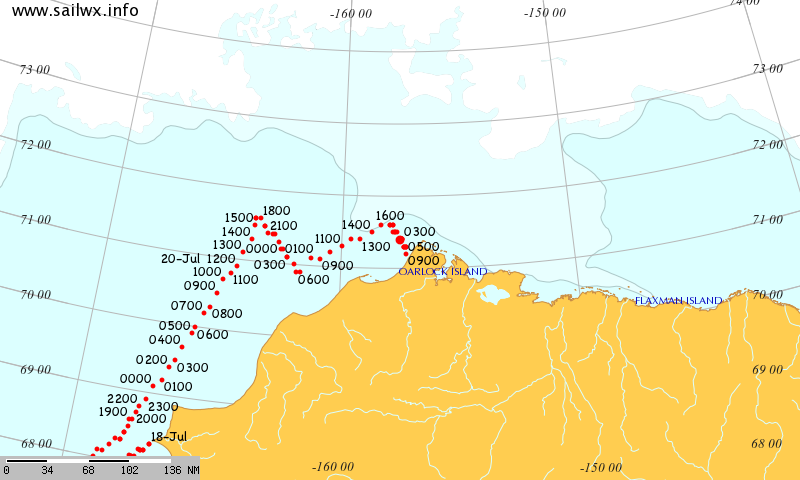
After a voyage through the Northwest Passage untroubled by sea ice in 2016, the cruise liner Crystal Serenity has set sail for the Bering Strait and beyond once again. The SailWX tracking map shows her passing the Aleutian Islands:
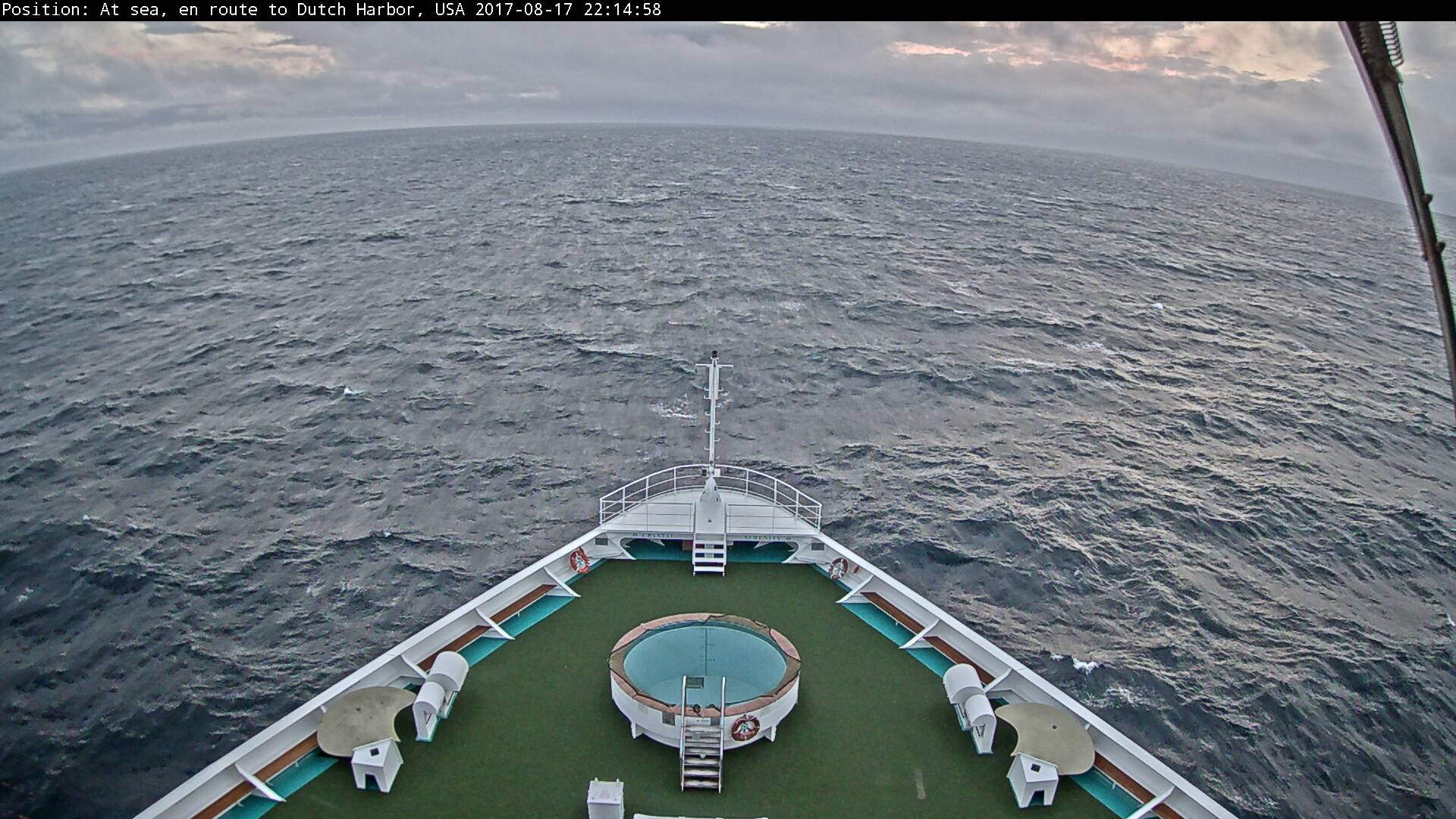
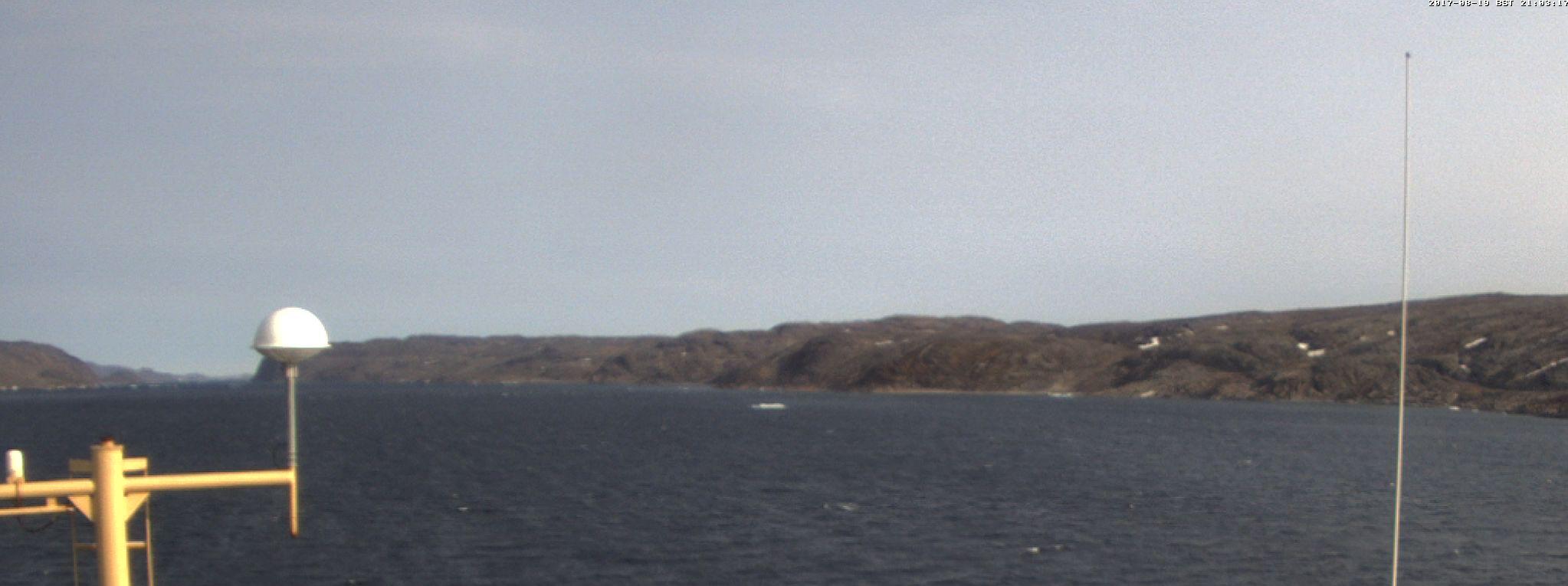
and although there is of course no sea ice to be seen yet her forward facing webcam reveals Dutch Harbor as her next port of call:
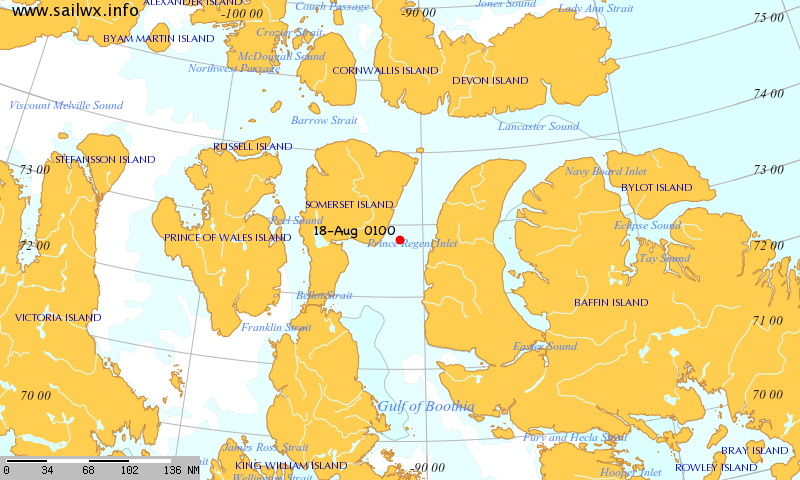
Much like last year, it looks as though the British icebreaker Ernest Shackleton is on its way to assist her:
Having an icebreaker in attendance might well prove to be essential this year, since, according to the Canadian Ice Service, Larsen Sound is currently still full of sea ice:
[Edit – August 21th]
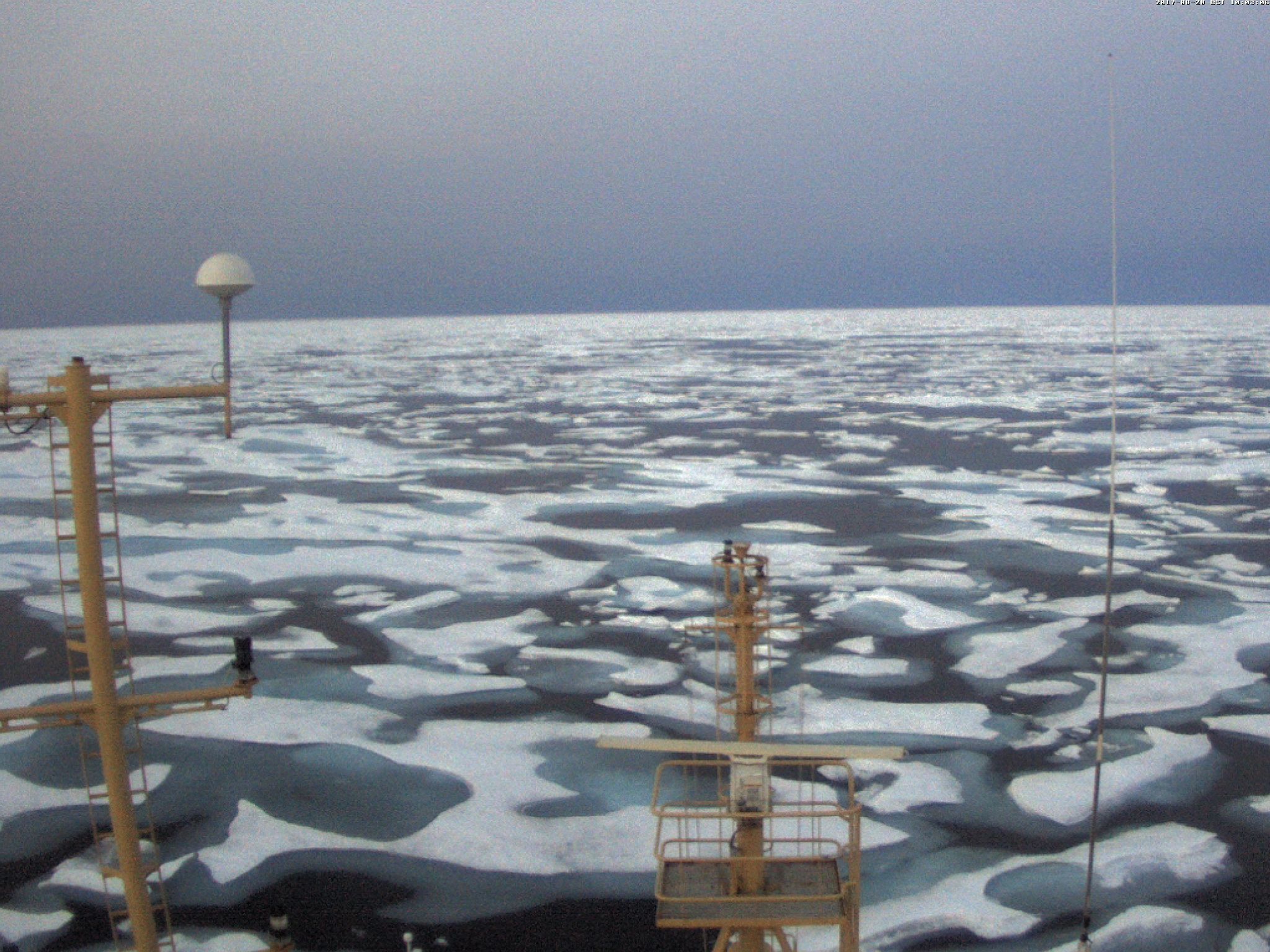
Heading westwards to meet Crystal Serenity, this is what met the RRS Ernest Shackleton in Franklin Strait:
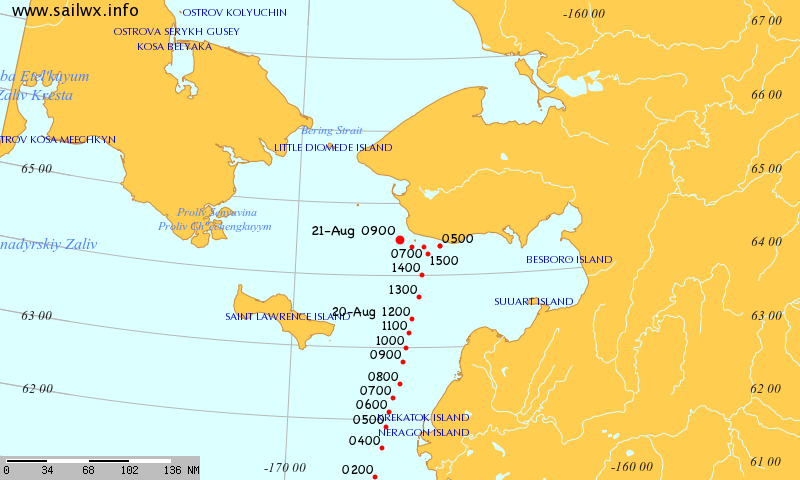
Meanwhile Crystal Serenity is about to pass through the (ice free!) Bering Strait:
[Edit – August 29th]
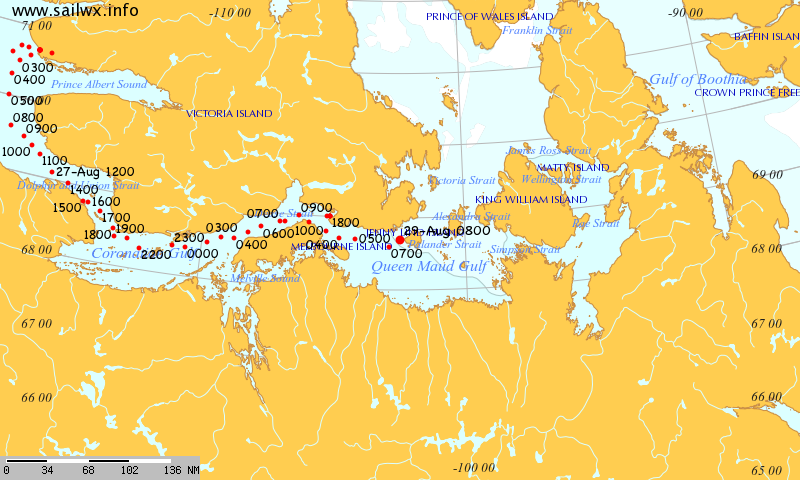
Crystal Serenity is now heading through Queen Maud Gulf:
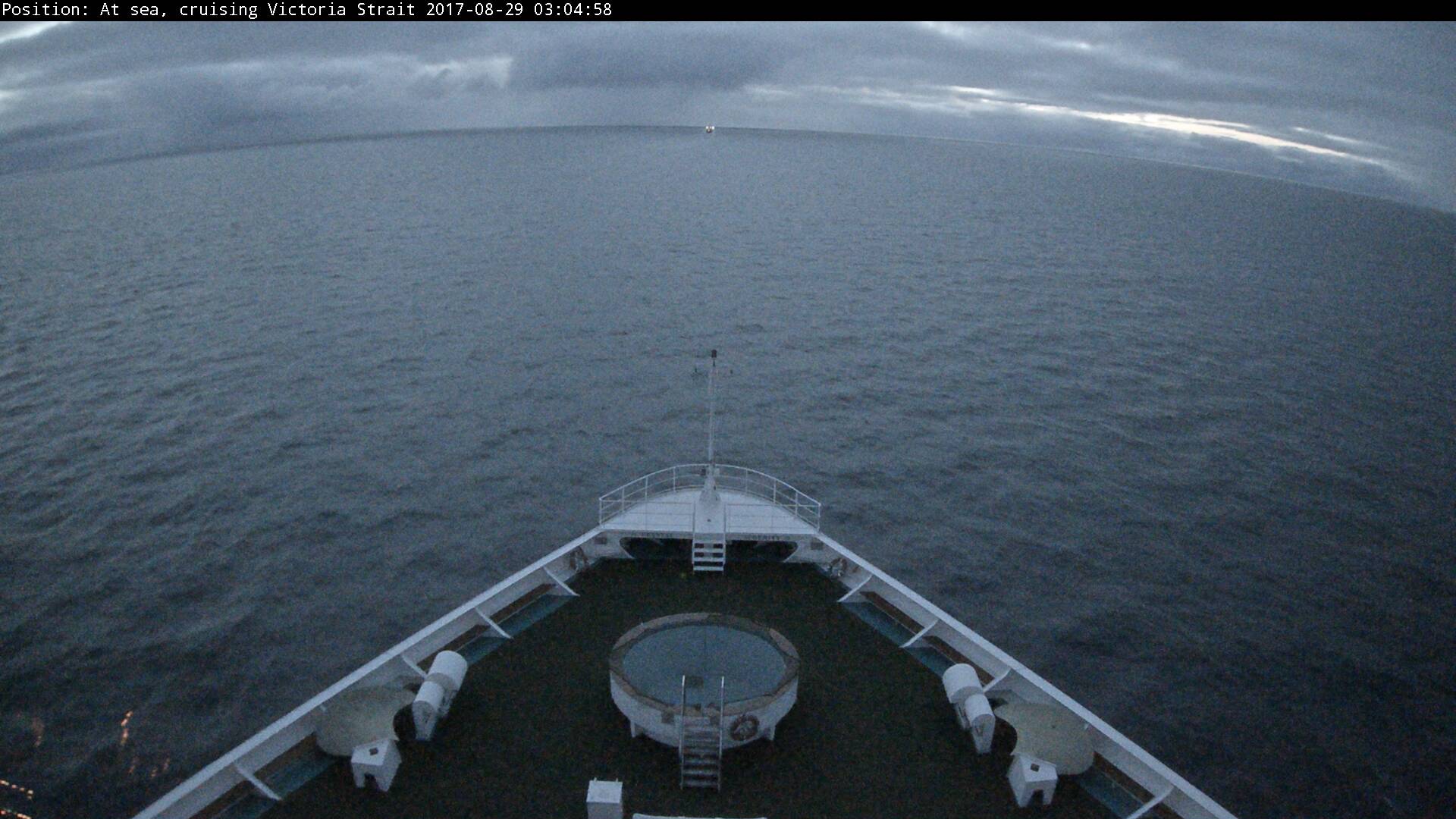
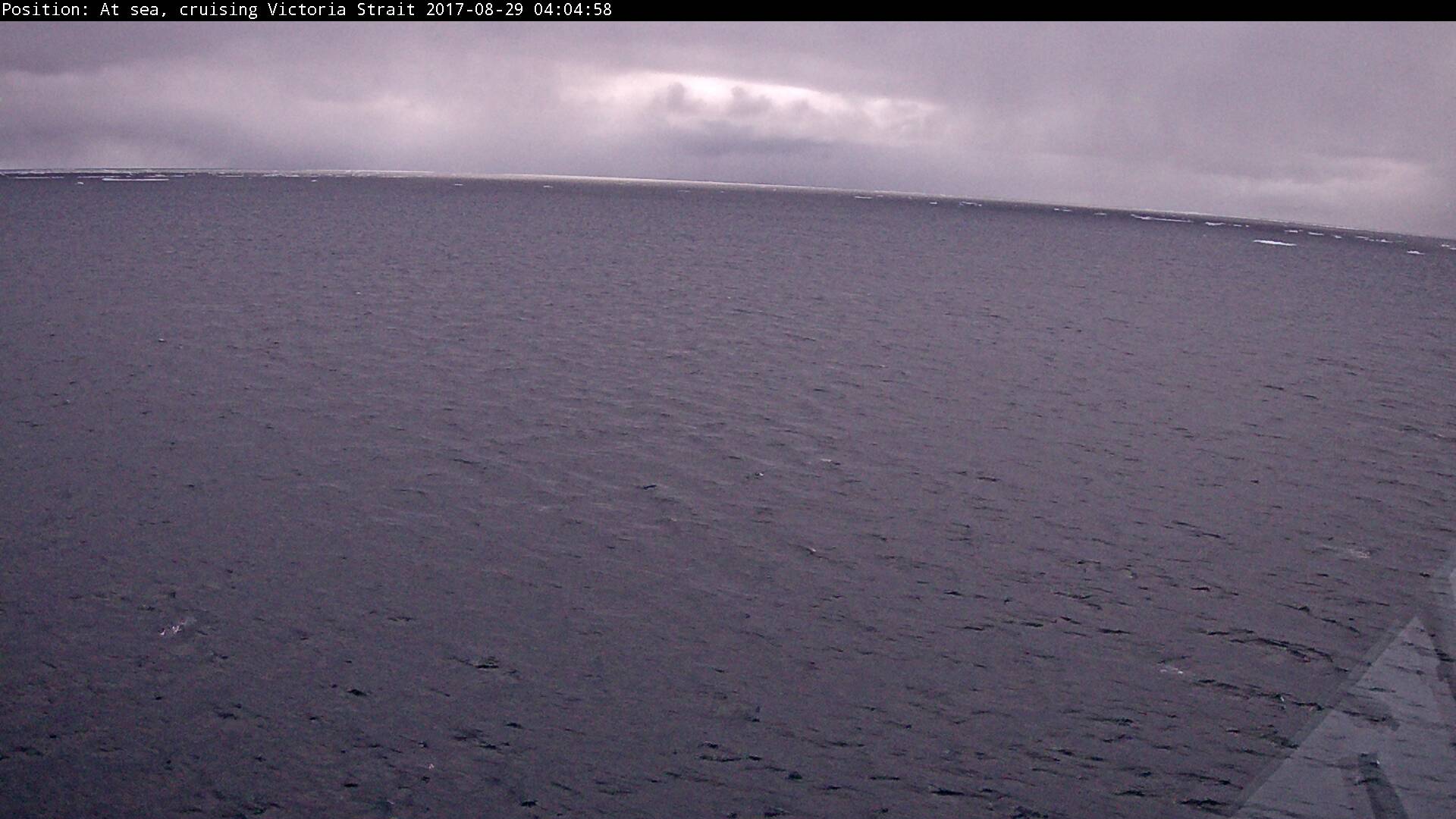
but there is as yet no sign of any sea ice:
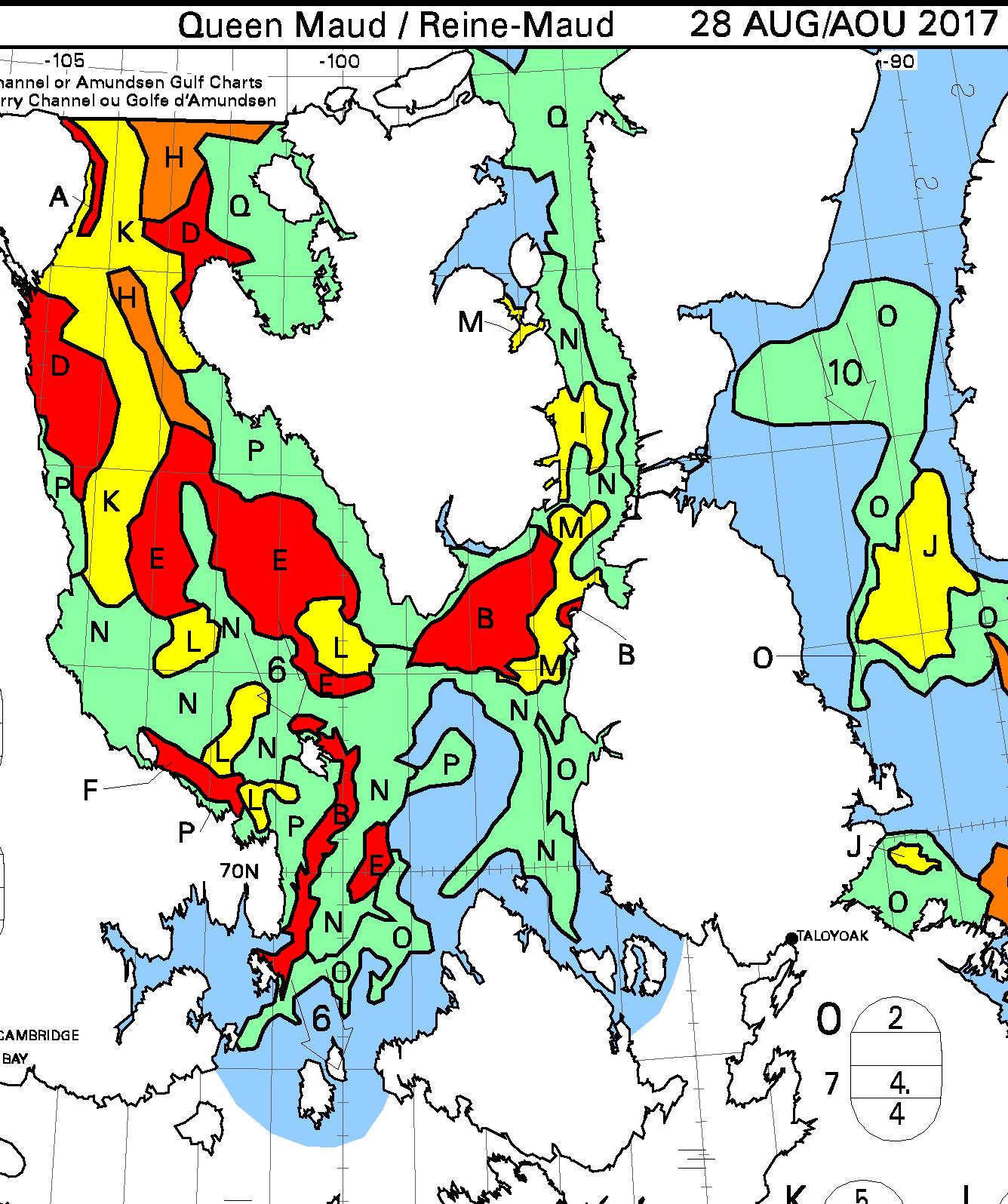
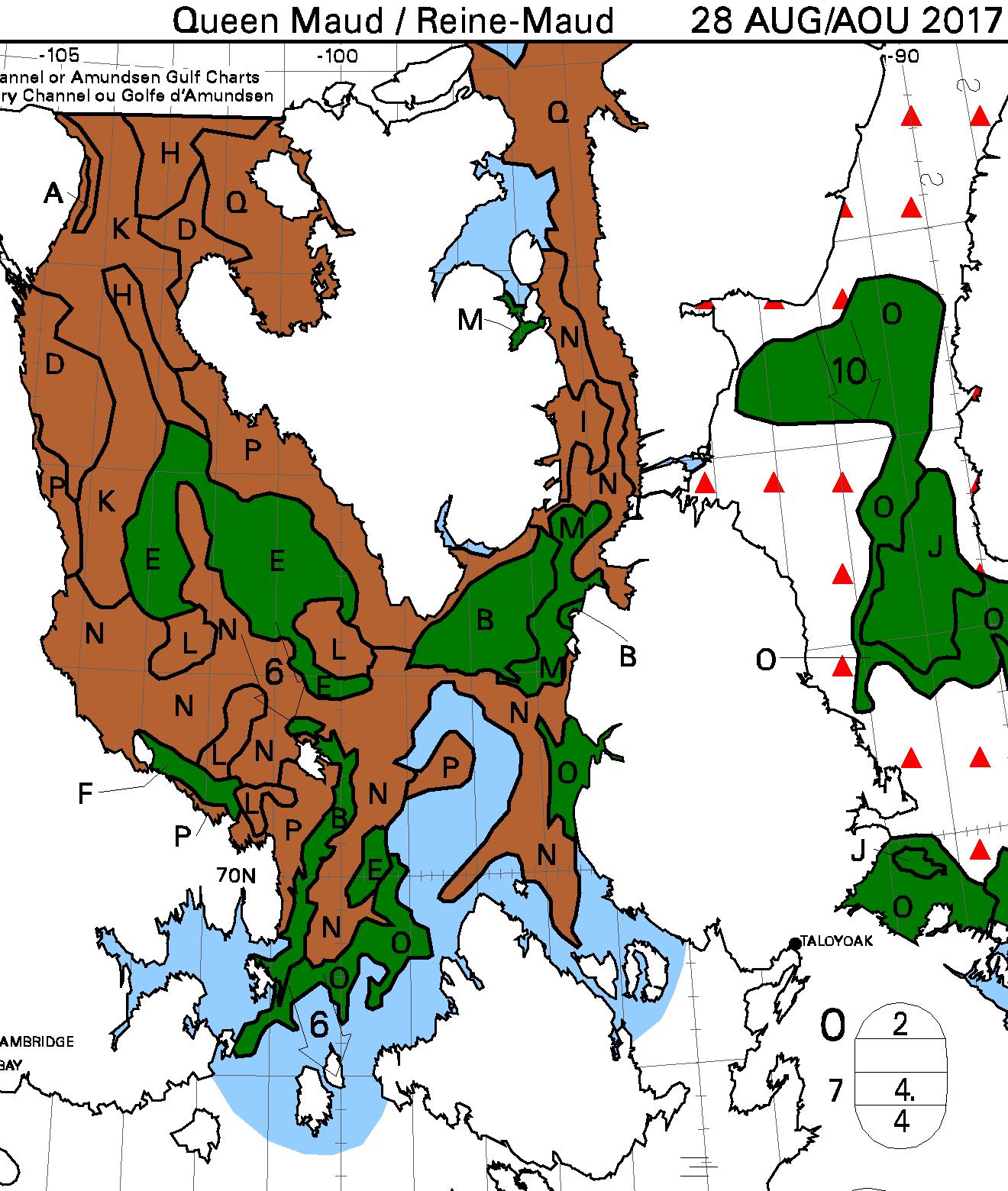
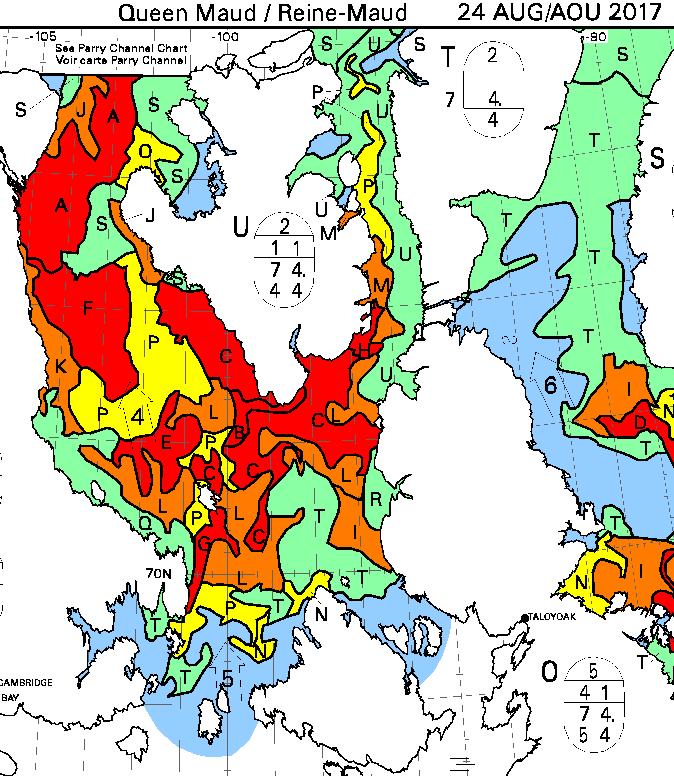
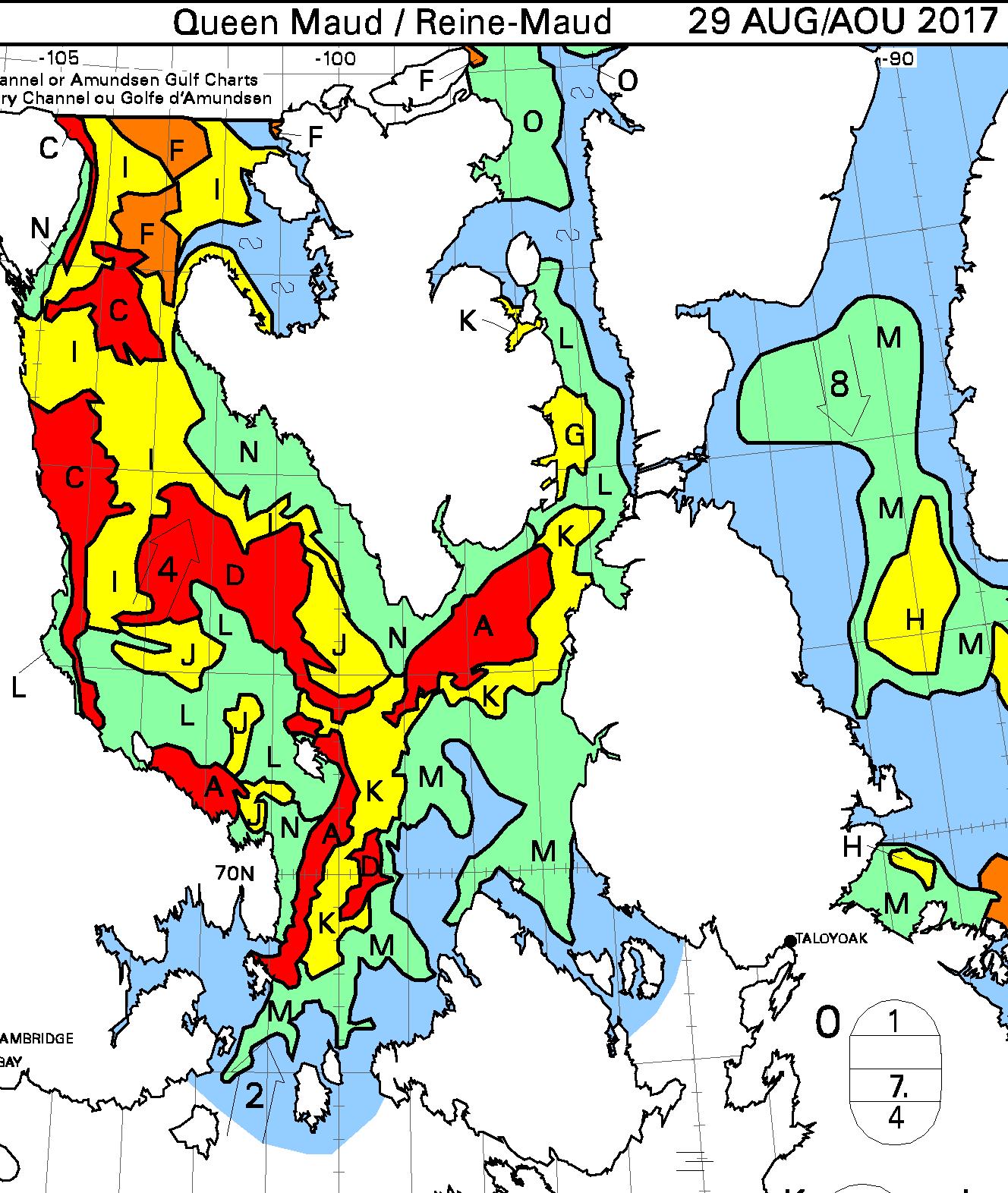
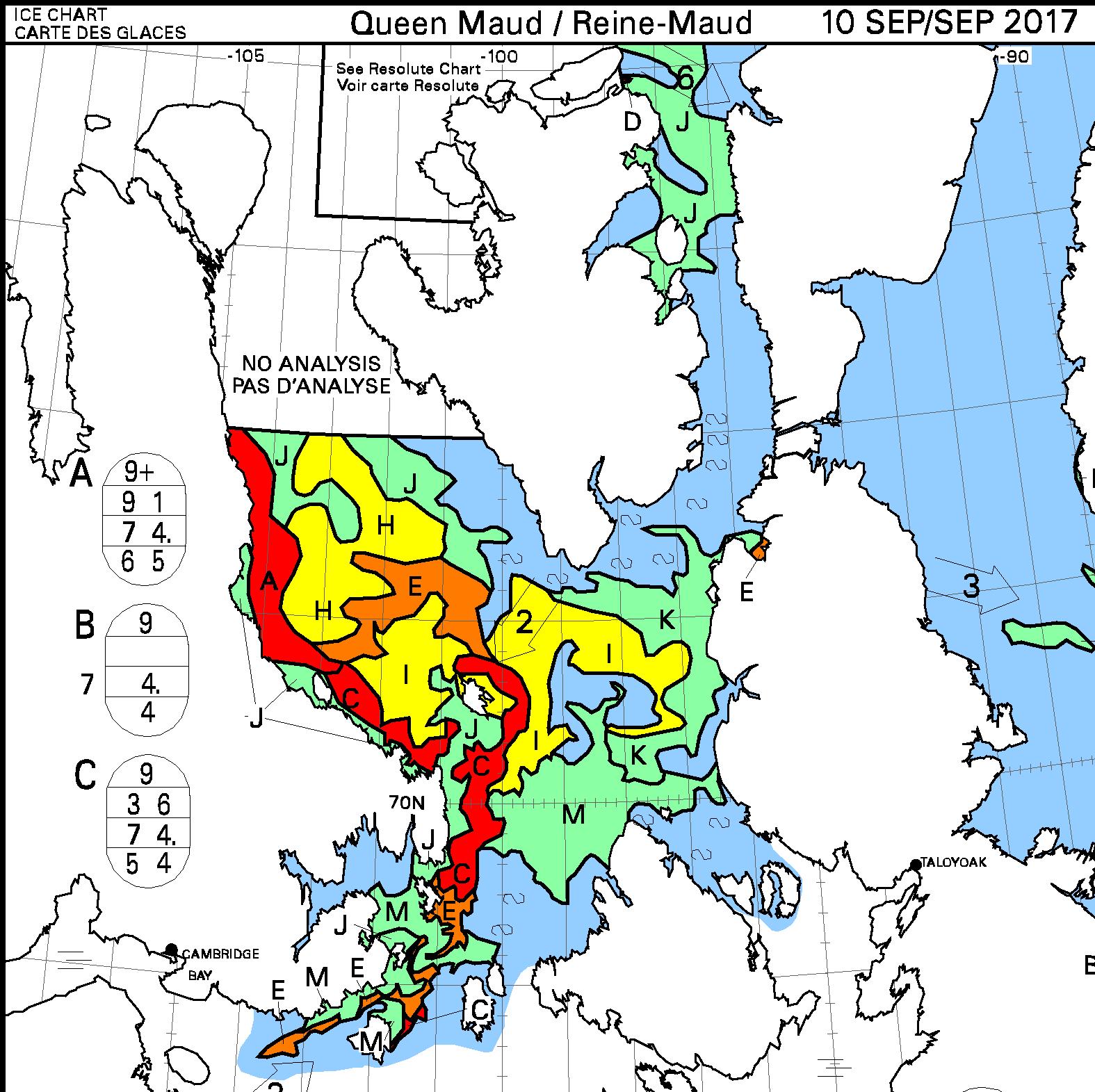
However some should come into view later today. Here are the latest Canadian Ice Service sea ice charts of the area:
[Edit – August 29th 11:30]
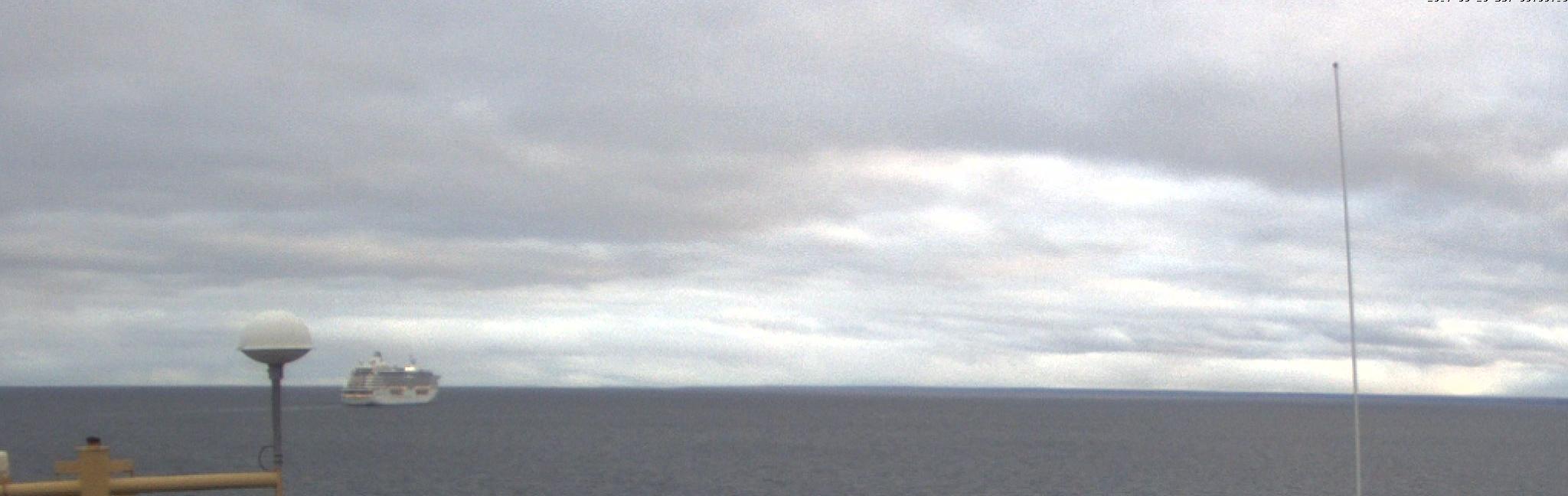
Crystal Serenity has spotted some sea ice!
[Edit – August 29th 17:30]
Crystal Serenity and Ernest Shackleton are well in amongst the ice now, as are the former’s passengers:
[Edit – August 30th]
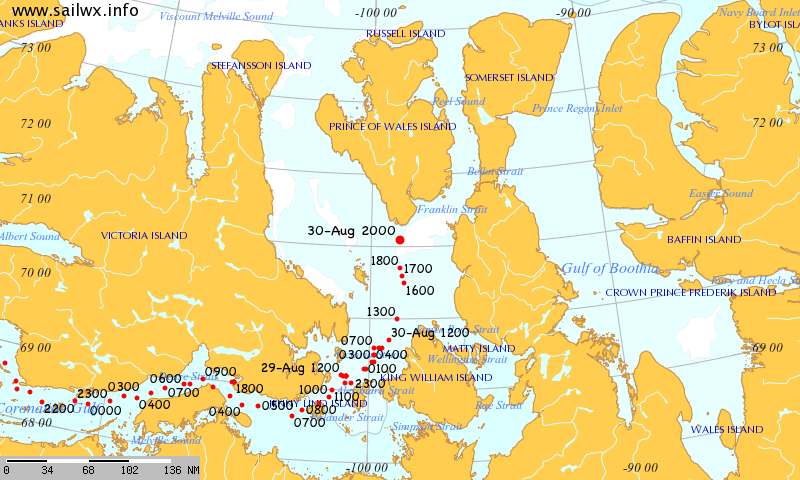
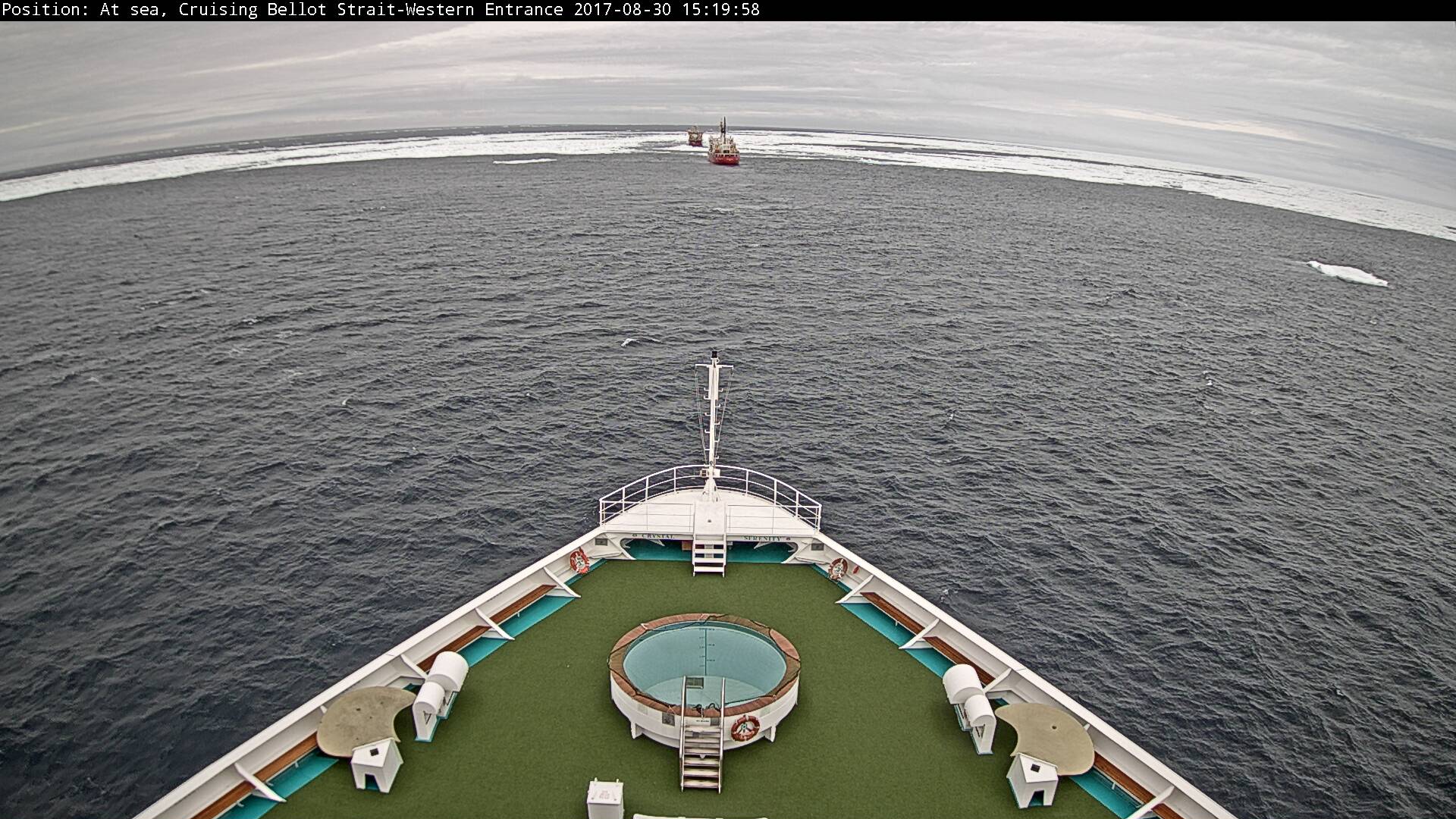
Crystal Serenity is now entering the Franklin Strait in the wake of TWO icebreakers:
Arctic explorer Pen Hadow trekked, and swam, from Ward Hunt Island to the North Pole in 2003. Solo and unsupported. He plans to return to the North Pole this summer, but on this occasion he’ll be sailing with a few companions. According to yesterday’s Sunday Times:
Pen Hadow launches bittersweet mission to sail to North Pole
For his new record attempt, Hadow and his nine-strong team will take two yachts on a 3,500-mile round trip from Nome in Alaska to the pole, using satellites to find a route through the ice and avoid getting stuck. He will fly to Alaska to join his team members on Saturday.
If all goes to plan, he will arrive at the pole between August 15 and early September, about 510 miles further north than anyone has sailed before.
Although the Sunday Times failed to mention it the expedition has a web site of its own. According to the Arctic Mission “About” page:
Arctic Mission sets off from Nome in Alaska (USA) in the first week of August. The expedition team will not see land again for six weeks. We will cover about 3,500 miles by the time they return to harbour at Nome in mid-September.
Our two 50 foot yachts, Bagheera and Snow Dragon II, are specially built to sail in waters with sea ice, and the four skippers, two on each boat, are exceptionally experienced in polar seas, and with navigation and safety procedures in sea ice.
The Arctic Mission team intend to do lots of science during their attempt to reach the Pole:
Our expedition is going to explore, discover and share the stories of the spectacular marine wildlife – plants, animals and even bacteria – that lives around the North Pole. Be prepared to be surprised!
We’ll also be doing essential scientific studies and sharing this information, so that our international policy-makers can decide how best to #protect90North.
The more we explore this unexplored ocean, the better we will understand how it works, which means we can make the best decisions to protect it for the benefit of everyone for ever.
We’ve met the two yachts in question before. In 2015 Bagheera and Snow Dragon II both successfully negotiated the Northwest Passage. However this voyage will be far more difficult. During their attempt to sail to the North Pole in the summer of 2013 Sébastian Roubinet and Vincent Berthet had to be rescued by the Russian icebreaker Admiral Makarov when the Central Arctic refreeze set in earlier than originally anticipated. Unlike the ice skating catamaran Babouchka, Bagheera and Snow Dragon II both have engines which will certainly help avoiding a similar fate. In addition perhaps the sea ice in the Arctic is less of an obstacle than it was in 2013? In an interview with the BBC World Service on Sunday Pen pointed out that:
Now 40% of the international waters around the North Pole, what we call the Central Arctic Ocean, are open water in the summer time.
When asked:
Do you think you’ll actually achieve this goal then?
Pen replied:
I think it’s quite possible, with the assistance of a US agency that have satellites that are going to be helping us each day pick the best route through these ever narrowing cracks, and it’s quite possible that we’ll reach the North Geographic Pole.
I also trust that the Arctic Mission team will be keeping a close eye on the Arctic weather forecast over the next month or so. Last August the crew of the yacht Northabout feared for their lives when caught in an Arctic cyclone in a sheltered anchorage on the Northern Sea Route. There is no such safe haven anywhere near the North Pole.
Pen concluded his BBC interview as follows:
If we can produce a visual image of a sail boat at 90 degrees north I think that could become an iconic image of the challenge that the twenty-first century faces. Are we serious about running this planet, which is actually what we need to start doing, and it’s biophysical resources on a sustainable basis, or are we just here for a laugh?
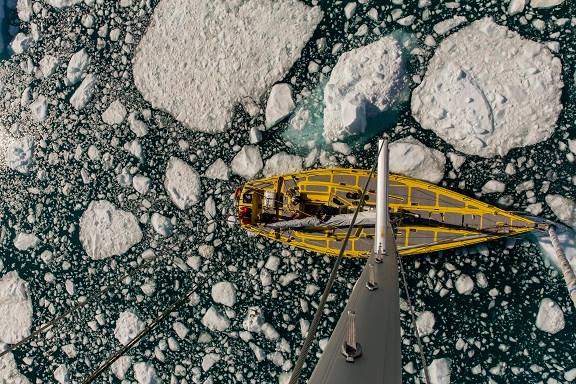
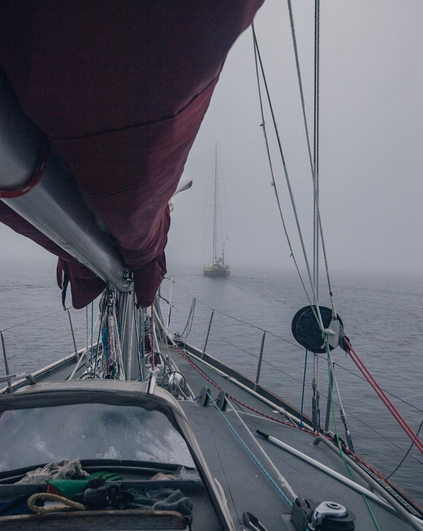
We wish him and the Arctic Mission team well. Watch this space for further updates, and possibly that iconic visual image! Meanwhile here’s a picture of Bagheera in the Northwest Passage in 2015:
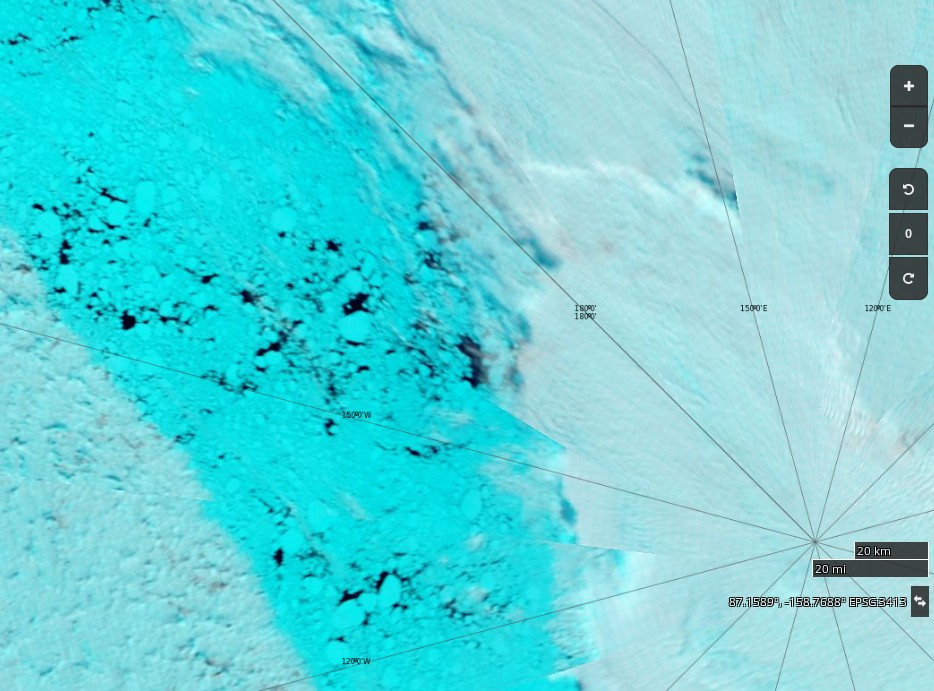
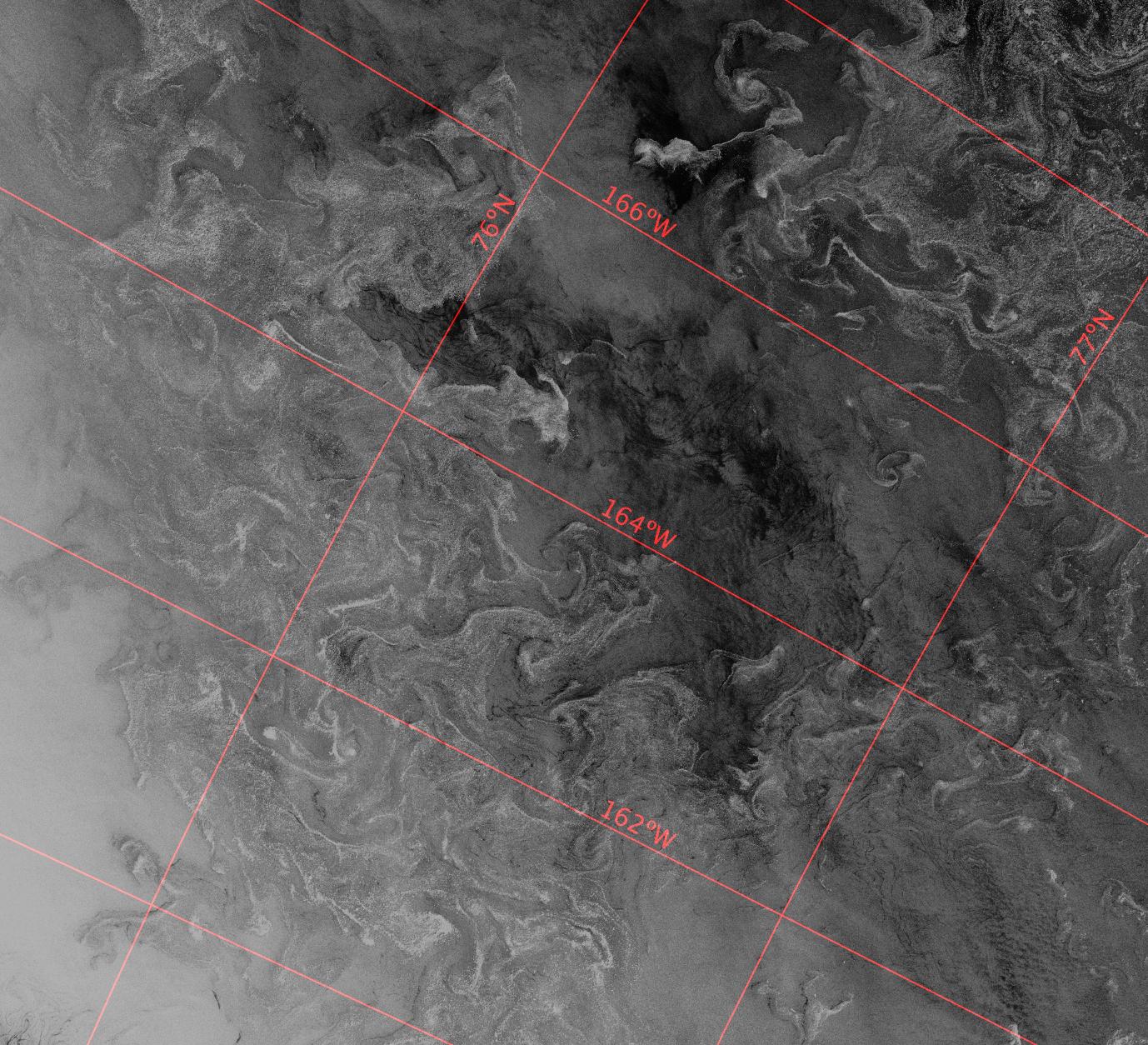
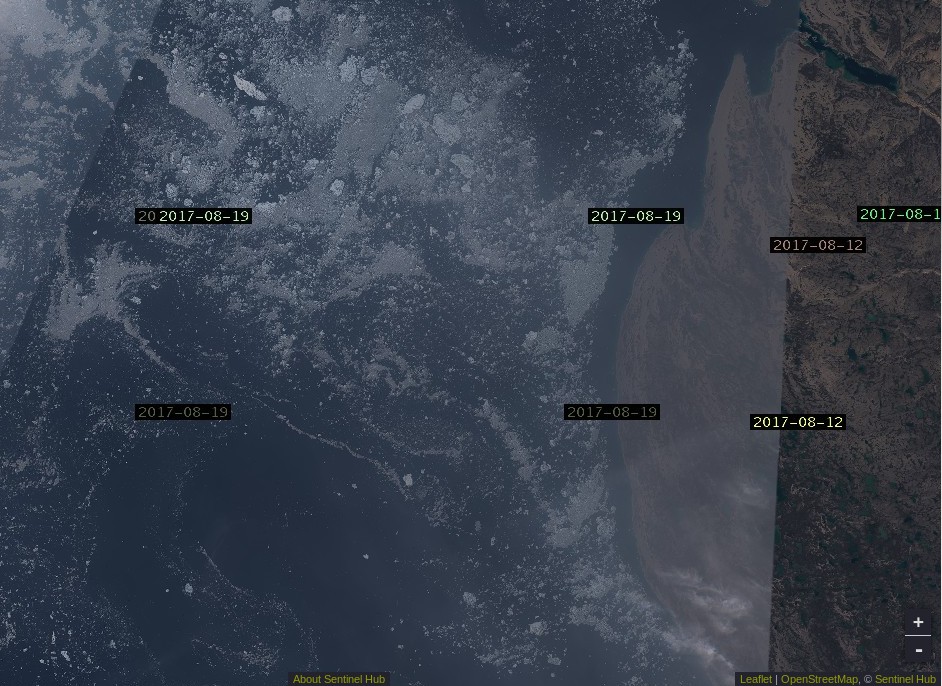
plus an image from the Sentinel 1B satellite of the current state of the Arctic sea ice on the direct route from Nome to the North Pole:
Sentinel 1B image of Arctic sea ice at 86N, 180W on July 24th 2017
There don’t seem to be many “narrow cracks” just yet.
[This] brings us to the summer of 2016, and an idea I was mulling over. A rather Big Idea. Had the deterioration of the Arctic sea ice got to a point where switching from Spring-time sledge-hauling to Summer-time sailing was appropriate? In my solo journey from northern Canada to the North Geographic Pole in 2003, I had spent over 30 hours swimming open water stretches, out of the total 850 hours spent hauling my sledge while walking on skis across the sea ice. It had dawned on me then that global warming was the likely cause of so much open water. Since then, it has become highly unlikely that the ski route from northern Russia to the Pole will be done again, due to the absence of sea ice for most of the year off the Severnaya Zemlya island group. And the other classic route from northern Canada no longer has an aircraft operation to provide the necessary support for sea ice expeditions, due to the worsening quality of the sea ice. Both routes have now been lost to the Arctic Ocean’s fast-changing environment. And with this change, the Arctic Ocean with its hitherto frozen summer surface is now rapidly becoming open-access to surface vessels for the first time in human history.
Would it be possible to sail a small yacht to the Pole? Could that create a useful platform to share the unfolding situation with a global audience? Might this be the best way I could focus world attention on the merit of creating a new marine reserve in the international waters surrounding the North Pole?
It looks like we’re just about to find out the answer to those questions. The team have also announced another livestream from Nome, Alaska. This one is scheduled for 8 PM BST tomorrow, Thursday August 10th. They say:
Ahead of our Friday departure (weather permitting – there’s a nasty storm brewing over the Bering Strait that may prove problematic) we’d love to introduce you to the Arctic Mission team.
This is probably what they are referring to:
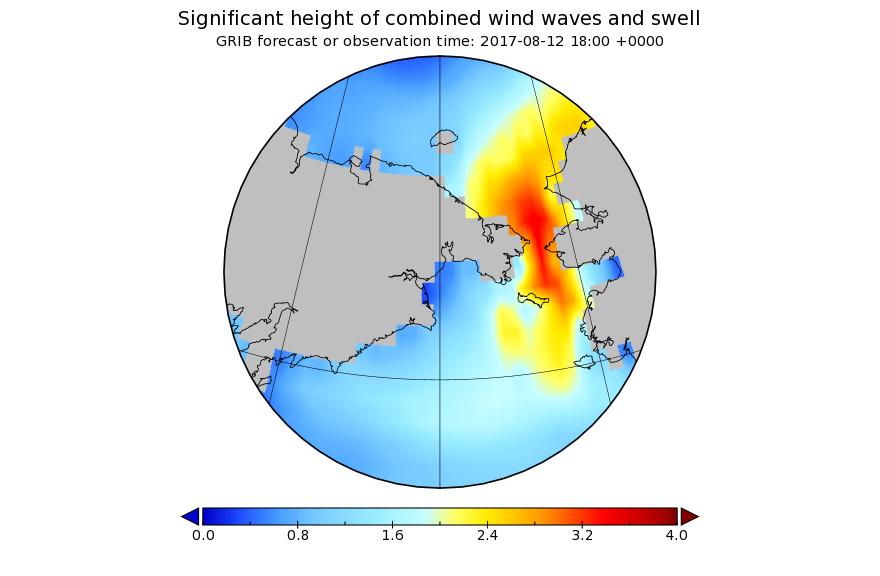
A bumpy ride for Pen Hadow et al. is in store on Saturday, and some big waves for Utqiaġvik (Barrow as was) as well.
[Edit – August 13th]
An overly brief and (hence?) rather misleading article in the Sunday Times today. According to Jonathan Leake:
Sailing to North Pole will have to wait
Pen Hadow, the British explorer, is today due to start a sailing expedition across the Arctic Ocean to highlight the effects of climate change, including an attempt to reach the North Pole.
Scientists warned, though, that despite the rapid melting of the ice there was unlikely to be access to the North Pole via open water for some years.
Professor Mark Serreze, director of America’s National Snow and Ice Data Centre, said the North Pole was still surrounded by nearly 800 miles of solid pack ice as of last week.
Jonathan appears not to have a particularly good grasp of sea ice (thermo)dynamics during the latter stages of the summer melting season!
NASA Worldview “false-color” image of the North Pole on August 13th 2017, derived from the MODIS sensor on the Terra satellite
Whilst waiting for the waves in the Bering Strait to die down Conor McDonnell, Arctic Mission’s photographer, has recorded a video from the top of Bagheera’s mast, amongst other places:
[Edit – August 14th]
According to Pen Hadow Bagheera and Snow Dragon II will set sail in the small hours of tomorrow morning (UTC):
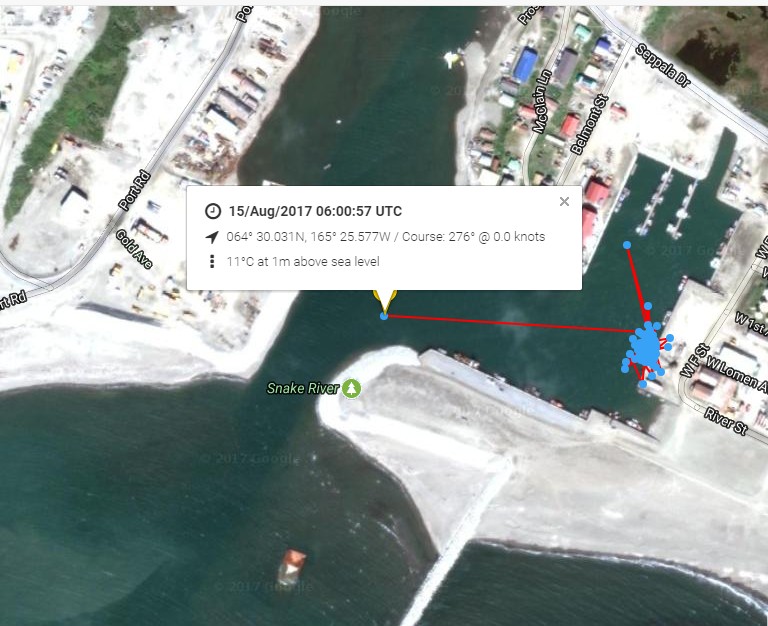
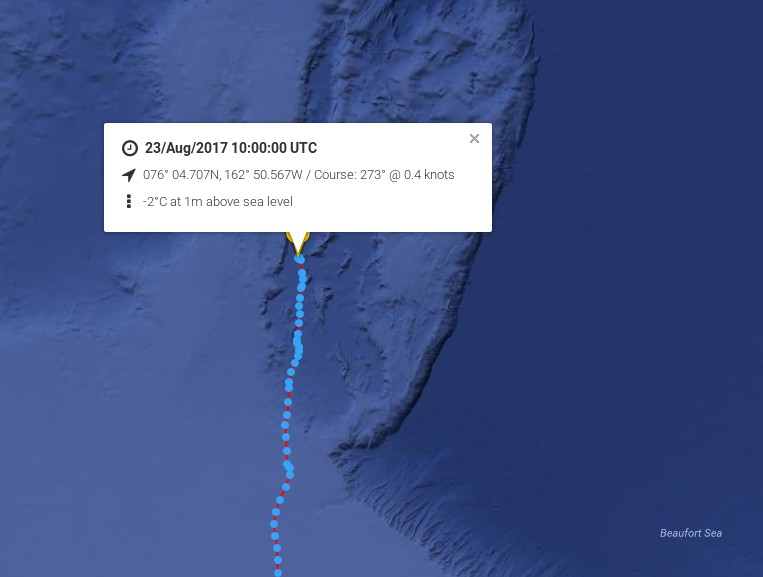
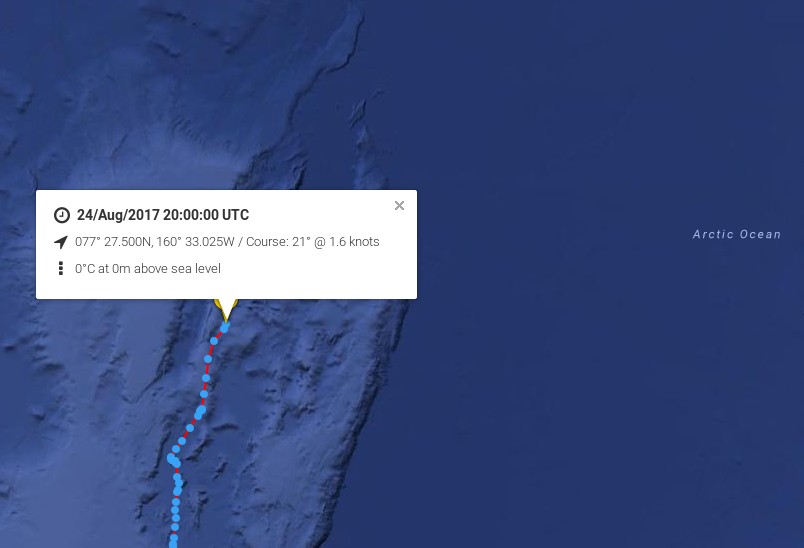
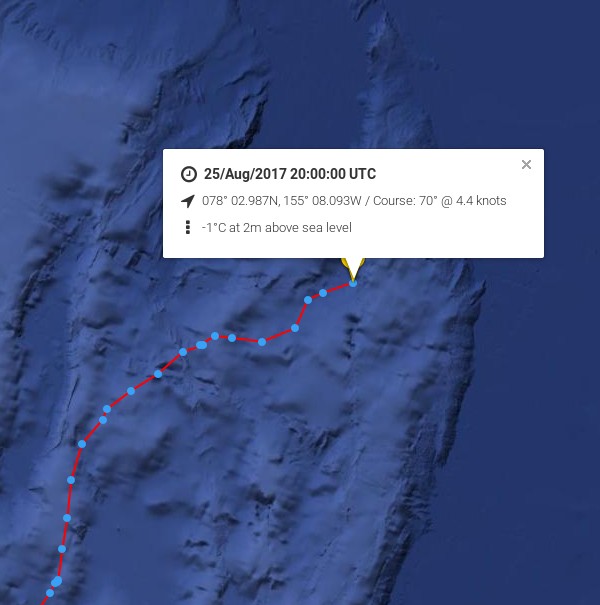
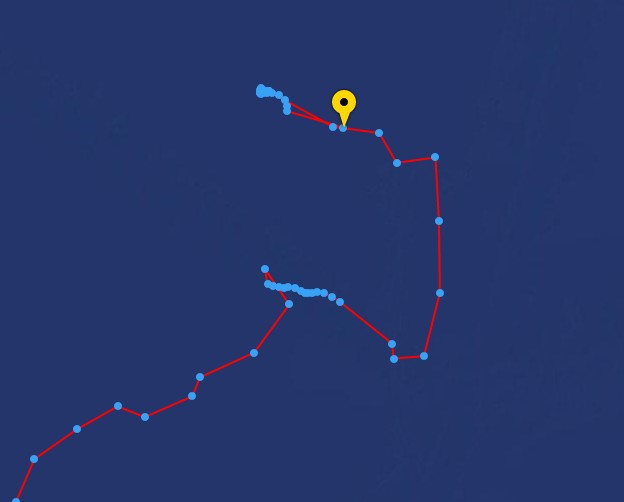
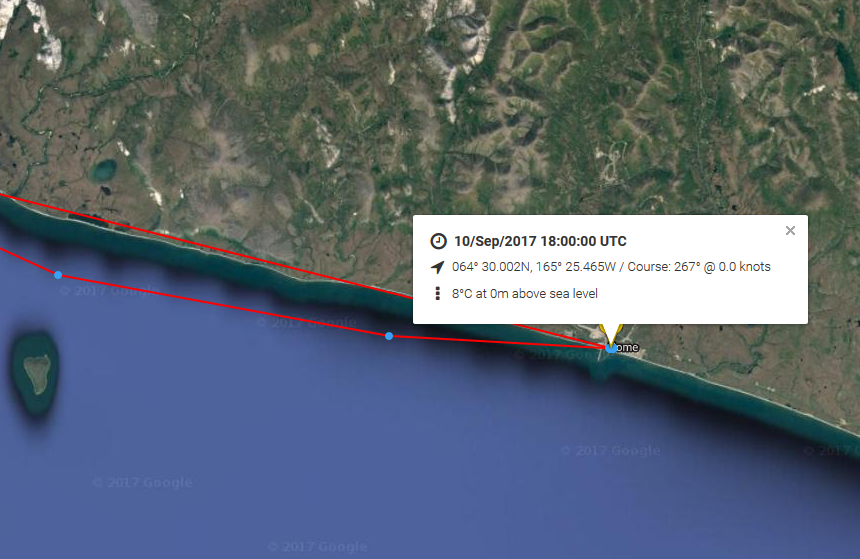
The Arctic Mission live tracking map is operational at last. Here is what it reveals so far:
It looks as though Bagheera and Snow Dragon II left Nome on their voyage of discovery at 06:00 UTC this morning.
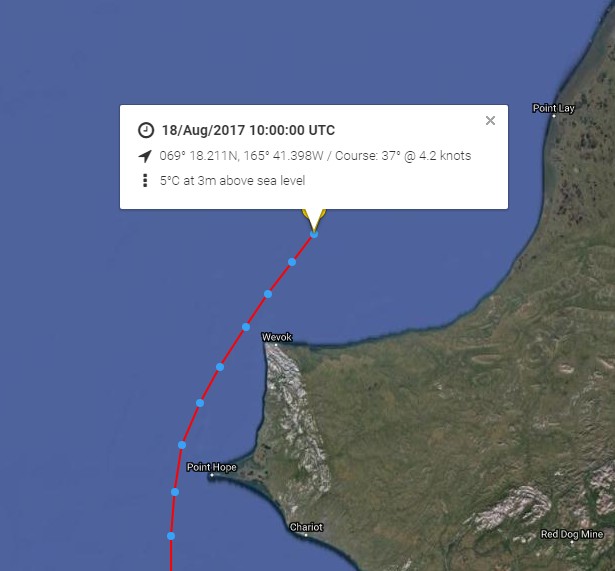
[Edit – August 18th]
Point Hope is now behind the Arctic Mission team:
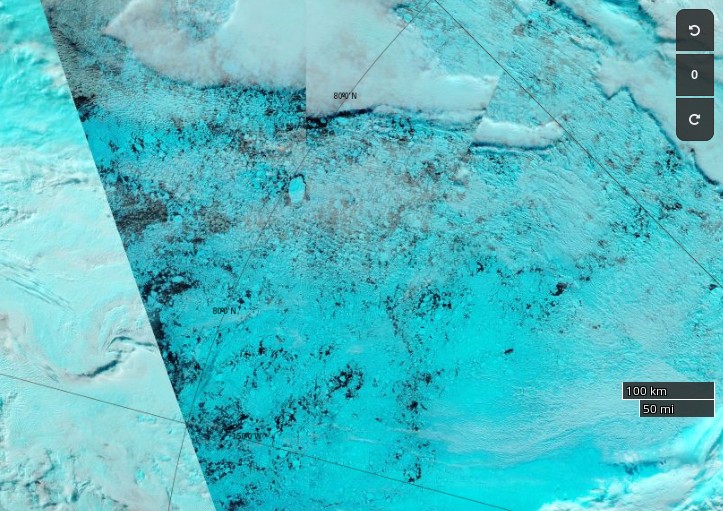
Next is Point Lay. Much further north, there are significant gaps appearing in the sea ice up to around 83N:
NASA Worldview “false-color” image of the Central Arctic north of the Beaufort Sea on August 18th 2017, derived from the MODIS sensor on the Terra satellite
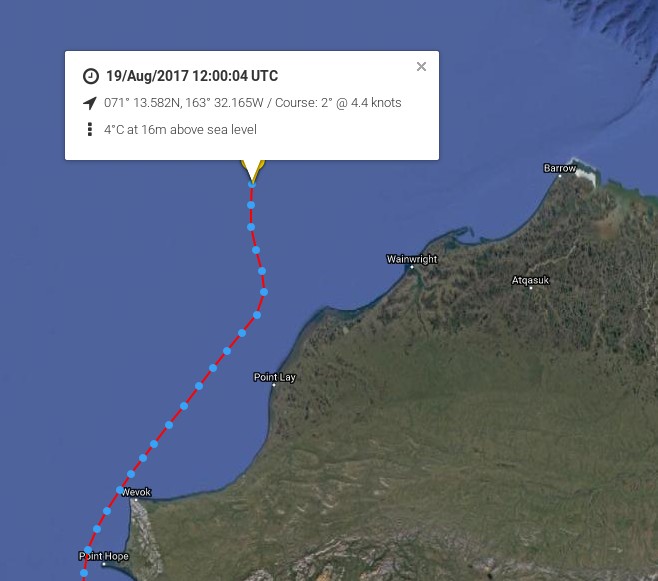
[Edit – August 19th]
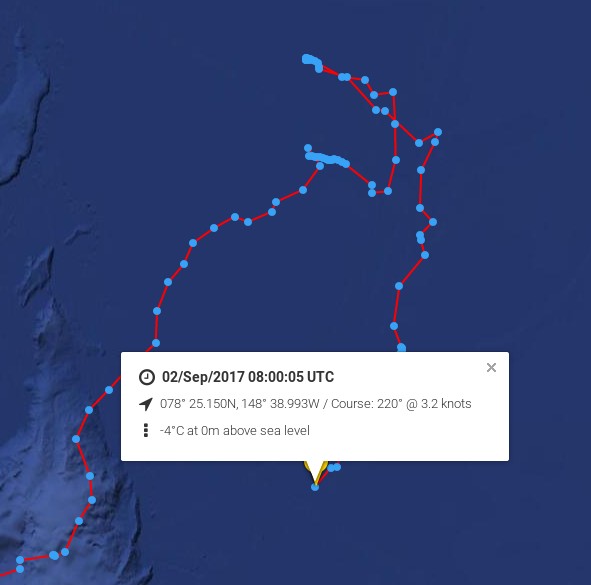
Bagheera and Snow Dragon II are obviously not heading for the Northwest Passage in 2017!
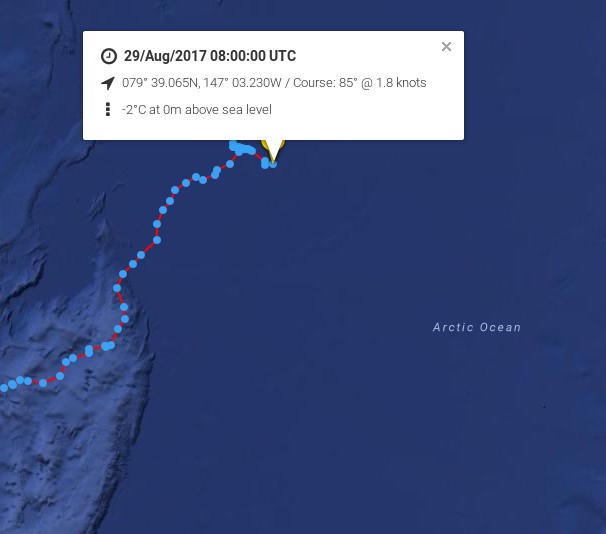
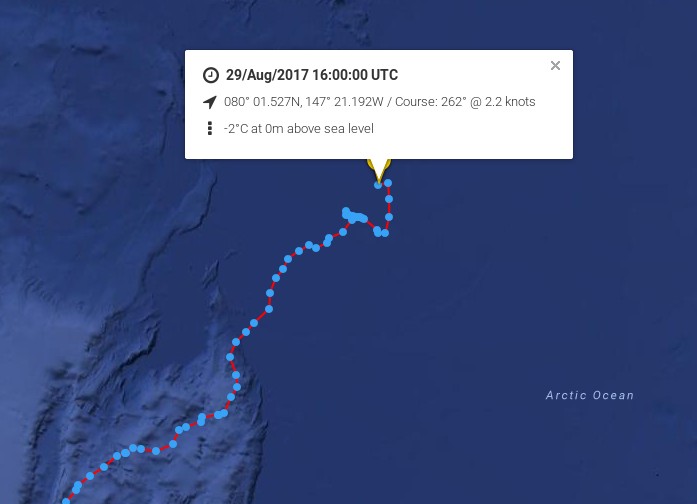
Arctic Mission’s furthest North was 80 degrees 10 minutes North, 148 degrees 51 minutes West, reached at 22:04:12 (Alaskan Time, GMT-9hours) on 29 August 2017 by yachts, Bagheera and Snow Dragon II.
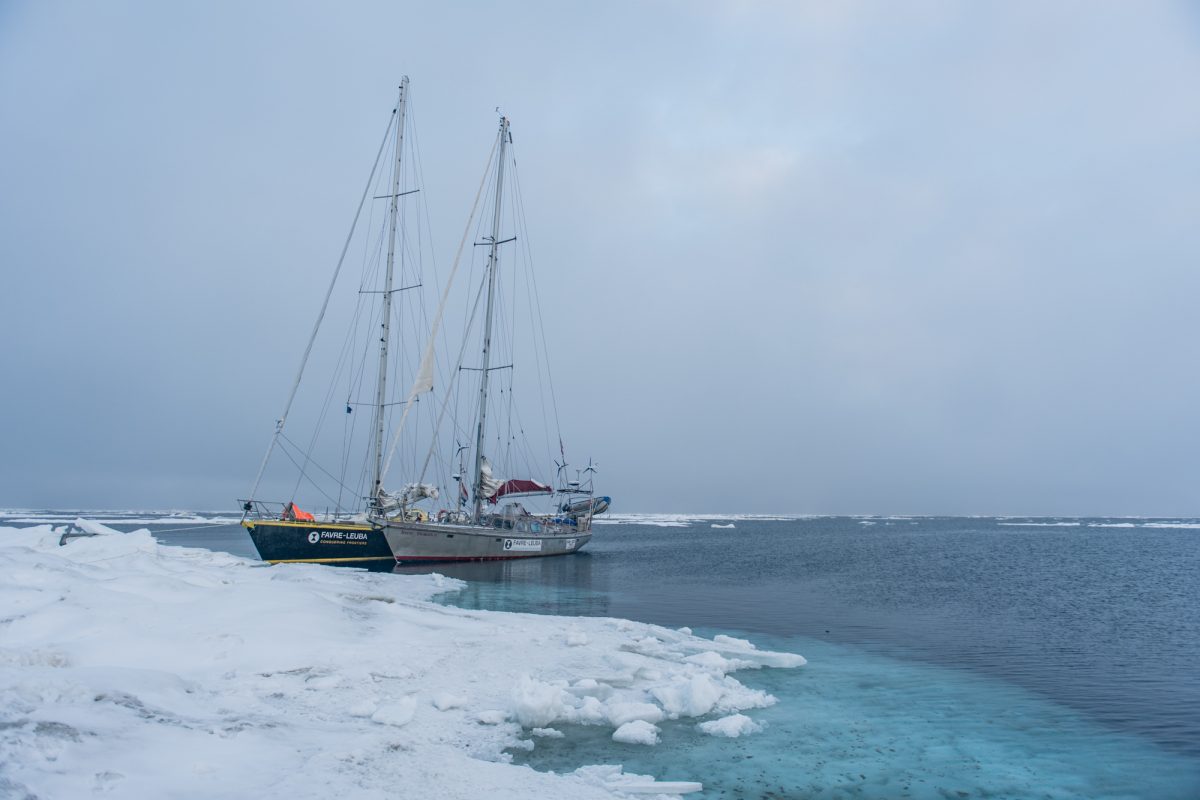
Arctic Mission moored its yachts to an ice floe on 29 August to conduct one of its 24-hour marine science surveys, while drifting with the sea ice. The strategy for any future northward progress had been to monitor the sea surface currents, sea ice, and weather conditions (both observed from the yachts and through satellites imagery downloaded onto our computers), and decide how to proceed as we approached the end of the 24-hour survey.
A meeting of the four skippers was held led by Erik de Jong, with Pen Hadow present, and it was agreed further northward progress would increase considerably the risks to the expedition, with very limited scientific reward. The decision to head south, back to an area of less concentrated sea ice in the vicinity of 79 degrees 30 minutes North, was made at 18.30 (Alaskan time).
Here’s the live tracking map from 06:00 UTC this morning:
A prudent and not unexpected decision. Cue the cackling from all the usual suspects?
[Edit – August 31st]
The cackling from all the usual suspects has indeed begun. It has even inspired a somewhat surreal modern art installation! Meanwhile according to their Twitter feed:
We are slowly making our way back to Nome now after reaching the northernmost point of our… https://t.co/GhrYYza6gk
The time has come to start speculating about if, and when, the Northwest Passage will become navigable for the host of small vessels eager to traverse it this summer. The west and east entrances are clearing early this year. Lancaster Sound and Prince Regent inlet already reveal only a few area of white amongst the deep blue open water:
NASA Worldview “true-color” image of Lancaster Sound and Prince Regent Inlet on July 8th 2017, derived from the MODIS sensor on the Aqua satellite
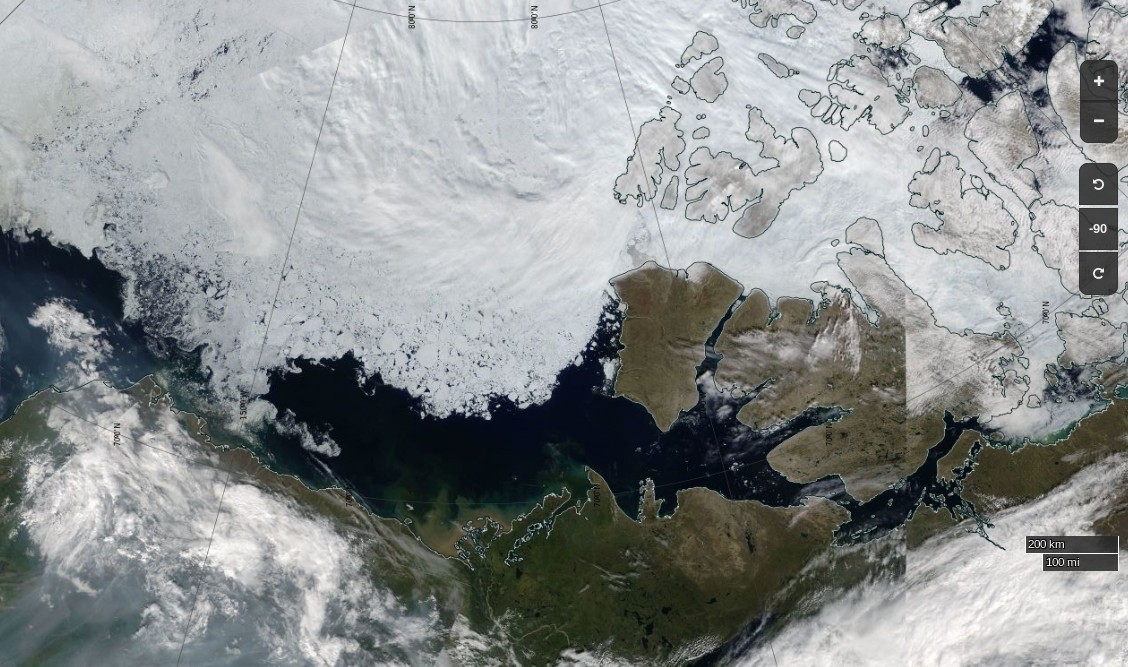
To the west the route is already opening up all the way from the Chukchi Sea to Cambridge Bay:
NASA Worldview “true-color” image of the Beaufort Sea on July 12th 2017, derived from the MODIS sensor on the Terra satellite
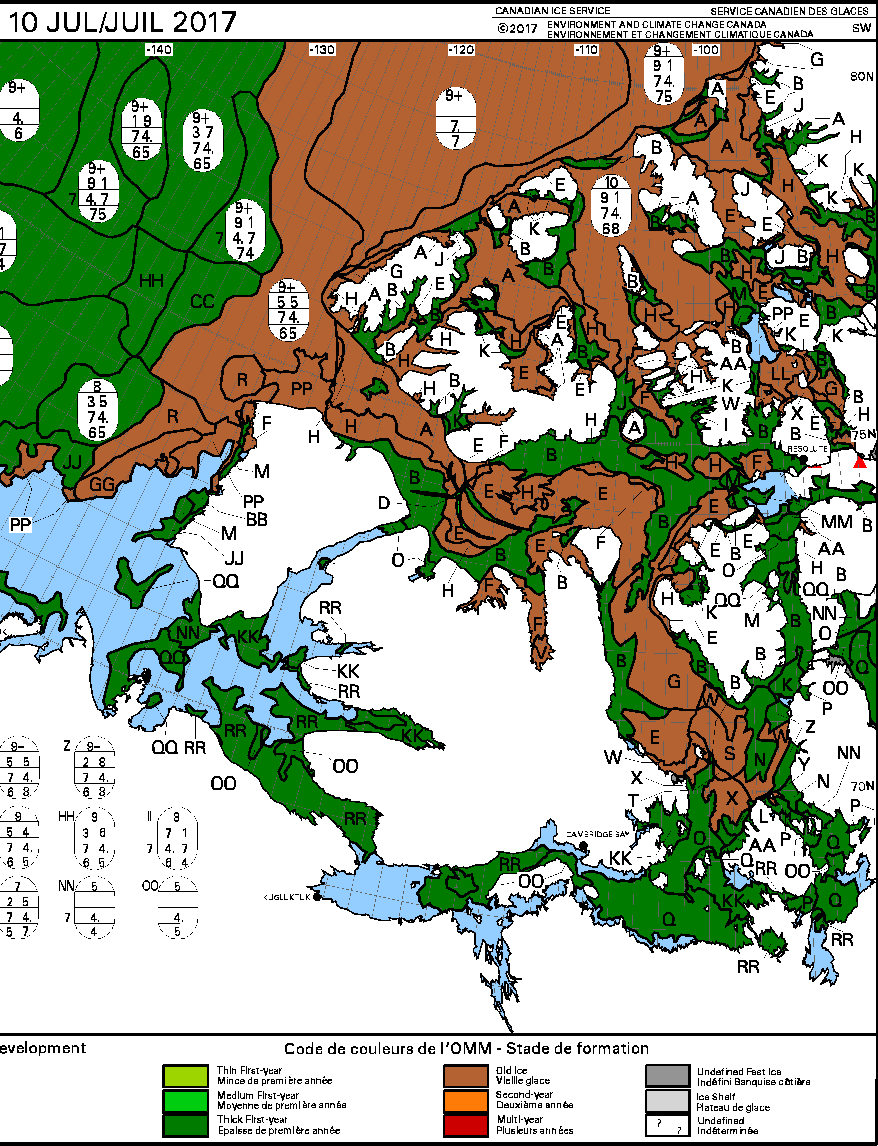
The problems on the southern route seem likely to arise in the central section this year, where far more old ice is present this year than in 2016:
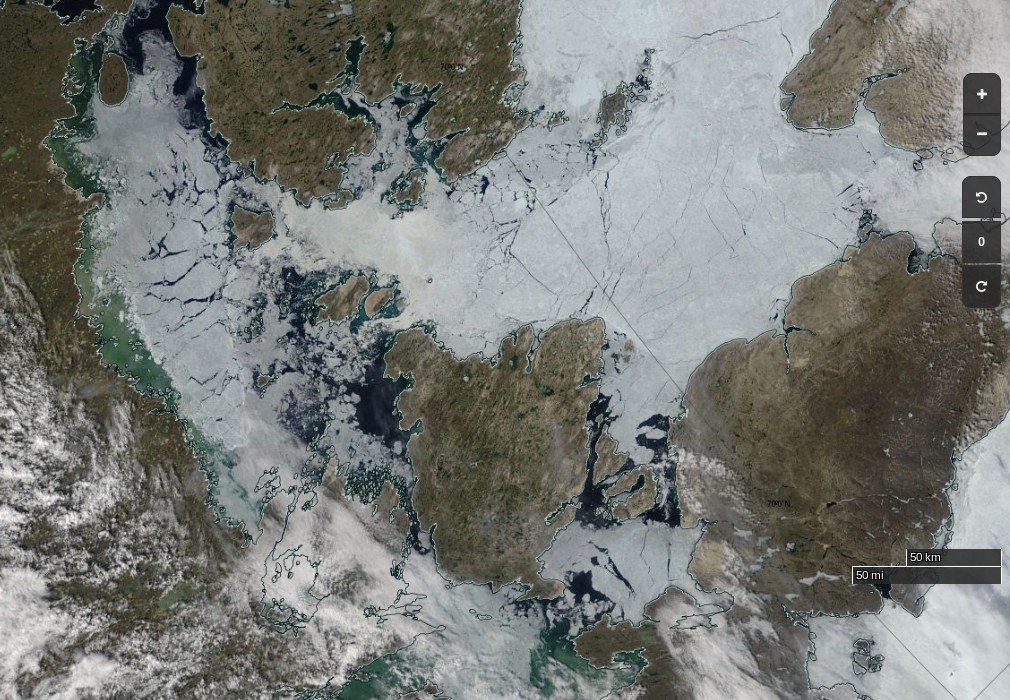
The remaining sea ice in Queen Maud Gulf doesn’t look like it will last long, but the ice in Victoria Strait and Larsen Sound is made of much sterner stuff:
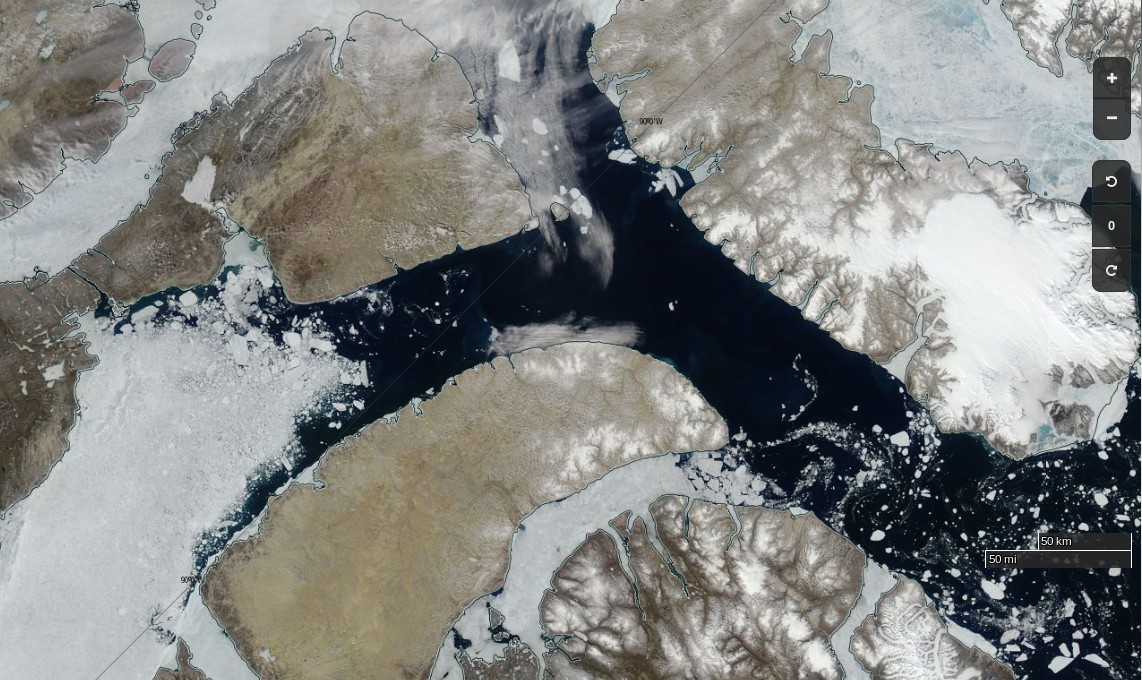
NASA Worldview “true-color” image of Victoria Strait and Larsen Sound on July 10th 2017, derived from the MODIS sensor on the Terra satellite
The cruise liner Crystal Serenity is anticipating navigating those waters once again this year, on August 29th. However much smaller craft are already heading for the Northwest Passage. Celebrate and Alkahest are already sailing north along the west coast of Greenland. Meanwhile Yvan Bourgnon is due to depart Nome, Alaska tomorrow, sailing his catamaran single handed in the opposite direction.
The crew of the Coast Guard Cutter Maple, a 225-foot seagoing buoy tender home ported in Sitka, Alaska, departed [July 12th] on a historic voyage through the Northwest Passage.
This summer marks the 60th anniversary of the three Coast Guard cutters and one Canadian ship that convoyed through the Northwest Passage. The crews of the U.S. Coast Guard Cutters Storis, SPAR and Bramble, along with the crew of the Canadian ice breaker HMCS Labrador, charted, recorded water depths and installed aids to navigation for future shipping lanes from May to September of 1957. All four crews became the first deep-draft ships to sail through the Northwest Passage, which are several passageways through the complex archipelago of the Canadian Arctic.
The crew of the cutter Maple will make a brief logistics stop in Nome, Alaska, to embark an ice navigator on its way to support marine science and scientific research near the Arctic Circle. The cutter will serve as a ship of opportunity to conduct scientific research in support of the Scripps Institution of Oceanography.
The Maple crew will deploy three sonographic buoys that are used to record acoustic sounds of marine mammals. A principal investigator with the University of San Diego embarked aboard the cutter will analyze the data retrieved from the buoys.
The Canadian Coast Guard Ship Sir Wilfrid Laurier will rendezvous with the Maple later this month to provide icebreaking services as the Maple makes it way toward Victoria Strait, Canada. The Maple has a reinforced hull that provides it with limited ice breaking capabilities similar to Coast Guard 225-foot cutters operating on the Great Lakes.
There doesn’t seem to be any up to date tracking information for the Maple, but CCGS Sir Wilfrid Laurier has recently arrived off Utqiaġvik (Barrow as was):
[Edit – August 18th]
Another article by Chris Mooney in the Washington Post includes this image of the eastern entrance to Bellot Strait on August 11th:
According to Chris:
After we’d passed through safely, Claude Lafrance, the ship’s commanding officer, took some time to explain how the strait worked with the help of a navigational chart. In the process, he lent credence to some of the observations made by Larsen over 70 years ago, while also explaining how modern knowledge has made navigating it safe with a proper tidal understanding.
The essence is that depending on when you are in Bellot Strait, the waters can be flowing either westward or eastward at and around high or low tide, respectively. So timing your crossing makes a great deal of difference.
The danger is that if you’re coming from the west (as we were) with the current to your back, you can be moving too fast, and have difficulty steering your vessel as you approach rocks at the end of the strait.
“We always want to go through where it’s more difficult, with the current against you, because it’s a lot easier to control the movement of your ship,” Lafrance said.
Therefore, the two-hour wait was quite intentional: The CCGS Amundsen stayed put until the tide began to shift and the waters to flow back westward, in effect neutralizing the current. Then the ship steamed out easily. “We just passed at the ideal time to go through,” Lafrance said.
Here’s Sentinel 2A’s view of what he should expect to see in Larsen Sound after emerging at the other end:
[Edit – August 21st]
From the RRS Ernest Shackleton in Franklin Strait or thereabouts:
[Edit – August 22nd]
From the C3 expedition, also in the Franklin Strait area by the look of things:
Yesterday, we broke through ice that was two metres thick. Thank you to the Canadian Ice Service for ensuring our safe passage! #CanadaC3pic.twitter.com/2nCgalwPOo
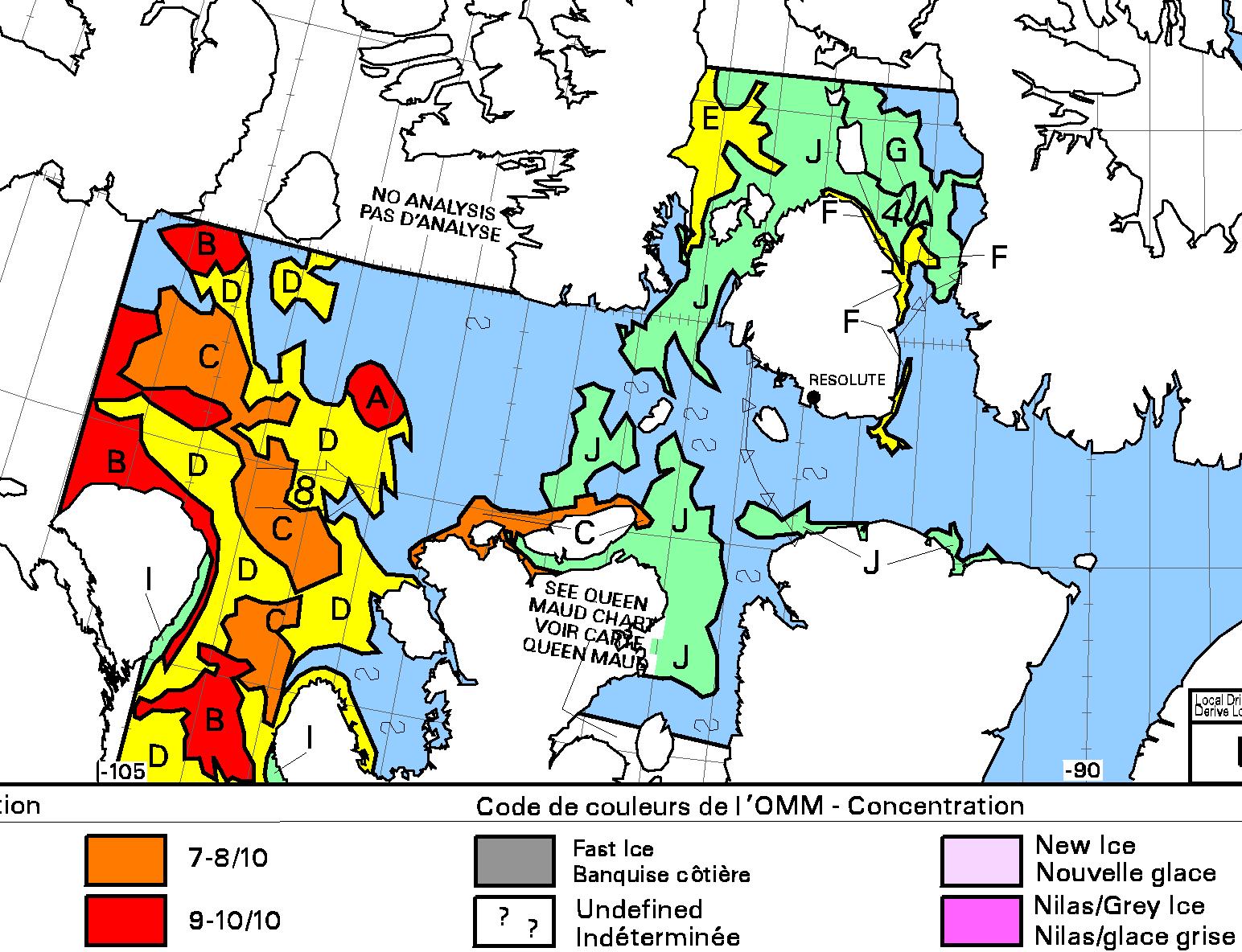
The latest CIS ice chart reveals a circuitous route via McClintock Channel that is ALMOST <= 6/10 concentration. Meanwhile Larsen Sound is still refusing to open up for the imminent arrival of the Crystal Serenity:
[Edit – August 27th]
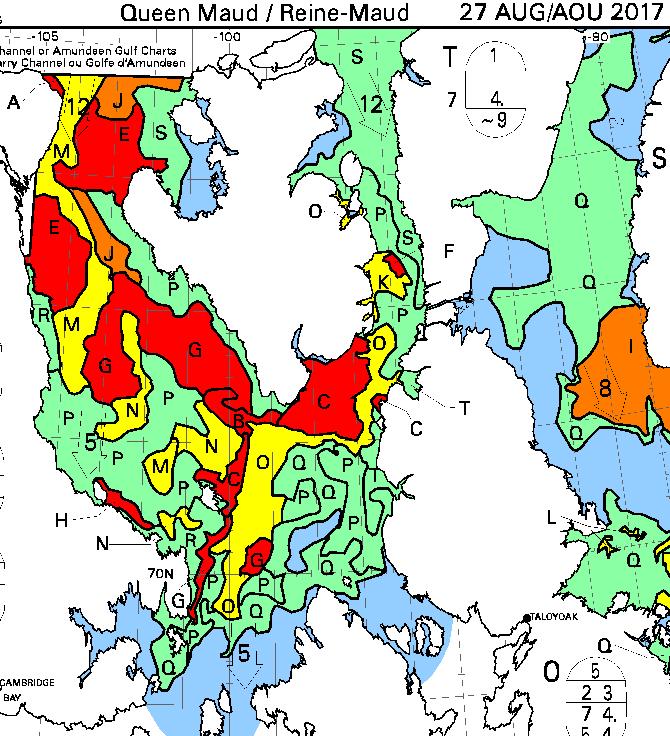
At long last the CIS concentration map reveals a <= 6/10 concentration path along the entire southern route via Bellot Strait:
[Edit – August 29th]
It is now possible to squeeze through Roald Amundsen’s route through the Northwest Passage without encountering over 6/10 concentration sea ice:
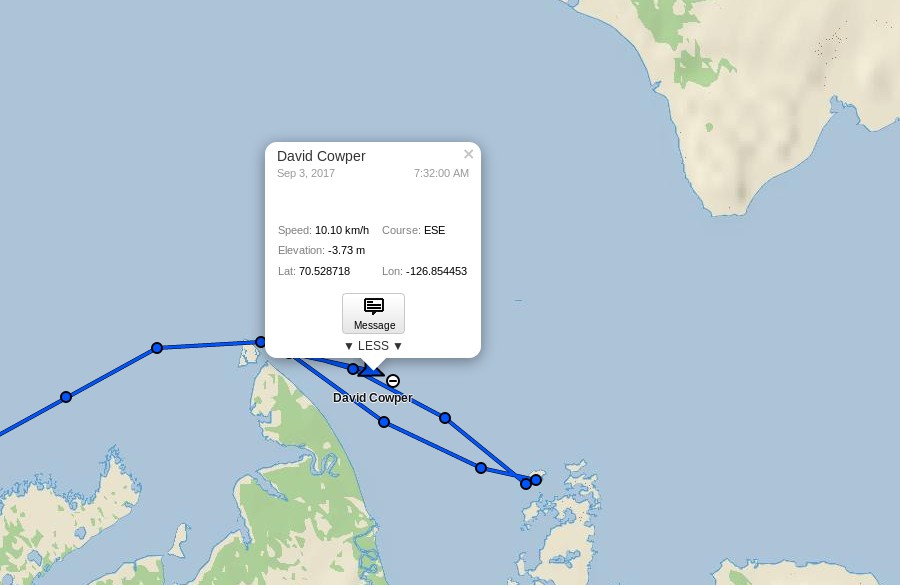
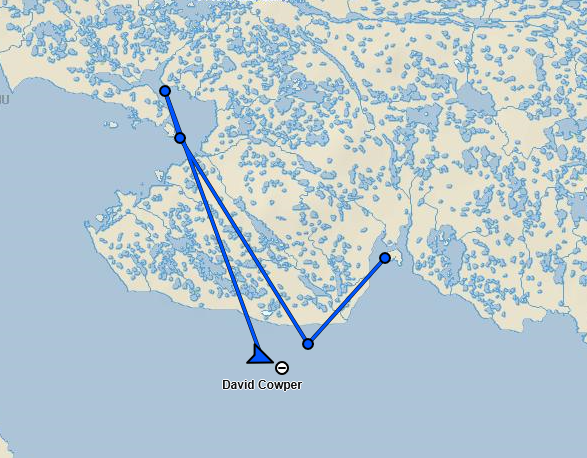
David Scott Cowper sought shelter for Polar Bound in the welcoming arms of Booth Island for a couple of days. Now they’re off again and have taken another close look at Cape Bathurst, but which route will they take now?
[Edit – September 10th]
David Scott Cowper has left Cambridge Bay in Polar Bound and is heading east:
An experienced team of polar explorers set off on April 4th intending to ski from a latitude of 88° North to 90° North, better known as the North Pole!
According to the expedition’s web site those 2 degrees of latitude are symbolic of the United Nations Framework Convention on Climate Change agreement in Paris to “hold the increase in the global average temperature to well below 2 °C above pre-industrial levels”, and are thus part of the expedition’s name.
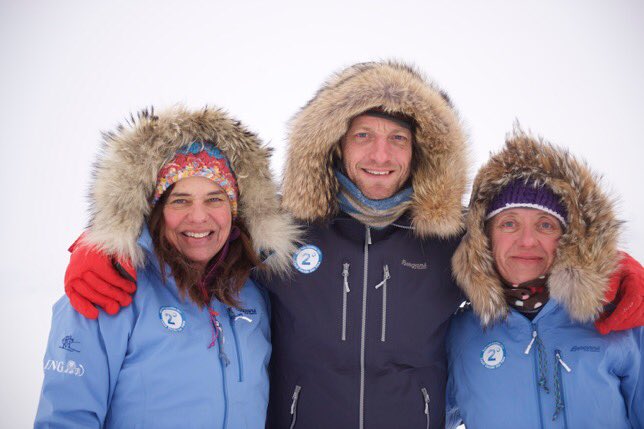
Here’s the team of Bernice Notenboom, Martin Hartley and Ann Daniels pictured shortly before departing on their arduous journey via the Russian Barneo ice camp near the North Pole:
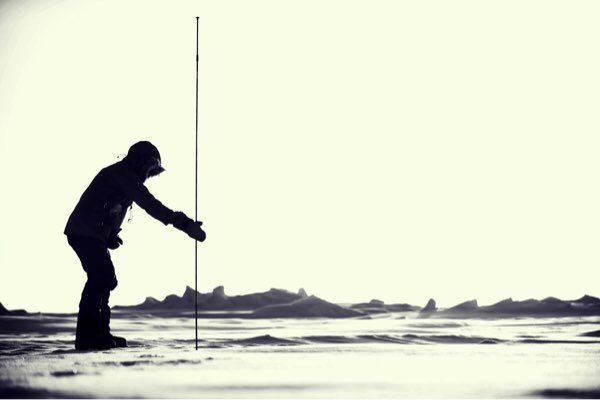
Apart from hauling their sleds across some very challenging terrain they will also be doing lots of “citizen science” en route, including stopping regularly to measure the depth of snow covering the sea ice:
Photo: Martin Hartley
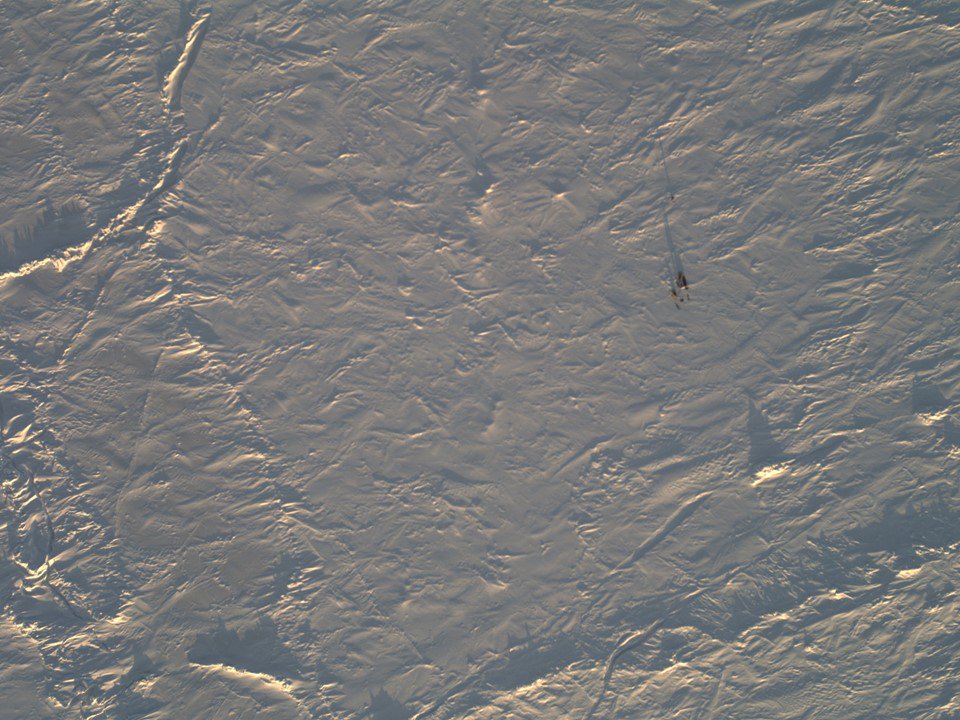
As part of that scientific mission the NASA Operation IceBridge Orion P3 aircraft overflew the team, and amongst other things took this picture:
Photo: NASA
Bernice announced on the 2 Degrees expedition’s blog this morning that:
A milestone today – skied 1/2 degree of latitude.
Victor Serov who I call into every night with our position is really happy with our progress: ” You are doing very well Bernice and you are doing science” is his encouraging response every time I call in.
I imagine he is sitting in a tent in Barneo with a giant map, North Pole in the middle, and plotting all routes towards the pole. Each team on the ice has to call in coordinates at night so if something happens, they are standby with 2 MI8 helicopters to assist. Like yesterday somebody had to get evacuated because of frostbite.
To get a compliment from a Russian scientist who has spend a year in Vostok in Antarctica [coldest place on earth] as well as being an accomplished polar explorer, we should be proud of ourselves to have skied 1/4 of the way on day 5. But it hasn’t come easy. The half degree has been really hard work temperatures dipped to -41C too cold to film, do science, all we can do is keep moving until we need to eat and drink.
The sleds weigh over 80 kilo’s and new pains and aches show unexpectedly in places you don’t want them, like my back. On the odd break, I would get the notebook out, jot down the GPS position while Ann pokes into the snow and yells the various snow depths to me. The rest of the day we are doing cold management: toes we don’t feel anymore and need nurturing or placing your thumb between the fingers to warm them up inside your mitt, and worse letting your arm hang so the blood can race back to the extremities.
If you are cold all blood flows to your heart and core to protect it, so to call it back is playing a trick with your mind. Despite this careful nursing, I still end up with frost nip on all fingers. I now need to be extra careful with exposure to cold.
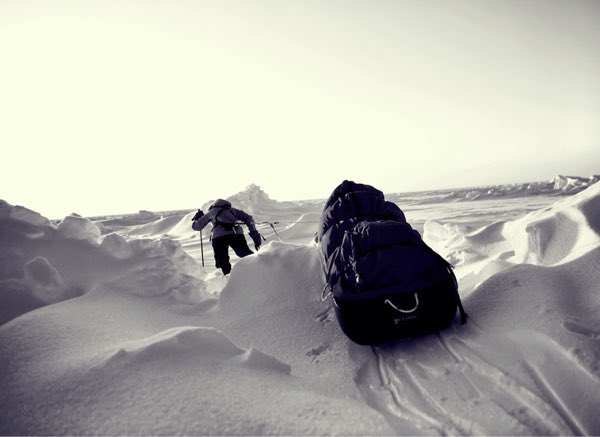
Meanwhile Ann Daniels published this image of the sort of terrain they’ve been crossing on her Twitter feed:
Photo: Martin Hartley
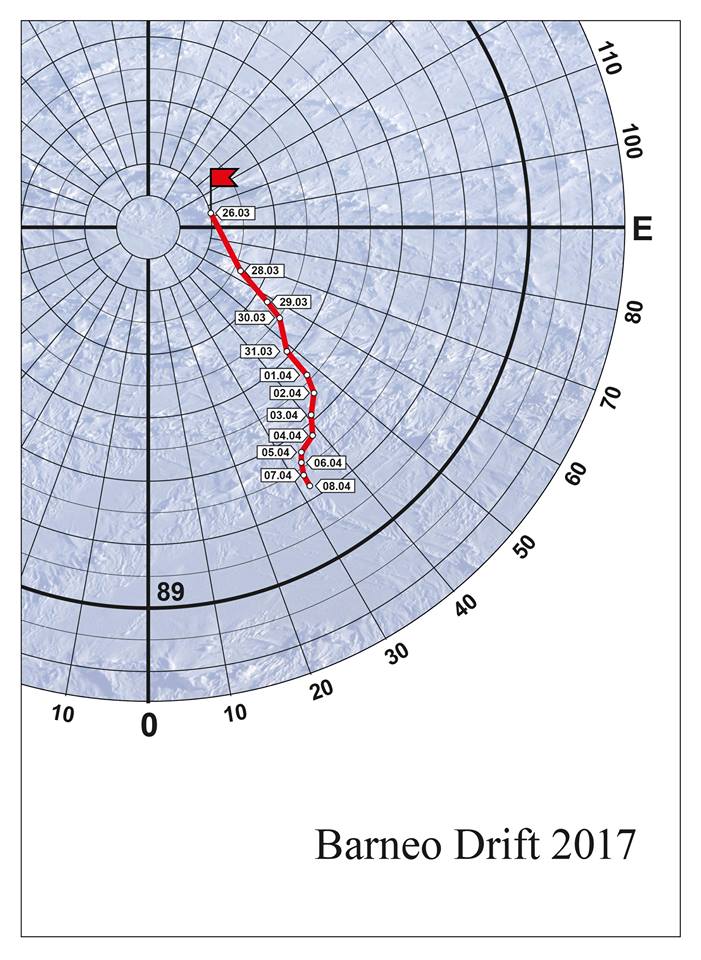
The expedition’s current position is reported as as 88.52 N, 147.75 E. Only another 1 1/2 degrees to go! As this map of the drift of the Barneo ice camp shows, the winds are currently somewhat in the team’s favour:
I just watched the live stream of the fall 2016 AGU press conference about the findings of the “First results from the Norwegian Young Sea ICE Expedition”.
Here’s the associated video of the expedition:
Here are the bullet points:
Initial results suggest that the thinner and younger ice is altogether different from older multiyear ice. It moves faster, breaks up easier, melts faster, and is more vulnerable to storms. This has important consequences for the Arctic as a whole, as our current knowledge is largely based on information from the “old Arctic.”
The Atmosphere
• For the first time, N-ICE2015 researchers directly observed large winter storms over sea ice and saw that they have significant effects on the young, thinner ice. The high winds create a lot of stress on the sea ice by pushing it around and breaking it up.
• One winter storm raised the air temperature from -40 F to +32 F in less than 48 hours, while the moisture in the air increased 10 times. All of these factors significantly warm the surface of the snow, even in mid-winter, and slow the growth of ice.
The Sea Ice and Snow Cover
• Researchers on the drifting ice camps found more snow on top of the ice than expected. This insulated the ice from the atmosphere, slowing its growth in winter and surface melt in summer.
• The sea ice was sometimes flooded by seawater as the large snow load pushed the thinner ice below sea level.
• The thinner sea ice was more dynamic than researchers have seen before. This could mean more ridging but also more cracks and leads between ice floes.
The Ocean
• Winter storms caused the sea ice to drift so fast that it increased mixing of the water beneath the ice. Deeper, warmer water was mixed up closer to the sea ice, causing it to melt from below despite winter air temperatures that were below freezing.
• Researchers saw summer storms stir up deep warm waters and melt as much as 25 cm of ice in a single day.
The Ecosystem
• For the first time, N-ICE2015 researchers observed an algae bloom under snow-covered pack ice. Thinner and more dynamic Arctic sea ice allows more light transmission to the ocean, especially through cracks and leads. This triggers earlier phytoplankton blooms under the snow-covered ice.
• The phytoplankton species that dominated the under-ice bloom does not sink to the deep ocean. Such shifts in phytoplankton species composition, associated with early under-ice phytoplankton blooms, could thus have important implications for the strength of the biological carbon pump in the Arctic.
There was also mention of the “waves in ice” event that the R/V Lance experienced back in June 2015:
P.S. A recording of the N-ICE2015 press conference is now available:
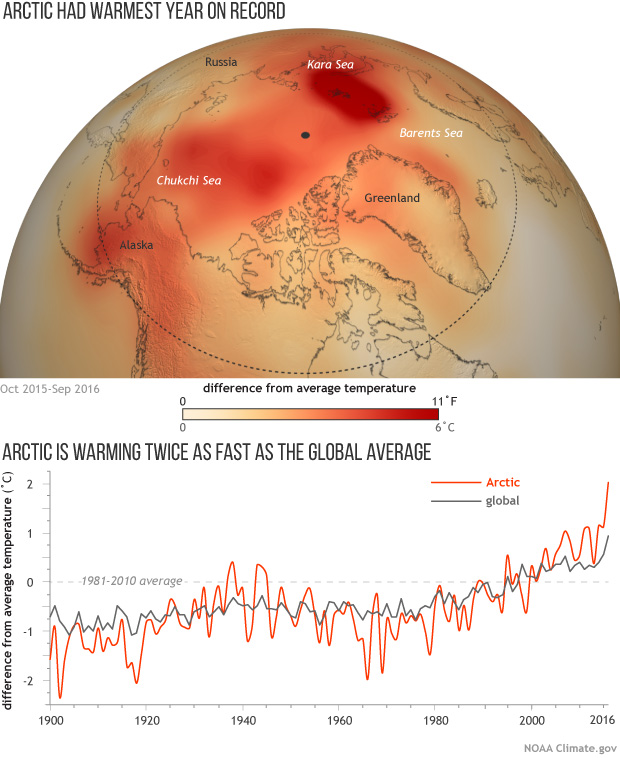
No doubt because of the recent controversy concerning the effects of the 2015/16 El Niño the first graphic that caught my eye was this one:
In the question and answer session the obvious question was asked. The answer was that while attribution is difficult the 2015/16 El Niño did have some effect on Arctic sea ice. However currently we’ve only seen “the first act of a 3 act play”. Act 2 will be the maximum extent in March.
In answer to another question, a focus of research over the next 10 years should be the interactions between mid latitudes and the Arctic.
P.S. A recording of the Arctic Report Card press conference is now available:
A variety of cryospheric posters are available via:
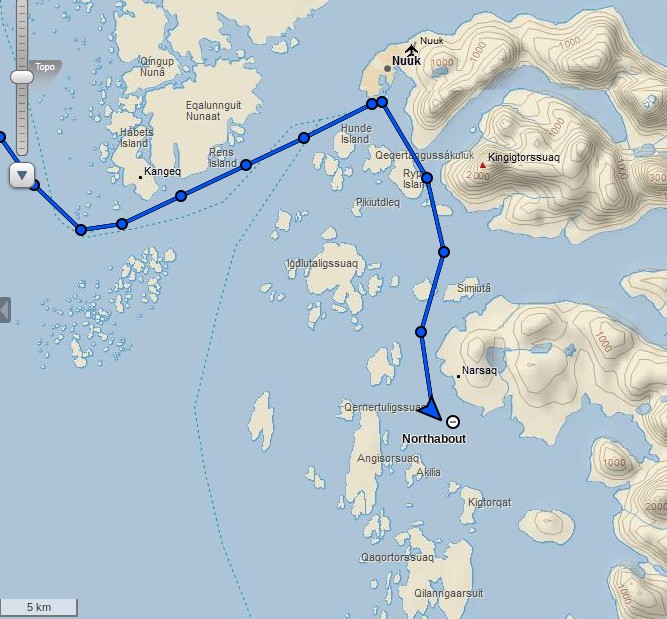
Following another crew change the Polar Ocean Challenge team in their yacht Northabout have just left Nuuk in Greenland, bound for Bristol in South West England:
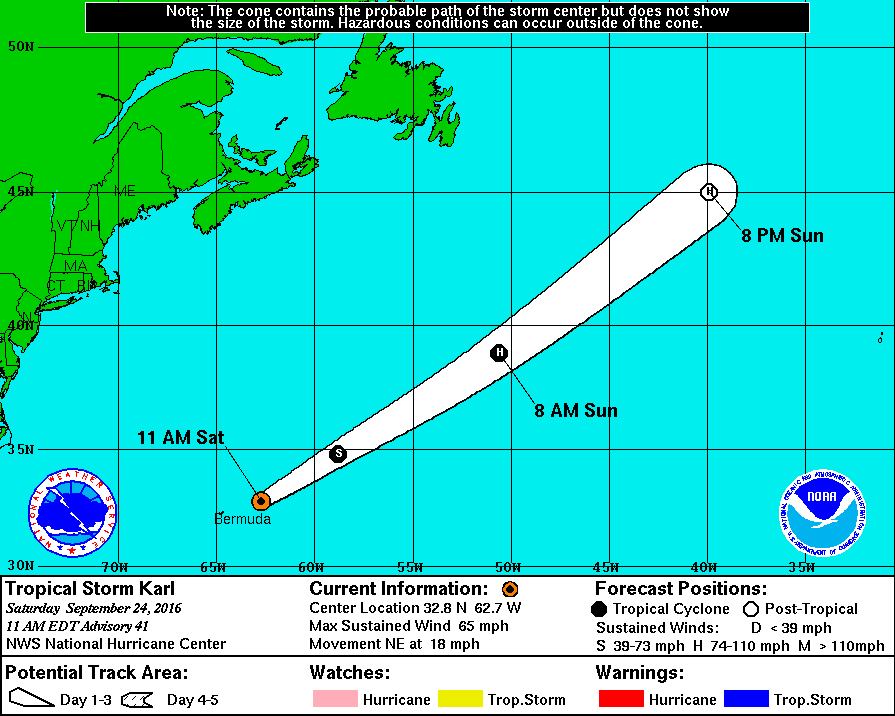
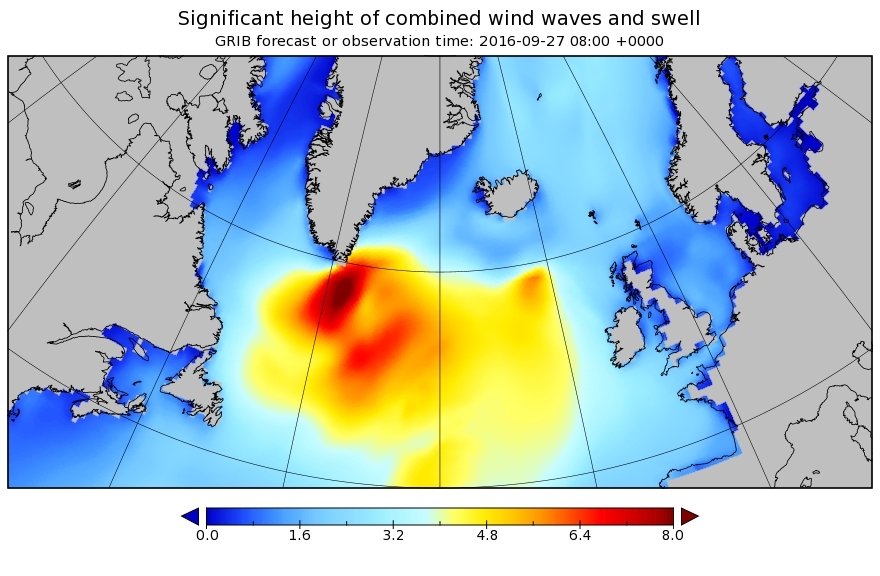
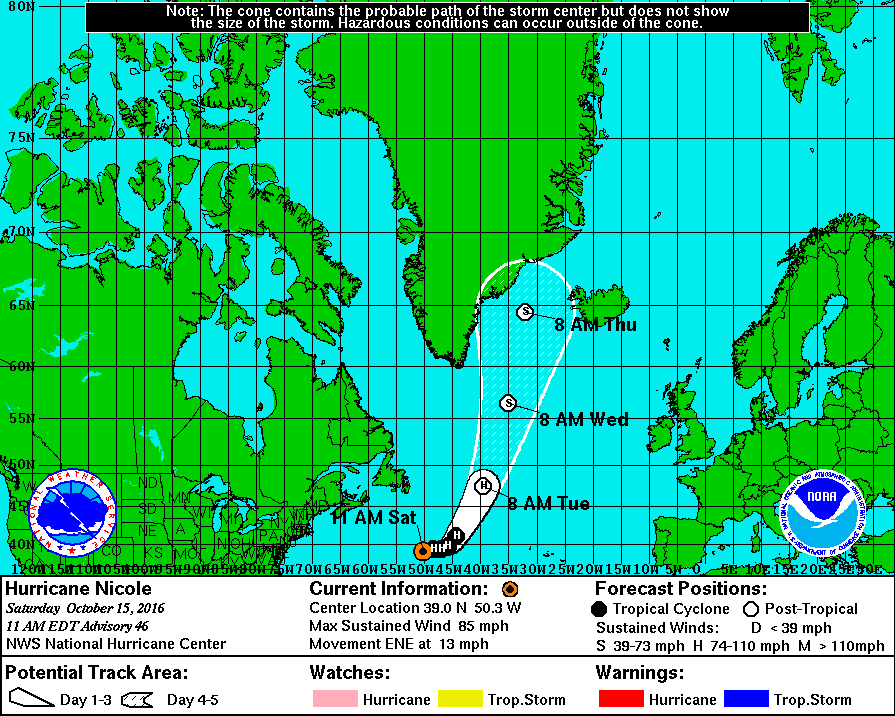
To get back to good old Blighty they are going to have to brave the North Atlantic in Autumn. Some stormy weather is likely! We’re currently keeping an eye on Tropical Storm Karl, who has just left Bermuda in his wake and is forecast to reach hurricane strength before heading off across the North Atlantic:
The latest advisory bulletin from the National Hurricane Center forecasts that:
Karl is forecast to be absorbed by an extratropical cyclone early Monday.
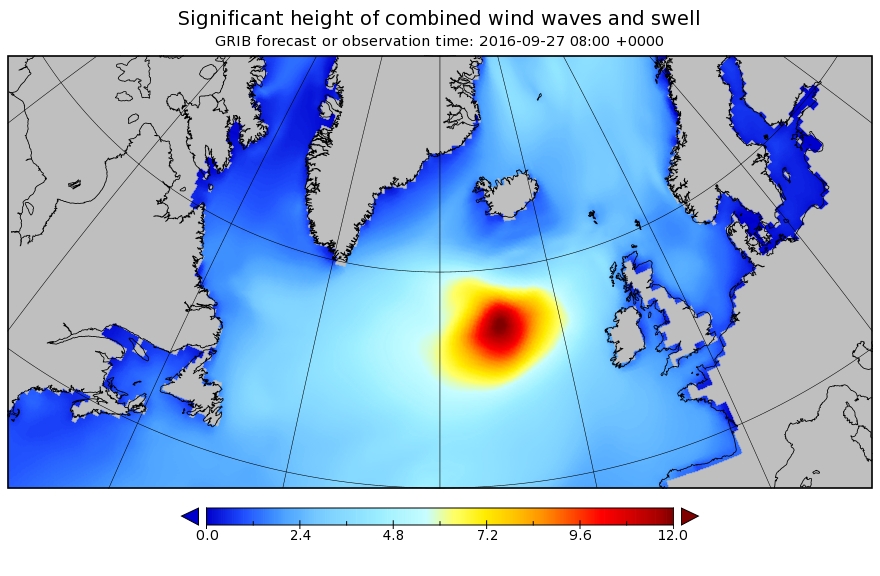
That cyclone looks set to create 8 meter waves south of Greenland! Here’s how the significant wave height forecast looks for 08:00 on Tuesday September 27th:
What happens after that remains to be seen. We will keep you posted!
[Edit – September 25th]
The new captain of Northabout, Mike Stewart, reports that:
We have decided to approach things in a relaxed manner, and for the first few days, at least, we will day sail southwards amongst the islets and channels towards our departure point, in a sort of ‘shake down’ period, to get used to each other and our vessel, we will head for a remote weather station on the very south east tip of this vast and forbidding Island. More to say on that later..
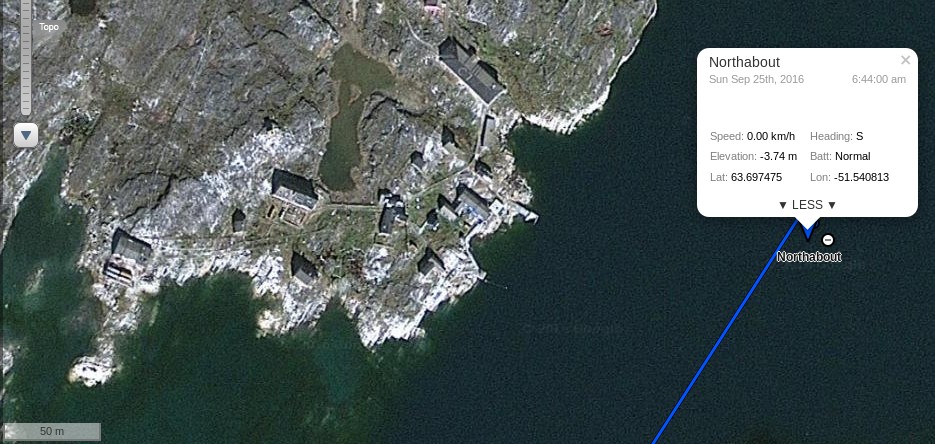
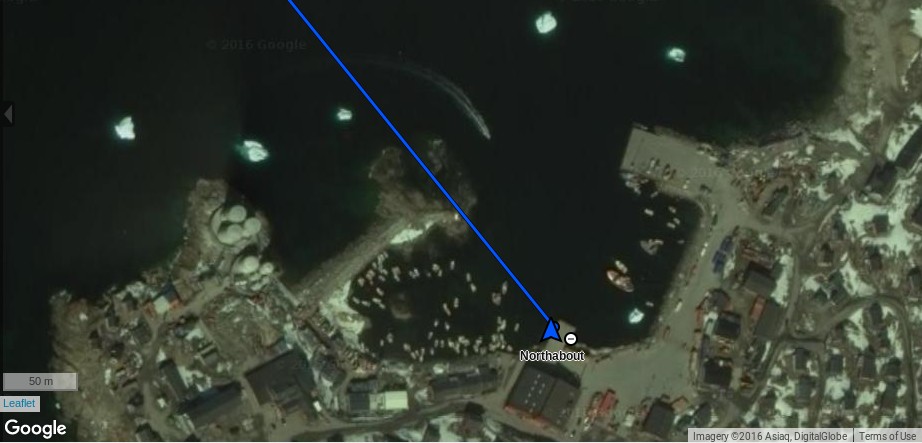
Our home for this, our first night, as a complete crew is at anchor next to a tiny abandoned port named FAERINGEHAVN. Old dead wooden whalers, ribs now showing, and sad broken down port buildings, minus roofs, are our view of the shore less that 50m away. Have a close look at the top of this image, or zoom in on the tracking on the satellite view.
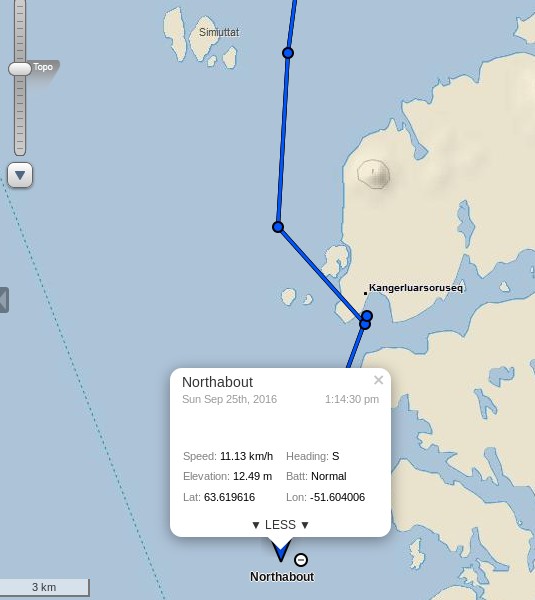
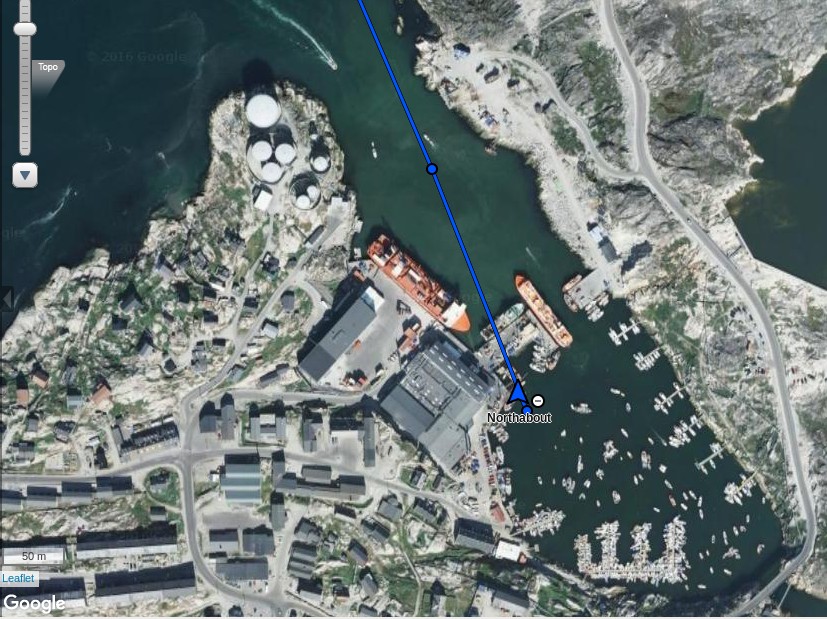
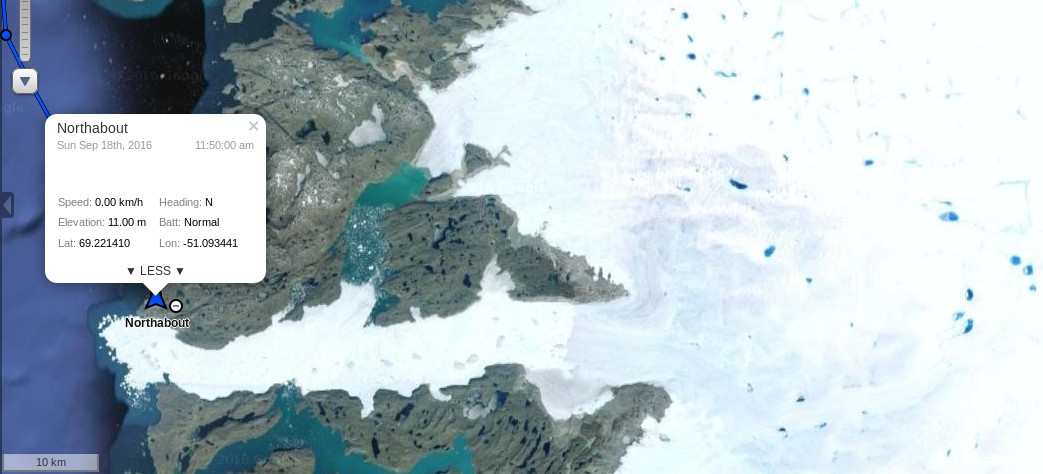
We did just that:
which reveals that the new name for Færingehavn is Kangerluarsoruseq.
Mike also points out that they are not alone:
We have visitors! EAGLES QUEST II crew, (a Hong Kong registered Tayana 58 who have sailed from via Alaska), decided to tag along for a while are on their way over for a brew..
Given the storm that Karl is brewing up in their path a leisurely cruise to Cape Farewell seems like an eminently sensible idea to me!
[Edit – September 25th PM]
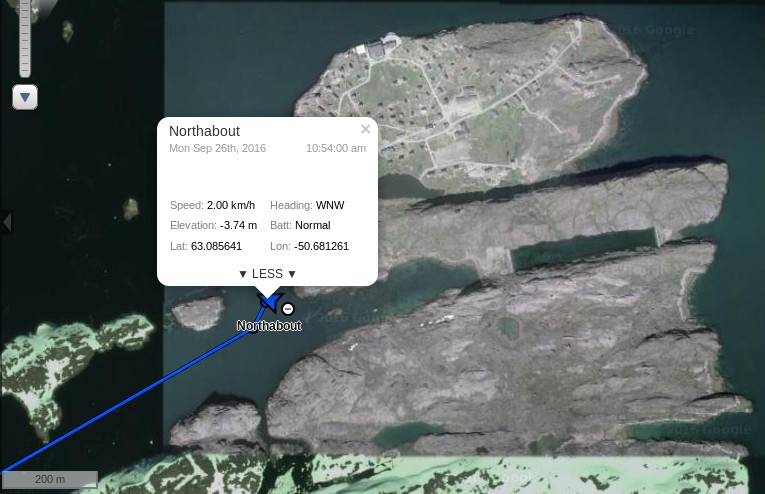
Northabout has now set off on the next section of her island hopping cruise to Cape Farewell:
[Edit – September 26th]
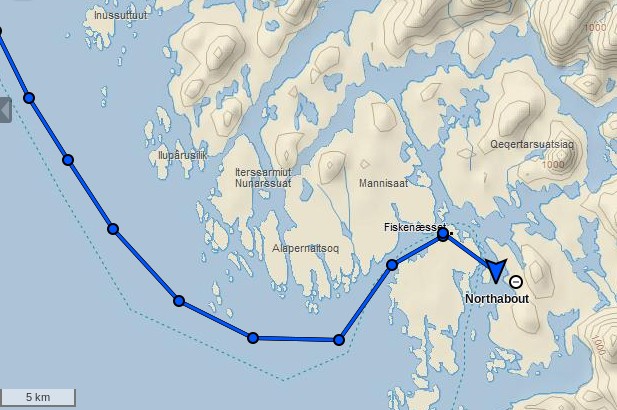
Northabout anchored for the night near Fiskenæsset (AKA Qeqertarsuatsiaat):
She has just set off hopping amongst a few more of the numerous islands off the south-west coast of Greenland:
The imminent storm swell is now forecast further out into the North Atlantic than two days ago, but has grown to a predicted 12 meters:
Note the change in scale!
[Edit – September 27th]
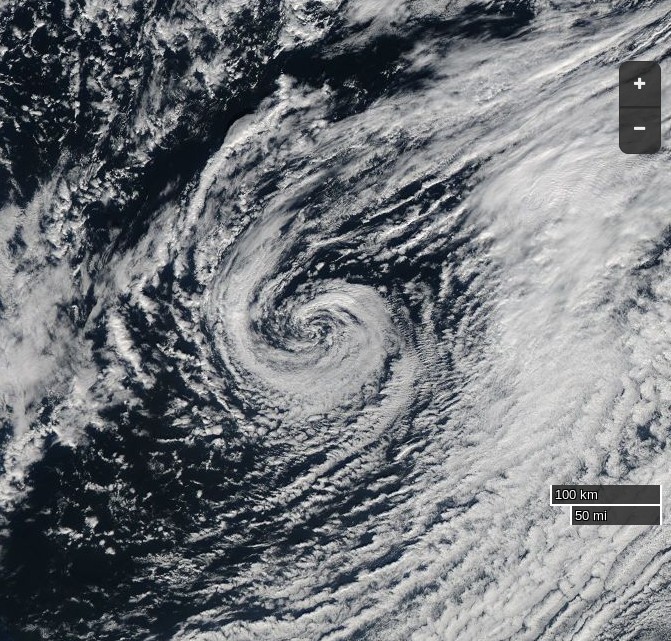
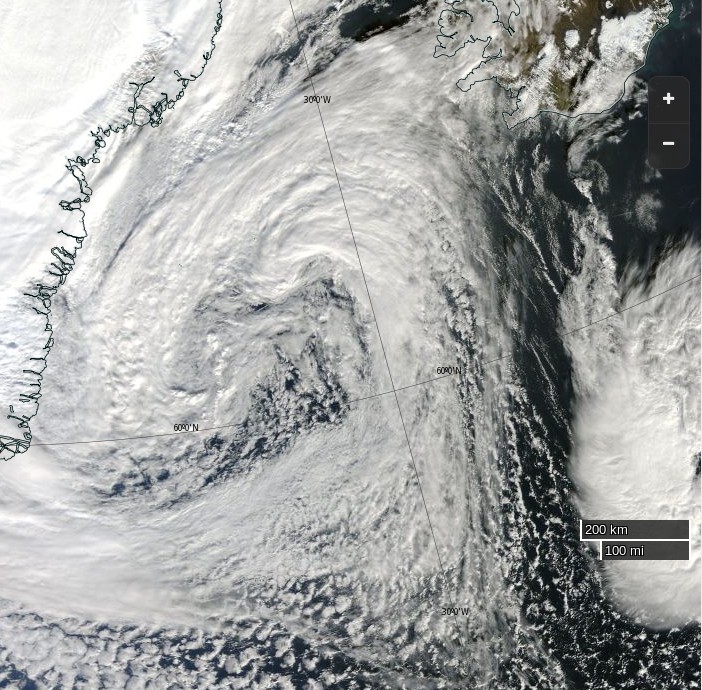
Here’s the storm currently raging in the North Atlantic:
NASA Worldview “true-color” image of the North Atlantic on September 27th 2016, derived from the MODIS sensor on the Aqua satellite
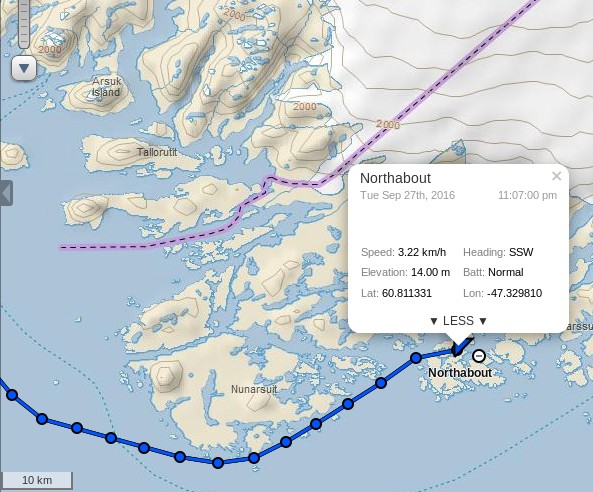
Northabout looks to have found a sheltered spot to stay the night:
It seems that her new crew have experienced plenty of fine weather recently. According to Ben Edwards:
This is ridiculous. Three days in a row and we’ve had the best weather of the entire trip. We woke up in the morning to relative warmth and clear skies our trip ashore to Qeqertarsuatsiaat was short but pleasant with a trip inside the local church.
Upon our return to Northabout we got the anchors up and motored off. We managed to get the sails up a couple of hours later and we’re now doing about eight knots. We passed a glacier earlier on which was a little odd. From where we sat it seemed huge. The head alone was several miles across. The strange thing was that it didn‘t seem to stretch down to the coast. We were fairly sure of this because we could see a line of what looked like stone between the ice and the water and there were no icebergs that we could see. If it was at the water one would expect bits to break off and form bergs. … So it seems likely that it never reached the coast.
Let’s hope that continues!
[Edit – September 30th]
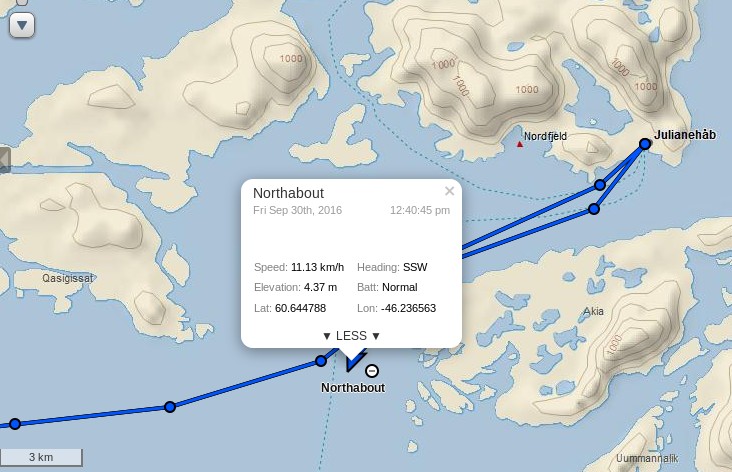
Northabout has just departed from Qaqortoq (AKA Julianehåb):
The Polar Ocean Challenge team have released a beautiful video of one of their recent sheltered spots to stay the night:
On their blog the current captain of Northabout, Mike Stewart, said yesterday:
We have successfully disembarked Steve and continued our preparation of Northabout for crossing the Atlantic. We have also re-fueled in situ courtesy of the Qaqortoq fuel supply truck, and have fitted a new house battery to bolster the hard working but a bit tired battery bank in place. This will keep our domestic amp draw supported- chart plotter, nav lights, interior lighting, electric pumps and bilge pumps etc working as they should. This also ensures that the engine start battery is kept fresh for its most important job.
I am told by the Inuit lady in the local chandlery that its going to blow hard tomorrow. We should have the wind behind us for our transit to the east, and then if all is ok run in to shelter mid afternoon.
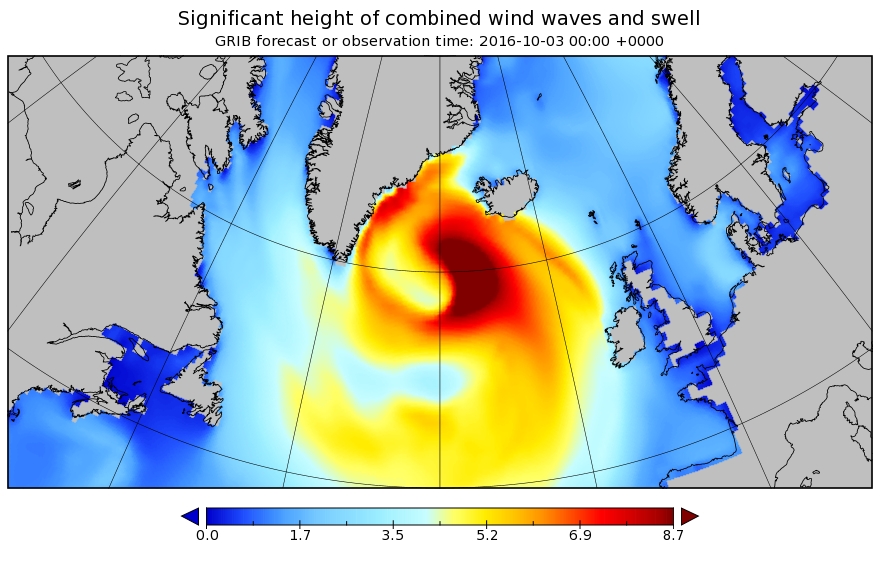
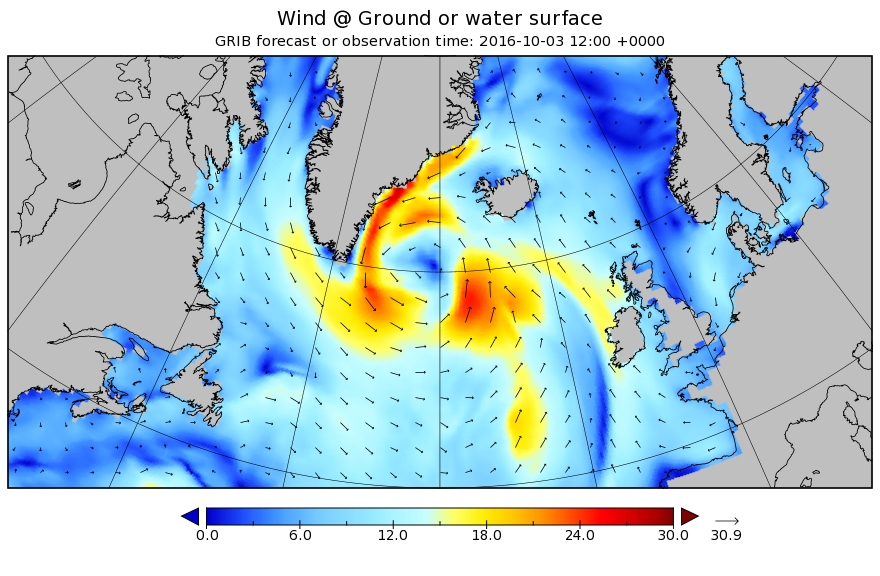
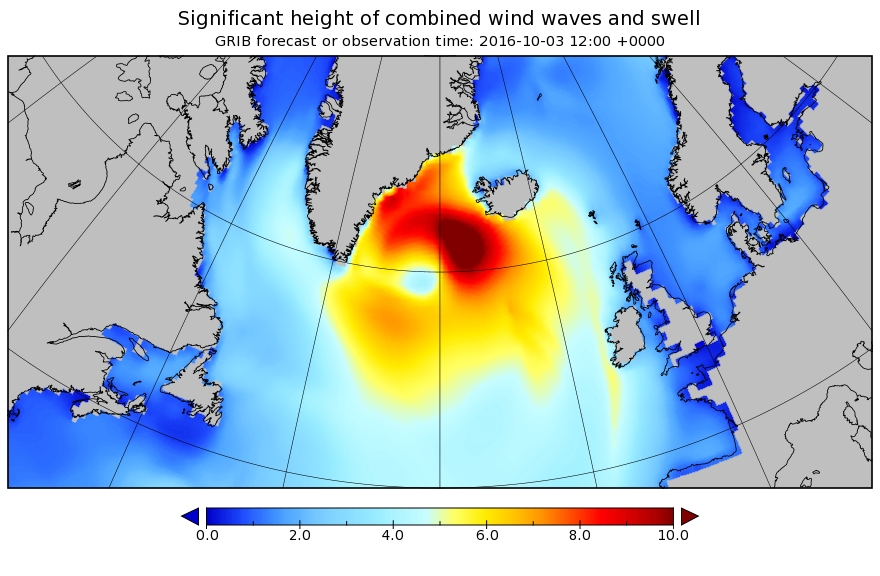
In actual fact it looks like it’s going to blow even harder in the not too distant future. Here is our North Atlantic “surf forecast” for 00:00 UTC on Monday October 3rd 2016:
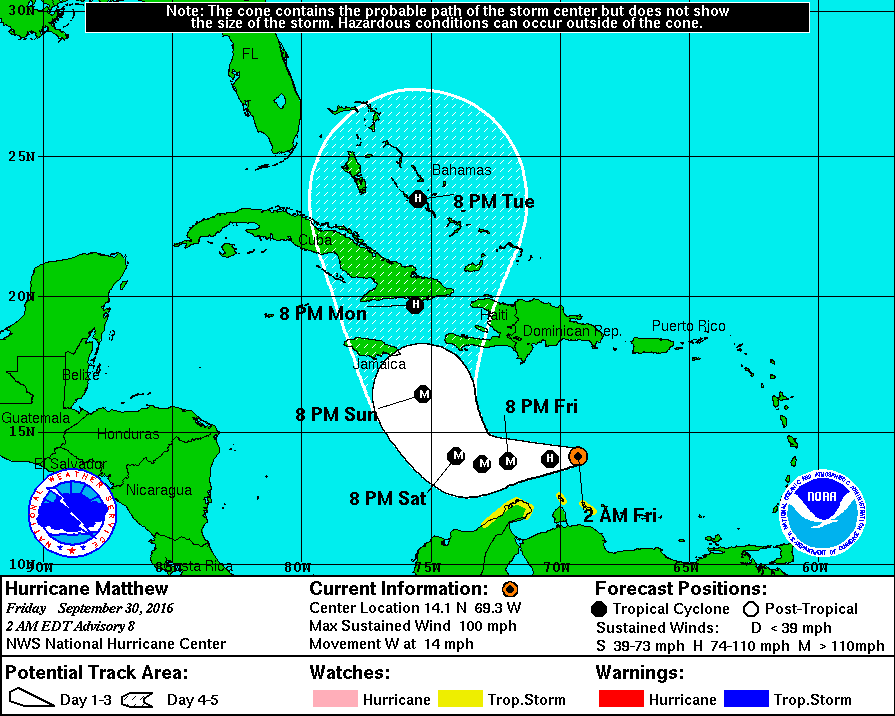
Meanwhile much further south in the Caribbean, Hurricane Matthew is forecast to become a major hurricane before reaching Cuba and then heading north across the Atlantic Ocean:
[Edit – October 1st]
Northabout is on the move again:
It seems my assumption that she would round Cape Farewell early next week was mistaken. According to Mike Stewart:
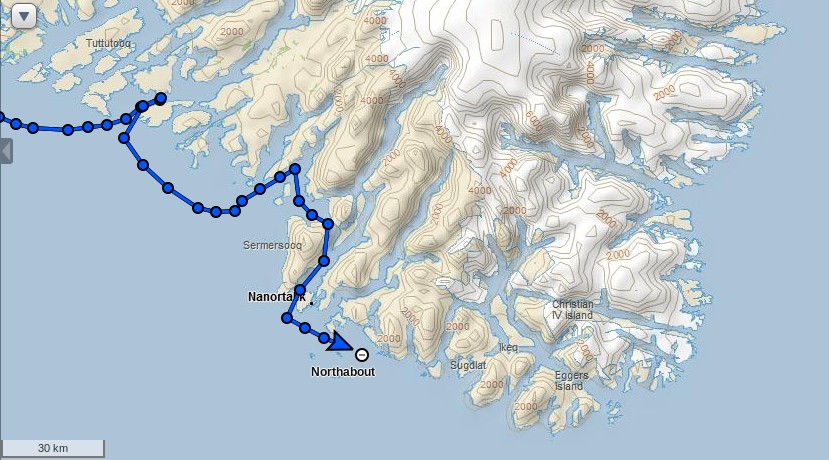
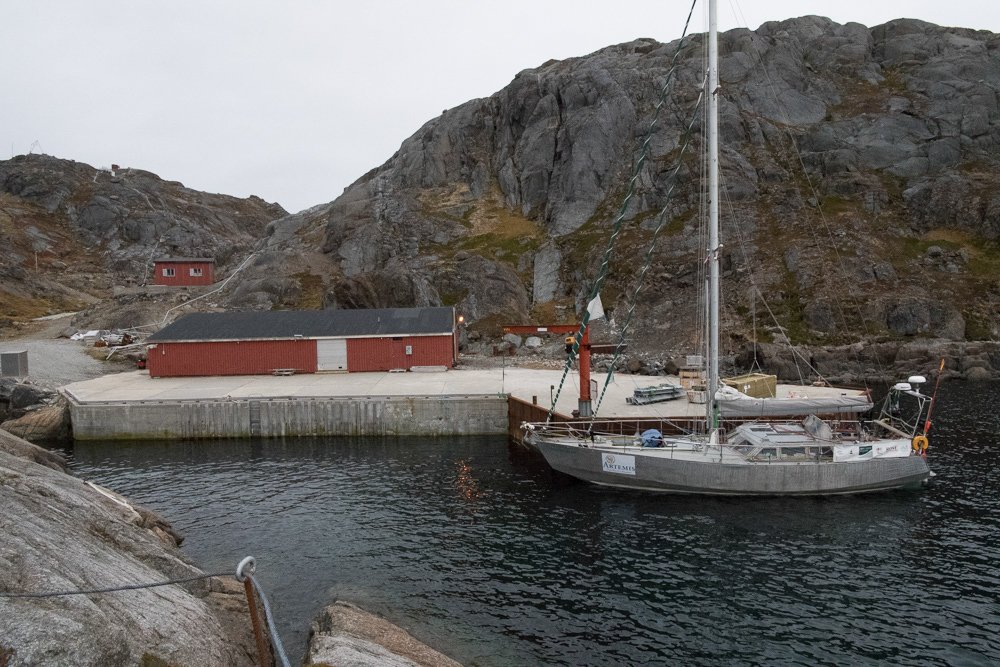
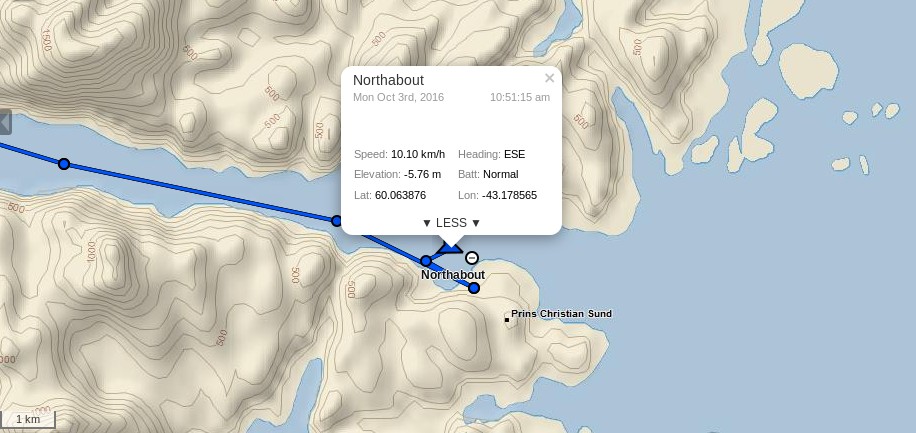
The strategy is to reach our departure point on the eastern entrance to PRINCE CHRISTIAN SOUND, which has a conveniently manned weather station and pier, in about two days sailing. This will allow us to hold in a safe area, whatever the weather in the Atlantic, and be in an ideal location to depart immediately to sea when the storm that is dominating the north Atlantic abates. After crossing Biscay 4 times this year, I have learnt that after a blow, kind of ‘riding on the back of it’ is an ideal time to head off. I recall something about the Chinese ideogram for chaos and opportunity being the same written character.. and as we have 3 Chinese sailors around half a mile behind us right now, I’ll use that to describe the general strategy I have in mind. Actually looks good for a Tuesday pm departure into decaying westerlies around 30-35 KTS.
If you look at the map above the planned route will take Northabout through the islands of Southern Greenland, passing to the north of Christian IV Island.
She is now heading in the direction of the Irminger Sea:
Beyond that the wilds of the North Atlantic beckon, where there is still a fair old storm raging!
It looks as though the Polar Ocean Challenge team are hoping to get a good head start on their voyage back to Bristol from the strong winds in the wake of that storm, but there’s also some big waves to contend with:
Differing accounts from Northabout in the stormy North Atlantic today! Skipper Mike Stewart reports that:
There is another low that will affect us in the next 24 hours, this will be through by tomorrow midnight, and most of its associated wind is westerly or northerly in our bit, anyway we take what we get here, its as simple as that. We have handled this at 50 KT with around 7m seas, (occasionally 8-9m) so our confidence levels are good. I heaved the boat to for a few minutes to test how she behaved, and she was ‘OK’ sitting duck like as the rollers powered through beneath us. During the evening, we were hit by one breaker, as always, theres a set bigger than the rest, and of course one broke over the boat, we were lifted and pushed sideways like a cork, but did not go over to any degree, which says volumes for our stability curve.
My first watch was from 1400 to 1600, and was quite an experience. I attached my harness before leaving the main cabin – I leave it permanently attached in the cockpit, a tip from a recent letter in Yachting Monthly – attached the second hook to another point near the wheel, and then took over from David. Looking around at the conditions a loud “Yeehaaar!” left my mouth and was whipped away by the wind. The seas were magnificent, lashed by the wind and spewing spume from the top, as Northabout gamely reached across the tops under reefed staysail.
So the night hath passed and we’re still alive. To me it feels like it was a bit of a close run thing…
I did my watch (eight to ten) and went straight to bed, not that that saved me. Twenty minutes later I rushed to the toilet and threw up my breakfast of porridge and tea. I then went back to bed, the swell got larger, the wind got stronger, I went back to toilet. This continued for the next ten hours. In total I threw up six times, a personal best.
Tomorrow is another day!
[Edit – October 8th]
David Wynne Davies reports from the middle of the North Atlantic:
Half way point to Ireland reached yesterday. Progress had been impeded by headwinds but with the wind now backed to the South and on the beam we were making 7kts. In order to catch up lost time the mainsail as well as the genoa were hoisted supported by the engine although increasing winds this afternoon (gusting 50kts squalls) prompted us to reduce to 3 reefs and a reduced staysail.
Everything then was cracking on beautifully in fairly rough seas – until the engine splutters and dies. Mike switched fuel tanks in the belief that the forward port tank may have been contaminated or be getting close to having to be switched over. Engine starts, but again stops suddenly. After further consideration the starboard fuel tanks were tested, and the engine started to run smoothly again. We will have to figure out why the port fuel tanks are not feeding through.
Last night to conserve fuel we stayed under sail started off making 5.5 kts. The wind is expected to ease over the next few days, and helpfully be on the nose when we cross the St George’s Channel. Let’s hope that the high pressure over UK moves away before then and that we can benefit from Westerlies.
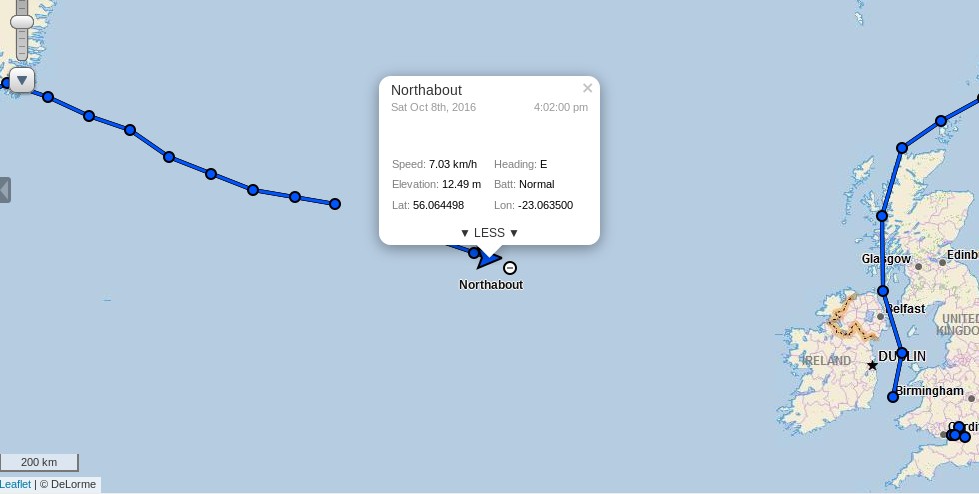
Possibly related to the spluttering engine, Northabout’s live tracking ceased to function for a while yesterday:
After an anxious wait it burst back into life, and confirms Northabout’s steady progress towards a welcome pint of Guinness in Ireland:
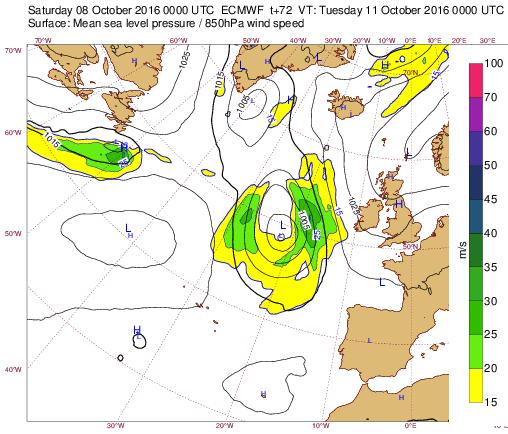
Here’s the ECMWF MSLP forecast for Tuesday morning revealing the approach of another low pressure system, which Northabout is no doubt hoping to avoid as far as possible:
[Edit – October 12th]
After a major, weather enforced detour:
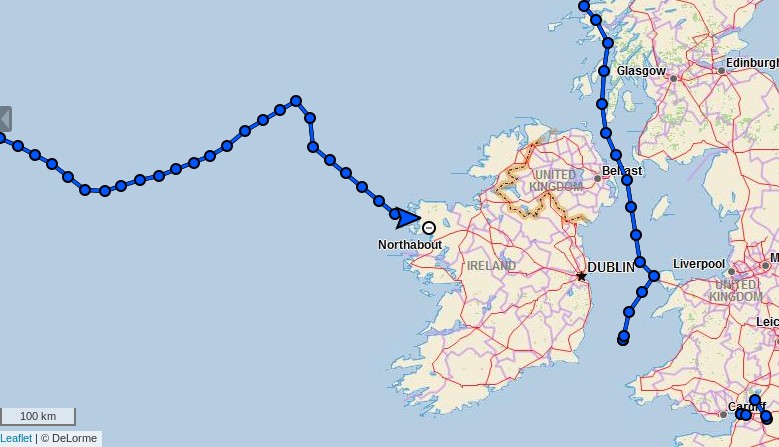
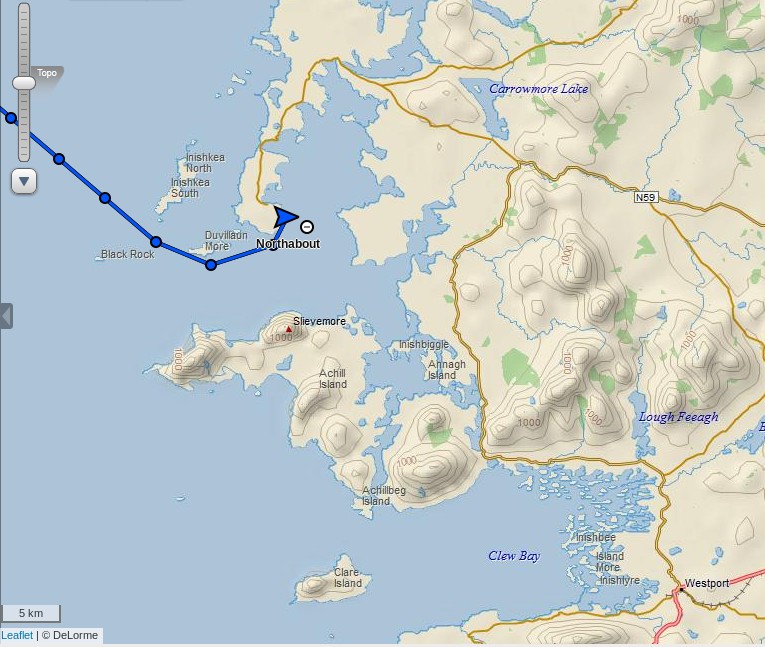
Northabout has just reached Ireland! After a recent blog post mentioned the town I thought they were heading for Clew Bay and Westport:
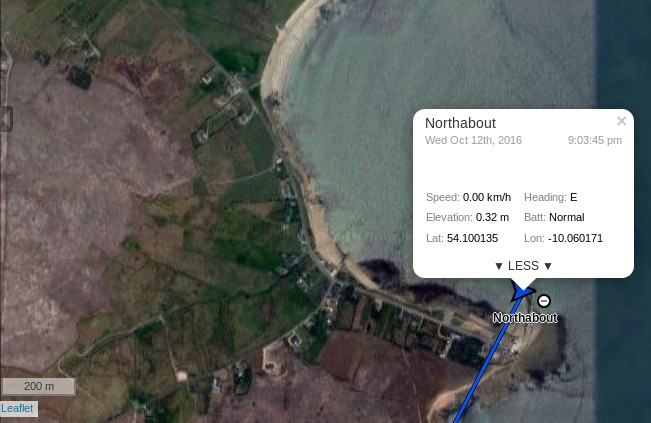
However they have stopped for the night north of there, at Blacksod Bay:
I hope there’s a hostelry available to serve the crew their longed for pints of Guinness. Then it’s on to Westport tomorrow.
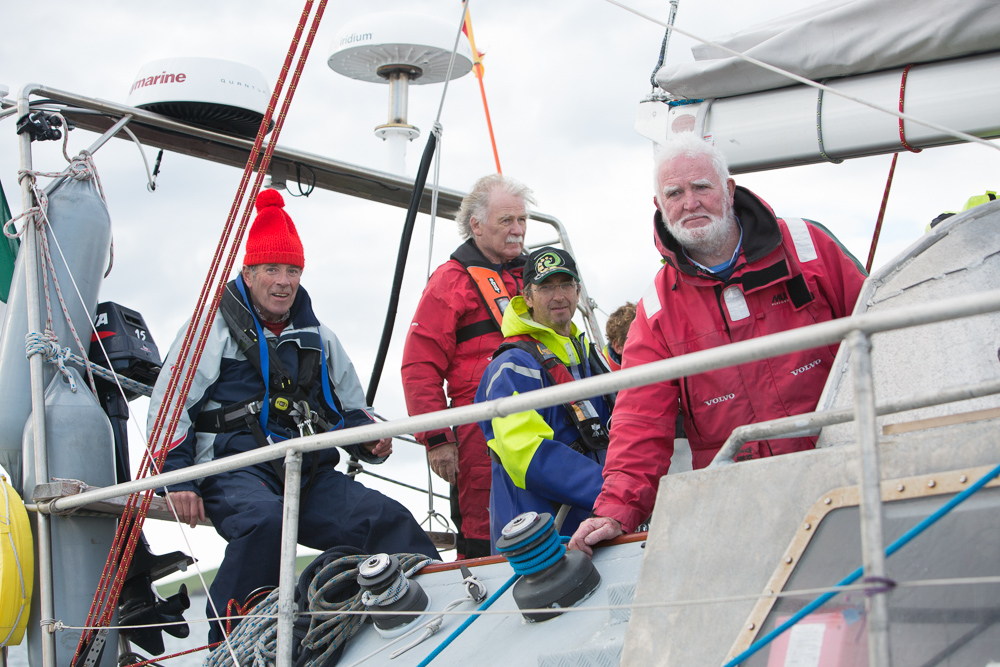
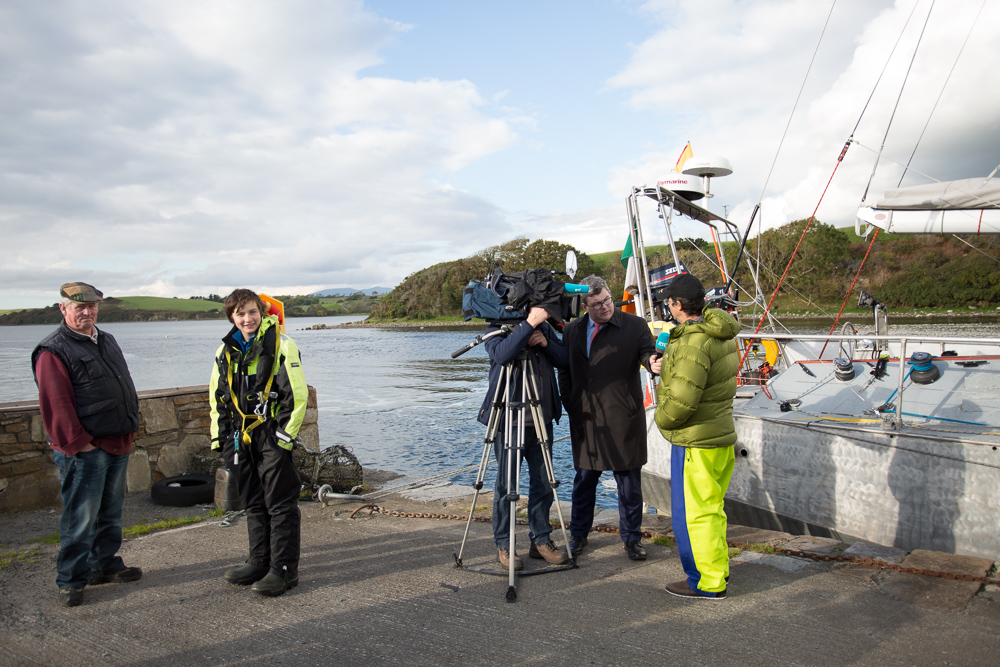
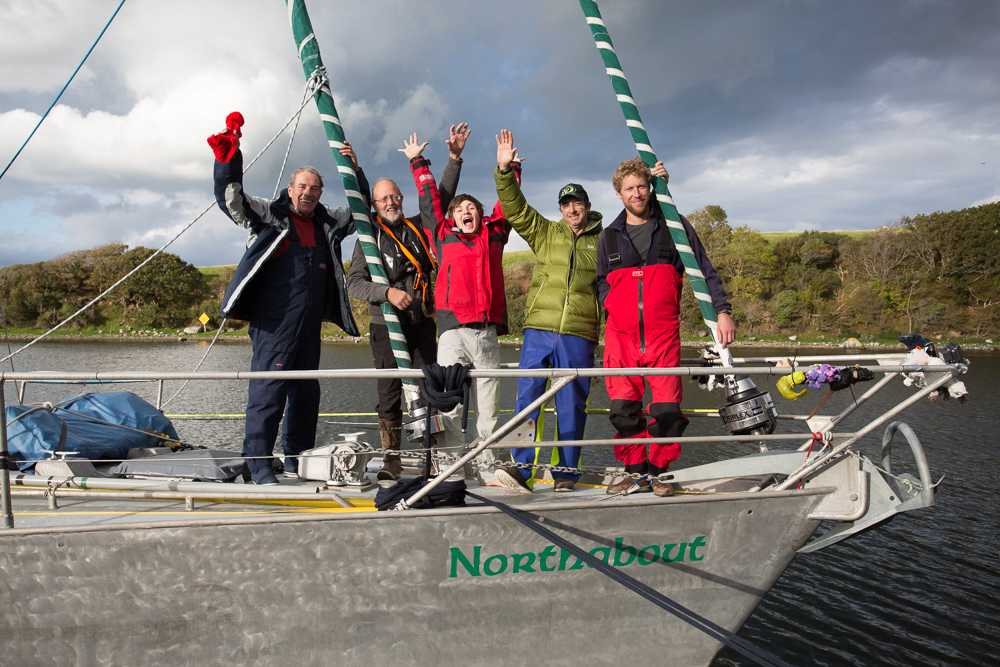
We arrived at Blacksod in darkness on Thursday evening to an unforgettable welcome from Jarlath, Mike, Tom and Mr Sweeney (the lighthouse keeper). Frances Gard was there too having hitched a lift after her Ryanair flight from Bristol.
With great enthusiasm they took our lines and promptly escorted us to a local hostelry. By golly, Guinness is indeed good for you at times like that! In true style, out came the fiddle and accordion with songs about Lord Franklin and other maritime disasters (all uplifting stuff!).
Yesterday we slipped Blacksod for Westport with Jarlath on board. Bringing Northabout back to Westport, where Jarlath had built her in 2001, was a poignant moment.
RTE News and several journalists were on the quay to record the event which was subsequently aired on the national TV news last night.
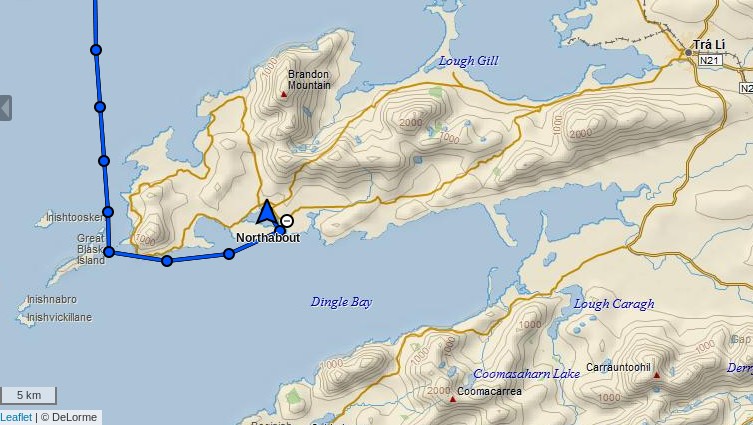
The sun is shining brightly again today although a front is expected tonight bringing heavy rain – but more importantly a wind shift. We leave for Dingle this afternoon after a most remarkable 36 hours during which we were treated to terrific hospitality. Many thanks to the hosting party who incidentally sailed Northabout through the NE and NW Passages over two seasons some years ago. So they fully recognise what this expedition had achieved.
[Edit – October 15th]
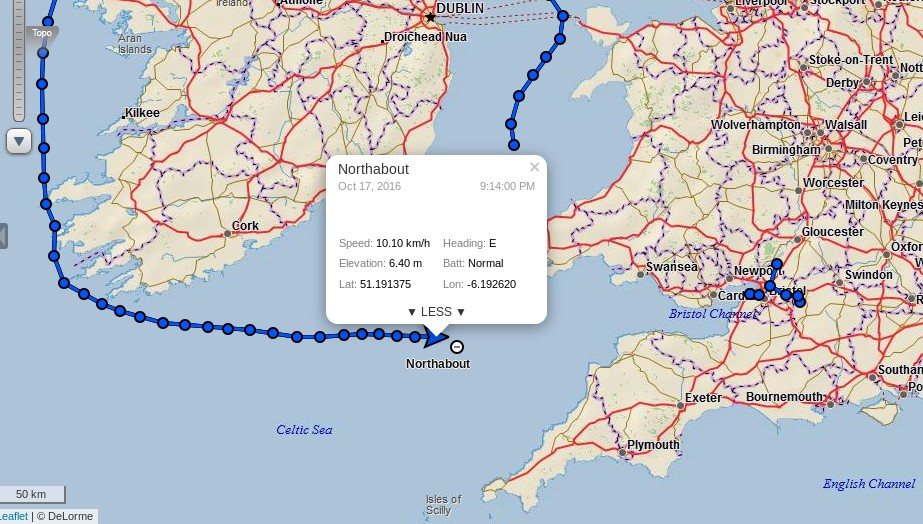
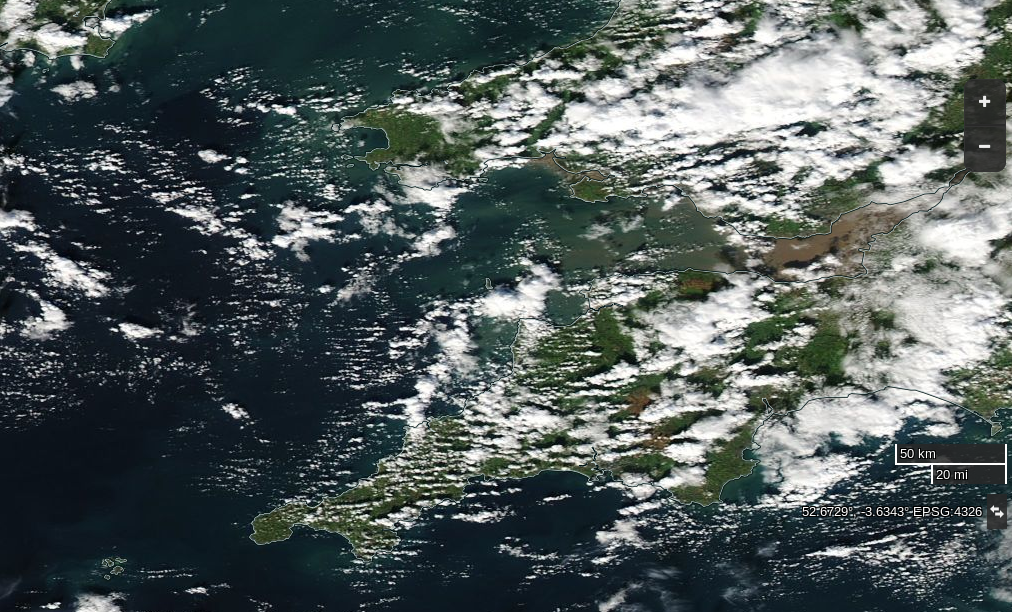
Having departed from Westport on yesterday evening’s high tide Northabout has now arrived in Dingle:
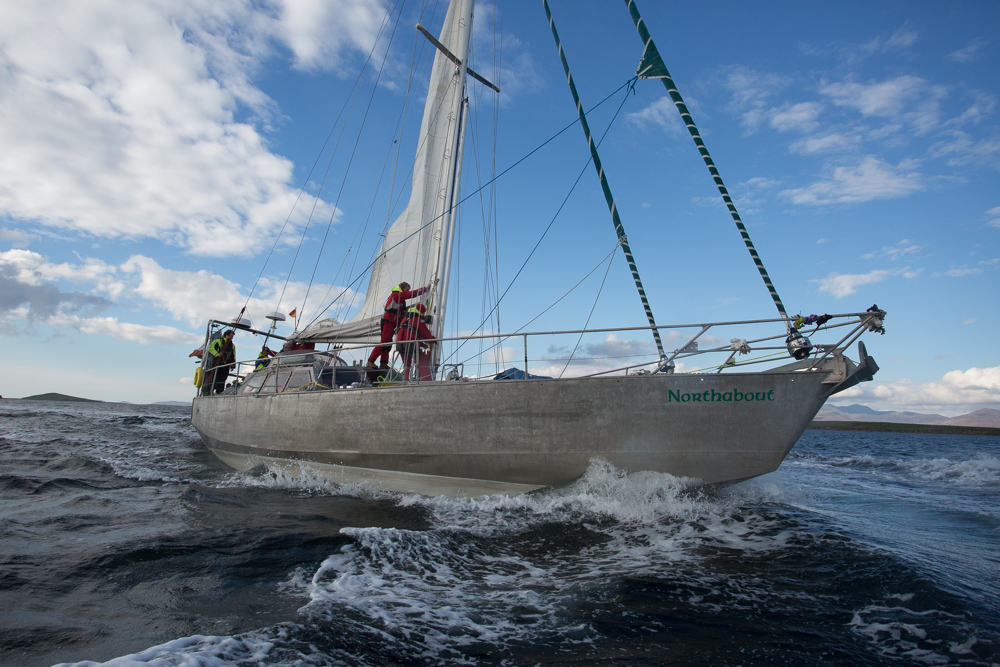
Beautiful morning, sun shining, a decent breeze from behind, and rolling down the Atlantic swells under full foresail at a steady 6kts, with bursts to 9kts if the waves pick us up. We are now well into the Celtic Sea, past Cork in the north, and enjoying the run home. We saw a dolphin last night, and four this morning so far.
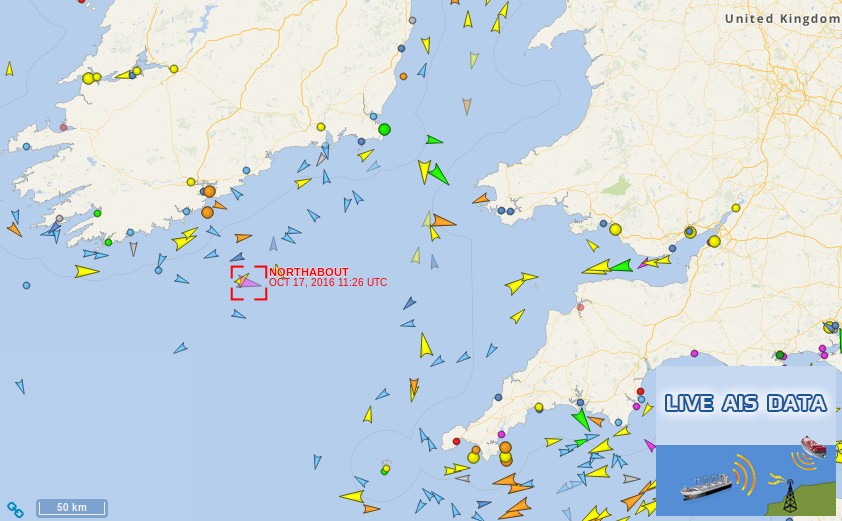
Skipper Mike is keeping us on our toes, with no relaxing – constant AIS watch, and looking out for boats without AIS on radar.
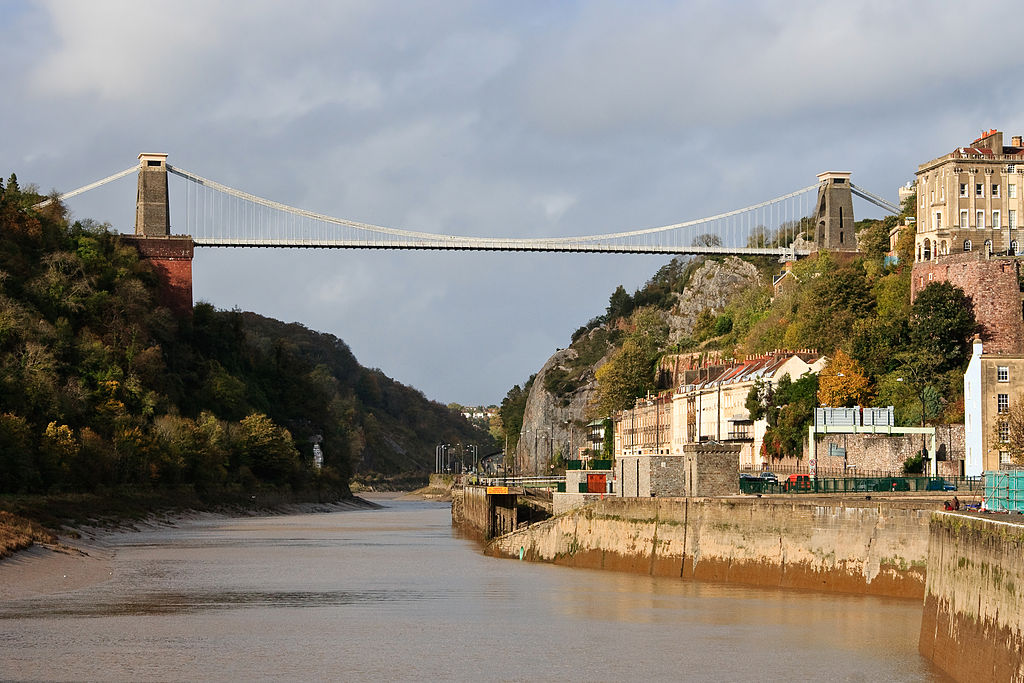
Assuming Northabout manages to safely avoid all the shipping in the Bristol Channel, on Thursday morning she is due to sail along the River Avon under Isambard Kingdom Brunel‘s Clifton Suspension Bridge:
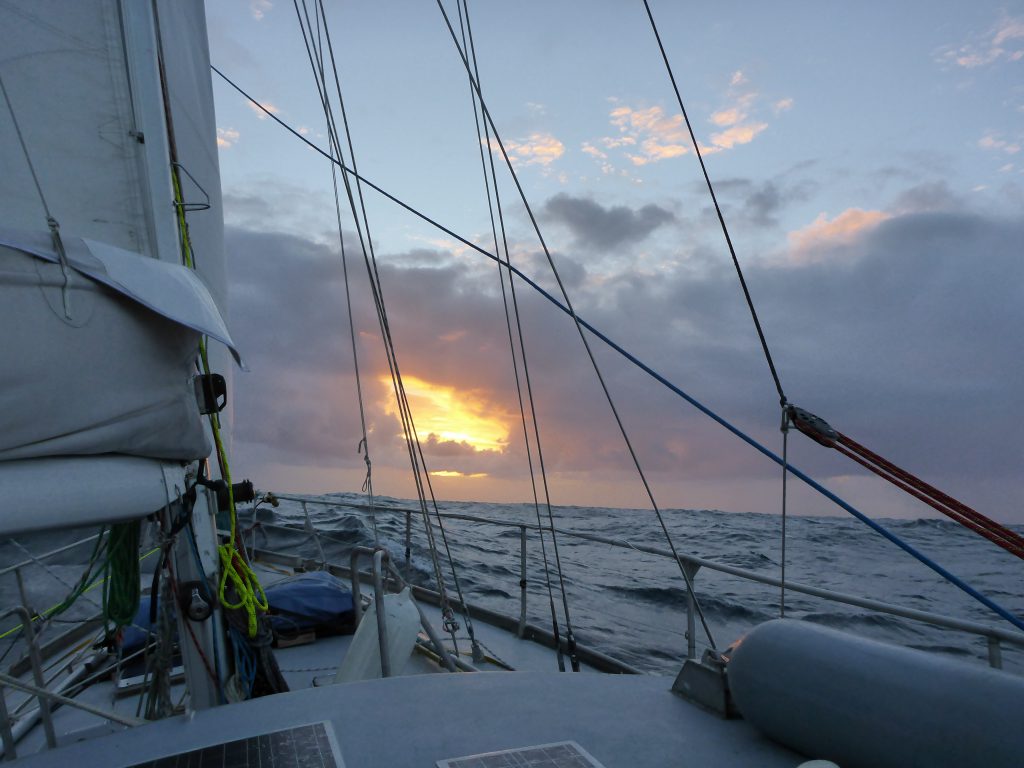
With the wind and swell behind us we were doing twelve knots at times with an average of about seven. Amazingly that continued and continues to continue as we continue to head east.
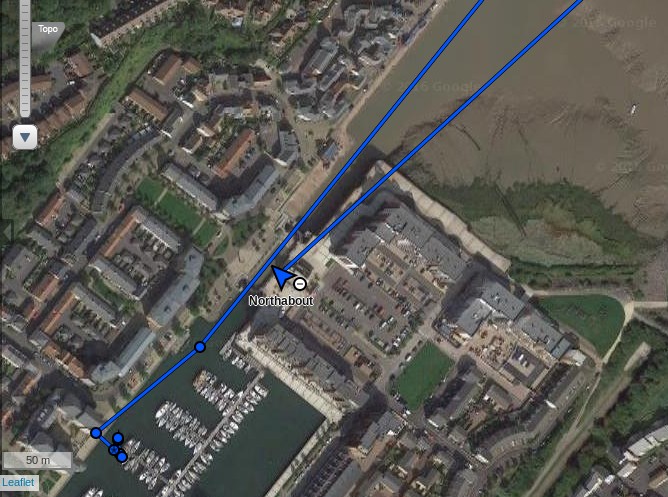
Perhaps slightly ahead of schedule, Northabout has now arrived in Portishead:
The other blue line in the picture was recorded way back in June!
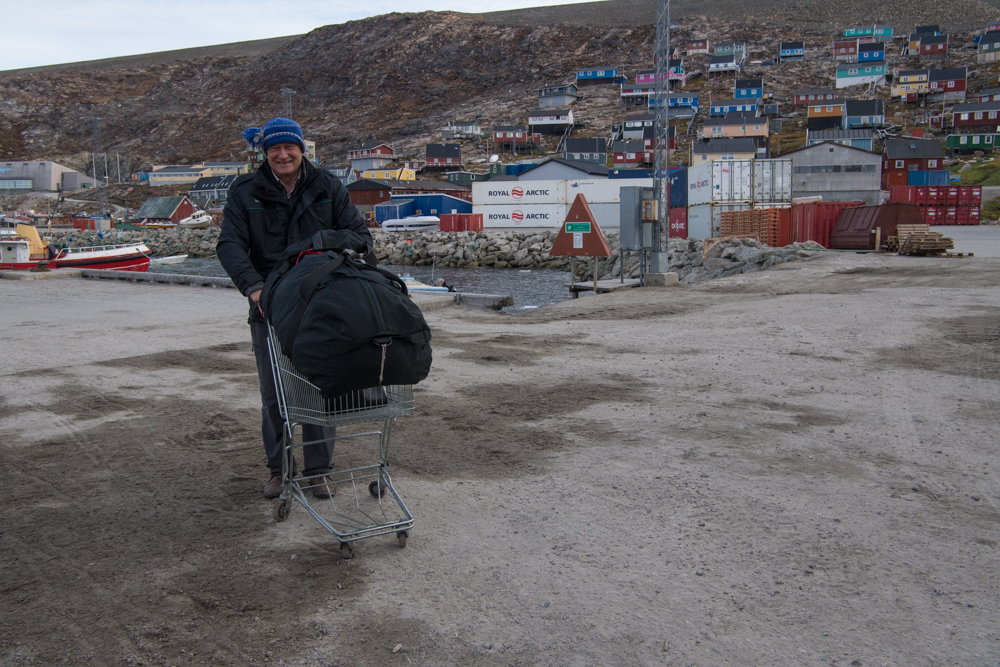
The BBC Radio 4 Today programme broadcast another one of their regular updates on the progress of the Polar Ocean Challenge expedition. On this occasion they were able to interview David Hempleman-Adams, the leader of the expedition. That’s because David disembarked from the yacht Northabout at Upernavik in Greenland:
By now David is back in Blighty, in Swindon to be precise. Here’s a brief extract from his interview with Sarah Montague this morning.
David pointed out that:
We’re not scientists. We weren’t collecting scientific data, and it’s wrong to suggest that our trip, this adventure, will show that there’s less ice. What we’re trying to do is make people more aware of the hundreds of scientists who are doing good work and who actually do show that.
At this juncture you might have supposed that one or more of those “hundreds of scientists” might have been mentioned, but you would have been wrong. Shortly thereafter Sarah asked David:
You will know though that the well known science writer Matt Ridley has written about your expedition and said look there are times in the past where routinely ice has disappeared during the summer, and his argument is that really it doesn’t matter, it doesn’t actually tell us anything.
I fondly imagine that at this juncture David raised his eyes to the heavens over Swindon. After all he’d already explained to Sarah that, rather like Matt Ridley, he isn’t a scientist. What he actually then said was:
Sure. You know I do know that he’s written that, and other people. But if you look on balance, and you know I’m just one of the general public, if you look on balance, if you look at 99% of the scientists they’re all saying that we’ve got a problem and if you look at the trends, and of course there are trends over the years but what we’re seeing now is really rapid change. If you look at the, as I said, the Northwest Passage it is quite frightening. We didn’t actually see any ice for the entire route up until the Lancaster Sound, which is worrying whatever scientists say or the naysayers say. It is a worrying trend.
And if you look at the cultures, I’ve been going up there for 30 years now, it’s not just sea ice. If you look at these small, little Inuit villages and seen the impact of the climate on some of these places, you know there’s been dramatic change over the last 30 years.
At which juncture Sarah thanked David Hempleman-Adams and Nick Robinson said:
The time is now 26 minutes past eight, and Rob’s got the sports news.
It’s nice to know where the BBC’s priorities lie, and that they prefer to publicise the views of a “coal baron” rather than one or more of “the hundreds of scientists who are doing good work” on the subject of sea ice.
Should you be wondering at this juncture how the opinions of Matt Ridley are at variance with the actual facts take a look at the August 29th article of his in The Times of London that Sarah Montague was referring to:
The sea ice in the Arctic Ocean is approaching its annual nadir. By early September each year about two thirds of the ice cap has melted, then the sea begins to freeze again. This year looks unlikely to set a record for melting, with more than four million square kilometres of ice remaining, less than the average in the 1980s and 1990s, but more than in the record low years of 2007 and 2012.
This will disappoint some. An expedition led by David Hempleman-Adams to circumnavigate the North Pole through the Northeast and Northwest passages, intending to demonstrate “that the Arctic sea ice coverage shrinks back so far now in the summer months that sea that was permanently locked up now can allow passage through”, was recently held up for weeks north of Siberia by, um, ice. They have only just reached halfway.
However it’s also extremely misleading. The yacht Northabout reached the International Date Line spot on the original Polar Ocean Challenge schedule, and earlier than previous successful polar circumnavigations managed to achieve.
Must I go on? I suppose so! Skipping several more untruths, a bit later Matt opines:
Would it matter if it did all melt one year? Here’s the point everybody seems to be missing: the Arctic Ocean’s ice has indeed disappeared during summer in the past, routinely. The evidence comes from various sources, such as beach ridges in northern Greenland, never unfrozen today, which show evidence of wave action in the past. One Danish team concluded in 2012 that 8,500 years ago the ice extent was “less than half of the record low 2007 level”. A Swedish team, in a paper published in 2014, went further: between 10,000 years ago and 6,000 years ago, the Arctic experienced a “regime dominated by seasonal ice, ie, ice-free summers”.
Here’s a thought for you to consider Matt. What was the population of London between 10,000 years ago and 6,000 years ago? How about Miami or the Big Apple, or Dhaka for that matter? Has it ever crossed your mind to enquire what the human population of the whole of Planet Earth was “during parts of the early and middle Holocene”, and what sea level around the World might have been at that time?
Answers on a postcard please, in the space provided for that purpose below. We’ll forward them on to the BBC. I don’t suppose Matt will be interested though.
Sarah Montague was interviewing David Hempleman-Adams about the Polar Ocean Challenge expedition to circumnavigate the Arctic. David pointed out that “We’re not scientists” and “What we’re trying to do is make people more aware of the hundreds of scientists who are doing good work”. If 3rd party comment was deemed necessary at this juncture then it should have included at least one of those “hundreds of scientists”. Not just Matt Ridley, whose recent article in The Times that Sarah was alluding to was riddled with factual errors, amongst its other failings. See above.
One can only assume that the BBC was attempting to achieve some sort of “balance”? They failed miserably. I’m a long ex academic, but for another perspective on that failure here’s one from a practicing astrophysicist:
Note also the comments. David Hempleman-Adams wasn’t even given adequate time to fully respond to the nonsense printed in The Times and regurgitated by BBC Radio 4 before it was “Rob’s got the sports news.”
As David put it “I’m just one of the general public”. If the BBC wanted to present a balanced report a specialist in the subject should have been invited to comment. There’s loads of them gathered in London as we speak:
Arctic sea ice is in the news, but what's really going on? Join us tmrw to dig into the details with the scientists: https://t.co/E3lc2PEG3u
Why not ask one of them for their views on declining sea ice? Helen Czerski works as a science presenter for the BBC doesn’t she? She may not be a sea ice specialist, but ask her for her opinion on this charade.
To summarise, either Matt Ridley has no idea what he’s talking about or he has an agenda. In either case reporting his views without adequate “balancing” comment badly lets down BBC Radio 4 listeners. How do you intend to remedy this?
Here is the BBC’s response so far:
[Edit – September 27th]
I have now received an emailed response from the BBC. Here it is:
Thank you for contacting us regarding Radio 4’s ‘Today’ which was broadcast on 19 September.
I understand you felt that the interview with David Hempleman-Adams was of a poor quality, that you considered it inappropriate for Sarah Montague to quote from an article written by Matt Ridley and that a “specialist in the subject should have been invited to comment”.
We are naturally very sorry when we hear that members of our audience have been left disappointed with an interview. We try very hard to produce a wide range of high quality shows and services which we hope will appeal to listeners.
It is not always possible or practical to reflect all the various aspects of a subject within one individual item. Editors are charged to ensure that over a reasonable period they reflect the range of significant views, opinions and trends in their subject area.
We do not seek to denigrate any view or to promote any view. Our aim is always to provide enough information on the stories we cover and to let our listeners make up their own minds. Nevertheless, I would like to assure you that we value your feedback on this matter.
All complaints are sent to senior management and programme makers every morning and we included your points in this overnight report. These reports are among the most widely read sources of feedback in the BBC and ensures that your complaint has been seen by the right people quickly. This helps inform their decisions about current and future output.
Thank you once again for getting in touch.
BBC Complaints Team
NB This is sent from an outgoing account only which is not monitored. You cannot reply to this email address but if necessary please contact us via our webform quoting any case number we provided.
As you can probably imagine, I am far from satisfied with the Beeb’s response thus far!
[Edit – September 28th]
Shock News! I’ve received another communication from the BBC!! In fact I received it twice!!! Here is what it says:
Dear Mr. Hunt
I’m Sam Smith, Head of BBC Audience Services – thank you for getting in touch with the BBC recently.
I wonder if you’d be interested in taking part in a short survey?
It’s to learn more about how you got on, and how we can improve.
All feedback – good or bad – gets passed back to the person that handled your contact.
The survey is carried out by an independent agency called ICM. It takes around 10 minutes to complete, and you just need to click the link below or paste it into your browser:
[Link redacted]
(ICM is a member of the Market Research Society and abides by its strict code of conduct at all times. You will not receive any emails, sales calls or literature as a result of taking part in this survey, and your personal data will only be used for the purpose of helping us to understand our audiences better. If you have any difficulties with the survey, please e-mail [email protected])
Thanks again – we’d love to hear from you.
Sam Smith
Head of BBC Audience Services
Ps. It’s not possible to reply to this address, but please use one of our webforms – quoting your case number – if you need anything else.
Am I “interested in taking part in a short survey”?
[Edit – September 29th]
As luck would have it I decided that I was interested:
Them:
Please tell us in detail why you decided to contact the BBC.
Please think about what made you decide to get in touch, why this was important to you, and what you hoped would happen as a result.
Us:
Quoting from my original complaint, I have already published my thoughts on the matter:
“At this juncture you might have supposed that one or more of those “hundreds of scientists” [mentioned by David Hempleman-Adams] might have been mentioned, but you would have been wrong.”
“Should you be wondering at this juncture how the opinions of Matt Ridley are at variance with the actual facts take a look at the August 29th article of his in The Times of London that Sarah Montague was referring to.”
“To summarise, either Matt Ridley has no idea what he’s talking about or he has an agenda. In either case reporting his views without adequate “balancing” comment badly lets down BBC Radio 4 listeners. How do you intend to remedy this?”
I “hoped for” a substantive answer to that final question. I have yet to receive one!
Them:
When you decided to contact the BBC, what did you think would happen next?
Please think about who you expected to respond, what information you expected the response to provide and what you expected would happen as a result.
Us:
Based on my past experience I expected another “canned” reply and no substantive response:
Thus far my exceedingly limited expectations have been fulfilled exactly!
Them:
Please tell us a bit more about what you thought about the response you received.
You may like to think about the language used, the tone of the response, what information it gave you, and what you thought was good about it.
Us:
See my previous responses.
There was nothing good about it.
Them:
What, if anything, could have been better about the response you received?
Please think about any aspect which could be improved – for example the tone of the response, the level of detail it gave, and anything you thought was missing.
Us:
The novelty of these questions is wearing off.
See my previous responses.
A substantive answer to my final question would have improved the BBC’s response.
Them:
How would you rate the response you received on the following attributes? Please rate each attribute out of 10 where 1 is ‘strongly disagree’ and 10 means ‘strongly agree’.
Please remember we are asking you to rate the specific response you received and not any other aspect of the BBC, such as its programming.
Us:
Them:
Finally, are there any other comments you would like to make about your contact experience with the BBC that we haven’t covered, or any comments you would like to make about this survey?
Us:
Yes. I’d like to ask two questions:
1) What is the point of all the “intrusive” questions I’ve just been asked?
2) Why hasn’t the BBC provided a substantive answer to the final question in my original complaint?
Them:
Thank you for taking the time to complete this questionnaire.
To exit the questionnaire you can either navigate to another website or close this window.
The Polar Ocean Challenge team issued a press release last night. This is what it said:
The Polar Ocean Challenge successfully completed their quest to sail the North East Passage and North West Passage in one season. The North West Passage was completed in an astonishing 14 days due to the fact that it was almost totally ice free. They encountered ice only twice in their 1800 mile NW Passage part of the voyage. This highlights an extraordinary loss of sea ice in the Arctic in the 30 years that David Hempleman-Adams has been coming to the area. He said, ‘whilst we are all delighted to have succeeded, it is extremely worrying to see this lack of ice so starkly‘ The objective of the expedition was to raise awareness of the change in the fragile climate in the Arctic. They left Lancaster Sound at the end of the NW Passage at 19.18 UTC on 12th September and are headed for Greenland.
This seems likely to cause much gnashing of teeth in certain quarters, where it is claimed that:
The S/V NORTHABOUT has failed to cross the Pacific Ocean Arctic Circle in the Bering Strait as the official starting line to validate their Northwest Passage attempt. You cannot say you climbed Mount Everest by just reaching high camp – you must summit. You don’t ride a bicycle in the Tour de France without starting and finishing over the course in the designated places. Likewise, you must cross BOTH the Pacific Ocean Arctic Circle in the Bering Strait and the Atlantic Ocean Arctic Circle in Davis Strait to validate a Northwest Passage.
In Northabout’s defence I pointed out that:
Perhaps the Polar Ocean Challenge team have other priorities than gaining an entry on that particular list?
If you’re planning a single season circumnavigation a diversion via Provideniya or Nome doesn’t make a whole lot of sense, rules or no rules.
but nobody else seemed to take that view!
Today they also pointed out on their Twitter feed that they are a:
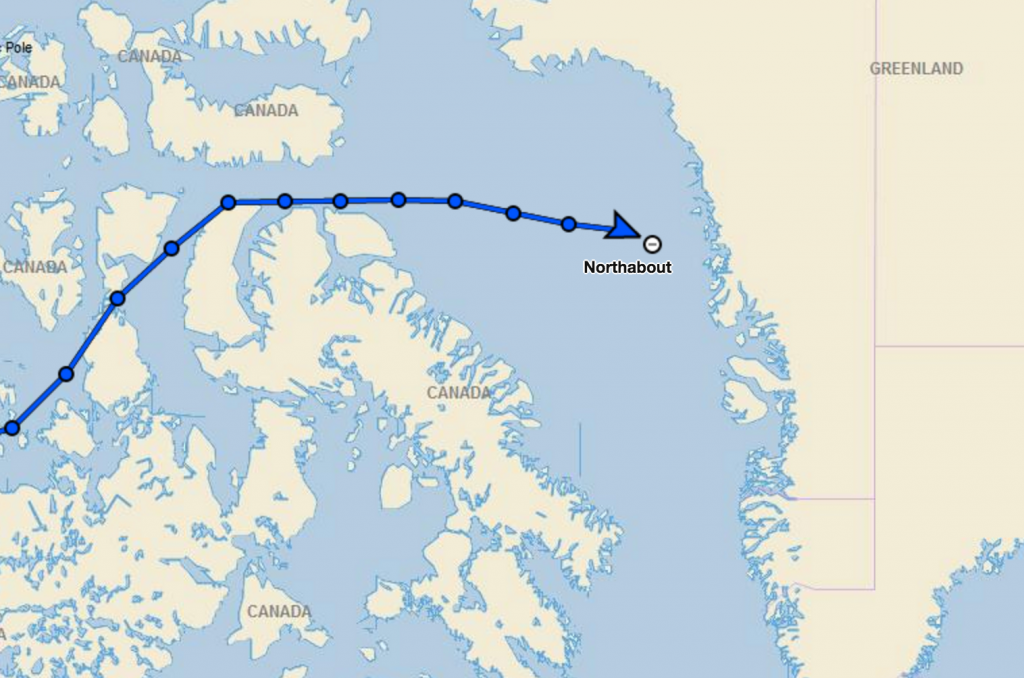
Pressing on the crew of Northabout are now approaching halfway across Baffin Bay:
Her crew are trying to reach Upernavik in Greenland before the impending storm gets too bad. Here’s our own WaveWatch III based forecast for tomorrow afternoon:
Today Tonight and Wednesday Wind light increasing to south 15 knots early this evening and to south 20 late this evening. Wind backing to southeast 25 overnight then diminishing to light Wednesday afternoon.
Waves
Today Tonight and Wednesday Seas 1 metre building to 2 after midnight.
Thursday
Wind light increasing to northwest 15 knots in the afternoon then veering to north 20 late in the day.
Friday
Wind north 30 knots diminishing to north 20.
I seem to recall that 30 knot winds are best avoided! After Upernavik Northabout will head for Nuuk further south in Greenland and then across the North Atlantic back to Bristol, where she started her voyage back in June. It is certainly not beyond the bounds of possibility that there will be winds of 30 knots and more to contend with on that final leg of the Polar Ocean Challenge!
[Edit – September 14th]
Northabout has obviously not managed to escape the storm entirely. Ben Edwards reports today:
I hate this part of a journey. Yesterday as I came off watch we were scheduled to arrive about midnight tonight. I hate that anyway because you get the so close yet so far feeling. But typically as I came off watch the wind picked up, moved to an unhelpful angle and created the worst sea state we’ve had since the Chuckchi Sea. We’re still supposed to arrive about two in the morning but it will make the next twenty two hours really horrible. Not that our arrival time mattes too much, we can’t go in till it’s light anyway.
Gale from south and southeast, 13 to 18 m/s. From the western part decreasing and becoming south and southwest, 5 to 10 m/s, in northern part locally 13 m/s. Thursday gradually in eastern part south and southeast, 8 to 13 m/s, but in western part cyclonic variable, up to 10 m/s. Especially in northern part locally rain, sleet or snow with moderate to poor visibility, otherwise good visibility.
Significant wave height: 3,5 m. Swells: 3 m.
Many icebergs and growlers in the eastern part along the coast, otherwise few icebergs and growlers.
Upernavik is slightly south of there, but nonetheless Ben will have a few more uncomfortable hours, and Northabout may yet meet some more ice before her crew set foot on dry land once again:
[Edit – September 15th]
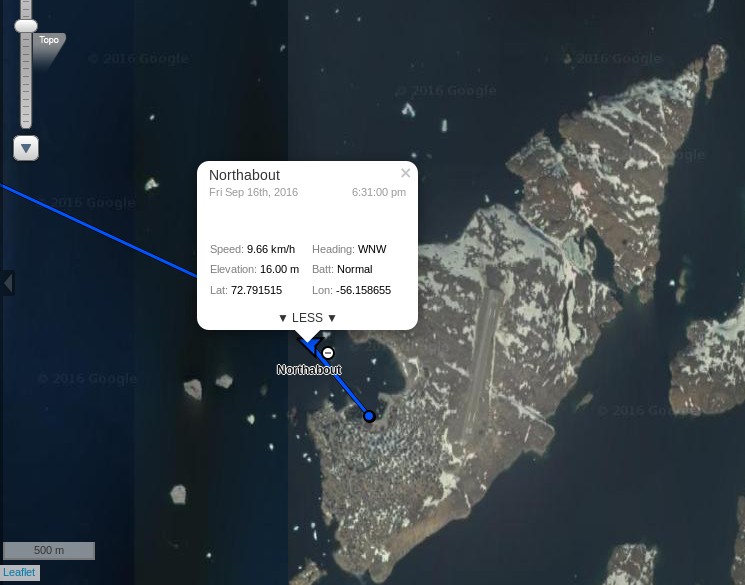
Northabout has just arrived in Upernavik:
[Edit – September 16th]
It looks as though Northabout has just left Upernavik, and is now en route to Nuuk:
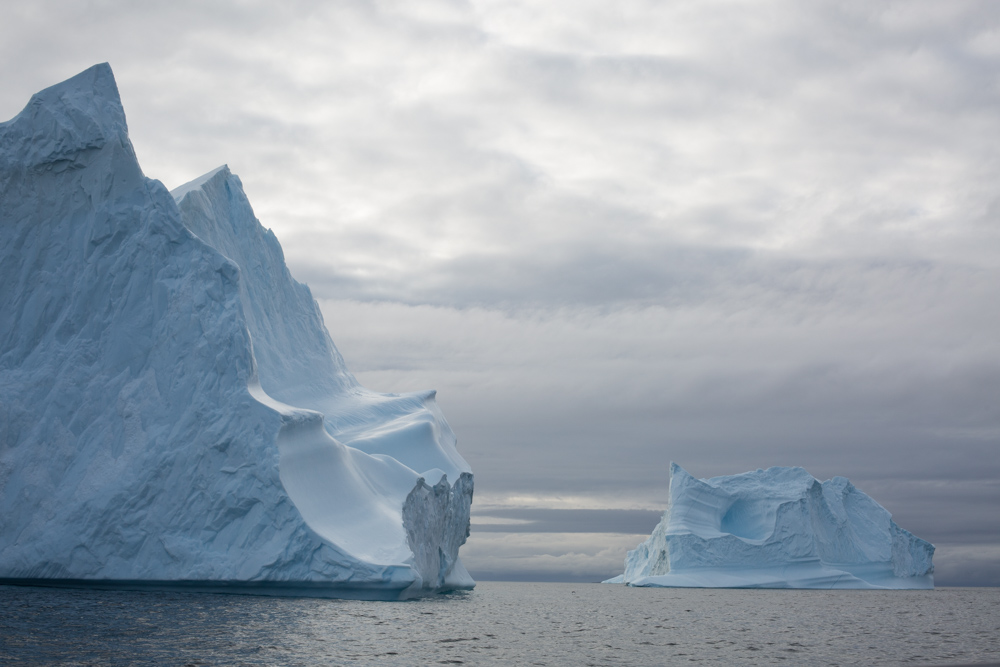
As we expected, it was a long night last night as the big swell and Northernly winds continued to sweep us along from Upernavik, big surf waves behind us breaking under us, Northabout became a little Hawwai five o. We made our way along the coastline through amazing beautiful icebergs created by glaciers at Ilulissat.
The icebergs were between the size of telly to the size of a house to the size of a grand hotel. They were breaking up, and once or twice right in front of us creating lots a small bergs and ice chunks that don’t float so high above the water and so are difficult to spot especially with a large 10 foot swell, they disappear and reappear in the water around us.
[Edit – September 19th]
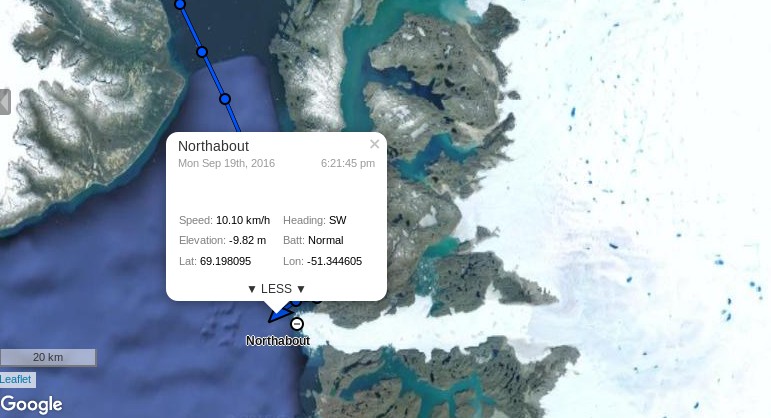
Northabout has just left Ilulissat, en route for Nuuk:
[Edit – September 22nd]
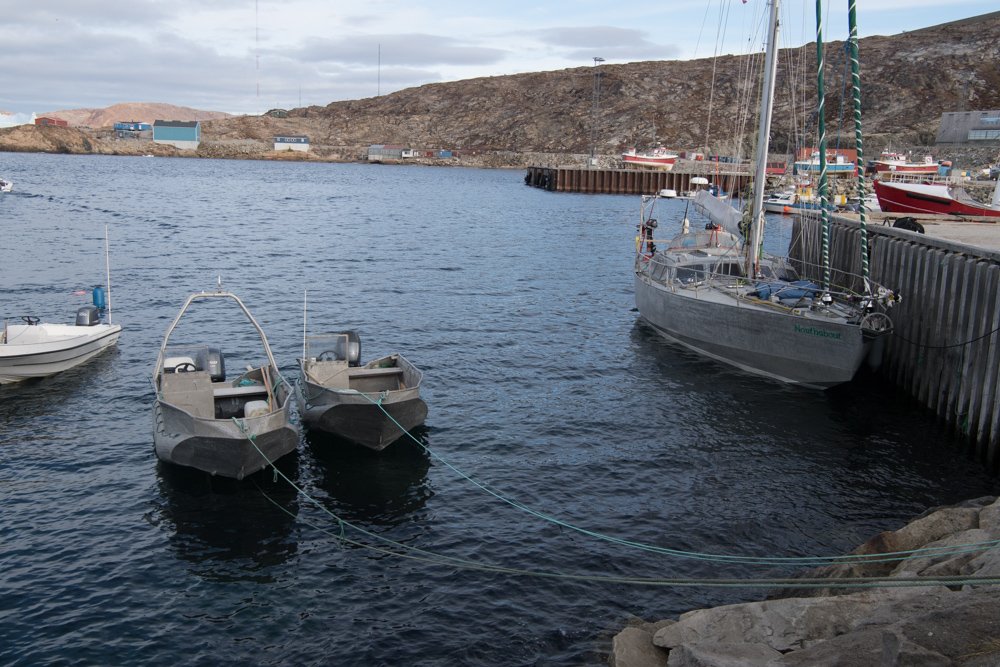
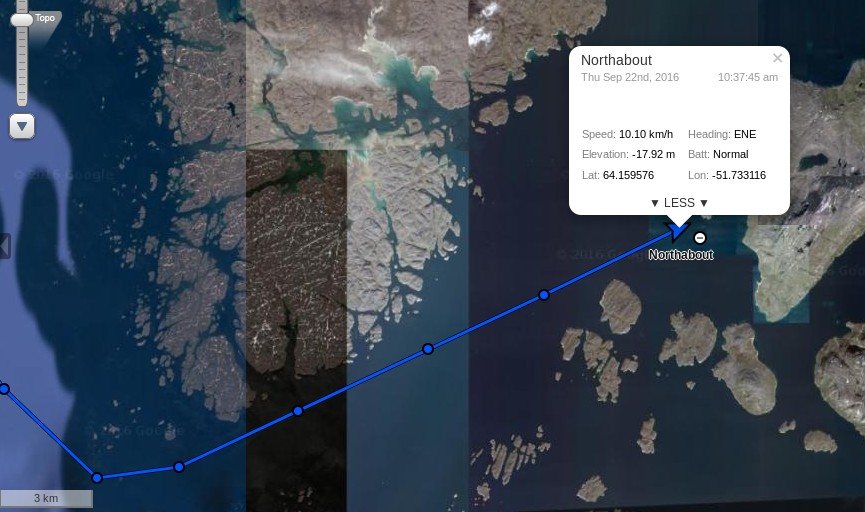
Northabout has crossed the Arctic Circle and has just reached Nuuk, the capital of Greenland:
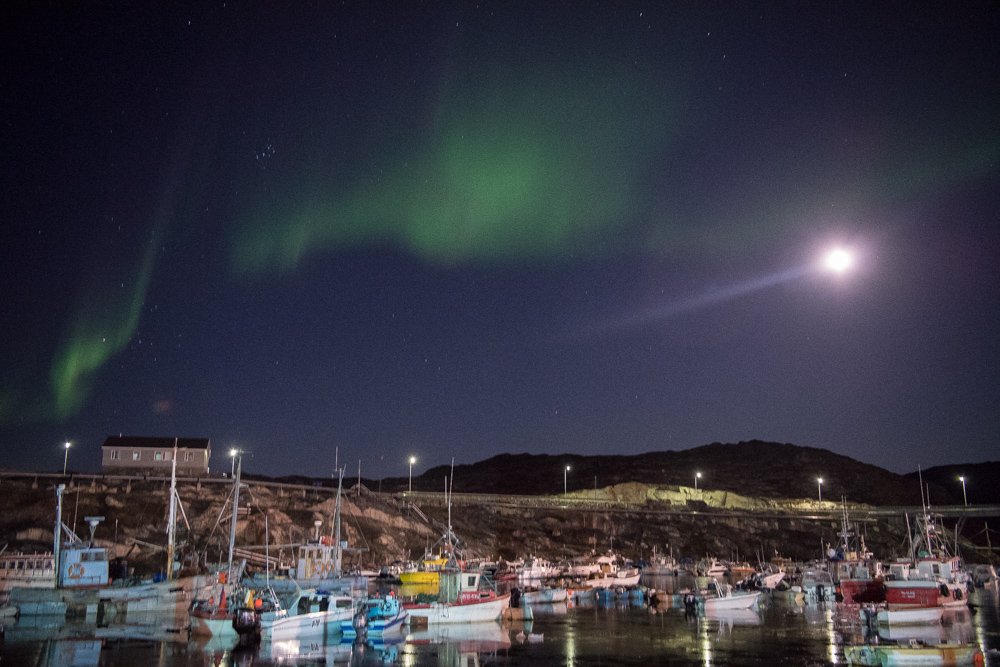
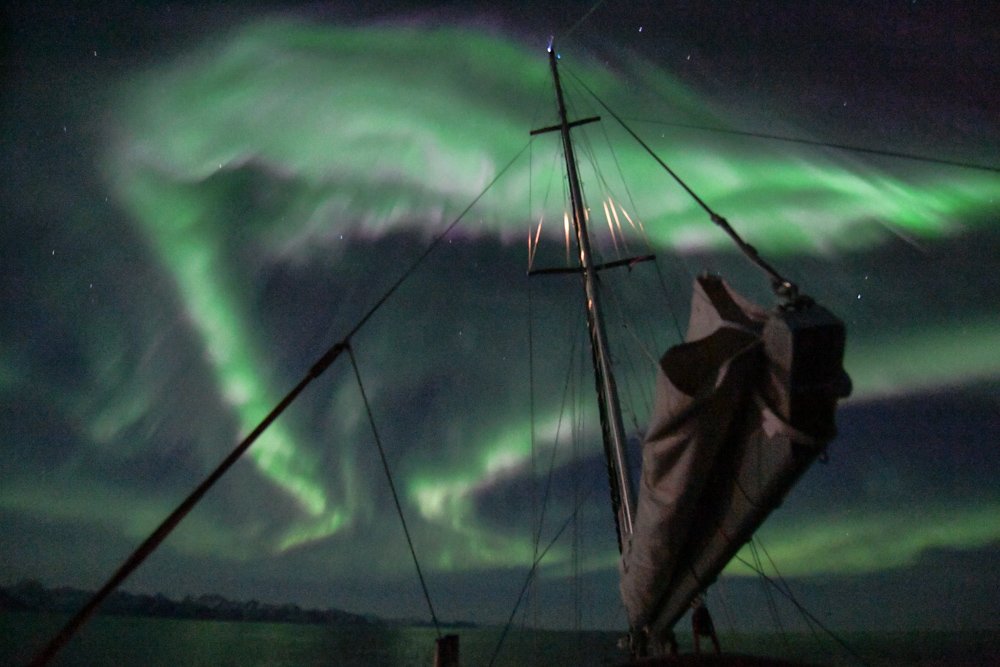
En route from Ilulissat her crew have seen some amazing sights:
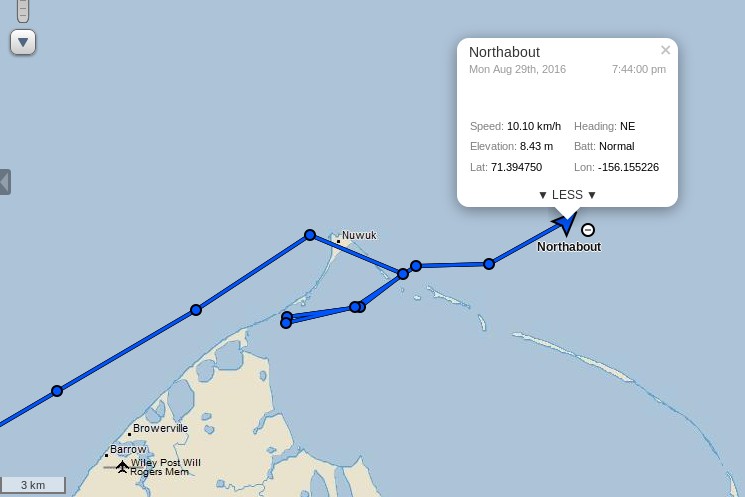
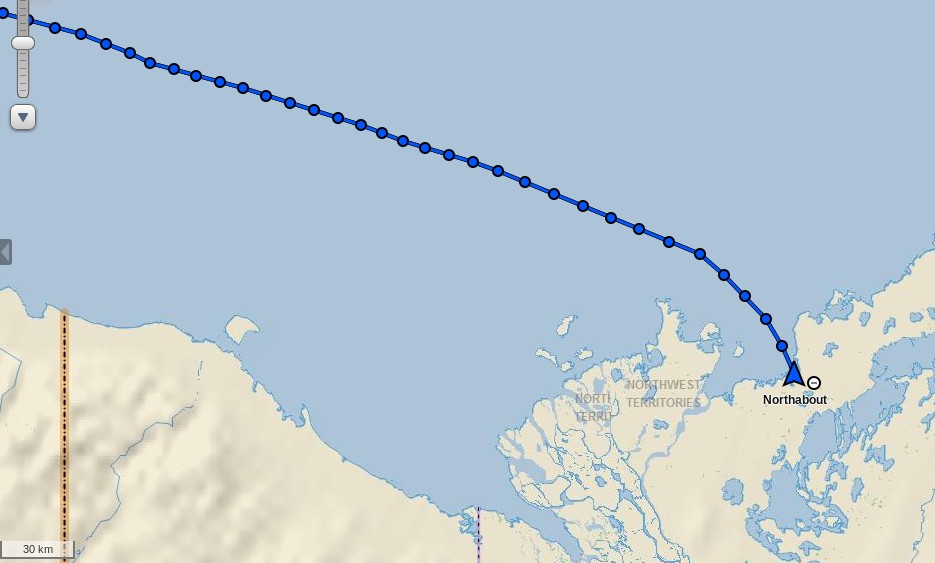
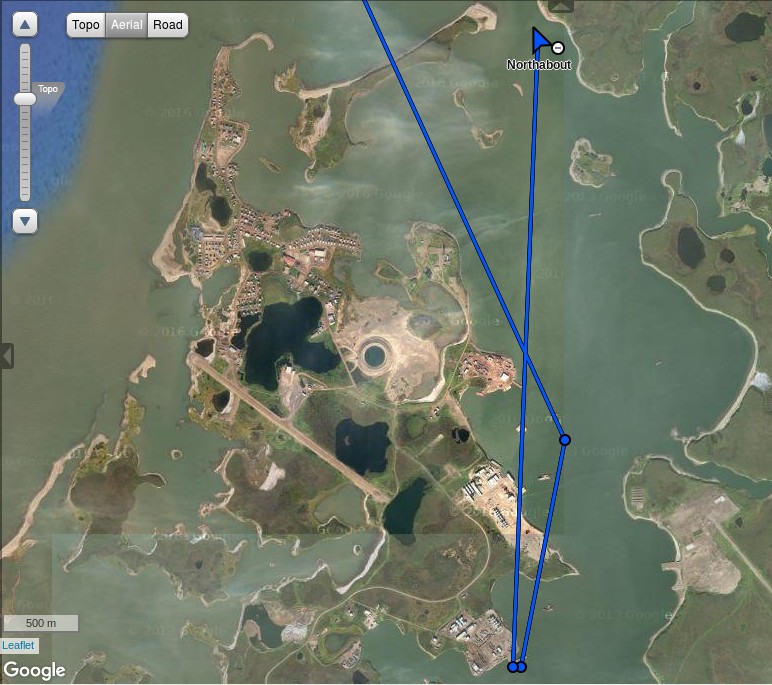
After the briefest of stops in Elson Lagoon behind Point Barrow Northabout is on the move once again:
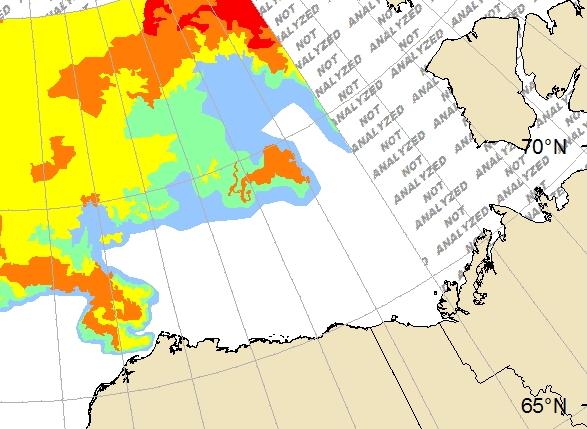
She’s currently heading out into the Beaufort Sea before following in the giant footsteps of the cruise liner Crystal Serenity in the direction of the Amundsen Gulf and the Canadian Arctic Archipelago. Here’s the United States National Weather Service’s current ice chart for Alaskan waters:
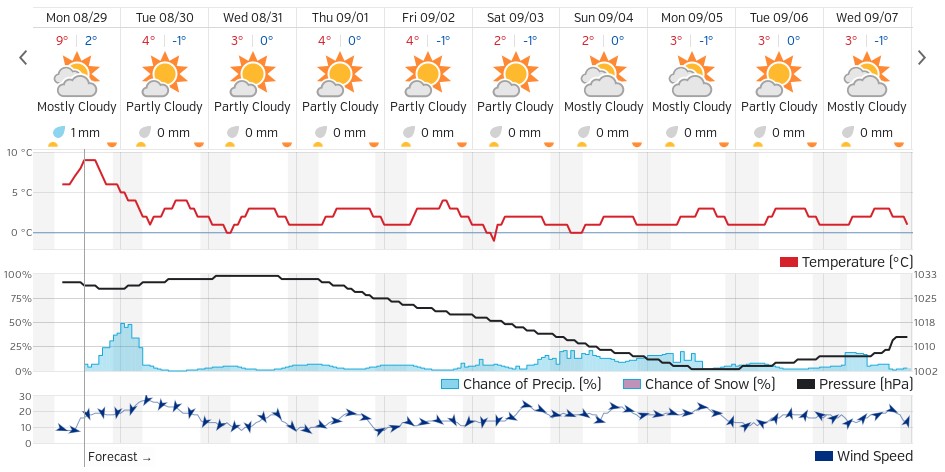
There looks to be far less to worry about ice wise on the next leg of the Polar Ocean Challenge than on the previous one! The weather forecast isn’t too bad either, with high pressure over the Beaufort Sea and a fair bit of sunshine. Here’s the Weather Underground forecast for Ulukhaktok, Crystal Serenity’s first port of call in the CAA:
There is currently a “small craft advisory” warning in effect for the Beaufort Sea coast:
CAPE HALKETT TO FLAXMAN ISLAND-
207 PM AKDT MON AUG 29 2016
…SMALL CRAFT ADVISORY IN EFFECT FROM TUESDAY MORNING THROUGH
TUESDAY AFTERNOON…
TONIGHT
E WINDS 20 KT. SEAS BUILDING TO 4 FT.
TUE
E WINDS 25 KT. SEAS 5 FT.
TUE NIGHT
E WINDS 20 KT. SEAS 6 FT.
WED
E WINDS 20 KT. SEAS 6 FT.
WED NIGHT
E WINDS 20 KT. SEAS 5 FT.
THU
NE WINDS 20 KT. SEAS 4 FT.
THU NIGHT
NE WINDS 15 KT. SEAS 4 FT.
FRI
N WINDS 10 KT. SEAS 2 FT.
SAT
N WINDS 15 KT. SEAS 3 FT.
All in all it looks like fairly plain sailing for the foreseeable future, with only occasional moderate headwinds to contend with.
[Edit – August 30th]
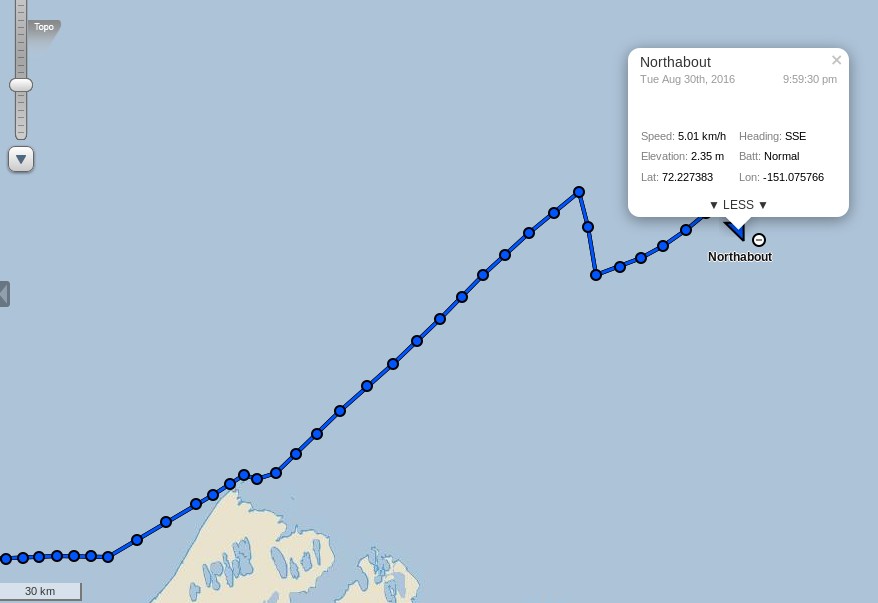
It seems my “fairly plain sailing” conclusion was overly hasty. According to the latest “Ship’s Log“:
The weather forecast is pants. A 30/35 knot headwind along the coast . No one has the appetite for it, so we are heading North, slacker winds, staysail out, still a choppy sea and uncomfortable, but not as bad as 30 knots. Hopefully no ice tonight on my watch.
This is the end result:
As Phil points out below:
Our next stop along the North West Passage is Tuktoyaktuk. That’s when we can use a pontoon, get rid of our rubbish, fill the tanks, do the laundry and have a shower. 500nm away.
[Edit – August 31st]
The Polar Ocean Challenge team report via Twitter:
They have some more to carry out in Tuk too. Despite the great “groove” displayed above Ben Edwards reports that:
Joy of joys, the auto-helm’s stopped working. Dad (Steve Edwards, crew), thinks he knows why so we’ll hopefully be able to fix it in Tuk. In the meantime we’re back to helming by hand. This is a mixed blessing, on the one hand it’s really irritating to have to helm in large swells and with a strong headwind because any movement you make is at first ignored, and then exaggerated by, the wind. So it’s hard to keep a decent track and it makes it harder to look out for ice. On the other hand, moving and putting effort into the steering keeps you warm which is nice and it means you don’t have to put as many clothes on which is also nice because when you go down stairs and it’s twenty four degrees it can get quite uncomfortable.
We all had our job lists, ice lights, bilge pumps, laundry, shopping but the man who gets the Vodka Salute is unquestionably Steve.
I dropped him off wth Willard. Two peas in a pod. They made a broken Pilot Spigot. That sounds quite easy but it took the whole day in a machine shop in a container, working to fine tolerances, and many modifications. Fitting it in the bowels of the Lazzerette in cold weather and driving rain. It worked first time. Brilliant effort.
Issued 07:00 AM MDT 04 September 2016
Today Tonight and Monday
Wind – Northwest 15 knots diminishing to light late this morning then becoming northwest 15 Monday morning.
Waves
Seas – 1 metre.
Weather & Visibility – Chance of showers changing to periods of rain near noon then to chance of showers tonight and Monday. Fog patches dissipating early this evening.
My famous last words? Plain sailing by the look of it!
[Edit – September 5th]
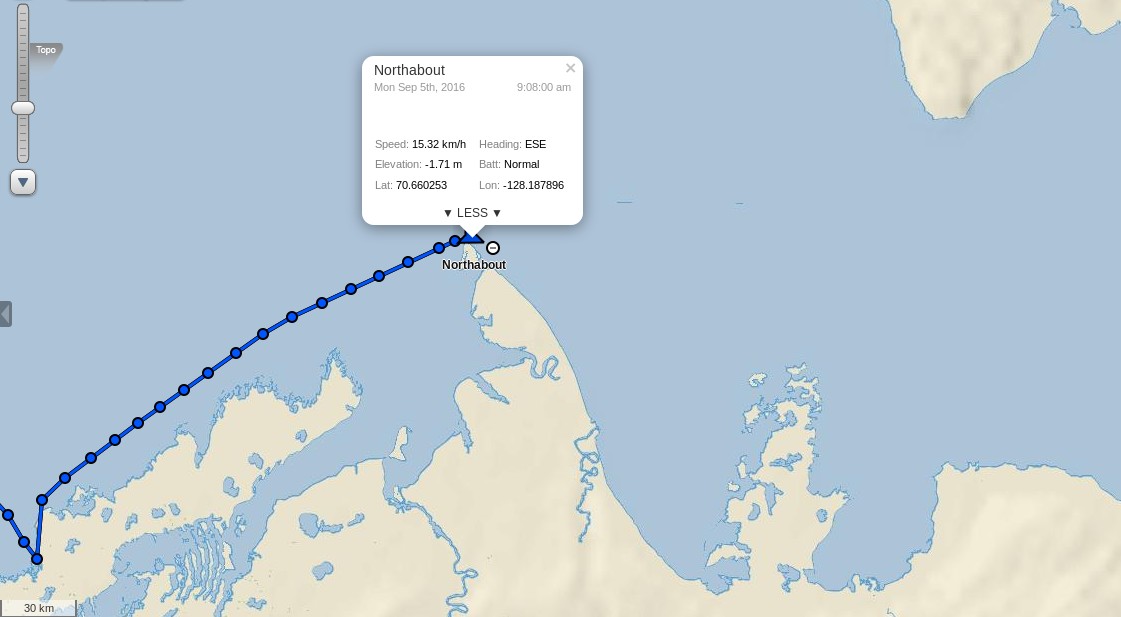
Northabout has just rounded Cape Bathurst, the northernmost point of mainland Northwest Territories:
I wonder if her crew will take a close look at the nearby Smoking Hills?
[Edit – September 6th]
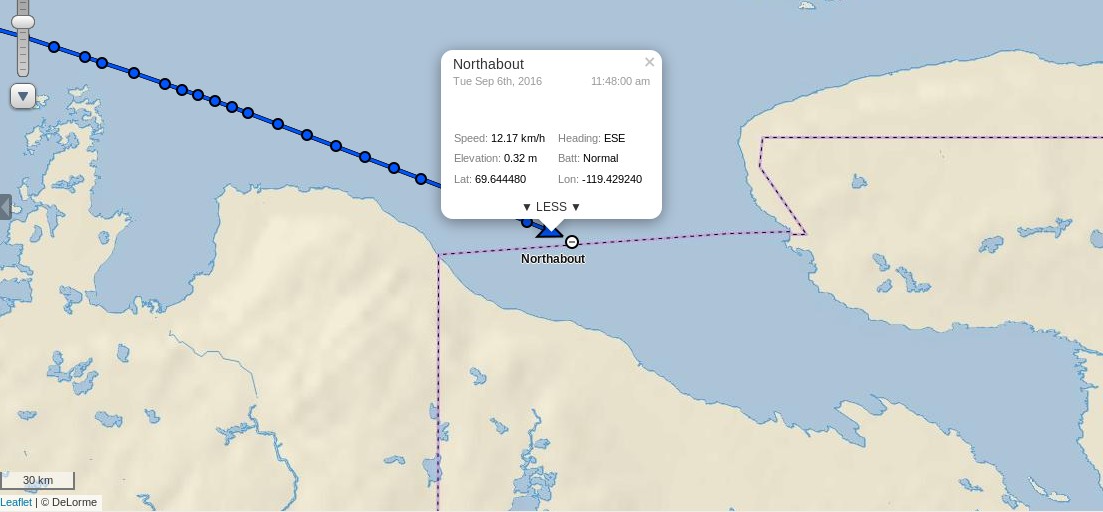
Northabout gave the Smoking Hills a miss and headed strait for Cape Parry. She has already crossed the Amundsen Gulf and is heading into the Dolphin & Union Strait:
In light of the lack of ice and in the spirit of saving time we’ve decided not to stop in Cambridge Bay or Pond Inlet and go straight on to Upernavik in Greenland before doing our crew change. Looking at the ice maps at the moment it seems we’ll be able to get through with little or no trouble, though this is almost bound to change, if it stays that way we’ll reach Upernavik in about fourteen days. I’m looking forward to it!
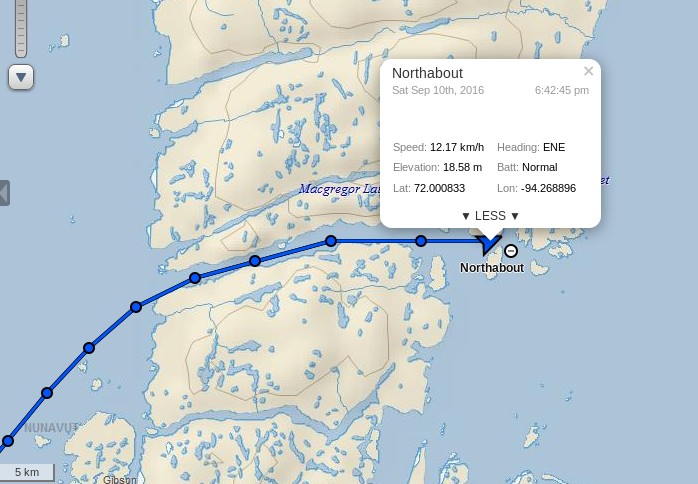
This morning Northabout is rapidly approaching the western entrance to Bellot Strait:
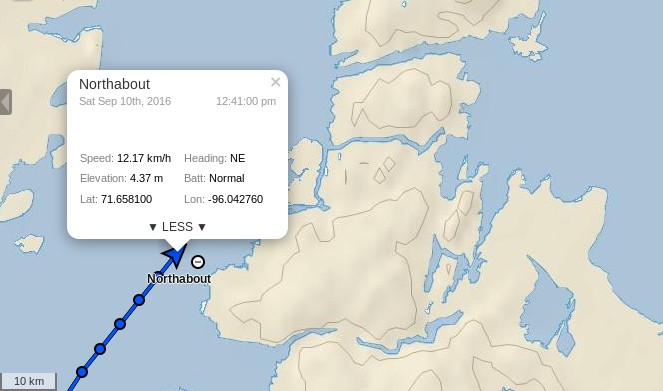
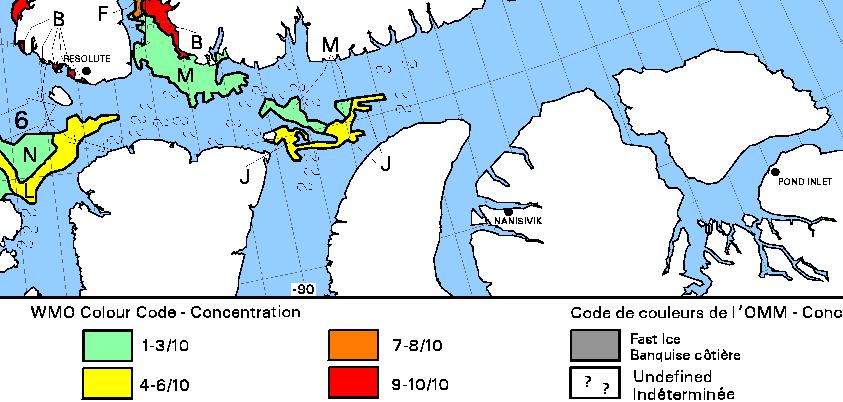
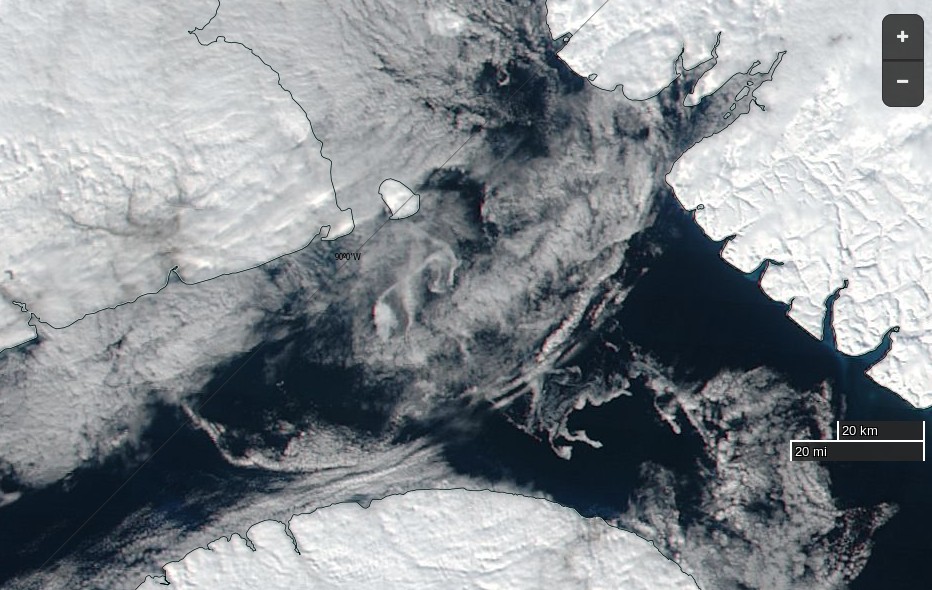
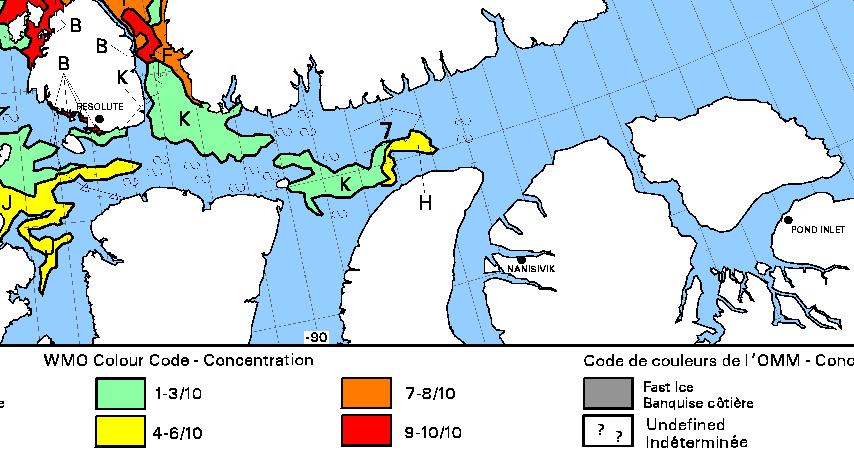
Their stated intentions are to head past Pond Inlet and across Baffin Bay to Upernavik in Greenland. Assuming they initially follow the same route as Crystal Serenity they will soon to need to pick their way past some bergy bits in Prince Regent Inlet before negotiating some currently “wispy” areas of sea ice as they enter Lancaster Sound. Here is the current Canadian Ice Service chart for the area:
plus a rather cloudy “visual” image:
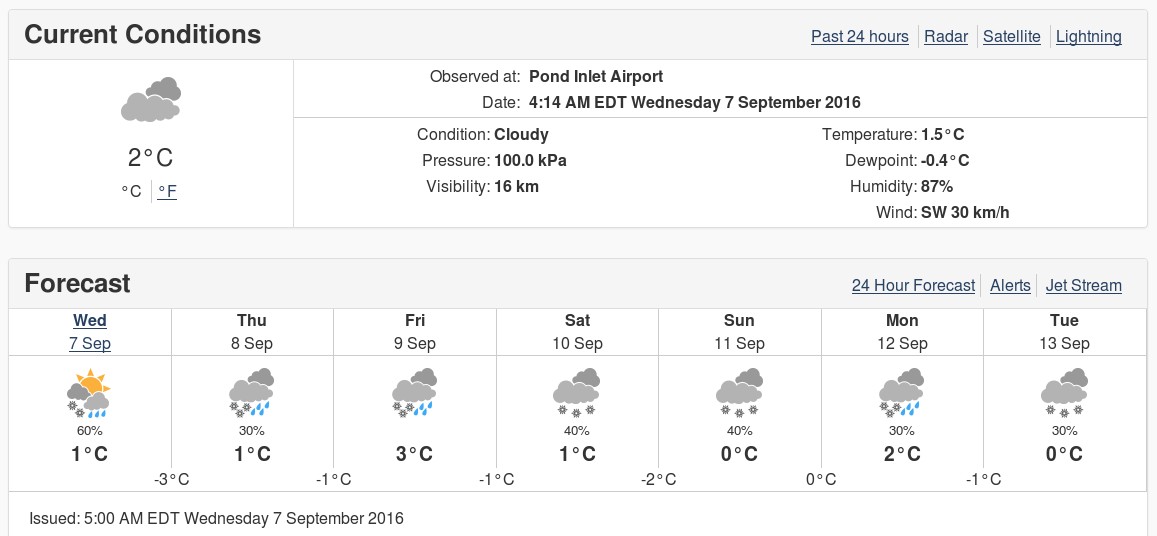
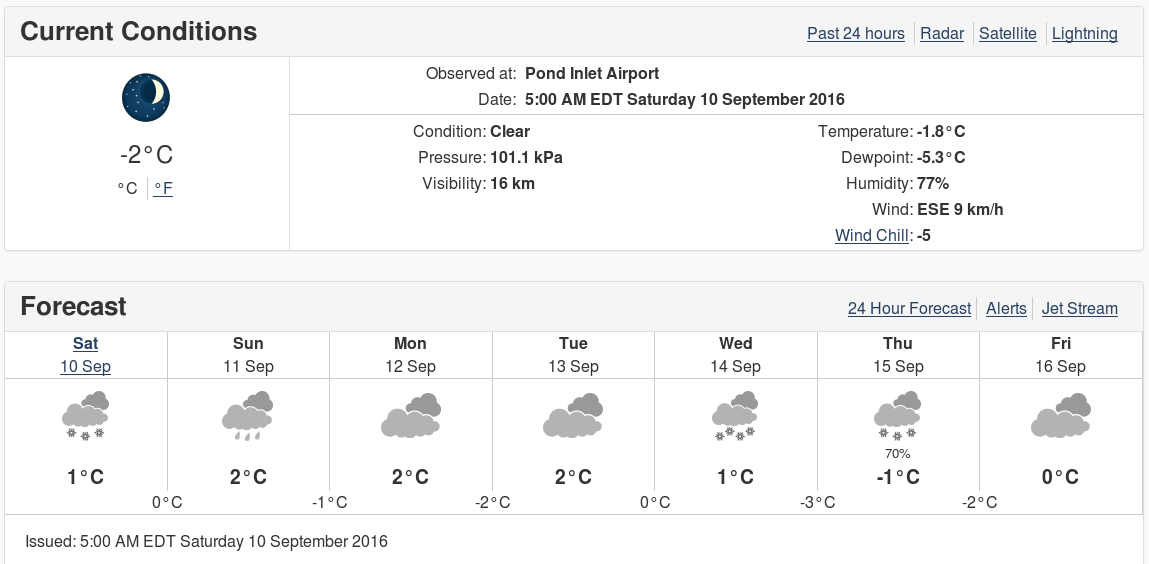
The current weather forecast for Pond Inlet doesn’t suggest the parts of the Northwest Passage still on Northabout’s route are going to start refreezing just yet:
Currently there is an obvious passage past the existing ice, but that may of course have changed by the time Northabout gets there.
[Edit – September 10th PM]
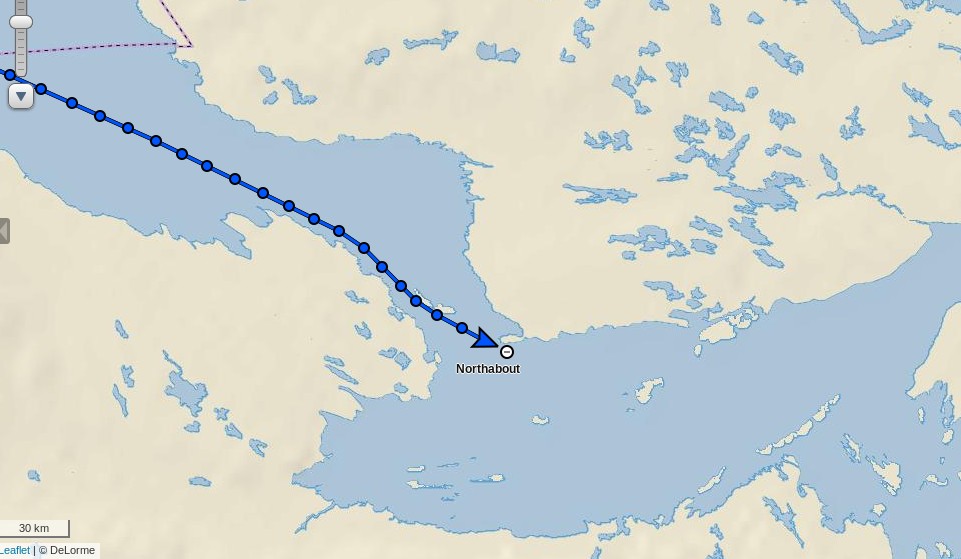
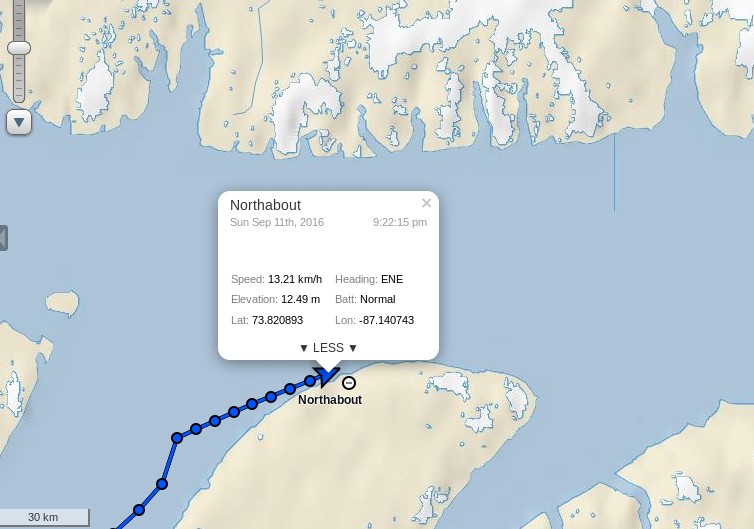
Northabout has just emerged safely from the eastern end of Bellot Strait:
I wonder if her crew will stop to make a new entry in the visitors book at Fort Ross?
[Edit – September 11th]
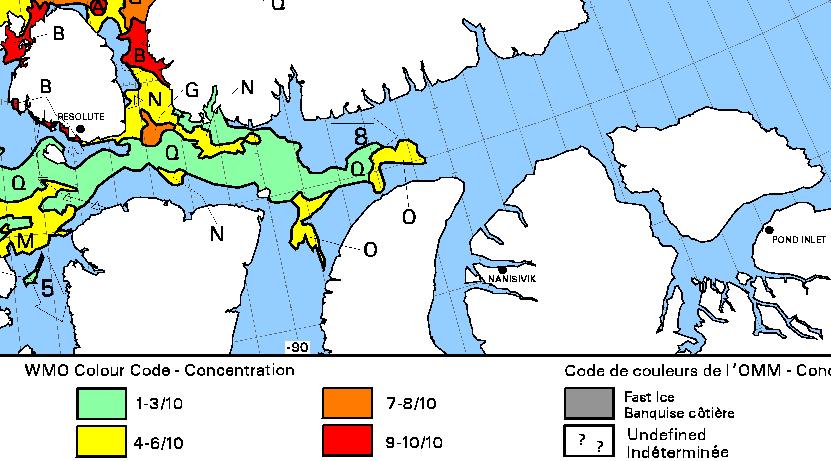
Here’s the latest CIS ice chart:
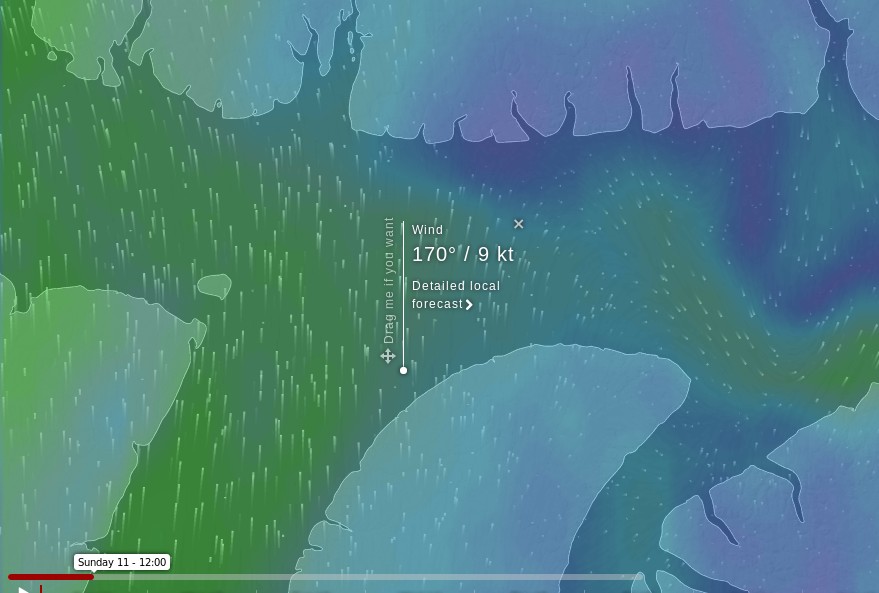
The gap between the coast and the yellow area of 4-6/10 concentration ice has closed considerably, and there’s now a broad expanse of 1-3/10 ice which Northabout may be forced to try and wend her way through. A change in wind direction would come in very handy, and that’s just what the ECMWF forecast at Windyty is suggesting for Sunday 11th:
Just what the doctor ordered?
[Edit – September 11th PM]
Video shot from Northabout’s drone of her ice-free passage through Bellot Strait:
However the passage from Prince Regent Inlet into Lancaster Sound has not proved to be ice-free!
Northabout is obviously endeavouring to skirt around the eastern edge of the 4-6/10 old ice in her path:
Today’s CIS ice concentration chart suggests there isn’t much room to spare:
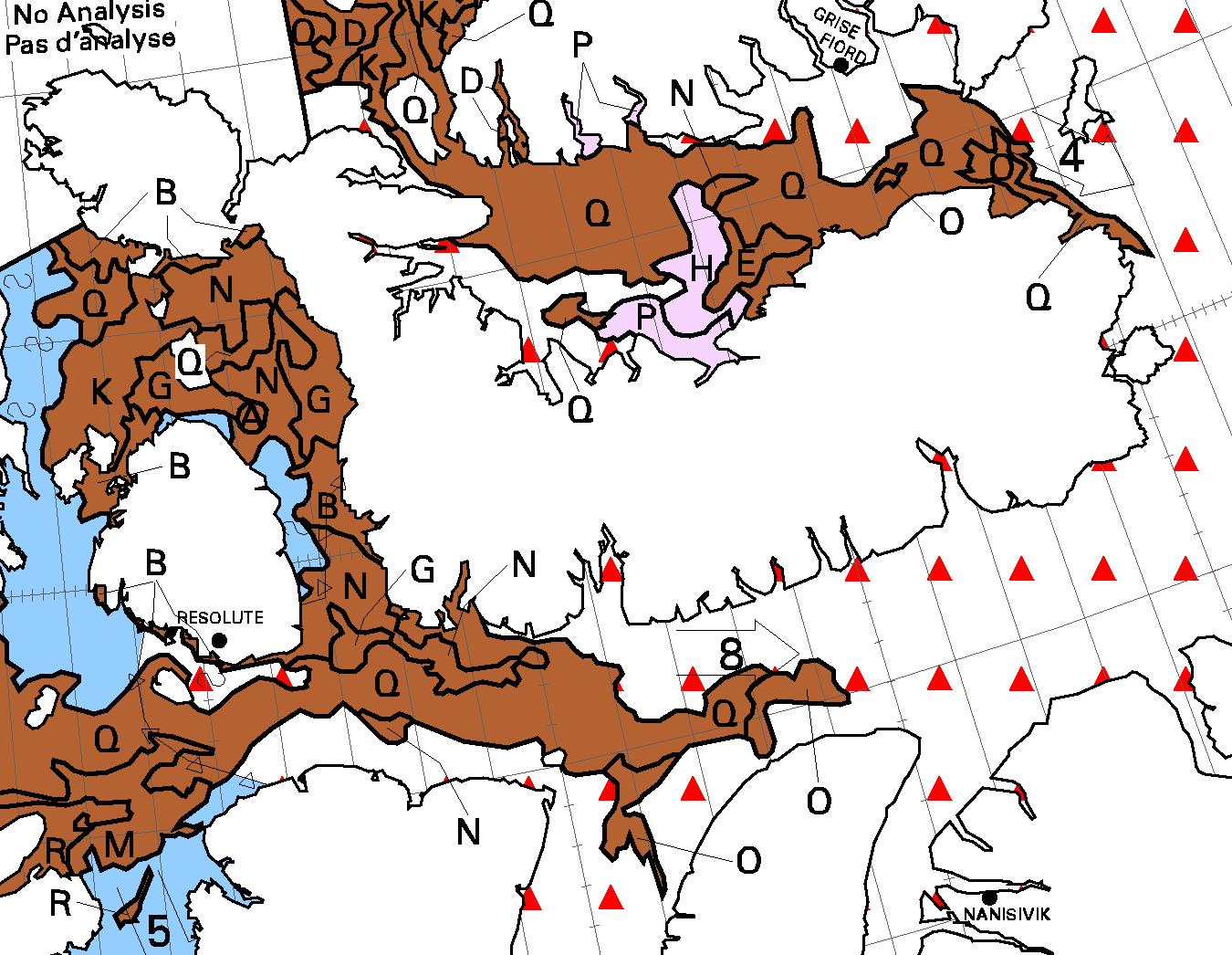
The stage of development chart does reveal some new ice, but it’s well to the north of Northabout’s route through Lancaster Sound to Pond Inlet:
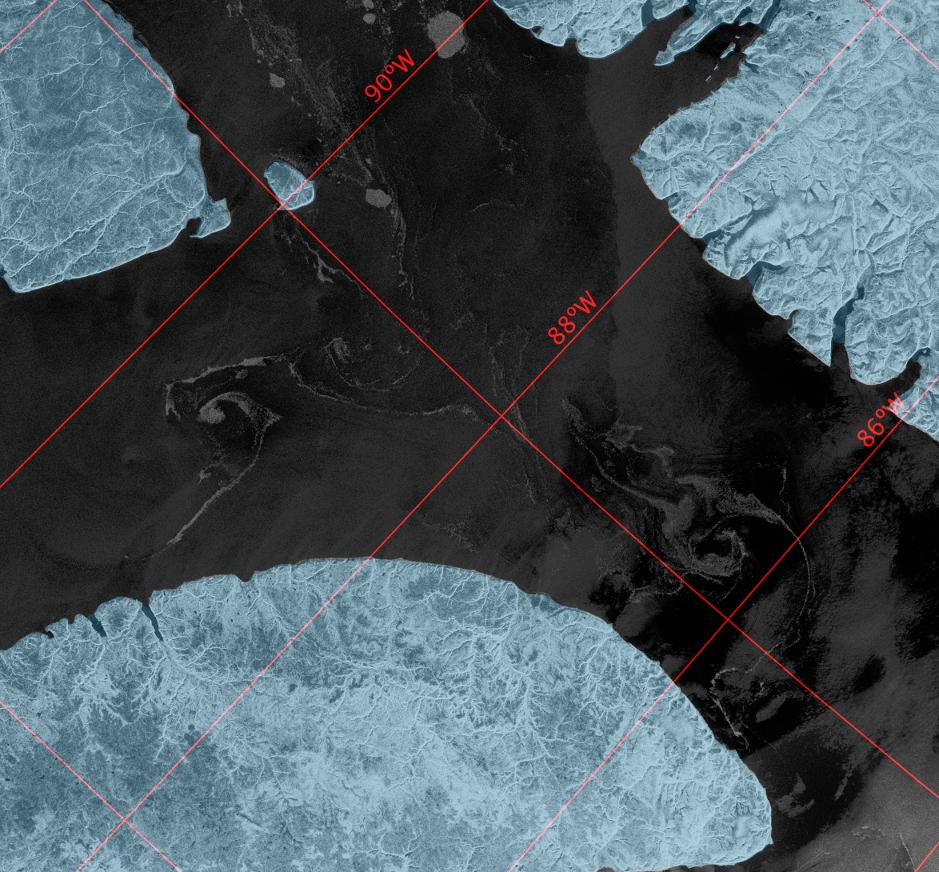
Somewhat belatedly, here’s a Sentinel 1A synthetic aperture radar image of the sea ice Northabout is squeezing past as we speak:
[Edit – September 12th]
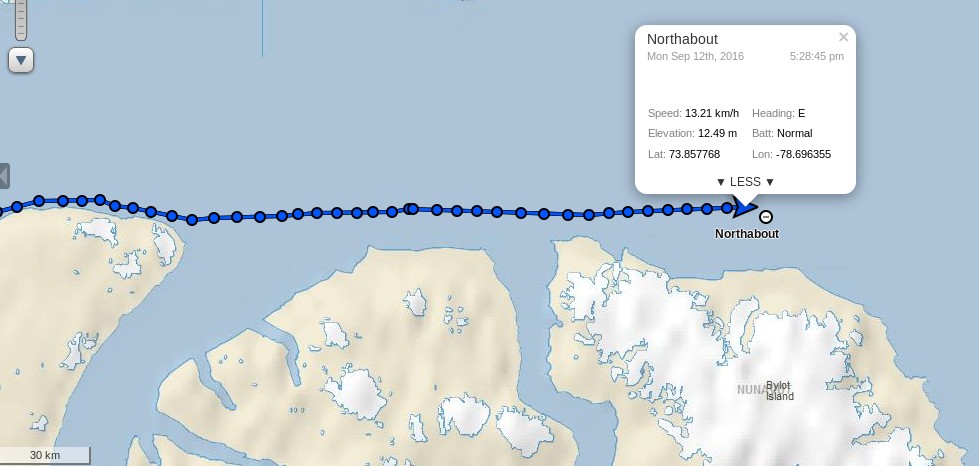
Northabout has emerged safely into Lancaster Sound, and is bypassing Pond Inlet in order to head strait across Baffin Bay:
Here are a couple of videos of some remnants of sea ice on her once again eastward travels:
There are several more on the Polar Ocean Challenge web site.
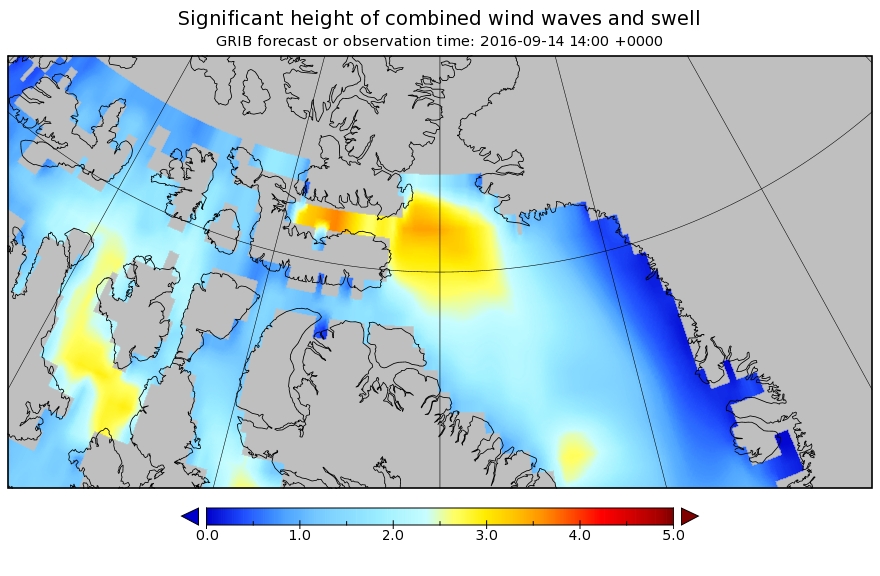
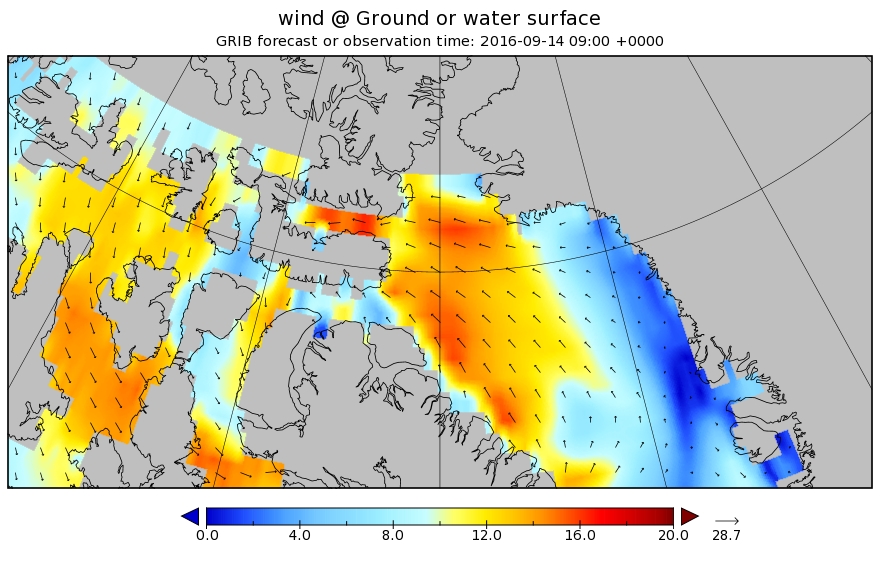
With all that ice now safely behind her Northabout has new dangers to face. Wind and waves! Let’s take a look at the WaveWatch III “surf forecast” for Baffin Bay over the next few days. A low pressure area is heading in Northabout’s direction from across the Canadian Arctic Archipelago. By Wednesday morning (UTC) the resultant wind field looks like this:
By Wednesday afternoon those winds of around 15 m/s will have produced waves in Baffin Bay that are forecast to have reached over 3 meters high:
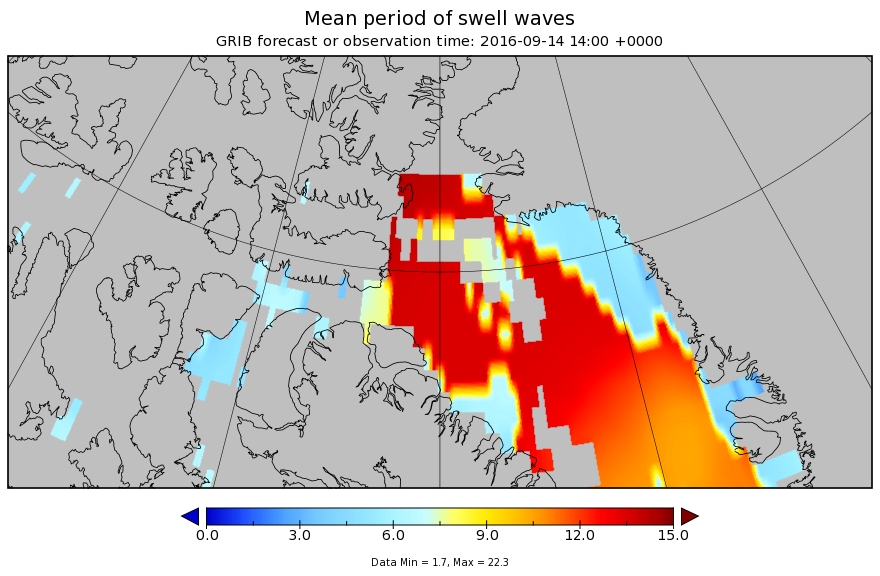
and what’s more they won’t be just wind waves. A modest swell with a period of over 12 seconds is predicted too:
I’m sure the Polar Ocean Challenge team will be doing their level best to be safely on the opposite side of Baffin Bay by the time the worst of the weather arrives!
This website uses cookies to improve your experience. We'll assume you're ok with this, but you can opt-out if you wish. Cookie settingsACCEPT
Privacy & Cookies Policy
Privacy Overview
This website uses cookies to improve your experience while you navigate through the website. Out of these, the cookies that are categorized as necessary are stored on your browser as they are essential for the working of basic functionalities of the website. We also use third-party cookies that help us analyze and understand how you use this website. These cookies will be stored in your browser only with your consent. You also have the option to opt-out of these cookies. But opting out of some of these cookies may affect your browsing experience.
Necessary cookies are absolutely essential for the website to function properly. This category only includes cookies that ensures basic functionalities and security features of the website. These cookies do not store any personal information.
Any cookies that may not be particularly necessary for the website to function and is used specifically to collect user personal data via analytics, ads, other embedded contents are termed as non-necessary cookies. It is mandatory to procure user consent prior to running these cookies on your website.