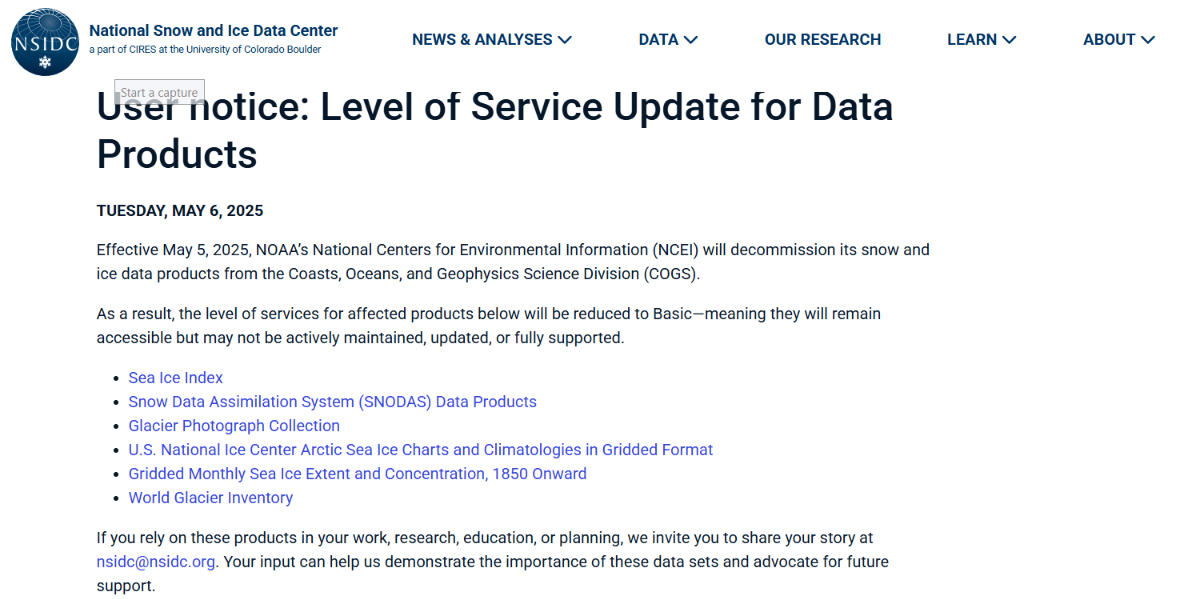
I frequently post a summary of the Arctic section of the United States’ National Snow and Ice Data Center’s monthly review of the current state of the cryosphere. Here is the most recent edition.
Effective May 5, 2025, NOAA’s National Centers for Environmental Information (NCEI) will decommission its snow and ice data products from the Coasts, Oceans, and Geophysics Science Division (COGS).
As a result, the level of services for affected products below will be reduced to Basic—meaning they will remain accessible but may not be actively maintained, updated, or fully supported.
If you rely on these products in your work, research, education, or planning, we invite you to share your story at [email protected]. Your input can help us demonstrate the importance of these data sets and advocate for future support.
I will certainly share my story with the NSIDC. If you are a resident of the US you may also wish to contact your local friendly neighbourhood politician(s) about the matter?
[Update – May 9th]
Mark Serreze, Director of the National Snow and Ice Data Center, replied to my email and told me that:
We are acutely aware of the importance of the SII and Sea Ice Today. Millions of visits per year. High priority. We’re in the middle of discussions about to make sure that we have continuity.
Thanks for your support. Everything helps.
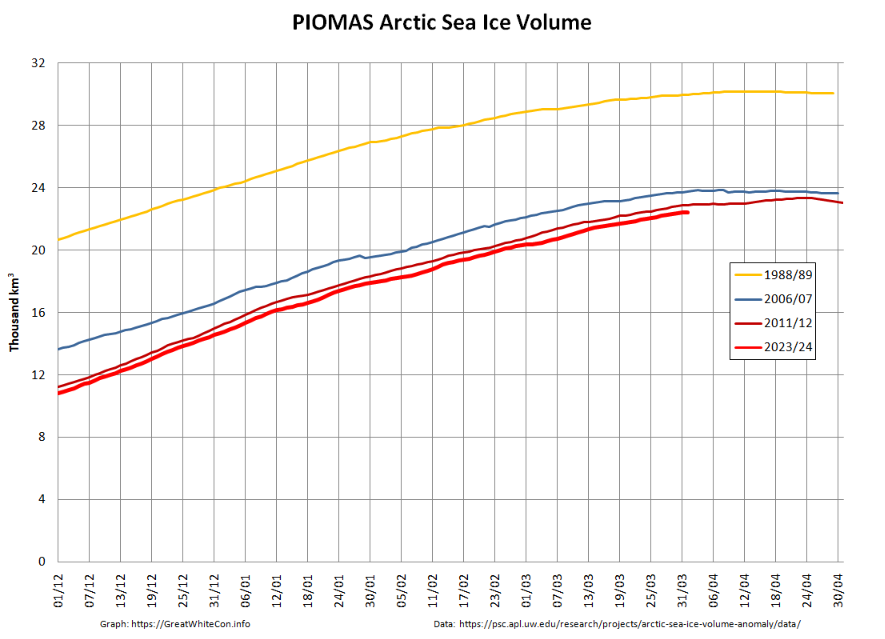
One of the less well known data products provided by the NSIDC is EASE-Grid Sea Ice Age.
I recently used that particular mine of essential cryospheric information to produce this educational YouTube video:
The video reveals the underlying reason for the “fast transition” of Arctic sea ice cover from thick multi-year ice to a reduced area of much more mobile young ice.
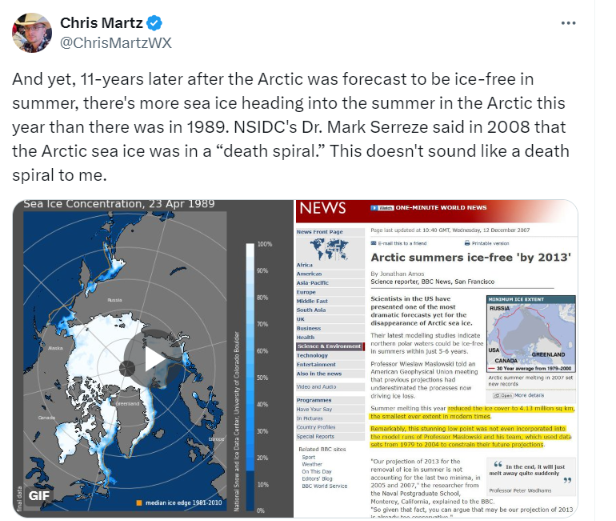
As you can see, Chris also invokes the age old canard of the “Mark Serreze Arctic sea ice death spiral”. I discussed that very topic with Mark in 2015:
Mark told me that he still stood by his 2030 estimate for the onset of a seasonally ice free Arctic, although: “Most models say more like 2050”.
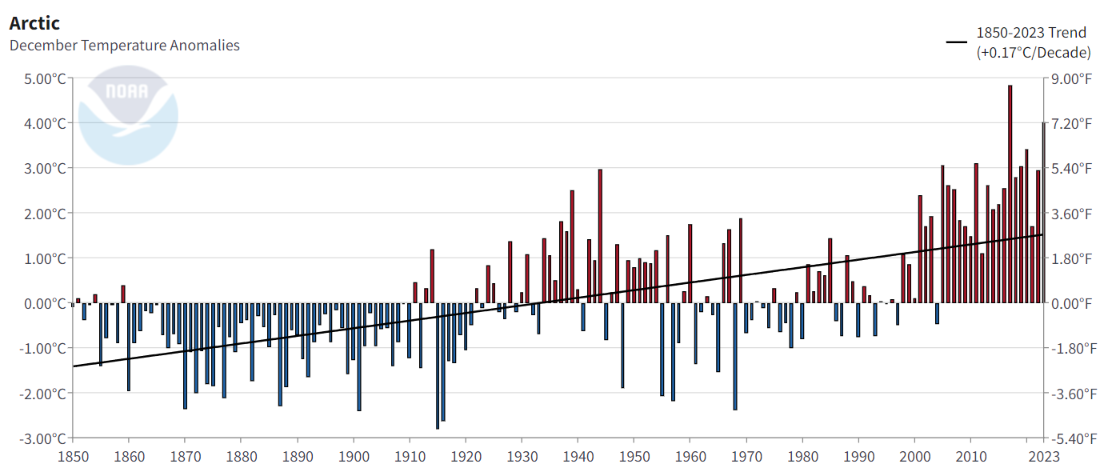
I was mildly surprised when a somewhat “skeptical” interlocutor of my Arctic alter ego linked to “Climate at a Glance” in the course of our alleged “debate”. I was even more surprised to discover that the far end of the suggested link was not NOAA’s familiar overview of the Arctic temperature trend:
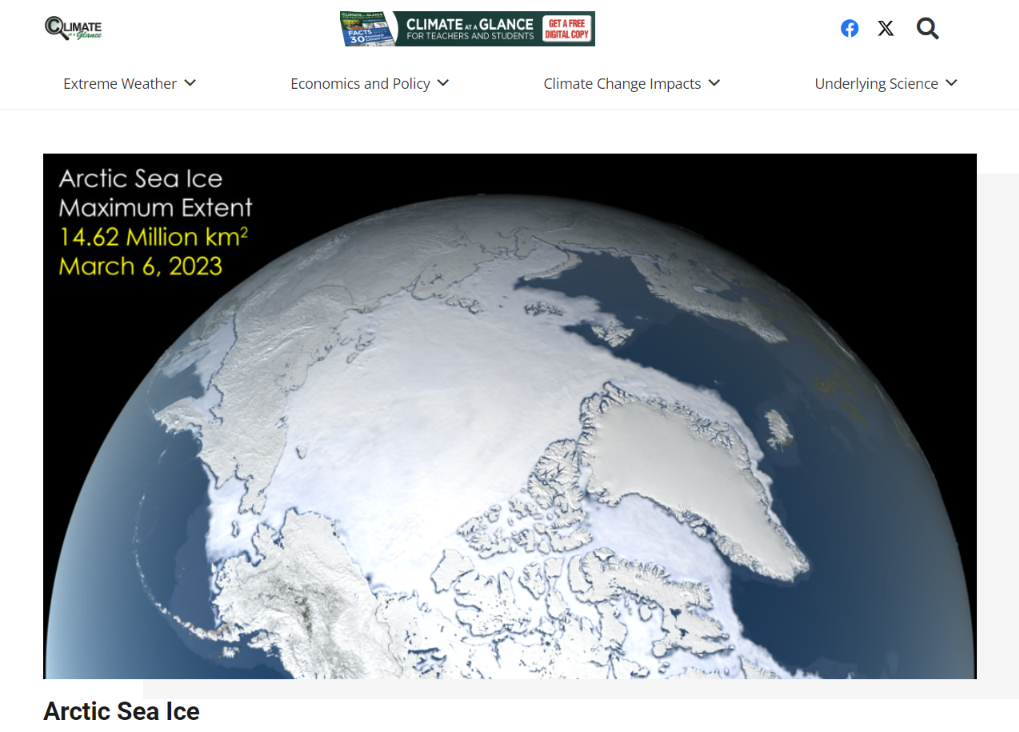
but instead a similarly named web site proudly sponsored by the Heartland Institute:
The “Climate at a Glance” home page currently features the Arctic at the top, and it probably won’t surprise you to learn that the linked article is full of half truths and untruths about “Snow White’s” favourite topic? Here are the Heartland Institute’s key Arctic takeaways:
Arctic explorer Pen Hadow trekked, and swam, from Ward Hunt Island to the North Pole in 2003. Solo and unsupported. He plans to return to the North Pole this summer, but on this occasion he’ll be sailing with a few companions. According to yesterday’s Sunday Times:
Pen Hadow launches bittersweet mission to sail to North Pole
For his new record attempt, Hadow and his nine-strong team will take two yachts on a 3,500-mile round trip from Nome in Alaska to the pole, using satellites to find a route through the ice and avoid getting stuck. He will fly to Alaska to join his team members on Saturday.
If all goes to plan, he will arrive at the pole between August 15 and early September, about 510 miles further north than anyone has sailed before.
Although the Sunday Times failed to mention it the expedition has a web site of its own. According to the Arctic Mission “About” page:
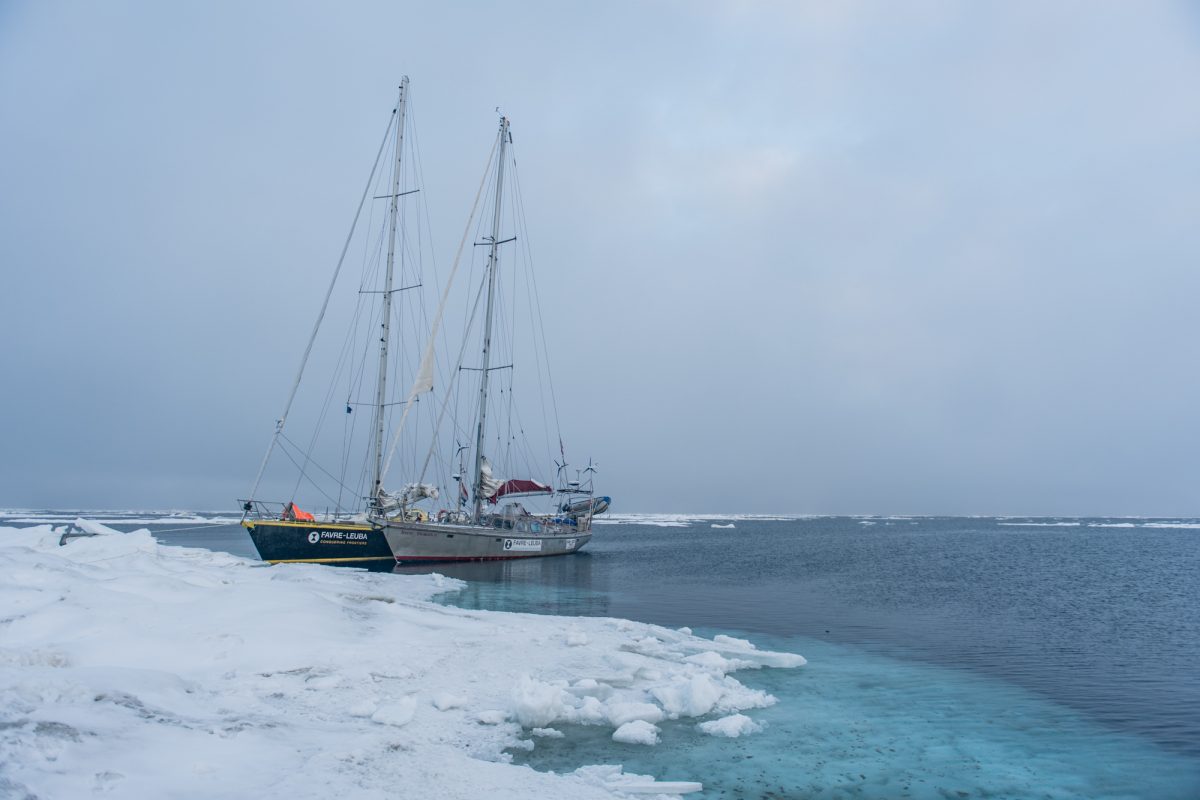
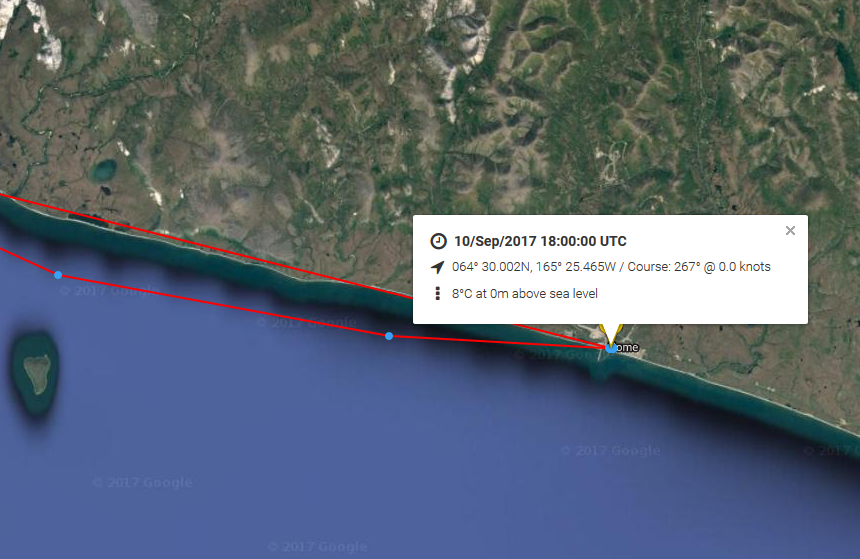
Arctic Mission sets off from Nome in Alaska (USA) in the first week of August. The expedition team will not see land again for six weeks. We will cover about 3,500 miles by the time they return to harbour at Nome in mid-September.
Our two 50 foot yachts, Bagheera and Snow Dragon II, are specially built to sail in waters with sea ice, and the four skippers, two on each boat, are exceptionally experienced in polar seas, and with navigation and safety procedures in sea ice.
The Arctic Mission team intend to do lots of science during their attempt to reach the Pole:
Our expedition is going to explore, discover and share the stories of the spectacular marine wildlife – plants, animals and even bacteria – that lives around the North Pole. Be prepared to be surprised!
We’ll also be doing essential scientific studies and sharing this information, so that our international policy-makers can decide how best to #protect90North.
The more we explore this unexplored ocean, the better we will understand how it works, which means we can make the best decisions to protect it for the benefit of everyone for ever.
We’ve met the two yachts in question before. In 2015 Bagheera and Snow Dragon II both successfully negotiated the Northwest Passage. However this voyage will be far more difficult. During their attempt to sail to the North Pole in the summer of 2013 Sébastian Roubinet and Vincent Berthet had to be rescued by the Russian icebreaker Admiral Makarov when the Central Arctic refreeze set in earlier than originally anticipated. Unlike the ice skating catamaran Babouchka, Bagheera and Snow Dragon II both have engines which will certainly help avoiding a similar fate. In addition perhaps the sea ice in the Arctic is less of an obstacle than it was in 2013? In an interview with the BBC World Service on Sunday Pen pointed out that:
Now 40% of the international waters around the North Pole, what we call the Central Arctic Ocean, are open water in the summer time.
When asked:
Do you think you’ll actually achieve this goal then?
Pen replied:
I think it’s quite possible, with the assistance of a US agency that have satellites that are going to be helping us each day pick the best route through these ever narrowing cracks, and it’s quite possible that we’ll reach the North Geographic Pole.
I also trust that the Arctic Mission team will be keeping a close eye on the Arctic weather forecast over the next month or so. Last August the crew of the yacht Northabout feared for their lives when caught in an Arctic cyclone in a sheltered anchorage on the Northern Sea Route. There is no such safe haven anywhere near the North Pole.
Pen concluded his BBC interview as follows:
If we can produce a visual image of a sail boat at 90 degrees north I think that could become an iconic image of the challenge that the twenty-first century faces. Are we serious about running this planet, which is actually what we need to start doing, and it’s biophysical resources on a sustainable basis, or are we just here for a laugh?
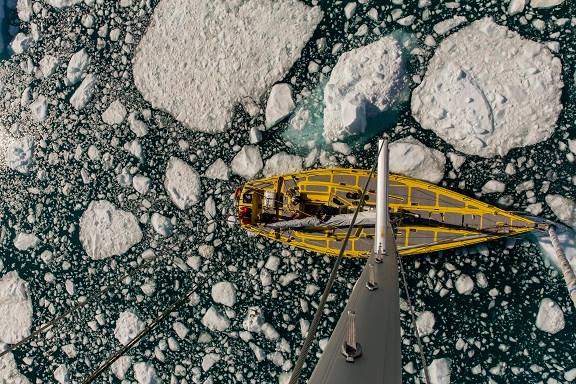
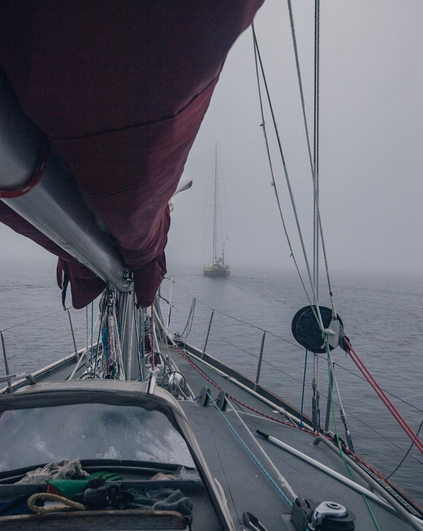
We wish him and the Arctic Mission team well. Watch this space for further updates, and possibly that iconic visual image! Meanwhile here’s a picture of Bagheera in the Northwest Passage in 2015:
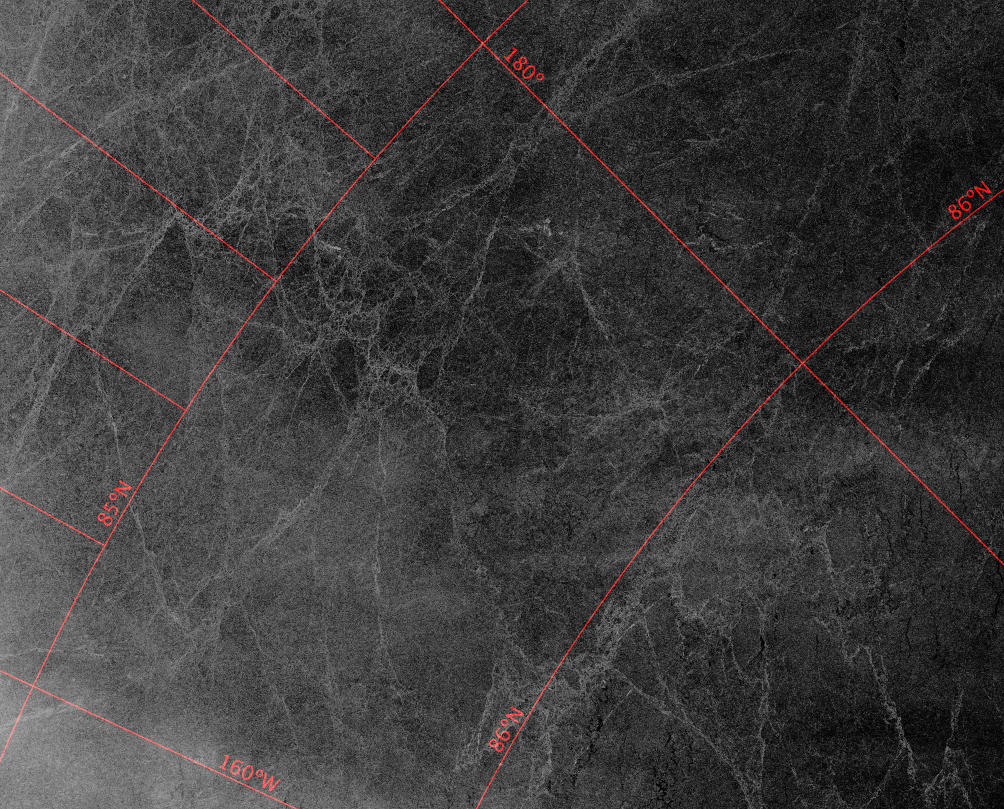
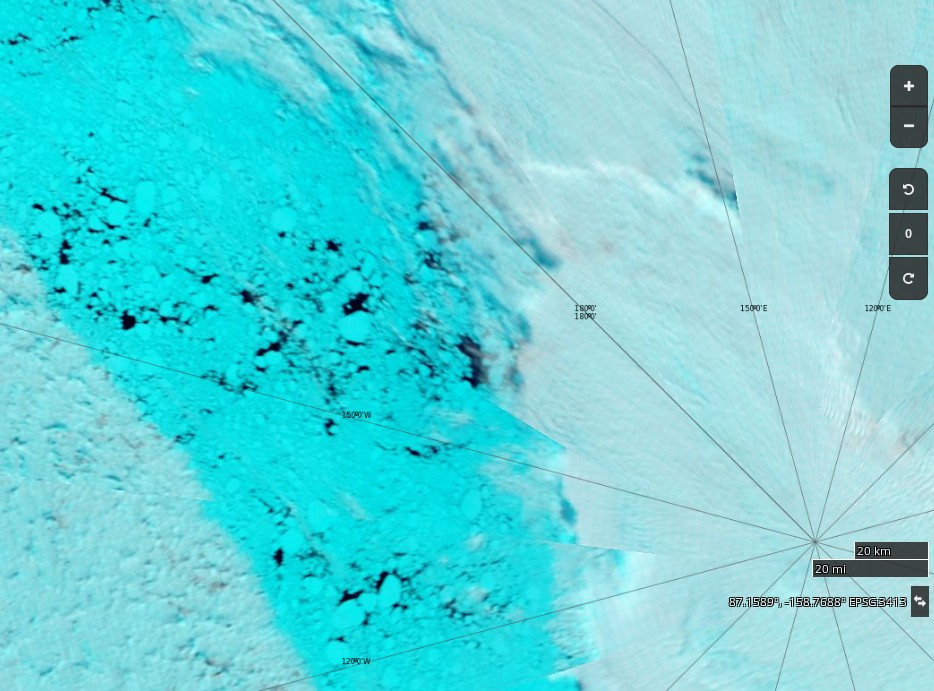
plus an image from the Sentinel 1B satellite of the current state of the Arctic sea ice on the direct route from Nome to the North Pole:
Sentinel 1B image of Arctic sea ice at 86N, 180W on July 24th 2017
There don’t seem to be many “narrow cracks” just yet.
[This] brings us to the summer of 2016, and an idea I was mulling over. A rather Big Idea. Had the deterioration of the Arctic sea ice got to a point where switching from Spring-time sledge-hauling to Summer-time sailing was appropriate? In my solo journey from northern Canada to the North Geographic Pole in 2003, I had spent over 30 hours swimming open water stretches, out of the total 850 hours spent hauling my sledge while walking on skis across the sea ice. It had dawned on me then that global warming was the likely cause of so much open water. Since then, it has become highly unlikely that the ski route from northern Russia to the Pole will be done again, due to the absence of sea ice for most of the year off the Severnaya Zemlya island group. And the other classic route from northern Canada no longer has an aircraft operation to provide the necessary support for sea ice expeditions, due to the worsening quality of the sea ice. Both routes have now been lost to the Arctic Ocean’s fast-changing environment. And with this change, the Arctic Ocean with its hitherto frozen summer surface is now rapidly becoming open-access to surface vessels for the first time in human history.
Would it be possible to sail a small yacht to the Pole? Could that create a useful platform to share the unfolding situation with a global audience? Might this be the best way I could focus world attention on the merit of creating a new marine reserve in the international waters surrounding the North Pole?
It looks like we’re just about to find out the answer to those questions. The team have also announced another livestream from Nome, Alaska. This one is scheduled for 8 PM BST tomorrow, Thursday August 10th. They say:
Ahead of our Friday departure (weather permitting – there’s a nasty storm brewing over the Bering Strait that may prove problematic) we’d love to introduce you to the Arctic Mission team.
This is probably what they are referring to:
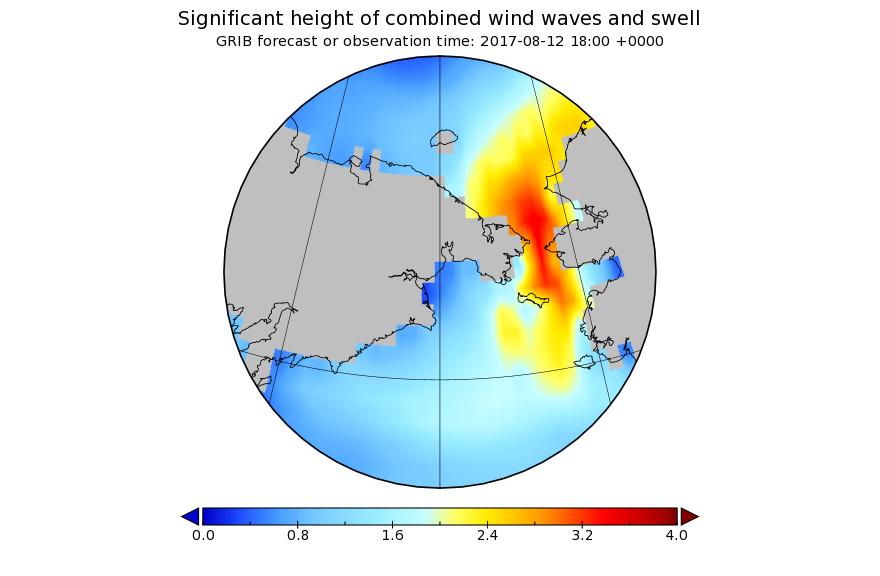
A bumpy ride for Pen Hadow et al. is in store on Saturday, and some big waves for Utqiaġvik (Barrow as was) as well.
[Edit – August 13th]
An overly brief and (hence?) rather misleading article in the Sunday Times today. According to Jonathan Leake:
Sailing to North Pole will have to wait
Pen Hadow, the British explorer, is today due to start a sailing expedition across the Arctic Ocean to highlight the effects of climate change, including an attempt to reach the North Pole.
Scientists warned, though, that despite the rapid melting of the ice there was unlikely to be access to the North Pole via open water for some years.
Professor Mark Serreze, director of America’s National Snow and Ice Data Centre, said the North Pole was still surrounded by nearly 800 miles of solid pack ice as of last week.
Jonathan appears not to have a particularly good grasp of sea ice (thermo)dynamics during the latter stages of the summer melting season!
NASA Worldview “false-color” image of the North Pole on August 13th 2017, derived from the MODIS sensor on the Terra satellite
Whilst waiting for the waves in the Bering Strait to die down Conor McDonnell, Arctic Mission’s photographer, has recorded a video from the top of Bagheera’s mast, amongst other places:
[Edit – August 14th]
According to Pen Hadow Bagheera and Snow Dragon II will set sail in the small hours of tomorrow morning (UTC):
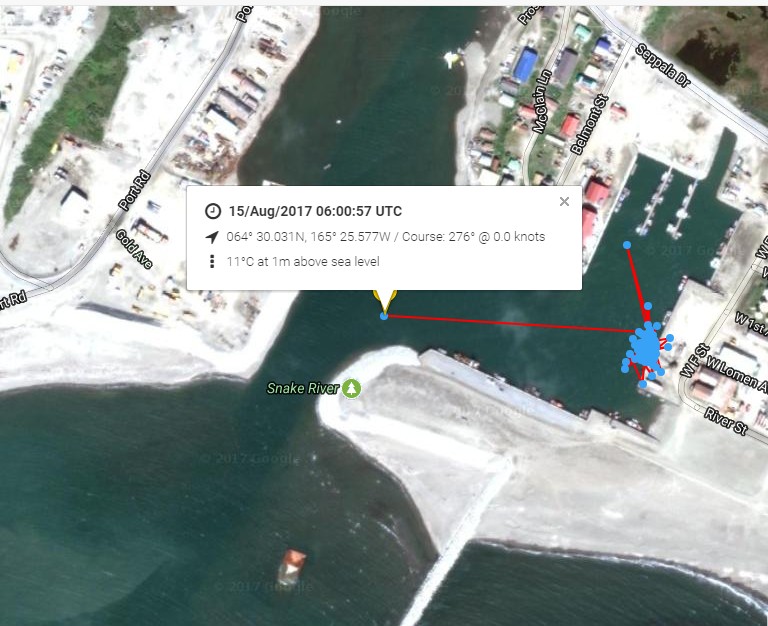
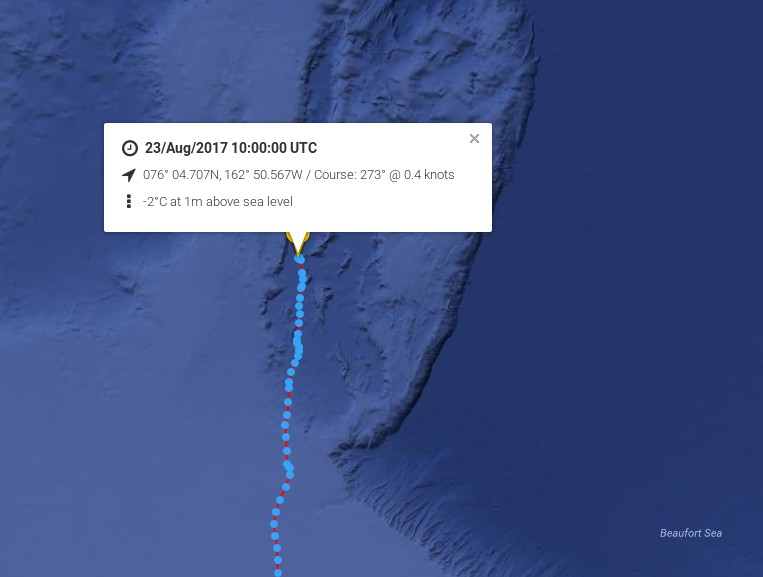
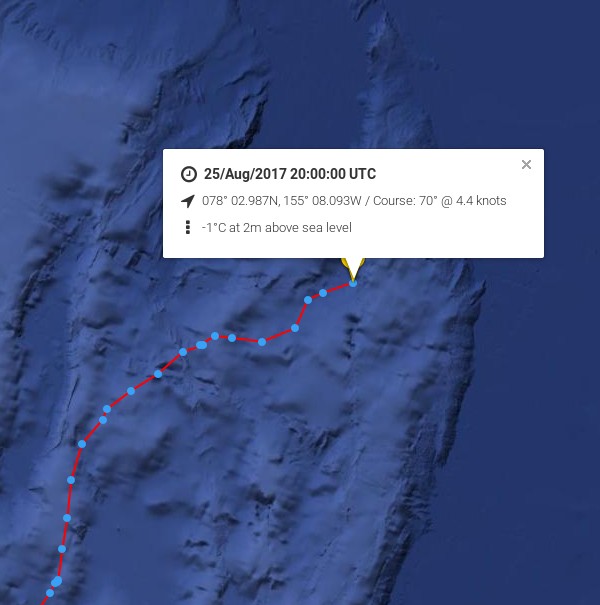
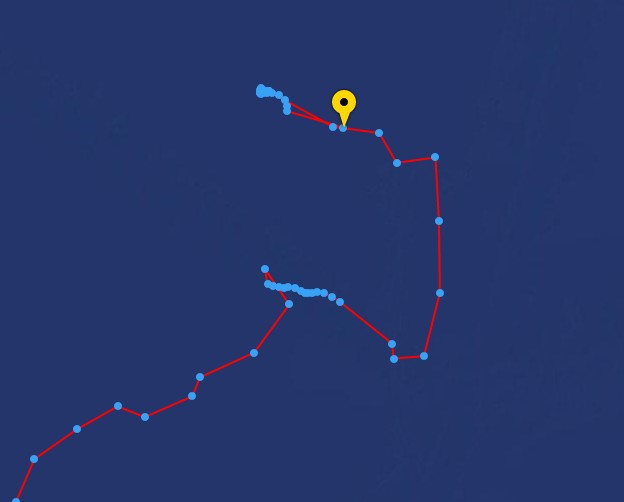
The Arctic Mission live tracking map is operational at last. Here is what it reveals so far:
It looks as though Bagheera and Snow Dragon II left Nome on their voyage of discovery at 06:00 UTC this morning.
[Edit – August 18th]
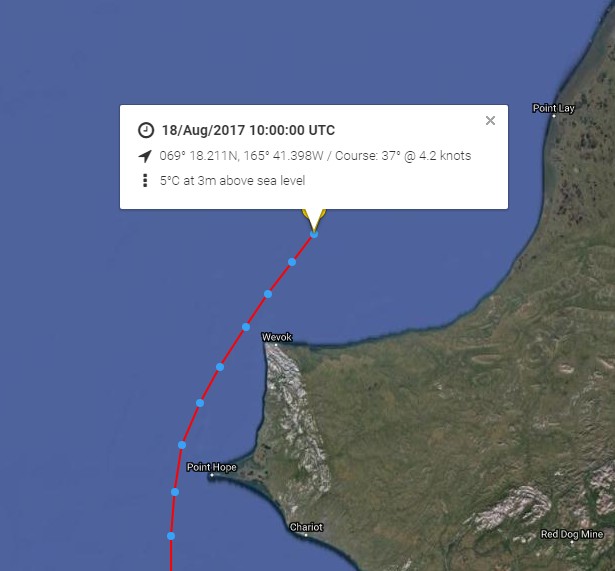
Point Hope is now behind the Arctic Mission team:
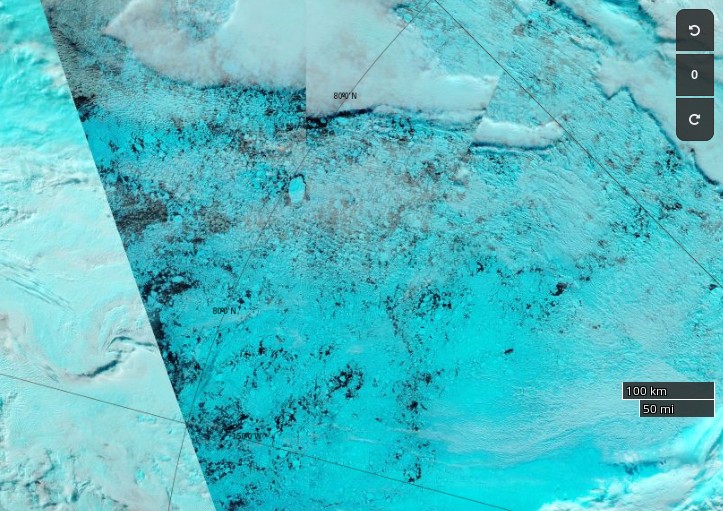
Next is Point Lay. Much further north, there are significant gaps appearing in the sea ice up to around 83N:
NASA Worldview “false-color” image of the Central Arctic north of the Beaufort Sea on August 18th 2017, derived from the MODIS sensor on the Terra satellite
[Edit – August 19th]
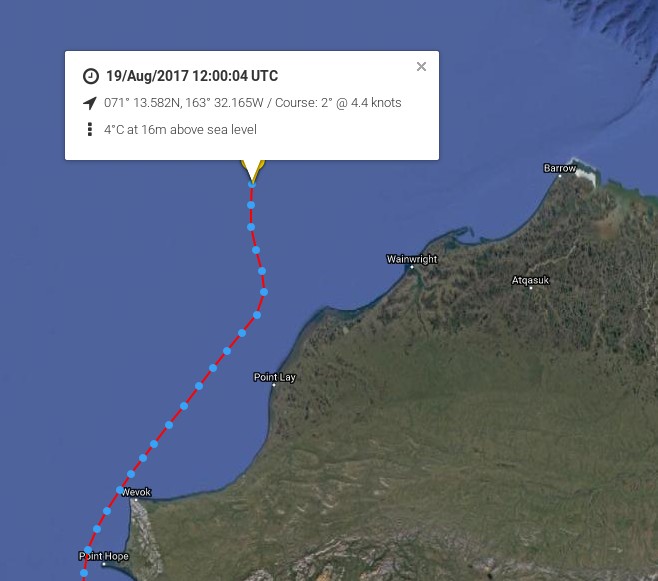
Bagheera and Snow Dragon II are obviously not heading for the Northwest Passage in 2017!
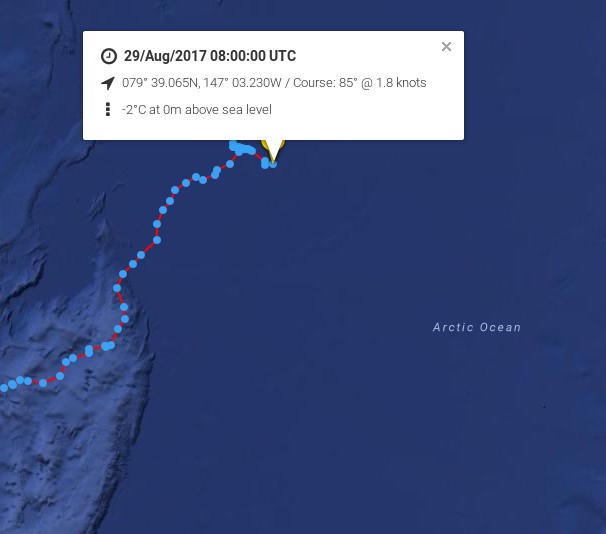
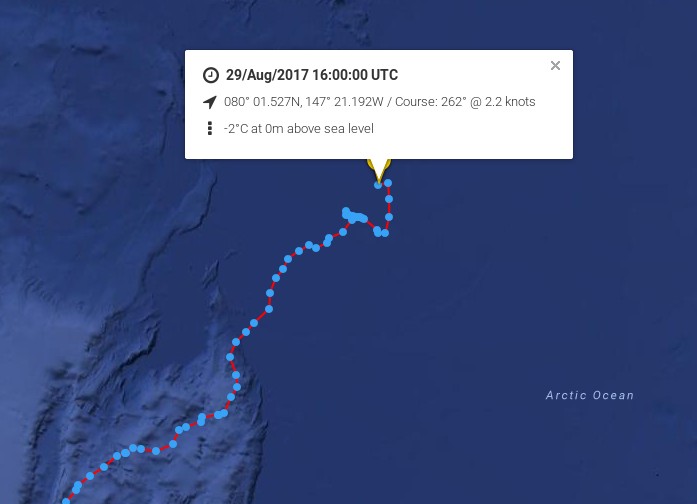
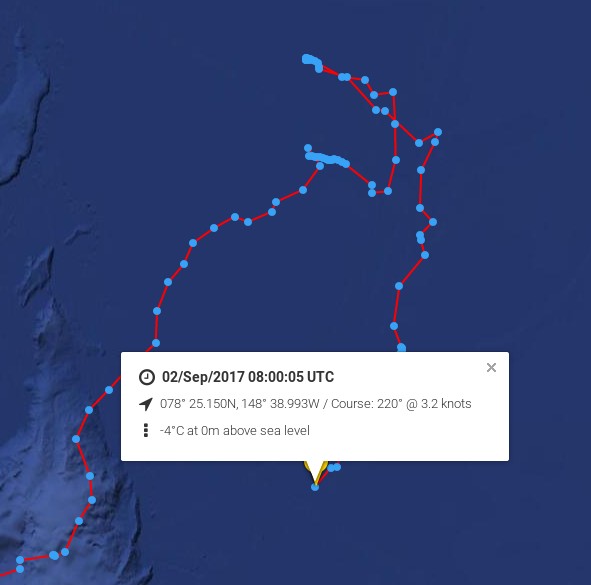
Arctic Mission’s furthest North was 80 degrees 10 minutes North, 148 degrees 51 minutes West, reached at 22:04:12 (Alaskan Time, GMT-9hours) on 29 August 2017 by yachts, Bagheera and Snow Dragon II.
Arctic Mission moored its yachts to an ice floe on 29 August to conduct one of its 24-hour marine science surveys, while drifting with the sea ice. The strategy for any future northward progress had been to monitor the sea surface currents, sea ice, and weather conditions (both observed from the yachts and through satellites imagery downloaded onto our computers), and decide how to proceed as we approached the end of the 24-hour survey.
A meeting of the four skippers was held led by Erik de Jong, with Pen Hadow present, and it was agreed further northward progress would increase considerably the risks to the expedition, with very limited scientific reward. The decision to head south, back to an area of less concentrated sea ice in the vicinity of 79 degrees 30 minutes North, was made at 18.30 (Alaskan time).
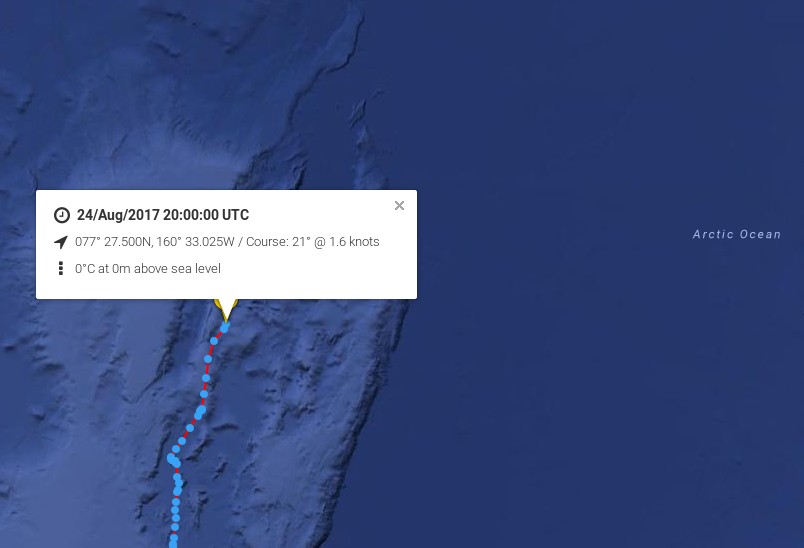
Here’s the live tracking map from 06:00 UTC this morning:
A prudent and not unexpected decision. Cue the cackling from all the usual suspects?
[Edit – August 31st]
The cackling from all the usual suspects has indeed begun. It has even inspired a somewhat surreal modern art installation! Meanwhile according to their Twitter feed:
We are slowly making our way back to Nome now after reaching the northernmost point of our… https://t.co/GhrYYza6gk
No is the obvious answer just at the moment, since the plucky little yacht is currently parked at a pontoon in Tuktoyaktuk. However actual facts aren’t sufficient to stop Tony Heller suggesting that Andrew Freedman suggested on Mashable that Mark Serreze of the NSIDC said that such a feat is feasible:
Mark “Arctic Is Screaming” Serreze says the Ship of Fools could sail to the North Pole.
In an interview with Mashable, Serreze said sea ice coverage across the different regions of the Arctic has fallen dramatically in association with a series of unusually powerful summertime Arctic storms during August.
That much is certainly true, as we here at Great White Con have documented in detail. Mr. Heller however highlights this section of Mr. Freedman’s article:
In fact, if they want to, the Hempleman-Adams and the rest of the ship’s crew could actually sail nearly all the way to the North Pole, since sea ice cover is largely absent to about 86 degrees north, according to Mark Serreze, director of the National Snow and Ice Data Center (NSIDC) in Boulder, Colorado.
It’s not out of the question that the North Pole will become a geographical marker in open water, rather than ice cover, sometime in the next few weeks.
Serreze called this situation “pretty darned unusual.”
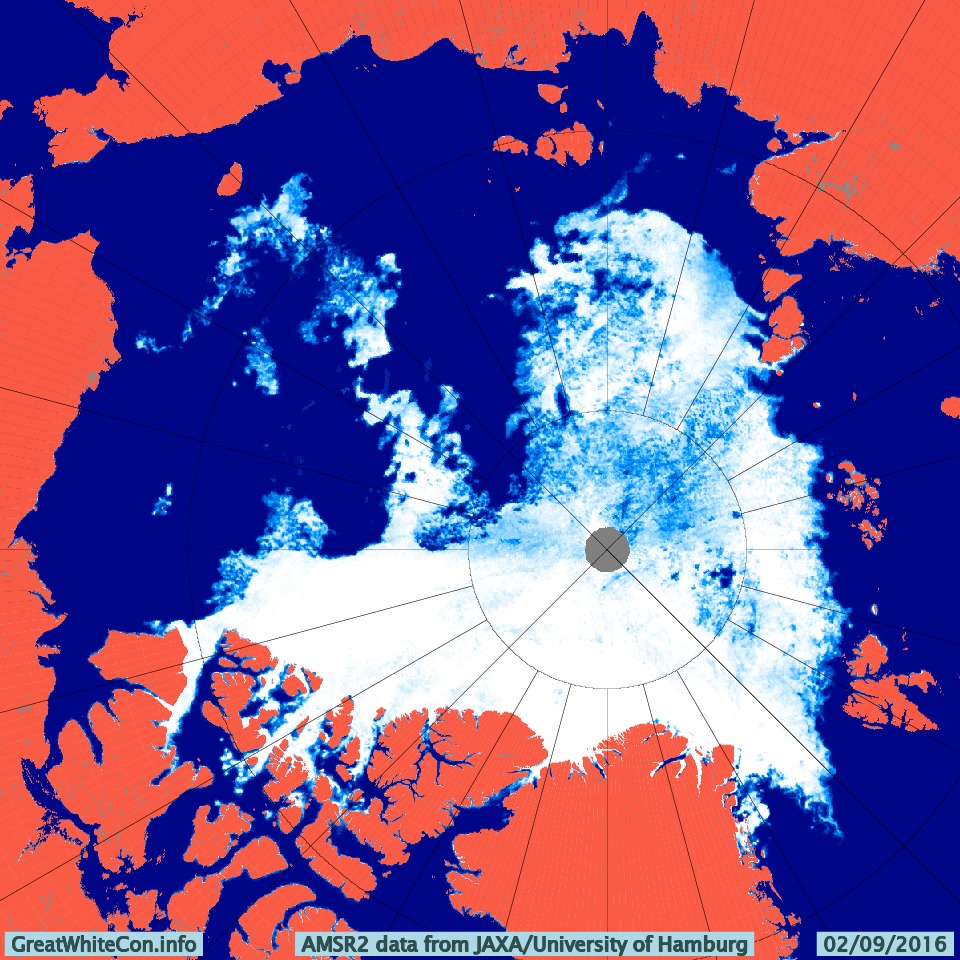
Let’s examine the facts about this “pretty darned unusual” situation shall we? Here is the latest high resolution AMSR2 visualisation of Arctic sea ice concentration:
Can you see the stretch of open water leading all the way from the East Siberian Sea, where Northabout was a couple of weeks ago, to 86 degrees north? Apparently Tony Heller and his faithful followers cannot! Not only that, but also supposedly:
A NASA image [shows that] the North Pole is indeed encased in Thick ice right now.
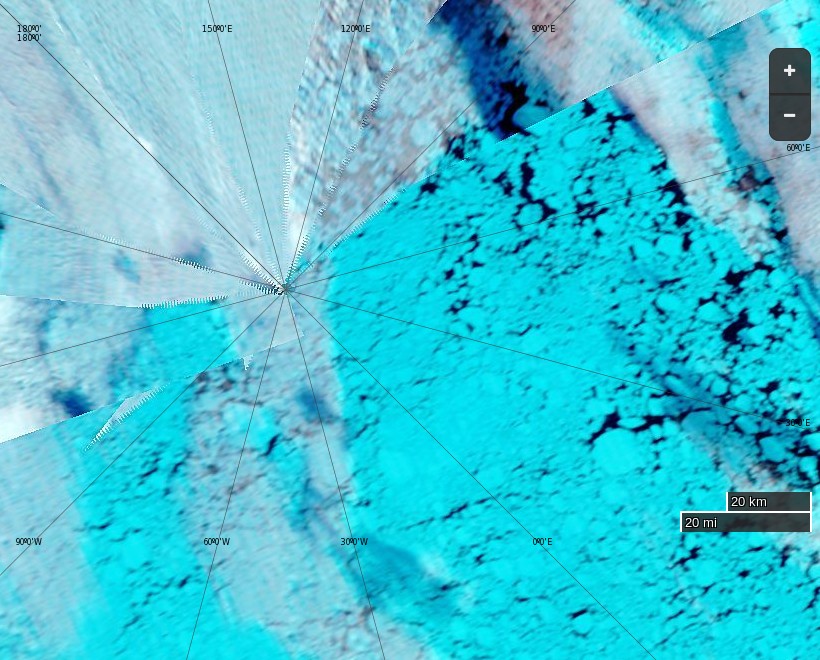
Here’s a (somewhat foggy) NASA image of the North Pole right now:
NASA Worldview “false-color” image of the North Pole on September 3rd 2016, derived from the MODIS sensor on the Terra satellite
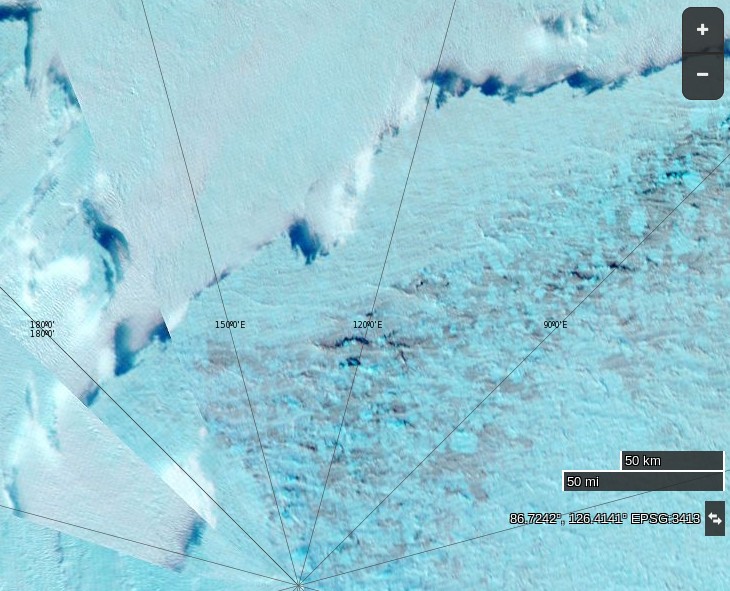
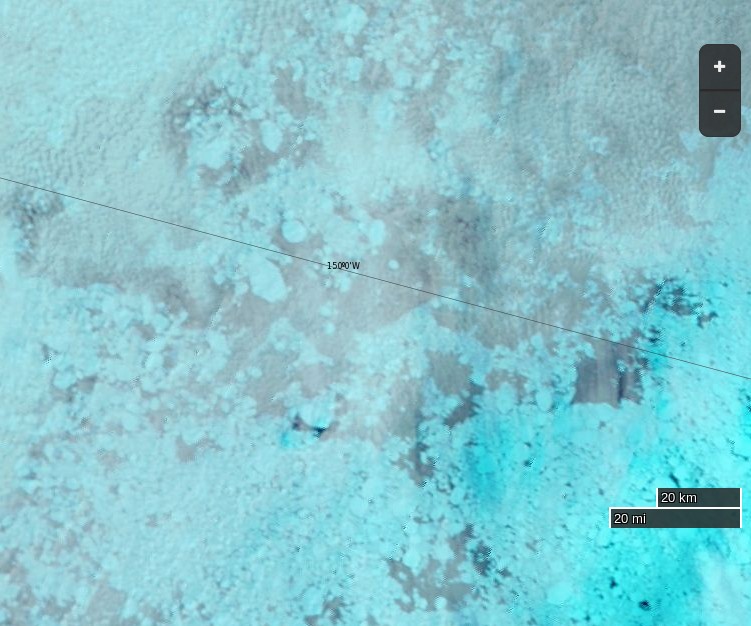
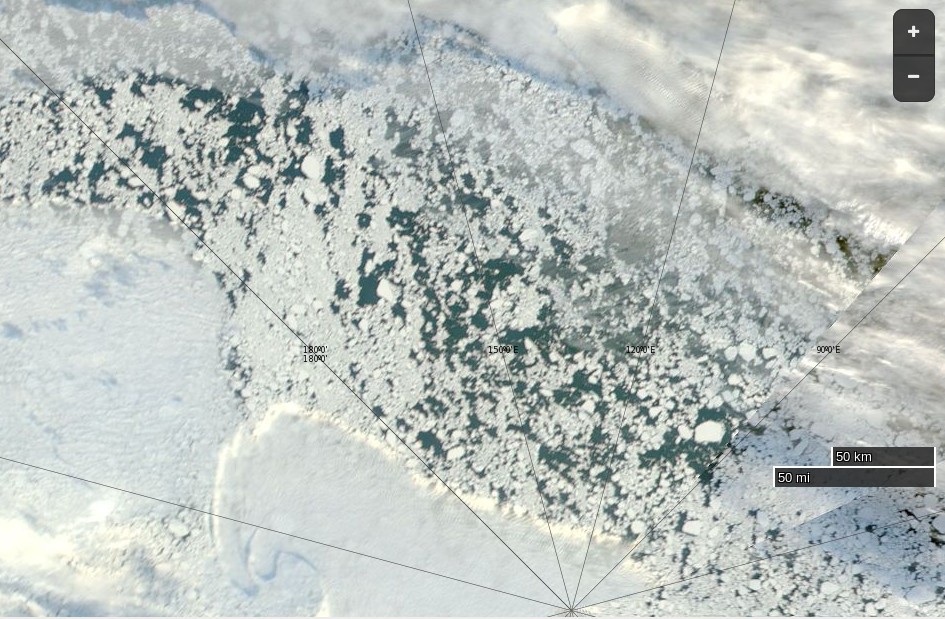
and for good measure here’s a (somewhat foggy) NASA image from 86 degrees north in the Central Arctic Basin right now:
NASA Worldview “false-color” image of the Central Arctic on September 3rd 2016, derived from the VIIRS sensor on the Suomi satellite
Need I say more?
[Edit – September 4th]
Today Terra offers a glimpse of the Greenland side of the North Pole:
NASA Worldview “false-color” image of the North Pole on September 4th 2016, derived from the MODIS sensor on the Terra satellite
[Edit – September 5th]
Today Aqua offers us a view of what’s left of the sea ice on the Siberian side of the North Pole:
NASA Worldview “true-color” image of the North Pole on September 5th 2016, derived from the MODIS sensor on the Aqua satellite
[Edit – September 9th]
SHOCK NEWS!!!
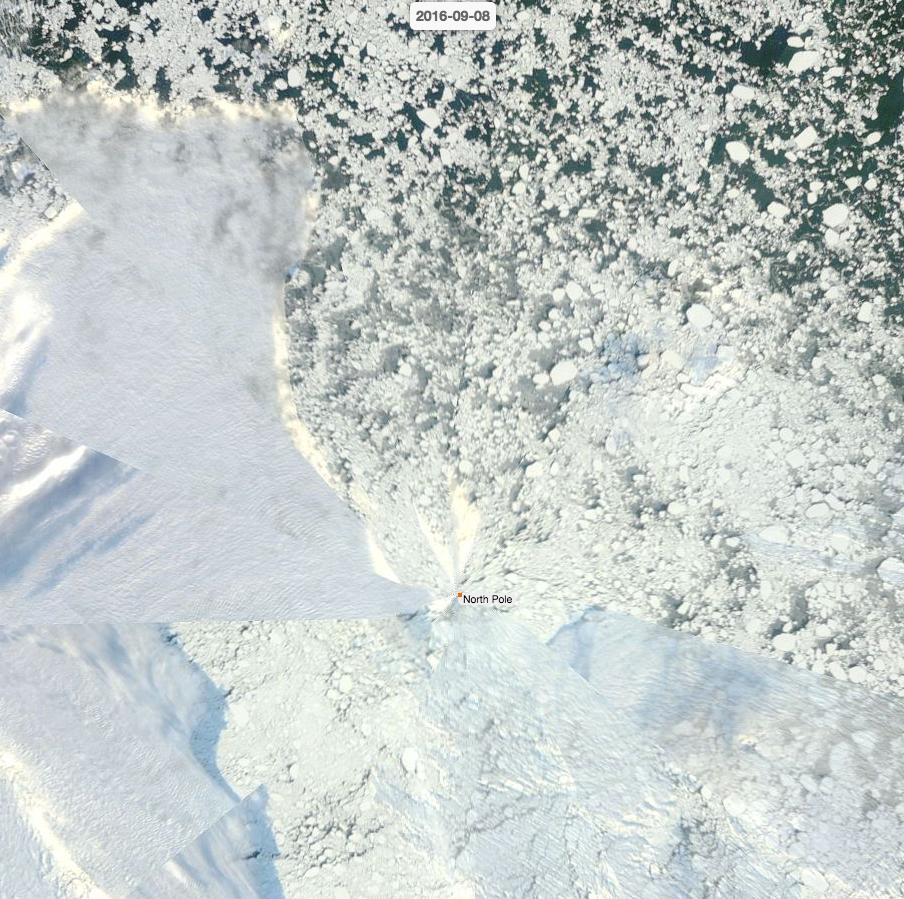
Tony Heller has just posted an accurate image of the state of the sea ice near the North Pole! Here it is:
The accompanying text is nonsense of course:
The Ship Of Fools is facing a -10C weather forecast in five days, which would be impassable. They better put their fossil fuel powered pedal to the metal and get out of there fast, so that they can go back to Bristol and lie about the ice.
Meanwhile, professional fraudster Mark Serreze said last week they could sail to the North Pole
Needless to say Tony doesn’t provide a link to his source. Try this one and then have a good look around on NASA Worldview.
From the University of Colorado at Boulder, where they are apparently attempting to explain away why Arctic sea ice isn’t living up to previous wild claims such as those made by Dr. Mark Serreze of the National Snow and Ice Data Center, who famously said that the Arctic is in a ‘Death Spiral’ in response to my writing on WUWT:
Hence we are proud to be able to bring you this exclusive report on the “breathtaking ignorance” of the WattsUpWithThat blog! I’ve recently been publicly castigated on Twitter for our tongue in cheek “Us and Them” exposes:
I remain unrepentant, but just for once I’ll maintain a more conventional narrative. Anthony Watts continues his argument as follows:
Serreze also famously said two years earlier that “The Arctic is screaming,” and that summer sea ice may be gone in five years, in an interview with the unquestioning and compliant Seth Borenstein at the Associated Press:
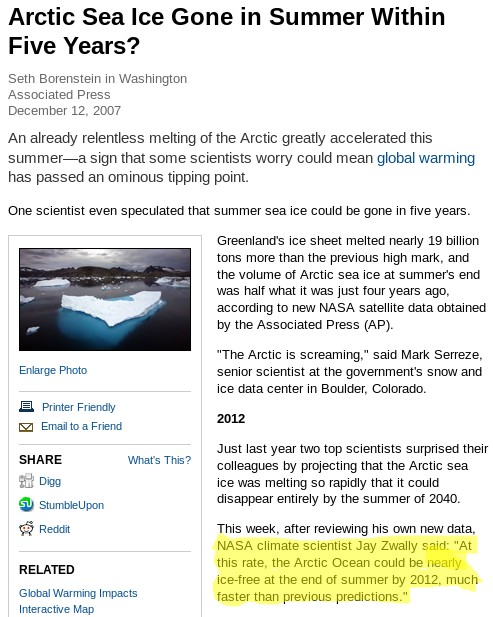
He helpfully highlights in yellow what Seth Borenstein said Mark Serreze said way back when in 2007. Note that no “predictions” or even “projections” are mentioned. So where do you suppose Tony’s “summer sea ice may be gone in five years” came from?
Here we provide our own screenshot of the National Geographic article in question, grabbing a slightly larger area of the screen, and highlighting a section slightly further down the page:
For those who have difficulty reading small print, such as Anthony Watts and his merry band of unquestioning and compliant followers over at WUWT, here is the unexpurgated transcript of our highlight in large letters:
NASA climate scientist Jay Zwally said: “At this rate, the Arctic Ocean could be nearly ice-free at the end of summer by 2012, much faster than previous predictions.”
Note firstly that this is a projection rather than a prediction, and secondly that it was reportedly uttered by Jay Zwally of NASA, not Mark Serreze of NSIDC!
Quod erat demonstrandum, and if so one cannot help but wonder how many similar blunders Mr. Watts has made over the course of his illustrious publishing career?
As luck would have it I interviewed Mark Serreze, who is currently director of the NSIDC, not so very long ago. I enquired whether the “Death spiral” story was apocryphal or not. Mark told me he did recall saying something along those lines to a journalist, but that he couldn’t recall the exact circumstances. I also asked if he was willing to make any “predictions” about the decline of sea ice in the Arctic. Mark told me that he still stood by his 2030 estimate for the onset of a seasonally ice free Arctic, although:
Most models say more like 2050
Doing my own due diligence (unlike the readers of Watts Up With That!) the earliest reference I could find to such a “prediction” involved a telephone interview much like the one I had just conducted. In an article dated August 27th 2008 the Reuters environment correspondent reported that:
This year’s Arctic ice melt could surpass the extraordinary 2007 record low in the coming weeks. Last year’s minimum ice level was reached on September 16, according to the National Snow and Ice Data Center.
Even if no records are broken this year, the downward trend in summer sea ice in the Arctic continues, the Colorado-based center said. Last year’s record was blamed squarely on human-spurred climate change.
“No matter where we stand at the end of the melt season it’s just reinforcing this notion that Arctic ice is in its death spiral,” said Mark Serreze, a scientist at the center. The Arctic could be free of summer ice by 2030, Serreze said by telephone.
So there you have it. Unless someone can come up with some evidence to the contrary (unlike Watts and the Watties), it looks to me like Mark Serreze has been consistently saying for many years:
The Arctic could be free of summer ice by 2030
or words to that effect. Expect more from me on my interview with Mark Serreze in due course.
[Edit – February 1st]
Without a word of thanks to yours truly Anthony Watts has now published an “Update” to his original article. The salient bits read as follows:
The original article implied that NISDC’s Mark Serreze made the statement about sea ice being gone in 5 years, ending in 2012, when it was actually NASA’s Jay Zwally that made the claim in the National Geographic article. The language has been clarified in the paragraph to reflect this.
Serreze also famously said two years earlier that “The Arctic is screaming,” and a Arctic research associate, Jay Zwally of NASA, said in the same article that summer sea ice may be gone in five years, in an interview with the unquestioning and compliant Seth Borenstein at the Associated Press.
Anthony obviously hasn’t taken on board my helpful remarks about the difference between a prediction and a projection, and hence he waxes lyrical about how the sea ice in the Arctic didn’t vanish in the summer of 2012. He signs off by saying:
To my knowledge, Dr. Serreze has never publicly corrected the National Geographic article claim of 2012 being the ice-free year that wasn’t, suggesting he endorsed the idea at the time.
Have I got news for you Anthony. It doesn’t suggest anything of the kind! In addition to suggesting strange things to the suggestible Mr. Watts has so far neglected to answer this question posed by a commenter on the article in question:
I look forward to seeing any substantive replies to Jim Hunt’s clarifying post.
and so far he has also neglected to publish my response to that question. It included this video of my namesake, James Hunt, conversing with a couple of clueless mechanics:
Anthony Watts has also thus far neglected to explain how he inexplicably (in all the circumstances) successfully attributed the supposed 2012 “prediction” to Jay Zwally in this 2012 article, that also included a highlighted screenshot much like mine above:
In four months, just 132 days from now at the end of summer on the Autumnal Equinox September 22nd 2012, the Arctic will be “nearly ice free” according to a prominent NASA scientist in a National Geographic article on December 12, 2007.
The most widely used measurements of Arctic ice extent are the daily satellite readings issued by the US National Snow and Ice Data Center, which is co-funded by NASA.
He also stated that:
For years, many have been claiming that the Arctic is in an ‘irrevocable death spiral’, with imminent ice-free summers bound to trigger further disasters. These include gigantic releases of methane into the atmosphere from frozen Arctic deposits, and accelerated global warming caused by the fact that heat from the sun will no longer be reflected back by the ice into space.
Judith Curry, professor of earth and atmospheric sciences at Georgia Institute of Technology in Atlanta, said last night: ‘The Arctic sea ice spiral of death seems to have reversed.’
All of which got me thinking. Why did David Rose speak to a professor of earth and atmospheric sciences when researching his article, rather than an expert on Arctic sea ice? Why, indeed, did he not speak to the man who originally coined the “Death spiral” metaphor? Seeking answers to these troubling questions amongst others, I called the National Snow and Ice Data Center in Boulder, Colorado. I enquired whether I might be able to speak with Mark Serreze, who is currently director of the NSIDC. Shortly after that Mark called me back and I was able to ask him a number of questions.
My first question was whether David Rose or anyone from the Mail on Sunday had been in touch with the NSIDC recently. The answer was “No”. Next I enquired whether the “Death spiral” story was apocryphal or not. Mark told me he did recall saying something along those lines, but that he couldn’t recall the exact circumstances. Doing my own due diligence (unlike the Mail!) the earliest reference I could find suggested that “the circumstances” involved a telephone interview much like the one I was in the middle of. In an article dated August 27th 2008 the Reuters environment correspondent reported that:
This year’s Arctic ice melt could surpass the extraordinary 2007 record low in the coming weeks. Last year’s minimum ice level was reached on September 16, according to the National Snow and Ice Data Center.
Even if no records are broken this year, the downward trend in summer sea ice in the Arctic continues, the Colorado-based center said. Last year’s record was blamed squarely on human-spurred climate change.
“No matter where we stand at the end of the melt season it’s just reinforcing this notion that Arctic ice is in its death spiral,” said Mark Serreze, a scientist at the center. The Arctic could be free of summer ice by 2030, Serreze said by telephone.
Mark confirmed to me that he still stood by his 2030 estimate for the onset of a seasonally ice free Arctic, although “most models say more like 2050”.
Next I asked him whether he agreed that “The Arctic sea ice spiral of death has reversed.” He said that he agreed with the statement attributed to Dr. Ed Hawkins near the end of the Mail article, that “There is undoubtedly some natural variability on top of the long-term downwards trend caused by the overall warming“. However 2 years worth of data certainly didn’t constitute “a recovery”. It was more like “a one week retracement in the US stock market. The long term trend in extent is definitely downwards”.
In conclusion I asked Mark to offer his best estimate for Arctic sea ice extent at this summer’s minimum. He told me that even at this late stage some of that “natural variability” could affect the outcome, but that the NSIDC extent “will probably end up on a par with 2013”.
I have also had an email conversation with Andrew Shepherd, the British “expert in climate satellite monitoring” whose views about Arctic sea ice were reported in the Mail on Sunday’s article. He told me that:
Arctic sea ice cover is expected to continue to decline, with the possibility of ice-free summers in the next 20-30 years. Climate model predictions tend to be at the upper end of this range, whereas projections of past observations tend to be at the lower end. Once we are able to include direct measurements of thickness from CryoSat-2, I expect the accuracy of predictions will improve.
If nothing else changes, then the recovery in Arctic sea ice thickness will wind the clock backwards a few years, but there is no reason to believe this is anything other than a temporary reprieve due to one cool summer.
Finally, for the moment at least, I also called the Danish Meteorological Institute. Along with the NSIDC their Arctic sea ice extent figures were quoted by David Rose. Along with the NSIDC they told me that they had received no enquiries recently from Mr. Rose or anyone else at the Mail on Sunday.
This website uses cookies to improve your experience. We'll assume you're ok with this, but you can opt-out if you wish. Cookie settingsACCEPT
Privacy & Cookies Policy
Privacy Overview
This website uses cookies to improve your experience while you navigate through the website. Out of these, the cookies that are categorized as necessary are stored on your browser as they are essential for the working of basic functionalities of the website. We also use third-party cookies that help us analyze and understand how you use this website. These cookies will be stored in your browser only with your consent. You also have the option to opt-out of these cookies. But opting out of some of these cookies may affect your browsing experience.
Necessary cookies are absolutely essential for the website to function properly. This category only includes cookies that ensures basic functionalities and security features of the website. These cookies do not store any personal information.
Any cookies that may not be particularly necessary for the website to function and is used specifically to collect user personal data via analytics, ads, other embedded contents are termed as non-necessary cookies. It is mandatory to procure user consent prior to running these cookies on your website.