Tag Archives: Concentration

The Balding Arctic Exposed

I’ve recently received a letter signed by John Wellington who is the Managing Editor of The Mail on Sunday.

Them:

Referring to David Rose’s Mail on Sunday article of September 8th 2013 John says amongst many other things that:

We deny that the article was significantly inaccurate apart from the original headline figure which we have already corrected.

and:

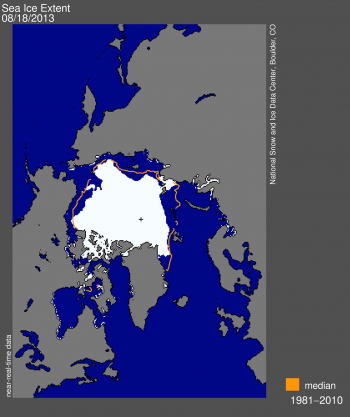
In August, ice did stretch from part of the Siberian shore to the Canadian islands. The image published in the newspaper and online supports this statement as does the enclosed image from the NSIDC site which shows the ice extent on August 18.

Here’s that image, which comes from the August 19th 2013 edition of the National Snow and Ice Data Center’s “Arctic Sea Ice News” entitled “The balding Arctic“:

National Snow and Ice Data Center graphic showing Arctic sea ice extent on August 18th 2013
NSIDC graphic showing Arctic sea ice extent on August 18th 2013

Us:

I’m currently writing a reply to John’s letter. Amongst many other things it directs his attention to this very article and says:

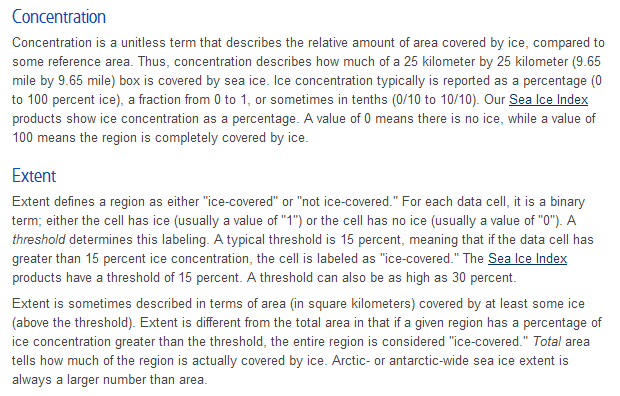
Images showing sea ice “extent” reveal remarkably little about whether an “ice sheet” is “unbroken” or not. If that is what you want to illustrate then an image showing “concentration” is much more helpful. In their report of September 4th upon which David Rose’s article is supposedly based, at least in part, the NSIDC helpfully provided such an image. The Mail on Sunday didn’t publish that image, or a similar image from 2012. In order to correct this inaccuracy they should do so.

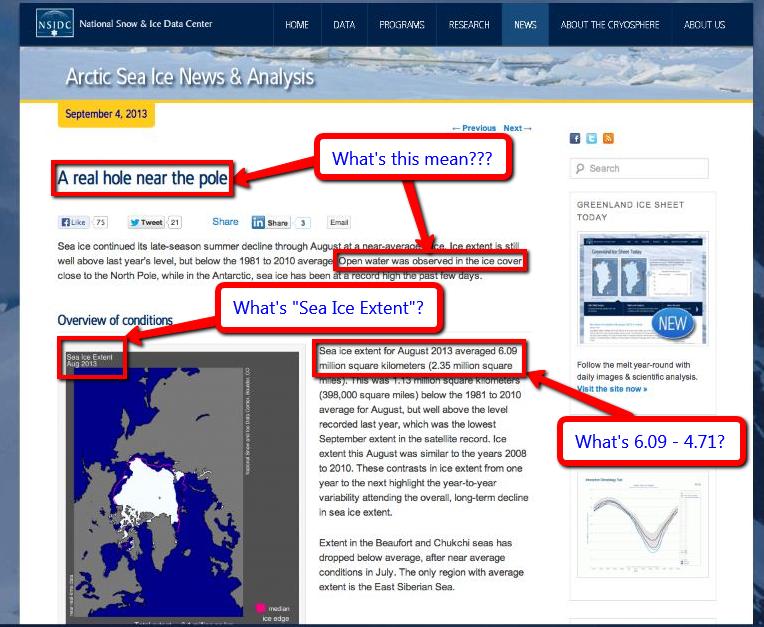
Since they’ve evidently read the NSIDC’s news that the Arctic was “Balding” towards the end of August and there was “A real hole near the pole” by early September John and David should be aware of this already, but it seems a refresher course is necessary. On August 19th the NSIDC pointed out that:

Satellite data from the AMSR-2 instrument and MODIS show an unusually large expanse of low-concentration sea ice (20 to 80% cover) within our extent outline (15% or greater, using the SSM/I sensor) spanning much of the Russian side of the Arctic and extending to within a few degrees of the North Pole.

While some of the low concentrations recorded by AMSR-2 may be due to surface melt on sea ice, the MODIS image confirms that a large region is covered by isolated floes.

On September 4th the NSIDC also helpfully pointed out that:

A large hole (roughly 150 square kilometers or 58 square miles) of near-zero ice concentration appears to have opened up at about 87 degrees North latitude.

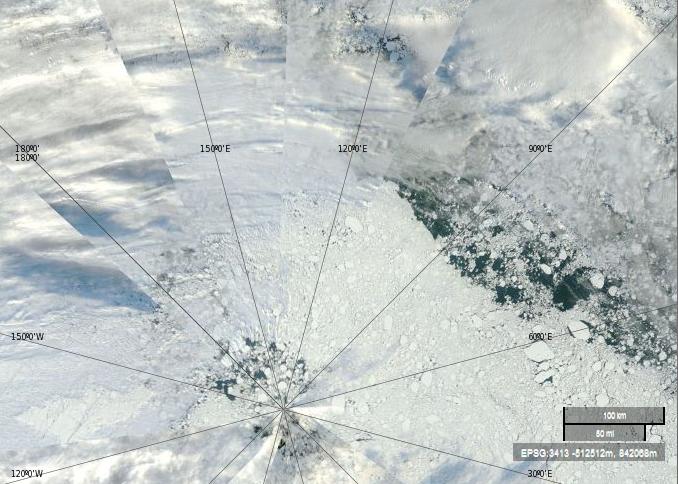
Here is a “true-color” image from September 4th 2013 using MODIS bands 1, 4 and 3, helpfully made available by NASA to anyone who might be interested via the EOSDIS Worldview web site:

NASA Worldview “true-color” image of the North Pole area on September 4th 2013 derived from bands 1,4 and 3 of the MODIS sensor on the Terra satellite
NASA Worldview “true-color” image of the North Pole area on September 4th 2013 derived from bands 1, 4 and 3 of the MODIS sensor on the Terra satellite

The lines in this image converge on the North Pole, the same location as the little cross in the NSIDC extent image near the top of this article. Let’s play “Spot the Difference” yet again shall we. Would you say that the sea ice underneath the clouds looks “broken” in this Worldview “true-color” image? How about in the the University of Bremen concentration images often shown by the NSIDC, or in the NSIDC “extent” image above, or in the NASA “extent” videos so beloved by David Rose and the Mail on Sunday?

Santa’s Secret Summer Swim

This weekend the Mail on Sunday admitted that the headline numbers in David Rose’s  “And now it’s global COOLING!” article published on September 8th were inflated by a factor of approximately two. This is how they explained that discrepancy to their faithful readers:

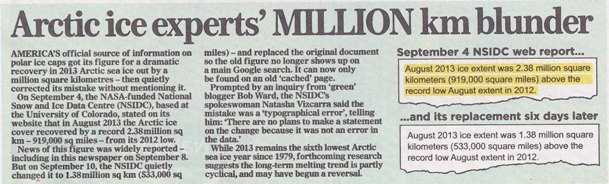
Scan of the bottom of page 31 in the September 29th 2013 edition of the Mail on Sunday
The bottom of page 31 in the September 29th 2013 edition of the Mail on Sunday

Can you spot the MILLION square km blunder by the Mail on Sunday? For the benefit of the scientifically illiterate amongst you I’ll explain, as I did yesterday in an email to the Mail on Sunday’s Managing Editor:

It appears that whoever writes your headlines is unaware of the difference between “A MILLION km” and “a million square km”. The former is a distance, and hence has no area. The latter IS an area.

Them:

As you can clearly see, the Mail reported yesterday that:

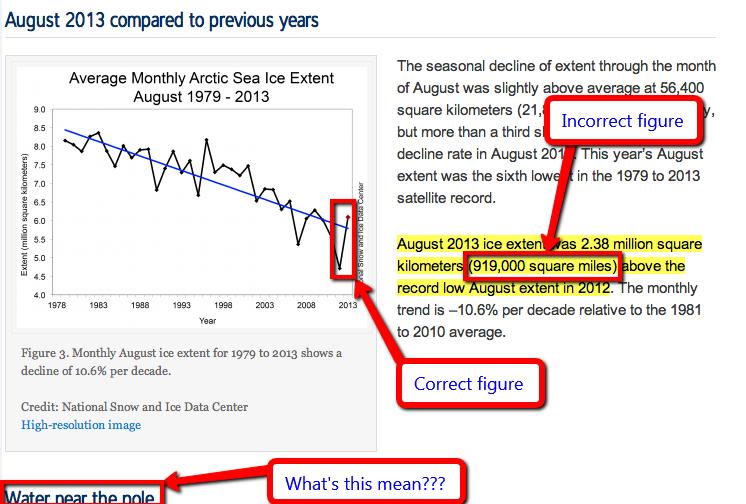
On September 4, NSIDC, based at the University of Colorado, stated on its website that in August 2013 the Arctic ice cover recovered by a record 2.38 million sq km – 919,000 sq miles – from its 2012 low.

News of this figure was widely reported – including by MailOnline – on September 8.

Us:

The headline of the report published on the NSIDC website on September 4th reads as follows:

A real hole near the pole

The related text reads as follows:

A large hole (roughly 150 square kilometers or 58 square miles) of near-zero ice concentration appears to have opened up at about 87 degrees North latitude. Small areas of open water are common within the ice pack, even at the North Pole, as the ice pack shifts in response to winds and currents, resulting in cracks (called leads) in the ice. The current opening seen in our satellite imagery is much larger.

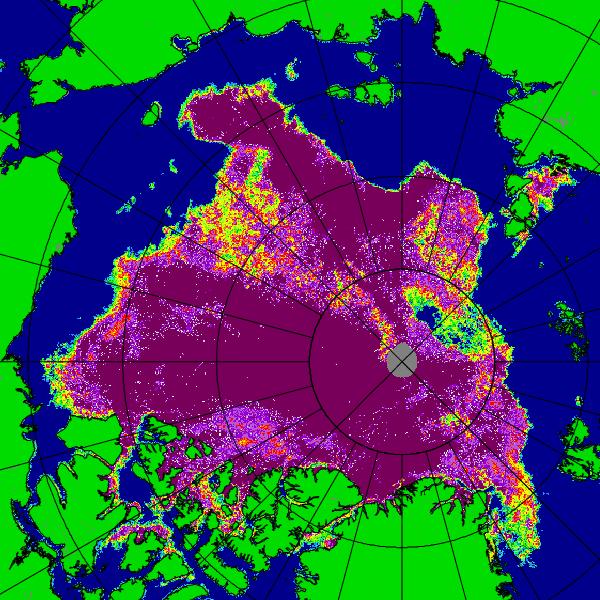
and the relevant area of the accompanying satellite imagery looks like this:

University of Bremen colour visualisation of Arctic sea ice concentration for September 2nd 2013
University of Bremen AMSR2 colour visualisation of Arctic sea ice concentration for September 2nd 2013

Them:

Since the Mail’s intrepid reporter evidently read those words and looked at that picture, why on Earth do you suppose that the Mail on Sunday printed these words four days later?

Days before the annual autumn re-freeze is due to begin, an unbroken ice sheet more than half the size of Europe already stretches from the Canadian islands to Russia’s northern shores.

Even more to the point, why on Earth do you suppose that the Mail on Sunday left those words unaltered following their September 28th edit of the online version of that article?

Us:

Here’s our latest video update on the 2013 Arctic sea ice refreeze. The “Polar Polynya” is prominent by its presence, as is the broad band of open water between the “broken ice sheet” and “Russia’s northern shores”: