Tag Archives: Area

New Year 2016 Arctic Meltdown Update

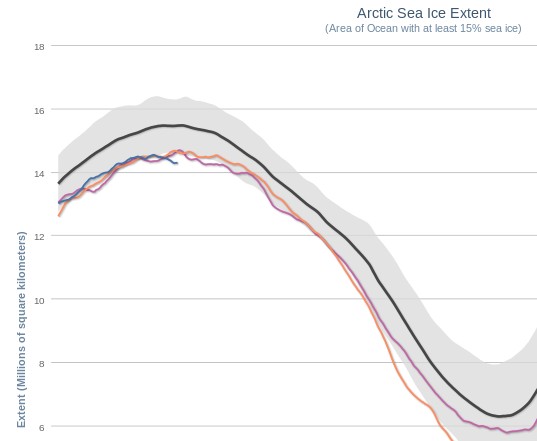
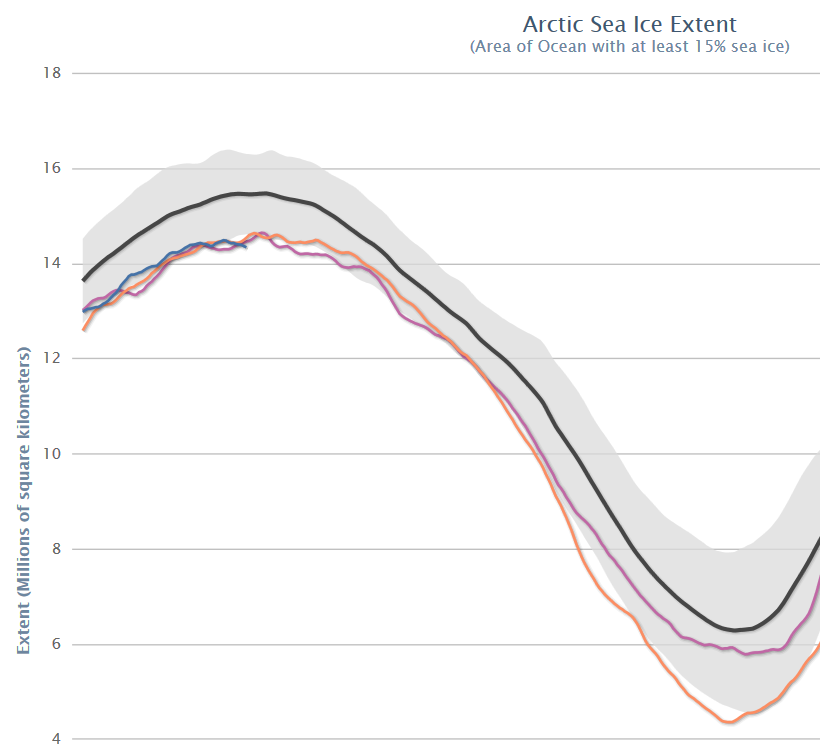
On January 1st 2016 the 15% concentration threshold daily Arctic sea ice extent metric reported by the United States National Snow and Ice Data Centre reached the lowest ever level for the first day of any year since their satellite derived records began in 1979. A couple of days later the more familiar 5 day trailing averaged extent also reached the lowest ever level for the date:

Charctic-20160107

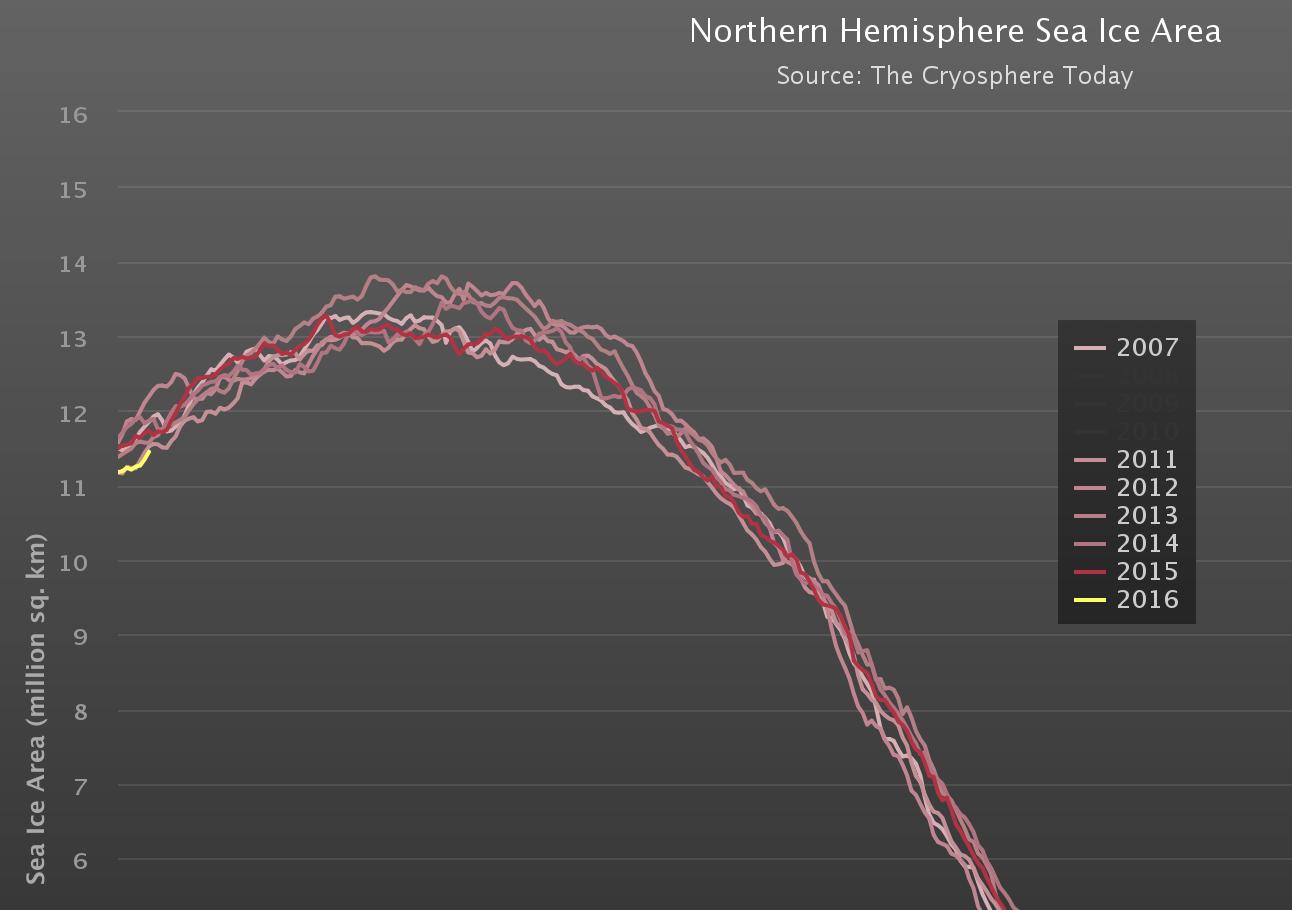
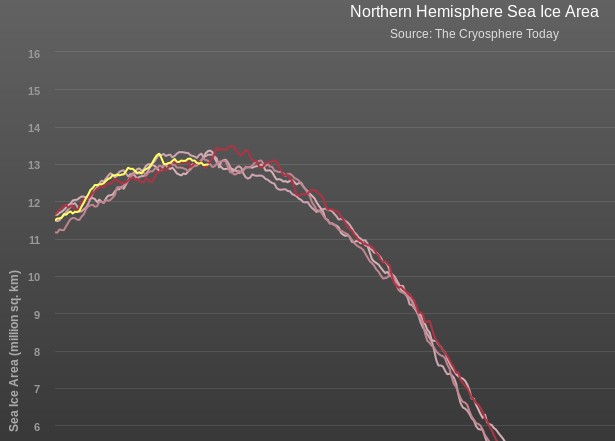
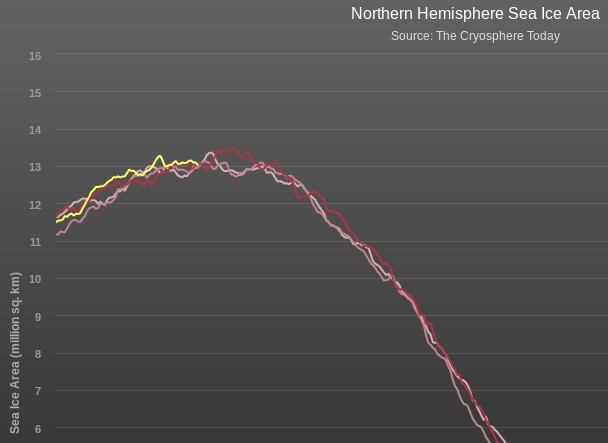
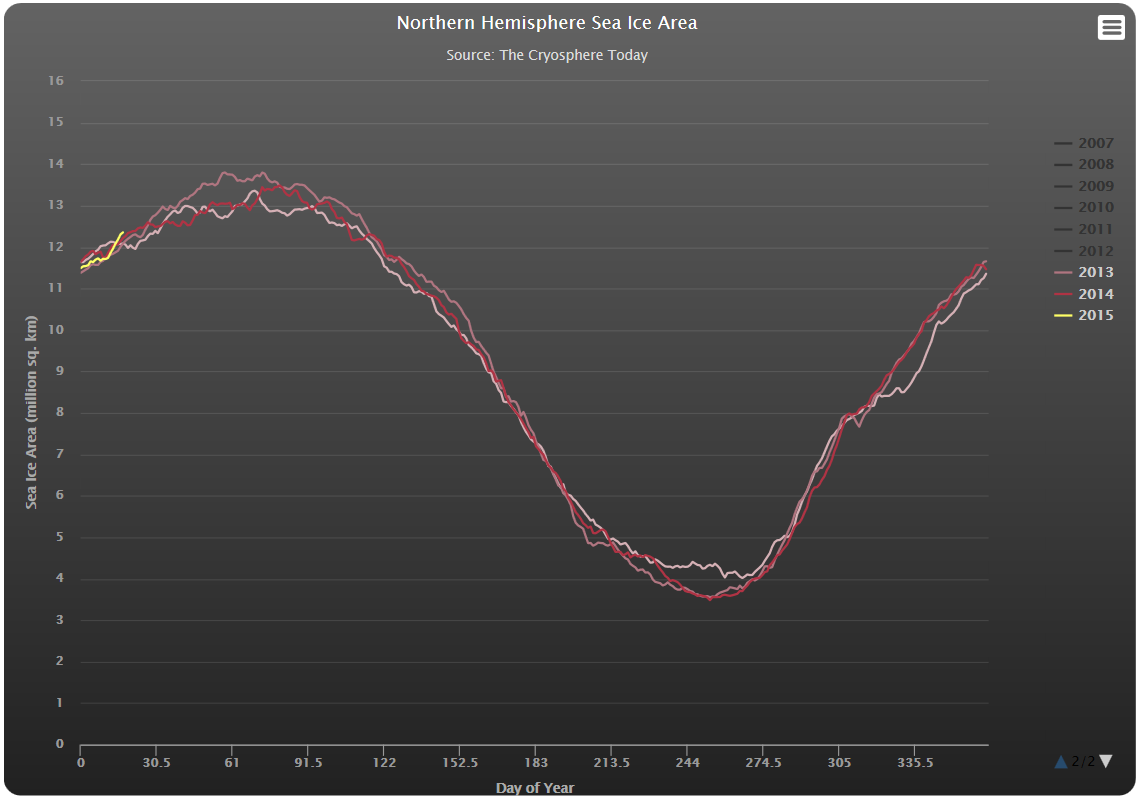
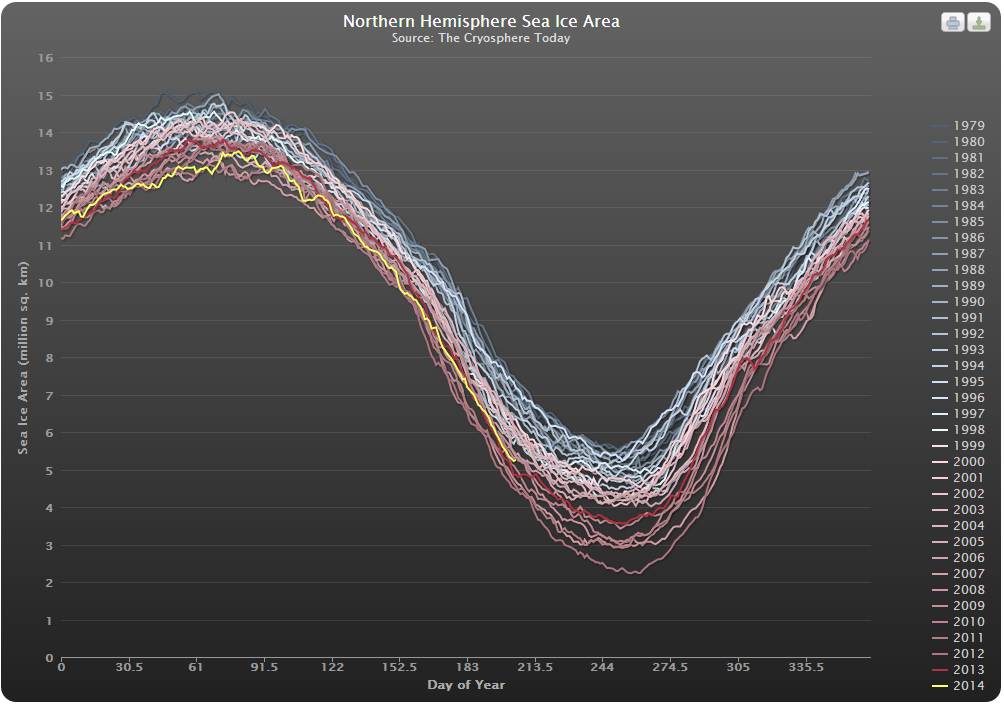
Cryosphere Today have been somewhat sluggish about updating their records of Arctic sea ice area, but have at long last revealed that their metric is now also at the lowest ever level for the date:

CT-NH-20160107

Meanwhile Great White Con commenter “Just A Thought” states that:

I find it hard, with what I do have access to, to see why everyone is so worried that the Arctic is melting.

He or she has evidently only had access to the propaganda perpetrated by Tony Heller (AKA “Steve Goddard”) on his so called “Real Climate Science” blog. Mr. Heller’s latest Arctic pronouncement on December 31st 2015 is entitled “Arctic Meltdown Update” and claims that:

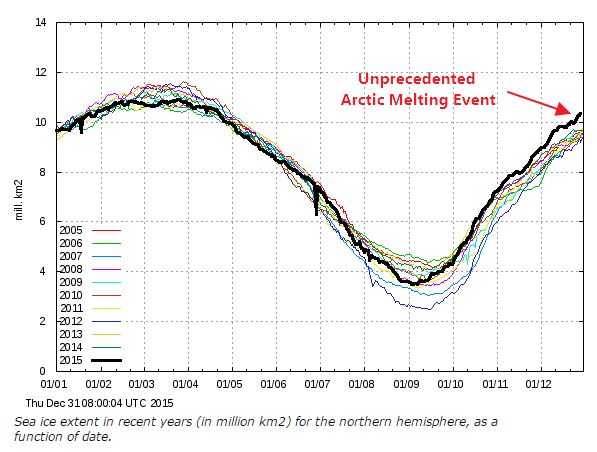
Experts say that a terrifying storm melted the North Pole yesterday. This unprecedented melting event has caused Arctic ice to reach its highest December extent in over a decade.

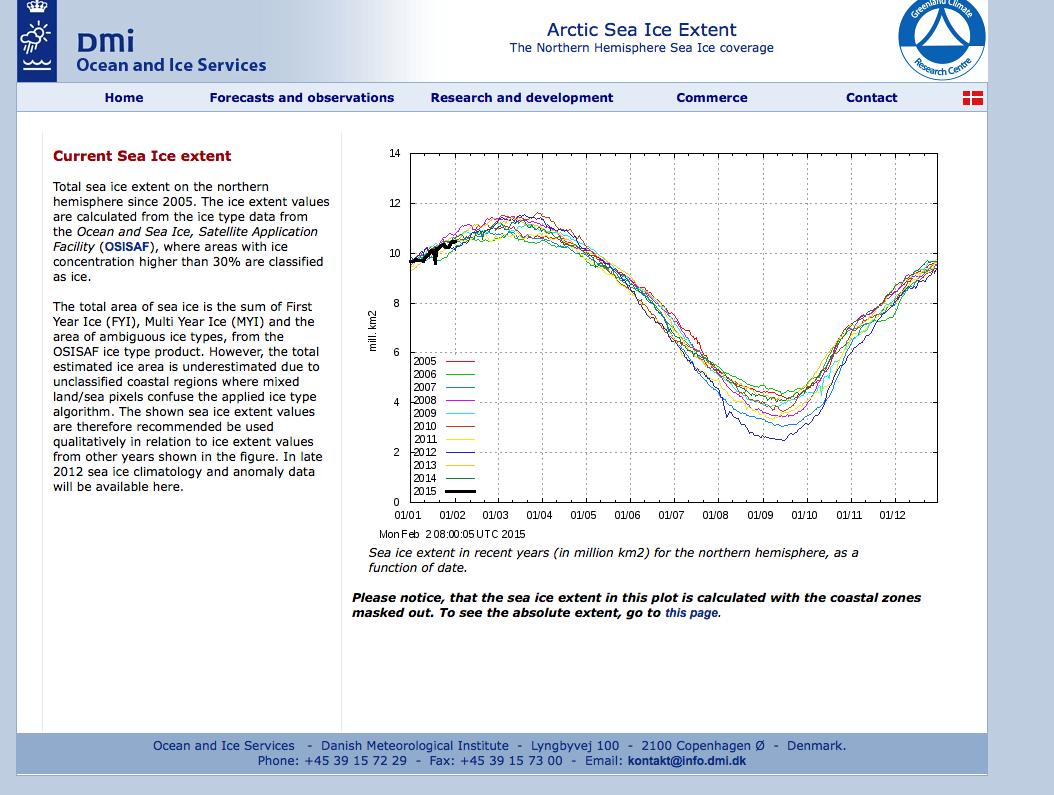
justifying that comment with the following graph of his beloved (albeit deprecated) 30% concentration threshold DMI extent metric:

DMI-30-2015-12-31-

Here’s a video revealing the effect of the recent “terrifying storm” on the sea ice on the North Atlantic side of the Arctic:

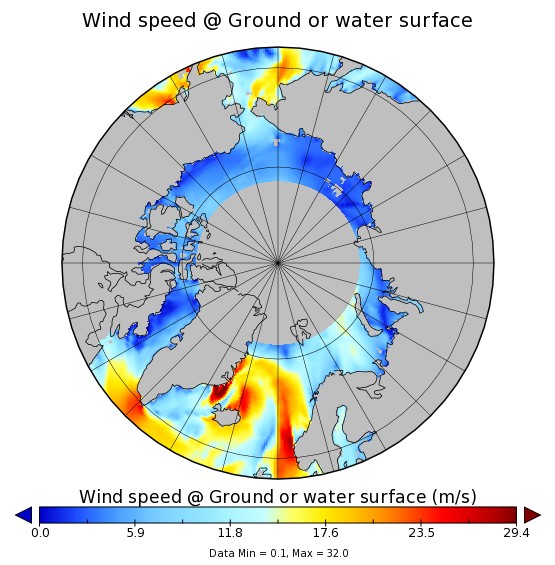
As you can see the ice at the North Pole didn’t melt away. However the ice edge did retreat in the immediate aftermath of what is referred to here in the United Kingdom as “Storm Frank“. Frank led to lots of flooding in the North of the nation, and also to some strong winds inside the Arctic Circle:

WW3Wind-20151230-1400

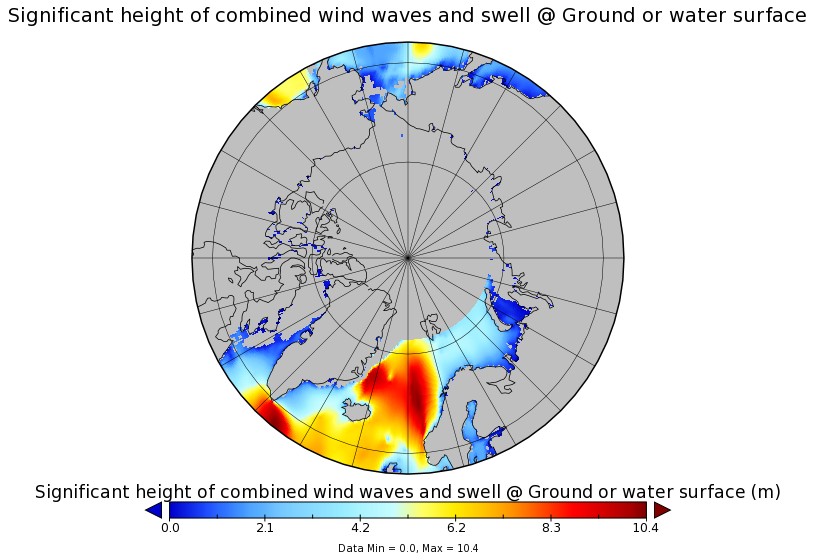
Those winds, travelling over a long stretch of open ocean, produced some pretty significant waves, speeding in the direction of the sea ice edge:

WWIII-20151231-0000

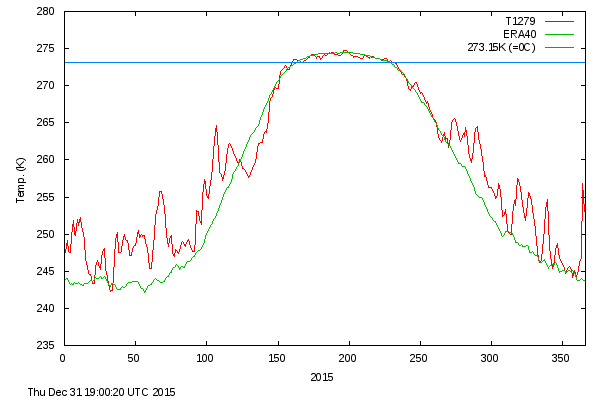
Meanwhile temperatures near the North Pole did briefly rise above the freezing point of sea ice in the middle of the Arctic winter. Here’s the Danish Meteorological Institute’s view of the air temperatures in the central Arctic:

meanT_20151231

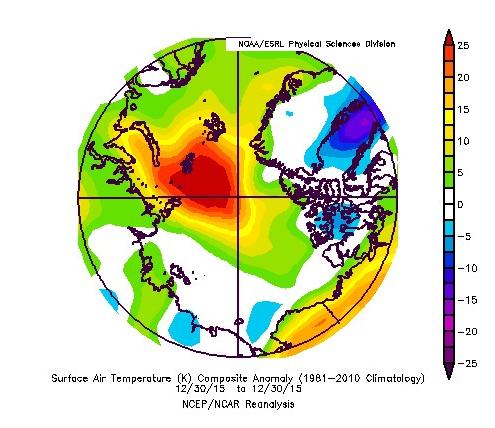
and here is NOAA’s temperature anomaly reanalysis for December 30th 2015:
NOAA-anomT_20151230

Personally I reckon the 25 m/s winds and resulting 10 meter waves had more effect on the sea ice metrics than the 25 °C above normal air temperatures, but your mileage may of course vary, especially if your pseudonym is “Steve Goddard”!

The 2015 Arctic Sea Ice Minimum Extent

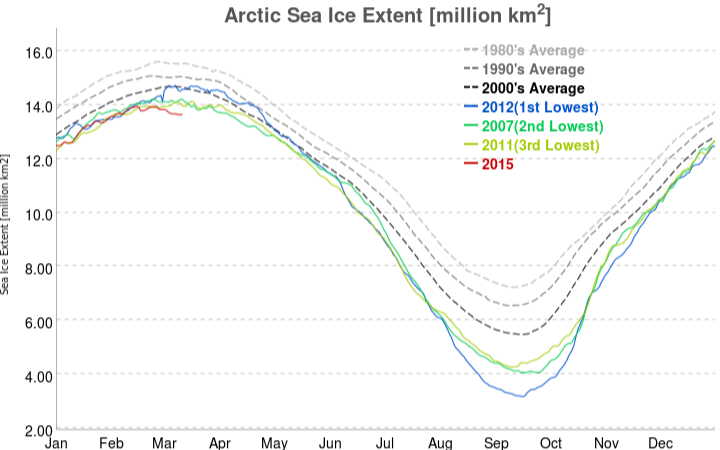
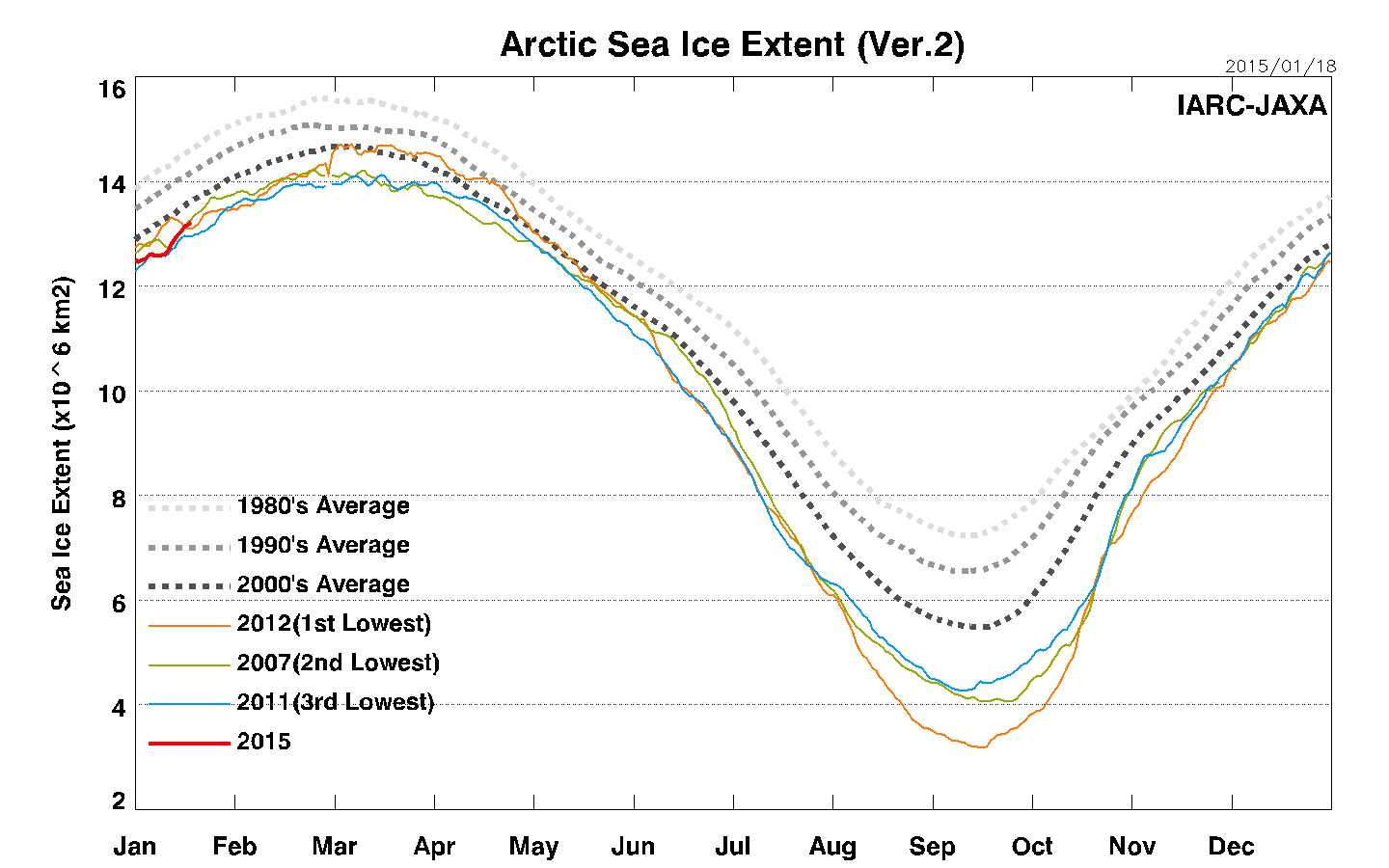
We’ve now entered the month of September, the month in which Arctic sea ice extent and area reach their annual minimum levels, historically at least. To set the scene, here’s the extent graph from the Japan Aerospace Exploration Agency (JAXA) for September 1st, based on data from the AMSR2 sensor on board their SHIZUKU satellite.:

IJIS-sep01

As you can see, the 2015 curve has just dropped below 2007 and is now at the second lowest level for the date in JAXA’s records. As the month progresses we’ll be taking a look at a variety of other metrics as they start to report their numbers for September.

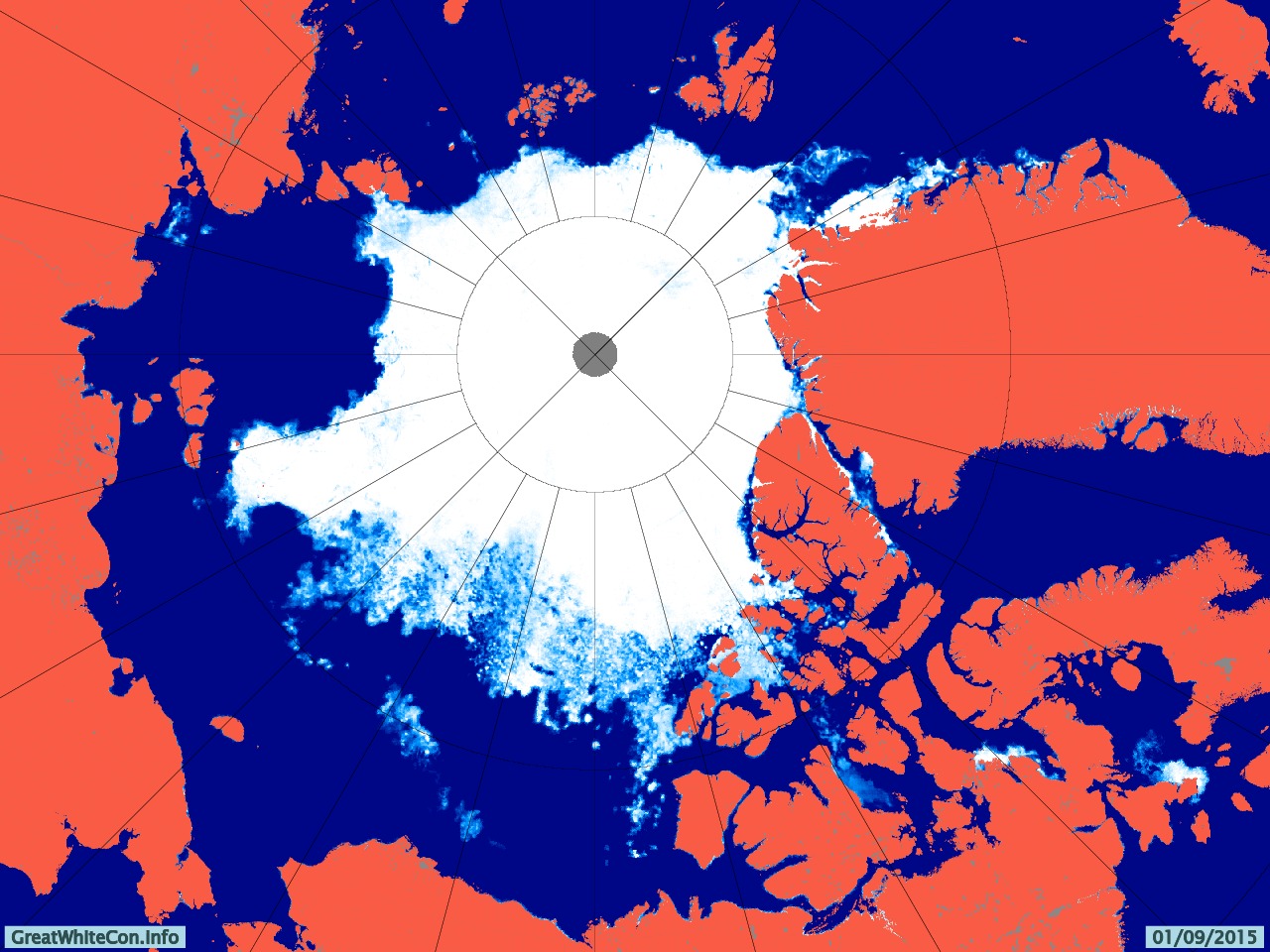
To set the scene, here’s the University of Hamburg’s map of Arctic sea ice concentration for September 1st, again based on AMSR2 data:

Arc_20150901_res3.125

Here’s a video showing how that map has changed over the last two months:


Notice in particular the effect of the recent Arctic cyclone on the sea ice in the lower left quadrant. Note also our comment that:

[There is] a large potential fetch across the East Siberian, Chukchi and Beaufort Seas should any further cyclones occur in the area over the next few weeks. The conditions now exist for an even more damaging swell to be generated before the 2015 minimum Arctic sea ice extent is reached.

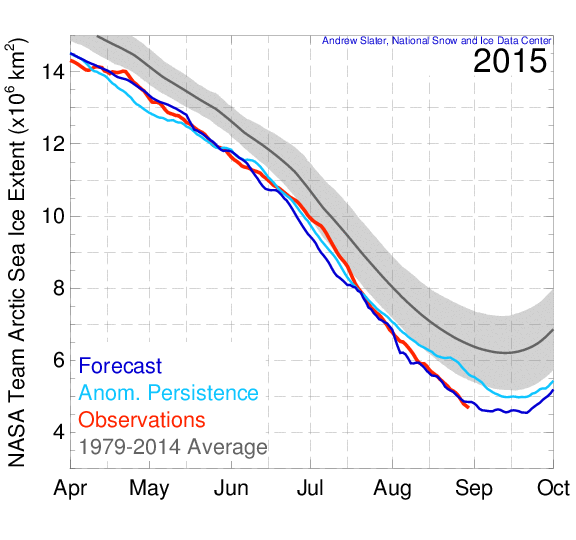
By now you may be wondering if we have a prediction to make? Well, we predict it still all depends on the weather! However here’s how the “probabilistic” 50 day ahead prediction from Andrew Slater of the NSIDC looks at the moment: SlaterExtent-20150831

If I were a betting man I’d say that the red line will ultimately put in a lower low than the dark blue one.

Finally, for the moment at least, take a look at the GFS surface level pressure forecast for later today, courtesy of MeteoCiel:

Can you see the 1000 hPa central pressure low spinning over the Laptev Sea? It’s currently not very deep, and it’s not over the East Siberian Sea either, but watch that space along with us as we wait to discover where and when the assorted Arctic sea ice metrics reach their minima for 2015.

[Edit – September 3rd 2015]

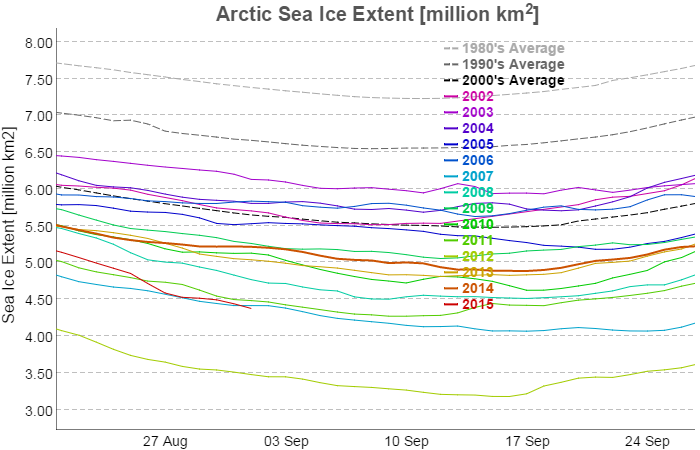
The latest edition of the US National Snow and Ice Data Center’s Arctic Sea Ice News has just been published. In the section on the imminent minimum they show this graph:

and say that:

Starting with the ice extent observed on August 31 and then applying 2006 loss rates, the slowest rate in recent years, results in the highest extrapolated minimum for 2015 of 4.50 million square kilometers (1.74 million square miles), and a September monthly average extent of 4.59 million square kilometers (1.77 million square miles). The lowest daily minimum comes from using the 2010 pace, yielding an estimated 4.12 million square kilometers (1.67 million square miles) for the daily minimum, and a September monthly average extent of 4.33 million square kilometers (1.67 million square miles).

Using an average rate of ice loss from the most recent ten years gives a one-day minimum extent of 4.38 ± 0.11 million square kilometers (1.79 million square miles), and a September monthly average of 4.49 ± 0.09. As of August 31, the 5-day running daily average extent is 4.72 million square kilometers. If no further retreat occurred, 2015 would already be the sixth lowest daily ice extent in the satellite record.

The forecast places the upcoming daily sea ice minimum between third and fourth lowest, with fourth more likely. There is still a possibility that 2015 extent will be lower than 4.3 million square kilometers, the third lowest sea ice extent, surpassing the 2011 sea ice extent minimum, and a small chance of surpassing 2007, resulting in the second-lowest daily minimum. This assumes that we continue to have sea ice loss rates at least as fast as those of 2010. This was indeed the case for the final ten days of August 2015.

Somewhere between 2nd and 6th then! We felt compelled to enquire on Twitter:

Some Statistics for the 2015 Economist Arctic Summit

Professor Jason Box was good enough to add some expert commentary to our recent story about a large calving of the Jakobshavn Glacier last month. Consequently we have just watched his presentation to the 2015 Economist Arctic Summit at the Hotel Bristol in Oslo with much interest. Here are our edited highlights from the conference’s Twitter feed:


Here are some relevant Arctic sea ice metrics. We will continue to update them as the latest figures arrive throughout the rest of today:

IJIS/JAXA daily extent: 13,648,280 km² – Lowest ever level for the date in records going back to 2003

vishop_sic_20150311
 

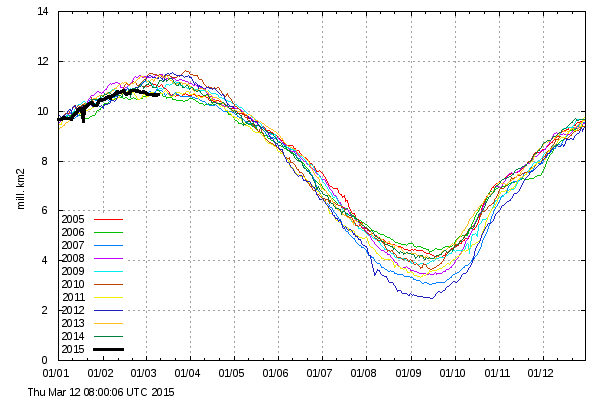
DMI “30%” daily extent: 10,676,900 km² – Lowest ever level for the date in records going back to 2005

DMI-30-icecover_20150312
 

NSIDC daily extent: 14,330,000 km² – Lowest ever level for the date
NSIDC 5 day average extent: 14,280,000 km² – Lowest ever level for the date in records going back to 1979
Charctic-201503011Crop
 

Cryosphere Today daily area: 12,984,410 km² – Lowest ever level for the date in records going back to 1979
CTArea-2015-Day69

Arctic Sea Ice Area Lowest Ever (For the Date!)

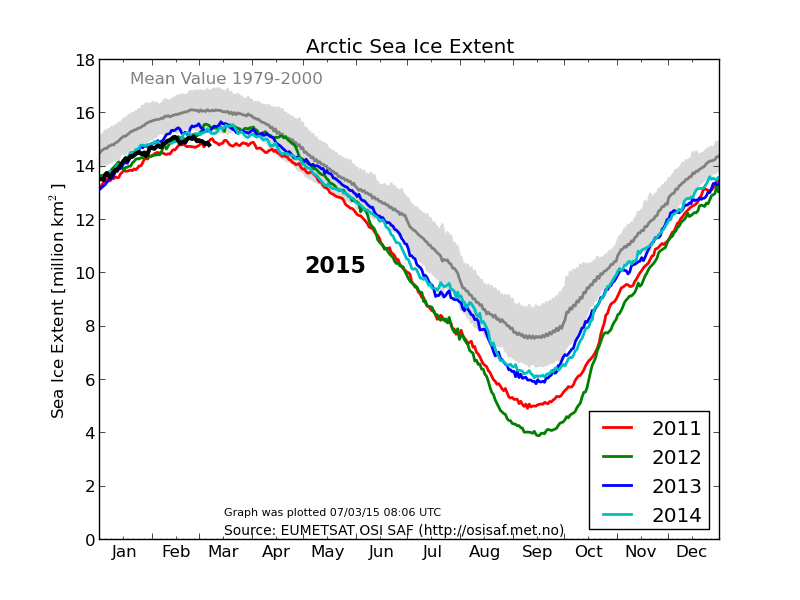
As we reported on February 18th, some of the Arctic sea ice extent metrics reached the lowest levels for the date in their respective histories quite some time ago. Today though, we’re looking at a full house. The daily NSIDC and IJIS extent numbers have both been at all time lows for the date for quite some time now. Here’s how the NSIDC 5 day average extent looks at the moment:

2015-03-06_NSIDC

and here’s the IJIS/JAXA daily extent:

vishop_sic_extent-20150307

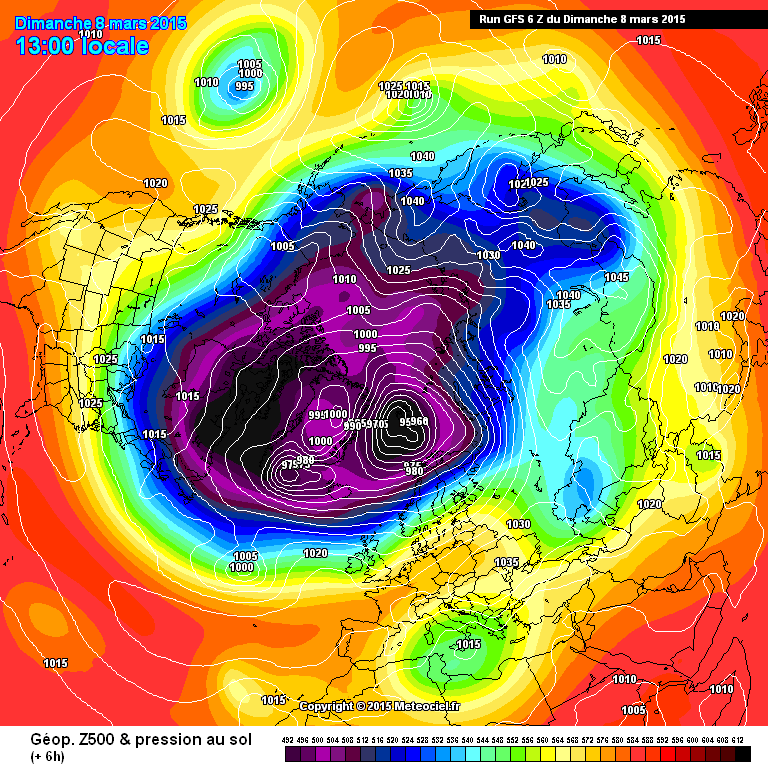
Meanwhile a series of storms in the North Atlantic have been bringing large surf to the shores of the Western United Kingdom, and battering the edge of the sea ice in the Greenland and Barents Seas. Here’s how GFS looks currently, as visualised by MeteoCiel:

gfsnh-20150308-6

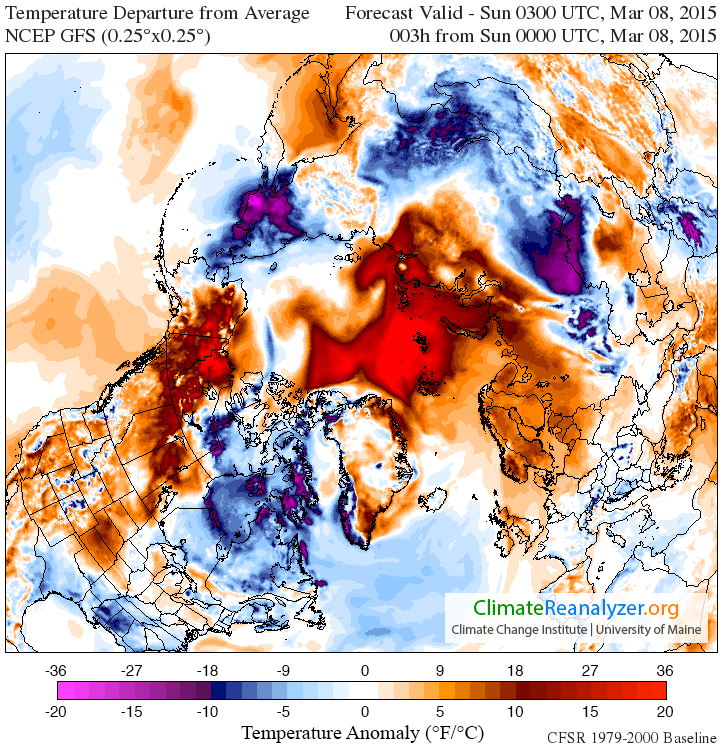
In addition this has  resulted in warm air from further south being funnelled into the high Arctic, so much so that the surface temperature anomalies currently look like this:

CCI-AnomT-20150308+003

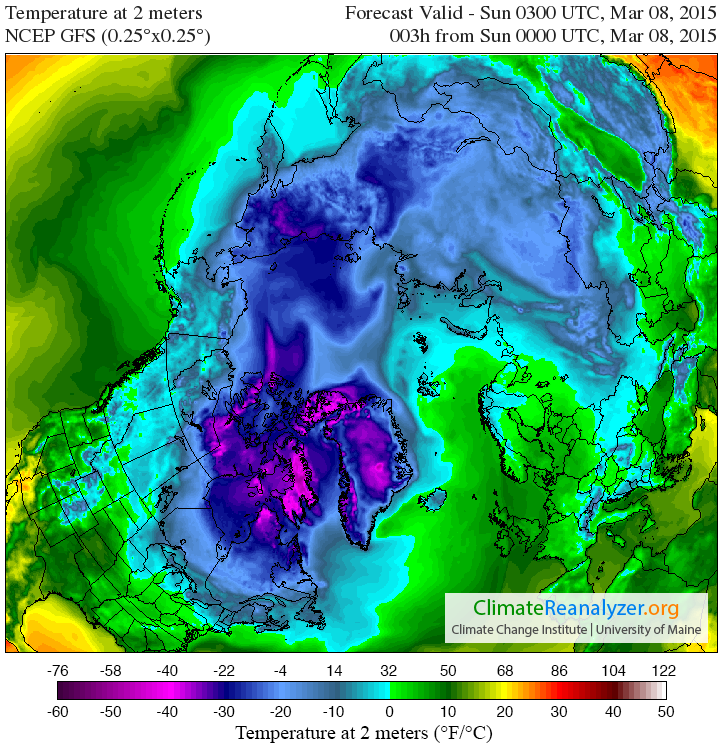
whilst the temperatures 2 metres above the surface of the Arctic look like this:

CCI-Temp2m-20150308+003

If you look closely you’ll see that air temperatures 2 metres above the North Pole are currently similar to those around the shores of the Great Lakes of North America.  As a result of all this atmospheric activity today we bring you news that both the Danish Meteorological Institute “new” 15% extent:

DMI-15-icecover_20150307

and “old” 30% metrics:

DMI-30-icecover_20150308

have now joined the club.

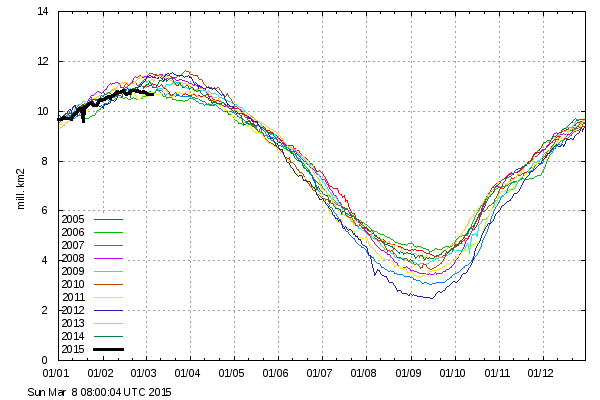
The Cryosphere Today area metric has been holding out against the trend in sea ice extent for weeks, but we can confidently predict that when their next update is released it too will also reveal the lowest ever Arctic sea ice area for the 65th day of the year, in records going back to 1979. Here’s how their graph looks currently:

CTArea-2015-Day64


New Antarctic Sea Ice Resources

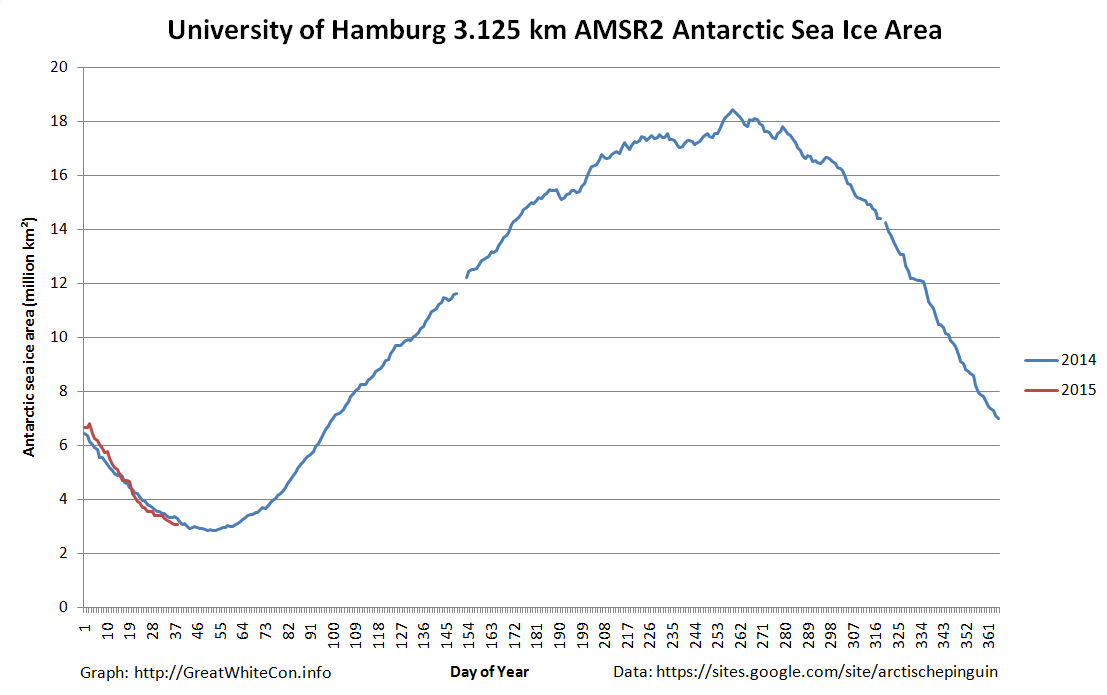
In the Arctic the refreeze is slowing down as the March maximum extent approaches. Meanwhile in the southern hemisphere Antarctic sea ice extent has taken a tumble as the annual minimum extent approaches.

Over the long cold Arctic winter “Wipneus” of ArctischePinguin fame has been porting his northern hemisphere regional sea ice area/extent methodology to cover the South Pole as well. We are pleased to be able to reveal the fruits of his labours on our new regional Antarctic Sea Ice Graphs page. The ultimate source of the information is the University of Hamburg’s sea ice concentration data based on a 3.125 km grid that uses data from the from the AMSR2  instrument on board the Japan Aerospace Exploration Agency’s SHIZUKU satellite. Here’s an overview of Antarctic sea ice area:

2015-02-07-Ant-Area and here’s a close up on the sea ice extent in the Bellingshausen and Amundsen Seas region, where what sea ice there is helps buttress the West Antarctic Ice Sheet:

2015-02-07-West-Extent

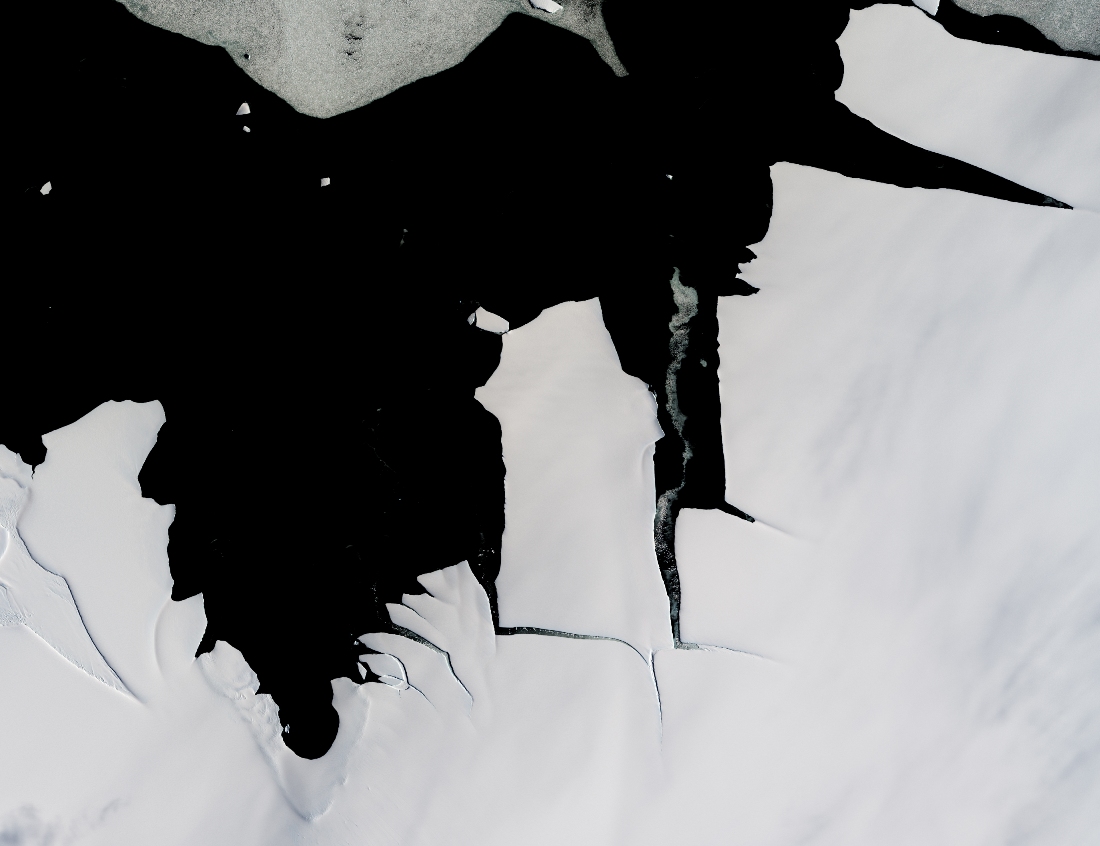
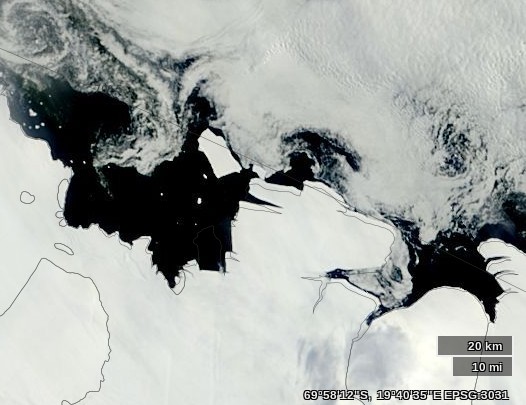
In future we will also be bringing you satellite images from Antarctica. By way of example, here’s the latest “Shock News!!!” from the Antarctic, courtesy of LandSat 8:

I
NASA report that:

While large icebergs calve regularly from fast-flowing ice shelves in West Antarctica, the coast of cooler, drier East Antarctica tends to be less active. That made it a mild surprise when a 70-square-kilometer chunk of ice broke off from the King Baudouin Ice Shelf in January 2015. The last time that part of King Baudouin calved such a large iceberg was in the 1960s.

and you can track the current position of the latest large chunk of ex ice shelf on their WorldView web site:

The recently calved King Baudouin Ice Shelf on February 3rd 2015

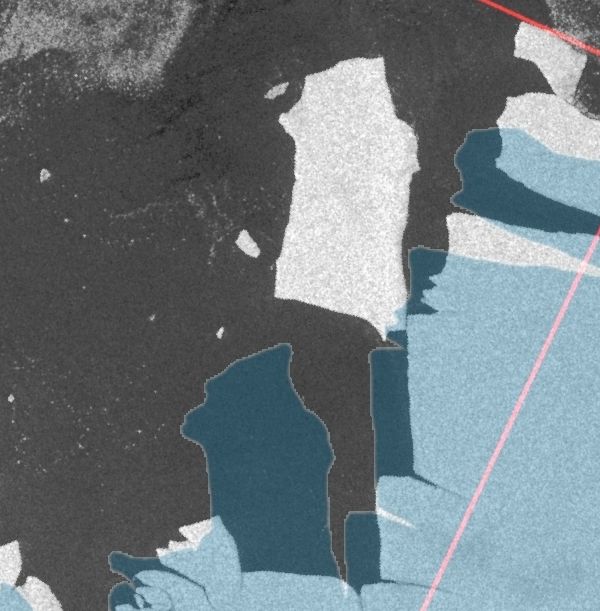
Thanks also to “Arcticio” from the Arctic Sea Ice Blog who pointed me in the direction of PolarView, where it was remarkably easy to locate this Sentinel-1A synthetic aperture radar image of the large iceberg in question on January 30th 2015:

RoiBaudouin-600

Implausible Deniability of 2014 Arctic Sea Ice Predictions

Further to the cessation of the brief hiatus in my continuing discussions with “Steve Goddard” about “global warming”, the debate has turned to predictions concerning Arctic sea ice metrics during the 2014 melting season.

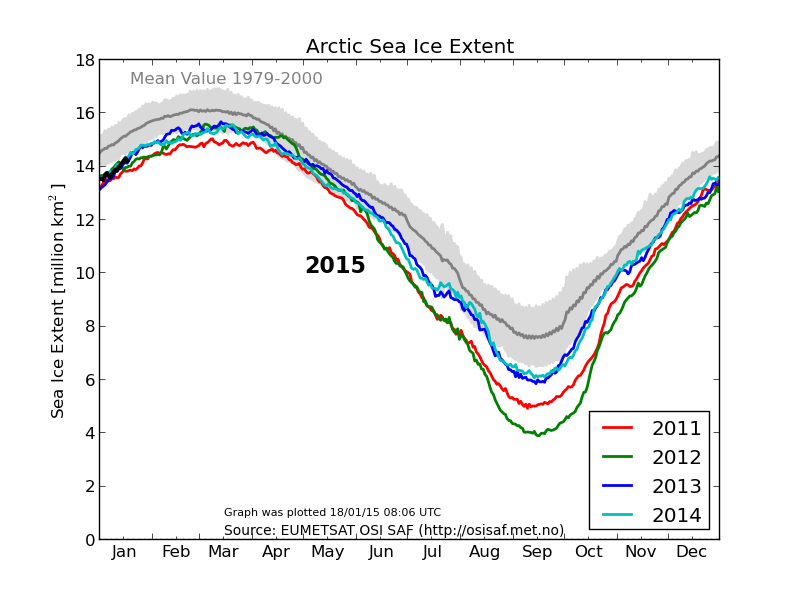
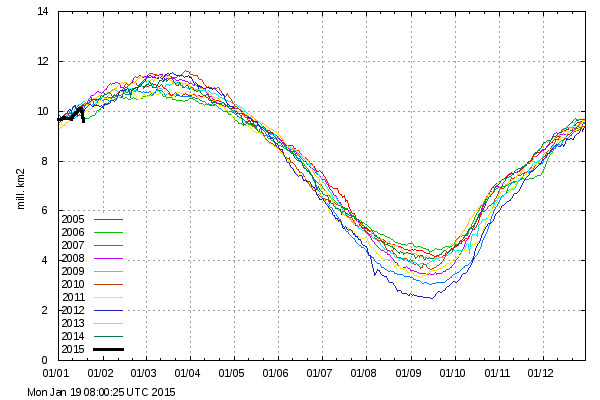
Firstly here’s a few charts of assorted Arctic sea ice metrics, hot off the virtual presses:

CT-Area-2015-01-18
Chart from Cryosphere Today – http://arctic.atmos.uiuc.edu/cryosphere/arctic.sea.ice.interactive.html
IJIS-Extent-2015-01-18
Chart from IJIS – http://www.ijis.iarc.uaf.edu/en/home/seaice_extent.htm
DMI-New-2015-01-19
Chart from DMI – http://ocean.dmi.dk/arctic/icecover.uk.php
DMI-Old-2015-01-19
Chart from DMI – http://ocean.dmi.dk/arctic/old_icecover.uk.php

Here’s a table of the minimum value of some of those metrics for a selection of years:

Metric 2006 2013 2014
NSIDC daily 15% extent 5.74877 5.077090 4.98339
CT area 4.02978 3.55440 3.48317
IJIS extent 5.62505 4.80929 4.88412


Now here’s one of Steve/Tony’s predictions, in this case from August 1st 2014:

The minimum this summer will likely be close to the 2006 minimum, which was the highest minimum of the past decade.

And finally here’s the “discussion” (such as it is) over at the “Real Science” blog:
 

Us:

That’s not really how things turned out, is it?


Them:

That is exactly how it turned out.

Do you believe it was ice-free as Nobel Prize winner Al Gore predicted?


Us:

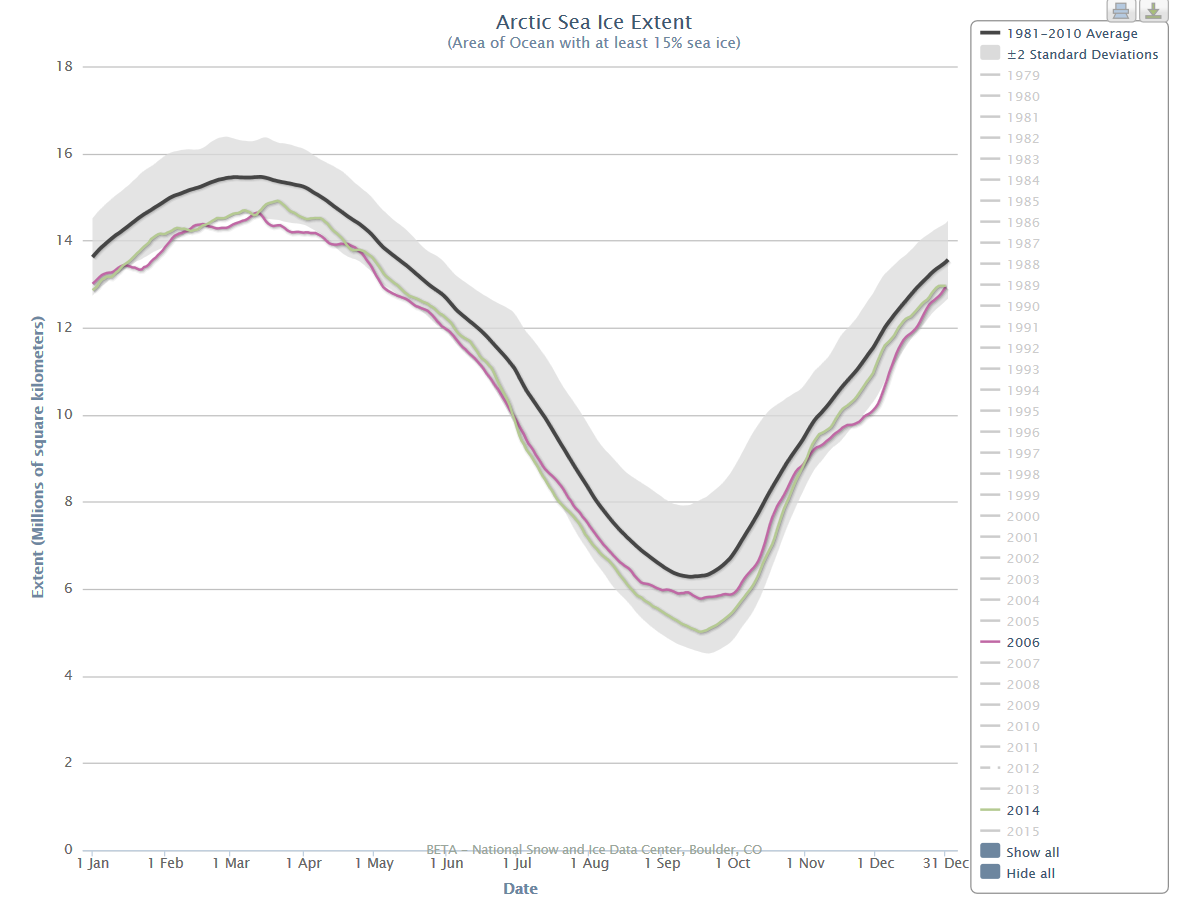
Perhaps this chart is clearer?

NSIDC-Extent-2015-01-18
Chart from NSIDC – http://nsidc.org/arcticseaicenews/charctic-interactive-sea-ice-graph/

How do you define “exactly”, “likely” and “close”?

Regarding my views on Al Gore’s so called predictions, see:

https://greatWhiteCon.info/2014/09/david-roses-apocalyptic-vision-of-al-gores-nobel-lecture/

In brief “Al Gore never ‘predicted’ that the Arctic would be ice-free by now!”


Them:

Well, he didn’t say ’22 years from now’, did he? No, he emphasized the most alarmist position he could find.

You can weasel out of this by stating that Gore did not make the prediction ,but he sure as Hell quoted and emphasized it, over any and all other predictions. And in front of the Nobel committee and entire world at that!

So have you confronted Gore over the failed prediction he parroted in Oslo? When you do, you will have a modicum of credibility. Get busy.


Us:

At the risk of repeating myself, “for the benefit of those who seem unable to understand either English or Mathematics a ‘projection’ is not the same thing as a ‘prediction’”

Getting back to Tony’s predictions, and using the NSIDC daily extent numbers for the moment, would you say that 4.98339 is “exactly” 5.74877? How about “close”?


Them:

Actually, no, your chart is less clear. Steve’s has all the years and it is clear his prediction is correct. Yours does not. Nor does yours have a legible legend. Another snow white lie.


Us:

Have you by any chance tried clicking on my chart? Does that help at all?

At the risk of repeating myself, would you say that 4.98339 is “exactly” 5.74877? How about “close”?


Them:

What bearing does 2013’s minimum have on goddard’s prediction for 2014? Are you a half-wit in addition to being a mentally ill stalker & transvestite?


Us:

What bearing does 2014’s maximum have on 2014’s minimum?

Are you blind?


Them:

You seem to think that some random number you came up with has some bearing on the subject at hand. Hint: it’s why we think you’re mentally ill.


Us:

Of course they’re not random numbers. To save you the bother of doing your own research please feel free to take a look at:

https://greatWhiteCon.info/2015/01/implausible-deniability-of-2014-arctic-sea-ice-predictions/#Table


Them:

Stark, it’s not about random numbers, it’s about random harassment. This clown takes no issue with ridiculous ‘projections’ delivered by alarmist zealots on a world stage, instead he haunts this site moaning about near misses.

But you are right about the mentally ill bit.


Us:

The conversation about the non-random Arctic numbers has at last taken a statistical turn over at:

https://stevengoddard.wordpress.com/2015/01/20/arctic-sea-ice-extent-continues-near-a-decadal-high/#comment-483567

I note that you are still dodging the question there too.


Them:

We’ll keep you posted!

Has the Arctic Ice Cap Expanded for the Second Year in Succession?

According to David Rose’s latest article in the Mail on Sunday it has. This came as shock news to me, because only a couple of days ago I was discussing with “Steve Goddard” how Arctic sea ice extent (using “Steve’s” patent pending personal “DMI 30% clone” metric) had actually decreased since the same time last year!

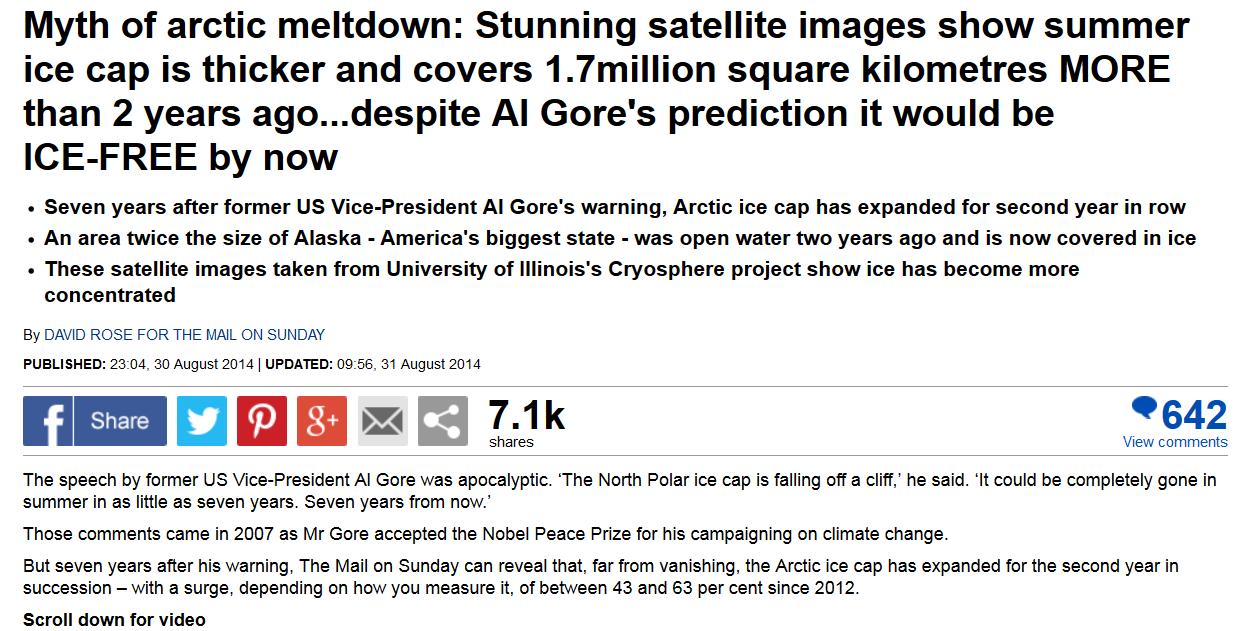
Before we delve deep into the data, and before the Mail on Sunday makes any “corrections” to David’s misleadingly purple prose, here’s how things look over there at the moment:


Them:
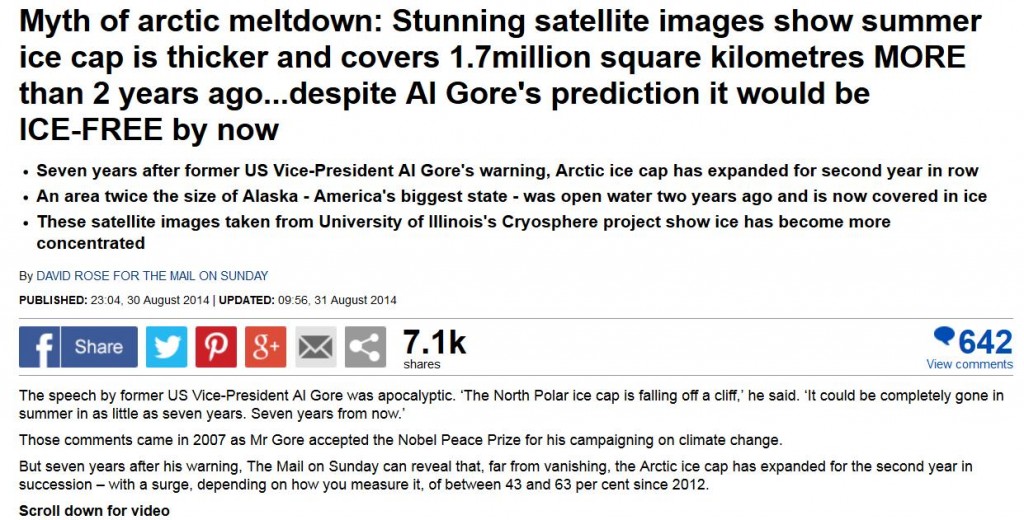
2014-08-31_MoS RoseMoS-20140831

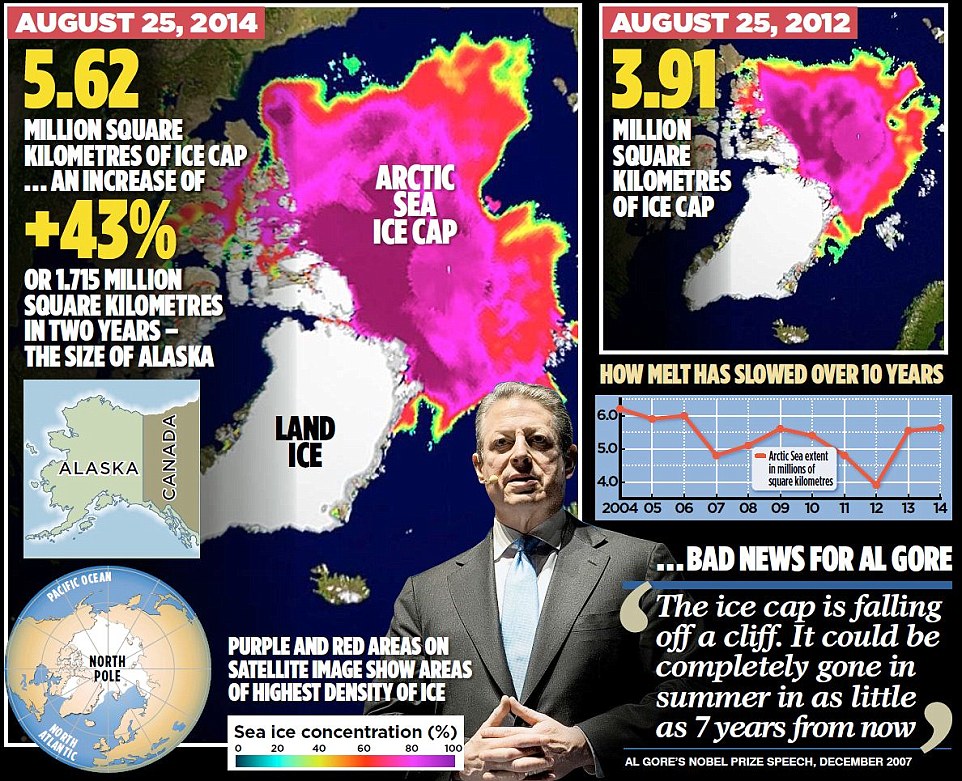
As you can see, the Mail’s main claims are:

  • Seven years after former US Vice-President Al Gore’s warning, Arctic ice cap has expanded for second year in row
  • An area twice the size of Alaska – America’s biggest state – was open water two years ago and is now covered in ice
  • These satellite images taken from University of Illinois’s Cryosphere project show ice has become more concentrated

not to mention that:

The Mail on Sunday can reveal that, far from vanishing, the Arctic ice cap has expanded for the second year in succession – with a surge, depending on how you measure it, of between 43 and 63 per cent since 2012.

For some strange reason David neglects to include any numbers for 2013, so….


Us:

A quick telephone call revealed that John Wellington doesn’t work at the Mail on Sunday’s, so I sent him an email instead:

Hello again John,

David Rose is at it again, hence so am I. According to his latest words of wisdom:

“The Mail on Sunday can reveal that, far from vanishing, the Arctic ice cap has expanded for the second year in succession”

I don’t suppose David and/or the Mail on Sunday can provide any data to back up that assertion can they?

Best wishes,

Jim Hunt


Them:

Hello Jim,

I did wonder if we would be corresponding, again.
I will be in touch after the weekend.

Best regards

John


Us:

Hi Tessa,

I’m working on the assumption that you are still responsible for this subject. If not perhaps you can pass this email on to the relevant person?

David Rose is talking about the Arctic on the Mail Online again, so I’m attempting to comment again. Yet again I can’t see my comments (under the nom de guerre “SoulSurfer”) anywhere underneath the article in question. Can you look into it please, and let me know what the problem is?

To make things easier for you I’ve just commented for the third time this morning, as per the enclosed attachment.

Thanks,

Jim Hunt
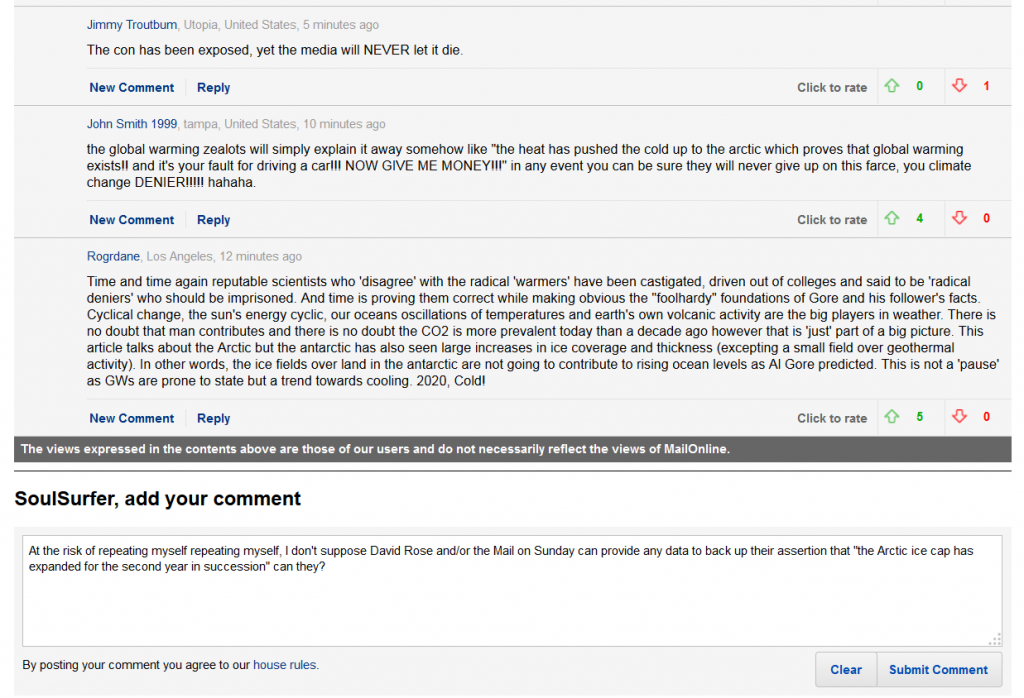
2014-08-31_1347_MoS

Them:

In an email dated September 6th 2014:

Dear Jim,

Sorry not to reply sooner. The article relied on data from the US National Snow and Ice Data Centre comparing ice cover on the same date, August 25. In 2012 the figure was 3.91m sq miles, in 2013 it was 5.59m and in 2014, 5.62m. You may wish to note that the article did point out that the long-term trend is still downward.

Best regards

John


Us:

In an email dated January 24th 2015:

Dear John,

Sorry not to reply sooner. The PCC decided to laboriously mutate into something called IPSO right around the time of the 2014 Arctic sea ice minimum extent. Hence the brief hiatus. However David Rose is at it again, and he’s now even discussing tricky things like “probabilities”! IPSO do now seem to be getting their act together as well. Did you see their “open letter to publishers” last month?

No doubt I will have more than a few bones to pick with David’s article last weekend, not to mention the subsequent one by Victoria Woollaston. Is that one your responsibility too? For the moment though, perhaps we can pick up where we left off last summer?

Thanks for your information about the long term Arctic sea ice trend and the NSIDC extent numbers. However the article in question also states:

“Figures from the Danish Meteorological Institute suggest that the growth has been even more dramatic. Using a different measure, the area with at least 30 per cent ice cover, these reveal a 63 per cent rise – from 2.7 million to 4.4 million square kilometres”.

Where did David get those DMI numbers from? I asked the DMI, and even they didn’t seem to know!

Best wishes,

Jim Hunt


Them:

In the absence of any response from John I called the Mail offices on January 26th 2015. It seems John is out of the office for the next two weeks. His PA is now looking into matters for me.


Us:

I sent a further email to John and Poppy on February 2nd 2015:

Them:

Dear Jim,

If you have a complaint about last Sunday’s article, you should set out exactly what it is. If you disagree with any opinions expressed you are welcome to write a letter that we will consider for publication.

You mention that you have sent us a number of inquiries recently. The only other, to my knowledge is that you wanted to know the source of some data that David Rose mentioned in an article some months ago. David Rose told me it came from the official website. Perhaps my colleague Poppy Hall can find it for you since David is probably unwilling to help after your insult.

Best regards,

John


Us:

Dear Poppy (and John)

Please would you ask David to let me know where exactly, and on which “official website”, he obtained the DMI extent numbers he quoted in his article last Summer?

FYI John, at Poppy’s suggestion I have also emailed the editorial team @MailOnline. They have yet to even acknowledge receipt of my email of January 26th.

Best wishes,

Jim Hunt


Them:

Dear Jim,

David is unable to find the table with the numerical data. But he says that the graph here from the DMI website makes it clear that if you look at 30% concentration, the figures he gave were correct.

I hope this answers your query.

Kind regards,

Poppy
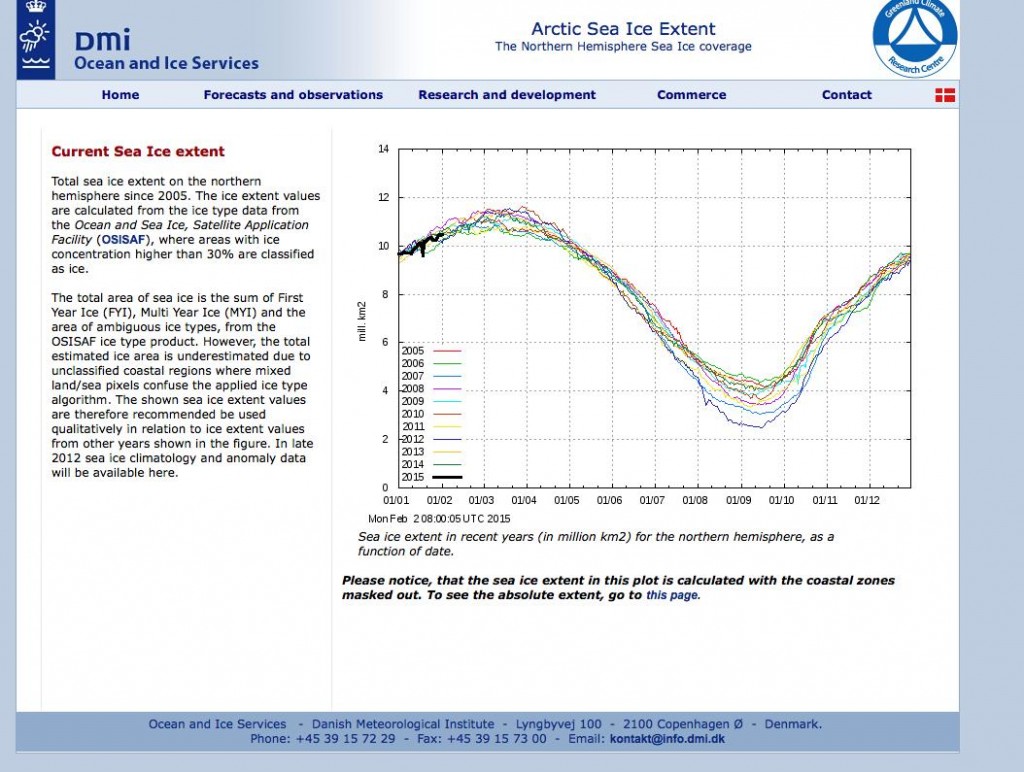
MailRoseDMI-001
 

Us:

Dear Poppy,

Just to clarify, the facts of the matter are that David Rose did NOT obtain the DMI numbers he quoted last summer from a “table with the numerical data” on an “official website”?

Best wishes,

Jim Hunt


Them:

We’ll keep you posted!
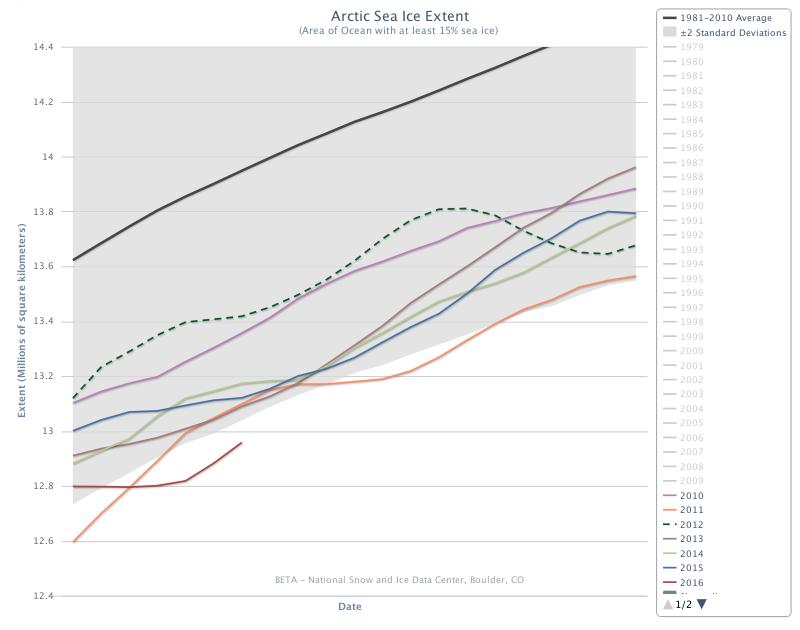
A Few Players Short of a Great Green Con Surf Team

Shock News! Over in the denialosphere at the (un)Real Science blog I’ve been challenged to yet another Arctic sea ice bet. This one now seems to be signed and sealed, but will probably have to wait a few years before it is delivered:

Them:

Have you come up with the terms of our bet yet? I have yet to find one single alarmist willing to bet their house on an ice free Arctic at any time over the next 20 years, I may have to extend to 30 years, though the amount of cigarettes I smoke, I doubt I will be around that long.

Us:

Having personally discussed the matter with Rear Admiral Jon White:

http://econnexus.org/the-economist-being-economical-with-the-truth-about-climate-change/

and having since publicly stated that I’m more pessimistic than him, how about $1000 in favour of ShelterBox on CT area < 1 mio square kilometers by the summer of 2022 at the latest?

Them:

$1000 on CT area being less than 1 million square kilometres at some point between now and 2022 sounds fine to me, we have a bet. Remember, this is where to send your $1000

http://www.chas.org.uk/how_we_help_families/our_hospices/rachel_house

Meanwhile I’ve been trying to find someone, anyone, willing to don a polar bear suit and then stand up on a surf board. I have yet to find one single “skeptic” willing to accept my challenge to become part of the “Great Green Con” Arctic surf team.  First in line for an invitation was “Steve Goddard” (AKA Tony Heller):

Them:

Within a week, a cyclone will be spreading Arctic sea ice, and extent will flat line or increase.

Us:

I’m following that cyclone with much interest too Tony! What’s your Arctic surf forecast?

https://greatWhiteCon.info/2014/08/the-arctic-surf-forecast-for-late-august-2014/

Do you fancy joining the GGC team?

Them:

[Abject silence]

Meanwhile over on Twitter Matt Ridley has been having a “debate” with Bob Ward about Bob’s latest article in the New Statesman:

Us:


Them:

[Abject silence]

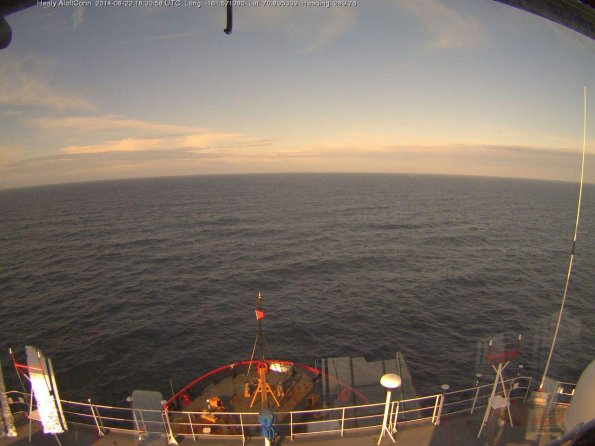
Whilst we wait for a “skeptic” willing to stop doing a chicken impression and start impersonating a polar bear to reveal themself, how is the surf in the Chukchi Sea coming along?  There are already some signs of a building swell to be seen. The US icebreaker USCGC Healy is currently bobbing about on a modest swell off Barrow:

Healy-20140822-1801_595

Whilst onshore a modest wave can currently be seen breaking on Barrow beach:

ABCam_20140822_1137

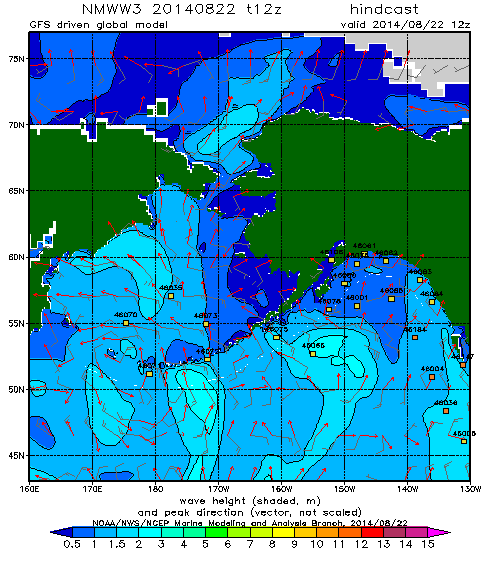
Here’s what that swell looks like on the WaveWatch III nowcast:

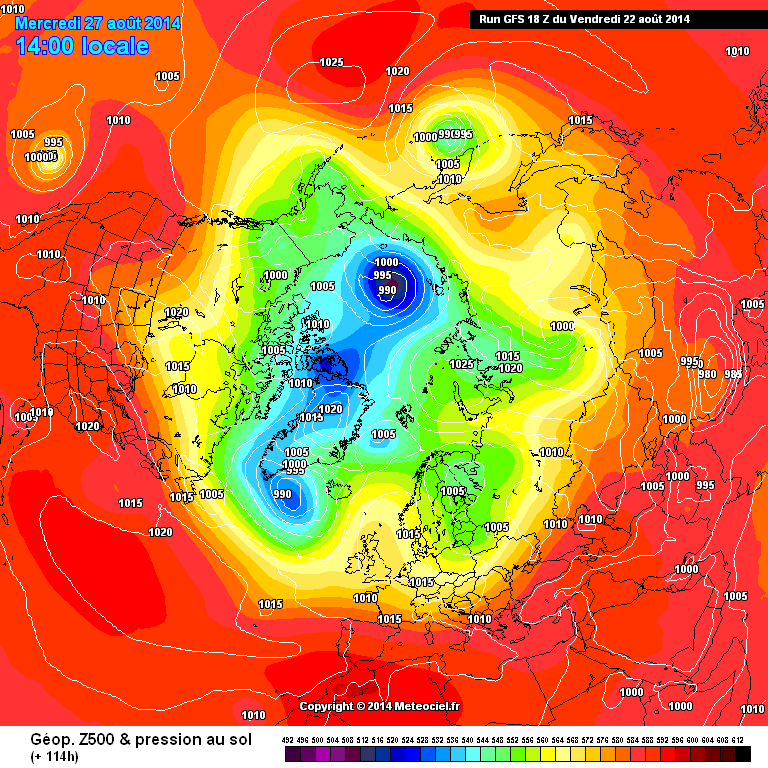
alaska.hs.h000h-20140822Meanwhile the cyclone brewing in the Arctic is now forecast to have a central pressure below 990 mb next week, by GFS at least:

gfsnh-0-114-20140822

We’ll keep you posted!

The Greatest Arctic Sea Ice Prophet on the Planet?

The “Shock News” about Arctic sea ice is coming thick and fast as the 2014 melting season reaches its peak. I’ve been debating the meaning all of the various metrics with none other than my old sparring partner “Steve Goddard” AKA Tony Heller. The theory which is mine (in brief!) is that the ice is actually getting thinner and hence travelling faster. As regular Great White Con readers may well suspect by now, Steve/Tony has other ideas. Here are the edited highlights:


Them:

Steve/Tony’s latest Arctic sea ice prophecy is entitled “My Arctic Forecast“, although it’s actually his fourth of the season. Here’s his take:

Arctic ice extent will continue to decline for a couple of days, then a cyclone near the North Pole will begin spreading the ice, and the extent curve will turn back towards the median.

The minimum this summer will likely be close to the 2006 minimum, which was the highest minimum of the past decade.


Us:

My latest Arctic forecast is more short term than yours Tony, and rather more precise too.

https://archive.today/YpoRm#selection-3929.0-3941.25

“CT area decline of around 180 k over the next two days”. I guess that equates to “CT Arctic sea ice area will reverse and then decline for a couple of days”?


Them:

Gutsy to go with a forecast, but then the great ones risk it to gain the glory.


Us:

Many thanks for your kind words Phil.

Time passes……

CT Area has just come in at 44,288 square kilometers below yesterday. The “turn on the proverbial dime” has come to pass, and there is only another 135,712 to go!


Them:

CT doesn’t measure extent. This post is about extent. Stop being a moron and wasting my time.

Time passes……

icecover_15_20140414I do appreciate you demonstrating so graphically the dissonance and dishonesty of climate alarmists.


Us:

The pleasure is all mine Tony.

I’ve asked this before without receiving an answer, but is there any way for commenters on here to include an image?

Failing that is there any way you might be willing and able to display the graph at my JAXA link here?

JAXA_Ice_Extent_20140801

Time passes……

Whoops! The decline was a mere 129,850  🙁


Them:

DedaEda says: August 1, 2014 at 2:48 pm

You do have a working knowledge of English. Congratulation!


Us:

Thanks for your kind words DedaEda, once again.

A new month means some masks have changed, so the GWC patent pending crystal ball is cloudier than usual. Undaunted the CT oracle hoarsely whispers “Expect a couple more 100 k declines next. Around 225 k in total”


Them:

We’ll keep you posted!

Does Tony Heller Need To Be Prosecuted?

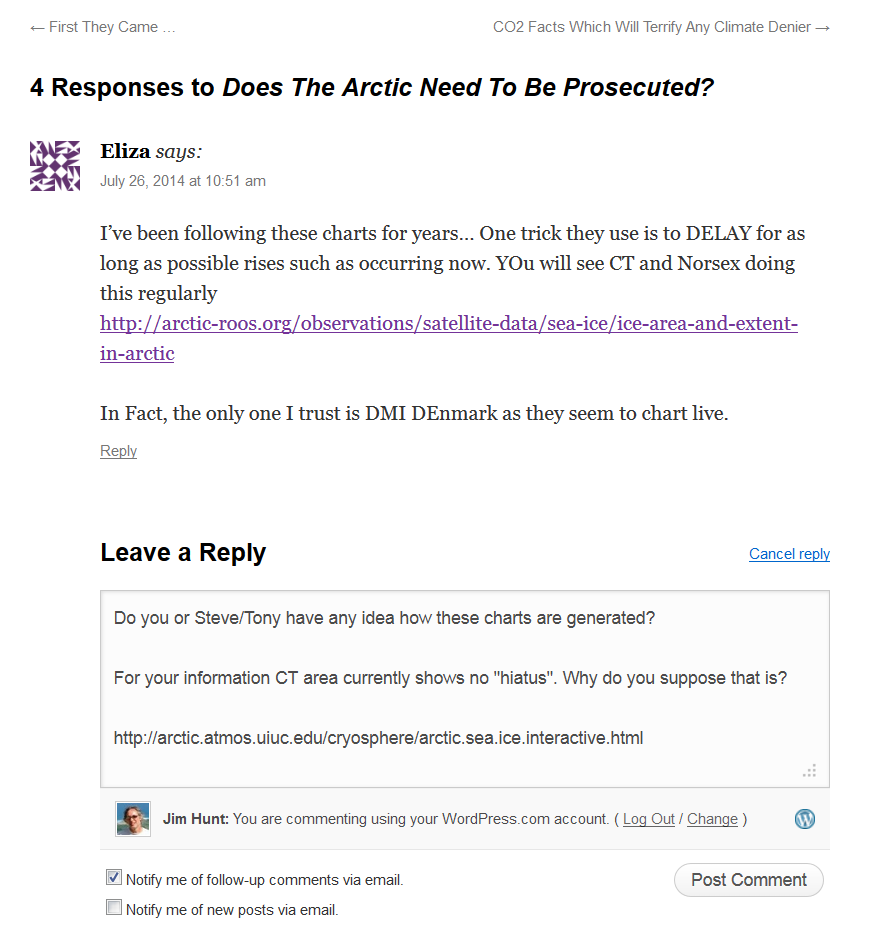
In some recent shock news over at the “Real Science” blog “Steven Goddard” asked “Who is Steven Goddard” and then answered himself as follows:

My name is Tony Heller. I am a whistle blower. I am an independent thinker who is considered a heretic by the orthodoxy on both sides of the climate debate.

I’m highly unorthodox, so I’ll consider him as a schizoidal cherry picking pseudo-skeptic instead. Steve/Tony finishes his “coming out” article as follows:

I am more than happy to debate anyone who feels up to the challenge, including the President of The United States. Science works through research and debate – not censorship, propaganda, faith, or intimidation.

Steve/Tony has been blogging about Arctic sea ice again recently. His most recent post is entitled “Does The Arctic Need To Be Prosecuted?“, but it seems he’s unwilling to engage in debate about that topic with me.

Them:

Some climate experts want to make skepticism of junk science a felony, and every day it becomes more clear that the Arctic has no respect for climate models or eminent government scientists. This is shocking, and it is time for the Arctic to be prosecuted. The Arctic is aiding and abetting climate deniers, as well as making obscene gestures towards the world’s leading academics.

DMI "new" Arctic sea ice extent graph on July 26th 2014

DMI “new” Arctic sea ice extent graph on July 26th 2014


Us:

Needless to say Steve/Tony has yet to approve my comment on his ruminations, which reads as follows:

2014-07-26_1314_RealScienceThis is what the Cryosphere Today graph of Arctic sea ice area I linked to looks like at the moment:

Cryosphere Today interactive Arctic sea ice area graph on July 26th 2014

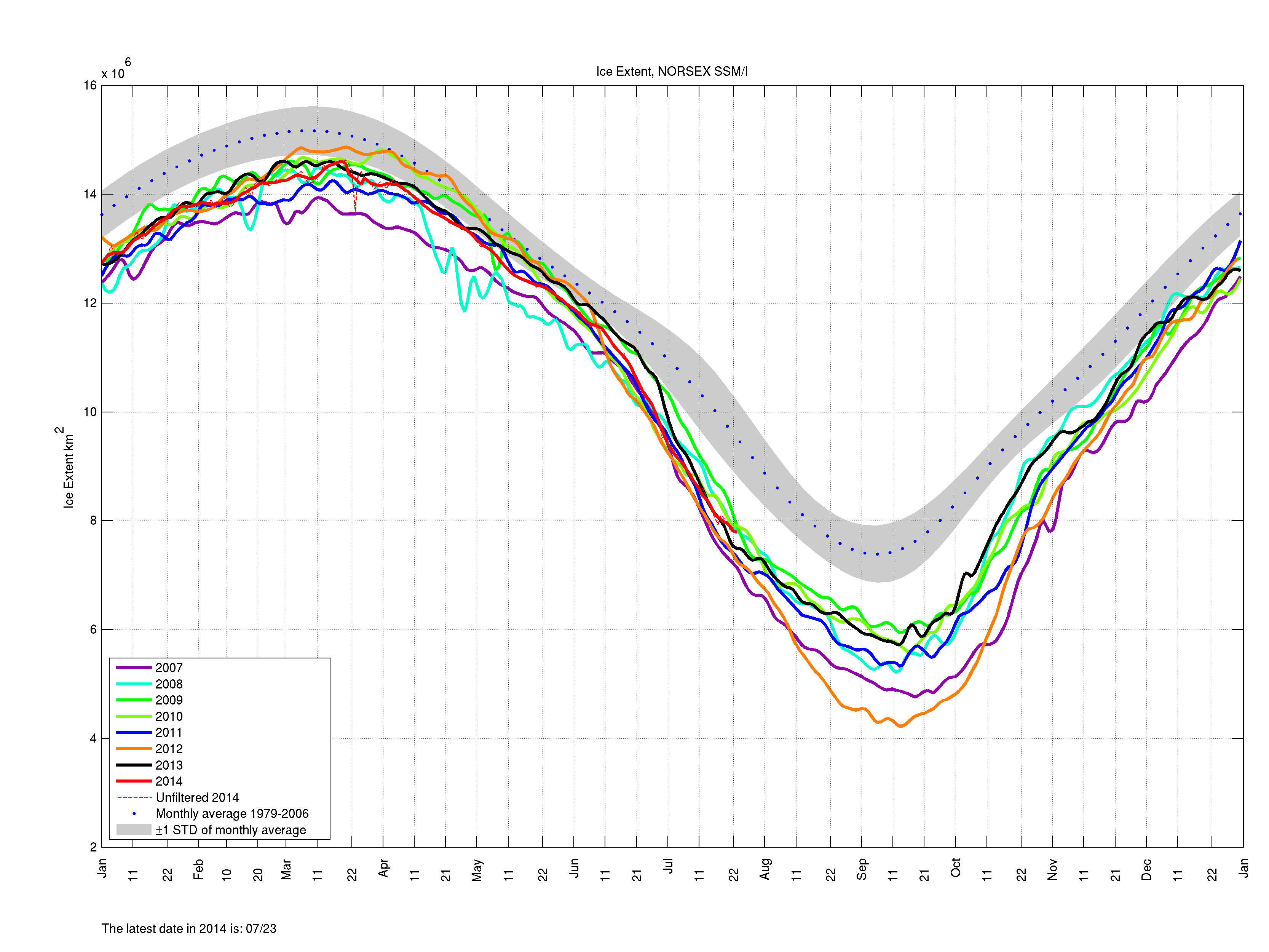
This is what the NORSEX extent chart that Eliza linked to looks like this morning:

NORSEX SSM/I Arctic sea ice extent graph on July 26th 2014

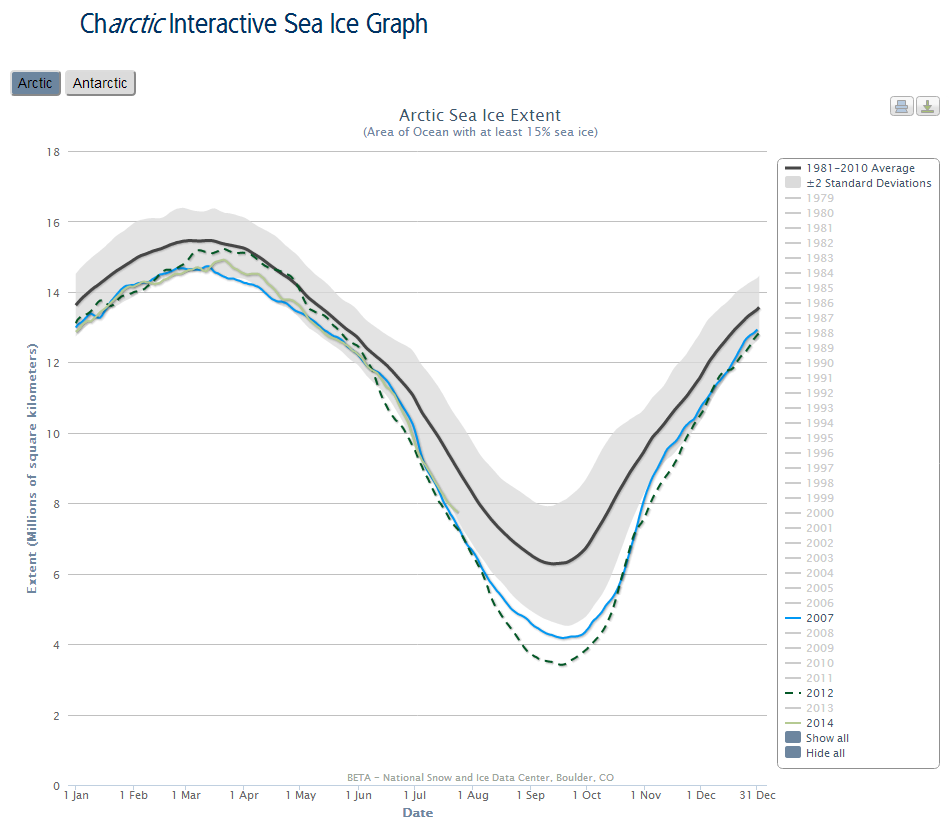
Here’s another one for good measure, this time showing NSIDC Arctic sea ice extent:

NSIDC interactive Arctic sea ice extent graph on July 26th 2014

As far as I am aware there is no law against being a schizoidal cherry picking pseudo-skeptic in the United States of America, or anywhere else for that matter. Please feel free to comment below if you know otherwise and/or think that there should be!


Them:

After a protracted exchange on Twitter a copy of my comment eventually saw the light of day:


Us:

We’ll keep you posted!