The Fifth US National Climate Assessment was published in November 2023 during the Biden/Harris administration. Here’s the announcement by Zeke Hausfather on X/Twitter:
After three years of work by a team of over 750 scientists, we are releasing the US 5th National Climate Assessment today!
We see greater impacts of climate change on the US since the 2018 NCA4 report, but also some encouraging signs of progress.https://t.co/2WZOLOXoKo
The Global Change Research Act of 1990 mandates that the US Global Change Research Program (USGCRP) deliver a report to Congress and the President not less frequently than every four years that “integrates, evaluates, and interprets the findings of the Program and discusses the scientific uncertainties associated with such findings; analyzes the effects of global change on the natural environment, agriculture, energy production and use, land and water resources, transportation, human health and welfare, human social systems, and biological diversity; and analyzes current trends in global change, both human-induced and natural, and projects major trends for the subsequent 25 to 100 years.”
You may well have noticed that Kamala Harris lost the subsequent election? Hence the Sixth US National Climate Assessment will be prepared during the term of the current Trump/Vance administration.
Regular readers will recognise some or all of those names, and it will not surprise you to learn that there was plenty of pushback from a wide range of climate scientists. In particular, the “Climate Experts’ Review of the DOE Climate Working Group Report“, led by Andrew Dessler and Robert Kopp was published at the end of September 2025. This report begins as follows:
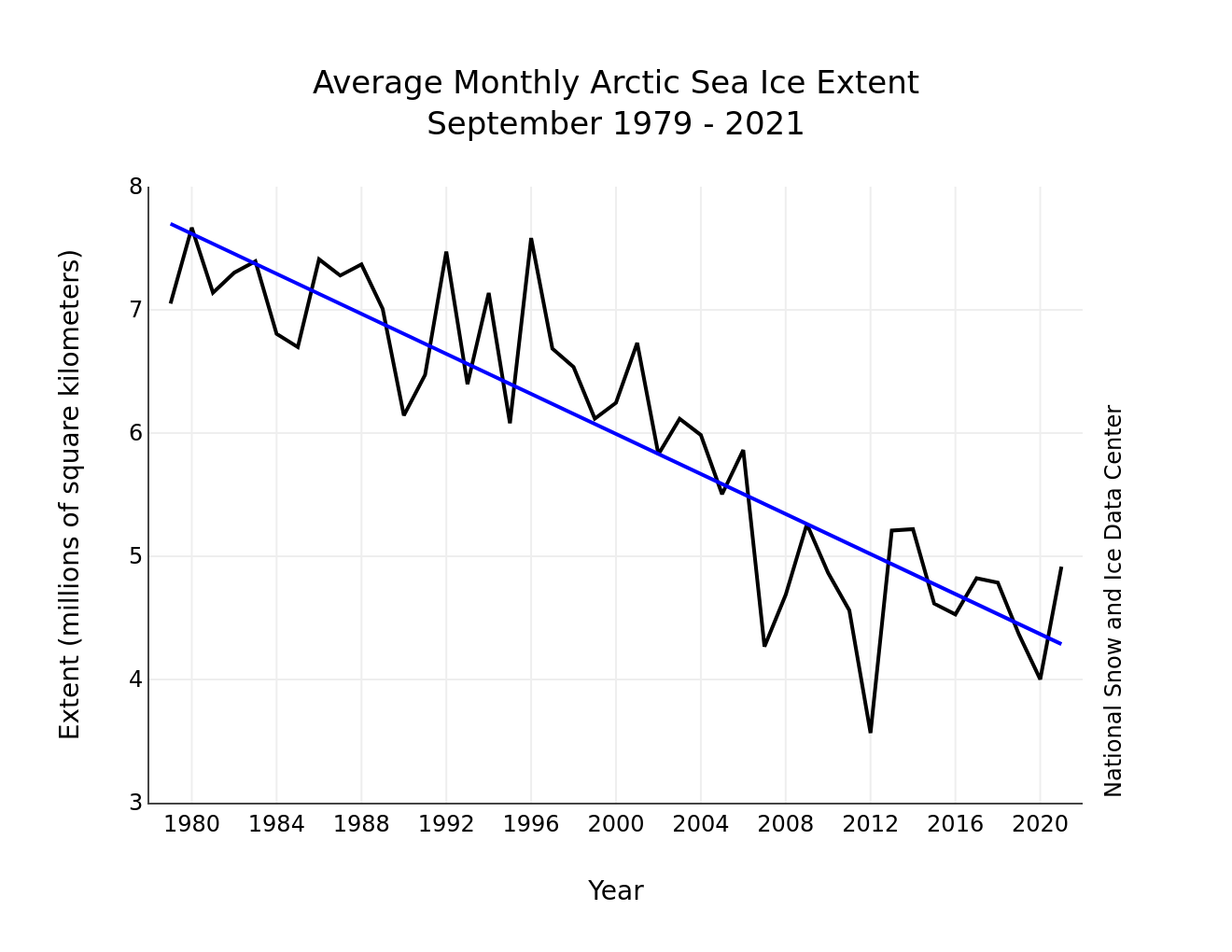
Yes. NSIDC satellite data shows Arctic September sea ice extent declined from ~6.5 million km² in the early 2000s to ~4.2 million km² by 2024, while PIOMAS volume estimates fell from ~12,000 km³ to under 4,000 km³. Shellenberger's claim ignores these multi-decadal trends, though…
By way of additional background information, Wikipedia asserts that:
Grok is a generative artificial intelligence chatbot developed by xAI. It was launched in November 2023 by Elon Musk as an initiative based on the large language model (LLM) of the same name. Grok has apps for iOS and Android and is integrated with the social media platform X (formerly known as Twitter), Tesla vehicles, and Tesla’s Optimus robot. The chatbot is named after the verb grok, coined by American author Robert A. Heinlein in his 1961 science fiction novel Stranger in a Strange Land to describe a deeper than human form of understanding.
The bot has generated various controversial responses, including conspiracy theories, antisemitism, and praise of Adolf Hitler, as well as referring to Musk’s views when asked about controversial topics or difficult decisions. Updates since 2023 have shifted the bot politically rightward to provide conservative responses to user queries.
and that:
Michael D. Shellenberger is an American author and journalist. He is the first endowed professor at the University of Austin, serving as CBR Chair of Politics, Censorship, and Free Speech.
Shellenberger is a prominent heterodox thinker on topics including climate change and homelessness…
An archived photograph in the NHHC image collection: “USN 1040961 USS SKATE (SSN–578)” which shows the submarine moored to the ice pack. flickr.com
A blog article “USS Skate at the North Pole – Truth and Fantasy Fiction” that collects several of the historic photographs and discusses their context. greatwhitecon.info
I asked ChatGPT to check out the final link in more detail. I was informed:
What GreatWhiteCon does well:
It collects and reproduces the historic images and contemporary captions, and discusses how those images have been interpreted (or misinterpreted) over time. That makes it a handy one-stop place to see the pictures and some commentary.
What GreatWhiteCon is not:
It is a blog/analysis piece (2018) rather than an official or archival source. That means its interpretation is useful, but any factual claim that matters (dates, official captions, archival catalog numbers) is best checked against the primary records (Naval History & Heritage Command, National Archives, contemporary magazines, USNI Proceedings).
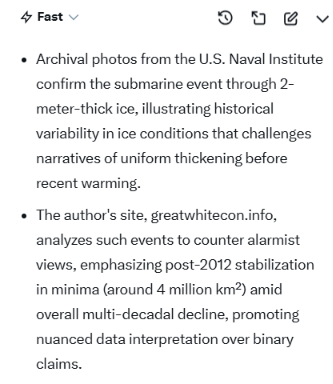
Grok has a rather different interpretation of what Great White Con does well. Allegedly “Snow White”:
Counters alarmist views… promoting nuanced data interpretation over binary claims.
My apologies for the mixed metaphors in today’s title, but the news I bear is beyond bizarre.
In a press release earlier today The Global Warming Policy Foundation proudly announced that:
A new paper by an eminent meteorologist says that trends in polar sea-ice levels give little cause for alarm. The paper, by Professor J. Ray Bates has just been published by the Global Warming Policy Foundation.
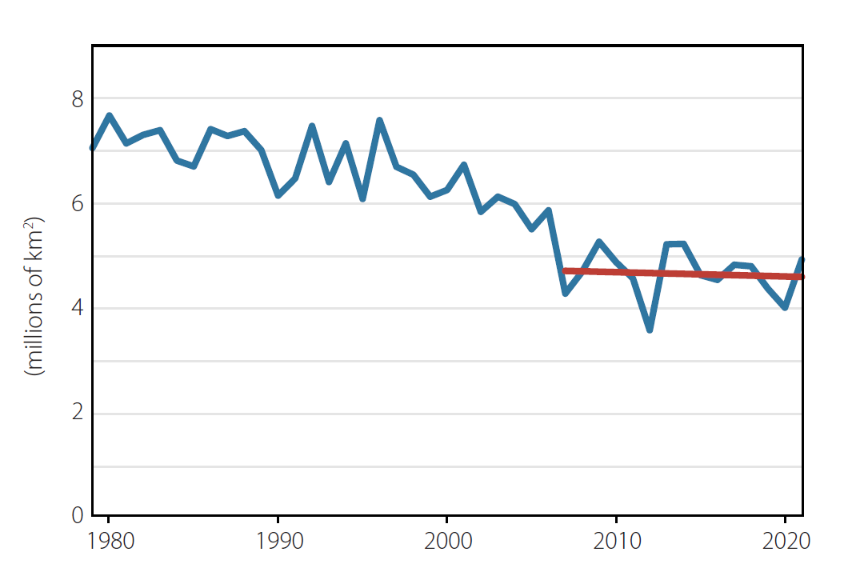
According to Professor Bates, climate model simulations indicate significantly decreasing sea ice levels in both hemispheres, with the greatest decreases occurring in September each year. However, the observed September trend in the Antarctic is actually slightly upwards, and while observed levels in the Arctic have fallen over the last 40 years, they have been quite stable since around 2007.
Professor Bates said:
“In 2007, Al Gore told us that Arctic sea ice levels were ‘falling off a cliff’. It’s clear now that he was completely wrong. In fact, the trends in sea-ice are an antidote to climate alarm.”
Professor Bates also says that little reliance should be placed on model simulations of future sea-ice decline:
“Climate models failed to predict the growth in Antarctic sea ice, and they missed the recent marked slowdown of sea-ice decline in the Arctic. It would be unwarranted to think they are going to get things right over the next 30 years.”
Professor Bates’ paper is published today, and can be downloaded here (pdf).
By all means download Ray’s “paper” from the link above and take a look at his introduction, which begins as follows:
The recent publication of the book Unsettled by Steven Koonin has led to the likelihood of increased scrutiny of the perception of a climate emergency,1 an idea which has become so widely established in recent years. Koonin, a former scientific advisor to the Obama administration, has demonstrated that what the public are being told by the media is not necessarily what the scientists are saying. He has also shown that what is being relayed in the national and UN climate assessments has often been written for the purpose of persuading rather than informing.
Unsettled clearly shows that important aspects of climate science, which the public have been persuaded to regard as beyond dispute are, in fact, quite unsettled.
Regular readers may recall that as soon as Steve’s book was published in machine readable format we established that it made no mention whatsoever of sea ice, whether of the Arctic or Antarctic variety.
Furthermore, when I attempted to debate that fact with Prof. Koonin he disappeared without trace before justifying that strange omission, beyond asserting that:
The topic is somewhat distant from ordinary folks’ perception.
It seems that Prof. Bates and the GWPF disagree with Prof. Koonin on this topic, since presumably their “paper” is addressed to ordinary folks? Ray even explicitly states that:
Although Unsettled covers a broad spectrum of climate topics, it does not treat in depth the issue of recent polar sea-ice trends, which are key indicators of changes in the global climate.
His “paper” goes on to assert in section 2 that:
Since the introduction of passive-microwave satellite observations in the late 1970s, polar sea-ice extent has been among the most accurately observed climate indicators. Sea-ice volume, on the other hand, is much more difficult to measure.
So far so good I suppose, but then we are told:
In December 2007, former US vice-president Al Gore, in his Nobel Peace Prize acceptance speech in Oslo, referred to scientific studies warning that the Arctic sea ice was ‘falling off a cliff’. He highlighted forthcoming model results that projected largely ice-free Arctic summers in ‘as little as seven years’. He repeated this warning two years later at the 2009 COP15 climate meeting in Copenhagen.
Gore’s claim was based on a study by researchers from the US Naval Postgraduate School, who used a regional model of the sea ice–ocean system in the Arctic, constrained using observational data for the 12-year period 1996–2007, and concluded that the Arctic would be nearly ice-free in summer by 2016 (plus or minus three years).
Prof. Bates seems blithely unaware that we thoroughly debunked this nonsense many moons ago. What Prof. Wieslaw Maslowski, one of those pesky “researchers from the US Naval Postgraduate School”, actually said in December 2007 was:
If we project this trend ongoing for the last 10–15 years, we probably will reach zero in summer some time mid next decade.
Reiterate for the benefit of those who seem unable to understand either English or Mathematics that a “projection” is not the same thing as a “prediction”.
preferring instead a version of his own construction, which looks like this:
Ray then confidently asserts that:
The current slowdown in the rate of sea-ice loss was not expected, and the reasons for it are uncertain.
Sadly Ray’s exhaustive list of references fails to mention this learned journal article from 2011 by authors from the University of Washington and Los Alamos National Laboratory, which not only anticipated such a “slow transition” but also offered reasons for it:
Given the strong thickness–growth feedback of sea ice (Bitz and Roe 2004), where in a warming climate we can expect the thicker MY ice to thin at a greater rate than the thinner FY ice, and the fact that the ratio of MY to FY ice entering into the MY ice category each year is decreasing, it is likely that the difference between FY and MY ice survival ratios will decrease in a warming climate. If this occurs, the Arctic sea ice system would move toward a regime of decreased memory and decreased sensitivity to climate forcing…
There is of course plenty more GWPF sea ice nonsense where that lot came from, but it’s already past my tea time (UTC) and so further debunking will have to wait a while. In the meantime here’s a wake up call for Professor J. Ray Bates:
[Edit – December 17th]
Moving further down section 2 Ray assures us that:
Any objective discussion of the recent Arctic sea-ice decline also requires that some consideration be given to the evidence regarding past natural variability on a multi-decadal timescale. In the pre-satellite era, reliable data on sea-ice coverage was sparse.
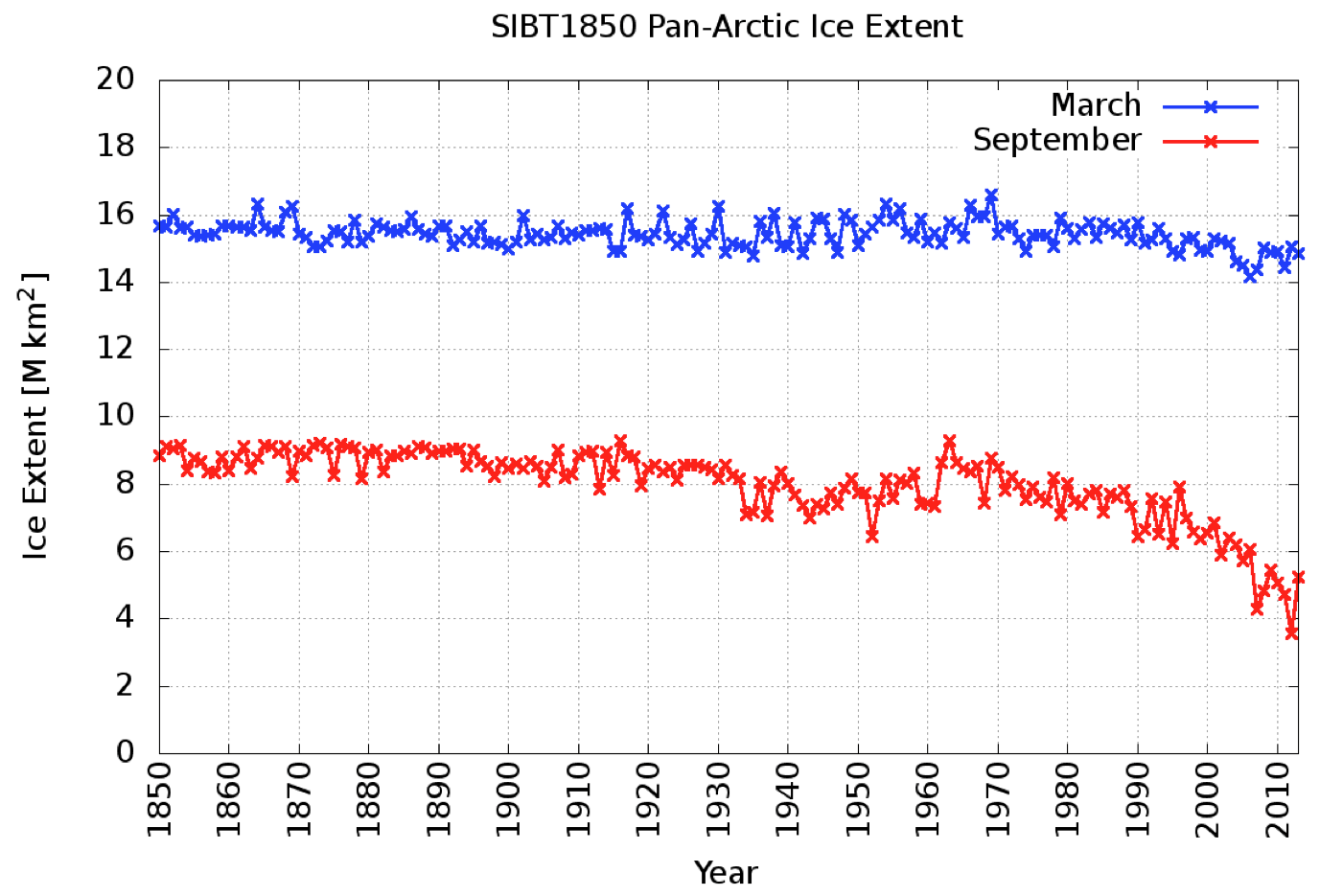
By combining the temperature and partial sea-ice records, statistical reconstructions of the total sea-ice extent going back to the early 1900s can be created. Some of these reconstructions indicate that between the 1900s and 1940s, Arctic sea-ice extent comparable to the present reduced levels may have occurred.
Ray doesn’t sound very certain, which is perhaps because the paper in question blithely states that:
Because Arctic sea ice trends are closely correlated to Arctic temperature trends, they are often discussed in the context of global temperature trends.
Maybe so, but to the best of my recollection Connolly et al. never attempt to “prove” the asserted correlation. Here’s an alternative assessment of “Arctic sea-ice extentbetween the 1900s and 1940s“:
There isn’t a million more square kilometers of ocean covered with ice than at the same time last year. Or is there?
For our younger readers perhaps I should point out that is a reference to the genesis of the Great White Con blog way back in the mists of time in September 2013, when a Daily Mail headline proudly, but erroneously, declared that:
And now it’s global COOLING! Record return of Arctic ice cap as it grows by 60% in a year.
With the COP26 conference due to start in Glasgow on October 31st UK Prime Minister Boris Johnson had this to say to the United Nations General Assembly yesterday, amongst other things:
In the words of the Oxford philosopher Toby Ord “we are just old enough to get ourselves into serious trouble”…
It is time for humanity to grow up.
It is time for us to listen to the warnings of the scientists – and look at Covid, if you want an example of gloomy scientists being proved right – and to understand who we are and what we are doing.
The world – this precious blue sphere with its eggshell crust and wisp of an atmosphere – is not some indestructible toy, some bouncy plastic romper room against which we can hurl ourselves to our heart’s content.
Daily, weekly, we are doing such irreversible damage that long before a million years are up, we will have made this beautiful planet effectively uninhabitable – not just for us but for many other species.
And that is why the Glasgow COP26 summit is the turning point for humanity.
If all that sounds unlikely, then take a look:
https://youtu.be/Z_YPE7vy_wQ?t=27
As we surmised at the time of the recent G7 Summit in Cornwall:
This article started out as an addendum to my recent tale of woe in which I got banned from Anthony Watts eponymous website just as Willis Eschenbach had published an article about Arctic sea ice inspired by yours truly!
I’ll get back to that in a moment, but earlier today this happened over on Twitter:
As luck would have it I'm in the middle of writing an article on alleged "hackneyed repetitions", but this morning's #ShockNews! has delayed it's publication by several hours.
I'll make sure to give you an early opportunity to review it.
Needless to say this news caused much excitement amongst both climate scientists and the cryodenialosphere! However getting back to where I was when I went to bed yesterday, I recently had the good fortune to bump into Willis once again, only this time it was on Judith Curry’s “Climate Etc.” blog rather than WUWT. I eagerly sought to reopen our Arctic discussion, and this is how the conversation went:
Our regular reader(s) must have noticed by now that in the dim and distant past we had the occasional debate with Anthony Watts, proprietor of the self proclaimed “world’s most viewed climate website”, catchily entitled “Watts Up With That”?
You may even have noticed that more recently we managed to engage in an admittedly brief debate with the suddenly world famous American Physicist Steven Koonin?
Now in a world exclusive we bring you the shock news that we are suddenly unable to debate with either of them!!!
In a recent article on the Watts Up With That web site Anthony wrote:
I was sent this by email, apparently “Scientific American” doesn’t believe in fairness. I stopped subscribing to SciAm years ago because they’ve turned into a socialist cesspool of opinion, with science as an afterthought. Steve Koonin writes:
“I attach a response that I submitted yesterday to Scientific American. Not surprisingly, they declined to publish it.
Please do distribute my response freely among your contacts or websites.
Steve Koonin“
Needless to say Anthony did as he was asked. Since I consider myself by now as something of an expert on the deficiencies of Professor Koonin’s alleged “science” I replied to Steve’s response to Scientific American on WUWT as follows:
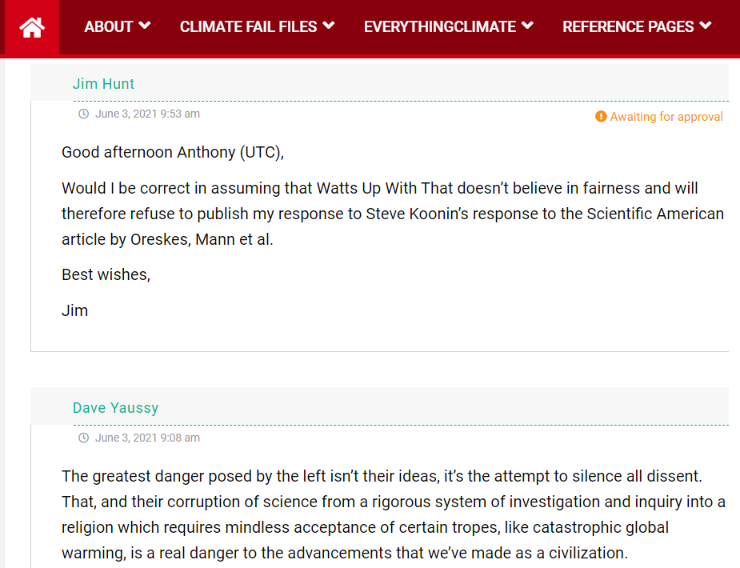
Needless to say two days later I have received no reply and my pertinent comment is still languishing underfoot on the Watts Up With That cutting room floor. Paraphrasing Dave Yaussy only slightly, and bolding for emphasis:
The greatest danger posed by Steve and Tony isn’t their ideas, it’s the attempt to silence all dissent.
That, and their corruption of science.
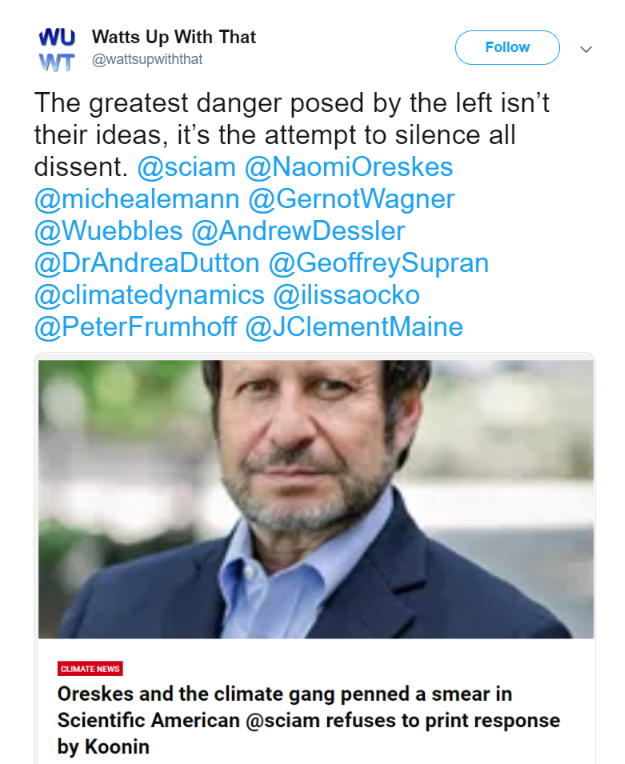
By way of one further example of his hypocrisy, Anthony did of course advertise his article on Twitter:
Of course he also stifled any anticipated dissent:
Q.E.D? As some scientists have been known to write from time to time.
Earlier today Scientific American published an article entitled “That ‘Obama Scientist’ Climate Skeptic You’ve Been Hearing About“. The climate skeptic in question being of course Steven E. Koonin. If you click that last link it will be immediately obvious that I’ve recently been critical of Professor Koonin’s new book “Unsettled” in several more ways than one! The article in Scientific American is authored by several more people than one. Twelve to be precise, including the famous names of Naomi Oreskes, Michael E. Mann and Andrew Dessler. That team takes a largely different approach to my own criticism, making no mention of the cryosphere for example, although sea level rise does get a mention. Rather than going into the science in detail, Oreskes et al. take a different approach. Here’s the introduction to the article:
If you’d heard only that a scientist who served in the Trump administration and now regularly appears on Fox News and other conservative media thinks climate change is a hoax, you’d roll your eyes and move on. But if you heard that someone associated with former President Barack Obama’s Democratic administration was calling the climate science consensus a conspiracy, the novelty of the messenger might make you take it a little more seriously.
The latter is what Steve Koonin is using to sell his new book, which is being billed as the revelation of an “Obama scientist” who wants you to think that climate change isn’t a big deal. But unfortunately, climate change is real, is caused primarily by burning fossil fuels, and is already hurting people all over the world, including here in the United States.
For example, a study published recently found that because climate change has caused sea levels to rise, Superstorm Sandy flooded an additional 36,000 homes, impacting 71,000 people who would’ve been safe otherwise, and caused $8 billion in additional damage.
A little later the article suggests that:
Steve Koonin is hoping you’ll see Obama’s name and trust him when he tells you that he’s better equipped to summarize major climate reports than the authors of the U.N.’s IPCC report and the U.S. government’sNational Climate Assessment, who wrote at length about the already sizable and growing costs of climate change. He’s hoping you won’t recall that each president appoints thousands of people, and Koonin, it turns out, was hired at the Energy Department specifically for his contrarianism. His boss at the time, Stephen Chu, said he “didn’t want to have a department where everybody believed exactly as everybody else” and added that Koonin “loves to be the curmudgeon type.”
Curmudgeon or not, Steve’s science certainly leaves a lot to be desired, as has been proved here! Oreskes et al. put it this way:
When it comes to the science, Koonin cherry-picks and misrepresents outdated material to downplay the seriousness of the climate crisis…
He wants you to believe that, as an Obama hire, he knows better about what you should take away from these reports than the scientists who wrote them.
That sums things up quite nicely, although the article doesn’t actually contain a whole lot of evidence for the first assertion, what Steve refers to as “The Science”. Instead it prefers to link to the Climate Feedback article mentioned here at the Great White Con back at the beginning of May and two articles by Marianne Lavelle in Inside Climate News.
However towards the end of the article, in true “Merchants of Doubt” style, following the money trail behind the promotion of “Unsettled” is mentioned:
The misrepresentations cited as appearing in Koonin’s book are being amplified in right-wing media and beyond. A recent Washington Post column by conservative contributor Marc Thiessen repeats several points Koonin makes…
Thiessen is a fellow at the American Enterprise Institute. For those unfamiliar with the tangled world of organized climate denial, a recent study paints a pretty clear picture: of all the conservative, climate-denying think tanks that get Koch and other industry funding, AEI has gotten the most. It received some $380 million to peddle industry-friendly denial like Koonin’s, much of it through dark money pass-throughs to conceal that it’s coming from conservative and dirty-energy donors.
Be all that as it may, in conclusion let’s get back to the cryospheric science. Here’s how I first found out about the Scientific American article, and Steve Koonin and/or Judith Curry still haven’t answered my pertinent questions about the unsettling lack of Arctic scientific expertise evident in “Unsettled”:
I rather doubt that Judith! Although @michaelemann and @NaomiOreskes are a bit behind the curve in their critique of the "recent Washington Post column by conservative contributor @marcthiessen" which I covered on May 16th.
Lawrence Livermore National Laboratory (LLNL) has invited Professor Steven Koonin to give a seminar on May 27, 2021. Professor Koonin’s seminar will cover material contained in a book he published on May 4. His book is entitled “Unsettled”. Its basic thesis is that climate science is not trustworthy.
Professor Koonin is not a climate scientist. I am. I have worked at LLNL since 1992. My primary job is to evaluate computer models of the climate system. I also seek to improve understanding of human and natural influences on climate.
Please read Ben’s article in full, but I expect you can already see what’s coming?
As mentioned in a previous episode of my series of reviews of Steven Koonin’s new book “Unsettled”, he published an allegedly “detailed point-by-point rebuttal of the fact check” of his book by Climate Feedback on Medium.
I politely enquired in a comment on Medium “Why does ‘Unsettled’ fail to address the issue of declining Arctic sea ice?”, and Steven was gracious enough to reply that:
All writers have to make choices. I didn’t (couldn’t) write an assessment report…
My focus is on significant points where the popular perception about climate and energy is very different from what the science says. In that way, this book is about more than what’s scientifically correct and what isn’t; it’s also about how the science, with all of its certainties and uncertainties, becomes The Science — how it gets summarized and communicated, and what’s lost in the process…
So limited space (and time writing the book) meant arctic sea ice didn’t get much mention. The topic is also somewhat distant from ordinary folks’ perception (unlike storms, heat waves, SLR, …).
Even so, on page 85 you can find a discussion of the ice-albedo feedback, although I don’t use that term. (no need to introduce technical lingo when it’s not convenient)
However Steven then rather ungraciously chose to ignore my follow up question:
Regarding “the topic somewhat distant from ordinary folks’ perception”, that is largely my point. Is Arctic sea ice decline really any more distant to the average (wo)man in the street than sea level rise?
Since Steve is evidently unable and/or unwilling to respond to my enquiry perhaps somebody else might be willing to do so in the space provided for that purpose below?
Meanwhile here’s news of a brand new paper documenting the evidently inexorable decline of the sea ice cover across the Arctic Ocean:
Regular readers will no doubt have noticed by now that here at the Great White Con we are publishing a series of reviews of Steven E. Koonin‘s new book “Unsettled”? Today we move on to the topic of Land-Surface Air Temperature (LSAT for short). Here is an extract from the very first page of the book:
Yes, it’s true that the globe is warming, and that humans are exerting a warming influence upon it. But beyond that—to paraphrase the classic movie The Princess Bride: “I do not think ‘The Science’ says what you think it says.”
For example, both the research literature and government reports that summarize and assess the state of climate science say clearly that heat waves in the US are now no more common than they were in 1900, and that the warmest temperatures in the US have not risen in the past fifty years. When I tell people this, most are incredulous. Some gasp. And some get downright hostile.
Here once again is an extract from page 23 of the Kindle edition of Steve’s book:
The [IPCC] assessment reports literally define The Science for non-experts. Given the intensive authoring and review processes, any reader would naturally expect that their assessments and summaries of the research literature are complete, objective, and transparent—the “gold standard.” In my experience, the reports largely do meet that expectation, and so much of the detail in the first part of this book, the science story, is drawn from them.
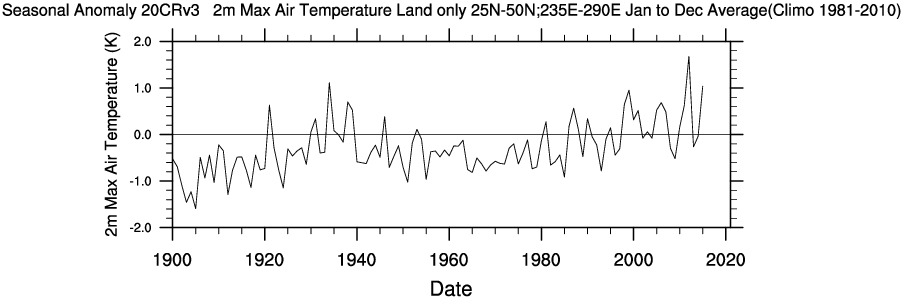
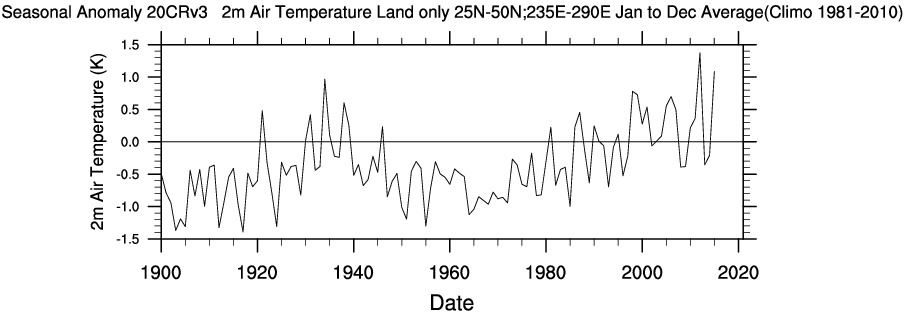
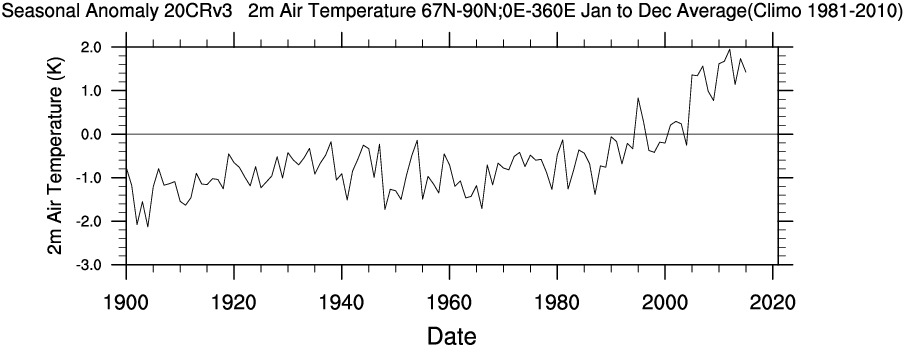
First of all let me remind Steve that the United States does not constitute the entirety of our planet. In particular the Arctic is warming a lot faster than mid latitudes in general and the US in particular. Using WRIT once again to produce our own time series, we can compare and contrast longer term temperature records between the Continental United States and the Arctic (including both land and ocean above the Arctic circle):
Also note that for some reason Steve makes no mention of US “coolest temperatures” and/or “cold waves” since 1900. I don’t know about you, but the top graph certainly suggest to me that “the warmest temperatures in the US have risen in the past fifty years”.
Let’s see how Steve explains himself. For that we have to wait until Chapter 5, catchily entitled “Hyping the Heat”. Therein no mention is made of recent temperature increases across the Arctic, but we are able to read in the introductory paragraphs that:
We can all agree the globe has gotten warmer over the past several decades. Here’s another summary statement from the IPCC’s AR5:
[S]ince about 1950 it is very likely that the numbers of cold days and nights have decreased and the numbers of warm days and nights have increased . . . there is medium confidence that globally the length and frequency of warm spells, including heat waves, has increased since the middle of the 20th century. (IPCC. AR5 WGI Section 2.6.1.)
Then there is a long discussion about what Steve apparently perceives to be shortcomings in the “The US government’s most recent assessment report, the 2017 Climate Science Special Report (CSSR)”. Steve is apparently well qualified in physics, so presumably he is able to comprehend these equations?
US ≠ Global
CSSR ≠ AR5
For those of you less familiar with the arcane language of mathematics and physics that translates to “the climate of the continental United States is not identical to Arctic climate or typical of the climate of Planet Earth as a whole” and hence “US Governmental climate reports are not necessarily typical of ‘Intergovernmental’ climate assessments”.
Next let’s check what Steve’s “gold standard for The Science” has to say on this topic. According to section 2.6.1 of the Intergovernmental Panel on Climate Change’s fifth Assessment Report, as cited by Steve:
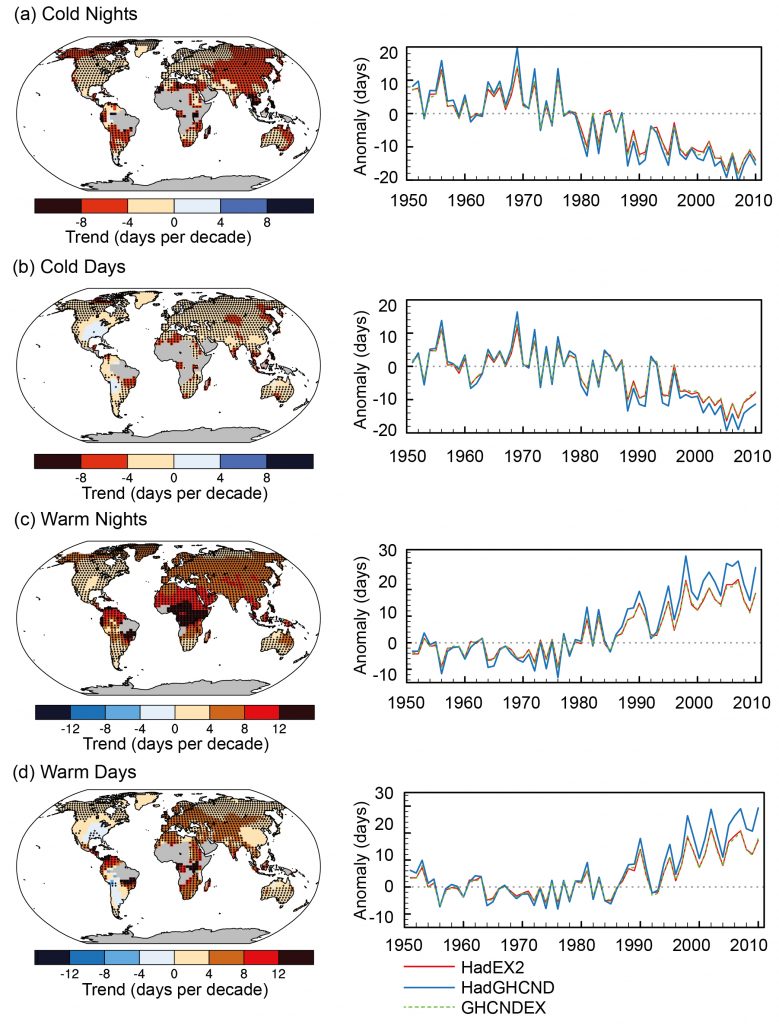
A large amount of evidence continues to support the conclusion that most global land areas analysed have experienced significant warming of both maximum and minimum temperature extremes since about 1950 (Donat et al., 2013c). Changes in the occurrence of cold and warm days (based on daily maximum temperatures) are generally less marked (Figure 2.32):
Figure 2.32 | Trends in annual frequency of extreme temperatures over the period 1951–2010, for (a) cold nights (TN10p), (b) cold days (TX10p), (c) warm nights (TN90p) and (d) warm days (TX90p) (Box 2.4, Table 1). Trends were calculated only for grid boxes that had at least 40 years of data during this period and where data ended no earlier than 2003. Grey areas indicate incomplete or missing data. Black plus signs (+) indicate grid boxes where trends are significant (i.e., a trend of zero lies outside the 90% confidence interval). The data source for trend maps is HadEX2 (Donat et al., 2013c) updated to include the latest version of the European Climate Assessment data set (Klok and Tank, 2009). Beside each map are the near-global time series of annual anomalies of these indices with respect to 1961–1990 for three global indices data sets: HadEX2 (red); HadGHCND (Caesar et al., 2006; blue) and updated to 2010 and GHCNDEX (Donat et al., 2013a; green). Global averages are only calculated using grid boxes where all three data sets have at least 90% of data over the time period. Trends are significant (i.e., a trend of zero lies outside the 90% confidence interval) for all the global indices shown.
To paraphrase The Princess Bride once again: “I do not think ‘The Science’ says what Steven E. Koonin says it says in ‘Unsettled’”.
Unsettling, is it not?
This website uses cookies to improve your experience. We'll assume you're ok with this, but you can opt-out if you wish. Cookie settingsACCEPT
Privacy & Cookies Policy
Privacy Overview
This website uses cookies to improve your experience while you navigate through the website. Out of these, the cookies that are categorized as necessary are stored on your browser as they are essential for the working of basic functionalities of the website. We also use third-party cookies that help us analyze and understand how you use this website. These cookies will be stored in your browser only with your consent. You also have the option to opt-out of these cookies. But opting out of some of these cookies may affect your browsing experience.
Necessary cookies are absolutely essential for the website to function properly. This category only includes cookies that ensures basic functionalities and security features of the website. These cookies do not store any personal information.
Any cookies that may not be particularly necessary for the website to function and is used specifically to collect user personal data via analytics, ads, other embedded contents are termed as non-necessary cookies. It is mandatory to procure user consent prior to running these cookies on your website.