Tag Archives: JAXA

The Japan Aerospace Exploration Agency

The 2025 Maximum Arctic Sea Ice Extent

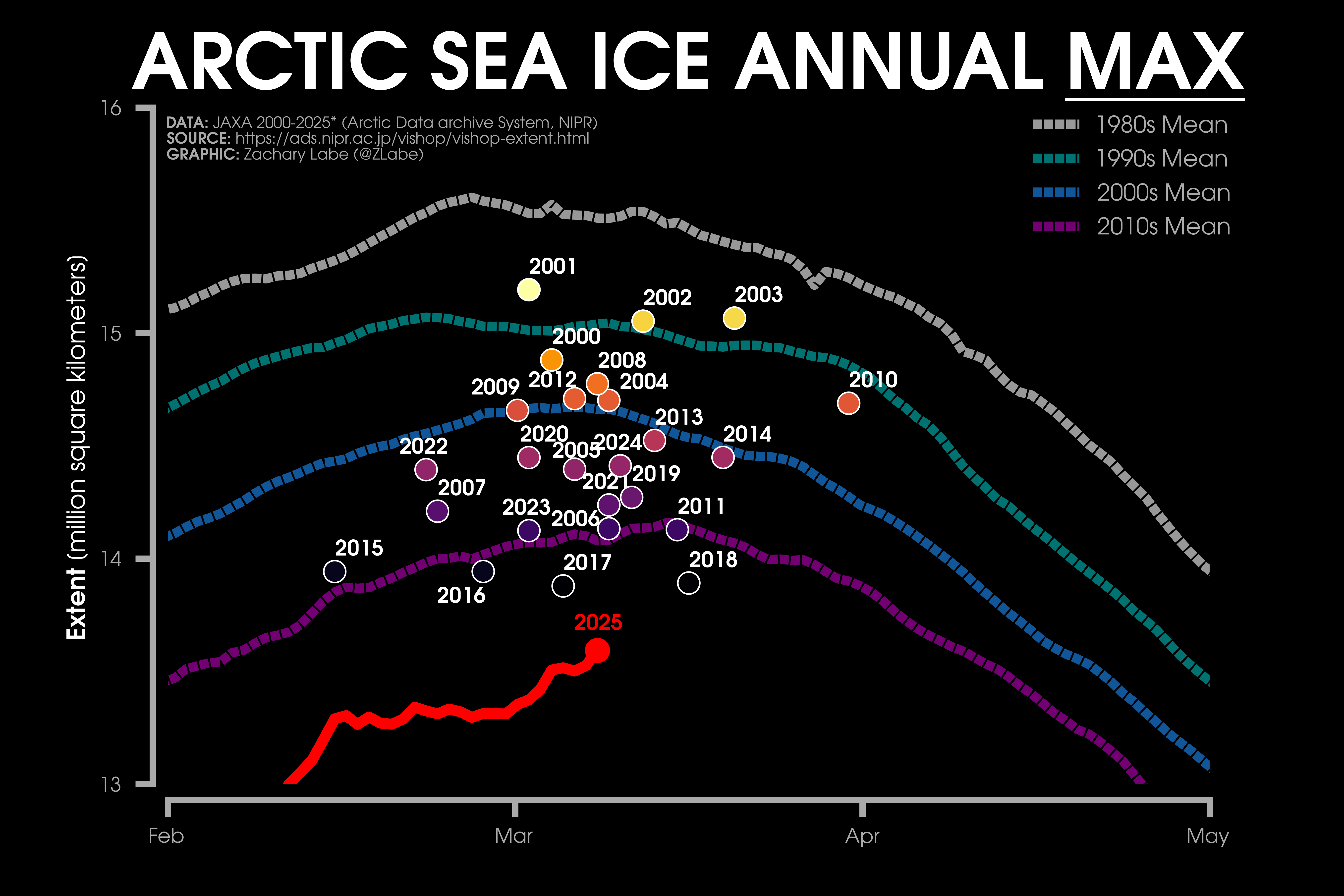
The time has arrived to start taking a close look at the assorted different Arctic sea ice extent metrics, in order to ascertain their respective maxima for 2025. To begin with here’s Zack Labe’s overview of previous years’ maxima:

It now seems highly likely that 2025’s maximum extent will ultimately prove to be the lowest in the satellite era. The remaining question is when this year’s maximum will occur.

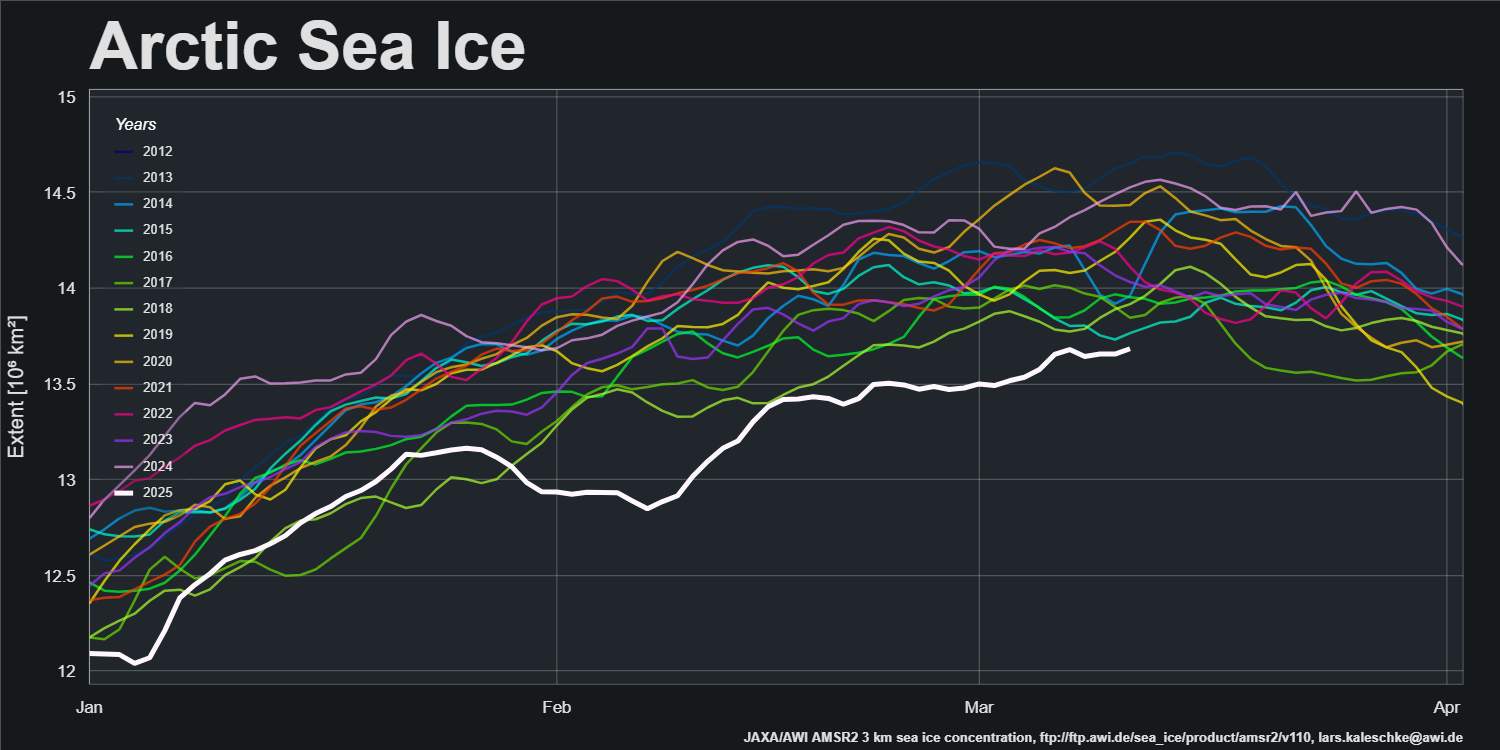
My speculation yesterday that AWI’s flavour of Arctic sea ice extent had already achieved its maximum value for 2025 has been negated today:

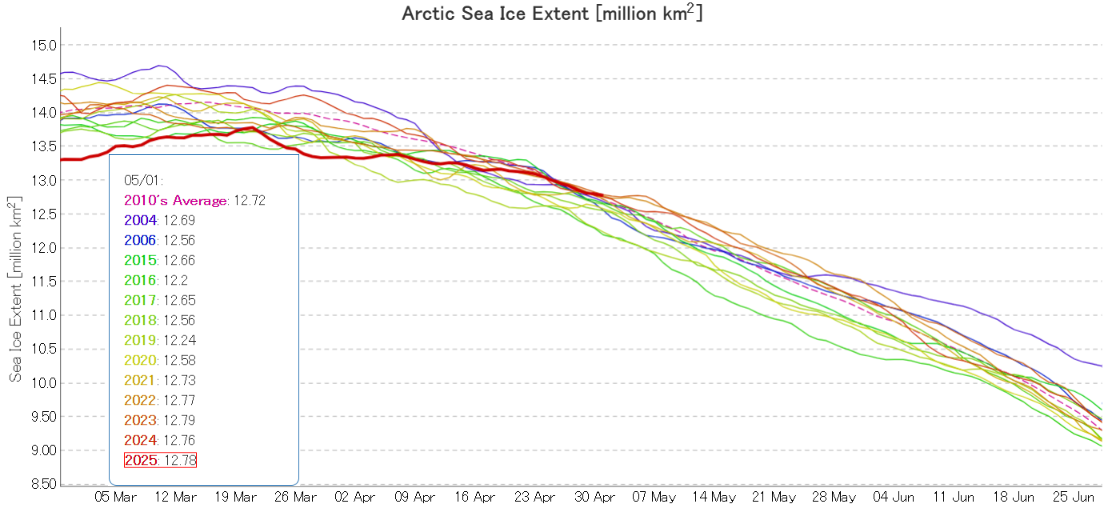
The NSIDC 5 day average and JAXA extent metrics are also currently at their maximum levels for the year so far, so let’s wait and see which one is the first to take a downward turn.

[Update – March 28th]

The National Snow and Ice Data Center have called the maximum extent of Arctic sea ice for 2025:

On March 22, Arctic sea ice likely reached its maximum extent for the year, at 14.33 million square kilometers, the lowest in the 47-year satellite record. This year’s maximum extent is 1.31 million square kilometers below the 1981 to 2010 average maximum of 15.64 million square kilometers and 80,000 square kilometers below the previous lowest maximum that occurred on March 7, 2017.

Continue reading The 2025 Maximum Arctic Sea Ice Extent

Facts About the Arctic in March 2025

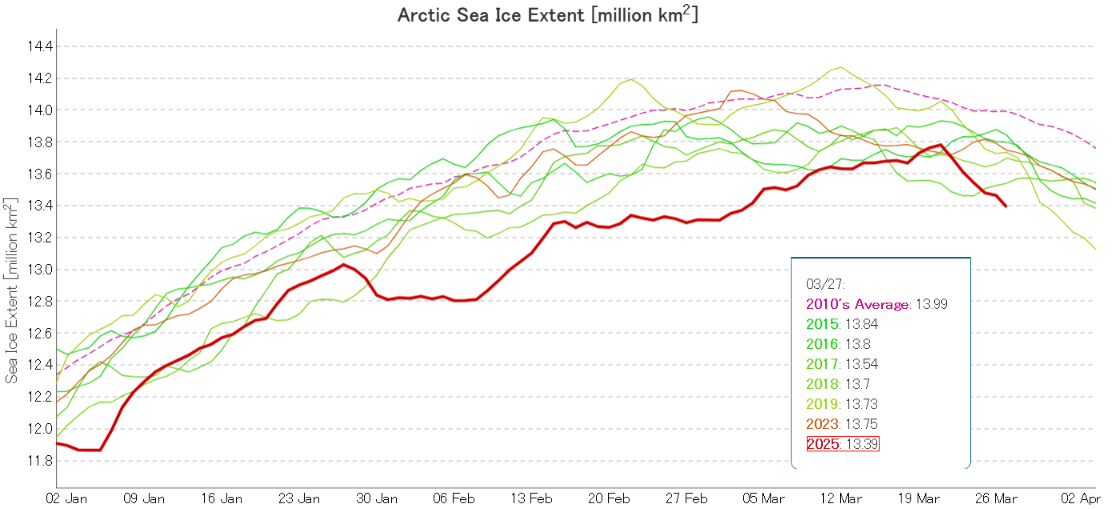
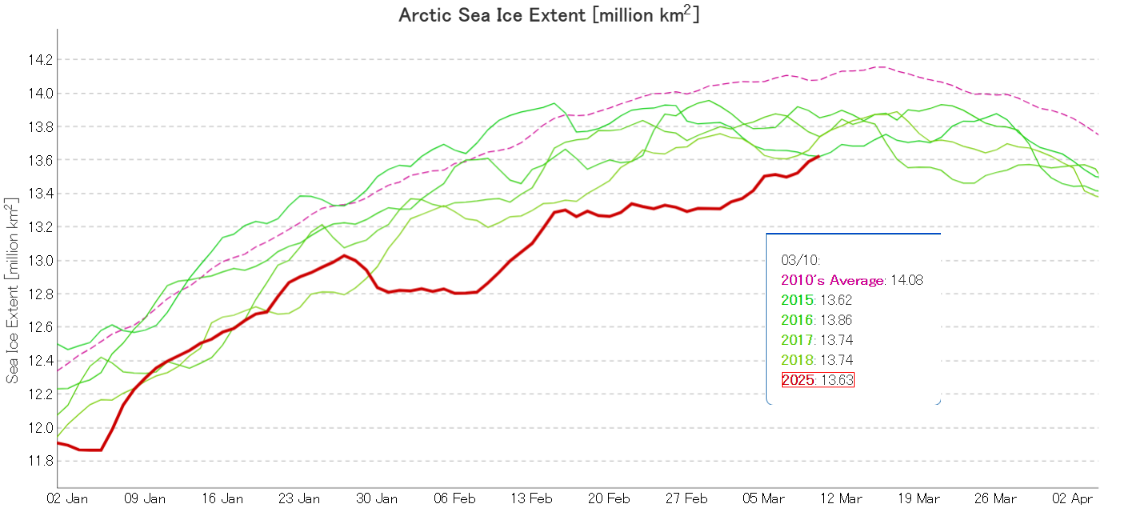
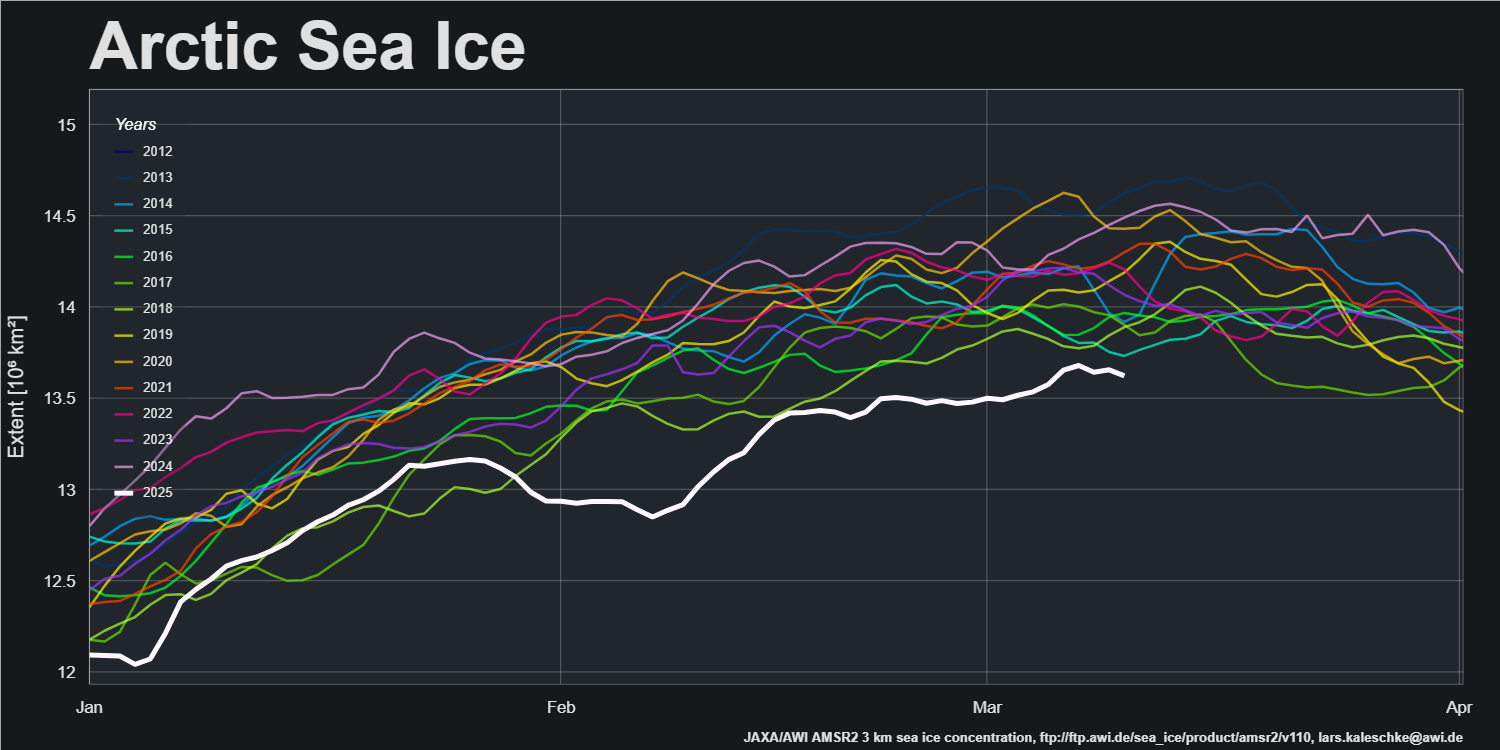
After spending several weeks in the unfortunate position of lowest for the date, JAXA/ViSHOP Arctic sea ice extent has just risen above 2015. By a mere 10,000 km²:

Despite the fact that JAXA extent is still rising, AWI extent has potentially already achieved its maximum value for 2025:

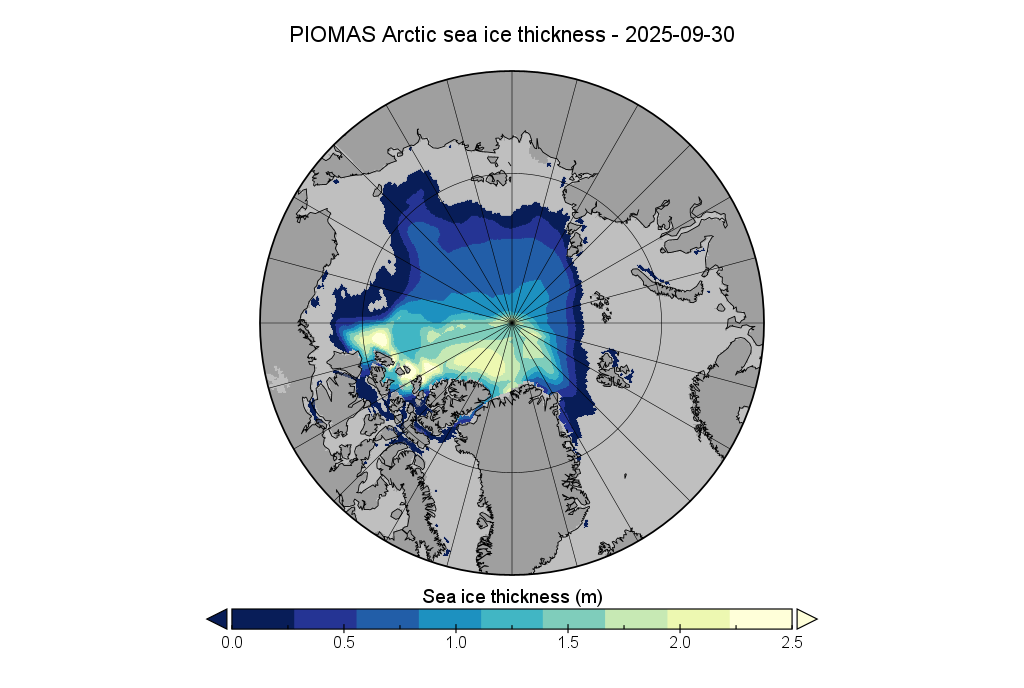
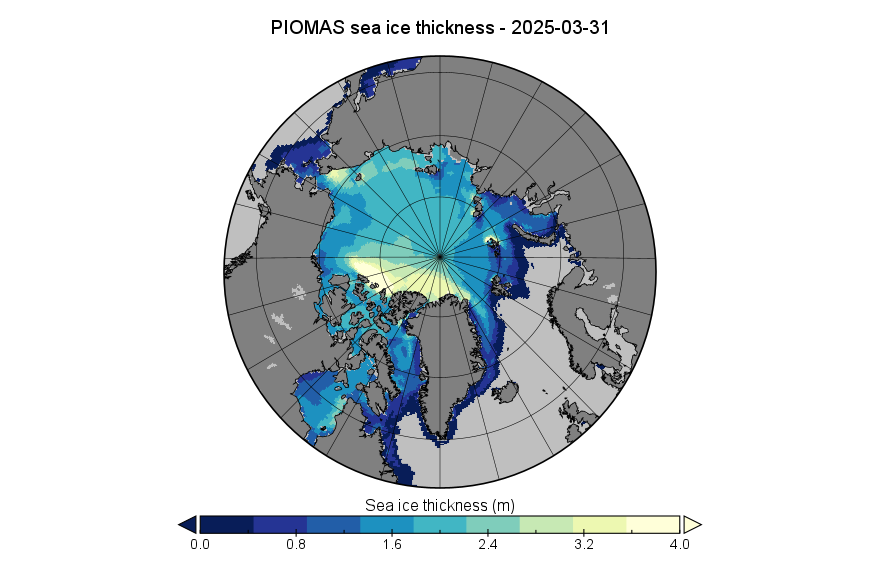
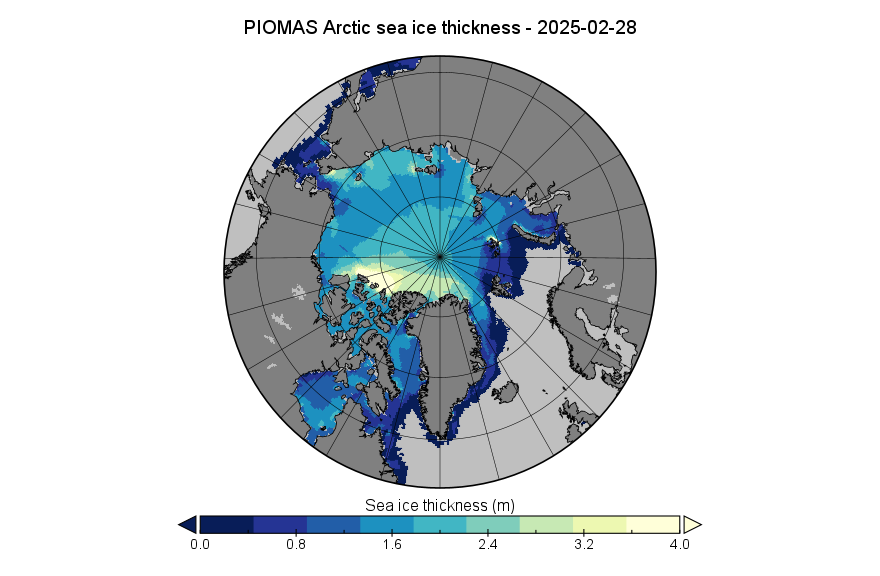
Somewhat belatedly, here is the PIOMAS sea ice thickness map for February 28th 2025:

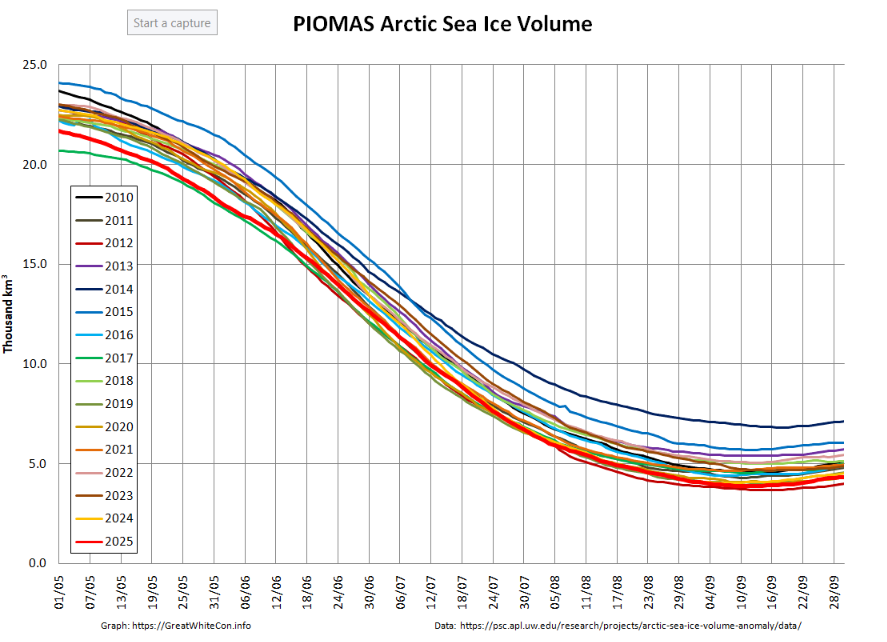
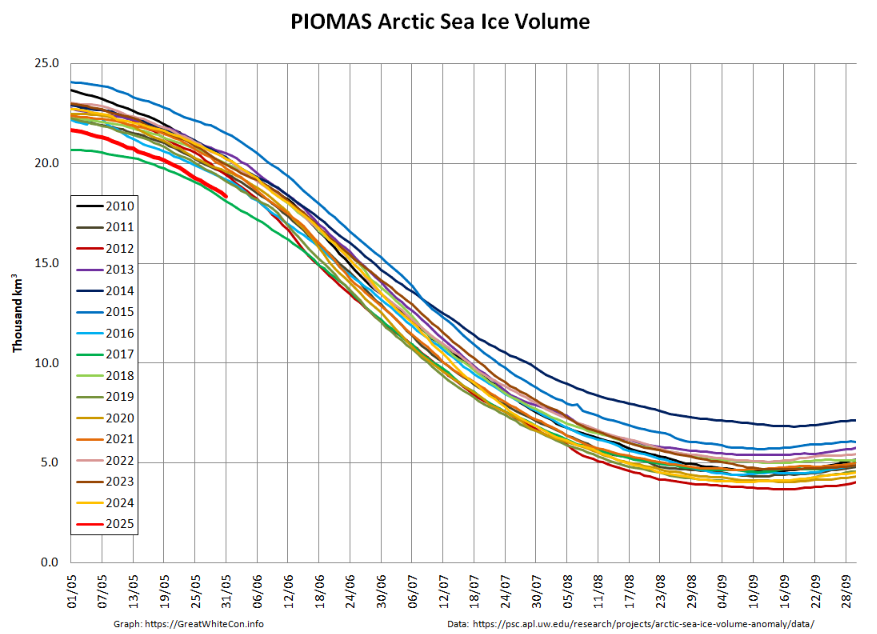
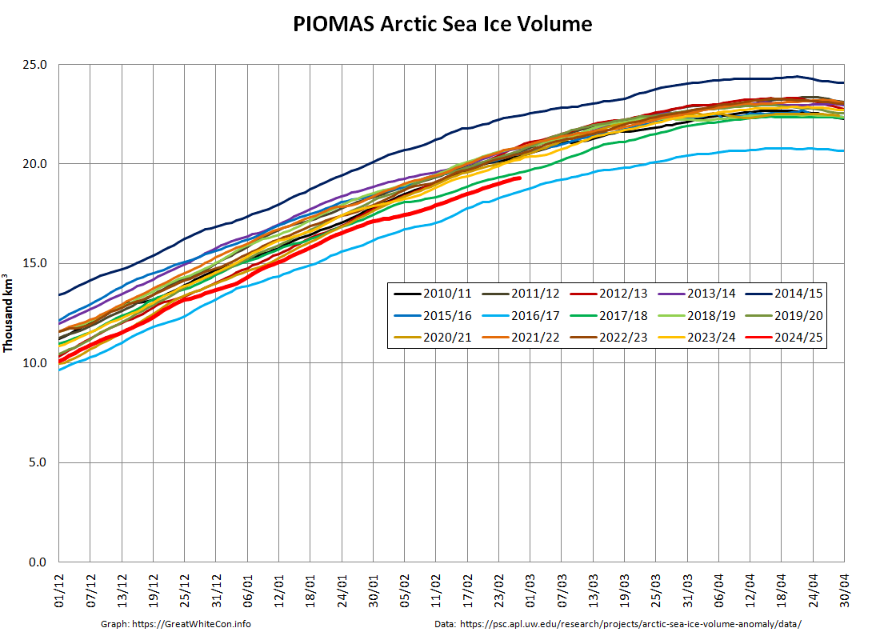
At the end of February Arctic sea ice volume had increased to 19.32 thousand km³, still 2nd lowest for the date in the PIOMAS record:

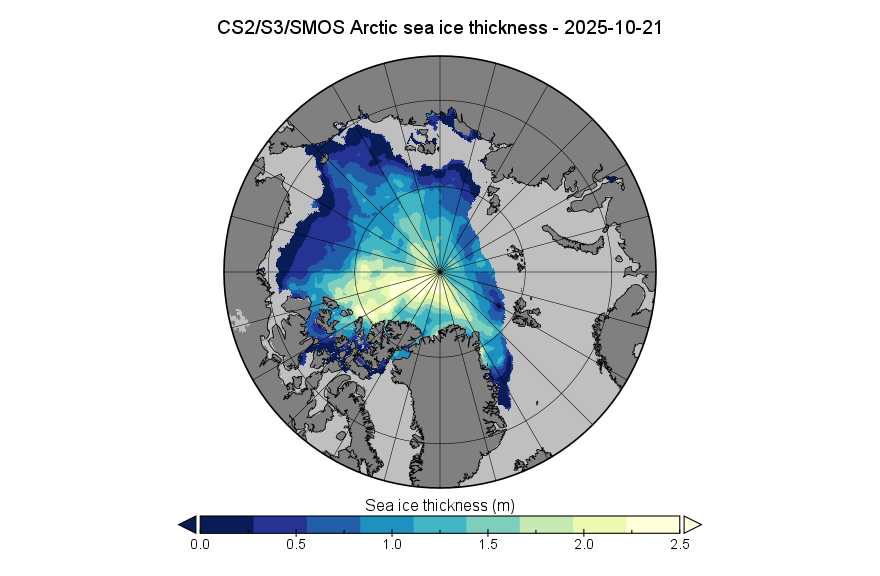
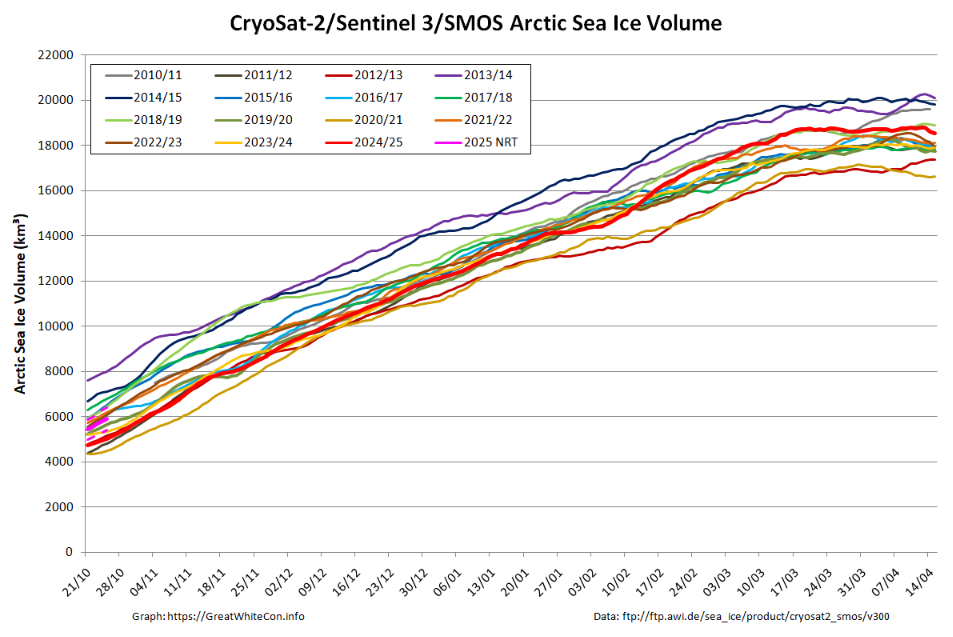
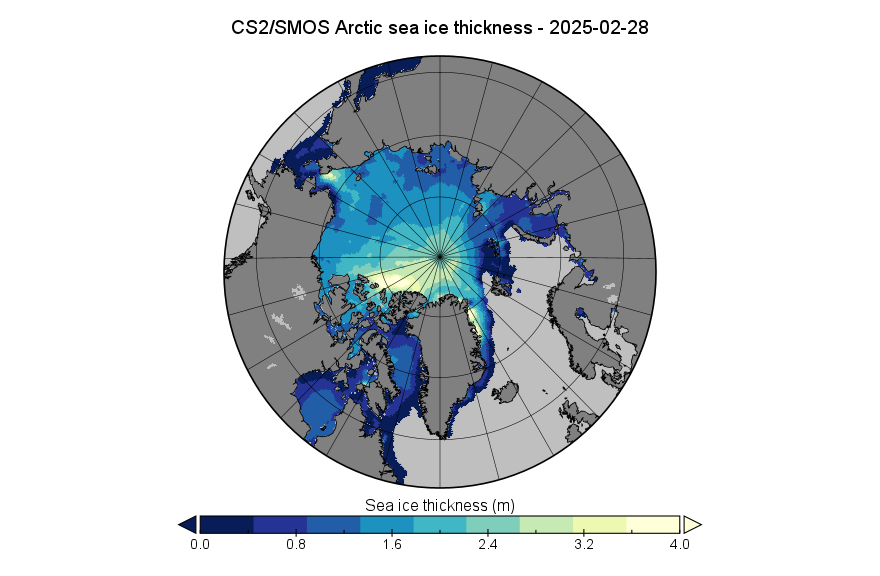
For comparison purposes, here is the “near real time” CryoSat-2/SMOS merged thickness data from the Alfred Wegener Institute: 

AWI have also released a new version of their thickness product, incorporating additional data from the two Sentinel 3 satellites. The thickness data for February 28th, looks slightly different:

Continue reading Facts About the Arctic in March 2025

Facts About the Arctic in February 2025

This isn’t exactly “shock news”, since we (slightly hesitantly!) predicted this 5 days ago.

A GFS 2 meter temperature chart revealing greater than zero degrees Celsius at the North Pole later today:

The 2 meter temperature anomaly at the Pole is almost off the charts:

Plus the cause of these unusual numbers, a cyclone with central pressure of 959 hPa spinning north of Ellesmere Island at 18:00 UTC this evening:

All of which has led to the JAXA/Vishop Arctic sea ice extent being the lowest for the date since 1979 at least by a significant margin:

Continue reading Facts About the Arctic in February 2025

Facts About the Arctic in January 2025

The New Year began with JAXA/ViSHOP extent lowest for the date in the satellite era, just below 2018 . Since then extent has reduced, and there is now a large gap:

The primary reason for this is the remaining open water in Hudson Bay:

In previous years Hudson Bay has been covered by sea ice by this time of year, but in 2025 a large area remains unfrozen in early January!

Due to the way PIOMAS handles the leap years the last gridded thickness data of 2024 is dated December 30th:

By December 30th Arctic sea ice volume had increased to 13.61 thousand km³, 2nd lowest for the date in the PIOMAS record:

Continue reading Facts About the Arctic in January 2025

Facts About the Arctic in December 2024

Christmas is coming, and even as we speak Snow White is heading for the geographical North Pole to assist Santa’s little helpers in their annual gift delivery mission:

Santa at the North Pole in August 2016

We’ll start the festive season with a graph of JAXA/ViSHOP extent, which is in a “statistical tie” with 2020 for 2nd lowest for the date in the satellite era:

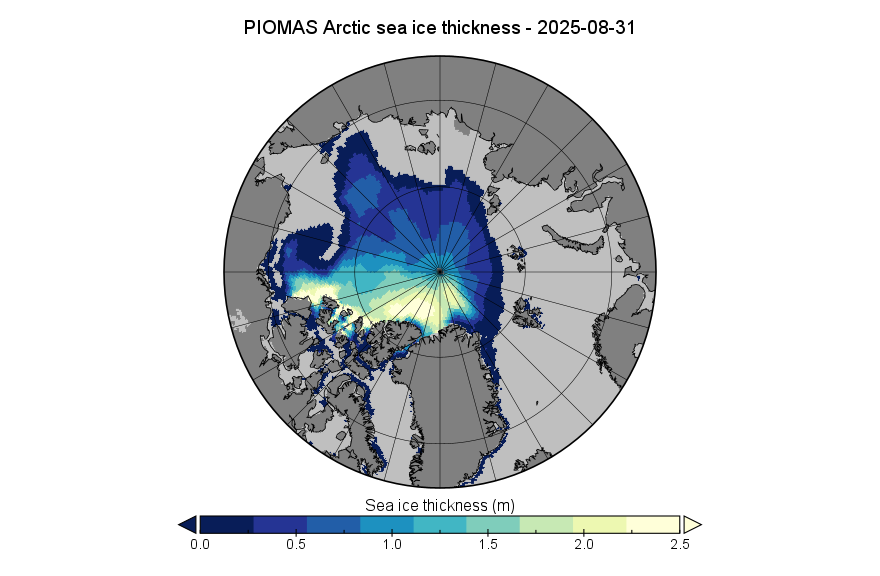
Here’s the PIOMAS gridded thickness data for the end of November 2024:

On November 30th Arctic sea ice volume had increased to 9.99 thousand km³, 3rd lowest for the date in the PIOMAS record:

For comparison purposes, here is the “near real time” CryoSat-2/SMOS merged thickness data from the Alfred Wegener Institute: 

Continue reading Facts About the Arctic in December 2024

Facts About the Arctic in November 2024

The Laptev and East Siberian Seas have now refrozen. Consequently Arctic sea ice extent is now increasing more slowly, and JAXA/ViSHOP extent is 3rd lowest for the date in the satellite era:

Introducing the third dimension, here’s the PIOMAS gridded thickness data for the end of October 2024:

Note the change in scale from previous months, to allow for easier comparison with the “near real time” CryoSat-2/SMOS merged thickness data from the Alfred Wegener Institute: 

Continue reading Facts About the Arctic in November 2024

Facts About the Arctic in September 2024

At the beginning of September JAXA/ViSHOP extent was 4th lowest for the date in the satellite era:

For much more detail on sea ice extent for the next few weeks please see the dedicated 2024 minimum thread. However, note that as extent has been flatlining sea ice area is still declining:

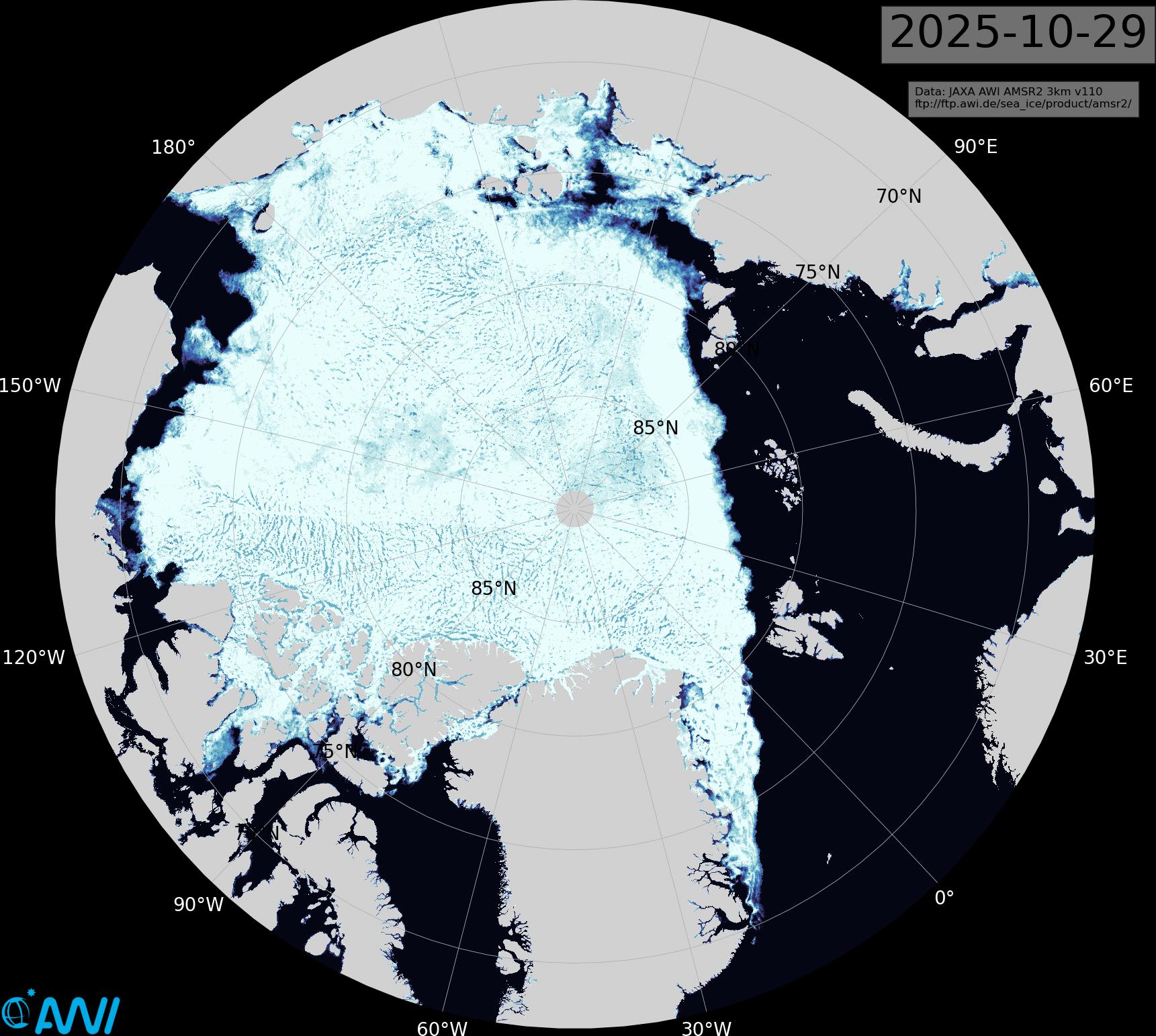
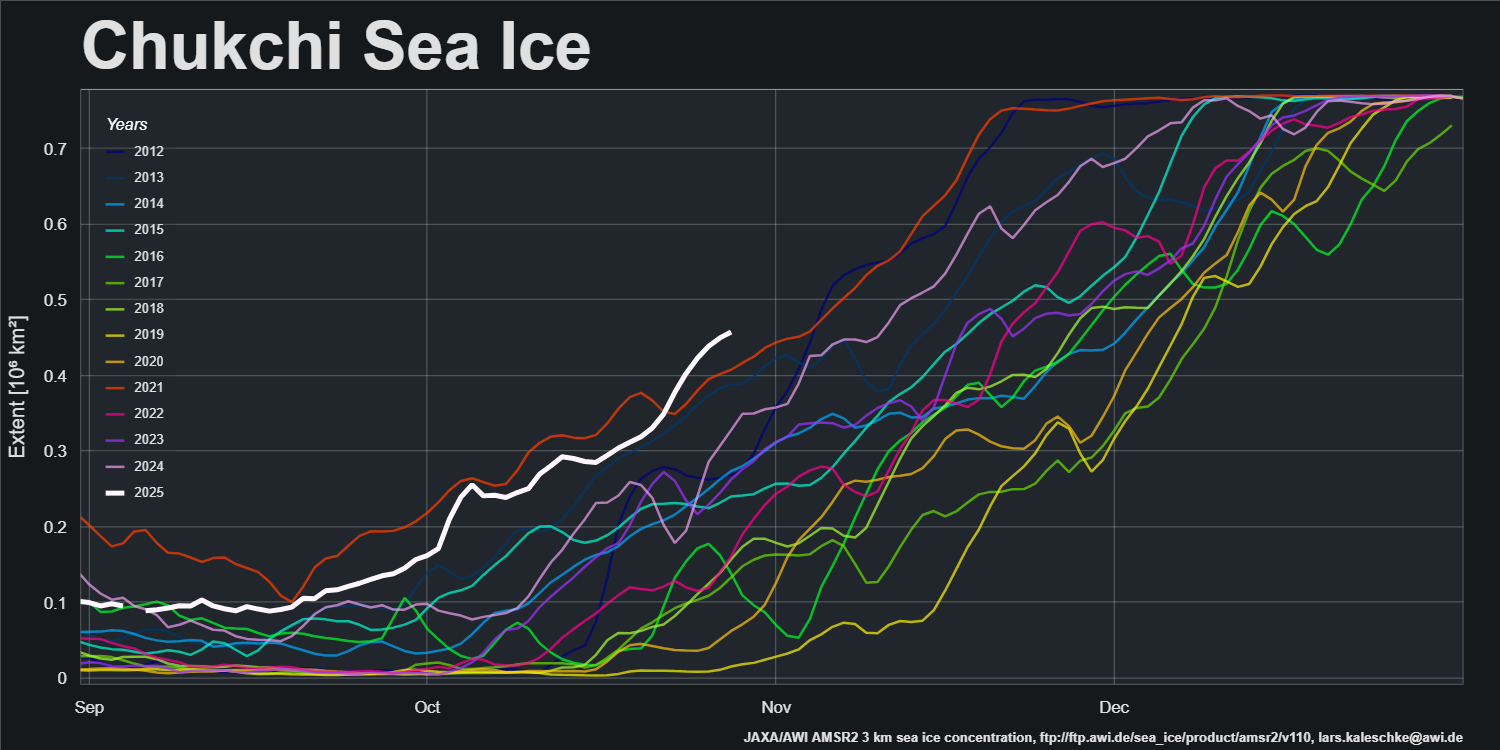
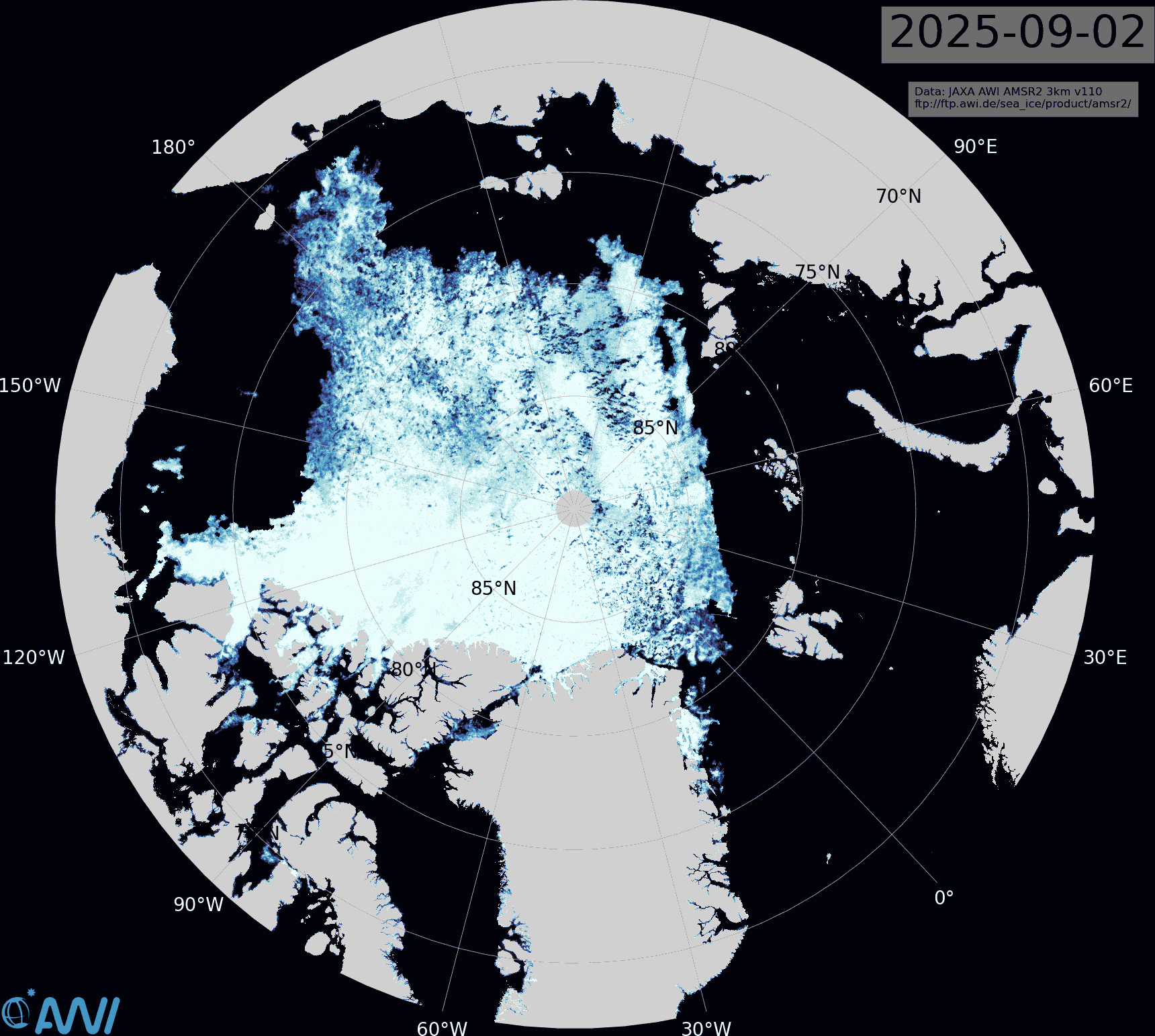
The latest AMSR2 sea ice concentration map from the Alfred Wegener Institute reveals that the area of thick ice in the Chukchi Sea has still not melted:

The most recent sea ice age map currently available dates from the beginning of August. Comparison with the concentration map shows that most of the remaining first year ice is highly fragmented, even close to the North Pole:

Continue reading Facts About the Arctic in September 2024

The 2024 Arctic Sea Ice Minimum Extent

The 2024 Arctic sea ice minimum extent will almost certainly occur at some point over the next month. The exact date and level will vary from one extent metric to the next. Here’s a comparison of the current JAXA extent with previous minima, courtesy of Zack Labe:

Here too is a more detailed look at 2024 extent compared with the 5 lowest annual minima in the JAXA record:

By way of comparison, here is the equivalent graph for the OSI SAF extent metric, which experienced an up tick yesterday but has now reached a new low for the year:

The Alfred Wegener Institute’s extent metric has flatlined over the last two days:

However AWI Arctic sea ice area is currently falling, which may well presage further significant falls in extent:

The NSIDC web site is currently “experiencing technical difficulties”, but hopefully we’ll be able to take a look at their extent graph in the very near future.

[Update – September 4th]

The NSIDC web site is back in action, and their 5 day averaged extent metric is currently still falling quickly:

The ARCUS Sea Ice Prediction Network August report has been published. Note that the predicted numbers are for the September monthly average extent rather than the daily minimum:

For the August Outlook, we received 24 contributions of September pan-Arctic sea-ice extent forecasts…

The August 2024 median forecasted value for pan-Arctic September sea-ice extent is 4.27 million square kilometers with an interquartile range of 4.11 to 4.54 million square kilometers. This is about 200,000 square kilometers lower than the June median and about 250,000 square kilometers lower than the July median, which reflects the faster than average ice loss during July.

The lowest sea-ice extent forecast is 3.71 million square kilometers and the highest sea-ice extent forecast is 5.23 million square kilometers. These extremes are actually higher, particularly on the low end, than the estimates from July.

[Update – September 9th]

There’s been the tiniest of upticks in the NSIDC 5 day extent metric. 1 thousand km² to be precise. However, the others are still slowly declining:

[Update – September 10th]

NSIDC extent has posted a new low for the year, and JAXA extent is still declining. However there has been a slightly more substantial uptick in the OSI SAF metric:

The current minimum is 4.64 million km² on September 8th.

AWI sea ice area has posted a convincing looking minimum on September 4th, which suggests that the central refreeze is already well under way:

[Update – September 17th]

JAXA/ViSHOP/ADS extent has risen significantly over the last two days:

It now looks highly likely that the 2024 minimum will prove to be 4.07 million km² on September 13th. That is 4th lowest for the date, but equal 5th lowest minimum in the JAXA record.

A closer look at some of the other extent metrics will have to wait until this problem is solved:

Not good timing for a data outage!

[Update – September 22nd]

SSMIS data has been flowing again for a couple of days:

This graph may be subject to revision if and when the missing data is recovered, but currently it looks as though the 2024 minimum of the NSIDC 5 day averaged extent metric is 4.28 million km² on September 11th.

[Update – September 24th]

The National Snow and Ice Data Center formally announced today that:

On September 11, Arctic sea ice likely reached its annual minimum extent of 4.28 million square kilometers. The 2024 minimum is the seventh lowest in the nearly 46-year satellite record. The last 18 years, from 2007 to 2024, are the lowest 18 sea ice extents in the satellite record…

Note that this is a preliminary announcement. Changing winds or late-season melt could still reduce the Arctic ice extent, as happened in 2005 and 2010. NSIDC scientists will release a full analysis of the Arctic melt season, and discuss the Antarctic winter sea ice growth, in early October.

The NSIDC also addressed the recent missing SSMIS data issue mentioned above as follows:

Note that a gap exists in the input source data between September 12 and September 18. This gap somewhat lowers our confidence in the minimum extent estimate. However, it appears that September 11 is the mostly likely date of the minimum based on data trends in daily extent values leading up to the 5-day average on September 11 and the extent values after data restarted on September 18. If extent did drop further between September 11 and September 18, it would have been marginal. If the input source data becomes available to fill that gap, our team will update the minimum estimate if necessary.

Watch this space!

Facts About the Arctic in August 2024

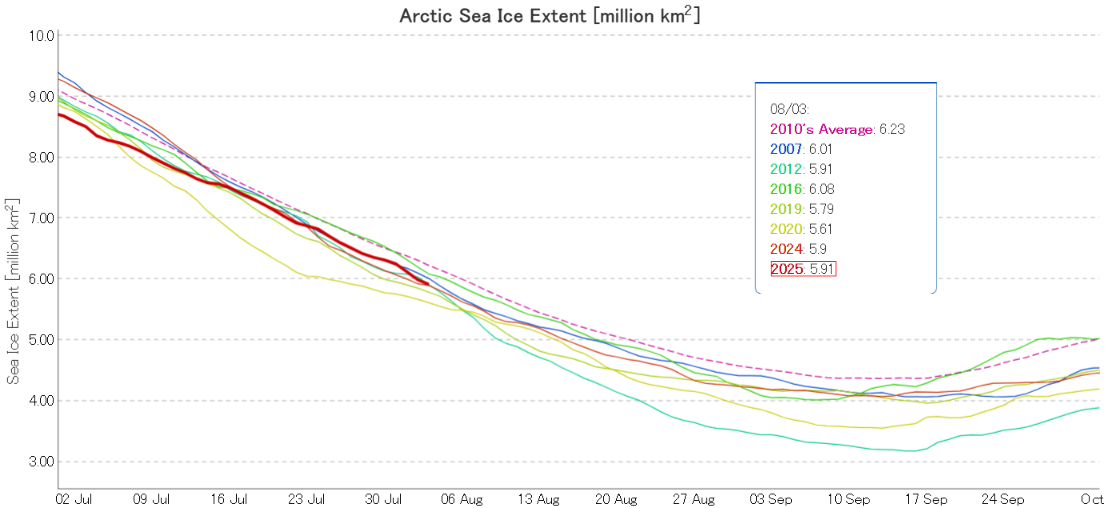
At the beginning of August JAXA/ViSHOP extent is 3rd lowest for the date in the satellite era:

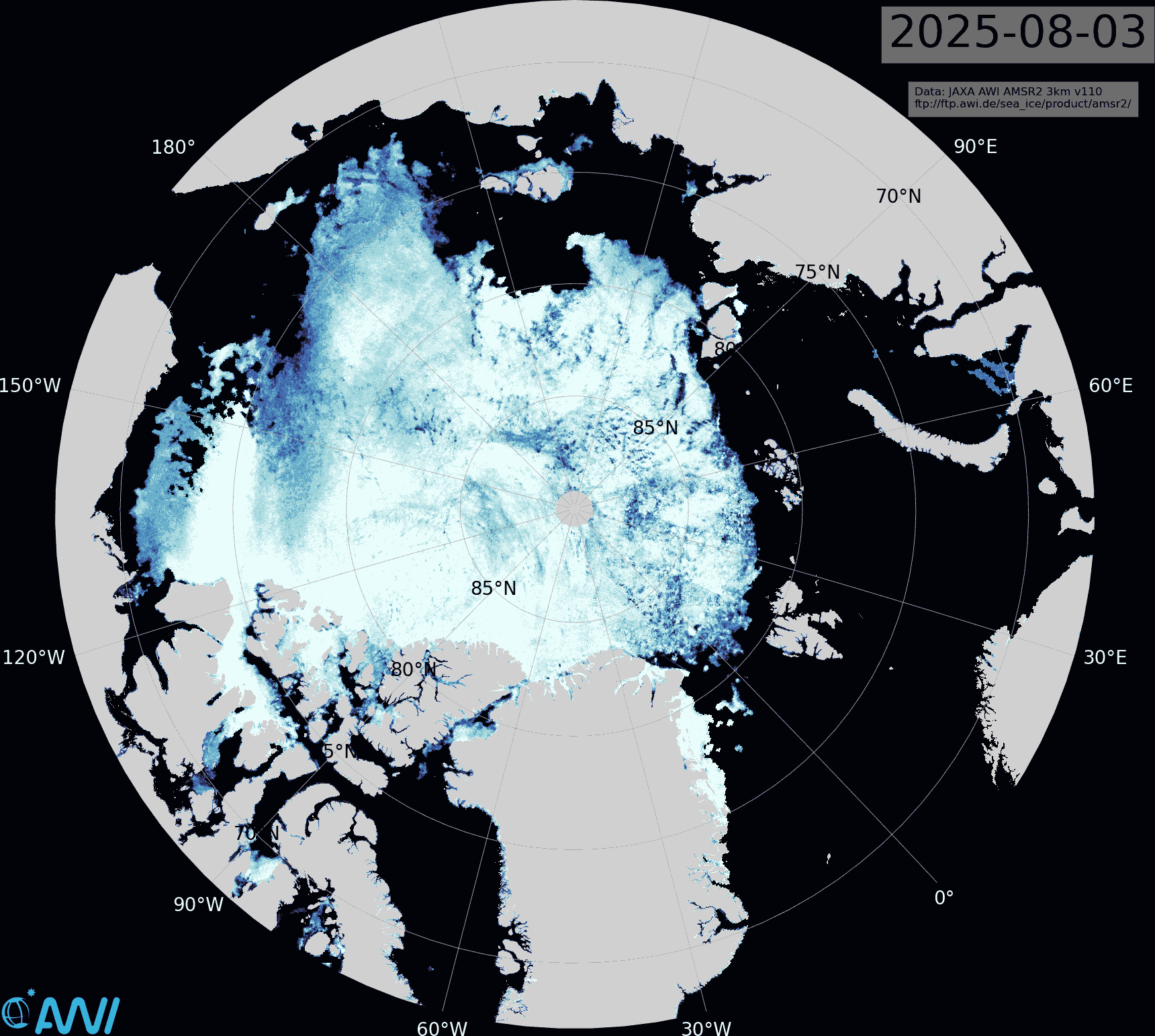
In 2012 extent had just started its unprecedented plunge towards the record September minimum, and 2024 seems certain to cross above the 2012 curve shortly. However, the latest AMSR2 sea ice concentration map from the Alfred Wegener Institute reveals areas of open water across the majority of the Central Arctic Basin:

In particular the sea ice between the North Pole and northern Greenland is remarkably fragmented:

“False colour” image of the North Pole on August 3rd from the MODIS instrument on the Terra satellite
Continue reading Facts About the Arctic in August 2024

Facts About the Arctic in July 2024

The first sea ice outlook report for 2024 has been published by the Sea Ice Prediction Network:

This year’s median forecasted value for pan-Arctic September sea-ice extent is 4.48 million square kilometers with an interquartile range of 4.21 to 4.74 million square kilometers. This is slightly lower than the 2022 (4.57 million square kilometers) and 2023 (4.54 million square kilometers) June median forecasts for September.

The lowest sea-ice extent forecast is 3.1 million square kilometers, from the UK Met Office, which would be a new record low for the satellite period (1979-present); the highest sea-ice extent forecast is 5.21 million square kilometers, submitted by both the HEU Group and SYSU/SML-MLM, which would be the highest September extent since 2015:

There are three heuristic Outlooks, with a median of 4.32 million square kilometers and an interquartile range of 4.26 to 4.4 million square kilometers. Statistical submissions total fifteen Outlooks with a median of 4.68 million square kilometers and an interquartile range of 4.47 to 4.9 million square kilometers. There are nine dynamical model contributions. The dynamical models have a median forecast of 3.97 million square kilometers with an interquartile range of 3.68 to 4.35 million square kilometers.

Continue reading Facts About the Arctic in July 2024