Inspired by my recent visits to Judith Curry’s blog this post will bring you links to the latest learned journal articles about Arctic sea ice. Together with occasional excursions into older and wider Arctic papers.
Judith’s “Week in Review” articles seem to last for a month, so this one will probably last for at least a year!
First up is an article apparently written by a regular reader of this humble web site! A University of Alaska article at phys.org begins:
In August 2016 a massive storm on par with a Category 2 hurricane churned in the Arctic Ocean. The cyclone led to the third-lowest sea ice extent ever recorded. But what made the Great Arctic Cyclone of 2016 particularly appealing to scientists was the proximity of the Korean icebreaker Araon.
For the first time ever, scientists were able to see exactly what happens to the ocean and sea ice when a cyclone hits. University of Alaska Fairbanks researchers and their international colleagues recently published a new study showing that sea ice declined 5.7 times faster than normal during the storm. They were also able to prove that the rapid decline was driven by cyclone-triggered processes within the ocean.
Note that it didn’t take us 5 years to write about the cyclone in question. Our article catchily entitled “The Great Arctic Cyclone of 2016” was published on August 13th 2016:
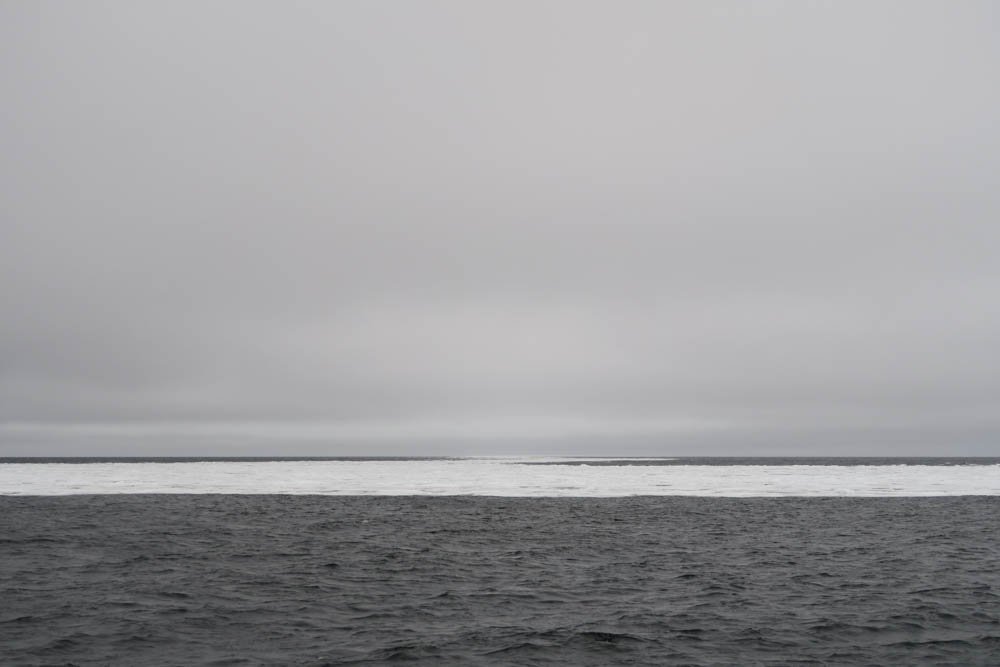
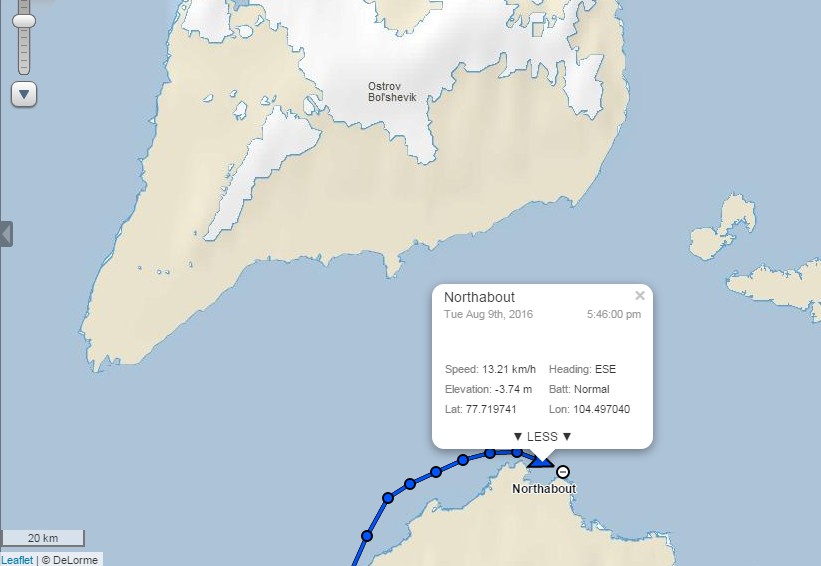
A storm is brewing in the Arctic. A big one! The crew of the yacht Northabout are currently sailing along the western shore of the Laptev Sea and reported earlier today that “The sea is calm. Tomorrow a gale 8. But this moment is perfect”.
That perfect moment will not last long.
I interviewed polar explorer David Hempleman-Adams about the succeeding moments once Northabout had returned to the UK. It seems riding out the cyclone was the most frightening experience he had ever had.
The University of Alaska article references the following peer reviewed paper:
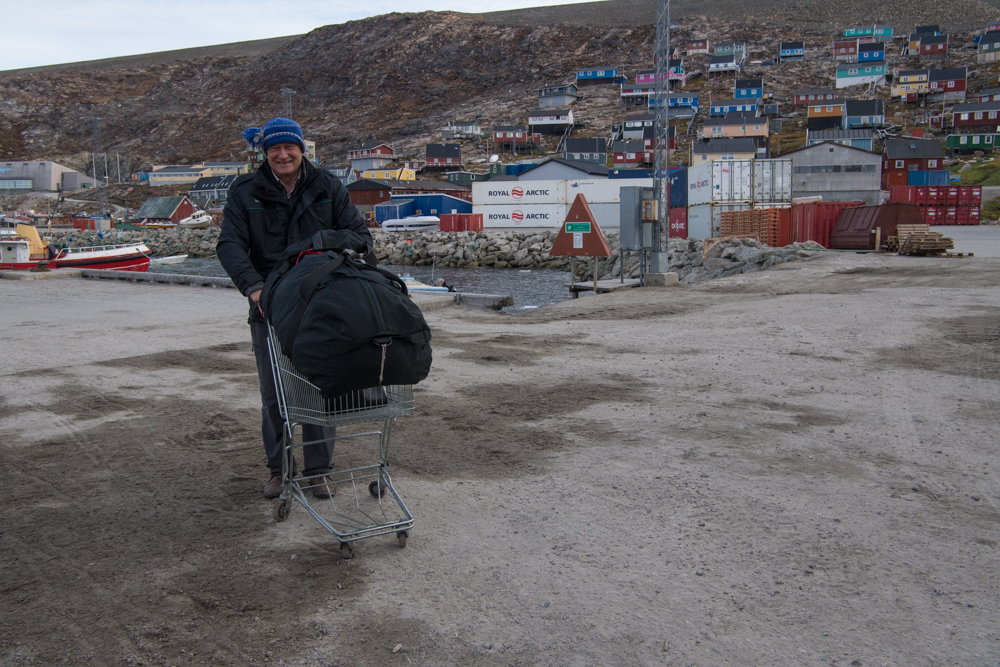
The BBC Radio 4 Today programme broadcast another one of their regular updates on the progress of the Polar Ocean Challenge expedition. On this occasion they were able to interview David Hempleman-Adams, the leader of the expedition. That’s because David disembarked from the yacht Northabout at Upernavik in Greenland:
By now David is back in Blighty, in Swindon to be precise. Here’s a brief extract from his interview with Sarah Montague this morning.
David pointed out that:
We’re not scientists. We weren’t collecting scientific data, and it’s wrong to suggest that our trip, this adventure, will show that there’s less ice. What we’re trying to do is make people more aware of the hundreds of scientists who are doing good work and who actually do show that.
At this juncture you might have supposed that one or more of those “hundreds of scientists” might have been mentioned, but you would have been wrong. Shortly thereafter Sarah asked David:
You will know though that the well known science writer Matt Ridley has written about your expedition and said look there are times in the past where routinely ice has disappeared during the summer, and his argument is that really it doesn’t matter, it doesn’t actually tell us anything.
I fondly imagine that at this juncture David raised his eyes to the heavens over Swindon. After all he’d already explained to Sarah that, rather like Matt Ridley, he isn’t a scientist. What he actually then said was:
Sure. You know I do know that he’s written that, and other people. But if you look on balance, and you know I’m just one of the general public, if you look on balance, if you look at 99% of the scientists they’re all saying that we’ve got a problem and if you look at the trends, and of course there are trends over the years but what we’re seeing now is really rapid change. If you look at the, as I said, the Northwest Passage it is quite frightening. We didn’t actually see any ice for the entire route up until the Lancaster Sound, which is worrying whatever scientists say or the naysayers say. It is a worrying trend.
And if you look at the cultures, I’ve been going up there for 30 years now, it’s not just sea ice. If you look at these small, little Inuit villages and seen the impact of the climate on some of these places, you know there’s been dramatic change over the last 30 years.
At which juncture Sarah thanked David Hempleman-Adams and Nick Robinson said:
The time is now 26 minutes past eight, and Rob’s got the sports news.
It’s nice to know where the BBC’s priorities lie, and that they prefer to publicise the views of a “coal baron” rather than one or more of “the hundreds of scientists who are doing good work” on the subject of sea ice.
Should you be wondering at this juncture how the opinions of Matt Ridley are at variance with the actual facts take a look at the August 29th article of his in The Times of London that Sarah Montague was referring to:
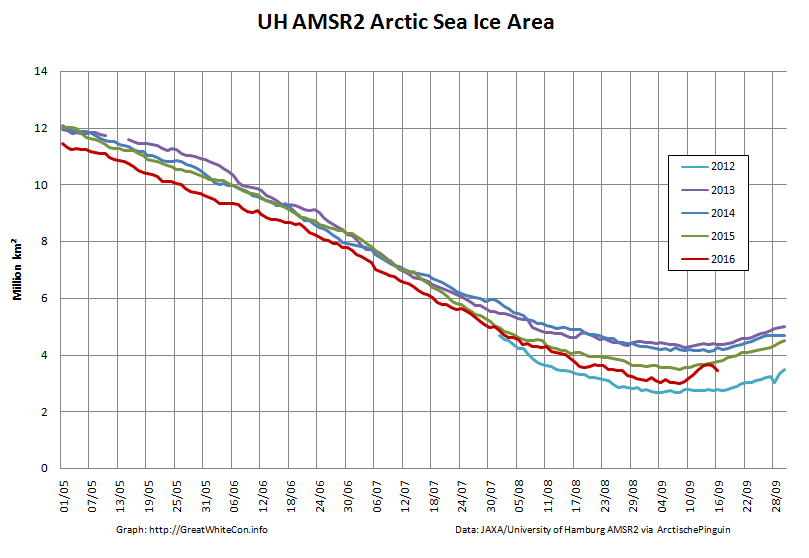
The sea ice in the Arctic Ocean is approaching its annual nadir. By early September each year about two thirds of the ice cap has melted, then the sea begins to freeze again. This year looks unlikely to set a record for melting, with more than four million square kilometres of ice remaining, less than the average in the 1980s and 1990s, but more than in the record low years of 2007 and 2012.
This will disappoint some. An expedition led by David Hempleman-Adams to circumnavigate the North Pole through the Northeast and Northwest passages, intending to demonstrate “that the Arctic sea ice coverage shrinks back so far now in the summer months that sea that was permanently locked up now can allow passage through”, was recently held up for weeks north of Siberia by, um, ice. They have only just reached halfway.
However it’s also extremely misleading. The yacht Northabout reached the International Date Line spot on the original Polar Ocean Challenge schedule, and earlier than previous successful polar circumnavigations managed to achieve.
Must I go on? I suppose so! Skipping several more untruths, a bit later Matt opines:
Would it matter if it did all melt one year? Here’s the point everybody seems to be missing: the Arctic Ocean’s ice has indeed disappeared during summer in the past, routinely. The evidence comes from various sources, such as beach ridges in northern Greenland, never unfrozen today, which show evidence of wave action in the past. One Danish team concluded in 2012 that 8,500 years ago the ice extent was “less than half of the record low 2007 level”. A Swedish team, in a paper published in 2014, went further: between 10,000 years ago and 6,000 years ago, the Arctic experienced a “regime dominated by seasonal ice, ie, ice-free summers”.
Here’s a thought for you to consider Matt. What was the population of London between 10,000 years ago and 6,000 years ago? How about Miami or the Big Apple, or Dhaka for that matter? Has it ever crossed your mind to enquire what the human population of the whole of Planet Earth was “during parts of the early and middle Holocene”, and what sea level around the World might have been at that time?
Answers on a postcard please, in the space provided for that purpose below. We’ll forward them on to the BBC. I don’t suppose Matt will be interested though.
Sarah Montague was interviewing David Hempleman-Adams about the Polar Ocean Challenge expedition to circumnavigate the Arctic. David pointed out that “We’re not scientists” and “What we’re trying to do is make people more aware of the hundreds of scientists who are doing good work”. If 3rd party comment was deemed necessary at this juncture then it should have included at least one of those “hundreds of scientists”. Not just Matt Ridley, whose recent article in The Times that Sarah was alluding to was riddled with factual errors, amongst its other failings. See above.
One can only assume that the BBC was attempting to achieve some sort of “balance”? They failed miserably. I’m a long ex academic, but for another perspective on that failure here’s one from a practicing astrophysicist:
Note also the comments. David Hempleman-Adams wasn’t even given adequate time to fully respond to the nonsense printed in The Times and regurgitated by BBC Radio 4 before it was “Rob’s got the sports news.”
As David put it “I’m just one of the general public”. If the BBC wanted to present a balanced report a specialist in the subject should have been invited to comment. There’s loads of them gathered in London as we speak:
Arctic sea ice is in the news, but what's really going on? Join us tmrw to dig into the details with the scientists: https://t.co/E3lc2PEG3u
Why not ask one of them for their views on declining sea ice? Helen Czerski works as a science presenter for the BBC doesn’t she? She may not be a sea ice specialist, but ask her for her opinion on this charade.
To summarise, either Matt Ridley has no idea what he’s talking about or he has an agenda. In either case reporting his views without adequate “balancing” comment badly lets down BBC Radio 4 listeners. How do you intend to remedy this?
Here is the BBC’s response so far:
[Edit – September 27th]
I have now received an emailed response from the BBC. Here it is:
Thank you for contacting us regarding Radio 4’s ‘Today’ which was broadcast on 19 September.
I understand you felt that the interview with David Hempleman-Adams was of a poor quality, that you considered it inappropriate for Sarah Montague to quote from an article written by Matt Ridley and that a “specialist in the subject should have been invited to comment”.
We are naturally very sorry when we hear that members of our audience have been left disappointed with an interview. We try very hard to produce a wide range of high quality shows and services which we hope will appeal to listeners.
It is not always possible or practical to reflect all the various aspects of a subject within one individual item. Editors are charged to ensure that over a reasonable period they reflect the range of significant views, opinions and trends in their subject area.
We do not seek to denigrate any view or to promote any view. Our aim is always to provide enough information on the stories we cover and to let our listeners make up their own minds. Nevertheless, I would like to assure you that we value your feedback on this matter.
All complaints are sent to senior management and programme makers every morning and we included your points in this overnight report. These reports are among the most widely read sources of feedback in the BBC and ensures that your complaint has been seen by the right people quickly. This helps inform their decisions about current and future output.
Thank you once again for getting in touch.
BBC Complaints Team
NB This is sent from an outgoing account only which is not monitored. You cannot reply to this email address but if necessary please contact us via our webform quoting any case number we provided.
As you can probably imagine, I am far from satisfied with the Beeb’s response thus far!
[Edit – September 28th]
Shock News! I’ve received another communication from the BBC!! In fact I received it twice!!! Here is what it says:
Dear Mr. Hunt
I’m Sam Smith, Head of BBC Audience Services – thank you for getting in touch with the BBC recently.
I wonder if you’d be interested in taking part in a short survey?
It’s to learn more about how you got on, and how we can improve.
All feedback – good or bad – gets passed back to the person that handled your contact.
The survey is carried out by an independent agency called ICM. It takes around 10 minutes to complete, and you just need to click the link below or paste it into your browser:
[Link redacted]
(ICM is a member of the Market Research Society and abides by its strict code of conduct at all times. You will not receive any emails, sales calls or literature as a result of taking part in this survey, and your personal data will only be used for the purpose of helping us to understand our audiences better. If you have any difficulties with the survey, please e-mail [email protected])
Thanks again – we’d love to hear from you.
Sam Smith
Head of BBC Audience Services
Ps. It’s not possible to reply to this address, but please use one of our webforms – quoting your case number – if you need anything else.
Am I “interested in taking part in a short survey”?
[Edit – September 29th]
As luck would have it I decided that I was interested:
Them:
Please tell us in detail why you decided to contact the BBC.
Please think about what made you decide to get in touch, why this was important to you, and what you hoped would happen as a result.
Us:
Quoting from my original complaint, I have already published my thoughts on the matter:
“At this juncture you might have supposed that one or more of those “hundreds of scientists” [mentioned by David Hempleman-Adams] might have been mentioned, but you would have been wrong.”
“Should you be wondering at this juncture how the opinions of Matt Ridley are at variance with the actual facts take a look at the August 29th article of his in The Times of London that Sarah Montague was referring to.”
“To summarise, either Matt Ridley has no idea what he’s talking about or he has an agenda. In either case reporting his views without adequate “balancing” comment badly lets down BBC Radio 4 listeners. How do you intend to remedy this?”
I “hoped for” a substantive answer to that final question. I have yet to receive one!
Them:
When you decided to contact the BBC, what did you think would happen next?
Please think about who you expected to respond, what information you expected the response to provide and what you expected would happen as a result.
Us:
Based on my past experience I expected another “canned” reply and no substantive response:
Thus far my exceedingly limited expectations have been fulfilled exactly!
Them:
Please tell us a bit more about what you thought about the response you received.
You may like to think about the language used, the tone of the response, what information it gave you, and what you thought was good about it.
Us:
See my previous responses.
There was nothing good about it.
Them:
What, if anything, could have been better about the response you received?
Please think about any aspect which could be improved – for example the tone of the response, the level of detail it gave, and anything you thought was missing.
Us:
The novelty of these questions is wearing off.
See my previous responses.
A substantive answer to my final question would have improved the BBC’s response.
Them:
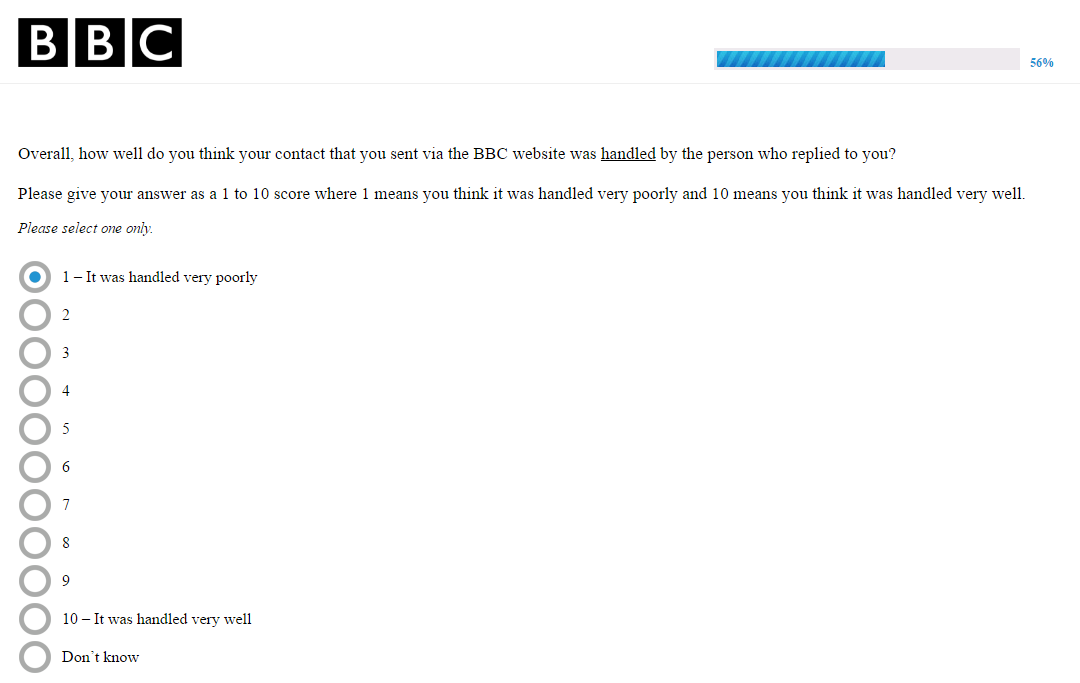
How would you rate the response you received on the following attributes? Please rate each attribute out of 10 where 1 is ‘strongly disagree’ and 10 means ‘strongly agree’.
Please remember we are asking you to rate the specific response you received and not any other aspect of the BBC, such as its programming.
Us:
Them:
Finally, are there any other comments you would like to make about your contact experience with the BBC that we haven’t covered, or any comments you would like to make about this survey?
Us:
Yes. I’d like to ask two questions:
1) What is the point of all the “intrusive” questions I’ve just been asked?
2) Why hasn’t the BBC provided a substantive answer to the final question in my original complaint?
Them:
Thank you for taking the time to complete this questionnaire.
To exit the questionnaire you can either navigate to another website or close this window.
The Polar Ocean Challenge team issued a press release last night. This is what it said:
The Polar Ocean Challenge successfully completed their quest to sail the North East Passage and North West Passage in one season. The North West Passage was completed in an astonishing 14 days due to the fact that it was almost totally ice free. They encountered ice only twice in their 1800 mile NW Passage part of the voyage. This highlights an extraordinary loss of sea ice in the Arctic in the 30 years that David Hempleman-Adams has been coming to the area. He said, ‘whilst we are all delighted to have succeeded, it is extremely worrying to see this lack of ice so starkly‘ The objective of the expedition was to raise awareness of the change in the fragile climate in the Arctic. They left Lancaster Sound at the end of the NW Passage at 19.18 UTC on 12th September and are headed for Greenland.
This seems likely to cause much gnashing of teeth in certain quarters, where it is claimed that:
The S/V NORTHABOUT has failed to cross the Pacific Ocean Arctic Circle in the Bering Strait as the official starting line to validate their Northwest Passage attempt. You cannot say you climbed Mount Everest by just reaching high camp – you must summit. You don’t ride a bicycle in the Tour de France without starting and finishing over the course in the designated places. Likewise, you must cross BOTH the Pacific Ocean Arctic Circle in the Bering Strait and the Atlantic Ocean Arctic Circle in Davis Strait to validate a Northwest Passage.
In Northabout’s defence I pointed out that:
Perhaps the Polar Ocean Challenge team have other priorities than gaining an entry on that particular list?
If you’re planning a single season circumnavigation a diversion via Provideniya or Nome doesn’t make a whole lot of sense, rules or no rules.
but nobody else seemed to take that view!
Today they also pointed out on their Twitter feed that they are a:
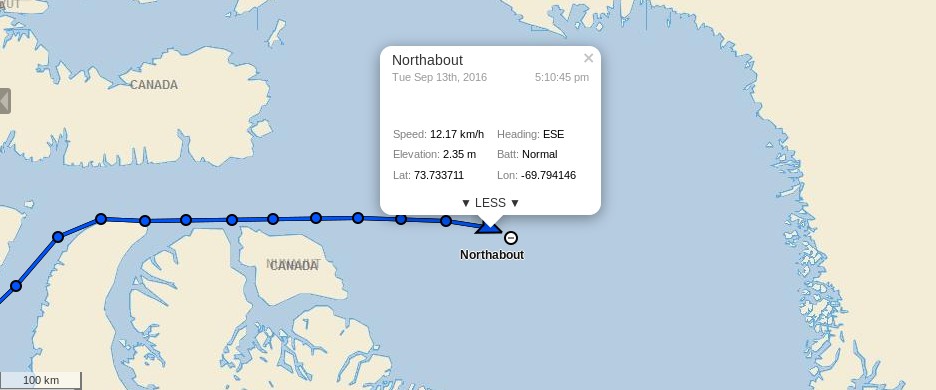
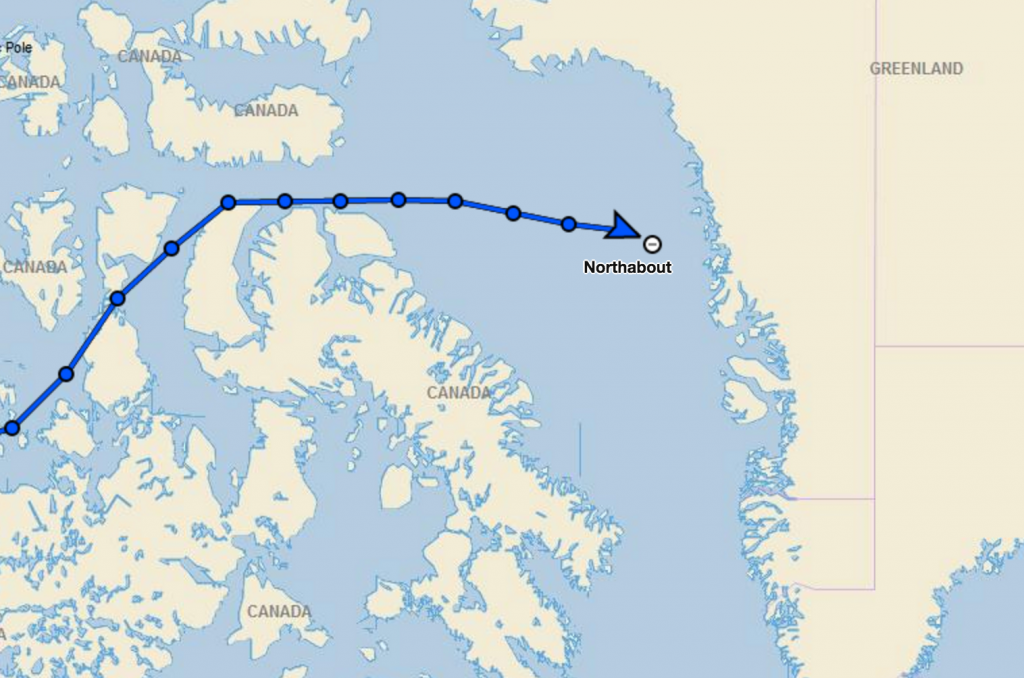
Pressing on the crew of Northabout are now approaching halfway across Baffin Bay:
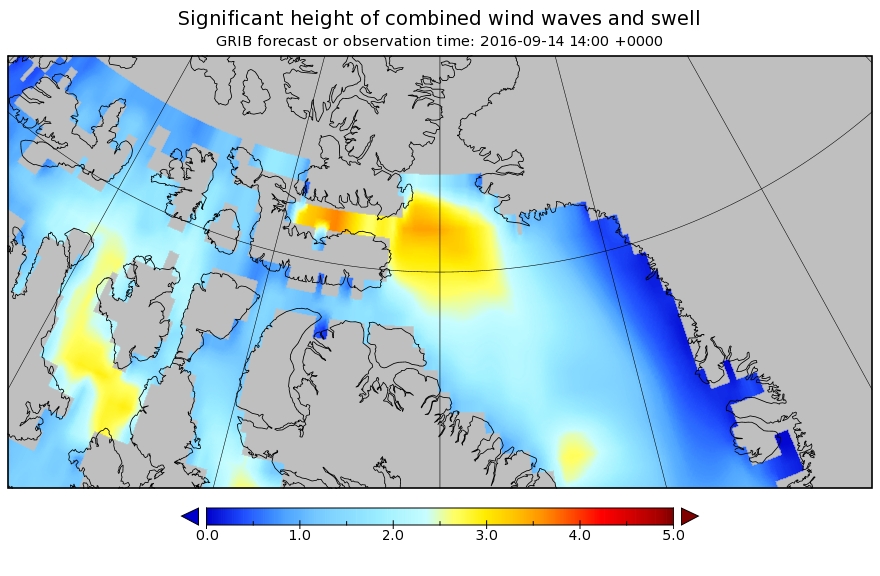
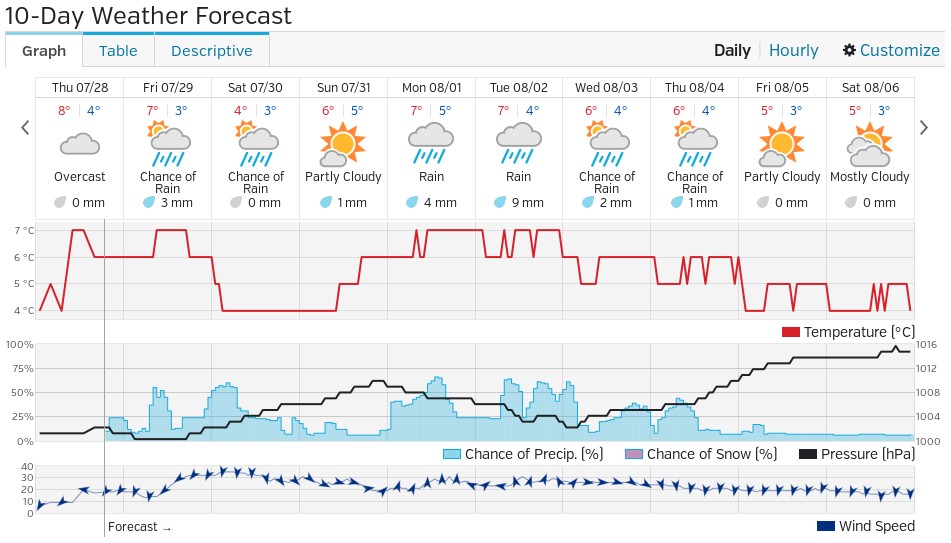
Her crew are trying to reach Upernavik in Greenland before the impending storm gets too bad. Here’s our own WaveWatch III based forecast for tomorrow afternoon:
Today Tonight and Wednesday Wind light increasing to south 15 knots early this evening and to south 20 late this evening. Wind backing to southeast 25 overnight then diminishing to light Wednesday afternoon.
Waves
Today Tonight and Wednesday Seas 1 metre building to 2 after midnight.
Thursday
Wind light increasing to northwest 15 knots in the afternoon then veering to north 20 late in the day.
Friday
Wind north 30 knots diminishing to north 20.
I seem to recall that 30 knot winds are best avoided! After Upernavik Northabout will head for Nuuk further south in Greenland and then across the North Atlantic back to Bristol, where she started her voyage back in June. It is certainly not beyond the bounds of possibility that there will be winds of 30 knots and more to contend with on that final leg of the Polar Ocean Challenge!
[Edit – September 14th]
Northabout has obviously not managed to escape the storm entirely. Ben Edwards reports today:
I hate this part of a journey. Yesterday as I came off watch we were scheduled to arrive about midnight tonight. I hate that anyway because you get the so close yet so far feeling. But typically as I came off watch the wind picked up, moved to an unhelpful angle and created the worst sea state we’ve had since the Chuckchi Sea. We’re still supposed to arrive about two in the morning but it will make the next twenty two hours really horrible. Not that our arrival time mattes too much, we can’t go in till it’s light anyway.
Gale from south and southeast, 13 to 18 m/s. From the western part decreasing and becoming south and southwest, 5 to 10 m/s, in northern part locally 13 m/s. Thursday gradually in eastern part south and southeast, 8 to 13 m/s, but in western part cyclonic variable, up to 10 m/s. Especially in northern part locally rain, sleet or snow with moderate to poor visibility, otherwise good visibility.
Significant wave height: 3,5 m. Swells: 3 m.
Many icebergs and growlers in the eastern part along the coast, otherwise few icebergs and growlers.
Upernavik is slightly south of there, but nonetheless Ben will have a few more uncomfortable hours, and Northabout may yet meet some more ice before her crew set foot on dry land once again:
[Edit – September 15th]
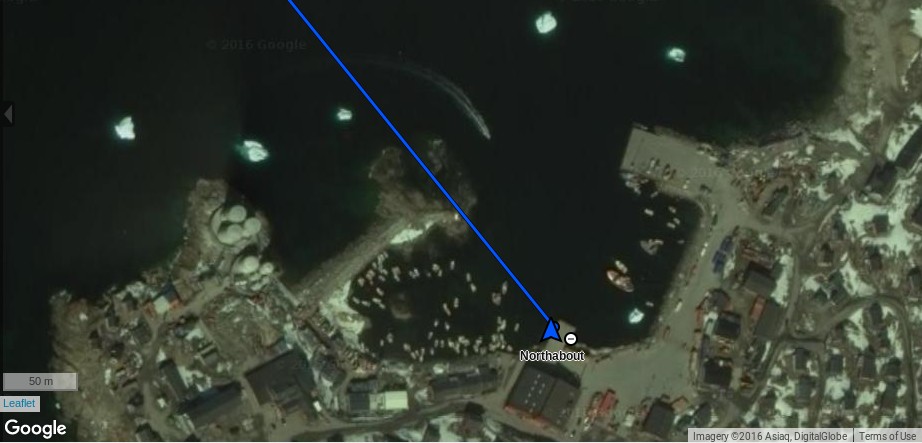
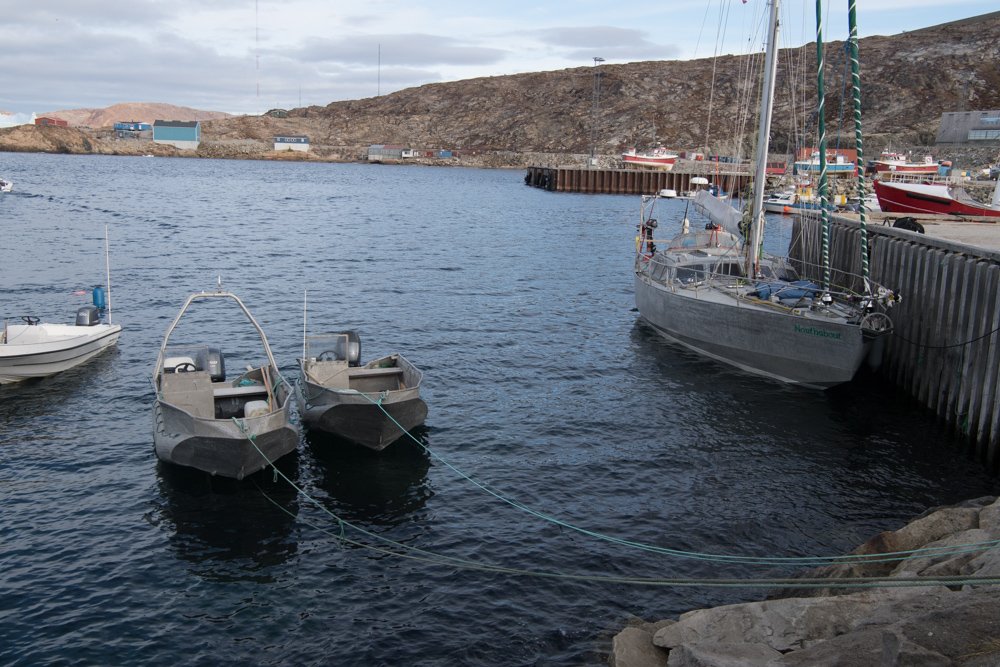
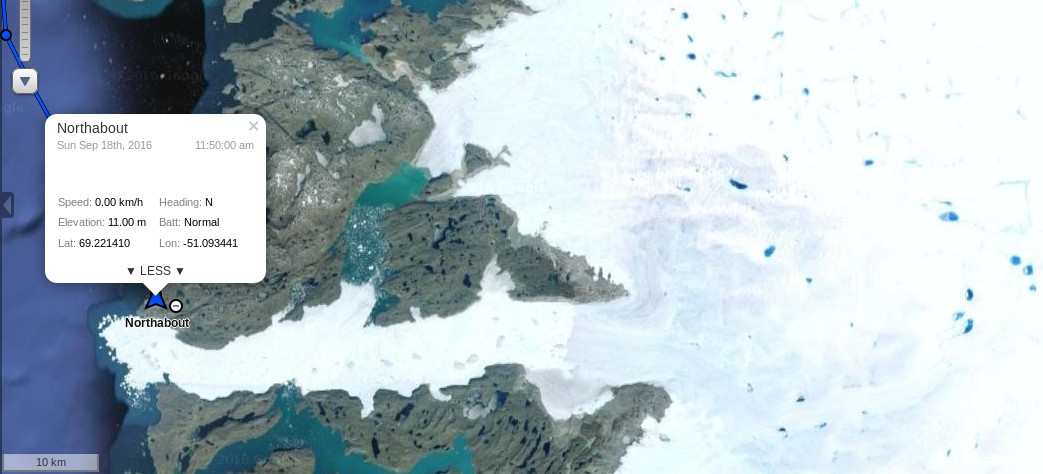
Northabout has just arrived in Upernavik:
[Edit – September 16th]
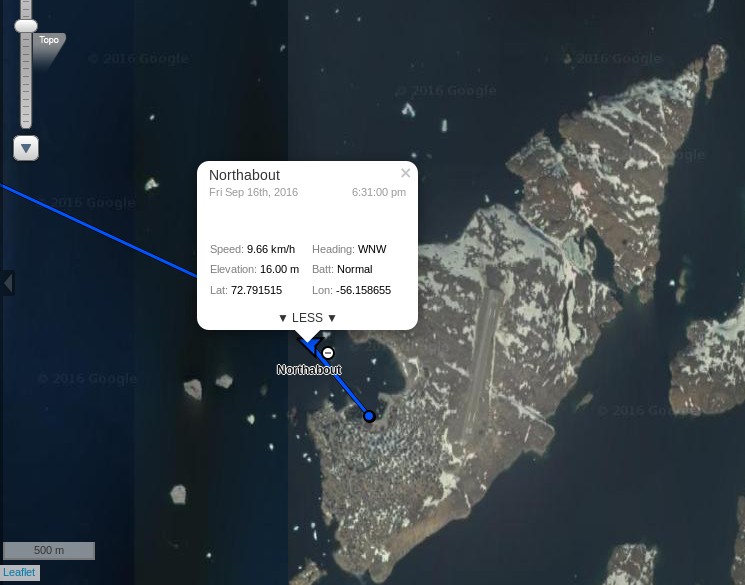
It looks as though Northabout has just left Upernavik, and is now en route to Nuuk:
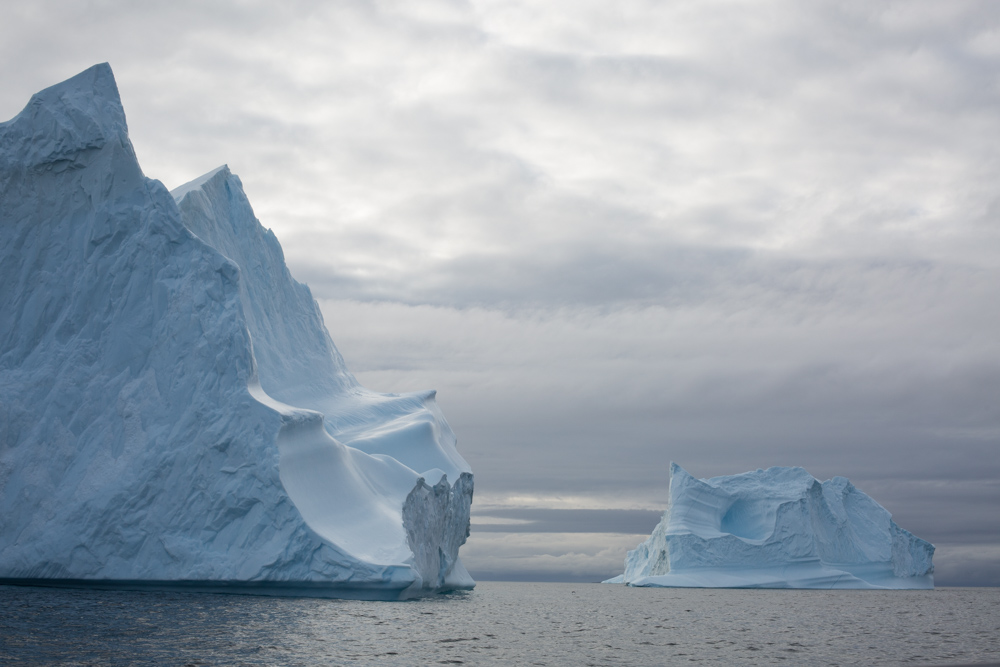
As we expected, it was a long night last night as the big swell and Northernly winds continued to sweep us along from Upernavik, big surf waves behind us breaking under us, Northabout became a little Hawwai five o. We made our way along the coastline through amazing beautiful icebergs created by glaciers at Ilulissat.
The icebergs were between the size of telly to the size of a house to the size of a grand hotel. They were breaking up, and once or twice right in front of us creating lots a small bergs and ice chunks that don’t float so high above the water and so are difficult to spot especially with a large 10 foot swell, they disappear and reappear in the water around us.
[Edit – September 19th]
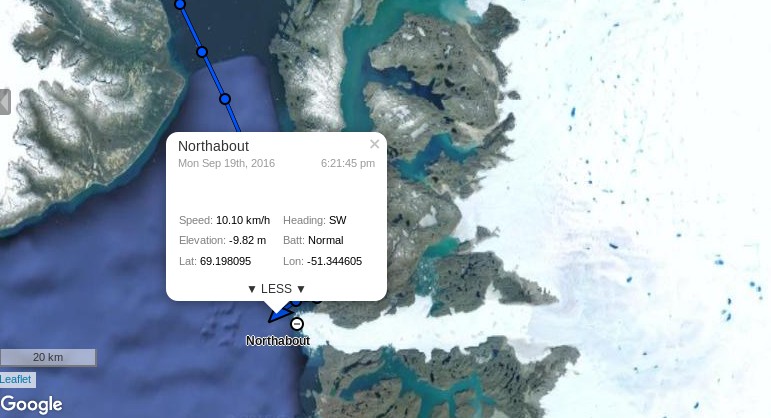
Northabout has just left Ilulissat, en route for Nuuk:
[Edit – September 22nd]
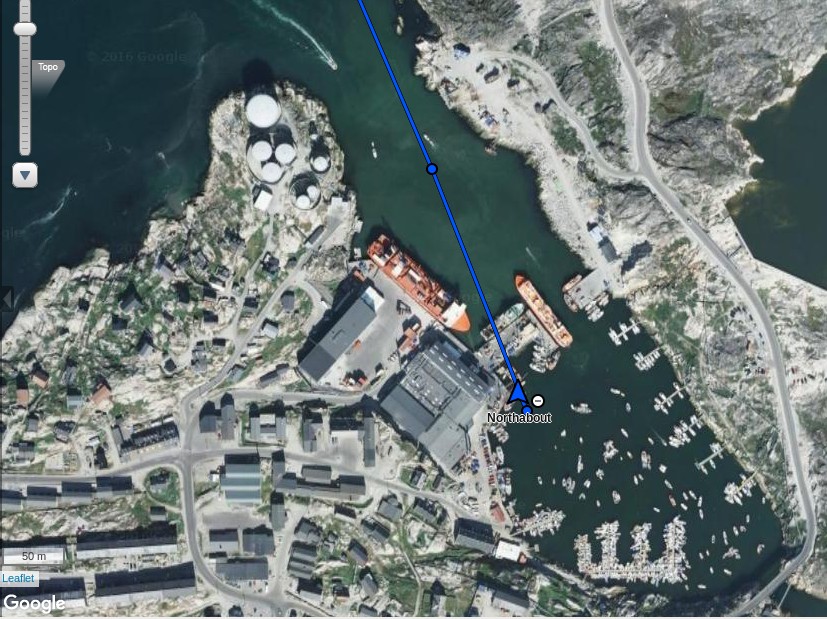
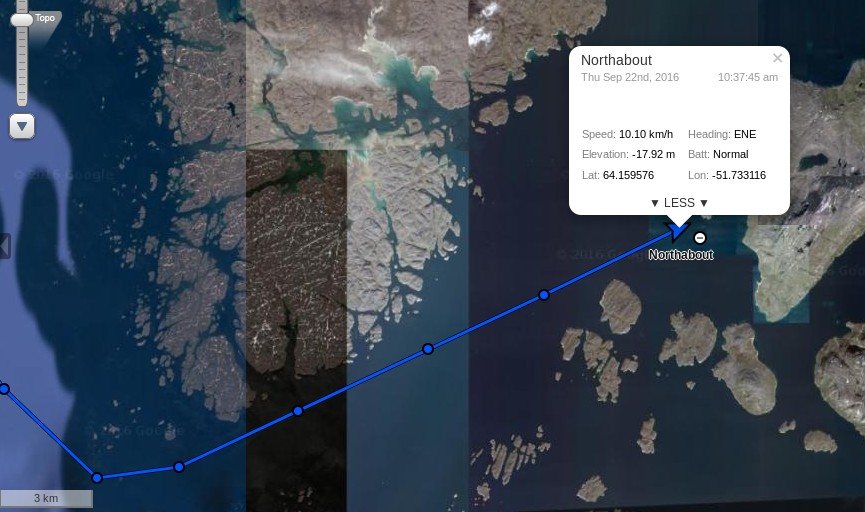
Northabout has crossed the Arctic Circle and has just reached Nuuk, the capital of Greenland:
En route from Ilulissat her crew have seen some amazing sights:
No is the obvious answer just at the moment, since the plucky little yacht is currently parked at a pontoon in Tuktoyaktuk. However actual facts aren’t sufficient to stop Tony Heller suggesting that Andrew Freedman suggested on Mashable that Mark Serreze of the NSIDC said that such a feat is feasible:
Mark “Arctic Is Screaming” Serreze says the Ship of Fools could sail to the North Pole.
In an interview with Mashable, Serreze said sea ice coverage across the different regions of the Arctic has fallen dramatically in association with a series of unusually powerful summertime Arctic storms during August.
That much is certainly true, as we here at Great White Con have documented in detail. Mr. Heller however highlights this section of Mr. Freedman’s article:
In fact, if they want to, the Hempleman-Adams and the rest of the ship’s crew could actually sail nearly all the way to the North Pole, since sea ice cover is largely absent to about 86 degrees north, according to Mark Serreze, director of the National Snow and Ice Data Center (NSIDC) in Boulder, Colorado.
It’s not out of the question that the North Pole will become a geographical marker in open water, rather than ice cover, sometime in the next few weeks.
Serreze called this situation “pretty darned unusual.”
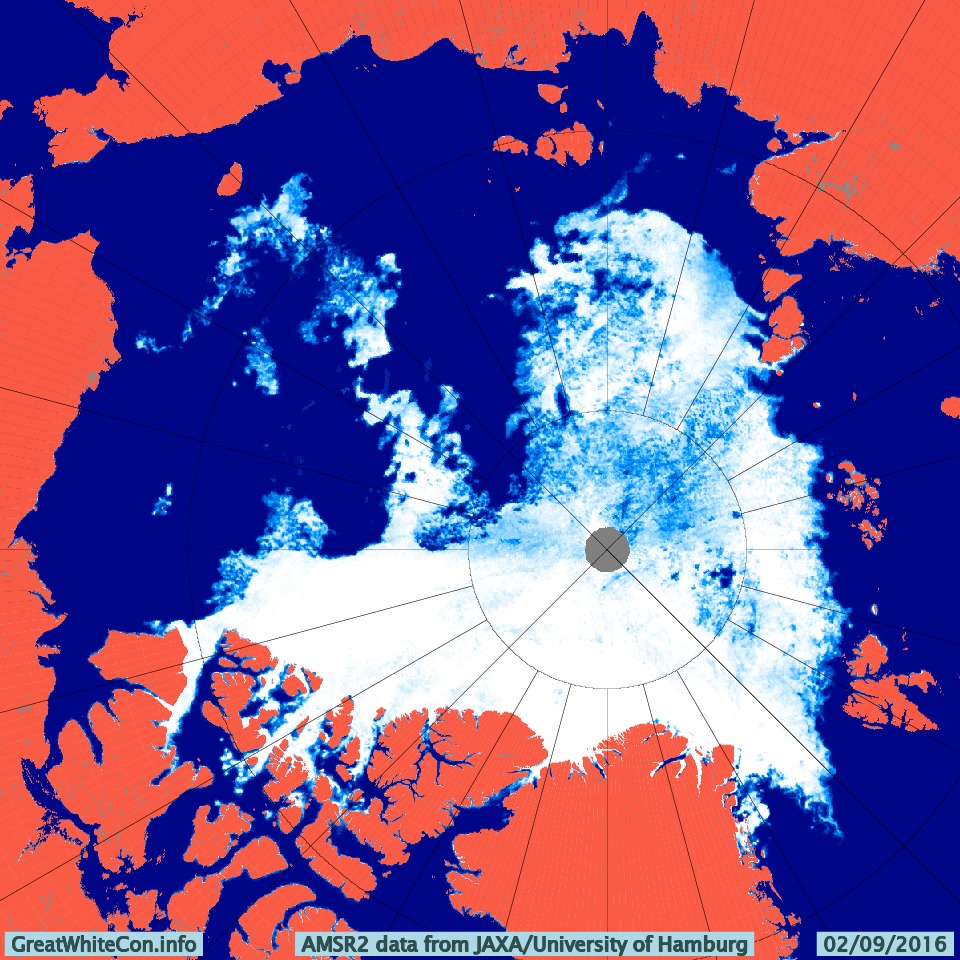
Let’s examine the facts about this “pretty darned unusual” situation shall we? Here is the latest high resolution AMSR2 visualisation of Arctic sea ice concentration:
Can you see the stretch of open water leading all the way from the East Siberian Sea, where Northabout was a couple of weeks ago, to 86 degrees north? Apparently Tony Heller and his faithful followers cannot! Not only that, but also supposedly:
A NASA image [shows that] the North Pole is indeed encased in Thick ice right now.
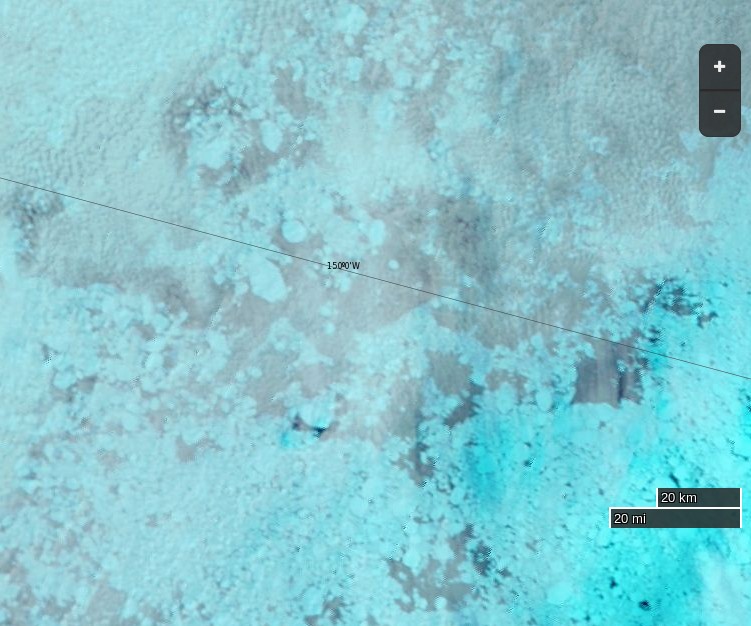
Here’s a (somewhat foggy) NASA image of the North Pole right now:
NASA Worldview “false-color” image of the North Pole on September 3rd 2016, derived from the MODIS sensor on the Terra satellite
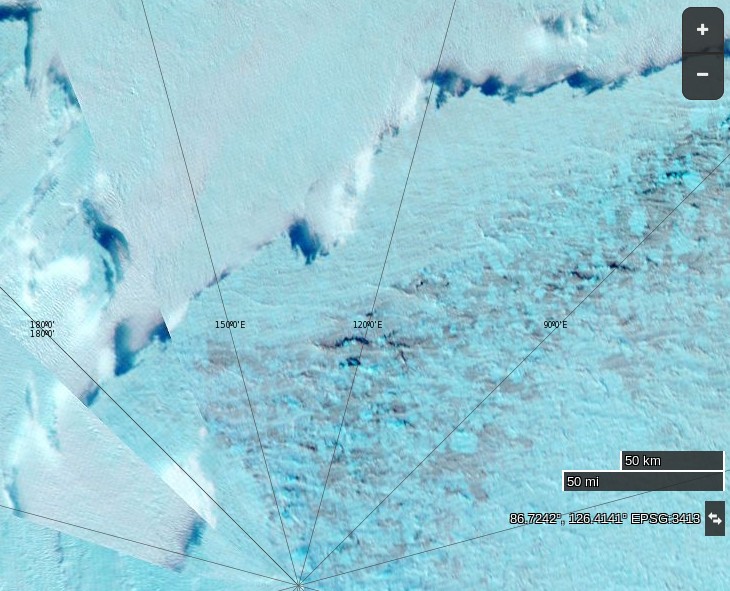
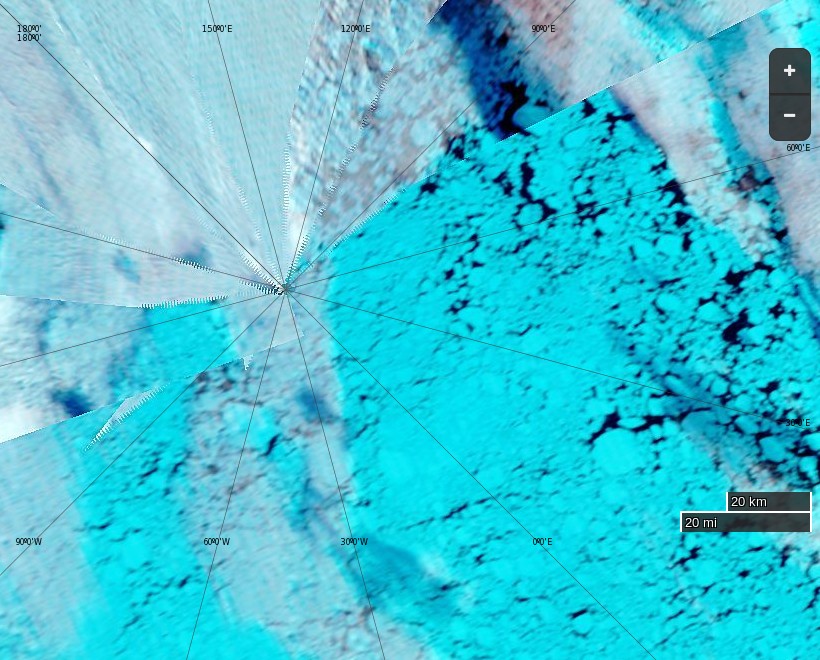
and for good measure here’s a (somewhat foggy) NASA image from 86 degrees north in the Central Arctic Basin right now:
NASA Worldview “false-color” image of the Central Arctic on September 3rd 2016, derived from the VIIRS sensor on the Suomi satellite
Need I say more?
[Edit – September 4th]
Today Terra offers a glimpse of the Greenland side of the North Pole:
NASA Worldview “false-color” image of the North Pole on September 4th 2016, derived from the MODIS sensor on the Terra satellite
[Edit – September 5th]
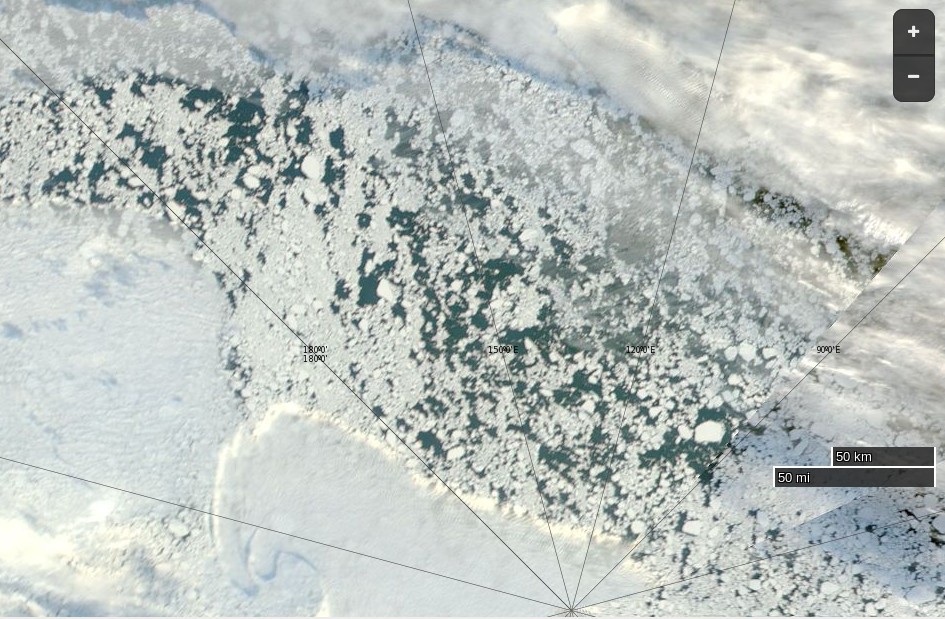
Today Aqua offers us a view of what’s left of the sea ice on the Siberian side of the North Pole:
NASA Worldview “true-color” image of the North Pole on September 5th 2016, derived from the MODIS sensor on the Aqua satellite
[Edit – September 9th]
SHOCK NEWS!!!
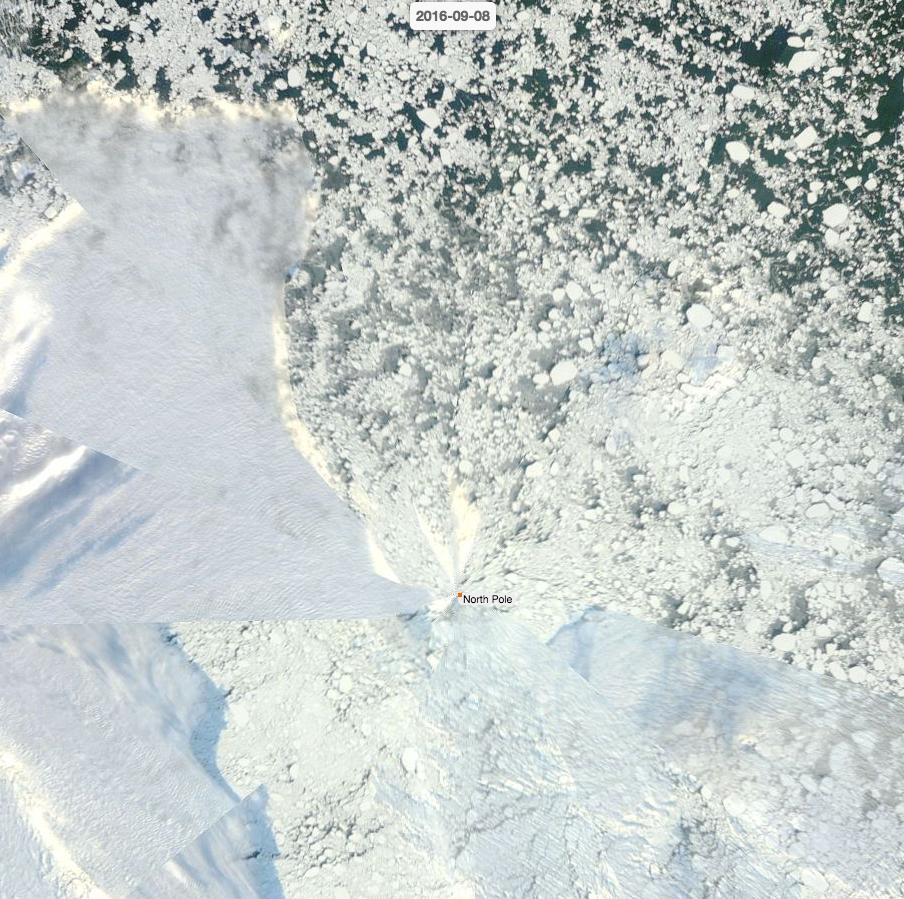
Tony Heller has just posted an accurate image of the state of the sea ice near the North Pole! Here it is:
The accompanying text is nonsense of course:
The Ship Of Fools is facing a -10C weather forecast in five days, which would be impassable. They better put their fossil fuel powered pedal to the metal and get out of there fast, so that they can go back to Bristol and lie about the ice.
Meanwhile, professional fraudster Mark Serreze said last week they could sail to the North Pole
Needless to say Tony doesn’t provide a link to his source. Try this one and then have a good look around on NASA Worldview.
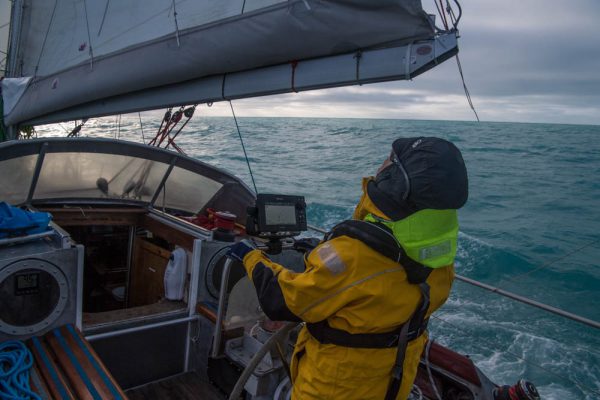
I had an interesting watch this morning. Just crawled out of bed, rocking and rolling getting ready. I even put my second thermals on, checked the log to see what was happening. clipped on before leaving the saloon, and clipped on behind the wheel.
Just sitting down, put my leg up for stability and a wave came across the boat. Didn’t see it or hear it. For a fraction of a second, my whole body was under water, and it was only my leg stopping me going out of the side, and hopefully my tether would have stopped me going over completely.
I actually had a mouth full of sea water which was novel. Nikolai thought it was hilarious. I’m just very pleased it was me and not one of the lighter ladies.
Here’s brief video showing some slightly smaller waves:
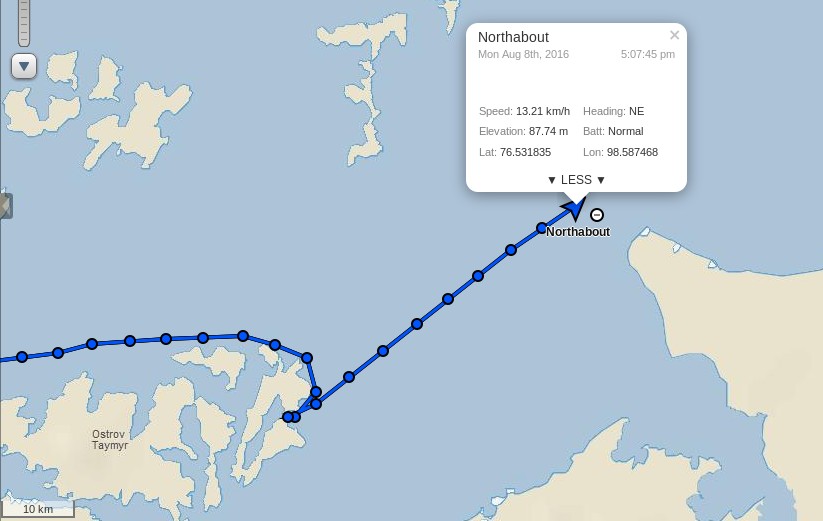
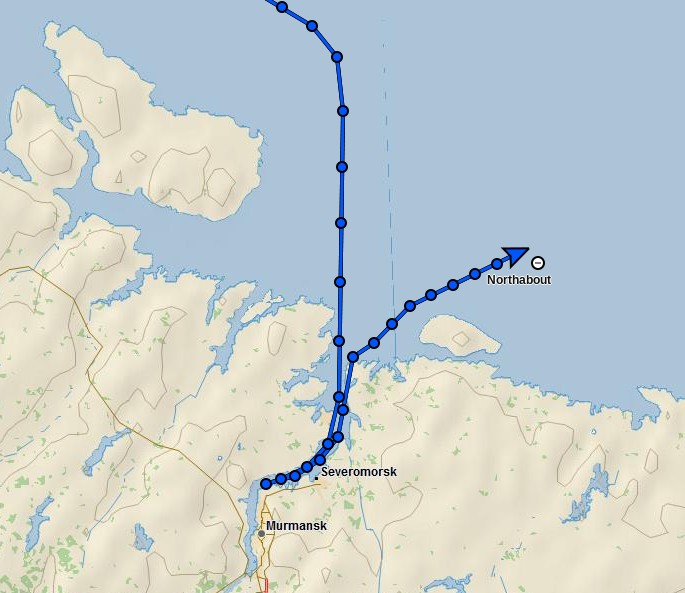
Their live tracking map reveals that they have passed Ostrov Troynoy and are now heading east in the general direction of the Nordenskiöld Archipelago:
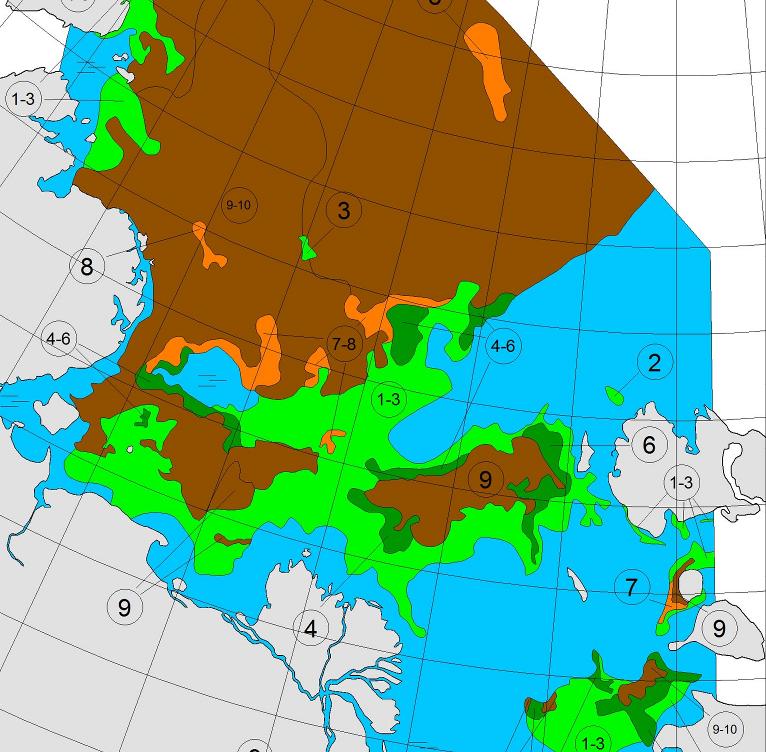
The latest sea ice map of the north eastern Kara Sea reveals some open water in the Vilkitsky Strait, but as yet no way through for a small yacht like Northabout:
A bit further afield the University of Hamburg’s AMSR2 imagery reveals the current ice conditions along the rest of the Northern Sea Route:
All in all it doesn’t look as though Northabout’s crew will beaming videos back to us from the Laptev Sea over the next few days, but never say “never” in the Arctic!
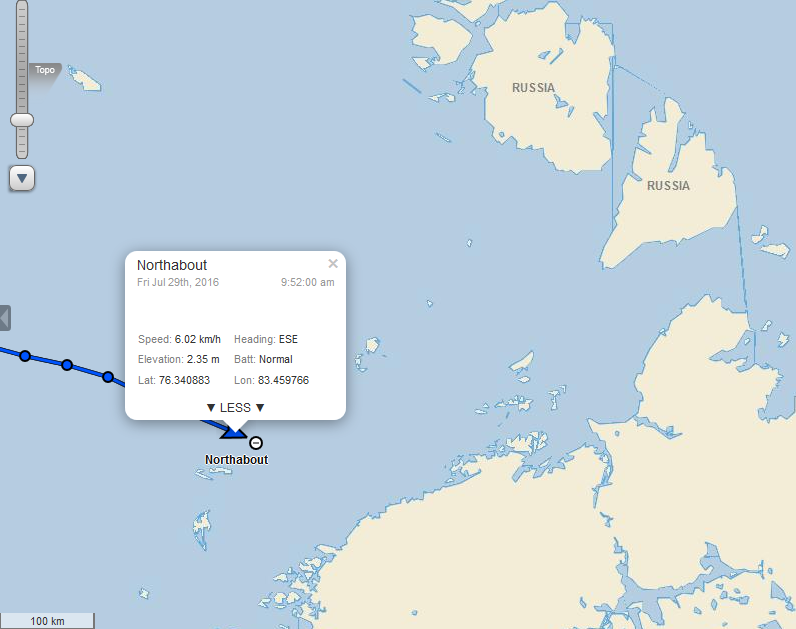
N76 20 E083 28 Pressure 998 water temp 4 outside temp 5 cloud 6/8 sea state 3 winds 15 knots.
Making steady progress east. I always love it when we click over degree of longitude. Of course, they are pretty close together up here. ( I have been dreaming of the 180 long), for weeks.
The winds will slowly take us north east today and tomorrow. Hopefully find our island with the Palm trees and wait for the Ice to break up. Looking forward to seeing an Ice update today and see if this storm has changed anything. Fingers crossed.
The Vilkitsky Strait is covered in thick clouds this morning, so here once again is the view from on high using passive microwaves:
Today’s sea ice update is that concentration in the Nordenskiöld Archipelago and Vilkitsky Strait seems to be falling fast. Visual confirmation of that is eagerly awaited.
Making steady progress East. We had the latest ice charts for the Vilkitskogo straight. Still blocked and the Laptev still blocked, but big changes from the last set of charts, and encouraging.
Nikolai and Dennis are having bets. Nikolai thinks it will be free on his birthday, the 9th Aug, and Dennis on his, 6th Aug . Either way, would mean a few days rest. We are heading for a small sheltered Island. Different to the first choice, as the ice from the North has come down and blocked it, so trying for another Island closer to shore and closer to the straight. So if anything dramatic changed quickly, we would be close to react. Ie, A strong southerly taking the ice from the shore.
Saw our first ICE today on my watch, just an hour ago. What is slightly worrying, it didn’t show up on the Radar. It’s probably good for the big icebergs, but not low ice in the water. I think we will see a lot more of that before the trip is out. You can’t beat that old eyeball.
[Edit – July 31st]
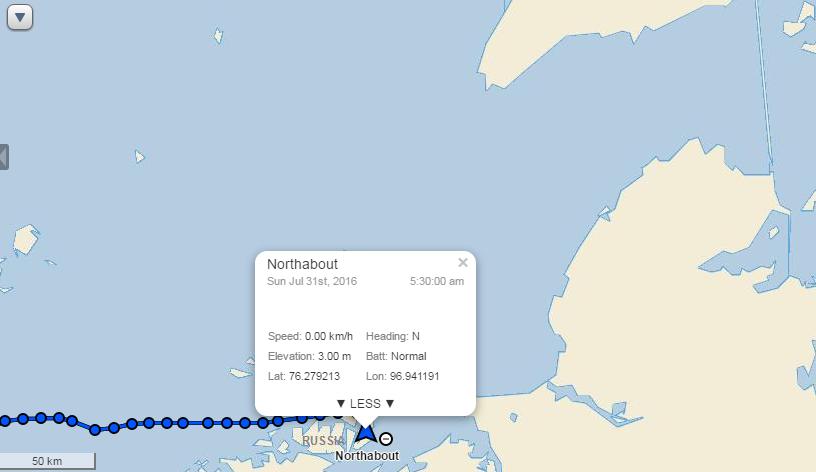
In a brief update this morning the crew of Northabout report they are:
Anchored! for rest repairs and to wait for favourable ice conditions in the NE passage and for the new ice charts. Proper shipslog update coming later with some photos (which take ages to upload) But for now we’re getting a bit of a rest & having a cuppa.
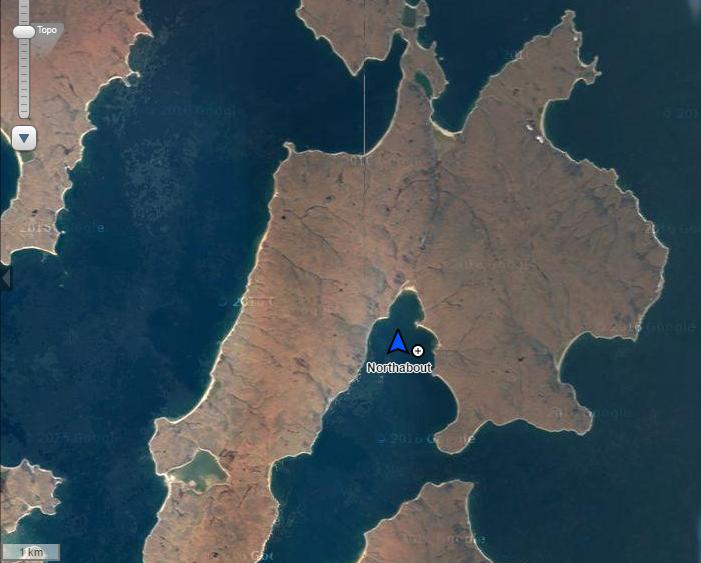
They have found some shelter in the convoluted coastline of Ostrov Pilota Makhotkina, just off the shores of Siberia and within striking distance of their exit from the Kara Sea:
As Reggie points out below, the sea ice in the Vilkitsky Strait broke up remarkably early this year. Here’s his view from June 23rd:
NASA Worldview “false-color” image of the Vilkitsky Strait on June 23rd 2016, derived from the VIIRS sensor on the Suomi satellite
and if you watch our latest Northern Sea Route animation carefully you’ll note that the ice was already mobile at the beginning of June:
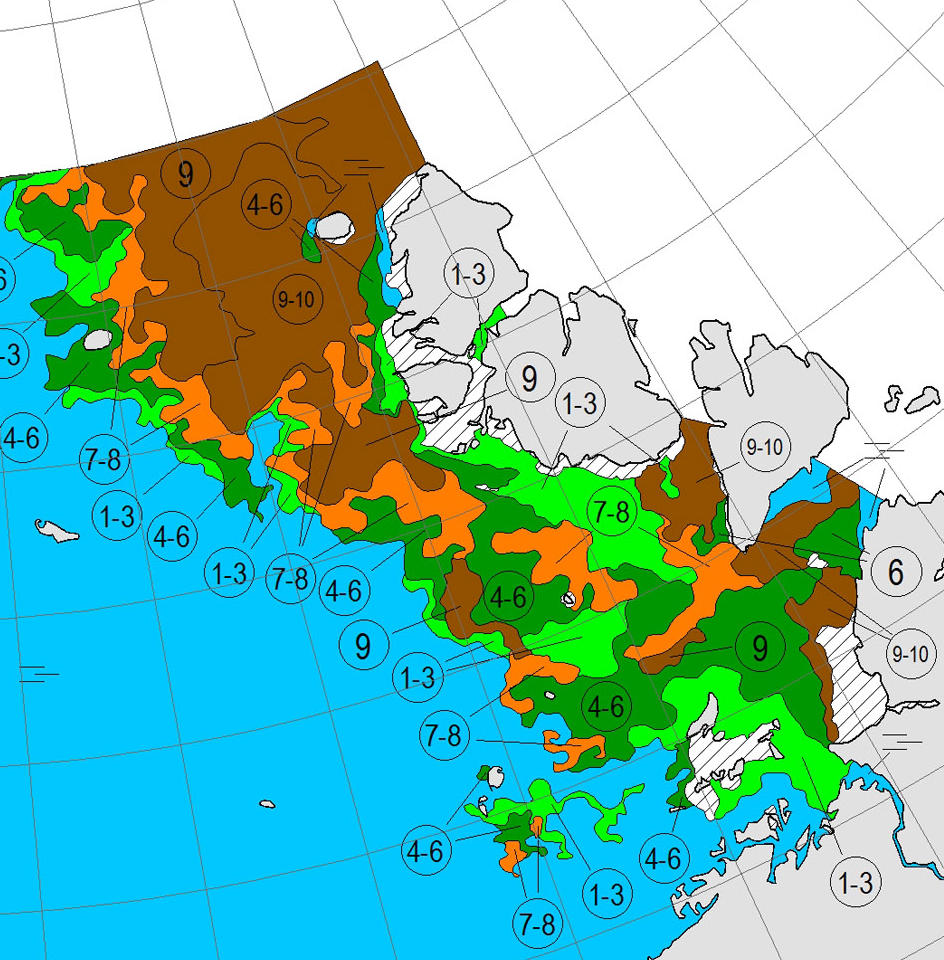
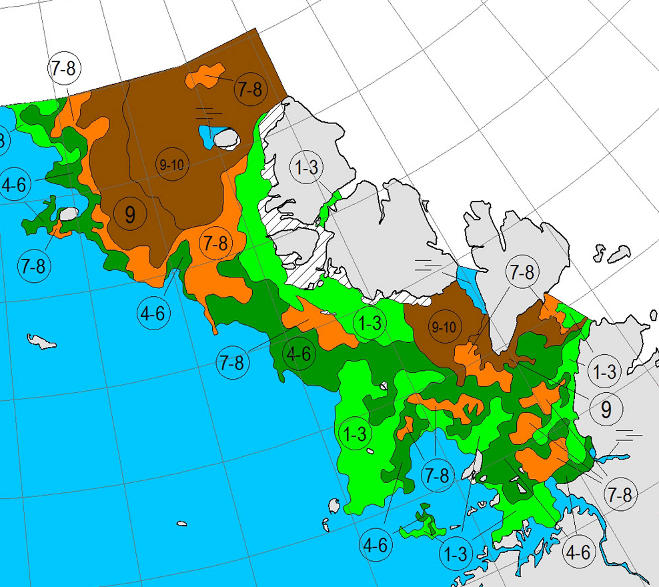
In actual fact the Vilkitsky Strait never became blocked with land-fast ice last winter. Compare this ice chart from the Russian Arctic and Antarctic Research Institute for May 4th 2016:
Three years ago the island where Northabout is now sheltering was still encased in land fast ice at the beginning of July, as was the Vilkitsky Strait itself. By August 25th when the yacht Tara passed around Cape Chelyuskin into the Laptev Sea on her own Polar circumnavigation the Strait looked like this:
[Edit – August 1st]
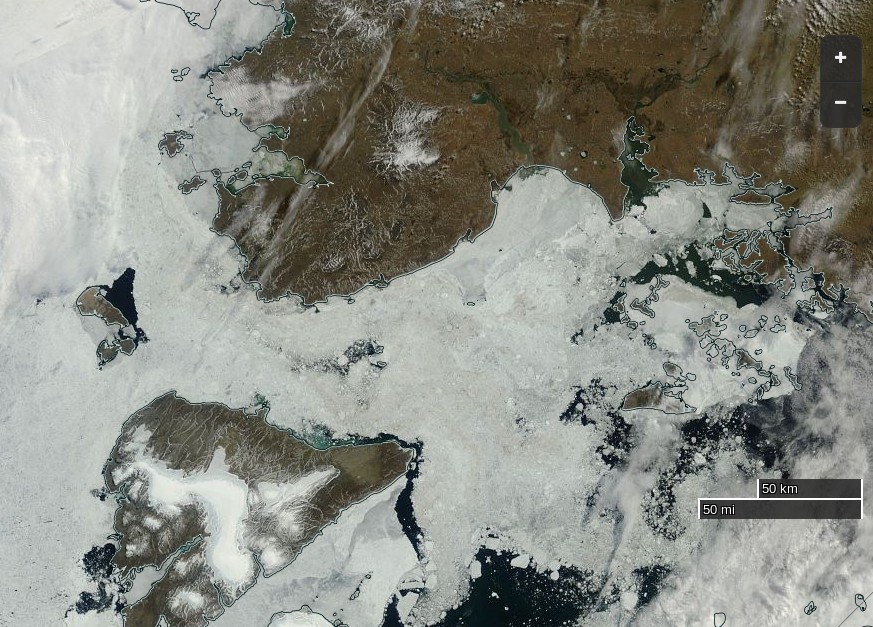
The latest video from the crew of Northabout reveals them anchoring off Ostrov Pilota Makhotkina:
The skies have cleared over the Vilkitsky Strait this morning! Here’s a “false colour” image from the MODIS instrument aboard the Aqua satellite:
NASA Worldview “false-color” image of the Vilkitsky Strait on August 1st 2016, derived from the MODIS sensor on the Aqua satellite
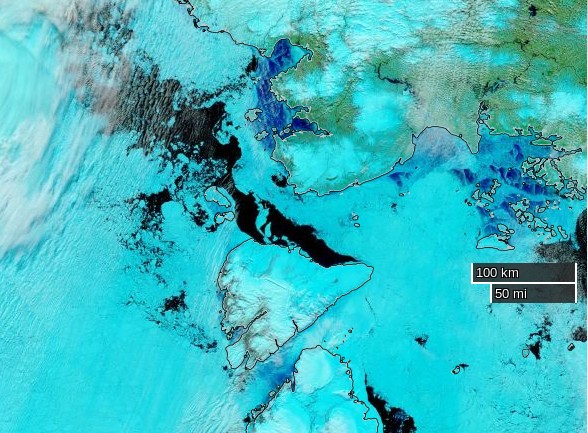
On “true colour” images sea ice looks white, and so do clouds. Using a different set of wavelengths reveals the ice in pale blue, with the clouds still white. Northabout remains anchored, and it’s easy to see why!
[Edit – August 2nd]
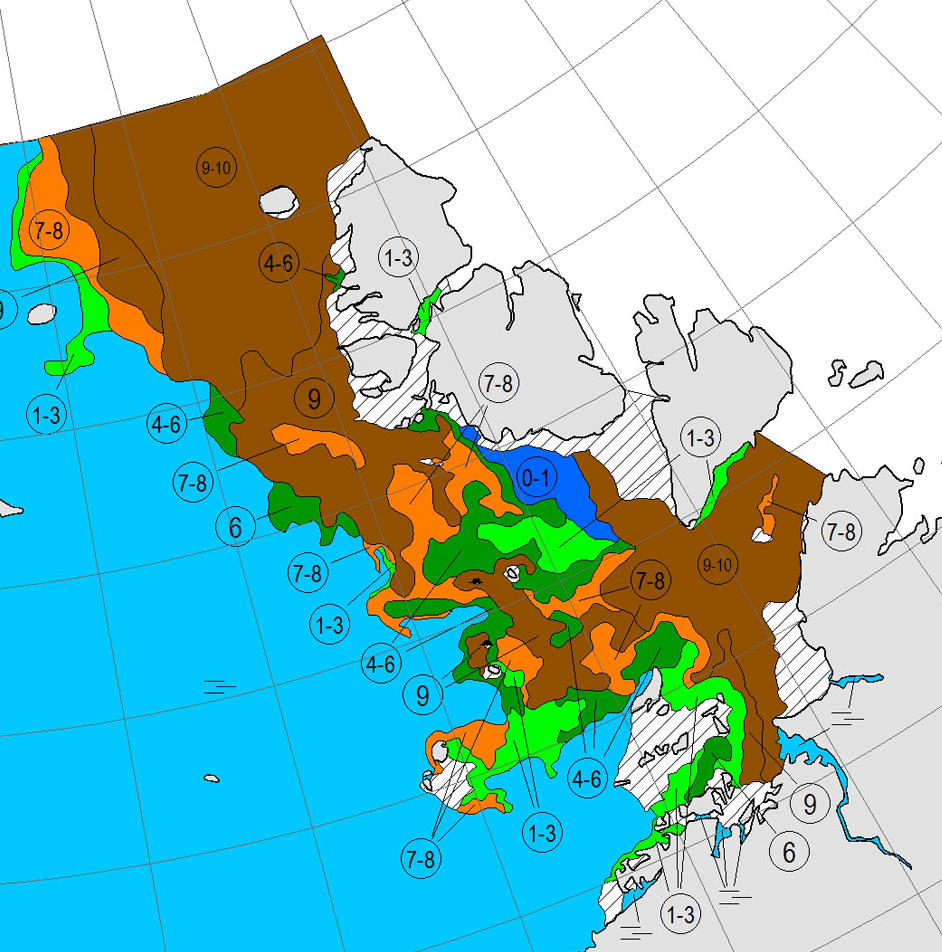
The latest AARI ice charts are out, but don’t reveal a way through to the Laptev Sea for Northabout just yet:
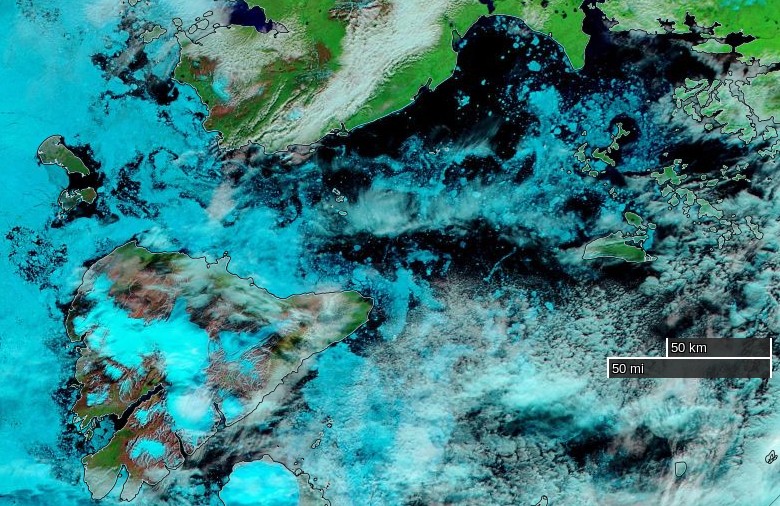
Here’s a fairly cloud free satellite image of what lies ahead:
NASA Worldview “true-color” image of the Laptev Sea on August 2nd 2016, derived from the MODIS sensor on the Aqua satellite
The crew of Northabout report that some of that ice has made its way into their anchorage:
Whilst at anchor we have a respite from our normal watch routine and it is replaced with Anchor Watch, which is an hour and half slot, mine is from 12.30am to 2am. The other crew and Northabout are in a deep slumber, perfect quiet interspersed with gentle snoring from contented crew! Last night was an exception, as the wind picked up and changed direction, resulting in some bits of drifting ice coming into the bay, ‘crashing’ into the boat at about 4am, giving all the crew an alarming wake up call. There was no danger, it was simply the deafening noise of ice and aluminium in the still of the night! Dennis was soon on the job with the ice poles, keeping all at bay!
[Edit – August 8th]
As Bill points out below, Northabout is now heading in the direction of Vilkitsky Strait:
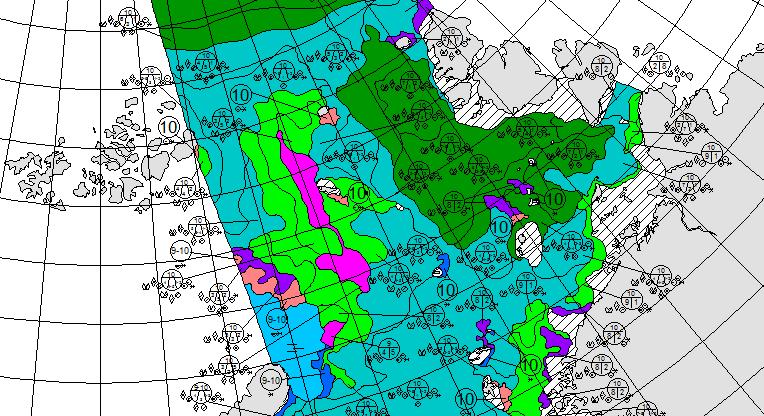
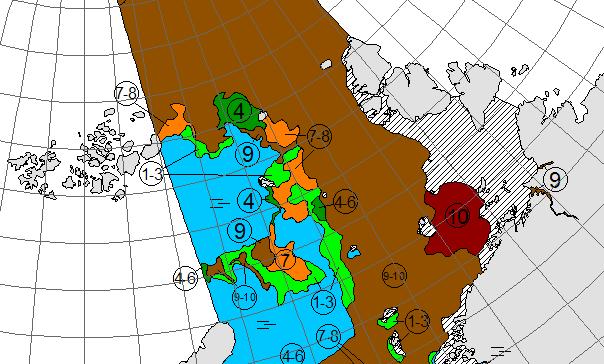
Perhaps they’ve had an early look at the latest AARI ice charts of the Laptev Sea? The Northern Sea Route Administration web site is still displaying the ones from August 5th, which showed the route blocked by 9/10 ice coverage in places:
Satellite imagery at visual frequencies is rather cloudy again today:
NASA Worldview “false-color” image of the Laptev Sea on August 8th 2016, derived from the VIIRS sensor on the Suomi satellite
but there’s still no obvious way through to the East Siberian Sea that I can see.
[Edit – August 9th]
Northabout has just rounded Cape Chelyuskin and is now heading into the Laptev Sea!
Here’s the new ice chart for the Laptev Sea:
A navigable strip does seem to be opening up around the coast, but there’s still a stubborn patch of 9/10 concentration sea ice blocking Northabout’s way.
According to the old saying “A change is as good as a rest”, so rather than plagiarise today’s title from a “skeptical” web site we’ve invented this one all by ourselves. Northabout is a small yacht with big ideas. (S)he wants to circumnavigate the North Pole in one summer season. However certain cryoblogospheric commenters are somewhat skeptical that this can be achieved this year. Take Tony Heller for example:
There has been very little melt going on in the Arctic Ocean the last few days, due to cold cloudy weather.
A group of climate clowns were planning on sailing around the entire Arctic Ocean through the Northeast and Northwest Passages (to prove there isn’t any ice in the Arctic) but are stuck in Murmansk because the Northeast Passage is completely blocked with ice.
The “group of climate clowns” aboard Northabout that Mr. Heller refers to are led by David Hempleman-Adams. According to the Polar Ocean Challenge web site:
David is one of the most experienced and successful adventurers in the world.
In his forty years as an adventurer, David was the first person to reach the highest peaks on all seven continents and journey fully to the North and South Geographical and Magnetic Poles. He has broken forty-seven Federation Aeronautique Internationale ballooning records
My name is Tony Heller. I am a whistle blower. I am an independent thinker who is considered a heretic by the orthodoxy on both sides of the climate debate.
I have degrees in Geology and Electrical Engineering, and worked on the design team of many of the world’s most complex designs, including some which likely power your PC or Mac. I have worked as a contract software developer on climate and weather models for the US government.
However despite Tony’s long list of qualifications he is evidently currently quite confused, since according to the Polar Ocean Challenge live tracking map David and Northabout are not in actual fact “stuck in Murmansk” at all:
This shouldn’t come as surprise to anyone with an internet connection and a desire to check the facts, since as we speak there is currently remarkably little sea ice cover on the Atlantic side of the Arctic Ocean:
Hence Northabout should find the next leg of his/her voyage across the Barents and Kara Seas pretty plain sailing. However Vilkitsky Strait, the passage from the Kara into the Laptev Sea, is currently looking a trifle tricky:
NASA Worldview “true-color” image of the Vilkitsky Strait on July 20th 2016, derived from the MODIS sensor on the Terra satellite
Do you suppose Tony Heller suffers from precognitive dreams?
[Edit – July 22nd 2016]
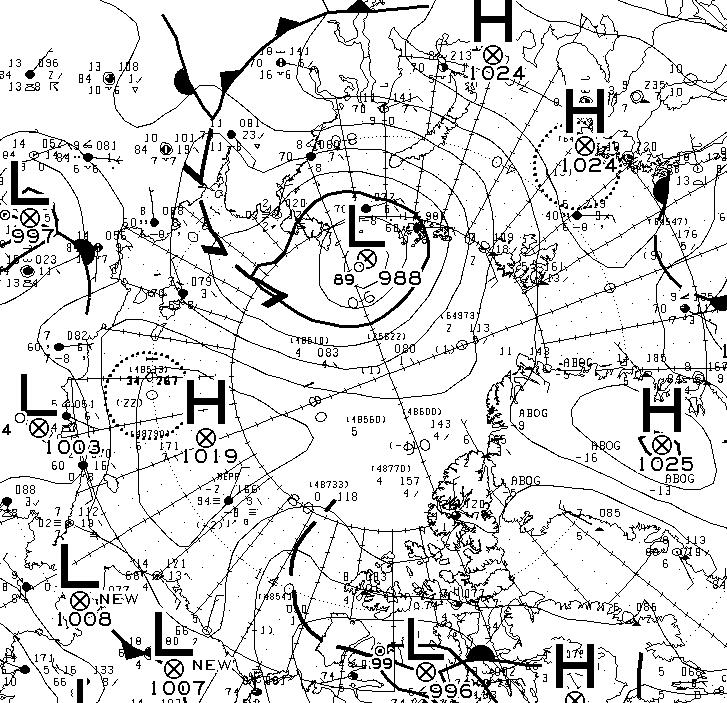
According to Environment Canada this morning there’s a 988 hPa central pressure cyclone causing a bit of a blow in the Vilkitsky Strait at the moment:
Sea and air temperature getting colder as we venture further north. Saw quite a lot of Dolphins for the first time around the Yacht. Still sea gulls flying behind and skimming the waves.
Had some promising Canadian ice charts yesterday, but that’s a long way off. Today we should get an update with the Russian side. fingers crossed it is still not solid around the cape and Laptev sea. That could slow us down considerably. The wind has been blowing the pack ice against the land, so very difficult to get around the shore, but let’s see what Santa brings.
P.S. Maintaining his usual modus operandi, Tony Heller has penned a new article today, containing a satellite image remarkably similar to the one just above. Under the headline “The 2016 Franklin Expedition” he tells his loyal readership:
The Polar Ocean Challenge is headed off into the ice.
They will run into this in three days – hundreds of miles of solid ice. Without an icebreaker, they are going nowhere. I asked them on Twitter if they have an icebreaker. I haven’t received a response, and will be monitoring them by satellite to see if they are cheating.
By some strange coincidence we’re “monitoring them by satellite” too:
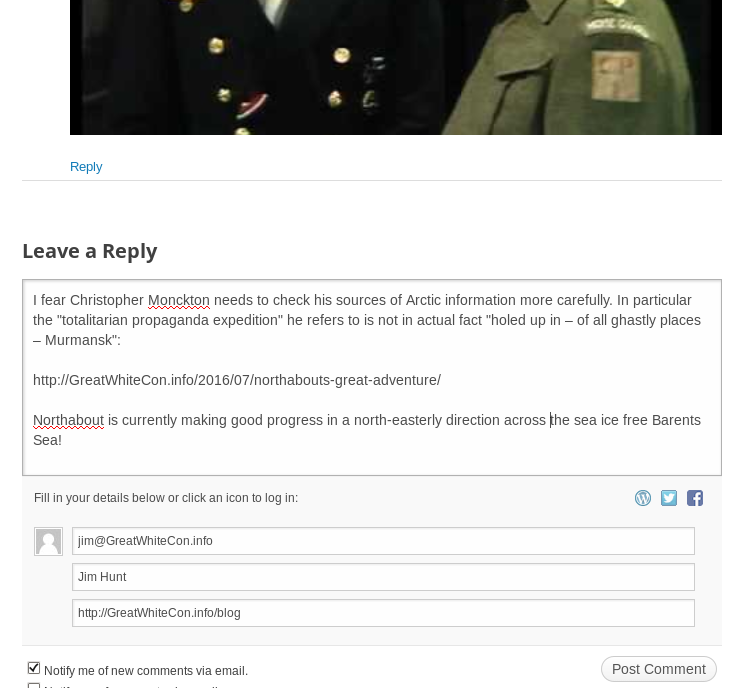
As for ice melt, yet another totalitarian propaganda expedition intended to “raise awareness” of climate “catastrophe” by trying to sail around the Arctic in the summer has just come a cropper owing to – er – too much ice. Neither the North-East Passage nor the North-West Passage is open, so the expedition is holed up in – of all ghastly places – Murmansk. That’ll teach Them.
However my corrective comment has yet to see the light of day at WUWT:
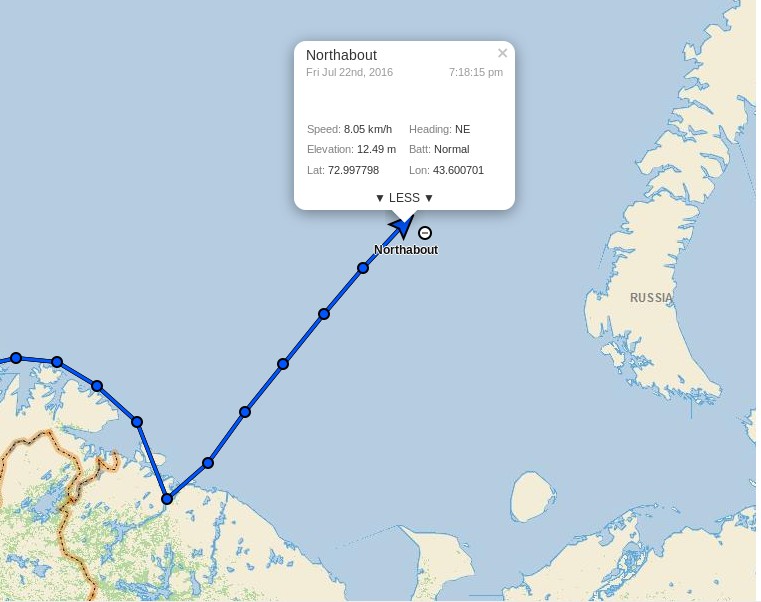
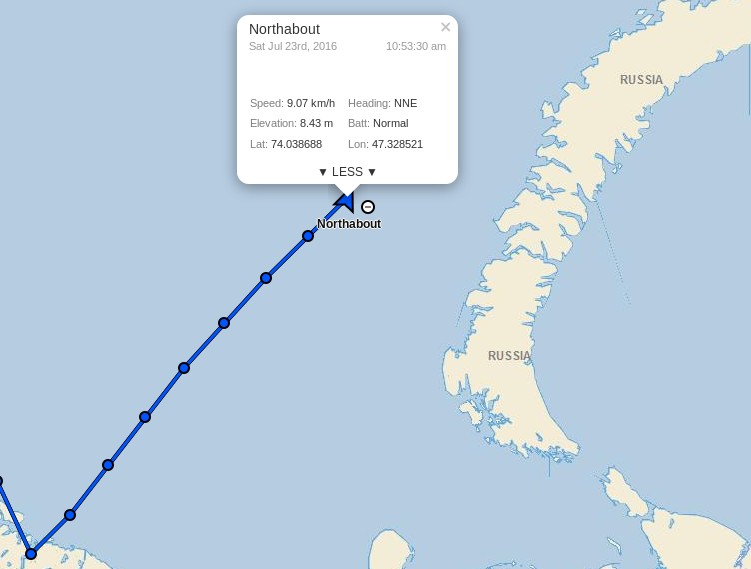
Meanwhile Northabout resolutely presses on regardless, and has just passed 74 degrees North:
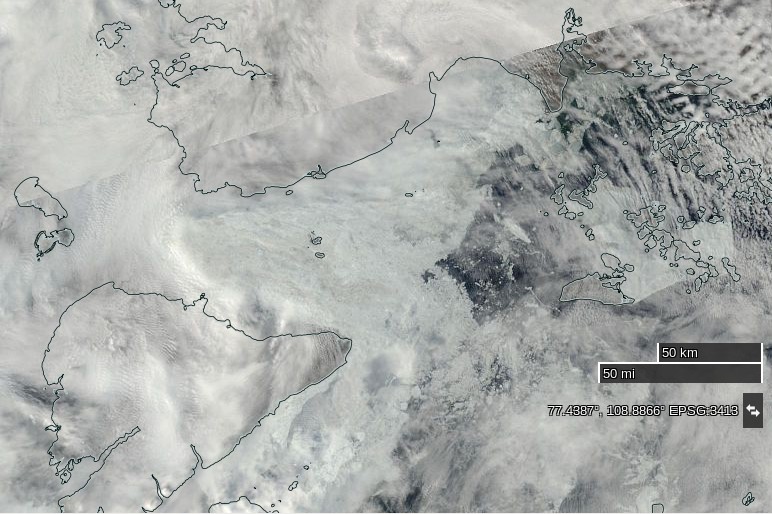
whilst the sea ice edge in the north-eastern Kara Sea has retreated somewhat over the last three days:
NASA Worldview “true-color” image of the Vilkitsky Strait on July 23rd 2016, derived from the MODIS sensor on the Terra satellite
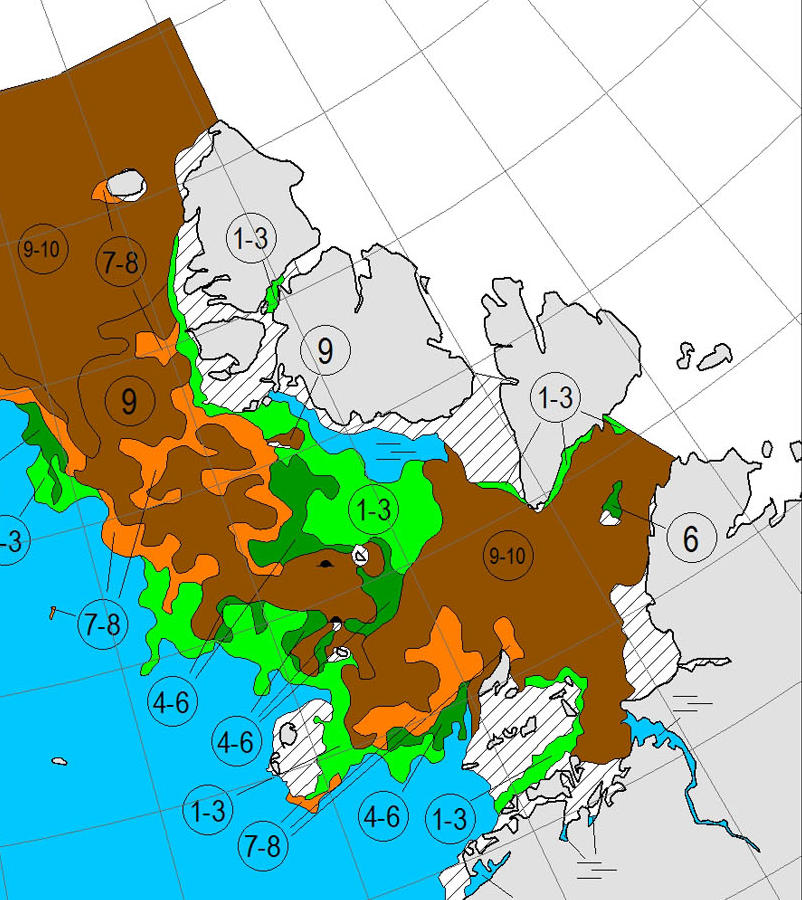
Here’s the July 20-22nd AARI map of the Vilkitsky Strait area:
On the topic of Arctic sea ice melt in general Viscount Monckton opines over on WUWT that:
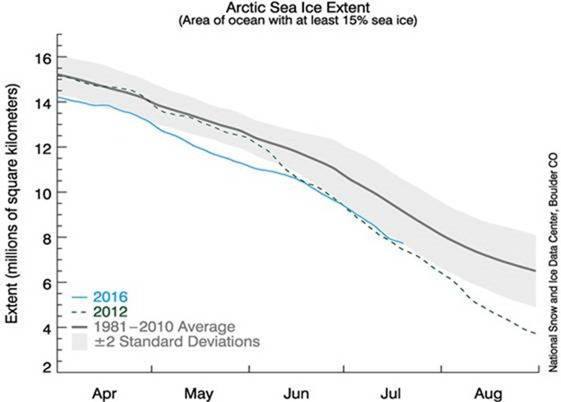
According to the National Snow and Ice Data Center’s graph, also available at WUWT’s sea-ice page, it’s possible, though not all that likely, that there will be no Arctic icecap for a week or two this summer:
Even if the ice disappears for a week or two so what? The same was quite possibly true in the 1920s and 1930s, which were warmer than today in the northern hemisphere, but there were no satellites to tell us about it.
The Good Lord seems to have a very tenuous grasp on reality, since the NSIDC’s graph shows nothing of the sort. Perhaps he is merely indulging in irony?
[Edit – July 24th 2016]
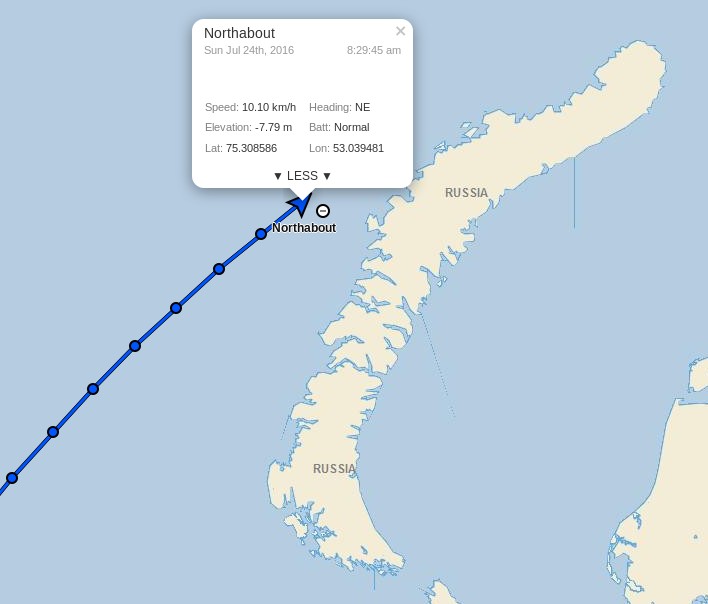
Northabout passed the 75 degrees North milestone overnight:
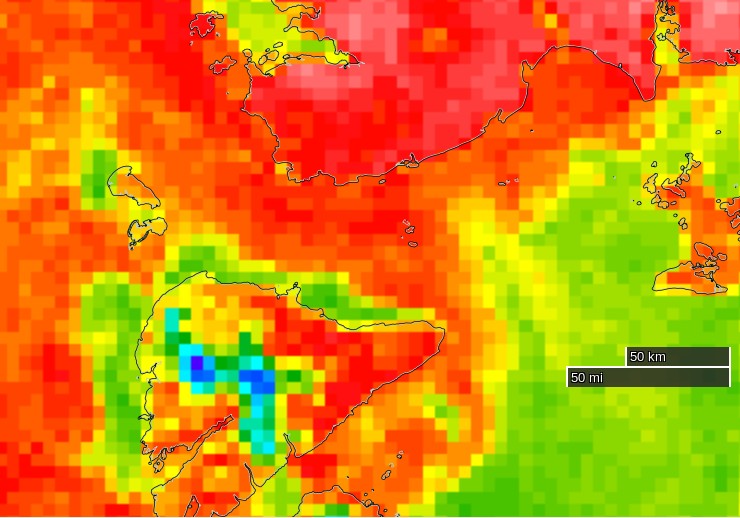
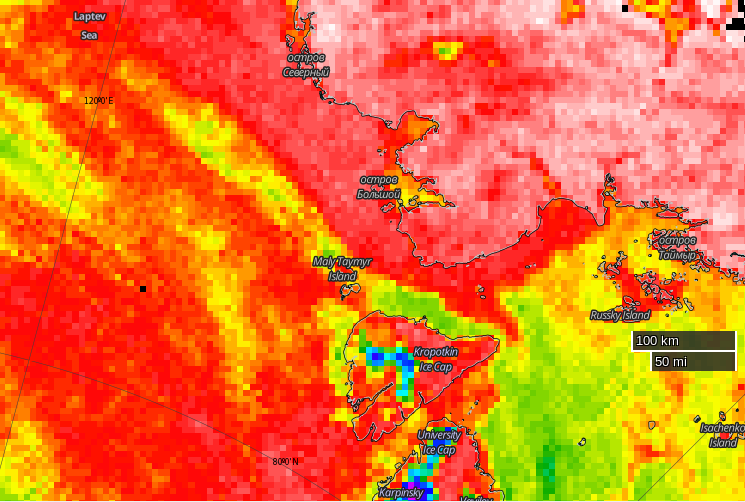
Clouds obscure the Vilkitsky Strait in visible light this morning but passive microwaves make it through the murk, albeit with reduced resolution. They reveal the sea ice edge in the Kara Sea receding and a narrow passage opening up along the Northern side of the Strait (North is down in the image):
NASA Worldview passive microwave image of the Vilkitsky Strait on July 24th 2016, derived from the AMSR2 instrument on the Shizuku satellite
According to Ben Edwards’ latest blog post from the Barents Sea:
I just wore a T-shirt on my first watch out of Murmansk. Today I wore my trawler suit and a primaloft under it with gloves and a hat….
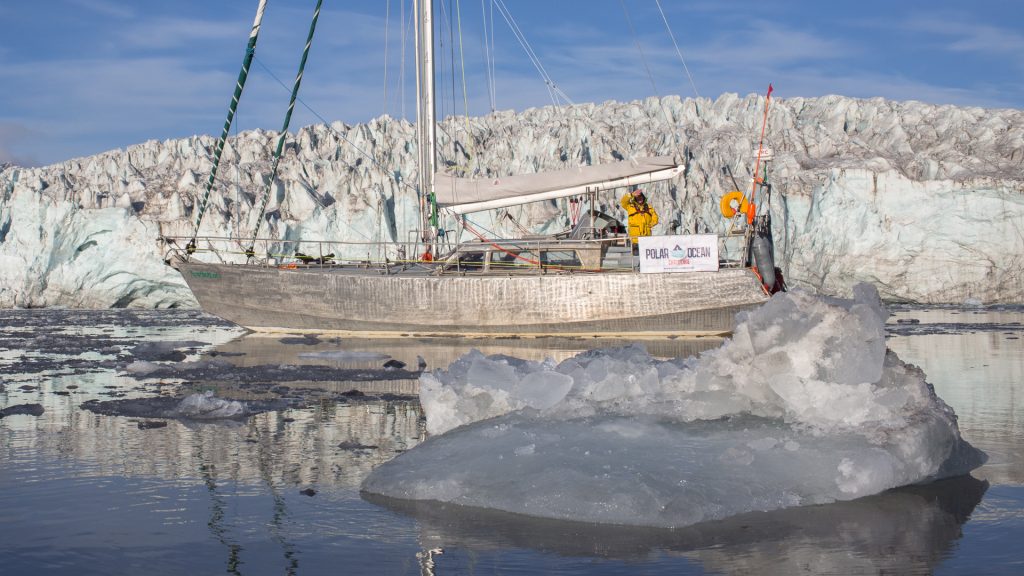
As the cryodenialosphere continue to retweet and reblog their regurgitated rubbish here’s a picture from last year of Northabout amidst some ice, especially for those apparently unable to distinguish a small yacht from a large icebreaker:
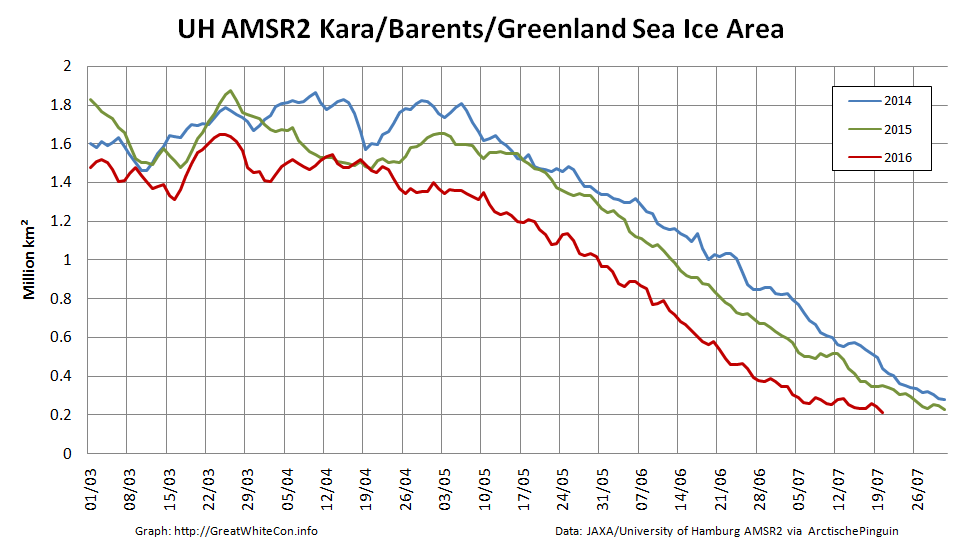
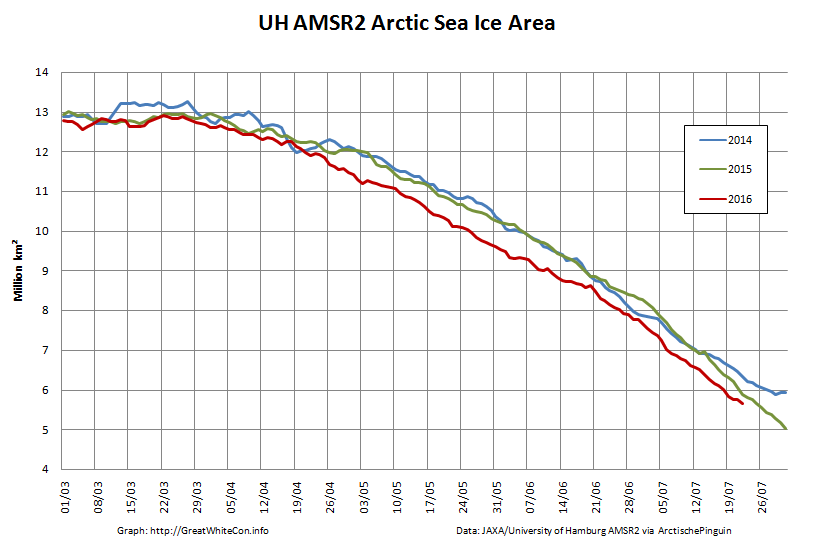
Meanwhile Arctic sea ice continues its inexorable decline:
[Edit – July 24th 2016 PM]
Shock News! Tony Heller has just published yet another article about Northabout’s Great Adventure, and yours truly gets a mention. In the headline no less!! Read all about it at:
Meanwhile the commenters over at unReal Science keep blathering on about icebreakers even though one of the more inquisitive denizens posted thisextract from the “Ship’s Log” over there yesterday:
Partly checked the new ice charts on www.nsra.ru, we still have no chance of getting through yet, not past the cape or through the Laptev sea. Nikolai, Our Russian Captain who is very familiar with this route, impresses on me that this is a very unusual year and normally clear, Not what I want to hear. We are under sail, so saving fuel, and will find a small island to shelter until we get improvements. We are still 5 days from the ice, so lets hope for some southerly winds to push the ice from shore.
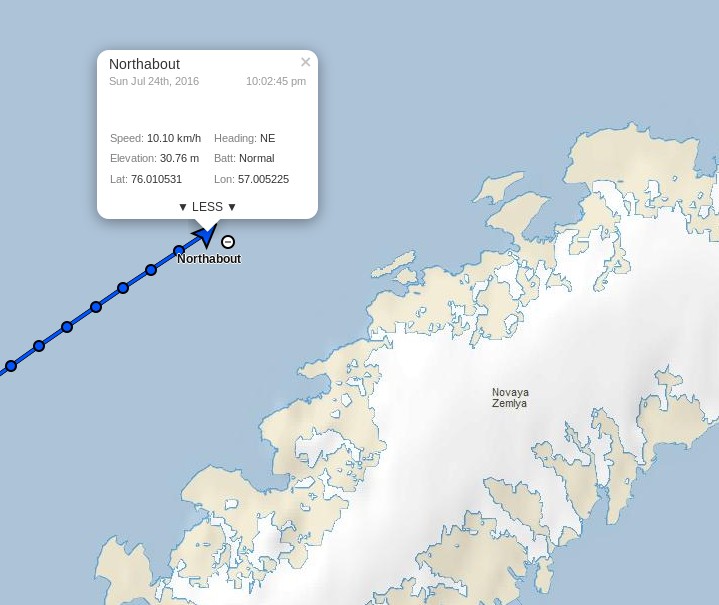
Northabout is heading for the Kara Sea past the northern tip of Novaya Zemlya, and has now passed 76 degrees North:
[Edit – July 25th 2016]
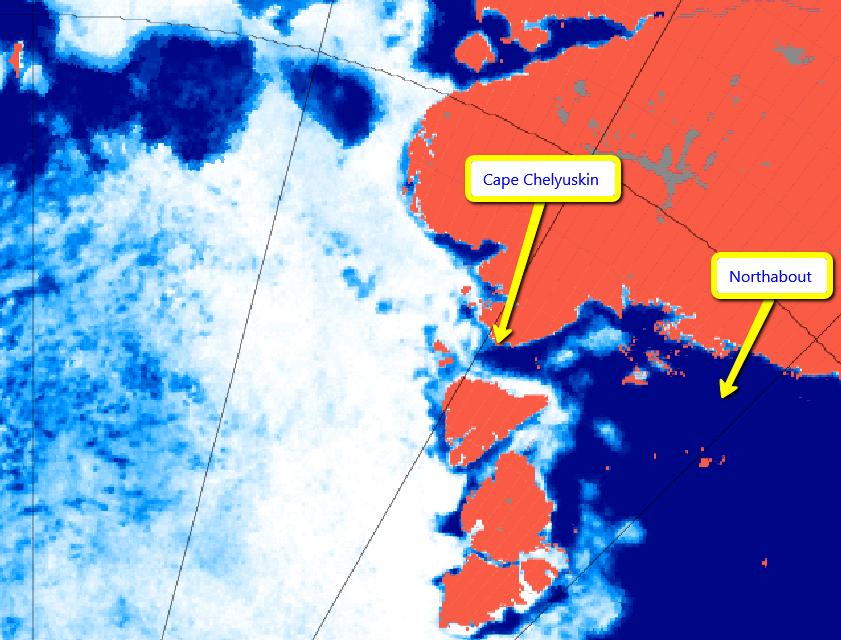
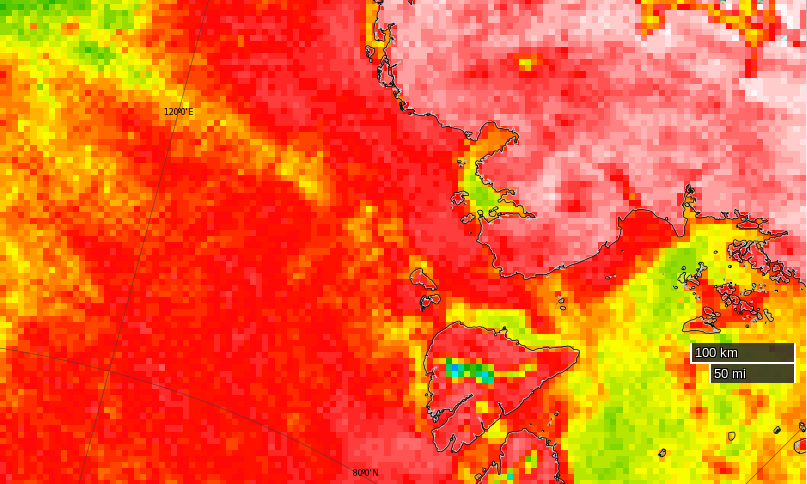
The skies are still cloudy over the Vilkitsky Strait and Cape Chelyuskin, so here’s another AMSR2 passive microwave visualisation of the state of play. Note the change of scale:
NASA Worldview passive microwave image of the Vilkitsky Strait on July 25th 2016, derived from the AMSR2 instrument on the Shizuku satellite
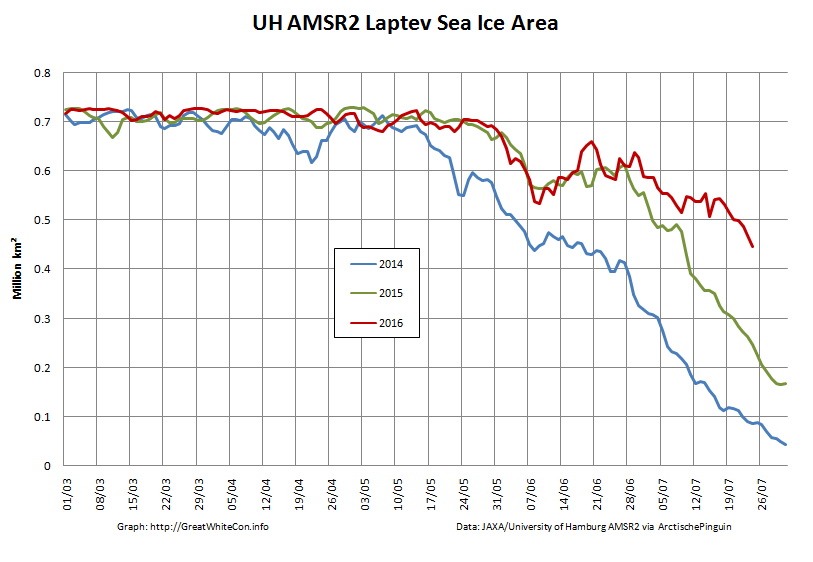
The sea ice area in the Laptev Sea has finally started decreasing at a more “normal” rate for late July, but still has a lot of catching up to do compared to recent years:
Meanwhile over at “Watts Up With That” at least one reader of Christopher Monckton’s purple prose is clearly confused. Needless to say my clarifying comment is still invisible to him:
Finally, for the moment at least, here’s some moving pictures of dolphins having fun in the Barents Sea:
[Edit – July 26th 2016]
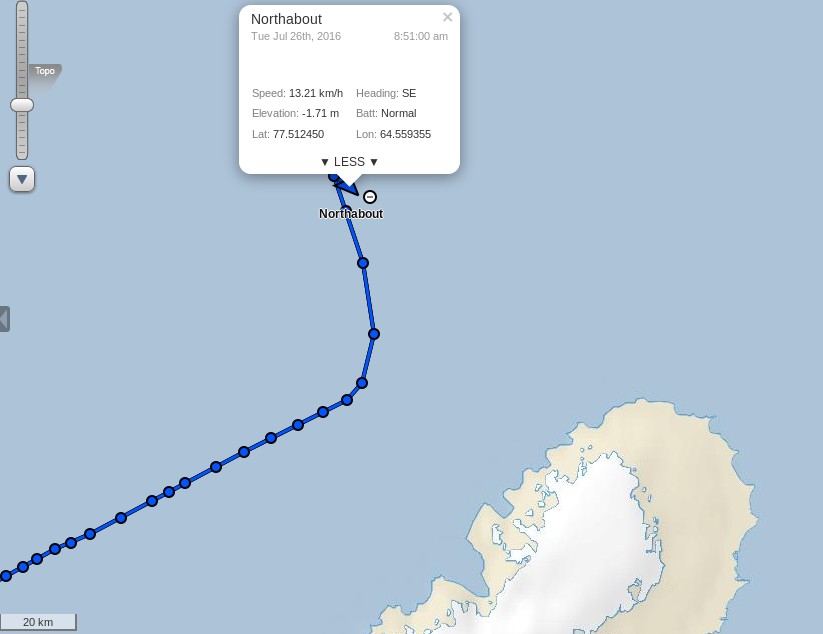
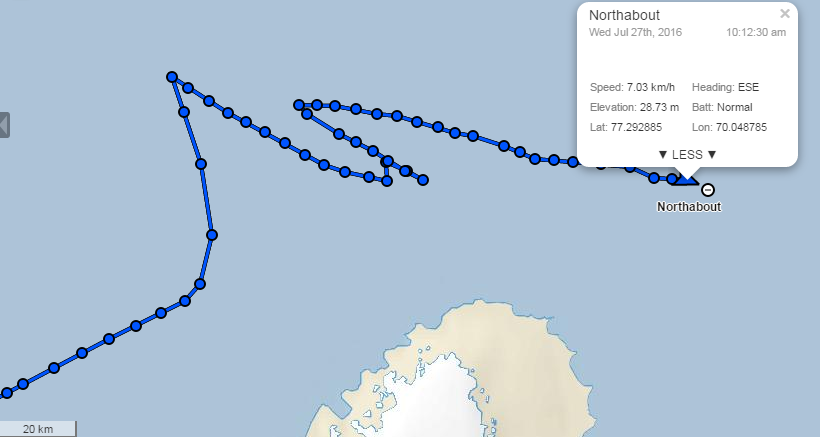
I was expecting Northabout to have entered the Kara Sea by now, but instead (s)he has headed north, and is now well above the 77th parallel:
It’s still pretty cloudy up there so here once again is the latest AMSR2 passive microwave visualisation of the Vilkitsky Strait area, with a few place names added for a bit of variety:
NASA Worldview passive microwave image of the Vilkitsky Strait on July 26th 2016, derived from the AMSR2 instrument on the Shizuku satellite
P.S. The Polar Ocean Challenge team explain via Twitter:
@GreatWhiteCon Ha ha! Thanks for interest! Waiting game, manoeuvring, strategy. Difficult to update in choppy conditions! New SHIPSLOG now
— PolarOceanChallenge (@PolarOceanChall) July 26, 2016
Choppy sea, taking four hour tacks. These sea conditions make it hard to sleep, cook or relax.
We are considering many elements all the time. We are due new Russian Ice charts today.
We know the North west is pretty clear, but this year is a very unusual year in the north east passage. Normally the Laptev Sea would be pretty open now as in previous years. It is not. This is also partly due to the wind blowing the pack ice down south and consolidating next to the land.
So, we need to get through the straight and through the Laptev Sea. So where do we wait until we can do this? We have deliberately taken our time to get to this point, and used the wind as much as we can to conserve fuel.
Now the weather has changed, the wind direction has also changed. From the calm turquoise seas, to choppy short seas, wet, windy and cold.
So we took a long tack north, and then tacked east again. There is No hurry. We will slowly make our way east, and if we can find an island with no fast ice around, will look for a sheltered spot, until we get better ice conditions.
The other options are to Heave to and wait, but this is a sailing Yacht, she needs to sail. And if we get a Southerly blow, it could change our chances very quickly to get around, so we need to be close to react.
So, another day at the office.
There was a report on the BBC Radio 4 Today programme this morning from the crew of Northabout, and an interview with Dr. Ed Blockley from the UK Met Office about the current state of sea ice in the Arctic:
Note in particular the part at 2:59:00 where Justin Webb says to Ed:
I thought that I’d read somewhere that [Northabout] had got stuck.
I cannot help but wonder what on Earth gave him that idea?
[Edit – July 27th 2016]
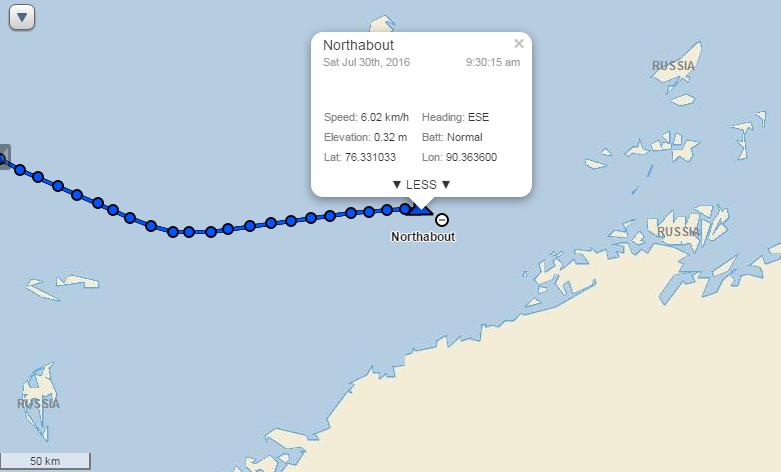
After “going round in circles” north of Novaya Zemlya yesterday Northabout is now heading East across the Kara Sea:
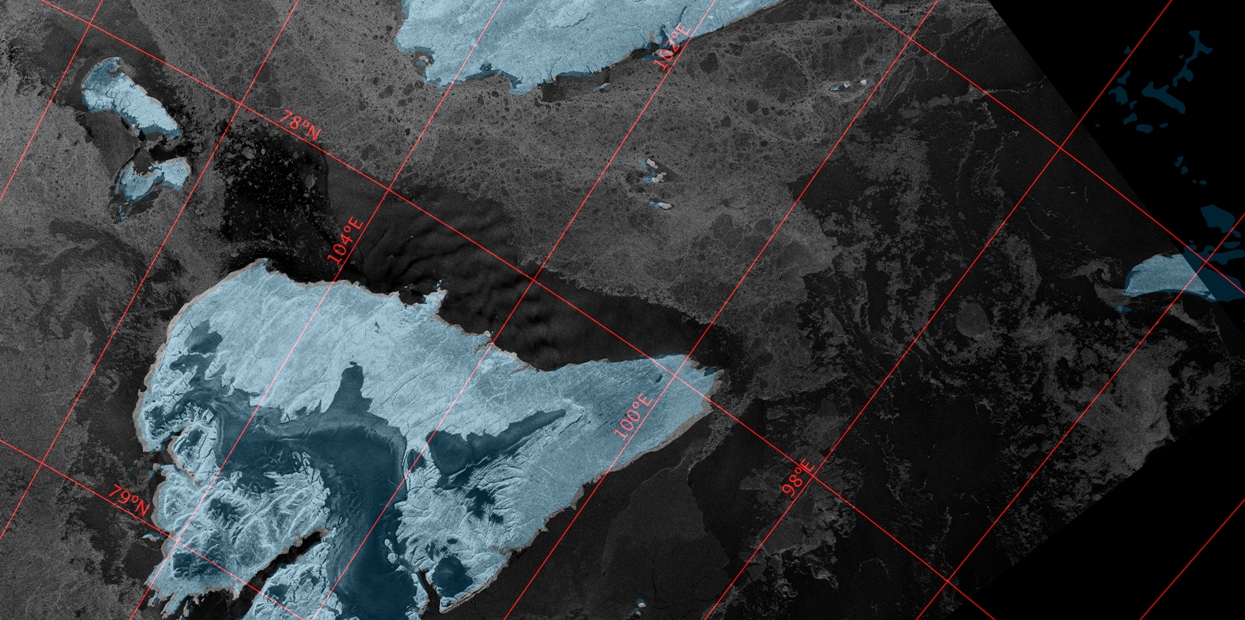
Synthetic aperture radar images from the European Space Agency’s Sentinel 1A satellite have started flowing through Polarview once again, so here’s one of where Northabout is heading:
Sentinel 1A synthetic aperture radar image of the Vilkitsky Strait on July 26th 2016
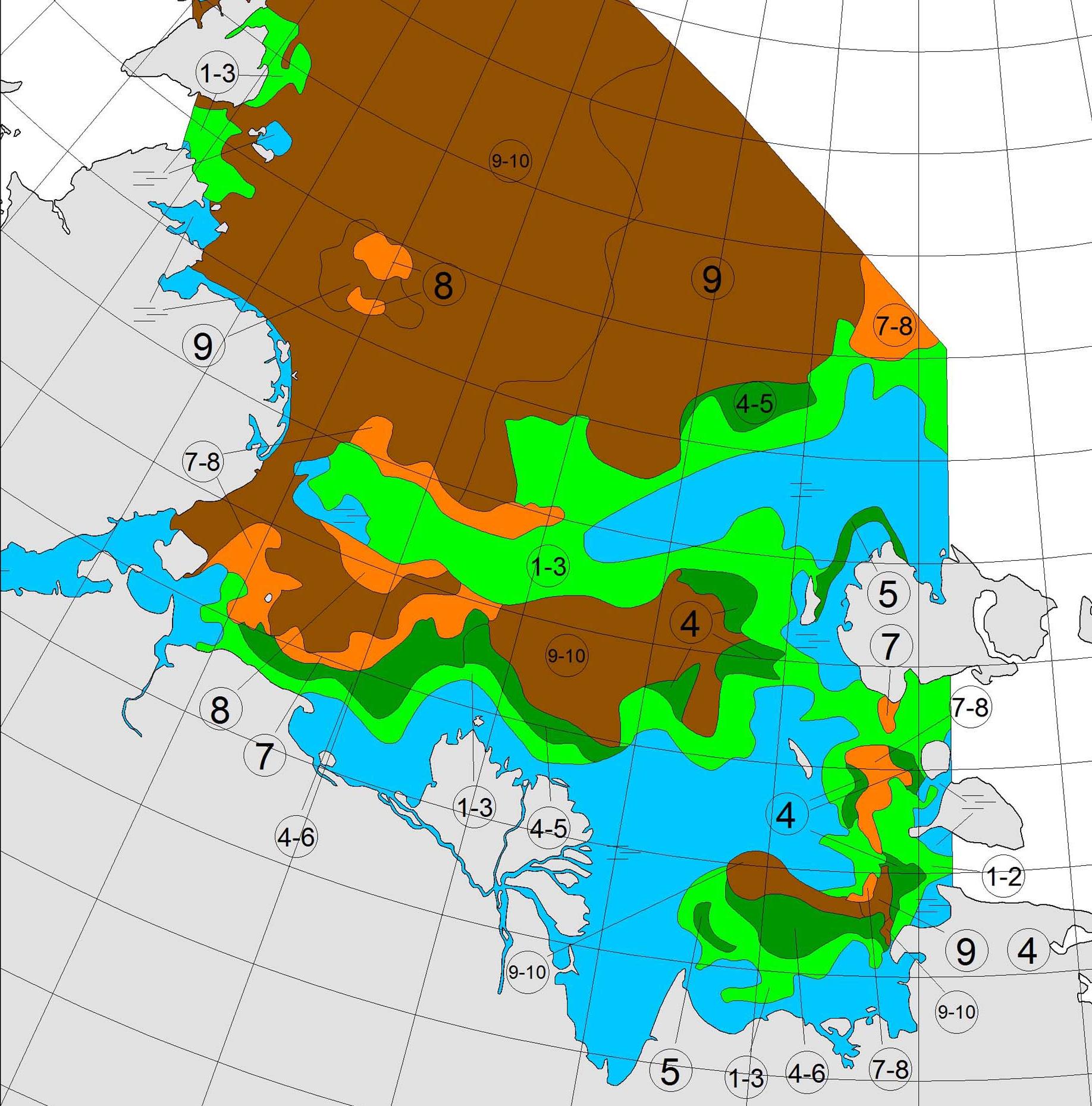
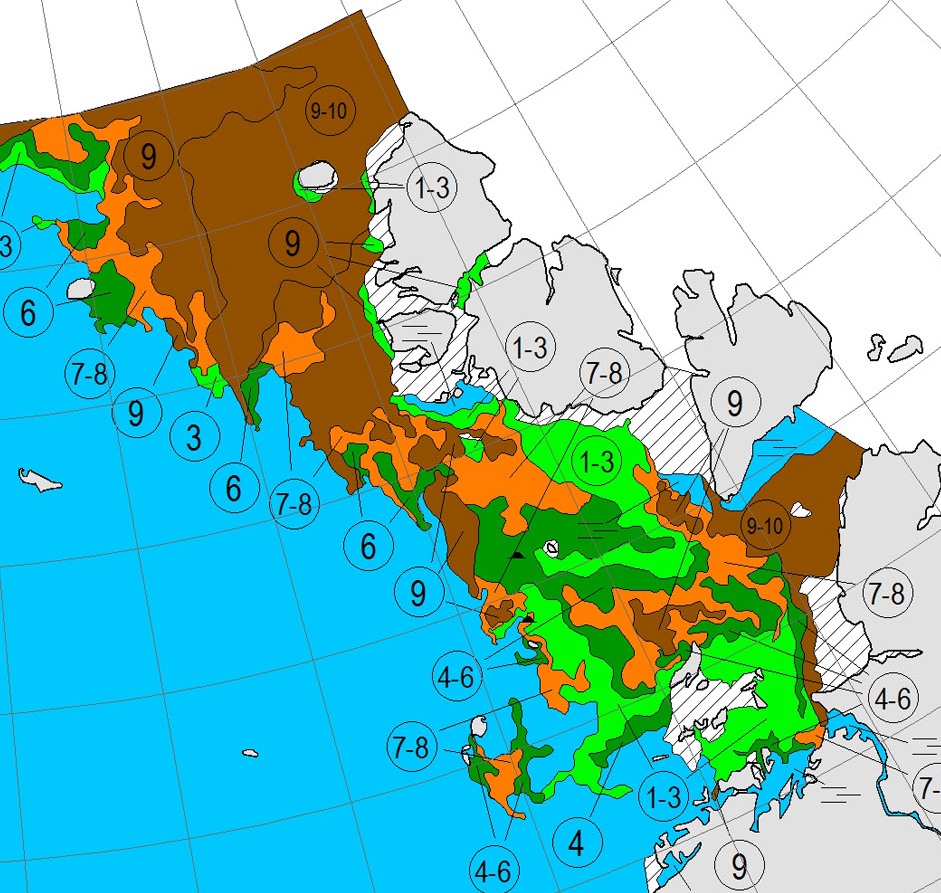
Here’s the current Arctic and Antarctic Research Institute map of the same area:
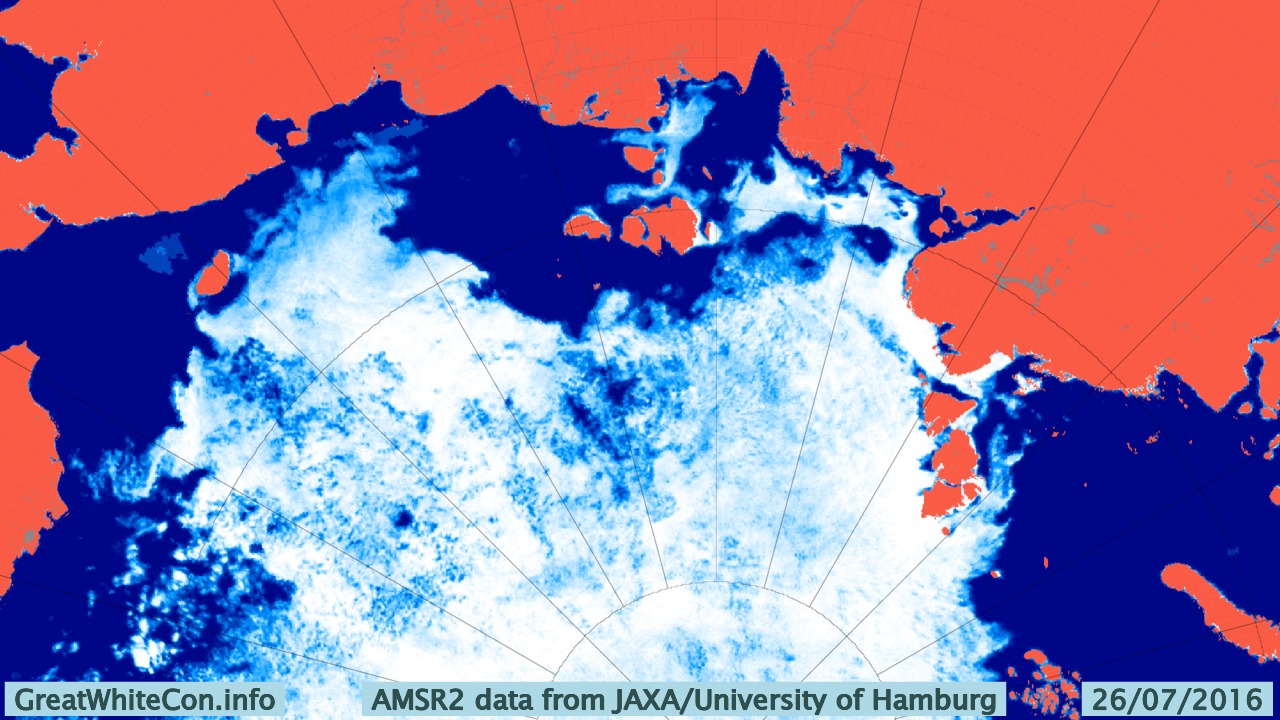
There’s still no way through by which Northabout might avoid an encounter with 9-10 tenths sea ice coverage. Then of course there’s the Laptev Sea to contend with too. Here’s the latest AMSR2 visualisation from the University of Hamburg:
It’s not exactly plain sailing there either just yet!
[Edit – July 28th 2016]
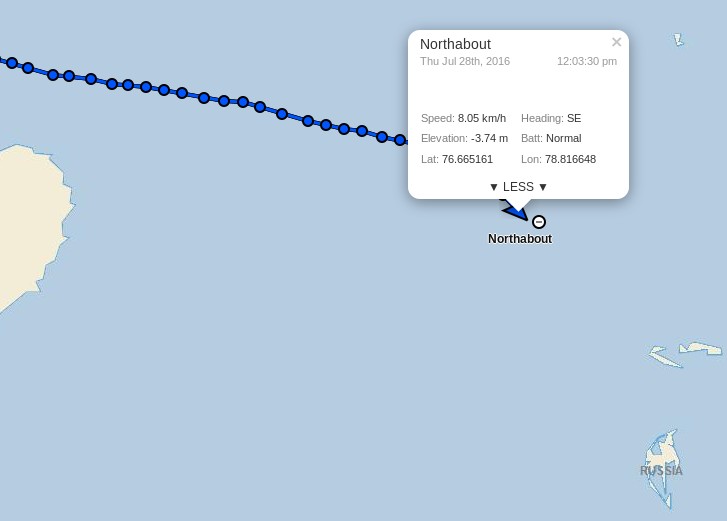
This morning Northabout has almost reached 79 degrees East, and appears to be heading in the direction of Ostrov Troynoy:
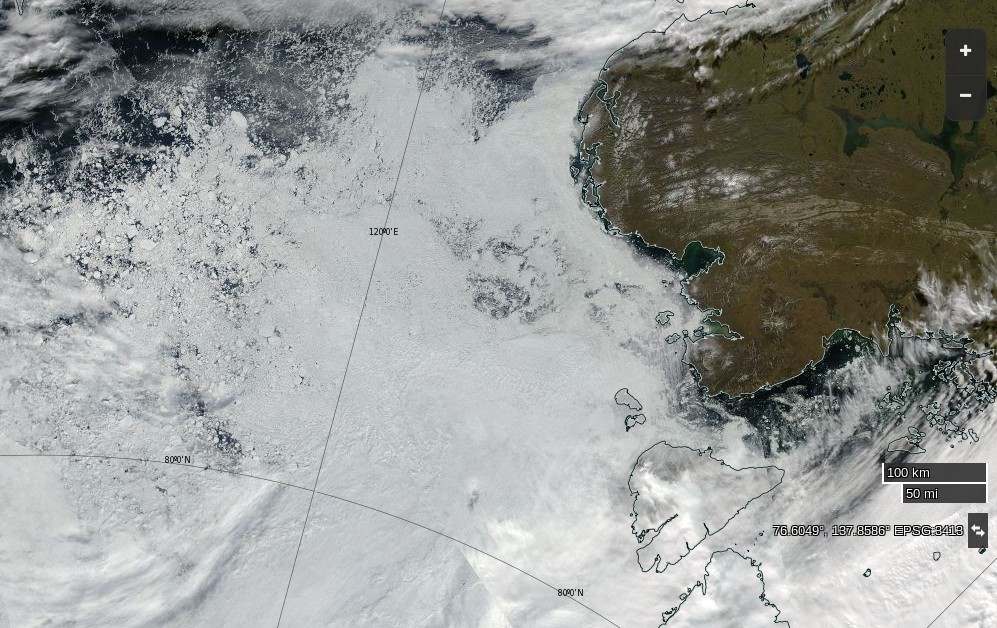
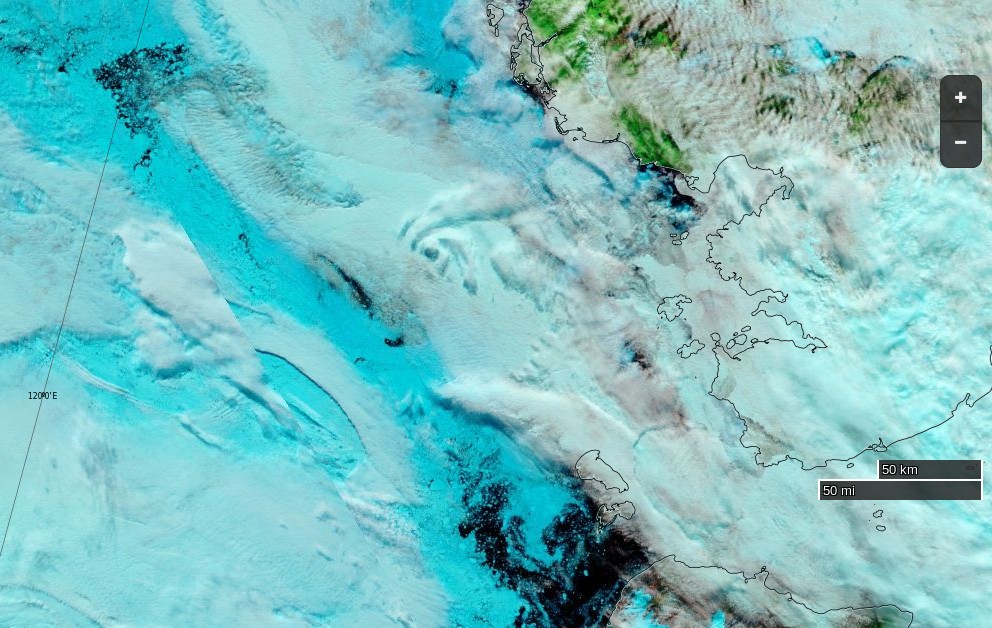
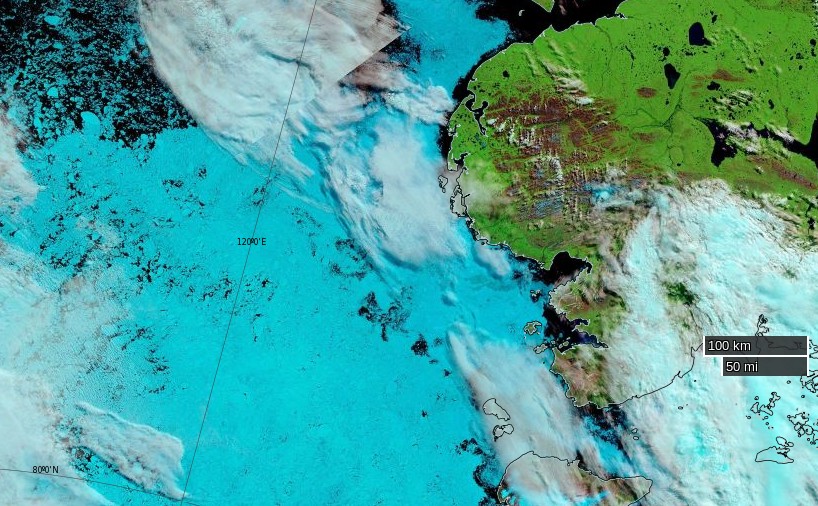
The clouds over the Laptev Sea have cleared somewhat as the recent cyclone heads for the Beaufort Sea, to reveal that the “brick wall” of ice referred to in certain quarters now looks more like Swiss cheese:
NASA Worldview “false-color” image of the Laptev on July 28th 2016, derived from the MODIS sensor on the Terra satellite
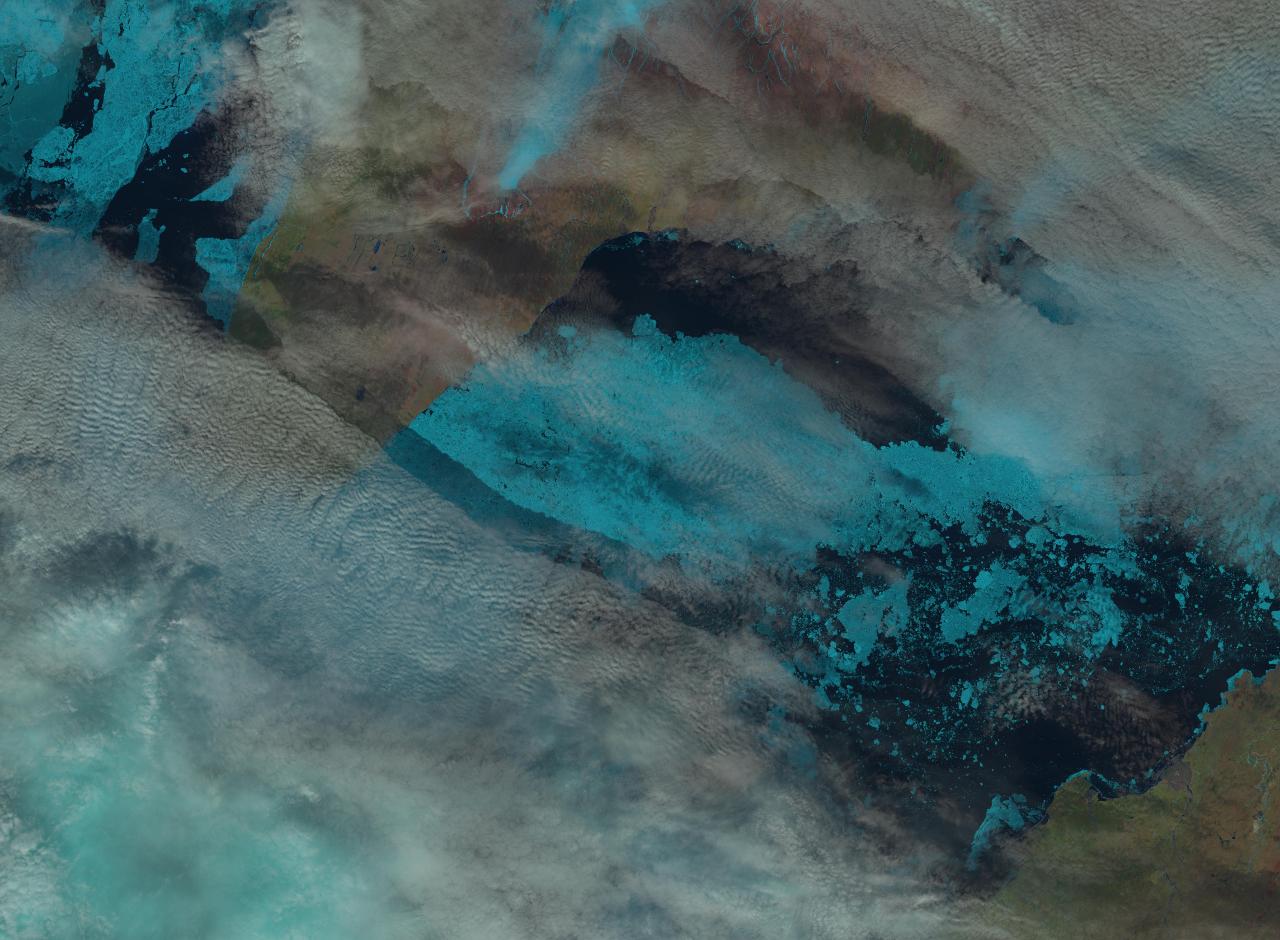
Here’s a close up look at the Vilkitsky Strait from the Landsat 8 satellite this morning. Note that unlike the MODIS image above, north is at the top of this one:
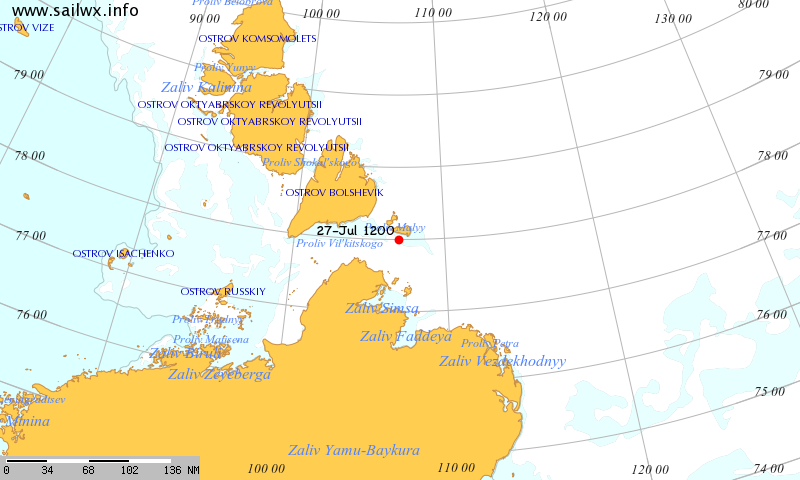
Meanwhile according to SailWX the Russian icebreaker Yamal is traversing the Vilkitsky Strait from east to west:
This website uses cookies to improve your experience. We'll assume you're ok with this, but you can opt-out if you wish. Cookie settingsACCEPT
Privacy & Cookies Policy
Privacy Overview
This website uses cookies to improve your experience while you navigate through the website. Out of these, the cookies that are categorized as necessary are stored on your browser as they are essential for the working of basic functionalities of the website. We also use third-party cookies that help us analyze and understand how you use this website. These cookies will be stored in your browser only with your consent. You also have the option to opt-out of these cookies. But opting out of some of these cookies may affect your browsing experience.
Necessary cookies are absolutely essential for the website to function properly. This category only includes cookies that ensures basic functionalities and security features of the website. These cookies do not store any personal information.
Any cookies that may not be particularly necessary for the website to function and is used specifically to collect user personal data via analytics, ads, other embedded contents are termed as non-necessary cookies. It is mandatory to procure user consent prior to running these cookies on your website.