Category Archives: Volume

Facts About the Arctic in June 2017

After a comparatively cool May, surface air temperatures in the high Arctic are back up to “normal”:
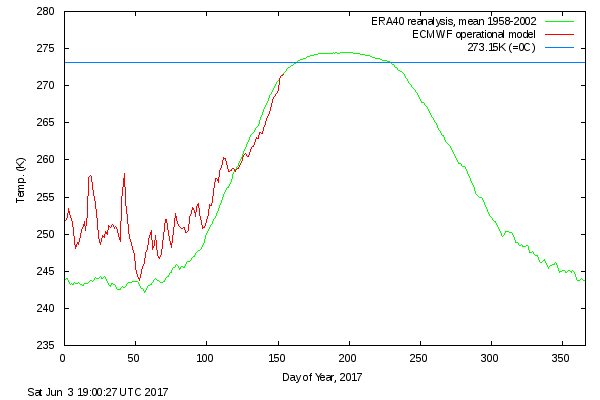
DMI-meanT_20170603

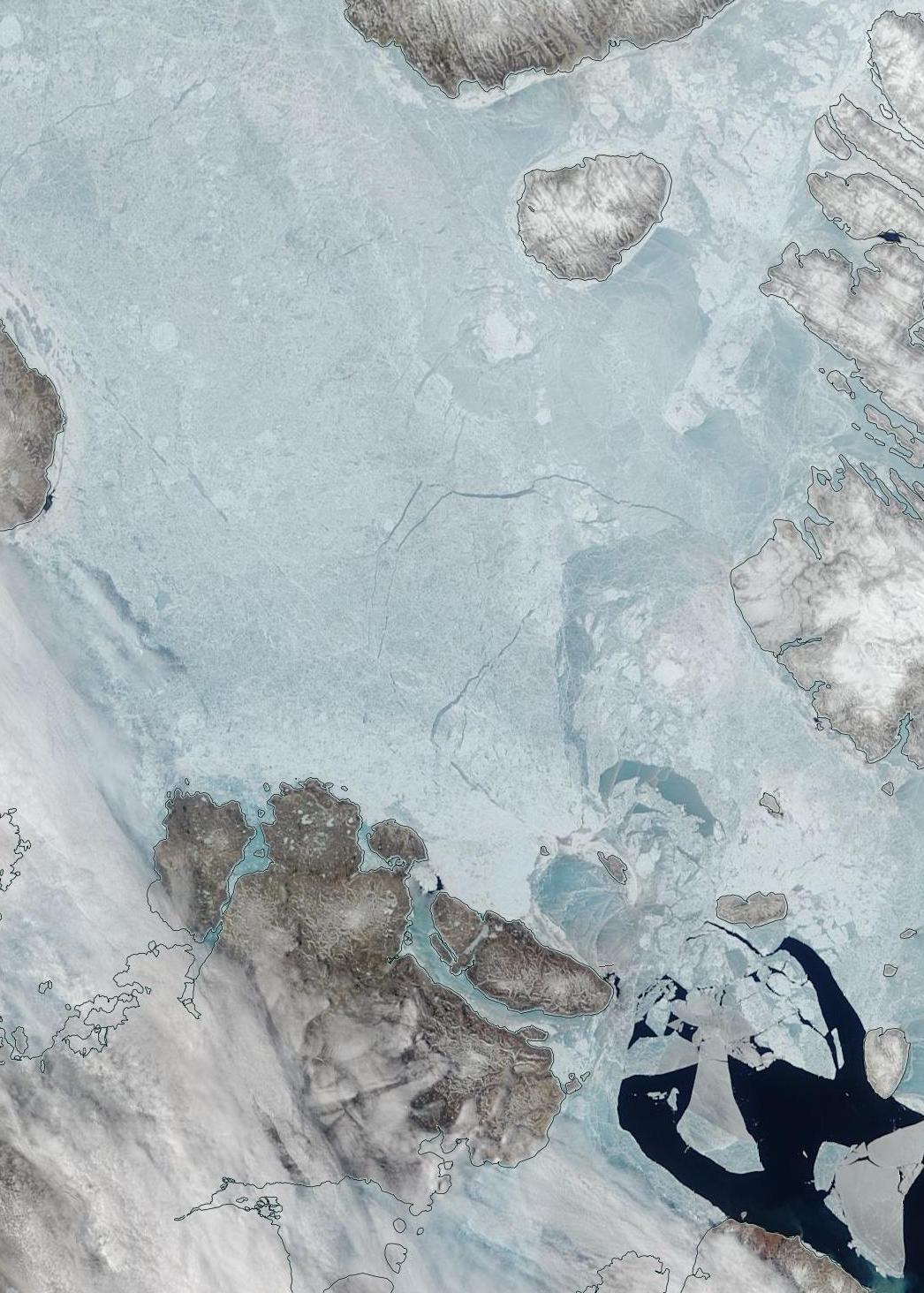
The condition of the sea ice north of 80 degrees is far from normal however. Here’s what’s been happening to the (normally) land fast ice north west of Greenland:
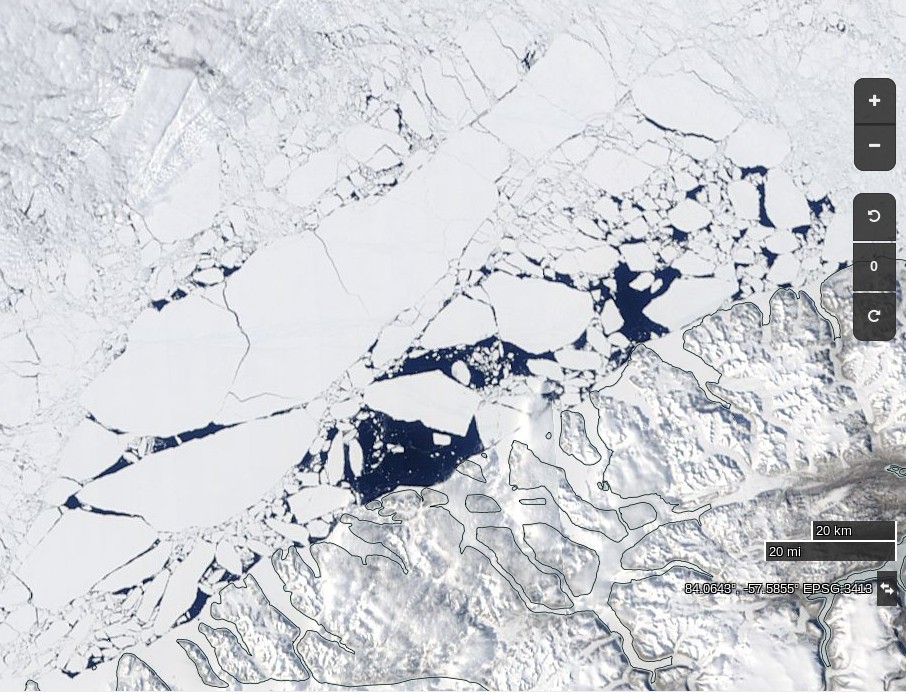
NASA Worldview “true-color” image of the sea ice north west of Greenland breaking up on June 2nd 2017

Further south surface melt has set in across the southern route through the Northwest Passage:
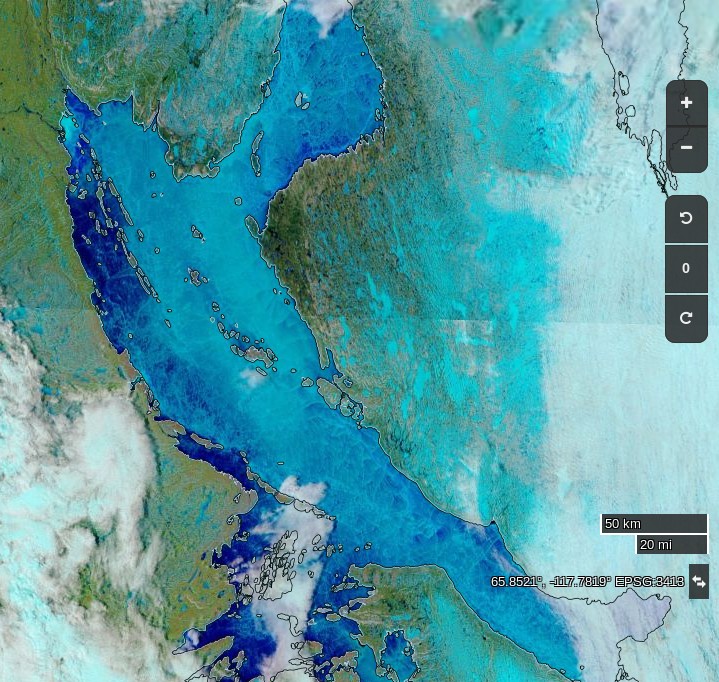
NASA Worldview “false-color” image of the Coronation Gulf on June 1st 2017, derived from the MODIS sensor on the Terra satellite

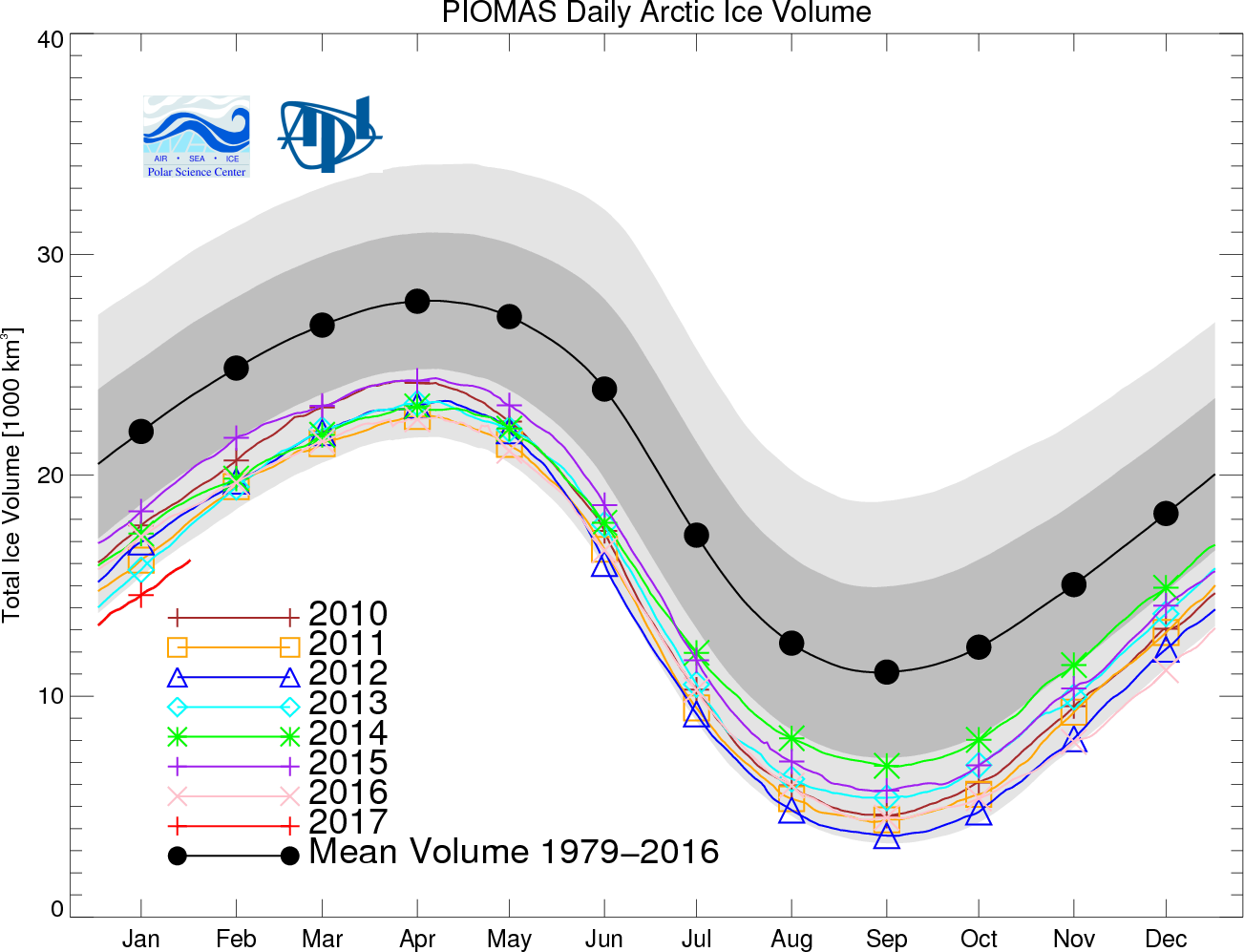
Whilst the gap with previous years has narrowed during May, PIOMAS Arctic sea ice volume is still well below all previous years in their records:
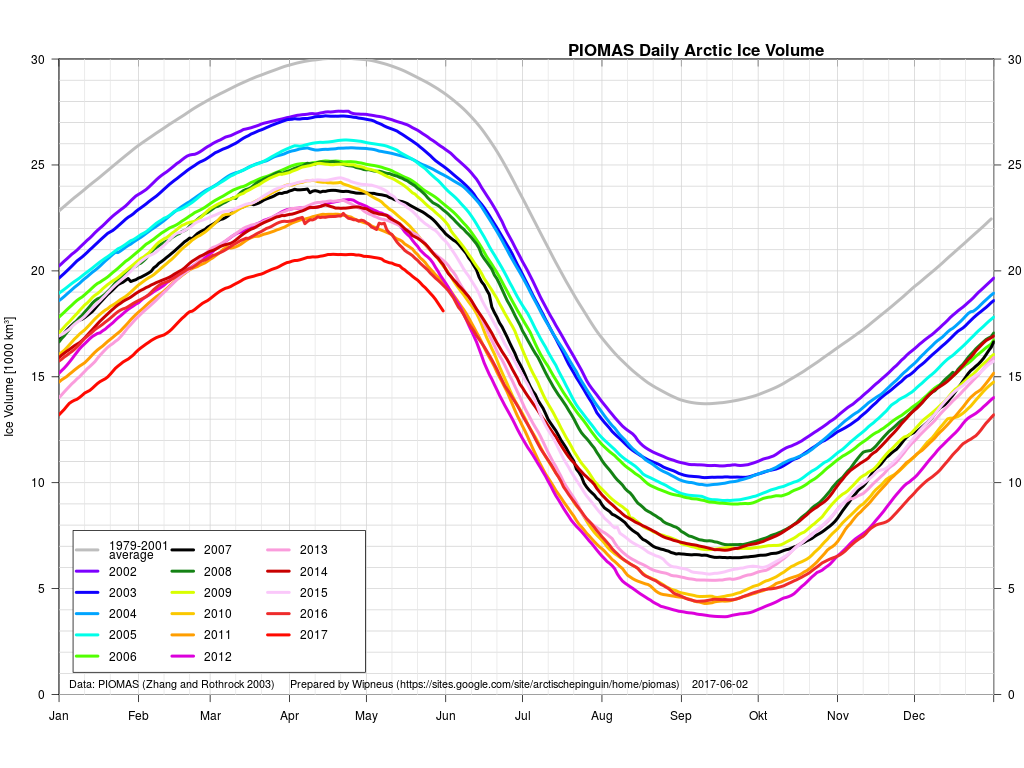
piomas-graph-201705

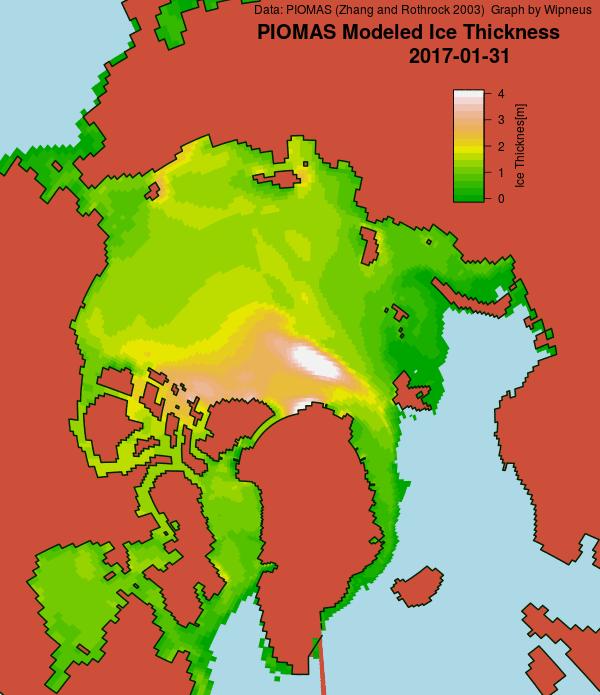
The PIOMAS gridded thickness graph suggests that a large area of thick ice is currently sailing through the Fram Strait to ultimate oblivion:
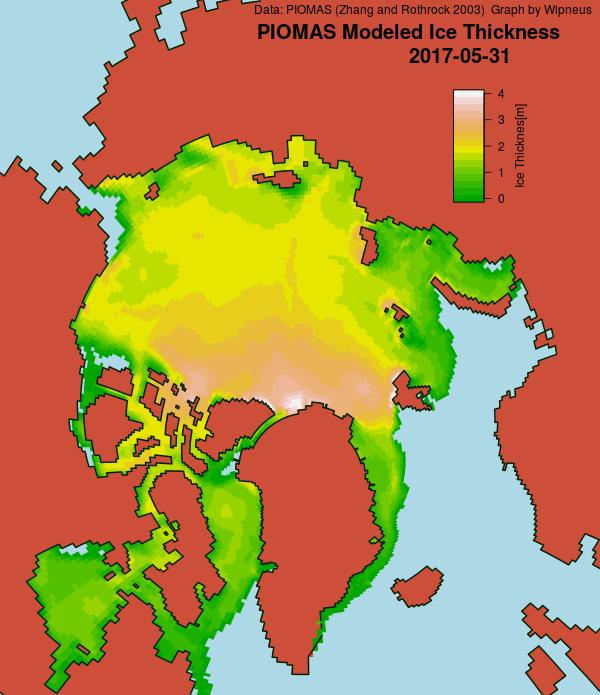
piomas_gridded_thickness_20170531

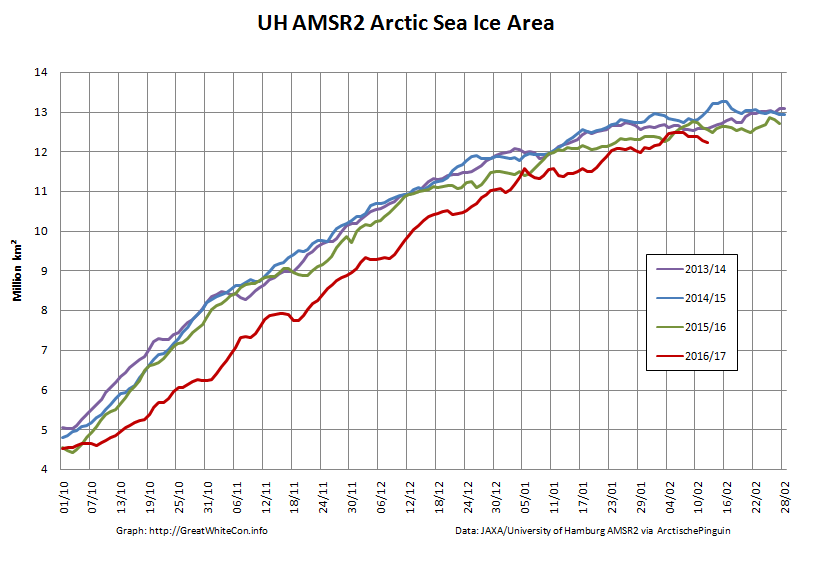
Here’s the latest AMSR2 Arctic sea ice area graph:
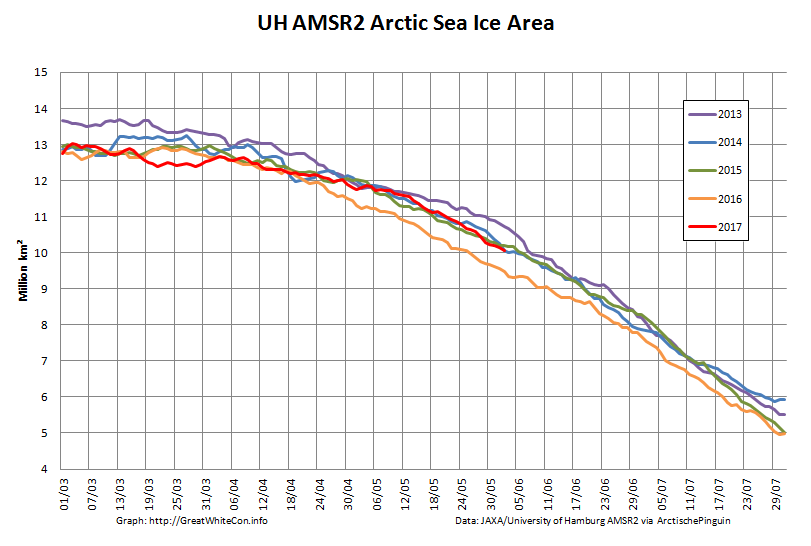
UH-Arctic-Area-2017-06-02

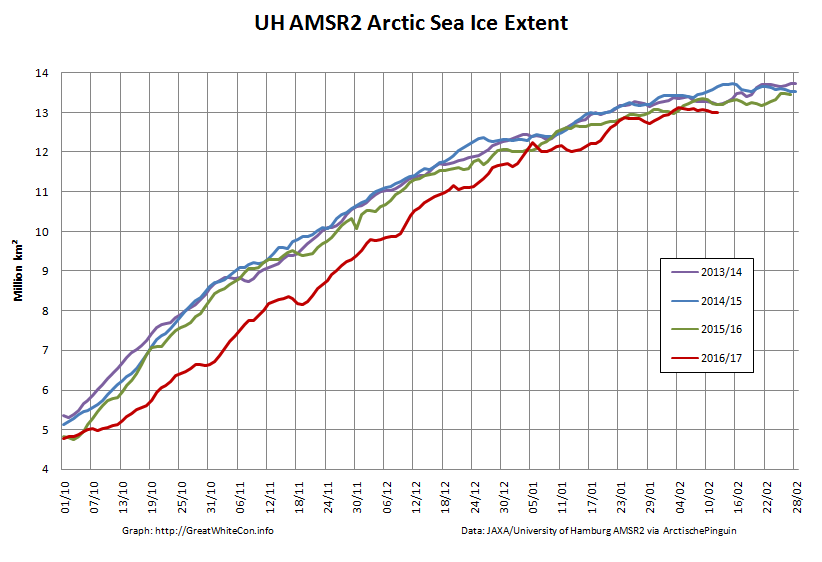
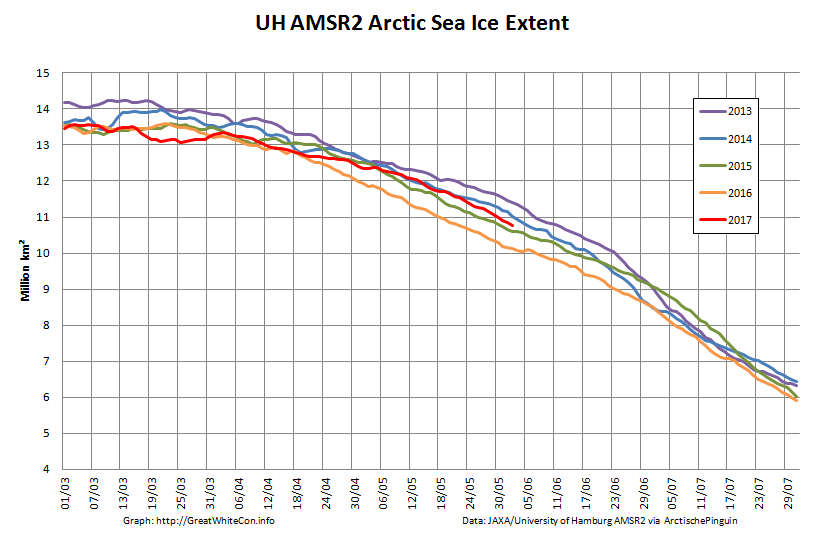
and just in case melt ponds are now affecting those numbers here is extent as well:
UH-Arctic-Extent-2017-06-02

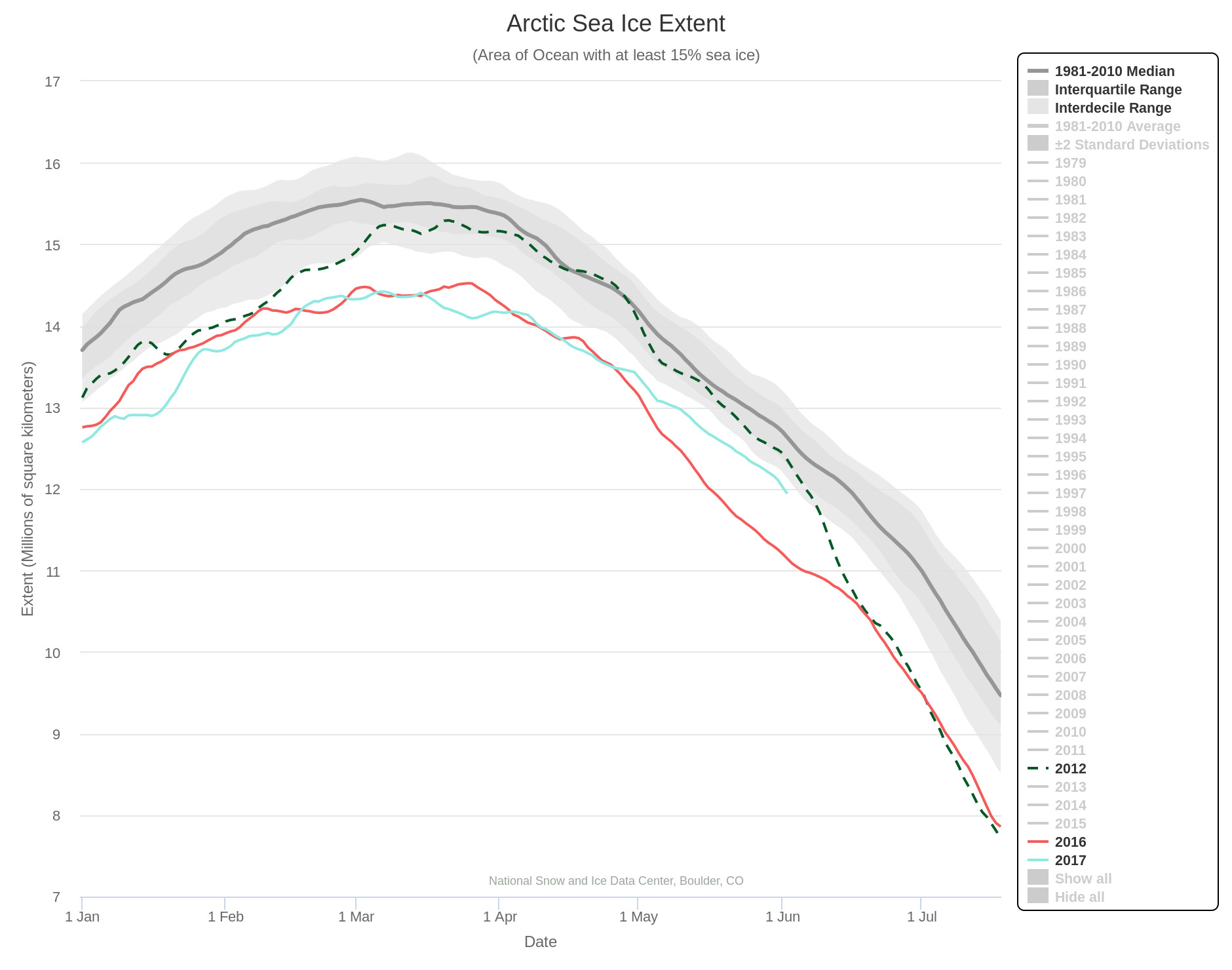
The rate of decrease is inexorably increasing! 2012 extent is currently still well above that of 2017, but those positions may well be reversed by the end of June? Here’s NSIDC’s view on the matter:
Charctic-20170602


[Edit – June 8th]

As requested by Tommy, here’s the current Arctic Basin sea ice area:UH-Basin-Area-2017-06-07
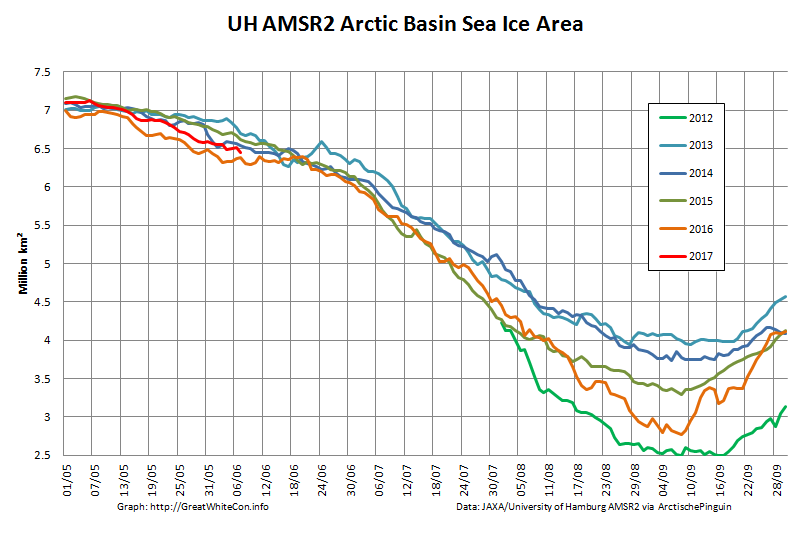
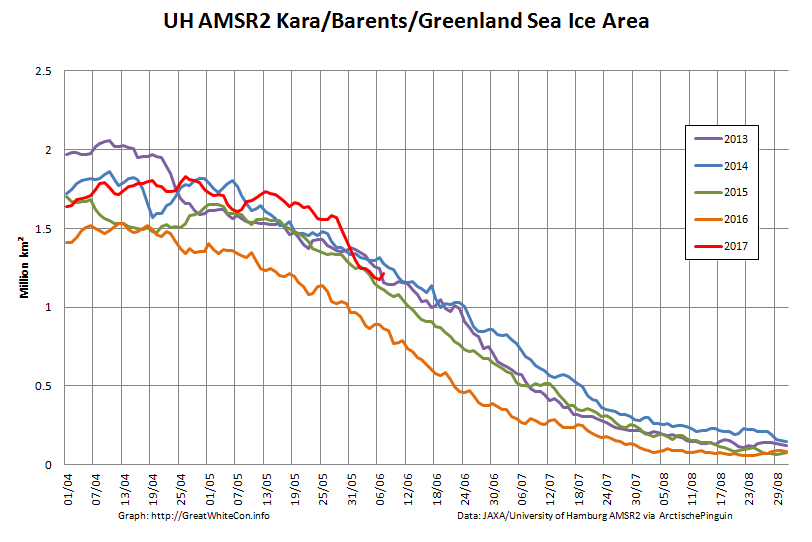
This includes the Beaufort, Chukchi, East Siberian and Laptev Seas along with the Central Arctic. It excludes the Atlantic periphery, which currently looks like this:UH-Atlantic-Area-2017-06-07
 

[Edit – June 10th]

At long last a clear(ish) image of water from the Lena Delta spreading out across the fast ice in the Laptev Sea:
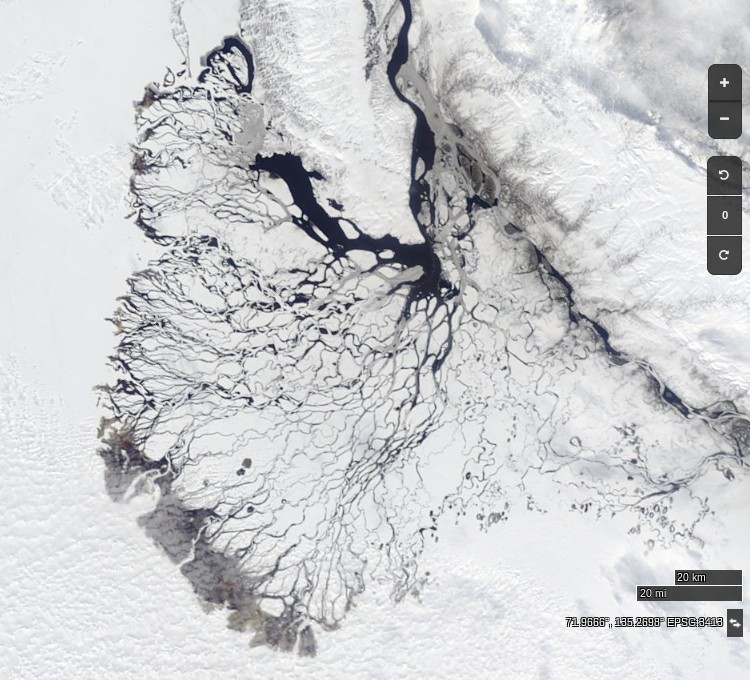
NASA Worldview “true-color” image of the Lena Delta on June 10th 2017, derived from the MODIS sensor on the Terra satellite

Compare and contrast with June 1st last year:
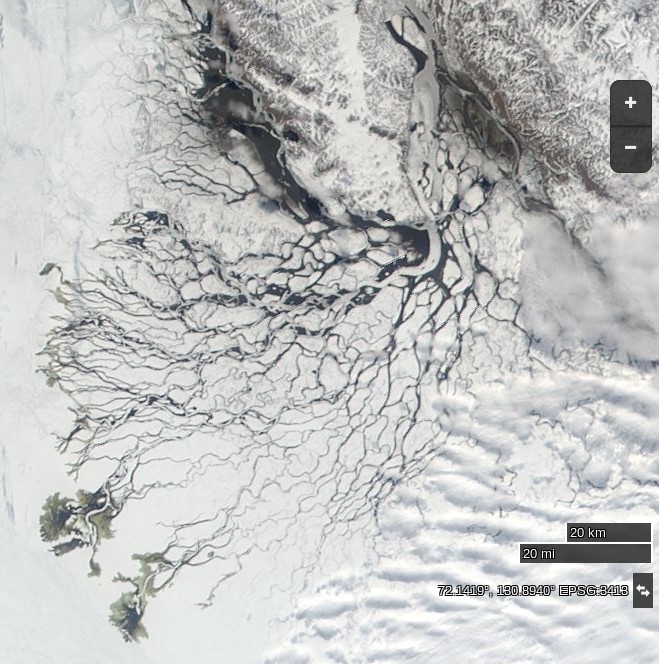
and June 10th 2012:
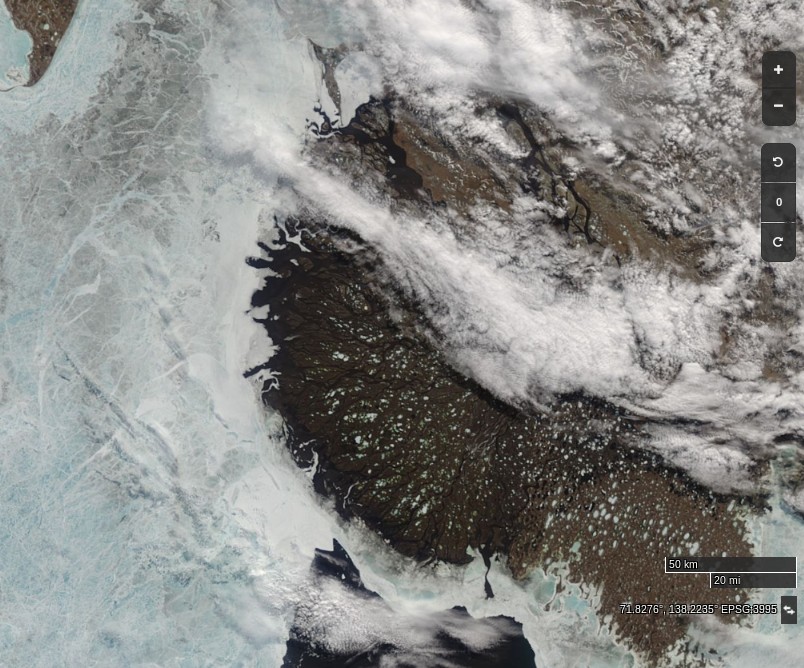
NASA Worldview “true-color” image of the Lena Delta on June 10th 2012, derived from the MODIS sensor on the Terra satellite


[Edit – June 11th]

DMI’s daily mean temperature for the Arctic area north of the 80th northern parallel has reached zero degrees Celsius almost exactly on the climatological schedule:
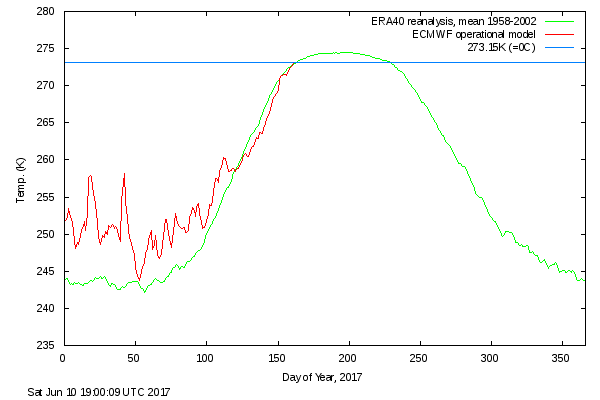
DMI-meanT_20170610

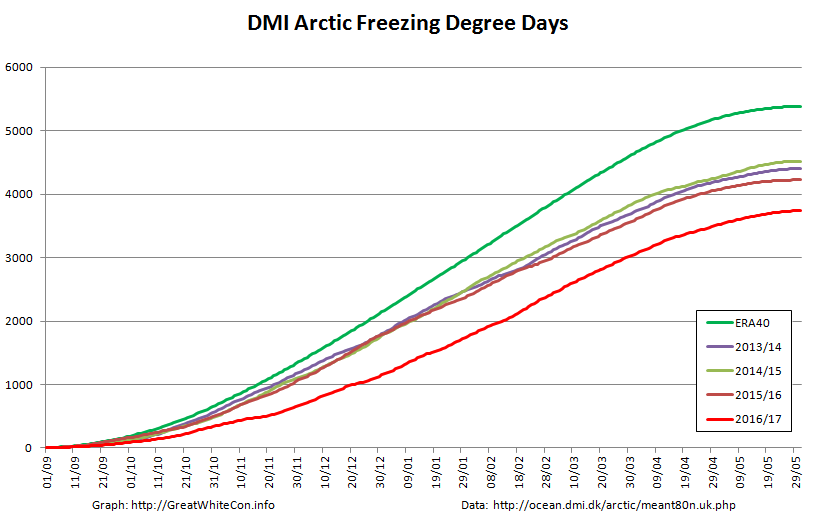
We calculate our freezing degree days on the basis of the freezing point of Arctic sea water at -1.8 degrees Celsius. On that basis this winter’s grand total of 3740 was reached on June 1st:
DMI-FDD-20170531

Despite the “coolish” recent weather total FDDs are way below the climatology and other recent years. Consequently there’s a lot less sea ice in the Arctic left to melt at the start of this Central Arctic melting season than in any previous year in the satellite record. However whilst there are some melt ponds visible in the Arctic Basin on MODIS, in that respect 2017 is lagging behind both last year and 2012.

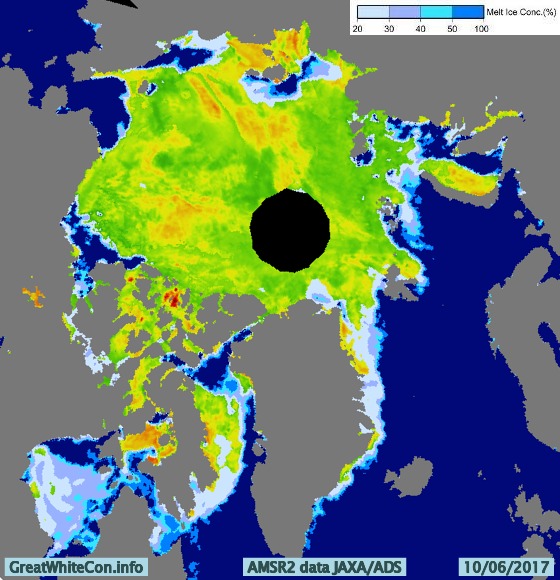
Here’s the latest JAXA surface melt map:AM2SI20170610A_SIT_NP
 

[Edit – June 13th]

JAXA/IJIS/ADS Arctic sea ice extent for 2017 is now above 2012:

VISHOP_Extent-20170612

Meanwhile there are finally signs of some surface melt on the fast ice in the Laptev Sea:
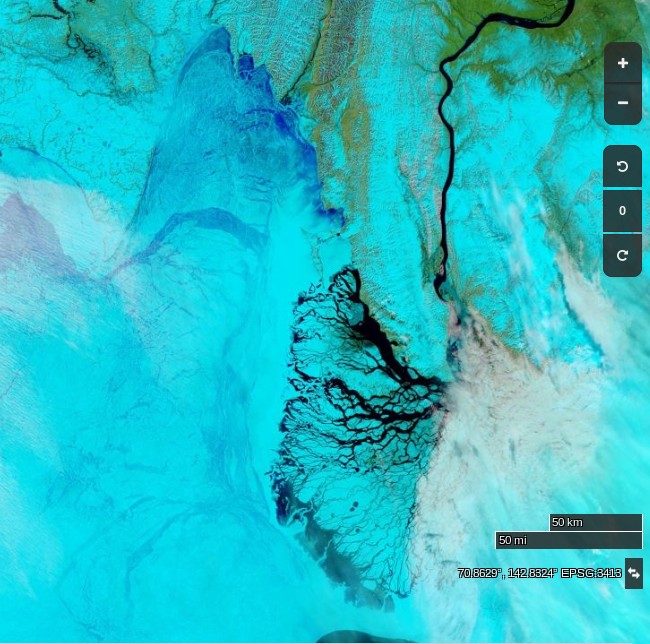
NASA Worldview “false-color” image of the Laptev Sea on June 13th 2017, derived from the MODIS sensor on the Aqua satellite


[Edit – June 14th]

An animation of the latest Arctic sea ice age data from Mark Tschudi:

Further confirmation that in 2017 the older, thicker ice is gathered together on the Atlantic side of the Arctic Ocean.


[Edit – June 15th]

The Mackenzie River melt waters have now breached the fast ice off the delta:
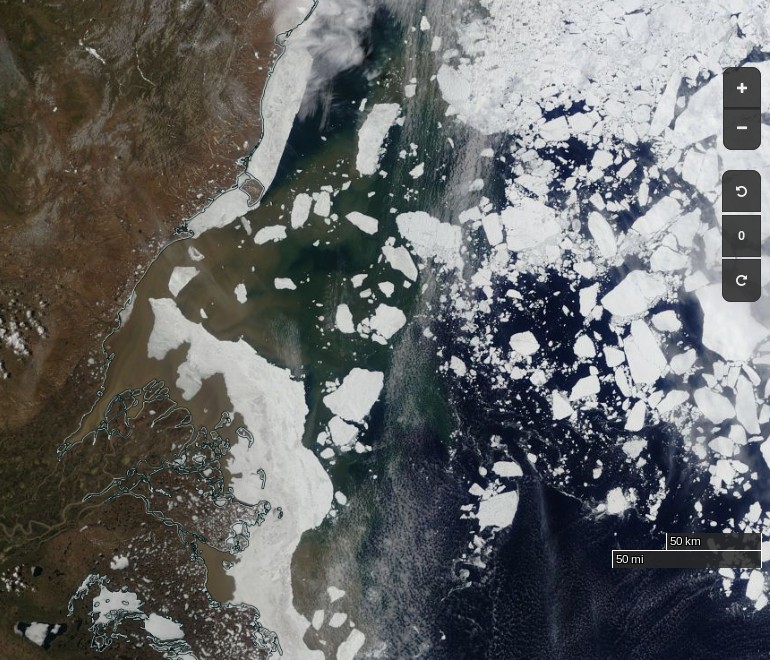
NASA Worldview “true-color” image of the Mackenzie on June 14th 2017, derived from the MODIS sensor on the Terra satellite


[Edit – June 16th]

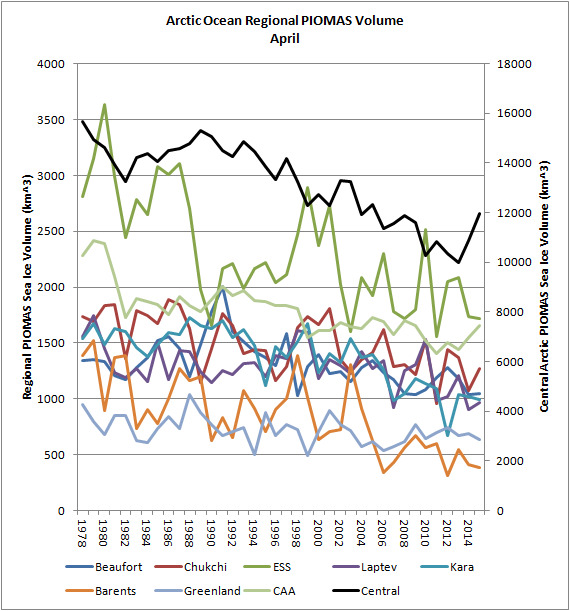
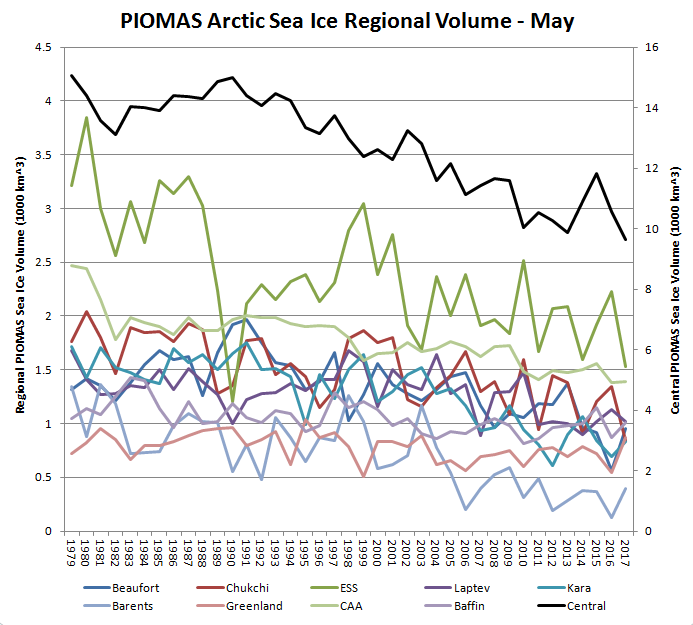
Thanks to the sterling work of Wipneus on the Arctic Sea Ice Forum, here’s a regional breakdown of PIOMAS Arctic Sea Ice volume for the month of May:
PIOMAS-Regions-2017-05

Note the caveat – “No checks, but the data looks plausible”.


[Edit – June 17th]

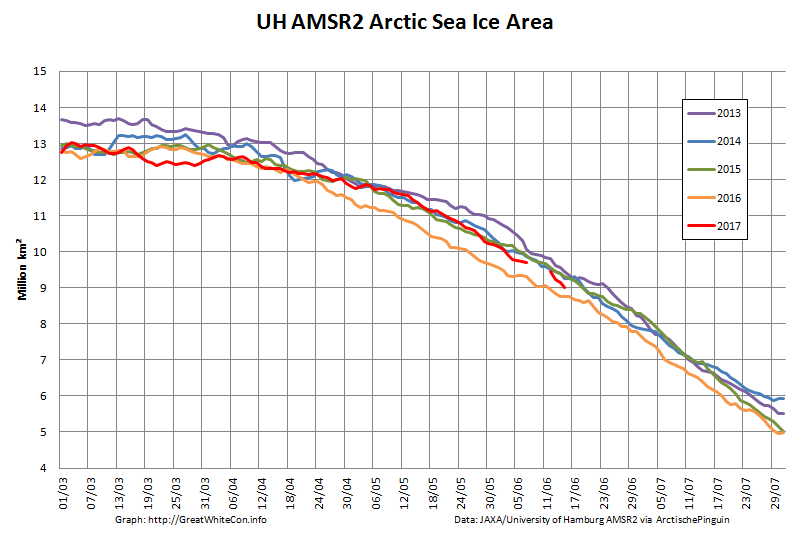
The AMSR2 data feed from the University of Hamburg suffered from a “brief hiatus” a few days ago, but is now back in action:
UH-Arctic-Area-2017-06-15

UH-Arctic-Extent-2017-06-15

Yesterday’s data still hasn’t arrived, but it certainly looks as though 2017 extent will soon drop below 2016.


[Edit – June 18th]

The PIOMAS mid month volume update has arrived. The gap between 2012 and 2017 is closing fast:

piomas-2017-D166

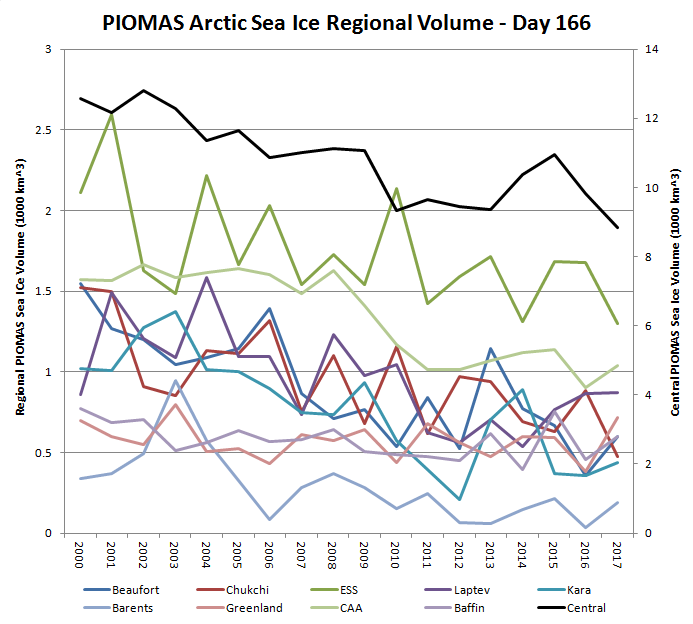
Here’s the regional breakdown:

PIOMAS-Regions-2017-D166


[Edit – June 23rd]

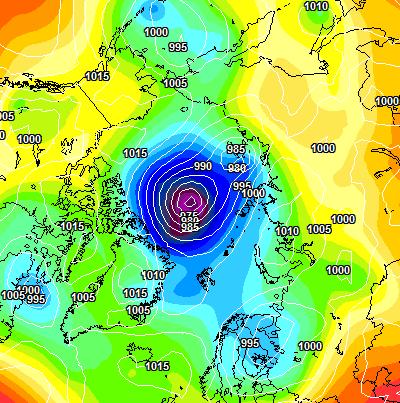
Here is the ECMWF MSLP forecast for 96 hours time:
ECMWF-20170623+96h-400

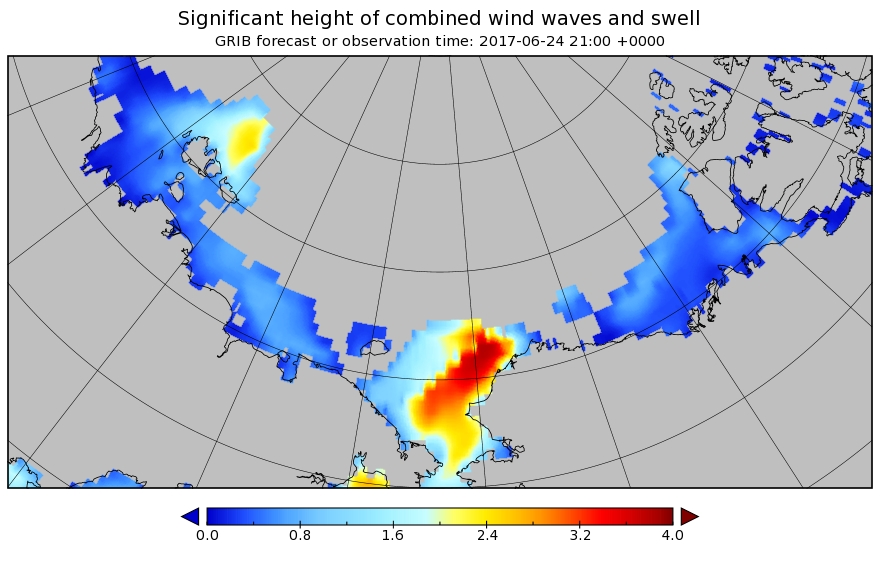
A sub 970 hPa cyclone is starting to enter the realms of realistic possibility, and also forecast are some significant waves in the Chukchi Sea and the expanding 2017 “Laptev Bite”:
Significant_height_of_combined_w in multi_1.glo_30mext.20170623_00016


[Edit – June 27th]

The forecast cyclone was nowhere near as deep as predicted. According to the analysis by Environment Canada it bottomed out at 980 hPa yesterday:
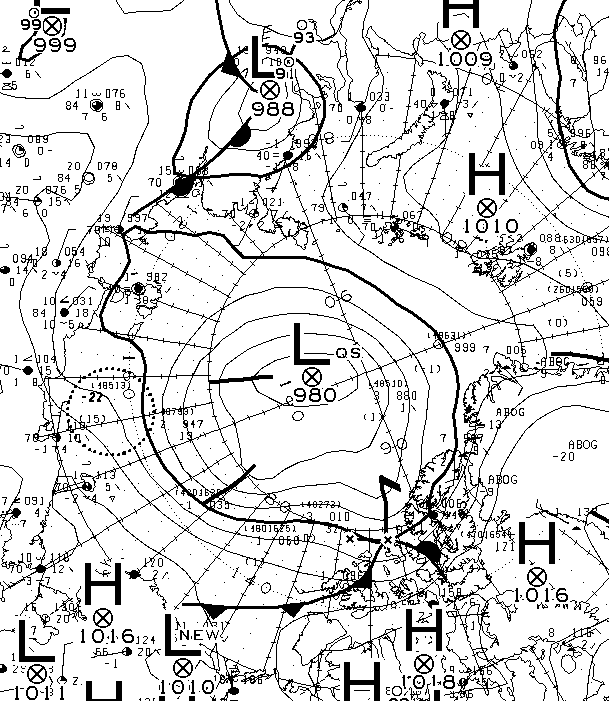
Synopsis-20170626-00Z-Crop


[Edit – June 29th]

O-Buoy 14 is currently firmly embedded in the fast ice of Viscount Melville Sound, deep in the heart of the Northwest Passage. Here’s the view from the buoy’s camera:
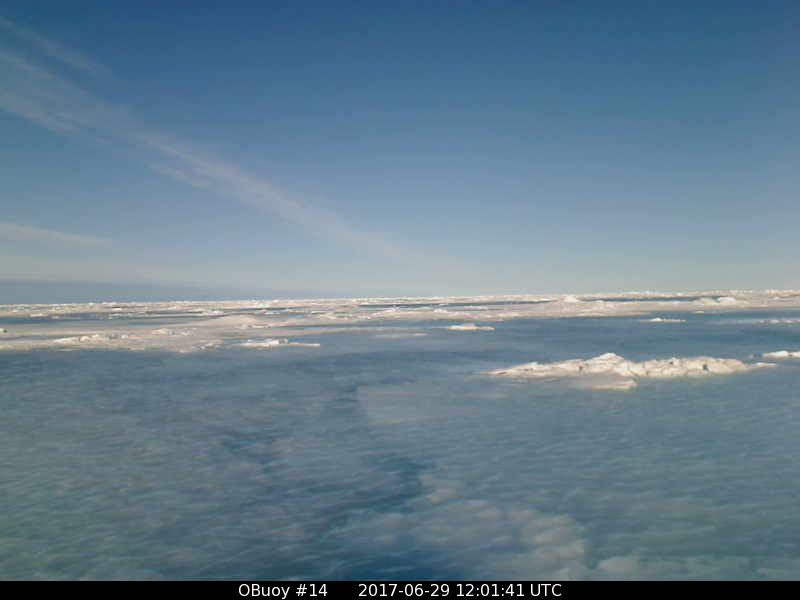
OBuoy14-20170629-1201

and here’s the view from space:

Melville-Terra-2017-06-29

Watch this space!
Facts About the Arctic in March 2017

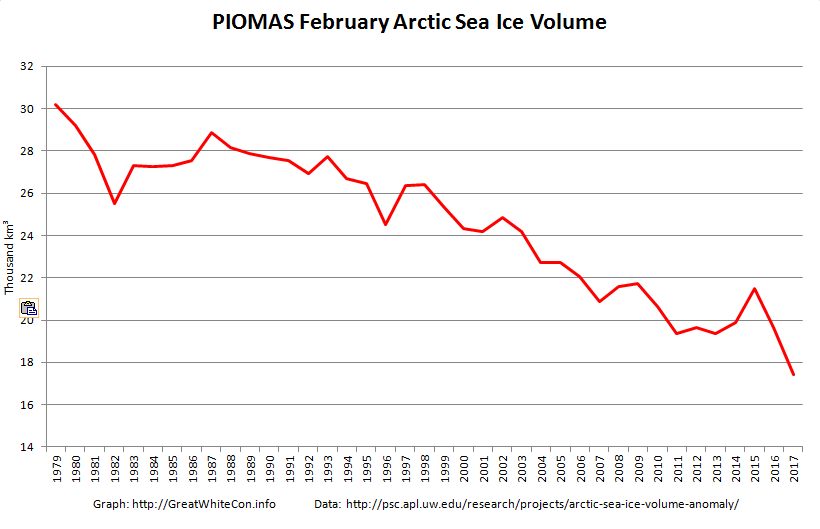
The February 2017 PIOMAS Arctic sea ice volume numbers are out. It’s no longer surprising to report that they are the lowest ever for the month of February in records going back to 1979:

PIOMAS-2017-02

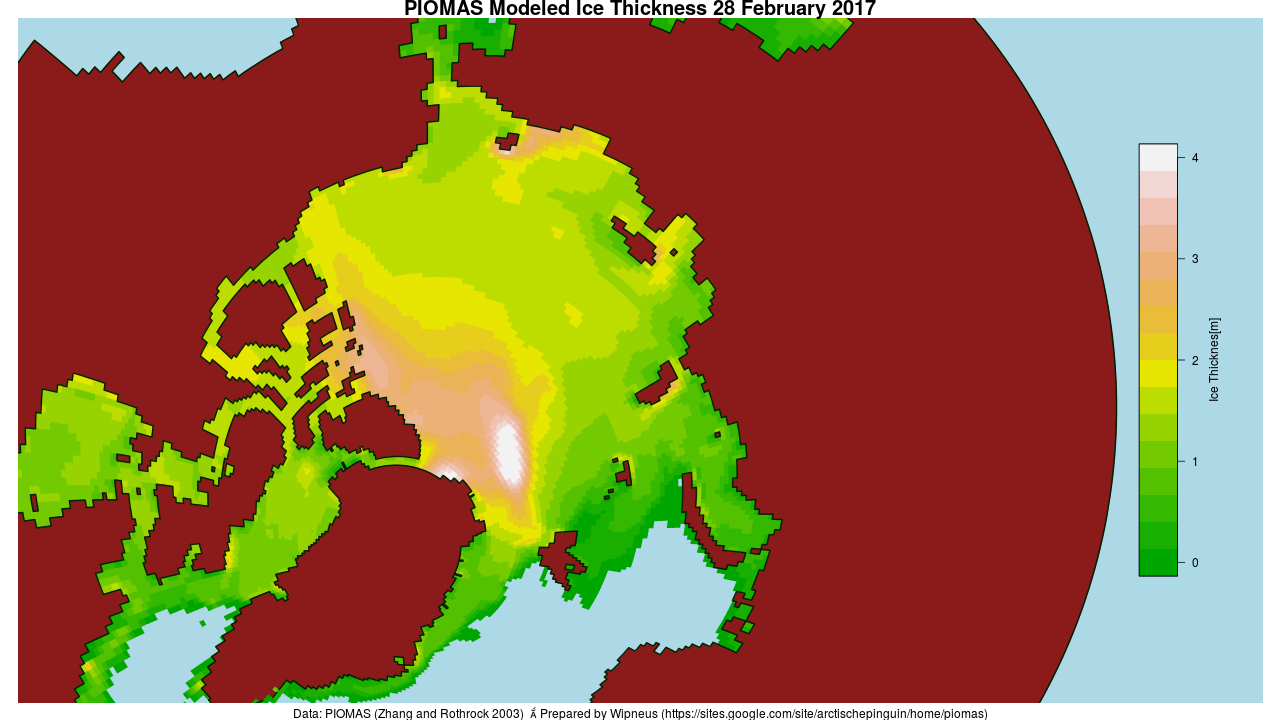
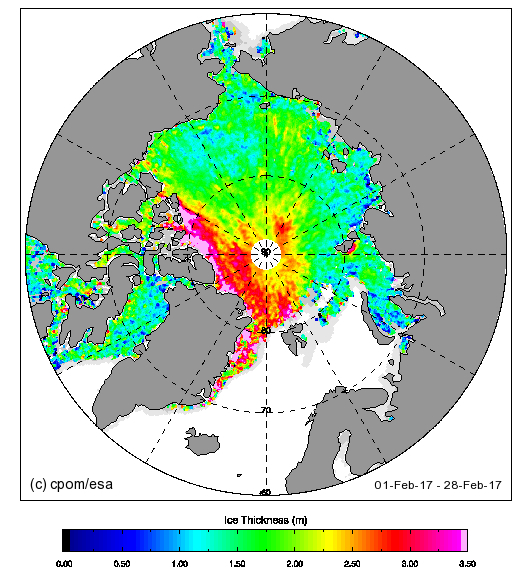
Here’s the PIOMAS gridded thickness map for February 28th:

PIOMAS-thkness-20170228

whilst here’s the latest CryoSat-2 thickness map:

Cryosat_28_20170228

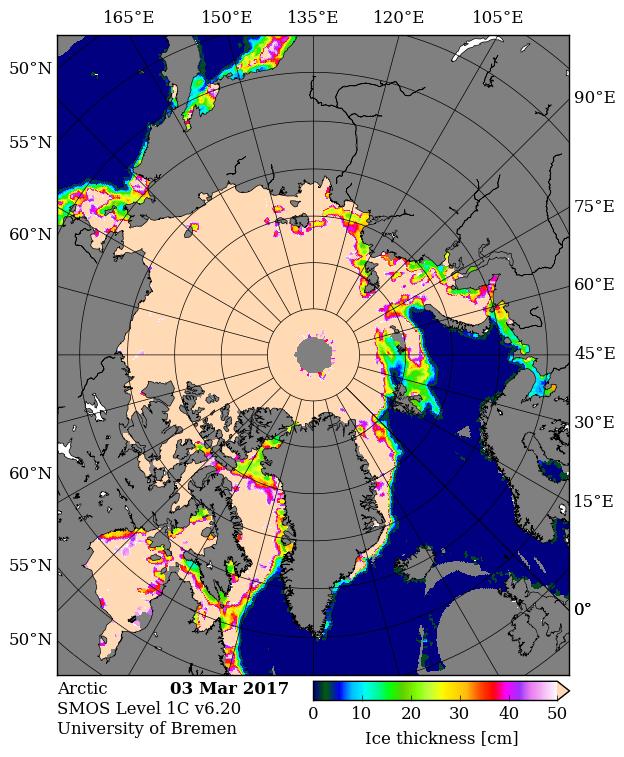
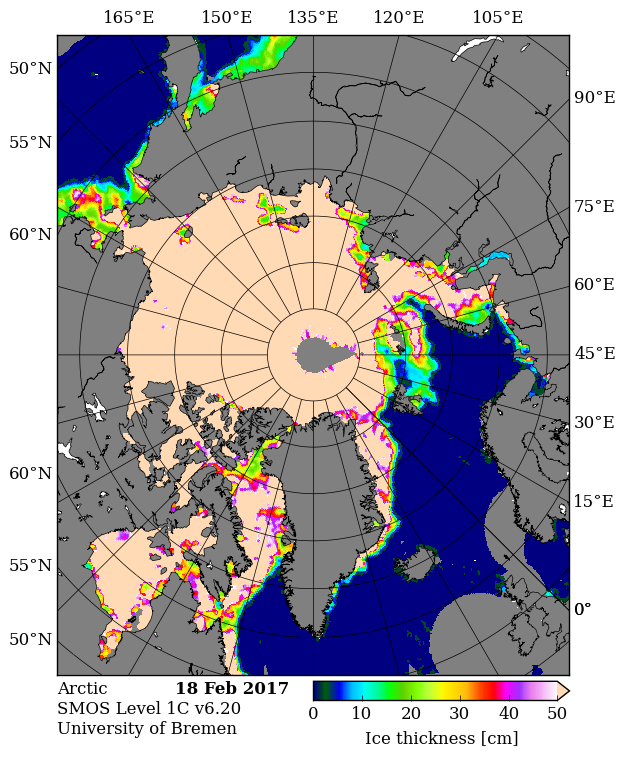
and here’s the latest SMOS thickness map from the University of Bremen:

SMOS-20170303

Lars Kaleschke suggests via Twitter this revealing SMOS thickness animation:

There does seem to be a small patch of slightly thicker ice in the East Siberian Sea off Chaunskaya Bay, but there’s still a much larger area of sub 0.5 meter thick ice in the Laptev and Kara Seas.

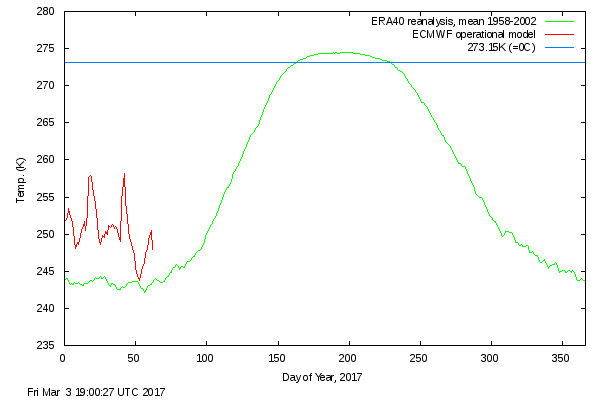
The Danish Meteorological Institute’s temperatures for the “Arctic area north of the 80th northern parallel” graph shows somewhat more “normal” readings in February 2017, but still without falling below the ERA40 climatology this year or in 2016:

DMI-meanT_20170303

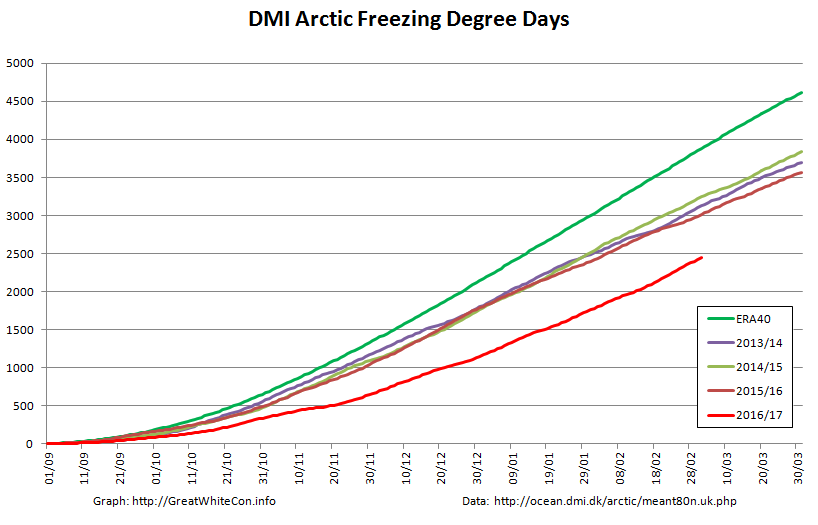
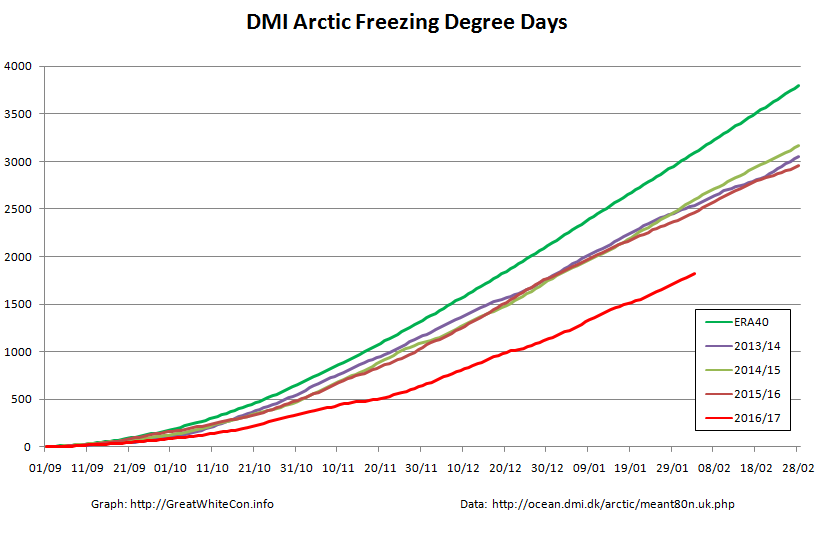
The graph of cumulative Freezing Degree Days (FDD for short) is still far below all previous years in DMI’s records going back to 1958:

DMI-FDD-20170303

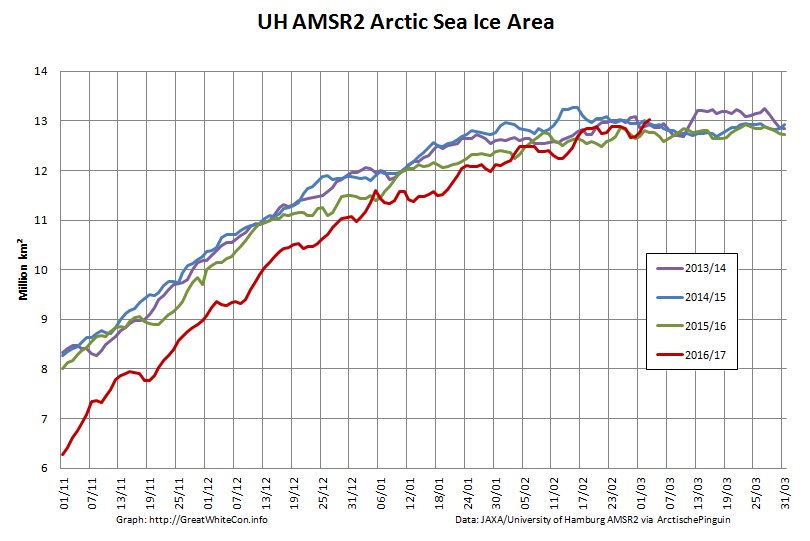
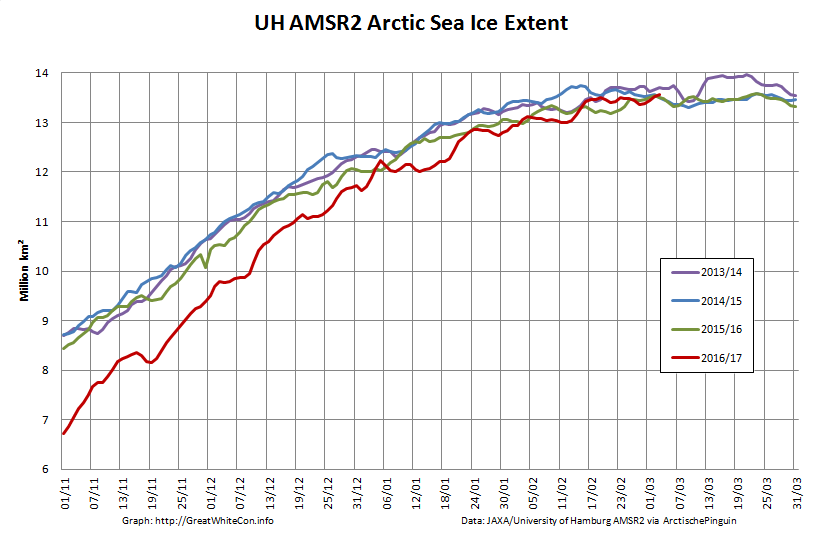
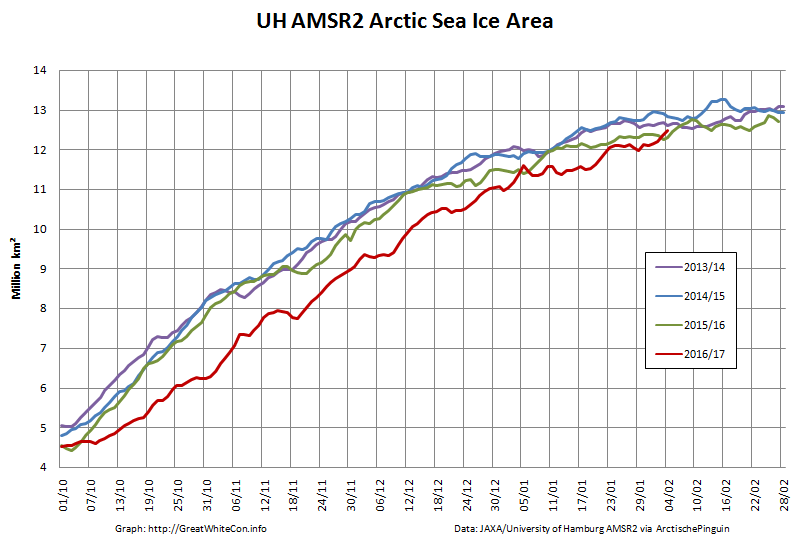
Finally, for the moment at least, here’s the high resolution AMSR2 Arctic sea ice area and extent:

UH-Arctic-Area-2017-03-03

UH-Arctic-Extent-2017-03-03

I’m going to have to eat some humble pie, or crow pie as I gather it’s usually referred to across the Atlantic, following my tentative “2017 maximum prediction” a couple of weeks ago. Both area and extent posted new highs for the year yesterday, with area creeping above 13 million square kilometers for the first time this year.


[Edit – March 7th]

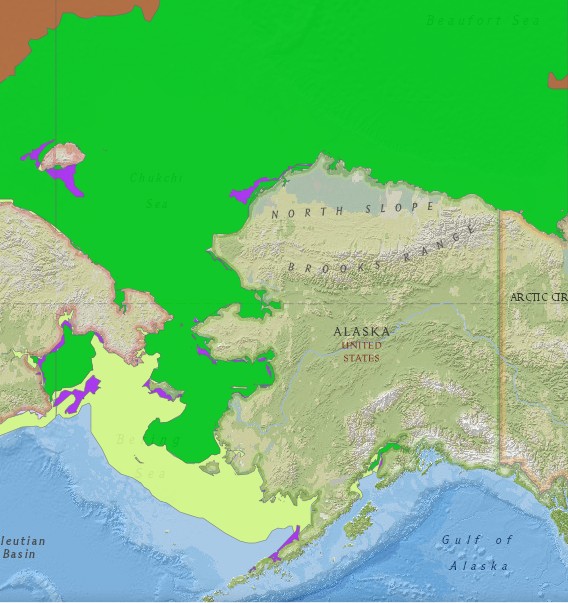
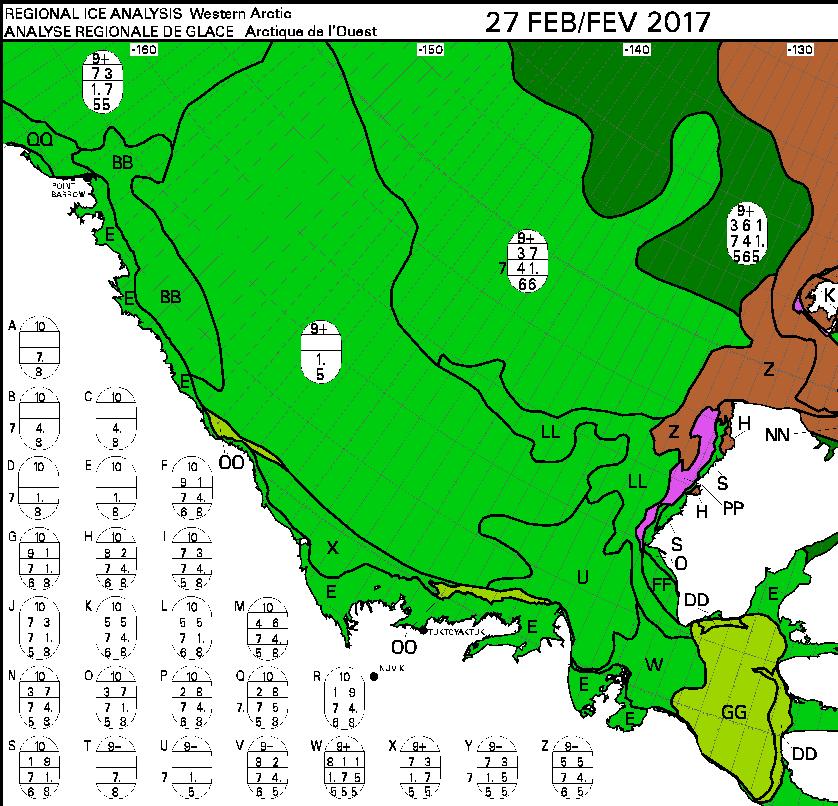
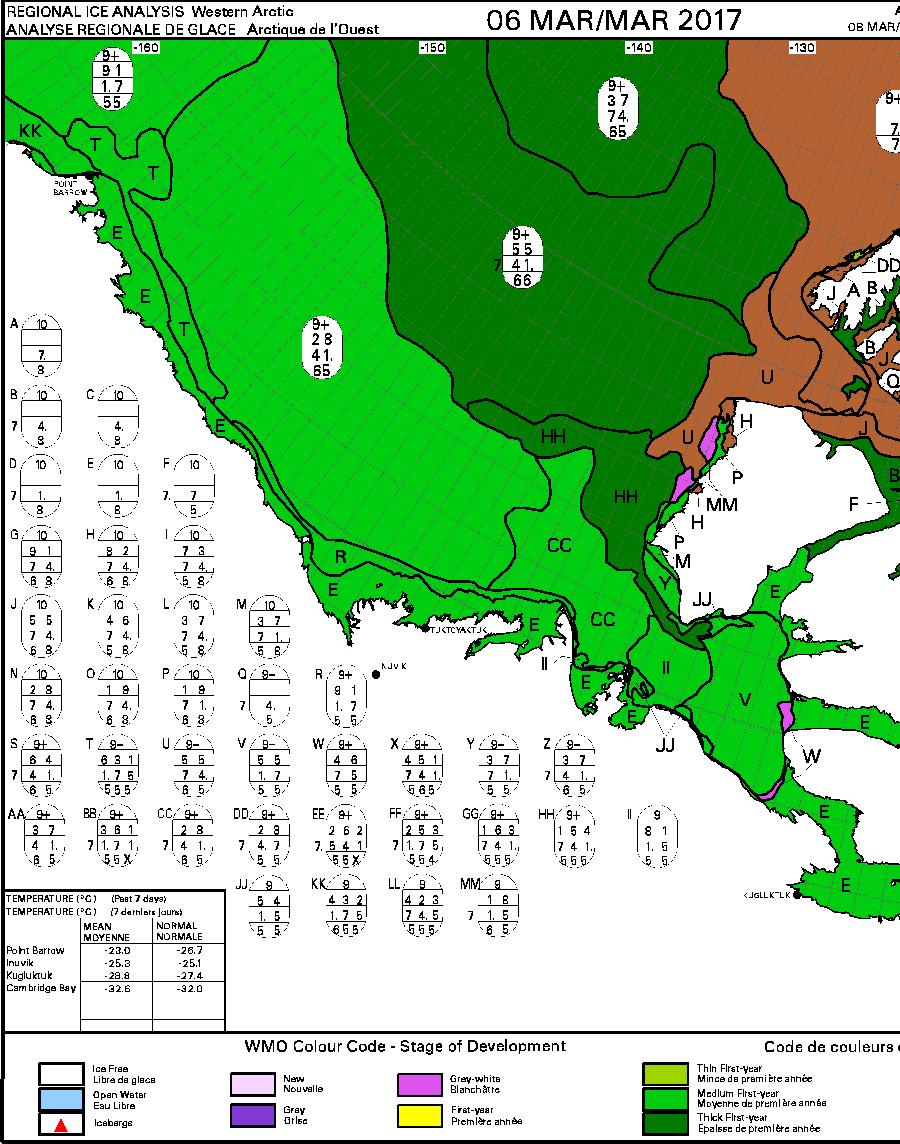
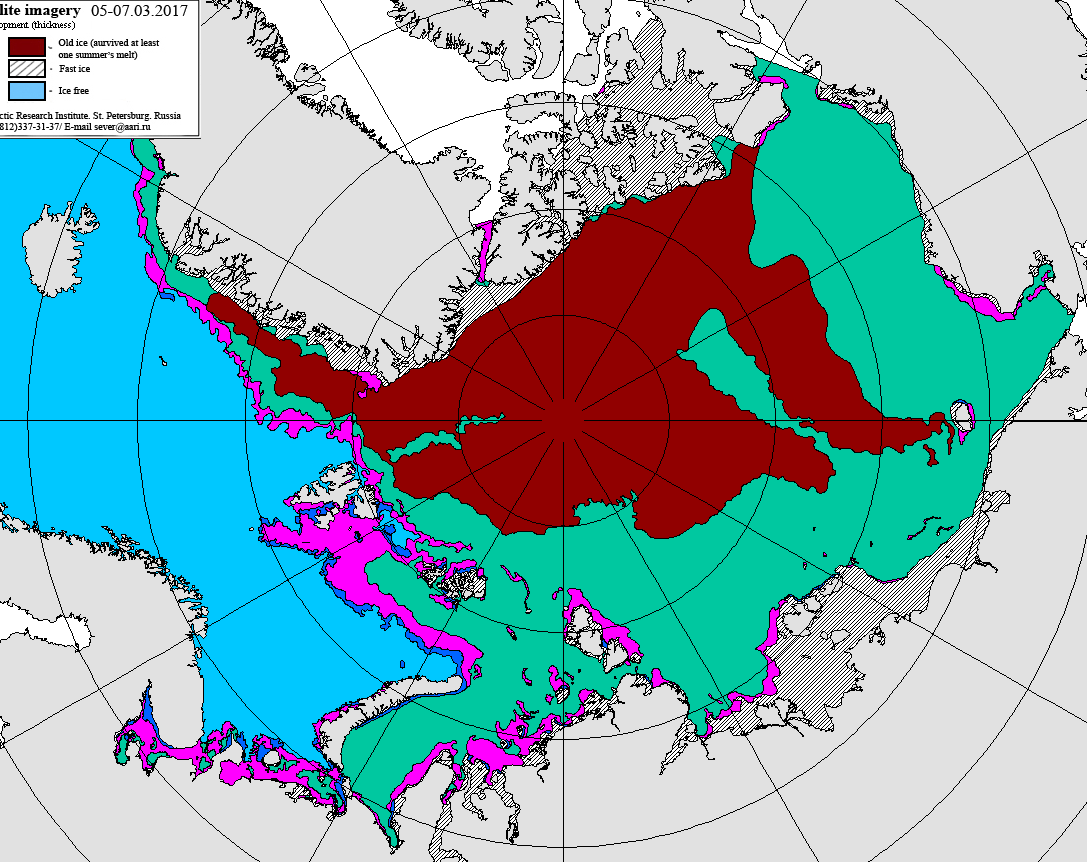
Commenter Michael Olsen suggests that “thicker ice being pushed into the Alaskan and Russian parts of the Arctic Ocean”. Here’s some evidence:

The United States’ National Weather Service current sea ice stage of development map for Alaskan waters:

NWS-Alaska-SoD-20170307

This week’s Canadian Ice Service sea ice stage of development map is expected later today, so for now here’s last week’s:

CIS-West-SoD-20170227

and here’s the latest version:

CIS-West-SoD-20170306

Similarly this week’s Russian Arctic and Antarctic Research Institute ice chart is expected soon has been published:

AARI-20170307-crop


[Edit – March 11th]

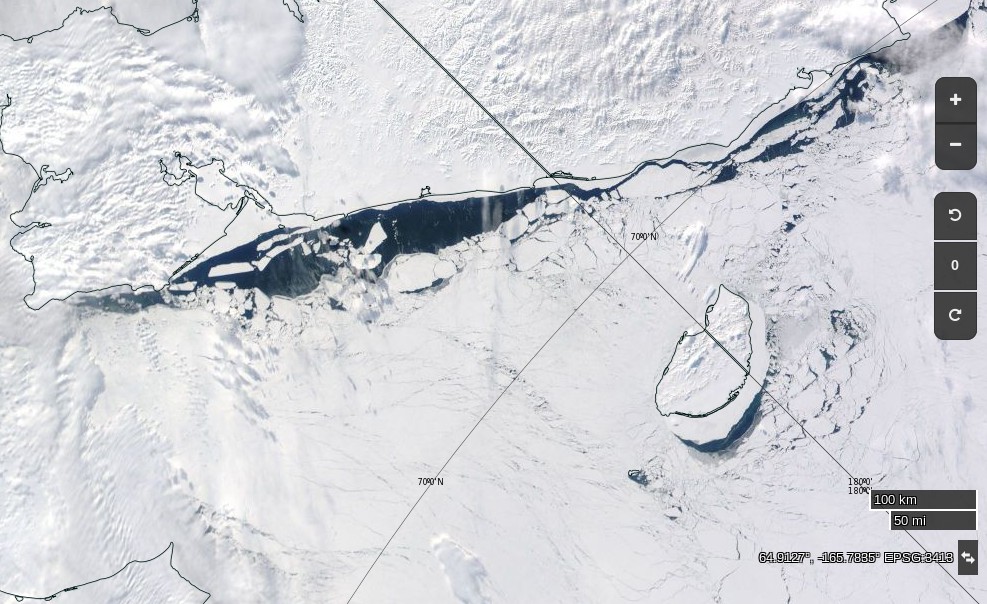
Especially for Michael, a visual image of all the “thicker ice [that’s been] pushed into the Russian parts of the Arctic Ocean” courtesy of the nice folks at NASA:

NASA Worldview “true-color” image of the Chukchi Sea on March 10th 2017, derived from the MODIS sensor on the Aqua satellite


[Edit – March 12th]

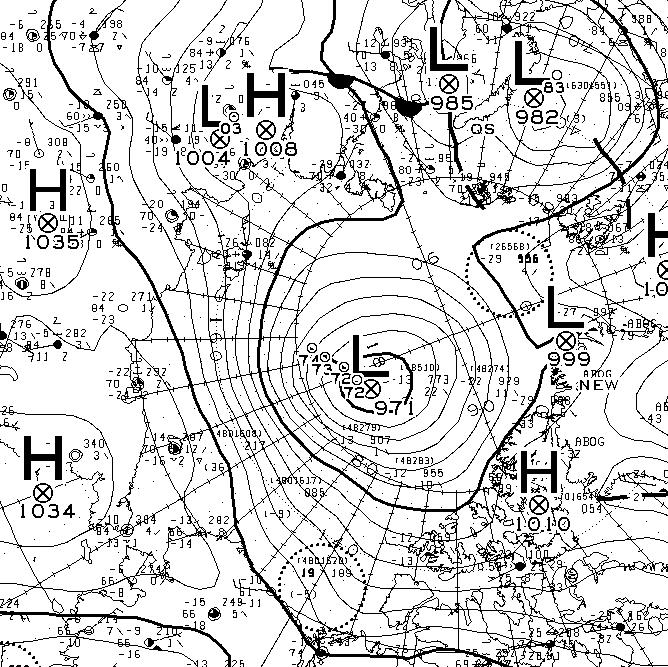
Yet another strong Arctic cyclone has been battering the sea ice in the Arctic Basin. According to Environment Canada this one bottomed out at 971 hPa at 06:00 UTC today.

Synopsis-20170312-06Z

Alternative Facts in the Arctic – Case Study 2

I had the profound joy of bumping into Mike Haseler on Twitter earlier today. After much bandying of words about global temperature the “debate” headed north to the Arctic. Here are the edited highlights:


I feel sure this story will run and run, but I’ve got to rush off up the M5 soon. Consider this as an appetiser, with the main course to follow in due course.

Watch this space!
Facts About the Arctic in February 2017

The PIOMAS Arctic sea ice volume numbers for January 2017 have just been published. Yet another new record low for the date:

PIOMASIceVolumeAnomaly-201701

Here’s the PIOMAS gridded thickness for January 31st, courtesy of Wipneus at the Arctic Sea Ice Forum:

PIOMAS-20170131

Somewhat anomalously it shows the thickest ice some distance away from the coast of Greenland and/or Ellesmere Island. Here too is Andy Lee Robinson‘s updated PIOMAS “Arctic death spiral”:

arctic-death-spiral-1979-201701

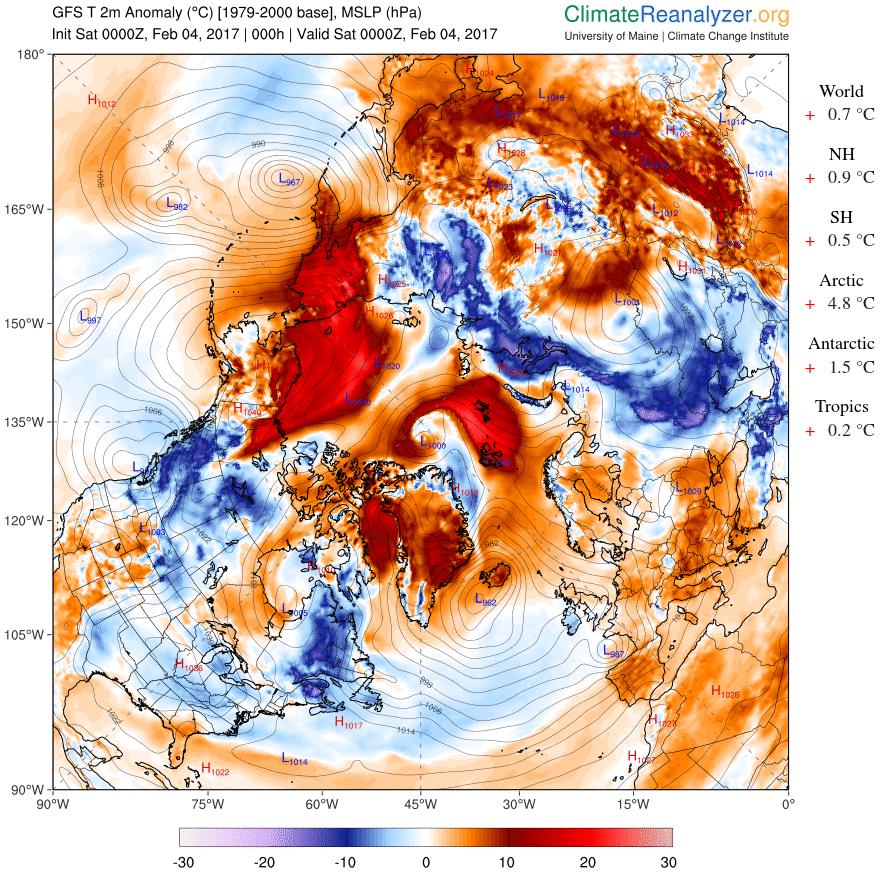
Meanwhile yet more anomalously warm air is entering the Arctic Basin from both the Pacific and Atlantic sides:

CCI-T2Anom-20170204

That sort of thing has happened quite a few times over the 2016/17 freezing season, as you can see from this graph of cumulative Freezing Degree Days (FDD for short):

2017-02-03-DMI-FDD

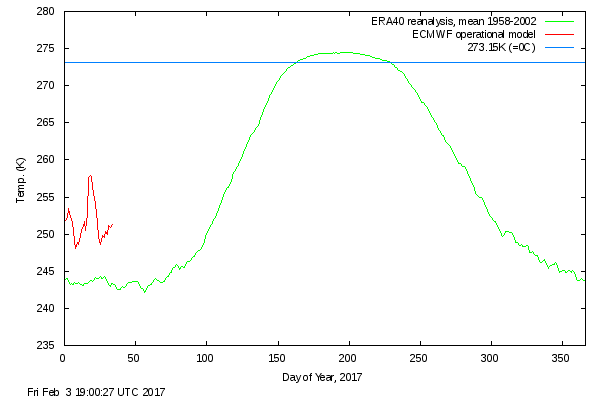
The FDD graph is based on the same data as the probably much more familiar DMI “Daily mean temperatures for the Arctic area north of the 80th northern parallel” graph:

DMI-meanT-20170203

Things are warming up in the Arctic once again.


[Edit – February 5th]

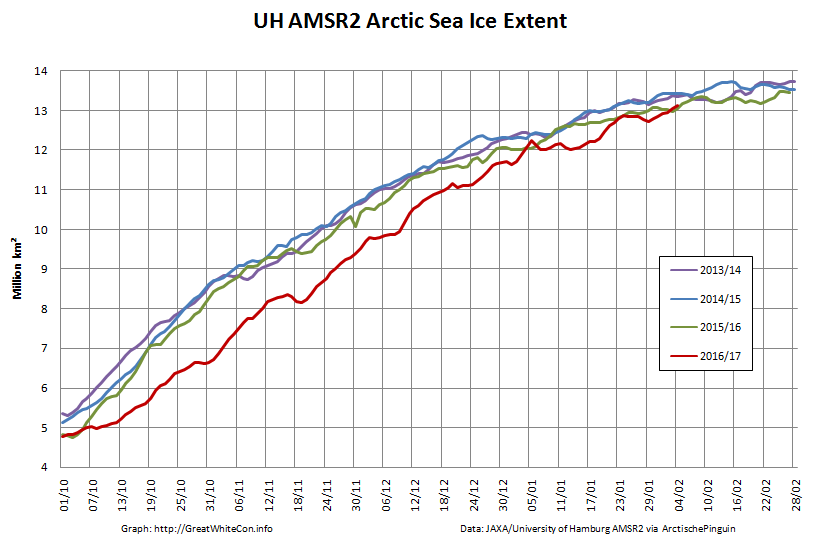
Whilst we await the arrival of the forecast anomalous warmth, how are some other metrics coming along? Here’s the high resolution AMSR2 area and extent:

UH-Arctic-Area-2017-02-04

UH-Arctic-Extent-2017-02-04

It looks like they’re back in the “normal” range for now, does it not?


[Edit – February 6th]

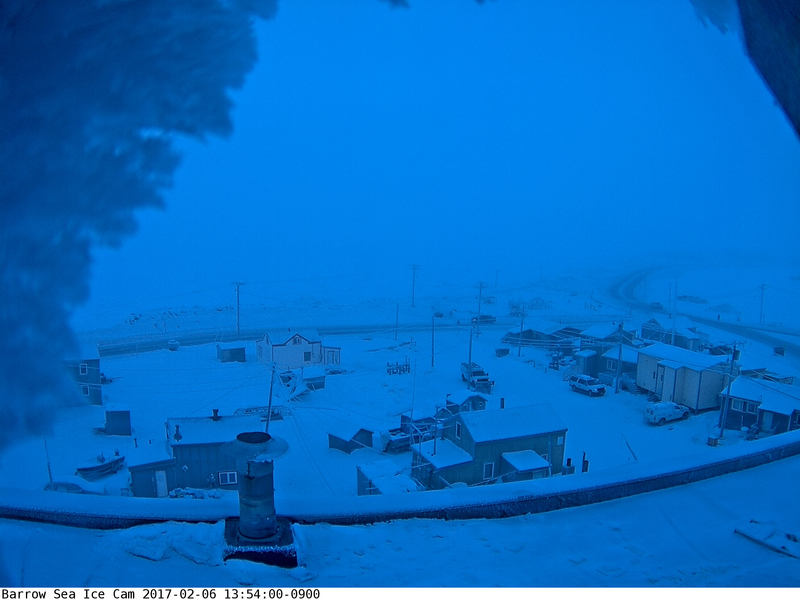
Things currently still look fairly frosty over on the Pacific side of the Arctic, as you can see from the webcam at Utqiagvik (Barrow as was):

BarrowCam_20170206_225400

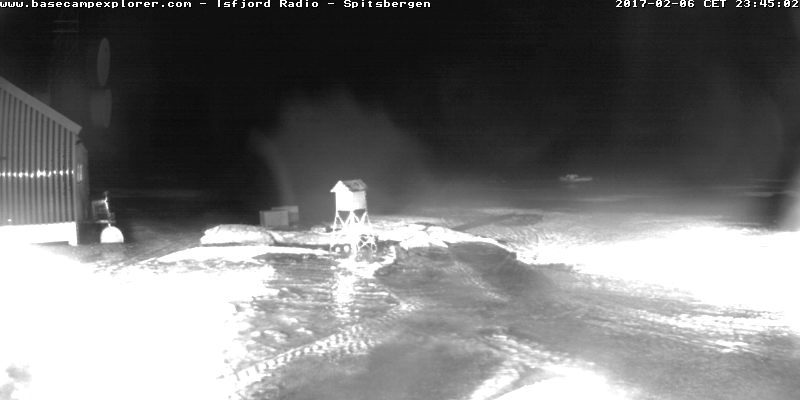
However over on the Atlantic side (and especially for “Richard”!) melting can now be observed on Svalbard:

isfjordradio-20170206

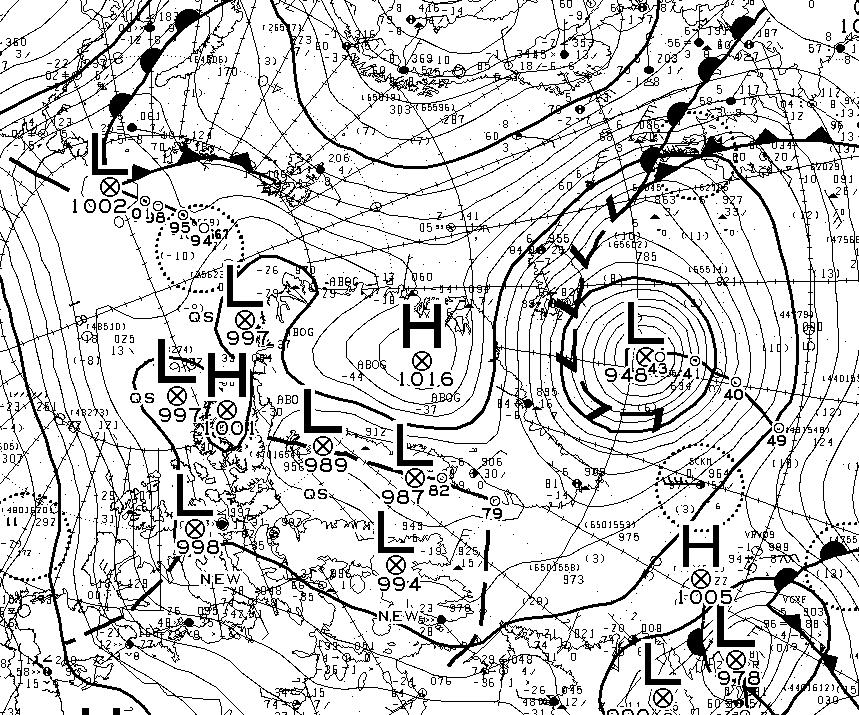
An extremely powerful cyclone off Greenland is pumping heat and moisture northwards:

Synopsis-20170206-18Z

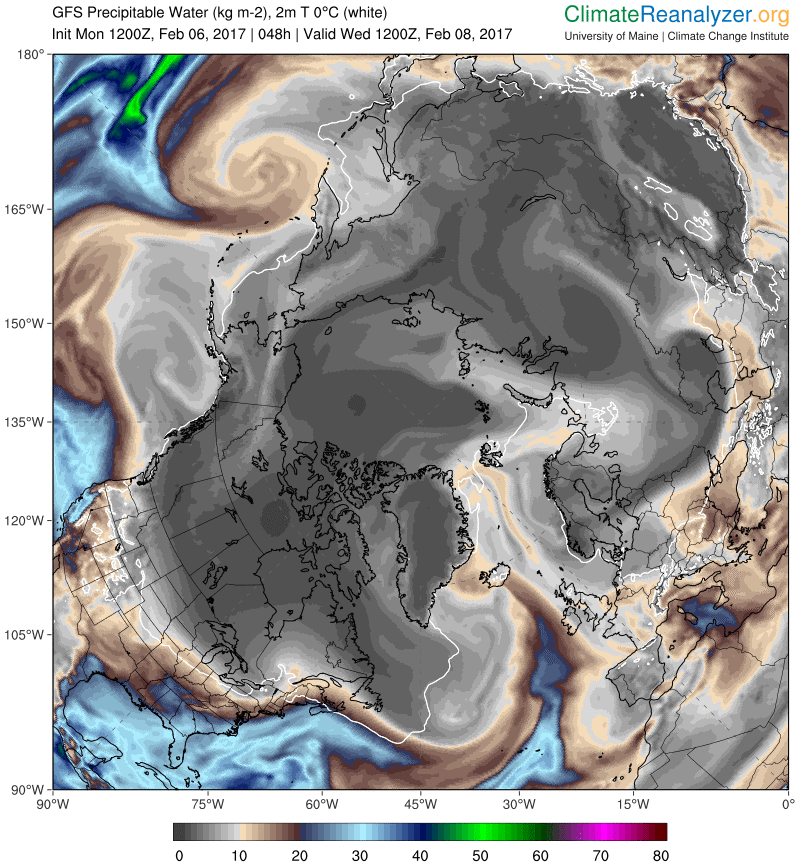
Note that the cyclone’s MSLP fell to 940 hPa earlier today. This is the GFS precipitable water forecast for Wednesday lunchtime:

CCI-PWTR-20170206-12+48h

Finally, for the moment at least, here’s the current weather forecast for Longyearbyen in Svalbard:

2017-02-07-Longyearbyen-Fcst

All in all there’s plenty more heat and moisture on the way.


[Edit – February 13th]

The temperatures in Svalbard have now dropped back below freezing point:

Svalbard-Temps-20170213

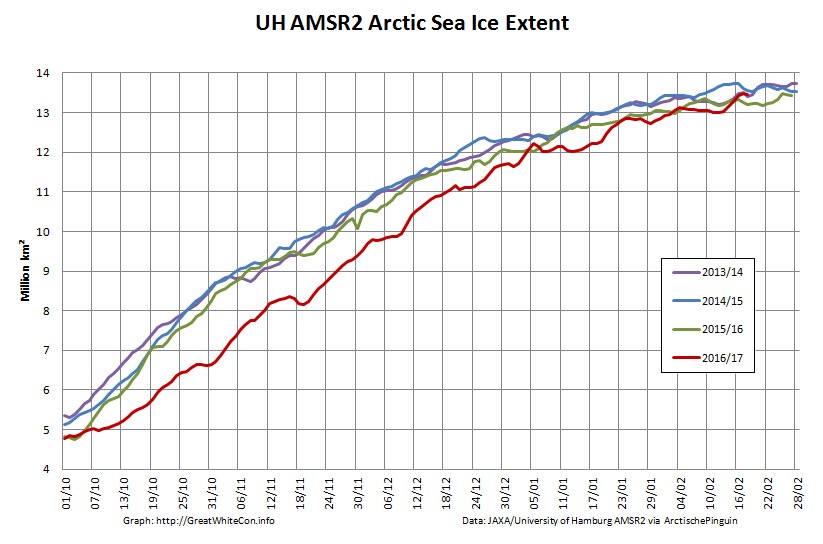
As temperatures over parts of the Arctic Basin have reached zero degrees Celsius and above, Arctic sea ice extent has been declining:

UH-Arctic-Extent-2017-02-12

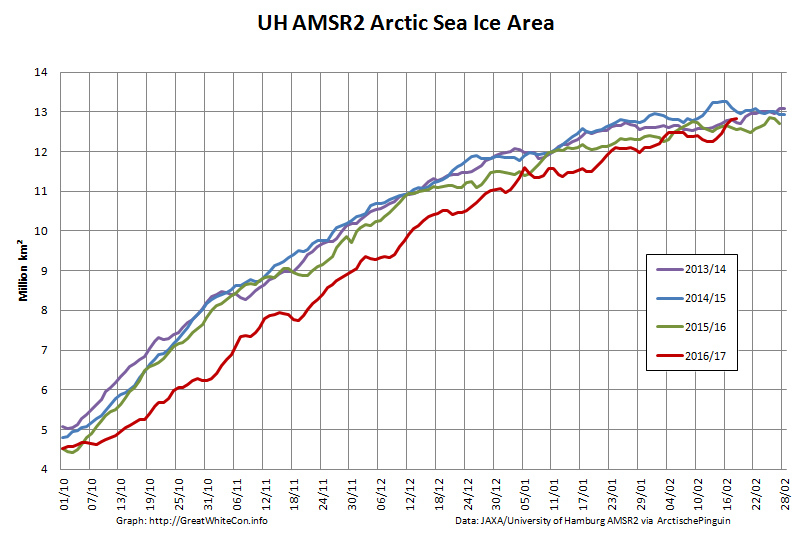
Now take a look at area:

UH-Arctic-Area-2017-02-12

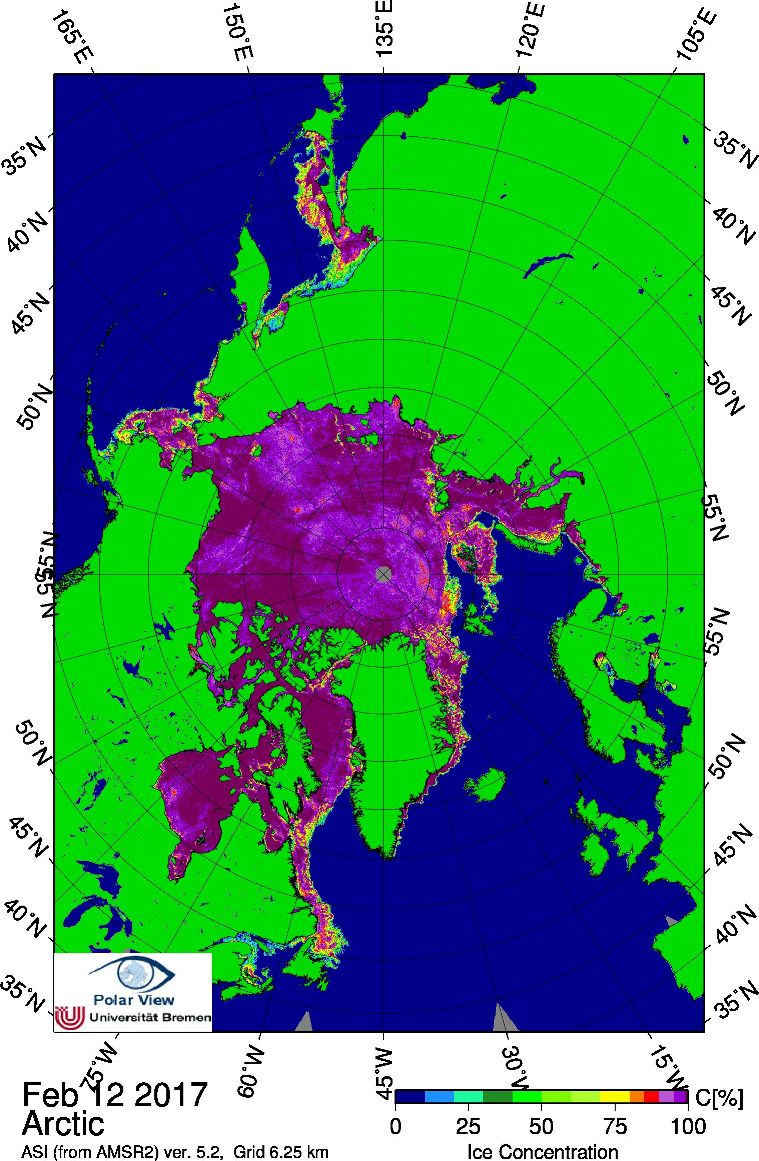
Area has declined a lot! That’s because sea ice concentration is now noticeably <100% across much of the Arctic:

Bremen-AMSR2-20170212

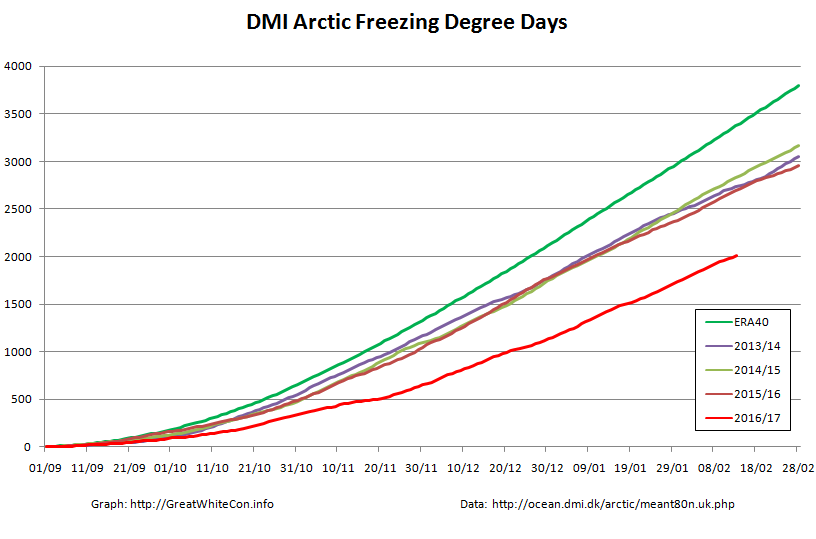
There’s also been a discernable change in slope of the DMI freezing degree days graph:

DMI-FDD-20170213


[Edit – February 19th]

There’s been a late spurt of growth in both area and extent, which are now back in the pack of previous years:

UH-Arctic-Area-2017-02-18

UH-Arctic-Extent-2017-02-18

The newly frozen areas are currently still very thin:

SMOS-20170218

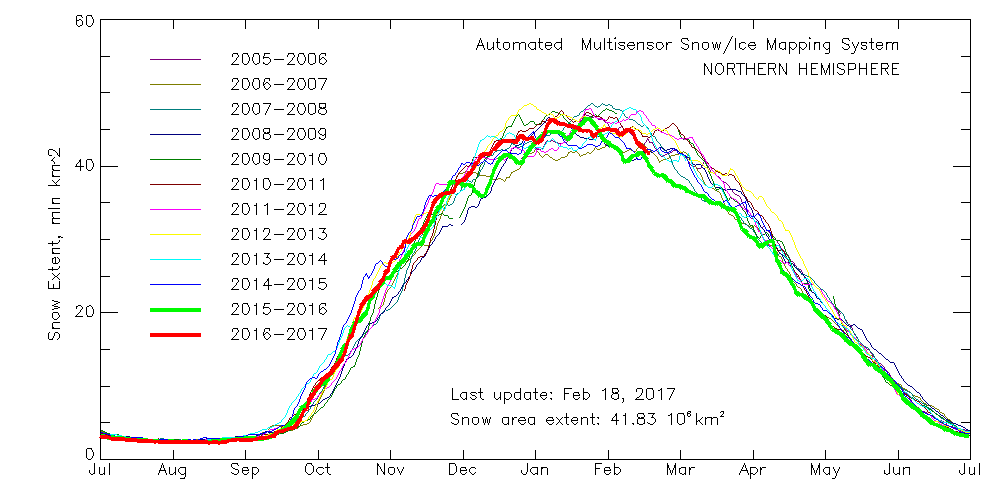
Meanwhile northern hemisphere snow cover has started to melt in earnest:

multisensor_4km_nh_snow_extent_20170218

Watch this space!
Global Sea Ice At Record Low Levels

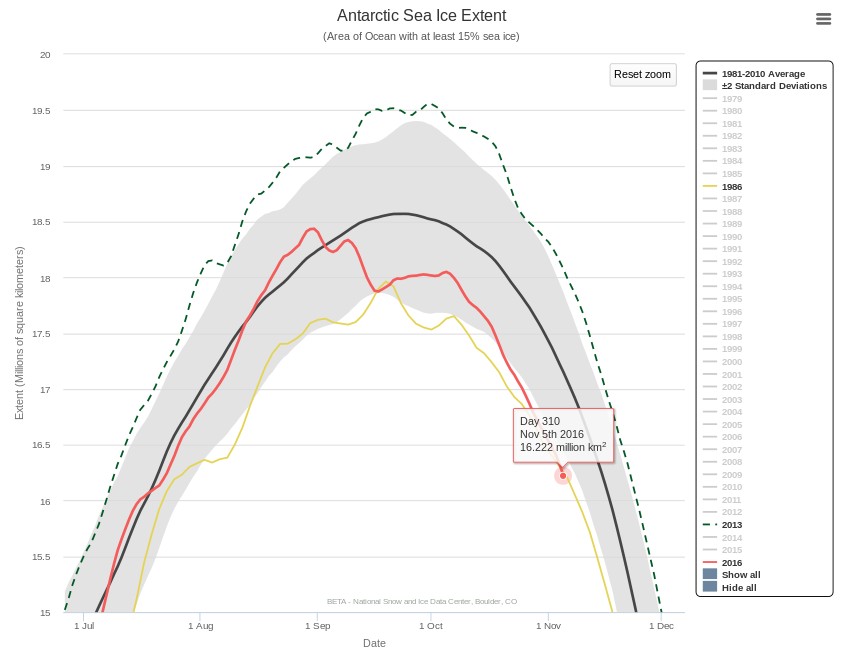
NSIDC 5 day averaged Antarctic sea ice extent is now at a record low level for the date, since satellite measurements began in 1979:

chantarctic-20161105

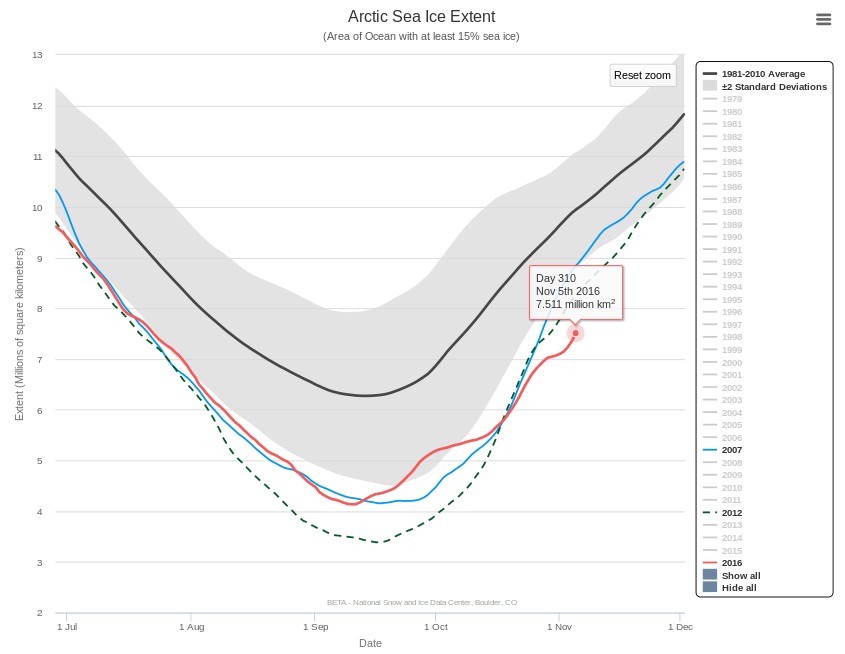
NSIDC 5 day averaged Arctic sea ice extent has been at a record low level for the date for quite a while:

charctic-20161105

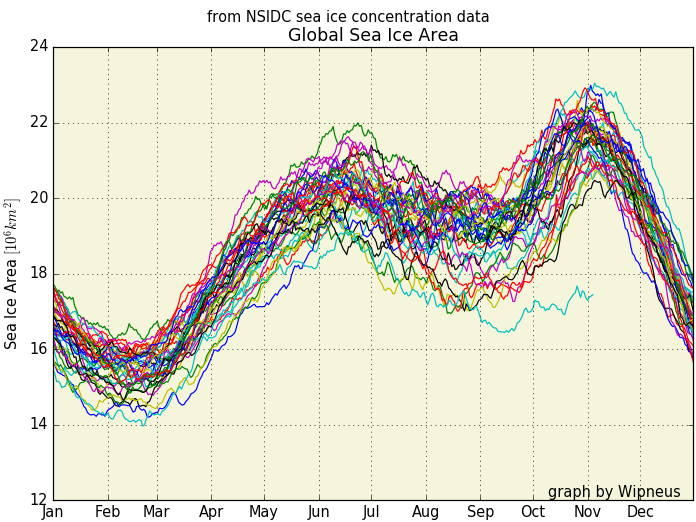
Combining those two facts means that global sea ice extent is also at a record low level for the date by a considerable margin. The gap with all previous years in the satellite record is even more stark if you look at global sea ice area:

nsidc_global_area_byyear

The October Arctic sea ice volume numbers from PIOMAS have also just been published:

piomas-trnd3-20161031

By October 31st that metric was also “lowest ever” for the date.

More Of The Usual Hype About Arctic Sea Ice

No sooner has one of the usual suspects claimed that “Arctic Sea Ice Holds Firm” than a few more jump on the same bandwagon. The Global Warming Policy Forum have republished almost the whole of an article penned by our old friend Paul Homewood entitled “More Of The Usual Hype About Arctic Ice“. According to Paul (and Benny):

Far from collapsing, Arctic sea ice area has been remarkably stable in the last decade

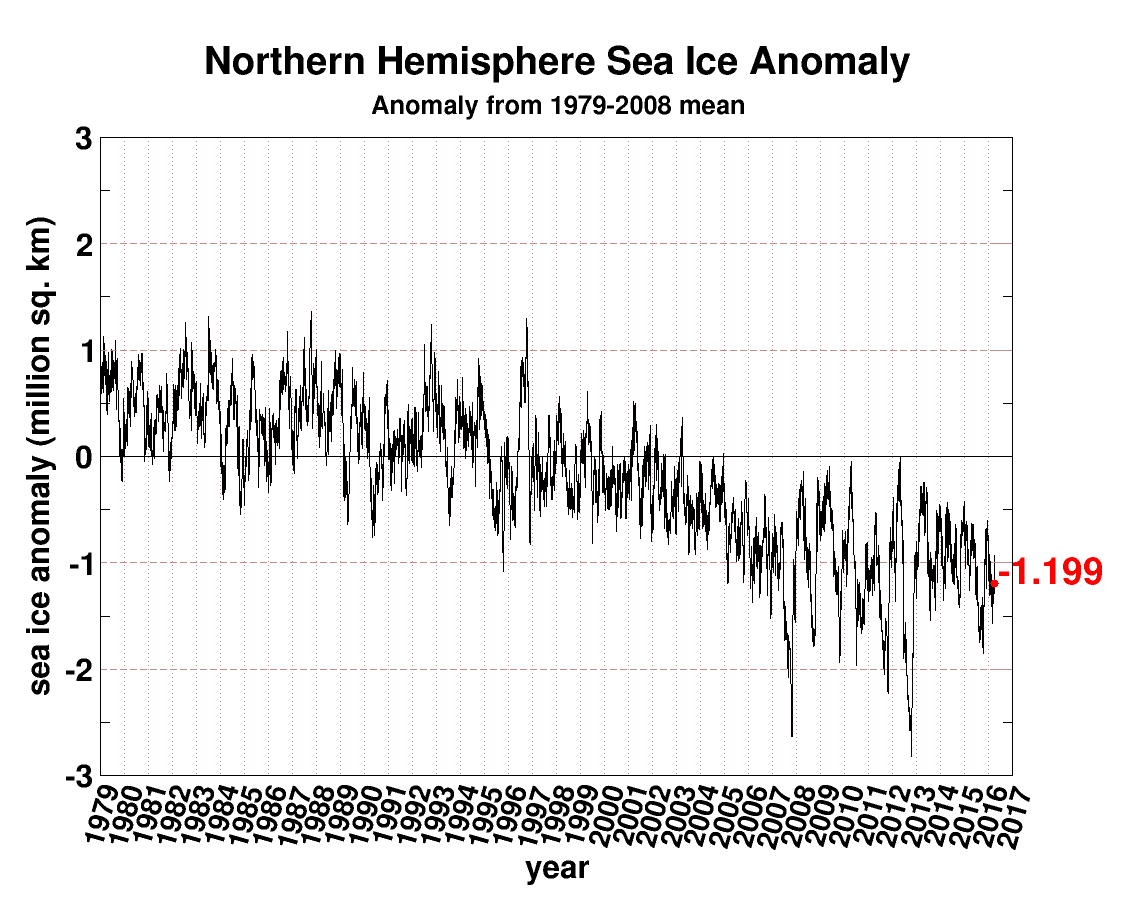
He illustrates his point using a slightly different version of the Cryosphere Today Arctic sea ice area anomaly graph employed by Andrew Montford on March 29th. Here’s the latest version:

seaice-anomaly-20160403

For some strange reason Paul (and Benny) neglect to mention that the current anomaly of -1.199 million square kilometers is the most negative it has ever been for the day of the year in the entirety of the Cryosphere Today record going back to 1979. They also neglect to mention that the CT anomaly is typically much larger in summer than in winter, and that despite that fact the CT anomaly never fell as low as -1.199 at any time of year until 2006.

Make sure to follow the first link above for much more on anomalously misleading area graphs. However Paul (and Benny) are not content with just one misleading interpretation of an anomaly graph. The article continues:

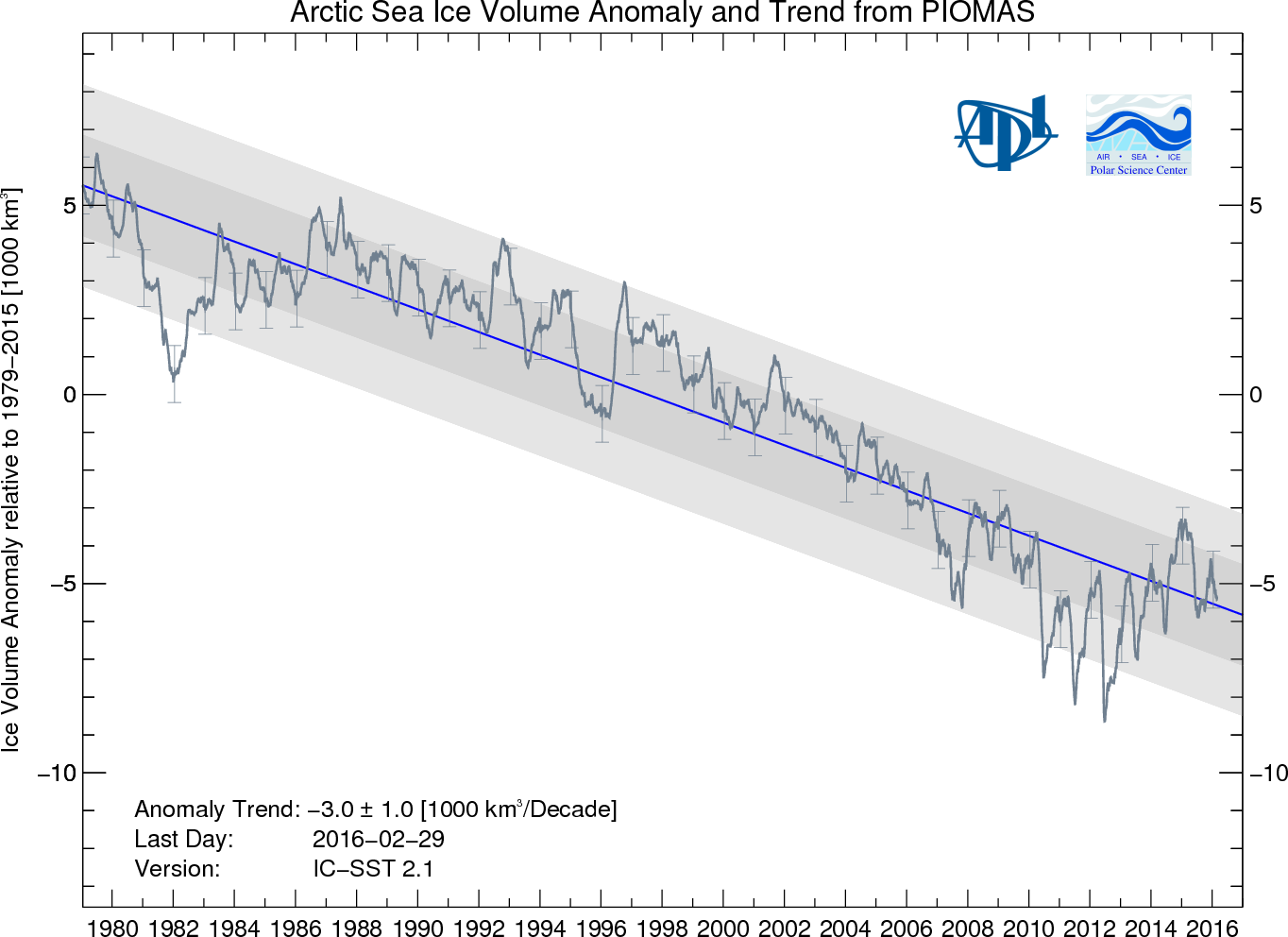
With multi year ice continuing to recover from 2008 lows, ice volume has also been growing in the last few years.

BPIOMASIceVolumeAnomaly-201602

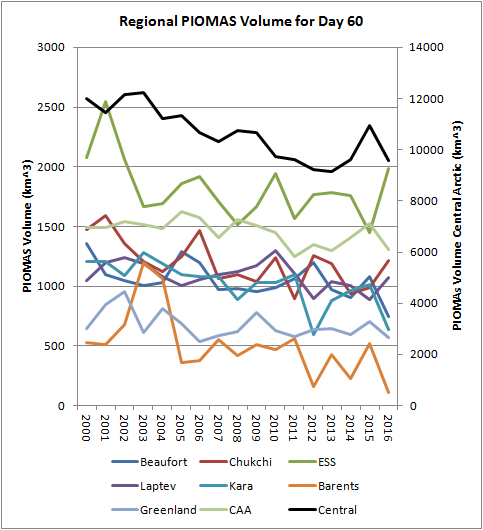
Whilst we all eagerly await the release of the PIOMAS Arctic sea ice volume numbers for March 2016, here is an alternative visualisation of the data from Chris Reynolds:

Reg-Vol-Feb16

Volume is the second lowest on record [for February] since 1978 at 20.660 thousand km cubed

In the Central Arctic, where it matters most, sea ice volume at the end of February was only a whisker above where it was in 2012, according to PIOMAS at least. For those with short memories the CT Arctic sea ice area metric reached an *all time low of 2.23401 million square kilometers on September 13th 2012, and an *all time low anomaly of -2.81817 million square kilometers on October 14th 2012.

*Since the Cryosphere Today records began

An Open Letter to the Reader’s Editor of the Daily Mail

Thank you for your prompt reply, and my apologies for my slightly sluggish one. As you can tell from my details below I have a “day job” to attend to, and if you’ve clicked the links I sent in my original complaint you’ll realise I’ve also been very busy following up on some other allegedly inaccurate articles in the Daily Mail and a number of other Great British newspapers. See for example:

https://greatWhiteCon.info/2015/07/professor-peter-wadhams-complaint-to-ipso/

Gettting back to this complaint, I have just posted my initial reply online here:

https://greatWhiteCon.info/2015/07/mail-makes-1000-arctic-mistake/

Reiterating the main point:

We hereby call on the Daily Mail to provide us with a fair opportunity to reply to this egregious inaccuracy and a number of others in the same article.

Despite your “I therefore cannot see that Clause 1(ii) of the Editors’ Code has been breached in any way.” below, and apart from your admittedly at least 1000% timescale error, the Guardian article linked to highlights a number of other gross inaccuracies in last week’s “Daily Mail Comment” concerning Arctic sea ice volume. I fail to see how “Putting the Arctic sea ice volume record straight” for the unfortunate readers of that editorial can be achieved without prominently displaying to your print readers the Arctic sea ice volume graph extracted from Rachel Tilling’s recent academic paper:

Tilling-2015-Volume

and in addition showing your online readers the “Arctic ice cube” video together with a link to it in print.

I shall have much more to say to you on that topic in the near future but I’m theoretically “on holiday” for a week from tomorrow, so it may well not arrive in your inbox until after my return.

Best wishes,

Jim Hunt

Arctic Sea Ice Volume for Dummies

Dana Nuccitelli has just published an article in the Guardian entitled:

The Daily Mail and Telegraph get it wrong on Arctic sea ice, again

Not only does Dana kindly link to our recent efforts to educate the Daily Mail’s leader writer about the Arctic facts of life. He also does a much better job of explaining the issues than a previous Guardian article about Arctic sea ice volume which we were recently somewhat critical of. This therefore seems like the perfect time to provide an “Arctic Sea Ice Volume 101” lesson for Daily Mail leader writers and their wholly independent “legal eagles”.

Let’s take things one small step at a time shall we. The Daily Mail leader last week starts by saying:

In a major report last year, the Intergovernmental Panel on Climate Change gave a grave assessment of how man-made global warming was rapidly destroying the Arctic ice cap.

Steadily increasing temperatures had made the pack ice contract by up to 12 per cent between 1979 and 2012, leading to rising sea levels which threatened to swamp coastal regions – not to mention endangering stranded polar bears.

By the middle of the century ‘a nearly ice-free Arctic Ocean’ was likely for a large part of the year, the report predicted.

The Mail’s leader writer isn’t very specific about which of the numerous IPCC reports they are referring to , but the Mail’s legal eagle tells us that:

This item was written on the basis of… the 2014 synthesis report by the Intergovernmental Panel on Climate Change – arguably the definitive authority on the subject.

This is a quote from that IPCC report (p4 notes). ‘The annual mean Arctic sea-ice extent decreased over the period 1979 to 2012, with a rate that was very likely in the range 3.5 to 4.1% per decade.’

Given that there are over three decades between 1979 and 2012, the shrinkage of the ice-cap couldn’t have been more than 12 per cent.

This is the first of many “misunderstandings” in the Daily Mail’s leader and their legal eagles response. Here is an extract from Section B.3 “Cryosphere” on page 9 of the IPCC AR5 Working Group 1 Summary for Policy Makers:

The annual mean Arctic sea ice extent decreased over the period 1979 to 2012 with a rate that was very likely in the range 3.5 to 4.1% per decade (range of 0.45 to 0.51 million km2 per decade), and very likely in the range 9.4 to 13.6% per decade (range of 0.73 to 1.07 million km2 per decade) for the summer sea ice minimum (perennial sea ice).

As you can see, the Mail’s “definitive authority on the subject” subject says that  “for the summer sea ice minimum” Arctic sea ice extent in fact decreased by more like 12% per DECADE.

Moving on the next paragraph in the Daily Mail’s leader, we are told that:

How interesting then, that the latest analysis of 88million measurements from the European Space Agency’s Cryosat satellite show the northern ice-cap INCREASED by a staggering 41 per cent in 2013 and, despite a modest shortage last year, is bigger than at any time for decades.

whilst the Mail’s legal eagle explains to us that:

This item was written on the basis of a UCL report that formed this story: http://www.dailymail.co.uk/sciencetech/article-3168504/Arctic-sea-ice-boosted-cool-summer-2013-study-reveals.html

That story states that:

Researchers used 88 million measurements of sea ice thickness recorded by the European Space Agency’s CryoSat-2 mission between 2010 and 2014.

The results showed that there was a 14 per cent reduction in the volume of summertime Arctic sea ice between 2010 and 2012 – but the volume of ice jumped by 41 per cent in 2013, relative to the previous year, when the summer was five per cent cooler than the previous year.

Notice that in this article the author is talking about “summertime Arctic sea ice volume” and not “mean Arctic sea ice extent”. Let’s see if instead of trying to compare apples with oranges like the Mail’s leader writer we can in fact compare like with like shall we?

Firstly let us recall (if we can) from our school days that Volume = Area x Thickness. Next returning to the IPCC AR5 WG1 report we need to turn to the technical summary of their full report where in the TS.2.5.3 “Sea Ice” section on page 40 we can read that:

There is high confidence that the average winter sea ice thickness within the Arctic Basin decreased between 1980 and 2008. The average decrease was likely between 1.3 m and 2.3 m. High confidence in this assessment is based on observations from multiple sources: submarine, electromagnetic probes and satellite altimetry; and is consistent
with the decline in multi-year and perennial ice extent.

Now unfortunately for our purposes this decline in thickness is not expressed as a percentage and is in winter rather than summer. Nevertheless it should be readily apparent to all and sundry by now that the thickness of Arctic sea ice has been declining at the same time as its extensiveness. Moving on to page 136 in section 1.3.4.3 “Ice” of the full IPCC WG1 report we find:

There has been a trend of decreasing Northern Hemisphere sea ice extent since 1978, with the summer of 2012 being the lowest in recorded history (see Section 4.2 for details). The 2012 minimum sea ice extent was 49% below the 1979 to 2000 average and 18% below the previous record from 2007. The amount of multi-year sea ice has been reduced, i.e., the sea ice has been thinning and thus the ice volume is reduced.

Following the IPCC’s instructions let’s now move on to page of section 4.2.2.4 “Arctic Sea Ice Thickness and Volume”, where we read that:

For the Arctic, there are several techniques available for estimating the thickness distribution of sea ice. Combined data sets of draft and thickness from submarine sonars, satellite altimetry and airborne electromagnetic sensing provide broadly consistent and strong evidence of decrease in Arctic sea ice thickness in recent years.

That’s followed by many paragraphs of learned discussion, but still no statement of Arctic wide volume decline in percentage terms to keep the Mail’s legal eagle happy.

Inside the BBC’s Arctic Sea Ice Science

I’m sure we’ll get stuck into to some real science eventually, but for the moment we’re still taking a long, hard look at mainstream media coverage of the latest learned journal article on Arctic sea ice to be misinterpreted by the media. Compared to some others one might mention the report on the BBC web site about the new CPOM paper in Nature Geoscience entitled “Increased Arctic sea ice volume after anomalously low melting in 2013” was relatively accurate. Entitled “Arctic ice ‘grew by a third’ after cool summer in 2013“, it said that:

Researchers say the growth continued in 2014 and more than compensated for losses recorded in the three previous years.

The scientists involved believe changes in summer temperatures have greater impacts on ice than thought.

But they say 2013 was a one-off and that climate change will continue to shrink the ice in the decades ahead.

The Arctic region has warmed more than most other parts of the planet over the past 30 years.

Satellite observations have documented a decrease of around 40% in the extent of sea ice cover in the Arctic since 1980.

and

The researchers used 88 million measurements of sea ice thickness from Cryosat and found that between 2010 and 2012, the volume of sea ice went down by 14%.

They published their initial findings at the end of 2013 – but have now refined and updated them to include data from 2014 as well.

Relative to the average of the period between 2010 and 2012, the scientists found that there was a 33% increase in sea ice volume in 2013, while in 2014 there was still a quarter more sea ice than there was between 2010 and 2012.

At this juncture one is forced to ask oneself the question that if there was 33% more sea ice in 2013 than there was between 2010 and 2012, but only 25% more in 2014 how it was possible that “the growth continued in 2014”?

Desperately hoping that the BBC might be able to explain this conundrum to us we avidly listened to Adam Rutherford’s interview with Rachel Tilling, the lead author of the paper in question, on BBC Radio 4’s “Inside Science” programme last night. We were also hoping that at long last there might be some quantification of what’s happened to the VOLUME of “sea ice cover in the Arctic since 1980”. Sadly all our hopes were dashed, and Adam never posed the vital questions.

You can download a recording of the broadcast from the link above. Adam’s interview with Rachel starts at 7:00 minutes. He begins by talking about:

The publication in Nature Geoscience this week of a new paper that shows that in 2013, which was a slightly cooler summer than average, Arctic ice had grown, not just a tad, but by a WHOPPING 41% on the previous year!
Rachel Tilling then begins by saying:

The thickness and the volume are actually the most important measurements we can get, because the area’s been really, really useful in giving us an overview of how the Arctic is changing, but it only really gives us half the picture.

Here’s the full picture, taken from our Arctic Sea Ice Graphs page. Since CryoSat-2 measurements only go back as far as 2010, this graph shows Arctic sea ice volume calculated by the PIOMAS model developed by the Polar Science Center at the University of Washington:

piomas-trnd2-201506Is that WHOPPING increase in Arctic sea ice volume from 2012 to 2013 clear to you now? At 11:00 minutes into the programme Adam says:

You can see how this is going to be interpreted. You know, with 30 years of Arctic sea ice shrinking, and then suddenly it gets bigger, you’re still OK with climate change being a real thing, and global warming being a real thing?

I can see that very clearly Adam, thanks for asking, and YES is the answer to your final question. It still wasn’t clear to me whether that would be clear to Adam’s listeners however, so I posed a pertinent question on Twitter first of all:

That didn’t elicit any response, so then I tried following Adam’s instructions at the end of the interview to:

 Do let us know what you think – [email protected]

This is what I thought:

Hello Adam,

Further to your recent interview with Rachel Tilling, and your joint Twitter conversation with my alter ego “Snow White”, I’d like to reiterate how disappointed the two of us are that during your conversation with Rachel there was no mention of “41% of nothing”. Twitter speak for “Doesn’t anybody at the BBC have the faintest idea what Arctic sea ice volume was 30 years ago, in April and in October?”

By way of additional context see e.g.

https://greatWhiteCon.info/2015/07/an-inconvenient-truth-about-the-mails-climate-coverage/

http://www.carbonbrief.org/blog/2015/07/cool-arctic-summer-brought-brief-recovery-in-2013-sea-ice-loss/

https://greatWhiteCon.info/resources/

Yours in dismay,

Jim Hunt

and this is the response I got from BBC Inside Science:

Dear Sir or Madam

Thank you very much for your email. While all emails are read – and we appreciate input from listeners – we cannot reply to each one individually. There are simply too many!

For more information about Inside Science, please go to our webpage:

Inside Science, Radio 4
http://www.bbc.co.uk/programmes/b036f7w2

For individual programmes, click on ‘Episodes’.
http://www.bbc.co.uk/programmes/b036f7w2/episodes/guide

Once you have located a particular programme page, you will see a link to ‘Listen now’- on the picture of Dr. Adam Rutherford.
‘Related Links’ are found further down on the right hand side of the page.

Downloads/Podcasts of Inside Science are available at:
http://www.bbc.co.uk/podcasts/series/inscience

Thanks again and do keep sending your comments in – listener feedback helps us make better programmes for you.

Yours sincerely

Inside Science, Radio 4


Meanwhile, over on Twitter:

An Inconvenient Truth About The Mail’s Climate Coverage

A new paper has just been published by the CryoSat-2 team at University College London. The lead author is Rachel Tilling, a PhD student in the Centre for Polar Observation & Modelling at UCL. We’ll get on to the science in due course, but first let’s take a look at how Rachel’s paper has been reported in the Great British mainstream media. In a headline redolent of our old friends at the Mail on Sunday The [headline writer for the] Guardian’s Damian Carrington proclaims that:

Arctic sea ice volume showed strong recovery in 2013

Cooler temperatures revived sea ice levels suggesting a rapid recovery was possible if global warming was curbed, scientists say

Yesterday wasn’t a Sunday, so David Rose was writing in The Spectator instead of The Mail, asking rhetorically:

Was the global warming pause a myth?

Of course it was David! We explained that to you back in January!

The Daily Mail Group couldn’t let a juicy headline go begging just because it’s midweek, so an anonymous leader writer came up with this one:

Climate change and an inconvenient truth

The “Daily Mail Comment” continues:

In a major report last year, the Intergovernmental Panel on Climate Change gave a grave assessment of how man-made global warming was rapidly destroying the Arctic ice cap.

Steadily increasing temperatures had made the pack ice contract by up to 12 per cent between 1979 and 2012, leading to rising sea levels which threatened to swamp coastal regions – not to mention endangering stranded polar bears.

By the middle of the century ‘a nearly ice-free Arctic Ocean’ was likely for a large part of the year, the report predicted.

How interesting then, that the latest analysis of 88million measurements from the European Space Agency’s Cryosat satellite show the northern ice-cap INCREASED by a staggering 41 per cent in 2013 and, despite a modest shortage last year, is bigger than at any time for decades.

After that it prattles on about the “pause”, so for now let’s take a look at the paper that’s got the papers so excited. For some strange reason it’s title makes no mention of a “strong recovery in 2013”, instead describing:

Increased Arctic sea ice volume after anomalously low melting in 2013

Searching the paper for the word “recovery” returns zero results, so you may well be wondering what it actually does say? Here’s a pertinent, albeit brief, extract from the abstract:

Between autumn 2010 and 2012, there was a 14% reduction in Arctic sea ice volume, in keeping with the long-term decline in extent. However, we observe 33% and 25% more ice in autumn 2013 and 2014, respectively, relative to the 2010–2012 seasonal mean, which offset earlier losses. This increase was caused by the retention of thick sea ice northwest of Greenland during 2013 which, in turn, was associated with a 5% drop in the number of days on which melting occurred—conditions more typical of the late 1990s. In contrast, springtime Arctic sea ice volume has remained stable.

Let’s compare that with the Mail’s version shall we? Whilst searching the paper for the word “ice” returns lots of results a search for the word “cap” returns zero results, just like “recovery”. Any investigative journalist (or leader writer) who had investigated Wikipedia would have discovered this:

An ice cap is an ice mass that covers less than 50,000 km² of land area (usually covering a highland area). Masses of ice covering more than 50,000 km² are termed an ice sheet.

Thus the Arctic Ocean is not covered by an “ice-cap [that] INCREASED by a staggering 41 per cent in 2013” because, as it’s name suggests, it’s an ocean and not a land area. Assuming for the moment that the Mail leader writer is in actual fact referring to sea ice cover in the Arctic, then according to Rachel Tilling’s paper CryoSat-2 “observed 33% more ice in autumn 2013”. Where did the Mail’s “41%” come from then? Their patent pending hot air generator in reverse gear?

Moving on, the Mail must also have a top secret time machine hidden in the basement of Northcliffe House that will enable their leader writer to travel back and change history, because here once again is Andy Lee Robinson’s graphic visualisation of what’s really been happening to the volume of sea ice in the Arctic over the past few decades, albeit using PIOMAS sized ice cubes rather than the CryoSat-2 flavour:

Needless to say I have already lodged an official complaint about the antics of The Daily Mail’s imaginary time machine. If you would like to do as well then here is the appropriate form to fill in:

http://dailymail.co.uk/readerseditor

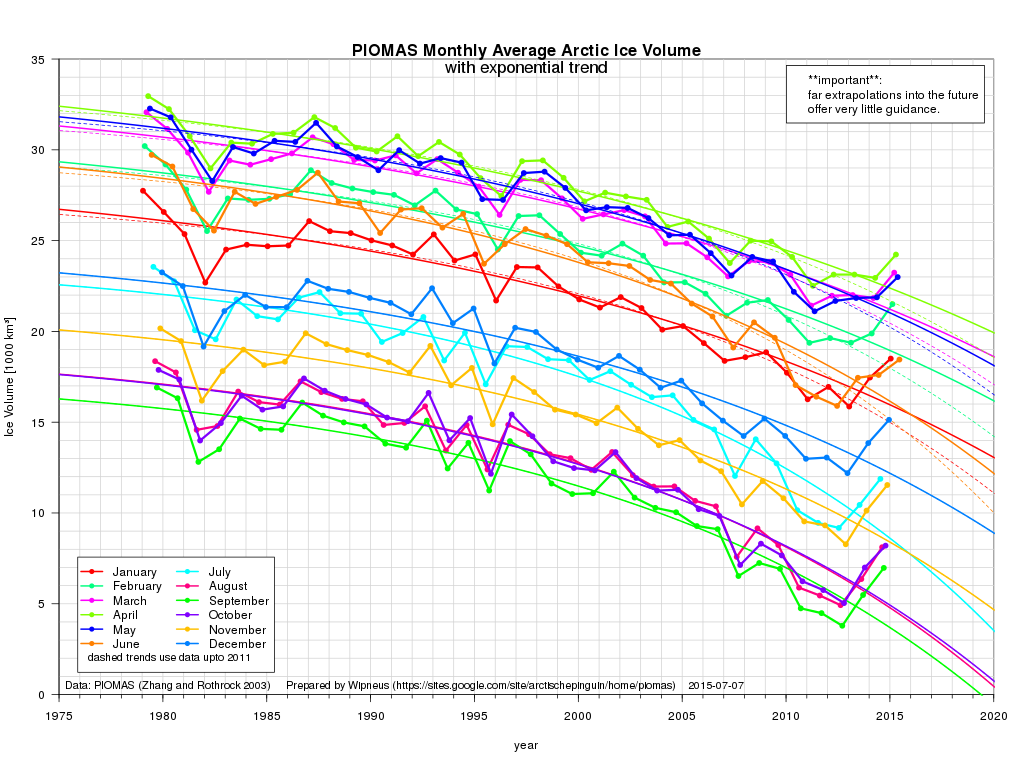
For any IPSO case officers (or Guardian writers) that might be watching please feel free to read all about 41% of nothing, and if you prefer graphs to moving pictures here’s one that shows Arctic sea ice volume in Spring from our PIOMAS regional volume page:


Meanwhile, over on Twitter: