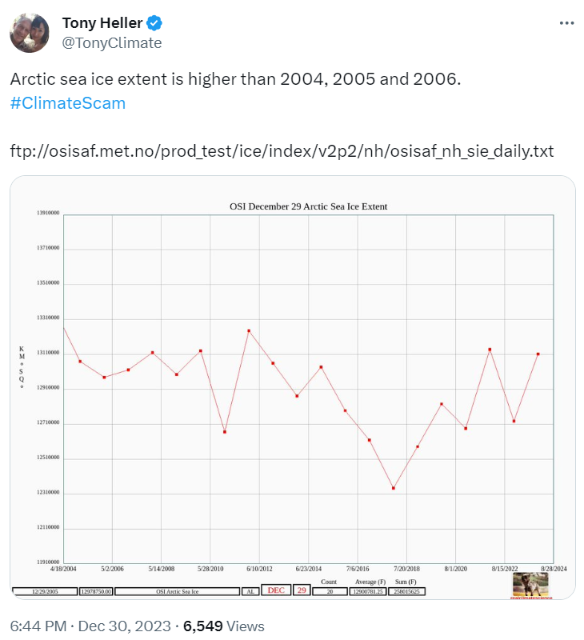
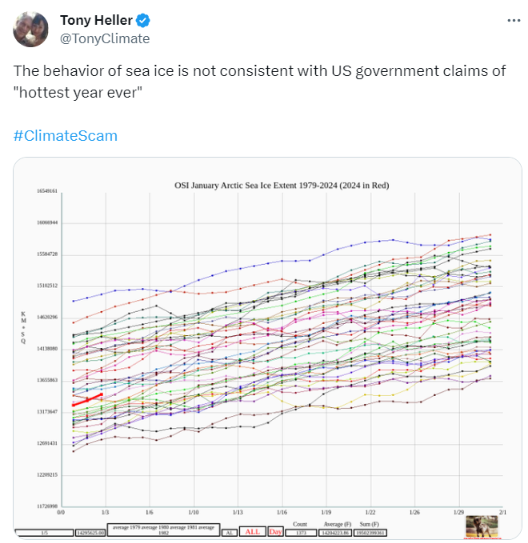
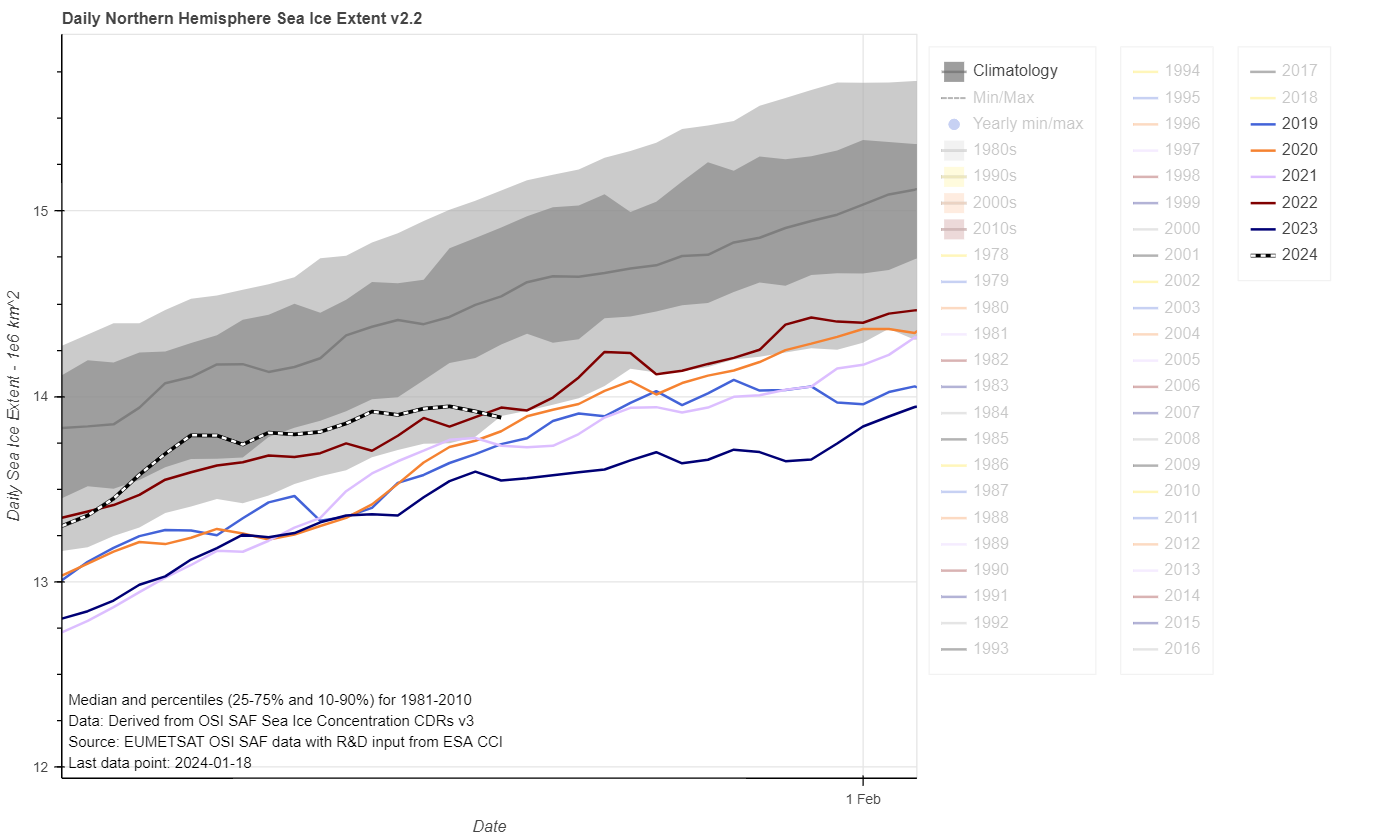
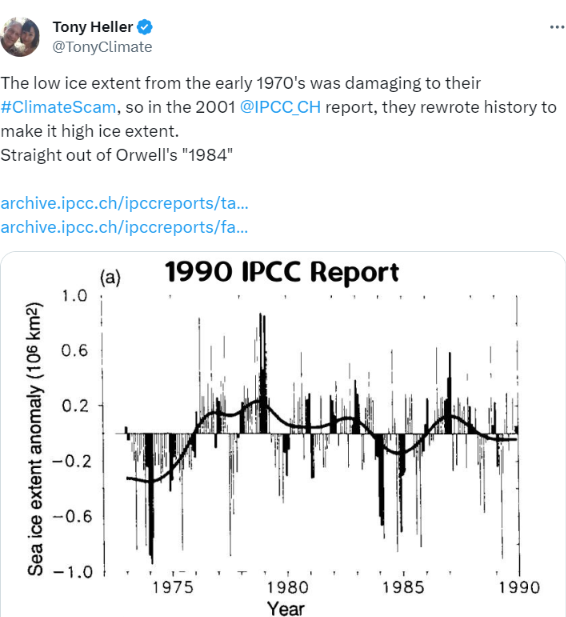
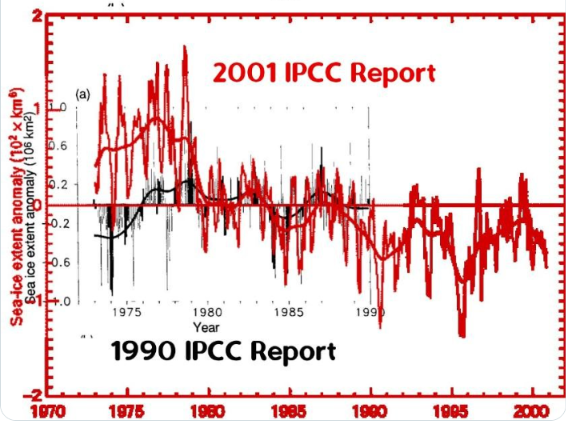
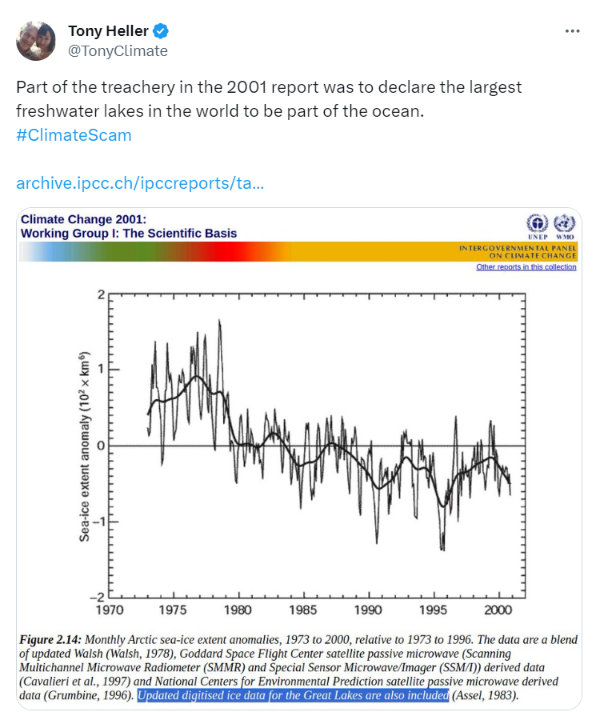
Apart from (presumably accidentally) empirically confirming global warming and Arctic sea ice volume decline, Tony Heller has also been frantically attempting to persuade his flock of faithful followers that the current value of the OSI SAF’s extent metric means that the impending series of “2023 has been the hottest year evah!” stories are all lies.
Here a few examples of his infamous oeuvre, together with “Snow White’s” responses:
Can you rustle up one of those for another date Tony?
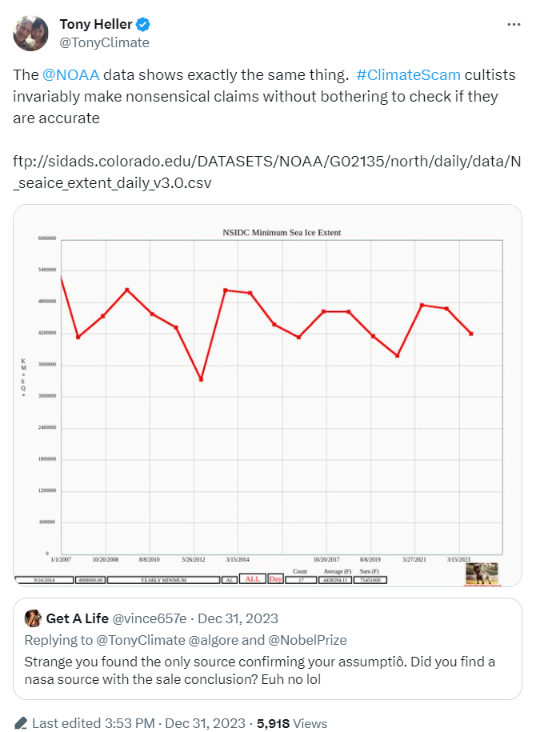
Switching swiftly to a cherry picked graph of the OSI SAF minimum extent, Tony invokes the spirit of a deceased parrot that went to meet its maker several decades ago. He remains blissfully unaware that I watched the Monty Python dead parrot sketch when it was first broadcast:
When do you suppose Tony will get around to implementing my suggestion of revealing the OSI SAF extent graph for December 8th to his flock of faithful followers?
Or a multi decade graph of NSIDC extent for that matter?
[Update – January 4th]
My prediction has come true in next to no time:
[Update – January 20th]
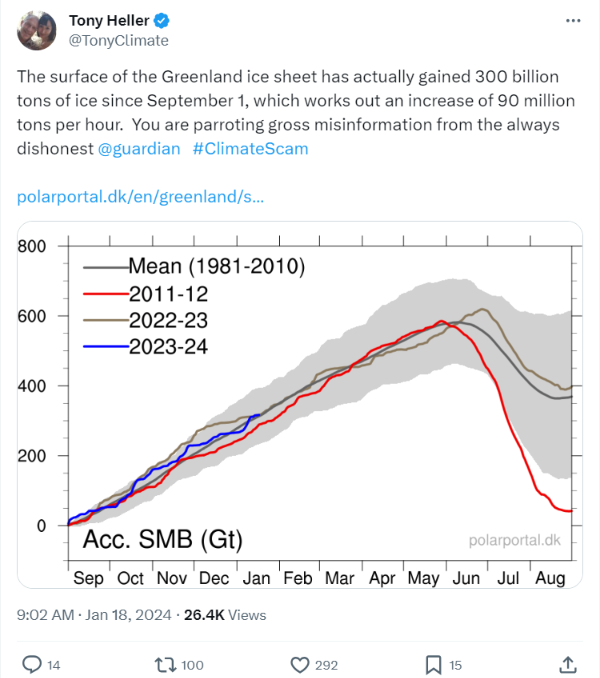
For some strange reason Tony has been silent about Arctic sea ice extent for a while, and has moved on to the Greenland ice sheet instead:
Presumably that’s in response to an article in The Guardian:
The Greenland ice cap is losing an average of 30m tonnes of ice an hour due to the climate crisis, a study has revealed, which is 20% more than was previously thought…
The study, published in the journal Nature, used artificial intelligence techniques to map more than 235,000 glacier end positions over the 38-year period, at a resolution of 120 metres. This showed the Greenland ice sheet had lost an area of about 5,000 sq km of ice at its margins since 1985, equivalent to a trillion tonnes of ice.
“Snow White” felt compelled to respond to Mr. Heller as follows:
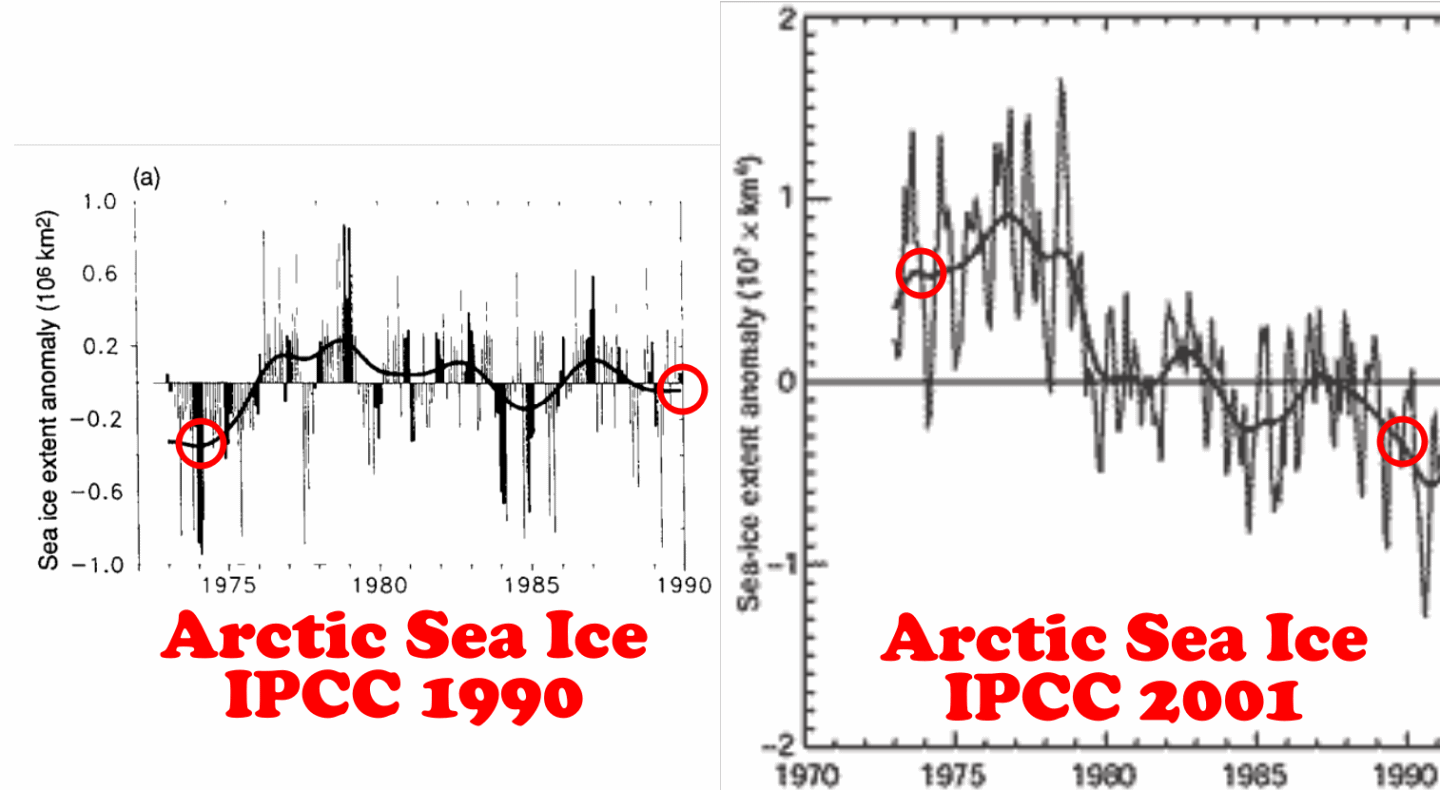
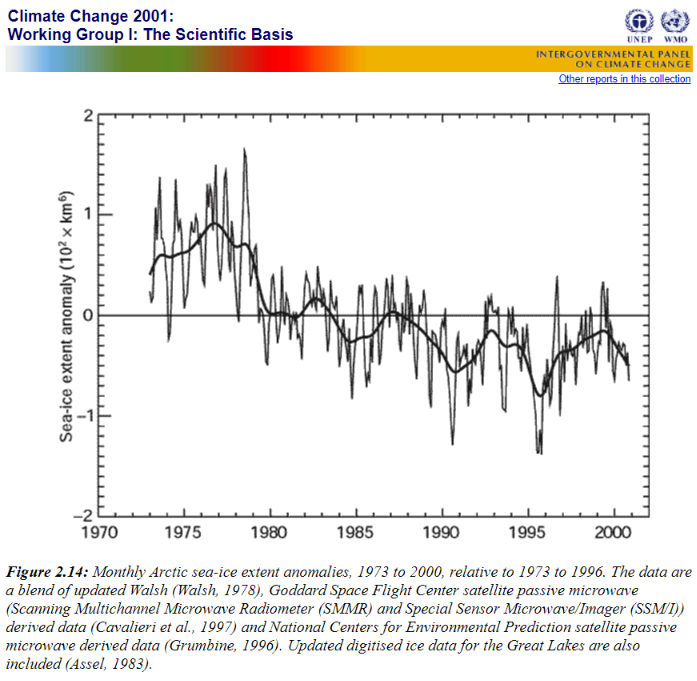
Evidently Tony has still not learned that it’s impossible to compare 1990 apples with 2001 oranges, despite having the difference explained to him on numerous previous occasions.
Stop Press! Tony has suddenly discovered that he’s been comparing apples with oranges all these years!!
As the New Year rapidly approaches Tony Heller is up to his old Arctic tricks yet again. No doubt we’ll get on to many of his hoary old chestnuts in due course, but although I may easily have blinked and missed it he appears to have a new trick up his voluminous sleeve. Providing empirical evidence that the Intergovernmental Panel on Climate Change’s global warming “predictions” are correct!
Here is a recent extract from “Snow White’s” XTwitter feed:
Here's @TonyClimate demonstrating yet again that either:
1) He has no understanding of all things #Arctic, or
2) He understands well enough, but he pulls the wool over the eyes of his flock of faithful followers:https://t.co/U3tbp2qrOU
My Arctic alter ego was checking out the new “X” rated edition of Twitter when “she” couldn’t help but notice that Elon Musk had allowed Tony Heller back into the climate “debate” thereon, albeit with a new handle.
“Snow White” also noticed that for some strange reason Tony was telling lots of porky pies about Arctic sea ice again! Hence:
Here's @TonyClimate demonstrating yet again that either:
1) He has no understanding of all things #Arctic, or
2) He understands well enough, but he pulls the wool over the eyes of his faithful flock of followers.https://t.co/yYNhpSncLE
Peter, a welcome new denizen here at the Great White Con Ivory Towers, appears to have parachuted into our far north summer hideaway on the shores of Santa’s Secret Summer Swimming Pool straight from Tony Heller‘s Unreal Climate Science blog.
Prompted by Peter I wandered over to Tony’s place where I found to my surprise that he has recently been busy warming up an old chestnut of his that has been debunked numerous times over the past decade. Allegedly:
Between 1990 and 2001, the IPCC rewrote the Arctic sea ice satellite record, and changed a trend of ice increasing to ice decreasing.
Here’s a previous chestnut rewarming event preserved for posterity:
You really have no idea what you're talking about, do you Tony?
Sadly Tony’s side of the “debate” has been deleted by the powers that be at Twitter, so here are the two graphs in question, combined by Mr. Heller into one illuminating animation:
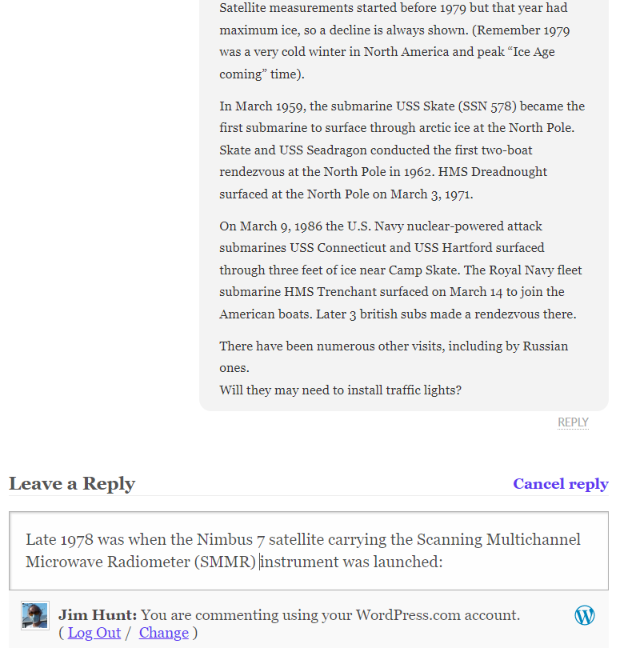
I posted this comment on Tony’s blog last night (UTC), but he hasn’t got back to me yet:
Neither has anybody else. That’s probably because this morning my words of wisdom are still only visible to Tony and I?
[Edit – October 5th]
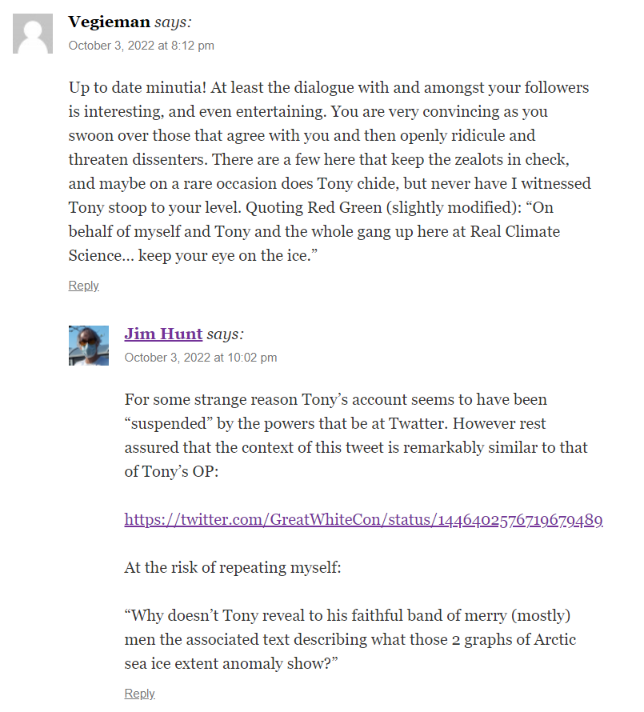
Progress at long last! Vegieman directs the attention of Tony’s band of merry (mostly) men to:
However for some strange reason he neglects to mention that Tony’s link labelled “2001 IPCC Report” doesn’t lead to that graph!
[Edit – October 9th]
Not a lot of people know that since things have gone quiet at Tony’s place I popped into Paul Homewood’s echo chamber, where rewriting the Arctic continues apace:
Having yet to cross metaphorical swords with many of the more foul mouthed “skeptics” of my acquaintance this missive comes to you later than usual this year. However I have just come across one Alan Poirier for the first time.
1) Apparently Alan’s source of Arctic expertise is Watts Up With That!
This is how the entirety of our conversation on Twitter went earlier this evening (UTC):
Al Gore said nothing of the sort Alan. Evidently your memory is faulty.
2) The pseudonymous Vegieman’s apparent source of Arctic expertise is Tony Heller!
This is how he signed off from our recent conversation over at Tony’s unReal Climate Science blog:
The arrogant, condescending manner you project is consistent with those that defend the absurdities of every godless, human denigrating, population destroying effort currently being perpetrated on mankind everywhere. What possesses you and your kind to glory in heaping hopelessness, misery, and despair on your neighbor? To come here and strut your depraved condition is evidence of your insecurity. Tony and most here share an integrity and regard for truth that you are severely deficient in. It would be good if you could abandon your sinking ship, but I know it is a very hard descent from the crows nest in which you reside.
My apologies for the mixed metaphors in today’s title, but the news I bear is beyond bizarre.
In a press release earlier today The Global Warming Policy Foundation proudly announced that:
A new paper by an eminent meteorologist says that trends in polar sea-ice levels give little cause for alarm. The paper, by Professor J. Ray Bates has just been published by the Global Warming Policy Foundation.
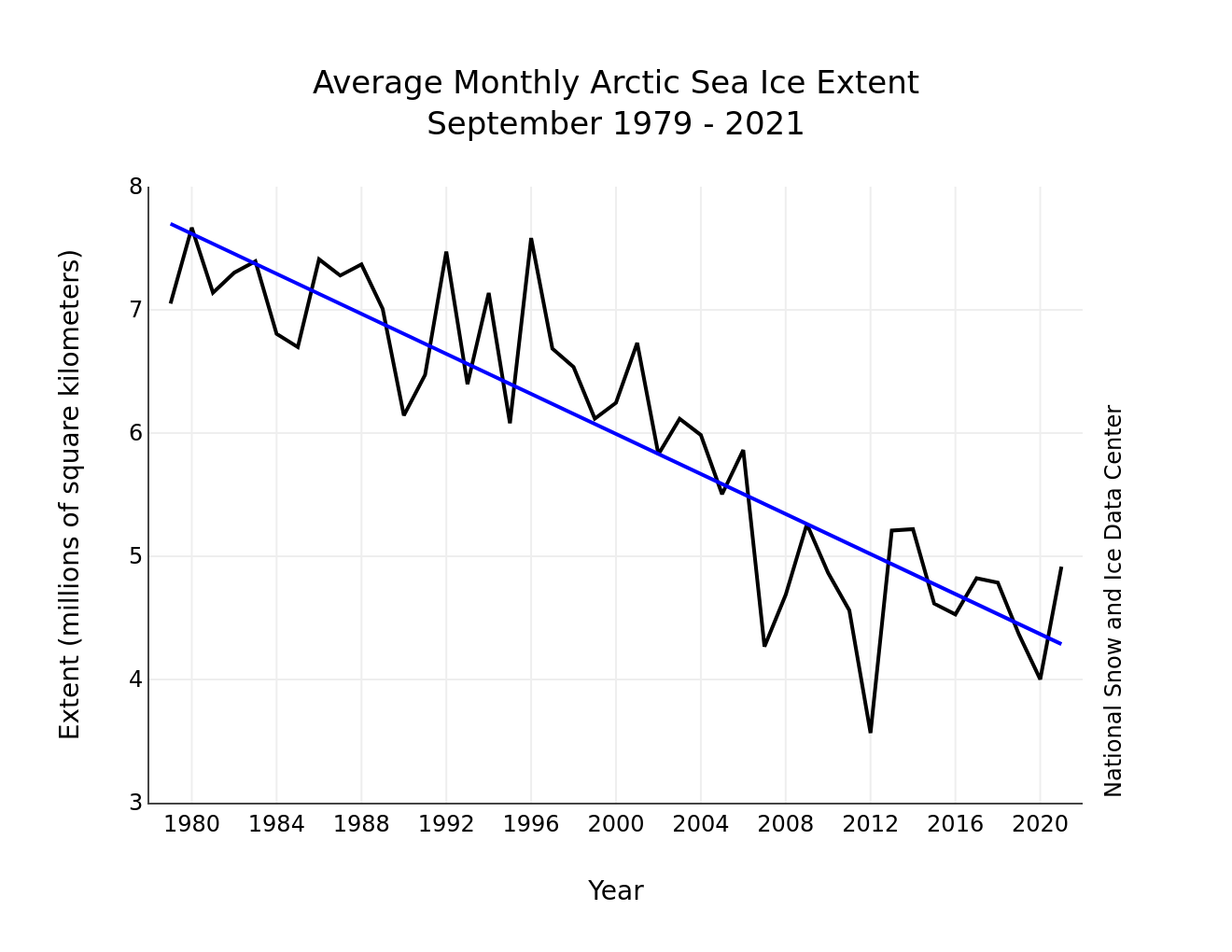
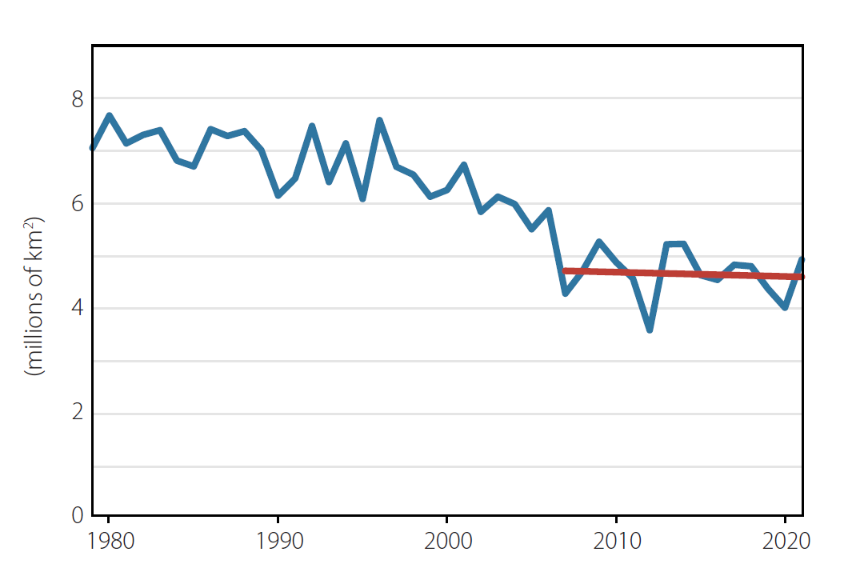
According to Professor Bates, climate model simulations indicate significantly decreasing sea ice levels in both hemispheres, with the greatest decreases occurring in September each year. However, the observed September trend in the Antarctic is actually slightly upwards, and while observed levels in the Arctic have fallen over the last 40 years, they have been quite stable since around 2007.
Professor Bates said:
“In 2007, Al Gore told us that Arctic sea ice levels were ‘falling off a cliff’. It’s clear now that he was completely wrong. In fact, the trends in sea-ice are an antidote to climate alarm.”
Professor Bates also says that little reliance should be placed on model simulations of future sea-ice decline:
“Climate models failed to predict the growth in Antarctic sea ice, and they missed the recent marked slowdown of sea-ice decline in the Arctic. It would be unwarranted to think they are going to get things right over the next 30 years.”
Professor Bates’ paper is published today, and can be downloaded here (pdf).
By all means download Ray’s “paper” from the link above and take a look at his introduction, which begins as follows:
The recent publication of the book Unsettled by Steven Koonin has led to the likelihood of increased scrutiny of the perception of a climate emergency,1 an idea which has become so widely established in recent years. Koonin, a former scientific advisor to the Obama administration, has demonstrated that what the public are being told by the media is not necessarily what the scientists are saying. He has also shown that what is being relayed in the national and UN climate assessments has often been written for the purpose of persuading rather than informing.
Unsettled clearly shows that important aspects of climate science, which the public have been persuaded to regard as beyond dispute are, in fact, quite unsettled.
Regular readers may recall that as soon as Steve’s book was published in machine readable format we established that it made no mention whatsoever of sea ice, whether of the Arctic or Antarctic variety.
Furthermore, when I attempted to debate that fact with Prof. Koonin he disappeared without trace before justifying that strange omission, beyond asserting that:
The topic is somewhat distant from ordinary folks’ perception.
It seems that Prof. Bates and the GWPF disagree with Prof. Koonin on this topic, since presumably their “paper” is addressed to ordinary folks? Ray even explicitly states that:
Although Unsettled covers a broad spectrum of climate topics, it does not treat in depth the issue of recent polar sea-ice trends, which are key indicators of changes in the global climate.
His “paper” goes on to assert in section 2 that:
Since the introduction of passive-microwave satellite observations in the late 1970s, polar sea-ice extent has been among the most accurately observed climate indicators. Sea-ice volume, on the other hand, is much more difficult to measure.
So far so good I suppose, but then we are told:
In December 2007, former US vice-president Al Gore, in his Nobel Peace Prize acceptance speech in Oslo, referred to scientific studies warning that the Arctic sea ice was ‘falling off a cliff’. He highlighted forthcoming model results that projected largely ice-free Arctic summers in ‘as little as seven years’. He repeated this warning two years later at the 2009 COP15 climate meeting in Copenhagen.
Gore’s claim was based on a study by researchers from the US Naval Postgraduate School, who used a regional model of the sea ice–ocean system in the Arctic, constrained using observational data for the 12-year period 1996–2007, and concluded that the Arctic would be nearly ice-free in summer by 2016 (plus or minus three years).
Prof. Bates seems blithely unaware that we thoroughly debunked this nonsense many moons ago. What Prof. Wieslaw Maslowski, one of those pesky “researchers from the US Naval Postgraduate School”, actually said in December 2007 was:
If we project this trend ongoing for the last 10–15 years, we probably will reach zero in summer some time mid next decade.
Reiterate for the benefit of those who seem unable to understand either English or Mathematics that a “projection” is not the same thing as a “prediction”.
preferring instead a version of his own construction, which looks like this:
Ray then confidently asserts that:
The current slowdown in the rate of sea-ice loss was not expected, and the reasons for it are uncertain.
Sadly Ray’s exhaustive list of references fails to mention this learned journal article from 2011 by authors from the University of Washington and Los Alamos National Laboratory, which not only anticipated such a “slow transition” but also offered reasons for it:
Given the strong thickness–growth feedback of sea ice (Bitz and Roe 2004), where in a warming climate we can expect the thicker MY ice to thin at a greater rate than the thinner FY ice, and the fact that the ratio of MY to FY ice entering into the MY ice category each year is decreasing, it is likely that the difference between FY and MY ice survival ratios will decrease in a warming climate. If this occurs, the Arctic sea ice system would move toward a regime of decreased memory and decreased sensitivity to climate forcing…
There is of course plenty more GWPF sea ice nonsense where that lot came from, but it’s already past my tea time (UTC) and so further debunking will have to wait a while. In the meantime here’s a wake up call for Professor J. Ray Bates:
[Edit – December 17th]
Moving further down section 2 Ray assures us that:
Any objective discussion of the recent Arctic sea-ice decline also requires that some consideration be given to the evidence regarding past natural variability on a multi-decadal timescale. In the pre-satellite era, reliable data on sea-ice coverage was sparse.
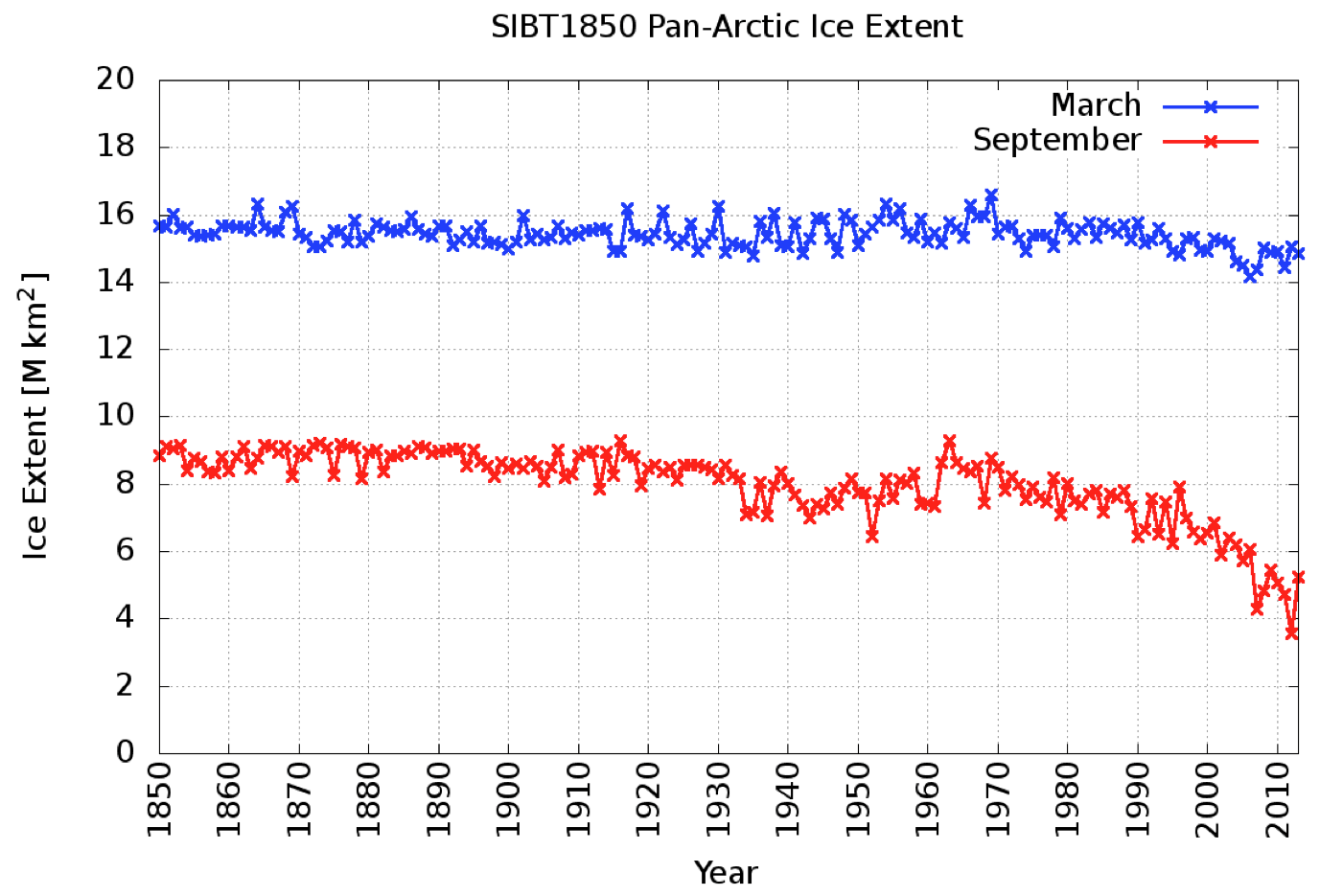
By combining the temperature and partial sea-ice records, statistical reconstructions of the total sea-ice extent going back to the early 1900s can be created. Some of these reconstructions indicate that between the 1900s and 1940s, Arctic sea-ice extent comparable to the present reduced levels may have occurred.
Ray doesn’t sound very certain, which is perhaps because the paper in question blithely states that:
Because Arctic sea ice trends are closely correlated to Arctic temperature trends, they are often discussed in the context of global temperature trends.
Maybe so, but to the best of my recollection Connolly et al. never attempt to “prove” the asserted correlation. Here’s an alternative assessment of “Arctic sea-ice extentbetween the 1900s and 1940s“:
Not a lot of people know that our headline for today (apart from the terminating question mark) has been shamelessly plagiarised from Paul Homewood’s latest Arctic article. This will give you a flavour of Paul’s purple prose:
Electroverse have uncovered some blatant data tampering by DMI:
“It would appear that the Danish Meteorological Institute (DMI) may have taken a leaf out of NASA’s ‘data-fudging 101‘.
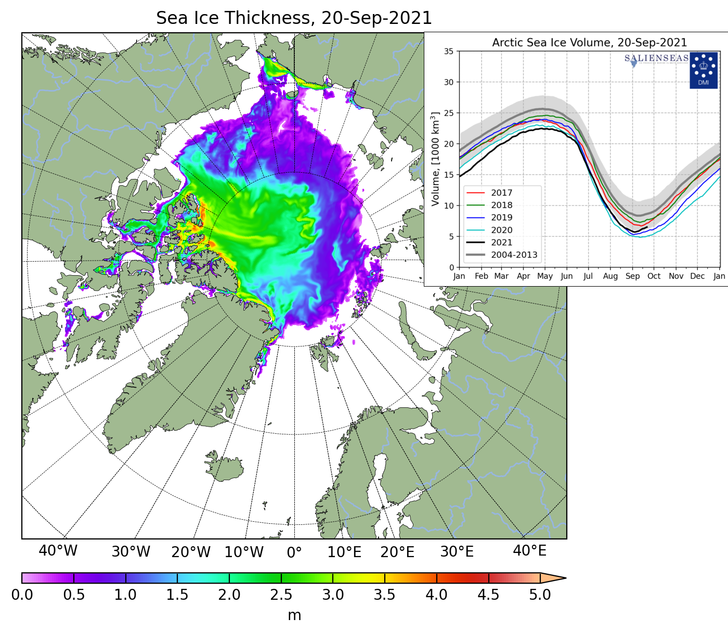
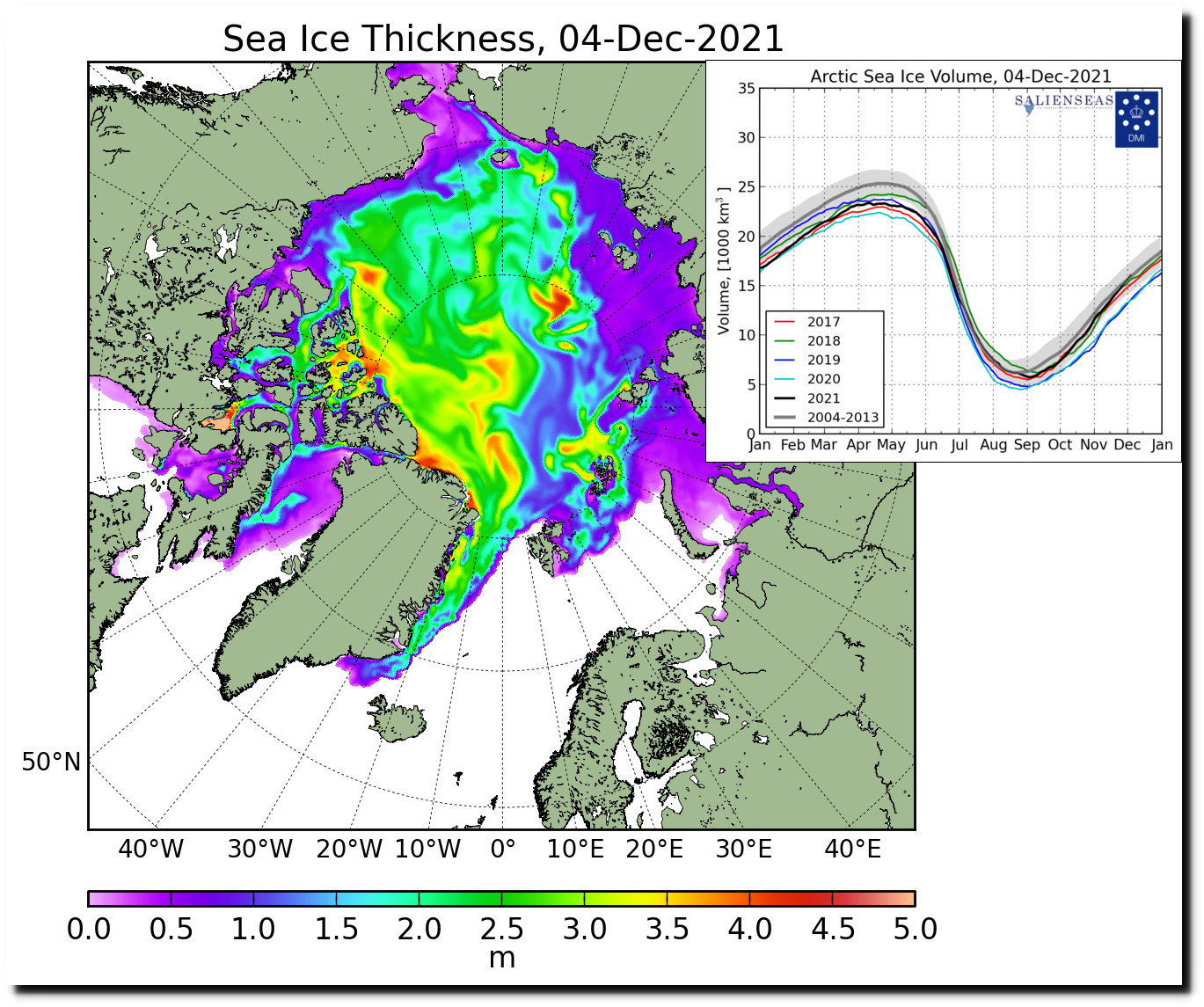
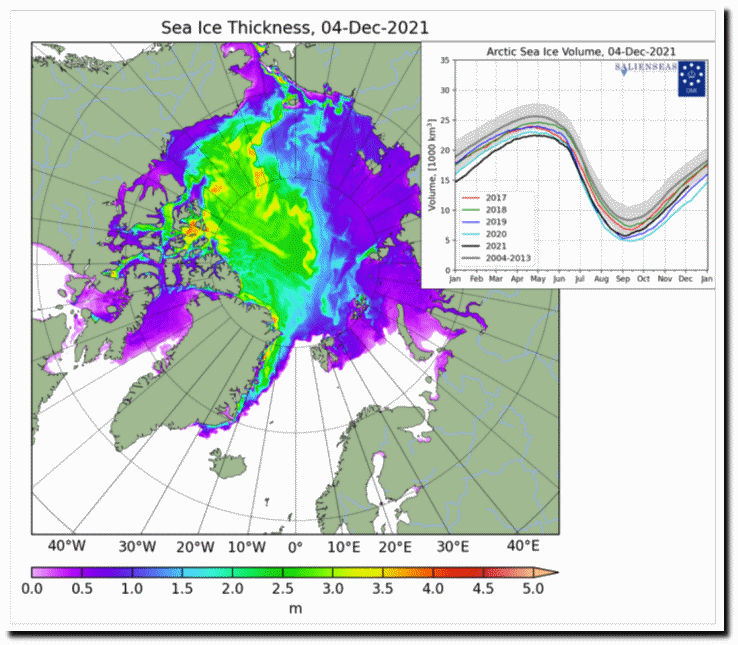
Sometime between late-Nov and early-Dec this year, the DMI’s Arctic Sea Ice Volume chart experienced a mysterious ‘vanishing’ of ice — this is revealed by a direct comparison of the Nov 18th and the Dec 8th charts below.”
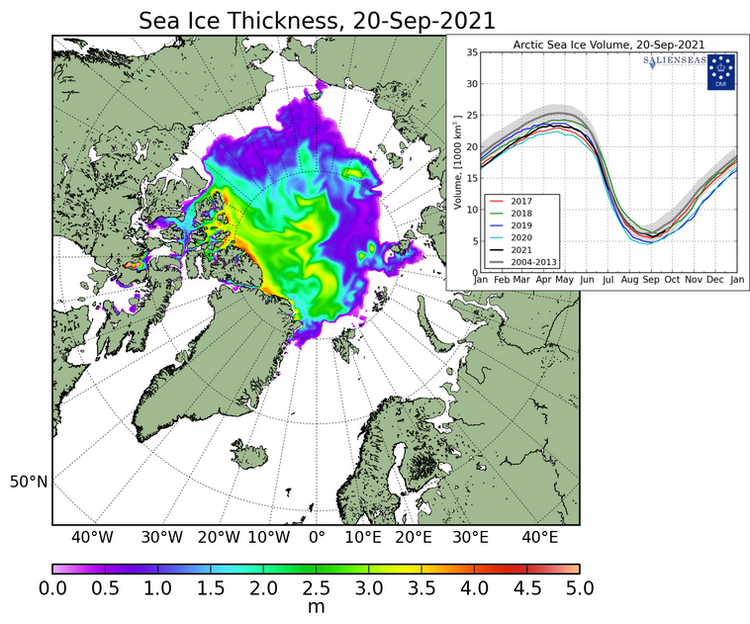
I am able to corroborate their findings. In September I took this screenshot of DMI sea ice thickness. Note that the black line for this year was close to the 2018 line, and above 2017 for Sep 20th:
But the new version shows this year well below those two years:
There is no other way to describe this than blatant fraud. The changes do not appear to have been even documented, and the old data is not archived, being simply “replaced”. These should surely be very basic scientific requirements.
Neither does there appear to have been any public announcement by DMI about the fact or the justifications for what amounts to a significant change.
What this episode means is that DMI can no longer be trusted to produce honest, reliable data. It also raises the question of whether similar tampering has been carried out in previous years, without anybody being aware. After all, it is only by pure accident that it has been spotted this time.
Even fewer people know that my helpful explanatory comment is currently invisible to Paul’s band of merry (mostly) men:
Should anyone contrive to click on the invisible link this what they would see just below the DMI’s recent Tweet:
Quite predictably Tony Heller has also jumped on the self same bandwagon, claiming in an article entitled “Rapidly Disappearing Arctic Ice” that:
On December 4, DMI showed Arctic sea ice volume above the 2004-2013 average:
Quite predictably, the data disappeared for three days, and now that it has returned, DMI has massively reduced the amount of sea ice in the Arctic. Much of the thick ice off the coast of Siberia has disappeared:
In normal circumstances I would of course point out the error of his ways to Tony via Twitter. However:
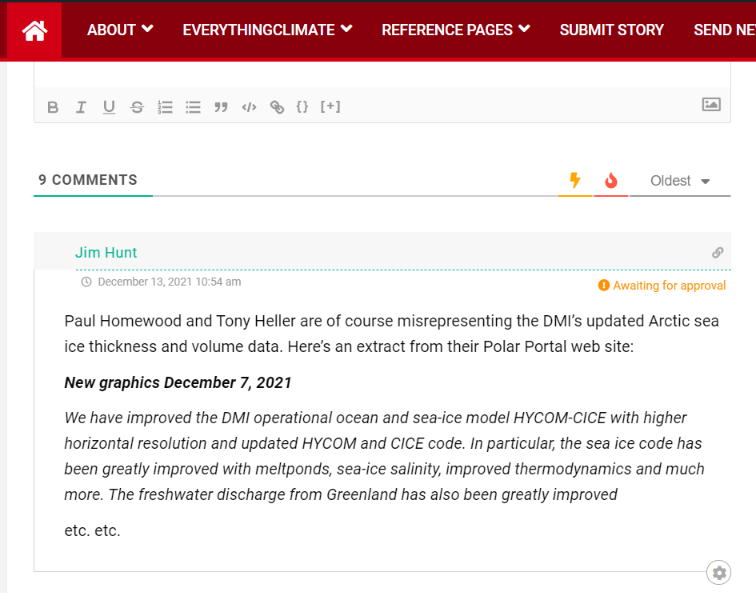
Here is the DMI’s explanation for the recent change in their Arctic sea ice thickness/volume visualisations, as shown on their “Polar Portal” web site:
New graphics December 7, 2021
We have improved the DMI operational ocean and sea-ice model HYCOM-CICE with higher horizontal resolution and updated HYCOM and CICE code. In particular, the sea ice code has been greatly improved with meltponds, sea-ice salinity, improved thermodynamics and much more. The freshwater discharge from Greenland has also been greatly improved using freshwater product from GEUS, which especially improves the coastal ocean currents and thus the ice transport nearshore Greenland. The model has been running continuously since September 1990. Therefore, we have by December 07, 2021 updated the graphics of sea-ice thickness and volume using the new and improved data on Polarportal and ocean.dmi.dk.
The improved model setup has led to higher variability as well as less abrupt melting during the melt season, which gives a shift of approximately half a month for the time of minimum ice volume. The trend between the years is almost unchanged. Thereby, a year with a large sea-ice volume in the old setup also has a large volume in the new setup, and similar for years with low sea-ice volume.
I always thought that “skeptical” folk didn’t much care for the output of “climate models” but I guess I must have been mistaken?
[Edit – December 13th]
Needless to say my comment at NALOPKT is still invisible this evening. However credit where credit is due. Tony Heller has at least not censored my comments on his blog. Earlier today Watts Up With That referred to both the Heller and Homewood DMIGate2 articles. Do you suppose the following helpful comment of mine will ever see the light of day at WUWT?
Watch this space for more #DMIGate2 news as and when we receive it!
O frabjous day! Callooh! Callay!” He chortled in his joy.
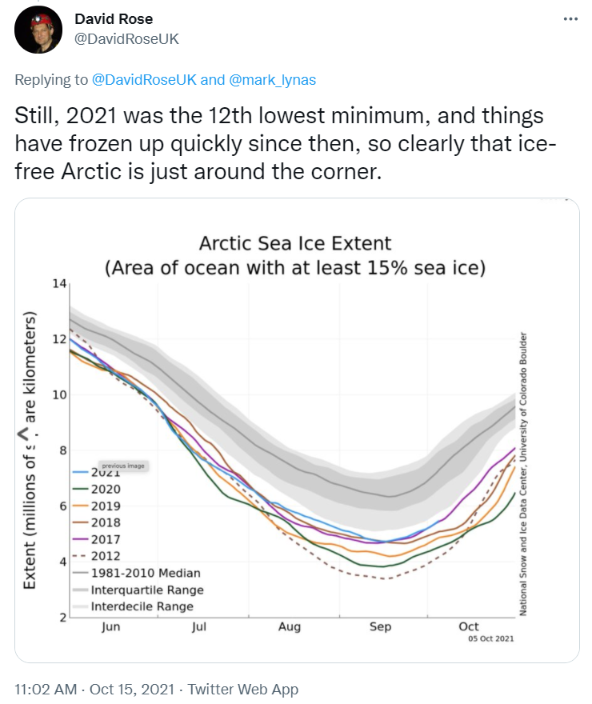
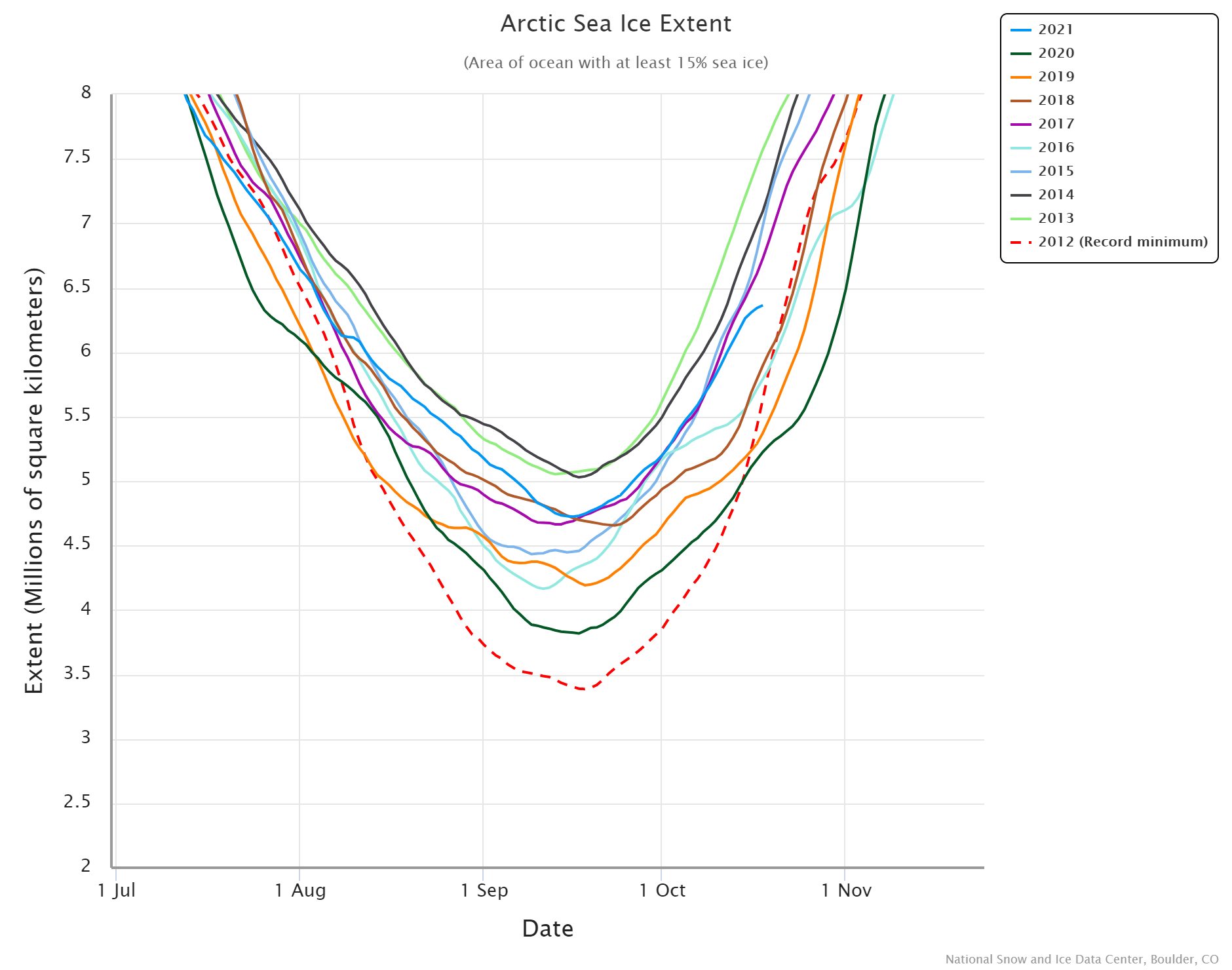
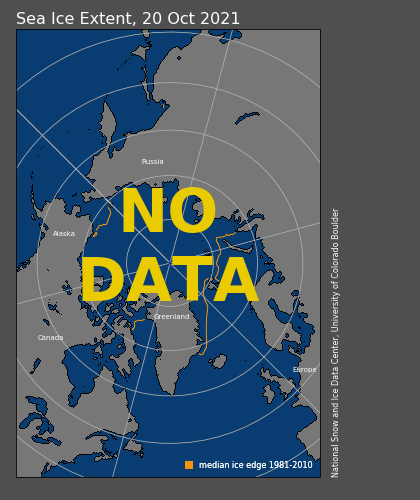
It has been brought to my attention (slightly belatedly) that in the run up to COP26 David Rose is once again pontificating about Arctic sea ice on Twitter. I have been in discussion about the “recently discovered” polynya in the so called “Last Ice Area” north of Ellesmere Island for a few days. Then this morning I discovered via a heads up from “ClimateVariability” that Mark Lynas has been tweeting about it too:
My Arctic alter ego and I were of course “blocked” by David Rose on Twitter many moons ago, and he has been quite quiet about the Arctic of late. However what with one thing and another he has now resumed his controversial commentary on the High North by commenting on Mark’s missive as follows:
It seems Tony didn't bother to read the references in the @IPCC_CH's #FAR that he quoted earlier.
Had he done so he would have discovered that when USS Nautilus sailed under the #NorthPole in 1958 it found the mean ice draft to be 5.32 meters.#TruthDecay#ClimateBall™
"I'm pretty sure that ice doesn't grow during record heat"
Tony seems unaware that the #Arctic isn't the entire planet, that #SeaIce melts in summer, and that summer surface temperatures in the high Arctic are held close to the melting point.#TruthDecay#ClimateBall™
Needless to say Tony has yet to answer my final question.
[Edit – October 16th]
Needless to say Tony Heller has yet to answer any of my recent questions. What’s more despite the exhortations of one of his band of merry (mostly) men he has declined to engage in a public debate with me:
With my alter ego blocked I’ve been debating with some of Tony’s band of merry (mostly) men whilst wearing my normal attire. One of them requested the opinion of Judah Cohen and Big Joe on Tony’s cherry pick du jour:
A few days ago we posted an article about the recent surge in the amount of disinformation being published about Arctic sea ice. Eventually one of our long list of usual suspects, Anthony Watts, published a copy of an erroneous Arctic article by Paul Homewood.
Now the Watts Up With That Arctic porky pie production line is going into overdrive, so here’s an already long list of its output in the run up to the COP26 conference in Glasgow in a month or so. First up is the aforementioned clone from NALOPKT. Allegedly:
It is very easy to show that Arctic sea ice has stabilised. As their graph itself shows, there have only been three years since 2007 with lower ice extent than that year, and eleven have had higher extents. Also the average of the last ten years is higher than 2007’s extent.
In itself, this is too short a period to make any meaningful judgements. But that is no excuse for the Met Office to publish such a manifest falsehood.
This comment of mine on that article remains invisible at WUWT:
Who would have thunk it?
Not a lot of people know that @wattsupwiththat has just repeated Paul Homewood's allegations that @MetOffice has been economical with the truth about #Arctic#SeaIce.
Neither Paul nor Anthony have seen fit to publish my response yet:
This website uses cookies to improve your experience. We'll assume you're ok with this, but you can opt-out if you wish. Cookie settingsACCEPT
Privacy & Cookies Policy
Privacy Overview
This website uses cookies to improve your experience while you navigate through the website. Out of these, the cookies that are categorized as necessary are stored on your browser as they are essential for the working of basic functionalities of the website. We also use third-party cookies that help us analyze and understand how you use this website. These cookies will be stored in your browser only with your consent. You also have the option to opt-out of these cookies. But opting out of some of these cookies may affect your browsing experience.
Necessary cookies are absolutely essential for the website to function properly. This category only includes cookies that ensures basic functionalities and security features of the website. These cookies do not store any personal information.
Any cookies that may not be particularly necessary for the website to function and is used specifically to collect user personal data via analytics, ads, other embedded contents are termed as non-necessary cookies. It is mandatory to procure user consent prior to running these cookies on your website.