In our recent article about the forthcoming G7 Summit in Cornwall we suggested that:
Climate change is top of the G7 agenda along with Covid-19, and you can rest assured that vested interests will not miss any opportunity to promote those interests over the next two months and beyond.
That has indeed proved to be the case! Let us count the ways.
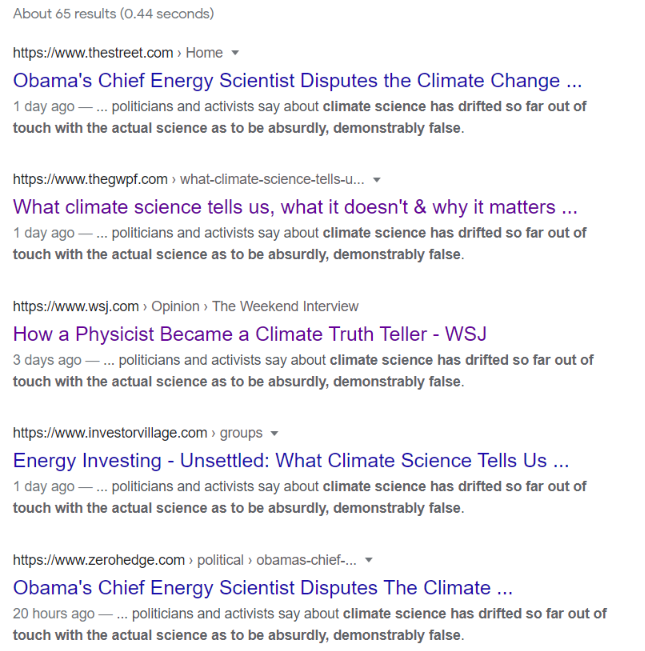
Steven Koonin’s new book “Unsettled: What Climate Science Tells Us, What It Doesn’t, and Why It Matters” is being promoted (left?), right and centre by a veritable cornucopia of the usual suspects. In an endeavour to explain (to the mythical (wo)man in the street?) the ways in which “A lie will fly around the whole world while the truth is getting its boots on” I’ve performed a Google search for the phrase “climate science has drifted so far out of touch with the actual science as to be absurdly demonstrably false” by way of a demonstration:
65 “demonstrably false” clones of the WSJ article, and counting……
[Edit – April 24th]
This morning’s update on my “demonstration” Google search.
There are now 241 “demonstrably false” Kooninism clones, and counting……
Arctic explorer Pen Hadow trekked, and swam, from Ward Hunt Island to the North Pole in 2003. Solo and unsupported. He plans to return to the North Pole this summer, but on this occasion he’ll be sailing with a few companions. According to yesterday’s Sunday Times:
Pen Hadow launches bittersweet mission to sail to North Pole
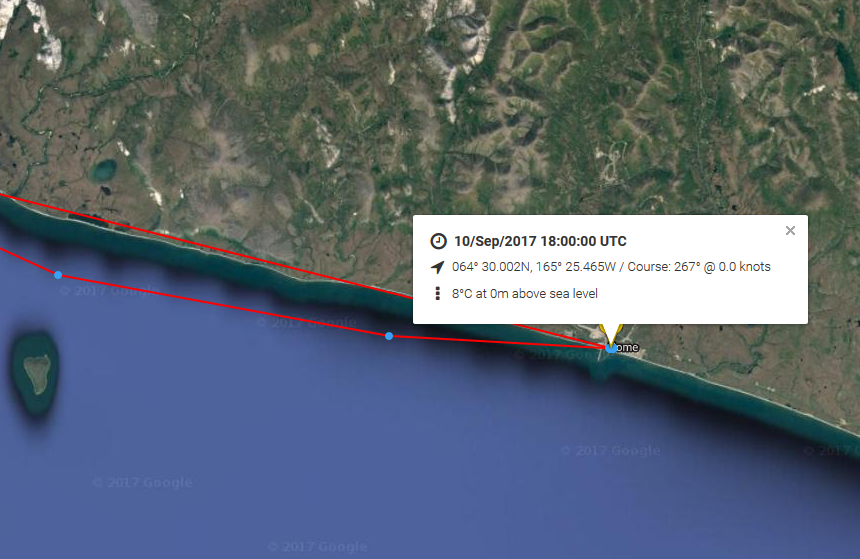
For his new record attempt, Hadow and his nine-strong team will take two yachts on a 3,500-mile round trip from Nome in Alaska to the pole, using satellites to find a route through the ice and avoid getting stuck. He will fly to Alaska to join his team members on Saturday.
If all goes to plan, he will arrive at the pole between August 15 and early September, about 510 miles further north than anyone has sailed before.
Although the Sunday Times failed to mention it the expedition has a web site of its own. According to the Arctic Mission “About” page:
Arctic Mission sets off from Nome in Alaska (USA) in the first week of August. The expedition team will not see land again for six weeks. We will cover about 3,500 miles by the time they return to harbour at Nome in mid-September.
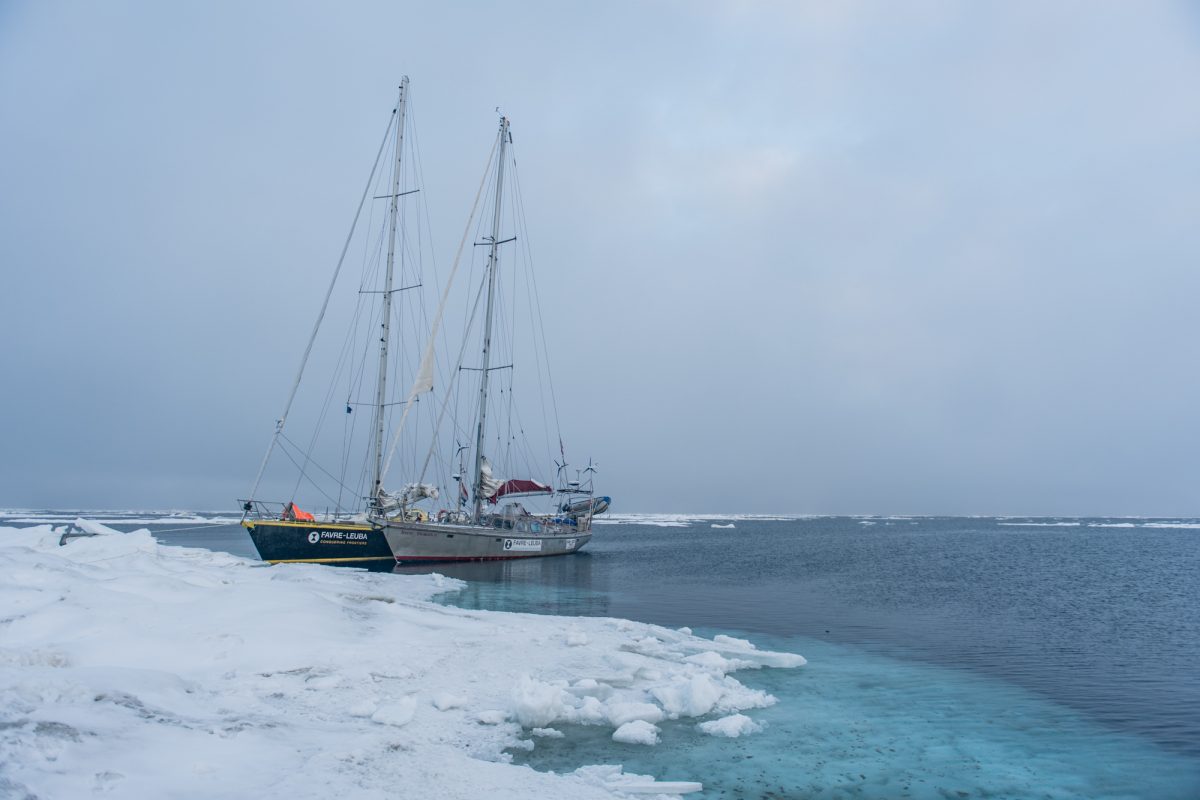
Our two 50 foot yachts, Bagheera and Snow Dragon II, are specially built to sail in waters with sea ice, and the four skippers, two on each boat, are exceptionally experienced in polar seas, and with navigation and safety procedures in sea ice.
The Arctic Mission team intend to do lots of science during their attempt to reach the Pole:
Our expedition is going to explore, discover and share the stories of the spectacular marine wildlife – plants, animals and even bacteria – that lives around the North Pole. Be prepared to be surprised!
We’ll also be doing essential scientific studies and sharing this information, so that our international policy-makers can decide how best to #protect90North.
The more we explore this unexplored ocean, the better we will understand how it works, which means we can make the best decisions to protect it for the benefit of everyone for ever.
We’ve met the two yachts in question before. In 2015 Bagheera and Snow Dragon II both successfully negotiated the Northwest Passage. However this voyage will be far more difficult. During their attempt to sail to the North Pole in the summer of 2013 Sébastian Roubinet and Vincent Berthet had to be rescued by the Russian icebreaker Admiral Makarov when the Central Arctic refreeze set in earlier than originally anticipated. Unlike the ice skating catamaran Babouchka, Bagheera and Snow Dragon II both have engines which will certainly help avoiding a similar fate. In addition perhaps the sea ice in the Arctic is less of an obstacle than it was in 2013? In an interview with the BBC World Service on Sunday Pen pointed out that:
Now 40% of the international waters around the North Pole, what we call the Central Arctic Ocean, are open water in the summer time.
When asked:
Do you think you’ll actually achieve this goal then?
Pen replied:
I think it’s quite possible, with the assistance of a US agency that have satellites that are going to be helping us each day pick the best route through these ever narrowing cracks, and it’s quite possible that we’ll reach the North Geographic Pole.
I also trust that the Arctic Mission team will be keeping a close eye on the Arctic weather forecast over the next month or so. Last August the crew of the yacht Northabout feared for their lives when caught in an Arctic cyclone in a sheltered anchorage on the Northern Sea Route. There is no such safe haven anywhere near the North Pole.
Pen concluded his BBC interview as follows:
If we can produce a visual image of a sail boat at 90 degrees north I think that could become an iconic image of the challenge that the twenty-first century faces. Are we serious about running this planet, which is actually what we need to start doing, and it’s biophysical resources on a sustainable basis, or are we just here for a laugh?
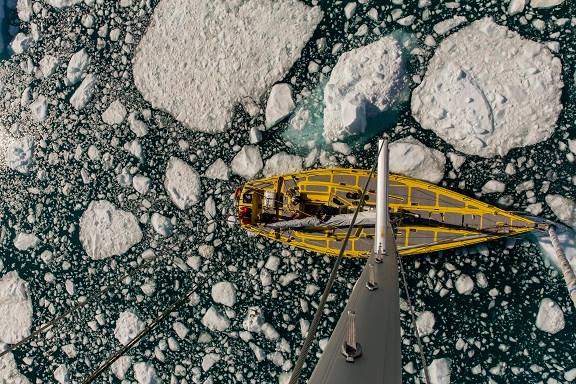
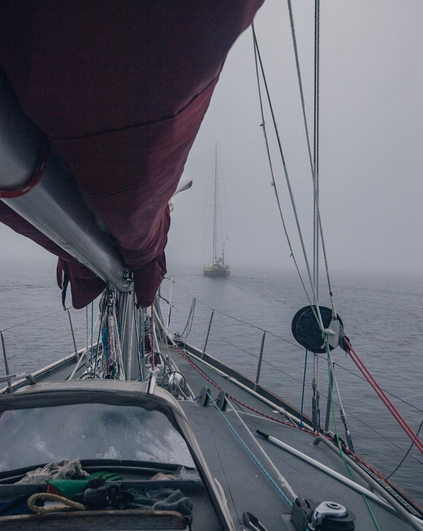
We wish him and the Arctic Mission team well. Watch this space for further updates, and possibly that iconic visual image! Meanwhile here’s a picture of Bagheera in the Northwest Passage in 2015:
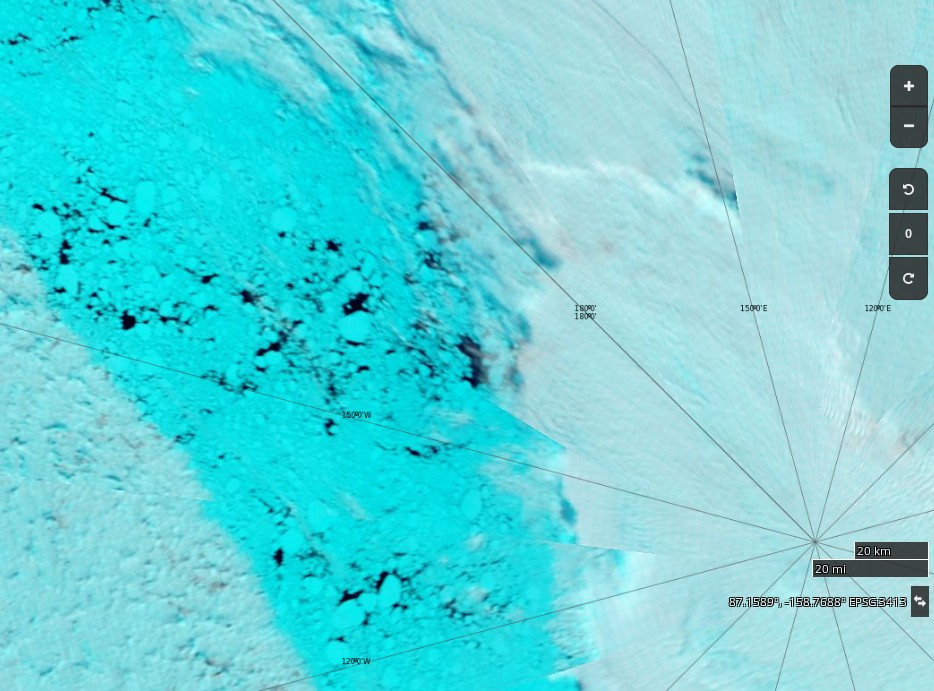
plus an image from the Sentinel 1B satellite of the current state of the Arctic sea ice on the direct route from Nome to the North Pole:
Sentinel 1B image of Arctic sea ice at 86N, 180W on July 24th 2017
There don’t seem to be many “narrow cracks” just yet.
[This] brings us to the summer of 2016, and an idea I was mulling over. A rather Big Idea. Had the deterioration of the Arctic sea ice got to a point where switching from Spring-time sledge-hauling to Summer-time sailing was appropriate? In my solo journey from northern Canada to the North Geographic Pole in 2003, I had spent over 30 hours swimming open water stretches, out of the total 850 hours spent hauling my sledge while walking on skis across the sea ice. It had dawned on me then that global warming was the likely cause of so much open water. Since then, it has become highly unlikely that the ski route from northern Russia to the Pole will be done again, due to the absence of sea ice for most of the year off the Severnaya Zemlya island group. And the other classic route from northern Canada no longer has an aircraft operation to provide the necessary support for sea ice expeditions, due to the worsening quality of the sea ice. Both routes have now been lost to the Arctic Ocean’s fast-changing environment. And with this change, the Arctic Ocean with its hitherto frozen summer surface is now rapidly becoming open-access to surface vessels for the first time in human history.
Would it be possible to sail a small yacht to the Pole? Could that create a useful platform to share the unfolding situation with a global audience? Might this be the best way I could focus world attention on the merit of creating a new marine reserve in the international waters surrounding the North Pole?
It looks like we’re just about to find out the answer to those questions. The team have also announced another livestream from Nome, Alaska. This one is scheduled for 8 PM BST tomorrow, Thursday August 10th. They say:
Ahead of our Friday departure (weather permitting – there’s a nasty storm brewing over the Bering Strait that may prove problematic) we’d love to introduce you to the Arctic Mission team.
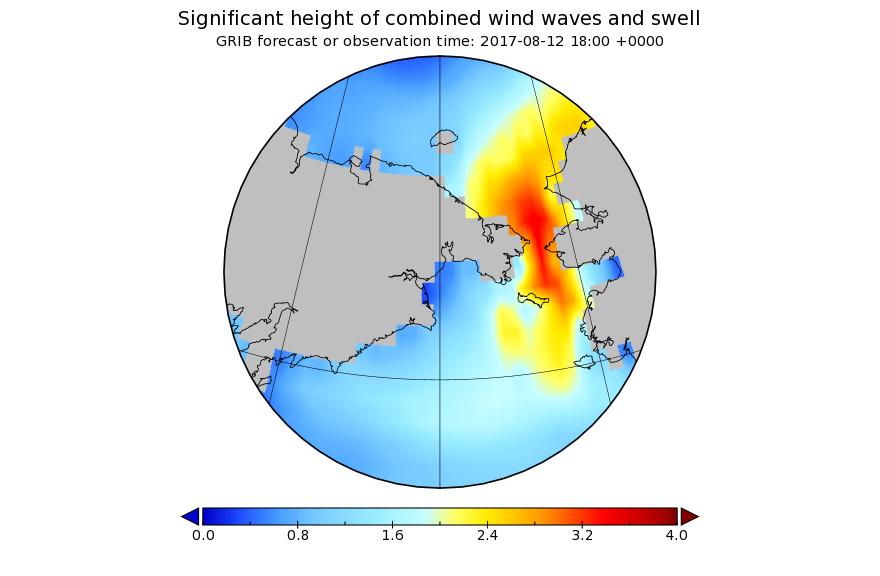
This is probably what they are referring to:
A bumpy ride for Pen Hadow et al. is in store on Saturday, and some big waves for Utqiaġvik (Barrow as was) as well.
[Edit – August 13th]
An overly brief and (hence?) rather misleading article in the Sunday Times today. According to Jonathan Leake:
Sailing to North Pole will have to wait
Pen Hadow, the British explorer, is today due to start a sailing expedition across the Arctic Ocean to highlight the effects of climate change, including an attempt to reach the North Pole.
Scientists warned, though, that despite the rapid melting of the ice there was unlikely to be access to the North Pole via open water for some years.
Professor Mark Serreze, director of America’s National Snow and Ice Data Centre, said the North Pole was still surrounded by nearly 800 miles of solid pack ice as of last week.
Jonathan appears not to have a particularly good grasp of sea ice (thermo)dynamics during the latter stages of the summer melting season!
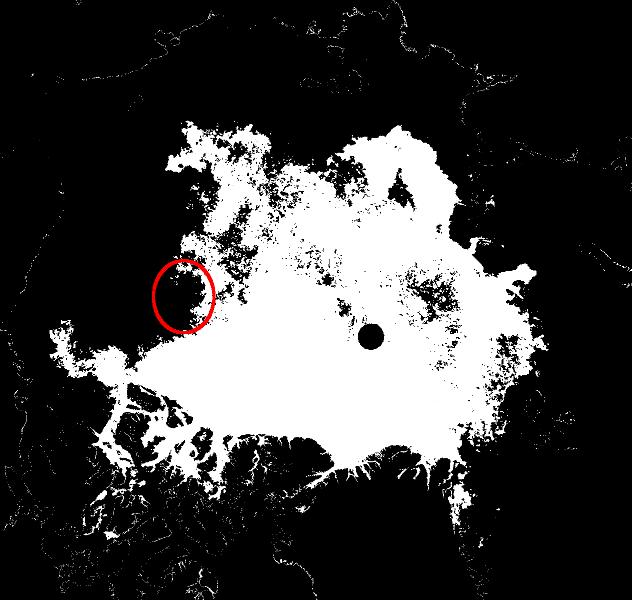
NASA Worldview “false-color” image of the North Pole on August 13th 2017, derived from the MODIS sensor on the Terra satellite
Whilst waiting for the waves in the Bering Strait to die down Conor McDonnell, Arctic Mission’s photographer, has recorded a video from the top of Bagheera’s mast, amongst other places:
[Edit – August 14th]
According to Pen Hadow Bagheera and Snow Dragon II will set sail in the small hours of tomorrow morning (UTC):
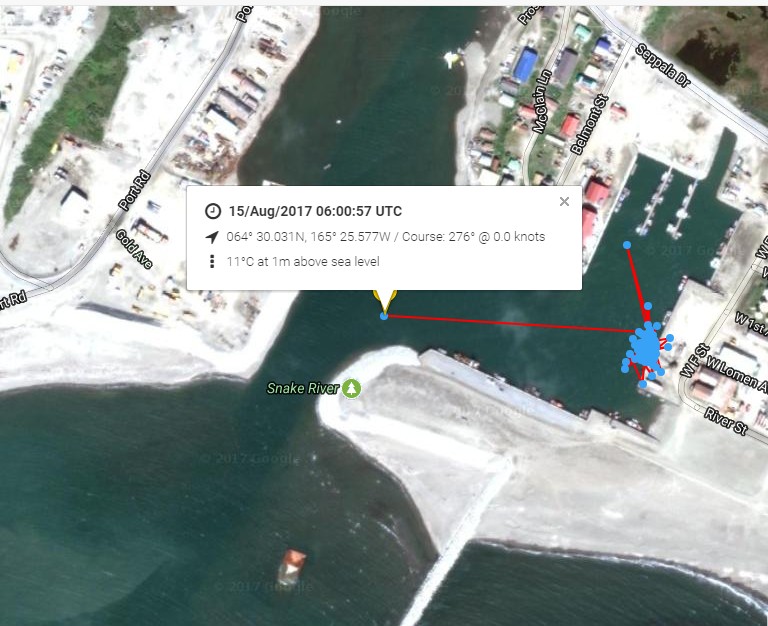
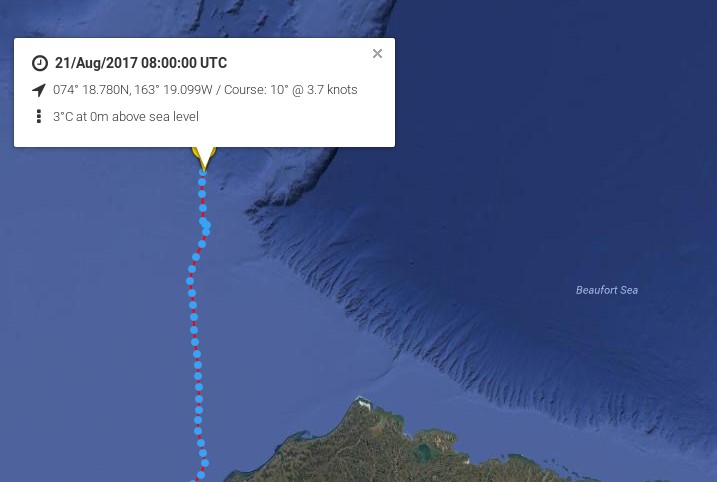
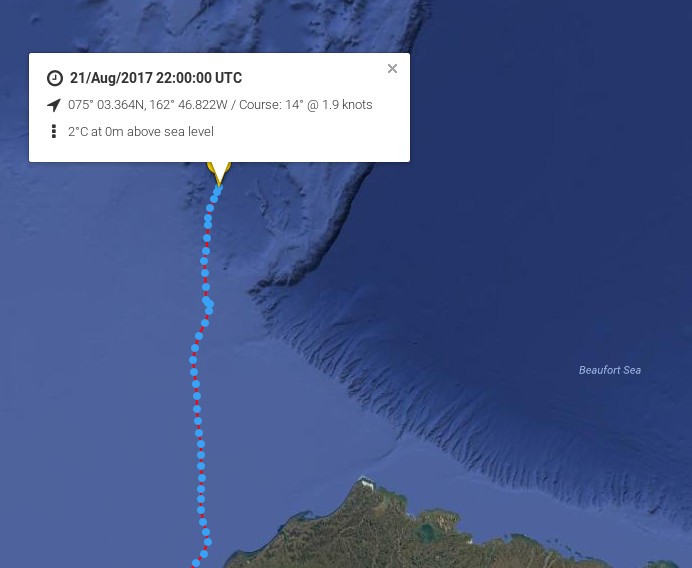
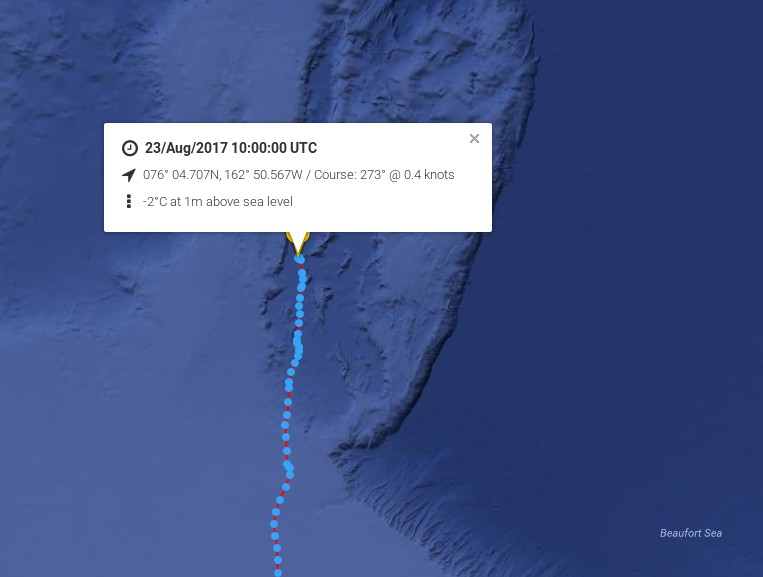
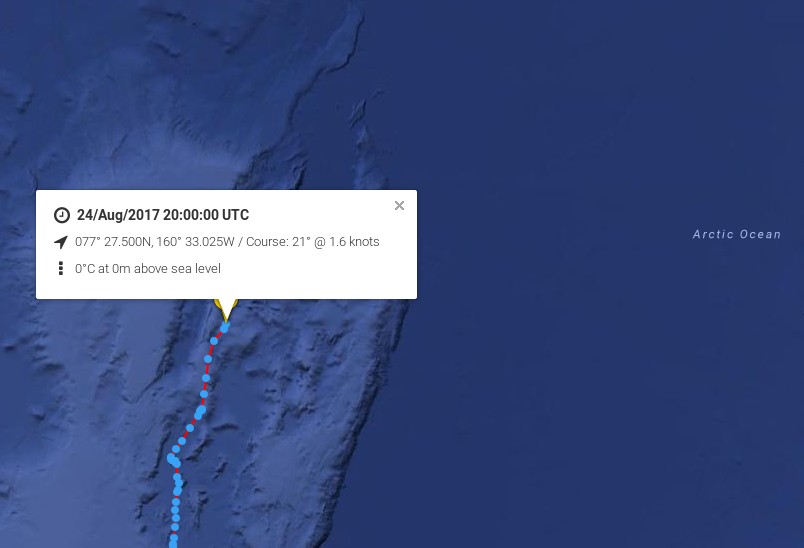
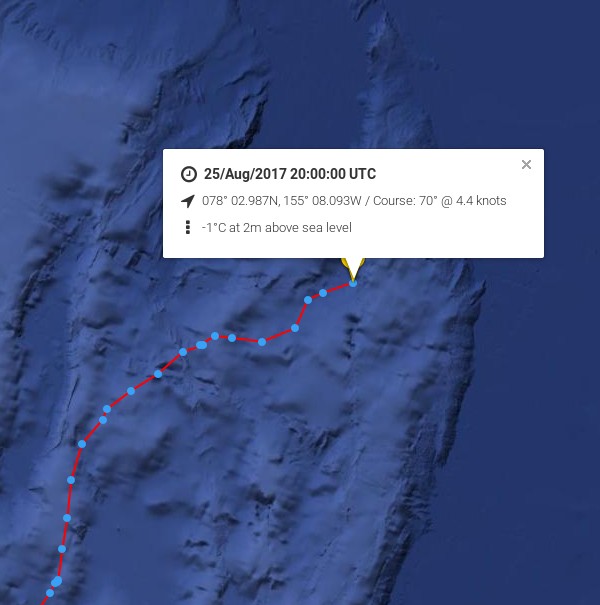
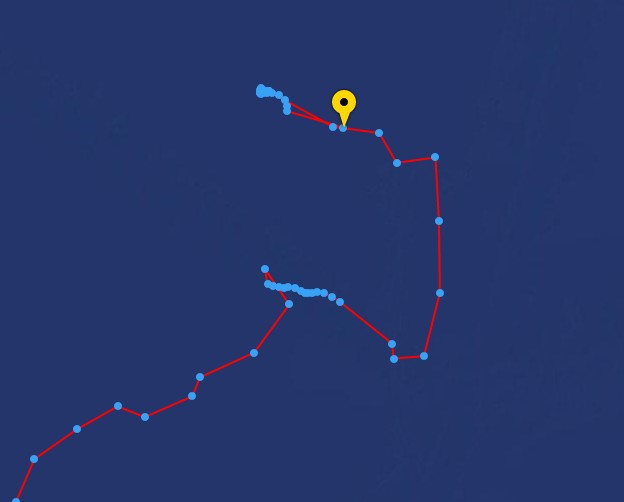
The Arctic Mission live tracking map is operational at last. Here is what it reveals so far:
It looks as though Bagheera and Snow Dragon II left Nome on their voyage of discovery at 06:00 UTC this morning.
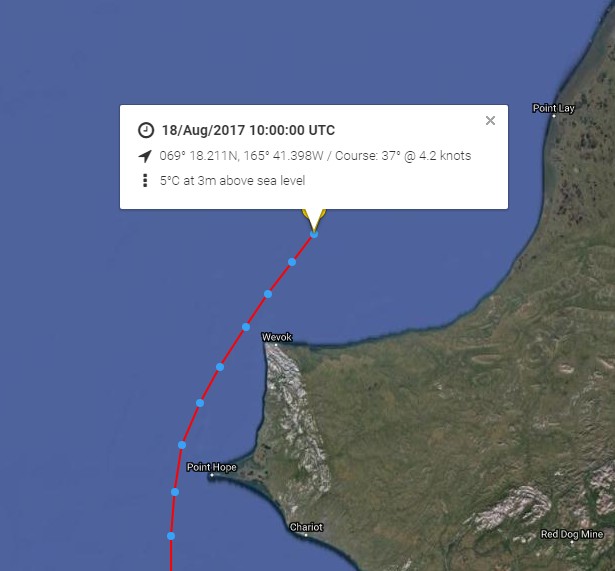
[Edit – August 18th]
Point Hope is now behind the Arctic Mission team:
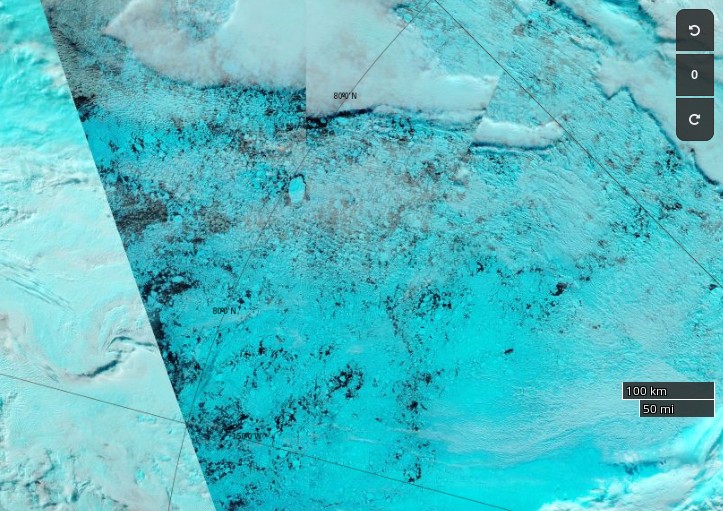
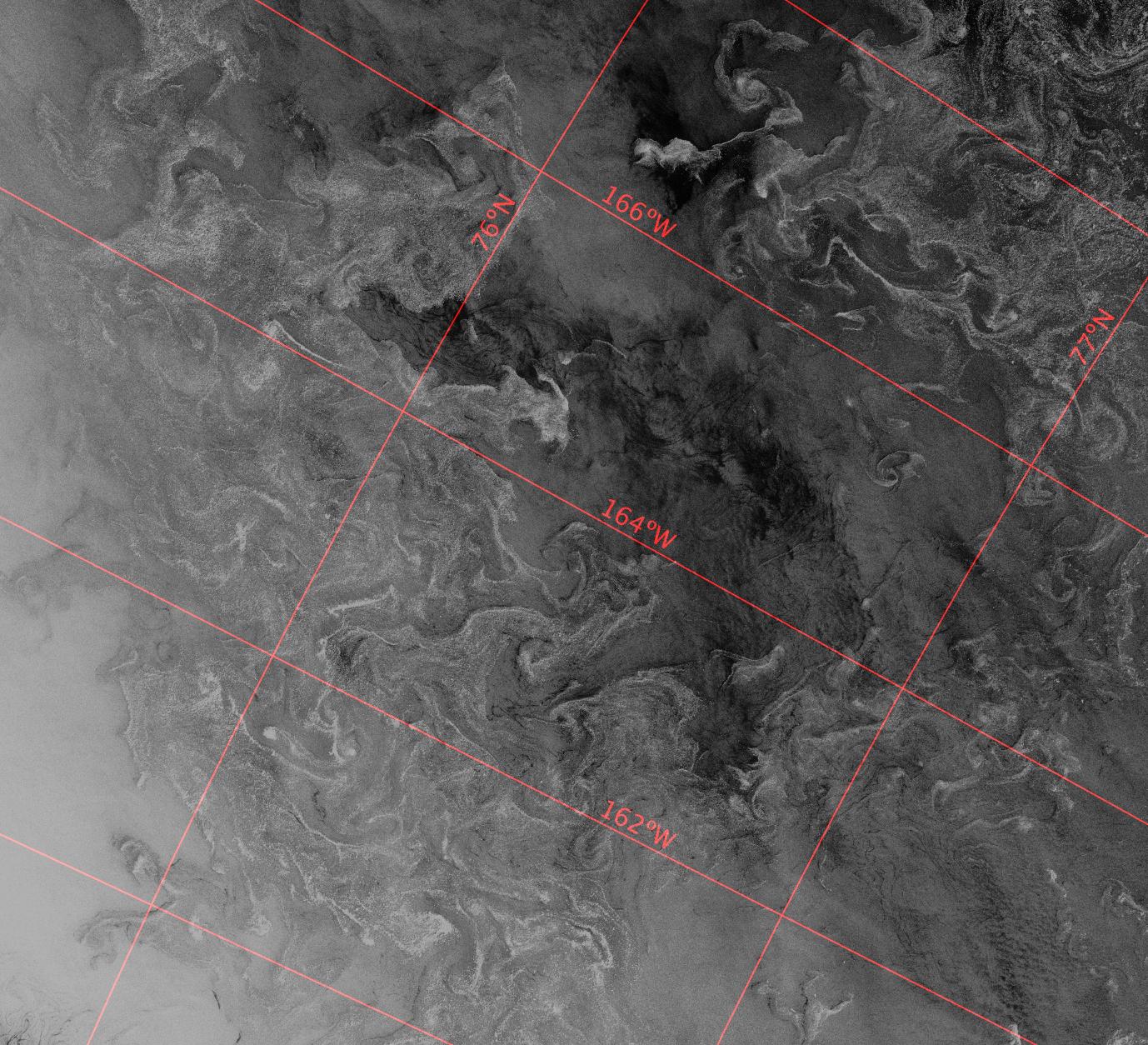
Next is Point Lay. Much further north, there are significant gaps appearing in the sea ice up to around 83N:
NASA Worldview “false-color” image of the Central Arctic north of the Beaufort Sea on August 18th 2017, derived from the MODIS sensor on the Terra satellite
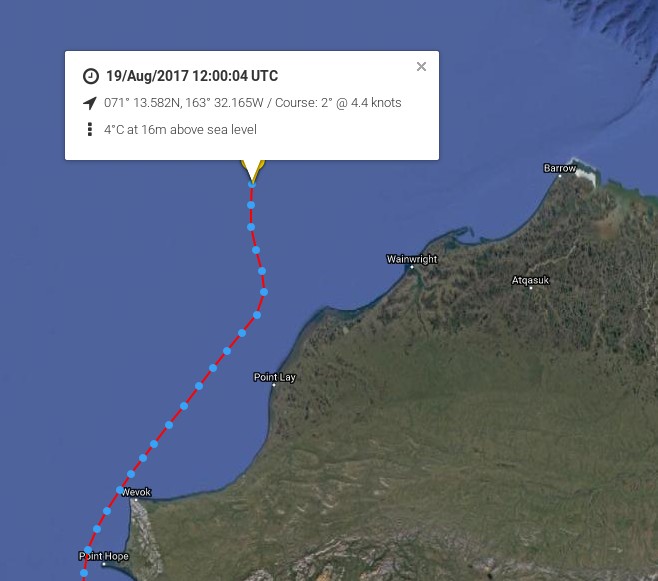
[Edit – August 19th]
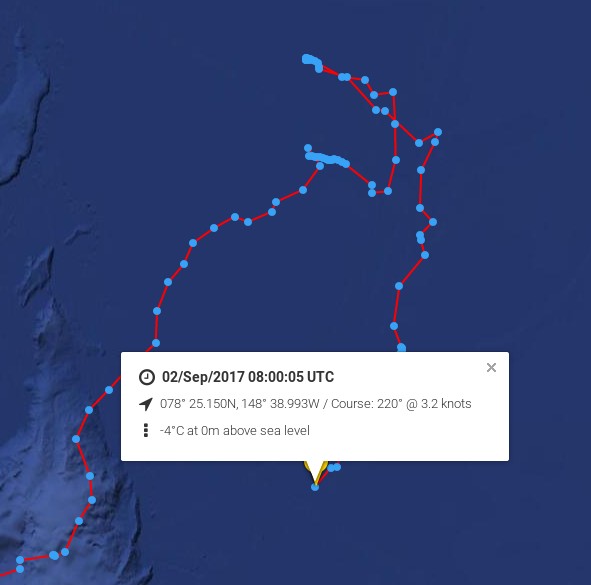
Bagheera and Snow Dragon II are obviously not heading for the Northwest Passage in 2017!
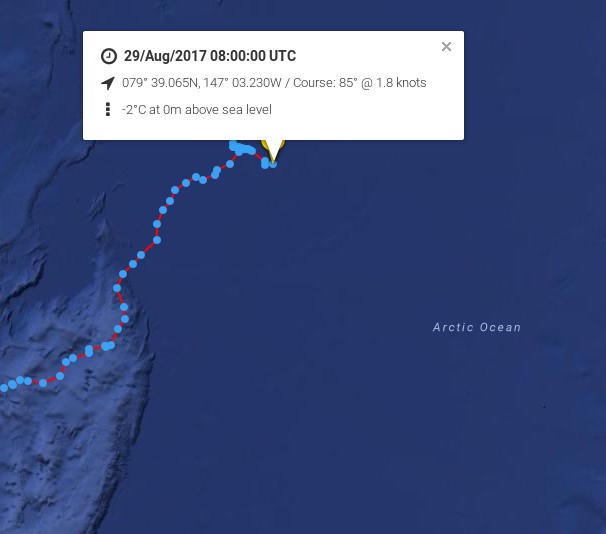
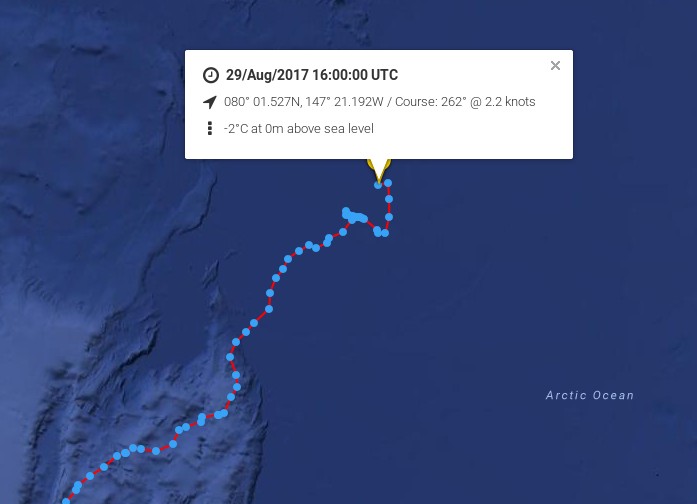
Arctic Mission’s furthest North was 80 degrees 10 minutes North, 148 degrees 51 minutes West, reached at 22:04:12 (Alaskan Time, GMT-9hours) on 29 August 2017 by yachts, Bagheera and Snow Dragon II.
Arctic Mission moored its yachts to an ice floe on 29 August to conduct one of its 24-hour marine science surveys, while drifting with the sea ice. The strategy for any future northward progress had been to monitor the sea surface currents, sea ice, and weather conditions (both observed from the yachts and through satellites imagery downloaded onto our computers), and decide how to proceed as we approached the end of the 24-hour survey.
A meeting of the four skippers was held led by Erik de Jong, with Pen Hadow present, and it was agreed further northward progress would increase considerably the risks to the expedition, with very limited scientific reward. The decision to head south, back to an area of less concentrated sea ice in the vicinity of 79 degrees 30 minutes North, was made at 18.30 (Alaskan time).
Here’s the live tracking map from 06:00 UTC this morning:
A prudent and not unexpected decision. Cue the cackling from all the usual suspects?
[Edit – August 31st]
The cackling from all the usual suspects has indeed begun. It has even inspired a somewhat surreal modern art installation! Meanwhile according to their Twitter feed:
We are slowly making our way back to Nome now after reaching the northernmost point of our… https://t.co/GhrYYza6gk
The BBC Radio 4 Today programme broadcast another one of their regular updates on the progress of the Polar Ocean Challenge expedition. On this occasion they were able to interview David Hempleman-Adams, the leader of the expedition. That’s because David disembarked from the yacht Northabout at Upernavik in Greenland:
By now David is back in Blighty, in Swindon to be precise. Here’s a brief extract from his interview with Sarah Montague this morning.
David pointed out that:
We’re not scientists. We weren’t collecting scientific data, and it’s wrong to suggest that our trip, this adventure, will show that there’s less ice. What we’re trying to do is make people more aware of the hundreds of scientists who are doing good work and who actually do show that.
At this juncture you might have supposed that one or more of those “hundreds of scientists” might have been mentioned, but you would have been wrong. Shortly thereafter Sarah asked David:
You will know though that the well known science writer Matt Ridley has written about your expedition and said look there are times in the past where routinely ice has disappeared during the summer, and his argument is that really it doesn’t matter, it doesn’t actually tell us anything.
I fondly imagine that at this juncture David raised his eyes to the heavens over Swindon. After all he’d already explained to Sarah that, rather like Matt Ridley, he isn’t a scientist. What he actually then said was:
Sure. You know I do know that he’s written that, and other people. But if you look on balance, and you know I’m just one of the general public, if you look on balance, if you look at 99% of the scientists they’re all saying that we’ve got a problem and if you look at the trends, and of course there are trends over the years but what we’re seeing now is really rapid change. If you look at the, as I said, the Northwest Passage it is quite frightening. We didn’t actually see any ice for the entire route up until the Lancaster Sound, which is worrying whatever scientists say or the naysayers say. It is a worrying trend.
And if you look at the cultures, I’ve been going up there for 30 years now, it’s not just sea ice. If you look at these small, little Inuit villages and seen the impact of the climate on some of these places, you know there’s been dramatic change over the last 30 years.
At which juncture Sarah thanked David Hempleman-Adams and Nick Robinson said:
The time is now 26 minutes past eight, and Rob’s got the sports news.
It’s nice to know where the BBC’s priorities lie, and that they prefer to publicise the views of a “coal baron” rather than one or more of “the hundreds of scientists who are doing good work” on the subject of sea ice.
Should you be wondering at this juncture how the opinions of Matt Ridley are at variance with the actual facts take a look at the August 29th article of his in The Times of London that Sarah Montague was referring to:
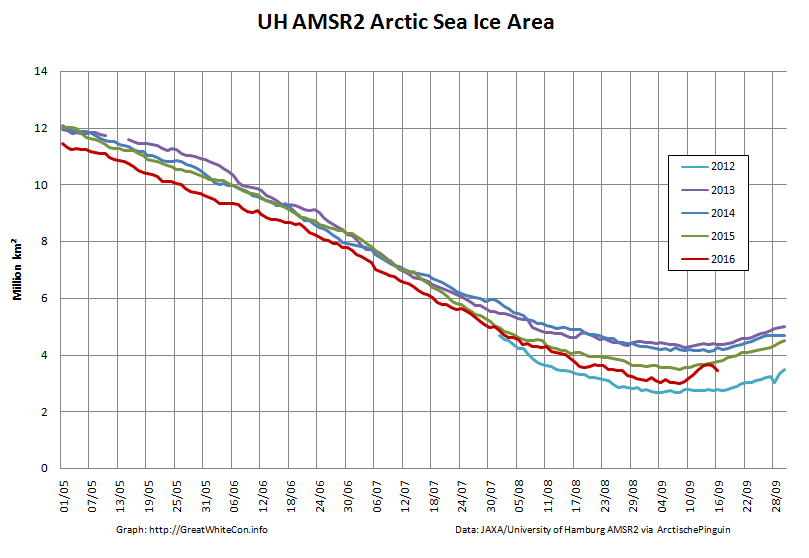
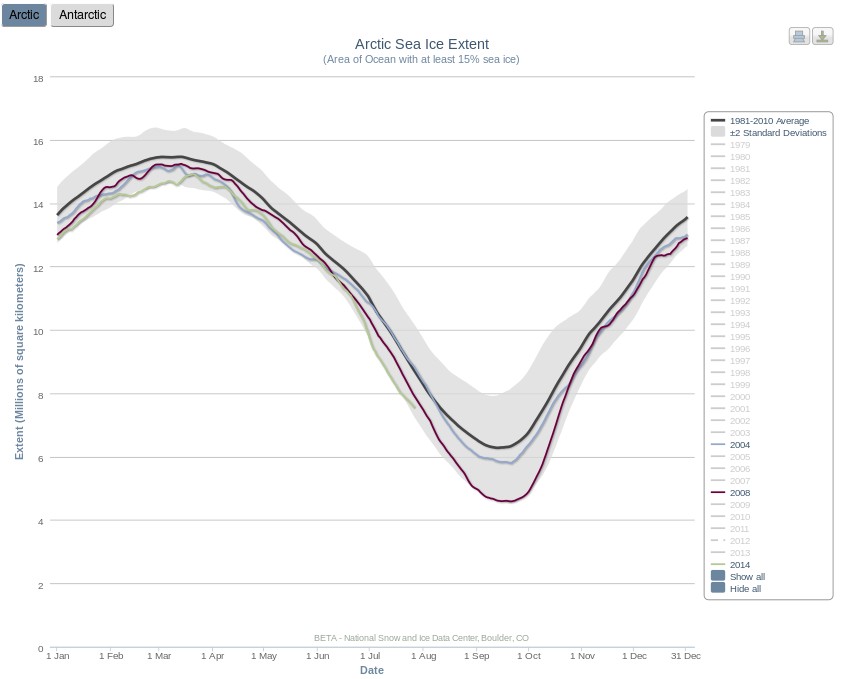
The sea ice in the Arctic Ocean is approaching its annual nadir. By early September each year about two thirds of the ice cap has melted, then the sea begins to freeze again. This year looks unlikely to set a record for melting, with more than four million square kilometres of ice remaining, less than the average in the 1980s and 1990s, but more than in the record low years of 2007 and 2012.
This will disappoint some. An expedition led by David Hempleman-Adams to circumnavigate the North Pole through the Northeast and Northwest passages, intending to demonstrate “that the Arctic sea ice coverage shrinks back so far now in the summer months that sea that was permanently locked up now can allow passage through”, was recently held up for weeks north of Siberia by, um, ice. They have only just reached halfway.
However it’s also extremely misleading. The yacht Northabout reached the International Date Line spot on the original Polar Ocean Challenge schedule, and earlier than previous successful polar circumnavigations managed to achieve.
Must I go on? I suppose so! Skipping several more untruths, a bit later Matt opines:
Would it matter if it did all melt one year? Here’s the point everybody seems to be missing: the Arctic Ocean’s ice has indeed disappeared during summer in the past, routinely. The evidence comes from various sources, such as beach ridges in northern Greenland, never unfrozen today, which show evidence of wave action in the past. One Danish team concluded in 2012 that 8,500 years ago the ice extent was “less than half of the record low 2007 level”. A Swedish team, in a paper published in 2014, went further: between 10,000 years ago and 6,000 years ago, the Arctic experienced a “regime dominated by seasonal ice, ie, ice-free summers”.
Here’s a thought for you to consider Matt. What was the population of London between 10,000 years ago and 6,000 years ago? How about Miami or the Big Apple, or Dhaka for that matter? Has it ever crossed your mind to enquire what the human population of the whole of Planet Earth was “during parts of the early and middle Holocene”, and what sea level around the World might have been at that time?
Answers on a postcard please, in the space provided for that purpose below. We’ll forward them on to the BBC. I don’t suppose Matt will be interested though.
Sarah Montague was interviewing David Hempleman-Adams about the Polar Ocean Challenge expedition to circumnavigate the Arctic. David pointed out that “We’re not scientists” and “What we’re trying to do is make people more aware of the hundreds of scientists who are doing good work”. If 3rd party comment was deemed necessary at this juncture then it should have included at least one of those “hundreds of scientists”. Not just Matt Ridley, whose recent article in The Times that Sarah was alluding to was riddled with factual errors, amongst its other failings. See above.
One can only assume that the BBC was attempting to achieve some sort of “balance”? They failed miserably. I’m a long ex academic, but for another perspective on that failure here’s one from a practicing astrophysicist:
Note also the comments. David Hempleman-Adams wasn’t even given adequate time to fully respond to the nonsense printed in The Times and regurgitated by BBC Radio 4 before it was “Rob’s got the sports news.”
As David put it “I’m just one of the general public”. If the BBC wanted to present a balanced report a specialist in the subject should have been invited to comment. There’s loads of them gathered in London as we speak:
Arctic sea ice is in the news, but what's really going on? Join us tmrw to dig into the details with the scientists: https://t.co/E3lc2PEG3u
Why not ask one of them for their views on declining sea ice? Helen Czerski works as a science presenter for the BBC doesn’t she? She may not be a sea ice specialist, but ask her for her opinion on this charade.
To summarise, either Matt Ridley has no idea what he’s talking about or he has an agenda. In either case reporting his views without adequate “balancing” comment badly lets down BBC Radio 4 listeners. How do you intend to remedy this?
Here is the BBC’s response so far:
[Edit – September 27th]
I have now received an emailed response from the BBC. Here it is:
Thank you for contacting us regarding Radio 4’s ‘Today’ which was broadcast on 19 September.
I understand you felt that the interview with David Hempleman-Adams was of a poor quality, that you considered it inappropriate for Sarah Montague to quote from an article written by Matt Ridley and that a “specialist in the subject should have been invited to comment”.
We are naturally very sorry when we hear that members of our audience have been left disappointed with an interview. We try very hard to produce a wide range of high quality shows and services which we hope will appeal to listeners.
It is not always possible or practical to reflect all the various aspects of a subject within one individual item. Editors are charged to ensure that over a reasonable period they reflect the range of significant views, opinions and trends in their subject area.
We do not seek to denigrate any view or to promote any view. Our aim is always to provide enough information on the stories we cover and to let our listeners make up their own minds. Nevertheless, I would like to assure you that we value your feedback on this matter.
All complaints are sent to senior management and programme makers every morning and we included your points in this overnight report. These reports are among the most widely read sources of feedback in the BBC and ensures that your complaint has been seen by the right people quickly. This helps inform their decisions about current and future output.
Thank you once again for getting in touch.
BBC Complaints Team
NB This is sent from an outgoing account only which is not monitored. You cannot reply to this email address but if necessary please contact us via our webform quoting any case number we provided.
As you can probably imagine, I am far from satisfied with the Beeb’s response thus far!
[Edit – September 28th]
Shock News! I’ve received another communication from the BBC!! In fact I received it twice!!! Here is what it says:
Dear Mr. Hunt
I’m Sam Smith, Head of BBC Audience Services – thank you for getting in touch with the BBC recently.
I wonder if you’d be interested in taking part in a short survey?
It’s to learn more about how you got on, and how we can improve.
All feedback – good or bad – gets passed back to the person that handled your contact.
The survey is carried out by an independent agency called ICM. It takes around 10 minutes to complete, and you just need to click the link below or paste it into your browser:
[Link redacted]
(ICM is a member of the Market Research Society and abides by its strict code of conduct at all times. You will not receive any emails, sales calls or literature as a result of taking part in this survey, and your personal data will only be used for the purpose of helping us to understand our audiences better. If you have any difficulties with the survey, please e-mail [email protected])
Thanks again – we’d love to hear from you.
Sam Smith
Head of BBC Audience Services
Ps. It’s not possible to reply to this address, but please use one of our webforms – quoting your case number – if you need anything else.
Am I “interested in taking part in a short survey”?
[Edit – September 29th]
As luck would have it I decided that I was interested:
Them:
Please tell us in detail why you decided to contact the BBC.
Please think about what made you decide to get in touch, why this was important to you, and what you hoped would happen as a result.
Us:
Quoting from my original complaint, I have already published my thoughts on the matter:
“At this juncture you might have supposed that one or more of those “hundreds of scientists” [mentioned by David Hempleman-Adams] might have been mentioned, but you would have been wrong.”
“Should you be wondering at this juncture how the opinions of Matt Ridley are at variance with the actual facts take a look at the August 29th article of his in The Times of London that Sarah Montague was referring to.”
“To summarise, either Matt Ridley has no idea what he’s talking about or he has an agenda. In either case reporting his views without adequate “balancing” comment badly lets down BBC Radio 4 listeners. How do you intend to remedy this?”
I “hoped for” a substantive answer to that final question. I have yet to receive one!
Them:
When you decided to contact the BBC, what did you think would happen next?
Please think about who you expected to respond, what information you expected the response to provide and what you expected would happen as a result.
Us:
Based on my past experience I expected another “canned” reply and no substantive response:
Thus far my exceedingly limited expectations have been fulfilled exactly!
Them:
Please tell us a bit more about what you thought about the response you received.
You may like to think about the language used, the tone of the response, what information it gave you, and what you thought was good about it.
Us:
See my previous responses.
There was nothing good about it.
Them:
What, if anything, could have been better about the response you received?
Please think about any aspect which could be improved – for example the tone of the response, the level of detail it gave, and anything you thought was missing.
Us:
The novelty of these questions is wearing off.
See my previous responses.
A substantive answer to my final question would have improved the BBC’s response.
Them:
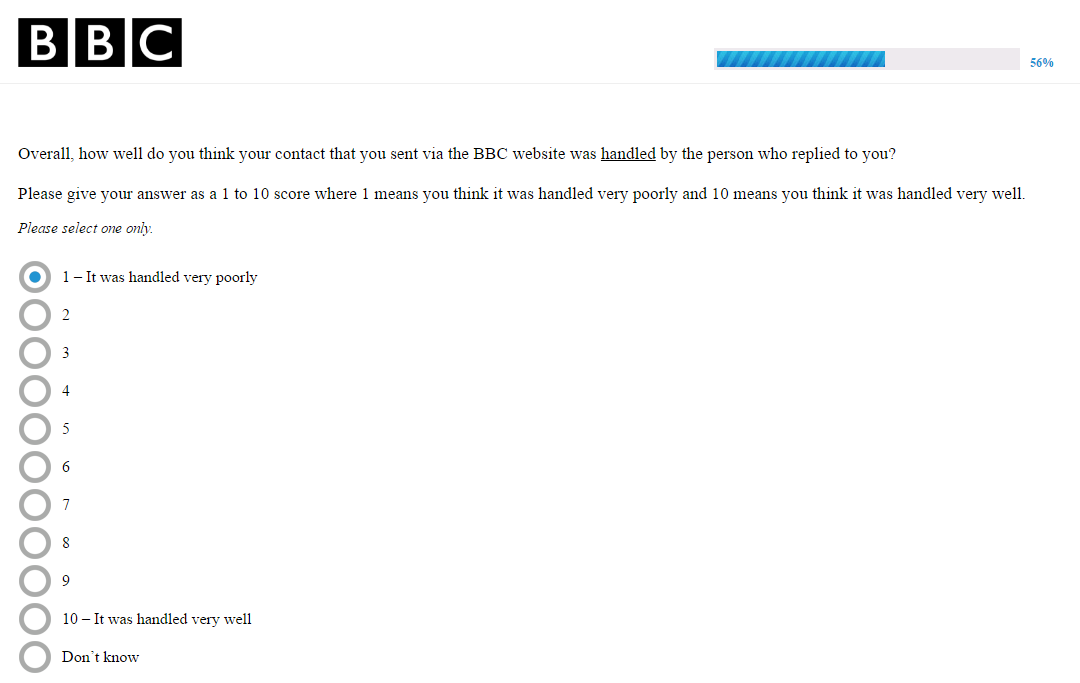
How would you rate the response you received on the following attributes? Please rate each attribute out of 10 where 1 is ‘strongly disagree’ and 10 means ‘strongly agree’.
Please remember we are asking you to rate the specific response you received and not any other aspect of the BBC, such as its programming.
Us:
Them:
Finally, are there any other comments you would like to make about your contact experience with the BBC that we haven’t covered, or any comments you would like to make about this survey?
Us:
Yes. I’d like to ask two questions:
1) What is the point of all the “intrusive” questions I’ve just been asked?
2) Why hasn’t the BBC provided a substantive answer to the final question in my original complaint?
Them:
Thank you for taking the time to complete this questionnaire.
To exit the questionnaire you can either navigate to another website or close this window.
Professor Peter Wadhams of Cambridge University has just written to the UK’s Independent Press Standards Organisation about recent articles that “ha[ve] substantially damaged my reputation for scientific integrity, and I believe that this was the deliberate intention”. Here is the text of his complaint.
The writer of this article, Ben Webster, phoned me up cold in my office at Cambridge University on Thursday 23 July, saying that he was writing a piece on the retreat of sea ice in the Arctic, and whether it was increasing or not. We discussed the scientific data, then he asked who else was working in this field in the UK, in order to contact them. I mentioned that there are not many others in this field, since three of the leading figures died within a short space of time in accidents in 2013. He asked for further details.
I asked that this be completely off the record because of (a) the sensibilities of relatives of the deceased (Prof Laxon’s partner was particularly upset by the subsequent publication),
(b) my own scientific reputation (I did not want to be made out to be a crazy person),
(c) the fact that these deaths were investigated and were very clearly simply an extraordinary coincidence.
He raised the question of whether they were murdered. I agreed that for a short time I thought that they were, since I had had the experience of being run off the road at the same time by a lorry, but that it was very clear afterwards that the three deaths were individually explainable accidents.
I did not make any of the statements enclosed in quotation marks by the reporter. Webster promised that this was in confidence and that if he wanted to use it he would contact me first. The next thing I saw was the article plastered over Saturday’s “Times”. He had clearly done some research in procuring photographs, but did not bother to contact me, and broke his promise of confidentiality.
The publication, subsequently picked up by the Sunday Telegraph and Mail on Sunday, has substantially damaged my reputation for scientific integrity, and I believe that this was the deliberate intention.
Here are our edited highlights of the story so far:
I wandered over to Twitter a couple of days ago to see if I could persuade Steve/Tony to dig a pertinent comment of mine about Arctic sea ice extent out of the “Real Science” spam folder. Whilst over there I couldn’t help but notice that Andrew Neil had been passing comment on recent events in the Arctic too! According to his Twitter page Andrew is:
Chairman Spectator Magazines (London); ITP Magazines (Dubai); World Media Rights (New York). BBC presenter.
According to his C.V. on the BBC web site Andrew is:
Presenter of the Daily Politics on BBC Two and the Sunday Politics on BBC One.
In a long career in publishing and broadcasting Andrew has been UK editor of The Economist, editor of The Sunday Times, executive chairman of Sky Television and publisher of The Scotsman Group of newspapers.
Fresh from his controversial BBC interview with Ed Davey, the UK’s Secretary of State for Energy and Climate Change, Andrew was “tweeting” things like:
@ret_ward Yip. Thought so. You have zero qualifications in climate scientist. But you are an indefatigable propagandist. Take a bow.
This website uses cookies to improve your experience. We'll assume you're ok with this, but you can opt-out if you wish. Cookie settingsACCEPT
Privacy & Cookies Policy
Privacy Overview
This website uses cookies to improve your experience while you navigate through the website. Out of these, the cookies that are categorized as necessary are stored on your browser as they are essential for the working of basic functionalities of the website. We also use third-party cookies that help us analyze and understand how you use this website. These cookies will be stored in your browser only with your consent. You also have the option to opt-out of these cookies. But opting out of some of these cookies may affect your browsing experience.
Necessary cookies are absolutely essential for the website to function properly. This category only includes cookies that ensures basic functionalities and security features of the website. These cookies do not store any personal information.
Any cookies that may not be particularly necessary for the website to function and is used specifically to collect user personal data via analytics, ads, other embedded contents are termed as non-necessary cookies. It is mandatory to procure user consent prior to running these cookies on your website.