Tag Archives: Polar Vortex

The Polar Amplification Model Intercomparison Project

The Polar Amplification Model Intercomparison Project (PAMIP for short) is one of several Community Earth System Model (CESM for short) based climate modelling projects.

As the project’s web site points out:

Polar amplification, the phenomenon that external radiative forcing produces a larger change in surface temperature at high latitudes than the global average, is a key aspect of anthropogenic climate change but its causes and consequences are not fully understood.

PAMIP, co-led by Dr. Doug Smith, Dr. James Screen, and  Dr. Clara Deser seeks to improve our understanding of this phenomenon through a coordinated set of numerical model experiments. As one of the Coupled Model Intercomparison Project Phase 6 (CMIP6) endorsed MIPs, PAMIP will address the following primary questions:

1. What are the relative roles of local sea ice and remote sea surface temperature changes in driving polar amplification?

2. How does the global climate system respond to changes in Arctic and Antarctic sea ice?

The following article provides an overview of the PAMIP including the protocols: https://www.geosci-model-dev.net/12/1139/2019/

The PAMIP project is thus part of the global climate modelling effort leading up to the long anticipated publication of the Intergovernmental Panel on Climate Change’s next series of assessment reports, conveniently abbreviated as simply “AR6”. The project has been in the news recently. According to an article in Science magazine:

Every time severe winter weather strikes the United States or Europe, reporters are fond of saying that global warming may be to blame. The paradox goes like this: As Arctic sea ice melts and the polar atmosphere warms, the swirling winds that confine cold Arctic air weaken, letting it spill farther south. But this idea, popularized a decade ago, has long faced skepticism from many atmospheric scientists, who found the proposed linkage unconvincing and saw little evidence of it in simulations of the climate.

Now, the most comprehensive modeling investigation into this link has delivered the heaviest blow yet: Even after the massive sea ice loss expected by midcentury, the polar jet stream will only weaken by tiny amounts—at most only 10% of its natural swings. And in today’s world, the influence of ice loss on winter weather is negligible, says James Screen, a climate scientist at the University of Exeter and co-leader of the investigation, which presented its results last month at the annual meeting of the European Geosciences Union (EGU for short). “To say the loss of sea ice has an effect over a particular extreme event, or even over the last 20 years, is a stretch.”

The idea that Arctic sea ice loss could influence midlatitude winter weather first gained traction in 2012, in a paper by two climate scientists, Jennifer Francis, now at the Woodwell Climate Research Center, and Stephen Vavrus at the University of Wisconsin, Madison. It started with a simple observation: The Arctic is warming nearly three times faster than the rest of the world. At the time, sea ice loss was thought to be the primary accelerant for this amplification: As bright, reflective ice is replaced by dark, sunlight-absorbing water, the Arctic heats up, causing more ice loss, and more warming in turn.

The warming, Francis and Vavrus proposed, would inflate the height of the polar troposphere—the lowest layer of the atmosphere and home to its weather. That would decrease the pressure differences between polar and midlatitude air that drive the polar jet stream, which separates the air masses and keeps cold air collared around the pole. The jet would grow weaker and wavier, allowing cold air to intrude farther south. In their paper, Francis and Vavrus argued such a trend was visible in weather records and worsening with Arctic warming and ice loss.

The results of the project presented at the EGU haven’t been published in an academic journal yet, but according to Science once again:

In the years long PAMIP investigation researchers ran more than a dozen climate models 100 times each. One set of model runs simulated the Arctic atmosphere without pronounced sea ice loss, using ocean temperatures and sea ice extent from 2000. The other kept the ocean temperatures the same, but reduced the ice coverage to the extent expected decades from now, after 2°C of global warming, when the Arctic could be ice free in the summer. Keeping the oceans the same should highlight the influence—if any—of sea ice loss.

In addition to finding only a tiny effect of sea ice loss on the polar jet stream, the models also found no coherent sign of a second proposed effect of reduced sea ice: more frequent disruptions of the stratospheric polar vortex—a second set of swirling winds, much higher up. Such disruptions, which occur every 2 years on average, ultimately allow cold air lower in the atmosphere to spill southward, causing extreme winter storms, including the cold that gripped Texas this past winter.

However not everyone is convinced by the modelling results:

Judah Cohen, director of seasonal forecasting at Atmospheric and Environmental Research, has long argued that increased snow cover and diminished sea ice in Siberia favor weather patterns that propagate energy into the stratosphere, making the high-altitude disruptions more frequent. He notes that the models also forecast unrealistically warm winter weather in the midlatitudes, making other predictions suspect. “There’s clearly something missing.” And Francis says the PAMIP experiment may be too simplistic, now that “we know there’s a lot more to Arctic amplification than sea ice loss.”

Whilst we wait to discover precisely what was revealed to the EGU audience, here is a list of current PAMIP publications:

https://www.cesm.ucar.edu/projects/CMIP6/PAMIP/publications.html

In conclusion, for the moment at least, here’s an illustration of one of the issues PAMIP is endeavouring to address. The difference between the outputs of previous generation of CMIP5 global climate models and observations taken from Smith et al. (2019):
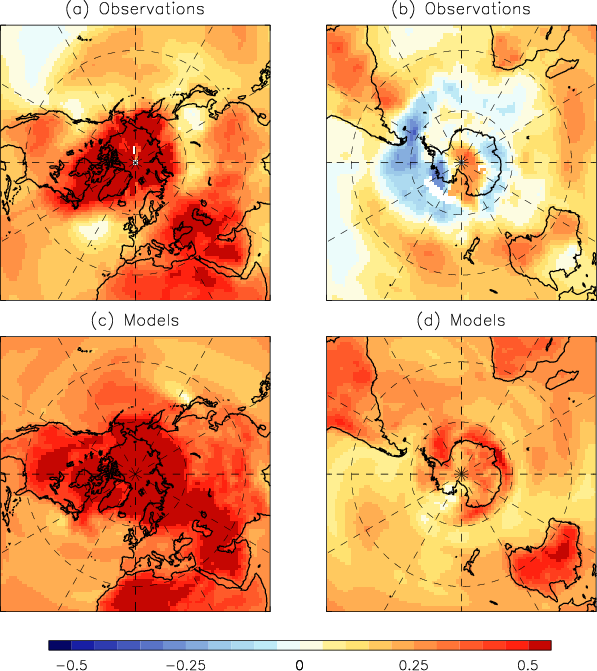
Recent Arctic and Antarctic temperature trends (C decade−1) in (a, b) observations and (c, d) model simulations. Linear trends are shown for the 30-year period (1988 to 2017). Observations are taken as the average of HadCRUT4 (Morice et al., 2012), NASA-GISS (Hansen et al., 2010) and NCDC (Karl et al., 2015). Model trends are computed as the average from 25 CMIP5 model simulations driven by historical and RCP4.5 radiative forcings.

It will be extremely interesting to discover what the working group 1 section of the IPCC’s 6th Assessment Report ultimately has to say on the topic of Arctic amplification. The current AR6 timeline states that:

The Working Group I contribution is expected to be considered at the 54th Session of the IPCC which is scheduled to take place in the 14 days from 26 July 2021. The report will be released, subject to approval and acceptance by the Panel, on or around 9 August.
Where’s the Thickest Arctic Sea Ice Gone?

In the absence of the usual mid month PIOMAS Arctic sea ice volume update I’m being moaned at by “angech” over on Judith Curry’s “Climate Etc.” blog:

Any ideas on why PIOMAS mid month update not out, other than not wanting to show a big recovery?

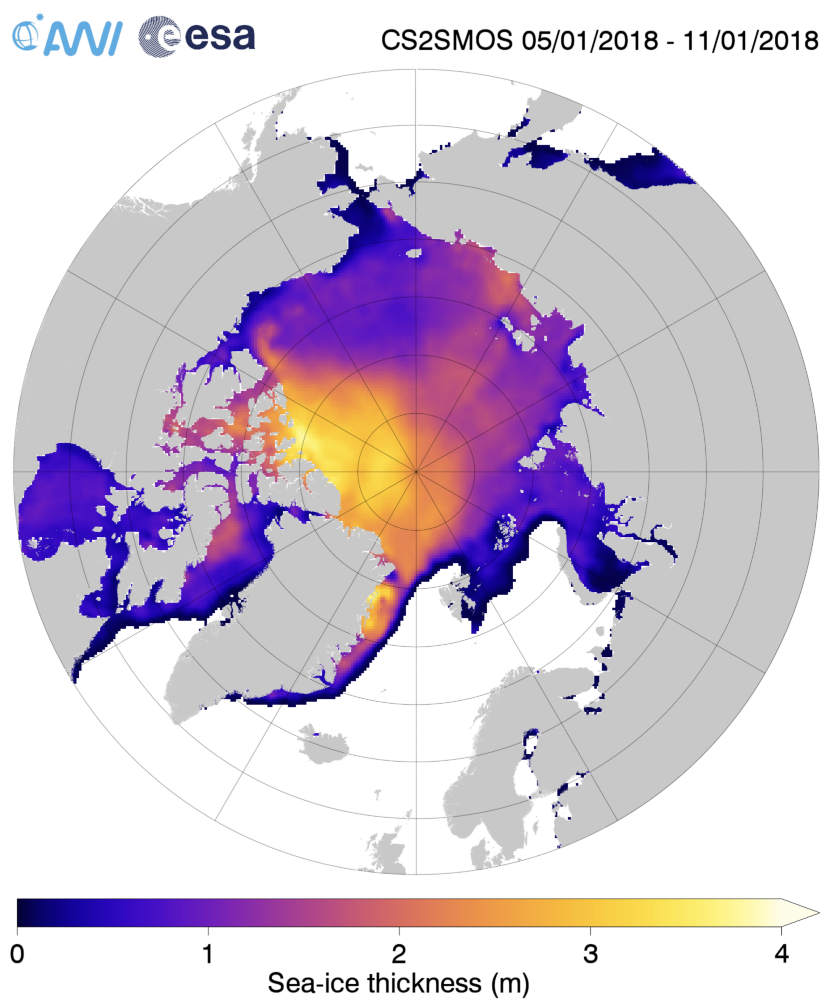
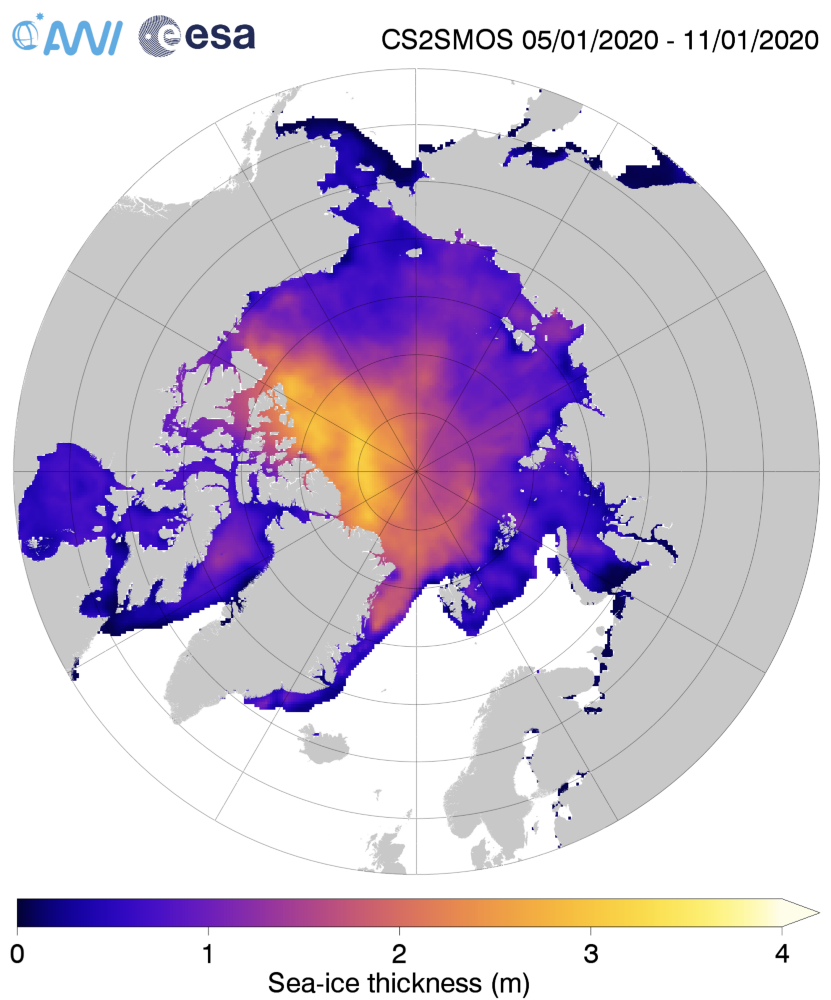
Unlike any of Judy’s denizens I checked out the comparatively new merged CryoSat-2 plus SMOS thickness maps from the Alfred Wegener Institute. “Measured” rather than “modelled” data must be a good thing surely?

Just in case there’s some significant difference between the “reanalysis” and “operational” versions of that product, here is the AWI’s most recent reanalysed Arctic sea ice thickness map, for the week ending January 11th:

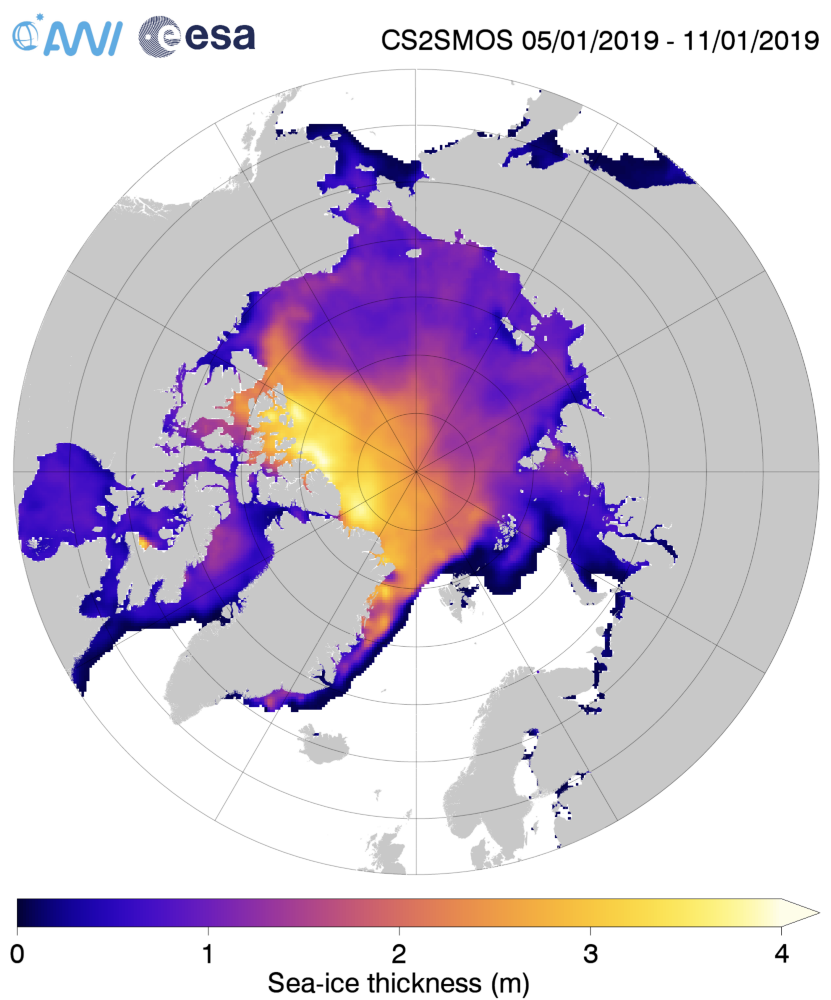
together with the same date from the previous two years:

Make sure to take a close look at the white areas north of Greenland and the Canadian Arctic Archipelago showing sea ice over 4 metres thick.

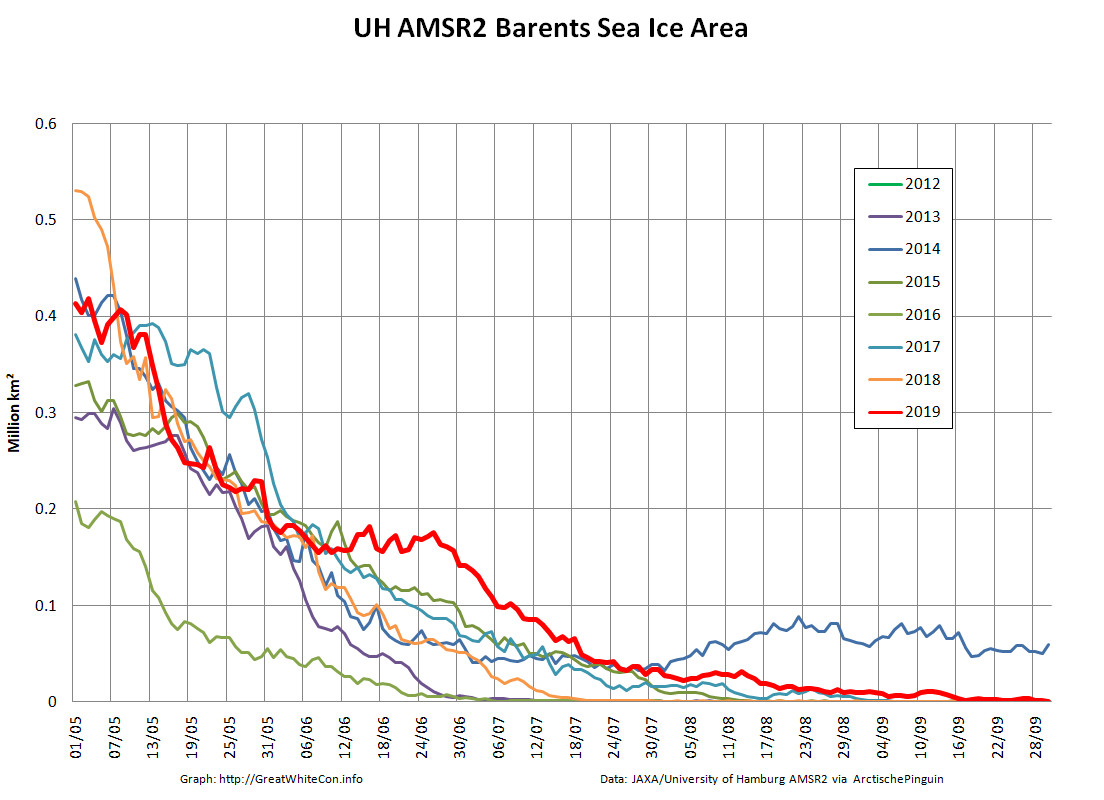
Over the winter of 2018/19 ASCAT revealed that there was a relentless movement of multi-year ice towards both the North Atlantic and the Beaufort Sea.

Not unexpectedly that meant that ice in the northern Barents Sea was slow to melt out in the summer of 2019:

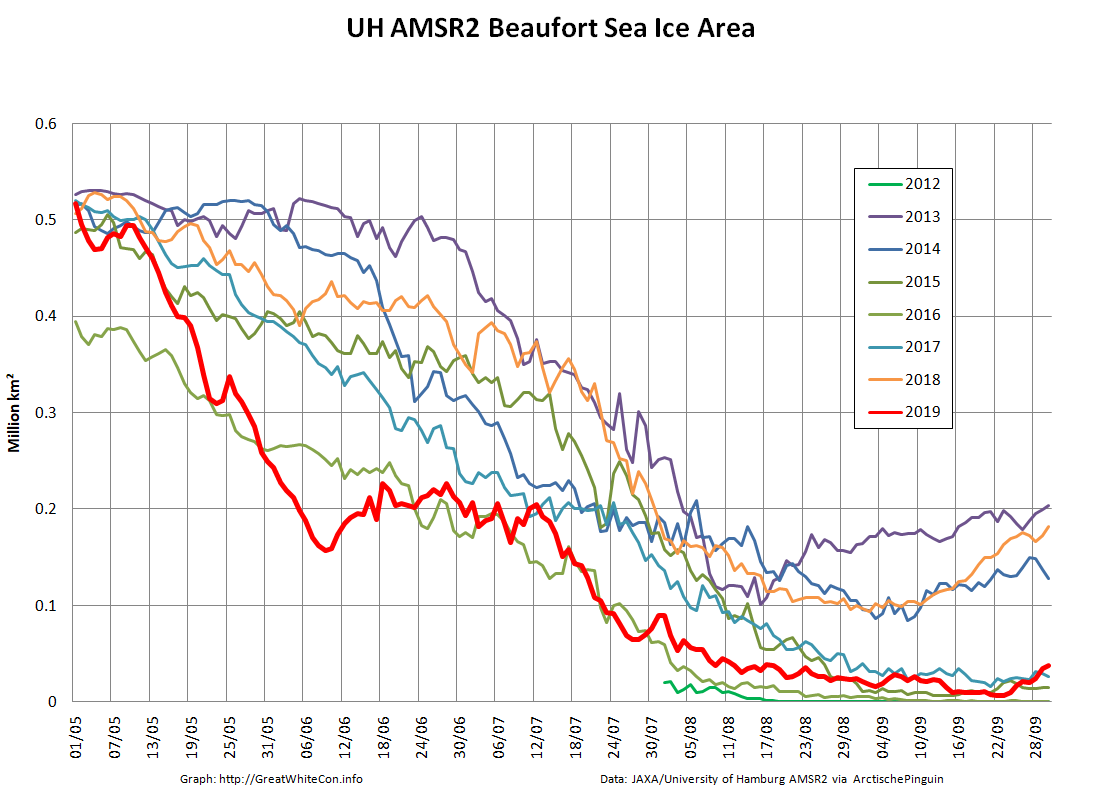
whilst after a fast start the melt in the Beaufort Sea also suffered a “brief hiatus” in June before ultimately melting out almost completely as well:

Perhaps a significant amount of the multi-year ice that survived the winter of 2018/19 has now simply melted away in warm water, to be replaced by much less robust first year ice in the area between the North Pole and the Siberian coast? It will be very interesting to see what the next PIOMAS update in early February reveals.

[Edit – February 4th]

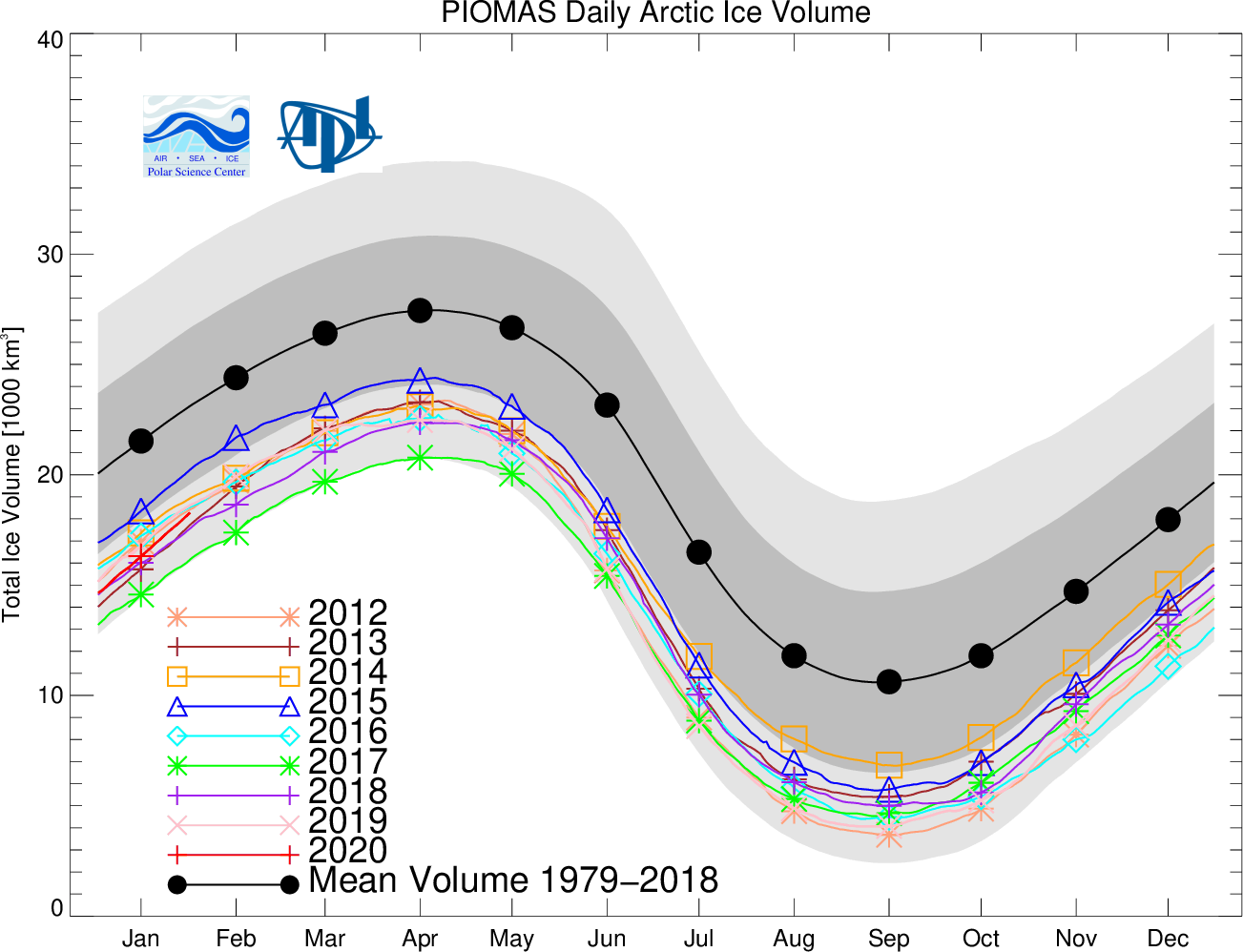
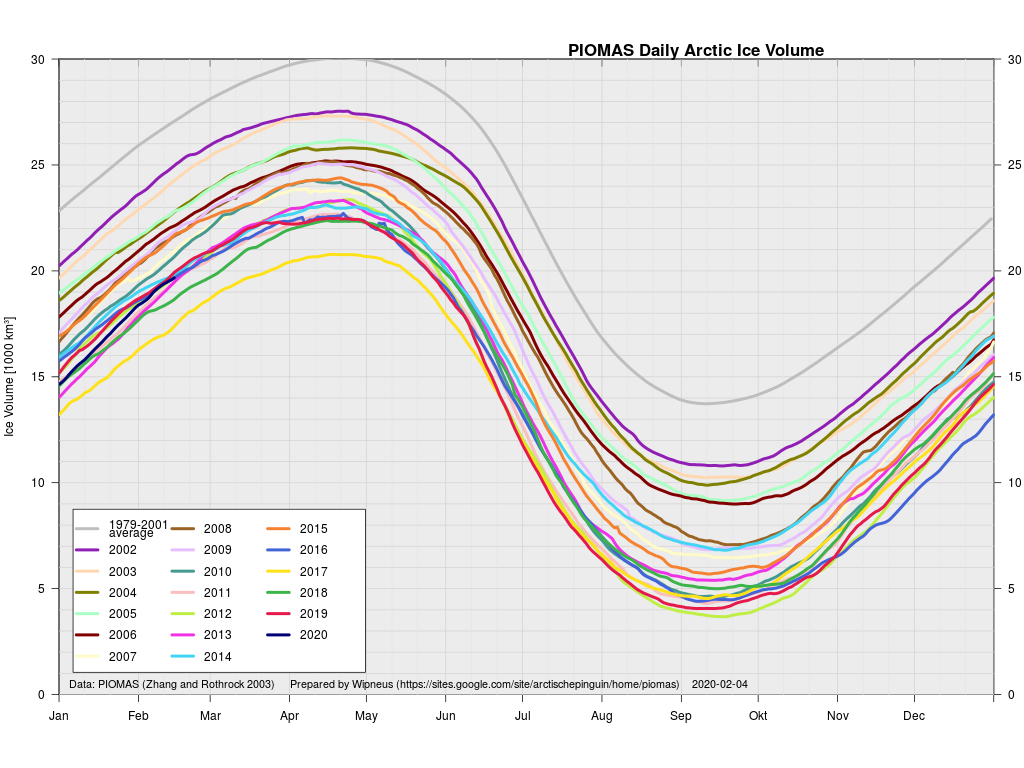
The next PIOMAS update referred to above has now arrived. Here’s the Polar Science Center’s graph:

Over on Climate Etc. angech is already exclaiming:

Strange it did go up a fair bit the old PIOMAS.
No publicity at the usual going down sites.

Actually it’s not at all strange, because thus far this winter the polar vortex has been remarkably well behaved. By and large cold air air has stayed in the Arctic. There hasn’t been much in the way of cold air intrusions into mid latitudes or warm air intrusions into the Arctic.

Hence it’s not at all surprising that the thickness of sea ice in the Arctic has been increasing slightly more quickly this winter than in other recent years. By way of some longer term context, here are the official Polar Science Center min/max trends:

[Edit – February 4th PM]

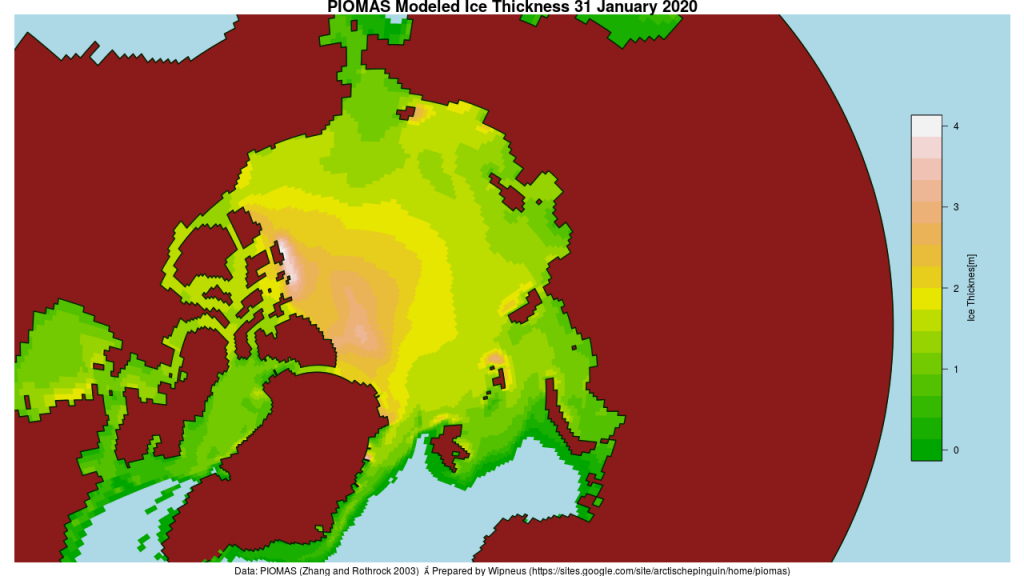
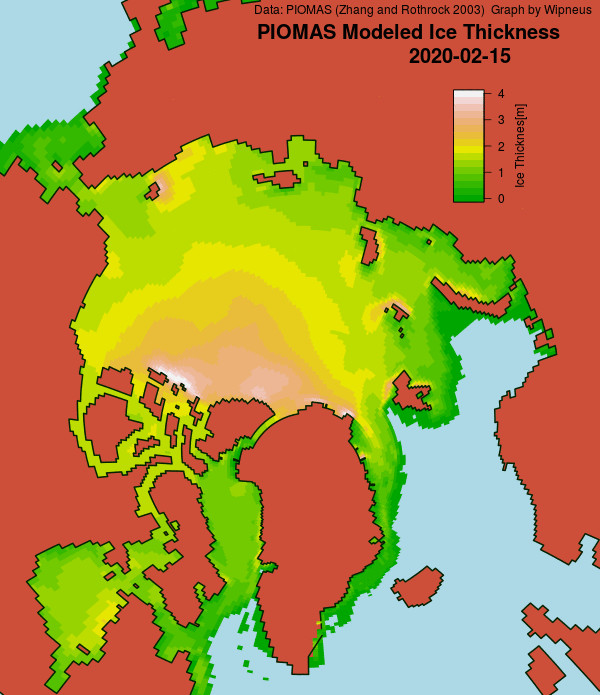
Wipneus has just released the January PIOMAS gridded thickness map. Here it is:

[Edit – February 5th]

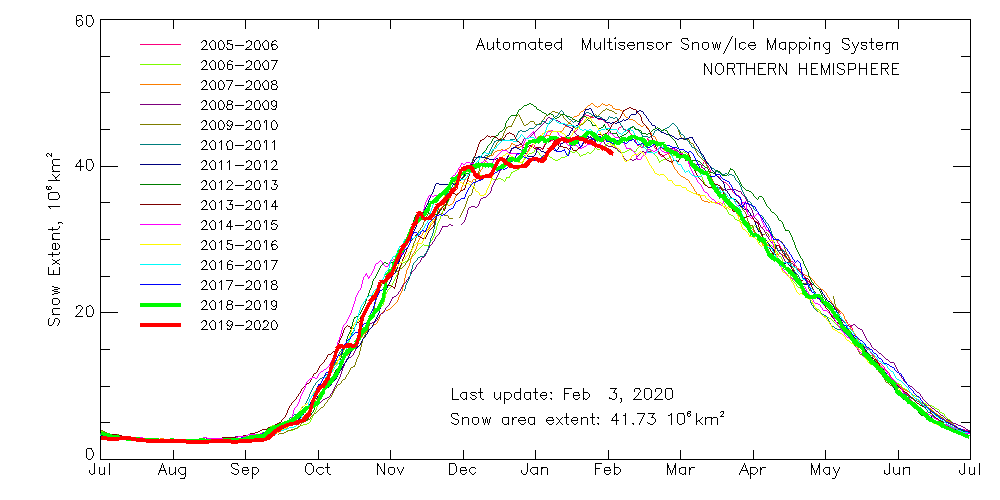
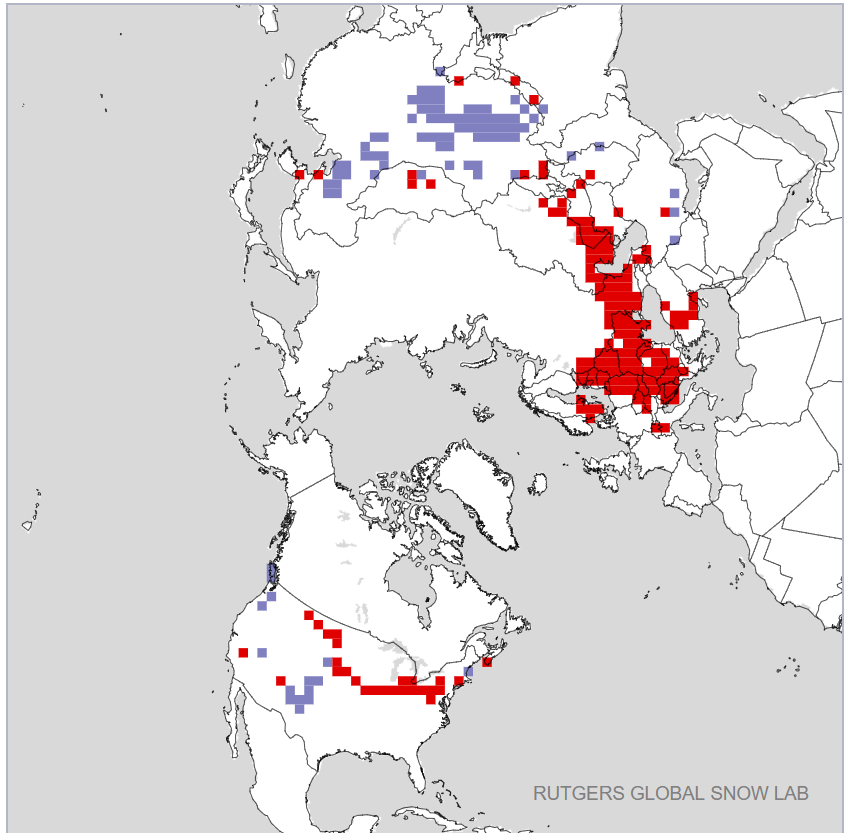
As is all too frequently the case, AdR and other commenters below get very excited about trivial increases in sea ice extent without considering snow extent. One side effect of the lack of cold air outbreaks into mid latitudes so far this winter currently looks like this:

[Edit – February 6th]

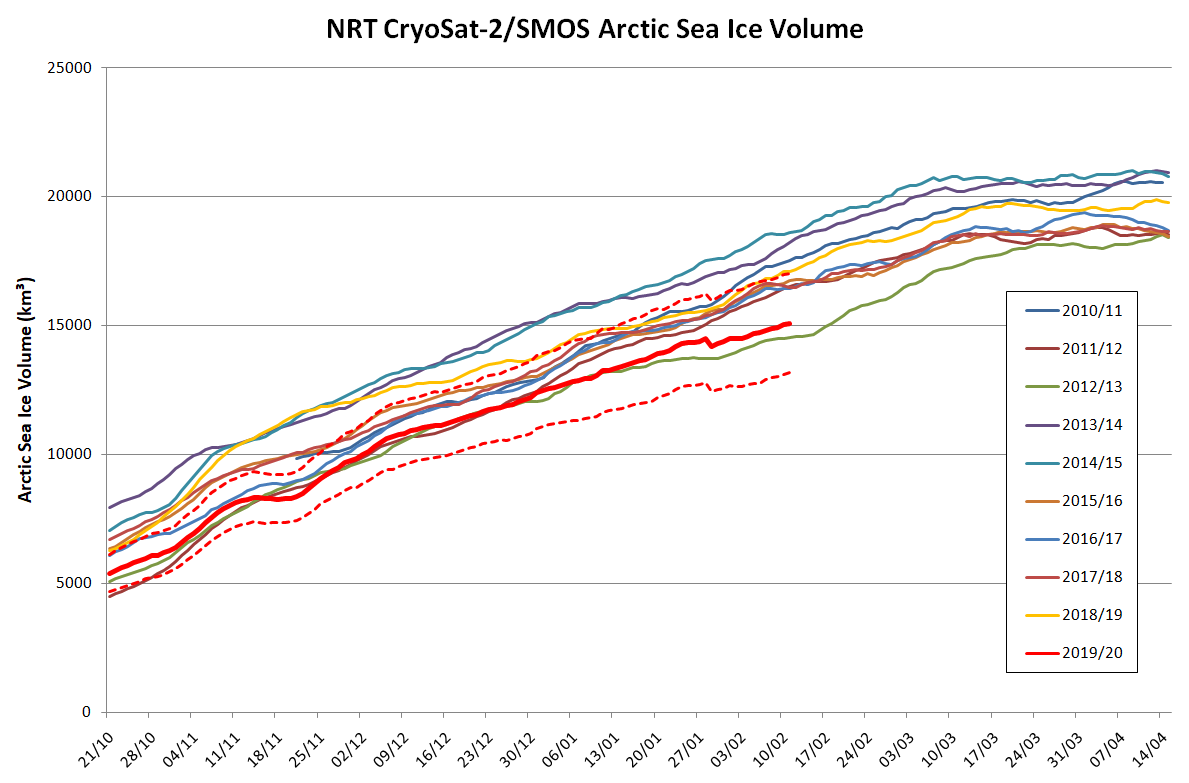
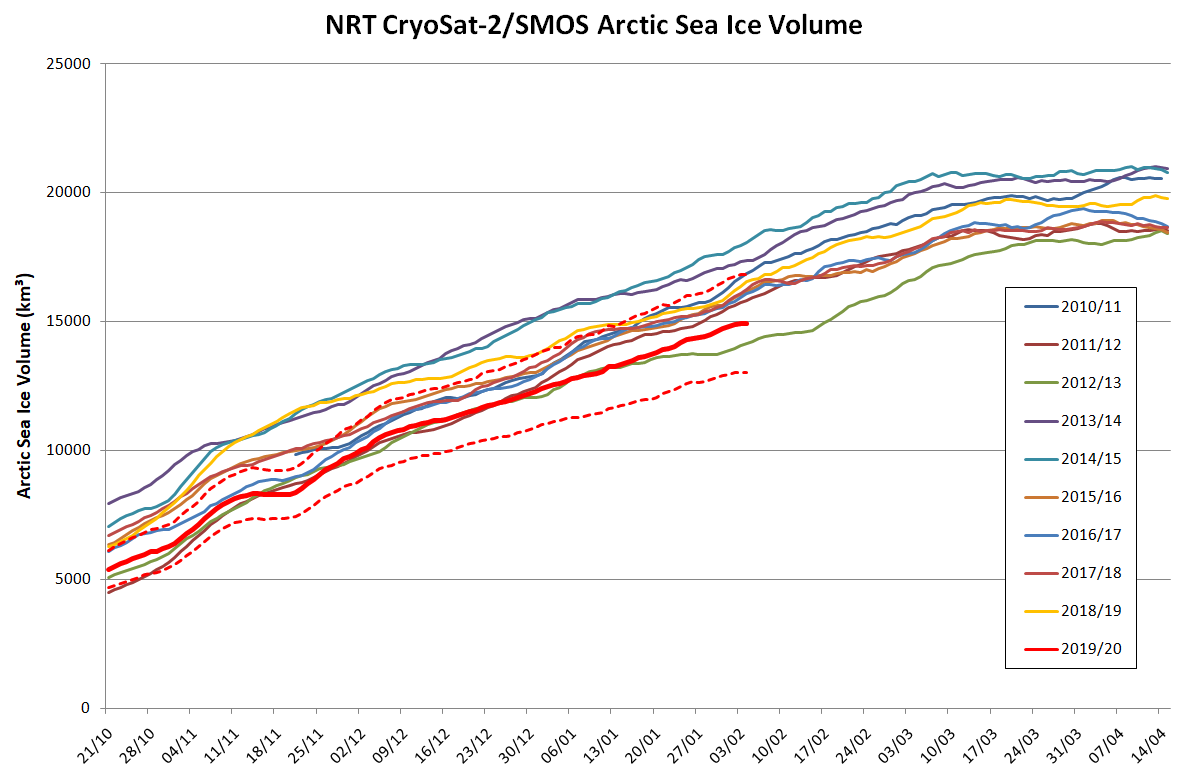
The AWI and PIOMAS sea ice thickness maps above look somewhat different at first glance. That being the case, I’ve written a program to crunch the AWI numbers. Here’s the result:

The source code plus raw and processed data can be accessed via the Arctic Sea Ice Forum:

CryoSat-2/SMOS Arctic Sea Ice Volume

[Edit – February 10th]

Further support for my “polar vortex” theory, from Judah Cohen no less!

[Edit – February 16th]

Here’s the latest update of our novel NRT volume metric:

Please note that there is a known problem with the NRT data from January 31st onwards.

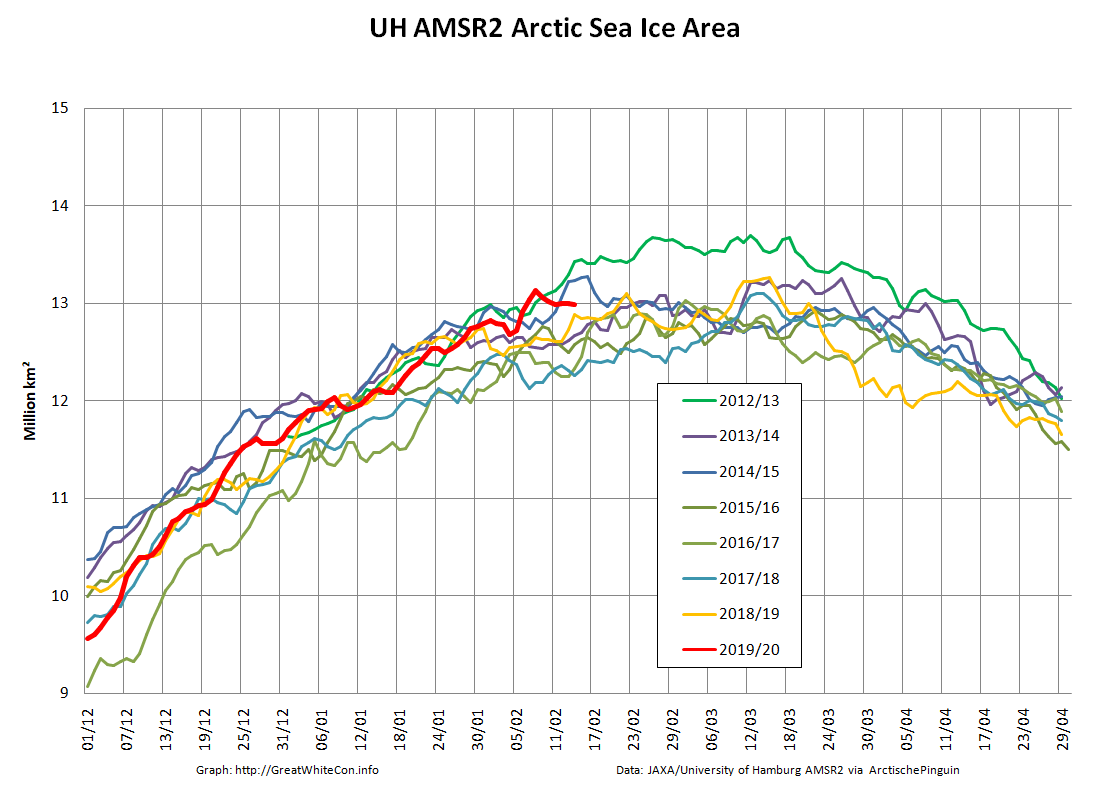
Here too are Wipneus’ latest high resolution AMSR2 area and extent graphs:

[Edit – February 18th]

Wipneus has released his usual mid month PIOMAS update on the Arctic Sea Ice Forum:

I am forced to ponder once again why the CryoSat-2/SMOS thickness “measured” numbers just above seem to be more at variance with PIOMAS in 2020 than in previous years:

[Edit – February 22nd]

Here’s another weekly NRT volume update:

This time I’ve left off the NRT data from February 6th onwards, since the “issue” referred to above obviously hasn’t been solved yet. As an added bonus here’s a graph showing the trends (or lack thereof) on 3 dates during the October to April freezing season:

Facts About the Arctic in January 2019

We generally write our periodic reports on the state of Arctic sea ice around the time the PIOMAS volume numbers are published. It seems as though we’ll have a long wait for that to happen at the moment though. According to The Economist today:

America’s government shutdown has become the longest in history. Hundreds of thousands of federal workers remain either stuck at home or forced to work without pay. To reopen the government President Donald Trump is demanding $5.7bn for his border wall. Nancy Pelosi, who presides over the most polarised House of Representatives in recent memory, does not want to give it to him.

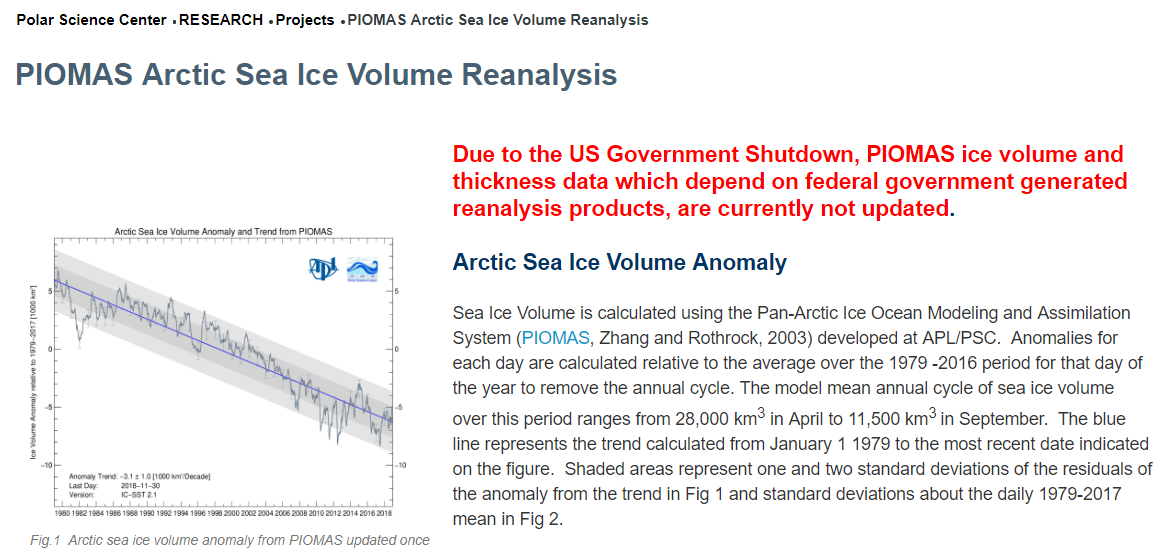
and according to the Polar Science Center at the University of Washington:

Due to the US Government Shutdown, PIOMAS ice volume and thickness data which depend on federal government generated reanalysis products, are currently not updated.

Instead of PIOMAS, let’s start instead with the January 2019 edition of the National Snow and Ice Data Center’s Arctic Sea Ice News:

As 2018 came to a close, Arctic sea ice extent was tracking at its third lowest level in the satellite record, while sea ice in the Antarctic remained at historic lows. Slightly faster growth in the first few days of the new year, mostly in the Pacific sea ice areas, has the daily sea ice extent at fifth lowest as of this post.

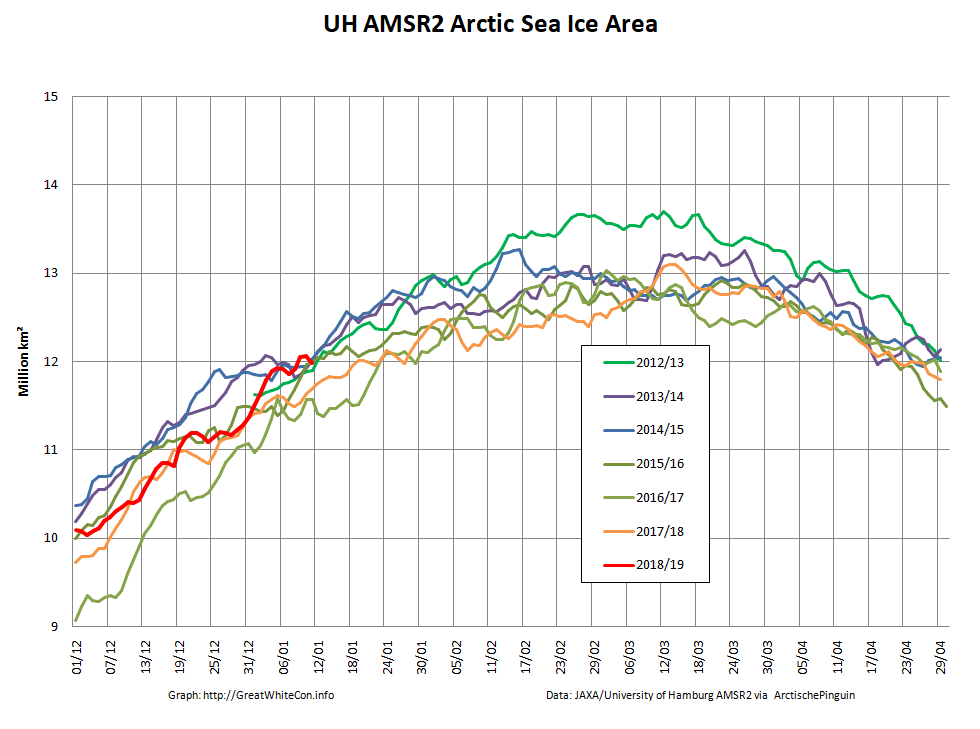
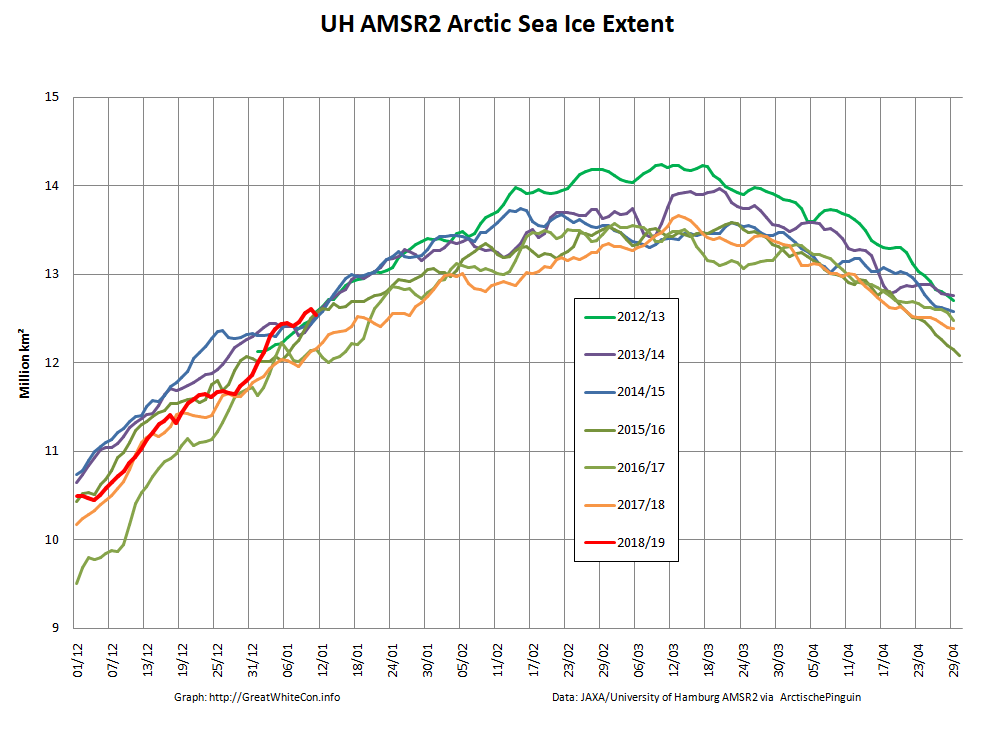
Now let’s take a look at our favourite high resolution AMSR2 area and extent metrics:

You can see that towards the end of December Arctic sea ice extent was verging on lowest for the date, since when it has risen quickly to reach highest for the date in the brief AMSR2 records a few days ago.

The NSIDC also mention the US Government shutdown:

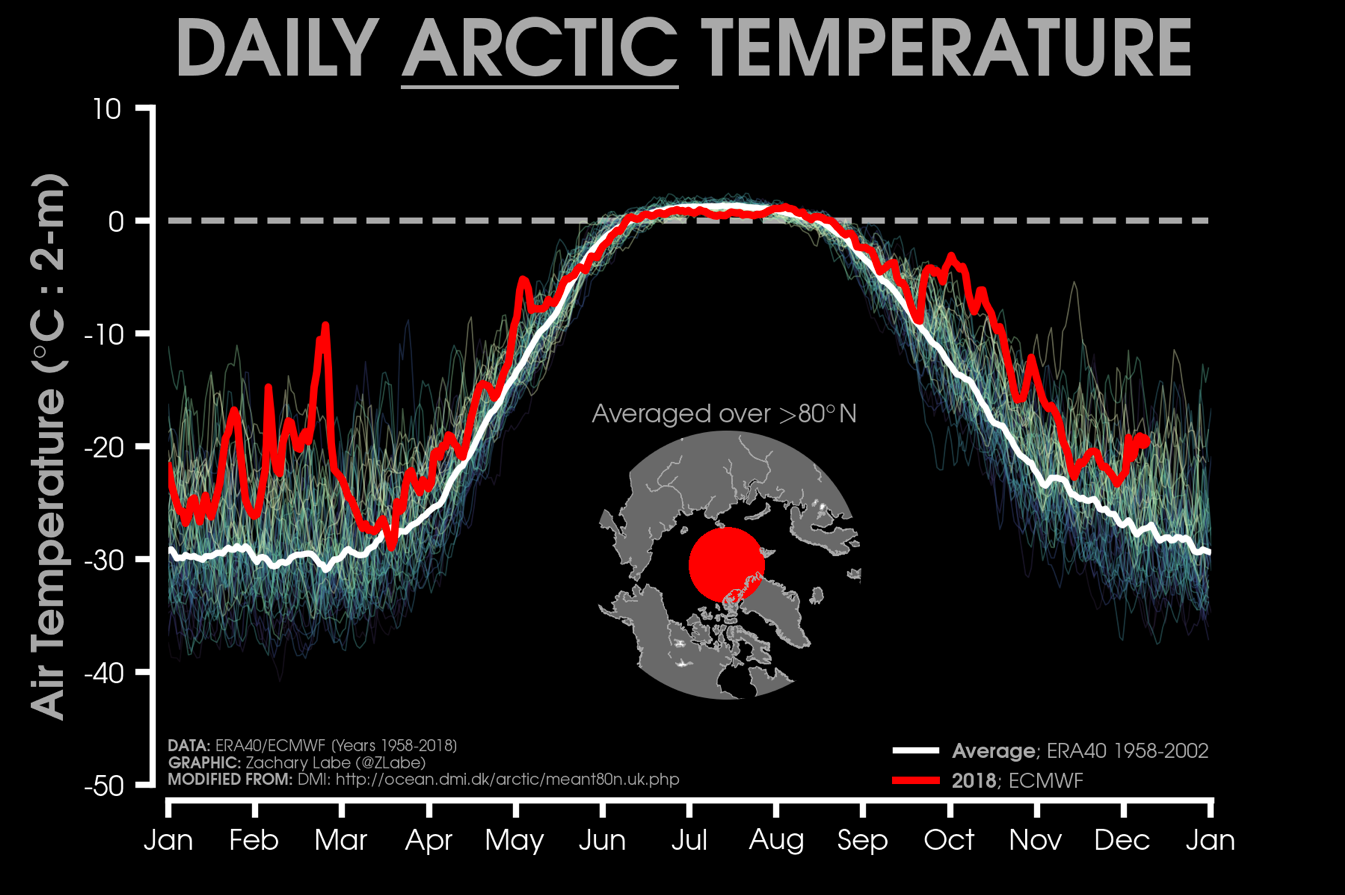
Unfortunately, as a result of the partial government shutdown, we are unable to access the National Oceanic and Atmospheric Administration (NOAA) pages to retrieve information on atmospheric air temperatures and sea level pressure patterns. Instead, we turn to daily (2 meters above the surface) mean air temperatures north of 80 degrees North from the European Centre for Medium-Range Weather Forecasts (ECMWF) operational model. This analysis shows that air temperatures remained above the 1958 to 2002 average for all of December.

Graph by Zack Labe
Graph by Zack Labe

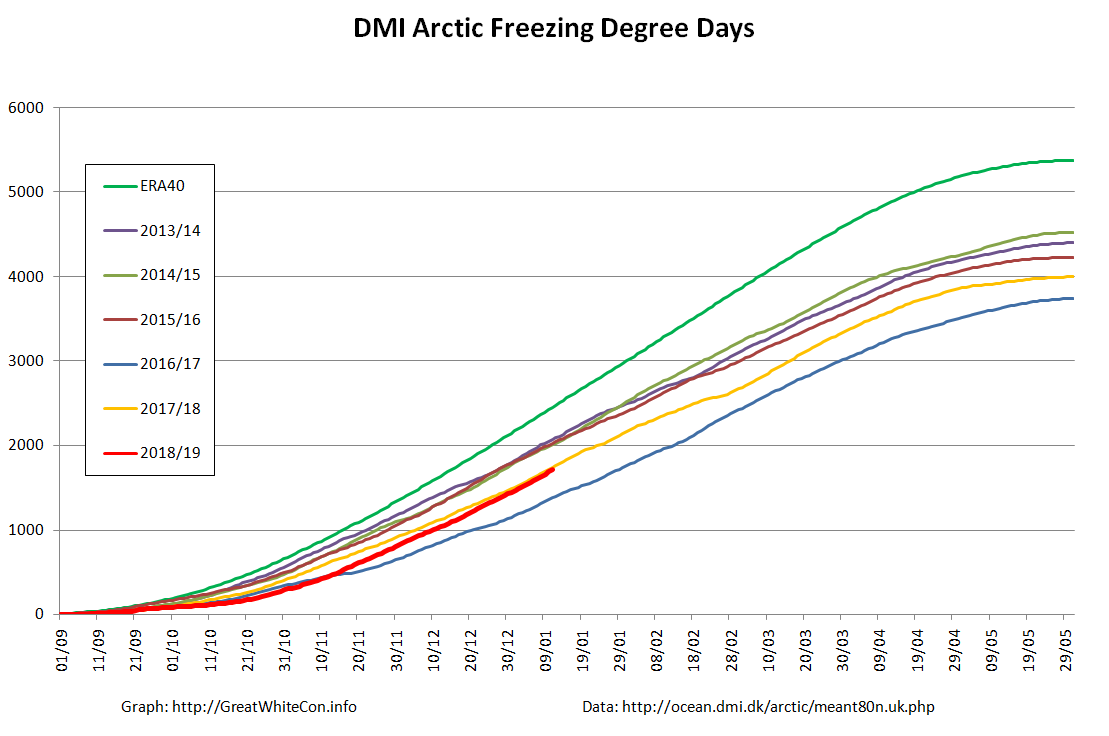
That brings us on to our Arctic freezing degree days graph, based on DMI data:

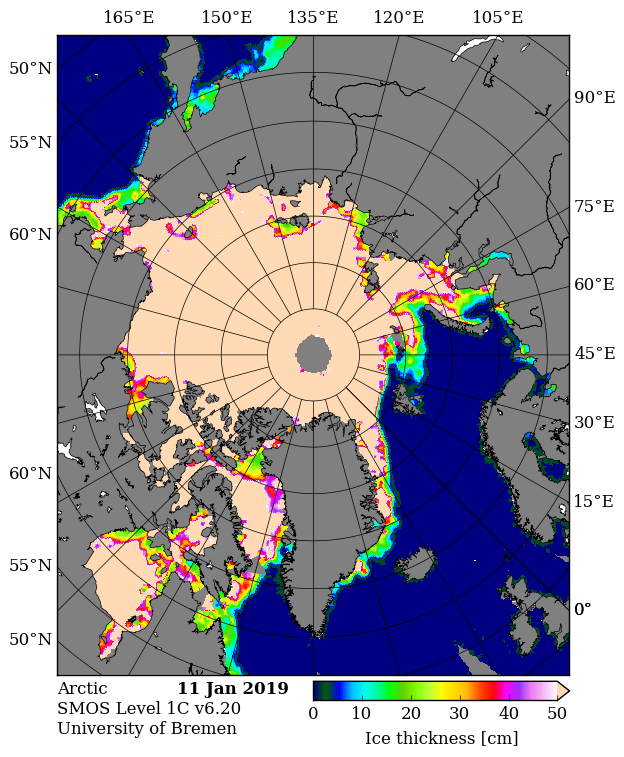
After a very slow start to the freezing season the FDD numbers are now vying for second place with last year, behind the astonishingly warm winter of 2016/17. In the absence of the PIOMAS volume numbers we can at least take a look at sea ice thickness. Here’s CryoSat-2:

followed by SMOS:

and since a change is as good as a rest here’s the latest map from the Russian Arctic and Antarctic Research Institute for good measure:

All those sources seem to be agreed that large areas of both the Barents and Kara Seas are currently covered by young thin ice. Finally, for the moment at least, let’s take a look at some extracts from the NSIDC’s review of 2018:

January 2018 began the year with record low sea ice extents for the Arctic as a whole.

The seasonal maximum, reached on March 17, 2018, was the second lowest in the satellite record. While low extent persisted through April and May, sea ice loss during early summer was unremarkable despite above average 925 hPa air temperatures over the Arctic Ocean and Eurasia.

Air temperatures over the Arctic Ocean in July were below average, followed by above average temperatures in August. In fact, on average, August temperatures were higher than July temperatures in 2018. This is highly unusual in the Arctic and something not seen in at least 40 years.
The September 2018 seasonal minimum extent ended up slightly above the long-term linear trend line, tying with 2008 for the sixth lowest in the satellite record. After the minimum, the ocean was slow to freeze up, and October sea ice extent ended up as the third lowest. However, ice growth was very rapid in November, such that November 2018 extent approached the interquartile range of the 1981 to 2010 median. Nevertheless, large amounts of open water remained in the Barents and Chukchi Seas. By the end of December, ice conditions in the Chukchi Sea were back to average, while extent remained unusually low in the Barents Sea.
Coverage of old ice (greater than 4 years old) over the Arctic continued to decline. Such old ice covers only 5 percent of the area it used to in 1980s.


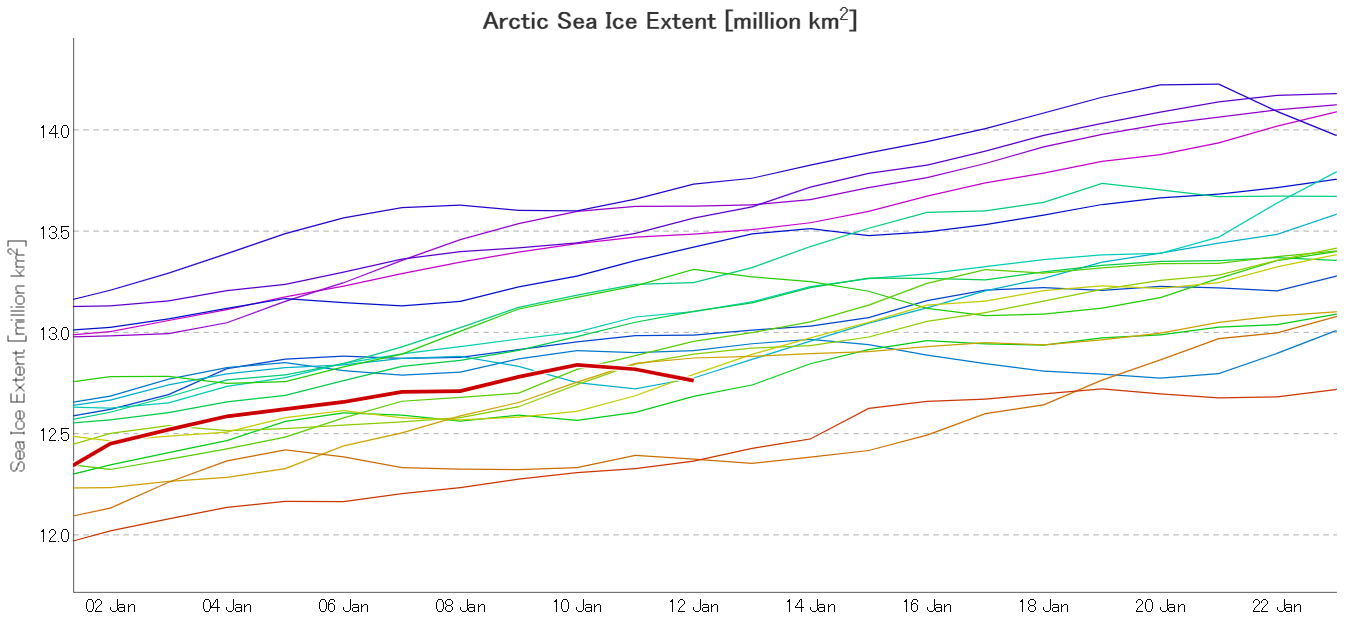
[Edit – January 13th]

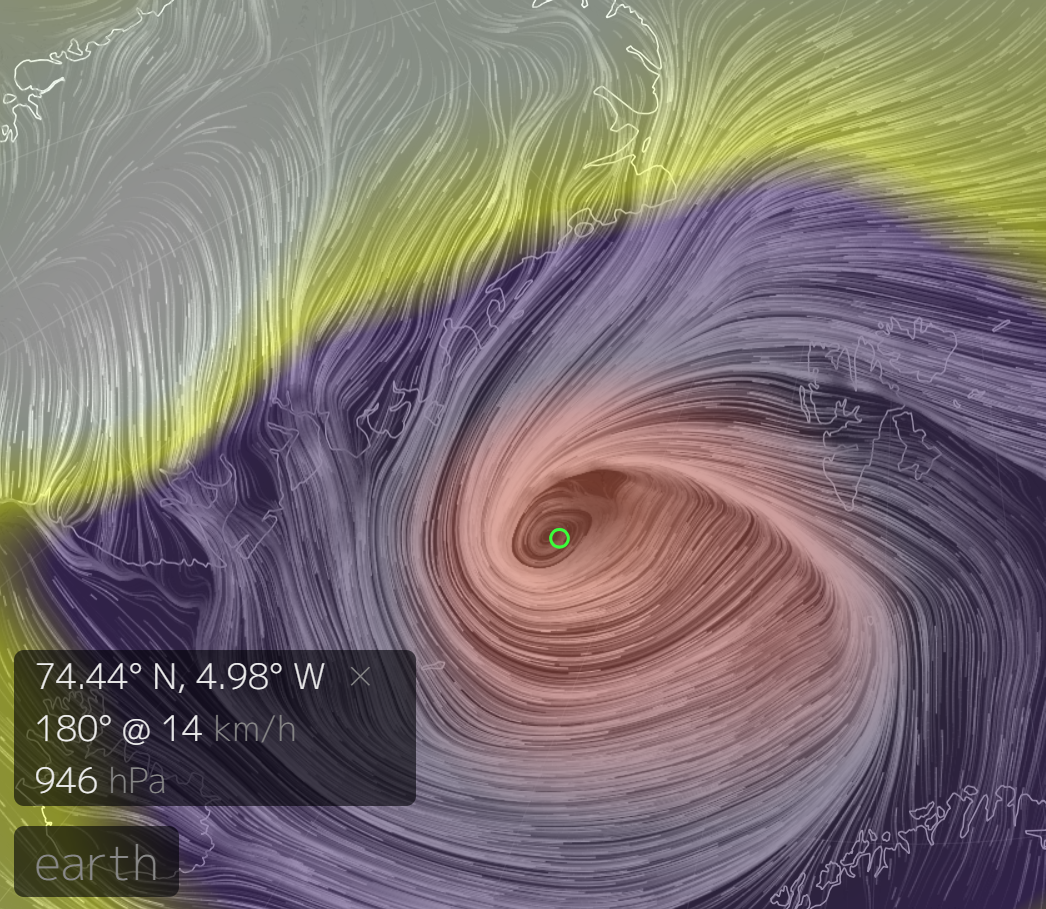
Arctic sea ice area and extent have both been falling over the last few days, possibly as a result of the recent cyclone which created strong northerly winds in the Fram Strait. This is from Earth at 09:00 UTC on January 10th, showing a MSLP of 946 hPa:
Here’s what used to be referred to as JAXA extent:

Meanwhile up in the stratosphere at 10 hPa the polar vortex has gone into reverse:

Or to be more precise:

The February 2018 Fram Strait Cyclones

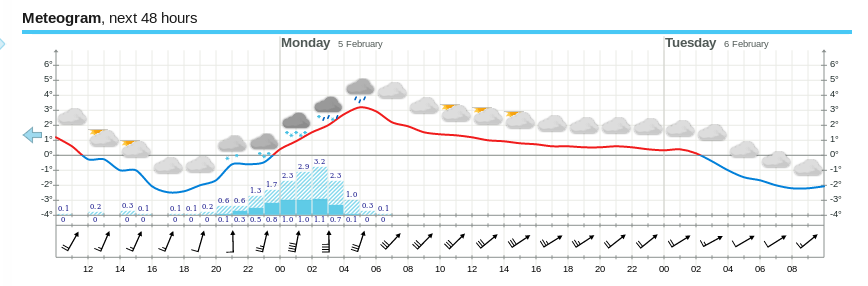
As already mentioned in our February Arctic overview, another storm is brewing. Here is this morning’s weather forecast for Longyearbyen, the capital of Svalbard:
svalbard_forecast_20180204

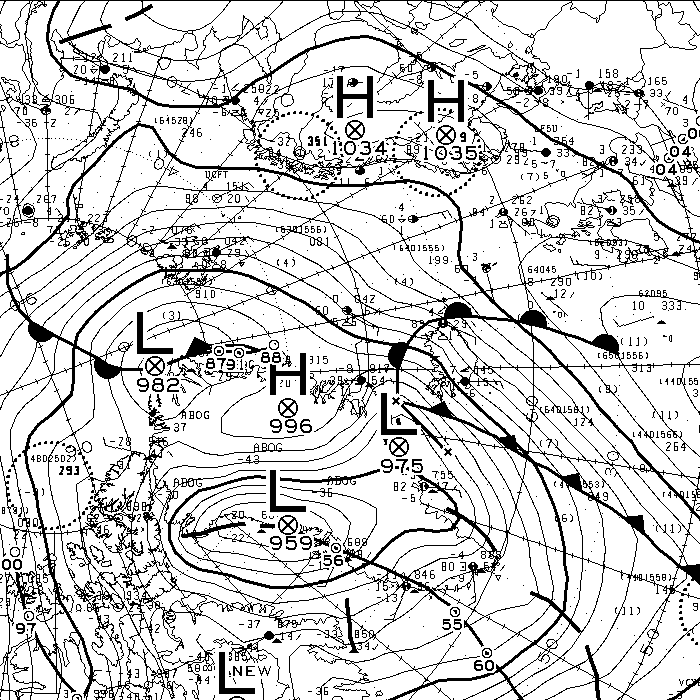
Much like last month, temperatures are above zero and rain is forecast. That’s because once again the current synoptic chart from Environment Canada shows a warm wet flow from way down south over Svalbard and on into the Central Arctic:

Synopsis-20180204-06Z-Crop

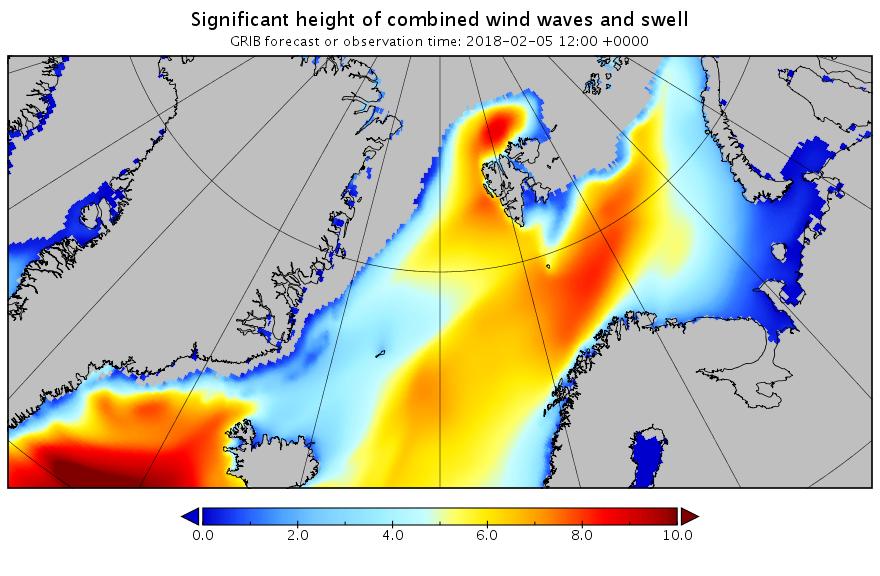
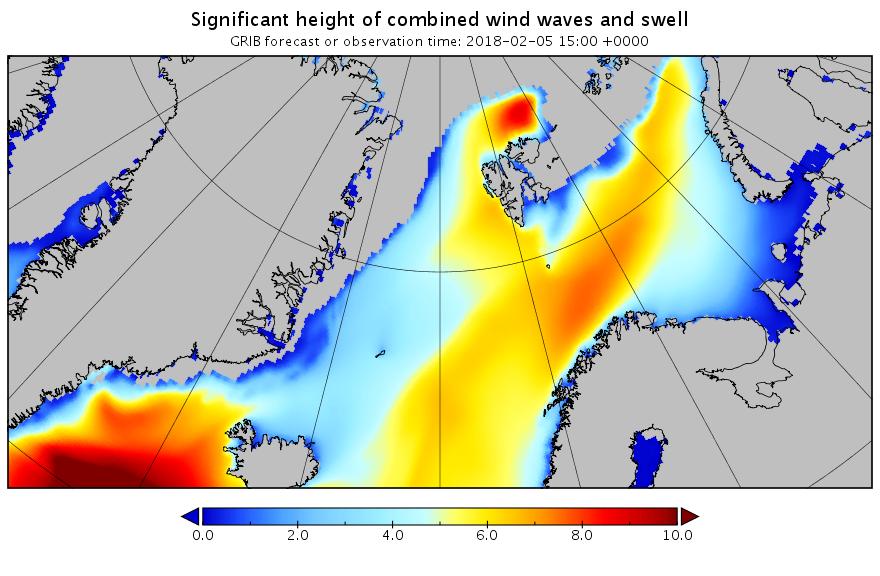
Next here’s the current combined wave and swell height forecast for the Svalbard area:

Significant_height_of_combined_w in multi_1.glo_15mext.20180204_00037

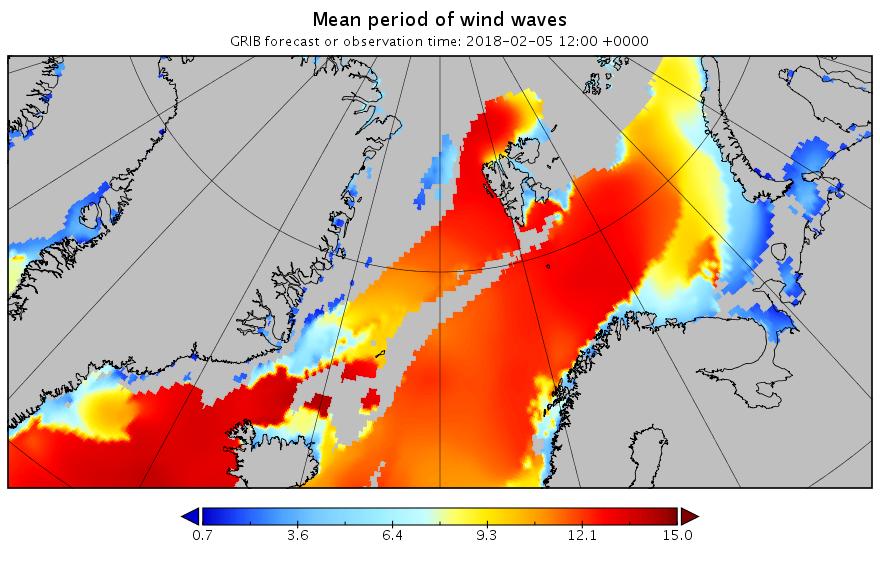
and here’s the associated wave period forecast:

Mean_period_of_wind_waves_surfac in multi_1.glo_15mext.20180204_00037

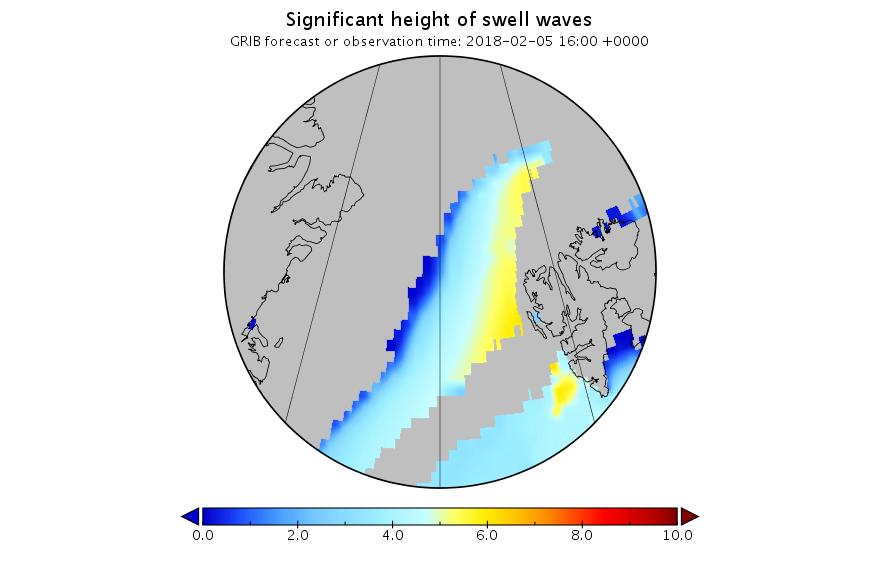
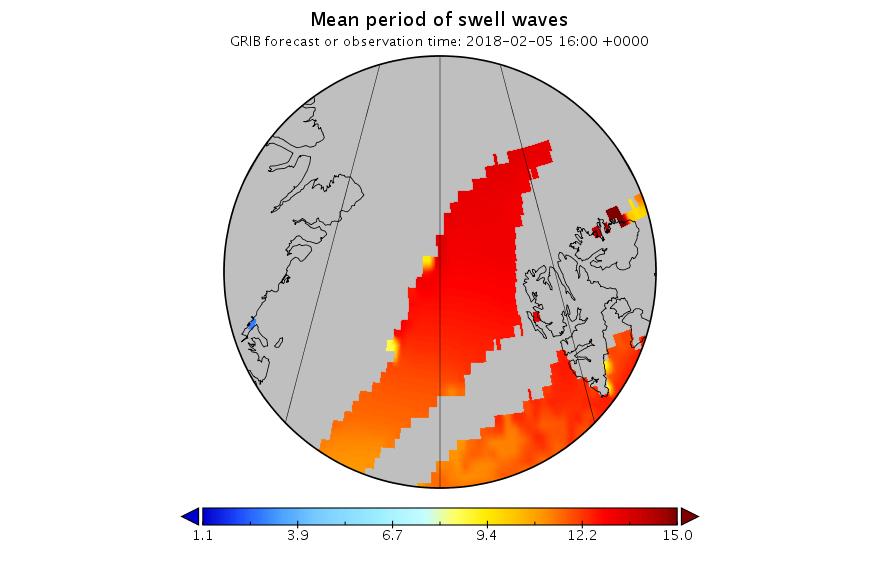
It’s still showing 10 meter waves with a 15 second period north of Svalbard tomorrow lunchtime. Somewhat unusually for the Arctic these aren’t merely giant wind waves. Zooming in on the Fram Strait and breaking out the underlying primary swell reveals:

Significant_height_of_swell_wave in multi_1.glo_15mext.20180204_00041

Mean_period_of_swell_waves_order in multi_1.glo_15mext.20180204_00041

A long distance swell of that magnitude is going to cause some damage.


[Edit – February 5th]

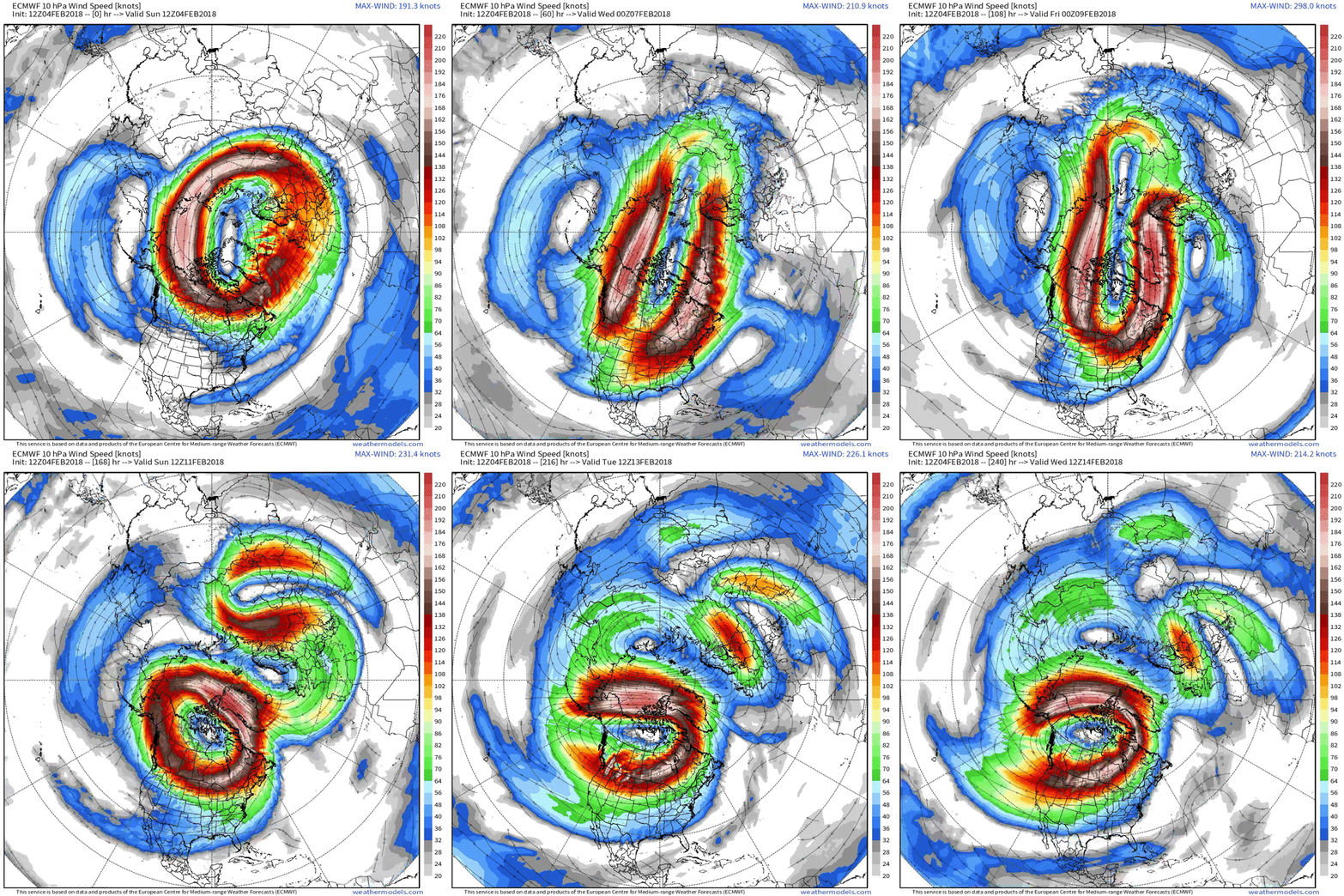
The current ECMWF forecast for a split polar vortex, courtesy of Ice Shieldz on the Arctic Sea Ice Forum:

Polar View Wind Speed 10 hPa 20180204

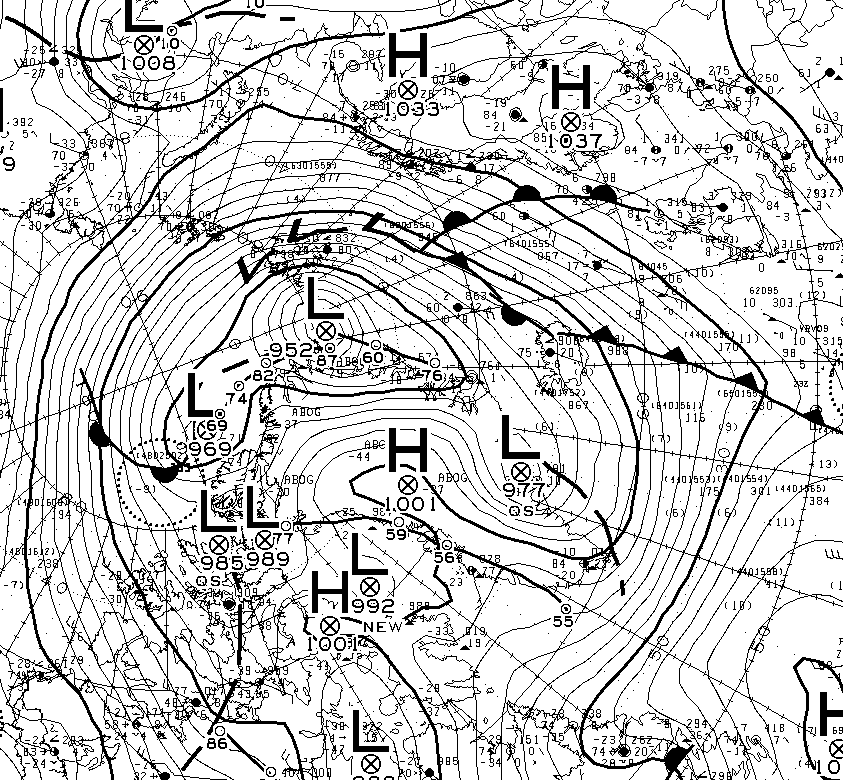
This is suggestive of more cyclones to come, but sticking with the current one for now, here is the MSLP chart at 00:00 UTC this morning showing the cyclone’s central pressure has dropped to 952 hPa:

Synopsis-20180205-00Z-Crop

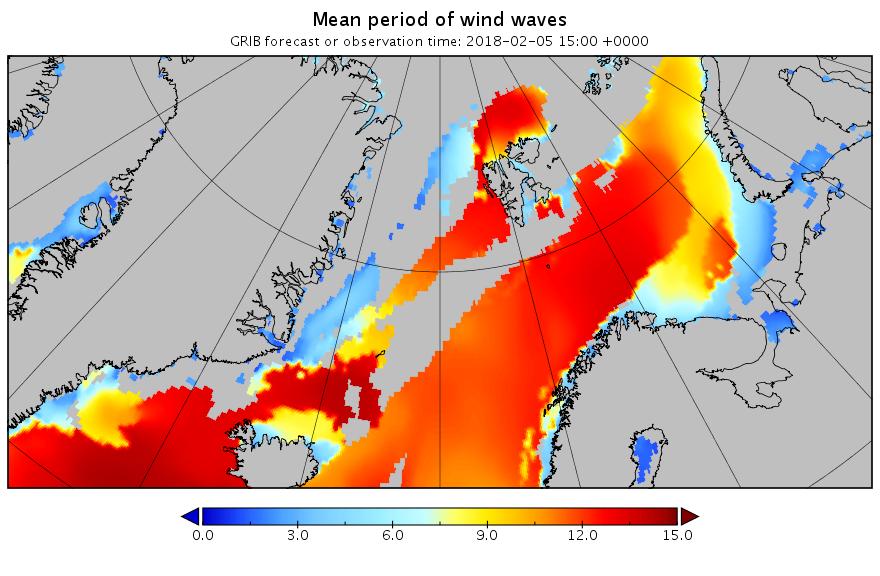
Here too is the current WaveWatch III forecast for 15:00 UTC today:

Significant_height_of_combined_w in multi_1.glo_15mext.20180205_00016

Mean_period_of_wind_waves_surfac in multi_1.glo_15mext.20180205_00016

The peak of the swell north of Svalbard is now slightly later than originally forecast, but it’s still enormous!

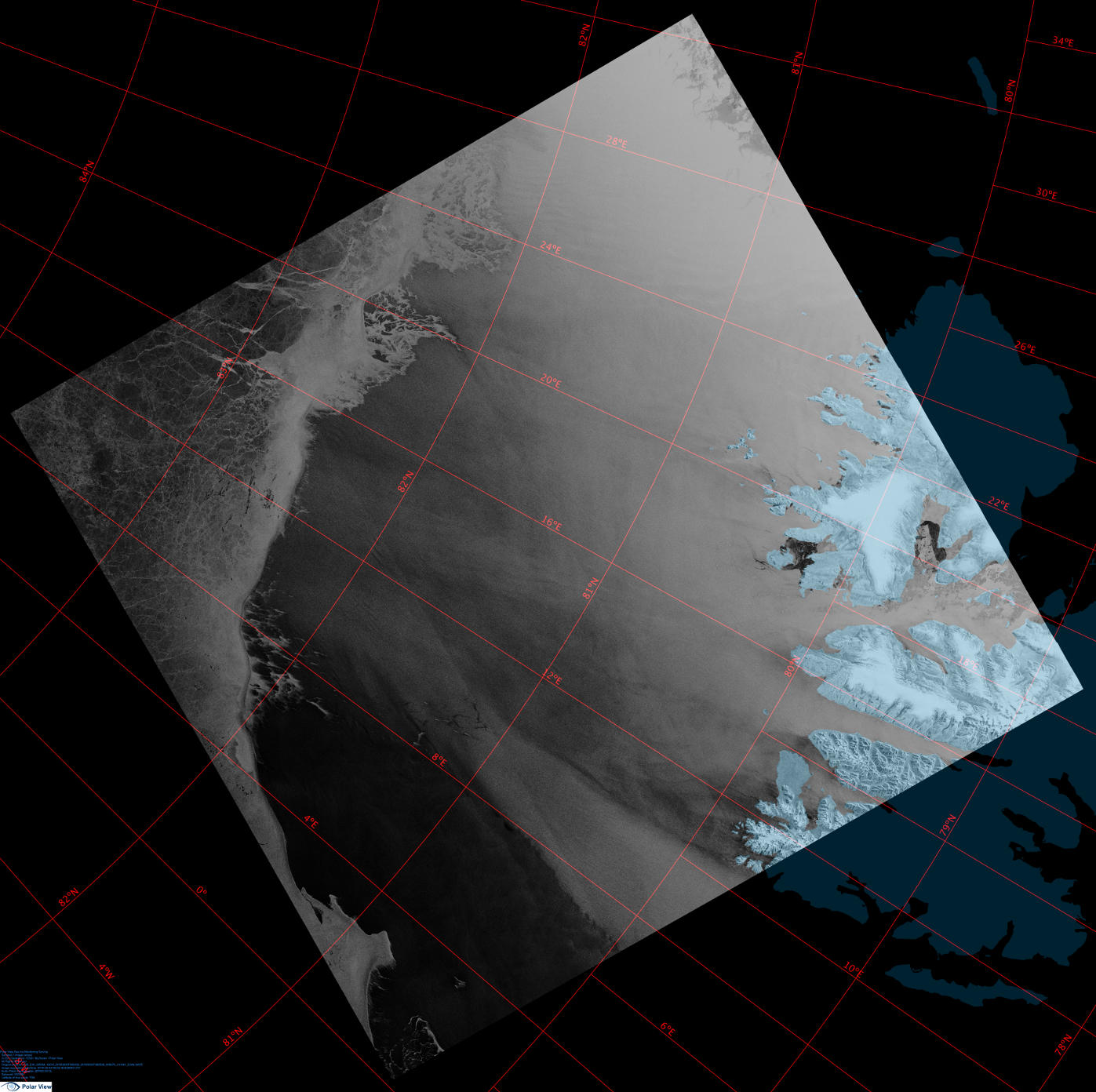
Here’s a single Sentinel 1B synthetic aperture radar image that captures the position of the ice edge north of Svalbard yesterday quite nicely:

S1B_Svalbard_20180204T0654


[Edit – February 7th]

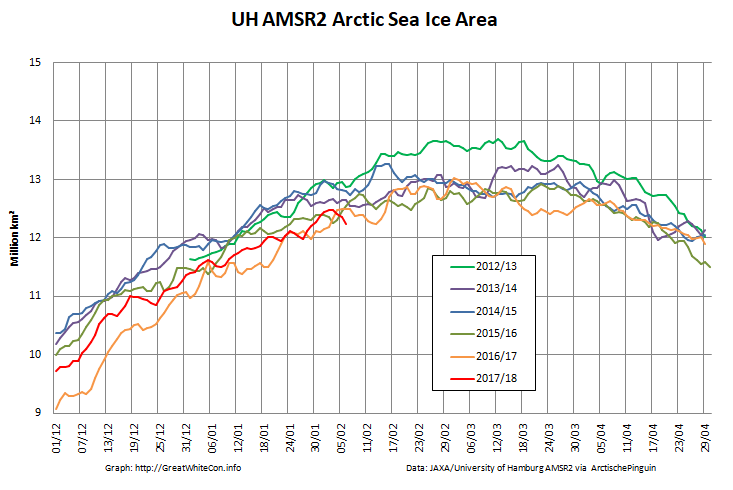
A brief overview of the effect of the recent cyclone on the sea ice in the Arctic via AMSR2:

UH-Arctic-Area-2018-02-06

UH-Arctic-Extent-2018-02-06

atlantic-201802-1280

Click the image to animate it.


[Edit – February 8th]

An Arctic wide take via Thomas Lavergne on Twitter:

plus the latest AMSR2 concentration map:

Arc_20180207_res3.125_LARGE


[Edit – February 9th]

An interesting insight into CryoSat-2 sea ice thickness measurements from Stefan Hendricks on Twitter:

Plus Judah Cohen on the split polar vortex: