Tag Archives: Kevin Cowtan

Climategate 2 Falls at the First Hurdle?

Shock News! The David and Judy Show took to the road once again last night, aided and abetted by all the usual suspects. We’ll skip the Breitbarts, Hellers and Watts of this world and head straight for the now ex Prof. Judith Curry‘s “Climate Etc.” blog. There we will discover “Climate scientists versus climate data“, a guest post by ex NOAA scientist John Bates. According to John:

The most serious example of a climate scientist not archiving or documenting a critical climate dataset was the study of Tom Karl et al. 2015 (hereafter referred to as the Karl study or K15), purporting to show no ‘hiatus’ in global warming in the 2000s (Federal scientists say there never was any global warming “pause”). The study drew criticism from other climate scientists, who disagreed with K15’s conclusion about the ‘hiatus.’ (Making sense of the early-2000s warming slowdown). The paper also drew the attention of the Chairman of the House Science Committee, Representative Lamar Smith, who questioned the timing of the report, which was issued just prior to the Obama Administration’s Clean Power Plan submission to the Paris Climate Conference in 2015.

Regular readers of our humble scribblings will be well aware that here in Great White Con Ivory Towers we are firmly of the opinion that there never was a ‘hiatus’. Exhibit 1:
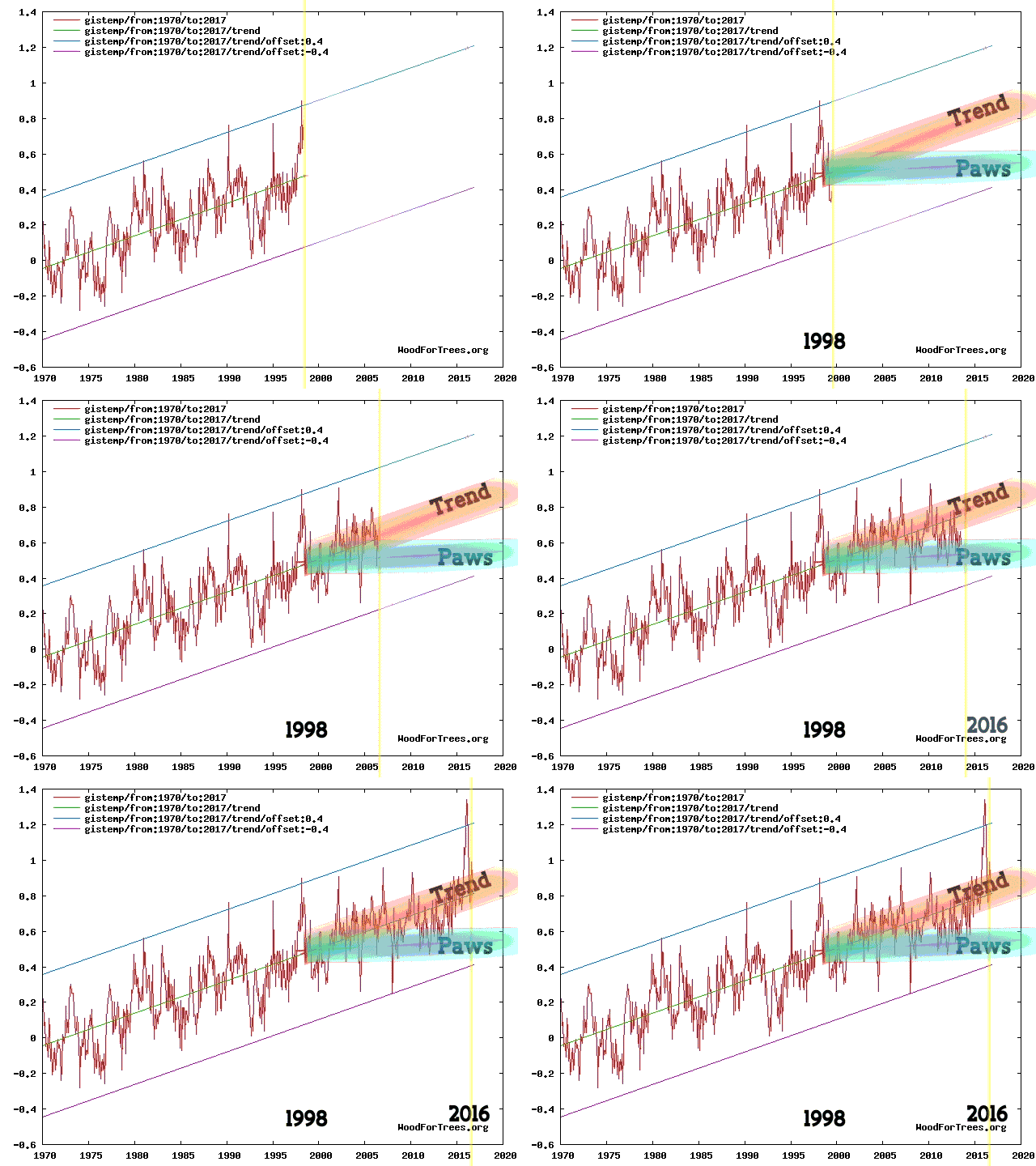
Animation by izen
Animation by izen

What’s all the fuss about then? Perhaps our old friend David Rose can explain in layperson’s terms? In his latest article for the Mail on Sunday, catchily entitled “Exposed: How world leaders were duped into investing billions over manipulated global warming data”, he assures us that amongst many other things:

The [K15] report claimed that the ‘pause’ or ‘slowdown’ in global warming in the period since 1998 – revealed by UN scientists in 2013 – never existed, and that world temperatures had been rising faster than scientists expected. Launched by NOAA with a public relations fanfare, it was splashed across the world’s media, and cited repeatedly by politicians and policy makers.

But the whistleblower, Dr John Bates, a top NOAA scientist with an impeccable reputation, has shown The Mail on Sunday irrefutable evidence that the paper was based on misleading, ‘unverified’ data.

It was never subjected to NOAA’s rigorous internal evaluation process – which Dr Bates devised.

Now “never subjected to NOAA’s rigorous internal evaluation process” isn’t quite the same thing as “manipulated global warming data”, but Mr. Rose has more!

MoS2 Template Master

The misleading ‘pausebuster chart’: The red line shows the current NOAA world temperature graph – which relies on the ‘adjusted’ and unreliable sea data cited in the flawed ‘Pausebuster’ paper. The blue line is the UK Met Office’s independently tested and verified ‘HadCRUT4’ record – showing lower monthly readings and a shallower recent warming trend
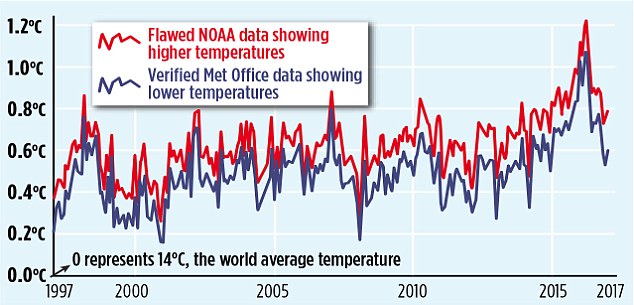
That graph looks convincing enough, doesn’t it? However there is a teensy weensy little upward adjustment in there that Mr. Rose is apparently unaware of, as NASA’s Gavin Schmidt pointed out late last night:

https://twitter.com/ClimateOfGavin/status/828082851585388544

This morning Carbon Brief has published a much longer takedown of the aforementioned purple prose by Zeke Hausfather, who points out amongst other things that:

What [David Rose] fails to mention is that the new NOAA results have been validated by independent data from satellites, buoys and Argo floats and that many other independent groups, including Berkeley Earth and the UK’s Met Office Hadley Centre, get effectively the same results.

As per usual Mr. Rose doesn’t stick to science, however dubious. He also dabbles in politics. On that front we are assured:

Karl’s ‘Pausebuster’ paper was hugely influential in dictating the world agreement in Paris and sweeping US emissions cuts. President Trump, above right, has pledged to scrap both policies – triggering furious claims by Democrats he is a climate ‘denier’ and ‘anti-science’.

Thanks to today’s MoS story, NOAA is set to face an inquiry by the Republican-led House science committee.

We’ll have much more to say on this controversy in the context of our “Alternative Facts” investigation in due course, but for the moment at least it looks to us as though the nth iteration of “Climategate 2” barely made it out of the starting gate. However Mr. Rose’s loyal army of “rebloggers, retweeters, plagiarisers and other assorted acolytes” and that “Republican-led House science committee” may of course have other ideas?

[Edit – February 5th PM]

Commentary on Judith Curry’s blog brought to light an article by Peter Thorne. He says, amongst many other things:

I worked for three and a bit years in the NOAA group responsible in the build-up to the Karl et al. paper (although I had left prior to that paper’s preparation and publication). I have been involved in and am a co-author upon all relevant underlying papers to Karl et al., 2015.

The ‘whistle blower’ is John Bates who was not involved in any aspect of the work. NOAA’s process is very stove-piped such that beyond seminars there is little dissemination of information across groups. John Bates never participated in any of the numerous technical meetings on the land or marine data I have participated in at NOAA NCEI either in person or remotely. This shows in his reputed (I am taking the journalist at their word that these are directly attributable quotes) mis-representation of the processes that actually occured. In some cases these mis-representations are publically verifiable.

A “rave from the grave” suggests itself at this juncture:

See if you can spot where Dan & Dan mention the term #Climategate.


[Edit – February 6th]

It’s been a busy day! Several of my carefully crafted comments have ended up on Judy’s cutting room floor, but this one has eluded the red pencil thus far. I bring you this warming and educational nightcap created by an ad hoc team of celebrity international chefs for “warmists” around the planet:

You have to keep clicking through to the very bottom of the virtual mug in order to experience the full benefit of the beverage.

Thank you and good night from May or May Not Land. I’ll see you all in the morning (UTC).


[Edit – February 7th]

Lot’s of pertinent papers just in from Great White Con guest author Kevin Cowtan of York University. Kevin is part of the by now world famous team of Cowtan & Way, who have long championed the cause of accurate Arctic temperature measurements. Kevin tells us:

The paper by Karl and colleagues corrected two known problems with the temperature observations: poor coverage of the Arctic, and a change from ships to buoys. Both had been known about since 2008:

http://www.realclimate.org/index.php/archives/2008/11/mind-the-gap/

https://www.ncdc.noaa.gov/sites/default/files/attachments/Improvements-NOAAs-Historical-Merged-land-Ocean-Temp-Analysis-1880-2006_0.pdf

and were further reported in subsequent papers:

http://onlinelibrary.wiley.com/doi/10.1029/2009JD012442/abstract

http://www.metoffice.gov.uk/hadobs/hadsst3/part_2_figinline.pdf

http://onlinelibrary.wiley.com/doi/10.1002/qj.2297/abstract

http://advances.sciencemag.org/content/3/1/e1601207

It took NOAA seven years to produce a paper correcting their temperature data, and even now their monthly updates still omit much of the Arctic. The UKMO temperature record is also missing much of the Arctic and only partially corrects the ship problem. Both lead to an underestimation of recent warming.

The agencies face an impossible dilemma – on one hand they have to slowly and carefully evaluate new results, and on the other they have to provide an up-to-date temperature record. Rather than rushing out corrections, they appear to have been extremely conservative.

So there you have it. For more accurate Arctic temperature metrics turn to Cowtan & Way and/or the Berkeley Earth Surface Temperature study! The long delay in improving the quality of the data published by NOAA and the UK Met Office has led to confusion amongst the public, politicans, and even other scientists. All three groups have been trying to understand a supposed “pause” in warming, which in our (humble?) opinion never actually happened. If you disagree with that assessment please feel free to take a good long look at izen’s animation at the top and then explain to us very slowly where you see a “hiatus”.

You may also wish to take a good long look at another guest post on the topic of “the pause”, this time authored by our very good friend Bill the Frog.


[Edit – February 8th]

Watch this video to discover how “The Land of the Free” has morphed into “TrumpLand” in a matter of weeks. The “interrogation” of Rush Holt of the AAAS:

A show trial of the American Association for the Advancement of Science? Congressman Lamar Smith presiding!


[Edit – February 9th]

We like the UK Met Office’s new style. They have taken off the kid gloves, rolled up their sleeves, and they’re extracting the Michael from David Rose on Twitter with great glee:

It looks like we’ve now got a serious contender for our surrealist crown. We’ll have to try and up our game!


[Edit – February 10th]

I was beginning to think he’d retired, but no such luck for David Rose! Peter Hadfield (AKA Potholer54) is back with avengeance. Essential viewing:

If you have the time take a good long look at Peter’s takedowns of the Good “Lord” Christopher Monckton.

The Telegraph is Wrong Again on Temperature Adjustments

Regular readers will recall that we recently sent The Telegraph a lesson or two about global surface temperature “adjustments”, both of which included “a video by a scientist who has studied such matters”. It seems nobody at The Telegraph, and particularly Christopher Booker, bothered to watch it or do the homework assignments.  The stated view of Jess McAree, Head of Editorial Compliance at the Telegraph Media Group, is that:

Only the most egregious inaccuracy could be significantly misleading.

We therefore take great pleasure in welcoming Dr. Kevin Cowtan from the University of York, the “scientist” mentioned above, who has kindly allowed us to reprint an article of his originally published at Skeptical Science. Please read on below the fold, and don’t forget to do your homework!


There has been a vigorous discussion of weather station calibration adjustments in the media over the past few weeks. While these adjustments don’t have a big effect on the global temperature record, they are needed to obtain consistent local records from equipment which has changed over time. Despite this, the Telegraph has produced two highly misleading stories about the station adjustments, the second including the demonstrably false claim that they are responsible for the recent rapid warming of the Arctic.

In the following video I show why this claim is wrong. But more importantly, I demonstrate three tools to allow you to test claims like this for yourself.

The central error in the Telegraph story is the attribution of Arctic warming (and somehow sea ice loss) to weather station adjustments. This conclusion is based on a survey of two dozen weather stations. But you can of course demonstrate anything you want by cherry picking your data, in this case in the selection of stations. The solution to cherry picking is to look at all of the relevant data – in this case all of the station records in the Arctic and surrounding region. I downloaded both the raw and adjusted temperature records from NOAA, and took the difference to determine the adjustments which had been applied. Then I calculated the trend in the adjustment averaged over the stations in each grid cell on the globe, to determine whether the adjustments were increasing or decreasing the temperature trend. The results are shown for the last 50 and 100 years in the following two figures:

Trend in weather station adjustments over the period 1965-2014, averaged by grid cell. Warm colours show upwards adjustments over time, cold colour downwards. For cells with less than 50 years of data, the trend is over the available period.

Trend in weather station adjustments over the period 1915-2014, averaged by grid cell. Warm colours show upwards adjustments over time, cold colour downwards. For cells with less than 100 years of data, the trend is over the available period.

In the video I demonstrate three tools which are useful in understanding and evaluating temperature adjustments:

A GHCN (global historical climatology network) station report browser. GHCN provide graphical reports on the adjustments made to each station record, but you need to know the station ID to find them. I have created an interactive map to make this easier.

The majority of cells show no significant adjustment. The largest adjustments are in the high Arctic, but are downwards, i.e. they reduce the warming trend. This is the opposite of what is claimed in the Telegraph story. You can check these stations using the GHCN station browser.

The upward adjustments to the Iceland stations, referred to in the Telegraph, predate the late 20th century warming. They occur mostly in the 1960’s, so they only appear in the centennial map. Berkeley Earth show a rather different pattern of adjustments for these stations.

Iceland is a particularly difficult case, with a small network of stations on an island isolated from the larger continental networks. The location of Iceland with respect to the North Atlantic Drift, which carries warm water from the tropics towards the poles, may also contribute to the temperature series being mismatched with records from Greenland or Scotland. However given that the Iceland contribution is weighted according to land area in the global records, the impact of this uncertainty is minimal. Global warming is evaluated on the basis of the land-ocean temperature record; the impact of adjustments on recent warming is minimal, and on the whole record it is small compared to the total amount of warming. As Zeke Hausfather has noted, the land temperature adjustments in the early record are smaller than and in the opposite direction to the sea surface temperature adjustments.

Impact of the weather stations adjustments on the global land-ocean temperature record, calculated using the Skeptical Science temperature record calculator in ‘CRU’ mode.

Manual recalibration of the Iceland records may make an interesting citizen science project. Most of the stations show good agreement since 1970, however they diverge in the earlier record. The challenge is to work out the minimum number of adjustments required to bring them into agreement over the whole period. But the answer may not be unique, and noise and geographical differences may also cause problems. To facilitate this challenge, I’ve made annualized data available for the eight stations as a spreadsheet file.

In the video I demonstrate three tools which are useful in understanding and evaluating temperature adjustments:

  • A GHCN (global historical climatology network) station report browser. GHCN provide graphical reports on the adjustments made to each station record, but you need to know the station ID to find them. I have created an interactive map to make this easier.
  • The Berkeley Earth station browser. The Berkeley Earth station reports provide additional information to help you understand why particular adjustments have been made.
  • The Skeptical Science temperature record calculator. This allows you to construct your own version of the temperature record, using either adjusted or unadjusted data for both the land and sea surface temperatures.

Data for the temperature calculator may be obtained from the following sources:

Finally, here are some interesting papers discussing why adjustments are required.

  • Menne et al (2009) The U.S. historical climatology network monthly temperature data, version 2.
  • Bohm et al (2010) The early instrumental warm-bias: a solution for long central European temperature series 1760–2007.
  • Brunet et al (2010) The minimization of the screen bias from ancient Western Mediterranean air temperature records: an exploratory statistical analysis.
  • Ellis (1890) On the difference produced in the mean temperature derived from daily maximum and minimum readings, as depending on the time at which the thermometers are read


Finally, for the moment at least, and lapsing back into our by now familiar (and adversarial?) style:


Us:


Them:

We’ll keep you posted!


A Letter to the Editor of the Sunday Telegraph

I called Ian Marsden, managing editor at the Telegraph Media Group, earlier this week and informed him that I wished to register a complaint about some of their content. Ian told me that in the shiny new world of the Independent Press Standards Organisation the first thing I would need to do is fill in a form. That is what I have just done:

Us:

See also the print version of Christopher Booker’s article.

As I mentioned in my telephone conversation with Ian Marsden, this article is so full of scientific inaccuracies that it’s hard to know where to begin, and what actions The Telegraph could take that would be sufficient to correct the incredibly misleading portrayal of the underlying science.

As Ian is well aware, my particular specialisation is the Arctic, so let’s start there. Booker starts off:

“New data shows that the ‘vanishing’ of polar ice is not the result of runaway global warming”

What “new data”? There is none!

He goes on to say “Homewood has now turned his attention to the weather stations across much of the Arctic, between Canada (51 degrees W) and the heart of Siberia (87 degrees E). Again, in nearly every case, the same one-way adjustments have been made, to show warming up to 1 degree C or more higher than was indicated by the data that was actually recorded.”

That’s “old data” and the statement is inaccurate. Have you heard of Steven Mosher? The author of “Climategate – The Crutape Letters”? He tells me:

https://andthentheresphysics.wordpress.com/2015/02/09/guest-post-skeptics-demand-adjustments/#comment-47424

“Looking at some maps I have of the Arctic It looks to me like we “cool” the Arctic. That is but for our adjustments the raw data would show a warmer arctic. I’ll try to check that in detail.

The Homewood approach (and by extension Delingpole and Booker) is pretty simple. Look for stations that are warmed and complain. Of course, he fails to look at the entire picture, fails to look at the large parts of Africa (20% of the globe) that our algorithm “cools”.

By looking at the whole we know that the scientifically interesting result (the world is getting warmer) STANDS. it stands with adjustments. It stands with no adjustments. Any local detail that may be wrong or questionable is not material to this conclusion.”

Here’s a video by a scientist who has studied such matters, which explains the truth:

Watch it, check the inaccuracy of Booker’s statements for yourself if you so desire, then get back to me. I’ll be more than happy to go through all the other inaccurate and misleading statements in the article once you have attempted to justify this one.

Them:

From an email dated 20/02/2015 17:55:

Dear Mr Hunt

The fiddling with temperature data is the biggest science scandal ever, 7 Feb 2015
and The Sunday Telegraph, Feb 8 2015

Thank you for contacting us about this article.

As you are aware, climate change is a complex and controversial topic. A newspaper is not a scientific journal, and is not required to represent all the possible shades of evidence and interpretation that might have a bearing upon any given topic.

This is clearly an opinion article and identifiable as such. Against the background described above, readers can be expected to understand that any evidence offered is almost certainly contestable. It follows that in an opinion article of this nature only the most egregious inaccuracy could be significantly misleading. None of the points you raise qualify as such.

The phrase ‘new data’ is readily understandable, in context, as meaning the new study into existing Arctic weather station data undertaken by Paul Homewood, which is the focus of the article.

You say that Homewood’s analysis is ‘inaccurate’, and seek to prove this by reference to the work of others. The existence of contrary views and interpretations does not negate Christopher Booker’s right to describe Homewood’s findings and comment upon them. There is nothing in the points you raise that would engage the terms of the Editor’s Code of Conduct.

I trust this is of some assistance.

Yours sincerely

Jess McAree | Head of Editorial Compliance


Us:

Jess McAree’s email didn’t include a telephone number, so I called The Telegraph’s switchboard (on the morning of February 24th). They told me “He doesn’t take calls”. I persisted and they put me through to Andy, who assured me that whilst Mr. McAree was currently in a meeting he would tell him that I had called as soon as he emerged. Whilst waiting for a call back I registered another complaint via The Telegraph’s online form, this time checking the “Opportunity to reply” box:

This is a supplementary note to my original complaint of February 13th 2015, a copy of which is available online here:

https://greatWhiteCon.info/2015/02/a-letter-to-the-editor-of-the-sunday-telegraph/

It is now 11:30 on February 24th 2015. I spoke at length to Ian Marsden yesterday, and for some strange reason he didn’t mention Jess McAree’s email of the 20th inst. to me. Does the left hand at The Telegraph not know what the right hand is doing? I pointed out to Ian that your complaints policy states:

“We aim to acknowledge your complaint within 5 working days of receipt”

Ian reminded me about the “We aim” bit, and assured me that my complaint was being dealt with. Following the recommendation of an IPSO complaints officer I am registering this further complaint about the lack of a timely “right to reply” on what Ian referred to yesterday as The Telegraph’s “audit trail”. I shall also send a more detailed response to his email to Mr. McAree’s personal email address.


Them:
 
2015-02-24_1200_Telegraph 

Us:

We’ll keep you posted!