The Fifth US National Climate Assessment was published in November 2023 during the Biden/Harris administration. Here’s the announcement by Zeke Hausfather on X/Twitter:
After three years of work by a team of over 750 scientists, we are releasing the US 5th National Climate Assessment today!
We see greater impacts of climate change on the US since the 2018 NCA4 report, but also some encouraging signs of progress.https://t.co/2WZOLOXoKo
The Global Change Research Act of 1990 mandates that the US Global Change Research Program (USGCRP) deliver a report to Congress and the President not less frequently than every four years that “integrates, evaluates, and interprets the findings of the Program and discusses the scientific uncertainties associated with such findings; analyzes the effects of global change on the natural environment, agriculture, energy production and use, land and water resources, transportation, human health and welfare, human social systems, and biological diversity; and analyzes current trends in global change, both human-induced and natural, and projects major trends for the subsequent 25 to 100 years.”
You may well have noticed that Kamala Harris lost the subsequent election? Hence the Sixth US National Climate Assessment will be prepared during the term of the current Trump/Vance administration.
Regular readers will recognise some or all of those names, and it will not surprise you to learn that there was plenty of pushback from a wide range of climate scientists. In particular, the “Climate Experts’ Review of the DOE Climate Working Group Report“, led by Andrew Dessler and Robert Kopp was published at the end of September 2025. This report begins as follows:
The United States seeks an Arctic region that is peaceful, stable, prosperous, and cooperative. Climate change is making the Arctic more accessible than ever, threatening Arctic communities and vital ecosystems, creating new potential economic opportunities. and intensifying competition to shape the region’s future. Russia has invested significantly in its presence in the Arctic over the last decade, modernizing its military infrastructure and increasing the pace of exercises and training operations. Its aggressive behavior has raised geopolitical tensions in the Arctic, creating new risks of unintended conflict and hindering cooperation. The PRC has also sought to increase its influence in the Arctic by rapidly increased its Arctic investments, pursuing new scientific activities, and using these scientific engagements to conduct dual-use research with intelligence or military applications.
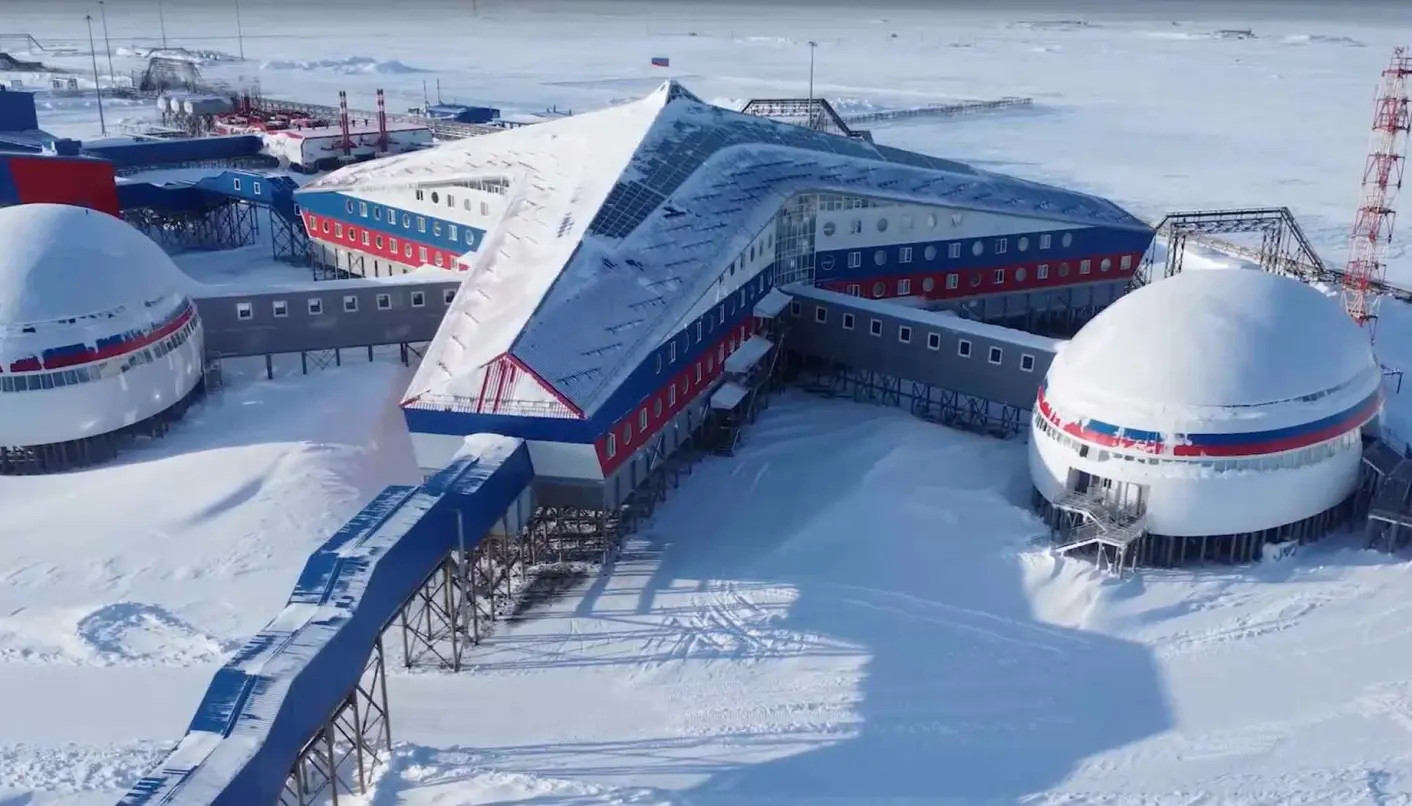
The Nagurskoye military base on on Aleksandra Island in Franz Josef Land. Image via the Barents Observer
We will uphold U.S. security in the region by improving our maritime domain awareness, communications, disaster response capabilities, and icebreaking capacity to prepare for increased international activity in the region. We will exercise U.S. Government presence in the region as required, while reducing risk and preventing unnecessary escalation. Arctic nations have the primary responsibility for addressing regional challenges, and we will deepen our cooperation with our Arctic allies and partners and work with them to sustain the Arctic Council and other Arctic institutions despite the challenges to Arctic cooperation posed by Russia’s war in Ukraine. We will continue to protect freedom of navigation and determine the U.S. extended continental shelf in accordance with international rules. We must build resilience to and mitigate climate change in the region, including through agreements to reduce emissions and more cross-Arctic research collaboration. As economic activity in the Arctic increases, we will invest in infrastructure, improve livelihoods, and encourage responsible private sector investment by the United States, our allies, and our partners, including in critical minerals, and improve investment screening for national security purposes. Across these efforts, we will uphold our commitment to honor Tribal sovereignty and self-governance through regular, meaningful, and robust consultation and collaboration with Alaska Native communities.
By way of contrast the Trump Administration’s document makes no mention of the Arctic or Alaska or even Greenland. It does, however state that:
After years of neglect, the United States will reassert and enforce the Monroe Doctrine to restore American preeminence in the Western Hemisphere, and to protect our homeland and our access to key geographies throughout the region. We will deny non-Hemispheric competitors the ability to position forces or other threatening capabilities, or to own or control strategically vital assets, in our Hemisphere. This “Trump Corollary” to the Monroe Doctrine is a common-sense and potent restoration of American power and priorities, consistent with American security interests.
Specifically regarding Europe the 2025 Security Strategy has this to say:
Continental Europe has been losing share of global GDP—down from 25 percent in 1990 to 14 percent today—partly owing to national and transnational regulations that undermine creativity and industriousness.
But this economic decline is eclipsed by the real and more stark prospect of civilizational erasure. The larger issues facing Europe include activities of the European Union and other transnational bodies that undermine political liberty and sovereignty, migration policies that are transforming the continent and creating strife, censorship of free speech and suppression of political opposition, cratering birthrates, and loss of national identities and self-confidence. Should present trends continue, the continent will be unrecognizable in 20 years or less. As such, it is far from obvious whether certain European countries will have economies and militaries strong enough to remain reliable allies. Many of these nations are currently doubling down on their present path. We want Europe to remain European, to regain its civilizational self-confidence, and to abandon its failed focus on regulatory suffocation.
At this juncture Russia does at last receive a mention:
This lack of self-confidence is most evident in Europe’s relationship with Russia. European allies enjoy a significant hard power advantage over Russia by almost every measure, save nuclear weapons. As a result of Russia’s war in Ukraine, European relations with Russia are now deeply attenuated, and many Europeans regard Russia as an existential threat. Managing European relations with Russia will require significant U.S. diplomatic engagement, both to reestablish conditions of strategic stability across the Eurasian landmass, and to mitigate the risk of conflict between Russia and European states.
There is no mention of any risk of conflict between Russia and the United States, in the Arctic or anywhere else on Planet Earth.
The whole document is worth a long look, but here is a brief extract:
Russia has a larger Arctic military presence and ice-breaking capability than other Arctic states, and has embarked on a substantial rebuilding of Soviet-era military infrastructure in the region. Nevertheless, Russian influence efforts seek to depict US and NATO activity in the Arctic as provocative and destabilizing, in contrast with casting Russia’s military presence as routine and defensive. For example, since 2024, state media has covered NATO “flexing its muscles” with exercises in Finland on “Russia’s Arctic doorstep” and featured Kremlin officials’ promises to protect Russia’s Arctic interests from “NATO’s expansionist ambitions,” while a known proxy site warned of “steps towards the Arctic war.” These narratives have found renewed salience since 2025 amid public calls from US President Trump for Greenland to join the United States.
I frequently post a summary of the Arctic section of the United States’ National Snow and Ice Data Center’s monthly review of the current state of the cryosphere. Here is the most recent edition.
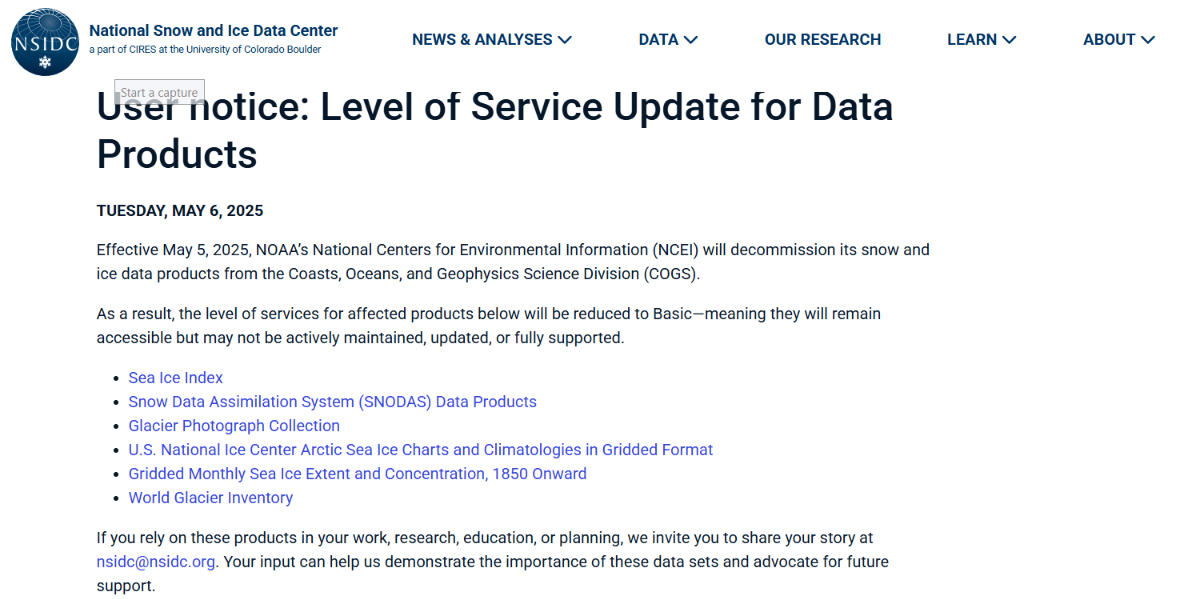
Effective May 5, 2025, NOAA’s National Centers for Environmental Information (NCEI) will decommission its snow and ice data products from the Coasts, Oceans, and Geophysics Science Division (COGS).
As a result, the level of services for affected products below will be reduced to Basic—meaning they will remain accessible but may not be actively maintained, updated, or fully supported.
If you rely on these products in your work, research, education, or planning, we invite you to share your story at [email protected]. Your input can help us demonstrate the importance of these data sets and advocate for future support.
I will certainly share my story with the NSIDC. If you are a resident of the US you may also wish to contact your local friendly neighbourhood politician(s) about the matter?
[Update – May 9th]
Mark Serreze, Director of the National Snow and Ice Data Center, replied to my email and told me that:
We are acutely aware of the importance of the SII and Sea Ice Today. Millions of visits per year. High priority. We’re in the middle of discussions about to make sure that we have continuity.
Thanks for your support. Everything helps.
One of the less well known data products provided by the NSIDC is EASE-Grid Sea Ice Age.
I recently used that particular mine of essential cryospheric information to produce this educational YouTube video:
The video reveals the underlying reason for the “fast transition” of Arctic sea ice cover from thick multi-year ice to a reduced area of much more mobile young ice.
Earlier today Scientific American published an article entitled “That ‘Obama Scientist’ Climate Skeptic You’ve Been Hearing About“. The climate skeptic in question being of course Steven E. Koonin. If you click that last link it will be immediately obvious that I’ve recently been critical of Professor Koonin’s new book “Unsettled” in several more ways than one! The article in Scientific American is authored by several more people than one. Twelve to be precise, including the famous names of Naomi Oreskes, Michael E. Mann and Andrew Dessler. That team takes a largely different approach to my own criticism, making no mention of the cryosphere for example, although sea level rise does get a mention. Rather than going into the science in detail, Oreskes et al. take a different approach. Here’s the introduction to the article:
If you’d heard only that a scientist who served in the Trump administration and now regularly appears on Fox News and other conservative media thinks climate change is a hoax, you’d roll your eyes and move on. But if you heard that someone associated with former President Barack Obama’s Democratic administration was calling the climate science consensus a conspiracy, the novelty of the messenger might make you take it a little more seriously.
The latter is what Steve Koonin is using to sell his new book, which is being billed as the revelation of an “Obama scientist” who wants you to think that climate change isn’t a big deal. But unfortunately, climate change is real, is caused primarily by burning fossil fuels, and is already hurting people all over the world, including here in the United States.
For example, a study published recently found that because climate change has caused sea levels to rise, Superstorm Sandy flooded an additional 36,000 homes, impacting 71,000 people who would’ve been safe otherwise, and caused $8 billion in additional damage.
A little later the article suggests that:
Steve Koonin is hoping you’ll see Obama’s name and trust him when he tells you that he’s better equipped to summarize major climate reports than the authors of the U.N.’s IPCC report and the U.S. government’sNational Climate Assessment, who wrote at length about the already sizable and growing costs of climate change. He’s hoping you won’t recall that each president appoints thousands of people, and Koonin, it turns out, was hired at the Energy Department specifically for his contrarianism. His boss at the time, Stephen Chu, said he “didn’t want to have a department where everybody believed exactly as everybody else” and added that Koonin “loves to be the curmudgeon type.”
Curmudgeon or not, Steve’s science certainly leaves a lot to be desired, as has been proved here! Oreskes et al. put it this way:
When it comes to the science, Koonin cherry-picks and misrepresents outdated material to downplay the seriousness of the climate crisis…
He wants you to believe that, as an Obama hire, he knows better about what you should take away from these reports than the scientists who wrote them.
That sums things up quite nicely, although the article doesn’t actually contain a whole lot of evidence for the first assertion, what Steve refers to as “The Science”. Instead it prefers to link to the Climate Feedback article mentioned here at the Great White Con back at the beginning of May and two articles by Marianne Lavelle in Inside Climate News.
However towards the end of the article, in true “Merchants of Doubt” style, following the money trail behind the promotion of “Unsettled” is mentioned:
The misrepresentations cited as appearing in Koonin’s book are being amplified in right-wing media and beyond. A recent Washington Post column by conservative contributor Marc Thiessen repeats several points Koonin makes…
Thiessen is a fellow at the American Enterprise Institute. For those unfamiliar with the tangled world of organized climate denial, a recent study paints a pretty clear picture: of all the conservative, climate-denying think tanks that get Koch and other industry funding, AEI has gotten the most. It received some $380 million to peddle industry-friendly denial like Koonin’s, much of it through dark money pass-throughs to conceal that it’s coming from conservative and dirty-energy donors.
Be all that as it may, in conclusion let’s get back to the cryospheric science. Here’s how I first found out about the Scientific American article, and Steve Koonin and/or Judith Curry still haven’t answered my pertinent questions about the unsettling lack of Arctic scientific expertise evident in “Unsettled”:
I rather doubt that Judith! Although @michaelemann and @NaomiOreskes are a bit behind the curve in their critique of the "recent Washington Post column by conservative contributor @marcthiessen" which I covered on May 16th.
Our regular reader(s) will no doubt recall the good old days when several times each month an opportunity would present itself to debunk some “skeptical” nonsense from one or more of the usual suspects?
That all changed when Donald Trump was elected President of the United States. He was of course much more amenable to lobbying from fossil fuel interests than Barack Obama, and everything went (comparatively!) quiet.
Now that The Don has sailed off into the proverbial sunset and Joe Biden is top dog all that has changed. A return to the (not so) good old days comes as no surprise, and the porky pies have started coming off the denialospheric production line once again.
There have already been a few contrarian ripples on the surface of the climate science seas, which we may well come to in due course. However a set of substantial waves are now visible on the horizon. The proximate cause is the forthcoming summit of the G7 nations, which as luck would have it is taking place just down the road from the Great White Con winter holiday residence in North Cornwall. Then in November the COP26 conference is being held in Glasgow.
In June, Prime Minister Boris Johnson will welcome fellow G7 leaders to one of the most beautiful parts of the UK: Carbis Bay in Cornwall.
Other parts of the region will also play a key role in the Summit, including neighbouring St Ives, Falmouth and Newquay airport.
With over 400 miles of coastline, Cornwall’s stunning landscape provides a perfect setting for world leaders to come together and discuss how to respond to global challenges like coronavirus and climate change.
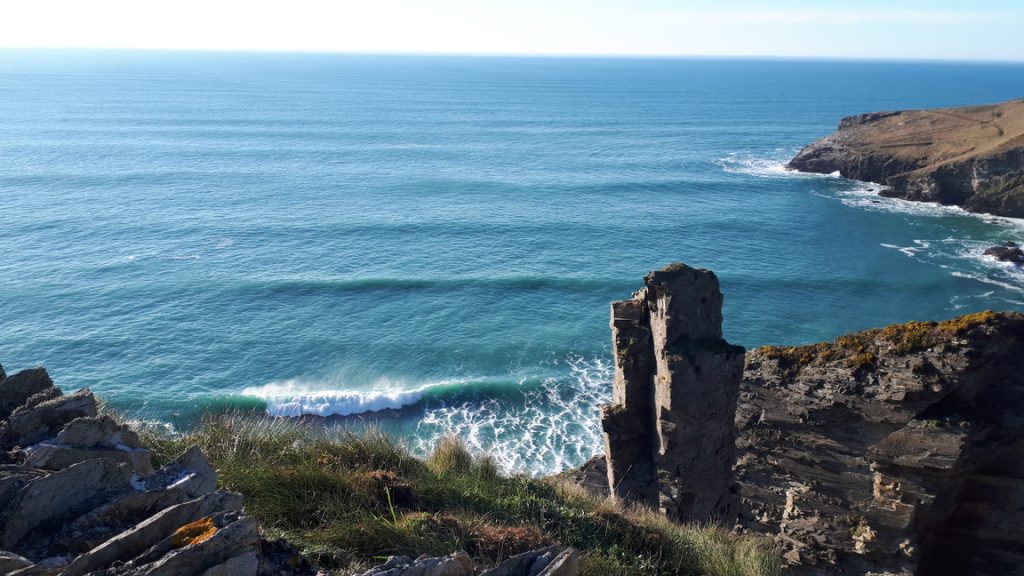
Here’s one of my recent pictures of some of that coastline, including part of Cornwall’s industrial heritage and some large waves!
Climate change is top of the G7 agenda along with Covid-19, and you can rest assured that vested interests will not miss any opportunity to promote those interests over the next two months and beyond. By way of example, one of our long standing “usual suspects”, Judith Curry, “tweeted” the following message to her followers on April 17th:
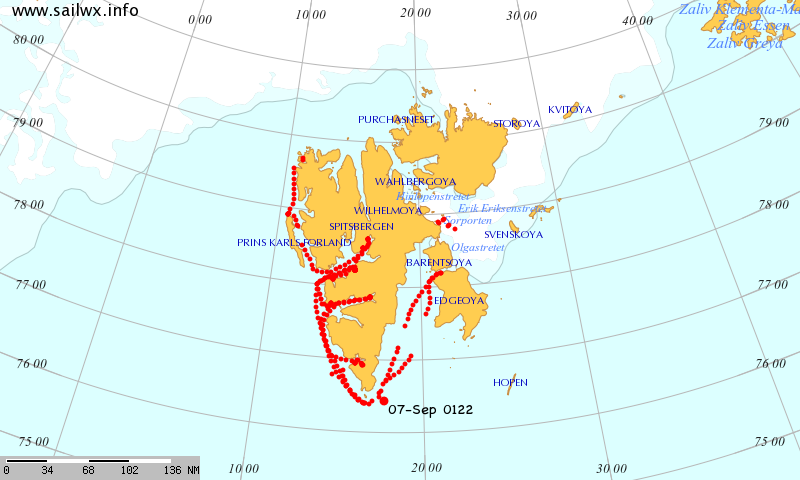
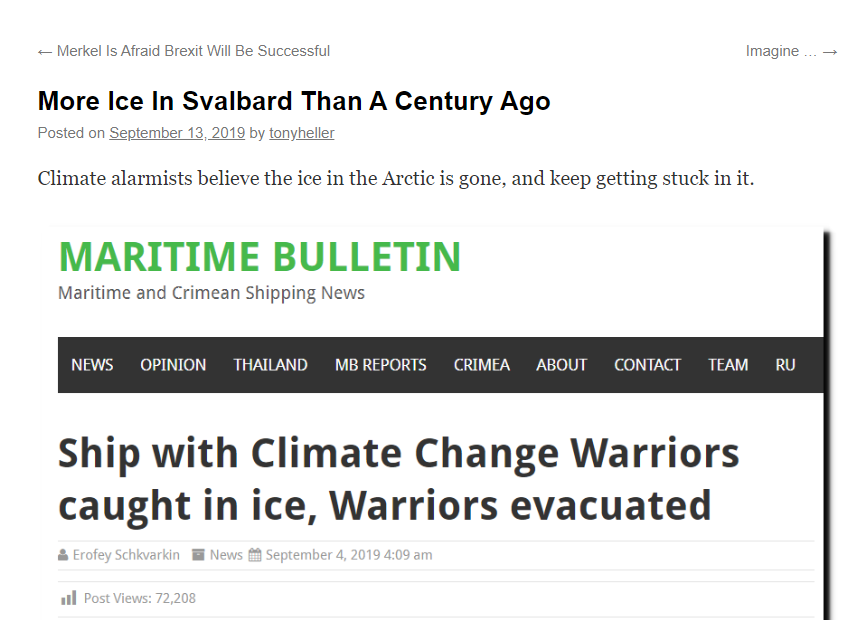
Arctic tours ship MS MALMO with 16 passengers on board got stuck in ice on Sep 3 off Longyearbyen, Svalbard Archipelago, halfway between Norway and North Pole. The ship is on Arctic tour with Climate Change documentary film team, and tourists, concerned with Climate Change and melting Arctic ice. All 16 Climate Change warriors were evacuated by helicopter in challenging conditions, all are safe. 7 crew remains on board, waiting for Coast Guard ship assistance.
Something is very wrong with Arctic ice, instead of melting as ordered by UN/IPCC, it captured the ship with Climate Change Warriors.
Not a lot of people know that despite all that purple prose Malmö has somehow managed to emerge unscathed from the clutches of the sea ice on the other side of Svalbard from Longyearbyen:
It will come as no surprise to our regular readers that the web site of our even older friend Anthony Watts has also published the self same story, also without the happy ending.
Whilst it is reasonable to assume that Paul and Anthony are not fluent in Norwegian, it seems they are also unfamiliar with Google. If they had performed the merest modicum of due diligence and employed the services of Google translate before pressing the “publish” button they would have discovered the coverage of the “massive false information” about the Malmö’s story in the Svalbard Post, published on September 5th:
Trygve Monsen and expedition leader Tore Toppe were among the 16 who were evacuated when MS Malmö got stuck in the ice on Tuesday. They respond strongly to what they call misinformation on the right-wing website document.no
Those who were on board MS Malmö have a completely different version of events.
“First, we are not Swedish. We are a group of middle aged Norwegians following the route of the Ahlmann expedition of 1931“, says Trygve Monsen. He himself has worked for the Norwegian press for a long time, particularly Aftenposten, where he has been both digital manager and correspondent in Berlin.
Together with Expedition Chief Tore Topp, Monsen arrived at the Svalbard Post on Thursday. He had tried to contact document.no many times before that, to correct the false information. They also say that they are not climate activists.
“No way. But when you are in the Arctic, and have been here many times over several years, you can’t help but notice what is happening to the environment up here”, says Topp. This is the seventh expedition he has led in the Arctic.
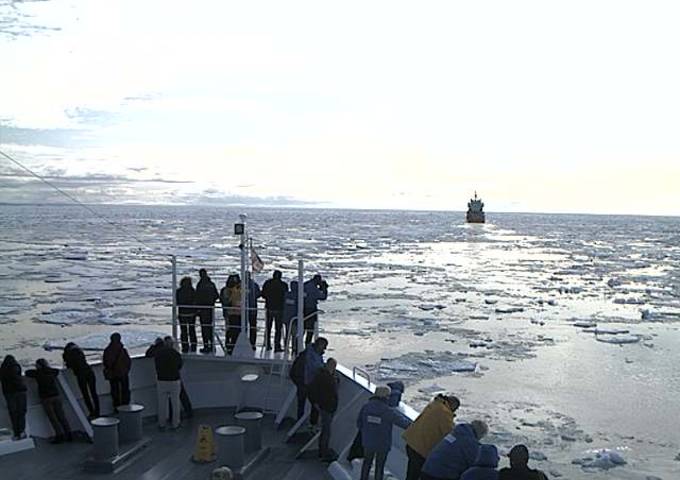
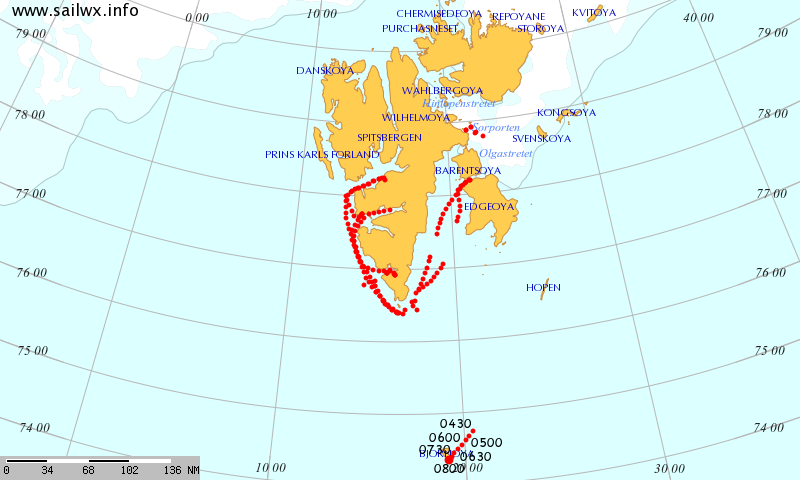
The evacuation of MS Malmö on Tuesday took place without significant drama. The boat was surprised by harsh ice conditions and eventually got stuck. The captain decided to ask for evacuation, for safety. The Governor came by helicopter and after a few minutes all the passengers were evacuated. The crew on the boat remained on board, and later got help from KV “Andenes” to get out of the sea ice.
In other old news the southern route through the Northwest Passage opened on August 15th this year, although with the assistance of the icebreaker CCGS Terry Fox the MS Bremen made it through a few days earlier:
[Edit – September 11th]
MS Malmö is now back in the range of an AIS receiver, whilst apparently en route back to Norway:
[Edit – September 12th]
I ventured onto Twitter this morning, where I discovered Matt Ridley regurgitating the same nonsense about MS Malmö, plus this news from the Norwegian Coastguard:
Kystvakten fikk melding om at MS Malmø trengte assistanse sør i Hinlopen-stredet. Da KV Andenes kom frem til området hadde MS Malmø klart å komme seg løs fra isen i åpen råk. Fartøyet ble eskortert ut av området og MS Malmø går nå for egen maskin tilbake til Longyearbyen. pic.twitter.com/ZFpa6fEmCN
Perhaps Paul, Anthony, Matt et al. would care to click @Jack’s helpfully provided “Translate Tweet” button?
I’ve also discovered that document.no eventually published a “correction” to their original story on September 9th. Perhaps Paul, Anthony, Matt et al. would care to follow suit?
Yet another greenie expedition to the Arctic to raise awareness of ‘global warming’ has been scuppered by unexpected large quantities of ice.
Furthermore James has brought my attention to the fact that my foolish numbering system is out of date. According to his reckoning MS Malmö is actually “Ship of Fools IV”. Mind you he’s also claiming that Northabout was “Ship of Fools II”, which is obviously another porkie pie of epic proportions.
James also repeats the “stuck in ice off Longyearbyen” nonsense. For Donald, James, Paul, Anthony, Matt et al. here’s the current view of all the sea ice off Longyearbyen, via Joss Stone on Twitter:
Wow, this place is stunning. Feel very lucky to be here. Cant wait to share our experiences with you. Now, where can I get a cup of tea? #arcticpic.twitter.com/JpjbS48Ebj
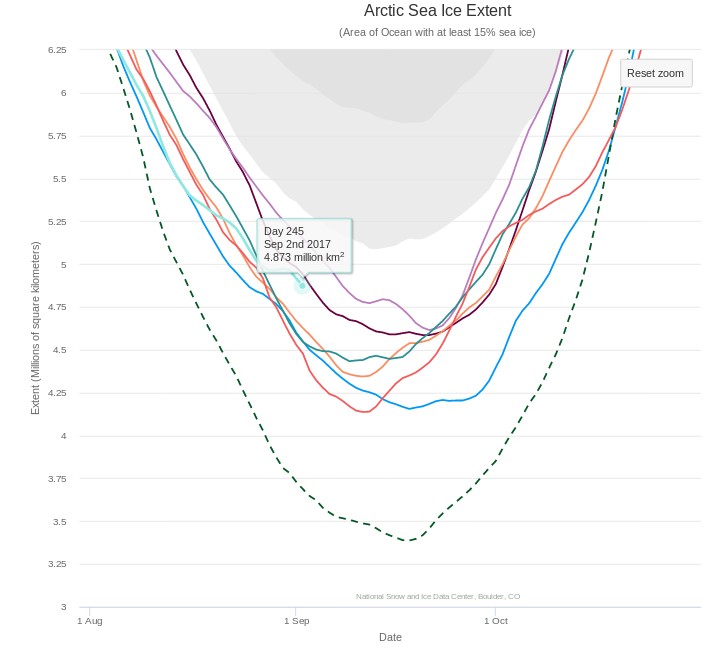
In actual fact there is of course currently less sea ice in the Arctic than in any previous year (in the satellite record) apart from 2012:
[Edit – September 13th]
Today on Twitter I’ve found myself in conversation about #MalmoGate with Ken. He doesn’t say an awful lot, but he appears to think that MS Malmö being “surprised by harsh ice conditions” is significant in some way:
What’s that supposed to prove Ken?
According to #WUWT “MS Malmo… got stuck in ice on Sep 3 off Longyearbyen”
The captain would have been very surprised to encounter such conditions, because that’s unadulterated ballcocks! #MalmoGate
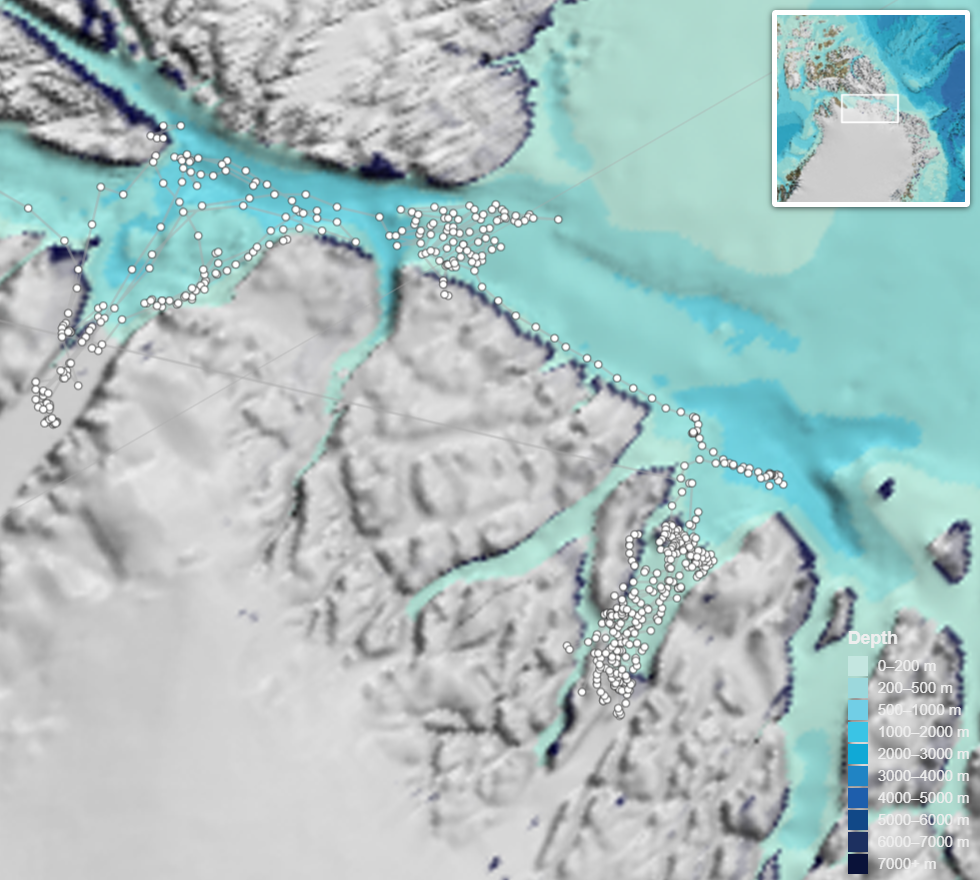
One of the things that is actually significant about the 2019 melting season is quite the reverse of that. The Swedish icebreaker Oden spent a couple of weeks pootling around in the Sherard Osborn Fjord in North Greenland without getting “stuck in the vanishing Arctic ice”:
[Edit – September 14th]
What Ken, Paul Joseph, Donald, James, Paul, Anthony, Matt et al. evidently fail to comprehend is that the sea ice covering the Arctic Ocean doesn’t merely expand and contract with the seasons. It also moves. Just in case any of them do get around to doing a modicum of due diligence, take a good long look at this animation of Arctic sea ice age from the September 2015 minimum to the end of August this year:
[Edit – September 15th]
It has just come to my attention that our very old friend Tony Heller (the artist formally known as Steve Goddard) has somewhat belatedly jumped on the MalmoGate bandwagon:
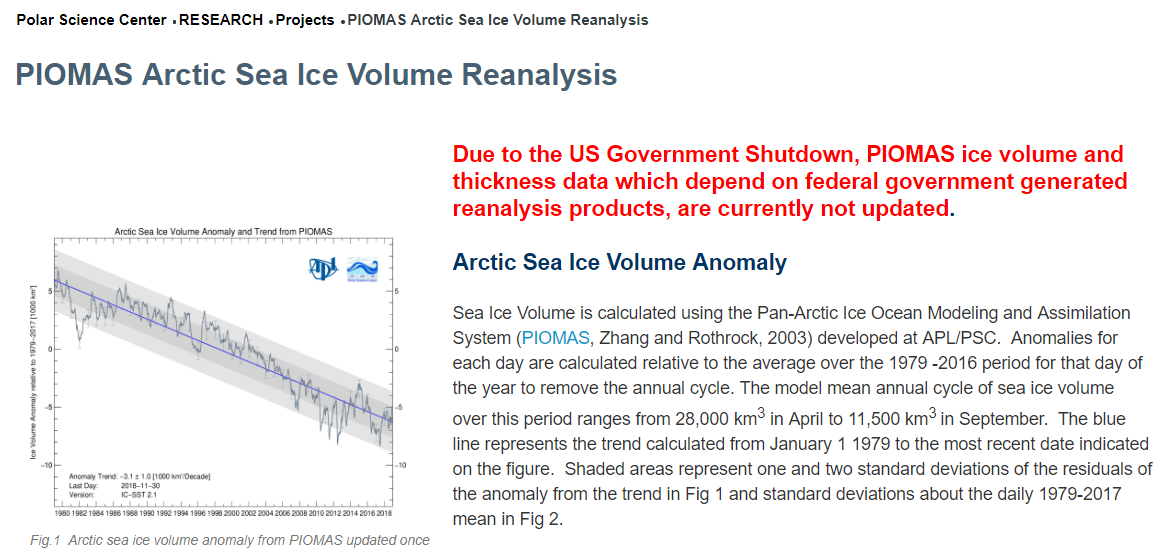
We generally write our periodic reports on the state of Arctic sea ice around the time the PIOMAS volume numbers are published. It seems as though we’ll have a long wait for that to happen at the moment though. According to The Economist today:
America’s government shutdown has become the longest in history. Hundreds of thousands of federal workers remain either stuck at home or forced to work without pay. To reopen the government President Donald Trump is demanding $5.7bn for his border wall. Nancy Pelosi, who presides over the most polarised House of Representatives in recent memory, does not want to give it to him.
Due to the US Government Shutdown, PIOMAS ice volume and thickness data which depend on federal government generated reanalysis products, are currently not updated.
Instead of PIOMAS, let’s start instead with the January 2019 edition of the National Snow and Ice Data Center’s Arctic Sea Ice News:
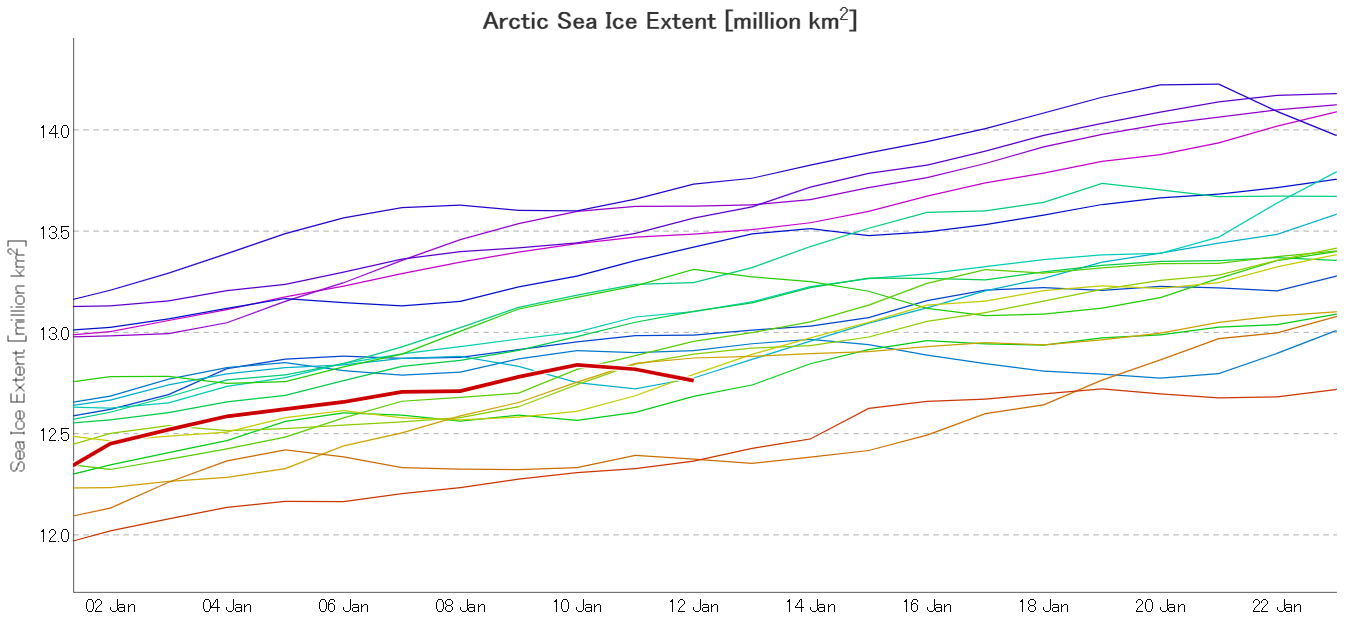
As 2018 came to a close, Arctic sea ice extent was tracking at its third lowest level in the satellite record, while sea ice in the Antarctic remained at historic lows. Slightly faster growth in the first few days of the new year, mostly in the Pacific sea ice areas, has the daily sea ice extent at fifth lowest as of this post.
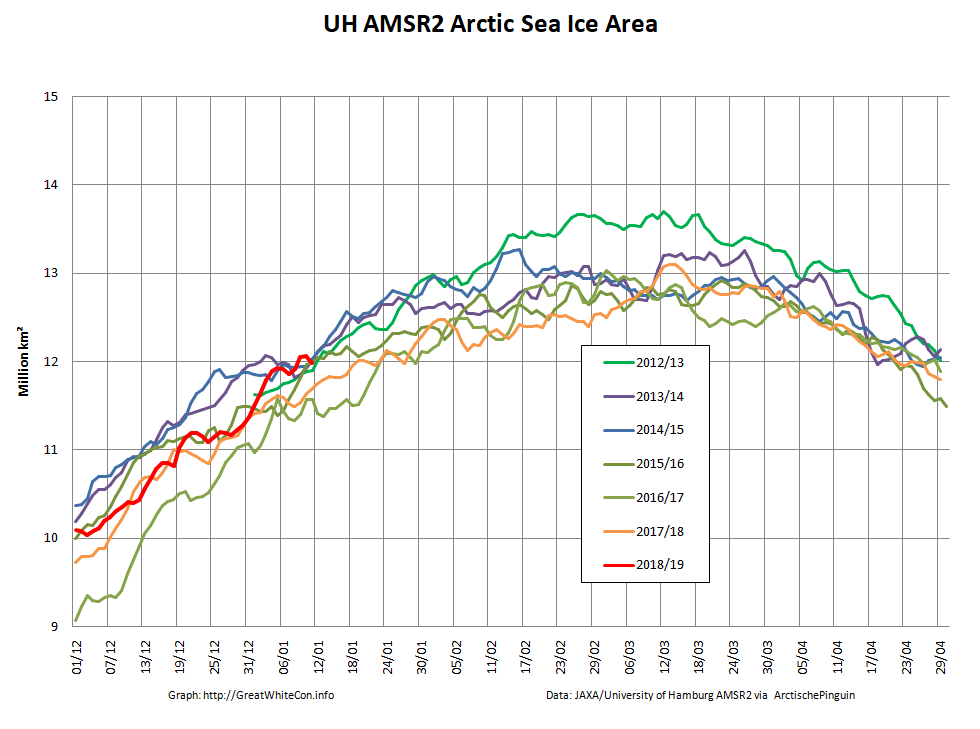
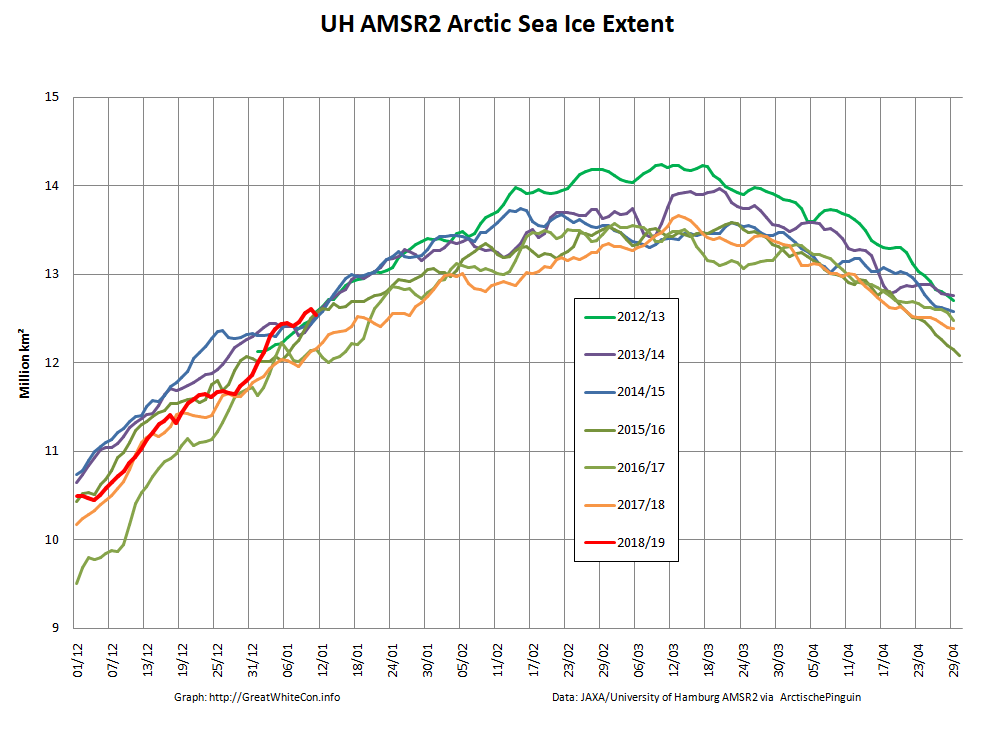
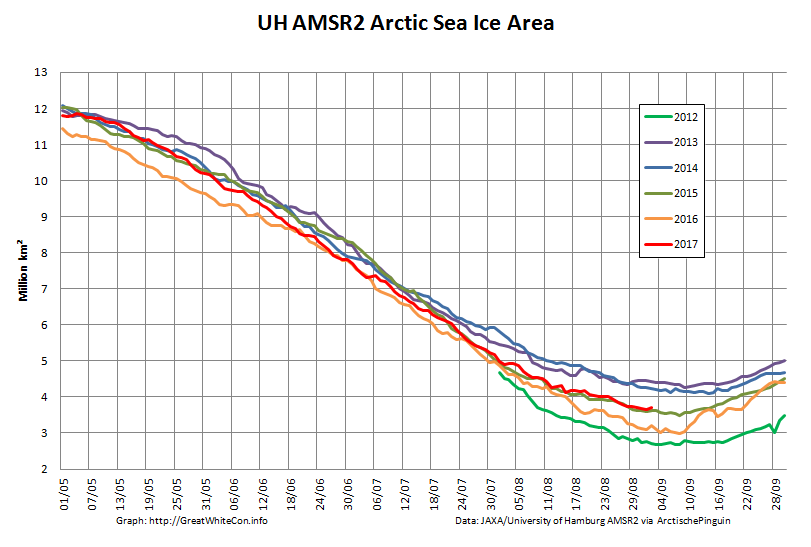
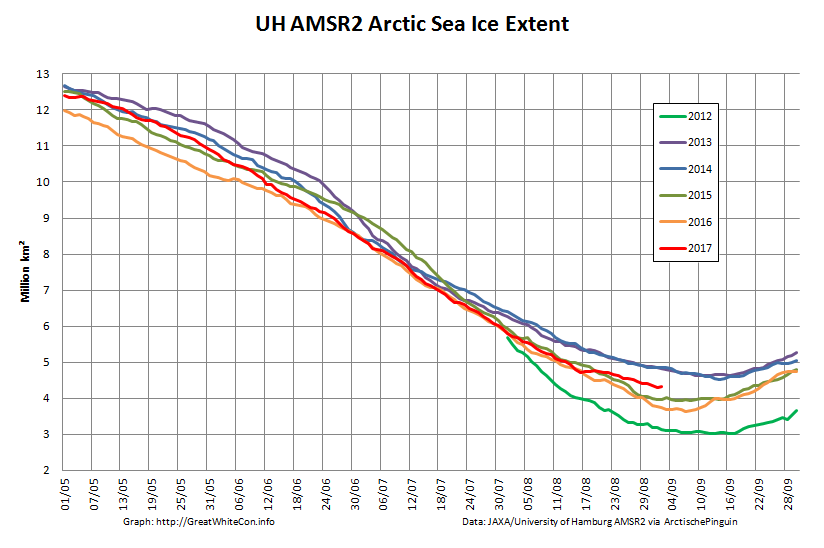
Now let’s take a look at our favourite high resolution AMSR2 area and extent metrics:
You can see that towards the end of December Arctic sea ice extent was verging on lowest for the date, since when it has risen quickly to reach highest for the date in the brief AMSR2 records a few days ago.
The NSIDC also mention the US Government shutdown:
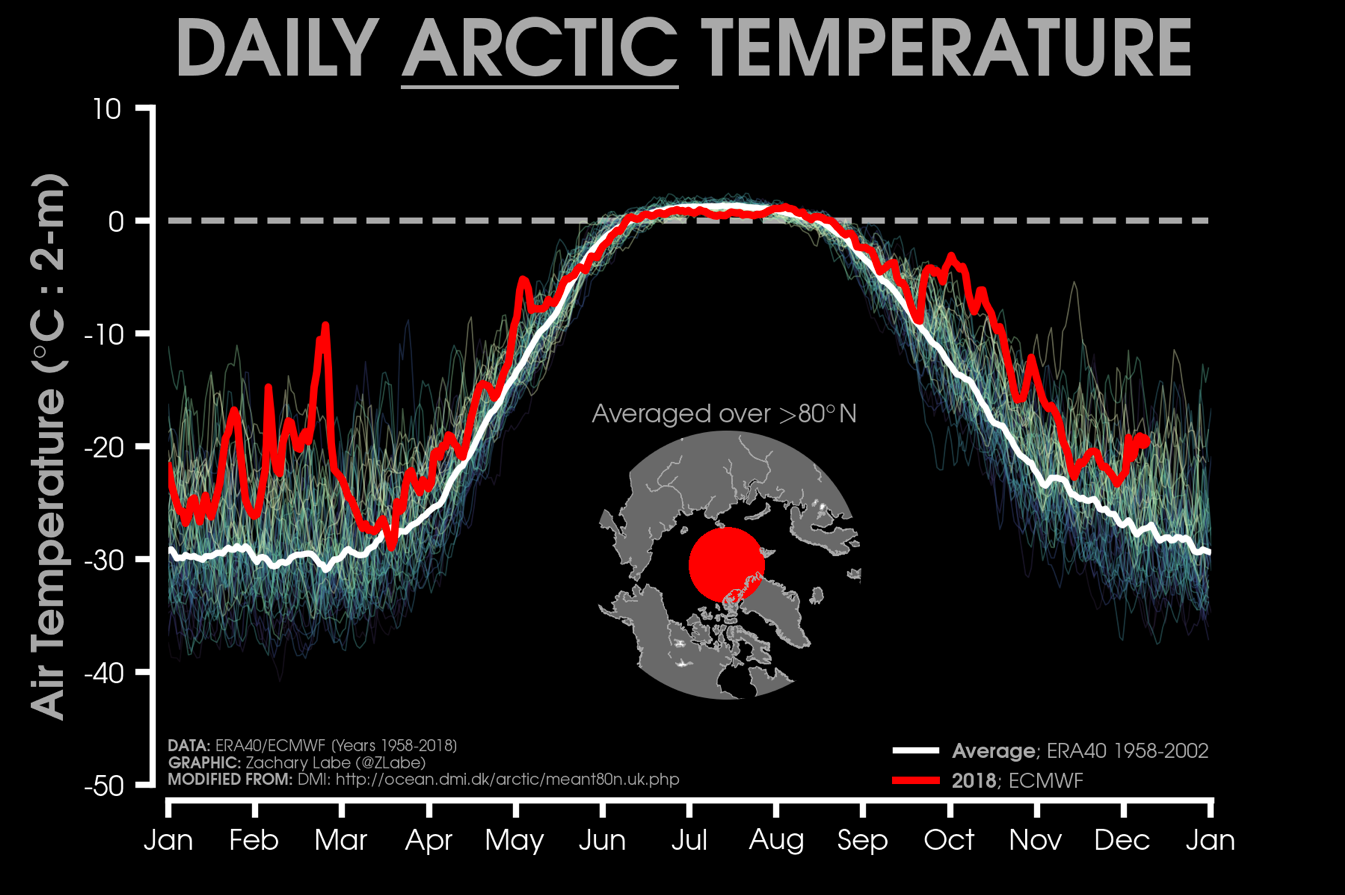
Unfortunately, as a result of the partial government shutdown, we are unable to access the National Oceanic and Atmospheric Administration (NOAA) pages to retrieve information on atmospheric air temperatures and sea level pressure patterns. Instead, we turn to daily (2 meters above the surface) mean air temperatures north of 80 degrees North from the European Centre for Medium-Range Weather Forecasts (ECMWF) operational model. This analysis shows that air temperatures remained above the 1958 to 2002 average for all of December.
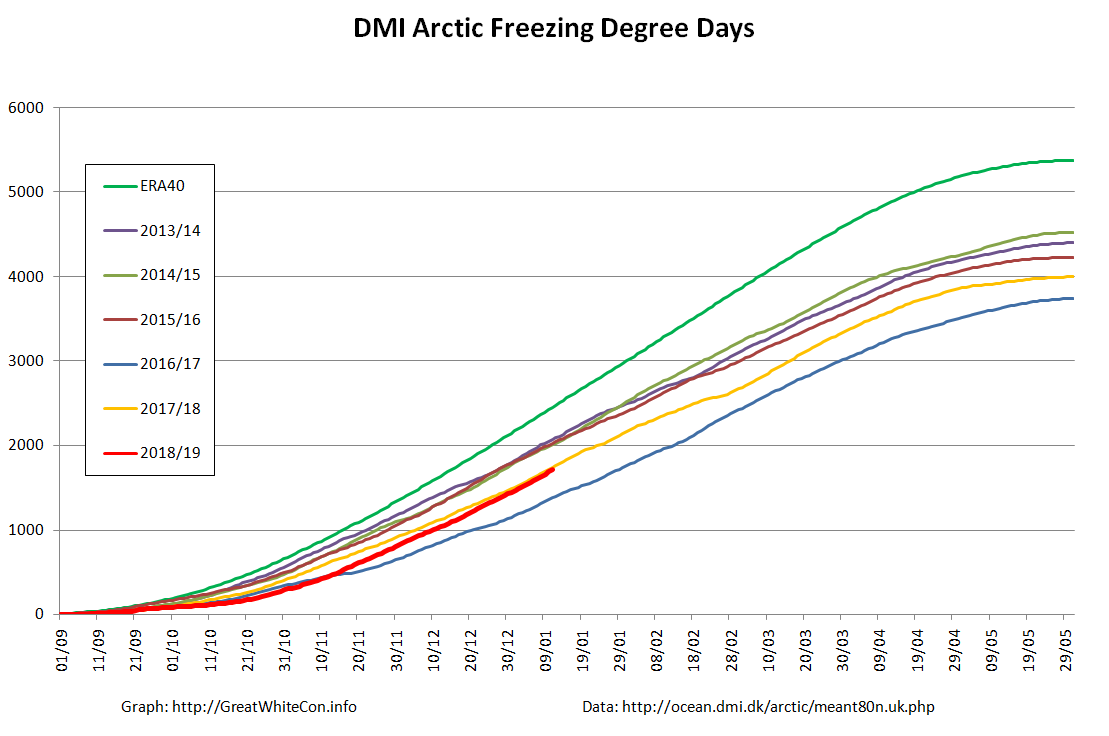
That brings us on to our Arctic freezing degree days graph, based on DMI data:
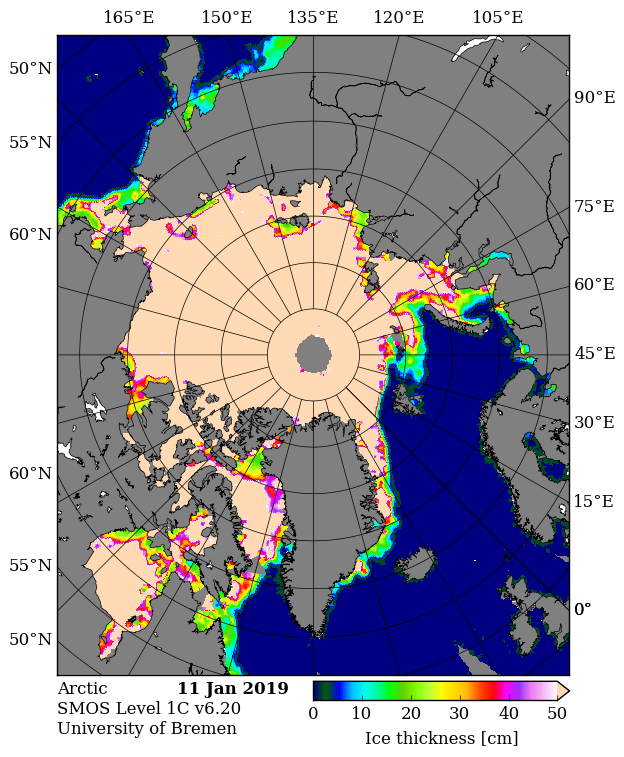
After a very slow start to the freezing season the FDD numbers are now vying for second place with last year, behind the astonishingly warm winter of 2016/17. In the absence of the PIOMAS volume numbers we can at least take a look at sea ice thickness. Here’s CryoSat-2:
All those sources seem to be agreed that large areas of both the Barents and Kara Seas are currently covered by young thin ice. Finally, for the moment at least, let’s take a look at some extracts from the NSIDC’s review of 2018:
January 2018 began the year with record low sea ice extents for the Arctic as a whole.
The seasonal maximum, reached on March 17, 2018, was the second lowest in the satellite record. While low extent persisted through April and May, sea ice loss during early summer was unremarkable despite above average 925 hPa air temperatures over the Arctic Ocean and Eurasia.
Air temperatures over the Arctic Ocean in July were below average, followed by above average temperatures in August. In fact, on average, August temperatures were higher than July temperatures in 2018. This is highly unusual in the Arctic and something not seen in at least 40 years.
The September 2018 seasonal minimum extent ended up slightly above the long-term linear trend line, tying with 2008 for the sixth lowest in the satellite record. After the minimum, the ocean was slow to freeze up, and October sea ice extent ended up as the third lowest. However, ice growth was very rapid in November, such that November 2018 extent approached the interquartile range of the 1981 to 2010 median. Nevertheless, large amounts of open water remained in the Barents and Chukchi Seas. By the end of December, ice conditions in the Chukchi Sea were back to average, while extent remained unusually low in the Barents Sea.
Coverage of old ice (greater than 4 years old) over the Arctic continued to decline. Such old ice covers only 5 percent of the area it used to in 1980s.
[Edit – January 13th]
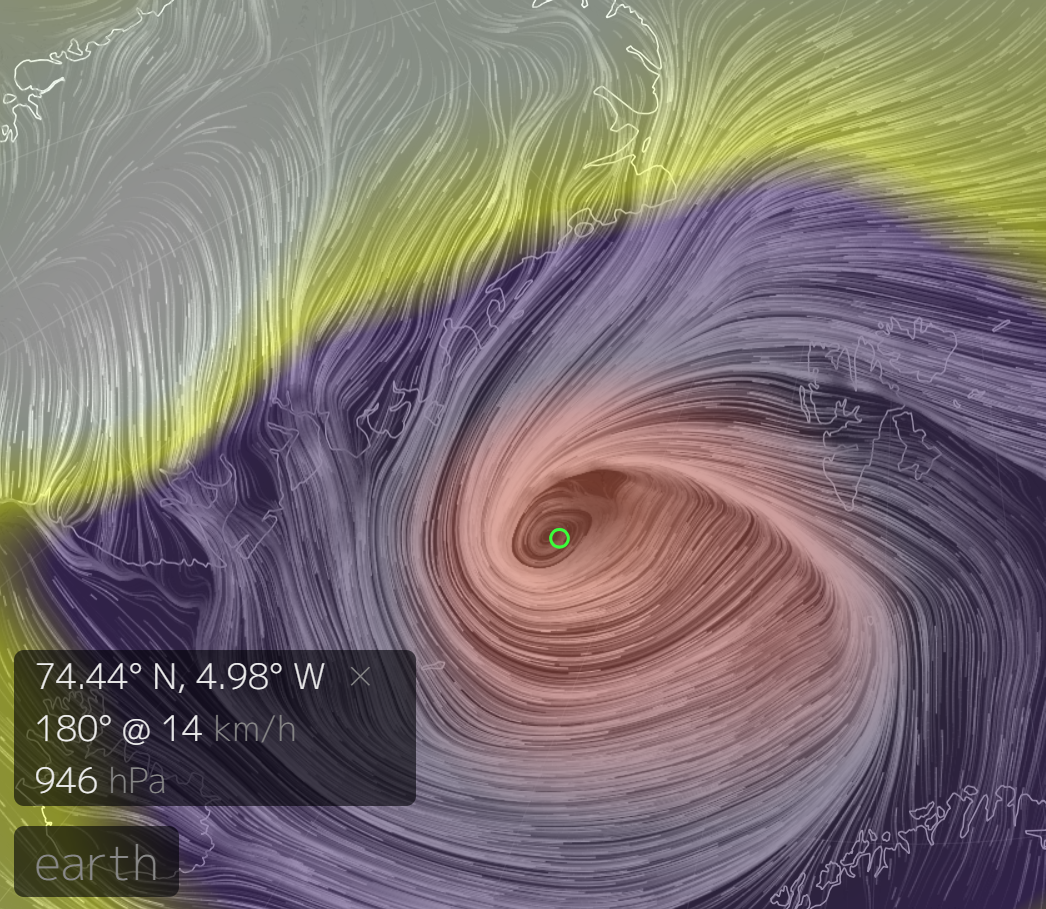
Arctic sea ice area and extent have both been falling over the last few days, possibly as a result of the recent cyclone which created strong northerly winds in the Fram Strait. This is from Earth at 09:00 UTC on January 10th, showing a MSLP of 946 hPa:
Here’s what used to be referred to as JAXA extent:
September has arrived once again, the month in which the assorted Arctic area and extent metrics (almost) always reach their respective annual minima. Now we can start to speculate about what the assorted minima will be, and on what date.
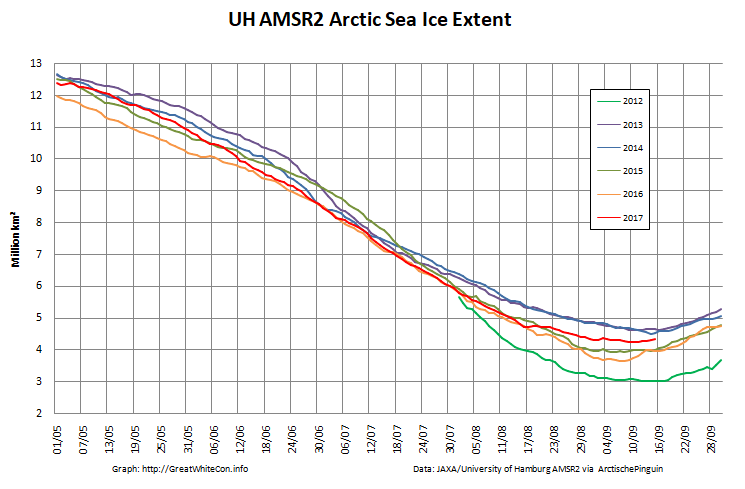
First of all let’s take a look at “Snow White’s” favourite high resolution AMSR2 metrics derived by “Wipneus” from University of Hamburg AMSR2 concentration data:
As you can see, today’s values are both higher than yesterday’s. Hence we already have potential minima to consider! In this case:
UH AMSR2 Area – 3.65 million km² on September 1st
UH AMSR2 Extent – 4.30 million km² on September 1st
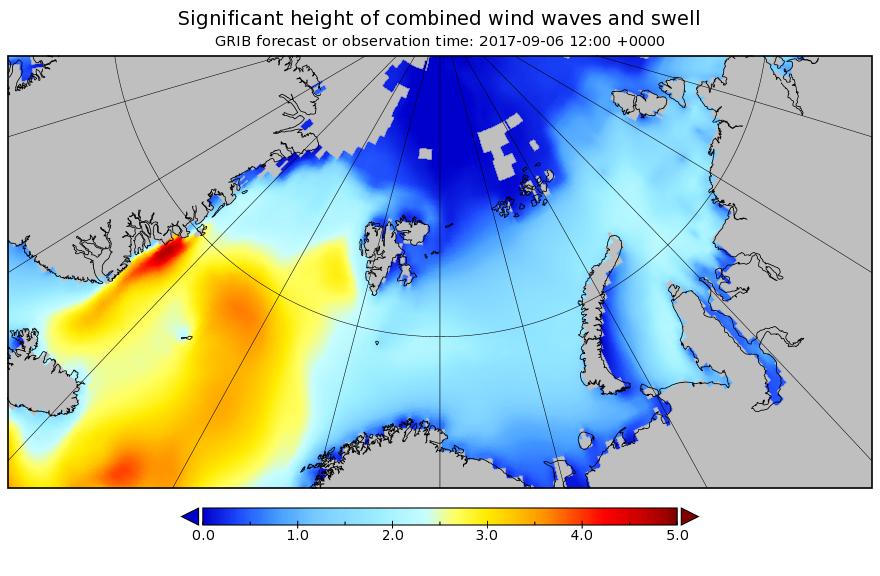
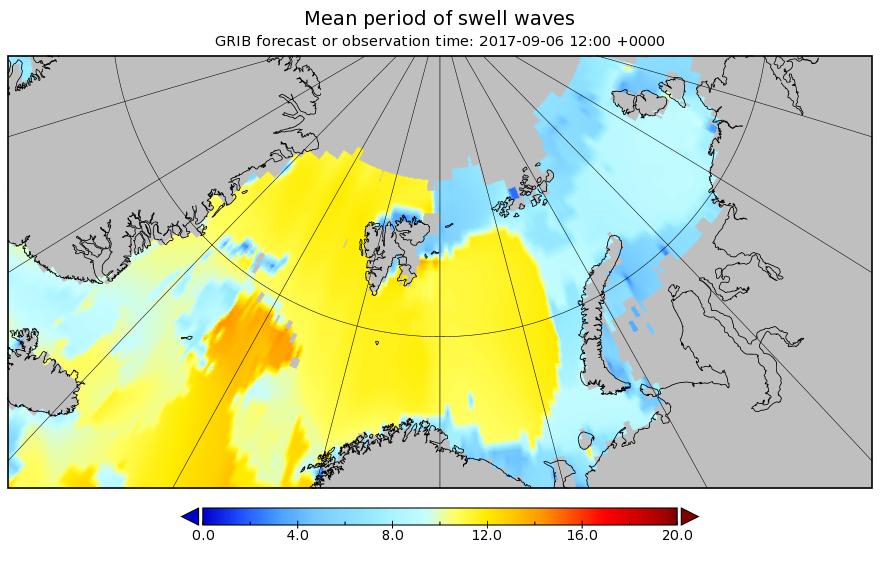
Personally I don’t think those numbers will last long, and here’s one reason why. The “surf forecast” for the far North Atlantic for midday on September 6th:
Some significant swells are currently forecast to batter the ice edge on the Atlantic side of the Arctic over the next few days.
[Edit – September 3rd PM]
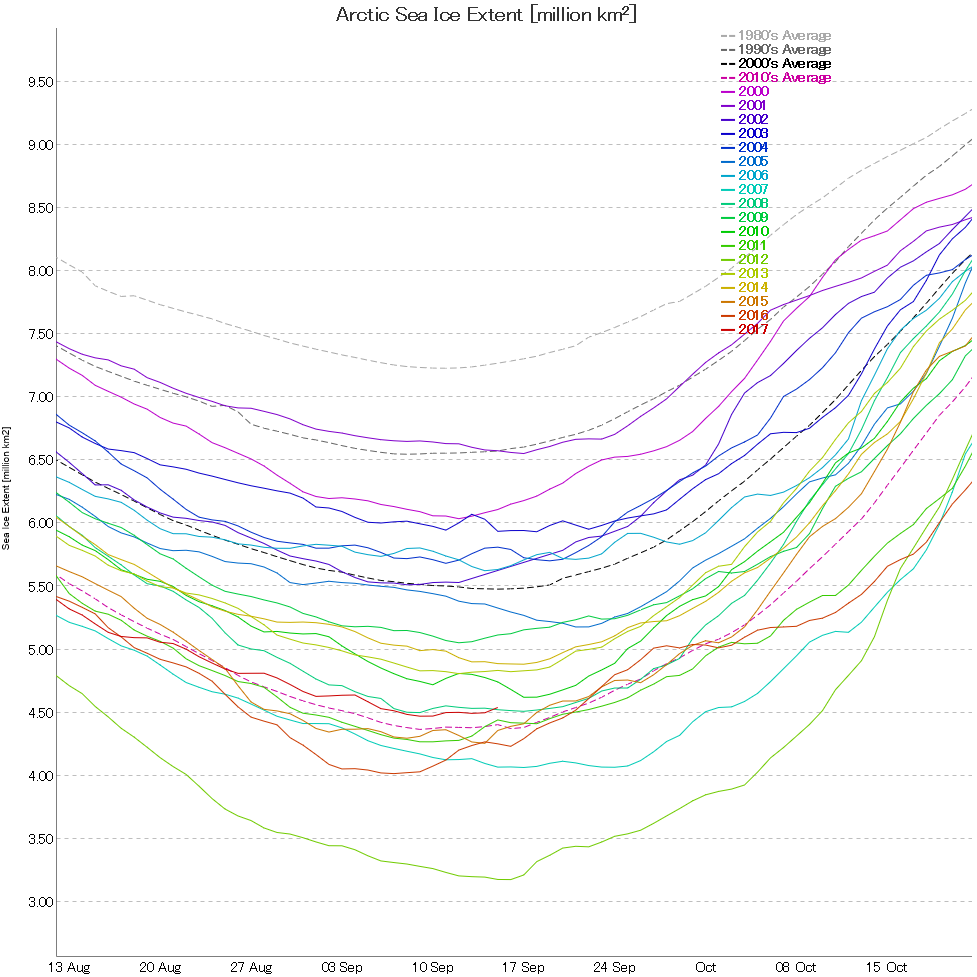
Shock news! Tony Heller has made a prediction about this year’s minimum!! Unlike last year, this year the NSIDC 5 day average extent seems to be his Arctic metric of choice:
Tony tells his faithful flock:
The Arctic sea ice minimum this year is very likely going to be be larger than 2016, 2015, 2012, 2011 and 2007.
It is also likely that the minimum extent will be higher than 2010 and 2008.
Instead of reporting the huge gain in ice and massive failure of their forecasts, climate alarmists will report that extent was “8th lowest on record.”
All those years are on the graph above. We shall see.
[Edit – September 15th]
Our normal Arctic sea ice extent 2017 minimum service will be restored as soon as possible. Meanwhile here is the test card:
On the way the cruise’s resident naturalist and Smithsonian lecturer, Michael Scott, risked the wrath of Trump supporters by pointing to some of the changes Greenland is undergoing.
A Nasa map based on data between 2004 and 2014 revealed that the ice is melting across most of Greenland – an area nine times the size of the UK.
Pulling together several papers, Michael said Greenland’s summer melt season now lasts 70 days longer than in the early 1970s.
This melting is unfreezing the fringes of the permafrost, which may explain why Nasa satellites are picking up fires raging where the ice has retreated.
[Edit – September 16th]
It is of course still to early to be 100% certain about this. However:
It certainly looks as though the bottom is in for the University of Hamburg AMSR2 extent: 4.25 million km² on September 11th.
It’s much the same story for JAXA extent:
4.47 million km² on September 9th and 10th.
[Edit – September 19th]
The NSIDC have followed in Snow White’s glass slippered footsteps and tentatively called the minimum:
On September 13, Arctic sea ice appears to have reached its seasonal minimum extent of 4.64 million square kilometers (1.79 million square miles), the eighth lowest in the 38-year satellite record. The overall rate of ice loss this summer was slowed by a persistent pattern of low sea level pressure focused over the central Arctic Ocean.
Please note that this is a preliminary announcement. Changing winds or late-season melt could still reduce the Arctic ice extent, as happened in 2005 and 2010. NSIDC scientists will release a full analysis of the Arctic melt season, and discuss the Antarctic winter sea ice growth, in early October.
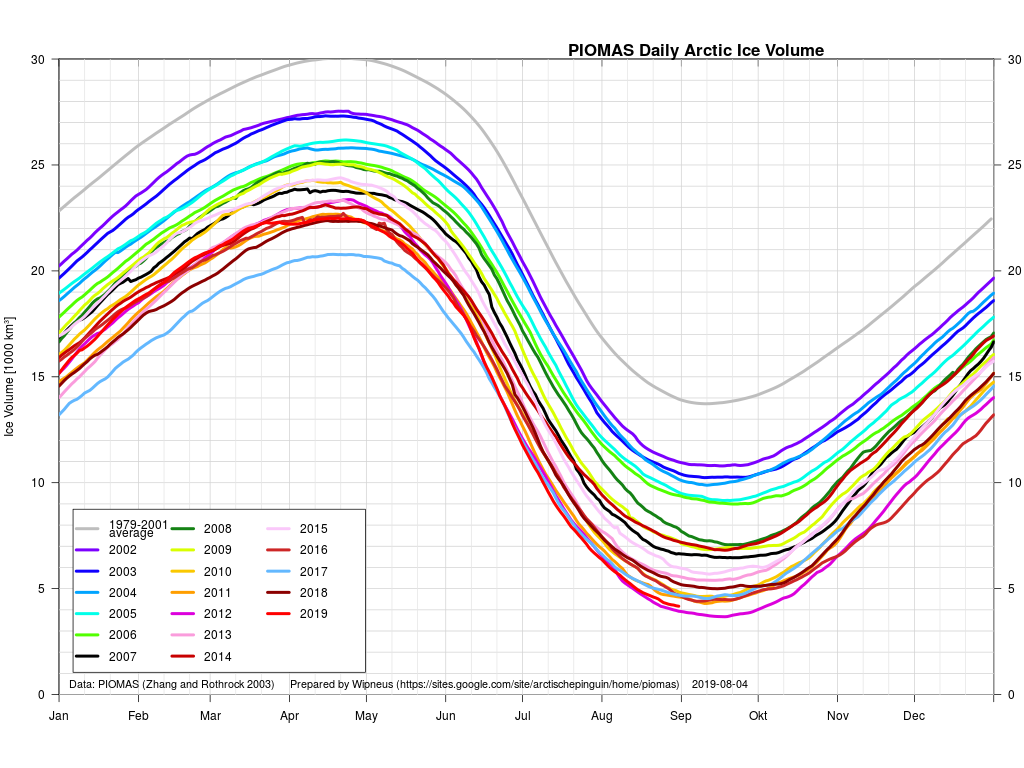
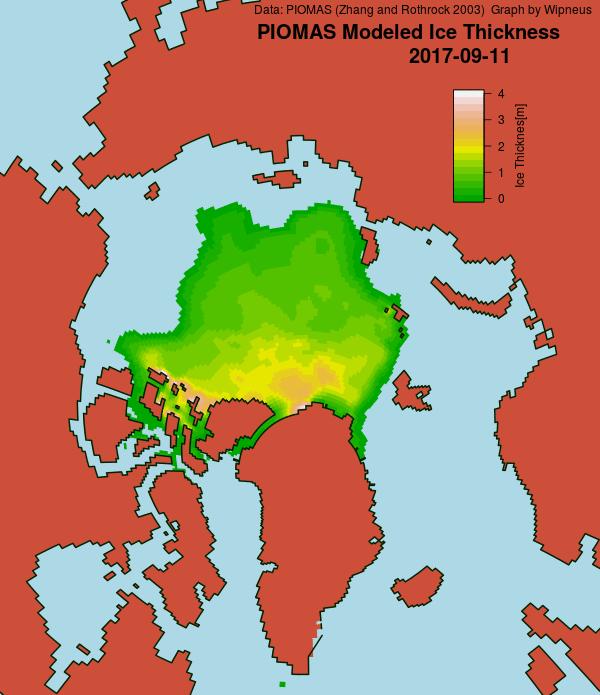
Minimum volume was reached at 11th September: 4.542 103km3, which is fourth lowest after 2012, 2011 and 2016 (resp 3.673, 4.302, 4.402) and just below 2010 (4.582).
[Edit – September 23rd]
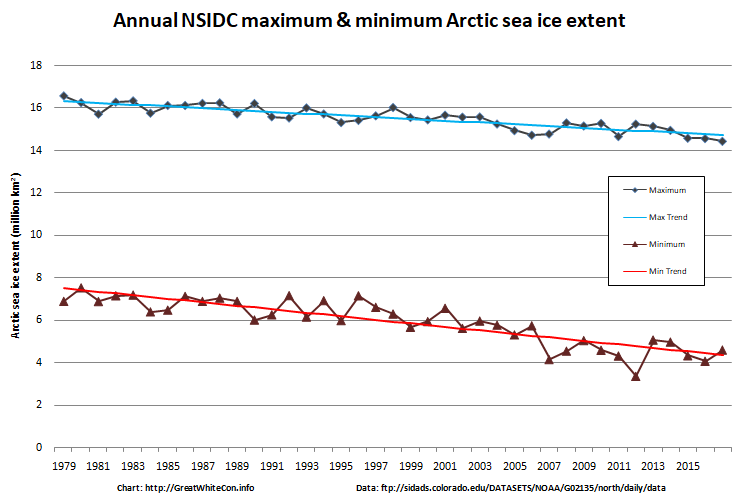
Here’s the 2017 edition of our annual NSIDC daily max/min extent graph:
The maximum extent was the lowest in the satellite record, and the minimum was just fractionally above the trend line. For those that concern themselves with “statistical significance”, the PIOMAS minimum volume was a “statistical tie” for second place:
For some relevant background to this weekend’s dose of “Alternative Facts” from David Rose in the Mail on Sunday you may wish to peruse this article in our sister journal “Alternative Facts Wetware™“:
From the conclusions to that article on Donald Trump’s rise to power:
Reflecting on the implications of this analysis for the specifics of this election, we can see that many Trump voters knew full well that their man was a reprobate, that they deplored his crudities and that they saw him as a risky choice. And yet in a world where the system is seen to be against “us” and where things appear to be driven in the wrong direction by “them,” the really irrational thing to do is to vote for the conventional candidate who represents sticking with that system.
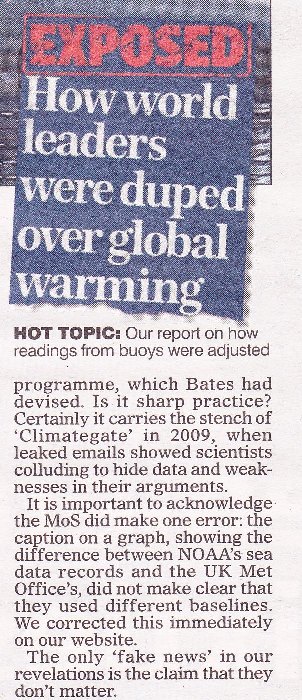
Getting back to this morning’s batch of post truth alternative facts from the poison pen of David Rose, the latest porky pie fresh off the Mail’s production line is entitled:
It is of course Mr. Rose who is “twisting the truth” yet again. His opening salvo:
They were duped – and so were we. That was the conclusion of last week’s damning revelation that world leaders signed the Paris Agreement on climate change under the sway of unverified and questionable data.
A landmark scientific paper –the one that caused a sensation by claiming there has been NO slowdown in global warming since 2000 – was critically flawed. And thanks to the bravery of a whistleblower, we now know that for a fact.
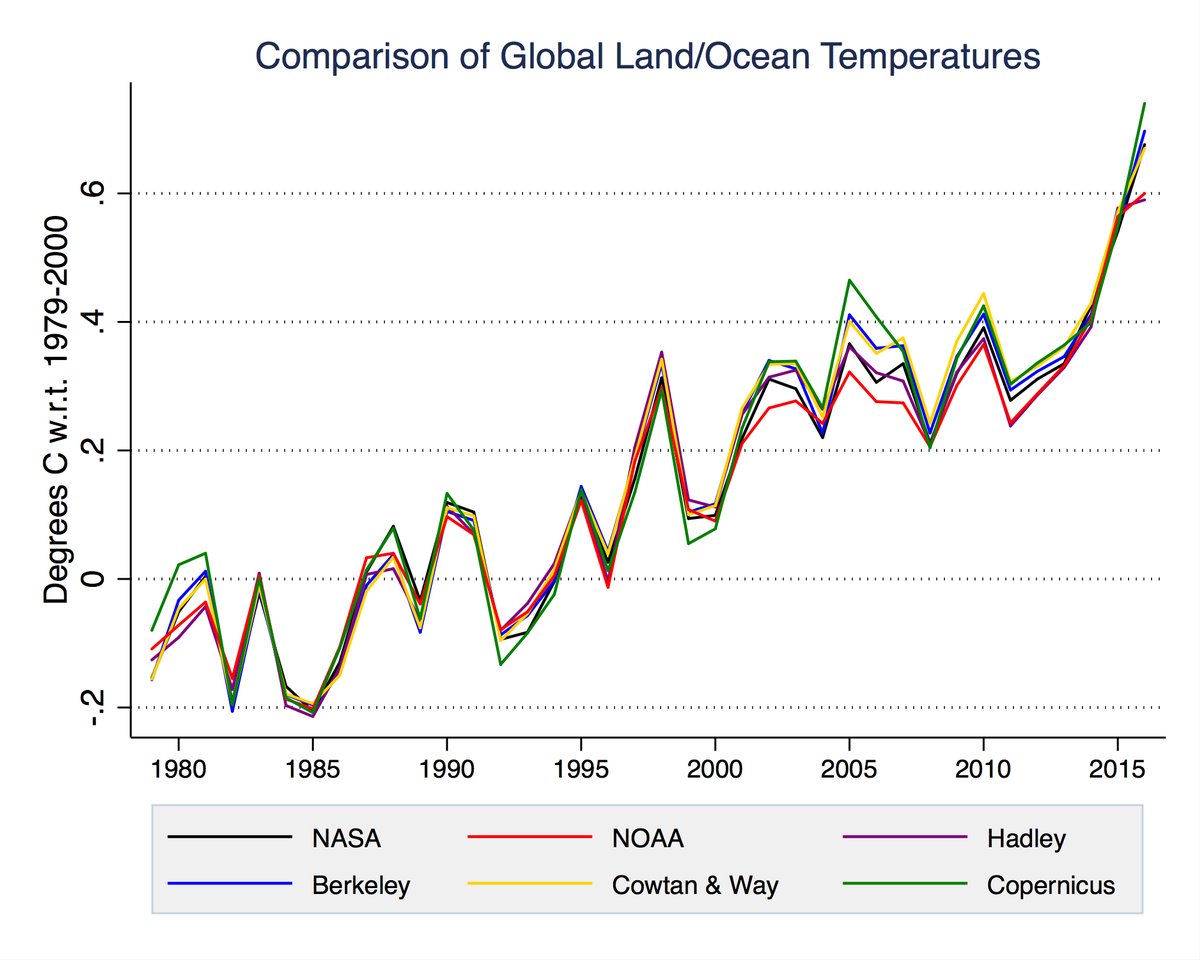
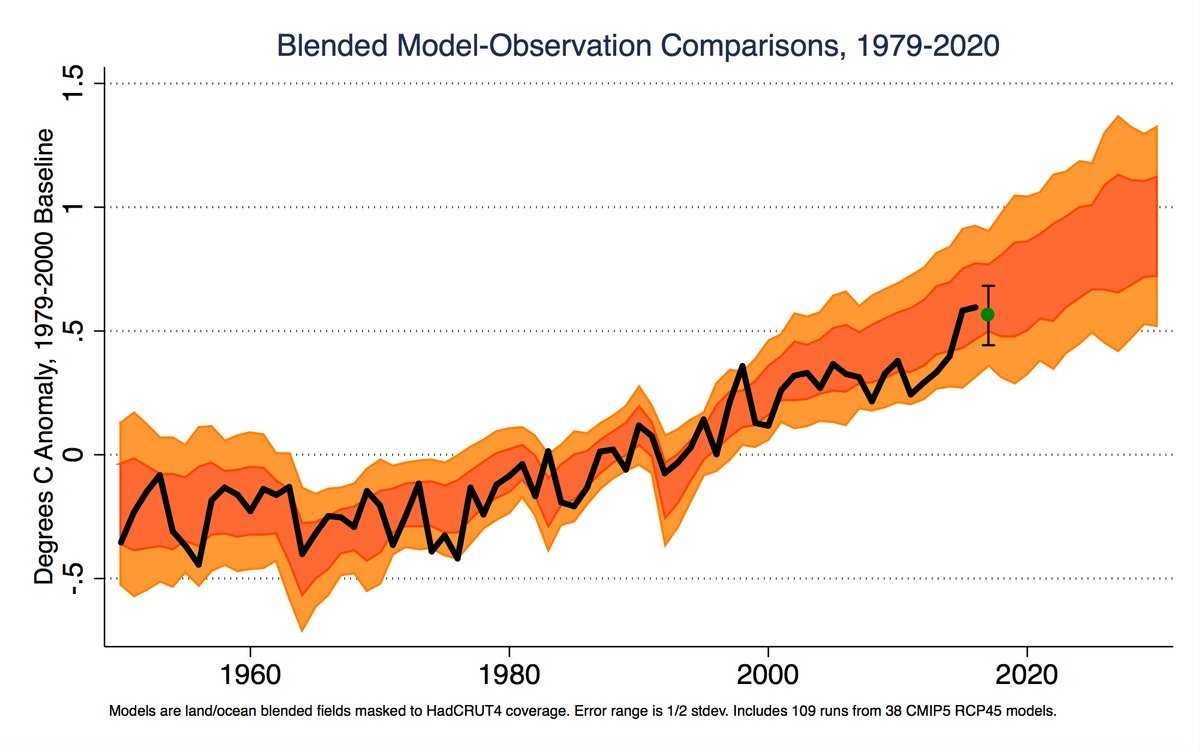
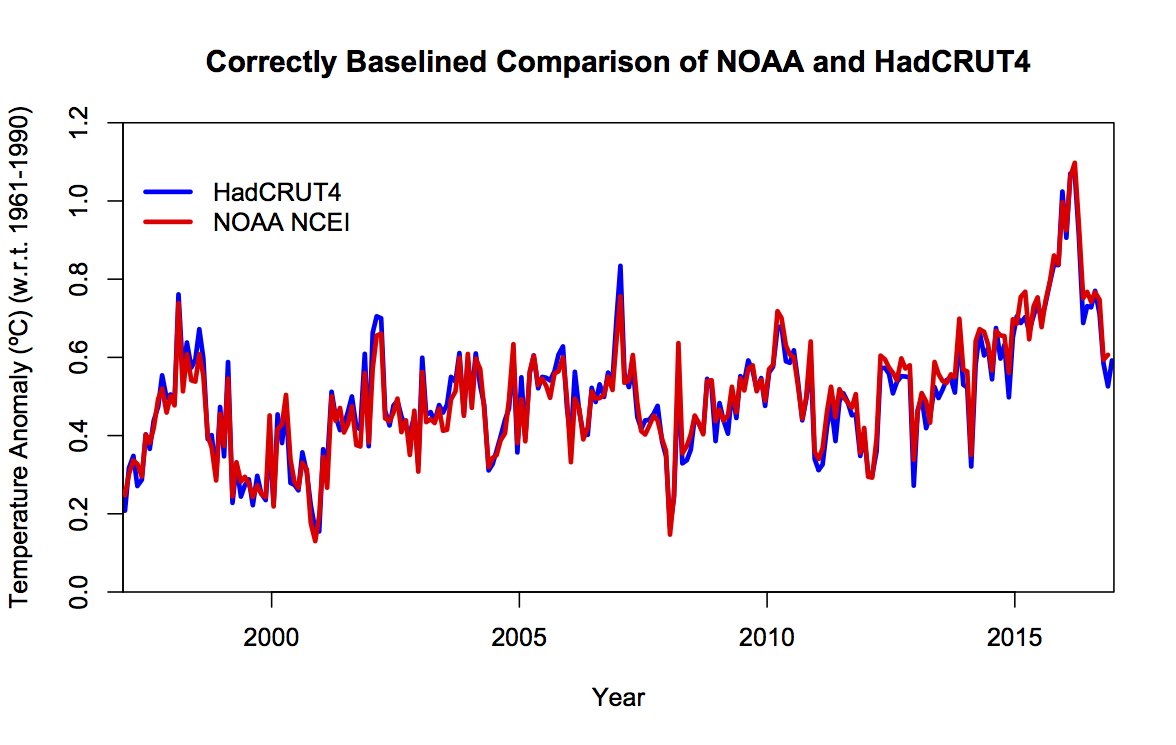
Mr. Rose wouldn’t recognise “a fact” if it hit him in the back of the head at a million miles an hour. The “landmark scientific paper” in question isn’t “critically flawed” anywhere but in the fertile imagination of David Rose and the other “Merchants of Doubt”. Take a look at the facts:
As predicted yesterday, I’m off down to the local paper shop. I wonder if there’s an associated editorial this week too? I’ll be back in a bit with more. As David Rose so eloquently put it this morning:
We cannot allow such a vital issue for our future to be mired in half truths and deceptions.
[Edit – February 12th PM]
My pocket is now £1.70 lighter in exchange for the following information:
It seems that is what passes for “due prominence, and — where appropriate — an apology” in MailSpeak? Here’s the actual facts once again:
I don’t see an accurate graph in Mr. Rose’s profuse apology. I see no mention of “World leaders not duped, Mail readers conned again”. Do you?
[Edit – February 15th]
This will come as no shock to seasoned Lamar Smith watchers. The U.S. House Science, Space, and Technology Committee have issued another news release:
Lamar Smith (R-Texas) today sent a letter to National Oceanic and Atmospheric Administration (NOAA) Acting Administrator Benjamin Friedman requesting information on the Karl study following reports the study ignored NOAA standards, was rushed to publication, and was not free from political bias.
“Allegations of politicization of government funded scientific research cannot be ignored. The Committee has a constitutional responsibility to conduct oversight in instances of alleged fraud, abuse, and misconduct especially where the government’s scientific integrity is called into question. Dr. Bates’ revelations raise additional questions as to whether the science at NOAA is objective and free from political interference. In light of this new information, the Committee requests the below information to better understand the depth and scope of internal debate at NOAA related to the Karl study,” the letter states.
Today’s letter requests documents and communications related to the release of the Karl study, the datasets used in the Karl study, concerns raised about datasets used in the Karl study, and the scientific integrity of the study. The committee also requested a briefing on the independent experts NOAA is engaging with to review this matter.
The news release continues to describe the alleged “background”, but I think we’re all pretty familiar with that by now? The letter itself is addressed to Benjamin Friedman, NOAA’s acting administrator. It demands to see a big pile of documents “related to the Karl study”. It will come a no surprise whatsoever to our regular readers that it references the leading actors in the David & Judy show!
This website uses cookies to improve your experience. We'll assume you're ok with this, but you can opt-out if you wish. Cookie settingsACCEPT
Privacy & Cookies Policy
Privacy Overview
This website uses cookies to improve your experience while you navigate through the website. Out of these, the cookies that are categorized as necessary are stored on your browser as they are essential for the working of basic functionalities of the website. We also use third-party cookies that help us analyze and understand how you use this website. These cookies will be stored in your browser only with your consent. You also have the option to opt-out of these cookies. But opting out of some of these cookies may affect your browsing experience.
Necessary cookies are absolutely essential for the website to function properly. This category only includes cookies that ensures basic functionalities and security features of the website. These cookies do not store any personal information.
Any cookies that may not be particularly necessary for the website to function and is used specifically to collect user personal data via analytics, ads, other embedded contents are termed as non-necessary cookies. It is mandatory to procure user consent prior to running these cookies on your website.