Has drawn on official sources.. to uncover what is actually happening [in the Arctic]
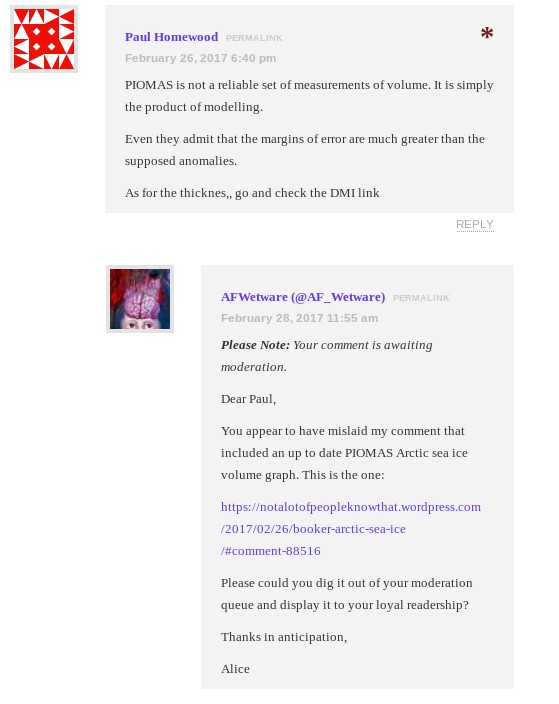
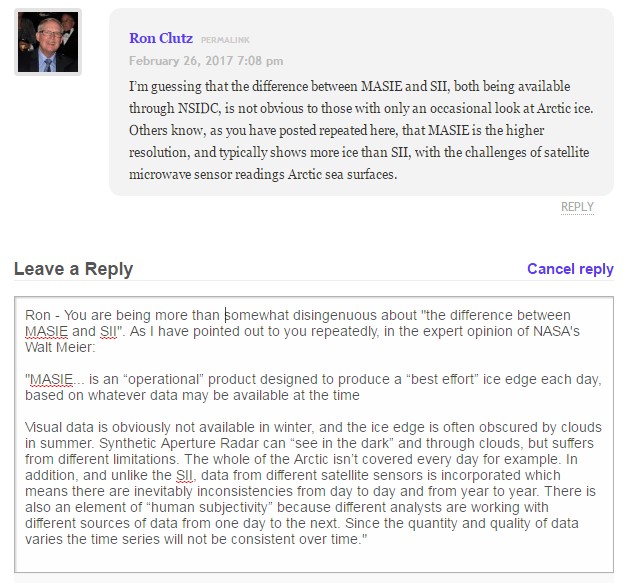
Have we got news for you Christopher? That’s not how it works in the cryodenialosphere! Mr. Homewood’s article about Mr. Booker’s article about Mr. Homewood’s previous article(s) is littered with factual errors. This is what happens should you be foolish enough to attempt to correct such errors.
Here is what we typed into the comment section of Mr. Homewood’s blog:
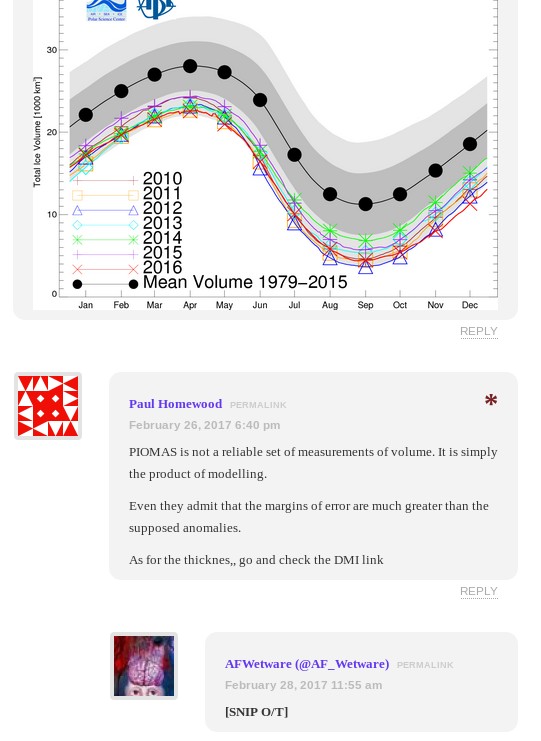
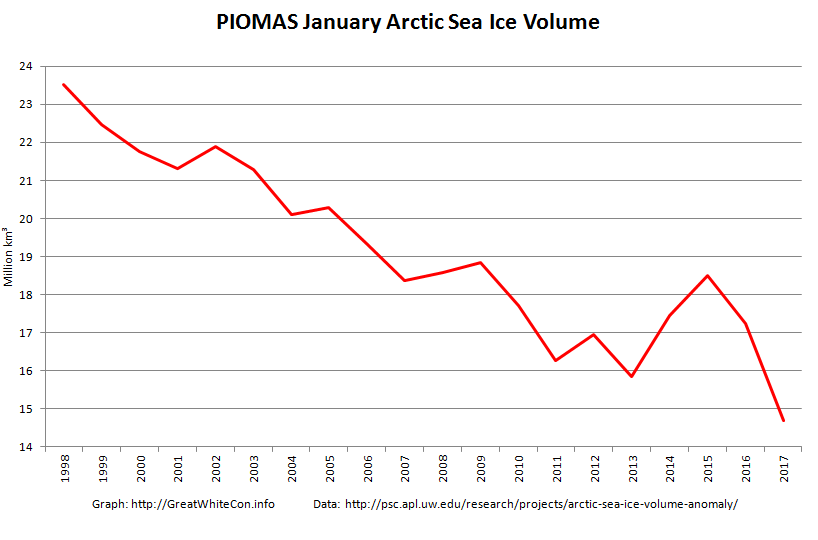
Of course if Mr. Booker were to have considered Arctic sea ice volume he might have thought twice about his “there is even more of it today than in February 2006, and it is also significantly thicker.” remark?
David Rose is mercifully quiet this weekend, but there’s no rest for the wicked! Christopher Booker in the Sunday Telegraph leads a bunch of the usual Alt-facts suspects in a barrage of fake news about our dearly beloved Arctic sea ice. According to Mr. Booker in the “Arctic Myths” section of his column today:
As the fake science of global warming continues to crumble, one scare story the zealots are determined to hold on to at all costs is their claim that ice in the Arctic is dangerously vanishing. Yet again lately we have been treated to a barrage of such headlines as “Hottest Arctic on record triggers massive ice melt”.
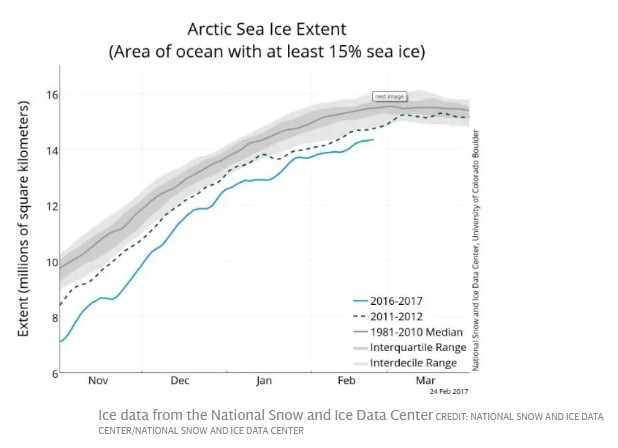
The nearest we got to such a headline here at the Great White Con was “Arctic Sea Ice News from AGU” in which article we showed images which said things like:
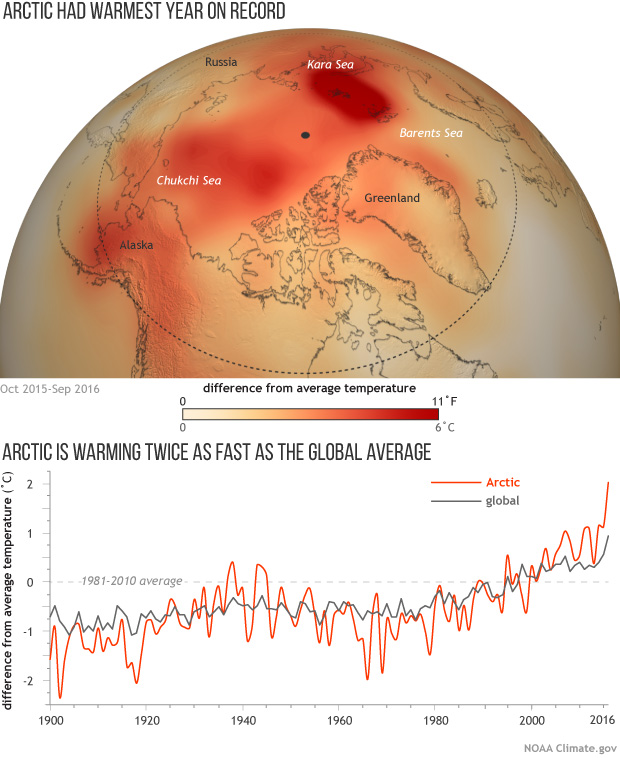
That’s because last year was the *hottest year on record in the Arctic! Undeterred by mere facts Mr. Booker continues:
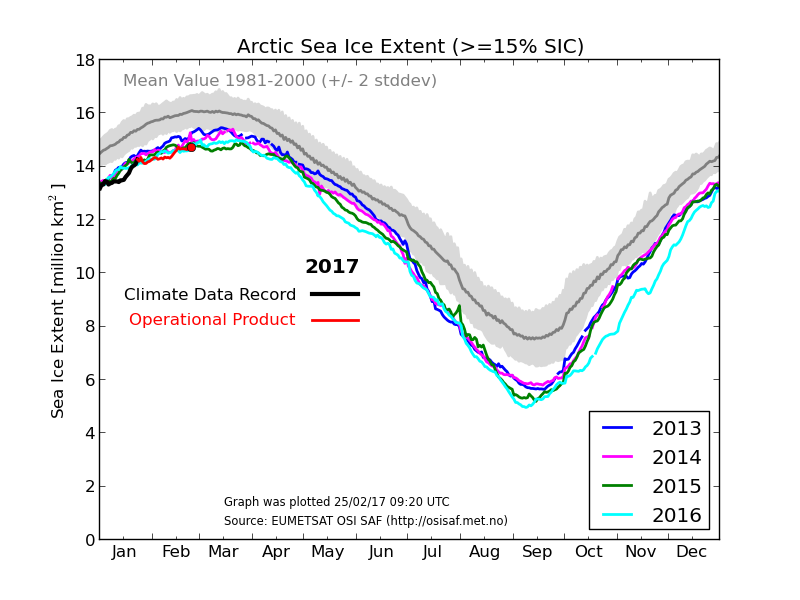
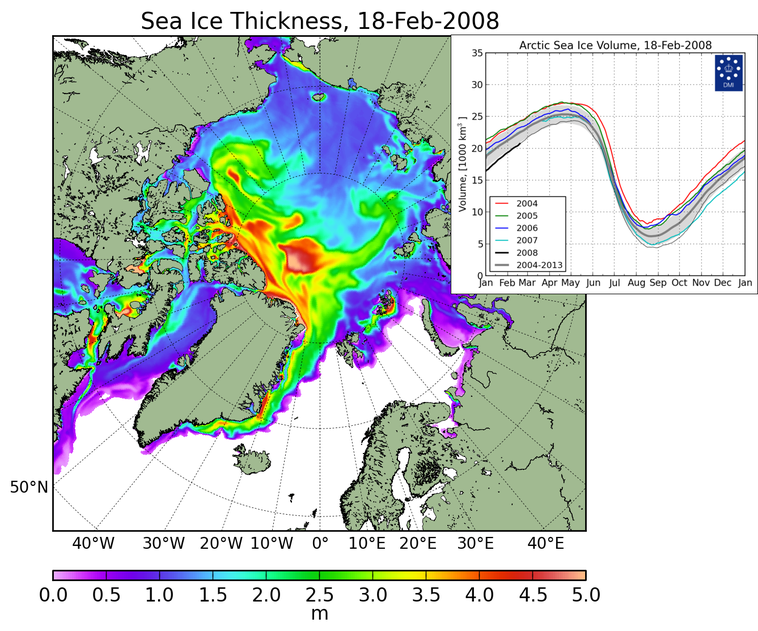
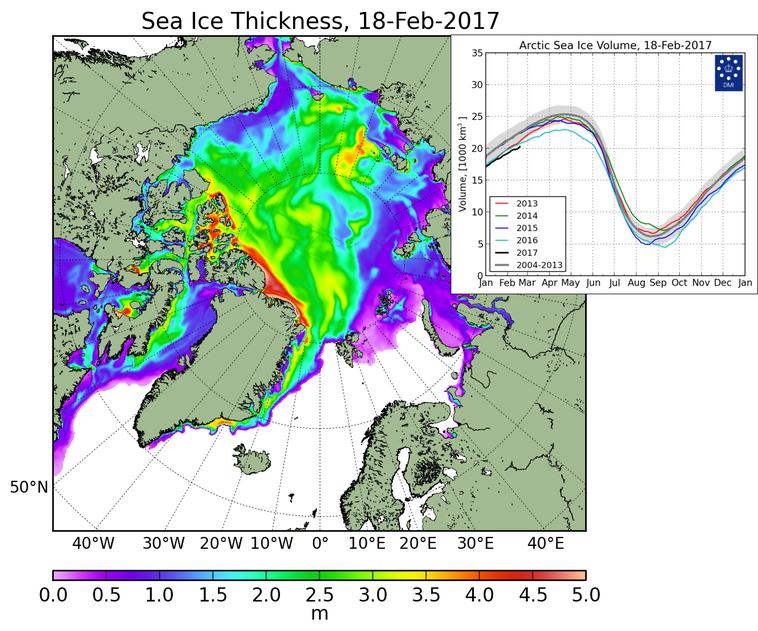
But that ever-diligent blogger Paul Homewood has drawn on official sources such as the US National Snow and Ice Data Center to uncover what is actually happening. Under “Arctic Fake News”, on NotALotOfPeopleKnowThat, he posted a graph showing that last week the extent of sea ice was much the same as it has been at this date ever since 2001. Indeed, according to the Danish Meteorological Institute, there is even more of it today than in February 2006, and it is also significantly thicker. Back in 2008 much of the ice was only a metre thick. Today that has risen to two metres, and in some places four.
Mr. Booker appears to be more than somewhat confused, since this is what the DMI Arctic sea ice extent graph he links to reveals:
In addition the DMI thickness maps he refers to aren’t available at any of the places he mentions! Not a lot of people know that he was probably thinking of another recent article by Paul Homewood entitled “Arctic Ice Fake News“, which includes these two DMI thickness maps:
Even without considering other sources of Arctic thickness and/or volume data it is quite clear from the two volume graphs that according to the Danish Meteorological Institue Arctic sea ice volume is significantly lower this year than it was in 2008. If Arctic sea ice extent is greater this year and the volume is lower then the laws of physics (which not even the combined talents of Messrs Homewood and Booker can change) dictate that its average thickness must be LESS this year than in 2008!
Mr Booker blunders on:
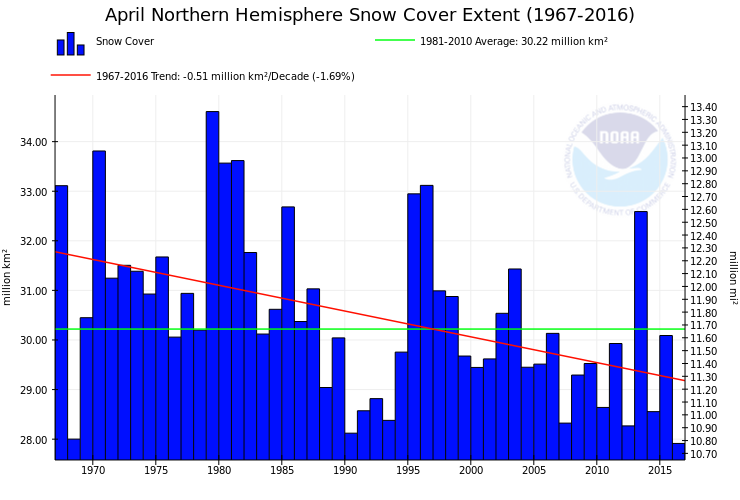
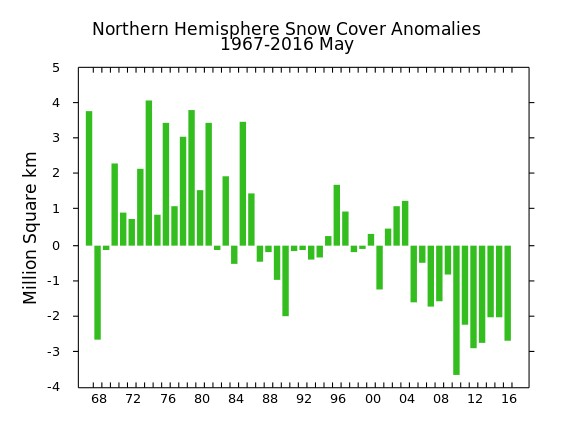
The DMI data also show that the Greenland ice sheet, which we are told is melting at horrendous speed, is actually growing this year at a record rate, to a size way above its average for the past 26 years. And the most authoritative record of Northern Hemisphere snow cover shows this year’s ranking as one of the six highest since 1967.
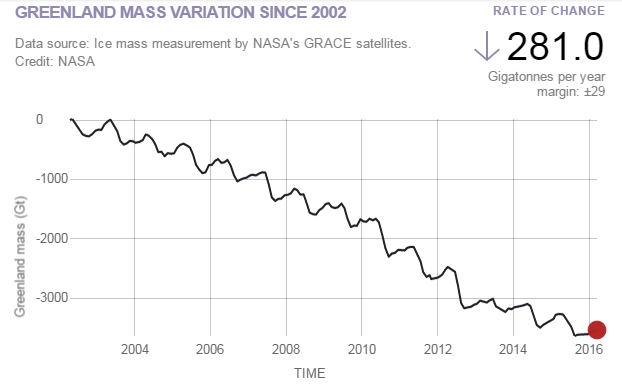
He seems blissfully unaware that the “DMI data” to which he refers is the output of a DMI climate model that attempts to determine the “surface mass balance” of the Greenland ice sheet. He seems to think it’s a measurement of the mass of the Greenland ice sheet, which it isn’t. However this is, courtesy of NASA:
In his bubble of astounding Arctic ignorance Mr. Booker continues:
The Deplorable Climate Science blog, run by US expert Tony Heller, gleefully reproduces a 2007 headline: “Scientists: ‘Arctic is screaming’, global warming may have passed tipping point”. As Heller comments: “The Arctic is indeed screaming at climate scientists – to shut up.”
Now as luck would have it I have been (vainly!) attempting to persuade Mr. Heller “to shut up” on the very article Mr. Booker references! Let’s take a quick look at a couple of highlights shall we?
It seems safe to assume that Mr. Booker wasn’t reading Mr Heller’s blog on or after February 22nd does it not? Otherwise he would surely have had second thoughts about writing such a ludicrous phrase as “there is even more of it today than in February 2006”?
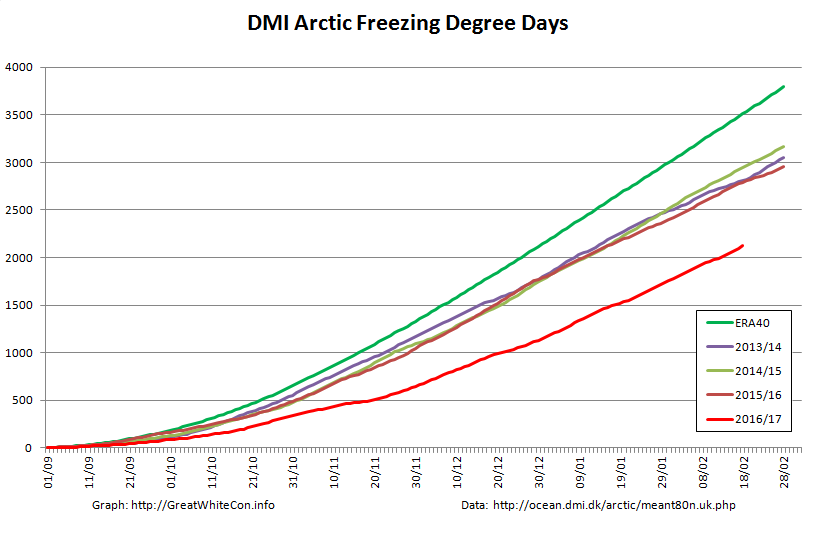
Then of course there’s the burning question of the “Hottest Arctic on record”
You seem to have forgotten about spring Gail? Here’s April:
Here’s the May graph from “the most authoritative record of Northern Hemisphere snow cover” for good measure:
To summarise, Messrs Booker and Homewood could have confined their due diligence on their assorted Arctic articles to reading my comments on Mr. Heller’s blog. Having done so it would quickly have become apparent to them that every single point they made was in actual fact a “fake fact”.
The inevitable conclusion is that they have no interest whatsoever in establishing the actual facts about the Arctic. All they are interested in is propagating “fake news” about the Arctic as far and as wide as possible in pursuit of a common “agenda”. As is David Rose.
Yesterday Anthony Watts published a guest post on his “Watts Up With That” blog authored by Matt Manos. It is entitled “Why It’s So Hard to Convince Warmists“.
Being a somewhat lazy realist I reproduce it here in full, although be warned that I have used the search/replace function of my text editor a teensy-weensy bit:
Many of the posters and readers at GWC have expressed frustration at convincing pseudo-skeptics. Using facts and logic seem to fall on deaf ears. There are some interesting social sciences theories on why pseudo-skeptics are unresponsive. I know the social sciences aren’t a favoured science with this group but if you’ll bear with me, you’ll hopefully see how social science can be useful in describing why pseudo-skeptics are unreachable. And possibly, what to do about it.
In their latest speeches on global warming, Obama and the Pope weren’t trying to convince pseudo-skeptics that CAGW is real. Instead, they were sending signals to their supporters on what “all right thinking people” should be saying. This is classic in-group/out-group communication. Obama and the Pope were setting up the talking points for their in-group members to use to determine who can be considered part of the tribe and who should be rejected for being outside of it. This is a process called Othering. Othering turns political foes into non-beings. Others have no value. Others can be discounted and ignored. Others can be mocked.
Booker and Rose are examples of bellwethers; the sheep with the bell that the other sheep follow. Bellwether is not a derogatory term, it’s a descriptive term. The job of a political bellwether is to indicate the position that their followers should take in their everyday conversations. Booker and Rose’s latest articles function as position papers for the delegates of all right thinking people. You meet these people at work, church, school, at the coffee house, etc. The delegates will mirror the words that Booker or Rose used to identify other in-group members, normalize beliefs and mock out-group members. One of the main themes of both speeches was shame. Shame on those who aren’t right thinking people. Shame that they aren’t as intelligent and capable as “us.”
That type of smugness is almost impossible to penetrate. When a realist questions a pseudo-skeptic’s view on global warming/climate change, the pseudo-skeptic hears something vastly different than what the realist is saying. A realist might say, “There’s no evidence for an Arctic Ice Recovery.” What the pseudo-skeptic hears is how stupid warmists are because that’s what Anthony Watts told him he should think. If the pseudo-skeptic doesn’t prove that he thinks realists are stupid then he might be confused for a warmist! And no one wants to be identified with being a warmist because they’re mocked and don’t get invited to the right parties. No amount of science can penetrate the ROI the pseudo-skeptic has internalized in not believing in CAGW.
Many of the pseudo-skeptics are running on pure rational ignorance. Rational ignorance is a belief that the cost/benefit to researching every issue is so low as to be a net negative in time utilization. Thus the ignorance is rational and everyone utilizes this mental process on certain topics. People who are rationally ignorant about global warming look to bellwethers that support their gut stance. Rationally ignorant pseudo-skeptics would look to Australian leaders, mockutainers and denialist scientists for guidance on how to communicate their position on global warming.
Penetrating rational ignorance is tough because the position pseudo-skeptics have taken isn’t based on logic. Their position is actually based on an appeal to authority. To question the rationally ignorant denier is to question the field of science as a whole (to be a science realist) or to question the leadership of their favorite bellwether personalities. This will cause the rationally ignorant denier to become defensive and try to stand up for their favorite bellwether. The rationally ignorant will also point to their favorite bellwethers and say, “Who am I to doubt all these intelligent people?” It’s intellectually offshoring. It’s lazy. It’s human nature.
The scientific method rejects outright in-group/out groups, Othering, bellwethers and rational ignorance. A scientist is supposed to follow the results on an experiment even if the results don’t support his hypothesis. The scientist is clearly not supposed to rig the data to ensure he gets invited to a party with the right people or continued funding. But science has a poor track record on controversial topics. It often takes decades to accept new theories that are clear winners (e.g., continental drift).
Scientists are still social animals. Social animals follow hierarchy and incentives. If you really want to win the debate on global warming, change the opinions of the bellwethers. Change the economic incentives for the global warming scientific paper mill. Otherwise you’re stuck debating only the people who are unable to change their minds because it would cost them personally to do so. Rare is the person intellectually honest enough to bite the hand that feeds or is willing to violate social norms to speak the truth.
Please feel free to comment below should you spot any inadvertent errors that necessitate a bit more searching/replacing on my part. In the meantime you may be interested in watching this recording I made of a presentation by Dr. Darren Schreiber of Exeter University at a “Pint of Science” presentation last week, entitled “Your Brain is Built for Politics“:
Note in particular the part at 8 minutes 15 seconds where Darren says:
In a new study that just came out a couple of months ago they showed a single disgusting image, and one single disgusting image and measuring the brain activity and how the person responded to that was sufficient to allow you to identify if somebody was conservative or liberal. With a single brain image. With 95% accuracy!
Great White Con fantasy big wave team rider Andrew Cotton was interviewed on BBC Radio Devon last week by none other than Simon Bates! Cotty was on a trip to Hawaii at the time and pointed out to Simon that:
The thing with surf… is it’s the tides, the waves, the wind. The surf tells you when to surf. It’s not around chores or work, you have to have surf that looks good.
As luck would have it all that came together for North Devon surfers at Putsborough Sands on Saturday. Things looked promising to us a couple of days beforehand, and plans were hatched on Twitter for our first equipment evaluation expedition of 2015:
We took the heaven sent opportunity to test out our thickest winter wetsuit in the following conditions:
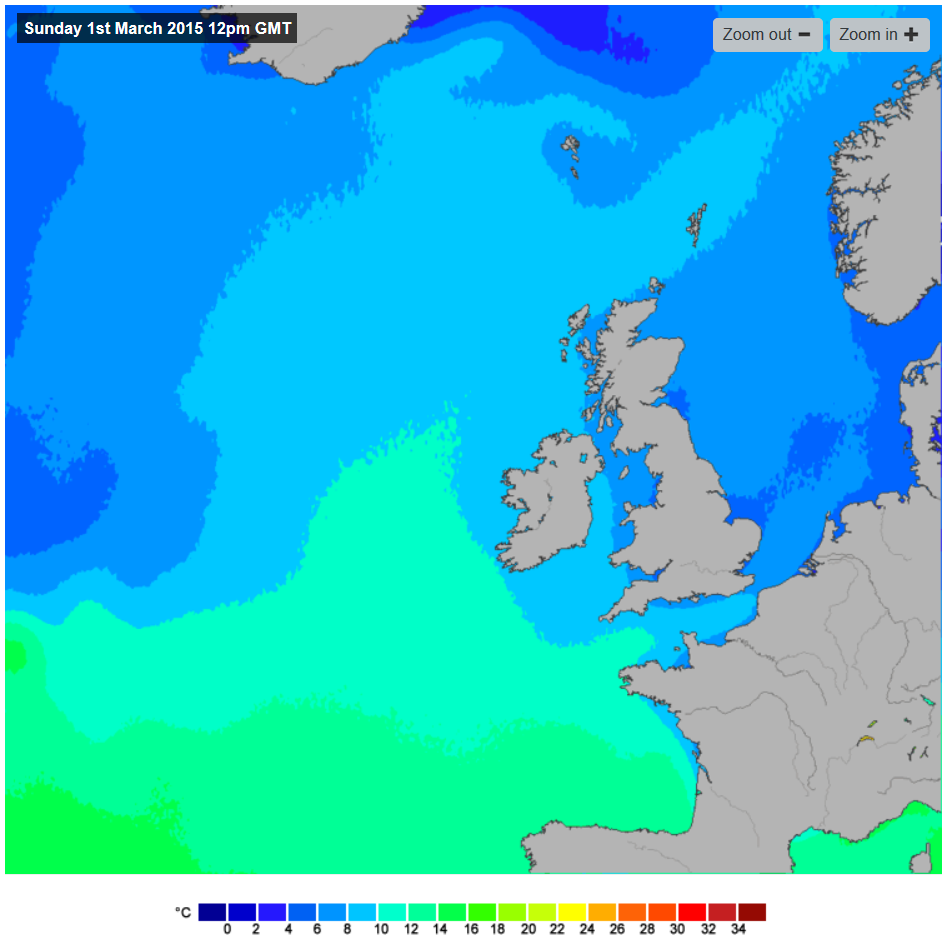
According to Magic Seaweed sea surface temperatures are currently around 8 °C off the coast of North Devon, and it doesn’t get much colder than that in this neck of the woods, which may have had something to do with at least one “no show” on Saturday. Simon had “volunteered” Richard Green for a “cold and dangerous” surf trip:
but Richard had a good excuse for being unable to make it since he was broadcasting on Radio Devon, and chatting to Pete Waterman amongst other things, that afternoon. We did invite Simon Bates along too, but it seems he had a previous engagement in London:
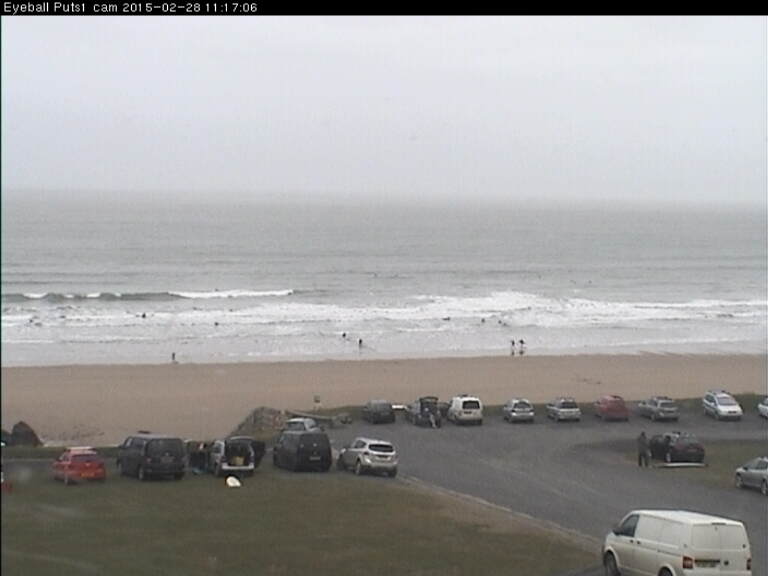
Prior to setting off for the north coast I got in touch with Trev Lumley, who is the proprietor of the Eyeball Surfcheck web site where we had discovered this enticing looking image on the Putsborough surfcam earlier that morning:
Trev told me he would be elsewhere by the time we arrived at “Spot P”, so I quickly tested out my little quiz for the day on him. He claimed never to have heard of Richard Green, whilst Simon Bates did ring a bell and the name Andrew Cotton was very familiar. When I explained the reason for my call Trev told me that he had actually heard Andrew being interviewed by Simon on BBC Radio Devon a few days previously. When pressed to decide who amongst the three names I had mentioned was most famous Trev told me that as far as he was concerned Cotty was the man, since he had known him since he was a boy. However Trev thought that Simon’s name would probably be more familiar to the average Devonian.
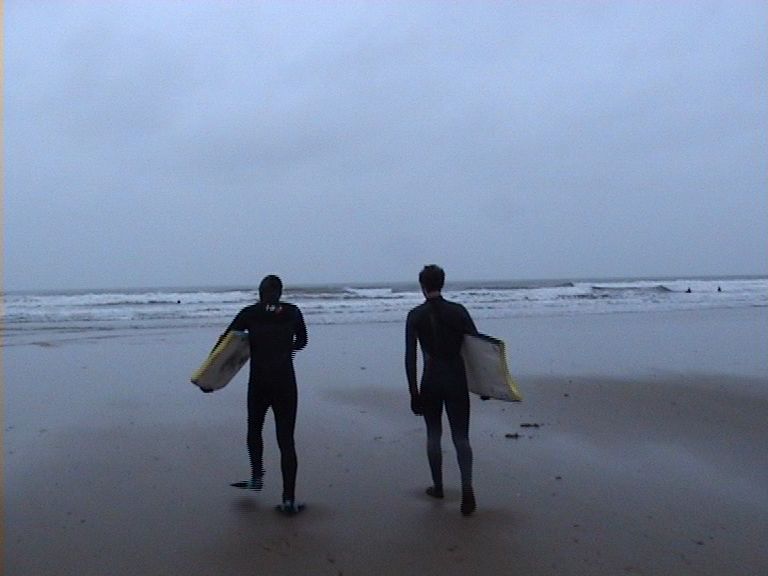
When we eventually arrived at the car park above the beach some heavy showers had already set in. However before plunging into the chilly North Atlantic, I took advantage of a break between the downpours and wandered around the car park at Putsborough with a cameraman in tow to discover the reaction of some of the locals to my TikiProdigy 6/5/4 suit, whilst also killing two birds with one stone by doing some research into the nature of fame and celebrity in the 21st century. Here’s my first interview, with a local lifeguard:
As you can see, our first interviewee thought the Tiki Prodigy “Looks warm”, which was comforting in all the circumstances. In addition out of our list of six celebrities Andrew Cotton was overwhelmingly the most famous. DJs Simon Bates and Richard Green, and journalists Andrew Neil, Christopher Booker and David Rose failed to achieve even the merest flicker of recognition.
More videos are on the way, but are currently still stuck in the editing suite here in the basement of the Great White Con Ivory Towers. In the meantime here are my own findings after a couple of hours at sea on my yellow sponge performing our first Arctic equipment evaluation test:
Apart from my Prodigy I was also wearing Tiki 5mm socks and 2mm bodyboarding gloves. I suffered none of the “brain freeze” reported by my even more intrepid companion, who entered the water hoodless beside me:
Because I didn’t want to lose my contact lenses I did very little duck diving. On only one occasion did I experience the thrill of cold water flushing down my back. My fingers started to feel a bit chilly as I was bobbing about out the back after my initial paddle out, but once I got into the swing of things even they were toasty for the duration. Whilst I do wonder if Tiki could be persuaded to produce some thicker gloves with webs between the fingers, my biggest problem proved to be extracting myself from my soggy suit in the pouring rain that had set in by the time I arrived back in the car park as the light was fading. To give you an idea of the problem I faced here is Andrew Cotton explaining the virtues of the chest zip version of the Zepha, which has replaced the Prodigy in Tiki’s range of cold water winter wetsuits:
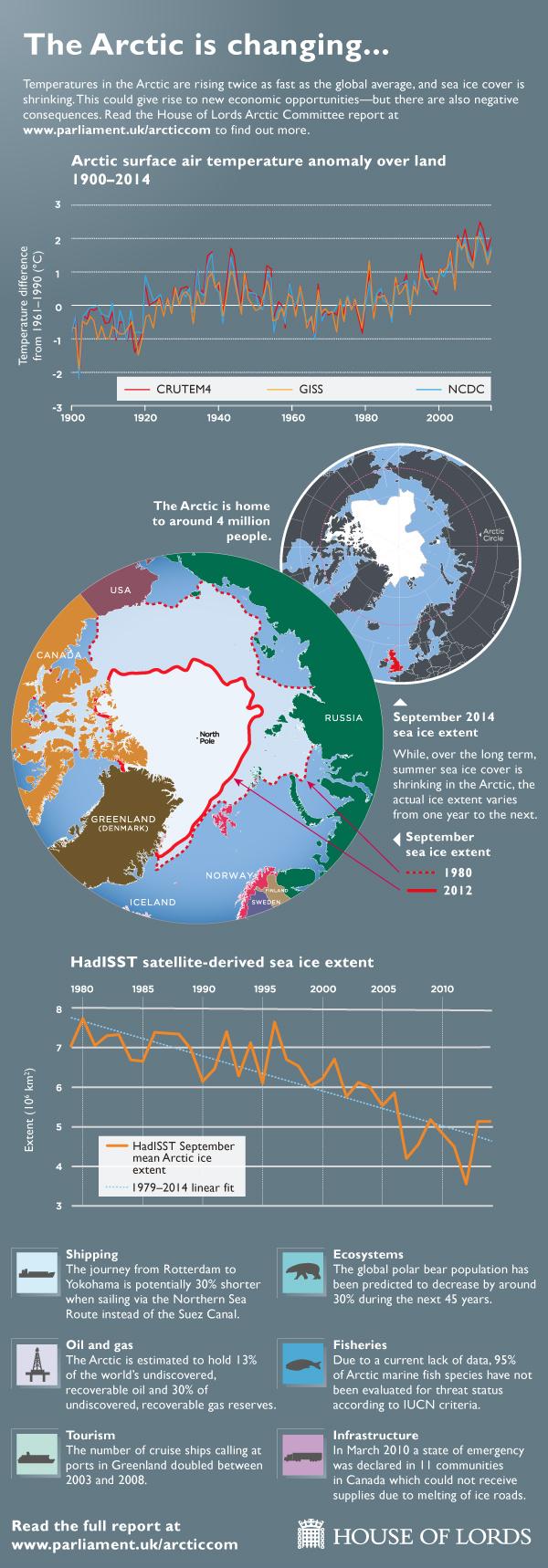
The United Kingdom’s House of Lords are an unlikely bunch to be bundled under the banner of “alarmist” or even “warmist”. Nevertheless their Select Committee on the Arctic has just published a report entitled “Responding to a Changing Arctic“, and in this video the chairman of that committee, Lord Teverson, briefly outlines their findings:
Note that he starts by saying that:
Absolutely the obvious thing first of all is that with the temperatures going up [in the Arctic] at twice the rate of the rest of the world the thing that everybody is seeing is reduction in sea ice which has reduced quite substantially over recent years, and of course a lot of the Arctic is land and we have the melting ice on Greenland particularly, which is causing sea level rises in the rest of the world.
In order to get that message across the committee has also produced the following infographic:
which shows how the temperature over land has been increasing whilst the sea ice extent in the Arctic has been declining. The committee have also made all the learned evidence they received whilst producing their report publicly available. Professor Andy Shepherd from the University of Leeds told the committee that:
The majority of sea ice changes witnessed in “the past 50 or 60 years” could be attributed to greenhouse gas emissions and their effect on temperatures in the Arctic region.
and:
Suggested that the length of the solar melt season had increased by around five days per decade, causing additional melting and retreat of the ice.
How strange then, that David Rose made no mention of any of this when reporting Prof. Shepherd’s views in his “Myth of Arctic meltdown” article of August 31st 2014?
How strange also, that Christopher Booker maintained in his “The fiddling with temperature data is the biggest science scandal ever” article of February 8th 2015 that:
The ice-melt is not caused by rising global temperatures at all.
Regular readers will recall that we recently sent The Telegraph a lesson or two about global surface temperature “adjustments”, both of which included “a video by a scientist who has studied such matters”. It seems nobody at The Telegraph, and particularly Christopher Booker, bothered to watch it or do the homework assignments. The stated view of Jess McAree, Head of Editorial Compliance at the Telegraph Media Group, is that:
Only the most egregious inaccuracy could be significantly misleading.
We therefore take great pleasure in welcoming Dr. Kevin Cowtan from the University of York, the “scientist” mentioned above, who has kindly allowed us to reprint an article of his originally published at Skeptical Science. Please read on below the fold, and don’t forget to do your homework!
There has been a vigorous discussion of weather station calibration adjustments in the media over the past few weeks. While these adjustments don’t have a big effect on the global temperature record, they are needed to obtain consistent local records from equipment which has changed over time. Despite this, the Telegraph has produced two highly misleading stories about the station adjustments, the second including the demonstrably false claim that they are responsible for the recent rapid warming of the Arctic.
In the following video I show why this claim is wrong. But more importantly, I demonstrate three tools to allow you to test claims like this for yourself.
The central error in the Telegraph story is the attribution of Arctic warming (and somehow sea ice loss) to weather station adjustments. This conclusion is based on a survey of two dozen weather stations. But you can of course demonstrate anything you want by cherry picking your data, in this case in the selection of stations. The solution to cherry picking is to look at all of the relevant data – in this case all of the station records in the Arctic and surrounding region. I downloaded both the raw and adjusted temperature records from NOAA, and took the difference to determine the adjustments which had been applied. Then I calculated the trend in the adjustment averaged over the stations in each grid cell on the globe, to determine whether the adjustments were increasing or decreasing the temperature trend. The results are shown for the last 50 and 100 years in the following two figures:
Trend in weather station adjustments over the period 1965-2014, averaged by grid cell. Warm colours show upwards adjustments over time, cold colour downwards. For cells with less than 50 years of data, the trend is over the available period.
Trend in weather station adjustments over the period 1915-2014, averaged by grid cell. Warm colours show upwards adjustments over time, cold colour downwards. For cells with less than 100 years of data, the trend is over the available period.
In the video I demonstrate three tools which are useful in understanding and evaluating temperature adjustments:
A GHCN (global historical climatology network) station report browser. GHCN provide graphical reports on the adjustments made to each station record, but you need to know the station ID to find them. I have created an interactive map to make this easier.
The majority of cells show no significant adjustment. The largest adjustments are in the high Arctic, but are downwards, i.e. they reduce the warming trend. This is the opposite of what is claimed in the Telegraph story. You can check these stations using the GHCN station browser.
The upward adjustments to the Iceland stations, referred to in the Telegraph, predate the late 20th century warming. They occur mostly in the 1960’s, so they only appear in the centennial map. Berkeley Earth show a rather different pattern of adjustments for these stations.
Iceland is a particularly difficult case, with a small network of stations on an island isolated from the larger continental networks. The location of Iceland with respect to the North Atlantic Drift, which carries warm water from the tropics towards the poles, may also contribute to the temperature series being mismatched with records from Greenland or Scotland. However given that the Iceland contribution is weighted according to land area in the global records, the impact of this uncertainty is minimal. Global warming is evaluated on the basis of the land-ocean temperature record; the impact of adjustments on recent warming is minimal, and on the whole record it is small compared to the total amount of warming. As Zeke Hausfather has noted, the land temperature adjustments in the early record are smaller than and in the opposite direction to the sea surface temperature adjustments.
Impact of the weather stations adjustments on the global land-ocean temperature record, calculated using the Skeptical Science temperature record calculator in ‘CRU’ mode.
Manual recalibration of the Iceland records may make an interesting citizen science project. Most of the stations show good agreement since 1970, however they diverge in the earlier record. The challenge is to work out the minimum number of adjustments required to bring them into agreement over the whole period. But the answer may not be unique, and noise and geographical differences may also cause problems. To facilitate this challenge, I’ve made annualized data available for the eight stations as a spreadsheet file.
In the video I demonstrate three tools which are useful in understanding and evaluating temperature adjustments:
A GHCN (global historical climatology network) station report browser. GHCN provide graphical reports on the adjustments made to each station record, but you need to know the station ID to find them. I have created an interactive map to make this easier.
The Berkeley Earth station browser. The Berkeley Earth station reports provide additional information to help you understand why particular adjustments have been made.
The Skeptical Science temperature record calculator. This allows you to construct your own version of the temperature record, using either adjusted or unadjusted data for both the land and sea surface temperatures.
Data for the temperature calculator may be obtained from the following sources:
The GHCN station data. For daily average temperature data, look for the ‘tavg’ files. The ‘qca’ files are adjusted temperatures, and the ‘qcu’ files are unadjusted temperatures. The files are stored in ‘.tar.gz’ archives, and may be extracted using most freely available unzip software.
Finally, here are some interesting papers discussing why adjustments are required.
Menne et al (2009) The U.S. historical climatology network monthly temperature data, version 2.
Bohm et al (2010) The early instrumental warm-bias: a solution for long central European temperature series 1760–2007.
Brunet et al (2010) The minimization of the screen bias from ancient Western Mediterranean air temperature records: an exploratory statistical analysis.
Ellis (1890) On the difference produced in the mean temperature derived from daily maximum and minimum readings, as depending on the time at which the thermometers are read
Finally, for the moment at least, and lapsing back into our by now familiar (and adversarial?) style:
Two days later a UK broadsheet did indeed publish an article I feel sure Rep. Rohrabacher would approve of. Later the same morning BBC Radio 4 News reported on that article with apparent approval. For the backstory on all this please follow the first link below. Please read on for the text of my maximum 1500 character written complaint to the Beeb!
Us:
I have already spoken to Rachel about this via telephone, but she couldn’t give me a reference number or include a URL along with my complaint, so for completeness:
BBC Radio 4 News at 7 AM on Sunday February 22nd 2015 discussed the morning newspapers. The Observer’s story about Ed Miliband’s appointment of John Prescott as his “climate change advisor” was mentioned. This was followed by a reference to Christopher Booker’s article in The Telegraph. For chapter & verse please see my article at:
and then follow all the links. In brief, as assorted readers over there put it:
“Why do people like Christopher Booker keep getting away with this kind of bullshit? There must be some kind of fine for lying and misleading so blatantly.”
“Hard to believe the BBC can give any credence to such nonsense. I was really shocked and phoned BBC to complain”
or as I summarised my conversation with Rachel:
“The BBC’s apparent belief that Mr. Booker’s article provides some sort of “scientific balance” to Ed Miliband’s remarks about the need for UK plc to up its “climate change” game is so utterly ludicrous that words totally fail me.”
By way of explanation for my disbelief, please see this elementary explanation of the underlying science that I sent to Mr. Booker and his editors 2 weeks previously:
Thanks for contacting the BBC. This is an automated email acknowledging that we’ve received the attached complaint sent in this name. We’ve attached the case reference and text of the complaint for your records (see below).
We’ll normally include the full text of your complaint to BBC staff in the overnight reports we compile for them about the complaints and other reaction we’ve received today (with all your personal details removed). This ensures it will reach the right people quickly tomorrow morning. We’ll then aim to reply to you within 10 working days, or around 2 weeks, but it also depends on the nature of your complaint and whether the relevant people can respond to us in time.
We aim to use your licence fee as efficiently as we can, so if you complained about the same issues as others we will send our response to you and everyone. For the same reason we may not investigate or reply in great detail if a complaint doesn’t suggest a potential breach of BBC standards, or a significant issue of general importance. You can read about our full complaints procedures and how we consider issues which people raise with us at www.bbc.co.uk/complaints/handle-complaint/.
This acknowledgment is automatically generated from an unmonitored address so please don’t reply. If you think you’ve received this in error please contact us using our webform at www.bbc.co.uk/complaints, quoting your case reference number.
followed on February 26th by:
Dear Mr Hunt
Thank you for contacting us regarding Radio 4’s “News and Papers” as broadcast on 22 February.
We understand you feel that the article by Christopher Booker in the Sunday Telegraph that was referred to is not a counter balance to Ed Miliband’s views on climate change as you believe it to be scientific nonsense.
We aim to provide the information which will enable listeners to make up their own minds; to show the political and scientific reality and provide the forum for debate. There is broad scientific agreement on the issue of climate change and we reflect this accordingly; however, we do aim to ensure that we also offer time to the dissenting voices.
We value your feedback about this issue. All complaints are sent to senior management and programme makers every morning and we included your points in this overnight report. These reports are among the most widely read sources of feedback in the BBC and ensure your complaint is seen by the right people quickly. This helps inform their decisions about current and future reporting.
Christopher Booker has raised the stakes in the “ClimateGate 2.0” edition of ClimateBall™ in his article in this morning’s edition of the Sunday Telegraph:
It was only the adjusted surface records which showed 2014 to have been “the hottest year on record”. The other two official records, based on satellite measurements, which only go back to 1979, show nothing of the kind.
The international fallout from my two articles has been huge. The second, headed “The fiddling of temperature data has been the biggest science scandal ever”, scored a record 30,000 comments on The Telegraph website. But what is particularly telling has been the silence of GHCN and the compilers of the other surface records in response to requests from Homewood and others for a proper explanation of how and why they had needed to make so many adjustments to the original data.
What is now needed is a meticulous analysis of all the data, to establish just how far these adjustments have distorted the picture the world has been given. Although I cannot yet reveal any details, I gather that a responsible foundation is gathering an expert team to do just that. If the results confirm what has already been unearthed by Homewood and other analysts, from the US to New Zealand, this may indeed turn out to have been the greatest scandal in the history of science.
He is apparently being aided and abetted in his latest outlandish bid by BBC Radio 4 News, who reported on his article as follows in their 07:07:25 review of the Sunday newspapers this morning:
Christopher Booker in the Sunday Telegraph demands a meticulous analysis of the data used to justify the claim that last year was the warmest on record, something he suggests could turn out to be one of the greatest scandals in science. He says a growing number of experts around the world have found that the raw data originally gathered by weather stations was comprehensively adjusted to justify the claim.
This is of course all spectacularly shoddy science (SSS for short) by Homewood, Booker et. al. , as we informed Ian Marsden at the Telegraph Group after Booker’s previous climate bluff was trumped by a long list of climate scientists, who have in fact been anything but “particularly silent” this time around. By way of example, since Ian Marsden evidently hasn’t watched this video yet, here once again is a video by a scientist who has studied such matters, which explains the truth:
Next I called the Beeb’s complaints number (03700 100 222 – 24 hours, charged as 01/02 geographic numbers) and told Rachel that I wished to register a complaint. I manfully resisted the temptation to emit any expletives, and informed her that the BBC’s apparent belief that Mr. Booker’s article provides some sort of “scientific balance” to Ed Milibands remarks about the need for UK plc to up its “climate change” game is so utterly ludicrous that words had totally failed me.
Rachel wondered if I was talking about this morning’s edition of “Broadcasting House“. I assured her I was not, but it sounds as though I now ought to go away and listen to that from cover to cover!
It’s now the morning of Monday February 23rd 2013. I haven’t received the email confirmation from the BBC that Rachel promised me yet, so…..
I’ve also just spoken to Ian Marsden of the Telegraph Group once again. He assures me that my complaint about a previous article by Christopher Booker is being dealt with, and suggests that I file another one to ensure that I have “a proper audit trail” in this instance as well.
An IPSO complaints officer suggests following up our previous complaint via said complaints form, so….
I called Ian Marsden, managing editor at the Telegraph Media Group, earlier this week and informed him that I wished to register a complaint about some of their content. Ian told me that in the shiny new world of the Independent Press Standards Organisation the first thing I would need to do is fill in a form. That is what I have just done:
As I mentioned in my telephone conversation with Ian Marsden, this article is so full of scientific inaccuracies that it’s hard to know where to begin, and what actions The Telegraph could take that would be sufficient to correct the incredibly misleading portrayal of the underlying science.
As Ian is well aware, my particular specialisation is the Arctic, so let’s start there. Booker starts off:
“New data shows that the ‘vanishing’ of polar ice is not the result of runaway global warming”
What “new data”? There is none!
He goes on to say “Homewood has now turned his attention to the weather stations across much of the Arctic, between Canada (51 degrees W) and the heart of Siberia (87 degrees E). Again, in nearly every case, the same one-way adjustments have been made, to show warming up to 1 degree C or more higher than was indicated by the data that was actually recorded.”
That’s “old data” and the statement is inaccurate. Have you heard of Steven Mosher? The author of “Climategate – The Crutape Letters”? He tells me:
“Looking at some maps I have of the Arctic It looks to me like we “cool” the Arctic. That is but for our adjustments the raw data would show a warmer arctic. I’ll try to check that in detail.
The Homewood approach (and by extension Delingpole and Booker) is pretty simple. Look for stations that are warmed and complain. Of course, he fails to look at the entire picture, fails to look at the large parts of Africa (20% of the globe) that our algorithm “cools”.
By looking at the whole we know that the scientifically interesting result (the world is getting warmer) STANDS. it stands with adjustments. It stands with no adjustments. Any local detail that may be wrong or questionable is not material to this conclusion.”
Here’s a video by a scientist who has studied such matters, which explains the truth:
Watch it, check the inaccuracy of Booker’s statements for yourself if you so desire, then get back to me. I’ll be more than happy to go through all the other inaccurate and misleading statements in the article once you have attempted to justify this one.
As you are aware, climate change is a complex and controversial topic. A newspaper is not a scientific journal, and is not required to represent all the possible shades of evidence and interpretation that might have a bearing upon any given topic.
This is clearly an opinion article and identifiable as such. Against the background described above, readers can be expected to understand that any evidence offered is almost certainly contestable. It follows that in an opinion article of this nature only the most egregious inaccuracy could be significantly misleading. None of the points you raise qualify as such.
The phrase ‘new data’ is readily understandable, in context, as meaning the new study into existing Arctic weather station data undertaken by Paul Homewood, which is the focus of the article.
You say that Homewood’s analysis is ‘inaccurate’, and seek to prove this by reference to the work of others. The existence of contrary views and interpretations does not negate Christopher Booker’s right to describe Homewood’s findings and comment upon them. There is nothing in the points you raise that would engage the terms of the Editor’s Code of Conduct.
I trust this is of some assistance.
Yours sincerely
Jess McAree | Head of Editorial Compliance
Us:
Jess McAree’s email didn’t include a telephone number, so I called The Telegraph’s switchboard (on the morning of February 24th). They told me “He doesn’t take calls”. I persisted and they put me through to Andy, who assured me that whilst Mr. McAree was currently in a meeting he would tell him that I had called as soon as he emerged. Whilst waiting for a call back I registered another complaint via The Telegraph’s online form, this time checking the “Opportunity to reply” box:
This is a supplementary note to my original complaint of February 13th 2015, a copy of which is available online here:
It is now 11:30 on February 24th 2015. I spoke at length to Ian Marsden yesterday, and for some strange reason he didn’t mention Jess McAree’s email of the 20th inst. to me. Does the left hand at The Telegraph not know what the right hand is doing? I pointed out to Ian that your complaints policy states:
“We aim to acknowledge your complaint within 5 working days of receipt”
Ian reminded me about the “We aim” bit, and assured me that my complaint was being dealt with. Following the recommendation of an IPSO complaints officer I am registering this further complaint about the lack of a timely “right to reply” on what Ian referred to yesterday as The Telegraph’s “audit trail”. I shall also send a more detailed response to his email to Mr. McAree’s personal email address.
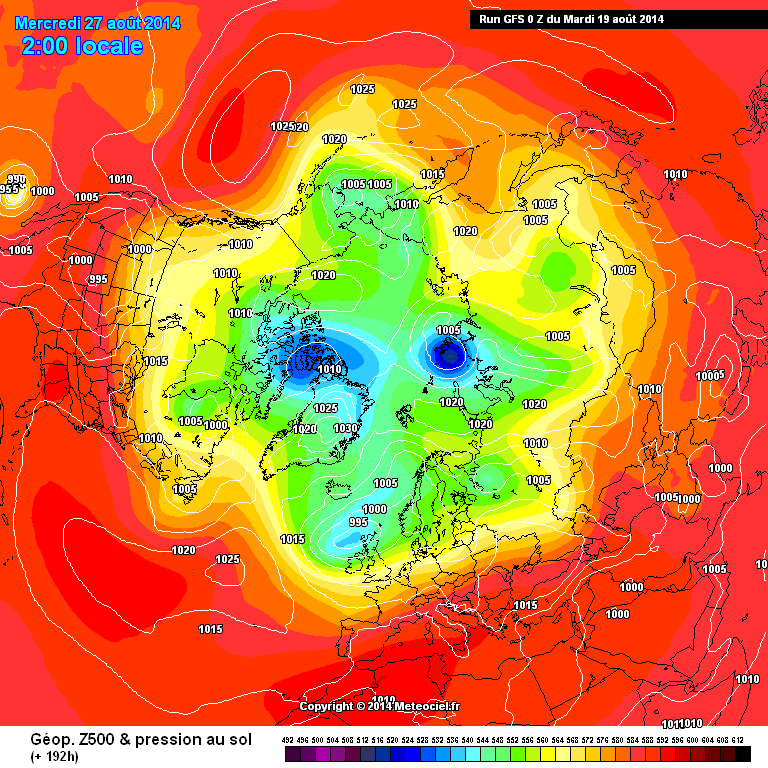
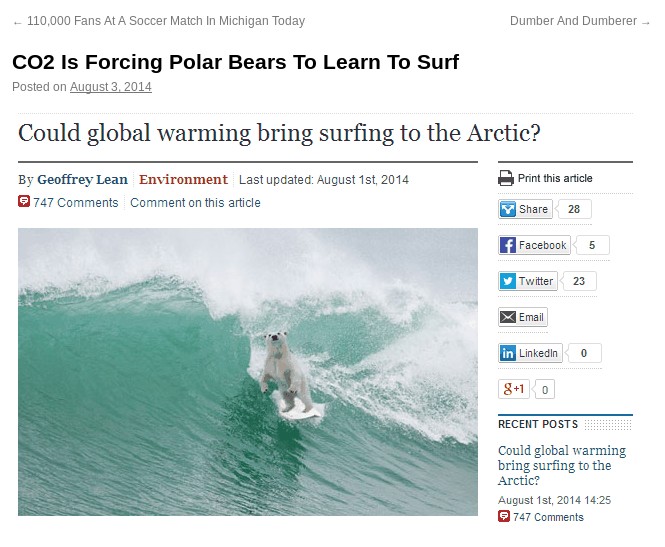
Regular readers adept at reading between lines may already have concluded that here in the Great White Con Ivory Towers we have been surreptitiously organising the world’s first ever Arctic Basin Big Wave Fantasy Surfing Contest (or GWCABBWFSC for short). Today we are proud to announce that the long waiting period may now be almost over!
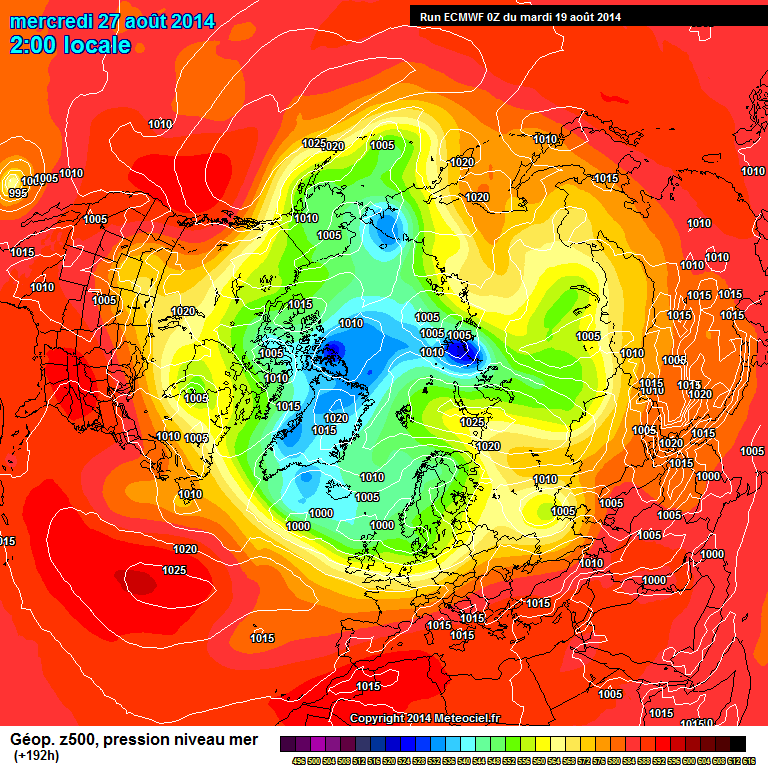
Here is the long range Arctic weather forecast from GFS 192 hours from now (courtesy of MeteoCiel):
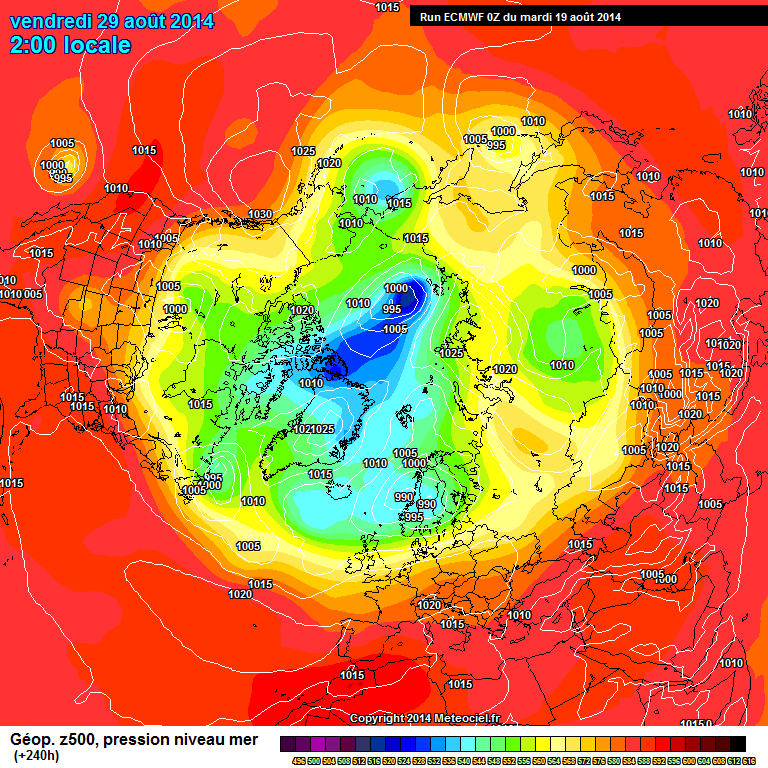
There looks to be a certain amount of agreement there, so now let’s take a look at ECMWF for T+240h:
If the forecast pans out (a very big IF this far out!) there’s an Arctic storm brewing with the isobars packed tight over all the open water in the Laptev Sea, pushing the potential swell through the East Siberian Sea and on into the Beaufort Sea before it crashes against the northernmost shores of North America.
We fondly imagine a Great White Con team containing the likes of Andrew Cotton:
taking on the biggest waves ever recorded on camera off Alaska’s North Slope, each clad in their respective sponsors’ thickest, finest neoprene.
The opposing “Great Green Con” team will be composed of volunteers from amongst the serried ranks of fiddlers with the facts on Fleet Street such as Andrew Neil, David Rose and Christopher Booker, all clad in matching Polar Bear suits to keep the cold Arctic waters at bay:
To coin a phrase oft used in this particular portion of the blogosphere:
We’ll keep you posted!
This website uses cookies to improve your experience. We'll assume you're ok with this, but you can opt-out if you wish. Cookie settingsACCEPT
Privacy & Cookies Policy
Privacy Overview
This website uses cookies to improve your experience while you navigate through the website. Out of these, the cookies that are categorized as necessary are stored on your browser as they are essential for the working of basic functionalities of the website. We also use third-party cookies that help us analyze and understand how you use this website. These cookies will be stored in your browser only with your consent. You also have the option to opt-out of these cookies. But opting out of some of these cookies may affect your browsing experience.
Necessary cookies are absolutely essential for the website to function properly. This category only includes cookies that ensures basic functionalities and security features of the website. These cookies do not store any personal information.
Any cookies that may not be particularly necessary for the website to function and is used specifically to collect user personal data via analytics, ads, other embedded contents are termed as non-necessary cookies. It is mandatory to procure user consent prior to running these cookies on your website.