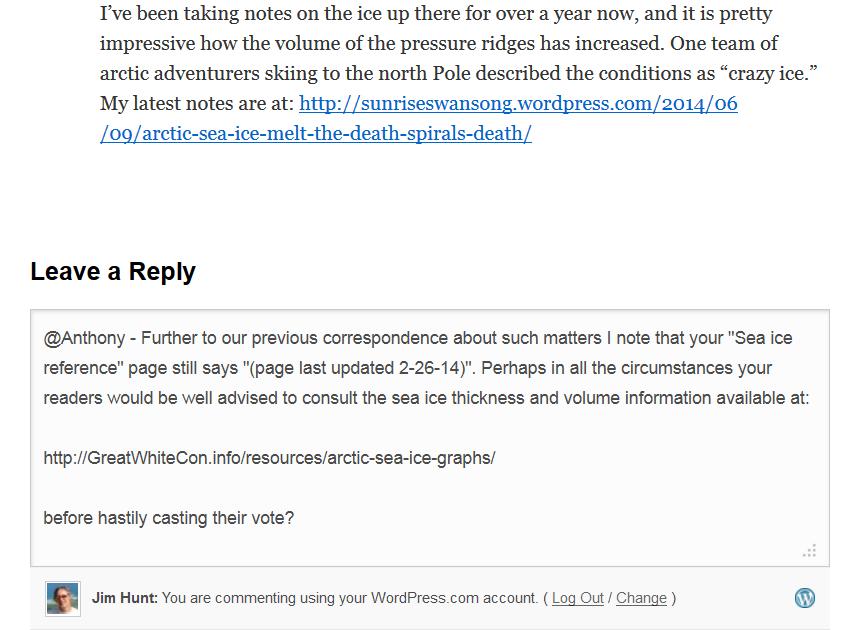
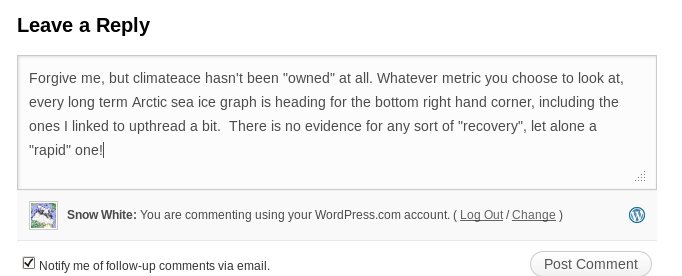
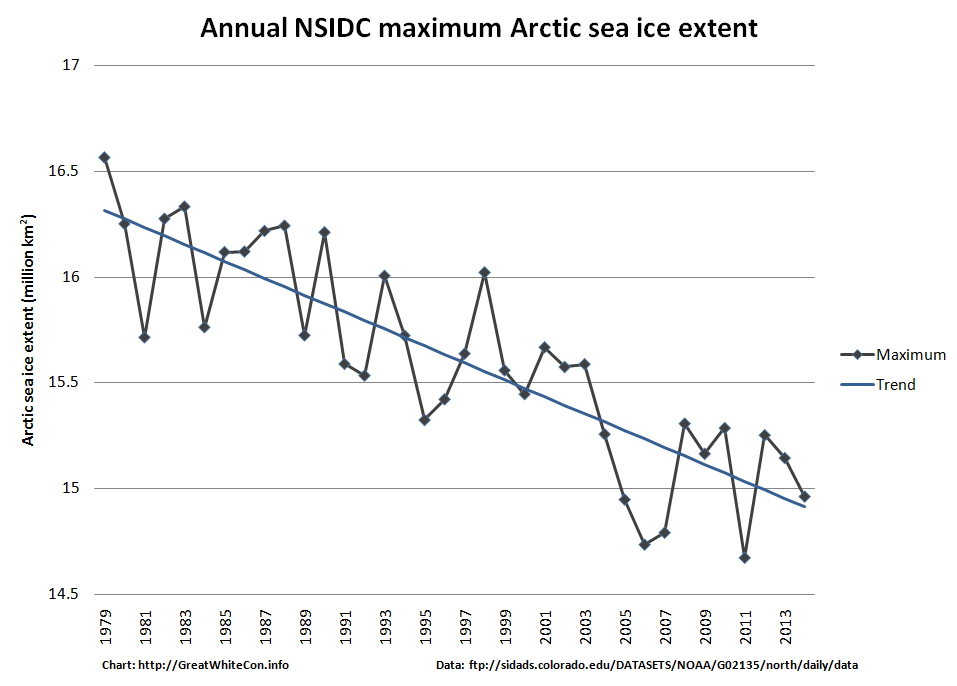
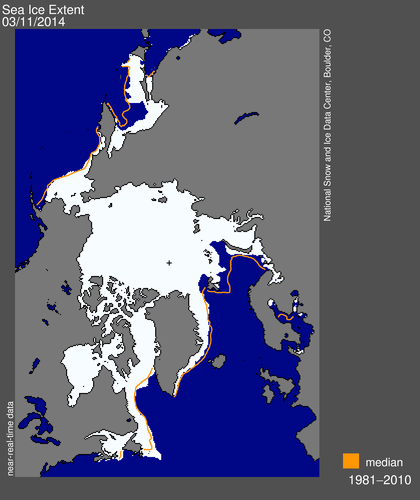
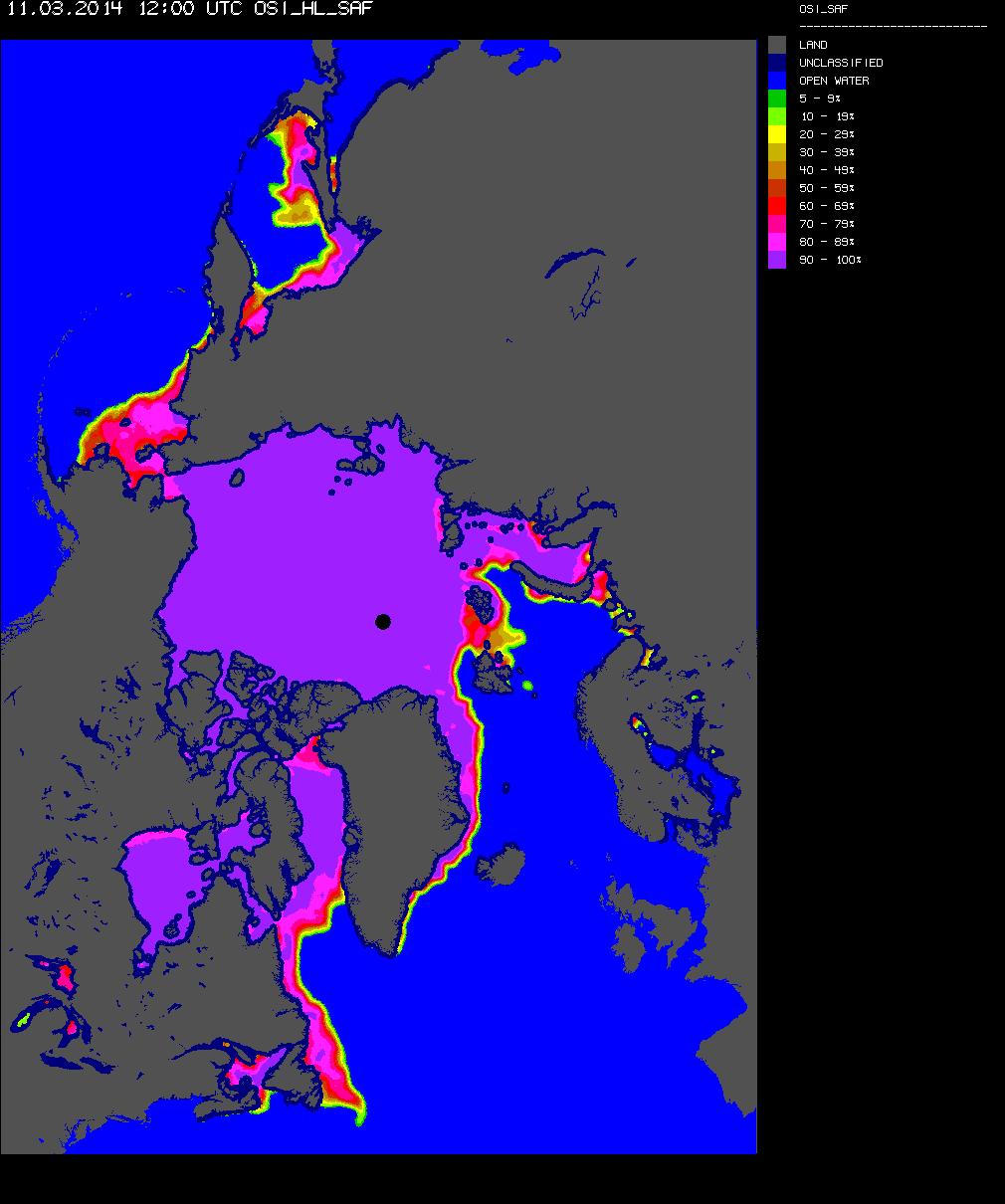
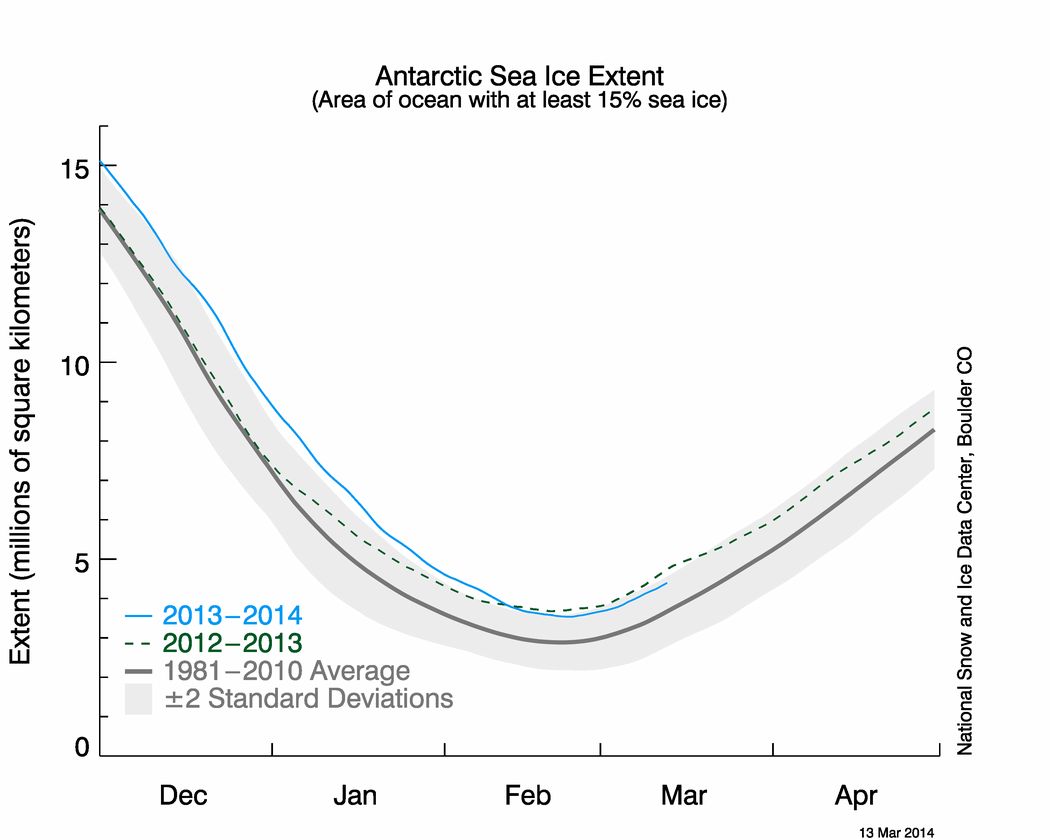
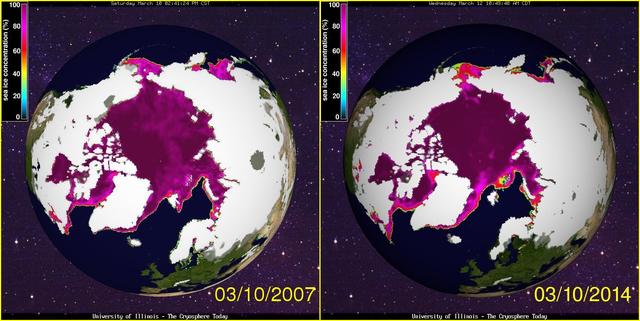
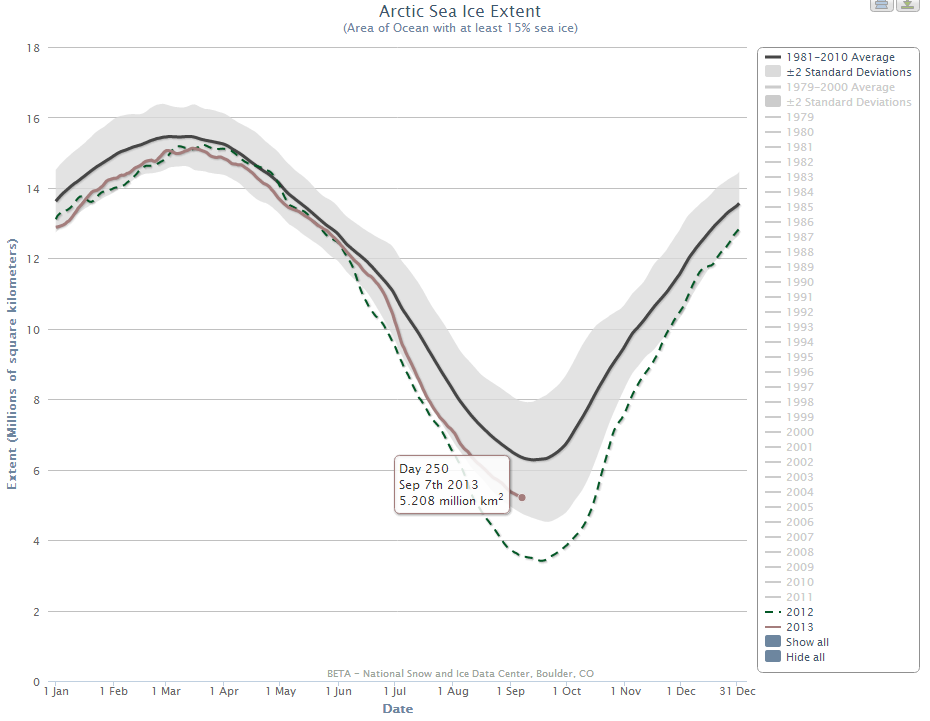
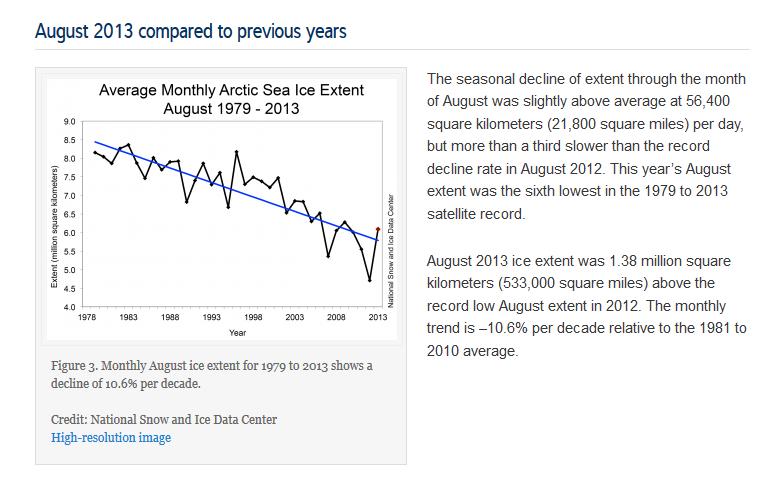
Particularly in view of the recent inclement weather in this neck of the woods, I thought perhaps you might be interested in taking a closer look at the most recent evidence concerning this “hot topic”?
I hope you enjoy your meeting!
Best wishes,
Jim Hunt
AKA “Snow White”!
Them:
Hi Jim,
Thanks for drawing our attention to the blog. It is not a topic that we’re planning something on imminently, but it is something we are certainly keeping an eye on and will come back to in future.
With the able assistance of some of the regular readers of Steve Goddard’s so called “Real Science” blog I have drawn up a checklist of questions to answer should you (or any “sceptics” you may be aware of) be suffering from the delusion that the sea ice in the Arctic is “recovering” or “rebounding”:
Us:
1. Is the NSIDC daily Arctic sea ice extent number for March 8th 2014 the lowest on record for that day of the year? Yes or No?
2. Is the Cryosphere Today Arctic sea ice area number for March 8th 2014 the lowest on record for that day of the year? Yes or No?
3. Is the IJIS Arctic sea ice extent number for March 9th 2014 the lowest on record for that day of the year? Yes or No?
4. What credible evidence can you provide to show that “The Arctic is getting colder”?
5. In what way has the NSIDC’s data been “contaminated by Mann”?
6. Where might one find “empirical data that hasn’t been contaminated” if not from the likes of NOAA/NASA/JAXA et. al.
8. How much sea ice do you suppose will be left in the Gulf of St. Lawrence by September? [2014-3-12 20:26]
9. Which version of “the [thickness/volume] truth” do you choose to believe? [2014-3-14 09:30]
10. When was it that the DMI “changed the way they read/interrupt coastal features [which] they incorporated into their extent/area numbers”? [2014-3-15 15:08]
11. Why have we been accused of “a lie” and “put on ignore”? [2014-3-16 15:12]
12. Please be so good as to provide us with a link that describes “the modeling used by NSIDC to ‘create’ these numbers” [2014-3-20 13:00]
Now seems like an entirely appropriate time to bring the latest “Shock News!” from the Arctic to the attention of the “mass media” here in once Great Britain. Here’s a copy of an email I sent to John Wellington over at The Mail earlier today:
Us:
Re: PCC – Global cooling in an ideal world
Hello again John,
Further to our previous correspondence on this controversial topic here is the latest “shock news” from the Arctic, hot off the presses down here at Ivory Towers:
In view of the recent inclement weather in this neck of the woods, perhaps you could forward it on to one of your finest investigative reporters for me?
Best wishes,
Jim Hunt
Them:
It’s now March 15th 2014, and this morning I received a “Dear Jim” note from John:
Dear Jim,
Nice to hear from you and I trust you were not hit by the West Country floods, climate-influenced or not.
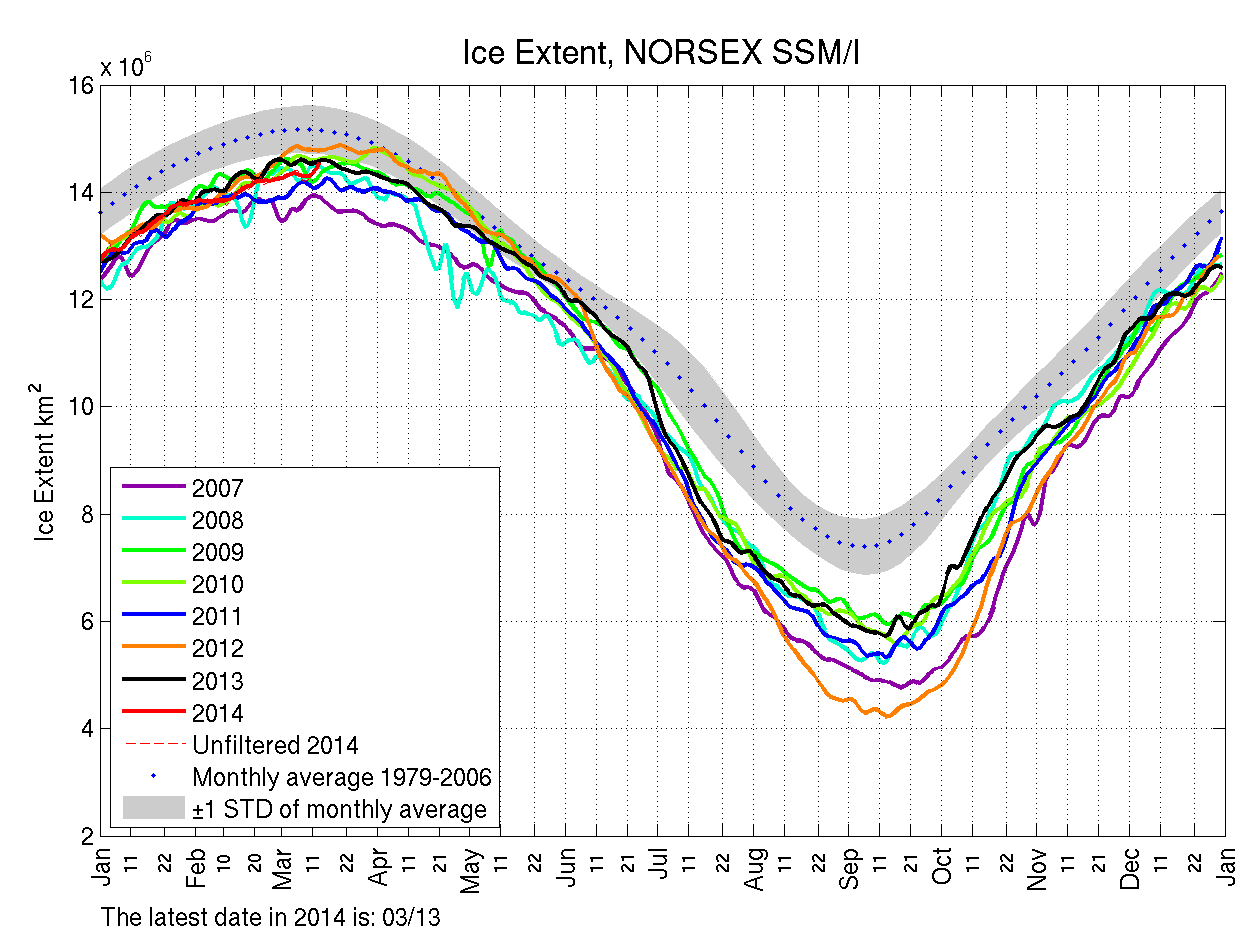
I have discussed your message with a colleague who is interested in these things and we conclude that March is a little early in the year to be drawing significant conclusions. I have been shown some different graphs that appear to show 2014 is not dissimilar to the last few years. I am attaching these for your information.
Best regards
John
Us:
Dear John,
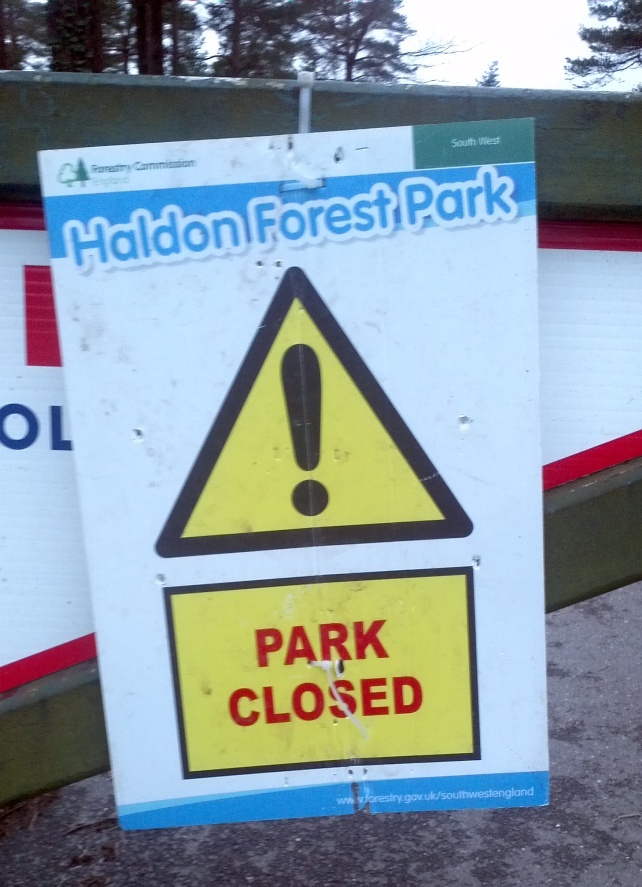
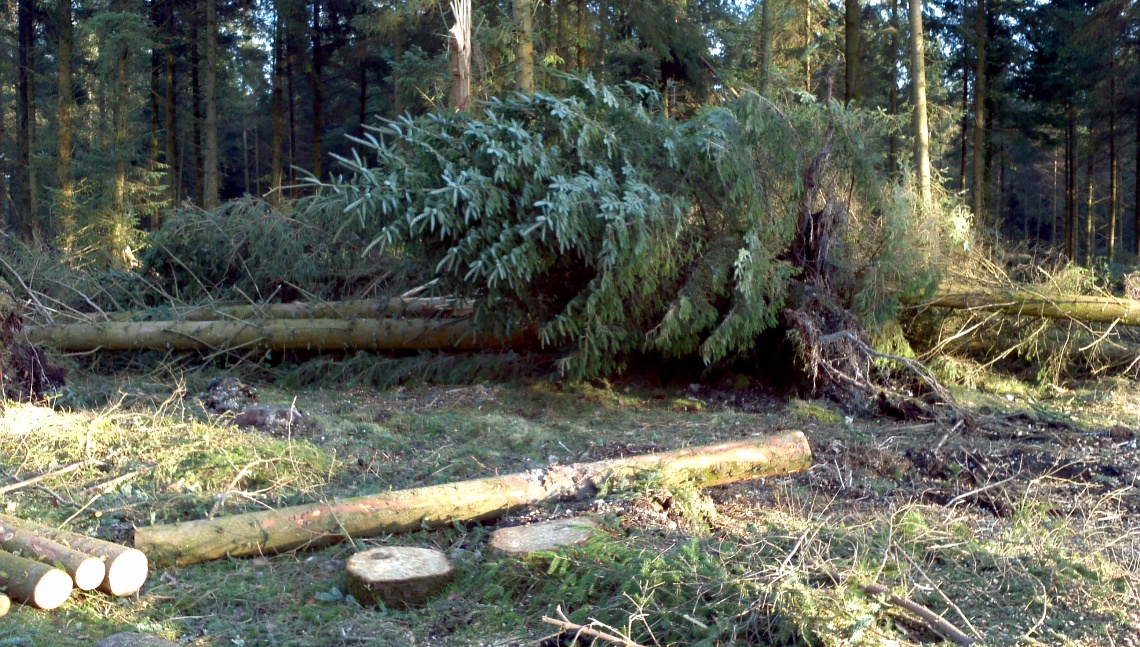
Thank you for your kind words. We’re situated halfway up Haldon, so we avoided the worst of the inclement weather. The top of the hill took a bit of a battering however.
The entrance to Haldon Forest Park on February 24th 2014Haldon Forest Park on March 8th 2014
Our garden suffered a bit too, but thankfully the house was OK.
A new spring gushes from the side of Haldon Hill on Valentine’s Day 2014
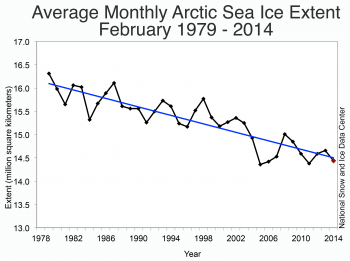
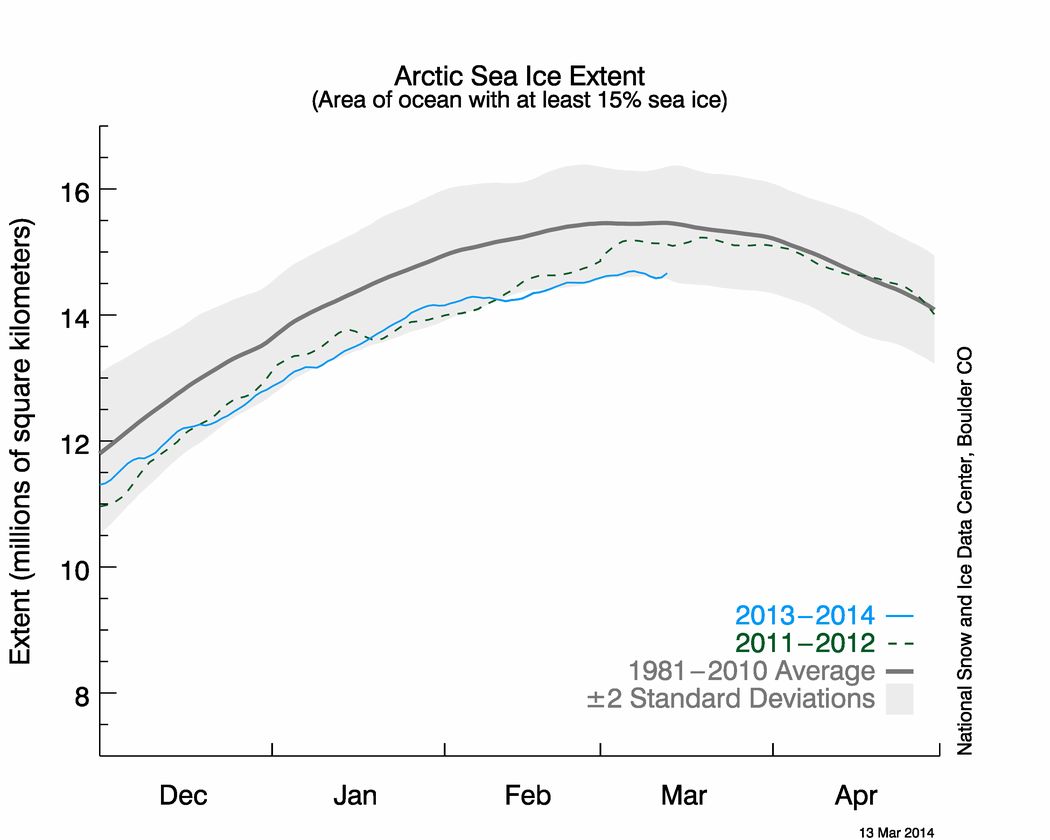
Regarding your own attachments, perhaps in the first instance you might ask your colleague to explain why he or she chooses to send you a NORSEX Arctic sea ice extent graph rather than one from the NSIDC, which I believe we established last summer is The Mail’s oracle on such matters? Please take a good look at the latest NSIDC equivalent to the Antarctic extent graph you sent me, which I attach for your convenience.
NSIDC Arctic sea ice extent graph for March 13th 2014
Whilst you’re at it perhaps you could also ask your colleague to answer at least the first three of these simple questions:
You may also wish to pass on to your colleague the shock news that earlier this week the daily atmospheric carbon dioxide readings from Mauna Loa rose above 400 ppm almost 2 months earlier than last year?
It has just been brought to my attention that the topic of Arctic sea ice was raised by Angela Rippon on the edition of “Broadcasting House” that aired on BBC Radio 4 on the morning of Sunday September 29th. In her review of that Sunday’s papers Angela had the following to say:
Them:
Tucked away at the bottom of a page in the Mail on Sunday is a piece saying that “The Arctic ice experts have made a million kilometer blunder“, and this is again using computers, and apparently the official source of information on polar ice caps have got it’s figures for the recovery of the Arctic cap wrong by a million square miles, and they say that this was actually a typo, it was a typographical error, and there are no plans to make a statement on the change because it was just an error in the data. So what data CAN we believe?
Us:
Obviously that’s my own transcript rather than an official one from the BBC. By all means listen to the programme yourself, and let me know if I’ve inadvertently got something wrong. According to the BBC’s “BH” page it will be available for download there for another 25 days.
Now obviously as soon as I’ve finished writing this article I’m going to amble over to the BBC web site to lodge a formal complaint, in which I shall suggest that Angela and the BBC’s “BH” team read this website from cover to cover, starting with this very article.
As a preliminary answer to Angela’s final question I would like to suggest:
Certainly not the Mail on Sunday’s, and not the British Broadcasting Corporation’s either, unless they correct this particular blunder quicker than you can say “Global COOLING!” whilst simultaneously sipping a piña colada by the side of Santa’s super new low albedo summer swimming pool!
I just received an emailed letter from the Telegraph’s Head of News, part of which reads as follows:
The Telegraph has looked into the matters you raise. As far as the points concerning ice extent are concerned, the incorrect information was derived from data published by the National Snow and Ice Data Center (NSIDC). The mistaken information was due to a typographical error, which the NSIDC only corrected after the article that incorporated it was published. We have since updated the online versions of the article and explained why this was necessary.
There is no mention in the letter of any “updates” or “corrections” being put into print. The Telegraph are thus telling much the same story as the Mail, which is of course wholly unsatisfactory when it comes to correcting the long list of “inaccuracies and misrepresentations” they have recently published regarding the sorry state of sea ice in the Arctic. This is how they’ve done it:
There has been a 29 per cent increase in the amount of ocean covered with ice compared to this time last year, the equivalent of 533,000 square miles.
In a rebound from 2012’s record low, an unbroken ice sheet more than half the size of Europe already stretches from the Canadian islands to Russia’s northern shores, days before the annual re-freeze is even set to begin.
The Northwest Passage from the Atlantic to the Pacific had remained blocked by pack-ice all year, forcing some ships to change their routes.
One ship has now managed to pass through, completing its journey on September 27.
with the following additional “explanation” at the end:
Update: As at the date the article was first posted it relied on information about ice extent from the Nasa-funded National Snow and Ice Data Centre (NSIDC). This information contained a typographical error which the NSIDC subsequently corrected. The article has been amended in line with the correct information.
In addition, we have amended our reference to the Northwest Passage following the successful traverse, completed on September 27 after our article was published, of the Danish bulk carrier Nordic Orion.
Us:
Should The Telegraph’s Head of News be interested in some slightly stale Northwest Passage news, here’s a picture published on econnexus.org on September 4th in an article linked to below, which takes a close look at the “pack ice” supposedly “blocking the North West Passage” on that date:
Sea ice concentration in the Northwest Passage on September 4th 2013, according to AMSR2
Update: After this article was published, a bulk carrier – the MV Nordic Orion – was able to pass through the Northwest Passage on its way from Vancouver to Finland.
c) “That has been enough to make a mockery of a much-publicised prediction, six years ago, by Prof Wieslaw Maslowski, of the Naval Postgraduate School in Monterey, California, that the Arctic would be entirely ice-free by 2013”
Our title today is an allusion to Bill Bruford’s “Five Percent For Nothing”, from the 1971 album “Fragile” by Yes. Here’s what the cover looks like:
Fragile cover art, by Roger Dean (image Wikipedia)
Them:
A chilly Arctic summer has left nearly a million more square miles of ocean covered with ice than at the same time last year – an increase of 60 per cent.
The sums are obviously rather tricky, so we’ve enlisted the aid of a spreadsheet. Here’s what it reveals to us:
Metric
Date
2012
2013
Increase
NSIDC Daily Extent (million km²)
Day 249
3.558
5.236
47.2%
NSIDC Daily Extent (million km²)
Sep 8th
3.523
5.179
47.0%
NSIDC Daily Extent (million km²)
Aug 27th
3.94
5.632
42.9%
NSIDC Daily Extent (million km²)
Aug 15th
4.845
6.159
27.1%
NSIDC Monthly Extent (million km²)
August
4.71
6.09
29.3%
Verdict:
Whichever way you look at things, on a “same time last year” basis at least, the magic number of 60% seems to be out of reach. Whatever the arithmetic David Rose actually performed, whether mentally or on his pocket calculator, it would appear not to involve comparing like with like. We have asked David and the Mail on a number of occasions what numbers he started from and what calculations he performed. We have received no answers as yet.
Getting back to our title, when you start to look at Arctic sea ice volume instead of extent, 160% of almost nothing is still almost nothing:
Let’s start at the very beginning. A very good place to start!
Them:
A chilly Arctic summer has left nearly a million more square miles of ocean covered with ice than at the same time last year – an increase of 60 per cent.
The Mailet. al. say “Nearly a million square miles”. When the floods in Boulder have receded the NSIDC will once again say “Just over half a million square miles”. Is that discrepancy sufficient to satisfy the Press Complaints Commission’s definition of “inaccurate, misleading or distorted information”?
This website uses cookies to improve your experience. We'll assume you're ok with this, but you can opt-out if you wish. Cookie settingsACCEPT
Privacy & Cookies Policy
Privacy Overview
This website uses cookies to improve your experience while you navigate through the website. Out of these, the cookies that are categorized as necessary are stored on your browser as they are essential for the working of basic functionalities of the website. We also use third-party cookies that help us analyze and understand how you use this website. These cookies will be stored in your browser only with your consent. You also have the option to opt-out of these cookies. But opting out of some of these cookies may affect your browsing experience.
Necessary cookies are absolutely essential for the website to function properly. This category only includes cookies that ensures basic functionalities and security features of the website. These cookies do not store any personal information.
Any cookies that may not be particularly necessary for the website to function and is used specifically to collect user personal data via analytics, ads, other embedded contents are termed as non-necessary cookies. It is mandatory to procure user consent prior to running these cookies on your website.