The United Kingdom’s House of Lords are an unlikely bunch to be bundled under the banner of “alarmist” or even “warmist”. Nevertheless their Select Committee on the Arctic has just published a report entitled “Responding to a Changing Arctic“, and in this video the chairman of that committee, Lord Teverson, briefly outlines their findings:
Note that he starts by saying that:
Absolutely the obvious thing first of all is that with the temperatures going up [in the Arctic] at twice the rate of the rest of the world the thing that everybody is seeing is reduction in sea ice which has reduced quite substantially over recent years, and of course a lot of the Arctic is land and we have the melting ice on Greenland particularly, which is causing sea level rises in the rest of the world.
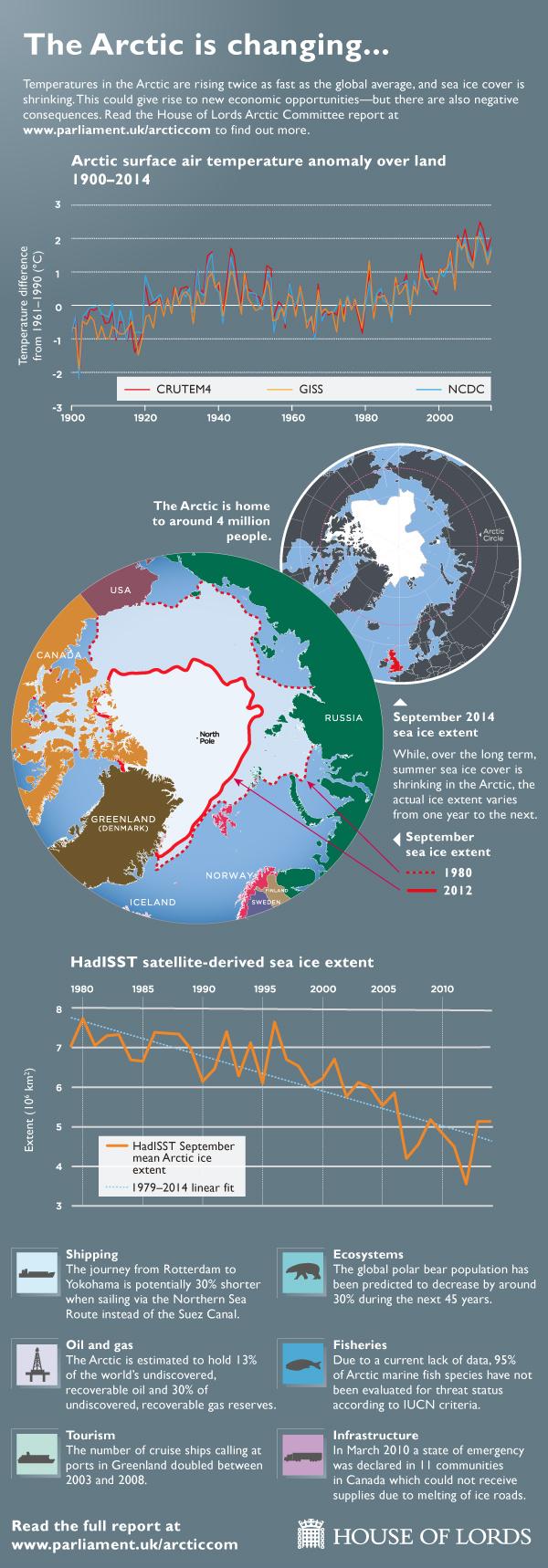
In order to get that message across the committee has also produced the following infographic:
which shows how the temperature over land has been increasing whilst the sea ice extent in the Arctic has been declining. The committee have also made all the learned evidence they received whilst producing their report publicly available. Professor Andy Shepherd from the University of Leeds told the committee that:
The majority of sea ice changes witnessed in “the past 50 or 60 years” could be attributed to greenhouse gas emissions and their effect on temperatures in the Arctic region.
and:
Suggested that the length of the solar melt season had increased by around five days per decade, causing additional melting and retreat of the ice.
How strange then, that David Rose made no mention of any of this when reporting Prof. Shepherd’s views in his “Myth of Arctic meltdown” article of August 31st 2014?
How strange also, that Christopher Booker maintained in his “The fiddling with temperature data is the biggest science scandal ever” article of February 8th 2015 that:
The ice-melt is not caused by rising global temperatures at all.
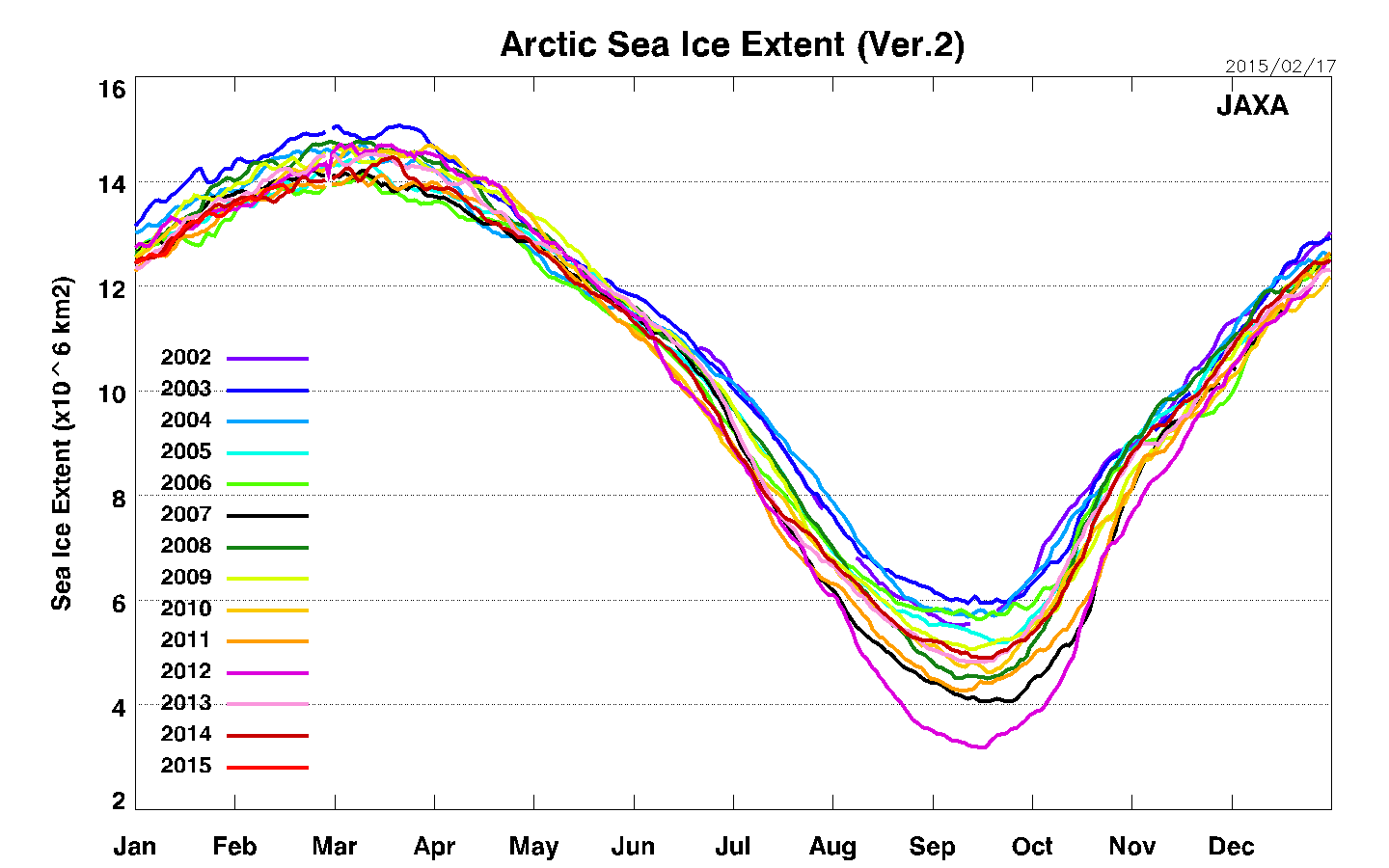
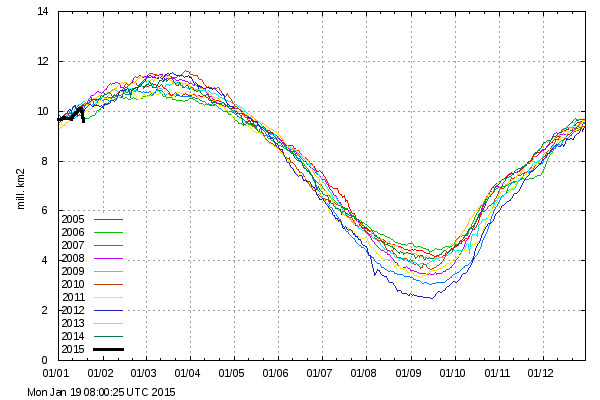
You can of course argue that this is mere cherry picking on our part, not to mention the slight economy with the truth in our necessarily punchy headline today. Nonetheless it is an actual fact that the IARC-JAXA Information System AMSR2 Arctic sea ice extent metric for February 17th 2015 reads 13,770,330 km² which is the lowest ever for the day of the year in a record going back to 2003. This follows a remarkably large fall (for the time of year) of 113,505 km² from yesterday’s reading of 13,883,835 km². Here’s our evidence:
If you prefer to look at numbers instead of pictures then by all means try here instead for proof of the latest shock news from the Arctic.
If instead you prefer moving pictures, here’s an animation based on high resolution AMSR2 data from the University of Hamburg that may provide a few clues about how all this came about:
Can you see how the recent storms in the North Atlantic have “pulled” and then “pushed” the sea ice to thisese new record lows?
Please also note this warning message on the IJIS “Arctic Sea Ice Monitor” web page:
Thank you for visiting our website.
This site will be closed on February 22, and might be unstable from February 15, 2015.
New sea ice monitor website will be coming soon. Stay tuned.
Meanwhile, almost equivalent information can be available at:
As regular readers will have realised by now, we are subject to a continuing barrage of verbal abuse as we fearlessly pursue our goal of telling the truth about the Arctic whatever the obstacles. Following the latest such episode we have consulted our learned counsel and decided to publish the spiciest episodes here. By the time August 2015 draws to a close a poll of our loyal reader(s) will determine which of our utterers of undeleted expletives will be awarded a wild card entry into the 2015 Great White Con Arctic Basin Big Wave Surfing Contest.
3) Roger (“TallBloke”) Tattersall, UKIP’s Yorks and North Lincs Energy and Climate Change spokesman and prospective parliamentary candidate for Pudsey, with:
As you are no doubt aware, I am rather dissatisfied with the responses I have received from you to my assorted enquiries over recent weeks. In such circumstances I took the liberty of attempting to communicate directly with David Rose about the wide variety of inaccurate and/or misleading statements about climate science that your esteemed organ has published over recent weeks. Here is a brief overview of my recent conversations with your leading investigative journalist on Twitter:
I am away at present so only dimly aware of what this is about.
You have sent two links to Twitter events. One appears to show some people talking about climate change. The other is a personal exchange between you and David Rose. You accused him of writing fiction. He told you to go away.
I have no comment about either.
Best regards,
John
Us:
Dear John,
I acknowledge receipt of your email.
I also have no further comment to make on yesterday’s article at this time.
Best wishes,
Jim Hunt
Time passes….. Until on February 19th 2015:
Hello John,
Perhaps you could pass the latest “shock news” from the Arctic on to David Rose for me?
Should we now expect a revealing article on the long term Arctic sea ice trend to be prominently featured in the Mail this coming Sunday?
Thanks in anticipation,
Jim
Them:
Dear Jim
Thanks for sending this.
John
Us:
My pleasure John,
Does this mean you are finally back at the desk on which the David Rose buck stops? Here is some undeniably “Shock News!” from the Arctic for you both:
Much like yesterday I was idly browsing my Twitter feed this morning whilst simultaneously consuming my habitual Sunday coffee + BLT when news reached me that David Rose had published yet another article in the Mail on Sunday that purports to investigate “climate science”:
Perhaps due to all our sterling work here at the Great White Con extracting the Michael, it doesn’t seem to fall under the Mail’s “Great Green Con” banner anymore. The general drift is the same though, apart from that lurid title of course!
I think current ‘renewable’ sources such as wind and ‘biomass’ are ruinously expensive and totally futile. They will never be able to achieve their stated goal of slowing the rate of warming and are not worth the billions being paid by UK consumers to subsidise them.
Skipping over all the (merely rhetorical?) self-pity, let’s move on to the climate science, such as it is!
Last Monday… a Met Office press release stated: ‘2014 one of the warmest years on record globally’.
The previous week, almost every broadcaster and newspaper in the world had screamed that 2014 was emphatically The Hottest Year Ever. They did so because NASA told them so. Its Goddard Institute for Space Studies (GISS), the custodian of one of the main American temperature datasets, had announced: ‘The year 2014 ranks as Earth’s warmest since 1880.’ If you’d bothered to click on the sixth of a series of internet links listed at the end of the press release, you could have found deep within it the startling fact that GISS was only ’38 per confident’ that 2014 really did set a record.
In other words, it was 62 per cent confident that it wasn’t. Another detail was that the ‘record’ was set by just two hundredths of a degree. The margin of error was five times bigger. These boring details were ignored. The ‘2014 was a record’ claim went to the very top. President Obama cited it in his State of the Union address. Like the news outlets, it’s unlikely he will issue a correction or clarification any time soon.
Al Gore repeatedly suggested that the Arctic would likely be ice-free in summer by 2014. In fact Arctic ice has recovered in the past two years, and while the long term trend is down, it looks likely to last several more decades.
Unfortunately that is misleading and/or inaccurate, apart from the bit about the long term trend in Arctic sea ice. Hence I’ve just popped yet another Dear John (and Poppy) virtual letter to Mr. Rose’s managing editor (+PA) at the Mail on Sunday, and I’ll have yet another long chat with IPSO tomorrow:
Us:
Dear John/Poppy,
Would you believe that David Rose is at it again? Not only is he “interviewing” himself in your esteemed organ today, he is misrepresenting the underlying science yet again.
I really must insist that whoever owns the desk on which the buck currently stops for the following article starts communicating with me yesterday if not sooner:
I am away from the office until Tuesday, February 10. I will be checking emails occasionally but if your message is urgent, please contact my assistant Poppy Swann.
Ultimately followed by:
Dear Jim
If you have a complaint about last Sunday’s article, you should set out exactly what it is. If you disagree with any opinions expressed you are welcome to write a letter that we will consider for publication.
You mention that you have sent us a number of inquiries recently. The only other, to my knowledge is that you wanted to know the source of some data that David Rose mentioned in an article some months ago. David Rose told me it came from the official website. Perhaps my colleague Poppy Hall can find it for you since David is probably unwilling to help after your insult.
Best regards
John
Us:
Dear Poppy (and John)
Please would you ask David to let me know where exactly, and on which “official website”, he obtained the DMI extent numbers he quoted in his article last Summer?
FYI John, at Poppy’s suggestion I have also emailed the editorial team @MailOnline. They have yet to even acknowledge receipt of my email of January 26th.
Regular readers of our so far somewhat surreal reporting from up here in the penthouse suite at the summit of the Great White Con ivory towers will no doubt have noticed that we like to concentrate on the facts about the Arctic, whilst occasionally naively exploring assorted psychological aspects of journeying through the “denialosphere”.
Today, however, we’re branching out in a different direction with the aid of our first ever guest post. It has been carefully crafted by Sou Bundanga of the HotWhopper blog, on the topic of the “journalistic tricks that professional disinformers use”. It covers some of the same ground as a recent post of our own, albeit from a rather different angle. If you would like view the original version on Sou’s blog please click here. Alternatively, please continue below the fold:
This is just a short article to show the journalistic tricks that professional disinformers use. It consists of excerpts from an article by David Rose, who is paid to write rubbish for the Mail on Sunday, a UK tabloid of the sensationalist kind. He’d probably claim that he’s just “doing his job”. His job being to create sensationalist headlines and not bother too much about accuracy, but to try to do it in such a way as to stop the paper ending up in court on the wrong end of a lawsuit. Just. (The paper probably doesn’t mind so much getting taken to the Press Complaints Commission. )
The Nasa climate scientists who claimed 2014 set a new record for global warmth last night admitted they were only 38 per cent sure this was true.
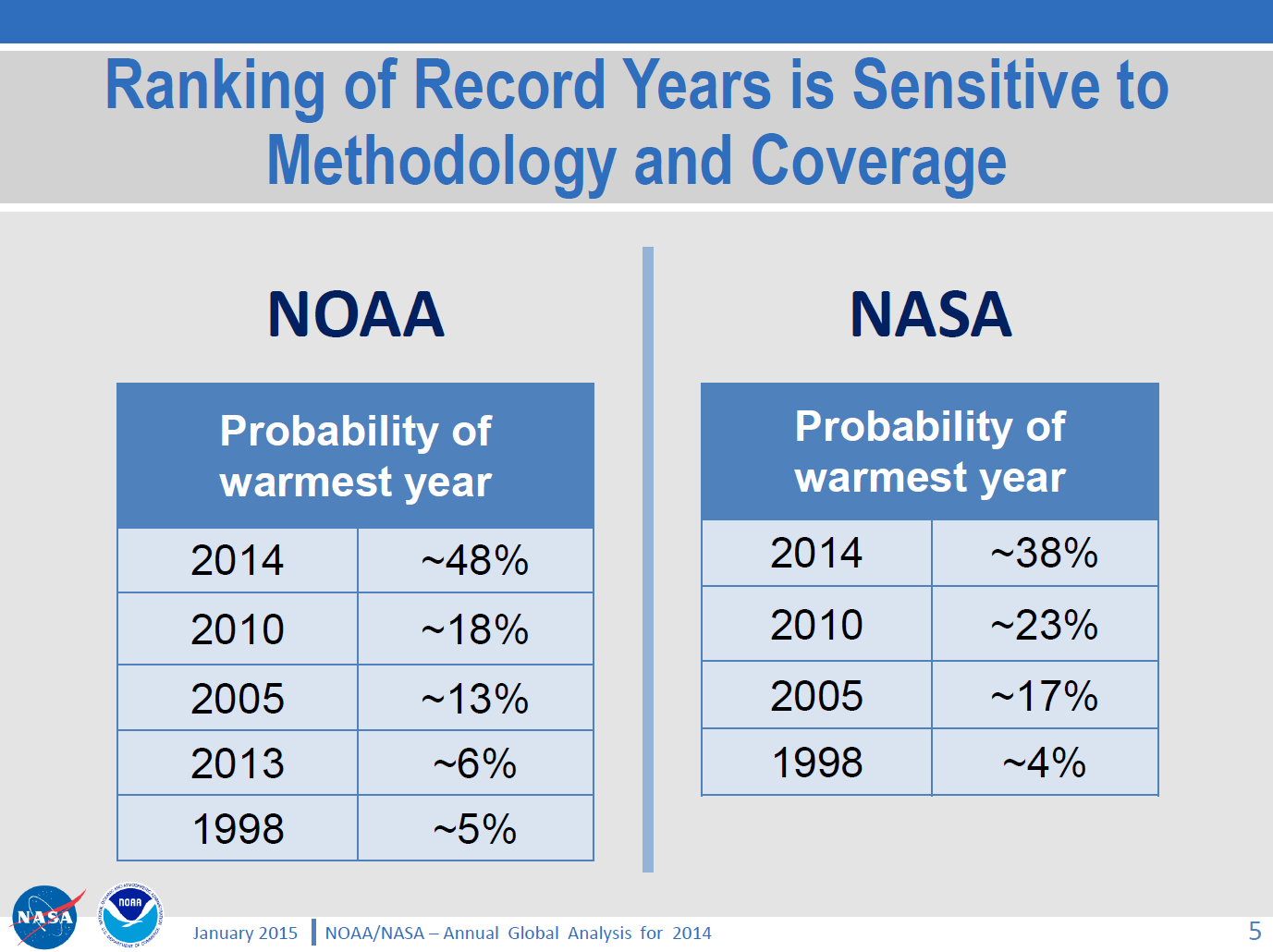
First of all notice the use of the word “admitted” – as if it was something that the scientists were forced into, whereas in fact they provided all the information in their press briefing. Notice also that David has taken one number and used it out of context. The 38% number is the probability that 2014 is the hottest year compared to the probability that 2010 and other hot years are the hottest. 2010, the next hottest year, only got a 23% probability by comparison. Here is the table showing out of 100%, what the different probabilities are:
You can see how David misused the 38% number. In fact the odds of it being the hottest year on record are the highest of the lot.
In a press release on Friday, Nasa’s Goddard Institute for Space Studies (GISS) claimed its analysis of world temperatures showed ‘2014 was the warmest year on record’.
The claim made headlines around the world, but yesterday it emerged that GISS’s analysis – based on readings from more than 3,000 measuring stations worldwide – is subject to a margin of error. Nasa admits this means it is far from certain that 2014 set a record at all.
See how David Rose distorts things. How he uses rhetoric, abusing words like “emerged” and “claim” and “admits”. He is also being “economical with the truth” about the “far from certain”. He just made that one up. It may not be “certain”, but it is much more certain than “far from”. And it is more “certain” that 2014 was the hottest year than that any other year was the hottest year.
If David Rose were arguing that you beat your wife, even though you don’t, he’d probably write it up as:
The so-called scientist claims that he doesn’t beat his wife. He admits that he cannot prove he doesn’t beat his wife. However this journalist can show that it has emerged that his claim is subject to a margin of error. 95% of wife-beaters deny beating their wives.
And I doubt he’d add the confidence limits to the 95% number!
David Rose continues his deception writing:
Yet the Nasa press release failed to mention this, as well as the fact that the alleged ‘record’ amounted to an increase over 2010, the previous ‘warmest year’, of just two-hundredths of a degree – or 0.02C. The margin of error is said by scientists to be approximately 0.1C – several times as much.
That section by David Rose contains the same journalistic tricks of rhetoric, as well as an error of fact. The margin of error of the annual averaged global surface temperature is described in the GISS FAQ as ±0.05°C:
Assuming that the other inaccuracies might about double that estimate yielded the error bars for global annual means drawn in this graph, i.e., for recent years the error bar for global annual means is about ±0.05°C, for years around 1900 it is about ±0.1°C. The error bars are about twice as big for seasonal means and three times as big for monthly means. Error bars for regional means vary wildly depending on the station density in that region. Error estimates related to homogenization or other factors have been assessed by CRU and the Hadley Centre (among others).
If the press release didn’t include any confidence limits, then where did David Rose get his numbers from you may ask? That’s a very good question. It turns out that NOAA and NASA held a press conference, during which they showed some slides and explained the confidence limits, among other things. So David Rose was being very deceitful, wasn’t he. Which isn’t a surprise.
What bit of deception does he swing to next? Well here it is. You be the judge:
As a result, GISS’s director Gavin Schmidt has now admitted Nasa thinks the likelihood that 2014 was the warmest year since 1880 is just 38 per cent. However, when asked by this newspaper whether he regretted that the news release did not mention this, he did not respond. Another analysis, from the Berkeley Earth Surface Temperature (BEST) project, drawn from ten times as many measuring stations as GISS, concluded that if 2014 was a record year, it was by an even tinier amount.
More rhetorical tricks using words like “admitted”. More deception by David Rose. When and how and where did David Rose ask Gavin Schmidt the question? I don’t know. It looks as if it was via an accusatory tweet of the type “have you stopped beating your wife”, like this one on January 17th:
@ClimateOfGavin why didn’t you mention the size of the 2014 “record” and the uncertainty in the GISS press release? Do you regret this?
That’s about it. I’ll leave it to you to decide who is the grand deceiver.
I’d not trust David Rose, denier journo, with a single fact. It is alleged that he is a master of deception. He’d probably try to claim he is just doing his job.
Thanks very much for that article Sou, and by way of conclusion here’s yet another tweet from Gavin Schmidt, this time from January 24th:
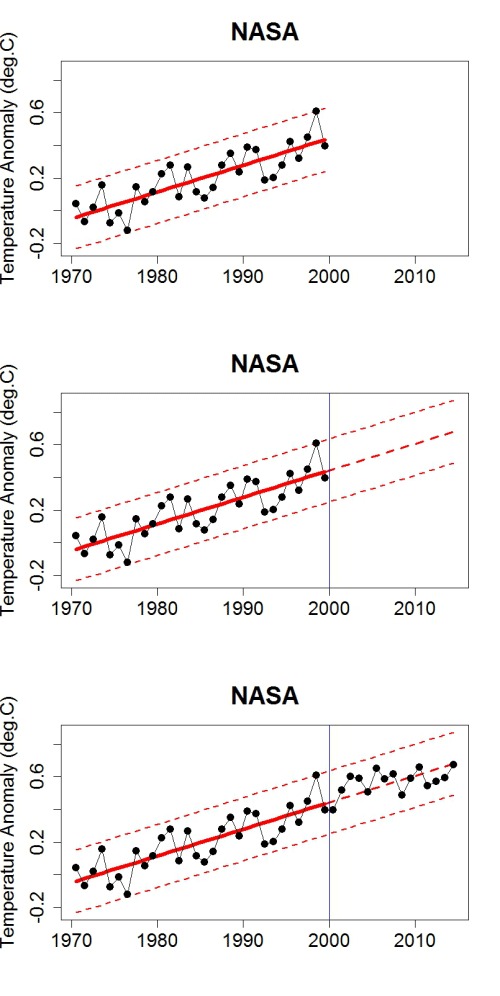
I don’t usually get involved in debates about “the global warming pause”, but as you will eventually see there is an Arctic connection, so please bear with me. Personally I reckon “global heat” is more relevant than “global surface temperature”, but nevertheless NASA and NOAA issued a “news release” a couple of days ago stating that:
The year 2014 ranks as Earth’s warmest since 1880, according to two separate analyses by NASA and National Oceanic and Atmospheric Administration (NOAA) scientists.
The 10 warmest years in the instrumental record, with the exception of 1998, have now occurred since 2000. This trend continues a long-term warming of the planet, according to an analysis of surface temperature measurements by scientists at NASA’s Goddard Institute of Space Studies (GISS) in New York.
In an independent analysis of the raw data, also released Friday, NOAA scientists also found 2014 to be the warmest on record.
The announcement was accompanied by this video:
I figured our old friend David Rose would have something to say about all that in the Mail on Sunday, and I was not disappointed. Yesterday David reported, in bold headlines:
Nasa climate scientists: We said 2014 was the warmest year on record… but we’re only 38% sure we were right
Nasa’s Goddard Institute for Space Studies claimed its analysis of world temperatures showed ‘2014 was the warmest year on record’
But it emerged that GISS’s analysis is subject to a margin of error
Nasa admits this means it is far from certain that 2014 set a record at all
David Rose includes this NASA video in the online version of his article:
which finishes up showing the Arctic blanketed in red for the period 2010-14. In the body of the article David suggests that:
GISS’s director Gavin Schmidt has now admitted Nasa thinks the likelihood that 2014 was the warmest year since 1880 is just 38 per cent.
but for some strange reason David neglects to mention this NASA/NOAA “press briefing“, which includes the following figure:
As you can see and hear, Gavin Schmidt’s “admission” was pretty public, and available for anyone doing their due diligence on this thorny topic to see well before the Mail on Sunday published David Rose’s article. For still more from Gavin see also the second half of yet another video from NASA, which we’ve hastily made embeddable from YouTube since NASA’s Goddard Space Flight Center don’t seem to have done so themselves as yet:
[Edit – 23/01/2015]
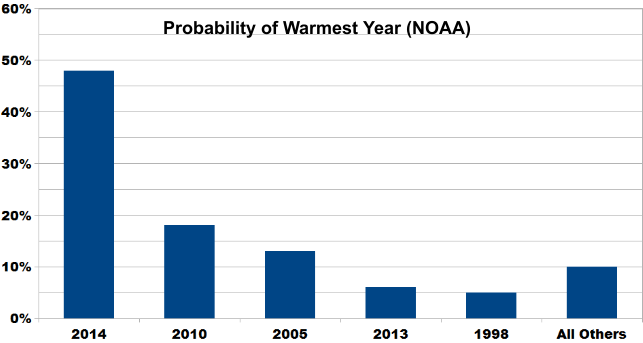
By way of further elucidation of the NASA/NOAA table of probabilities above, here’s a new graphic courtesy of Skeptical Science:
The probability of 2014 being the warmest year (due to margin of uncertainty and the small differences between years) is almost ten times that of 1998. And the contrarians were very certain that year was warm!
Does that help make things clearer, for those who evidently have difficulty understanding statistics?
[/Edit]
I also figured that the likes of “Steve Goddard” and Anthony Watts would be jumping on the same bandwagon, so you can imagine my disappointment when I discovered that they have both, unlike Gavin, blocked me from their Twitter feeds! Venturing over to the so called “Real Science” blog instead I discovered that Steve/Tony does at least read Gavin’s Twitter feed, although apparently not NASA/NOAA press briefings:
Them:
Implausible Deniability
Gavin is playing his usual game, trying to cover his ass with “uncertainty” that wasn’t mentioned in the NASA press release.
They get the propaganda out there for the White House and major news outlets, then try to generate implausible deniability through back channels like twitter. None of this was mentioned in the NASA press release.
Us:
I take it you weren’t on the call either Tony? Have you by any chance seen this press briefing?
THE DATA ON WEATHER AND CLIMATE (NASA AND NOAA) CAN BE COMPARED TO THE STOCK MARKET ON WALL STREET, MUCH CORRUPTION AND ALTERING. WE ARE NOT GUARANTEED A CERTAIN TEMPERATURE EVERYDAY; ALTHOUGH, THAT IS WHAT THEY WOULD HAVE US THINK, JUST BECAUSE OF SEASONS IN GENERAL.
Further to previous correspondence on similar matters, on January 27th 2015 I received the following email from the Personal Assistant to John Wellington, David Rose’s managing editor at the Mail on Sunday:
Dear Jim,
Thank you for your email.
I am afraid the best person to deal with your question is John Wellington who will reply on his return at the beginning of March.
Thank you for your patience.
Kind regards
Poppy Hall
Us:
CC: IPSO.co.uk
Dear Poppy,
Thanks for that information, but I am afraid my almost infinite patience in this matter is exhausted.
In John’s absence perhaps I might reiterate a question posed by Bob Ward of The Grantham Institute on Twitter yesterday:
Predictable that Mail on Sunday censored all letters pointing out errors in last week's article by @DavidRoseUK about @NASAGISS
Please would you ask whoever owns the desk on which the buck currently stops for the article entitled “Nasa climate scientists: We said 2014 was the warmest year on record… but we’re only 38% sure we were right” by David Rose to communicate with me as soon as possible. FYI – Here it is:
As I’m sure you must realise by now, unfortunately it includes some inaccurate and/or misleading statements which as far as I can ascertain have still not been publicly corrected.
Best wishes,
Jim Hunt
Post Script:
Bob Ward lodged a formal complaint with the Independent Press Standards Organisation about the Mail on Sunday article. Their conclusion?
The complaint was not upheld.
Remedial Action Required – N/A
Date complaint received: 13/02/2015
Date decision issued: 22/06/2015
Their “reasoning”?
The Committee noted that information about the margin of error had been made available by GISS, but that it was not in dispute that these details had been omitted from the press release. The article had made clear that this specifically was the basis for its criticism of Nasa, and the newspaper was entitled to present its view that this omission represented a failure on the part of the organisation. While the information had been released by Nasa, it had been released to a limited selection of people, in comparison to those who would have had access to the press release, and had not been publicised to the same level as the information in the release. The press briefing images referred to by the complainant were available on Nasa’s website, but were not signposted by the press release. In this context, it was not misleading to report that the information relating to the margin of error had emerged in circumstances where the position was not made clear in the press release. While these details of the margin of error may have been noted in a press briefing two days previously, rather than “yesterday”, as reported, this discrepancy did not represent a significant inaccuracy requiring correction under the terms of the Code.
The most widely used measurements of Arctic ice extent are the daily satellite readings issued by the US National Snow and Ice Data Center, which is co-funded by NASA.
He also stated that:
For years, many have been claiming that the Arctic is in an ‘irrevocable death spiral’, with imminent ice-free summers bound to trigger further disasters. These include gigantic releases of methane into the atmosphere from frozen Arctic deposits, and accelerated global warming caused by the fact that heat from the sun will no longer be reflected back by the ice into space.
Judith Curry, professor of earth and atmospheric sciences at Georgia Institute of Technology in Atlanta, said last night: ‘The Arctic sea ice spiral of death seems to have reversed.’
All of which got me thinking. Why did David Rose speak to a professor of earth and atmospheric sciences when researching his article, rather than an expert on Arctic sea ice? Why, indeed, did he not speak to the man who originally coined the “Death spiral” metaphor? Seeking answers to these troubling questions amongst others, I called the National Snow and Ice Data Center in Boulder, Colorado. I enquired whether I might be able to speak with Mark Serreze, who is currently director of the NSIDC. Shortly after that Mark called me back and I was able to ask him a number of questions.
My first question was whether David Rose or anyone from the Mail on Sunday had been in touch with the NSIDC recently. The answer was “No”. Next I enquired whether the “Death spiral” story was apocryphal or not. Mark told me he did recall saying something along those lines, but that he couldn’t recall the exact circumstances. Doing my own due diligence (unlike the Mail!) the earliest reference I could find suggested that “the circumstances” involved a telephone interview much like the one I was in the middle of. In an article dated August 27th 2008 the Reuters environment correspondent reported that:
This year’s Arctic ice melt could surpass the extraordinary 2007 record low in the coming weeks. Last year’s minimum ice level was reached on September 16, according to the National Snow and Ice Data Center.
Even if no records are broken this year, the downward trend in summer sea ice in the Arctic continues, the Colorado-based center said. Last year’s record was blamed squarely on human-spurred climate change.
“No matter where we stand at the end of the melt season it’s just reinforcing this notion that Arctic ice is in its death spiral,” said Mark Serreze, a scientist at the center. The Arctic could be free of summer ice by 2030, Serreze said by telephone.
Mark confirmed to me that he still stood by his 2030 estimate for the onset of a seasonally ice free Arctic, although “most models say more like 2050”.
Next I asked him whether he agreed that “The Arctic sea ice spiral of death has reversed.” He said that he agreed with the statement attributed to Dr. Ed Hawkins near the end of the Mail article, that “There is undoubtedly some natural variability on top of the long-term downwards trend caused by the overall warming“. However 2 years worth of data certainly didn’t constitute “a recovery”. It was more like “a one week retracement in the US stock market. The long term trend in extent is definitely downwards”.
In conclusion I asked Mark to offer his best estimate for Arctic sea ice extent at this summer’s minimum. He told me that even at this late stage some of that “natural variability” could affect the outcome, but that the NSIDC extent “will probably end up on a par with 2013”.
I have also had an email conversation with Andrew Shepherd, the British “expert in climate satellite monitoring” whose views about Arctic sea ice were reported in the Mail on Sunday’s article. He told me that:
Arctic sea ice cover is expected to continue to decline, with the possibility of ice-free summers in the next 20-30 years. Climate model predictions tend to be at the upper end of this range, whereas projections of past observations tend to be at the lower end. Once we are able to include direct measurements of thickness from CryoSat-2, I expect the accuracy of predictions will improve.
If nothing else changes, then the recovery in Arctic sea ice thickness will wind the clock backwards a few years, but there is no reason to believe this is anything other than a temporary reprieve due to one cool summer.
Finally, for the moment at least, I also called the Danish Meteorological Institute. Along with the NSIDC their Arctic sea ice extent figures were quoted by David Rose. Along with the NSIDC they told me that they had received no enquiries recently from Mr. Rose or anyone else at the Mail on Sunday.
Regular readers may recall that way back when in September 2013 we wondered why David Rose hadn’t seen fit to reproduce any visualisations of Arctic sea ice concentration in a previous article about Arctic sea ice, particularly when his source materials from the NSIDC contained some very nice examples.
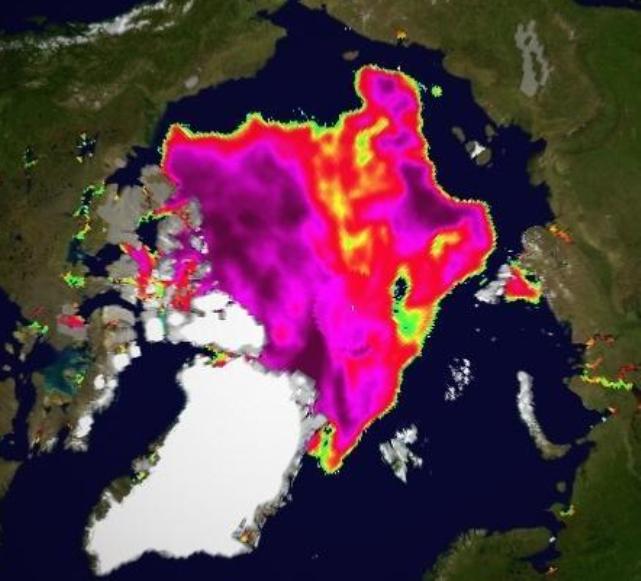
Today we are pleased to be able to inform you that David has now followed our long standing advice, and his article in the Mail on Sunday yesterday included two such “stunning satellite images”. Of course they are not really “photographic” images, any more than the visualisations of Arctic sea ice extent that David was so keen to show his loyal readers last time around were. Unfortunately David neglected to include a “stunning satellite concentration visualisation” for August 25th 2013 in yesterday’s article. We are pleased to be able to help correct that no doubt inadvertent oversight, albeit somewhat belatedly, with the able assistance of the Department of Atmospheric Sciences at the University of Illinois and their Cryosphere Today web site:
Stunning satellite images show summer ice cap is thicker and covers 1.7 million square kilometres MORE than 2 years ago…despite Al Gore’s prediction it would be ICE-FREE by now
Seven years after former US Vice-President Al Gore’s warning, Arctic ice cap has expanded for second year in row.
In the first paragraph of his article Mr. Rose continued:
The speech by former US Vice-President Al Gore was apocalyptic. ‘The North Polar ice cap is falling off a cliff,’ he said. ‘It could be completely gone in summer in as little as seven years. Seven years from now.’
Those comments came in 2007 as Mr Gore accepted the Nobel Peace Prize for his campaigning on climate change.
But seven years after his warning, The Mail on Sunday can reveal that, far from vanishing, the Arctic ice cap has expanded for the second year in succession – with a surge, depending on how you measure it, of between 43 and 63 per cent since 2012.
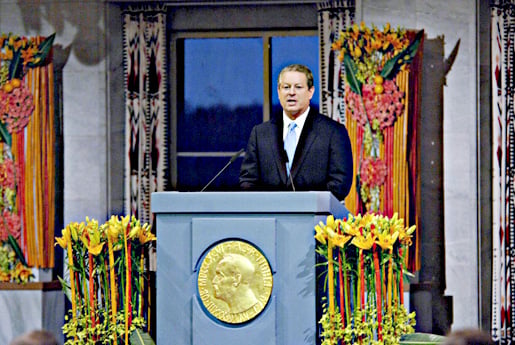
Would it surprise you to learn that when it comes to reporting Nobel Prize acceptance speeches Mr. Rose has as much difficulty separating fact from fiction as he does when reporting on the state of the sea ice in the Arctic? What do you suppose Mr. Gore actually said in his Nobel lecture in Oslo in December 2007? It’s not hard to find out. Here’s a picture of the former US Vice-President at the time:
Skip to 4:30 minutes into the video and you will discover that what Al actually said was:
Last September 21st, as the Northern Hemisphere tilted away from the sun, scientists reported with unprecedented alarm that the North Polar ice cap is, in their words, “falling off a cliff.” One study estimated that it could be completely gone during summer in less than 22 years. Another new study, to be presented by U.S. Navy researchers later this week, warns it could happen in as little as seven years. Seven years from now.
For those who, like David Rose, apparently have difficulty in understanding English I suppose I now need to point out that the “falling off a cliff” phrase should be attributed to some unnamed scientists, not to Al Gore. You will no doubt have noted that Mr. Gore didn’t actually say the words put into his mouth by Mr. Rose, and that the sentiment that “it could happen in as little as seven years” is not in fact “Al Gore’s prediction” at all, and should instead be attributed to some unnamed “U.S. Navy researchers”.
For the hard of hearing amongst you:
Al Gore never “predicted” that the Arctic would be ICE-FREE by now!
Would it surprise you to discover that David Rose has misrepresented the “new study” that Al Gore referred to in 2007 as well, by some strange coincidence at around this time last year? I refer you to our article on that topic from September 15th 2013, and reiterate for the benefit of those who seem unable to understand either English or Mathematics that a “projection” is not the same thing as a “prediction”, and that Professor Wieslaw Maslowski’s statement that “if this trend persists the Arctic Ocean will become ice-free by around 2013” is not at all the same thing as David Rose’s (mis)interpretation that “The Arctic will be ice-free in summer by 2013”.
The obvious conclusion, or so it seems to me at least, is that Mr. Rose should stop pretending to be an investigative reporter and concentrate in future on his evident talent as a writer of speculative fiction.
[P.S. September 2nd 2014]
For some strange reason this post seems to have attracted a lot of interest over on Twitter. Here are the edited highlights!
This website uses cookies to improve your experience. We'll assume you're ok with this, but you can opt-out if you wish. Cookie settingsACCEPT
Privacy & Cookies Policy
Privacy Overview
This website uses cookies to improve your experience while you navigate through the website. Out of these, the cookies that are categorized as necessary are stored on your browser as they are essential for the working of basic functionalities of the website. We also use third-party cookies that help us analyze and understand how you use this website. These cookies will be stored in your browser only with your consent. You also have the option to opt-out of these cookies. But opting out of some of these cookies may affect your browsing experience.
Necessary cookies are absolutely essential for the website to function properly. This category only includes cookies that ensures basic functionalities and security features of the website. These cookies do not store any personal information.
Any cookies that may not be particularly necessary for the website to function and is used specifically to collect user personal data via analytics, ads, other embedded contents are termed as non-necessary cookies. It is mandatory to procure user consent prior to running these cookies on your website.