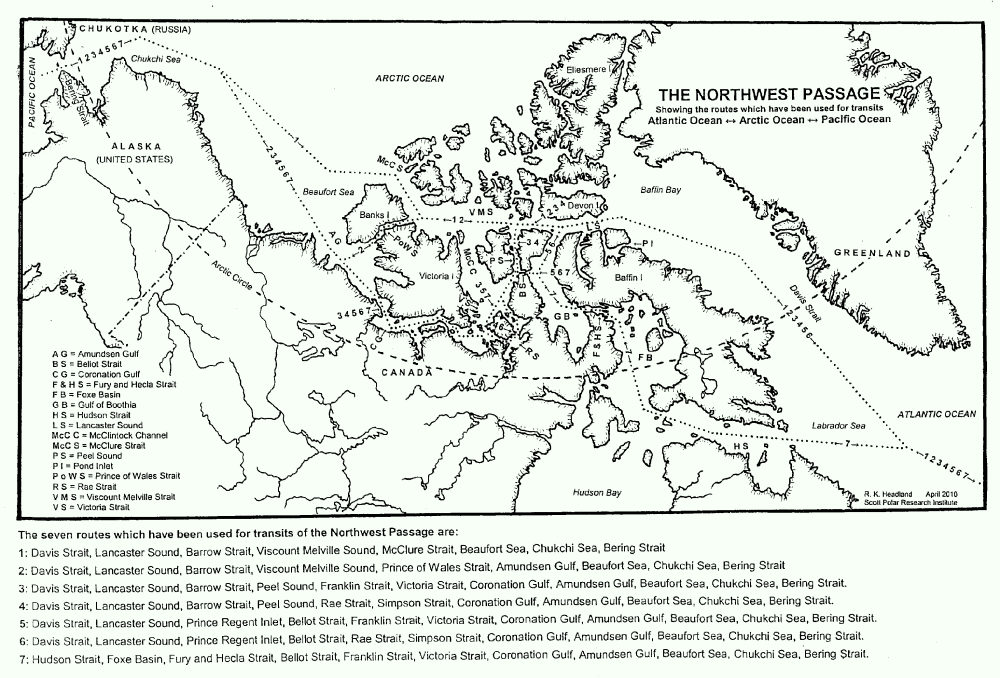
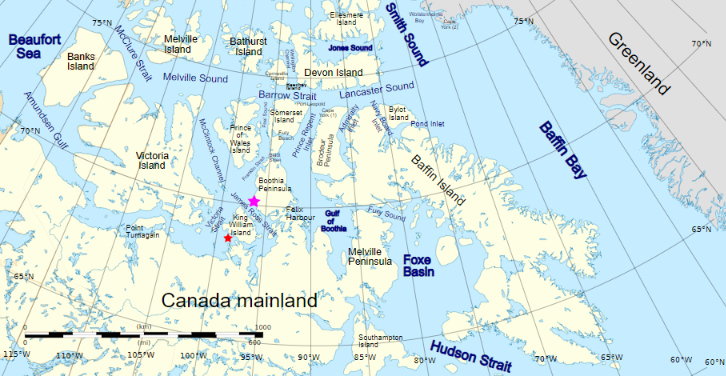
Some “pleasure craft” are currently heading up the west coast of Greenland en route to the Bering Strait via Lancaster Sound and one of the assorted routes through the Canadian Arctic Archipelago. For those of you unfamiliar with the geography of the Northwest Passage, here are couple of hopefully helpful maps:
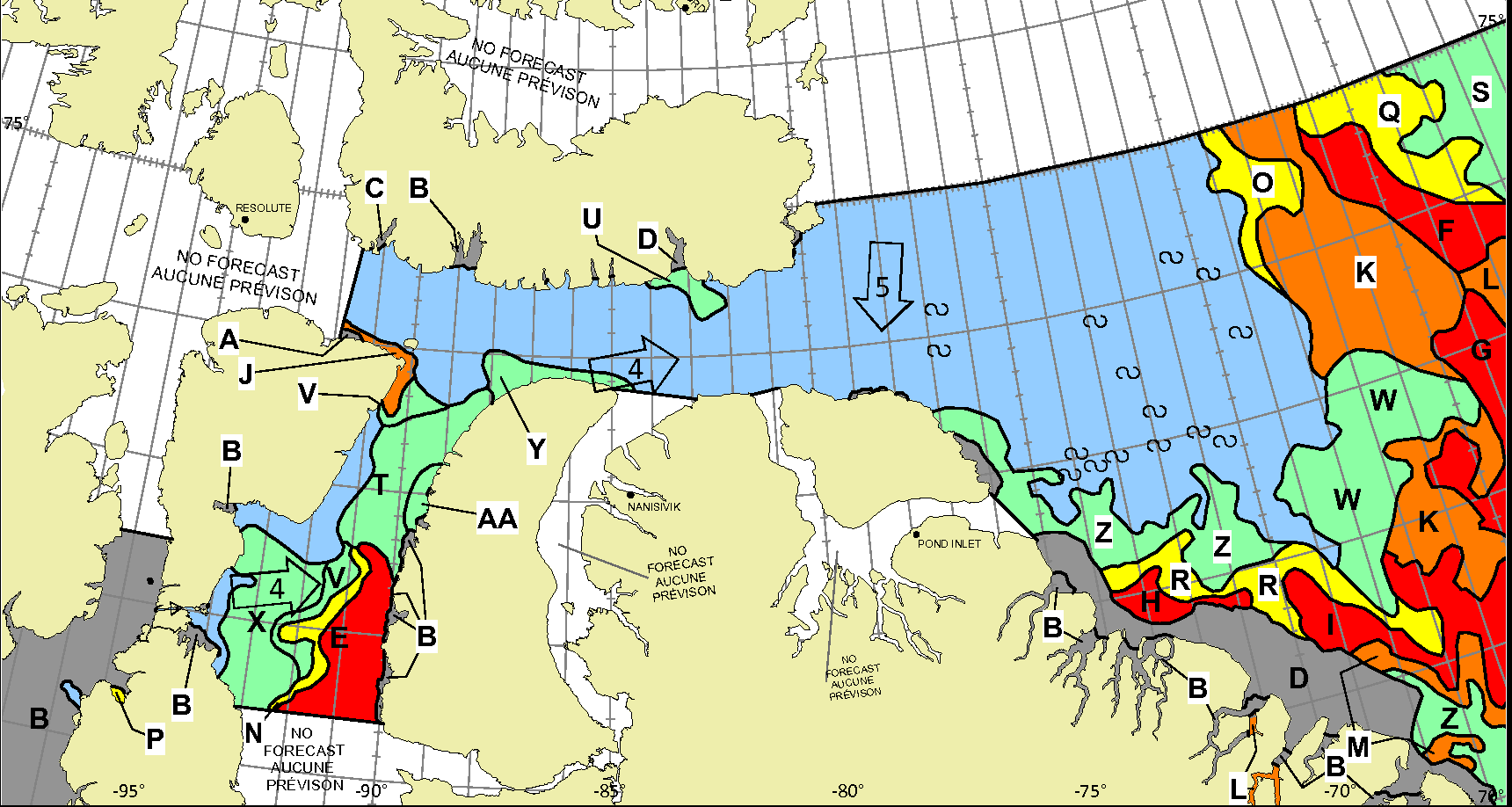
Whilst there is still ice blocking the route across Baffin Bay from Greenland, the Canadian Ice Service has already started daily coverage of the heart of the southern route through the Northwest Passage. There’s plenty of open water in Lancaster Sound and low concentration sea ice in Prince Regent Inlet:
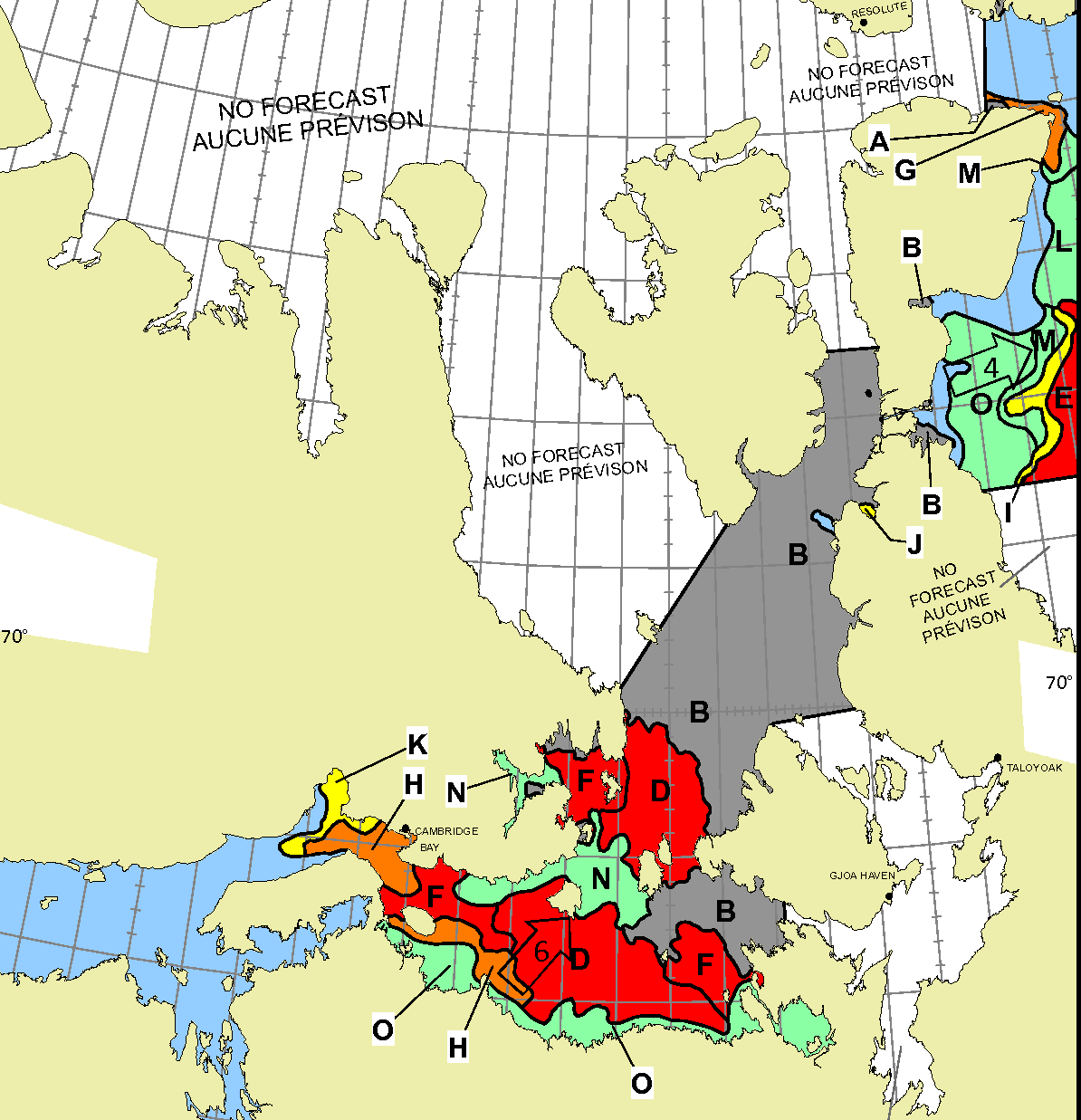
Further south there is also open water in the Coronation Gulf, but the fast ice between Peel Sound and King William Island has not yet started breaking up:
This slightly cloudy satellite image of the Canadian Arctic Archipelago also shows that the exit of the northern route via McClure Strait into the Beaufort Sea is already navigable:
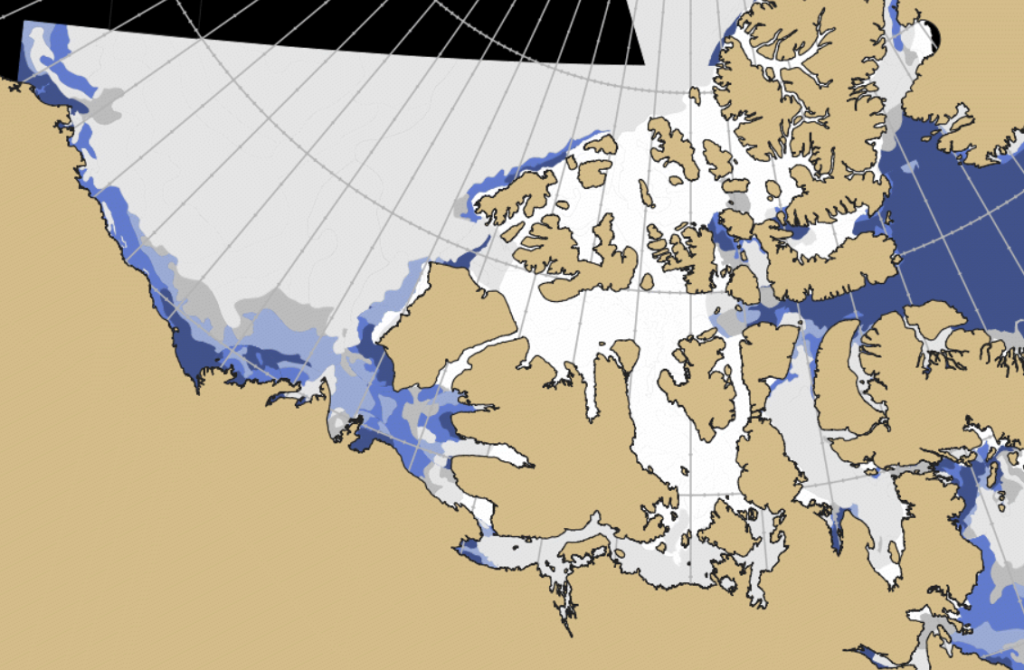
Whilst the Northern Sea Route has opened up early this year, it will be be quite some time before the Northwest Passage follows suit. Nevertheless our old friend Northabout is currently sailing in the direction of Baffin Bay, so now seems as good a time as any to start speculating about the prospects for the Summer of 2020. The passage through Lancaster Sound is already navigable:
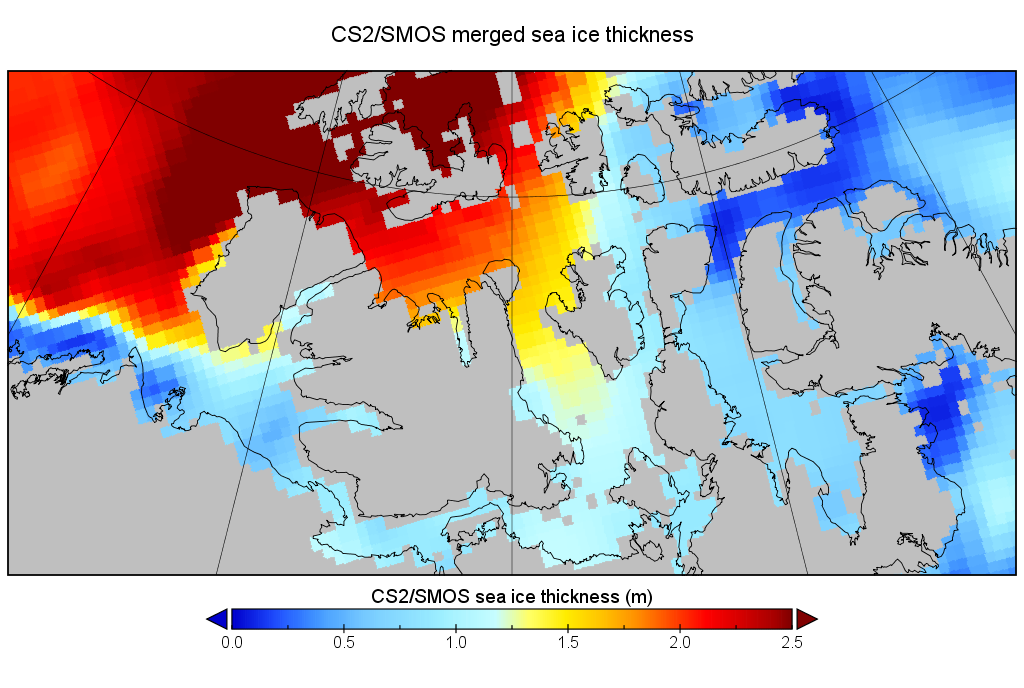
However as the Canadian Ice Service chart also shows, there are still some areas of 7-8/10 concentration along the Beaufort Sea coast en route to the Bering Strait. The central Canadian Arctic Archipelago is solid 9-10/10 at present, but what’s the prognosis? Here’s the final CryoSat-2/SMOS merged thickness map of the winter, from April 15th:
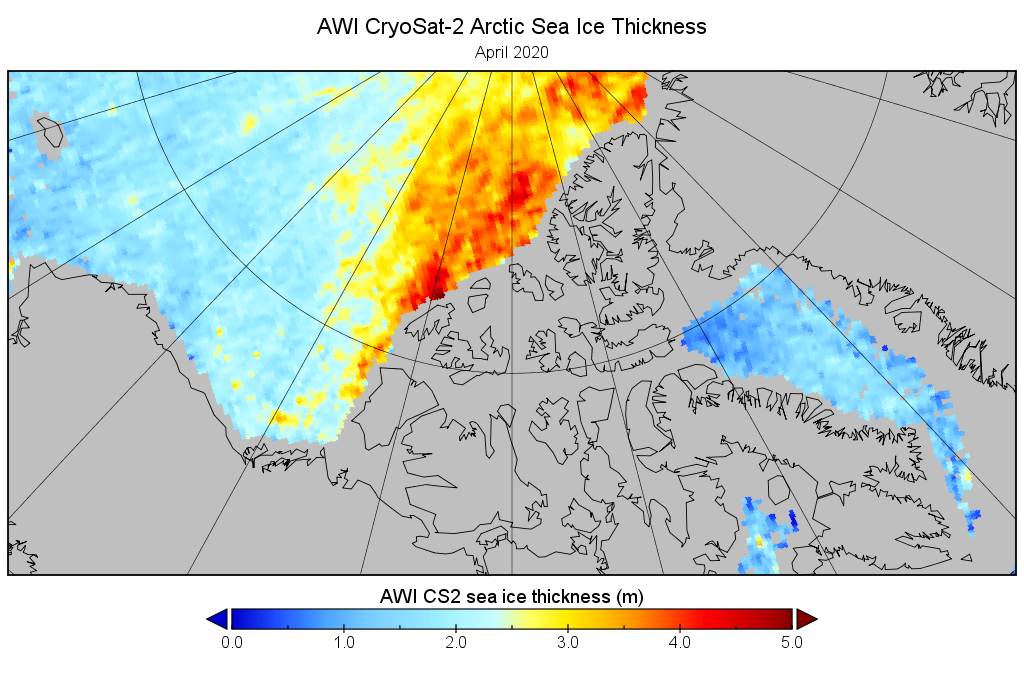
This suggests that the thickest ice on the usual route through the Northwest Passage for small vessels was around 1.2 meters in Larsen Sound. This seemed suspiciously thin to me, so next I tried the underlying Cryosat-2 data from AWI, which revealed this:
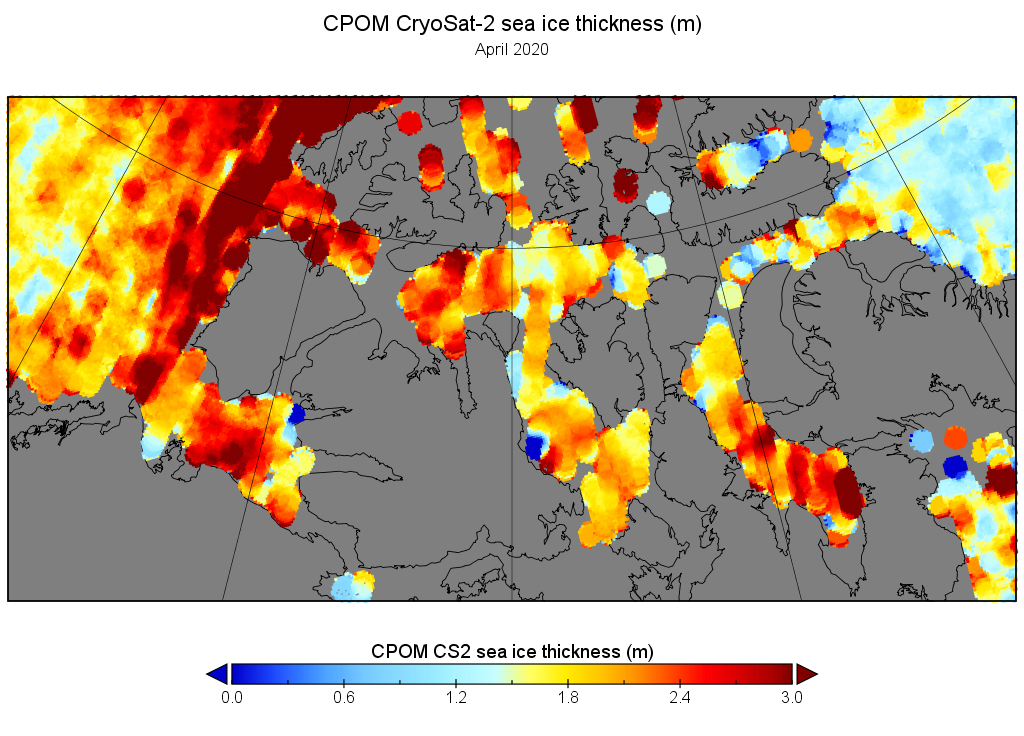
Suspicions confirmed. It looks like AWI are ignoring CS2 data in the CAA for 2020! Here’s how the CPOM Cryosat-2 numbers look for a similar date, which is hopefully nearer the reality:
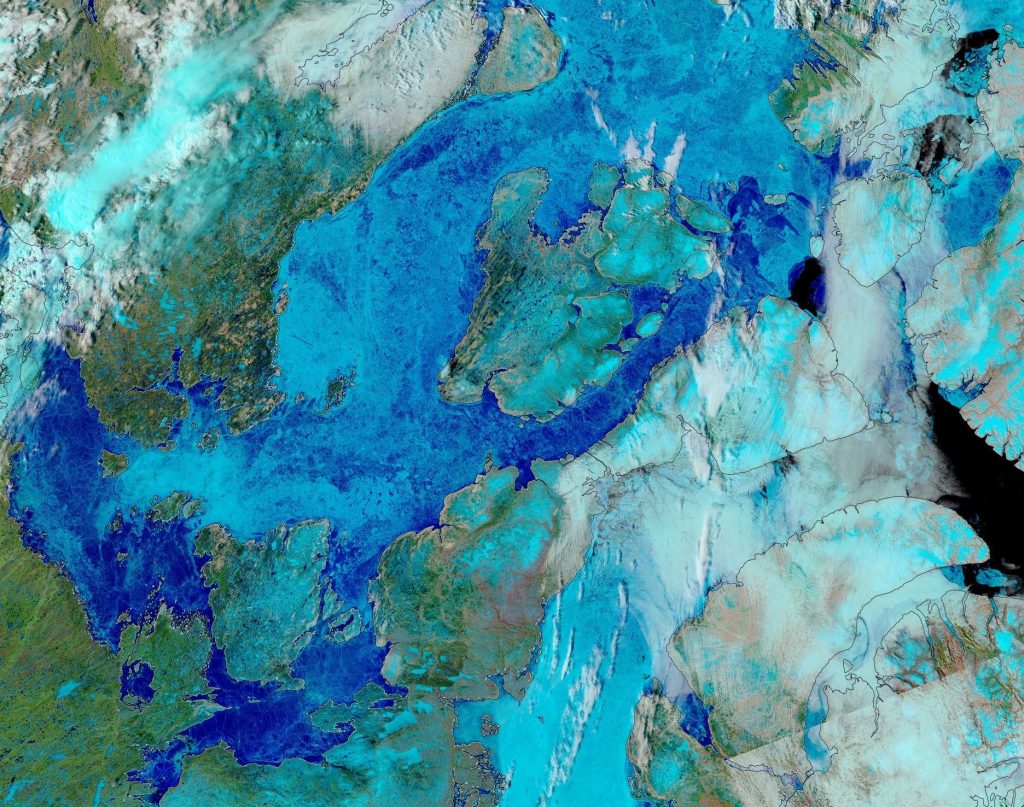
The CAA was fairly cloud free on June 23rd, and this satellite image shows that surface melt had started across the entire central section of the Northwest Passage:
NASA Worldview “false-color”image of the Canadian Arctic Archipelago on June 23rd 2020, derived from the MODIS sensor on the Terra satellite
All in all it looks to me as though “small vessels” will be able to successfully make it through the Northwest Passage later in the summer of 2020, with thicker ice drifting south into Larsen Sound from the McClintock Channel being a potential bottleneck.
[Edit – August 1st]
Whilst there are certainly some cruise ships planning on voyaging through the Northwest Passage this summer it looks as though there will be very few yachts or other small vessels. According to Transport Canada:
To better protect Arctic communities, pleasure craft are prohibited from operating in Canada’s Arctic coastal waters north of the 60th parallel until October 31, 2020, at the earliest:
to limit any potential interaction with remote and vulnerable coastal communities in consideration of minimal health care infrastructure in these waterways that notably comprise the Northwest Passage as well as the territorial sea of Canada surrounding Nunatsiavut, Nunavik and the Labrador Coast).
to allow the Canadian Coast Guard to focus efforts on essential operations including community resupply ice-breaking, environmental response, and search and rescue.
With this proviso:
In the Canadian Arctic coastal waters, the following measures will not apply to:
Foreign pleasure craft exercising their right of innocent passage within the territorial sea. However, any such transits will be subject to receipt of a 60-day written notice in advance of arrival in Canadian Arctic coastal waters to Transport Canada, and be subject to any conditions the Minister determines necessary to ensure the protection of marine personnel and of local communities (for example, additional insurance, rescue strategy).
[Edit – August 6th]
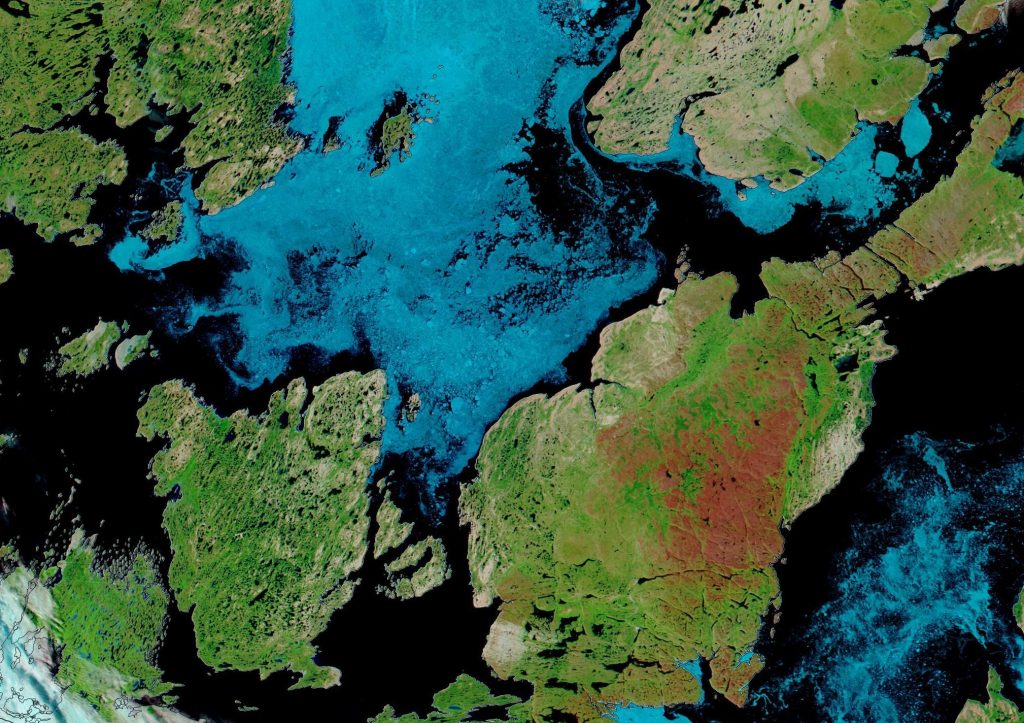
The skies were clear over the Northwest Passage yesterday, and this is what could be seen from the Aqua satellite:
I don’t know about you, but based on that image I reckon a plucky little yacht like Northabout could just about squeeze past the remaining sea ice along the coast of the Boothia Peninsula?
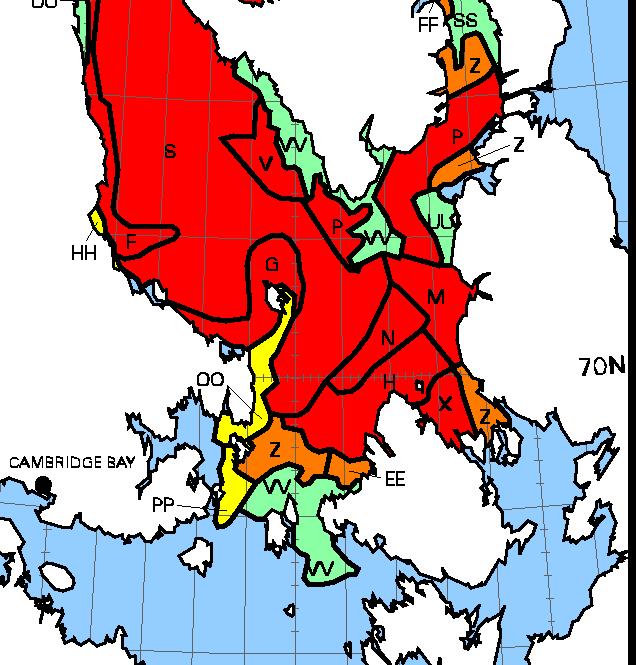
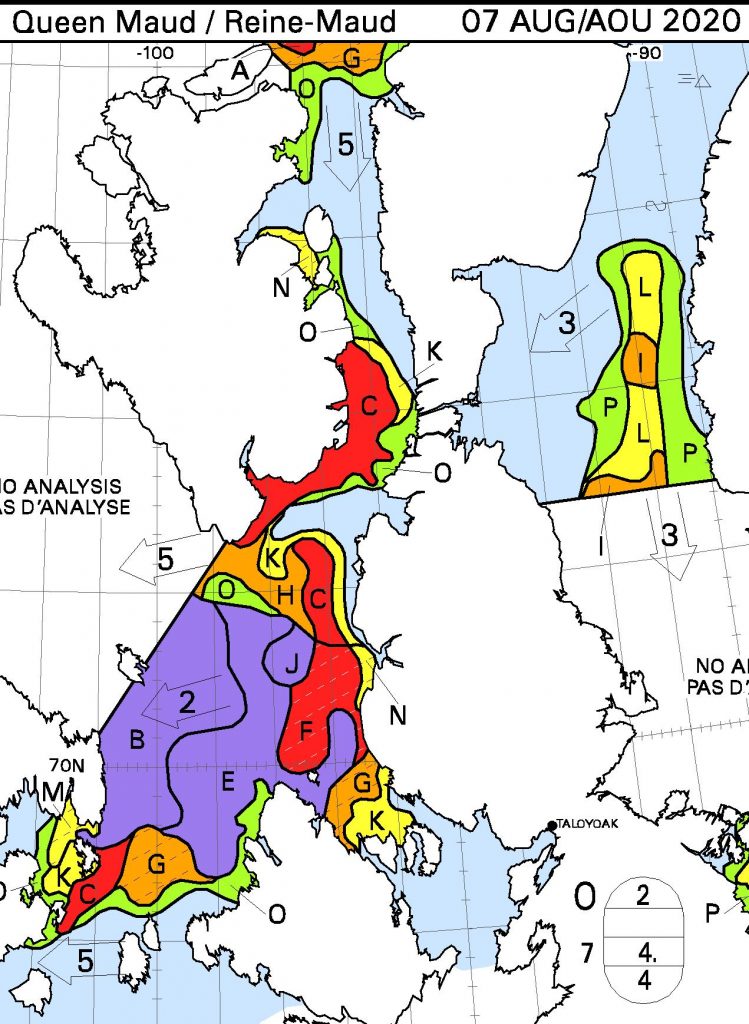
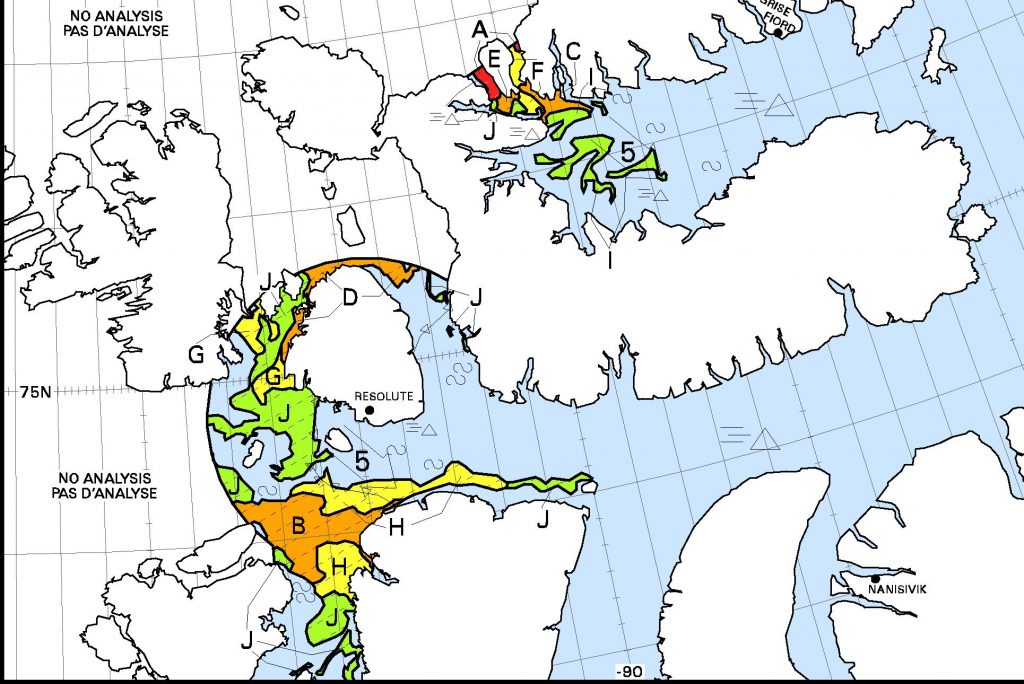
However let’s also take a look at the charts of the Canadian Ice Service shall we? The daily regional maps don’t cover the “squeeze point” yet, but the weekly map dated August 3rd reveals this:
We’re forced to conclude that officially the Northwest Passage isn’t quite “open” yet!
[Edit – August 7th]
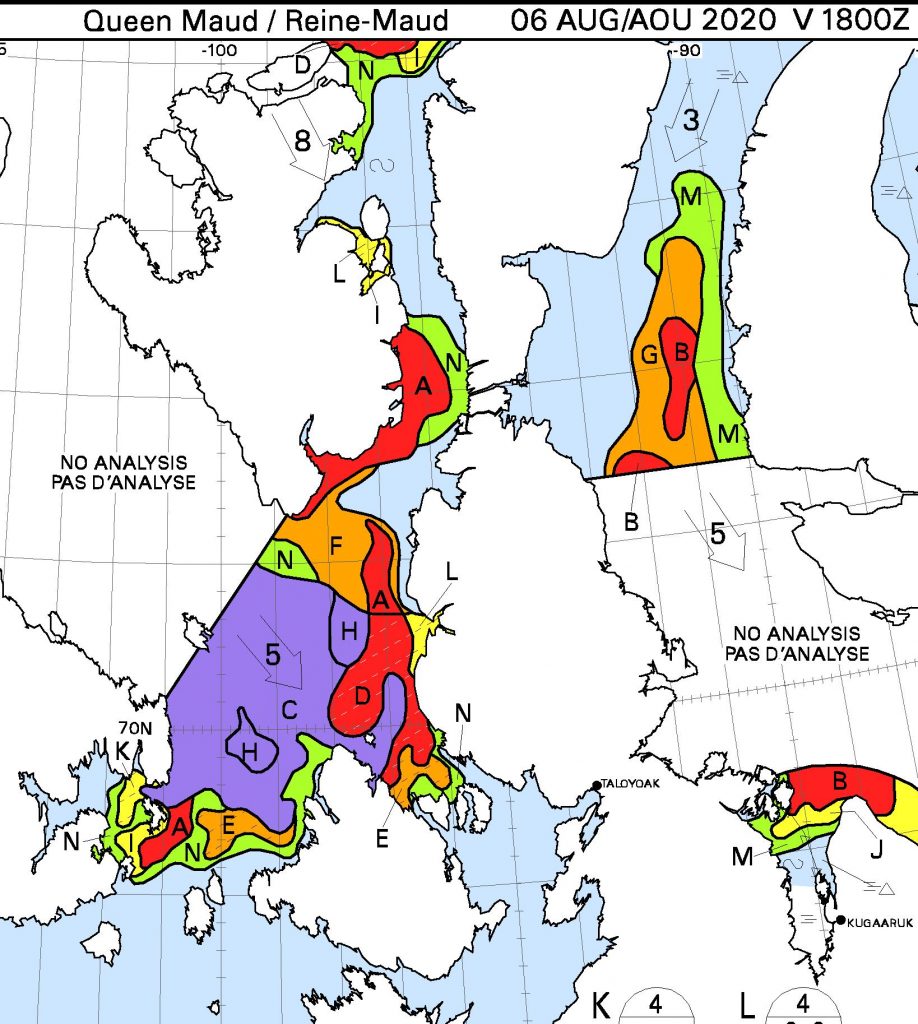
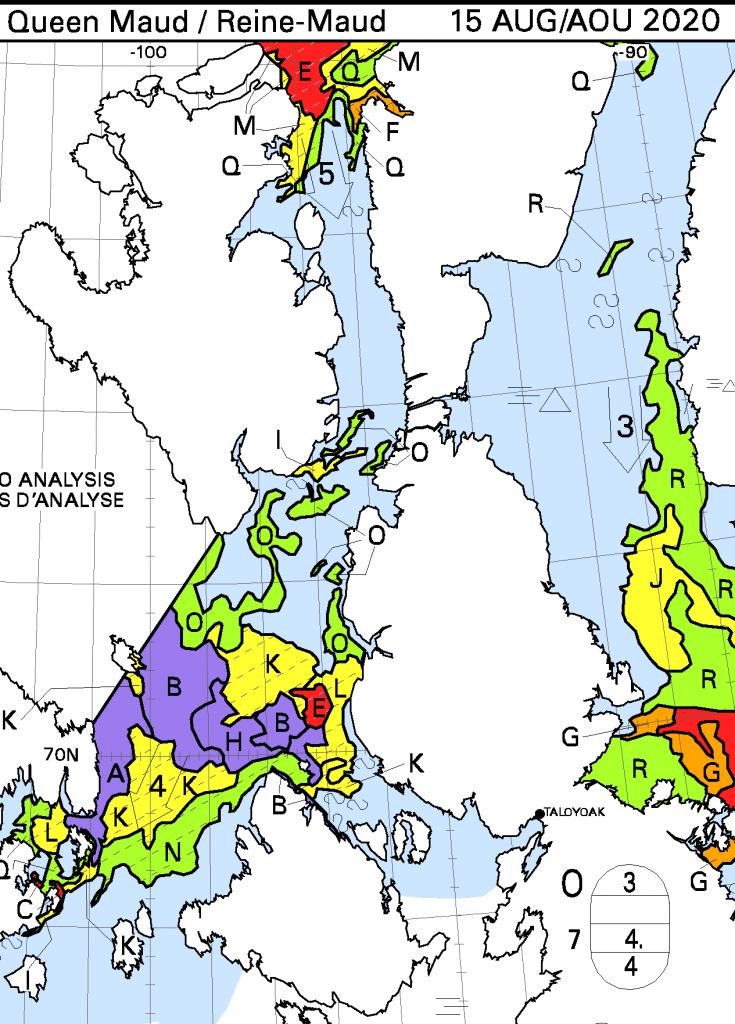
The Canadian Ice Service have extended their daily coverage to the “choke point” we looked at above:
The Northwest Passage is still not “officially” open!
[Edit – August 8th]
The southern “choke point” is still blocking the way, and winds are currently pushing ice into the north of Peel Sound:
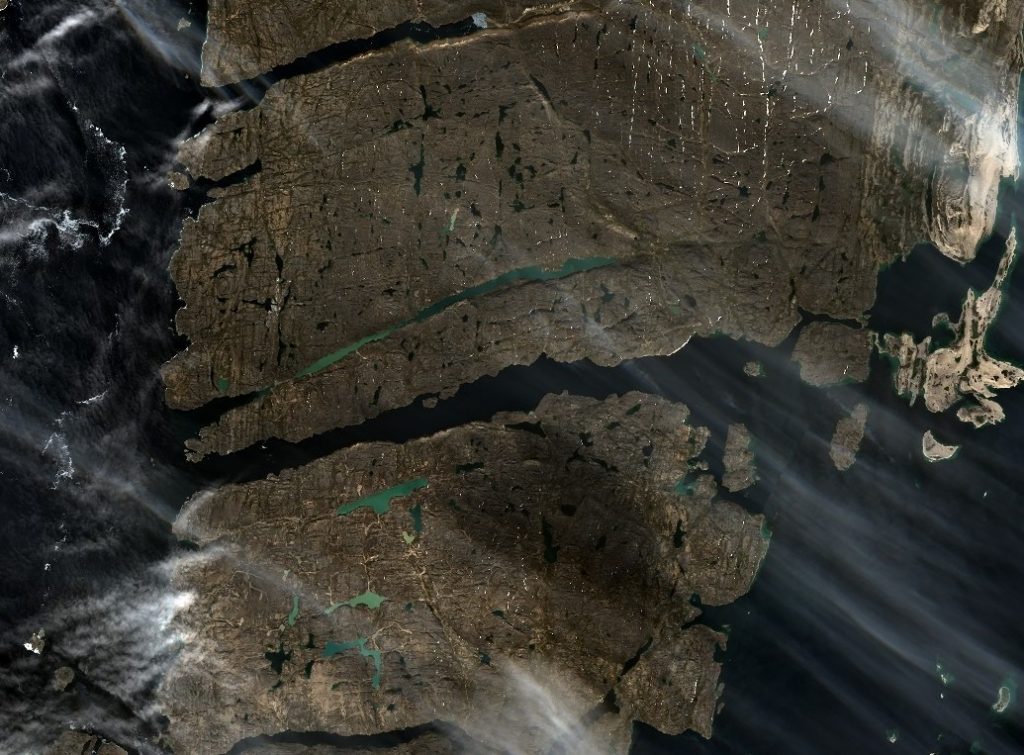
This Sentinel 2 image from August 6th shows the Bellot Strait to be completely clear of ice, so despite that route 6 through the Northwest Passage may well be very open soon.
[Edit – August 11th]
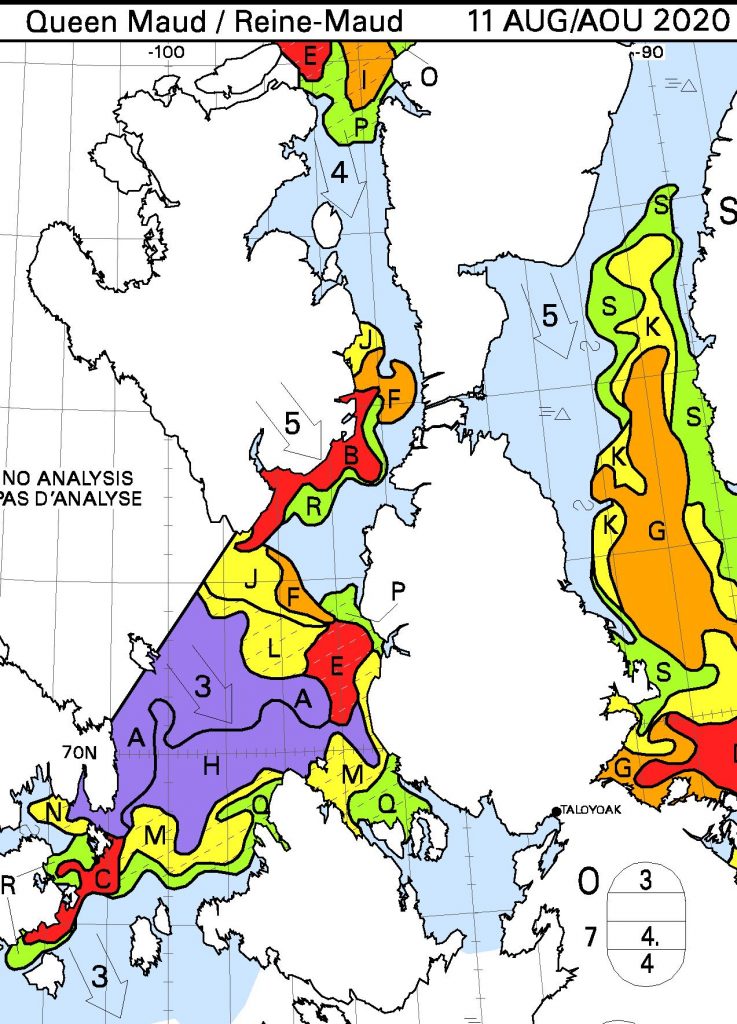
Snow White is pleased to announce that she cut the ribbon at the 2020 Northwest Passage route 6 opening ceremony earlier today:
[Edit – August 14th]
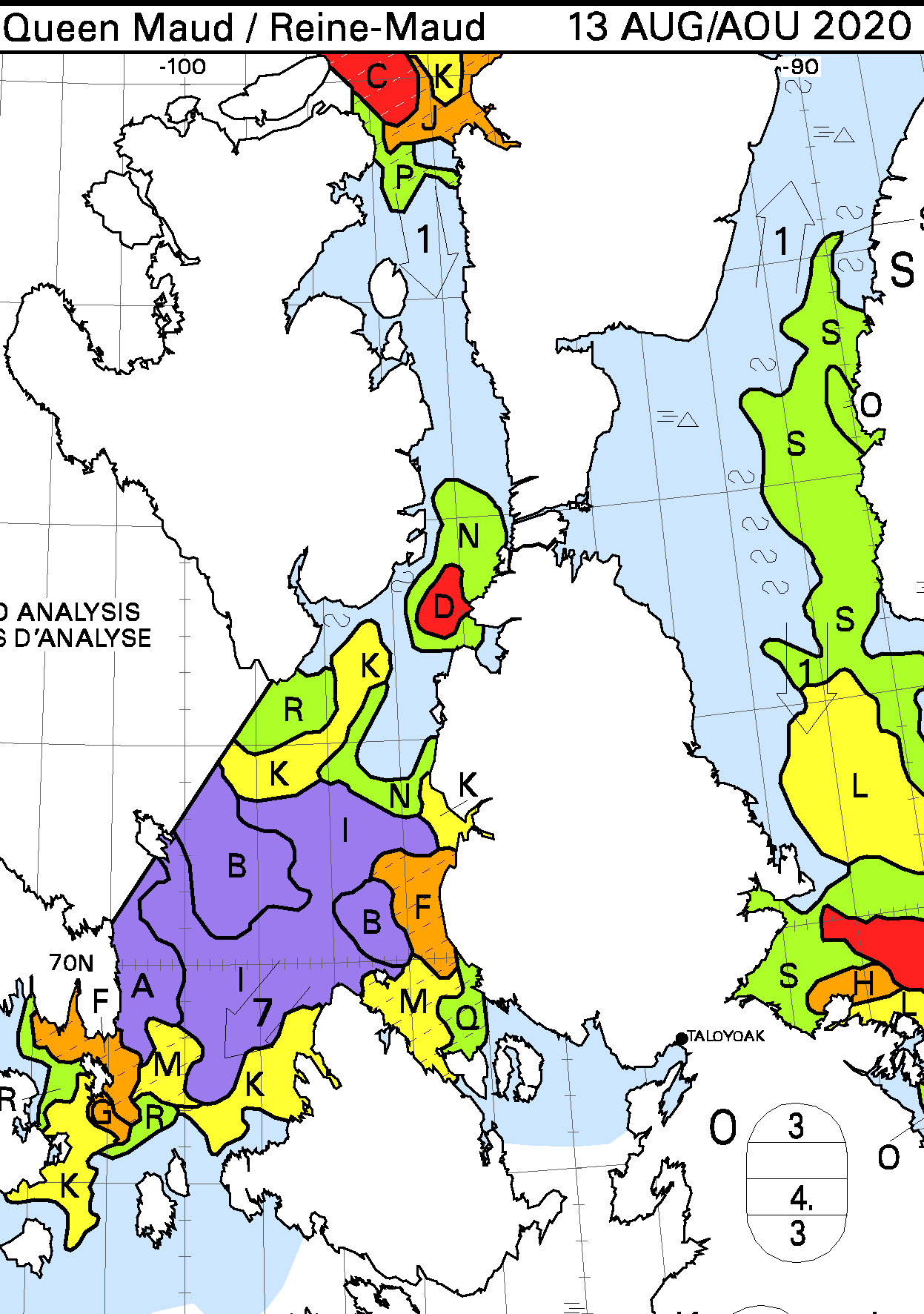
Whilst this is no doubt only temporary, the route along the coast of the Boothia Peninsula is now blocked by an area of 7-8/10 concentration ice:
[Edit – August 16th]
Route 6 is open once again, and it is also now possible to take a circuitous route around the north of both Somerset and King William Islands without encountering anything worse than 6/10 concentration ice:
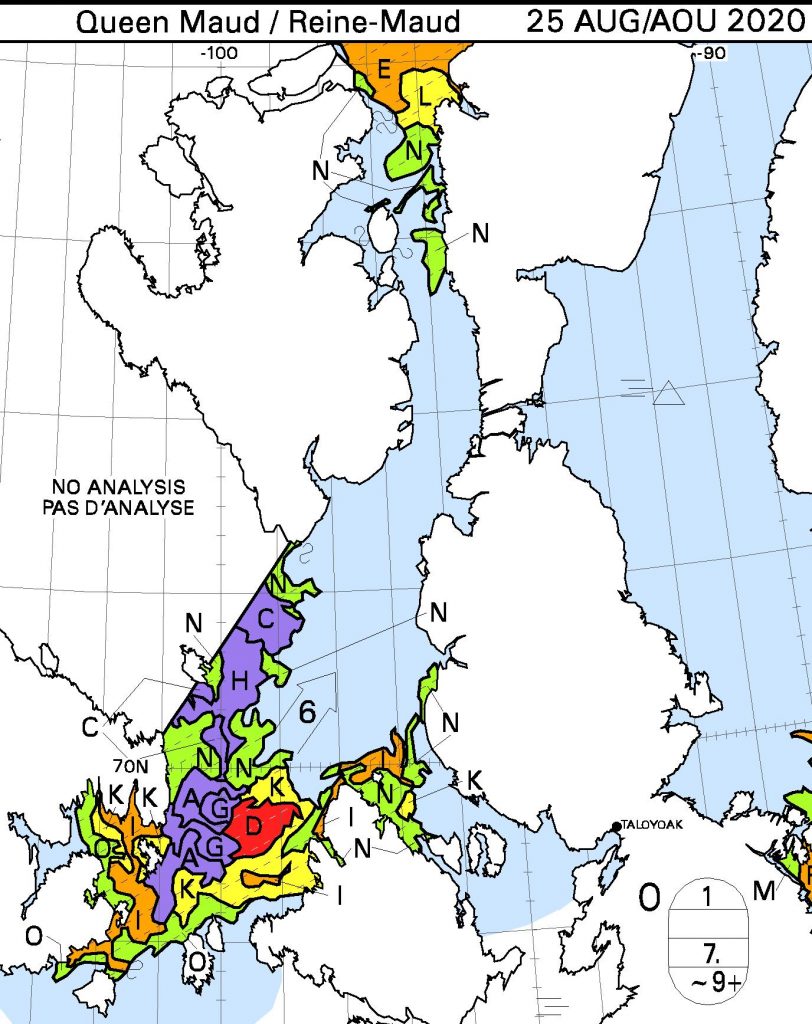
[Edit – August 25th]
As one door opens, another one closes?
[Edit – August 27th]
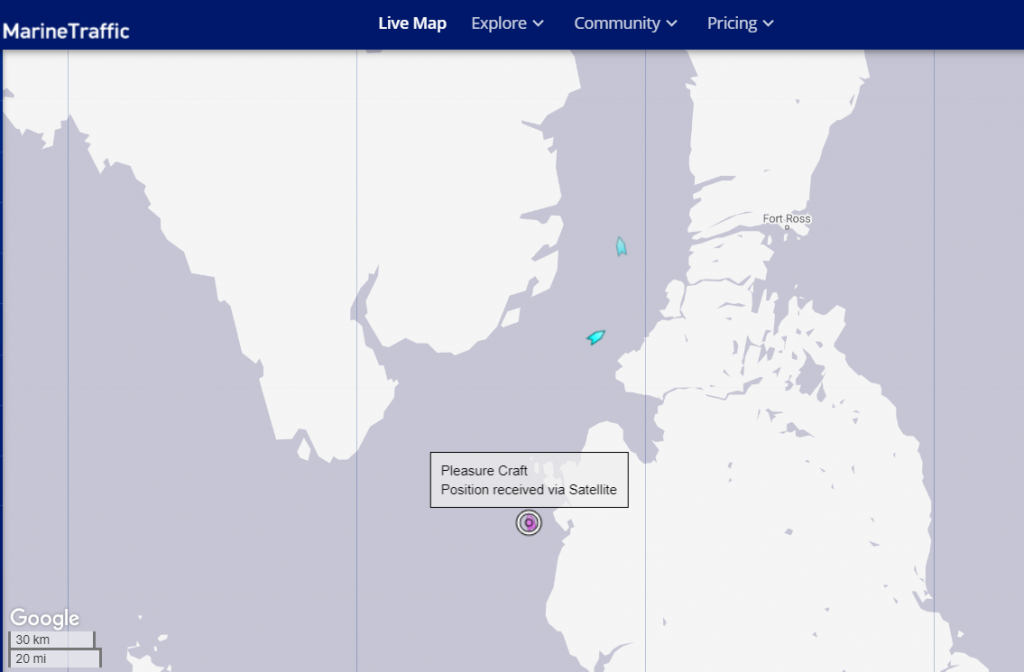
Making one of my periodic visits to MarineTraffic I couldn’t help but notice a “pleasure craft” approaching Bellot Strait!
According to the Canadian government, he has no business being there. But 72-year-old Peter Smith is sailing the Northwest Passage anyway, in violation of COVID-19-related orders prohibiting most foreign yachts from entering Canadian waters.
But according to a Facebook post on Aug. 20, Bobby Klengenberg, a local observer with the Inuit Marine Monitoring Program, spotted Smith’s custom yacht, the Kiwi Roa, off the coast of Cambridge Bay, Nunavut.
Transport Canada confirmed the sighting in an email to CBC News, and said the vessel was told “to depart Canadian waters and not make landfall.”
A spokesperson said the Canadian Coast Guard will “monitor the vessel’s transit out of the region.” If Smith is indeed found to have broken the law, they wrote, the agency “will not hesitate to take appropriate enforcement action,” including penalties of up to $5,000.
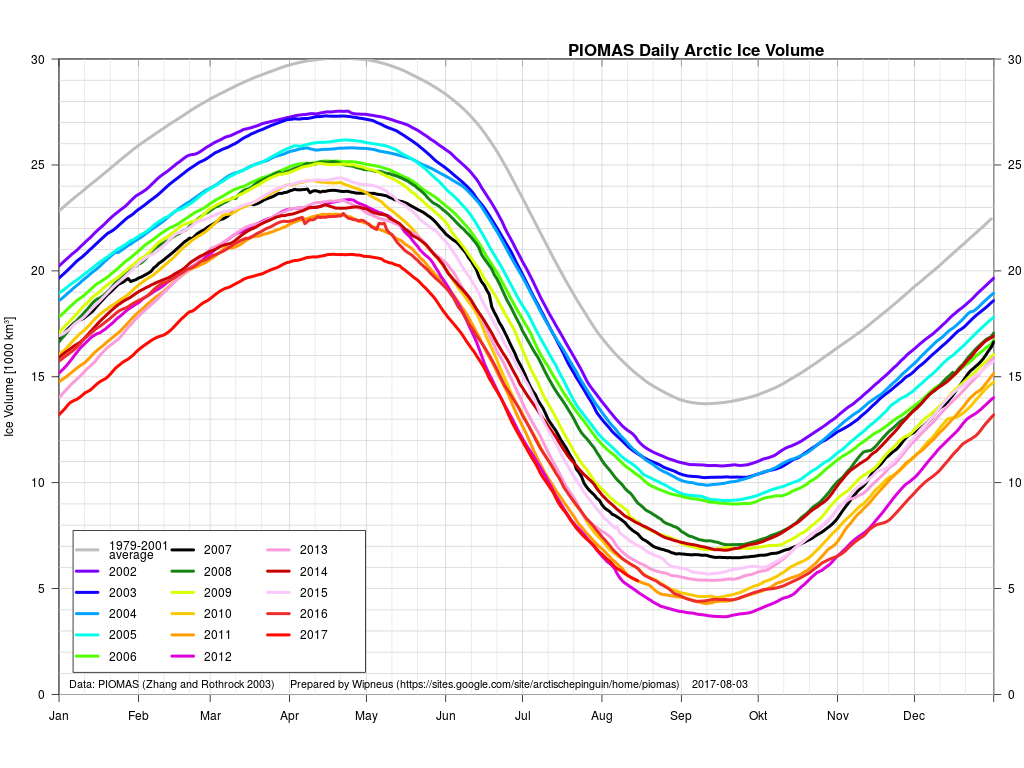
What seems likely to be the most interesting period of the 2017 Arctic sea ice melting season is upon us! The PIOMAS gridded data hasn’t been released yet, but the overall volume numbers reveal that 2017 has now relinquished its “lowest ever” position to 2012. Here’s Wipneus’ graph of the volume data:
plus his anomaly plot:
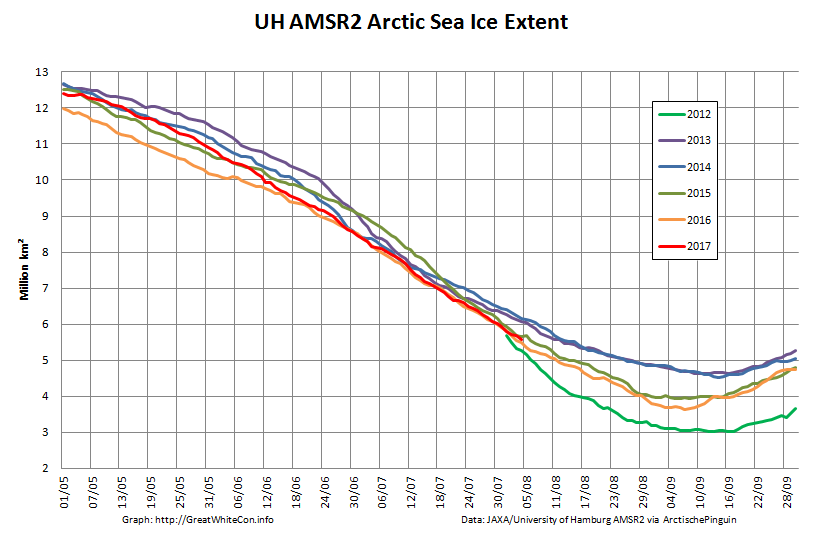
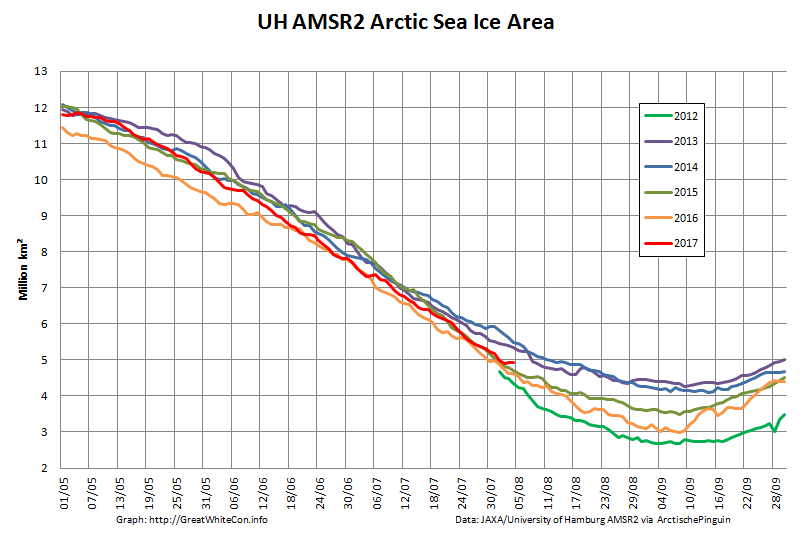
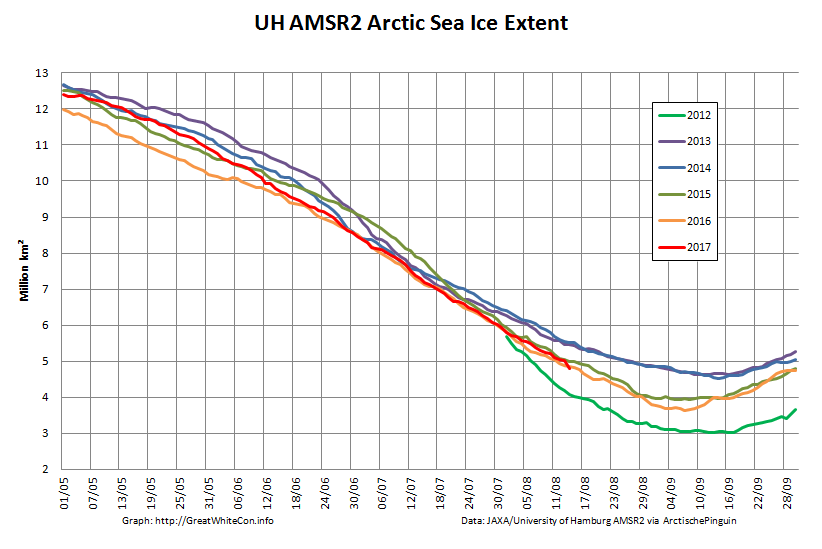
Our favourite high resolution AMSR2 area and extent graphs now also allow comparison with 2012. Here’s how they look at the moment:
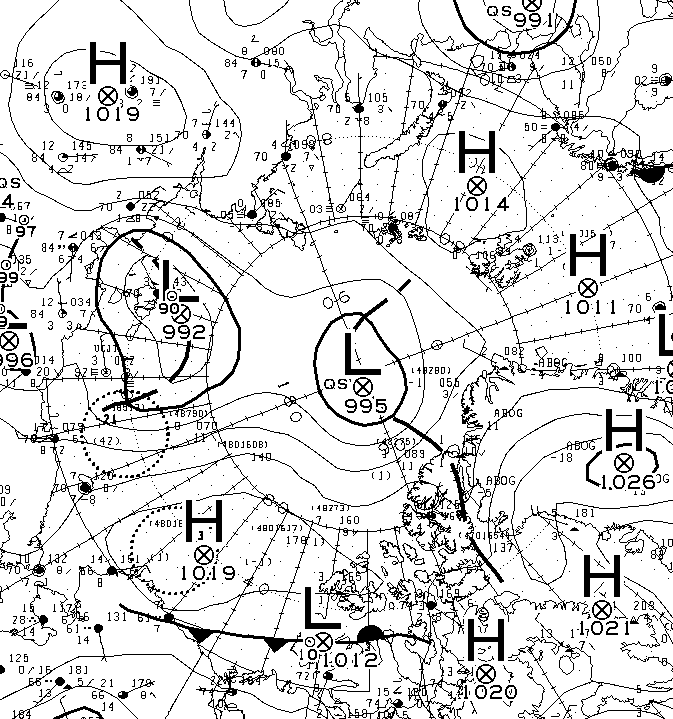
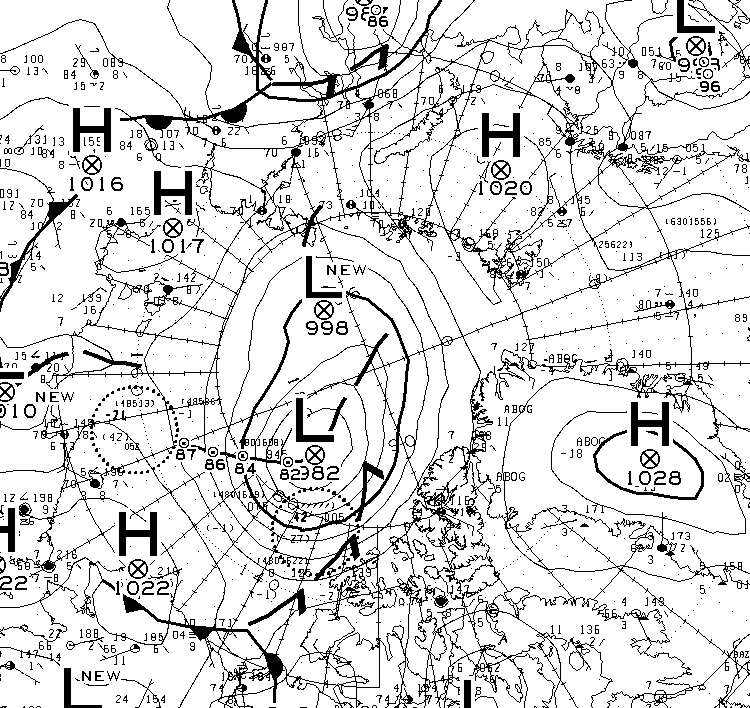
As you can see, round about now is when 2012 Arctic sea ice extent started to noticeably race ahead of the rest of the pack. Will 2017 follow suit? Are there any Arctic cyclones on the horizon for example? Well, the one forecast for August 4th hasn’t materialised. Here’s this morning’s Environment Canada synopsis:
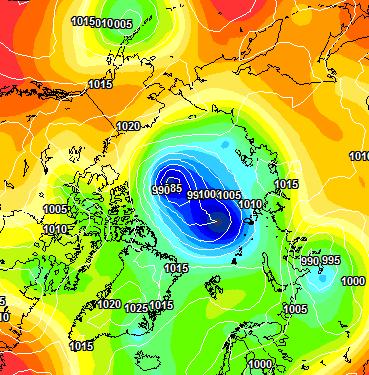
However both ECMWF and GFS agree that a sub 985 hPa storm should have arrived by Sunday morning. Here’s the ECMWF version from MeteoCiel:
There’s stronger storms in the forecast further out, but once again we’ll believe them if and when we see them!
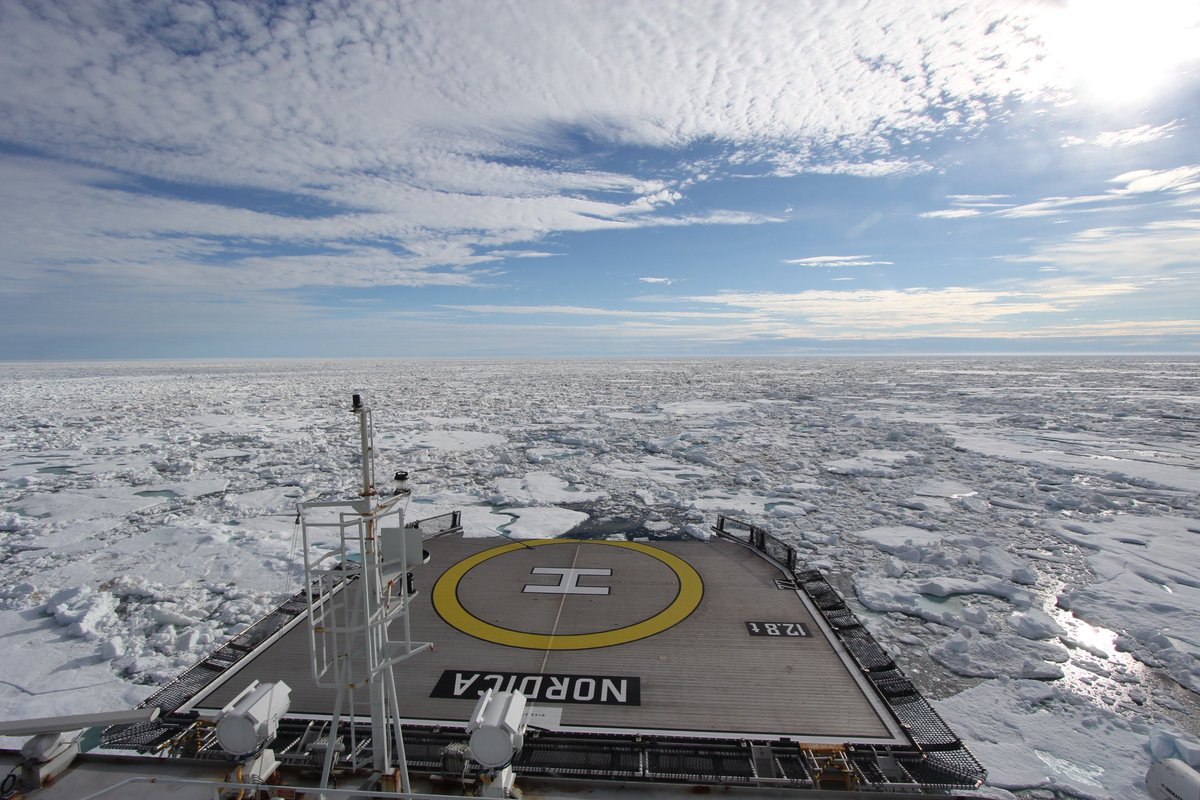
We’re keeping a close eye on the Northwest Passage once again this year. Most of the southern route is open already, but as we predicted the old ice in Larsen Sound has a lot of melting still to do. Here’s how it looked from the icebreaker Nordica a few days ago:
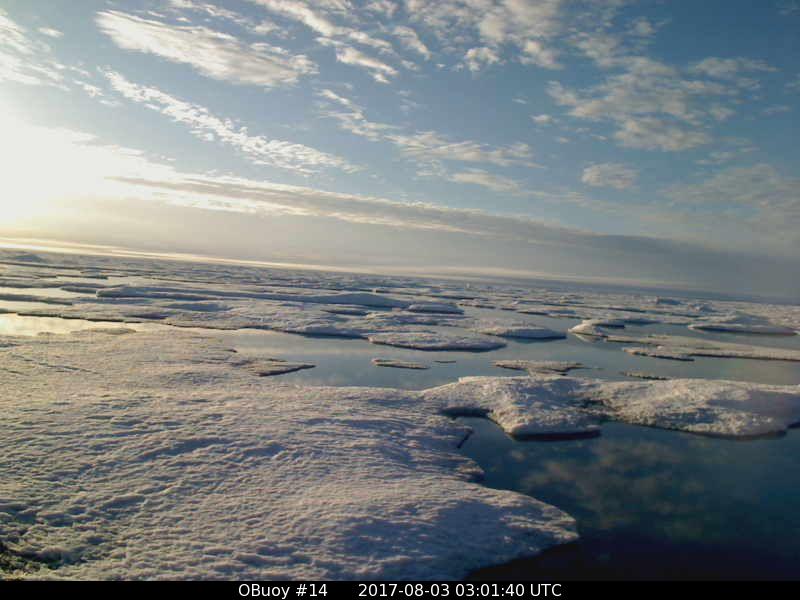
On top of that the old ice around O-Buoy 14 is currently rushing south down the McClintock Channel to replenish it. Here’s how that looks at the moment:
Meanwhile the melt along the Northern Sea Route is well ahead of last year. Here’s the University of Hamburg AMSR2 concentration map of the area:
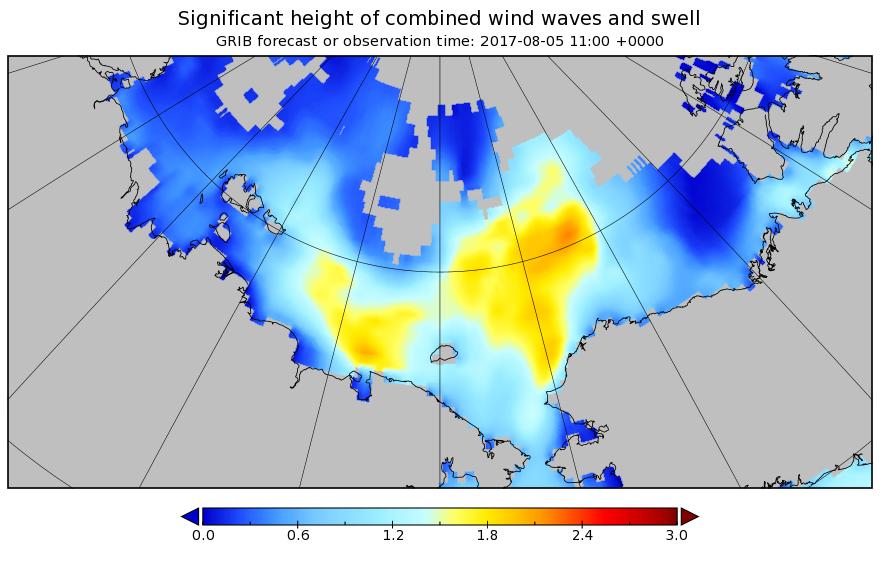
There’s also now a lot of open water on the Pacific side of the Arctic, and Sunday’s cyclone is forecast to create a large area of 2 meter plus waves heading in the direction of the ice edge:
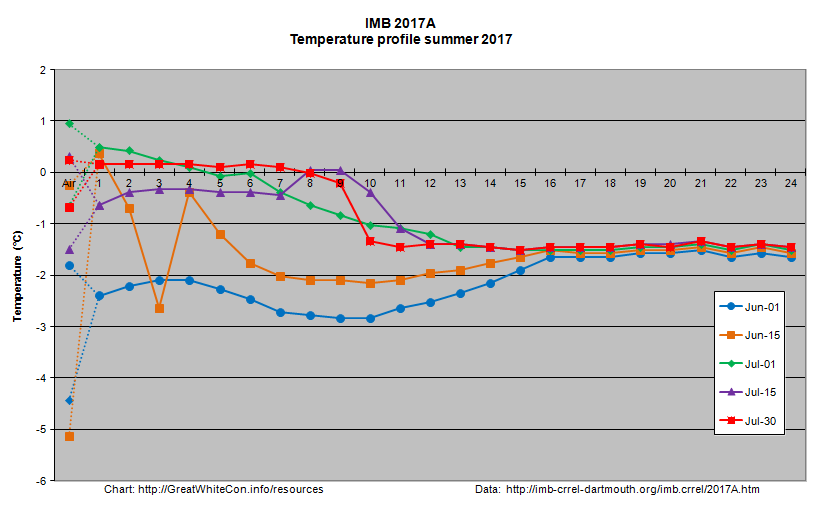
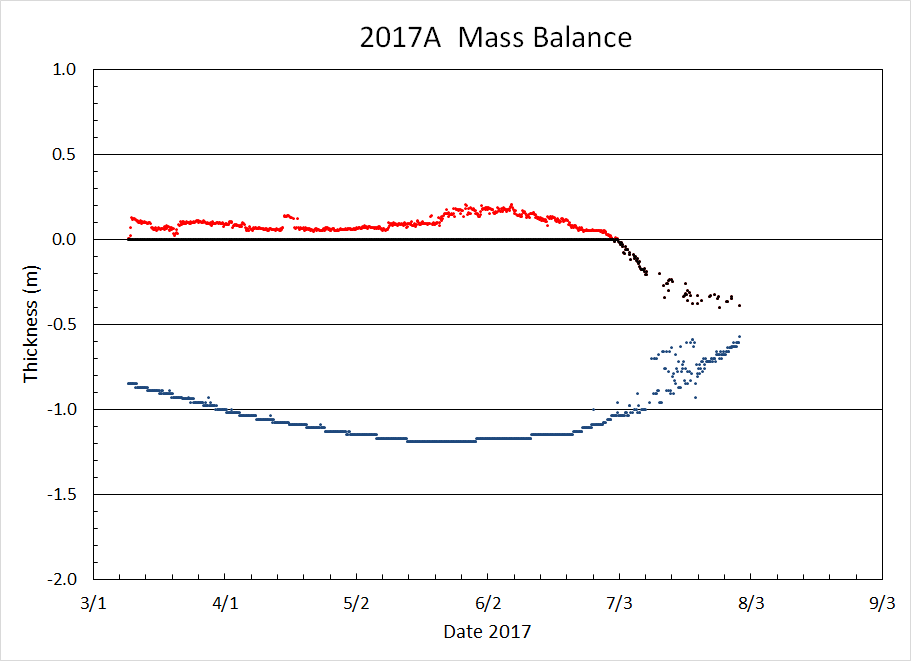
I expect that to have a noticeable effect on the already fragile sea ice by early next week, assuming the storm arrives as forecast! There is an ice mass balance buoy handily placed out on the ice in the path of the storm. Buoy 2017A is currently located near 77 N, 147 W, and its assorted sensors suggest the ice underneath it is now less than 20 cm thick:
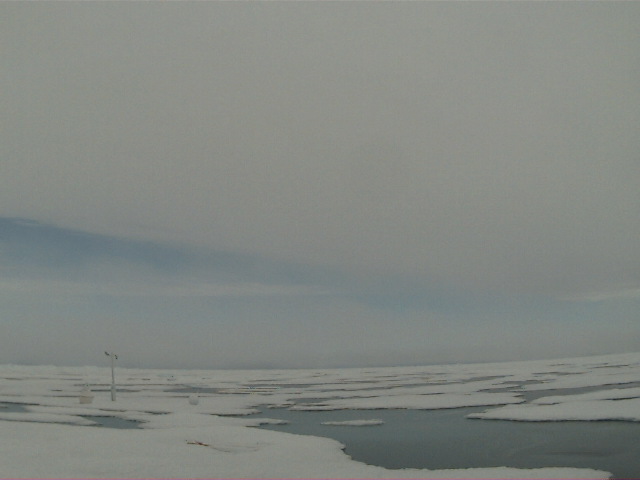
Here’s how the area around the buoy looked a couple of weeks ago:
Image of 2017A from WARM 6 on July 18th 2017. NSF project: NSF OPP #1603548
The $64,000 question now is will the 2017 Arctic sea ice metrics stay in amongst the recent pack, or race after 2012 instead?
[Edit – August 6th]
This morning’s synopsis from Environment Canada suggests the cyclone has bottomed out at a MSLP of 982 hPa:
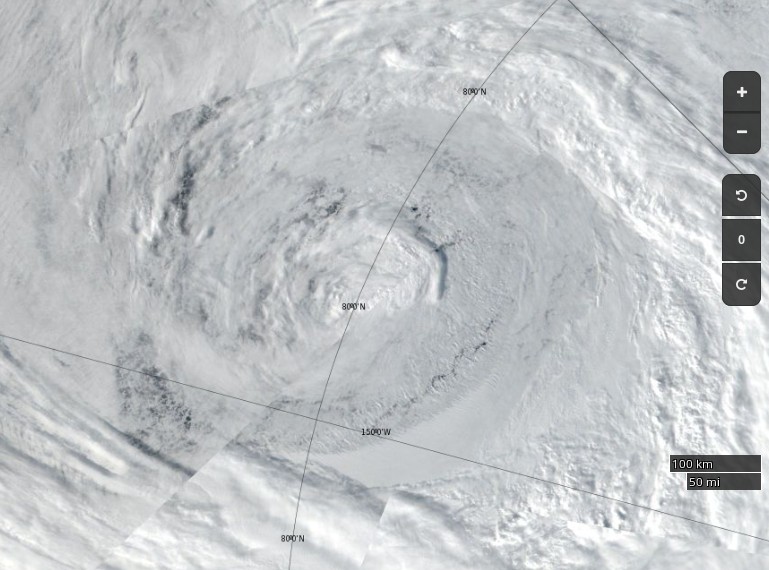
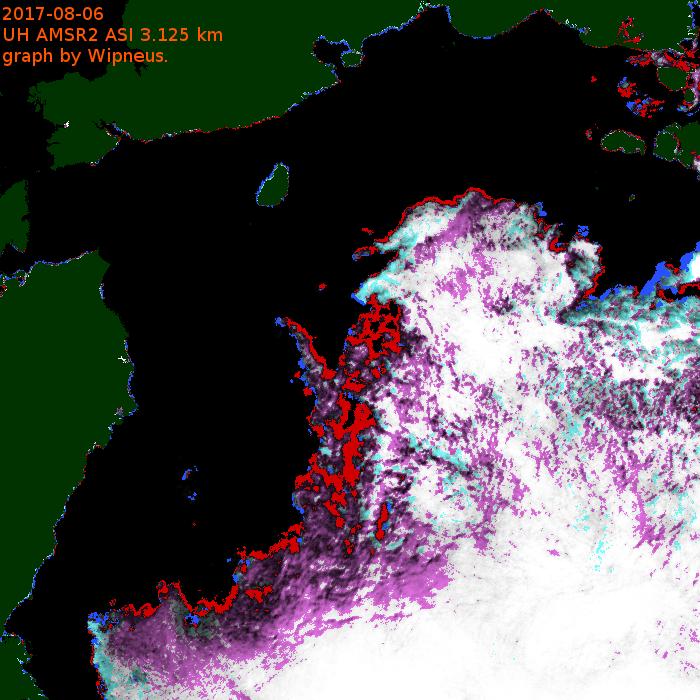
Here’s how the cyclone looked from space yesterday:
NASA Worldview “true-color” image of the sea ice north of the Beaufort Sea on August 5th 2017, derived from the VIIRS sensor on the Suomi satellite
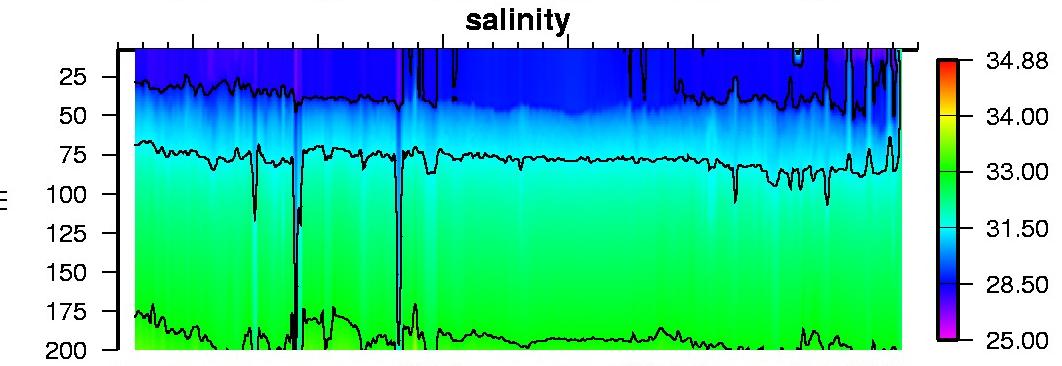
I think that I can convince myself that the salinity profile from ice tethered profiler 97, currently located at 73° N, 134° W, reveals mixing from depth in the wake of the storm:
The synthetic aperture radar on the Sentinel 1B satellite can certainly see through the clouds, and reveals open water in the Central Arctic north of the Beaufort Sea yesterday evening (UTC):
Sentinel 1B image of Arctic sea ice at 79° N, 160° W on August 5th 2017
The effects of this weekend’s storm are readily apparent! Just in case you’re wondering Wipneus reports:
Area: -172.0 (+324k vs 2016, +138k vs 2015, -669k vs 2014, -523k vs 2013, +493k vs 2012)
[Edit – August 8th]
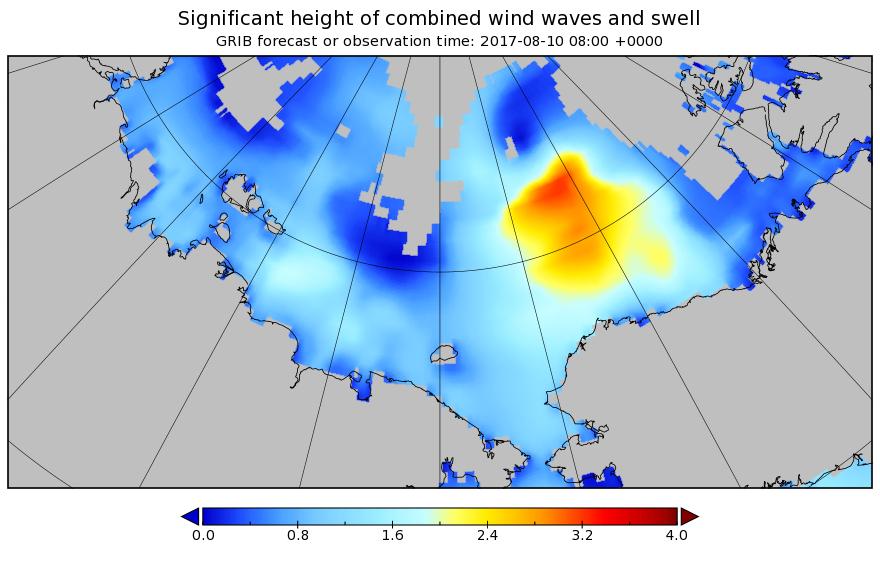
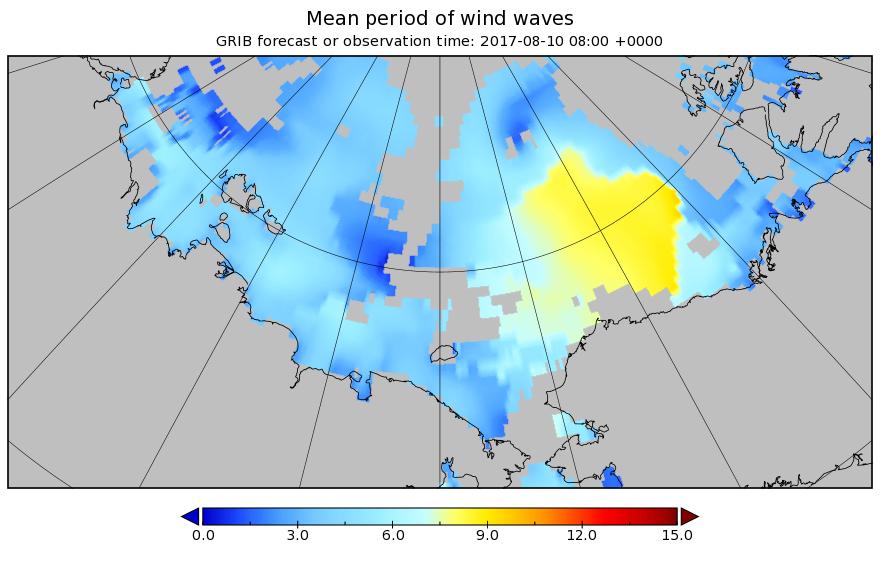
The next pulse of swell is currently forecast to be somewhat higher and longer period than the last one. This one is also taking aim at the Beaufort Sea MIZ:
[Edit – August 9th]
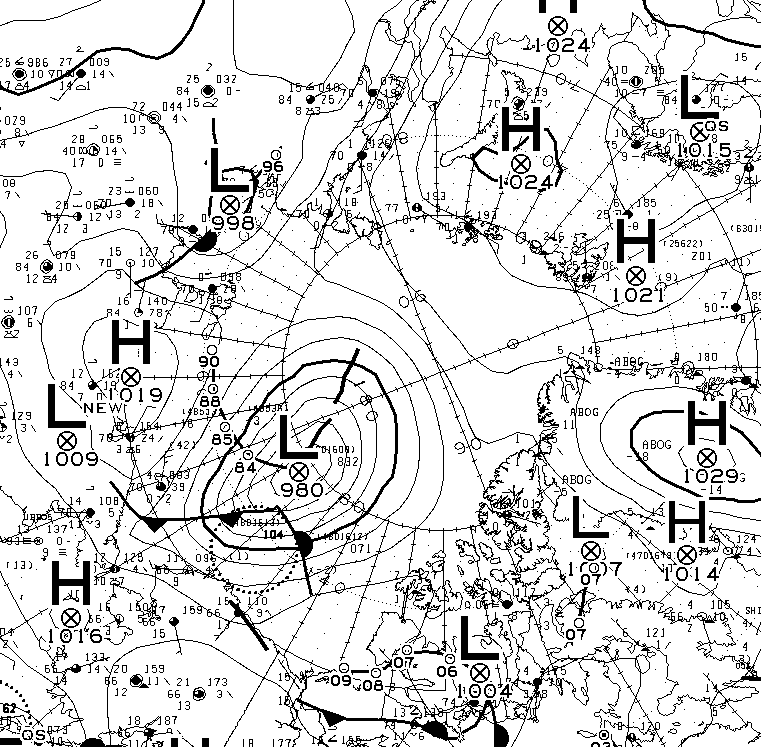
According to Environment Canada the latest cyclone is already down to 980 hPa MSLP:
[Edit – August 9th PM]
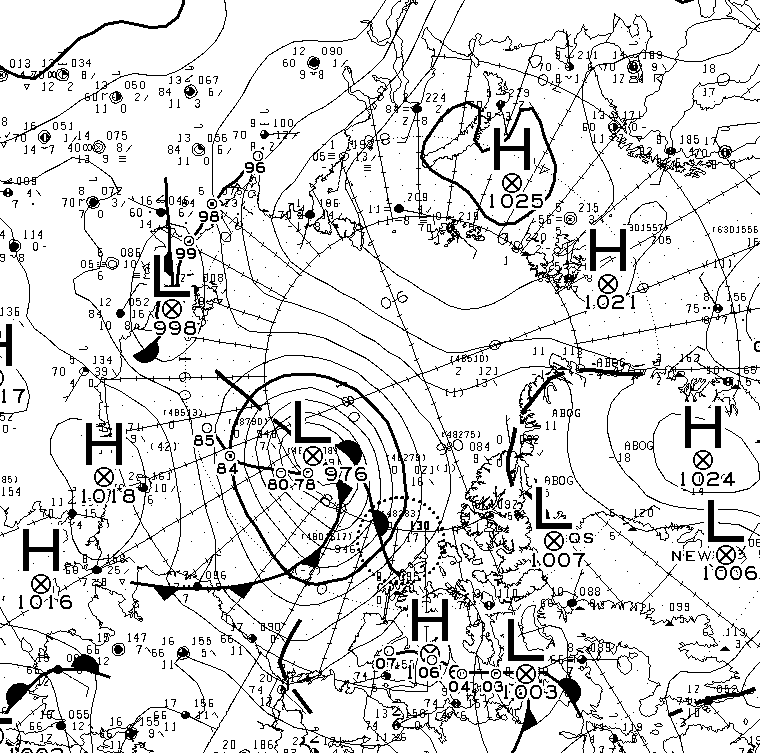
The MSLP of the current cyclone is now down to 976 hPA:
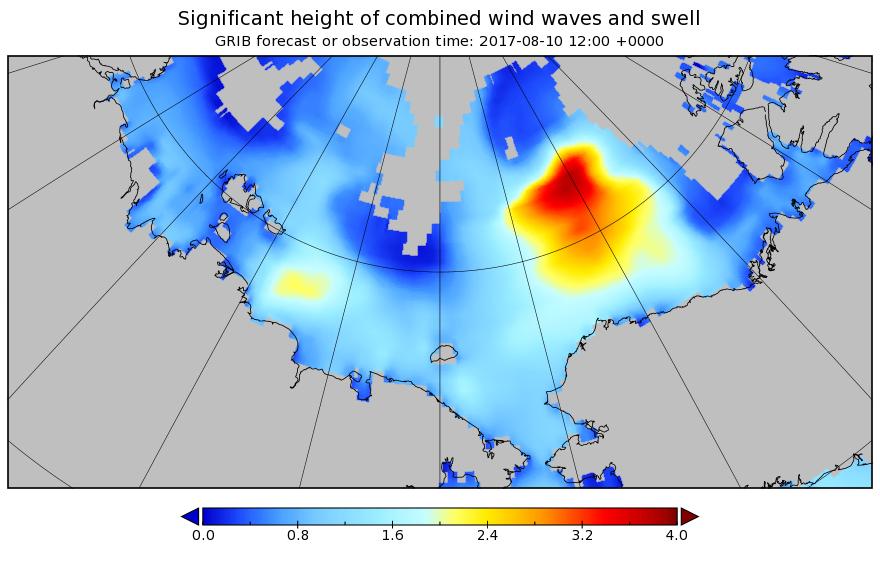
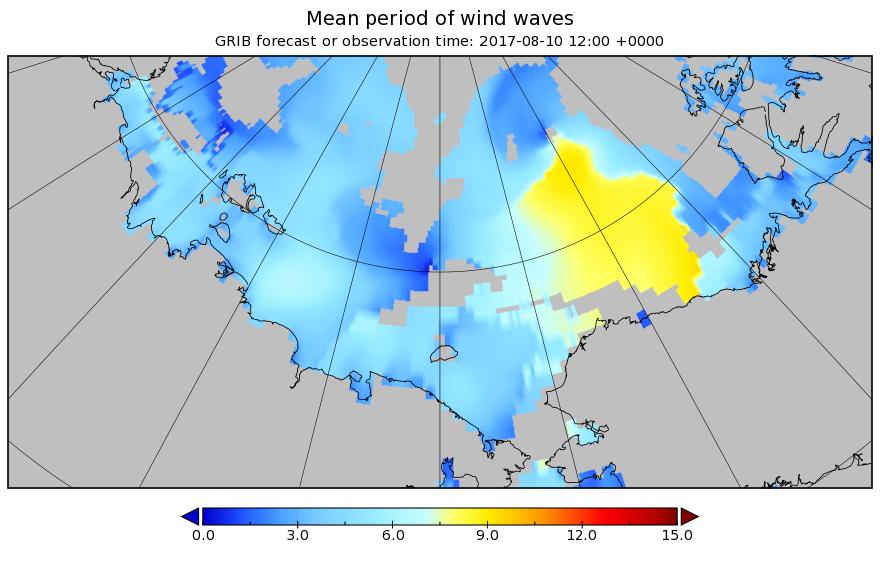
The latest WaveWatch III forecast has increased the predicted peak height and period of the resulting waves once again:
[Edit – August 10th]
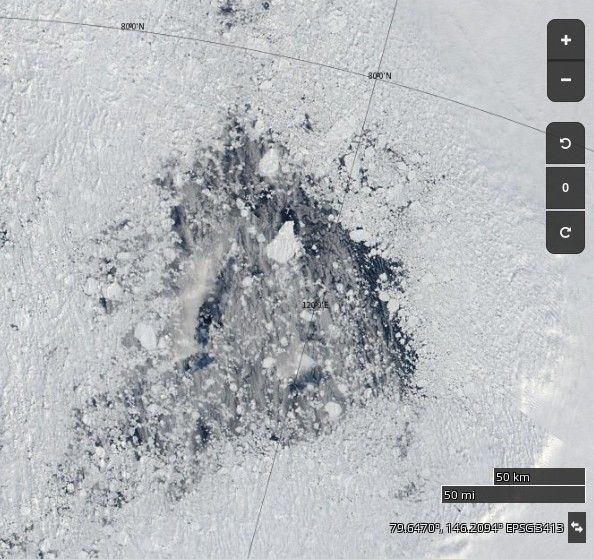
Large holes are appearing in the sea ice on the other side of the Arctic too. Take a look north of the Laptev Sea for example:
NASA Worldview “true-color” image of the “Laptev Bite” polynya on August 10th 2017
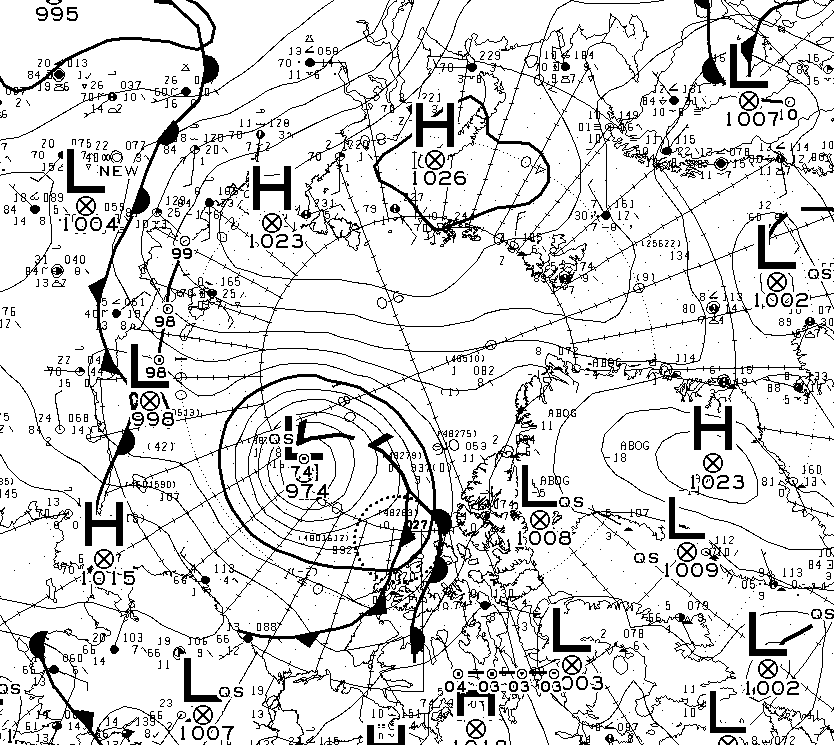
Meanwhile the current cyclone on the Pacific side of the North Pole appears to have bottomed out at 974 hPa:
[Edit – August 11th]
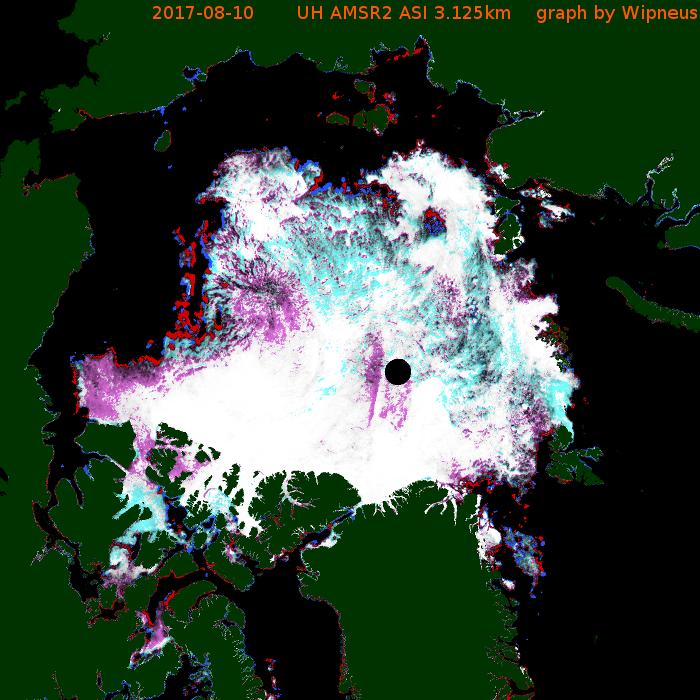
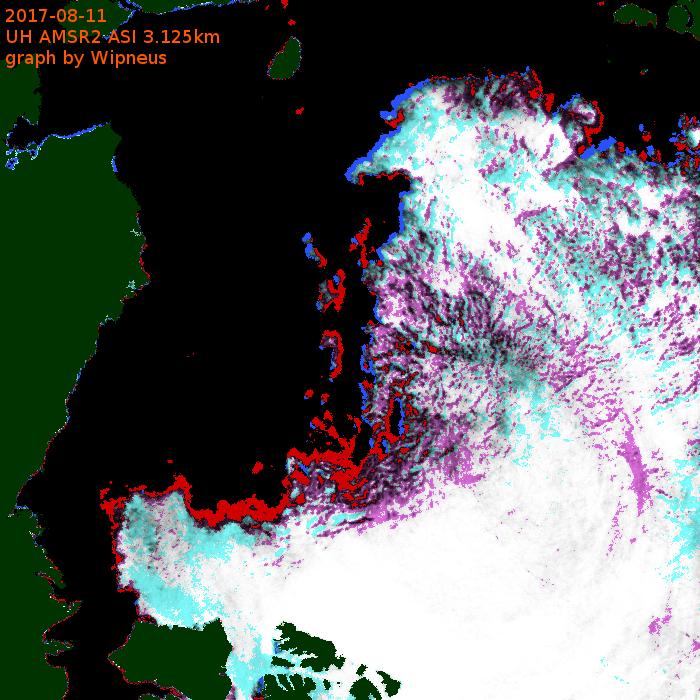
Here’s the latest sea ice concentration one day delta map from Wipneus:
Despite the expected divergence caused by a low pressure area crossing the ice, both are and extent of sea ice on the Pacific side of the Arctic are still falling.
[Edit – August 12th]
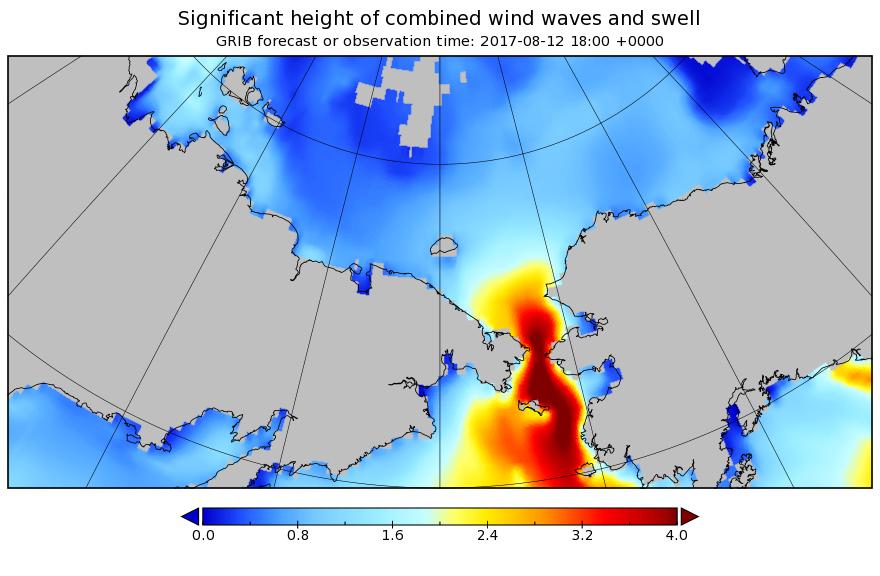
The waves are considerably smaller in the Beaufort Sea today, but not in the Bering Strait!
Here’s the latest one day delta map:
and here’s video showing the motion of sea ice in the Beaufort & Chukchi Seas so far this summer:
[Edit – August 13th]
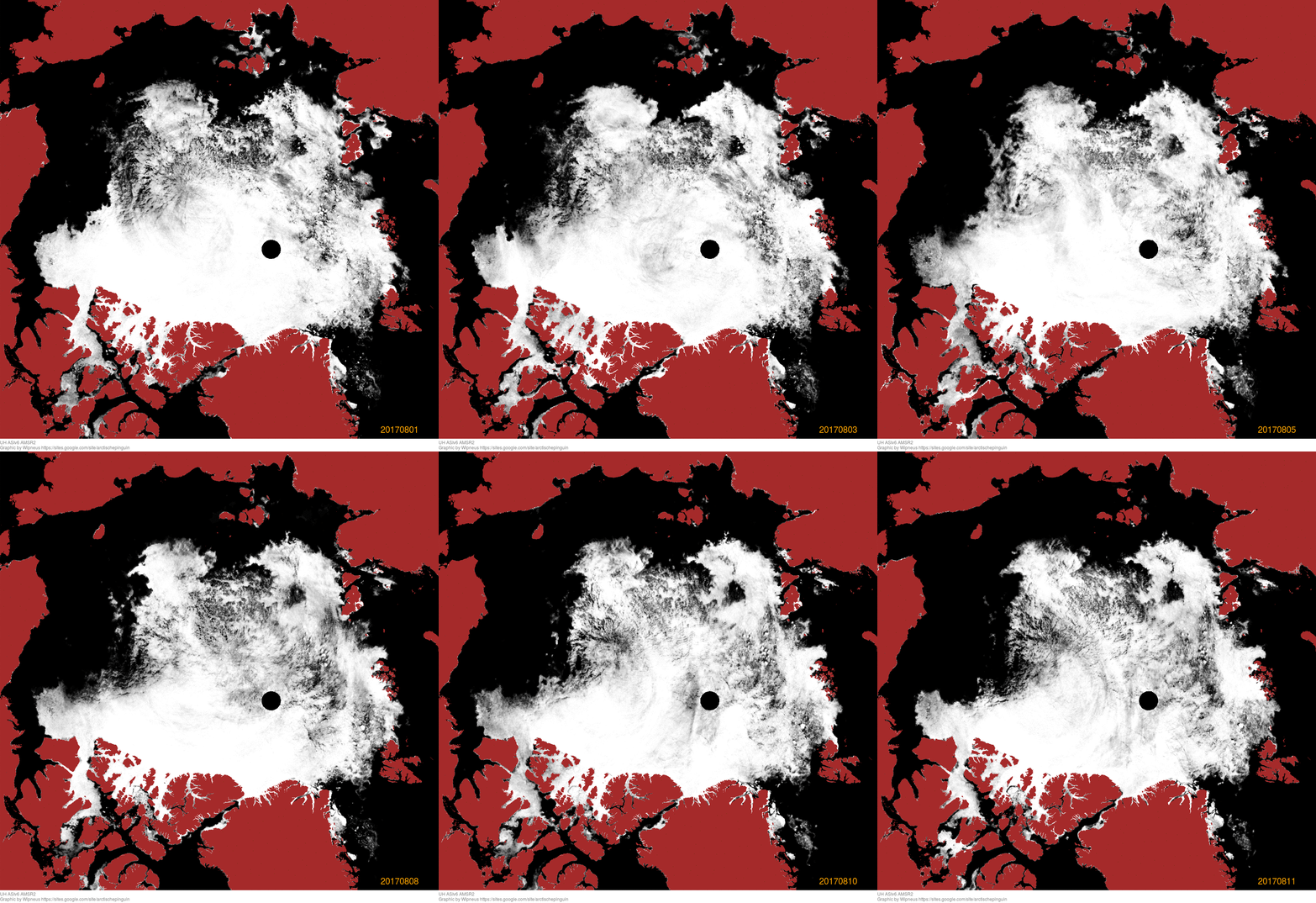
Here’s an animation from Wipneus revealing the effect of the two recent cyclones on the Pacific side, plus everything else that’s been going on in the Arctic:
Click the image to see a much larger (3.3 Mb) version.
[Edit – August 16th]
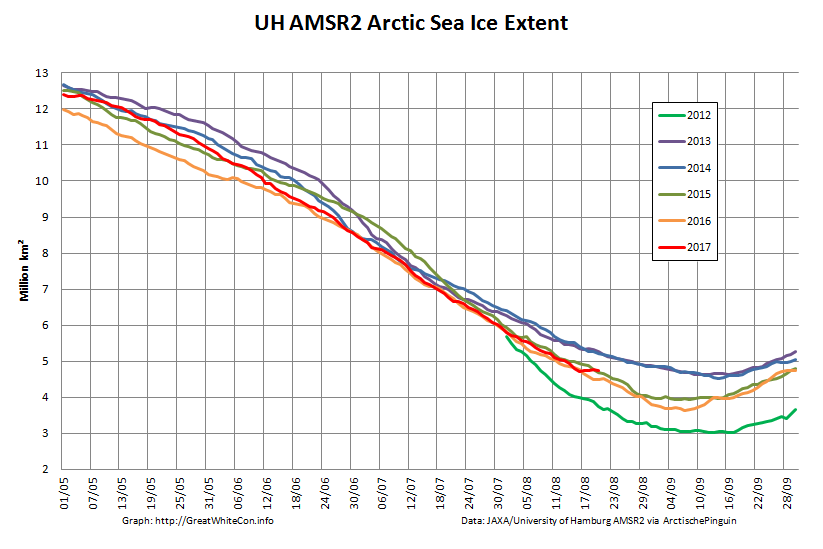
AMSR2 Arctic sea ice extent has taken another tumble, and has dropped below 2016:
Only 2012 left to beat!
[Edit – August 18th]
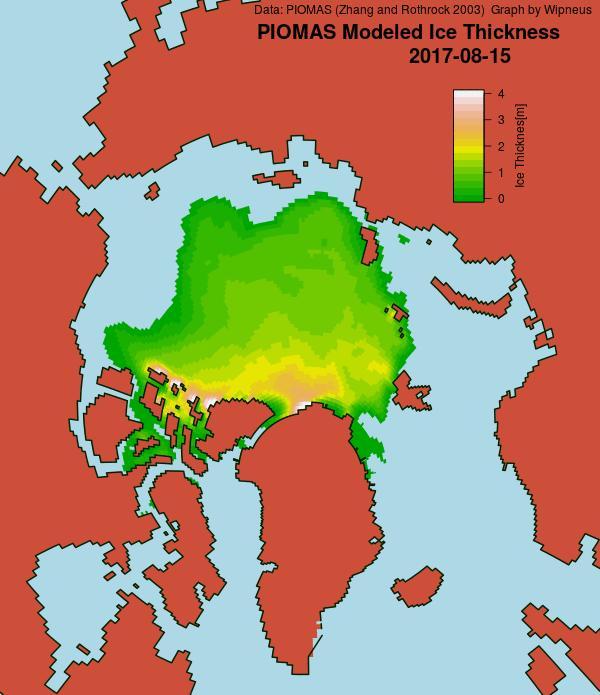
A PIOMAS mid month update has been released, including gridded thickness data. 2017 modelled volume has failed to follow 2012’s trajectory towards the September minimum, and is now on a par with 2011:
[Edit – August 21st]
After a “brief hiatus” in the wake of the recent cyclones Arctic sea ice area has posted a new low for the year:
Extent has yet to follow suit:
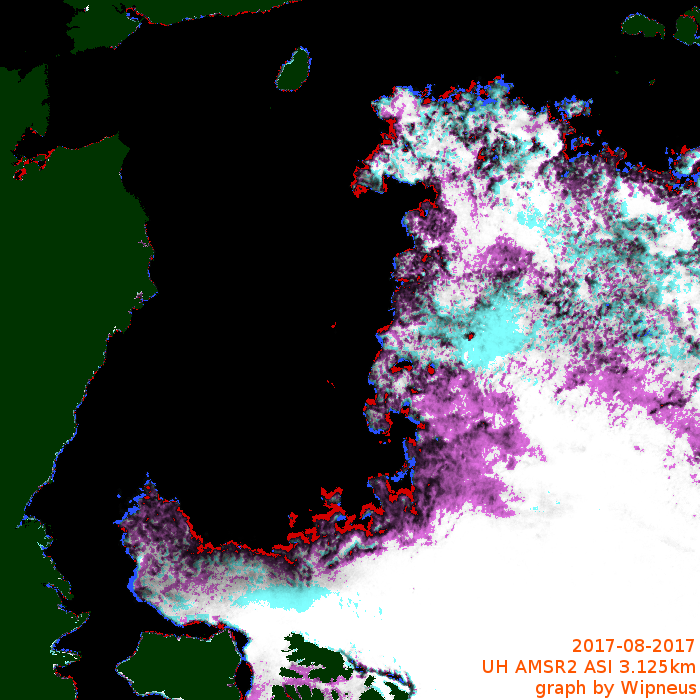
The main loss of area has been in the “Beaufort Bite” once again:
This website uses cookies to improve your experience. We'll assume you're ok with this, but you can opt-out if you wish. Cookie settingsACCEPT
Privacy & Cookies Policy
Privacy Overview
This website uses cookies to improve your experience while you navigate through the website. Out of these, the cookies that are categorized as necessary are stored on your browser as they are essential for the working of basic functionalities of the website. We also use third-party cookies that help us analyze and understand how you use this website. These cookies will be stored in your browser only with your consent. You also have the option to opt-out of these cookies. But opting out of some of these cookies may affect your browsing experience.
Necessary cookies are absolutely essential for the website to function properly. This category only includes cookies that ensures basic functionalities and security features of the website. These cookies do not store any personal information.
Any cookies that may not be particularly necessary for the website to function and is used specifically to collect user personal data via analytics, ads, other embedded contents are termed as non-necessary cookies. It is mandatory to procure user consent prior to running these cookies on your website.