Tag Archives: Albedo

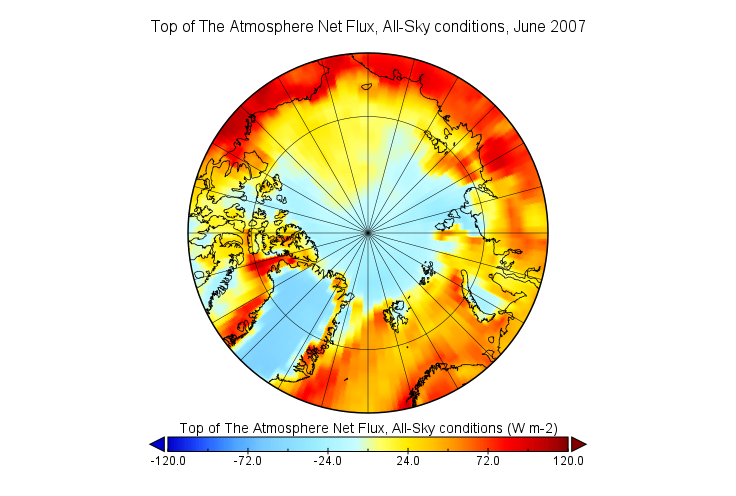
CERES Arctic TOA Energy Fluxes

Earth’s energy imbalance is of course a critical factor driving “global warming”. According to NASA back in June:

Researchers have found that Earth’s energy imbalance approximately doubled during the 14-year period from 2005 to 2019.

Earth’s climate is determined by a delicate balance between how much of the Sun’s radiative energy is absorbed in the atmosphere and at the surface and how much thermal infrared radiation Earth emits to space. A positive energy imbalance means the Earth system is gaining energy, causing the planet to heat up.

The doubling of the energy imbalance is the topic of a recent study, the results of which were published June 15 in Geophysical Research Letters.

Scientists at NASA and NOAA compared data from two independent measurements. NASA’s Clouds and the Earth’s Radiant Energy System (CERES) suite of satellite sensors measure how much energy enters and leaves Earth’s system. In addition, data from a global array of ocean floats, called Argo, enable an accurate estimate of the rate at which the world’s oceans are heating up. Since approximately 90 percent of the excess energy from an energy imbalance ends up in the ocean, the overall trends of incoming and outgoing radiation should broadly agree with changes in ocean heat content.

“The two very independent ways of looking at changes in Earth’s energy imbalance are in really, really good agreement, and they’re both showing this very large trend, which gives us a lot of confidence that what we’re seeing is a real phenomenon and not just an instrumental artifact, ” said Norman Loeb, lead author for the study and principal investigator for CERES at NASA’s Langley Research Center in Hampton, Virginia. “The trends we found were quite alarming in a sense.”

As our regular reader(s) will no doubt already be aware, Willis Eschenbach has been singularly unhelpful when it comes to assisting 3rd parties to reproduce the results contained in his 2014 letter to the editor of PNAS on the topic of “Arctic albedo”:

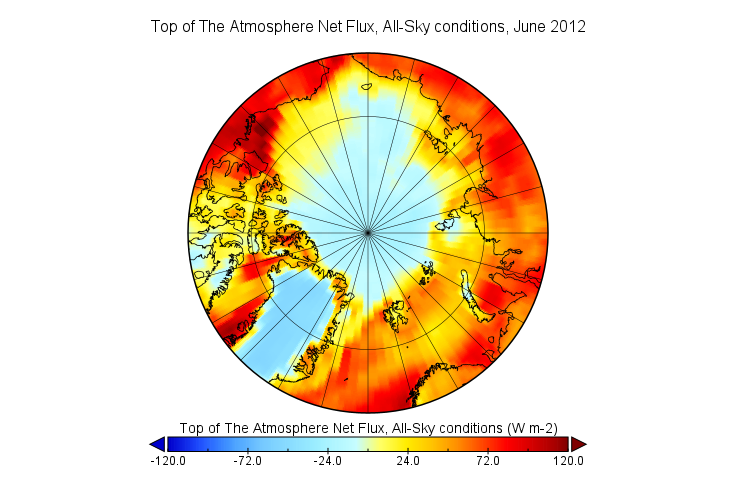
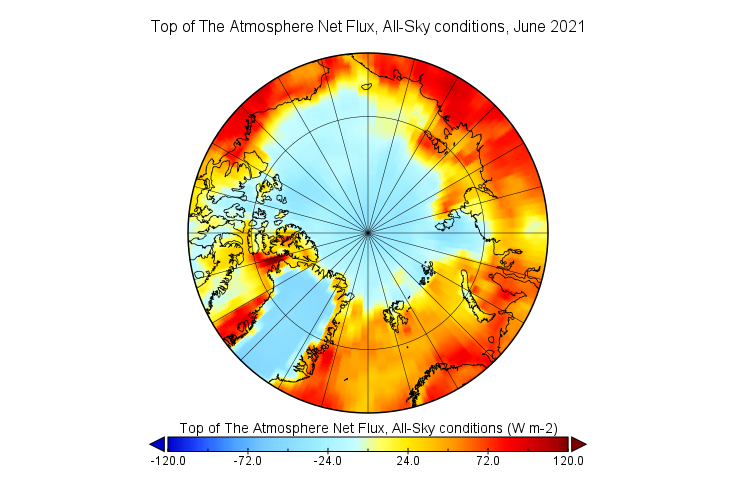
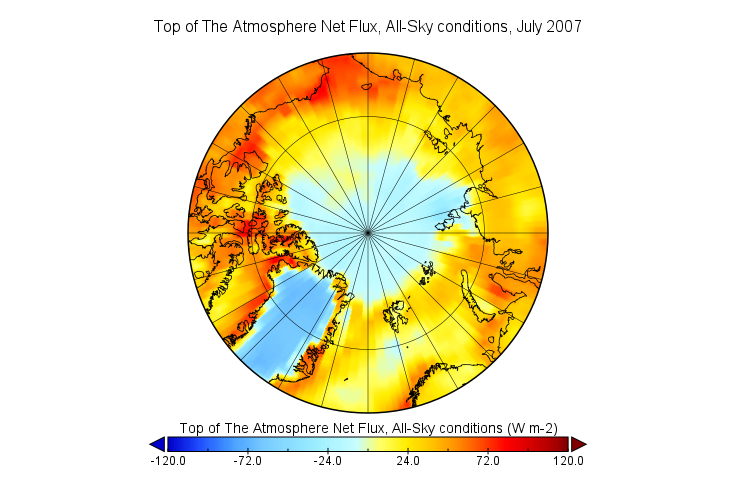
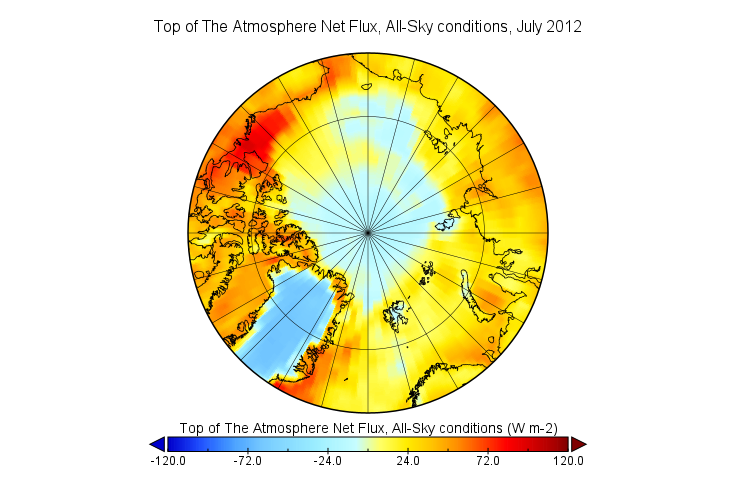
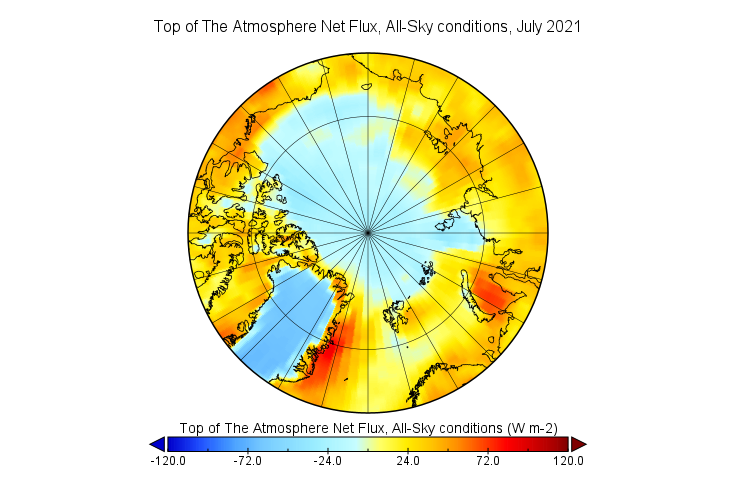
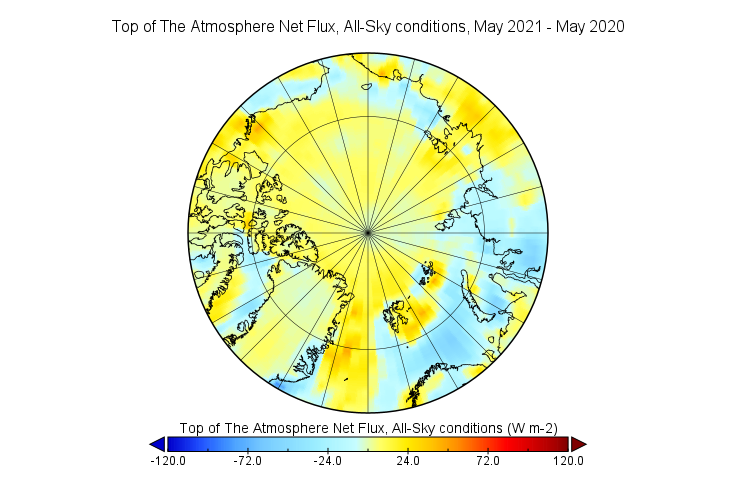
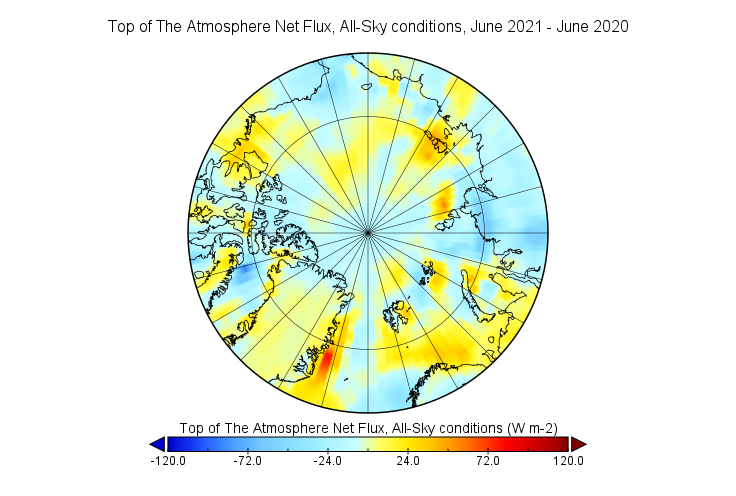
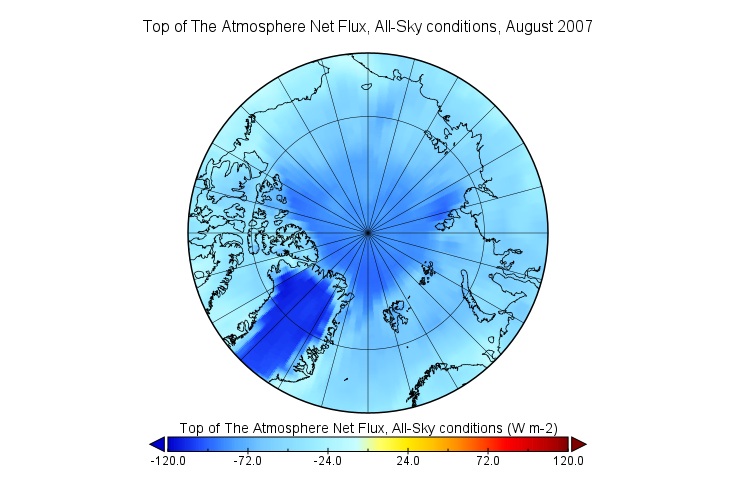
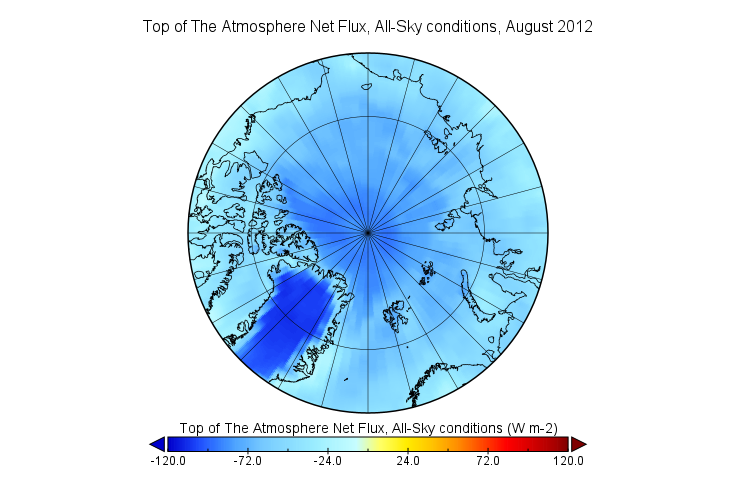
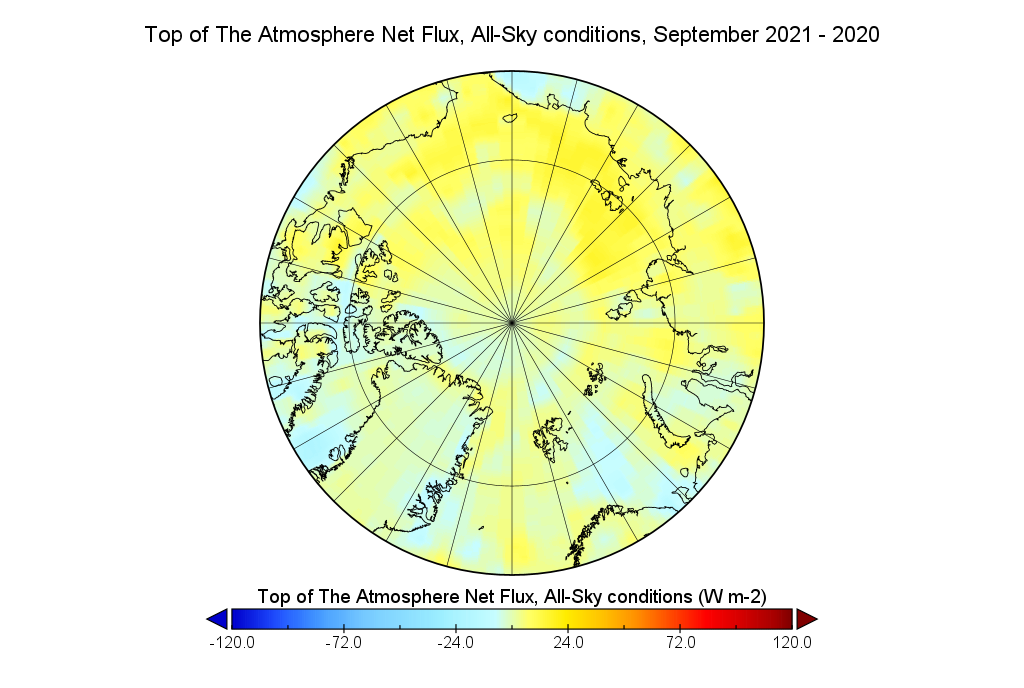
Whilst we wait (in vain?) for Willis to explain himself, here is a preliminary look at some example CERES net top of the atmosphere energy flux maps for the Arctic:

June 2021 is the latest month currently available in NASA’s CERES data, and please feel to play the game of “spot the difference” in the space provided for that purpose below. Meanwhile we await the data for July and August 2021 with barely bated breath.

[Edit – November 3rd]

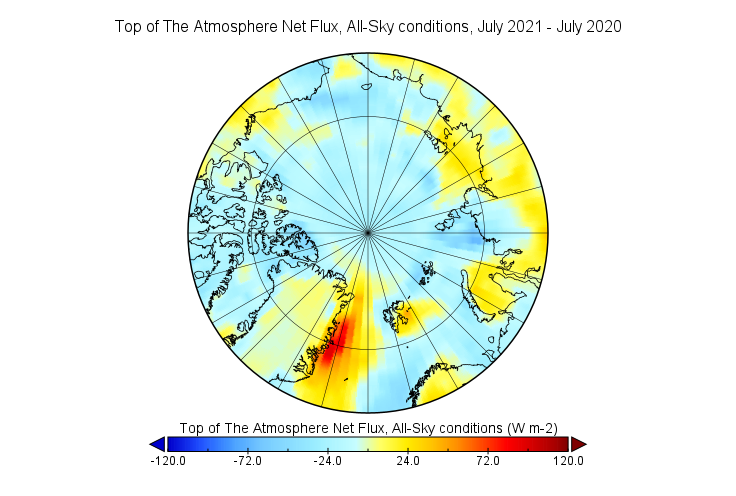
The CERES data for July 2021 has now been released, so first of all let’s take a look at the July net TOA flux for some selected years:

Next let’s compare this year’s peak insolation months with last year’s:

Does anything stand out yet?

[Edit – January 1st]

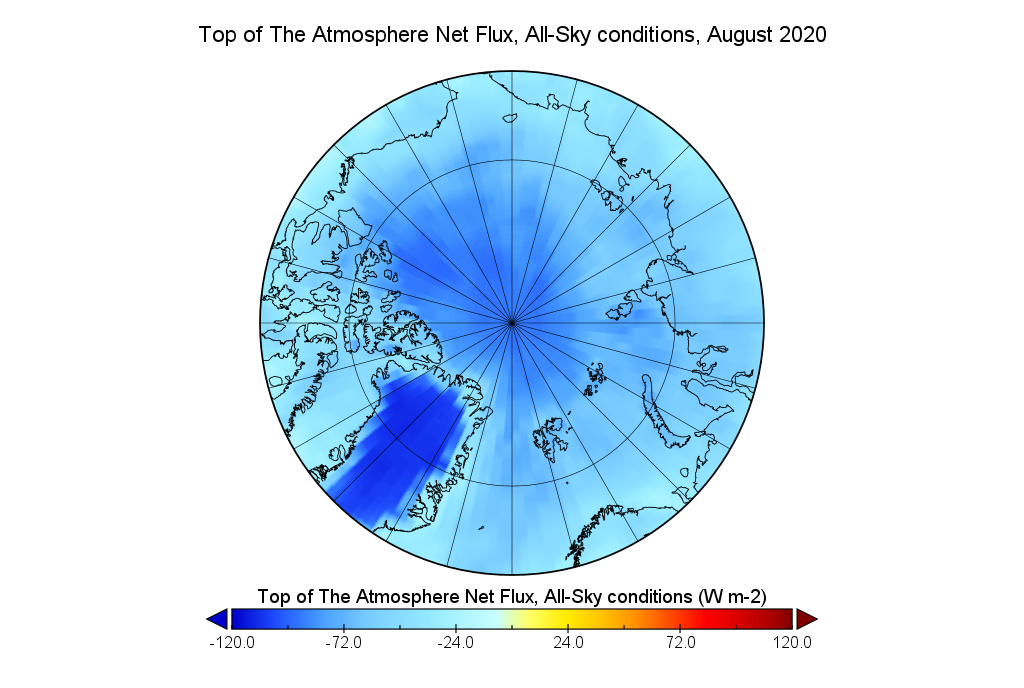
Here are maps of the CERES net TOA flux for August 2021 and our usual selection of other years:

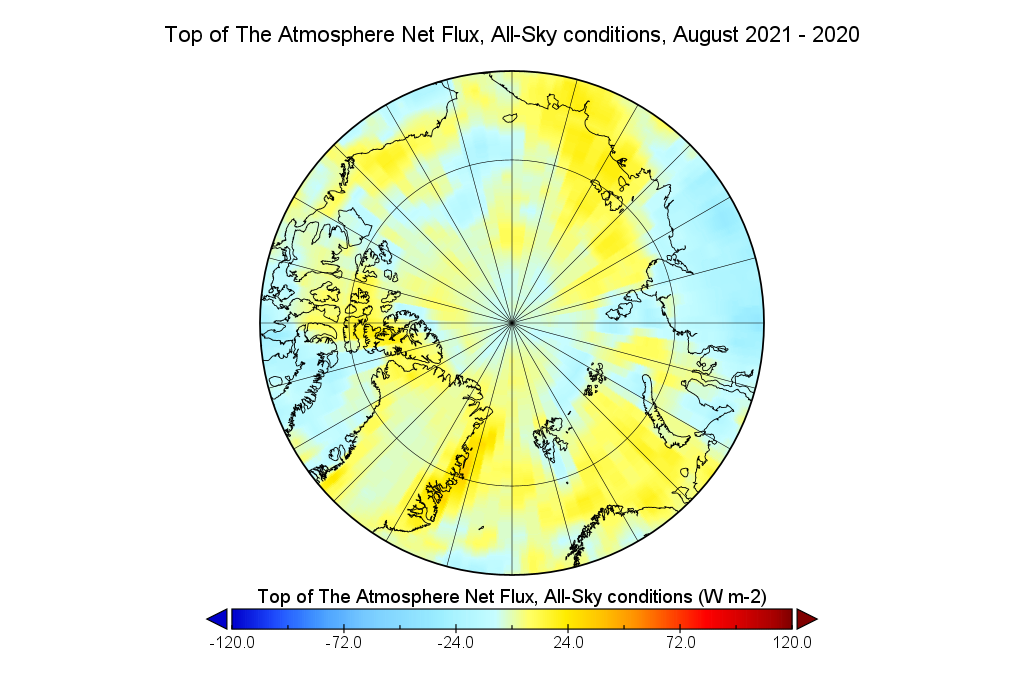
It is obvious that by August the entire Arctic is radiating energy back into space. Now let’s compare August 2021 with 2020:

Whilst we’re at it let’s also take a look at how September compares to last year:

It is also obvious that the central Arctic has been radiating less energy back into space during September this year than it was in 2020.

Watch this space!

What’s Up With That Arctic Sea Ice Disinformation

A few days ago we posted an article about the recent surge in the amount of disinformation being published about Arctic sea ice. Eventually one of our long list of usual suspects, Anthony Watts, published a copy of an erroneous Arctic article by Paul Homewood.

Now the Watts Up With That Arctic porky pie production line is going into overdrive, so here’s an already long list of its output in the run up to the COP26 conference in Glasgow in a month or so. First up is the aforementioned clone from NALOPKT. Allegedly:

It is very easy to show that Arctic sea ice has stabilised. As their graph itself shows, there have only been three years since 2007 with lower ice extent than that year, and eleven have had higher extents. Also the average of the last ten years is higher than 2007’s extent.

In itself, this is too short a period to make any meaningful judgements. But that is no excuse for the Met Office to publish such a manifest falsehood.

This comment of mine on that article remains invisible at WUWT:

This morning (UTC) I added another comment to Anthony’s moderation queue:

Continue reading What’s Up With That Arctic Sea Ice Disinformation

Koonin’s Unsettled Science – The Movie(s)

We have previously mentioned the Wall Street Journal’s assorted activities promoting the new book by Steven E. Koonin which possesses the rather long winded title of “Unsettled: What Climate Science Tells Us, What It Doesn’t, and Why It Matters.”

We further speculated that assorted things that climate science tells us which Dr. Koonin neglected to mention in his book would also not appear in moving pictures expounding his “message”. That has indeed proved to be the case. You can see a copy of the book in question handily placed on a bookshelf behind Steve Koonin in this interview with Paul Gigot for the Wall Street Journal:

By way of introduction Paul enquires:

What isn’t settled in your mind?

Steve responds:

What isn’t settled is how the climate is going to respond to growing human influences, and how that response will affect society and ecosystems.

A little later Paul asserts that:

There’s no question that fossil fuel extraction and burning adds carbon dioxide and methane and other things into the atmosphere. Is the issue just how the interactions work and how much warming they will cause? I mean Al Gore keeps telling us for example that if you look at the graph of CO2 emissions it’s going up, therefore there’s a direct correlation between that and temperature. I think you’re saying “that’s not true”?

to which Steve responds:

That’s not true! For example, when you look at the record global temperature went down between 1940 and 1970 even as greenhouse gases increased. That’s got to tell you immediately that things are a little more complicated than just greenhouse gases are warming the Earth.

So there you have it. Al Gore is a mere straw man, easily knocked down with a cherry pick without even bothering to mention any of the underlying science.

Paul moves on to mention in passing our favourite topic here at the Great White Con:

Now what about the idea that if we continue to warm you’re seeing all these consequence in terms of much more severe weather events, you’re seeing rising oceans, you’re seeing the melting of the polar ice caps. All of that sort of blends together into a kind of disastrous scenario. Are you saying that those are also just simply exaggerated?

Steve responds eagerly:

Yes they are! And let me give you some factoids.

Unsettlingly none of the factoids he gives us mention Arctic sea ice, a topic which Professor Koonin appears to be strangely ignorant of. Perhaps that’s because whichever way you try to slice and dice it that’s still the ultimately unavoidable giant canary in the climate coal mine?

[Edit – May 11th]

Needless to say Steve Koonin has also been interviewed by Tucker Carlson for Fox News. Needless to say the clip once again opens with a speech by that well known climate scientist, Joe Biden. Needless to say there is no mention of the giant canary in the Arctic coal mine once again. Tucker makes no reference to Greenland either, which does at least merit a mention in Steve’s book. Take a look:

Tucker opens his questioning with:

A hurricane will arise out of the Caribbean. We’ll have a heat wave. We’ll have a cold snap. All of them are attributed reflexively to climate change. How certain can we be that climate change causes those events?

Steve responds:

When you read the official reports from the UN and the US Government you find some surprises. For example, even though the globe has warmed by about 2 degrees Fahrenheit over the last century the incidence of heat waves across the 48 states is no greater than it was in 1900, and the highest temperatures haven’t gone up in 60 years.

We have been able to find no detectable influence on hurricanes from humans, and the models that we use to predict future climates have become more uncertain even as they’ve become more sophisticated. All of these things suggest that people who say that “we’ve broken the climate” and face certain doom unless we take drastic action are just misinformed about what the official reports actually say.

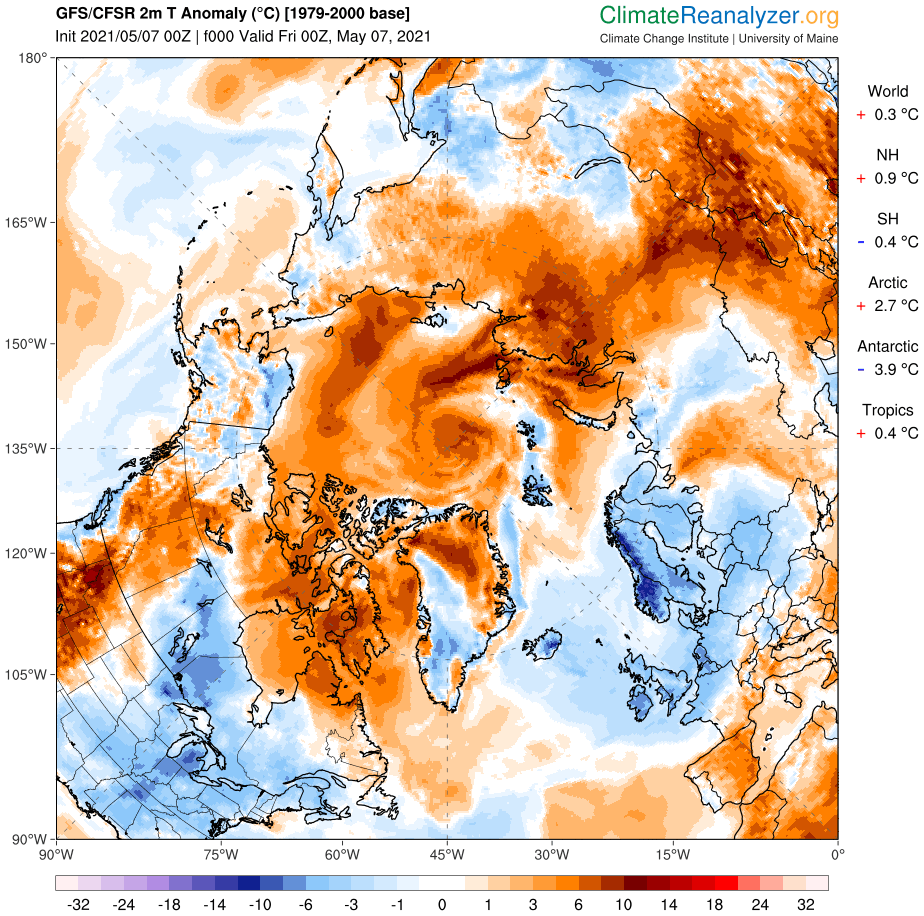
Despite the fact that Fox display some stock footage of sea ice during the interview, Tucker and Steve seem strangely unaware that those 48 states do not constitute the entire globe, or that there was a 2.7 degrees Celsius “heat wave” in the Arctic even as the interview was being conducted:

A little later in the interview Steve says:

We need to have an accurate portrayal of what we know and what we don’t know, and then we can have the debate about what to do about it, without using science as a weapon.

Sadly Steve seems strangely unaware that evidently you’re not going to get the accurate portrayal he recommends via Fox News!

[Edit – May 14th]

Steven Koonin has also been interviewed on CNBC’s Squawk Box, where Joe Kernen’s introduction gives you a strong flavour of what’s to come:

Corporations are spending billions to reduce their so called carbon footprint. President Biden’s infrastructure plan is loaded with subsidies for green industries. In fact if the new green deal ever was passed it wouldn’t be billions, it would be trillions.

Our next guest questions the conventional wisdom on climate science and it’s impact on business and the US economy. Steven Koonin served as the chief scientist in the Obama energy department, and is currently a professor at NYU and the author of “Unsettled: What Climate Science Tells Us, What It Doesn’t, and Why It Matters” :

Steve begins by assuring Joe’s audience that:

Everything I’ve written in this book comes almost directly from the official UN and US Government assessment reports, so this is not Steve talking really, but it is the consensus science.

For some strange reason Steve neglected to include the phrase “ignored and/or cherry picked” in front of “official UN and US Government assessment reports”. He then spouts his by now familiar schtick about “heatwaves in the US”, “hurricanes” and “global wildfires”. Joe then moves the conversation on to the economy:

Will there be an unnecessary negative effect on GDP, on corporations, if they pursue this when it’s not really necessary?

To which Dr. Koonin, as Joe calls him, responds:

I like to say you change the energy system by orthodonture rather than tooth extraction. And so if we do want to reduce carbon emissions we need to do it at a more thoughtful pace and in a more thoughtful way than is being proposed, and moreover we need to get the rest of the world to come along with us if it’s going to have any impact at all…

As [John] Kerry has said, unless the rest of the world comes along US efforts are futile.

So yet again no mention of the IPCC’s “consensus science” regarding Arctic sea ice or even the Greenland Ice Sheet. I cannot help but wonder where Steve’s talking head will appear next on United States’ viewers screens, but on past performance it seems unlikely that the cryosphere will merit a mention.

Watch this space!

Is Time Running Out for Arctic Sea Ice?

One eminent sea ice researcher certainly seems to think that time is indeed running out for the sea ice in the Arctic. First let’s take a look at the results of the first call for contributions of the 2015 melting season from the Sea Ice Prediction Network:
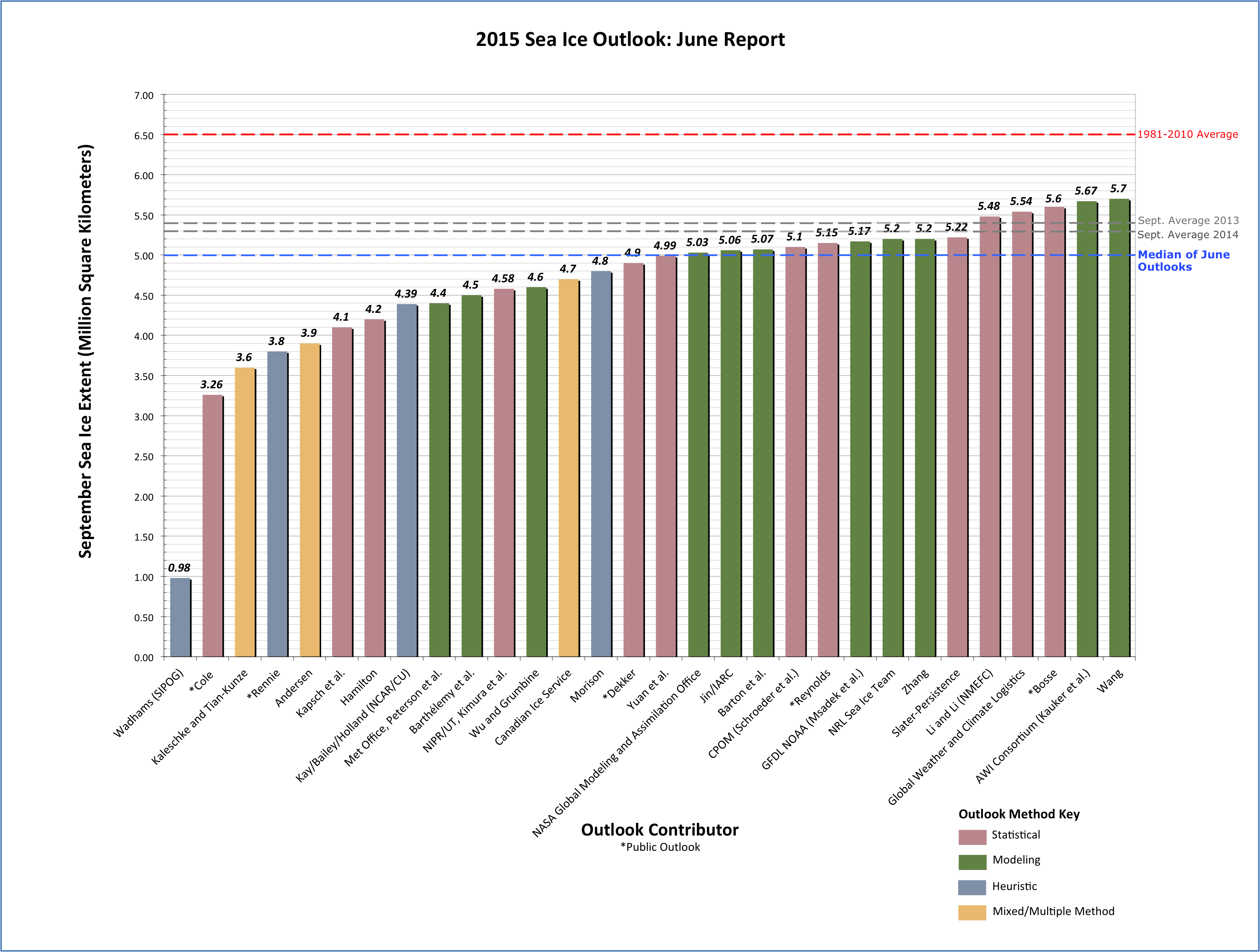
The Sea Ice Prediction Network  June 2015 Sea Ice Outlook results

Note that in the bottom left hand corner of that graph there is a prediction of 0.98 million square kilometers labelled “Wadhams (SIPOG)”. The acronym refers to the Sea Ice and Polar Oceanography Group in the Department of Applied Mathematics and Theoretical Physics at the University of Cambridge, of which Prof. Peter Wadhams is the head. Before we get on to his explanation for what the SIPN refers to as “an extreme outlier” amongst all the other predictions, here’s a TEDx presentation given by Dr. David Barber, who is currently Associate Dean (Research) in the CHR Faculty of Environment, Earth and Resources at the University of Manitoba in Canada:

Here are what Dr. Barber refers to as the “seven surprising impacts” of declining Arctic sea ice:

  1. Increasing coverage of young ice significantly changes atmospheric chemistry

  2. More snow both preserves and destroys ice

  3. Polar bear habitat can actually improve in some areas while deteriorating in others

  4. Match-mismatch timing in the marine ecosystem increases vulnerability

  5. Uncertainty as to whether the Arctic ocean will increase or decrease in overall productivity is a key unknown

  6. Evidence that ice hazards are actually increasing while the world marshals to increase development of Arctic resources

  7. Evidence that our recent cold winters are actually linked to our warming Arctic.

However those bullet points from David’s closing summary don’t actually mention the part of his presentation that most interested me. Listen carefully at 7:40 when he says that:

In 2009 we had our icebreaker down here and we went up this line that you see right here in this figure.

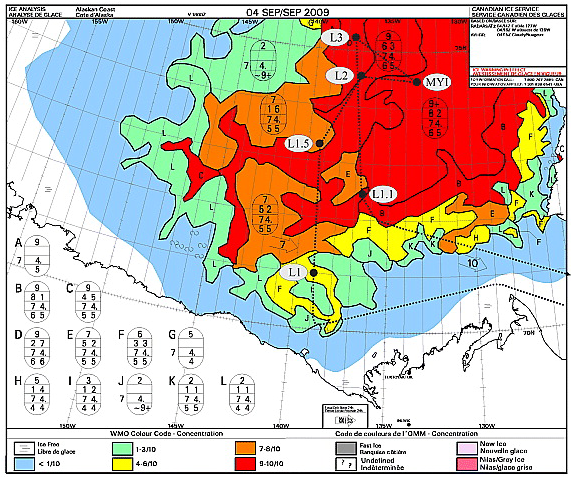
Here’s a version of the map Dr. Barber is referring that comes from a 2009 paper of his entitled “Perennial pack ice in the southern Beaufort Sea was not as it appeared in the summer of 2009“:
Barber-2009-Map

Here’s the relevant passage from the paper rather than the TEDx video:

We departed from station L1 heading north towards station L1.5, expecting to enter MY sea ice cover at about 71°20′N, 139°00′W based on remotely sensed information (Orange polygon in the figure). The Canadian Ice Service (CIS) ice chart (which relies extensively on Radarsat-1 data) for 4 September 2009 indicated the ship track would range from 7 to 9 tenths coverage and this ice would consist of partial concentrations of 5 tenths to 7 tenths old ice and from 2 to 3 tenths thick first year ice.

In situ observations of the sea ice conditions however showed that the ice we were traversing was not MY or thick FY, nor was it 7 to 9 tenths concentration, but rather it was a mixture of a few small MY ice floes (1 tenth coverage) interspersed in a cover dominated by small (10–100 m) rounded floes of heavily decayed first year sea ice (4 tenths). These floes were overlain by a thin layer of new ice (7 tenth) where freeboard was negative and thin ice growing between remnant pieces when the ice had a positive freeboard. Likewise, some new ice covered open water areas between floes.

This is the “rotten sea ice” David refers to in the video, about which he says:

It was so rotten in fact that the ship that we had does 13.5 knots in open water, and we were able to traverse that ice at 13 knots, yet the satellites all thought that this was very thick multi-year sea ice, because that’s what it had always traditionally been.

This information is obviously very interesting of course, but even more interesting (to me at least) is a subsequent paper by Dr. Barber about the same voyage of the Canadian Research Icebreaker Amundsen, published in 2012 and entitled “Fracture of summer perennial sea ice by ocean swell as a result of Arctic storms“. Here’s a pertinent extract:

We progressed through the heavily decayed ice region into a transitional region containing a mix of decayed old and FY sea ice floes, and finally into thick late summer MY pack ice. Using the onboard helicopter to survey the area, we identified a vast MY floe (10 km diameter), to which we intended to moor the ship, and conduct our typical science operations. The ice in this area was much thicker than the heavily decayed FY ice we that we had encountered the previous day to the west. Our helicopter EMI system recorded overall thicknesses of sea ice around station MYI (e.g., mean = 2.0 m, max = 10 m).

As ice teams initially prepared to deploy to the ice, we noticed the appearance of a swell from the ships helicopter deck. Laser data collected during the helicopter EMI survey at station MYI indicated a swell period of 13.5 s, and a wavelength ranging from 200–300 m. Laser data were collected while the helicopter hovered over a large MY ice floe. These data were augmented with three-dimensional dynamic ship positioning data, which revealed approximate ship heave amplitude of 0.4 m, also with a period of 13.5 s. The swell caused the vast MY ice floe nearest the Amundsen to ride up one side of the swell and fracture as it crested the wave peak, creating smaller ice floes of width approximately one half of the wavelength of the swell. In a matter of minutes from the initial onset of swell propagation, all large MY ice floes in the region were fractured in this manner, yielding a new distribution of smaller MY ice floes ranging from 100–150 m in diameter. A helicopter-borne video system recorded this event in still photographs along its flight track which were later combined to create a series of photo mosaics.

On 09 September 2009, we conducted a longitudinal helicopter EMI survey at 72.5 N, and determined the limit of the swell penetration into the pack ice at 72.526 N 134.51 W, a penetration of 350 km. Furthermore, the rotted FY ice margin was heavily fractured, with small floe sizes ranging from 20–50 m in diameter.

Moving on from Manitoba to Cambridge, Peter Wadhams has recently recorded an interview for The University of Earth, which describes itself as “an entertaining educational reality television series”. Here it is:

So what is “the reality” of the situation in the Arctic? Prof. Wadhams doesn’t explain his “extreme outlier” 2015 prediction in detail in the interview, but he does identify three potentially significant problems:

  1. The “minor thing, in a way” of several feet of global sea level rise this century due to melting of the Greenland ice sheet
  2. A sudden increase in the rate of “global warming” due to Arctic albedo feedback, which leads to
  3. The exposure of the methane hydrate bearing continental shelves off Siberia to increasing water temperatures as the sea ice above them melts. “It’s a massive risk, if you do a risk analysis”

Peter also highlights the same concerns as Barber et al. 2012, often referred to in the literature as “waves-in-ice“. I highly recommend watching both videos from cover to cover. However if you’re in a rush then at least skip to 28:30 minutes where he points out that on his cruise around the Arctic this coming September:

We’re looking at one particular thing, which may not be the most important thing, but the retreat of the sea ice in summer is going much faster than computer models predict, and we think that one factor there is the fact that as the sea ice retreats it opens up this huge area of open water in the Arctic Ocean which then becomes like an ocean, with lots of waves and storms and swell, and the waves themselves break the remaining ice up and cause it to retreat faster so that there’s a kind of collaborative effect there that the remaining ice is vanishing faster because of so much open water producing wave action.

Getting back to the current situation in the 2015 melting season, here’s what the University of Hamburg’s AMSR2 sea ice concentration map currently reveals:
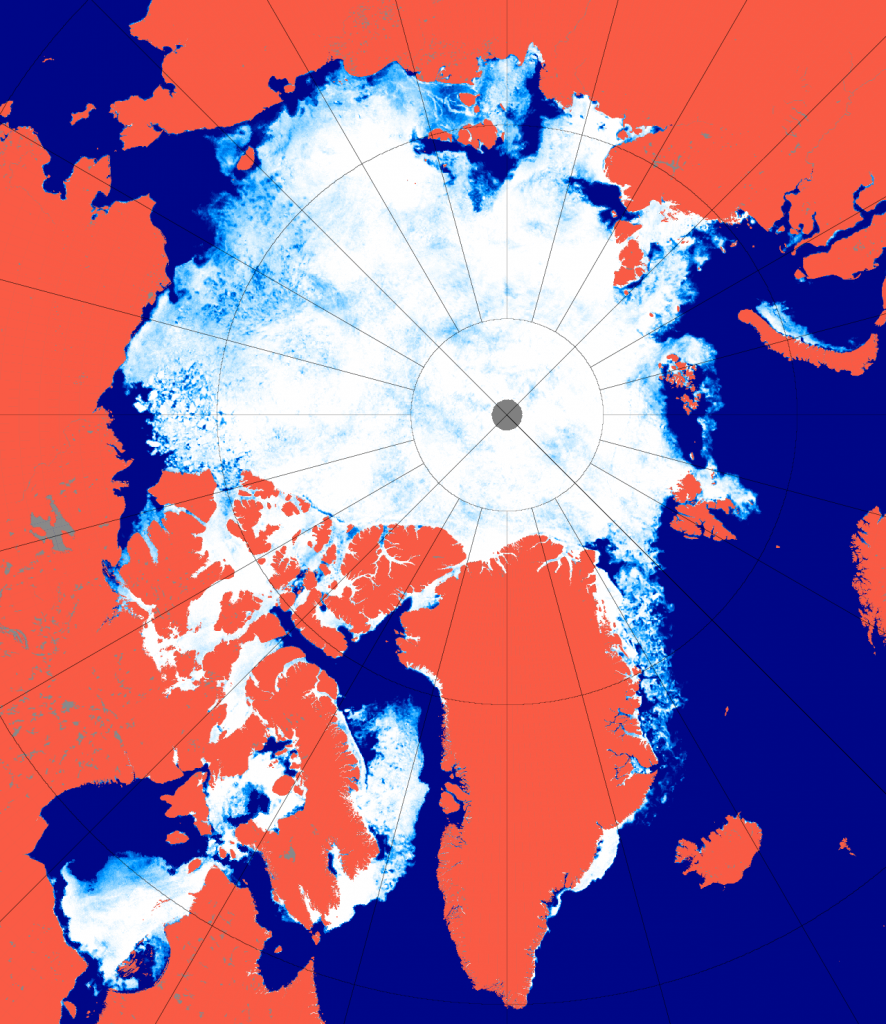
Arc_20150703_res3.125

and here’s what the Slater Probabilistic Ice Extent methodology is predicting will happen over the next 50 days:
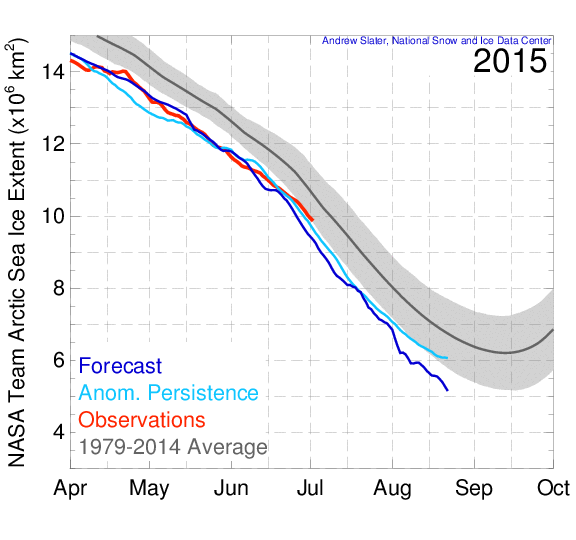
Slater_fcst_20150703

Both suggest to me that although the rate of decline in the area of Arctic sea ice is not currently abnormal for post 2007 years, it may well become so in another month or so, when the extent curve “normally” starts to flatten out. Possibly even sooner than that, because here is the current GFS 2 metre temperature map for the Arctic:
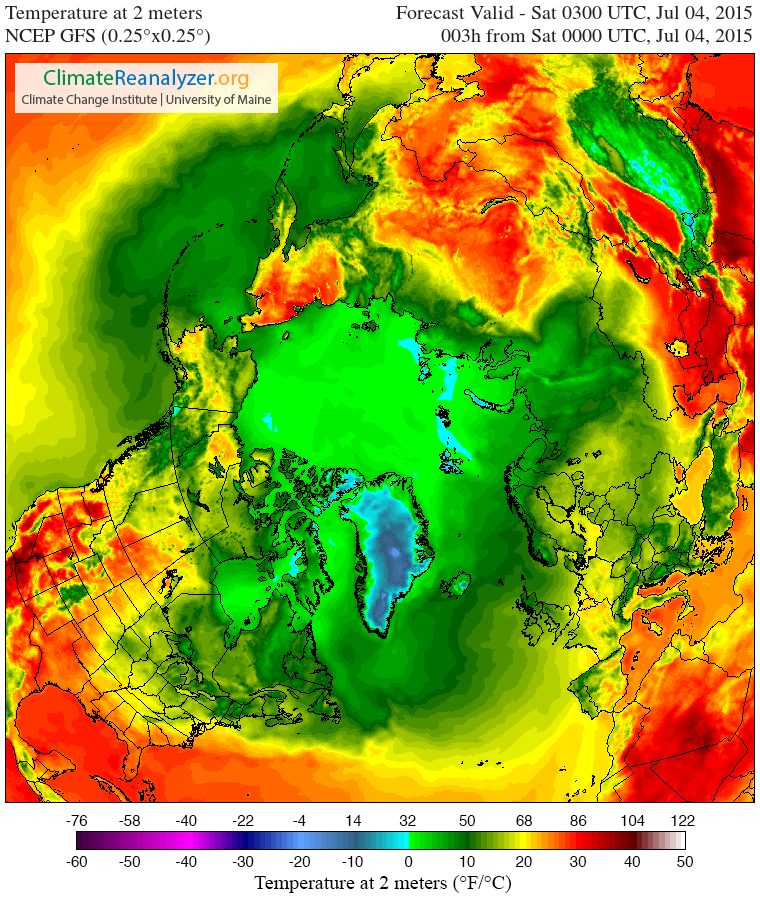
CCI-T2-20150703+3

and temperatures, particularly on the Pacific side of the Arctic, are forecast to get warmer still over the next few days.

Watch this space and we’ll keep you posted, but in the meantime here’s a final thought from Peter Wadhams:

Our children have a future only if we take action now.

[Edit – July 6th 2015]

In a personal communication Prof. Wadhams informs me that:

This year I’m going out in September in the “Sikuliaq” (University of Alaska) to do some more specific wave-ice interaction experiments [in the Beaufort Sea Marginal Ice Zone], assuming there is any ice to experiment on.

[/Edit]
Broadcasting House’s Million Square Kilometre Blunder

It has just been brought to my attention that the topic of Arctic sea ice was raised by Angela Rippon on the edition of “Broadcasting House” that aired on BBC Radio 4 on the morning of Sunday September 29th. In her review of that Sunday’s papers Angela had the following to say:

Them:

Tucked away at the bottom of a page in the Mail on Sunday is a piece saying that “The Arctic ice experts have made a million kilometer blunder“, and this is again using computers, and apparently the official source of information on polar ice caps have got it’s figures for the recovery of the Arctic cap wrong by a million square miles, and they say that this was actually a typo, it was a typographical error, and there are no plans to make a statement on the change because it was just an error in the data. So what data CAN we believe?

Us:

Obviously that’s my own transcript rather than an official one from the BBC. By all means listen to the programme yourself, and let me know if I’ve inadvertently got something wrong. According to the BBC’s “BH” page it will be available for download there for another 25 days.

Now obviously as soon as I’ve finished writing this article I’m going to amble over to the BBC web site to lodge a formal complaint, in which I shall suggest that Angela and the BBC’s “BH” team read this website from cover to cover, starting with this very article.

As a preliminary answer to Angela’s final question I would like to suggest:

Certainly not the Mail on Sunday’s, and not the British Broadcasting Corporation’s either, unless they correct this particular blunder quicker than you can say “Global COOLING!” whilst simultaneously sipping a piña colada by the side of Santa’s super new low albedo summer swimming pool!