Category Archives: Extent

The New Normal In The Arctic

The latest headline on the so called “Real Science” blog reads as follows:

The New Normal In The Arctic – Cold Summers

According to “Steven Goddard”:

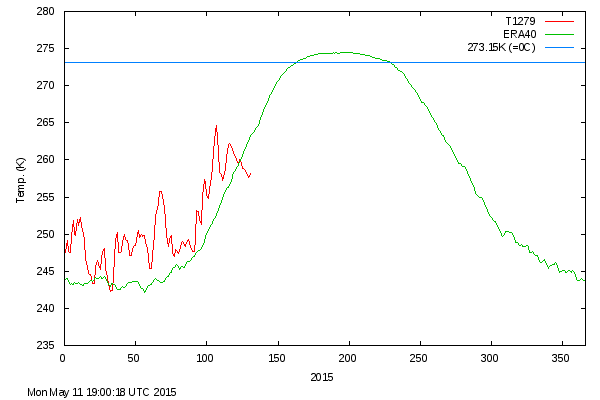
For the third year in a row, near-polar temperatures have dropped below normal in May.

meant_20150511

Both of the last two years, temperatures stayed below normal for the entire melt season.

The below normal summer temperatures are keeping the ice from melting, and have led to a large expansion in the amount of thick multi-year ice.

However the Arctic is unfortunately failing to cooperate with that narrative. Today we are unhappy to report that Tony Heller‘s favourite Arctic sea ice metric, the Danish Meteorological Institute 30% threshold extent, is at the lowest level ever for the date since their records began:

DMI-30_20150512

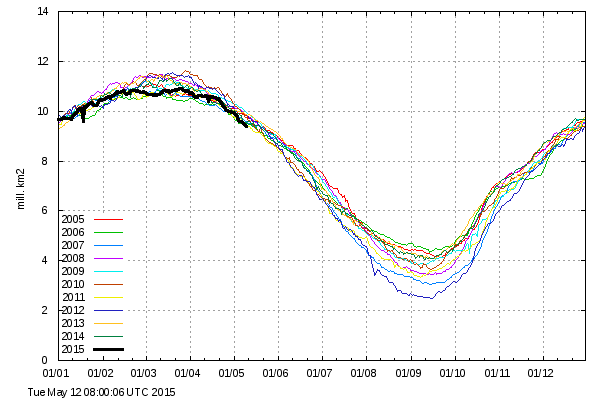
What is more, so is the JAXA 15% extent metric:

2015-05-12_JAXA

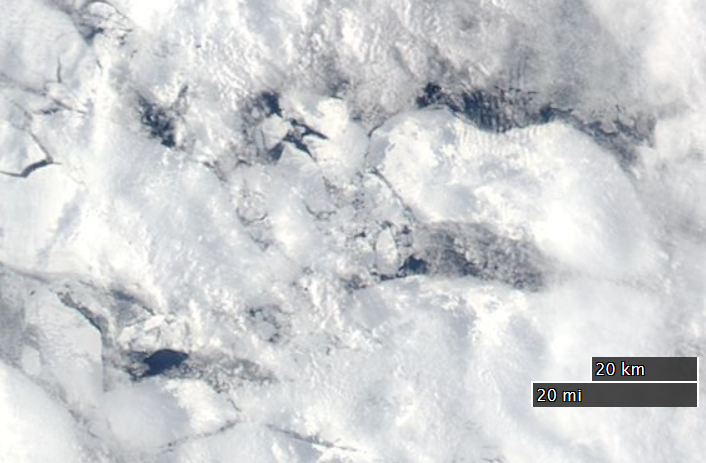
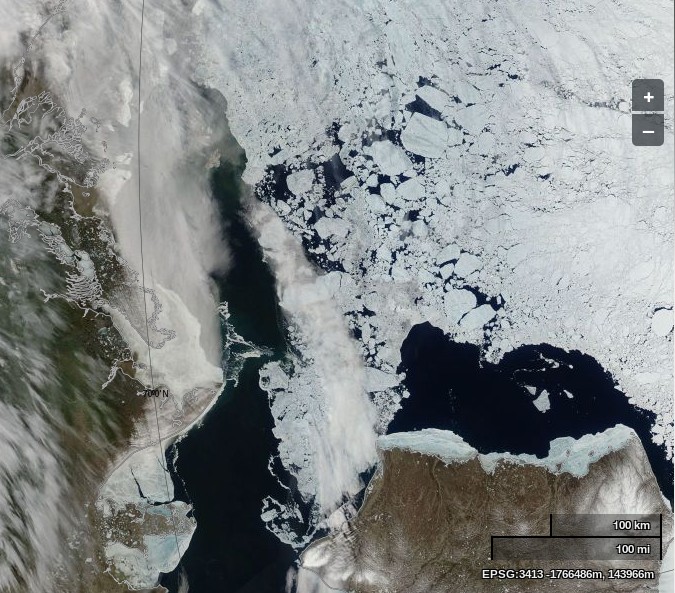
As if that wasn’t enough to be going on with, some big holes have already appeared in the middle of the supposedly multi-meter thick, multi-year sea ice in the Beaufort Sea, well away from the open water already warming up off the Mackenzie Delta:

NASA Worldview “true-color” image of The Beaufort Sea on May 11th, derived from bands 1, 4 and 3 of the MODIS sensor on the Aqua satellite

Gross Deception Measuring Arctic Sea Ice Trends

Our title today is inspired by Paul Homewood, who published an article earlier this week entitled “Why Measuring Arctic Ice Trends From 1979 Is Gross Deception” and which begins as follows:

Officially, we only started monitoring Arctic sea ice extents by satellite from 1979. We know however that this is not the whole story. For instance, HH Lamb tells us:

Kukla & Kukla (1974) report that the area of snow and ice, integrated over the year across the Northern Hemisphere, was 12% more in 1973 than in 1967, when the first satellite surveys were made.

I’ve added that link, since Paul neglected to include it. He concludes:

To draw any conclusions about Arctic ice or temperatures, using data that begins at the coldest point of the cycle is utterly worthless and grossly misleading. But this is climate “science” we are talking about.

Since this is Paul Homewood we are talking about I felt compelled to quibble about his grossly misleading assertion:
 

Us:

Here’s the NSIDC’s chart of Arctic sea ice extent anomalies since 1953:

You will no doubt note that it reveals an overall peak in the late 60s, not the late 70s


Them:

I note they don’t show the 1940’s


Us:

Whereas I note that 1969 is a much juicier looking cherry than 1979. Is 1949 better still?


Them:

They did not have satellite monitoring in 1969.


Even though I had already pointed out the error of his ways to him Paul Homewood decided at this juncture to publish another article, this time entitled “Satellite Monitoring Of Arctic Sea Ice Pre 1979“. It began:

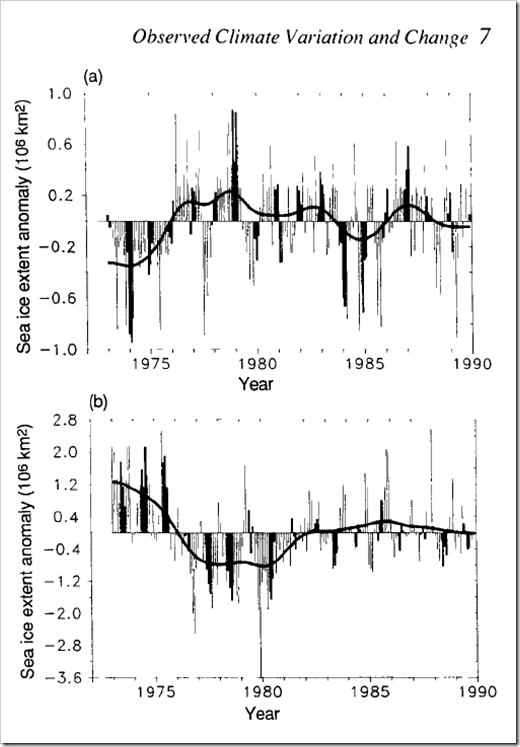
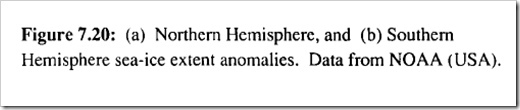
IPCC90-SeaIce IPCC90-Captionhttp://www.ipcc.ch/ipccreports/far/wg_I/ipcc_far_wg_I_full_report.pdf

I was pointing out yesterday why it was so inappropriate to deduce trends in Arctic sea ice, using 1979 as the start point. NSIDC, of course, do this supposedly because that is when satellite monitoring began.

Mr Biscuits, however, reminds me that the 1990 IPCC report showed the above graph, with Arctic sea ice extent back to 1972.


Us:

At the risk of repeating myself, what about this remarkable recent narrative?

https://archive.today/ADq4O#selection-1535.0-1547.25


Them:

They did not have satellites in 1953.


Us:

What the NSIDC actually say regarding their dataset that starts in 1978 is:

“This product is designed to provide a consistent time series of sea ice concentrations (the fraction, or percentage, of ocean area covered by sea ice) spanning the coverage of several passive microwave instruments.”

http://nsidc.org/data/nsidc-0051

Note that there is no mention of “when satellite monitoring began”. See also their Nimbus Data Rescue project, which has data going back to 1964:

http://nsidc.org/data/nimbus/data-sets.html

“Consistent time series” are the operative words


Them:

We’ll keep you posted!

Shock News – IJIS Arctic Sea Ice Extent Lowest Ever!

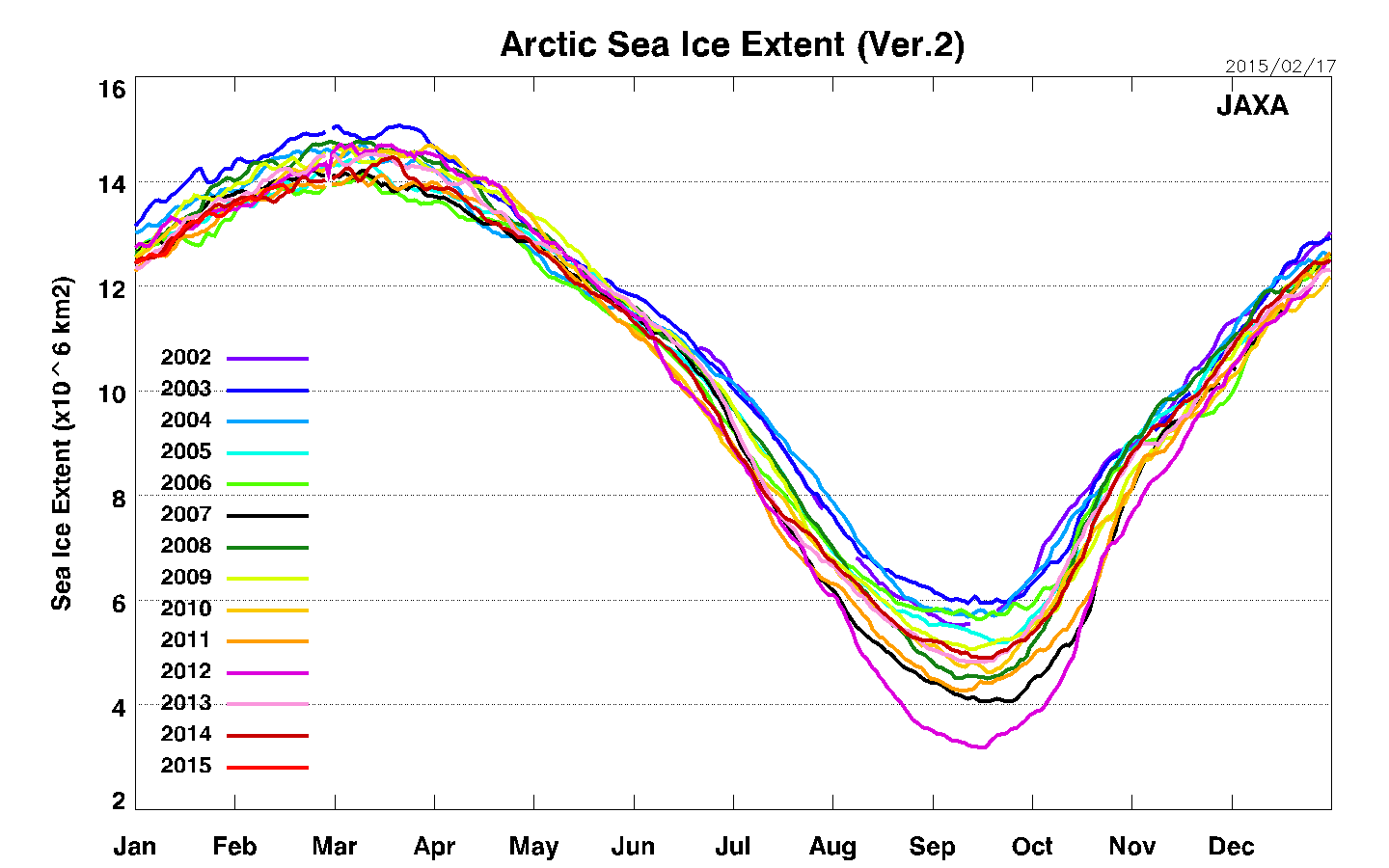
You can of course argue that this is mere cherry picking on our part,  not to mention the slight economy with the truth in our necessarily punchy headline today. Nonetheless it is an actual fact that the IARC-JAXA Information System AMSR2 Arctic sea ice extent metric for February 17th 2015 reads 13,770,330 km² which is the lowest ever for the day of the year in a record going back to 2003. This follows a remarkably large fall (for the time of year) of  113,505 km² from yesterday’s reading of 13,883,835 km². Here’s our evidence:

IJIS_Sea_Ice_Extent_N_20150217

If you prefer to look at numbers instead of pictures then by all means try here instead for proof of the latest shock news from the Arctic.

If instead you prefer moving pictures, here’s an animation based on high resolution AMSR2 data from the University of Hamburg that may provide a few clues about how all this came about:

Can you see how the recent storms in the North Atlantic have “pulled” and then “pushed” the sea ice to thisese new record lows?

Please also note this warning message on the IJIS “Arctic Sea Ice Monitor” web page:

Thank you for visiting our website.

This site will be closed on February 22, and might be unstable from February 15, 2015.

New sea ice monitor website will be coming soon. Stay tuned.

Meanwhile, almost equivalent information can be available at:

JAXA:

http://kuroshio.eorc.jaxa.jp/JASMES/daily/polar/index.html
http://kuroshio.eorc.jaxa.jp/JASMES/climate/index.html

NIPR: National Institute of Polar Research , Japan

https://ads.nipr.ac.jp/vishop/vishop-monitor.html?N
https://ads.nipr.ac.jp/vishop/vishop-extent.html?N
https://ads.nipr.ac.jp/vishop/data/graph/Sea_Ice_Extent_N_v2.png
https://ads.nipr.ac.jp/vishop/data/graph/Sea_Ice_Extent_N_v2_L.png

Mark Serreze and the Arctic Sea Ice Death Spiral

Anthony Watts has been telling porky pies again. He claims his blog is “The world’s most viewed site on global warming and climate change”, which may or may not be true. However Anthony published an article earlier today entitled “NSIDC Mark Serreze’s sea ice ‘death spiral’ no longer ‘screaming’ on the way down, now termed to be ‘erratic & bumpy’“, which most certainly contains an inaccuracy or two.

Here’s how Anthony introduces his “argument”:

From the University of Colorado at Boulder, where they are apparently attempting to explain away why Arctic sea ice isn’t living up to previous wild claims such as those made by Dr. Mark Serreze of the National Snow and Ice Data Center, who famously said that the Arctic is in a ‘Death Spiral’ in response to my writing on WUWT:

Exclusive: New NSIDC director Serreze explains the “death spiral” of Arctic ice, brushes off the “breathtaking ignorance” of blogs like WattsUpWithThat

Hence we are proud to be able to bring you this exclusive report on the “breathtaking ignorance” of the WattsUpWithThat blog! I’ve recently been publicly castigated on Twitter for our tongue in cheek “Us and Them” exposes:

I remain unrepentant, but just for once I’ll maintain a more conventional narrative. Anthony Watts continues his argument as follows:

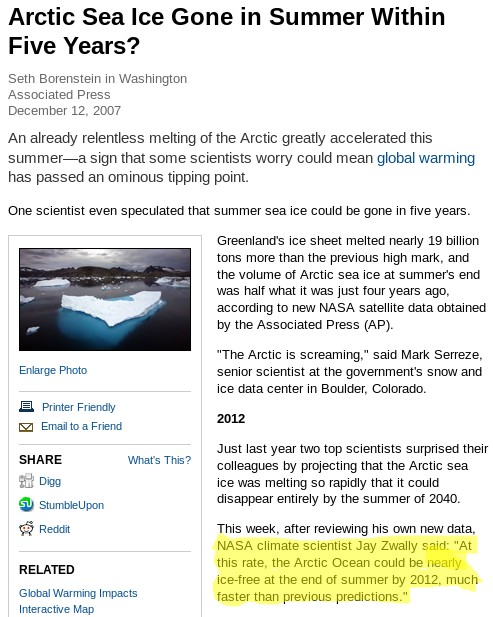
Serreze also famously said two years earlier that “The Arctic is screaming,” and that summer sea ice may be gone in five years, in an interview with the unquestioning and compliant Seth Borenstein at the Associated Press:

He helpfully highlights in yellow what Seth Borenstein said Mark Serreze said way back when in 2007. Note that no “predictions” or even “projections” are mentioned. So where do you suppose Tony’s “summer sea ice may be gone in five years” came from?

Here we provide our own screenshot of the National Geographic article in question, grabbing a slightly larger area of the screen, and highlighting a section slightly further down the page:
Selection_387

For those who have difficulty reading small print, such as Anthony Watts and his merry band of unquestioning and compliant followers over at WUWT, here is the unexpurgated transcript of our highlight in large letters:

NASA climate scientist Jay Zwally said: “At this rate, the Arctic Ocean could be nearly ice-free at the end of summer by 2012, much faster than previous predictions.”

Note firstly that this is a projection rather than a prediction, and secondly that it was reportedly uttered by Jay Zwally of NASA, not Mark Serreze of NSIDC!

Quod erat demonstrandum, and if so one cannot help but wonder how many similar blunders Mr. Watts has made over the course of his illustrious publishing career?

As luck would have it I interviewed Mark Serreze, who is currently director of the NSIDC, not so very long ago. I enquired whether the “Death spiral” story was apocryphal or not. Mark told me he did recall saying something along those lines to a journalist, but that he couldn’t recall the exact circumstances. I also asked if he was willing to make any “predictions” about the decline of sea ice in the Arctic. Mark told me that he still stood by his 2030 estimate for the onset of a seasonally ice free Arctic, although:

Most models say more like 2050

Doing my own due diligence (unlike the readers of Watts Up With That!) the earliest reference I could find to such a “prediction” involved a telephone interview much like the one I had just conducted. In an article dated August 27th 2008 the Reuters environment correspondent reported that:

This year’s Arctic ice melt could surpass the extraordinary 2007 record low in the coming weeks. Last year’s minimum ice level was reached on September 16, according to the National Snow and Ice Data Center.

Even if no records are broken this year, the downward trend in summer sea ice in the Arctic continues, the Colorado-based center said. Last year’s record was blamed squarely on human-spurred climate change.

“No matter where we stand at the end of the melt season it’s just reinforcing this notion that Arctic ice is in its death spiral,” said Mark Serreze, a scientist at the center. The Arctic could be free of summer ice by 2030, Serreze said by telephone.

So there you have it. Unless someone can come up with some evidence to the contrary (unlike Watts and the Watties), it looks to me like Mark Serreze has been consistently saying for many years:

The Arctic could be free of summer ice by 2030

or words to that effect. Expect more from me on my interview with Mark Serreze in due course.

 
[Edit – February 1st]

Without a word of thanks to yours truly Anthony Watts has now published an “Update” to his original article. The salient bits read as follows:

The original article implied that NISDC’s Mark Serreze made the statement about sea ice being gone in 5 years, ending in 2012, when it was actually NASA’s Jay Zwally that made the claim in the National Geographic article. The language has been clarified in the paragraph to reflect this.

The offending paragraph now reads:

Serreze also famously said two years earlier that “The Arctic is screaming,” and a Arctic research associate, Jay Zwally of NASA, said in the same article that summer sea ice may be gone in five years, in an interview with the unquestioning and compliant Seth Borenstein at the Associated Press.

Anthony obviously hasn’t taken on board my helpful remarks about the difference between a prediction and a projection, and hence he waxes lyrical about how the sea ice in the Arctic didn’t vanish in the summer of 2012. He signs off by saying:

To my knowledge, Dr. Serreze has never publicly corrected the National Geographic article claim of 2012 being the ice-free year that wasn’t, suggesting he endorsed the idea at the time.

Have I got news for you Anthony. It doesn’t suggest anything of the kind! In addition to suggesting strange things to the suggestible Mr. Watts has so far neglected to answer this question posed by a commenter on the article in question:

I look forward to seeing any substantive replies to Jim Hunt’s clarifying post.

and so far he has also neglected to publish my response to that question. It included this video of my namesake, James Hunt, conversing with a couple of clueless mechanics:

Anthony Watts has also thus far neglected to explain how he inexplicably (in all the circumstances) successfully attributed the supposed 2012 “prediction” to Jay Zwally in this 2012 article, that also included a highlighted screenshot much like mine above:

In four months, just 132 days from now at the end of summer on the Autumnal Equinox September 22nd 2012, the Arctic will be “nearly ice free” according to a prominent NASA scientist in a National Geographic article on December 12, 2007.

Quod Erat Demonstrandum?

“There’s no answer to that”!

[/Edit]
Implausible Deniability of 2014 Arctic Sea Ice Predictions

Further to the cessation of the brief hiatus in my continuing discussions with “Steve Goddard” about “global warming”, the debate has turned to predictions concerning Arctic sea ice metrics during the 2014 melting season.

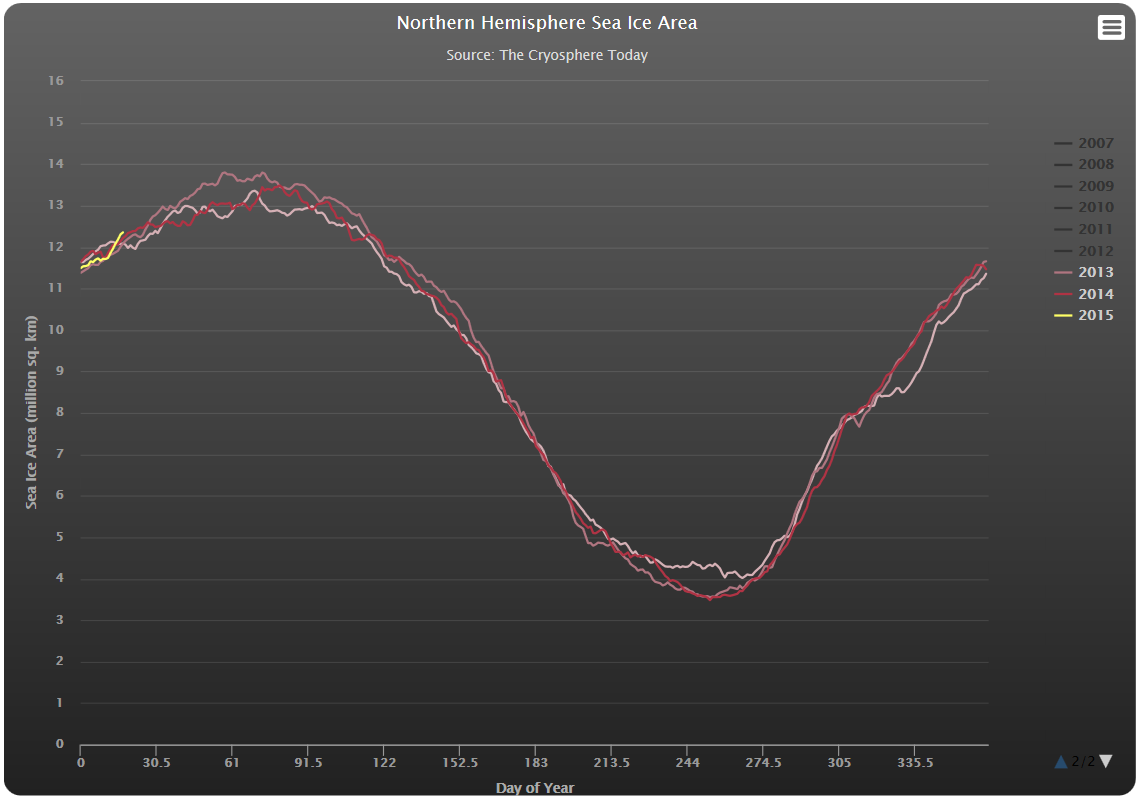
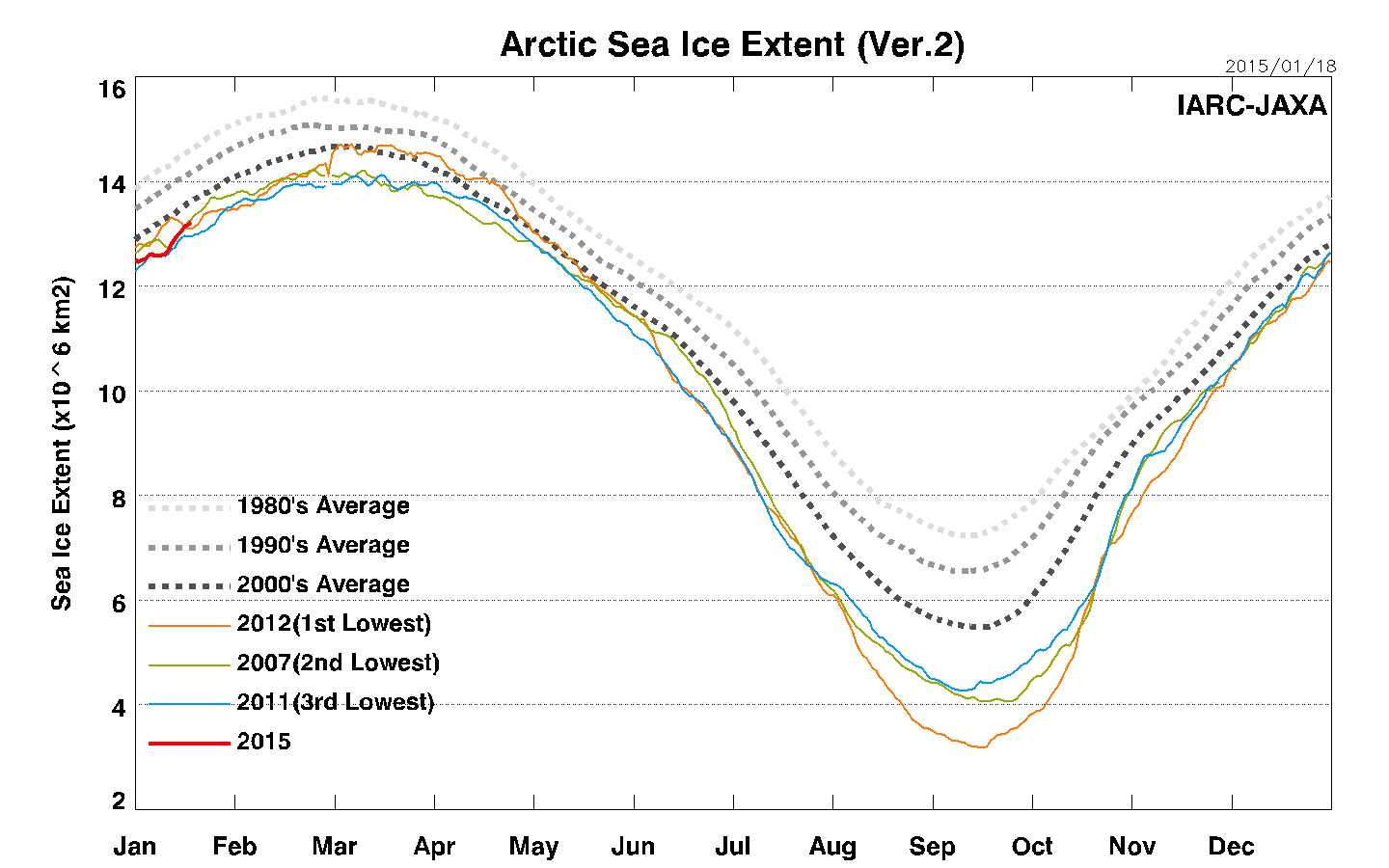
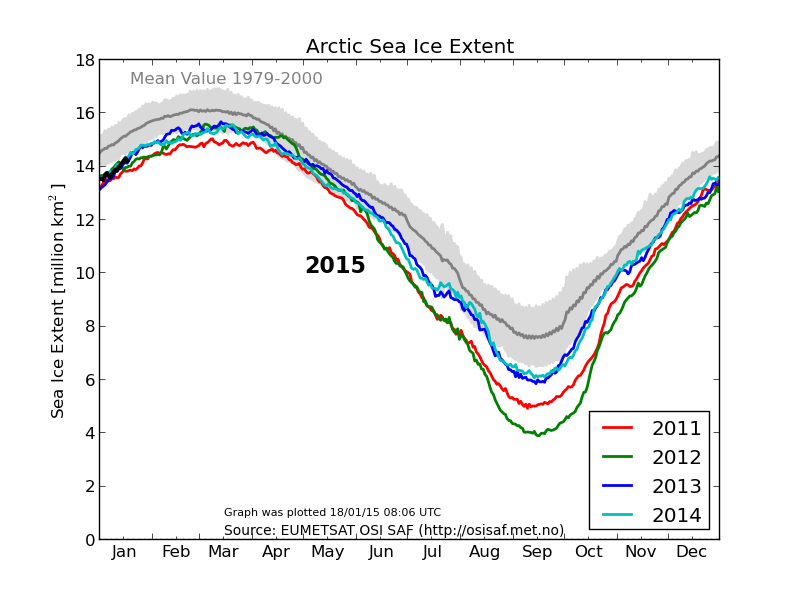
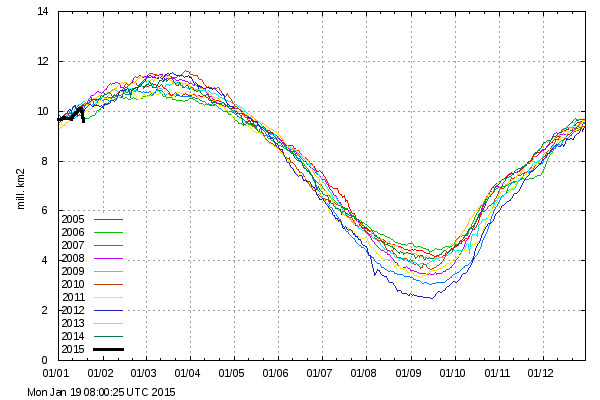
Firstly here’s a few charts of assorted Arctic sea ice metrics, hot off the virtual presses:

CT-Area-2015-01-18
Chart from Cryosphere Today – http://arctic.atmos.uiuc.edu/cryosphere/arctic.sea.ice.interactive.html
IJIS-Extent-2015-01-18
Chart from IJIS – http://www.ijis.iarc.uaf.edu/en/home/seaice_extent.htm
DMI-New-2015-01-19
Chart from DMI – http://ocean.dmi.dk/arctic/icecover.uk.php
DMI-Old-2015-01-19
Chart from DMI – http://ocean.dmi.dk/arctic/old_icecover.uk.php

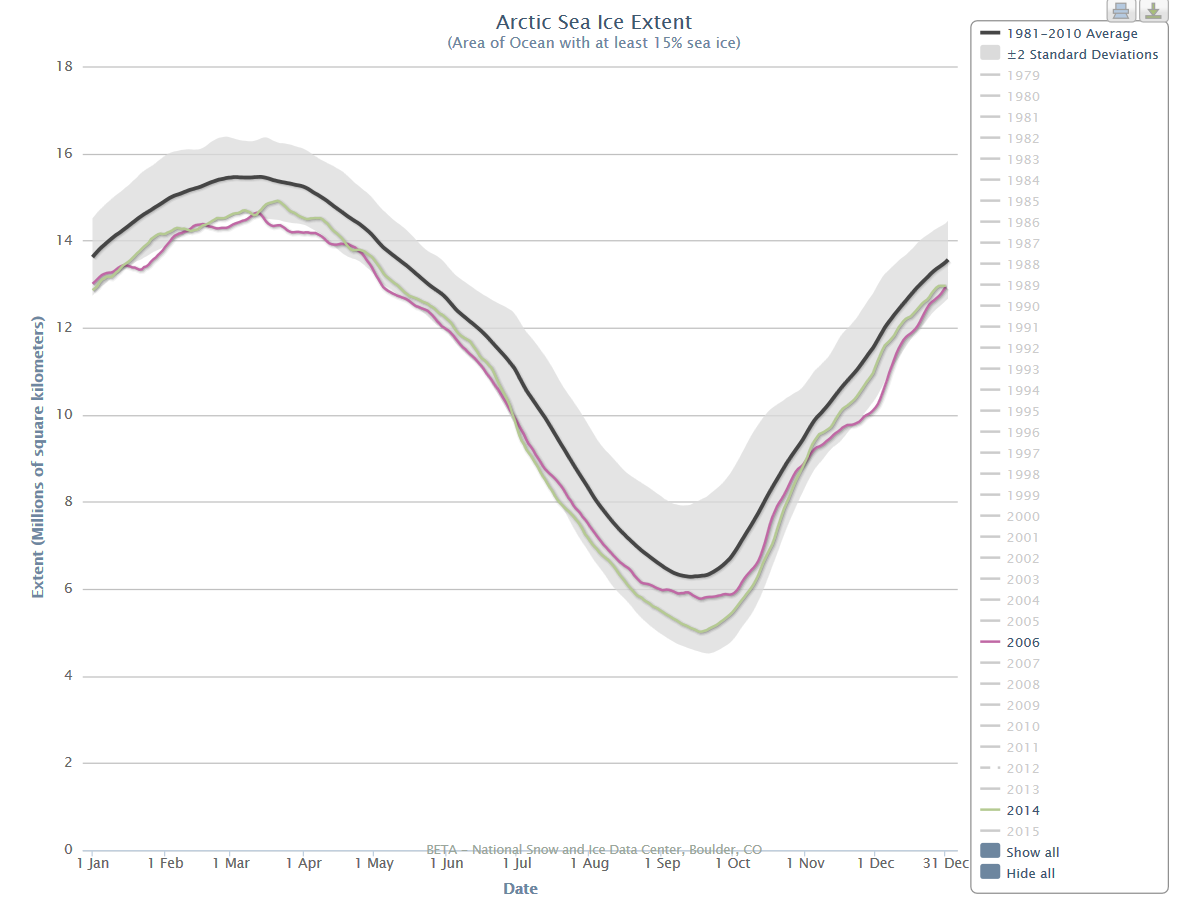
Here’s a table of the minimum value of some of those metrics for a selection of years:

Metric 2006 2013 2014
NSIDC daily 15% extent 5.74877 5.077090 4.98339
CT area 4.02978 3.55440 3.48317
IJIS extent 5.62505 4.80929 4.88412


Now here’s one of Steve/Tony’s predictions, in this case from August 1st 2014:

The minimum this summer will likely be close to the 2006 minimum, which was the highest minimum of the past decade.

And finally here’s the “discussion” (such as it is) over at the “Real Science” blog:
 

Us:

That’s not really how things turned out, is it?


Them:

That is exactly how it turned out.

Do you believe it was ice-free as Nobel Prize winner Al Gore predicted?


Us:

Perhaps this chart is clearer?

NSIDC-Extent-2015-01-18
Chart from NSIDC – http://nsidc.org/arcticseaicenews/charctic-interactive-sea-ice-graph/

How do you define “exactly”, “likely” and “close”?

Regarding my views on Al Gore’s so called predictions, see:

https://greatWhiteCon.info/2014/09/david-roses-apocalyptic-vision-of-al-gores-nobel-lecture/

In brief “Al Gore never ‘predicted’ that the Arctic would be ice-free by now!”


Them:

Well, he didn’t say ’22 years from now’, did he? No, he emphasized the most alarmist position he could find.

You can weasel out of this by stating that Gore did not make the prediction ,but he sure as Hell quoted and emphasized it, over any and all other predictions. And in front of the Nobel committee and entire world at that!

So have you confronted Gore over the failed prediction he parroted in Oslo? When you do, you will have a modicum of credibility. Get busy.


Us:

At the risk of repeating myself, “for the benefit of those who seem unable to understand either English or Mathematics a ‘projection’ is not the same thing as a ‘prediction’”

Getting back to Tony’s predictions, and using the NSIDC daily extent numbers for the moment, would you say that 4.98339 is “exactly” 5.74877? How about “close”?


Them:

Actually, no, your chart is less clear. Steve’s has all the years and it is clear his prediction is correct. Yours does not. Nor does yours have a legible legend. Another snow white lie.


Us:

Have you by any chance tried clicking on my chart? Does that help at all?

At the risk of repeating myself, would you say that 4.98339 is “exactly” 5.74877? How about “close”?


Them:

What bearing does 2013’s minimum have on goddard’s prediction for 2014? Are you a half-wit in addition to being a mentally ill stalker & transvestite?


Us:

What bearing does 2014’s maximum have on 2014’s minimum?

Are you blind?


Them:

You seem to think that some random number you came up with has some bearing on the subject at hand. Hint: it’s why we think you’re mentally ill.


Us:

Of course they’re not random numbers. To save you the bother of doing your own research please feel free to take a look at:

https://greatWhiteCon.info/2015/01/implausible-deniability-of-2014-arctic-sea-ice-predictions/#Table


Them:

Stark, it’s not about random numbers, it’s about random harassment. This clown takes no issue with ridiculous ‘projections’ delivered by alarmist zealots on a world stage, instead he haunts this site moaning about near misses.

But you are right about the mentally ill bit.


Us:

The conversation about the non-random Arctic numbers has at last taken a statistical turn over at:

https://stevengoddard.wordpress.com/2015/01/20/arctic-sea-ice-extent-continues-near-a-decadal-high/#comment-483567

I note that you are still dodging the question there too.


Them:

We’ll keep you posted!

Mark Serreze and the Arctic Sea Ice Death Spiral

In his article about Arctic sea ice in the Mail on Sunday three days ago David Rose pointed out that:

The most widely used measurements of Arctic ice extent are the daily satellite readings issued by the US National Snow and Ice Data Center, which is co-funded by NASA.

He also stated that:

For years, many have been claiming that the Arctic is in an ‘irrevocable death spiral’, with imminent ice-free summers bound to trigger further disasters. These include gigantic releases of methane into the atmosphere from frozen Arctic deposits, and accelerated global warming caused by the fact that heat from the sun will no longer be reflected back by the ice into space.

Judith Curry, professor of earth and atmospheric sciences at Georgia Institute of Technology in Atlanta, said last night: ‘The Arctic sea ice spiral of death seems to have reversed.’

All of which got me thinking. Why did David Rose speak to a professor of earth and atmospheric sciences when researching his article, rather than an expert on Arctic sea ice? Why, indeed, did he not speak to the man who originally coined the “Death spiral” metaphor? Seeking answers to these troubling questions amongst others, I called the National Snow and Ice Data Center in Boulder, Colorado. I enquired whether I might be able to speak with Mark Serreze,  who is currently director of the NSIDC. Shortly after that Mark called me back and I was able to ask him a number of questions.

My first question was whether David Rose or anyone from the Mail on Sunday had been in touch with the NSIDC recently. The answer was “No”. Next I enquired whether the “Death spiral” story was apocryphal or not. Mark told me he did recall saying something along those lines, but that he couldn’t recall the exact circumstances. Doing my own due diligence (unlike the Mail!) the earliest reference I could find suggested that “the circumstances” involved a telephone interview much like the one I was in the middle of. In an article dated August 27th 2008 the Reuters environment correspondent reported that:

This year’s Arctic ice melt could surpass the extraordinary 2007 record low in the coming weeks. Last year’s minimum ice level was reached on September 16, according to the National Snow and Ice Data Center.

Even if no records are broken this year, the downward trend in summer sea ice in the Arctic continues, the Colorado-based center said. Last year’s record was blamed squarely on human-spurred climate change.

“No matter where we stand at the end of the melt season it’s just reinforcing this notion that Arctic ice is in its death spiral,” said Mark Serreze, a scientist at the center. The Arctic could be free of summer ice by 2030, Serreze said by telephone.

Mark confirmed to me that he still stood by his 2030 estimate for the onset of a seasonally ice free Arctic, although “most models say more like 2050”.

Next I asked him whether he agreed that “The Arctic sea ice spiral of death has reversed.” He said that he agreed with the statement attributed to Dr. Ed Hawkins near the end of the Mail article, that “There is undoubtedly some natural variability on top of the long-term downwards trend caused by the overall warming“. However 2 years worth of data certainly didn’t constitute “a recovery”. It was more like “a one week retracement in the US stock market. The long term trend in extent is definitely downwards”.

In conclusion I asked Mark to offer his best estimate for Arctic sea ice extent at this summer’s minimum. He told me that even at this late stage some of that “natural variability” could affect the outcome, but that the NSIDC extent “will probably end up on a par with 2013”.

I have also had an email conversation with Andrew Shepherd, the British “expert in climate satellite monitoring” whose views about Arctic sea ice were reported in the Mail on Sunday’s article. He told me that:

Arctic sea ice cover is expected to continue to decline, with the possibility of ice-free summers in the next 20-30 years. Climate model predictions tend to be at the upper end of this range, whereas projections of past observations tend to be at the lower end. Once we are able to include direct measurements of thickness from CryoSat-2, I expect the accuracy of predictions will improve.

If nothing else changes, then the recovery in Arctic sea ice thickness will wind the clock backwards a few years, but there is no reason to believe this is anything other than a temporary reprieve due to one cool summer.

Finally, for the moment at least, I also called the Danish Meteorological Institute. Along with the NSIDC their Arctic sea ice extent figures were quoted by David Rose. Along with the NSIDC they told me that they had received no enquiries recently from Mr. Rose or anyone else at the Mail on Sunday.

Does Tony Heller Need To Be Prosecuted?

In some recent shock news over at the “Real Science” blog “Steven Goddard” asked “Who is Steven Goddard” and then answered himself as follows:

My name is Tony Heller. I am a whistle blower. I am an independent thinker who is considered a heretic by the orthodoxy on both sides of the climate debate.

I’m highly unorthodox, so I’ll consider him as a schizoidal cherry picking pseudo-skeptic instead. Steve/Tony finishes his “coming out” article as follows:

I am more than happy to debate anyone who feels up to the challenge, including the President of The United States. Science works through research and debate – not censorship, propaganda, faith, or intimidation.

Steve/Tony has been blogging about Arctic sea ice again recently. His most recent post is entitled “Does The Arctic Need To Be Prosecuted?“, but it seems he’s unwilling to engage in debate about that topic with me.

Them:

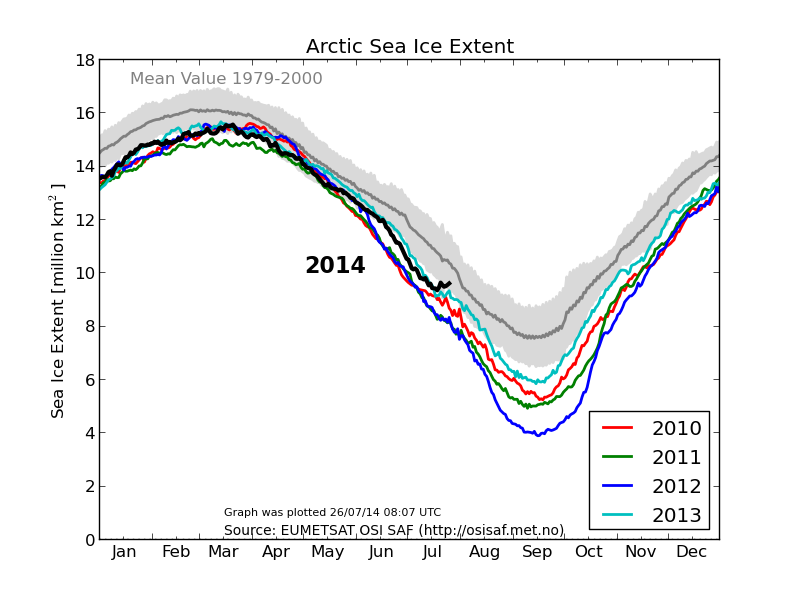
Some climate experts want to make skepticism of junk science a felony, and every day it becomes more clear that the Arctic has no respect for climate models or eminent government scientists. This is shocking, and it is time for the Arctic to be prosecuted. The Arctic is aiding and abetting climate deniers, as well as making obscene gestures towards the world’s leading academics.

DMI "new" Arctic sea ice extent graph on July 26th 2014

DMI “new” Arctic sea ice extent graph on July 26th 2014


Us:

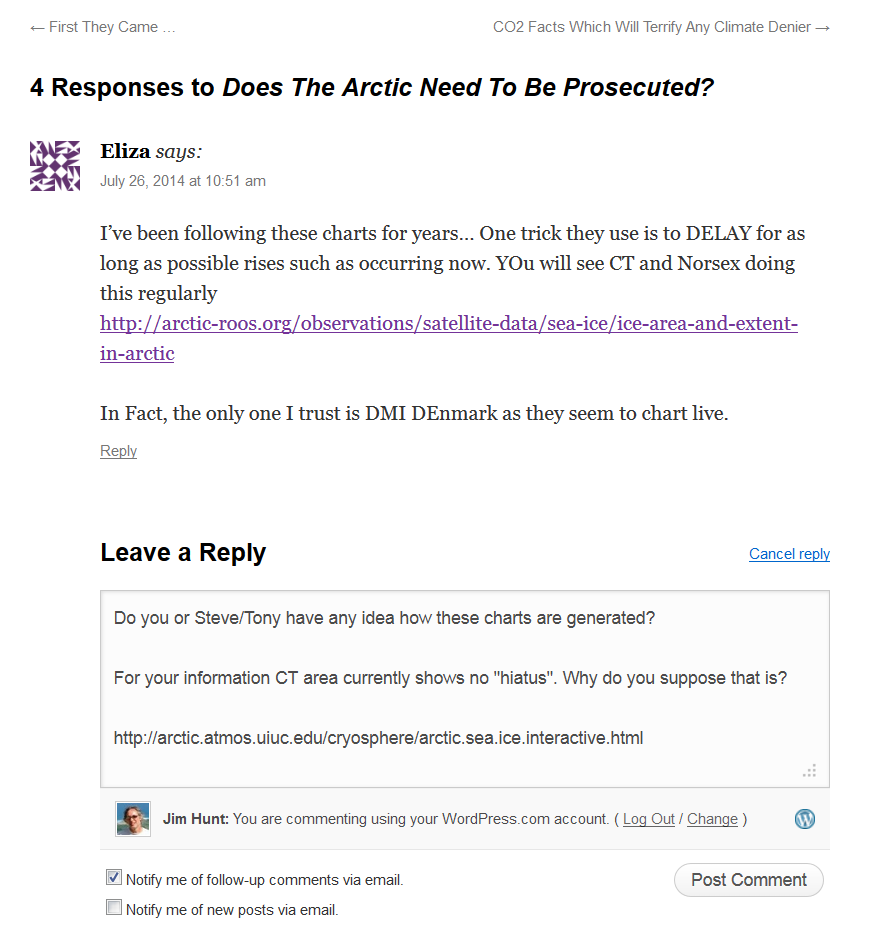
Needless to say Steve/Tony has yet to approve my comment on his ruminations, which reads as follows:

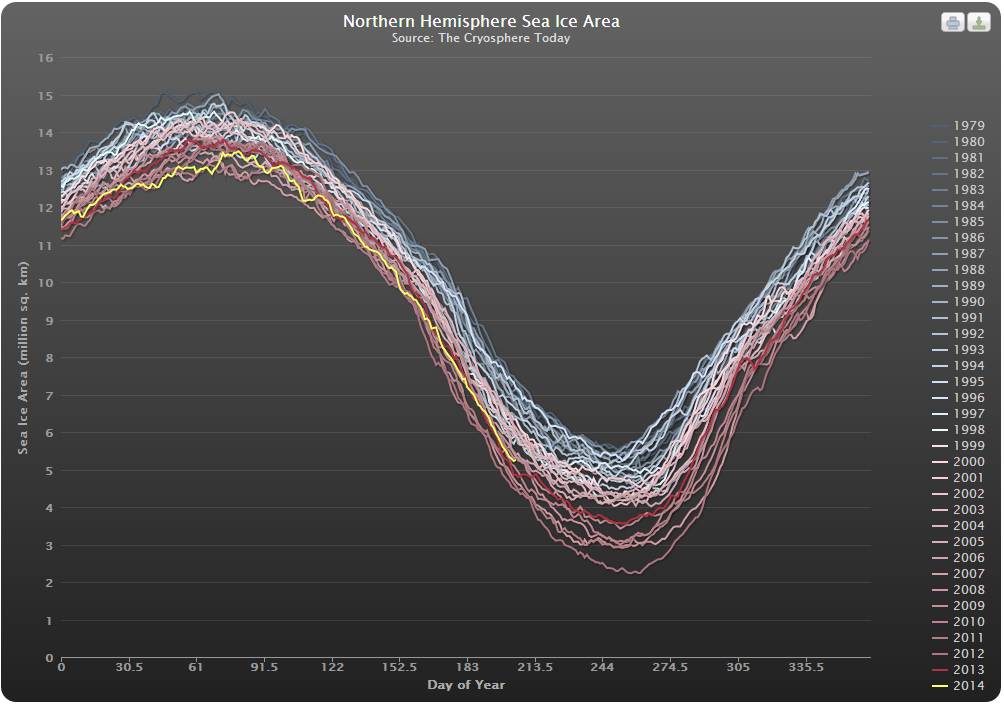
2014-07-26_1314_RealScienceThis is what the Cryosphere Today graph of Arctic sea ice area I linked to looks like at the moment:

Cryosphere Today interactive Arctic sea ice area graph on July 26th 2014

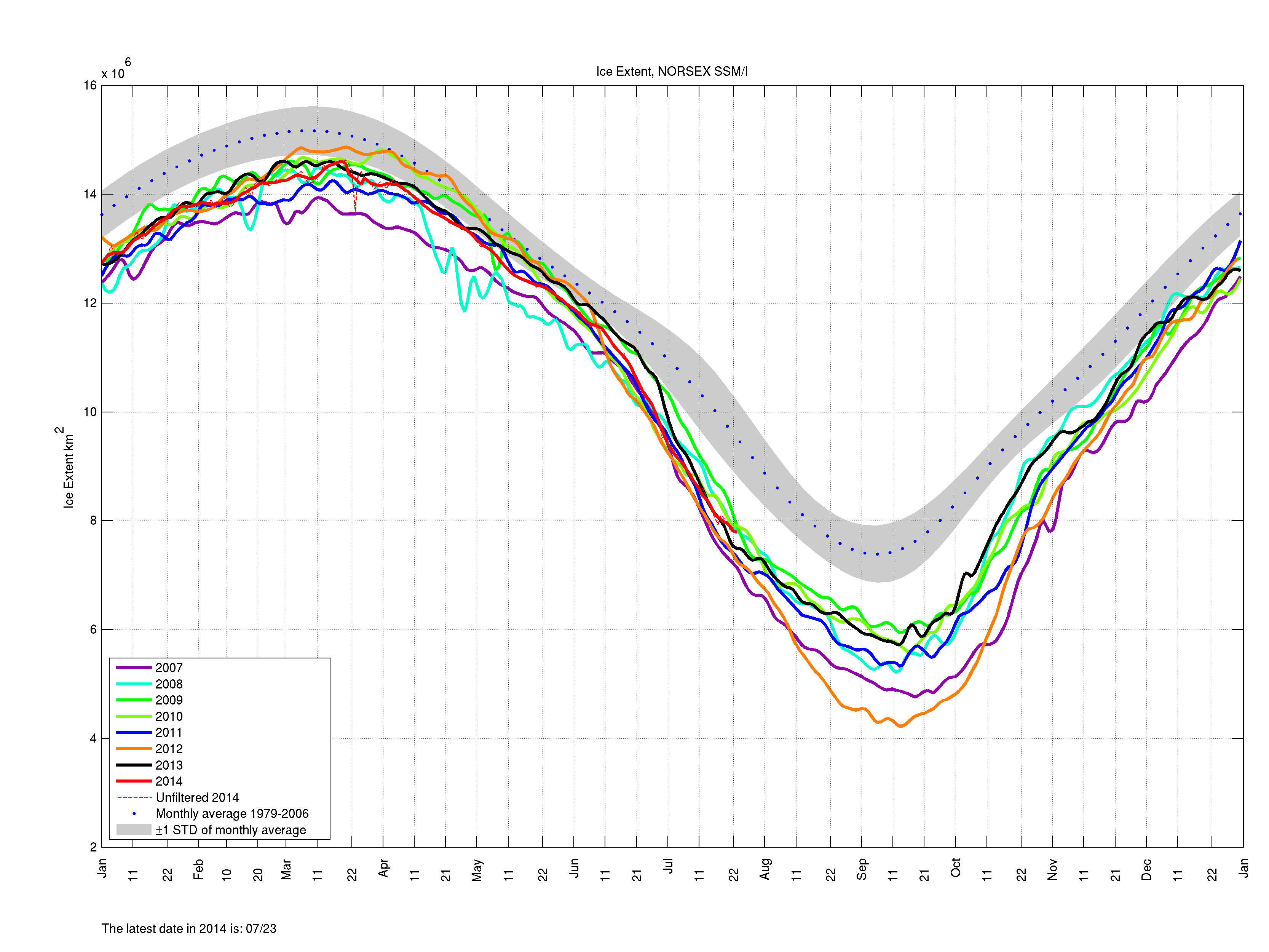
This is what the NORSEX extent chart that Eliza linked to looks like this morning:

NORSEX SSM/I Arctic sea ice extent graph on July 26th 2014

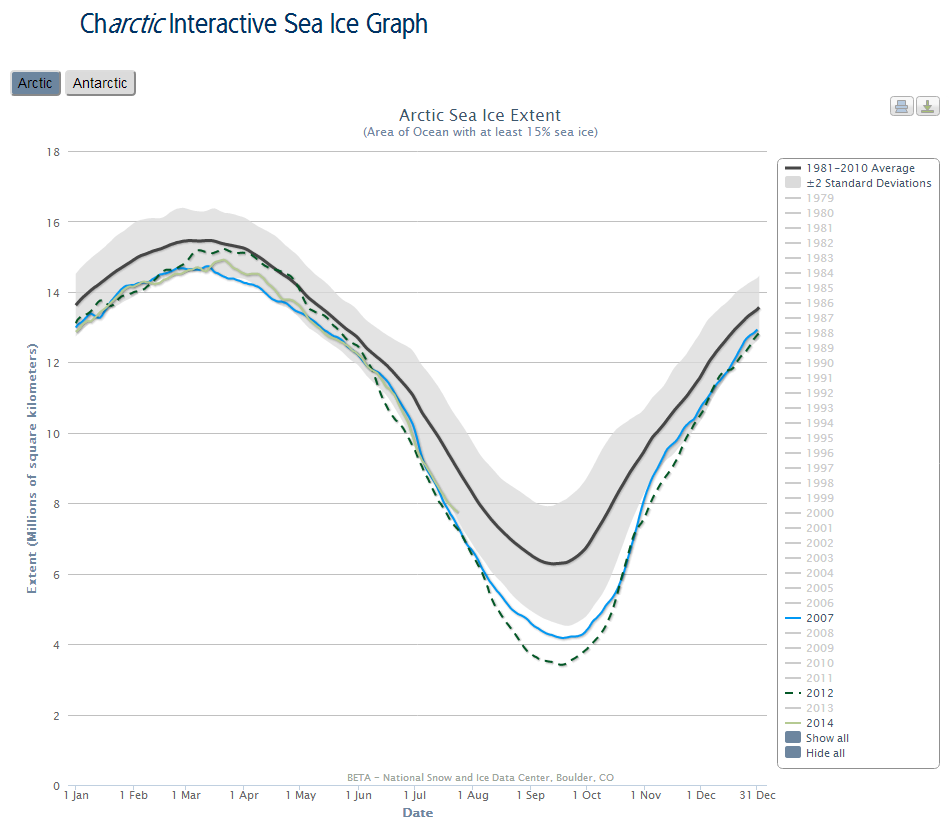
Here’s another one for good measure, this time showing NSIDC Arctic sea ice extent:

NSIDC interactive Arctic sea ice extent graph on July 26th 2014

As far as I am aware there is no law against being a schizoidal cherry picking pseudo-skeptic in the United States of America, or anywhere else for that matter. Please feel free to comment below if you know otherwise and/or think that there should be!


Them:

After a protracted exchange on Twitter a copy of my comment eventually saw the light of day:


Us:

We’ll keep you posted!


The Pseudo-Skeptics’ Worst Nightmare?

On June 17th 2014 the Danish Meteorological Institute (DMI for short) published a news article which said amongst other things (and translated from the original Danish) that:

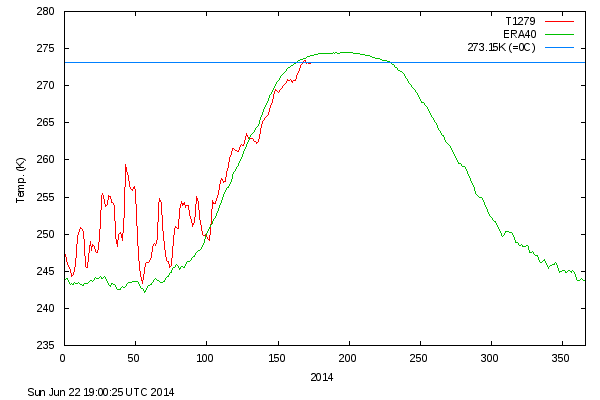
On Tuesday, June 17, 2014 daily mean temperature of the Arctic area north of the 80th northern parallel rose above the melting point. Thus, the summer melting season in the central part of the Arctic Ocean has begun.

Here’s the DMI’s graph that is being referred to:

DMI daily mean temperature and climate north of the 80th northern parallel, on June 22nd 2014
DMI daily mean temperature and climatology north of the 80th northern parallel, on June 22nd 2014

The DMI’s news article continues:

This year’s onset of melting is 7 days later than usual and 2 weeks later than in 2012, when later in the season – in September – the sea ice shrank to the smallest area ever measured.

According to Rasmus Tonboe, one of the DMI’s sea ice experts from their Centre for Ocean and Ice:

There is a clear correlation between the start date of the melt season in June and the area of ​​the same year’s minimum ice coverage in September. When the season starts later than the year before, then extent in September is more than the year before – and vice versa. This applies in 4 out of 5 cases since 1972.

As you might expect the usual suspects have greeted this news item with unconcealed glee. According to Steven Goddard on his so called “Real Science” blog the news is the “Alarmists’ Worst Nightmare – They Have Already Lost 15% Of The Arctic Melt Season”:

Them:

The Sun has begun its descent towards winter, and the high Arctic melt season hasn’t started yet.

Us:

As is usual these days, Steve has neglected to publish my comment on his article, which reads as follows:

20140622-RealScience

By way of an explanation for my cryptic comment, Steve seems happy to ignore that fact that the graph shown above reveals that the metric under consideration was way above “average” for the entire 2013/14 Arctic sea ice freezing season, as we ourselves pointed out not so very long ago. 2014’s numbers have only been lagging behind “normal” since around day 130. Perhaps this will prove to be enough of a difference from Rasmus’s historical records such that the 2014 melting season will be one of the exceptions that proves his “4 out of 5 rule”?

As some sort of support for this theory we suggest you take a good long look at our regional Arctic sea ice extent breakdown and our ice mass balance buoy overview. The sea ice extent in the Central Arctic Basin is currently much the same as last year, with barely any visible reduction in extent as yet. However in important areas for the overall Arctic sea ice extent in September, such as the Laptev and Beaufort Seas, the melt in 2014 is way ahead of 2013. In the former case the melt is even ahead of 2012 at the same time of year.

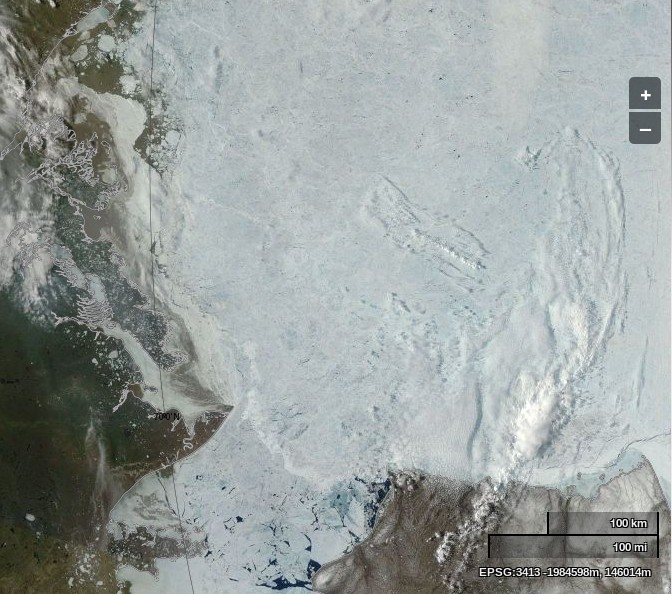
Do you suppose that Steve will be able to spot the difference between these two satellite images, taken one year apart?

NASA Worldview “true-color” image of the Beaufort Sea on June 21st 2014, derived from bands 1, 4 and 3 of the MODIS sensor on the Aqua satellite
NASA Worldview “true-color” image of the Beaufort Sea on June 21st 2013, derived from bands 1, 4 and 3 of the MODIS sensor on the Terra satellite


We’ll keep you posted!

Watts Up With the Maximum Trend?

The self proclaimed “world’s most viewed site on global warming and climate change”, otherwise known as the “Watts Up With That?” blog, recently published an article entitled “Arctic Sea Ice Appears to Have Reached Maximum And Other Ice Observations”. Since I’ve been speculating about the date of the 2014 maximum Arctic sea ice extent myself I avidly read the article but found myself ultimately somewhat perplexed. There were lots of graphs and charts displayed, but there was no sight or mention of what seems to me the most relevant one of all. The long term trend. Here is an expurgated version of my attempts to bring this oversight to the attention of the Watts Up With Thatters:

Us:

A "dull" comment about Arctic sea ice trends
A “dull” comment about Arctic sea ice trends

Them:

Re: Michael Jennings says:
March 26, 2014 at 7:07 am

[snip . . this is dull. Put some content into your contributions or you are just trolling . . mod]

Us:

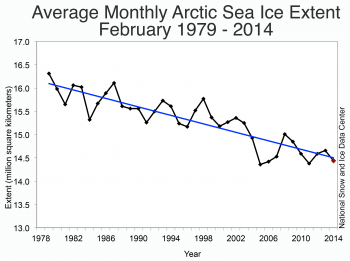
At the risk of repeating myself, here’s the latest dull content out of NSIDC:

Do you see the blue line heading for the bottom right?

[snip.. lots of dull references to Antarctic sea ice and “Real Science” removed.. mod]

Them:

Snow White needs to get up to speed on the Scientific Method: skeptics have nothing to prove.

Rather, the onus is on the alarmist crowd to provide scientific evidence showing that their CO2/cAGW conjecture is true. They have failed miserably.

But there is no scientific evidence supporting their belief in manmade global warming. None at all. Every last climate model has failed. They were all wrong.

The alarmist crowd is fixated on Arctic ice, instead of on global ice cover. Why? Because that is their last forlorn hope; every other climate scare has been debunked. Well, it’s time to debunk the ‘disappearing Arctic ice’ scare, too:

Global sea ice is at it’s 30-year average [the red graph – click in chart to embiggen]. We already know about the polar see-saw, in which the NH and SH poles balance each other out. That effect can be clearly seen in the global ice chart above.

There is nothing either unusual or unprecedented happening. What we observe now has happened before, repeatedly, and to a much greater degree. Rational folks understand that. It is called the climate Null Hypothesis, and it has never been falsified. The Null Hypothesis is a corollary of the Scientific Method. So is the fact that the onus is on those who produce the catastrophic CO2/AGW conjecture, to suport their belief with scientific evidence.

But there is no evidence proving that Arctic ice is in unprecedented decline. None at all. There is no evidence to prove that the current Arctic ice fluctuation is anything other than natural climate variability. Occam’s Razor says that natural variability is by far the most likely explanation.

The Arctic ice scare is just the same as all the other climate scares. It is promoted by religious True Believers, who expect everyone to share in their Chicken Little panic.

But that only works on those who are ruled by emotion, and fright is an emotion. Scientific skeptics, OTOH, are logical, and therefore they are unaffected by the silly ‘Arctic ice’ scare.

Us:

So to summarise, you cannot muster a single chart to refute my assertion about Arctic sea ice decline, let alone “hundreds”.

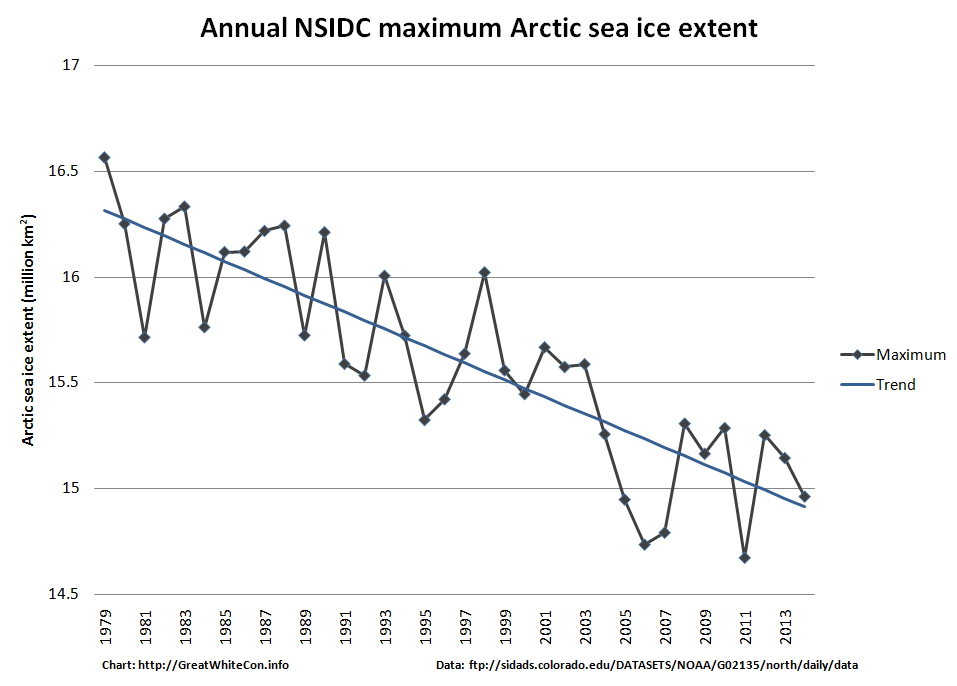
For your edification, and for that of the writer of the original article who for some strange reason neglected to include a graph showing the long term trend in Arctic sea ice maximum extent, here is one I prepared earlier:

Provisional NSIDC annual maximum extent graph for 1979 – 2014
Provisional NSIDC annual maximum Arctic sea ice extent graph for 1979 – 2014

Them:

From a comment on a different thread on WUWT, on April 10, 2014 at 3:33 am (WUWT time)

I’m sorry Snow White (or Mr Hunt, if you prefer), but I think that a little courtesy would be in order. I’ve read every word on the link you’ve provided, and the central theme of your original post was that “there was no sight or mention of what seems to me the most relevant one of all. The long term trend [of Arctic sea ice]“. You described more than one attempt to bring this deficit to the attention of WUWT.

Given that Michael D posted on your page at April 9, 2014 at 4:01 pm, politely pointing out that the WUWT sea ice page has just such data presented, it would seem a basic courtesy to either acknowledge his assistance (in this blog or yours) and either thank him, or explain why graph does not answer your criticisms.

I acknowledge that your arguments seem to have moved on to volume now, but they have been addressed by others, and better than I could have done. As an aside, I suppose I could run a blog with limited data about Antarctic sea ice coverage and volumes. I’m sure that I would be criticised, with comments explaining that I was looking at the mural through a microscope, and that the Antarctic buildup cannot be considered in isolation. I think that such criticism would be valid – your thoughts?

Us:

As you can see from the historical record, I asked on more than one occasion for someone to supply a link to “A long term (let’s say 30 years or more) graph for any measure of Arctic sea ice “quantity” showing anything other than a trend in the direction of the bottom right hand corner.” Nobody did. Nobody suggested looking at the WUWT sea ice page either, presumably because no graphs fitting my description can be found on there.

Q.E.D. ?

Them:

 We’ll keep you posted!

Has Arctic Sea Ice Already Started to Recover?

In a word, NO!! Here we go again.

Them:

According to David Rose’s headline in yesterday’s Mail on Sunday:

Global warming ‘pause’ may last for 20 more years and Arctic sea ice has already started to recover.

There is of course plenty more where that came from, such as:

The 17-year pause in global warming is likely to last into the 2030s and the Arctic sea ice has already started to recover, according to new research.

A paper in the peer-reviewed journal Climate Dynamics – by Professor Judith Curry of the Georgia Institute of Technology and Dr Marcia Wyatt – amounts to a stunning challenge to climate science orthodoxy.

Not only does it explain the unexpected pause, it suggests that the scientific majority – whose views are represented by the UN Intergovernmental Panel on Climate Change (IPCC) – have underestimated the role of natural cycles and exaggerated that of greenhouse gases.

along with a:

Graph that makes a mockery of warming

Us:

If you take a look at the evidence from the NSIDC the Mail on Sunday recently provided us with in support of their previous inaccurate headlines you will discover it says:

Monthly August ice extent for 1979 to 2013 shows a decline of 10.6% per decade.

QED? Apparently not as far as the Mail on Sunday’s concerned. If further evidence is needed please read our previously published “stunning challenge” to Judith Curry’s Arctic sea ice expertise. In brief:

Judith Curry republishes the same nonsense [as The Mail], but then neglects to publish even a similarly mealy mouthed “correction”, let alone anything remotely resembling the information originally published by the NSIDC upon which this collective fantasy is allegedly based. Therefore Judith should be taken seriously, and as a climate scientist rather than a tabloid journalist or a fantasy fiction writer?

We think not.

Them:

David Rose goes on to say (amongst other things) that:

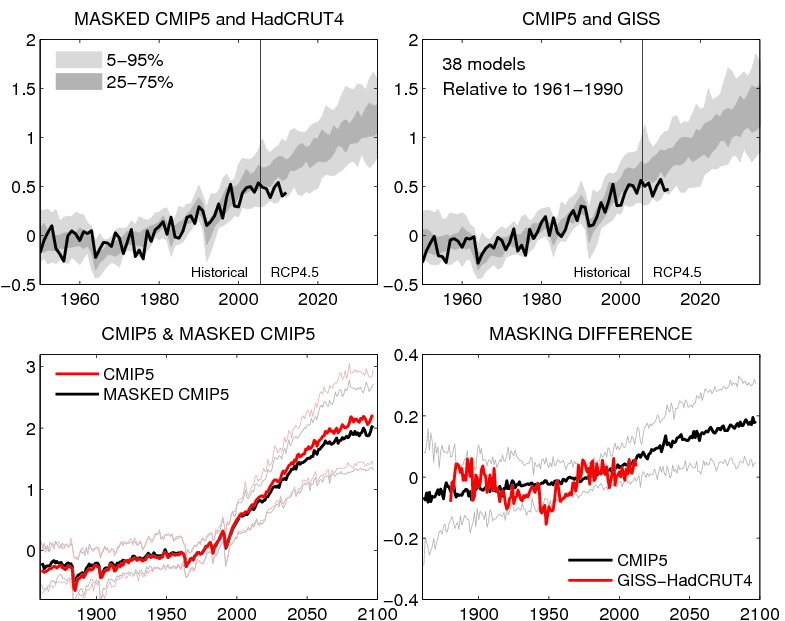
The graph shown above, based on a version published by Dr Ed Hawkins of Reading University on his blog, Climate Lab Book, reveals that actual temperatures are now below the predictions made by almost all the 138 models on which the IPCC relies.

The pause means there has been no statistically significant increase in world average surface temperatures since the beginning of 1997, despite the models’ projection of a steeply rising trend.

Us:

On Dr. Hawkins’ blog, commenting on a previous David Rose article in the Mail on Sunday, he says this:

David Rose has written an article in the Mail on Sunday which, by eye, seems to use the top left panel from the figure below, but without mention of its original source. In the article David Rose suggests that this figure proves that the forecasts are wrong. This is incorrect.

Here’s the figure Dr. Hawkins is referring to:

Ed Hawkins original graphs comparing CMIP5 simulations with observations
Ed Hawkins’ original graphs comparing CMIP5 simulations with observations

Finally, for the moment at least, here’s the text of an email we sent to the Managing Editor of the Mail on Sunday this morning:

Hello John,

Thanks for your additional comments. Unfortunately you still fail to address the primary question I’ve been asking for almost 2 months now, so I will be formally pursuing matters concerning the September 8th article via the PCC from now on.

Moving on I note that you have published another article by David Rose this weekend entitled “Global warming ‘pause’ may last for 20 more years and Arctic sea ice has already started to recover”, which mentions both Judith Curry and Arctic sea ice once again. I already have a few bones to pick with you about this one as well.

1. I posted an online comment on the article yesterday evening. It remains invisible this morning. Your web site says “The comments below have not been moderated.”. My comment included no links, although it did mention the “Great White Con”. Perhaps you could look into that for me, and provide me with an explanation?

2. Do you suppose it would be possible to persuade David to reveal his sources any more swiftly this time around? Where does his misleading graphic entitled “Graph that makes a mockery of warming” and the underlying data come from? At first sight it doesn’t seem to be from Judith Curry’s “Stadium wave” paper for example.

We have yet to receive a reply.