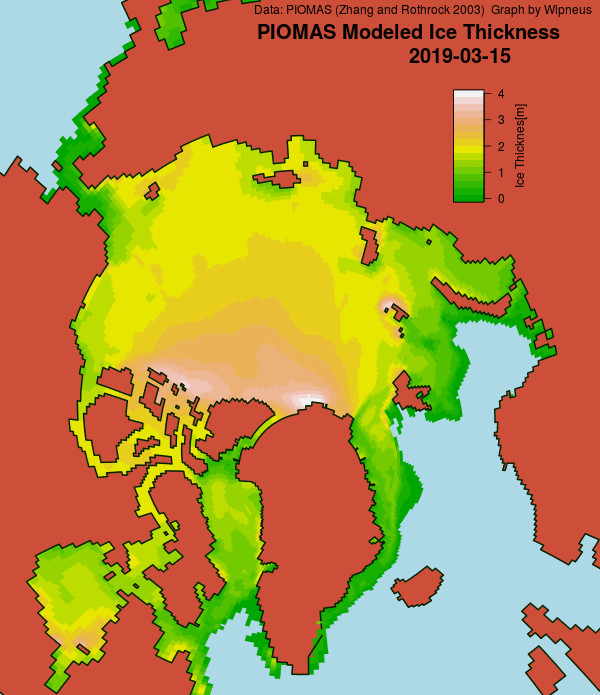
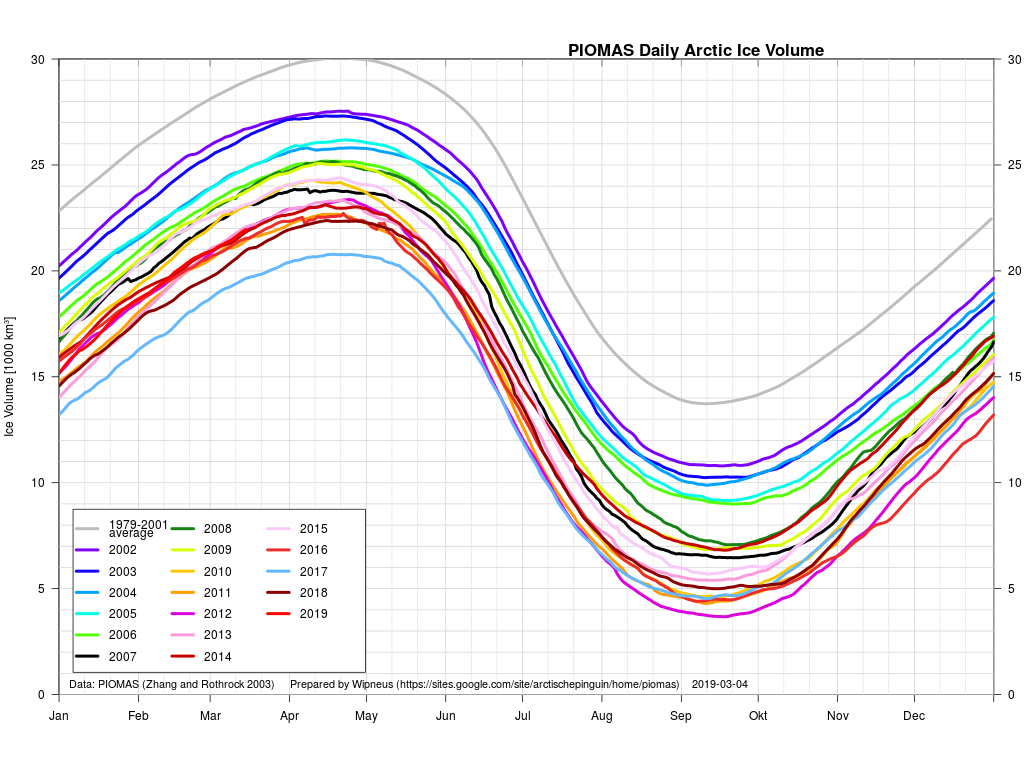
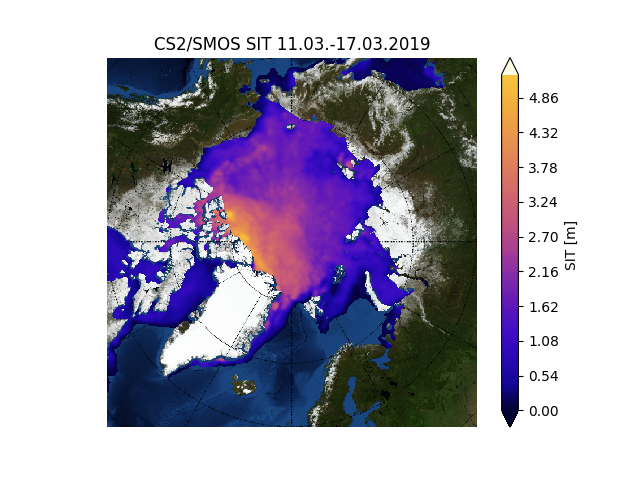
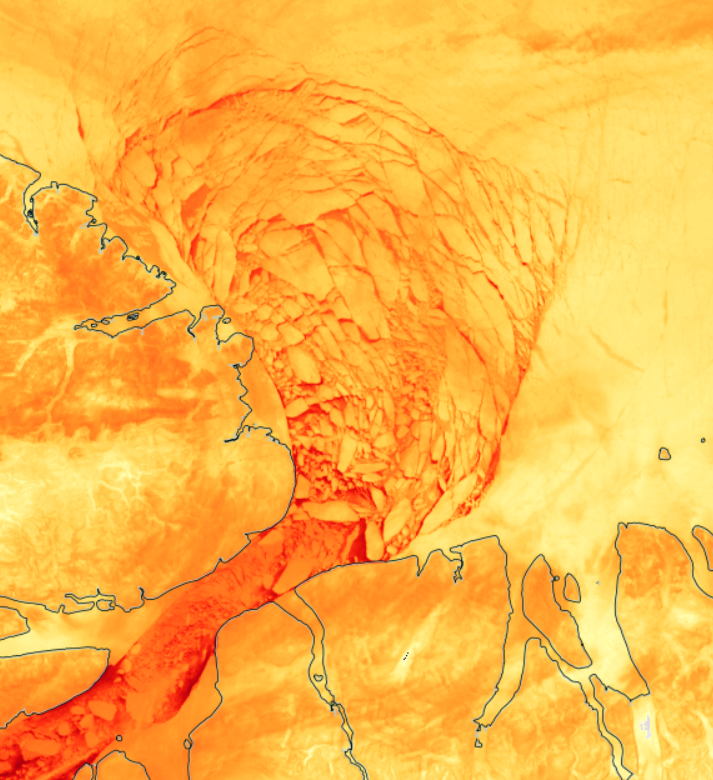
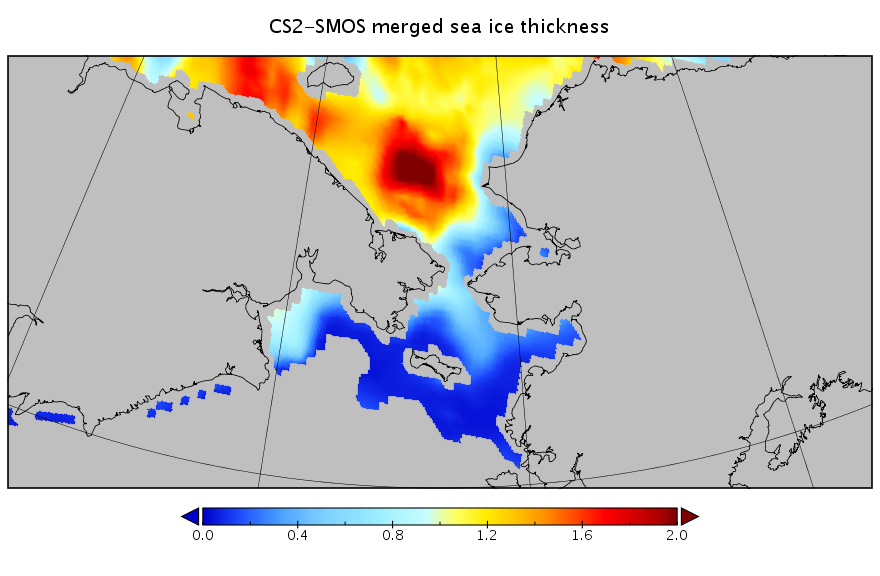
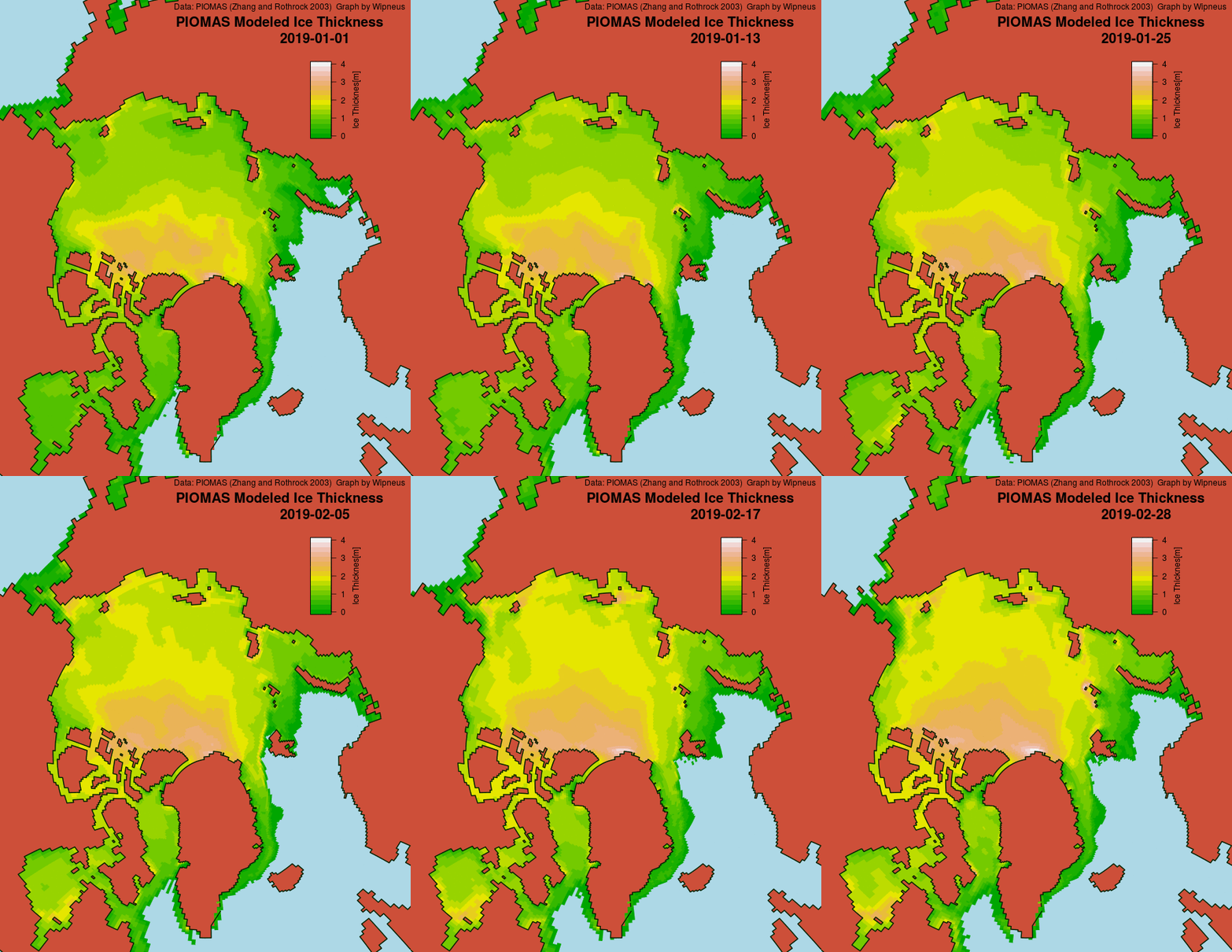
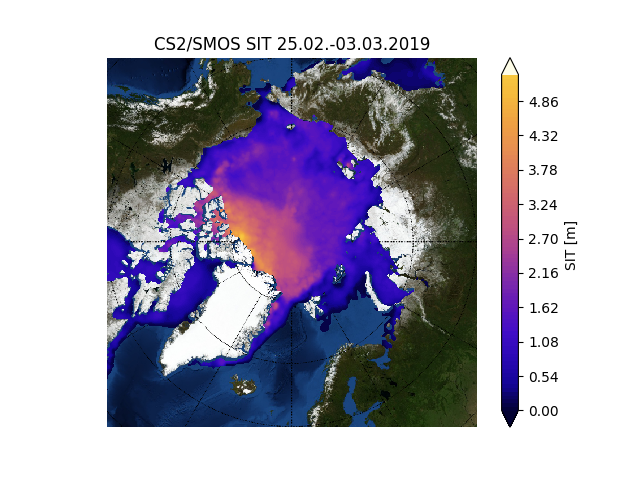
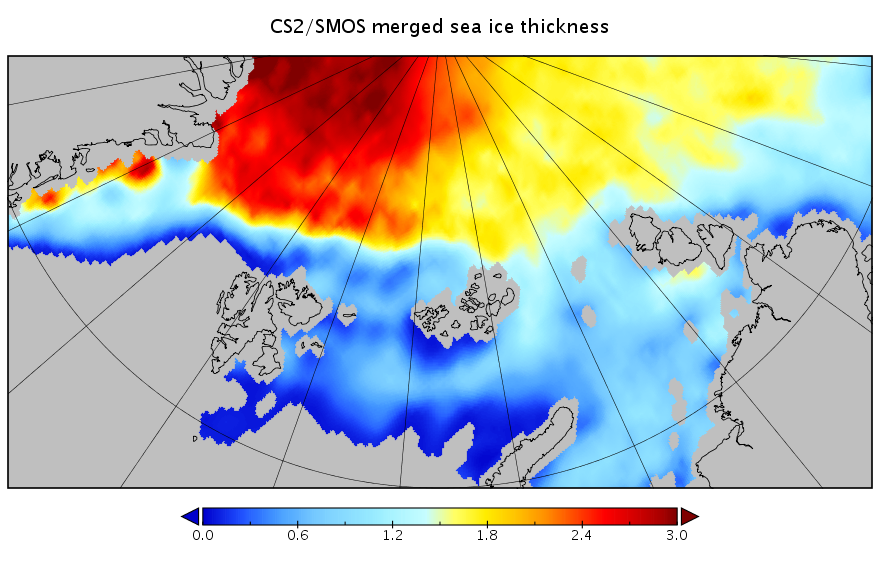
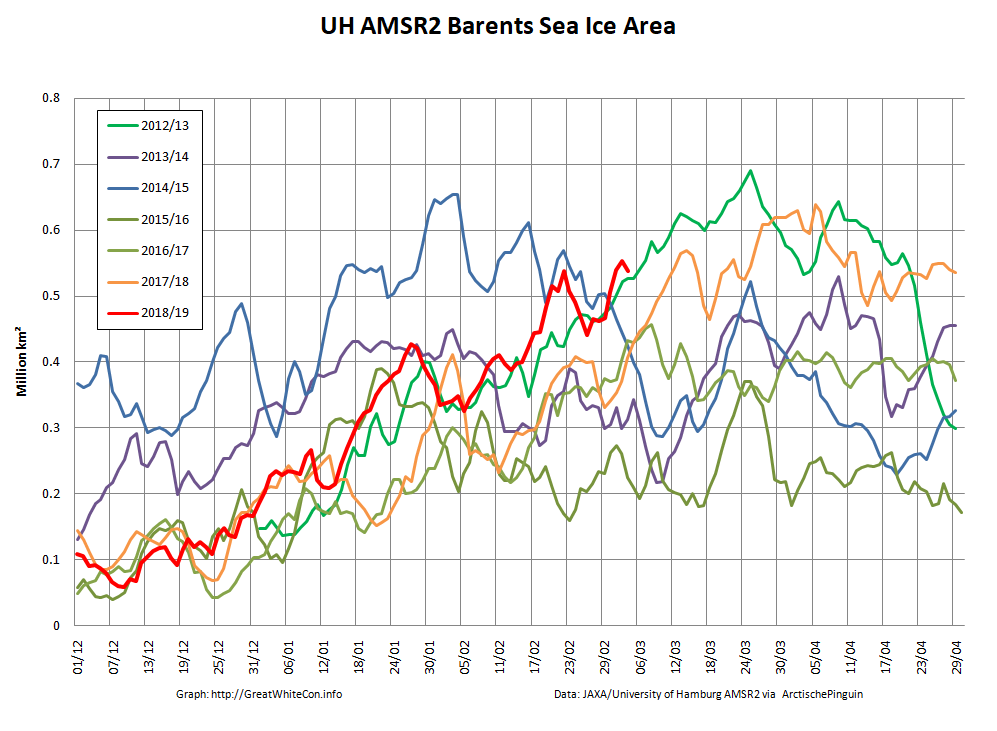
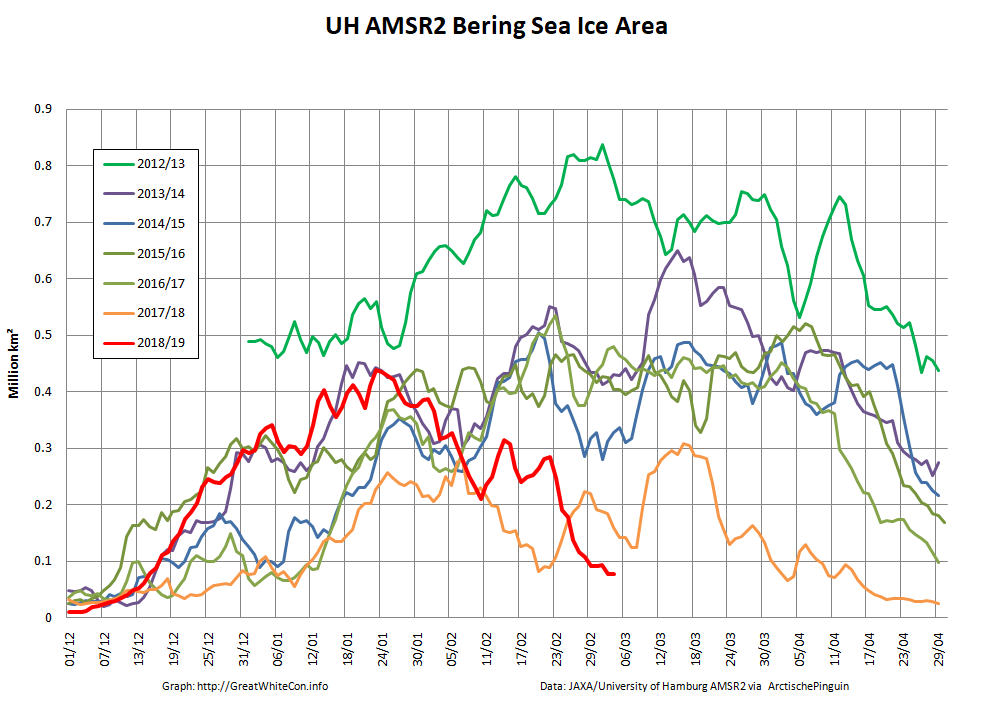
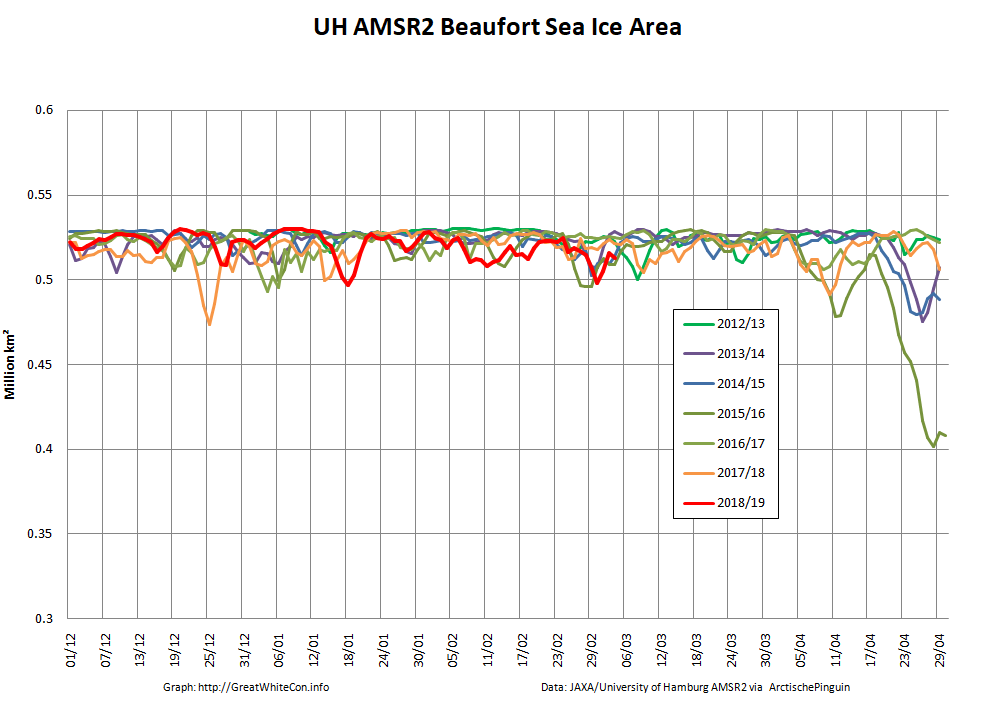
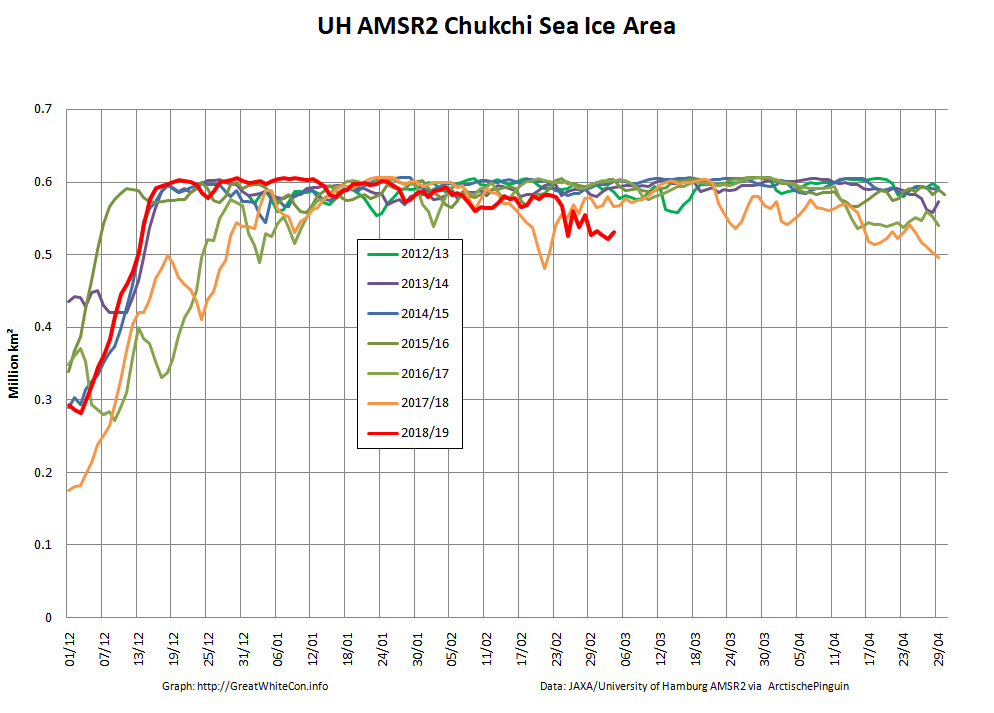
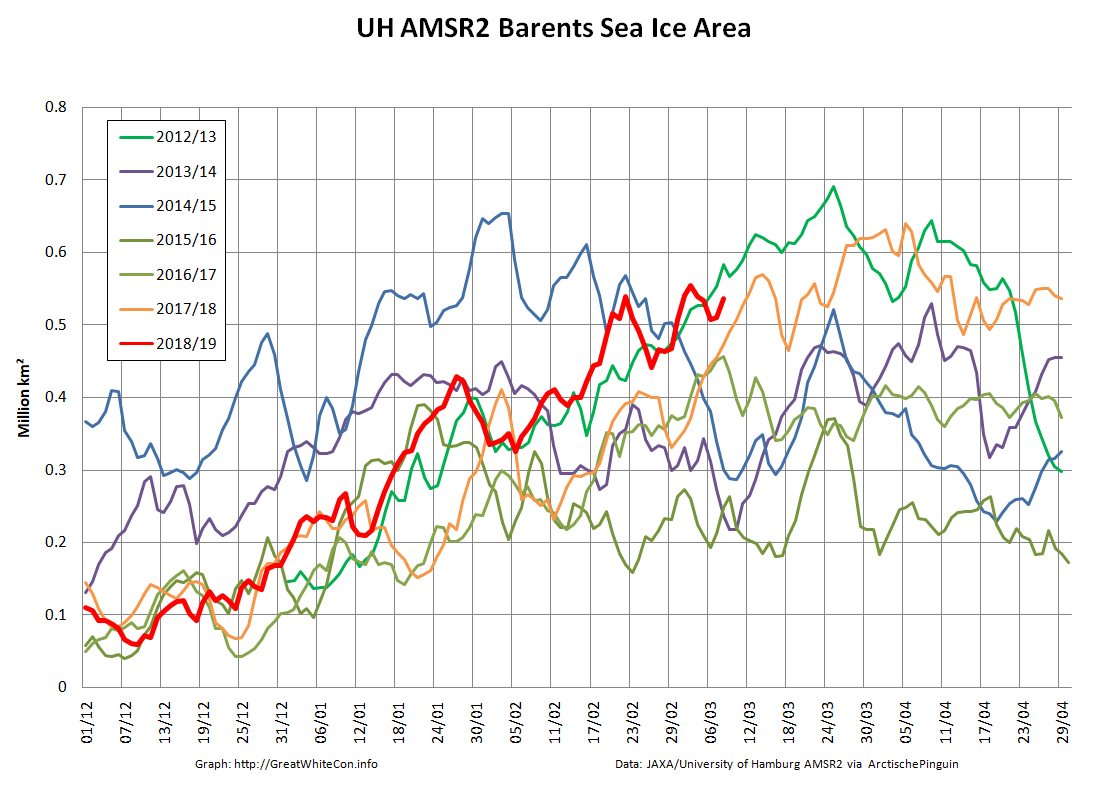
Since the FMI make the gridded data available as well as that visualisation, here’s a closer look at the Bering/Chukchi area:
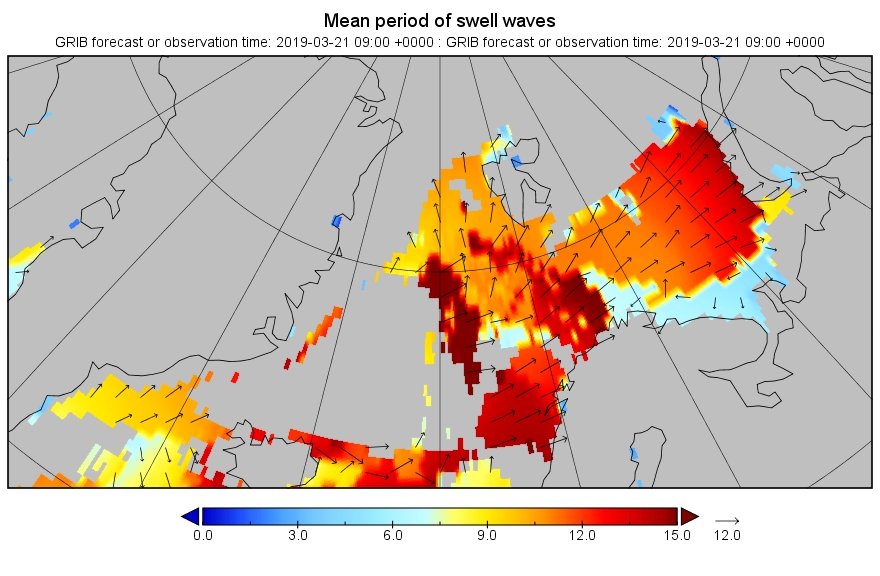
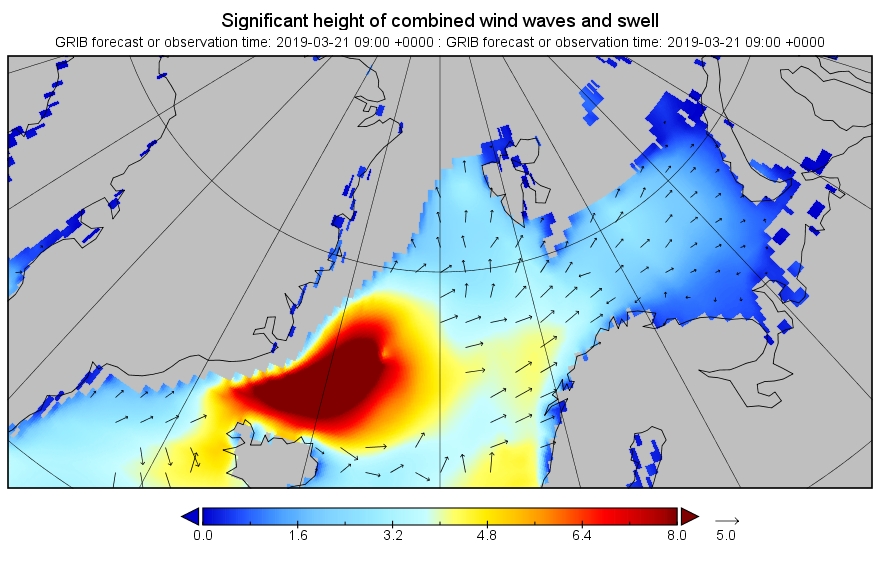
There’s an awful lot of thin ice in the region ripe for rapid melting now that the sun is shining down for a rapidly increasing number of hours per day. Over on the other side of the North Pole there’s also some significant swell forecast to hit the Atlantic edge of the Arctic ice pack. Here’s the current WaveWatch III forecast for 09:00 UTC tomorrow morning:
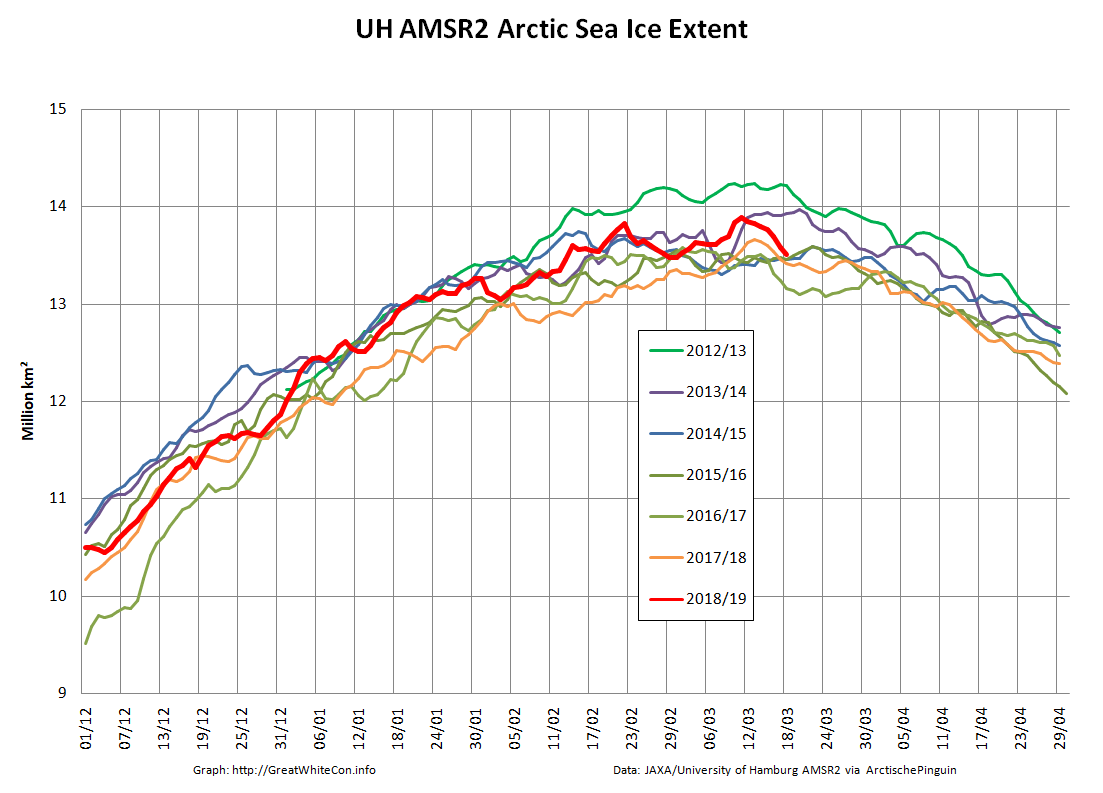
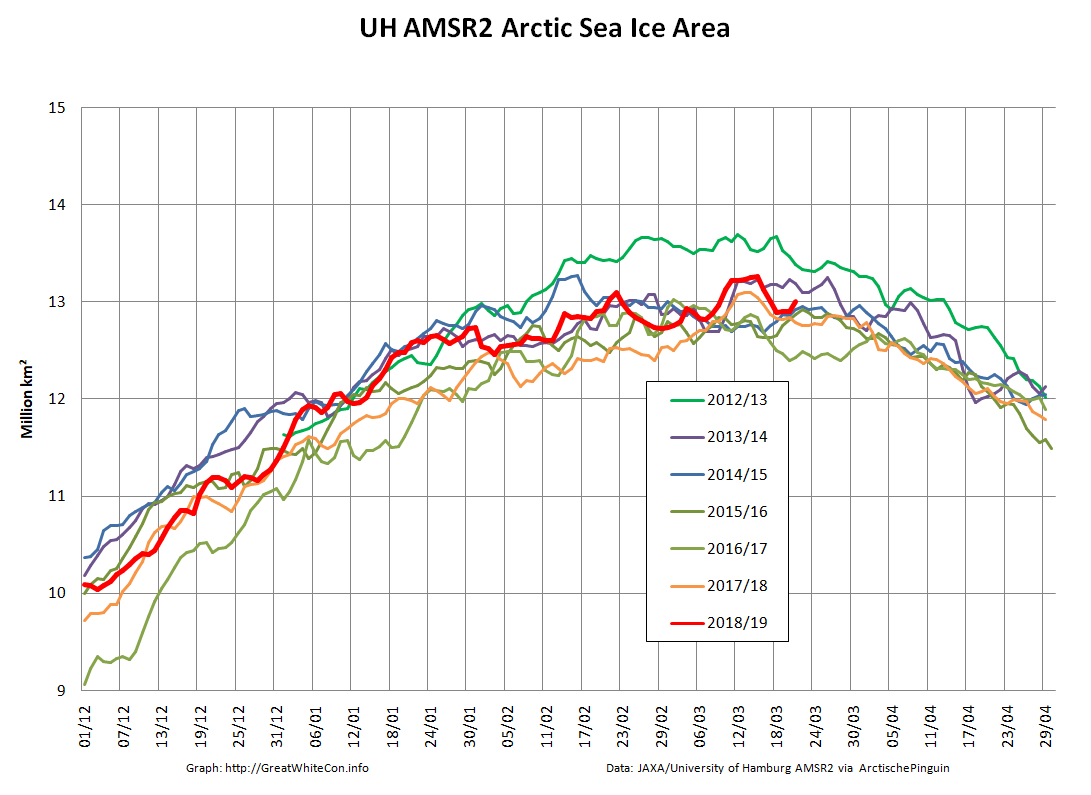
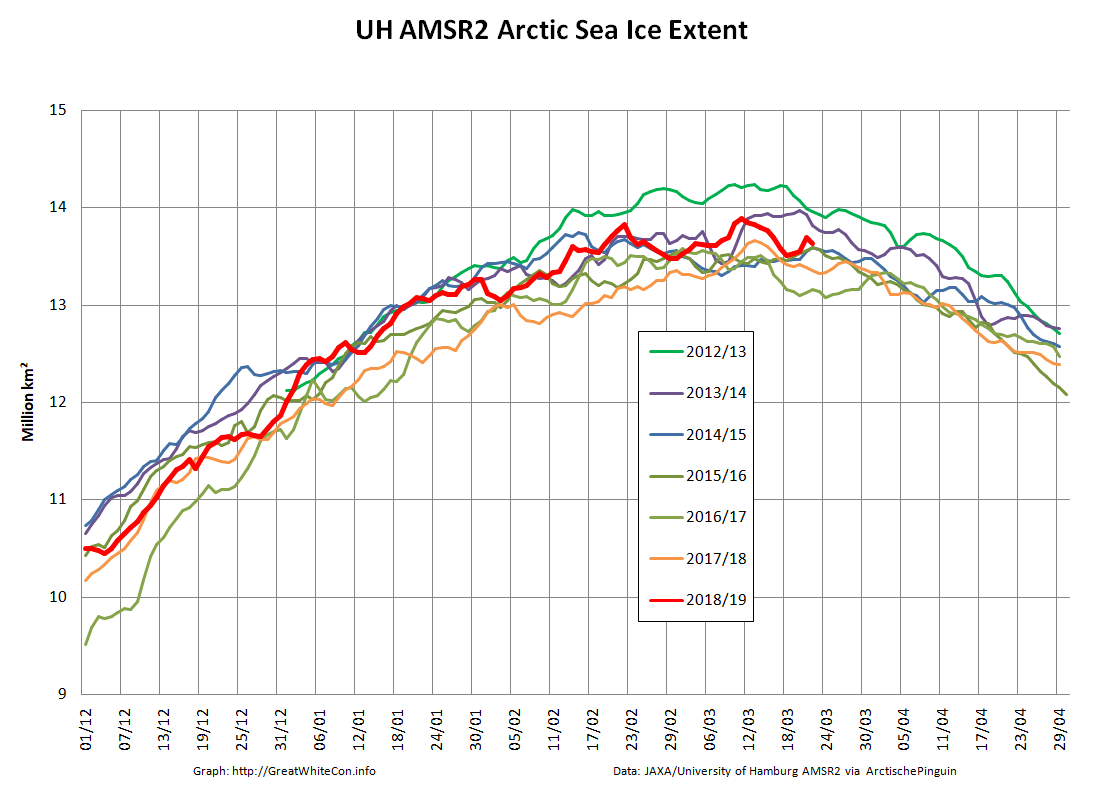
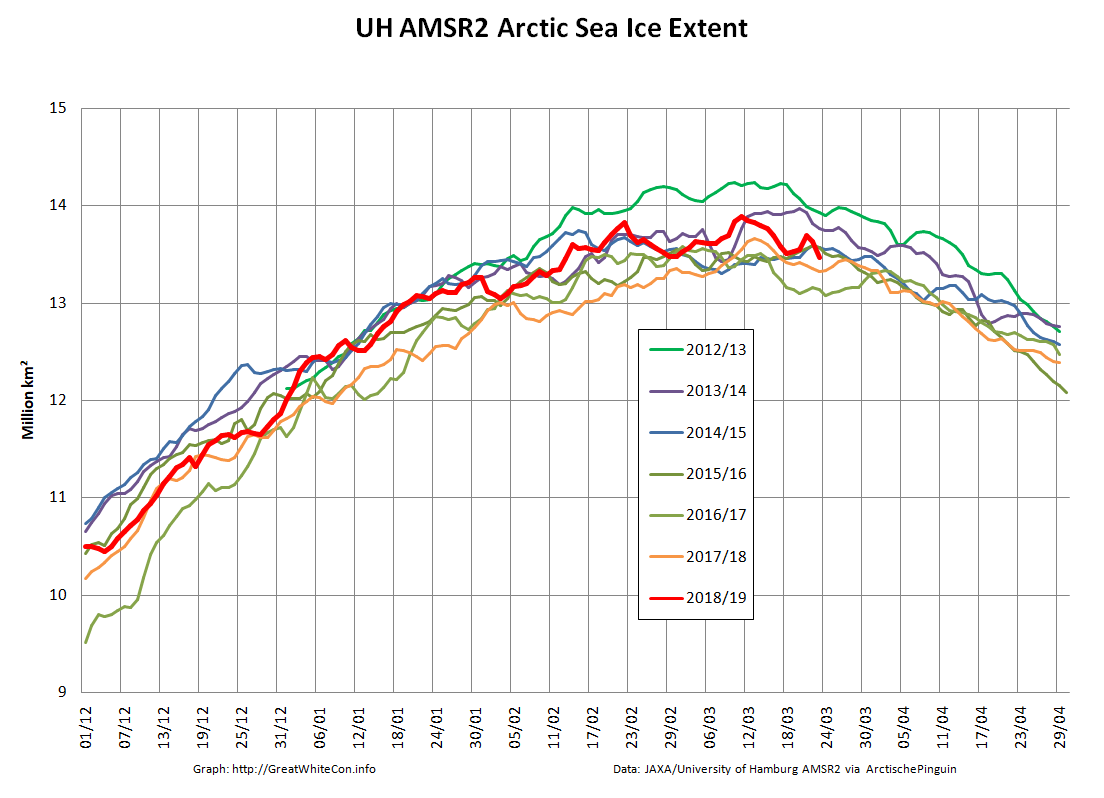
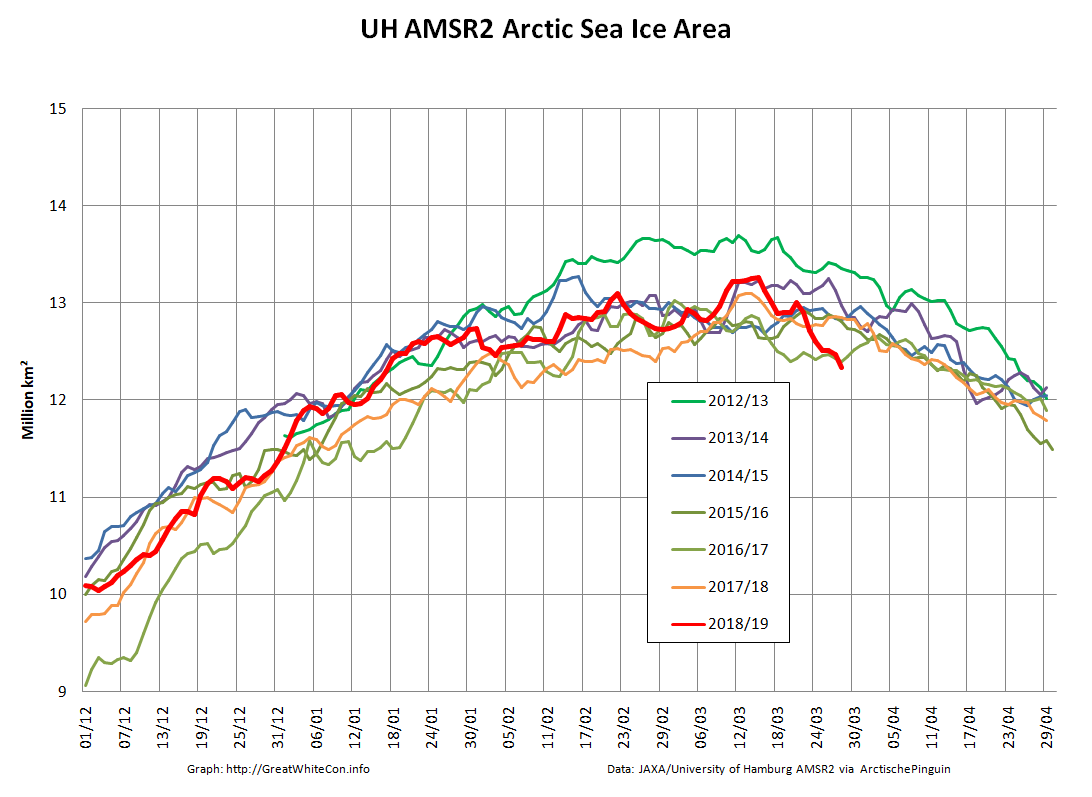
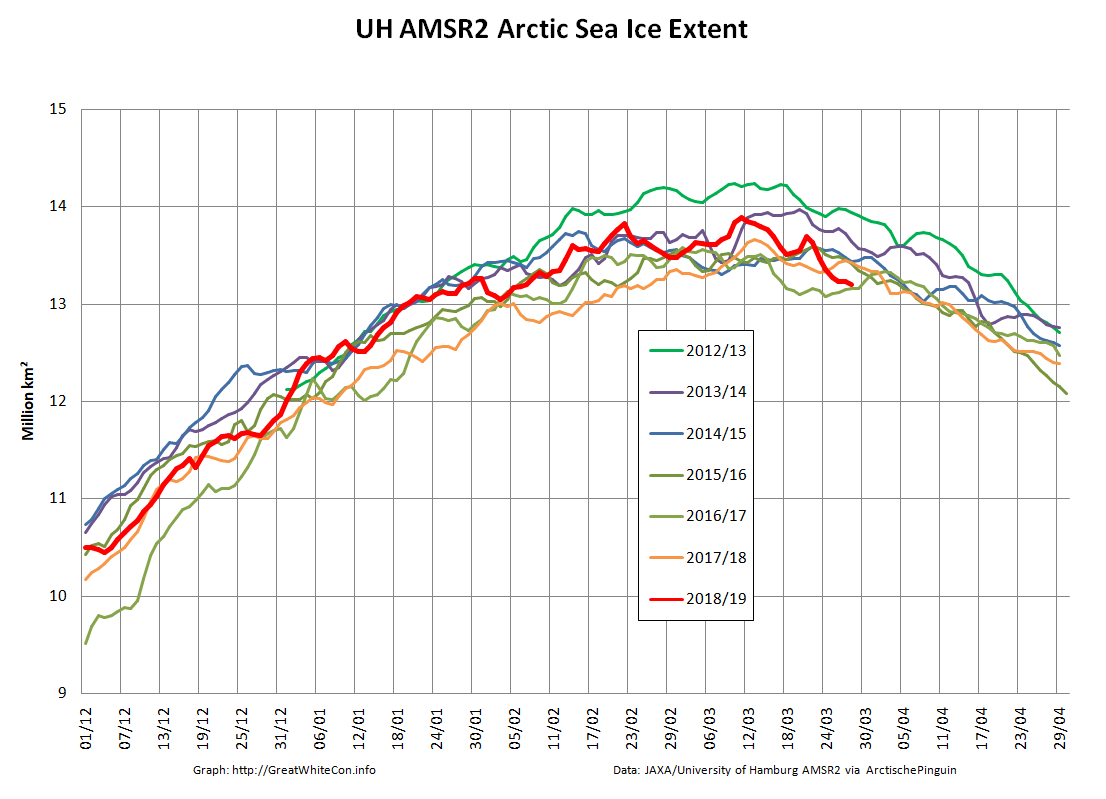
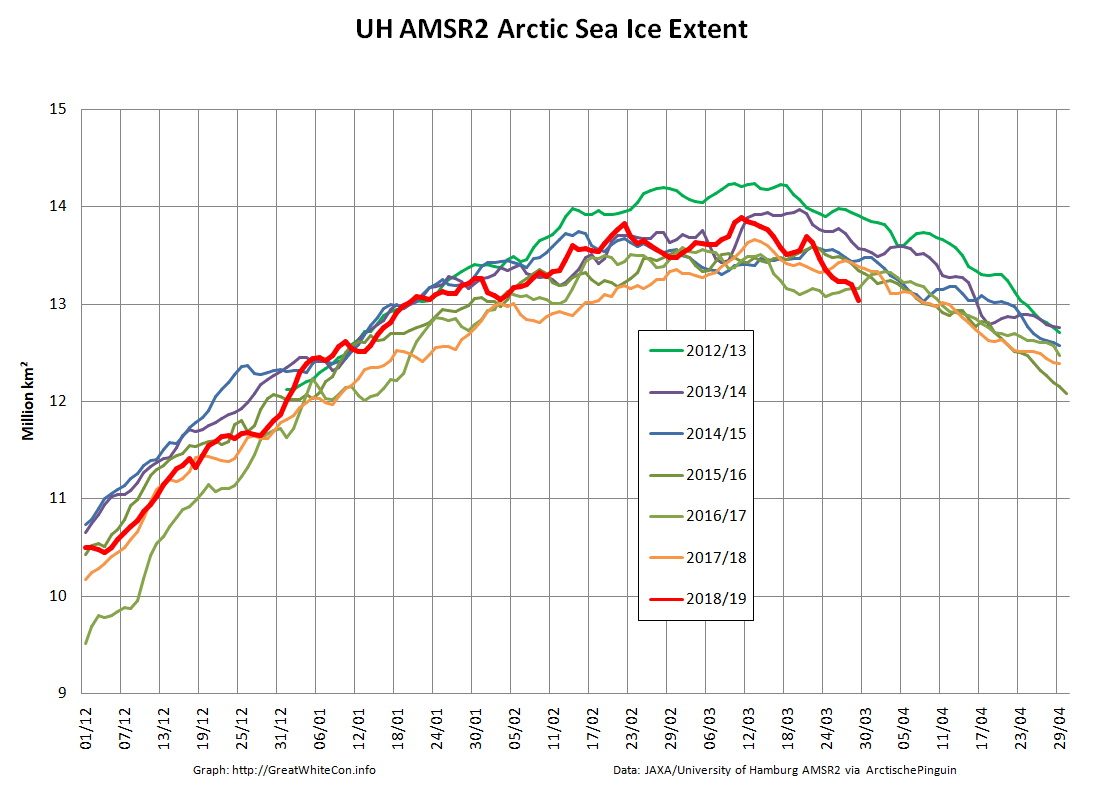
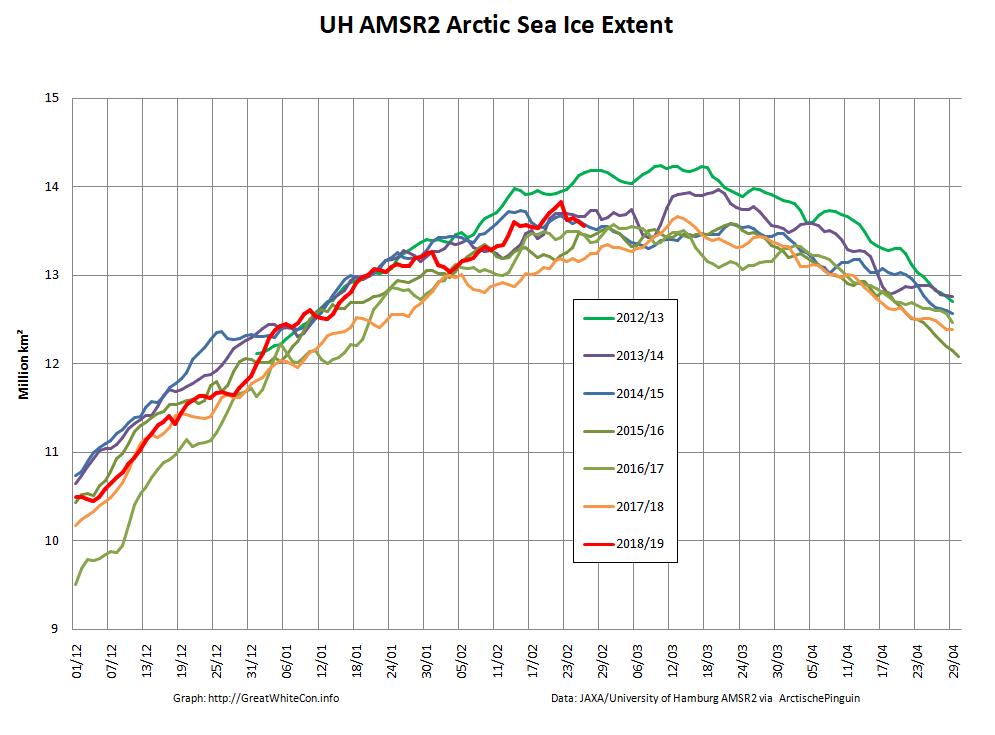
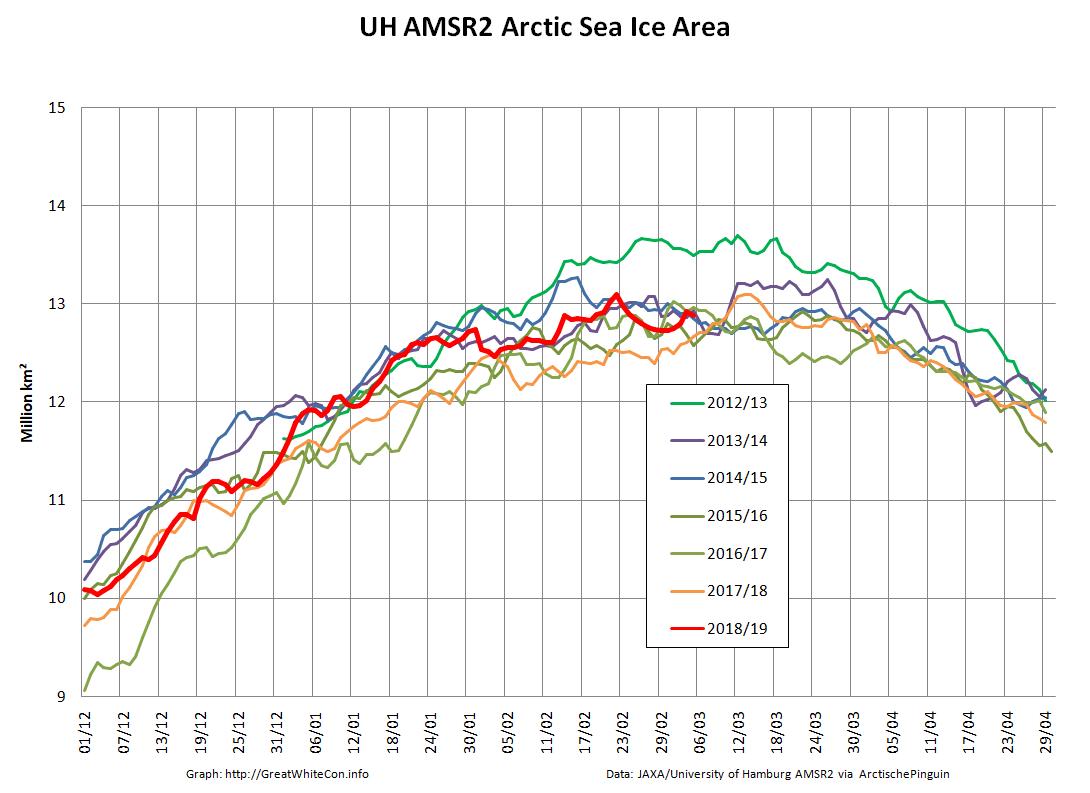
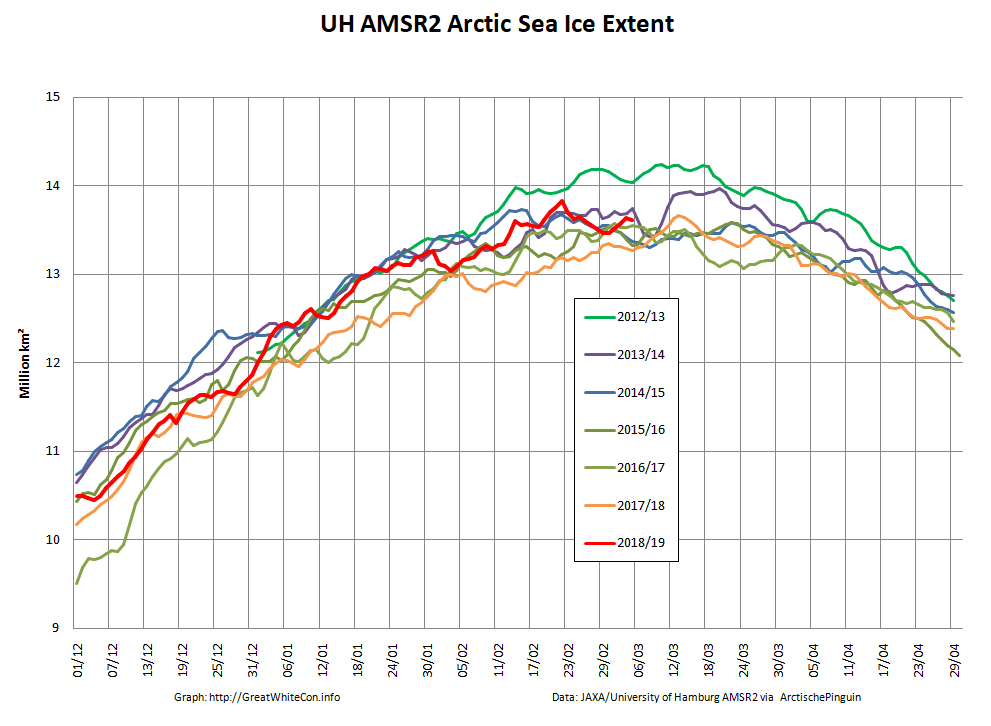
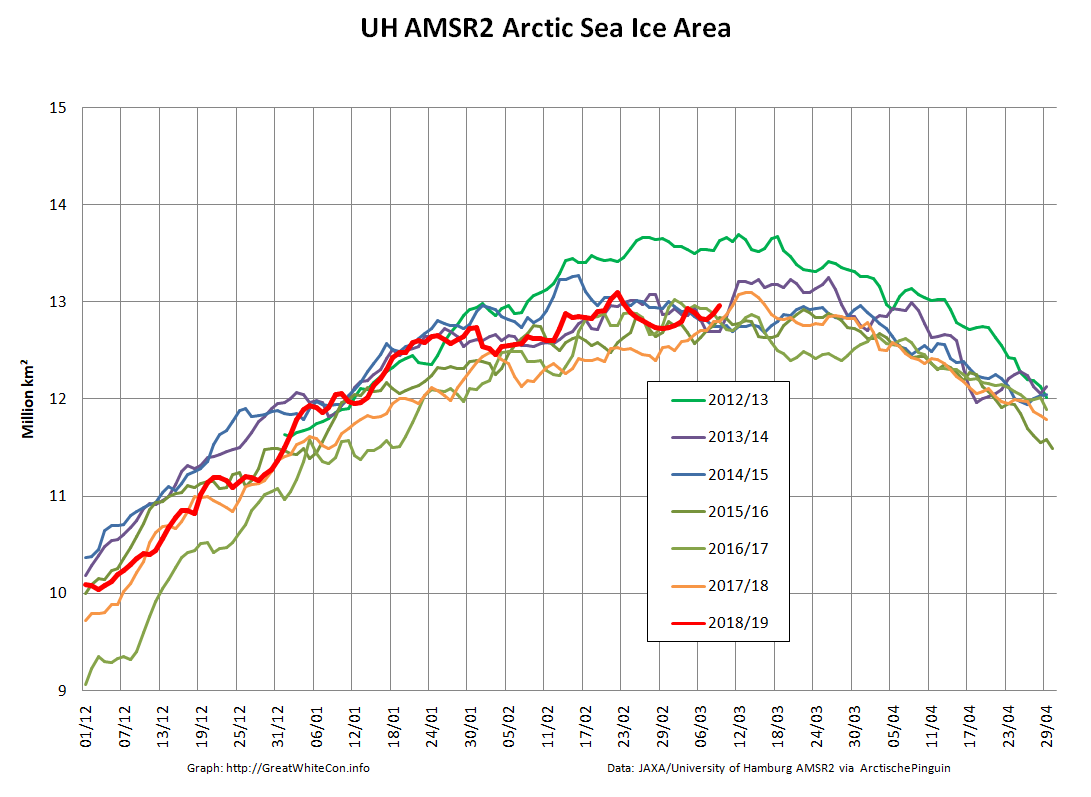
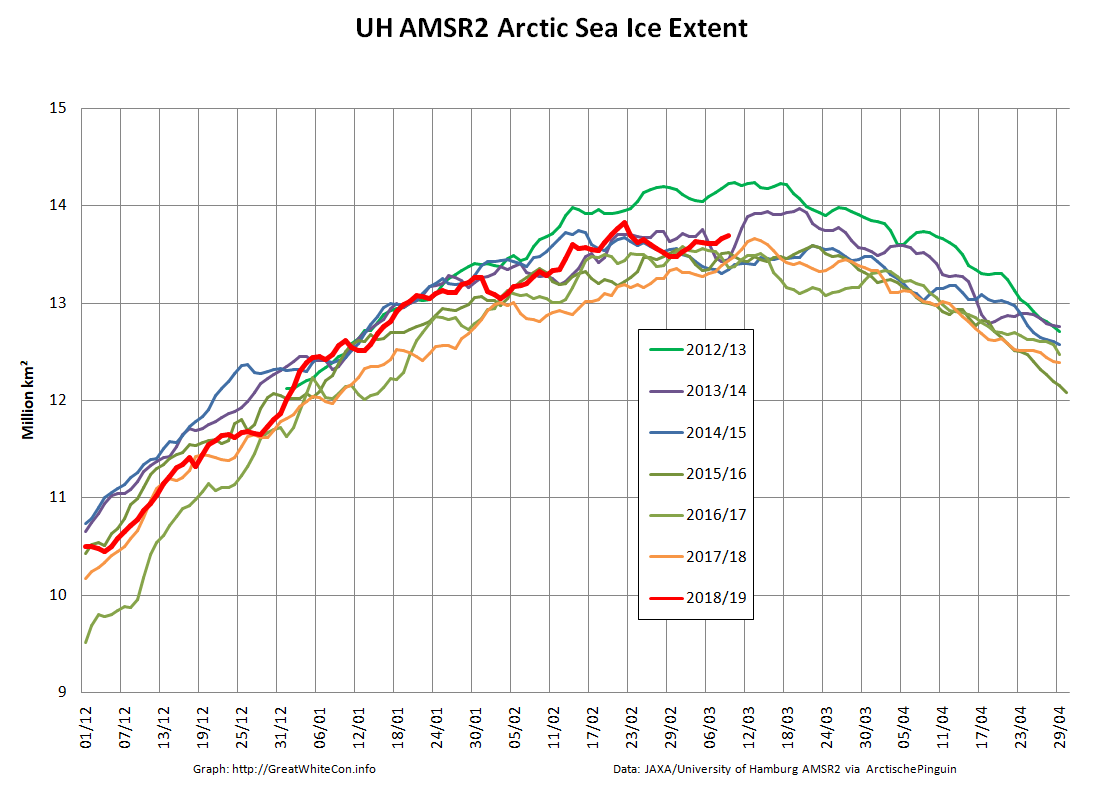
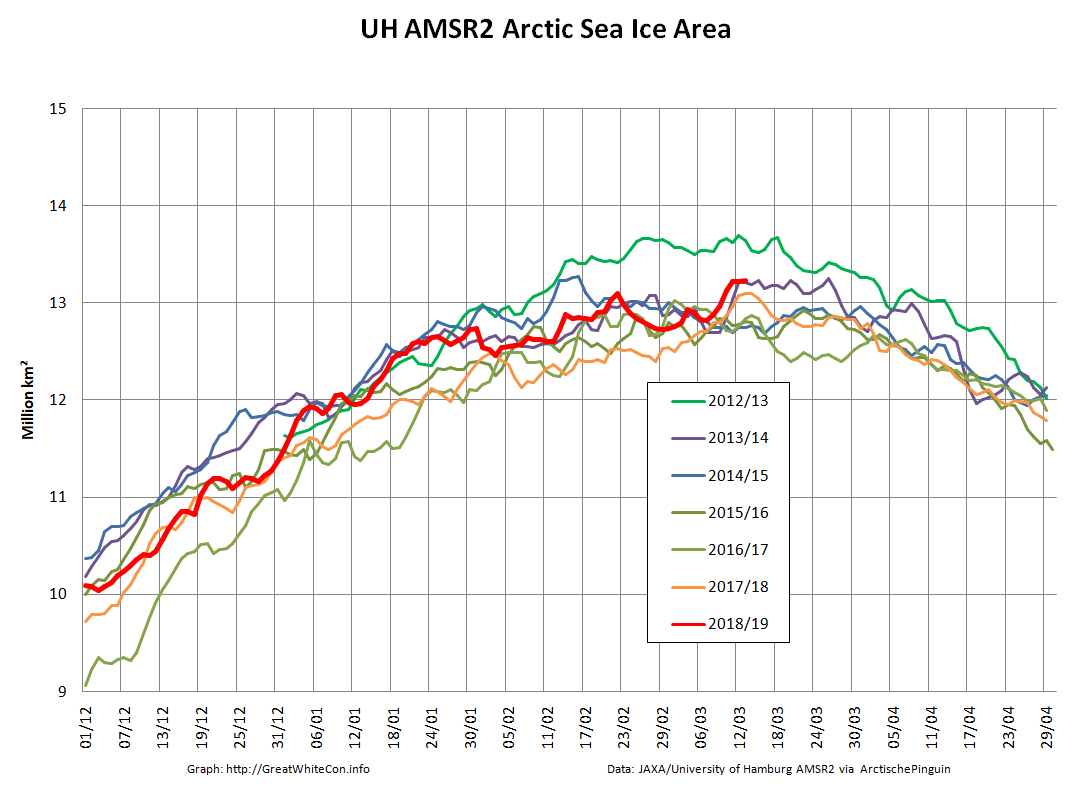
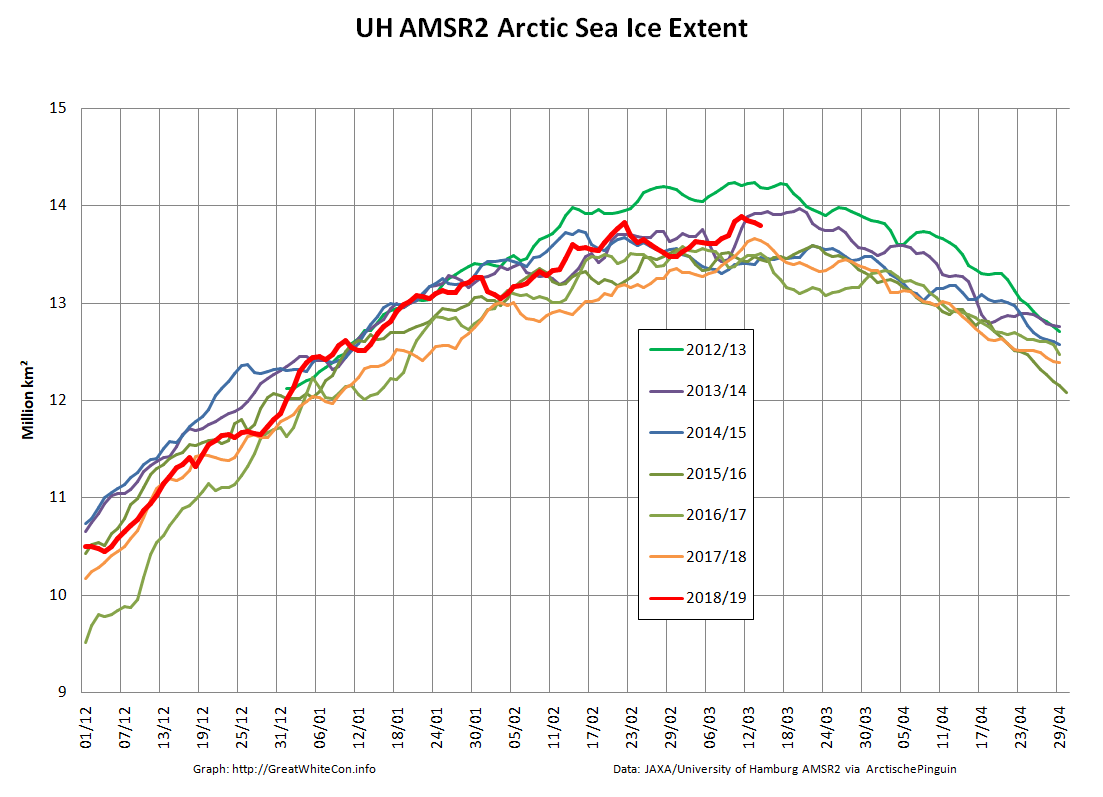
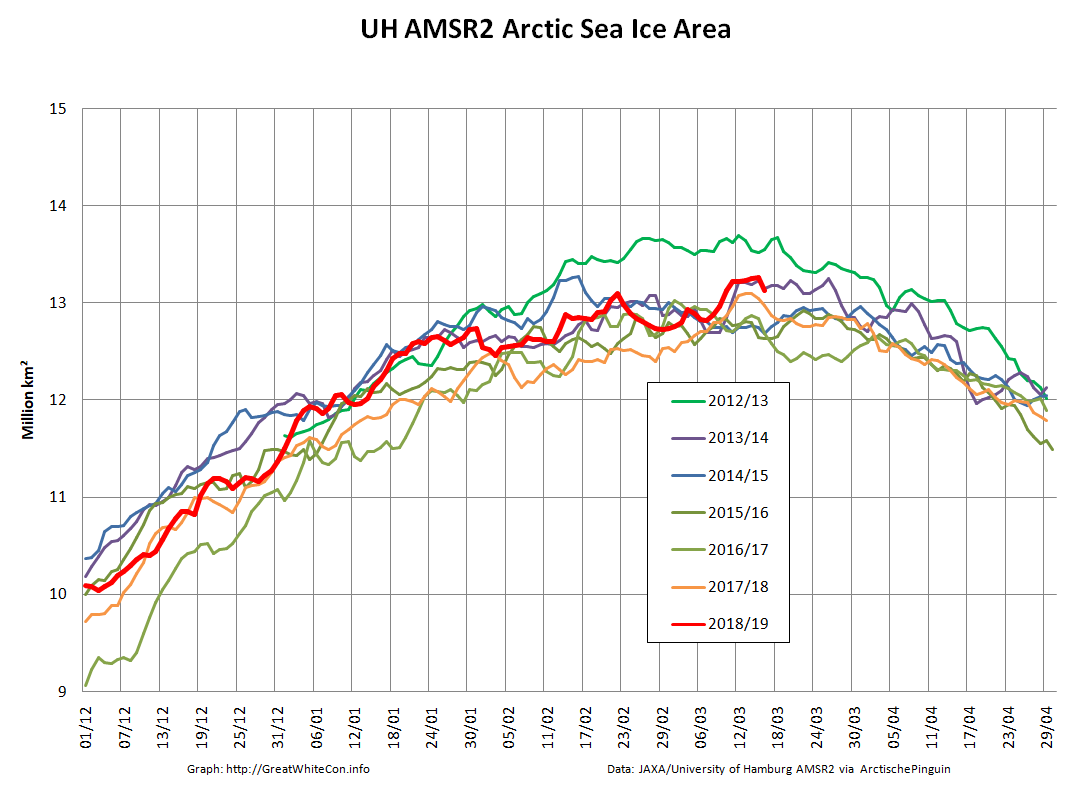
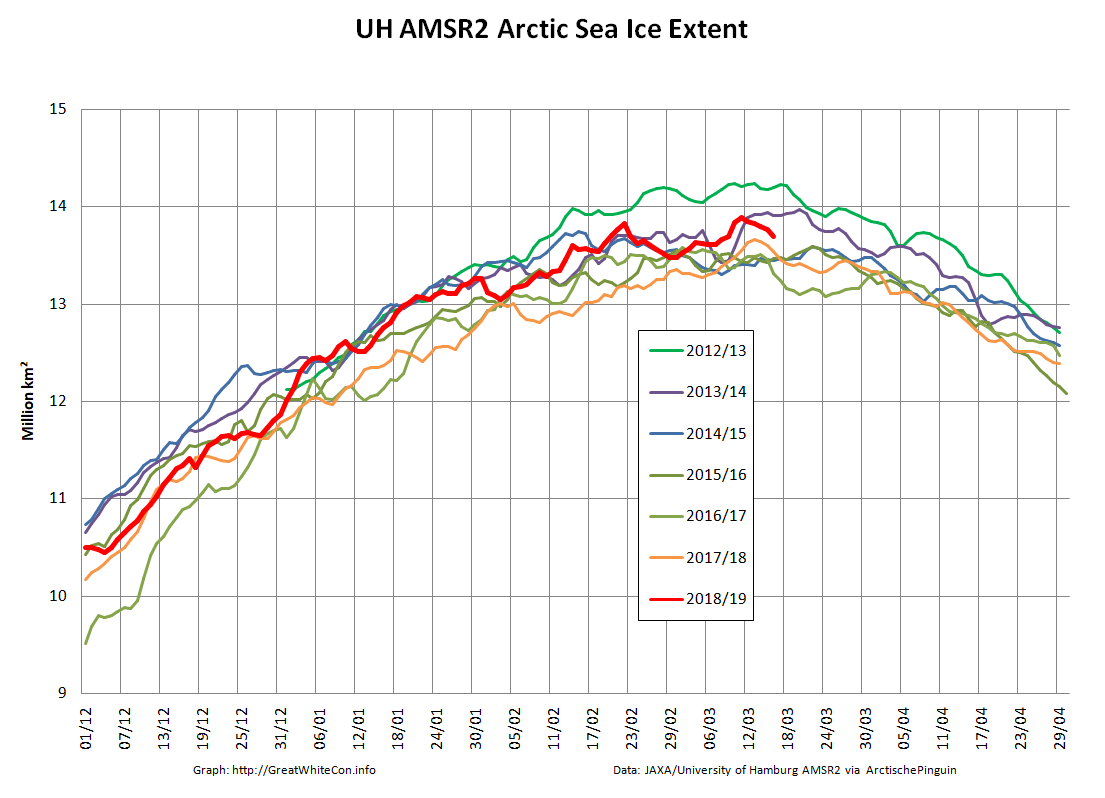
Finally, for the moment at least, here are the current Arctic wide high resolution AMSR2 sea ice area and extent graphs:
[Edit – March 22nd]
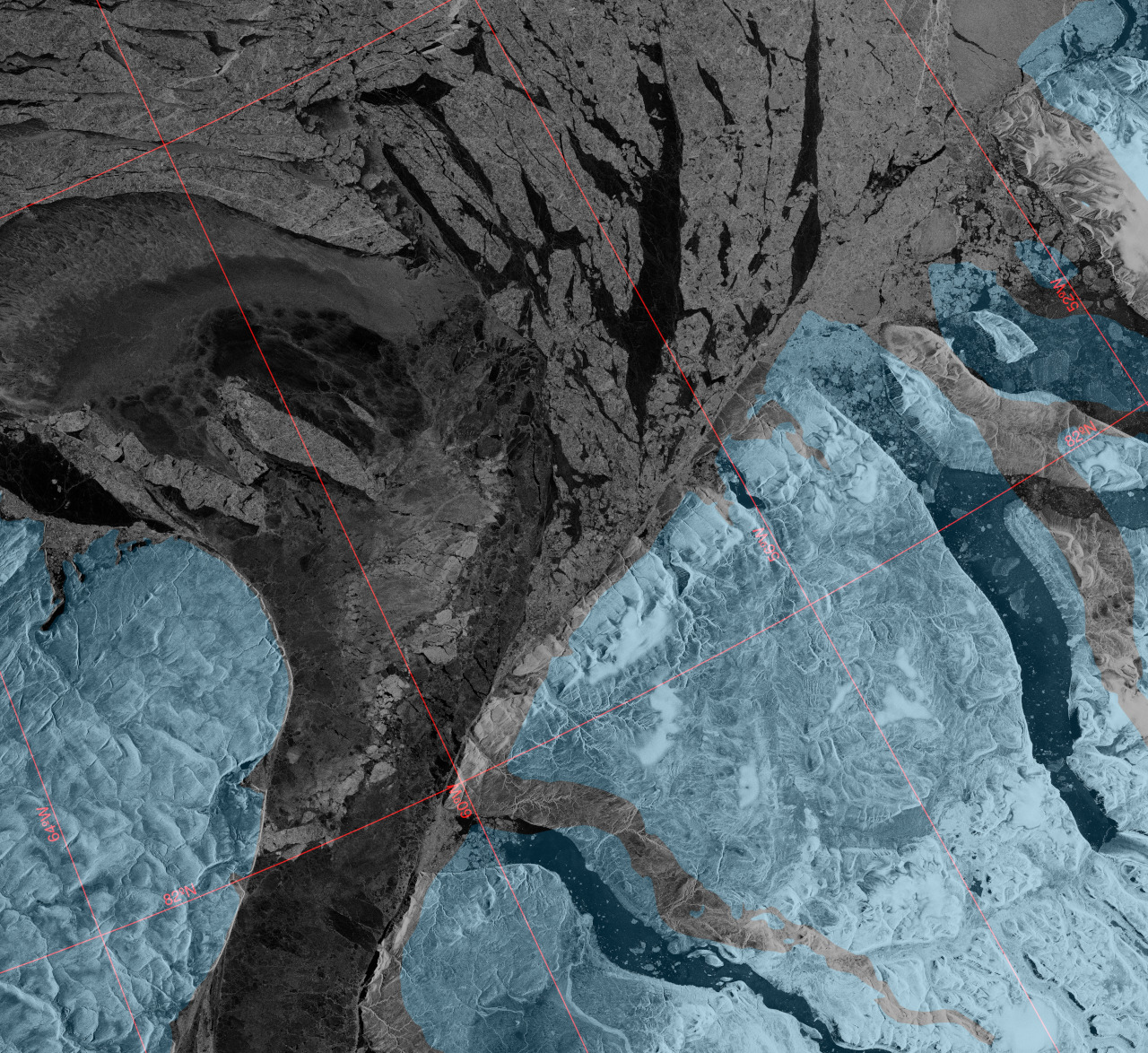
This Sentinel 1 SAR image of the Lincoln Sea from PolarView suggests that the northern arch of the Nares Strait is breaking up once again:
It is therefore conceivable that sea ice in the Lincoln Sea will continue to break up and flow south through the Nares Strait for the entire 2018/2019 winter.
[Edit – March 23rd]
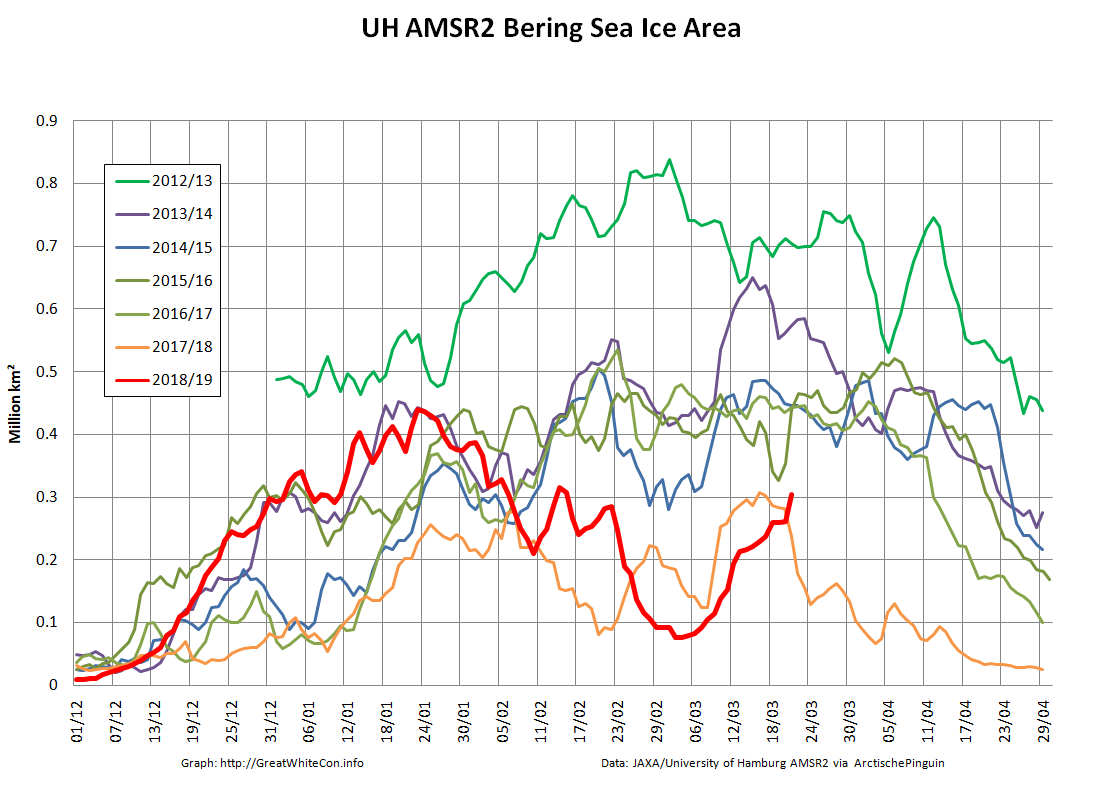
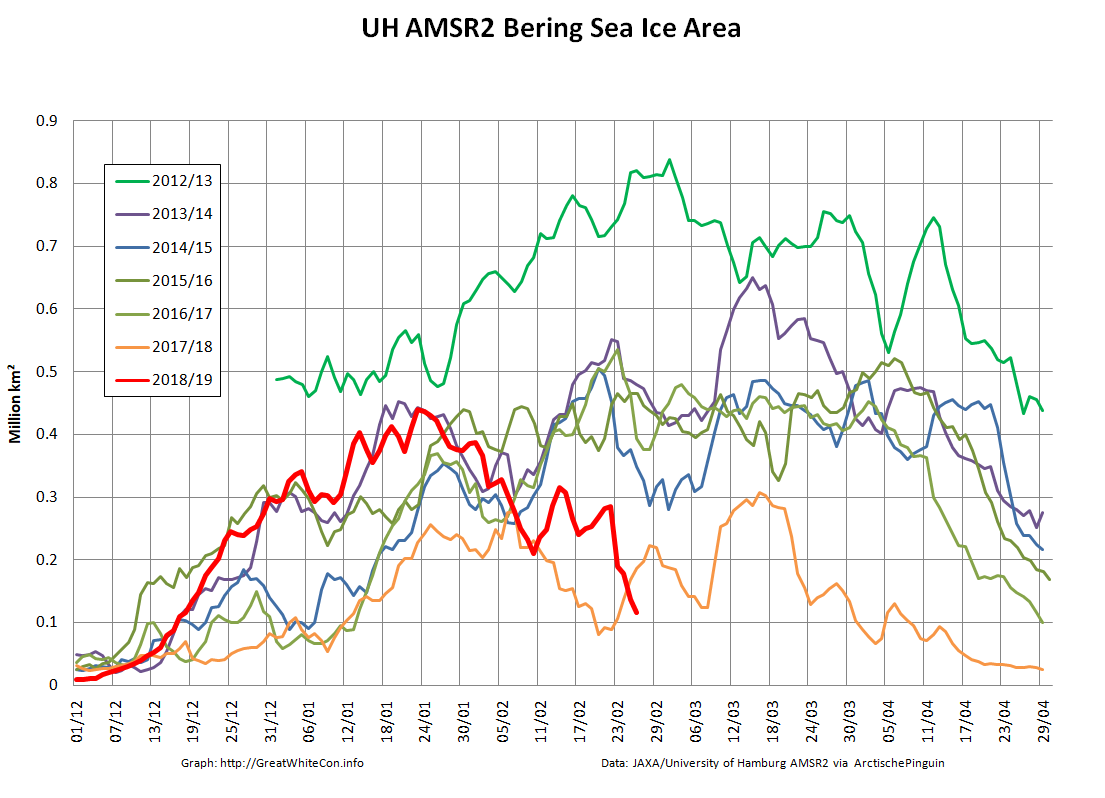
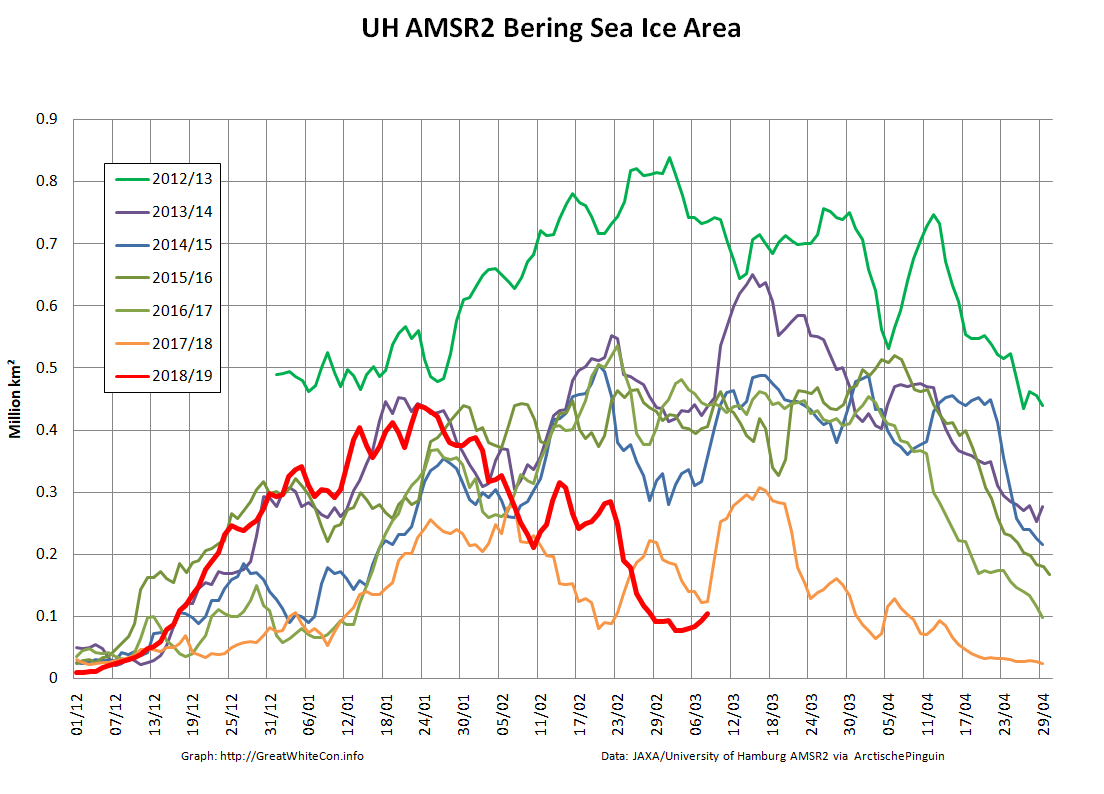
Bering Sea ice area has “rebounded” over the last few days:
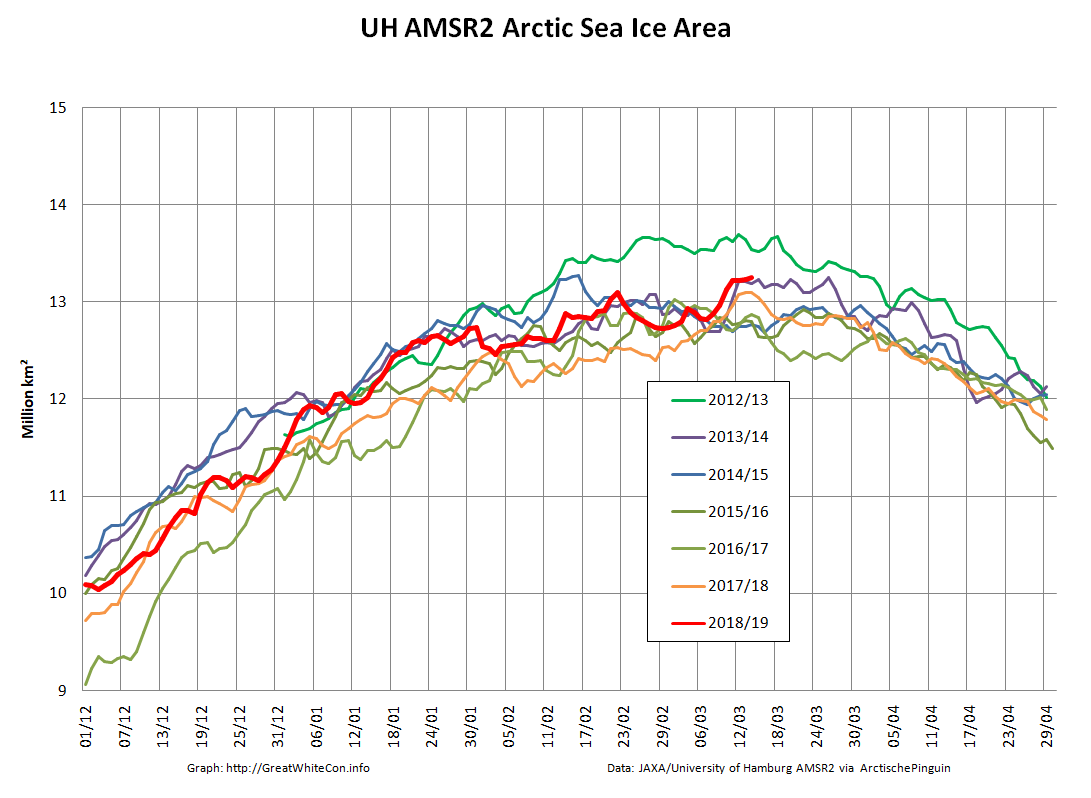
and taken the Arctic wide metrics with it:
Here’s the latest Sentinel 1 SAR image of the Lincoln Sea and northern Nares Strait:
[Edit – March 24th]
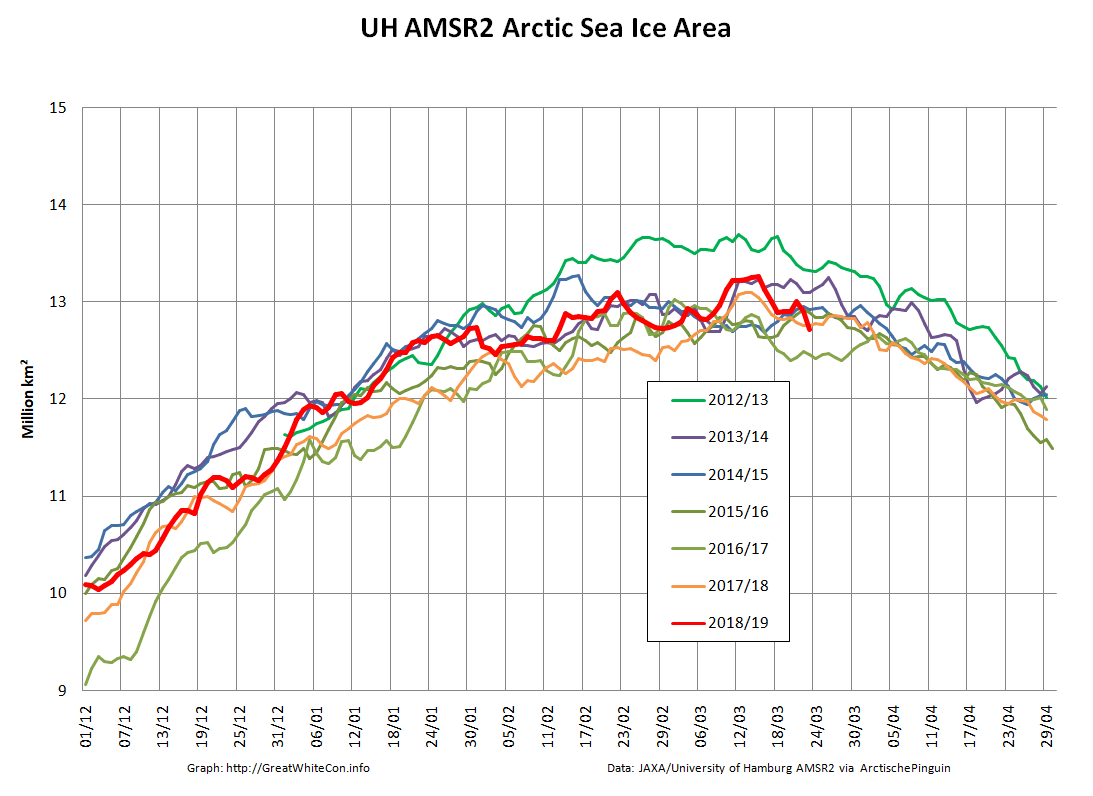
The “rebound” has reversed:
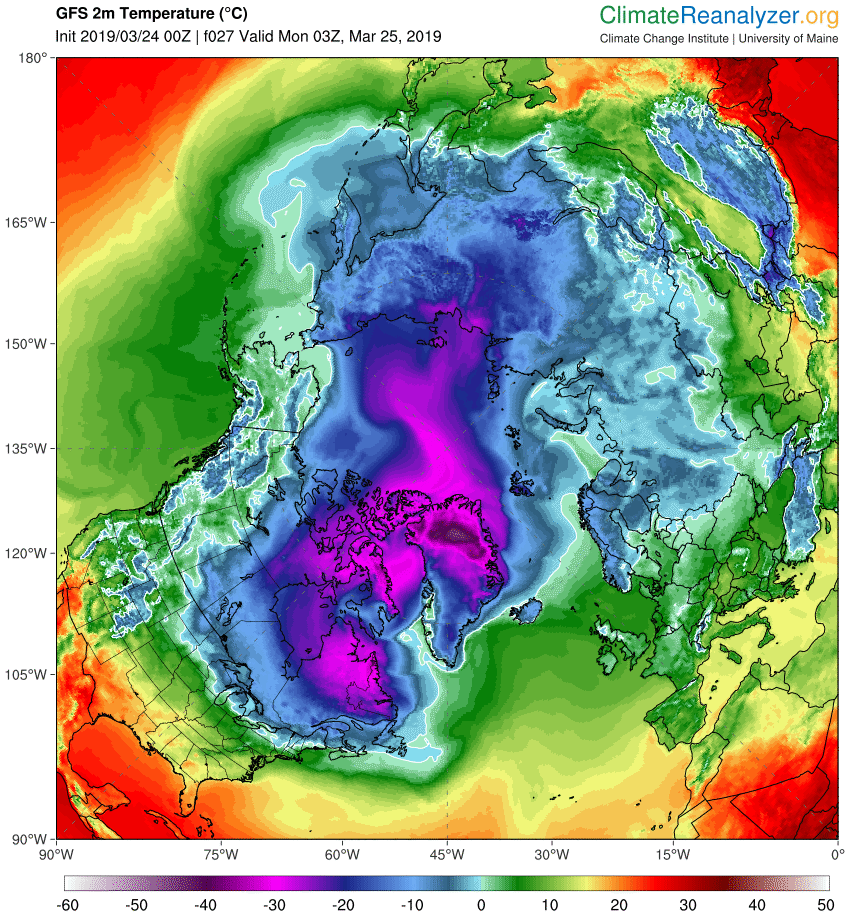
With temperatures above freezing point across the Bering and Chukchi Sea forecast for tomorrow morning expect the decline in Arctic sea ice extent to accelerate:
[Edit – March 25th]
There was a 162k decline in high resolution extent yesterday:
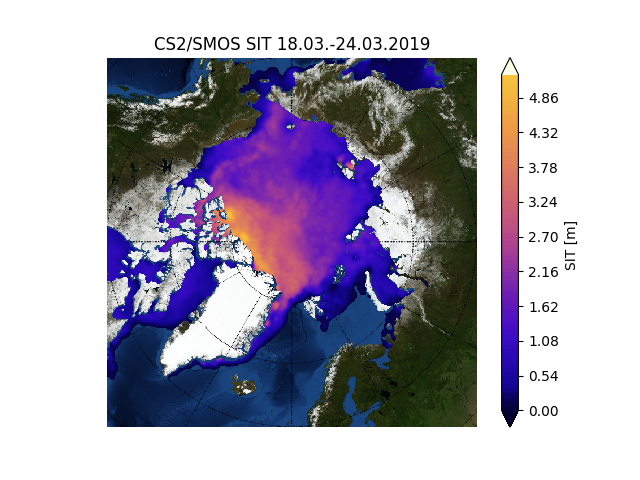
Here also is the current state of the thick sea ice exiting the Lincoln Sea via the Nares Strait:
[Edit – March 27th]
Here’s another week’s merged CryoSat-2/SMOS thickness data from the Finnish Meteorological Institute:
[Edit – March 30th]
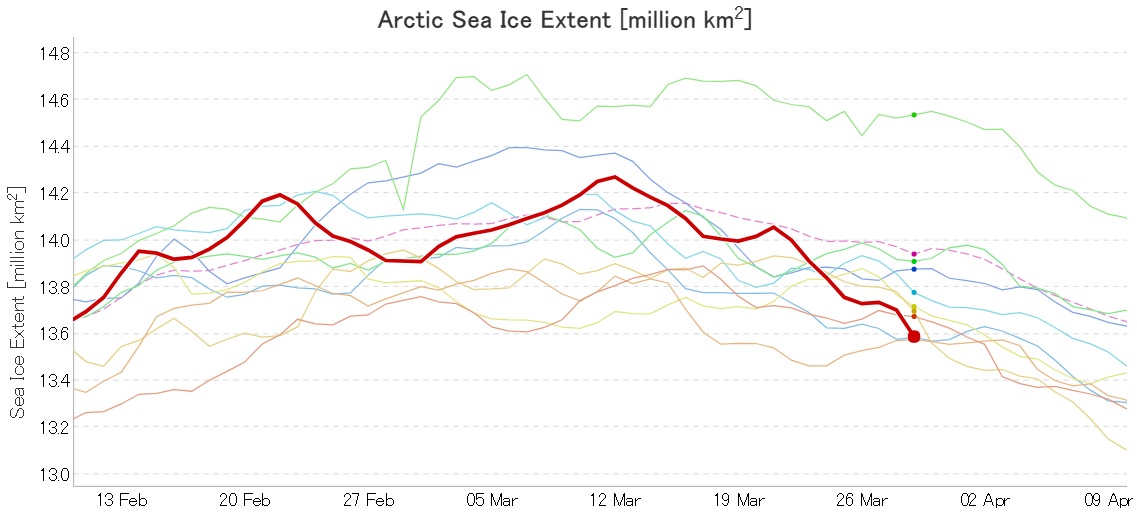
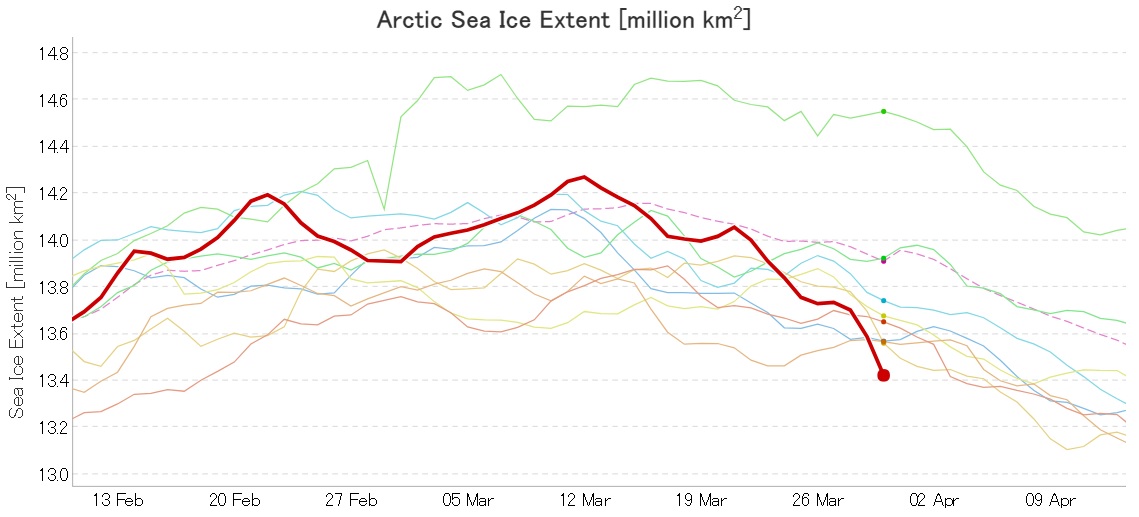
We’re still waiting for Wipneus’ Raspberry Pi to crunch the high resolution AMSR2 numbers, but here’s the latest from JAXA:
2019 currently in 3rd place by a whisker.
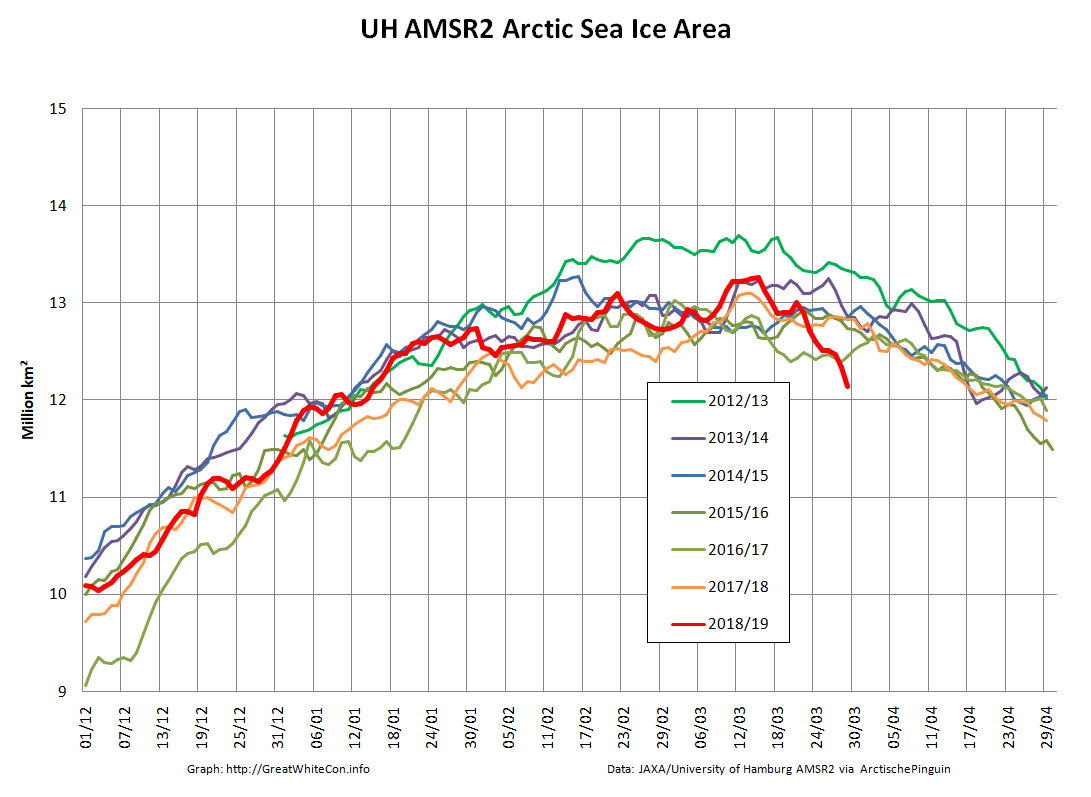
P.S. The high resolution AMSR2 numbers are out:
Area is certainly lowest for the date in the AMSR2 era. Extent will almost certainly achieve that status tomorrow. Excluding the two most peripheral seas reveals perhaps an even more worrying picture?
[Edit – March 31th]
Arctic sea ice coverage is now firmly in the “lowest extent for the date in the satellite record” category, whichever metric you care to choose:
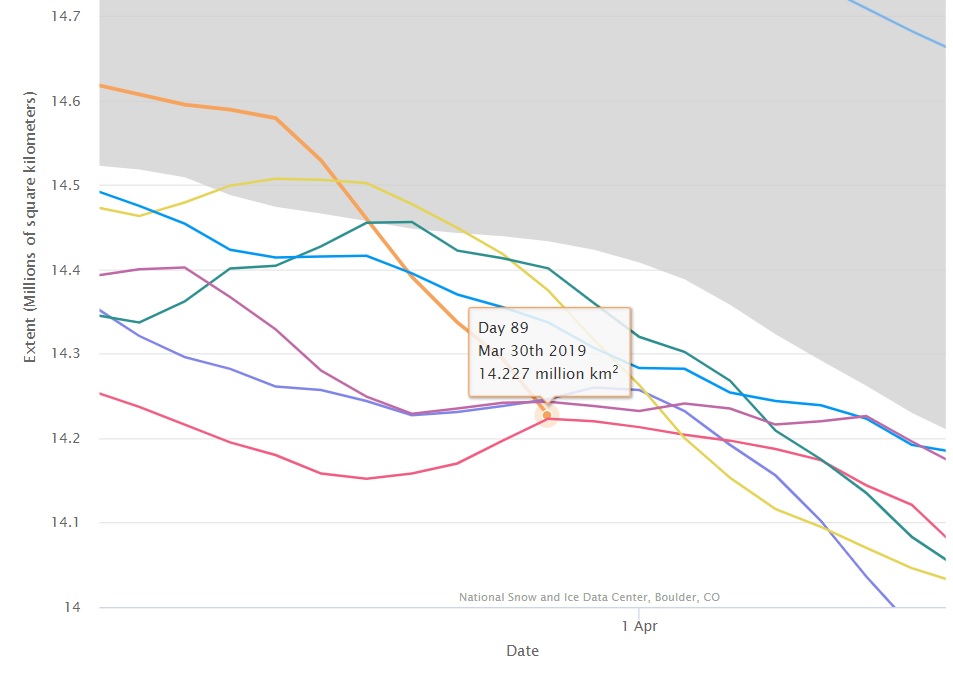
The NSIDC 5 day average is in a “statistical tie” for first place with 2017:
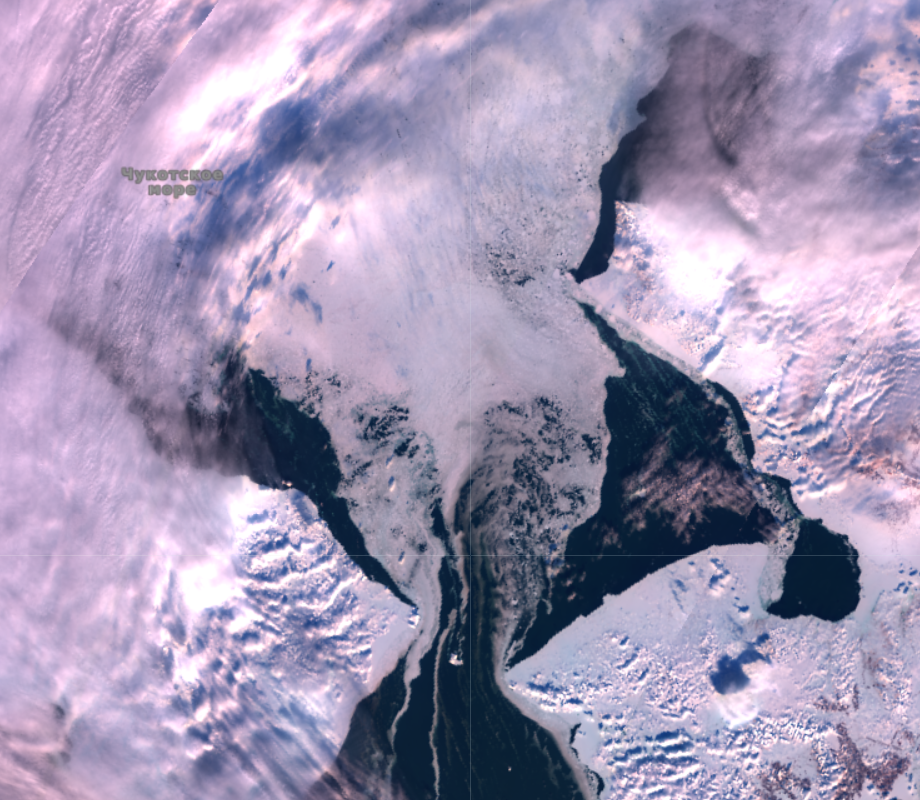
It’s been a long wait for the first ever Great White Con Arctic Basin Big Wave (Fantasy?) Surfing Contest to remove the ‘F’ from the overlong acronym. However currently the omens are bad for the sea ice in the Arctic Basin, which is sadly good for the GWCABBWSC. As we announced yesterday, there is already plenty of open water in the Chukchi Sea north of the Bering Strait between Russia and Alaska:
All of which means that today we are extremely unhappy to be able to announce that the waiting period for the Great White Con Arctic Basin Big Wave Surfing Contest 2019 began on March 1st.
Earlier this week I posed a little conundrum over on Twitter. Here it is:
Nobody has called the Great White Con Ivory Towers hotline with the correct answer as yet, so today we can also reveal that the third in our series of Arctic Basin equipment evaluations took place last Wednesday on the outskirts of Newquay in North Cornwall. Here’s a slightly less obscure clue for the pub quiz fanatics amongst you:
As you can see from my neoprene encased image on Twitter, I was perhaps slightly over dressed for the weather conditions last week. I was wearing a C-Skins thermal rash vest with integrated hood inside my ancient Gul 5/4/3 winter wetsuit plus Tiki 6 mm socks and 2 mm webbed gloves. Even my fingers were more than warm enough on the day, although it’s fair to say that conditions weren’t typical for late summer in the Arctic Basin! What’s more they weren’t even typical for Newquay, since the weather on Wednesday was the tail end of a “heat wave” involving the highest February temperatures in England since the Met Office’s records began:
We’ll be doing an attribution study on how this week’s record-breaking temperatures were affected by #climatechange A Met Office analysis in 2014 showed that since 2000 there were 10 times as many high temperature records broken as cold temperature ones https://t.co/6cgNBdj7CYpic.twitter.com/1CEaORGsQx
What with one thing and another warming wise we’re confidently(ish) anticipating that the Great White Con big wave surf team will be searching the shores of the Arctic Basin on their electric powered jetskis for potential big wave spots by early September 2019. Unfortunately the opposing “Great Green Con” team haven’t worked out how to drive a jetski yet, but hopefully we can resolve that minor problem before the Arctic refreeze begins once again?
Regular readers who also follow the surfing news may recall that Great White Con team leader Andrew Cotton broke his back during his award winning wipeout at Nazaré in Portugal back in November 2017?
I spoke to Cotty yesterday and he assured me that his back was already healed sufficiently to take on the biggest waves the Arctic might care to offer over the coming months. However the same doesn’t yet apply to his more recent knee injury:
He expects to be fully fit by the end of the Northern Hemisphere summer, but failing that Cotty’s team partner Garrett McNamara has also successfully returned from injury recently, and hasn’t yet hurt anything else!
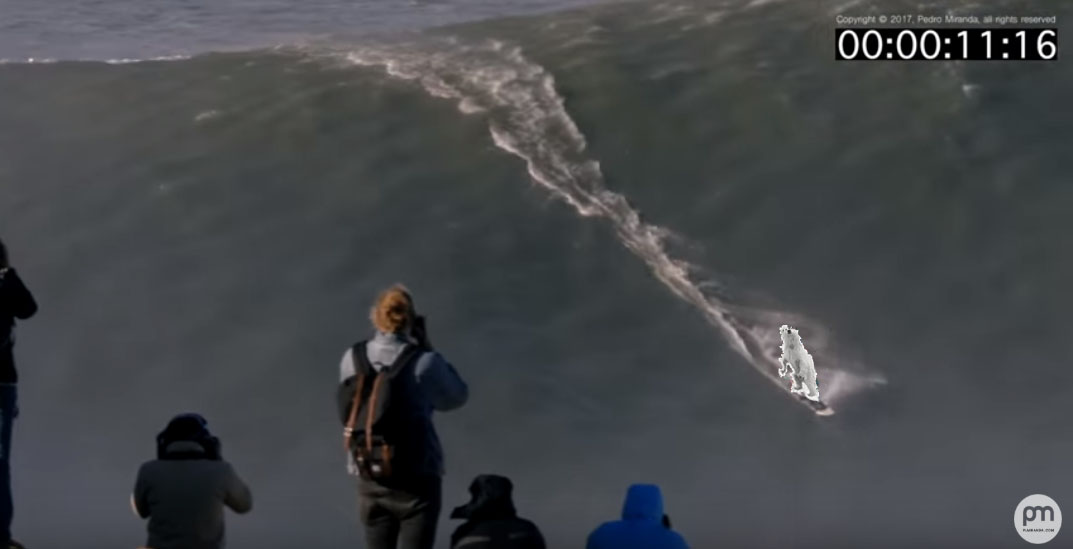
By the end of the long contest waiting period we will also have selected the lucky winner of our 2019 “New Einstein” competition who will be able to enjoy being fitted with one of our custom polar bear suits before partnering with “Great Green Con” team leader David Rose. Here’s our artist’s impression of a forthcoming GGC team equipment evaluation session on the next big swell to hit Nazaré:
With apologies to Pedro Miranda, Andrew Cotton and polar bears worldwide.
The omens are good that 2019 is destined to be a year of firsts in the Arctic. Our regular reader(s) will no doubt fondly recall previous editions of our annual Great White Con “New Einstein” Award? 2019’s competition breaks all the moulds by opening the running with a quote from Snow White’s home from home at the Arctic Sea Ice Forum rather than one of the usual “skeptical” venues!
Here for your delectation is the very first “New Einstein” contestant of the 2019 melting season:
Your unnecessary over the top haughtiness and implicit threats is not helping your communication style one bit Jim. I am far from impressed atm with your version of the Ivory Tower you seem to inhabit. By all means ‘sharpen your sword’ if that is what you imagine you are dealing with because someone says they do not quite understand what you thread is all about.
You can either answer such reasonable questions with a modicum of sincerity and genuineness or continue in the direction you are heading.
What I found out these last 3 months as a Newbie on this forum is that some people here don’t like it when new members take away the spotlight from the oldtimers. All they do is moan and bitch over file sizes, but they fail to reply to any other message I post. So what we have here my dear friend is a textbook example of bigotry. We are excluded from the group… They rather have we left, so they get all the attention again… But who cares? Leave those idiots be. Do what you know to be right, and work together for the benefit of all mankind!
in conjunction with:
Your only contributions to this thread have been complaints and promotions for your own website.
Please refrain from doing so! If you have some Nullschool animation to contribute or comments on the work that is posted here, feel free to do so! If you only come here to complain and tell people what to do, please go away!
and not forgetting:
May I remind everyone that this is the Nullschool Animations thread. I made this thread because you bastards complaint about my graphics on the melting season thread, and now you come here to bitch AGAIN? GO FUCK YOURSELVES!!!!!!!!
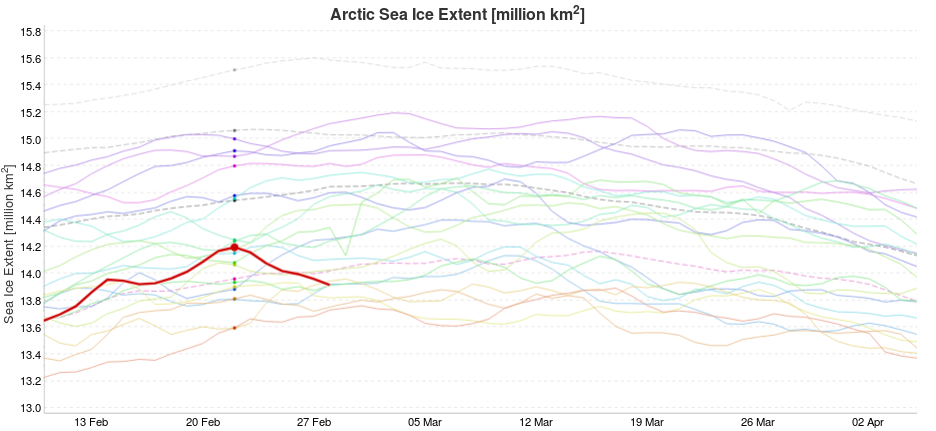
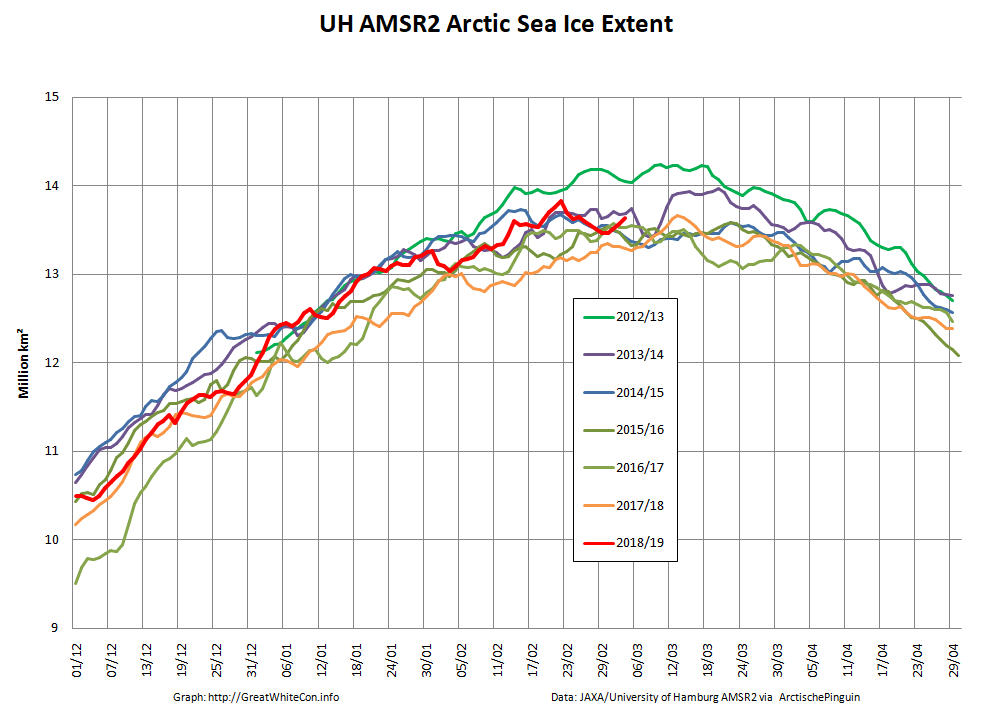
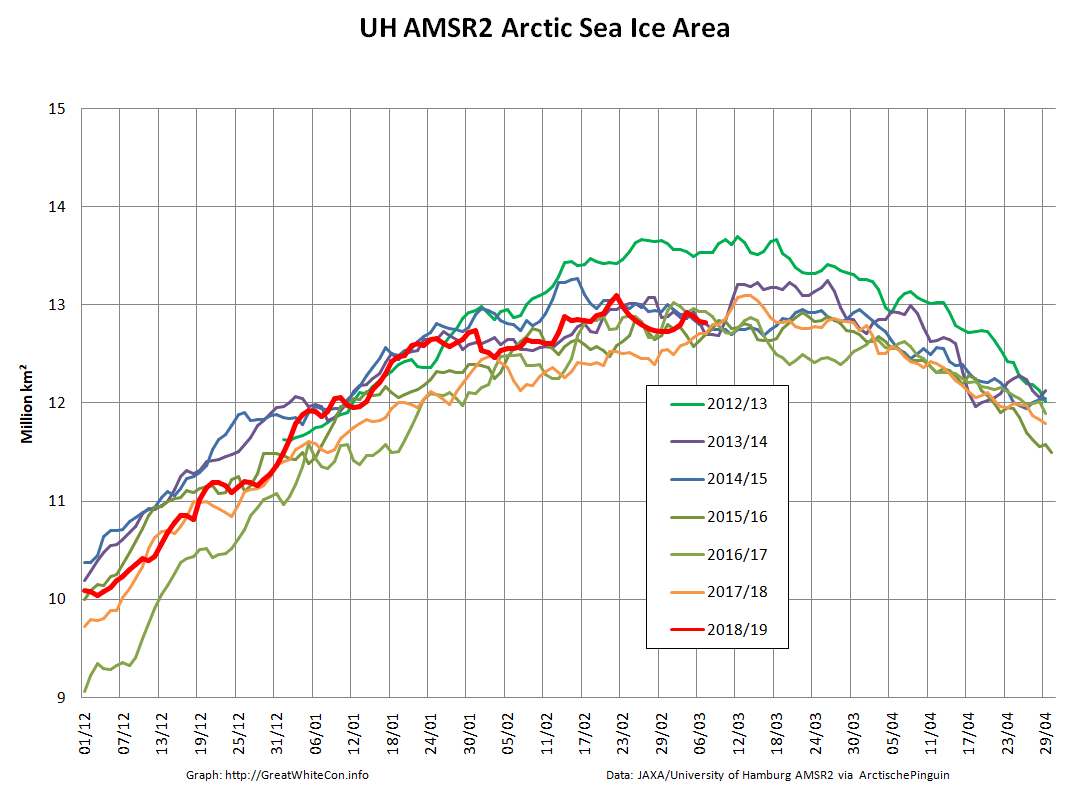
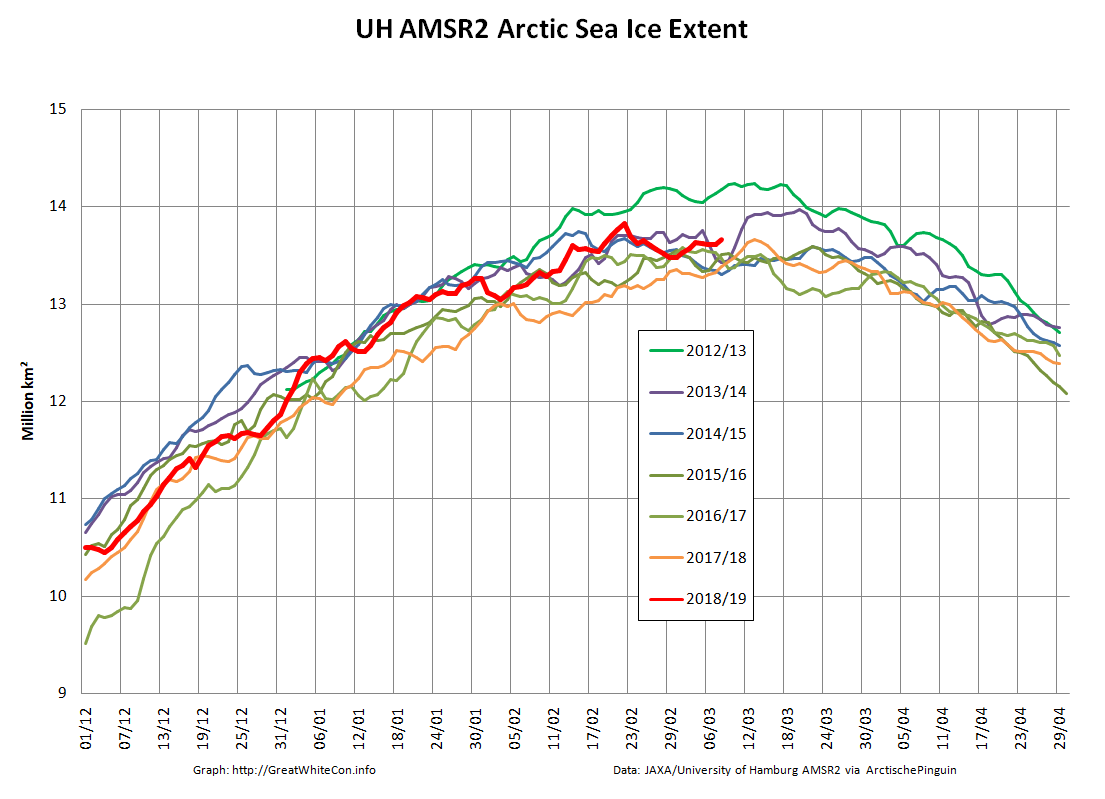
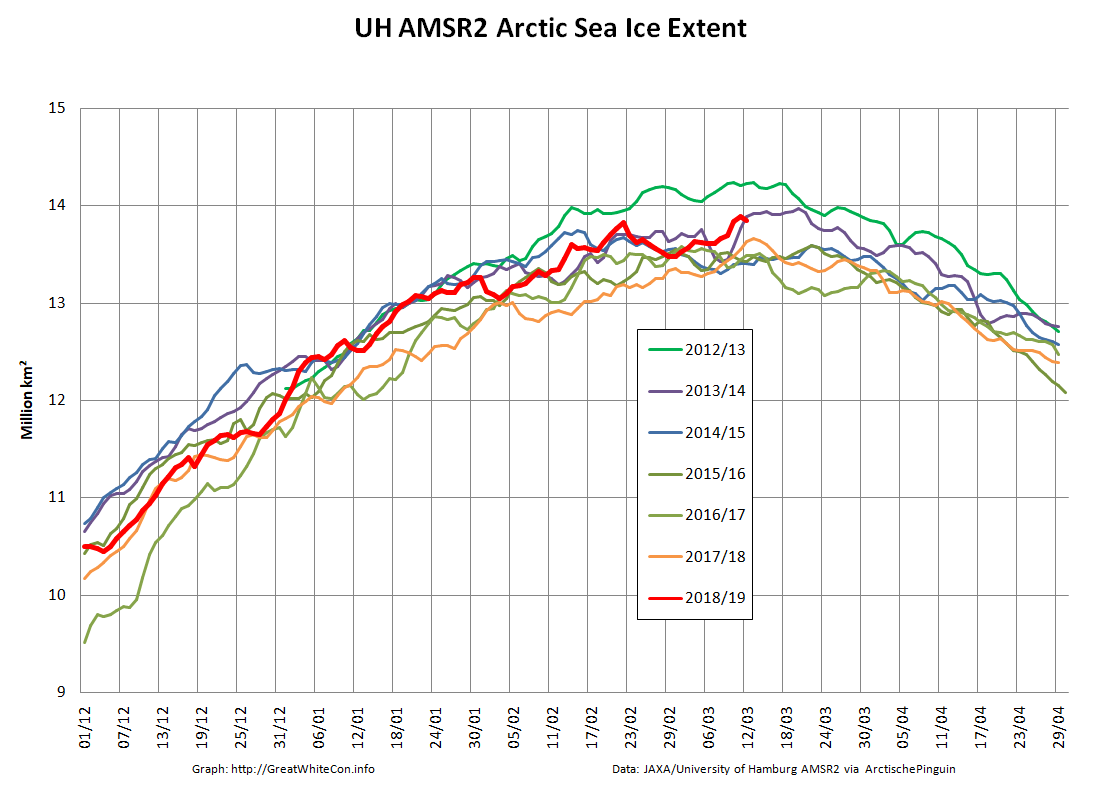
March 2019 has arrived, which in recent years has proved to be by far the likeliest month to contain the maximum extent of Arctic sea ice for the year. To begin with, here’s our favourite high resolution extent graph calculated by “Wipneus” from University of Hamburg/JAXA AMSR2 data:
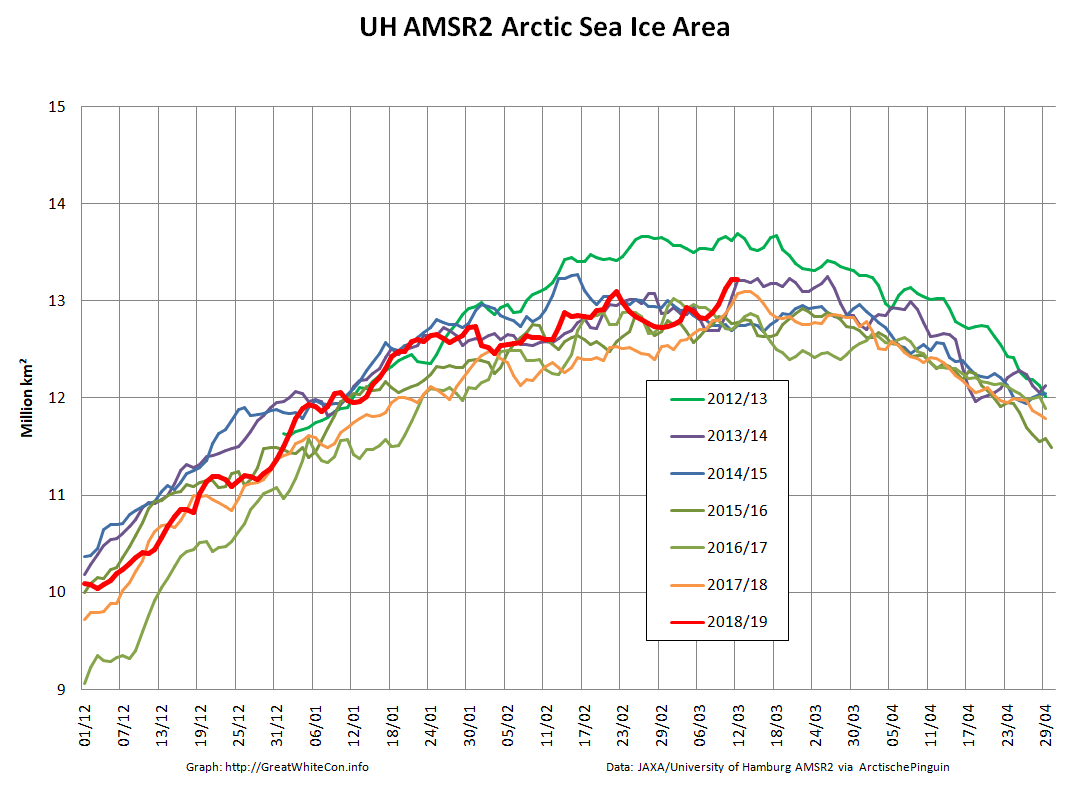
Hopefully you can plainly see the pronounced sharp peak towards the end of February 2019? The current maximum Arctic sea ice extent for 2019 is 13.83 million square kilometers on February 22nd. Here’s Arctic sea ice area for good measure:
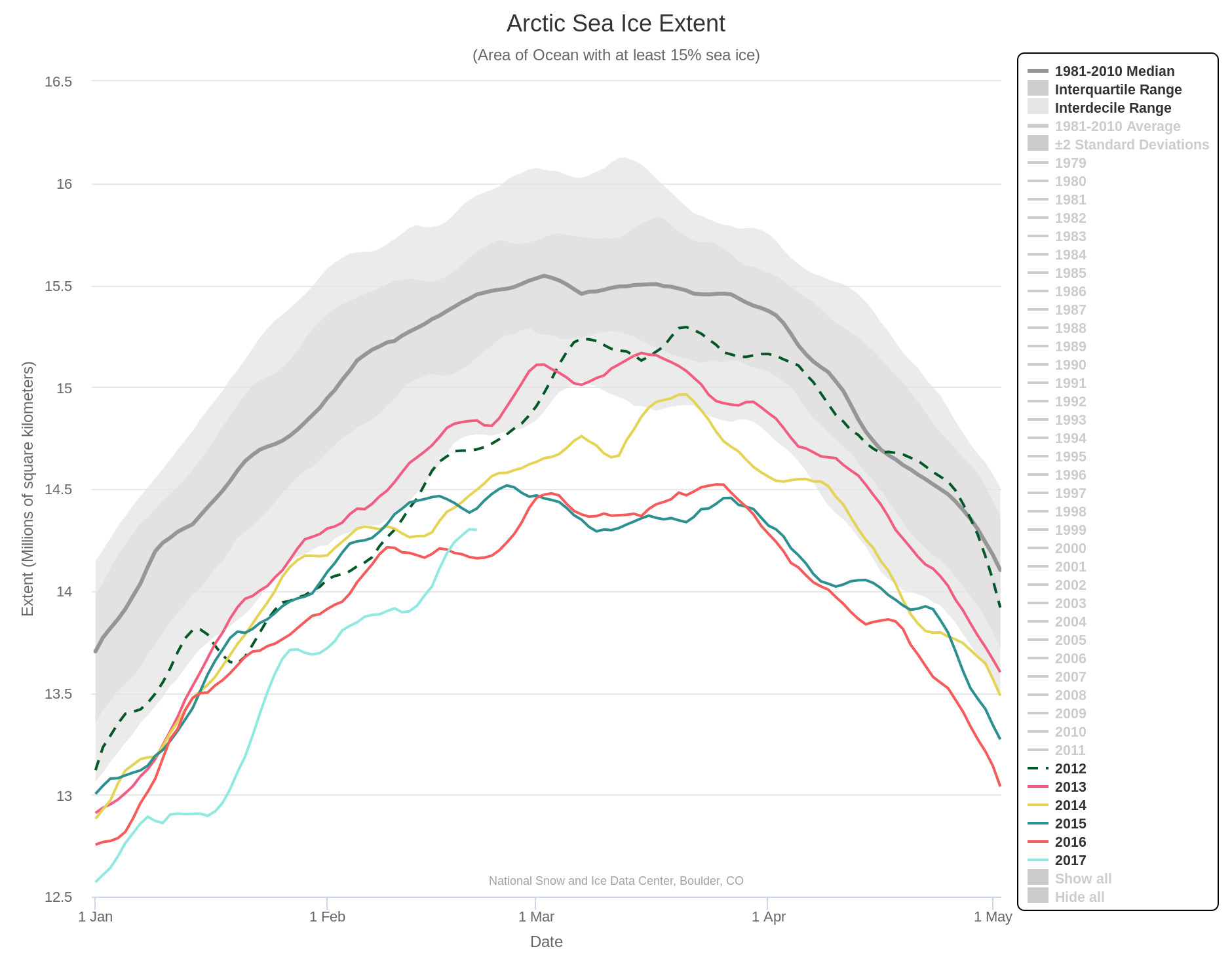
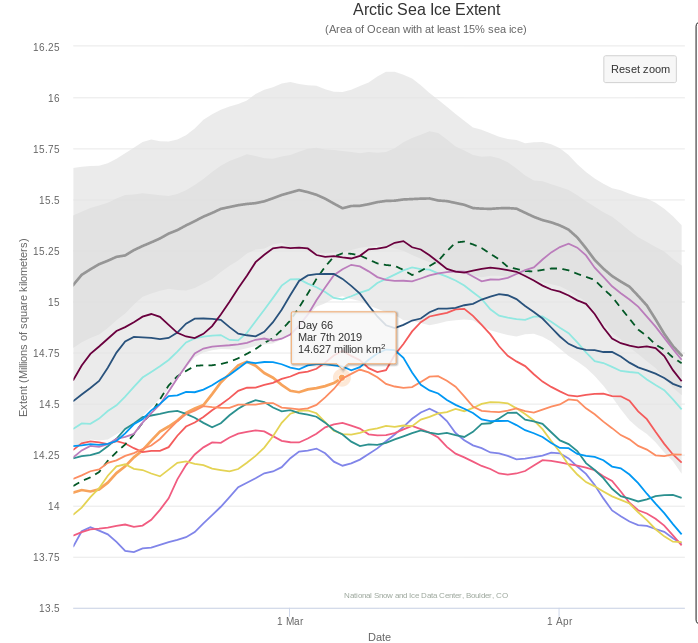
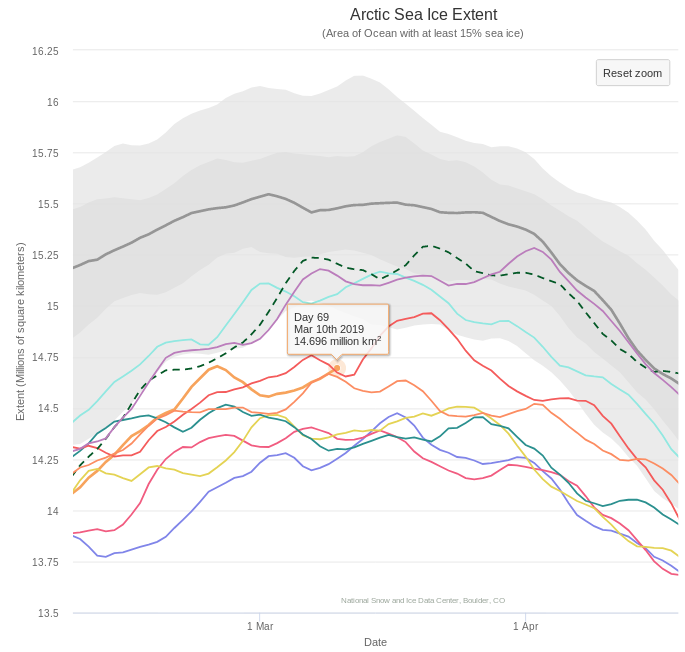
The current maximum area for 2019 is 13.10 million square kilometers, also on February 22nd. Here too is the NSIDC’s 5 day averaged extent:
This reveals a current maximum extent for 2019 of 14.705 million square kilometers on February 24th.
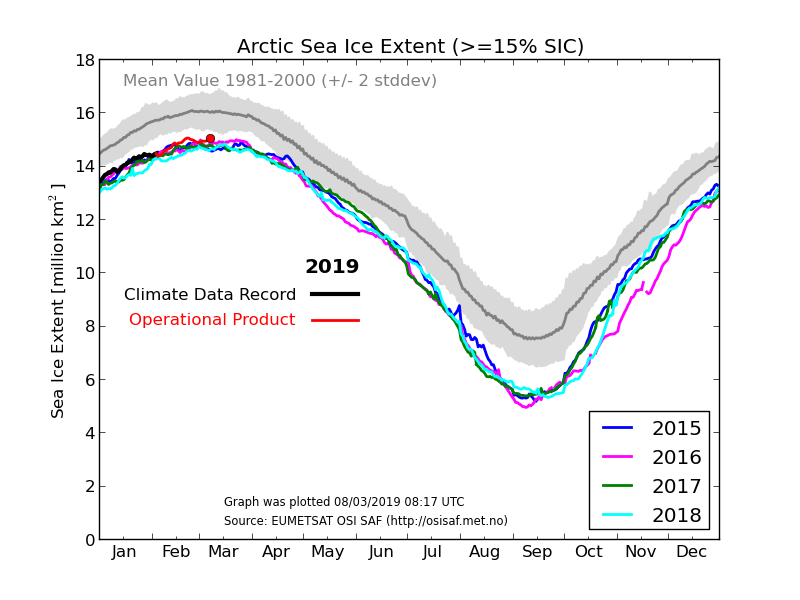
At this juncture you may well be wondering what the cause of that sudden sharp peak might be? Here’s your starter for ten:
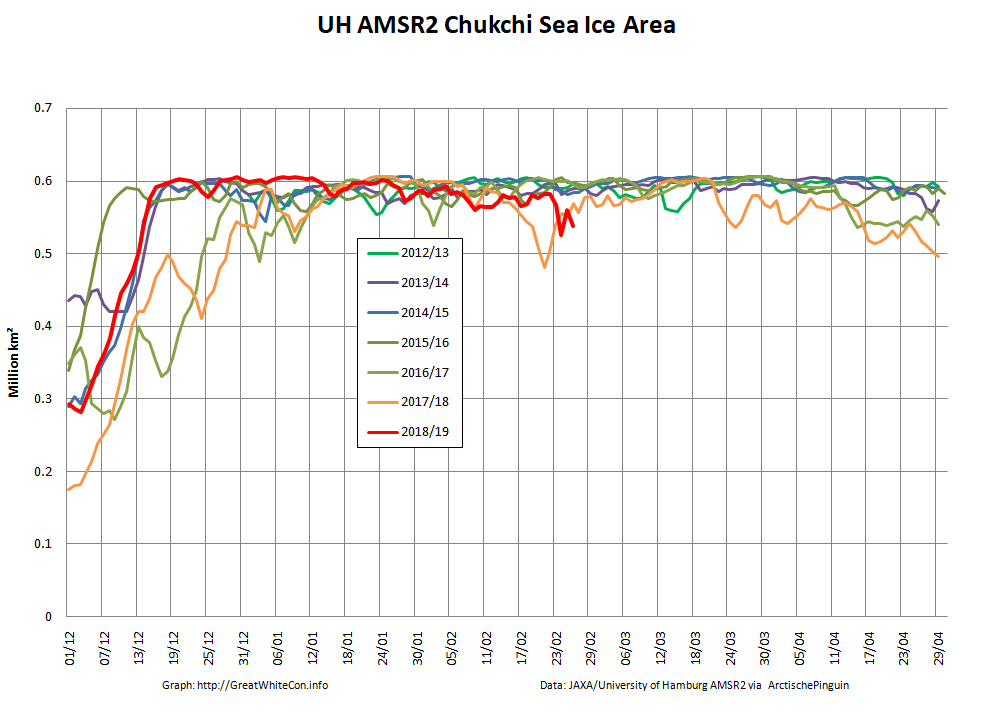
Whilst overall Arctic sea ice area is unremarkable for the current decade, sea ice area in the Bering Sea is remarkable low for the time of year! What’s more much like last year the Chukchi Sea is not currently full to overflowing with sea ice, and is also lowest for the date in the AMSR2 satellite records:
I’ve also been experimenting with the new gridded CryoSat-2/SMOS thickness data from the Finnish Meteorological Institute, which reveals this:
That’s a weekly overview dated February 24th, but it does perhaps explain how such a large area of sea ice could melt so swiftly?
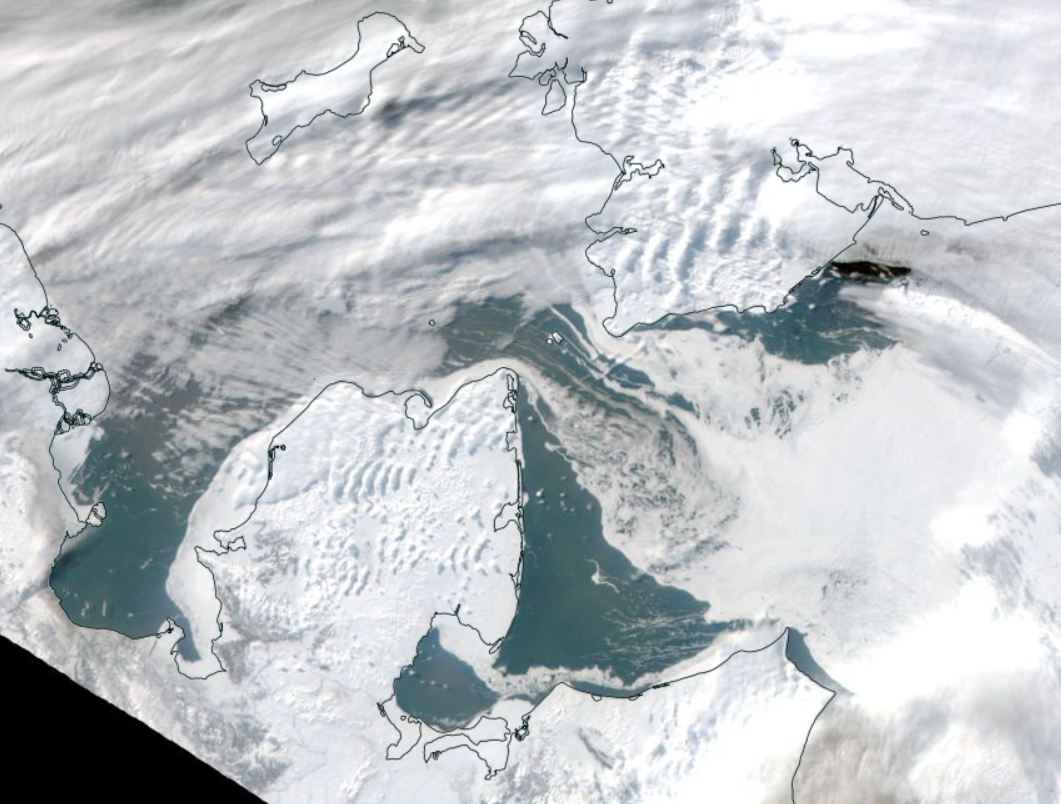
As luck would have it the skies are reasonably clear over the Bering Strait this morning (UTC). Here’s Terra’s view from on high of the current situation:
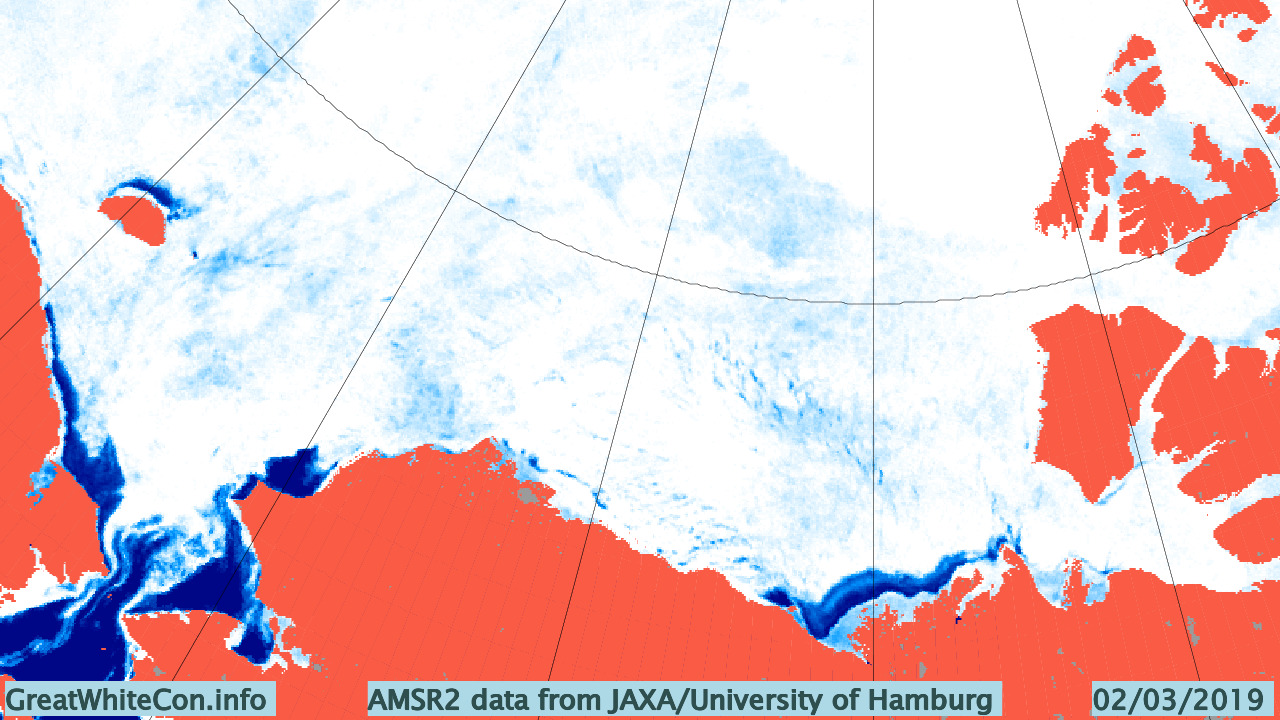
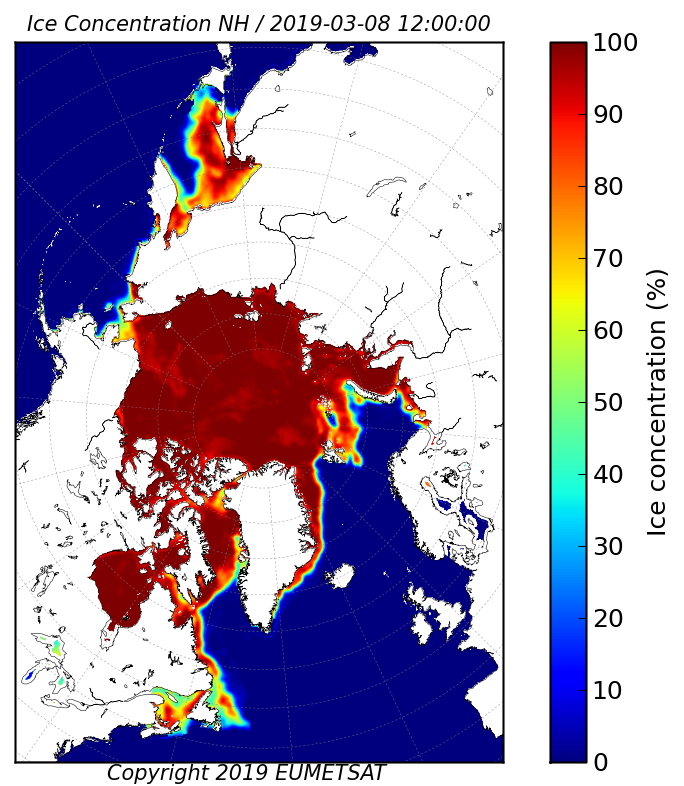
In addition, here is the underlying sea ice concentration data from the OSI-SAF:
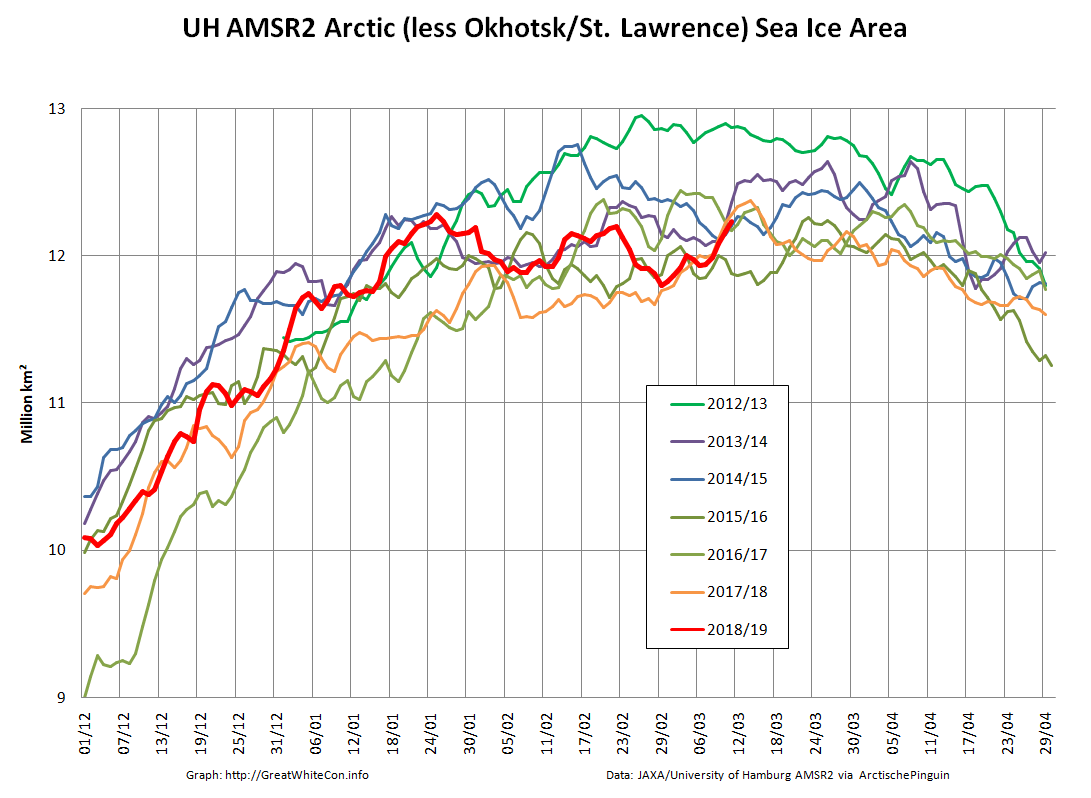
Since Michael is also asserting that there currently exists “the greatest February Arctic sea ice extent (according to DMI) in your blog’s history”, here’s Arctic sea ice area excluding the extremely peripheral Okhotsk and St. Lawrence regions:
P.S. Wipneus’ Pi has processed the AMSR2 data now, and area shows another, more modest, decline today:
Both area and extent are still moving inexorably upwards:
The late February maximum still holds, on the high resolution numbers at least. The JAXA/VISHOP web site is down at the moment, so we’ll have to wait for an update to that particular metric, as well as a post weekend update to the NSIDC’s Charctic chart.
P.S. Jaxa is still down this afternoon, but here’s the latest from the NSIDC:
[Edit – March 13th]
Arctic wide area and extent have blasted past their respective late February maxima:
However Arctic sea ice area excluding the Okhotsk and St. Lawrence peripheral regions has still not exceeded the maximum formed on January 25th:
[Edit – March 14th]
This morning’s data reveal the first decline in extent for several days:
The (extremely!) tentative new maximum Arctic sea ice extent for 2019 is 13.89 million square kilometers on March 12th.
[Edit – March 15th]
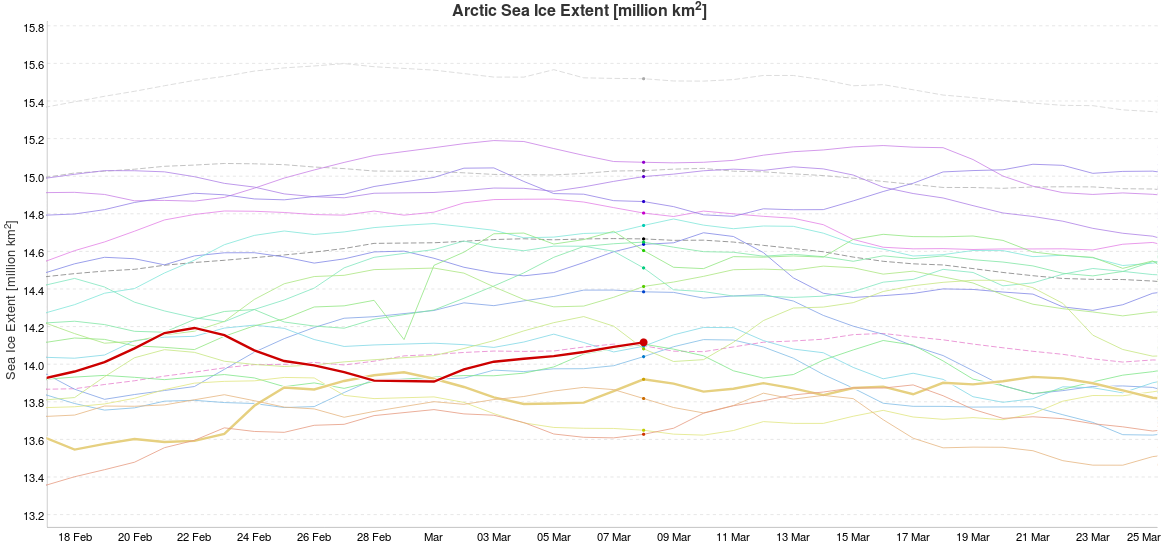
JAXA is back!
UH AMSR2 confirms that extent is still declining:
[Edit – March 16th]
Arctic sea ice extent continues to decline, whilst area is still flatlining:
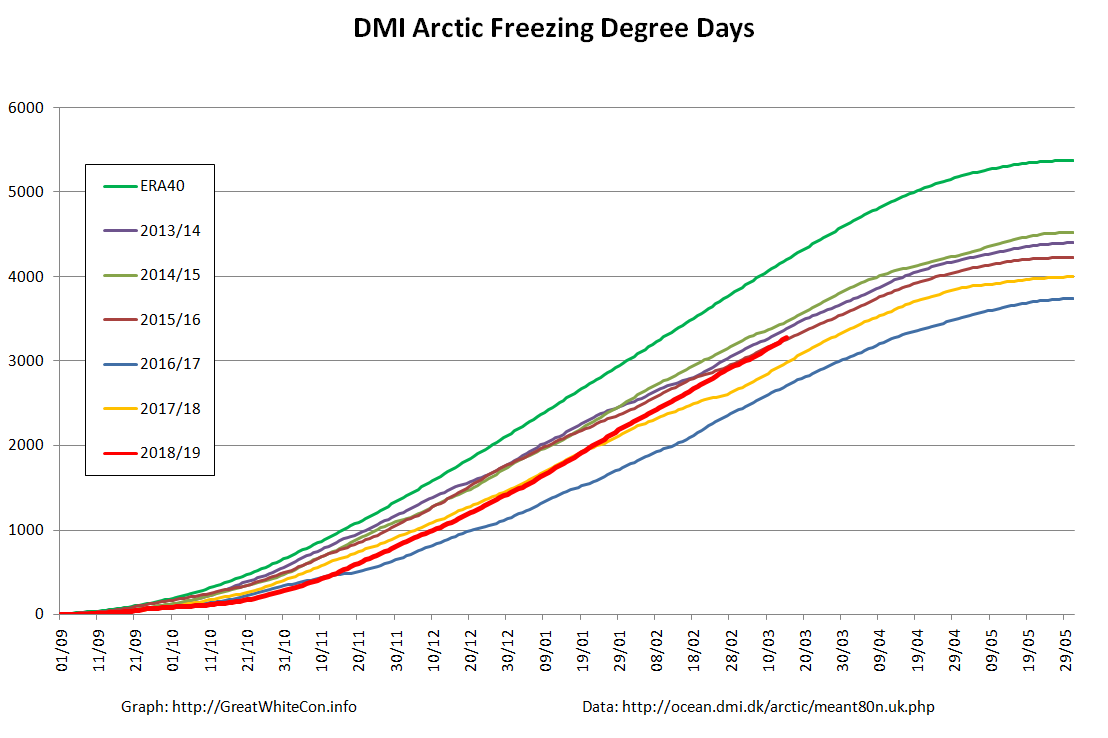
Meanwhile a look at freezing degree days based on the DMI’s dubiously weighted data for north of 80 degrees reveals the story of the freezing season. A historically warm start, but now back in amongst the pack of the 2010s:
[Edit – March 17th]
It looks as though there’ll be no going back from this. Arctic sea ice area is finally following extent’s decline in no uncertain terms:
Barring exceedingly unforeseen circumstances after this year’s “double top” that leaves the 2019 Arctic sea ice maximum extent numbers as follows:
UH/Wipneus AMSR2 – 13.89 million square kilometers on March 12th
JAXA/VISHOP AMSR2 – 14.27 million square kilometers on March 12th
NSIDC 5 day SSMIS – 14.78 million square kilometers on March 13th
[Edit – March 19th]
Arctic sea ice area has fallen off the proverbial cliff over the last few days. There can now be no doubt that the 2019 maximum extent has been reached:
That being the case, all other Arctic sea ice discussion for the month of March can now take place over at:
On March 13, 2019, Arctic sea ice likely reached its maximum extent for the year, at 14.78 million square kilometers (5.71 million square miles), the seventh lowest in the 40-year satellite record, tying with 2007. This year’s maximum extent is 860,000 square kilometers (332,000 square miles) below the 1981 to 2010 average maximum of 15.64 million square kilometers (6.04 million square miles) and 370,000 square kilometers (143,000 square miles) above the lowest maximum of 14.41 million square kilometers (5.56 million square miles) set on March 7, 2017. Prior to 2019, the four lowest maximum extents occurred from 2015 to 2018.
The date of the maximum this year, March 13, was very close to the 1981 to 2010 median date of March 12.
Please note this is a preliminary announcement of the sea ice maximum. At the beginning of April, NSIDC scientists will release a full analysis of winter conditions in the Arctic, along with monthly data for March.
This website uses cookies to improve your experience. We'll assume you're ok with this, but you can opt-out if you wish. Cookie settingsACCEPT
Privacy & Cookies Policy
Privacy Overview
This website uses cookies to improve your experience while you navigate through the website. Out of these, the cookies that are categorized as necessary are stored on your browser as they are essential for the working of basic functionalities of the website. We also use third-party cookies that help us analyze and understand how you use this website. These cookies will be stored in your browser only with your consent. You also have the option to opt-out of these cookies. But opting out of some of these cookies may affect your browsing experience.
Necessary cookies are absolutely essential for the website to function properly. This category only includes cookies that ensures basic functionalities and security features of the website. These cookies do not store any personal information.
Any cookies that may not be particularly necessary for the website to function and is used specifically to collect user personal data via analytics, ads, other embedded contents are termed as non-necessary cookies. It is mandatory to procure user consent prior to running these cookies on your website.