Monthly Archives: April 2014

Debating skeptics is like mud wrestling with pigs

In an article entitled “Exeter University Prof: ‘Debating skeptics is like mud wrestling with pigs’” a guest poster on the “Watts Up With That” blog quotes my fellow Exonian Dr. Stephan Harrison of Exeter University, whilst simultaneously managing to misspell his name:

Them:

Dr Harrison [was] asked about climate skeptics and he goes on to say that they are not worth debating their viewpoint as it’s “like mud wrestling with pigs. Firstly you get covered in mud and secondly, the pig loves it” he then goes on to say he won’t debate skeptics because geographers don’t debate with people who think the world is flat and biologists don’t debate with people who think evolution isn’t happening or that the world is only 6000 years old.

Us:

Fresh from indulging in some “mud wrestling” with Anthony Watts myself, I felt compelled to contribute my own two new pence worth to the ongoing “debate”:

I don’t know if this counts as “mud wrestling with pigs” but here at WUWT seems to be no place to “engage in a fair public debate”. By way of example see:

http://wattsupwiththat.com/2014/04/09/study-wuwt-near-the-center-of-the-climate-blogosphere/#comment-1611483

et seq.

Them:

Your comment is so cryptic it is worthy of Mosher. Whatever your comment/link means, I don’t understand it.


Us:

A recent screenshot of some mud being flung at WUWT:
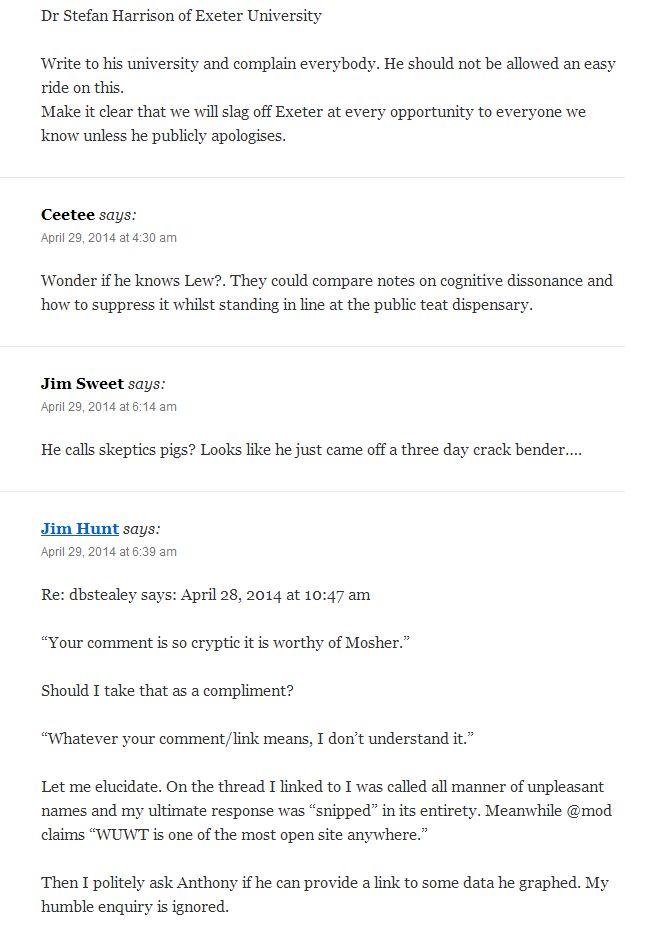
2014-04-29_1557_WUWT


Them:

Jim,

After reading your comment on WUWT, it looks like you thought the moderator who snipped your comment was me. It wasn’t.

In fact, I made the moderator’s comment under the comment you made on April 12, 2014 at 10:25 am on the ‘Study: WUWT near the center of the climate blogosphere‘ thread.

I don’t like it when an anonymous moderator snips a comment without a good reason. In your case it was done improperly. I am sorry about that.

Sincerely,


Us:

Thanks for your note. I previously hadn’t the faintest inkling that you are one of the moderators at WUWT, let alone a senior one. It did however seem to me that your comment on the “Mud wrestling” thread deserved to be balanced by recounting my own recent experience on the “Study” thread.

That said, my riposte to GreggB’s long list of wholly unjustified accusations remains “snipped”, and my request for Anthony to reveal his sources remains unanswered, so I remain an unhappy bunny!

Best wishes,

Jim


Them:

We’ll keep you posted!
“Real Science” Censorship – Episode 2

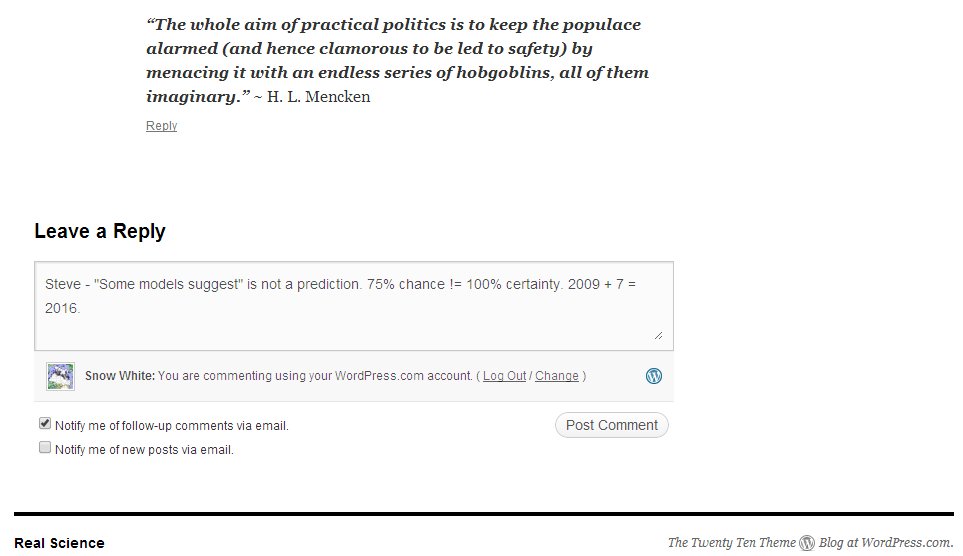
After having a brush with the “Real Science” censor last month I’ve really gone and done it now. Steven Goddard’s blog has been badmouthing Al Gore recently. I’m afraid I couldn’t let that slight on Al’s predictive abilities go unchallenged. Steve evidently didn’t care for my suggestion that he “is fond of poetic license”, so my alter ego is “now spam” there too:

I’ve cut out much of the gratuitous abuse in the ensuing conversation, but you can peruse an archived version if you so desire. Note amongst other things that Al Gore never mentioned “16 foot thick ice in the Beaufort Sea”. Here are the expurgated highlights:

Them:

Nobel Peace Prize Laureate Al Gore says that the 16 foot thick ice in the Beaufort Sea will all melt in the next few weeks.

http://www.examiner.com/article/gore-arctic-ocean-ice-free-as-early-as-2014

Us:

“Some of the models suggest that there is a 75 percent chance that the entire north polar ice cap during some of the summer months will be completely ice-free within the next five to seven years,” Gore said in 2009.

There’s still plenty of time left for some of the models to be proved 75% correct!


Them:

“Some models suggest.” I love that – so very scientific. Some do, others don’t.


Us:

I realise Steve is fond of poetic license, but my point is that in the article Steve references Al Gore did not “predict an ice free Arctic in 2014″. He didn’t even “predict an ice free Arctic by 2016 at the latest”


Them:

I have warned you numerous times about lying about me. This is your last warning
http://www.examiner.com/article/gore-arctic-ocean-ice-free-as-early-as-2014


Us:

Steve – My Gore quote from April 15, 2014 at 10:41 am is cut/pasted from the article you just linked to. Here’s another quote from the same article, presumably a journalist’s interpretation of Gore’s words:
“Today at the U.N. climate conference in Copenhagen, Al Gore said there is new computer modeling that suggests the Arctic Ocean may be nearly ice-free in the summertime as early as 2014.”


Them:

“Some of the models suggest that there is a 75 percent chance that the entire north polar ice cap during some of the summer months will be completely ice-free within the next five to seven years,” Gore said.
Attack Gore for being an idiot. Not me for reporting on it.


Us:

Unpublished comment on Steven Goddard's "Real Science" blog from Wednesday April 16th at 12:55 UTC
Unpublished comment on the “Real Science” blog from Wednesday April 16th at 12:55 UTC


Them:

They have so far neglected to publish the above comment.


Us:

We’ll keep you posted!
North Pole Webcam Begins Transmissions

Construction of Ice Camp Barneo 2014 began close to the North Pole at the beginning of April, and now the first scientific data has started flowing  from the sea ice near the Pole. The first of three webcams has been successfully  installed on the ice, and the slightly noisy initial images are available from the North Pole Environmental Observatory 2014 web site:

NPEO webcam 1 image from April 14th 2014

Data is now also arriving from ice mass balance buoy 2014E, which as you can see if you click on the pushpins on the map below, has been drifting at the rate of 16 km / day during its brief lifetime on the Arctic sea ice so far:

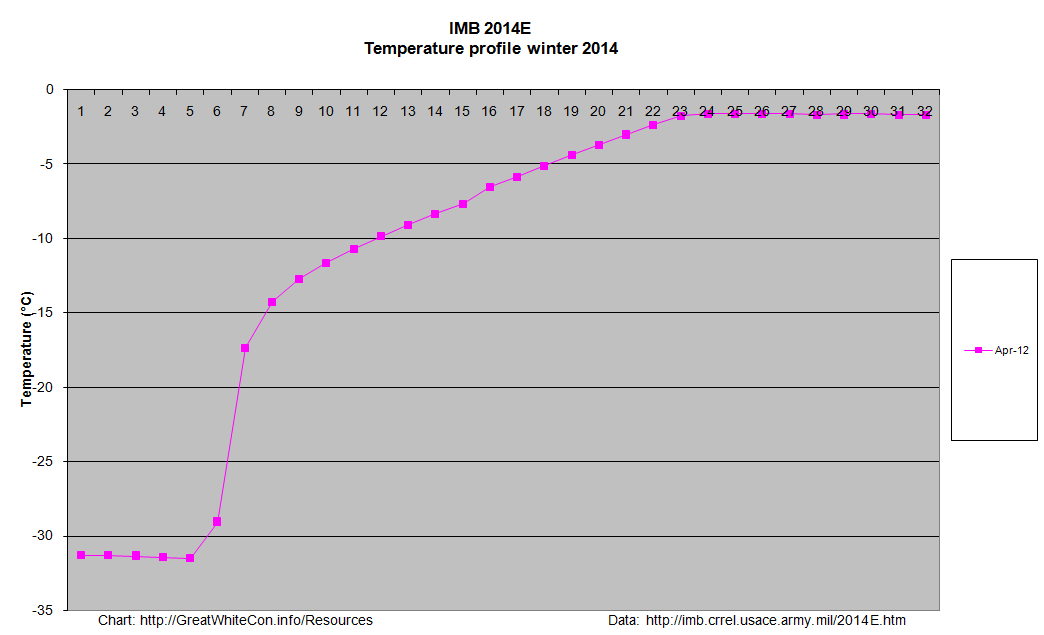
Here’s the initial temperature profile for 2014E:

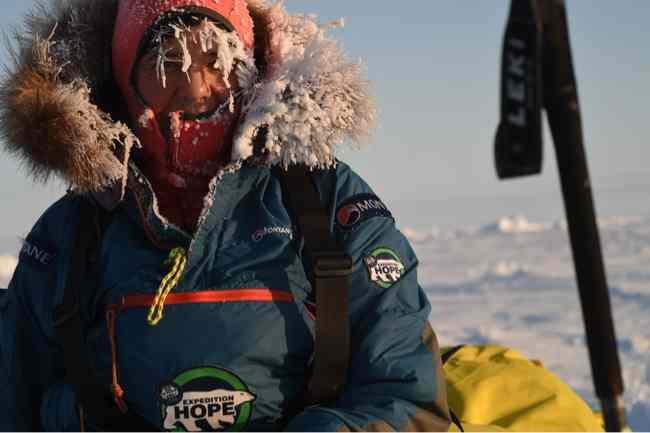
Temperature profiles for ice mass balance buoy 2014E from April to May 2014At present the ice on the floe is 1.7 m thick, covered with 19 cm of snow. As you can see, temperatures were a touch chilly when the buoy was installed on April 12th, at around -32 degrees Celsius. A variety of expeditions have already set off from Barneo in various directions. Expedition Hope are heading in the direction of Cape Discovery on Ellesmere Island, and here Bernice Nootenboom illustrates the effects of such low temperatures on the human body:

Bernice Nootenboom near the North Pole. Photo: Martin Hartley

You can also view data from IMB 2014E and the other active ice mass balance buoys on our IMB overview page.


New Arctic Sea Ice Resources

Stung by some unusually constructive criticism from Anthony Watts we have (somewhat hurriedly) added several new pages to the Great White Con “Resources” section of this web site. They contain the sort of information that is rather tricky to update automatically on a daily basis, and concentrate on resources that help the interested searcher after truth get a handle on the thickness and hence volume of the sea ice in the Arctic, on a regional as well as pan Arctic scale.

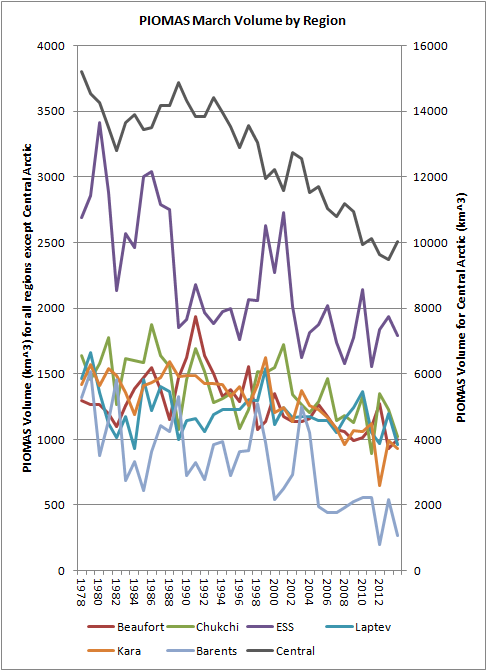
The first section is entitled “Arctic Sea Ice Graphs“, and here’s an example of one graph which reveals the ice volume in various regions of the Arctic, based on the output of the PIOMAS model:

PIOMAS regional volume breakdown for March 2014

[Graph by Chris Reynolds on the Dosbat blog]

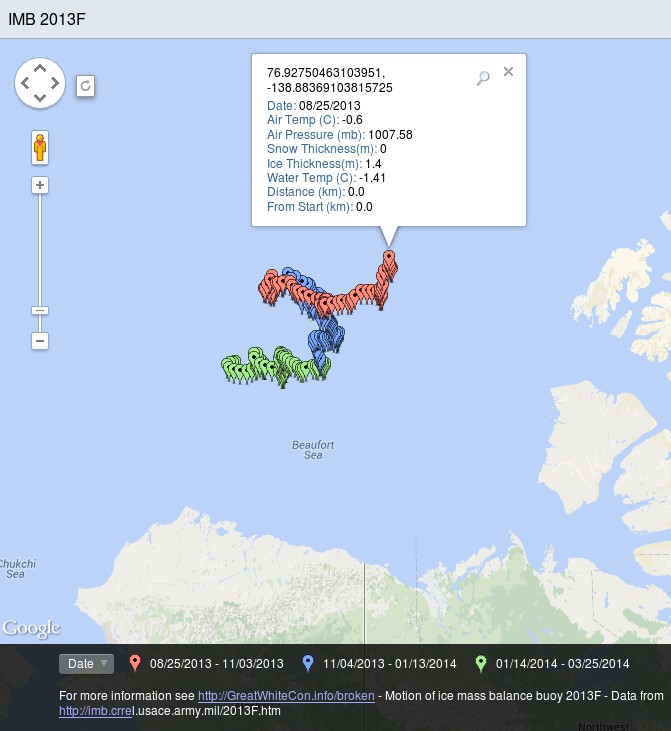
The second section is entitled “Ice Mass Balance Buoys“. As the name hopefully suggests, this section displays data reported by the Cold Regions Research and Engineering Laboratory’s currently active ice mass balance buoys in a variety of novel formats. These buoys are deployed on a regular basis at selected locations across the Arctic, and report on a number of different parameters including snow depth, ice thickness and temperature. By way of example here’s a couple of reports from IMB 2013F, which was originally deployed last August on what was then classified as “first year” ice in the Beaufort Sea. First of all here’s the Google Maps/Earth view that reveals how the buoy has moved around the Arctic since then, and shows how clicking on one of the “pushpins” reveals the values of a variety of interesting metrics on a daily basis:

Google map of the movement of IMB 2013F

As you can see, last August the thickness of the ice floe that the buoy is located upon was 1.4 metres thick. If you click through to the live map and experiment you will discover, amongst a variety of other things, that the ice under the buoy is now 1.68 meters thick, with an additional 49 cm of snow on top of that.

A second set of images shows graphs revealing the temperature above, below and within the ice, currently on a monthly basis:

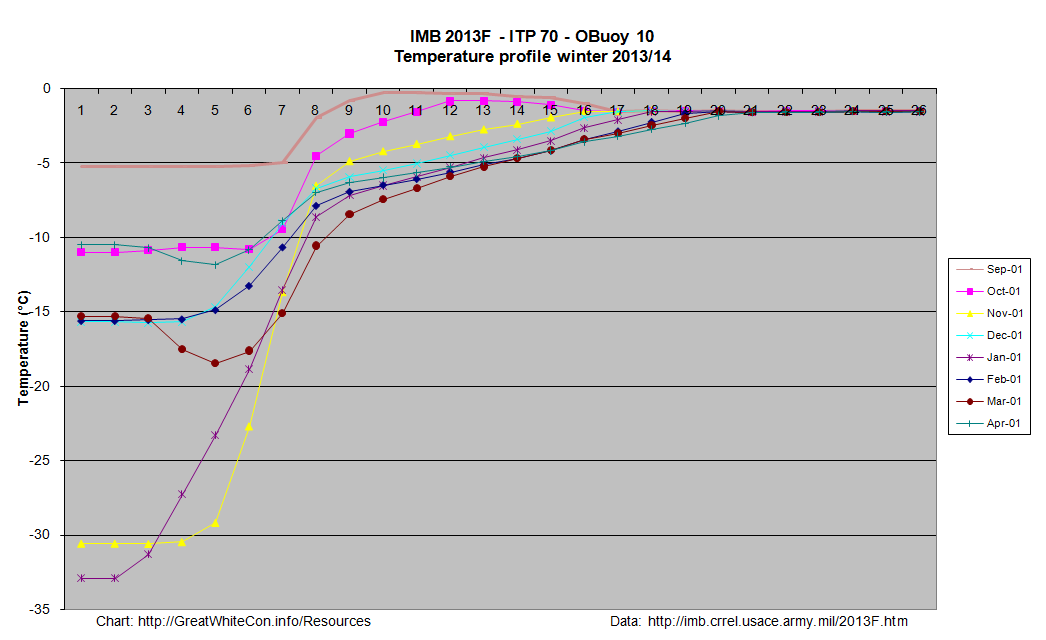
2013F-Temp-20140401

Click on the graph to view a larger version. This one requires a certain amount of interpretation, but the first thing to note is that the numbers across the top represent the position of thermistors spaced 10 cm apart on a pole that is mounted vertically through the ice floe. Number 1 is in the air above the floe, the rightmost side of the graph (number 26 in this case) is in the water below the ice floe, and somewhere in between those extremes the temperature sensors can also be in the midst of either ice or snow.

At the end of March the interface between ice and snow in this case was somewhere between sensors 8 and 9, and hence at a temperature of around – 7 degrees Celsius, by which time the buoy had moved from the Canadian waters where it started into the area of the Beaufort Sea north of Alaska.

For further discussion about the interpretation of our new resources please use the comment section on the “About Our Arctic Sea Ice Resources” page. For technical observations and suggestions for improvements feel free to comment below!


Snow White is Actually a “Cowardly Cross Dresser”!

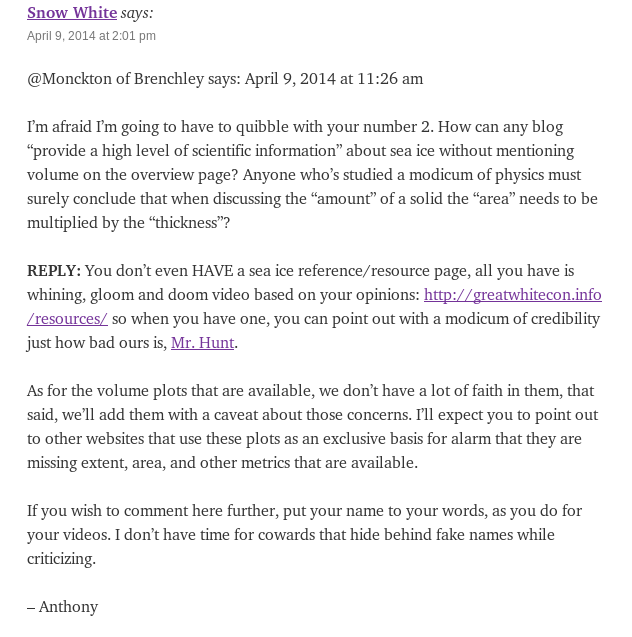
In order to avoid the malicious “spammer” label attached to me by Steven Goddard of “Real Science” fame many moons ago I have been using the nom de guerre “Snow White” in skeptical circles for a while. Unfortunately my pseudonimity didn’t stand a chance against the laser sharp investigative skills of Anthony Watts. My embarrassment is now archived in the public record, plain for all to see:

An extract from the "WUWT near the center of the climate blogosphere"
An extract from the “WUWT near the center of the climate blogosphere” thread on the “Watts Up With That” blog on April 9, 2014 at 2:01 pm

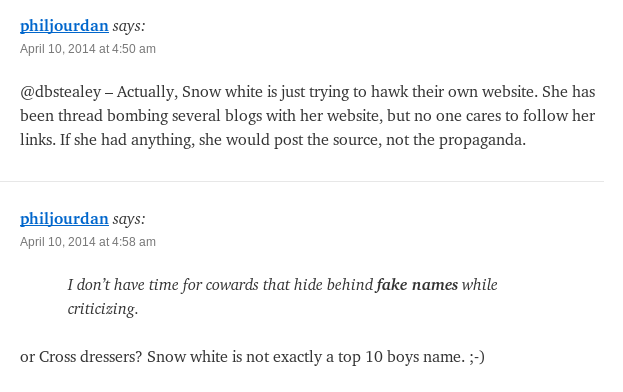
A commenter at “Watts Up With That” then piled on the scorn:

"Snow White"  is revealed as a "Cowardly Cross dresser", for all the world to see.
“Snow White” is revealed as a “Cowardly cross dresser”, for all the world to see.

The thing is though, that in the process of so skilfully “outing” Snow White Anthony kindly pointed his loyal readers in the direction of our humble “Resources” section and our videos, so I suppose we’ll have to tart them all up a bit now!

The Arctic Sea Ice “Recovery” Vanishes Even More

Whilst a variety of climate change “skeptics” have been pointing out recently that the April 2014 edition of the National Snow and Ice Data Center’s Arctic Sea Ice News mentioned that:

A large area of the multiyear ice has drifted to the southern Beaufort Sea and East Siberian Sea

which led said skeptics to claim things like:

There is a lot of thick ice in the western Arctic, which will be difficult to melt this summer.

they glossed over the bit where the NSIDC added:

Where warm conditions are likely to exist later in the year.

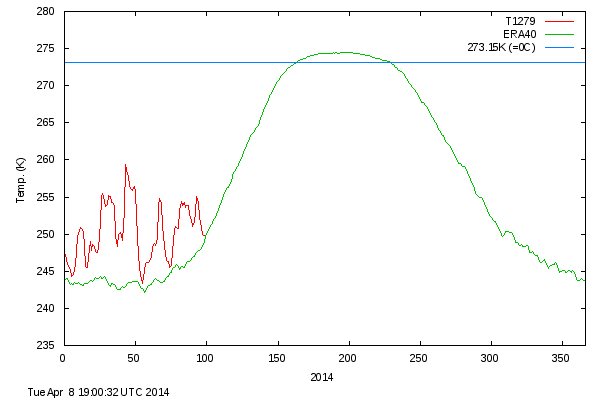
In fact conditions have been very warm (relatively speaking!) in the Arctic for all of 2014 so far. The DMI daily mean temperature of the Arctic area north of the 80th northern parallel has never dropped below the long term average all winter:

DMI mean temperature north of the 80th northern parallel, on April 8th 2014

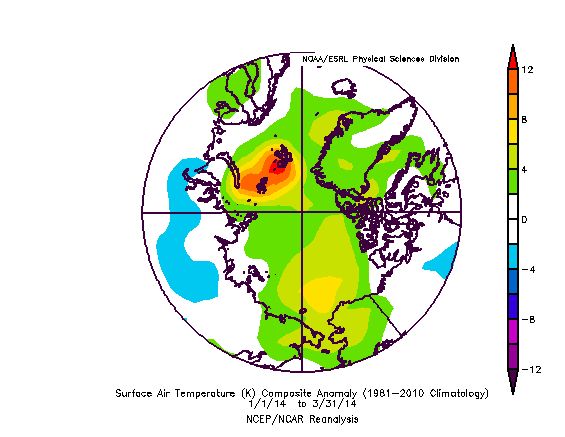
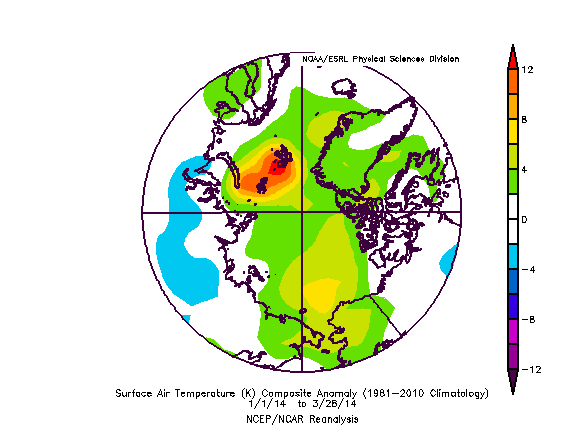
and the surface air temperature anomaly chart for the Arctic for the first three months of 2014 looks like this:

Surface air temperature anomaly plot for January to March 2014
Arctic surface air temperature anomaly plot for January to March 2014

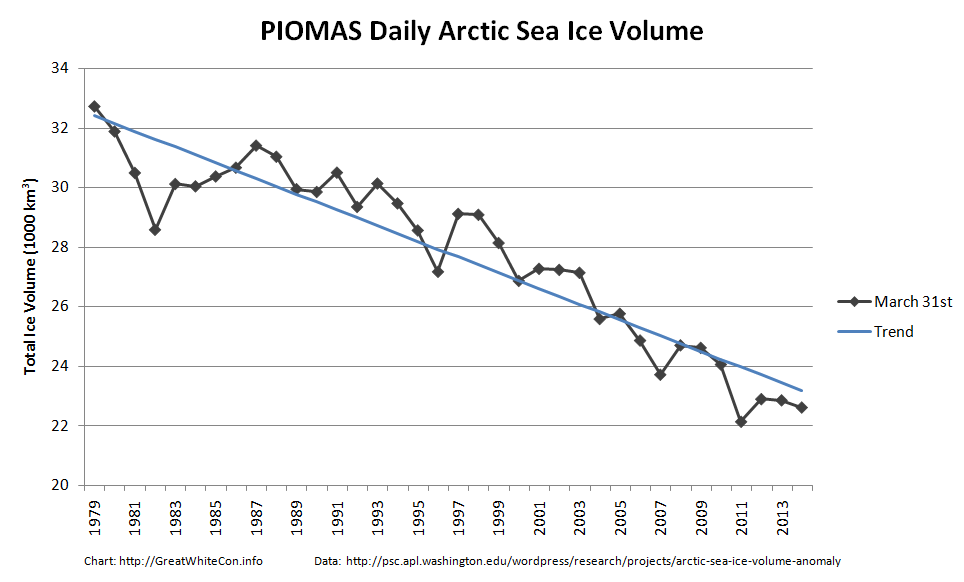
Those anomalously warm temperatures may well have something to do with the fact that the latest PIOMAS Arctic sea ice volume estimates which have just been released reveal this:

PIOMAS arctic sea ice volume on March 31st from 1979-2014

As you can see, according to the PIOMAS model at least, Arctic sea ice volume has now reached the second lowest level for the date since the satellite record began.

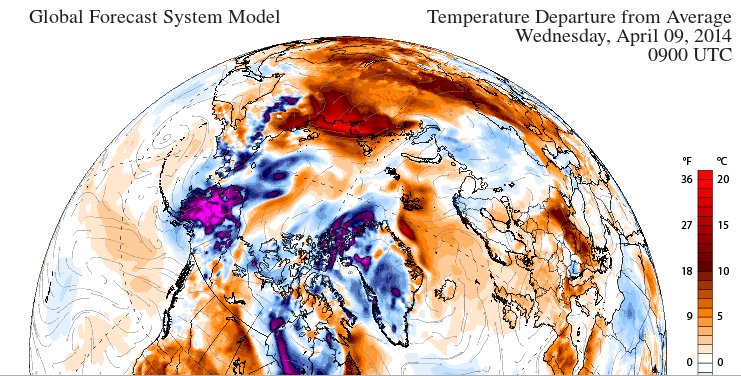
Whilst the skeptics have been complaining about the amount of ice on the Great Lakes of North America they seem to have somehow failed to notice the anomalously low coverage of snow over Siberia. Here’s the surface air temperature anomaly forecast for the northern hemisphere tomorrow:

GFS 2m temperature anomaly forecast for 09:00 UTC on April 9th 2014

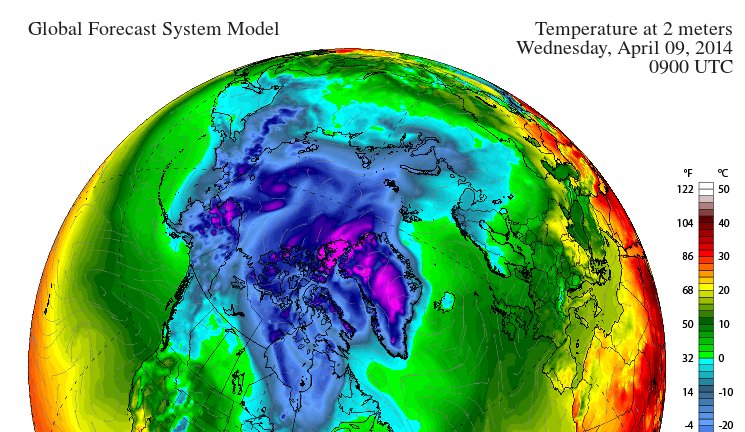
Do you see the bright red patch over the coast of the Laptev Sea, indicating temperatures 20 degrees Celsius above normal? Now take a look at a similar chart, but of the surface air temperatures themselves:

GFS 2m temperature forecast for 09:00 UTC on April 9th 2014

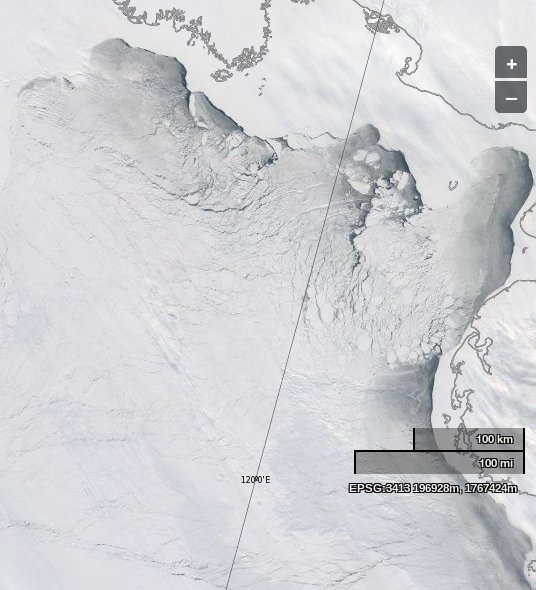
That reveals that the temperatures over the edge of the Laptev Sea are forecast to be above the freezing point of fresh water tomorrow. Just in case you’re wondering what the shores of the Laptev Sea look like at the moment, here’s a picture we recorded earlier today, courtesy of NASA Worldview and the MODIS sensor on the Aqua satellite:

The Laptev Sea as seen by the Aqua satellite on April 8th 2014

What do you suppose the same area will look like in a day or two’s time, or in a month or two’s time for that matter?


What’s Up With Watts Moderation? Episode 1

We proudly present some “Shock News” concerning a disappearing comment of ours on the “Watts Up With That” blog.

According to the April 2014 edition of the NSIDC’s Arctic Sea Ice News:

The percentage of the Arctic Ocean consisting of ice at least five years or older remains at only 7%, half of what it was in February 2007. Moreover, a large area of the multiyear ice has drifted to the southern Beaufort Sea and East Siberian Sea (north of Alaska and the Lena River delta), where warm conditions are likely to exist later in the year.

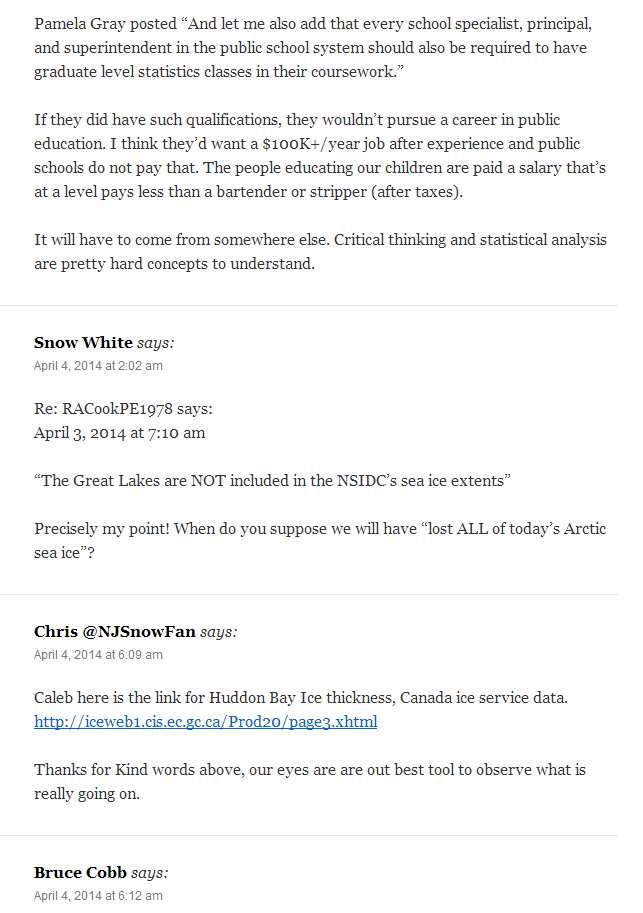
We thought we’d point out to any interested WUWTers that actually warm conditions have existed in the southern Beaufort Sea and East Siberian Sea for quite some time now. However it appears as if the powers that be in WattsLand had other ideas:

Them:

Caleb says:
April 3, 2014 at 7:06 pm

RE: Tom in Denver says:
April 3, 2014 at 9:12 am

I think we need to pay less attention to 2 meter surface temperatures, and more attention to the temperature of the sea. Any time a polynya forms the sea is getting severely cooled by churning winds. Also the ice that has been moved south is going somewhere. In the case of Baffin Bay it was surging south right along the coast of Labrador and out into the Atlantic, creating above-average ice-extents in an area adjacent to the Gulf Stream.

Us:

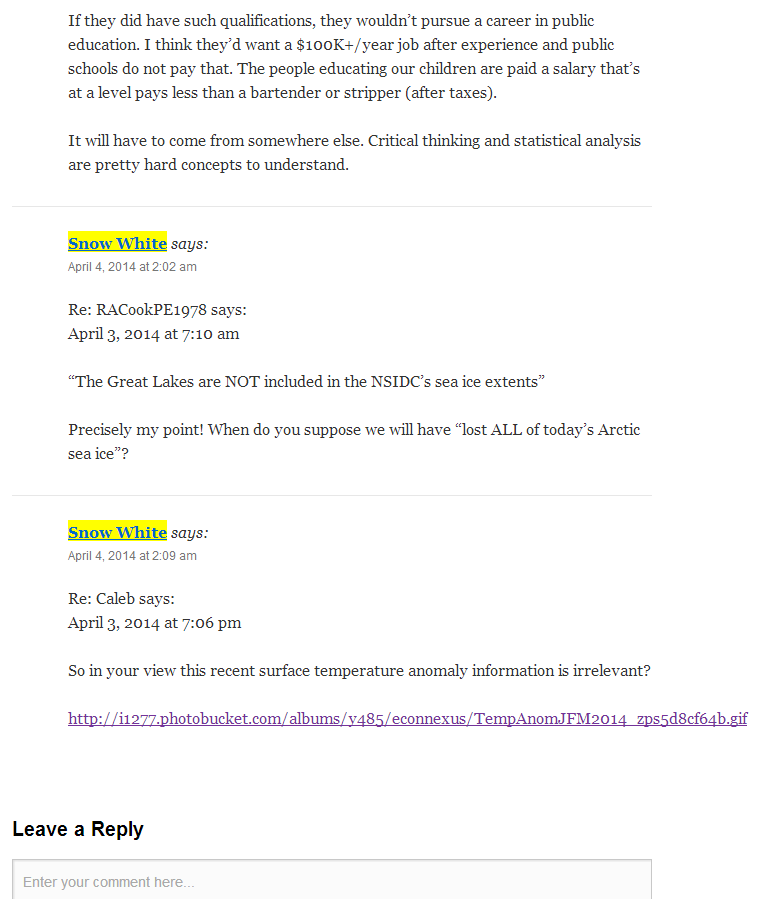
A comment by "Snow White" visible on the "Watts Up With That" blog on April 3rd 2014


Surface air temperature anomaly plot for January to March 2014


Them:

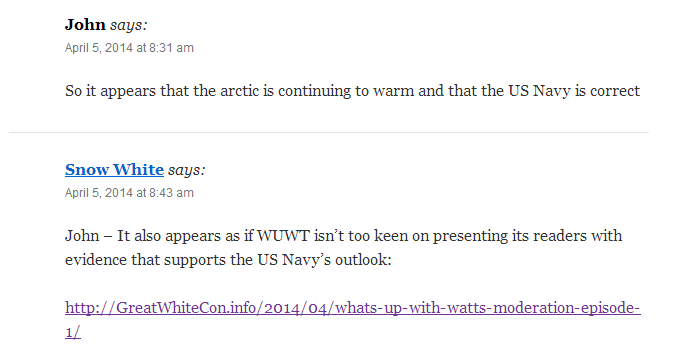
As of April 5th 2014 at 13:27:41 BST:

A comment by "Snow White" now invisible on the "Watts Up With That" blog on April 5th 2014
A comment by “Snow White” now invisible on the “Watts Up With That” blog on April 5th 2014

Us:

A comment by "Snow White" visible on the "Watts Up With That" blog at 16:43 BST on April 5th 2014

Them:

We’ll keep you posted!