Tag Archives: PCC

The Press Complaints Commission

Tricks Used by David Rose to Deceive

Regular readers of our so far somewhat surreal reporting from up here in the penthouse suite at the summit of the Great White Con ivory towers will no doubt have noticed that we like to concentrate on the facts about the Arctic, whilst occasionally naively exploring assorted psychological aspects of journeying through the “denialosphere”.

Today, however, we’re branching out in a different direction with the aid of our first ever guest post. It has been carefully crafted by Sou Bundanga of the HotWhopper blog, on the topic of the “journalistic tricks that professional disinformers use”. It covers some of the same ground as a recent post of our own, albeit from a rather different angle. If you would like view the original version on Sou’s blog please click here. Alternatively, please continue below the fold:


This is just a short article to show the journalistic tricks that professional disinformers use. It consists of excerpts from an article by David Rose, who is paid to write rubbish for the Mail on Sunday, a UK tabloid of the sensationalist kind. He’d probably claim that he’s just “doing his job”. His job being to create sensationalist headlines and not bother too much about accuracy, but to try to do it in such a way as to stop the paper ending up in court on the wrong end of a lawsuit. Just. (The paper probably doesn’t mind so much getting taken to the Press Complaints Commission. )

Here is what David Rose wrote last weekend:

The Nasa climate scientists who claimed 2014 set a new record for global warmth last night admitted they were only 38 per cent sure this was true.

First of all notice the use of the word “admitted” – as if it was something that the scientists were forced into, whereas in fact they provided all the information in their press briefing. Notice also that David has taken one number and used it out of context.  The 38% number is the probability that 2014 is the hottest year compared to the probability that 2010 and other hot years are the hottest. 2010, the next hottest year, only got a 23% probability by comparison. Here is the table showing out of 100%, what the different probabilities are:


You can see how David misused the 38% number. In fact the odds of it being the hottest year on record are the highest of the lot.

What is David’s next atrocity:

In a press release on Friday, Nasa’s Goddard Institute for Space Studies (GISS) claimed its analysis of world temperatures showed ‘2014 was the warmest year on record’.

The claim made headlines around the world, but yesterday it emerged that GISS’s analysis – based on readings from more than 3,000 measuring stations worldwide – is subject to a margin of error. Nasa admits this means it is far from certain that 2014 set a record at all.

See how David Rose distorts things. How he uses rhetoric, abusing words like “emerged” and “claim” and “admits”. He is also being “economical with the truth” about the “far from certain”. He just made that one up. It may not be “certain”, but it is much more certain than “far from”.  And it is more “certain” that 2014 was the hottest year than that any other year was the hottest year.

If David Rose were arguing that you beat your wife, even though you don’t, he’d probably write it up as:

The so-called scientist claims that he doesn’t beat his wife. He admits that he cannot prove he doesn’t beat his wife. However this journalist can show that it has emerged that his claim is subject to a margin of error.  95% of wife-beaters deny beating their wives.

And I doubt he’d add the confidence limits to the 95% number!

David Rose continues his deception writing:

Yet the Nasa press release failed to mention this, as well as the fact that the alleged ‘record’ amounted to an increase over 2010, the previous ‘warmest year’, of just two-hundredths of a degree – or 0.02C. The margin of error is said by scientists to be approximately 0.1C – several times as much.

That section by David Rose contains the same journalistic tricks of rhetoric, as well as an error of fact. The margin of error of the annual averaged global surface temperature is described in the GISS FAQ as ±0.05°C:

Assuming that the other inaccuracies might about double that estimate yielded the error bars for global annual means drawn in this graph, i.e., for recent years the error bar for global annual means is about ±0.05°C, for years around 1900 it is about ±0.1°C. The error bars are about twice as big for seasonal means and three times as big for monthly means. Error bars for regional means vary wildly depending on the station density in that region. Error estimates related to homogenization or other factors have been assessed by CRU and the Hadley Centre (among others).

If the press release didn’t include any confidence limits, then where did David Rose get his numbers from you may ask? That’s a very good question. It turns out that NOAA and NASA held a press conference, during which they showed some slides and explained the confidence limits, among other things. So David Rose was being very deceitful, wasn’t he. Which isn’t a surprise.

What bit of deception does he swing to next? Well here it is. You be the judge:

As a result, GISS’s director Gavin Schmidt has now admitted Nasa thinks the likelihood that 2014 was the warmest year since 1880 is just 38 per cent. However, when asked by this newspaper whether he regretted that the news release did not mention this, he did not respond. Another analysis, from the Berkeley Earth Surface Temperature (BEST) project, drawn from ten times as many measuring stations as GISS, concluded that if 2014 was a record year, it was by an even tinier amount.

More rhetorical tricks using words like “admitted”. More deception by David Rose. When and how and where did David Rose ask Gavin Schmidt the question? I don’t know. It looks as if it was via an accusatory tweet of the type “have you stopped beating your wife”, like this one on January 17th:


Yet Gavin Schmidt had already responded to David Rose’s tweets about “uncertainties” on January 16th:


That’s about it. I’ll leave it to you to decide who is the grand deceiver.

I’d not trust David Rose, denier journo, with a single fact.  It is alleged that he is a master of deception. He’d probably try to claim he is just doing his job.


Thanks very much for that article Sou, and by way of conclusion here’s yet another tweet from Gavin Schmidt, this time from January 24th:

Shock News! Murdoch Plagiarises David Rose Errors

Regular readers may recall that on September 8th 2013 the Mail on Sunday published an article by David Rose claiming that the Arctic “Ice Sheet Grew 920,000 Square Miles in a Year“. That was not true, and after we complained to the UK Press Complaints Commission The Mail eventually published a “correction” of sorts.

On September 15th 2013 the Mail on Sunday published another article by David Rose entitled “Global warming is just HALF what we thought: World’s top climate scientists admit computers got the effects of greenhouse gases wrong”, which proudly displayed their erroneous headline from the previous week. The article contained many more errors,  some of which the United Kingdom’s Met Office highlighted on their official blog later the same day:

The article states that the Met Office’s ‘flagship’ model (referring to our Earth System Model known as HadGEM2-ES) is too sensitive to greenhouse gases and therefore overestimates the possible temperature changes we may see by 2100.

There is no scientific evidence to support this claim.

The Mail eventually “corrected” the article in their usual half hearted fashion, whilst simultaneously updating the title to read “Global warming is just QUARTER what we thought“, which doesn’t strike me as being an accurate use of the English language let alone scientifically accurate.

Meanwhile on September 16th 2013 on the other side of the planet Rupert Murdoch’s The Australian published an article written by Graham Lloyd entitled “We got it wrong on warming, says IPCC“, saying things like:

The Intergovernmental Panel on Climate Change’s latest assessment reportedly admits its computer drastically overestimated rising temperatures, and over the past 60 years the world has in fact been warming at half the rate claimed in the previous IPCC report in 2007. More importantly, according to reports in British and US media, the draft report appears to suggest global temperatures were less sensitive to rising levels of atmospheric carbon dioxide than was previously thought. The 2007 assessment report said the planet was warming at a rate of 0.2C every decade, but according to Britain’s The Daily Mail the draft update report says the true figure since 1951 has been 0.12C.

After a long drawn out enquiry the Australian Press Council has finally announced that in its view The Australian cannot justify publishing inaccurate scientific information by blaming David Rose and The Mail on Sunday. They state that:

The Press Council has considered a complaint about a number of items published in The Australian in September 2013, a week before the release of the Fifth Assessment Report of the Intergovernmental Panel on Climate Change (IPCC).

The Council has considered the complaint by reference to the following parts of its General Principles: “Publications should take reasonable steps to ensure reports are accurate, fair and balanced”; “relevant facts should not be misrepresented or suppressed”; and “Where it is established that a serious inaccuracy has been published, a publication should promptly correct the error, giving the correction due prominence.”

The Council has concluded that the erroneous claim about the revised warming rate was very serious, given the importance of the issue and of the need for accuracy (both of which were emphasised in the editorial that repeated the claim without qualification). Although based on another publication’s report, the claim was unequivocally asserted in The Australian headline, “We got it wrong on warming, says IPCC”, which also implied the IPCC had acknowledged the alleged error. The impression that the claim was correct was reinforced by The Australian saying the IPCC had been “forced to deny” that it was in crisis talks.

The Council considers rigorous steps should have been taken before giving such forceful and prominent credence to The Mail on Sunday’s claim. Accordingly, the complaint on that ground is upheld.

The Council welcomes the acknowledgements of error and expressions of regret which the publication eventually made to it. But they should have been made very much earlier, and made directly to the publication’s readers in a frank and specific manner. It is a matter of considerable concern that this approach was not adopted.

To summarise, don’t believe everything you read in The Daily Mail or The Australian, particularly if the words in question are written by or plagiarised from David Rose:


The Mail’s Concentration on Sea Ice Extent

Further to our previous communications about what we refer to here as “The Great White Con” I have now received another email from John Wellington, Managing Editor of the Mail on Sunday.

Them:

Amongst other things it says that:

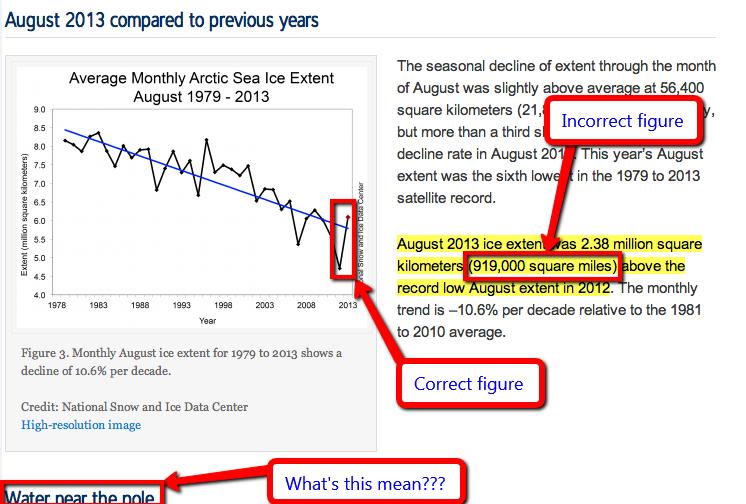
The incorrect figure published by the NSIDC was taken in good faith. Our writer [AKA David Rose] did not expect an institution of its stature to make such an error, so it is not reasonable to expect him to contact NSIDC to check it, specially as the general idea of an increase in the icepack was consistent with more anecdotal information such as the shipping information. You say we did not produce evidence of the NSIDC mistake. I am attaching a screen grab of their web site before they corrected it.

Mail on Sunday screen grab of NSIDC article entitled "A real hole near the pole"
Mail on Sunday screen grab of NSIDC article entitled “A real hole near the pole”

John’s latest email also included the following statement:

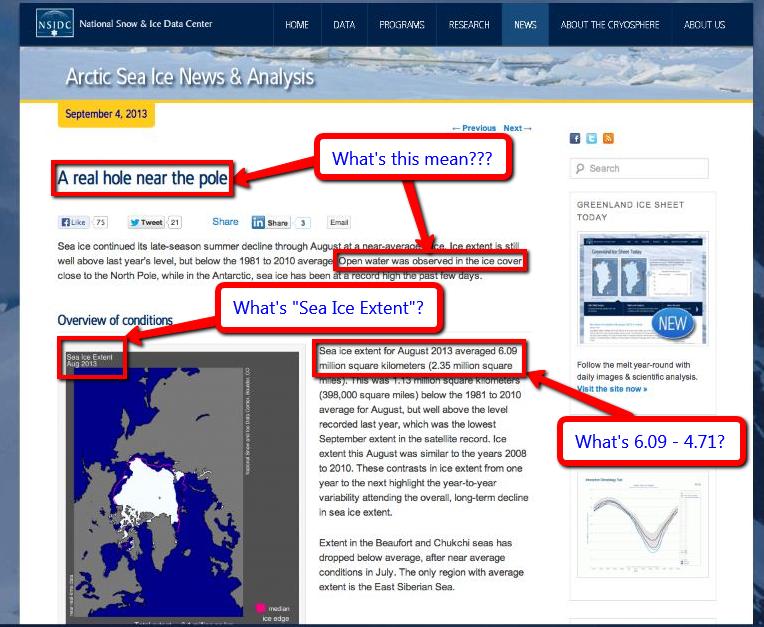
The August NSIDC report begins with a diagram (see  attachment). This shows the Arctic ice sheet stretching from Siberia to the Canadian islands:

Another Mail on Sunday screen grab of NSIDC "Arctic Sea Ice News" article of September 4th 2013
Another Mail on Sunday screen grab of NSIDC “Arctic Sea Ice News” article of September 4th 2013

Us:

You will note I have taken the liberty of annotating The Mail’s screen grabs with what seem to me to be reasonable questions for any vaguely competent investigative journalist to ask themselves when reading the NSIDC’s early September update. At this juncture I can only repeat this question from my most recent missive to The Mail:

This raises any number of questions about the Mail on Sunday misleading its readers, such as “Why didn’t The Mail ask the NSIDC about the apparently conflicting information, much like Bob Ward did, before publishing an article relying on that information?” not to mention “Why can’t David Rose perform accurate arithmetic?”

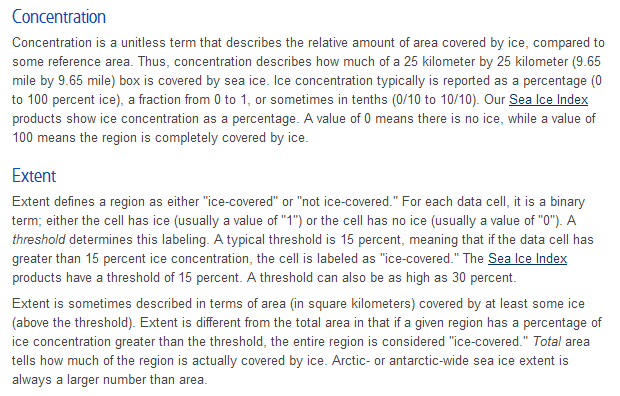
and provide my own screenshot from the “terminology” page of the NSIDC web site in a no doubt vain attempt to provide John and David with an answer to just one of those questions:

NSIDC explanation of the terms "concentration" and "extent"
NSIDC explanation of the terms “concentration” and “extent”

In brief:

Extent defines a region as either “ice-covered” or “not ice-covered.” For each data cell, it is a binary term; either the cell has ice (usually a value of “1”) or the cell has no ice (usually a value of “0”).

 Do you suppose that given their apparent difficulties in performing elementary arithmetic John and David are able to appreciate the difference between “1 or 0” and “low-concentration sea ice (20 to 80% cover) within our extent outline” or even “near-zero ice concentration“?

How about the readers of The Mail on Sunday, or the Press Complaints Commission for that matter?

A Million Square Miles?

Let’s start at the very beginning. A very good place to start!

Them:

A chilly Arctic summer has left nearly a million more square miles of ocean covered with ice than at the same time last year – an increase of 60 per cent.

Us:

NSIDC Arctic Sea Ice News report for August 2012
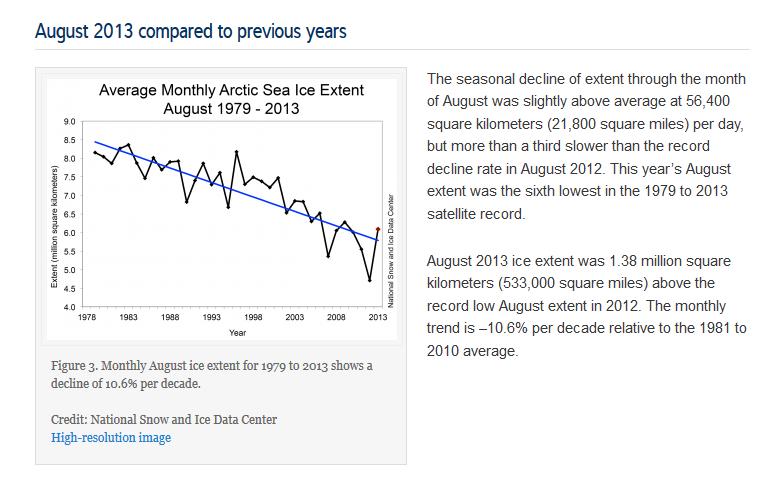
NSIDC Arctic Sea Ice News report for August 2013

Verdict:

The Mail et. al. say “Nearly a million square miles”. When the floods in Boulder have receded the NSIDC will once again say “Just over half a million square miles”. Is that discrepancy sufficient to satisfy the Press Complaints Commission’s definition of “inaccurate, misleading or distorted information”?