In answer to the question posed in our title for today, retired Rear Admiral David Titley certainly seems to think so. According to his article for the Washington Post‘s “Capital Weather Gang”:
Unless you’ve been living under a (melting) ice shelf recently, you know by now the U.S. House of Representatives Committee on Science Space and Technology is holding a climate science hearing Wednesday to probe the “assumptions, policy implications and scientific method.”
This hearing, whose witnesses consist of one mainstream climate scientist and three other witnesses whose views are very much in the minority, is remarkably similar in structure and scope to the climate hearing Sen. Ted Cruz (R-Tex.) conducted in December 2015 titled “Data or Dogma”? So similar that two of the five witnesses from the Cruz hearing will also testify on Wednesday.
In the past, the science community has participated in these hearings, even though questioning the basics of climate change is akin to holding a hearing to examine whether Earth orbits the sun.
Enough!
As our regular reader(s) will be aware we have been characterising today’s hearing as a “show trial“, and David Titley agrees:
For years, these hearings have been designed not to provide new information or different perspectives to members of Congress but, rather, to perpetuate the myth that there is a substantive and serious debate within the science community regarding the fundamental causes or existence of human-caused climate change.
Quite so David, but next comes a more controversial message seemingly aimed at his Penn State colleague Michael Mann, who is due to appear before the House Committee on Science, Space and Technology later today:
We should no longer be duped into playing along with this strategy.
Despite sending many skilled science communicators to testify at the hearings over the years and even when scoring tactical victories, the strategic effect of participating at these hearings has been to sustain the perception of false equivalence, a perception only exaggerated by the majority’s ability to select a grossly disproportionate number of witnesses far removed from mainstream science (it’s not coincidence that Judith Curry, professor emeritus, Georgia Institute of Technology, and John Christy, professor of atmospheric sciences, University of Alabama at Huntsville, are called upon so often by the Republicans).
A better response would be to simply boycott future hearings of this kind and to call out these hearings for what they are: a tactic to distract the public from a serious policy debate over how to manage both the short- and long-term risks of climate change. These hearings are designed to provide theatrics, question knowledge that has been well understood for more than 150 years, and leave the public with a false sense that significant uncertainty and contention exist within the science community on this issue.
“Boycott future hearings” then, but perhaps not today’s? We will discover what Michael Mann has to say later today, assuming he turns up! Ex Rear Admiral Titley does have experience of similar “show trials”. Here is a recording of what he said to Senator Ted Cruz’s so called “Data or Dogma: Promoting Open Inquiry in the Debate over the Magnitude of Human Impact on Earth’s Climate” hearing:
A combination of multiple, independent sources of data provide the basis to the latest conclusion from the Intergovernmental Panel on Climate Change:
“Warming of the climate system is unequivocal, and since the 1950’s, many of the observed changes are unprecedented over decades to millennia…
Human influence on the climate system is clear. This is evident from the increasing greenhouse gas concentrations in the atmosphere, positive radiative forcing, observed warming, and understanding of the climate system.”
We should not be surprised; these conclusions rest on science discovered in the 19th century by Fourier, Tyndall, Arrhenius and their colleagues and validated by many scientists in the subsequent decades.
It is worth noting that private industry independently arrived at these same conclusions decades ago. t is worth noting that private in
dustry independently arrived at these same conclusions decades
ago. Recently released documents show that in 1980 Exxon researchers projected the impacts on global temperature due to increasing greenhouse gasses with astonishing accuracy.
From David Titley’s verbal testimony:
The more we looked at the data, the more we saw that not only were the air temperatures coming up, but the water temperatures were coming up, the sea level was coming up, the glaciers were retreating, the oceans were acidifying. When you put all those independent lines of evidence together, coupled with a theory that was over 100 years old that had stood the test of time, it kinda made sense.
Does it mean we know everything? No, but does it mean we know enough that we should be considering this and acting? Yes, it’s called risk management and that’s what we were doing.
Apparently David thinks Ted Cruz wasn’t listening particularly carefully in December 2015, and that Lamar Smith won’t be listening carefully to Prof. Mann today.
Although positive feedbacks between sea ice and the Arctic circulation exist, we find that these are small during summer. Instead, circulation variations over the Arctic have been a significant factor in driving sea-ice variability since 1979, and have had a non-trivial contribution to the total surface temperature trend over Greenland and northeastern Canada39 . The potentially large contribution of internal variability to sea-ice loss over the next 40 years reinforces the importance of natural contributions to sea-ice trends over the past several decades. The similarity of high-latitude circulation variability associated with sea-ice loss to the teleconnections with the tropical Pacific suggests a contribution of sea-ice losses from SST trends across the tropical Pacific Ocean. Decadal trends in the hemispheric circulation are an important driver of Arctic climate change, and therefore a significant source of uncertainty in projections of sea ice. Better understanding of these teleconnections and their representation in global models under increasing greenhouse gases may help increase predictability on seasonal to decadal timescales.
As you may already be able to imagine, this paper (PDF as submitted) is already the source of considerable controversy! Firstly let’s take a look at an overview of the paper from the University of Washington, entitled “Rapid decline of Arctic sea ice a combination of climate change and natural variability”:
“The idea that natural or internal variability has contributed substantially to the Arctic sea ice loss is not entirely new,” said second author Axel Schweiger, a University of Washington polar scientist who tracks Arctic sea ice. “This study provides the mechanism, and uses a new approach to illuminate the processes that are responsible for these changes.”
[First author Qinghua] Ding designed a new sea ice model experiment that combines forcing due to climate change with observed weather in recent decades. The model shows that a shift in wind patterns is responsible for about 60 percent of sea ice loss in the Arctic Ocean since 1979. Some of this shift is related to climate change, but the study finds that 30-50 percent of the observed sea ice loss since 1979 is due to natural variations in this large-scale atmospheric pattern.
Now let’s take a look at another overview of the paper, this time from Roz Pidcock at Carbon Brief and entitled “Humans causing up to two-thirds of Arctic summer sea ice loss, study confirms”:
Rising greenhouse gas emissions are responsible for at least half, possibly up to two-thirds, of the drop in summer sea ice in the Arctic since the late 1970s, according to new research. The remaining contribution is the result of natural fluctuations, say the authors.
The paper, published today in Nature Climate Change, confirms previous studies which show how random variations in the climate have acted to enhance ice loss caused by rising CO2.
Importantly, the authors state clearly in the paper that their work does not absolve human activity as a driver of Arctic sea ice loss. A News and Views article that accompanies the paper, by Dr Neil Swart from Environment and Climate Change Canada, adds:
“The results of Ding et al. do not call into question whether human-induced warming has led to Arctic sea-ice decline — a wide range of evidence shows that it has.”
There has already been much debate about the paper on Twitter! Here’s the “scientific” edition:
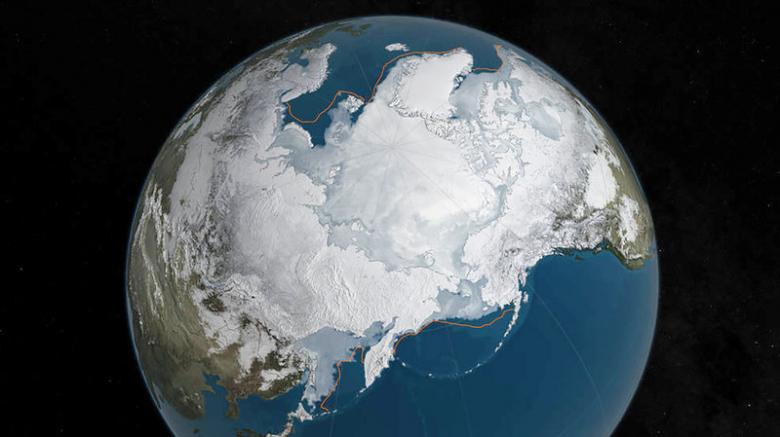
FILE PHOTO: An undated NASA illustration shows Arctic sea ice at a record low wintertime maximum extent for the second straight year, according to scientists at the NASA-supported National Snow and Ice Data Center (NSIDC) and NASA. NASA/Goddard’s Scientific Visualization Studio/C. Starr/Handout via Reuters/File Photo
Natural swings in the Arctic climate have caused up to half the precipitous losses of sea ice around the North Pole in recent decades, with the rest driven by man-made global warming, scientists said on Monday.
The study indicates that an ice-free Arctic Ocean, often feared to be just years away, in one of the starkest signs of man-made global warming, could be delayed if nature swings back to a cooler mode.
Natural variations in the Arctic climate “may be responsible for about 30–50 percent of the overall decline in September sea ice since 1979,” the U.S.-based team of scientists wrote in the journal Nature Climate Change.
David embellished his article with some “humorous” asides such as:
“This is the worst of the worst catastrophes in the world! Oh, it’s crashing … Oh, the humanity! Honest, I can hardly breathe. I’m going to step inside where I cannot see it.”
Please say it ain’t so!!!
“The melt of the Arctic is disrupting the livelihoods of indigenous peoples and damaging wildlife such as polar bears and seals while opening the region to more oil and gas and shipping.”
Eskimos, seals and polar bears!!! Oh My!!! And more oil and gas shipping!!! Aiiieeee!!!!
which some of us took exception to:
David – An Arctic indigenous person of my acquaintance asks me to tell you to “go f(r)@ck yourself”!
What should I reply on your behalf?
No answer has yet been received to that (im)pertinent question!
All this excitement in the Twittosphere and elsewhere leads one to wonder whether Ding, Schweiger et al. saw (or should have seen?) all this coming, and if so what might have been done differently? In any event this story is set to run and run and run and……
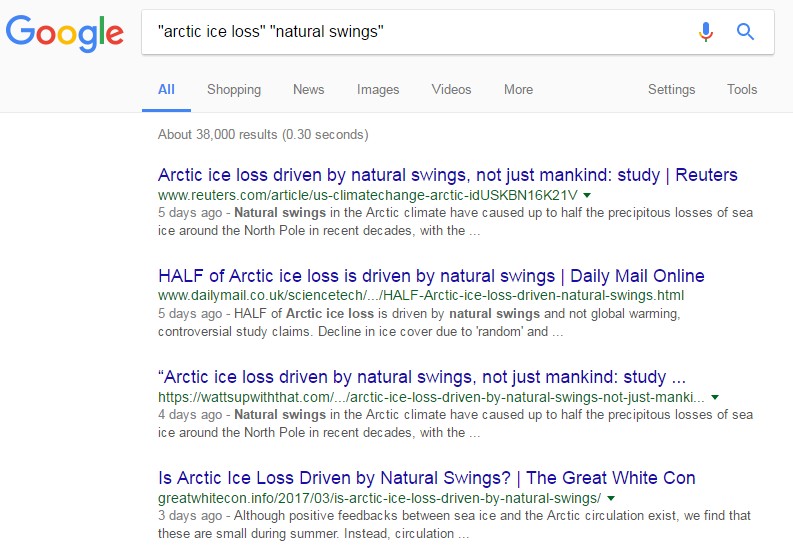
38,000 results. We’re number 4. If you repeat the exercise please feel free to experiment with the search phrase(s) you employ. Make sure to only click on the link that leads you back here!
Without being able to pick any obvious holes I feel somewhat uncomfortable with that; the idea that September ice depends just on JJA circulation doesn’t feel at all right. Having decided that, though, they then run a variety of model experiments, for example “nudging” the circulation back to re-analysis, with and without an ocean-ice model underneath. And the result seems to be that it is mostly the circulation forcing the sea ice, rather than the sea ice changes forcing the atmosphere. This kinda-fits the “information flow” meme from way back so I should be prepared to accept that mostly. Having done that they then convince themselves that most of the circulation changes that matter to the ice are not GW forced, and so must be natural variability; and hence the conclusion. If you took all of this at face value then they’d have solved one of the puzzles, that on the whole models show much less ice decline that reality. But of course if the decline is substantially a freak of variation, not forced, that would fit.
The flaw in this overall, without looking at the details, is that it’s hard to see a near-40-year trend and being so much natural variability. That seems to be asking for an awful lot of one-way variation.
Prof. Andrew Shepherd, Director of the Centre for Polar Observation and Modelling at the University of Leeds, said:
“According to this new research, the dramatic decline in Arctic sea ice that we have witnessed over recent decades is primarily due to anthropogenic (man-made) climate warming.
“Although this finding may not come as a surprise, being able to separate this from the effects of natural climate variability is an important step forwards, and paves the way for an improved understanding of what we should expect in future decades.”
Dr Ed Hawkins, Climate research scientist at the University of Reading, said:
“Recent summer Arctic sea ice extents have all been amongst the lowest on record but this is not necessarily all due to warming global temperatures – part of the sea ice decline is also because of changes in the atmospheric circulation.
“It is challenging to determine how much of the change in the circulation is itself due to warming temperatures, but this study suggests that a substantial fraction is due to natural fluctuations.
“Looking ahead, it is still a matter of when, rather than if, the Arctic will become ice-free in summer, but we expect to see periods where the ice melts rapidly and other times where it retreats less fast.”
The Arctic icecap is shrinking – but it’s not all our fault, a major study of the polar region has found. At least half of the disappearance is down to natural processes, and not the fault of man made warming.
Part of the decline in ice cover is due to ‘random’ and ‘chaotic’ natural changes in air currents, researchers said.
The rest has been driven by man-made global warming, scientists said.
The research means that although it is widely feared that the Arctic could soon be free of ice, this could be delayed if nature swings back to a cooler cycle.
Colin Fernandez’ Daily Mail article reproduced at Mark Morano’s “Climate Depot”
Study in journal Nature: HALF of Arctic ice loss driven by natural swings — not ‘global warming’
The five earliest years of data plot near +2 standard deviations. The five most recent full years of data plot near or just outside of -2 standard deviations. Ding et al., 2017 conclude that up to half of the difference is due to the NAO and other natural climate fluctuations.
Astonishingly though, the study makes no mention of the Atlantic Multidecadal Oscillation, which also has a significant effect on Arctic sea ice extent.
Since the late 1970s, the AMO has moved from the coldest point of its cycle to its highest, coinciding with a decline in Arctic sea ice coverage.
Considering that the climate models are already performing poorly as it is, the new finding means that they are actually faring even worse than has been generally realized. And accounting for this strengthens the case for a lukewarming future from greenhouse gas emissions.
Ring up another strike against the climate models, and another reason why basing government policy on their output is a bad idea.
Prompted by my (no doubt vain?) attempt to hold a sensible discussion about the greenhouse effect in a rather hostile environment, we have just added a brand new page to the long list of Great White Con educational resources:
A very brief history of the science of the greenhouse effect, courtesy of Ed Hawkins:
In the 1820s, the French mathematician Joseph Fourier was trying to understand the various factors that affect Earth’s temperature. But he found a problem – according to his calculations, the Earth should have been a ball of ice.
In 1861, the Irish physicist John Tyndall performed an experiment which changed our view of the atmosphere. Tyndall demonstrated that gases such as methane and carbon dioxide absorbed infrared radiation, and could trap heat within the atmosphere.
Svante Arrhenius, a Swedish chemist, provided the first numerical estimates of “climate sensitivity” – defined as the temperature change corresponding to a doubling of carbon dioxide in the atmosphere. He suggested a value around 4°C in 1896.
In 1938, Guy Stewart Callendar revealed evidence for a 0.3°C rise in global temperatures over the previous 50 years.
Much more recently “Tamino” has just penned an article on his Open Mind blog entitled:
Intriguingly the supplementary materials accompanying Rasmus’ paper include ‘R’ source code!
If you have any constructive comments to make about efforts to explain the physics of the greenhouse effect to a lay audience and/or our new resource on that topic please feel free to do so in the space provided below.
Global warming ‘pause’ may last for 20 more years and Arctic sea ice has already started to recover.
There is of course plenty more where that came from, such as:
The 17-year pause in global warming is likely to last into the 2030s and the Arctic sea ice has already started to recover, according to new research.
A paper in the peer-reviewed journal Climate Dynamics – by Professor Judith Curry of the Georgia Institute of Technology and Dr Marcia Wyatt – amounts to a stunning challenge to climate science orthodoxy.
Not only does it explain the unexpected pause, it suggests that the scientific majority – whose views are represented by the UN Intergovernmental Panel on Climate Change (IPCC) – have underestimated the role of natural cycles and exaggerated that of greenhouse gases.
along with a:
Graph that makes a mockery of warming
Us:
If you take a look at the evidence from the NSIDC the Mail on Sunday recently provided us with in support of their previous inaccurate headlines you will discover it says:
Monthly August ice extent for 1979 to 2013 shows a decline of 10.6% per decade.
QED? Apparently not as far as the Mail on Sunday’s concerned. If further evidence is needed please read our previously published “stunning challenge” to Judith Curry’s Arctic sea ice expertise. In brief:
Judith Curry republishes the same nonsense [as The Mail], but then neglects to publish even a similarly mealy mouthed “correction”, let alone anything remotely resembling the information originally published by the NSIDC upon which this collective fantasy is allegedly based. Therefore Judith should be taken seriously, and as a climate scientist rather than a tabloid journalist or a fantasy fiction writer?
We think not.
Them:
David Rose goes on to say (amongst other things) that:
The graph shown above, based on a version published by Dr Ed Hawkins of Reading University on his blog, Climate Lab Book, reveals that actual temperatures are now below the predictions made by almost all the 138 models on which the IPCC relies.
The pause means there has been no statistically significant increase in world average surface temperatures since the beginning of 1997, despite the models’ projection of a steeply rising trend.
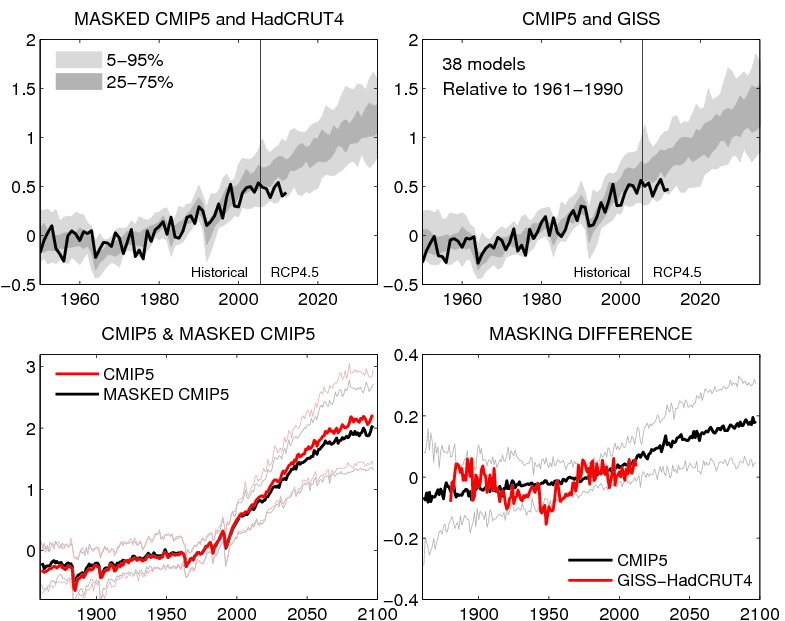
David Rose has written an article in the Mail on Sunday which, by eye, seems to use the top left panel from the figure below, but without mention of its original source. In the article David Rose suggests that this figure proves that the forecasts are wrong. This is incorrect.
Here’s the figure Dr. Hawkins is referring to:
Ed Hawkins’ original graphs comparing CMIP5 simulations with observations
Finally, for the moment at least, here’s the text of an email we sent to the Managing Editor of the Mail on Sunday this morning:
Hello John,
Thanks for your additional comments. Unfortunately you still fail to address the primary question I’ve been asking for almost 2 months now, so I will be formally pursuing matters concerning the September 8th article via the PCC from now on.
Moving on I note that you have published another article by David Rose this weekend entitled “Global warming ‘pause’ may last for 20 more years and Arctic sea ice has already started to recover”, which mentions both Judith Curry and Arctic sea ice once again. I already have a few bones to pick with you about this one as well.
1. I posted an online comment on the article yesterday evening. It remains invisible this morning. Your web site says “The comments below have not been moderated.”. My comment included no links, although it did mention the “Great White Con”. Perhaps you could look into that for me, and provide me with an explanation?
2. Do you suppose it would be possible to persuade David to reveal his sources any more swiftly this time around? Where does his misleading graphic entitled “Graph that makes a mockery of warming” and the underlying data come from? At first sight it doesn’t seem to be from Judith Curry’s “Stadium wave” paper for example.
We have yet to receive a reply.
This website uses cookies to improve your experience. We'll assume you're ok with this, but you can opt-out if you wish. Cookie settingsACCEPT
Privacy & Cookies Policy
Privacy Overview
This website uses cookies to improve your experience while you navigate through the website. Out of these, the cookies that are categorized as necessary are stored on your browser as they are essential for the working of basic functionalities of the website. We also use third-party cookies that help us analyze and understand how you use this website. These cookies will be stored in your browser only with your consent. You also have the option to opt-out of these cookies. But opting out of some of these cookies may affect your browsing experience.
Necessary cookies are absolutely essential for the website to function properly. This category only includes cookies that ensures basic functionalities and security features of the website. These cookies do not store any personal information.
Any cookies that may not be particularly necessary for the website to function and is used specifically to collect user personal data via analytics, ads, other embedded contents are termed as non-necessary cookies. It is mandatory to procure user consent prior to running these cookies on your website.