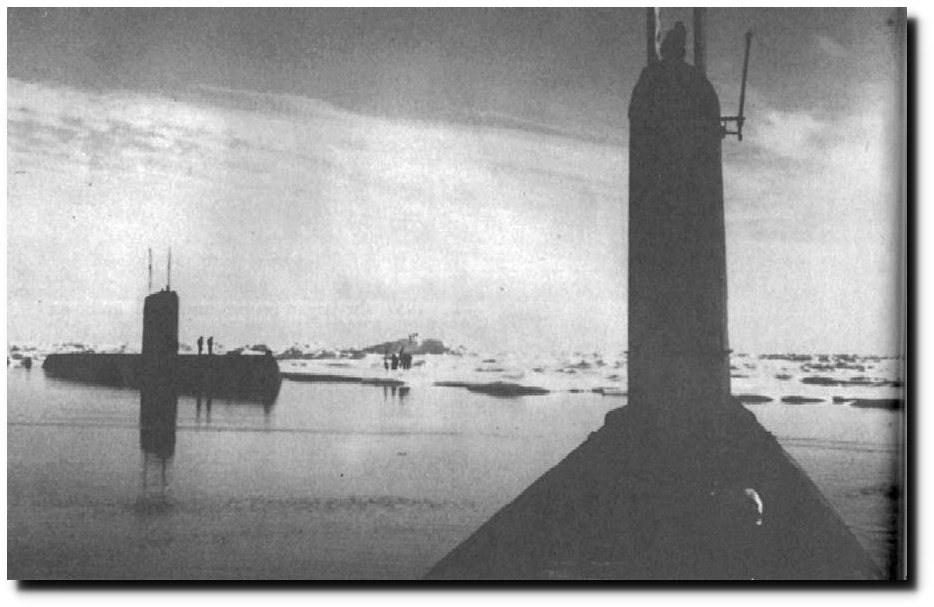
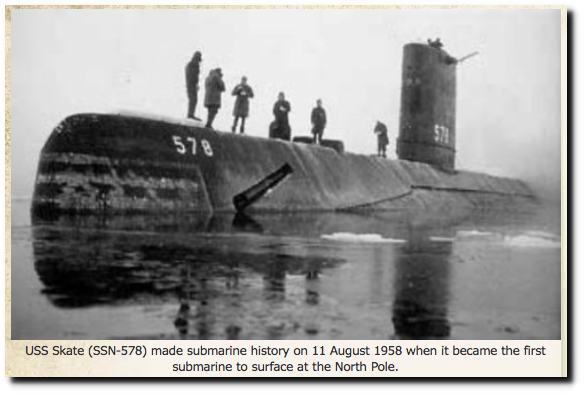
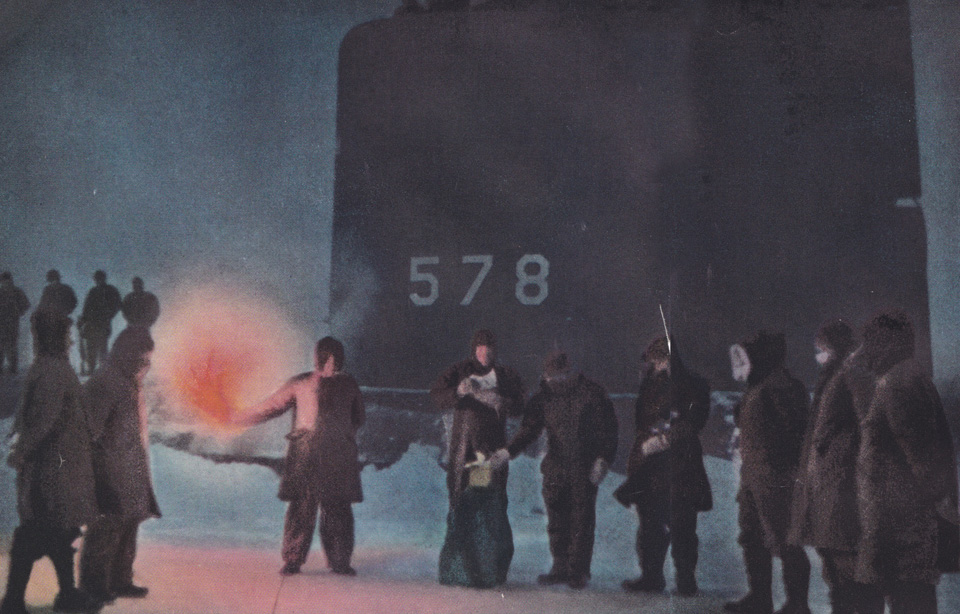
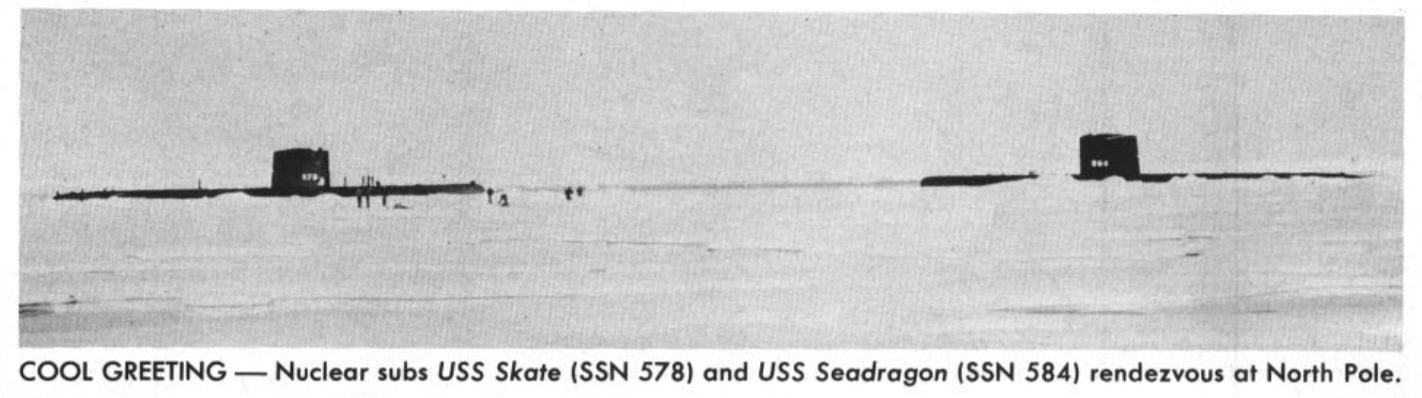
Sixty years ago this week, the USS Skate surfaced at the North Pole. Arctic sea ice was two meters thick.
using these images as “evidence”:
Please note that according to the July 1959 issue of National Geographic magazine:
The winter sun still hid below the horizon last March 17 when USS Skate crunched up through the ice at 90° N – first ship in history ever to surface at the Pole.
Note also that when USS Skate surfaced at the North Pole on March 17th 1959 she was alone. There was no polynya to be seen, let alone a second submarine in one.
What do you suppose the odds are that Tony’s “No Change In Arctic Sea Ice Over The Past 60 Years” assertion is equally aberrant?
[Edit – August 18th]
A reader on Twitter, apparently a fan of Mr. Heller asks:
So, is there any change in Article sea Ice over the last 60 yrs, which was the title of the post?
Of course there is! According to Commander James Calvert in the May 1959 edition of LIFE magazine:
On March 17 we arrived in the vicinity of the geographic North Pole. We had a job we very much wanted to do here, but as we cruised back and forth in the darkness below the Pole it seemed doubtful that we would be able to perform the last service requested by Sir Hubert Wilkins. No frozen leads or polynyas appeared. For a time I thought it would be necessary to conduct the service while submerged and discharge the ashes from one of the torpedo tubes as we passed under the pole.
Then suddenly we spotted the faint light of a small lead and we started up. This was our toughest surfacing so far. The quarters were cramped and we had to take special care not to hit Skate’s delicate rudder against the walls of ice. It took us two hours of careful maneuvering before Skate’s sail buckled the ice at the precise top of the world.
Climbing to the bridge I was greeted by an awesome sight. Skate was in a small lead completely surrounded by 10-foot-high hummocks of ice. This was the most inhospitable terrain we had seen so far.
[Edit – October 18th 2019]
The Skate and Seadragon surfacing at the North Pole meme has just been resurrected by David Middleton at “Watts Up With That”. He asserts that:
The North Pole may not have been totally ice free in 1962, but there clearly was a lot of open water…
USS SKATE (SSN 578), CDR Joseph L. Skoog (Dr. W.K. Lyon and Richard Boyle), and USS SEADRAGON (SSN 584), CDR Charles D. Summitt, (Walter Wittman) conducted the first rendezvous of 2 ships at the North Pole.
Unfortunately for Mr. Middleton, Commander Summitt wrote a book about his experiences, the relevant section of which reads as follows:
When we were a couple of miles from the pole, we started watching for a large enough polynya to hold both of us. However, we reached the pole without either of us having any luck.
I recently found myself in an extended discussion on Professor Judith Curry’s “Climate Etc.” blog with Tony Brown. Tony asserts that:
In 1932, a Soviet expedition led by Professor Otto Yulievich Schmidt was the first to sail all the way from Arkhangelsk to the Bering Strait in the same summer without wintering en route. After a couple more trial runs, in 1933 and 1934, the Northern Sea Route was officially defined and open and commercial exploitation began in 1935. The next year, part of the Baltic Fleet made the passage to the Pacific where armed conflict with Japan was looming.
and asks:
Are you SERIOUSLY suggesting that the northern sea route was not operable from the 1930’s onwards?
My response?
I’m still awaiting your pick of the year in the 1930s in which the NSR was most “open”. I have a sneaking suspicion it won’t conform to, for example, the current Canadian Ice Service definition.
I won’t bore you with the long list of questions I asked Tony that he has thus far failed to answer. Instead let’s take a closer look at the history of the Northern Sea Route than Tony is willing and/or able to undertake. Perhaps the most obvious place to start is the “History of the Northern Sea Route“? However this does rather gloss over the 1930s. For our initial reference let’s see what Bill Barr has to say in his “The Drift of Lenin’s Convoy in the Laptev Sea, 1937 – 1938″, published in 1980.
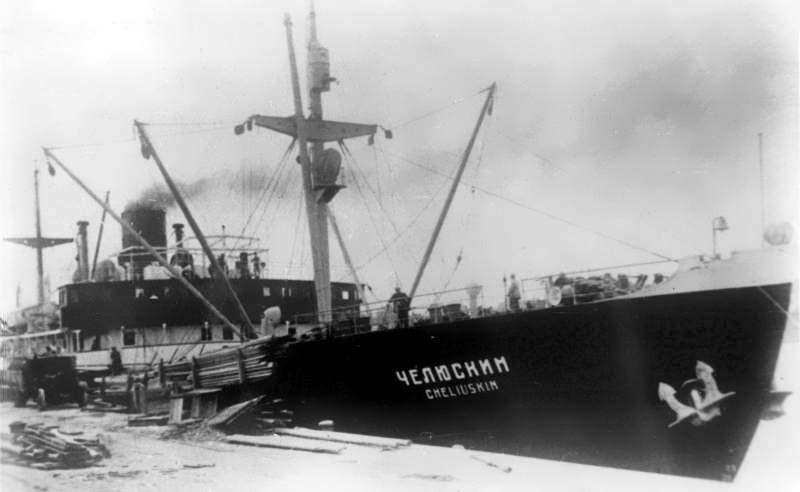
Only a few months after Sibiryukov‘s limited success in her attempt at a one-season passage of the Northern Sea Route, so eloquently embodied in her final emergence from the ice of the Chukchi Sea under improvised sails, on December 17, 1932 Sovnurkom (the Soviet of Peoples’ Commissars) took the momentous step of forming the Chief Administration of the Northern Sea Route (Gluvnoye Upruvleniye Severnogo Morskogo Puli), more commonly known as Gluvsevmorput’. Its primary task was to establish safe, reliable navigation from the White Sea to Bering Strait, but in a series of subsequent decrees over the next few years it also acquired a remarkable array of ancillary functions, and along with them, remarkably wide powers. In effect Gluvsevmorput’ was given almost complete control of the entire vast area of Siberia north of 62″ (the latitude of Yakutsk) not only in terms of transport and economic development, but also education, health services and cultural development. Even with these extensive powers, however, the new organization’s first attempt at demonstrating that it was capable of tackling its primary task was a disastrous failure. In her attempt at making a one-season passage of the Northern Sea Route in the summer of 1933 the steamer Chelyuskin became beset in the ice of the Chukchi Sea, and after drifting helplessly for several months, was ultimately crushed and sank on February 13, 1934. However, the new organization’s reputation was definitely redeemed the following year when the icebreaker Fyodor Litke reached Murmansk on September 20, 1934, having succeeded where Chelyuskin had so utterly failed.
To summarise, one of Tony’s “trial runs in 1933” was “a disastrous failure”!
On 1 October 1932 the icebreaking steamer Sibiryukov emerged from the ice in Bering Strait having completed the first one-season passage of the Northern Sea Route from Arkhangelsk. It was not an unqualified success, however; Sibiryakov had lost her propeller two weeks previously and had managed to reach the edge of the ice only under improvised sails and with a large measure of luck.
Moving on to another 1933 “trial run” Bill informs us that:
In 1933 the newly-formed Gluvsevmorput’ dispatched the first convoy of freighters via the Northern Sea Route to the mouth of the Lena to deliver cargoes bound for the Yakut ASSR. It consisted of three freighters and was escorted by the icebreaker Krasin. Despite heavy ice conditions in the Kara Sea two of the ships reached Tiksi, their destination, and unloaded their cargoes. The third ship, bound for Bukhta Nordvik with an oil exploration expedition, ran aground near its destination and turned back. Severe ice conditions in Proliv Vil’kitskogo forced all three ships to winter at the Ostrova Samuila. A shore station was built and a full scientific programme maintained all winter. Urvantsev, the chief scientist, took the opportunity to make a winter reconnaissance survey of the northern portion of Poluostrov Taymyr using half-tracks. The convoy was freed from the ice by the icebreaker Fyodor Litke in the summer of 1934 and having completed their tasks all three ships ultimately returned safely to Arkhangel’sk.
Not exactly an unqualified success either then, and certainly not a single season transit of the full Northern Sea Route! However despite all her assorted trials and tribulations the icebreaker Fyodor Litke did manage to complete a single season transit from Vladivostok to Murmansk, and according to Wikipedia “became a Soviet propaganda icon”.
Returning to Barr 1980, we discover that:
In the summer of 1935 Fyodor Litke escorted the first two laden freighters, Vantsetti and Iskra, through the Sea Route from west to east; sailing from Leningrad on July 8, they reached Vladivostok on October 8. Meanwhile two other steamers, Anadyr’ and Stalingrad, made the through-passage in the opposite direction, sailing from Vladivostok on July 23 and 25 and reaching Leningrad on October 16.
The following season (1936) saw a spectacular increase in activity along the Northern Sea Route; a total of 160 ships travelled parts of the route (the bulk of them from the west to the mouth of the Yenisey and back), while 16 vessels made the through-passage, 14 from west to east, and 2 from east to west, the latter being Vantsetti and Iskra homeward bound to Leningrad. The ships heading east included the first Soviet warships to utilize the Northern Sea Route, the destroyers Voykov and Stalin, escorted once again by Fyodor Litke
Hence 1935 and 1936 were far more successful years than the previous two, but then we come to 1937. Quoting Barr 1980 once again:
The plans for the 1937 season were equally ambitious, but by then the run of luck had ended. Due to a combination of abnormally severe ice conditions and some very unfortunate decisions as to routing of convoys and deployment of icebreakers towards the end of the season, 25 ships were obliged to winter on an emergency basis at various points in the Soviet Arctic. Perhaps the most critical aspect, however, was that of Gluvsevmorput’s fleet of icebreakers; only one, the veteran Yermak was not forced to winter in the Arctic.
One of the other questions I asked Tony Brown over at Prof. Judy’s was:
It would be helpful if you selected an ice chart from the 1930s to illustrate your point.
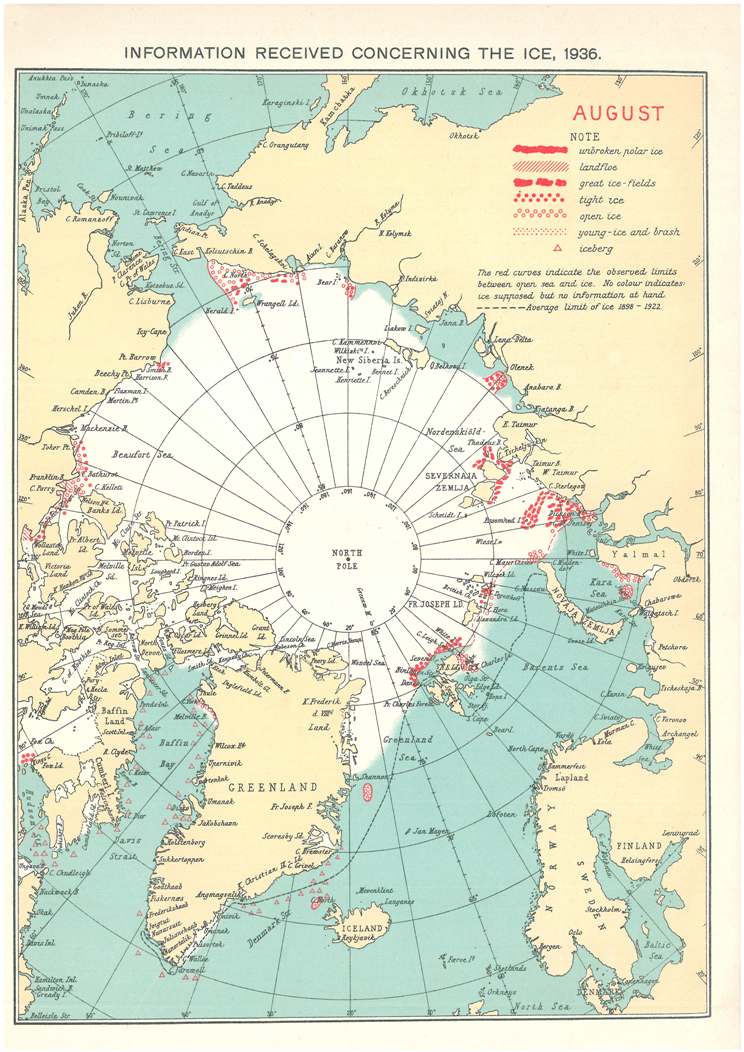
Tony still hasn’t got around to doing that, so why don’t we take a look at the August 1936 chart from the archives of the Danish Meteorological Institute:
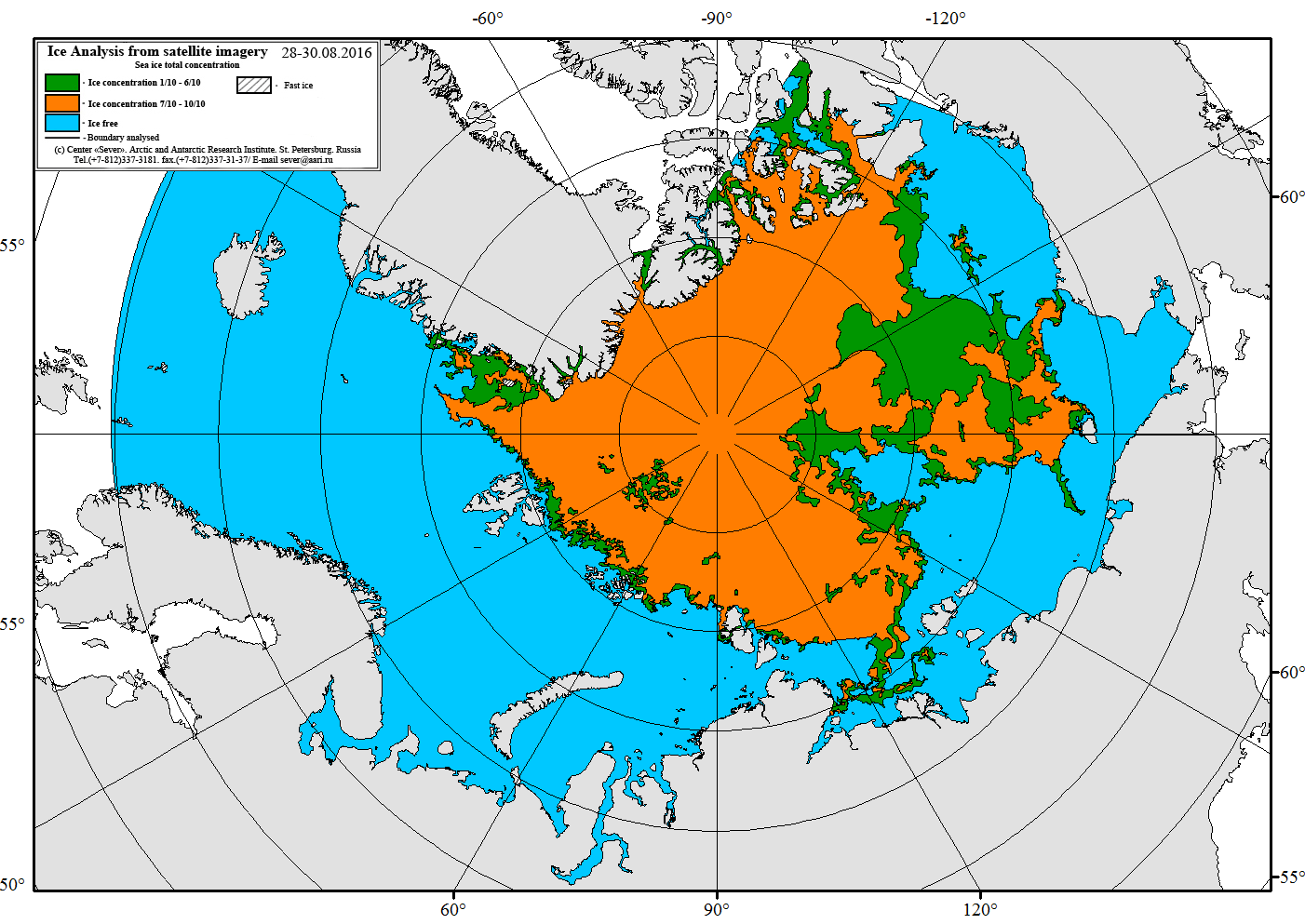
It certainly doesn’t look to me as though the entire Northern Sea Route was covered by no more than 3/10 concentration sea ice in August 1936. For comparison purposes here’s the Russian Arctic and Antarctic Research Institute ice chart for the end of August 2016:
For an eyewitness account of conditions along the Northern Sea Route in 2016 see our series of articles on the voyage of the yacht Northabout
As part of the build up to the 2015 Great White Con Arctic Basin Big Wave (Fantasy?) Surfing Contest (GWCABBWFSC for short) we’ve been researching previous Arctic Basin water sports events. You can only imagine our shock and delight when we discovered deep in the depths of the NSIDC’s “Top Secret” archives some never before seen video footage of the USS Skate surfacing “near the North Pole” in the summer of 1958. Even more astonishing than that was the moving pictures of Norbert Untersteiner being towed at high speed behind a powered water craft in the very same lead that SSN-578 had used to reach fresh air and sunshine. Firstly feast your eyes on this:
Now take a look at how 21st century big wave surfers tow into the waves created by calving glaciers:
This website uses cookies to improve your experience. We'll assume you're ok with this, but you can opt-out if you wish. Cookie settingsACCEPT
Privacy & Cookies Policy
Privacy Overview
This website uses cookies to improve your experience while you navigate through the website. Out of these, the cookies that are categorized as necessary are stored on your browser as they are essential for the working of basic functionalities of the website. We also use third-party cookies that help us analyze and understand how you use this website. These cookies will be stored in your browser only with your consent. You also have the option to opt-out of these cookies. But opting out of some of these cookies may affect your browsing experience.
Necessary cookies are absolutely essential for the website to function properly. This category only includes cookies that ensures basic functionalities and security features of the website. These cookies do not store any personal information.
Any cookies that may not be particularly necessary for the website to function and is used specifically to collect user personal data via analytics, ads, other embedded contents are termed as non-necessary cookies. It is mandatory to procure user consent prior to running these cookies on your website.