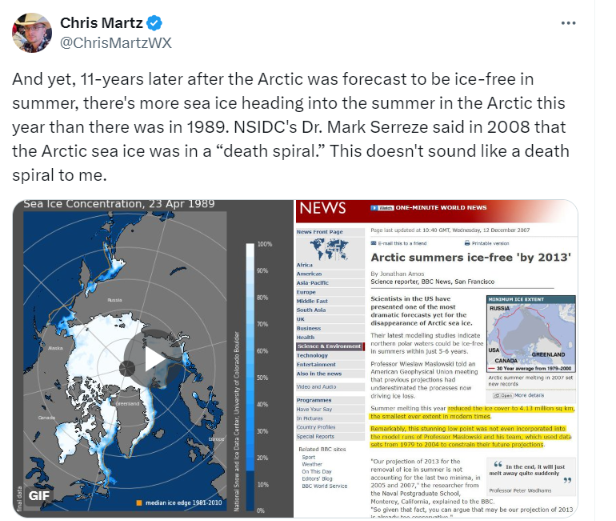
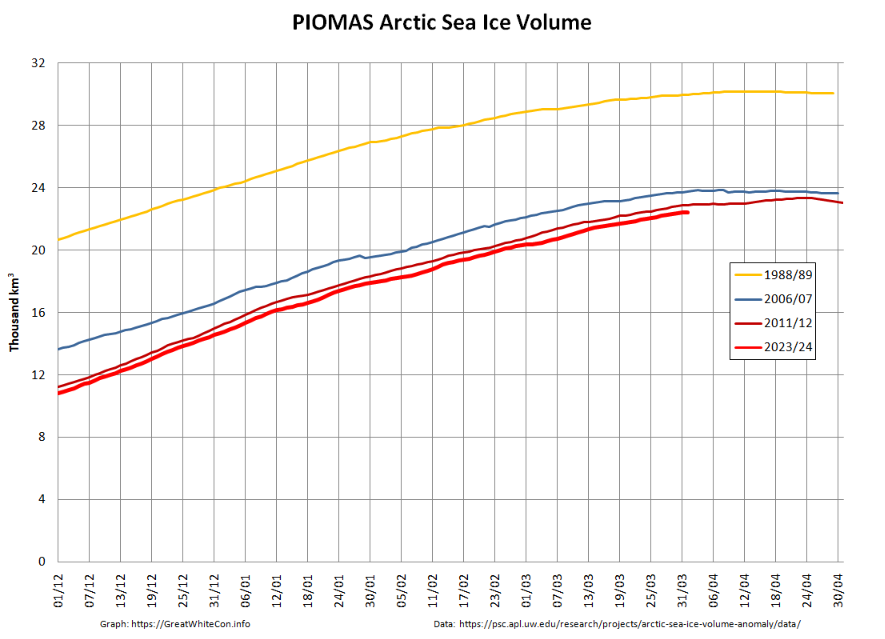
As you can see, Chris also invokes the age old canard of the “Mark Serreze Arctic sea ice death spiral”. I discussed that very topic with Mark in 2015:
Mark told me that he still stood by his 2030 estimate for the onset of a seasonally ice free Arctic, although: “Most models say more like 2050”.
My apologies for the mixed metaphors in today’s title, but the news I bear is beyond bizarre.
In a press release earlier today The Global Warming Policy Foundation proudly announced that:
A new paper by an eminent meteorologist says that trends in polar sea-ice levels give little cause for alarm. The paper, by Professor J. Ray Bates has just been published by the Global Warming Policy Foundation.
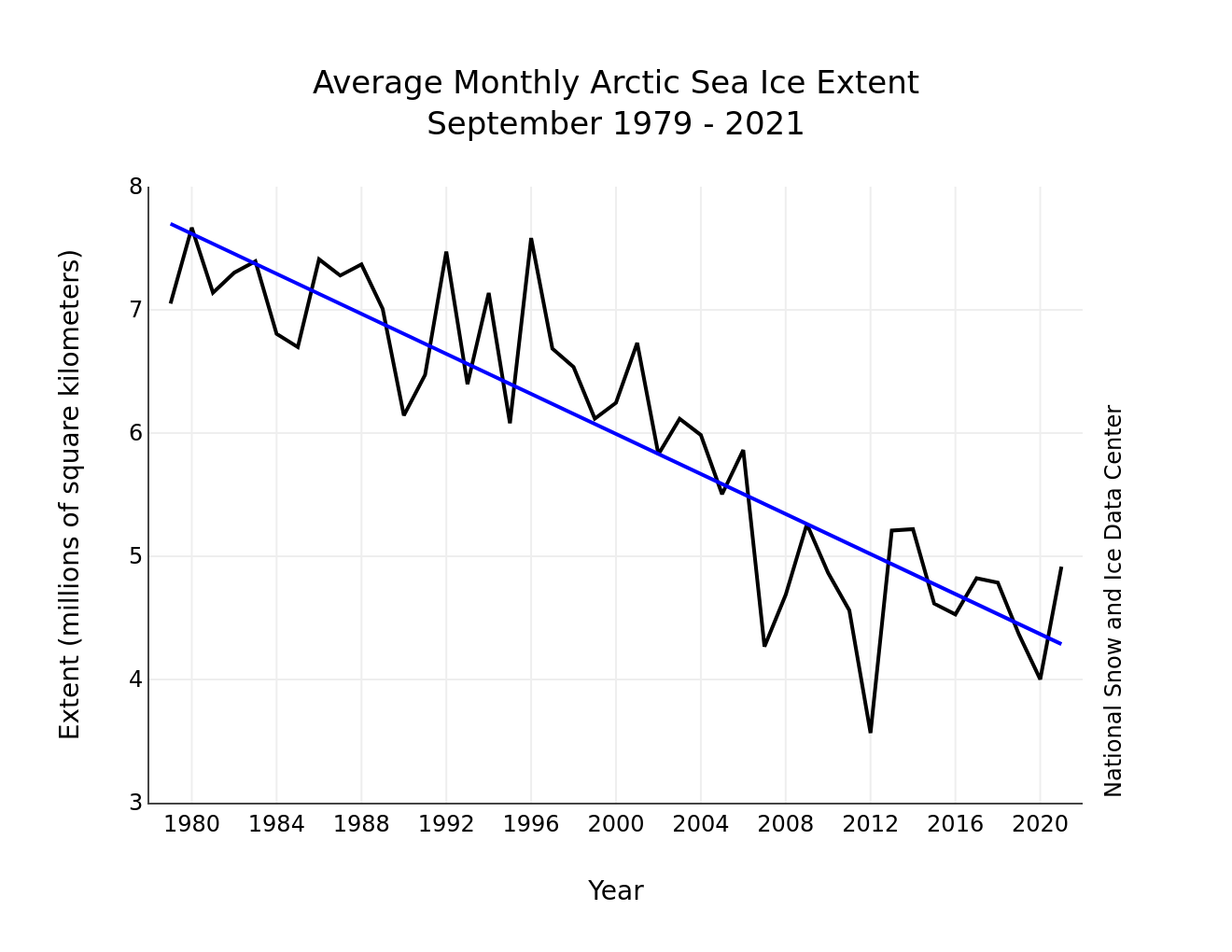
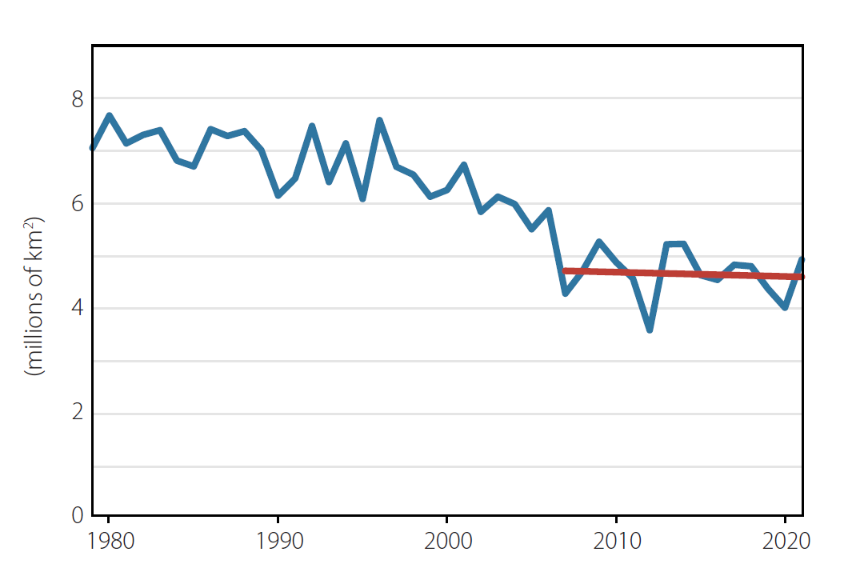
According to Professor Bates, climate model simulations indicate significantly decreasing sea ice levels in both hemispheres, with the greatest decreases occurring in September each year. However, the observed September trend in the Antarctic is actually slightly upwards, and while observed levels in the Arctic have fallen over the last 40 years, they have been quite stable since around 2007.
Professor Bates said:
“In 2007, Al Gore told us that Arctic sea ice levels were ‘falling off a cliff’. It’s clear now that he was completely wrong. In fact, the trends in sea-ice are an antidote to climate alarm.”
Professor Bates also says that little reliance should be placed on model simulations of future sea-ice decline:
“Climate models failed to predict the growth in Antarctic sea ice, and they missed the recent marked slowdown of sea-ice decline in the Arctic. It would be unwarranted to think they are going to get things right over the next 30 years.”
Professor Bates’ paper is published today, and can be downloaded here (pdf).
By all means download Ray’s “paper” from the link above and take a look at his introduction, which begins as follows:
The recent publication of the book Unsettled by Steven Koonin has led to the likelihood of increased scrutiny of the perception of a climate emergency,1 an idea which has become so widely established in recent years. Koonin, a former scientific advisor to the Obama administration, has demonstrated that what the public are being told by the media is not necessarily what the scientists are saying. He has also shown that what is being relayed in the national and UN climate assessments has often been written for the purpose of persuading rather than informing.
Unsettled clearly shows that important aspects of climate science, which the public have been persuaded to regard as beyond dispute are, in fact, quite unsettled.
Regular readers may recall that as soon as Steve’s book was published in machine readable format we established that it made no mention whatsoever of sea ice, whether of the Arctic or Antarctic variety.
Furthermore, when I attempted to debate that fact with Prof. Koonin he disappeared without trace before justifying that strange omission, beyond asserting that:
The topic is somewhat distant from ordinary folks’ perception.
It seems that Prof. Bates and the GWPF disagree with Prof. Koonin on this topic, since presumably their “paper” is addressed to ordinary folks? Ray even explicitly states that:
Although Unsettled covers a broad spectrum of climate topics, it does not treat in depth the issue of recent polar sea-ice trends, which are key indicators of changes in the global climate.
His “paper” goes on to assert in section 2 that:
Since the introduction of passive-microwave satellite observations in the late 1970s, polar sea-ice extent has been among the most accurately observed climate indicators. Sea-ice volume, on the other hand, is much more difficult to measure.
So far so good I suppose, but then we are told:
In December 2007, former US vice-president Al Gore, in his Nobel Peace Prize acceptance speech in Oslo, referred to scientific studies warning that the Arctic sea ice was ‘falling off a cliff’. He highlighted forthcoming model results that projected largely ice-free Arctic summers in ‘as little as seven years’. He repeated this warning two years later at the 2009 COP15 climate meeting in Copenhagen.
Gore’s claim was based on a study by researchers from the US Naval Postgraduate School, who used a regional model of the sea ice–ocean system in the Arctic, constrained using observational data for the 12-year period 1996–2007, and concluded that the Arctic would be nearly ice-free in summer by 2016 (plus or minus three years).
Prof. Bates seems blithely unaware that we thoroughly debunked this nonsense many moons ago. What Prof. Wieslaw Maslowski, one of those pesky “researchers from the US Naval Postgraduate School”, actually said in December 2007 was:
If we project this trend ongoing for the last 10–15 years, we probably will reach zero in summer some time mid next decade.
Reiterate for the benefit of those who seem unable to understand either English or Mathematics that a “projection” is not the same thing as a “prediction”.
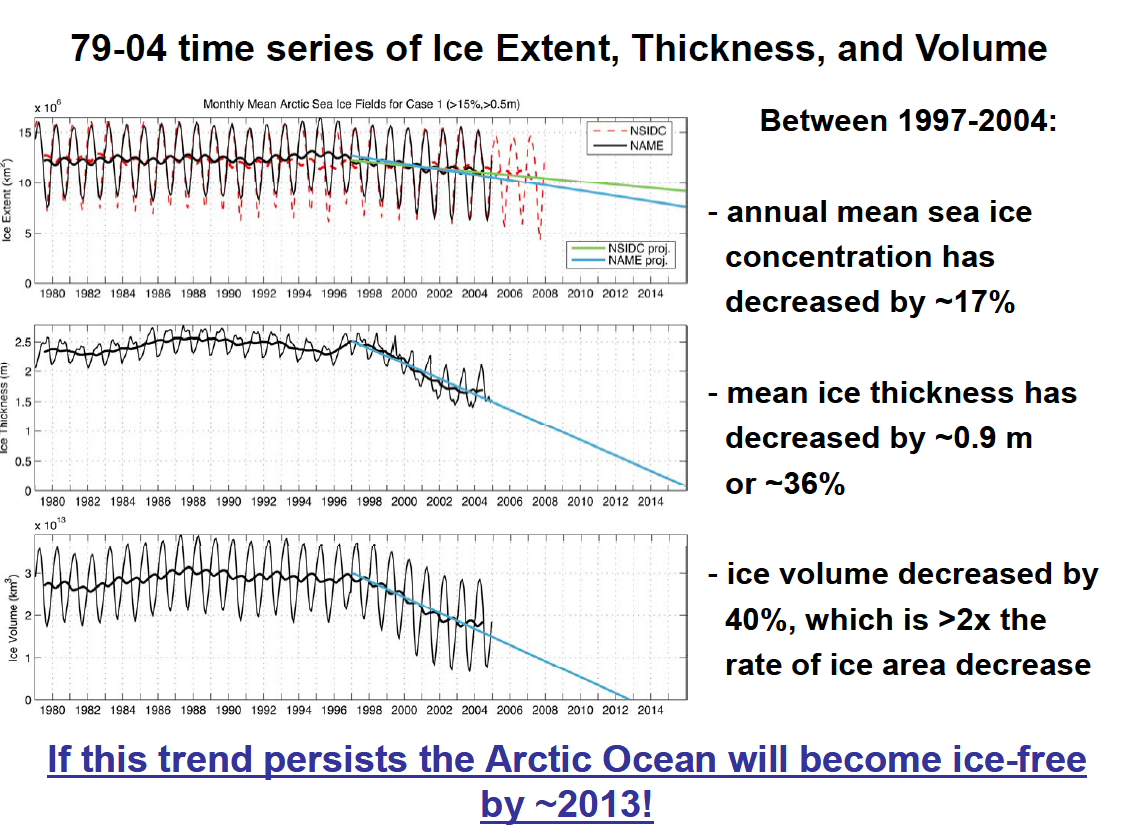
preferring instead a version of his own construction, which looks like this:
Ray then confidently asserts that:
The current slowdown in the rate of sea-ice loss was not expected, and the reasons for it are uncertain.
Sadly Ray’s exhaustive list of references fails to mention this learned journal article from 2011 by authors from the University of Washington and Los Alamos National Laboratory, which not only anticipated such a “slow transition” but also offered reasons for it:
Given the strong thickness–growth feedback of sea ice (Bitz and Roe 2004), where in a warming climate we can expect the thicker MY ice to thin at a greater rate than the thinner FY ice, and the fact that the ratio of MY to FY ice entering into the MY ice category each year is decreasing, it is likely that the difference between FY and MY ice survival ratios will decrease in a warming climate. If this occurs, the Arctic sea ice system would move toward a regime of decreased memory and decreased sensitivity to climate forcing…
There is of course plenty more GWPF sea ice nonsense where that lot came from, but it’s already past my tea time (UTC) and so further debunking will have to wait a while. In the meantime here’s a wake up call for Professor J. Ray Bates:
[Edit – December 17th]
Moving further down section 2 Ray assures us that:
Any objective discussion of the recent Arctic sea-ice decline also requires that some consideration be given to the evidence regarding past natural variability on a multi-decadal timescale. In the pre-satellite era, reliable data on sea-ice coverage was sparse.
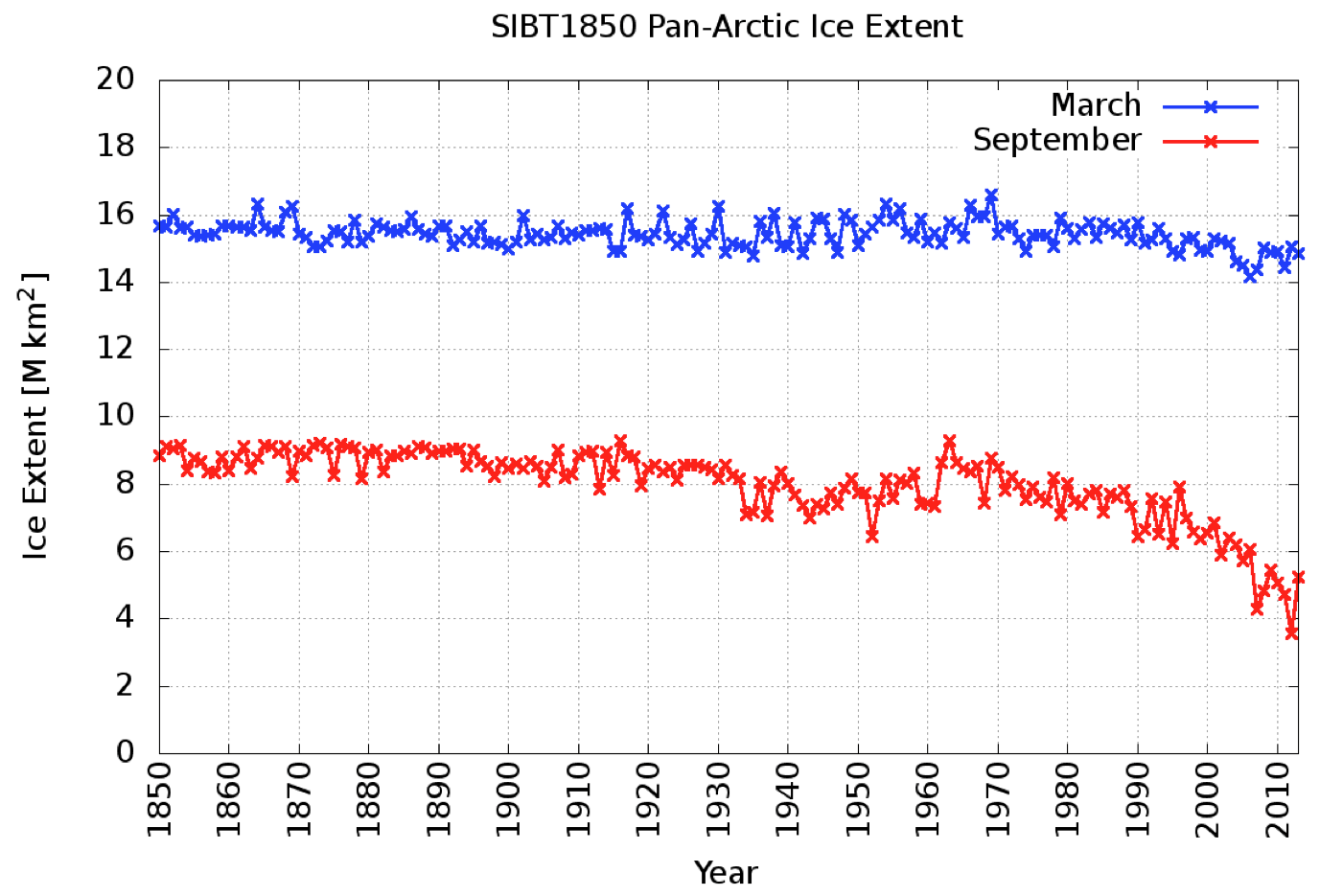
By combining the temperature and partial sea-ice records, statistical reconstructions of the total sea-ice extent going back to the early 1900s can be created. Some of these reconstructions indicate that between the 1900s and 1940s, Arctic sea-ice extent comparable to the present reduced levels may have occurred.
Ray doesn’t sound very certain, which is perhaps because the paper in question blithely states that:
Because Arctic sea ice trends are closely correlated to Arctic temperature trends, they are often discussed in the context of global temperature trends.
Maybe so, but to the best of my recollection Connolly et al. never attempt to “prove” the asserted correlation. Here’s an alternative assessment of “Arctic sea-ice extentbetween the 1900s and 1940s“:
The celebrated web site of our old friend Anthony Watts published an article yesterday entitled “The polar ice melt myth“. As a self styled expert on that particular topic I popped over there expectantly, only to discover that it is an actual fact a cut ‘n’ paste of an April 30th article by Dr. Jay Lehr at CFACT. Part of that article reads as follows:
Al Gore predicted in 2007 that by 2013 the Arctic Ocean would be completely ice free. In the summer of 2012 ice levels did reach all time lows in the Arctic. Emboldened by this report Australian Professor Chris Turney launched an expedition in December of 2013 to prove that the Antarctic Sea Ice was also undergoing catastrophic melting only to have his ship trapped in sea ice such that it could not even be rescued by modern ice-breakers.
The Professor should have known that a more accurate estimate of sea ice can be had from satellite images taken every day at the Poles since 1981. These images show that between summer and winter, regardless of the degree of summer melting, the sea ice completely recovers to its original size the winter before for almost every year since the pictures were taken. The sea ice has been stubbornly resistant to Al Gore’s predictions. In fact the average annual coverage of sea ice has been essentially the same since satellite observations began in 1981. However that has not stopped global warming advocates and even government agencies from cherry picking the data to mislead the public.
I also like to think that I’m something of an expert on the way “skeptical” folks cherry pick the data to mislead the public. For example I once wrote a post about David Rose‘s Mail on Sunday article concerning Al Gore’s interpretation of Prof. Wieslaw Maslowski’s research into Arctic sea ice decline. Hence I felt compelled to comment on this most recent of misleadling WUWT articles about polar ice!
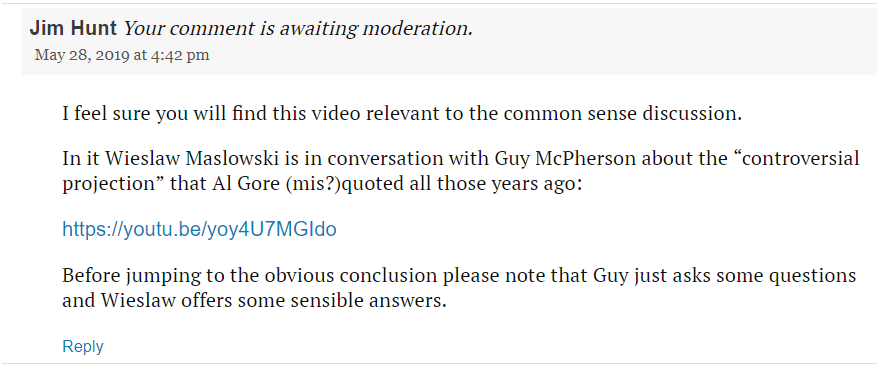
As luck would have it Guy McPherson recently interviewed Wieslaw about events back in 2007 and his more recent research on Arctic sea ice melt. Here is a video recording of their conversation:
I endeavoured to bring this most relevant piece of information to the attention of Anthony’s loyal readership last night (UTC) as follows:
This morning my pertinent comment is still “awaiting moderation”.
Stunning satellite images show summer ice cap is thicker and covers 1.7 million square kilometres MORE than 2 years ago…despite Al Gore’s prediction it would be ICE-FREE by now
Seven years after former US Vice-President Al Gore’s warning, Arctic ice cap has expanded for second year in row.
In the first paragraph of his article Mr. Rose continued:
The speech by former US Vice-President Al Gore was apocalyptic. ‘The North Polar ice cap is falling off a cliff,’ he said. ‘It could be completely gone in summer in as little as seven years. Seven years from now.’
Those comments came in 2007 as Mr Gore accepted the Nobel Peace Prize for his campaigning on climate change.
But seven years after his warning, The Mail on Sunday can reveal that, far from vanishing, the Arctic ice cap has expanded for the second year in succession – with a surge, depending on how you measure it, of between 43 and 63 per cent since 2012.
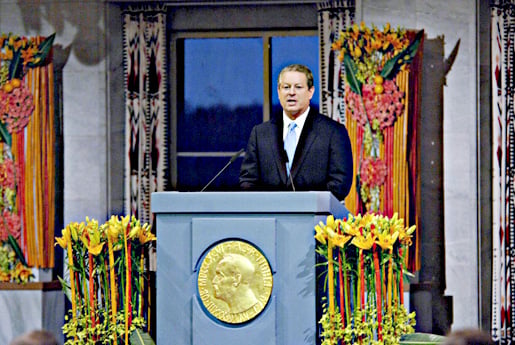
Would it surprise you to learn that when it comes to reporting Nobel Prize acceptance speeches Mr. Rose has as much difficulty separating fact from fiction as he does when reporting on the state of the sea ice in the Arctic? What do you suppose Mr. Gore actually said in his Nobel lecture in Oslo in December 2007? It’s not hard to find out. Here’s a picture of the former US Vice-President at the time:
Skip to 4:30 minutes into the video and you will discover that what Al actually said was:
Last September 21st, as the Northern Hemisphere tilted away from the sun, scientists reported with unprecedented alarm that the North Polar ice cap is, in their words, “falling off a cliff.” One study estimated that it could be completely gone during summer in less than 22 years. Another new study, to be presented by U.S. Navy researchers later this week, warns it could happen in as little as seven years. Seven years from now.
For those who, like David Rose, apparently have difficulty in understanding English I suppose I now need to point out that the “falling off a cliff” phrase should be attributed to some unnamed scientists, not to Al Gore. You will no doubt have noted that Mr. Gore didn’t actually say the words put into his mouth by Mr. Rose, and that the sentiment that “it could happen in as little as seven years” is not in fact “Al Gore’s prediction” at all, and should instead be attributed to some unnamed “U.S. Navy researchers”.
For the hard of hearing amongst you:
Al Gore never “predicted” that the Arctic would be ICE-FREE by now!
Would it surprise you to discover that David Rose has misrepresented the “new study” that Al Gore referred to in 2007 as well, by some strange coincidence at around this time last year? I refer you to our article on that topic from September 15th 2013, and reiterate for the benefit of those who seem unable to understand either English or Mathematics that a “projection” is not the same thing as a “prediction”, and that Professor Wieslaw Maslowski’s statement that “if this trend persists the Arctic Ocean will become ice-free by around 2013” is not at all the same thing as David Rose’s (mis)interpretation that “The Arctic will be ice-free in summer by 2013”.
The obvious conclusion, or so it seems to me at least, is that Mr. Rose should stop pretending to be an investigative reporter and concentrate in future on his evident talent as a writer of speculative fiction.
[P.S. September 2nd 2014]
For some strange reason this post seems to have attracted a lot of interest over on Twitter. Here are the edited highlights!
Today we move on to the second sentence in David Rose’s article “this time last week”.
Them:
The rebound from 2012’s record low comes six years after the BBC reported that global warming would leave the Arctic ice-free in summer by 2013.
Us:
As you can see, the Mail article includes no references. Surely in this day and age an online article about such a controversial subject should at the very least include a few links? Hayley Dixon’s article for The Telegraph did at least manage to do that! I’ve asked David Rose via a number of different avenues where he got his information, and how he did his sums. I know he got at least one of the messages because he was browsing my profile on LinkedIn last week, but I have yet to receive any answer from him.
Groping in the dark I’ve tried to speculate about which BBC report in 2007 David is referring to. Perhaps it’s this one by Jonathan Amos entitled “Arctic summers ice-free ‘by 2013′”. Please note the quotation marks around the date. According to this article:
Professor Wieslaw Maslowski told an American Geophysical Union meeting that previous projections had underestimated the processes now driving ice loss.
[His] latest modelling studies indicate northern polar waters could be ice-free in summers within just 5-6 years.
Instead of relying on what David Rose says Jonathan Amos says Wieslaw Maslowski said, why don’t we instead take a look at what Prof. Maslowski actually said. Here’s an extract from the slides he used when giving a presentation in Japan in the summer of 2008, when he’d had plenty of time to learn the lessons of the astonishing Arctic sea ice melt in the summer of 2007:
Wieslaw Maslowski says “if” and “around” in 2008
Note that he didn’t say words to the effect that “The Arctic will be ice-free in summer by 2013” as claimed by David Rose. What he actually said, and converting the mathematical symbol into plain English, was:
IF this trend persists the Arctic Ocean will become ice-free by AROUND 2013!
which is a very different thing. For those of you that would prefer to actually hear Prof. Maslowski convey that message himself, here’s a podcast from December 2007:
The interview lasts for about half an hour, and a full transcript is also available courtesy of Beyond Zero Emissions. You will note that what Wieslaw actually said was:
If we project this trend ongoing for the last 10 – 15 years, we probably will reach zero in summer some time mid next decade.
Verdict:
The evidence suggests that David Rose doesn’t research his sources properly, doesn’t understand English and doesn’t understand common mathematical symbols. Alternatively he understands all of that perfectly well, but chooses to misrepresent all of that to his loyal readership instead of educating them about the facts of the matter.
This website uses cookies to improve your experience. We'll assume you're ok with this, but you can opt-out if you wish. Cookie settingsACCEPT
Privacy & Cookies Policy
Privacy Overview
This website uses cookies to improve your experience while you navigate through the website. Out of these, the cookies that are categorized as necessary are stored on your browser as they are essential for the working of basic functionalities of the website. We also use third-party cookies that help us analyze and understand how you use this website. These cookies will be stored in your browser only with your consent. You also have the option to opt-out of these cookies. But opting out of some of these cookies may affect your browsing experience.
Necessary cookies are absolutely essential for the website to function properly. This category only includes cookies that ensures basic functionalities and security features of the website. These cookies do not store any personal information.
Any cookies that may not be particularly necessary for the website to function and is used specifically to collect user personal data via analytics, ads, other embedded contents are termed as non-necessary cookies. It is mandatory to procure user consent prior to running these cookies on your website.