Tag Archives: PIOMAS

The Pan-Arctic Ice Ocean Modeling and Assimilation System

An Inconvenient Truth About The Mail’s Climate Coverage

A new paper has just been published by the CryoSat-2 team at University College London. The lead author is Rachel Tilling, a PhD student in the Centre for Polar Observation & Modelling at UCL. We’ll get on to the science in due course, but first let’s take a look at how Rachel’s paper has been reported in the Great British mainstream media. In a headline redolent of our old friends at the Mail on Sunday The [headline writer for the] Guardian’s Damian Carrington proclaims that:

Arctic sea ice volume showed strong recovery in 2013

Cooler temperatures revived sea ice levels suggesting a rapid recovery was possible if global warming was curbed, scientists say

Yesterday wasn’t a Sunday, so David Rose was writing in The Spectator instead of The Mail, asking rhetorically:

Was the global warming pause a myth?

Of course it was David! We explained that to you back in January!
The Daily Mail Group couldn’t let a juicy headline go begging just because it’s midweek, so an anonymous leader writer came up with this one:

Climate change and an inconvenient truth

The “Daily Mail Comment” continues:

In a major report last year, the Intergovernmental Panel on Climate Change gave a grave assessment of how man-made global warming was rapidly destroying the Arctic ice cap.

Steadily increasing temperatures had made the pack ice contract by up to 12 per cent between 1979 and 2012, leading to rising sea levels which threatened to swamp coastal regions – not to mention endangering stranded polar bears.

By the middle of the century ‘a nearly ice-free Arctic Ocean’ was likely for a large part of the year, the report predicted.

How interesting then, that the latest analysis of 88million measurements from the European Space Agency’s Cryosat satellite show the northern ice-cap INCREASED by a staggering 41 per cent in 2013 and, despite a modest shortage last year, is bigger than at any time for decades.

After that it prattles on about the “pause”, so for now let’s take a look at the paper that’s got the papers so excited. For some strange reason it’s title makes no mention of a “strong recovery in 2013”, instead describing:

Increased Arctic sea ice volume after anomalously low melting in 2013

Searching the paper for the word “recovery” returns zero results, so you may well be wondering what it actually does say? Here’s a pertinent, albeit brief, extract from the abstract:

Between autumn 2010 and 2012, there was a 14% reduction in Arctic sea ice volume, in keeping with the long-term decline in extent. However, we observe 33% and 25% more ice in autumn 2013 and 2014, respectively, relative to the 2010–2012 seasonal mean, which offset earlier losses. This increase was caused by the retention of thick sea ice northwest of Greenland during 2013 which, in turn, was associated with a 5% drop in the number of days on which melting occurred—conditions more typical of the late 1990s. In contrast, springtime Arctic sea ice volume has remained stable.

Let’s compare that with the Mail’s version shall we? Whilst searching the paper for the word “ice” returns lots of results a search for the word “cap” returns zero results, just like “recovery”. Any investigative journalist (or leader writer) who had investigated Wikipedia would have discovered this:

An ice cap is an ice mass that covers less than 50,000 km² of land area (usually covering a highland area). Masses of ice covering more than 50,000 km² are termed an ice sheet.

Thus the Arctic Ocean is not covered by an “ice-cap [that] INCREASED by a staggering 41 per cent in 2013” because, as it’s name suggests, it’s an ocean and not a land area. Assuming for the moment that the Mail leader writer is in actual fact referring to sea ice cover in the Arctic, then according to Rachel Tilling’s paper CryoSat-2 “observed 33% more ice in autumn 2013”. Where did the Mail’s “41%” come from then? Their patent pending hot air generator in reverse gear?

Moving on, the Mail must also have a top secret time machine hidden in the basement of Northcliffe House that will enable their leader writer to travel back and change history, because here once again is Andy Lee Robinson’s graphic visualisation of what’s really been happening to the volume of sea ice in the Arctic over the past few decades, albeit using PIOMAS sized ice cubes rather than the CryoSat-2 flavour:

Needless to say I have already lodged an official complaint about the antics of The Daily Mail’s imaginary time machine. If you would like to do as well then here is the appropriate form to fill in:

http://dailymail.co.uk/readerseditor

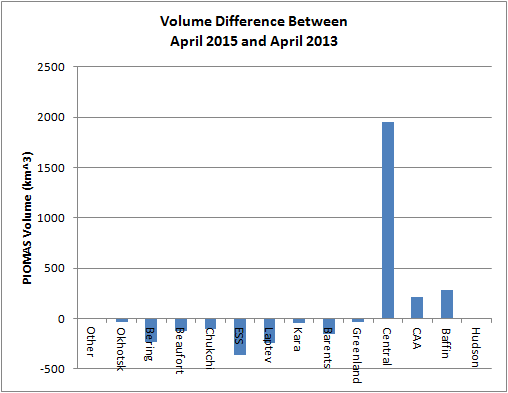
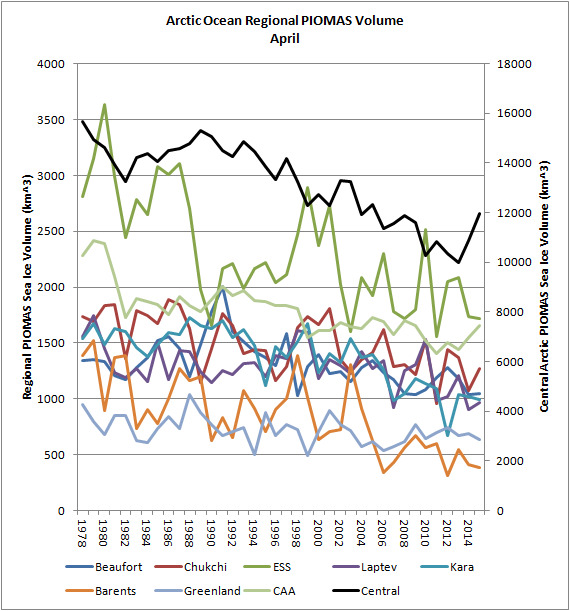
For any IPSO case officers (or Guardian writers) that might be watching please feel free to read all about 41% of nothing, and if you prefer graphs to moving pictures here’s one that shows Arctic sea ice volume in Spring from our PIOMAS regional volume page:
 

Meanwhile, over on Twitter:
Trouble Looming for the Arctic?

Once again our title for today is inspired by the indefatigable “Steven Goddard”. His latest Arctic themed article on his so called “Real Science” blog is entitled “Trouble Looming For Arctic Alarmists“, and he’s following his usual formula of showing an image or two interspersed with unrelated text. Here’s Tony’s textual take on things, interspersed with our graphic retorts:

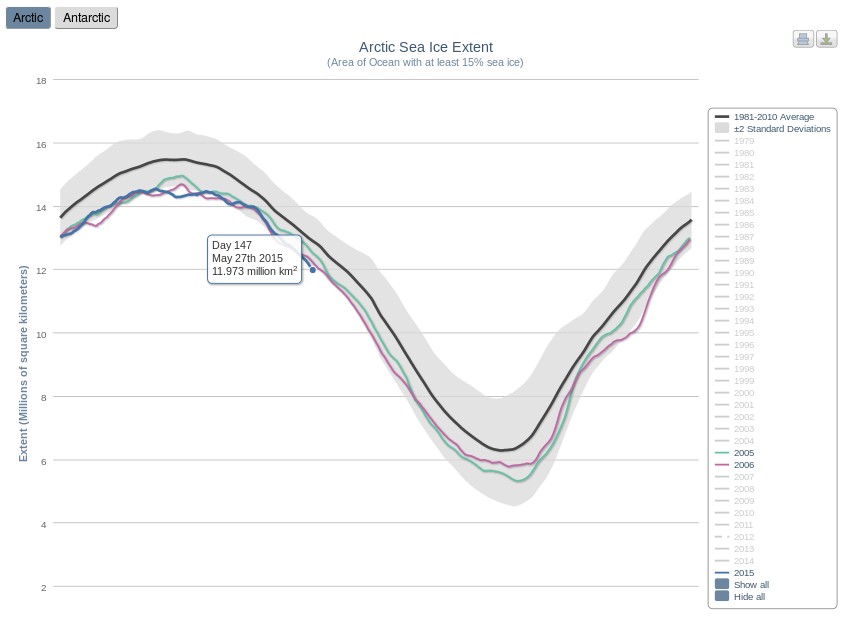
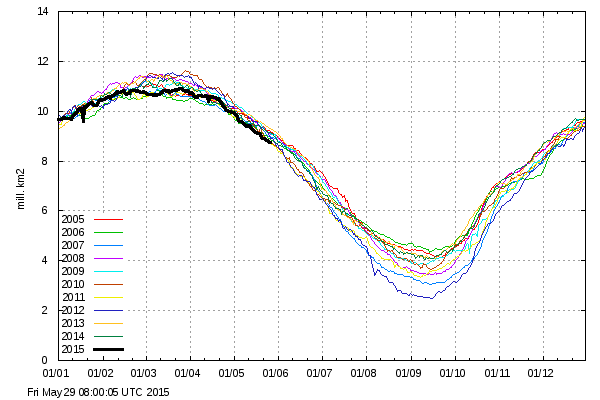
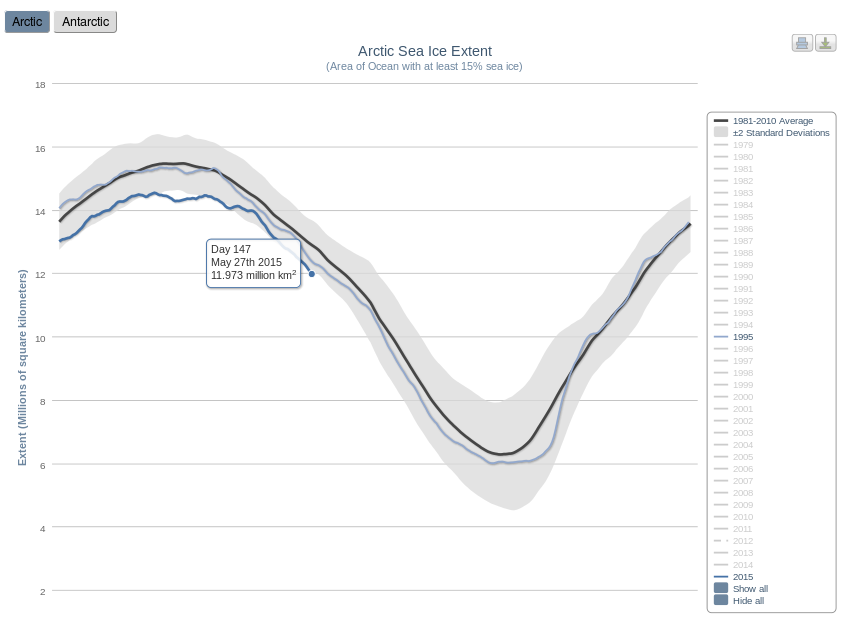
Arctic sea ice coverage is nearly identical to 20 years ago:

Not according to the NSIDC it isn't!
Not according to the NSIDC it isn’t!

Arctic sea ice is following almost the exact trajectory of 2006, which had the highest summer minimum of the last decade.

Not according to the NSIDC it isn't!
Not according to the NSIDC it isn’t!

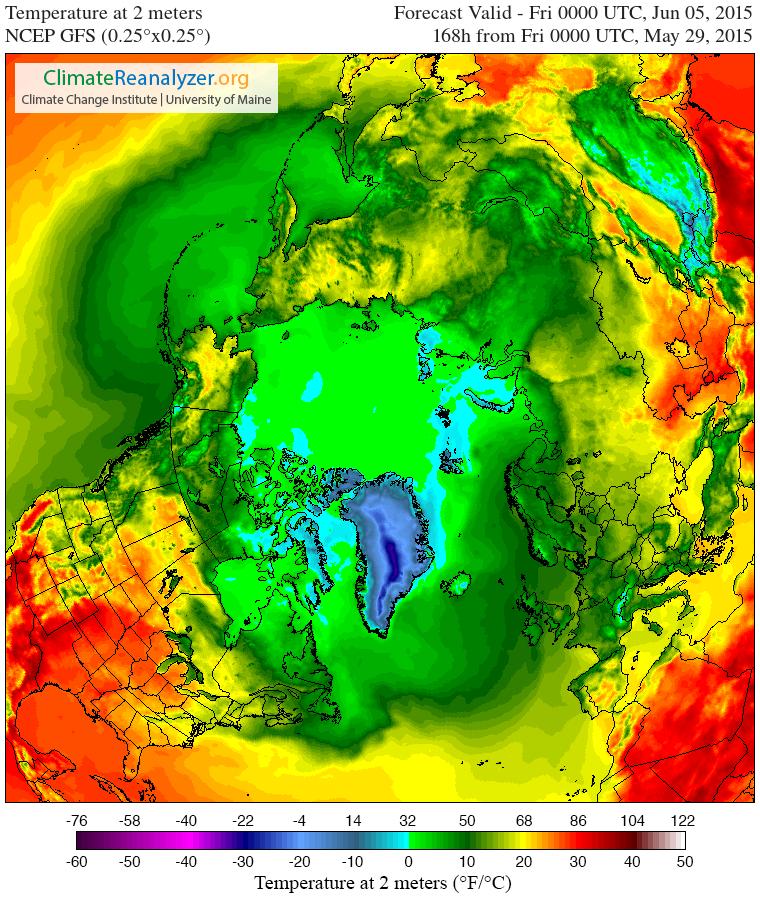
Not according to GFS they're not, and look at the North Pole!
Not according to GFS they’re not, and look at the North Pole!

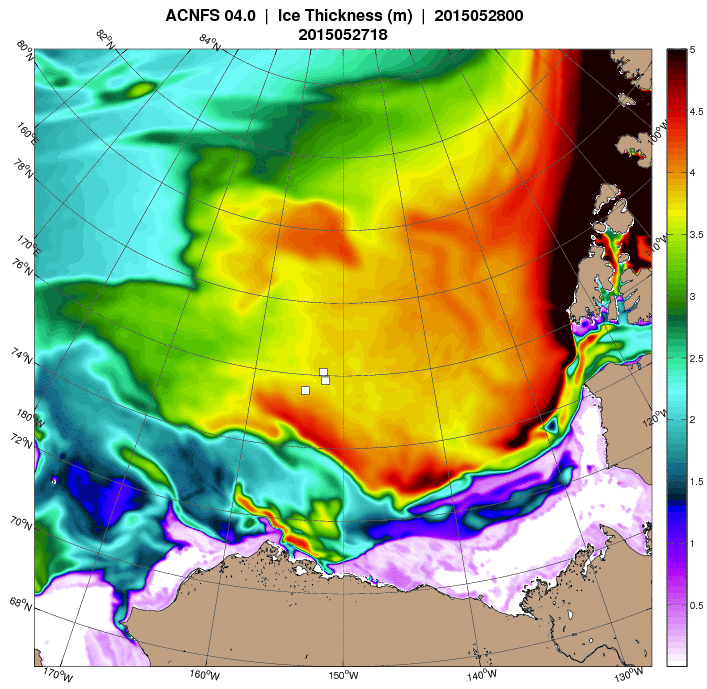
The Beaufort Sea is full of very thick ice.

Not according to the US Navy it isn't!
Not according to the US Navy it isn’t!

Arctic sea ice is the thickest it has been in a decade.

According to PIOMAS it's thin in the Beaufort, and most other areas too!
According to PIOMAS it’s thin in the Beaufort, and most other areas too!

As we summarised matters for “Steve”/Tony’s loyal readership:

The Gish Gallop continues! Just for the record:

  1. Arctic sea ice coverage is currently NOT nearly identical to 20 years ago
  2. Arctic sea ice is currently NOT following almost the exact trajectory of 2006
  3. Arctic sea ice is currently NOT the thickest it has been in a decade in Ron’s beloved Beaufort/Chukchi/East Siberian Seas (BCE for short)
  4. Renowned Arctic sea ice expert “Steve Goddard” predicted last year that.”The minimum this summer will likely be close to the 2006 minimum, which was the highest minimum of the past decade”. That’s not how things eventually turned out!

The Greatest Arctic Sea Ice Prophet on the Planet?

The unedited version of "Steve's" extent graph
The unedited version of “Steve’s” DMI extent graph earlier today

The Arctic Sea Ice “Recovery” Vanishes Even More

Whilst a variety of climate change “skeptics” have been pointing out recently that the April 2014 edition of the National Snow and Ice Data Center’s Arctic Sea Ice News mentioned that:

A large area of the multiyear ice has drifted to the southern Beaufort Sea and East Siberian Sea

which led said skeptics to claim things like:

There is a lot of thick ice in the western Arctic, which will be difficult to melt this summer.

they glossed over the bit where the NSIDC added:

Where warm conditions are likely to exist later in the year.

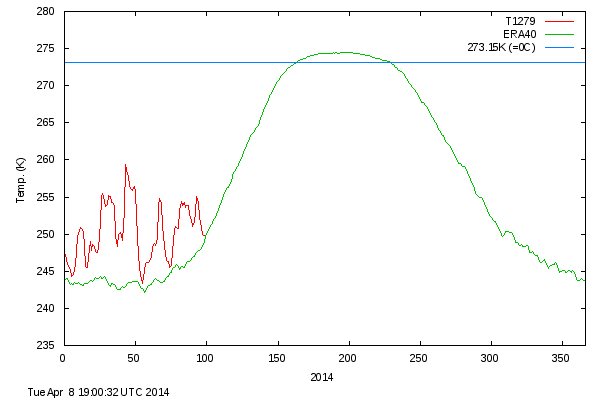
In fact conditions have been very warm (relatively speaking!) in the Arctic for all of 2014 so far. The DMI daily mean temperature of the Arctic area north of the 80th northern parallel has never dropped below the long term average all winter:

DMI mean temperature north of the 80th northern parallel, on April 8th 2014

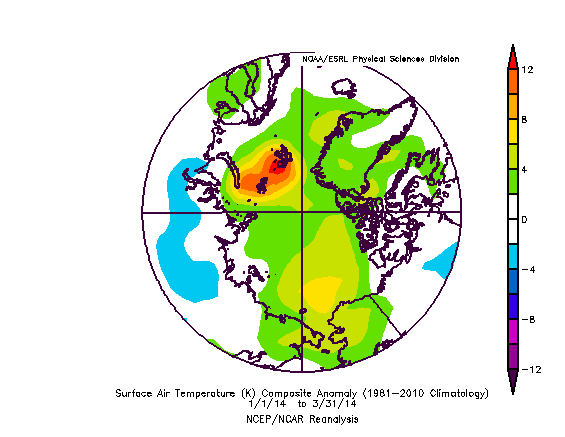
and the surface air temperature anomaly chart for the Arctic for the first three months of 2014 looks like this:

Surface air temperature anomaly plot for January to March 2014
Arctic surface air temperature anomaly plot for January to March 2014

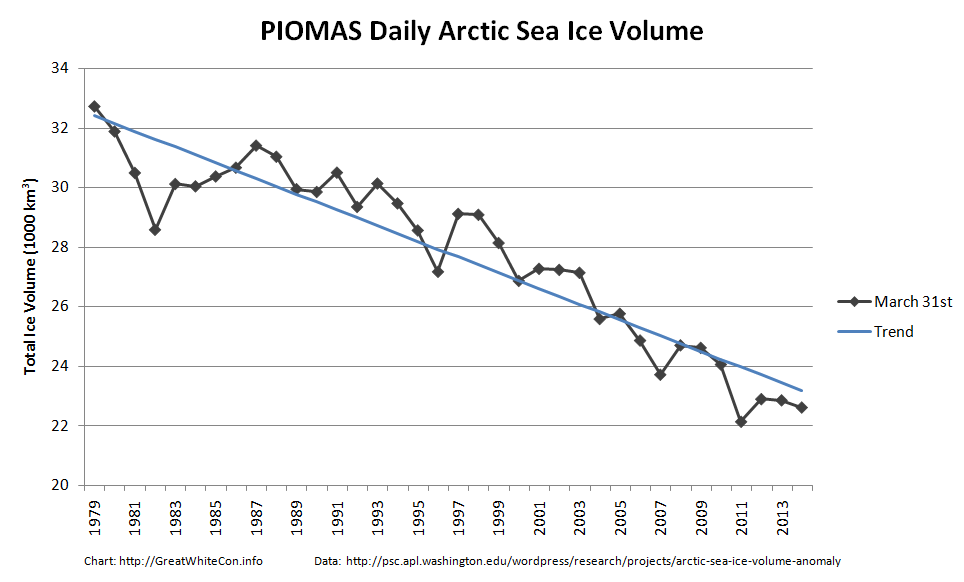
Those anomalously warm temperatures may well have something to do with the fact that the latest PIOMAS Arctic sea ice volume estimates which have just been released reveal this:

PIOMAS arctic sea ice volume on March 31st from 1979-2014

As you can see, according to the PIOMAS model at least, Arctic sea ice volume has now reached the second lowest level for the date since the satellite record began.

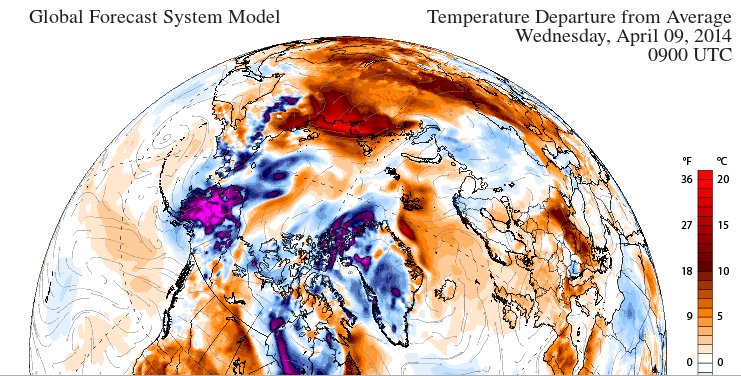
Whilst the skeptics have been complaining about the amount of ice on the Great Lakes of North America they seem to have somehow failed to notice the anomalously low coverage of snow over Siberia. Here’s the surface air temperature anomaly forecast for the northern hemisphere tomorrow:

GFS 2m temperature anomaly forecast for 09:00 UTC on April 9th 2014

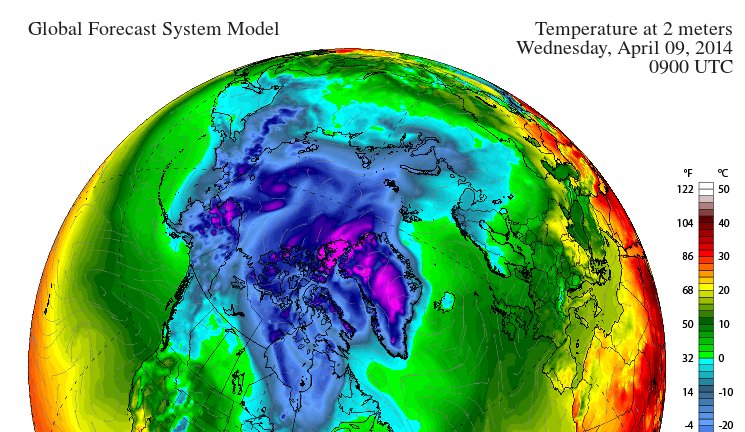
Do you see the bright red patch over the coast of the Laptev Sea, indicating temperatures 20 degrees Celsius above normal? Now take a look at a similar chart, but of the surface air temperatures themselves:

GFS 2m temperature forecast for 09:00 UTC on April 9th 2014

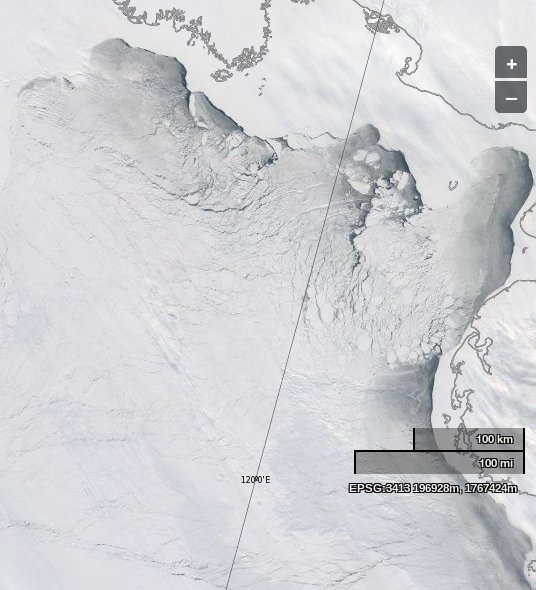
That reveals that the temperatures over the edge of the Laptev Sea are forecast to be above the freezing point of fresh water tomorrow. Just in case you’re wondering what the shores of the Laptev Sea look like at the moment, here’s a picture we recorded earlier today, courtesy of NASA Worldview and the MODIS sensor on the Aqua satellite:

The Laptev Sea as seen by the Aqua satellite on April 8th 2014

What do you suppose the same area will look like in a day or two’s time, or in a month or two’s time for that matter?


The Arctic Sea Ice “Recovery” Vanishes

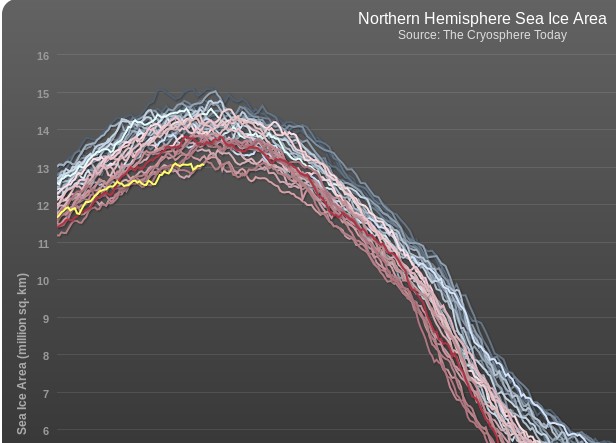
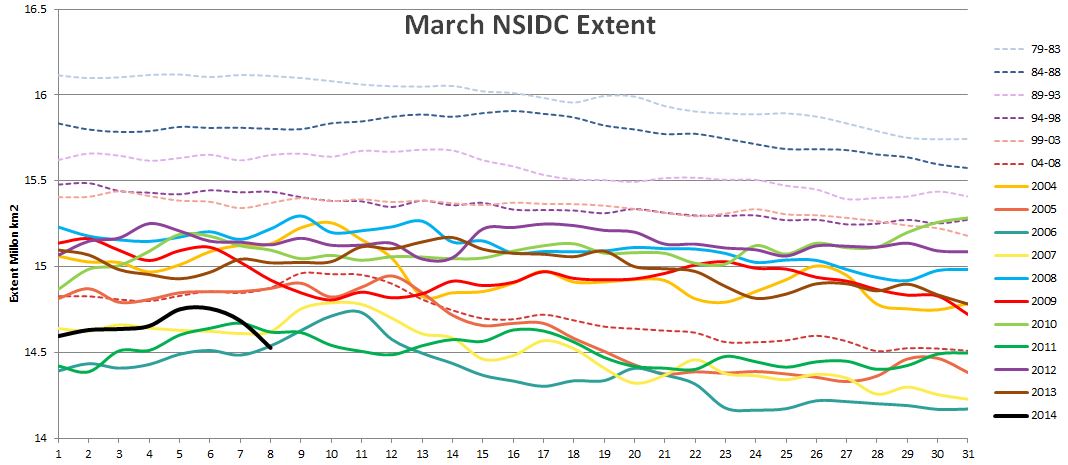
It’s highly probable that whatever metric you choose to use the 2014 Arctic sea ice maximum area and extent will occur this month. Consequently the volume of nonsense propagated by the “skeptics” amongst the “mass media” is increasing also. Earlier today yesterday’s sea ice metrics were published and currently both the Cryosphere Today Arctic sea ice area and NSIDC daily extent are at all time lows for the date. Needless to say that hasn’t stopped the denialosphere prattling on about an “Arctic Ice Recovery” yet again.

First of all, here’s our evidence:

Cryosphere Today Arctic sea ice area graph, as at March 8th 2014

[Graph from Cryosphere Today interactive Arctic sea ice chart]

NSIDC daily extent graph for March
NSIDC daily extent graph for March, as at March 8th 2014

[Graph courtesy of BornFromTheVoid at the Arctic Sea Ice Forum]

Now I couldn’t help but notice that yet another reproduction of the Mail on Sunday’s erroneous graphic first printed at the time of the 2013 minimum appeared on Steven Goddard’s “Real Climate” blog  last week. Steve has been using a variety of other graphics in his assorted attempts to persuade his readers that there is in fact an “Arctic Ice Recovery”. Needless to say, we beg to differ!

Them:

Shocking Increase In Arctic Ice Dooms The Planet – How Ice Sheet Grew 533,000 Square Miles in a Year

Us:

Whilst we’re on the subject of cherry picking, it looks a lot like the left hand part of the image dates from August 27th 2012 whereas the right hand part dates from August 15th 2013. If you’re interested in seeing a similar image dating from September 8th 2013, when the original version of the image above was originally published in the Mail on Sunday over here in once Great Britain then please feel free to take a long hard look at:

https://GreatWhiteCon.info/2013/09/santas-secret-summer-swim/

Credible evidence, or not?

Them:

Arctic Ice Recovery

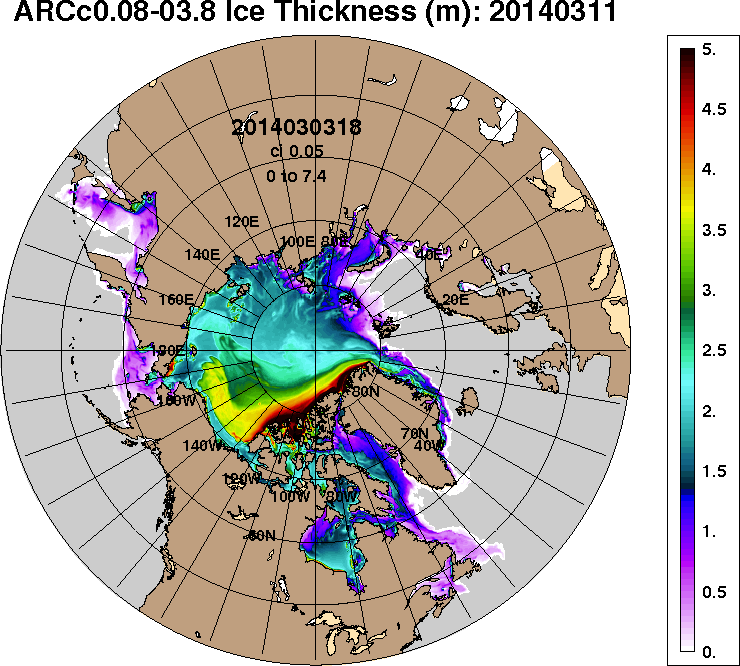
The dirty little secret of Arctic sea ice, is that it is controlled by winter winds – not temperature. Over the last few years, the older thicker ice has pushed into the Beaufort Sea where it survives the winter and slows summer melt. Thus the Arctic continues to “recover.”

ACNFS forecast for Arctic sea ice thickness on March 11th 2014, from the March 3rd model run
ACNFS forecast for Arctic sea ice thickness on March 11th 2014

[Image from the 1/12° Arctic Cap HYCOM/CICE/NCODA archive]

 Us:

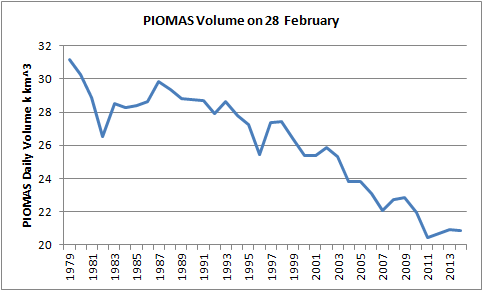
Actually the Arctic doesn’t “continue to recover”. Whilst a bit hard to see on their rather cluttered chart the latest PIOMAS Arctic sea ice volume estimates show that the so called “recovery” had almost completely “melted away” by the end of February:

PIOMAS arctic sea ice volume on February 28th from 1979-2014
PIOMAS Arctic sea ice volume on February 28th from 1979-2014

 [Image by Chris Reynolds on the Arctic Sea Ice Blog]

Them:

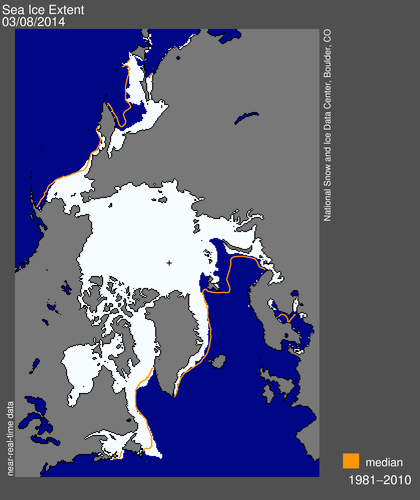
Planet Doomed By Missing Ice Cube In The Barents Sea

NSIDC visualisation of Arctic sea ice daily extent for March 6th 2014

Us:

Here’s the thing (well, 2 things actually)

1. Steve’s “map” shows the NSIDC Arctic sea ice extent, but you make no mention of it. Perhaps that’s because that particular metric is currently at the lowest it has ever been on this day of any year since the satellites started attempting to measure it? How on Earth can he possibly characterize that as any sort of “recovery”?

2. Surely the very title of this thread (“ice cube”) implies a volume, does it not? I believe Steve’s an engineer, and so he is presumably well aware that a square and a cube are completely different kettles of fish (metaphorically speaking)? All that being the case, why on Earth would Steve choose to illustrate his point with a “map” of ice extent instead of a “graph” of ice volume?

For the moment we rest our case, but rest assured that there is plenty more where this lot came from!