Tag Archives: MASIE

The NSIDC’s Multisensor Analyzed Sea Ice Extent product

Clutz Clutches at Minimum Extent Straws

On several previous occasions “Snow White” and I have documented Ron Clutz’s misuse of MASIE Arctic sea ice extent data on his “Science Matters” blog. We agree with Ron that science matters, so on several occasions we have attempted to direct his attention to my interview with NASA/NSIDC scientist Walt Meier. Walt’s words of wisdom included:

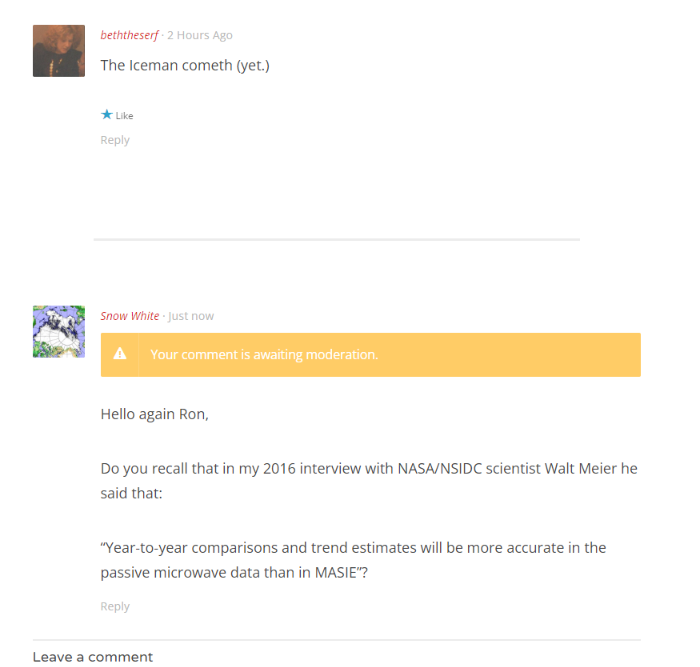
Year-to-year comparisons and trend estimates will be more accurate in the passive microwave data than in MASIE.

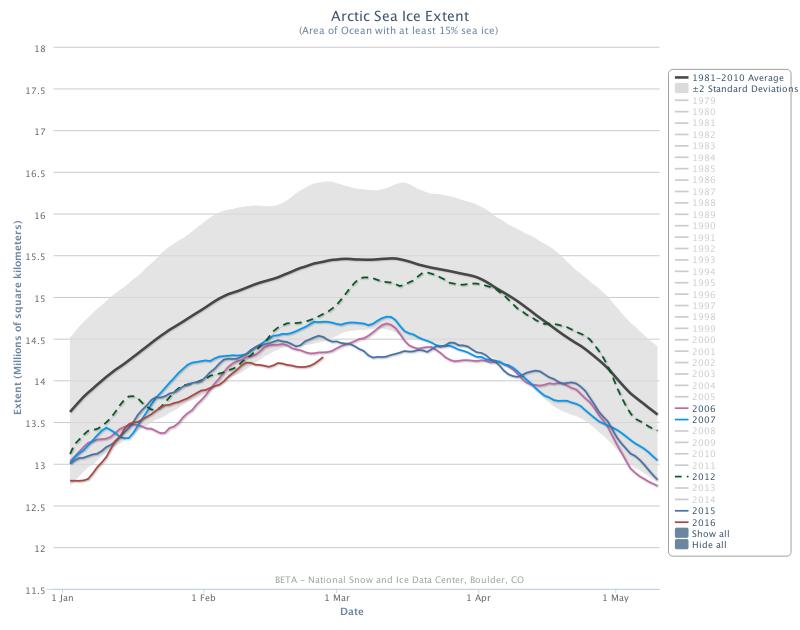
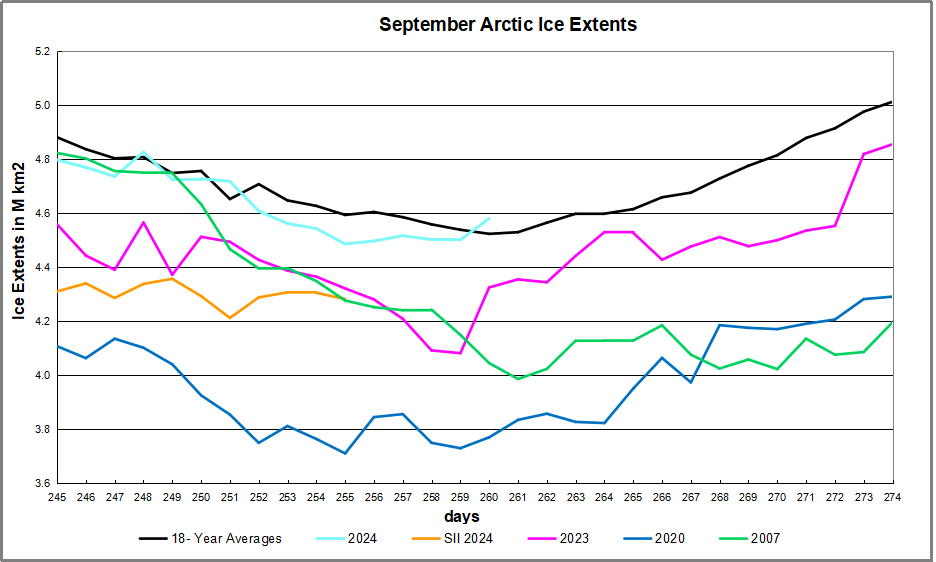
It will probably not surprise you to learn that Ron has not learned anything from our repeated efforts. In his article entitled “2024 Arctic Ice Beats 2007 by Half a Wadham” earlier today Ron proudly displays this graph:

You will note that Ron does not provide details of his data source. However I have recently noted a sudden lack of SSMIS passive microwave data emanating from NOAA. The OSI SAF reported it this way on September 12th:

Dear OSI SAF Sea Ice Concentration User,

Due to missing input data, we have not been able to generate L2 products, corresponding to F-16 / F-17 / F-18 since Sep 11 19:36 UTC.

We apologize for any inconvenience.

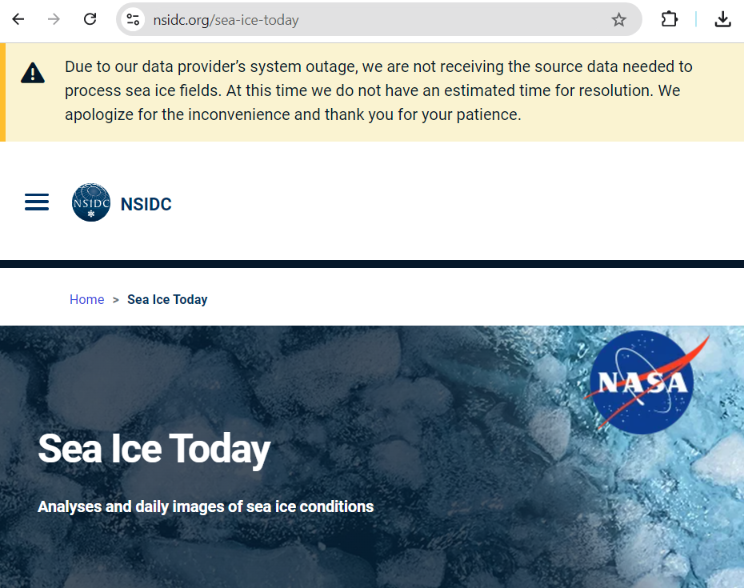
The NSIDC’s sea ice home page puts it this way today:

Now day 260 of 2024 is September 16th, so it seems safe to assume that Ron is erroneously using his favourite MASIE metric for year to year comparisons yet again. In his article Ron states that:

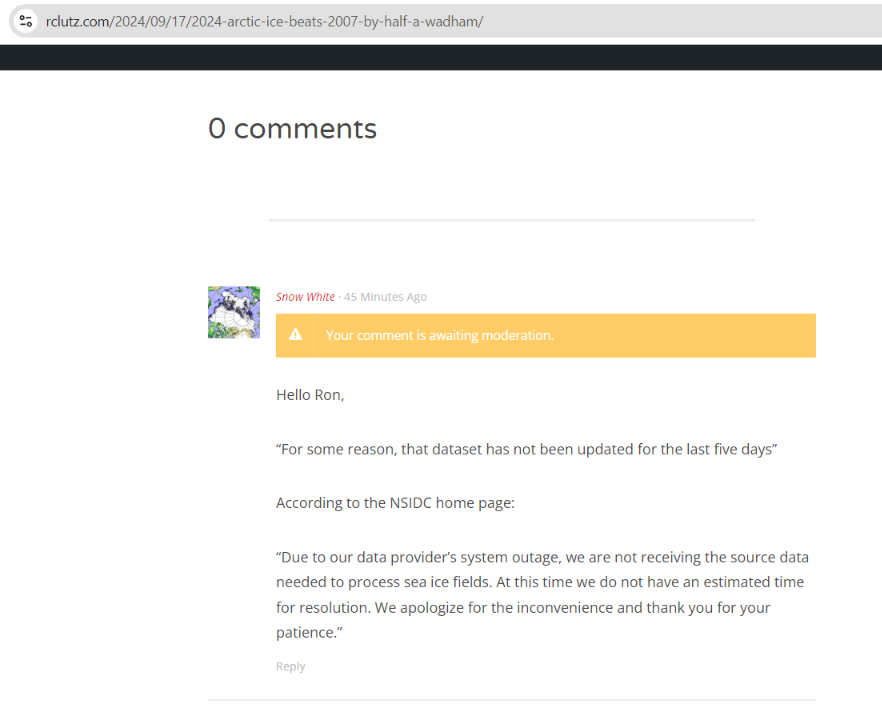
SII was reporting deficits as high as 0.5M km2 (half a Wadham) compared to  MASIE early in September.  For some reason, that dataset has not been updated for the last five days.

It appears as though Ron has also not yet learned how to find NSIDC’s sea ice home page on the world wide interweb!

I added this hopefully helpful comment below Ron’s article. For some strange reason it is yet to emerge from his moderation queue:

[Update – September 18th]

Our regular reader(s) will not be surprised to learn that my helpful comment yesterday is no longer in Ron’s moderation queue, but is now languishing underfoot on his cutting room floor.

Ron has written another Arctic article using the graph reproduced above. This one is entitled: “2024 Arctic Ice Abounds at Average Daily Minimum“. In it Ron assures his flock of faithful followers that:

We are close to the annual Arctic ice extent minimum, which typically occurs on or about day 260 (mid September). Some take any year’s slightly lower minimum as proof that Arctic ice is dying, but the image above shows the Arctic heart is beating clear and strong.

Over this decade, the Arctic ice minimum has not declined, but since 2007 looks like fluctuations around a plateau.

Ron has also changed his phraseology regarding the recent SSMIS data outage. This time it reads:

For some reason, apparently data access issues, that dataset has not been updated for the last five days.

“Snow White” felt compelled to leave Ron another helpful comment concerning his new words of Arctic wisdom:

Watch this space!

Not A Lot Of People Know How Paul Homewood Propagates Fake News About the Arctic!!

A couple of days ago we explained how Christopher Booker explained that blogger Paul Homewood:

Has drawn on official sources.. to uncover what is actually happening [in the Arctic]

Have we got news for you Christopher? That’s not how it works in the cryodenialosphere! Mr. Homewood’s article about Mr. Booker’s article about Mr. Homewood’s previous article(s) is littered with factual errors. This is what happens should you be foolish enough to attempt to correct such errors.

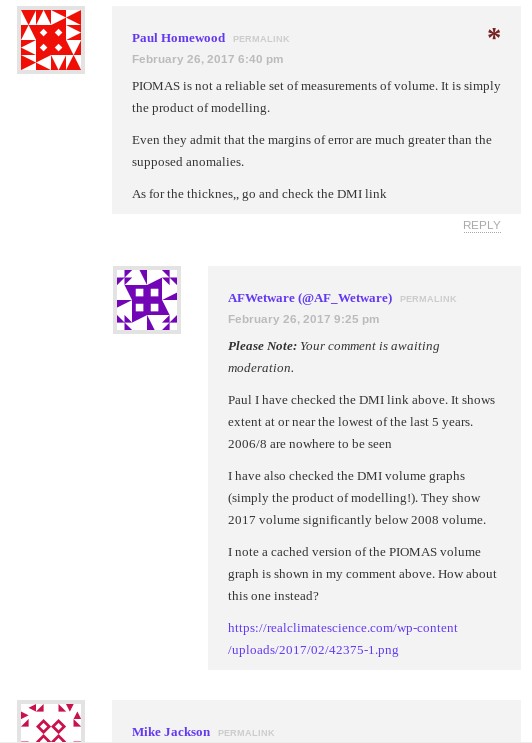
Here is what we typed into the comment section of Mr. Homewood’s blog:

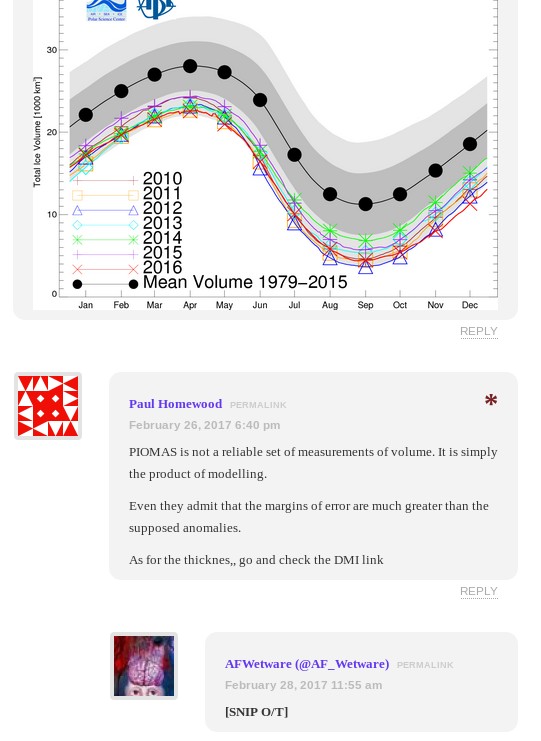
Of course if Mr. Booker were to have considered Arctic sea ice volume he might have thought twice about his “there is even more of it today than in February 2006, and it is also significantly thicker.” remark?

PIOMAS-IceVolumeAnomalyCurrentV2.1_20170227

Followed by:

NALOPKT-AliceIsModerated

When that failed to make an appearance:

NALOPKT-Alice-Moderated-20170228

When Ron Clutz sang the praises of MASIE yet again:

NALOPKT-Jim-AutoSnipped-20170227

Here is what Paul Homewood cherry picked to publish to his loyal readership:

NALOPKT-Alice-Snipped-20170228

Can you spot the difference? Our juiciest cherries all ended up on Paul’s cutting room floor!

NSIDC Announce The 2016 Arctic Sea Ice Maximum Extent

In the latest edition of their “Arctic Sea Ice News” the United States’ National Snow and Ice Data Center have announced that:

Arctic sea ice appears to have reached its annual maximum extent on March 24, and is now the lowest maximum in the satellite record, replacing last year’s record low. This year’s maximum extent occurred later than average. A late season surge in ice growth is still possible. NSIDC will post a detailed analysis of the 2015 to 2016 winter sea ice conditions in early April.

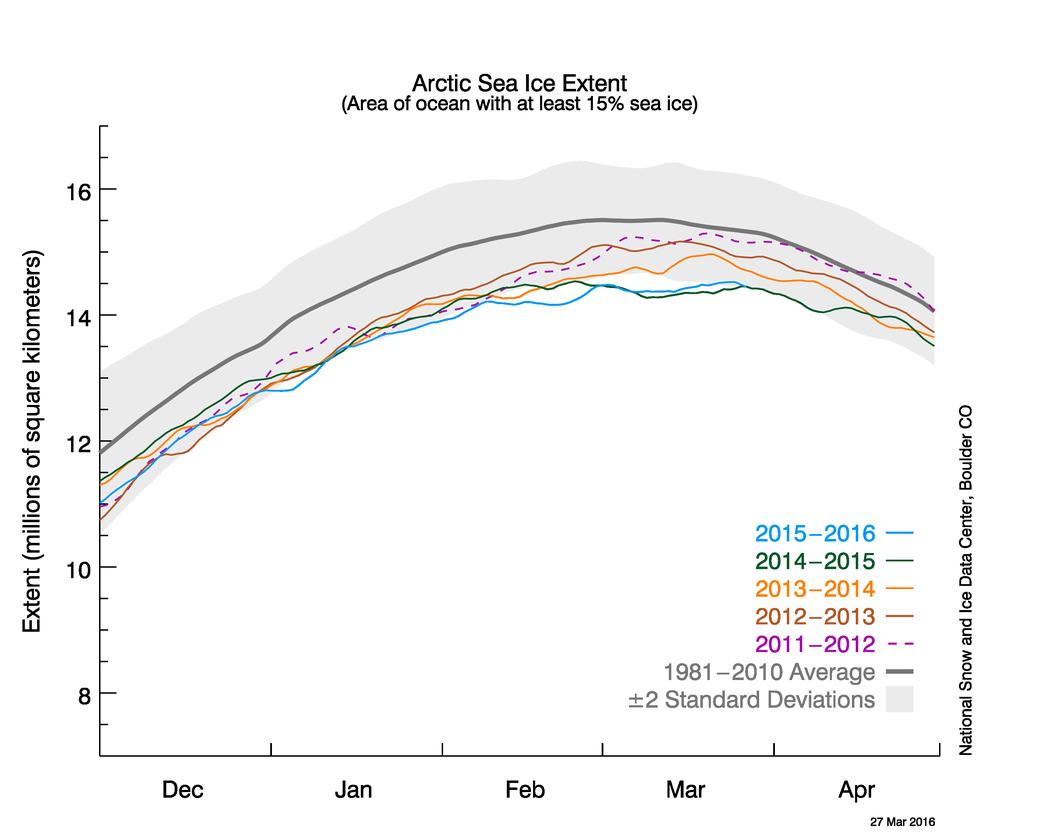
NSIDC-20160327

On March 24, 2016, Arctic sea ice likely reached its maximum extent for the year, at 14.52 million square kilometers (5.607 million square miles). This year’s maximum ice extent was the lowest in the satellite record, with below-average ice conditions everywhere except in the Labrador Sea, Baffin Bay, and Hudson Bay. The maximum extent is 1.12 million square kilometers (431,000 square miles) below the 1981 to 2010 average of 15.64 million square kilometers (6.04 million square miles) and 13,000 square kilometers (5,000 square miles) below the previous lowest maximum that occurred last year. This year’s maximum occurred twelve days later than the 1981 to 2010 average date of March 12. The date of the maximum has varied considerably over the years, occurring as early as February 24 in 1996 and as late as April 2 in 2010.

NASA’s Goddard Space Flight Center has also made a similar announcement, which includes this video:

The new record low follows record high temperatures in December, January and February around the globe and in the Arctic. The atmospheric warmth probably contributed to this lowest maximum extent, with air temperatures up to 10 degrees Fahrenheit above average at the edges of the ice pack where sea ice is thin, said Walt Meier, a sea ice scientist at NASA’s Goddard Space Flight Center in Greenbelt, Maryland.

The wind patterns in the Arctic during January and February were also unfavorable to ice growth because they brought warm air from the south and prevented expansion of the ice cover. But ultimately, what will likely play a bigger role in the future trend of Arctic maximum extents is warming ocean waters, Meier said.

“It is likely that we’re going to keep seeing smaller wintertime maximums in the future because in addition to a warmer atmosphere, the ocean has also warmed up. That warmer ocean will not let the ice edge expand as far south as it used to,” Meier said. “Although the maximum reach of the sea ice can vary a lot each year depending on winter weather conditions, we’re seeing a significant downward trend, and that’s ultimately related to the warming atmosphere and oceans.” Since 1979, that trend has led to a loss of 620,000 square miles of winter sea ice cover, an area more than twice the size of Texas.

This year’s record low sea ice maximum extent will not necessarily result in a subsequent record low summertime minimum extent, Meier said. Summer weather conditions have a larger impact than the extent of the winter maximum in the outcome of each year’s melt season; warm temperatures and summer storms make the ice melt fast, while if a summer is cool, the melt slows down.

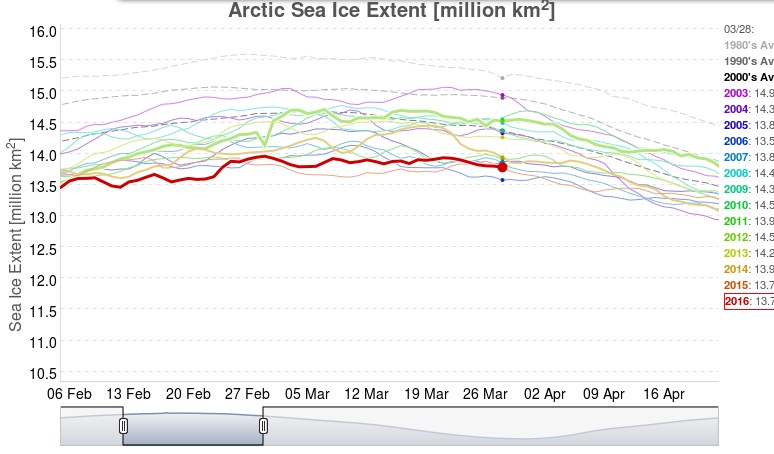
Neither NASA or the NSIDC comment on one of the striking things about this winter’s NSIDC extent chart, which has effectively “plateaued” during March 2016 following an initial peak of 14.48 million square kilometers on March 2nd, which was only recently exceeded. This is also illustrated by the JAXA Arctic sea ice extent metric, for which the 2016 maximum was 13.96 million square kilometers on February 29th:

JAXA-20160328

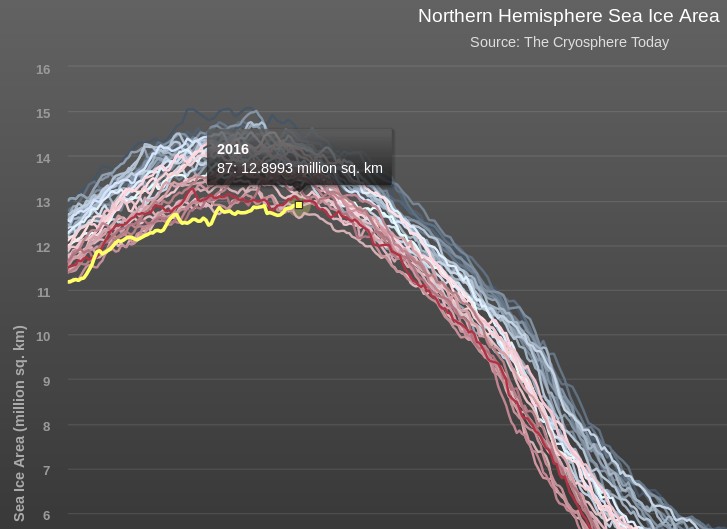
Now that the start of 2016 Arctic sea ice melting season has been called, albeit slightly hesitantly, by the experts at the NSIDC let’s also take a look at Cryosphere Today Arctic sea ice area:

CT-20160327

The preliminary peak which we announced on March 16th has also recently been exceeded, but we now feel supremely confident in predicting that the 2016 CT area maximum will be less than 13 million square kilometers for the first time ever in the satellite record.

Thus begins what promises to be a very interesting 2016 Arctic sea ice melting season! As the NSIDC puts it:

There is little correlation between the maximum winter extent and the minimum summer extent—this low maximum does not ensure that this summer will see record low ice conditions. A key factor is the timing of widespread surface melting in the high Arctic. An earlier melt onset is important to the amount of energy absorbed by the ice cover during the summer. If surface melting starts earlier than average, the snow darkens and exposes the ice below earlier, which in turn increases the solar heat input, allowing more ice to melt. With the likelihood that much of the Arctic cover is somewhat thinner due to the warm winter, early surface melting would favor reduced summer ice cover.

Gross Deception About MASIE and the Sea Ice Index

Our title for today is a reference back to a 2015 article by Paul Homewood on his “Not A Lot Of People Know That” blog, in which he told a load of old porky pies about the National Snow and Ice Data Center’s graphs of Arctic sea ice extent. Only last week Mr. Homewood cooked up another pile of porky pies concerning the Danish Meteorolical Institute’s Arctic sea ice extent metric. Now he has turned his pie baking skills to the Multisensor Analyzed Sea Ice Extent (MASIE for short), which is “a prototype collaborative product of the National Ice Center and NSIDC”.

Mr. Homewood obviously hadn’t done a whole lot of homework on MASIE before firing up his porky pie production line, since he used the self same recipe posted on the so called “Science Matters” blog of Ron Clutz shortly before. In fact he just reprinted the first part of Ron’s article and added a handy link to Ron’s even bigger pile of porky pies beneath it. Hence both Paul and Ron’s web sites currently proudly proclaim that:

Something strange is happening in the reporting of sea ice extents in the Arctic. I am not suggesting that “Something is rotten in the state of Denmark.” That issue about a Danish graph seems to be subsiding, though there are unresolved questions. What if the 30% DMI graph is overestimating and the 15% DMI graph is underestimating?

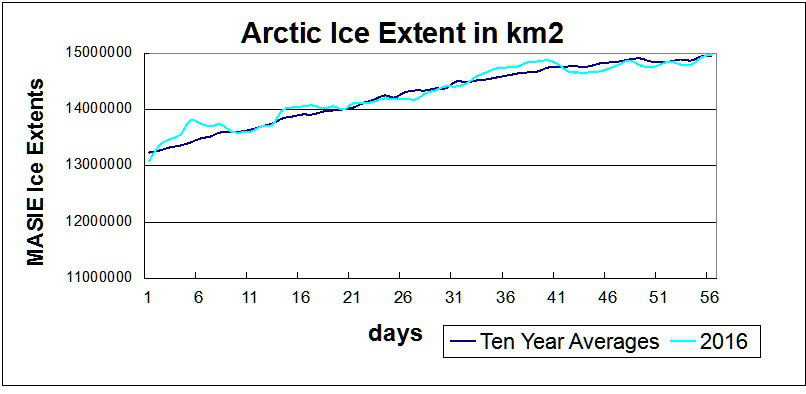
The MASIE record from NIC shows an average year in progress, with new highs occurring well above the 2015 maximum:

Clutz-masie-2016-to-day-56r

While I am compelled to agree with Ron and Paul that “something strange is happening in the reporting of sea ice extents in the Arctic” we disagree about everything else! One reason for that is because only a few days ago I interviewed NASA scientist Walt Meier following a suggestion by Ron Clutz that I do precisely that. Please read the edited highlights of that interview, and note in addition that Walt assured me that he had not previously been contacted by either of Messrs. Clutz and Homewood. Having never previously contacted Mr. Meier, here’s what Ron Clutz would have his loyal readership believe this weekend:

NOAA Is Losing Arctic Ice

Why the Discrepancy between SII and MASIE?

The issue also concerns Walter Meier who is in charge of SII, and as a true scientist, he is looking to get the best measurements possible. He and several colleagues compared SII and MASIE and published their findings last October. The purpose of the analysis was stated thus:

Our comparison is not meant to be an extensive validation of either product, but to illustrate as guidance for future use how the two products behave in different regimes.

Here is what Dr. Meier’s peer reviewed paper from October last year concluded on the matter:

Operational modelers require timely data that are as accurate as possible to initialize forecast models. In particular, an accurate ice edge is important because of the influence of the interaction of sea ice and water with the overlying atmosphere on the model fluxes. Consistency of data is also desirable for operational models, but is a secondary concern because the models are regularly reinitialized for their synoptic forecasts. Operational observations like MASIE make the most sense for these applications. However, the quality and amount of information used to produce the operational analyses vary.

Climate modelers desire consistent long-term data to minimize model biases and better understand and potentially improve model physics. The passive microwave record is useful, but has limitations. Regions of thin ice are underestimated and if the ice cover is diffuse with low concentration, ice-covered regions may be detected as open water. Even thin ice modifies heat and moisture transfer and thus may affect atmospheric and oceanic coupling. Surface melt results in an underestimation of concentration. This should be considered when evaluating model concentrations with passive microwave data.

and here once again is what he told me a few short days ago:

Since the quantity and quality of [MASIE] data varies the time series will not be consistent over time.

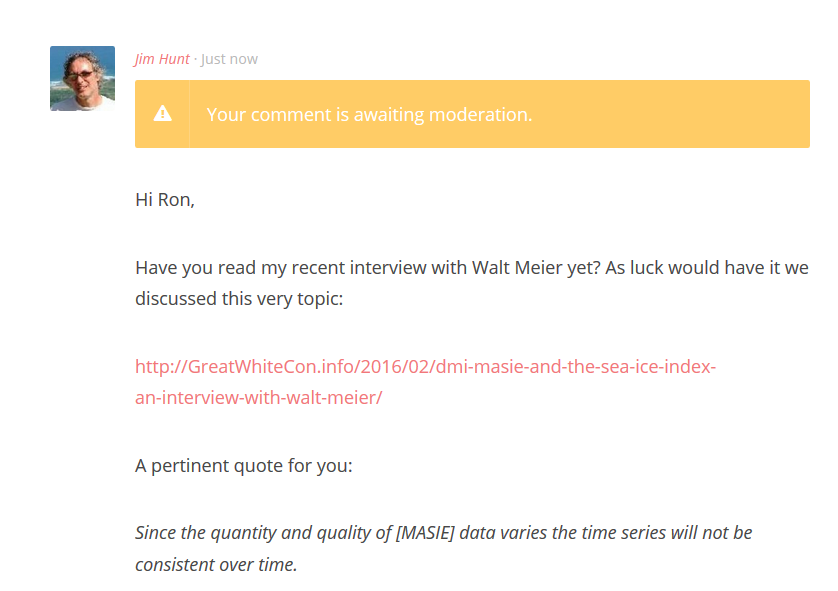
For some strange reasom Mr. Clutz’s article mentions none of this. Needless to say I have attempted to bring this unfortunate oversight to the attention of Ron & Paul:

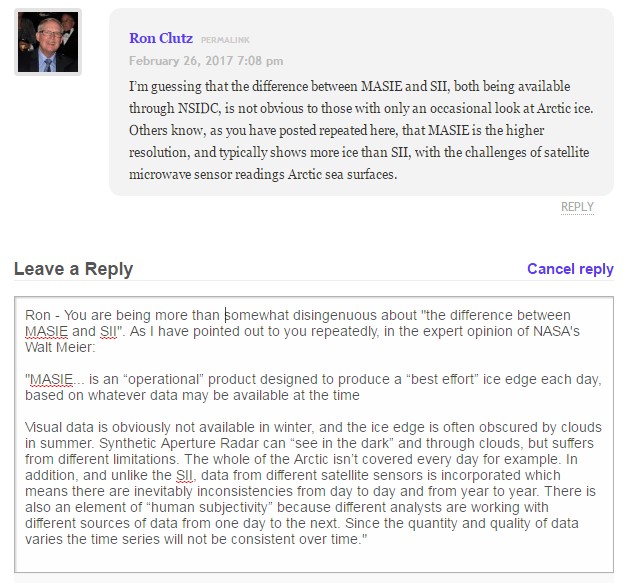
2016-02-28_1007-RonClutz

Even more unfortunately it seems that their joint acute snow blindness has got even worse over the last few days, since they still haven’t noticed my link to Walt Meier’s words waiting patiently in their WordPress.com “moderation queues”.

Whilst we wish them on their recovery from their painful ailment, here’s an alternative interpretation of the MASIE data:

MASIE-Min

Operational modellers for the use of! Here’s what the NSIDC’s Sea Ice Index currently reveals to climate scientists:

Charctic-20160226

NSIDC Arctic sea ice extent is evidently still currently lowest *ever for the date.

DMI, MASIE and the Sea Ice Index – An Interview With Walt Meier

For some reason best known to himself Anthony Watts has jumped on the “DMIGate” bandwagon started by Paul Homewood over on this side of the Atlantic a few days ago. In his latest article Mr. Watts quotes with approval the “Not A Lot Of People Know That” article which we have already covered in some depth.

Here yet again is one of my comments that recently ended up on the NALOPKT cutting room floor:

2016-02-21_1811-NALOPKT

You will note that I was suggesting that Ron Clutz’s extremely selectively interpretation of some of Walt Meier’s academic papers left a lot to be desired. Particularly given the additional fuel added to the “skulduggery” fire by the Watts Up With That article it seemed sensible to phone up NASA and ask Walt for his views on the second hottest Arctic sea ice topic on the planet at the moment, according to Messrs. Clutz and Homewood at least. That is the relative merits of Multisensor Analyzed Sea Ice Extent (MASIE for short) versus the National Snow and Ice Data Center’s Sea Ice Index (SII for short) for determining Arctic sea ice trends.

According to the NSIDC:

MASIE sea ice products are developed from National Ice Center (NIC for short) data with support from the U.S. Navy and from NOAA. MASIE is hosted by NOAA@NSIDC.

whereas:

The Sea Ice Index provides a quick look at Arctic- and Antarctic-wide changes in sea ice. It is a source for consistent, up-to-date sea ice extent and concentration images and data values from November 1978 to the present.

As luck would have I managed to get through to Walt on my second attempt, and he graciously agreed to be interviewed at extremely short notice. He told me that whilst he now worked at NASA he used to be at the NSIDC, and still collaborated with them. Here are the edited highlights of his thoughts on “MASIE v SII”:

MASIE repackages data from the NIC, and incorporates an ice edge hand drawn by analysts working with whatever satellite data they have available at the time. It is an “operational” product designed to produce a “best effort” ice edge each day, based on whatever data may be available at the time.

Visual data is obviously not available in winter, and the ice edge is often obscured by clouds in summer. Synthetic Aperture Radar can “see in the dark” and through clouds, but suffers from different limitations. The whole of the Arctic isn’t covered every day for example. In addition, and unlike the SII, data from different satellite sensors is incorporated which means there are inevitably inconsistencies from day to day and from year to year. There is also an element of “human subjectivity” because different analysts are working with different sources of data from one day to the next. Since the quantity and quality of data varies the time series will not be consistent over time.

On the other hand the SII was designed to use a consistent methodology over a long period of time using a single type of sensor. 100% automatically processed passive microwave data is the “gold standard” when it comes to determining sea ice trends. It is subject to some biases and thus is not necessarily as accurate on a given day as MASIE. However, the biases are consistent over time, so the time series will be consistent over time. This means that year-to-year comparisons and trend estimates will be more accurate in the passive microwave data than in MASIE.

So there you have it. If you’re on the bridge of a vessel sailing in Arctic waters then MASIE is the right tool for the job. If on the other hand you’re sat in front of a computer trying to get the best estimate of trends in Arctic sea ice extent then the Sea Ice Index is what you’ll grab from your toolkit.

Having had a chance to examine the “evidence” of DMI “skulduggery” presented by Messrs. Watts and Homewood, Walt sent me a follow up email. Here is what it says:

Regarding DMI, the issue seems quite simple. The 30% plot is an older version that they stopped supporting as they transitioned to the 15% plot. I don’t know specifically why the 30% plot went awry, but there is generally automatic quality control done to make sure the final results are accurate and consistent. If such QC is not done, a lot of incorrect values can occur. I suspect that since the older version was no longer supported, the QC wasn’t being watched and something went wrong that they didn’t bother to fix (or maybe didn’t even notice) because the new 15% version is the official DMI output.

Not a lot of people know that, because Watts, Homewood et al. have developed the nasty habit of “snipping” comments to that effect as and when the mood takes them, which based on my own experience seems to be remarkably often in this day and age.

The Great Global Warming Policy Forum Con

You may possibly be aware that here in the United Kingdom the charitable status of the so called “Global Warming Policy Foundation” was challenged in 2014. As the BBC reported in 2014:

Lawson’s climate-sceptic group hit by charity status row

The climate-sceptic Global Warming Policy Foundation is to relaunch in September, after a complaint about its charitable status.

The Charity Commission has forced it to divide into a charitable educational arm and a separately funded political arm.

The change follows a charge that the main purpose of the foundation is political, not charitable.

The foundation said its new structure would make it even more effective.

It aimed to continue to promote debate about the costs of tackling climate change, it added.

But the complainant had argued that its information was often misleading.

The Charity Commission will issue a formal statement on the changes in the coming weeks, but a spokesman told BBC News: “Some of the the Global Warming Policy Foundation’s activities breached what is expected of an educational charity, namely that the material lacked balance and promoted a particular line of opinion. An organisation will not be charitable if its purposes are political.”

The Charity Commission investigated the Global Warming Policy Foundation following a complaint by Bob Ward, a science communicator who works with Lord Stern’s climate change team at the LSE.

He also complained that the foundation breaches charity rules by “continually disseminating inaccurate and misleading information”.

As a consequence of all that brouhaha yet another organisation with an identical acronym was set up. The Global Warming Policy Forum (or GWPF for short). Would it surprise you to learn that the new “political” GWPF is “disseminating inaccurate and misleading information” about the Arctic? If so then please read on.

In an extract from an article by Ron Clutz dated 28th September 2015 and headlined “Arctic Ice Recovering – MASIE Proves Yearly Arctic Ice Recovering” the GWPF prove nothing of the sort. Mr. Clutz claims that:

You will be hearing a lot about 2015 having the fourth lowest minimum Arctic ice extent ever recorded. Here is what they are not telling you:
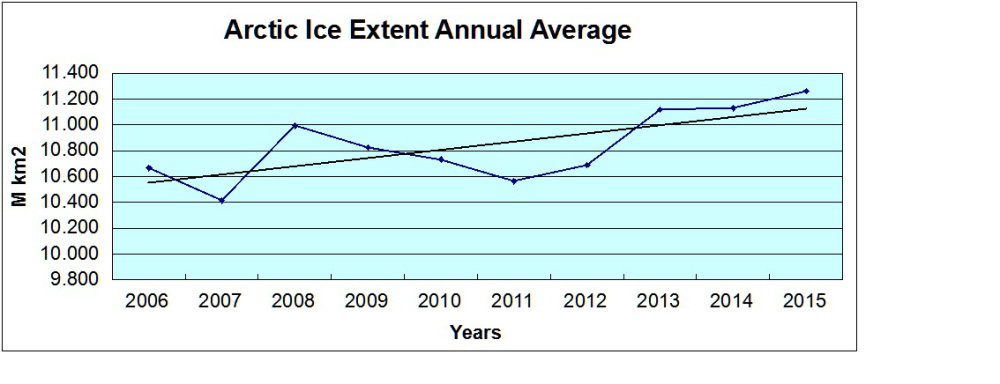
GWPF-masie-annual

MASIE has very helpfully provided their records for the last ten years. Since stormy weather can affect both maximum and minimum ice extents, emphasis on March and September averages can be misleading. From a climate change perspective, a better metric is the average ice extent over the entire year. By that measure we gain a realistic perspective on the last ten years of Arctic ice fluctuation.

Actually we don’t Ron, for a number of reasons. For example Chris Reynolds summarises your “better metric” as follows:

Claims that there is no ongoing deterioration in Arctic sea ice are totally unfounded, and it is safe to ignore those making such claims as being unreliable due to their lack of grasp of the subject.

whilst “Tamino” points out that:

The data used, from MASIE, doesn’t start until 2006. Which makes it downright bizarre to use this for studying climate, for two reasons. First, we have data (passive microwave from satellites) covering quite a bit more time — starting in late 1978. Second, the MASIE people themselves tell you that their product isn’t the best for climate studies, instead you should use that passive microwave data from satellites.

If you download the data that “MASIE has very helpfully provided” and plot the self same graph so proudly displayed by the GWPF you will see something that looks a lot like this:
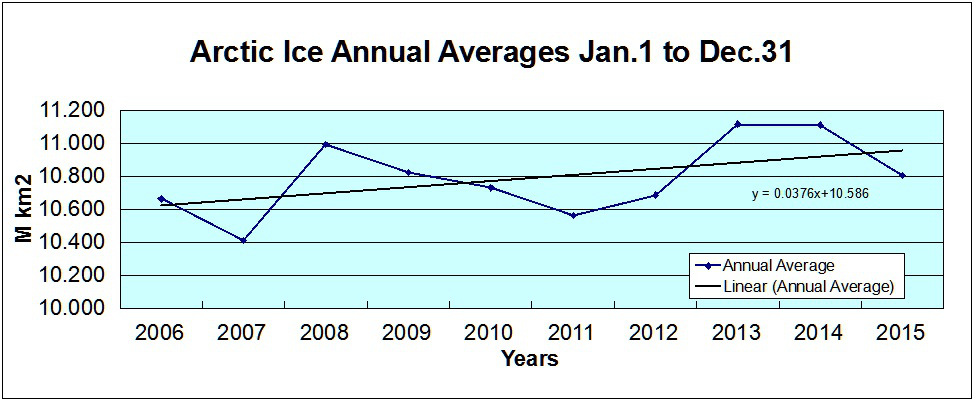
GWPF-masie-day-2015365

Amazingly enough this graph is taken from a more recent article by Ron Clutz, also reproduced in part on the Global Warming Policy Forum’s web site. This one is dated 2nd January 2016 and entitled “Happy Arctic Ice Year!“. Ron claims that:

Arctic ice declined in the decade prior to 2007, but has not declined since. What we have seen in the last decade is a plateau in Arctic ice extent, analogous to the plateau in surface temperatures. This year end report shows there is no reason to worry about Arctic ice melting.

For some strange reason the GWPF have thus far not corrected the extract from Ron’s earlier article on their web site, and neither has Mr. Clutz. For some other strange reason he hasn’t gotten around to publishing my comment to his article pointing him and his loyal readers to this graph which is also derived from the MASIE data, and neither have the GWPF:
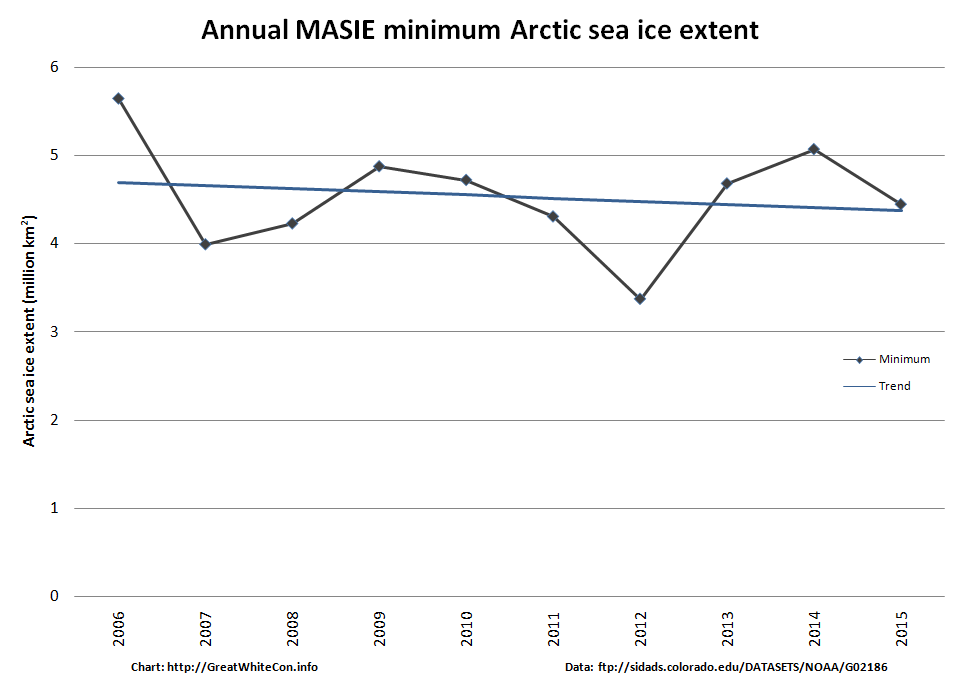
MASIE-Min

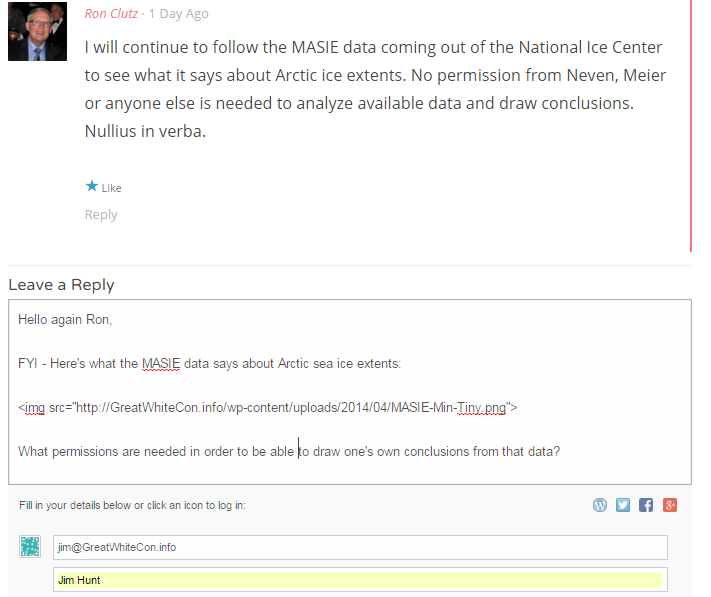
It’s not as though I haven’t tried! See for example:
Selection_608

I’m not the only one to have my constructive criticism censored by Ron Clutz recently. Neven, proprietor of the Arctic Sea Ice Blog, reports over there that:

He’s deleting my comments again (and his own comments to wipe out traces of the fact, which is a cowardly act), so I’m just posting the comments here for reference.

I’ll conclude for the moment with some more words from Chris Reynolds. Someone who, unlike Ron Clutz and the other GWPF Arctic article authors (GWPFAAA for short), has a grasp of physics:

Ice state in the Peripheral Seas region is a critical metric in determining whether the Arctic Ocean’s ice pack is indeed stabilising or recovering.

Here is a plot of compactness for late summer in the Peripheral Seas from 1979 to 2015, where late summer is the seven day average centred on 31 August.

Here’s the accompanying graph:

Nullius in verba, as the GWPF don’t put it.


[Edit – February 18th 2016]

I have recently exchanged a few emails about this issue with Dr. Benny Peiser, who is Director of the Global Warming Policy Forum. However Benny has suddenly gone strangely silent, so here is a transcript of the “debate” thus far:

Us:

Hello Benny,

Thanks for your time in our telephone conversation just now.

In brief, here are my alter ego’s initial quibbles about the GWPForum’s recent Arctic coverage:

and

Please do not hesitate to ask if you require any additional information!


Them:

Dear Mr Hunt

I wonder whether you have any comments regarding the latest PIOMAS data which appear to show a pause in the Arctic sea ice melt in recent years?

With best regards


Us:

Hello Benny,

All in the fullness of time. First of all though, I am waiting to hear your comment(s) on the points I raised in my original email. Here’s where those “Tweets” finish up:

https://greatWhiteCon.info/2016/02/the-great-global-warming-policy-forum-con/

To reiterate, as numerous people pointed out to Mr. Clutz following his first article, MASIE is not fit for the purpose to which he (and hence the GWPF) put it.

To add insult to injury the first MASIE based graph he (and hence the GWPF) published is wildly inaccurate and misleading, and has still not been corrected.

I still eagerly await your comment(s) on this matter,


Them:

Dear Mr Hunt

If I understand you correctly you claim that

1. MASIE is not fit for the purpose to assess Artic sea ice extent, and

2. Arctic sea ice has actually decreased since 2007 — contrary to claims that Arctic ice has not declined in the last 8 years.

I have looked into your first claim and cannot find any information that undermines the reliability of MASIE data for Arctic sea ice analysis.

Regarding your second criticism, the latest PIOMAS data appear to confirm Mr Clutz’s main point, i.e. Arctic ice has remained fairly stable since 2007.

Yours sincerely


Us:

Hello again Benny,

Thank you for your swift response to my most recent email. I fear that you totally misunderstand me. Regarding your numbered points:

1) Did your due diligence include reading this section of the NSIDC web site concerning MASIE?

https://nsidc.org/data/docs/noaa/g02186_masie/index.html

Can you see the parts where it says?

MASIE may look like several other sea ice products distributed at NSIDC and elsewhere, but its source data and intended uses are different.

Operational ice charts meet the needs of those going into the ice and provide general situational awareness, such as the extent of fast ice or of ice of any concentration greater than zero percent.

If one is interested in long-term trends in sea ice or how it responds to changing climate forcing, generally, it is best not to use an operational product, but rather one that is consistently produced and retroactively quality controlled.

Do you understand what that means? If not please do not hesitate to ask!

2) Where on Earth did you get that idea from? Here’s what I said once again:

The first MASIE based graph [Ron Clutz] (and hence the GWPF) published is wildly inaccurate and misleading, and has still not been corrected.

To see what I mean all you have to do is compare it to the second MASIE based graph [Ron Clutz] (and hence the GWPF) published.


Them:

Dear Mr Hunt

I’m afraid you have not addressed my points.

There is nothing wrong with the MASIE data, in particular not when it comes to short-term data sets (although I agree that it should not be used for any trend analysis).

You did not answer the key question: where is the evidence (as suggested in your graph) that Artic sea ice has declined since 2007?

Yours sincerely


Us:

Hello Benny,

I’m afraid that in actual fact it is you who have not addressed my points. Let me take you through them slowly once again. Once you’ve understood the first two rest assured there are more.

1 a) According to the NSIDC, MASIE is not a “short-term data set”, it is an “operational ice chart”.

1 b) In addition, please feel free to search the NSIDC web site for any graph based on the Arctic Ice Annual Average of any metric whatsoever, and let me know what you discover

2) Let’s play “Spot the difference” shall we? Please let me know what differences (if any) you can find between this graph:

GWPF-masie-annual

and this one:

GWPF-masie-day-2015365

Thanks in anticipation,


[Edit – February 19th 2016]

Us again:

Not having heard from Benny for a while we thought it polite to enquire after his health this morning:

Dear Benny,

I’ve received nothing back from you since your email of 15:22 on the 16th. Are you OK? If there’s anything we can do to help please do get in touch.

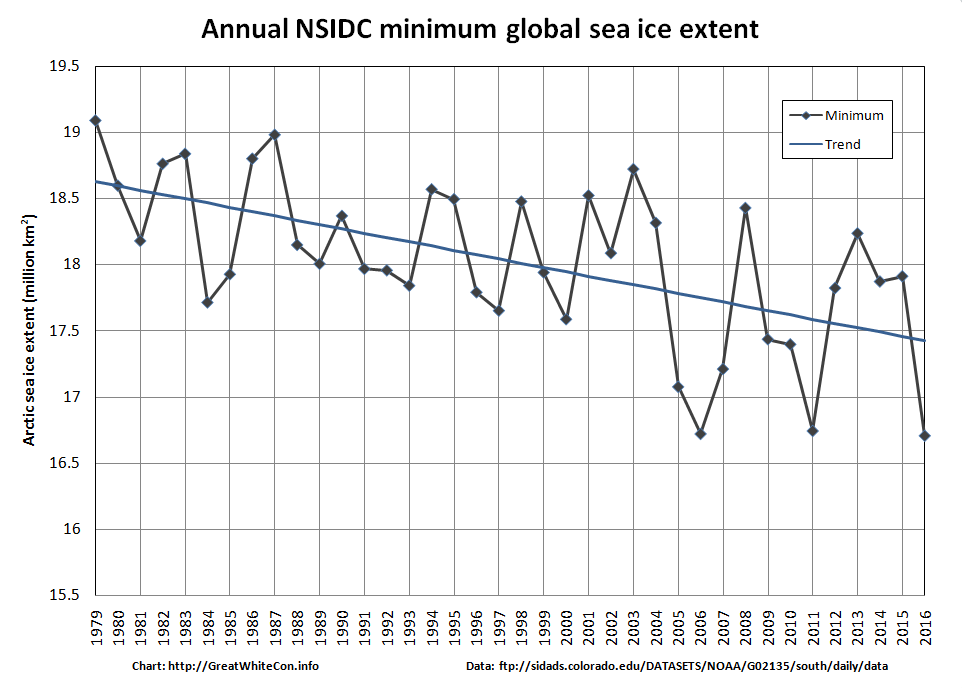
We have some interesting news about which we’d love to know your opinion, as soon as you feel up to it of course. First of all, the NSIDC’s global sea ice extent metric fell to the lowest level *ever yesterday:
Global-Extent-2016-02-18

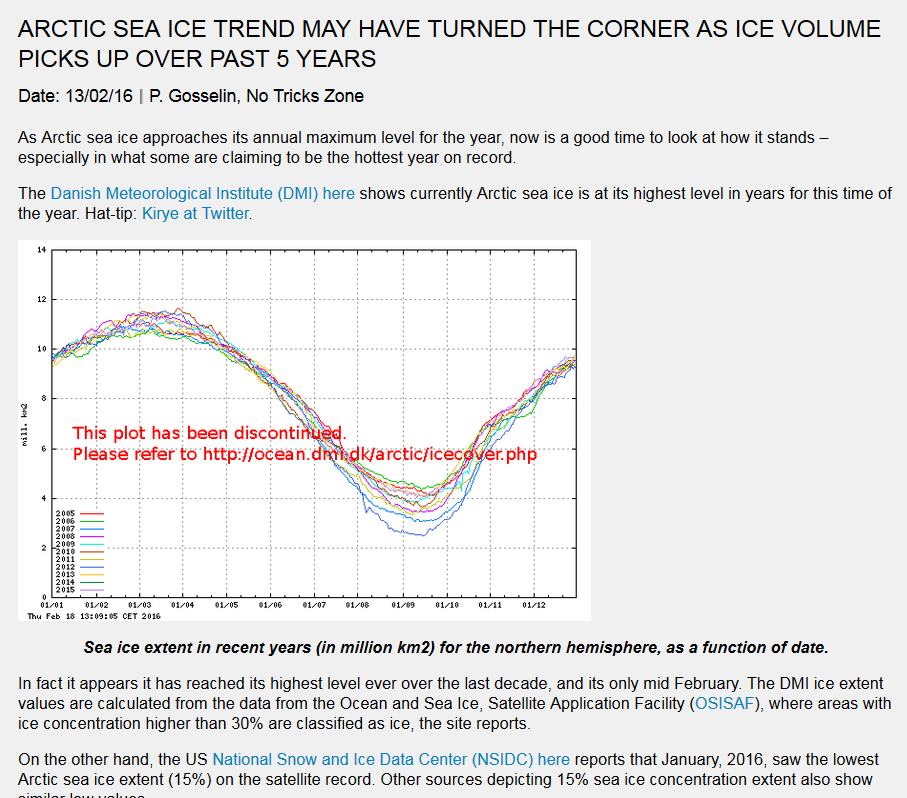
Secondly, are you aware that the February 13th article on the GWPF web site by Pierre Gosselin entitled “Arctic Sea Ice Trend May Have Turned The Corner As Ice Volume Picks Up Over Past 5 Years” currently looks like this?
2016-02-19_1140-GWPF-DMI

Get well soon,


Them:

Dear Mr Hunt

Thank you for your latest concern about global sea ice extent

I suggest to monitor global sea ice extent in the next 12 months to see whether the usual recovery fails to materialise (see graph below).


Us:

Dear Dr. Peiser,

I’m delighted to discover that you are evidently in fine fetttle!

I am however afraid that your image is invisible at this end, although it appears to emanate from somewhere on the WUWT sea ice page.

First of all can you possibly resend it?

Secondly I highly recommend that you peruse the GWC sea ice resources instead of Mr. Watts’ in future.

Thirdly will you please fix the wide variety of gross inaccuracies concerning Arctic sea ice that still exist on the Global Warming Policy Forum web site, even after they have been brought to your attention on numerous occasions. For your further information please see also:

https://greatWhiteCon.info/2016/02/global-sea-ice-extent-at-lowest-ever-level/#comment-213484

Best wishes,


[Edit – February 23rd 2016]

Us:

Good day Benny,

I trust that you had a pleasant weekend?

I note that the GWPF webmaster has still not corrected even the most egregious of Ron Clutz’s errors republished on the GWPF web site in the following article:

http://www.thegwpf.com/arctic-ice-recovering/

I further note that you have also now republished this article authored by Paul Homewood:

http://www.thegwpf.com/maisie-confirms-arctic-sea-ice-remaining-stable-in-february/

which amongst other errors contains the following insinuation:

“MAISIE, of course, only goes back to 2006, whereas the sea ice index dates to 1979. It is, however, easy to see why NSIDC are keen to use the latter as a starting point!”

This is of course inaccurate, as I have personally pointed out to Paul on several occasions in the past. The NSIDC themselves have this to say on the matter:

“The Sea Ice Index provides a quick look at Arctic- and Antarctic-wide changes in sea ice. It is a source for consistent, up-to-date sea ice extent and concentration images, in PNG format, and data values, in ASCII text files, from November 1978 to the present.

The images and data are produced in a consistent way that makes the Index time-series appropriate for use when looking at long-term trends in sea ice cover.”

When do you suppose the GWPF webmaster will be able to get around to correcting the latest piece of Arctic misinformation to be published on your web site?

Best wishes,


Us again:

Good morning Benny,

I note that the GWPF webmaster has still not taken on board any of the helpful advice I have proffered over the last few weeks, and has now posted some inaccurate information about “global warming”. Will he or she never learn?

Sticking with our own speciality, please feel free to “print” Snow White’s prediction that CT global sea ice area will post yet another new record of around 14.22 million square kilometers over the next 2 to 3 days.

I followed Ron Clutz’s recent suggestion on Paul Homewood’s blog to “Take it up with Walt Meier”. I interviewed Dr. Meier yesterday and this is what he told me:

https://greatWhiteCon.info/2016/02/dmi-masie-and-the-sea-ice-index-an-interview-with-walt-meier/

Perhaps it is now time to hand your current webmaster their cards and hire a new one?

Best wishes,


[Edit – March 4th 2016]

Us once again:

Hello again Benny,

It seems that your new webmaster has yet to republish the latest product of the Clutz/Homewood porky pie production line! Please pass on our congratulations on their perspicacity. However the latest article on The GWPF web site by David Whitehouse has this to say:

“Is the global warming pause over for good — or will it continue once the current El Nino dies down?”

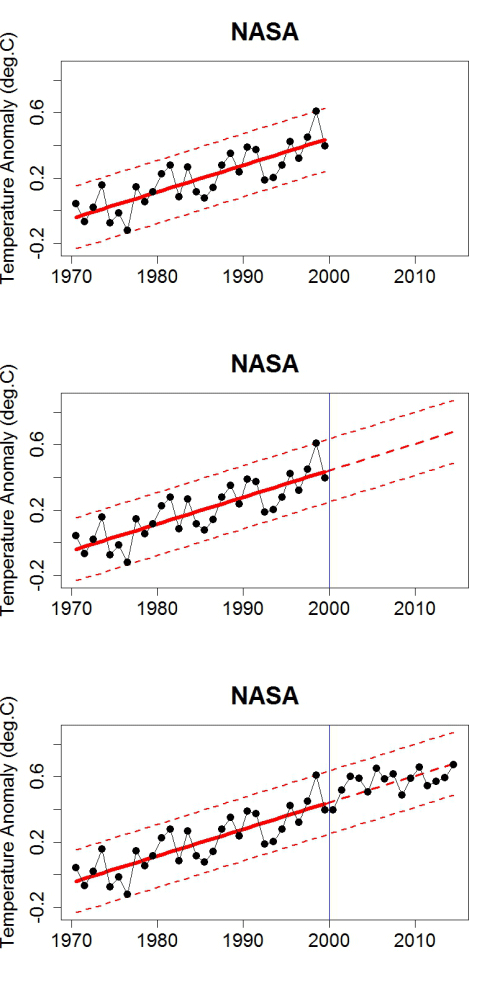
Does Dr. Whitehouse not realise that there was no “pause”?
There is no "pause"!

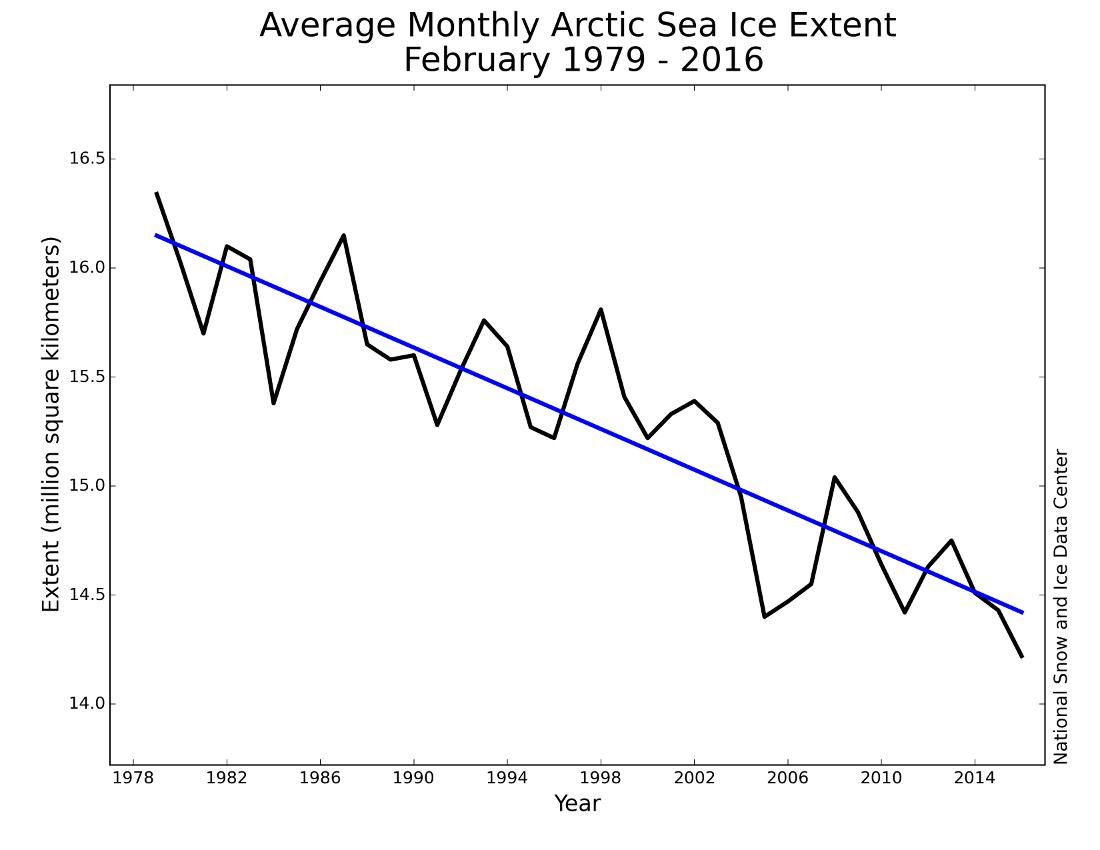
For your, and Dr. Whitehouse’s, information here is the latest report from the NSIDC on Arctic sea ice extent:
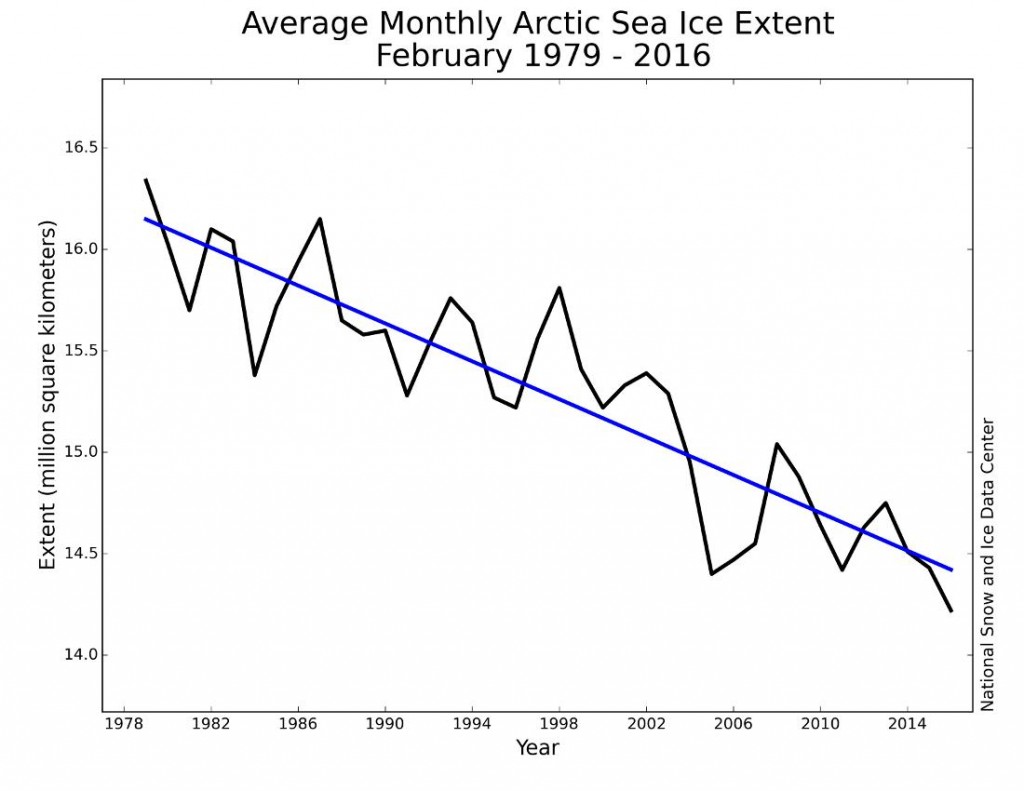
NSIDC February 2016 monthly Arctic sea ice extent

With a new webmaster in charge at The GWPF can we now anticipate an accurate Arctic article appearing on your web site? Please do not hesitate to ask if you would like to republish one of mine.

Best wishes,


[Edit – April 4th 2016]

Us once again:

Hello again Benny,

I hope this finds you well? I have been doing as you suggested! Consequently I could not help but notice that you have not been doing what I suggested, and have instead recently republished a large extract from yet another article by Paul Homewood on the topic of Arctic sea ice:

http://www.thegwpf.com/more-of-the-usual-hype-about-arctic-ice/

Needless to say this one is also downright misleading. For your information, here are the actual facts:

Claim – Arctic Sea Ice Holds Firm?

and

More Of The Usual Hype About Arctic Sea Ice

It looks like you’ll have to let another webmaster go, does it not? Don’t forget to tell the new one that my offer of an authoritative Arctic article still stands.

Best wishes,


Them:

We’ll keep you posted!
 

Is the Northwest Passage Open Yet?

People keep on posing that question just at the moment. Here’s a typical example from the Arctic Sea Ice Blog this morning:

Albeit not ‘officially’ declared as such, the daily Uni-Bremen chart shows Amundsen’s route is cleared and free now.

Here’s an extract from the “Daily Uni-Bremen chart” referred to, with an apparently “ice free” section of the southern route through the Northwest Passage highlighted:

asi-AMSR2-n6250-20150813-hilite

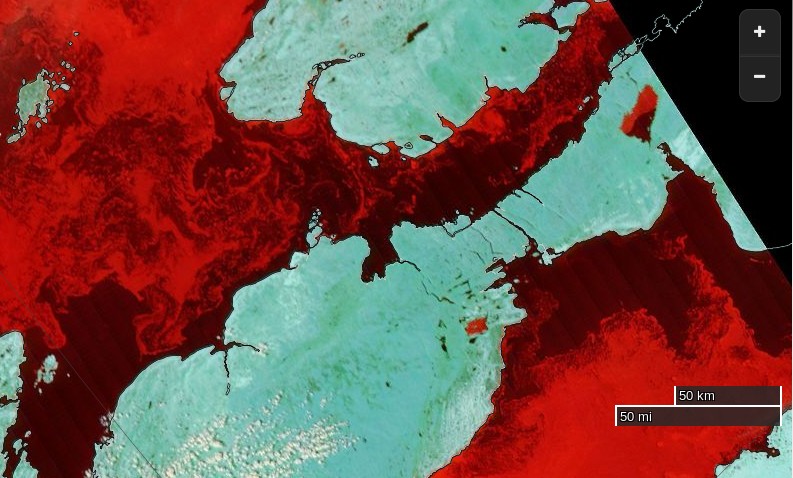
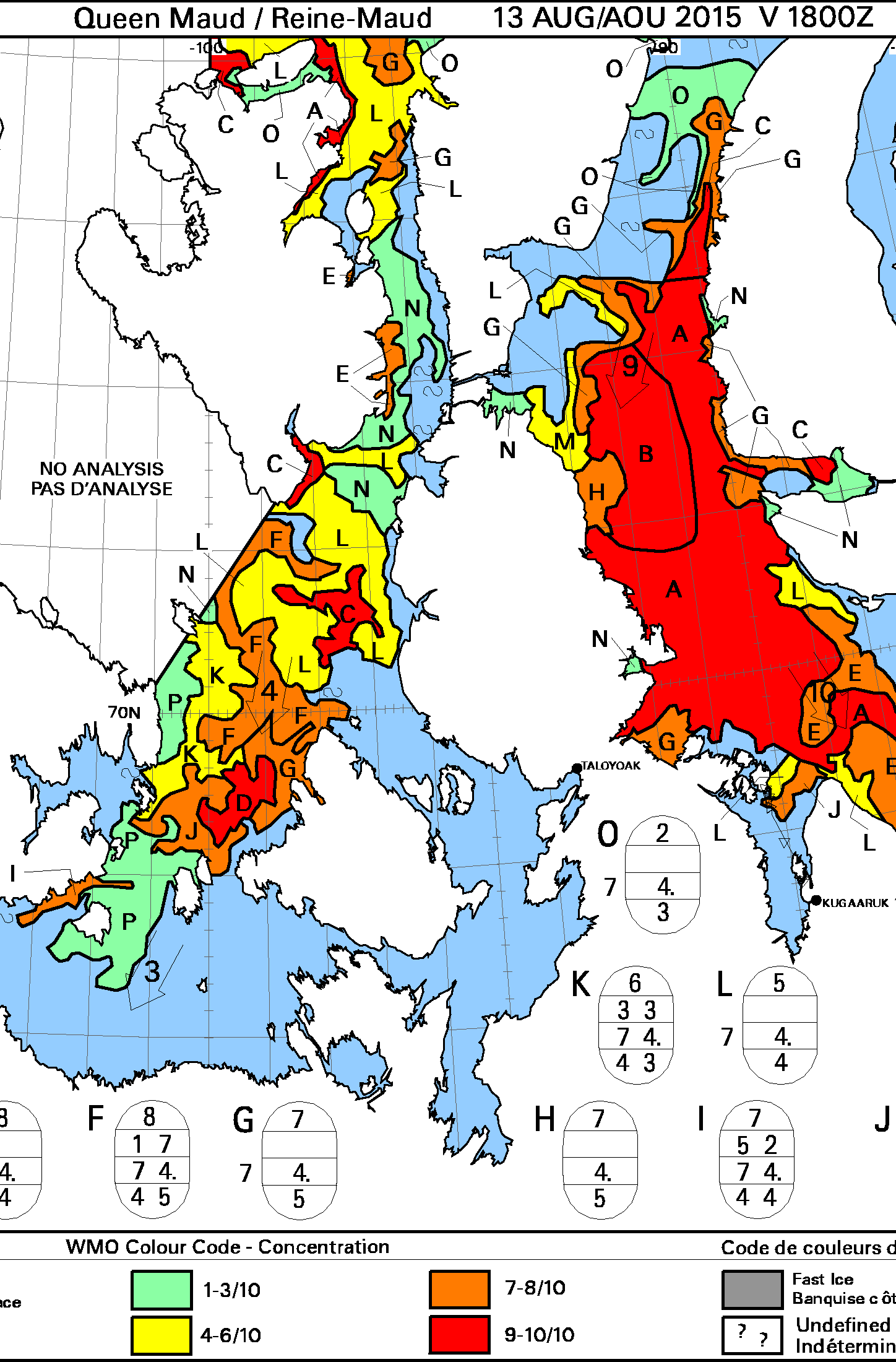
As we’ve been discussing here recently, the automated passive microwave based satellite Arctic sea ice concentration products can miss ice that’s visible to the naked human eye. Here’s some pictures from the Great White Con Northwest Passage page:

NASA Worldview “false-color” image of the Northwest Passage on August 13th 2015, derived from bands 7, 2 and 1 of the MODIS sensor on the Terra satellite

The Canadian Ice Service sea ice concentration chart for the Queen Maud Gulf on August 13th 2015

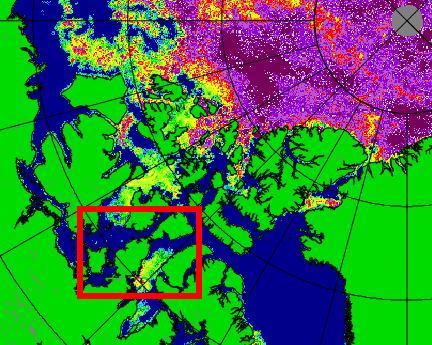
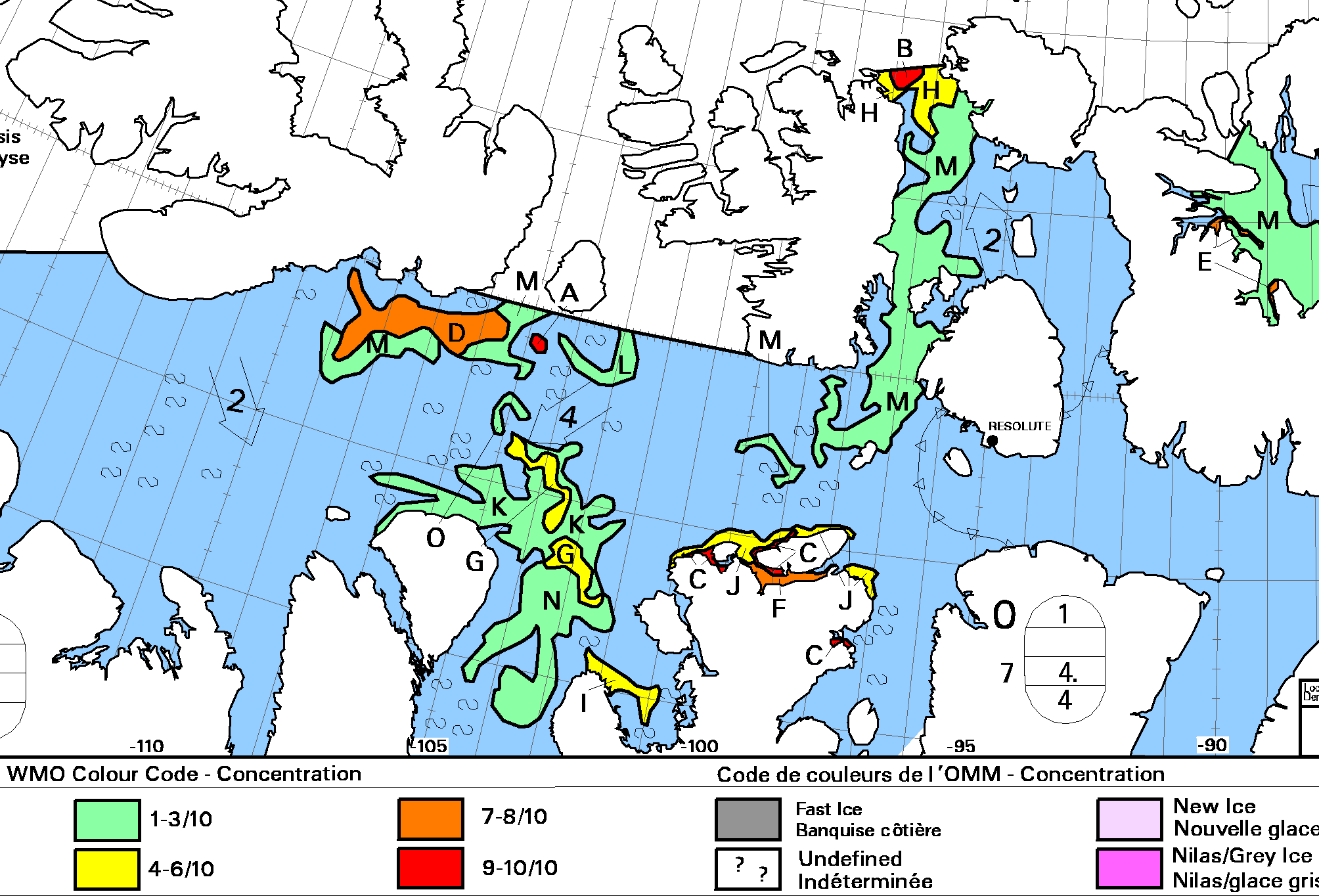
Here’s an extract from the NSIDC’s Multisensor Analyzed Sea Ice Extent (MASIE) product (currently for August 12th 2015):

masie_all_r00_v01_2015224_crop

and here’s an extract from an answer I gave to a similar question on the Arctic Sea Ice Forum earlier this morning:

The Canadian Ice Service still have 4-6/10 ice within a whisker of the coast. Would you fancy your chances in amongst that and a bit of a breeze?

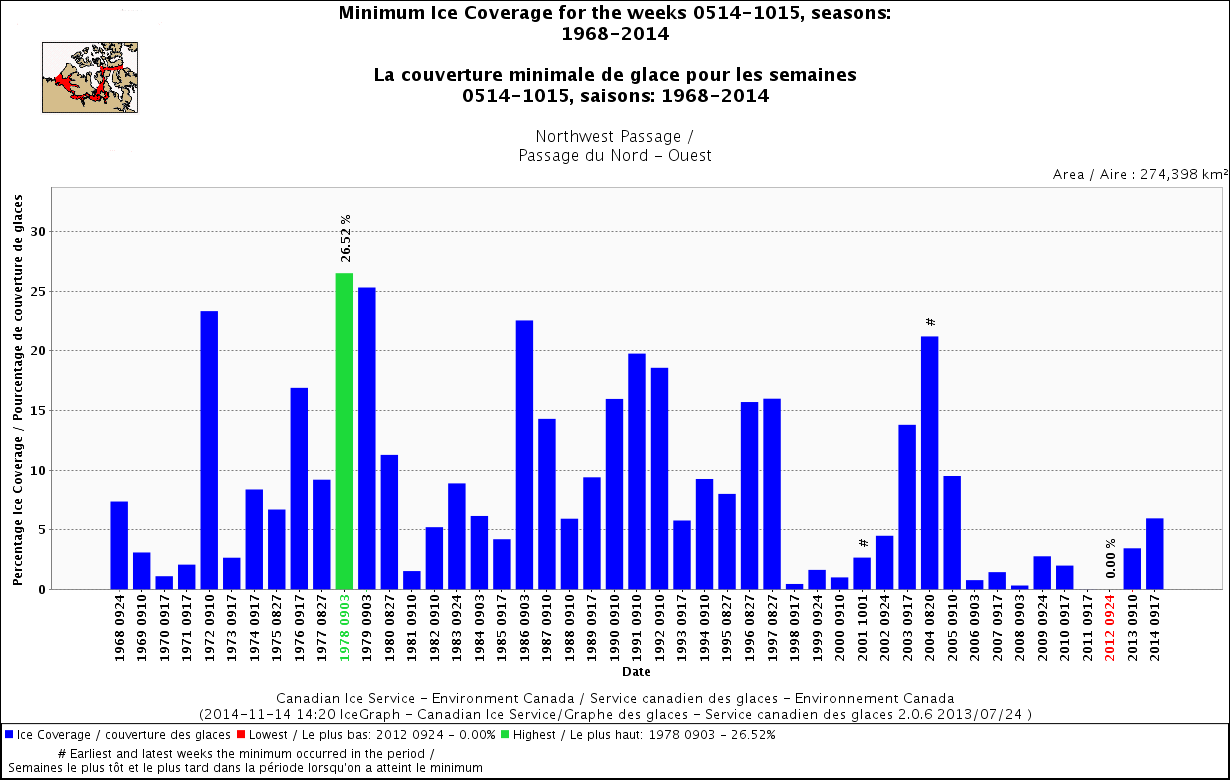
The CIS definition of “navigable” is “a criteria of less than 60% ice cover over all sections of the Northwest Passage”. See:

http://ec.gc.ca/glaces-ice/default.asp?lang=En&n=765F63E4-1

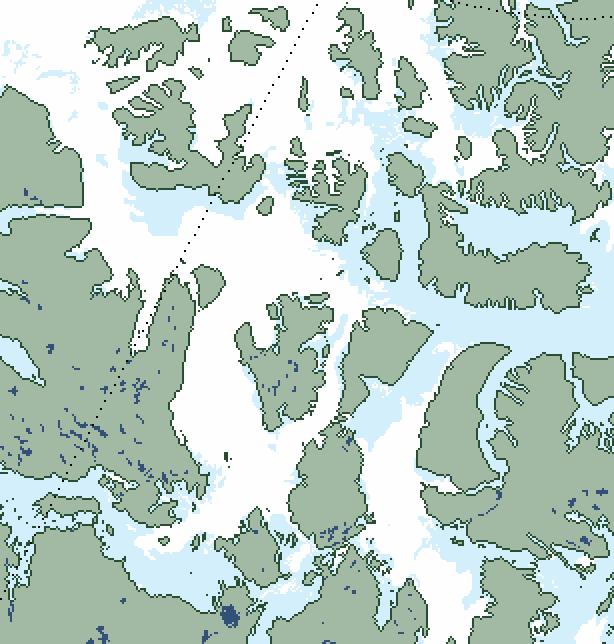
and the inset map at:

CIS-NWP-MinConc-2014

The answer to the question posed in the title to this article is therefore currently NO, the Northwest Passage is not open yet, both officially from the CIS and unofficially from any mariner with a sense of self preservation in charge of any vessel that isn’t “ice hardened”. In all the circumstances that answer might change quite quickly though!

[Edit 18/09/15]

The Canadian Ice Service have finally published a close up map of the Parry Channel that doesn’t say “No Analysis”. Here it is:

CIS_Parry_20150917-Crop

There’s still a (narrow!) green path into McClure Strait, so I reckon we can at long last confidently declare the main Northwest Passage to be OPEN!