The Fifth US National Climate Assessment was published in November 2023 during the Biden/Harris administration. Here’s the announcement by Zeke Hausfather on X/Twitter:
After three years of work by a team of over 750 scientists, we are releasing the US 5th National Climate Assessment today!
We see greater impacts of climate change on the US since the 2018 NCA4 report, but also some encouraging signs of progress.https://t.co/2WZOLOXoKo
The Global Change Research Act of 1990 mandates that the US Global Change Research Program (USGCRP) deliver a report to Congress and the President not less frequently than every four years that “integrates, evaluates, and interprets the findings of the Program and discusses the scientific uncertainties associated with such findings; analyzes the effects of global change on the natural environment, agriculture, energy production and use, land and water resources, transportation, human health and welfare, human social systems, and biological diversity; and analyzes current trends in global change, both human-induced and natural, and projects major trends for the subsequent 25 to 100 years.”
You may well have noticed that Kamala Harris lost the subsequent election? Hence the Sixth US National Climate Assessment will be prepared during the term of the current Trump/Vance administration.
Regular readers will recognise some or all of those names, and it will not surprise you to learn that there was plenty of pushback from a wide range of climate scientists. In particular, the “Climate Experts’ Review of the DOE Climate Working Group Report“, led by Andrew Dessler and Robert Kopp was published at the end of September 2025. This report begins as follows:
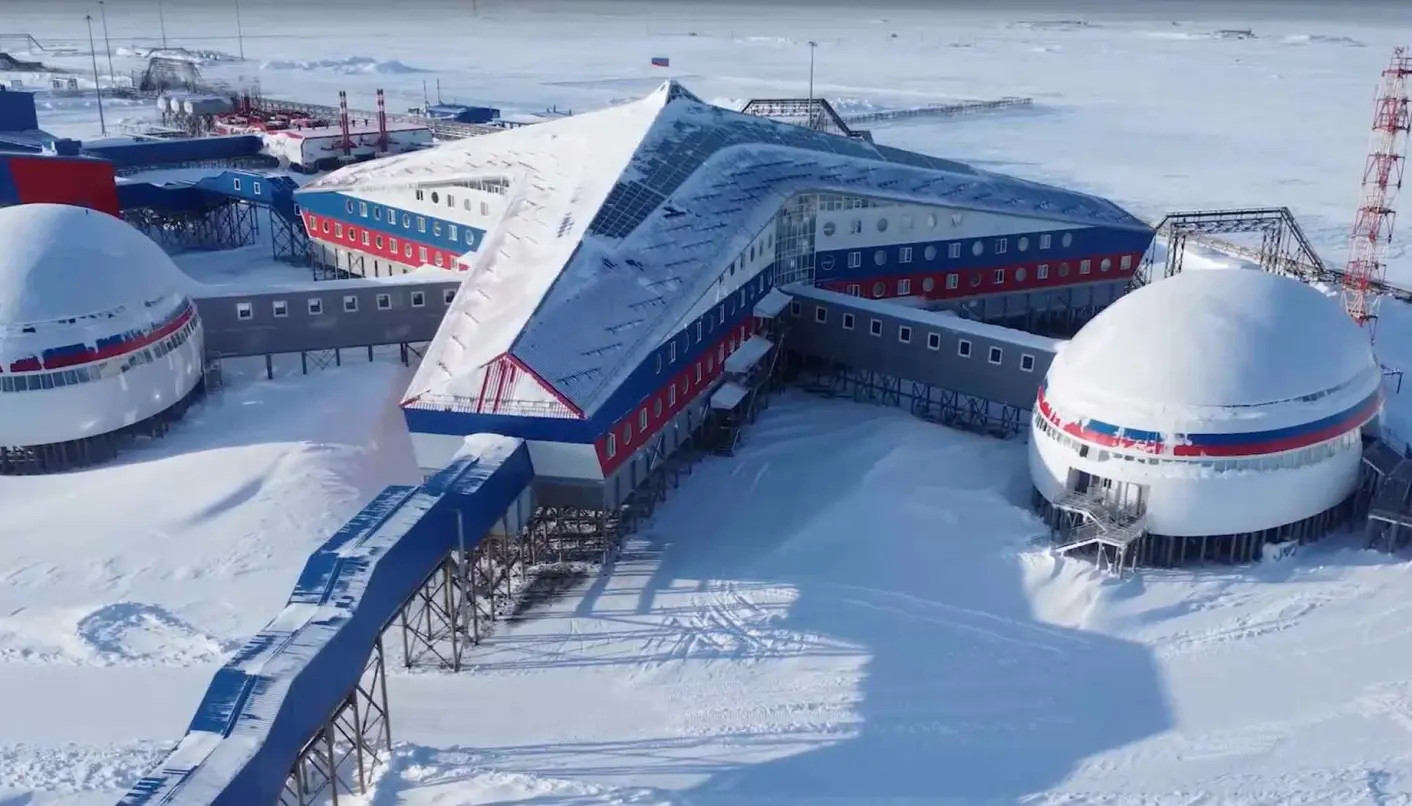
The United States seeks an Arctic region that is peaceful, stable, prosperous, and cooperative. Climate change is making the Arctic more accessible than ever, threatening Arctic communities and vital ecosystems, creating new potential economic opportunities. and intensifying competition to shape the region’s future. Russia has invested significantly in its presence in the Arctic over the last decade, modernizing its military infrastructure and increasing the pace of exercises and training operations. Its aggressive behavior has raised geopolitical tensions in the Arctic, creating new risks of unintended conflict and hindering cooperation. The PRC has also sought to increase its influence in the Arctic by rapidly increased its Arctic investments, pursuing new scientific activities, and using these scientific engagements to conduct dual-use research with intelligence or military applications.
The Nagurskoye military base on on Aleksandra Island in Franz Josef Land. Image via the Barents Observer
We will uphold U.S. security in the region by improving our maritime domain awareness, communications, disaster response capabilities, and icebreaking capacity to prepare for increased international activity in the region. We will exercise U.S. Government presence in the region as required, while reducing risk and preventing unnecessary escalation. Arctic nations have the primary responsibility for addressing regional challenges, and we will deepen our cooperation with our Arctic allies and partners and work with them to sustain the Arctic Council and other Arctic institutions despite the challenges to Arctic cooperation posed by Russia’s war in Ukraine. We will continue to protect freedom of navigation and determine the U.S. extended continental shelf in accordance with international rules. We must build resilience to and mitigate climate change in the region, including through agreements to reduce emissions and more cross-Arctic research collaboration. As economic activity in the Arctic increases, we will invest in infrastructure, improve livelihoods, and encourage responsible private sector investment by the United States, our allies, and our partners, including in critical minerals, and improve investment screening for national security purposes. Across these efforts, we will uphold our commitment to honor Tribal sovereignty and self-governance through regular, meaningful, and robust consultation and collaboration with Alaska Native communities.
By way of contrast the Trump Administration’s document makes no mention of the Arctic or Alaska or even Greenland. It does, however state that:
After years of neglect, the United States will reassert and enforce the Monroe Doctrine to restore American preeminence in the Western Hemisphere, and to protect our homeland and our access to key geographies throughout the region. We will deny non-Hemispheric competitors the ability to position forces or other threatening capabilities, or to own or control strategically vital assets, in our Hemisphere. This “Trump Corollary” to the Monroe Doctrine is a common-sense and potent restoration of American power and priorities, consistent with American security interests.
Specifically regarding Europe the 2025 Security Strategy has this to say:
Continental Europe has been losing share of global GDP—down from 25 percent in 1990 to 14 percent today—partly owing to national and transnational regulations that undermine creativity and industriousness.
But this economic decline is eclipsed by the real and more stark prospect of civilizational erasure. The larger issues facing Europe include activities of the European Union and other transnational bodies that undermine political liberty and sovereignty, migration policies that are transforming the continent and creating strife, censorship of free speech and suppression of political opposition, cratering birthrates, and loss of national identities and self-confidence. Should present trends continue, the continent will be unrecognizable in 20 years or less. As such, it is far from obvious whether certain European countries will have economies and militaries strong enough to remain reliable allies. Many of these nations are currently doubling down on their present path. We want Europe to remain European, to regain its civilizational self-confidence, and to abandon its failed focus on regulatory suffocation.
At this juncture Russia does at last receive a mention:
This lack of self-confidence is most evident in Europe’s relationship with Russia. European allies enjoy a significant hard power advantage over Russia by almost every measure, save nuclear weapons. As a result of Russia’s war in Ukraine, European relations with Russia are now deeply attenuated, and many Europeans regard Russia as an existential threat. Managing European relations with Russia will require significant U.S. diplomatic engagement, both to reestablish conditions of strategic stability across the Eurasian landmass, and to mitigate the risk of conflict between Russia and European states.
There is no mention of any risk of conflict between Russia and the United States, in the Arctic or anywhere else on Planet Earth.
The whole document is worth a long look, but here is a brief extract:
Russia has a larger Arctic military presence and ice-breaking capability than other Arctic states, and has embarked on a substantial rebuilding of Soviet-era military infrastructure in the region. Nevertheless, Russian influence efforts seek to depict US and NATO activity in the Arctic as provocative and destabilizing, in contrast with casting Russia’s military presence as routine and defensive. For example, since 2024, state media has covered NATO “flexing its muscles” with exercises in Finland on “Russia’s Arctic doorstep” and featured Kremlin officials’ promises to protect Russia’s Arctic interests from “NATO’s expansionist ambitions,” while a known proxy site warned of “steps towards the Arctic war.” These narratives have found renewed salience since 2025 amid public calls from US President Trump for Greenland to join the United States.
We have previously mentioned the Wall Street Journal’s assorted activities promoting the new book by Steven E. Koonin which possesses the rather long winded title of “Unsettled: What Climate Science Tells Us, What It Doesn’t, and Why It Matters.”
We further speculated that assorted things that climate science tells us which Dr. Koonin neglected to mention in his book would also not appear in moving pictures expounding his “message”. That has indeed proved to be the case. You can see a copy of the book in question handily placed on a bookshelf behind Steve Koonin in this interview with Paul Gigot for the Wall Street Journal:
By way of introduction Paul enquires:
What isn’t settled in your mind?
Steve responds:
What isn’t settled is how the climate is going to respond to growing human influences, and how that response will affect society and ecosystems.
A little later Paul asserts that:
There’s no question that fossil fuel extraction and burning adds carbon dioxide and methane and other things into the atmosphere. Is the issue just how the interactions work and how much warming they will cause? I mean Al Gore keeps telling us for example that if you look at the graph of CO2 emissions it’s going up, therefore there’s a direct correlation between that and temperature. I think you’re saying “that’s not true”?
to which Steve responds:
That’s not true! For example, when you look at the record global temperature went down between 1940 and 1970 even as greenhouse gases increased. That’s got to tell you immediately that things are a little more complicated than just greenhouse gases are warming the Earth.
So there you have it. Al Gore is a mere straw man, easily knocked down with a cherry pick without even bothering to mention any of the underlying science.
Paul moves on to mention in passing our favourite topic here at the Great White Con:
Now what about the idea that if we continue to warm you’re seeing all these consequence in terms of much more severe weather events, you’re seeing rising oceans, you’re seeing the melting of the polar ice caps. All of that sort of blends together into a kind of disastrous scenario. Are you saying that those are also just simply exaggerated?
Steve responds eagerly:
Yes they are! And let me give you some factoids.
Unsettlingly none of the factoids he gives us mention Arctic sea ice, a topic which Professor Koonin appears to be strangely ignorant of. Perhaps that’s because whichever way you try to slice and dice it that’s still the ultimately unavoidable giant canary in the climate coal mine?
[Edit – May 11th]
Needless to say Steve Koonin has also been interviewed by Tucker Carlson for Fox News. Needless to say the clip once again opens with a speech by that well known climate scientist, Joe Biden. Needless to say there is no mention of the giant canary in the Arctic coal mine once again. Tucker makes no reference to Greenland either, which does at least merit a mention in Steve’s book. Take a look:
Tucker opens his questioning with:
A hurricane will arise out of the Caribbean. We’ll have a heat wave. We’ll have a cold snap. All of them are attributed reflexively to climate change. How certain can we be that climate change causes those events?
Steve responds:
When you read the official reports from the UN and the US Government you find some surprises. For example, even though the globe has warmed by about 2 degrees Fahrenheit over the last century the incidence of heat waves across the 48 states is no greater than it was in 1900, and the highest temperatures haven’t gone up in 60 years.
We have been able to find no detectable influence on hurricanes from humans, and the models that we use to predict future climates have become more uncertain even as they’ve become more sophisticated. All of these things suggest that people who say that “we’ve broken the climate” and face certain doom unless we take drastic action are just misinformed about what the official reports actually say.
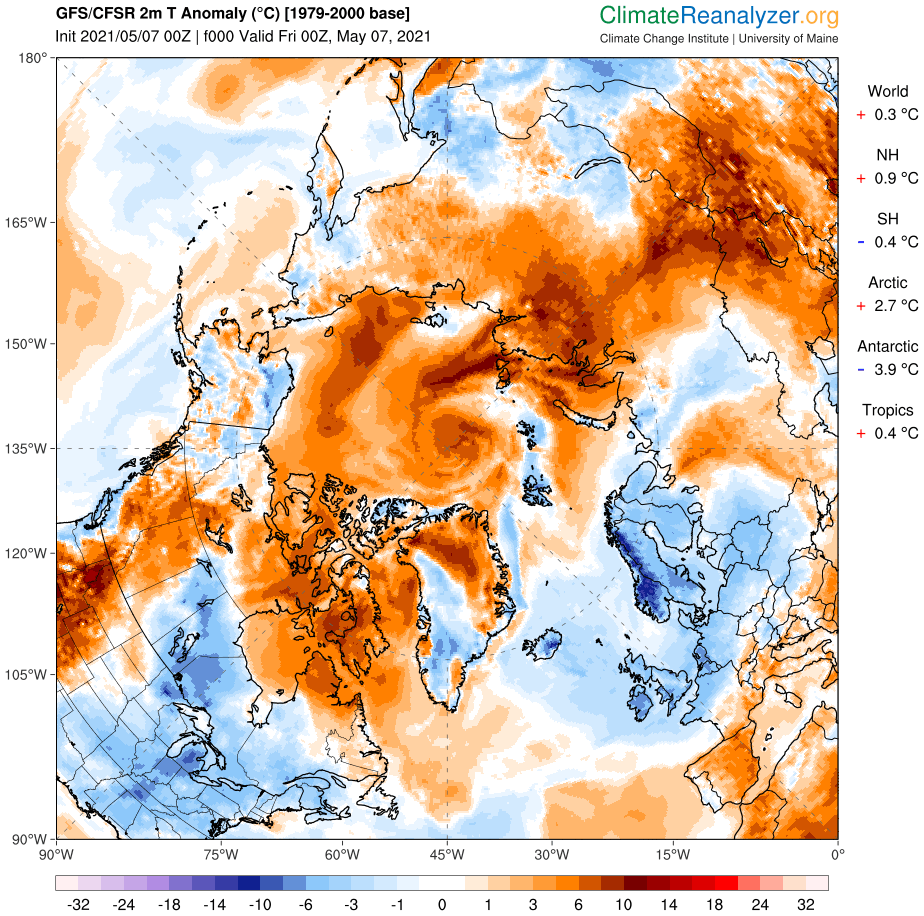
Despite the fact that Fox display some stock footage of sea ice during the interview, Tucker and Steve seem strangely unaware that those 48 states do not constitute the entire globe, or that there was a 2.7 degrees Celsius “heat wave” in the Arctic even as the interview was being conducted:
A little later in the interview Steve says:
We need to have an accurate portrayal of what we know and what we don’t know, and then we can have the debate about what to do about it, without using science as a weapon.
Sadly Steve seems strangely unaware that evidently you’re not going to get the accurate portrayal he recommends via Fox News!
[Edit – May 14th]
Steven Koonin has also been interviewed on CNBC’s Squawk Box, where Joe Kernen’s introduction gives you a strong flavour of what’s to come:
Corporations are spending billions to reduce their so called carbon footprint. President Biden’s infrastructure plan is loaded with subsidies for green industries. In fact if the new green deal ever was passed it wouldn’t be billions, it would be trillions.
Our next guest questions the conventional wisdom on climate science and it’s impact on business and the US economy. Steven Koonin served as the chief scientist in the Obama energy department, and is currently a professor at NYU and the author of “Unsettled: What Climate Science Tells Us, What It Doesn’t, and Why It Matters” :
Steve begins by assuring Joe’s audience that:
Everything I’ve written in this book comes almost directly from the official UN and US Government assessment reports, so this is not Steve talking really, but it is the consensus science.
For some strange reason Steve neglected to include the phrase “ignored and/or cherry picked” in front of “official UN and US Government assessment reports”. He then spouts his by now familiar schtick about “heatwaves in the US”, “hurricanes” and “global wildfires”. Joe then moves the conversation on to the economy:
Will there be an unnecessary negative effect on GDP, on corporations, if they pursue this when it’s not really necessary?
To which Dr. Koonin, as Joe calls him, responds:
I like to say you change the energy system by orthodonture rather than tooth extraction. And so if we do want to reduce carbon emissions we need to do it at a more thoughtful pace and in a more thoughtful way than is being proposed, and moreover we need to get the rest of the world to come along with us if it’s going to have any impact at all…
As [John] Kerry has said, unless the rest of the world comes along US efforts are futile.
So yet again no mention of the IPCC’s “consensus science” regarding Arctic sea ice or even the Greenland Ice Sheet. I cannot help but wonder where Steve’s talking head will appear next on United States’ viewers screens, but on past performance it seems unlikely that the cryosphere will merit a mention.
Our regular reader(s) will no doubt recall the good old days when several times each month an opportunity would present itself to debunk some “skeptical” nonsense from one or more of the usual suspects?
That all changed when Donald Trump was elected President of the United States. He was of course much more amenable to lobbying from fossil fuel interests than Barack Obama, and everything went (comparatively!) quiet.
Now that The Don has sailed off into the proverbial sunset and Joe Biden is top dog all that has changed. A return to the (not so) good old days comes as no surprise, and the porky pies have started coming off the denialospheric production line once again.
There have already been a few contrarian ripples on the surface of the climate science seas, which we may well come to in due course. However a set of substantial waves are now visible on the horizon. The proximate cause is the forthcoming summit of the G7 nations, which as luck would have it is taking place just down the road from the Great White Con winter holiday residence in North Cornwall. Then in November the COP26 conference is being held in Glasgow.
In June, Prime Minister Boris Johnson will welcome fellow G7 leaders to one of the most beautiful parts of the UK: Carbis Bay in Cornwall.
Other parts of the region will also play a key role in the Summit, including neighbouring St Ives, Falmouth and Newquay airport.
With over 400 miles of coastline, Cornwall’s stunning landscape provides a perfect setting for world leaders to come together and discuss how to respond to global challenges like coronavirus and climate change.
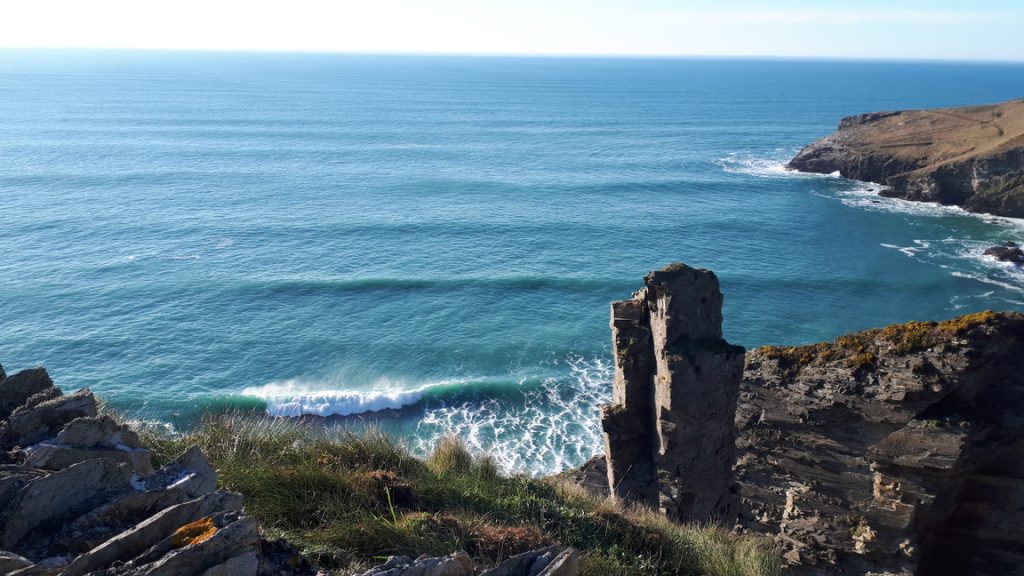
Here’s one of my recent pictures of some of that coastline, including part of Cornwall’s industrial heritage and some large waves!
Climate change is top of the G7 agenda along with Covid-19, and you can rest assured that vested interests will not miss any opportunity to promote those interests over the next two months and beyond. By way of example, one of our long standing “usual suspects”, Judith Curry, “tweeted” the following message to her followers on April 17th:
This website uses cookies to improve your experience. We'll assume you're ok with this, but you can opt-out if you wish. Cookie settingsACCEPT
Privacy & Cookies Policy
Privacy Overview
This website uses cookies to improve your experience while you navigate through the website. Out of these, the cookies that are categorized as necessary are stored on your browser as they are essential for the working of basic functionalities of the website. We also use third-party cookies that help us analyze and understand how you use this website. These cookies will be stored in your browser only with your consent. You also have the option to opt-out of these cookies. But opting out of some of these cookies may affect your browsing experience.
Necessary cookies are absolutely essential for the website to function properly. This category only includes cookies that ensures basic functionalities and security features of the website. These cookies do not store any personal information.
Any cookies that may not be particularly necessary for the website to function and is used specifically to collect user personal data via analytics, ads, other embedded contents are termed as non-necessary cookies. It is mandatory to procure user consent prior to running these cookies on your website.