Regular readers will have realised by now that we’ve been pestering the Mail and The Telegraph with telephone calls and emails for weeks now. That’s because, as The Economist put it last weekend:
There are climate facts—and facts are stubborn things.
Both The Mail and The Telegraph have now corrected a couple of the gross inaccuracies they printed (virtually and/or physically) on September 8th, but many more remain. One of those is the identical phrase in both articles saying:
An unbroken ice sheet more than half the size of Europe already stretches from the Canadian islands to Russia’s northern shores.
The fact of the matter is that this statement is untrue. I’ve recently received a couple of letters about this from “The Daily Telegraph” signed by “Robert Winnett, Head of News”. Here’s an extract from the first one:
Them:
Reputable evidence exists to show an unbroken ice sheet more than half the size of Europe already stretches from the Canadian islands to Russia’s northern shore. This can be seen on the National Snow and Ice Data Center’s website [in the article] “A Real Hole Near the North Pole“. The site states that the average ice extent for August 2013 was 6.09 million square kilometres, which is more than half the size of Europe.
Us:
Have I got news for you Robert! If you’d read any of the articles on here, or watched any of the videos I linked to in my emails, that wasn’t the “fact” I was quibbling about. The fact is that the Arctic “ice sheet” was not “unbroken” and did not “stretch… to Russia’s northern shore” on September 8th 2013 and for considerable periods of time both before and after that date. Here’s an extract from The Telegraph’s second letter:
Them:
In reply to your enquiry, the Telegraph’s policy is to correct clear inaccuracies once we are alerted to them – and in appropriate cases update articles on our website.
Us:
I thought I’d already made this perfectly plain, but evidently not, so here’s yet another alert about clear inaccuracies in the “reporting” of climate science in The Telegraph:
I just received an emailed letter from the Telegraph’s Head of News, part of which reads as follows:
The Telegraph has looked into the matters you raise. As far as the points concerning ice extent are concerned, the incorrect information was derived from data published by the National Snow and Ice Data Center (NSIDC). The mistaken information was due to a typographical error, which the NSIDC only corrected after the article that incorporated it was published. We have since updated the online versions of the article and explained why this was necessary.
There is no mention in the letter of any “updates” or “corrections” being put into print. The Telegraph are thus telling much the same story as the Mail, which is of course wholly unsatisfactory when it comes to correcting the long list of “inaccuracies and misrepresentations” they have recently published regarding the sorry state of sea ice in the Arctic. This is how they’ve done it:
There has been a 29 per cent increase in the amount of ocean covered with ice compared to this time last year, the equivalent of 533,000 square miles.
In a rebound from 2012’s record low, an unbroken ice sheet more than half the size of Europe already stretches from the Canadian islands to Russia’s northern shores, days before the annual re-freeze is even set to begin.
The Northwest Passage from the Atlantic to the Pacific had remained blocked by pack-ice all year, forcing some ships to change their routes.
One ship has now managed to pass through, completing its journey on September 27.
with the following additional “explanation” at the end:
Update: As at the date the article was first posted it relied on information about ice extent from the Nasa-funded National Snow and Ice Data Centre (NSIDC). This information contained a typographical error which the NSIDC subsequently corrected. The article has been amended in line with the correct information.
In addition, we have amended our reference to the Northwest Passage following the successful traverse, completed on September 27 after our article was published, of the Danish bulk carrier Nordic Orion.
Us:
Should The Telegraph’s Head of News be interested in some slightly stale Northwest Passage news, here’s a picture published on econnexus.org on September 4th in an article linked to below, which takes a close look at the “pack ice” supposedly “blocking the North West Passage” on that date:
Sea ice concentration in the Northwest Passage on September 4th 2013, according to AMSR2
Update: After this article was published, a bulk carrier – the MV Nordic Orion – was able to pass through the Northwest Passage on its way from Vancouver to Finland.
c) “That has been enough to make a mockery of a much-publicised prediction, six years ago, by Prof Wieslaw Maslowski, of the Naval Postgraduate School in Monterey, California, that the Arctic would be entirely ice-free by 2013”
Today we move on to the second sentence in David Rose’s article “this time last week”.
Them:
The rebound from 2012’s record low comes six years after the BBC reported that global warming would leave the Arctic ice-free in summer by 2013.
Us:
As you can see, the Mail article includes no references. Surely in this day and age an online article about such a controversial subject should at the very least include a few links? Hayley Dixon’s article for The Telegraph did at least manage to do that! I’ve asked David Rose via a number of different avenues where he got his information, and how he did his sums. I know he got at least one of the messages because he was browsing my profile on LinkedIn last week, but I have yet to receive any answer from him.
Groping in the dark I’ve tried to speculate about which BBC report in 2007 David is referring to. Perhaps it’s this one by Jonathan Amos entitled “Arctic summers ice-free ‘by 2013′”. Please note the quotation marks around the date. According to this article:
Professor Wieslaw Maslowski told an American Geophysical Union meeting that previous projections had underestimated the processes now driving ice loss.
[His] latest modelling studies indicate northern polar waters could be ice-free in summers within just 5-6 years.
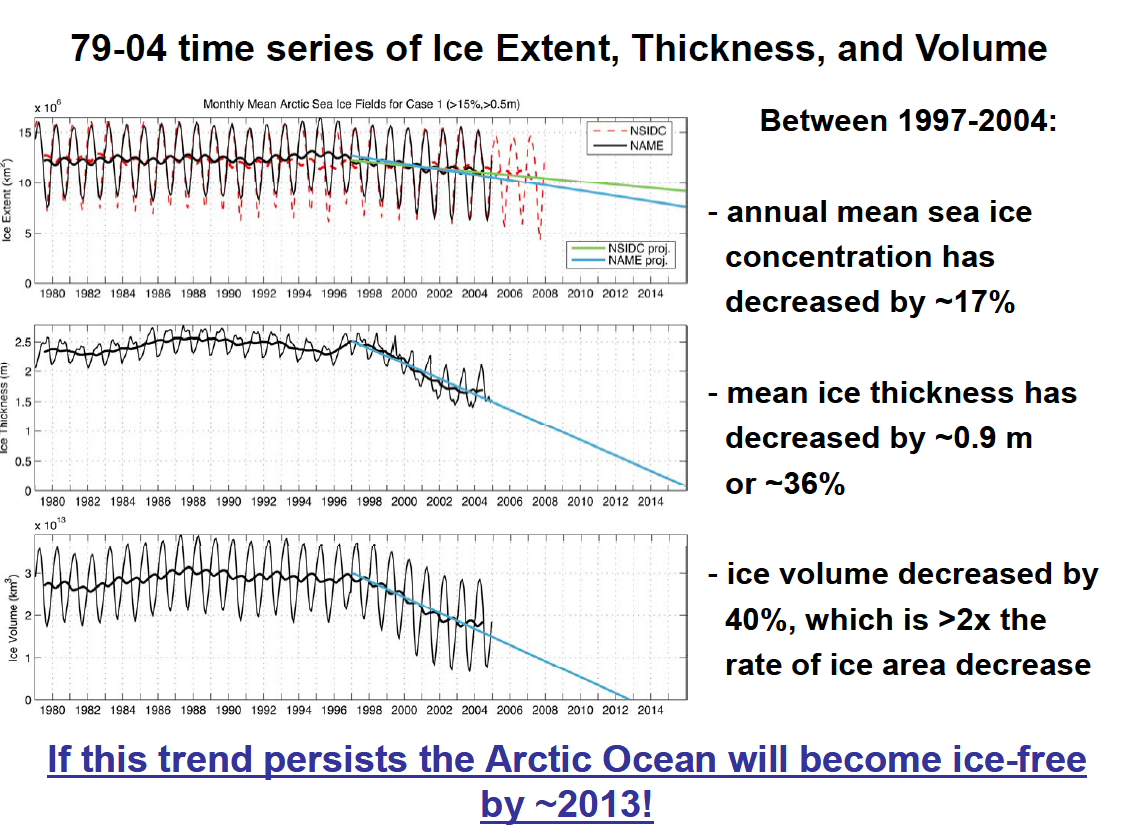
Instead of relying on what David Rose says Jonathan Amos says Wieslaw Maslowski said, why don’t we instead take a look at what Prof. Maslowski actually said. Here’s an extract from the slides he used when giving a presentation in Japan in the summer of 2008, when he’d had plenty of time to learn the lessons of the astonishing Arctic sea ice melt in the summer of 2007:
Wieslaw Maslowski says “if” and “around” in 2008
Note that he didn’t say words to the effect that “The Arctic will be ice-free in summer by 2013” as claimed by David Rose. What he actually said, and converting the mathematical symbol into plain English, was:
IF this trend persists the Arctic Ocean will become ice-free by AROUND 2013!
which is a very different thing. For those of you that would prefer to actually hear Prof. Maslowski convey that message himself, here’s a podcast from December 2007:
The interview lasts for about half an hour, and a full transcript is also available courtesy of Beyond Zero Emissions. You will note that what Wieslaw actually said was:
If we project this trend ongoing for the last 10 – 15 years, we probably will reach zero in summer some time mid next decade.
Verdict:
The evidence suggests that David Rose doesn’t research his sources properly, doesn’t understand English and doesn’t understand common mathematical symbols. Alternatively he understands all of that perfectly well, but chooses to misrepresent all of that to his loyal readership instead of educating them about the facts of the matter.
This website uses cookies to improve your experience. We'll assume you're ok with this, but you can opt-out if you wish. Cookie settingsACCEPT
Privacy & Cookies Policy
Privacy Overview
This website uses cookies to improve your experience while you navigate through the website. Out of these, the cookies that are categorized as necessary are stored on your browser as they are essential for the working of basic functionalities of the website. We also use third-party cookies that help us analyze and understand how you use this website. These cookies will be stored in your browser only with your consent. You also have the option to opt-out of these cookies. But opting out of some of these cookies may affect your browsing experience.
Necessary cookies are absolutely essential for the website to function properly. This category only includes cookies that ensures basic functionalities and security features of the website. These cookies do not store any personal information.
Any cookies that may not be particularly necessary for the website to function and is used specifically to collect user personal data via analytics, ads, other embedded contents are termed as non-necessary cookies. It is mandatory to procure user consent prior to running these cookies on your website.