Tag Archives: BBC

The British Broadcasting Corporation

The Great Global Warming Policy Forum Con

You may possibly be aware that here in the United Kingdom the charitable status of the so called “Global Warming Policy Foundation” was challenged in 2014. As the BBC reported in 2014:

Lawson’s climate-sceptic group hit by charity status row

The climate-sceptic Global Warming Policy Foundation is to relaunch in September, after a complaint about its charitable status.

The Charity Commission has forced it to divide into a charitable educational arm and a separately funded political arm.

The change follows a charge that the main purpose of the foundation is political, not charitable.

The foundation said its new structure would make it even more effective.

It aimed to continue to promote debate about the costs of tackling climate change, it added.

But the complainant had argued that its information was often misleading.

The Charity Commission will issue a formal statement on the changes in the coming weeks, but a spokesman told BBC News: “Some of the the Global Warming Policy Foundation’s activities breached what is expected of an educational charity, namely that the material lacked balance and promoted a particular line of opinion. An organisation will not be charitable if its purposes are political.”

The Charity Commission investigated the Global Warming Policy Foundation following a complaint by Bob Ward, a science communicator who works with Lord Stern’s climate change team at the LSE.

He also complained that the foundation breaches charity rules by “continually disseminating inaccurate and misleading information”.

As a consequence of all that brouhaha yet another organisation with an identical acronym was set up. The Global Warming Policy Forum (or GWPF for short). Would it surprise you to learn that the new “political” GWPF is “disseminating inaccurate and misleading information” about the Arctic? If so then please read on.

In an extract from an article by Ron Clutz dated 28th September 2015 and headlined “Arctic Ice Recovering – MASIE Proves Yearly Arctic Ice Recovering” the GWPF prove nothing of the sort. Mr. Clutz claims that:

You will be hearing a lot about 2015 having the fourth lowest minimum Arctic ice extent ever recorded. Here is what they are not telling you:

GWPF-masie-annual

MASIE has very helpfully provided their records for the last ten years. Since stormy weather can affect both maximum and minimum ice extents, emphasis on March and September averages can be misleading. From a climate change perspective, a better metric is the average ice extent over the entire year. By that measure we gain a realistic perspective on the last ten years of Arctic ice fluctuation.
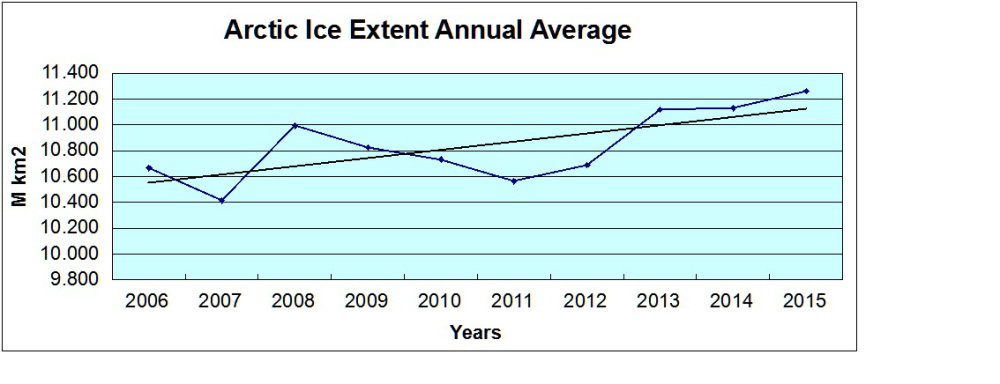
Actually we don’t Ron, for a number of reasons. For example Chris Reynolds summarises your “better metric” as follows:

Claims that there is no ongoing deterioration in Arctic sea ice are totally unfounded, and it is safe to ignore those making such claims as being unreliable due to their lack of grasp of the subject.

whilst “Tamino” points out that:

The data used, from MASIE, doesn’t start until 2006. Which makes it downright bizarre to use this for studying climate, for two reasons. First, we have data (passive microwave from satellites) covering quite a bit more time — starting in late 1978. Second, the MASIE people themselves tell you that their product isn’t the best for climate studies, instead you should use that passive microwave data from satellites.

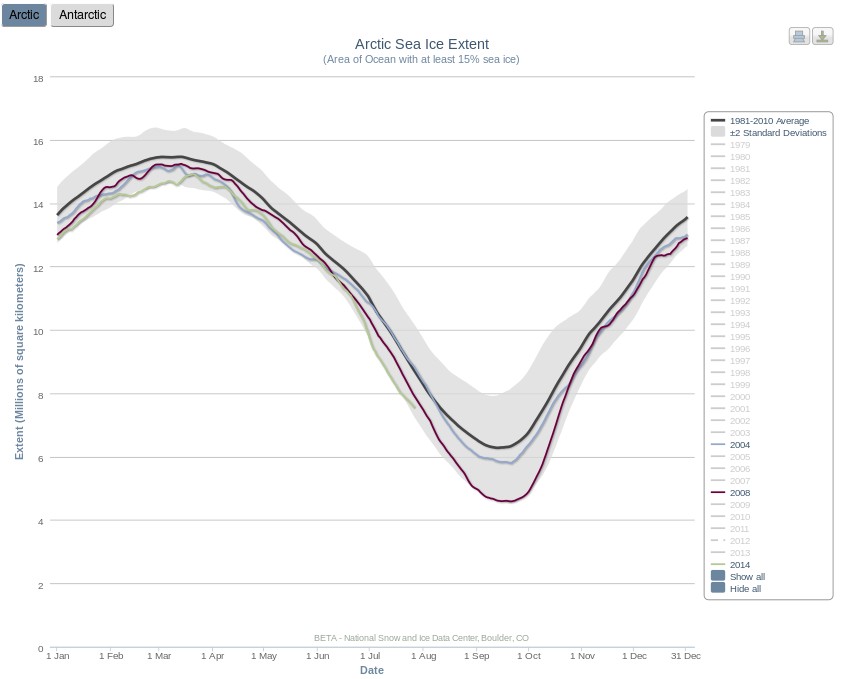
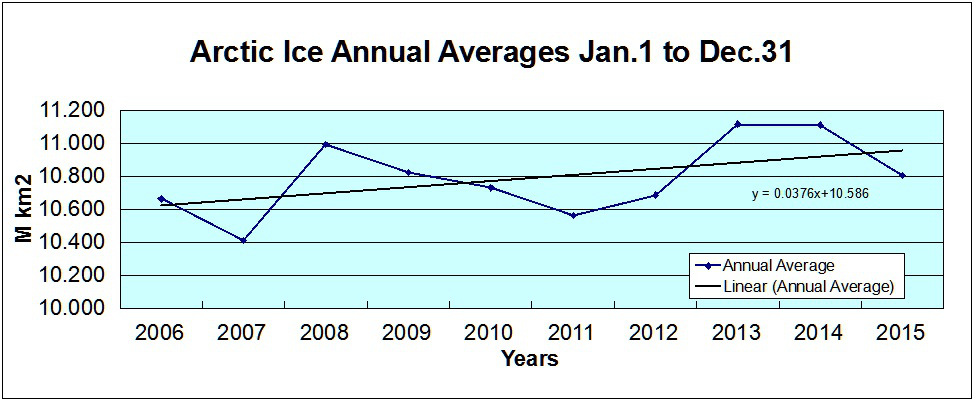
If you download the data that “MASIE has very helpfully provided” and plot the self same graph so proudly displayed by the GWPF you will see something that looks a lot like this:
GWPF-masie-day-2015365

Amazingly enough this graph is taken from a more recent article by Ron Clutz, also reproduced in part on the Global Warming Policy Forum’s web site. This one is dated 2nd January 2016 and entitled “Happy Arctic Ice Year!“. Ron claims that:

Arctic ice declined in the decade prior to 2007, but has not declined since. What we have seen in the last decade is a plateau in Arctic ice extent, analogous to the plateau in surface temperatures. This year end report shows there is no reason to worry about Arctic ice melting.

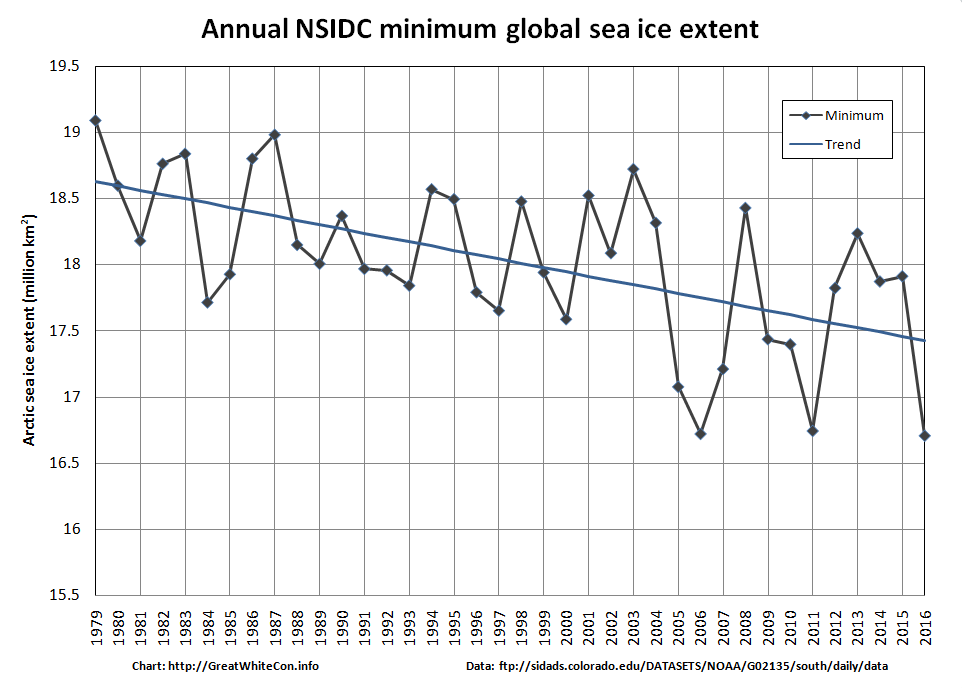
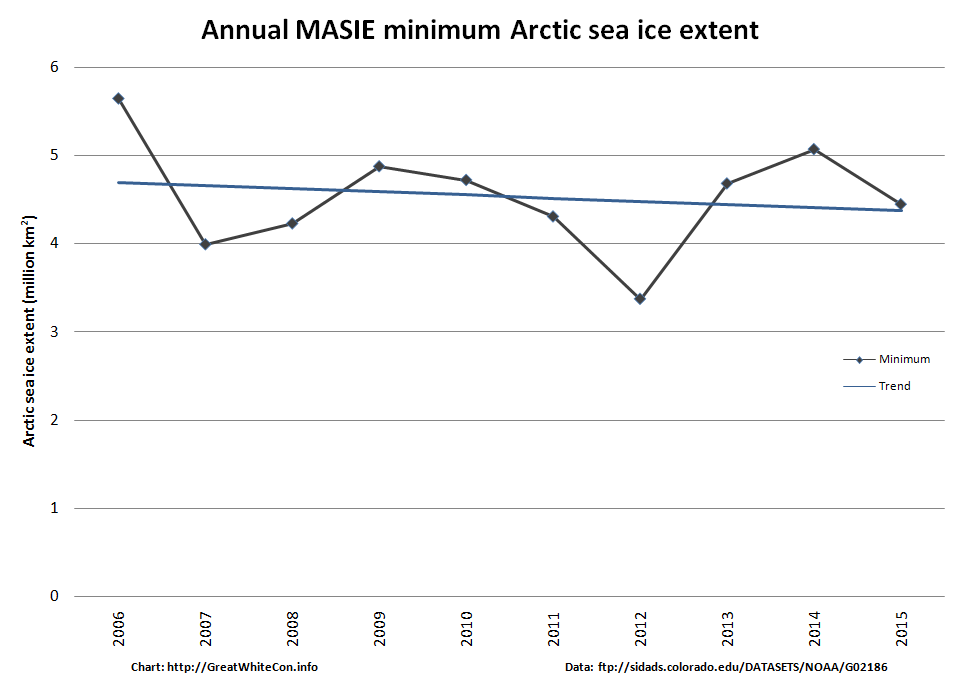
For some strange reason the GWPF have thus far not corrected the extract from Ron’s earlier article on their web site, and neither has Mr. Clutz. For some other strange reason he hasn’t gotten around to publishing my comment to his article pointing him and his loyal readers to this graph which is also derived from the MASIE data, and neither have the GWPF:
MASIE-Min

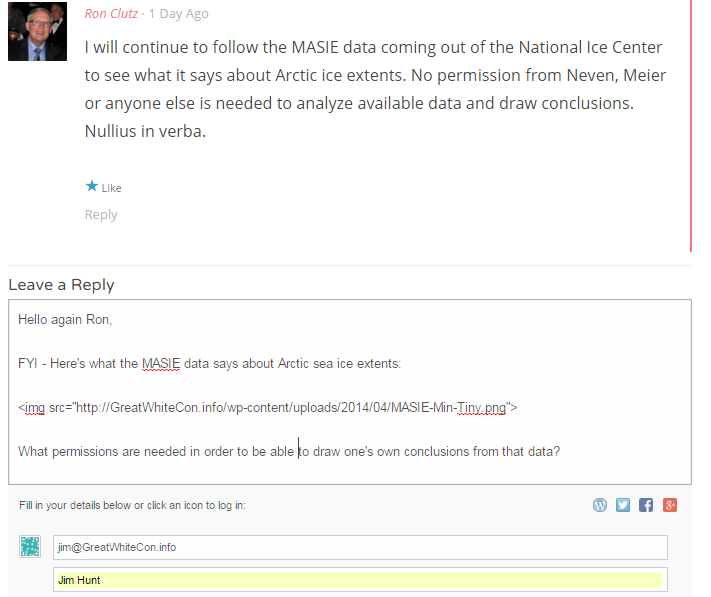
It’s not as though I haven’t tried! See for example:
Selection_608

I’m not the only one to have my constructive criticism censored by Ron Clutz recently. Neven, proprietor of the Arctic Sea Ice Blog, reports over there that:

He’s deleting my comments again (and his own comments to wipe out traces of the fact, which is a cowardly act), so I’m just posting the comments here for reference.

I’ll conclude for the moment with some more words from Chris Reynolds. Someone who, unlike Ron Clutz and the other GWPF Arctic article authors (GWPFAAA for short), has a grasp of physics:

Ice state in the Peripheral Seas region is a critical metric in determining whether the Arctic Ocean’s ice pack is indeed stabilising or recovering.

Here is a plot of compactness for late summer in the Peripheral Seas from 1979 to 2015, where late summer is the seven day average centred on 31 August.

Here’s the accompanying graph:

Nullius in verba, as the GWPF don’t put it.


[Edit – February 18th 2016]

I have recently exchanged a few emails about this issue with Dr. Benny Peiser, who is Director of the Global Warming Policy Forum. However Benny has suddenly gone strangely silent, so here is a transcript of the “debate” thus far:

Us:

Hello Benny,

Thanks for your time in our telephone conversation just now.

In brief, here are my alter ego’s initial quibbles about the GWPForum’s recent Arctic coverage:

and

Please do not hesitate to ask if you require any additional information!


Them:

Dear Mr Hunt

I wonder whether you have any comments regarding the latest PIOMAS data which appear to show a pause in the Arctic sea ice melt in recent years?

With best regards


Us:

Hello Benny,

All in the fullness of time. First of all though, I am waiting to hear your comment(s) on the points I raised in my original email. Here’s where those “Tweets” finish up:

https://greatWhiteCon.info/2016/02/the-great-global-warming-policy-forum-con/

To reiterate, as numerous people pointed out to Mr. Clutz following his first article, MASIE is not fit for the purpose to which he (and hence the GWPF) put it.

To add insult to injury the first MASIE based graph he (and hence the GWPF) published is wildly inaccurate and misleading, and has still not been corrected.

I still eagerly await your comment(s) on this matter,


Them:

Dear Mr Hunt

If I understand you correctly you claim that

1. MASIE is not fit for the purpose to assess Artic sea ice extent, and

2. Arctic sea ice has actually decreased since 2007 — contrary to claims that Arctic ice has not declined in the last 8 years.

I have looked into your first claim and cannot find any information that undermines the reliability of MASIE data for Arctic sea ice analysis.

Regarding your second criticism, the latest PIOMAS data appear to confirm Mr Clutz’s main point, i.e. Arctic ice has remained fairly stable since 2007.

Yours sincerely


Us:

Hello again Benny,

Thank you for your swift response to my most recent email. I fear that you totally misunderstand me. Regarding your numbered points:

1) Did your due diligence include reading this section of the NSIDC web site concerning MASIE?

https://nsidc.org/data/docs/noaa/g02186_masie/index.html

Can you see the parts where it says?

MASIE may look like several other sea ice products distributed at NSIDC and elsewhere, but its source data and intended uses are different.

Operational ice charts meet the needs of those going into the ice and provide general situational awareness, such as the extent of fast ice or of ice of any concentration greater than zero percent.

If one is interested in long-term trends in sea ice or how it responds to changing climate forcing, generally, it is best not to use an operational product, but rather one that is consistently produced and retroactively quality controlled.

Do you understand what that means? If not please do not hesitate to ask!

2) Where on Earth did you get that idea from? Here’s what I said once again:

The first MASIE based graph [Ron Clutz] (and hence the GWPF) published is wildly inaccurate and misleading, and has still not been corrected.

To see what I mean all you have to do is compare it to the second MASIE based graph [Ron Clutz] (and hence the GWPF) published.


Them:

Dear Mr Hunt

I’m afraid you have not addressed my points.

There is nothing wrong with the MASIE data, in particular not when it comes to short-term data sets (although I agree that it should not be used for any trend analysis).

You did not answer the key question: where is the evidence (as suggested in your graph) that Artic sea ice has declined since 2007?

Yours sincerely


Us:

Hello Benny,

I’m afraid that in actual fact it is you who have not addressed my points. Let me take you through them slowly once again. Once you’ve understood the first two rest assured there are more.

1 a) According to the NSIDC, MASIE is not a “short-term data set”, it is an “operational ice chart”.

1 b) In addition, please feel free to search the NSIDC web site for any graph based on the Arctic Ice Annual Average of any metric whatsoever, and let me know what you discover

2) Let’s play “Spot the difference” shall we? Please let me know what differences (if any) you can find between this graph:

GWPF-masie-annual

and this one:

GWPF-masie-day-2015365

Thanks in anticipation,


[Edit – February 19th 2016]

Us again:

Not having heard from Benny for a while we thought it polite to enquire after his health this morning:

Dear Benny,

I’ve received nothing back from you since your email of 15:22 on the 16th. Are you OK? If there’s anything we can do to help please do get in touch.

We have some interesting news about which we’d love to know your opinion, as soon as you feel up to it of course. First of all, the NSIDC’s global sea ice extent metric fell to the lowest level *ever yesterday:

Global-Extent-2016-02-18

Secondly, are you aware that the February 13th article on the GWPF web site by Pierre Gosselin entitled “Arctic Sea Ice Trend May Have Turned The Corner As Ice Volume Picks Up Over Past 5 Years” currently looks like this?
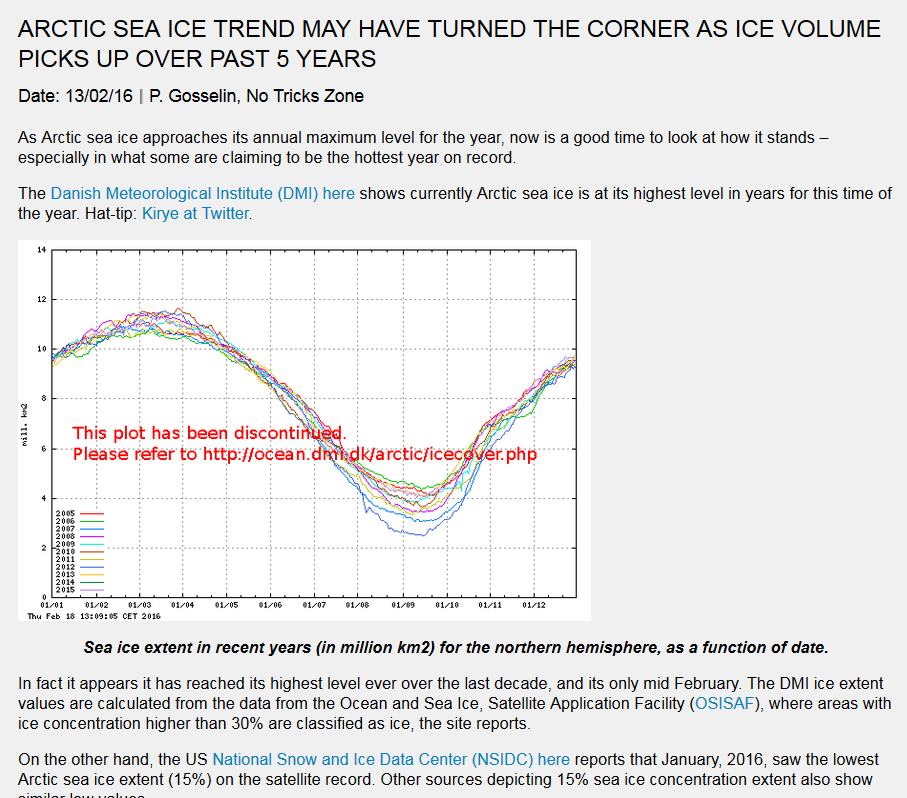
2016-02-19_1140-GWPF-DMI

Get well soon,


Them:

Dear Mr Hunt

Thank you for your latest concern about global sea ice extent

I suggest to monitor global sea ice extent in the next 12 months to see whether the usual recovery fails to materialise (see graph below).


Us:

Dear Dr. Peiser,

I’m delighted to discover that you are evidently in fine fetttle!

I am however afraid that your image is invisible at this end, although it appears to emanate from somewhere on the WUWT sea ice page.

First of all can you possibly resend it?

Secondly I highly recommend that you peruse the GWC sea ice resources instead of Mr. Watts’ in future.

Thirdly will you please fix the wide variety of gross inaccuracies concerning Arctic sea ice that still exist on the Global Warming Policy Forum web site, even after they have been brought to your attention on numerous occasions. For your further information please see also:

https://greatWhiteCon.info/2016/02/global-sea-ice-extent-at-lowest-ever-level/#comment-213484

Best wishes,


[Edit – February 23rd 2016]

Us:

Good day Benny,

I trust that you had a pleasant weekend?

I note that the GWPF webmaster has still not corrected even the most egregious of Ron Clutz’s errors republished on the GWPF web site in the following article:

http://www.thegwpf.com/arctic-ice-recovering/

I further note that you have also now republished this article authored by Paul Homewood:

http://www.thegwpf.com/maisie-confirms-arctic-sea-ice-remaining-stable-in-february/

which amongst other errors contains the following insinuation:

“MAISIE, of course, only goes back to 2006, whereas the sea ice index dates to 1979. It is, however, easy to see why NSIDC are keen to use the latter as a starting point!”

This is of course inaccurate, as I have personally pointed out to Paul on several occasions in the past. The NSIDC themselves have this to say on the matter:

“The Sea Ice Index provides a quick look at Arctic- and Antarctic-wide changes in sea ice. It is a source for consistent, up-to-date sea ice extent and concentration images, in PNG format, and data values, in ASCII text files, from November 1978 to the present.

The images and data are produced in a consistent way that makes the Index time-series appropriate for use when looking at long-term trends in sea ice cover.”

When do you suppose the GWPF webmaster will be able to get around to correcting the latest piece of Arctic misinformation to be published on your web site?

Best wishes,


Us again:

Good morning Benny,

I note that the GWPF webmaster has still not taken on board any of the helpful advice I have proffered over the last few weeks, and has now posted some inaccurate information about “global warming”. Will he or she never learn?

Sticking with our own speciality, please feel free to “print” Snow White’s prediction that CT global sea ice area will post yet another new record of around 14.22 million square kilometers over the next 2 to 3 days.

I followed Ron Clutz’s recent suggestion on Paul Homewood’s blog to “Take it up with Walt Meier”. I interviewed Dr. Meier yesterday and this is what he told me:

https://greatWhiteCon.info/2016/02/dmi-masie-and-the-sea-ice-index-an-interview-with-walt-meier/

Perhaps it is now time to hand your current webmaster their cards and hire a new one?

Best wishes,


[Edit – March 4th 2016]

Us once again:

Hello again Benny,

It seems that your new webmaster has yet to republish the latest product of the Clutz/Homewood porky pie production line! Please pass on our congratulations on their perspicacity. However the latest article on The GWPF web site by David Whitehouse has this to say:

“Is the global warming pause over for good — or will it continue once the current El Nino dies down?”

Does Dr. Whitehouse not realise that there was no “pause”?

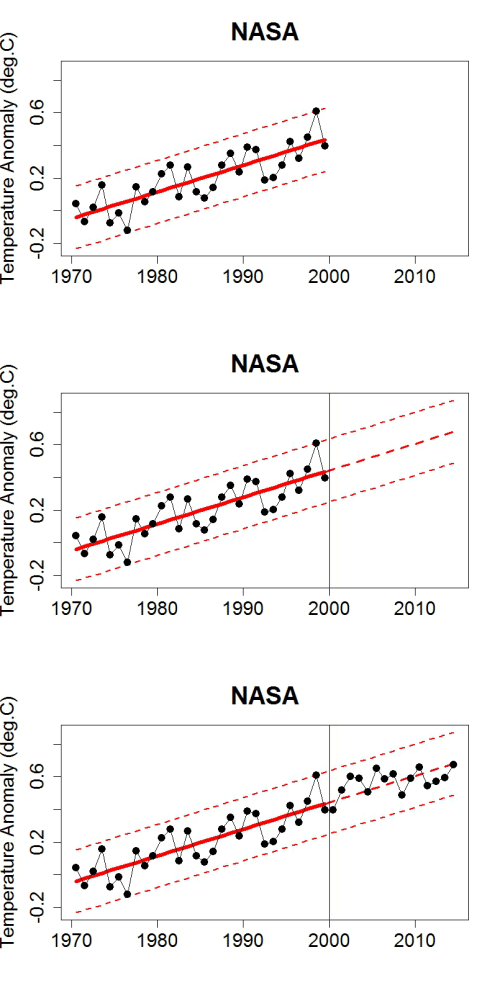
There is no "pause"!

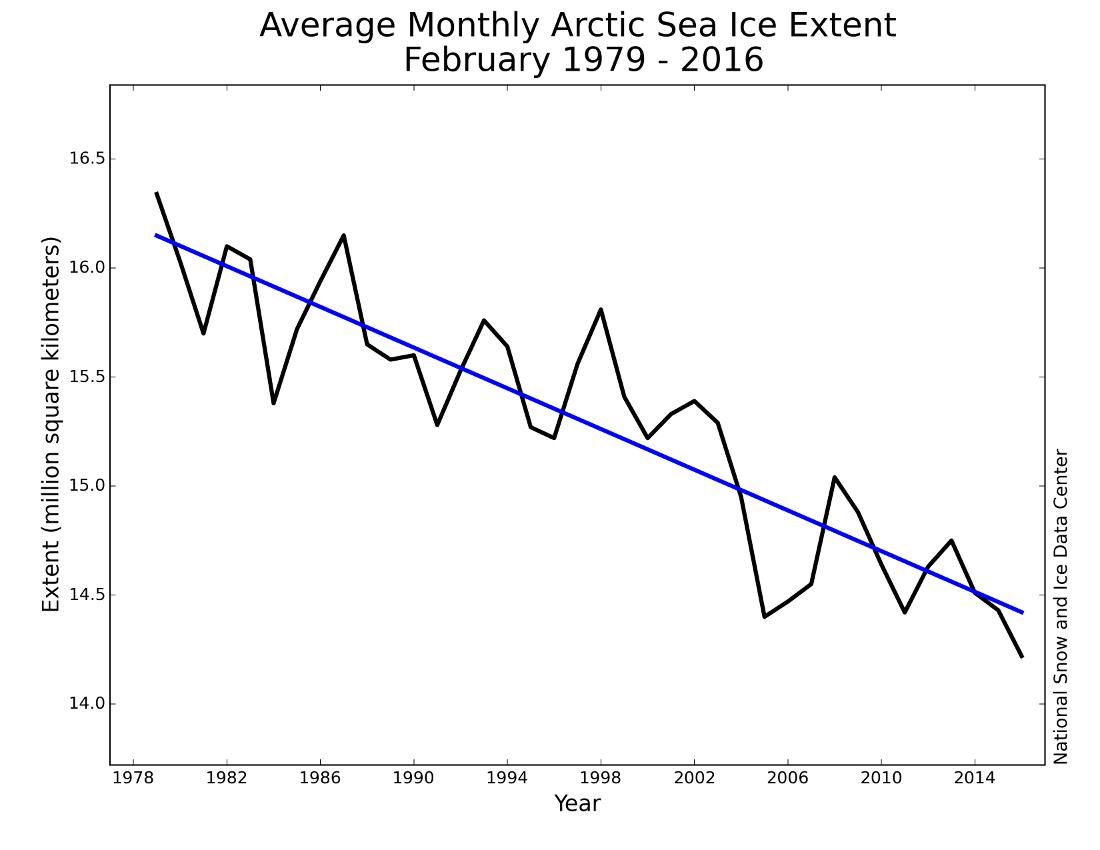
For your, and Dr. Whitehouse’s, information here is the latest report from the NSIDC on Arctic sea ice extent:

NSIDC February 2016 monthly Arctic sea ice extent

With a new webmaster in charge at The GWPF can we now anticipate an accurate Arctic article appearing on your web site? Please do not hesitate to ask if you would like to republish one of mine.

Best wishes,
 

[Edit – April 4th 2016]

Us once again:

Hello again Benny,

I hope this finds you well? I have been doing as you suggested! Consequently I could not help but notice that you have not been doing what I suggested, and have instead recently republished a large extract from yet another article by Paul Homewood on the topic of Arctic sea ice:

http://www.thegwpf.com/more-of-the-usual-hype-about-arctic-ice/

Needless to say this one is also downright misleading. For your information, here are the actual facts:

Claim – Arctic Sea Ice Holds Firm?

and

More Of The Usual Hype About Arctic Sea Ice

It looks like you’ll have to let another webmaster go, does it not? Don’t forget to tell the new one that my offer of an authoritative Arctic article still stands.

Best wishes,


Them:

We’ll keep you posted!
 

Inside the BBC’s Arctic Sea Ice Science

I’m sure we’ll get stuck into to some real science eventually, but for the moment we’re still taking a long, hard look at mainstream media coverage of the latest learned journal article on Arctic sea ice to be misinterpreted by the media. Compared to some others one might mention the report on the BBC web site about the new CPOM paper in Nature Geoscience entitled “Increased Arctic sea ice volume after anomalously low melting in 2013” was relatively accurate. Entitled “Arctic ice ‘grew by a third’ after cool summer in 2013“, it said that:

Researchers say the growth continued in 2014 and more than compensated for losses recorded in the three previous years.

The scientists involved believe changes in summer temperatures have greater impacts on ice than thought.

But they say 2013 was a one-off and that climate change will continue to shrink the ice in the decades ahead.

The Arctic region has warmed more than most other parts of the planet over the past 30 years.

Satellite observations have documented a decrease of around 40% in the extent of sea ice cover in the Arctic since 1980.

and

The researchers used 88 million measurements of sea ice thickness from Cryosat and found that between 2010 and 2012, the volume of sea ice went down by 14%.

They published their initial findings at the end of 2013 – but have now refined and updated them to include data from 2014 as well.

Relative to the average of the period between 2010 and 2012, the scientists found that there was a 33% increase in sea ice volume in 2013, while in 2014 there was still a quarter more sea ice than there was between 2010 and 2012.

At this juncture one is forced to ask oneself the question that if there was 33% more sea ice in 2013 than there was between 2010 and 2012, but only 25% more in 2014 how it was possible that “the growth continued in 2014”?

Desperately hoping that the BBC might be able to explain this conundrum to us we avidly listened to Adam Rutherford’s interview with Rachel Tilling, the lead author of the paper in question, on BBC Radio 4’s “Inside Science” programme last night. We were also hoping that at long last there might be some quantification of what’s happened to the VOLUME of “sea ice cover in the Arctic since 1980”. Sadly all our hopes were dashed, and Adam never posed the vital questions.

You can download a recording of the broadcast from the link above. Adam’s interview with Rachel starts at 7:00 minutes. He begins by talking about:

The publication in Nature Geoscience this week of a new paper that shows that in 2013, which was a slightly cooler summer than average, Arctic ice had grown, not just a tad, but by a WHOPPING 41% on the previous year!

Rachel Tilling then begins by saying:

The thickness and the volume are actually the most important measurements we can get, because the area’s been really, really useful in giving us an overview of how the Arctic is changing, but it only really gives us half the picture.

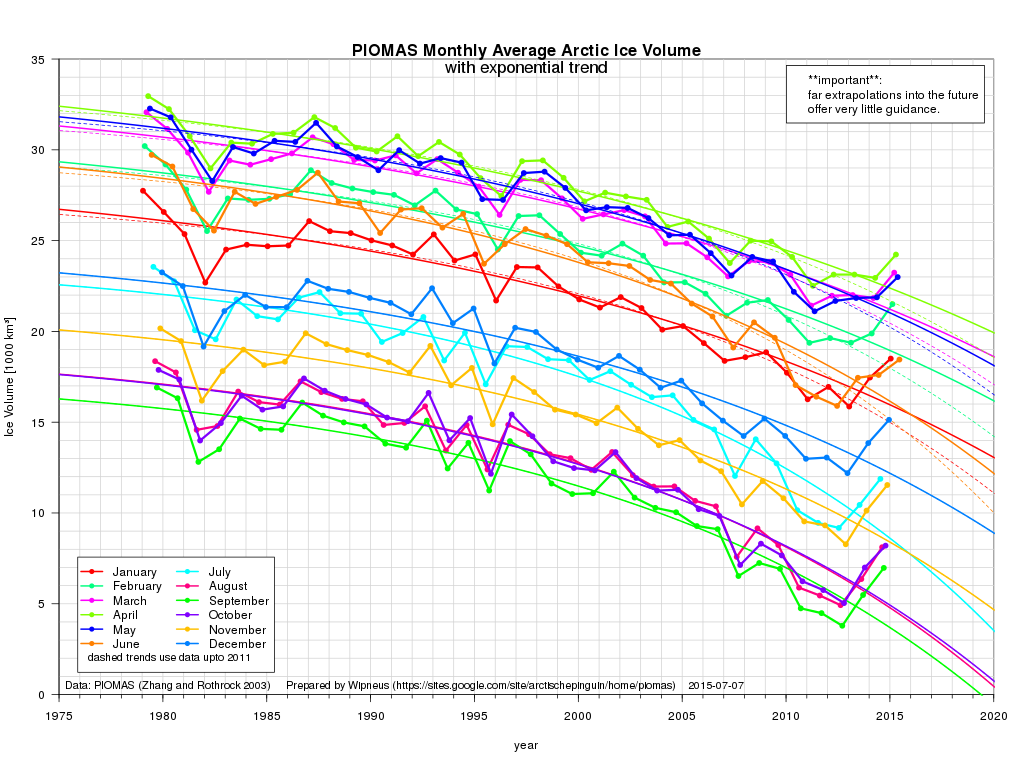
Here’s the full picture, taken from our Arctic Sea Ice Graphs page. Since CryoSat-2 measurements only go back as far as 2010, this graph shows Arctic sea ice volume calculated by the PIOMAS model developed by the Polar Science Center at the University of Washington:

piomas-trnd2-201506Is that WHOPPING increase in Arctic sea ice volume from 2012 to 2013 clear to you now? At 11:00 minutes into the programme Adam says:

You can see how this is going to be interpreted. You know, with 30 years of Arctic sea ice shrinking, and then suddenly it gets bigger, you’re still OK with climate change being a real thing, and global warming being a real thing?

I can see that very clearly Adam, thanks for asking, and YES is the answer to your final question. It still wasn’t clear to me whether that would be clear to Adam’s listeners however, so I posed a pertinent question on Twitter first of all:

That didn’t elicit any response, so then I tried following Adam’s instructions at the end of the interview to:

 Do let us know what you think – [email protected]

This is what I thought:

Hello Adam,

Further to your recent interview with Rachel Tilling, and your joint Twitter conversation with my alter ego “Snow White”, I’d like to reiterate how disappointed the two of us are that during your conversation with Rachel there was no mention of “41% of nothing”. Twitter speak for “Doesn’t anybody at the BBC have the faintest idea what Arctic sea ice volume was 30 years ago, in April and in October?”

By way of additional context see e.g.

https://greatWhiteCon.info/2015/07/an-inconvenient-truth-about-the-mails-climate-coverage/

http://www.carbonbrief.org/blog/2015/07/cool-arctic-summer-brought-brief-recovery-in-2013-sea-ice-loss/

https://greatWhiteCon.info/resources/

Yours in dismay,

Jim Hunt

and this is the response I got from BBC Inside Science:

Dear Sir or Madam

Thank you very much for your email. While all emails are read – and we appreciate input from listeners – we cannot reply to each one individually. There are simply too many!

For more information about Inside Science, please go to our webpage:

Inside Science, Radio 4
http://www.bbc.co.uk/programmes/b036f7w2

For individual programmes, click on ‘Episodes’.
http://www.bbc.co.uk/programmes/b036f7w2/episodes/guide

Once you have located a particular programme page, you will see a link to ‘Listen now’- on the picture of Dr. Adam Rutherford.
‘Related Links’ are found further down on the right hand side of the page.

Downloads/Podcasts of Inside Science are available at:
http://www.bbc.co.uk/podcasts/series/inscience

Thanks again and do keep sending your comments in – listener feedback helps us make better programmes for you.

Yours sincerely

Inside Science, Radio 4


Meanwhile, over on Twitter:

BBC Radio 4 Swallows Booker’s Bait

Here’s a prescient recent “Tweet” of mine to United States Representative Dana Rohrabacher:

Two days later a UK broadsheet did indeed publish an article I feel sure Rep. Rohrabacher would approve of. Later the same morning BBC Radio 4 News reported on that article with apparent approval. For the backstory on all this please follow the first link below. Please read on for the text of my maximum 1500 character written complaint to the Beeb!

Us:

I have already spoken to Rachel about this via telephone, but she couldn’t give me a reference number or include a URL along with my complaint, so for completeness:

BBC Radio 4 News at 7 AM on Sunday February 22nd 2015 discussed the morning newspapers. The Observer’s story about Ed Miliband’s appointment of John Prescott as his “climate change advisor” was mentioned. This was followed by a reference to Christopher Booker’s article in The Telegraph. For chapter & verse please see my article at:

https://greatWhiteCon.info/2015/02/the-greatest-scandal-in-the-history-of-science/

and then follow all the links. In brief, as assorted readers over there put it:

“Why do people like Christopher Booker keep getting away with this kind of bullshit? There must be some kind of fine for lying and misleading so blatantly.”

“Hard to believe the BBC can give any credence to such nonsense. I was really shocked and phoned BBC to complain”

or as I summarised my conversation with Rachel:

“The BBC’s apparent belief that Mr. Booker’s article provides some sort of “scientific balance” to Ed Miliband’s remarks about the need for UK plc to up its “climate change” game is so utterly ludicrous that words totally fail me.”

By way of explanation for my disbelief, please see this elementary explanation of the underlying science that I sent to Mr. Booker and his editors 2 weeks previously:

https://greatWhiteCon.info/2015/02/a-letter-to-the-editor-of-the-sunday-telegraph/

Read those links too.


Them:

Dear Mr. Hunt

Thanks for contacting the BBC. This is an automated email acknowledging that we’ve received the attached complaint sent in this name. We’ve attached the case reference and text of the complaint for your records (see below).

We’ll normally include the full text of your complaint to BBC staff in the overnight reports we compile for them about the complaints and other reaction we’ve received today (with all your personal details removed). This ensures it will reach the right people quickly tomorrow morning. We’ll then aim to reply to you within 10 working days, or around 2 weeks, but it also depends on the nature of your complaint and whether the relevant people can respond to us in time.

We aim to use your licence fee as efficiently as we can, so if you complained about the same issues as others we will send our response to you and everyone. For the same reason we may not investigate or reply in great detail if a complaint doesn’t suggest a potential breach of BBC standards, or a significant issue of general importance. You can read about our full complaints procedures and how we consider issues which people raise with us at www.bbc.co.uk/complaints/handle-complaint/.

This acknowledgment is automatically generated from an unmonitored address so please don’t reply. If you think you’ve received this in error please contact us using our webform at www.bbc.co.uk/complaints, quoting your case reference number.


followed on February 26th by:

Dear Mr Hunt

Thank you for contacting us regarding Radio 4’s “News and Papers” as broadcast on 22 February.

We understand you feel that the article by Christopher Booker in the Sunday Telegraph that was referred to is not a counter balance to Ed Miliband’s views on climate change as you believe it to be scientific nonsense.

We aim to provide the information which will enable listeners to make up their own minds; to show the political and scientific reality and provide the forum for debate. There is broad scientific agreement on the issue of climate change and we reflect this accordingly; however, we do aim to ensure that we also offer time to the dissenting voices.

We value your feedback about this issue. All complaints are sent to senior management and programme makers every morning and we included your points in this overnight report. These reports are among the most widely read sources of feedback in the BBC and ensure your complaint is seen by the right people quickly. This helps inform their decisions about current and future reporting.

Thanks again for taking the time to contact us.

Kind regards

David Glenday

BBC Complaints


Us:

We’ll keep you posted!


Andrew Neil Fails Simple Maths Test

I wandered over to Twitter a couple of days ago to see if I could persuade Steve/Tony to dig a pertinent comment of mine about Arctic sea ice extent out of the “Real Science” spam folder. Whilst over there I couldn’t help but notice that Andrew Neil had been passing comment on recent events in the Arctic too! According to his Twitter page Andrew is:

Chairman Spectator Magazines (London);  ITP Magazines (Dubai);  World Media Rights (New York). BBC presenter.

According to his C.V. on the BBC web site Andrew is:

Presenter of the Daily Politics on BBC Two and the Sunday Politics on BBC One.

In a long career in publishing and broadcasting Andrew has been UK editor of The Economist, editor of The Sunday Times, executive chairman of Sky Television and publisher of The Scotsman Group of newspapers.

Fresh from his controversial BBC interview with Ed Davey, the UK’s Secretary of State for Energy and Climate Change,  Andrew was “tweeting” things like:

Andrew also expressed his views about Arctic sea ice extent:


Them:


Us:


Them:

Andrew has yet to respond to my polite enquiry, so……  


Us:


Here’s the big picture:

Charctic-AFNeil-20140729Here’s the small print, and here’s the ancient history.


Them:

We’ll keep you posted!

Broadcasting House’s Million Square Kilometre Blunder

It has just been brought to my attention that the topic of Arctic sea ice was raised by Angela Rippon on the edition of “Broadcasting House” that aired on BBC Radio 4 on the morning of Sunday September 29th. In her review of that Sunday’s papers Angela had the following to say:

Them:

Tucked away at the bottom of a page in the Mail on Sunday is a piece saying that “The Arctic ice experts have made a million kilometer blunder“, and this is again using computers, and apparently the official source of information on polar ice caps have got it’s figures for the recovery of the Arctic cap wrong by a million square miles, and they say that this was actually a typo, it was a typographical error, and there are no plans to make a statement on the change because it was just an error in the data. So what data CAN we believe?

Us:

Obviously that’s my own transcript rather than an official one from the BBC. By all means listen to the programme yourself, and let me know if I’ve inadvertently got something wrong. According to the BBC’s “BH” page it will be available for download there for another 25 days.

Now obviously as soon as I’ve finished writing this article I’m going to amble over to the BBC web site to lodge a formal complaint, in which I shall suggest that Angela and the BBC’s “BH” team read this website from cover to cover, starting with this very article.

As a preliminary answer to Angela’s final question I would like to suggest:

Certainly not the Mail on Sunday’s, and not the British Broadcasting Corporation’s either, unless they correct this particular blunder quicker than you can say “Global COOLING!” whilst simultaneously sipping a piña colada by the side of Santa’s super new low albedo summer swimming pool!

Shock News! Why Isn’t the Arctic Ice Free?

Today we move on to the second sentence in David Rose’s article “this time last week”.

Them:

The rebound from 2012’s record low comes six years after the BBC reported that global warming would leave the Arctic ice-free in summer by 2013.

Us:

As you can see, the Mail article includes no references. Surely in this day and age an online article about such a controversial subject should at the very least include a few links?  Hayley Dixon’s article for The Telegraph did at least manage to do that! I’ve asked David Rose via a number of different avenues where he got his information, and how he did his sums. I know he got at least one of the messages because he was browsing my profile on LinkedIn last week, but I have yet to receive any answer from him.

Groping in the dark I’ve tried to speculate about which BBC report in 2007 David is referring to. Perhaps it’s  this one  by Jonathan Amos entitled “Arctic summers ice-free ‘by 2013′”. Please note the quotation marks around the date. According to this article:

Professor Wieslaw Maslowski told an American Geophysical Union meeting that previous projections had underestimated the processes now driving ice loss.

[His] latest modelling studies indicate northern polar waters could be ice-free in summers within just 5-6 years.

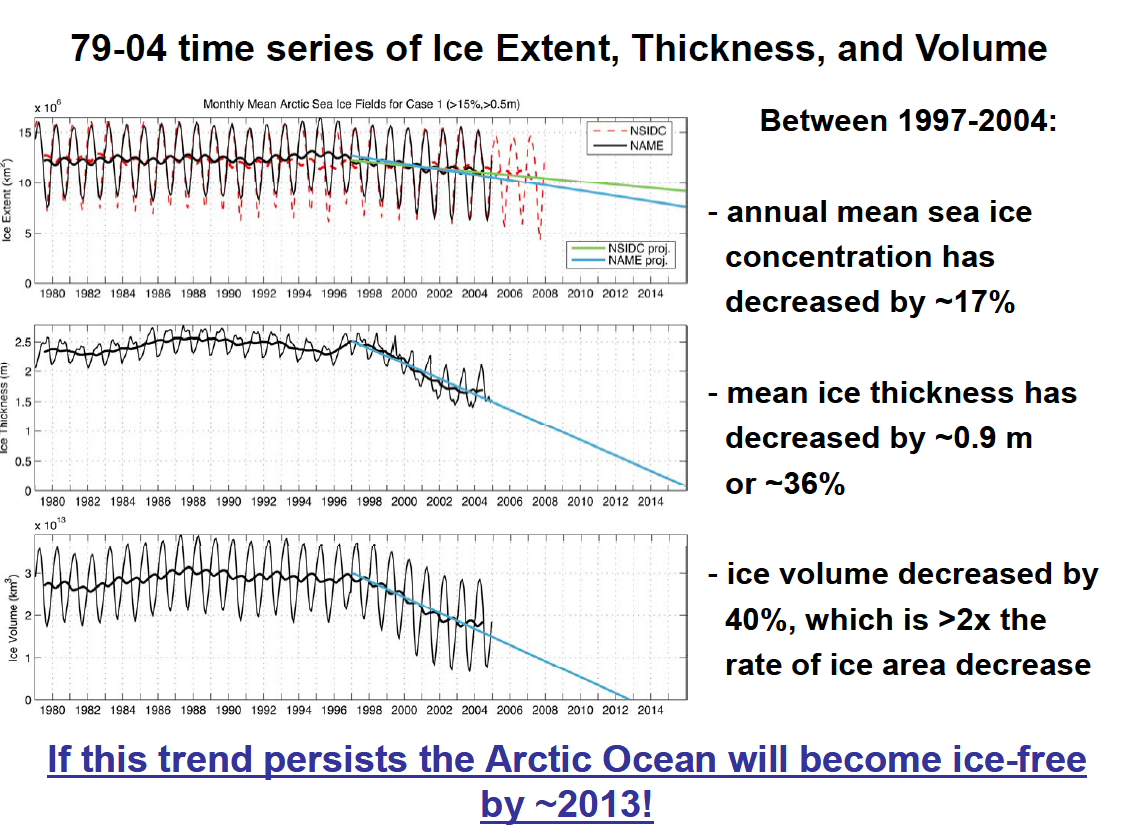
Instead of relying on what David Rose says Jonathan Amos says Wieslaw Maslowski said, why don’t we instead take a look at what Prof. Maslowski actually said. Here’s an extract from the slides he used when giving a presentation in Japan in the summer of 2008, when he’d had plenty of time to learn the lessons of the astonishing Arctic sea ice melt in the summer of 2007:

Wieslaw Maslowski says "if" and "about" in 2008
Wieslaw Maslowski says “if” and “around” in 2008

Note that he didn’t say words to the effect that “The Arctic will be ice-free in summer by 2013” as claimed by David Rose. What he actually said, and converting the mathematical symbol into plain English, was:

IF this trend persists the Arctic Ocean will become ice-free by AROUND 2013!

which is a very different thing.  For those of you that would prefer to actually hear Prof. Maslowski convey that message himself, here’s a podcast from December 2007:


The interview lasts for about half an hour, and a full transcript is also available courtesy of Beyond Zero Emissions. You will note that what Wieslaw actually said was:

If we project this trend ongoing for the last 10 – 15 years, we probably will reach zero in summer some time mid next decade.

Verdict:

The evidence suggests that David Rose doesn’t research his sources properly, doesn’t understand English and doesn’t understand common mathematical symbols.  Alternatively he understands all of that perfectly well, but chooses to misrepresent all of that to his loyal readership instead of educating them about the facts of the matter.

Hello, Good Evening and Welcome!

David Frost died last week . So it goes.

According to the BBC:

Politicians regularly complained to BBC management that they were being ridiculed by David Frost and his team. But the programme gained a massive following and soon achieved cult status.

We hope to achieve something similar!

By way of brief introduction, the name of our humble organ is an ironic play on the title of David Rose’s series of “Great Green Con” articles in The Mail on Sunday.