Category Archives: Waves

Is Time Running Out for Arctic Sea Ice?

One eminent sea ice researcher certainly seems to think that time is indeed running out for the sea ice in the Arctic. First let’s take a look at the results of the first call for contributions of the 2015 melting season from the Sea Ice Prediction Network:
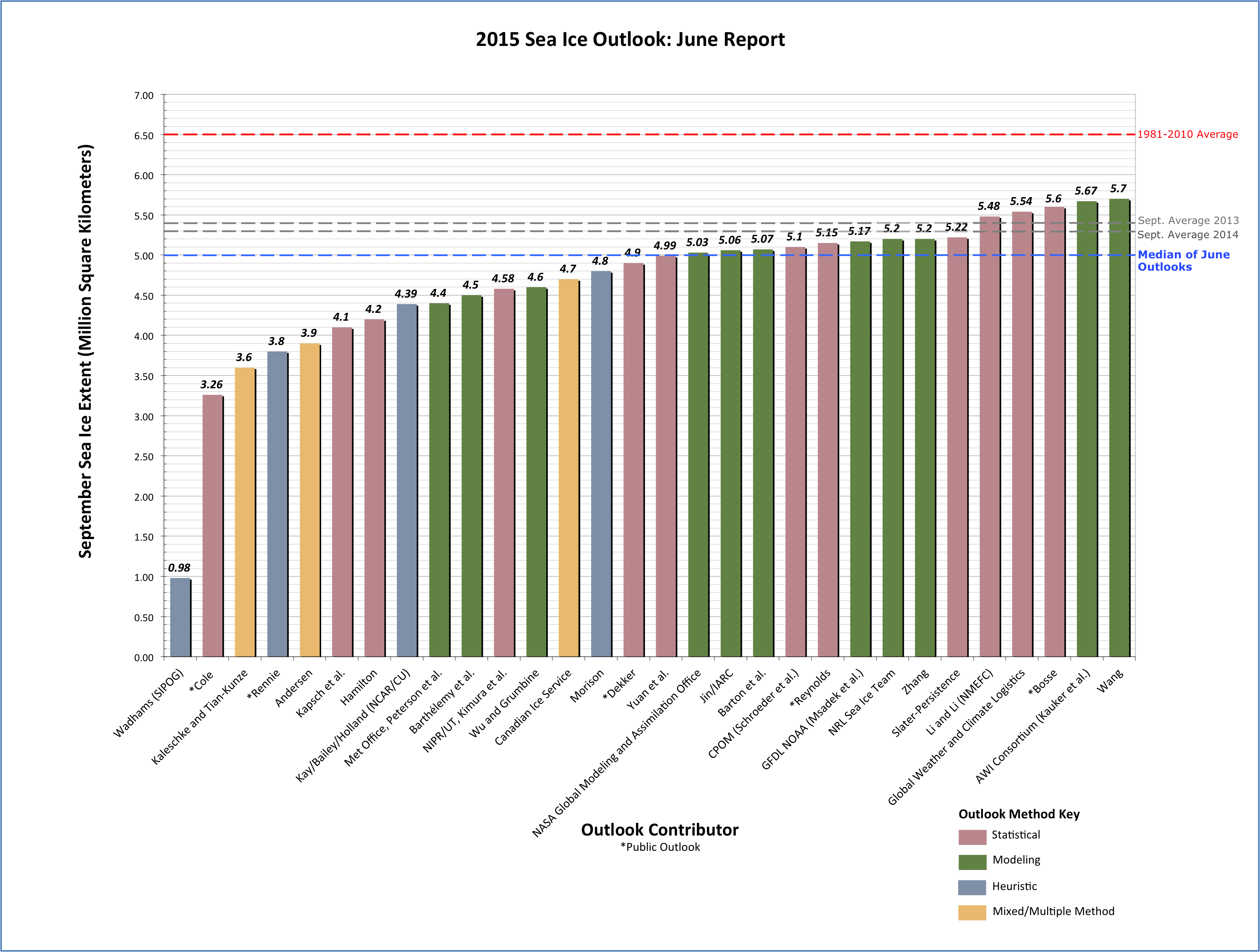
The Sea Ice Prediction Network  June 2015 Sea Ice Outlook results

Note that in the bottom left hand corner of that graph there is a prediction of 0.98 million square kilometers labelled “Wadhams (SIPOG)”. The acronym refers to the Sea Ice and Polar Oceanography Group in the Department of Applied Mathematics and Theoretical Physics at the University of Cambridge, of which Prof. Peter Wadhams is the head. Before we get on to his explanation for what the SIPN refers to as “an extreme outlier” amongst all the other predictions, here’s a TEDx presentation given by Dr. David Barber, who is currently Associate Dean (Research) in the CHR Faculty of Environment, Earth and Resources at the University of Manitoba in Canada:

Here are what Dr. Barber refers to as the “seven surprising impacts” of declining Arctic sea ice:

  1. Increasing coverage of young ice significantly changes atmospheric chemistry

  2. More snow both preserves and destroys ice

  3. Polar bear habitat can actually improve in some areas while deteriorating in others

  4. Match-mismatch timing in the marine ecosystem increases vulnerability

  5. Uncertainty as to whether the Arctic ocean will increase or decrease in overall productivity is a key unknown

  6. Evidence that ice hazards are actually increasing while the world marshals to increase development of Arctic resources

  7. Evidence that our recent cold winters are actually linked to our warming Arctic.

However those bullet points from David’s closing summary don’t actually mention the part of his presentation that most interested me. Listen carefully at 7:40 when he says that:

In 2009 we had our icebreaker down here and we went up this line that you see right here in this figure.

Here’s a version of the map Dr. Barber is referring that comes from a 2009 paper of his entitled “Perennial pack ice in the southern Beaufort Sea was not as it appeared in the summer of 2009“:
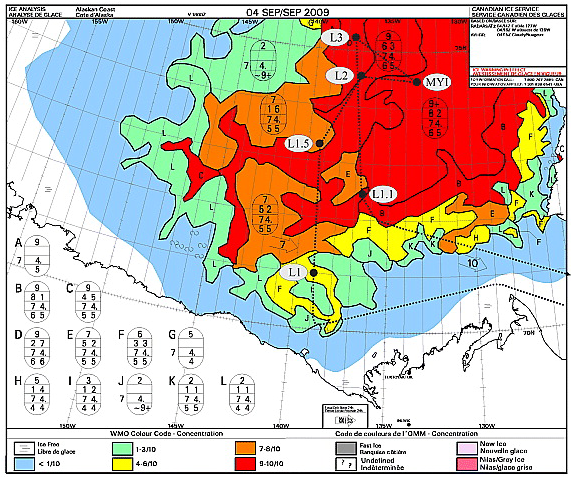
Barber-2009-Map

Here’s the relevant passage from the paper rather than the TEDx video:

We departed from station L1 heading north towards station L1.5, expecting to enter MY sea ice cover at about 71°20′N, 139°00′W based on remotely sensed information (Orange polygon in the figure). The Canadian Ice Service (CIS) ice chart (which relies extensively on Radarsat-1 data) for 4 September 2009 indicated the ship track would range from 7 to 9 tenths coverage and this ice would consist of partial concentrations of 5 tenths to 7 tenths old ice and from 2 to 3 tenths thick first year ice.

In situ observations of the sea ice conditions however showed that the ice we were traversing was not MY or thick FY, nor was it 7 to 9 tenths concentration, but rather it was a mixture of a few small MY ice floes (1 tenth coverage) interspersed in a cover dominated by small (10–100 m) rounded floes of heavily decayed first year sea ice (4 tenths). These floes were overlain by a thin layer of new ice (7 tenth) where freeboard was negative and thin ice growing between remnant pieces when the ice had a positive freeboard. Likewise, some new ice covered open water areas between floes.

This is the “rotten sea ice” David refers to in the video, about which he says:

It was so rotten in fact that the ship that we had does 13.5 knots in open water, and we were able to traverse that ice at 13 knots, yet the satellites all thought that this was very thick multi-year sea ice, because that’s what it had always traditionally been.

This information is obviously very interesting of course, but even more interesting (to me at least) is a subsequent paper by Dr. Barber about the same voyage of the Canadian Research Icebreaker Amundsen, published in 2012 and entitled “Fracture of summer perennial sea ice by ocean swell as a result of Arctic storms“. Here’s a pertinent extract:

We progressed through the heavily decayed ice region into a transitional region containing a mix of decayed old and FY sea ice floes, and finally into thick late summer MY pack ice. Using the onboard helicopter to survey the area, we identified a vast MY floe (10 km diameter), to which we intended to moor the ship, and conduct our typical science operations. The ice in this area was much thicker than the heavily decayed FY ice we that we had encountered the previous day to the west. Our helicopter EMI system recorded overall thicknesses of sea ice around station MYI (e.g., mean = 2.0 m, max = 10 m).

As ice teams initially prepared to deploy to the ice, we noticed the appearance of a swell from the ships helicopter deck. Laser data collected during the helicopter EMI survey at station MYI indicated a swell period of 13.5 s, and a wavelength ranging from 200–300 m. Laser data were collected while the helicopter hovered over a large MY ice floe. These data were augmented with three-dimensional dynamic ship positioning data, which revealed approximate ship heave amplitude of 0.4 m, also with a period of 13.5 s. The swell caused the vast MY ice floe nearest the Amundsen to ride up one side of the swell and fracture as it crested the wave peak, creating smaller ice floes of width approximately one half of the wavelength of the swell. In a matter of minutes from the initial onset of swell propagation, all large MY ice floes in the region were fractured in this manner, yielding a new distribution of smaller MY ice floes ranging from 100–150 m in diameter. A helicopter-borne video system recorded this event in still photographs along its flight track which were later combined to create a series of photo mosaics.

On 09 September 2009, we conducted a longitudinal helicopter EMI survey at 72.5 N, and determined the limit of the swell penetration into the pack ice at 72.526 N 134.51 W, a penetration of 350 km. Furthermore, the rotted FY ice margin was heavily fractured, with small floe sizes ranging from 20–50 m in diameter.

Moving on from Manitoba to Cambridge, Peter Wadhams has recently recorded an interview for The University of Earth, which describes itself as “an entertaining educational reality television series”. Here it is:

So what is “the reality” of the situation in the Arctic? Prof. Wadhams doesn’t explain his “extreme outlier” 2015 prediction in detail in the interview, but he does identify three potentially significant problems:

  1. The “minor thing, in a way” of several feet of global sea level rise this century due to melting of the Greenland ice sheet
  2. A sudden increase in the rate of “global warming” due to Arctic albedo feedback, which leads to
  3. The exposure of the methane hydrate bearing continental shelves off Siberia to increasing water temperatures as the sea ice above them melts. “It’s a massive risk, if you do a risk analysis”

Peter also highlights the same concerns as Barber et al. 2012, often referred to in the literature as “waves-in-ice“. I highly recommend watching both videos from cover to cover. However if you’re in a rush then at least skip to 28:30 minutes where he points out that on his cruise around the Arctic this coming September:

We’re looking at one particular thing, which may not be the most important thing, but the retreat of the sea ice in summer is going much faster than computer models predict, and we think that one factor there is the fact that as the sea ice retreats it opens up this huge area of open water in the Arctic Ocean which then becomes like an ocean, with lots of waves and storms and swell, and the waves themselves break the remaining ice up and cause it to retreat faster so that there’s a kind of collaborative effect there that the remaining ice is vanishing faster because of so much open water producing wave action.

Getting back to the current situation in the 2015 melting season, here’s what the University of Hamburg’s AMSR2 sea ice concentration map currently reveals:

Arc_20150703_res3.125

and here’s what the Slater Probabilistic Ice Extent methodology is predicting will happen over the next 50 days:
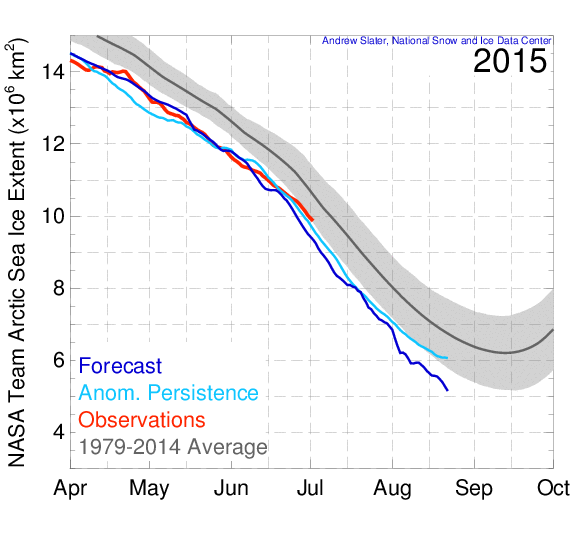
Slater_fcst_20150703

Both suggest to me that although the rate of decline in the area of Arctic sea ice is not currently abnormal for post 2007 years, it may well become so in another month or so, when the extent curve “normally” starts to flatten out. Possibly even sooner than that, because here is the current GFS 2 metre temperature map for the Arctic:
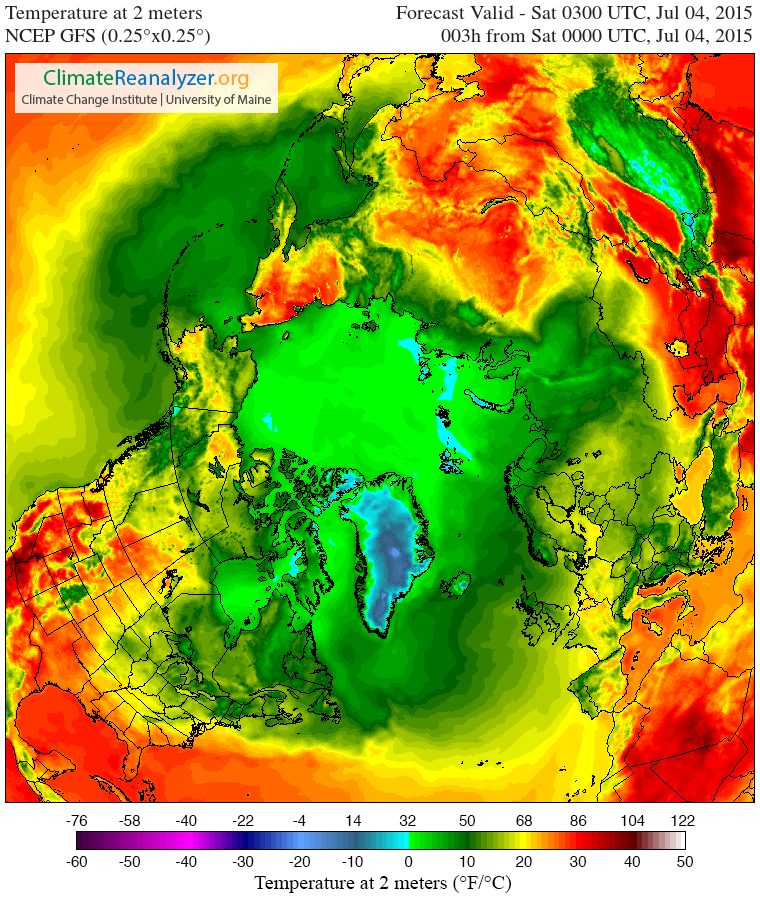
CCI-T2-20150703+3

and temperatures, particularly on the Pacific side of the Arctic, are forecast to get warmer still over the next few days.

Watch this space and we’ll keep you posted, but in the meantime here’s a final thought from Peter Wadhams:

Our children have a future only if we take action now.

[Edit – July 6th 2015]

In a personal communication Prof. Wadhams informs me that:

This year I’m going out in September in the “Sikuliaq” (University of Alaska) to do some more specific wave-ice interaction experiments [in the Beaufort Sea Marginal Ice Zone], assuming there is any ice to experiment on.

[/Edit]
Sea Ice and Swells in the Beaufort Sea in the Summer of 2014

Today we’re going to delve into the application of surf science in the Arctic. If you’re not already familiar with the basics of how the best surf is created then perhaps you might first wish to take a detour to the StormSurf “Wave Basics” article:

Wind waves, though rideable, are not the optimal type of wave one likes to ride. Swells are much better. Wind waves are only the raw material that swells are made from. But, the more energy wind waves accumulate while being driven by wind, the greater the likelihood they will transform into a swell. Enough energy and the swell can travel the entire circumference of the globe with only a slow decay in size!

During a typical open ocean winter storm, one could expect to see winds of 45-55 kts blowing over 600-1000 nautical miles for 36 hours. In such a storm, the average highest wind waves (or ‘seas’) commonly reach 30-35 ft towards the center of the fetch area and produce a swell with a period of 17-20 secs.

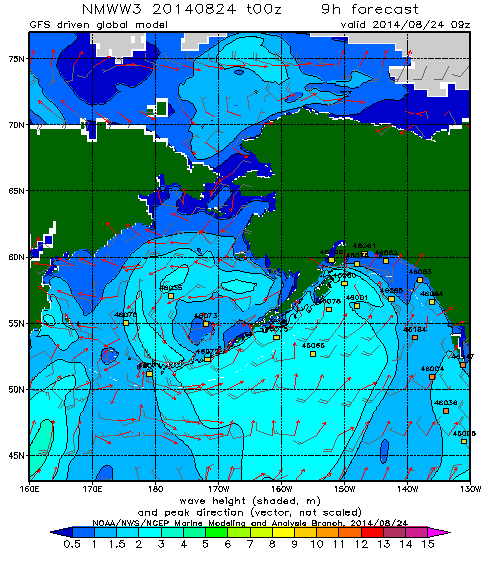
Regular readers may recall that on August 24th 2014 we revealed this WaveWatch III “surf forecast” for the Beaufort Sea, which lies off the north coast of Alaska and the Canadian Northwest Territories (i.e. top center of the map):
alaska.hs.f009h-20140824and noted that the 2 meter waves depicted:

Have blasted past Point Barrow and are currently heading straight for the Beaufort Sea Marginal Ice Zone.

Here’s a video from the University of Washington’s Applied Physics Laboratory which explains that the Marginal Ice Zone is:

The area between declining unbroken sea ice and the expanding area of open water.

The theoretical significance of such swells has been discussed in a number of academic papers recently. Take for example these extracts from “Swell and sea in the emerging Arctic Ocean” by Jim Thomson from the University of Washington and W. Erick Rogers from the US Naval Research Laboratory. Note first of all that the authors distinguish between “wind seas” and “swells” as follows:

Pure wind seas have a wave age less than one, indicating that the wind is driving the waves, and these points cluster largely below the Pierson–Moskowitz limit. Swells have a wave age greater than one, indicating that the waves are outrunning the wind.

They then go on to use some more terms very familiar to the average surfer:

Ocean surface waves (sea and swell) are generated by winds blowing over a distance (fetch) for a duration of time. In the Arctic Ocean, fetch varies seasonally from essentially zero in winter to hundreds of kilometers in recent summers. Using in situ observations of waves in the central Beaufort Sea, combined with a numerical wave model and satellite sea ice observations, we show that wave energy scales with fetch throughout the seasonal ice cycle. Furthermore, we show that the increased open water of 2012 allowed waves to develop beyond pure wind seas and evolve into swells. The swells remain tied to the available fetch, however, because fetch is a proxy for the basin size in which the wave evolution occurs. Thus, both sea and swell depend on the open water fetch in the Arctic, because the swell is regionally driven. This suggests that further reductions in seasonal ice cover in the future will result in larger waves, which in turn provide a mechanism to break up sea ice and accelerate ice retreat.

It is possible that the increased wave activity will be the feedback mechanism which drives the Arctic system toward an ice-free summer. This would be a remarkable departure from historical conditions in the Arctic, with potentially wide-ranging implications for the air-water-ice system and the humans attempting to operate there.

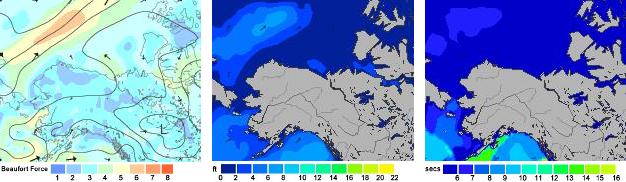
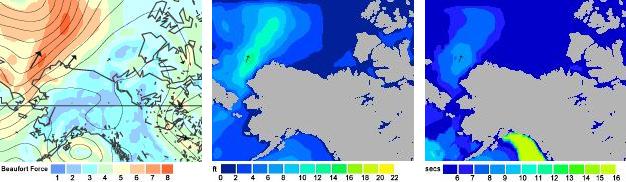
In practice there were several more swells that impacted the Beaufort Sea marginal ice zone over the course of the next couple of weeks. Here’s what the charts looked like, as visualised by MagicSeaweed.com rather than NOAA:

Beaufort Sea on August 27th 2014 - Winds / Wave Height / Wave Period
Beaufort Sea on August 27th 2014 – Winds / Wave Height / Wave Period
Beaufort Sea on September 1st 2014 - Wind / Swell / Period
Beaufort Sea on September 1st 2014 – Winds / Wave Height / Wave Period
Beaufort Sea on September 7th 2014 - Wind / Swell / Period
Beaufort Sea on September 7th 2014 – Winds / Wave Height / Wave Period

Note that on the right of each set of three is a depiction of the period of the waves in question. As StormSurf points out:

Chop tends to have a period ranging from 3-8 seconds. That is, there is anywhere from 3-8 seconds between each wave crest. Wind waves range from 9-12 seconds. Ground swells range from 13-15 seconds, and strong ground swells have a period anywhere from 16-25 or more seconds.

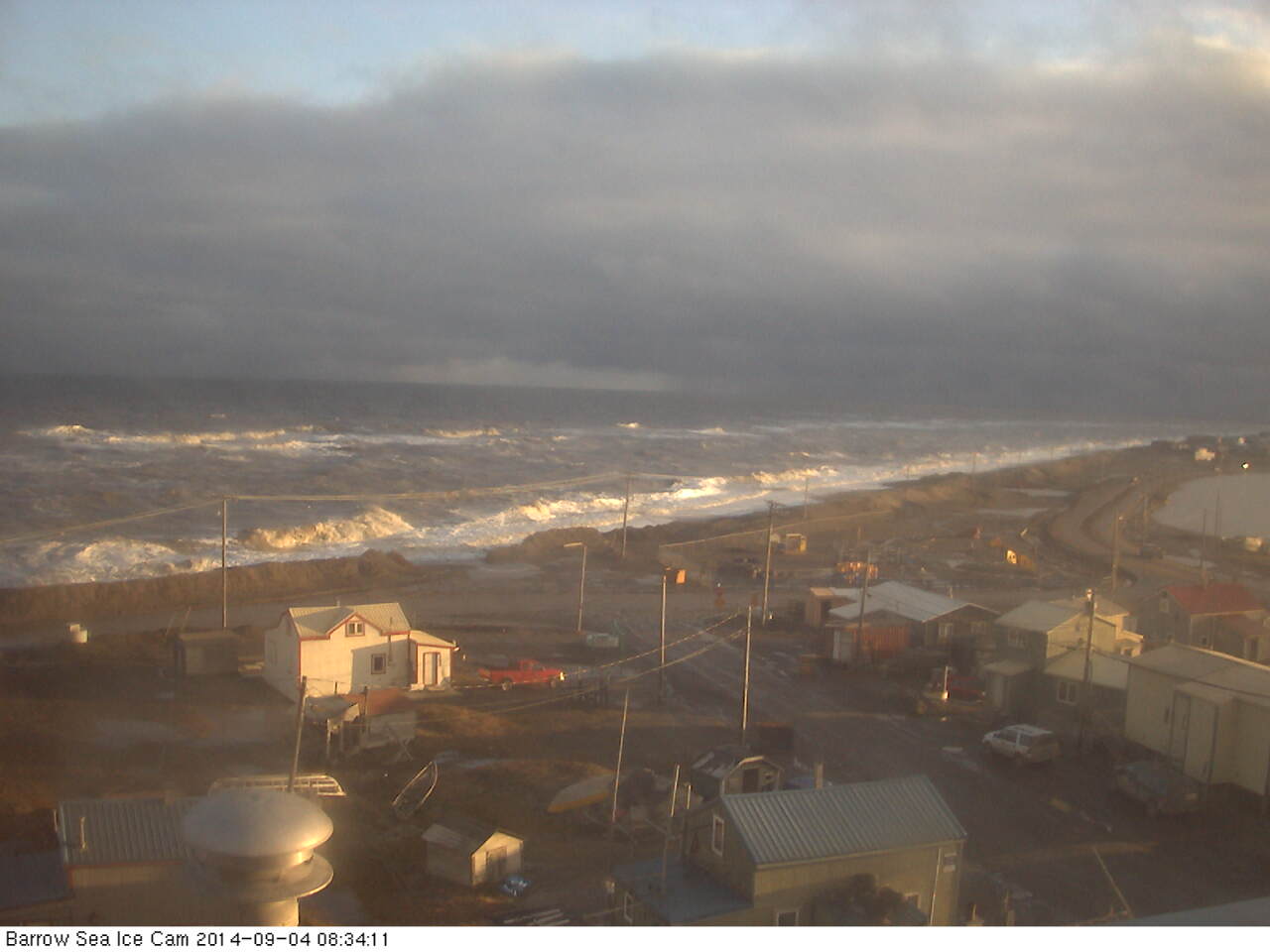
Thus the final swell on September 7th was actually the best of the bunch, with a small area of waves over 10 feet in height and with a period of over 9 seconds. According to StormSurf those are merely “wind waves” and not yet a full blown “swell”. To give you a feel for such waves here’s what some “wind waves” hitting the beach at Barrow looked like on September 4th 2014:

BarrowCam_20140904_0834


Next here’s another video that reveals what effect those series of waves had on the sea ice in the Beaufort Sea:

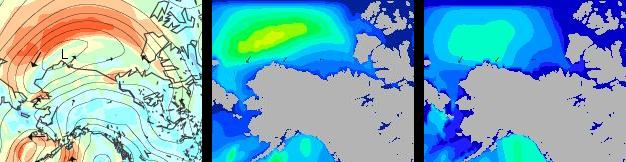
For future reference here also is the same swell described by Thomson and Rogers, but illustrated in an identical “surfer friendly” format to the 2014 swells we’ve been looking at:

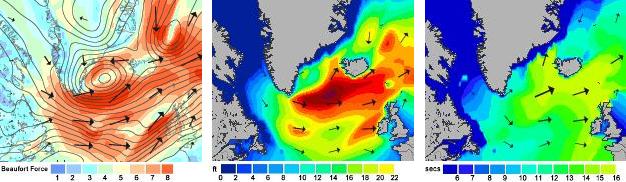
Beaufort Sea on September 18th 2012 - Wind / Swell / Period
Beaufort Sea on September 18th 2012 – Winds / Wave Height / Wave Period

whilst here is the swell produced by the “Great Arctic Cyclone” of early August 2012, also mentioned in passing by Thomson and Rogers:

Beaufort Sea on August 5th 2012 - Winds / Wave Height / Wave Period
Beaufort Sea on August 5th 2012 – Winds / Wave Height / Wave Period

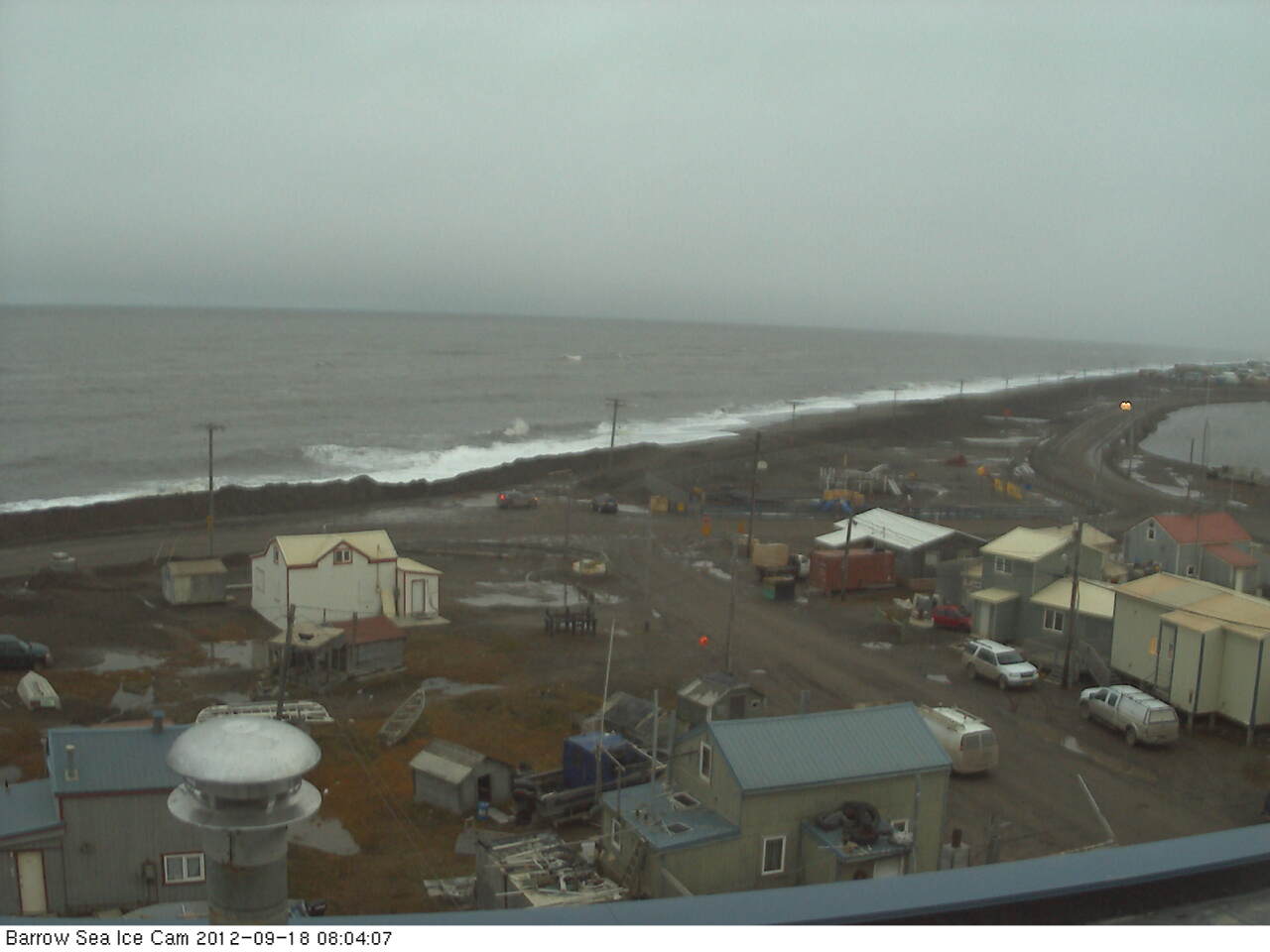
As you can see, if you’re a surfer used to tracking swells across the world’s oceans at least, whilst the September 2012 swell was indeed rather more substantial than those we have looked at in 2014, with a height in excess of 20 feet, the period was too short to qualify as a full blown swell and it was in fact directed away from the ice edge rather than towards it. Here’s what that 2012 swell looked like once it reached Barrow:

BarrowCam_20120918_0804

All of which does rather make one wonder what might happen if a slightly longer period swell directed at the ice edge in the Beaufort Sea were to occur at some point in the not too distant future? Whilst we all wait with bated breath to discover what that future holds for the sea ice in the Arctic, not to mention the beach at Barrow, here’s another video about the 2014 Marginal Ice Zone Program, which summarises the year’s campaign as a whole:

Note that Craig Lee says that:

We had very little wave activity. It was surprisingly calm when we were out there in the Araon, both when we were in the ice and in the open water. There just wasn’t much wind, and so there weren’t very many surface waves.

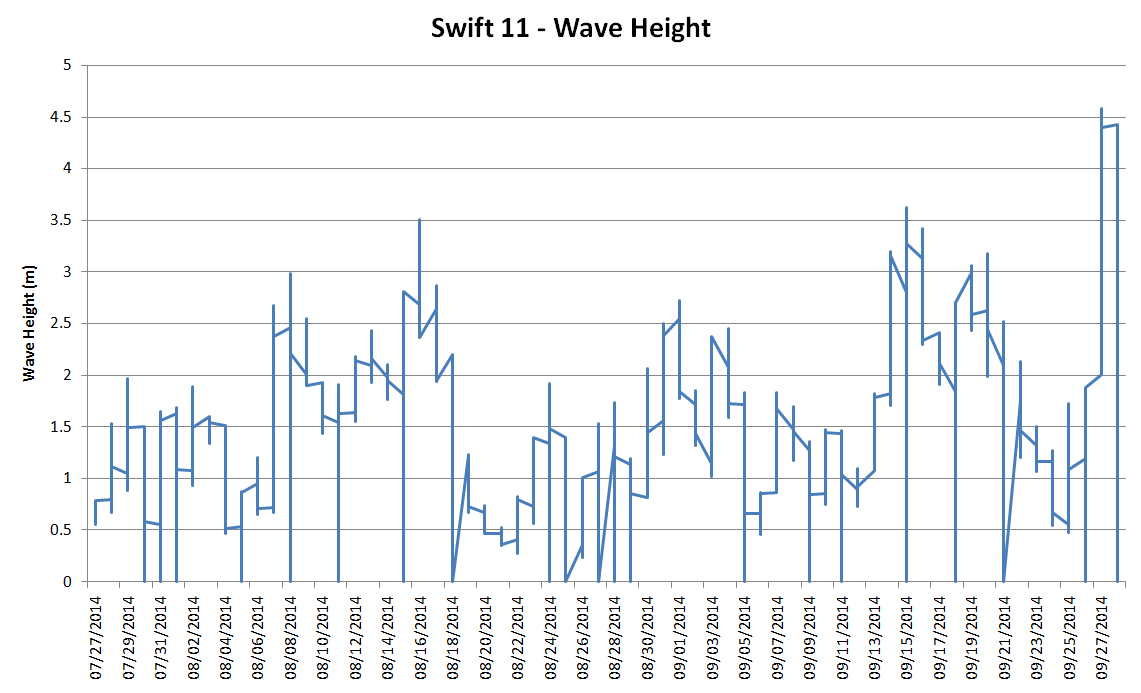
However at least one of the “robots” he refers to did discover some significant wave activity. Here’s a visualisation of SWIFT 11‘s record of significant wave height as it floated across the Beaufort Sea in the summer of 2014:

2014-Swift11-WaveHeight

I don’t know about you, but I don’t think I would describe 4.5 meter waves as “surprisingly calm”, especially in the Arctic!


Arctic Basin Big Wave Surfing Contest Equipment Evaluation 2

A week after our first equipment evaluation expedition for our 2015 Arctic Basin Big Wave Surfing Contest the signs were looking good once again, albeit with a southwesterly wind once again. Here’s how our compact format surf forecast looked for noon on March 7th, courtesy of some copying and pasting from Magic Seaweed’s global surf outlook:

The North Atlantic surf forecast for March 7th 2015. Wind / Waves / Period
The North Atlantic surf forecast for March 7th 2015. Winds / Wave Height / Wave Period

You’ll no doubt note that the swell height out in mid Atlantic was off the top of the truncated scale. That’s because it’s designed for use in the Arctic Basin, where 40 foot waves are very hard to come by! Take a look at the last link below to see what I mean.

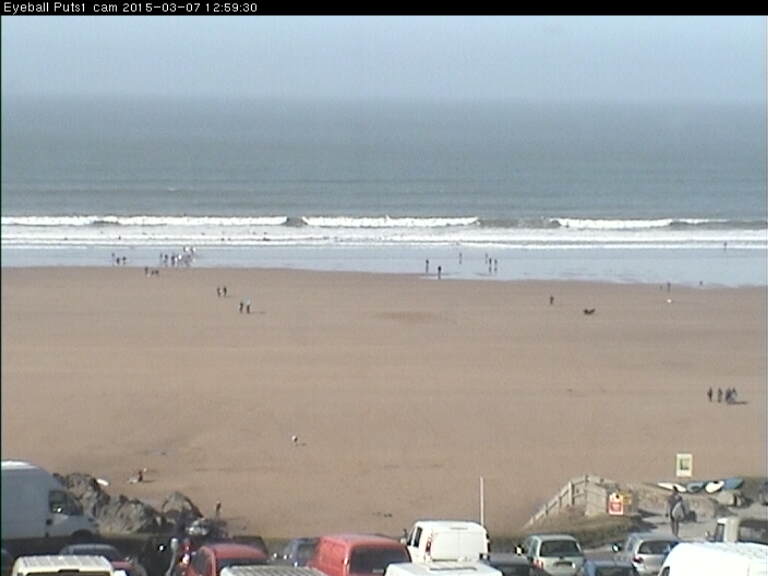
Given the wind the shelter of Putsborough was the order of the day when it came to spot selection. Water temperatures hadn’t changed significantly in a week, but the sun was shining on this occasion, which is undoubtedly preferable to the rain we experienced last time:

Eyeball-puts-20150307-2

Donning the same gear as last time even my fingers didn’t feel cold this time around, although my partner for the day (encased in a standard winter wet suit plus separate hood) described conditions as “f…. cold!” even after warming up thoroughly, as you can see here:

Eat your heart out Anastasia Ashley! After the session considerably more energy was expended by the two of us extracting yours truly from his Tiki Prodigy 6/5/4 suit. After that I started chatting to Simon, who happened to be parked next to us in the car park at Putsborough Sands, as dusk started to descend. Here’s what happened next:

Towards the end of our conversation I explained the rationale behind our Arctic Basin big wave surfing contest, and briefly touched on some of the associated Arctic surf science. For the scientifically inclined amongst you, there’s a much longer explanation available in this companion article!

Sea Ice and Swells in the Beaufort Sea in the Summer of 2014