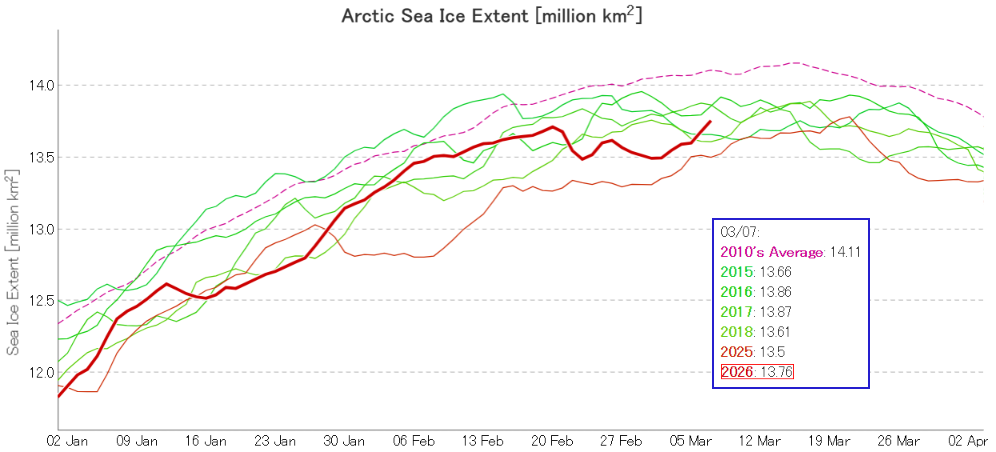
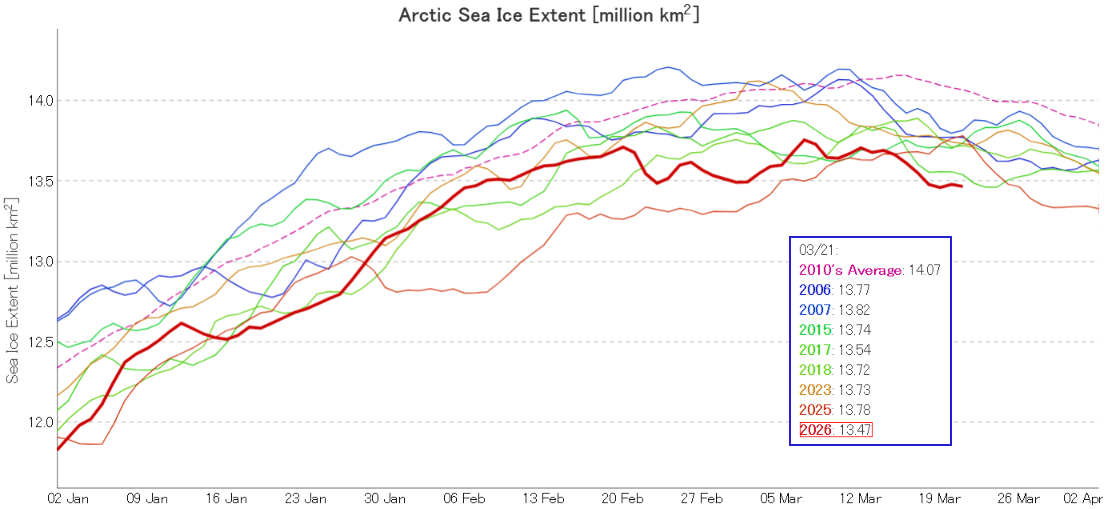
JAXA Arctic sea ice extent has just reached a new high for the year. At 13.76 million km² extent is currently 4th lowest for the date, just below last year’s maximum of 13.78 million km²:
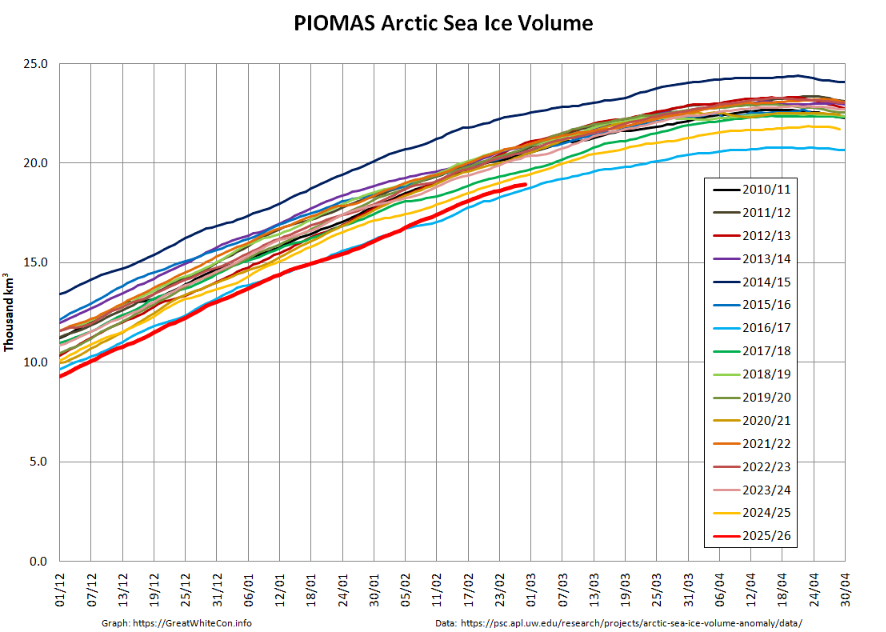
At the end of February PIOMAS Arctic sea ice volume was 2nd lowest for the date at 17.54 km³:
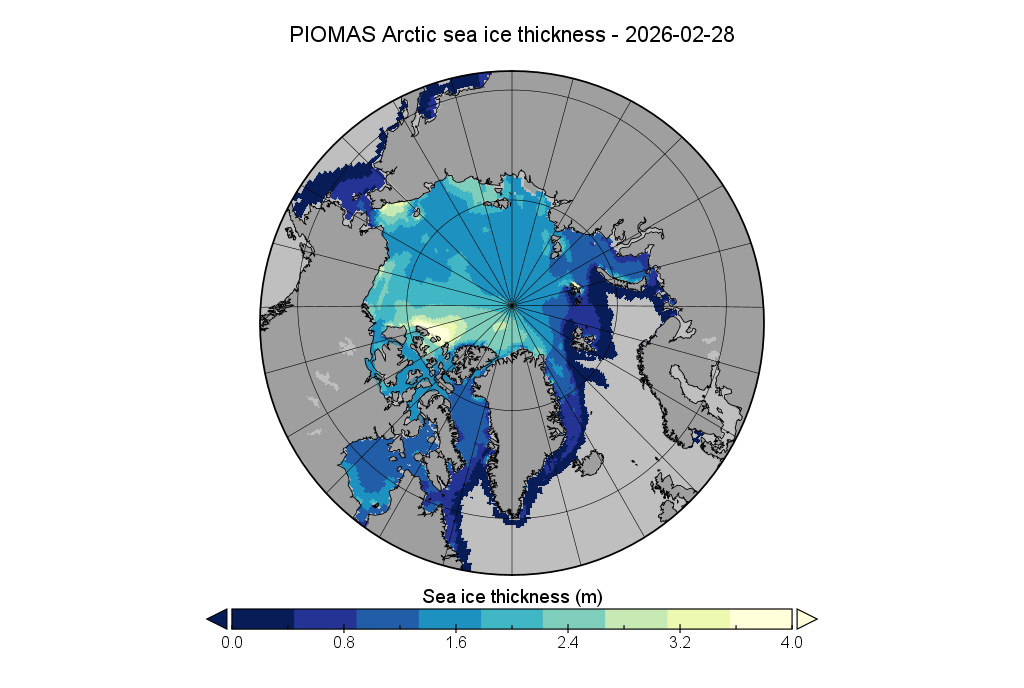
Here is the associated sea ice thickness map:
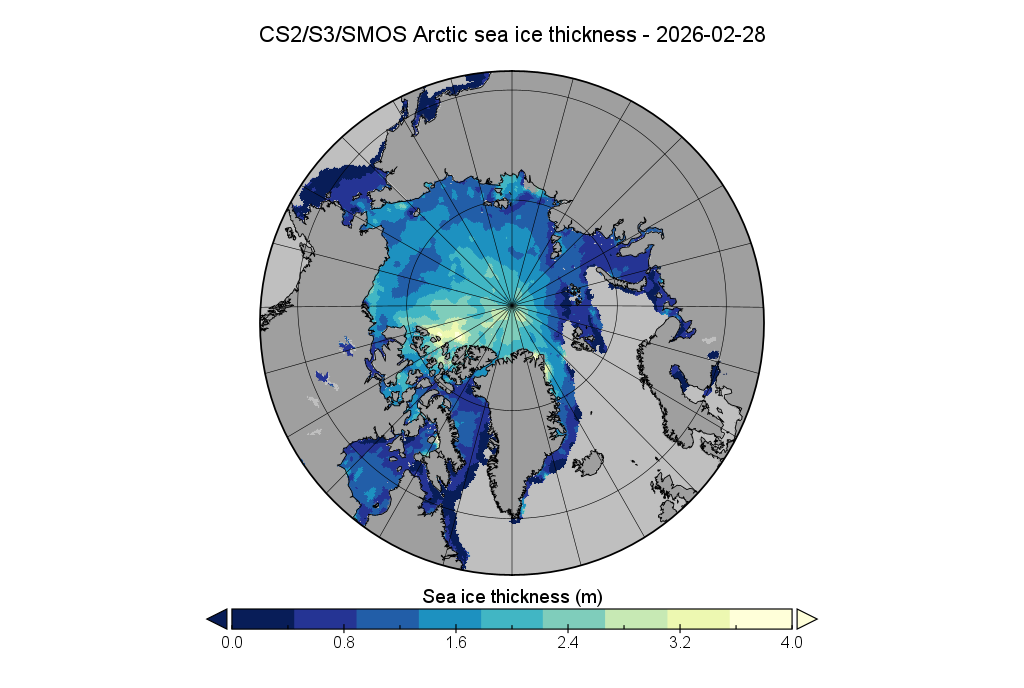
For comparison purposes, here is the Alfred Wegener Institute’s CryoSat-2/Sentinel 3/SMOS Arctic sea ice thickness map at the end of February:
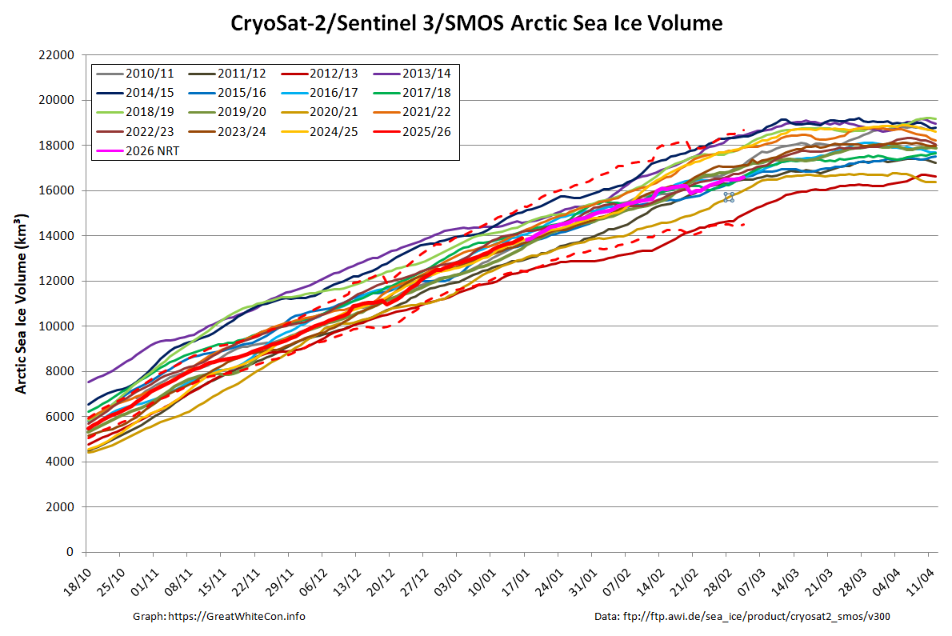
and the associated volume graph:
JAXA extent is currently lowest for the date in their record going back to 1979. It’s highly likely that the metric peaked on March 7th which is a new record low maximum, albeit by a mere 20 thousand km²:
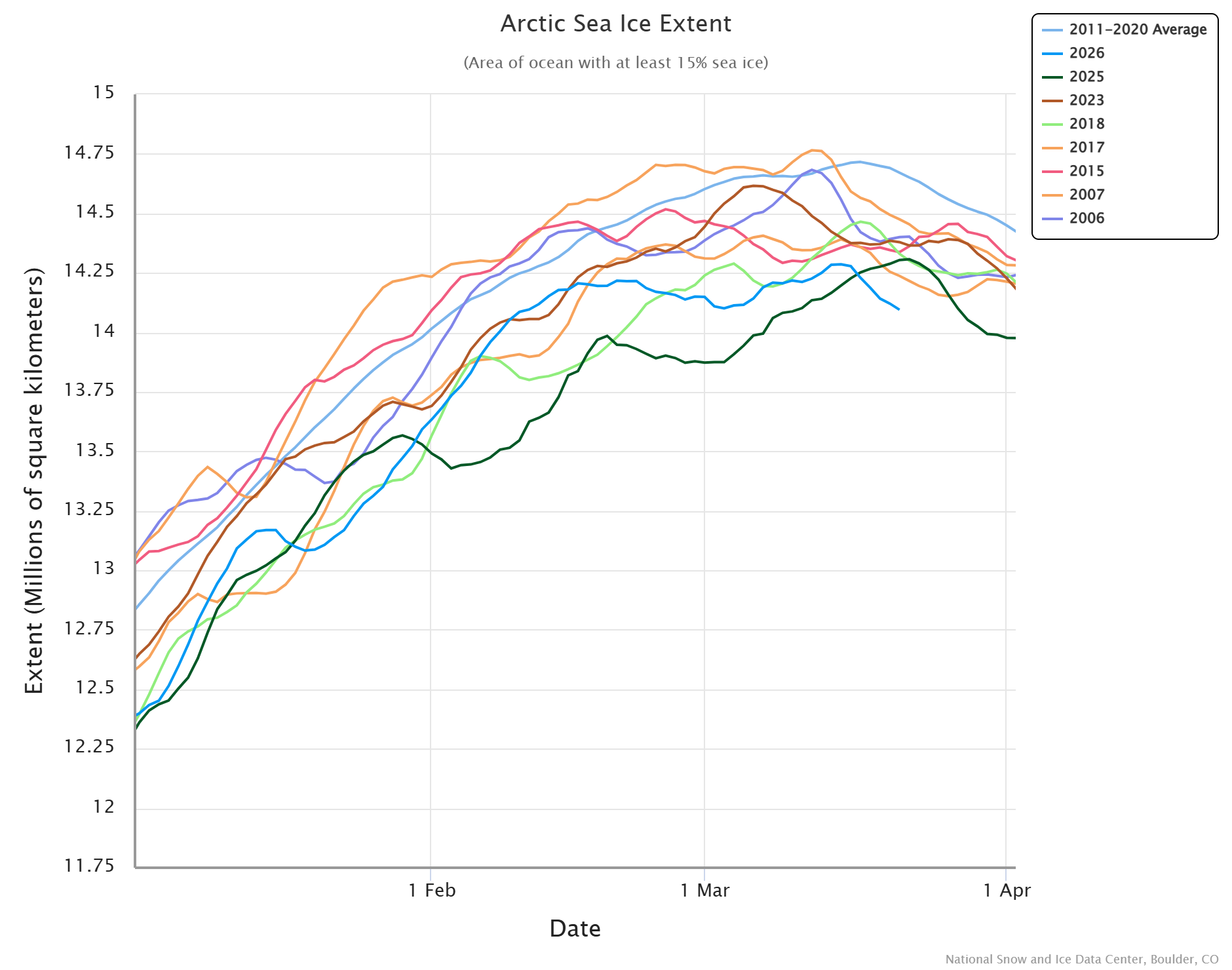
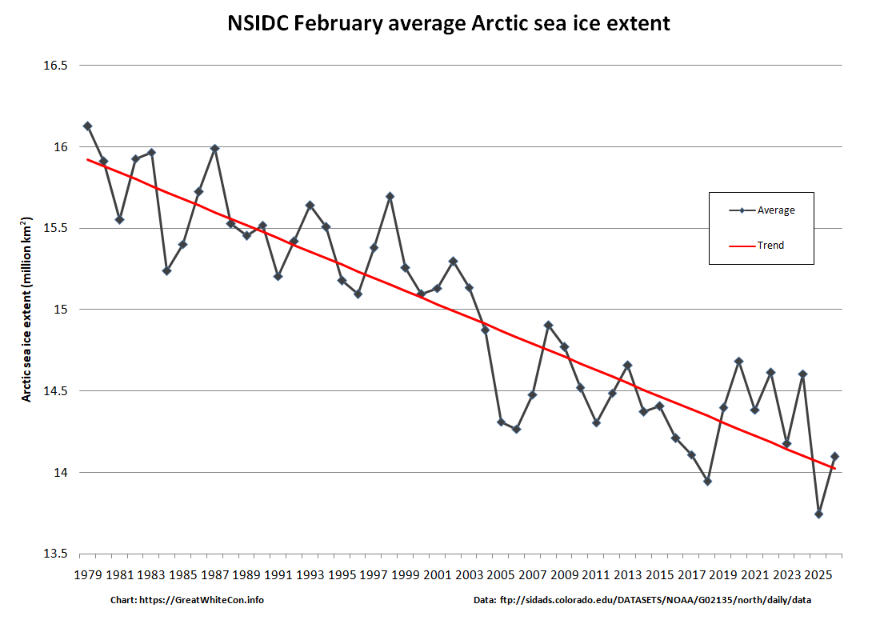
By way of a contrast, the National Snow and Ice Data Center’s 5 day averaged extent maximum of 14.29 million km² was reached on March 15th:
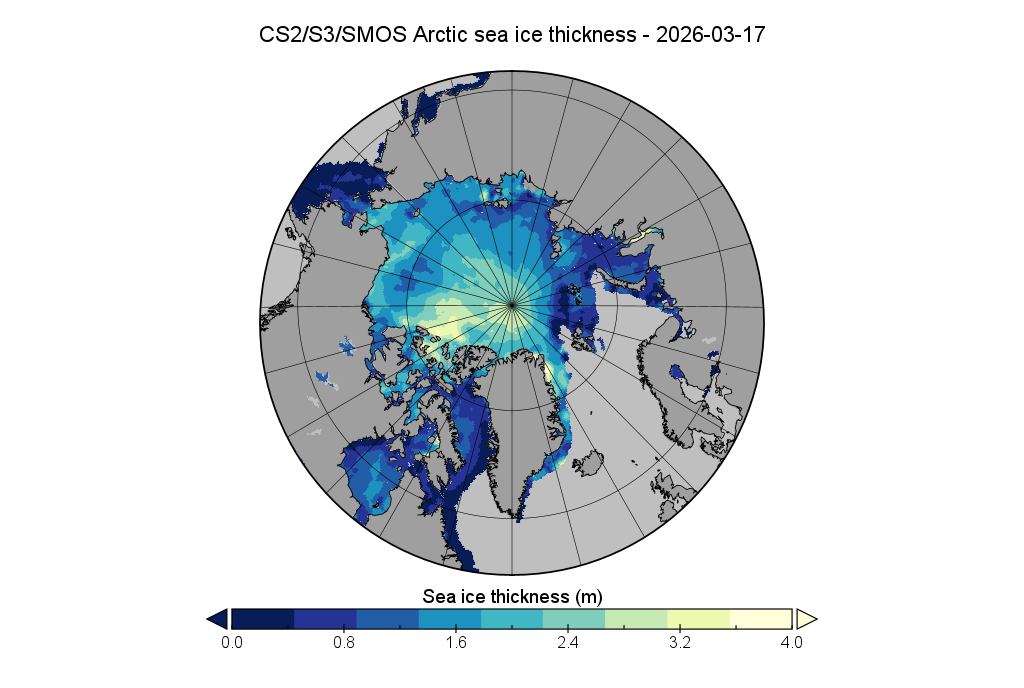
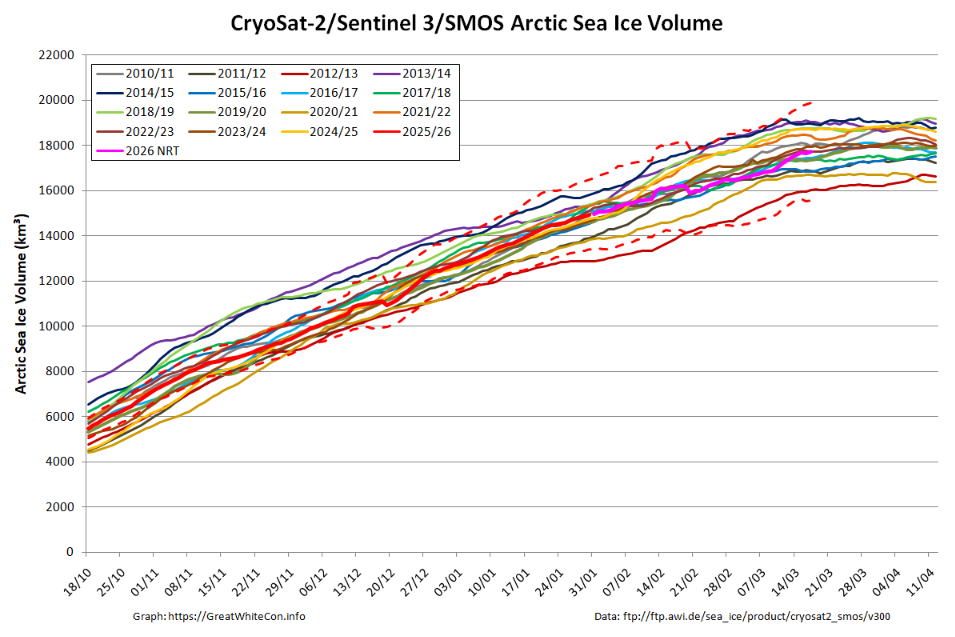
Here is the mid month update on the AWI’s CryoSat-2/Sentinel 3/SMOS Arctic sea ice thickness map:
Here too is the associated sea ice volume graph:
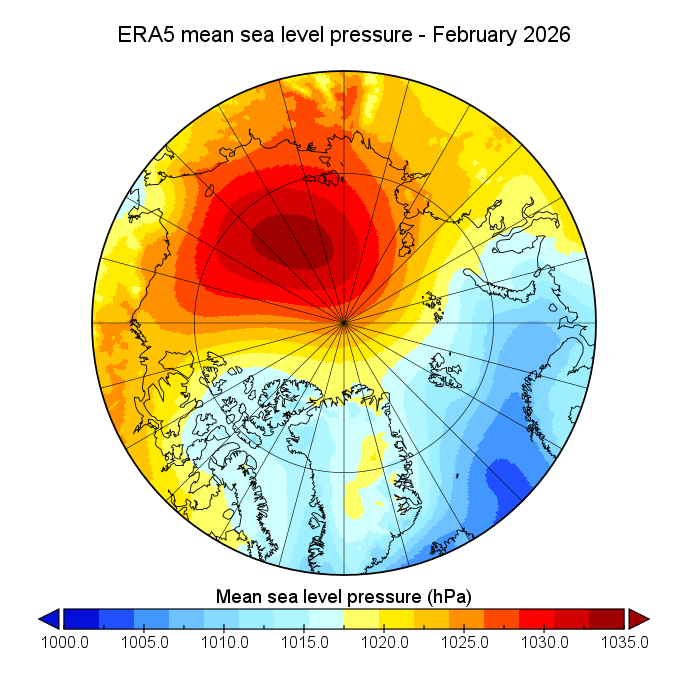
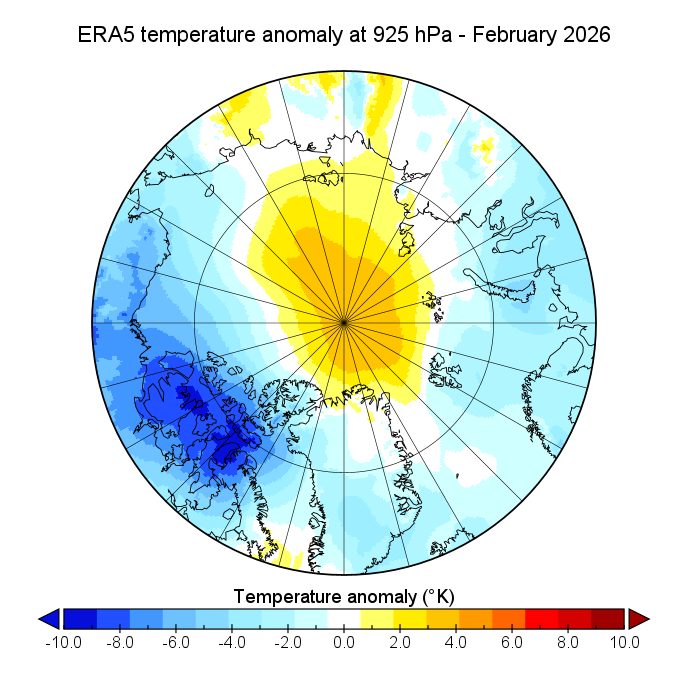
Next here are the ERA5 MSLP and 925 hPa air temperature anomaly maps for February 2026, now in “Greenland down” orientation to match the thickness maps:
together with the NSIDC monthly average extent graph for February:
Watch this space!
Ides of March upcoming, and it already seems clear (fairly) that Arctic extent, per JAXA anyway, will set a new, record low, winter maximum.
That’s the 2nd year in a row, if it comes to pass.
Moreover, the Global (Antarctic + Arctic) sea ice volume, when annualised, is lowest on record (Dec 2025 latest data point). That is to say, we’ve never had less sea ice on the Planet, while keeping records.
JAXA now lowest for the date.
Another drop in extent yesterday, 51.7 k on JAXA.
Starting to very like a new record low maximum at this stage!
So today, another day lowest on satellite record, and let’s not fool ourselves, we are having another lowest winter season ice maximum. It’s 99.99% certain, let’s not entertain the 0.01%-bros at all. Let’s just ignore tem.
We’re clearly on our way to the premier Arctic Blue Ocean even! It may not come the same year as a record low winter sea ice year. But we do know where this steam train is heading. We’ll be left with no ice!
Do you even know what that implies? No? Well, we’ve been trying to tell you. For, like, half a century.
The NSIDC have officially called the maximum extent for 2026:
https://nsidc.org/news-analyses/news-stories/arctic-sea-ice-record-low-maximum-strikes-again
Needless to say the news release includes the usual disclaimer:
Jim, it’s a bit exhausting to see the NSIDC folks drop the ball once again. They’re too busy saying the lowest ever winter sea ice peak ‘tied’ with the second lowest, to notice or inform their readers that a two records in a row situation is something remarkable.
Therefore, they don’t bother to check their archives to look for the Previous time this happened. The last time we had a 2-year streak like this. They had one job.. as the young ones say
Well, maybe just as well. The NSIDC seem to have bungled it royally about a decade ago, where they claimed an even 3-year streak of back to back new low records for the winter maximum.
Then they declared the 2017 “Arctic sea ice maximum at record low for third straight year”, but if you look at the numbers they had 2015 at 14.51, and 2016 at 14.52. So what most normal people call higher than 2015 and not a new record low.
This time period is also when they rather irritatingly seem to adopt the “tie” narrative in their sea ice outliers reports. That’s like saying the Euro or FA Cup ended in a tie, even though one of the teams scored more goals.
Flesh & blood humans are not happy with that sort of fancy talk, and what’s more, the yanks seem to have adopted the “tie” talk in order to cover up getting it wrong with 2016 and the “3 records in a row” headline.
In reality, we need to go back 2 decades to find a similar situation, but I’m sure that’s covered in the annals of this fine site?
We have been bemoaning the deleterious side effects of the Trump administration’s war on climate science for many months. The PIOMAS team have now added yet another entry in the catalogue of missing climate data: