The United States seeks an Arctic region that is peaceful, stable, prosperous, and cooperative. Climate change is making the Arctic more accessible than ever, threatening Arctic communities and vital ecosystems, creating new potential economic opportunities. and intensifying competition to shape the region’s future. Russia has invested significantly in its presence in the Arctic over the last decade, modernizing its military infrastructure and increasing the pace of exercises and training operations. Its aggressive behavior has raised geopolitical tensions in the Arctic, creating new risks of unintended conflict and hindering cooperation. The PRC has also sought to increase its influence in the Arctic by rapidly increased its Arctic investments, pursuing new scientific activities, and using these scientific engagements to conduct dual-use research with intelligence or military applications.
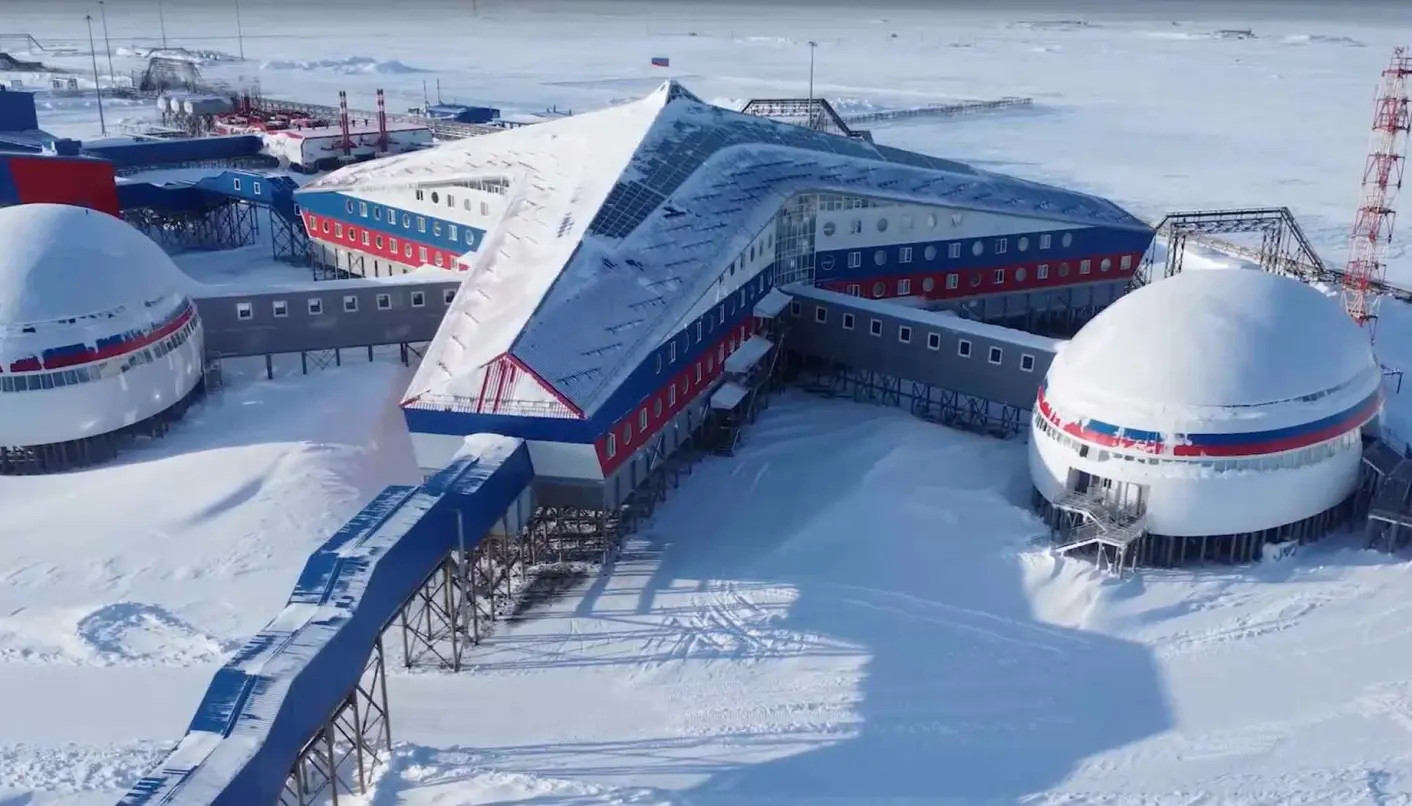
The Nagurskoye military base on on Aleksandra Island in Franz Josef Land. Image via the Barents Observer
We will uphold U.S. security in the region by improving our maritime domain awareness, communications, disaster response capabilities, and icebreaking capacity to prepare for increased international activity in the region. We will exercise U.S. Government presence in the region as required, while reducing risk and preventing unnecessary escalation. Arctic nations have the primary responsibility for addressing regional challenges, and we will deepen our cooperation with our Arctic allies and partners and work with them to sustain the Arctic Council and other Arctic institutions despite the challenges to Arctic cooperation posed by Russia’s war in Ukraine. We will continue to protect freedom of navigation and determine the U.S. extended continental shelf in accordance with international rules. We must build resilience to and mitigate climate change in the region, including through agreements to reduce emissions and more cross-Arctic research collaboration. As economic activity in the Arctic increases, we will invest in infrastructure, improve livelihoods, and encourage responsible private sector investment by the United States, our allies, and our partners, including in critical minerals, and improve investment screening for national security purposes. Across these efforts, we will uphold our commitment to honor Tribal sovereignty and self-governance through regular, meaningful, and robust consultation and collaboration with Alaska Native communities.
By way of contrast the Trump Administration’s document makes no mention of the Arctic or Alaska or even Greenland. It does, however state that:
After years of neglect, the United States will reassert and enforce the Monroe Doctrine to restore American preeminence in the Western Hemisphere, and to protect our homeland and our access to key geographies throughout the region. We will deny non-Hemispheric competitors the ability to position forces or other threatening capabilities, or to own or control strategically vital assets, in our Hemisphere. This “Trump Corollary” to the Monroe Doctrine is a common-sense and potent restoration of American power and priorities, consistent with American security interests.
Specifically regarding Europe the 2025 Security Strategy has this to say:
Continental Europe has been losing share of global GDP—down from 25 percent in 1990 to 14 percent today—partly owing to national and transnational regulations that undermine creativity and industriousness.
But this economic decline is eclipsed by the real and more stark prospect of civilizational erasure. The larger issues facing Europe include activities of the European Union and other transnational bodies that undermine political liberty and sovereignty, migration policies that are transforming the continent and creating strife, censorship of free speech and suppression of political opposition, cratering birthrates, and loss of national identities and self-confidence. Should present trends continue, the continent will be unrecognizable in 20 years or less. As such, it is far from obvious whether certain European countries will have economies and militaries strong enough to remain reliable allies. Many of these nations are currently doubling down on their present path. We want Europe to remain European, to regain its civilizational self-confidence, and to abandon its failed focus on regulatory suffocation.
At this juncture Russia does at last receive a mention:
This lack of self-confidence is most evident in Europe’s relationship with Russia. European allies enjoy a significant hard power advantage over Russia by almost every measure, save nuclear weapons. As a result of Russia’s war in Ukraine, European relations with Russia are now deeply attenuated, and many Europeans regard Russia as an existential threat. Managing European relations with Russia will require significant U.S. diplomatic engagement, both to reestablish conditions of strategic stability across the Eurasian landmass, and to mitigate the risk of conflict between Russia and European states.
There is no mention of any risk of conflict between Russia and the United States, in the Arctic or anywhere else on Planet Earth.
The whole document is worth a long look, but here is a brief extract:
Russia has a larger Arctic military presence and ice-breaking capability than other Arctic states, and has embarked on a substantial rebuilding of Soviet-era military infrastructure in the region. Nevertheless, Russian influence efforts seek to depict US and NATO activity in the Arctic as provocative and destabilizing, in contrast with casting Russia’s military presence as routine and defensive. For example, since 2024, state media has covered NATO “flexing its muscles” with exercises in Finland on “Russia’s Arctic doorstep” and featured Kremlin officials’ promises to protect Russia’s Arctic interests from “NATO’s expansionist ambitions,” while a known proxy site warned of “steps towards the Arctic war.” These narratives have found renewed salience since 2025 amid public calls from US President Trump for Greenland to join the United States.
12 thoughts on “The US National Security Strategy 2025”
According to the BBC:
US President Donald Trump says the US needs to “own” Greenland to prevent Russia and China from doing so:
Meanwhile, according to the US Ambassador to NATO:
As the ice thaws and the routes in the Arctic and the high north open up Greenland becomes a very serious security risk for the mainland of the United States of America:
[Yesterday], Congressman Fine (FL-06) introduced the Greenland Annexation and Statehood Act, landmark legislation focused on securing America’s strategic national security interests in the Arctic and countering the growing threats posed by China and Russia.
As global competition intensifies in the Arctic, the United States cannot afford to allow adversarial powers to gain influence over one of the world’s most strategically important regions.
“Greenland is not a distant outpost we can afford to ignore—it is a vital national security asset,” said Congressman Fine. “Whoever controls Greenland controls key Arctic shipping lanes and the security architecture protecting the United States. America cannot leave that future in the hands of regimes that despise our values and seek to undermine our security.”
According to Congressman Fine’s bill, it will when (if?) enacted:
Authorize the annexation and subsequent admission to statehood of Greenland, and for other purposes…
The President is authorized to take such steps as may be necessary, including by seeking to enter into negotiations with the Kingdom of Denmark, to annex or otherwise acquire Greenland as a territory of the United States.
In response to Rep. Fine’s opening gambit, Democrat Congressman Jimmy Gomez (CA-34) announced today that he had:
Introduced the Greenland Sovereignty Protection Act, legislation that would prohibit federal funds from facilitating the invasion, annexation, or any other form of acquisition of Greenland by the United States.
Rep. Gomez stated that:
Greenland is not for sale, not for conquest, and not a bargaining chip. Threatening to seize territory from an ally undermines basic international law and destabilizes one of the United States and the world’s most important alliances in NATO. This bill draws a clear line: Congress will not fund Donald Trump’s imperial fantasies.
The press release added that:
The Greenland Sovereignty Protection Act would:
Ban federal funding for any activity that supports or facilitates the invasion, annexation, purchase, or acquisition of Greenland by the United States.
Prohibit increases in U.S. military presence or financial investment in Greenland above current levels, absent explicit congressional authorization.
Block any type of U.S.-funded influence or information campaigns intended to sway the political self-determination of the Greenlandic people.
Require any waiver of these prohibitions to be enacted through explicit future legislation that directly references the Act.
The United States already maintains defense cooperation with Greenland and Denmark through longstanding agreements and NATO. The legislation does not intend to alter those commitments but prevents any unilateral effort to seize or acquire Greenland outside existing international frameworks.
Defense Secretary Pete Hegseth said Monday that Elon Musk’s artificial intelligence chatbot Grok will join Google’s generative AI engine in operating inside the Pentagon network, as part of a broader push to feed as much of the military’s data as possible into the developing technology.
“Very soon we will have the world’s leading AI models on every unclassified and classified network throughout our department,” Hegseth said in a speech at Musk’s space flight company, SpaceX, in South Texas.
The announcement comes just days after Grok — which is embedded into X, the social media network owned by Musk — drew global outcry and scrutiny for generating highly sexualized deepfake images of people without their consent.
Donald Trump has threatened to impose further tariffs on a range of European nations, including Denmark and the UK, until the US is allowed to purchase Greenland.
Here’s a Sky News report, including video of the protests in Denmark today:
Here too is the BBC’s “live reporting” on the story:
President Trump has issued an apparently coercive threat to force Western allies to not oppose his proposed annexation of Greenland, or face further damage to their trade with the US.
We’ve had some unusual and unexpected economic threats from President Trump over the past year, but I think we can modestly say that this exceeds all of them, and takes us into the at once surreal and the utterly dangerous.
If taken at face value it is a form of economic war being levied by the White House on closest allies.
That’s because it targets allies at incredibly short notice and for a cause that essentially could break up Nato and the western alliance.
This will be leaving officials in all the allies absolutely baffled.
In fact, it’s so outlandish that they may indeed be more baffled than angry.
Nobody in the world could assume that a threat like this – based on acquiring the land of your ally – would really ever actually happen.
Does Trump really have the backing in the US, in Congress, even in his own administration to do this?
The Speaker of the United States’ Congress, Mike Johnson, has been speaking to members of the United Kingdom’s House of Commons and House of Lords. Here’s a recording of the event:
If you have the stomach for it here is the whole rambling speech of Donald J. Trump at the World Economic Forum in Davos:
Greenland gets several mentions, starting at around 38:00. However the country is referred to as “Iceland” several times by the alleged leader of the free world.
The BBC “fact checks” the times when The Don inadvertently “misspoke”:
Speaking of how perceptions of him had been good in Europe and among Nato allies, Trump said: “Until the last few days, when I told them about Iceland, they loved me.”
It seemed to me that the final standing ovation was far less enthusiastic than the one at the start. Evidently the globalist elite have no sense of humour.
It was a brilliant performance by the world’s greatest ever stand-up (dark) comedian.
Here’s an extract from the BBC’s “live” coverage this morning:
As events resume at the World Economic Forum in Davos this morning, Nato Secretary Mark Rutte has been addressing the “very good talks” he held with Donald Trump on Greenland yesterday.
As a reminder, Trump said the pair agreed the “framework of a future deal” for Greenland when they met yesterday in Switzerland, but little detail has emerged so far about the nature of this agreement.
One element of the talks, Rutte clarifies this morning, asked how Nato allies can help make sure that “the Arctic circle remains safe, [and] that the Russians and the Chinese stay out”.
Another objective of the talks, Rutte continues, is to ensure that Russia and China “will not gain access to Greenland’s economy” militarily – and this will be a discussion “taken forwards”.
In news from the UK:
Foreign Secretary Yvette Cooper shar[ed] further details on the “Arctic sentry” discussed as part of the deal framework, Cooper said this would be a combined operation programme that draws Nato countries together to work on a “shared threat”.
The work could involve “different Arctic countries coming together, supported by other Nato countries”, she said.
Asked why Trump climbed down on previous threats, Cooper said: “I think there’s been a very coordinated approach across allies”.
Cooper was also asked about the UK’s decision to spend billions on the Chagos deal – in recent days Trump criticised the deal, which gives the Chagos Islands to Mauritius while leasing back a key UK-US military base.
Cooper said the deal was about ensuring the UK has strong defence and intelligence cooperation with the US, and that it had a legal basis for continuing this in the future.
This website uses cookies to improve your experience. We'll assume you're ok with this, but you can opt-out if you wish. Cookie settingsACCEPT
Privacy & Cookies Policy
Privacy Overview
This website uses cookies to improve your experience while you navigate through the website. Out of these, the cookies that are categorized as necessary are stored on your browser as they are essential for the working of basic functionalities of the website. We also use third-party cookies that help us analyze and understand how you use this website. These cookies will be stored in your browser only with your consent. You also have the option to opt-out of these cookies. But opting out of some of these cookies may affect your browsing experience.
Necessary cookies are absolutely essential for the website to function properly. This category only includes cookies that ensures basic functionalities and security features of the website. These cookies do not store any personal information.
Any cookies that may not be particularly necessary for the website to function and is used specifically to collect user personal data via analytics, ads, other embedded contents are termed as non-necessary cookies. It is mandatory to procure user consent prior to running these cookies on your website.
According to the BBC:
Meanwhile, according to the US Ambassador to NATO:
According to the House web site of Trump loyalist Rep. Randy Fine:
According to Congressman Fine’s bill, it will when (if?) enacted:
In response to Rep. Fine’s opening gambit, Democrat Congressman Jimmy Gomez (CA-34) announced today that he had:
Rep. Gomez stated that:
The press release added that:
According to a PBS report:
Donald Trump has threatened to impose further tariffs on a range of European nations, including Denmark and the UK, until the US is allowed to purchase Greenland.
Here’s a Sky News report, including video of the protests in Denmark today:
Here too is the BBC’s “live reporting” on the story:
https://www.bbc.co.uk/news/live/c1j8kw866p3t
“Ooh, let the drums mark this day”
The BBC’s Moscow correspondent, Steve Rosenberg, translates the Russian morning papers:
The Speaker of the United States’ Congress, Mike Johnson, has been speaking to members of the United Kingdom’s House of Commons and House of Lords. Here’s a recording of the event:
Speaker Johnson’s remarks start at ~12:30.
Here’s the speech by the Prime Minister of Canada, Mark Carney, at the World Economic Forum meeting in Davos earlier today:
If you have the stomach for it here is the whole rambling speech of Donald J. Trump at the World Economic Forum in Davos:
Greenland gets several mentions, starting at around 38:00. However the country is referred to as “Iceland” several times by the alleged leader of the free world.
The BBC “fact checks” the times when The Don inadvertently “misspoke”:
https://www.bbc.co.uk/news/live/cjrzjqg8dlwt
It seemed to me that the final standing ovation was far less enthusiastic than the one at the start. Evidently the globalist elite have no sense of humour.
It was a brilliant performance by the world’s greatest ever stand-up (dark) comedian.
Here’s an extract from the BBC’s “live” coverage this morning:
In news from the UK:
The Greenland Defence Front has just published another recruitment video:
In response, Trump chickened out in Davos: