Tag Archives: Videos

The World’s Leading Arctic Surfing Expert

I left the “Self styled” bit out of today’s title, which would have otherwise have been too long for comfort! With all due modesty I do in fact have lots of hard evidence to back my claim. By way of example, here’s a copy of a recent conversation over at “Steve Goddard’s” (un)Real Science blog, but with all the expletives and (most of the) ad homs deleted:

Them:
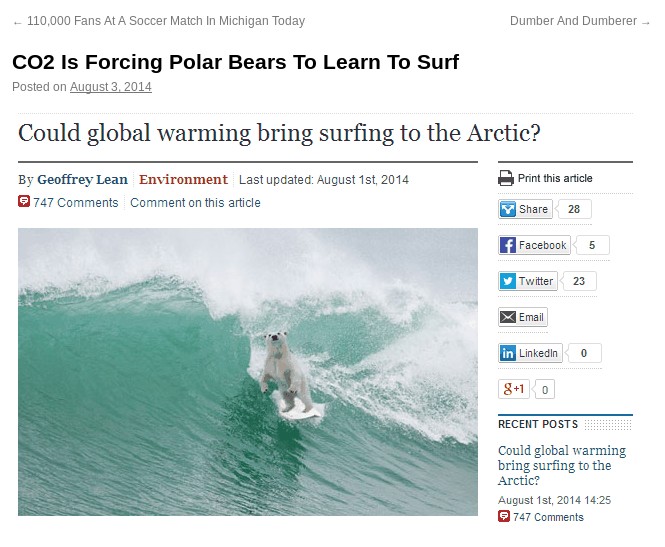
SurfBearCould global warming bring surfing to the Arctic? – Telegraph Blogs

I’m afraid this by now iconic “photoshopped” image of a surfing polar bear culled from Geoffrey Lean’s blog at the Daily Telegraph strikes all Arctic surfing experts,  yours truly included, as nothing more that a piss poor piss take (or PPPT for short)!


Us:

As the current “silver” surfer in residence here, perhaps I should point out that this subject is very dear to my heart. The surfing not the bears!

For a photoshopless video of things to come see Red Bull’s “Surfing in Alaska”:


Them:

Hats off to you guys (and beautiful girl)! I got cold just watching it!


Us:

Hats off to Maya certainly. Far more balls than most men, and (conventionally) beautiful with it.

http://stabmag.com/an-interview-with-maya-gabeira-about-drowning-at-nazare/


Them:

Numpty alert! [Etymology: Numpty first surfaced on the terraces of west of Scotland football grounds, many, many years ago. A player who couldn’t hit a cow’s arse with a shovel would be a f***ing numpty. “Awww Jimmy you f************ing numpty!! You couldnae score wi’ ma’ sister!”]

Three numpties on one thread; is this a record? Could it be due to global warming?


Us:

Cotty tames the waves that almost killed Maya. Paxo interviews him about the experience!

Numpty alert?

Time passes…..

Another surf vid. This one is much more low key. It captures the mellow vibe of a midwinter session somewhere on the North Devon coast:

The Beach – Episode 1 from Jim L. Hunt on Vimeo.

http://econnexus.org – In which Ralph Freeman, bassist for the Universe Inspectors and British big wave surfer extraordinaire, catches a short ride at Putsborough Beach 18 months after suffering a broken neck whilst surfing low tide Croyde.

It’s great to see a local legend apparently back to full fitness after his injuries.

That was the first time I ever saw Ralph Freeman in action on his trademark bright yellow board, but it wasn’t the last!

Finally, for today at least, here’s a video that Tony Heller and his band of merry (mostly) men have not thus far been privy too. The Red Bull record of the day Maya Gabeira drowned and then Carlos Burle brought her back to life:


P.S.

Time passes…..

In conclusion, here’s the conclusion of the University of Washington paper, that for some strange reason neither Tony or Geoffrey mentioned:

“It is possible that the increased wave activity will be the feedback mechanism which drives the Arctic system toward an ice-free summer. This would be a remarkable departure from historical conditions in the Arctic, with potentially wide-ranging implications for the air-water-ice system and the humans attempting to operate there.”


Them:

Translation…

Surfs up!


Us:

Quite so! Some associated technology testing:


Them:

We’ll keep you posted!
Forecasting Sea Ice Extent in the Dark

My title today refers to the fact that the summer Arctic sea ice forecasting season is with us once again. The ARCUS Sea Ice Outlook (SIO for short) started in 2008, with the aim of gathering together and publishing “community predictions of the September sea ice extent”.  The SIO is now part of the recently created Sea Ice Prediction Network, and the deadline for submission for the first set of forecasts of 2014 was June 10th.

I have a professional interest in UK and international energy policy, and as a consequence I have been commenting on the recent attempts of  Professor Richard Tol to debunk the so called “97% climate change consensus” elsewhere in the blogosphere. As luck would have it I allowed myself to become engaged in what was supposedly a conversation about that very topic on the What’s Up With That blog.  Feel free to read all about it if you’d like to see a pseudo-skeptical gish gallop in full swing:


Whilst over there I couldn’t help but notice that Anthony Watts had left things until the eleventh hour before asking his faithful followers to contribute to the Sea Ice Outlook June survey. I also couldn’t help but notice that despite assurances to the contrary a few short weeks ago (and even after my recent “extra heads up“!)  the  WUWT “Sea Ice Reference Page” is still sadly lacking in a wide range of  information about Arctic sea ice thickness and volume. Consequently I figured I would be performing a valuable public service by bringing this to the attention of Anthony and his readers. Here’s what happened after that:

Us:

2014-06-10_1654_WUWT

Them:

June 10, 2014 at 8:55 am

[snip no, we are not going to have you thread-jack again by pushing your own website and own views – Anthony]

Us:

June 10, 2014 at 9:32 am

Re: @Anthony says: June 10, 2014 at 8:55 am
It’s not my “own views” Anthony. In fact it’s a long list of useful facts and figures for anybody attempting to forecast the future of Arctic sea ice. A long list of useful information still noticeable only by its absence from the WUWT sea ice reference page.
 

Them:

REPLY: We aren’t forecasting volume, we are forecasting extent, so again, your views that we should pay attention to volume graphs on your website (your favorite hobby horse) in this extent forecasting exercise are irrelevant. Don’t clutter up this thread further – Anthony.

Them & Us:


Them:

In the absence of a wide range of scientific information concerning the current thickness distribution of sea ice in the Arctic, and after due deliberation about the likely value of the NSIDC Arctic sea ice extent metric in September 2014, Anthony concluded:

A value of 6.12 million sq km will be sent to ARCUS.

Us:

We’ll keep you posted!


Snow White is Actually a “Cowardly Cross Dresser”!

In order to avoid the malicious “spammer” label attached to me by Steven Goddard of “Real Science” fame many moons ago I have been using the nom de guerre “Snow White” in skeptical circles for a while. Unfortunately my pseudonimity didn’t stand a chance against the laser sharp investigative skills of Anthony Watts. My embarrassment is now archived in the public record, plain for all to see:

An extract from the "WUWT near the center of the climate blogosphere"
An extract from the “WUWT near the center of the climate blogosphere” thread on the “Watts Up With That” blog on April 9, 2014 at 2:01 pm

A commenter at “Watts Up With That” then piled on the scorn:

"Snow White"  is revealed as a "Cowardly Cross dresser", for all the world to see.
“Snow White” is revealed as a “Cowardly cross dresser”, for all the world to see.

The thing is though, that in the process of so skilfully “outing” Snow White Anthony kindly pointed his loyal readers in the direction of our humble “Resources” section and our videos, so I suppose we’ll have to tart them all up a bit now!


Russia’s Northern Shores

Regular readers will have realised by now that we’ve been pestering the Mail and The Telegraph with telephone calls and emails for weeks now. That’s because, as The Economist put it last weekend:

There are climate facts—and facts are stubborn things.

Both The Mail and The Telegraph have now corrected a couple of the gross inaccuracies they printed (virtually and/or physically) on September 8th, but many more remain. One of those is the identical phrase in both articles saying:

An unbroken ice sheet more than half the size of Europe already stretches from the Canadian islands to Russia’s northern shores.

The fact of the matter is that this statement is untrue. I’ve recently received a couple of letters about this from “The Daily Telegraph” signed by “Robert Winnett, Head of News”. Here’s an extract from the first one:

Them:

Reputable evidence exists to show an unbroken ice sheet more than half the size of Europe already stretches from the Canadian islands to Russia’s northern shore.  This can be seen on the National Snow and Ice Data Center’s website [in the article] “A Real Hole Near the North Pole“.  The site states that the average ice extent for August 2013 was 6.09 million square kilometres, which is more than half the size of Europe.

Us:

Have I got news for you Robert!  If you’d read any of the articles on here, or watched any of the videos I linked to in my emails, that wasn’t the “fact” I was quibbling about. The fact is that the Arctic “ice sheet” was not “unbroken” and did not “stretch… to Russia’s northern shore” on September 8th 2013 and for considerable periods of time both before and after that date. Here’s an extract from The Telegraph’s second letter:

Them:

In reply to your enquiry, the Telegraph’s policy is to correct clear inaccuracies once we are alerted to them – and in appropriate cases update articles on our website.

Us:

I thought I’d already made this perfectly plain, but evidently not, so here’s yet another alert about clear inaccuracies in the “reporting” of climate science in The Telegraph:

The “Polar Polynya” Reappears!

Whatever David Rose may say in the Mail on Sunday, satellite images from high above the Arctic make it abundantly clear that there is in fact no “unbroken ice sheet [that] already stretches from the Canadian islands to Russia’s northern shores.”

Should further confirmation of that fact be needed, here’s our latest video analysis of the Arctic “refreeze” thus far:

The Great White Con – Update 1 from Jim L. Hunt on Vimeo.

As our video update points out, if you look carefully at the Arctic sea ice concentration maps derived from AMSR2 data, the large “Polar Polynya” visible is the region of the North Pole earlier this month seemed to be shrinking to nothing following the (provisional) NSIDC 2013 extent minimum on September 13th. However it now seems to have been given a new lease of life, as has the nearby “Barents Bite” of open water north of 85 degrees latitude.

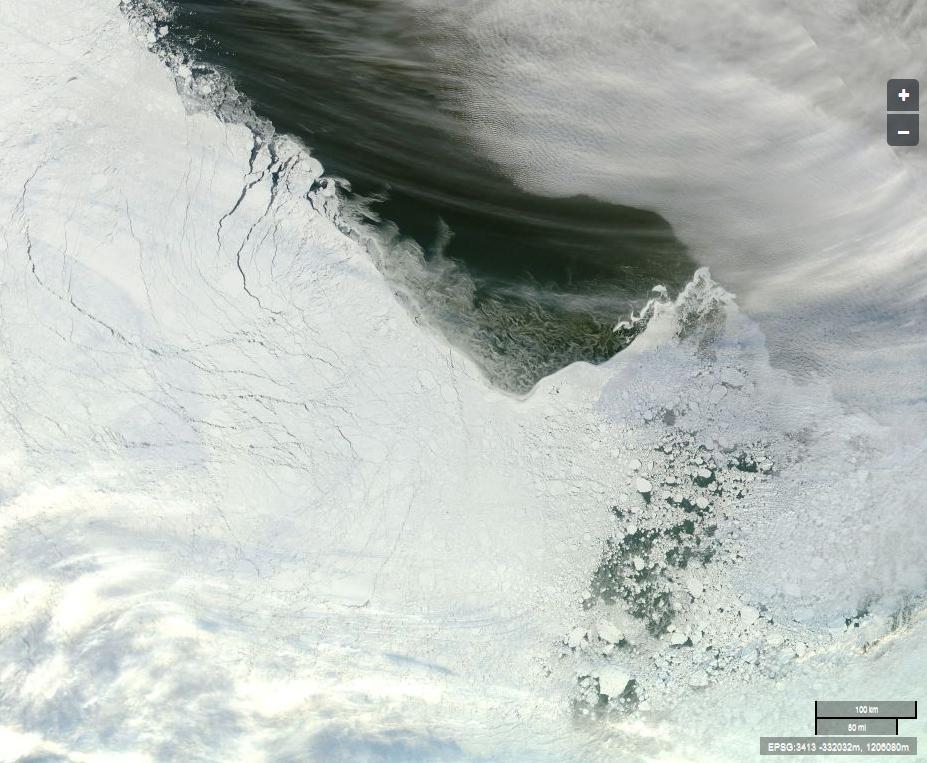
That area of the Arctic is currently obscured by cloud, but here’s an image captured by the Aqua satellite earlier today of the “broken ice sheet” off “Russia’s northern shores”:

The Arctic sea ice edge off "Russia’s northern shores" from the Aqua satellite
The Arctic sea ice edge off “Russia’s northern shores” (Click for larger version)

Image courtesy of NASA Worldview from from the Aqua satellite.

Can you by any chance spot any cracks and/or holes in the supposedly “unbroken ice sheet”? Can you spot “Russia’s northern shores” for that matter?

In conclusion, for the moment at least, please note that we are now collecting all these periodical updates together in one handy location.

An Unbroken Ice Sheet?

David Rose has now had another article published in the Mail on Sunday. The new one refers back to his previous words of wisdom about the Arctic, imparting this piece of information:

The Mail on Sunday’s report last week that Arctic ice has had a massive rebound this year from its 2012 record low was followed up around the world – and recorded 174,200 Facebook ‘shares’, by some distance a record for an article on the MailOnline website.

That’s a lot of people repeating a load of old nonsense! Here at GreatWhiteCon.info we also have a Facebook presence, so if you would like to share our alternative interpretation of what’s really going on in the Arctic please take a good look at:

https://www.facebook.com/GreatWhiteCon

and share that information with your friends, as long as it makes more sense to you than David Rose’s record breaking article.  Meanwhile here in at Great Ivory Towers we’ve still only progressed as far as the third sentence in David’s article the weekend before last, which reads as follows:

Them:

Days before the annual autumn re-freeze is due to begin, an unbroken ice sheet more than half the size of Europe already stretches from the Canadian islands to Russia’s northern shores.

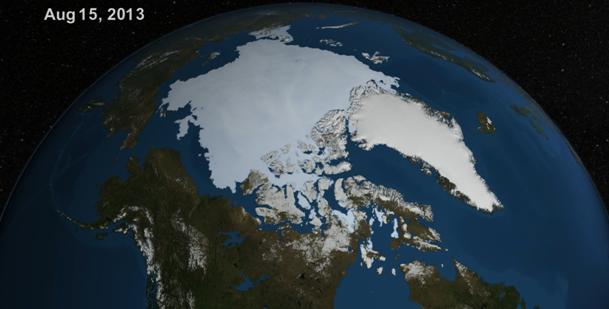
As you’ll discover below we’ve been experimenting with YouTube recently, where we stumbled upon a NASA video which led us to a page on NASA’s Goddard Space Flight Center web site where you can download a high resolution version of the same video. We did that, and then much like the Mail, we took a screenshot from the video to reveal an image remarkably like the one they published just over a week ago. Here it is:

NASA visualization of the Arctic on August 15th 2013

Us:

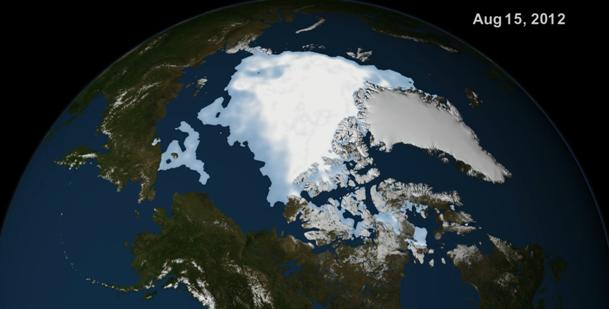
We also found that NASA’s Scientific Visualization Center had another similar video available for download, covering the period from August 1st to September 13th 2012. Here’s a screenshot we took from that video, for August 15th 2012:

NASA visualization of the Arctic on August 15th 2012

For some reason a similar image cannot however be found in David Rose’s Mail on Sunday article of September 8th 2013. Instead that contains an image labelled “August 27th 2012”. Whilst you ponder why the Mail was avoiding comparing like with like visually 9 days ago, here’s a little animation we’ve put together using alternative visualizations of Arctic sea ice, this time of ice concentration and generated by the University of Bremen. It shows how the sea ice cover has been changing from August 15th through to September 13th 2013, which may ultimately prove to be day of  the minimum extent  in 2013, using the NSIDC’s methodology at least. Note that it lingers for a while on August 27th, and we hope you like the sound track!

Verdict:

For reasons known only to themselves the Mail certainly weren’t comparing like with like  visually on September 8th 2013. They evidently weren’t comparing like with like numerically either, since however hard we try comparing numbers from “the same time last year” we can’t come up with the Mail’s magic “60% increase”. Comparing NSIDC extent for  August 15th 2013 with August 27th 2012 did however lead us to perform this bit of elementary arithmetic:

6.16 / 3.94 = 1.56 – A 56% increase.

However hard we try we still can’t get close to the Mail’s “nearly a million more square miles of ocean covered with ice than at the same time last year – an increase of 60 per cent”.  We also challenge all and sundry to watch our video and then loudly proclaim, with a straight face, that “an unbroken ice sheet more than half the size of Europe already stretches from the Canadian islands to Russia’s northern shores”.

60 Per Cent of Nothing?

Our title today is an allusion to Bill Bruford’s “Five Percent For Nothing”, from the 1971 album “Fragile” by Yes. Here’s what the cover looks like:

Fragile cover art, by Roger Dean (image Wikipedia)

Them:

A chilly Arctic summer has left nearly a million more square miles of ocean covered with ice than at the same time last year – an increase of 60 per cent.

Us:

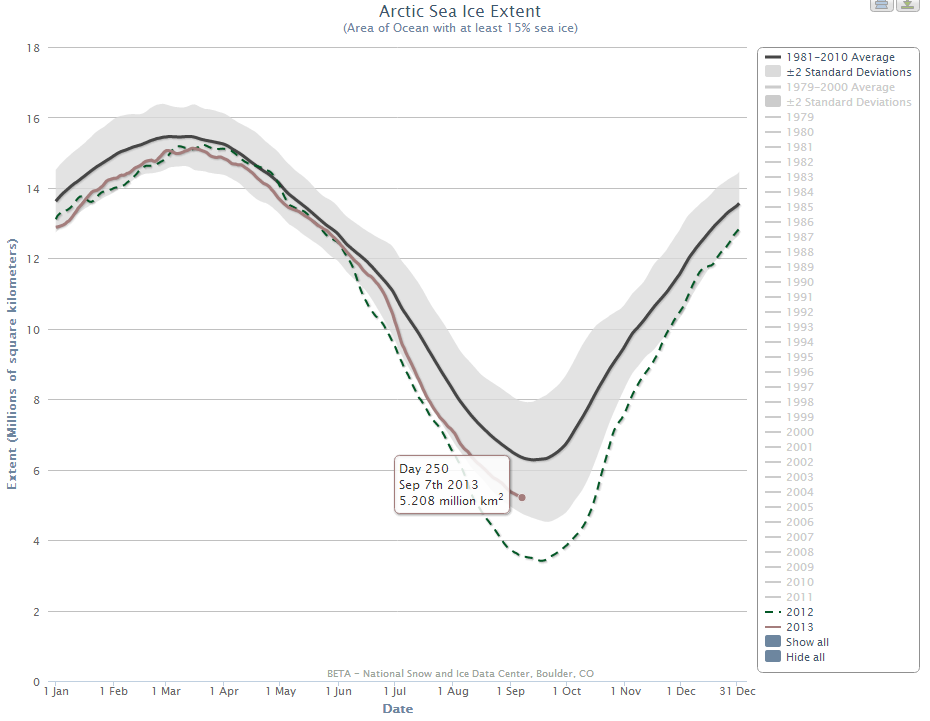
According to the NSIDC once again the numbers look like this:

NSIDC daily Arctic sea ice extent chart, highlighting September 7th 2013

The sums are obviously rather tricky, so we’ve enlisted the aid of a spreadsheet. Here’s what it reveals to us:

Metric Date 2012 2013 Increase
NSIDC Daily Extent (million km²) Day 249 3.558 5.236 47.2%
NSIDC Daily Extent (million km²) Sep 8th 3.523 5.179 47.0%
NSIDC Daily Extent (million km²) Aug 27th 3.94 5.632 42.9%
NSIDC Daily Extent (million km²) Aug 15th 4.845 6.159 27.1%
NSIDC Monthly Extent (million km²) August 4.71 6.09 29.3%

Verdict:

Whichever way you look at things, on a “same time last year” basis at least, the magic number of 60% seems to be out of reach. Whatever the arithmetic David Rose actually performed, whether mentally or on his pocket calculator, it would appear not to involve comparing like with like. We have asked David and the Mail on a number of occasions what numbers he started from and what calculations he performed. We have received no answers as yet.

Getting back to our title, when you start to look at Arctic sea ice volume instead of extent, 160% of almost nothing is still almost nothing:

Video courtesy of Andy Lee Robinson

Small print: We have yet to double check all the numbers in our simple spreadsheet. The NSIDC web site is still down today.