Tag Archives: Climate Change

Does Toby Young Have “Close Affiliations to the Fossil Fuel Industry”?

According to The Spectator magazine “Toby Young is associate editor of The Spectator”

According to Toby’s article in tomorrow’s edition of The Spectator:

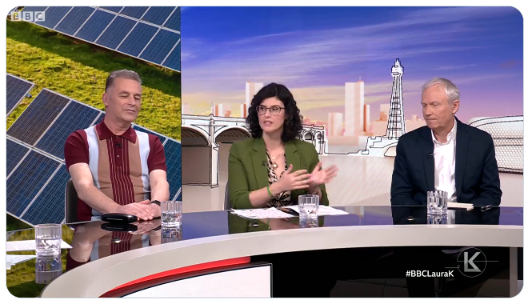
On Sunday, the BBC did something unusual. It invited Luke Johnson, a climate contrarian, to join a panel with Laura Kuenssberg to discuss net zero. As followers of this debate will know, the BBC’s editorial policy unit issued guidance to staff in 2018 saying: ‘As climate change is accepted as happening, you do not need a “denier” to balance the debate.’ Although it did allow for exceptions to this rule: ‘There are occasions where contrarians and sceptics should be included within climate change and sustainability debates.’ Presumably this was one such occasion.

Here’s a picture of the “panel” he refers to:
Toby continues:

The other two people on the panel – Chris Packham and Layla Moran – are members of the climate emergency camp, so there was no pretence of ‘balance’. At one point, the exchange between Johnson and Packham became heated and when the latter invoked the recent downpour in Dubai as well as extensive wildfires in the ‘global south’, as evidence of the effect of anthropogenic global warming, Johnson challenged him to come up with evidence that extreme weather was caused by carbon emissions.

‘It doesn’t come from Toby Young’s Daily Septic [sic], which is basically put together by a bunch of professionals with close affiliations to the fossil fuel industry,’ replied Packham. ‘It comes from something called science.’

According to Mr. Young on X (formerly Twitter) yesterday:

Continue reading Does Toby Young Have “Close Affiliations to the Fossil Fuel Industry”?

The Primacy of Doubt

Recently Judith Curry published a series of articles on the topic of blackouts. Since attempting to prevent such things is my “professional” speciality I’ve spent a bit of time over at “Climate Etc.” recently. Hence I couldn’t help but notice Judith’s article on Tim Palmer‘s new book, entitled “The Primacy of Doubt”. According to Judith:

This book is a physics-intellectual feast.  Must read.

Hence I immediately rushed online and bought a copy from amazon.co.uk, which arrived today. A more detailed overview will follow once I’ve had a chance to read the whole book, but leafing through it this evening I couldn’t help but notice this quotation from Richard Feynman at the very start:

Our freedom to doubt was born of a struggle against authority in the early days of science. It was a very deep and strong struggle. Permit us to question — to doubt, that’s all — not to be sure.

My gaze also alighted on the final paragraph of chapter 10 – “Decisions! Decisions!”:

Just as with weather prediction, a cost-loss analysis can help you make a decision about whether to take anticipatory action regarding climate change…

Based on the way we value our own existence in other areas of life, there does indeed seem to be a strong argument that we should act now, uncertainties about future climate change notwithstanding.

But this is ultimately a decision which each of us must make, e.g. in deciding which politicians to vote for.

Of course being a citizen of the once Great British banana republic I don’t get to vote on our next Prime Minister!

I think I’ll go and pass this news on to Judith and her denizens forthwith. Meanwhile here’s a quotation from the back cover. According to Suki Manabe, winner of the 2021 Nobel Prize in Physics:

The Primacy of Doubt is an important book by one of the pioneers of dynamical weather prediction, indispensable for daily life, describing how the approach can be used for prediction in other areas, such as climate, health, economy, and conflict.

[Edit – October 22nd]

I’m still rather busy trying to help keep the UK’s lights on, so I have yet to even begin reading “The Primacy of Doubt” from cover to cover. However here is another brief extract, from the chapter on “Climate Change”:

We understand these [water vapour, albedo] feedback processes reasonably well. However, there is another feedback process associated with water that we understand rather poorly. This is the cloud feedback process.

[Edit – October 25th]

Here’s another extract from chapter 6 (page 115):

The question of whether clouds act as a positive or negative feedback on climate change can’t at present be answered unambiguously: indeed, I would say it is the biggest unsolved problem in physical climate-change science.

Watch this space!